Nucleic Acid Quantification
DNA / RNA Quantification
Bio-Resource
www.technologyinscience.blogspot.com
Why to quantify Nucleic acids?
• Nucleic acids are quantified to check the concentration and
purity of DNA/RNA present in the solution mixture.
• It is important to know the concentration and purity of the
nucleic acid for the use in further applications like PCR,
restriction digestion etc.
www.technologyinscience.blogspot.com
Nucleic acid Quantification
Methods
• Spectrophotometric Mehtod
• Agarose gel electrophoresis
www.technologyinscience.blogspot.com
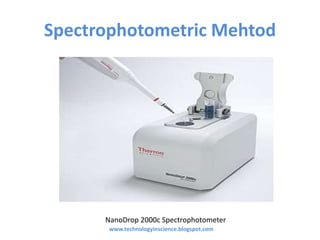
Spectrophotometric Mehtod
NanoDrop 2000c Spectrophotometer
www.technologyinscience.blogspot.com
Advantages of using Nano Drop
• Can quantify nucleic acid from micro volumes of 0.5µL –
2.0µL.
• Measures DNA, RNA (A260) and Protein (A280)
concentrations and sample purity (260/280 ratio).
• Large concentration range (2 ng/µL – 15,000 ng/µL dsDNA)
without dilutions.
www.technologyinscience.blogspot.com
Purity and Quantification – Nano
Drop
• Pure DNA sample gives a 260/280 ratio ~ 1.8.
• For pure RNA 260/280 ratio is ~ 2.
• A 260/230 Indicates possible contaminats.
www.technologyinscience.blogspot.com
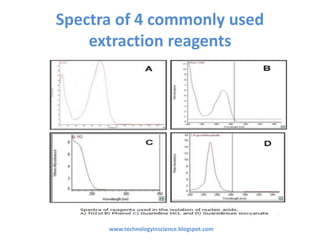
Spectra of 4 commonly used
extraction reagents
www.technologyinscience.blogspot.com
Checking contaminants in Extracted
sample
• A low 260/230 ratio indicates the contaminants absorbing at
230nm or less.
• A low 260/280 ratio indicates the contaminants absorbing at
280nm or less.
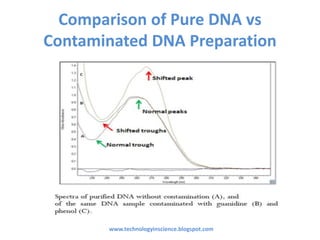
• A shift in the wavelength trough is indicative of contaminants
absorbing at low wavelengths.
• The wavelength of the sample peak should be at 260nm if
contaminants are present the peak may shift.
www.technologyinscience.blogspot.com
Comparison of Pure DNA vs
Contaminated DNA Preparation
www.technologyinscience.blogspot.com
Agarose Gel Electrophoresis
• It is a separation method used to separate nucleic acids based
on their size under the influence of electric current.
www.technologyinscience.blogspot.com
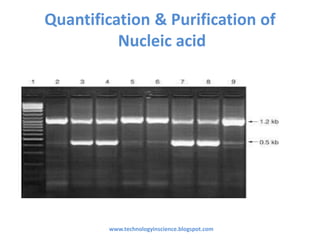
Quantification & Purification of
Nucleic acid
www.technologyinscience.blogspot.com
Quantification and Purification
Nucleic Acids
• Contaminating DNA/RNA fragments can be removed using
this method.
• After running the sample on gel the band of interest can be
spliced out and gel extraction can be done to purify it.
www.technologyinscience.blogspot.com
Thank You
Bio-Resource
http://technologyinscience.blogspot.in/20
12/05/nucleic-acid-quantification-
dnarna.html
www.technologyinscience.blogspot.com

Nucleic Acid Quantification Methods - DNA / RNA Quantification

  • 1.
    Nucleic Acid Quantification DNA/ RNA Quantification Bio-Resource www.technologyinscience.blogspot.com
  • 2.
    Why to quantifyNucleic acids? • Nucleic acids are quantified to check the concentration and purity of DNA/RNA present in the solution mixture. • It is important to know the concentration and purity of the nucleic acid for the use in further applications like PCR, restriction digestion etc. www.technologyinscience.blogspot.com
  • 3.
    Nucleic acid Quantification Methods •Spectrophotometric Mehtod • Agarose gel electrophoresis www.technologyinscience.blogspot.com
  • 4.
    Spectrophotometric Mehtod NanoDrop 2000cSpectrophotometer www.technologyinscience.blogspot.com
  • 5.
    Advantages of usingNano Drop • Can quantify nucleic acid from micro volumes of 0.5µL – 2.0µL. • Measures DNA, RNA (A260) and Protein (A280) concentrations and sample purity (260/280 ratio). • Large concentration range (2 ng/µL – 15,000 ng/µL dsDNA) without dilutions. www.technologyinscience.blogspot.com
  • 6.
    Purity and Quantification– Nano Drop • Pure DNA sample gives a 260/280 ratio ~ 1.8. • For pure RNA 260/280 ratio is ~ 2. • A 260/230 Indicates possible contaminats. www.technologyinscience.blogspot.com
  • 7.
    Spectra of 4commonly used extraction reagents www.technologyinscience.blogspot.com
  • 8.
    Checking contaminants inExtracted sample • A low 260/230 ratio indicates the contaminants absorbing at 230nm or less. • A low 260/280 ratio indicates the contaminants absorbing at 280nm or less. • A shift in the wavelength trough is indicative of contaminants absorbing at low wavelengths. • The wavelength of the sample peak should be at 260nm if contaminants are present the peak may shift. www.technologyinscience.blogspot.com
  • 9.
    Comparison of PureDNA vs Contaminated DNA Preparation www.technologyinscience.blogspot.com
  • 10.
    Agarose Gel Electrophoresis •It is a separation method used to separate nucleic acids based on their size under the influence of electric current. www.technologyinscience.blogspot.com
  • 11.
    Quantification & Purificationof Nucleic acid www.technologyinscience.blogspot.com
  • 12.
    Quantification and Purification NucleicAcids • Contaminating DNA/RNA fragments can be removed using this method. • After running the sample on gel the band of interest can be spliced out and gel extraction can be done to purify it. www.technologyinscience.blogspot.com
  • 13.