 Chapter 1

(section 1 & 2)
 Chapter 2

(section 3 to 13)
 Chapter 3

Introduction, Objects,
Applications and
Definitions
Payment and
Deduction of wages

Authorities under the Act

(section 14 to 19)
 Chapter 4

(section 20 to 26)

Miscellaneous
 1. Short

title, extent, commencement and
application.-

This Act may be called
the Payment of Wages Act, 1936.
 2. It extends to the whole of

India.
In this Act, unless there is
anything repugnant in the subject or
context,
“EMPLOYED PERSON" includes
the legal representative of a deceased
employed person;
“EMPLOYER" includes the legal
representative of a deceased employer
“WAGES” means

all remunerations capable of being
expressed in terms of money, which
would if the terms of the contract of
employment, expressed of
implied, were full filled, be payable
to person employed irrespective of
his employment or of work done in
such employment and includes house
rent allowances.
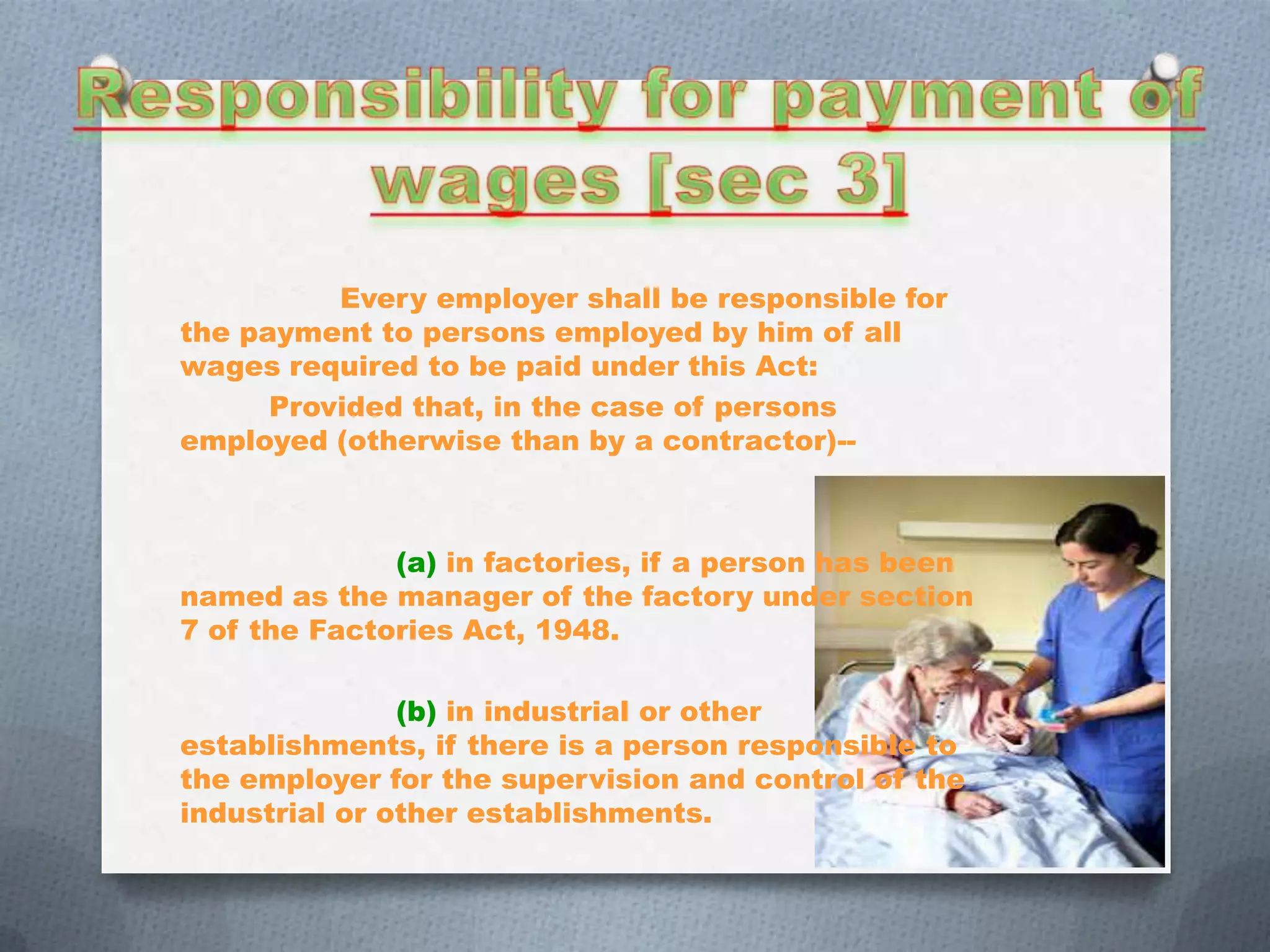
Every employer shall be responsible for
the payment to persons employed by him of all
wages required to be paid under this Act:
Provided that, in the case of persons
employed (otherwise than by a contractor)--

(a) in factories, if a person has been
named as the manager of the factory under section
7 of the Factories Act, 1948.
(b) in industrial or other
establishments, if there is a person responsible to
the employer for the supervision and control of the
industrial or other establishments.
(c)

upon railways (otherwise
than in factories), if the employer is the
railway administration and the railway
administration has nominated a person in
this behalf for the local area concerned;
the person so named, the person so
responsible to the employer, or the person
so nominated, as the case may be, [shall
also be responsible] for such payment.
Fixation of wage-periods.-

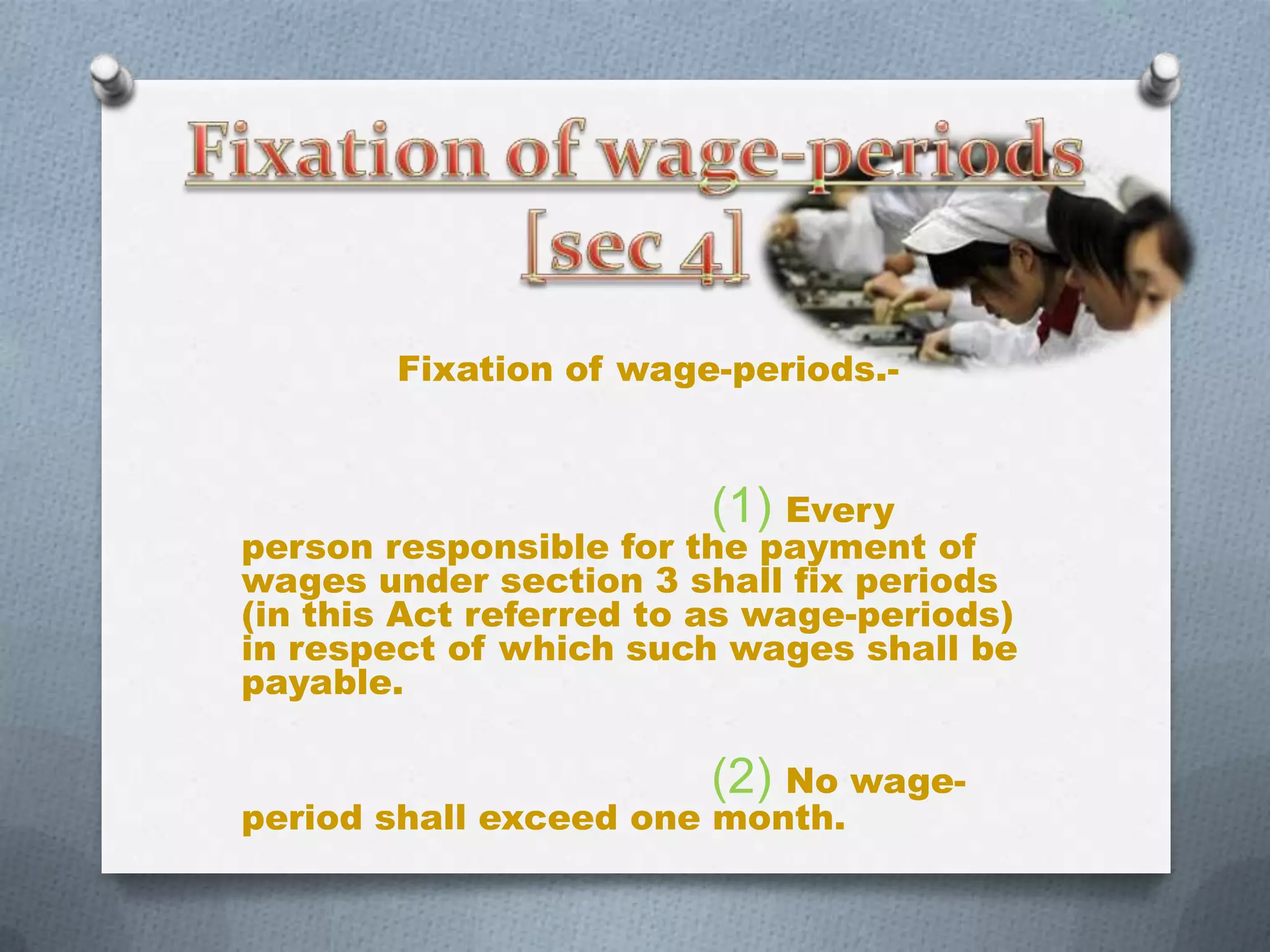
(1) Every

person responsible for the payment of
wages under section 3 shall fix periods
(in this Act referred to as wage-periods)
in respect of which such wages shall be
payable.

(2) No wage-

period shall exceed one month.
Time of payment of wages.The wages of every person employed upon or
in—
(a) any railway, factory or

[industrial or other establishment] upon or in
which less than one thousand persons are
employed, shall be paid before the expiry of the
seventh day,
(b) any other railway, factory

or [industrial or other establishment], shall be
paid before the expiry of the tenth day, after the
last day of the wage-period in respect of which
the wages are payable.
Wages to
be paid in current coin or
currency notes. All
wages shall be paid in
current coin or currency
notes or in both
(1) No fine shall be imposed on
any employed person save in respect of such acts and
omissions on his part as the employer, with the
previous approval of the State Government or of the
prescribed authority, may have specified by notice
under sub-section (2).
(2) A notice specifying such acts and
omissions shall be exhibited in the prescribed manner
on the premises in which the employment is carried on
or in the case of person employed upon a railway
(otherwise than in a factory), at the prescribed place
or places.
(3) No fine shall be imposed
on any employed person until he has been given
an opportunity of showing cause against the
fine, or otherwise than in accordance with such
procedure as may be prescribed for the
imposition of fines.
(4) The total amount of fine
which may be imposed in any one wage-period on
any employed person shall not exceed an amount
equal to [three per cent.] of the wages payable to
him in respect of that wage-period.
(5) No fine shall be imposed
on any employed person who is under the age of
fifteen years.
Sec 7(1) says that every payment made
by the employed person to the
employer or his agent shall, for the
purposes of this Act, be deemed to be
deduction from wages.
It also lays down that any loss of
wages resulting from any
imposition, upon a person, shall not be
deemed to be a deduction from wages.
Deductions for absence from
duty.
(1) Deductions may be
made under section 7 only on account of the absence
of an employed person from the place or places
where, by the terms of his employment, he is required
to work, such absence being for the whole or any part
of the period during which he is so required to work.
(2) The amount of such
deduction shall in no case bear to the wages payable
to the employed person in respect of the wage-period
for which the deduction is made a larger proportion
than the period for which he was absent bears to the
total period, within such wage period, during which by
the terms of his employment, he was required to work:
A deduction under section
7 shall not exceed the amount of the damage or
loss caused to the employer by the neglect or
default of the employed person.

A deduction shall not be
made under (2) of section 7 until the employed
person has been given an opportunity of
showing cause against the deduction, or
otherwise than in accordance with such
procedure as may be prescribed for the making
of such deductions.
All such deductions and all
realizations thereof shall be recorded in
a register to be kept by the person
responsible for the payment of wages
under section 3 in such form as may be
prescribed.
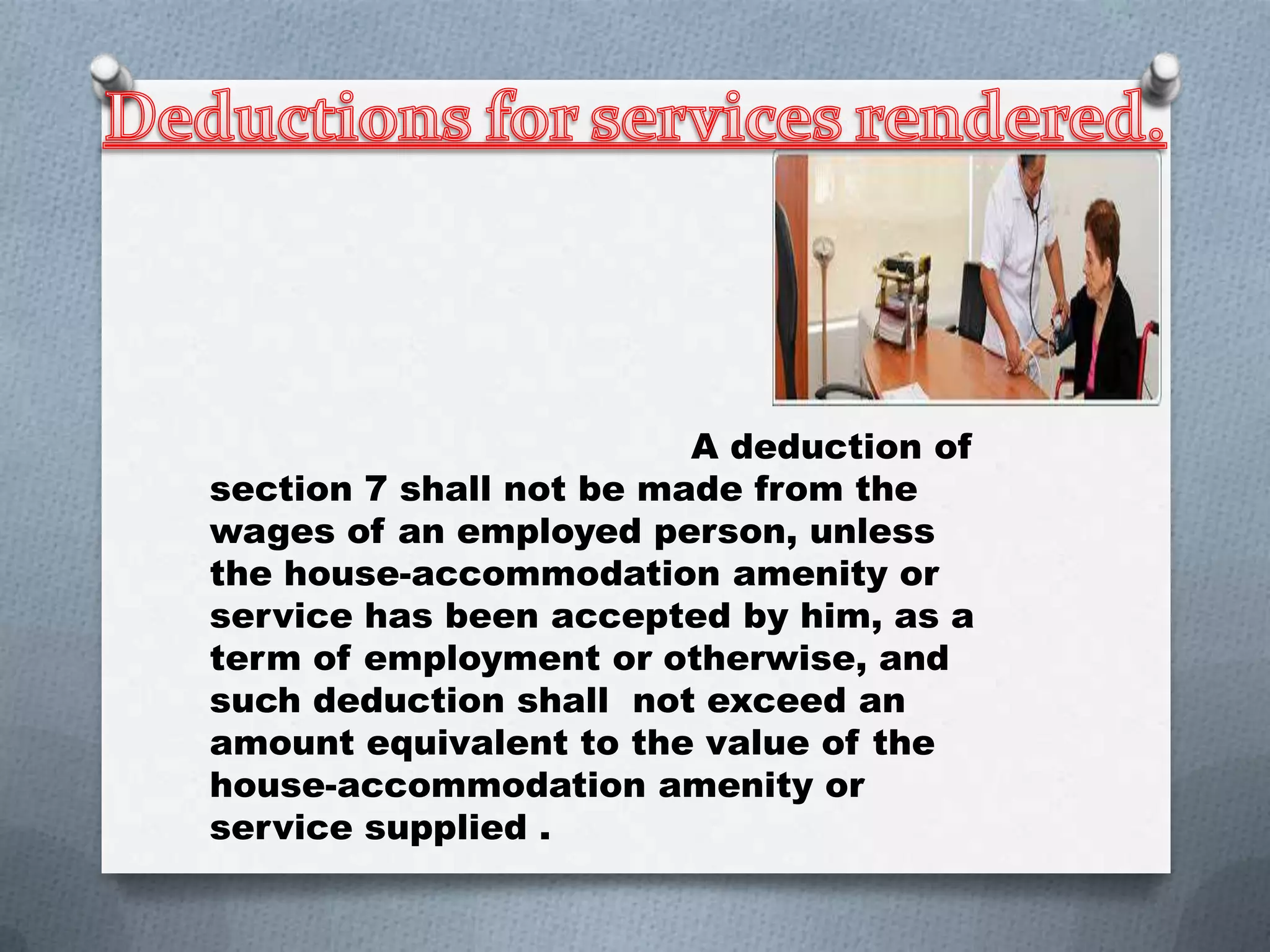
A deduction of
section 7 shall not be made from the
wages of an employed person, unless
the house-accommodation amenity or
service has been accepted by him, as a
term of employment or otherwise, and
such deduction shall not exceed an
amount equivalent to the value of the
house-accommodation amenity or
service supplied .
Deductions under section 7 shall be subject to the
following conditions, namely:-(a) recovery of an advance of
money given before employment began shall be
made from the first payment of wages in respect of a
complete wage-period, but no recovery shall be
made of such advances given for travelling
expenses;

recovery of an advance of money given after
employment began shall be subject to such
conditions as the State Government may impose;
(b) recovery of advances of
wages not already earned shall be subject to any rules
made by the State Government regulating the extent
to which such advances may be given and the
installments by which they may be recovered.
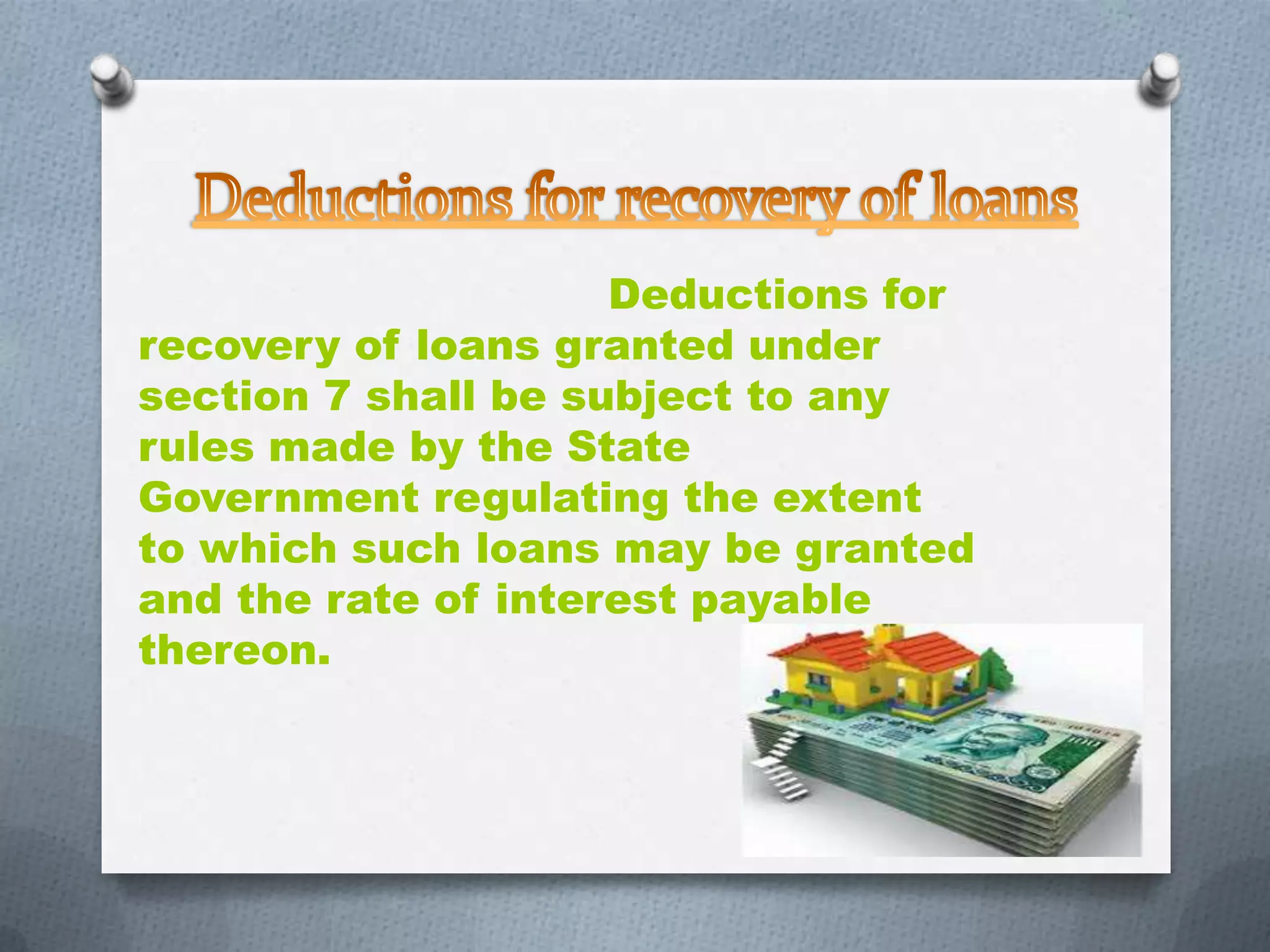
Deductions for
recovery of loans granted under
section 7 shall be subject to any
rules made by the State
Government regulating the extent
to which such loans may be granted
and the rate of interest payable
thereon.
Deductions under
section 7 shall be
subject to such
conditions as the
State Government may
impose.
An Inspector of factory
appointed under sec 8(1) of
Factory Act shall be an Inspector
for the purpose of this Act in
respect of all factories within the
local limits of assigned to him.
Any contract
or agreement, whether made
before or after the
commencement of this
Act, whereby an employed
person relinquishes any right
conferred by this Act shall be
null and void in so far as it
purports to deprive him of such
right.
Sec 20(1) of the act makes
contravention of the provisions of
the Act, by any person responsible
for the payment of wages to an
employed person, punishable with
fine which shall not be less than one
thousand five hundred rupees but
which may extend to seven thousand
five hundred rupees.
Paymentofwagesact 130825015756-phpapp01

Paymentofwagesact 130825015756-phpapp01

  • 2.
     Chapter 1 (section1 & 2)  Chapter 2 (section 3 to 13)  Chapter 3 Introduction, Objects, Applications and Definitions Payment and Deduction of wages Authorities under the Act (section 14 to 19)  Chapter 4 (section 20 to 26) Miscellaneous
  • 3.
     1. Short title,extent, commencement and application.- This Act may be called the Payment of Wages Act, 1936.  2. It extends to the whole of India.
  • 4.
    In this Act,unless there is anything repugnant in the subject or context, “EMPLOYED PERSON" includes the legal representative of a deceased employed person; “EMPLOYER" includes the legal representative of a deceased employer
  • 5.
    “WAGES” means all remunerationscapable of being expressed in terms of money, which would if the terms of the contract of employment, expressed of implied, were full filled, be payable to person employed irrespective of his employment or of work done in such employment and includes house rent allowances.
  • 6.
    Every employer shallbe responsible for the payment to persons employed by him of all wages required to be paid under this Act: Provided that, in the case of persons employed (otherwise than by a contractor)-- (a) in factories, if a person has been named as the manager of the factory under section 7 of the Factories Act, 1948. (b) in industrial or other establishments, if there is a person responsible to the employer for the supervision and control of the industrial or other establishments.
  • 7.
    (c) upon railways (otherwise thanin factories), if the employer is the railway administration and the railway administration has nominated a person in this behalf for the local area concerned; the person so named, the person so responsible to the employer, or the person so nominated, as the case may be, [shall also be responsible] for such payment.
  • 8.
    Fixation of wage-periods.- (1)Every person responsible for the payment of wages under section 3 shall fix periods (in this Act referred to as wage-periods) in respect of which such wages shall be payable. (2) No wage- period shall exceed one month.
  • 9.
    Time of paymentof wages.The wages of every person employed upon or in— (a) any railway, factory or [industrial or other establishment] upon or in which less than one thousand persons are employed, shall be paid before the expiry of the seventh day, (b) any other railway, factory or [industrial or other establishment], shall be paid before the expiry of the tenth day, after the last day of the wage-period in respect of which the wages are payable.
  • 10.
    Wages to be paidin current coin or currency notes. All wages shall be paid in current coin or currency notes or in both
  • 11.
    (1) No fineshall be imposed on any employed person save in respect of such acts and omissions on his part as the employer, with the previous approval of the State Government or of the prescribed authority, may have specified by notice under sub-section (2). (2) A notice specifying such acts and omissions shall be exhibited in the prescribed manner on the premises in which the employment is carried on or in the case of person employed upon a railway (otherwise than in a factory), at the prescribed place or places.
  • 12.
    (3) No fineshall be imposed on any employed person until he has been given an opportunity of showing cause against the fine, or otherwise than in accordance with such procedure as may be prescribed for the imposition of fines. (4) The total amount of fine which may be imposed in any one wage-period on any employed person shall not exceed an amount equal to [three per cent.] of the wages payable to him in respect of that wage-period. (5) No fine shall be imposed on any employed person who is under the age of fifteen years.
  • 13.
    Sec 7(1) saysthat every payment made by the employed person to the employer or his agent shall, for the purposes of this Act, be deemed to be deduction from wages. It also lays down that any loss of wages resulting from any imposition, upon a person, shall not be deemed to be a deduction from wages.
  • 14.
    Deductions for absencefrom duty. (1) Deductions may be made under section 7 only on account of the absence of an employed person from the place or places where, by the terms of his employment, he is required to work, such absence being for the whole or any part of the period during which he is so required to work. (2) The amount of such deduction shall in no case bear to the wages payable to the employed person in respect of the wage-period for which the deduction is made a larger proportion than the period for which he was absent bears to the total period, within such wage period, during which by the terms of his employment, he was required to work:
  • 15.
    A deduction undersection 7 shall not exceed the amount of the damage or loss caused to the employer by the neglect or default of the employed person. A deduction shall not be made under (2) of section 7 until the employed person has been given an opportunity of showing cause against the deduction, or otherwise than in accordance with such procedure as may be prescribed for the making of such deductions.
  • 16.
    All such deductionsand all realizations thereof shall be recorded in a register to be kept by the person responsible for the payment of wages under section 3 in such form as may be prescribed.
  • 17.
    A deduction of section7 shall not be made from the wages of an employed person, unless the house-accommodation amenity or service has been accepted by him, as a term of employment or otherwise, and such deduction shall not exceed an amount equivalent to the value of the house-accommodation amenity or service supplied .
  • 18.
    Deductions under section7 shall be subject to the following conditions, namely:-(a) recovery of an advance of money given before employment began shall be made from the first payment of wages in respect of a complete wage-period, but no recovery shall be made of such advances given for travelling expenses;  recovery of an advance of money given after employment began shall be subject to such conditions as the State Government may impose; (b) recovery of advances of wages not already earned shall be subject to any rules made by the State Government regulating the extent to which such advances may be given and the installments by which they may be recovered.
  • 19.
    Deductions for recovery ofloans granted under section 7 shall be subject to any rules made by the State Government regulating the extent to which such loans may be granted and the rate of interest payable thereon.
  • 20.
    Deductions under section 7shall be subject to such conditions as the State Government may impose.
  • 21.
    An Inspector offactory appointed under sec 8(1) of Factory Act shall be an Inspector for the purpose of this Act in respect of all factories within the local limits of assigned to him.
  • 22.
    Any contract or agreement,whether made before or after the commencement of this Act, whereby an employed person relinquishes any right conferred by this Act shall be null and void in so far as it purports to deprive him of such right.
  • 23.
    Sec 20(1) ofthe act makes contravention of the provisions of the Act, by any person responsible for the payment of wages to an employed person, punishable with fine which shall not be less than one thousand five hundred rupees but which may extend to seven thousand five hundred rupees.