CONTENTS
Preface ix
Introduction xiii
. The Factory
. The Prince and His Palace
. The Visionary of Lopukhinskaya Street
. The Laboratory System
. Producing Physiology
. The Remarkable Druzhok
. From Dog to Digestive Factory
. The Physiology of Purposiveness
. From the Machine to the Ghost Within
. Laboratory Products
. Gastric Juice for Sale
. Hail to the Chief
. The Nobel Prize
Epilogue
Appendixes
Notes
Selected Bibliography
Index
10.
PREFACE
This book resultedfrom a roadblock in my work on a bi-
ography of Ivan Pavlov. By late I was reasonably satis-
fied with my draft chapters on the first forty years of Pavlov’s
life, including my account of his research in the s and
s on the physiology of the heart and the digestive sys-
tem. The science was interesting, and I treated it in a con-
ventional biographical manner by exploring the various
contexts in which Pavlov worked, by studying his publica-
tions and those of relevant contemporaries, and by examin-
ing the archival materials (manuscripts, memoirs, corre-
spondence,and a few laboratory notebooks) I had gathered.
This approach proved inapplicable, however, when I
came to and the investigations on digestion that culmi-
nated in Pavlov’s Lectures on the Work of the Main Digestive
Glands () and his Nobel Prize (). Before Pavlov
had been a lone investigator, but in that year he became a
laboratory chief—the director of a large and productive re-
search group in his Physiology Division of the Imperial In-
stitute of Experimental Medicine in St. Petersburg. Even a
glance at Pavlov’s Lectures—with its constant references to
the experiments of his numerous coworkers—revealed that
the chief’s synthetic work was understandable only as the
product of his laboratory system.
An examination of the few laboratory notebooks I could
find only underscored this point. The notebooks from the
years before contained notes, data, and other records of
a single investigator puzzling over his subject. Those from
after had an entirely different character: almost com-
11.
pletely lacking experimentaldata (which, I later learned, were kept by Pavlov’s
coworkers in notebooks arranged by experimental animal), these were the
records of a manager and thinker reflecting on the results obtained by his sub-
ordinates and planning their future work.
My biographical interests, then, led me to a very different task: to recon-
struct the social and cognitive dynamics of Pavlov’s laboratory enterprise and
to place his own work, as manager, experimentalist, and thinker, within this
dynamic. How did Pavlov’s laboratory enterprise generate knowledge claims
and other products? What was the relationship between the nature of this lab-
oratory, Pavlov’s scientific work, and his professional trajectory?
So famous has Pavlov (and his salivating dogs) become as a cultural sym-
bol of the experimental, objectivist approach to mind that relatively few peo-
ple today are aware that he first achieved prominence for his earlier contribu-
tions to digestive physiology, let alone that these contributions featured an
insistence on the central physiological role of an idiosyncratic psyche. This
book addresses that earlier Pavlov. I explore his transformation from lone in-
vestigator to laboratory chief, his creation of a laboratory system that would
prove a prototype for the much larger system over which he presided in future
years, and the investigations of digestive physiology that brought him inter-
national fame and launched him upon the later research on conditional re-
flexes for which he is best known today.
On Terminology
Readers with expertise in physiology, medicine, and biochemistry will, at
many junctures, note that I relate without comment what now seem to be
clearly tendentious interpretations by the scientists I discuss and that I do not
“update” scientific terminology. For example, one might be tempted to iden-
tify the nineteenth-century term ferment with today’s enzyme, the earlier zy-
mogen with today’s proenzyme, the earlier humoral mechanism with today’s
hormone, and the earlier catarrh with today’s inflammation of the gastric mem-
brane. I have instead followed the historical convention of using actors’ terms
and categories—and, whenever possible, I allow these terms and categories to
define themselves through usage and context. This approach, it seems to me,
allows us to better understand the reasoning of scientists and physicians who
lived in a different time and place. Because terminology is embedded in a
broader discourse, even apparently simple terminological changes often in-
volved complex conceptual changes. For example, the transition in the late
nineteenth century from proteid to protein seems to have been relatively
12.
straightforward, while thecluster of meanings surrounding the words ferment
and enzyme did not map nearly so neatly and often differed from scientist to
scientist. These transitions, like the various and changing meanings ascribed
to catarrh, dyspepsia, and even the word scientific, are themselves the subject
of historical inquiry.
Acknowledgments
It is most gratifying to have this opportunity to thank the many institutions
and individuals who have helped me write this book.
The National Endowment for the Humanities, Fulbright-Hays, the Inter-
national Research and Exchanges Board, and the John Simon Guggenheim
Memorial Foundation generously funded my continuing research on a biog-
raphy of Ivan Pavlov and so provided the necessary resources for this product
of that work. I am also grateful to my Department of History of Science, Med-
icine, and Technology at the Johns Hopkins University—especially to its
chairperson, Gert Brieger; its longtime administrative manager, Dolores Saw-
icki; and Linda Bright and Christine Ruggere of its historical collection—for
constant support and assistance. The good efforts of directors and staff at nu-
merous archives have also proven indispensable. I am particularly grateful to
Vladimir Sobolev and the talented and hospitable staff at the St. Petersburg
branch of the Archive of the Russian Academy of Sciences, to IuriiVinogradov
for sharing his great knowledge of Pavlov and his archival legacy, to Natalia
Zagrina and the fine staff at the Dom-Muzei I. P. Pavlova in Ryazan, to Anita
Lundmark at the Karolinska Institute in Stockholm, and to Denise Ogilvie at
the Pasteur Institute in Paris.
This book bears the imprint of many colleagues and friends who have been
generous with their time and energy, allowing me to draw upon their knowl-
edge and insights. Five colleagues read the entire manuscript with great care.
Mark Adams first encouraged me to write a biography of Pavlov, and then to
write the present book along the way; he regularly discussed with me the is-
sues arising in my research and read several versions of the manuscript with
his usual intelligence and perspicacity. Two wonderful colleagues at the Johns
Hopkins University, Larry Schramm and Harry Marks, also commented ex-
tensively on the manuscript to my great benefit—Larry with the sensitivities
of a physiologist and lover of history, Harry with the intellectual engagement
and insight that he brings to all historical subjects. Larry also kindly arranged
for me to discuss Pavlov’s physiology with two groups of supportive scientists
at Johns Hopkins. Nikolai Krementsov brought me the benefit of both his ear-
INTRODUCTION
What is ascientific laboratory? It is a small world, a small
corner of reality. And in this small corner man labors with his
mind at the task of . . . knowing this reality in order correctly
to predict what will happen, . . . even to direct this reality ac-
cording to his will, to command it, if this is within our tech-
nical means.
— , “On the Mind in General” ()
In four successive years (–) Ivan Pavlov was nomi-
nated for the Nobel Prize, and each time the award com-
mittee confronted the same question: to what extent were
the products of Pavlov’s laboratory truly Pavlov’s?
That question arose for good reason. The nominee had
himself pronounced his most substantial work, Lectures on
the Work of the Main Digestive Glands (), “the deed of
the entire laboratory” and credited his coworkers by name
for conducting the experiments on which it was based. Fur-
thermore, he referred readers seeking evidence for his most
important arguments to the publications of his coworkers,
where many of those arguments first appeared. Did Pavlov’s
major works,then,represent his own original contributions
to science or were they merely“a type of compilation of the
experimental dissertations upon which they are based”?1
Guided by an image of the heroic lone investigator, the
Nobel Prize Committee here confronted a different form of
scientific production. As the nineteenth century wore on
and the workshop yielded pride of place to the factory in
15.
goods production,so,too,were leadinglaboratory scientists increasingly likely
to be the managers of large-scale enterprises. Justus von Liebig and Felix
Hoppe-Seyler in chemistry, Carl Ludwig and Michael Foster in physiology,
Robert Koch and Louis Pasteur in bacteriology, and Paul Ehrlich in im-
munology all presided over distinctively social enterprises involving substan-
tial capital investment, a specially designed workplace, a relatively large work-
force, a developed division of labor, and a productive process that involved
managerial decisions. Clearly, their achievements owed something not only to
their scientific (and rhetorical) skills but also to their qualities as masters of
large-scale production.2
Scientists at the turn of the century fully appreciated the significance of this
newly emerging system of production, and they filled their journals with arti-
cles describing the physical plant, design, workforce, technologies, and man-
agerial style of various laboratories.3 Writing in , William Henry Welch
observed that the emergence of the “well-equipped and properly organised
modern laboratory” had“completely revolutionised during the past half-cen-
tury the material conditions under which scientific work is prosecuted.” For
Welch, as for many others, this development only enhanced the heroic stature
of such earlier figures as Claude Bernard, who had contributed mightily to
science in premodern conditions. “Bernard, that prince of experimenters,
worked in a damp, small cellar, one of these wretched Parisian substitutes for
a laboratory which he called the ‘tombs of scientific investigators,’” Welch re-
minded his readers. “There can be no greater proof of the genius of Bernard
than the fact that he was able to make his marvellous discoveries under such
obstacles and with such meagre appliances.”4
Nobody was more keenly aware of the advantages of the modern labora-
tory than another of Bernard’s admirers, Ivan Pavlov. Having labored in a sci-
entific workshop for some fifteen years—and having glimpsed the alternative
during brief stays in Rudolf Heidenhain’s and Carl Ludwig’s laboratories—in
Pavlov became master of Russia’s first large-scale physiological enterprise.
The laboratory system he established, however, was no carbon copy of those
he had seen in Western Europe. Like scientific workshops, large-scale labora-
tories differed greatly one from the other. Each laboratory chief brought with
him differing conceptions of his science and differing approaches to the man-
agement of complex tasks, and each responded to the challenges and oppor-
tunities of a different set of institutional circumstances.5
In the last decades of the nineteenth century, a variety of large-scale labo-
ratories addressed the science of life, physiology. Carl Ludwig in Leipzig man-
aged the research of a large group of transient, mostly unskilled coworkers—
16.
usually aspiring physicians—whoaddressed a wide variety of subjects that
seem linked only by the chief’s perception that they were important and, per-
haps, by his drive to apply physicochemical models to life processes. Carl Voit
in Munich managed an interdisciplinary enterprise that coordinated the work
of a more stable group of investigators—each with special expertise in anatomy,
physiology, or chemistry—on highly focused studies of metabolic processes.
Michael Foster in Cambridge managed only very loosely the undergraduates,
graduates, and permanent researchers whom he inspired to adopt his evolu-
tionary and broadly biological approach to a wide range of topics, but who re-
mained free to follow their own evolving interests.6 Ludwig and Voit were ac-
complished experimentalists who could always be found in the laboratory;
Foster, like William Henry Welch, was not. The similarities and differences
among these laboratories could be enumerated almost ad infinitum. How was
work organized and intellectual credit divided? What drove the research
agenda? Who controlled interpretive decisions, and how? What was the rela-
tive importance and relationship of research and teaching? What products did
they generate, and for whom?
Pavlov’s laboratory system shared some features with those of his fellow
physiologists, but it was the distinctive result of institutional resources and his
scientific-managerial vision. First and foremost, his laboratory was organized
for efficient production and, as in any factory, the labors of his coworkers were
tightly coordinated for a common task. In Pavlov’s physiology factory, that
task was prescribed by his scientific vision as applied to digestive physiology.
The managerial system by which he coordinated laboratory work featured an
authoritarian structure and cooperative ethos that allowed Pavlov to use
coworkers as extensions of his sensory reach while enabling him constantly to
monitor the work process, to control the interpretive choices in experiments,
to incorporate results into his developing ideas,and to convert them into mar-
ketable products.
The nineteenth-century factory was not an assembly line run on F. W. Tay-
lor’s principles of scientific management, let alone the finely mechanized and
computerized operation that one can find today. In both manufacturing and
science, the new large-scale enterprises coexisted alongside traditional work-
shops, and factories themselves incorporated elements of the workshop tradi-
tion. Despite the increasing division of labor and reliance on technologies, ar-
tisanal skills retained their importance. As Raphael Samuel has explained,
skilled workers proved critical to the operation of early factory machinery,
which was often “too crude and indiscriminate for the tasks it was appointed
to perform . . . The difficulty often lay with the raw materials which were too
17.
delicate, or toovariable, for machinery’s harsh beat. No two skins were ever
precisely the same in the leatherworking trades, no two grains in furniture.”
Machinery, therefore, “was rarely self-acting, but required skilled hands to
guide and to complete its work.”7
Standardized methodologies and new technologies acquired increasing im-
portance in late nineteenth-century science, but scientists, too, dealt with ex-
tremely delicate and variable materials. Pavlov and his coworkers, for exam-
ple, worked largely with intact, complex animals and were well aware that no
two dogs—and no two experiments—were precisely the same. Craft skills,
puzzle-solving abilities, and imagination, then, proved no less important in
Pavlov’s laboratory—and in large-scale scientific enterprises in general—than
in the scientific workshop.
The word workshop has long evoked a much more pleasing image than the
word factory, especially in reference to knowledge-generating enterprises. In
this spirit, turn-of-the-century scientists frequently referred to themselves as
craftsmen, and one series of articles in Nature about the new large-scale labo-
ratory enterprises of the day bore the appealing title“Famous Scientific Work-
shops.”8 Even today,many academic departments—in a tradition dating from
the late nineteenth century—refer to their weekly sessions with a visiting
speaker as a workshop. This word evokes a pleasing image (however histori-
cally inaccurate) of communality, the absence of hierarchy, and the happy
unity of head and hands.
The word factory, on the other hand, calls forth images of alienated labor
and a standardized, exploitative, even inhuman process that violates the spirit
of intellectual inquiry. Factories may produce things efficiently, but they lack
the contemplative, cooperative, egalitarian image that scholars and scientists
commonly associate with the nature of their work. Some decades ago, one
group of socialist historians named their journal History Workshop; it is diffi-
cult to imagine any historians—left, right, or center—adopting the title His-
tory Factory. We all, of course, might label another department, laboratory, or
school a“real factory.”But never our own. Pavlov himself, a committed truth-
seeker who celebrated the communal ethos of science, would certainly have
objected to my description of his laboratory as a factory.
I do not, however, use this word pejoratively. My intention, rather, is to em-
phasize the differences between the production process in a small enterprise
and in a large one, to describe the system by which Pavlov directed the labors
of his coworkers to his own investigative ends, and to explore—as did the No-
bel Prize Committee for its own, quite different reasons—the structure and
functioning of his laboratory.
18.
The first partof this book,“The Factory,” explores Pavlov’s laboratory sys-
tem as the union of a particular man and a particular set of institutional cir-
cumstances. It examines the resources, challenges, and incentives that the Im-
perial Institute of Experimental Medicine brought to this union (Chapter ),
the origins and content of the animating principles that Pavlov brought to his
post there (Chapter ), and the social-cognitive dynamics of the laboratory
that resulted from the merger of the two (Chapter ).
In Part II,“Producing Physiology,” I turn to the central work process in the
laboratory: experimentation and interpretation.Pavlov was indeed,as he once
put it proudly, “an experimenter from head to toe,” but the meaning of that
phrase is hardly transparent. In recent years, the “black box” of experimenta-
tion has been opened by scientists and historians alike,revealing it to be a com-
plex,highly contingent process that resists easy definition.We now know from
a number of case studies that, as in other forms of scientific inquiry, the ex-
perimenter’s confrontation with an infinitely complex reality is influenced by
a broad range of factors including the institutional, disciplinary, and social
context in which he or she works; the availability and choices of technique and
model organism; responses to unexpected results and opportunities; and in-
terpretive decisions in the face of complex and often contradictory data. In
their reactions to these and other elements of what one scholar has termed“the
mangle of practice,” experimenters display various styles. In a group enter-
prise, the chief’s style as an experimentalist is necessarily entangled in the so-
cial relations of his or her laboratory.9
To approach experimentation as a form of work—and science as a form of
production—is not to neglect the importance of ideas, but rather to empha-
size it. Ideas are inherent to any productive process, whether in a workshop or
a factory, in manufacturing or in science. They may animate all participants
in the work process or the manager alone; they may be codified in a manual
or simply embedded in technologies and the organization of labor—but they
are always an important force of production.
This point was made forcefully by both Karl Marx and Max Weber. In a fa-
mous comment about workshop production, Marx observed that “a spider
conducts operations that resemble those of a weaver, and a bee puts to shame
many an architect in the construction of her cells. But what distinguishes the
worst architect from the best of bees is this, that the architect raises his struc-
ture in imagination before he erects it in reality.”Factory production,he noted,
involved the distribution of this “intelligence” among a differentiated work-
force and machines.10 Weber objected forcefully to what he perceived as the
fashionable view of his day that imagination had no place in modern science
19.
because the laboratoryhad become a factory. Proponents of that view, he ob-
served, lacked“all clarity about what goes on in a factory or in a laboratory. In
both some idea has to occur to someone’s mind.”“The idea is not a substitute
for work,”he observed,“and work, in turn, cannot substitute for or compel an
idea, just as little as enthusiasm can.”11 This, I think, is self-evident to any per-
son—scientist or historian, craftsperson, laborer, or factory manager—who
reflects on his or her own labors.
Pavlov’s particular scientific style makes attention to his underlying ideas
about the organism and physiology especially important, for he was always a
resolutely vision-driven experimentalist. What he termed physiological think-
ing rested on an unchanging view of the organism and how best to explore it,
and, contrary to his carefully cultivated image, his style of physiological in-
vestigation relied heavily on his interpretive choices amid complex and often
contradictory data.
Thus Part II explores the process by which experiment and interpretation
gave rise to the laboratory’s most important knowledge claims. I examine the
laboratory career of Pavlov’s favorite dog and the key concepts that resulted
(Chapter ), the emergence of Pavlov’s central explanatory metaphor and its
relationship to the changing interpretation of data (Chapter ), and Pavlov’s
major synthetic treatise,both as a final stage in data processing and as a rhetor-
ically powerful literary product that communicated an appealing vision of the
relationship between the laboratory and the clinic (Chapter ). Finally, in
Chapter , I discuss the transformation of the laboratory’s view of the psyche
in the years – and analyze the related social-cognitive processes that
fueled the transition from digestive physiology to investigations of conditional
reflexes.
Parts I and II, then, concern the origins, structure, and functioning of
Pavlov’s physiology factory and the nature of its experimental practices. Part
III, “Laboratory Products,” addresses several questions: what did Pavlov’s
physiology factory actually produce, for whom, and to what effect? Here the
distinctive qualities of factory production come clearly to the fore, and we see
the important role of the sheer number and diversity of laboratory products.
In the years –, the laboratory produced not only an avalanche of
knowledge claims and publications aimed at various audiences but also med-
ical advice, techniques and technologies, digestive fluids for investigative and
clinical use, expertise in laboratory design, alumni, and—as the spokesman
for all these products—Pavlov himself, who became a powerful symbol of a
modern clinically relevant, laboratory-based physiology.
The chapters in Part III explore this process from three different perspec-
20.
tives. Chapter focuses on a single product, the laboratory’s most important
direct contribution to medical practice: “the natural gastric juice of the dog,”
which the laboratory drew from experimental dogs and sold as a remedy for
dyspepsia. Chapter examines Pavlov’s rise to international renown as the
spokesman for and embodiment of the laboratory’s product line. Here, too, I
explore the developments in turn-of-the-century physiology and physiologi-
cal chemistry that, just as Pavlov’s reputation attained new heights, subjected
some of his most important scientific conclusions to serious criticism. Finally,
Chapter examines the assessment of Pavlov’s achievements by a single au-
dience—the Karolinska Institute’s Nobel Prize Committee for Physiology or
Medicine.
That Committee finally decided that the products of Pavlov’s laboratory
were Pavlov’s indeed, and in it made him the first physiologist to win the
prize. In pondering the question of intellectual property, the Committee had
confronted the different features of Pavlov’s scientific profile. It was precisely
the integration of these features that lay at the core of his laboratory system
and his astonishing range of achievements, and that had already made him,
for many of his colleagues, the symbol of a new era in laboratory physiology.
This book, then, concerns this multifaceted Pavlov—the thinker, experimen-
talist,manager,and spokesman; in a phrase,the visionary factory physiologist.
22.
A merchant ora big industrialist without “business imagina-
tion,” that is, without ideas or ideal intuitions . . . will never
be truly creative in organization. Inspiration in the field of
science by no means plays any greater role, as academic con-
ceit fancies, than it does in the field of mastering problems of
practical life by a modern entrepreneur. On the other hand,
and this also is often misconstrued, inspiration plays no less a
role in science than it does in the realm of art.
— , “Science as a Vocation” ()
The principle of a factory is that each labourer, working sepa-
rately, is controlled by some associating principle which di-
rects his producing powers to effect a common result, which
it is the object of all collectively to obtain.
—Palgrave’s Dictionary of Political Economy ()
So famous is Ivan Pavlov, so striking his undeniable tal-
ents, and so important his place in twentieth-century sci-
ence and culture, that it is difficult to imagine him as any-
thing other than a phenomenon. Winner of a Nobel Prize
at age fifty-five and celebrated during his lifetime as the
“Prince of World Physiology,” this passionate, frosty-
bearded Russian (with his salivating dogs) is an interna-
tionally recognized symbol of the power not only of exper-
imental biology but of science itself.
That familiar Pavlov is difficult to recognize in the forty-
PARTONE
THEFACTORY
23.
year-old man who,in , having failed in two attempts to land an assistant
professorship at a Russian university, squeezed his experiments into the time
remaining from his duties as assistant in a small and filthy laboratory.Precious
time,he lamented,was slipping away unproductively.Financially strapped and
with no clear prospects,he suffered from a myriad of bodily symptoms,which,
drawing upon his medical training, he forlornly diagnosed as a fatal case of
“tabes.” By his fortieth birthday, Pavlov had a completed doctoral thesis and a
number of published articles to his credit. A specialist on the nervous control
of the heart and digestive glands, he was a talented and well-trained investi-
gator with grand ideas about his science, but had he indeed perished that year
few would remember him today.
Two years later, in , Prince Alexander Ol’denburgskii appointed Pavlov
chief of the Physiology Division in his newly created Imperial Institute of Ex-
perimental Medicine. The result was not merely that Pavlov finally obtained
his own laboratory and the opportunity to conduct his experiments full-time.
This union of the man and the institution fundamentally transformed his
scientific profile: the workshop physiologist became a factory physiologist.
Pavlov’s physiology factory was born, and its chief began a rapid ascent to
world renown.
The struggling physiologist with his ideas and skills, the Prince’s Institute
with its resources and incentives, the unlikely process that brought them to-
gether, and the laboratory that resulted from their union were all deeply
steeped in their place and time—in Russian social, cultural, and political life
from Tsar Alexander II’s Great Reforms of the s to the country’s industrial
revolution in the late s; in the exciting era in science and medicine asso-
ciated with the names of Darwin, Bernard, Ludwig, Pasteur, and Koch; in the
play of networks, professional structures, and the state bureaucracy. These
structured the individual journeys of our two protagonists—the physiologist
and the Institute—and shaped the results of their eventual union. Chance,
too, played its part.
24.
Chapter 1
THE PRINCE
ANDHIS
PALACE
Human dignity and human pride demand palaces to apply
and manifest the power of the human intellect.
— , “The Contemporary Unification
in Experiment of the Main Aspects of Medicine,
as Exemplified by Digestion” ()
On November , , a rabid setter named Pluto bit
AlexanderDem’ianenkov,anofficerinSt.Petersburg’s Corps
of Guards. This event was in itself unextraordinary, for
tsarist Russia’s many dubious medical distinctions included
its world leadership, together with Hungary and Italy, in re-
ported cases of rabies.1
Pluto’s bite, however, proved mo-
mentous because it prompted the officer’s commander,
Prince Ol’denburgskii, a colorful member of the extended
royal family and a philanthropist engagé, to convert a series
of events and circumstances in Paris, Berlin, and St. Peters-
burg into what he hoped would be a grand bacteriological
institute—a “palace” of scientific medicine similar to those
being founded by Pasteur, Koch, and Lister in the West.2
At the moment that Pluto sank his teeth into Alexander
Dem’ianenkov, Ivan Pavlov (–) was on a study
leave in Europe, where he was working in the physiological
laboratories of Carl Ludwig and Rudolf Heidenhain.Thirty-
six years old and struggling to support a wife and a one-
year-old son, Pavlov was no doubt already worrying about
his bleak job prospects at home in St.Petersburg.Having ac-
quired his medical degree as a prerequisite for a career in
25.
physiology and hisdoctorate for a thesis on the nerves of the heart, he would
hardly have had reason to see his personal salvation in Prince Ol’denburgskii’s
efforts.
Social networks, the politics of institution-building, and a set of unfore-
seeable contingencies soon combined, however, to make the Prince and the
struggling physiologist central to each other’s ambitions. In December ,
five years after Pluto’s bite, Prince Ol’denburgskii celebrated the founding of
his creation—though it was not the bacteriological institute he had originally
envisioned—and Ivan Pavlov had found in it an institutional home that would
facilitate his transformation into Russia’s leading physiologist.
The Philanthropist Prince
Prince Alexander Petrovich Ol’denburgskii (–) was heir not only to
his family’s considerable fortune but also to its philanthropic traditions.These
traditions had developed together with those of the ruling Romanovs, with
whom the Ol’denburgskiis were joined by friendship and marriage.
A branch of the venerable Holstein-Hottorp family, the Ol’denburgskiis
began in the early eighteenth century to intermarry with the Romanovs. One
issue of this familial relation was our Prince’s father, Petr Georgievich Ol’den-
burgskii (–), the son of Petr Friedrich Georg Ol’denburgskii and Ekate-
rina Pavlovna Romanova, the daughter of Empress Maria Fedorovna and Tsar
Paul I.
Petr Georgievich received his early education in Oldenburg before being
summoned back to Russia by his uncle, Tsar Nicholas I, who assigned him to
service as colonel of the palace guard, the famous Preobrazhenskii regiment.
In he was awarded the title Vashe Imperatorskoe Vysochestvo (Your Impe-
rial Excellency), signifying his membership in the extended royal family. He
partook fully in the life of the tsarist court and enjoyed a lifelong friendship
with Alexander II, the “Tsar Liberator” who reigned from to and in-
stituted a number of modernizing reforms, most notably the emancipation of
the serfs in .3
By the time of Alexander II’s accession to the throne, the Romanov family,
especially its female members, had cultivated a rich philanthropic tradition.4
Empress Maria Fedorovna (–), wife of Tsar Paul I, devoted consider-
able energy to the education of women—for example, as head of the Society
for the Upbringing of Well-Born Young Ladies (founded in ) and, from
, as head of St. Petersburg’s homes for young women without means
(vospitatel’nye doma). The wives of the two tsars who reigned in the first half
26.
of the nineteenthcentury were well known for their charitable works: Empress
Elizaveta Alekseevna (–), wife of Tsar Alexander I, donated the lion’s
share of her fortune to charity; and Empress Alexandra Fedorovna (–
), wife of Tsar Nicholas I, succeeded Maria Fedorovna as trustee of the
empire’s philanthropic institutions.
Romanov philanthropy took a medical turn during the Crimean War
(–),particularly through the efforts of the Grand Duchess Elena Pavlovna
(–).5 Before the war, the Grand Duchess had managed two institutes
concerned with women’s education and safe childbirth; during the war she or-
ganized the Krestovozdvizhenskoi Obshchiny Sester Miloserdiia (The Cross of
the Exalted Commune of Sisters of Mercy), the forerunner of Russia’s Red
Cross.6 She also founded an institute to provide young physicians with addi-
tional training and investigatory experience.After the Grand Duchess’s death,
this important and prestigious institution in St. Petersburg medicine was re-
named in her honor, becoming the Clinical Institute of Grand Duchess Elena
Pavlovna.
Many other female members of the royal family shared the Grand Duchess’s
medical interests.Empress Maria Alexandrovna (–),wife of Tsar Alexan-
der II, organized the Red Cross and a series of philanthropic societies. Grand
Duchess Elizaveta Fedorovna (–) established and governed several
charitable organizations in St. Petersburg and Moscow, and during the Russo-
Japanese War (–) she donated considerable funds for the purchase of
medical trains, aid to widows and orphans, and so forth. At least one Grand
Duke, Pavel Alexandrovich (–), took an interest in medical charity as
honorary president of the Russian Society for the Preservation of Public
Health. This Romanov tradition continued through the First World War up to
the overthrow of the monarchy.EmpressAlexandra Fedorovna,wife of the last
tsar, Nicholas II, patronized sanitary divisions at the front, established and su-
pervised field hospitals, and even completed the necessary courses to work as
a nurse.
An enlightened member of the gentry, committed to the modernizing mis-
sion of his friend and sovereign Alexander II, Prince Petr Georgievich Ol’den-
burgskii partook fully in this philanthropic tradition and its medical orienta-
tion,bringing to it considerable organizational skills.Aside from service in the
military and various governmental bodies, he contributed money and served
as founder, president, or trustee of an extensive network of educational and
medical institutions: the Imperial Juridical Academy, the Aleksandrovsk Ly-
cée, the Free Economic Society, the Main Council of Women’s Institutions of
Learning, several hospitals (including one for the mentally ill), and several
27.
Communes of theSisters of Mercy. These activities—in which the Prince co-
operated with his wife and other members of the royal family—involved con-
stant contact with leading figures in Russian statecraft, education, and medi-
cine and created a rich network of expertise and mobilizable connections.
Most important for our story are the St. Troitskii and St. George’s Com-
munes of the Sisters of Mercy,each of which,as E.A.Annenkova and Iu.P.Go-
likov have put it, constituted “an entire village” dedicated to the welfare and
medical care of the indigent. Founded in by Prince Petr Ol’denburgskii’s
wife, Theresa, and two of Tsar Alexander I’s daughters, the St. Troitskii Com-
mune developed by the s into an extensive facility for the care and med-
ical training of indigent women. Under the trusteeship of Prince and Princess
Ol’denburgskii,this commune expanded to include a church,several hospitals
with outpatient clinics, a dispensary of free medicines, a shelter for “fallen
women,” a gymnasium, and courses that trained women as teachers or as as-
sistants in hospitals and infirmaries. The St. George’s Commune, founded in
by Maria Fedorovna (–, wife of the future Tsar Alexander III),
was devoted to the free care of the indigent and wounded. The Empress’s per-
sonal physician, Sergei Petrovich Botkin, oversaw the St. George’s Commune’s
medical facilities and convinced the Ol’denburgskiis, who had also partici-
pated in its creation,to finance its courses for medical paraprofessionals (fel’d-
shery).7
This, then, was the tradition—with its moral vision, institutions, and so-
cial networks—into which Prince Alexander Petrovich Ol’denburgskii was
born. Like his father,Alexander combined a military career with that of a phil-
anthropist engagé. He distinguished himself in combat during the Russo-
Turkish war of –, and in was appointed commander of the twenty-
two thousand or so soldiers in the palace guard. When his father died in ,
the Prince assumed a number of his institutional positions—for example, as
trustee of the Imperial Academy of Jurisprudence, the St. Troitskii Commune,
and the Charity Home for the Mentally Ill. The Prince also undertook his own
initiatives. One of his favorites was the creation of St. Petersburg’s Narodnyi
Dom (People’s House), which offered the lower classes a clinic for alcoholics
and such affordable alcohol-free entertainment as theater, opera, a library,
musical instruction, and inexpensive restaurants.
The Prince’s wife, Princess Evgeniia Maksimilianovna (–), the
granddaughter of Tsar Nicholas I, was an equally energetic activist and phil-
anthropist who supported and oversaw numerous scholarly, medical, and
artistic institutions. She served, for example, as president of the St. Troitskii
Commune and honorary trustee of the St. George’s Commune, as trustee of
28.
the St. PetersburgSchool of the St. Petersburg Women’s Patriotic Society and
several shelters for women and children,and as president of the Imperial Min-
eralogical Society and the Society for the Support of the Arts.
The couple’s philanthropic energies were also evident in their management
of the estate in Ramon (in central Russia, near Voronezh) that Tsar Alexander
II had presented to the Princess (his niece). Here the Princess created one of
only two hospitals in the entire province, a well-equipped facility staffed by a
modern physician,Pavel Khizhin,who had studied surgery with the acclaimed
Moscow University Professor V. A. Basov.8 According to one account,“Tens of
thousands of suffering people streamed there seeking advice and aid; hun-
dreds of important operations were performed with complete success, thanks
to the modern setting; . . . thousands were cured of the wasting fever and of
that terrible disease [syphilis] that undermines the health of the population
and even influences its distant progeny.” The Ol’denburgskiis also created
there a school and an inexpensive cafeteria for the local peasantry.“In this cafe-
teria a peasant could use his earnings to purchase good food and, perhaps,
even to drink a small cup of vodka—but would not receive a second one.”9
The estate’s sugar factory also came to embody this spirit of enlightened
gentry philanthropy. As one Russian later recalled: “I can still remember very
well the Ramon sugar candies or Monpensier. We ate them as children in the
eighties and nineties. Instead of the unappetizing molasses candies we had
been used to up to that time, it was now possible to buy for kopeks (
cents) a lb. tin of good candy made with pure sugar. The Prince wanted to
give the people inexpensive sweets of fine quality. The Prince’s candy-making
project failed, probably because of his inexperience in business matters, and
his factory was placed in the hands of promoters. However, the example set by
the Prince led other private concerns to manufacture candy cheaply and
well.”10
The philanthropic activities of the Prince and Princess (Figure ) were
widely recognized and celebrated—for example, on the occasion of their
twenty-fifth wedding anniversary in —and the Prince’s contributions
were recognized in through conferral of the title “honorary citizen of St.
Petersburg,” which carried with it the right to vote in the city Duma.11
Prince Ol’denburgskii’s effectiveness as a patron rested not only on his con-
siderable financial resources and energy but also on his court connections, his
erratic but forceful personality, and his talent for extracting money from in-
fluential personages in the government, including the Tsar himself. Finance
Minister Sergei Witte characterized the Prince as “a lively man possessed of
such a quality of character that when he pesters people, including those stand-
29.
ing above PrinceA. P. Ol’denburgskii himself, they agree to the payment of
hundreds of thousands of rubles from the state purse, if only to rid themselves
of him.”12
The Prince was“a good person”engaged in“useful activity,”but was
also “abnormal”—emotionally erratic, quick to anger, and capable of “the
most impossible acts.” In Witte’s view, no other member of the royal family
had so completely“inherited the qualities of [the ostensibly unbalanced] Tsar
Paul.”13
Another leading figure in court circles observed similarly that the
Prince was“very capable,but extremely unbalanced [and] explosive,and lack-
ing sufficient inhibitory centers.”14
A third contemporary later recalled that
the Prince’s “hot temper led him to do many strange things,” which rendered
him especially effective in tasks for which “a certain degree of coercion was
necessary, for everyone was afraid of him.”15
The Prince could also be quite
charming, eliciting the following description by one foreign visitor of :
“With a still-youthful appearance, he was large, with an open and sympathetic
appearance—amiable, but commanding respect.”16
Like his father, Prince Ol’denburgskii was an enthusiast and a decidedly
hands-on patron. Aside from donating sizable personal funds and securing
state financing, he devoted considerable energy to the daily management of
his creations and to publicizing their achievements.His enthusiasms were var-
ied and mirrored those of his time. For example, during the vogue of spiritu-
. The Imperial family. Prince Ol’denburgskii stands second from the left in
the back row; Tsar Alexander III sits third from the right in the second row.
30.
alism among theRussian intelligentsia in the s, he transported a pur-
ported medium (by train) from the sugar refinery in Ramon to St. Petersburg
for a séance.
Most important for us here, Prince Ol’denburgskii combined his family’s
rich tradition of medical philanthropy and the networks he had inherited with
great enthusiasm for the possibilities of scientific medicine. Alert to Western
European developments, he championed numerous innovative medical treat-
ments rooted in the science of the day, ranging from the rabies vaccine, tu-
berculin,and light therapy developed by established medical authorities to the
vibrating table that the Prince himself designed to cure various nervous ail-
ments.17
Laying the Foundations
When Pluto bit Alexander Dem’ianenkov, Prince Ol’denburgskii reacted to
this attack on his officer not simply as a misfortune but as an event made es-
pecially meaningful by the medical developments of the day—and so as an
opportunity. Louis Pasteur had just issued his sensational announcement of a
rabies vaccine, riveting the eyes of the medical world upon him.18 The Prince
dispatched his wounded officer to Paris, together with the military physician
N.A. Kruglevskii, who was to study Pasteur’s techniques and acquire a sample
of the vaccine.19 Pasteur received his Russian patient warmly, but was initially
reluctant to share the vaccine itself, so Kruglevskii returned empty-handed
from Paris in early January . (Dem’ianenkov apparently recovered from
his wounds.) Meanwhile, Ol’denburgskii directed Kh. I. Gel’man, the veteri-
narian attached to the Preobrazhenskii regiment,to follow Pasteur’s published
procedures. Having made an emulsion from Pluto’s brain, Gel’man began
passing the “poison” through a series of rabbits.20 On Kruglevskii’s return,
Ol’denburgskii financed the construction of a small anti-rabies station in his
division’s military hospital.By mid-February the facilities were completed and
Gel’man’s work on preparation of a vaccine proceeded in earnest.21
In early , the Medical Council of Russia’s Ministry of Internal Affairs
formally requested that Pasteur train Russian physicians in his anti-rabies
techniques. In an impolitic reply leaked to Russia’s leading medical journal
Vrach (The Physician), Pasteur suggested that Russian rabies patients instead
make haste to Paris (“from Siberia?” interjected Vrach incredulously). Pasteur
continued, “If I could give advice I would propose that the Russian govern-
ment provide financial aid to the already-established [Parisian] institute for
preventive injections against rabies. I would then consider myself fortunate to
31.
receive in thisinstitute physicians from your expansive country, who always
elicit in me great sympathy.”22
Vrach reacted editorially with controlled patriotic and professional outrage:
“We understand entirely if well-off Russians make their donations to the con-
struction of the Pasteur Institute. For the government, however, a more nat-
ural and kindred concern is the construction of its own institute, all the more
so since the foundations have already been laid through the personal resources
of Prince A. P. Ol’denburgskii. Aside from the abnormality of concentrating
all investigations of any scientific question in one place, it suffices to note that
the costs of sending the bitten to Paris will probably in a short time surpass
the cost of an independent institute.”23
Some offended Russians canceled plans to visit Pasteur’s rabies station, but
scores of Russians bitten by dogs and wolves soon formed the largest contin-
gent among its foreign patients.24 These included twenty-one people from
Smolensk. Pasteur’s successful treatment of them caused a sensation, and a
grateful Tsar Alexander III pledged , francs to the projected Pasteur In-
stitute.
Prince Ol’denburgskii himself took the Tsar’s contribution to Paris (along
with his own gift of a malachite vase). He returned to Russia with a rabbit that
had been inoculated against rabies and with Pasteur’s promise of further as-
sistance.Shortly thereafter Pasteur dispatched two coworkers,Adrien Loir and
Leon Perdrix, to St. Petersburg.25 He had by this time decided to encourage
the founding of anti-rabies facilities in other countries, and Ol’denburgskii’s
was but the first of several such “Pasteur Institutes” to appear outside Paris in
.26
In the years –, Western European developments combined with the
expanding operations of the St.Petersburg rabies station to allow Prince Ol’den-
burgskii to make the case for a much-expanded investigative institute. The
subscription drive to honor Pasteur with a new medical institute in Paris
proved astoundingly successful, and the formal founding of the Pasteur Insti-
tute in was followed shortly by the announcement of plans for similar in-
stitutions in Germany and Great Britain. The St. Petersburg rabies station was
soon engaged not only in treating patients but also in scientific investiga-
tions—conducted largely by Gel’man and the eminent syphilologist Eduard
Shperk on various infectious diseases in animals—substantiating the earlier
observation in Vrach that Ol’denburgskii’s facility provided an appropriate
nucleus for a similar institute in Russia.27
Inspired by Pasteur’s example, the Prince began in late to lay the
groundwork for a Russian bacteriological institute by inviting Ilya Mechnikov,
32.
the zoologist-pathologist alreadyrenowned for his phagocytic theory of in-
flammation, to become its director. Mechnikov had earlier co-founded the
Odessa Bacteriological Station, only to see it temporarily closed the following
year when locals protested against its reputed role in an epizootic of anthrax.
This episode, and other difficulties at Odessa’s Novorossiisk University, where
Mechnikov had been a faculty member, convinced him that the obstacles to
scientific work in Russia were virtually insurmountable. He had been scout-
ing for a position in Western Europe and had good reason to believe he would
find one at the Pasteur Institute.28 Not wanting to risk the indignity of having
Mechnikov refuse his direct request, Prince Ol’denburgskii chose the expatri-
ate’s friend and former collaborator, Nikolai Gamaleia, as an intermediary. In
August , Gamaleia informed Mechnikov that Ol’denburgskii wanted him
to head“a new Bacteriological institute with the richest resources”and that the
Prince would guarantee him “absolute independence” and agree to any of
Mechnikov’s conditions for taking the post. Mechnikov, however, demurred
and soon accepted a position at the Pasteur Institute.29
Undeterred, Ol’denburgskii dispatched V. A. Kraiushkin and Gel’man to
study relevant institutions in the West and requested permission from Tsar
Alexander III to establish an institute similar to those projected in Paris and
Berlin. In November the Tsar granted his request, but stipulated that the
new institute would have to subsist“without the expenditure of state funds.”30
Interestingly,however,Ol’denburgskii soon addressed a separate request to the
Ministry of the Imperial Court and Domains, and in April he received a
credit of , rubles to be spent over twenty years on construction of a
“bacteriological station.”31
The construction of Prince Ol’denburgskii’s institute clearly reflected its
Parisian inspiration. As Paul Weindling has explained, the Pasteur Institute
and Koch’s Institute for Infectious Diseases offered quite different physical and
organizational models.32 Like Pasteur, Ol’denburgskii chose a spacious loca-
tion on the outskirts of the city, purchasing over thirty-seven thousand square
meters of land (Pasteur’s Institute was housed on a mere eleven thousand) on
St. Petersburg’s outlying Aptekarskii Island (Pharmacist’s Island), which took
its name from the enormous garden of medicinal grasses founded there in the
early eighteenth century.33 The extensive compound that arose on Lopukhin-
skaya Street included a large building to house the Institute’s laboratories and
others for employee apartments, a machine shop, experimental animals, dis-
eased animals, and patients (Figure ).
The staffing of the new Institute, however, remained a problem, and
Ol’denburgskii’s approach to it reflected his attempt to build relations with the
33.
court, the keystate ministry, and a skeptical medical community. He chose
as the Institute’s director V. K. Anrep, a distinguished physiologist with excel-
lent court and ministerial connections. Anrep had left a professorship at
Khar’kov University for a position at the Clinical Institute of Grand Duchess
Elena Pavlovna, and he occupied the medical community’s preeminent bu-
reaucratic post as scholarly secretary of the Ministry of Internal Affairs’ Med-
ical Council. The editor of Vrach expressed his delight at the Prince’s director-
designate: the institute’s success, he noted, depended on a wise selection of
personnel and “one could not wish for a better choice [than Anrep].”34
. Ground plan of the Imperial Institute of Experimental Medicine, .
The Institute was originally to be housed entirely on the northern tract of land. Prince
Ol’denburgskii purchased the southern tract after his negotiations with Nencki, and
the three southernmost buildings (O, P, and Q) represent the beginnings of a much-
expanded Institute with a large workforce and separate laboratory buildings for its
various divisions. A, main building with attached laboratories; B, greenhouse;
C, holding facilities for animals (equipped with cages, pool, bird cages); D, kennels;
E, monkey cages; F, barracks for diseased animals; G, barracks for patients;
H, mechanical works; J, director’s living quarters; K, cafeteria and apartments for
praktikanty; L, apartment for administrative manager; M, warehouse; N, apartments
for attendants; O, chemistry laboratory (under construction); P, club and cafeteria for
Institute personnel, apartments; Q, furnished apartments for individual praktikanty
and their families (under construction). From A. P. Salomon, “Imperatorskii Institut
Eksperimental’noi Meditsiny v S-Peterburge,” Arkhiv Biologicheskikh Nauk
():
34.
The organizing committeethat Ol’denburgskii created in to assist An-
rep was largely bacteriological in orientation: M.I.Afanas’ev,an accomplished
European-trained investigator of infectious diseases who was director of the
Clinical Institute of Grand Duchess Elena Pavlovna, a professor at St. Peters-
burg’s Military-Medical Academy, and a clinician at the city’s main military
hospital; A. V. Pel’, a biological chemist and member of the state’s Medical
Council; and Gel’man, Kraiushkin, and Shperk from the rabies station. Not
surprisingly,then,as late as November ,Vrach referred to the Prince’s proj-
ect as “the Bacteriological Institute.”35
The other member of the organizing committee was a relative nonentity
who was cobbling together a precarious existence as a privatdozent (an un-
salaried teacher who received payment from students’fees) and laboratory as-
sistant at the Military-MedicalAcademy.Ivan Pavlov lacked bacteriological ex-
pertise, professional gravitas, and scientific eminence. He was, to be sure, a
promising middle-aged scientist who had won a coveted two-year fellowship
for scientific studies in Europe (–). Yet this hardly distinguished him
from other talented investigators of his generation, as he would discover
painfully in , when he placed second in competitions for assistant profes-
sorships in physiology at Tomsk and St. Petersburg universities.
Ol’denburgskii probably included Pavlov on the organizing committee as a
link to (and perhaps at the suggestion of) Russia’s most powerful medical
man, Sergei Botkin (–). Through decades of activity within the court,
state ministries, and medical institutions, and as an esteemed professor at the
Military-Medical Academy, Botkin had become a hegemonic presence in St.
Petersburg medicine. The Empress’s personal physician, chair of the state’s
high-profile commission on public health, and honorary trustee at every St.
Petersburg city hospital and clinic, Botkin had, by the late s, installed a
protégé as chief physician in each of St. Petersburg’s hospitals.
A vigorous proponent of scientific medicine, Botkin had created in a
small clinical laboratory on the grounds of the Medical-Surgical Academy
(which became the Military-Medical Academy in ). Two years later, too
busy to supervise work there, he had asked one of the physicians working
in the laboratory, Ia. Ia. Stol’nikov, to recommend somebody for the job.
Stol’nikov had suggested his good friend Pavlov, who was just completing his
medical degree at the Academy.With only a two-year break for research in Eu-
rope, Pavlov had managed Botkin’s laboratory ever since, guiding the doctoral
research of a good many physicians, including Botkin’s son. Though some-
times privately expressing scorn for his powerful patron, Pavlov turned fre-
quently to him for advice and help. Relations were sufficiently close that when
35.
Pavlov’s wife,Serafima,took illin she enjoyed the services of the Empress’s
physician. At Botkin’s suggestion, Pavlov had also taught courses in physiol-
ogy to medical paraprofessionals at the St. George’s Commune, a project on
which Botkin and Prince Ol’denburgskii collaborated and over which Princess
Ol’denburgskaia presided.36 The nature of Pavlov’s relationship with the royal
couple is unknown, but he was, at the very least, a known quantity. Further-
more, Pavlov maintained good relations with Botkin’s former student V. A.
Manassein, the editor of Vrach. The Botkin connection, then, made Pavlov a
most sensible choice for Ol’denburgskii’s organizing committee, especially as
this unpaid advisory position did not carry with it the presumption of an ac-
ademic position in the future Institute.
The Tuberculin Gambit
In fall , with the physical construction of the Institute largely completed,
Ol’denburgskii moved to phase two: winning it a permanent place on the state
payroll. Just as he had earlier capitalized on Pasteur’s rabies vaccine, he now
moved quickly to exploit the announcement of another timely miracle of
medical science: Robert Koch’s treatment for tuberculosis—tuberculin. The
Prince’s plan was simple: invite the Tsar to stroll through the impressive
grounds and facilities and use a demonstration of Koch’s cure to dramatize the
great blessings that the new Institute, if properly funded, could bestow upon
Russia.37
This stratagem proved successful and nearly catastrophic. Prince Ol’den-
burgskii apparently pressured his medical advisors to obtain quickly the pos-
itive clinical results needed to impress the Tsar. On November , , Vrach
reported that the Prince had dispatched Anrep to Berlin to familiarize himself
with Koch’s latest discovery.38 On November , immediately after his return,
Anrep regaled a Sunday evening audience at the Institute with his impressions
of the first patients treated with tuberculin in Berlin. “It turns out,” wrote a
medical reporter, “that a truly positive result is obtained at the present time
only when the new substance is used on patients with lupus and various tu-
bercular illnesses of the bones, joints, and glands. In such cases one cannot
doubt the brilliant results of the treatment.”Anrep proceeded in the audience’s
presence to give three female lupus sufferers spinal injections of tuberculin.
Ten hours later, two of the three women already manifested the characteristic
reaction to tuberculin described by Koch (the third required a second injec-
tion). The Institute promised a prompt report on the final results.39 Four days
later, on November , Vrach reported expectantly that“the bacteriological in-
36.
stitute of PrinceA. P.Ol’denburgskii has already begun experiments on Koch’s
serum.”On November ,however,there followed an announcement of an en-
tirely different character:“We have heard that the director of the Bacteriolog-
ical Institute,V.K.Anrep,has resigned his post.Undoubtedly a terrible loss for
the Institute.”40
Three days later, on November , Tsar Alexander III paid a visit to the In-
stitute. Much impressed, he accepted it as a “gift.”“A fervent sympathy for the
suffering,” the Tsar wrote shortly thereafter to Prince Ol’denburgskii,“has in-
spired in You the idea of building in Petersburg an institution for scientific in-
vestigations of the most important questions arising in contemporary medi-
cine about new means to treat many serious ailments that were previously
considered untreatable.” The Prince had clearly spared neither effort nor ex-
pense; his Institute reflected “the spiritual qualities You have inherited from
Your father” and was destined to occupy “a prominent place among institu-
tions devoted to the protection of the people’s health.” As a “sign of My spe-
cial goodwill toward You,”the Tsar accepted the Institute as imperial property
and decreed that Prince Ol’denburgskii should serve as its trustee,“in the con-
viction that, with the assistance of our best national scientific forces, You will
assure it a future corresponding to My intentions and Your desires.”41 The In-
stitute of Experimental Medicine thus became The Imperial Institute of Ex-
perimental Medicine—and was assured of state funding.
The Tsar’s reference to “our best national scientific forces” captured an im-
portant element of the context in which Prince Ol’denburgskii would build
the Imperial Institute. As Richard Wortman has demonstrated, Alexander III
fashioned a distinctive, personalized “scenario of power” based on conserva-
tive nationalism.The economic modernization of Russia continued—indeed,
accelerated greatly—at the same time as the Tsar emphasized the special traits
of the Russian people and the spiritual connection between himself and his
people, a connection captured and sustained by the Tsar’s self-presentation as
exemplar of traditional Russian virtues. Alexander III emphasized that the
Empire’s non-Russian lands were integral to Russia’s national destiny, and so
properly Russified Poles, for example, might be included among“national sci-
entific forces.” Officially sanctioned anti-Semitism made the status of Jewish
subjects much more problematic (Jews were expelled from Moscow in ,
terrorized by pogroms, and subject to numerous official strictures).42 Depen-
dent on state patronage and himself a member of the royal family, Prince
Ol’denburgskii was of course sensitive to the values of his sovereign. In any
case, as we shall see, he would be constantly reminded of them while creating
his Imperial Institute.
37.
Returning to thesuccess of the Tsar’s visit to the Institute and Anrep’s sud-
den resignation as its director-designate, it seems likely that the same event
played an important role in both: the“favorable results”reported on the treat-
ment of nonpulmonary tuberculosis with tuberculin.43 One day after the
Tsar’s visit, Vrach received a “bulletin” from Prince Ol’denburgskii detailing
the positive effects of tuberculin on the Institute’s three patients. This report,
with which the Tsar had no doubt been regaled during his visit on the previ-
ous day, was signed by Shperk, Khizhin, and two physicians who had previ-
ously worked with Pavlov in Botkin’s lab.44 One of them, Pavlov’s friend D. A.
Kamenskii, later recalled this episode.
Prince Ol’denburgskii generally wanted“his”institute to be foremost in the
world and was delighted that the first investigations of tuberculin would be
conducted at “his” institute. The great Koch proposed that under certain
conditions tuberculin could become a true means for treating tuberculosis,
especially of the skin. The Institute took up the verification of this proposal.
Patients suffering from nonpulmonary tuberculosis were transferred to the
Institute from Kalinkin hospital.When the question arose as to which physi-
cians to invite to supervise the tubercular patients during their treatment,
Ivan Petrovich [Pavlov] suggested me and V. V. Kudrevetskii. E. F. Shperk,
the senior physician at Kalinkin hospital and a well-known specialist-physi-
cian, also participated in this study.
One must recall that after injections with tuberculin the patients’ tem-
perature rose very sharply,to degrees [Celsius; about degrees Fahren-
heit]; their faces glowed, there was observed a significant quickening of res-
piration and pulse—the patients were in a very serious state. This acute
reaction lasted a day or two and then the face became red, swollen. After a
day or two these symptoms disappeared and it seemed to us that tuberculin
actually was a good specific remedy for lupus. But E. F. Shperk turned out
to be more competent than were we; he photographed these patients when
they were brought to the Institute. When we photographed them again one
month later everybody saw that tuberculin had produced no benefits, and
the treatment of lupus with tuberculin was terminated.45
By that time, however, the deed had been done.46 We should also note that,
however prescient Shperk appears in Kamenskii’s account, he did sign—per-
haps in deference to the Prince—the published “bulletin” about the thera-
peutic benefits of tuberculin.47
Anrep, however, did not—and a conflict over this episode may well have
precipitated his demonstrative resignation as director on the very eve of the
38.
Tsar’s visit.Afanas’ev andPel’followed suit, leaving a much-depleted and gen-
erally undistinguished committee—Shperk, Pavlov, Gel’man, and Kraiush-
kin—to set the Institute’s course.48 These resignations severely damaged the
Institute’s reputation within the medical community, making it all the more
difficult to recruit“the best national scientific forces.”Vrach never commented
explicitly on the tuberculin incident, but one week after Anrep’s resignation it
observed editorially that recent studies of the substance were “distinguished
by a haste that is incomprehensible to clinicians who are not enthusiasts.”49
Discredited within the medical community, Ol’denburgskii became in-
creasingly dependent on the remaining loyalists on the Institute’s organizing
committee. Pavlov’s standing with the Prince rose quickly. By December ,
hoping to appoint a director before the Institute’s upcoming founding cere-
mony and unable to lure a more distinguished candidate from a skeptical med-
ical community, Ol’denburgskii offered Pavlov the position. Guarded about
the Institute’s prospects, and having just been appointed assistant professor of
pharmacology at the Military-MedicalAcademy,Pavlov declined.50 He had his
eye instead on the superbly equipped laboratory in the Institute’s Physiology
Division (which, unlike the directorship, he could acquire without relin-
quishing his more secure position at the Academy). Anrep had apparently in-
tended the Physiology Division for V. Ia. Danilevskii, Khar’kov University’s
distinguished professor of physiology; but Danilevskii’s candidacy evaporated
with Anrep’s resignation. The position became Pavlov’s for the asking.51
Ol’denburgskii considered Koch’s son-in-law and collaborator Eduard Pfuhl
as a potential director, but Vrach sternly warned him off:“One must think that
this rumor is mistaken,since there can no doubt be found one of our own Rus-
sian candidates who has,moreover,a bigger name in science than Mr.Pfuhl.”52
On December , , the Imperial Institute of Experimental Medicine—
directorless, its organization, guidelines, and staffing still unsettled, but luxu-
riously equipped and firmly ensconced on the state payroll—was formally
born (Figure ). The gathering that heard the Tsar’s edict pronouncing the In-
stitute royal property included representatives of the great triumvirate of west-
ern medical science—Pasteur, Koch, and Lister. Their presence underscored
the symbolism of the occasion: the tsarist state had ensured that in Russia, as
in its more modern neighbors to the west, science would have the “palaces”
necessary to redeem its promise to medicine.53
Prince Ol’denburgskii had played court politics masterfully, medical poli-
tics much less well. He now had his Imperial Institute, but it remained to be
seen what kind of experimental medicine might flourish there.
39.
. A montage of Institute scenes, , from the weekly magazine Niva. From
Niva, , no. : –
Structuring Scientific Medicine
Shortlyafter the founding ceremony, Ol’denburgskii and his organizing com-
mittee submitted the budget and temporary statutes for an institute devoted
to“the all-sided investigation of the causes of illnesses, mainly of an infectious
character, and equally for the practical application of means of struggle with
illnesses and their consequences.” Here the Prince preached the gospel of sci-
entific medicine.“Science knows only two means of struggle with illnesses—
prevention of illness and treating the sick,” he explained. Prevention was both
scientifically and economically preferable, yet it remained undeveloped be-
cause science had not yet generated “precise and well-founded data on the
essence of many illnesses.” By their great successes, Pasteur and Koch had
demonstrated the great potential of a scientific approach, and so had gener-
ated an“urgent demand for the very broadest formulation of the task of study-
ing the causes of diseases and the means to struggle rationally against them.”54
Scientific medicine, however, was an inherently expensive endeavor. Ex-
perimental investigations “must be conducted in conditions that satisfy ab-
solutely the demands of science; the slightest deviation from these demands,
whatever the reason, places the enterprise on shaky ground and frequently de-
prives any results of their significance.” By financing the Institute, the Russian
state joined its western counterparts in providing the extensive funding nec-
essary to meet the exacting demands of the experimental method.55
As a state institution in a disease-wracked nation, the Institute would sup-
plement its scientific investigations with a commitment to immediate, practi-
cal tasks.“As opposed to clinical medicine, the task of which consists in study-
ingatthesickbedtheactionof medicinalsubstancesandmethodsof treatment,
experimental medicine has as its subject the study by means of direct experi-
ments of morbid principles, the essence of the alterations they cause in the tis-
sues and functions of organisms, and, no less, of the means to struggle against
illnesses. But if this theoretical task determines the role of the Institute in sci-
ence, its state designation is conditioned by the practical application on some
scale of those means being investigated for the prevention and treatment of
illnesses.” These practical obligations would include clinical testing, serum
production, and participation in the struggle against great epidemics.56
Ol’denburgskii’s proposal for the organization and governance of the In-
stitute distinguished his creation from many other Russian institutions by in-
vesting substantial power in various levels of the Institute itself (as opposed to
the state bureaucracy). The governing trustee (popechitel’) served at the Tsar’s
pleasure and provided the Institute’s“main leadership.”Prince Ol’denburgskii
42.
(who served astrustee until the Bolshevik takeover) was to report annually on
the Institute’s activities both to the Tsar and to the responsible state body, the
Ministry of Internal Affairs. He had the right to dispatch members of the In-
stitute throughout the Empire and abroad and to grant vacations.57 Respon-
sibility for “direct governance” of the Institute’s affairs fell to its director, who
oversaw its scientific and practical activities and headed its two deliberative
bodies, the Council and the Management Committee, both of which were
composed of division chiefs and reported directly to the Prince.58
The chiefs of the Institute’s scientific divisions were to be granted consid-
erable authority; they would set the course of its research, hire an assistant,
and determine which outsiders would be permitted to work there. Division
chiefs would submit annual reports to Prince Ol’denburgskii. The Institute’s
planners originally envisioned a great deal of joint work among the divisions
according to a general plan.
Most important, of course, is the elaboration of scientific-practical ques-
tions that demand the joint work of all the divisions. The success of such
works demands rational organization, with the subordination of separate
investigations to a certain general plan. This is the particular, fundamental
task of the Institute, giving sense to its existence as a scholarly corporation;
without such a task the Institute would revert into a group of laboratories
united accidentally under one general management.
But one must also not forget that science, being a completely free affair
demanding personal creativity and inspiration, cannot move forward with-
out the independent initiative of scientists. Thus it is also necessary to per-
mit in the Institute the private work undertaken by separate members of the
Institute at their own discretion.59
The notion of planned Institute-wide scientific work was clearly important to
Ol’denburgskii. In his introductory remarks to the first Council meeting in
September ,he reminded members that the Institute was based on the view
that “only through harmonious general work and mutual aid among mem-
bers in separate specialties is it possible fruitfully to develop science and to
intensively resolve its increasingly complex tasks.”60 (The Institute, however,
quickly evolved in precisely the opposite direction.)61
The identity of the Institute’s divisions and chiefs was, however, still unre-
solved. The Institute’s organizing committee recommended eight scientific
and two practical sections. Acknowledging that it was still “difficult to deter-
mine” what practical sections to include, the committee noted only that one
would certainly be devoted to Pasteur’s rabies vaccine and another to clinical
studies of Koch’s tuberculin.62
43.
When the Ministryof InternalAffairs and the Ministry of Finance reviewed
Ol’denburgskii’s proposal in early ,only one item proved controversial: the
budget—specifically, the premium salaries that Ol’denburgskii and his com-
mittee proposed for the Institute’s director and division heads. The Prince in-
sisted that this largesse was necessary not only to ensure recruitment of the
“best national scientific forces” but also because of the very nature of experi-
mental investigations:63 “The conditions of a professor’s activity are com-
pletely different from those of the laboratory activity of a scientist-experi-
menter. The professor knows well in advance, and knows exactly, how many
and which hours of the week he must dedicate to the reading of lectures.Aside
from these hours, he disposes freely of his time. The scientist-experimenter
can never know in advance how much time in a given day he will devote to his
activities. Once begun, an experiment can last much longer than the desig-
nated time; in the course of the work itself there may arise new tasks de-
manding immediate resolution and often the plan of work for an entire week
can change suddenly.”64 Ol’denburgskii and the organizing committee pro-
posed, therefore, that all division heads be paid , rubles a year and that
the director receive in addition an “apartment in nature” (free lodging).
The Ministry of Internal Affairs agreed, but the Ministry of Finance object-
ed that this proposed salary exceeded even that paid to members of the exalted
Academy of Sciences and was percent more than the salaries of full profes-
sors in the universities and the Military-Medical Academy. The director’s
salary was considerably more than that of the director of the Military-Medical
Academy and university rectors, whose duties were “very responsible and dif-
ficult, not at all comparable to the more peaceful activity of heading a schol-
arly Institute.”65 Division heads at the Institute, argued the Ministry of Fi-
nance, should be paid the same as assistant professors—, rubles a year.
The final compromise surely made Institute scientists the envy of their col-
leagues. The director received , rubles plus his “apartment in nature,” the
heads of scientific divisions received ,, the heads of practical divisions
,, and assistant heads of all divisions ,.66 So, the Institute director was
paid about percent more than his counterparts at the universities and the
Military-Medical Academy (none of whom received free lodging), and divi-
sion heads received percent more than full professors at those same insti-
tutions. (Pavlov’s salary would considerably exceed that of full professors at
Tomsk and St. Petersburg universities, where he had recently been denied an
assistant professorship.) In addition, Prince Ol’denburgskii had at his disposal
a yearly slush fund of , rubles to supplement the salaries of certain divi-
sion chiefs as he saw fit.
44.
The Institute’s academicpersonnel also gained the considerable advantages
of a high place on the Table of Ranks, the system established by Tsar Peter the
Great to reward state servants. The Institute’s director was awarded rank (the
fourth-highest rank); full members,rank ; heads of practical divisions,rank ;
and assistants to chiefs of scientific divisions, rank . Thus the director enjoyed
the same rank as a regional governor or the director of a central department in
the state apparatus; division heads ranked with vice-governors and vice-direc-
tors. As a rank state servant, the Institute’s director immediately acquired the
considerable advantages of hereditary nobility. Because the Institute’s statutes
allowed for division heads, through able and continuous service, to rise two
additional ranks above that with which they began (rank ), membership in
the hereditary nobility became a reasonable prospect for them as well.67
The Institute also gained the right to hire those whose social standing (na-
tionality, low rank, gender) otherwise prevented them from assuming desir-
able positions in state institutions. For example, a special law of allowed
women to assume a number of jobs at the Institute, including that of division
head (although without the right to a pension).68
The final Institute budget approved by the State Soviet in April
amounted to , rubles annually—a truly princely sum that dwarfed the
combined yearly budget of all St. Petersburg’s sanitary institutions and, as
Vrach observed archly, surpassed the annual outlay of an entire medical fac-
ulty.69 Roughly percent of the Institute’s budget was designated for the
salaries of scientific personnel; another percent for buildings, equipment,
and supplies (in Ol’denburgskii planned to spend , rubles on labo-
ratory buildings and equipment, , to buy experimental animals, , to
feed the animals, , for oil and firewood, and so forth); and about per-
cent for the expenses and salaries of the nonacademic administrative appara-
tus.70 State funding began on January , .
However lavish in sum,this budget provided relatively few resources for the
daily operations of the scientific divisions. Even in , when the scientific di-
visions were just getting off the ground, the Institute’s fixed costs left few dis-
cretionary funds available. The state recognized that the Institute would in-
evitably require funding beyond its annual budget and so allowed it to seek
these“special sums”from three sources: () grants from state,community,and
private institutions; () personal contributions; and () income derived from
the Institute’s property, scientific publications, and sale of medicinal prepara-
tions.71 As Institute resources became chronically and increasingly strained
over subsequent years, these special sums became essential to its operations,
lending an increasingly practical character to its activities.
45.
The budgets forthe individual divisions were not fixed by statute but set
annually by the Institute’s Council. Yet the heads of these divisions—and so
the Council itself—had not been recruited at the time the Institute’s general
budget was approved.As we shall see,when personnel were chosen and the sci-
entific divisions actually began their operations, the Institute evolved quickly
in an unforeseen direction.
New Faces and Their Consequences
In the first half of Prince Ol’denburgskii awaited formal approval of the
Institute’s budget and continued to seek a director and scientific heads. Of the
scientific divisions,only Physiology—promised,but not yet officially granted,
to Pavlov—was operational.72 The old rabies station was moved to the Insti-
tute grounds, where Shperk, Gel’man, and others continued their work on ra-
bies, syphilis, and other diseases.
In June , one month after approval of the Institute budget, Ol’den-
burgskii officially began to appoint the chiefs and assistants of the six scien-
tific divisions (pharmacology and medical botany were dropped from the
original eight approved by the ministries) and one practical division (a gen-
eral “inoculation division” replaced the projected rabies and tuberculin divi-
sions). By August all the division chiefs had been chosen.
Scientific Divisions
Head: E. F. Shperk
Assistant: E. A. Ganike
Head: I. P. Pavlov
Assistant: V. N. Massen
-
Head: N. V. Uskov
Assistant: N. K. Shul’ts
Head: M. V. Nencki
Assistants: N. O. Ziber-Shumova,
S. K. Dzerzhgovskii
Head: S. N. Vinogradskii
Assistant: N. V. D’iakonov
Head: Kh. I. Gel’man
Assistant: A. A. Vladimirov
Practical Division
Head: V. A. Kraiushkin
Assistant: V. G. Ushakov
46.
In October ,after a long and fruitless search—and almost one year af-
ter the formal founding of the Institute—the Prince finally settled the direc-
torship upon the most distinguished member left on his organizing commit-
tee, Eduard Shperk.73
Theoretical and practical work in bacteriology occupied over one-half of
the Institute’s divisions, but this was not the bacteriological institute that the
Prince had originally envisioned. The departure of Anrep, Afanas’ev, and Pel’,
the failure to recruit a leading microbiologist such as Mechnikov, and the po-
litical necessity to recruit “national scientific forces” had forced the Prince to
create a somewhat broader investigative institution than those in Paris and
Berlin.74
The identity of the division heads also reflected the Institute’s low standing
within the Russian medical community and Ol’denburgskii’s failure to recruit
the leading lights of Russian medical science. Of those who had been residing
in Russia, only Shperk possessed what the Russian medical press commonly
called a“European reputation.”One division chief confided to a colleague that
his counterparts “left much to be desired.”75
One physician who solicited the
advice of a senior colleague about a proffered, relatively minor position at the
Institute later recalled that the response was typical of medical opinion in St.
Petersburg: “You know, it does not take much to build a house and even to
paint it in fine white oil paint! One still must choose good personnel and or-
ganize things. We will see what comes of it!”76
Pavlov, too, was wary. He con-
fided to a friend that he would probably remain at the Institute only long
enough to establish himself financially.77
Two of these division chiefs, Vinogradskii and Nencki, had been aggres-
sively recruited by the Prince in an effort to strengthen his Institute by
attracting “national scientific forces” from abroad. S. N. Vinogradskii (–
) was a graduate of St. Petersburg University who held only a masters de-
gree in botany, but he had worked for years in Zurich, and his investigations
of nitrification and microbiology had begun to earn him a“European reputa-
tion.” In both Ol’denburgskii and Pasteur invited him to head a division
at their new institutes. Vinogradskii met with Pasteur in and was deeply
impressed with the atmosphere and facilities in Paris, but after much soul-
searching he decided to return to Russia. “It came to me,” he later confided,
“that if I enter this scientific milieu I will always, like Mechnikov, remain
within it.The desire not to expatriate myself determined my decision.”78
Vino-
gradskii proved to be a good choice. He enhanced the Institute’s stature
through his growing scientific reputation (he was elected corresponding
47.
member of theAcademy of Sciences in ), his practical work on cattle
plague, and his editorship of the Institute’s journal, Arkhiv Biologicheskikh
Nauk (Archive of the Biological Sciences). In , Vinogradskii founded the
Russian Microbiological Society, and he served briefly (–) as the Insti-
tute’s director.79 Furthermore, during the recruitment process Vinogradskii
made only modest demands on his future employer. In his correspondence
with Shperk in summer he requested only a single assistant, some basic
equipment, and four separate rooms for microscopy, chemical analysis, steril-
ization of equipment, and his assistant’s workplace.80
Not so Ol’denburgskii’s prize catch, M. V. Nencki (–). Born near
Kielce in what is now Poland, Nencki had participated in the failed Polish up-
rising against Russian rule in and so had been forced into emigration. At
the time of Ol’denburgskii’s overtures, he was chairman of the Department of
Physiological Chemistry at the University of Bern and a distinguished scien-
tist with interests that ranged broadly from the liver to the chemical structure
of the blood to the etiology of various diseases.81 He arrived in St. Petersburg
with great clout and big plans.82 His privileged position is clear both from the
, rubles he received annually as a salary supplement from the Prince’s
slush fund and from his bringing with him from Switzerland not one, but two
assistants. Three more foreign coworkers arrived by November , followed
closely by a stream of others attracted to Nencki’s laboratory.83
Most important, Nencki was accustomed to a spacious laboratory with nu-
merous coworkers. He rejected the relatively modest facilities originally of-
fered for his Chemistry Division in the single building erected for the Insti-
tute’s laboratories and insisted on a grand laboratory building designed,
constructed,and equipped to his specifications.A contemporary later recalled,
“It had originally been proposed that scientific investigations would be con-
ducted by the division heads themselves together with their assistants (one per
laboratory), and that there might be – laboratory coworkers. The laborato-
ries were not designed for large cadres. But upon his arrival at the Institute
Nencki announced that he was accustomed to a large laboratory with many
people working in it. A separate building was constructed for the Chemistry
division, and the entire work of the Institute acquired a different character.”84
Nencki’s demand for a laboratory “designed for large cadres” became one of
two key factors that soon transformed the Institute into a site for large-scale
scientific investigations.
In summer , after his discussions with Nencki, Prince Ol’denburgskii
bought an additional tract of land,doubling the size of the Institute’s grounds.
There in a two-story chemistry building was erected, and construction
48.
began on anew building for the pathology-anatomy laboratory. Another new
two-story structure housed expanded facilities for the Inoculations Division
on the ground floor and lodgings for Institute personnel on the second floor.
In the pathology-anatomy building was completed, a new structure for
autopsies and the burning of animal corpses was begun (equipped with mod-
ern technologies to burn the diseased bodies of even large animals without re-
quiring them to be first cut apart), and work began on a new, two-story struc-
ture for the Physiology Division.85 When a new division of General Pathology
was organized in , it too acquired its own building. Ol’denburgskii him-
self initially financed this new construction, perhaps with the help of “special
sums”at his disposal; in April , however, the state allocated , rubles
for expansion and modernization. These funds, Ol’denburgskii wrote grate-
fully in his report of , had made possible the fundamental transformation
of the Institute.86
The Tsar and his ministers, of course, were unlikely to expend such sums
simply to satisfy the vanity of a chemistry professor, let alone the desire of his
lesser colleagues to have their own buildings as well. Nor would these build-
ings themselves have changed the nature of the Institute. An essential element
in both developments was the unanticipated “influx of scientific forces wish-
ing to use the Institute’s facilities.”87 As Ol’denburgskii wrote to the Minister
of Finance in March ,“From the first days of the Institute of Experimen-
tal Medicine it turned out that the number of those wishing to work in it ex-
ceeded all our initial expectations and assumptions.”88 This was good public
relations, but it was also the truth.
By the Chemistry Division, which led the way, boasted forty-one out-
side investigators; another twenty-five worked in the other divisions.89 These
praktikanty (the singular form is praktikant) justified not only the expanded
laboratory facilities but also the building of lodgings, libraries, a cafeteria, and
even a club on Institute grounds.90 By the demand of this rapidly grow-
ing workforce for experimental animals had outstripped the ability of the
market to provide them. The following year, Ol’denburgskii proudly reported
that the Institute’s independent animal“factory”had produced of the ,
rabbits, of the guinea pigs, and all white mice required for labora-
tory work.91
Who were these unexpected praktikanty and why did they come to the In-
stitute? Typical was the contingent in Nencki’s laboratory in : thirty-two
of forty-one were physicians.92 They were not attracted solely by an interest
in cholera, diphtheria, and cattle plague, by the Institute’s well-equipped lab-
oratories, or even, as Ol’denburgskii suggested in a self-serving letter to the
49.
Minister of Finance,by the Prince’s fine choice of division chiefs.93
This new
labor force was, rather, the product of an important victory won by Russian
proponents of scientific medicine some years before. Unbeknownst to Prince
Ol’denburgskii,policymakers had sent Russian physicians on a“detour through
the lab” long before he had unwittingly occupied choice ground along that
route.94
Praktikanty: The Unexpected Workforce
The praktikanty who beat a path to the Institute’s door in such unexpected
numbers,and in so doing transformed the very nature of the Prince’s creation,
were largely motivated by their quest for a quick doctoral degree.95
The de-
mand for this degree was rooted in developments that, for almost four
decades, had been quietly transforming the institutional portrait of the well-
educated physician.
The years between Russia’s stunning defeat in the Crimean War (–)
and the founding of the Imperial Institute of Experimental Medicine had wit-
nessed a qualitative improvement in the status of Russia’s medical community
and that of science within it.The defeat in Crimea was widely perceived within
ruling circles as evidence of the military importance of medicine, and the re-
forms of the s and the accelerating growth of Russian cities put qualita-
tively greater demands on medical institutions. Recognition of the desperate
need for improved health services led to a significant increase in state funding
for medical institutions, to the training of increased numbers of physicians,
and, as Nancy Frieden has demonstrated, to increased leverage for the med-
ical profession, enabling it to secure rights of assembly, association, and pub-
licity denied to other professional groups.96
A series of laws from the s
through the s steadily raised the salaries and perquisites of medical per-
sonnel (the vast majority of whom were state employees).97
By Russian
physicians hardly constituted a uniformly well-paid profession, but a medical
career had become sufficiently attractive for applications to outstrip places in
medical schools, and there was considerable competition for choice posts in
medical institutions and the state’s medical bureaucracy.98
The leaders of Russia’s academic medical establishment stressed that the
improvement of Russian medicine required not just more but better-trained
physicians. In his history of St. Petersburg’s Military-Medical Academy, its di-
rector, the pathologist V. I. Pashutin, recalled the widespread perception in the
post–Crimean War years that the “great revolution in the teaching of medical
sciences in Europe”was inextricably connected with the triumph of “scientific
50.
positivism.” “The applicationof exact physical and chemical methods to the
study of biological phenomena” had replaced “the purely speculative orienta-
tion” in European medical schools, and Russia could not afford to lag behind.
So, Russia’s most prestigious academic medical institution revised its curricu-
lum to provide students with a basic knowledge of scientific approaches, and
its faculty was expanded to include young Russian scholars schooled in the
spirit of scientific positivism.99 The universities,too,received additional fund-
ing to train students in experimental science.“The study of nature develops so
quickly,”wrote Minister of Education I.D.Delianov in a directive of ,“and
the significance in it of experiment moves forward with such enormous
strides, that to remain in place is to fall behind.” For Delianov, the intellectual
discipline inherent to experimental science carried the added advantage that,
by training young minds to think soberly, it discouraged political radical-
ism.100
A series of statutes from the s through the s provided impressive
incentives for physicians to gain experience in the experimental sciences and
to certify their scientific credentials with a doctorate in medicine.101 By the
s an ambitious physician had many good reasons to seek this higher de-
gree.The Ministry of Internal Affairs annually distributed grants to physicians
seeking to“improve themselves scientifically”and planning to put that exper-
tise to state service. These physicians were granted a service leave (koman-
dirovka) of six months to two years for studies at the Military-Medical Acad-
emy, a university medical school, a university clinic, or a hospital in proximity
to a university. While on leave, these physicians were paid their usual salary
plus a small bonus.102 Time spent on these studies counted as service time to-
ward advancement on the Table of Ranks; should the physician successfully
complete a doctoral degree and remain in state service, each year spent study-
ing would count as two years toward advancement of rank. Physicians who
distinguished themselves “by special abilities and success” during their stud-
ies were included on a list compiled by the Medical Department of those en-
titled to special consideration when scholarly opportunities or“higher vacan-
cies”appeared.103 Physicians availing themselves of study leaves were required
to report annually on their activities, and those with a mere medical degree
(lekar’) were obligated to demonstrate their assiduousness by taking an exam
for a doctorate in medicine or another higher degree.
The financial and professional advantages of using this study leave to ob-
tain a doctorate in medicine were also substantial. This degree conferred rank
on its holder, compared with rank for a simple physician. Furthermore, the
privileges of this higher rank were not dependent on the job a physician sub-
51.
sequently held oreven on continued state service. If the physician died, his
family’s benefits were set by this higher rank—an important advantage, since
a deceased physician often left his family impoverished. Amid the increasing
competition for choice jobs in medical institutions, the law prescribed that“in
the higher positions, other qualities of the candidates being equal, those with
higher scholarly degrees should be preferred.”104 A doctorate in medicine also
offered Jewish physicians refuge from several discriminatory laws. A Jewish
doctor of medicine entering state service was entitled to the same rank as non-
Jews in that position and was permitted to serve in any ministry in any loca-
tion (a Jewish physician without a doctorate could serve only in the Ministry
of Enlightenment or the Ministry of Internal Affairs and,in the latter case,was
forbidden to live in St. Petersburg or Moscow).105
The great influx of student-physicians into St.Petersburg led,in ,to the
establishment of a Society for MutualAid among PhysiciansArriving in St.Pe-
tersburg for Scientific Improvement.This society helped the largely provincial
arrivals make their way professionally, socially, and materially in the capital. It
facilitated contact with scientific institutions, published their scientific works,
sponsored general meetings,convened an Honor Court,offered loans and ma-
terial aid, and rented out inexpensive rooms in its dormitory.106 Among the
more attractive institutional alternatives for these physicians, as one journal
reported in ,was the Imperial Institute of Experimental Medicine,with its
expansive grounds, rich laboratory facilities, and extensive (,-volume) li-
brary.Although not a pedagogical institution,the Institute accepted“those de-
siring to study scientific questions” and “for the comfort of these persons,
called praktikanty,” had built “special small apartments for rent” and even a
club for its more sociable physician-investigators.107 Many aspiring doctors of
medicine chose the Institute for their studies, justifying its expansion in the
early s and populating its laboratories until the outbreak of the First
World War.
The numbers of praktikanty in the Institute’s scientific divisions for each
year between and were as follows:108
52.
More of thesepraktikanty worked in the Chemistry Division than in any other,
but by the turn of the century the Physiology Division had joined Chemistry
as the Institute’s primary attraction,with sizable cadres coming to all divisions
other than General Microbiology. I have complete data by division for the
years – only:109
Chemistry 18 21 22 16 16 24 22 139
Physiology 12 13 9 16 23 16 19 108
Pathology-Anatomy 17 18 9 10 10 17 16 97
Epizootology 13 12 9 11 14 10 7 76
General Pathology 11 11 7 6 9 9 6 59
Microbiology 2 2 2 2 2 5 7 22
The working conditions for praktikanty, and the chiefs’ different styles as
scientists and managers, are evident in the Rules for Outside Personnel Wishing
to Work in the Facilities of the Imperial Institute of Experimental Medicine, a
document drafted by Pavlov in consultation with other members of the Insti-
tute Council in , when the Council decided that the influx of praktikanty
necessitated a standardized policy.110
According to these guidelines, the aspir-
ing praktikant first obtained permission from the division chief,then from the
director and governing trustee. After paying rubles into the Institute cof-
fers, the praktikant gained the right to work in the laboratory and to receive
free supplies for experiments at the chief’s discretion. The laboratories oper-
ated from .. to .. during the fall and spring and opened an hour later
in the winter. The praktikant could work during the summer months or hol-
idays only with permission of the division chief and director, and the use of
electricity after .. was strictly prohibited (budgets were tight, and electric-
ity, gas, and firewood were expensive). The division chief had great authority
over the praktikant’s research:“research on each question is conducted by mu-
tual agreement with the Division Chief, who is informed of every deviation in
the conduct or course of an experiment and who is generally kept informed
of the fate of the work.” Results could be published only with the chief’s con-
sent.111
To this list of general rules, each division chief added his own. Those for
Uskov’s division of Pathology-Anatomy chiefly concerned the care of equip-
ment and safety (e.g., dead animals were to be autopsied only in the presence
of the division chief or his assistant; injections and other operations with dan-
53.
gerous bacteria wereto be conducted only by a physician, who could not del-
egate the job to an attendant). Those for Nencki’s Chemistry Division con-
cerned order, economy, and safety (e.g., “At least once a day the praktikant
must inspect his animals.Animals remain in the laboratory only during an ex-
periment.Animal corpses are investigated within hours after death.After
hours the animal corpses are exterminated”). S. M. Luk’ianov’s Division of
General Pathology forbade “rebukes and crude comments, . . . loud conversa-
tion and generally any noise in the laboratory” and prescribed two hours in
the day when praktikanty could make any“personal explanations”to the chief
(only in “extreme cases” should the chief be approached at other times). The
single rule for Physiology captured its cooperative ethos: “Every praktikant is
required to participate in the work of his comrades, specifically when there is
conducted a complex experiment or operation that requires a large number
of assistants, greater than the constant paid contingent in the laboratory.”112
The stream of praktikanty seeking doctoral degrees, and the splendid lab-
oratory facilities built to accommodate them, provided unique resources for
division chiefs at the Institute—resources that they used according to their
own styles as scientists and managers.
Making Ends Meet
Founded on spacious grounds and possessing Russia’s most lavish facilities for
laboratory medicine, the Imperial Institute of Experimental Medicine none-
theless struggled constantly with financial difficulties. The radical expansion
of facilities in – qualitatively increased fixed costs (especially repairs and
heat)113 while the Institute’s annual state allocation remained flat. The Insti-
tute thus became ever more dependent on its“special sums,”that is,on income
from one-time state grants, personal contributions, and the sale of various
products and services. This, in turn, imparted an increasingly practical orien-
tation, forcing the Institute increasingly, as Ol’denburgskii later put it, to rel-
egate its“basic task”of scientific investigation to the“back-burner.”This pres-
sure, already evident in , had by reached the point where Ol’denburg-
skii warned that his Institute was “in danger of losing the physiognomy of a
scientific institution . . . to a certain degree becoming almost a factory insti-
tution working for the sale of its products.”114
Council meetings in the years – featured constant discussions and
warnings about the Institute’s finances. In , Shperk’s successor as director,
S. M. Luk’ianov, reported a deficit of about , rubles, which Princess Ol’-
54.
denburgskaia (filling infor her husband as governing trustee) agreed to cover
with her personal funds.115 In the financial crisis was so severe that most
divisions sustained a deep cut—especially Chemistry, where the recently de-
ceased Nencki had been succeeded by a new and less powerful chief.116 In
Vinogradskii resigned after a brief tenure as director, ostensibly because bud-
getary restrictions prevented him from implementing plans for“fundamental
changes”in the Institute’s organization and facilities.117 This situation was re-
flected in the operating budgets of the scientific divisions, each of which, with
the exception of Physiology’s,declined over the Institute’s first fifteen years.118
The relationship of the divisions’ budgets to their scientific achievements
was, of course, complex, and Ol’denburgskii could in justly point to the
“great scientific authority”that the Institute enjoyed internationally as a result
of the investigations conducted there.119 The point remains, however, that the
constant budgetary shortfall—typical was , when the Institute’s state al-
lotment of , rubles covered about half its expenses of , rubles—
made the Institute and its divisions constantly dependent on their ability to
cater to patrons and a market with decidedly practical interests.120
In the years – the state provided one-time grants on four occa-
sions: in ,as we have seen,to finance the Institute’s expansion; in that same
year, an additional , rubles to broaden the activities of the Epizootology
Division (i.e., to combat diseases among livestock); in , , rubles to
organize an epizootological station in the Zabaikal region; and in , a two-
year grant of , rubles to refurbish and expand technical facilities con-
nected to the Institute’s practical functions (this was used largely to build a
modern two-story building for the production of vaccines, a new disinfection
room, and a bath for the Institute’s servants).121
The same practical orientation characterized the largest private contribu-
tors, who donated considerably more money to study disease among livestock
than among people. The most generous donor was Graf Orlov-Davydov, a
large landowner and high official of the Imperial Court, who donated over
, rubles in several gifts from to , earmarked almost entirely for
combating cattle plague.122 There were exceptions, but hardly on a scale to in-
fluence the Institute’s budgetary profile. The mother of Tsar Nicholas II, Em-
press Maria Fedorovna, donated , rubles in to encourage scientific
work on the “proximate cause of scurvy, which has acquired epidemic pro-
portions in places suffering from poor harvests.”123 Vinogradskii donated over
, rubles in and to equip his own bacteriological laboratory;
, rubles were collected after Nencki’s death to found a science prize in his
55.
honor; and in the Grand Duke Konstantin Konstantinovich honored
Pavlov’s Nobel achievement by donating the capital for an annual -ruble
prize for physiological research.124
On an annual basis,then,the Institute budget was balanced precariously on
the sale of various products, particularly serums (Table ). The Institute pro-
duced and sold anti-streptococcal, anti-staphylococcal, and anti-plague se-
rums,but its most important medical product was diphtheria antitoxin,which
was a highly profitable and well-publicized contribution to public health.
In early Ol’denburgskii reported that French and German producers
could not satisfy what would certainly be an immense Russian demand for
diphtheria antitoxin, that the serum would be relatively easy to produce, and
that Nencki and Dzerzhgovskii in the Chemistry Division would supervise
production according to the techniques developed by Emile Roux at the Pas-
teur Institute.125
In October Director Luk’ianov informed the conserva-
tive newspaper Novoe Vremia (New Times) of the Institute’s intention to sup-
ply all St. Petersburg’s children’s hospitals with the serum, a project that
attracted contributions from numerous well-wishers.126
One week later,Vrach
reported that production was proceeding at “full speed” in twelve horses sta-
bled at the Ol’denburgskii dacha (summer home) on Kamenoostrovskii Is-
Table 1
“Special Sums” from Institute Sales and Services (in rubles)
56.
land, where theoperation was supervised by one medical paraprofessional
(fel’dsher) and several stable boys.127
By the following year more than twenty horses were being used for serum
production, and output had achieved“significant dimensions.” Physicians ar-
rived at the Institute from throughout the country to be taught (without fee)
how to produce the serum. Unable to meet the Russian demand, the Institute
contracted with Hoechst Company, the leading commercial producer of the
Behring-Ehrlich serum.128 Although the Institute was earning much-needed
income from the sale of its own antitoxin, its spokesmen were at pains to ex-
plain that it turned no profit from resale of the German product. Such “spec-
ulation”ran against the grain of common Russian and professional values,and
the Institute made clear to Vrach’s correspondent that “far from pursuing the
goal of trading for a profit, the Institute releases the serum at the same price
at which it itself acquires it.”129
I cannot pursue here the Institute’s adventures with diphtheria anti-
toxin,130 but it is important to note the precipitous decline in serum revenues
in the years after (see Table ), a plunge that caused“extreme financial dif-
ficulties.”131 This resulted from increasingly stiff competition from the Mos-
cow Bacteriological Institute and especially from foreign firms. The Institute’s
director reported in that the major pharmacies in St.Petersburg sold over
twenty thousand flagons of foreign serums annually, and many had ceased to
stock those produced at the Institute.Many hospitals and regional medical ad-
ministrations throughout the country had also discontinued purchases from
the Institute, buying the less expensive serums of competitors. The Institute
responded with price cuts in at least two years ( and ) but was unable
to reverse its shrinking market position.132 By this time, as the director con-
ceded,“the budget of the Institute,unfortunately,”depended“to a large degree
on the sale of serums.”133
The scientific divisions, then, began the s with facilities comparable to
their best European counterparts, but these did not necessarily remain com-
parable as time wore on. The improvement and expansion of facilities de-
pended on securing outside funding, most commonly by providing a serum
or service to the medical market.
Public Relations
Prince Ol’denburgskii’s annual reports to his state patrons—the Tsar and the
Ministry of Internal Affairs—demonstrated a keen sense of the criteria by
which his creation was evaluated. Aware of his patrons’ limited comprehen-
57.
sion of andinterest in the details of scientific research, the Prince described
the scholarly accomplishments of the Institute in quantitative terms mean-
ingful to a layman, along with telling qualitative details illustrating the foreign
prestige, practical benefits, and political loyalty of the institution.
Every January Ol’denburgskii collected from each division head a pre-
scribed form that left little room for embellishment beyond the bare facts
needed for the patrons. The chiefs listed the personnel working in their labo-
ratories, noted any change in physical facilities, and provided an inventory of
supplies; they supplied a sentence or two on“the general orientation of scien-
tific activity”and listed the publications, public courses and lectures, practical
contributions, and research trips produced by their division. The Prince then
submitted a short, four- to five-page report to the Tsar and a longer, approxi-
mately twenty-five–page report to the Minister of Internal Affairs.
The Prince’s report to the Tsar (Alexander III until , then Nicholas II
until ) was standardized by . After listing the division chiefs, Ol’den-
burgskii summarized the Institute’s scientific achievements through the num-
ber of praktikanty and publications in each division. He then explained the
“essence”of each division’s research in a single sentence, adding another if the
researcher had received foreign recognition (ranging from a publication by
Vinogradskii in the protocols of the French Academy of Sciences to Pavlov’s
Nobel Prize). He also described the Institute’s practical activities quantita-
tively: the number of courses offered and students instructed, rabies patients
treated, microbes collected, flagons of serum produced, library volumes pur-
chased, and issues of Arkhiv published.
Ol’denburgskii sometimes added texture to his reports by highlighting the
financial contributions of the Institute’s well-wishers (this, of course, demon-
strated its efficacy and reputation) and mentioning specific services rendered
to the imperial family and other important gentry. In , for example, he
noted that N. K. Shul’ts, the “woman-physician” who headed the Institute’s
subdivision on bacteriological pathology, had checked the water in the Win-
ter Palace for cholera and that the Epizootology Division had attended to an
outbreak of anthrax at the Dubrovsk stud farm of Grand Duke Dmitrii Kon-
stantinovich.134
The Prince always closed with a phrase tying the Institute’s activities to the
prosperity of the Tsar and his Empire. In his report of he pledged the In-
stitute’s “service to the Throne and the Fatherland on the field of science, fa-
cilitating, in accordance with the philanthropic destiny of Your Imperial
Majesty, the peaceful prosperity of the peoples entrusted to You by provi-
dence.” The following year he emphasized the enduring nature of the Insti-
58.
tute’s scientific mission:“Workingwith all its forces in the broad academic di-
rection indicated by its Statutes, and unrelentingly concerned with satisfying
vital questions in the most complete manner possible, the Institute, it would
seem, is justly confident that its efforts will not vanish without a trace, since
that which is achieved for science,and through science for life,is achieved dou-
bly, achieved enduringly.” In , he affirmed the Institute’s “firm faith in its
scientific calling and its equally firm hope that it will continue to serve Rus-
sian science.”135
Ol’denburgskii’s longer reports to the Ministry of Internal Affairs differed
essentially only in their detail (e.g., all publications were listed) and scope (the
detailed administrative and financial accounting even included the number of
documents processed by the Institute bureaucracy). Addressing himself to
presumably clear-eyed bureaucrats, the Prince omitted the declarations of
fealty and patriotism with which he concluded his reports to the Tsar.
The Institute spared few opportunities to publicize its achievements within
the broader medical community. Vrach frequently contained items about the
Institute’s scientific achievements, participation in antiepidemic campaigns,
and sponsorship of prize competitions and courses; and the approximately
publications that appeared between and bearing the words“from
the laboratory of the Imperial Institute of Experimental Medicine”spoke elo-
quently about the Institute’s scientific contribution.136 All of the Institute’s di-
visions participated in the First All-Russian Hygiene Exhibit, held in St. Pe-
tersburg in . The Exhibit itself was apparently uneven at best; for financial
reasons, its sponsors rented booths even to those advertising such “undoubt-
edly unhygienic” products as patented corsets, plasters, and soaps.137 The In-
stitute’s exhibits,however,were clearly designed to impress the public with the
modern scientific approach to the causes and cures of disease. Pathology-
Anatomy displayed a piece of a kidney taken from a cholera sufferer some
hours before death; General Microbiology exhibited photographs of the or-
ganisms responsible for nitrification in various lands and explained the
process by which these organisms were cultured; Epizootology displayed pho-
tographs of the microorganisms responsible for glanders (a disease common
in horses) and tuberculosis; and Physiology exhibited dogs prepared surgically
for the collection of pure samples of their gastric and pancreatic secretions.138
The Institute’s reputation as the center of Russian medical research was ex-
pressed in the convening on its spacious grounds of the Twelfth International
Medical Congress (), during which foreign medical luminaries could be
photographed alongside Russian royalty (Figure ).139 When the Seventh
Conference of the International Red Cross met in St. Petersburg in , del-
59.
egates visited notjust the famous art collection at the Winter Palace and the
Tsar’s glittering residence at Tsarskoe Selo but also Russia’s palace of experi-
mental medicine.140
Public lectures also proved a most successful means to enhance the Insti-
tute’s prestige.In September Institute Director Luk’ianov pressed division
heads to deliver lectures to physicians on some aspect of their research. Five
months later, he and Pavlov delivered a series of lectures on the Institute’s
grounds (at no charge) to large audiences comprised mostly of physicians and
students at the Military-Medical Academy. Vrach applauded this“new step”by
the Institute, pronouncing it “completely successful” and the lectures them-
selves as“satisfying an urgent need.”“As one would expect, the lectures of both
professors were completely successful and elicited enthusiastic applause.”141
Luk’ianov’s lectures on experimental pathology and Pavlov’s on the physiol-
ogy of the digestive system became the basis for well-received books in .
Among the Institute’s other courses for physicians were those in on the
bacteriology and diagnosis of plague and a“Short Course on Bacteriology”in
.142
By the turn of the century,Prince Ol’denburgskii’s annual report to the Tsar
had become the occasion for a ceremonial gathering of influentials. The guest
list included leading ministers and bureaucrats (including everybody on the
. At the International Medical Congress of , Prince Ol’denburgskii (far
left) stands with a group of luminaries, including Rudolf Virchow (third from left).
From Niva, , no. :
60.
Medical Council ofthe Ministry of Internal Affairs), all faculty members of
the Military-Medical Academy, the physico-mathematical faculty of St. Pe-
tersburg University, and, generally, those members of the state and academic
elite with a possible interest in or influence on the Institute’s fate.143 This au-
gust gathering heard the Prince’s brief account of the Institute’s accomplish-
ments for that year and another report on an achievement of particular mo-
ment. In , for example, the Grand Duke Konstantin Konstantinovich and
Minister of Internal Affairs D. S. Sipiagin were among those to hear a report
on the etiology of scurvy—that is, an account of the good use to which the In-
stitute had put the funds donated that year by the Tsar’s mother. The follow-
ing year, an audience that included President of the Council of Ministers I. N.
Durnovo and Minister of Popular Enlightenment I. V. Meshchaninov heard a
description of the Institute’s new facility in Zabaikal to combat cattle plague.144
The reputation of the Institute’s special occasions as a gathering place for the
state elite had its disadvantages as well: in the wake of the Revolution of ,
the celebration of the Institute’s new clinic for skin diseases ended most un-
ceremoniously with the assassination of St. Petersburg’s arch-conservative
military governor, V. F. Von der Launits.145
Conclusion
Prince Ol’denburgskii’s plan for a scientific institute in which a number of
workshop scientists would investigate bacteriological subjects was, as we have
seen,much transformed in the process of its implementation.The Prince’s tac-
tics amid unforeseen structural forces and unforeseeable contingencies pro-
duced instead an Imperial Institute of Experimental Medicine that offered in-
vestigators in a range of medically relevant fields Russia’s first institutional
opportunity to practice large-scale scientific research. The Institute presented
a set of resources, challenges, and incentives to its division heads. Each began
with relatively lavish facilities and a potential pool of motivated yet unskilled
coworkers; with a budget that could be increased only by finding outside pa-
trons or markets for their products; with institutional pressures to generate
quantifiable achievements, win allies in Russia’s medical world, and gain for-
eign recognition; and with ready access to the elite of St. Petersburg’s medical
community and state medical bureaucracy. The division chiefs responded to
these circumstances in various ways, depending on their own abilities, aspira-
tions, and scientific-managerial styles.
A combination of structural circumstances and contingencies had also
placed Ivan Pavlov among them, putting him at the helm of Russia’s best-
61.
equipped and best-financedphysiological laboratory. Pavlov’s scientific and
managerial response to his institutional circumstances—and the laboratory
system he thus created—would transform him in little more than a decade
from one of the least accomplished members of the Prince’s organizing com-
mittee to one of the most celebrated physiologists in the world.
62.
Chapter 2
THE VISIONARYOF
LOPUKHINSKAYA
STREET
A passage from a period of fantasy to a period of logical work
is unavoidable if a person does not wish to be torn away from
intellectual life, because this is a natural passage, because this
is intellectual growth . . . The intellectual organism has the
same history as the physical organism. Milk is in its time a
satisfactory food, but with the growth of the body it becomes
insufficient, even harmful, if taken exclusively. A more com-
plex diet is necessary if the organism is to become stronger
and develop.
— , Wondrous Are Thy Works, Lord ()
Pavlov could never understand how it was possible to con-
duct research in physiology without making use of an appro-
priate theoretical conception, even though only a temporary
one. To him every new fact that was revealed in the labora-
tory was like a link in a chain that was being pulled out of a
dark hold. One link was connected with another and in-
evitably led to the appearance of the next. Research must fol-
low some guiding idea and not be a blind investigation of dif-
ferent possibilities.
— , Pavlov ()
At the time of his appointment to the organizing com-
mittee of the Institute of Experimental Medicine, Ivan
Pavlov was a professional nonentity, yet he was also a man
of ideas, a visionary. Just as his accomplishments of –
would have been impossible without the resources that
63.
the Institute putat his disposal, so would they have been (literally) unthink-
able without the scientific-managerial vision that animated his use of those re-
sources.1
Pavlov’s scientific practices involved all the elements identified in historical
studies of experimental science, and in subsequent chapters we shall see the
importance of, for example, the choice of organism, the commitment to spe-
cific techniques and technologies, unexpected empirical results, the institu-
tional setting, and the social dynamics of the laboratory group.
Yet Pavlov was a resolutely and consistently vision-driven scientist. The
striking continuities of more than two decades of research on digestive phys-
iology (and the three decades of work on conditional reflexes that followed)
testify to the overriding importance of Pavlov’s basic notions about the or-
ganism, good science, and good physiology (his scientific vision) and about
how best to produce good physiology with the resources at his disposal (his
managerial vision).There were,to be sure,important junctures at which other
elements in the“mangle of practice”played a decisive role, but Pavlov’s vision
is consistently evident in the design and choice of techniques and technolo-
gies, the interpretation of sometimes perplexing experimental data, the plan-
ning of subsequent trials, and his synthesis of results.2
This scientific vision was strikingly stable. The same identifiable notions of
the organism, good physiology, and the good physiologist are recognizable
parts of Pavlov’s identity from the late s (the earliest date for which rele-
vant material is available) until his death in . He did, of course, change his
mind about various questions and even previously ascertained facts, and he
expressed himself on general issues more robustly and confidently as he be-
came increasingly successful and secure, but the aesthetic, philosophical, and
professional preferences embodied in his scientific vision remained essentially
unchanged. These were not subject to refutation by experimental data, and
none of the important events and challenges in Pavlov’s life from the s on-
ward shook his confidence in his fundamental ideas about nature and science.
Quite to the contrary: from the time he became chief of the Institute’s Physi-
ology Division in , Pavlov enjoyed a series of impressive successes that
deepened his confidence in the general beliefs to which he had become accus-
tomed and the techniques with which he acquired increasing facility. One
telling reflection of this stability is Pavlov’s repeated use of the same anecdotes,
phrases,and metaphors throughout his many decades as a public scientific fig-
ure. He often refined and elaborated these over time, but their message re-
mained unchanged.3 This is not, of course,to say that Pavlov’s scientific vision
was monolithic, seamlessly consistent, or always expressed in the same terms.
64.
It consisted, rather,of various elements acquired at different formative stages
in his life, and these included, if not contradictory views, then contradictory
moments.
Pavlov’s scientific vision featured the interplay of two related contradictory
moments: one concerning the nature of the organism, the other the physiol-
ogist’s approach to understanding it. For Pavlov, the organism was a purpo-
sive, nervous machine, but a machine that was distinguished from all others
by its complexity and by the subtle relationships among its parts; the physiol-
ogist, like the physicist and chemist, sought precise, determinist laws, but the
nature of the organism necessarily distinguished physiological thinking from
that in other sciences. The goal of physiological thinking was both to encom-
pass the complex animal whole (in which processes beyond the control of the
experimenter abounded) and to attain the precise, repeatable, determined re-
sults that were the hallmark of any true science.
In this chapter, I explore Pavlov’s scientific vision both chronologically and
analytically (touching only briefly on his managerial vision, which is best dis-
cussed in the context of his laboratory operation).After examining the origins
of Pavlov’s scientific vision in his experiences before becoming chief of the In-
stitute’s Physiology Division, I analyze this vision as a stable, if contradictory,
set of views, impulses, and preferences in the years –. We will then be
prepared to examine (in Chapter ) the laboratory enterprise that took shape
when Pavlov brought this vision to the institutional setting on Lopukhinskaya
Street.
Attaining Intellectual Adulthood: Passion, Professionalism,
and a “Wild Episode”
Pavlov’s scientific vision was shaped by Russia’s radical essayists of the s,
who impressed upon him the transforming mission and power of scientific
knowledge and a materialist worldview, and by his mentor in physiology, Ilya
Tsion, who taught him the perspectives and procedures of professional exper-
imental physiology in the early s. Pavlov grappled explicitly with the
sometimes contradictory values that he imbibed from these two sources,mod-
ifying and adapting his youthful passions as he developed his professional per-
sona. The result was a Bernardian vision of physiology that incorporated also
the emphasis on precision and quantification associated with contemporary
German science and particular intellectual mannerisms rooted in Pavlov’s
own experiences and temperament.
Pavlov had been bound for the priesthood in the s, when, as a student
65.
in the RyazanTheological Seminary,he was entranced by the radical scientism
propagated by Dmitrii Pisarev and other popular essayists of the day. Russia
was then undergoing fundamental social changes under Tsar Alexander II,
whose modernizing reforms shook the very foundations of traditional Rus-
sian society and initiated a period of unprecedented intellectual and social fer-
ment. For the young Pavlov, as for many of his generation, science became the
symbol and instrument of modernization—the path away from the obfusca-
tory metaphysics, injustice, and social backwardness of Church and Tsar to-
ward a materialist worldview, positive knowledge, social and technological
progress, and the rational control of human destiny. For the “men of the six-
ties” (shestidesiatniki), the biological sciences occupied pride of place in this
project, both in the form of evolutionism, with its materialist, relativizing im-
plications, and in the form of modern physiology, with its promise to explain
scientifically the mysteries of the human organism, including its ideologically
sensitive spiritual dimension.4
Seminarians were expressly forbidden to “read works of their own choos-
ing, especially books that include ideas contrary to morality and Church doc-
trine,” but the young Pavlov regularly procured precisely such works from
Ryazan’s new public library.5 He would read virtually around the clock, and
he engaged in heated intellectual discussions both with the members of his
student circle (kruzhok) and with his family. Ivan was especially attached to
Pisarev’s slogans, such as “nature is not a cathedral but a workshop” and “a
bootmaker is of more use than Shakespeare.” These captured the contempo-
rary radical ethos that Russia needed less philosophizing and more practical
works and that a utilitarian, materialist science would play a central role in the
industrial, social, and spiritual transformation of the country.6
The young Pavlov’s other favorite nonscientific author of the time was a
leading British popularizer of bourgeois Victorian values. This is only appar-
ently paradoxical.Pisarev’s ideas were,by mid-decade,already under attack by
the populist left as too individualistic and ultimately apolitical.Pisarev and his
followers, after all, stressed the development of an intellectual vanguard that,
having discarded tsarist metaphysics in favor of positive knowledge, busied it-
self with the physiologist’s frog and narrowly practical tasks. Pisarev’s “real-
ists” (captured or caricatured—depending on one’s point of view—by Tur-
genev’s Bazarov in Fathers and Children [also known as Fathers and Sons])
were“enlighteners”and modernizers rather than political activists with a well-
articulated vision of Russia’s future and tactics for its transformation.
It is not surprising, then, that Pavlov delighted both in Pisarev’s essays and
in the aphorisms of Samuel Smiles, whose Self-Help and Lives of the Engineers
66.
“caught the spiritof an achieving society.”7
Smiles emphasized the importance
of individual character and self-discipline and preached “the gospel of work.”
As Thomas Hughes has observed, Smiles’s heroic engineers imposed their
character on a hostile and disorderly nature, thus promoting reliable, evolu-
tionary social progress. Smiles’s books were popular not only in Great Britain
but also among modernizers in such developing countries as Italy, Serbia, and
Russia.8
Pavlov could recite from memory lengthy passages from Smiles’s Self-
Help (translated into Russian as Samodeiatel’nost’), a collection of essays and
aphorisms on the centrality of character and the virtues of industriousness,
perseverance, self-discipline, regularity, punctuality, and honesty.9
“The crown
and glory of life is character,” Smiles wrote, which “is moral order embodied
in the individual.” “An economical use of time is the true mode of securing
leisure”;“the common highway of steady industry and application is the only
safe road to travel”; and “the art of seizing opportunity and turning even ac-
cidents to account, bending them to some purpose, is a great secret of suc-
cess.”10
Just as Pisarev’s essays pointed to science’s central role in the modern-
ization and westernization of postreform Russia, so perhaps did Smiles’s
aphorisms appeal to the young Pavlov as morally resonant guidelines for pro-
fessional success in these newly emerging circumstances.
Many years later, Pavlov would recall with special emotion the impression
created by three other works—each concerning physiology—that gained much
attention amid the ideological struggles of the s: Russian physiologist
I. M. Sechenov’s “Reflexes of the Brain,” British popularizer G. H. Lewes’s The
Physiology of Common Life, and the lectures of French physiologist Claude
Bernard.
Sechenov’s essay, originally entitled “An Attempt to Establish the Physio-
logical Foundations of Psychical Processes,” drew upon his investigations of
central inhibition to provide a determinist physiological explanation of ap-
parently spontaneous, volitional human actions. Originally intended for pub-
lication in the radical journal Sovremennik (The Contemporary) and later
published as a book,“Reflexes of the Brain”() mobilized physiology against
a key element of tsarist ideology—the existence of an immaterial, psychic as-
pect in man—and contributed mightily to the common association of phys-
iology with political radicalism.Sechenov denied that his determinism negated
morality. On the contrary, he insisted, people would always prefer good ma-
chines to bad ones, and an understanding of reflex mechanisms might be
useful for the production of good “human machines”—that is, enlightened
individuals inclined toward noble acts.11
Like Sechenov’s essay, Lewes’s The Physiology of Common Life delighted
67.
Russian radicals, whofound in it support for their position that science was
seizing the study of human sensation from “the hands of metaphysicians and
psychologists.”12 (Lewes’s positivism also endeared him to liberal and conser-
vative thinkers who were attempting to separate the prestige of science from
materialist metaphysics.) The young Pavlov considered this work a “striking
epigraph” to the arguments of Russian radicals. It also captured his imagina-
tion with its portrayal of the physiologist’s approach to the animal machine.
Many years later, Pavlov plucked Lewes’s book off the library shelf of a friend,
turned directly to an illustration (reproduced in Figure ), and recalled that,
as a youth, “I was greatly intrigued by this picture. I asked myself: How does
such a complicated system work?”13 Lewes had reproduced this sketch from a
work by Claude Bernard, whom Pavlov also later remembered as an impor-
tant early influence.
Bernard was a most prestigious figure within the Russian intelligentsia at
this time. Among Russian physiologists, he was universally acclaimed as a
prophet of their professionalizing discipline. Three successive professors of
physiology at St. Petersburg University assumed that post after working in
Bernard’s laboratory, and the French physiologist’s works were quickly trans-
lated into Russian.14 Like Lewes, Bernard was venerated by political thinkers
of various orientations who claimed him for their own view of science and the
organism.Radicals emphasized Bernard’s insistence on emancipating modern
physiology from idealist metaphysics and so, for example, republished an es-
say of his that the censor found“pernicious”for its undermining of “esteemed
. . . teleological truths.”15 Yet it was conservative intellectual N. N. Strakhov
who first translated into Russian Bernard’s An Introduction to the Study of Ex-
perimental Medicine ().16 In Strakhov’s view, this work ably distinguished
true science, sober experimentalism, and positive knowledge from the mate-
rialist metaphysics of Russian radicals and the fashionable vulgarisms of Carl
Vogt, Jacob Moleschott, and Ludwig Buchner. Many years later, Pavlov de-
clared that Bernard was“the original inspiration of my physiological activity.”
In any case, the French physiologist’s reputation in Russia lends credence to
Pavlov’s comment that Bernard’s “remarkable lectures with such lively de-
scriptions of biological experiments, the force and compelling clarity of his
thought, and the charm of his investigative intellect attracted me in my
youth.”17
Abandoning his family’s long-standing clerical tradition, Pavlov set off in
for St. Petersburg University, where, after an initial stratagem designed to
avoid an entrance examination in mathematics (a subject in which he always
confessed his weakness), he enrolled in the physico-mathematical faculty. He
68.
. G. H. Lewes’s sketch of a mammal’s internal organs. From G. H. Lewes, The
Physiology of Common Life, vol. (Edinburgh: Blackburn and Sons, ),
69.
participated in oneof the University’s many student circles, distinguishing
himself (according to his future wife) as “the best-read and also the most
heated and inexhaustible disputant.”“Possessing a brilliant memory, he could
recite by heart entire pages from Pisarev’s articles and from his favorite book,
Lewes’s Physiology of Common Life.”18
As an undergraduate (–), medical student (–), and doctoral
student (–), Pavlov assumed the attitudes and aspirations of the pro-
fessional scientist and struggled with the relationship between these values
and those that had inspired him earlier. He retained the materialist sentiments
and the ideal of a transformative science that he had imbibed in the s, but
quickly surrendered any radical political ideas earlier associated with these
views. His growing appreciation of the distance between the radical ideals of
his youth and his daily preoccupations as a professionalizing scientist con-
tributed to an “identity crisis” in the late s and early s. He emerged
from it with his scientism intact and still profoundly joined to his personal
identity, but now through a moderate liberal vision of the practical benefits
and civilizing mission of science.19 He came to see his earlier passion for Pis-
arev and other radical theoreticians as a normal stage of youthful enthusiasms,
a necessary and fruitful stage that one needed to traverse and transcend on the
path to intellectual maturity.
As would be his practice throughout life, Pavlov generalized easily from his
own experience. In a series of letters in – to his future wife, Serafima
Karchevskaia, he explained the differences between “the youthful mind” and
the mature thinker in terms that clearly reflected the tensions attending his
own professionalization. The youthful mind was excitable, passionate, inde-
fatigable, and wide-ranging; “receptive, free, unprejudiced, bold” and con-
stantly in search of novelty and a “general view.”“We considered people with-
out such a general view pathetic,”he recalled of the circles in his seminary and
early university years. “We could not understand how one could live without
a general view of the world and life.” Disdaining narrow specialization, the
youthful mind addressed“issues from all possible sciences,philosophical ques-
tions about God, the soul, and so forth; about every fact of life.” These mental
characteristics, which reflected the physiological excitability of the young or-
ganism, constituted a good defense against the “tyranny of life’s trivia” and
were the preconditions of true knowledge and a “rational, worthy life.”20
The thirty-year-old Pavlov did not, however, romanticize youth as a hal-
cyon age of the intellect.Every positive attribute of the youthful mind reflected
a corresponding deficiency. Its uninhibited scope and ambition—this “light-
hearted stroll from one end of the universe to the other, as if it were a gar-
70.
den”—betrayed an ignoranceof the “infinite difficulty” of attaining a real
truth and of the time, energy, and means this required. Similarly, the young
mind’s receptivity and lack of prejudice reflected the absence of“deeply rooted
opinions,” and such opinions had their virtues.21
As the organism aged, every thinking individual was plunged into a “criti-
cal period” during which further intellectual development depended on find-
ing a means to preserve the strengths and transcend the weaknesses of the
youthful mind.For Pavlov,the best path to intellectual maturity was that upon
which he had already embarked: the systematized,“specialized scientific stud-
ies” of the professional scientist.22 By engaging in disciplined scientific work,
one replaced the fading overseer of youthful excitation—the“authority of di-
rect sensations”—with a new source of self-control: “conscious, systematized
behavior.”23 The unsustainable general passions of youth yielded to the more
mature satisfactions of specialized, disciplined investigation, which developed
one’s logical powers and inaugurated a new, more mature approach to knowl-
edge.
Once this is done, once the logical powers have acquired force, become
strong, look how naturally the passage is made from the period of youthful
intellectual excitation to that of sober thought. We allowed that in the tran-
sitional period excitability diminishes. But during the natural rational pas-
sage this does not end in a complete, irreplaceable loss. If the adult mind has
fewer occasions to celebrate, be disillusioned, and so forth, then, of course,
its rarer sensations are probably more profound. Novelty does not disap-
pear; on the contrary, an infinite realm of the new opens up. Where is the
end of human science? Does one not encounter at every step new under-
standings once one has trained oneself to think? Do not fear your final leave-
taking from philosophy.Your active thought is stimulated by everything that
falls upon your eyes; this poses questions, and these questions quickly reach
the urgent need for all-encompassing principles, but do so seriously, with a
firm tread, taking partial questions as a point of departure. To think in this
way, to create in the intellectual sphere—this is the final goal of intellectual
power; to train oneself to think, to put logical power into action in appro-
priate conditions—this is the final task of the epoch of human develop-
ment. And true human happiness is guaranteed only to those who under-
stand this task in timely fashion and devote to it all their time and effort. It
is as if nature teases the young, excites their taste for the joys of intellectual
life,opens the door and reveals the interesting,alluring kingdom of thought.
But [into this kingdom] enters only the person who, entranced by its ap-
pearance, undertakes serious and difficult work in order to make himself
worthy of it.24
71.
Pavlov’s first guideto this kingdom of mature thought—and the likely
source of much of the wisdom he was sharing here with Serafima—was St.Pe-
tersburg University’s new professor of physiology, Ilya Fadeevich Tsion (Elie
de Cyon) (–).25 Pavlov would recall in later years Tsion’s “enormous
impression upon all of us [aspiring] physiologists.”“We were simply astounded
by his masterful, simple presentation of the most complex physiological ques-
tions and his truly artistic ability to perform experiments.”26 In a letter to Tsion
almost thirty years after their work together, Pavlov reminisced warmly that
“for me, your lectures in the special course at the University and work in your
laboratory are among the best memories of my youth.”27 Publicly, he com-
mented simply that “I have the honor of being [Tsion’s] student.”28
Tsion’s career, scientific practice, and outlook on physiology exemplify the
larger historical point made by Frederic L.Holmes that,as physiology matured
in the last decades of the nineteenth century, the work and perspectives of
Claude Bernard and Carl Ludwig became “woven together into the texture of
that discipline.”29 Only six years older than Pavlov, Tsion already possessed a
“European reputation” for his scientific contributions, having collaborated in
the s with both Bernard and Ludwig on subjects related to the self-regu-
lation of physiological processes. His first article, coauthored with Ludwig,
demonstrated the reflex action by which the depressor branch of the vagus
nerve (“Cyon’s nerve”) lowered the blood pressure by dilating the vessels.
Working with Bernard, Tsion also discovered nerves that accelerated cardiac
activity. He also taught a course on the circulatory and respiratory systems to
a small group of doctors and interns that gathered in Bernard’s laboratory at
the Collège de France. The French physiologist was so impressed by the young
Russian that he sponsored Tsion’s successful candidacy for the French Acad-
emy of Science’s first Montyon Prize for original research. Trained and highly
praised by Western Europe’s leading physiologists, Tsion was perfectly posi-
tioned for appointment to St. Petersburg University’s expanding Department
of Anatomy and Physiology—first, in November , as assistant in its small
physiological laboratory; then, in June , as assistant professor. When
Sechenov resigned his professorship in physiology at St. Petersburg’s Medical-
Surgical Academy, Tsion, armed with strong recommendations from Bernard,
Ludwig, and Sechenov himself, also assumed that position in August .
Tsion, then, was the very model of the modern experimental physiologist,
a figure straight from the pages of the radical journals Pavlov had devoured
just a few years before—except for his reactionary political views. A member
of the conservative circles around the leading official ideologists M. N. Katkov
and K. P. Pobedonostsev, Tsion and his associate N. I. Bakst—privatdozent in
72.
physiology at St.Petersburg University—crusaded against the popular associ-
ation of physiology with materialism and radicalism.30 Thus Pavlov’s mentor
sought explicitly to overthrow the image of physiology associated with Pis-
arev’s essays and Sechenov’s“Reflexes of the Brain”—works that had appealed
greatly to Pavlov’s “youthful mind.” (Sechenov was also popular among stu-
dents for his gentle, kindly manner and ascetic lifestyle; in this regard, too,
Tsion presented a sharp contrast, acquiring the reputation of a brusque and
aggressive social climber with a taste for fine living.)
Tsion’s lectures provided Pavlov’s first systematic view of physiology. Here
he propounded a “physico-vivisectional” approach that incorporated what
he considered the best elements of two Western European traditions: the
“anatomical-vivisectional”orientationthathadreacheditsapogeewithBernard
and the “purely physical” orientation associated with Ludwig and German
physiology. According to Tsion, practitioners of the anatomical-vivisectional
orientation had investigated the operations of animal organs through anatom-
ical studies and vivisection—both of which retained a largely observational
rather than truly experimental character. These investigators had produced a
wealth of factual material, but their explanations of physiological phenomena
often rested upon the empty deus ex machina of “life force.”“They ascribed to
this force the ability to govern and regulate all animal processes, to correct all
anomalies that developed, to separate substances that were useful to the or-
ganism from those which were harmful, and so forth.”31
Proponents of the“purely physical”orientation, on the other hand, had at-
tempted to explain physiological phenomena in terms of the same physical
and chemical processes that governed the inorganic realm. These scientists
had successfully banished from science the unscientific notion of“vital forces,”
but this orientation, too, proved unable“to satisfy all the demands of physiol-
ogy as it penetrated deeper and deeper into the very depths of life phenom-
ena.” According to Tsion, “This orientation discovered its limits, on the one
hand, in its inapplicability to the investigation of several functions of the or-
ganism; and, on the other, in the increasingly visible fact that, while the laws
of the inorganic world were obligatory for organic phenomena, nevertheless
these chemical and physical laws, as a consequence of the particularities of or-
ganic phenomena, are usually manifested in forms that make their simple ap-
plication far from sufficient for an explanation of these phenomena. All or-
ganic processes are in large part so complex, they are conditioned by the joint
action of so many varied forces, that it is often completely impossible to re-
duce these processes to the comparatively simple laws that lie at their founda-
tion.”32
73.
The failure ofpurely physical models and the progress of physiological
methodology had given rise to the “physico-vivisectionist” orientation with
which Tsion associated himself. Practitioners of this orientation rejected the
doctrine of vital forces and so preserved their science’s “strictly scientific
spirit.” They continued to employ chemistry and physics in their approach to
biological phenomena, but (in a Bernardian spirit) these were now clearly rel-
egated to the status of “helpmate sciences.” The modern physiologist rejected
the earlier, “purely physical” view that physiology was merely the application
of physics and chemistry to the organic world, and regarded“more attentively
the particularities that characterize biological phenomena.”33
Tsion saw the recent turn in physiology as owing much to methodological
developments. Vivisection was being transformed from “a means of observa-
tion to a means of experimentation.” “Vivisectionist techniques” were im-
proving rapidly, allowing physiologists to separate and study in isolation the
functions of individual organs. Furthermore (and here Tsion drew primarily
upon the achievements of Etienne-Jules Marey and German physiology), by
borrowing techniques developed in physics, physiologists could observe the
resultant experimental phenomena more accurately, protecting themselves
from “ruinous errors.”34 A host of modern apparatuses enhanced “the abili-
ties of our sensory organs” by producing graphic representations of physio-
logical processes and their relationships. Curves inscribed on graph paper
constituted a“universal language comprehensible to all peoples”; not only did
they provide “true representations, of the forms or the arrangement of ob-
jects”of investigation, but they also served“to relate the very act of the change
of forms, of motion itself.”35
These developments underlined an important truth about physiology. Be-
cause this science dealt with “the most complex and intricate phenomena oc-
curring in nature,”36 its progress depended primarily on the development of
scientific methodologies. “In every physiological investigation, the precision
of the method employed is of primary importance,and each newly discovered
fact in physiology receives its citizenship rights only when it has been attained
on the basis of a method, the strictness and precision of which permits no ob-
jections whatsoever.”37 The great progress of nineteenth-century physiology
rested precisely upon its emancipation from “scientific systems,” and its peri-
odic changes in orientation resulted primarily not from metaphysical discus-
sions but rather from “changes in the methods of investigation.”38
Tsion accompanied his lectures with experimental demonstrations pre-
pared in the Medical-Surgical Academy’s physiological laboratory, which he
expanded qualitatively for pedagogical and research purposes. The laboratory
74.
acquired two roomsequipped for vivisection, a third with apparatus for the
analysis of blood, a fourth for chemical analysis, and special facilities for re-
search on electrophysiology and the sensory organs. Tsion’s updated labora-
tory included such modern technologies as Ludwig’s kymograph and appara-
tus for analysis of the blood; Marey’s sphygmograph, cardiograph, myograph,
and polygraph; and other equipment developed by Hermann von Helmholtz,
Eduard Pflüger,and Rudolf Heidenhain.39 Tsion’s pedagogical attention to the
use of these modern technologies is clear in his two-volume guide to labora-
tory physiology—which his protégé Ivan Pavlov would, even forty years later,
pronounce the best primer of its kind, together with Bernard’s Leçons de Phys-
iologie Opératoire.40
Pavlov joined a number of other young aspiring physiologists in Tsion’s lab-
oratory and developed there a passion for intricate experimental work, an ap-
preciation of the role of methodology and technique in science, and the sur-
gical skills necessary to Tsion’s brand of experimental physiology.His evenings
at the laboratory soon bore fruit, further acquainting him with the satisfac-
tions of the “mature mind.” In late and early , Pavlov presented his
first two scientific communications, each a collaborative work with another of
Tsion’s students that built upon their mentor’s earlier scientific contributions.
Pavlov presented the first work, on the nervous regulation of the heart, to the
St. Petersburg Society of Naturalists; the second report, on the nervous regu-
lation of the pancreatic gland,earned Pavlov and his collaborator a gold medal
in a University competition.41 By this time, Pavlov was nearing graduation
from the University, and Tsion invited him to serve as his laboratory assistant
at the Medical-Surgical Academy while pursuing there a medical degree, com-
monly seen as a prerequisite for a professorship in physiology.42
This, however, was not to be.“There occurred a wild episode,”as Pavlov put
it some years later, and Tsion, “this most talented physiologist,” was “chased
out of the Academy.”43 The conflagration that enveloped Tsion—and trau-
matized his protégé—resulted from the confluence of a number of factors: the
changing relationship between the Russian state and academic institutions,
faculty factionalism, widespread student discontent, anti-Semitism, Tsion’s
combatively conservative political views, his unusually high standards of aca-
demic rigor, and his personal truculence and lack of political finesse. For our
purposes, the first public spark in this conflagration merits greatest attention:
Tsion’s address on“The Heart and the Brain”at the inaugural ceremony of the
Medical-Surgical Academy in January .44
The very title of this speech invoked Tsion’s personal relationship with
Bernard and identified his approach to physiology with that of the great
75.
French physiologist. Tsionnoted that Bernard had addressed this same sub-
ject in a well-known lecture of at the Sorbonne in which the French phys-
iologist “attempted to provide a physiological explanation of some of the po-
etic forms expressing the dependence of the heart upon emotional states.”45
In his own speech, Tsion updated Bernard’s analysis in the light of modern in-
vestigative techniques and recent scientific discoveries and joined Bernard’s
authority to his own crusade against the image of physiology as a radical, ma-
terialist science.
Referring to the work of Sechenov and the “men of the sixties,” Tsion la-
mented the fact that “due to the unscientific spirit of several of the popularly
disseminated essays on physiology, about no other science do there exist so
many perverse views, so many false conceptions as about this science.”46 Sci-
ence was not, and by its true nature never could be, an agent “destroying little
by little all the ideals that mankind has created in the course of so many cen-
turies, and which it has so long revered” (p. ). The widespread belief that
physiology would ultimately explain psychological and spiritual phenomena
was but a naive response to the recent successes of “mechanical views of or-
ganic phenomena.”Despite recent achievements in psychophysiology, the dis-
tance between the physiological processes accompanying psychological phe-
nomena and the subjective content of thought and emotion would always
remain unbridgeable. Those who thought otherwise resembled “a child who,
seeing on the horizon the apparent contact of the sky with the earth, imagines
that he need only reach that point in order to climb up into the heavens”
(p. ). Science did provide material relevant to a general worldview, but it
served humanity not by resolving philosophical questions but rather by in-
creasing productivity and “by regulating consumption in a more rational
manner” (p. ). For scientists, the search for truth itself, and the discovery of
nature’s harmonies, was a constant source of aesthetic pleasure (p. ).47
Tsion developed these themes by discussing scientific developments in
studies of the relationship between heart and brain.As Bernard had indicated,
these two organs were united by nervous connections into an interactive unit.
Physiology, then, had confirmed the poets’ view that the heart was “an organ
in which all human emotional (dushevnye) states are clearly reflected” (p. ).
The characteristics of the heartbeat varied with human emotions themselves.
Indeed, because of “the involuntary nature of all changes in the heart and its
vessels under the influence of emotional states, these [changes] are essentially
the only true proof of the sincerity of our feelings” (p. ). Explaining the use
by contemporary physiologists of the sphygmograph and cardiograph to por-
tray graphically the strength and frequency of the pulse and heartbeat, Tsion
76.
noted that theseenabled a scientific analysis of “the sincerity of our emo-
tions.” This, in turn, might serve a series of practical purposes—for example,
assessing which potential inheritors at the deathbed of a rich man were gen-
uinely grief-stricken (and so facilitating a proper dispensation of the de-
ceased’s property) and determining whether a young lady’s suitors were mo-
tivated by love or lust (and so helping her preserve her virtue) (p. ). Like his
attack on fashionable views of physiology as a materialist science, these exam-
ples were hardly calculated to endear Tsion to a student body accustomed to
talk about the democratic essence of modern science and the equality of
women.
For us, with an eye on Pavlov’s developing scientific vision, another aspect
of Tsion’s speech bears emphasis: his attention to the nervous connections
among organs, the relationship between emotional states and involuntary
physiological processes, and the related limitations of mechanistic views. On
the one hand, Tsion consistently described the heart as a pump and charac-
terized circulatory processes in terms of mechanical laws.48 This mechanistic
language served an important professional and heuristic function: guarding
physiology against a doctrine of “vital forces” that, as Bernard and others had
argued, threatened to deprive physiology of the determinism necessary to any
science.
Tsion emphasized, however, that this formulation did not mean the heart
was merely a pump, as the“purely physical”school would have it. The nervous
connections between the heart and the brain confirmed, rather, a more com-
plex view long dismissed by mechanistic anatomists and physiologists as “po-
etic fantasy”:“This small muscular sac is not only an ingeniously constructed
pump” but also “an organ in which, as in a mirror, all the moods of our soul
are quantitatively and accurately reflected.”49 The physiology of the heart,
then, was inseparable from that of other organs—and from the emotional
state of the organism.
In his speech, as in his lectures, Tsion propounded an updated Bernardian-
ism enriched by developments in German physiology. He upheld Bernard’s
concentration on organ physiology and the relations between organs and his
combination of determinism with attention to the “particularities that char-
acterize biological phenomena.” Tsion’s Bernardianism, however, dispensed
with all references to vital forces and incorporated the precision-oriented
techniques adapted from the physical sciences by Marey and many German
physiologists. The “purely physical” world served also as a source of heuristi-
cally useful models—for example, the model of heart as pump—but these
were useful only if the physiologist bore in mind their inevitable limitations.50
77.
Tsion emphatically rejectedwhat he considered the metaphysical materialism
of the so-called Group,adopting Bernard’s agnosticism on ontological is-
sues as the only stance compatible with positive science.
Indignant student reaction to the political tenor of Tsion’s speech was com-
pounded by his departure from a tradition at the Academy that they held dear:
Tsion refused to guarantee a blanket “gentleman’s C” to the medical students
in his course on physiology in the – academic year. He was apparently
motivated by his conviction that students paid too little attention to the “the-
oretical” courses in the medical curriculum and by a widespread sentiment
that the Academy’s standards of academic rigor needed to be raised. (Two
other professors joined Tsion that semester in refusing to grant the “gentle-
man’s C.”) One hundred and thirty second-year medical students failed Tsion’s
final exam and were informed that they would have to repeat his course the
following year. Many students protested, and the factionalized faculty could
not agree on an appropriate response. But the end of the academic year qui-
eted the campus.
Over the summer, however, the populist journal Otechestvennye Zapiski
(Fatherland Notes) published a polemical attack on Tsion as a mediocrity, a
plagiarist,and a political reactionary whose very appointment to the Academy
had been illegitimate.51 Student protesters appeared en masse at his first lec-
ture of fall , heckling him and pelting him with eggs and cucumbers. One
student leaflet put the issue this way: “Will we, , people, be defeated by
Tsion, allow him to laugh at us? We will conduct a struggle to the end, until we
chase him from the Academy.”52 A general boycott of Academy classes culmi-
nated in mass student demonstrations in late October . The protests were
suppressed by St. Petersburg’s security forces, and many students were ex-
pelled and sent home. Student activists responded by spreading the boycott
throughout the city’s academic institutions. Never popular among the faculty,
Tsion alienated administrators with several impolitic moves, and his support
among even his conservative political allies proved thin. Strakhov, for exam-
ple, confided that students had found an object “entirely worthy of their an-
tipathy.” Besides being a “yid,” Tsion was “boastful, insolent [and] heartless”
and“tried the patience of both students and professors with his infernal fussi-
ness over his science.”53 In November , the authorities at both St. Peters-
burg University and the Medical-Surgical Academy asked Tsion to take an ex-
tended leave.Never invited to return,he resigned formally from both positions
one year later.
For Pavlov, of course, this was a most traumatic turn of events. His adored
mentor had been humiliated and destroyed, and his own plans to assist Tsion
78.
in the Academy’sphysiological laboratory had evaporated. He was left with-
out a patron and embittered at the liberal intelligentsia. Two days after the
student demonstrations against Tsion were suppressed—on October ,—
Pavlov delivered his first scientific report to the St. Petersburg Society of Nat-
uralists. Three months later, in a clear protest against Tsion’s forced departure,
Pavlov and his collaborator did not attend the ceremony at which they were
to receive a gold medal for research conducted in Tsion’s laboratory. Tsion’s
successor as professor of physiology at the Academy offered Pavlov an assist-
antship in the laboratory there, but Pavlov indignantly refused.
Pavlov left no enduring record of his experiences during this“wild episode,”
but scattered comments reveal its searing effect. Even forty years later, in a
public address entitled “The Russian Mind,” he commented bitterly on Rus-
sians’attitude toward freedom of speech:“Do we have this freedom? One must
say no.I remember my student years.To say anything against the general mood
was impossible. You were dragged down and all but labeled a spy.”54
“In Somebody Else’s Laboratory”
From to Pavlov continued to work on the two topics he had taken
up under Tsion’s tutelage: the nervous control of the digestive glands and the
circulatory system.In the s he addressed the former subject in“On the Re-
flexive Inhibition of Salivation”(),“Material on the Physiology of the Pan-
creatic Gland” (), “Further Material on the Physiology of the Pancreatic
Gland” (), and “New Methods of Implantation of the Pancreatic Fistula”
(). He explored the nervous control of the circulatory system in “On the
Vascular Centers in the Spine”(),“Material on the Innervation of the Cir-
culatory System” (), his doctoral dissertation on “The Afferent Nerves of
the Heart” (), and other articles on the nerves of the heart in –. In
the late s Pavlov resumed his research on the digestive glands in collabo-
ration with the chemist Ekaterina Shumova-Simanovskaia, with whom he
wrote two important articles: “The Secretory Nerve of the Gastric Glands of
the Dog” () and “The Innervation of the Gastric Glands of the Dog”
().55
As we can glean from scattered indications in Pavlov’s correspondence, he
had not forgotten the broader vision that inspired him in the s. For ex-
ample,in one letter of ,in which he grappled with the uncomfortable sim-
ilarity between Dostoevsky’s portrayal of Ivan Karamazov and his own inner
life, he observed,“Where is the science of human life? Not even a trace of it ex-
ists. It will [exist], of course, but not soon, not soon.”56 The distant prospect
79.
of such ascience, however, held little allure for the“mature mind”of this pro-
fessionalizing scientist and Tsion protégé in the s and s.
For our purposes here, two other aspects of Pavlov’s life in these years are
especially important: his two stays in Western Europe and his laboratory ex-
periences.
In , Pavlov became one of three recently minted doctors of medicine
chosen by the Military-Medical Academy for a coveted two-year study trip to
Western Europe.57 He decided to divide his two years between Heidenhain’s
physiological laboratory in Breslau (now Wrocklaw, Poland), where he had
spent the summer months of , and Carl Ludwig’s Physiological Institute
in Leipzig. Ludwig’s laboratory had become a mecca for scientifically oriented
physicians and aspiring experimentalists from around the world,and the more
than two hundred who spent time in Leipzig from the s to the s are
often referred to as Ludwig’s“students.”Among the laboratory’s other visitors
in – were such future luminaries as Johns Hopkins University phar-
macologist John J. Abel and anatomist Franklin Mall, Columbia University
physiologist Franklin Lee, and University of Helsingfors (Helsinki) physiolo-
gist Robert Tigerstedt.58
The record of Pavlov’s stay in Heidenhain’s and Ludwig’s laboratories is
scanty, but several things are clear. For one thing, these visits did not substan-
tially change the investigatory paths on which Pavlov had embarked under
Tsion’s direction.Pavlov had first visited Breslau in to demonstrate to Hei-
denhain some experiments related to his own argument for nervous control
of the pancreas.59 Heidenhain had remained unconvinced and raised several
objections, which Pavlov sought to address in subsequent investigations. His
return visit was apparently intended to continue these discussions. Pavlov
journeyed to Leipzig in part, no doubt, to garner the career benefits of an as-
sociation with the world’s leading physiologist, but also to familiarize himself
with the physiological techniques for which Ludwig was famous, to use a spe-
cific apparatus necessary for his ongoing investigations, and to read the latest
scientific literature in the Physiological Institute’s renowned library.60 Al-
though Ludwig assigned his Russian visitor a research topic, that assignment
reflected mutual interests: Pavlov pursued questions arising from his doctoral
dissertation by using an apparatus that measured the quantity of blood
pumped by the heart. (Interestingly, this apparatus was originally conceived
by a previous Russian visitor.)61
Pavlov’s experiences in Western Europe influenced him substantially. First,
his stay in Ludwig’s laboratory seems to have reinforced Tsion’s earlier em-
phasis (originating, perhaps, in Tsion’s own work with Ludwig) on the use-
80.
fulness for physiologyof graphic representation and precise measurement.
Second, Pavlov was clearly impressed by particular animal technologies de-
veloped by the two European physiologists: by Ludwig’s “isolated heart” and
Heidenhain’s “isolated stomach,” both designed to facilitate physiological ex-
periments on an intact and functioning organ. Third, after his trip to Europe,
Pavlov used mechanistic imagery more frequently and self-confidently, iden-
tifying such imagery firmly with physiology’s status as a determinist science.
In this respect, however, his European experience was contradictory. Pavlov
had earlier imbibed mechanistic imagery from many sources—including
from Bernard and Tsion, both of whom were also sensitive to the limitations
of simple mechanistic interpretations of physiological phenomena. Pavlov
recognized a substantial difference between Ludwig and Heidenhain in this re-
gard and always identified thereafter with what he perceived as Heidenhain’s
more specifically physiological style of experimentation and interpretation. I
return to this point below.62
Pavlov himself later emphasized another consequence of his stay in West-
ern Europe.“My trip abroad was precious to me,”he recalled,“mainly because
it acquainted me with a type of scientific worker,such as Heidenhain and Lud-
wig, who placed their entire life, all its joy and grief, in science.”63 In his eu-
logy to Heidenhain in ,Pavlov drew upon his personal experiences in Bres-
lau and Leipzig to describe this ideal “scientific type.”
As a teacher, Heidenhain was a charming personality—completely simple,
attentive,always extremely interested in everything,and rejoicing in the suc-
cesses of his pupils. His expansiveness, his activeness, united the entire lab-
oratory. Experiencing deeply every work conducted in his laboratory, he in-
terested everybody else in it, so we all lived not only for our own interests,
but also for the successes and failure of the entire laboratory. Above all this,
he has still another invaluable quality: he preserved into his old age his naive
childlike spirit, his heartfelt goodness . . . I also noticed this rare quality in
another teacher, Ludwig. How were they able to preserve it? Very simple,
gentlemen! They spent their entire life within the walls of a laboratory—
among books, apparatus, and experiments—where there is one virtue, one
joy, one attachment and passion: the achievement of truth.64
Pavlov wholeheartedly adopted the persona he identified in these two scien-
tists—as inspiring laboratory managers, wholly dedicated scientists, and
childlike spirits. His use of the word childlike testifies to the resonance of Lud-
wig’s and Heidenhain’s examples with Pavlov’s own preoccupation with the
passage from youthful passions to the mature mind. Here were two great sci-
entists who had successfully negotiated that transition,preserving their youth-
81.
ful passion asprofessional scientists by devoting their lives to systematized,
disciplined, laboratory work.
In Breslau and especially Leipzig, Pavlov encountered a new type of physi-
ological laboratory: larger, comparatively well-equipped enterprises that drew
upon the increasing cadres of aspiring scientists and scientifically oriented
physicians made available by the growing prestige of scientific medicine. Lud-
wig’s laboratory combined a pedagogical mission with a system of production
that made efficient use of mostly young and inexperienced investigators from
around the world. As W. Bruce Fye has indicated, Ludwig’s coworkers were
“usually recent medical graduates who came to Ludwig’s institute to receive
training in the techniques of modern experimental physiology and to partic-
ipate in research under his direction.”65 Laboratory coworkers attended Lud-
wig’s lectures and enjoyed free access to the Physiological Institute’s rich li-
brary. Often about ten coworkers worked in the laboratory simultaneously in
a setting that, according to one coworker, combined “a form of military disci-
pline” and a “skillful division of labor” with an inspiring “esprit de corps.”66
Ludwig usually assigned coworkers a research topic from among the great va-
riety of subjects and approaches that interested him. As one former coworker
put it,“Each man had his own clearly defined problem, and the problems were
as distinct as the men . . . It was remarkable how many different forms of re-
search he could supervise at the same time and keep them all clearly in mind.”
In , for example, Stolnikov worked on the rate of blood flow, Tigerstedt on
the latent period of muscle, von Frey and Gruber on the metabolism of iso-
lated muscle, Bohr on gases’entry into and exit from blood in the lungs, Lom-
bard on reflex processes in the spine, Smith on histology, and Abel and others
on issues in physiological chemistry.67 Aided by a mechanic and two assistants,
Ludwig supervised this work closely, checking experimental protocols and
editing (often rewriting completely) the published reports. These reports bore
the master’s“characteristic means of expression,”but authorship was credited
to the coworker alone.68
Russian institutions offered no possibility for an even remotely compara-
ble operation. In the s and s, Pavlov was associated with Russia’s lead-
ing medical investigative institution, the Military-Medical Academy, but the
laboratory resources there were comparatively paltry. The Academy’s profes-
sor of physiology—Tsion in – and Ivan Tarkhanov in –—di-
rected a small, sparsely equipped workshop where three or four students
worked on topics assigned by the professor. The Academy also housed several
small laboratories that had been created by Sergei Botkin, professor of thera-
peutic clinical medicine, as part of his effort to bring scientific medicine to
82.
Russia. Two ofthese laboratories were devoted to medically related investiga-
tions in chemistry and bacteriology;the third,for animal experiments in phar-
macology, was managed by Pavlov from to .
Here Pavlov discovered a talent and enthusiasm for running a laboratory
and an opportunity to emulate the Heidenhain-Ludwig model, albeit with
some important and frustrating limitations. For one thing, the laboratory was
“small and poorly equipped”; if investigators needed any complex apparatus
aside from an old kymograph, they had to build it themselves.69 Furthermore,
the hygienic conditions were “nasty,” to which Pavlov attributed the death of
his dogs and rabbits after any complex operation. “So, it’s not my fault,” he
wrote to Serafima in of the slow progress on his dissertation.“I’ll take up
other experiments that do not require the animals on which I operate to re-
main alive.”70
Another important limitation was that the laboratory was emphatically not
Pavlov’s. Botkin rarely appeared there, but he did assign dissertation topics to
the one or two physician-investigators who arrived each year. These assign-
ments concerned a variety of topics that Botkin considered important to clin-
ical medicine. Most of them concerned the action of various pharmacological
agents on bodily organs, although a number did not (e.g., he assigned one in-
vestigator to explain the coating of the tongue). As laboratory manager,
Pavlov’s job was to guide research on these diverse topics to a successful con-
clusion. This required him to expend an enormous amount of time and effort
on work that he often found dull and pointless. As he confided to Serafima in
, “It is a shame that I will have to conduct the experiments of others . . .
This would be all the same to me if only they suited me. But, you know, these
themes come from Botkin, sometimes entirely, and they are entirely incoher-
ent; my participation in such experiments is made entirely mechanical, very
boring.”71
Despite his private sentiments, Pavlov supervised the completion of about
fifteen doctoral dissertations—mostly on topics far from his main interests—
and apparently succeeded, at least in the eyes of some of his charges, in living
up to the image of the ideal scientist that he had acquired in Breslau and
Leipzig. One coworker in the Botkin laboratory later wrote, “Recalling this
time, I think that each one of us shares the feeling of most lively gratitude to
our teacher, not only for his talented guidance, but, mainly, for the extraordi-
nary example that we saw in him personally as a man devoted entirely to sci-
ence and living only for science,despite the very difficult material conditions—
conditions of literal poverty—that he and his heroic [wife] were required to
endure.”72 Both Pavlov’s image of the ideal scientific manager and a lingering
83.
sense of frustrationat the time spent on this job are evident in his later am-
bivalent comment about his tenure in the Botkin laboratory: “I worked there
without distinguishing between what was mine and what belonged to others.
For months and years all my laboratory work went to participation in the work
of others.”73
Pavlov expressed this frustration clearly in his job inquiry to the dean of the
newly created Tomsk University in . Almost forty years old, financially
strapped, and without prospects, he reviewed his achievements and asked for
a professorship in physiology or, failing that, in pharmacology or general pa-
thology (as“other purely experimental sciences”). Noting that he had worked
with Tsion, Heidenhain, and Botkin and that he could provide letters of refer-
ence from such leading lights of Russian medical science as Botkin, Sechenov,
and V. I. Pashutin, Pavlov gave voice to his sense that, in the absence of proper
facilities, precious time was slipping away: “And meanwhile my time and
strength is not spent as productively as it should, because it is not at all the
same to work alone in somebody else’s laboratory as to work with students in
one’s own laboratory.”74
His situation soon grew worse, and then improved radically. In Pavlov
placed second in competitions for rare vacancies in physiology at both Tomsk
and St. Petersburg universities.75 His most powerful supporter, Botkin, died
shortly thereafter. The following year, however, Pavlov’s time of troubles came
to an end: in mid- he was offered a position at both Tomsk University and
the Military-Medical Academy, in each case as an assistant professor of phar-
macology.76 Several months after accepting the position at the Academy, he
acquired a second laboratory as chief of the Physiology Division in the Impe-
rial Institute of Experimental Medicine.
Two developments in – signaled the use Pavlov would make of the
Physiology Division’s rich facilities. First, his research in collaboration with
Shumova-Simanovskaia opened up new investigative horizons. Second, with
Botkin seriously ill, Pavlov apparently had the opportunity to assign disserta-
tion topics to two new physician-investigators in the Botkin laboratory. He di-
rected both N. Ia. Ketcher and B. V. Verkhovskii to undertake theses designed
to follow up his own work with Shumova-Simanovskaia on the nervous mech-
anisms of digestive secretion.
According to his good friend D. A. Kamenskii, Pavlov was initially ambiva-
lent about accepting a position at the Institute.For one thing,“the atmosphere
around Prince Ol’denburgskii was not especially comfortable for sensitive
people, and even many who sought work reconciled themselves to this setting
with difficulty.”77 As an assistant professor of pharmacology at the Military-
84.
Medical Academy—and aforceful, explosive personality himself—Pavlov al-
ready had a good income and a small laboratory and so could have spared him-
self the aggravation of an overbearing, unpredictable boss in a new institution
with uncertain prospects. Yet Pavlov and his family had endured years of ma-
terial privation, often living separately with friends and relatives in the s
when they were unable to afford an apartment. They were still in debt and no
doubt savored the material comforts that the income from two positions (es-
pecially the high salary from the Institute) could provide. So, Pavlov decided
to accept the new position at the Institute and to maintain his assistant pro-
fessorship at the Military-Medical Academy. He prevailed upon Ol’denburg-
skii to exempt him from the Institute’s prohibition against division chiefs
holding outside positions, and, “not without pressure from his [Pavlov’s]
friends,” he assigned one of his first assistants to work on Ol’denburgskii’s
beloved tuberculin.78 Still, Pavlov confided to Kamenskii that he would “not
work long at the Institute, that once his material situation . . . improved some-
what he would remain only at the Military-Medical Academy.”79
His sentiments changed when Nencki’s plans for the Chemistry Division
and the unexpected influx of praktikanty led to a radical expansion of Insti-
tute facilities—and to a fundamental change in its very nature. As Kamenskii
recalled, “Pavlov became convinced that one could acquire here all necessary
means for scientific work, that the physicians working with him would not
need to spend their own money on experiments, that everything would be
provided to them—both dogs and feed—and,mainly,that he would have here
many coworkers. All this bound him to the Institute.”80
The new chief of the Institute’s Physiology Division, then, was hardly an
eminent scientist.But he was a veteran investigator with developed ideas about
what constituted good physiology and a keen awareness of the advantages of
a large laboratory group for producing it.
The Mature Mind: Physiological Thinking and the Animal Machine
Like Tsion, Pavlov propounded an updated Bernardianism that incorporated
the demand for quantitative precision associated with German physiology.81
For both mentor and protégé, this general framework defined the tasks and
approaches of the professional physiologist. That common framework, how-
ever, accommodated differences in intellectual style and tendency: for Tsion,
a critique of materialist metaphysics; for Pavlov,a continued attachment to the
materialism and scientism he had absorbed in the s.
Throughout his career, Pavlov’s vision and rhetoric bore a striking similar-
85.
ity to thoseexpressed by Bernard in An Introduction to the Study of Experi-
mental Medicine ().82 For both physiologists, the organism was a purpo-
sive,complex,specifically biological machine governed by determinist relations.
The physiologist’s task was to uncover these unvarying relations, to control
experimentally or otherwise account for the “numberless factors” that con-
cealed them behind a veil of apparent spontaneity. Physiology would thus at-
tain mastery over the organism and give birth to an experimental pathology
and therapeutics that would revolutionize medicine.83
In this spirit, Pavlov always insisted on results that were pravil’nye, a word
that means both “regular” and “correct,” capturing his view that in physiolog-
ical experiments, the two meanings were one and the same. Pavlov also shared
Bernard’s commitment to organ physiology, which addressed a level “high”
enough to encompass the vital, purposive activity of complex organic ma-
chines but “low” enough to discover the unvarying laws without which phys-
iology would not qualify as a science. Also like Bernard, Pavlov was acutely
conscious that the physiological phenomena he studied often resulted from
the constant and complex interactions among organ systems.84
Pavlov also shared Bernard’s position that the physiologist, in his labora-
tory research, disavowed ontological questions, seeking only proximate causes
and leaving the question of essences to philosophers. This did not mean, of
course, that Pavlov had no ontological commitments or inclinations, but in
the laboratory, as the province of the “mature mind,” these emerged primar-
ily as methodological issues.
Like Bernard, Pavlov wrestled with the relationship between physiology
and the sciences just “below” it—physics and chemistry. For both physiolo-
gists, the central question here was not so much philosophical as method-
ological. Although they sometimes expressed their views (usually cautiously
and tentatively) about the ontological relationship of physicochemical and
physiological processes, both were more concerned with defining the physiol-
ogist’s specific goals, approaches, and interpretive procedures. Pavlov’s re-
sponse to this set of issues constituted what he referred to as physiological
thinking (fiziologicheskoe myshlenie).85
The terms of Pavlov’s physiological thinking were set by a basic tension
rooted in his conception of the organism and of physiology as a science: he
sought both to understand the normally functioning organism in all its com-
plexity and to express that understanding in pravil’nye, fully determined, and,
when appropriate, quantitative terms. For Pavlov, as for Bernard and Tsion,
the organism was a machine governed by determinist relations, but it was im-
measurably more complex than any known machine and its parts were con-
86.
nected in subtleand extraordinarily sensitive relationships. A physiological
understanding of the organic machine therefore required an integration of
what Pavlov termed analytical and synthetic approaches. Organic phenomena
could not violate physical and chemical laws, but because of their complexity
they were rarely (at least, for the present) understandable through the same
approaches and models that guided physics and chemistry. In Pavlov’s view,
the truthfulness of a physiological discovery was demonstrated by control (or
prediction) of the phenomenon in question and, ideally, was expressed by a
precise quantitative formula. He recognized, however, that the results of any
experiment on an intact animal were always influenced by uncontrolled fac-
tors in the complex organic whole.Interpretations about the influence of these
factors, then, always played some role in his assessment of experimental re-
sults. Pavlov’s scientific vision is best sketched, I think, by exploring these dif-
ferent dimensions and the tensions they created. We will then be prepared to
watch them play out in his actual laboratory practices.
Pavlov rarely expressed himself explicitly about philosophical issues,but he
considered one bedrock position essential to physiology’s status as a science:
“The living organism is an indivisible part of nonliving nature and is subject
to the very same laws.” The basic laws of physics—the “constancy of matter,
force, and elements”—were “entirely applicable to the living organism.”86
“Life,” wrote Pavlov, “is the distinctive (svoeobraznoe) transformation of ex-
ternal matter into vital forces.”Physiology’s task was to track that process from
the moment external matter was taken into the body through the processes of
digestion, muscular movement, and respiration. The “ideal” of physiology,
then, was the“reduction (svedenie) [of physiological phenomena] to physico-
chemical forces.”87 When Pavlov was particularly enthusiastic about a scien-
tific achievement, he sometimes noted (cautiously) that it might “serve as
proof of the correctness of the physicochemical view of life.”88
Pavlov often expressed this perspective through his use of mechanistic im-
agery: the organism was a machine, a factory, or a laboratory; the physician
(or physiologist) was a mechanic; the heart was a pump, the nerves were tele-
phone cables, and so forth.89 As Pavlov explained in his lectures to medical
students at the Military-Medical Academy,“as a physiologist, I will look at the
human organism as simply a machine. Only such a view can be termed scien-
tific . . . You must look at the human organism just as a mechanic looks at a
machine that he must know and fix.”90
Such mechanistic imagery expressed not only Pavlov’s faith in the ultimate
explicability of organic phenomena but also another of his basic beliefs: that
scientific knowledge is ultimately expressed in the prediction and control of a
87.
phenomenon. He expressedthis sentiment publicly as early as , but ex-
pressed it most robustly in his speech to the International Medical Congress
in Paris in . Here Pavlov recounted the history of physiologists’ attempts
to keep alive dogs that had undergone a double vagotomy:
At every stage of the cultivation of our question has not the animal organ-
ism revealed itself to be simply a machine, an extraordinarily complex one,
of course,but all the same as submissive and obedient as any other machine?
[By cutting both vagus nerves] we inflicted colossal damage on this ma-
chine, many of its small and extremely important parts were broken, the re-
lations between them were profoundly changed, the machine had become
useless, its complete destruction seemed imminent.
What did the physiologist do when confronted with this destruction?
Skillfully, patiently, over the course of an entire century, he continued to an-
alyze, one after another, all the disturbances which he himself had produced
by his vulgar contact with this delicate machine;and these disturbances were
enormous in number; nevertheless, he attempted to discover the meaning
and significance of each of them to the general work of the machine.
As a result, a gradation in the importance of damages was uncovered:
some immediately elicited the complete collapse of the entire machine; oth-
ers brought it to death more or less gradually; still others, finally, elicited
only an irregularity in its work.
And so, guided by these various categories of facts, it became possible to
save the machine . . .And physiology in the final analysis triumphed over all
these difficulties; the repaired animal machine . . . continued its work with
complete success . . .Our power over this animal organism is continually in-
creasing.91
Here,in characteristic fashion,Pavlov joined the notion of control over the an-
imal machine to the medical mission of experimental physiology.“The prac-
tical physician is called upon to fix a machine that nobody understands as is
necessary,” he explained. “If one fixes a watch then he knows how it is built
and, of course, his activity is entirely purposive. The same is demanded of the
physician—to fix that which is broken, but in a machine about which there is
not complete information.”92
For Pavlov, however, this reductionist/analytical moment was always in
tension with a holistic/synthetic one. The organism was “an extraordinarily
complex” and “delicate machine”; its parts were constantly interacting in far
more subtle ways than did a cog and wheel. “The animal organism,” he once
remarked,“is a closed machine, and there is no real beginning and end to that
machine. Every beginning would be artificial.” The physiologist, therefore,
88.
always confronted a“chain of undefined moments,” a series of distant and
often indiscernible causes and effects.93 Knowledge of any single part or phys-
iological process—and the correct interpretation of any experimental data—
therefore required a grasp of the organism as a whole: “Only having in view
the whole, the normal course of work in one or another section of the organ-
ism,can we without difficulty distinguish the accidental from the essential,the
artificial from the normal, easily find new facts and often quickly notice er-
rors. The idea of the general, joint work of the parts throws a clear light on the
entire investigated area.”94
This holistic moment rested, then, not on an ontological commitment to
emergent properties but rather on Pavlov’s sense of how a complex organic ma-
chine operated and how the physiologist must proceed in order to understand
it.95 Like Bernard,Pavlov regarded determinism as the sine qua non of true sci-
ence and perceived the notion of immaterial, spontaneous “vital forces” as a
threat to physiology’s scientific status. So, whenever he noted the limitations of
mechanistic explanations, he always closed the door firmly to neovitalist inter-
pretations. To Pavlov,“life force” was always an “empty phrase.”96
There was also an aesthetic dimension to Pavlov’s methodological holism.
As his longtime coworker A. F. Samoilov discussed in a perceptive commen-
tary on Pavlov’s investigative profile, the chief was simply most comfortable
when dealing with a recognizably alive and vital organism.
The sphere of phenomena in which he felt light and free encompasses the
entire animal as a whole in its connection to the environment that sur-
rounds and acts upon it, and it is this inclination that expresses the strong
biological inclination of Pavlov’s gift. He valued most the experiment on an
intact, unnarcotized animal, on an animal with a normal reaction to an ir-
ritation, on an animal that was energetic and cheerful. I remember how he
once looked with satisfaction at a dog with an esophagotomy and a gastric
fistula as it ran happily into the room in anticipation of the pleasure of
sham-feeding.He petted and stroked the dog and said more than once,“And
where did people get it into their heads that there is a qualitative difference
between us and animals? Do this dog’s eyes not sparkle with joy? Why not
investigate the phenomenon of joy in the dog; here it is much more ele-
mentary and therefore accessible.”97
This passage in Samoilov’s reminiscences follows his account of Pavlov’s neg-
ative, even irate reaction to the growing literature on the physiology of cells
and tissues. On discovering Samoilov immersed in journals of this orienta-
tion, Pavlov paged through them impatiently, threw one indignantly onto the
table,and remarked,“Yes,if you work upon such questions and upon such ob-
89.
jects, you willnot go far. I wish that I had never seen all this.” Although un-
persuaded by Pavlov’s arguments, Samoilov noted sympathetically that “all
these investigations that concerned isolated parts of the body seemed to him
too isolated from the animal mechanism as a whole, from the whole organ-
ism; they seemed too . . . abstract [and] untimely.”98
In his public comments, Pavlov was more balanced in his appraisal of this
increasingly influential tendency in physiology. He noted, for example, that
the great Heidenhain had been“a cellular physiologist, a representative of that
physiology which must necessarily replace our contemporary organ physiol-
ogy and which one can consider a precursor of the last step in the science of
life—the physiology of the living molecule.” The organism arose from a cell
and so“everything that exists in the organism existed in the cell”; an organ was
an “association of cells” and so “its qualities and activity depend on the qual-
ities and activity of the cells that comprise it.”99 Thus, just as he did not rec-
ognize any ontological principle separating physiological laws from those of
physics and chemistry, so he recognized none that rendered the operation of
organs essentially distinct from that of cells and tissues.
Yet for Pavlov (as Samoilov observed), attempts to understand the animal
machine from the perspective of cells and tissues were “untimely,” incapable,
at least for the foreseeable future, of providing synthetic knowledge about the
functioning of the normal, intact organism. The cell constituted “the begin-
ning,the bottom of life,”but it was the“middle of life”—the organs—that still
offered the best opportunity for physiologists to discover determinist truths
about the organism.
In one passage of his Lectures on the Work of the Main Digestive Glands,
Pavlov characterized organ physiology as follows:
This is not a question of the essence of life, of the mechanism and chemism
of cellular activity, the final resolution of which will remain for an innu-
merable series of scientific generations an engrossing but never completely
satisfied desire.In our,so to speak,sphere of life,in organ physiology (as op-
posed to cellular physiology) . . . one can truly and soberly hope for a com-
plete elucidation of the normal connection of all the separate parts of the
apparatus (in our case,of the digestive canal) with one another and with the
objects of external nature standing in special relation to them . . .At the level
of organ physiology we are disengaged from such questions as: What is the
peripheral ending of the reflexive nerves and how does it receive one or an-
other irritant? What is the nervous process? How, as a result of which reac-
tions and what molecular structure does one or another ferment arise in the
secretory cell? And how is one or another digestive reagent prepared? We
90.
[organ physiologists] takethese qualities and these elementary activities as
givens and, seeking their rules, the laws of their activity in the complete ap-
paratus, can within certain limits govern that apparatus, rule over it.100
In this programmatic statement, Pavlov positioned himself among past and
present researchers on digestion.Ever since Friedrich Tiedemann and Leopold
Gmelin’s treatise of on the chemical changes undergone by various foods
as they passed along the digestive tract, a series of scientists—from Justus von
Liebig to Carl Voit—had investigated the intermediary chemical reactions re-
sponsible for the processing of food in the organism. In their quest for an un-
derstanding of digestion,these scientists tackled such questions as:What is the
elementary composition of albumin, fibrin, and casein? What is the chemical
nature of gastric juice? How are proteins converted to peptones (soluble, par-
tially digested proteins)? Even Claude Bernard, that champion of a specifically
physiological approach to life processes, concentrated his research on diges-
tion on the chemical properties of pancreatic and gastric juice; and, as F. L.
Holmes has demonstrated, his theoretical ruminations reflected his belief that
a theory of digestion must rest upon a chemically based explanation of the
successive changes that food substances underwent in the body.101
It was this scientific orientation—and an analogous approach to neuro-
physiology—that Pavlov had in mind when he explained in the above-quoted
passage from Lectures that“at the level of organ physiology we are disengaged”
from issues concerning cellular and subcellular processes. Knowledge about
the chemical composition of “reagents or pure ferments” and their effect on
the component parts of food was certainly useful,but by itself it provided only
a very “abstract” understanding of the physiological act of digestion itself. If
one assumed the perspective of a medical practitioner, one was struck by the
“large gap between such knowledge, on the one hand, and the physiological
reality and empirical rules of dietetics, on the other.”102
The organ physiologist sought to close this gap by comprehending“the en-
tire, real course of the digestive act.” He regarded lower-level processes as
“givens” and directed his attention to the laws of “the complete apparatus.”
Chemistry provided a valuable tool,but it did not set the physiologist’s agenda,
which revolved around such questions as: Why are the reagents poured on the
raw material in one order rather than another? Are all reagents always poured
into the digestive canal for every food? Does the flow of each reagent fluctu-
ate, and how, why, and when? This specifically physiological program would
generate the basic framework within which knowledge generated by physio-
logical chemists would acquire meaning.
91.
Pavlov saw thisas but one instance of a general principle: a scientific, med-
ically relevant grasp of animal physiology required a combination of synthetic
and analytical approaches. The task of analysis is “to become acquainted as
much as possible with every isolated part” of the living machine; the task of
synthesis is“to evaluate the significance of every organ in its true and vital di-
mension,”“to study the activity of the organism as a whole and of its parts in
strictly normal circumstances.”103
Analytical physiology rested primarily on the acute experiment—that is, on
experiments conducted on a freshly operated-on animal. Physiologists re-
moved organs or severed nerves and observed the effects, or they opened up
the animal’s body to permit observation of and experimentation on individ-
ual structures.The“highest expression”of this analytical tendency was the iso-
lated heart developed in Ludwig’s laboratory.By completely removing the heart
from the animal while maintaining the conditions necessary for the heart to
function, this procedure allowed experimenters to investigate the heart’s op-
erations in complete isolation from other organs.104
Such procedures had yielded valuable information,but their usefulness was
limited in two basic ways.First,the value of the analytical knowledge itself was
compromised by the difficulty of separating the results of the operation from
the functions of the organ under investigation. Acute operations were accom-
panied by bleeding, pain or narcosis, and infection and so by “huge physio-
logical changes in the body.” So sensitive and interconnected are the parts of
the animal machine that these changes “in the great majority of cases are not
linked with the direct traumatization of a given organ; so, the influence of the
operation constitutes an action at a distance.”105 Such operations probably ex-
cited the inhibitory nerves throughout the body, distorting physiological phe-
nomena in both gross and subtle ways often unrecognized by the experi-
menter. “Many physiological phenomena can completely disappear . . . or be
manifested in an entirely distorted form.”106 The second limitation was even
more fundamental. By their very nature, acute experiments on isolated organs
could not yield synthetic knowledge—that is, an understanding of how the
activities of “separate parts are interlinked in the normal operation of the liv-
ing machine.”107
This synthetic task, which comprised the end goal of physiology (and the
fundamental link between physiological findings and medical practice), could
be addressed only by what Pavlov eventually termed chronic experiments on
normally functioning animals. In several chapters of this book, I closely ex-
amine Pavlov’s chronic experiments on the digestive glands and the particu-
lar interpretive challenges they presented.
92.
I should notehere, however, that Pavlov’s commitment to this synthetic
task was firmly rooted in his scientific vision and preoccupied him from at
least the late s—that is, long before he acquired the laboratory facilities he
considered necessary for its resolution.108 This commitment had, by the late
s, generated specific interpretive problems and procedures that would
emerge full-blown in his later work on digestion and conditional reflexes. In
, while investigating the nervous control of the circulatory system, Pavlov
became convinced that curarizing a dog prior to experiments rendered the re-
sults “abnormal.” He therefore decided to use “unpoisoned, unharmed” ani-
mals, which he trained to remain “completely peaceful” during experimental
procedures.109
Two years later, Pavlov wrote about one difficulty encountered during ex-
periments on such conscious and unpoisoned dogs: the results were influ-
enced by“the possible psychic moods of the animal.”One dog,especially,man-
ifested a much higher blood pressure than expected, which Pavlov attributed
to a“psychic or physiological state”caused by the animal’s particular response
to the experimental setting: the dog had failed to urinate.“A well-trained an-
imal is accustomed to refraining from urination in the room,” Pavlov ob-
served. After the dog had urinated in the courtyard, however, “further mea-
surements gave figures corresponding exactly” to those in other experiments.
Other problems encountered in experiments with intact animals included the
“extraordinary excitability” of some dogs and a common “fear of the un-
known” (i.e., of the experimental setting). One dog, “despite long training,
nevertheless would begin to cry out desperately each time it was fastened or
unfastened” on the experimental table, and this psychic state was reflected in
the dog’s blood pressure.110
This early work, then, manifested the same distinctive tension that charac-
terized Pavlov’s later investigations: that between his determination to en-
compass the complex, animal whole—in which the psyche and other uncon-
trollable processes abounded—and his scientific ideal of absolutely precise
and repeatable results. In his investigations of blood pressure, Pavlov sought
both to minimize the effect of the animal’s psyche on his experiments and to
use his understanding of that effect as a source of interpretive flexibility. He
clearly believed that, in principle, the results of various experimental trials
should be absolutely predictable and identical. In practice, however,“far from
all the experiments gave identical results,”since the psyche of an intact animal
caused “disturbances in the course of the curve.”111
The importance of experimenting on an intact, normal animal was a cen-
tral theme in the landmark article on the role of appetite in gastric secretion
93.
coauthored by Pavlovand Shumova-Simanovskaia in , on the eve of
Pavlov’s appointment to the Imperial Institute of Experimental Medicine.The
authors portrayed the differences between their results and those of previous
investigators as a result of the distortions inherent to acute experiments: “It
becomes obvious,”they wrote“that the usual, traditional setting of physiolog-
ical experimentation on an animal that has been poisoned . . . and recently
subjected to a complex operation is a serious danger that—and this is espe-
cially important—is inadequately recognized by physiologists”; during such a
procedure “many physiological phenomena can completely disappear from
the eyes of the observer or are manifested in an extremely distorted form . . .
The time has come for physiology to begin the search for means of experi-
mentation in which deviations from the norm in the experimental animal . . .
will be as negligible as possible.”112
For Pavlov, the demands of synthetic physiology required a fundamentally
different approach to experimentation and interpretation than that employed
in physics, a point he made by contrasting the scientific styles of Ludwig and
Heidenhain. Pavlov admired both physiologists and acknowledged their spe-
cific contributions frequently in his own work. But he used the limitations of
Ludwig’s approach to illustrate the perils of a one-sided reliance on ap-
proaches and models drawn from physics, while Heidenhain emerged as “the
physiologist’s physiologist” and as a model with whom Pavlov clearly identi-
fied.
In an article on vivisection in , Pavlov outlined three rules that were
characteristic of physiological investigation and distinguished it substantially
from investigations in physics. In order to ascertain the true relations between
complex, interconnected physiological phenomena, the physiologist must be
alert to “the slightest details of the experimental setting,” must conduct nu-
merous trials of the same experiment, and must vary the form of the experi-
ment.113 A one-sided reliance on the “physics method frequently ends in fail-
ure—as is well-known from the history of physiology.” Here Pavlov drew
upon his own experience working with Ludwig, “who to the very end of his
very fruitful activity” retained “the distinctly physical tendency in physiology,
as the successor to Volkmann, Weber, and others.”“One must recall,” contin-
ued Pavlov, “some of the works of the Leipzig laboratory—or, even better,
work there a bit—in order to easily notice this quality of Ludwig’s activity.
Here experiments are generally conducted stingily, the small details of exper-
iments are not especially taken into account, but the result of each experiment
is given a quantitative expression with the aid of clever and more or less exact
94.
instruments—and then thisquantitative material is subjected to careful ab-
stract processing in a study.”114
Heidenhain, on the other hand, working in Breslau, had an entirely differ-
ent approach. “He brings a mass of animals before him, attentively studying
the circumstances of the experiment, constantly varying the form of the ex-
periment, and not concerning himself especially with writing constant proto-
cols with the quantitative dimension of the data. The task is considered com-
pleted when,finally,the basic result becomes entirely sharp and constant.”The
history of physiology testified to the superiority of Heidenhain’s approach:
“Many results of the Ludwig laboratory were systematically revised by the one
in Breslau. The author of these words [Pavlov himself] was a witness to a most
touching scene in which the -year-old Ludwig complained through his tears
about his alleged persecution by the Breslau laboratory.”115
Eulogizing Heidenhain at a meeting of the Society of Russian Physicians in
, Pavlov told this same basic story, embellishing it with details about Hei-
denhain’s refutation of Ludwig’s theories of urine formation, lymph forma-
tion, and digestive absorption in the organism. The basic idea of Heidenhain’s
experimental criticism was this: that “simple physicochemical notions about
the essence of these processes do not at all correspond to reality.” For exam-
ple, Ludwig had interpreted urine formation as a simple physicochemical
process of filtration and diffusion, but Heidenhain had demonstrated experi-
mentally that this process owed much, instead, to “the active participation in
urine formation of the epithelial cells.”116
Characteristically, Pavlov added that the failure of simplistic mechanistic
models did not justify unscientific vitalist conclusions. Heidenhain’s refuta-
tion of Ludwig’s findings had encouraged “people with metaphysical tenden-
cies to assert the inapplicability of the physicochemical perspective to the
analysis of living phenomena, and the necessity to turn, during the investiga-
tion of life, to a special vital, spiritual principle.” Yet Heidenhain was himself
a“struggler for the physicochemical theory of life” and had offered an elegant
analogy, described by Pavlov thus: “Imagine that there stands on the bank of
a river a man who is unfamiliar with the action of steam, and he sees a canoe
and a steamboat. Initially the two might seem identical to him, but then his
observations begin to reveal various differences between them: the canoe
moves with the rapidity of the water, but the steamboat sometimes moves
more quickly than the water, sometimes less quickly, and, finally, even against
the current. It has an independent force.”117
Just as Heidenhain had demonstrated the inapplicability of simplistic
95.
physics-like explanations, sohis very investigative style (in contrast to Lud-
wig’s) exemplified a specifically physiological style of investigation.In Pavlov’s
words:
[Heidenhain] had a special method of work. Beginning work, he conducted
experiment after experiment each day, even two experiments a day. Initially,
he did not keep protocols of the experiments, but merely, being constantly
himself present, observed [the experiment] for any small detail, mastering
the smallest condition, and, in this manner, finally made himself the master
of the fundamental condition. Only then did he write the phenomena into
the protocols,without the least slackening of his attention to everything that
was transpiring. Such a method is especially important for the physiologist.
We are not physicists,who can extract the numbers from an experiment and
then leave in order to calculate the results in an office. The physiological ex-
periment must always depend on a mass of the smallest circumstances and
surprises, which must be noticed at the time of the experiment, otherwise
our material loses its real sense.118
Pavlov apparently made regular use of this account when explaining the na-
ture of physiological thinking in his lectures on physiology at the Military-
Medical Academy from to . Here too, Pavlov portrayed Ludwig,“cre-
ator of the physicochemical orientation in physiology,”as repeatedly suffering
the refutation of his mechanistic theories by the more specifically physiologi-
cal thinking of his Breslau colleague, and reduced to tears “because his truths
turned out to be false truths.”119
The Purposive Nervous Machine
In Pavlov’s thinking, the determined regularity of physiological processes ex-
pressed their “purposiveness” or, as he sometimes put it, their “adaptive-
ness.”120 The identity of these two notions was rooted in Pavlov’s adaptation-
ist views. Like Bernard, Pavlov used the term purposiveness to denote the
coordinated activity of the organism as a whole in the interests of survival.
Purposiveness was reflected in “the precise links of the elements of a complex
system both among themselves and, as an entire complex, with the surround-
ing circumstances.”For Pavlov,contemporary evolutionary theory sanctioned
the view that all physiological processes in the organism—down to their most
minute details—had a definite purpose. Over time, the parts of the organism
had become perfectly adapted one to the other, and the organism as a whole
had become perfectly adapted to its environment.“The grandiose complexity
of higher organisms, like lower ones, continues to exist as a whole only as long
96.
as all itsconstituent parts are subtly and precisely linked, balanced both with
each other and with surrounding circumstances. The analysis of this balanc-
ing of the system comprises the first task and goal of physiological investiga-
tion.”121 In Pavlov’s view, Darwin had demonstrated that evolution produced
complex organisms in which all parts and processes had been forged into a
perfectly functioning, purposive machine. Yet, as Pavlov once complained in
response to a critic,proponents of the“physicomechanist doctrine”continued
stubbornly to find in the word purposiveness a retreat from objectivity toward
teleological thinking.122 Adaptationism flourished within every post-Darwin
evolutionary community, but Pavlov’s interpretation was solidly grounded in
a Russian evolutionary tradition that incorporated Darwin’s theory within a
set of well-developed pre-Darwinian evolutionary views that emphasized the
“harmony of nature.”123
As will become evident in Part II, this notion of purposiveness/adaptive-
ness played a central role in Pavlov’s approach to digestive physiology. Here let
me merely offer one illustration of its place in his reasoning about specific
physiological issues. In his youth, Pavlov had been impressed by the dire con-
sequences of his uncles’ excessive alcohol consumption, and in the s he
strongly supported campaigns to banish alcohol entirely from Russian life.
Nevertheless, when one coworker discovered that alcohol excited gastric se-
cretion, Pavlov concluded that this substance must serve some purpose in the
organism.“Mankind’s instinct has taken him too far in the use of alcohol, but,
on the other hand, the initial use of alcohol was elicited by the demands of the
organism.”124 This kind of reasoning created a compelling rationale for inter-
preting the details of experiments in terms of the purposiveness of the animal
machine.
For Pavlov, the lawful functioning and subtle interconnection of organ sys-
tems and the precise adaptation of organisms to their environment could re-
sult only from nervous mechanisms. In his doctoral dissertation, he explicitly
embraced nervism, which he defined methodologically as “the physiological
theory that attempts to extend the influence of the nervous system to the
greatest possible number of the organism’s activities.”125 Indeed, throughout
his scientific career, Pavlov worked almost exclusively on the nervous control
of organ systems: the circulatory and digestive systems from the early s to
the late s, the digestive system alone in the s, and the higher nervous
system itself from to .
Pavlov’s nervism, however, was much more than a methodological princi-
ple.The coordination and precision of organic processes in the living machine
were, for him, only comprehensible as the product of nervous control. Before
97.
William Bayliss andErnest Starling’s disorienting discovery of secretin in ,
he found it difficult to even conceive of humoral mechanisms as a truly phys-
iological process.126 As we shall see, he confidently explained the most varied
phenomena as the result of both established and hypothesized qualities of the
nervous system. For Pavlov, the specific excitability of the nervous system, the
far-reaching effects of even localized excitation and inhibition on distant or-
gans, and the existence of still undiscovered nervous structures (such as par-
allel secretory and trophic nerves) always provided an initial explanation of
puzzling phenomena.
The influence of Pavlov’s nervism on his choice and conceptualization of
scientific problems is evident from the very beginning of his scientific career.
For example, in he confided to Serafima that “for my future work I have
a very, very daring and important idea.”“I am making the proposal: are there
no nerves governing the very production, the very formation of the blood. An
extremely important thing, of course. Blood is such an important liquid in the
organism, and to know the mechanisms upon which its formation depends
means to have something big. How our understanding would change of many
disease processes, how much rational treatment would gain. But there is no
real basis for success except for several analogies. One can try anything; but in
this case it is good to remember that a half year’s work is at risk. But God fa-
vors the bold—and I will probably begin.”127
This inspiration proved short-lived, and Pavlov wrote his dissertation in-
stead on the nervous control of the heart. In the mid and late s, his re-
search involved establishing the existence of nervous control over various,
mostly digestive organs. His correspondence from March testifies to the
animating power of nervism. When he was able to establish that the vagus
nerve controlled the pancreatic gland, he celebrated. When his initial experi-
ments failed to reveal vagal control of the gastric glands, he concluded, “It
turns out that the vagus nerve does not act; it will be necessary to move on to
other experiments, to other nerves.” When stimulation of the vagus nerve
yielded no consistent results, he hypothesized that “the lack of success results
from this: aside from the nerves eliciting secretion there are others acting in
an opposite manner—these halt the activity of the glands and usually take pri-
macy over the former [nerves].”After separating the excitatory and inhibitory
branches of the vagus, he reported happily that “the vagus [now] drives pan-
creatic juice superbly. I also thought about the gastric glands, but it turns
out—no, I now need to try another nerve that goes to the stomach.”128
Throughout the s, Pavlov’s nervism continually shaped the choice and
98.
development of hislaboratory’s lines of investigation.As his longtime coworker
V. V. Savich observed,
I. P. [Pavlov] had little interest in chemism; all his ardor was directed toward
“nervism,” to the nervous connections of the organism. So, one of his stu-
dents (Mironov) investigated the causes of the secretion of the mammary
glands. After the severing of all nervous connections, secretions continued:
it was clear that here one was dealing with the humoral connections of the
organism.And this alone was enough to abandon this question forever! But
all nervous mechanisms were investigated to the end.
This tendency of I.P.’s explains very well why he halted in midstream in
the analysis of the action of acid upon the secretion of pancreatic juice.Ner-
vous connections were hypothesized a priori, and it was sufficient for one
control experiment to turn out well in order to consider the thing entirely
proven.129
We shall see in Chapter that, just as Pavlov’s attachment to nervism framed
his experiments and conclusions about the digestive system, so did it con-
tribute—after Bayliss and Starling’s discovery of a humoral mechanism for
pancreatic secretion—to his abandonment of digestive physiology for the in-
vestigation of conditional reflexes.
Theory, Fact, and Interpretation
In his public comments,Pavlov consistently denigrated the role of theory,pre-
ferring to speak “the most elegant language of facts.” “Physiology,” he ex-
plained to his medical students,“is not a theoretical science. It is built entirely
on facts.”“Facts are one thousand times more important than words,”he con-
tinued. “If you understand facts, you understand everything.” Rarely did he
refer to“my theory”of anything, and he used the word theoretician only pejo-
ratively. In Pavlov’s rhetoric, theories and theoreticians were abstract, discon-
nectedfromreality,andincompatiblewiththeconcernsof thematuremind.130
He consistently referred to the interpretive dimension of physiology in
more modest terms that emphasized its close relationship to experimental re-
sults and its distance from philosophical systems. For example, he promised
readers of his Lectures on the Work of the Main Digestive Glands “an idea in-
creasingly embodied in the form of tenable and harmoniously linked experi-
ments.” Elsewhere, he referred positively to “the idea linking these facts,”“the
view of the laboratory,”“basic conclusions,”“an entirely clear generalization,”
and “the verbal meaning of facts.”131
99.
On one occasion,when asked for an explanation of a reported laboratory
result, Pavlov responded, “Explanations are cheap; an explanation is not sci-
ence.Science is distinguished by absolute prediction and mastery,and our cal-
culations are clear and proven. One can propose as many explanations as one
likes.” When pressed by a second interlocutor, he retreated a bit: “I do not, of
course, have anything against explanations in science. Of course, it is impos-
sible to do without an understanding, an explanation of the facts. I wanted
only to emphasize that explanation is not the goal of science, but rather its
means.”132
We should not overinterpret this episode, but it does highlight two impor-
tant points. First, Pavlov adopted here his usual public posture of the hard-
headed experimentalist, the “man of facts” disdainful of speculation. Yet his
notion of physiological thinking left ample room for the role of interpretation,
and he was well aware of the complex relationship between fact and interpre-
tation in his own experimental practices. As Pavlov explained to his medical
students,“The physiologist cannot explain all acquired facts in a + = man-
ner.”133 In one of his favorite formulations, the physiologist ulovlivaet fakty—
that is, “detects facts” or “catches facts,” as one might catch someone’s eye or
catch someone’s drift. Second, Pavlov defended here a very high standard for
convincing scientific results: “absolute prediction and mastery.” This senti-
ment echoed Bernard’s comment in An Introduction to the Study of Experi-
mental Medicine that“true science exists only when man succeeds in accurately
foreseeing the phenomena of nature and mastering them.”134 For both phys-
iologists, the experimentalist had mastered a phenomenon only when he
could reproduce it at will. For Pavlov, the verbal analogue to this was not an
elaborate “theory” but rather an “exact scientific formula.”135
This brings us to an important tension between Pavlov’s Bernardian vision
and his experimental practices. As is well known, Bernard denied the useful-
ness of mathematical averages or means to characterize physiological phe-
nomena.These,he argued,were inappropriate to the search for unvarying,de-
terminist laws. In An Introduction to the Study of Experimental Medicine, he
made this point by describing his own relentless search to reconcile (rather
than average) conflicting results. (See, for example, the description of his path
to the discovery that an animal could be made diabetic by puncturing the
fourth ventricle of its brain.) In Bernard’s view, the moral of these narratives
was clear:a“negative fact”did not negate a“positive fact”but rather challenged
the determinist physiologist to perform further experiments that reconciled
apparently variant results and, finally, gave him“absolute prediction and mas-
tery” of the phenomenon.136
100.
Bernard’s examples, however,all concerned questions that could finally be
answered with a simple yes or no—for example, does puncturing the fourth
ventricle of the brain result in diabetes? Beginning in , however, Pavlov’s
synthetic physiology involved the analysis of secretory patterns in experimen-
tal trials that never culminated in a simple yes or no answer.In such trials,“ab-
solute prediction and mastery”was impossible to attain and very difficult even
to define. As we shall see, Pavlov’s attempt to uncover the determined, precise
glandular responses elicited by different foods required him to make constant
interpretive judgments about the “essential” similarities or differences be-
tween rows of data. Furthermore, he needed to do so without either an artic-
ulated statistical method or the possibility of controlling the“numberless fac-
tors” that, he had good reason to believe, were constantly skewing the data in
his experiments on intact animals. No guide, not even the redoubtable Claude
Bernard, had prepared him for the interpretive challenges presented by this
task.
101.
Chapter 3
THE LABORATORY
SYSTEM
Thewealth of resources, the opportunity to work in it around
the clock for an entire year, the enormous quantity of entirely
healthy animals with complex operations, the ability to ac-
quire every day a portion of all digestive juices in fresh form
. . . and, finally, a marvelously trained service staff—such is
the external side of the activity of the [Pavlov] laboratory.
As for its inner life, here you see a very interesting phe-
nomenon: it is as if its numerous workers, having been earlier
occupied with various specialties having nothing in common
with physiology—surgeons, therapists, pediatricians,
oculists, and so forth . . . —are transformed upon entering
the laboratory into physiologists and come to work amiably
together on one general task that excites them all, under the
untiring guidance of the professor, who is at once the most
experienced among them, an indispensable teacher, a devoted
assistant, and one’s best comrade.
— , doctoral dissertation,
St. Petersburg Military-Medical Academy ()
Immediately after assuming control of the Physiology Di-
vision at the Imperial Institute, Ivan Pavlov transformed
himself from a workshop physiologist into a factory physi-
ologist. In the s and s he had worked essentially
“alone in somebody else’s laboratory,” conducting his re-
search in a small room with sparse equipment, sometimes
with an assistant or an occasional collaborator. In these
years Pavlov pursued one line of investigation at a time and,
102.
most important, healone conceived, conducted, and interpreted experimen-
tal trials. Pavlov’s “small world” at the Institute, however, was a site of large-
scale social production with a specific social-cognitive division of labor.Pavlov
himself, of course, occupied the central role in this system of production—as
its creator, manager, and governing intellect—but his achievements cannot be
understood as if he were working alone. These were inseparable from “the
unique manner in which experimental work in Pavlov’s laboratory was orga-
nized.”1
In this chapter I explore the synthesis of institutional circumstances and
Pavlov’s scientific-managerial vision in the social-cognitive structure and dy-
namics of his laboratory. We will then be prepared, in Part II, to explore these
dynamics in greater detail with respect to specific junctures in the laboratory’s
research. As is so often the case with Pavlov, Claude Bernard’s ruminations
provide a good point of departure.
As the product of Bernard’s reflections on his own practice, his Introduc-
tion to the Study of Experimental Medicine addressed the epistemological,craft,
and, one might say, psychological challenges that confronted the individual
investigator. For Bernard, the same individual devised, conducted, and inter-
preted an experiment and so must adopt the fundamentally different “quali-
ties of mind”required at each juncture.When devising an experiment, the ex-
perimenter must have a preconceived idea; when observing its results,he must
become a passive “photographer of phenomena”; when ascribing meaning to
these results,“reasoning intervenes, and the experimenter steps forward to in-
terpret the phenomenon.” The fluid dynamics of experimental trials made
these stages “impossible to disassociate” in practice, but they remained con-
ceptually distinct. “In the experimenter we might also differentiate and sepa-
rate the man who preconceives and devises an experiment from the man who
carries it out or notes its results. In the former, it is the scientific investigator’s
mind that acts; in the latter, it is the senses that observe and note.”2 Thus, even
the blind naturalist François Huber had“left us admirable experiments which
he conceived and afterward had carried out by his serving man, who, for his
part, had not a single scientific idea. So Huber was the directing mind that de-
vised the experiment; but he was forced to borrow another’s senses. The serv-
ing man stood for the passive senses, obedient to the mind in carrying out an
experiment devised in the light of a preconceived idea.”3
The managerial vision animating Pavlov’s laboratory operation involved
the transformation of Bernard’s “qualities of mind” into a highly rationalized
division of labor. Pavlov himself (in principle) assumed control over the qual-
ities that Bernard had credited to Huber’s “directing mind,” while using his
103.
coworkers—like Huber’s servant—asextensions of his own senses, as largely
“passive photographer[s] of phenomena.”4
The obvious challenges inherent to this transformation of an epistemolog-
ical issue into a managerial policy underscore the close relationship between
scientific and managerial visions. Our story, in fact, involves not one factory
but two. Pavlov referred to the digestive system alternately as a “chemical fac-
tory” and a “laboratory.” He ascribed to it the very same qualities that he did
to successful human endeavors: both were“precise, regular, and purposive.”In
laboratory investigations, the factory metaphor expressed and guided the
search for pravil’nye results—for precise, repeated (or “stereotypical”), and
purposive patterns in the glandular responses of dogs to varying quantities of
different foods. Pavlov never referred to his laboratory as a factory—to do so
would have demystified the ethos that helped make it hum; but his manage-
ment style and rhetoric clearly expressed his belief that“the marvelous mech-
anism”of the digestive system would reveal its secrets only to a laboratory en-
deavor that matched its most essential qualities.5
Forces of Production
Everything is in the method, in the chances of attaining a steadfast, lasting
truth . . .
— , “Experimental Psychology and
Psycho-pathology in Animals” ()
Even before the Institute formally opened in , Pavlov and several of his as-
sociates from the Botkin laboratory set to work in Russia’s best-equipped
physiological laboratory. His Physiology Division occupied five rooms in the
single wooden building that housed all the Institute’s scientific divisions.
Pavlov used the smallest room for surgical operations and the four larger ones
to house animals and conduct experiments. In addition to a laboratory bud-
get more than five times greater than that of any other Russian physiologist,
he had the use of two attendants, one paid assistant, and a growing number of
praktikanty.6
However lavish by Russian standards, these facilities quickly came to seem
cramped and inadequate. Designed as a workshop for a handful of men, they
were soon swarming with praktikanty—twelve in and seventeen in
—and the animals for their experiments.7 Furthermore, Pavlov’s experi-
ments with the Eck fistula (which linked the portal vein with the inferior vena
104.
cava)8
soon convinced himthat it was difficult or impossible to maintain the
aseptic standards necessary for successful surgical operations in the single
room available for them. As in Pavlov’s years in the cramped Botkin labora-
tory, animals perished during the operations designed to prepare them for ex-
periments.
The influx of praktikanty that caused these problems also cemented Pav-
lov’s loyalty to the Institute. As manager of Botkin’s clinical laboratory in the
s, Pavlov had supervised the doctoral research of about fifteen physicians
but, as we have seen, had been frustrated by Botkin’s scientific-managerial
style. Botkin assigned to the physician-investigators in his laboratory a wide
variety of topics—ranging from the pharmacological action of various sub-
stances to the mechanism of the coating of the tongue—complicating im-
measurably Pavlov’s task of seeing their research to a successful conclusion.
Now, however, Pavlov was master in his own house.With a clear research pro-
gram that extended far beyond the resources of any single investigator, he im-
mediately began to assign praktikanty to topics of his own design.
The space problem was resolved in – when an unexpected contri-
bution from Alfred Nobel enabled the Physiology Division to become the In-
stitute’s third scientific section to acquire a separate building.9
Perhaps moti-
vated by the Institute’s highly visible efforts against the cholera epidemic that
swept through his Baku oilfields in , Nobel in that same year asked his
nephew Emmanuel—one of several Nobels who built an oil-based industrial
empire in Russia—to relay his intention to donate , rubles to the Insti-
tute.10
This was an unconditional gift, but the ailing sixty-year-old philan-
thropist did express the hope that the beneficiary would address two subjects
that he found particularly pressing. Would transfusions of blood from a
young, healthy animal (Nobel suggested a giraffe) revivify an ailing animal of
the same, or another, species? Could the stomach of a healthy animal be trans-
planted to an ailing one with salutary effect? Emmanuel added a short cover
note (mentioning Alfred’s “interest in physiology”) and forwarded his uncle’s
letter to Prince Ol’denburgskii, who, after receiving the Tsar’s permission, ac-
cepted the gift in August .11
Some months later, Pavlov, who was tem-
porarily filling in for the absent director,Eduard Shperk,formally thanked No-
bel and informed him that, since the gift carried no conditions, it would be
applied to the general needs of the Institute. The money was, in fact, already
being used to finance a two-story stone addition to Pavlov’s laboratory (Fig-
ure ).12
Perhaps to justify his division’s use of Nobel’s money—and perhaps gen-
uinely excited by Nobel’s ideas—Pavlov assigned one praktikant,V.N.Geinats,
105.
to develop asurgical procedure for uniting the circulatory systems of two dif-
ferent dogs. Pavlov developed great hopes for this project and, in one enthu-
siastic moment, announced that he would soon turn the entire laboratory to
such “sewing.” The operation, however, failed repeatedly and was reluctantly
abandoned.13
A more enduring consequence of Nobel’s gift was the new quarters, con-
structed under Pavlov’s close supervision and completed in , more than
doubling the space at his disposal and allowing him more fully to implement
his vision of the physiological enterprise. The basement became a full-service
kennel with individual cells for experimental animals; the first floor provided
three more rooms for experiments; and the second floor housed a surgical and
recovery complex that embodied Pavlov’s commitment to investigating the
normal functioning of organs through what he termed physiological surgery
and the chronic experiment (Figure ). This expression of Pavlov’s holism was
central to the forces and relations in his laboratory, so I discuss it briefly here.
For Pavlov, the chronic experiment allowed the physiologist to investigate
normal physiological processes, which, Pavlov claimed, were too often dis-
torted during an acute experiment (a term he used synonymously with vivi-
section). In contrast to acute experiments, which were conducted on animals
. The two-story stone laboratory building financed by Alfred Nobel’s gift. On
the far right is Pavlov’s wing of the building in which all scientific divisions were
originally housed. Courtesy of Academy of Sciences Archive, St. Petersburg branch
106.
immediately after anoperation from which they would eventually die,chronic
experiments began only after the animal had recovered from an operation and
regained its “normal” physiological state. Acute experiments had their uses—
and Pavlov employed them himself—but they yielded only“analytical”knowl-
edge, not a “synthetic” understanding of the organism at work. Shortly after
the completion of his new building,Pavlov explained to the Society of Russian
Physicians that acute experiments conducted on a freshly operated-on and
bleeding animal that was either writhing in pain or heavily narcotized so dis-
torted normal physiological processes that they led inevitably to“crude errors.”
It was impossible to untangle the results of the operation itself from normal
physiological processes. In chronic experiments, on the other hand,“the phys-
iologist counts on the animal living after the removal of parts of organs, after
the disturbance of connections between them,the establishment of a new con-
nection, and so forth”—in other words, after a surgical procedure that af-
forded permanent access to the physiological processes of an animal that had
been purposefully altered but remained essentially normal.14 The surgical and
recovery complex, then, embodied a long-standing element of Pavlov’s scien-
tific vision: his view that the exploration of normal physiological processes—
specifically, the responses of the digestive glands to various stimuli (e.g., teas-
. Laboratory room adjoining the surgical and recovery complex. Courtesy of
Academy of Sciences Archive, St. Petersburg branch
107.
ing with food,the act of eating, or the passage of various foods through the
digestive system)—was both necessary and possible.
The “normalcy” (normal’nost’) of the experimental animals undergoing
chronic experiments was, then, central to laboratory work and a source of au-
thority for Pavlov’s arguments vis-à-vis both physicians and other scientists.
Physicians who drew on clinical experience to dispute the laboratory’s results
could be reminded,in the sympathetic tones of a fellow medical man,that they
encountered an impossibly complex mass of interconnected phenomena in
their daily practice and that these could not be disentangled outside the labo-
ratory.15 Similarly, when the experimental results of other scientists conflicted
with Pavlov’s own, these could be explained (and either reconciled or dis-
missed) by reference to the physiological abnormalities that resulted from
their crude, acute experiments.
This notion of “normalcy” inevitably entailed a series of “interpretive mo-
ments.” Pavlov acknowledged, as we have just seen, that physiological surgery
and chronic experiments involved some departure from normal physiological
relations (“removal of parts of organs,. . .disturbance of connections between
them, the establishment of a new connection, and so forth”). Given that the
laboratory setting itself, to say nothing of the surgical operations performed
there,always had some effect on the dog’s behavior and reactions,how was one
to determine whether the dog remained acceptably “normal”? For example,
were a dog’s digestive processes functioning normally if, after an operation, its
appetite diminished, it accepted only one kind of food, or it lost weight? It
therefore fell to the experimenter, the praktikant—within, as we shall see, a
matrix of social relations in the laboratory—to answer such questions and to
affirm the normalcy of an experimental dog. Or, to affirm its lack of normalcy.
Pavlov and his coworkers were, after all, dealing with a large, complex organ-
ism, and pravil’nye results were inevitably difficult to obtain. Feeding two dif-
ferent dogs the identical quantity of the same food always produced somewhat
different secretory results,and sometimes radically different ones.Even the re-
sults of identical experiments on a single dog varied. Pavlov (following
Bernard) saw these variations as reflecting the “numberless factors” that con-
cealed determined regularities behind a veil of apparent spontaneity. So, when
two dogs yielded strikingly different results, one animal was pronounced rel-
atively “normal” and the other relatively “abnormal.” Divergent results with a
single dog were handled similarly.
I discuss the social-cognitive dynamics of such interpretive moments in
Part II; for now I need only note that the notion of normalcy was simultane-
ously a laboratory goal, a reservoir of interpretive flexibility, and a source of
108.
authority for thelaboratory’s knowledge claims.To the outside world,Pavlov’s
laboratory consistently represented its experimental dogs as normal—happy,
energetic, and long-lived. Within the laboratory, however, Pavlov and his
coworkers struggled constantly to create and define normalcy while also ex-
ploiting fully the interpretive flexibility afforded by such judgments.
Because chronic experiments depended on the animal’s surviving surgery,
Pavlov conceded no essential difference between physiological surgery and
clinical surgery on humans. In his speech to the Society of Physicians entitled
“The Surgical Method of Investigation of the Secretory Phenomena of the
Stomach”(), and more extensively in Lectures on the Work of the Main Di-
gestive Glands (),he proudly presented the plan of his surgical ward—“the
first case of a special operative division in a physiological laboratory.”16 Dogs
were washed and dried in one room, narcotized and prepared for surgery in a
second, and operated on in a third. A separate room was devoted to the ster-
ilization of instruments, the surgeon, and his assistants. Separated from the
surgical ward by a partition were individual recovery rooms for dogs. These
were well lit and ventilated, heated with hot air, and washed by means of a wa-
ter pipe with minute apertures—enabling rooms to be “copiously syringed
from the corridor without [the assistant] entering the room.”17 Figure , a
. Surgical creation of a dog-technology, . From left to right: assistant
A. P. Sokolov; attendant I. V. Shuvalov; I. P. Pavlov; praktikant Ia. A. Bukhshtab.
Courtesy of Academy of Sciences Archive, St. Petersburg branch
109.
posed photograph, communicatesthis essential identity between physiologi-
cal and clinical surgery; looking at the photo, one realizes with a slight start
that the patient is a dog.
For the physiologist to master nature’s most complex phenomena, Bernard
had argued, his workshop must be “the most complicated of all laborato-
ries.”18 In this spirit, Pavlov explained to the Society of Russian Physicians in
that the demands of chronic experimentation—of this qualitative exten-
sion of the physiologist’s grasp on the organic whole—required a radical ex-
pansion of the laboratory’s physical plant. “In the final analysis the very type
and character of physiological institutes should be changed; they should def-
initely include a surgical section answering the demands of surgical rooms in
general.”19 For physicians in his audience,this was yet another of Pavlov’s con-
stant injunctions that they use their social connections to secure greater fi-
nancial support for physiology; for Russian physiologists, it was a reminder
that only Pavlov possessed the resources to practice what he preached.20
In the years – about one hundred people—his coworkers (sotrud-
niki)—worked in Pavlov’s laboratory. A small minority—about ten—were
permanent or semipermanent staff: the chief (zaveduiushchii), the assistants
(pomoshchniky), and the attendants (sluzhashchie). The great majority were
temporary investigators, praktikanty (Figure ).
As chief, Pavlov provided the laboratory’s scientific-managerial vision and
ruled in firm patriarchal fashion. He hired coworkers, assigned research top-
ics, performed complex operations on dogs, participated in the praktikanty’s
experiments as he saw fit, edited and approved completed work, and rewarded
success and punished failure. His were the governing ideas in the laboratory,
and he tolerated no alternatives. He was also the spokesman for the labora-
tory’s achievements, defending his coworkers and explaining the broader sig-
nificance of their work when they delivered papers or defended dissertations
to outside audiences. Pavlov himself wrote articles on a wide range of spe-
cialized subjects, including the nature of pepsin, the effect of hunger on the
stomach, and the effects of a double vagotomy. But most important were his
periodic publications synthesizing laboratory results and explaining their sig-
nificance for physiology and medicine. In the years – these published
works included“Vivisection”(),“On the Surgical Method of Investigation
of the Secretory Phenomena of the Stomach”(),“On the Mutual Relations
of Physiology and Medicine in Questions of Digestion”(–), Lectures on
110.
the Work ofthe Main Digestive Glands (),“The Contemporary Unification
in Experiment of the Main Aspects of Medicine, as Exemplified by Digestion”
(),“Physiological Surgery of the Digestive Canal” (), and, during the
laboratory’s transition to research on conditional reflexes, “The Psychical Se-
cretion of the Salivary Glands (Complex Nervous Phenomena in the Work of
the Salivary Glands)” ().21
The great majority of the workforce consisted of temporary investigators,
the praktikanty, drawn to the Physiology Division by the changes in Russian
medicine described in Chapter . Most came to Pavlov’s laboratory between
the ages of twenty-five and thirty-five, during their first decade of work as
practical physicians, and they lacked training in physiology beyond that pro-
vided in a single medical school course. Many were military physicians, and
all but one were male.22 They entered the laboratory from a wide range of
medical settings: of the percent for whom information is available, twenty-
eight were physicians in St. Petersburg’s hospitals and clinics (twelve of these
in the clinics of the Military-Medical Academy), thirteen served in hospitals
. The chief and his workforce in . Unless otherwise noted, the coworkers
are praktikanty. Bottom row, from left to right: E. A. Ganike (assistant), G. A.
Smirnov (member-coworker), I. P. Pavlov (chief), S. V. Parashchuk, L. F. Piontkovskii,
V. N. Boldyrev, B. P. Babkin, A. P. Sokolov (assistant), Ia. A. Bukhshtab, N. M. Geiman,
I. S. Kadygrobov, V. P. Neelov, M. A. Arbekov. Top row, from left to right: P. V. Troitskii,
B. G. Berlatskii, L. A. Orbeli, I. S. Tsitovich, V. V. Savich. Courtesy of Academy of
Sciences Archive, St. Petersburg branch
111.
and clinics outsidethe capital, ten were rural physicians, and nine worked for
the Medical Department of the Ministry of Internal Affairs. The praktikanty
were drawn almost entirely from the diverse middling social stratum known
in Russia as the raznochintsy. Their nationality is often difficult to determine,
but clearly the great majority were Russian and a disproportionate number
were Jewish. Praktikanty usually spent two to three years in the laboratory,
during which time about percent wrote dissertations, defended them at the
Military-Medical Academy, and received their doctorates in medicine.23
The nature of this workforce—young and transient, largely untrained in
physiology,and intent on gaining a quick doctoral degree—facilitated Pavlov’s
use of its members as extensions of his own eyes and hands. Consider long-
time coworker Boris Babkin’s perspicacious description of the most numer-
ous contingent among the laboratory’s praktikanty, military physicians pur-
suing their doctorate at the Military-Medical Academy.
About sixty or seventy of them were enrolled [in the Academy] yearly, re-
maining for two years. During the first year they had to pass their examina-
tions for the degree of doctor of medicine—a repetition of the state exam-
inations—and during the second year they had to work in one of the
academic clinics or laboratories,presenting the results of their clinical or ex-
perimental investigations in their M.D. [doctoral] thesis. The majority of
the doctors attached to the Academy were regimental doctors who had had
no opportunity to work in the hospitals and to refresh their knowledge and
perfect their medical skill. The greater part of the Russian army was sta-
tioned on different strategic borders, far from any cultural center, even of
the most modest kind. Because of this, many of the military doctors, espe-
cially those who had been stationed for a long time in some dreary little
town, were very backward in medicine and even more in science.24
“Very backward in medicine and even more in science,” these physicians pro-
vided the basic human “material,” as another observer put it, for the produc-
tion process.25
The praktikanty were not, of course, an undifferentiated mass, and at spe-
cial junctures in laboratory production—when the chief was engaged in “re-
tooling”—he sometimes employed coworkers for their special expertise. For
example,Pavel Khizhin’s surgical skills and training played a critical role in the
creation of a key dog-technology, and Pavlov’s later transition to research on
conditional reflexes owed much to perspectives he imported by recruiting the
praktikanty Anton Snarskii and Ivan Tolochinov. These exceptions, however
important, also illustrate the rule: when the physiology factory was operating
normally, the praktikanty served as skilled hands.26
112.
The praktikanty conductedthousands of experiments in Pavlov’s labora-
tory, painstakingly collecting, recording, measuring, and analyzing the dogs’
secretory reactions to various exciters during experimental trials that often
continued for eight or ten hours at a time. The strains of this work are clearly
and poignantly evident in an obituary for Iulian Iablonskii,Pavlov’s praktikant
and assistant in –, who died in after a protracted mental illness:
“Increasingly fascinated by physiology, he soon decisively abandoned the
clinic for the laboratory.For entire days he sat,collecting digestive juices,mak-
ing calculations, and later, as an assistant to the professor, making necessary
preparations for experiments and complex operations. In his third year . . .
there appeared the first signs of over-exhaustion, and then a sinister mental
illness. Undoubtedly already ill, the deceased defended his dissertation and
was sent to the provinces.”27 Iablonskii’s fate was unique, but the rigorous
work process he endured was not.
Pavlov also had at his disposal each year two paid assistants and one unpaid
“member-coworker,” who provided a relatively stable supervisory stratum
amid the transitory praktikanty. Although they conducted scientific research,
their principal task was to incorporate praktikanty into the laboratory’s pro-
ductive process—to inculcate in them the laboratory’s procedures and cul-
ture, facilitate the smooth progress of their work, and keep the chief informed
of their abilities, progress, and problems.28 All but one of these assistants were
physicians with a developing specialty of some use to the laboratory. V. N.
Massen, a gynecologist, established the laboratory’s initial aseptic and antisep-
tic procedures; N. I. Damaskin and E. A. Ganike were biochemists, and A. P.
Sokolov brought a background in histology. Damaskin and G. A. Smirnov
came to the laboratory with doctorates already in hand, whereas Massen,
Iablonskii, and Sokolov acquired their doctorates for theses researched there.
None possessed a broad physiological education beyond that acquired at
Pavlov’s side. As long-standing members of the laboratory, Ganike, Sokolov,
and Smirnov became bearers of its institutional memory.
This was especially true of Ganike. Arriving at the Physiology Division in
from the collapsed Syphilology Division, he remained Pavlov’s close col-
laborator until the chief’s death in .Ganike’s background in chemistry and
his“unusual technical inventiveness”made him the laboratory’s resident tech-
nician and problem-solver.29 He was also Pavlov’s all-purpose right-hand man
and chief supervisor. Ganike handled the laboratory’s budget, supervised its
chief money-making enterprise, and drafted its annual reports for the chief’s
approval. He also enjoyed a close personal relationship with Prince Ol’den-
burgskii.When Pavlov was absent or busy, it was Ganike, whom the Prince ad-
113.
dressed with thefamiliar ty, who represented the Physiology Division at meet-
ings of the Institute’s governing Council. Self-effacing, intensely private, and
devoted to Pavlov,Ganike left only the skimpiest of memoirs,but Babkin,who
worked with him closely, has left the following portrait.
Ganike was an exceptional person. He was extremely original and at the
same time one of the most modest, cultured, well-bred and honorable of
men.He was a bachelor and lived in the Institute of Experimental Medicine.
He worked at night and slept most of the day, arriving at the laboratory
about or even in the afternoon. He was very musical and played the vio-
loncello in the laboratory at night to an accompaniment provided by a me-
chanical device. For his accompaniment he cut out notes in paper tape and
inserted this in a special mechanical piano, which was set in motion by an
electric motor, while he himself played the solo part on his violoncello.30
That Pavlov, who demanded punctuality and regularity from his coworkers,
accepted Ganike’s nocturnal ways speaks volumes about the taciturn assis-
tant’s value to the laboratory.
The other long-term workers in the laboratory were the attendants charged
with caring for the dogs and preparing them for experiments, assisting during
surgical procedures, troubleshooting at the bench, keeping the laboratory in
order, and other miscellaneous tasks. Several attendants worked in the labo-
ratory for many years, accumulating important craft knowledge. One prak-
tikant recalled that two attendants, Nikolai Kharitonov and a certain Timofei,
thus became “indispensable participants in each experiment, and such active
participants that they were not so much helpers as, rather, almost the direc-
tors.” Another praktikant wrote of Kharitonov and a younger attendant, Ivan
Shuvalov, that their accumulated experience with the sometimes puzzling be-
havior of dogs and fistulas enabled them to “provide in many cases absolutely
invaluable assistance.” They also became the chief’s valued assistants during
surgical operations. Pavlov’s wife, Serafima, later recalled that when Kharito-
nov was absent“it was as if Ivan Petrovich [Pavlov] had lost his hands.”31 When
Kharitonov grew too old, Shuvalov assumed this task, which required some
knowledge of the irascible chief as well.
It was not easy to assist Pavlov when he was operating. He did not like to call
out the name of the instrument he wanted at a given moment or to say what
he would do next, and at the same time he was extremely impatient. The in-
struments were handed to him by the very able young laboratory attendant,
Vania [Ivan] Shuvalov, who knew the operational procedures perfectly and
handed Pavlov the required instrument at the right moment. But [in Shu-
114.
valov’s absence] theassistants, especially the newcomers, often failed to give
Pavlov the help he wanted or did so at the wrong time. Then he would push
the assistant’s hand away and say: “I speak with my hands—you must get
used to that,” or he would begin to mutter irritably: “Well, hold this, hold
this!” or some such words. He had no patience with new assistants . . . and
they would feel altogether at a loss during an operation and would give him
even less help than they were capable of.32
In the group photograph in Figure , Shuvalov stands ready to assist the chief.
The laboratory workforce,then,consisted of the chief,the assistants,the at-
tendants, and the praktikanty—all with their prescribed roles. Before explor-
ing their interaction in the laboratory’s productive process, however, I must
introduce its last, and by no means least, participant.
At the center of the productive process were laboratory dogs modified by in-
genious surgical procedures to Pavlov’s investigative ends. In the physiology
factory, these dogs were simultaneously technologies, physiological objects of
study, and products.33
I will defer discussion of dogs-as-products and explore
here their dual character in the production process itself.
Laboratory dogs were technologies (or“intermediate products”) created in
the laboratory to produce something else—as in a factory that makes ma-
chines for the manufacture of another product. As Bruno Latour puts it,“you
cannot make the facts if you do not have the machines, any more than you can
make iron without the big furnaces and the big hammers.”34
Laboratory dogs
were particular kinds of “machines” designed and produced in the laboratory
to generate particular kinds of facts. As with any technology, their existence
and design influenced the organization and nature of the work process.As in-
termediate products, these dogs also created “local knowledge” and rendered
problematic the replication of laboratory results by others.35
Physiologists in-
capable of creating, say, a dog with an isolated stomach could reproduce the
laboratory’s experiments only by acquiring a dog from Pavlov or journeying
to St. Petersburg. These dogs were also pedagogical technologies, serving as
“wonderful material in all regards for teaching” and so were “no less indis-
pensable for university laboratories than the most important physiological ap-
paratuses” (Figure ).36
I distinguish between the laboratory dog as “technology” and as “physio-
logical object of study” to emphasize that it remained a living, functioning,
and infinitely complex organism. Designed to perform “normally” in labora-
115.
tory experiments, thelaboratory dog possessed biological attributes that of-
ten complicated its use as a technology for the production of pravil’nye facts.
This tension between dog-as-technology and dog-as-organism was rooted
both in the laboratory dog’s“lifestyle”and in the confrontation between its bi-
ological complexity and Pavlov’s scientific vision. We will be prepared to ex-
plore this tension after a closer look at the principles and practices of physio-
logical surgery.
The varied operations performed in Pavlov’s surgical ward to produce a
laboratory dog for chronic experiments were developed to satisfy three basic
criteria: () the animal must recover to full health and its digestive system must
return to normal functioning; () the product of the digestive gland must be
rendered accessible to the experimenter at any time for measurement and
analysis; and () the reagent in that glandular product must be obtainable in
pure form, undiluted by food or the secretions of other glands. Pavlov, a con-
vinced “nervist,” believed that the digestive system could function normally
. Dog-technologies on display. From left to right: Mysh’, with intestinal and
gastric fistulas; Zhuk, with intestinal and gastric fistulas and with artificial connection
between stomach and intestines; Mal’chik, equipped in the same manner as Zhuk;
Kurchavka, equipped with esophagotomy and fistula for service in the “small gastric
juice factory,” where he reportedly produced a liter per day for nine years (see Chapter
); an unnamed dog, equipped and employed in the same manner as Kurchavka, which
after two years of factory service escaped from the laboratory. Courtesy of Academy of
Sciences Archive, St. Petersburg branch
116.
only if surgicaloperations left intact the basic nervous relations that controlled
physiological processes.37
The simplest and most common operation was implantation of a fistula to
draw a portion of salivary,gastric,or pancreatic secretions to the surface of the
dog’s body, where it could be collected and analyzed. Fistulas were not origi-
nal to Pavlov’s laboratory;for each digestive gland,however,he and his cowork-
ers refined the operation to meet the three criteria enumerated above.38 This
proved relatively simple with the gastric and salivary glands. Gastric and sali-
vary fistulas diverted only a small portion of glandular secretions to the surface,
so any disturbance to normal digestive processes was presumably minimal;
both could be opened or closed at the experimenter’s discretion, and neither
resulted in any substantial pathological symptoms.39
The creation of a “normal” dog with a pancreatic fistula, however, posed
great difficulties. Pavlov himself had devised one procedure in and as-
signed several praktikanty to improve it in the s, but he conceded even in
that, despite “much labor and attention,” the pancreatic fistula left much
to be desired. The problem lay in the complex “physiological connections of
this gland” and in the constant leakage of pancreatic juice from the fistulized
dog. Escaping pancreatic ferments macerated the abdominal wall, causing ul-
ceration and bleeding,and the chronic loss of pancreatic fluid undermined the
dog’s health in dramatic and mysterious ways. Animals often suddenly fell ill
a few weeks or even months after the operation, losing their appetite and de-
veloping various nervous disturbances; sometimes “acute general weakness”
was followed by fibrillations and death. Conceding that the pancreatic fistula
was“not ideal,”Pavlov insisted that its usefulness was nevertheless clear in“the
numerous, clear, indubitable, and decisive results of investigations.”The“nor-
malcy” of these dog-technologies, however, always remained problematic.40
A second standard operation was the esophagotomy, which Pavlov and his
collaborator E. O. Shumova-Simanovskaia had used in combination with the
gastric fistula in – to demonstrate the ability of appetite to excite gas-
tric secretion and to obtain pure gastric juice from an intact and functioning
dog.The esophagotomy involved dividing the esophagus in the neck and caus-
ing its divided ends to heal separately into an angle of the skin incision. This
accomplished the “complete anatomical separation of the cavities of the
mouth and stomach,”allowing the experimenter to analyze the reaction of the
gastric glands to the act of eating.Food swallowed by an esophagotomized dog
fell out of the opening created between the esophagus and the neck, rather
than proceeding down the digestive tract (see Figure in Chapter ). Because
117.
the dog chewedand swallowed but the food never reached its stomach, this
procedure was termed sham-feeding. Sham-feeding an esophagotomized dog
equipped with a gastric fistula gave the experimenter access to the gastric se-
cretions produced during the act of eating. The experimenter then collected
these secretions through the fistula at five-minute intervals, later measuring
them and analyzing their contents. This dog-technology allowed the experi-
menter to collect virtually unlimited quantities of gastric juice and to analyze
the secretory results of the act of eating. Because ingested food never reached
the stomach, however, this dog-technology did not permit investigation of
gastric secretion during the second phase of normal digestion, when food was
present in the stomach.
This task was addressed by the complex dog-technology that soon became
both a symbol of Pavlov’s surgical virtuosity and the source of the laboratory’s
cardinal theoretical achievements. In , after a series of frustrating failures,
Khizhin and Pavlov created“the remarkable Druzhok”with an“isolated stom-
ach” (or “Pavlov sac”) (see Chapter ). The isolated-stomach operation was
difficult and complex, but the principle behind it was simple. The goal was to
create an isolated pocket in part of a dog’s stomach and to do so in such a way
that, after the dog’s recovery, the entire stomach continued to work normally
while the “small stomach” could be studied separately (Figure ). As Pavlov
explained to the Society of Russian Physicians:
The stomach is divided into two parts; a large part, which remains in place
and serves as the normal continuation of the digestive canal; and another,
smaller part, completely fenced off from the rest of the stomach and having
an opening to the surface, through the abdominal wall. The essential thing
in this operation is that in one part of this small stomach the fence [sepa-
rating it from the large stomach] is formed only of mucous membrane while
the muscle and serous layers are preserved,because there [through these lay-
ers] passes . . . the vagus nerve, which is the main secretory nerve of the gas-
tric glands. In this manner we acquire in an isolated part of the stomach a
completely normal innervation, which gives us the right to take the secre-
tory activity of this part as a true representation of the work of the entire
stomach.41
Food,then,came into direct contact only with the large stomach,but it excited
presumably normal gastric secretion in both the large stomach and the iso-
lated sac.Because the isolated stomach remained uncontaminated by food and
the products of other glands, the experimenter could extract pure glandular
secretions through a glass tube and analyze the secretory responses to various
foods during the “normal” digestive process.
118.
. Theisolated stomach, as sketched in the appendix of Khizhin’s doctoral
dissertation. The top sketch describes the creation of the isolated stomach by an incision
along the line AB, which creates a pouch composed of the membrane in region C. The
bottom sketch portrays the result: the large stomach (region U) is separated from the
isolated stomach (region S) by a barrier composed of mucous membrane (the wavy line
in the bottom of region U). Vagal innervation is preserved, but food cannot cross from
the large to the small stomach. A special fistula can then be inserted in region S for
collection of secretions in the isolated stomach. From P. P. Khizhin, Otdelitel’naia
rabota zheludka sobaki, Military-Medical Academy Doctoral Dissertation Series
(St. Petersburg, )
119.
Pavlov was notthe first to create an isolated stomach, but his substantial
variation on those developed by Rudolf Klemensiewicz () and Rudolf Hei-
denhain () reflected his nervism. Heidenhain doubted that central ner-
vous mechanisms played an important role in gastric secretion, and so the
“Heidenhain stomach,”or“Heidenhain sac,”involved transection of the vagus
nerves. Pavlov thought this transection rendered the Heidenhain sac abnor-
mal,and he therefore modified Heidenhain’s operation,making the procedure
“more difficult” but preserving vagal innervation. Two related assumptions
were built into the “Pavlov sac”: that exciters of the gastric glands did not act
locally (in just one part of the stomach) but rather generally (distributing any
excitation to the small sac as well), and that mechanical stimulation of the
stomach wall played no role in gastric secretion (since such stimulation was
exerted by food on the large stomach but not on the isolated sac). These as-
sumptions contradicted a loose consensus among physiologists and a firm one
among physicians, yet they were central to Pavlov’s claim that what took place
in the isolated sac mirrored normal digestive processes.42
Pavlov cultivated the image of laboratory dogs that, after recovering from
these surgical operations, led normal,“happy”lives. The reality was somewhat
different. For one thing, many dogs died as Pavlov and his coworkers devel-
oped new surgical procedures. About twenty perished before Khizhin and
Pavlov successfully created an isolated stomach, and an untold number were
sacrificed during attempts over more than a decade to perfect the pancreatic
fistula. Survivors usually developed fatal conditions long before their natural
lifespan had expired: the isolated stomach would slip or become infected; the
pancreatic fistula would lead to various illnesses, spasms, softening of the
bones, and a terrible death. In Pavlov referred proudly in his Lectures on
the Work of the Main Digestive Glands to the fact that one dog (Druzhok) had
lived for two and one-half years with an isolated sac. He assured his readers
that the operation did not bring in its wake “any sensory unpleasantness, to
say nothing of danger to the life of the animal operated upon.”43 By the time
this work appeared, however, it was obvious to Andrei Volkovich, the prak-
tikant then working with Druzhok,that this assertion was—at least in spirit—
untrue. The severe deterioration of Druzhok’s isolated stomach had rendered
the dog useless for experimentation. Furthermore, the erratic functioning of
Druzhok’s gastric glands led Volkovich to speculate that the abnormal man-
ner in which the dog had been fed for years (through a fistula) had caused the
glands to “gradually atrophy.” Pavlov himself observed in that, after ac-
quiring an isolated sac, dogs tended “to lie on their backs with their legs up,”
apparently because they experienced “unpleasant or painful sensations when
120.
in a normalposition.”44
Thus the relative normalcy of these dogs, like that of
the dogs with a pancreatic fistula, remained a matter of interpretation.
Whether or not they were “happy and normal,” the dog-technologies used
in chronic experiments lived much longer than those consumed in acute ex-
periments, and this facilitated a relationship with experimenters that some-
times resembled that between pet and master (Figure ).45
Each dog received
a name and manifested an identifiable personality (lichnost’). This simultane-
ously rendered the dogs both more and less normal. On the one hand, what
better testimony to a dog’s normalcy than a recognizable personality? On the
other, personalities varied and that of any single dog inevitably influenced the
results of experimental trials, making the results, if not “abnormal,” at least
somewhat idiosyncratic and subject to interpretation.
Had laboratory dogs been simple, ideal mechanical technologies, the prak-
tikant’s task would have been relatively straightforward: turn them on under
conditions prescribed by the chief, then measure and analyze the secretory re-
sults. The contradictory nature of these laboratory animals, however, and the
drive to gain from them pravil’nye results, inevitably entailed a series of inter-
pretive moments.The“numberless factors”presumed to conceal pravil’nye re-
sults were frequently identified with a dog’s psyche and individual personal-
ity.46
. Out for a walk on the Institute grounds. Courtesy of Academy of Sciences
Archive, St. Petersburg branch
121.
Pavlov characterized thepsyche as a “dangerous source of error” in exper-
iments on digestive secretion. The dog’s “thoughts about food” threatened
constantly to introduce the “arbitrary rule of chance” to experiments and so
to produce “completely distorted results.” Only through the “complete exclu-
sion of psychic influence”could experimenters uncover the otherwise factory-
like regularity of the digestive machine. So, praktikanty conducting chronic
experiments came to work in separate, isolated rooms and were enjoined to
“carefully avoid everything that could elicit in the dog thoughts about food.”
Such procedures, however, could not, even in principle, exclude the psyche
from chronic experiments,since a dog’s personality and food tastes shaped the
“psychic secretion” that constituted the first phase of its response to a meal.
In chronic experiments, then, the idiosyncratic psyche acquired “flesh and
blood,” and the results were incorporated into descriptions of the pravil’nye
processes of the digestive machine.47
So familiar were the secretory consequences of a dog’s psyche and person-
ality that, as praktikant I. O. Lobasov wrote in ,“it is taken as a rule in the
laboratory to study the tastes of the dogs under investigation.”Some dogs had
pronounced food preferences; others refused the horse meat offered in the lab-
oratory or ate it without enthusiasm. “In such picky dogs sham-feeding with
an unpleasant or even undistinguished food produces an extremely weak [se-
cretory] effect.” Inattention to the individual “character” (kharakter) of dogs,
Lobasov continued, explained the inability of some Western European scien-
tists to elicit gastric secretion by teasing a dog with food.
Dogs exhibit a great variety of characters, which it is well to observe in their
relation to food and manner of eating. There are passionate dogs, especially
young ones, who are easily excited by the sight of food and are easily subject
to teasing; others, to the contrary, have great self-possession and respond
with great restraint to teasing with food. Finally, with certain dogs it is as if
they understand the deceit being perpetrated upon them and turn their back
on the proffered food, apparently from a sense of insult. These dogs only re-
act to food when it falls into their mouth . . . Certain dogs are distinguished
by a very suspicious or fearful character and only gradually adapt to the lab-
oratory setting and the procedures performed upon them; it stands to rea-
son that the depressed state of these dogs does not facilitate the success of
experiments. The age of dogs is also important in determining their char-
acter: the older the dog the more restrained and peaceful it is,and vice versa.48
The acknowledged importance of the dog’s psyche and individual character
made these factors not only the “main enemy” of the experimenter seeking
pravil’nye results but also his “best friend” when attempting to reconcile con-
122.
flicting data withlaboratory doctrine.As we shall see in Chapters and ,judg-
ments about the individual particularities of one’s experimental animal in-
variably played a part in the interpretation of data. By their very nature, then,
laboratory dogs constantly generated not “clean” quantitative data but rather
complexities engendering interpretive flexibility. This was fully recognized in
the laboratory,raising a question about the work process there.How could the
praktikant—a mass of “borrowed senses” fit only for simple observation—
render the interpretive judgments appropriate only for the chief’s “directing
mind”?
Relations of Production
With a good method, even a rather untalented person can accomplish much.
— , Lectures on Physiology
,
The workforce in Pavlov’s physiology factory was bound together by an au-
thoritarian structure and cooperative ethos. The chief’s administrative au-
thority was absolute: he hired and fired, assigned research tasks, decided when
a task had been satisfactorily completed,and determined whether a praktikant
would receive his doctorate.His intellectual authority was also,of course,con-
siderable—by virtue of his knowledge, experience, and administrative power.
The atmosphere of free, cooperative inquiry in the laboratory permitted
coworkers to disagree openly with Pavlov on scientific questions, although the
chief’s legendary temper could make this extremely unpleasant. Laboratory
glasnost both suited the spirit of scientific inquiry and socialized the labora-
tory’s cognitive process, serving as one of several means by which the chief’s
“directing mind” presided over the interpretive moments inherent to experi-
mental trials. Institutional realities and the career trajectory of the prak-
tikanty—who lacked physiological education and were chiefly interested in
quick doctoral degrees—shaped the results of this mixture of authority and
cooperation. Praktikanty came and went, but “we, the laboratory” remained.
The laboratory’s cooperative ethos was embodied in Pavlov’s addition to
the Institute’s statutes of one rule specific to the Physiology Division: “Every
praktikant is required to participate in the work of his comrades, specifically
when there is being conducted a complex experiment or operation demand-
ing a large number of assistants, greater than the constant paid contingent in
the laboratory.”49
Praktikanty frequently paid tribute to this ethos in memoirs
and acknowledgments, of which the following, written in , is typical:“My
123.
fervent thanks tothe profoundly esteemed professor Ivan Petrovich Pavlov,ac-
cording to whose thought and guidance this work was conducted; and whose
active participation and precious help greeted its every step . . . [My thanks
also] to all the laboratory comrades, who always came to my aid enthusiasti-
cally as a result of both their personal goodwill and the principle of broad mu-
tual aid that reigns in Professor Pavlov’s laboratory.”50
Laboratory glasnost meant that scientific issues were openly discussed
among praktikanty in general meetings and in one-to-one sessions with
Pavlov. As one praktikant recalled, “everybody felt himself a member of one
common family and learned much, studied much, knowing the course of the
work of his comrades. No secrets were permitted.”51 The interaction of these
two dimensions of laboratory life—glasnost and Pavlov’s immense author-
ity—was central to the productive process, allowing Pavlov to direct, monitor,
and process the research of the fifteen or so praktikanty who worked for him
at any one time and to incorporate the observations of their“borrowed senses”
into ongoing laboratory traditions.
Pavlov always openly and proudly acknowledged that the data for his own
general works were obtained almost entirely by his praktikanty, whom he
credited by name for specific results and technical innovations. He himself,
however, took credit for the laboratory’s methodologies, thus implicitly as-
suming much credit for his praktikanty’s achievements.“With a good method,”
he once remarked in a lecture, “even a rather untalented person can accom-
plish much.”52 Furthermore, the concepts that gave these results meaning be-
longed to “the laboratory.” As Pavlov put it in the preface to Lectures:
In the text of the lectures . . . I use the word “we,” that is, I speak in the per-
son of the entire laboratory. Citing constantly the authors of specific exper-
iments, I discuss jointly the experiment’s purpose, sense, and place among
other experiments,without citing the authors of opinions and views.I think
it is useful for the reader to have before him the unfolding of a single idea
increasingly embodied in tenable and harmoniously linked experiments.
This basic view that permeates everything is, of course, the view of the lab-
oratory, encompassing its every fact, constantly tested, frequently corrected,
and, consequently, the most correct. This view is also, of course, the deed of
my coworkers, but it is a general deed, the deed of the entire laboratory
atmosphere in which everybody gives something of himself and breathes it
all in.
Looking upon everything the laboratory has accomplished in our field, I
value especially the participation of each separate worker and therefore feel
the need on this occasion to send to all my dear coworkers, scattered
124.
throughout the broadexpanses of our motherland, heartiest greetings from
the laboratory which they, I hope, remember as it does them.53
This goes to the heart of the division of labor and intellectual property. For
Pavlov, “we, the laboratory” involved the collective work of all its personnel
over the years, but he himself provided its stable personal and interpretive
identity (the others were soon “scattered throughout the broad expanses of
our motherland”). The experiments belonged to the praktikant, but the “ba-
sic view” or “single idea” that united them and gave them meaning belonged
to “the laboratory”—that is, to Pavlov himself. At the same time, his constant
references to “the laboratory’s view” and to the experiments of various prak-
tikanty gave Pavlov’s conclusions greater authority, portraying them as the re-
sults of collective thinking and independent experimentation by numerous in-
dividuals on countless dogs.
These values were embodied in the highly standardized structure and lan-
guage of laboratory dissertations.These invariably began with a review of pre-
vious literature that developed into a rationale for “Professor Pavlov’s pro-
posal”that the praktikant investigate a particular issue in a particular manner.
The literature review almost invariably obeyed the following sequence: first, a
statement about the fundamental importance of methodology; second, sum-
maries of earlier research conducted in various laboratories; third,a statement
about the cardinal methodological achievements of the Pavlov laboratory; and
fourth, summaries of recent research, almost exclusively that produced in the
Pavlov laboratory.The impression created is captured nicely by the words with
which one of Pavlov’s favorite praktikanty concluded this section of his the-
sis: “To the author of the present work fell the happiness of participating in
the elaboration of a small part of this great task: Professor Ivan Petrovich
Pavlov proposed that . . .”54
In the body of the dissertations, the word I appears almost exclusively with
reference to specific observations or to the actual process of conducting ex-
periments; either the passive voice, or we, or the name of the chief himself is
attached to conclusions and ideas.So,for example,A.S.Sanotskii () writes
that “I tested the influence of teasing with meat” and refers to “my observa-
tions,”“my experiments,” and so forth, but “we have a right to conclude,”“we
come to the conclusion,” and so on.55
Pavlov’s central role in the interpretive
moments arising during the praktikant’s work was acknowledged in standard
phrases: “suggestion of the theme,” “constant guidance and aid in word and
deed,” “constant participation and warm attention.” The chief no doubt ex-
pected such phrases, yet this was not the empty rhetoric of obeisance. It re-
125.
flected, rather, Pavlov’sextraordinary energy and engagement and a produc-
tion system that made him an active participant at critical junctures in the
praktikant’s work.
Pavlov’s scientific-managerial vision meshed with the workforce at his dis-
posal in a system of production that gave both the chief and most praktikanty
what they most wanted. For Pavlov, the praktikanty were set to work on his
own scientific vision, multiplying his sensory reach manyfold while enabling
him constantly to monitor the work process and its results, to incorporate
these into his developing ideas,and to convert them efficiently into marketable
products. For the praktikant, this system provided a sometimes exciting in-
vestigatory experience and justified the confident expectation “that after one
year in Pavlov’s laboratory the thesis would be written and the degree of doc-
tor of medicine would be received.”56 This doctoral thesis originated in
Pavlov’s scientific-managerial vision, by which he generated an endless series
of topics that, within his laboratory system, could be quickly and successfully
completed by a praktikant with no prior physiological training.
A fundamental, unalterable principle was that Pavlov assigned all research
topics. One praktikant later recalled that Pavlov appreciated initiative among
his coworkers, but “he could not give it a wide berth, since this would inter-
fere with the development of his scientific idea, which proceeded according to
a set plan.” A coworker could express a desire or intention, and this might be
sanctioned temporarily if it corresponded with Pavlov’s plans. Otherwise,
should the praktikant contest the point, “there arose an argument that rarely
ended with the victory of the coworker.”Another coworker recalled,“When a
young scientist had matured and was able to formulate his own ideas and plans
for research, work with Pavlov became difficult. Subjects that had no direct re-
lation to the work of the laboratory did not interest him, and often he would
even refuse to discuss them.” The laboratory was oriented almost entirely to
production, and perhaps because of the nature of his workforce, the chief de-
voted little effort to pedagogy that did not have a direct productive function.57
By what rationale did Pavlov assign topics? Wandering into his laboratory
in any year, one would find praktikanty engaged in a wide variety of subjects.
If we look at the chronological development of research topics, however,
Pavlov’s “set plan” and the reason for his insistence on assigning research top-
ics are readily apparent. In the years – the topics assigned to prak-
tikanty reflected a standardized approach to the main digestive organs (the
126.
gastric glands, thepancreatic gland, and, somewhat less and somewhat later,
the salivary and intestinal glands). Research on each organ followed a general
sequence: establish the existence of nervous control over the gland,develop an
appropriate dog-technology, identify the specific exciters of glandular secre-
tion, establish quantitatively the pravil’nye patterns of glandular activity, and
verify the “stereotypicity” (stereotipnost’) of these secretory responses. Re-
search on the different glands proceeded in parallel,each providing models for
research on the others. Alongside these principal lines of investigation, prak-
tikanty were often assigned topics designed to fortify the Physiology Division’s
institutional position, explore possible new research paths, respond to critics
of laboratory doctrine, or examine puzzling results that lay off the main in-
vestigative paths.
When these lines of investigation developed normally, Pavlov never as-
signed two praktikanty to the same topic simultaneously. This made good
sense, since one praktikant’s results were a necessary prelude to the research
of the next along the standardized route of investigation. This practice also re-
quired the chief to interpret only a single set of experimental results at a time.
Pavlov departed from it only three times: in assignments for work on the
pathology of the digestive system in –; on the psychic secretion of the
salivary gland,beginning in ; and on the influence of nerves and“humors”
on pancreatic secretion in .In the first two cases,he was considering a ma-
jor shift in the focus of laboratory work and quickly generalized initial results
in a public speech hailing the dawn of a new era, not just for his laboratory but
for physiology itself. In the third case, Pavlov was responding to the discovery
of secretin—a major blow to the nervist views underlying his laboratory
work.58
This scientific-managerial strategy can be illustrated by a brief look at as-
signments for work involving the pancreas. Before acquiring his laboratory at
the Institute, Pavlov had traversed the first part of his standard investigatory
path, demonstrating to his own satisfaction that the vagus and sympathetic
nerves controlled pancreatic secretion.Animals with a pancreatic fistula,how-
ever, died unexpectedly and were still considered insufficiently “normal” for
chronic experiments. The main task, then, was to improve this dog-technol-
ogy. In the Physiology Division’s first year (), Pavlov assigned two prak-
tikanty to this objective—one to develop a better fistula, the other to explore
various dietary means to keep animals with pancreatic fistulas alive. In
and , armed with the results of this research, Pavlov assigned new prak-
tikanty to test likely exciters of pancreatic secretion. By this time, experiments
with Druzhok had convinced Pavlov that the gastric glands responded to spe-
127.
cific foods withspecific secretory patterns; in , he assigned an especially
promising praktikant,A.Val’ter,to find similar patterns in the pancreatic gland.
WhenVal’ter succeeded in doing so,Pavlov assignedA.R.Krever to confirm his
results. Two other praktikanty elucidated mechanisms of nervous control.59
Two interesting observations about Pavlov’s scientific-managerial style
emerge here. First, Pavlov assigned Krever to verify Val’ter’s results in , a
year after Pavlov had showcased Val’ter’s results in his own Lectures. Indeed,
Pavlov declared Val’ter’s results “stereotypical” even before Val’ter had man-
aged to complete his thesis,let alone before Krever’s (as it turned out,tortured)
confirmation of them. This raises an obvious question about the process and
meaning of such verification.60 Second, since Pavlov was satisfied by that
research on the pancreas had confirmed that, like the gastric glands, it pro-
duced precise, purposive secretory reactions to various foods, laboratory re-
search on this gland was slowing by the end of the century. New praktikanty
were assigned instead to other topics (e.g., the study of intestinal secretions
and the interaction of the glands). This changed suddenly in with Bayliss
and Starling’s announcement of a humoral mechanism for pancreatic secre-
tion. Pavlov immediately assigned several praktikanty (Val’ter, P. Borisov,V.V.
Savich, and Ia. A. Bukhshtab in ) to investigate this challenge to his
nervism and to repairVal’ter’s earlier findings in the light of this and other new
developments.61
This great productive capacity and flexibility was an important advantage
of factory production. Pavlov was able to develop concurrently his standard-
ized line of investigation for each gland while also using incoming praktikanty
to respond quickly to critics, new developments, and simply curious phe-
nomena. No workshop physiologist could do so.62 Furthermore, the chief’s
position in the factory afforded him a “panoramic view.” Moving at will from
one praktikant’s work to another’s,he could concentrate his own efforts on the
key task of the moment while keeping his eye on synthetic possibilities. He
confided to his son some years later that “I have turned this into a system. If I
did not move simultaneously from one work to another I would never have
been able to conduct one work as successfully as I now conduct tens of
them.”63 I now look more closely at the managerial system by which Pavlov
“conducted” the research of his praktikanty.
On entering the physiology factory, the praktikant was incorporated into a
highly structured production system that harnessed his “borrowed senses” to
128.
Pavlov’s “directing mind.”Little was left to chance. An attendant cared for the
praktikant’s dog and provided the craft skills necessary at the bench; an assis-
tant socialized the praktikant into laboratory culture, familiarized him with
necessary procedures and interpretive models, and supervised his work; and
when experimental results proved baffling, “all physiological difficulties were
solved by Pavlov or his assistant.”64
Typically, a physician wishing to work in the laboratory made his applica-
tion directly to Pavlov, who interviewed and quickly decided whether to ac-
cept him. Sometimes the laboratory was filled to capacity and a strong letter
of recommendation was necessary for an applicant to gain admission.65
Pavlov was chiefly concerned in the interview to begin sizing up the appli-
cant’s ability and to establish that the praktikant would be completely at his
disposal.
Once accepted, the praktikant was assigned to an assistant, under whose
watchful eye he spent several weeks or even months familiarizing himself with
laboratory procedures. This lengthy period both facilitated his socialization
into laboratory life and gave Pavlov and his assistant an opportunity to deter-
mine an appropriate work assignment. As Babkin observed,“This lengthy or-
deal to which the worker had to submit was partly due to the fact that, ac-
cording to Pavlov, one of the most difficult tasks which devolved on him as
laboratory chief was the choice of problems for his coworkers. He gave most
careful thought to each question that he was planning to investigate with a new
collaborator and worked out a preliminary plan in his mind, but all this re-
quired time.”66 Babkin’s choice of words here—his reference to problems that
Pavlov “was planning to investigate with a new collaborator”—is most ap-
propriate.
The praktikant’s socialization involved all aspects of laboratory culture.
During his first few weeks in the laboratory, he observed the experiments of
other coworkers and imbibed general laboratory values. For example, on ar-
riving thirty minutes late to the laboratory one day, the new praktikant I. S.
Tsitovich found his assistant,A.P.Sokolov,waiting for him.“With his very first
words Sokolov criticized my half-hour tardiness. I was a little insulted by such
captiousness, which I ascribed to hostility on his part. Later I became con-
vinced that his criticism was fully deserved, since Ivan Petrovich and the en-
tire laboratory worked like the mechanism of a watch. With the laboratory’s
strict discipline my lateness really could not be justified.”67 Tsitovich also
learned, to his surprise, that a mere praktikant had the right to disagree with
the chief, and he cheerfully engaged in his first exchanges with Pavlov on sci-
entific developments.
129.
After a fewweeks the praktikant received his own dog, either that of a de-
parting investigator or, if a new animal was required, one prepared surgically
by Pavlov or an assistant. The choice of dog reflected Pavlov’s decision about
which line of investigation the praktikant would pursue. Under the assistant’s
eye, the praktikant now familiarized himself thoroughly with the appropriate
techniques. He also read the “relevant literature,” which consisted almost ex-
clusively of reports of previous work in Pavlov’s laboratory, thus further fa-
miliarizing himself with the chief’s expectations. Pavlov sometimes stopped
by his bench for a moment or two and conferred with the assistant about the
praktikant’s progress.
When both assistant and chief judged the praktikant ready for work and had
sized up his abilities, Pavlov assigned him a specific task. Work began under
careful supervision. Tsitovich’s recollection is typical: “The assistant related to
me in great detail how and what I must observe, how to take notes on the ex-
periment, how to avoid extraneous influences [on the dog].”68 Chronic exper-
iments demanded a great deal of patience and self-discipline, often compelling
the praktikant to sit virtually motionless for hours. (Pavlov later liked to re-
count an anecdote about walking into an experimental room only to find both
dog and praktikant asleep on the job.)69 The ability to endure these lengthy
periods of observation and collection was the chief obstacle between the prak-
tikant and his doctoral degree. Possessing a surgically prepared dog and an ex-
pertly defined topic and guided by attendants, assistants, and the chief him-
self, “all that was necessary for a doctor’s success was that he should perform
his work carefully, bringing to it all his concentration and understanding.”70
The relationship between observation and interpretation,however,is rarely
that simple, especially within a context that locates the two in different per-
sons. In Pavlov’s physiology factory, this relationship was shaped by two in-
teractions: that between Pavlov and the praktikant and that between the prak-
tikant and his laboratory dog(s).
Pavlov’s presence permeated the laboratory daily. Unless he was lecturing or
attending a faculty meeting at the Military-Medical Academy,he arrived at the
laboratory between : and : .., immediately checking the coatrack in
the entrance hallway to ascertain who was present and who was not.“He never
missed a day at the laboratory and did not like anybody to be absent or late.”71
As praktikant A. F Samoilov recollected, “When in the mornings he entered,
or, more correctly, ran into the laboratory, there streamed in with him force
130.
and energy; thelaboratory literally enlivened,and this heightened businesslike
tone and work tempo was maintained until his . . . departure; but even then,
at the door, he would sometimes rapidly deliver instructions regarding what
remained to do immediately and how to begin the following day. He brought
to the laboratory his entire personality, both his ideas and his moods. He dis-
cussed with all his coworkers everything that came into his mind. He loved ar-
guments, he loved arguers and would egg them on.”72
Pavlov spent his mornings and afternoons attending to the work of one or
more praktikanty—observing, commenting, and participating in experi-
ments if moved to do so. About fifteen praktikanty were working in the labo-
ratory simultaneously and Pavlov managed to make himself a presence in the
work of each, although he singled out one or two whose work interested him
especially at any given time.73 At the very least, the chief dropped by occa-
sionally to check the protocols; if the experiments proved exceptionally inter-
esting he often worked alongside. “From the moment that a problem was as-
signed to a worker, Pavlov took a most active interest in it and inquired about
its progress almost daily. Often he would sit for an hour or more in the
worker’s room observing an experiment.He would examine the protocols and
often remembered the figures previously obtained better than did the worker
himself. Finally, if he was especially interested in the work, he would partici-
pate in the experiments himself.”74
The memoir literature makes clear that Pavlov used his sessions with prak-
tikanty to exercise a steady influence on both the course of the experiments
and the interpretation of their results. As L. A. Orbeli recalled:
In regard to the correctness of the [experimental] protocols, Ivan Petrovich
was very demanding.He did not limit himself to asking how things were go-
ing. He would take the notebook with the protocols and begin to look
through it.He might ask one of the workers how much juice he had acquired
over a quarter of an hour. He would then take the notebook and check. If
the verbal answer conflicted with the notes in the protocols, even by several
tenths [of a cubic centimeter], the session would end with a dressing down.
He knew how to retain in his memory for several days or weeks the most
minor details of a work, and sometimes would recall that “at such and such
a time an experiment yielded such and such figures.”This extraordinary de-
mandingness, perspicacity, and attention to the protocols; this extraordi-
nary memory for all the details of the work conducted in his laboratory, was
Ivan Petrovich’s exclusive quality.75
Aside from these one-to-one sessions, there were frequent laboratory-wide
discussions,which Pavlov would initiate sometimes in the Division’s common
131.
room and sometimesby drawing others into his discussion with a single prak-
tikant in the laboratory. V. P. Kashkadamov, who worked in the laboratory
from to , recorded the following recollection:
Not less than once a week he would confer with each of us and attempt to
draw all the workers into these discussions. Thanks to this we were always
aware of all the work being conducted in the laboratory. All facts were sub-
jected to an all-sided discussion and to the strictest criticism. If the slight-
est carelessness, inattentive relationship to work, or hurried conclusion was
revealed Ivan Petrovich would hurl himself upon the guilty party and crit-
icize him sharply. Such sharpness, especially at first, offended me, and I re-
acted to it very painfully. Then, when I became convinced that Ivan Petro-
vich’s rage cooled in fifteen minutes and he forgot about it entirely, relating
to the guilty party as he had previously, I came to regard it much more
calmly.76
Orbeli recalled similarly that,excited about a new fact or observation gathered
at a praktikant’s side, Pavlov would wander from room to room, informing all
the coworkers about the event and its significance.“Having established an im-
portant proposition or having noticed a new fact, he would call everybody to-
gether and begin a public discussion on the spot. This habit (thinking pub-
licly) facilitated the precision of his ideas and thoughts, and also attracted the
coworkers to the work.”77
These discussions also helped the chief direct the work of his subordinates
and unite the laboratory behind a single perspective: “each scientific fact,
achievement or error was heatedly discussed at our daily general meetings . . .
Everybody knew what others were working on, what interpretation to ascribe
to new facts, how one could interpret them otherwise, what perspectives were
revealing what results.”78 In the great majority of cases, Pavlov’s guidance was
exercised smoothly, as his greater authority, knowledge, and commitment al-
lowed him to dominate free-ranging discussions and shape the interpretation
of data.
Sometimes, however, the praktikant proved less pliable, eliciting the chief’s
intolerant, even belligerent, reaction to results and interpretations that con-
tradicted his own views. For example, in a self-confident praktikant,V. N.
Boldyrev, showed Pavlov the protocols of some experiments that apparently
contradicted the laboratory’s doctrine of purposiveness. Boldyrev had not fed
his dog for an entire day but observed that, nevertheless, the pancreatic gland
secreted periodically. This seemed to contradict Pavlov’s view of the factory-
like response of the digestive glands to specific exciters. The result was an “ex-
traordinarily stormy scene.” Pavlov hollered that Boldyrev was obviously a
132.
sloppy observer, thathe must have had food in his pockets or smelled of food
or made some inadvertent movement that excited the dog. The scene ended
with Pavlov literally chasing Boldyrev out of the laboratory. Yet the stubborn
praktikant returned and repeated the experiment with another dog. The re-
sult was identical, as was Pavlov’s response. Boldyrev then sat with the dog
for twenty-four straight hours, with the same result. Finally, Pavlov joined
Boldyrev and confirmed his observation—which was soon incorporated into
laboratory doctrine.79
The memoir literature contains several such examples, always with Pavlov
exploding and then finally surrendering to the force of scientific facts. In any
case, as this literature also makes clear, it was a rare praktikant who stood up
to Pavlov’s authority and legendary temper and who was as committed as the
chief to a particular interpretation of laboratory results. Furthermore, it was
the chief who decided which data and perspectives revealed by a praktikant’s
research would be pursued—and which would not.80
Pavlov’s most direct intervention in the work of the praktikant was his edit-
ing of all reports, articles, and dissertations. This allowed him to shape the in-
terpretation of data, to incorporate the praktikant’s work into the laboratory’s
institutional memory, and to project a unified laboratory voice into the
broader scientific and medical communities. On drafting one of these “liter-
ary products,”81 the praktikant was invited to Pavlov’s office in the laboratory,
where he was treated to sweet tea, black bread, and Ukrainian bacon while he
read his draft aloud to the chief. (In the case of a dissertation, this continued
for two hours a day over about two weeks.) Pavlov sat with his head back and
his eyes closed, frequently interrupting with questions or corrections and
“sometimes revising all through, most attentively, before publication. He even
wrote some of them himself.”82
Each literary product was edited to a particular style. Reports read to the
Society of Russian Physicians, for example, were no more than ten minutes
long, with a simple presentation of data and conclusions. When one prak-
tikant submitted a draft in which he polemicized with other scientific tradi-
tions and elaborated future research perspectives, Pavlov reacted negatively:
“‘What is this? What have you scribbled about here? Let me see this!’ With a
highly skeptical look he took my notebook and leafed through it. ‘Well, what
have we here!’ and tore out about one-half of it.‘Words, little brother, are just
words—empty sounds. Just give the facts, this will be valuable material.’”83
Pavlov’s editing lent a highly standardized structure and content to labora-
tory publications. By the mid-s, discussions of previous research and is-
sues in digestive physiology—even the language itself—were almost identical
133.
from one literaryproduct to the next. (The exceptions were written by the few
people who came to Pavlov’s laboratory with well-developed scientific inter-
ests and inclinations.)
This editing reached deeply into the content of the praktikant’s product.
Babkin later recalled one revealing detail about Pavlov’s editorial preferences.
One of [Pavlov’s] favorite expressions was “quite definite.” An experiment
had to show “quite definite” results, and if the results were indefinite then
the worker had to ascertain the reasons for this. Pavlov was never satisfied
with half measures.Either some wrong technique had been employed or the
phenomenon was more complex than the experimenter had imagined. In
the latter case it was necessary to change the plan of attack, taking the new
factors into consideration. In both his own and his students’ publications
Pavlov tried as far as possible to avoid such expressions as “it would seem”
and “probably.” In other words, he avoided “suggestive results.” He was a
determinist by conviction and believed that every phenomenon had its
cause.84
As editor, then, Pavlov “processed” results, pressing the praktikant to offer
“quite definite” conclusions and offering helpful interpretations to this end.
The praktikant himself, with little physiological training, needed to explain
quite complex phenomena in a short period of time and knew that he would
not receive his doctorate until he had done so to Pavlov’s satisfaction. The
chief’s suggestions, then, seldom fell upon deaf ears.
So, all scientific works were “filtered” through Pavlov, who took this final
opportunity to relate the praktikant’s data to laboratory doctrine. A common
recollection about this filtering process is worth pondering: “He loved not to
read, but to hear the work, immediately elucidating inexactnesses, demanding
explanation and confirmation of the material through experiments.There fre-
quently arose heated discussions, during which Ivan Petrovich, using his bril-
liant memory, would refute the figures and propositions offered by the writer
of the dissertation.”85 This curious point—that Pavlov remembered the data
better than did the praktikant himself—arises repeatedly in the memoir liter-
ature.86 It appears suspicious, even absurd, on the face of it—however prodi-
gious Pavlov’s memory—when we consider that he was usually supervising
the work of some fifteen praktikanty conducting hundreds of experiments,
each generating columns of data.
I am inclined, however, to accept these recollections as essentially accurate
and as an important reflection of Pavlov’s scientific style. He could not, of
course, remember all the experimental data, but neither was he equally inter-
ested in them all. Just as he considered the research of some praktikanty more
134.
important than thatof others, so he considered some experiments more
telling than others. Contrary to his carefully cultivated image, Pavlov was a
deeply intuitive thinker. Like Bernard, his notion of experimental reason left
ample room for the “preconceived idea”; and like Gerald Geison’s Pasteur, he
confidently identified the“signal”amid the“noise.”87 Pavlov carried with him
an ideal “template” of what good experimental results along his main lines of
investigation should look like. When he observed results that fit this template,
he remembered them well and so was quite capable of citing such data to re-
fute or amend interpretations of other experiments that fit his preconception
less snugly.
This highlights a critical point for reading the praktikanty’s literary prod-
ucts: Pavlov was the coauthor of each. Throughout the praktikant’s tenure in
the laboratory—during his initial socialization, the meetings with assistant
and chief at the bench, the give-and-take of general laboratory discussions,
and his editorial sessions with Pavlov—his“borrowed senses”constantly con-
fronted the chief’s “directing mind.” In the dissertations, this confrontation
was often reflected in detailed physiological explanations downplaying results
that threatened long-standing laboratory doctrines and emphasizing those
that affirmed them. Reading these dissertations, one sometimes notices that
their argumentation“changes direction”—that data and prose running coun-
ter to, say, the notion of a purposive pattern in pancreatic secretions suddenly
shift and take the opposite direction; or, more commonly, that tentative sug-
gestions become“quite definite”conclusions. This, I think, testifies to Pavlov’s
hand and to the deeper significance of Babkin’s observation that “all physio-
logical difficulties were solved by Pavlov or his assistant.”88
Appreciation of Pavlov’s role brings us back to the interpretive moments
inherent to the chronic experiment. I now turn to the second critical interac-
tion in the laboratory.
We have seen that the tension between laboratory dogs as technologies and as
intact organisms created a series of interpretive moments in chronic experi-
ments. As technologies, the dogs were expected to yield pravil’nye results. For
example, one dog’s gastric glands were expected to produce the same pattern
of secretions in response to grams of meat from one meal to the next, and
this secretory curve was expected to be“essentially”the same as that produced
by another dog. Pavlov and his praktikanty also recognized, however, that, as
an intact organism, each dog possessed a psyche and a distinctive personality
135.
and that theseinfluenced experimental results. The praktikant’s task, then,
went far beyond collecting, measuring, and analyzing digestive fluids; he had
also to assess the normality and personality of his dog(s) and interpret his re-
sults accordingly—with Pavlov’s help and until gaining Pavlov’s approval. Re-
viewing the doctoral dissertations produced in the laboratory reveals several
features of this interpretive process.
In keeping with Pavlov’s scientific vision, a praktikant necessarily assessed
the“normalcy”of his dog. This assessment rested in part on such objective in-
dicators as the animal’s maintenance of a stable weight and temperature, but
it was not limited to these. The word happy (veselyi) occurs regularly in attes-
tations of normalcy. For example, Sanotskii () assured his readers that,
having recovered from their operations, “the dogs were happy and energetic,
possessed a marvelous appetite, and gave at a glance the general impression of
completely normal animals.”89 Attesting to the full recovery of his dogs from
the implantation of the troublesome pancreatic fistula, Val’ter () noted
that they “create the impression of entirely normal, well-fed, happy animals.”
The dog on whom most of his conclusions were based, Zhuchka,“ate its food
enthusiastically,” ran a normal temperature, and “produced the impression of
a healthy animal enjoying her life.”90 Sometimes, as in a dog with a pancreatic
fistula, the praktikant knew the operation had fundamentally disrupted the
dog’s digestive system and would eventually lead to its death. He then needed
to attest that the dog was “sufficiently normal” to generate trustworthy data.
To this end, Bukhshtab () described the medical ups and downs of his dog
Lada,who suffered from both a pancreatic fistula and transection of the nerves
between its stomach and intestines. Bukhshtab related that Lada actually
gained weight and “felt good” but had lost some of its “former stamina”: “It
would become exhausted from standing in the stand, and ate unenthusiasti-
cally after the end of the experiment; therefore, the next day its weight de-
clined. Therefore, we began to conduct experiments, not every day, but with
breaks of a day or two, to allow the dog to recover and preserve its health and
weight longer.” Despite these efforts, Lada’s “ability to withstand various ex-
ternal influences was lessened.” The animal developed mouth ulcers, refused
food, and lost weight, finally dying three months after its nerves were tran-
sected. Bukhshtab concluded that his data were valid, however, since experi-
mentswithLadawereconductedonlywhenthedogwas“incompletehealth.”91
The praktikant also needed to identify the dog’s personality (lichnost’),
character (kharakter), or individuality (individual’nost’) and to interpret ex-
perimental results accordingly. “Professor Pavlov has many times told those
working in his laboratory that knowledge of the individual qualities of the ex-
136.
perimental dog hasimportant significance for a correct understanding of
many phenomena elicited by the experiment,” wrote one coworker in .
“During the conduct of our experiments we always kept this in view.”92 Here
the praktikant drew on observations concerning the dog’s ease in adapting to
the laboratory settings, its reaction to teasing with food, its preference for cer-
tain foods, the relative quantity of its secretory reactions, the consistency of
these reactions from day to day, and so forth.
This assessment of the dog’s personality was often invoked in interpreting
experimental data. For example, Vasil’ev () noted that his two dogs pro-
duced markedly different secretory reactions, perhaps owing to their differing
ways of life before entering the laboratory: one was a “simple street dog” and
so ate any food readily; the other was“obviously a hunting dog, judging by the
breed and by its neural temperament.” Krever’s dog Sokol () was “distin-
guished by the great sensitivity of its digestive canal” and so easily disturbed
that it had to be taken for calming walks between experiments. Even the pos-
sible effect of these walks played a role in the interpretation of experimental
results. Zavriev’s Volchok () was“very cowardly, reacting to every manip-
ulation with panicky terror.”Kazanskii’s Laska () was“peaceful,happy,and
affectionate” and “very greedy for food. It trembled at the sight of the food
bowl and burst off the stand, almost tipping it over.”93
Kazanskii’s other dog, Pestryi, was entirely different.
As for particularities in Pestryi’s nature, we can note that he was not distin-
guished by greed for food. He never threw himself upon the food being
brought to him; he always ate calmly, unhurriedly, but with visible appetite.
During the initial experiments he did not eat raw meat enthusiastically, as a
consequence of which the quantity of juice in the first hour sometimes was
less than during the second (a little); but then having become accustomed
to meat he began to eat it enthusiastically. He was happy and always obedi-
ent during the experiments; but was also distinctively nervous and easily of-
fended. It was enough to raise one’s hand at him for him to begin to squeal,
bark and grumble . . . Pestryi initially leaned toward the pieces of meat and
sausage offered him [in teasing experiments]; but then, as if he had been of-
fended or had understood the deception, he would turn away from the food
offered him in that way.94
Here Kazanskii invoked Pestryi’s personality and relative apathy toward food
in order to reconcile experimental data with laboratory doctrine. According
to the “stereotypical secretory curves” (constructed earlier through interpre-
tation of experiments with Druzhok), the rapidity of gastric secretion elicited
by a meal of raw meat should peak in the first hour, not the second (as was
137.
sometimes the casewith Pestryi). This rapid secretion during the first hour,
however, owed much to “psychic secretion,” which, according to Kazanskii’s
argument, was muted by Pestryi’s particular character. Similarly, Pestryi’s
changing disposition explained the different results in presumably identical
experimental trials (sometimes secretion peaked in the first hour, sometimes
in the second).Finally, laboratory doctrine held that appetite itself rather than
the mechanical effects of food on the nerves of the mouth, generated the ini-
tial “psychic” phase of gastric secretion. This could usually be demonstrated
by teasing animals with food and observing the secretory results.Pestryi,how-
ever,often failed to produce this secretory response,instead turning away from
the food“as if he had been offended or had understood the deception.”Kazan-
skii’s voracious Laska would of course respond both to feeding and to teasing
with a more copious“psychic secretion”than would the restrained Pestryi,and
their differing “psychological profiles” were necessarily borne in mind when
constructing a single, stereotypical curve from the differing data produced by
the two animals.
Such interpretive moments constituted an “industrial secret” well-known
to those who worked on the factory floor but largely unappreciated by con-
sumers familiar only with its finished products.
Conclusion
The fundamental social-cognitive dynamics of Pavlov’s laboratory remained
essentially stable, not only in the years – but also, apparently, in sub-
sequent decades. This does not mean, of course, that these dynamics were al-
ways the same during every juncture in laboratory work. That could never be
true of any complex social situation, nor of such a complex process as exper-
iments on living animals. Pavlov’s scientific vision exercised a controlling in-
fluence on the planning, performance, and interpretation of experiments, but
unforeseen empirical results,the emergence of equally plausible alternative in-
terpretations, or the emergence of new technologies sometimes briefly ac-
quired “the upper hand.”
The social-cognitive structure of “we, the laboratory” gave the chief con-
stant control over the interpretive moments in experimental work and only
rarely presented him with authoritative alternatives to his own judgment.This
was true to such an extent that when I deal in detail with evolving laboratory
interpretations (in Part II), the praktikant who actually conducted the exper-
iments often falls into the distant background.Even when he does not,phrases
such as “Khizhin concluded” must almost always be read as “Khizhin and
138.
Pavlov concluded.” Yetthis regularity, too, was upset at rare junctures—and
with important results. As we have seen, social and cognitive processes in the
Pavlov laboratory were tightly interwoven. In Part II we shall see how Pavlov’s
“single idea” underwent a steady development as he controlled the interpre-
tive moments in experiments on digestive physiology, and how a rupture in
standard social relations—the emergence of two praktikanty as more than
skilled hands—played a key role in changing an important feature of labora-
tory doctrine.
140.
The stomach ofan enlightened person has the best qualities
of a good heart: sensitivity and gratitude.
—
Without a dog, you’ll catch no rabbit.
—Russian folk saying
In Lectures on theWork of the Main Digestive Glands (),
Ivan Pavlov offered his readers “the unfolding of a single
idea increasingly embodied in tenable and harmoniously
linked experiments.” In this part of the book I explore the
process by which this“embodiment”occurred—that is, the
production of knowledge claims in the laboratory.
Given the complex, dynamic nature of experiment and
interpretation in the laboratory, a process in which key ele-
ments and their relationship were constantly changing over
time, a clear chronological narrative would necessarily sac-
rifice the detail that makes the story convincing and mean-
ingful. My narrative, therefore, sometimes passes over the
same terrain two or even three times, focusing on different
objects and relationships during each pass. It seems useful
here, then, to offer the reader a general road map of devel-
opments.
In the years –, Pavlov developed his mature con-
ception of the digestive system as a “complex chemical fac-
tory.” For Pavlov, the digestive system incorporated a capri-
PARTTWO
PRODUCINGPHYSIOLOGY
141.
cious psyche andpravil’nye nervous-chemical mechanisms into a single, prav-
il’nyi mechanism. (Recall that pravil’nyi [plural, pravil’nye] means both “reg-
ular”and“correct,”capturing Pavlov’s view that,in physiological experiments,
the two meanings were one and the same.) This unifying conception drew
upon two main lines of inquiry: () delineation of the role and relationship of
these two main exciters of the glands (the psyche and nervous-chemical mech-
anisms), and () development of the “characteristic secretory curves,” which
described quantitatively the precise, regular, and purposive responses of the
glands to various foods.
The laboratory view of these two subjects, and the factory metaphor itself,
emerged largely on the basis of experiments conducted by Pavlov and four
praktikanty on two dogs—that is, on one“template dog”for each of the main
digestive glands.Under the chief’s close supervision,three praktikanty—Pavel
Khizhin in ,Ivan Lobasov in –,and AndreiVolkovich in –—
studied the gastric glands through experiments on Druzhok, the first dog to
perform successfully with a Pavlov sac. Their counterparts for the pancreatic
gland were Anton Val’ter and his dog Zhuchka, in experiments of –.
Pavlov synthesized these results in his Lectures on the Work of the Main Diges-
tive Glands. On the eve of that work’s publication,Volkovich attempted to ver-
ify the results obtained with Druzhok by experimenting on a second dog, Sul-
tan. Only after publication of Pavlov’s Lectures were Val’ter’s results for the
pancreas tested through experiments on other dogs.
The first three chapters of Part II are devoted to these developments. In
Chapter I explore the ways in which praktikanty used Druzhok to analyze
the role of the psyche and to generate data about secretory patterns, and de-
scribe some of the interpretive choices inherent to this work.In Chapter I ex-
amine the emergence of the “factory” metaphor and its relationship to the
evolving interpretation of experimental data from to . I then turn in
Chapter to Pavlov’s presentation of the experimental data in Lectures and to
the laboratory’s verification of some of its key knowledge claims shortly after
publication of this synthetic work. Here, too, I examine Pavlov’s rhetorical
strategies in his master work and his use of its pages to communicate an ap-
pealing vision of the relationship between laboratory physiology and clinical
medicine.
The capricious psyche that played a central role in studies of the gastric and
pancreatic glands would soon disappear from Pavlovian physiology. In Chap-
ter I describe the transformation of the laboratory view of the psyche in the
years – and analyze the process by which a relatively minor line of in-
142.
vestigation—studies of thesalivary glands—gave rise to a new era in labora-
tory research.
This process is interesting not just because it gave birth to the now familiar
Pavlov of salivating dogs and conditional reflexes but also because it owed
much to a rupture in standard social relations in the laboratory.In research on
the gastric and pancreatic glands, the laboratory functioned as a largely closed
world, with the chief confidently and authoritatively presiding over the inter-
pretation of experiments conducted by praktikanty who lacked specialized ex-
pertise.In research on the salivary glands,however,the laboratory was exposed
to outside perspectives by two key praktikanty who brought with them, from
psychology and psychiatry, specialized expertise about “the mind of the
glands” and whose collaboration with Pavlov therefore acquired an unusual
form. The fundamental shift in the laboratory view of the psyche, then, owed
much to a rupture in the laboratory’s long-standing social relations.
Each of these developments reveals the central role of Pavlov’s scientific vi-
sion and the basic tension within it: his attempt both to understand the nor-
mally functioning organism in all its complexity and to express that under-
standing in pravil’nye, fully determined, and, ideally, quantitative terms. This
tension lent an inherent interpretive dimension to even the most apparently
esoteric experiments, to say nothing of efforts to“embody”in them the chief’s
“single idea.” Pavlov grappled not only with the influence of his dogs’ person-
alities and moods on experimental results but also with the relationship be-
tween his Bernardian notion of determinist physiology and the results of ex-
periments that,however ingeniously executed,invariably produced somewhat
varying results. These issues were built into the most dramatic empirical ex-
pression of his single idea—the characteristic secretory curves—and forced
Pavlov to make rhetorical decisions in the presentation of his data to outside
readers.Yet the basic tension within Pavlov’s scientific vision would also prove
a main source of his appeal as a scientist who bridged the gap between labo-
ratory physiology and clinical medicine.
The ideal source with which to begin a study of data processing in the phys-
iology factory would be the laboratory notebooks kept by praktikanty for each
dog. Were these notebooks available, we could follow the data and their inter-
pretation through progressively more processed forms—that is, from experi-
mental protocols to doctoral dissertations to published articles to the chief’s
synthetic works. These notebooks, however, have disappeared (most likely the
bulk of them were burned for fuel during the siege of Leningrad).I begin,then,
with the next “highest”—but still relatively unprocessed—source: the doc-
143.
toral dissertations. Thissource is not ideal, but by comparing data and inter-
pretations as they moved“upward”from the dissertations toward Pavlov’s syn-
thetic statements, we can understand the general contours of interpretive
practices.
Finally I should note again, as in Chapter , that Pavlov was deeply involved
in the interpretation of all experiments, and the conclusions advanced in the
dissertations and publications of his praktikanty can almost always be taken
as the chief’s own. So, except in special circumstances that are noted, phrases
such as “Sanotskii concluded” should be read as “Sanotskii and Pavlov con-
cluded.”
144.
Chapter 4
THE REMARKABLE
DRUZHOK
Thehappy choice of an animal, an instrument constructed in
some special way, one reagent used instead of another, may
often suffice to solve the most abstract and lofty questions.
— , An Introduction to the
Study of Experimental Medicine ()
We must painfully acknowledge that, precisely because of its
great intellectual development, the best of man’s domesti-
cated animals—the dog—most often becomes the victim of
physiological experiments. Only dire necessity can lead one
to experiment on cats—on such impatient, loud, malicious
animals. During chronic experiments, when the animal, hav-
ing recovered from its operation, is under lengthy observa-
tion, the dog is irreplaceable; moreover, it is extremely touch-
ing. It is almost a participant in the experiments conducted
upon it, greatly facilitating the success of the research by its
understanding and compliance.
— , “Vivisection” ()
Pavlov had good reason for gratitude toward the dog, par-
ticularly toward one mongrel of setter and collie that the
laboratory named Druzhok (Little Friend).
The chief and his coworkers worked with many scores of
dogs, and Pavlov frequently invoked their sheer quantity to
lend authority to his conclusions; but these dogs were not
created equal. For one thing, some possessed physiological
and temperamental attributes that made them, in Claude
145.
Bernard’s phrase, a“happy choice” of experimental animal. They varied
greatly in their “understanding and compliance,” their excitability and food
tastes, and their ability to generate pravil’nye results. For another, dog-tech-
nologies were endowed by their laboratory creators with different surgical
modifications and occupied different places in the chronological development
of the laboratory’s lines of investigation.
Temperament, technology, and timing combined to make Druzhok, as E.A.
Ganike put it,“the basic object for the study of digestive processes in the stom-
ach.”1 As the laboratory’s first successful dog-technology with an isolated
Pavlov sac, Druzhok provided the first opportunity for sustained chronic ex-
perimentation on the “normal” functioning of the digestive system. By virtue
of the chief’s satisfaction with the results of these investigations, Druzhok be-
came the“template dog”for the gastric glands. That is, this dog’s secretory re-
sponses were enshrined in characteristic secretory curves that described the
reactions of the gastric glands to various foods, and these curves became the
standard against which the gastric responses of other dogs were subsequently
assessed.Druzhok also served as the model for Zhuchka,who became the tem-
plate dog for the pancreatic gland.
Druzhok’s years of laboratory service (–) coincided with the emer-
gence and development of the“single idea”that became“increasingly embod-
ied” in laboratory experiments: that of the digestive system as a complex
chemical factory. This single idea emerged from the two main lines of inquiry
pursued through experiments on Druzhok: the attempt () to delineate the
roles and relationship of psychic and nervous-chemical exciters of the gastric
glands and () to describe the precise, purposive work of those glands in char-
acteristic secretory curves.
In this chapter I examine the design and creation of this dog-technology
and introduce the experimental processes and interpretive choices that
emerged when Pavlov and three praktikanty used Druzhok to address these
two issues. This provides the background for exploring, in Chapter , the
process through which results with “the remarkable Druzhok” (and with his
fellow template dog, Zhuchka) were fashioned into the image of a digestive
factory that greeted readers of Pavlov’s Lectures on the Work of the Main Di-
gestive Glands.
Before Druzhok: Nervism and the Problem of “Psychic Secretion”
Druzhok’s laboratory career was prepared by the laboratory’s previous at-
tempts to extend the doctrine of nervism and grapple with the mysteries of
“psychic secretion.”
146.
In his lasttwo years in the Botkin laboratory, Pavlov had attempted to
demonstrate nervous control over the pancreatic and gastric glands. Success
came more easily with the former, and in an article of Pavlov presented
his experimental evidence for recognizing the vagus as the“secretory nerve of
the pancreas.”2 Persevering in the face of initially negative results, Pavlov and
his collaborator, the chemist Ekaterina Shumova-Simanovskaia, finally estab-
lished that the sway of the vagus nerve extended to the gastric glands, and they
announced their results in articles of and .3
The point of departure for these investigations was Pavlov’s disagreement
with the consensus among physiologists that central nervous mechanisms
played no role in gastric secretion. The leading authority on this subject,
Rudolf Heidenhain, recognized two exciters of gastric secretion: the mechan-
ical effect of food in the stomach on the gastric membrane and the subsequent
absorption of the products formed by the contact between food and gastric
secretions (which, in turn, acted in an undetermined manner on the glands).
In his authoritative contribution to L. Hermann’s multi-volume Textbook of
Physiology (), Heidenhain had concluded that“the result of numerous ex-
periments makes indubitably clear that nerves coming to the stomach from
without possess no noticeable,direct influence on secretion.”4 In Heidenhain’s
view,the negative results both of his own experiments (in which he stimulated
the vagus nerve while observing the gastric membrane through a special mir-
ror inserted through a fistula) and of those conducted by other investigators
(usually involving the severing of the vagus nerves) were especially com-
pelling, since similar techniques had convincingly demonstrated the presence
of nervous mechanisms in the salivary and pancreatic glands.5 Other physiol-
ogists had followed Heidenhain’s lead,attributing little or no role in gastric se-
cretion to central nervous mechanisms.6
Heidenhain did, however, suggest that this conclusion would have to be re-
vised if contradictory reports about one phenomenon were confirmed: a“true
proof” of central nervous control would be confirmation of “the frequent in-
dications that the mere sight of food is sufficient to elicit secretion in hungry
animals.”In a well-known work of ,Friedrich Bidder and Carl Schmidt re-
ported that teasing a hungry dog with food elicited gastric secretion; and in
Charles Richet observed that, in one human subject suffering from com-
plete blockage of the digestive tract, the chewing of food “with an intensive
taste” (such as sugar or lemon) elicited a flow of gastric juice. The reliability
and meaning of these results were, however, subject to doubt. For example, in
Moritz Schiff repeated Bidder and Schmidt’s experiments and concluded
that the secretion elicited by teasing did not act on albuminous substances and
so hardly qualified as normal gastric juice. In Braun reported that stim-
147.
ulating a dog’smouth with vinegar and ether failed to elicit gastric secretion.
For Heidenhain, especially given the negative results of experiments on the
connection between the vagus and the gastric glands, the meaning of Richet’s
results—in which the patient did not merely see the food but actually chewed
it—was ambiguous. Perhaps some vasomotor reflex was excited by chewing
and this had the incidental result of eliciting a slight secretion.7
Heidenhain’s experiments on a dog with an isolated sac confirmed his skep-
ticism, for two reasons. First, although the vagus nerves to the Heidenhain sac
were cut, the sac produced plentiful gastric secretion, seemingly disproving
any important secretory role for the vagus nerves. Second, when Heidenhain’s
dog-technology chewed and swallowed food, gastric secretion ensued only af-
ter “a more or less long time”—that is, only after the food itself had reached
the stomach. The simple act of eating, let alone of merely seeing food, did not
seem to routinely elicit gastric secretion. “I think,” Heidenhain concluded,
“that the complete insufficiency of direct proofs should at least lead to caution
regarding hypotheses of the existence of secretory nerves.”8
Taking Heidenhain’s discussion as their point of departure,Pavlov and Shu-
mova-Simanovskaia attempted to provide a “true proof” of central nervous
control over gastric secretion. They sought to establish “the fact of the excita-
tion of gastric secretion without any direct action upon the mucous mem-
brane of the stomach” and to reproduce “this fact in the sharpest and most
constant form.”9 They did so in the following manner. Dogs were esophago-
tomized and equipped with a gastric fistula. After recovering from the opera-
tion, they were sham-fed and teased with food.10 The right branch of the va-
gus nerve was then severed and the dogs were again sham-fed and teased with
food. Finally, the left branch of the vagus was also severed and the same ex-
periments were performed—now, presumably, on dogs with complete vagal
enervation.
The authors acknowledged some difficulties with this procedure. Most im-
portant, the dogs lost a great amount of saliva through the esophagotomy,
which led to their “progressive exhaustion” and eventual death. Still, by feed-
ing them solids through the gastric fistula and liquids through a cannula in-
serted in the anus, Pavlov and Shumova-Simanovskaia succeeded in main-
taining “several animals”“for a rather significant time.”11 The “normalcy” of
these animals, however, was open to question.
Pavlov and Shumova-Simanovskaia concluded that their experiments
demonstrated“the sharp and constant influence of the central nervous system
on the secretion of gastric juice.”“The results of experiments could not have
met our expectations more.”12 They reported that in every one of about
148.
twenty experiments withseven different dogs, sham-feeding with meat elic-
ited gastric secretion. (Milk and soup, however, elicited none.) Furthermore,
sham-feeding always failed to elicit secretion after the vagus had been com-
pletely severed.The authors conceded,however,that whether the vagus nerves
were intact or severed, “teasing the animals with the sight of meat not once
gave us a sharp result.”13
This concession,although offered somewhat casually in the article,revealed
an important ambiguity in their results.As we have seen,Heidenhain had writ-
ten that a “true proof” of central nervous control would be gastric secretion
elicited not by the act of eating but by the “mere sight of food.” By Heiden-
hain’s criterion, then, Pavlov and Shumova-Simanovskaia had failed to estab-
lish the existence of nervous control.
The authors (and I attribute the physiological argumentation in the article
mostly to Pavlov) dealt with this problem in an interesting rhetorical fashion.
They explained that they had adopted their methodology—that is, their re-
liance on sham-feeding esophagotomized dogs—for three main reasons.
First, the esophagotomy prevented saliva from reaching the stomach (and so
forestalled the possible objection that the saliva itself elicited gastric secre-
tion). Second, the feeding of an esophagotomized dog reproduced experi-
mentally the conditions of Richet’s observations on a patient with a blocked
digestive tract. And third, “By feeding an esophagotomized dog through the
mouth we counted upon uniting and possibly strengthening both investigated
influences (the psychic and the reflected irritation from the surface of the
mouth).”14 In practice, by “uniting” these two mechanisms, the authors
downplayed the negative results of the teasing experiments. Had they been
less committed to proving central nervous control, they might have concen-
trated on the sharply different results with sham-feeding and teasing, perhaps
even confirming Heidenhain’s skepticism about “psychic secretion.” Instead,
they concluded,“What do we have in these experiments: a reflex from the sur-
face of the mouth or psychic excitation? Probably both, but probably with the
predominance of the former, since merely teasing the animals with the sight
of meat not once gave us a sharp result” (p. ). (After conceding the nega-
tive results with teasing experiments, the authors thereafter referred to the se-
cretory effect of sham-feeding as a“reflex from the surface of the mouth”[e.g.,
p. ].)
Emphasizing their positive results with sham-feeding, Pavlov and Shu-
mova-Simanovskaia attributed the negative results of previous investigators
to faulty methodology, which had disrupted the normal digestive processes of
their experimental animals (pp. –). Even the great Heidenhain had been
149.
led astray bythe abnormalcy of the Heidenhain sac. Convinced that the vagus
nerves played no important role in gastric secretion, the Breslau physiologist
had severed them in his version of the isolated sac. Therefore,“normal [phys-
iological] relations do not exist” (p. ), and the Heidenhain sac produced
distorted secretory phenomena that reinforced the false assumption built into
it. For example, Heidenhain reported that gastric secretion began only twenty
to thirty minutes after the dog had ingested food (and this reinforced his view
that central nervous mechanisms played no important role),but in Pavlov and
Shumova-Simanovskaia’s esophagotomized dogs (which they took as more
“normal” in this respect), gastric secretion began within five or six minutes of
eating.
This time lag also created a problem for the authors’ nervist interpretation,
since it was “strange,” they admitted, in view of the rapidity of nervous trans-
mission. Pavlov would later term this time lag“the hidden period”(skrytyi pe-
riod), capturing his assumption that some unseen nervous process was indeed
taking place. The authors emphasized that this time lag was a “rather deter-
mined” (i.e., consistent) phenomenon, indicating that it had “a definite goal
and a precisely operating mechanism” (p. ).
Encouraged by the perspectives opened up by this work, Pavlov suggested
that Nikolai Ketcher, a physician who arrived in the Botkin laboratory in ,
write his doctoral thesis on the mechanism by which sham-feeding elicited
gastric secretion: did this occur through a “reflex from the surface of the
mouth” or through psychic excitation?15 (In other words, did this phenome-
non meet Heidenhain’s criterion for establishing nervous control over gastric
secretion?)
Ketcher sought to separate these two processes experimentally through sev-
eral procedures that presumably excited one possible mechanism while by-
passing the other. He probed the dog’s mouth with a stick, forcing the animal
to chew on it; this elicited no secretion. He force-fed the dog,“using tweezers
to cram pieces of meat down into its very pharynx and forcing it to swallow
them without chewing”; a plentiful secretion resulted. In Ketcher’s view, these
experiments indicated that“neither taste sensations nor the processes of chew-
ing and swallowing are capable of eliciting the reflexive secretion of gastric
juice.” He also experimented with various foods, attempting to link their dif-
ferent physical and chemical properties with the results obtained during
sham-feeding.Perhaps only albuminous foods that required pepsin—the pro-
teolytic (protein-digesting) ferment in gastric juice—for their digestion
elicited gastric secretion? In Ketcher’s experiments, however, sugar, potato,
150.
and bread elicited“noless gastric secretion than did meat.”Solid foods always
elicited a greater secretion than liquids.16
Ketcher concluded that sham-feeding elicited gastric secretion through a
combination of mechanical irritation of the nerves of the surface of the mouth
and psychic excitation. Solid foods irritated the nerves of the roof of the
mouth, generating reflexive “taste sensations,” which in turn excited the psy-
che. Liquids did not irritate the nerves of the mouth mechanically but never-
theless elicited gastric secretion, so perhaps this secretion was “not reflexive,
but rather psychic.”17 Thus Ketcher insisted on the role of the psyche, but he
enjoyed no greater success than had Pavlov and Shumova-Simanovskaia in
obtaining consistently positive results by granting a dog “the mere sight of
food.”
Having begun his research in the Botkin laboratory, Ketcher completed it
in the gleaming and comparatively spacious new quarters of Pavlov’s Physi-
ology Division at the Imperial Institute of Experimental Medicine. Prak-
tikanty were already streaming into the laboratory, and the chief assigned two
of them to this line of investigation. One, N. P. Iurgens, repeated Pavlov and
Shumova-Simanovskaia’s acute experiments on the role of the vagus; the other,
physician and surgeon Anton Sanotskii, repeated and elaborated Ketcher’s
chronic experiments on the “role of various factors in the secretion of gastric
juice.”18
In sharp contrast to previous experiences in the Botkin laboratory, Sanot-
skii (and Pavlov) found that, in the “suitable hygienic conditions” of the In-
stitute’s new facilities, the majority of esophagotomized dogs survived the op-
eration, recovered weight rapidly, and returned to their “normal” state. “The
dogs were happy and energetic, possessed a marvelous appetite, and produced
at first glance the general impression of completely normal animals.”19 Only
in rare cases did a dog“become rapidly exhausted and die.”Depending on their
weight,the dogs received one to two pounds each of meat and bread daily,plus
a bottle of condensed milk.20 They still lost a great deal of saliva, and some-
times lost weight and became“exhausted.”Sanotskii assured the readers of his
thesis, however, that at the first sign of a progressive loss in weight all experi-
ments ceased.21
Sanotskii achieved an important result that had earlier eluded Pavlov, Shu-
mova-Simanovskaia,and Ketcher:teasing six different dogs with meat,he con-
sistently elicited a psychic secretion. The quantity, proteolytic power, and du-
ration of psychic secretion differed from dog to dog and from day to day with
the same animal.22 Here, then, was Heidenhain’s“true proof”of nervous con-
151.
trol.“A more orless lively representation (predstavlenie) of food,”without any
physical contact whatsoever, was itself a powerful exciter of gastric secretion.
This psychic excitation clearly acted on the gastric glands through the vagus
nerves, demonstrating central nervous control of gastric secretion.
Why, then, had previous experimenters consistently failed to elicit psychic
secretion in their animals? First, they had used dogs that were insufficiently
“normal”—that is, dogs that had never fully recovered from their operations
and were constantly sickly and losing weight. Second, they had used dogs that
were insufficiently hungry.Sanotskii,on the other hand,had deprived his dogs
of food for eighteen to twenty-four hours before an experiment.23
In the light of his success with teasing, Sanotskii revised Ketcher’s conclu-
sions, discarding entirely any direct role for the mechanical excitation of the
nerves in the surface of the mouth. In so doing, he reinterpreted the results of
one of his predecessor’s key experiments. For Ketcher, the secretion of gastric
juice as a result of force-feeding indicated that mere mechanical stimulation
of the mouth,even without the animal’s“complicity,”caused gastric secretion.
Sanotskii, however, thought it much more likely that force-feeding created
some degree of “psychic excitation.”24 He followed this up with a series of ex-
periments in which the dog was force-fed various inedible substances with
physical resemblances to food.For example,force-feeding with a water-soaked
sponge failed to elicit secretion. Even a sponge soaked in meat broth failed to
produce a psychic secretion (“although the mechanical irritation was com-
bined in this case with . . . the same type of taste that occurs when the animal
is swallowing meat”).25 Conversely, a dog was sham-fed pieces of meat soaked
in mustard and coated in salt, and the absence of psychic secretion demon-
strated that mechanical irritation of the nerves of the mouth was powerless to
produce gastric secretion unless accompanied by psychic excitation. As in all
experiments of this type, there were exceptions—and an explanation for
them.26
Using esophagotomized dogs and dogs with a Heidenhain sac, Sanotskii
also confirmed that a second, weaker gastric secretion resulted from the pres-
ence of food in the stomach.27 Only his general conclusions concern us here.
First, he affirmed Heidenhain’s view that this second secretion resulted from
absorption of food products into the stomach wall. Second, whereas Heiden-
hain had suggested several possible mechanisms for this secretion, Sanotskii
argued that, like psychic secretion, this process was “also nervous” and prob-
ably dependent on the action of food products on the sympathetic nervous
system.28
Sanotskii concluded,then,that there were two“special mechanisms”of gas-
152.
tric secretion: a“distinctive[or idiosyncratic (svoeobraznyi)] psychic process”
transmitted through the vagus nerves and generating a “very active” product
(i.e., juice with a high pepsin content); and a second mechanism, “also ner-
vous,” that was excited by the process of absorption in the stomach and was
probably dependent on “a sympathetic nerve.” This latter mechanism pro-
duced a “relatively very weak” gastric secretion—that is, it had a low pepsin
content.29
The important role of the dog’s psyche, the experience of working with in-
tact animals, Sanotskii’s medical background, and Pavlov’s drive to link labo-
ratory investigations to medical practice all fostered making a connection be-
tween the dog’s “more or less lively representation of food” and the human
appetite. Sanotskii noted that the results of his experiments promised to give
the very notion of “appetite” a more defined physiological character.
The absence of appetite while ingesting food resembles, to a certain extent,
the forcible insertion of food substances through the surface of the mouth
and throat in our experiments; similarly, the behavior of animals during
sham-feeding leaves no doubt that the influence of this feeding on the stom-
ach can with complete justice be identified with the effect of a normal feed-
ing with a big appetite. The concept of appetite would thus acquire a more
defined character and acquire, so to speak, a material form. A greater or
lesser appetite while ingesting food would mean . . . a more or less plentiful
secretion of gastric juice and, consequently, a more or less rapid, successful,
and complete digestion of food substances in the stomach.30
In the same spirit, Sanotskii suggested that clinical investigators and pharma-
cologists concerned with digestive complaints should explore two separate sets
of explanations and palliatives, corresponding to the two different mecha-
nisms of gastric secretion. Shortly thereafter, Pavlov assigned one praktikant
to explore the possibility of using laboratory findings to treat a defective ap-
petite and related problems.31
By late , then, Pavlov and his coworkers had established the importance
of psychic secretion and so had made a strong argument for nervism in the
physiology of the gastric glands. They had distinguished two mechanisms of
gastric secretion and had noted that these gave rise to products of varying pro-
teolytic power. These developments, in turn, rendered available dog-tech-
nologies inadequate for generating synthetic knowledge about normal diges-
tive processes in an intact animal. Food ingested by an esophagotomized dog
did not reach the stomach (so the second phase of gastric secretion was miss-
ing entirely) and the Heidenhain isolated sac was now viewed as hopelessly ab-
153.
normal because ofits lack of vagus innervation. A new dog-technology was
needed.
Druzhok’s Laboratory Birth
In the fall of Pavlov began working with Pavel Khizhin on the creation of
a dog with a vagally innervated isolated stomach. (As we saw in Chapter , this
sac was “isolated” from the stomach but presumably retained its normal ner-
vous connections with it.) The physiology factory was “retooling,” and the
chief chose a praktikant particularly well qualified for this task. For one thing,
Khizhin was a known quantity as Ol’denburgskii’s trusted physician and as a
fellow loyalist throughout the tense tuberculin episode of . For another, he
was an experienced surgeon, having studied surgical technique as a medical
student under V. A. Basov (the first Russian to successfully implant a gastric
fistula in a dog) and having performed numerous operations at the Ol’den-
burgskiis’ clinic in Ramon (see Chapter ).
The creation of a vagally innervated isolated sac involved a long, complex
operation demanding surgical skill, the manual manipulation of slippery tis-
sues, and improvisation and teamwork.32 Many of the craft skills necessary to
surgeon and assistants were gained only through experience with numerous
failures.“To describe” the operation, Khizhin later wrote, was “immeasurably
easier than to actually accomplish it.”33 In Khizhin’s description of their ini-
tial attempts we see some of the more mundane but considerable difficulties
involved: “Personal experience convinced us of how difficult it is to hold in
one’s hands such a gentle and slippery organ as the stomach wall, at the same
time using one’s fingers to straighten the profusely bleeding parts of the
wounded area—which are stubbornly doubling over and collecting in the
folds of the mucous membrane—in order to place the bleeding vessel under
the attendant’s tweezers” (pp. –). The operation took about four hours to
complete and required at least two people—the surgeon and an “experienced
and skillful attendant.” The basic conception of the “isolated stomach” was
Pavlov’s, but both Khizhin and another praktikant, Aleksandr Samoilov, con-
tributed important surgical suggestions (such as Samoilov’s suggestion on
how to ease the difficulty described by Khizhin above [p. ]).
The surgical formation of the flap that would become the isolated sac was
an especially difficult stage of the operation (see Figure in Chapter ). In de-
scribing it, Khizhin emphasized the importance of coordination between sur-
geon and assistant: “The great delicacy of this moment consists in the danger
154.
of damaging thelayers of the stomach wall that contain the [vagus] nerve
branches while one is separating the mucous membrane [to create the flap for
the isolated sac]. The success of this separation depends to a great degree,
again, on the attention and skill of the assistant, who again grasps the sepa-
rated part of the stomach membrane with two tweezers, raises it up, guides it,
and in so doing gives the operator the ability to attentively follow the effect of
each short stroke of the scalpel” (pp. –).
Khizhin devoted seven dense pages to his description of the operation (fre-
quently even advising readers which hand to use for what), but at several
points conceded that he could not adequately convey all the important infor-
mation in prose. For example, the actual formation of the sac from the surgi-
cally created flap of the stomach wall was the “most difficult” stage in the op-
eration, “not so much in its technical implementation as in its description”
(p. ).
From fall through March the laboratory team endured repeated
failures. At least sixteen dogs died under the knife or shortly thereafter. Au-
topsies revealed that seven bled to death,six died of peritonitis,one from heart
failure, and two from “unknown causes” (p. ). In October one dog sur-
vived the operation but died soon thereafter. An autopsy revealed that its iso-
lated stomach had not held. In November, a second dog survived long enough
to undergo several experiments and to receive a name, Tsygan (Gypsy). The
secretion from its isolated sac, however, ran milky rather than clear, indicat-
ing contamination by food products from the large stomach. In late January
another dog, Gordon, survived for two weeks with its isolated sac in-
tact—long enough for Khizhin to conduct a series of experiments. This suf-
ficed for Pavlov to laud the operation publicly as another indication of the
dawning of a new era in physiology defined by surgical technique. In his short
address to the Society of Russian Physicians in March, however, he also ac-
knowledged his need for advice about how to overcome continuing surgical
difficulties.34
At this point, the director of the Institute fell ill and Pavlov temporarily as-
sumed his duties. Burdened with unfamiliar administrative tasks and assured
by local pathologists that the isolated-sac operation was doomed to failure, he
considered abandoning the procedure. He confided to his wife, Serafima,
shortly thereafter that his “thoughts became temporarily divorced from the
laboratory.” Meanwhile, the panic-stricken Khizhin, his leave time drawing
short without a completed dissertation in sight,despaired of ever receiving his
doctorate.35
155.
Finally, on April, , nature and laboratory technique combined to pro-
duce“the remarkable Druzhok.”The name“Little Friend”expressed the relief,
gratitude, and exhilaration that attended the dog’s recovery from the opera-
tion with his isolated stomach intact. Four days after the operation Druzhok
was“energetic and happy.”By April his appetite was“excellent,”and on April
he took his first postoperative stroll around the grounds.36
The next day
there began five months of experiments, all conducted, according to Khizhin
and Pavlov, while the dog was in “excellent health.”37
Druzhok’s laboratory “birth” was later dramatized in reports and reminis-
cences by the major actors—Pavlov, Khizhin, Ganike, and Samoilov. Each
maintained a curious silence on one point: who actually performed the oper-
ation? Pavlov certainly conceived the basic idea for the isolated stomach,which
was immediately labeled “partial resection of the stomach by the Heidenhain
method, as altered by I. P. Pavlov,”or the“Heidenhain-Pavlov sac.”38
Given the
great drama and importance of Druzhok’s birth and the frequent stories in the
memoir literature about Pavlov’s undeniable surgical wizardry, the silence
about this triumphant moment is especially puzzling. Pavlov himself stated
explicitly that he operated on Gordon, but he never made the same public
claim about Druzhok.39
Both Samoilov and Ganike later wrote dramatic pas-
sages about the tensions, failures, and emotional ups and downs surrounding
Druzhok’s creation, but when their narratives reach the actual surgical event
each writer adopts the passive voice.40
In both his report to the Society of Rus-
sian Physicians and his thesis, Khizhin credits both Pavlov and Samoilov with
specific surgical innovations important to the ultimate success of the opera-
tion, but he too is silent about the actual operation, commenting only that
“having acquainted me with this task [creation of the isolated sac] and con-
tinuing to remain personally at the head of this affair, professor I. P. Pavlov did
me the special honor of assigning me to the immediate concerns regarding
implementation of the above-described program.”41
This ambiguity contrasts
sharply with the routine acknowledgments in later praktikanty’s doctoral the-
ses that Pavlov had created the isolated sac in their dogs.
It seems likely, then, that Khizhin operated on Druzhok while Pavlov was
mired in administrative chores, his thoughts “temporarily divorced from the
laboratory.” If this is so, it provides an interesting example of the allocation of
intellectual credit in the laboratory: the basic conception of the operation was
allotted to Pavlov and credit for important aspects of its implementation was
awarded to Khizhin (and, secondarily, to Ganike and Samoilov).Unlike the
normal experimental duties of a praktikant, this breakthrough operation was
156.
too important tobe credited to anybody other than Pavlov or, since this was
apparently impossible, to “we, the laboratory.”
Druzhok’s isolated sac, combined with the now doctrinal view of the im-
portance of the psyche, made the dog not a mere site of glandular secretion
but rather an active subject whose “character” (kharakter) demanded the at-
tention of experimenters. Other dogs had earlier revealed an individualized
character—for example, Sanotskii noticed that psychic secretion differed
from dog to dog—but an esophagotomy had separated this character from
other digestive processes in the stomach. That is, since food ingested by an
esophagotomized dog never reached the stomach, all gastric secretions were
psychic secretion; there was no need (and no possible way) to separate the in-
fluence of the dog’s psyche from the presumably purely nervous-chemical ef-
fects elicited by food in the stomach. As the first dog with a fully functional
isolated sac, however, Druzhok now confronted experimenters with the com-
plex relationship between psyche and glandular response and with the diffi-
cult experimental problem of separating one from the other.
Work with Druzhok required considerable patience. Most experiments
lasted about five hours, and some as many as ten, during which Khizhin strove
to avoid exciting the animal by movements or sounds. After an attendant
brought Druzhok into the room, Khizhin first ascertained that the dog’s gas-
tric glands were at rest. Experiments could commence only after a glass tube
inserted in the aperture to Druzhok’s isolated stomach revealed no secretion
for at least thirty minutes.42 Khizhin then teased or fed Druzhok,waited about
five minutes for the first drops of gastric juice to appear in the special fistula
that ran from the isolated sac, and collected the subsequent secretions at fif-
teen-minute intervals. Secretion continued for only about two hours when
Druzhok was merely teased with food, but when Khizhin fed the dog milk,
bread, meat, or mixed food, the experimenter had to remain as still as possi-
ble for five to ten hours at a stretch.43
Druzhok,too,needed to be“understanding and compliant.”The dog’s will-
ingness to lie quietly on a table during the long trials greatly facilitated the ex-
perimenter’s success. Otherwise, given the length of experiments, both inves-
tigator and dog would soon tire, undermining the precision of experimental
results. For one thing, Khizhin noted, the dog’s exhaustion “could hardly fail
to be reflected in the course of secretory activity.” For another, an “exhausted
or simply bored animal” would inevitably make jerky movements that dis-
rupted the collection of gastric secretions. Given the small quantity of secre-
tions from the isolated sac (the surface area of which was estimated to be only
157.
to percent of that of the intact stomach), failure to catch even small
quantities of secretion in the collecting cup could skew the results signifi-
cantly. Furthermore, if the dog insisted on standing “the experimenter him-
self would become quite exhausted by having to continually hold the collect-
ing cup or cylinder under the aperture of the tube that projects from the sac,
which would not at all facilitate the precision of the data received.” Druzhok
adapted rapidly to this requirement, lying peacefully on the table and “taking
no particular interest in anything”during the experiment.Better yet,he greatly
facilitated the research by frequently sleeping for five to seven hours at a
stretch.44
Although Khizhin attested to Druzhok’s“excellent health,”he admitted that
one problem with the isolated sac raised a question about the dog’s normalcy.
“From the very first days of its proper feeding” after recovery from surgery,
“the gastric juice that flowed from the aperture of the isolated sac began en-
ergetically to eat away (to digest) the tissue surrounding the aperture; this sub-
jected the animal to pain, and required it to tend constantly to this region, to
assiduously and almost continually lick it with its tongue, which, nevertheless,
helped things little; and in a rather short time the area around the isolated sac
can become one large sinusoid ulcer . . . The single palliative measure, so far,
is the careful collection of the juice during each act of digestion.” Khizhin
quickly added, however, that “aside from this problem, the animal generally
moves quickly and eats superbly, having quickly regained its former weight,
energy, and cheer (bodrost’).”45
As we shall see below, however, this and other
questions about the dog’s normalcy would serve throughout Druzhok’s labo-
ratory life as a source of interpretive flexibility.
In April and May , while Pavlov tended to administrative duties,46
Khizhin conducted about sixty experiments, the great majority of which were
designed to address the “first task” put to him by the chief: to compare the
functioning of the Pavlov and Heidenhain sacs and to evaluate the former’s re-
liability as a “true mirror” of normal secretory processes in the large stom-
ach.47
To this end, Khizhin conducted two types of trials. In the first he fed
Druzhok either bread or mixed food (a combination of various quantities of
milk, meat, and bread), measuring every fifteen minutes the quantity, prote-
olytic power, and acidity of the secretions elicited in the Pavlov sac. In the sec-
ond type of trial he teased Druzhok with “the sight and smell of meat,” again
measuring the secretory response (p. ). Khizhin compared his results to
those obtained by Heidenhain,by previous coworkers in the Pavlov laboratory
who had used a dog with a Heidenhain sac, and by another coworker who had
studied the secretory reaction of other dogs to sham-feeding.
158.
Khizhin concluded thata series of “characteristic particularities” demon-
strated the superiority of the Pavlov sac to the Heidenhain sac as a mirror of
normal gastric secretion (p. ). Three of these particularities were attributed
to the Pavlov sac’s distinguishing characteristic, its vagal innervation: it pro-
duced a psychic secretion (absent in the Heidenhain sac), had a shorter “la-
tency period” (due to the onset of psychic secretion), and elicited gastric se-
cretion of higher proteolytic power (because psychic secretion was rich in
ferments).The fourth particularity was even more intriguing:the quantity and
quality of gastric secretion in the Pavlov sac, unlike that in the Heidenhain sac,
varied independently, “each pursuing its own goals.” That is, the amount of
gastric juice and its proteolytic power did not rise and fall together. Within
Pavlov’s scientific vision, the regularity of this phenomenon attested to the ex-
istence of a determinist relationship with a particular purpose and to the ex-
istence of a specialized nervous mechanism.
Khizhin concluded, then, that the Pavlov sac was ideal for studying normal
gastric secretion. The chief had succeeded in creating“an isolated sac that pre-
serves completely the normal relations of secretory innervation and conse-
quently possesses the ability to precisely and truly express everything that oc-
curs in the stomach under any set of conditions; in a word, Prof. Pavlov’s
isolated sac is a pure and true mirror of the stomach in which one can with
complete clarity observe the activity of this organ in all its smallest details”
(p. ).48
On June , , just as Khizhin was completing his experiments on the
qualities of Druzhok’s new stomach, Pavlov completed his tenure as acting di-
rector of the Institute. Three days later, the chief first mentioned Khizhin’s re-
search in a letter to his wife, who was summering with their son in the coun-
tryside:“I am now delighting in total concentration on Khizhin’s experiments.
An enlivening of our projects is inevitable—success after success,not only new
but downright beautiful.”Two days later he postponed a scheduled visit to his
family: “Khizhin’s work is flowing so successfully, and is of such gripping in-
terest, that I want to see it all myself.”49
The encouraging performance of Druzhok’s new stomach certainly prom-
ised“an enlivening of our projects,”but what exactly did Pavlov find“not only
new but downright beautiful”?
“Like Clockwork”: Peptone, the Psyche, and the Interpretive Moment
Having established the virtues of his dog-technology, Khizhin conducted a se-
ries of experiments from June through about June , , to test Druzhok’s
159.
response to varioussubstances that, when present in the stomach, might rea-
sonably be expected to excite gastric secretion. In an attempt to avoid arous-
ing the dog’s appetite—and so to avoid a psychic secretion that would obscure
the nervous-chemical effects of these substances themselves—Khizhin used a
cannula (a long, thin, hollow tube) to introduce material directly through the
throat into the stomach. In this manner, he tested Druzhok’s secretory re-
sponse to water, acids, alkalis, salts, starch, egg white, and a commercial pep-
tone prepared by the Parisian pharmaceutical factory Chapoteaut.
Khizhin (and Pavlov) had good reason to believe that peptone excited the
gastric glands.As we have seen, Sanotskii’s experiments had indicated that the
first, psychic phase in gastric secretion produced a large quantity of pepsin-
rich juice, which greeted the food mass as it arrived in the stomach. Khizhin
(and Pavlov) reasoned that whatever substance or substances excited the pe-
ripheral nerves of the stomach membrane (initiating the second, nervous-
chemical phase of secretion) must be either a common component of food or
a common product of the contact between food and the pepsin contained in
psychic secretion.They reasoned further that a dog’s usual meal of mixed food
contains albuminous substances and that these substances might be converted
to peptone by the pepsin in psychic secretion. So, this peptone might well be
the exciter of the second phase of secretion, in which case peptone placed di-
rectly in the stomach should itself excite the gastric glands.50
In his thesis (which he completed four months after these trials), Khizhin
published the protocols of three experiments—conducted on June , , and
—that seemed to dramatically confirm this hypothesis. In each trial, the in-
troduction into Druzhok’s stomach of a solution of Chapoteaut peptone
(most likely mixed with gastric juice and water to simulate the products of the
first, psychic phase of secretion) resulted in an abundant flow of gastric secre-
tion. These protocols are reproduced here (Experiments LVII and LXI) with
only minor simplifications.51
Experiment LVII
June []
At : .., when there was no secretion from the isolated sac, poured
into Druzhok’s stomach by means of a gastric cannula a solution of
grams of Chapoteaut peptone + cc of distilled water + cc of gastric
juice.
When the cannula was withdrawn several drops of the solution fell on
the dog’s tongue, and it began to lick its lips.
160.
The first dropof juice appeared [in the tube running from the isolated
sac] ten minutes after the pouring. The subsequent course of secretion was
as follows.
(, (, ,
() () %) )
12:47–1:02 1.3
1:02–1:17 3.8
1:17–1:32 5.2
1:32–1:47 4.7 15.0 0.529 3.58
1:47–2:02 4.4
2:02–2:17 4.4
2:17–2:32 3.4
2:32–2:47 2.0 14.2 0.547 3.75
2:47–3:02 1.5
3:02–3:17 1.0
3:17–3:32 0.1
3:32–3:47 0.2 1.8 — 5.62
3:47–4:02 0.2
4:02–4:17 0.0
4:17–4:32 0.0 0.2 — —
31.2 0.511 3.93
— ϭ no data.
Source: P. P. Khizhin, Otdelitel’naia rabota zheludka sobaki, Military-Medical Academy
Doctoral Dissertation Series (St. Petersburg, ), –.
Note: Occasional comments on the appearance of the gastric secretion (e.g., “com-
pletely transparent,” “transparent with mucus,” “opaque with mucus,” and “mu-
cous”) are omitted from the table.
Experiment LXI
June []
At : .., when there was no secretion from the isolated sac, poured into
Druzhok’s stomach by means of a cannula a solution of grams Chapo-
teaut peptone + cc distilled water + cc of gastric juice.
161.
The first dropappeared minutes after the pouring. The subsequent
course of secretion was the following.
(, (, ,
() () %) )
2:04–2:19 1.2
2:19–2:34 3.4
2:34–2:49 5.8
2:49–3:04 4.6 15.0 0.493 2.50
3:04–3:19 4.5
3:19–3:34 2.9
3:34–3:49 2.0
3:49–4:04 2.6 12.0 0.511 3.29
4:04–4:19 0.9
4:19–4:34 0.9
4:34–4:49 0.6
4:49–5:04 0.4 2.8 — 5.0
5:04–5:19 0.1
5:19–5:34 0.0
5:34–5:49 0.0 0.1 — —
29.9 0.511 3.04
Source: P. P. Khizhin, Otdelitel’naia rabota zheludka sobaki, Military-Medical Academy
Doctoral Dissertation Series (St. Petersburg, ), –.
Note: Occasional comments on the appearance of the gastric secretion (e.g., “com-
pletely transparent,” “transparent with mucus,” “opaque with mucus,” and “mu-
cous”) are omitted from the table. The values given as the “total” for acidity and
proteolytic power do not seem to make sense (perhaps these were printing errors),
but this is not relevant here.
In his discussion of these results, Khizhin emphasized both the dramatic
excitatory effect of peptone and the striking similarities between Druzhok’s
secretory responses in the two experiments. Not only the totals, he empha-
sized, but also the data for hourly and even fifteen-minute periods were “re-
markably similar and almost identical, like clockwork.”52
It was this aspect of Khizhin’s results, I suspect—this precise, repeated, me-
162.
chanical regularity ofsecretory responses to a specific exciter—that moved
Pavlov,in his letter to Serafima of June ,to describe them as“downright beau-
tiful.”These superbly pravil’nye results promised to be only the beginning. On
June , the day after the second of these trials, Khizhin began his first experi-
ments on Druzhok’s secretory response to feedings with raw meat—an im-
portant development in the direction of experiments (“an enlivening of our
projects”).In his trials of April and May,Khizhin had fed Druzhok mixed food
and bread to test the functioning of the isolated sac. But the meat experiments
that began on June —and which, together with similar experiments with
milk, consumed the entire month of July—were clearly designed to compare
patterns of secretion for different foods. The search for distinct secretory pat-
terns characterizing the digestion of different foods, and the attempt to de-
scribe these patterns in characteristic secretory curves,became a central theme
of Khizhin’s thesis and of Pavlovian digestive physiology.
An epilogue to these peptone experiments highlights the role of the inter-
pretive moment. The results that delighted Khizhin and Pavlov in June
were discarded one year later as meaningless artifacts. Based on a series of ex-
periments in , Pavlov and Ivan Lobasov, the next praktikant to work with
Druzhok, concluded that peptone did not, in fact, excite gastric secretion.
Lobasov attributed Khizhin’s results to impurities in Chapoteaut peptone and
to the inadvertent excitation of Druzhok’s appetite.53
The differing conclusions reached by Khizhin and Lobasov each owed
something to the interpretive choices created by the acknowledged role of the
psyche in digestive secretion. Khizhin had acknowledged in his thesis that, be-
cause it was impossible to feed Druzhok without the dog noticing, he could
not exclude the possibility that Druzhok’s secretory response to peptone
placed in the stomach resulted from psychic excitation.54 “Despite every effort
and contrivance to deny the animal an understanding of the qualities of the
liquids introduced”through the cannula, a few drops almost always fell on the
animal’s tongue, which “in a hungry dog can immediately serve as a powerful
source for the development of psychic excitation.”55 Indeed, in his experi-
mental protocol of June (Experiment LVII), Khizhin noted that a few drops
of the peptone solution had fallen on Druzhok’s tongue, causing him to lick
his lips. This could have been interpreted as an indication that Druzhok’s se-
cretory response owed something to the arousal of his psyche. Khizhin, how-
ever, chose to attribute this secretion to the action of peptone on the mucous
membrane of the stomach. Conversely, Lobasov acknowledged that placing
peptone directly in Druzhok’s stomach sometimes did elicit a small gastric se-
cretion, but he attributed this secretion not to the presence of peptone but
163.
rather to thearousal of Druzhok’s psyche by the procedure itself.56
Thus, for
both Khizhin (and Pavlov) in and Lobasov (and Pavlov) in , the ac-
knowledged power of the psyche to elicit gastric secretion was simultaneously
an “enemy” of precise, conclusive results and a “friend” in the flexible inter-
pretation of discordant data.As we shall see in Chapter , this was all the more
true of the much more complex interpretive issues involved in the construc-
tion of characteristic secretory curves.
By the time Lobasov had refuted Khizhin’s results, Pavlov, I think, had al-
ready glimpsed in them the outlines of a secretory apparatus that produced
precise,repeatable,and distinctive responses to different exciters; the resultant
investigations had already produced much confirming evidence. In his Lec-
tures of , Pavlov publicly acknowledged his earlier error about peptone;
but, if my suspicion is correct, these“downright beautiful”results had already
given rise to a view—one superbly compatible with Pavlov’s scientific vi-
sion—that a careful, methodologically sound investigation of the gastric re-
sponses to various foods would discover distinctive, stable, and determined
secretory patterns.57
The June experiments with various substances placed in the stomach also
led Khizhin and Pavlov deeper into the mysteries of the connection between
psyche and glandular response. Both later expressed “astonishment” at their
discovery that placing egg white directly in Druzhok’s stomach did not elicit
gastric secretion. Pavlov later recalled that “it was to be expected, from a pri-
ori reasons, that if the gastric juice were specially adapted to act on the pro-
teids, these substances would also prove to be chemical stimuli of the mucous
membrane of the stomach.”58
This “wholly unexpected” negative result was
followed by an equally intriguing discovery on June : when Khizhin placed
egg white in Druzhok’s stomach and then teased the dog with meat, the se-
cretory result differed substantially, both in duration and proteolytic power,
from that of either part of this process (sham-feeding or insertion of egg white
directly into the stomach) considered separately.So,although egg white placed
in the stomach itself failed to excite gastric secretion, in normal digestion this
foodstuff was apparently “ignited” by psychic secretion, with distinctive se-
cretory results. This cast in sharp relief the close relationship between the first,
psychic phase of gastric secretion and the second, nervous-chemical phase.
Beginning in June , these two related quests—the attempt to distin-
guish between psychic and nervous-chemical mechanisms and the search for
pravil’nye secretory patterns—would frame Druzhok’s experience in the lab-
oratory and tax the experimental ingenuity and interpretive imagination of
the men who worked with him.
164.
Druzhok’s Appetite
Khizhin inheritedthe laboratory’s working definition of psychic secretion from
Sanotskii’s investigations of two years before. This first stage in gastric secre-
tion was caused by an “idiosyncratic [or, distinctive (svoeobraznyi)] psychic
process” elicited by “lively and clear representations about food.”59
As investigations with Druzhok proceeded on both phases of gastric secre-
tion, the word pravil’nyi (“lawful,”“regular,” or “correct”) came to occupy the
same central place in discussions of the second, nervous-chemical phase of se-
cretion as did svoeobraznyi (“distinctive” or “idiosyncratic”) in discussions of
the first, psychic phase. This defined a set of experimental, interpretive, and
doctrinal challenges. A central task was to distinguish between and analyze
these two mechanisms in the process of gastric secretion and to use this in-
formation to understand gastric secretion as a fundamentally pravil’nyi
process. According to the emerging “laboratory view,” an idiosyncratic ghost
inhabited the digestive machine, but the machine remained pravil’nyi never-
theless.
The acknowledged power of the idiosyncratic psyche created extreme dif-
ficulty in isolating its effects from those of the pravil’nyi nervous-chemical
processes in the stomach. As Sanotskii put it with respect to his efforts to de-
termine whether food excited gastric secretion by acting directly on the wall
of the stomach, “One must repeat the experiment many times to be certain
that the secretion actually results from this contact, and not from some unin-
tended and unforeseen influence on the animal’s psyche—from an influence
under which there appears in the hungry animal a representation about food.
Therefore, it is best initially to regard every positive result [i.e., every secre-
tion] with suspicion, and in subsequent experiments to guard oneself with
every precaution against the possibility of errors.”60
This difficulty was exac-
erbated by the fact that this psychic influence differed from dog to dog and day
to day. For example, teasing one dog with meat elicited only . cubic cen-
timeters of gastric juice in forty-five minutes, but teasing another in precisely
the same manner elicited cubic centimeters in just five minutes. The idio-
syncratic, individualized nature of the psyche, then, created a series of inter-
pretive moments, during which Sanotskii’s analysis of data rested explicitly on
subjective judgments about the character and mood of his experimental ani-
mals. For example, confronted with the experimental result that force-feeding
elicited gastric secretion in one dog but not in another, Sanotskii explained
that the former animal “was always distinguished by a rather strong impres-
sionability toward everything connected in any way to food.”61
165.
Khizhin’s experience withDruzhok underscored the key role of the dog’s
psyche and temperament.The secretory results of teasing experiments,he dis-
covered,“depend to a great degree on the individuality of the animal, and also
on some other causes which give to this very individuality rather broad fluc-
tuations.”62 To conduct meaningful experiments, then, one needed to under-
stand and adjust to Druzhok’s particular character. For example, Khizhin
wrote the following about one series of experiments in which he sought to
elicit “appetite juice” by teasing Druzhok.
In view of the fact that, as he proved more than once, Druzhok possesses an
unusual impressionability and a broad self-esteem, we needed to approach
this teasing with special delicacy; otherwise—as actually occurred—having
noticed that we are only teasing him (by crudely and immediately snatch-
ing a piece [of food] away when he reaches for it)—he turns his snout away
and does not even want to look at the things around him. Therefore, in or-
der to attain our goal and interest Druzhok with the teasing, we would carry
in a plate with meat, milk, and bread, and place it near his snout, avoiding
even the appearance that we wish to tease the dog; we cook a piece of it on
the gas flame, pour the milk and cut the bread; under such delicate condi-
tions the dog immediately took an interest in our activities and began to get
disturbed—inhaling energetically, stretching out its snout in order to draw
closer to the food, began to intensely smack its lips, to swallow from the
plentifulness of saliva; at the very same time juice appeared in the tube in-
troduced into the aperture of the isolated stomach.63
As Pavlov put it in a speech of to the Society of Russian Physicians, if the
dog“guesses”it is being deceived, teasing will not produce a psychic secretion.
“The dog is an intelligent animal and is angered by this ruse no less quickly
than a person would be.”64
Attempting to distinguish between the psychic and nervous-chemical com-
ponents of secretory responses, Khizhin conducted a series of experiments
during which foods were introduced directly into Druzhok’s stomach through
a cannula. The results were sometimes puzzling. For example, Druzhok’s se-
cretory response to milk was greater when this substance was introduced di-
rectly into his stomach than when the dog ingested it normally. This seemed
to contradict laboratory doctrine, which regarded total secretion as the arith-
metical sum of psychic secretion and nervous-chemical secretion. If A (psy-
chic secretion) + B (nervous-chemical secretion) = C (total secretion), how
could B be greater than C? Khizhin’s (and Pavlov’s) interpretive response ex-
emplifies the manner in which the psyche served as a highly flexible explana-
tory variable. One could not, Khizhin explained, exclude the possibility that
166.
Druzhok responded witha psychic secretion even to feeding with a cannula:
a bit of milk almost always fell on the dog’s tongue during this procedure, and
even when it did not, Druzhok’s “extraordinarily subtle sense of smell” virtu-
ally guaranteed that the milk would exercise some influence on the dog’s psy-
che.65 Even so,why should Druzhok produce a greater secretion when fed with
a cannula than when fed normally?
Khizhin reasoned as follows. Laboratory dogs in general, and Druzhok in
particular, seemed to dislike milk, responding to it with little or no psychic se-
cretion. Perhaps the procedure itself—the prolonged, awkward, and disturb-
ing activities associated with shoving a long tube down Druzhok’s throat—
produced a stronger psychic reaction than did feeding the dog this relatively
unappetizing food.66 If this explanation were pursued, however, it might have
raised basic problems about some accepted laboratory procedures and expla-
nations; perhaps for this reason, Khizhin did not develop it.67 He contented
himself with the observation that the quantitative results for normal feeding
and for feeding with a cannula were “rather similar” and showed “absolutely
no difference” in proteolytic power.68
As this example illustrates, Khizhin’s discussion of experimental results re-
flected a number of implicit choices regarding which data to discuss, which
apparent discrepancies to explore, and which apparent discrepancies to ig-
nore. With so many experiments and so many data at his disposal, Khizhin
(and Pavlov) thereby gave selective evidential and interpretive weight to cer-
tain results and to certain perspectives that developed from discussion of those
results. This is true to some extent for all intellectual endeavors, of course, but
the sheer quantity of data produced in Pavlov’s laboratory gave him and his
coworkers great flexibility in this regard.
Khizhin candidly acknowledged the tentative nature of his conclusions, es-
pecially those pertaining to the distinct roles of psychic and nervous-chemi-
cal factors. The existence and power of psychic secretion was unquestionable,
but given that Druzhok could not be fed without his noticing, all conclusions
about the secretory effects of nervous-chemical factors remained in a“shadow”
of doubt. Even the fundamental tenet that “the mucous membrane of the di-
gestive canal possesses specific excitability”—that the nerves of the stomach
responded only to specific exciters and thus differently to different foods—
remained only hypothetical. “We must always remember that the psychic ex-
citation of the animal has perhaps not been entirely excluded, and, conse-
quently, we must be very cautious in our conclusions.”69
This admission condemned Druzhok to further operations. In September
—while Khizhin hurriedly composed his doctoral thesis and his succes-
167.
sor, Ivan Lobasov,waited in the wings—the large stomach of the laboratory’s
prize dog was fitted with a gastric fistula. Lobasov could now test the nervous-
chemical response to the presence of various foods in the stomach by feeding
Druzhok directly through the fistula, bypassing his mouth (and presumably
his psyche) altogether. This relatively simple surgery, however, was not per-
formed optimally: the aperture of the fistula emerged not in the very center of
Druzhok’s belly, where the dog would be least likely to notice activity around
it, but a bit left of center. Toward the end of Lobasov’s experiments, in April
, Druzhok underwent another surgical procedure, an esophagotomy, to
permit experiments on the dog’s secretory response to sham-feeding. The ad-
dition of a fistula and esophagotomy to Druzhok’s isolated stomach reflected
Pavlov’s investigative drive to separate the different mechanisms of digestive
secretion—that is, to study the psychic and nervous-chemical phases in isola-
tion.
By the time Lobasov inherited Druzhok, Khizhin’s research had given rise
to the factory metaphor for gastric secretions and to the related view that spe-
cific foods generated distinctive, characteristic secretory curves. (These devel-
opments are discussed in Chapter .) Lobasov’s task, then, was to distinguish
between the psychic and nervous-chemical mechanisms of Druzhok’s secre-
tory responses to various foods and to explain the role of these mechanisms
in generating “the entire complexity and characteristicity” of secretory re-
sponses to each.70 As Lobasov put it in his thesis, he was assigned, first,“to de-
tect (ulovit’) and distinguish in each case of the secretory work of the stom-
ach during eating what relates to psychic secretion, and to elucidate to what
degree the typicality of secretion with various sorts of food is determined by
the participation of the psychic moment.”71 Second, he was to elucidate the
specific exciters of “secretory work” in the second, nervous-chemical phase of
digestion.
Lobasov worked with Druzhok from February through October ,
during which time, he wrote, the dog was “with rare exceptions, in complete
health.”72 The problem that Khizhin had earlier noticed with Druzhok’s iso-
lated sac had, however, grown more serious. If the dog was fed after experi-
ments and permitted to roam freely, his gastric secretions“ate away terribly at
the skin of the belly around the opening of the isolated sac; this disturbed the
dog terribly, threatened his health (bleeding from the eaten-away arterial ves-
sels and a deep eating away of tissues) and little by little consumed the mucous
membrane of the isolated sac.”73 Like Khizhin, Lobasov sought to vitiate this
problem by collecting Druzhok’s gastric secretions until they had slowed to a
trickle. This, however, was a long, difficult, and tedious procedure: gastric se-
168.
cretions could continueup to ten hours after a feeding, and one can imagine
the difficulties involved in getting Druzhok to stand still all this time while a
praktikant or attendant tried to wipe the leaking juice from his belly.
In any event, Lobasov conceded that Druzhok’s postprandial secretions
were not cleaned up diligently, to which he attributed a most distressing re-
sult: “the surface of the isolated sac diminished little by little, and sometimes,
through our negligence, diminished sharply.” Lobasov estimated that, by late
, the mucous membrane of Druzhok’s isolated sac had shrunk by about
one-quarter or one-third. When comparing his results with Khizhin’s, he cor-
rected for this shrinkage by multiplying his data by an appropriate coefficient.
Because “the distinguishing characteristics” of secretory reactions to various
foods remained unchanged and because “experiments were conducted only
when the dog was absolutely healthy,”he professed himself satisfied that Dru-
zhok was nevertheless producing “normal” secretions.74
In his experiments on the nervous-chemical phase of digestion, Lobasov
went to new lengths to deactivate the psyche, “to obstruct the appearance in
the dog of thoughts and fantasies about food.”75 Experiments were conducted
in a separate room, into which “only a little noise” penetrated from outside
(p. ). During the experiment, “nobody entered, insofar as possible, and the
observer himself maintained complete quiet in order not to attract the dog’s
attention” (p. ).
Yet the problem remained: how to feed Druzhok without his noticing?
Lobasov attempted to do so stealthily through the gastric fistula. This, how-
ever,was a clumsy procedure requiring two to five minutes,during which time
Druzhok frequently noticed the fumbling activity around his stomach and re-
sponded with a psychic secretion that ruined the experiment (pp. –). Fi-
nally, Lobasov arrived at a solution: a long glass tube, designed to fit inside the
gastric fistula, was filled with food and hidden inside the room. Druzhok was
placed on the table and the experimenter waited for him to fall asleep.The tube
was then quickly inserted into the fistula, and the food was pushed into
Druzhok’s stomach with a plunger.The procedure required only about twenty
or thirty seconds, and the psychic moment seemed reliably absent.76
Lobasov used this technique to identify the psychic and nervous-chemical
components of secretory responses. For example, placing milk directly in the
dog’s stomach yielded an “abundant chemical secretion.” By comparing these
results with those obtained when Druzhok ingested milk normally, Lobasov
reached the conclusion that “secretion with milk is mainly chemical.” That is,
the quantity and quality of secretion elicited by these two modes of ingestion
were essentially “identical,” and each lacked the distinctive signs of a psychic
169.
secretion (i.e., rapidsecretion and high proteolytic power).77
Here Lobasov
acknowledged some differences—when Druzhok ingested milk normally
there was a “certain participation of the psychic moment,” expressed in the
“somewhat higher” proteolytic power of secretion—but appealed to the
“identical” secretory curves for both modes.78
Both normal feeding and in-
gestion through a cannula generated curves in which the amount of secretion
in the first hour was low (indicating that psychic secretion was absent), fol-
lowed by a much larger and steady secretion of “chemical juice”in the second,
third, and fourth hours.
Here, too, Lobasov relied on his reading of the idiosyncratic psyche to ex-
plain puzzling results. He noted, for example, that in the experiments of other
praktikanty with other dogs, sham-feeding with milk sometimes did elicit a
strong psychic secretion. Seeking to reconcile these results with his own,
Lobasov noted that these previous experiments were usually conducted on
dogs that had just completed a period of relative fasting after an operation.Be-
cause these dogs were relatively hungry, he suggested, they responded with a
robust psychic secretion even to such an unappetizing meal as milk. His dog
had been better fed before experiments, and “the more the dog has been fed,
the choosier it is about food.” This reconciled earlier results with his own,
which he pronounced “typical.”79
As with the peptone experiments, a brief epilogue illustrates the difficulties
of separating the presumably capricious psyche from the presumably prav-
il’nye nervous-chemical mechanisms and underlines the interpretive flexibil-
ity that this difficulty created. In a third praktikant,Andrei Volkovich, in-
herited Druzhok. Confronted with troubling experimental data, he suggested
that even stealthily feeding an unknowing Druzhok through a cannula might
elicit a psychic secretion. Seeking to explain the puzzlingly high proteolytic
power of the secretory response to nonfat milk placed directly in the stomach
of an apparently oblivious Druzhok, Volkovich suggested that even this pro-
cedure “is not of indifference to the dog, directing its psyche to the food; or
the passing of the food along the lower portion of the digestive tract is capa-
ble of eliciting some sensations in the dog’s brain, the consequence of which
can be some quantity of strong [psychic] juice.”80
In other words, perhaps the
psyche could be excited by processes in the stomach itself. This suggestion,
which might have undermined basic elements of the laboratory view and lab-
oratory methodology,apparently sufficed to put aside the anomalous data,but
it was not pursued further.
I have here only sketched the general contours of the laboratory’s experi-
mental and interpretive confrontation with Druzhok’s appetite. We have seen
170.
the difficulties involvedin distinguishing between psychic and nervous-chem-
ical mechanisms and have been introduced to the dual role of the psyche as
“enemy” of precise results and “friend” in explanations of varied data. This
sketch will, I hope, acquire texture and definition in Chapter as I explore the
relationship of these themes to the development of the laboratory’s central
synthetic knowledge claim.
Druzhok’s Final Service
By “the remarkable Druzhok” had labored long and well, leaving a con-
siderable legacy to the laboratory. As the first long-lived survivor of the iso-
lated-sac operation, he had afforded Pavlov and his coworkers their closest
look at the“normal”operation of the gastric glands.Sustaining the subsequent
implantation of a gastric fistula in and an esophagotomy in , Dru-
zhok had permitted the laboratory to grapple with the puzzling interaction of
psychic and nervous-chemical mechanisms. He had remained throughout
“understanding and compliant”: almost always swallowing the proffered por-
tions of meat, bread, and milk (he had, in truth, drawn the line at nonfat milk,
and after one experiment with this unpleasant substance refused milk alto-
gether), sleeping peacefully through long experiments, and producing results
that the chief was soon to immortalize in a grand synthetic work.
The dog’s labors, however, were not yet over. Just as his survival of the iso-
lated-sac operation had revolutionized one line of investigation, so did the ill-
ness that finally resulted from his operations—and from more than three
years of experimental work—contribute to the launching of another.
By fall it was clear to Andrei Volkovich, the third and last praktikant to
work with Druzhok, that the laboratory’s prize animal was unwell. Druzhok’s
isolated stomach had deteriorated so severely as to render him useless for ex-
perimentation. Furthermore, his gastric glands had begun to function errati-
cally, leading Volkovich to speculate that the abnormal manner in which the
dog had been fed since his esophagotomy (through a fistula, without the ben-
efit of appetite) had caused his glands to “gradually atrophy.”81
The chief had assigned to Volkovich the task of comparing Druzhok’s se-
cretory responses with those of the laboratory’s second dog with an isolated
sac, a male setter named Sultan (I examine Volkovich’s procedures and results
in Chapters and ). After several months of experiments, however, Sultan,
too, became sick. His illness was first manifested as a gradual increase in the
volume of his secretory responses to food. Volkovich initially “paid little at-
tention, since catarrh is frequent among laboratory dogs,” but the problem
171.
worsened and eventuallyaltered the dog’s secretory response to various foods.
Sultan also became “unusually greedy,” devouring food indiscriminately, yet
losing weight. When blood began to flow from the isolated sac, his illness was
diagnosed as“an ulcer of the small stomach with hypersecretion,”and this was
confirmed by autopsy after he died of acute peritonitis. Volkovich speculated
that Sultan’s ulcer may have been caused by experiments with extremely cold
and gassed milk, or perhaps from the constant irritation of the dog’s mucous
membrane by the rubber tube inserted into the isolated sac.82
In any event, the laboratory “acquired, completely unexpectedly, the op-
portunity to observe a clinical case in a laboratory setting—the development
of an ulcerated stomach with hypersecretion.” Experiments on the distorted
glandular responses of the sick Sultan to various foods led to the conclusion
that hypersecretion was“a neurosis affecting the peripheral endings of the re-
flexive-secretory nerves.” This neurosis was characterized by “disturbance of
the usual relationships between the psychic and reflexive phases of secretion,
with the sharp predominance of the latter” and so by the disturbance of the
“strict purposiveness” of glandular work.83
The various medical problems with Druzhok, Sultan, and other laboratory
dogs inspired the chief to launch a new line of investigation: the experimen-
tal pathology and therapeutics of digestion. Pavlov saw this as a logical step, in
keeping with Bernard’s vision of the laboratory as a place not only for gener-
ating physiological knowledge but also for developing new clinical practices.84
The chief was clearly excited about the possibilities of this new line of investi-
gation, and he departed from his usual managerial practice by assigning sev-
eral praktikanty to this topic simultaneously. In the years – only two
dogs, Druzhok and Sultan, had been equipped with an isolated sac for the
study of normal secretory patterns; beginning in at least seven more were
thus equipped for this new line of research.85 Over the next few years, prak-
tikanty experimented with various means of causing, diagnosing, and treat-
ing gastric ailments in dogs.86 In a major address to the Society of Russian
Physicians in , Pavlov claimed that this research, however minor its prac-
tical results as yet, reflected the dawning of a new era in which the laboratory
would become a central site for therapeutic developments. This task, however,
proved more complex than Pavlov had envisioned, and he soon abandoned it
completely.87
In the context of this new line of investigation, Pavlov spoke freely about
the illnesses of his laboratory dogs, drawing upon these as a source of author-
ity in discussions of pathology. For example, in the article “Laboratory Ob-
servations of Pathological Reflexes from theAbdominal Cavity”() he con-
172.
fided that“almost all”the dogs with an isolated sac tended to lie on their back
with their feet up, indicating they experienced “unpleasant or painful sensa-
tions” when in their normal posture. This comment is especially interesting
because not only does it flatly contradict his assertion in Lectures that the op-
eration did not result in “any sensory unpleasantness,” but it also reveals in-
formation relevant to judgments about the dogs’“normalcy” that was consis-
tently absent from prior laboratory publications. (It may also explain why the
laboratory apparently did not, in these years, photograph dogs with an iso-
lated sac.) Pavlov noted that among the “great number” of dogs with an iso-
lated sac (about ten dogs by ),many presented“no serious deviations from
the norm, but in several there were very sharp pathological symptoms.”These
animals could eat only small portions, he added, and one experienced paraly-
sis of a paw when it consumed more. Another dog reacted to larger portions
by refusing to eat, quickly reaching the brink of starvation before recovering
unexpectedly. “Such phenomena appeared several times, but finally com-
pletely ceased.”88 In Pavlov intervened confidently in a clinical discussion
of suppurating inflammation of the stomach, noting that“not one of the dogs
upon which we have operated (and there have been very many of them) has
failed to produce similar phenomena.”89 We cannot know, given available
sources, which of these pathologies afflicted “the remarkable Druzhok.”
Volkovich’s and Pavlov’s diagnoses of Druzhok’s illness provide the last bit
of available information for the dog’s biography. The memoir literature tells
us nothing about Druzhok’s subsequent fate. Even if the atrophy of his gastric
glands did not culminate in a fatal illness, this veteran experimental animal
was incapable of living outside the laboratory without special care: he was un-
able to eat normally because of the esophagotomy, and leaked gastric juice
from the isolated sac for hours after being fed through a fistula. Had special
provisions been made for Druzhok after the end of his laboratory career, this
would almost certainly have been mentioned in the memoir literature as an
example of Pavlov’s kindness to his experimental animals—especially in view
of the antivivisectionists’ attacks on him.90
Conclusion
Druzhok’s laboratory career was the product of both Pavlov’s long-standing
scientific vision and the specific features of his physiology factory.
Long before , as we have seen, Pavlov was committed to the investiga-
tion of the normal functioning of intact animals and to the creation of ani-
mal-technologies that would allow him to encompass normal physiological
173.
processes in theintact organism and achieve pravil’nye results.By the late s
he was already grappling with the relationship of the psyche to physiological
processes (see Chapter ). The nervism that so complicated Pavlov’s isolated-
sac operation—and distinguished Druzhok from Heidenhain’s dog-technol-
ogy—was also a feature of Pavlov’s scientific vision from the very beginning
of his career.
Yet Druzhok’s career was inseparable from the resources and laboratory
system of the Physiology Division. On the most basic level, some sixteen dogs
perished before the isolated-sac operation was successfully performed; before
Pavlov could only dream of such richesse.Druzhok’s laboratory birth may
also have been facilitated by the new surgical complex constructed in –
and by the new hygienic procedures developed by Pavlov’s assistant V. N.
Massen; and the dog’s relatively long postoperative life certainly owed some-
thing to the Division’s attendants and kennel facilities.91
Most important, the
line of investigation underlying Druzhok’s creation and career involved the
time, labor, and skills of numerous praktikanty and assistants—most directly,
of Ketcher, Sanotskii, Khizhin, Ganike, Samoilov, Lobasov, and Volkovich.92
We might imagine a scenario in which Pavlov,proceeding as a workshop phys-
iologist with a single assistant, could have reproduced the necessary labor of
all these men. Even the most generous scenario, however, would require sig-
nificantly more time and would ignore the importance of specific skills (e.g.,
Khizhin’s and Samoilov’s surgical expertise) and the necessity at times for the
simultaneous labor of a group of coworkers. Furthermore, as a factory physi-
ologist, Pavlov cultivated several other lines of investigation simultaneously;
these lines of inquiry and their influence on one another would also disappear
in any workshop scenario.
The name Druzhok appears in several of the laboratory’s doctoral theses but
vanishes in the more processed articles of praktikanty and in the chief’s syn-
thetic works. The great value of this experimental animal, after all, resided in
the generation of knowledge not just about his own psyche and glandular re-
sponses but about the digestive factory in all higher animals. We turn next to
the process by which results with the laboratory’s first template dog were
shaped and presented to that end.
174.
Chapter 5
FROM DOGTO
DIGESTIVE FACTORY
The outer limit of physiological knowledge, its goal, is to ex-
press this infinitely complex interrelationship of the organ-
ism with the surrounding world in the form of an exact sci-
entific formula.
— , “Lectures on Physiology”
A theory can be thought of as the fitting of a curve to a spray
of data. One can always simply go from point to point, con-
necting the dots like those in a child’s coloring book. But all
that is left is a meandering line with little explanatory power;
there is no way to predict how future points are likely to fall.
Science is the search for neat, predictable curves, compact
ways of summarizing the data. But there is always the danger
that the curves we see are illusory, like pictures of animals in
the clouds.
— , Fire in the Mind ()
In December , shortly after Pavel Khizhin had com-
pleted his dissertation, Pavlov addressed the Society of Rus-
sian Physicians about his laboratory’s findings and their im-
plications for medicine. This speech differed profoundly in
tone and content from that which he had delivered nine
months before, when he and Khizhin had been struggling
unsuccessfully with the isolated-stomach operation. At that
time, Pavlov had urged the physicians in his audience to ap-
preciate the potential of the chronic experiment and to help
175.
him overcome repeatedfailures with the isolated sac. Now, emboldened by
Khizhin’s successes, he spoke as a confident factory physiologist. The chief in-
voked years of laboratory research, the names of sixteen coworkers, and, es-
pecially, results with “the remarkable Druzhok” in a systematic analysis of the
digestive system and the relationship between experimental physiology and
medical practice.He was fairly bursting with results,research perspectives,and
general observations, and his speech proved too long for a single Society ses-
sion (he completed it at the January meeting).1
In his December address, Pavlov introduced the “single idea” that now im-
parted a general direction to the interpretive moments in laboratory research:
the digestive system was a“complex chemical factory”that responded precisely
to the requirements for processing various foods. There could be no question,
he assured his audience, that investigations of this factory would uncover“the
very same subtlety and adaptiveness of work”that characterized other parts of
the animal machine.
The most impressive empirical expression of this subtlety and adaptiveness
was the “characteristic secretory curves” that described the distinctive re-
sponses of the main digestive glands to different foods. The factory metaphor
and these curves had emerged together in the course of Khizhin’s research and
would develop together over the next three years, attaining their most refined
expression in the chief’s Lectures on the Work of the Main Digestive Glands
(). Pavlov’s central synthetic idea, then, can quite literally be discussed as
“the fitting of a curve to a spray of data.”2 In this chapter, I explore this process
of “fitting” and the curves and conceptions it involved.
The Digestive System and Other Factories
We cannot know precisely when Pavlov first formulated the factory metaphor,
but the language pattern in Khizhin’s dissertation points toward the final
months of that praktikant’s labors in mid-fall . Throughout most of his
text, Khizhin employs the laboratory’s traditional lexicon, referring to the
“phenomena”or“exciters”of gastric secretion.A new language emerges, how-
ever, in the general introduction, the conclusion to one critical section, the
general conclusion, and the title of the dissertation—passages that, I suggest,
were drafted or redrafted in consultation with Pavlov as Khizhin’s labors drew
to a close. Here Khizhin refers not to “phenomena” or “exciters,” but to secre-
tory“work”(rabota),as in the title of his thesis: The SecretoryWork of the Stom-
ach of the Dog.3 From this time forward, the word work entered the standard
176.
lexicon of laboratorypublications, most famously in Pavlov’s Lectures on the
Work of the Main Digestive Glands.4
This word represented the tip of the factory metaphor that Pavlov intro-
duced in his speech to the Society of Russian Physicians in December .
The digestive canal is in its task a complex chemical factory (zavod).The raw
material passes through a long series of institutions (uchrezhdeniia) in
which it is subjected to certain mechanical and, mainly, chemical process-
ing (obrabotka), and then, through innumerable side-streets, it is brought
into the depot of the body. Aside from this basic series of institutions, along
which the raw material moves, there is a series of lateral chemical manufac-
tories (fabriki), which prepare certain reagents for the appropriate process-
ing of the raw material.
Anatomy and physiology have disassembled this factory into its compo-
nent parts and have become acquainted with the significance of each. These
lateral manufactories, which determine the function of the digestive canal,
are essentially the glands and their ducts. Physiology has been preoccupied
with the reagents prepared by separate chemical manufactories; it has be-
come acquainted with their properties, has shown their relationship to the
various constituent parts of food. Of course this knowledge is an enormous
acquisition. But does it suffice for the physician, whose task is to fix this fac-
tory when it is damaged? Obviously not, for this is mere analytical data.
What is the activity of this factory at full operation, how and by what is it
brought into motion, in what manner does one part go into operation after
another,in what manner does the work change in dependence upon the type
of raw material, does the entire factory always operate with all its parts, or
not?All these questions and many others arising upon inspection of our fac-
tory are, of course, not even close to resolution; many have barely been
posed. Nevertheless, one cannot doubt that in the investigation of this sub-
ject we will find the very same subtlety and adaptiveness of work that strike
us in other, better-studied areas of physiology.5
The factory metaphor represented the chief’s considered interpretive response
to Khizhin’s results with Druzhok, as pondered together with the results of
other laboratory research on the gastric and pancreatic glands. This metaphor
had three general implications for laboratory investigations and interpreta-
tions.
First, the factory metaphor placed an emphasis on the digestive apparatus
as a precisely coordinated system operating toward a single end. As is clear
from the above extract from Pavlov’s speech, this perspective defined a series
of questions about the operation of the system. The subtle and adaptive work
177.
of the digestivefactory required a subtle and adaptive coordinating mecha-
nism. In Pavlov’s thinking, the only conceivably satisfactory mechanism was
the nervous system with its property of specific excitation. In its role as coor-
dinator of the digestive factory, the nervous system, then, came to bear in-
creasing explanatory weight as the often confusing, even paradoxical, data
from chronic experiments piled up. As a result, during the interpretive mo-
ments in experimental work the nervous system acquired a number of hy-
pothesized structures and properties.
Second, the factory metaphor expressed Pavlov’s Bernardian determinism
in a new, refined, exacting manner, channeling the search for pravil’nye (“reg-
ular”and“correct”) results in specific directions. Long before , as we have
seen, Pavlov shared Claude Bernard’s vision of the organism as a purposive,
fully determined, specifically biological machine in which apparent spon-
taneity testified only to complexity and the “numberless factors” that veiled
causal relations. What, precisely, did the factory metaphor add to this? Most
important, it focused attention on the specific purposive, determined relation
to be uncovered experimentally: that between the raw material and its pro-
cessing—that is, between the ingested food and the responses of the glands to
it.6 This, in turn, put“pressure” on laboratory data, encouraging the quest for
determined and precise secretory patterns.
This search for precise,“factory-like”patterns in the varying data generated
by chronic experiments gave rise to a certain tension between Bernardian
principles and Pavlov’s experimental practices. As we saw in Chapter , Ber-
nard had firmly rejected the use of average results or statistical techniques;
this, he argued, was incompatible with the physiologist’s determinist creed. In
Bernard’s narratives about scientific method,experimental trials always ended
with a definitive, repeatable conclusion that reconciled earlier “positive” and
“negative” results. These narratives, however, always involved questions that
could be answered with a simple yes or no. Pavlov’s factory metaphor pressed
him to provide similarly definitive responses, but to a very different kind of
question and using much different kinds of data. For all the laboratory’s ex-
perimental ingenuity, chronic experiments on intact, complex dog-technolo-
gies always yielded data that varied to some extent from experiment to exper-
iment. Especially as the factory metaphor developed, these data were all
presumed to have significance, to require a “quite definite” explanation. The
identification of pravil’nye results,then,always involved a comparison of vary-
ing data and a judgment about the relative similarities and differences in dif-
ferent experimental trials.
Pavlov did so without an articulated statistical method, which had not yet
178.
found a placein physiology and which, in any case, would have been difficult
to incorporate within his scientific vision.7 The tension between Pavlov’s
Bernardian ideal and the actual nature of his experimental results was, as we
shall see, expressed in a homegrown mathematical logic/rhetoric through
which the average data of varying trials were interpreted and presented as if
they represented the results of a single, ideal experiment.
The pressure of the factory metaphor on the interpretation of experimen-
tal data is already evident in a subtle difference between Khizhin’s characteri-
zation of glandular secretion in mid-fall and Pavlov’s formulation (based
on the very same data) a few months later in his speech to the Society.Khizhin,
as we have seen, openly acknowledged the tentative nature of his conclusions,
and in his formulation“the secretory work of the stomach possesses to a great
degree the ability to adapt to various types of food.” For Pavlov, however,“for
each food there exists its particular work of the digestive factory.”8 The subse-
quent maturation of the factory metaphor is evident in Andrei Volkovich’s
then-standard formulation of . “The work of the gastric glands,” wrote
Volkovich,“is distinguished by strict precision,lawfulness,and purposiveness,
expressing the greatest capacity of adaptation to various types of food.”9 As we
shall see, successive interpretations of experimental data reflected the corre-
sponding tendency to find unvarying, stereotypical patterns in the varying re-
sults of chronic experiments.
A third,related consequence of the factory metaphor was that it highlighted
the contradictory relationship between the idiosyncratic psyche and the prav-
il’nyi digestive machine.Previously,Pavlov could be true to his Bernardian de-
terminism by simply recognizing the psyche’s important role in shaping glan-
dular responses to food and using this acknowledged importance to interpret
experimental data. There was no need to confront the nature of the psyche,
which was simply “black-boxed” as an important, poorly understood factor
that might even lie outside the bounds of determinist physiology. The factory
metaphor, however, incorporated the psyche fully within the digestive ma-
chine, transforming the long-appreciated relationship between the idiosyn-
cratic psyche and the pravil’nyi digestive system into a contradiction. The ac-
knowledged importance of the psyche remained a source of interpretive
flexibility in laboratory trials,but an uneasy dualism developed—not between
mind and body per se but between pravil’nost’—“regularity” or “correct-
ness”—and capriciousness. How could a factory haunted by an eccentric
ghost be purposive, precise, and regular? What did the power of this ghost
leave for the nervous system,which supposedly imparted pravil’nost’ to the di-
gestive machine?
179.
The image offactory production so permeated late nineteenth-century dis-
course that its appeal, especially during Russia’s industrial revolution of the
late s and s, requires little explanation. I should note, however, that
this metaphor was more appealing to some Russian intellectuals than to oth-
ers and had various possible meanings. Many Russian thinkers, on both the
monarchist right and the populist left, saw the emergence of huge factories in
St. Petersburg and other large cities as an ominous sign of western-style capi-
talism with its attendant evils (most commonly, the emergence of an urban
proletariat, class struggle, and the destruction of cottage industry and Russia’s
communal social fabric).10 From his days as a youthful admirer of Dmitrii Pis-
arev and Samuel Smiles, Pavlov, however, had a westernizing bent, and he in-
stead associated factories with a set of positive attributes: with precise, power-
ful, efficient, effectively coordinated, modern production for a particular goal.
Pavlov apparently had no direct knowledge of factories, but his longtime
acquaintance Dmitrii Mendeleev did.11 Best-known in the West for his peri-
odic table of the elements, Mendeleev also served, from , as chief of Rus-
sia’s Bureau of Weights and Measures and was a leading authority on eco-
nomic, industrial, and technological developments. In this capacity, he wrote
the article“Factories”in the twelfth volume of the authoritative Brokgauz and
Efron encyclopedia,which appeared in —on the eve of Pavlov’s landmark
speech to the Society of Russian Physicians.12 Several nuances common to
Mendeleev’s article and Pavlov’s speech suggest that Pavlov may have drawn
upon the article (or, perhaps, on a personal conversation) in his conceptual-
ization of the digestive factory.
In his article, Mendeleev emphasized the distinction between manufacto-
ries (fabriki), in which raw material was subjected to primarily mechanical al-
terations,and factories (zavody),which relied primarily on chemical processes
that produced more profound“molecular transformations of substances.”The
latter, Mendeleev emphasized, were the more advanced, making chemical fac-
tories the cutting edge of industrial progress. This same distinction is evident
in the passage from Pavlov’s address, quoted above, in which he describes
the glands themselves as “manufactories” and the digestive system as a whole
as a “factory.” (The glands simply produce digestive juice, whereas the actual
chemical alteration of food occurs in the digestive canal.) Pavlov further noted
that the digestive canal is a “complex chemical factory” in which raw material
(food) “is subjected to certain mechanical and, mainly, chemical processing.”
According to Mendeleev’s criterion, then, the digestive system matched the
most advanced type of factory in existence.13
Mendeleev also observed that modern factory production differed from
180.
craft production, notonly in the number of workers involved but also in “the
presence of particular (specialized) knowledge demanding preliminary prepa-
ration, and also of machines and apparatuses that act, although under the
guidance of people, mainly by means of the forces and phenomena of nature
[as harnessed by science and technology], . . . for example, by means of fur-
naces, steam machines, and so forth.”14 For Pavlov, the controlling apparatus
in the digestive factory, and the repository of its “specialized knowledge” (in
the form of specific excitability), was the nervous system. As he explained in
,the precision of glandular processes was“of course possible only through
the participation of the nervous system, of this regulator, coordinator, of the
activity of various organs.”15
It bears emphasis that Pavlov’s notions about the factory were based not on
any actual experiences but entirely on an idealized image. The factories of the
time were rarely so regular and precise as Pavlov imagined; their workers and
managers struggled with the same difficulty in obtaining pravil’nye results as
did Pavlov and his laboratory coworkers.16 Yet it was Pavlov’s metaphorical,
ideal image of the factory that guided him conceptually and that he glimpsed
in the data generated in his laboratory. For Pavlov, only Bernard’s “number-
less factors”prevented experiments from yielding these same results with rec-
ognizably factory-like precision and regularity.
Pavlov did, one might argue, have experience with one factory—his own
laboratory (though this is my own formulation and emphatically not his).The
factory metaphor did,I think,gain commonsensical power for Pavlov from his
own enterprise, which, as we have seen, he strove to make purposive, regular,
and precise. Furthermore, by setting before Pavlov a “panoramic view” of re-
sults on different glands, his laboratory enterprise afforded him a view of di-
gestive mechanisms as a system.So,for example,whereas Khizhin had demon-
strated (at least temporarily) that peptone was the specific exciter of the gastric
glands, another praktikant, Ivan Dolinskii, had discovered that the hydro-
chloric acid produced by the gastric glands served, in turn, as an exciter of the
pancreatic gland. This made “the joint activity of various parts of the chemi-
cal factory” much more striking than it would have been had Pavlov been a
lone investigator addressing one gland at a time.
We can appreciate another dimension of the factory metaphor by return-
ing to the language of Khizhin’s dissertation. The same passages that employ
the word work also introduce another term related to the factory metaphor:
the secretory response to different foods was not shablonnyi and digestion “is
never accomplished according to any shablon.”17 A shablon was a template,the
“carved form of a pattern or generally of curved shapes” used to produce the
181.
same shape timeafter time; the adjective shablonnyi (adverb, shablonno) was
commonly used to describe inflexible, clichéd human responses to varied sit-
uations.18 Khizhin’s point was that the secretory curves produced by different
foods were not produced by a single template; rather, they differed for differ-
ent foodstuffs.In his thesis,Khizhin described the work of the digestive glands
most frequently (seven times) as pravil’nyi and twice as proceeding zakonno
(lawfully).19
Khizhin (and Pavlov) saw these qualities as expressing a deeper truth about
glandular work: its purposiveness or, in more contemporary biological lan-
guage, its adaptation (prisposoblenie) to the requirements for efficiently di-
gesting any meal.20 As we saw in Chapter , this interpretive framework re-
flected Pavlov’s adaptationist views—views with deep roots both in Bernardian
physiology and in Russia’s evolutionist tradition.
The word adaptation was also usefully ambiguous.Beginning with Khizhin,
it was employed in laboratory publications to imply that the different secre-
tory curves expressed the purposive adjustment of glandular secretions to the
differing chemical requirements for the optimal digestion of various foods.
When this broad claim was challenged, the term adaptation was defended
more narrowly as an expression of the narrower empirical claim that the
glands simply responded differently to different foods. When Khizhin pre-
sented his findings to the Society of Russian Physicians in fall and em-
phasized the adaptiveness of the glands,one physician in the audience objected:
“You used the word ‘adaptation.’ Why is this ‘adaptation’; what advantage is
there to the organism in the fact that with bread there is secreted a small
amount of thick [i.e., pepsin-rich] juice, while with meat it is thinner and of
a greater quantity; why is this advantageous—perhaps, to the contrary, it is
not advantageous, perhaps there is here no adaptation?”21 This concluded a
long series of questions,directed mostly at experimental methodology and the
reliability of the isolated sac, that this physician had posed.
Khizhin responded to the challenges about experimental issues, but the
chief himself addressed the issue of adaptation in his comments a few mo-
ments later:“As for purposiveness—this is philosophizing. We are not talking
about whether something is useful or not useful, but are, rather, showing an
existing fact. And here the first lesson is that the stomach does not work shab-
lonno, as one might think from textbooks. Its work is undoubtedly strictly
adapted to each given type of food: for bread there is a special juice, for meat
its special [juice]. We have before us the fact of the extremely subtle relation-
ship of the stomach to the details of the digestive task; as for why this occurs—
182.
this is anotherquestion that it remains to explain.”22
Here Pavlov fended off
the physician’s objection by defending the narrow definition (the “existing
fact”) of adaptation. His choice of words, however, reveals the deeper mean-
ing of this fact for Pavlov: given his adaptationist views, the very existence of
an identifiable pattern testified to an underlying purpose.23
It is an interesting reflection of the division of intellectual property in the
laboratory that, although the factory metaphor clearly structured the inter-
pretation of laboratory data and the language in which results were reported,
this metaphor was never expressed directly in the praktikanty’s reports and ar-
ticles. Experiments belonged to the praktikanty, but this all-encompassing ex-
pression of the laboratory’s basic view, which united experiments and gave
them meaning, belonged to Pavlov himself. Introduced to the Society of Rus-
sian Physicians in his speech of December , the explicit statement of the
factory metaphor was reserved for Pavlov’s public lectures to medical audi-
ences and for his statement of the grand vision in his published Lectures of
.
The factory metaphor, then, emerged at the final stages of Khizhin’s work
and matured in subsequent years, problematizing the relationship of the
capricious psyche to the pravil’nyi digestive machine, shaping and intensify-
ing the search for factory-like experimental results and, inevitably, influenc-
ing the identity, construction, and meaning of the “characteristic secretory
curves.” We turn now to the dynamics of this last process.
Curve Construction
After acquiring “downright beautiful” results in his peptone experiments,
Khizhin worked closely with Pavlov on a series of experimental trials in which
he fed Druzhok various meals and measured the quantity and quality of the
secretory responses in the dog’s isolated sac (see Chapter ). The main result
of these trials was the construction of characteristic secretory curves.24
In the
original formulation, these curves dramatized the ability of the gastric glands
“to adapt to various types of food” and became the conceptual and rhetorical
cutting edge of Pavlovian digestive physiology.
Like the “normalcy” of experimental animals, the characteristic secretory
curves were presented to the consumers of laboratory products as simple em-
pirical facts, but they actually represented a series of interpretive and rhetori-
cal decisions. The very process of the “fitting of a curve to a spray of data” in-
corporated the developing laboratory view of the operation of the digestive
183.
glands. Not surprisingly,then, as this view developed between Khizhin’s ini-
tial work with Druzhok in and the chief’s Lectures of , the identity,
main features, and meaning of these curves changed as well.
These curves originated in the data from a relatively small number of ex-
periments on Druzhok. In his doctoral thesis, Khizhin reports that he experi-
mented on Druzhok’s response to normal feeding in the following trials: ()
five experiments each with , , and grams of meat; () five experi-
ments with grams of bread; () three with cubic centimeters of milk;
and () forty-three with various quantities of mixed food.25 (“Mixed food”
was soon discarded as a meaningful category and these data dropped out of
laboratory publications, never appearing in Pavlov’s Lectures.) Khizhin con-
ducted only three trials with milk because Druzhok disliked that substance
and refused to ingest it altogether after his first encounter with the nonfat va-
riety. As we shall see, the conduct and interpretation of trials with bread were
also complicated by the food tastes of the laboratory’s template dog.
Even identical trials with the same quantity of the same food yielded vary-
ing (sometimes widely varying) secretory results, and this, in turn, lent both
an interpretive and rhetorical dimension to curve construction. As we have
seen, Pavlov and his coworkers were fully aware that the results of any trial
were influenced by Druzhok’s personality and mood, yet they sought to find
in the quantitative results of their trials a pravil’nyi pattern. This necessarily
involved judgments about the relative importance or unimportance of simi-
larities and differences between the data for the quantity and proteolytic
power of secretions during various trials. Physiology at this time had no es-
tablished traditions for making such judgments.Physiologists were largely un-
acquainted with the development of statistics and, in any case, it remained for
them to negotiate the tension between statistical thinking and the particular
determinist ideal enunciated by leading figures in their discipline. (Even in
, Halbert Dunn, having reviewed two hundred articles on physiology and
medicine in U.S. journals, concluded that“in over per cent [of the articles]
statistical methods were necessary and not used.”)26 Unconstrained by a for-
mal statistical methodology, Pavlov (no doubt like others in the same situa-
tion) developed his own, homegrown approach to making these judgments.
Curve construction entailed not only a particular logic but also an impor-
tant rhetorical dimension.27 As a rhetorical form, curves dramatized similar-
ity and difference,significance and insignificance.As one praktikant put it,the
curves “make it possible to distinguish the primary from the secondary, and
to accent the general main features that primarily characterize the type of se-
cretion with one or another food.”28 An understanding of the“main features”
184.
of the “meatcurve,” for example, revealed the essential identity between the
results of two experimental trials with meat that might otherwise seem quite
different. Similarly, what might otherwise seem only a slight difference be-
tween one trial with meat and another with bread could be considerably ele-
vated in importance when judged against the background of the characteris-
tic curves (Figures and ).
We can appreciate the general interpretive issues inherent to curve con-
struction by asking ourselves the same question that Khizhin and Pavlov asked
themselves in : which of these curves are“essentially”the same, and which
are different? For Khizhin and Pavlov in , all the curves in Figure were
essentially the same, whereas those in Figure fell into four subgroups: a, b,
and c; d; e; and f and g. Especially in the absence of a single, conventional sta-
tistical methodology, one can choose a number of plausible groupings (or
none at all),depending on which aspects of the curves one chooses to construe
as important, how much “stretch” one is willing to grant within a category,
how little stretch one allows between categories, and how much confidence
one has in the data.
We can further appreciate the subjective dimension of such judgments by
considering the seven curves in Figure . For Pavlov, in , these fell clearly
into three pairs (I have added one curve as a decoy). I suggest the reader at-
tempt to group these curves, as this will highlight the interpretive moments
involved. (Pavlov’s groupings are provided in the Notes).29 Such interpretive
moments, always shaped by prevailing laboratory doctrine, were inherent to
curve construction in the laboratory. Pavlov emphasized quantitative preci-
sion—and laboratory publications were permeated by numbers, curves, and
various formulae—but the nature of and criteria for this precision were them-
selves worked out as experimental and interpretive tasks unfolded and were
highly sensitive to interpretive decisions.
This is not to say that these groupings were plucked from thin air. Consider
Khizhin’s discussion of the curves in Figure (amount of secretion). In his
view, the total quantity of secretion varied according to the type of food in-
gested. A unit of weight of each type of food excited a different, “determined
amount of juice secreted during its digestion.”30 Meat elicited the greatest
amount of secretion per weight, followed by bread and then milk. The course
of secretion, however—that is, the shape of each curve—was essentially the
same for all food substances. In each case he saw “one and the same pravil’nyi
course, which can be expressed in the form of a curve that attains its acme ei-
ther during the first hour of the digestive act (the‘psychic type’) or only in the
nd or rd hour (‘usual type’). Immediately after reaching its acme, this curve
185.
. Khizhin’scharacteristic curves (from average data) for amount of gastric juice secretion (in cubic centimeters) in response to meat,
milk, bread, and mixed food, in the quantities indicated. From P. P. Khizhin, Otdelitel’naia rabota zheludka sobaki, Military-Medical
Academy Doctoral Dissertation Series (St. Petersburg, ), appendix; based on average data on p. (f & g), p. (a–c), p. (d), and p. (e)
186.
. Khizhin’scharacteristic curves (from average data) for proteolytic power of gastric juice (in millimeters, as
measured by the Mett method) in response to meat, milk, bread, and mixed food, in the quantities indicated. From P. P.
Khizhin, Otdelitel’naia rabota zheludka sobaki, Military-Medical Academy Doctoral Dissertation Series (St. Petersburg,
), appendix; based on average data on p. (f & g), p. (a–c), p. (d), and p. (e).
187.
. Findthe three pairs of stereotypical secretory curves. The three pairs (six curves) are from data in A. N. Volkovich, Fiziologiia
i patologiia zheludochnykh zhelez, Military-Medical Academy Doctoral Dissertation Series (St. Petersburg, ), .
188.
begins to fall.This decline, accomplished gradually and progressively in the
course of the remaining hours of the digestive act, finally attains ” (pp. –
).
From this perspective, all the curves in Figure , as Khizhin finally con-
cluded, “have much in common” (p. ). The secondary differences among
them—for example, the differing hours in which the curves reach their
peak—do not distinguish the curves for different foods. For example, the
curves for grams of meat (c), grams of bread (d), and grams of
mixed food (f) all reach their peak in the first hour; and those for grams
of meat (a), grams of mixed food (g), and cubic centimeters of milk
(e) all reach their peak in the second or third hour.For Khizhin,this secondary
difference among the curves resulted from a mere idiosyncrasy: the varying
intensity of Druzhok’s psychic response to different meals and so the varying
amount of high-quantity, high-proteolytic power psychic secretion that these
meals elicited.When Druzhok responded enthusiastically to a meal, the resul-
tant psychic type of secretion reached its peak in the first hour; when he did
not, a usual type of secretion peaked in the second or third hour. (I return to
this point below.) Other differences between these curves—for example, their
relative steepness and their variations in the fourth hour—are not considered
significant here. Still others—for example, variations within any hour—are
invisible, since the curves are plotted with hourly results (although measure-
ments were taken every fifteen minutes).
The curves in Figure describe the course of proteolytic power, and here
Khizhin’s analysis tended in precisely the opposite direction. That is, while he
emphasized the similarities among the curves showing amount of gastric se-
cretion produced by different foods (Figure )—constructing a common,
pravil’nyi course of the quantity of secretion—he emphasized the differences
among the curves showing the proteolytic power of secretions for different
foods (Figure ). This different interpretive direction reflected the state of the
“laboratory view” at the time. For Khizhin, the curves in Figure described
the most important of the“sharply expressed distinctions”in the glandular re-
sponse to different foods: the characteristic level and course of proteolytic
power in the gastric juice elicited by each. These curves are constructed from
the average hourly data from experiments measuring the proteolytic power of
Druzhok’s secretory response to various meals.31 According to Khizhin, both
the level of proteolytic power and its fluctuations during the digestive act—
that is, both the height and the shape of the curves in Figure —were dis-
tinctive and characteristic for each food. So, although there are some sec-
ondary differences between curves a, b, and c, these “meat curves” are “essen-
189.
tially”the same anddiffer fundamentally from the“bread curve”(d),the“milk
curve” (e), and the “mixed-food curves” (f and g).
“To each type of food,” Khizhin explained, “there corresponds its com-
pletely special [level and] course of the proteolytic power of juice during the
digestive act; this course is in each case so different from that for other foods,
and is repeated with such consistency in experiments with one and the same
type of food, that we are compelled to consider it characteristic for the given
type of food” (p. ). So, for example, grams of each food produced gas-
tric secretions of different proteolytic power, measured in millimeters by the
Mett method (see Chapter ): an average of . for meat, . for bread, and
. for milk (p. ). Furthermore, the hourly curves for proteolytic power
obeyed different rules for different foods. For example (as is evident in curves
a, b, and c in Figure ), “with raw meat, in all the quantities we tested, the
course of proteolytic power manifests a single general characteristic—the de-
cline of the curve from the very beginning of the act of digestion; with small
quantities of meat and short acts of digestion this decline is limited to the sec-
ond hour—there follows a rise to a point that even surpasses the initial level;
with a large quantity of meat and with longer acts of digestion, the duration
of this initial fall of the curve is also increased and its rise is put off further and
further, occurring usually in the last hours of the digestive act” (pp. –).
The curve of proteolytic power for bread (d) also had its“special character.”It
was very high in the first hour,rose even higher in the second,remained at that
high level throughout the third and sometimes the fourth hours,declined only
in the fourth and fifth hours (during which time it lost “about percent” of
its height), and retained that level from the sixth hour until the end of the di-
gestive act (p. ). The curve for milk (e) was “striking” because it was “com-
pletely opposite”to that for bread. Milk elicited juice of less proteolytic power
than did any other food,and bread elicited the highest.Furthermore,the shape
of the milk curve seemed precisely opposite to that of the bread curve: it be-
gan at a relatively high level, falling over the next hour to one-half its previous
value and remaining at that lower level for the third and fourth hours; in the
fifth hour it regained its previous height,maintaining that level evenin the sixth
hour. The sharp differences between the bread and milk curves raised the pos-
sibility that these represented “opposite poles of activity of the glandular ap-
paratus of the stomach” (p. ).32
Perhaps the reader did not initially group the curves in Figures and in
the same manner as did Khizhin and Pavlov, but will now grant that their
groupings are at least plausible.(This has been my experience and that of most
people whom I have victimized with this exercise.) One may not be convinced,
190.
but at leastone can “see” it. This illustrates the rhetorical dimension of the
curves. They may not fall immediately into the Pavlovian groupings, but once
the principles for grouping have been explained, these, combined with the
curves’striking visual power, acquire some force. To that extent, the curves ac-
quire “stretch value,” enabling them to encompass results that differ in their
particulars. As we shall see, the striking visual power of a curve, as opposed to
a table of data, made the decision about which data to convert to curves (and
which to leave as a mere table) a rhetorical judgment of some consequence.
Khizhin appended the characteristic curves to his thesis and invoked them
constantly to help his readers properly “distinguish the primary from the sec-
ondary.” In his report to the Society of Russian Physicians, he provided a vi-
sual display of these curves to convince his audience about his groupings. In
his most highly processed literary product,the edited form of his doctoral the-
sis that appeared in the French edition of the Institute’s journal, Arkhiv Bio-
logicheskikh Nauk (Archive of the Biological Sciences), the curves were moved
from the appendix to the text so as to better utilize (I think) their rhetorical
power.
Let us now go a bit deeper and examine the interpretive decisions involved
in the construction of these curves. These decisions are virtually invisible in
the more processed literary products—in Khizhin’s report to the Society and
in Pavlov’s Lectures—but Khizhin candidly acknowledged several of them in
the body of his thesis, and still others are evident from the data he provided.
Two important construction tools were a mathematical logic/rhetoric of “av-
erage and instantiation” and the interpretation of experimental results in the
light of judgments about the dog’s psyche and mood.
Khizhin’s logic/rhetoric of average and instantiation took the following
form. A series of experiments was conducted on the secretory responses to
bread, meat, and milk. The results varied considerably, even among experi-
ments with the same food. Khizhin then produced a summary chart of aver-
age results for each food, used these to construct a curve, and illustrated that
curve with the results of a single“model”(obrazets) experiment. He explained
and justified this procedure as follows:“This conclusion has been constructed
(postroen) by us upon investigation of average arithmetical values,but it is also
completely justified by data acquired through direct experiments.”33 This re-
porting procedure had a clear rhetorical content: it minimized the importance
of varied results within a category (say, proteolytic power for meat) and fo-
cused attention on differences between them (say, between the proteolytic
power for meat and bread). The difference was then dramatized by a model
experiment that best illustrated the pattern. This reporting procedure also, of
191.
course, minimized thereader’s ability to compare variation within a category
with variation between categories. Khizhin’s (and Pavlov’s) justification of
these curves on the basis of both average data and a single model experiment
reflected the tension between Pavlov’s determinist ideal and his resort to av-
erage data made necessary by the varied results of individual trials.
Khizhin frequently discarded or downplayed aberrant experiments and
emphasized others“instantiating”and even exaggerating what he perceived as
underlying patterns. For example, he dismissed the results of one trial on the
secretory response to meat that showed a decline in proteolytic power during
an hour when, according to the characteristic curve, it should rise. He ex-
plained that “one cannot ascribe to it decisive significance, since this decline
occurred in only one experiment in five.”34 Conversely, however, he high-
lighted the results of another experiment on the secretory response to mixed
food that showed an unusually pronounced distinction between two hourly
periods that, according to the characteristic curve, were indeed distinct. Here
he explained that “in one of our experiments . . . this distribution of the ra-
pidity of the flow . . . attained the greatest degree of its expression” (p. ).
We can appreciate the importance of such interpretive decisions by briefly
exploring several examples of the construction of similarity and difference.Let
us first consider Khizhin’s comparison of the quantity of secretion in trials
with Druzhok and with the short-lived Gordon. Khizhin found a“remarkable
pravil’nost’ ” in the secretory responses of each dog; but the central problem
was that this pravil’nost’—that is, the shape of the secretory curve—was sig-
nificantly different for each animal (pp. , –). For both dogs, the curve
expressing the amount of secretion peaked in the first or second hour after
feeding, then fell gradually to zero. However, for each dog, the curve reached
its peak either in the first or in the second hour; and Gordon’s curve usually
peaked in the first hour, whereas Druzhok’s usually did so in the second.35
Khizhin solved these problems by invoking the power of the psyche and
defining two different types of secretory response: the “psychic type” (which
reached its acme in the first hour) and the “usual type” (which did so in the
second). The psychic type of secretion occurred “only in cases when the dog
eats especially greedily, in a dog that has been especially starved or tempted by
especially tasty food, when its representations of food are so lively and sharp
that the mucous membrane of the stomach is already in an active state before
arrival of the food.”36 Gordon had produced a psychic type of secretion in all
eleven experiments because these were conducted before he had fully regained
his “physiological balance” after his operation and the monotonous diet that
followed it. Therefore,“he always ate with special greediness.”37 Druzhok, on
192.
the other hand,had manifested a psychic type of secretory pattern in only
thirty-six of seventy-eight experiments. These thirty-six trials, Khizhin noted,
were distributed unevenly across four months of experiments, constituting
percent of the trials in the first month, percent in the second, percent in
the third, and percent in the fourth. This pravil’nost’ enabled Khizhin both
to explain the results with Gordon and to reconcile them with those obtained
on Druzhok: as Druzhok regained his physiological balance (and so became
less excitable), he increasingly manifested the usual type of secretory pattern.38
Khizhin, then, used the interpretive flexibility afforded by judgments about
normalcy and the idiosyncratic psyche to construct from data that varied
widely, both between dogs and among trials with one and the same dog, a“re-
markable regularity”attesting to the pravil’nyi work of the glands.A secretory
pattern manifested by Druzhok in forty-two of seventy-eight experiments—
and not once in twelve experiments with Gordon—was enshrined as the
“usual type.”As we shall see, Khizhin’s identification of “psychic” and “usual”
secretory patterns, like his“clocklike”results with peptone, soon reached a de-
nouement that further illustrates the interpretive moments inherent to curve
construction.
These are also evident in Khizhin’s construction of the meat curve. In his
thesis,Khizhin reported that he had conducted five experiments each with ,
, and grams of meat. The results of these experiments, although
recorded in the “Druzhok” laboratory notebook, do not appear in Khizhin’s
dissertation.39 Here (as with other foodstuffs) Khizhin provides only the av-
erage results of all trials taken together and the “minimum” and “maximum”
results for each series. That is, taking together the five experiments with each
quantity of food, he tells the reader only () the average amount of secretion
produced during each hour, () the largest amount of secretion produced in
any single experiment during each hour, and () the smallest amount of se-
cretion produced in any single experiment during each hour.This form of pre-
sentation, again, minimizes the reader’s ability to compare the results of indi-
vidual experiments and so to judge the relationship between the characteristic
curve and the results of concrete trials. Even these incomplete data, however,
reveal a considerable range in results.40 For example, in the five experiments
with grams of meat, the amount of secretion during the first hour varied
by about percent (ranging between . and . cubic centimeters), in the
second hour by about percent (between . and . cubic centimeters),and
in the third hour by percent (between . and . cubic centimeters).41 By
using average data, however, Khizhin fashioned a single characteristic curve
for the amount of secretion in response to meat.
193.
For Khizhin, thissame characteristic curve described the amount of secre-
tion for other foodstuffs as well, and the psyche again provided a ready expla-
nation for aberrant differences among them. For example, noting that the
meat curve more consistently reached its peak during the first hour than did
the curve for mixed food, Khizhin attributed this to the “decisive predomi-
nance” of the psychic type of secretion in experiments with meat. In other
words, Druzhok preferred meat to mixed food, and the resultant psychic type
of secretion in trials with meat obscured the“essential similarity”between the
dog’s secretory responses to these two meals. Once the influence of the psyche
was taken into account, Khizhin argued, the quantitative aspect of the secre-
tory response to meat preserved“entirely the same lawfulness in the course of
its secretion as was demonstrated by us for mixed food, and the resemblance
is here so great that there is almost a repetition of one and the same figures.”42
Druzhok’s particular response to bread also created interpretive challenges
and flexibility. Experiments with bread were complicated by Druzhok’s pas-
sion for this food: the dog“always ate bread with special satisfaction; pricking
up its ears and attentively following each movement of the experimenter, it
greedily seized each piece offered and excitedly awaited the next.” This com-
pelled a change in feeding procedure. “In order to give the dog the opportu-
nity to thoroughly chew and swallow the relatively dry pieces of bread,we usu-
ally did not hasten to offer it piece after piece, and so the feeding lasted from
three to four minutes.” Perhaps because this procedure was a lengthy affair,
Khizhin apparently conducted experiments with only one quantity of bread—
grams.43
The results, again, ranged widely.44 But more interesting is a subtle differ-
ence in Khizhin’s interpretation of the data for quantity of secretion and the
data for quality of secretion. To appreciate the significance of this interpretive
move, the reader must keep in mind that, according to the laboratory view at
the time, the curves expressing the quantity of secretion were essentially the
same for all foods, whereas the curves expressing the quality (i.e., the prote-
olytic power) of secretion were fundamentally different for various foods. The
quantitative results of the bread experiments, however, showed a sharp peak
in the first hour, which threatened to distinguish the bread curve from the
meat curve. Khizhin explained this difference as an artifact of his feeding
method. Feeding Druzhok small pieces of bread over three or four minutes
kept the dog in a constant state of excitation,“as if we were teasing him,” and
this produced a “quasi-psychic type of secretion” that gave the bread curve a
sharp peak in the first hour and so seemed to distinguish it from the meat
curve. Once this deceptive result of psychic excitation was taken into consid-
194.
eration, however, thequantitative curve for secretion during a meal of bread
“generally presents identical characteristics to that with meat and mixed
food.”45
Significantly, Khizhin did not invoke this quasi-psychic type of secretion
when interpreting the data on proteolytic power from these very same trials.
According to laboratory doctrine, this quasi-psychic response would have
raised not only the quantity of secretion (which Khizhin corrected for) but
also the level of proteolytic power (which he did not correct for). Why this
asymmetry in Khizhin’s interpretation? I suspect the answer is this: invoking
the psyche solved a problem in the former case but would have created a prob-
lem in the latter. With respect to the quantity of secretion, invoking the psy-
che explained away an aberrant difference between meat curves and bread
curves; with respect to the quality of secretion, however, it would have under-
mined an expected, pravil’nyi difference between the curves of proteolytic
power for bread and meat. Here again, we see that the acknowledged secretory
role of the psyche served as a “friend” in the interpretation of discordant re-
sults.
Curve construction, then, involved a number of interpretive decisions that
were themselves shaped by laboratory doctrine. This will become all the more
evident when I examine the evolving identification, explanation, and presen-
tation of these curves between and .
The Haunted Factory: The Psyche, Curves, and Nerves
The development of the factory metaphor in the two years after Khizhin com-
pleted his thesis is evident in the language of I. O. Lobasov’s thesis (), in
its analysis of the psyche, and in its regrouping of the characteristic secretory
curves.In Lobasov’s dissertation,the word work appears routinely (at least sev-
enteen times) in references to the secretory glands. The word adaptive, intro-
duced and used twice by Khizhin, permeates Lobasov’s thesis, in which“adap-
tiveness” is pronounced “the essential characteristic of [secretory] work.”
Lobasov refers six times to glandular work as complex (slozhno) and once notes
its subtlety (tonkost’)—terms absent from Khizhin’s thesis and first appearing
in Pavlov’s response to Khizhin’s critics at the meeting of the Society of Rus-
sian Physicians. Lobasov refers once to the end goal of secretory work and, un-
like Khizhin, uses unapologetically the terms bread juice, milk juice, and meat
juice (terms that, again, first appeared in Pavlov’s defense of Khizhin).46
Lobasov considered the secretory curves, though sometimes obscured by in-
numerable complexities, fully regular and reliable. Khizhin’s tentativeness is
195.
nowhere to befound: “the complexity and typical constancy of the secretory
work of the stomach,” writes Lobasov,“is expressed in the adaptiveness of the
glands” (pp. , ).
On inheriting Druzhok from Khizhin, Lobasov had received the following
charge from the chief: “To demonstrate the consistency of this phenomenon
[psychic secretion], to detect (ulovit’) and distinguish in each case of the se-
cretory work of the stomach during feeding what relates to psychic secretion,
and to elucidate to what degree the typicality of secretion with various sorts
of food is determined by the participation of the psychic moment”(p. ). The
task, then, was to more fully incorporate the idiosyncratic psyche into the
pravil’nyi digestive machine, a machine now believed to generate distinctive
secretory responses to different foods. Clearly, the digestive factory could not
work regularly,precisely,and purposively if the most important force in its op-
eration, the psyche, was entirely capricious. Psychic secretion too must neces-
sarily manifest, as Lobasov put it, some “consistency.”
His efforts to elucidate that consistency and to separate psychic from ner-
vous-chemical mechanisms were facilitated by the implantation in the labo-
ratory’s prize dog-technology of a gastric fistula (in September ) and an
esophagotomy (in April ).As we saw in Chapter , the fistula was intended
to enable Lobasov to feed Druzhok while bypassing the animal’s eyes and
mouth (and so, presumably, the psyche); the esophagotomy enabled him to
test Druzhok’s secretory response to the act of eating alone—in other words,
to analyze psychic secretion in isolation from nervous-chemical mechanisms.
The effort to incorporate the psyche within the digestive factory is evident
in Lobasov’s reinterpretation of the characteristic secretory curves. His rea-
soning illustrates both the implications of the developing factory metaphor
and the interpretive dimensions of curve construction.
As we have seen, for Khizhin (and Pavlov) in , the course of the secre-
tory responses to various foods differed with respect to proteolytic power but
not with respect to quantity. For Khizhin (and Pavlov), the curves in Figure
are essentially the same, expressing“one and the same pravil’nyi course.”They
differ only—and unimportantly—in that some (the psychic type) reached
their acme during the first hour, whereas others (the usual type) peaked in the
second hour.47 In the view of Lobasov (and Pavlov) in , however, these
same curves differed fundamentally for different types of food. Curves a, b,
and c described the meat curve, d the bread curve, and e and f the milk curve.
In sharp contrast to Khizhin, Lobasov concluded that “to each sort of food
there is a special character of these changes in the rapidity of secretion of the
juice and its qualities.” These patterns—the very existence of which Khizhin
196.
had denied—were,for Lobasov,“repeatedwith such constancy and such prav-
il’nost’ that we have the right to distinguish between milk, meat, and bread se-
cretion—and milk, bread, and meat juices.”48
This regrouping of the curves reflected the development of the factory
metaphor and the related attempt to incorporate the psyche within the diges-
tive machine. The psyche remained capricious from experiment to experi-
ment, but it had now also acquired a determinist moment: a standard, pre-
sumably pravil’nyi psychic response had been identified for each food.
Previously, Khizhin had discerned both psychic and usual secretory responses
to each of the different foods; Lobasov,on the other hand,incorporated a stan-
dard amount of psychic secretion (or “appetite juice”) into the characteristic
secretory curve for each food. So, for example, Khizhin had not perceived an
important difference between the course of secretion in experiments with
meat and with mixed food: both types of meal sometimes generated a psychic
type of secretory response and sometimes a usual type. He saw the difference
between the average hourly values for each as reflecting an idiosyncrasy in
Druzhok’s personality: the dog’s usual enthusiasm for meat, expressed in a
large psychic secretion that drove up the amount of secretion in the first
hour.49 Lobasov, on the other hand, saw this large psychic secretion as part of
the characteristic meat curve, just as a small or nonexistent psychic secretion
was part of the milk curve.50
Khizhin’s experimental data, however, presented an obstacle here. His dis-
tinction between psychic and usual secretory responses to one and the same
food rested upon what he (and Pavlov) considered an important variation in
their data. When a dog was fed the same quantity of meat several times, this
resulted in two different secretory curves: one of the psychic type (peaking in
the first hour) and another of the usual type (peaking in the second hour).
This same kind of variation was evident in experiments with other foods as
well.
Lobasov (and Pavlov) destroyed this typology with a simple change in count-
ing procedure. To understand this move, we must recall that a so-called hid-
den period, or latent period, of about five minutes elapsed between the initial
excitation of the dog (say, by feeding) and the appearance of the first drops of
gastric secretion in the fistula running from the isolated sac.The nature of this
hidden period was a mystery (and an especially troubling one given the ex-
treme rapidity attributed to nervous processes). Khizhin had begun measure-
ments of the first hour of secretion immediately after excitation; the quantity
of secretion in this first hour, therefore, was weighed down by the hidden pe-
riod, during which nothing was secreted. Lobasov reanalyzed Khizhin’s data
197.
and discovered thatif one began the first hour only after the hidden period
had ended—that is, only when the first drops of gastric juice appeared—this
drove up the total for the first hour significantly at the expense of the second
hour. In the great majority of experimental trials with meat, the curve for
amount of secretion now reached a “characteristic” peak in this newly consti-
tuted first hour.The remaining differences among these trials could still be ex-
plained, as previously, by fluctuations in Druzhok’s mood, hungriness, and so
forth.51
Lobasov,then,attempted to incorporate psychic secretion more fully within
the laboratory’s emerging concept of the digestive factory, giving greater em-
phasis than had Khizhin to the pravil’nye features of this first exciter of gastric
secretion. Meat elicited a strong psychic secretion, and so both the quantity
and the proteolytic power of the meat curve rose quickly and almost always
peaked in the first hour.The same was true of the bread curve.That these foods
elicited a reliable psychic secretion was clear from experiments in which
Druzhok was fed several small portions sequentially. After each feeding, the
amount and proteolytic power of glandular secretion rose noticeably, testify-
ing to psychic secretion.52 Milk was the exception that illustrated the rule.
Feeding Druzhok small sequential portions of milk did not generate a notice-
able rise in either quantity or proteolytic power. “Eating milk does not facili-
tate the development of the psychic process,” Lobasov concluded. Drawing
upon laboratory experience, he observed that “dogs consume milk without
noticeable satisfaction and often do not consume their entire portion.”53 As
milk elicited little or no psychic secretion, the quantity and proteolytic power
of milk juice was reliably low in the first hour.
In this analysis, the psyche is somewhat pravil’nyi. The nature of the psy-
che is not here an ontological but rather an operational question. It concerns
not the nature of the mind and emotions but the tension between capricious-
ness and pravil’nost’—and the ability of the experimenters to acquire prav-
il’nye results. Insofar as the psyche has become a standard part of a physiolog-
ical process (the digestive act), it is a determined process, dependent on the
vagus nerves, presumed to be reliably present or absent in the secretory re-
sponse to specific foods, and subject to physiological mechanisms. So, for ex-
ample, comparing Druzhok’s secretory responses to whole and nonfat milk,
Lobasov identified a determinist mechanism in the glandular consequences of
the psyche: fat, he concluded, inhibits the vagus nerves (through which the
psyche excites the gastric glands) and so inhibits psychic secretion itself.54 The
psyche, however, has not been completely subsumed within determinist phys-
198.
iology. It remainssensitive to the character, mood, and food tastes of the dog,
and it therefore manifests itself differently from trial to trial.55
As we have seen, Pavlov charged Lobasov with discerning the specific con-
tribution of psychic secretion and nervous-chemical mechanisms to the gen-
eration of the characteristic secretory curves. To what extent were distinctive
secretory responses to different foods the result of psychic secretion, and to
what extent did they reflect the pravil’nyi response of specific nervous exciters
in the mucous membrane of the stomach?
To this end, Lobasov repeated a number of Khizhin’s earlier trials, taking
advantage of Druzhok’s gastric fistula and esophagotomy to distinguish ex-
perimentally between psychic and nervous-chemical reactions. For example,
by feeding Druzhok through the gastric fistula, Lobasov presumably excluded
psychic secretion and so could test the nervous-chemical response to meat in
the stomach. After meat was placed directly in Druzhok’s stomach, secretion
began only after about twenty-five minutes and the rate of secretion and pro-
teolytic power of the resultant gastric juice were substantially lower than when
elicited by normal feeding. Meat, then, contained something—unknown“ex-
tractive substances”—capable of eliciting nervous-chemical secretion, al-
though these substances were a less powerful exciter than appetite. Lobasov
confirmed Khizhin’s finding that egg white, bread, and starch elicited little if
any secretion when placed directly in the stomach. These foods would appar-
ently remain undigested,“unaltered until they rot,”if the secretory process was
not first “ignited” by psychic secretion (p. ).
Lobasov’s summary statement reveals the tension between these findings
and the image of a pravil’nyi digestive factory governed by precise nervous
mechanisms.
From all these data it follows that the psychic moment, as a condition de-
terminingthesecretoryworkof thestomachglands,issignificanttothehigh-
est degree. Analysis of the data . . . has led us to the conclusion that the first
portions of the juice, which begins the processing (pererabotka) of the more
or less crude food mass that enters the stomach,initially consists exclusively,
and, subsequently, to a great degree, of psychic juice with great proteolytic
power. But various sorts of food elicit psychic secretion to different degrees;
this difference in the energy of psychic secretion is one of the moments con-
ditioning the difference of secretory work with various sorts of food, espe-
cially in the first hours of the digestive period. The data from special exper-
iments show the significance of the psychic moment to be even more
important. With some substances (meat and so forth), the decline of the
199.
psychic moment hasthe result that secretion ceases to be characteristic,loses
its strength (less juice is secreted and its proteolytic power is lower still) and
digestion loses rapidity; other substances (like bread and so forth), with the
decline of the psychic moment, elicit no secretion of juice whatsoever and
are doomed to lie in the stomach unaltered until they rot. (p. )
The problem here is that the “characteristic” features of the secretory re-
sponses to specific foods rest largely on the dog’s psychic response to them.
These curves, then, might reflect not the work of precise nervous-chemical
mechanisms but simply the ability of a food to arouse the dog’s appetite. This,
of course,would undermine the beauty of the secretory curves,reducing them
to expressions of the dog’s personality, emotions, and food tastes and leaving
little of the precise, regular, and purposive digestive factory.
Lobasov immediately and vigorously disavowed such a conclusion.“But if
we are convinced of the indubitable importance of the psychic moment as an
exciter of initial secretion,we must at the same time be convinced that the psy-
chic moment is not the only condition determining the secretory work of the
glands of the stomach: it is only one link in a chain of such conditions—al-
though it is the first link, both temporally and in importance” (p. ).
Experimental trials indeed provided powerful arguments for the action of
secretory mechanisms other than the psyche.For one thing,sham-feeding and
teasing experiments indicated that psychic secretion lasted no more than four
hours, but gastric secretion during the digestive act usually continued for
about nine. Furthermore, sham-feeding experiments often generated a rela-
tively simple curve for psychic secretion—a curve that rose quickly to a peak
and then fell steadily to zero—and this contrasted with the more irregular
curves generated by normal feeding. Finally, the proteolytic power of psychic
secretion in sham-feeding experiments remained within a relatively narrow
range, but the proteolytic power of gastric secretions during the actual diges-
tion of various foods reached levels both above and below this range. This,
again,testified to the action of additional mechanisms (i.e.,mechanisms other
than the psyche). This was further confirmed by the fact that, when placed di-
rectly in the stomach (and so presumably bypassing the psyche), both meat
and milk excited a glandular response. Psychic secretion alone could not,
therefore, explain the“distinctive, but entirely determined”fluctuations in the
rapidity and proteolytic power of glandular secretion during the normal di-
gestive act (pp. –).
A series of experimental trials led Lobasov (and Pavlov) to the conclusion
that three nonpsychic mechanisms were involved in the work of the gastric
glands. The first, unknown “extractive substances” (chemical exciters), “de-
200.
velop from thecomponent parts of food under the influence of psychic juice.”
These substances probably irritated the peripheral ends of the afferent nerves
of the mucous membrane of the stomach, generating a reflex that was distrib-
uted to the gastric glands. Meat was apparently rich in these unknown sub-
stances and therefore elicited gastric secretion when placed directly in the
stomach. Other foodstuffs, such as egg white and bread, perhaps produced
these extractive substances only when “ignited” by appetite juice. Therefore,
when placed directly in the stomach,egg white and bread remained“unaltered
until they rot”; but when ignited by psychic secretion, each generated a curve
that differed from that for psychic secretion alone. Water was also capable of
acting as a weak extractive substance eliciting gastric secretion. Summarizing
these findings, Lobasov concluded that “the mucous membrane turns out to
be gifted with an extraordinarily subtle adaptability to various substances: not
only is it capable of responding with a secretion only to specific irritations,but
in each separate case it can alter the quality of the secretion, bringing into ac-
tivity one or another reflexive apparatus” (p. ). (In Lobasov’s thesis, these
ideas about extractive substances changed from possibility [p. ] to fact
[pp. , ].)
The other two nonpsychic agents—starch and fat—were incapable in
themselves of eliciting gastric secretion but presumably influenced the quali-
ties of secretion initiated by other agents. So, although starch was not a “true
exciter,” when introduced into a stomach already brought into secretory ac-
tivity by other agents it manifested “its active qualities, eliciting a heightened
appearance in the secreted juice of the albuminous ferment.” This explained
the high proteolytic power of the secretory response to bread. Starch acted
“upon the work of the glands reflexively, acting specifically upon the periph-
eral endings of the centripetal nerves in the mucous membrane of the stom-
ach” (p. ).56 The final nonpsychic mechanism in gastric secretion was fat.
Like starch, fat did not“in itself bring the glands of the stomach into an active
state; one must propose that, like starch, it possesses only the ability to alter
the activity of the glands.” Fat diminished the amount of secretion and “sig-
nificantly” lowered its proteolytic power. This explained the low proteolytic
power of milk juice and the low quantity of secretion in meat juice compared
with bread juice (pp. –).
Before exploring Lobasov’s use of these mechanisms to explain the charac-
teristic secretory curves, I should note one consequence of the great explana-
tory weight he (and Pavlov) placed on the nervous system. Because the quan-
tity and proteolytic power of gastric secretion varied independently—that is,
the same substance could generate a large amount of gastric juice with low
201.
proteolytic power, andthe quantity of juice could increase while proteolytic
power decreased, or vice versa—a single exciter acting on a single nervous ap-
paratus did not suffice. In other words, if the extractive substances of meat ex-
cited the nerves governing gastric secretion, this should lead to an increase in
both quantity and proteolytic power; if a food was low in such substances,
both quantity and proteolytic power should be low. The very nature of the se-
cretory curves, however, seemed to refute this: for example, meat elicited a
greater quantity of less powerful juice than did bread. In his earlier studies of
the salivary glands, Heidenhain had dealt with this problem by hypothesizing
that there were two sorts of nerve fibers: “secretory” fibers that controlled the
amount of liquids (here, the amount of secretion) and “trophic” fibers that
governed the amount of solids (here,pepsin).Pavlov and Ekaterina Shumova-
Simanovskaia had used this hypothesis in their articles of –, and it per-
formed a critical explanatory role in Khizhin’s thesis, then in Lobasov’s. Con-
cluding his exposition of the three agents of “chemical secretion” (extractive
substances, fat, and starch), Lobasov wrote:
This permits one to propose that, like salivary secretion, the process of the
secretion of gastric juice consists in two separate phenomena: the secretion
of the liquid part of the juice (the mixture of hydrochloric acid) and the pro-
duction of its solid constituent parts (mainly the ferment). From the fact
that we can reflexively elicit and alter the dimensions of the latter phenom-
enon we must conclude that each phenomenon is governed by a separate re-
flexive nervous apparatus. In this matter, we must think that the innerva-
tion of the stomach glands is accomplished by two sorts of nerve fibers,
which one may term the secretory and the trophic—to use Heidenhain’s
conditional terms in reference to the innervation of the salivary glands.
(p. )
The operation of the digestive factory, then, rested on the purely hypothetical
existence of these two sets of nerve fibers. (We shall see in Chapter that ad-
ditional nervous structures were posited to explain pancreatic secretion.) Un-
less such fibers existed, and unless both sets possessed specialized nerve end-
ings that could respond differently to the various extractive substances in
foods, the characteristic secretory curves either were meaningless artifacts or
were inexplicable as the results of nervous processes.
In sharp contrast to such hypotheses about possible nervous mechanisms,
experimental indications of possible humoral mechanisms were systemati-
cally discounted. For example, Lobasov discovered that an intravenous injec-
tion of Liebig’s meat extract elicited gastric secretion in a dog with a Heiden-
hain sac. Rather than exploring the possibility that this secretion might result
202.
from a humoralmechanism,operating through the blood and independent of
the nervous system, Lobasov (no doubt with Pavlov’s aid) interpreted it as fol-
lows. Dogs respond to the intravenous injection of emetics not only by vom-
iting but also with salivation and gastric secretion. In the same manner, the
gastric secretion elicited in a dog with a Heidenhain sac by an intravenous in-
jection of meat extract was “not an expression of [the extract’s] significance
for gastric secretion in real circumstances” but, rather, reflected the animal’s
response to the “poisoning” of its blood by a foreign substance. Here, clearly,
the interpretive moments inherent to judgments about normalcy combined
with Pavlov’s nervism to frame the interpretation of experimental results
(pp. –).57
Lobasov (and Pavlov) deployed the acknowledged exciters of the gastric
glands in an ingenious explanation of the characteristic secretory curves. This
explanation depended on a fundamental distinction between two basic types
of gastric juice: () psychic juice, produced by psychic secretion—secreted
rapidly and having high proteolytic power; and () a generic “chemical juice,”
produced by the action of unknown extractive substances on the secretory and
trophic nerve fibers in the mucous membrane of the stomach—secreted
slowly and having low proteolytic power. The curves for different foods re-
flected the “balance of forces” between these two juices at different hours in
the digestive act, as modified by the special action of starch and fat.
Lobasov acknowledged that much remained to be explained about“the en-
ergy and quality of secretory work in each separate moment of digestion,”but
this schema did enable him to explain some of the main attributes of the char-
acteristic secretory curves. Drawing upon sham-feeding experiments to es-
tablish the average and normal range of proteolytic power for psychic secre-
tion (the average was . millimeters, the maximum about .), and using
experiments in which food was placed directly in the stomach to establish the
range of proteolytic power for chemical juice (. to . millimeters), Lobasov
explained the results of experiments with particular foods as reflecting a par-
ticular mixture of these two juices, plus the action of starch and fat.58 When
the proteolytic power of gastric secretion during a digestive act lay between
these two figures, it was presumably some combination of psychic and chem-
ical juices (if closer to . millimeters, the mixture contained more psychic
juice; if closer to ., it contained more chemical juice). If the proteolytic
power of a secretion was higher than . or lower than . millimeters,this pre-
sumably testified to the action of a special agent (starch in the former case, fat
in the latter).
Using the available variables, then (the psyche, unknown extractive sub-
203.
stances,water,starch,and fat),Lobasov explainedthe main features of the var-
ious secretory curves (Figures and ) as follows. Meat elicited a strong psy-
chic secretion, generating the high rapidity and proteolytic power of “meat
juice” in the first two hours. Meat also contained extractive substances that,
beginning about ten minutes into the first hour, generated a large amount of
“chemical juice.” As the digestive act continued, this chemical juice predomi-
nated increasingly over the fading psychic secretion,leading to a relatively high
quantity of juice (consisting of both psychic and chemical juices) with a grad-
ually decreasing proteolytic power (as increasing amounts of chemical juice,
with its lower ferment content, gradually decreased proteolytic power below
the characteristic level for psychic secretion). The fat content of meat also
served to lower the proteolytic power of meat juice. (The rising proteolytic
power toward the end of the digestive act was, presumably, among the phe-
nomena that remained to be explained.) Bread also elicited a strong psychic
secretion and so produced a large amount of high-ferment juice in the first
hour. Unlike meat, however, bread was relatively poor in chemical exciters.
Therefore, as the digestive act progressed the amount of secretion fell sharply
(as the fading psychic secretion was not compensated for by chemical juice)
and the proteolytic power of that secretion remained high (since the appetite
juice was not watered down by the less potent chemical juice). The starch in
bread raised the proteolytic power of “bread juice”still higher—to a level that
sometimes even exceeded that of psychic secretion. Milk elicited little psychic
secretion, resulting in an initial secretion low in quantity and proteolytic
power. Subsequently, however, the water (and, perhaps, some unknown sub-
stance) in milk elicited plentiful chemical juice, which raised the amount of
secretion to its peak in the third hour. As a result of its fat content, the prote-
olytic power of milk juice was lower than that of chemical juice.59
I have already discussed the interpretive moments involved in laboratory
explanations of this genre. Rather than multiply such examples, I want to em-
phasize another point: the tensions created within the factory metaphor by
this account of the secretory curves. These tensions were not addressed di-
rectly by Lobasov (or any other praktikant); rather, they awaited their resolu-
tion in the chief’s synthetic treatise of .
First, there is a tension between different elements of the factory metaphor:
between its purposiveness and the different mechanisms employed to explain
its precision. What, for example, is the “purpose” of low-ferment digestive
juice in the digestion of fatty foods or of high-ferment juice in the digestion
of starchy foods? How is it purposive that the richer a food is in extractive sub-
stances—and thus the more chemical juice it elicits—the lower the proteolytic
204.
power in theearly stages of digestion (since the resulting chemical juice is
much lower in ferment than is the appetite juice with which it combines)?
Similarly, what purpose is served by a large piece of meat eliciting gastric juice
with lower proteolytic power than that elicited by a small piece of meat?60
Other tensions are associated with the insistence on the“subtlety” and“preci-
sion” of the digestive factory. For one thing, as we have seen, these arguments
were built on the average data of numerous trials that generated a wide range
of results; yet, as the factory metaphor matured, increasingly strong claims
were made about the subtlety and precision of glandular work. Furthermore,
although this subtlety was linked rhetorically with the specific excitability of
the nervous system—and all four mechanisms of glandular work were treated
as nervous mechanisms—the most “characteristic” features of the secretory
curves remained dependent on the psyche (without which, secretion ceased to
be “characteristic” or was altogether absent).
Paradoxically, the comparison of results obtained with the Pavlov and Hei-
denhain sacs underlined the relatively great importance of the psyche, starch,
and fat and the relatively small role played by the action of hypothesized ex-
tractive substances on the specialized nerves of the stomach. Lobasov noted
that the Pavlov sac, with its intact vagus nerves, manifested the action of all
four mechanisms, whereas the Heidenhain sac, with its vagus nerves severed,
responded only to the action of extractive substances on the nerves of the
stomach. The Heidenhain sac, however, produced “only small fluctuations
within comparatively narrow limits” never attaining “such high numbers as
was observed in juice from Druzhok.” The difference between the relatively
broad range of secretory responses in the Pavlov sac and the relatively narrow
range in the Heidenhain sac could thus be interpreted as evidence of the rela-
tively small part played by the action of specific extractive substances on the
nervous mechanisms of the stomach in the “subtlety, precision, and purpo-
siveness” of glandular work. Within Pavlov’s scientific vision, however, such a
conclusion was virtually inconceivable.61
A Template Dog for the Pancreatic Gland and a Last-Moment
Verification of Results with Druzhok
In Pavlov assigned an especially promising praktikant, Anton Val’ter, to
do for the pancreas what Khizhin had done for the gastric glands. Like
Druzhok,Val’ter’s dog Zhuchka was equipped with the latest laboratory tech-
nology and proved to be an ideal laboratory animal. Having recovered her
health after implantation of the troublesome pancreatic fistula, Zhuchka
205.
quickly regained anexcellent appetite and was soon “enjoying” her life. As
Val’ter put it,“It is in the steadfastness of this dog, fully stabilized after the op-
eration, that one must find the essential reason for the great pravil’nost’ of the
results obtained upon it.”62 Although Val’ter had not yet completed his dis-
sertation when Pavlov’s Lectures went to press, his results with Zhuchka al-
ready delighted the chief, who used them to display and explicate in his own
text the characteristic secretory curves for pancreatic secretion. When Val’ter
completed his thesis, it acquired a classical title, The Secretory Work of the Pan-
creatic Gland, reminiscent of Khizhin’s earlier groundbreaking work. Val’ter
and Zhuchka became counterparts to Khizhin and Druzhok.
The laboratory view of pancreatic secretion was essentially the same as that
of gastric secretion, but research on the pancreas confronted additional com-
plications. According to laboratory doctrine, pancreatic secretion, like gastric
secretion, occurred in two stages. In the first stage, the hydrochloric acid in
gastric secretion excited the pancreas; in the second, as food moved out of the
stomach it excited the specialized nerve endings in the mucous membrane of
the duodenum. The specific excitability of these nerves led the pancreas, like
the gastric glands, to respond precisely and purposively to specific foods.
Unlike the gastric glands, the pancreas secreted three separate ferments,
each of which acted specifically on either proteins, fat, or starch. In a much-
praised dissertation of , praktikant V. N.Vasil’ev (and Pavlov) argued that
the ferment content of an animal’s pancreatic responses changed over time as
the pancreas adapted to a particular diet.63 In other words, the pancreas not
only adapted to the composition of a specific meal during a single feeding, it
also underwent a “chronic adaptation” to long-term changes in the animal’s
diet. This added another variable to the experimental search for pravil’nye re-
sults, since it meant that different dogs, with their different digestive histories,
would probably differ in their pancreatic responses to the same meal. The
choice of a single template dog, then, gained added importance.
The influence of the psyche on pancreatic secretion was held to be indirect
but omnipresent.There was no experimental evidence for psychic secretion in
the pancreas (Val’ter speculated that it existed but was relatively insignificant).
By virtue of its important role in gastric secretion, however, the psyche influ-
enced the volume of hydrochloric acid produced in the stomach and there-
fore, because pancreatic secretion responded sensitively to even small amounts
of hydrochloric acid, also played an important role in pancreatic secretion.
Val’ter’s interpretation of experimental trials with Zhuchka led him to the
same basic conclusions as had Khizhin’s with Druzhok.
206.
Under identical experimentalconditions with the same food, the secretion
of pancreatic juice after the dog has consumed milk, bread or meat is re-
peated with stereotypical precision. This identity—which is manifest in the
course of secretion over time, in its quantity, and in the qualities of the pan-
creatic juice—testifies to the fact that the secretory apparatus of the pan-
creatic gland works with great precision and lawfulness. When the food is
varied, the secretion of pancreatic juice acquires a different course, distinc-
tive for each sort of food; by the sharpness of these distinctions and the con-
sistency with which they are repeated, there is a typical work of the pancre-
atic gland for each food substance; this typicality is manifest not only in the
course of secretion, but also in the fluctuations of the juice and its ferment-
ing activity.
The fluctuations of the fermenting qualities of the juice manifest an ev-
ident adaptation to the type of food ingested by the animal: the juice is dom-
inated by precisely that ferment which is necessary for digestion of the given
foodstuff.64
Val’ter attributed the precise,stereotypical work of the pancreatic gland to“the
play of a special mechanism, based on the specific excitability of the mucous
membrane of the gastric-intestinal tract.”65
A series of interpretive moments played an important role in Val’ter’s con-
struction of stereotypical curves. He conceded that his data showed “signifi-
cant fluctuations” from trial to trial: for example, the amount of pancreatic
juice elicited by experiments with the same quantity of milk varied from .
to . cubic centimeters,with the same quantity of bread from . to .
cubic centimeters,and with the same quantity of meat from . to . cu-
bic centimeters.66
These unstereotypical results, however, could be explained
by the uncontrolled variables in chronic experiments on the pancreas and
therefore,wroteVal’ter,“do not contradict our view.”For one thing,Pavlov had
recently demonstrated that the water content of an animal’s body—and so its
recent history of eating and drinking—influenced gastric (and therefore pan-
creatic) secretion.67
Furthermore, three other uncontrolled variables influ-
enced the amount and strength of the acid in gastric secretion that excited the
work of the pancreas. The first was“conditions related to the movement of the
acidic content of the stomach to the duodenum.” Because hydrochloric acid
was a powerful exciter of the pancreatic gland, even small influences on its ac-
cumulation in the stomach would have great consequences for the amount of
pancreatic secretion.68
Second, experimental animals with a gastric fistula
sometimes manifested a tendency toward hypersecretion. This phenomenon,
207.
which often appearederratically, also obscured the stereotypicity of pancre-
atic responses to specific foods.
The third important uncontrolled variable was the indirect influence of the
psyche.Val’ter provided a lucid description of the challenges posed by the idio-
syncratic psyche to the experimenter’s craft and interpretive skills.
In most cases of normal feeding the first and most powerful exciter of gas-
tric juice is the animal’s appetite: the passionate desire for and enjoyment of
food. One must say that this psychic exciter is, by the very nature of things,
difficult to subordinate to the control of the experimenter.Even in the purest
form of application of this exciter, in “sham-feeding” experiments, the ani-
mal often eats with varied interest and therefore produces various quanti-
ties of gastric juice; the experimenter’s craft in such cases consists in various
tactics,for example,finding a suitable tempo of feeding,to hold the animal’s
interest at a specific level (usually, to arouse it ad maximum). The short-
livedness of normal feeding greatly limits the use of such tactics; here it of-
ten occurs that, despite the precise observance of all conditions of the ex-
periment, the animal eats the very same food on various days with varying
degrees of enthusiasm. When the dog eats with abandon, there is secreted,
at least in the first hours of digestion, much gastric juice; when the dog eats
sluggishly, there is little. Since the work of the pancreas is tightly linked, by
virtue of its acidic exciter, to the work of the stomach, therefore the quan-
tity of pancreatic juice also fluctuates in the same manner. This is so aside
from the possibility that the psychic moment has a direct effect upon the
pancreatic gland.69
Just as Khizhin had used the psyche and other variables to fashion from
highly varied data his stereotypical curves for the gastric glands,soVal’ter used
them to construct similar curves for the pancreas. (I discuss Val’ter’s data in
detail in Chapter , when analyzing their presentation in Pavlov’s Lectures.)
When Lectures went to press in fall , Pavlov’s data for the characteristic
secretory curves came almost entirely from two template dogs: Druzhok for
the gastric glands and Zhuchka for the pancreas. As the manuscript made its
way through the typographer, however, the chief sought to remedy this situa-
tion somewhat.
Khizhin, Lobasov,Val’ter, and Pavlov had presented their work to the Soci-
ety of Russian Physicians, and so the chief was well-acquainted with possible
objections to their conclusions. It was most likely here that, as praktikant An-
drei Volkovich reported, the laboratory’s conclusions about the work of the
gastric glands“elicited the objection that all these experiments were conducted
almost entirely on one animal.” So, Pavlov assigned Volkovich, then a new
208.
praktikant, to demonstratethat “the results obtained on Druzhok can be ob-
tained on any dog.”70 On October , , Pavlov successfully created an iso-
lated stomach in a second dog,Sultan.The animal recovered from its operation
“superbly” and was soon “very happy, and generally produced the impression
of a healthy animal enjoying its life.”71 With Pavlov no doubt hovering impa-
tiently over his shoulder, Volkovich conducted a series of trials on Sultan’s se-
cretory responses to meat, bread, and milk in mid-October.72
Pavlov’s discussion in Lectures of the characteristic secretory curves for gas-
tric secretion remained totally dependent on trials with Druzhok, but Volko-
vich’s experiments on Sultan sufficed for the chief to add a single sentence to
a late chapter of his own synthetic work. It is to that work—and, in good time,
to that sentence—that we turn in Chapter .
On Curves and Claims
Pavlov was not the first physiologist to construct and deploy curves in an
analysis of digestive secretions. He was not even the first to use curves to de-
scribe the secretory responses elicited from an isolated gastric sac. How did
Pavlov’s practices in this respect differ from those of his predecessors? The fun-
damental difference, I think, resides in the degree to which these curves “took
over”as ideal representations of the“thick things”with which Pavlov was con-
fronted.73
In the years before Pavlov’s research, N. O. Bernstein, Michael Foster, and
Rudolf Heidenhain, among others, used curves to describe various digestive
secretions.74 For these three physiologists the curves expressed only general
(and still hypothetical) tendencies,and they made relatively weak claims based
on them.
Heidenhain’s curves, constructed from data of four experiments on a sin-
gle dog with a Heidenhain sac,are presented in Figure .Heidenhain ascribed
a very low level of specificity and precision to these curves. For him, as for
Bernstein and Foster, the most important and definite conclusion from the
curves was that the amount and fermenting power of secretion did not remain
constant throughout the digestive act but rather changed over time. He was
intrigued by the fact that the curves ascended twice (rather than just once) and
that those for the amount of secretion seemed to move in an opposite direc-
tion from those for fermenting power.Although these curves represented four
trials with the same animal (on different days), the differences between them
did not trouble Heidenhain. He noted only that all four, in their broad out-
lines, manifested a common course of secretion. He also noted some differ-
209.
. Heidenhain’s curves. Each curve is constructed from four experiments on
the same dog. Top: Amount of gastric secretion. Vertical axis, cubic centimeters;
horizontal axis, time in hours. Bottom: Proteolytic power of gastric secretion. Vertical
axis, proteolytic power in millimeters; horizontal axis, time in hours. From Rudolf
Heidenhain, Handbuch der Physiologie der Absonderung und Aufsaugung, in
Handbuch der Physiologie, ed. L. Hermann (Leipzig: F. C. W. Vogel, ),
210.
ences between hisdata and Bernstein’s, but he discussed these noncommit-
tally.75 He did not even mention the type of food that his experimental dog
had ingested; this level of specificity, apparently, had no significance for him.
As we have seen, even in Khizhin’s thesis of the Pavlov laboratory as-
cribed a much higher level of precision and specificity to its results and pre-
sented those results accordingly. Were we to approach the Heidenhain curves
in the Pavlovian style, the first step would be to explain the differences among
them (using, most probably, observations about the dog’s differing mood on
different days). We might decide to discard a trial or two on this ground. We
could then calculate average data, construct a single ideal curve, and illustrate
this ideal curve by the curve for the single concrete trial that most closely ap-
proximated it. The knowledge claims associated with this curve would then
change over time as the factory metaphor matured, and the curve would fi-
nally be used to describe the purposive,precise,and regular work of the glands.
The comparison with Heidenhain highlights the importance of Pavlov’s
scientific vision and interpretive practices. These two great scientists worked
with much the same dog-technology76 and acquired basically the same type
of data in their experimental trials. They differed fundamentally, however, in
the confidence with which they fit a curve to their “spray of data” and identi-
fied that curve as an ideal representation of “thick reality.” Pavlov certainly
“trusted numbers,”but,even more,he trusted his interpretation of numbers—
his ability, through an understanding of the organism and a grasp of the ex-
perimental setting, to discern in his data the precise, regular, and purposive
work of the digestive factory.
211.
Chapter 6
THE PHYSIOLOGY
OFPURPOSIVENESS
The object of the experimental method is to transform this a
priori conception, based on an intuition or a vague feeling
about the nature of things, into an a posteriori interpretation
founded on the experimental study of phenomena.
— , An Introduction to the
Study of Experimental Medicine ()
I think it useful for the reader that there unfolds before him,
as it were, a single idea, increasingly embodied in tenable and
harmoniously linked experiments.
— , Lectures on the Work of the
Main Digestive Glands ()
Pavlov’s Lectures on the Work of the Main Digestive Glands
represented both a synthesis (or final processing) of six
years of laboratory research and a rhetorically powerful lit-
erary product. Here Pavlov convincingly “embodied” his
“single idea” in the great number and range of knowledge
claims generated by the experiments of his praktikanty and
offered a compelling picture of laboratory physiology and
its relationship to medical practice.
The laboratory’s most exquisitely refined literary prod-
uct originated as a series of lectures that Pavlov first deliv-
ered to a medical audience at the Imperial Institute in
and was subsequently refined through presentations at the
Military-Medical Academy (Figure ).1
The form and con-
212.
tent of Lecturesowed much to its origins as a lecture series for an audience of
nonspecialists (primarily physicians) rather than as a monograph for physiol-
ogists.2 Pavlov’s voice is lively, informal, and authoritative as he draws upon
his specialized knowledge to explain both the fundamentals of digestive phys-
iology and, using his research as an exemplar, the proper relationship between
laboratory and clinic.
Pavlov’s lectures always featured experimental demonstrations, and he as-
sures his readers that Lectures includes“all the experiments”performed before
his live audiences.3 During his lectures at the Military-Medical Academy, only
a few students in the front rows could actually see the results of these experi-
ments. Pavlov therefore chose several students to “witness” them for the rest
of the class.4 The reader of Lectures is also dependent on a witness—Pavlov
himself, who selects data from his laboratory’s vast “storehouse of informa-
tion,” asks the reader to believe that these are typical, and interprets them ac-
cording to the laboratory’s “single idea.”
The six central lectures on the functioning of the digestive glands are
framed by two others, Lectures and , that address the nature of physiology
as a science and its relationship to medical practice. In Lecture , “A General
Overview of the Subject—Methodology,”Pavlov introduces the factory meta-
. Pavlov lecturing at the Military-Medical Academy. Courtesy of Academy of
Sciences Archive, St. Petersburg branch
213.
phor, explains thecardinal importance of methodology for physiology, ex-
plicates the unique advantages of physiological surgery and the chronic ex-
periment, describes his laboratory’s dog-technologies, and presents his own
Physiology Division as a model institution for physiological research. He syn-
thesizes his laboratory’s findings in the next six lectures.
In Lecture , “The Work of the Glands during Digestion,” Pavlov presents
the characteristic secretory curves for gastric and pancreatic secretion as the
empiricalembodimentof the“laboratoryview.”Lecture ,“TheEfferentNerves
of the Gastric and Pancreatic Glands,”and Lecture ,“A General Scheme of the
Complete Innervative Apparatus . . .”explore the nervous apparatus that gov-
erns the purposive and precise work of the glands and introduce the central
role of appetite. In Lecture , “The Place and Significance of Psychic (or Ap-
petite) Juice in the Entire Work of the Stomach . . . ,” Pavlov deepens his dis-
cussion of the psyche and debunks the widespread view—typifying “obsolete
textbook doctrines”—that the crude action of mechanical irritants plays an
important role in glandular secretion. In Lecture ,“The Chemical Exciters of
the Innervative Apparatus of the Gastric Glands . . . ,” and Lecture ,“Normal
Exciters of the Innervative Apparatus of the Pancreatic Gland . . . ,” he ad-
dresses a series of miscellaneous questions (ranging from the reliability of the
isolated sac to the specific exciters of the pancreas) and reviews his general
conclusions.The final lecture,“Physiological Data,Human Instinct,and Med-
ical Empiricism,” is devoted to the practical significance of the Pavlov labora-
tory’s research for daily life and medical practice.
The text, then, moves first from the general to the specific—from a discus-
sion of methodology and Pavlov’s single idea to the characteristic secretory
curves and the psychic and nervous mechanisms that generate them—and
then outward to the relationship of physiology to medicine and daily life.
This chapter is structured in much the same manner. I first sketch the gen-
eral picture of digestion that emerges from Pavlov’s synthetic work, then ex-
amine the chief’s final processing of experimental data to express his single
idea. After a brief digression—to explore the manner in which the results ob-
tained with Druzhok and Zhuchka were subsequently verified with other
dogs—I explore the rhetoric in Lectures about the nature of experimental
physiology and its relationship to medical practice.
The Digestive Factory
Pavlov’s narrative is structured by the factory metaphor, which he introduces
immediately as a replacement for “obsolete textbook doctrines.” In Lectures,
214.
he has elaboratedthis metaphor slightly since its original formulation in
.
By its basic task in the organism, the digestive canal is, obviously, a chemi-
cal factory (zavod) that subjects the raw material entering it—food—to
processing (obrabotka), mainly chemical, in order to enable it to enter the
juice of the organism and to serve there as material for the process of life.
This factory consists of a series of compartments in which the food, ac-
cording to its properties, is more or less sorted and either retained for some
time or immediately moved to the next compartment.The factory,in its var-
ious compartments, is supplied with special reagents, obtained either from
the nearest small manufactories (fabrik) built into the very walls of the fac-
tory—by industrial agreement, (kustarnyi lad), so to speak—or from more
distant specialized organs, great chemical manufactories, which communi-
cate with the factory through tubes that transmit reagents. These are the so-
called glands and their ducts. Each manufactory supplies a special fluid, a
special reagent,with definite chemical properties,as a consequence of which
they [the fluids] act only upon certain component parts of food, which usu-
ally contains a complex mixture of ingredients. These properties of reagents
are determined mainly by the presence in them of special substances, of so-
called ferments.5
As in , Pavlov has carefully preserved Mendeleev’s distinction between a
manufactory (fabrika)—for Pavlov, the glands—and a factory (zavod)—the
digestive canal (and, with its outlying parts, the digestive system as a whole).
Only in the factory is the food matter actually transformed by “mainly chem-
ical”processes.Pavlov amplifies his earlier explication of this metaphor by ref-
erence to kustarnyi lad, referring to a common arrangement between Russian
factories and cottage industries by which the former ordered precisely what
they needed from the latter.6 In Pavlov’s view, this describes exactly the rela-
tionship of the digestive canal to the glands. Both the gastric glands (“built
into the very walls of the factory”) and the pancreatic gland (one of the“more
distant specialized organs,great chemical manufactories,which communicate
with the factory through tubes that transmit reagents”) respond to specific,
timely orders from the digestive tract, which thereby acquires precisely what
it needs to process various foods.7
As in any efficient factory enterprise, the work of the digestive system is
above all purposive (or adaptive) and therefore characteristic (or stereotypi-
cal) for each food, responding precisely and subtly to the requirements for op-
timal digestion.“The work of the glands,” Pavlov writes,“is extremely elastic,
and at the same time characteristic, precise, and completely purposive.”8 Or,
215.
in an alternativeformulation,“The differentiation and variety of reagents au-
thoritatively indicates the complexity, subtlety and adaptiveness of the work
of the digestive canal to each partial digestive task” (pp. ; ). Specific phe-
nomena that seem to lack purposiveness are puzzling. For example, it seems
paradoxical that water excites the gastric glands,given that it lacks the proteins
that are processed by the pepsin in gastric juice. On reflection, however, we see
that this phenomenon, too, is revealed as purposive:“Water is very widely dis-
tributed in nature, and the instinct for it—thirst—is even more pressing and
persistent than the desire for solid food. If a dry meal be eaten without ap-
petite, thirst will compel one to drink water afterwards, and this fluid suffices
to ensure the beginning and continuation of the secretory work of the glands”
(pp. ; ).9
Pavlov draws constantly upon experiments conducted by his praktikanty to
provide a detailed and unified picture of the coordinated work of this diges-
tive factory (see Appendix A). Food first encounters the salivary glands, which
supply reagents that prepare its descent through the digestive canal. As the
food proceeds along the digestive canal, it is processed by reagents supplied by
the gastric and pancreatic glands. This process is coordinated exclusively by
the nervous system. First, appetite is aroused by the act of eating. The “pas-
sionate desire for food and the sensation of satisfaction,pleasure,derived from
eating” is “the first and strongest stimulant of the secretory nerves of the gas-
tric glands” (pp. –; –). This initial excitation is relayed through the
vagus nerves to the gastric glands, where it generates a “psychic secretion” of
indeterminate duration. This “appetite juice” is characterized by its rapid se-
cretion and high proteolytic power. The second phase of gastric digestion be-
gins five or ten minutes later, when the food excites the specialized nerves in
the mucous membrane of the stomach, eliciting a “chemical secretion” of the
optimal amount and proteolytic power for digestion of the ingested substance.
The work of the glands is well coordinated: the moisture produced by the sali-
vary glands excites the gastric glands, and the hydrochloric acid produced by
the gastric glands excites the pancreas. As food proceeds from the stomach
into the duodenum,it stimulates formation of the specialized nervous exciters
in the mucous membrane, eliciting another precise secretory response. This
system produces exactly the amount and quality of secretions necessary to
process any given food. It is as if, as in any well-run factory operation, the
glands “possess a mind.”10
This purposive“mind”is rooted not in the psyche but rather in the specific
excitability of the nervous system. Specific substances excite specific parts of
the “nervous machinery” in specific ways, eliciting the precise secretion nec-
216.
essary for theirdigestion. The specific excitability of the nervous system, then,
“lies at the foundation of the mechanism of the purposive activity of the or-
gans” (pp. ; ).That the sensitivity and precision of the digestive factory
could be the result of any other mechanism was inconceivable to Pavlov:“The
basis of the adaptive capacity of the glands must of course first be sought in
the nervous relations of these organs. One must turn to any other explanation
only in the event of the complete failure of this one” (pp. ; ). Nowhere in
Lectures does Pavlov find this necessary.
As presented in Lectures, the psyche is a complex actor—pravil’nyi (“regu-
lar” and “correct”) in its general outlines but capricious in any individual ex-
periment.Pavlov’s laboratory had revealed it to be a constant,objectively mea-
surable participant in the digestive process, but in any specific trial the activity
of this “first and strongest” exciter of secretion depended on the personality,
food tastes, and mood of the dog.
Pavlov introduces the psyche by relating the results of sham-feeding exper-
iments. If such experiments are properly conducted, the act of eating elicits a
strong response from the gastric glands. Furthermore, one can observe the re-
lationship between the “greediness” (zhadnost’) with which a dog devours a
meal and the quantity and quality of the secretory response. The“psychic mo-
ment,” then, has “acquired a physiological character, that is, it has become
compulsory, repeating itself without fail under defined conditions, like any
fully investigated physiological phenomenon.” If one regards this phenome-
non from “a purely physiological point of view, one can say that it is a com-
plex reflex” (pp. ; –).
Like all physiological phenomena, this complex reflex has a purpose.
Its complexity is understandable, because the physiological goal in this case
can be attained only by an entire series of actions by the organism. The ob-
ject of digestion—food—is located beyond the body, in the external world;
it can be acquired by the organism only by using,not just muscular strength,
but also the higher functions of the organism—the animal’s sense, will, and
desire. Consequently, the simultaneous irritation by food of various sense
organs—those of sight, hearing, smell, and taste— . . . provides the truest
and most powerful impulse to the secretory nerves of the glands. Through
the passionate instinct for food, persistent and untiring nature has tightly
joined the search for and acquisition of food to its initial processing in the
organism. (pp. ; )
Having acquired the pravil’nost’ of a physiological process, the psychic mo-
ment, commonly called appetite, “takes form as scientific flesh and blood,
217.
transformed from asubjective sensation into a precise laboratory fact” (pp.
; ).
The existence of the psychic moment as a “precise laboratory fact” de-
pended, however, on proper experimental technique, and this, in turn, re-
quired the effective recognition and management of such imprecise qualities
as the dog’s character and preferences. For example, most dogs prefer meat to
bread and some exhibit a marked preference for raw over boiled meat, but
“sometimes one encounters dogs who incline more, with better appetite, to
bread rather than meat, and in such dogs, contrary to the rule, sham-feeding
with bread elicits more and stronger juice.”A dog that has eaten within fifteen
to twenty hours will perhaps react with a psychic secretion only to its favorite
food, but once “prepared” by a two- or three-day fast, it will respond to any
food with“a copious secretion of gastric juice”(pp.; ).The results of teas-
ing experiments (and, by extension, the action of the psyche in normal feed-
ing) depended on “the degree of the desire to eat, and this depends on how
much and how long ago the dog has eaten, and with what it is teased: is the
food really interesting to it or does it regard it with indifference.” Pavlov con-
tinues:
It is known that dogs have no less varied tastes than do people . . . Among
dogs, too, one encounters more positive and cold-blooded types, who are
not in the habit of being teased by a dream, by that which is distant from
their mouth, but rather wait patiently and peacefully until the food ends up
in their mouth. Consequently, the experiment requires greedier dogs and
dreamier (mechtatel’nye) animals . . . An extraordinarily important mo-
ment with which one must contend in these experiments is the cunning and
touchiness of the animals. We rather frequently come upon dogs who
quickly notice that they are being teased with food and become angry, stub-
bornly turning away from that which you are doing before them. It is always
better, therefore, to conduct an experiment with teasing as if you are not
even thinking of teasing the animal, but are simply preparing its food.
(pp. –; –)
The intimate involvement of the psyche in the digestive process challenged
the experimenter’s skills and observational powers. The lack of vigilant man-
agement easily contaminated experiments on all aspects of glandular work.
“When one is long occupied with the work of the gastric glands under various
conditions one becomes convinced of the great danger posed to all experi-
ments by the psychic secretion of juice.You must constantly, so to speak, con-
duct a struggle with this factor, constantly reckon with it, constantly guard
oneself against it. If the dog has long not eaten, your every movement, your
218.
every exit fromthe room, every appearance of the attendant who feeds it, and
so forth—all this can sometimes be an impulse to the work of the glands. The
most unrelenting and careful attention is demanded to avoid this source of er-
rors” (pp. ; ).
As presented in Lectures, then, the psyche is both an important factor in di-
gestion and a source of authority for Pavlov’s conclusions. In other laborato-
ries, the capricious psyche led investigators astray; but in Pavlov’s, it was ex-
pertly managed, acquiring “a physiological character” and “repeating itself
without fail under defined conditions, like any fully investigated physiological
phenomenon” (pp. ; ).
Purposiveness and Organ Physiology: The Logic/Rhetoric
of Pavlov’s Argument
In Lecture , the reader confronts Pavlov’s concept of the digestive factory and
its essential quality, which Pavlov introduces as a commonsensical truth.
“Upon reflection,one must a priori recognize that each food,that is,each mix-
ture of substances subject to processing, should encounter its own combina-
tion of reagents and their properties”(pp. ; ).In subsequent lectures Pavlov
embodies this single idea in “tenable and harmoniously linked experiments.”
Or, in Bernard’s formulation, he deploys his experimental data to transform
this “a priori conception” into an “a posteriori interpretation founded on the
experimental study of phenomena.”The analytical and rhetorical structure of
his argument is rooted in Pavlov’s vision of organ physiology and the logical
form appropriate to it.
As noted in Chapter , a number of tensions exist between the factory
metaphor and experimental data. How could the variations in psychic secre-
tion from dog to dog and from day to day be reconciled with the presumably
purposive and precise work of the glands? How could the notion of purpo-
siveness be reconciled with the fact that most foodstuffs failed to excite ner-
vous-chemical secretion when placed directly in the stomach? What was the
digestive purpose of,for example,the relatively small quantity of high-ferment
juice elicited by a meal of bread and the relatively large quantity of low-fer-
ment juice elicited by a meal of meat?
In Lectures, Pavlov speculates on these and other issues,11 but he finally de-
fers their resolution to the distant future. He acknowledges that he could not
demonstrate biochemically the purposiveness of any of the characteristic
curves—he could not even identify (nor could any other physiologist of his
day) the“extractive substances”in foods that excited the nerves in the mucous
219.
membrane of thestomach and the duodenum. He did briefly adduce several
“striking”examples of the purposiveness of particular points on the curves but
concedes that this issue remained “an almost untouched area for investiga-
tion.” So, “the conviction of the purposiveness of the fluctuations of glandu-
lar work can at the present time be based mainly on general considerations
and only in part on separate, more or less clear and indisputable, cases of it”
(pp. ; ).12
Pavlov’s argument for purposiveness therefore rests on the regularities he
perceived at the organ level—on the identification of laws “in the complete
apparatus.” These laws were embodied in the stereotypical secretory curves,
which displayed a pravil’nost’ and precision that testified to the purposiveness
of digestive work.As he puts it,“Their lawfulness testifies to their importance”
(pp. ; ). This relationship between stereotypicity and purposiveness is ev-
ident in the passage in which Pavlov introduces the first set of characteristic
curves.“The work of the glands, that is, the secretion of juices, presents a cer-
tain definite course: juice is not poured out at the same rate from beginning
to end, nor does it flow by a directly ascending line . . . It is poured according
to a certain special curve—this one rising more or less quickly, that one hold-
ing to certain defined points, and another one descending gently or suddenly
. . . In view of the exactness of this curve and its stereotypicity one must rec-
ognize that one or another course of secretion does not exist by chance, but is
necessary, useful for the most successful processing of food and the greatest
good for the entire organism”(pp.; ).13 The very existence of these curves,
then—the stereotypical repetition of the same patterns in experiment after ex-
periment—testifies to the glands’“astonishing exactitude” (pp. ; ), to the
“great accuracy and precision” with which they provide “just enough” juice of
the precise proteolytic power necessary for the processing of a specific food
(pp.; ).These curves justify Pavlov’s assertion—just ten pages after his ad-
mission that the purposiveness of any single curve is unproven—that “the
sum of facts adduced, I hope, sufficiently justifies the conclusion made above,
and now repeated again, that the work of the glands being investigated is very
complex and elastic, and at the same time surprisingly precise and, of course,
purposive, although at the present time we see only isolated indisputable cases
of this purposiveness” (pp. ; ).
The conceptual and rhetorical importance of these curves is clear from
their appearance at critical junctures in Pavlov’s text. They first appear early
in Lecture , where Pavlov converts into curves the experimental data for two
experiments on the gastric response and two on the pancreatic response to the
same quantity of the same food (pp. ; –). These convincingly illustrate
220.
the stereotypicity, andhence purposiveness, of the course of digestive secre-
tion. The next two pairs of curves (also in Lecture ) demonstrate this same
point with respect to the proteolytic power of gastric and pancreatic secretions
(pp. ; –). Pavlov closes Lecture with a discussion of the distinctive
characteristic curves for gastric and pancreatic secretions in response to meat,
bread, and milk (pp. , ; , , ). He begins Lecture by reviewing what
the reader has learned“in the boring form of curves”: that the glands“poured
their juice, with regard both to its quantity and quality, in correspondence to
the mass and type of food, providing specifically that which was most advan-
tageous for the processing of a given sort”(pp. ; ). This sets up his discus-
sion, in Lectures and , of the psychic and nervous-chemical mechanisms
that generate these curves. In Lecture he uses one set of curves to prove that
the Pavlov isolated sac faithfully reproduces the secretions of the large stom-
ach, and a final set to demonstrate that the ordinary course of gastric secre-
tion is precisely equal to the sum of the psychic and chemical phases of diges-
tion (pp. , ; –).
As we have seen, these curves were not the simple empirical products of ex-
periments that produced precisely the same results every time. Pavlov is surely
overstating his case when he writes that, as a result of his laboratory’s precise
and careful techniques,“the course of secretion in identical conditions has be-
come truly stereotypical” (pp. ; ). How, then, does he present these varied
results to demonstrate that glandular secretion is stereotypical and thus pur-
posive?
“Two out of Five, or about That”
In physiology, we must never make average descriptions of experiments, because
the true relations of phenomena disappear in the average; when dealing with
complex and variable experiments, we must study their various circumstances,
and then present our most perfect experiment as a type, which, however, still
stands for true facts.
— , An Introduction to the Study of
Experimental Medicine ()
In presenting his purposive characteristic secretory curves, Pavlov con-
fronted the tension between the developed factory metaphor, his Bernardian
notion of determinism, and the nature of his data. On the one hand, the fac-
tory metaphor invoked the determined precision and regularity of glandular
responses—qualities that Pavlov indeed discerned in his data and sought to
221.
portray convincingly forhis readers. On the other hand, however impressive
they might be, the results of chronic experiments with complex and intact
dog-technologies were never precisely the same from one trial to the next (let
alone from one dog to the next).The characteristic secretory curves ultimately
rested on precisely the kind of average data that Bernard rejected,14 and these
averages concealed substantial differences from one trial to the next.
Let us begin with the first two curves in Lectures. Here Pavlov introduces
the reader to the stereotypical precision of the glands by reproducing data
from two of Khizhin’s experiments on the quantity of gastric secretion elicited
by the digestion of grams of meat (Figure ) and two of Val’ter’s on the
quantity of pancreatic secretion elicited by the digestion of cubic cen-
timeters of milk (Figure ). For rhetorical effect, these data are converted to
curves. The reader encounters two, virtually identical pairs that demonstrate
dramatically the regular, precise work of the glands.
In his thesis, Khizhin reported a total of five experiments on the amount of
gastric secretion elicited by the digestion of grams of meat. He provided
the complete results for only one trial, giving also the average, highest, and
lowest amounts of secretion for the five experiments, taken together, every
hour.15 These results do not permit us to fully reproduce the data for all five
experiments, but they do make clear that Pavlov chose the two experiments
whose results best illustrated stereotypical precision. For example, the total
amount of secretion in the five experiments was ., ., ., ., and .
. Pavlov’s two curves for the amount of gastric secretion after a meal of
grams of meat. From I. P. Pavlov, Lektsii o rabote glavnykh pishchevaritel’nykh zhelez
(), in Polnoe sobranie sochinenii (Moscow: USSR Academy of Sciences, ), ,
pt. : –; W. H. Thompson, The Work of the Digestive Glands (London: Charles
Griffin and Co., ), –
222.
cubic centimeters.16
In Lectures,Pavlov uses the second and third experiments,
making much of their stereotypicity. Furthermore, Khizhin’s thesis reveals
that in two of the other three experiments, a greater quantity of juice was se-
creted in the second hour than in the first hour, yielding a different curve than
the stereotypical one presented to the readers of Lectures (Figure ).17
Val’ter’s thesis provides more complete data, permitting a closer look at
Pavlov’s choices regarding pancreatic secretion (Figure ). Val’ter conducted
thirty-two experiments on Zhuchka’s pancreatic response to the ingestion of
cubic centimeters of milk. As we have seen, he openly acknowledged the
great variations in these results. For example, the total quantity of pancreatic
secretion in these trials varied by almost percent—from . to . cu-
bic centimeters.Val’ter ascribed these variations to the uncontrolled variables
in his chronic experiments (see Chapter ). For reasons he did not explain,
Val’ter discarded eight of his thirty-two trials. His data for the remaining
twenty-four are presented in Table .
. Pavlov’s two curves for the amount of pancreatic secretion (in cubic
centimeters) after a meal of cubic centimeters of milk. From I. P. Pavlov, Lektsii o
rabote glavnykh pishchevaritel’nykh zhelez (), in Polnoe sobranie sochinenii
(Moscow: USSR Academy of Sciences, ), , pt. : ; W. H. Thompson, The Work of
the Digestive Glands (London: Charles Griffin and Co., ),
223.
In Lectures, Pavlovchooses trials and , converts them into curves, and of-
fers these to his readers as examples of the “truly stereotypical” work of the
glands. “The powerful impression of such an almost physical precision in a
complex organic process,” he enthuses,“is one of the pleasant compensations
for sitting many hours in front of the glands at work.”18
Table 2
Pancreatic Secretion Elicited by a Meal of cc of Milk
224.
If we ponderVal’ter’s data (Table ), we can understand Pavlov’s choice of
precisely these two trials. Their results resembled one another in two impor-
tant ways. First, they yielded much the same total amount of secretion (.
and . cubic centimeters). Second, they exhibited much the same course of
secretion. That is, the amount of secretion in each began modestly in the first
hour, fell slightly in the second hour, rose about threefold in the third hour,
declined sharply in the fourth hour, and fell to almost zero in the fifth hour.
No other pair of trials fulfills these two criteria so well. Let us assume that
Pavlov first chose trial as his “template curve.” Which other trials provide a
good match? The total amount of secretion in trial is too low. That in trial
is very close indeed, but here the amount of secretion rises much less sharply
in the third hour and declines much less sharply in the fourth hour—hardly
stereotypical.In trial the total amount of secretion is,again,very close to that
in trial , but the sharp increase in secretion comes only in the fourth hour.
Trial is a good fit, and Pavlov used it accordingly. The total amount of secre-
tion in trials and is too low and the slope of these curves diverges markedly
at several points from that in trial . Trial fits trial more snugly than does
trial in terms of total secretion, but the amount of secretion more than dou-
bles in the second hour, contrasting sharply with the slight decline in trial .
Trial is again a good fit in terms of total amount of secretion,but the amount
of secretion rises inappropriately in the fourth hour. Proceeding through
Pavlov’s“storehouse of information”in this manner,we can see that trial pro-
vides the closest fit with trial , and of the others, only trials , , , and
offer plausible (if less convincing) alternatives.19
Pavlov was no doubt thinking about the selectivity of his choices when he
interrupted his argument to concede, “Of course, not all experiments are so
similar as those given, but if such a similarity is encountered in two experi-
ments out of five, or about that, this cannot, in all justice, but be considered
clear proof of the strict lawfulness of glandular work.”20
The phrase “two ex-
periments out of five”refers, as we have seen, to his selection among Khizhin’s
experiments; the less exact “or about that” refers to his choice of two experi-
ments (or, one might argue, of six experiments) from Val’ter’s twenty-four.
It is not difficult to imagine Pavlov as he writes this passage—searching
through Val’ter’s data, finding just the right two experiments, and reflecting a
bit about what he has done. He was, of course, engaging in a certain sleight of
hand: assuring readers that he was presenting “typical” items from his “store-
house of information” while actually choosing those that made his case most
convincingly. In my view, however, he signaled this to his readers, however el-
liptically, not only because it seemed the honest thing to do but also because
he was essentially comfortable with his interpretation of experimental data.
225.
He was, afterall, following Bernard’s dictum to present one’s“most perfect ex-
periment as a type”—that is, to choose the experiment that has been most ef-
fectively stripped of the “numberless factors” concealing the determinism of
physiological processes. Pavlov was no doubt confident that, were he to show
all his results to an open-minded and experienced physiologist and were he to
have the opportunity to explain the complexity and difficulty of chronic ex-
periments, the variations in mood and temperament from dog to dog and day
to day, and the other“numberless factors”that obscured experimental results,
such a physiologist would accept his choice of “model experiments.” This was
especially true because, although his raw data did not compel belief in a pre-
cise digestive factory, they did cluster in a manner that allowed one, if so in-
clined, to discern the contours of a factory concealed within.
In Lectures Pavlov moves immediately from acknowledging his selective
choice of data to a reaffirmation of his central point.“There is every reason to
think that the fluctuations encountered in various experiments are condi-
tioned by often-overlooked differences in experimental conditions; that is,
even in these fluctuations from experiment to experiment, the work of the
glands is strictly lawful.” This assertion suffices for him to reaffirm, two sen-
tences later, that the “precision and stereotypicity of this curve” demonstrate
the purposive work of the glands.21
Pavlov employs the same rhetorical tactic in his next two pairs of curves,
which make the case for“the astonishing precision”of the gastric and pancre-
atic glands with respect to the fermenting power of secretion (pp. ; ). For
the gastric glands, he chose two of Lobasov’s experiments with grams of
meat. The results of these trials were not reported in the praktikant’s disserta-
tion, so I cannot analyze Pavlov’s choices in detail here.22
The more complete data inVal’ter’s thesis,however,permit a relatively close
look at what would prove to be one of Pavlov’s more controversial knowledge
claims. In Pavlov’s view, we should recall, the pancreas secreted three different
ferments: a proteolytic ferment (which breaks down proteins) an amylolytic
ferment (which breaks down starch), and a fat-splitting ferment. The precise
and purposive response of the pancreas to meat, milk, and bread, then, was
manifest in two ways. First, each specific food elicited a distinctive course and
quality of pancreatic secretion, and second, the three ferments in the secretory
response to any one food were not present in equal amounts (since the nature
of the food demanded more of one ferment than another) and their secretory
courses varied independently from one another.
In Lectures, Pavlov again draws upon Val’ter’s data on the pancreatic re-
sponse to a meal of cubic centimeters of milk to make this point.He chose
226.
the data fromtwo trials of Val’ter’s twenty-four, converted these into curves,
and presented them to readers as an illustration of “the astonishing precision
in [glandular] work: the glands provide precisely what is demanded, produce
it consistently and to a hair’s-breadth.”23
According to Pavlov, the curves for
each ferment are distinctively different one from the other and vary indepen-
dently (Figure ). The secretion of each ferment, then, follows its own in-
dependent course, providing a distinctive mixture of ferments at each mo-
ment—a mixture suited to the optimal digestion of each different food.
Pavlov did not have a great many trials from which to choose here,and these
curves proved the least rhetorically convincing in Lectures. Val’ter’s thesis re-
veals that he had complete data for only three experiments of this type and
that Pavlov chose the two that yielded results most closely resembling one an-
other.24
Interpreting these data through the lens of his factory metaphor,
Pavlov saw the curves for the three ferments as fundamentally different and
. Secretory curves showing
ferment content in hourly portions of
pancreatic juice after a meal of cubic
centimeters of milk. From From I. P.
Pavlov, Lektsii o rabote glavnykh
pishchevaritel’nykh zhelez (), in
Polnoe sobranie sochinenii (Moscow:
USSR Academy of Sciences, ), , pt. :
; W. H. Thompson, The Work of the
Digestive Glands (London: Charles Griffin
and Co., ),
227.
clearly independent onefrom the other. As we shall see, some other scientists
would draw precisely the opposite conclusion from these same curves and
would argue that the three ferments varied, rather, in parallel (see Chapters
and ).
In Lectures Pavlov now moves from exemplary concrete trials to the char-
acteristic secretory curves, the curves illustrating the distinctive responses of
the gastric and pancreatic glands to various foods. I examined in Chapters
and the construction of several of these curves; here I touch briefly on two
revealing moments of curve construction.Reproduced in Figures and are
two of the four sets of characteristic secretory curves from Lectures.
First, Pavlov“presents only one example”for each type of food, and he asks
his reader to “believe that here, too, the precision is repeated no less than in
the earlier examples.”25 By “one example,” he means the results for feedings
. Characteristic curves for the amount of pancreatic secretion with different
diets. From I. P. Pavlov, Lektsii o rabote glavnykh pishchevaritel’nykh zhelez (),
in Polnoe sobranie sochinenii (Moscow: USSR Academy of Sciences, ), , pt. : ;
W. H. Thompson, The Work of the Digestive Glands (London: Charles Griffin and
Co., ),
228.
with only onequantity of each food. These examples were carefully chosen
(see Appendix B). Second, the tension between Pavlov’s scientific vision and
the nature of his data emerges in a curious manner: the stereotypical milk
curve in Figure differs from the two curves for concrete trials with milk al-
ready provided to demonstrate the “astonishing precision” of the glands (see
Figure ).This reflects the problem created by Pavlov’s alternating reliance on
average data and on data from concrete trials. The stereotypical secretory
curve in Figure was apparently constructed from Val’ter’s average data; but
when Pavlov sought two concrete trials to make his point about the precision
of glandular work, he could not find two that both closely resembled one an-
other and conformed to the average data. In effect, then, in Lectures Pavlov
provides two different stereotypical curves for the amount of pancreatic se-
cretion elicited by a meal of cubic centimeters of milk. (This went un-
mentioned by reviewers and subsequent commentators, which perhaps tells
us something about the way people tend to read curves and data charts.)
Verifying the Stereotypicity of the Template Dogs
Buried at the end of a long paragraph near the conclusion of Lecture , a para-
graph devoted to demonstrating the reliability of the isolated sac, we find the
following sentence: “Lately, another dog with an isolated sac constructed ac-
cording to our method is stereotypically reproducing all the main facts col-
lected on our first [such] dog” (pp. ; ). Pavlov is referring here to Vol-
kovich’s trials with Sultan, which had started after Lectures had gone to press.
. Characteristic curves for the proteolytic power of gastric secretion after
meals of meat, bread, and milk. From I. P. Pavlov, Lektsii o rabote glavnykh
pishchevaritel’nykh zhelez (), in Polnoe sobranie sochinenii (Moscow: USSR
Academy of Sciences, ), , pt. : ; W. H. Thompson, The Work of the Digestive
Glands (London: Charles Griffin and Co., ),
229.
Coming as itdoes several chapters after Pavlov’s discussion of gastric secre-
tion, this sentence does not disturb the general impression (not one reviewer
raised the point) that the characteristic secretory curves—supported with
data from“the experiments of Dr. Khizhin”and“the experiments of Dr. Loba-
sov”—are based on countless experiments on numerous dogs.
In sharp contrast to his rhetorical tactics at other junctures,Pavlov does not
demonstrate the stereotypicity of results with Druzhok and Sultan by pre-
senting secretory curves constructed from data generated with these two ani-
mals. Nor did Volkovich do so in his thesis. Although the praktikant appealed
in his dissertation to a “comparison of the curves of secretion in both dogs,”
no such curves appeared there. Volkovich offered only a description of the
general “characteristic features” of the dogs’ secretory responses to various
foods.26
Nor did Volkovich present the data on Druzhok and Sultan in a manner
calculated to ease comparison. He offered separate charts for each dog; each
chart contained selected data on the amount and proteolytic power of the
dogs’ secretory responses to meat, milk, and bread. Pavlov offers even less in
Lectures, dispensing not only with the curves used so effectively in other cases
to illustrate stereotypical similarities but also with all data from experiments
with Sultan. Why did neither author provide separate curves for the two dogs
and invite the reader to agree to their essential identity? Given Pavlov’s rhetor-
ical tactics in Lectures, it seems likely that they considered doing so. Had they
used the average data provided in Volkovich’s dissertation, these would have
yielded the curves presented in Figure .
These curves would hardly have refuted the laboratory’s basic view, and
Pavlov no doubt saw them as “essentially stereotypical.” (The reader has al-
ready encountered the top six curves in Figure in Chapter , where I asked
that the reader attempt to group them.) Clearly, however, these curves did not
meet the laboratory’s rhetorical standards for demonstrating factory-like pre-
cision and stereotypicity. Pavlov could indeed have argued that these two sets
of curves manifested the same general features. The similarities in the two sets
of bread curves are striking. Both curves for the amount of secretion elicited
by meat reach their peak in the first or second hours,declining gradually there-
after; and both curves for the amount of secretion in response to milk rise
slowly to a peak in the third hour,declining gradually thereafter.Other sets are
more problematic.In any event,Pavlov andVolkovich apparently decided that
the dramatic visual display provided by these curves would not effectively sup-
port their conclusion that the results with Sultan reproduced those obtained
with Druzhok “with striking accuracy.”27 This did not mean, of course, that
they could not interpret the differences in results in a manner that would up-
230.
. Results with Druzhok and Sultan compared, based on data in Volkovich’s
thesis. These are average results for amount of secretion (in cubic centimeters) after a
meal of meat ( grams), bread ( grams), and milk ( cc for Druzhok; cc for
Sultan). Volkovich does not provide average results for other quantities elsewhere in his
thesis. (Note that here proteolytic power is recorded as cubic millimeters.) From A. N.
Volkovich, Fiziologiia i patologiia zheludochnykh zhelez, Military-Medical Academy
Doctoral Dissertation Series (St. Petersburg, ),
231.
hold their essentialstereotypicity and therefore the laboratory’s general
view.28 Still, the differences in these curves dramatize the extent to which the
characteristic secretory curves in Lectures reflect certain particularities in the
personality of “the remarkable Druzhok.”
Only after the publication of Lectures did Pavlov assign to Abraham Krever
the unenviable task of verifying Val’ter’s conclusions regarding the pancreas,
conclusions that the chief had already publicly pronounced stereotypical and
featured in his own synthetic work. Val’ter had openly conceded (in his the-
sis) the great variations within his data. Krever’s results, obtained on five new
dogs,were more varied still.He reconciled these data withVal’ter’s conclusions
through judgments about the reliability of various experiments and experi-
mental animals. Of five experiments with one dog, Sokol, only one yielded re-
sults that could be “considered normal” according to Val’ter’s schema. Of the
remaining four, one had “a certain hypersecretory character” and the other
three produced “a type of secretion that neither we nor Val’ter had ever ob-
served.” Krever (no doubt with Pavlov’s counsel) interpreted these discordant
data as the result of Sokol’s nervous nature and the walks through the Insti-
tute courtyard by which the experimenter and attendants sought to calm the
dog—factors that“made a new psychic excitation possible”and explained the
“hypersecretory character of the experiment.”29 One experiment out of three
on the second dog, Lyska, produced results that were “close to Val’ter’s type,
but with deviations.” In this case, “Obviously, as a result of the recent opera-
tion, the physiological sensitivity of the stomach or the pancreatic gland was
raised.”30 So Krever discarded the distorted experiments with Sokol and Lyska
(but not those that produced results resemblingVal’ter’s).His other three dogs
produced similarly mixed results: their secretory curves corresponded at sev-
eral points with those that Val’ter had observed in Zhuchka, but diverged fun-
damentally at other points. These divergences, however, were ascribed to the
vagaries of experiments with“several dogs with their individual personalities.”
When these factors were duly considered,Krever concluded,“our experiments
confirm Val’ter’s schema.”31
Val’ter’s findings underwent a second verification in –, when Iakov
Bukhshtab examined pancreatic secretion in a context considerably compli-
cated by Bayliss and Starling’s discovery of a humoral mechanism of pancre-
atic secretion and by developments in the biochemistry of pancreatic ferments
(see Chapter ). These developments, Bukhshtab acknowledged, made it“dif-
ficult” to uphold Val’ter’s scheme of purposive secretory curves. For much of
the text, Bukhshtab’s dissertation reads like a refutation of Val’ter’s argument:
the results with bread, meat, and milk did not show the same “constancy” as
232.
didVal’ter’s,fluctuating by over percent from experiment to experiment.32
Here again, however, the idiosyncrasies of individual dogs provided an expla-
nation that upheld the laboratory’s central idea.
Obviously, the stereotypical course of secretion that repeats itself in some
experiments can be acquired when the stomach, pancreas, and other parts
of the digestive system are consistently functioning in a precise and correct
manner. We have already spoken above of the many circumstances that can
disturb these [normal] relations.Not every dog presents a suitable object for
the analysis of normal relations. It was Val’ter’s especially good fortune to
work on a completely healthy dog who lived in the laboratory in complete
health for two years, who adapted completely to laboratory life and to the
new conditions created by the implantation of a pancreatic fistula. There-
fore, [Val’ter’s] typology of secretions preserves its correctness even today.
Dogs that do not possess the [fortunate] qualities of Val’ter’s Zhuchka are
not distinguished by that dog’s same pravil’nost’ in the work of the gland,
but in these other dogs,too,we can find the very same characteristic features
of secretion established by Val’ter.33
So, Zhuchka was accepted as “normal,” as a “suitable object for the analysis of
normal relations.”The divergent results produced by Bukhshtab’s dog were as-
cribed to its “unfortunate” nature and so were discarded. The isolated experi-
ments with this dog that did produce results corresponding to those obtained
earlier with the template dog were taken as confirmation of Val’ter’s charac-
teristic curves.
The Unification of Physiology and Medicine
In Lectures, Pavlov uses his own laboratory and research findings to offer his
views not just of the digestive factory but of modern experimental physiology
and its relationship to clinical medicine. Pavlov himself emerges as an exem-
plar of both the modern laboratory enterprise and a medically relevant,physi-
cian-friendly physiology.
The “Ladies and Gentlemen” whom Pavlov addresses at the beginning of
each lecture were primarily the physicians, medical students, and medical bu-
reaucrats of St. Petersburg, who comprised the most important constituency
for laboratory physiology.34
By Pavlov had accumulated more than
twenty years of experience as an intermediary between the laboratory and
medical practitioners—as a medical student, a member of the faculty of the
Military-Medical Academy, the manager of three laboratories (Botkin’s, and
his own at the Academy and the Institute) that were largely populated by
233.
physicians, and anactive participant in the Society of Russian Physicians.35
The origin of Lectures as a series of addresses to a medical audience at the In-
stitute,together with Pavlov’s extensive experience with this audience,explains
much about its form, tone, and rhetorical qualities.
Pavlov also,no doubt,had a second primary audience in mind: Lectures was
his first synthetic statement to western physicians and physiologists. Having
limited his previous western publications to relatively narrow subjects, and
having for over a decade eschewed western scientific conferences entirely,
Pavlov clearly intended Lectures to be translated into western languages and to
secure for him a “European reputation.”36
Pavlov describes in Lectures a close relationship between the nature of the
laboratory and the quality of its products. Only a scientific enterprise that was
itself purposive, regular, and precise could divine these same qualities in the
digestive system. Previous investigators, bound by clumsy methodologies and
vulgar generalizations, had inevitably failed to discern the subtlety and preci-
sion of the digestive system. Working crudely, they perceived glands that re-
sponded bluntly and indiscriminately to mechanical, chemical, or thermal
agents. Pavlov’s laboratory, on the other hand, had perfected surgical and ex-
perimental methods with a precision appropriate to their object of investiga-
tion. The data thus obtained enabled him to “banish—one hopes forever—
[this] crude and fruitless idea” of the “bluntness” of the digestive glands by
revealing “the contours of an artistic mechanism imbued, like everything in
nature, with subtlety and internal purposiveness.”37
The distinctiveness of the
laboratory’s methodologies and technologies is underlined by the absence in
Lectures of references to contemporary work in other laboratories. Pavlov
praises Nicolas Blondlot and Rudolf Heidenhain for their contributions of
earlier decades, but in the new era defined by physiological surgery and the
chronic experiment, his own laboratory stands virtually alone.38
The very nature of Pavlov’s laboratory enterprise enabled him to offer not
merely his own interpretation but the “view of the laboratory,” the result of
thousands of experiments on hundreds of dogs by dozens of coworkers.“We,
the laboratory,” is on proud display in Lectures, where Pavlov praises his
coworkers,refers to twenty-one of their publications,and constantly cites their
experiments and specific discoveries. Like previous investigators, he and his
coworkers had, of course, committed their share of methodological and in-
terpretive errors. Their coordinated efforts, however, ensured the quality of
the laboratory’s products. The “laboratory view” was “constantly tested, fre-
quently corrected, and, consequently, the most correct.”39
Addressing himself to the medical practitioners in his audience,Pavlov em-
234.
phasizes the necessarilysymbiotic relationship of laboratory and clinic and
offers a physician-friendly physiology that is respectful of traditional clinical
wisdom. Effectively “triangulating” between mechanistic physiologists and
physicians, Pavlov defends the empirical wisdom of the latter against the vul-
garisms of the former while insisting on the indispensable role of the right
kind of laboratory physiology. His perspective here differs sharply from the
common view that “basic science should direct medical practice,” a view that,
as John Harley Warner has argued, often pitted laboratory knowledge against
clinical experience.40
The physician, Pavlov explains—using a popular metaphor of the time—
was the“mechanic of the human body.”Only by gradually incorporating phys-
iological facts would medicine eventually become that which it ideally should
be: “the ability to fix the damaged mechanism of the human organism on the
basis of a precise knowledge of it, the applied knowledge of physiology.”41 Yet
the“strictly scientific resolution of therapeutic questions”still lay far in the fu-
ture; the laboratory could not yet bring within its purview the complex issues
that confronted the physician, whose “laboratory” was mankind itself: “Phys-
iology, of course, cannot presume to forcefully guide the physician, because,
lacking complete knowledge, it turns out constantly to be narrower than clin-
ical reality. As compensation, however, physiological information can often
elucidate greatly the mechanism of ailments and the inherent sense of useful
empirical therapeutic practices. It is one thing to use a remedy without know-
ing its mode of action, and quite another—an immeasurably more advanta-
geous situation—to know clearly what you are doing. The latter case will of
course be more successful,with treatment that is better adapted to specific cir-
cumstances” (pp. ; ). Pavlov’s specific examples of his physiology’s con-
tribution to medical practice, then, are almost always cases in which his labo-
ratory had confirmed and refined accepted clinical (and even folk) practices.
He adduces many cases in which, as adjudicated by his laboratory, the “in-
stinct”of common people and their physicians enjoyed a“victory in the court
of physiology” (pp. ; ).
These cases revolved largely around Pavlov’s reaffirmation of the impor-
tance of appetite.Peoples and medical practitioners throughout the world had
long understood that “food should be eaten with attention and satisfaction”
(pp. ; ). The use of alcohol, spices, and condiments, the provision of a
separate room for meals, and rules of etiquette that forbade serious discus-
sions at the table all attested to a common understanding that it was impor-
tant to facilitate “attention, interest, and pleasure in food” (pp. ; ).
(Pavlov explains further that such habits were more extensively developed
235.
among the “moreintellectual and well-to-do classes” for two reasons: “First,
because among them there is greater intellectual activity and the various is-
sues in life are more unsettling; and second, because food is usually provided
in greater quantity than necessary [for the organism]. Among the simpler
classes—where intellectual life is more elementary and there is a greater ex-
penditure of muscular energy and a general insufficiency of nutrients—the
interest in food is normally strong and lively without any special measures”
[pp. ; ].)
Unfortunately, writes Pavlov, scientifically minded physicians had been led
astray by physiologists in recent times. Blondlot had emphasized the impor-
tance of appetite in his Traité analytique de la digestion (), but in subse-
quent decades physiologists, unable to transform this psychic moment into a
reliable laboratory phenomenon,had increasingly ignored it.They made“only
minor mention . . . of psychic gastric juice, which was treated as a mere cu-
riosity. Furthermore, great significance was ascribed to the mechanical irrita-
tion” of the digestive apparatus by food. Medical textbooks had followed suit,
reducing appetite to “an insignificant subjective symptom”; and scientifically
oriented practitioners, “attempting to find assistance in laboratory data and
not finding there facts relating to appetite, naturally cooled toward it in their
clinical practice” (pp. ; ).
The“progressive significance”of physicians’confidence in laboratory knowl-
edge was“indisputable,”but“here, as in all human affairs, there are errors and
extremes. One must not forget that the absence of one or another phenome-
non in given laboratory conditions does not mean that it is a fantasy.” Scien-
tists, Pavlov explains, frequently do not know all the conditions necessary to a
particular phenomenon and so cannot reproduce it in the laboratory. Physi-
cians should not, then, too readily relinquish their authority to the laboratory
wisdom of the day, nor should physiologists ignore time-tested medical prac-
tices when framing and interpreting their experiments.42
In this account, Pavlov and the practicing physician emerge as partners and
heroes. Pavlov had corrected the error committed by less skilled (and more
mechanistic) experimentalists,restoring appetite to its rightful place in the di-
gestive apparatus. In so doing, he had confirmed traditional clinical wisdom.
Practicing physicians, while often avoiding any “direct” mention of appetite,
had stubbornly continued to practice many therapeutic measures that were
oriented toward its promotion.For example,although the laboratory had pro-
vided no evidence in favor of the use of bitters, which had consequently been
“all but expunged from pharmaceutical lists,” physicians continued to rely on
them when treating patients. Now that Pavlov had affirmed the importance of
236.
appetite, this stubbornattachment to bitters was vindicated. The physician,
with his worldly experience, and Pavlov, whose vision and experimental skills
allowed him to affirm the physician’s wisdom, could together enjoy a moment
of triumph at the expense of mechanistic physiologists (pp. –; –).
Pavlov’s laboratory findings also validated other common medical prac-
tices and supported a broad conception of the physician’s authority.Physicians
had long fed milk to grievously ill patients—and Pavlov now demonstrated
that, in the absence of appetite, milk, with its rich chemical exciters, was in-
deed the most easily digested of foods. Physicians had long claimed that part
of their art was to adapt their treatment to a patient’s experiences and incli-
nations—and Pavlov now had proven scientifically the importance of indi-
viduality to the digestive process.And physicians had long emphasized the im-
portance of proper regimen—and Pavlov now underlined the significance of
managing the idiosyncratic psyche. Particularly in caring for people“who live
in the great [urban] centers, where life is especially tense,” the physician must
not only have the authority to prescribe travel or a stay in a hydropathic insti-
tution but should also cultivate among the public“a correct view of the process
of eating” (pp. ; ). This was particularly true for the Russian physician.
“Especially in Russia’s so-called intellectual classes, with its still utterly con-
fused ideas about life in general, one often encounters a completely unphysi-
ological, sometimes even contemptuously inattentive attitude toward eating”
(pp. ; ).43
In his closing (and subsequently much-quoted) peroration, Pavlov invites
physicians to engage in the necessary dialogue between laboratory and clinic
by alerting him to the deficiencies in his own work.
If the physiological data collected here help the physician to understand
anything in the sphere of his activity and facilitate a more correct and suc-
cessful approach to treatment, then the physician can secure for himself still
greater advantage by informing the physiologist of any corrections . . . that,
from his point of view, need to be made to the explanations offered here,
and by indicating those new dimensions of the subject that have been re-
vealed to the physician in the broad world of clinical observations but still
remain outside the physiologist’s field of sight. I believe profoundly that
only by such a lively exchange of views between the physiologist and the
physician will the goals of physiology as knowledge, and medicine as an ap-
plied science, be quickly and truly attained. (pp. ; )
The style and content of Pavlov’s research allowed him to assume this
rhetorical posture with great authority. Working with intact animals, he was
able to make specific recommendations about the treatment of intact patients
237.
and to appreciatethe individual idiosyncrasies with which physicians con-
tended in their daily practice. (For their part, one suspects, physicians would
have been sympathetic to the inherent difficulties of obtaining precisely the
same results in different experimental trials, as such was often the case in their
own therapeutic experience.) As we shall see in Chapter , this fundamental
similarity in their daily work had, for years, facilitated an exchange of experi-
ences and advice between Pavlov and St. Petersburg’s physicians.
Here,too,resided the great appeal of Pavlov’s grand synthesis of the two ba-
sic moments at the heart of his scientific vision: his effort both to identify pre-
cise, quantitative, determined physiological laws and to encompass the intact,
functioning animal. The joining of these two moments in Lectures, embodied
thematically in the characteristic secretory curves and the powerful, idiosyn-
cratic psyche, presented physiologist and physician alike with an impressive
example of the union between the ideals of laboratory science and the daily
complexities of medical practice.
The Dual Aftermath of Lectures
Lectures represented both a final processing of laboratory data and the labo-
ratory’s most important literary product. These two dimensions of the chief’s
synthetic work now take us in two different directions. As the laboratory’s
most refined and widely read literary product, Lectures played an important
role in the historical fate of the laboratory’s other products. This is the subject
of Part III. As a stage in data processing, Lectures represented both the culmi-
nation of six years of intensive research and ground zero for a new beginning.
Pavlov and his coworkers continued their research on digestive physiology for
about six years, but in – investigations on the relatively minor sali-
vary glands precipitated a revolution in Pavlov’s approach to the psyche and
in the very direction of his laboratory’s research. It is to this development that
we now turn.
238.
Chapter 7
FROM THEMACHINE TO
THE GHOST WITHIN
You know, this very same I. P. Pavlov used to talk all the time
about “psychic juice” in the dog. And now I. P. Pavlov denies
that the dog has a psyche.
—. . , remarks to the Society
of Russian Physicians ()
The phenomena of the conditional reflex, if one gives them a
psychological term, are precisely . . . associations.
— , remarks to the Society
of Russian Physicians ()
How did the scientist who established the importance of
the idiosyncratic psyche in digestive physiology become the
champion of an objective approach to mind? How, in other
words, did “psychic secretion” become a “conditional re-
flex”—and the subject of an entirely new line of investiga-
tion that displaced digestive studies in the Pavlov labora-
tory?
This transformation is best understood as the product
not only of specific experiments and Pavlov’s scientific vi-
sion but also of the laboratory itself. The conceptual dy-
namics of this development owed much to a departure from
Pavlov’s standard managerial practice. Confronted with a
problem that he recognized as psychological and therefore
beyond his expertise, he recruited outside experts to help
him resolve it, thus importing perspectives from contem-
239.
porary psychology andpsychiatry. The important role of insights from these
two disciplines in the birth of research on conditional reflexes has been ob-
scured by Pavlov’s tale about this episode, a tale repeated uncritically by sub-
sequent commentators.1
Vul’fson, Pavlov, and the Psyche’s Choices
In the s Pavlov’s laboratory devoted relatively little attention to the sali-
vary glands, but this line of research moved quickly along the standard inves-
tigatory sequence. In the chief assigned one praktikant, Sergei Ostro-
gorskii, to confirm nervous control over the glands.2 A former praktikant,
David Glinskii, working independently, accomplished the next step: develop-
ment of an improved salivary fistula.Glinskii’s fistula allowed the separate col-
lection of fluids from the three salivary glands (the parotid gland and the two
mucous glands—the submaxillary and sublingual). Using this fistula, Glinskii
confirmed Claude Bernard’s earlier observation that the various salivary
glands responded differently to the same exciter and that these glands were
“extraordinarily sensitive to the dryness of food.” In Pavlov reported to
the Society of Russian Physicians on Glinskii’s results, finding in them evi-
dence that, as for the pancreatic and gastric glands,“the work of the [salivary]
glands is entirely purposive and individualized.”3
In Lectures on the Work of the Main Digestive Glands, Pavlov devoted only a
few pages to the relatively unimportant salivary glands, but affirmed that, like
the main glands,they were controlled by nerves,responded only to specific ex-
citers (and not to mechanical irritation), and secreted purposively. Saliva was
the first fluid that greeted food on its entrance into the digestive factory. “It
must, therefore, provide a good welcome to the entering substances.” If an in-
gested food was dry, saliva moistened it; if it was hard and bulky, saliva cov-
ered it with mucin (mucus) in order to facilitate its passage down the narrow
esophagus. Saliva also initiated the chemical processing of some foods (such
as starch) and served as a “washing-out fluid” when injurious substances en-
tered the mouth.4
Even more markedly than the gastric and pancreatic glands, the salivary
glands responded to psychic excitation. This was long known to various in-
vestigators, and Pavlov presented it as a familiar observation: “Daily experi-
ence has shown us that the salivary glands become active even before food
reaches the mouth. With an empty stomach, the sight of food or even the
thought of it suffices for the salivary glands to immediately set to work; which
is the basis of the well-known expression that ‘one’s mouth is watering.’ So, a
240.
psychic event, thepassionate longing for food, is undoubtedly an irritant of
the nervous centers of the salivary glands.”5
In sum, laboratory research on the salivary glands was very much on the
standard Pavlovian track. By this line of investigation had reached the
same place as had research on the gastric glands before Pavel Khizhin’s exper-
iments with Druzhok and research on the pancreatic gland before Anton
Val’ter’s experiments with Zhuchka. The next step was to use Glinskii’s im-
proved salivary fistula—just as Khizhin had used the isolated stomach and
Val’ter the improved pancreatic fistula—to establish quantitatively the prav-
il’nost’ (“regularity” or “correctness”) of salivary work.
Pavlov entrusted this task to Sigizmund Vul’fson, who arrived at the labo-
ratory in . Vul’fson was a typical praktikant: a young physician with no
background in physiology, he required only a dissertation to complete his re-
quirements for a doctorate in medicine. Pavlov assigned him“to establish pre-
cisely the exciters of salivation and to confirm their specificity and purposive-
ness.”6 Vul’fson accomplished this with skill and dispatch: he reported to the
Society of Russian Physicians in October and again in March , and
shortly thereafter he completed his dissertation, The Work of the Salivary
Glands ().7 (The classical title of Vul’fson’s thesis, like Khizhin’s and
Val’ter’s before it, reflected the chief’s judgment that it established the funda-
mentals of salivary secretion.)
Vul’fson proceeded much as had previous investigators working on the
main glands. From March through February he experimented on
four dogs with a varying combination of salivary fistulas (Milka, for instance,
had a fistula of the two mucous glands; Ryzhaia a fistula of the parotid gland;
and Vorona a fistula of both mucous and parotid glands). He analyzed the
quantity and quality of glandular reactions to teasing with and feeding of var-
ious edible and inedible substances (including hydrochloric acid, urine, bi-
sulfide of carbon, and a mustard oil solution). In the teasing experiments,
Vul’fson followed the lead of previous laboratory researchers: “In order to
heighten the effect of the psychic stimulation, the experiments were usually
conducted in a manner creating the appearance that we wished to introduce
these substances into the dog’s mouth.”Sometimes, to facilitate the dog’s“bet-
ter recognition” of a substance with which it was being teased, the substance
was tinctured or placed in a distinctive container. Frequently these substances
were placed in the dog’s mouth immediately before the teasing experiment be-
gan “in order to leave in the animal a lively representation about them. Then
we awaited the end of the secretion and began the experiment.”8
Vul’fsonidentifieda“strictpurposiveness”intheworkof thesalivaryglands.
241.
The salivary responseto edible substances varied in quantity according to the
dryness of the food and was uniformly rich in mucin. Inedible substances
elicited “about the same” quantity of saliva as did foods, but its mucin level
was generally low and varied little from one inedible substance to another.
This,Vul’fson observed, made good“sense.”Mucin served to lubricate a food-
stuff for its passage down the digestive canal, and inedible substances were not
swallowed but, rather, ejected from the mouth. Mucin was unnecessary to this
latter task, so inedible substances elicited instead a watery saliva that served to
cleanse the mouth of any unexpelled remnants.9
The psyche’s role in this “strict purposiveness” was especially evident in a
number of “special facts.”Most important,“psychic secretion is a complete re-
flection of the direct,purely physiological secretion,differing only in amount.”
The participation of the psyche in the process of salivation is indubitable.
The very same results regarding quantity and quality of saliva that are ac-
quired when substances come into direct contact with the roof of the mouth
occur also when they are used for teasing alone. The very same dependence
of the quantity of saliva upon the dryness of food that occurs during feed-
ing is clearly manifest when the dog is merely teased with [dry food]. Just as
introducing unpleasant substances into the mouth elicits salivation, so does
a mere representation of the unpleasant substance elicit a rather strong se-
cretion from both types of glands. Substances that do not excite the salivary
glands by their direct contact with the mucous covering of the mouth also
do not elicit secretion by their psychic influence.So,teasing with water,even
when the dog is very thirsty, produces no effect. With respect to the com-
position of the secretion of the mucous glands, the reaction to teasing with
food is no less accurate: a thick secretion rich in mucin; and in reaction to
teasing with rejected substances the secretion is watery. But what is a simple
physiological reflex in the case of the direct contact of substances with the
roof of the mouth remains [in the case of psychic secretion] undefined and
subject to reinvestigation.10
In contrast to gastric and pancreatic secretions, then, the psychic secretion
from the salivary glands was essentially identical to secretion during the sec-
ond, nervous-chemical phase of digestion. This psychic secretion manifested
the same ability to differentiate among and respond purposively to substances
that, in the gastric and pancreatic glands, occurred only in the nervous-chem-
ical phase of digestion,when,according to laboratory doctrine,the specific ex-
citability of the nerve endings in the mucous membrane of the stomach and
duodenum generated distinctive responses to different foods.
Vul’fson observed in his report to the Society of Russian Physicians in Oc-
242.
tober thatthe highly specific responses of the salivary glands involved not
only “emotion, but also an element of thought—a representation about the
nature of the external substances falling into the roof of the mouth.”11
The
“adaptation” of salivary reactions to specific substances was “almost entirely
of a psychic nature.”12
“The task of the psyche,” he wrote, is “to sort out” ob-
jects, “to divide” them into two groups—accepted and rejected substances—
in order to respond to each with the appropriate salivation.13
The psyche ex-
hibited great “scrupulousness,” an unerring “judgment of particular circum-
stances,” and the ability to “generalize.”14
Two experiments were especially telling.The first concerned the salivary re-
sponse to a combination of meat and mustard oil. When the dog ate meat
alone, its saliva was rich in mucin, which facilitated the meat’s passage down
the digestive tract; when the dog was fed mustard oil (a most unpleasant sub-
stance), the glands produced a watery saliva to wash out the mouth. When
mustard oil was added to meat, the result was not a simple summing of the re-
sponses to the two substances but rather a watery saliva appropriate to a re-
jected substance. The psyche, then, had transcended mere chemical responses
to render a judgment: the combination of meat and mustard oil was catego-
rized as a rejected substance.15
A second important experiment underlined the same point.“Rocks intro-
duced into the dog’s mouth do not elicit salivation, [but] sand elicits a great
amount of saliva. What other than an evaluation of particular circumstances,
and so the psychic moment, could determine this difference in salivation?”16
Here again, the dog’s salivary response was governed not by the simple chem-
istry of the substance but rather by an acute judgment rendered by the psyche.
Rocks and sand were identical in chemical composition, but they presented
the salivary glands with different tasks: the dog simply ejects rocks from its
mouth (which requires no saliva) but must wash down its throat the small
grains of sand that invariably remain after its attempt to expel the sand. This
latter task required a mucin-rich saliva. Clearly,Vul’fson informed the Society
of Russian Physicians in March , further investigation of the salivary
glands “must move to the psychology of salivation”17
A delighted Pavlov echoed these sentiments. He lauded Vul’fson’s report
(which, of course, he had closely edited) for developing the doctrine of spe-
cific excitability by demonstrating the“subtle and sharp adaptation of the sali-
vary glands: everything edible elicits from the submaxillary gland a saliva rich
in mucin, and everything rejected yields a watery saliva.” It was especially in-
teresting, he continued, that in the work of this first part of the digestive sys-
tem“the participation of the psyche emerges clearly, so psychology almost en-
243.
tirely overshadows physiology. . .Substances rejected by the organism,which,
it stands to reason, are united by a sense of the unpleasant, elicit watery saliva.
Meat usually elicits saliva rich in mucin, but when mustard oil is added meat
moves to the category of substances that elicit watery saliva—although it pre-
serves its physicochemical qualities. Finally, the following fact also testifies to
the dominance of psychology: the same types of saliva are secreted both when
a tested substance is put into the mouth and when it is only used to tease the
dog.” Pavlov then added, “One can say directly that if in other cases we speak
in jest, metaphorically, about ‘the mind’ of the glands, then in this case ‘the
mind of the glands’ should be understood literally.”18
The “mind” of the salivary glands buttressed Pavlov’s general case for the
importance of the psyche and his rejection of simple, mechanistic models of
complex physiological processes, but the specific qualities of this mind also
presented an obstacle to his standardized investigatory path. For years, he and
his coworkers had recognized the importance of the psyche but had simply
“black-boxed” it. In analyses of the gastric glands, for example, a dog’s initial
secretory reaction to foodstuffs was simply attributed to the influence of ap-
petite (i.e., to the psyche). This psychic secretion gave way, in the second phase
of the digestive process, to the specific nervous mechanisms that produced the
characteristic secretory curves.Vul’fson’s research,however,demonstrated the
inapplicability of this schema to the salivary glands. Here, psychic secretion
was essentially identical to the nervous-chemical secretion, differing only in
amount. The purposive, precise, and specific reactions of the salivary glands
to different foods resulted, then, not from the specific excitability of the ner-
vous system (as presumably was the case with the gastric and pancreatic
glands) but rather from the psyche’s ability to, as Vul’fson put it, “sort out,”
“arrange,”and“judge.”The Pavlovian program for glandular physiology,then,
seemed to lead directly into the psychology of the salivary glands.
Recognizing that here “psychology almost entirely overshadows physiol-
ogy” and conceding his own lack of expertise in this area, Pavlov abandoned
a long-standing managerial practice and turned to an outside expert.
Psychology to the Rescue: Snarskii Opens the Black Box
Anton Teofilovich Snarskii was a most atypical praktikant. The holder of both
university and medical degrees, he entered Pavlov’s laboratory to investigate a
subject in which he possessed greater expertise than the chief.
Snarskii had joined the medical community’s campaign against the cholera
epidemic of – and subsequently served as a military physician in the Far
244.
East. In he was transferred to St. Petersburg, where he worked in V. M.
Bekhterev’s clinic for mental and nervous illnesses. Shortly thereafter he
served as a clinician in the Alexander III Charity Home for the Mentally Ill.
Given this background, Snarskii was quite familiar with modern theories and
practices concerning the mind and mental illness when, in , he became a
praktikant in the Physiology Division.Here Pavlov assigned him to investigate
the “mind” of the salivary glands.19
There is good reason to believe that Pavlov recruited Snarskii for this spe-
cific purpose. Snarskii’s boss at the Charity Home was Pavlov’s friend A. V.
Timofeev. Timofeev had worked with Pavlov in the Botkin laboratory, receiv-
ing his doctorate for a thesis completed under Pavlov’s guidance. After study-
ing neurology and psychiatry with Jean-Martin Charcot in Paris, Timofeev
returned to St.Petersburg in .Declining Pavlov’s offer of a post in the Phys-
iology Division, he became instead director of the Charity Home, a position
he occupied from to . On Sundays, Pavlov regularly rode his bicycle
(or, on snowy days, skied) to the Charity Home, which was located just out-
side St. Petersburg, in Udel’naia. After supper at Timofeev’s home, the two
would tour the institution together, during which time Pavlov was treated to
sessions with especially interesting patients.20
It seems likely that Pavlov met
Snarskii through Timofeev, perhaps during one of these Sunday tours; that he
recognized in Snarskii an appropriate partner for exploration of the psychol-
ogy of salivation; and that the two conceived a mutually beneficial arrange-
ment: Snarskii would lend his expertise to the laboratory’s investigation of the
“mind of the glands” and in the process would in a year or two earn his doc-
torate.21
Snarskii became the second of three Charity Home employees (each
of whom had previously worked in Bekhterev’s clinic) to be recruited for work
in Pavlov’s laboratory in the years –.22
This atypical praktikant produced a most atypical doctoral dissertation.
Unlike those of the vast majority of praktikanty, Snarskii’s thesis drew exten-
sively on scientific authorities outside the laboratory. He cited physiologists
who had addressed the biology of purposive behavior (including Jacques Loeb
and Ivan Sechenov), the Russian zoopsychologist V. A. Vagner, and a number
of Russian and Western psychologists (including G. I. Chelpanov, William
James, T. A. Ribot, and Wilhelm Wundt).
Snarskii mobilized these authorities to criticize Vul’fson’s (and, implicitly,
Pavlov’s) conclusion that the psyche actively“chooses,”“sorts out,”“arranges,”
and “judges.” By the standards of contemporary psychology, he insisted, Pav-
lov’s “mind of the glands” did not deserve the label mind. Like the contempo-
rary psychologists whom he cited, Snarskii distinguished among a wide vari-
245.
ety of mentalqualities that involved a broad range of capacities. He concluded
that psychic secretion reflected not high-level processes such as will,choice,and
judgment but rather the relatively low-level process of “visual associations.”
Snarskii developed this line of argument by constantly juxtaposing his
views to Vul’fson’s. He basically accepted Vul’fson’s methodology and empir-
ical results, but rejected his conclusion that “the psyche determines the corre-
sponding work of the glands.”23 This, Snarskii insisted, was a psychological
conclusion—and an amateurish one at that.
The method is entirely exact and, insofar as the problem concerns physiol-
ogy, it provides entirely clear and lawful conclusions. But these conclusions
enter the sphere of zoopsychology, and here, it seems to me, the author’s
conclusions are too hurried and constructed on an inexact and contradic-
tory terminology, which, in the sphere of psychology, too, should be com-
pletely exact and definite.
Apparently, [Vul’fson] was fascinated, on the one hand, by his discovery
of the purposive activity of the salivary glands, and on the other, by a cer-
tain participation of the psychic activity of the dog in the act of salivary se-
cretion. This leads him to the conclusion that “the psyche determines” and
that the dog, too, makes a “choice.” (p. )
Echoing Sechenov’s famous argument in Reflexes of the Brain, Snarskii pointed
out that “entirely purposive and complex acts are characteristic of even de-
capitated animals,”which obviously lack a psyche and are incapable of “choos-
ing” anything. (Sechenov had used the example of a beheaded frog that pur-
posively withdraws its leg from a drop of acid.)24
What, then, did Vul’fson mean by the word psyche? Was he referring to
“purely reflexive or instinctive” actions or to “conscious activity”?25 This was
a specifically psychological question, and neither Vul’fson nor Pavlov had ever
addressed it systematically. Snarskii’s response to it led him to greatly dimin-
ish the active role attributed to the psyche during salivation.
Judgingby[Vul’fson’suseof]thewords“determines,”and,especially,“choice,”
the author had in mind the latter [i.e.,conscious activity].It is proposed that
in each case of indirect irritation the dog consciously makes an evaluation
of the given substance, compares the sensation with previous ones, thinks it
over (perhaps even vacillates) and finally, confirming only one of various
possibilities, makes a choice—that is, a higher, conscious, willful, and vol-
untary act. In other words, it makes the decision to secrete one or another
saliva. Such, after all, is the meaning of the words “choice” and “decision” in
psychology. One can hardly acknowledge such a subtle and complex activ-
ity for each secretion of saliva, especially since such activity is possible only
246.
in the presenceof representations in the precise meaning of that word—that
is, of memories of past sensations. In our experiments the psychic activity of
the dog is expressed in a much more elementary form: each time the dog
sees before it an irritating object it only recognizes it and, consequently, re-
ceives a so-called linked representation (as distinct from a free representa-
tion, which alone is an independent part of consciousness). (p. ; emphasis
in original)
The same psychic secretion that for Vul’fson and Pavlov represented the psy-
che’s active “judgment” and “determination” was for Snarskii a mere “linked
representation” independent of volition.26
Citing research by Ribot, Snarskii noted that various sensory impressions
were easily linked with specific foods and that various types of representations
thus became associated with one another in various patterns. Visual impres-
sions were grouped into “complex aggregates” and auditory impressions into
a “consequential series.” Snarskii’s analysis of the various animal senses led
him to the conclusion that a dog’s recognition of substances was based largely
on “visual associations.” For taste, these associations were formed with the
“tactile sensations from the roof of the mouth.”Edible and inedible substances
were recognized through“visual representations, for example, of the vessel, of
a certain shape, or of the tinting of the fluid in a certain color” (p. ). So, the
phenomenon of psychic secretion involved both the recognition of objects
and“a corresponding salivary reaction as a consequence of the established vi-
sual association.”
From a “psychological point of view,” Snarskii continued, one must ask
what “rung” this phenomenon occupied in the “general chain of psychic phe-
nomena.”Following such“authoritative teachers of psychology as Wundt and
Harald Hoffding,” Snarskii concluded that psychic secretion was the result of
“the simplest processes that unite new impressions with preceding impres-
sions—that is, elementary memory.” This process of recognition by means of
“newly established associations”—what Wundt termed recognition anew—
was of course a more complex act than those resulting directly from elemen-
tary animal appetites. This did not, however, justify Vul’fson’s sweeping attri-
bution to psychic secretion of higher-rung psychological qualities. “To draw
from this entirely elementary act the conclusion that the dog makes a ‘choice’
about which saliva to secrete in the given case is to make an unfounded logi-
cal leap. Direct recognition does not rise [to the level of] even a free represen-
tation, to say nothing of the long chain of psychic acts, such as the formation
of concepts, judgments and conclusions, which must precede a conscious
choice and decision” (p. ). Snarskii offered a better explanation.
247.
As long asthere is direct irritation, the secretion of saliva is only a simple re-
flex.When the dog recognizes a previous irritant . . . it repeats a habitual re-
flex; but repeats it automatically, without any participation of conscious,
active will. Schematically, this would be expressed as follows: there is estab-
lished a common reflexive arc between the direct irritant, on the one hand,
and the act of salivation on the other. We can imagine that the centripetal
end of this arc is, so to speak, split; and therefore the very same salivary re-
flex can be received by the representations associated directly with the irri-
tation. But this very circumstance—that the secretion of saliva as the result
of association is ‘a complete reflection’ [these and subsequent quotes are
from Vulfson’s thesis] of the very same act during direct irritation, speaks
clearly against the possibility of ‘a choice’: the act is accomplished entirely
stereotypically, automatically, through a well-trod path. The consciousness
of the dog plays no ‘important’ role; it ‘chooses’ nothing and in itself does
not ‘determine’ the activity of the salivary glands. (pp. –)
Snarskii here used one of Pavlov’s favorite words, stereotypical, to make his
point: psychic secretion resulted not from judgment or any other volitional
process but from an association between the irritant, the act of salivation, and
associated (perhaps visual) representations. Or, “schematically,” the reflexive
response to the food irritation is split: part continues as the usual salivary re-
flex, while part is received by and becomes associated with other (say, visual)
irritations. This process was rooted not in the dog’s emotions but in its ap-
petites—that is, in a physiological form characterized by “stability, consis-
tency, automaticity, and the absence of the novelty and indecisiveness that ap-
pear together with consciousness.”“We are obviously dealing with purely vital,
physiological needs,” wrote Snarskii, which represent the same type of “ele-
mentary form of affective life” as the need for sleep and sex (p. ).
Snarskii used this schema throughout his thesis to reinterpret experimen-
tal results that Vul’fson and Pavlov had attributed to the psyche’s choices. For
example, when a substance, such as acid, that elicited a salivary reaction was
tinted black and poured into a dog’s mouth,“there is apparently established a
visual association between the caustic taste and the substance’s color; corre-
spondingly, a reflex is established.” If black-tinted water was then poured into
the dog’s mouth several times, however, the salivary response ceased, since the
roof of the mouth was not irritated by the water. If black-tinted acid was again
poured into the dog’s mouth and the experimenter then feigned putting black-
tinted water into the dog’s mouth, salivation again occurred: “It is clear that
the dog, on the basis of the just-established reflex, repeats the very same reflex,
defending the mucous [membrane] of the mouth from the corrosive action of
248.
the acid. Twosigns—acid and color—turn out to be linked, and the dog re-
acts identically to one and the other—without judging and without choosing”
(pp. –). As with a child who, after a painful experience with a physician,
cries on seeing him again, “Everything is settled by a single sign accidentally
linked with the subject” (p. ).
The“psychic moment”in salivation, then, was most definitely not, as Vul’f-
son (and Pavlov) had concluded,“liberated from the guardianship of physiol-
ogy.” Rather, wrote Snarskii,“I think that the psychic element is a later super-
structure, established through experience, and is therefore not independent
but subordinate” (p. ). Psychic secretion was a “reflex” that was entirely ac-
complished in the subcortical region of the brain,outside the brain’s conscious
centers in the cortex (p. ).27
For Snarskii, the salivary response, with its psychic “superstructure,” was a
means by which organisms adapted to their environment. The “adaptiveness
of reflexes to the uses of the organism” arose “very early in the chain of living
beings” and was even manifest, as Loeb had demonstrated, in the purposive
reflexes of denervated ascidians.28 The voluminous salivary response to such
inedible substances as acid was“clearly linked to the need to preserve the mu-
cous membrane of the mouth from harmful influences; one can see in this an
instinctive adaptation of the reflex in the sense of self-preservation.”29
“According to the principle of Professor Wundt,” Snarskii concluded, one
should adopt “the simplest explanation possible.” This explanation, it seemed
to him, was that the psychic activity of the dog during the work of the taste
apparatus came down to two things: () “the elementary act of the formation
of associations regarding one or another substance” and () “recognition
anew”(Wundt’s term) of these substances by means of“established,mainly vi-
sual associations.” Salivation during direct feeding was a “purposive reflex,”
and salivation in response to teasing was but “repetition, the automatic re-
production of an established reflex; an act completely devoid of any element
of conscious choice.”30
Snarskii completed his dissertation by September and defended it be-
fore a three-person committee at the Military-Medical Academy in January
. According to the short published record of the defense, both Pavlov and
Val’ter (now a privatdozent at the Academy) praised the thesis, though not ex-
travagantly. Val’ter commented on its “mass of scientific facts” and their use-
fulness for further investigation, but he criticized Snarskii for his skimpy pre-
sentation of experimental data. Pavlov emphasized the “very important fact”
that such a small organ as the salivary glands manifested“psychic activity”and
noted Snarskii’s identification of the precise nerves in which “the physiologi-
249.
cal reflexes begin.”The third reader, Bekhterev, was most critical, noting that
Snarskii had not explained several discrepancies among the results of his own
experiments and between his data and those obtained by Vul’fson.31 Accord-
ing to Pavlov’s later recollection, Bekhterev also remarked to the candidate,
“Your duty and mine is to teach physiologists psychology.” Here, perhaps,
Bekhterev was alluding both to Snarskii’s psychologically informed revision of
Pavlov’s long-standing approach to the psyche and to the tensions between the
Bekhterev and Pavlov laboratories resulting from the increasingly close prox-
imity of their research.
Snarskii had drawn upon contemporary psychology to challenge the lay,
black-boxed notion of the psyche that had governed laboratory interpreta-
tions throughout the s. He did not, however, indicate a path forward that
was compatible with the chief’s experiences, laboratory setting, and scientific-
managerial vision. Pavlov knew virtually nothing about the discipline of psy-
chology and was uncomfortable with the philosophical problems,procedures,
and terminology associated with it. Unless he retooled completely, he was ut-
terly incapable of supervising praktikanty along this line of investigation.
Pavlov’s expertise,rather,lay in chronic experiments with dogs,and in his view
the requirements of good science included precise, repeatable, quantifiable
facts. So, even if he accepted Snarskii’s basic conclusions, he lacked a method-
ology by which psychic secretion (or associations or complex reflexes) could
be addressed in a manner consistent with his notion of good physiology.
The chief again looked outside his laboratory for“a person with whom one
could go further.”32
A Context for Change: Russian Biological Psychology
at the Turn of the Century
Snarskii was the tip of an iceberg, a representative of fundamental changes oc-
curring in the second half of the nineteenth century in Russian professional
discourse on the biology of mind. Until Snarskii’s arrival, Pavlov and his lab-
oratory had been largely insulated from these changes: the chief had his own,
lay ideas about the psyche, and his praktikanty had little incentive or author-
ity (either institutional or intellectual) to dispute them. Moreover, Pavlov’s
approach to the psyche had proven quite effective for his purposes, contribut-
ing much to the successful investigations of the gastric and pancreatic glands.
As we have seen,however,this situation changed afterVul’fson’s research.Con-
vinced that, in investigations of the salivary glands,“psychology overshadows
physiology,” Pavlov turned to an outside expert, and in so doing he imported
250.
into his laboratorydevelopments in the world of professional psychology. As
we shall see shortly,a second outside expert,Ivan Tolochinov,would soon pick
up this line of investigation where Snarskii left off.
During the s and s, discourse on the relationship of biological and
mental processes had been deeply embedded in larger political and ideologi-
cal issues. Sechenov’s“Reflexes of the Brain”() had created a sensation be-
cause the author’s schema for explaining higher mental functions on the ba-
sis of reflex physiology had resonated with the materialist philosophy of the
radical“men of the sixties.”Sechenov’s essay,and others like it,were associated
with the radical critiques of free will, the Orthodox Church, and the tsarist
state and with radicals’ call for the modernization of Russian society on the
basis of positive knowledge, modern technology, and westernization. Argu-
ments about the biology of mind filled the pages of Russia’s “thick journals”
from the s through the mid-s, challenging the tsarist censor to devise
a policy that would allow scientific discussions to flourish while suppressing
the subversive ideas that seemed so often embedded in them.33
We have seen the echoes of this highly polarized discourse in Pavlov’s bi-
ography—in his impassioned reading as a seminarian in the s of works
by Sechenov, G. H. Lewes, and radical essayists, which contributed to his de-
cision to become a scientist, and in the negative reaction of leftist essayists and
students to I. F. Tsion’s speech “The Heart and the Brain” in –. Pavlov’s
letters to Serafima in the late s and early s about the weaknesses of the
“youthful mind” and the necessary “leave-taking from philosophy” also re-
flected a more general development.As a young physiologist,he was grappling
with the distance between the broader controversial issues that had first in-
terested him in science and the constrained philosophical claims and more
mundane daily practices of the professional scientist.
In the years between and , Russian discourse on biology and mind
had undergone a similar process of professionalization and depolarization.The
“men of the sixties” had been replaced by the “men of the eighties.”34 Physiol-
ogists,physicians,and psychiatrists of varying ideological and political stripe—
men such as V. F. Chizh, S. S. Korsakov, P. I. Kovalevskii, N. N. Lange, A. A.
Tokarskii, and a now more philosophically restrained I. M. Sechenov—devel-
oped biological and experimental approaches to mind with an eye to medical
practice and the assertion of medical authority.For the professional men of the
eighties, the broader philosophical and political issues that had animated an
earlier generation either faded into the background or lay outside the province
of positive science altogether.For these professionals,materialism and idealism
gave way, at least in their scientific activities, to methodological“realism.”Lib-
251.
erals and conservatives,populists and monarchists, materialists and idealists
were thus able to work together—in the laboratory or on the editorial board
of a journal—toward common professional and scientific goals.35
By the turn of the century, then, it was neither radical nor uncommon to
assert that what Pavlov termed psychic secretion might be explicable as a reflex.
Indeed,Pavlov’s longtime coworker Leon Orbeli recalled that when Pavlov dis-
cussed psychic secretion in his lectures on physiology at the Military-Medical
Academy, his interpretation was challenged by his student audience. “I re-
member those lively discussions that would occur in our auditorium. The lis-
teners often asked: but can’t this event be explained as a reflex, just one from
another sensory organ? Ivan Petrovich [Pavlov] then would present an entire
line of facts that contradicted this explanation and compelled one to relegate
‘psychic activity’ to a special group of facts. This was in –.”36 This
same sentiment was expressed by some Russian medical reviewers of Pavlov’s
work. One commentator wrote in the Russkii Arkhiv Patologii, Klinicheskoi
Meditsiny i Bakteriologii (RussianArchive of Pathology,Clinical Medicine,and
Bacteriology) in , for example, that what Pavlov termed igniter or psychic
juice was probably “the effect not so much of psychic excitation as of a direct
reflex.”37 Similarly, Pavlov’s former praktikant Petr Borisov, who became pro-
fessor of pharmacology and balneotherapy at Novorossiisk University in ,
expressed his opinion in the same year that, notwithstanding the opinion of
his “much-esteemed teacher,” “the secretion of gastric juice during so-called
sham-feeding is conditioned not by a psychic moment but rather by irritation
of the taste nerves and a reflex from them to the glands of the stomach.”38
Even closer to home, and of more direct impact, was the laboratory enter-
prise of Pavlov’s colleague at the Military-Medical Academy, Vladimir Bekh-
terev (–). The lives of these two researchers and scientific entrepre-
neurs were intertwined for over fifty years—in mutually respectful relations
from the mid-s until about , when, their research interests having
grown very close, a clash over experimental results precipitated an acrimo-
nious competition that lasted until Bekhterev’s death.39 Pavlov and Bekhterev
had been medical students together at the Military-Medical Academy (Bekh-
terev graduated in , Pavlov the year after), after which both had enrolled
in the Academy’s doctoral program. Pavlov had acquired his doctorate in
and Bekhterev in ; in the latter year both received a two-year scholarship
to study in Western Europe. Each spent some time in Carl Ludwig’s labora-
tory, at which point their paths diverged. Pavlov traveled to Rudolf Heiden-
hain’s physiological laboratory, and Bekhterev pursued research and training
in neurology and psychiatry with Paul Flechsig, Charcot, and Wundt.
252.
Bekhterev was aquintessential man of the eighties. On his return to Russia
he became chair of the Department of Psychiatry at Kazan University, where
he studied the influence of the central nervous system on various internal or-
gans (including the stomach), founded a psychophysiological laboratory, and
became a leading member of the generation of Russian researchers in the s
and s who developed biological approaches to the psychological and psy-
chiatric phenomena related to medical practice.40 In , by which time
Pavlov was an assistant professor of pharmacology at the Military-Medical
Academy, Bekhterev was appointed professor of psychiatry and neuropathol-
ogy there. In both his physiological laboratory and his clinical laboratory on
nervous and mental diseases, Bekhterev pursued research on the cortical lo-
calization of various vegetative and sensory functions.
Pavlov and Bekhterev initially enjoyed friendly and mutually beneficial col-
legial relations.They worked together on a number of Academy committees—
in , for example, they jointly approved the statutes of the Russian Society
of Normal and Pathological Psychology—and in the years – they
served on the same dissertation defense committee thirty times. In these years
Bekhterev routinely approved the doctoral work completed in Pavlov’s labo-
ratory, and Pavlov returned the compliment.41
In the s and early s, Bekhterev and his coworkers published many
articles on the brain centers controlling various physiological processes, on
various reflexive phenomena, and on experimental psychology. These publi-
cations, which often appeared in Bekhterev’s journal, Obozrenie Psikhiatrii,
Nevrologii, i Eksperimental’noi Psikhologii (Review of Psychiatry, Neurology,
and Experimental Psychology),now touched directly on the psychic secretions
that were so central to the Pavlov laboratory’s research on digestive physiology.
The first public clash between Bekhterev and Pavlov occurred in ,when
one of Bekhterev’s coworkers, A.V. Gerver, delivered a report to the Society of
Russian Physicians,“On the Influence of the Brain on the Secretion of Gastric
Juice.”Noting the Pavlov laboratory’s claims about the importance of the“psy-
chic sphere of the animal” in gastric secretion, Gerver argued that psychic se-
cretion was “nothing other than a reflex transmitted to the gastric glands
through the central nervous system.”42 He claimed to have found the psy-
chomotor center in the brain that controlled this function. Pavlov’s criticism
of Gerver’s report drew upon a psychological distinction that the chief had ap-
parently conceived while pondering Vul’fson’s results:“I want to note that the
influence of the psyche on secretion is expressed not only in the form of de-
sire, but also in the form of a thought. This is clear, at least, for the salivary
glands. If one gives a dog dry bread, which the dog does not want, the saliva
253.
flows nevertheless; furthermore,not only an appetite for any food, but also a
desire for a particular food is important. It is obvious, then, that the psychic
processes of secretion of the digestive juices are expressed in two forms.”43 Be-
cause these two processes—desire and thought—were localized in different
parts of the brain, Pavlov reasoned, Gerver could hardly have discovered a sin-
gle psychomotor center that controlled psychic secretion. Bekhterev defended
his coworker by insisting that,“according to contemporary science,” the brain
had psychic, sensory, and motor centers. Clinical experience, as well as scien-
tific research, indicated that psychic centers involved “associational and
thought centers,”so it was entirely likely that there existed“special psychic cen-
ters for the secretory organs.”44 In – the Bekhterev laboratory pro-
duced several publications on these psychic centers and the reflexive processes
that controlled them.45
While Pavlov argued with Gerver and Bekhterev and maintained his dis-
tance from contemporary psychological theory and practice, two outside ex-
perts recruited to his laboratory enterprise nevertheless brought with them the
perspectives and experiences of the medical men of the eighties in general and
of Bekhterev’s laboratory in particular. Snarskii was the first bearer of this in-
fluence. We now turn to the second.
Tolochinov Brings an Analogy from Psychiatry
When Snarskii’s experiments were completed, Pavlov again looked outside his
laboratory for “a person with whom one could go further.” He settled upon
Ivan Filippovich Tolochinov (–). Tolochinov, like Snarskii, was a vet-
eran of the Bekhterev laboratory who worked in Timofeev’s Charity Home for
the Mentally Ill. Unlike Snarskii, on entering Pavlov’s laboratory Tolochinov
had already received his doctoral degree,for a thesis on alterations in the nerve
fibers of the brain during “paralytic imbecility.” He had investigated this sub-
ject in both Bekhterev’s and Timofeev’s laboratories and had completed his
thesis under Bekhterev in .46
Joining the laboratory at Pavlov’s request, possessing expertise that Pavlov
valued, and with a doctorate in hand, Tolochinov enjoyed an unusual rela-
tionship of virtual equality with the chief. He did not require Pavlov’s ap-
proval,and they worked together not as chief and praktikant but as colleagues.
“He already was a doctor and worked with me purely from scientific interest,”
Pavlov later recalled.“Ivan Filippovich became very close to my heart, became
a person very close to me.”47
This relationship is reflected in the unusual first-person-singular language
254.
of Tolochinov’s researchreport of .In discussing the origins of his research,
for example,he writes not the usual“Professor Pavlov suggested . . .”but rather
“Ihadinmindtostudyinamoredetailedmannertheroleof thepsychicprocess
in salivary secretion; to do so I conducted in the physiological laboratory of
professor I. P. Pavlov . . . experiments on dogs with salivary fistulas.”48
The details of the Pavlov and Tolochinov collaboration during this research
are impossible to unravel from existing sources, but despite the men’s subse-
quent dispute, the versions provided by each agree in their general contours.
First, Tolochinov conducted most of the experiments, sometimes with Pav-
lov’s participation. Second, Tolochinov was largely responsible for the initial
experimental and conceptual breakthroughs; as Pavlov put it,“he was the first
to put his hand to it; priority, one could say, belonged to him.” And third,
Pavlov fundamentally reinterpreted Tolochinov’s findings—as reflected in his
replacing Tolochinov’s term for psychic secretion, reflex at a distance, with his
own term, conditional reflex—and conceived an experimental line of inquiry
to build upon Tolochinov’s initial results.49
From November until June , Tolochinov traveled from the Charity
Home to Pavlov’s laboratory several afternoons a week to conduct experiments
for about three hours at a time. Boris Babkin, who entered the laboratory in
,later recalled that sometimes Tolochinov and Pavlov worked together and
sometimes Tolochinov worked alone. Tolochinov later recalled that, to avoid
“extrinsic influences,” the experiments were conducted in a separate room “in
the presence of only the laboratory attendants; from time to time, [the exper-
iments] were checked by I. P. Pavlov.”50
Babkin provides the following sketch
of Tolochinov as experimentalist: “He was an extremely quiet and withered
man. It is impossible to remember without smiling the manner in which he
carried out his experiments. He slowly waved a rusk in the dog’s face a certain
number of times. The dog licked its chops and saliva dripped from the fistula
which had been made in one of its salivary glands for the purposes of these ex-
periments. This was a conditional reflex. Then Tolochinov invariably tapped
the dog gently on the head with the rusk, after which the animal was allowed
to eat it—this was an unconditional reflex. This ritual never varied and was al-
ways conducted in the same methodical and melancholy fashion.”51
Tolochinov initially intended“only to register more facts”about the psychic
secretion of the salivary glands,and he proceeded within the post-Snarskii lex-
icon, using “purely psychological terms such as ‘representation,’ ‘association,’
and so forth.”52
His first experiments involved measuring the salivary response
as he irritated the dog“at a distance”by waving various substances in its face—
toast, fingers smeared with meat powder, open bottles of mustard oil and hy-
255.
drochloric acid. Hedeliberately varied his trials in order to test the effect of ir-
ritating various sensory organs (e.g., with both the sight and scent of meat
powder or mustard oil), irritating them at various distances and time inter-
vals, and varying one quality of the irritating substance (e.g., by waving both
dry and moist toast).
The initial trials, in October and November , were largely aimed at es-
tablishing how to acquire a psychic secretion consistently. Tolochinov discov-
ered that the dog must be very hungry and, as the laboratory had discovered
long ago, that some dogs were better experimental animals than others. From
October through March , Tolochinov used three dogs: Ryzhaia (Red-
head),Voron (Crow), and Pudel’ (Poodle).Voron, a male prepared with fistu-
las of both the parotid and submaxillary glands, proved a poor experimental
animal, producing a “generally poor secretory reaction” to every irritation “at
a distance.”53 Ryzhaia, a female used previously byVul’fson and prepared with
only a parotid fistula, gave much better results. Experiments on Pudel’ were
conducted only after extirpation of the dog’s frontal lobes on December ,
—an indication that these experiments were conducted with one eye on
the Bekhterev laboratory and its alleged psychic centers in the brain.
We have only the published protocols of these experiments and we must re-
gard the commentaries to them with some skepticism, but these protocols, re-
arranged for our purposes, do suggest a radical change in experimental design
in early February , a date that fits Tolochinov’s later description of the
turning point in his investigations.54 Before February , Tolochinov termi-
nated his experiments without regard for the amount of secretion in the last
trial. Even if he did notice earlier that the secretory response to the same irri-
tant declined to zero with repetition, he had not made this phenomenon the
subject of systematic experimental inquiry.Typical of earlier trials was this one
with Ryzhaia on December , :55
()
2:50 Wave dry toast, 2 min. 0.5
2:55 Wave moist toast, 2 min. 0.2
2:59 Wave moist toast, 2 min. 0.0
3:05 Wave dry toast, 2 min. 0.1
3:09 Scent of hidden dry meat powder, 2 min. 0.8
3:12 Scent of hidden moist meat powder, 2 min. 0.1
3:15 Scent of hidden dry meat powder, 2 min. 0.4
3:20 Scent of hidden moist meat powder, 2 min. 0.1
3:25 Scent of hidden dry meat powder, 2 min. 0.5
256.
In this trial,Tolochinov was not interested in repeating each “irritation at a
distance” until the salivary response declined to zero.
In about ten trials conducted on Ryzhaia from February to February ,
however, Tolochinov did precisely this. Several times, as if to assure himself
that he had discovered a real phenomenon, he repeated this twice—bringing
the secretion to zero, renewing it by feeding the dog, and then bringing it to
zero again. The first instance of such a procedure comes in the only experi-
ment reported for February , :56
Over the next two weeks Tolochinov tested this phenomenon—soon to be
termed extinction—with various “irritations at a distance.” The following se-
ries, conducted on Ryzhaia on February , , is typical of these more com-
plex trials (p. ):
()
2:47 Wave dry toast, 1 min. 0.2
2:50 Wave dry toast, 1 min. 0.1
2:53 Wave dry toast, 1 min. 0.0
[Tolochinov tests this again one hour later.]
3:42 Wave dry toast, 1 min. 0.3
3:52 Wave dry toast, 1 min. 0.2
3:55 Wave dry toast, 1 min. 0.05
3:57 Wave dry toast, 1 min. 0.0
()
2:33 Wave dry toast, 1 min. 0.1
2:35 Wave dry toast, 1 min. 0.0
2.37 Wave dry toast, 1 min. 0.0
2:42 Sound of hidden toast scraped on plate, 1 min. 0.5
2:44 Sound of hidden toast scraped on plate, 1 min. 0.2
2:46 Sound of hidden toast scraped on plate, 1 min. 0.1
2:48 Sound of hidden toast scraped on plate, 1 min. 0.0
3:04 Wave dry toast, 1 min. 0.0
3:06 Sound of hidden toast scraped on plate, 1 min. 0.9
3:10 Sound of hidden toast scraped on plate, 1 min. 0.2
3:13 Sound of hidden toast scraped on plate, 1 min. 0.3
3:15 Sound of hidden toast scraped on plate, 1 min. 0.1
3:18 Sound of hidden toast scraped on plate, 1 min. 0.0
257.
Tolochinov’s later accountindicates that this discovery of extinction proved
to be a turning point—imparting “a new direction both to my work and to
that of subsequent investigators in this sphere”(p. )—precisely because of
his background as a psychiatrist and former coworker in Bekhterev’s labora-
tory. Explaining his decision “that it is irrational for a physiologist to resort
to psychological terms for the explanation of salivation when the animal is
shown foodstuffs,” Tolochinov recalled:
Resolution of this question presented no special difficulties because the in-
fluence at a distance of various factors upon the muscular work of certain
organs of our body had been noticed long ago. In the experiments [on irri-
tation at a distance] we are dealing with the very same influence on the work
of the glandular organ.
It was noticed long ago that in several patients knee reflexes sometimes
result, not only from the blow of a hammer, but even when this instrument
is merely waved with the intention to strike the lig. patel. propr.[patellar lig-
ament], although this latter reflex is much weaker than the former . . . It is
also remarkable that this phenomenon is to a certain degree involuntary;
therefore it is most easily understood as a reflexive act from the brain cor-
tex by means of waves of light, just as the reflexive response of the knee to a
blow is the result of mechanical waves. This is the same type of phenome-
non as the nictating reflex of the eyelid, which occurs, not only when the
eyelid is touched, but also when any object, or the investigator’s fingers,
makes a more or less rapid approach to the eye.
If one compares the irritation at a distance of the muscular organ and the
glandular organ, the difference consists only in the special function of each,
but the mechanism is one and the same.
On these foundations, I proposed that the phenomena of salivation dur-
ing irritation of the dogs at a distance by foodstuffs be considered a reflex at
a distance, which was accepted by prof. I. P. Pavlov, who termed it a condi-
tional reflex as distinct from the unconditional reflex received when the mu-
cous membrane of the roof of the mouth is irritated directly by edible and
inedible substances.
My conviction of the truth of this new view . . . was further strengthened
by the circumstance that the salivary reflex elicited at a distance obeyed the
same basic physiological law as the nictating reflex of the eyelid or the knee
reflex elicited at a distance. That is, it obeyed the law of extinction (ugasa-
niia) or decline (otklonenie) of the reflex, and, mainly, when certain condi-
tions were observed, it was distinguished by an involuntary, fatal (rokovoi)
character. If salivation sometimes did not occur in several dogs, I would ex-
plain this phenomenon by the declining irritation of a given center.
In general,one gets the impression that the stronger the irritation at a dis-
258.
tance, the moresaliva is secreted; however, the amount of saliva during nu-
merous types of irritation rarely was as great as with the direct irritation of
the mucous membrane of the roof of the mouth by the very same foodstuffs,
just as the knee reflex elicited at a distance does not acquire the same force
as with the direct blow of the hammer. (pp. –; emphasis in original)
Like Snarskii, then, Tolochinov brought to Pavlov’s laboratory professional
experiences and expertise critical to the reevaluation of psychic secretion and
foreign to the chief himself. For Tolochinov, the extinction of psychic secre-
tion was reminiscent of his experiences in Bekhterev’s clinic with the knee and
eyelid reflexes. Bekhterev had devoted special attention to these reflexes and
regularly demonstrated to physicians like Tolochinov the usefulness of the
knee reflex as a diagnostic tool for nervous and mental diseases.57
Just as
Snarskii had drawn upon authorities in psychology to strip the “mind of the
glands”of will and judgment, to portray psychic secretion as a simple“associ-
ation” or “habitual reflex,” so did Tolochinov draw upon clinical psychiatry to
establish that psychic secretion behaved similarly to other“reflexes from a dis-
tance” that were “distinguished by an involuntary, fatal character.”
The phenomenon of extinction also gave Tolochinov some firm ground on
which to stand and observe other regularities governing his “complex reflex.”
For example, he soon discovered that an extinguished conditional reflex could
be rekindled by exciting the unconditional reflex on which it depended—that
is, for example, by feeding the dog in the following trials:58
()
4:16 Sound of scraping of toast hidden under experimental table, 0.05
1 min.
4:20 Toast fed to the dog (unconditional stimulus) 2.0
4:23 Sound of scraping of toast hidden under experimental table, 0.2
1 min.
4.25 Sound of scraping of toast hidden under experimental table, 0.0
1 min.
4:28 Sound of scraping of toast hidden under experimental table, 0.05
1 min.
4:30 Sound of scraping of toast hidden under experimental table, 0.0
1 min.
[The conditional reflex is extinguished.]
259.
From mid-February throughearly June ,Tolochinov used extinction as
a background phenomenon for identifying increasingly complex regularities
governing conditional reflexes.59 He explored the secretory effects of alternat-
ing various irritants, of burning the dogs with hot wires on parts of their body
(some within reach of the dog’s mouth and so eliciting protective salivation,
some out of reach), of feeding one dog in the presence of another (this inhib-
ited secretion), and of denying the dog food for up to six days (the same reg-
ularities obtained, but in sharper form).
In July Tolochinov joined a delegation of Pavlov’s coworkers that de-
livered reports to the Northern Congress of Physiologists in Helsingfors (Hel-
sinki).60 In his short report, Tolochinov unveiled the term coined by the
chief—conditional reflex; explained how one obtained such a reflex in a labo-
ratory dog;and briefly discussed the phenomenon of extinction.Reporting his
discovery that a number of simple salivary reflexes originated with the trigem-
inal nerve that ran from the mucous membrane of the nose, Tolochinov ex-
plained:“This is why we oppose to the immediate and absolute reflexes—that
is,to the reflexes of the mucous [membrane] of the nose and mouth cavities—
all the other effects on the salivary glands that are ordinarily determined to be
psychic effects and which we term conditional reflexes (réflexes condition-
nels).”61 To obtain a conditional reflex, Tolochinov continued, not the “avid-
ity” but only the “attention” of the dog was required. The dog must be “more
or less starving,” and “to obtain the conditional reflex one must take advan-
tage of an immediate reflex.” Even a dog that was relatively indifferent to food
could be made to yield a conditional reflex,“which weakens little by little and
()
4:33 Toast fed to the dog (unconditional stimulus) 1.8
4:34 Sound of scraping of toast hidden under experimental table, 0.4
1 min.
[The unconditional reflex has renewed the conditional reflex.]
4:36 Sound of scraping of toast hidden under experimental table, 0.2
1 min.
4:40 Sound of scraping of toast hidden under experimental table, 0.0
1 min.
[The conditional reflex is extinguished again.]
260.
disappears if, havingfirst allowed the dog to eat, one excites him again by
showing the same food.” Conditional reflexes could be obtained by exciting
various sensory organs with food or inedible substances—by sight, by sound,
or by smell; and the greatest secretory effect was obtained by exciting an en-
semble of sensory organs simultaneously. Finally, Tolochinov noted that the
conditional reflex responded sensitively to complex properties: for example,
despite a “great desire” for meat powder, the dog did not salivate on being
shown meat powder moistened with water (since ingestion of this moist sub-
stance did not require salivation).62
After the Helsingfors conference, Tolochinov returned to Pavlov’s labora-
tory and conducted experiments there until early March . These trials had
two main objectives: first, to establish that the same regularities discovered
principally with Ryzhaia could be reproduced on two other dogs, Milordka
and Belka; and, second, to explore the effect on conditional reflexes of the ab-
lation of the frontal cerebral lobes and the“salivary center”that Bekhterev and
his coworkers claimed to have discovered.As we shall see,the first of these lines
of investigation became one factor encouraging Pavlov to shift laboratory in-
vestigations toward the study of conditional reflexes. The results of the abla-
tion experiments were buried until Tolochinov published them almost a
decade later.63
Tolochinov himself took no further part in laboratory research. He re-
turned to clinical practice in the Charity Home and, for years, failed to write
up the bulk of his experimental findings for publication. Finally, in –, he
infuriated Pavlov with a series of articles in which he included the protocols
of his experiments, claimed a large share of the credit for the birth of condi-
tional reflexes research, and criticized the direction that research had taken in
subsequent years. Pavlov responded sharply, labeling Tolochinov’s account a
mixture of “fact and fantasy.” In his own tale of the transition to conditional
reflexes,discussed later in this chapter,Pavlov made much of Tolochinov’s fail-
ure of will and personal betrayal.
Pavlov’s Difficult Transition
Tolochinov’s research, however significant,did not in itself determine Pavlov’s
decision to shift investigations from digestion to the psyche. The laboratory,
after all, was constantly uncovering new phenomena and research possibili-
ties, many of which were never pursued. We must also keep in mind that
Pavlov was both an experimental physiologist and the manager of a large lab-
oratory enterprise, so his evaluation of this new line of research necessarily in-
261.
volved both scientificand managerial decisions. Within Pavlov’s scientific vi-
sion, the key question was: could investigations of the psyche, like research on
digestion, generate precise, repeatable patterns that could be expressed quan-
titatively and interpreted according to their purposiveness? From an institu-
tional and managerial perspective, the key question was: could this line of re-
search consistently generate fresh dissertation topics that could be satisfactorily
completed within two years by physiologically untrained physicians? Only
when Pavlov decided that both questions could be answered affirmatively did
he shift the focus of laboratory research.
His decision was also influenced by two scientific developments that made
digestive physiology less appealing by introducing, as one praktikant later rec-
ollected,“a certain dissonance” into Pavlov’s approach to that subject.64 First,
the discovery of secretin by William Bayliss and Ernest Starling in un-
dermined Pavlov’s nervist portrayal of digestive processes, reopening and
complicating questions that he had considered closed. The secretion of pan-
creatic juice, the British physiologists announced, was elicited by this humoral
agent and“does not depend on a nervous reflex.”65 The significance of this de-
velopment for Pavlov’s nervist schema and for the experimental program
based on it was succinctly summarized by a defensive Russian reviewer in
Russkii Vrach (The Russian Physician): “In any case, the conclusions of I. P.
Pavlov’s experiments now need review, in the opinion of Bayliss and Starling
(most of all, in my view, it is their own experiments that demand a careful ver-
ification).”66
Pavlov had always found nervist explanations more aesthetically pleasing
than the alternatives, and throughout the s he had consistently avoided
topics that might compel him to confront humoral explanations.V.V. Savich,
a coworker at the Institute at the time of Bayliss and Starling’s discovery, de-
scribed Pavlov’s reaction this way: “I. P. [Pavlov] immediately assigned me to
verify Bayliss and Starling’s data about secretin. We began in his presence the
experiment that provided a complete verification of their views. I. P. stood for
a bit, left for his study in silence and half an hour later emerged and said: ‘Of
course they are right. You know, we cannot pretend to have the sole right to
the discovery of new facts!’”67 There is no reason to question this much-cited
account, but it does overstate Pavlov’s acquiescence to this new development.
In the laboratory’s first public response to Bayliss and Starling’s discovery, the
praktikanty Borisov and Val’ter confirmed that secretin was capable of elicit-
ing pancreatic secretion,but they also insisted that this secretion was relatively
weak, that secretin also elicited secretion from other glands, and that its action
depended on the participation of the nervous system. They therefore rejected
262.
Bayliss and Starling’scontention that secretin was a specific exciter of the pan-
creas.68 (For more on these developments, see Chapter 9.)
In any event, Bayliss and Starling’s“new fact”rendered digestive physiology
much less appealing to the chief. The discovery of secretin—and soon there-
after of gastrin—complicated discussions of digestive secretion, which from
that time necessarily involved analysis of the relative importance and interac-
tion of nervous and humoral mechanisms. A number of Pavlov’s praktikanty
found this an attractive subject, but Pavlov himself did not.69 He was also un-
enthusiastic about reviewing ten years of experimental results and interpreta-
tions in the light of now indisputable humoral mechanisms.70
New discoveries on the biochemistry and interaction of digestive ferments
were also complicating Pavlov’s portrayal of the digestive system. Perhaps
most important, as we shall see in Chapter , these developments challenged
the meaning of the regularities Pavlov and his coworkers had discovered at the
organ level. Just as the discovery of secretin rendered thoroughgoing nervism
obsolete in studies of digestion, so the new biochemistry of ferments signaled
the limitations to Pavlov’s beloved organ physiology. Discourse was moving
away from the chief’s strengths into areas in which he neither enjoyed techni-
cal supremacy nor spoke with special authority.
Pavlov’s pronouncements and his pattern of praktikant assignments at the
turn of the century suggest that he was wearying of the lines of investigation
that had culminated in Lectures and was considering shifting laboratory re-
search toward the experimental pathology and therapeutics of digestion. By
–,however,his enthusiasm for this field had cooled,leaving him open
to alternatives, particularly those that would draw upon his developed exper-
tise and laboratory resources.71
Pavlov may also have been attracted to the investigation of conditional re-
flexes by its potential to combine the passions of the“youthful mind”with the
disciplined methodology of the professional scientist. We have seen that, as a
seminarian in the s, he had been excited by Dmitrii Pisarev’s essays and
Ivan Sechenov’s“Reflexes of the Brain,”but had discarded these“youthful”en-
thusiasms in his “leave-taking from philosophy.” Pavlov later explained his
subsequent decision to conduct research on conditional reflexes as in part the
result of the “unconscious” influence of Sechenov, and he reflected that “the
influence of an idea that is powerful by virtue of its novelty and truthfulness
to reality, especially in one’s younger years, is so profound, so enduring, and,
one must add again, often concealed.” There was no doubt some truth to this
recollection (although, as we shall see below, it was also one-sided and self-
serving). Pavlov never surrendered the interest in the mysteries of the human
263.
mind and humanbehavior that he had imbibed in the s or his positivist
faith that a scientific understanding of these subjects was the surest path to im-
proving human society. Not until Tolochinov’s experiments, however, had it
seemed possible to address these subjects in a professional, truly scientific
(mature) fashion.
Whatever the emerging difficulties with digestive physiology or the visceral
attractiveness of this possible new line of investigation, the center of gravity in
Pavlov’s deliberations, in what he later described as his “difficult intellectual
struggle,”remained his scientific-managerial vision.The complexity of the sci-
entific and managerial issues at stake made Pavlov’s decision-making process
slow and contradictory. As one longtime coworker later recalled, “Of course,
I. P. [Pavlov] expected attacks on his new child and suffered through a great
series of doubts and vacillations.”72
So,judging fromA.F.Samoilov’s recollection about Pavlov’s behavior at the
Helsingfors conference in which Tolochinov delivered his report, one might
date Pavlov’s transition from July at the latest.
In the corridor of the university building he [Pavlov] laid out for several
people in a private meeting the facts he had established about conditional
reflexes. He was in a state of great agitation. Relating the very first experi-
ments, he already saw before him their subsequent fate and development.
He saw before him a broad new field of investigations,again on an intact an-
imal; investigations concerning the interaction between the animal and the
external environment, that is, investigations on the very soil upon which his
talent was greatest.He repeated:“Yes,we’ve got it,look what we’ve got!”And
he added: “You know, there is enough work here for many decades—I will
cease work on digestion, will leave it entirely for this new work.”73
In this same vein, a praktikant who arrived at the laboratory in fall later
recalled that “one could hear Ivan Petrovich frequently say ‘Down with the
physiology of digestion.And you all,’turning to his students,‘I will turn to the
study of the nervous system.’”74
The response of Pavlov’s colleagues in the Helsingfors corridor was, how-
ever,“restrained,”and Pavlov’s notes for his lectures on digestive physiology in
September indicate that he analyzed psychic secretion precisely as he had
before Tolochinov’s (and even Snarskii’s) work.
Recent investigations reveal psychic phenomena: the dog, for example, can
think, desire and express its feelings. It follows instructions, guesses, shows
what is pleasant and unpleasant for it. Psychic phenomena in connection
with the activity of the glands. We will build all our experiments upon the
264.
attention of thedog, but its attention depends upon the impressions pro-
duced upon it by the object. We will tease the dog with meat powder. The
salivary glands immediately begin to work.We will attract its attention with
meat: although its desire to eat the meat is greater [than for the meat pow-
der], it secretes less saliva since this is raw food. Adding dye to the acid in
order to color it, and pretending that we want to pour it into the dog’s
mouth. The dog guesses that this is an unpleasant substance; it knows this
from preceding experiments, and salivation [to wash the substance out] be-
gins. It is enough to show any dark liquid for the saliva to flow, since the dog
takes this for acid. But if we repeat this experiment several times, the dog
will become accustomed to it and there will be less and less saliva, and fi-
nally not a drop, because the dog will understand the deception. The same
with meat powder. This proves that this is a psychic phenomenon.75
This passage is especially interesting because Pavlov was here explaining psy-
chologically (the dog “will understand the deception”) the very same phe-
nomenon, extinction, that had convinced Tolochinov that psychic secretion
was a complex but determined reflex.
One looks in vain for a crucial experiment that convinced Pavlov that psy-
chic secretion could be productively approached as a reflex and thus launched
his new line of investigation. We are dealing, rather, with a complicated, non-
linear decision-making process involving a matrix of intellectual, managerial,
and even personal considerations. Before exploring the main line in this
process, we can orient ourselves with a few key dates.
In February praktikant N. M. Geiman delivered a paper to the Society
of Russian Physicians that signaled a significant shift in the laboratory’s long-
standing rejection of mechanical exciters of the glands—a somewhat embar-
rassing shift that was important to the emerging new line of investigation. In
April Pavlov delivered his first public address on conditional reflexes to
the Fourteenth International Congress of Physiologists in Madrid. The pat-
tern of praktikant assignments is also helpful. In only Tolochinov was
pursuing the investigation of psychic secretion, but the new praktikant Gei-
man was assigned to clarify, using acute experiments, the mechanism of sali-
vary responses to substances placed in the mouth. In only one of five new
praktikanty was assigned to the new line of investigation (A. P. Zel’geim, who
replaced the departing Tolochinov); but significantly, in October , Pavlov
pulled a favorite praktikant, Boris Babkin, off an important investigation of
the pancreas and assigned him to work on conditional reflexes. In , most
of Pavlov’s coworkers left for the front in the Russo-Japanese War. Still, he as-
signed one of his two new praktikanty, N. P. Tikhomirov, to the new line of in-
265.
vestigation and devotedmuch of his high-profile Nobel Prize speech to re-
search on conditional reflexes. In two of three, in three of four, and
in all new praktikanty were assigned to the new research. Pavlov’s annual
reports to Prince Ol’denburgskii fit the same basic chronology. He first men-
tioned the new line of investigation in his report of December . He listed
it last among the laboratory’s research topics from to ,and as the only
topic in his report of . It seems, then, that only in late did the new line
of investigation attain a status comparable to that achieved by experimental
pathology and therapeutics in . That is, the research was sufficiently in-
triguing for the chief to tout initial results in a high-profile speech, and it was
beginning to change the pattern of praktikanty’s assignments. Thereafter,
Pavlov seems to have become steadily more convinced of the efficacy of this
research, although he continued to hedge his bet in both his assignments of
praktikanty and his reports to his patron.76
Are Conditional Reflexes Conditioned? The Key Question
of Pravil’nost’
Pavlov was quite alert to the conceptual and rhetorical importance of lan-
guage. In his second article on the new line of investigation (), he con-
ceded that everything he had described physiologically as “complex nervous
activity” was “perfectly obvious from the subjective point of view.” The pur-
pose of his “physiological schema,” he explained, was to provide “a basis for
the collection and exposition of additional new facts along a new path of in-
vestigation.”77 Proper language was so important to the socialization of prak-
tikanty that, for at least a brief transitional period, Pavlov instituted a system
of fines to discourage lapses into the subjective lexicon of previous years.
Tolochinov, too, recalled that, for the conceptualization of this new line of in-
vestigation, “the introduction of a suitable physiological terminology was a
first necessity.”78
We should consider, then, the choice of one term that reveals much about
the dynamics of Pavlov’s transition. To replace psychic secretion, he chose the
term uslovnyi refleks, commonly translated as“conditioned reflex.”79 Uslovnyi
refleks, however, can be translated as either “conditioned reflex” or “condi-
tional reflex.” Significantly, in the French-language abstract of the report in
which Tolochinov first used this term—an abstract edited by Pavlov—
uslovnyi refleks is translated not as le réflexe conditionné but as le réflexe condi-
tionnel.80
What exactly did Pavlov mean by conditional reflex in the years that con-
266.
cern us here?Why did he use this term to replace Snarskii’s association or ha-
bitual reflex and Tolochinov’s reflex at a distance? Recall Tolochinov’s account
that, having discovered the phenomenon of extinction, he suggested a specif-
ically physiological terminology for psychic secretion: “I proposed that the
phenomenon of salivation during irritation of the dogs at a distance by food-
stuffs be considered a reflex at a distance, which was accepted by prof. I. P.
Pavlov, who termed it a conditional reflex as distinct from the unconditional re-
flex received during the direct irritation by edible and inedible substances of
the mucous membrane of the roof of the mouth.”81 For Tolochinov, reflex at
a distance captured what he considered essential about this phenomenon: it
was a determined,reflexive phenomenon elicited,like those from the knee and
the eye, without physical contact. Like some of Tolochinov’s experiments, this
term also suggests he was thinking in terms of an analogy from Newtonian
physics, in which gravity was “action at a distance.”82
According to Orbeli,who worked in the laboratory from to ,Pavlov
used the term conditional reflexes “in part because their very inclusion as re-
flexes then had for him a conditional character.”83 This fits Pavlov’s common
use of the word uslovyni, “conditional,” which he employed as a synonym for
“tentative” or “hypothetical.”84
For Pavlov, I think, conditional reflex reflected not only whatever ontologi-
cal reservations he may have had but also, much more importantly, the test
this potential new line of investigation had to pass in order to qualify as“good
physiology.” To make this point, I first explore Pavlov’s basic distinction be-
tween “unconditional” and “conditional” reflexes.
In his first public statement on this subject, to the Fourteenth International
Congress of Physiologists in , Pavlov rejected Tolochinov’s notion that the
difference between simple physiological reflexes and psychic secretion was that
the former resulted from the organism’s direct contact with an exciter and the
latter from action “at a distance.” In “psychic experiments,” Pavlov argued, an
object irritated the animal’s salivary glands by acting on various bodily sur-
faces—the nose, the eyes, or the ear—“by means of the environment (the air,
the ether) in which both the organism and the irritating substance are lo-
cated.” This was a form of direct contact and resembled many “simple physi-
ological reflexes” that were transmitted through the same organs.85
The essential difference between conditional and unconditional reflexes,
then,lay elsewhere.“In the physiological case,the activity of the salivary glands
is linked with the same qualities of the object upon which the effect of the
saliva is directed.” These qualities irritated the specific nerve endings in the
roof of the mouth. So,“in physiological experiments the animal is irritated by
267.
the essential,unconditional qualitiesof the subject,by those related to the phys-
iological role of saliva.” This was an unconditional reflex. In psychic experi-
ments, on the other hand, the animal was irritated by“the qualities of external
objects that are inessential or even completely accidental in relation to the work
of the salivary glands.”For example, the visual, auditory, and olfactory proper-
ties of meat could elicit psychic secretion even though these properties had no
“business relation” to the work of the glands. Indeed, in psychic experiments
the salivary glands could be irritated by “absolutely everything in the sur-
roundings,” including the dish in which the substance was presented, the at-
tendant who brought it into the room, the noises he made, and so forth.“So, in
psychic experiments the connection of objects irritating the salivary glands
becomes altogether distant and subtle.”86 This was the conditional reflex.
Both the promise and the peril of research on psychic secretion resided in
the apparent “conditionality” of the relationship between stimulus and re-
sponse.87 On the one hand—and this was Pavlov’s gut feeling—this condi-
tionality perhaps represented the animal’s complex but determined adapta-
tion to the subtlest change in its conditions:to changing signals about available
food or an approaching predator. By means of “the distant and even acciden-
tal characteristics of objects the animal seeks food, avoids enemies, and so
forth.”88 On the other hand this conditionality might represent either the in-
determinacy of the idiosyncratic psyche or a determinacy inaccessible to phys-
iological methods.In either case,conditionality would deprive experiments on
this subject of the determinedness that was the sine qua non of “good physi-
ology.”As Pavlov put the central question in (answering it, perhaps, with
a bit more conviction that he actually felt):
The center of gravity in our subject lies, then, in this: is it possible to include
all this apparent chaos of relations within certain bounds, to make these
phenomena constant,to discover their rules and mechanism? It seems to me
that the several examples which I shall now present give me the right to re-
spond to these questions with a categorical “yes” and to find at the basis of
all psychic experiments always the very same special reflex as a fundamen-
tal and most common mechanism. True, our experiment in physiological
form always gives one and the very same result, excluding, of course, any
extraordinary conditions—this is an unconditional reflex; the basic char-
acteristic of the psychic experiment, on the other hand, is its inconstancy, its
apparent capriciousness. Nevertheless, the result of the psychic experiment
also recurs, otherwise we could not even speak about it. Consequently, the
entire matter resides only in the great number of conditions influencing the
result of the psychic experiment as compared with the physiological exper-
iment. This will be, then, a conditional reflex.89
268.
Pavlov saw theconditional reflex as a suitable subject for physiological re-
search only if it could be revealed, in the final analysis, as a fully determined
conditioned reflex. As an experimentalist and laboratory manager, he defined
the question operationally: “To what extent can pravil’nye results be acquired
in the laboratory?” This is what made Tolochinov’s discovery of extinction so
important to Pavlov: it represented the first case in which conditional reflexes
behaved in a quantifiably repeatable, orderly fashion. After his report in Hel-
singfors, Tolochinov conducted a number of trials (ending in April ) that
gradually reinforced Pavlov’s intuition that research on conditional reflexes
could reveal “firm lawfulness,”“constantly recurring facts.” For example, con-
ditional reflexes diminished and disappeared if the conditional stimulus was
repeated without repetition of the unconditional stimulus on which it was
based, it was renewed by a strong unconditional stimulus, and it became
stronger when a stimulus excited several sensory organs rather than just one.
Babkin’s research of – further buttressed Pavlov’s growing confidence
that the conditional reflex would,with sufficient research,prove to be fully de-
termined.
This ability to generate pravil’nye results was the consistent theme of Pav-
lov’s initial speeches on the new line of investigation. In Madrid (), as we
have seen, he answered with an emphatic yes his own question about whether
the chaos of psychic experiments could be rendered pravil’nyi, and he enu-
merated the“main conditions guaranteeing [the experiments’] success,that is,
their constancy.”90 In his second public communication, “On the Psychic Se-
cretion of the Salivary Glands” (), he commented extensively on both the
complexity of conditional reflexes and the several“constant relationships”that
indicated the subject could “be studied with complete success.” By this time,
Babkin’s research had begun and Pavlov could claim that“the results obtained
in the laboratory by one worker were easily reproduced by others [sic] on new
dogs. It was clear that the path chosen for the study of complex nervous phe-
nomena was successful.”91 In his third statement,on accepting the Nobel Prize
in , he emphasized that“the observed relations between the external phe-
nomena and variations in the secretory work” of the salivary glands during
psychic experiments are“lawful (zakonomernye), since they can be repeated as
often as one wishes, like ordinary physiological phenomena, and can be sys-
tematized in a definite manner.”92 Babkin emphasized this same point in the
laboratory’s first doctoral dissertation devoted to conditional reflexes: “The
constancy of phenomena [and] the ease with which they can be reproduced
. . . leave no doubt that the salivary glands of the dog are a very convenient
object for investigation of several functions of the large hemispheres of the
brain.”93
269.
After Tolochinov’s andBabkin’s experiments had established a few basic,re-
peatable patterns, Pavlov could address the conditional reflex in basically the
same manner as he had addressed digestive physiology. Feeding the same dog
the same quantity of the same food in two different experiments had never, af-
ter all, yielded exactly the same secretory results. The differences were ex-
plained by reference to the dog’s personality, mood, and so forth, and varying
results were contained within the characteristic secretory curves.Similarly,dif-
fering results in two apparently identical experiments with conditional reflexes
could be contained by invoking an increasing number of laws and the numer-
ous uncontrolled variables that,as Pavlov,like Bernard,knew,always existed in
any complex animal machine. As in the construction and explanation of the
characteristic secretory curves, interpretive moments played an essential role
in Pavlov’s transformation of the conditional reflex into a conditioned reflex.
Confidence in the ability of experiments on the conditional reflex to gener-
ate relatively regular, quantifiable results was also critical to Pavlov’s concerns
as manager of a large laboratory. Regardless of its scientific promise, the new
line of investigation was only feasible if it could be pursued by the physiolog-
ically untrained physicians who performed the vast majority of experiments
in his laboratory. Pavlov could not sit on the bench beside each of these
coworkers, who usually numbered about twelve at a time. To supervise their
work and interpret their results adequately—to exercise “quality control”—
the chief required that experiments be of relatively simple design and that re-
sults be expressible quantitatively. This was not just part of Pavlov’s notion of
good physiology; it also provided a simple language in which his coworkers
could gather results and communicate them to the chief for final interpreta-
tion. Pavlov“trusted”numbers both as a reflection of physiological reality and
as a managerial tool.94 By – he was confident that the investigation of
conditional reflexes could generate reasonably regular, repeatable numbers, as
had investigations of digestive physiology over the previous fifteen years, and
so meet the scientific and managerial criteria for a new focus of laboratory re-
search.
Reinterpreting an Old Experiment, Reconsidering an Old Truth
In February , Pavlov’s praktikant Nikolai Geiman reported to the Society
of Russian Physicians that the mouth of a dog responded to both chemical and
mechanical excitation. On the basis of acute experiments, Geiman reported
that mechanical irritants,including rocks,sand,and other inedible substances,
elicited salivation through a simple reflex transmitted from the tongue, lips,
270.
and cheek throughthe lingual and glossopharyngeal nerves to the salivary
glands.
These findings constituted a fundamental change, both in the interpreta-
tion of Vul’fson’s experiments with stones and sand in and in Pavlov’s
long-standing rejection of mechanical exciters of the digestive glands. For
Vul’fson and Pavlov in , as we have seen, the production of a plentiful,
mucin-rich saliva when sand was placed in a dog’s mouth and no saliva at all
when stones were placed there demonstrated that the salivary response re-
flected an acute judgment by the psyche, which determined that the stones
were to be ejected from the mouth and the sand washed out. The chemical
composition of the two substances was identical, and the possibility that they
exercised a mechanical effect was so contrary to laboratory doctrine that it was
not taken seriously. “What other than an evaluation of particular circum-
stances, and so the psychic moment,” Vul’fson had asked rhetorically, “could
determine this difference in salivation?”95 As we have seen, this position was
part of a more general opposition to hypothesized mechanical exciters, which
Pavlov considered emblematic of the outmoded mechanistic view of the di-
gestive system.
Now,however,the laboratory view was changing,at least with respect to the
salivary glands. According to the emerging new line of investigation, every
conditional reflex was based on an unconditional reflex, and mechanical ex-
citers could well serve as just such an unconditional stimulus. This is not to
say that Geiman’s specific experimental results did not play some role,but they
clearly underdetermined the conclusions drawn from them (as had the results
of Vul’fson’s previous experiments on this same issue). Pavlov had sometimes
disregarded the results of acute experiments (dismissing their results as the ar-
tifacts of trauma to the experimental animal), but he chose not to do so in this
case.
The importance here of the interpretive moment emerges clearly if we com-
pare Geiman’s report of February with the data and argumentation in his
doctoral thesis, completed the following year. According to the thesis, Gei-
man’s acute experiments encountered a number of problems that interfered
with normal salivary secretion. Tracheotomized dogs with salivary fistulas
were curarized (to paralyze the motor system and so keep the animal still) and
kept alive through artificial respiration.Their mouths were propped open and,
in most experiments, the dogs were placed on their belly. If the dog moved
during the experiment, it received an additional injection of curare. The cu-
rare sometimes clearly affected salivation, even ending it completely—in
which case the dog received an injection of pilocarpine to increase the ex-
271.
citability of theglands. These injected chemicals clearly interfered with nor-
mal salivation, so Geiman devised another technique to render his animals
motionless: he severed the spine of three experimental dogs, hoping in this
way to prevent movement while avoiding chemicals that interfered with nor-
mal salivation. The resultant trauma caused salivation to increase for several
hours and then to cease completely.According to Geiman,only with his thirty-
ninth experiment was he able to immobilize the dog without clearly disrupt-
ing normal salivation. His thesis makes clear that this experiment was con-
ducted in March —that is, after his report to the Society of Russian Phy-
sicians, and so after Pavlov had committed himself publicly to the new posi-
tion on mechanical excitation of the salivary glands.96
The discussion of Geiman’s results at the meeting serves to highlight the in-
terpretive choices behind that new position. This is especially striking because
of Bekhterev’s aggressive questioning. Well-acquainted with the work of the
Pavlov laboratory and keenly aware of the shift in perspective reflected in
Geiman’s report,Bekhterev was clearly determined to wrest from Pavlov an ad-
mission of previous error. Pavlov spoke first, summarizing Geiman’s results in
a manner calculated to deemphasize the change in the laboratory’s basic view.
Thanks to a series of investigations in our laboratory there have accumu-
lated many facts [testifying to] subtle adaptiveness. So, there arose a second
question about the nature of this adaptiveness.It was proposed that here the
irritation of the ends of the sensory nerves, based on specific conditions of
irritation, plays a role. This view was most easily verified with the salivary
glands, with regard to which there had already been established two facts:
first, that the dryer the food, the more the saliva; and second, that edible,
tasty food elicits a thick, mucin-rich saliva, while substances that are not
tasty, [are] repulsive, elicit a watery [saliva]. Clearly, these phenomena are
entirely purposive, but what is the nature of these purposive relations?
[Geiman’s] investigation confirms that it all resides in the specific irritabil-
ity of the nervous endings. With the contact of unpleasant substances, ap-
parently, the chemical endings of the nerves are irritated, but food sub-
stances irritate salivation mainly by a mechanical path, and in a purely
mechanical manner there is acquired a thick saliva. If these facts are con-
firmed by further investigations, everything will be reduced to simple re-
flexive relations.97
Pavlov thus emphasized the continuity between previous views and those ex-
pressed in Geiman’s report: the praktikant was merely elaborating the labora-
tory’s long-standing position on the purposiveness of salivary secretion.
Bekhterev was not going to let Pavlov get away with this so easily.
272.
Bekhterev: “It seemsto me that your recent investigations do not entirely
accord with the data in Snarskii’s work, since there much attention is given to
various psychic phenomena.”
Pavlov:“Not in the least. In these experiments we are investigating the sim-
plest reflex, but this does not exclude the possible existence of a more complex
reflex, a psychic reflex. One must distinguish between these two forms of re-
flex. There is a simple salivary reflex from the mucous membrane of the
mouth, but a complex one from the eyes and olfactory organ. In certain con-
ditions [the complex reflex] occurs, but in others it does not.”
Bekhterev: “It seems to me that in the present work, for some reason, you
are especially emphasizing the mechanical moment.”
Pavlov:“The fact remains as before, only its interpretation has changed.We
already knew from Vul’fson’s experiments that the secretion of saliva is linked
to the dryness of food.We drew the conclusion that it was specifically this dry-
ness that influenced [salivation],without investigating more closely the causes
of this phenomenon. But, you know, [dryness] can influence [salivation] ei-
ther chemically or physically. Actual investigations make clear that here one
must seek this influence,apparently,in mechanical causes,but the form of me-
chanical irritation, undoubtedly, varies—and so its consequences vary as
well. . . .”
Bekhterev (pressing for an admission of previous error):“The experiments
with stones [and sand] always seemed unconvincing to me.”
Pavlov:“No, they all the same have their significance. Sand drives saliva, but
stones do not. What does this mean? Clearly, the sand clings to the mucous
membrane and must be lubricated for removal; this is absolutely unnecessary
for removal of the stones. So, this experiment indicates great purposiveness,
indicating that even mechanical influences must be differentiated.” (This was
not, of course, Pavlov’s original interpretation of this experiment.)
Bekhterev: “I also wanted to say that the experiment with the stones does
not correspond to irritation with food, since here there is another mechanical
action.” (Bekhterev is criticizing here the very form of experiments in which
the Pavlov laboratory evaluated the possible effect of the mechanical influence
of food.)
Pavlov (reacting to this general challenge):“But there is no hint whatsoever
in the stomach of mechanical sensitivity.”
Bekhterev (pressing the attack): “But here also mechanical influences have
enormous significance, since the mechanical activity of the stomach, like a
millstone, is indispensable for a pravil’nyi digestive process. This is why the
question occurs to me: are the data of previous authors regarding these me-
273.
chanical influences reallyentirely excluded and refuted? It is not clear how this
influence is expressed, but it is indubitable in such a complex organ as the
stomach with its motor function.”
At this point, Bekhterev mentioned related investigations in his own labo-
ratory, which allowed Pavlov to change the subject by attacking Bekhterev’s
methodology. Nikolai Kravkov, professor of pharmacology at the Military-
MedicalAcademy supported Bekhterev’s position,noting that“in the question
of the action of substances, especially food, on the mucous membrane it is ex-
traordinarily difficult to distinguish between mechanical and chemical irrita-
tion.” Geiman and Pavlov then summarized their experimental evidence for
the laboratory’s new position on the importance of mechanical exciters (for
the salivary glands, but not for the gastric glands).98 Their reinterpretation of
experimental results now provided the unconditional reflex on which the
more complex system of conditional reflexes was based.
Pavlov’s Tale
Pavlov himself related several times the story of his transition to research on
conditional reflexes, each time with the story line first presented in a speech of
at a London ceremony honoring T. H. Huxley.99 Especially interesting is
one aspect of this tale, presented here in the version Pavlov offered in the pref-
ace to Twenty-five Years of Objective Study of the Higher Nervous Activity (Be-
havior) of Animals ().
I began to investigate the question of this [psychic] secretion with my col-
laborators,Drs.Vul’fson and Snarskii.WhileVul’fson collected new and im-
portant material regarding the details of the psychic excitation of the sali-
vary glands, Snarskii undertook an analysis of the internal mechanism of
this excitation from the subjective point of view; that is, considering the
imagined internal world of the dogs (upon whom our experiments were
conducted) by analogy with our own thoughts, feelings, and desires. There
then occurred an event unprecedented in the laboratory.We differed sharply
from each other in our interpretations of this world and could not by any
further experiments come to agreement on any general conclusion, despite
the laboratory’s consistent practice by which new experiments undertaken
by mutual agreement usually resolved any disagreements and arguments.
Dr. Snarskii held to his subjective explanation of the phenomena, but I,
struck by the fantastic nature and barrenness for science of such an ap-
proach to the problem, began to seek another exit from this difficult posi-
tion. After persistent deliberation, after a difficult intellectual struggle, I de-
274.
cided, finally, inthe face of the so-called psychic excitation, to remain in the
role of a pure physiologist, that is, of an objective external observer and ex-
perimenter, dealing exclusively with external phenomena and their rela-
tions. For implementation of this decision I also began with a new co-
worker, Dr. I. F. Tolochinov, and there subsequently followed twenty years
of work with the participation of many tens of my dear coworkers.100
According to Pavlov, a distant influence from his youth gave him the courage
to address psychological phenomena “objectively.”
I think that . . .the most important impetus for my decision,although at the
time an unconscious one, was the influence, from the long distant years of
my youth, of the talented brochure of Ivan Mikhailovich Sechenov, the fa-
ther of Russian physiology, entitled Reflexes of the Brain (). You know,
the influence of an idea that is powerful by virtue of its novelty and truth-
fulness to reality, especially in one’s younger years, is so profound, so en-
during, and, one must add again, often concealed. In this brochure, a bril-
liant attempt was made—a truly extraordinary attempt for that time (of
course theoretically, in the form of a physiological scheme) to represent our
subjective world in a purely physiological manner.101
Notice that Pavlov’s version of his conflict with Snarskii corresponds nei-
ther to the content of Snarskii’s thesis nor to Pavlov’s actual position on psy-
chic secretion in the years immediately before and after Snarskii’s research.
Pavlov and Snarskii clearly differed about something, and perhaps their dis-
agreement indeed concerned differing estimations of the fruitfulness of con-
temporary psychology.102
As we have seen, however, Snarskii did not distin-
guish himself by “holding to a subjective explanation of the phenomena.” He
was the first laboratory coworker to insist that psychic secretion was“an asso-
ciation” or “habitual reflex” and that “the consciousness of the dog plays no
important role.”103
Furthermore, he developed this idea in a polemic against
Vul’fson’s view that the psyche actively chooses and judges, a view that Pavlov
had enthusiastically endorsed and continued to propound in his lectures
through at least fall .104
As for the “unconscious” influence of Sechenov’s
“Reflexes of the Brain,” this tract, published in and unmentioned by
Pavlov until his tale of , was cited—for the first time in any laboratory
publication—by Snarskii himself in his doctoral thesis.It is quite possible that
Snarskii’s invocation of Sechenov’s essay awakened Pavlov’s youthful enthusi-
asm for it, in which case, here again, Pavlov was being strangely reticent about
his praktikant’s role.
Assuming that my account of the transition to research on conditional re-
275.
flexes is correct,why would Pavlov have told such a tale? This is especially puz-
zling since Pavlov was usually scrupulous—even generous—in crediting co-
workers for their contributions. For example, although Pavlov was critical of
Tolochinov’s failure to write up his results and deeply disturbed by “the mix-
ture of fact and fantasy” in his former collaborator’s articles of –, he
always acknowledged Tolochinov’s importance—and privately, even his “pri-
ority”—in the initial research on conditional reflexes.105
I can suggest two reasons. First, in his tale Pavlov cast himself as a commit-
ted struggler for the scientific worldview in the spirit of Darwin, T. H. Huxley,
and other such heroes. Snarskii-the-subjective-psychologist served him well
here as a villain. Second, Pavlov’s tale established a reputable physiological pa-
ternity for a line of research that he regarded, in Savich’s phrase, as a vulnera-
ble “child.” Dismissed by many as speculative and ridiculed by others as “spit-
ting science,” the study of conditional reflexes was a risky endeavor for a
basically conservative man who treasured the respect of his colleagues.106 In
Pavlov’s tale, this line of investigation was born through a combination of
Vul’fson’s and Tolochinov’s experiments, the conceptual influence of Seche-
nov,“the father of Russian physiology,” and Pavlov’s own courage and faith in
the scientific worldview. It was, in other words, respectably modern and ob-
jective; it was “good physiology,” untainted by influences from psychology, a
discipline that had been associated in Pavlov’s formative intellectual years with
barren, reactionary metaphysics. In this same spirit, as Pavlov embraced his
new line of investigation with growing enthusiasm and confidence he rede-
fined it in increasingly physiological terms. In his annual reports of – he
termed it “the study of questions of experimental psychology on animals”; in
he renamed it “the objective investigation of the higher divisions of the
central nervous system”; and in he finally settled on “the investigation of
the activity of the large hemispheres and sense organs.”107
Pavlov’s tale, then, was a part of this changing lexicon, this redefinition and
legitimation of his new endeavor. In this sense, it was a final step in his tran-
sition to research on conditional reflexes.
276.
In a sciencethat has been cultivated so thoroughly as has
physiology, one could hardly expect that a single person
could make so many important contributions as has Pavlov.
— , memo to the Nobel Committee ()
Throughout the s and into the early twentieth cen-
tury, Ivan Pavlov’s physiology factory fairly hummed with
activity. But what exactly did it produce?
For one thing, of course, it produced a substantial num-
ber of knowledge claims about the digestive system. These
included relatively simple facts (e.g., the pepsin content of
gastric acid), broader physiological generalizations (the im-
portant role of the vagus and the psyche), theoretical in-
sights (the specific excitability of the glands), and sweeping
metaphorical statements (the digestive system is a chemical
factory). The laboratory’s extensive experience with intact
animals also enabled its members to offer advice to physi-
cians about the treatment of various digestive disorders in
human patients.
These knowledge claims were formulated and commu-
nicated in a constant output of literary products, processed
differently for various audiences. The least processed of
these were the doctoral dissertations, which were edited by
the chief for a few readers. A thesis often contained contra-
dictory data and interpretations, confessions about experi-
mental difficulties, and other impurities absent in more re-
fined literary products. Next came the praktikanty’s public
PARTTHREE
LABORATORYPRODUCTS
277.
reports and publishedarticles. These were tightly edited, sharply focused, self-
consciously public statements that projected the laboratory’s confident voice
to outside audiences. Many of the contradictions and complexities contained
in the dissertations were omitted (although these sometimes reemerged in
public discussions). Finally, the most highly processed literary products—in
which vision and data meshed most grandly and smoothly—were the chief’s
synthetic publications, particularly his Lectures on the Work of the Main Di-
gestive Glands.
Literary products served also to advertise the laboratory’s methods, tech-
niques, and dog-technologies. Ranging from the Mett method for determin-
ing proteolytic power of a digestive juice to the Pavlov sac (isolated stomach),
these products attracted a number of western scientists to St. Petersburg. En-
hancing production in other laboratories, establishing the chief’s presence in
scientific discourses distant from his own area of expertise, and fortifying the
scientific status of physiology in general, such products provided a stable
source of Pavlov’s authority even when some of his knowledge claims were
called into question.
Perhaps most important in this respect were the various types of surgically
altered dogs,impressive embodiments of laboratory achievements.Pavlov dis-
played several of these animals at the All-Russian Hygiene Exhibit in to
impress the general public with the power of experimental physiology. They
also served in public lectures, not only for scientific-pedagogical purposes but
more broadly for, as Pavlov put it,“convincing the usually so stubborn public
of the correctness and obvious usefulness of experiments on animals.”1 Ex-
hibited proudly to the laboratory’s visitors and in a photo album cele-
brating Pavlov’s achievements,laboratory dogs also made an impressive gift to
a valued colleague.
These dogs, in turn, enabled the physiology factory to produce large quan-
tities of pure digestive juices, which themselves proved a quite popular item
among scientists and clinicians. Many Russian and western investigators re-
quested samples of these gastric and pancreatic secretions to facilitate their re-
search on the physiological chemistry of digestion and the process of protein
absorption.
Pure gastric juice created a sensation in the international medical market.
Pavlov’s“small gastric juice factory”(as he proudly called it),which swung into
production in , bottled the gastric juice drawn from esophagotomized
dogs by sham-feeding and sold it as a remedy for dyspepsia. By , this en-
terprise was selling over three thousand flagons a year, increasing the labora-
tory budget by over percent.Perhaps more important,Pavlov’s“natural gas-
278.
tric juice ofthe dog” provided a dramatic demonstration of the clinical value
of experimental physiology, considerably enhancing the chief’s reputation
among physicians and physiologists in Russia and abroad.
The laboratory also produced about a hundred alumni. Just as they had
when praktikanty, these alumni qualitatively extended Pavlov’s reach. Armed
with a doctoral degree,they often rose to influential positions in Russia’s med-
ical establishment. About one-half acquired professorial positions in clinical
medicine (often combining these with a clinical position in a hospital); oth-
ers assumed posts in the state medical bureaucracy and in a wide range of mil-
itary and civilian institutions throughout the Empire. Few became physiolo-
gists, although this began to change at the turn of the century. Even alumni
who attained only modest professional heights enhanced Pavlov’s reputation
simply by making their way, in the course of their everyday lives, into innu-
merable milieus inaccessible to the chief for many reasons, including the
sheer limitations on the time of any single person. Former praktikanty lived
throughout the Empire, treating and chatting with patients, attending meet-
ings, delivering and commenting on papers, recommending the laboratory’s
home remedy for dyspepsia, and, apparently quite often, regaling acquain-
tances with tales of their investigative experiences in St. Petersburg. Favored
alumni continued to perform important tasks for the laboratory; several trav-
eled abroad on study leaves, teaching Pavlovian techniques and otherwise ex-
tending the chief’s European contacts. Traveling alumni were especially im-
portant to Pavlov given the rarity of his own forays beyond Russia’s borders,
and they generated significant return traffic to St. Petersburg.
The broad appeal of these various products made the laboratory the hub of
an expanding network and,in a sense,a product itself.Visitors came from Rus-
sia and abroad to marvel at the operation of this modern physiological labo-
ratory and to master its techniques. Impressed by what they had read or seen,
a number of scientists solicited the chief’s expert advice in laboratory design.
This simple inventory highlights an important feature of factory produc-
tion: the efficient generation of sheer numbers of diversified products. The
great quantity of experiments and data—over which only the chief had total
access and control—allowed Pavlov to mobilize them selectively for his pur-
poses. The sheer quantity of praktikanty and lines of investigation afforded
him great flexibility and a“panoramic view,”allowing him to move among re-
lated projects at will, to note interesting similarities and differences among
them, and to initiate new ones as he saw fit. The sheer number of knowledge
claims and literary products—and their “diversification”—appealed to vari-
ous audiences and vitiated the importance of a challenge to any single claim.
279.
The sheer quantityof alumni amplified Pavlov’s voice and extended his reach
both in Russia and abroad.
This brings us to the laboratory’s final product:Pavlov himself.The talented
but undisciplined procrastinator who labored erratically during the s and
s became part of the purposive,precise,and regular operation of his phys-
iology factory. No longer did he work by inspiration or stroll along the Neva
River on weekdays, dreaming of future accomplishments. Every moment was
accounted for, and those who sought unscheduled counsel could usually ob-
tain it only, literally, on the run.
Pavlov himself became a product in yet another important sense. As chief,
his name became associated with the entire array of products generated by his
physiology factory and so with a broad and impressive set of achievements that
seemed (and indeed was) beyond the powers of any single individual. This
composite Pavlov was much more than the sum of his parts.He acquired sym-
bolic status—as a precise and ingenious experimenter,a synthetic thinker,and
the embodiment of a modern, clinically relevant, laboratory-based physiol-
ogy. He became, one might say, a Claude Bernard for his time, a Bernard for
the emerging era of factory science.
With one notable exception,these products were not exchanged for money.
Pavlov usually took payment in the currency of authority, reputation, profes-
sional position, and expansion of his network. These, in turn, provided capi-
tal for the continual refueling and expansion of his physiology factory. This,
for Pavlov, was the most important material reward for his scientific labors. (It
was of distinctly secondary importance, though still much appreciated, that
thecurrencyof scientificsuccessprovedreadilyconvertibleintosalaryincreases
and, eventually, great material comfort.)2
In Part III I explore the fate of laboratory products from three different per-
spectives. Chapter is devoted to the history of a single product, gastric
juice—the laboratory’s most important direct contribution to clinical medi-
cine. In Chapter I examine Pavlov’s rise to international renown as the
spokesman for and embodiment of the laboratory’s product line. Here, too, I
explore developments in turn-of-the-century physiology and physiological
chemistry that, just as Pavlov attained a “European reputation,” subjected
some of his key knowledge claims to serious criticism and signaled a shift in
physiological discourse on digestion away from his beloved organ physiology.
Finally, in Chapter , I address the response to laboratory products by one
important audience: the Karolinska Institute’s Nobel Committee.
280.
Chapter 8
GASTRIC JUICE
FORSALE
Appetite is juice. To restore a person’s appetite means to give
him a large portion of good juice at the beginning of a meal.
— , Lectures on the Work of the
Main Digestive Glands ()
Appetite was not only central to Pavlov’s analysis of the
digestive system, it was also both the productive force and
the product of what the chief proudly called his “small gas-
tric juice factory.”1
This laboratory enterprise thus captured
and deployed the dual nature of appetite according to the
laboratory view in the s. Appetite was both the psychic
impulse that generated large quantities of pepsin-rich gas-
tric juice and the “igniter juice” itself, necessary to the effi-
cient processing of foodstuffs in the stomach. Those un-
happy individuals who suffered from a lack of appetite and
so from various digestive ailments could be effectively
treated by providing“a large portion of good juice at the be-
ginning of a meal.” The Pavlov laboratory’s most successful
contribution to the clinic was the production and sale of
“appetite juice”—“the natural gastric juice of the dog”—as
a remedy for dyspepsia.
This enterprise significantly increased Pavlov’s labora-
tory budget,but the intangible profits were greater still.Nat-
ural gastric juice flowed not just from Pavlov’s dogs but also
from his fundamental scientific insights. By selling the juice
to clinicians he was also marketing other products with a
much higher price tag and a much longer shelf-life: labora-
281.
tory-based scientific medicinein general and his own physiological enterprise
in particular. The notion of a scientific medicine had gained a great deal of
ground in the last decades of the nineteenth century, though its heroes were
not Bernard’s experimental physiologists but rather bacteriologists such as
Louis Pasteur and Robert Koch. Pavlov’s “natural gastric juice of the dog” was
a down payment on behalf of the Bernardian vision of a physiologically based
scientific medicine—the first specifically therapeutic product that his labora-
tory could offer the medical community.2
The development and success of the small gastric juice factory resulted not
simply from Pavlov’s ideas and skills but from his laboratory system as a whole.
Like the laboratory’s less tangible products,this medical innovation developed
through the fusion of the chief’s scientific-managerial vision with the institu-
tional context in which he worked—in particular, with the nature of his lab-
oratory’s workforce.
Physiologists, Physicians, and the Pepsin Market
Pavlov recognized immediately that his success with Ekaterina Shumova-
Simanovskaia in obtaining a plentiful psychic secretion by sham-feeding esoph-
agotomized dogs was significant not only for the scientific arguments it en-
abled them to make but also for the physical product of these experiments. In
their article“The Innervation of the Gastric Glands of the Dog”(),the au-
thors were primarily concerned with making several scientific points—specif-
ically, about the secretory role of the vagus nerves and of appetite; but they
also noted that sham-feeding esophagotomized dogs was a reliable means of
producing “a great mass” of pure gastric juice. “Now with the aid of our ex-
periment one can replace, so to speak, the chemical extraction of pepsin with
the physiological [extraction],which has the advantage of making available an
almost pure solution of pepsin without the admixture of other substances.”3
Generations of physiologists and clinicians had sought precisely that. Jo-
hann Eberle’s discovery in the early s that an extract of mammalian gas-
tric mucosa coagulated egg white sparked a search for the active agent. In
Johannes Müller and his pupil Theodor Schwann published an article on the
artificial digestion of egg white in which they concluded that the active prin-
ciple in gastric juice was an organic ferment, which in Schwann named
pepsin.4 In subsequent decades, those who investigated the properties of
pepsin were hampered by the difficulty of obtaining sufficient quantities in
pure form. Many pigs, goats, and cows were slaughtered in largely unsatisfac-
tory attempts to isolate and gather pepsin from the stomach’s mucous mem-
282.
brane and fromrennet bags. The procedure developed by Pavlov and Shu-
mova-Simanovskaia offered an unprecedented opportunity for the systematic
chemical analysis of gastric juice in general and pepsin in particular, an op-
portunity that Shumova-Simanovskaia subsequently exploited in the Imper-
ial Institute’s Chemistry Division in the early s.5
By pepsin had also become a well-established remedy for a widespread
nineteenth-century ailment—dyspepsia. The literature on the causes of and
cures for this ill-defined malady was vast. Sergei Luk’ianov, director of the In-
stitute and head of its Pathology Division, observed that “dyspeptic phenom-
ena, as the expression of disturbances of gastric processes with respect to se-
cretion, absorption, motility, and sensitivity, are distinguished by their great
variety.”6 These varied symptoms, according to another observer, included
generalized distress or discomfort, nausea, vomiting, vertigo, hemicrania (mi-
graine), nervous phenomena, palpitation of the heart and cardiac pain, im-
pairment of sexual function, malnutrition, and“muscular weakness, or a feel-
ing of worthlessness, especially in the morning.”7 Physicians attributed dys-
pepsia to various combinations of nervous, chemical, and emotional causes
and often described the “dyspeptic” personality as hypochondriacal and self-
indulgent.8
A landmark in the clinical treatment of dyspepsia was the proposal by the
eminent French physician Lucien Corvisart in that dyspepsia resulted
from a pepsin insufficiency in the stomach and so was best treated by the in-
gestion of a pepsin-rich substance. Commercial (artificial) pepsins produced
by various means soon flooded the medical marketplace. In the late s a
lawsuit against a purportedly impotent pepsin concoction led the Société de
pharmacie de Paris to investigate the array of available poudres nutrimentives.
The commission reported in that these commercial pepsins, although
very popular among French physicians, were of uneven and undependable
quality.For example,one product sold as“German pepsin”and obtained from
the stomach of slaughtered pigs was rich in active ferment but could hardly be
endorsed for medical use owing to its “reprehensible odor,” which testified to
the presence of putrefying animal matter. The commission recommended an
“official pepsin” prepared by rinsing the rennet bag of a slaughtered goat and
refining the residue, and this procedure entered the French pharmacopoeia.9
In subsequent decades,scientists,physicians,and entrepreneurs in Europe and
the United States developed over twenty methods for preparing commercial
pepsin.10 Russia’s pharmacopoeia recommended a native variation, pepsinum
rossicum, prepared by passing the mucous membrane of a freshly slaughtered
animal through a hydraulic press, freezing the residue, cleaning it by dialysis,
283.
and freezing itagain “with a strong draft of dry air.”11
By the s a number
of pharmaceutical companies were responding to the ever-increasing demand
by selling commercial preparations, which were administered in combination
with hydrochloric acid (the other active component of gastric juice). St. Pe-
tersburg’s pharmacies sold four such preparations produced by Merck alone.
A Spurned Offering from Laboratory to Clinic (–)
When the military physician P. N. Konovalov arrived at the laboratory in ,
Pavlov assigned him a dissertation topic designed to explore the feasibility of
replacing commercial,artificial pepsins with natural gastric juice.Were a dog’s
feeding habits, weight, and health disrupted by using sham-feeding to drain it
of gastric juice? How much juice could be obtained,and how frequently?What
was the chemical nature of this juice, and how long did it remain stable? How
did it compare with the commercial preparations sold in St. Petersburg as a
remedy for dyspepsia? Pavlov also asked Konovalov to compare the therapeu-
tic efficacy of natural gastric juice and commercial products, but the prak-
tikant was unable to do so “due to lack of time.” This latter issue, clearly, was
considered the least pressing.12
For Konovalov, this research always remained a dramatic high point of his
professional career. Associating himself proudly with the early history of nat-
ural gastric juice, he recalled some forty years later that“during the public de-
fense of my dissertation at the Military-Medical Academy, one of my examin-
ers, Professor of Physiological Chemistry A. Ia. Danilevskii, told me: ‘Having
worked all my life on the secretions of various glands of the living organism,
I could never imagine that one could obtain gastric juice of such ideal purity;
when your teacher I.P.Pavlov showed me a glass tube of the juice you obtained
I thought he was joking and showing me a tube of distilled water.’”13
In his dissertation,“Commercial Pepsins in Comparison to Natural Gastric
Juice”(),Konovalov described the technique he developed for drawing
to cubic centimeters of gastric juice from a dog daily with no ill effects. He
also analyzed the properties of the juice and argued that, by comparison, the
thirteen commercial pepsins sold in St. Petersburg’s pharmacies were “ex-
tremely crude and faulty.”14
Despite the laboratory’s attachment to dogs as experimental subjects,
Konovalov also attempted to acquire gastric juice from the most popular an-
imal among producers of commercial pepsin—the pig. Pigs survived the
esophagotomy well, but they proved temperamentally unsuited to the job.
“Obtaining the juice from them is absolutely impossible. As soon as the pig is
284.
placed in thestand it begins to squeal frenziedly; terror paralyzes its extremi-
ties and, apparently, temporarily halts the functioning of the gastric glands
completely, so not a drop of gastric juice is acquired. The pig turns out to be
a very nervous and sensitive animal, and so is extremely unsuitable for physi-
ological experiments requiring calm.”15
Why test pigs at all? Discussing his adventures with these noncompliant
creatures, Konovalov noted that dog juice would suffice “for physiological
goals,” but from a therapeutic perspective it raised the problem of “squea-
mishness” (p. ). Russians did not eat dog meat, and potential customers
might find ingestion of a dog’s bodily fluids aesthetically displeasing. Russians
did eat pork, however, and so would perhaps respond more enthusiastically to
pig juice. Furthermore, dogs were meat-eaters and therefore expensive to feed
in St.Petersburg,inevitably driving up the cost of their gastric juice.These two
concerns—squeamishness and expense—may also explain Konovalov’s con-
sideration of goats and calves, neither of which proved suitable since the
esophagotomy excised their cud, condemning them to a quick (and uneco-
nomical) death.
Whatever their disadvantages, dogs proved most cooperative producers.
Three or four weeks after implantation of an esophagotomy and gastric fis-
tula, a dog was ready for work. Upkeep was minimal: one needed to clean the
animal’s wounds three times a day (since digestive fluids dripped constantly
through the aperture of the esophagotomy and around the fistula) and feed it
solid food through the fistula and milk and water through a cannula.
After denying the dogs food for about twelve hours,Konovalov placed them
on a wooden stand and fastened them with leather straps to an overhead
wooden beam. Unlike the pigs, Konovalov’s two dogs stood “calmly,” making
extraction of their gastric juice most “convenient” (p. ). Konovalov then
opened the gastric fistula to drain the dog’s stomach of any mucus and undi-
gested food. The fistula was corked and a thin glass tube inserted through the
cork. Konovalov then waited another few minutes for the occasional “voli-
tional secretion” to pass. He then began slowly to feed the dog small pieces of
meat. “The dog eats with great enthusiasm,” he reported, “and the swallowed
pieces, moistened with copious saliva, fall through the opening in the diges-
tive tract [from the esophagotomy] and out into a vessel” (p. ). Five to ten
minutes later, transparent drops of “reflexive gastric juice” appeared in the
glass tube. Sometimes the juice contained bits of mucus, which Konovalov re-
moved with pincers or a glass filter. He usually collected to cubic cen-
timeters of juice in a one-hour session, setting it aside in five-minute portions
for later analysis. He concluded the session by feeding the dog a generous meal
285.
of two poundsof meat and a half pound of black bread (inserted through the
fistula) and two bottles of milk (through a cannula).16
Konovalov’s dogs usually remained nameless.17 Unlike Druzhok, Zhuchka,
and other experimental animals, their personalities (aside from a healthy ap-
petite) were largely irrelevant to their laboratory task. The experimenter was
interested only in their ability to perform chernaia rabota, “hard labor,” in a
factory regimen that made taxing physical demands on their bodies.
For several months Konovalov tested the productive capacity of his dogs
under various regimens. He discontinued experiments with his first dog after
only twelve sessions, perhaps because it produced a mere cubic centime-
ters of juice in an average session, compared with the second dog’s cubic
centimeters. From late October through mid-March , he tested this
second dog’s reaction to an increasingly demanding schedule, initially collect-
ing the juice every three or four days, then every other day, and finally, daily.
In forty-five sessions the dog produced , cubic centimeters of gastric
juice. Its production per hour increased constantly until Konovalov moved to
daily collections, when yield per hour declined (p. ).
Both dogs, Konovalov observed, were quite happy in their work. Through-
out the experiments, they “looked like entirely healthy, normal animals. Both
always greeted me and the attendant joyfully; upon being released from the
kennel they themselves rushed to the room where I collected juice and leapt
on the table and into the stand. This was of course facilitated, aside from their
habituation to the experimental setting, by the fact that sham-feeding obvi-
ously brought the animal great satisfaction, since during actual feeding
through the fistula its taste sensations were but little satisfied” (pp. –).
Moreover, while providing enormous quantities of gastric juice both dogs ac-
tually gained weight, and did so in direct proportion to the frequency with
which the juice was collected (perhaps because they were fed much more
sumptuously by Konovalov than in the kennel). Clearly, Konovalov con-
cluded, the gastric glands were capable of producing such a massive quantity
of juice that the daily loss of hundreds of cubic centimeters did not interfere
with digestion. The glands adapted to the demands made on them (pp. , ).
Konovalov devoted considerable space in his thesis to a description of this
gastric juice and its chemical properties (pp. –). He analyzed these prop-
erties with the help of Marcel Nencki, chief of the Institute’s Chemistry Divi-
sion, and he used them to establish a norm for later comparison with com-
mercial substitutes. The juice was “an entirely transparent, colorless liquid
without any scent, or with the same light scent of a fresh solution of hy-
drochloric acid; very acidic to the taste, it not only is not repugnant but is even
286.
pleasant” (p. ).The gastric juice was composed largely of hydrochloric acid,
which gave it an important bactericidal function.About . percent of the juice
consisted of solids. When boiled or frozen, the juice yielded a white sedi-
ment—this was the ferment, pepsin, responsible for gastric juice’s proteolytic
power. The juice’s acidity fluctuated in the course of secretion but had a mean
value of . percent. Its proteolytic power varied with the acidity and was
usually between . and millimeters (as measured by the Mett method).
Pepsin was most effective—its proteolytic power highest—when the acidity
was . percent. Preserved at room temperature, gastric juice lost its prote-
olytic power, and did so rapidly after the second month. In sum, “the purity
of reflexive gastric juice, its taste, its enormous proteolytic power and, finally,
its antimicrobial qualities give it every right to attract the serious attention of
therapeutists” (p. ).18
Konovalov then analyzed the commercial pepsins competing in the Russian
market. The demand for these was constantly increasing, but the products re-
mained largely unregulated. Their ingredients were varied and mysterious.19
“Almost every factory and pharmacy that prepares pepsin for sale varies it in
its own way,” wrote Konovalov, “varying additives, taste, scent and so forth;
moreover, most of these manipulations are entirely unknown to the public
and physicians. The greater number of methods are unsatisfactory. The gen-
eral, heretofore inherent problem with all these methods is that, essentially,
nobody knows the substance which they are attempting to obtain . . . The sec-
ond great insufficiency characteristic of all these means is the crudeness of ap-
proach, of chemical and physical agents which can hardly extract the ferment
. . . without changing its essential physicochemical qualities” (p. ). These
commercial products varied widely in their fermenting power, and sometimes
lacked it completely. Their therapeutic efficacy was inevitably inconsistent,
and “it fell to physicians to sort out what to accept and what to reject among
those offered for sale, which are usually accompanied by advertisements that
promise much” (pp. –). Physician-investigators in England, France, Ger-
many, and Russia had, on occasion, systematically examined commercial
pepsins, but these studies suffered from a superficial understanding of natural
pepsin itself. Furthermore, since various commercial pepsins constantly ap-
peared and disappeared from the market, such studies were quickly outdated
(pp. –). (Konovalov cited more than half a dozen such studies in the s
alone.)
Konovalov found all the commercial pepsins he tested to be foul, useless,
and potentially dangerous (p. ). When natural gastric juice proteolyzed al-
bumins, the resulting fluid was “pure, transparent, colorless, scentless”; com-
287.
mercial pepsins, onthe other hand, produced a turbid, yellowish, opalescent
liquid “with a heavy, unpleasant, and even fetid scent” (p. ). Natural gastric
juice did not rot, but the impurities in artificial varieties produced the unmis-
takable odor of putrefaction by the second day of use. The proteolytic power
of commercial pepsins varied greatly but was uniformly much lower than that
of natural gastric juice. The usual prescribed dosage of ten grams for an adult
contained “too little ferment to have any effect.” Larger doses were likely to
produce dangerous “peptotoxins” in the unhappy patient’s stomach, so per-
meated were these products by “unnecessary admixtures in a state of rotting
degeneration”(p. ). By virtue of “its purity, anti-putrefaction qualities, taste,
appearance, and enormous proteolytic capacity,” the natural gastric juice of
the dog was a vastly superior product (p. ).
Confessing that he had lacked time to test systematically the therapeutic ef-
ficacy of natural gastric juice, Konovalov nevertheless pronounced it “a new,
useful, and very powerful medicinal substance” (p. ). He could himself tes-
tify to its effectiveness against dyspepsia. Having ingested it in doses of cu-
bic centimeters, he reported “not only the absence of any unpleasant sensa-
tions, but, taking it after a meal, I always received a sensation of special
lightness in the stomach area,an absence of that sensation of unpleasant heav-
iness during digestion that is characteristic of the chronic, low degree dyspep-
sia that I have”(p. ).Nor was this his experience alone.“In just the same way,
my comrade physicians in the laboratory and those who visited the Institute
drank the juice, in part from curiosity, in part with the medicinal goal of eas-
ing a sense of heaviness during digestion, which was always quickly attained.
Then, for some time the juice was tested in the treatment of children’s dys-
pepsia in one of the children’s hospitals; a result worthy of great attention was
immediately acquired, about which there will probably be a report in time”
(p. ).20
Konovalov also noted several earlier claims that gastric juice relieved suf-
fering in patients with cancerous tumors, cleared up soft chancres, and dis-
solved pellicles in diphtherial patients. These positive findings—from an ear-
lier era in which large quantities of pure gastric juice had been impossible to
obtain—promised a bright therapeutic future under new conditions of pro-
duction.21
Gastric juice therapy, however, did not catch on. Pavlov proudly exhibited
both the juice and the dogs that produced it at St.Petersburg’s All-Russian Hy-
giene Exhibition in , but his laboratory did not produce the juice regularly
or market it aggressively. Pavlov’s attitude seems to have been that his labora-
288.
tory had providedthe clinic with a gift and a clear scientific demonstration of
its value; it was for clinicians themselves to make use of it.
Konovalov’s report to the Society of Russian Physicians probably did in-
spire the first reported clinical use of natural gastric juice by a physician out-
side the Pavlov laboratory. A. Troianov was a leading St. Petersburg physician,
senior surgeon at the city’s Obukhovskaia Hospital, and a regular participant
at meetings of the Society of Russian Physicians. In he was treating a pa-
tient who suffered from a number of symptoms of poor digestion, including
a sensation“like a flow in the stomach,accompanied by unusual heat and rum-
bling in the intestines.”Troianov first treated him with bouillon, milk, thin ce-
real, and kissel (boiled, thickened, and sweetened fruit juice or puree). When
the patient began to suffer from heartburn, diarrhea, and gassiness on eating,
his physician concluded that the problem lay with “a disturbance of the
chemism of the gastric juice” and “decided to try the gastric juice of the dog.”
Troianov turned to the Imperial Institute of Experimental Medicine and,
“thanks to the kindness of professor I. P. Pavlov,” received half a liter of juice.
After the patient had ingested a tablespoon of juice twice a day for two weeks,
“we received a good result”: his appetite improved, his heartburn diminished,
and his diarrhea and edema disappeared.22
In , Russia’s medical press reported that a French physician, Frémont,
had developed a surgical procedure—a form of isolated stomach based on the
Thiry intestinal fistula—that enabled him to obtain about cubic cen-
timeters of gastric juice from a dog, and that Frémont was highly enthusiastic
about the juice’s clinical potential.23 Pavlov defended his priority in a “His-
torical Note on the Secretory Work of the Stomach” (), which appeared
(in both French and Russian) in the Institute’s Archive of Biological Sciences.
He reminded readers that“the basic results flowing from doctor Frémont’s ex-
periments were established long ago by me, together with my coworkers.”24
Citing his article of with Shumova-Simanovskaia and the dissertations of
two praktikanty, Pavlov pronounced it “understandable that doctor Frémont
acquired from his dogs the very same hundreds of cubic centimeters of pure
juice that we, too, acquired.” Frémont’s work, Pavlov continued, was actually
much inferior in both its scientific and its clinical import to the earlier find-
ings in his own laboratory. The isolated stomach developed “by me together
with doctor Khizhin” was superior to Frémont’s technique since it allowed
food to come into direct contact with the stomach’s mucous membrane.As for
the acquisition of gastric juice for clinical use, the combination of fistula and
esophagotomy used in Pavlov’s laboratory was an “incomparably easier oper-
289.
ation” than Frémont’sisolated-stomach procedure and yielded juice with an
acidity level much closer to that of “pure”juice.And“our dogs live many years
in flourishing health”; could Frémont say the same? Pavlov added that “the
juice of our dogs has for the past three or four years been used many times by
various Petersburg physicians for disturbances of gastric digestion and, judg-
ing by their oral testimonies, with good use.” Unfortunately, the pioneering
work in this direction by Konovalov (“in a dissertation completed in my lab-
oratory”) remained entirely unknown outside Russia.25
Frémont’s threat to Pavlov’s scientific priority, and his increasing success in
convincing French physicians of the merits of gastric juice therapy, was obvi-
ously much on Pavlov’s mind in , as is evident from Lectures on the Work
of the Main Digestive Glands. Here Pavlov noted that his method allowed one
to acquire juice from a dog“almost as milk is acquired from cows,”converting
the animal into “an inexhaustible manufactory of the purest product.” He re-
minded Russian physicians of Konovalov’s demonstration that the artificial
solutions of pepsin and hydrochloric acid they used “cannot even think of
competing” with the effectiveness of natural gastric juice. Pavlov’s frustration
with the unresponsiveness of Russian physicians is evident in the next passage
in Lectures.
That it is obtained from dogs can hardly be a serious obstacle to the use and
distribution of the gastric juice of dogs as a pharmaceutical preparation.
Numerous trials in the laboratory upon ourselves testified to its usefulness
rather than to any harm. Its taste is not at all unpleasant, no worse than a
solution of hydrochloric acid of corresponding strength. In view of preju-
dice [against the juice of dogs] it is entirely possible to acquire juice in this
manner from animals that people eat.I cannot refrain on this occasion from
expressing regret that this project, which at least deserves a serious trial, is
not progressing in Russia, although I have many times brought it to the at-
tention of comrade physicians . . .As of last year the pure gastric juice of the
dog, obtained by doctor Frémont from an isolated stomach on the princi-
ple of Thiry’s well-known intestinal fistula, is recommended abroad as a
therapeutic agent for various illnesses of the digestive canal.Will it prove the
case that this product long known to us will be more successful under a for-
eign flag?26
This digression from Pavlov’s narrative, ten pages into the first chapter of Lec-
tures, is interesting for several reasons. First, of course, Pavlov is clearly con-
cerned to establish his own scientific priority. Second, he attributes the failure
of natural gastric juice to catch on to “prejudice” against ingesting the juice of
a dog. This was indeed a problem, one that Pavlov exacerbated by stressing
290.
proudly the “natural”origins of his juice and that Frémont vitiated by ob-
scuring those origins with a well-chosen brand-name—gasterine.27 Third,
Pavlov was clearly not primarily concerned here with turning a profit for his
laboratory: he suggested that others could draw natural gastric juice from an-
other animal (perhaps a pig) that Russians ate and so, presumably, would in-
gest more enthusiastically, and he offered technical assistance to those who
might attempt to do so. Finally, Pavlov simultaneously invoked the authority
of French medicine (which was already using gastric juice as a remedy) and
appealed to Russians’ patriotic pride (this remedy was “long known to us”).
As of late , then, Pavlov thought he had offered compelling laboratory
evidence in favor of his natural gastric juice, but Russian physicians made lit-
tle use of it. For one thing, Pavlov spoke the language of the laboratory phys-
iologist rather than that of the clinician. For another, he had not advertised his
product or made it generally accessible. Commercial pepsins were sold freely
in St. Petersburg’s pharmacies, but a physician could acquire natural gastric
juice only by making arrangements with Pavlov himself. Finally, whatever the
limitations of commercial pepsins,these did not include surmounting the cul-
tural prejudice against ingesting the juice of a dog.
From the Laboratory to the Medical Market (–)
The confluence of several circumstances at the turn of the century trans-
formed the natural gastric juice of the dog from a scientific innovation into a
well-known clinical remedy.Certainly,the publication of Pavlov’s Lectures and
Luk’ianov’s textbook of pathology—each of which extolled the virtues of gas-
tric juice treatment—provided added publicity. Three other factors seem to
have been even more important: () the clinical background, interests, and
practice of Pavlov’s praktikanty, many of whom became effective advocates of
gastric juice therapy in the medical community; () the Institute’s practical
orientation and budgetary problems,both of which put Prince Ol’denburgskii
constantly on the alert for potential sources of new income; and () the vogue
of gastric juice therapy in France and Germany,which enabled Pavlov and oth-
ers to use both the prestige of western medicine and an appeal to Russian pa-
triotism in marketing this product to Russian clinicians.
For Pavlov, the laboratory’s tasks were largely limited to developing a
method for obtaining the juice, analyzing its qualities, and establishing scien-
tifically its advantages over artificial products. His praktikanty, however, had
a different perspective. Having come to his laboratory with a medical degree,
they almost always returned to medical practice afterwards. Many of them be-
291.
came active proponentsof scientific medicine and the beneficiaries of its pres-
tige. They thus provided a conveyor belt of influence from the laboratory into
the clinical community and sought to persuade their medical colleagues in a
language somewhat different from the chief’s.
For example,in AbramVirshubskii,an experienced physician who was
working in the laboratory on the influence of fats on digestion, contributed to
the widely read clinical journal Gazeta Meditsina (Medical Gazette) a two-part
article entitled“The Old and the New in the Sphere of the Secretory Function
of the Stomach.”28 Here Virshubskii not only outlined the “new doctrine” on
digestion that had emerged from Pavlov’s laboratory but also engaged clinical
experiences and literature to make the connection between laboratory and
clinic.“The fundamental reform in the physiology of the stomach,”he argued,
“will inevitably be reflected in the pathology and therapy of this organ.”29 His
central example of the contribution of physiology to a new scientific thera-
peutics was natural gastric juice.
According to Virshubskii, the new doctrine scientifically explained and
confirmed some accepted clinical practices (e.g., the use of milk to treat hy-
peracidity and hypersecretion) but, more importantly, entailed a new ap-
proach to the diagnosis and treatment of gastric problems. Engaging the
(primarily German) clinical literature, he outlined the clinical perspective
emerging from the work of Pavlov’s laboratory. First, the secretory functions
of the gastric glands were “indispensable” to the digestion of food and its
movement along the digestive tract, and the acid content of gastric juice also
stimulated pancreatic secretion. Second, disturbances of this secretory func-
tion were manifested in a great number of apparently“independent illnesses”
ranging from acidic dyspepsia to diarrhea to “reflexive suffering” in other or-
gans. And third, clinicians frequently failed to correctly diagnose these distur-
bances and treat them appropriately.30
This brought Virshubskii to“the question of the use of gastric juice,”which
pitted the new doctrine against old prejudices and blind empiricism. Noting
that the therapeutic advantages of gastric juice had been mentioned twice pre-
viously in print—but“without consequences”—he suggested that physicians’
failure to adopt the new remedy reflected their false belief that a solution of
pepsin and hydrochloric acid was equally effective.31 Again Virshubskii en-
gaged the clinical literature, using the reports of Russian, German, and French
physicians on their results with artificial pepsins to demonstrate that this view
“cannot withstand the most indulgent critique.”Using Konovalov’s laboratory
findings, Virshubskii explained scientifically the disappointing clinical results
with commercial products. Not only were these products low in proteolytic
292.
power and permeatedby various harmful admixtures,but given that they were
administered with a random amount of hydrochloric acid, they might actu-
ally inhibit digestion (since the optimal acidity level for gastric juice was .
percent). This, Virshubskii argued, explained what one noted Russian clini-
cian admitted to be the “capricious” results obtained by administering hy-
drochloric acid to patients suffering from gastritis. “Consequently,” he con-
cluded,“given the contemporary state of our clinical information” the results
of treatment with artificial pepsin and hydrochloric acid “are dependent on
blind chance.”32
Virshubskii’s clinical evidence for the efficacy of natural gastric juice was,
however, revealingly sketchy. Having devoted about nine printed pages to an
explication of the new doctrine and three to debunking the use of artificial
pepsin and hydrochloric acid, only on his last page did he turn to the positive
clinical results of his preferred remedy. Gastric juice, he explained, had
demonstrable bactericidal powers, which would perhaps prove useful in treat-
ing diarrhea in children.33 Because the juice was a “natural product, at one
with the organism” and could be easily obtained in great quantity and ideal
purity through Pavlov’s method, it should certainly win itself a place in the
medical armamentarium.34 As for clinical experiences, he offered only the
splendid results achieved on himself and other praktikanty:“I personally have
been drinking it for three months, taking – cc. once or twice a day after
eating, and am indebted to it for the disappearance of continual diarrhea and
meteorism. Others drank cc. at a time with good results in the sense of the
easing of the subjective symptoms of dyspepsia.”35 “Mutatis mutandum,”con-
cluded Virshubskii.“The radical reform of gastric physiology is inevitably re-
flected in the pathology and therapeutics of this organ.”36
As the s wore on, natural gastric juice acquired an important con-
stituency by becoming a home remedy in Pavlov’s laboratory. One clinician
who visited in observed that the advocates of gastric juice therapy in-
cluded not only Pavlov and Luk’ianov, “the best representatives of the physi-
ology and pathology of digestion,” but also “many of Pavlov’s students” who
had become its“fervent champions.”Pavlov himself referred in his Lectures to
the convincing results obtained by “numerous trials in the laboratory upon
ourselves.” Publications by such praktikanty as Konovalov (), Virshubskii
(), and V. N. Boldyrev () also mention their own happy experiences,
and those of their coworkers, with the laboratory’s favorite remedy.37 Need-
less to say, these “trials” transpired in an atmosphere conducive to positive re-
sults.Several coworkers advocated gastric juice treatment in the medical press,
but, probably more important, they no doubt spoke up on its behalf during
293.
informal and formalgatherings of their medical colleagues (as the laboratory’s
visitor found in ). By the turn of the century, the sheer number of physi-
cians who passed through the laboratory, became enamored of its home rem-
edy, and subsequently returned to medical practice and administration cre-
ated a vanguard constituency for this contribution to scientific medicine.
The leaders of the Institute were always alert to potential sources of funds,
favorable publicity, and concrete medical contributions, so they also devel-
oped an interest in promoting gastric juice therapy. At a meeting of the Insti-
tute’s governing body on October , , the director, Sergei Luk’ianov, an-
nounced that “in view of the successful application of natural gastric juice”
Prince Ol’denburgskii thought it “necessary to organize the regular prepara-
tion of this juice for sale.” Pavlov had clearly been consulted beforehand, and
he expressed his willingness to produce the juice in cubic centimeter por-
tions for sale at kopecks per flagon through the Institute’s financial office.38
In his report to the Tsar at year’s end, Ol’denburgskii explained this decision
as a result of “heightened demand for this preparation.”39
This heightened demand was actually quite meager (see Table below), but
it sufficed to tax Pavlov’s limited production capacity. It seems likely that Vir-
shubskii’s article, the first to make an extended argument on behalf of natural
gastric juice in terms (and in a journal) calculated to influence a clinical audi-
ence, led a few physicians to make their way to Pavlov’s laboratory and request
a flagon or two (just as Troianov had done in after publication of Kono-
valov’s report). If so, this would have put Pavlov in an awkward position: His
entreaties to Russian physicians notwithstanding, he was not prepared to pro-
vide gastric juice to all comers.He had other uses for his dogs,and it was hardly
an efficient use of his resources to have an esophagotomized dog standing by
just in case a physician should stop by. Furthermore, an outsider’s arrival
would disrupt the chief’s rigid laboratory regimen and require him to pull a
coworker away from his research in order to draw the gastric juice. Pavlov
would not have failed, however, to see this“heightened demand”as an oppor-
tunity to expand his operations, enhance his prestige at the Institute, and pro-
vide a service to physicians. He may well have turned to either Luk’ianov or
Ol’denburgskii with the suggestion that the gastric juice operation be put on
a firmer footing.
The Institute Council reached the decision to begin regular production of
natural gastric juice amid a controversy regarding the Institute’s anti-plague
serum. Several flagons of this preparation had been taken to the Pasteur Insti-
tute for analysis by Emile Roux and by A.A.Vladimirov, chief of the Institute’s
Epizootology Division, both of whom pronounced it effective. Their report
294.
was attacked vigorously,however, by several Council members, including
Pavlov,who complained that the experimental evidence was too scanty to sup-
port this conclusion. The Institute had invested considerable sums in the anti-
plague serum, which was a pet project of Prince Ol’denburgskii, the subject of
many proud words in his annual reports to the Tsar, and the source of both
good publicity and much-needed revenue. (Both Prince and Princess Ol’den-
burgskii seem generally to have taken an adventurous approach toward the use
of Institute serums.)40 Luk’ianov had adopted a compromise position, agree-
ing that more experimental investigations were required but also insisting that
the serum had “some” preventive and therapeutic value.41 Himself a propo-
nent of Pavlov’s remedy for dyspepsia, and also preoccupied with the Insti-
tute’s financial problems, Luk’ianov probably invoked Prince Ol’denburgskii’s
authority to forestall a similar debate about natural gastric juice.
The Institute Council decided on November , , to advertise its new
medical product in the official government journal Pravitel’stvennyi Vestnik
(Herald of the State), the conservative newspaper Novoe Vremia (New Times),
and the leading medical journal Vrach (The Physician). During the last two
months of the year, a mere ten flagons were sold (adding a grand total of
rubles to Institute coffers).Yet a meeting of the Institute’s Council on January
, , with Pavlov in attendance, further resolved that, in view of the nu-
merous people who were coming to the Institute to obtain gastric juice, the
juice would be dispensed only through pharmacies or with a physician’s pre-
scription.42 This “heightened demand” produced sales of flagons in
and in .
In , a qualitative increase in demand led to the establishment of a full-
fledged factory-style laboratory operation. Luk’ianov reported to the Institute
Council that the “significant increase” in demand had caused frequent delays
in satisfying the requests of pharmacies and physicians. Clearly, as in ,
Pavlov and Luk’ianov had conferred before the Council meeting, but this time
they had not reached an accord on all relevant issues. Pavlov responded to
Luk’ianov’s report by insisting that his staff could not produce enough gastric
juice to meet the increased demand without disrupting his laboratory’s scien-
tific research. He suggested that an assistant be hired and paid rubles a
month from the Institute’s general coffers.Luk’ianov then raised a contentious
issue: like other Institute preparations, Pavlov’s natural gastric juice should
come with instructions for its proper use. The director had raised this in an
earlier meeting in January but had dropped it when Pavlov insisted that the
necessary information was already available in the scientific literature.
Luk’ianov now raised it again, clearly as a negotiating point. Pavlov again re-
295.
sisted (the Councilprotocols record “an exchange of opinions”), and the
Council finally agreed to ground rules for a much-expanded operation: Pavlov
would be allowed to hire an assistant at rubles a month to prepare the gas-
tric juice under his direction. This assistant’s salary would be approved
monthly by the Council and could be terminated if juice sales declined. At
Luk’ianov’s suggestion, the price of a flagon of gastric juice was raised to
kopecks to cover this added expense. Pavlov would write instructions for the
use of this product and submit them for the Council’s approval.43 I discuss
these instructions and Pavlov’s reticence about writing them below, but first
we need to consider one question: why did the demand for gastric juice in-
crease so sharply, from flagons in to flagons in the first nine
months of ?
The answer,I think,lies in the rave reports about the efficacy of gastric juice
therapy in the French medical press in and . Between January
and June , French physicians published about a dozen articles with glow-
ing reports in Bulletin de Société Médicale des Hôpitaux and Le Bulletin Médi-
cal. Their general tone was captured by the eminent clinician Henri Huchard’s
pronouncement that natural gastric juice was as powerful a remedy for the
treatment of gastric illnesses as was foxglove for disturbances of the heart.44
These reports elicited published discussions celebrating the therapeutic ben-
efits of gastric juice in treating various digestive ailments.
These French physicians were using Frémont’s gasterine, the product that
had prompted Pavlov’s defensive “Historical Note” of and the patriotic
warning in Lectures that this “product long known to us will be more success-
ful under a foreign flag.” Gasterine had caught on much more quickly with
French physicians than had Pavlov’s natural gastric juice with Russian physi-
cians.45 At this time there were close ties between the Russian and French med-
ical communities, and Russia’s leading medical journal, Vrach, regularly re-
ported on French developments.
In February , a certain D.J. contributed an item to Vrach in which he
drew attention to a report made by the French physician Le Gendre to the
Parisian Société Médicale des Hôpitaux earlier that year. Describing Le Gen-
dre’s reported clinical successes with Frémont’s gasterine, D.J. noted,“Gaster-
ine is Frémont’s name” (to conceal from patients the nature of the substance
administered to them) “for gastric juice obtained from the isolated stomach of
the dog (strange that there is no mention at all of prof. I. P. Pavlov, to whom
we are indebted for this means of obtaining gastric juice).”46 Doctors Frémont
and Le Gendre had reported on thirteen cases in which gasterine (which D.J.
296.
loyally insisted oncalling “gastric juice of the dog”) had cured all manner of
digestive complaints, failing only with cancer sufferers.
These developments corresponded perfectly with the rhetorical tactic by
which Pavlov, in both his “Historical Note” and Lectures, positioned his “nat-
ural gastric juice” vis-à-vis Frémont’s “gasterine.” Pavlov’s nostrum benefited
both from the authority of French medicine (which had demonstrated its clin-
ical efficacy) and from patriotic reaction against what was portrayed as the
vaguely dishonest exploitation of a Russian discovery by French physicians.
French developments were clearly much on the mind of the Khar’kov
physician A. A. Finkel’shtein, who arrived at Pavlov’s laboratory in to
learn about the production and use of natural gastric juice. Pavlov arranged
an “extraordinarily kind reception” and instructed his visitor on the tech-
niques of gastric juice production. Finkel’shtein then operated on his own
dogs in the faculty clinic of Khar’kov University’s medical school and used the
gastric juice thus obtained to treat twenty-two patients with various stomach
ailments.47 His article in Vrach,“Treatment with Natural Gastric Juice,”began
and concluded with references to the nationalist aspects of this remedy. In his
introduction he wrote pointedly,“Our illustrious physiologist prof.I.P.Pavlov,
having illuminated so much about digestion in a new light, has expressed, in-
cidentally, regret that the use of the gastric juice of dogs as a therapeutic agent,
which merits a thorough trial, has not caught on here in Russia” (p. ). In
his concluding paragraph, Finkel’shtein “quoted” Pavlov’s patriotic plea in
Lectures (quoted earlier in this chapter),adding several words in a perhaps un-
conscious indication of his own patriotic preoccupations: “Will it prove the
case that this product long known to us and produced in a Russian laboratory
will be more successful under a foreign flag?” (the emphasized words are
Finkel’shtein’s, absent from Pavlov’s text). He ended with the ominous obser-
vation that “efforts in this direction have already been made in recent times
(Le Gendre, Frémont, Leyden)” (p. ).
Finkel’shtein endorsed the now traditional arguments in favor of using nat-
ural gastric juice rather than a solution of pepsin and hydrochloric acid,
adding his own observations that natural gastric juice“is pleasant in sight and
scent”and that most pepsin solutions“even diminish the proteolytic power of
gastric juice in man”(p. ). More important, he detailed the encouraging re-
sults obtained in eight patients suffering from “catarrh of the stomach,” two
with stomach cancer, nine with typhus, and three with miscellaneous gastric
problems. Natural gastric juice had not, of course, restored the “chemism” in
the stomach of cancer patients, but it did relieve their pain on eating, improve
297.
their appetite,and vitiateseveral other symptoms.For those suffering from ca-
tarrh,it had proven a“powerful healing agent,”relieving symptoms and restor-
ing digestive functions. “The most striking data was acquired by detailed in-
vestigation of the patients’ gastric juice: both its secretion and chemism
changed sharply for the better” (p. ). Finkel’shtein reported equally dra-
matic improvements in anemic patients. Knowing that anemia was frequently
accompanied by a diminution of gastric secretion and a revulsion for food, he
had administered natural gastric juice to two anemic patients. His hopes were
“justified brilliantly” when their appetite returned, improving the quality of
both their gastric juice and their blood (p. ). Seven of nine typhus patients
also responded positively, much more so than to the hydrochloric acid with
which they had earlier been treated: natural gastric juice stimulated their ap-
petite,cured their constipation,relieved symptoms in their intestines and ner-
vous system, and may even have shortened the course of their illness. In sum,
the gastric juice of dogs had proven “a new, powerful, therapeutic agent”
(p. ). As a product of “the Russian laboratory,” it deserved the attention of
Russian physicians who cared about their patients and their country.
Factory Production
In a small room on the ground floor of the laboratory, five young, large dogs,
weighing sixty to seventy pounds and selected for their voracious appetite,
stood on a long table harnessed to the wooden cross-beam directly above their
heads. Each was equipped with an esophagotomy and fistula, and each faced
a short wooden stand tilted to display a large bowl of minced meat (Figure ).
During the period of their employment—about five or six years on the
average—these “factory dogs” (fabrichnye sobaki) were fed sumptuously to
compensate for the extraordinary demands made on them.48 Every other day
they were called on to produce about one or two quarts of gastric juice for col-
lection, enough, one knowledgeable coworker wrote, to treat two or three pa-
tients.49 They constantly lost a great deal of fluid as their saliva ran out through
the aperture of their esophagotomy, and so, at midday, they were fed large
quantities of water through their fistula. Their weight was monitored con-
stantly; if it declined,they were pulled off the line.The dogs were fortified daily
with a breakfast and dinner each consisting of about two pounds of meat and
a large bowl of oatmeal.It is not surprising,then,that one assistant,who could
not afford to indulge himself so generously, was discovered eating the dogs’
supplies.50
The amount of meat necessary to sustain factory dogs drove up the price
298.
of their labor,but the continued exploration of alternatives had come to
naught.In theory,pigs and cats could also generate the pepsin-rich psychic se-
cretion necessary to ignite a patient’s digestive process, but the chief was prej-
udiced, both personally and institutionally, in favor of dogs (and against cats).
As we have seen, Konovalov had demonstrated that pigs were “too nervous”
for the job. One former praktikant, Nikolai Riazantsev, had explored the pos-
sibility of using the juice of cats () and bulls ().The former had proven
too small and too inefficient as producers. The latter generated a relatively in-
expensive and plentiful product, but the gastric juice of a bull failed, pre-
dictably, to proteolize albumins and so was unfit for human use.51
So it was dogs that, every other day, were put to work (Figure ). Having
been denied food since the previous evening, they bounded hungrily to their
places in the small gastric juice factory. The assistant washed out their stom-
achs with water, attached each dog to a harness, corked the fistula, and ran a
glass tube (containing some glass wadding to catch any mucus) through the
cork to a large collecting bottle. Only then did he or she place before the dogs
the basin filled with chopped meat. “The dogs were fed raw minced meat,
which, because of the esophagotomy, fell out of the upper end of the gullet
into a dish. The animal bent its head, took the same meat in its mouth and
swallowed, and again the meat fell into the dish. The dog could never know
. Pavlov’s “small gastric juice factory.” Courtesy of Academy of Sciences
Archive, St. Petersburg branch
299.
the reason whyit might continue eating indefinitely and yet become more and
more hungry . . . Large, hungry dogs could produce up to , cc. of gastric
juice at one session.Gastric juice was collected from an animal every other day
so as to allow the animal’s organism to replenish the water, salts, and proteins
lost with the secretion.”52
As Pavlov delighted in pointing out, the gastric juice factory was powered
by appetite. In his lectures at the Military-Medical Academy, he proudly
demonstrated the operation of this physiological perpetual-motion machine.
Yesterday somebody asked me: why does the dog not refuse to eat? I must
tell you that I have had hundreds of such dogs and not one behaved as your
comrade suggested . . . They eat in the most marvelous fashion until their
jaws become tired. Well, of course, this is a sham meal, a physiological per-
petuum mobile . . . Does it guess that it is being deceived? That is for the dog
. Boldyrev’s sketch of a “factory dog” at work. Food consumed by the dog
excites its appetite but falls out of the aperture of the esophagotomy (C) and so never
reaches the stomach. The resulting gastric secretion (or “appetite juice”) flows out
through a fistula (E) into a receptacle. After heating and filtering, the juice was bottled
and sold as a remedy for dyspepsia. From V. N. Boldyrev, “Natural’nyi zheludochnyi
sok, kak lechebnoe sredstvo, i sposob ego dobyvaniia,” Russkii Vrach, , no. :
300.
to know. What,after all, stimulates us to eat? Necessity. But the dog has this
very same necessity, even more so, because it eats and eats and is not satis-
fied. You have heard from history that in dissolute times Roman gentlemen
would feast and then take purgatives and again begin to eat.And this is peo-
ple—but the dog does as God commands. With its operation it needs no
purgatives. Eat as much as you wish!53
Pavlov concluded this lecture by offering the class an opportunity to sample
the gastric juice produced by the dog before them.“Taste it. It is very acidic in
taste.”54
The dogs usually labored for about two or three hours a session, during
which time they each produced about a quart and a half of juice. The assistant
then passed the juice through filter paper and heated Chamberland-Pasteur
tubes composed of unglazed porcelain. This was calculated not only to elimi-
nate bacteria and improve the scent but also,as one coworker revealed,to catch
any “worm” eggs—“if,” he hastened to add,“the dog has worms and if one al-
lows that these could somehow penetrate to the stomach, which, by the way,
has never been seen in the laboratory.”55
Management of this operation entailed “great responsibility.” By the
gastric juice factory was adding thousands of rubles to laboratory coffers, and
quality control was especially essential in the face of the cultural prejudice
against ingesting a dog’s bodily fluids. On days when the factory was in oper-
ation,Pavlov made it his“first duty”on arriving at the laboratory“to check the
thermostat upon which the control bottles stood in order to make sure that
there was no fungal infection.”56
The first assistant, hired after the Institute
Council meeting of October , was a female student, one Filatova.57
As
profits swelled in subsequent years, Pavlov placed the operation under the su-
pervision of his most trusted assistant, Evgenii Ganike.
These profits made a substantial difference in the life of Pavlov’s laboratory
and in his clout at the Institute. As we saw in Chapter , the Institute was con-
stantly strapped for funds and the budgets of its divisions remained essentially
flat from to —except for the monies earned by the sale of various
serums. The impact of the gastric juice proceeds is clear from the data in Table .
By juice proceeds had increased the laboratory budget by about per-
cent and by the FirstWorldWar by more than percent.Earlier,both Ganike
and Pavlov had routinely reached into their own pockets to pay for necessary
supplies when money ran short.58
Now Pavlov had considerable discretionary
funds at his disposal and was able to purchase whatever animals and equip-
ment he desired, to expand his laboratory’s permanent staff and working
hours, to raise Ganike’s salary, and even to provide Ganike with his own assis-
301.
tant.59 (It wasperhaps a sign of the Physiology Division’s prosperity that in
it became the first to submit typed annual reports to Prince Ol’den-
burgskii.) Gastric juice funds also inevitably increased Pavlov’s stature at the
Institute. For example, in January he requested a raise, to be paid from
the special fund at Prince Ol’denburgskii’s disposal to augment the salaries of
selected division chiefs. The much-esteemed head of the Chemistry Division,
Marcel Nencki, had received , rubles annually from this fund until his
death the previous year; Sergei Vinogradskii, head of the Division of General
Microbiology, received , rubles. A yearly sum equal to Vinogradskii’s,
Pavlov wrote, would “entirely satisfy” him; and he added by way of justifica-
tion,“In conclusion, I permit myself to share with Your Excellency my happi-
ness that the budget of the Physiological laboratory of the Institute has in-
creased by almost , rubles thanks to the ever increasing sale of gastric
juice.”60 This argument proved persuasive.
The growing wealth of Pavlov’s laboratory resulted not only from the juice
sales themselves but also from his successful negotiation of Institute politics.
Other Institute divisions that produced serums and medicines for sale were
permitted to keep only a small percentage of the proceeds, most of which en-
Table 3
Gastric Juice for Sale, –
302.
tered the Institute’sgeneral coffers. The Epizootological Division, for exam-
ple, kept only percent of the profits from its sale of malein and tuberculin.
Pavlov’s Physiology Division, however, received percent of the gastric juice
proceeds. Recall that in Pavlov agreed to produce gastric juice if the In-
stitute provided rubles a month so that he could hire a helper and thus avoid
disrupting the scientific work of his laboratory. In , when Nencki died,
Pavlov took advantage of the situation to plead poverty and object to the
Chemistry Division’s privileged budgetary status (Chemistry received ,
rubles a year, , more than Physiology—which received , more than
General Pathology). Pavlov was partially mollified by a one-time transfer of
rubles from the Chemistry Division’s budget and by another one-time pay-
ment of rubles from the Division of General Pathology. Much more im-
portant, the Institute Council agreed that “in view of the new difficulties for
the Physiology Division” all expenditures for the production of gastric juice
would be reimbursed monthly from the Institute’s general coffers. The Physi-
ology Division would reimburse the Institute at the end of the year, however,
for any net losses from gastric juice production.61
The Institute, then, made the initial investment in the gastric juice factory.
Pavlov received rubles a year to pay an assistant’s salary of rubles and
to cover other costs. When the operation began to turn a profit, Pavlov as-
sumed this ruble fixed cost and successfully resisted attempts to appro-
priate the profits for the Institute’s general needs. Boris Babkin, a coworker at
the time, later recalled Pavlov’s argument for this special arrangement:“From
time to time the Institute administrators sought to deprive Pavlov of this in-
come from the sale of gastric juice, which they wished to apply to the general
needs of the Institute. Their efforts always called forth stormy protests from
Pavlov, and he invariably defended the right of his laboratory to use funds
gained from the sale of a product obtained by his own method. Of course, he
himself did not receive a penny from this undertaking, and, as far as I know,
he never patented his method of procuring gastric juice.”62 Here again,
Pavlov’s close relationship with Ol’denburgskii no doubt worked in his favor.
(Babkin’s observation about Pavlov’s failure to patent his procedure is worth
pondering, and I do so below.)
The Difficult Link to the Clinic
How exactly were physicians supposed to use natural gastric juice? The sim-
ple answer, from Pavlov’s standpoint, was as follows: “We know for scientific
reasons, and from our own experience, that it works. Discover the clinical de-
303.
tails for yourselves.”As noted earlier, in Pavlov had refused to write in-
structions for the use of his remedy, insisting that the necessary information
was“available in the scientific literature.”He agreed to do so only in in re-
turn for the Institute’s subsidy of his operation. Those instructions, repro-
duced in full below, provided little guidance for clinicians.
Natural gastric juice is obtained at the Physiological Division of the Imper-
ial Institute of Experimental Medicine from dogs operated upon by the
method of the Member of the Institute I. P. Pavlov. The operation is de-
scribed in the article by I. P. Pavlov and E. O. Shumova-Simanovskaia,“The
innervation of the gastric glands in the dog” (Vrach, , No. , p. ).
Before obtaining the juice the dog’s stomach is washed completely clean
and it is then allowed to swallow a piece of meat, which, nevertheless, does
not reach the stomach but rather falls out to the surface through a fistula in
the esophagus. Due to the food’s excitation of the appetite there begins a
very strong flow of gastric juice through the gastric fistula.
The juice obtained in this manner is first aerated with the goal of elimi-
nating, as much as possible, the unpleasant specific scent which is absent
only in rare cases, and then the juice is filtered through heated tubes made
of unglazed porcelain to eliminate all microorganisms and accidental ad-
mixtures.
The juice is poured into sterilized glass receptacles of cubic cen-
timeters each.Gastric juice should be used only at a physician’s instructions.
The medium dose for an adult: – cubic cm. a day, in several doses,
taken with food. For a child the dose should be correspondingly less.
Of the reports in the scientific literature about the use of gastric juice,the
following can be mentioned: . A. Finkel’shtein, “Treatment with natural
gastric juice” (Vrach, , No. , p. ); . Frémont (“Gazette des hôpi-
taux,” , No. ); . Le Gendre (Vrach, , No. , p. ); . Lannois
(Vrach, , No. , p. ); . A. M. Virshubskii, “The Old and the New in
the Sphere of the Secretory Function of the Stomach” (Meditsina, , No.
, p. ).
It is necessary to keep in mind that the juice spoils over time. At room
temperature the juice can be maintained without marked weakening for
only one month; but on ice it can be preserved for about one year,and there-
fore this is the preferred means of preserving it.
Kept on ice, the juice sometimes produces a sediment which dissolves if
the juice is returned for a while to room temperature. This sediment is com-
posed of pure pepsin and does not at all mean the preparation has spoiled.
Juice that has grown dark at room temperature is not fit for use. For under-
standable reasons, juice that has spoiled under any conditions should be
withdrawn from use.
304.
A cubiccm. vial of juice costs kopecks. Juice cannot be returned
unless there are reasons to recognize that the spoilage occurred for reasons
dependent on the Institute. Uncorked vials are not accepted back.
Prof. I. Pavlov
St. Petersburg
November , 63
Here the authority for gastric juice therapy rests almost entirely on the scien-
tific literature and the hygienic quality of laboratory procedures, with an
added implicit appeal to the reputation of French medicine. The illnesses or
symptoms amenable to gastric juice treatment are not even mentioned. The
recommended “medium dose,” to say nothing of the “correspondingly less”
dose for children—both without regard to illness or symptoms—represented,
at best, rough guesswork. (To take some of the sources cited in the “instruc-
tions”: Le Gendre treated indigestion with to grams a day; Finkel’shtein
treated catarrh of the stomach with grams each time his patient complained
of pain; and Virshubskii reported no clinical experiences or dosages.)64
Pavlov’s coworker Alexander Sokolov candidly admitted the roughness of
these instructions in July when one physician, I. K. Konarzhevskii, re-
quested ten flagons of gastric juice and precise instructions for its use. “In-
structions for the use of natural gastric juice and the means of its application
at the bedside must be developed by the clinic and practical medicine,”replied
Sokolov. “We cannot devote ourselves specifically to the elaboration of this
question and therefore cannot provide the exact instructions that you need.
Published information on the use of natural gastric juice for therapeutic goals
is still very scanty.You,therefore,have no alternative other than to yourself ob-
serve this remedy,guided by the conclusions obtained by experiment and pub-
lished in an entire series of works from our laboratory.”65
Armed with “the
good wishes of the comrade and the purely theoretical character of the infor-
mation,” Konarzhevskii used gastric juice to treat twenty patients at the am-
bulatory clinic of the private hospital where he worked.
The results were most encouraging. “Natural gastric juice,” Konarzhevskii
concluded, “should in the near future occupy a conspicuous place as a thera-
peutic agent in the treatment of chronic illnesses of the stomach, including
cancer of that organ.” Taken shortly before a meal, it most “energetically re-
stored the appetite,”much more effectively than did hydrochloric acid and ar-
tificial pepsin. The restoration of appetite was not the result of “psychic influ-
ence”(i.e., a placebo effect), since most of the patients did not know what they
were taking or why. Natural gastric juice reversed the decline in “general nu-
305.
trition” associated withchronic catarrh of the stomach, curing it completely
in about three weeks; it produced an aversion to liquor in alcoholics and was
an effective palliative for those suffering from cancer of the stomach. It also
cured “neurosis of the stomach” and inflammation of the stomach’s mucous
membrane, and it halted unhealthy fermentative processes. Konarzhevskii
concluded, as did many Russian commentators on this subject, on a patriotic
note:“It is extremely desirable that science be indebted to Russian clinical and
practical medicine for the decisive resolution of the question of evidence for
the use of natural gastric juice and the means of its application, just as science
is entirely indebted to the Russian school of experimental medicine for the de-
velopment of the method for its acquisition from dogs” (p. ).
Intended to publicize the therapeutic efficacy of natural gastric juice, Ko-
narzhevskii’s clinical accounts also reveal the difficulties engendered by the
problems of expense and squeamishness. Perhaps apprehensive about his pa-
tients’ reactions, Konarzhevskii did not generally inform them of the nature
of “the acidic medicine” they were ingesting. Some, however, discovered the
truth one way or another—perhaps he told the first few patients and the re-
action convinced him not to inform subsequent ones; perhaps he informed
only his well-educated clientele. One female patient who suffered from ane-
mia, “globus hystericus,” and “neurosis of the stomach” responded “very re-
luctantly, with great skepticism and revulsion” to the proposal that she ingest
the juice of a dog. Another sufferer from “neurosis of the stomach” proved an
inconveniently knowledgeable man:“Although much revolted by the very idea
that he would have to take natural gastric juice—as a naturalist by education,
he was already familiar with the means by which it was obtained—when the
neurosis of the stomach began to torture him badly our patient began to take
a liquor glass-full twice a day before eating. He easily adjusted to this in sev-
eral days, finding it even rather tasty and saying that, however skeptical he
might have been about gastric juice as a therapeutic agent, he recognized its
usefulness for himself, since after taking it for several days he undoubtedly felt
a significant relief from the torturous, extremely unpleasant ‘revolutions’ of
his stomach”(p.).The patient’s appetite improved markedly and he was still
gratefully taking his medicine when Konarzhevskii completed his article.
Konarzhevskii’s most detailed accounts concerned six female patients suf-
fering from chronic catarrh and chlorosis. Three were “rural girls,” two were
peasants, and one was an urban woman. The rural girls apparently did not
know what they were taking. They were well aware of its cost, however. In-
structed to ingest to cubic centimeters three times a day, they attempted
306.
to economize bywatering down the gastric juice to a / solution. Only on
the twelfth day of their treatment did they begin to notice an improvement in
their condition.The two peasant women remarked from the first day that“this
acidic medicine” was restoring their appetite; by the fourth day they were eat-
ing without pain. They ended their treatment after two weeks (pp. –).
Unlike the peasants and like the male intellectual, the urban woman was
well aware of the nature of the nostrum: she “initially ingested natural gastric
juice very reluctantly, with great revulsion; but I [Konarzhevskii] then consid-
ered it an urgent necessity at every meal. During the first two or three days she
ate little and without appetite, just as she had before taking the gastric juice;
but from the fourth day, that is, after the ingestion of an entire cc. flagon,
it was clear to all that her appetite was enhanced and that the symptoms of
chronic catarrh had noticeably subsided.She began to eat much and with clear
satisfaction,commenting that she was experiencing dog-like proclivities in the
form of a craving for food” (p. ). Possessing a good sense of humor, she was
clearly expressing her discomfort with the nature of the cure.
Konarzhevskii worked in a private hospital where his patients possessed at
least a modicum of discretionary funds.We can only estimate the cost of their
treatments, but clearly they were rather expensive. Assuming that the rural
girls who watered down their gastric juice terminated their treatment at the
first sign of improvement, they each purchased about five flagons at a cost of
rubles. The two peasant women, who ingested full-strength gastric juice for
two weeks, each spent rubles. The urban woman, who followed the standard
regimen for three weeks and then ingested reduced portions of juice during a
fourth week, probably spent about rubles. For the price of their treatments,
the rural girls could have purchased forty pounds of apples and the peasant
women eighty pounds of meat on the hoof; the urban woman could have paid
one week’s rent on a nice two-bedroom apartment in St. Petersburg.66
In their public comments, Pavlov’s coworkers discussed several obstacles to
the sale of natural gastric juice,but its expense took pride of place.Perhaps be-
cause they didn’t want to exacerbate the problem, none mentioned patients’
aesthetic resistance to ingesting dog juice. Babkin later concluded that the
chief obstacle was the “inconvenience of its administration”: “Even though
twice diluted with water, it still had an unpleasantly sour taste. The juice had
to be taken in large quantities, being sucked through a glass tube so that its
acid would not damage the teeth.”67
This observation was no doubt correct
for the relatively small group that could afford Pavlov’s nostrum. Boldyrev’s
diagnosis in , however, was closer to the mark as a general market analy-
307.
sis: unfortunately, heobserved, the high cost of feeding a dog in St. Petersburg
drove the price up well beyond that affordable in the public clinics of rural
Russia and rendered it impractical for “practice among the poor.”68
The steadily increasing sales from to , then, almost certainly re-
flected purchases by physicians, pharmacies, and medical institutions catering
to St. Petersburg’s wealthy and, especially, to its growing middle classes. Un-
like Germany, Russia lacked national health insurance, and few peasants or
workers—together comprising over percent of the population—could af-
ford to indulge in such an expensive cure for their stomach ailments. Natural
gastric juice, then, never became a truly mass phenomenon, but its sales grew
with St. Petersburg’s middle classes, reaching fifteen thousand flagons annu-
ally by the eve of the First World War.69
Selling Scientific Medicine
Why did Pavlov not patent his natural gastric juice? This was, after all, a lu-
crative product of his scientific discoveries, and one with demonstrable po-
tential in both Russian and foreign markets. There are a number of possible
explanations, including Pavlov’s distaste for commercial ventures that he con-
sidered inappropriate to the life and values of the true scientist.70
The interesting point, though, is that, far from patenting this product,
Pavlov and his coworkers actively encouraged others to produce it themselves.
Konovalov’s dissertation () and Lectures itself () contained the basic
information necessary for aspiring creators of a gastric juice factory. When
Frémont and other westerners began producing their own juice, Pavlov ob-
jected only to their failure to acknowledge his scientific priority and to the pos-
sibility, hurtful to his patriotic pride, that Russians would eventually purchase
gasterine rather than Russian-made natural gastric juice. We have seen that
Finkel’shtein and Konarzhevskii received guided tours of the gastric juice op-
eration and were apprised of all necessary technical information to reproduce
what they saw there.Furthermore,in two of Pavlov’s coworkers,Boldyrev
and I. S. Tsitovich, published articles in Russkii Vrach specifically designed to
aid their countrymen in just such an endeavor. As Boldyrev explained, the
juice was expensive to produce in St. Petersburg, an obstacle to its use that “is
easily overcome, since the operations that transform the dog into a producer
of natural gastric juice, as is evident from their description [in his article], are
so simple that they can be performed by any physician with even a little mas-
tery over the knife.”He provided readers not just with precise instructions for
the care and feeding of the dogs but even with the address of the medical sup-
308.
ply company inSt.Petersburg where the equipment necessary for sterilizing the
juice could be purchased by catalogue for a mere rubles and kopecks.71
However important the financial benefits of his operation,these clearly did not
exhaust Pavlov’s motivations for spreading the gospel of gastric juice therapy.
For Pavlov and his praktikanty, the distribution of natural gastric juice and
associated technologies was a means of selling physiologically based scientific
medicine in general and publicizing the achievements of Pavlov’s laboratory
in particular. For precisely this reason, perhaps, Pavlov insisted on marketing
his product as“the natural gastric juice of the dog,”despite the risk of causing
revulsion in potential customers. By such nomenclature he emphasized that
this medical product was the creation of experimental physiology, the result
of understanding and manipulating the laws governing living organisms.
Gastric juice therapy fit perfectly the rhetorical tactics by which Pavlov
sought to convince physicians of the importance of experimental physiology.
Throughout the s, Pavlov emphasized the necessarily symbiotic relation-
ship of laboratory and clinic and offered a physician-friendly physiology that
was respectful of traditional clinical wisdom, which he delighted in defend-
ing against the criticism of mechanistic physiologists.72 Within this rhetori-
cal context, and given the failure of physiology to provide the same dramatic
medical breakthroughs as had bacteriology, Pavlov’s specific examples of
physiology’s contribution to medical practice were almost always cases in
which the laboratory had confirmed and refined accepted clinical practices.
For example, physicians had always stressed the importance of the patient’s
individuality—and Pavlov’s studies of the digestive role of the capricious
psyche had confirmed this; physicians had always prescribed milk in cases of
weak digestion—and Pavlov’s discovery of milk’s richness in chemical exciters
had revealed the sound physiological principles behind this wise practice.
Gastric juice treatment embodied this same relationship between labora-
tory and clinic. Through his synthetic physiology, Pavlov had confirmed and
explained the traditional medical emphasis on appetite and associated prac-
tices. He had debunked the debunkers, refuting the crude laboratory experi-
ments used to convince physicians that their attention to appetite was unsci-
entific. He had vindicated the wisdom of those physicians who, although the
concept of appetite had disappeared from recent textbooks, continued to em-
ploy therapeutic measures, such as the use of bitters, to promote a healthy ap-
petite.73 The “natural gastric juice of a dog” represented physiology’s refine-
ment of an established clinical practice—the replacement of unreliable
artificial pepsins with a superior natural product—and so embodied a part-
nership between laboratory and clinic.74
309.
Gastric juice therapythus became part of Pavlov’s physician-friendly phys-
iology, a physiology that self-consciously defended traditional medical prac-
tices against the criticism of crude and mechanistic experimentalists, that re-
stored appetite to the central place to which empirical medicine had earlier
assigned it, that reinforced physicians’ authority over the regimen of their pa-
tients, and that, as Claude Bernard had promised decades ago, provided ther-
apeutically useful scientific knowledge.
Conclusion
The success of the “small gastric juice factory” resulted not just from Pavlov’s
ideas and skills but also from the very nature of his laboratory enterprise.
Pavlov had developed the basic scientific ideas and surgical skills for the gas-
tric juice operation by , but it was the institutional context of the Institute
and the nature of his laboratory system that transformed these into a success-
ful enterprise. That context encouraged division chiefs to develop and market
medical remedies in order to secure favorable publicity and much-needed
funds. The incorporation of a large number of physicians into laboratory life
provided the skilled hands that turned appetite and a specific dog-technology
into a medical innovation and provided a vanguard constituency for that in-
novation within the medical community.These physicians spoke the language
of clinical medicine more fluently than did the chief. They proved effective
salesmen, recommending“the natural gastric juice of the dog”—this emblem
of the value of their own scientific expertise—in articles and daily interactions
with their peers.
By any reasonable historical definition, gastric juice treatment provides an
example of laboratory-based scientific medicine. Based on the path-breaking
research of a leading experimental physiologist, publicized under the banner
of contemporary science and buttressed by the experiences of numerous
physicians in several different countries,the natural gastric juice of the dog en-
hanced Pavlov’s reputation among physiologists and physicians alike.I suspect
that gastric juice therapy was typical of the relatively small services that phys-
iologists rendered to the clinic in this period, services that were far less dra-
matic than those rendered by bacteriology and much less likely to attract the
attention of historians looking for contributions that we might recognize as
scientific today, but nevertheless provided good reason to believe in the clini-
cal promise of experimental physiology.
310.
Chapter 9
HAIL TO
THECHIEF
I will even venture the opinion that Pavlov [is] . . . as great as
Claude Bernard.
— , An Ambassador’s Memoirs ()
That France’s last ambassador to the tsarist court would,
in his private diary (September , ), equate Ivan Pavlov
with Claude Bernard speaks volumes about the Russian’s
reputation. Paléologue’s assessment, moreover, echoed that
of more authoritative commentators. Even before Pavlov
became the first physiologist to win a Nobel Prize, his
French colleagues were comparing him to Bernard and
Charles Brown-Séquard, while Germans invoked the names
of Carl Ludwig and Rudolf Heidenhain.
Paléologue and his scientific contemporaries could each,
no doubt, have pointed to one or more of Pavlov’s particular
contributions,but when paying homage to the Russian phys-
iologist they usually emphasized the great number and range
of his achievements. Theoretical generalizations and esoteric
facts,new techniques for measuring secretions and surgically
altered animals, endless supplies of digestive fluids for in-
vestigative and therapeutic purposes—these and other lab-
oratory products formed the“material substrate”of Pavlov’s
reputation.
The composite Pavlov who emerged, however, was much
greater than the sum of his parts. As the single man associ-
ated with these many varied achievements, and as an effec-
311.
tive spokesman fortheir broader significance, Pavlov himself became a pow-
erful symbol of a modern,clinically relevant,laboratory-based physiology that
was simultaneously precise and synthetic, a physiology that truly brought liv-
ing organisms, in all their complexity, within the purview of modern science.
The historical development of this composite Pavlov followed a relatively
simple chronology: From to Pavlov concentrated on the Russian
medical audience, rising to prominence in his native country. In the Ger-
man translation of Lectures on theWork of the Main Digestive Glands effectively
“breached the frontiers” (in the words of one contemporary), and the syner-
gistic effect of laboratory products and effective marketing brought Pavlov a
“European reputation.” This status was both reflected and qualitatively en-
hanced by the Nobel Prize he received in December .
The next part of the story both complicates this picture and underlines the
importance of factory production. In the first years of the twentieth century,
as Pavlov was enjoying his growing reputation, scientific developments raised
serious questions about some of his most important knowledge claims, his in-
terpretive practices, and even the “normalcy” of one of his key dog-technolo-
gies. The increasing importance of physiological chemistry, the rise of a new
humoralism, and insider criticisms by a disaffected former coworker sug-
gested the limits of Pavlov’s style of organ physiology, exposed the tenden-
tiousness of some of his interpretations, and compromised the sweeping vi-
sion of a precise and purposive digestive factory that Pavlov had offered just a
few years before. These subjects remained contentious for decades. Pavlov’s
reputation, however, did not rest on the resolution of any one or even several
such issues. As the representative of the entire product line of his physiology
factory, and the symbol of all that this product line had come to represent, he
was praised as a great physiologist even by those who rejected the knowledge
claims he held most dear.
Capturing the Russian Medical Market, –
In the early and mid-s, Pavlov used the steady stream of products gener-
ated by his laboratory to occupy a strategic position as the leading Russian
physiologist in St. Petersburg’s medical community and as the exemplar of a
mutually respectful relationship between laboratory physiology and the med-
ical practitioner. The principal market for these products was the Society of
Russian Physicians, where praktikanty and chief alike delivered the great bulk
of their scientific reports. This choice suited both Pavlov’s scientific vision and
312.
his institutional circumstances,and it did much to shape, in turn, the rhetoric
he later brought to a broader audience in Lectures.
Russia’s physiological community was small and scattered, but six leading
practitioners worked at its epicenter in St. Petersburg. The most prestigious
position, at the Academy of Sciences, was occupied by the aging F. V. Ovsian-
nikov,who concentrated on histology,embryology,and neurophysiology (and
whose intervention on behalf of V. N. Velikii had cost Pavlov the position at
Tomsk University in ). The professor of physiology at St. Petersburg Uni-
versity was the neurophysiologist N.E.Vvedenskii,who had narrowly defeated
Pavlov for that university post in . Four scientists pursued physiological
research in various departments of the Military-Medical Academy: Ivan
Tarkhanov, professor of physiology until his retirement in ; K. N. Usti-
movich, who presided over a small physiological laboratory in the Veterinary
Department; V. M. Bekhterev, professor of psychiatry and neuropathology;
and Pavlov, who headed the department of pharmacology until , when he
replaced Tarkhanov as professor of physiology.
Russian physiologists lacked both their own professional society and their
own specialized journal. They published primarily in the country’s various
medical journals and, when seeking a more specialized and prestigious outlet,
in such leading western scientific journals asVirchow’s Arkhiv, Pflüger’s Arkhiv,
Centralblatt für Physiologie, and (less frequently) Archives de Physiologie. (Dur-
ing the First World War, when German outlets were closed and patriotic feel-
ings ran high,Pavlov andVvedenskii would join two other colleagues to found
Russia’s Physiological Society and its Fiziologicheskii Zhurnal.)
The Russian market for physiology expanded qualitatively with the profes-
sionalization of Russian medicine in the years after the Crimean War, partic-
ularly with the founding in the s of what quickly became the medical com-
munity’s two leading institutions: the journal Vrach and the Society of Russian
Physicians.1 The Society’s vibrant St. Petersburg branch included about of
the capital’s most eminent physicians, professors of clinical medicine, and
medical administrators,a number of whom gathered twice a month from Sep-
tember through May to hear and discuss brief reports. The proceedings of the
St. Petersburg Society were widely published, both in its Trudy Obshchestva
Russkikh Vrachei (Works of the Society of Russian Physicians) and in other
Russian medical journals (which sent their own reporters to Society meet-
ings).
Pavlov was St. Petersburg’s only physiologist to make the Society the major
outlet for his laboratory’s literary products. Tarkhanov and his relatively few
313.
coworkers published mostof their scientific work in French and German sci-
entific journals, and they reported only infrequently to the Society. Ovsian-
nikov and Ustimovich appeared at Society meetings rarely if at all, and Vve-
denskii was not even a member. Bekhterev and his coworkers published
extensively abroad and concentrated their domestic efforts on a specialized
segment of the Russian medical market—psychiatrists and neuropatholo-
gists.2
The nature of Pavlov’s laboratory, his institutional base, and his style of
physiology made the Society of Russian Physicians an ideal audience. As the
physiology factory moved into full operation, it was capable of generating
about six reports a year, researched and delivered by practicing physicians and
frequently concerning the vital processes in intact animals.Pavlov used the oc-
casions of these reports to propagate his vision of a physiologically based med-
icine and to gather potentially useful advice from his audience. Furthermore,
the Imperial Institute of Experimental Medicine strongly encouraged out-
reach to the broader medical community, so Pavlov’s participation in the So-
ciety enhanced his institutional position (and his praktikanty’s publications
in the Society’s Works added heft and “good numbers” to his annual reports).
The praktikanty’s reports also redounded to their own professional advantage,
helping them make connections in the capital as they prepared to return to
medical practice. The chief routinely used a successful report to advance a
praktikant’s candidacy for membership in the selective Society itself. (Leon
Orbeli later recalled that some influential members resented the influx of Jew-
ish candidates from Pavlov’s laboratory and that only the chief’s threat to re-
sign from the Society reversed the rejection of one Jewish nominee.)3
The reliable supply of reports from Pavlov’s laboratory also sustained the
Society of Russian Physicians, which often experienced difficulty finding
speakers for its semi-monthly meetings. Pavlov could always be depended on
to provide the necessary reports, and this constant supply, in turn, influenced
the shape and tone of Society discourse and Pavlov’s status within it.
Rarely did any investigator take the podium at Society meetings more than
once a year, but between and Pavlov and his coworkers delivered
about ninety reports. Carefully edited by the chief, these reports were tightly
focused ten-minute statements on some aspect of the praktikant’s doctoral re-
search. Delivered by physicians and buttressed by impressive experimental
data, they conveyed the range, methodologies, fundamental conclusions, and
therapeutic promise of the laboratory’s activities. Furthermore, their sheer
volume, their interlocking position along Pavlov’s lines of investigation, and
the chief’s periodic synthetic presentations made each of these reports part of
314.
an ongoing discourse.Frequently, a challenging question to a praktikant-
reporter was answered by reference to an earlier report to the Society or to on-
going laboratory research. These questions were usually handled by Pavlov
himself, who often rose at the conclusion of a praktikant’s report to summa-
rize its significance and, almost always, to deal with any objections.
The sheer quantity of these occasions created a role for Pavlov: he became,
as he once put it, “the voice of contemporary times,” the experimental physi-
ologist explaining to practicing physicians the nature and value of laboratory
research.4 His status as the authoritative voice of laboratory science within St.
Petersburg’s leading medical organization was reflected in his election as the
Society’s vice-president in September , a post he held until assuming the
presidency in .
Mounting the podium regularly at Society meetings, Pavlov became in-
creasingly expert at marketing his laboratory’s products to an audience com-
posed “primarily of representatives of practical medicine.”5 The rhetoric and
specific examples he would use so effectively in Lectures to describe the rela-
tionship between laboratory physiology and medical practice (both in general
and with respect to his laboratory’s specific products) were developed, en-
riched, and polished during these constant exchanges at Society meetings.
In his remarks at these meetings Pavlov always insisted on the special ad-
vantages of laboratory research in analyzing complex phenomena that were
difficult or impossible to untangle at the bedside, but he was also (usually)
careful to acknowledge the unique perspective conferred by physicians’ daily
experiences. His effectiveness in making the connection between laboratory
and clinic,and doing so in a manner attractive to medical practitioners,is clear
from the frequency with which physicians responded to a report from the
Pavlov laboratory by referring to their own clinical experiences.6
The dynamics of these exchanges is evident in the discussions of Khizhin’s,
Lobasov’s, Volkovich’s, and Val’ter’s reports. When Pavel Khizhin reported to
the Society in September , explaining the key role of appetite in digestion,
one physician asked Pavlov his opinion of force-feeding patients.The chief did
not condemn that practice—noting that even in the absence of appetite, a pa-
tient required nourishment—and took the occasion to tie his laboratory find-
ings to long-standing clinical practices.“It is well-known to all physicians that
appetite is an important thing, and it is therefore a constant concern of the
physician . . . and this is because it is linked with ignitory secretion. Appetite
is the first portion of gastric juice, with which digestion begins.”7
The harmony between laboratory results and clinical traditions broke
down,however,over another issue.Physicians in the audience insisted that the
315.
mechanical excitation ofthe stomach by food contributed to gastric secretion,
a position that contradicted Khizhin’s report and undermined Pavlov’s claim
that the isolated sac faithfully mirrored secretion in the intact stomach. On
this issue Pavlov was adamant, insisting that here clinical experience was mis-
leading. “I invite you to my laboratory,” he responded. “You can tickle the
stomach [of a laboratory dog] as much as you please and will not receive even
a drop of juice.”8
One physician related his experiences with “starving patients with cancer-
ous constrictions of the digestive tract” to explain his skepticism about
Pavlov’s argument. These patients had a “fearsome appetite” and “think only
about food,” yet when the physician opened their stomachs he found “not a
drop of gastric juice.” After placing two tablespoons of food in the patients’
stomachs, he observed “the most enormous secretion of juice, entire cups of
it.” Pavlov professed himself “profoundly certain that there is an error here”
since the results of laboratory experiments were clear and consistent. “If you
take a dog with a gastric fistula and perform on it an esophagotomy . . . and
then force the dog to fast for two days, and then approach it with a piece of
meat, there will begin an ignitory secretion, and one will receive a mass of
juice. I would want personally to see your trials for gastric juice in the patients
you describe.”9
Ivan Lobasov’s report the following year prompted one physician in the au-
dience to discuss his own experiences with the responses of dyspeptic patients
to meat. Pavlov replied that the laboratory had this “in view,” and he offered
some advice. “I would like to turn the attention of physicians to the fact that
fat is a normal inhibitor of gastric secretion, and when the physician is strug-
gling with hypersecretion of the stomach and at the same time wants to acti-
vate the pancreas, fat is a wonderful means to do so. I think that this can also
be useful with an ulcer.”10
After Andrei Volkovich’s report to the Society in March , Pavlov com-
plained that physicians had paid too little attention to his laboratory’s find-
ings and that one recent physician-investigator,“based on clinical material,ex-
presses the conviction that there are no differences in the gastric juice elicited
by various types of food.”“Such a conclusion,” he asserted,“is explicable only
by the unsuitability of the clinical method for resolution of such questions.”
Pavlov also noted that one of Volkovich’s dogs had developed an ulcer, “the
symptoms of which corresponded entirely to those observed among patients
in the clinic.” Drawing upon laboratory experiences with this dog, he offered
physicians some advice about diagnosing similar cases.11
When Anton Val’ter reported to the Society about the distinctive pancre-
316.
atic responses tovarious foods,the potential clinical import of his research led
several members of the audience to press him on some sensitive details. Why,
asked one professor of clinical medicine, did Val’ter compare amounts of
various foods with equivalent nitrogenous content rather than with equiva-
lent amounts of carbohydrates or fats?“You know, I feed a patient, not so that
he will absorb nitrogen, but to give him strength—which means I have in
mind carbohydrates and fats . . . I see that if I want to introduce nitrogen, it is
best to feed [the patient] milk, but what should I do if I want to enhance nu-
trition?”Val’ter responded that this would be addressed in future experiments,
but that he had begun with amounts equivalent in nitrogen because“nitrogen
is the main component part of food.” His questioner, however, pressed the
point,noting that“in that case,you are comparing incomparable things,”since
the caloric content differed in the tested amounts of milk and bread.“From a
clinical point of view,it would be more interesting to determine what it is most
advantageous to feed [the patient] in order to [efficiently] introduce nutri-
ents.”At this point, Pavlov took the floor. The questioner’s point would be ad-
dressed more precisely in future experiments, he said, but Val’ter’s “approxi-
mate calculation of calories” already indicated that the most advantageous
food for that purpose was milk. Another physician suggested that pediatri-
cians would be especially interested in laboratory tests of mother’s milk,which
perhaps was more easily digested than cow’s milk; another added that a com-
parison of the digestibility of the milk of various animals would also be use-
ful.12
V.N.Sirotinin,professor of clinical medicine at the Military-Medical Acad-
emy, raised another point. Val’ter had demonstrated the “surprisingly ratio-
nal” nature of pancreatic secretion, but was this necessarily the result of ner-
vous reflexes? What happened when this reflex was destroyed experimentally?
Val’ter responded that it was impossible to test this experimentally,since“these
reflexive paths have not been elucidated anatomically and therefore cannot be
destroyed by vivisection.” Another professor objected that these paths could
surely be found in the spinal cord. Pavlov again rescued his floundering prak-
tikant. Severing the spinal cord was too “crude” an operation to yield defini-
tive results, he explained. The laboratory did, however, have supporting data
of another sort: unlike dogs with a Pavlov sac, dogs with a Heidenhain sac
manifested no“fluctuations in secretion.”Clearly, then, the severing of the va-
gus nerves in the Heidenhain sac destroyed a “subtle [nervous] reflex.” (Here,
of course, Pavlov was using an observation concerning gastric secretion to an-
swer a question about pancreatic secretion.)
Two other physicians—again, having in mind specific issues about the
317.
treatment of patients—pressedVal’ter about other details: how big were the
food particles fed to his dogs, and what was the temperature of the food and
the feeding time? Pavlov again stepped in,insisting on the experimenter’s need
first to identify basic patterns and only afterwards to confront complicating
variables.“In all our experiments,” he explained,“we constantly took bread as
bread,meat as meat,and milk as milk,since each type of food has its own char-
acter. There then arises the question: why does this occur, what depends upon
the food, what upon its volume, what upon various qualities of firm materi-
als? This already belongs to the province of analysis. For us, it was most nec-
essary to first characterize the work [of the glands] with each food, and then
there will be analysis.”13 Another clinician then related some experiences that
accorded withVal’ter’s (and Khizhin’s) conclusions, and the Society president,
Popov, engaged in an agreeable exchange with Val’ter about the importance of
a patient’s (or dog’s) individuality. Popov concluded the session by thanking
Pavlov for the “valuable data” generated by his laboratory and expressing his
hope that research on the questions discussed would continue.
When laboratory findings seemed to contradict clinical experiences,Pavlov
always insisted on the reliability of his results, but he sought, wherever possi-
ble, to reconcile the two. By both insisting on the precision of controlled lab-
oratory experiments and conceding that these experiments could not repro-
duce the complexities that the physician encountered in a patient, he upheld
the conclusions of his laboratory while leaving room for the sometimes con-
trasting experiences of physicians. For example, when one praktikant’s report
on the passage of food from the stomach to the intestines encountered objec-
tions based on medical practice, Pavlov responded, “I generally find that one
cannot compare clinical observations of chronic illnesses with a physiological
experiment: these [observations] cannot be refuted by the data of an experi-
ment. A mass of other influences enter into [clinical observations], and the
physician cannot eliminate these . . . In the physiological experiment all these
peripheral influences are eliminated,the phenomena are simplified,and so the
results stand out in greater relief.” The physicians in the audience were able to
agree that the laboratory had isolated one of several mechanisms in the pas-
sage of food from the stomach to the intestines and therefore the apparently
conflicting experiences of laboratory investigators and clinical observers could
be reconciled.14 Similarly, Pavlov once noted that“from ancient times” physi-
cians had used alkalies to treat gastric disorders in the belief that they excited
the secretion of gastric juice. This, his laboratory had discovered, was erro-
neous. Still, Pavlov took empirical medical wisdom on faith. Clinical observa-
tions, after all, were “incomparably broader than experimental observation”;
318.
it would thereforebe “unjust” to conclude that alkalies had no therapeutic
benefits. It was simply “premature” to expect the laboratory to explain every-
thing that worked in practice.15
Pavlov did, however, insist on the fundamental “analogy” between labora-
tory findings with dogs and clinical realities with human patients, and some-
times moved easily between the two realms. For example, he noted that the
laboratory’s finding that cold foods disturbed gastric secretion was confirmed
by the frequent illness of peasants during harvest time (when they were too
rushed to prepare hot meals).16 When one physician drew upon his experi-
ences with patients to criticize a praktikant’s finding that fat inhibited the
movement of food through the digestive tract, Pavlov responded,“I think that
the fact related by the report is beyond doubt and that its meaning is clear. I
cannot allow that there is a fundamental difference between a human and a
dog in this regard. If doctor Akimov-Perets did not succeed in finding in peo-
ple the inhibitory influence of fat upon the movement of food, then one can
explain this only by the fact that his thought was not directed toward this. If
he would now repeat his experiments, then, probably, he would find in people
the very same as the reporter [i.e., the praktikant] found in dogs.”17 When an-
other clinician reported experiments on patients that confirmed the labora-
tory’s conclusions about the role of appetite, the chief noted approvingly,
“Your experiments demonstrate in the best possible manner that if one repeats
and verifies any investigation, one must perform the experiment under the
very same conditions . . .Clinicians have already attempted to verify your con-
clusions, but always depart from the conditions of the experiment, . . . having
a preformed idea,and,of course,do not acquire your results.Your service con-
sists in the fact that you have entered completely into the spirit of an experi-
menter . . . and so you have received entirely the same [results] as did the ex-
perimenters.”18
Pavlov repeatedly invoked his own experiences and attitude as exemplary
of the fruitful relationship between laboratory and clinic. On assuming the
vice-presidency of the Society of Russian Physicians in , he applauded its
practice of dividing the top posts between representatives of “practical and
theoretical laboratory medicine.”This policy was“the best guarantee of the vi-
tality and purposiveness of our Society” and embodied the “mutually benefi-
cial union” between laboratory and clinic.19
Similarly, he portrayed his relationship with Sergei Botkin as one between
exemplary representatives of the laboratory and the clinic. Recall that Botkin,
Russia’s most eminent physician until his death in , had in become
Pavlov’s patron by selecting him to manage the Botkin laboratory at the Mil-
319.
itary-Medical Academy.The choiceof Pavlov rather than a clinician as speaker
on the fifth anniversary of Botkin’s death was itself symbolically meaningful.
Throughout his speech, Pavlov portrayed Botkin as the ideal “thinking physi-
cian,” possessing a broad clinical perspective, cognizant of his lack of physio-
logical expertise, and respectful of the laboratory’s potential contribution to
medicine. In this speech he recalled an instructive episode from the pre-
vious meeting of the Society.
My much-esteemed comrade, professor Tarkhanov, reporting on his animal
experiments, expressed a somewhat new view about sleep. At the end of his
report, with many reservations and labeling his own words almost auda-
cious, he permitted himself to propose the existence of a special sleep cen-
ter [in the brain]. Then a member of the audience clearly recalled that
years earlier the late Sergei Petrovich Botkin, at one of his lectures analyz-
ing cases of pathological sleep, bravely dwelled on his own view that these
cases were best understood if one acknowledged the existence of a special
sleep center. I find this case instructive and truly characteristic of the rela-
tionship of the physiologist and physician to certain issues. Therefore, it
seems to me desirable that physiologists be better acquainted with the clinic
and especially with clinical casuistry. How many cases one can find where
clinical observations led to the discovery of new physiological facts!20
The exchange Pavlov was describing here had occurred just two weeks previ-
ously,so many listeners surely remembered that the“member of the audience”
was Pavlov himself.21 In this anecdote, then, Pavlov both flattered physi-
cians—crediting their great representative, Botkin, with the initial insight—
and advertised himself as a physiologist respectful of the physician’s unique
perspective.(It was no doubt a bonus that he accomplished this at Tarkhanov’s
expense.)
Pavlov closed this address by invoking his own (idealized) relationship with
Botkin as an exemplary one between physiologist and physician: “I had the
pleasure of entering into special relations with the late Sergei Petrovich
[Botkin]. I was a laborant in his clinical laboratory. I well remember now and
will long recall those cases when I came to him with laboratory results. Sergei
Petrovich did not like to engage in physiological critiques, but, through his
extraordinary perspicacity, he immediately found confirmation of the facts
brought to him [by Pavlov], and these [facts] also elucidated for him murky
sides of clinical observations, . . . opening new perspectives for the posing of
new questions, for [the discovery of] new factors.I naturally hope that our ex-
change after my report today will have the very same fruitful character.”22 His
wish was granted.Clinicians in the audience shared their experiences with var-
320.
ious remedies andsolicited Pavlov’s opinion. Sirotinin, professor of clinical
medicine at the Military-Medical Academy, termed Pavlov’s findings“a joyous
phenomenon”for all physicians, since“they reconcile therapeutic, pharmaco-
logical, and experimental results, which have long contradicted one another,
for example, with respect to bitters.”23 Pavlov later incorporated this infor-
mation and the very tone of this exchange into Lectures.
In his addresses to the Society of Russian Physicians, Pavlov developed and
honed the rhetoric on the laboratory-clinic relationship that he would use so
effectively in Lectures. His speech on assuming the vice-presidency in both
asserted the necessity of the laboratory to modern medicine and recognized
the uniqueness of the practitioner’s perspective. On the one hand, “the prac-
tical physician is called upon to fix a machine that nobody understands as is
necessary. Take the example of a watch craftsman. If he takes it upon himself
to fix a watch, he knows how it is built and, of course, his activity is entirely
purposeful and precise. The very same is demanded of the physician—to fix
that which is broken—but to do so in a machine about which there is no com-
plete information. Therefore I understand the ideal aspiration of the practical
physician toward that which provides this knowledge; I understand why prac-
tical medicine at present holds tightly to the theoretical, to the laboratory.”24
On the other hand, the “theoretical” medicine generated in the laboratory
required the broad experience and textured perspective of practical medicine
if it was to avoid the dangers of rigid, one-sided thinking. “It is clear,” said
Pavlov,“that practical medicine,as knowledge existing from the time that man
first fell ill, knowledge that has been collected always under the powerful pres-
sure of the instinct of health and life—that such knowledge must have un-
covered immense material and does so every moment. I understand, then, the
interest of theoretical physicians dedicating themselves to the laboratory who,
in order to avoid clichédness (shablonnost’) and broaden their worldview,turn
to practical medicine’s profound and broad supply of observations.”25
Addressing “the relationship between physiology and medicine in ques-
tions of digestion”in his speech commemorating the fifth anniversary of
Botkin’s death, Pavlov again emphasized the symbiotic relationship between
laboratory and clinic and positioned himself as an intermediary between the
two. The physician was “the mechanic of the human body” and like any me-
chanic required precise knowledge of the mechanism he was repairing. There
was,Pavlov recognized,a nonscientific component to medical practice,yet the
“talent and art of separate physicians”were but“fleeting phenomena”that per-
ished“together with individuals.”Practitioners’contribution to“the science of
the human organism” would prove more enduring, since that science would
321.
best provide mankindwith“its greatest happiness—health and life.”As a com-
ponent of science,medicine consisted of “the collection of data about the phe-
nomena occurring in the human organism under extremely varied conditions,
both external and internal, in the majority of cases arising on their own and
only in part resulting from the interference of the physician in the course of
the vital process.”Physiology, on the other hand, was the investigation of phe-
nomena “produced almost entirely by the investigators themselves,” and con-
sequently,“observation,as the basic method of medicine,is transformed in the
hands of physiology into experiment.”26
This replacement of observation by experiment was “an enormous advan-
tage”for the physiologist as investigator, but Pavlov hastened to assure his au-
dience that he was not “a true theoretician . . . prepared to view all practical
medicine as applied physiology.” The “thinking physician,” too, possessed im-
portant advantages. For one thing,“all ailing mankind”was in the“laboratory
of the physician,” who therefore was heir to generations of empirical knowl-
edge and constantly encountered phenomena produced not by man’s “weak
hand” but by “powerful life and nature.” Not surprisingly, then, “the physio-
logical horizon of thinking physicians”was sometimes“broader and freer than
that of physiologists themselves.”Furthermore,physiology consisted largely of
limited, analytical truths obtained by breaking the organism into its parts; the
physician,on the other hand,dealt“with synthesis,with the whole of life.”This
constituted both a great strength and a source of errors for the“thinking physi-
cian.” It also made the practical use of physiological knowledge a difficult,
challenging task.27
The fusion of this synthetic dimension with the precision of laboratory
physiology was,as we have seen,a hallmark of Pavlov’s scientific vision.Speak-
ing in on the tenth anniversary of Botkin’s death—and two years after the
publication of Lectures—he claimed some important practical success in do-
ing so and thus took a slightly more aggressive position on physiology’s status
in scientific medicine. Entitled “The Contemporary Unification in Experi-
ment of the Main Aspects of Medicine in the Case of Digestion,” his speech
drew upon his own preliminary successes in “experimental pathology and
therapeutics” to proclaim the dawn of a new age in medicine.28 “Victorious
experiment,”he announced,“is, under our very eyes, now extending its power
to both pathology and therapy . . .It seems to me that the most important suc-
cess of contemporary medicine consists in this—that it has acquired the pos-
sibility at the present time of being elaborated, in its main aspects, experi-
mentally.29 Physiology,then,was increasingly able to incorporate the synthetic
dimension that had earlier been the exclusive province of practical medicine.
322.
Pavlov referred hereto his laboratory’s efforts to treat the afflictions of ex-
perimental dogs.30 The practical results, he conceded, were still “trivial,” but
they justified the confident hope that“experimental, laboratory therapeutics”
would soon “indicate to the clinic—efficiently and with complete compe-
tence—a purposive mode of action” against specific illnesses.31
The most impressive of these results concerned the survival of a dog with
a double vagotomy.Physiologists had long been aware that this operation con-
demned an animal to death, and Moritz Schiff had recently proposed that a
vagotomized animal perished from the disruption of its digestive system. In
a dramatic presentation to the Society of Russian Physicians in , Pav-
lov stirred his audience (and become a bête noire among Russian antivivisec-
tionists) by displaying a vagotomized dog that he had kept alive for many
months.32 He explained that, by first identifying the chain of events that led
from a vagotomy to fatal digestive disturbances, he had been able to intervene
effectively and preserve the animal’s health.“Here is a clear example of an en-
tirely laboratory-based, rational therapy of a serious, fatal disturbance of the
organism,” in other words, an example of experimental therapeutics.33
Pavlov’s other examples involved much less dramatic successes in treating
the various digestive problems of his laboratory dogs.For example,he claimed
some success in using alkalies to treat dogs with hypersecretion. As noted ear-
lier, physicians had long treated digestive problems with alkalies in the belief
that they excited gastric secretion, a belief that Pavlov had refuted. Yet he had
nevertheless urged physicians not to abandon this practice, since it repre-
sented generations of empirical experience. Now, in , he claimed that his
laboratory had justified long-standing medical wisdom: alkalies actually in-
hibited gastric secretion and so were useful in the treatment of hypersecretion.
Preliminary experiments also indicated that hypersecretion might be “easily”
treated by varying an animal’s diet.34
For Pavlov in , the physician’s authority rested primarily on mastery of
the clinical art. As in , he closed his speech with some inspirational words
about his model “thinking physician,” Sergei Botkin, a man of “magical” clin-
ical abilities who appreciated the unique virtues of the laboratory.
Was this not a clinician with a stunning ability to unravel the riddle of ill-
nesses and to find the best means against them! His charm among patients
truly carried a magical character: he would often cure with only a word,with
only one visit.How many times did one hear from his student-clinicians the
sad admission that the very same prescriptions in, apparently, the very same
cases, that were ineffective for them produced miracles in the hands of their
teacher. It would seem that the soul of this great clinician would be com-
323.
pletely satisfied .. . but, nevertheless, his profound intellect, not seduced by
his success, sought the key to the great puzzle: what is an ill person and how
to help him through the laboratory, through animal experiment. Under my
very eyes,he sent tens of his students into the laboratory.And this clinician’s
great appreciation of experiment comprises, in my conviction, Sergei Petro-
vich [Botkin’s] glory no less than does the clinical activity so well-known
throughout Russia.35
As Pavlov dominated the Society of Russian Physicians, his other labora-
tory products reinforced his position as the leading physiologist among St. Pe-
tersburg’s physicians. The laboratory’s various publications were reviewed
appreciatively by physician V. F. Orlovskii in his annual summary of develop-
ments in digestive physiology and their practical significance.36
The “natural
gastric juice of the dog” found a growing market among the capital’s practi-
tioners, and as laboratory alumni occupied positions throughout the Empire
they spread the word about laboratory achievements—occasionally, in arti-
cles that applied their scientific expertise to issues related to their subsequent
careers, ranging from the treatment of various ailments to the scientific feed-
ing of cattle.37
Professional Successes in Russia
By Pavlov had become Russia’s institutionally most powerful physiolo-
gist, and he enjoyed the various kinds of recognition that marked a successful
Russian scientist in his prime.
Laboratory products made solid if undramatic headway in Russia’s small
physiological community. The production of pure digestive juices facilitated
work in the burgeoning area of physiological chemistry by the physiologist
A.Ia.Danilevskii and by two chemists at the Institute,Marcel Nencki and Eka-
terina Shumova-Simanovskaia. Beginning in , E. S. London, head of the
Institute’s Division of General Pathology, used a dog with a Pavlov isolated sac
(created by Pavlov’s assistant A. P. Sokolov) in his pioneering studies of pro-
tein absorption.38
As of , however, the laboratory had launched only a
handful of alumni on a career in physiology. Pavlov’s favorite,Val’ter, had died
in a train accident in , prompting the chief’s lament that “there are no
physiologists now, and they are needed.”39
Pavlov ignored here two former
praktikanty who, although practicing physiologists, brought him no solace:
Alexander Samoilov had abandoned digestive studies for electrophysiology,
and Lev Popel’skii, as we shall see below, was hardly conducting himself as an
ideal alumnus. (A cohort of future physiologists—Babkin, Boldyrev, Orbeli,
324.
and Savich—had notyet completed their doctoral dissertations and left the
laboratory.)40
Pavlov was keenly disappointed by the response of Russian physiologists to
Lectures. His wife, no doubt echoing his assessment, recalled that the book
“had no success at home in Russia.”41 Yet Pavlov’s dissatisfaction seems more
revealing of his high expectations than of his work’s actual reception. Lectures
inspired only a few reviews—not one by a senior physiologist—and certainly
did not transform physiology, or even digestive physiology, in Russia. The
paucity of reviews, however, reflected the absence of specialized physiological
journals and the rarity of book reviews in Russia’s medical journals. The si-
lence of such leading physiologists as Danilevskii, Ovsiannikov, Sechenov,
Tarkhanov, and Vvedenskii was at least partly explicable by their primary
interest in other aspects of their discipline. Furthermore, Lectures offered
little that was new to the many Russian physicians and physiologists who reg-
ularly read the Works of the Society of Russian Physicians, where both the
praktikanty’s reports and the chief’s synthetic statements had previously ap-
peared.
The few reviews that did appear were positive, praising Pavlov for his syn-
thetic view of the digestive system,his contributions to methodology and tech-
nique, and the usefulness of Lectures for medical practice. The reviewer for
Russkii Arkhiv Patologii, Klinicheskoi Meditsiny i Bakteriologii (Russian Archive
of Pathology, Clinical Medicine, and Bacteriology) praised Lectures as a “very
important contribution to the scientific-physiological literature,”although he
did note that the book was not “a separate independent investigation of di-
gestive physiology.”“Professor I. P. Pavlov’s work is, nevertheless, highly valu-
able,” he wrote, “since the author presents in lively form, in the form of lec-
tures,everything accomplished over the past ten years on the physiology of the
stomach and pancreatic gland by an entire series of investigators in the labo-
ratory he directs. The important scientific significance of such a‘summary’ of
a decade of laboratory work, in which the initiative, direction, and guidance
of work, rested entirely, of course, on the director of the laboratory, is not sub-
ject to any doubt.”The reviewer emphasized Pavlov’s important methodolog-
ical innovations, which had enabled him to provide “an entirely precise re-
sponse to the main questions of digestive physiology.” He concluded on a
strong positive note: Lectures would “fundamentally change the reader’s view
of the activity of the digestive organs” and would become a “handbook for
every physician.”42
The same journal carried a much longer essay,“The Old and the New in the
Field of Digestion,” by S. S. Salazkin, who had worked briefly in Pavlov’s lab-
325.
oratory in .Salazkin, who had embarked on a successful career in physio-
logical chemistry, described the history of digestive physiology in purely
Pavlovian terms. He touched every point dear to his former chief, emphasiz-
ing Pavlov’s methodological contributions, his demonstration of the central
role of appetite and nervous control, his refutation of previous views about
the role of mechanical exciters, his proof of the precise, regular, and “enor-
mously adaptive” operation of the digestive glands, and the clinical impor-
tance of Pavlov’s achievements. “The works of the Pavlov school,” Salazkin
concluded,“have played a very prominent role, having fundamentally altered
. . .not a few former views and having shed light on many areas in which dark-
ness had earlier reigned.”43 Salazkin’s reference to the “Pavlov school” would
prove typical of a transformation that took place as Lectures was reviewed: the
praktikanty,whom Pavlov had always called“coworkers”(sotrudniki),became
instead his “pupils” and part of his “school.”
The leaders of Russian physiology wrote little or nothing about Pavlov’s
work in these years. Tarkhanov’s assessment of Pavlov’s scientific contribu-
tions, in an article of for the Brokgauz and Efron encyclopedia, offered
faint praise indeed: “I. P. Pavlov’s great significance consists in his introduc-
tion and perfection of a method to obtain various digestive juices in pure
form.”44 S. I. Chir’ev, professor of physiology at Kiev University, wrote thirty
pages on digestive physiology in his textbook Human Physiology () with-
out once mentioning his St. Petersburg colleague.45
Nor was Pavlov among the scientists most familiar to the Russian public.
Unlike such popular figures as Ivan Sechenov and Dmitrii Mendeleev, he was
neither a preeminent scientist nor a frequent writer and lecturer to lay audi-
ences. When in a columnist for the popular weekly Niva (The Cornfield)
reviewed the scientific legacy of the past century, he mentioned three Russian
physiologists: Sechenov, Tsion, and Vvedenskii.46
Pavlov did, however, enjoy considerable professional success in these years.
In he was promoted to full professor at the Military-Medical Academy,
and his laboratory there, though never a match for that at the Institute, was
fundamentally renovated. In he shared with Bekhterev the Academy of
Science’s prestigious von Baer prize for scientific research. A committee
chaired by Ovsiannikov concluded that “the experiments of professor Pavlov,
thanks to the new methods he has introduced, have yielded such brilliant re-
sults by their precision that his name is inextricably linked with all the most
significant data in the sphere of digestion.”47 Significantly, the Academy’s
committee also noted that Pavlov’s Lectures had been translated into German,
a sign of the “European reputation” much prized by Russia’s scientific com-
326.
munity. In Pavlov was elected to corresponding membership in the Acad-
emy of Sciences, and so had good reason to believe that he might succeed
Ovsiannikov as its physiologist, and so acquire there his third laboratory (this
did occur, in ). There also began a trickle of honorary memberships: in
the Ekaterinoslav Medical Society (), the Society of Russian Physicians
(), the Moscow Society of Naturalists (), the St. Petersburg Medical
Society (), and the Society of Odessa Physicians (). Finally, as we shall
see in Chapter , in Pavlov’s colleagues at the Institute and the Military-
Medical Academy nominated him for a Nobel Prize. At least in the latter case,
Pavlov was almost certainly aware that they had done so.
What, then, was the source of Pavlov’s disappointment in the Russian re-
sponse to Lectures? What could he have wanted from his colleagues that they
had not bestowed? Perhaps the answer, in part, is this: they had not recognized
him as the preeminent physiologist in the country and they could not bestow
upon him the prerequisite for that status: a European reputation.
Attaining a European Reputation, –
Until the publication of the German edition of Lectures, Pavlov did little to
publicize his laboratory products or his special contribution as laboratory
chief in the West. In the years – he published only infrequently in west-
ern journals and eschewed all international conferences. His few publications
in western languages concerned either the innervation of the digestive glands
or topics far from his laboratory’s main lines of investigation, and they lacked
entirely the synthetic quality of his published addresses to the Society of Rus-
sian Physicians. During these same years, edited versions of key doctoral
dissertations—including those by Sanotskii, Dolinskii, Khizhin, and Loba-
sov—appeared in the French edition of the Institute’s Archive of the Biological
Sciences. Though not widely available, this journal did make some of the lab-
oratory’s key knowledge claims accessible to western specialists. Pavlov him-
self, then, was not cited substantially more frequently, or in greater detail, than
were his praktikanty.
This state of affairs is clear in Edward Schäfer’s authoritative Text-Book of
Physiology, published in as an English-language successor to L.Hermann’s
Handbuch der Physiologie of the previous decade. In his contributions to this
multi-authored volume,J.S.Edkins cited the two Pavlov articles that had been
published in German, one on vagus control of the pancreas, the other on va-
gus control of the gastric glands and the importance of appetite. Drawing
upon the publications of Pavlov and a number of praktikanty—Kudrevetskii,
327.
Dolinskii,and Popel’skii—Edkins notedthat“the later experiments of Pawlow
and the St.Petersburg school have greatly amplified our knowledge of the ner-
vous influence”on the pancreas.48 Pavlov’s scientific contribution received no
special emphasis here. In his discussion of gastric secretion, Edkins devoted
more space to Khizhin’s research than to that of any other member of “the St.
Petersburg school,”crediting him with the important discovery that the course
of secretion differs for various foods.49
The German edition of Lectures, then, was Pavlov’s first effort to bring be-
fore a western audience the full range of laboratory products, his own syn-
thetic vision of the digestive system, and his role as laboratory chief. In Sep-
tember , even before the Russian edition had appeared, he wrote the
preface to the German translation: “These [lectures] present a connected and
complete review of everything that has previously been scattered among a
dozen separate articles. Several of these articles are written only in Russian,
others were published in the form of dissertations and reports to meetings,
and so remained entirely unknown to the scientific world of other countries.
This book contains that which, in its sum, was not accessible to foreign spe-
cialists and to the contemporary literature.”50
The German edition owed much to Pavlov’s Institute colleague Marcel
Nencki, who used his extensive European contacts to facilitate Pavlov’s nego-
tiations with the German publisher, and to Pavlov’s favorite praktikant of the
time,Anton Val’ter.Val’ter had completed his path-breaking thesis on pancre-
atic secretion in and received a grant from the Military-Medical Academy
to work in Ewald Hering’s laboratory of experimental pathology. By this time
he had also begun his German translation of Pavlov’s masterwork. Perhaps in
part as a result of his affection for and familiarity with the chief and his labo-
ratory, Val’ter succeeded in giving this translation the same authoritative, in-
formal, and lively tone as the Russian original.51 The German edition ap-
peared in , followed in by a French edition and in by an English
edition, translated fromVal’ter’s German (and including Pavlov’s address
to the Society of Russian Physicians).
Lectures was reviewed quickly, widely, and with uniform enthusiasm by
physicians, physiologists, and other laboratory scientists in Western Europe
and the United States. Reviewers did not fasten upon any single knowledge
claim, but rather commented consistently on the work’s great range, synthetic
quality, and relevance to medical practice. A brief summary of some typical
responses illustrates both the separate appeal of the different elements of Lec-
tures and the symbolic value that Pavlov himself acquired as the single figure
identified with them all.
328.
In his reviewof Lectures for Zeitschrift für Physikalische Chemie, the emi-
nent physical chemist Wilhelm Ostwald emphasized the exemplary relation-
ship between “the Pavlov school” and the chief’s synthetic work. Noting
Pavlov’s “lively language,” “brilliantly conducted experiments with animals,”
and“numerous new explanations,”Ostwald emphasized that Lectures resulted
from “the general work of the laboratory” and thus embodied the great
progress over recent decades in the very nature of scientific work. Liebig’s lab-
oratory had been the first example of the “organization of such collaborative
work of master and comrades, where the latter are themselves on the path to
becoming masters themselves.” “This scientific-practical method” was des-
tined to reshape world science, and, wrote Ostwald, “we can hail the present
work as a desirable and fortunate sign of this success.” (Ostwald clearly knew
little about Pavlov’s laboratory beyond what he had read in Lectures; as we have
seen, the great majority of praktikanty were not, in fact, “on the path to be-
coming masters.”) Ostwald had a developed interest in the nature of scientific
creativity, and he was unique in identifying Pavlov’s laboratory system as the
most significant feature of Lectures, but this theme, and the routine transfor-
mation of Pavlov’s coworkers into his “pupils” and his “school,” marked other
reviews as well.52
Many reviewers noted the great sweep and synthetic quality of Pavlov’s in-
vestigations, which recalled the triumphs of an earlier era. J. Boas, a specialist
on the treatment of digestive ailments and editor of Archiv für Verdauungs-
Krankheiten, pronounced Pavlov the successor to “the great era of Bernard,
Ludwig, Heidenhain and their schools.” Hermann Munk, professor of physi-
ology at Berlin University,concluded that Pavlov’s“enormous work”was com-
parable only to that of “Beaumont and Blondlot, and, recently, Heidenhain.”
The anonymous reviewer for the British Medical Journal pronounced Pavlov’s
investigations “not unworthy to be compared with the inimitable researches
of Claude Bernard.”53
Reviewers were uniformly sympathetic to Pavlov’s argument for the spe-
cific excitability of the glands and the purposive nature of their work, and sev-
eral noted his discovery of “definite periodic laws” for gastric and pancreatic
secretion. Interestingly, however, not a single reviewer mentioned, let alone
endorsed, his factory metaphor.54
Reviewers consistently mentioned that Pavlov’s work would prove “indis-
pensable” to both physiologists and clinicians. Munk urged “all physiologists,
clinicians, and physicians . . . interested in questions of the secretion of the di-
gestive juices and their dependence on the nervous system to study this in-
structive work.” Boas predicted that “everybody working in the sphere of di-
329.
gestive illnesses willacquire from this book plentiful new ideas and impulses.”
The reviewer for the Lancet urged Lectures on “all who practice medicine and
who desire to have intelligent reasons for recommending to their patients sys-
tems of diet adapted to their particular derangements of digestion.”55 Pavlov’s
rhetoric about the relationship between laboratory and clinic clearly pleased
his reviewers, who often quoted approvingly his exhortation that“it is only by
an active interchange of opinion between the physiologist and the physician
that the common goal of physiological science and of medical art will be
quickly and surely reached.”56 Among the specific knowledge claims held by
reviewers to have practical medical significance were Pavlov’s demonstration
of the importance of appetite, the response of the gastric glands to Liebig’s
meat extract, the inhibiting effect of fat and alkalies upon the glands, the role
of hydrochloric acid as an exciter of the pancreas, the influences of various
foodstuffs on the glands, and the key secretory role of the vagus and sympa-
thetic nervous system.
Medical reviewers did not, of course, accept all Pavlov’s practical recom-
mendations. Boas disputed Pavlov’s faith in bitters, and Theodor Rosenheim,
a specialist in the treatment of digestive disorders, cautioned that Pavlov’s re-
sults had yet to be verified through clinical experience with humans.57 Yet
these reviewers were uniformly supportive of the Russian physiologist’s at-
tempt to link his laboratory findings to clinical concerns, and their criticisms
lacked entirely the defensive glee that sometimes accompanied a practitioner’s
discovery of weaknesses in the arguments of laboratory scientists. Pavlov’s
rhetoric—his engagement of clinicians in what he presented as a discourse
among partners—clearly played an important role in this positive response to
his work.
In his short review in Science, the U.S. biochemist Lafayette Mendel united
the various elements of Lectures noted by other reviewers. “Among the com-
paratively recent contributions to physiological literature,” he claimed, “no
book has exerted a more stimulating influence” than Lectures. Emphasizing
the broad range of Pavlov’s contributions, he noted that the highly original
work of this “brilliant Russian investigator” had “aroused the interest of both
physiologists and physicians; and the work has already served in fulfillment of
the author’s hope, to further physiological science by promoting a more active
interchange of ideas between the practitioner and the laboratory worker.”The
research of “Pavlov’s school” was also interesting “from the general biological
point of view” for its “demonstration of the purposeful character of secretion
into the alimentary canal. Quantitatively and qualitatively the work of the
glands varies with the character of the substances upon which they exert their
330.
action at differenttimes.” Mendel also mentioned a number of Pavlov’s nar-
rower knowledge claims and his development of new experimental methods.
These new methods, particularly those for acquiring pure digestive juices, had
acquired an importance independent of Pavlov’s scientific conclusions. As
Mendel noted with respect to his own field,“With pure digestive juices made
thus readily available, it is not surprising to find interest in the study of their
composition renewed.”For Mendel, as for Ostwald, Pavlov’s work and labora-
tory embodied larger developments in science, demonstrating the truth of
Michael Foster’s observation that“the heart of physiology is in the laboratory.
It is this which sends the life-blood through its frame; and in respect to this,
perhaps,more than anything else,has the progress of the past years been strik-
ing.”58
Pavlov’s various knowledge claims rapidly made their way into the special-
ized physiological literature and into textbooks. One important example is
Johns Hopkins University physiologist W. H. Howell’s American Text-Book of
Physiology (, ). Howell had read the German edition of Lectures and
structured his discussion of the mechanism of pancreatic and gastric secretion
according to that work. He related approvingly Pavlov’s experimental proofs
for the role of the vagus nerve in pancreatic and gastric secretion, the failure
of mechanical irritation to excite gastric secretion, the important role of the
psyche, and the two stages of gastric secretion. His response to Pavlov’s argu-
ment for precise, purposive secretion was respectful but cautious: Pavlov’s
findings were “suggestive” and, if borne out, would demonstrate “an adapta-
tion whose mechanism is very obscure.”59
Howell’s textbook illustrates dramatically the manner in which Lectures es-
tablished the chief’s intellectual credit for the work performed by his prak-
tikanty. Compare one section from the first edition of Howell’s text, published
in , before the publication of Lectures, with the same section in the second
edition of . Howell is discussing the nervous mechanisms of gastric se-
cretion.
First edition,
Some notable experiments recently made by Pawlow and Khigine [Khizhin]
. . . have, however, thrown some light upon this difficult problem . . . Khi-
gine has made similar experiments,but altered the operation so that the iso-
lated fundic sac retained its normal nerve supply,which in Heidenhain’s op-
erations was apparently injured. The results which he obtained are much
more complete than any hitherto reported. He was able in the first place to
determine the effect of various diets . . .
331.
Second edition,
Thenotable experiments recently made by Pawlow and his pupils . . . have,
however, thrown some light upon this difficult problem . . . This operation
has since been modified by Pawlow in such a way that the isolated fundic sac
retains its normal nerve supply . . . Pawlow has been led by his interesting
experiments to give a different explanation of the normal mechanism of se-
cretion . . . On a given diet the secretion will assume certain characteristics,
and Pawlow is convinced . . .60
The knowledge content of these passages is identical, but in the post-Lectures
version Pavlov emerges as laboratory chief and head of a school—and gains
the intellectual credit for the isolated-sac operation and the knowledge claims
that flowed from it.
Pavlov’s knowledge claims also permeated Robert Tigerstedt’s Lehrbuch der
Physiologie des Menschen (), which one leading physiologist characterized
as “the standard text-book of German [medical] students.”61
When Pavlov
sent Tigerstedt a copy of Lectures in , the Finnish physiologist replied that
“as you have perhaps seen from the first volume of my textbook on physiol-
ogy, I make use of your investigations of secretion and the qualities of diges-
tive juices . . . The summary of results on this subject in your lectures is ex-
tremely important. I am profoundly convinced that it will be received with
great gratitude by other specialists.”62
Pavlov edited the Russian translation of Tigerstedt’s textbook in , add-
ing a preface that praised its “outstanding qualities.” No doubt with the au-
thor’s blessing, Pavlov drew upon recent developments in his laboratory to
make some additions to Tigerstedt’s treatment of several aspects of digestive
physiology. His explanation exudes confidence in his growing international
authority.
As editor, I decided generally not to add notes. For what purpose? The au-
thor advances more than sufficient facts. To oppose my own opinion to the
guiding opinion of the author seems inappropriate—for this is his textbook
and not mine. And there are many other opinions besides mine. I permit-
ted myself the single exception of the section on the work of the digestive
glands—and this, I think, with good foundation. This sphere has for about
ten years been cultivated almost exclusively by my laboratory—and here my
opinion,my choice of facts,might well turn out to be closer to the truth than
that of anybody else. Nevertheless, even here I limited myself to but a few
[comments], since our facts have already been taken into account by the au-
thor.63
332.
Tigerstedt was apparentlypleased by the Russian edition of his book, and the
increasingly warm relationship between the two physiologists would soon
prove a great boon to Pavlov.64
The positive response to Lectures also spurred other developments that en-
hanced Pavlov’s international reputation. First, because his knowledge claims
and dog-technologies were relevant to clinical practice and clinically oriented
investigations, several western physician-investigators took these as the basis
for their own research. Perhaps the first to do so was Franz Riegel, a clinician
and laboratory investigator in Giessen with numerous publications on the di-
agnosis and treatment of circulatory and digestive ailments. Based on Pavlov’s
demonstration of the importance of the vagus nerve, Riegel and his cowork-
ers explored the usefulness of atropine (which paralyzes nervous activity) and
various medicaments for regulating gastric secretion. Riegel’s coworker Wal-
ther Clemm used a dog with a Pavlov sac to explore the secretory response to
sugar, a subject about which clinicians had long held differing views. Riegel
and two other coworkers also experimented on patients to determine the se-
cretory effect of chewing, and they confirmed Pavlov’s view of the importance
of appetite.65 Another German physician-investigator, Professor Heinrich
Schüle of Freiburg,addressed this same subject.Using a cannula to insert food
directly into a patient’s stomach (as had Khizhin with Druzhok),he concluded
that appetite played little part in normal human digestion.66 Others reached
precisely the opposite conclusion.67 This question remained contentious, but
the dispute itself served to incorporate Pavlov’s specific knowledge claim and
his dog-technologies into medical discourse.
Lectures also served to advertise Pavlov’s “numerous ingenious experi-
mental methods” and his laboratory design, generating a demand for these
products and transforming the St. Petersburg laboratory into the hub of an
expanding network of contacts.68 Many western scientists and physicians ei-
ther initiated correspondence with Pavlov or traveled to St. Petersburg. Some
correspondents requested literature on Pavlov’s techniques, others solicited
advice about specific methodologies, and still others sought his counsel on
laboratory design.The last group included Johann Orth (a professor of patho-
logical anatomy who was planning a laboratory for the study of experimental
biology at the Virchow Institute in Berlin), Robert Emerson (a physiological
chemist at Harvard University who was seeking a model for a floor devoted to
operations on animals), and Francis Benedict (who was planning a laboratory
for studies of metabolism at the new branch of the Carnegie Institute in
Boston).69 A number of other scientists—including Emil Abderhalden, H. J.
Hamburger, Carl Lewin, F. Rollin, Paul Mayer, Robert Tigerstedt, and Karl
333.
Mörner—wrote to Pavlovfor advice about obtaining pure digestive juices and
creating the dog-technologies necessary for their production.70
Creation of these dog-technologies, however, required surgical skill, suit-
able facilities, and the craft knowledge acquired only through experience. A
number of western scientists, therefore, requested permission to come to St.
Petersburg in order to study the necessary operations with the generally ac-
knowledged master. By this group included Otto Cohnheim,W. Frieden-
thal, Walther Gross, Waldemar Koch, Hermann Munk, Johann Orth, Ernest
Stadler, F. A. Steeksma, G. Stewart, Walther Straub, Armand Tschermak, Alois
Velich, and Robert Webster.71
The demand for laboratory technologies did not depend on a scientist’s
agreement with, or even interest in, Pavlov’s specific knowledge claims. This
is clear from the sizable contingent of physiological chemists among the lab-
oratory’s correspondents and visitors. Abderhalden, Cohnheim, Emerson,
Munk, and Webster all studied the biochemistry of ferments and proteins and
the process of protein absorption. This scientific orientation, originating in
the early decades of the nineteenth century, had begun to take off at about the
same time as Lectures reached the West—and, as we shall see below, it was
rapidly moving scientific discourse on digestion away from Pavlov’s beloved
organ physiology. These physiological chemists were indifferent to purposive
secretory curves, the problem of appetite, or the innervation of the gastric
glands, but they were very interested in learning how to create dog-technolo-
gies that would provide a reliable supply of pure digestive juices.72
The yearly contingent of foreigners in Pavlov’s laboratory that is best rep-
resented in the archival record is that for . Visitors during that year in-
cluded the physiological chemist Cohnheim, the pathologist Gross, and the
pharmacologist Straub from Heidelberg University; Walther Friedenthal, an
assistant to the physiological chemist Munk at Berlin University; physiologist
Tschermak of Vienna; and Dutch physician Steeksma. Each sought to master
the creation of Pavlov’s dog-technologies.73
After his stay in Pavlov’s laboratory, Steeksma informed his former host
that “I have begun to conduct the very same experiments as I conducted in
your laboratory and intend to acquaint my colleagues in Holland with them
at the April meetings of the Holland Congress of Physicians, where I will
demonstrate several operated dogs.”He also passed on a colleague’s request for
medical advice: This physician was treating a patient who, after an operation
to remove a stone, had a fistula of the bile duct. The patient was now suffer-
ing from a softening of the bones,“exactly as that in dogs” in Pavlov’s labora-
tory. Would Pavlov please tell him how to treat this condition?74
334.
The pathologist Grossspent over four months in Pavlov’s laboratory in
early , during which time he conducted work on gastric digestion along
the laboratory’s line of investigation. On returning to Heidelberg, he wrote an
article based on this research and sent it to Pavlov for his inspection. “If you
are agreed with the text of my article,” he wrote to Pavlov in June ,“please
be so kind as to send it to the journal that seems most appropriate. It seems to
me that the order in which experiments are presented should be changed,
some of them excluded, and data added from the articles of your pupils.”
Shortly thereafter, Gross became an assistant to Friedrich von Müller at the
medical clinic of Munich University. With Müller’s encouragement, in
Gross requested a return trip to St. Petersburg in order to “master your surgi-
cal method on dogs and conduct work in your laboratory under your guid-
ance.”75 He arrived in September of that year and continued research begun
by another foreign visitor, B. Lonnqvist.76 Like Pavlov’s praktikanty, Gross re-
ported on his results to the Society of Russian Physicians.77
The most eminent visitor of was Otto Cohnheim, who, according to
one modern commentator, “inaugurated the modern phase in the study of
protein absorption.” Before his trip to St. Petersburg, Cohnheim had pub-
lished a book on protein chemistry, and in he claimed to have identified
an enzyme, erepsin, that prepared proteins for absorption into the blood. In
he was investigating the origin of erepsin and its site of action, and, ap-
parently, thought Pavlov’s dog-technologies would facilitate this research.78
After returning from St. Petersburg in late , he wrote a letter to Pavlov “to
again express my heartfelt thanks for your kindness . . . You greeted me with
such kindness and so readily showed me your new and most interesting in-
vestigations that I will all my life recall with the greatest satisfaction the won-
derful weeks that I was permitted to spend in your laboratory. I will soon be-
gin to conduct here the operations that I studied [in St. Petersburg] . . . In
Leipzig, I attempted to perform the Eck fistula operation, but without success,
since the animal’s loss of blood was so great.” Five years later, Cohnheim in-
formed Pavlov that“our Institute is completely adapted for surgical operations
and I will diligently conduct the operations that I studied under you.” In
he sent Pavlov a number of his recent articles,“from the content of which you
will see that I have become your diligent student.”79
Another leading physiological chemist, Emil Abderhalden, wrote to Pavlov
in October to request assistance in the creation and maintenance of a dog
with a pancreatic fistula. Abderhalden was collaborating with H. E. Fischer
(who had won the Nobel Prize in Chemistry two years earlier).“For the split-
ting of synthetic polypeptides we need the most active pancreatic ferment pos-
335.
sible,”he wrote.“I wantto prepare a dog with a pancreatic fistula and use juice
from the fistula. I would be very grateful if you would be so kind as to advise
me, having such valuable investigative experience, how one can preserve the
life of the operated-upon animal as long as possible, what nutrients it needs,
and how best to care for it. It would also be very important for me to know
how I can acquire the most active juice . . . If it would be useful for our exper-
iments (with professor Fischer), I would not fear a long trip to visit your won-
derful laboratory.” Pavlov responded by sending both some digestive juices
and his praktikant Boris Babkin to Berlin, where Babkin labored unsuccess-
fully to create the necessary dog-technology in Abderhalden’s laboratory. Ab-
derhalden wrote again in September : “I must again ask of you the great
kindness of sending us pancreatic, intestinal, and gastric juices so that we
(prof. Fischer and I) can continue our work . . . It has been completely im-
possible here in Berlin to acquire a dog with a pancreatic fistula. Doctor
Babkin is horrified by the operative facilities in the local Institute and has lit-
tle hope for the operations. We can only hope that it will soon be possible to
conduct the fistula implantation operation here. For now, we are wholly de-
pendent on your kindness, for which we express our heartfelt thanks.” Many
years later, Abderhalden recalled that, even before Pavlov had rendered this
technical assistance, the Russian physiologist had influenced him profoundly:
“As a young student I was fascinated by your remarkable experiments on the
secretion of digestive juices, and from that time you have been my teacher. I
cannot find the words to express my debt to you.”80
Pavlov’s international reputation was reflected in these years by his election
to a series of honorary memberships. Beginning with Italy’s Anton Alzatel So-
ciety in , by these had been conferred by scientific and medical soci-
eties in Uppsala, Stockholm, Helsingfors, Copenhagen, Berlin, Vienna, Paris,
and New York. When Pavlov traveled to Paris in for the International
Congress of Physicians—his first foreign trip in fifteen years—he did so as one
of the Congress’s honorary presidents.
The Manifestation Mondiale of
The year marked the twenty-fifth anniversary of Pavlov’s graduation
from medical school and so, according to Russian academic tradition, offered
an occasion for official celebration of his achievements. Pavlov disliked offi-
cial festivities and torpedoed those planned by the Academy of Sciences and
the Military-Medical Academy by threatening to leave St. Petersburg on the
day they were scheduled. He did consent to a celebratory meeting at the Soci-
336.
ety of RussianPhysicians, and his jubilee was also marked by congratulatory
notes from numerous scientific and medical societies, a photo album cele-
brating his achievements,and a special volume of the Imperial Institute’s jour-
nal devoted to reminiscences and scientific articles honoring his scientific
achievements.81
As the Parisian physiologist J. P. Langlois observed, Pavlov’s reputation had
so completely“breached the frontiers”that“physiologists of the entire world”
transformed his jubilee into a manifestation mondiale (“worldwide demon-
stration”of respect for his achievements).82 Langlois had in mind here the cel-
ebratory volume of the Institute’s Archive of the Biological Sciences, which was
dedicated to Pavlov from his “colleagues, pupils, and admirers.” This volume
reflected the great range of his contributions to science and medicine, testified
to his international reputation,and codified the existence of a“Pavlov school.”
Russian contributors included Pavlov’s friend D. A. Kamenskii, who de-
scribed the chief’s early days in the Botkin laboratory; the former praktikant
I. Shirokikh, who wrote an article entitled “The Significance of I. P. Pavlov’s
Ideas for the Development of a Doctrine about the Feeding of AgriculturalAn-
imals”; and another former praktikant, V. V. Kudrevetskii, who reported his
latest clinical experiences in the treatment of dyspepsia (and the use of “the
natural gastric juice of the dog”). Two Russian professors of physiology, Dani-
levskii and Tarkhanov, also contributed articles, although neither cited Pav-
lov’s work and Tarkhanov could manage only a two-page abstract. Four of
Pavlov’s coworkers and colleagues contributed an annotated bibliography of
“works of I. P. Pavlov and his pupils.” The eleven contributions by west-
erners included a warm biographical sketch by Tigerstedt and scientific arti-
cles by five recent visitors to the laboratory (Cohnheim, Friedenthal, Langlois,
Straub, and Tschermak), British physiologists William Bayliss and Edward
Schäfer, French physiologists Marcel Gley and Jean Camus, and Swedish phar-
macologist C. E. Santesson.83
Describing the reasons for this manifestation mondiale to readers of La
Presse Médicale, Langlois portrayed Pavlov not merely as the discoverer of a
dazzling array of scientific facts but as the very embodiment of modern phys-
iology, a visionary, and even a bit of a wizard. Having visited Pavlov’s labora-
tory in February , Langlois explained that it was there, “among the nu-
merous students that he directs and inspires,that one must see Pavlov.”Pavlov
resembled Langlois’s “venerated master” Brown-Séquard by his physical and
intellectual vivacity and his love for his collaborators. Also like Brown-
Séquard, Pavlov had, in earlier years, shared his own modest lodgings with his
experimental animals.That, however, was a bygone era. Now,“the small room
337.
in a narrowalley has been singularly transformed: Pavlov’s laboratory, con-
structed according to its master’s instructions, can be considered a model of
its genre.” His greatness could be fully appreciated only by seeing the labora-
tory in operation and by reviewing all the works produced there by the mas-
ter and his pupils. These investigations were “guided in their every step by
therapeutic concerns” and united by a single “directing idea, the same philo-
sophical conception”: “to demonstrate the adaptation of all the organs to ac-
complish the best for the entire organism in its vital processes” (p. ).
Lovingly describing the surgical facilities of Pavlov’s Physiology Division—
“a milieu that is identical to the best hospital’s operating room”—Langlois ob-
served that the dogs, like Pavlov’s coworkers, were enraptured by their master:
“All these dogs, with their double or triple fistulas, have a particularly gay air,
and welcome the arrival of their master with expressions of joy. The dogs who
are manufacturing gastric juice, pancreatic juice, and saliva, suspended by a
double strap under their belly, interrupt their abundant ‘sham meal’ to cast
their gaze at Pavlov and to request his habitual caress” (pp. –).
Langlois’s Pavlov, then, is considerably more than the sum of his labora-
tory’s products. He is the beloved master of a modern laboratory and every-
thing within it—not merely nerves and glands, but coworkers and dogs. He
collects both the juices and the affection of his experimental animals, who,
despite the rattling of their sophisticated technological apparatus, retain rec-
ognizably pet-like characteristics. As a visionary and the master of a modern
laboratory system that produced so many diverse products, Pavlov thus em-
bodied an appealing synthesis of some troublesome polarities: efficient pro-
duction and scientific imagination, laboratory physiology and medical prac-
tice, precise science and the complexities of living creatures. “The Russian
master,” Langlois concluded,“occupies the very pinnacle in the domain of ex-
perimental medicine” (p. ).
Criticism from Within, Complexity from Below
Even as Pavlov enjoyed his growing reputation in the first years of the twenti-
eth century, cracks began to appear in the intellectual edifice he had con-
structed.
Three related developments combined to cast doubt on some of his central
knowledge claims, to devalue and even discredit one of his key dog-technolo-
gies, and to shift discourse on the digestive glands away from organ physiol-
ogy and his approach to it. First, growing attention to the interaction and bio-
chemistry of ferments cast doubt on the conclusions Pavlov had drawn from
338.
the regularities heperceived at the organ level and signaled an important shift
in discourse toward issues that were resolvable only at a sub-organ level.84 Sec-
ond, Pavlov’s former coworker Lev Popel’skii published several articles sub-
jecting Pavlov’s concept of purposiveness, and the quantitative data used to
support it, to an “insider” criticism. Finally, Bayliss and Starling’s discovery of
secretin undermined Pavlov’s nervist portrayal of pancreatic secretion and
generated a growing interest in the humoral mechanisms of the digestive ap-
paratus. All three of these developments resulted in part from discoveries in
Pavlov’s laboratory.
Pavlov’s reputation remained intact, but these developments did suggest
that the scientific vision and style that had brought him to the pinnacle of in-
ternational science would no longer be the source of cutting-edge develop-
ments in digestive physiology.
“ ”
Before the publication of Lectures, Pavlov’s laboratory had devoted little at-
tention to the lowly intestines.85 In , however, the chief assigned N. P. She-
poval’nikov to investigate intestinal secretions, and two years later the prak-
tikant reported a stunning (and disturbing) fact: the addition of intestinal
juice to pancreatic juice raised the strength of all three pancreatic ferments and
transformed the albuminous ferment from a zymogenic (i.e., inactive) form
into an active form,trypsin.Describing Shepoval’nikov’s finding in an address
to the Society of Russian Physicians in , Pavlov named the newly discov-
ered agent enterokinase, from the Greek for “intestinal” and “move” or “ex-
cite.”86 For Pavlov, the discovery of enterokinase was exciting because this
“ferment of ferments” represented a further mechanism for the precise and
purposive work of the digestive glands. “Initial experiments,” he announced,
“give us good reason to expect that the joint chemical activity of three fluids—
pancreatic juice, bile and intestinal juice—provides the broadest scope for the
most precise adaptations to various objects of digestion.”87
This discovery, however, also had another, disturbing implication. It raised
the possibility that dog-technologies with Pavlov’s pancreatic fistula were“ab-
normal” and that the data generated by them were flawed. In dogs with a
Pavlov fistula, pancreatic juice flowed out over a piece of the duodenum and
so might well be affected by enterokinase. This, in turn, raised the possibility
that the fermenting power of the pancreatic juice analyzed by Vasil’ev and
Val’ter had been selectively—and even idiosyncratically—raised by the “fer-
ment of ferments.” Because enterokinase acted most decisively on one of the
339.
three pancreatic ferments—andbecause the laboratory had not been aware
that it was dealing with ferments that were in some combination of zymogenic
and active states—measurements of the “precise, purposive” response of that
gland to various foodstuffs may well have been skewed. Furthermore, the rate
of flow (which influenced the proportion of the pancreatic juice flowing out
of the fistula that had made contact with the duodenum),and even the elapsed
time between secretion and the measurement of ferment content, may well
have influenced the experimental data. At a meeting of the Society of Russian
Physicians,Pavlov conceded that,with the benefit of hindsight,there had been
signs of this possibility. “There actually were several indications of these dif-
ferent states of the albuminous ferment. For example, it was clear that while
sitting in the thermostat [after secretion from the animal] the juice became
stronger,that is,it digested more egg white.But this issue was not further elab-
orated until now.”88
Even after Shepoval’nikov’s discovery,however,the laboratory continued to
rely on its standard pancreatic fistula,the chief having redeemed it with a phys-
iological argument:“It was thought that this small piece [of duodenum] does
not secrete enterokinase, since it is subjected to a strong irritation, which, ac-
cording to laboratory experiments, inhibits the secretion of kinase.”89 So, in
Pavlov assigned another praktikant,I.I.Lintvarev,to use the standard fis-
tula in experiments designed to incorporate the discovery of enterokinase into
laboratory doctrine on the adaptiveness of pancreatic secretion.90
The Pavlov laboratory, however, did not monopolize discussions of this
question. Twenty-five years earlier, Heidenhain had obtained from the pan-
creas a substance that did not itself possess proteolytic power but from which
he could acquire an active ferment. He had named this substance zymogen, a
term that by the late s was commonly used for this entire class of sub-
stances (sometimes referred to as precursors or proferments). By this time, a
number of investigators were studying the physiological and chemical pro-
cesses that converted digestive zymogens to active enzymes—transforming,
for example,the pepsinogen secreted by the gastric glands into pepsin,and the
trypsinogen secreted by the pancreas into trypsin.91
In two physiologists at the Pasteur Institute, C. Delezenne and A.
Frouin, built upon the discovery of enterokinase to deliver a “severe blow” to
the Pavlov laboratory view.92 Using a catheter to obtain pancreatic juice that
had not passed over the duodenum, the French physiologists concluded that
the juice “does not possess its own digestive action vis-à-vis albumin.” Under
normal physiological conditions, then, pancreatic juice possessed no prote-
olytic power until it combined with the enterokinase secreted by the duode-
340.
num. Yet Pavlovand his coworkers had claimed to measure the varying pro-
teolytic power of pancreatic secretion in response to various foods—and had
built their characteristic curves upon just such data. “The positive results of-
fered by Pavlov and his pupils,”Delezenne and Frouin explained,“must be at-
tributed to the intervention of the intestinal juice secreted by the fragment of
[duodenal] mucous membrane” that supported the orifice of the pancreatic
duct in dogs with a pancreatic fistula.93 In a second report delivered the fol-
lowing year, they concluded that Pavlov’s evidence for the precise, purposive
adaptation of pancreatic secretion was, at least with regard to variations in
proteolytic power, an artifact of experimental error. Their new data, they
wrote, would “completely change the classical notions about the proteolytic
power of pancreatic secretion that resulted from the work of Heidenhain, and
from the numerous investigations of Pavlov and his pupils. The experiments
of Pavlov’s school that were apparently so suggestive about the adaptive vari-
ations of pancreatic secretion lose their significance.”94 By this time, Dele-
zenne and Frouin could cite two other investigators,one German and one Rus-
sian (see below), who had independently reached the same conclusion.
Pavlov assigned Boris Babkin to check the French physiologists’ results.
Babkin raised questions about the normalcy of Delezenne and Frouin’s dog-
technology and about some of their specific conclusions, but he confirmed
their critique of the pancreatic fistula and the results based upon it.95 Perhaps
the best indication of Pavlov’s state of mind regarding this question is that,
rather than assigning Babkin to continue his work on the pancreas, he instead
assigned him to write the laboratory’s first doctoral thesis on conditional re-
flexes.
These developments proved only the beginning of increasingly complex
discussions about the physiology and chemistry of digestive secretions, dis-
cussions in which some members of Pavlov’s laboratory group, including
Babkin and Savich, would participate actively. The question of the adaptive-
ness of pancreatic secretions was not settled and would prove contentious for
decades to come.Yet this challenge did undermine one of Pavlov’s key knowl-
edge claims and signaled a far-reaching change in the very nature of scientific
discourse on digestion.
That discourse was spiraling away from organ physiology toward studies of
intermediary metabolism. Fueled by the increasing intellectual and institu-
tional power of physiological chemistry,the center of gravity in digestive phys-
iology was, then, moving away from Pavlov’s aesthetic preferences and intel-
lectual strengths.96 Pavlov did not enjoy technical supremacy in this emerging
discourse,nor did he speak with special authority.This is clearly evident in the
341.
publications from hislaboratory that did address these issues: in marked con-
trast to those of earlier years, these publications contained ubiquitous cita-
tions to data and interpretations generated by other laboratories. As we shall
see in Chapter , these forays into unfamiliar territory hardly enjoyed un-
mixed success.
’
Sometime in –, Pavlov’s former coworker Lev Popel’skii visited the lab-
oratory for a talk with the chief. Their encounter ended with a vintage explo-
sion of Pavlov’s temper. Babkin witnessed the aftermath: “After a stormy in-
terview in the laboratory at the Institute of Experimental Medicine, Pavlov
broke off relations with Popielski completely and refused to shake hands with
him on parting. It happened that I was working in the laboratory at the time.
The scene took place in Pavlov’s study on the second floor. We heard loud
shouts and then down the small winding staircase leading to our room came
Popielski [Popel’skii], almost falling downstairs in his hurry, and red as a lob-
ster. He quickly put on his coat and went out, without saying good-bye to any-
one. After this there was dead silence and it was a long time before Pavlov ap-
peared.”97
For Babkin, this incident illustrated Pavlov’s integrity, his unwillingness to
“compromise in matters relating to scientific truth.” The chief was “incensed
beyond words,”not because“of any personal considerations of Pavlov’s or be-
cause his pride was hurt by Popielski’s criticisms,” but “solely because Popiel-
ski had had the temerity to criticize Pavlov’s laboratory in print, after working
there for four years, and that he did so without performing a single new ex-
periment to prove his words. Pavlov would not have objected if Popielski had
based his criticism on experimental evidence, instead of which he had looked
for small discrepancies in the figures or illogical presentation of facts in the
M.D. theses of some of Pavlov’s students dealing with the adaptation of fer-
ments to food.”98 The notion of “experimental criticism” to which Babkin re-
ferred here was indeed part of Pavlov’s views on good science. Pavlov agreed
with Bernard that, since a “negative fact” did not refute a “positive fact,” phys-
iologists should ground their criticisms in experiments that limited or refuted
the conclusions of another scientist.Popel’skii’s criticisms,however,did in fact
draw upon his own experiments. In any case, it seems most unlikely that
Pavlov’s wrath was ignited by this epistemological nicety.
A much more likely source of Pavlov’s fury was Popel’skii’s “disloyalty” (to
which Babkin alludes). This was not simply a matter of personal allegiances.
342.
Unlike most consumersof laboratory products,Popel’skii was an insider.Hav-
ing written his doctoral thesis in the laboratory, he had studied closely the dis-
sertations of Pavlov’s coworkers and was intimately familiar with laboratory
procedures, and was therefore able to criticize the laboratory’s conclusions
from a unique perspective.
Lev Popel’skii belonged to the small group of coworkers that, at the turn of
the century, seemed to comprise the nucleus of a genuine “Pavlov school.” He
differed from the other members of this cohort, however—and from other
laboratory coworkers as well—in two important respects. First, as a graduate
of the mathematics division of St. Petersburg University, he could engage in
quantitative reasoning with some comfort and authority. Second, he had de-
cided on a career in physiology and begun to acquire expertise in that disci-
pline before working with Pavlov. As Tarkhanov’s assistant in the Physiology
Department of the Military-Medical Academy from the early s through
, Popel’skii had begun research on the influence of cocaine, ether, and
alcohol on nervous excitability. When Pavlov replaced Tarkhanov in ,
Popel’skii remained as assistant to the new chief and conducted doctoral re-
search under Pavlov’s guidance.
Popel’skii’s doctoral thesis () attests to both his goodwill toward the
chief and his intellectual independence. He thanked Pavlov for choosing the
theme of his thesis and for “the fundamental physiological education which I
received under his guidance,”and he consistently noted the dependence of his
work on the methodological contributions of “my most-esteemed teacher.”99
His review of the literature, however, departed from standard form by failing
to emphasize the contributions of Pavlov’s laboratory (although he gave due
credit to its important achievements) and by the ubiquitous citations of work
produced in other, mostly French and German, laboratories. This review also
lacked the standard explication of the importance of methodology in general
and the methodological contributions of Pavlov’s laboratory in particular.
Popel’skii’s thesis also contained a considerable amount of first-person-sin-
gular language that clearly expressed the author’s self-image as not simply a
pair of skilled hands but a physiologist in his own right. Finally, Popel’skii did
not employ Pavlov’s favorite words for describing physiological processes. In
particular—and this was a harbinger of things to come—the word purposive-
ness does not appear once. One of the propositions appended to Popel’skii’s
thesis may well have reflected his problem with this concept so dear to the
chief:“The question of the specific exciters of the digestive glands requires fur-
ther, serious exploration.”100
Like Pavlov, Popel’skii was a convinced nervist. In his thesis, On the Secre-
343.
tory-Inhibitory Nerves ofthe Pancreas (), he argued that two sets of
nerves—one excitatory, the other inhibitory—connected the vagus nerves to
the pancreas. Using acute experiments, he demonstrated that stimulation of
the vagus could inhibit the pancreatic secretion that was otherwise elicited
by the presence of hydrochloric acid in the duodenum.For both Popel’skii and
Pavlov, this“antagonism”between excitatory and inhibitory nerves character-
ized the nervous control of bodily organs.101
Popel’skii also provided a nervist
explanation for a previously troubling phenomenon: dogs with severed vagus
and sympathetic nervous connections still responded with a pancreatic secre-
tion to the presence of hydrochloric acid in the duodenum. Popel’skii attrib-
uted this to hypothesized local nerve centers that presumably connected the
duodenum with the pancreas. This conclusion proved to be the high-water
mark for nervist explanations of pancreatic secretion; it appeared in Pflügers
Archive shortly before Bayliss and Starling’s discovery of an alternative hu-
moral mechanism.102
After defending his doctoral thesis, Popel’skii was appointed privatdozent
in physiology at the Military-Medical Academy, where he continued his re-
search on digestive physiology.As theAcademy approached the hundredth an-
niversary of its founding, Popel’skii was commissioned to write a history of its
Physiology Department.103
Published in , his account was appropriately
complimentary toward the four major figures of the Department’s modern
era—Sechenov, Tsion,Tarkhanov,and Pavlov; but the latter could hardly have
been pleased by the relatively faint praise he received.Popel’skii found suitable
superlatives to describe the contributions of Sechenov (“the glory and pride
of the Academy”), Tsion (“a first-class scientist”), and Tarkhanov (“indis-
putably one of the leading contemporary physiologists”). Describing Pavlov’s
work, he could muster only the following: “The scientific activity of prof. I.
Pavlov was expressed in part in his own investigations, published in various
Russian and foreign specialized publications,and in part in his guidance of the
work of up to beginning authors, largely on topics provided by the profes-
sor.”104
In what was, at the very least, an impolitic oversight, Popel’skii failed
to mention Lectures on the Work of the Main Digestive Glands or even to in-
clude it in his list of Pavlov’s scholarly works.
In Popel’skii was bitterly disappointed by his failure to secure an Acad-
emy stipend to study abroad. According to Babkin, he“attached the blame for
this misfortune to Pavlov” and took his revenge in print. “He began writing
critical articles in a somewhat unpleasant vein, which appeared in the Russian
Physician . . . in and . In them he disparaged the work that was being
published at that time from Pavlov’s laboratory concerning the adaptation of
344.
ferments of thepancreatic juice to different kinds of food.These criticisms had
no experimental basis and were purely speculative.”105 Pavlov did have diffi-
culty at this time securing coveted European travel grants for his favorites, in
large part because of his ongoing feud withViktor Pashutin,the powerful pres-
ident of the Military-Medical Academy. As we have seen, however, there were
distinct signs of strained relations between Pavlov and Popel’skii before the
latter’s failed candidacy, strains that were perhaps related to Popel’skii’s prior
physiological training, his independent cast of mind, and his continued loy-
alty to Tarkhanov (who had always viewed Pavlov’s scientific style as dog-
matic). In any case, Popel’skii’s subsequent criticism of Pavlov’s work was
rooted in his independent expertise in mathematics and physiology and, as we
have seen, was foreshadowed in his dissertation (three years before his failed
candidacy of ).
In –, while serving as a military physician in Moscow, Popel’skii pub-
lished a series of articles criticizing Pavlov’s notion of “purposiveness”and the
quantitative data on which it was based. Using the laboratory facilities at the
Moscow Military Hospital, he also employed Pavlovian techniques and dog-
technologies, particularly the improved pancreatic fistula, to advance an al-
ternative view of the differing glandular responses to various foods.106
In sharp contrast to outside reviewers of the knowledge claims generated
by Pavlov’s laboratory, Popel’skii analyzed in detail the relationship between
the experimental data generated by praktikanty and the conclusions based on
them. “The facts,” he argued, “cannot be considered convincing,” and he re-
peatedly noted“a certain subjectivism in interpretation.”107 When confronted
with complex phenomena, Popel’skii observed, scientists frequently become
“the victim of enthusiasm for some preconceived idea.” Pavlov’s enthusiasm
for his vague notion of “purposiveness” had proven so powerful that his the-
ory “cannot be considered strictly scientific.”108
For Popel’skii, the facts generated by Pavlov and his praktikanty themselves
clearly refuted the laboratory view that the glands secreted purposively.For ex-
ample,the pepsin in gastric juice acted only on albumins,so what purpose was
served by the gastric secretion elicited by alcohol, hydrochloric acid, starch,
and bread? Conversely, what purpose was served by what Pavlov admitted to
be the “puzzling” failure of egg white to elicit any secretion whatsoever?
Popel’skii’s critique focused, however, on his specialty—the pancreatic
gland. He argued that Pavlov simultaneously insisted on two incompatible
propositions: () the amount and ferment content of pancreatic secretion
elicited by particular food followed the stereotypical courses identified in
Val’ter’s thesis, and () the secretory pattern of the pancreatic gland adapted
345.
over time toan animal’s diet. If the latter claim was true, how could any one
animal produce the “stereotypical” secretory pattern identified in the first
proposition? Pavlov’s investigative assumptions were also, in Popel’skii’s view,
biochemically unsupportable. “In Vasil’ev’s, Iablonskii’s, and Lintvarev’s ex-
periments,”wrote Popel’skii,“professor I.P.Pavlov maintained dogs on a milk-
bread diet, expecting that the albumin ferment [would] disappear from pan-
creatic juice and that the gland [would] come to produce a heightened amount
of starch ferment, in correspondence to the food’s starch content. With meals
of meat,I.P.Pavlov expected that the starch ferment would disappear,and that
the gland [would] produce only albumin ferment . . .A simple chemical analy-
sis of these substances (a meal of milk-bread consists of albumins, fats, and
starch) . . . indicates that professor I. P. Pavlov’s attempt must turn out unsuc-
cessfully”(pp.–).Since Pavlov had succeeded in demonstrating this bio-
chemical impossibility, Popel’skii suggested that the secret of this “success”
must reside in the interpretation of data.
He proceeded to analyze in detail the data provided by the doctoral disser-
tations that sought to “justify” Pavlov’s doctrine of the purposiveness of pan-
creatic secretion—specifically, those of Vasil’ev, Iablonskii, Lintvarev, and
Val’ter. He pointed to significant differences in the results of identical experi-
ments and to what he perceived as a consistent pattern of ignoring differences
within a category (say, experiments on the secretory response to feedings of
meat) while emphasizing lesser differences between categories (say, between
the secretory responses to meat and bread) (pp. –). He adduced nu-
merous cases in which the experimental data seemed to contradict Pavlov’s
notion of purposiveness. For example, contrary to Pavlov’s theory, a diet of
milk and bread elicited a greater amount of albuminous ferment than did a
diet of meat (p. ). Similarly, the pancreatic juice poured upon fat con-
tained both albuminous and starch ferment, and this had no discernible pur-
pose. For Popel’skii, the experimental data actually fit a pattern that was pre-
cisely opposite to that predicted by Pavlov’s doctrine: “with small exceptions,
in [Val’ter’s] experiments there is visible a parallelism between the [rise and
fall] of the proteolytic power of all three ferments” (p. ). In other words,
if a meal elicited a high content of one ferment, it tended to elicit a high con-
tent of the other two ferments as well. (See the relevant curves from Lectures,
reproduced in Figure in Chapter .) There was no evidence, then, for the
specificity—let alone the purposive specificity—of pancreatic responses to
the three foods.
Popel’skii argued, further, that the very nature of the digestive process ren-
dered Pavlov’s theory highly improbable.
346.
Ingested food issubjected in the stomach to a fundamental physicochemi-
cal reprocessing, as a result of which: ) it is transformed into a homoge-
neous gruelly mass; ) it acquires an acidic reaction; ) albumins turn into
peptones; ) starch, due to [the ferments in] the saliva, [is] partially trans-
formed into sugar; ) fat, judging from Volhard’s investigations, in all prob-
ability is also subjected to certain alterations. If one considers all this, it is
understandable that there is no basis to speak about a specific action of the
component parts of food—of fat, starch, and albumins in their natural
state—on the pancreas.Furthermore,the acid in gastric juice obliterates the
differences between types of food: acid is such an energetic exciter of the
pancreas that the question of other exciters falls to the background.109
Reinterpreting Pavlov’s data, and offering the results of his own experi-
ments,110
Popel’skii proposed a sweeping alternative to Pavlov’s explanation
of the fluctuations in the course of pancreatic secretion. Rejecting Pavlov’s be-
lief in “a variety of specialized irritants” and nerve endings, Popel’skii argued
that physical and chemical exciters all acted on the same nerve. The amount
and proteolytic power of the pancreatic juice depended on the amount and
strength of the exciters.111
As for Pavlov’s insistence that the amount and pro-
teolytic power of pancreatic juices fluctuated independently (i.e., that some
substances elicited a great amount of weak juice, others a small amount of
strong juice), Popel’skii suggested that juice that seemed weak in proteolytic
power was actually strong in“proferment”and that this juice became fully“ki-
netic” only in the course of seven to ten hours.112
Our conclusion that the qualities of pancreatic juice are determined by the
force and amount of the irritant is very important for physiology, since it
eliminates prof. I. P. Pavlov’s complicated hypothesis of the existence in the
mucous membrane of the digestive canal of an entire mass of varied ner-
vous endings, capable of becoming active under the influence of strictly de-
fined, specific exciters.
In our view, at the basis of the work of the glands lies a simple nervous
apparatus (one type of nervous ending of the centripetal nerves, a reflexive
center from which there emanate secretory nerves), that, under the influ-
ence of the changing qualities of the irritant, of its strength and amount, can
condition the production of juices with the most varied qualities.113
Popel’skii first advanced these arguments in Russian—in a “preliminary
communication”in Vrach in and a detailed exposition in Russkii Vrach in
–.114
That, no doubt, would have sufficed to infuriate the chief. One can
imagine Pavlov’s reaction to the republication of Popel’skii’s preliminary com-
munication in Deutsche Medicinische Wochenschrift (November ) and to
347.
the appearance ofa second article,which detailed Popel’skii’s experiments un-
dermining Val’ter’s thesis, in Centralblatt für Physiologie (May ).115
Shortly after writing these articles, Popel’skii left Russia for the University
of Lwow, where he became an eminent professor of pharmacology and direc-
tor of the Research Institute of Experimental Physio-Pharmacology.116 A
renowned European scientist, he would always be recalled with distaste by
Pavlov and his coworkers. Not only had Popel’skii violated the integrity of
“we, the laboratory,” but, as we shall see in Chapter , his timing had been
most unpropitious.
The“humoralist tide”that in the s had largely recast scientists’perception
of immunological processes reached the digestive system in with William
Bayliss and Ernest Starling’s discovery of secretin.117
The British physiologists had been following up Dolinskii’s discovery of
in Pavlov’s laboratory that the introduction of hydrochloric acid into the
duodenum elicited a pancreatic secretion. As we have seen, Popel’skii had ex-
plained this phenomenon as resulting from hypothesized nervous mecha-
nisms linking the duodenum with the pancreas.According to Bayliss and Star-
ling, further experiments by the French physiologist Emile Wertheimer had
convinced them that this secretion might be caused by the same “local re-
flexes”as those responsible for the intestinal movements (peristalsis) they had
been studying. They anesthetized a dog, isolated a loop of its duodenum, tied
it at both ends, and destroyed its nervous connections, creating a loop con-
nected to the rest of the body only by its blood vessels. A friend who was pres-
ent later recalled what followed: “On the introduction of some weak HCl
[hydrochloric acid] into the duodenum,secretion from the pancreas occurred
and continued for some minutes. After this had subsided a few cubic cen-
timeters of acid were introduced into the denervated loop of duodenum. To
our surprise a similarly marked secretion was produced. I remember Starling
saying ‘Then it must be a chemical reflex.’ Rapidly cutting off a further piece
of jejunum [duodenum] he rubbed its mucous membrane with sand and
weak HCl, filtered and injected it into the jugular vein of the animal. After a
few moments the pancreas responded by a much greater secretion than had
occurred before. It was a great afternoon.”118
Bayliss and Starling concluded that the active substance, which they named
secretin, was produced by the action of the hydrochloric acid on a precursor
stored in the mucous membrane of the duodenum. Traveling through the
blood, secretin excited pancreatic secretion.119
348.
They quickly incorporatedtheir discovery into a broad vision of the regu-
lation of bodily processes, a vision that assigned much the same role to hu-
mors as Pavlov assigned to nerves.Also like Pavlov, they were soon able to mo-
bilize the research of other investigators. In , F. A. Bainbridge, who was
writing his M.D. thesis at the University of London under Bayliss and Star-
ling’s supervision, announced a humoralist explanation of the adaptation of
pancreatic secretion to various foods. The following year, J. S. Edkins, work-
ing in the physiological laboratory at St. Bartholomew’s Hospital in London,
announced his discovery of gastrin, a humoral mechanism of gastric secre-
tion.120
In Bayliss and Starling’s Croonian Lecture to the Royal Society in March
, and in Starling’s Croonian Lecture the following year, they rejected, of
course, Pavlov’s nervist portrayal of gastric and pancreatic secretion, but they
also confirmed Pavlov’s status as the founder of modern digestive physiology
by testing their own views against the basic framework he had established.121
Most important, they adopted Pavlov’s basic view that the digestive glands
adapted sensitively to the demands placed on them, and they explored the
manner in which humoral mechanisms might accomplish this. Judging from
their published texts, this generated problems that soon led them to follow
Popel’skii’s lead in seriously questioning some of the data and knowledge
claims generated by Pavlov’s laboratory.122
In their original communication, Bayliss and Starling were careful to allow
for the possible role of nervous mechanisms. Alluding to Pavlov’s claim that
the vagus was the secretory nerve of the pancreas, they wrote that “we have in
no way stated that our experiments disproved the existence of secretory nerves
to the pancreas. So far, however, as our own experiments go we have been un-
able to obtain secretory effect from the vagus in the neck.” They did insist,
however, that the second stage of pancreatic secretion was purely humoral; it
“does not depend on a nervous reflex, and occurs when all the nervous con-
nections of the intestine are destroyed.”123 By their position had hard-
ened, and they suggested that all cases of presumably nervous secretion were
due to experimental error:“We are inclined to believe that the chemical mech-
anism is the only one involved in the secretion of pancreatic juice and that in
all Pawlow’s experiments where secretion was excited by the stimulation of
nerves such as the vagus or splanchnics the effect on the pancreas was really a
secondary one due to movements of the stomach arising as a result of the nerve
stimulation and squeezing some of its acid contents into the first part of the
small intestine . . .We ourselves have never been able by nervous means to ob-
tain secretion of pancreatic juice provided that we excluded all possibility of
entry of acid into the upper part of the small intestine.”124
349.
In his lectureof , Starling accepted Pavlov’s demonstration of the ner-
vous character of the first, psychic phase of gastric secretion, but drawing on
Edkins’s research he rejected any role for the nerves in the second phase:
“Pawlow has shown that this second stage occurs even when both vagus nerves
are divided and the possibility is at once suggested that this stage is not due to
nervous processes at all, but is determined by some chemical mechanism sim-
ilar to that which we have studied in the case of the pancreas. Pawlow is ap-
parently of the opinion that the secondary secretion is due to local reflexes in
the wall of the viscus, but recent experiments by Edkins have shown that it is
unnecessary to invoke the aid of any such obscure mechanisms.” Analyzing
Edkins’s results by analogy with their own, Bayliss and Starling concluded that
“certain constituents of the food have a special influence in promoting the se-
cretion of gastric juice.”“These elements can by their action on the pyloric mu-
cous membrane give rise to the production of gastric secretin [i.e., Edkins’s
gastrin].”125
A problem emerged, however, when Bayliss and Starling sought to account
for the fine adaptation of the glands to various meals—as demonstrated by
Pavlov and his coworkers—by the action of a single chemical messenger for
each gland. According to their view, a precursor to secretin (prosecretin) was
stored in the mucous membrane of the duodenum until acid triggered the
production and release of secretin itself. Traveling through the blood to the
pancreas, secretin caused this gland to release its stored ferments. (They hy-
pothesized an analogous mechanism for gastrin and gastric secretion.) Here,
however, was the problem: how could this single agent account for the differ-
ences in amount and proteolytic power that Pavlov and his coworkers identi-
fied for specific foods, and for the ostensibly independent fluctuations of the
amount and proteolytic power of pancreatic secretion? How, in other words,
could it generate Pavlov’s stereotypical secretory curves? We have seen that
Pavlov handled this problem by hypothesizing the existence, first, of separate
secretory and trophic nerves (the former governing the production of fluids,
the latter the production of ferment bodies); and, second, of a variety of dif-
ferent nervous receptors that responded selectively to the extractive substances
in various foods. Bayliss and Starling’s humoral agents, however, did not af-
ford them such an explanation. Secretin and gastrin were unitary substances
elicited by undifferentiated exciters (secretin by the acid in the duodenum,
gastrin by peptogenous substances in the stomach), and they triggered the re-
lease of the entire stock of stored ferments in the pancreas and gastric glands.
They may well have been encouraged by Popel’skii’s articles (cited in both
Croonian Lectures) to solve this problem by questioning the data and inter-
350.
pretation in keyPavlovian doctoral dissertations.“A striking feature . . . of the
pancreas,” they wrote,“is its alleged power of adapting its secretion to the na-
ture of the food taken in by the animal. It has been stated by Pawlow that ac-
cording as the food consists chiefly of proteids, carbohydrates, or fats, so do
we find a relative preponderance of the ferments acting respectively on each
of these three classes of foods. The evidence on which this statement is based,
although lending to it considerable support, is not absolutely convincing.”126
Following Delezenne and Frouin, Bayliss and Starling pointed out, first,
that the discovery of enterokinase invalidated the data collected by the Pavlov
laboratory on the proteolytic power of pancreatic ferments. It was “impossi-
ble to say what proportion of the trypsinogen of the juice secreted in these ex-
periments had been converted into trypsin by the small amount of intestinal
mucous membrane at the mouth of the duct.”127
Furthermore—and here they echoed Popel’skii—Val’ter’s “results do not
entirely bear out his contentions.”“Although milk contains no starch,it evokes
the secretion of a large amount of amylopsin and . . . meat causes a secretion
of more steapsin than does milk, although this latter contains much more fat
than the meat diet.”Val’ter and other representatives of the Pavlov laboratory
“regard the adaptation as determined by the stimulation of special nerve end-
ings in the mucous membrane by each constituent of the food, a conclusion
hardly borne out by the results just quoted.” Finally,“Another disturbing fac-
tor of these experiments is the large variation in total quantity of juice secreted
with different food-stuffs” (an objection first raised, again, by Popel’skii).128
Bayliss and Starling’s “chemical correlation” of digestive functions differed
fundamentally from Pavlov’s precise,nerve-governed digestive factory.For the
British physiologists, neither the pancreas nor the stomach nor the intestines
responded“purposively and precisely”to the requirements for digesting a par-
ticular food. Rather, each gland was stimulated by a single chemical agent to
release its stock of ferments. This process, however, was coordinated by chem-
ical reflexes. First, the peptogenous substances created in the stomach by the
contact between psychic secretion and food led to the production of gastrin,
which released the stomach’s stock of ferments. Next, the acid produced by
gastric digestion led to the production of secretin, which excited both the re-
lease of pancreatic ferments (and proferments) and the secretion of bile. Bile
salts, in turn,“doubled or tripled” the strength of the fat-splitting and starch-
splitting ferments in pancreatic juice. So, by exciting both glands simultane-
ously, secretin served to coordinate the timing and volume of their secretory
activity.Bayliss and Starling predicted the discovery of a similar mechanism—
also “of a chemical nature”—that synchronized the activity of the pancreas
351.
and the duodenum.In this way, the trypsinogen produced by the pancreas
would be converted to trypsin by the enterokinase secreted by the duode-
num.129 For these physiologists,then,the efficient functioning of the digestive
system was due not to nervous mechanisms that fine-tuned the secretions of
each individual gland but rather to chemical mechanisms that coordinated the
gross activity of these glands as a whole.
The British physiologists concluded with an explanation of the fluctuations
in pancreatic secretion that more closely resembled Popel’skii’s than Pavlov’s.
The quantity of juice secreted will depend on the amount of secretin turned
into the circulation, and this, in its turn, on the amount of acid entering the
duodenum from the stomach. The amount of juice will, therefore, be mea-
sured by the stay and resistance to digestion of the substance in the stomach
rather than to any direct nervous or other influence of the duodenal con-
tents on the pancreas. A repetition of Walther’s experiments by Popiel-
ski . . . , working independently, has in fact led the latter to deny altogether
the adaptation of the pancreatic juice to the nature of the food. Popielski
concludes from his experiments that variations in the juice depend only on
the intensity and duration of the stimulus, the intensity of the stimulus de-
termining the amount of enzymes, whilst its duration determines the total
quantity of juice.130
In their discussion of the salivary and gastric glands, Bayliss and Starling
conceded a greater role to nervous mechanisms, but here, too, they rejected
Pavlov’s notion that specific nervous exciters accounted for any fine adapta-
tion of secretion to specific foodstuffs.They agreed with Pavlov that any speci-
ficity of the salivary response to particular foods resulted from“the psychic re-
production of previous actual stimulation of peripheral sense organs.” As for
the gastric glands,these were probably governed by“a chemical mechanism or
reflex . . . associated with, and probably subordinated to, a nervous reflex
mechanism.” Any specific secretory response to particular foods could, how-
ever, be explained without recourse to specific nervous exciters: “As a rule the
more indigestible the foodstuff the longer will it remain in the stomach; the
greater, therefore, will be the secretion of acid gastric juice.”131
There followed decades of experimental investigations and interpretive
conflicts about the role of nerves, humors, and the psyche in digestive pro-
cesses. Experiment was piled on experiment, interpretation on interpretation,
and methodological quarrel on methodological quarrel. This fascinating
chapter in the history of experimental physiology, which seems to involve dis-
tinctly different national orientations, awaits a systematic historical analy-
sis.132
352.
Epilogue: One Critic’sConcluding Assessment
In his Principles of General Physiology (), William Bayliss introduced his
discussion of the secretion of digestive juices with an imposing, almost full-
page photograph of Ivan Pavlov. “The modes in which the secretion of these
juices is set going,” he explained, “have been worked out almost entirely by
Pavlov and his coworkers and will be found described in his book [Lec-
tures].”133
Bayliss had not surrendered his earlier criticisms of Pavlov’s conclusions,
and his description of pancreatic and gastric secretion fully incorporated the
humoralist corrections to Lectures. (For example, “Whether the vagus takes
any part in the normal process [of pancreatic secretion] we have seen to be
doubtful.”) Still, much remained from the Russian’s now classic work: for ex-
ample, the ineffectiveness of mechanical excitation of the stomach, the role of
the vagus in gastric secretion, and the important role of appetite. (“When,
therefore, Macbeth wishes for his guests that‘good digestion’ may‘wait on ap-
petite,’ he is merely expressing a physiological fact.”) Bayliss also referred his
readers to Pavlov’s instructions for the creation of salivary and pancreatic fis-
tulas, and he lauded “the ingenious operation” by which the Russian had cre-
ated “a greatly improved form” of the Heidenhain sac.134
Even Pavlov’s British critic, then, considered him a father figure in the field.
The Russian physiologist’s reputation did not rest on any single knowledge
claim and had not been significantly tarnished by the suggestions of experi-
mental errors and tendentious interpretation. Bayliss did not even mention
Pavlov’s characteristic secretory curves, which would have fit only with great
difficulty into his own conception of digestive mechanisms. This, too, mat-
tered little. Pavlov had transformed digestive physiology through his labora-
tory’s many varied products and had become the very symbol of physiology’s
status as a modern,precise,medically relevant experimental science.As for the
digestive system itself, Pavlov had replaced the earlier image of a mousetrap-
like mechanism that responded bluntly to a wide variety of irritants with a new
image of a complex and coordinated system that responded subtly to specific
exciters. Bayliss and Pavlov, and the successors to each, might disagree about
the relative importance of various exciters, the degree of their specificity, and
the mechanism of their action, but these disagreements themselves transpired
within the basic framework established by the visionary factory physiologist
of Lopukhinskaya Street.
353.
Chapter 10
THE NOBELPRIZE
Pavlov is the soul and the leader even in the research that his
workers and students in the laboratory carry out.
— , memo to Nobel Committee ()
On December ,,Ivan Petrovich Pavlov stepped for-
ward from his place on the platform of Sweden’s Royal Mu-
sicalAcademy’s Great Hall to accept the Nobel Prize in Phys-
iology or Medicine from King Oscar II. He was the first
physiologist and the first Russian to win that award.
The Nobel Prize—the thrilling climax to Pavlov’s jubilee
year—resulted from the same features of his scientific vi-
sion and laboratory system as had his renown in previous
years. The great number and range of Pavlov’s knowledge
claims, his synthesis of these claims in a compelling de-
scription of a precise and integrated digestive system, the
appeal of his laboratory’s various products to scientists and
physicians, and his own symbolic appeal as an embodiment
of modern laboratory physiology and its clinical promise—
all are evident in the deliberations of the Nobel Committee.
So, too, are the criticisms raised in the early twentieth cen-
tury against Pavlov’s conclusions.
Pavlov’s Nobel Prize was not, of course, inevitable. Vari-
ous contingencies—for example, the changing identity of
the Nobel Committee’s five members and its group dynam-
ics, to say nothing of the merits of Pavlov’s competitors—
played an important role in the decision-making process.
354.
This is clearfrom Pavlov’s being nominated four times (–) before win-
ning the award in . Yet the imprint of Pavlov’s laboratory system and sci-
entific vision remains clearly visible in the history of his candidacy.1
Alfred Nobel’s will, and the statutes created to implement it, specified that,
beginning in , the medical faculty of the Karolinska Medical-Surgical In-
stitute would award a prize to the person “who shall have made the most im-
portant discovery within the domain of physiology or medicine.” Nomina-
tions were solicited from individuals in a wide range of scientific and medical
institutions throughout the world.
In , three of the four letters nominating Pavlov were postmarked in St.
Petersburg. Two were written on the letterhead of the Imperial Institute of Ex-
perimental Medicine: both its director, Sergei Luk’ianov, and the chief of its
Chemistry Division, Marcel Nencki, nominated their institution’s physiolo-
gist.A third nominating letter was signed by thirty of Pavlov’s colleagues at the
Military-Medical Academy.
The circumstances surrounding the Academy’s nomination underline the
extent to which it was an expression of institutional and national pride. Such
a collective letter could have been organized only by—or,at the very least,with
the active participation of—the Academy’s strong-willed president, Viktor
Pashutin. A well-known pathologist, Pashutin had, like Pavlov, worked in
Botkin’s, Ludwig’s, and Heidenhain’s laboratories and was a strong proponent
of scientific medicine. He had earlier lent important support to Pavlov’s can-
didacy for Academy positions in pharmacology () and physiology ().
Since that time, however, the two had engaged in a bitter ongoing quarrel
about what Pavlov perceived as the president’s dictatorial ways. In fact, one
month after sending the Academy’s letter to Stockholm, Pashutin collapsed of
a heart attack and died at a faculty meeting—immediately after a heated ex-
change with the nominee.2
No record exists of the history of the nominating
letter, but it seems clear that Pashutin’s appreciation of Pavlov’s contributions
and his own strong desire to advance the interests of his Academy and Russian
science trumped his dislike for Pavlov.Whatever his faults,Pavlov was the only
member of the Academy who possessed both a European reputation and ac-
complishments that fit the ambiguous criteria for a Prize in “physiology or
medicine.”
Had Pavlov read the Academy’s nominating letter he would certainly have
been less disappointed with the Russian response to Lectures.
For almost fifteen years Mr. Pavlov has studied in his laboratory the funda-
mental questions of the physiology and pathology of the digestive glands.
355.
These systematic researcheshave provided science with an entire series of
new methods,ingeniously conceived,which,as applied by their creator,have
led to the discovery of a number of extremely important facts regarding the
physiology and chemistry of the digestive glands and their secretions.
Guided by the correct principle that the study of physiological phenomena
should be conducted upon subjects that are as normal as possible, Mr.
Pavlov has conducted his experiments upon animals that have earlier been
operated upon and which are in a normal physiological condition. The en-
semble of these experiments, the number and fertility of which grows every
year, has provided the author with vast material for a profound analysis of
the mechanisms and laws governing the work of the digestive glands, and
subsequently for a synthetic conception of their work under diverse real
conditions. The incontestable importance of Mr. Pavlov’s work for pure
physiology and its application to practical medicine serve as sufficient proof
of the justice of our proposition.3
The fourth nominating letter attested to Pavlov’s international reputation
in the wake of the German edition of Lectures. The Johns Hopkins University
physiologist William Howell wrote, with the Committee’s selection criteria in
mind, that “Professor Pavlov’s work upon the physiology of digestion and se-
cretion seems to me the most important contribution to physiology in recent
years that can be traced solely or mainly to a single individual.”4
Forty-one candidates were nominated for the Nobel Prize in Physiology or
Medicine in ; Pavlov was one of twenty deemed worthy of further inves-
tigation. This task was passed to the sole physiologist on the Committee, the
Karolinska Institute’s professor of physiology J. E. Johansson. It was probably
Johansson who decided to enlist the aid of his former coworker Robert Tiger-
stedt and to visit St. Petersburg in order to witness Pavlov’s experiments first-
hand. Neither the use of an outside expert nor the site visit was unusual in the
early years of the Committee’s deliberations, when its experts were called
upon, if possible, to evaluate independently the truthfulness of a nominee’s
knowledge claims.5
Tigerstedt, as we have seen, was already acquainted with the nominee, who
had just edited the Russian edition of Tigerstedt’s textbook on human physi-
ology (see Chapter ). Johansson also had a previous connection with Pavlov,
though both men were probably unaware of it. After meeting Alfred Nobel in
October , the Swedish physiologist had, at Nobel’s request, conducted in
Nobel’s laboratory at Sevran “a certain number of tests connected with blood
transfusion in which [Nobel] took a special interest.”6
(I described in Chapter
Nobel’s identical proposal to the Imperial Institute and Pavlov’s subsequent
356.
transfusion experiments.) AtNobel’s urging, then, both physiologists had ex-
perimented briefly with blood transfusion in the early s.
Johansson had subsequently corresponded with Nobel and played an im-
portant role in discussions about the meaning of two key terms in Nobel’s will.
The philanthropist had specified that five separate awards were to be made to
those who “during the preceding year, shall have conferred the greatest benefit
on mankind,” and that one prize was for “the person who shall have made the
most important discovery within the domain of physiology or medicine.” On
deliberation,“preceding year”was interpreted to mean“recently,”and“the do-
main of physiology or medicine” was interpreted to encompass “all the theo-
retical as well as the practical medical sciences.”7
Having informed Pavlov of their visit beforehand, Johansson and Tiger-
stedt arrived in St. Petersburg on June , . The nominee had prepared“two
dozen dogs upon which various operations had been performed,” and for the
next ten days, from .. until or .., he used them to demonstrate his
“most important results.”8 Pavlov treated his visitors to an abbreviated live
version of Lectures (which, in turn, closely resembled his lectures on digestive
physiology to the Military-Medical Academy).
The two visiting physiologists were most favorably impressed. Their exten-
sive joint report of July , and Tigerstedt’s lengthy addition to it, became
part of the Nobel Committee’s permanent record, framing discussions of
Pavlov’s achievements during all four years of his candidacy. For some com-
bination of reasons—their appreciation of Pavlov’s scientific contributions
and, perhaps, shared disciplinary allegiances and personal relationships that
developed during their ten days together in St. Petersburg—Johansson and
Tigerstedt became Pavlov’s committed advocates.
Invoking their firsthand observations, Johansson and Tigerstedt testified to
the veracity of proposition after proposition advanced in Lectures on the sali-
vary, gastric, and pancreatic glands, and in Pavlov’s other publications on the
survival of vagotomized dogs, the role of enterokinase, and so forth. They wit-
nessed Pavlov’s creation of an isolated sac (“one of the most delicate [opera-
tions] in contemporary physiology”) and his demonstration that this sac
faithfully mirrored the activity of the intact portion of the stomach. They de-
scribed approvingly Pavlov’s experimental demonstration of the powerless-
ness of mechanical irritation to excite the gastric glands, the governing role of
nervous mechanisms, and the important role of the psyche in salivary, gastric,
and pancreatic secretion. Pavlov apparently did not demonstrate the existence
of his precise characteristic secretory curves, but the visiting physiologists did
report that on operated-upon animals,“one could observe that the gastric acid
357.
after ingestion ofmeat differs from that after the intake of bread. Therefore,
gastric secretion has a different course for different substances.”9
In the conclusion to their report, Johansson and Tigerstedt attested to the
truthfulness of Pavlov’s scientific findings. “Summarizing our observations,
which, as should be evident from [this report] extended to most of the areas
of prof. Pavlov’s work—in which a rigorous scientific precision has been ob-
served—we wish to emphasize that it is our certain conviction that the evi-
dence presented to us by prof. Pavlov must be considered to be fully and pos-
itively established—it can be presented at any time, naturally under the
presumption that the experiments are conducted with the necessary precision
and care.”10 Johansson and Tigerstedt’s submission of an extensive list of
Pavlov’s achievements is especially interesting in the light of the Committee’s
charge to “call attention to the special aspect of the [nominee’s] discovery
which [the expert] considers decisive.”11 Committed advocates of Pavlov’s
candidacy,they did not identify any single decisive“discovery.”Rather,they in-
dicated the great number and range of Pavlov’s contributions to his field.
A final comment in their report indicates that an important reservation
about Pavlov’s candidacy had already been raised: to what extent were Pavlov’s
works really Pavlov’s?“We also feel that we should mention,”wrote Johansson
and Tigerstedt, “that during our stay in prof. Pavlov’s laboratory we reached
the conclusion that all the works issued from it,whether or not they carry prof.
Pavlov’s name, to a substantial degree constitute his intellectual property, as
he has not only carried out all the operations on the animals used in the ex-
periments, but has also been the leader and organizer with regard to the plan-
ning, development, and implementation of the special investigations.”12
Tigerstedt was apparently dissatisfied with the case he and Johansson had
made, and shortly thereafter he submitted his individual appraisal of the can-
didate’s achievements. He began with the issue of intellectual credit. Pavlov’s
work, he conceded, indeed represented a synthesis of “a large number of spe-
cialized dissertations” written by other people. Yet Pavlov himself had “awak-
ened” these researchers’ interest in the subject, and their dissertations were
permeated by the chief’s“guiding idea.”These works“must therefore,to a sub-
stantial degree, be seen to constitute one single man’s intellectual property, al-
though this man, despite his clear work capability and his great endurance,
would not by himself have been capable of collecting the colossal amount of
material which has been observed and that [is] put forth in these works.”13
The practice of “coworkership,”then, should not“constitute any hindrance to
attributing these texts to prof. Pavlov.”
The “guiding idea” uniting all these works, Tigerstedt explained, was that
358.
“the digestive organs,through a many-sided and extremely subtle regulation,
cooperate for the resolution of their task” (pp. –). This idea, in turn, en-
compassed two insights of general significance. First, Pavlov’s analysis of the
role of the psyche provided “an extremely obvious example of how the activ-
ity of organs that definitely are not under the influence of our will can still be
rather closely dependent on our mental state—and we have thereby received
a new intimation of the close dependence in which mind and body stand in
relation to one another.” Second, and of no less “general physiological inter-
est,” Pavlov had demonstrated that the principle of specific excitability ex-
tended beyond the sensory organs to the inner organs as well.
Tigerstedt again reviewed Pavlov’s many specific knowledge claims. These,
he attested, were“as correct as facts in physiology can be”and had been“tested
so many times on different individuals that any doubt concerning the cor-
rectness of the observations must be excluded” (p. ). Reviewing Pavlov’s
methodological contributions, he apparently thought it necessary to respond
to the objection that these were not original. Conceding that other physiolo-
gists had previously devised fistulas and even an isolated sac, he noted that
Pavlov’s improvement of these operations, and his unprecedented success in
caring for the experimental animals thus created, had enabled him to avoid
the errors of his predecessors and so to accomplish something substantially
new (pp. –).
Tigerstedt’s and Johansson’s arguments proved persuasive for a key mem-
ber of the committee—Karl Mörner, rector of the Karolinska Institute and its
professor of chemistry and pharmacy. In a short note of July , , Mörner
pronounced himself satisfied that“prof. Pavlov’s work regarding the glands of
the digestive canal is of the nature and importance”worthy of the Nobel Prize
in Physiology or Medicine.14
Pavlov, however, was but one of four candidates who had passed through
the initial stages of the selection process. He joined Emil von Behring, re-
nowned for his development of serum therapy, particularly against diphthe-
ria; Ronald Ross, for his work on malaria; and Niels Finsen, for his develop-
ment of light therapy against various diseases. The archival record does not
include even the briefest summary of Committee discussions, but a memo
from Tigerstedt, written after one Committee session of September , in-
dicates that Pavlov’s relative paucity of publications in his own name and the
related problem of intellectual property continued to weaken his candidacy.15
It was, Tigerstedt insisted, “totally incorrect” to regard Pavlov’s Lectures as “a
kind of compilation of the experimental dissertations upon which they are
based.” Quite to the contrary, both the theses and the chief’s synthetic work
359.
represented “the contributionsof the Pavlovian school” and should be con-
sidered jointly in evaluating the candidate’s achievements.16
In August a rumor circulated throughout the international scientific
community that Pavlov and Finsen would share the Nobel Prize in Physiology
or Medicine. Printed as fact in the conservative newspaper Novoe Vremia, in
Vrach, and in the Military-Medical Academy’s Izvestiia, the news also elicited
a congratulatory letter from Pavlov’s proud mentor, Ilya Tsion, who was then
living in Paris. An abashed Pavlov could only reply that “as for the prize, the
press has confused something—it has probably still not been awarded, but
your happiness for your pupil of long ago is for me a very great reward.”17
Three weeks later, Pavlov finished third in the Committee’s balloting and
fourth in the final deliberations. The majority of the Committee voted to
award the prize jointly to Ross and Finsen, with a minority favoring a joint
award to Ross and Pavlov. Behring’s candidacy suffered from the investigators’
conclusion that “both the fundamental discovery and the proof of its practi-
cal value are so old that, while admitting that in other respects they fully de-
serve a prize, we cannot now recommend them for the honor.”18 The Faculty
Collegium of the Karolinska Institute, however, had the last word, and it over-
ruled the divided Committee. The prize finally went to Behring “for his work
on serum therapy,especially its application against diphtheria,by which he has
opened a new road in the domain of medical science and thereby placed in the
hands of the physician a victorious weapon against illness and death.”19
The decision-making process of did, however, produce enduring and
ultimately critical successes for Pavlov. For one thing, the glowing reports by
Johansson and Tigerstedt became the basic documents for future evaluations
of his candidacy. Even more important, the two physiologists became his de-
termined champions. Each did what he could to advance Pavlov’s candidacy
in subsequent years.
Tigerstedt’s visit to Pavlov’s laboratory proved the beginning of a long
friendship. The Finnish physiologist’s first letter to Pavlov after his return to
Helsingfors was addressed to“Respected Colleague,”but by September he
had adopted the salutation“Dear Friend.”20 Perhaps one element in their bud-
ding friendship was Pavlov’s generosity regarding a laboratory product that
had especially intrigued his colleague. Tigerstedt was interested in research on
digestive fluids and apparently had expressed enthusiasm about Pavlov’s
method for acquiring pure gastric juice. Pavlov responded by offering to send
him the necessary dog-technology. Tigerstedt eventually demurred at “great
self-sacrifice,”professing concern that he would be unable to care properly for
the animal in the constricted setting of his laboratory.He did,however,request
360.
and receive “alittle natural gastric juice.” (Several years later, when Tigerstedt
embarked on a study of “animal fluids,” he again requested a sample of diges-
tive juices,since“conditions in my present laboratory do not permit us to con-
duct the operation for the implantation of fistulas.”)21 By October
Mörner, too, had received a sample of gastric juice from the nominee.22
Tigerstedt waited less than one week after the Nobel Committee had settled
the Prize on Behring to nominate Pavlov for the succeeding year.23 He
also advised Pavlov that he and his coworkers should participate in force at the
upcoming Congress of Northern Naturalists and Physicians in Helsingfors,
which would be attended by some of the Nobel judges.24 Babkin later recalled
that the chief “mobilized his whole laboratory that spring in order to present
as many papers as possible at the Congress,” knowing that it “would be at-
tended by the Swedish scientists.”25
The laboratory was indeed well-represented at Helsingfors, where its rep-
resentatives delivered eight separate reports. These addressed a wide range of
topics, which reflected the changing nature of scientific discourse on digestive
secretion.Only two reporters—Babkin andA.P.Sokolov—developed the lab-
oratory’s standard lines of investigation.26 A third, Ivan Tolochinov, delivered
the first public account of conditional reflexes and the laboratory’s changing
view of the psyche (see Chapter ). V. V. Savich presented two reports: one on
enterokinase and a second that reaffirmed nervous control over the pancreas
in the wake of Bayliss and Starling’s discovery of secretin. Anton Val’ter also
addressed the humoral challenge, presenting experimental evidence to indi-
cate that the blunt exciters of acid and secretin could not explain the speci-
ficity of pancreatic secretion. As Karl Mörner (one of the Nobel Committee
members attending the conference) noted in his report, two other presenta-
tions, one by Evgenii Ganike and another coauthored by Pavlov and his prak-
tikant S. V. Parashchuk,“touched upon territory that Pavlov and his disciples
had earlier avoided—specifically, questions of a purely chemical nature.”
Ganike addressed the chemical nature of pepsin, and Pavlov advanced a bold
chemical proposition: that pepsin and rennet were one and the same sub-
stance.27
The two Nobel Committee members present—Mörner and Oskar Medin,
professor of pediatrics at the Karolinska Institute—were unimpressed by the
forays into physiological chemistry.Medin noted that Ganike’s report“did not
contain anything new.”28 Mörner added that Ganike had merely repeated ear-
lier experiments conducted by Cornelis Pekalharing in Utrecht. (He observed,
however, that Pekalharing had relied on Pavlov’s method for acquiring pure
gastric juice and that this redounded to the chief’s credit.)29 Mörner also
361.
raised a numberof criticisms about Pavlov and Parashchuk’s report (includ-
ing one concerning Pavlov’s interpretation of quantitative data), and he ob-
served that the chemist Emil Hammersten had introduced Pavlov’s talk by of-
fering several important reasons to reject the Russian’s conclusions. Medin
offered the blunt assessment,“I was not convinced.”30
Nevertheless, Mörner concluded his report to the Committee on a strong
positive note. He endorsed Johansson and Tigerstedt’s earlier summary of
Pavlov’s scientific contributions, added that the Russian’s methodological in-
novations had “paved the road” for future advances, and emphasized the
broader significance of three of Pavlov’s accomplishments: his proofs for spe-
cific excitability and the role of the psyche and his elucidation of nervous
mechanisms that controlled the glands.“In a science that has been cultivated
so thoroughly as has physiology,”wrote Mörner,“one could hardly expect that
one person could make so many important contributions as has Pavlov.”Taken
together, these contributions constituted a “thorough transformation” of di-
gestive physiology and were “fully deserving of a Nobel Prize.”31
In its final deliberations, the Committee quickly identified the same three
leading candidates as it had the previous year—Finsen, Ross, and Pavlov. Jo-
hansson was not on the Committee this year, so Pavlov lacked a strong advo-
cate. The five members split between two basic positions. Emil Holmgren
(professor of histology) argued—and Mörner agreed—that Ross should be
ranked first and Pavlov second. In Holmgren’s view, Ross’s work best com-
bined theoretical and practical contributions. Pavlov was “an extraordinarily
skillful and talented scientist,” but his work had not conferred the same “ben-
efit upon mankind”as had Ross’s. Conversely, Finsen had devised a“very ben-
eficial method of treatment” but was an undistinguished scientist. Holmgren
suggested, then, that the prize be divided between Ross and Pavlov, a decision
that would signal the Committee’s appreciation of both practical and theo-
retical contributions. Medin, Ernst Almquist (professor of hygiene), and Carl
Sundberg (professor of pathological anatomy) adopted another position: all
three leading candidates fully met Nobel’s criterion of conferring “the great-
est benefit upon mankind.”Finsen’s and Ross’s contributions were of more im-
mediate practical benefit,yet Pavlov’s achievements,too,showed signs of med-
ical usefulness. Finsen’s and Ross’s discoveries, however, were more “original”
and theoretically exciting than Pavlov’s. Considering Ross’s work to be more
scientifically sophisticated than Finsen’s, this group ranked Ross first, Finsen
second, and Pavlov third and recommended that Ross alone receive the prize.
All five committee members, then, ranked Ross first, and the majority voted
362.
to award himan undivided Nobel Prize. The Faculty Collegium approved this
decision.32
Pavlov’s candidacy proved substantially weaker the following year. He was
nominated in by five individuals—including Tigerstedt and Johans-
son—and both the chief investigator of his candidacy and the Committee’s
composition remained unchanged. But criticism of some of Pavlov’s key
knowledge claims over the past two years now entered the Committee’s delib-
erations.33 In his report Mörner concluded that, although Pavlov’s many
achievements still made him worthy of the honor,“I believe that it would not
be opportune to award Pavlov this year’s Nobel Prize.”34
Mörner mentioned“the emergence of vague questions”about four aspects
of Pavlov’s research (p.).First,Pavlov’s foray into physiological chemistry—
his identification of pepsin with rennet—had proven unconvincing.Some sci-
entists supported Pavlov’s position, others opposed it; the issue had not yet
been “definitively resolved” (pp. –). Second, and “more important,” was
Bayliss and Starling’s discovery of a humoral mechanism of pancreatic secre-
tion, which cast doubt on Pavlov’s broader notions of nervous control and
specific excitability. Mörner listed a number of important scientists who
agreed with Bayliss and Starling,but concluded,again,that this issue remained
unresolved (p. ). Third, alluding to the research of Delezenne and Frouin,
Mörner noted that Pavlov’s investigations on pancreatic secretion had been
conducted before scientists had fully appreciated the difference between zy-
mogenic and active ferments,and this realization had created“an opening”for
criticism of Pavlov’s conclusion about the specific and purposive secretion of
the pancreas (pp. –).35
Mörner devoted most attention, however, to the disturbing criticisms
raised by“one of Pavlov’s former disciples,”Lev Popel’skii.36 These went to the
very heart of Pavlov’s claim about the “precise adaptation” of pancreatic se-
cretion. Mörner reported that Popel’skii’s argument was grounded in “criti-
cism of some of the details of works conducted by some of Pavlov’s students,”
and cogently summarized Popel’skii’s critique of Vasil’ev’s,Iablonskii’s,Val’ter’s,
and Lintvarev’s theses. For example, he noted that “Popel’skii says that Lint-
varev selected certain data that agreed with the [laboratory’s] preconceived
view” and added that “Popel’skii cites the [complete] data, with a reference to
the page of the dissertation in which they appear.”37 Popel’skii’s critique of the
concept of precise and purposive secretion extended also to Pavlov’s analysis
of gastric and salivary secretion—and here, again, Mörner provided some de-
tail. He also mentioned that Popel’skii had himself conducted experiments on
363.
pancreatic secretion, andhe described for the Committee Popel’skii’s alterna-
tive explanation of secretory patterns in the main glands.38
Pavlov had not replied to Popel’skii’s critique, and Mörner predicted that
the future would bring“both attack and defense.”Pavlov would certainly prove
able to refute some of the criticisms,but Popel’skii had established that“Pavlov
is certainly guilty of one-sidedness in his consistent finding that secretory ac-
tivity is governed by purposiveness.” Here, argued Mörner, Pavlov’s claims
clearly outstripped his evidence, and even the existing factual foundations
“may not be fully reliable.”39
Both in his lengthy report and in his remarks at the Nobel Committee’s
meeting of September , , Mörner made clear that he remained im-
pressed by the candidate’s achievements. Recent criticisms concerned “only a
part” of Pavlov’s results, and the more Mörner pondered the Russian’s corpus
as a whole, “the more important it seems.”40 He also agreed with Tigerstedt
and Johansson that Pavlov deserved intellectual credit for the work of his prak-
tikanty, since he remained “the soul and the leader even in the research that
his workers and students in the laboratory” carried out.41 Still, during the
Committee’s deliberations Mörner reiterated his position that, since “certain
aspects of Pavlov’s work are now under debate,” it would be “inopportune” to
award him the prize.
Nobody on the Committee took issue with this conclusion, and the com-
petition narrowed to Finsen and Koch. Finsen carried four votes out of five
and became the winner of the Nobel Prize for Physiology or Medicine.42
By , then, Pavlov was the sole finalist of who had not yet won the
prize. He again received multiple nominations, including one from Vinsens
Czerny, director of the surgical clinic at Heidelberg University, and another
submitted jointly by Johansson and C. G. Santesson, professor of pharmacol-
ogy at the Karolinska Institute.43 The Swedish scientists’ unusually lengthy
nominating letter signaled the beginning of a determined campaign to finally
gain the prize for Pavlov. They apparently identified four weaknesses in his
candidacy. The first was the issue of intellectual property, which the nomina-
tors dealt with by referring to Tigerstedt and Johansson’s conclusion of
that “the credit for the achievements in [the laboratory’s] works belongs to
Pavlov himself.” The second weakness was the recent objections to Pavlov’s
work reported by Mörner in ; these, they argued, were relatively minor
when viewed against the background of Pavlov’s many undeniable contribu-
tions, both methodologically and to scientific knowledge itself. Third, in a ref-
erence to Pavlov’s notion of “purposiveness,” they conceded that the Russian
physiologist“had given his doctrine a somewhat teleological formulation that
364.
might appear strangeto some modern scientists,” but argued this should“not
have any importance.”44
Santesson and Johansson devoted most space to the fourth point: the ob-
jection that Pavlov’s contributions, however scientifically important, did not
have sufficient practical import to satisfy Nobel’s directives. They pointed out
that A. F. Hornborg—in experiments, we should note, that were conducted
under Tigerstedt’s supervision—had recently confirmed the importance of
appetite to gastric secretion in a young boy.45 Theoretical works such as
Pavlov’s, they argued, “only slowly” entered the practical realm. Pavlov’s re-
search,however,was clearly oriented toward practical goals.Drawing upon the
eighth chapter of Lectures, they contended that it was surely not “too auda-
cious to predict” that Pavlov’s research would, for example, facilitate the ra-
tional organization of the diet and the treatment of digestive diseases.This was
especially probable in view of the “transforming influence” of his method-
ological contributions on research in pathology and pharmacodynamics.
They closed with the argument that Nobel had intended to reward not only
practical achievements but also “more theoretical works.” Johansson’s well-
known relationship to Nobel no doubt lent great authority to this interpreta-
tion of the philanthropist’s intent.46
It was Pavlov’s great fortune that Johansson replaced Holmgren on the No-
bel Committee that year and, as the Committee’s sole physiologist, was as-
signed to investigate his own nominee. Mörner’s report of had consti-
tuted a reluctant brief for Pavlov’s critics; Johansson’s of presented a
whole-hearted and powerful argument for his admirers.
Johansson’s basic rhetorical tactic was to compare, gland by gland, the state
of digestive physiology before and after Pavlov’s work, to enumerate the num-
ber and range of the candidate’s scientific contributions, and so to portray as
unimportant any doubts concerning a few of them. Having visited Pavlov’s
laboratory in ,Johansson reminded the Committee,he and Tigerstedt had
witnessed “with our own eyes” the experiments underlying Pavlov’s knowl-
edge claims.47
Briefly reviewing the scant and contradictory knowledge about glandular
mechanisms before Pavlov’s research, Johansson enumerated Pavlov’s major
discoveries (unapologetically identifying many of these findings with the dis-
sertations written by praktikanty). Concerning the gastric glands, Pavlov’s
main contributions were his demonstrations that the mucous membrane of
the stomach did not respond to mechanical irritation, that appetite—medi-
ated by the vagus—played an important secretory role, that the gastric glands
could be excited only by specific substances, that fat inhibits gastric secretion,
365.
and that thesecretions elicited by different foods differed distinctively in their
amount and proteolytic power (Johansson here referred to Khizhin’s and
Lobasov’s dissertations) (p. ). Concerning the pancreatic gland, Pavlov had
demonstrated the governing role of the vagus and sympathetic nerves,the spe-
cific secretory roles of hydrochloric acid and fat, the characteristic nature of
the secretory response to fat and various foods, the adaptation of pancreatic
secretion over time to particular diets, and the role of enterokinase (Johans-
son here mentioned the dissertations of Kudrevetskii, Popel’skii, Dolinskii,
Damaskin, Val’ter, Vasil’ev, Iablonskii, and Lintvarev) (p. ). Johansson pro-
vided similar lists of Pavlov’s contributions regarding the salivary glands (three
knowledge claims), the gall bladder (three knowledge claims), and the passage
of food from the stomach to the duodenum (two knowledge claims) (pp. –
). These discoveries, united by Pavlov’s principles of specific excitability and
purposiveness, had yielded a fundamentally new view of the digestive canal,
which had been revealed as a sensitive, interconnected, and adaptive system.
Viewed against this background, Johansson insisted, the criticisms raised
recently against Pavlov’s work were, at the most, trivial. Bayliss and Starling’s
discovery of a possible humoral mechanism of pancreatic secretion did not
negate the importance of Pavlov’s nervous mechanisms.“Pavlov,so far as I can
see, assumed a reflex mechanism on good grounds. There is no decisive evi-
dence against this view.”Furthermore,“for the Nobel Committee, it should be
sufficient to state that [Pavlov’s] actual discovery of the two exciting sub-
stances [hydrochloric acid and fat] cannot be contradicted, that this discovery
is of the greatest importance for physiology, and that it forms the point of de-
parture for discussions of the importance of so-called secretin” (p. ).
Johansson directed his main fire against Popel’skii’s criticisms, which he
treated with disdain.Like Mörner,Johansson did not have access to Popel’skii’s
detailed critique, which was available only in Russian. He simply ignored
Popel’skii’s criticism of Val’ter’s thesis (this criticism had been important to
Mörner the year before), dealing only with criticisms directed against Vasil’ev,
Iablonskii, and Lintvarev. Johansson concluded that the basic patterns in their
data indeed supported the laboratory’s conclusions and that Popel’skii’s crit-
icism was “illegitimate.” Furthermore, although Popel’skii wanted “to insinu-
ate that some data [have] been hidden,” the experimental protocols were fully
reported in the dissertations and “one can fully follow the experiments”
(pp. –).48 Again invoking his authority as an eyewitness, Johansson ex-
pressed his own opinion on one scientific issue in dispute: “My view on this
question, which I base not only upon the above-mentioned experiments [as
reported in the published literature] but also upon the observations that I
366.
made myself duringmy visit to Pavlov’s laboratory with Tigerstedt, is that the
pancreatic juice really does lose its proteolytic power when [the animal] is fed
milk and bread for a long time.As for the other ferments, I believe that the ex-
periments are noteworthy, but that further proof is required” (p. ).
Johansson concluded that Pavlov, by virtue of his “pioneering operational
and experimental methods” and his “comprehensive revision” of scientists’
understanding of the digestive canal, was worthy of the Nobel Prize (p. ).49
A postscript written on this report in a different hand attested to the effec-
tiveness of Johansson’s argument: “I agree to the above stated. K. A. H.
Mörner.”Johansson had convinced Pavlov’s half-hearted critic of to sup-
port the Russian’s candidacy in .
By the Committee’s final session on September , the field had been win-
nowed to two finalists: Pavlov and Koch. The major weaknesses in Koch’s can-
didacy were that his “fundamental, epoch-making discoveries” regarding
cholera and typhoid had occurred long ago and that Committee members
considered his later contributions either derivative or untested. Koch’s fervent
advocate on the Committee, Ernst Almquist, presented a strong argument for
his favorite. Koch and Pavlov had each begun his research at about the same
time, in the late s, and each had“delivered one contribution after another
to the solution of a complex and comprehensive question.” In each case, no
single one of these contributions was “really worthy of a Nobel Prize,” but to-
gether they constituted“a great advance for science.”Koch had“established the
foundations for the rational struggle against epidemics,”and although not one
of his “beautiful discoveries after ” deserved a prize, if his work was re-
garded as a whole—in the same manner as Johansson was urging the Com-
mittee to view Pavlov’s—it certainly did. “I find Koch’s work to be of greater
importance,” Almquist concluded,“and give him my vote.”50
The other Committee members had decided otherwise. The perfunctori-
ness of their remarks testifies to the fact that the die was cast. Citing Johans-
son’s report and“Prof. Mörner’s concurrence,”Sundberg voted for Pavlov, ex-
plaining that his “discoveries, and especially the general acknowledgement of
these discoveries, are so contemporary . . . that they coincide with the spirit of
[Nobel’s] testament.” Johansson voted without comment. Medin briefly al-
luded to Johansson’s and Mörner’s position and to the lack of any “pioneer-
ing discovery” in Koch’s recent work, and he, too, voted for Pavlov. Mörner
commented briefly about the datedness of Koch’s most original work and cast
a final vote for the Russian physiologist. The Committee’s recommendation,
by a vote of four to one, was endorsed by the Faculty Collegium on October
, .
367.
On October ,Mörner sent the following letter to Pavlov.
Most Respected Colleague!
I have the honor and the pleasure to inform you that the Collegium of
Professors of the Royal Karolinska Medical-Surgical Institute yesterday (/
X) decided to award you this year’s Nobel Prize in Physiology and Medicine
for your work on the physiology of digestion.
The financial value of a Nobel Prize is exactly , kroner and ere
(or , francs).
The decision of the Collegium of Professors will be published in news-
papers on December .
It would be preferable if you refrained from a premature disclosure of
this news.
We invite you to come to Stockholm for a personal audience on De-
cember.Do you intend to deliver a presentation,and if so in which language:
German, English, or French?
If you agree to deliver a presentation I will take all the necessary measures.
With profound respect, your devoted
Rector of the Royal Karolinska Medical-Surgical
Institute, Professor, Doctor of Medicine,
Graf Karl Mörner.51
In her memoirs,Serafima Pavlova recalled that her husband was“absolutely
stunned, so unexpected was this for him . . . He had never thought that his
work might be valued so highly, especially since [his] book . . . had enjoyed no
success in Russia. Having myself always considered I. P. [Pavlov’s] work bril-
liant,I was delighted that it was finally being properly appreciated.I.P.was not
happy with my attitude and said‘You have created for yourself an idol and now
enjoy kneeling before it. There is nothing special about my work. It consists
wholly of the logical development of thought on the basis of conclusions from
facts.’”52 He was clearly enjoying his role as the great man of science.
Tigerstedt invited the Pavlovs to spend a week with his family in Helsing-
fors on the way to Stockholm, and so, having “ordered an evening coat for I. P.
and two dresses and a nice fur coat” for Serafima, they departed for a week of
friendly evenings and formal receptions. The Pavlovs were feted no less gen-
erously in Stockholm, where they began what proved to be enduring relation-
ships with the Mörners and with Sir William Ramsay, who shared that year’s
Nobel Prize in Chemistry.53 There they also met Emmanuel Nobel, who years
earlier had negotiated Pavlov’s first “Nobel prize”—the , ruble gift of
that had financed the construction of his new laboratory and so made
possible the second Prize of (see Chapter ).
368.
The ceremonies ofDecember –, , were a triumph for Pavlov and
his country. The speeches hailing the Nobel laureates each ended with a cli-
mactic passage in the prize-winner’s native language. Mörner had learned
enough Russian to properly conclude his review of Pavlov’s many contribu-
tions to digestive physiology,“which have accomplished a revolution and com-
prised an epoch in the history of that sphere of knowledge.”54
King Oscar II,
who formally awarded the gold Nobel medallion on December , startled
Pavlov by greeting him in Russian: “Kak Vashe zdorov’e, kak Vy pozhivaete?”
(How is your health, how are you?). Emmanuel Nobel later confided to the
Pavlovs,however,that the Russian Nobelist’s democratic attire had made a bad
impression on the king: “I fear your Pavlov,” he reportedly told Nobel, “he
wears no orders and is probably a socialist.”55
On December ,Pavlov addressed the Swedish Academy of Science in halt-
ing German. He devoted the first two-thirds of his presentation to a review of
the digestive system as a purposive “series of chemical laboratories” governed
by specific excitability and the omnipresent psyche. He then gave an intensely
delivered account of his laboratory’s recent research on psychic secretion, to
which he now referred as a conditional reflex. He concluded with these words:
Essentially, only one thing in life is of real interest to us—our psychical ex-
perience.Its mechanism,however,was and still is shrouded in profound ob-
scurity. All human resources—art, religion, literature, philosophy, and the
historical sciences—all have joined in the attempt to throw light upon this
darkness. But humanity has at its disposal yet another powerful resource—
natural science with its strict objective methods.This science,as we all know,
is achieving gigantic successes every day. The facts and conceptions that I
have advanced at the end of this lecture constitute one of many attempts to
study the mechanism of the higher vital processes in the dog . . .through the
consistent application of a purely natural scientific manner of thinking.56
With the ceremonies behind them, the Pavlovs attended yet more receptions,
enjoyed a performance of Eugene Onegin, and paid a memorable visit to Stock-
holm’s zoological garden. Finally, “exhausted by the endless festivities . . . we
happily left for home.”57
The Nobel laureate returned to a celebration of his “International Nobel
Prize” at Prince Ol’denburgskii’s palace, to much-enlivened festivities at the
Society of Russian Physicians in honor of his twenty-fifth jubilee, to a labora-
tory that was more attractive than ever to Russian coworkers and foreign vis-
itors, and to the three decades of research on conditional reflexes that would
transform him from an internationally famous physiologist into a cultural
symbol of twentieth-century science.58
369.
EPILOGUE
By Pavlov’sphysiology factory was well-established,
successful, and humming with activity. The beleaguered
workshop physiologist of who had lamented that “my
time and strength are not spent as productively as they
could be” now commanded a laboratory system that, by
harnessing skilled hands to his recast Bernardian vision,had
transformed digestive physiology and brought him interna-
tional renown.
Yet the Nobel Prize marked only the midpoint of Pavlov’s
career and that of his enterprise. The Pavlov of conditional
reflexes and salivating dogs would emerge over the next
three decades in a time of unprecedented historical change
marked by two revolutions, a civil war, and a world war; the
massive expansion and transformation of Russia’s scientific
community; the end of imperial rule and the consolidation
of the Soviet state, first by Lenin and then by Stalin.
What, then, became of the physiology factory? It is not
surprising that these world-shaking events—to say nothing
of the chief’s attention to a new scientific subject—affected
Pavlov’s enterprise. Much more striking, however, is that
these events elicited only slight variations on familiar
themes: the chief’s scientific-managerial vision and the op-
eration of his laboratory system remained fundamentally
the same in old times and new. A brief look at subsequent
developments serves to highlight the physiology factory’s
essential features.
As Russia’s preeminent physiologist after receiving the
Nobel Prize, Pavlov expanded and improved his laboratory
370.
facilities in thelast decade of imperial rule. He acquired a more spacious lab-
oratory at the Military-Medical Academy, and his election to the Academy of
Sciences brought a third one under his wing. A new patron emerged with the
growing vitality of Russian capitalism: the Moscow merchants’ Ledentsov So-
ciety for the Support of the Experimental Sciences and Their Practical Appli-
cation, which financed a large fortress-like addition to Pavlov’s laboratory at
the Imperial Institute of Experimental Medicine. The chief personally de-
signed this building, the so-called Towers of Silence, for maximum control
over the environment of animals during experiments on conditional reflexes,
and it became the site of numerous technical innovations to that end. In
Pavlov’s longtime assistant Evgenii Ganike became chief of the Institute’s new
Physico-Physiological Division,which served mainly as a workshop for the de-
velopment of techniques and technologies to facilitate Pavlov’s investigations.
Coworkers and foreign visitors flooded Pavlov’s laboratories as never before.
The good times came to an abrupt end in August .The First World War,
the Bolshevik seizure of power in , and the civil war that followed dis-
rupted laboratory work at a critical juncture. Pavlov’s coworkers left for the
front, depriving his factory of the skilled hands necessary to its operation.
Openly hostile to the Bolsheviks, depressed by his inability to continue his re-
search under deteriorating material conditions, and outraged by communist
suggestions that scientific laboratories should be run by a council of its work-
ers, Pavlov reluctantly considered emigration. He finally decided to remain in
Russia, in part because no western country was prepared to provide the sev-
enty-year-old scientist with the large laboratory and staff he required, and in
part because Lenin promised to do just that. Lenin was motivated by his con-
viction that Russia’s scientific community was essential to socialist construc-
tion and by the potential propaganda value of a Nobelist prospering in revo-
lutionary Russia. Having established by his special status with the Soviet
state, Pavlov turned it to good advantage in subsequent years, openly criticiz-
ing communist policies while enjoying the privileges of those at the apex of
the Soviet star system in science.1
Under both Lenin and Stalin,the state granted Pavlov a virtual carte blanche.
He and his favored coworkers were allowed to travel abroad with relative free-
dom; his laboratories were continually expanded and renovated; and, in the
late s, construction began on his own science city in Koltushi, a small vil-
lage just outside Leningrad (as St. Petersburg was renamed in ). Here, at
the Institute of Experimental Genetics of Higher Nervous Activity, Pavlov and
his coworkers studied conditional reflexes in a wide variety of organisms,most
notably the anthropoid apes Roza and Rafael, and prepared for what Pavlov
371.
envisioned as amajor study—with eugenic goals—of the role of heredity and
environment in determining an organism’s “nervous type.” Renowned as the
“World Capital of Conditional Reflexes,” Koltushi became a scientific show-
place and a hub of Pavlov’s ever-expanding international network. By this
time,Pavlov was coordinating the work of about forty coworkers a year in four
separate facilities. His basic managerial approach remained unchanged: he
continued to use his coworkers for the gathering of experimental data which
he himself interpreted.
Yet the qualitative expansion of his laboratory enterprise and the new cir-
cumstances of Soviet science complicated this task and posed new manager-
ial challenges. For one thing, however energetically he raced from laboratory
to laboratory, it was now impossible for Pavlov to have more than the most ca-
sual contact at the bench with the great majority of his coworkers. He seems
to have adjusted to this by expanding middle management in his laboratories
and also by convening the so-called Pavlovian Wednesdays, weekly gatherings
of his coworkers to hear reports on their experiments and discuss interpretive
possibilities. (Time permitted only a few coworkers to report, however, and
this honor became a point of intense competition.) Attempting to exert qual-
ity control, Pavlov often instructed coworkers in different laboratories to con-
duct the same experiments so that he could compare their results. These re-
sults, however, like those from earlier experiments on digestive physiology,
inevitably varied, requiring the chief to make the interpretive choices inher-
ent to his style of physiological research.
The changing nature of the scientific workforce seems also to have had con-
sequences for the social-cognitive dynamics in Pavlov’s laboratories. With the
massive expansion of Soviet science, Pavlov now employed not just physio-
logically untrained physicians but, increasingly, coworkers who were them-
selves preparing for, and sometimes had already embarked upon, a career in
physiology.Were there now fewer merely“skilled hands”and more Boldyrevs,
Popel’skiis, Snarskiis, and Tolochinovs? It seems, indeed, that it became much
more common for important questions to remain open in the laboratory,with
the more frequent coexistence of different opinions—about, for example, the
nature of inhibition—than had earlier been the case.
As in earlier years, some coworkers brought particular skills and perspec-
tives that exercised a special influence on laboratory work. An important ex-
ample in later years was Pavlov’s lover and longtime coworker Maria Petrova,
who convinced him to launch several new lines of investigation, including one
in which chief and coworker collaborated closely to study the effect of castra-
tion on conditional reflexes. (Pavlov’s attachment to Petrova also influenced
’
372.
his managerial stylein a more mundane way, sometimes depriving other
coworkers of his attention altogether.)
Soviet power challenged Pavlov’s managerial traditions in a number of
ways. For one thing, by the late s his new workforce included a number of
Communist Party members. Pavlov remained the unquestioned final author-
ity in the laboratory, but the Communist cell created another interpretive cen-
ter there. The relationship of Pavlov’s research to broader ideological ques-
tions—to philosophical issues about dialectical materialism, free will, and the
nature of cognition—gave Party members reason to question the interpretive
authority of their bourgeois chief.2 Communist coworkers sometimes met to
debate the relationship between laboratory work and dialectical materialism,
and on occasion a coworker urged their ideas on Pavlov. The broader politi-
cization of science in Soviet society also generated challenges to Pavlov’s au-
thority, yet his special status allowed him to successfully resist purges, plans,
and other Party policies that radically reduced the autonomy of other scien-
tists in the s.3 Only after he had passed from the scene in did the pol-
itics of Stalinist Russia sweep unimpeded through his laboratories, condemn-
ing some of his most valued coworkers to the gulag.
Pavlov himself was always very proud of his laboratory operation and its
many contributions to Russian science and world physiology; yet, in his last
days he seems to have regretted one disadvantage of his managerial style. Ru-
minating about a possible successor, he lamented the fact that the “thinking
people” who had passed through his laboratory had largely gone their own
way, while those who remained in the fold lacked the qualities to replace him
as chief.
Just as Pavlov preserved with minor variations the basic system of produc-
tion in his laboratories, so did he maintain his basic approach to physiology.
Research turned from digestive processes to“higher nervous activity,”and the
formerly idiosyncratic psyche now became the fully determined object of lab-
oratory investigations. Yet Pavlov’s scientific vision remained unchanged.
The later research, too, was conceived and approached as a form of organ
physiology (the physiology of the brain and sensory organs), and at its heart
lay Pavlov’s adaptationist faith. It relied on chronic experiments with intact
dogs fitted with a salivary fistula and proceeded simultaneously along clearly
identifiable lines of investigation. As in the s, these different lines of in-
quiry—for example, on the nature of inhibition, the laws of excitation, and
the characteristics of various “nervous types”—influenced each other and
provided Pavlov with a panoramic view of his subject. Just as Pavlov’s earlier
research was conducted with an eye toward the clinic, generating an “experi-
373.
mental pathology ofdigestion,” medical advice, and gastric juice for sale, so
did his later work feature an “experimental pathology of higher nervous pro-
cesses,” the diagnosis of psychiatric patients, and advice about treating them
with caffeine and bromides.Just as research on digestive physiology was struc-
tured by a metaphor rooted in Russian political economy of the day—the di-
gestive system as a complex chemical factory—so was research on higher ner-
vous activity increasingly informed by a metaphorical relationship between
excitation (which Pavlov equated with freedom) and inhibition (which he
equated with discipline), a metaphor that acquired force and meaning from
Pavlov’s life experience, particularly his response to the Bolshevik seizure of
power and its aftermath.4
The fundamental nature of the interpretive moments in Pavlov’s style of
“physiological thinking” also remained unchanged. As in earlier years, these
were rooted in the dynamic tension at the heart of his scientific vision—in his
determination both to encompass the complete animal whole and to attain the
precise, repeatable, determined results that were the hallmark of any true sci-
ence. In the years – he pursued this same dual goal in investigations of
the brain. This, of course, proved an immeasurably more difficult and com-
plex task. Pavlov had required only about six years to convert laboratory ex-
periments into a synthetic monograph on digestion; for his new subject he
would need twenty-five years.
Even then, the chief confessed to his coworkers that he was tormented by a
“beast of doubt”: uncertainty about the success of his great quest. Confident,
even aggressive, in public, Pavlov was constantly haunted by this “beast”
through at least the mid-s. His longtime coworker Vladimir Savich ob-
served in that the chief continually looked for basic reassurance in the re-
sults of new experiments:“Even many,many years later,when the new method
had already clearly recommended itself, I. P. [Pavlov] would often say: ‘Look,
this new fact entirely justifies our approach, we could hardly be greatly mis-
taken.’”5 In , speaking privately to a group of coworkers at a celebration
of the twenty-fifth anniversary of this research, Pavlov oscillated between self-
congratulation and confession.
I am unfortunately burdened by nature with two qualities. Perhaps they are
both objectively good, but one of them is very burdensome for me. On the
one hand,I am enthusiastic and surrender myself to my work with great pas-
sion; but together with this I am always weighed down by doubts.The small-
est obstacle disturbs my balance and I am tortured until I find an explana-
tion, until new facts bring me again into balance.
I must thank you for all your work, for the mass of collected facts—for
’
374.
having superbly subduedthis beast of doubt.And now,when the book is ap-
pearing in which I give the conclusions of our years of work—now, I
hope, this beast will retreat from me. And my greatest gratitude for liberat-
ing me from torment is to you.6
Pavlov’s“beast of doubt” was nourished by the very nature of the interpre-
tive process in this research.This process was,as we have seen,essentially iden-
tical to that in his research on digestive physiology: in each case, the task was
to discern the contours of a fully determined process amid a mass of highly
variable data. In each case, he proceeded by invoking uncontrolled variables,
hypothesized structures, and tentative laws to contain varied data within a
framework that owed much to an intuited pattern.
In the later research, however, the distance between the data and the phe-
nomena under investigation was considerably greater, and that space was
bridged by piling interpretation upon interpretation. We must keep in mind
that, for Pavlov, the conditional reflex comprised not so much a discovery as a
method for experiments on higher nervous activity. In these experiments,
Pavlov and his coworkers relied almost entirely on one source of data: saliva
drops. As in the earlier research on digestive physiology, the amount of secre-
tion was presumed to reflect with precision underlying physiological pro-
cesses,and all good experimental data were presumed to be explicable in terms
of Bernardian determinism.
Using the quantitative patterns of salivation during tens of thousands of ex-
periments, Pavlov built an edifice of interpretive judgments about higher ner-
vous processes, constructing a complex picture of brain activity that included
excitation, inhibition, the inhibition of inhibition, generalization, radiation,
various “nervous types,” and so forth. However ingenious the experimental
design and conceptual apparatus, this interpretive process offered very little
firm ground,certainly nothing even remotely resembling the satisfyingly crisp
conclusions to Claude Bernard’s experimental trials as described in his Intro-
duction to the Study of Experimental Medicine.
Pavlov uttered his only recorded public allusion to his private “beast of
doubt” in a short speech on accepting an honorary doctorate from the Uni-
versity of Paris in . It is not surprising that he flattered his French audi-
ence by praising a French physiologist, but it is, I think, revealing that he ac-
knowledged his debt to Bernard specifically for the moral support offered by
his writings in dealing with the traumas of the interpretive moment. Pro-
nouncing Bernard “the original inspiration of my physiological activity” and
praising “the force and compelling clarity of his thought,” Pavlov confided:
“The experiments so masterfully conducted by Claude Bernard served as an
375.
example for meduring my works on the determination of biological phe-
nomena, and directed and supported me in the hours of often painful doubts
during my recent investigations of the physiology of the large hemispheres. In
this field, still an unclear one for physiology, there is a great variety and com-
plexity of the conditions in which nervous activity . . . takes place, and there-
fore the search for and determination of the active agents can here elicit justi-
fiable anxiety.”7
Pavlov’s research on higher nervous activity, like his earlier work on diges-
tion, gained broader symbolic significance from the tension at the heart of his
scientific vision. In the years – his effort both to encompass the com-
plex animal whole and to attain precise, repeatable, pravil’nye results had
helped make him a symbol of a modern, clinically relevant, experimental
physiology. In the years – that same effort, now directed at the organ
that most defines what it means to be human, made him an icon of twentieth-
century science. Pavlov’s status transcended that of a mere Nobelist. He and
his salivating dogs entered the common culture of the twentieth century as a
symbol of the hope—and, for many, the fear—that science might enable us
to understand and perhaps even to control human nature.
’
AppendixA. Praktikantyandthe
KnowledgeClaimsinLectures
This chartprovides some indication of the great range of
knowledge claims in Lectures and of the dependence of
Pavlov’s work on the experiments conducted by his prak-
tikanty. Page numbers are from the first English edition of
Lectures (W.H.Thompson,TheWork of the Digestive Glands
[London: Charles Griffin and Co., ]) and refer only to
pages on which praktikanty are mentioned by name. This,
of course, understates the dependence of Lectures on their
experiments.
( / () ,
) ,
Lecture 1: A General Overview of the Subject—Methodology
Kuvshinskii (1888)a 6 Techniques for constructing
a pancreatic fistula
Vasil’ev (1893) 7 Proper diet for dogs with a
pancreatic fistula
Iablonskii (1894) 7 Proper diet for dogs with a
pancreatic fistula
Shumova-Simanovskaia 9 Technique for constructing
(unpublished)b
an esophagotomy
Konovalov (1893) 11 Qualities of natural gastric juice
Khizhin (1894) 12 Creation and qualities of isolated
sac
379.
Lecture 2: TheWork of the Glands during Digestion
Khizhin (1894) 21 The amount of gastric secretion
is proportional to the quantity of
the ingested food
22 Under identical experimental
conditions, the course of gastric
secretion is identical from one
trial to another
33, 35, 37 Meat, bread, and milk elicit
characteristic gastric secretory
responses in terms of amount
and proteolytic power
Val’ter (1896)c 27 Technique for estimating
strength of proteolytic and
amylolytic pancreatic ferments
29, 38, 40 Meat, bread, and milk elicit
characteristic patterns of
secretion of the pancreas’s fat-
splitting, amylolytic, and tryptic
ferments
Glinskii (1895) 27 Technique for measuring
proteolytic power
Ketcher (1890) 31 Relationship of acidity and
volume in gastric secretion
Vasil’ev (1893) 41 Pancreatic secretion adapts to a
long-term change in diet
Iablonskii (1894) 41 Pancreatic secretion adapts to a
long-term change in diet
Vasil’ev (1893) 41 Pancreatic secretion adapts to a
long-term change in diet
( / () ,
) ,
380.
Lecture 3: TheEfferent Nerves of the Gastric and Pancreatic Glands
Iurgens (1892) 51 Vagus control of gastric secretion
Ushakov (1894) 54 Vagus control of gastric secretion
Shumova-Simanovskaia 51, 54 Important role of appetite as
(unpublished) evident in sham-feeding
experiments
Sanotskii (1892) 55 Vagus control of gastric secretion
Kudrevetskii (1890) 59 Sympathetic nervous control of
salivary secretion
Popel’skii (1896) 60 Vagus control of pancreatic
secretion
Sympathetic nervous inhibition
of pancreatic secretion
Lecture 4: A General Scheme of the Complete Innervative Apparatus . . .
Glinskii (1895) 66–68 Technique for constructing
salivary fistulas
Salivary response varies according
to moisture of food
Vul’fson (1897) 69 Response of parotid salivary
gland to meat and bread
Sanotskii (1892) 72 Teasing excites gastric secretion
Lecture 5: The Place and Significance of Psychic (or Appetite) Juice in the Entire
Work of the Stomach . . .
Khizhin (1894) 77 Appetite as first exciter of gastric
secretion
Kotliar (unpublished) 78 Psychic secretion increases
amount and proteolytic power of
gastric secretion
( / () ,
) ,
381.
Lobasov (1896) 78–83Psychic secretion in large stomach
and isolated sac is identical
No secretory effect of mechanical
stimulation of stomach
Total gastric secretion equals
psychic secretion plus nervous-
chemical secretion
Sanotskii (1892) 84 Psychic secretion does not
account for all gastric secretion in
digestive act
Lecture 6: The Chemical Exciters of the Innervative Apparatus of the
Gastric Glands . . .
Khizhin (1894) 94 Water excites gastric secretion
Sanotskii (1892) 94 Water excites gastric secretion
Iurgens (1892) 94 Psychic secretion depends on
vagus nerves
Khizhin (1894) 95 Meat ash, chloride of sodium,
and hydrochloric acid do not
excite gastric secretion; sodium
bicarbonate inhibits gastric
secretion
Khizhin (1894) 96 Egg white in the stomach does
not excite gastric secretion
Riazantsev (1896) 96 Egg white in the stomach does
not excite gastric secretion
Lobasov (1896) 97 Peptone does not excite gastric
secretion (this corrects error by
Pavlov and Khizhin, as explained
on p. 96 of Lectures)
Liebig’s meat extract excites
gastric secretion
Khizhin (1894) 97 Starch and fat do not excite
gastric secretion
( / () ,
) ,
382.
Lobasov (1896) 99–106Psychic juice converts bread and
egg albumin into secretory exciter
more powerful than those foods
Starch heightens the secretory
response to meat proteins
Fat lessens the amount and
proteolytic power of the secretory
response to meat
Fat lessens the amount and
proteolytic power of the secretory
response to milk
Khizhin (1894) 101–6 Psychic juice converts egg
albumin into secretory exciter
more powerful than this food—it
is an “igniter”
Moistening of meat and
desiccation of bread do not influ-
ence gastric secretory response to
these substances
Fat lessens the secretory response
to meat
The Pavlov isolated sac mirrors
the activity of the larger stomach
Lecture 7: Normal Exciters of the Innervative Apparatus of the
Pancreatic Gland . . .
Bekker (1893) 113 Salts and alkalies have opposite
effect on pancreatic secretion
Dolinskii (1894) 113 Acids excite pancreatic secretion
Shirokikh (1894) 115 Pepper and mustard have no
effect on pancreatic secretion
Popel’skii (1896) 117 The hydrochloric acid in gastric
secretion excites pancreatic
secretion from the intestine, not
from the stomach
( / () ,
) ,
383.
118 This excitation(listed above) is
reflexive in nature
Val’ter (1896) 119 The volume of pancreatic
secretion is proportional to its
acidity
120 Starch may exercise an influence
on the trophic component of
pancreatic secretion
Dolinskii (1894) 121 Fats excite pancreatic secretion
Damaskin (1896) 121 Fats excite pancreatic secretion
125 Water excites pancreatic secretion
Kuvshinskii (1888) 124 Psychic excitation results in
pancreatic secretion (although
this may be the indirect result of
gastric secretion)
Bekker (1893) 126 Alkaline salts inhibit pancreatic
secretion
Lecture 8: Physiological Data, Human Instinct, and Medical Empiricism
Riazantsev (1896) 143 Milk is an efficient source of
nitrogen for the body
Val’ter (1896) 144 Fibrin is a powerful exciter of
pancreatic secretion
Khizhin (1894) 147 Alkalies do not excite gastric
secretion
a
Kuvshinskii conducted his research in the Botkin laboratory, but he chose his subject
at Pavlov’s suggestion and pursued it under Pavlov’s guidance.
b
Pavlov and Shumova-Simanovskaia collaborated in 1889-90, just before Pavlov’s
appointment at the Institute.
c
Pavlov cites Val’ter’s 1896 report to the Society of Russian Physicians, since Val’ter’s
thesis was not completed when Lectures went to press.
( / () ,
) ,
384.
AppendixB. Pavlov’sChoicesamong
Khizhin’sCharacteristic
SecretoryCurves
Pavlov hadat his disposal data for the gastric secretion
elicited by one quantity of bread, one quantity of milk, and
three quantities of meat (a limitation due to experimental
difficulties arising from Druzhok’s dislike of milk and avid-
ity for bread; see Chapters and ). In his thesis, Khizhin
presented characteristic secretory curves for all three quan-
tities of meat (Figure B.). In Lectures, Pavlov made an in-
teresting choice among Khizhin’s curves,enshrining that for
grams as the “meat curve” (Figure B.).
Pavlov freely conceded that he did not know what spe-
cific substances in meat (or any other foodstuff) excited
nervous-chemical secretion, so he had some latitude in
choosing the quantity of meat to compare with the data for
bread and milk. In his discussion of pancreatic secretion,
however, he justified the comparison of grams of meat
with grams of bread and cubic centimeters of milk
by their equivalent nitrogen content.1 Val’ter discussed the
choice of quantities at length and provided calculations for
nitrogenous content that justified the comparison of these
three quantities. A second reason for choosing these quan-
tities, Val’ter explained, was that they permitted an easy
comparison with Khizhin’s results for the gastric glands.2
Why, then, did Pavlov, in Lectures, use a characteristic se-
cretory curve constructed on the data for grams rather
than grams of meat?
There are, I think, two plausible explanations, each of
which touches on interesting aspects of Pavlov’s presenta-
tion of data.
385.
First, Pavlov sometimesused average data and sometimes used the results
of individual trials as an“ideal type.”We have seen that in the first set of curves
presented in Lectures, Pavlov demonstrated the precise stereotypicity of gas-
tric secretion by using the data from two experiments with grams of meat.
To do so, he chose the two experiments of five with results that most closely
resembled each other. These results, however, did not correspond to the aver-
age data for these five trials. Had he used the average data from trials with
grams of meat to make his characteristic “meat curve,” this would have pre-
sented the reader with two different curves—each ostensibly stereotypical and
.. Khizhin’s three curves (see fig. a–c) for the amount of gastric secretion
with a meal of various amounts of meat. From P. P. Khizhin, Otdelitel’naia rabota
zheludka sobaki, Military-Medical Academy Doctoral Dissertation Series (St.
Petersburg, ), appendix
.. Pavlov’s characteristic curve (fig. ) for the amount of gastric secretion
with a meal of meat, bread, and milk. I. P. Pavlov, Lektsii o rabote glavnykh
pishchevaritel’nykh zhelez (), in Polnoe sobranie sochinenii (Moscow: USSR
Academy of Sciences, ), , pt. : , ; W. H. Thompson, The Work of the Digestive
Glands (London: Charles Griffin and Co., ).
386.
precise—for trials with grams of meat. As we have seen, this is precisely
what occurred in Pavlov’s portrayal of the characteristic curve for the pancre-
atic response to milk. (For that gland, however, Pavlov had at his disposal data
for only one quantity of each foodstuff, so he could not avoid this problem.)
By using the results of two concrete trials with grams of meat to demon-
strate the “astonishing precision” of the glands, and the average results of tri-
als with grams of meat to construct his characteristic curve, Pavlov
avoided having to present two different curves again.
The second possible explanation is that Pavlov based his meat curve on re-
sults with grams because the curve for grams too closely resembled
the bread curve. As we saw in Chapter , there was an inherently subjective di-
mension to judgments about the relative similarity or difference between two
curves,and such judgments changed with the emergence and hardening of the
factory metaphor in –. For Pavlov in , the fundamental difference
between the meat curve and the bread curve was that the bread curve peaked
sharply in the first hour and was of relatively long duration. Had he used
Khizhin’s curve for grams of meat, this latter difference would have dis-
appeared: both the bread and meat curves would have showed a sharp peak in
the first hour. So, why not use Khizhin’s curve for grams of meat? First,
according to Pavlov’s calculations, the nitrogenous content of grams of
meat was substantially larger than that for the quantities of bread and milk
that he used for his characteristic curves. Second, the total amount of secre-
tion elicited by grams of meat was so much higher than that for these other
substances that it dwarfed any other differences. Finally, the shape of this meat
curve would then acquire some close resemblances to that of the milk curve.
As in all cases of such choices, Pavlov had a ready scientific explanation for the
problems that he was dealing with rhetorically. The differences among the
curves elicited by differing quantities of meat were easily explicable. Meat al-
ways elicited a strong psychic secretion and so a sharp rise in secretion in the
first hour after feeding. Larger quantities of meat, however, contained more
extractive substances, and so generated a greater secretion in the second, ner-
vous-chemical phase. This drove up the quantity (and proteolytic power) of
secretion from the second hour onwards, changing the shape of the secretory
curve.
Notes
. I. P. Pavlov, Lektsii o rabote glavnykh pishchevaritel’nykh zhelez, in Polnoe so-
branie sochinenii (Moscow: USSR Academy of Sciences, ) , pt. : ; W. H.
387.
Thompson, The Workof the Digestive Glands (London: Charles Griffin and Co.,
),; andVal’ter’s and Pavlov’s comments at the Society of Russian Physicians,
recorded in A. A. Val’ter, “Rabota podzheludochnoi zhelezy pri miase, khlebe,
moloke i pri vlivanii kisloty,” Trudy obshchestva russkikh vrachei, September ,
pp. , .
. A.A.Val’ter, Otdelitel’naia rabota podzheludochnoi zhelezy (Military-Medical
Academy Doctoral Dissertation Series, St. Petersburg, ), –.
388.
NOTES
Works frequently citedin the notes are identified by the following abbreviations:
Academy diss. Dissertation in the Military-Medical Academy Doctoral
Dissertation Series, St. Petersburg
Babkin, Pavlov Boris Babkin’s manuscript biography of Pavlov, held at the
(MS) archive of McGill University (a longer version of Babkin’s
Pavlov: A Biography [Chicago: University of Chicago Press,
]); the manuscript is paginated separately for each chapter
Heidenhain, R. Heidenhain [Geidengain], Rukovodstvo k fiziologii, vol. ,
Fiziologiia pt. of Fiziologiia otdelitel’nykh protsessov (St. Petersburg,
)
Pavlov, Lectures Authorized English translation of Pavlov’s Lektsii o rabote
(trans.) glavnykh pishchevaritel’nykh zhelez by W. H. Thompson, The
Work of the Digestive Glands (London: Charles Griffin and
Co., )
Pavlov, Lektsii Ivan Pavlov, Lektsii o rabote glavnykh pishchevaritel’nykh zhelez
(Lectures on the Work of the Main Digestive Glands) [],
in PSS, , pt.
PSS I. P. Pavlov, Polnoe sobranie sochinenii, vols. (Moscow: USSR
Academy of Sciences, –)
RGIA Rossiiskii Gosudarstvennyi Istoricheskii Arkhiv, St. Petersburg
SPF ARAN Sankt-Peterburgskii filial Arkhiva Rossiiskoi Akademii Nauk,
St. Petersburg
TsGIA SPb Tsentral’nyi Gosudarstvennyi Istoricheskii Arkhiv Sankt-
Peterburga, St. Petersburg
389.
The location ofRussian archival materials is identified as, for example, SPF
ARAN .a.: ,meaning the item is located in SPFARAN,collection (fond) ,
inventory (opis’) a, file (delo) , page (list) . Where pages of archival papers are
numbered only on the front side, the reverse side is indicated by ob; for example,
ob means the reverse side (“obverse”) of page (list) .
The journal Vrach was renamed Russkii Vrach in .
All English translations are my own, unless otherwise noted.
Introduction
. This was the physiologist Robert Tigerstedt’s characterization of the “totally
incorrect”opinion of some members of the Nobel Prize Committee. It appears in
his memo of September , , “P. M. angaende prof. J. P. Pawlowa arbeten,” in
P. M. Försändelser och Betänkanden , Nobel Archives, Karolinska Institute,
Stockholm.
. Among the many works that treat science as social production are Bruno La-
tour and Steve Woolgar, Laboratory Life: The Social Construction of Scientific Facts
(Beverly Hills: Sage,); Karin Knorr-Cetina,The Manufacture of Knowledge: An
Essay on the Constructivist and Contextual Nature of Science (Oxford: Pergamon
Press, ); Steven Shapin and Simon Schaffer, Leviathan and the Air-Pump:
Hobbes, Boyle, and the Experimental Life (Princeton: Princeton University Press,
); Adele Clarke and Joan Fujimura, eds., The Right Tools for the Job: At Work
in Twentieth-Century Life Sciences (Princeton: Princeton University Press, );
Steven Shapin, A Social History of Truth: Civility and Science in Seventeenth-Cen-
tury England (Chicago: University of Chicago Press, ); and Robert Kohler,
Lords of the Fly: Drosophila Genetics and the Experimental Life (Chicago: Univer-
sity of Chicago Press, ). I read Kohler’s splendid book closely while thinking
about Pavlov’s laboratory and acknowledge the benefit of his many insights.
Shapin provides a close analysis of the division of labor and work process in
Boyle’s workshop laboratory in Social History of Truth, –.
. For example, paging through Nature, one finds the following (this is only a
partial list): “The Schorlemmer Memorial Laboratory,” (May , ): –;
Alfred Earl, “Tonbridge School Laboratories,” (May , ): –; William
H. Welch, “The Evolution of Modern Scientific Laboratories,” (May , ):
–;“The Davy-Faraday Research Laboratory,” (July , ): –;“The
New Research Laboratory of the Royal College of Physicians of Edinburgh,”
(November , ): –; “The New Laboratories at Guy’s Hospital,” (June
,): –;“The New Physical Laboratory of the Owens College,Manchester,”
(October , ): –; “National Physical Laboratory,” (January ,
): –; “Some Scientific Centres: The Leipzig Chemical Laboratory,”
(June , ): –; [F.H.N.] “Some Scientific Centres: The Laboratory of Wil-
helm Ostwald,” (August , ): –; “Some Scientific Centres: The Lab-
xiii–xiv
390.
oratory of HenriMoissan,” (January , ): –; “Some Scientific Cen-
tres: The Chemical Laboratory of the Royal Institutions,” (September , ):
–;“Opening of the Johnston Laboratories for Medical Research in the Uni-
versity College, Liverpool,” (May , ): –;“Some Scientific Centres:VI.
The Cavendish Laboratory,” (December , ): –; “New Buildings of
the University of Liverpool,” (November , ): –; and M. Foster,“Some
Scientific Centres:VII. The Physiological Research Laboratory of the University of
London,” (March , ): –.
. Welch,“Evolution of Modern Scientific Laboratories,” .
. For the differing scientific-managerial styles in six large chemistry laborato-
ries, see Joseph Fruton, Contrasts in Scientific Style: Research Groups in the Chem-
ical and Biochemical Sciences (Philadelphia: American Philosophical Society,
). No similar work exists for large physiological laboratories, but reminis-
cences and the observations of historians point to important differences among
them. See, for example, Gerald L. Geison, Michael Foster and the Cambridge School
of Physiology: The Scientific Enterprise in Late Victorian Society (Princeton: Prince-
ton University Press, ); Frederic L. Holmes, “The Formation of the Munich
School of Metabolism,” in The Investigative Enterprise: Experimental Physiology in
Nineteenth-Century Medicine, ed. William Coleman and Frederic L. Holmes
(Berkeley: University of California Press,),–; Simon Flexner and James
Thomas Flexner, William Henry Welch and the Heroic Age of American Medicine
(Baltimore: Johns Hopkins University Press, ), –; Robert Frank Jr.,
“American Physiologists in German Laboratories, –,” in Physiology in the
American Context, –, ed. Gerald Geison (Bethesda, Md.: American Philo-
sophical Society,),–,esp.–; Merriley Borell,“Instruments and an In-
dependent Physiology: The Harvard Physiological Laboratory, –,”in Gei-
son,Physiology in theAmerican Context,–;and E.M.Tansey,“TheWellcome
Physiological Research Laboratories –: The Home Office, Pharmaceuti-
cal Firms, and Animal Experiments,” Medical History (): –.
For the contrasting styles of Pavlov and his longtime rival, neurologist V. M.
Bekhterev, see Boris Babkin, Pavlov: A Biography (Chicago: University of Chicago
Press, ), –, –, –. Babkin described these laboratories more fully
in his original manuscript (Pavlov [MS]).Robert Frank Jr.of the University of Cal-
ifornia,LosAngeles,is currently writing a book on biomedical laboratories in Ger-
many and the United States, and I am indebted to him for sharing his extensive
knowledge of this subject in several conversations.
The comparison of laboratory and factory has a long history. For two quite dif-
ferent reflections, see Max Weber,“Science as a Vocation”[], in From Max We-
ber: Essays in Sociology, trans. and ed. H. H. Gerth and C. Wright Mills (New York:
Oxford University Press, ), ; and Bruno Latour, “The Costly Ghastly
Kitchen,”in The Laboratory Revolution in Medicine, ed.Andrew Cunningham and
Perry Williams (Cambridge: Cambridge University Press,), –, esp. .
xiv
391.
My thanks toKeith Barbera for bringing Weber’s comments to my attention. W.
Bruce Fye was, to my knowledge, the first to refer to a physiological laboratory as
a factory, in his “Carl Ludwig and the Leipzig Physiological Institute:‘A Factory of
New Knowledge,’” Circulation , no. (): .
. My comments about Voit are based on Holmes, “Formation of the Munich
School”; those about Foster are based on Geison, Michael Foster. For information
on Ludwig,see Robert Frank Jr.,“American Physiologists in German Laboratories,
–,”in Geison,Physiology in the American Context, –,esp.–; Heinz
Schröer, Carl Ludwig (Stuttgart: Wissenschaftliche Verlagsgesellschaft, );
Timothy Lenoir,“Science for the Clinic: Science Policy and the Formation of Carl
Ludwig’s Institute in Leipzig,” in Coleman and Holmes, Investigative Enterprise,
–; Carl Rothschuh, History of Physiology, ed. and trans. Guenter B. Risse
(Huntington, N.Y.: R. E. Krieger, ); and Warren Lombard, “Life and Work of
Carl Ludwig,” Science, September , , pp. –.
. Raphael Samuel,“Workshop of the World: Steam Power and Hand Technol-
ogy in Mid-Victorian Britain,” History Workshop (spring ): . My thanks to
Harry Marks for drawing my attention to this article. The standard text on the
emergence of the factory system remains David S. Landes, The Unbound Prome-
theus: Technological Change and Industrial Development in Western Europe from
to the Present (Cambridge: Cambridge University Press, ). For an intro-
duction to this same revolution in science, see Robert W. Smith,“Large-Scale Sci-
entific Enterprise,” in Encyclopedia of the United States in the Twentieth Century,
ed. Stanley Kutler (New York: Charles Scribner’s Sons, ), : –.
. The first article in this series was A. Gray, “Famous Scientific Workshops: I.
Lord Kelvin’s Laboratory in the University of Glasgow,”Nature (March ,):
–.
. On the dynamics of experiment, see, for example, Frederic L. Holmes’s fine-
grained studies of three scientists and his discussions of scientific creativity in
Claude Bernard and Animal Chemistry: The Emergence of a Scientist (Cambridge,
Mass.: Harvard University Press, ), Lavoisier and the Chemistry of Life: An Ex-
ploration of Scientific Creativity (Madison: University of Wisconsin Press, ),
and Hans Krebs, vols. (New York: Oxford University Press, , ). See also
Gerald Geison, The Private Science of Louis Pasteur (Princeton: Princeton Univer-
sity Press,); Gerald Holton,“Subelectrons,Presuppositions,and the Millikan-
Ehrenhaft Dispute,”in The Scientific Imagination: Case Studies (Cambridge: Cam-
bridge University Press, ), –; François Jacob, The Statue Within: An
Autobiography (New York: Basic Books, ); Peter Medawar, Memoir of a Think-
ing Radish: An Autobiography (Oxford: Oxford University Press, ); Hans-Jorg
Rheinberger, Toward a History of Epistemic Things: Synthesizing Proteins in the Test
Tube (Stanford: Stanford University Press, ); Peter Galison, Image and Logic:
A Material Culture of Microphysics (Chicago: University of Chicago Press, );
Lawrence Principe, The Aspiring Adept: Robert Boyle and His Alchemical Quest
xv–xvii
392.
(Princeton: Princeton UniversityPress, ); Shapin and Schaffer, Leviathan and
the Air-Pump; Latour and Woolgar, Laboratory Life; Kohler, Lords of the Fly; and
Andrew Pickering, The Mangle of Practice: Time, Agency, and Science (Chicago:
University of Chicago Press, ).
. Karl Marx, Capital, vol. [], online transcription of the English edition
of , available from http://csf.Colorado.edu/cgi-bin/mfs//csf/web/psn/
marx/Archive/-C/Part/ch.htm?. With respect to factory production,
the full passage is as follows: “Intelligence in production expands in only one di-
rection, because it vanishes in many others. What is lost by the detail labourer is
concentrated in the capital that employs them and the labourer is brought face-
to-face with the intellectual potencies of the material process of production as the
property of another, as a ruling power . . . The separation of the intellectual pow-
ers of production from the manual labour and the conversion of these powers into
the might of capital over labour, is . . . finally completed by modern industry
erected on the foundation of machinery.” From http://csf.Colorado.edu/cgi-bin/
mfs//csf/web/psn/marx/Archive/-C/Part/ch.htm?.
. Weber,“Science as aVocation,”–.According to Gerth andWright Mills,
this article originated as a speech in and was first published in .
Chapter . The Prince and His Palace
. Contemporary data indicated that European Russia regularly led Europe in
infant mortality (roughly % mortality for children under five) and in the inci-
dence of almost every serious infectious disease (e.g., smallpox, scarlatina, diph-
theria, typhus). G. Khopin and F. Erisman, “Meditsina i narodnoe zdravie v
Rossii,” in Rossiia [], ed. F. A. Brokgauz and I. A. Efron (Leningrad: Lenizdat,
), –.
. On the early history of the Imperial Institute of Experimental Medicine, see
A. P. Salomon, “Imperatorskii Institut Eksperimental’noi Meditsiny v S.-Peter-
burge,” Arkhiv Biologicheskikh Nauk (): –; N. A. Kharauzov,“K istorii In-
stituta Eksperimental’noi Meditsiny AMN SSSR,” in Ezhegodnik Instituta Eksper-
imental’noi Meditsiny za (Leningrad: Akademiia Meditsinskikh Nauk, ),
–; N. M. Gureeva, “K istorii organizatsii Instituta Eksperimental’noi Med-
itsiny,” in Ezhegodnik Instituta Eksperimental’noi Meditsiny za , –; N. A.
Chebysheva “Nauchno-organizatsionnaia rol’ I. P. Pavlova v Institute Eksperi-
mental’noi Meditsiny v – gg. (po materialam arkhiva IEM),” in Ezhegod-
nik Instituta Eksperimental’noi Meditsiny za , –; and Iu. P. Golikov and
K. A. Lange, “Stanovlenie pervogo v Rossii issledovatel’skogo uchrezhdeniia v
oblasti biologii i meditsiny,”in Pervyi v Rossii issledovatel’skii tsentr v oblasti biologii
i meditsiny (Leningrad: Nauka, ), –.
. P.Kh.Grebel’skii andA.B.Mirvis,Dom Romanovykh, d ed.(St.Petersburg,
), .
xvii–
393.
. See AdeleLindenmeyr, Poverty Is Not a Vice: Charity, Society, and the State
in Imperial Russia (Princeton: Princeton University Press,).Note that Russian
family names have male and female forms. So, it is Ivan Pavlov and Prince Ol’den-
burgskii, but Serafima Pavlova and Princess Ol’denburgskaia.
. A grand duchess (velikaia kniaginia) was a woman married to a son of the
royal family who was not a tsar but merely a grand duke (velikii kniaz’). Elena
Pavlovna’s husband was the Grand Duke Mikhail, son of Tsar Paul I.
. On the Sisters of Mercy and Russian Red Cross, see John F. Hutchinson,
Champions of Charity: War and the Rise of the Red Cross (Boulder, Colo.: Westview
Press, ).
. E. A. Annenkova and Iu. P. Golikov, Russkie Ol’denburgskie i ikh dvortsy (St.
Petersburg: Almaz, ), .
. P. P. Khizhin, Istoricheskii ocherk deiatel’nosti Ramonskoi lechebnitsy ee Im-
peratorskoi Vysochestva Printsessa E. M. Ol’denburgskoi so vremeni osnovaniia lecheb-
nitsy (Voronezh, ).
. Novoe Vremia, January [January ], , no. .
. Babkin, Pavlov (MS), chap. , p. .
. See NovoeVremia, January [January ],,no.,and January [Jan-
uary ], , no. : . On the Prince’s honorary citizenship, see Novosti i
Birzhevaia gazeta, January , , p. .
. S. Iu. Vitte [Witte], Vospominaniia (Moscow, ), : .
. Ibid.
. A.A. Mosolov, Pri dvore poslednego imperatora: zapiski nachal’nika kantseli-
arii ministra dvora [] (St. Petersburg: Nauka, ), .
. Babkin, Pavlov (MS), chap. , p. .
. Adrien Loir,Le PrinceAlexandre D’Oldenbourg,initiator de l’alliance Franco-
Russe, et ses relations avec Pasteur (Le Havre: Havre Eclair, ), .
. See Vrach, , no. : –; and TsGIA SPb ..: ob. The Insti-
tute’s “light treatment station,” Russia’s first, was based on the research and tech-
niques of Nils Finsen, who won the Nobel Prize in Physiology or Medicine in
(see my Chapter ). Established in , the station offered treatment for a vari-
ety of ailments, including skin cancer. Prince Ol’denburgskii’s vibrating table was
tested in the clinic of neurologist-psychiatristV.M.Bekhterev (who hoped to open
a psychoneurological section at the Prince’s Institute), where it was credited with
a “positive therapeutic effect on patients with various nervous problems, both
functional and organic, and also on one patient from the psychiatric ward.” See
Obozrenie psikhiatrii, nevrologii, i eksperimental’noi psikhologii (): .
. Gerald L.Geison devotes two fine chapters to Pasteur’s development of a ra-
bies vaccine in his The Private Science of Louis Pasteur (Princeton: Princeton Uni-
versity Press, ). For a different account, see Patrice Debré, Louis Pasteur, trans.
Elborg Forster (Baltimore: Johns Hopkins University Press, ).
–
394.
. V. G.Ushakov, “Antirabicheskoe otdelenie,” in Materialy k istorii Vserossi-
iskogo Instituta Eksperimental’noi Meditsiny (Moscow: Medgiz, ), .
. From N.A. Kruglevskii’s account in his letter of February , , in Vrach,
, no. : . For the logic behind such serial passages, see Geison, Private Sci-
ence of Louis Pasteur, –.
. Ibid.; N. S. Stolygo, “K istorii otkrytiia pervykh pasterovskikh stantsii v
Rossii,”in Iz istorii meditsiny (Riga,),: –; Ushakov,“Antirabicheskoe ot-
delenie,” . According to Kruglevskii, on February , , he and Gel’man in-
jected a rabbit with a rabies emulsion that had been passed through five genera-
tions of rabbits. The rabbit took sick ten days later and died on February .
. Vrach, , no. : .
. Ibid. The fact that Vrach mentioned only Ol’denburgskii’s rabies station
here (others had been established almost simultaneously in Moscow, Odessa, and
other cities) perhaps reflects the Prince’s influence. For a brief account of the
Odessa station, see John Hutchinson,“Tsarist Russia and the Bacteriological Rev-
olution,”Journal of the History of Medicine and Allied Sciences ,no. (): –
.
. Two physicians from Khar’kov canceled their trip due to Pasteur’s“dubious
reply.” See RGIA .., as cited in the notes of V. L. Merkulov, held in the
Fundamental’naia Biblioteka Voenno-Meditsinskoi Akademii. N. F. Gamaleia, of
the Odessa bacteriological station, took with him to Paris nineteen Russians bit-
ten by wolves. On Gamaleia’s trip, see Ushakov, “Antirabicheskoe otdelenie,” .
Vrach reported on April ,,that Pasteur had so far treated French patients,
Algerian, English, Italian, Russian, Austro-Hungarian, North Amer-
ican, Belgian, German, Spanish, Swiss, Greek, and Brazilian. On April
it reported that Russians were now the largest foreign contingent: since the be-
ginning of the month, Russians bitten by dogs and bitten by wolves had made
their way to Pasteur.
. Loir brought another inoculated rabbit to St.Petersburg,performed further
inoculations there,and worked closely with Gel’man at the anti-rabies station.For
his account of this trip, see Loir, Le Prince Alexandre D’Oldenbourg, –. Perdrix’s
papers at the archive of the Pasteur Institute include a file“Mission en Russie”with
some correspondence from his trip. In late July, Perdrix informed Pasteur that the
St. Petersburg anti-rabies station had begun treating patients. On Pasteur’s in-
structions,Perdrix then traveled to the Ol’denburgskii estate in Ramon,where,to-
gether with Khizhin, he examined cattle ill with anthrax and inoculated seven an-
imals against the disease. He then inspected an anti-rabies facility in Moscow and
paid a final visit to St. Petersburg before departing for Paris in September. See also
Stolygo, “K istorii,” ; Ushakov, “Antirabicheskoe otdelenie,” , –; V. I.
Likhachev, S.-Peterburgskaia stantsiia predupreditel’nogo lecheniia vodoboiazni po
sposobu Pastera (St. Petersburg, ); and Golikov and Lange,“Stanovlenie,”–.
–
395.
. Pasteur referredto these anti-rabies facilities as instituts Pasteur in his let-
ter to Dr. Chautemps of July , . See Pasteur Vallery-Radot, ed., Correspon-
dance de Pasteur, – (Paris: Flammarion, ), : . Pasteur used the ex-
istence of these facilities to defend himself against charges that he was secretive
about his rabies treatment.
. Gel’man and Shperk also traveled to Ramon in to open an anti-rabies
station and a syphilis division at the hospital on the Ol’denburgskii estate. The
anti-rabies station remained open for only six months owing to the dearth of pa-
tients. See Khizhin, Istoricheskii ocherk, –.
. On Mechnikov’s life and thought, see Daniel P. Todes, “Mechnikov, Dar-
winism, and the Phagocytic Theory,” in Darwin without Malthus: The Struggle for
Existence in Russian Evolutionary Thought (New York: Oxford University Press,
), –; and Alfred Tauber and Leon Chernyak, Metchnikoff and the Origins
of Immunology: From Metaphor to Theory (New York: Oxford University Press,
).
. Gamaleia’s letter is cited according to Kharauzov, “K istorii Instituta,” .
Mechnikov discussed this proposal and his rejection of it in “Rasskaz o tom, kak i
pochemu ia poselilsia za granitsei” [], reprinted in Stranitsy vospominanii
(Moscow: Akademiia Nauk SSSR, ). For Pasteur’s delight at Mechnikov’s de-
cision to remain in Paris,see his letter of August ,,to Emile Roux,inVallery-
Radot, Correspondance de Pasteur, : –. See also Hutchinson, “Tsarist Russia
and the Bacteriological Revolution.”
. Ol’denburgskii mentioned this stipulation in a letter of November , ,
informing the Ministry of Justice of the Tsar’s decision. The letter is reproduced
in Kharauzov,“K istorii Instituta,” .
. RGIA ... Ol’denburgskii drew considerably from these funds in
and ,clearly using them as seed money for his new Institute.The ,
rubles, however, represented much less than half the costs of construction.
. PaulWeindling,“Scientific Elites and Laboratory Organisation in Fin de Siè-
cle Paris and Berlin: The Pasteur Institute and Robert Koch’s Institute for Infec-
tious Diseases Compared,” in The Laboratory Revolution in Medicine, ed. Andrew
Cunningham and PerryWilliams (Cambridge: Cambridge University Press,),
–.
. The garden soon gave rise to the Imperial Botanical Garden. In the eigh-
teenth and nineteenth centuries, Russia’s leading botanists lived on the island,
oversaw the garden,and delivered lectures there.See M.I.Pyliaev,Zabytoe proshloe
okrestnostei Peterburga [] (St. Petersburg: Liga, ), .
. Vrach, , no. : . Anrep had also participated in the work of the St.
George’s Commune, as had Kruglevskii, S. M. Luk’ianov (who served as Institute
director from to ), V. A. Manassein (editor of Vrach), and Pavlov.
. Vrach, , no. : .
–
396.
. Pavlov deliveredthese lectures from until the closing of the fel’dsher
courses in . Gureeva writes that P. P. Khizhin, chief physician at Princess
Ol’denburgskaia’s free hospital in Ramon, worked under Pavlov in Botkin’s labo-
ratory (Gureeva,“K istorii organizatsii,” ). If so, this connection may also have
played a role in Pavlov’s appointment to the Institute’s organizing committee.
. Koch himself was at the time parlaying tuberculin into his own institute.
Unfortunately, there is no satisfactory historical account of the tuberculin episode
in Western Europe or Russia. It is clear, however, that the great enthusiasm that
greeted Koch’s announcement passed quickly. Rudolf Virchow demonstrated tu-
berculin’s toxicity in , and favorable clinical reports quickly yielded to nega-
tive ones. Still, clinical testing of tuberculin continued at least into the early s.
See, for example, Magda Whitrow,“Wagner-Jauregg and Fever Therapy,” Medical
History (): –.
. Vrach, , no. : .
. Bol’nichnaia gazeta Botkina , no. – (): .According to the Rus-
sian medical press at the time, tuberculosis came in various forms: lupus (vol-
chanka), tuberculosis of the bones, joints, and glands (bugorchatka), and tubercu-
losis of the lungs (chakhotka). According to Anrep, tuberculin had as yet produced
no positive results for patients suffering from tuberculosis of the lungs.
. November and reports in Vrach, , no. : , and no. : .
. Tsar Alexander III to Prince A. P. Ol’denburgskii, December , ; copy in
TsGIA SPb ..: –.
. Richard S. Wortman, Scenarios of Power: Myth and Ceremony in Russian
Monarchy (Princeton: Princeton University Press, ), : –.
. For a brief account of the short-lived use of tuberculin to treat lupus, see
Brian Potter, “The History of the Disease Called Lupus,” Journal of the History of
Medicine and Allied Sciences (): –.
. “Biulleten’ o lechenii liupoznykh bol’nykh po sposobu prof. R. Koch’a,”
Vrach, , no. : –. The second report on this subject was published
two weeks later, in Vrach, , no. : . The signatories of the first report were
Shperk, V. V. Kudrevetskii, D. A. Kamenskii, and Khizhin. Curiously, Khizhin did
not sign the second report.
. D. A. Kamenskii, “Moe znakomstvo s Ivanom Petrovichem,” in I. P. Pavlov
v vospominaniiakh sovremennikov, ed. E. M. Kreps (Leningrad: Nauka, ), .
In this source, the extract in the text is one long paragraph.According to Ushakov,
Professor L. V. Popov of the Military-Medical Academy served as consultant, and
physicians B. V. Verkhovskii, V. V. Kudrevetskii, and N. Ia. Ketcher supervised the
patients.SeeV.G.Ushakov,“Iz istoriiVIEM,”in Materialy k istoriiVIEM (Moscow,
), : . Gureeva writes that five physicians (Kudrevetskii, Verkhovskii, Ka-
menskii, Khizhin, and Ketcher), all of whom had formerly worked under Pavlov
in Botkin’s laboratory, were invited to participate in the tuberculin study. See
–
397.
Gureeva, “K istoriiorganizatsii,” . With the exception of Kudrevetskii, these
names do not appear among the signatories of the report. I cannot reconcile these
differing accounts from available sources.
Prince Ol’denburgskii was apparently competing for Russian priority with at
least two other ventures. In St. Petersburg’s Obukhovskaia Hospital, a doctor
Kalmeir began on November , , to treat tuberculosis with tuberculin ac-
quired directly from Berlin. See Bol’nichnaia gazeta Botkina , no. (): .
In early November the St.Petersburg Duma dispatched the physician N.I.Sokolov
to Berlin to become acquainted with tuberculin. See Vrach, , no. : .
Sokolov began giving treatments at the Aleksandrovskaia Barachnaia Hospital
in the last week of November, and on December he reported positive results
to a meeting of the Society of Russian Physicians. See N. I. Sokolov,“Nabliudeniia
nad lecheniem chakhotochnykh bol’nykh Kokhovskoi zhidkost’iu,” Bol’nichnaia
gazeta Botkina , no. – (): –.
. Tuberculin studies played an important part in the early life of the Institute,
and the Prince subsequently dated the beginning of its investigatory activities to
these investigations of Koch’s remedy. See TsGIA SPb ..: . The clinical in-
vestigation of tuberculin was also one of the two practical tasks included in the In-
stitute committee’s report to the Ministry of Internal Affairs on the work of the
projected Institute. See ibid., .: . The examination of tuberculin played an im-
portant part in the joint work of several of the new Institute’s sections in and
, just as its production (for diagnostic purposes) became a mainstay of the In-
stitute’s activities until the First World War.
On the basis of her archival studies,Gureeva concludes that Pavlov participated
in these studies; in February he took supplies of the serum from the Institute
for use in the clinic of the Military-Medical Academy. He also supervised the work
of an early coworker (and his first assistant), V. N. Massen, on the pharmacology
of tuberculin. Massen’s article“Neskol’ko eksperimental’nykh dannykh k voprosu
o tuberculine”(Some Experimental Data on the Question of Tuberculin) was one
of the first produced in Pavlov’s laboratory at the Institute of Experimental Med-
icine. In it Massen acknowledges that his investigation was conducted“at the sug-
gestion of Prof.I.P.Pavlov.”Massen concluded that tuberculin was“not an energetic
pharmacological substance.” See Trudy obshchestva russkikh vrachei (–):
–. The investigation of tuberculin was the principal task of the Institute’s Epi-
zootological Division in . See TsGIA SPb ..: ob.
. Perhaps in deference to Shperk, the report was published as a “bulletin”
rather than a conclusive study of tuberculin’s effects.
. In early , Ol’denburgskii recalled that Shperk had been his “closest as-
sistant in the initial and very difficult organization of the Institute.”See TsGIA SPb
..: .
. Vrach, , no. : . Tuberculin became the subject of much political
infighting with the state apparatus and the medical community. Vrach reported in
–
398.
December ona discussion of tuberculin within the Medical Council of the
Ministry of Internal Affairs (of which Anrep was scholarly secretary). This appar-
ently stormy meeting ended in “compromise.” The free sale of tuberculin was not
permitted, but rather, in view of its potential importance, it was made a property
of the state. The Ministry of Internal Affairs would purchase Koch’s remedy and
use it only after its quality had been verified in“special laboratories established for
this purpose by the Ministry of Internal Affairs,” and it would be released for use
“in clinical institutions only under strict controls.”This decision, published in the
official Pravitel’stvennyi Vestnik of November , , was reprinted in Vrach,
, no. : . The results of various clinical trials with tuberculin appeared in
Vrach and other medical journals throughout the s.Vrach editorialized in
(no.: ) that the results were so consistently negative that it was past time to con-
sider this issue closed.
. The item on this“rumor”in Vrach (, no. : ) expressed high regard
for Pavlov and relief that he would not abandon his recently acquired assistant
professorship in pharmacology at the Military-Medical Academy to assume the In-
stitute directorship. This combination of sentiments speaks volumes about the
attitude of the medical community toward the Prince and his Institute after the
tuberculin episode.
Pavlov’s refusal reflected both his aversion to administrative tasks and his cau-
tiousness about the eventual success of the Institute.In her unpublished memoirs,
Pavlov’s wife recalled that although she was “sorely tempted by the director’s
house,”her husband“refused without hesitation every administrative post offered
by Prince Ol’denburgskii.” See Serafima Vasil’evna Pavlova, Vospominaniia, in
SPF ARAN ..: . Kamenskii noted that Pavlov found his dealings with
Ol’denburgskii difficult and was uncertain about the eventual fate of the Institute.
See Kamenskii,“Moe znakomstvo,” .
. Kamenskii,“Moe znakomstvo,”. Anrep had also planned to appoint Da-
nilevskii’s brother to head the Chemistry Division. As we shall see shortly, the
sinking of this candidacy had an even more profound impact on the subsequent
history of the Institute.According to an unsigned biographical fragment found in
Pavlov’s personal papers, Prince Ol’denburgskii originally intended to appoint
physiologist V. Ia. Danilevskii as director of the Imperial Institute, but was unable
to do so because Danilevskii was Jewish. If this was the case, it is also quite possi-
ble that anti-Semitism played a role in the failure both of Danilevskii’s candidacy
for head of the Physiology Division and of his brother’s (A. Ia. Danilevskii’s) can-
didacy for head of the Chemistry Division. I have been unable to find information
bearing on this unsubstantiated claim. This biographical fragment is found in a
file of miscellaneous papers and notes in SPF ARAN ..: –.
. Vrach, , no. : .
. Ibid. Charles Chamberland represented Pasteur, Eduard Pfuhl represented
Koch, and Watson Cheyne represented Lister. For an enthusiastic review in the
399.
popular press onthe Institute and its founding ceremony,see Niva, ,no.: –
.
. This formulation from the committee’s original statutes remained un-
changed in the approved document. See TsGIA SPb ..: and the published
statutes in Vremennyi ustav Imperatorskogo Instituta Eksperimental’noi Meditsiny
(St. Petersburg, ), .
. TsGIA SPb ..: –ob.
. Ibid., .: ob.
. Vremennyi ustav, –.
. The Council was composed of the heads (zaveduiushchie) of the Institute’s
scientific divisions—that is, of its full members (deistvitel’nye chleny)—and set
“the general orientation of the Institute’s scientific and practical activity.” Under
the director’s leadership the Council met at least once a month from September
through May to discuss and resolve issues of academic policy such as joint work
among various divisions; founding, expanding, or closing existing divisions; per-
mitting outsiders to work at the Institute; overseeing publication of the Institute’s
journal, Arkhiv Biologicheskikh Nauk (Archive of the Biological Sciences); and
budgetary problems. The director was obligated to discuss the agenda of each
Council meeting beforehand with Ol’denburgskii




![the St. Petersburg School of the St. Petersburg Women’s Patriotic Society and
several shelters for women and children,and as president of the Imperial Min-
eralogical Society and the Society for the Support of the Arts.
The couple’s philanthropic energies were also evident in their management
of the estate in Ramon (in central Russia, near Voronezh) that Tsar Alexander
II had presented to the Princess (his niece). Here the Princess created one of
only two hospitals in the entire province, a well-equipped facility staffed by a
modern physician,Pavel Khizhin,who had studied surgery with the acclaimed
Moscow University Professor V. A. Basov.8 According to one account,“Tens of
thousands of suffering people streamed there seeking advice and aid; hun-
dreds of important operations were performed with complete success, thanks
to the modern setting; . . . thousands were cured of the wasting fever and of
that terrible disease [syphilis] that undermines the health of the population
and even influences its distant progeny.” The Ol’denburgskiis also created
there a school and an inexpensive cafeteria for the local peasantry.“In this cafe-
teria a peasant could use his earnings to purchase good food and, perhaps,
even to drink a small cup of vodka—but would not receive a second one.”9
The estate’s sugar factory also came to embody this spirit of enlightened
gentry philanthropy. As one Russian later recalled: “I can still remember very
well the Ramon sugar candies or Monpensier. We ate them as children in the
eighties and nineties. Instead of the unappetizing molasses candies we had
been used to up to that time, it was now possible to buy for kopeks (
cents) a lb. tin of good candy made with pure sugar. The Prince wanted to
give the people inexpensive sweets of fine quality. The Prince’s candy-making
project failed, probably because of his inexperience in business matters, and
his factory was placed in the hands of promoters. However, the example set by
the Prince led other private concerns to manufacture candy cheaply and
well.”10
The philanthropic activities of the Prince and Princess (Figure ) were
widely recognized and celebrated—for example, on the occasion of their
twenty-fifth wedding anniversary in —and the Prince’s contributions
were recognized in through conferral of the title “honorary citizen of St.
Petersburg,” which carried with it the right to vote in the city Duma.11
Prince Ol’denburgskii’s effectiveness as a patron rested not only on his con-
siderable financial resources and energy but also on his court connections, his
erratic but forceful personality, and his talent for extracting money from in-
fluential personages in the government, including the Tsar himself. Finance
Minister Sergei Witte characterized the Prince as “a lively man possessed of
such a quality of character that when he pesters people, including those stand-
](https://image.slidesharecdn.com/2002-pavlovsphysiologyfactory-160317043615/85/pavlov-s-physiology-factory-28-320.jpg)
![ing above Prince A. P. Ol’denburgskii himself, they agree to the payment of
hundreds of thousands of rubles from the state purse, if only to rid themselves
of him.”12
The Prince was“a good person”engaged in“useful activity,”but was
also “abnormal”—emotionally erratic, quick to anger, and capable of “the
most impossible acts.” In Witte’s view, no other member of the royal family
had so completely“inherited the qualities of [the ostensibly unbalanced] Tsar
Paul.”13
Another leading figure in court circles observed similarly that the
Prince was“very capable,but extremely unbalanced [and] explosive,and lack-
ing sufficient inhibitory centers.”14
A third contemporary later recalled that
the Prince’s “hot temper led him to do many strange things,” which rendered
him especially effective in tasks for which “a certain degree of coercion was
necessary, for everyone was afraid of him.”15
The Prince could also be quite
charming, eliciting the following description by one foreign visitor of :
“With a still-youthful appearance, he was large, with an open and sympathetic
appearance—amiable, but commanding respect.”16
Like his father, Prince Ol’denburgskii was an enthusiast and a decidedly
hands-on patron. Aside from donating sizable personal funds and securing
state financing, he devoted considerable energy to the daily management of
his creations and to publicizing their achievements.His enthusiasms were var-
ied and mirrored those of his time. For example, during the vogue of spiritu-
. The Imperial family. Prince Ol’denburgskii stands second from the left in
the back row; Tsar Alexander III sits third from the right in the second row.](https://image.slidesharecdn.com/2002-pavlovsphysiologyfactory-160317043615/85/pavlov-s-physiology-factory-29-320.jpg)
![alism among the Russian intelligentsia in the s, he transported a pur-
ported medium (by train) from the sugar refinery in Ramon to St. Petersburg
for a séance.
Most important for us here, Prince Ol’denburgskii combined his family’s
rich tradition of medical philanthropy and the networks he had inherited with
great enthusiasm for the possibilities of scientific medicine. Alert to Western
European developments, he championed numerous innovative medical treat-
ments rooted in the science of the day, ranging from the rabies vaccine, tu-
berculin,and light therapy developed by established medical authorities to the
vibrating table that the Prince himself designed to cure various nervous ail-
ments.17
Laying the Foundations
When Pluto bit Alexander Dem’ianenkov, Prince Ol’denburgskii reacted to
this attack on his officer not simply as a misfortune but as an event made es-
pecially meaningful by the medical developments of the day—and so as an
opportunity. Louis Pasteur had just issued his sensational announcement of a
rabies vaccine, riveting the eyes of the medical world upon him.18 The Prince
dispatched his wounded officer to Paris, together with the military physician
N.A. Kruglevskii, who was to study Pasteur’s techniques and acquire a sample
of the vaccine.19 Pasteur received his Russian patient warmly, but was initially
reluctant to share the vaccine itself, so Kruglevskii returned empty-handed
from Paris in early January . (Dem’ianenkov apparently recovered from
his wounds.) Meanwhile, Ol’denburgskii directed Kh. I. Gel’man, the veteri-
narian attached to the Preobrazhenskii regiment,to follow Pasteur’s published
procedures. Having made an emulsion from Pluto’s brain, Gel’man began
passing the “poison” through a series of rabbits.20 On Kruglevskii’s return,
Ol’denburgskii financed the construction of a small anti-rabies station in his
division’s military hospital.By mid-February the facilities were completed and
Gel’man’s work on preparation of a vaccine proceeded in earnest.21
In early , the Medical Council of Russia’s Ministry of Internal Affairs
formally requested that Pasteur train Russian physicians in his anti-rabies
techniques. In an impolitic reply leaked to Russia’s leading medical journal
Vrach (The Physician), Pasteur suggested that Russian rabies patients instead
make haste to Paris (“from Siberia?” interjected Vrach incredulously). Pasteur
continued, “If I could give advice I would propose that the Russian govern-
ment provide financial aid to the already-established [Parisian] institute for
preventive injections against rabies. I would then consider myself fortunate to
](https://image.slidesharecdn.com/2002-pavlovsphysiologyfactory-160317043615/85/pavlov-s-physiology-factory-30-320.jpg)


![court, the key state ministry, and a skeptical medical community. He chose
as the Institute’s director V. K. Anrep, a distinguished physiologist with excel-
lent court and ministerial connections. Anrep had left a professorship at
Khar’kov University for a position at the Clinical Institute of Grand Duchess
Elena Pavlovna, and he occupied the medical community’s preeminent bu-
reaucratic post as scholarly secretary of the Ministry of Internal Affairs’ Med-
ical Council. The editor of Vrach expressed his delight at the Prince’s director-
designate: the institute’s success, he noted, depended on a wise selection of
personnel and “one could not wish for a better choice [than Anrep].”34
. Ground plan of the Imperial Institute of Experimental Medicine, .
The Institute was originally to be housed entirely on the northern tract of land. Prince
Ol’denburgskii purchased the southern tract after his negotiations with Nencki, and
the three southernmost buildings (O, P, and Q) represent the beginnings of a much-
expanded Institute with a large workforce and separate laboratory buildings for its
various divisions. A, main building with attached laboratories; B, greenhouse;
C, holding facilities for animals (equipped with cages, pool, bird cages); D, kennels;
E, monkey cages; F, barracks for diseased animals; G, barracks for patients;
H, mechanical works; J, director’s living quarters; K, cafeteria and apartments for
praktikanty; L, apartment for administrative manager; M, warehouse; N, apartments
for attendants; O, chemistry laboratory (under construction); P, club and cafeteria for
Institute personnel, apartments; Q, furnished apartments for individual praktikanty
and their families (under construction). From A. P. Salomon, “Imperatorskii Institut
Eksperimental’noi Meditsiny v S-Peterburge,” Arkhiv Biologicheskikh Nauk
(): ](https://image.slidesharecdn.com/2002-pavlovsphysiologyfactory-160317043615/85/pavlov-s-physiology-factory-33-320.jpg)


![Returning to the success of the Tsar’s visit to the Institute and Anrep’s sud-
den resignation as its director-designate, it seems likely that the same event
played an important role in both: the“favorable results”reported on the treat-
ment of nonpulmonary tuberculosis with tuberculin.43 One day after the
Tsar’s visit, Vrach received a “bulletin” from Prince Ol’denburgskii detailing
the positive effects of tuberculin on the Institute’s three patients. This report,
with which the Tsar had no doubt been regaled during his visit on the previ-
ous day, was signed by Shperk, Khizhin, and two physicians who had previ-
ously worked with Pavlov in Botkin’s lab.44 One of them, Pavlov’s friend D. A.
Kamenskii, later recalled this episode.
Prince Ol’denburgskii generally wanted“his”institute to be foremost in the
world and was delighted that the first investigations of tuberculin would be
conducted at “his” institute. The great Koch proposed that under certain
conditions tuberculin could become a true means for treating tuberculosis,
especially of the skin. The Institute took up the verification of this proposal.
Patients suffering from nonpulmonary tuberculosis were transferred to the
Institute from Kalinkin hospital.When the question arose as to which physi-
cians to invite to supervise the tubercular patients during their treatment,
Ivan Petrovich [Pavlov] suggested me and V. V. Kudrevetskii. E. F. Shperk,
the senior physician at Kalinkin hospital and a well-known specialist-physi-
cian, also participated in this study.
One must recall that after injections with tuberculin the patients’ tem-
perature rose very sharply,to degrees [Celsius; about degrees Fahren-
heit]; their faces glowed, there was observed a significant quickening of res-
piration and pulse—the patients were in a very serious state. This acute
reaction lasted a day or two and then the face became red, swollen. After a
day or two these symptoms disappeared and it seemed to us that tuberculin
actually was a good specific remedy for lupus. But E. F. Shperk turned out
to be more competent than were we; he photographed these patients when
they were brought to the Institute. When we photographed them again one
month later everybody saw that tuberculin had produced no benefits, and
the treatment of lupus with tuberculin was terminated.45
By that time, however, the deed had been done.46 We should also note that,
however prescient Shperk appears in Kamenskii’s account, he did sign—per-
haps in deference to the Prince—the published “bulletin” about the thera-
peutic benefits of tuberculin.47
Anrep, however, did not—and a conflict over this episode may well have
precipitated his demonstrative resignation as director on the very eve of the
](https://image.slidesharecdn.com/2002-pavlovsphysiologyfactory-160317043615/85/pavlov-s-physiology-factory-37-320.jpg)


![in the Ryazan Theological Seminary,he was entranced by the radical scientism
propagated by Dmitrii Pisarev and other popular essayists of the day. Russia
was then undergoing fundamental social changes under Tsar Alexander II,
whose modernizing reforms shook the very foundations of traditional Rus-
sian society and initiated a period of unprecedented intellectual and social fer-
ment. For the young Pavlov, as for many of his generation, science became the
symbol and instrument of modernization—the path away from the obfusca-
tory metaphysics, injustice, and social backwardness of Church and Tsar to-
ward a materialist worldview, positive knowledge, social and technological
progress, and the rational control of human destiny. For the “men of the six-
ties” (shestidesiatniki), the biological sciences occupied pride of place in this
project, both in the form of evolutionism, with its materialist, relativizing im-
plications, and in the form of modern physiology, with its promise to explain
scientifically the mysteries of the human organism, including its ideologically
sensitive spiritual dimension.4
Seminarians were expressly forbidden to “read works of their own choos-
ing, especially books that include ideas contrary to morality and Church doc-
trine,” but the young Pavlov regularly procured precisely such works from
Ryazan’s new public library.5 He would read virtually around the clock, and
he engaged in heated intellectual discussions both with the members of his
student circle (kruzhok) and with his family. Ivan was especially attached to
Pisarev’s slogans, such as “nature is not a cathedral but a workshop” and “a
bootmaker is of more use than Shakespeare.” These captured the contempo-
rary radical ethos that Russia needed less philosophizing and more practical
works and that a utilitarian, materialist science would play a central role in the
industrial, social, and spiritual transformation of the country.6
The young Pavlov’s other favorite nonscientific author of the time was a
leading British popularizer of bourgeois Victorian values. This is only appar-
ently paradoxical.Pisarev’s ideas were,by mid-decade,already under attack by
the populist left as too individualistic and ultimately apolitical.Pisarev and his
followers, after all, stressed the development of an intellectual vanguard that,
having discarded tsarist metaphysics in favor of positive knowledge, busied it-
self with the physiologist’s frog and narrowly practical tasks. Pisarev’s “real-
ists” (captured or caricatured—depending on one’s point of view—by Tur-
genev’s Bazarov in Fathers and Children [also known as Fathers and Sons])
were“enlighteners”and modernizers rather than political activists with a well-
articulated vision of Russia’s future and tactics for its transformation.
It is not surprising, then, that Pavlov delighted both in Pisarev’s essays and
in the aphorisms of Samuel Smiles, whose Self-Help and Lives of the Engineers
](https://image.slidesharecdn.com/2002-pavlovsphysiologyfactory-160317043615/85/pavlov-s-physiology-factory-65-320.jpg)


![den”—betrayed an ignorance of the “infinite difficulty” of attaining a real
truth and of the time, energy, and means this required. Similarly, the young
mind’s receptivity and lack of prejudice reflected the absence of“deeply rooted
opinions,” and such opinions had their virtues.21
As the organism aged, every thinking individual was plunged into a “criti-
cal period” during which further intellectual development depended on find-
ing a means to preserve the strengths and transcend the weaknesses of the
youthful mind.For Pavlov,the best path to intellectual maturity was that upon
which he had already embarked: the systematized,“specialized scientific stud-
ies” of the professional scientist.22 By engaging in disciplined scientific work,
one replaced the fading overseer of youthful excitation—the“authority of di-
rect sensations”—with a new source of self-control: “conscious, systematized
behavior.”23 The unsustainable general passions of youth yielded to the more
mature satisfactions of specialized, disciplined investigation, which developed
one’s logical powers and inaugurated a new, more mature approach to knowl-
edge.
Once this is done, once the logical powers have acquired force, become
strong, look how naturally the passage is made from the period of youthful
intellectual excitation to that of sober thought. We allowed that in the tran-
sitional period excitability diminishes. But during the natural rational pas-
sage this does not end in a complete, irreplaceable loss. If the adult mind has
fewer occasions to celebrate, be disillusioned, and so forth, then, of course,
its rarer sensations are probably more profound. Novelty does not disap-
pear; on the contrary, an infinite realm of the new opens up. Where is the
end of human science? Does one not encounter at every step new under-
standings once one has trained oneself to think? Do not fear your final leave-
taking from philosophy.Your active thought is stimulated by everything that
falls upon your eyes; this poses questions, and these questions quickly reach
the urgent need for all-encompassing principles, but do so seriously, with a
firm tread, taking partial questions as a point of departure. To think in this
way, to create in the intellectual sphere—this is the final goal of intellectual
power; to train oneself to think, to put logical power into action in appro-
priate conditions—this is the final task of the epoch of human develop-
ment. And true human happiness is guaranteed only to those who under-
stand this task in timely fashion and devote to it all their time and effort. It
is as if nature teases the young, excites their taste for the joys of intellectual
life,opens the door and reveals the interesting,alluring kingdom of thought.
But [into this kingdom] enters only the person who, entranced by its ap-
pearance, undertakes serious and difficult work in order to make himself
worthy of it.24
](https://image.slidesharecdn.com/2002-pavlovsphysiologyfactory-160317043615/85/pavlov-s-physiology-factory-70-320.jpg)
![Pavlov’s first guide to this kingdom of mature thought—and the likely
source of much of the wisdom he was sharing here with Serafima—was St.Pe-
tersburg University’s new professor of physiology, Ilya Fadeevich Tsion (Elie
de Cyon) (–).25 Pavlov would recall in later years Tsion’s “enormous
impression upon all of us [aspiring] physiologists.”“We were simply astounded
by his masterful, simple presentation of the most complex physiological ques-
tions and his truly artistic ability to perform experiments.”26 In a letter to Tsion
almost thirty years after their work together, Pavlov reminisced warmly that
“for me, your lectures in the special course at the University and work in your
laboratory are among the best memories of my youth.”27 Publicly, he com-
mented simply that “I have the honor of being [Tsion’s] student.”28
Tsion’s career, scientific practice, and outlook on physiology exemplify the
larger historical point made by Frederic L.Holmes that,as physiology matured
in the last decades of the nineteenth century, the work and perspectives of
Claude Bernard and Carl Ludwig became “woven together into the texture of
that discipline.”29 Only six years older than Pavlov, Tsion already possessed a
“European reputation” for his scientific contributions, having collaborated in
the s with both Bernard and Ludwig on subjects related to the self-regu-
lation of physiological processes. His first article, coauthored with Ludwig,
demonstrated the reflex action by which the depressor branch of the vagus
nerve (“Cyon’s nerve”) lowered the blood pressure by dilating the vessels.
Working with Bernard, Tsion also discovered nerves that accelerated cardiac
activity. He also taught a course on the circulatory and respiratory systems to
a small group of doctors and interns that gathered in Bernard’s laboratory at
the Collège de France. The French physiologist was so impressed by the young
Russian that he sponsored Tsion’s successful candidacy for the French Acad-
emy of Science’s first Montyon Prize for original research. Trained and highly
praised by Western Europe’s leading physiologists, Tsion was perfectly posi-
tioned for appointment to St. Petersburg University’s expanding Department
of Anatomy and Physiology—first, in November , as assistant in its small
physiological laboratory; then, in June , as assistant professor. When
Sechenov resigned his professorship in physiology at St. Petersburg’s Medical-
Surgical Academy, Tsion, armed with strong recommendations from Bernard,
Ludwig, and Sechenov himself, also assumed that position in August .
Tsion, then, was the very model of the modern experimental physiologist,
a figure straight from the pages of the radical journals Pavlov had devoured
just a few years before—except for his reactionary political views. A member
of the conservative circles around the leading official ideologists M. N. Katkov
and K. P. Pobedonostsev, Tsion and his associate N. I. Bakst—privatdozent in
](https://image.slidesharecdn.com/2002-pavlovsphysiologyfactory-160317043615/85/pavlov-s-physiology-factory-71-320.jpg)


![French physiologist. Tsion noted that Bernard had addressed this same sub-
ject in a well-known lecture of at the Sorbonne in which the French phys-
iologist “attempted to provide a physiological explanation of some of the po-
etic forms expressing the dependence of the heart upon emotional states.”45
In his own speech, Tsion updated Bernard’s analysis in the light of modern in-
vestigative techniques and recent scientific discoveries and joined Bernard’s
authority to his own crusade against the image of physiology as a radical, ma-
terialist science.
Referring to the work of Sechenov and the “men of the sixties,” Tsion la-
mented the fact that “due to the unscientific spirit of several of the popularly
disseminated essays on physiology, about no other science do there exist so
many perverse views, so many false conceptions as about this science.”46 Sci-
ence was not, and by its true nature never could be, an agent “destroying little
by little all the ideals that mankind has created in the course of so many cen-
turies, and which it has so long revered” (p. ). The widespread belief that
physiology would ultimately explain psychological and spiritual phenomena
was but a naive response to the recent successes of “mechanical views of or-
ganic phenomena.”Despite recent achievements in psychophysiology, the dis-
tance between the physiological processes accompanying psychological phe-
nomena and the subjective content of thought and emotion would always
remain unbridgeable. Those who thought otherwise resembled “a child who,
seeing on the horizon the apparent contact of the sky with the earth, imagines
that he need only reach that point in order to climb up into the heavens”
(p. ). Science did provide material relevant to a general worldview, but it
served humanity not by resolving philosophical questions but rather by in-
creasing productivity and “by regulating consumption in a more rational
manner” (p. ). For scientists, the search for truth itself, and the discovery of
nature’s harmonies, was a constant source of aesthetic pleasure (p. ).47
Tsion developed these themes by discussing scientific developments in
studies of the relationship between heart and brain.As Bernard had indicated,
these two organs were united by nervous connections into an interactive unit.
Physiology, then, had confirmed the poets’ view that the heart was “an organ
in which all human emotional (dushevnye) states are clearly reflected” (p. ).
The characteristics of the heartbeat varied with human emotions themselves.
Indeed, because of “the involuntary nature of all changes in the heart and its
vessels under the influence of emotional states, these [changes] are essentially
the only true proof of the sincerity of our feelings” (p. ). Explaining the use
by contemporary physiologists of the sphygmograph and cardiograph to por-
tray graphically the strength and frequency of the pulse and heartbeat, Tsion
](https://image.slidesharecdn.com/2002-pavlovsphysiologyfactory-160317043615/85/pavlov-s-physiology-factory-75-320.jpg)

![Tsion emphatically rejected what he considered the metaphysical materialism
of the so-called Group,adopting Bernard’s agnosticism on ontological is-
sues as the only stance compatible with positive science.
Indignant student reaction to the political tenor of Tsion’s speech was com-
pounded by his departure from a tradition at the Academy that they held dear:
Tsion refused to guarantee a blanket “gentleman’s C” to the medical students
in his course on physiology in the – academic year. He was apparently
motivated by his conviction that students paid too little attention to the “the-
oretical” courses in the medical curriculum and by a widespread sentiment
that the Academy’s standards of academic rigor needed to be raised. (Two
other professors joined Tsion that semester in refusing to grant the “gentle-
man’s C.”) One hundred and thirty second-year medical students failed Tsion’s
final exam and were informed that they would have to repeat his course the
following year. Many students protested, and the factionalized faculty could
not agree on an appropriate response. But the end of the academic year qui-
eted the campus.
Over the summer, however, the populist journal Otechestvennye Zapiski
(Fatherland Notes) published a polemical attack on Tsion as a mediocrity, a
plagiarist,and a political reactionary whose very appointment to the Academy
had been illegitimate.51 Student protesters appeared en masse at his first lec-
ture of fall , heckling him and pelting him with eggs and cucumbers. One
student leaflet put the issue this way: “Will we, , people, be defeated by
Tsion, allow him to laugh at us? We will conduct a struggle to the end, until we
chase him from the Academy.”52 A general boycott of Academy classes culmi-
nated in mass student demonstrations in late October . The protests were
suppressed by St. Petersburg’s security forces, and many students were ex-
pelled and sent home. Student activists responded by spreading the boycott
throughout the city’s academic institutions. Never popular among the faculty,
Tsion alienated administrators with several impolitic moves, and his support
among even his conservative political allies proved thin. Strakhov, for exam-
ple, confided that students had found an object “entirely worthy of their an-
tipathy.” Besides being a “yid,” Tsion was “boastful, insolent [and] heartless”
and“tried the patience of both students and professors with his infernal fussi-
ness over his science.”53 In November , the authorities at both St. Peters-
burg University and the Medical-Surgical Academy asked Tsion to take an ex-
tended leave.Never invited to return,he resigned formally from both positions
one year later.
For Pavlov, of course, this was a most traumatic turn of events. His adored
mentor had been humiliated and destroyed, and his own plans to assist Tsion
](https://image.slidesharecdn.com/2002-pavlovsphysiologyfactory-160317043615/85/pavlov-s-physiology-factory-77-320.jpg)
![in the Academy’s physiological laboratory had evaporated. He was left with-
out a patron and embittered at the liberal intelligentsia. Two days after the
student demonstrations against Tsion were suppressed—on October ,—
Pavlov delivered his first scientific report to the St. Petersburg Society of Nat-
uralists. Three months later, in a clear protest against Tsion’s forced departure,
Pavlov and his collaborator did not attend the ceremony at which they were
to receive a gold medal for research conducted in Tsion’s laboratory. Tsion’s
successor as professor of physiology at the Academy offered Pavlov an assist-
antship in the laboratory there, but Pavlov indignantly refused.
Pavlov left no enduring record of his experiences during this“wild episode,”
but scattered comments reveal its searing effect. Even forty years later, in a
public address entitled “The Russian Mind,” he commented bitterly on Rus-
sians’attitude toward freedom of speech:“Do we have this freedom? One must
say no.I remember my student years.To say anything against the general mood
was impossible. You were dragged down and all but labeled a spy.”54
“In Somebody Else’s Laboratory”
From to Pavlov continued to work on the two topics he had taken
up under Tsion’s tutelage: the nervous control of the digestive glands and the
circulatory system.In the s he addressed the former subject in“On the Re-
flexive Inhibition of Salivation”(),“Material on the Physiology of the Pan-
creatic Gland” (), “Further Material on the Physiology of the Pancreatic
Gland” (), and “New Methods of Implantation of the Pancreatic Fistula”
(). He explored the nervous control of the circulatory system in “On the
Vascular Centers in the Spine”(),“Material on the Innervation of the Cir-
culatory System” (), his doctoral dissertation on “The Afferent Nerves of
the Heart” (), and other articles on the nerves of the heart in –. In
the late s Pavlov resumed his research on the digestive glands in collabo-
ration with the chemist Ekaterina Shumova-Simanovskaia, with whom he
wrote two important articles: “The Secretory Nerve of the Gastric Glands of
the Dog” () and “The Innervation of the Gastric Glands of the Dog”
().55
As we can glean from scattered indications in Pavlov’s correspondence, he
had not forgotten the broader vision that inspired him in the s. For ex-
ample,in one letter of ,in which he grappled with the uncomfortable sim-
ilarity between Dostoevsky’s portrayal of Ivan Karamazov and his own inner
life, he observed,“Where is the science of human life? Not even a trace of it ex-
ists. It will [exist], of course, but not soon, not soon.”56 The distant prospect
](https://image.slidesharecdn.com/2002-pavlovsphysiologyfactory-160317043615/85/pavlov-s-physiology-factory-78-320.jpg)


![Russia. Two of these laboratories were devoted to medically related investiga-
tions in chemistry and bacteriology;the third,for animal experiments in phar-
macology, was managed by Pavlov from to .
Here Pavlov discovered a talent and enthusiasm for running a laboratory
and an opportunity to emulate the Heidenhain-Ludwig model, albeit with
some important and frustrating limitations. For one thing, the laboratory was
“small and poorly equipped”; if investigators needed any complex apparatus
aside from an old kymograph, they had to build it themselves.69 Furthermore,
the hygienic conditions were “nasty,” to which Pavlov attributed the death of
his dogs and rabbits after any complex operation. “So, it’s not my fault,” he
wrote to Serafima in of the slow progress on his dissertation.“I’ll take up
other experiments that do not require the animals on which I operate to re-
main alive.”70
Another important limitation was that the laboratory was emphatically not
Pavlov’s. Botkin rarely appeared there, but he did assign dissertation topics to
the one or two physician-investigators who arrived each year. These assign-
ments concerned a variety of topics that Botkin considered important to clin-
ical medicine. Most of them concerned the action of various pharmacological
agents on bodily organs, although a number did not (e.g., he assigned one in-
vestigator to explain the coating of the tongue). As laboratory manager,
Pavlov’s job was to guide research on these diverse topics to a successful con-
clusion. This required him to expend an enormous amount of time and effort
on work that he often found dull and pointless. As he confided to Serafima in
, “It is a shame that I will have to conduct the experiments of others . . .
This would be all the same to me if only they suited me. But, you know, these
themes come from Botkin, sometimes entirely, and they are entirely incoher-
ent; my participation in such experiments is made entirely mechanical, very
boring.”71
Despite his private sentiments, Pavlov supervised the completion of about
fifteen doctoral dissertations—mostly on topics far from his main interests—
and apparently succeeded, at least in the eyes of some of his charges, in living
up to the image of the ideal scientist that he had acquired in Breslau and
Leipzig. One coworker in the Botkin laboratory later wrote, “Recalling this
time, I think that each one of us shares the feeling of most lively gratitude to
our teacher, not only for his talented guidance, but, mainly, for the extraordi-
nary example that we saw in him personally as a man devoted entirely to sci-
ence and living only for science,despite the very difficult material conditions—
conditions of literal poverty—that he and his heroic [wife] were required to
endure.”72 Both Pavlov’s image of the ideal scientific manager and a lingering
](https://image.slidesharecdn.com/2002-pavlovsphysiologyfactory-160317043615/85/pavlov-s-physiology-factory-82-320.jpg)

![Medical Academy—and a forceful, explosive personality himself—Pavlov al-
ready had a good income and a small laboratory and so could have spared him-
self the aggravation of an overbearing, unpredictable boss in a new institution
with uncertain prospects. Yet Pavlov and his family had endured years of ma-
terial privation, often living separately with friends and relatives in the s
when they were unable to afford an apartment. They were still in debt and no
doubt savored the material comforts that the income from two positions (es-
pecially the high salary from the Institute) could provide. So, Pavlov decided
to accept the new position at the Institute and to maintain his assistant pro-
fessorship at the Military-Medical Academy. He prevailed upon Ol’denburg-
skii to exempt him from the Institute’s prohibition against division chiefs
holding outside positions, and, “not without pressure from his [Pavlov’s]
friends,” he assigned one of his first assistants to work on Ol’denburgskii’s
beloved tuberculin.78 Still, Pavlov confided to Kamenskii that he would “not
work long at the Institute, that once his material situation . . . improved some-
what he would remain only at the Military-Medical Academy.”79
His sentiments changed when Nencki’s plans for the Chemistry Division
and the unexpected influx of praktikanty led to a radical expansion of Insti-
tute facilities—and to a fundamental change in its very nature. As Kamenskii
recalled, “Pavlov became convinced that one could acquire here all necessary
means for scientific work, that the physicians working with him would not
need to spend their own money on experiments, that everything would be
provided to them—both dogs and feed—and,mainly,that he would have here
many coworkers. All this bound him to the Institute.”80
The new chief of the Institute’s Physiology Division, then, was hardly an
eminent scientist.But he was a veteran investigator with developed ideas about
what constituted good physiology and a keen awareness of the advantages of
a large laboratory group for producing it.
The Mature Mind: Physiological Thinking and the Animal Machine
Like Tsion, Pavlov propounded an updated Bernardianism that incorporated
the demand for quantitative precision associated with German physiology.81
For both mentor and protégé, this general framework defined the tasks and
approaches of the professional physiologist. That common framework, how-
ever, accommodated differences in intellectual style and tendency: for Tsion,
a critique of materialist metaphysics; for Pavlov,a continued attachment to the
materialism and scientism he had absorbed in the s.
Throughout his career, Pavlov’s vision and rhetoric bore a striking similar-
](https://image.slidesharecdn.com/2002-pavlovsphysiologyfactory-160317043615/85/pavlov-s-physiology-factory-84-320.jpg)
![nected in subtle and extraordinarily sensitive relationships. A physiological
understanding of the organic machine therefore required an integration of
what Pavlov termed analytical and synthetic approaches. Organic phenomena
could not violate physical and chemical laws, but because of their complexity
they were rarely (at least, for the present) understandable through the same
approaches and models that guided physics and chemistry. In Pavlov’s view,
the truthfulness of a physiological discovery was demonstrated by control (or
prediction) of the phenomenon in question and, ideally, was expressed by a
precise quantitative formula. He recognized, however, that the results of any
experiment on an intact animal were always influenced by uncontrolled fac-
tors in the complex organic whole.Interpretations about the influence of these
factors, then, always played some role in his assessment of experimental re-
sults. Pavlov’s scientific vision is best sketched, I think, by exploring these dif-
ferent dimensions and the tensions they created. We will then be prepared to
watch them play out in his actual laboratory practices.
Pavlov rarely expressed himself explicitly about philosophical issues,but he
considered one bedrock position essential to physiology’s status as a science:
“The living organism is an indivisible part of nonliving nature and is subject
to the very same laws.” The basic laws of physics—the “constancy of matter,
force, and elements”—were “entirely applicable to the living organism.”86
“Life,” wrote Pavlov, “is the distinctive (svoeobraznoe) transformation of ex-
ternal matter into vital forces.”Physiology’s task was to track that process from
the moment external matter was taken into the body through the processes of
digestion, muscular movement, and respiration. The “ideal” of physiology,
then, was the“reduction (svedenie) [of physiological phenomena] to physico-
chemical forces.”87 When Pavlov was particularly enthusiastic about a scien-
tific achievement, he sometimes noted (cautiously) that it might “serve as
proof of the correctness of the physicochemical view of life.”88
Pavlov often expressed this perspective through his use of mechanistic im-
agery: the organism was a machine, a factory, or a laboratory; the physician
(or physiologist) was a mechanic; the heart was a pump, the nerves were tele-
phone cables, and so forth.89 As Pavlov explained in his lectures to medical
students at the Military-Medical Academy,“as a physiologist, I will look at the
human organism as simply a machine. Only such a view can be termed scien-
tific . . . You must look at the human organism just as a mechanic looks at a
machine that he must know and fix.”90
Such mechanistic imagery expressed not only Pavlov’s faith in the ultimate
explicability of organic phenomena but also another of his basic beliefs: that
scientific knowledge is ultimately expressed in the prediction and control of a
](https://image.slidesharecdn.com/2002-pavlovsphysiologyfactory-160317043615/85/pavlov-s-physiology-factory-86-320.jpg)
![phenomenon. He expressed this sentiment publicly as early as , but ex-
pressed it most robustly in his speech to the International Medical Congress
in Paris in . Here Pavlov recounted the history of physiologists’ attempts
to keep alive dogs that had undergone a double vagotomy:
At every stage of the cultivation of our question has not the animal organ-
ism revealed itself to be simply a machine, an extraordinarily complex one,
of course,but all the same as submissive and obedient as any other machine?
[By cutting both vagus nerves] we inflicted colossal damage on this ma-
chine, many of its small and extremely important parts were broken, the re-
lations between them were profoundly changed, the machine had become
useless, its complete destruction seemed imminent.
What did the physiologist do when confronted with this destruction?
Skillfully, patiently, over the course of an entire century, he continued to an-
alyze, one after another, all the disturbances which he himself had produced
by his vulgar contact with this delicate machine;and these disturbances were
enormous in number; nevertheless, he attempted to discover the meaning
and significance of each of them to the general work of the machine.
As a result, a gradation in the importance of damages was uncovered:
some immediately elicited the complete collapse of the entire machine; oth-
ers brought it to death more or less gradually; still others, finally, elicited
only an irregularity in its work.
And so, guided by these various categories of facts, it became possible to
save the machine . . .And physiology in the final analysis triumphed over all
these difficulties; the repaired animal machine . . . continued its work with
complete success . . .Our power over this animal organism is continually in-
creasing.91
Here,in characteristic fashion,Pavlov joined the notion of control over the an-
imal machine to the medical mission of experimental physiology.“The prac-
tical physician is called upon to fix a machine that nobody understands as is
necessary,” he explained. “If one fixes a watch then he knows how it is built
and, of course, his activity is entirely purposive. The same is demanded of the
physician—to fix that which is broken, but in a machine about which there is
not complete information.”92
For Pavlov, however, this reductionist/analytical moment was always in
tension with a holistic/synthetic one. The organism was “an extraordinarily
complex” and “delicate machine”; its parts were constantly interacting in far
more subtle ways than did a cog and wheel. “The animal organism,” he once
remarked,“is a closed machine, and there is no real beginning and end to that
machine. Every beginning would be artificial.” The physiologist, therefore,
](https://image.slidesharecdn.com/2002-pavlovsphysiologyfactory-160317043615/85/pavlov-s-physiology-factory-87-320.jpg)

![jects, you will not go far. I wish that I had never seen all this.” Although un-
persuaded by Pavlov’s arguments, Samoilov noted sympathetically that “all
these investigations that concerned isolated parts of the body seemed to him
too isolated from the animal mechanism as a whole, from the whole organ-
ism; they seemed too . . . abstract [and] untimely.”98
In his public comments, Pavlov was more balanced in his appraisal of this
increasingly influential tendency in physiology. He noted, for example, that
the great Heidenhain had been“a cellular physiologist, a representative of that
physiology which must necessarily replace our contemporary organ physiol-
ogy and which one can consider a precursor of the last step in the science of
life—the physiology of the living molecule.” The organism arose from a cell
and so“everything that exists in the organism existed in the cell”; an organ was
an “association of cells” and so “its qualities and activity depend on the qual-
ities and activity of the cells that comprise it.”99 Thus, just as he did not rec-
ognize any ontological principle separating physiological laws from those of
physics and chemistry, so he recognized none that rendered the operation of
organs essentially distinct from that of cells and tissues.
Yet for Pavlov (as Samoilov observed), attempts to understand the animal
machine from the perspective of cells and tissues were “untimely,” incapable,
at least for the foreseeable future, of providing synthetic knowledge about the
functioning of the normal, intact organism. The cell constituted “the begin-
ning,the bottom of life,”but it was the“middle of life”—the organs—that still
offered the best opportunity for physiologists to discover determinist truths
about the organism.
In one passage of his Lectures on the Work of the Main Digestive Glands,
Pavlov characterized organ physiology as follows:
This is not a question of the essence of life, of the mechanism and chemism
of cellular activity, the final resolution of which will remain for an innu-
merable series of scientific generations an engrossing but never completely
satisfied desire.In our,so to speak,sphere of life,in organ physiology (as op-
posed to cellular physiology) . . . one can truly and soberly hope for a com-
plete elucidation of the normal connection of all the separate parts of the
apparatus (in our case,of the digestive canal) with one another and with the
objects of external nature standing in special relation to them . . .At the level
of organ physiology we are disengaged from such questions as: What is the
peripheral ending of the reflexive nerves and how does it receive one or an-
other irritant? What is the nervous process? How, as a result of which reac-
tions and what molecular structure does one or another ferment arise in the
secretory cell? And how is one or another digestive reagent prepared? We
](https://image.slidesharecdn.com/2002-pavlovsphysiologyfactory-160317043615/85/pavlov-s-physiology-factory-89-320.jpg)
![[organ physiologists] take these qualities and these elementary activities as
givens and, seeking their rules, the laws of their activity in the complete ap-
paratus, can within certain limits govern that apparatus, rule over it.100
In this programmatic statement, Pavlov positioned himself among past and
present researchers on digestion.Ever since Friedrich Tiedemann and Leopold
Gmelin’s treatise of on the chemical changes undergone by various foods
as they passed along the digestive tract, a series of scientists—from Justus von
Liebig to Carl Voit—had investigated the intermediary chemical reactions re-
sponsible for the processing of food in the organism. In their quest for an un-
derstanding of digestion,these scientists tackled such questions as:What is the
elementary composition of albumin, fibrin, and casein? What is the chemical
nature of gastric juice? How are proteins converted to peptones (soluble, par-
tially digested proteins)? Even Claude Bernard, that champion of a specifically
physiological approach to life processes, concentrated his research on diges-
tion on the chemical properties of pancreatic and gastric juice; and, as F. L.
Holmes has demonstrated, his theoretical ruminations reflected his belief that
a theory of digestion must rest upon a chemically based explanation of the
successive changes that food substances underwent in the body.101
It was this scientific orientation—and an analogous approach to neuro-
physiology—that Pavlov had in mind when he explained in the above-quoted
passage from Lectures that“at the level of organ physiology we are disengaged”
from issues concerning cellular and subcellular processes. Knowledge about
the chemical composition of “reagents or pure ferments” and their effect on
the component parts of food was certainly useful,but by itself it provided only
a very “abstract” understanding of the physiological act of digestion itself. If
one assumed the perspective of a medical practitioner, one was struck by the
“large gap between such knowledge, on the one hand, and the physiological
reality and empirical rules of dietetics, on the other.”102
The organ physiologist sought to close this gap by comprehending“the en-
tire, real course of the digestive act.” He regarded lower-level processes as
“givens” and directed his attention to the laws of “the complete apparatus.”
Chemistry provided a valuable tool,but it did not set the physiologist’s agenda,
which revolved around such questions as: Why are the reagents poured on the
raw material in one order rather than another? Are all reagents always poured
into the digestive canal for every food? Does the flow of each reagent fluctu-
ate, and how, why, and when? This specifically physiological program would
generate the basic framework within which knowledge generated by physio-
logical chemists would acquire meaning.
](https://image.slidesharecdn.com/2002-pavlovsphysiologyfactory-160317043615/85/pavlov-s-physiology-factory-90-320.jpg)


![instruments—and then this quantitative material is subjected to careful ab-
stract processing in a study.”114
Heidenhain, on the other hand, working in Breslau, had an entirely differ-
ent approach. “He brings a mass of animals before him, attentively studying
the circumstances of the experiment, constantly varying the form of the ex-
periment, and not concerning himself especially with writing constant proto-
cols with the quantitative dimension of the data. The task is considered com-
pleted when,finally,the basic result becomes entirely sharp and constant.”The
history of physiology testified to the superiority of Heidenhain’s approach:
“Many results of the Ludwig laboratory were systematically revised by the one
in Breslau. The author of these words [Pavlov himself] was a witness to a most
touching scene in which the -year-old Ludwig complained through his tears
about his alleged persecution by the Breslau laboratory.”115
Eulogizing Heidenhain at a meeting of the Society of Russian Physicians in
, Pavlov told this same basic story, embellishing it with details about Hei-
denhain’s refutation of Ludwig’s theories of urine formation, lymph forma-
tion, and digestive absorption in the organism. The basic idea of Heidenhain’s
experimental criticism was this: that “simple physicochemical notions about
the essence of these processes do not at all correspond to reality.” For exam-
ple, Ludwig had interpreted urine formation as a simple physicochemical
process of filtration and diffusion, but Heidenhain had demonstrated experi-
mentally that this process owed much, instead, to “the active participation in
urine formation of the epithelial cells.”116
Characteristically, Pavlov added that the failure of simplistic mechanistic
models did not justify unscientific vitalist conclusions. Heidenhain’s refuta-
tion of Ludwig’s findings had encouraged “people with metaphysical tenden-
cies to assert the inapplicability of the physicochemical perspective to the
analysis of living phenomena, and the necessity to turn, during the investiga-
tion of life, to a special vital, spiritual principle.” Yet Heidenhain was himself
a“struggler for the physicochemical theory of life” and had offered an elegant
analogy, described by Pavlov thus: “Imagine that there stands on the bank of
a river a man who is unfamiliar with the action of steam, and he sees a canoe
and a steamboat. Initially the two might seem identical to him, but then his
observations begin to reveal various differences between them: the canoe
moves with the rapidity of the water, but the steamboat sometimes moves
more quickly than the water, sometimes less quickly, and, finally, even against
the current. It has an independent force.”117
Just as Heidenhain had demonstrated the inapplicability of simplistic
](https://image.slidesharecdn.com/2002-pavlovsphysiologyfactory-160317043615/85/pavlov-s-physiology-factory-94-320.jpg)
![physics-like explanations, so his very investigative style (in contrast to Lud-
wig’s) exemplified a specifically physiological style of investigation.In Pavlov’s
words:
[Heidenhain] had a special method of work. Beginning work, he conducted
experiment after experiment each day, even two experiments a day. Initially,
he did not keep protocols of the experiments, but merely, being constantly
himself present, observed [the experiment] for any small detail, mastering
the smallest condition, and, in this manner, finally made himself the master
of the fundamental condition. Only then did he write the phenomena into
the protocols,without the least slackening of his attention to everything that
was transpiring. Such a method is especially important for the physiologist.
We are not physicists,who can extract the numbers from an experiment and
then leave in order to calculate the results in an office. The physiological ex-
periment must always depend on a mass of the smallest circumstances and
surprises, which must be noticed at the time of the experiment, otherwise
our material loses its real sense.118
Pavlov apparently made regular use of this account when explaining the na-
ture of physiological thinking in his lectures on physiology at the Military-
Medical Academy from to . Here too, Pavlov portrayed Ludwig,“cre-
ator of the physicochemical orientation in physiology,”as repeatedly suffering
the refutation of his mechanistic theories by the more specifically physiologi-
cal thinking of his Breslau colleague, and reduced to tears “because his truths
turned out to be false truths.”119
The Purposive Nervous Machine
In Pavlov’s thinking, the determined regularity of physiological processes ex-
pressed their “purposiveness” or, as he sometimes put it, their “adaptive-
ness.”120 The identity of these two notions was rooted in Pavlov’s adaptation-
ist views. Like Bernard, Pavlov used the term purposiveness to denote the
coordinated activity of the organism as a whole in the interests of survival.
Purposiveness was reflected in “the precise links of the elements of a complex
system both among themselves and, as an entire complex, with the surround-
ing circumstances.”For Pavlov,contemporary evolutionary theory sanctioned
the view that all physiological processes in the organism—down to their most
minute details—had a definite purpose. Over time, the parts of the organism
had become perfectly adapted one to the other, and the organism as a whole
had become perfectly adapted to its environment.“The grandiose complexity
of higher organisms, like lower ones, continues to exist as a whole only as long
](https://image.slidesharecdn.com/2002-pavlovsphysiologyfactory-160317043615/85/pavlov-s-physiology-factory-95-320.jpg)

![William Bayliss and Ernest Starling’s disorienting discovery of secretin in ,
he found it difficult to even conceive of humoral mechanisms as a truly phys-
iological process.126 As we shall see, he confidently explained the most varied
phenomena as the result of both established and hypothesized qualities of the
nervous system. For Pavlov, the specific excitability of the nervous system, the
far-reaching effects of even localized excitation and inhibition on distant or-
gans, and the existence of still undiscovered nervous structures (such as par-
allel secretory and trophic nerves) always provided an initial explanation of
puzzling phenomena.
The influence of Pavlov’s nervism on his choice and conceptualization of
scientific problems is evident from the very beginning of his scientific career.
For example, in he confided to Serafima that “for my future work I have
a very, very daring and important idea.”“I am making the proposal: are there
no nerves governing the very production, the very formation of the blood. An
extremely important thing, of course. Blood is such an important liquid in the
organism, and to know the mechanisms upon which its formation depends
means to have something big. How our understanding would change of many
disease processes, how much rational treatment would gain. But there is no
real basis for success except for several analogies. One can try anything; but in
this case it is good to remember that a half year’s work is at risk. But God fa-
vors the bold—and I will probably begin.”127
This inspiration proved short-lived, and Pavlov wrote his dissertation in-
stead on the nervous control of the heart. In the mid and late s, his re-
search involved establishing the existence of nervous control over various,
mostly digestive organs. His correspondence from March testifies to the
animating power of nervism. When he was able to establish that the vagus
nerve controlled the pancreatic gland, he celebrated. When his initial experi-
ments failed to reveal vagal control of the gastric glands, he concluded, “It
turns out that the vagus nerve does not act; it will be necessary to move on to
other experiments, to other nerves.” When stimulation of the vagus nerve
yielded no consistent results, he hypothesized that “the lack of success results
from this: aside from the nerves eliciting secretion there are others acting in
an opposite manner—these halt the activity of the glands and usually take pri-
macy over the former [nerves].”After separating the excitatory and inhibitory
branches of the vagus, he reported happily that “the vagus [now] drives pan-
creatic juice superbly. I also thought about the gastric glands, but it turns
out—no, I now need to try another nerve that goes to the stomach.”128
Throughout the s, Pavlov’s nervism continually shaped the choice and
](https://image.slidesharecdn.com/2002-pavlovsphysiologyfactory-160317043615/85/pavlov-s-physiology-factory-97-320.jpg)
![development of his laboratory’s lines of investigation.As his longtime coworker
V. V. Savich observed,
I. P. [Pavlov] had little interest in chemism; all his ardor was directed toward
“nervism,” to the nervous connections of the organism. So, one of his stu-
dents (Mironov) investigated the causes of the secretion of the mammary
glands. After the severing of all nervous connections, secretions continued:
it was clear that here one was dealing with the humoral connections of the
organism.And this alone was enough to abandon this question forever! But
all nervous mechanisms were investigated to the end.
This tendency of I.P.’s explains very well why he halted in midstream in
the analysis of the action of acid upon the secretion of pancreatic juice.Ner-
vous connections were hypothesized a priori, and it was sufficient for one
control experiment to turn out well in order to consider the thing entirely
proven.129
We shall see in Chapter that, just as Pavlov’s attachment to nervism framed
his experiments and conclusions about the digestive system, so did it con-
tribute—after Bayliss and Starling’s discovery of a humoral mechanism for
pancreatic secretion—to his abandonment of digestive physiology for the in-
vestigation of conditional reflexes.
Theory, Fact, and Interpretation
In his public comments,Pavlov consistently denigrated the role of theory,pre-
ferring to speak “the most elegant language of facts.” “Physiology,” he ex-
plained to his medical students,“is not a theoretical science. It is built entirely
on facts.”“Facts are one thousand times more important than words,”he con-
tinued. “If you understand facts, you understand everything.” Rarely did he
refer to“my theory”of anything, and he used the word theoretician only pejo-
ratively. In Pavlov’s rhetoric, theories and theoreticians were abstract, discon-
nectedfromreality,andincompatiblewiththeconcernsof thematuremind.130
He consistently referred to the interpretive dimension of physiology in
more modest terms that emphasized its close relationship to experimental re-
sults and its distance from philosophical systems. For example, he promised
readers of his Lectures on the Work of the Main Digestive Glands “an idea in-
creasingly embodied in the form of tenable and harmoniously linked experi-
ments.” Elsewhere, he referred positively to “the idea linking these facts,”“the
view of the laboratory,”“basic conclusions,”“an entirely clear generalization,”
and “the verbal meaning of facts.”131
](https://image.slidesharecdn.com/2002-pavlovsphysiologyfactory-160317043615/85/pavlov-s-physiology-factory-98-320.jpg)


![Chapter 3
THE LABORATORY
SYSTEM
The wealth of resources, the opportunity to work in it around
the clock for an entire year, the enormous quantity of entirely
healthy animals with complex operations, the ability to ac-
quire every day a portion of all digestive juices in fresh form
. . . and, finally, a marvelously trained service staff—such is
the external side of the activity of the [Pavlov] laboratory.
As for its inner life, here you see a very interesting phe-
nomenon: it is as if its numerous workers, having been earlier
occupied with various specialties having nothing in common
with physiology—surgeons, therapists, pediatricians,
oculists, and so forth . . . —are transformed upon entering
the laboratory into physiologists and come to work amiably
together on one general task that excites them all, under the
untiring guidance of the professor, who is at once the most
experienced among them, an indispensable teacher, a devoted
assistant, and one’s best comrade.
— , doctoral dissertation,
St. Petersburg Military-Medical Academy ()
Immediately after assuming control of the Physiology Di-
vision at the Imperial Institute, Ivan Pavlov transformed
himself from a workshop physiologist into a factory physi-
ologist. In the s and s he had worked essentially
“alone in somebody else’s laboratory,” conducting his re-
search in a small room with sparse equipment, sometimes
with an assistant or an occasional collaborator. In these
years Pavlov pursued one line of investigation at a time and,](https://image.slidesharecdn.com/2002-pavlovsphysiologyfactory-160317043615/85/pavlov-s-physiology-factory-101-320.jpg)

![coworkers—like Huber’s servant—as extensions of his own senses, as largely
“passive photographer[s] of phenomena.”4
The obvious challenges inherent to this transformation of an epistemolog-
ical issue into a managerial policy underscore the close relationship between
scientific and managerial visions. Our story, in fact, involves not one factory
but two. Pavlov referred to the digestive system alternately as a “chemical fac-
tory” and a “laboratory.” He ascribed to it the very same qualities that he did
to successful human endeavors: both were“precise, regular, and purposive.”In
laboratory investigations, the factory metaphor expressed and guided the
search for pravil’nye results—for precise, repeated (or “stereotypical”), and
purposive patterns in the glandular responses of dogs to varying quantities of
different foods. Pavlov never referred to his laboratory as a factory—to do so
would have demystified the ethos that helped make it hum; but his manage-
ment style and rhetoric clearly expressed his belief that“the marvelous mech-
anism”of the digestive system would reveal its secrets only to a laboratory en-
deavor that matched its most essential qualities.5
Forces of Production
Everything is in the method, in the chances of attaining a steadfast, lasting
truth . . .
— , “Experimental Psychology and
Psycho-pathology in Animals” ()
Even before the Institute formally opened in , Pavlov and several of his as-
sociates from the Botkin laboratory set to work in Russia’s best-equipped
physiological laboratory. His Physiology Division occupied five rooms in the
single wooden building that housed all the Institute’s scientific divisions.
Pavlov used the smallest room for surgical operations and the four larger ones
to house animals and conduct experiments. In addition to a laboratory bud-
get more than five times greater than that of any other Russian physiologist,
he had the use of two attendants, one paid assistant, and a growing number of
praktikanty.6
However lavish by Russian standards, these facilities quickly came to seem
cramped and inadequate. Designed as a workshop for a handful of men, they
were soon swarming with praktikanty—twelve in and seventeen in
—and the animals for their experiments.7 Furthermore, Pavlov’s experi-
ments with the Eck fistula (which linked the portal vein with the inferior vena
](https://image.slidesharecdn.com/2002-pavlovsphysiologyfactory-160317043615/85/pavlov-s-physiology-factory-103-320.jpg)


![authority for the laboratory’s knowledge claims.To the outside world,Pavlov’s
laboratory consistently represented its experimental dogs as normal—happy,
energetic, and long-lived. Within the laboratory, however, Pavlov and his
coworkers struggled constantly to create and define normalcy while also ex-
ploiting fully the interpretive flexibility afforded by such judgments.
Because chronic experiments depended on the animal’s surviving surgery,
Pavlov conceded no essential difference between physiological surgery and
clinical surgery on humans. In his speech to the Society of Physicians entitled
“The Surgical Method of Investigation of the Secretory Phenomena of the
Stomach”(), and more extensively in Lectures on the Work of the Main Di-
gestive Glands (),he proudly presented the plan of his surgical ward—“the
first case of a special operative division in a physiological laboratory.”16 Dogs
were washed and dried in one room, narcotized and prepared for surgery in a
second, and operated on in a third. A separate room was devoted to the ster-
ilization of instruments, the surgeon, and his assistants. Separated from the
surgical ward by a partition were individual recovery rooms for dogs. These
were well lit and ventilated, heated with hot air, and washed by means of a wa-
ter pipe with minute apertures—enabling rooms to be “copiously syringed
from the corridor without [the assistant] entering the room.”17 Figure , a
. Surgical creation of a dog-technology, . From left to right: assistant
A. P. Sokolov; attendant I. V. Shuvalov; I. P. Pavlov; praktikant Ia. A. Bukhshtab.
Courtesy of Academy of Sciences Archive, St. Petersburg branch](https://image.slidesharecdn.com/2002-pavlovsphysiologyfactory-160317043615/85/pavlov-s-physiology-factory-108-320.jpg)

![and clinics outside the capital, ten were rural physicians, and nine worked for
the Medical Department of the Ministry of Internal Affairs. The praktikanty
were drawn almost entirely from the diverse middling social stratum known
in Russia as the raznochintsy. Their nationality is often difficult to determine,
but clearly the great majority were Russian and a disproportionate number
were Jewish. Praktikanty usually spent two to three years in the laboratory,
during which time about percent wrote dissertations, defended them at the
Military-Medical Academy, and received their doctorates in medicine.23
The nature of this workforce—young and transient, largely untrained in
physiology,and intent on gaining a quick doctoral degree—facilitated Pavlov’s
use of its members as extensions of his own eyes and hands. Consider long-
time coworker Boris Babkin’s perspicacious description of the most numer-
ous contingent among the laboratory’s praktikanty, military physicians pur-
suing their doctorate at the Military-Medical Academy.
About sixty or seventy of them were enrolled [in the Academy] yearly, re-
maining for two years. During the first year they had to pass their examina-
tions for the degree of doctor of medicine—a repetition of the state exam-
inations—and during the second year they had to work in one of the
academic clinics or laboratories,presenting the results of their clinical or ex-
perimental investigations in their M.D. [doctoral] thesis. The majority of
the doctors attached to the Academy were regimental doctors who had had
no opportunity to work in the hospitals and to refresh their knowledge and
perfect their medical skill. The greater part of the Russian army was sta-
tioned on different strategic borders, far from any cultural center, even of
the most modest kind. Because of this, many of the military doctors, espe-
cially those who had been stationed for a long time in some dreary little
town, were very backward in medicine and even more in science.24
“Very backward in medicine and even more in science,” these physicians pro-
vided the basic human “material,” as another observer put it, for the produc-
tion process.25
The praktikanty were not, of course, an undifferentiated mass, and at spe-
cial junctures in laboratory production—when the chief was engaged in “re-
tooling”—he sometimes employed coworkers for their special expertise. For
example,Pavel Khizhin’s surgical skills and training played a critical role in the
creation of a key dog-technology, and Pavlov’s later transition to research on
conditional reflexes owed much to perspectives he imported by recruiting the
praktikanty Anton Snarskii and Ivan Tolochinov. These exceptions, however
important, also illustrate the rule: when the physiology factory was operating
normally, the praktikanty served as skilled hands.26
](https://image.slidesharecdn.com/2002-pavlovsphysiologyfactory-160317043615/85/pavlov-s-physiology-factory-111-320.jpg)

![dressed with the familiar ty, who represented the Physiology Division at meet-
ings of the Institute’s governing Council. Self-effacing, intensely private, and
devoted to Pavlov,Ganike left only the skimpiest of memoirs,but Babkin,who
worked with him closely, has left the following portrait.
Ganike was an exceptional person. He was extremely original and at the
same time one of the most modest, cultured, well-bred and honorable of
men.He was a bachelor and lived in the Institute of Experimental Medicine.
He worked at night and slept most of the day, arriving at the laboratory
about or even in the afternoon. He was very musical and played the vio-
loncello in the laboratory at night to an accompaniment provided by a me-
chanical device. For his accompaniment he cut out notes in paper tape and
inserted this in a special mechanical piano, which was set in motion by an
electric motor, while he himself played the solo part on his violoncello.30
That Pavlov, who demanded punctuality and regularity from his coworkers,
accepted Ganike’s nocturnal ways speaks volumes about the taciturn assis-
tant’s value to the laboratory.
The other long-term workers in the laboratory were the attendants charged
with caring for the dogs and preparing them for experiments, assisting during
surgical procedures, troubleshooting at the bench, keeping the laboratory in
order, and other miscellaneous tasks. Several attendants worked in the labo-
ratory for many years, accumulating important craft knowledge. One prak-
tikant recalled that two attendants, Nikolai Kharitonov and a certain Timofei,
thus became “indispensable participants in each experiment, and such active
participants that they were not so much helpers as, rather, almost the direc-
tors.” Another praktikant wrote of Kharitonov and a younger attendant, Ivan
Shuvalov, that their accumulated experience with the sometimes puzzling be-
havior of dogs and fistulas enabled them to “provide in many cases absolutely
invaluable assistance.” They also became the chief’s valued assistants during
surgical operations. Pavlov’s wife, Serafima, later recalled that when Kharito-
nov was absent“it was as if Ivan Petrovich [Pavlov] had lost his hands.”31 When
Kharitonov grew too old, Shuvalov assumed this task, which required some
knowledge of the irascible chief as well.
It was not easy to assist Pavlov when he was operating. He did not like to call
out the name of the instrument he wanted at a given moment or to say what
he would do next, and at the same time he was extremely impatient. The in-
struments were handed to him by the very able young laboratory attendant,
Vania [Ivan] Shuvalov, who knew the operational procedures perfectly and
handed Pavlov the required instrument at the right moment. But [in Shu-
](https://image.slidesharecdn.com/2002-pavlovsphysiologyfactory-160317043615/85/pavlov-s-physiology-factory-113-320.jpg)
![valov’s absence] the assistants, especially the newcomers, often failed to give
Pavlov the help he wanted or did so at the wrong time. Then he would push
the assistant’s hand away and say: “I speak with my hands—you must get
used to that,” or he would begin to mutter irritably: “Well, hold this, hold
this!” or some such words. He had no patience with new assistants . . . and
they would feel altogether at a loss during an operation and would give him
even less help than they were capable of.32
In the group photograph in Figure , Shuvalov stands ready to assist the chief.
The laboratory workforce,then,consisted of the chief,the assistants,the at-
tendants, and the praktikanty—all with their prescribed roles. Before explor-
ing their interaction in the laboratory’s productive process, however, I must
introduce its last, and by no means least, participant.
At the center of the productive process were laboratory dogs modified by in-
genious surgical procedures to Pavlov’s investigative ends. In the physiology
factory, these dogs were simultaneously technologies, physiological objects of
study, and products.33
I will defer discussion of dogs-as-products and explore
here their dual character in the production process itself.
Laboratory dogs were technologies (or“intermediate products”) created in
the laboratory to produce something else—as in a factory that makes ma-
chines for the manufacture of another product. As Bruno Latour puts it,“you
cannot make the facts if you do not have the machines, any more than you can
make iron without the big furnaces and the big hammers.”34
Laboratory dogs
were particular kinds of “machines” designed and produced in the laboratory
to generate particular kinds of facts. As with any technology, their existence
and design influenced the organization and nature of the work process.As in-
termediate products, these dogs also created “local knowledge” and rendered
problematic the replication of laboratory results by others.35
Physiologists in-
capable of creating, say, a dog with an isolated stomach could reproduce the
laboratory’s experiments only by acquiring a dog from Pavlov or journeying
to St. Petersburg. These dogs were also pedagogical technologies, serving as
“wonderful material in all regards for teaching” and so were “no less indis-
pensable for university laboratories than the most important physiological ap-
paratuses” (Figure ).36
I distinguish between the laboratory dog as “technology” and as “physio-
logical object of study” to emphasize that it remained a living, functioning,
and infinitely complex organism. Designed to perform “normally” in labora-
](https://image.slidesharecdn.com/2002-pavlovsphysiologyfactory-160317043615/85/pavlov-s-physiology-factory-114-320.jpg)


![the dog chewed and swallowed but the food never reached its stomach, this
procedure was termed sham-feeding. Sham-feeding an esophagotomized dog
equipped with a gastric fistula gave the experimenter access to the gastric se-
cretions produced during the act of eating. The experimenter then collected
these secretions through the fistula at five-minute intervals, later measuring
them and analyzing their contents. This dog-technology allowed the experi-
menter to collect virtually unlimited quantities of gastric juice and to analyze
the secretory results of the act of eating. Because ingested food never reached
the stomach, however, this dog-technology did not permit investigation of
gastric secretion during the second phase of normal digestion, when food was
present in the stomach.
This task was addressed by the complex dog-technology that soon became
both a symbol of Pavlov’s surgical virtuosity and the source of the laboratory’s
cardinal theoretical achievements. In , after a series of frustrating failures,
Khizhin and Pavlov created“the remarkable Druzhok”with an“isolated stom-
ach” (or “Pavlov sac”) (see Chapter ). The isolated-stomach operation was
difficult and complex, but the principle behind it was simple. The goal was to
create an isolated pocket in part of a dog’s stomach and to do so in such a way
that, after the dog’s recovery, the entire stomach continued to work normally
while the “small stomach” could be studied separately (Figure ). As Pavlov
explained to the Society of Russian Physicians:
The stomach is divided into two parts; a large part, which remains in place
and serves as the normal continuation of the digestive canal; and another,
smaller part, completely fenced off from the rest of the stomach and having
an opening to the surface, through the abdominal wall. The essential thing
in this operation is that in one part of this small stomach the fence [sepa-
rating it from the large stomach] is formed only of mucous membrane while
the muscle and serous layers are preserved,because there [through these lay-
ers] passes . . . the vagus nerve, which is the main secretory nerve of the gas-
tric glands. In this manner we acquire in an isolated part of the stomach a
completely normal innervation, which gives us the right to take the secre-
tory activity of this part as a true representation of the work of the entire
stomach.41
Food,then,came into direct contact only with the large stomach,but it excited
presumably normal gastric secretion in both the large stomach and the iso-
lated sac.Because the isolated stomach remained uncontaminated by food and
the products of other glands, the experimenter could extract pure glandular
secretions through a glass tube and analyze the secretory responses to various
foods during the “normal” digestive process.
](https://image.slidesharecdn.com/2002-pavlovsphysiologyfactory-160317043615/85/pavlov-s-physiology-factory-117-320.jpg)


![Pavlov characterized the psyche as a “dangerous source of error” in exper-
iments on digestive secretion. The dog’s “thoughts about food” threatened
constantly to introduce the “arbitrary rule of chance” to experiments and so
to produce “completely distorted results.” Only through the “complete exclu-
sion of psychic influence”could experimenters uncover the otherwise factory-
like regularity of the digestive machine. So, praktikanty conducting chronic
experiments came to work in separate, isolated rooms and were enjoined to
“carefully avoid everything that could elicit in the dog thoughts about food.”
Such procedures, however, could not, even in principle, exclude the psyche
from chronic experiments,since a dog’s personality and food tastes shaped the
“psychic secretion” that constituted the first phase of its response to a meal.
In chronic experiments, then, the idiosyncratic psyche acquired “flesh and
blood,” and the results were incorporated into descriptions of the pravil’nye
processes of the digestive machine.47
So familiar were the secretory consequences of a dog’s psyche and person-
ality that, as praktikant I. O. Lobasov wrote in ,“it is taken as a rule in the
laboratory to study the tastes of the dogs under investigation.”Some dogs had
pronounced food preferences; others refused the horse meat offered in the lab-
oratory or ate it without enthusiasm. “In such picky dogs sham-feeding with
an unpleasant or even undistinguished food produces an extremely weak [se-
cretory] effect.” Inattention to the individual “character” (kharakter) of dogs,
Lobasov continued, explained the inability of some Western European scien-
tists to elicit gastric secretion by teasing a dog with food.
Dogs exhibit a great variety of characters, which it is well to observe in their
relation to food and manner of eating. There are passionate dogs, especially
young ones, who are easily excited by the sight of food and are easily subject
to teasing; others, to the contrary, have great self-possession and respond
with great restraint to teasing with food. Finally, with certain dogs it is as if
they understand the deceit being perpetrated upon them and turn their back
on the proffered food, apparently from a sense of insult. These dogs only re-
act to food when it falls into their mouth . . . Certain dogs are distinguished
by a very suspicious or fearful character and only gradually adapt to the lab-
oratory setting and the procedures performed upon them; it stands to rea-
son that the depressed state of these dogs does not facilitate the success of
experiments. The age of dogs is also important in determining their char-
acter: the older the dog the more restrained and peaceful it is,and vice versa.48
The acknowledged importance of the dog’s psyche and individual character
made these factors not only the “main enemy” of the experimenter seeking
pravil’nye results but also his “best friend” when attempting to reconcile con-
](https://image.slidesharecdn.com/2002-pavlovsphysiologyfactory-160317043615/85/pavlov-s-physiology-factory-121-320.jpg)

![fervent thanks to the profoundly esteemed professor Ivan Petrovich Pavlov,ac-
cording to whose thought and guidance this work was conducted; and whose
active participation and precious help greeted its every step . . . [My thanks
also] to all the laboratory comrades, who always came to my aid enthusiasti-
cally as a result of both their personal goodwill and the principle of broad mu-
tual aid that reigns in Professor Pavlov’s laboratory.”50
Laboratory glasnost meant that scientific issues were openly discussed
among praktikanty in general meetings and in one-to-one sessions with
Pavlov. As one praktikant recalled, “everybody felt himself a member of one
common family and learned much, studied much, knowing the course of the
work of his comrades. No secrets were permitted.”51 The interaction of these
two dimensions of laboratory life—glasnost and Pavlov’s immense author-
ity—was central to the productive process, allowing Pavlov to direct, monitor,
and process the research of the fifteen or so praktikanty who worked for him
at any one time and to incorporate the observations of their“borrowed senses”
into ongoing laboratory traditions.
Pavlov always openly and proudly acknowledged that the data for his own
general works were obtained almost entirely by his praktikanty, whom he
credited by name for specific results and technical innovations. He himself,
however, took credit for the laboratory’s methodologies, thus implicitly as-
suming much credit for his praktikanty’s achievements.“With a good method,”
he once remarked in a lecture, “even a rather untalented person can accom-
plish much.”52 Furthermore, the concepts that gave these results meaning be-
longed to “the laboratory.” As Pavlov put it in the preface to Lectures:
In the text of the lectures . . . I use the word “we,” that is, I speak in the per-
son of the entire laboratory. Citing constantly the authors of specific exper-
iments, I discuss jointly the experiment’s purpose, sense, and place among
other experiments,without citing the authors of opinions and views.I think
it is useful for the reader to have before him the unfolding of a single idea
increasingly embodied in tenable and harmoniously linked experiments.
This basic view that permeates everything is, of course, the view of the lab-
oratory, encompassing its every fact, constantly tested, frequently corrected,
and, consequently, the most correct. This view is also, of course, the deed of
my coworkers, but it is a general deed, the deed of the entire laboratory
atmosphere in which everybody gives something of himself and breathes it
all in.
Looking upon everything the laboratory has accomplished in our field, I
value especially the participation of each separate worker and therefore feel
the need on this occasion to send to all my dear coworkers, scattered
](https://image.slidesharecdn.com/2002-pavlovsphysiologyfactory-160317043615/85/pavlov-s-physiology-factory-123-320.jpg)


![After a few weeks the praktikant received his own dog, either that of a de-
parting investigator or, if a new animal was required, one prepared surgically
by Pavlov or an assistant. The choice of dog reflected Pavlov’s decision about
which line of investigation the praktikant would pursue. Under the assistant’s
eye, the praktikant now familiarized himself thoroughly with the appropriate
techniques. He also read the “relevant literature,” which consisted almost ex-
clusively of reports of previous work in Pavlov’s laboratory, thus further fa-
miliarizing himself with the chief’s expectations. Pavlov sometimes stopped
by his bench for a moment or two and conferred with the assistant about the
praktikant’s progress.
When both assistant and chief judged the praktikant ready for work and had
sized up his abilities, Pavlov assigned him a specific task. Work began under
careful supervision. Tsitovich’s recollection is typical: “The assistant related to
me in great detail how and what I must observe, how to take notes on the ex-
periment, how to avoid extraneous influences [on the dog].”68 Chronic exper-
iments demanded a great deal of patience and self-discipline, often compelling
the praktikant to sit virtually motionless for hours. (Pavlov later liked to re-
count an anecdote about walking into an experimental room only to find both
dog and praktikant asleep on the job.)69 The ability to endure these lengthy
periods of observation and collection was the chief obstacle between the prak-
tikant and his doctoral degree. Possessing a surgically prepared dog and an ex-
pertly defined topic and guided by attendants, assistants, and the chief him-
self, “all that was necessary for a doctor’s success was that he should perform
his work carefully, bringing to it all his concentration and understanding.”70
The relationship between observation and interpretation,however,is rarely
that simple, especially within a context that locates the two in different per-
sons. In Pavlov’s physiology factory, this relationship was shaped by two in-
teractions: that between Pavlov and the praktikant and that between the prak-
tikant and his laboratory dog(s).
Pavlov’s presence permeated the laboratory daily. Unless he was lecturing or
attending a faculty meeting at the Military-Medical Academy,he arrived at the
laboratory between : and : .., immediately checking the coatrack in
the entrance hallway to ascertain who was present and who was not.“He never
missed a day at the laboratory and did not like anybody to be absent or late.”71
As praktikant A. F Samoilov recollected, “When in the mornings he entered,
or, more correctly, ran into the laboratory, there streamed in with him force
](https://image.slidesharecdn.com/2002-pavlovsphysiologyfactory-160317043615/85/pavlov-s-physiology-factory-129-320.jpg)
![and energy; the laboratory literally enlivened,and this heightened businesslike
tone and work tempo was maintained until his . . . departure; but even then,
at the door, he would sometimes rapidly deliver instructions regarding what
remained to do immediately and how to begin the following day. He brought
to the laboratory his entire personality, both his ideas and his moods. He dis-
cussed with all his coworkers everything that came into his mind. He loved ar-
guments, he loved arguers and would egg them on.”72
Pavlov spent his mornings and afternoons attending to the work of one or
more praktikanty—observing, commenting, and participating in experi-
ments if moved to do so. About fifteen praktikanty were working in the labo-
ratory simultaneously and Pavlov managed to make himself a presence in the
work of each, although he singled out one or two whose work interested him
especially at any given time.73 At the very least, the chief dropped by occa-
sionally to check the protocols; if the experiments proved exceptionally inter-
esting he often worked alongside. “From the moment that a problem was as-
signed to a worker, Pavlov took a most active interest in it and inquired about
its progress almost daily. Often he would sit for an hour or more in the
worker’s room observing an experiment.He would examine the protocols and
often remembered the figures previously obtained better than did the worker
himself. Finally, if he was especially interested in the work, he would partici-
pate in the experiments himself.”74
The memoir literature makes clear that Pavlov used his sessions with prak-
tikanty to exercise a steady influence on both the course of the experiments
and the interpretation of their results. As L. A. Orbeli recalled:
In regard to the correctness of the [experimental] protocols, Ivan Petrovich
was very demanding.He did not limit himself to asking how things were go-
ing. He would take the notebook with the protocols and begin to look
through it.He might ask one of the workers how much juice he had acquired
over a quarter of an hour. He would then take the notebook and check. If
the verbal answer conflicted with the notes in the protocols, even by several
tenths [of a cubic centimeter], the session would end with a dressing down.
He knew how to retain in his memory for several days or weeks the most
minor details of a work, and sometimes would recall that “at such and such
a time an experiment yielded such and such figures.”This extraordinary de-
mandingness, perspicacity, and attention to the protocols; this extraordi-
nary memory for all the details of the work conducted in his laboratory, was
Ivan Petrovich’s exclusive quality.75
Aside from these one-to-one sessions, there were frequent laboratory-wide
discussions,which Pavlov would initiate sometimes in the Division’s common
](https://image.slidesharecdn.com/2002-pavlovsphysiologyfactory-160317043615/85/pavlov-s-physiology-factory-130-320.jpg)


![from one literary product to the next. (The exceptions were written by the few
people who came to Pavlov’s laboratory with well-developed scientific inter-
ests and inclinations.)
This editing reached deeply into the content of the praktikant’s product.
Babkin later recalled one revealing detail about Pavlov’s editorial preferences.
One of [Pavlov’s] favorite expressions was “quite definite.” An experiment
had to show “quite definite” results, and if the results were indefinite then
the worker had to ascertain the reasons for this. Pavlov was never satisfied
with half measures.Either some wrong technique had been employed or the
phenomenon was more complex than the experimenter had imagined. In
the latter case it was necessary to change the plan of attack, taking the new
factors into consideration. In both his own and his students’ publications
Pavlov tried as far as possible to avoid such expressions as “it would seem”
and “probably.” In other words, he avoided “suggestive results.” He was a
determinist by conviction and believed that every phenomenon had its
cause.84
As editor, then, Pavlov “processed” results, pressing the praktikant to offer
“quite definite” conclusions and offering helpful interpretations to this end.
The praktikant himself, with little physiological training, needed to explain
quite complex phenomena in a short period of time and knew that he would
not receive his doctorate until he had done so to Pavlov’s satisfaction. The
chief’s suggestions, then, seldom fell upon deaf ears.
So, all scientific works were “filtered” through Pavlov, who took this final
opportunity to relate the praktikant’s data to laboratory doctrine. A common
recollection about this filtering process is worth pondering: “He loved not to
read, but to hear the work, immediately elucidating inexactnesses, demanding
explanation and confirmation of the material through experiments.There fre-
quently arose heated discussions, during which Ivan Petrovich, using his bril-
liant memory, would refute the figures and propositions offered by the writer
of the dissertation.”85 This curious point—that Pavlov remembered the data
better than did the praktikant himself—arises repeatedly in the memoir liter-
ature.86 It appears suspicious, even absurd, on the face of it—however prodi-
gious Pavlov’s memory—when we consider that he was usually supervising
the work of some fifteen praktikanty conducting hundreds of experiments,
each generating columns of data.
I am inclined, however, to accept these recollections as essentially accurate
and as an important reflection of Pavlov’s scientific style. He could not, of
course, remember all the experimental data, but neither was he equally inter-
ested in them all. Just as he considered the research of some praktikanty more
](https://image.slidesharecdn.com/2002-pavlovsphysiologyfactory-160317043615/85/pavlov-s-physiology-factory-133-320.jpg)

![perimental dog has important significance for a correct understanding of
many phenomena elicited by the experiment,” wrote one coworker in .
“During the conduct of our experiments we always kept this in view.”92 Here
the praktikant drew on observations concerning the dog’s ease in adapting to
the laboratory settings, its reaction to teasing with food, its preference for cer-
tain foods, the relative quantity of its secretory reactions, the consistency of
these reactions from day to day, and so forth.
This assessment of the dog’s personality was often invoked in interpreting
experimental data. For example, Vasil’ev () noted that his two dogs pro-
duced markedly different secretory reactions, perhaps owing to their differing
ways of life before entering the laboratory: one was a “simple street dog” and
so ate any food readily; the other was“obviously a hunting dog, judging by the
breed and by its neural temperament.” Krever’s dog Sokol () was “distin-
guished by the great sensitivity of its digestive canal” and so easily disturbed
that it had to be taken for calming walks between experiments. Even the pos-
sible effect of these walks played a role in the interpretation of experimental
results. Zavriev’s Volchok () was“very cowardly, reacting to every manip-
ulation with panicky terror.”Kazanskii’s Laska () was“peaceful,happy,and
affectionate” and “very greedy for food. It trembled at the sight of the food
bowl and burst off the stand, almost tipping it over.”93
Kazanskii’s other dog, Pestryi, was entirely different.
As for particularities in Pestryi’s nature, we can note that he was not distin-
guished by greed for food. He never threw himself upon the food being
brought to him; he always ate calmly, unhurriedly, but with visible appetite.
During the initial experiments he did not eat raw meat enthusiastically, as a
consequence of which the quantity of juice in the first hour sometimes was
less than during the second (a little); but then having become accustomed
to meat he began to eat it enthusiastically. He was happy and always obedi-
ent during the experiments; but was also distinctively nervous and easily of-
fended. It was enough to raise one’s hand at him for him to begin to squeal,
bark and grumble . . . Pestryi initially leaned toward the pieces of meat and
sausage offered him [in teasing experiments]; but then, as if he had been of-
fended or had understood the deception, he would turn away from the food
offered him in that way.94
Here Kazanskii invoked Pestryi’s personality and relative apathy toward food
in order to reconcile experimental data with laboratory doctrine. According
to the “stereotypical secretory curves” (constructed earlier through interpre-
tation of experiments with Druzhok), the rapidity of gastric secretion elicited
by a meal of raw meat should peak in the first hour, not the second (as was
](https://image.slidesharecdn.com/2002-pavlovsphysiologyfactory-160317043615/85/pavlov-s-physiology-factory-136-320.jpg)


![cious psyche and pravil’nye nervous-chemical mechanisms into a single, prav-
il’nyi mechanism. (Recall that pravil’nyi [plural, pravil’nye] means both “reg-
ular”and“correct,”capturing Pavlov’s view that,in physiological experiments,
the two meanings were one and the same.) This unifying conception drew
upon two main lines of inquiry: () delineation of the role and relationship of
these two main exciters of the glands (the psyche and nervous-chemical mech-
anisms), and () development of the “characteristic secretory curves,” which
described quantitatively the precise, regular, and purposive responses of the
glands to various foods.
The laboratory view of these two subjects, and the factory metaphor itself,
emerged largely on the basis of experiments conducted by Pavlov and four
praktikanty on two dogs—that is, on one“template dog”for each of the main
digestive glands.Under the chief’s close supervision,three praktikanty—Pavel
Khizhin in ,Ivan Lobasov in –,and AndreiVolkovich in –—
studied the gastric glands through experiments on Druzhok, the first dog to
perform successfully with a Pavlov sac. Their counterparts for the pancreatic
gland were Anton Val’ter and his dog Zhuchka, in experiments of –.
Pavlov synthesized these results in his Lectures on the Work of the Main Diges-
tive Glands. On the eve of that work’s publication,Volkovich attempted to ver-
ify the results obtained with Druzhok by experimenting on a second dog, Sul-
tan. Only after publication of Pavlov’s Lectures were Val’ter’s results for the
pancreas tested through experiments on other dogs.
The first three chapters of Part II are devoted to these developments. In
Chapter I explore the ways in which praktikanty used Druzhok to analyze
the role of the psyche and to generate data about secretory patterns, and de-
scribe some of the interpretive choices inherent to this work.In Chapter I ex-
amine the emergence of the “factory” metaphor and its relationship to the
evolving interpretation of experimental data from to . I then turn in
Chapter to Pavlov’s presentation of the experimental data in Lectures and to
the laboratory’s verification of some of its key knowledge claims shortly after
publication of this synthetic work. Here, too, I examine Pavlov’s rhetorical
strategies in his master work and his use of its pages to communicate an ap-
pealing vision of the relationship between laboratory physiology and clinical
medicine.
The capricious psyche that played a central role in studies of the gastric and
pancreatic glands would soon disappear from Pavlovian physiology. In Chap-
ter I describe the transformation of the laboratory view of the psyche in the
years – and analyze the process by which a relatively minor line of in-
](https://image.slidesharecdn.com/2002-pavlovsphysiologyfactory-160317043615/85/pavlov-s-physiology-factory-141-320.jpg)



![twenty experiments with seven different dogs, sham-feeding with meat elic-
ited gastric secretion. (Milk and soup, however, elicited none.) Furthermore,
sham-feeding always failed to elicit secretion after the vagus had been com-
pletely severed.The authors conceded,however,that whether the vagus nerves
were intact or severed, “teasing the animals with the sight of meat not once
gave us a sharp result.”13
This concession,although offered somewhat casually in the article,revealed
an important ambiguity in their results.As we have seen,Heidenhain had writ-
ten that a “true proof” of central nervous control would be gastric secretion
elicited not by the act of eating but by the “mere sight of food.” By Heiden-
hain’s criterion, then, Pavlov and Shumova-Simanovskaia had failed to estab-
lish the existence of nervous control.
The authors (and I attribute the physiological argumentation in the article
mostly to Pavlov) dealt with this problem in an interesting rhetorical fashion.
They explained that they had adopted their methodology—that is, their re-
liance on sham-feeding esophagotomized dogs—for three main reasons.
First, the esophagotomy prevented saliva from reaching the stomach (and so
forestalled the possible objection that the saliva itself elicited gastric secre-
tion). Second, the feeding of an esophagotomized dog reproduced experi-
mentally the conditions of Richet’s observations on a patient with a blocked
digestive tract. And third, “By feeding an esophagotomized dog through the
mouth we counted upon uniting and possibly strengthening both investigated
influences (the psychic and the reflected irritation from the surface of the
mouth).”14 In practice, by “uniting” these two mechanisms, the authors
downplayed the negative results of the teasing experiments. Had they been
less committed to proving central nervous control, they might have concen-
trated on the sharply different results with sham-feeding and teasing, perhaps
even confirming Heidenhain’s skepticism about “psychic secretion.” Instead,
they concluded,“What do we have in these experiments: a reflex from the sur-
face of the mouth or psychic excitation? Probably both, but probably with the
predominance of the former, since merely teasing the animals with the sight
of meat not once gave us a sharp result” (p. ). (After conceding the nega-
tive results with teasing experiments, the authors thereafter referred to the se-
cretory effect of sham-feeding as a“reflex from the surface of the mouth”[e.g.,
p. ].)
Emphasizing their positive results with sham-feeding, Pavlov and Shu-
mova-Simanovskaia attributed the negative results of previous investigators
to faulty methodology, which had disrupted the normal digestive processes of
their experimental animals (pp. –). Even the great Heidenhain had been
](https://image.slidesharecdn.com/2002-pavlovsphysiologyfactory-160317043615/85/pavlov-s-physiology-factory-148-320.jpg)
![led astray by the abnormalcy of the Heidenhain sac. Convinced that the vagus
nerves played no important role in gastric secretion, the Breslau physiologist
had severed them in his version of the isolated sac. Therefore,“normal [phys-
iological] relations do not exist” (p. ), and the Heidenhain sac produced
distorted secretory phenomena that reinforced the false assumption built into
it. For example, Heidenhain reported that gastric secretion began only twenty
to thirty minutes after the dog had ingested food (and this reinforced his view
that central nervous mechanisms played no important role),but in Pavlov and
Shumova-Simanovskaia’s esophagotomized dogs (which they took as more
“normal” in this respect), gastric secretion began within five or six minutes of
eating.
This time lag also created a problem for the authors’ nervist interpretation,
since it was “strange,” they admitted, in view of the rapidity of nervous trans-
mission. Pavlov would later term this time lag“the hidden period”(skrytyi pe-
riod), capturing his assumption that some unseen nervous process was indeed
taking place. The authors emphasized that this time lag was a “rather deter-
mined” (i.e., consistent) phenomenon, indicating that it had “a definite goal
and a precisely operating mechanism” (p. ).
Encouraged by the perspectives opened up by this work, Pavlov suggested
that Nikolai Ketcher, a physician who arrived in the Botkin laboratory in ,
write his doctoral thesis on the mechanism by which sham-feeding elicited
gastric secretion: did this occur through a “reflex from the surface of the
mouth” or through psychic excitation?15 (In other words, did this phenome-
non meet Heidenhain’s criterion for establishing nervous control over gastric
secretion?)
Ketcher sought to separate these two processes experimentally through sev-
eral procedures that presumably excited one possible mechanism while by-
passing the other. He probed the dog’s mouth with a stick, forcing the animal
to chew on it; this elicited no secretion. He force-fed the dog,“using tweezers
to cram pieces of meat down into its very pharynx and forcing it to swallow
them without chewing”; a plentiful secretion resulted. In Ketcher’s view, these
experiments indicated that“neither taste sensations nor the processes of chew-
ing and swallowing are capable of eliciting the reflexive secretion of gastric
juice.” He also experimented with various foods, attempting to link their dif-
ferent physical and chemical properties with the results obtained during
sham-feeding.Perhaps only albuminous foods that required pepsin—the pro-
teolytic (protein-digesting) ferment in gastric juice—for their digestion
elicited gastric secretion? In Ketcher’s experiments, however, sugar, potato,
](https://image.slidesharecdn.com/2002-pavlovsphysiologyfactory-160317043615/85/pavlov-s-physiology-factory-149-320.jpg)


![tric secretion: a“distinctive [or idiosyncratic (svoeobraznyi)] psychic process”
transmitted through the vagus nerves and generating a “very active” product
(i.e., juice with a high pepsin content); and a second mechanism, “also ner-
vous,” that was excited by the process of absorption in the stomach and was
probably dependent on “a sympathetic nerve.” This latter mechanism pro-
duced a “relatively very weak” gastric secretion—that is, it had a low pepsin
content.29
The important role of the dog’s psyche, the experience of working with in-
tact animals, Sanotskii’s medical background, and Pavlov’s drive to link labo-
ratory investigations to medical practice all fostered making a connection be-
tween the dog’s “more or less lively representation of food” and the human
appetite. Sanotskii noted that the results of his experiments promised to give
the very notion of “appetite” a more defined physiological character.
The absence of appetite while ingesting food resembles, to a certain extent,
the forcible insertion of food substances through the surface of the mouth
and throat in our experiments; similarly, the behavior of animals during
sham-feeding leaves no doubt that the influence of this feeding on the stom-
ach can with complete justice be identified with the effect of a normal feed-
ing with a big appetite. The concept of appetite would thus acquire a more
defined character and acquire, so to speak, a material form. A greater or
lesser appetite while ingesting food would mean . . . a more or less plentiful
secretion of gastric juice and, consequently, a more or less rapid, successful,
and complete digestion of food substances in the stomach.30
In the same spirit, Sanotskii suggested that clinical investigators and pharma-
cologists concerned with digestive complaints should explore two separate sets
of explanations and palliatives, corresponding to the two different mecha-
nisms of gastric secretion. Shortly thereafter, Pavlov assigned one praktikant
to explore the possibility of using laboratory findings to treat a defective ap-
petite and related problems.31
By late , then, Pavlov and his coworkers had established the importance
of psychic secretion and so had made a strong argument for nervism in the
physiology of the gastric glands. They had distinguished two mechanisms of
gastric secretion and had noted that these gave rise to products of varying pro-
teolytic power. These developments, in turn, rendered available dog-tech-
nologies inadequate for generating synthetic knowledge about normal diges-
tive processes in an intact animal. Food ingested by an esophagotomized dog
did not reach the stomach (so the second phase of gastric secretion was miss-
ing entirely) and the Heidenhain isolated sac was now viewed as hopelessly ab-
](https://image.slidesharecdn.com/2002-pavlovsphysiologyfactory-160317043615/85/pavlov-s-physiology-factory-152-320.jpg)
![normal because of its lack of vagus innervation. A new dog-technology was
needed.
Druzhok’s Laboratory Birth
In the fall of Pavlov began working with Pavel Khizhin on the creation of
a dog with a vagally innervated isolated stomach. (As we saw in Chapter , this
sac was “isolated” from the stomach but presumably retained its normal ner-
vous connections with it.) The physiology factory was “retooling,” and the
chief chose a praktikant particularly well qualified for this task. For one thing,
Khizhin was a known quantity as Ol’denburgskii’s trusted physician and as a
fellow loyalist throughout the tense tuberculin episode of . For another, he
was an experienced surgeon, having studied surgical technique as a medical
student under V. A. Basov (the first Russian to successfully implant a gastric
fistula in a dog) and having performed numerous operations at the Ol’den-
burgskiis’ clinic in Ramon (see Chapter ).
The creation of a vagally innervated isolated sac involved a long, complex
operation demanding surgical skill, the manual manipulation of slippery tis-
sues, and improvisation and teamwork.32 Many of the craft skills necessary to
surgeon and assistants were gained only through experience with numerous
failures.“To describe” the operation, Khizhin later wrote, was “immeasurably
easier than to actually accomplish it.”33 In Khizhin’s description of their ini-
tial attempts we see some of the more mundane but considerable difficulties
involved: “Personal experience convinced us of how difficult it is to hold in
one’s hands such a gentle and slippery organ as the stomach wall, at the same
time using one’s fingers to straighten the profusely bleeding parts of the
wounded area—which are stubbornly doubling over and collecting in the
folds of the mucous membrane—in order to place the bleeding vessel under
the attendant’s tweezers” (pp. –). The operation took about four hours to
complete and required at least two people—the surgeon and an “experienced
and skillful attendant.” The basic conception of the “isolated stomach” was
Pavlov’s, but both Khizhin and another praktikant, Aleksandr Samoilov, con-
tributed important surgical suggestions (such as Samoilov’s suggestion on
how to ease the difficulty described by Khizhin above [p. ]).
The surgical formation of the flap that would become the isolated sac was
an especially difficult stage of the operation (see Figure in Chapter ). In de-
scribing it, Khizhin emphasized the importance of coordination between sur-
geon and assistant: “The great delicacy of this moment consists in the danger
](https://image.slidesharecdn.com/2002-pavlovsphysiologyfactory-160317043615/85/pavlov-s-physiology-factory-153-320.jpg)
![of damaging the layers of the stomach wall that contain the [vagus] nerve
branches while one is separating the mucous membrane [to create the flap for
the isolated sac]. The success of this separation depends to a great degree,
again, on the attention and skill of the assistant, who again grasps the sepa-
rated part of the stomach membrane with two tweezers, raises it up, guides it,
and in so doing gives the operator the ability to attentively follow the effect of
each short stroke of the scalpel” (pp. –).
Khizhin devoted seven dense pages to his description of the operation (fre-
quently even advising readers which hand to use for what), but at several
points conceded that he could not adequately convey all the important infor-
mation in prose. For example, the actual formation of the sac from the surgi-
cally created flap of the stomach wall was the “most difficult” stage in the op-
eration, “not so much in its technical implementation as in its description”
(p. ).
From fall through March the laboratory team endured repeated
failures. At least sixteen dogs died under the knife or shortly thereafter. Au-
topsies revealed that seven bled to death,six died of peritonitis,one from heart
failure, and two from “unknown causes” (p. ). In October one dog sur-
vived the operation but died soon thereafter. An autopsy revealed that its iso-
lated stomach had not held. In November, a second dog survived long enough
to undergo several experiments and to receive a name, Tsygan (Gypsy). The
secretion from its isolated sac, however, ran milky rather than clear, indicat-
ing contamination by food products from the large stomach. In late January
another dog, Gordon, survived for two weeks with its isolated sac in-
tact—long enough for Khizhin to conduct a series of experiments. This suf-
ficed for Pavlov to laud the operation publicly as another indication of the
dawning of a new era in physiology defined by surgical technique. In his short
address to the Society of Russian Physicians in March, however, he also ac-
knowledged his need for advice about how to overcome continuing surgical
difficulties.34
At this point, the director of the Institute fell ill and Pavlov temporarily as-
sumed his duties. Burdened with unfamiliar administrative tasks and assured
by local pathologists that the isolated-sac operation was doomed to failure, he
considered abandoning the procedure. He confided to his wife, Serafima,
shortly thereafter that his “thoughts became temporarily divorced from the
laboratory.” Meanwhile, the panic-stricken Khizhin, his leave time drawing
short without a completed dissertation in sight,despaired of ever receiving his
doctorate.35
](https://image.slidesharecdn.com/2002-pavlovsphysiologyfactory-160317043615/85/pavlov-s-physiology-factory-154-320.jpg)
![Finally, on April , , nature and laboratory technique combined to pro-
duce“the remarkable Druzhok.”The name“Little Friend”expressed the relief,
gratitude, and exhilaration that attended the dog’s recovery from the opera-
tion with his isolated stomach intact. Four days after the operation Druzhok
was“energetic and happy.”By April his appetite was“excellent,”and on April
he took his first postoperative stroll around the grounds.36
The next day
there began five months of experiments, all conducted, according to Khizhin
and Pavlov, while the dog was in “excellent health.”37
Druzhok’s laboratory “birth” was later dramatized in reports and reminis-
cences by the major actors—Pavlov, Khizhin, Ganike, and Samoilov. Each
maintained a curious silence on one point: who actually performed the oper-
ation? Pavlov certainly conceived the basic idea for the isolated stomach,which
was immediately labeled “partial resection of the stomach by the Heidenhain
method, as altered by I. P. Pavlov,”or the“Heidenhain-Pavlov sac.”38
Given the
great drama and importance of Druzhok’s birth and the frequent stories in the
memoir literature about Pavlov’s undeniable surgical wizardry, the silence
about this triumphant moment is especially puzzling. Pavlov himself stated
explicitly that he operated on Gordon, but he never made the same public
claim about Druzhok.39
Both Samoilov and Ganike later wrote dramatic pas-
sages about the tensions, failures, and emotional ups and downs surrounding
Druzhok’s creation, but when their narratives reach the actual surgical event
each writer adopts the passive voice.40
In both his report to the Society of Rus-
sian Physicians and his thesis, Khizhin credits both Pavlov and Samoilov with
specific surgical innovations important to the ultimate success of the opera-
tion, but he too is silent about the actual operation, commenting only that
“having acquainted me with this task [creation of the isolated sac] and con-
tinuing to remain personally at the head of this affair, professor I. P. Pavlov did
me the special honor of assigning me to the immediate concerns regarding
implementation of the above-described program.”41
This ambiguity contrasts
sharply with the routine acknowledgments in later praktikanty’s doctoral the-
ses that Pavlov had created the isolated sac in their dogs.
It seems likely, then, that Khizhin operated on Druzhok while Pavlov was
mired in administrative chores, his thoughts “temporarily divorced from the
laboratory.” If this is so, it provides an interesting example of the allocation of
intellectual credit in the laboratory: the basic conception of the operation was
allotted to Pavlov and credit for important aspects of its implementation was
awarded to Khizhin (and, secondarily, to Ganike and Samoilov).Unlike the
normal experimental duties of a praktikant, this breakthrough operation was
](https://image.slidesharecdn.com/2002-pavlovsphysiologyfactory-160317043615/85/pavlov-s-physiology-factory-155-320.jpg)


![response to various substances that, when present in the stomach, might rea-
sonably be expected to excite gastric secretion. In an attempt to avoid arous-
ing the dog’s appetite—and so to avoid a psychic secretion that would obscure
the nervous-chemical effects of these substances themselves—Khizhin used a
cannula (a long, thin, hollow tube) to introduce material directly through the
throat into the stomach. In this manner, he tested Druzhok’s secretory re-
sponse to water, acids, alkalis, salts, starch, egg white, and a commercial pep-
tone prepared by the Parisian pharmaceutical factory Chapoteaut.
Khizhin (and Pavlov) had good reason to believe that peptone excited the
gastric glands.As we have seen, Sanotskii’s experiments had indicated that the
first, psychic phase in gastric secretion produced a large quantity of pepsin-
rich juice, which greeted the food mass as it arrived in the stomach. Khizhin
(and Pavlov) reasoned that whatever substance or substances excited the pe-
ripheral nerves of the stomach membrane (initiating the second, nervous-
chemical phase of secretion) must be either a common component of food or
a common product of the contact between food and the pepsin contained in
psychic secretion.They reasoned further that a dog’s usual meal of mixed food
contains albuminous substances and that these substances might be converted
to peptone by the pepsin in psychic secretion. So, this peptone might well be
the exciter of the second phase of secretion, in which case peptone placed di-
rectly in the stomach should itself excite the gastric glands.50
In his thesis (which he completed four months after these trials), Khizhin
published the protocols of three experiments—conducted on June , , and
—that seemed to dramatically confirm this hypothesis. In each trial, the in-
troduction into Druzhok’s stomach of a solution of Chapoteaut peptone
(most likely mixed with gastric juice and water to simulate the products of the
first, psychic phase of secretion) resulted in an abundant flow of gastric secre-
tion. These protocols are reproduced here (Experiments LVII and LXI) with
only minor simplifications.51
Experiment LVII
June []
At : .., when there was no secretion from the isolated sac, poured
into Druzhok’s stomach by means of a gastric cannula a solution of
grams of Chapoteaut peptone + cc of distilled water + cc of gastric
juice.
When the cannula was withdrawn several drops of the solution fell on
the dog’s tongue, and it began to lick its lips.
](https://image.slidesharecdn.com/2002-pavlovsphysiologyfactory-160317043615/85/pavlov-s-physiology-factory-159-320.jpg)
![The first drop of juice appeared [in the tube running from the isolated
sac] ten minutes after the pouring. The subsequent course of secretion was
as follows.
(, (, ,
() () %) )
12:47–1:02 1.3
1:02–1:17 3.8
1:17–1:32 5.2
1:32–1:47 4.7 15.0 0.529 3.58
1:47–2:02 4.4
2:02–2:17 4.4
2:17–2:32 3.4
2:32–2:47 2.0 14.2 0.547 3.75
2:47–3:02 1.5
3:02–3:17 1.0
3:17–3:32 0.1
3:32–3:47 0.2 1.8 — 5.62
3:47–4:02 0.2
4:02–4:17 0.0
4:17–4:32 0.0 0.2 — —
31.2 0.511 3.93
— ϭ no data.
Source: P. P. Khizhin, Otdelitel’naia rabota zheludka sobaki, Military-Medical Academy
Doctoral Dissertation Series (St. Petersburg, ), –.
Note: Occasional comments on the appearance of the gastric secretion (e.g., “com-
pletely transparent,” “transparent with mucus,” “opaque with mucus,” and “mu-
cous”) are omitted from the table.
Experiment LXI
June []
At : .., when there was no secretion from the isolated sac, poured into
Druzhok’s stomach by means of a cannula a solution of grams Chapo-
teaut peptone + cc distilled water + cc of gastric juice.](https://image.slidesharecdn.com/2002-pavlovsphysiologyfactory-160317043615/85/pavlov-s-physiology-factory-160-320.jpg)


![Druzhok’s Appetite
Khizhin inherited the laboratory’s working definition of psychic secretion from
Sanotskii’s investigations of two years before. This first stage in gastric secre-
tion was caused by an “idiosyncratic [or, distinctive (svoeobraznyi)] psychic
process” elicited by “lively and clear representations about food.”59
As investigations with Druzhok proceeded on both phases of gastric secre-
tion, the word pravil’nyi (“lawful,”“regular,” or “correct”) came to occupy the
same central place in discussions of the second, nervous-chemical phase of se-
cretion as did svoeobraznyi (“distinctive” or “idiosyncratic”) in discussions of
the first, psychic phase. This defined a set of experimental, interpretive, and
doctrinal challenges. A central task was to distinguish between and analyze
these two mechanisms in the process of gastric secretion and to use this in-
formation to understand gastric secretion as a fundamentally pravil’nyi
process. According to the emerging “laboratory view,” an idiosyncratic ghost
inhabited the digestive machine, but the machine remained pravil’nyi never-
theless.
The acknowledged power of the idiosyncratic psyche created extreme dif-
ficulty in isolating its effects from those of the pravil’nyi nervous-chemical
processes in the stomach. As Sanotskii put it with respect to his efforts to de-
termine whether food excited gastric secretion by acting directly on the wall
of the stomach, “One must repeat the experiment many times to be certain
that the secretion actually results from this contact, and not from some unin-
tended and unforeseen influence on the animal’s psyche—from an influence
under which there appears in the hungry animal a representation about food.
Therefore, it is best initially to regard every positive result [i.e., every secre-
tion] with suspicion, and in subsequent experiments to guard oneself with
every precaution against the possibility of errors.”60
This difficulty was exac-
erbated by the fact that this psychic influence differed from dog to dog and day
to day. For example, teasing one dog with meat elicited only . cubic cen-
timeters of gastric juice in forty-five minutes, but teasing another in precisely
the same manner elicited cubic centimeters in just five minutes. The idio-
syncratic, individualized nature of the psyche, then, created a series of inter-
pretive moments, during which Sanotskii’s analysis of data rested explicitly on
subjective judgments about the character and mood of his experimental ani-
mals. For example, confronted with the experimental result that force-feeding
elicited gastric secretion in one dog but not in another, Sanotskii explained
that the former animal “was always distinguished by a rather strong impres-
sionability toward everything connected in any way to food.”61
](https://image.slidesharecdn.com/2002-pavlovsphysiologyfactory-160317043615/85/pavlov-s-physiology-factory-164-320.jpg)
![Khizhin’s experience with Druzhok underscored the key role of the dog’s
psyche and temperament.The secretory results of teasing experiments,he dis-
covered,“depend to a great degree on the individuality of the animal, and also
on some other causes which give to this very individuality rather broad fluc-
tuations.”62 To conduct meaningful experiments, then, one needed to under-
stand and adjust to Druzhok’s particular character. For example, Khizhin
wrote the following about one series of experiments in which he sought to
elicit “appetite juice” by teasing Druzhok.
In view of the fact that, as he proved more than once, Druzhok possesses an
unusual impressionability and a broad self-esteem, we needed to approach
this teasing with special delicacy; otherwise—as actually occurred—having
noticed that we are only teasing him (by crudely and immediately snatch-
ing a piece [of food] away when he reaches for it)—he turns his snout away
and does not even want to look at the things around him. Therefore, in or-
der to attain our goal and interest Druzhok with the teasing, we would carry
in a plate with meat, milk, and bread, and place it near his snout, avoiding
even the appearance that we wish to tease the dog; we cook a piece of it on
the gas flame, pour the milk and cut the bread; under such delicate condi-
tions the dog immediately took an interest in our activities and began to get
disturbed—inhaling energetically, stretching out its snout in order to draw
closer to the food, began to intensely smack its lips, to swallow from the
plentifulness of saliva; at the very same time juice appeared in the tube in-
troduced into the aperture of the isolated stomach.63
As Pavlov put it in a speech of to the Society of Russian Physicians, if the
dog“guesses”it is being deceived, teasing will not produce a psychic secretion.
“The dog is an intelligent animal and is angered by this ruse no less quickly
than a person would be.”64
Attempting to distinguish between the psychic and nervous-chemical com-
ponents of secretory responses, Khizhin conducted a series of experiments
during which foods were introduced directly into Druzhok’s stomach through
a cannula. The results were sometimes puzzling. For example, Druzhok’s se-
cretory response to milk was greater when this substance was introduced di-
rectly into his stomach than when the dog ingested it normally. This seemed
to contradict laboratory doctrine, which regarded total secretion as the arith-
metical sum of psychic secretion and nervous-chemical secretion. If A (psy-
chic secretion) + B (nervous-chemical secretion) = C (total secretion), how
could B be greater than C? Khizhin’s (and Pavlov’s) interpretive response ex-
emplifies the manner in which the psyche served as a highly flexible explana-
tory variable. One could not, Khizhin explained, exclude the possibility that
](https://image.slidesharecdn.com/2002-pavlovsphysiologyfactory-160317043615/85/pavlov-s-physiology-factory-165-320.jpg)


![secretion (i.e., rapid secretion and high proteolytic power).77
Here Lobasov
acknowledged some differences—when Druzhok ingested milk normally
there was a “certain participation of the psychic moment,” expressed in the
“somewhat higher” proteolytic power of secretion—but appealed to the
“identical” secretory curves for both modes.78
Both normal feeding and in-
gestion through a cannula generated curves in which the amount of secretion
in the first hour was low (indicating that psychic secretion was absent), fol-
lowed by a much larger and steady secretion of “chemical juice”in the second,
third, and fourth hours.
Here, too, Lobasov relied on his reading of the idiosyncratic psyche to ex-
plain puzzling results. He noted, for example, that in the experiments of other
praktikanty with other dogs, sham-feeding with milk sometimes did elicit a
strong psychic secretion. Seeking to reconcile these results with his own,
Lobasov noted that these previous experiments were usually conducted on
dogs that had just completed a period of relative fasting after an operation.Be-
cause these dogs were relatively hungry, he suggested, they responded with a
robust psychic secretion even to such an unappetizing meal as milk. His dog
had been better fed before experiments, and “the more the dog has been fed,
the choosier it is about food.” This reconciled earlier results with his own,
which he pronounced “typical.”79
As with the peptone experiments, a brief epilogue illustrates the difficulties
of separating the presumably capricious psyche from the presumably prav-
il’nye nervous-chemical mechanisms and underlines the interpretive flexibil-
ity that this difficulty created. In a third praktikant,Andrei Volkovich, in-
herited Druzhok. Confronted with troubling experimental data, he suggested
that even stealthily feeding an unknowing Druzhok through a cannula might
elicit a psychic secretion. Seeking to explain the puzzlingly high proteolytic
power of the secretory response to nonfat milk placed directly in the stomach
of an apparently oblivious Druzhok, Volkovich suggested that even this pro-
cedure “is not of indifference to the dog, directing its psyche to the food; or
the passing of the food along the lower portion of the digestive tract is capa-
ble of eliciting some sensations in the dog’s brain, the consequence of which
can be some quantity of strong [psychic] juice.”80
In other words, perhaps the
psyche could be excited by processes in the stomach itself. This suggestion,
which might have undermined basic elements of the laboratory view and lab-
oratory methodology,apparently sufficed to put aside the anomalous data,but
it was not pursued further.
I have here only sketched the general contours of the laboratory’s experi-
mental and interpretive confrontation with Druzhok’s appetite. We have seen
](https://image.slidesharecdn.com/2002-pavlovsphysiologyfactory-160317043615/85/pavlov-s-physiology-factory-169-320.jpg)



![craft production, not only in the number of workers involved but also in “the
presence of particular (specialized) knowledge demanding preliminary prepa-
ration, and also of machines and apparatuses that act, although under the
guidance of people, mainly by means of the forces and phenomena of nature
[as harnessed by science and technology], . . . for example, by means of fur-
naces, steam machines, and so forth.”14 For Pavlov, the controlling apparatus
in the digestive factory, and the repository of its “specialized knowledge” (in
the form of specific excitability), was the nervous system. As he explained in
,the precision of glandular processes was“of course possible only through
the participation of the nervous system, of this regulator, coordinator, of the
activity of various organs.”15
It bears emphasis that Pavlov’s notions about the factory were based not on
any actual experiences but entirely on an idealized image. The factories of the
time were rarely so regular and precise as Pavlov imagined; their workers and
managers struggled with the same difficulty in obtaining pravil’nye results as
did Pavlov and his laboratory coworkers.16 Yet it was Pavlov’s metaphorical,
ideal image of the factory that guided him conceptually and that he glimpsed
in the data generated in his laboratory. For Pavlov, only Bernard’s “number-
less factors”prevented experiments from yielding these same results with rec-
ognizably factory-like precision and regularity.
Pavlov did, one might argue, have experience with one factory—his own
laboratory (though this is my own formulation and emphatically not his).The
factory metaphor did,I think,gain commonsensical power for Pavlov from his
own enterprise, which, as we have seen, he strove to make purposive, regular,
and precise. Furthermore, by setting before Pavlov a “panoramic view” of re-
sults on different glands, his laboratory enterprise afforded him a view of di-
gestive mechanisms as a system.So,for example,whereas Khizhin had demon-
strated (at least temporarily) that peptone was the specific exciter of the gastric
glands, another praktikant, Ivan Dolinskii, had discovered that the hydro-
chloric acid produced by the gastric glands served, in turn, as an exciter of the
pancreatic gland. This made “the joint activity of various parts of the chemi-
cal factory” much more striking than it would have been had Pavlov been a
lone investigator addressing one gland at a time.
We can appreciate another dimension of the factory metaphor by return-
ing to the language of Khizhin’s dissertation. The same passages that employ
the word work also introduce another term related to the factory metaphor:
the secretory response to different foods was not shablonnyi and digestion “is
never accomplished according to any shablon.”17 A shablon was a template,the
“carved form of a pattern or generally of curved shapes” used to produce the
](https://image.slidesharecdn.com/2002-pavlovsphysiologyfactory-160317043615/85/pavlov-s-physiology-factory-180-320.jpg)
![same shape time after time; the adjective shablonnyi (adverb, shablonno) was
commonly used to describe inflexible, clichéd human responses to varied sit-
uations.18 Khizhin’s point was that the secretory curves produced by different
foods were not produced by a single template; rather, they differed for differ-
ent foodstuffs.In his thesis,Khizhin described the work of the digestive glands
most frequently (seven times) as pravil’nyi and twice as proceeding zakonno
(lawfully).19
Khizhin (and Pavlov) saw these qualities as expressing a deeper truth about
glandular work: its purposiveness or, in more contemporary biological lan-
guage, its adaptation (prisposoblenie) to the requirements for efficiently di-
gesting any meal.20 As we saw in Chapter , this interpretive framework re-
flected Pavlov’s adaptationist views—views with deep roots both in Bernardian
physiology and in Russia’s evolutionist tradition.
The word adaptation was also usefully ambiguous.Beginning with Khizhin,
it was employed in laboratory publications to imply that the different secre-
tory curves expressed the purposive adjustment of glandular secretions to the
differing chemical requirements for the optimal digestion of various foods.
When this broad claim was challenged, the term adaptation was defended
more narrowly as an expression of the narrower empirical claim that the
glands simply responded differently to different foods. When Khizhin pre-
sented his findings to the Society of Russian Physicians in fall and em-
phasized the adaptiveness of the glands,one physician in the audience objected:
“You used the word ‘adaptation.’ Why is this ‘adaptation’; what advantage is
there to the organism in the fact that with bread there is secreted a small
amount of thick [i.e., pepsin-rich] juice, while with meat it is thinner and of
a greater quantity; why is this advantageous—perhaps, to the contrary, it is
not advantageous, perhaps there is here no adaptation?”21 This concluded a
long series of questions,directed mostly at experimental methodology and the
reliability of the isolated sac, that this physician had posed.
Khizhin responded to the challenges about experimental issues, but the
chief himself addressed the issue of adaptation in his comments a few mo-
ments later:“As for purposiveness—this is philosophizing. We are not talking
about whether something is useful or not useful, but are, rather, showing an
existing fact. And here the first lesson is that the stomach does not work shab-
lonno, as one might think from textbooks. Its work is undoubtedly strictly
adapted to each given type of food: for bread there is a special juice, for meat
its special [juice]. We have before us the fact of the extremely subtle relation-
ship of the stomach to the details of the digestive task; as for why this occurs—
](https://image.slidesharecdn.com/2002-pavlovsphysiologyfactory-160317043615/85/pavlov-s-physiology-factory-181-320.jpg)

![glands. Not surprisingly, then, as this view developed between Khizhin’s ini-
tial work with Druzhok in and the chief’s Lectures of , the identity,
main features, and meaning of these curves changed as well.
These curves originated in the data from a relatively small number of ex-
periments on Druzhok. In his doctoral thesis, Khizhin reports that he experi-
mented on Druzhok’s response to normal feeding in the following trials: ()
five experiments each with , , and grams of meat; () five experi-
ments with grams of bread; () three with cubic centimeters of milk;
and () forty-three with various quantities of mixed food.25 (“Mixed food”
was soon discarded as a meaningful category and these data dropped out of
laboratory publications, never appearing in Pavlov’s Lectures.) Khizhin con-
ducted only three trials with milk because Druzhok disliked that substance
and refused to ingest it altogether after his first encounter with the nonfat va-
riety. As we shall see, the conduct and interpretation of trials with bread were
also complicated by the food tastes of the laboratory’s template dog.
Even identical trials with the same quantity of the same food yielded vary-
ing (sometimes widely varying) secretory results, and this, in turn, lent both
an interpretive and rhetorical dimension to curve construction. As we have
seen, Pavlov and his coworkers were fully aware that the results of any trial
were influenced by Druzhok’s personality and mood, yet they sought to find
in the quantitative results of their trials a pravil’nyi pattern. This necessarily
involved judgments about the relative importance or unimportance of simi-
larities and differences between the data for the quantity and proteolytic
power of secretions during various trials. Physiology at this time had no es-
tablished traditions for making such judgments.Physiologists were largely un-
acquainted with the development of statistics and, in any case, it remained for
them to negotiate the tension between statistical thinking and the particular
determinist ideal enunciated by leading figures in their discipline. (Even in
, Halbert Dunn, having reviewed two hundred articles on physiology and
medicine in U.S. journals, concluded that“in over per cent [of the articles]
statistical methods were necessary and not used.”)26 Unconstrained by a for-
mal statistical methodology, Pavlov (no doubt like others in the same situa-
tion) developed his own, homegrown approach to making these judgments.
Curve construction entailed not only a particular logic but also an impor-
tant rhetorical dimension.27 As a rhetorical form, curves dramatized similar-
ity and difference,significance and insignificance.As one praktikant put it,the
curves “make it possible to distinguish the primary from the secondary, and
to accent the general main features that primarily characterize the type of se-
cretion with one or another food.”28 An understanding of the“main features”
](https://image.slidesharecdn.com/2002-pavlovsphysiologyfactory-160317043615/85/pavlov-s-physiology-factory-183-320.jpg)


![tially”the same and differ fundamentally from the“bread curve”(d),the“milk
curve” (e), and the “mixed-food curves” (f and g).
“To each type of food,” Khizhin explained, “there corresponds its com-
pletely special [level and] course of the proteolytic power of juice during the
digestive act; this course is in each case so different from that for other foods,
and is repeated with such consistency in experiments with one and the same
type of food, that we are compelled to consider it characteristic for the given
type of food” (p. ). So, for example, grams of each food produced gas-
tric secretions of different proteolytic power, measured in millimeters by the
Mett method (see Chapter ): an average of . for meat, . for bread, and
. for milk (p. ). Furthermore, the hourly curves for proteolytic power
obeyed different rules for different foods. For example (as is evident in curves
a, b, and c in Figure ), “with raw meat, in all the quantities we tested, the
course of proteolytic power manifests a single general characteristic—the de-
cline of the curve from the very beginning of the act of digestion; with small
quantities of meat and short acts of digestion this decline is limited to the sec-
ond hour—there follows a rise to a point that even surpasses the initial level;
with a large quantity of meat and with longer acts of digestion, the duration
of this initial fall of the curve is also increased and its rise is put off further and
further, occurring usually in the last hours of the digestive act” (pp. –).
The curve of proteolytic power for bread (d) also had its“special character.”It
was very high in the first hour,rose even higher in the second,remained at that
high level throughout the third and sometimes the fourth hours,declined only
in the fourth and fifth hours (during which time it lost “about percent” of
its height), and retained that level from the sixth hour until the end of the di-
gestive act (p. ). The curve for milk (e) was “striking” because it was “com-
pletely opposite”to that for bread. Milk elicited juice of less proteolytic power
than did any other food,and bread elicited the highest.Furthermore,the shape
of the milk curve seemed precisely opposite to that of the bread curve: it be-
gan at a relatively high level, falling over the next hour to one-half its previous
value and remaining at that lower level for the third and fourth hours; in the
fifth hour it regained its previous height,maintaining that level evenin the sixth
hour. The sharp differences between the bread and milk curves raised the pos-
sibility that these represented “opposite poles of activity of the glandular ap-
paratus of the stomach” (p. ).32
Perhaps the reader did not initially group the curves in Figures and in
the same manner as did Khizhin and Pavlov, but will now grant that their
groupings are at least plausible.(This has been my experience and that of most
people whom I have victimized with this exercise.) One may not be convinced,
](https://image.slidesharecdn.com/2002-pavlovsphysiologyfactory-160317043615/85/pavlov-s-physiology-factory-189-320.jpg)


![eration, however, the quantitative curve for secretion during a meal of bread
“generally presents identical characteristics to that with meat and mixed
food.”45
Significantly, Khizhin did not invoke this quasi-psychic type of secretion
when interpreting the data on proteolytic power from these very same trials.
According to laboratory doctrine, this quasi-psychic response would have
raised not only the quantity of secretion (which Khizhin corrected for) but
also the level of proteolytic power (which he did not correct for). Why this
asymmetry in Khizhin’s interpretation? I suspect the answer is this: invoking
the psyche solved a problem in the former case but would have created a prob-
lem in the latter. With respect to the quantity of secretion, invoking the psy-
che explained away an aberrant difference between meat curves and bread
curves; with respect to the quality of secretion, however, it would have under-
mined an expected, pravil’nyi difference between the curves of proteolytic
power for bread and meat. Here again, we see that the acknowledged secretory
role of the psyche served as a “friend” in the interpretation of discordant re-
sults.
Curve construction, then, involved a number of interpretive decisions that
were themselves shaped by laboratory doctrine. This will become all the more
evident when I examine the evolving identification, explanation, and presen-
tation of these curves between and .
The Haunted Factory: The Psyche, Curves, and Nerves
The development of the factory metaphor in the two years after Khizhin com-
pleted his thesis is evident in the language of I. O. Lobasov’s thesis (), in
its analysis of the psyche, and in its regrouping of the characteristic secretory
curves.In Lobasov’s dissertation,the word work appears routinely (at least sev-
enteen times) in references to the secretory glands. The word adaptive, intro-
duced and used twice by Khizhin, permeates Lobasov’s thesis, in which“adap-
tiveness” is pronounced “the essential characteristic of [secretory] work.”
Lobasov refers six times to glandular work as complex (slozhno) and once notes
its subtlety (tonkost’)—terms absent from Khizhin’s thesis and first appearing
in Pavlov’s response to Khizhin’s critics at the meeting of the Society of Rus-
sian Physicians. Lobasov refers once to the end goal of secretory work and, un-
like Khizhin, uses unapologetically the terms bread juice, milk juice, and meat
juice (terms that, again, first appeared in Pavlov’s defense of Khizhin).46
Lobasov considered the secretory curves, though sometimes obscured by in-
numerable complexities, fully regular and reliable. Khizhin’s tentativeness is
](https://image.slidesharecdn.com/2002-pavlovsphysiologyfactory-160317043615/85/pavlov-s-physiology-factory-194-320.jpg)
![nowhere to be found: “the complexity and typical constancy of the secretory
work of the stomach,” writes Lobasov,“is expressed in the adaptiveness of the
glands” (pp. , ).
On inheriting Druzhok from Khizhin, Lobasov had received the following
charge from the chief: “To demonstrate the consistency of this phenomenon
[psychic secretion], to detect (ulovit’) and distinguish in each case of the se-
cretory work of the stomach during feeding what relates to psychic secretion,
and to elucidate to what degree the typicality of secretion with various sorts
of food is determined by the participation of the psychic moment”(p. ). The
task, then, was to more fully incorporate the idiosyncratic psyche into the
pravil’nyi digestive machine, a machine now believed to generate distinctive
secretory responses to different foods. Clearly, the digestive factory could not
work regularly,precisely,and purposively if the most important force in its op-
eration, the psyche, was entirely capricious. Psychic secretion too must neces-
sarily manifest, as Lobasov put it, some “consistency.”
His efforts to elucidate that consistency and to separate psychic from ner-
vous-chemical mechanisms were facilitated by the implantation in the labo-
ratory’s prize dog-technology of a gastric fistula (in September ) and an
esophagotomy (in April ).As we saw in Chapter , the fistula was intended
to enable Lobasov to feed Druzhok while bypassing the animal’s eyes and
mouth (and so, presumably, the psyche); the esophagotomy enabled him to
test Druzhok’s secretory response to the act of eating alone—in other words,
to analyze psychic secretion in isolation from nervous-chemical mechanisms.
The effort to incorporate the psyche within the digestive factory is evident
in Lobasov’s reinterpretation of the characteristic secretory curves. His rea-
soning illustrates both the implications of the developing factory metaphor
and the interpretive dimensions of curve construction.
As we have seen, for Khizhin (and Pavlov) in , the course of the secre-
tory responses to various foods differed with respect to proteolytic power but
not with respect to quantity. For Khizhin (and Pavlov), the curves in Figure
are essentially the same, expressing“one and the same pravil’nyi course.”They
differ only—and unimportantly—in that some (the psychic type) reached
their acme during the first hour, whereas others (the usual type) peaked in the
second hour.47 In the view of Lobasov (and Pavlov) in , however, these
same curves differed fundamentally for different types of food. Curves a, b,
and c described the meat curve, d the bread curve, and e and f the milk curve.
In sharp contrast to Khizhin, Lobasov concluded that “to each sort of food
there is a special character of these changes in the rapidity of secretion of the
juice and its qualities.” These patterns—the very existence of which Khizhin
](https://image.slidesharecdn.com/2002-pavlovsphysiologyfactory-160317043615/85/pavlov-s-physiology-factory-195-320.jpg)


![velop from the component parts of food under the influence of psychic juice.”
These substances probably irritated the peripheral ends of the afferent nerves
of the mucous membrane of the stomach, generating a reflex that was distrib-
uted to the gastric glands. Meat was apparently rich in these unknown sub-
stances and therefore elicited gastric secretion when placed directly in the
stomach. Other foodstuffs, such as egg white and bread, perhaps produced
these extractive substances only when “ignited” by appetite juice. Therefore,
when placed directly in the stomach,egg white and bread remained“unaltered
until they rot”; but when ignited by psychic secretion, each generated a curve
that differed from that for psychic secretion alone. Water was also capable of
acting as a weak extractive substance eliciting gastric secretion. Summarizing
these findings, Lobasov concluded that “the mucous membrane turns out to
be gifted with an extraordinarily subtle adaptability to various substances: not
only is it capable of responding with a secretion only to specific irritations,but
in each separate case it can alter the quality of the secretion, bringing into ac-
tivity one or another reflexive apparatus” (p. ). (In Lobasov’s thesis, these
ideas about extractive substances changed from possibility [p. ] to fact
[pp. , ].)
The other two nonpsychic agents—starch and fat—were incapable in
themselves of eliciting gastric secretion but presumably influenced the quali-
ties of secretion initiated by other agents. So, although starch was not a “true
exciter,” when introduced into a stomach already brought into secretory ac-
tivity by other agents it manifested “its active qualities, eliciting a heightened
appearance in the secreted juice of the albuminous ferment.” This explained
the high proteolytic power of the secretory response to bread. Starch acted
“upon the work of the glands reflexively, acting specifically upon the periph-
eral endings of the centripetal nerves in the mucous membrane of the stom-
ach” (p. ).56 The final nonpsychic mechanism in gastric secretion was fat.
Like starch, fat did not“in itself bring the glands of the stomach into an active
state; one must propose that, like starch, it possesses only the ability to alter
the activity of the glands.” Fat diminished the amount of secretion and “sig-
nificantly” lowered its proteolytic power. This explained the low proteolytic
power of milk juice and the low quantity of secretion in meat juice compared
with bread juice (pp. –).
Before exploring Lobasov’s use of these mechanisms to explain the charac-
teristic secretory curves, I should note one consequence of the great explana-
tory weight he (and Pavlov) placed on the nervous system. Because the quan-
tity and proteolytic power of gastric secretion varied independently—that is,
the same substance could generate a large amount of gastric juice with low
](https://image.slidesharecdn.com/2002-pavlovsphysiologyfactory-160317043615/85/pavlov-s-physiology-factory-200-320.jpg)

![from a humoral mechanism,operating through the blood and independent of
the nervous system, Lobasov (no doubt with Pavlov’s aid) interpreted it as fol-
lows. Dogs respond to the intravenous injection of emetics not only by vom-
iting but also with salivation and gastric secretion. In the same manner, the
gastric secretion elicited in a dog with a Heidenhain sac by an intravenous in-
jection of meat extract was “not an expression of [the extract’s] significance
for gastric secretion in real circumstances” but, rather, reflected the animal’s
response to the “poisoning” of its blood by a foreign substance. Here, clearly,
the interpretive moments inherent to judgments about normalcy combined
with Pavlov’s nervism to frame the interpretation of experimental results
(pp. –).57
Lobasov (and Pavlov) deployed the acknowledged exciters of the gastric
glands in an ingenious explanation of the characteristic secretory curves. This
explanation depended on a fundamental distinction between two basic types
of gastric juice: () psychic juice, produced by psychic secretion—secreted
rapidly and having high proteolytic power; and () a generic “chemical juice,”
produced by the action of unknown extractive substances on the secretory and
trophic nerve fibers in the mucous membrane of the stomach—secreted
slowly and having low proteolytic power. The curves for different foods re-
flected the “balance of forces” between these two juices at different hours in
the digestive act, as modified by the special action of starch and fat.
Lobasov acknowledged that much remained to be explained about“the en-
ergy and quality of secretory work in each separate moment of digestion,”but
this schema did enable him to explain some of the main attributes of the char-
acteristic secretory curves. Drawing upon sham-feeding experiments to es-
tablish the average and normal range of proteolytic power for psychic secre-
tion (the average was . millimeters, the maximum about .), and using
experiments in which food was placed directly in the stomach to establish the
range of proteolytic power for chemical juice (. to . millimeters), Lobasov
explained the results of experiments with particular foods as reflecting a par-
ticular mixture of these two juices, plus the action of starch and fat.58 When
the proteolytic power of gastric secretion during a digestive act lay between
these two figures, it was presumably some combination of psychic and chem-
ical juices (if closer to . millimeters, the mixture contained more psychic
juice; if closer to ., it contained more chemical juice). If the proteolytic
power of a secretion was higher than . or lower than . millimeters,this pre-
sumably testified to the action of a special agent (starch in the former case, fat
in the latter).
Using the available variables, then (the psyche, unknown extractive sub-
](https://image.slidesharecdn.com/2002-pavlovsphysiologyfactory-160317043615/85/pavlov-s-physiology-factory-202-320.jpg)


![he has elaborated this metaphor slightly since its original formulation in
.
By its basic task in the organism, the digestive canal is, obviously, a chemi-
cal factory (zavod) that subjects the raw material entering it—food—to
processing (obrabotka), mainly chemical, in order to enable it to enter the
juice of the organism and to serve there as material for the process of life.
This factory consists of a series of compartments in which the food, ac-
cording to its properties, is more or less sorted and either retained for some
time or immediately moved to the next compartment.The factory,in its var-
ious compartments, is supplied with special reagents, obtained either from
the nearest small manufactories (fabrik) built into the very walls of the fac-
tory—by industrial agreement, (kustarnyi lad), so to speak—or from more
distant specialized organs, great chemical manufactories, which communi-
cate with the factory through tubes that transmit reagents. These are the so-
called glands and their ducts. Each manufactory supplies a special fluid, a
special reagent,with definite chemical properties,as a consequence of which
they [the fluids] act only upon certain component parts of food, which usu-
ally contains a complex mixture of ingredients. These properties of reagents
are determined mainly by the presence in them of special substances, of so-
called ferments.5
As in , Pavlov has carefully preserved Mendeleev’s distinction between a
manufactory (fabrika)—for Pavlov, the glands—and a factory (zavod)—the
digestive canal (and, with its outlying parts, the digestive system as a whole).
Only in the factory is the food matter actually transformed by “mainly chem-
ical”processes.Pavlov amplifies his earlier explication of this metaphor by ref-
erence to kustarnyi lad, referring to a common arrangement between Russian
factories and cottage industries by which the former ordered precisely what
they needed from the latter.6 In Pavlov’s view, this describes exactly the rela-
tionship of the digestive canal to the glands. Both the gastric glands (“built
into the very walls of the factory”) and the pancreatic gland (one of the“more
distant specialized organs,great chemical manufactories,which communicate
with the factory through tubes that transmit reagents”) respond to specific,
timely orders from the digestive tract, which thereby acquires precisely what
it needs to process various foods.7
As in any efficient factory enterprise, the work of the digestive system is
above all purposive (or adaptive) and therefore characteristic (or stereotypi-
cal) for each food, responding precisely and subtly to the requirements for op-
timal digestion.“The work of the glands,” Pavlov writes,“is extremely elastic,
and at the same time characteristic, precise, and completely purposive.”8 Or,
](https://image.slidesharecdn.com/2002-pavlovsphysiologyfactory-160317043615/85/pavlov-s-physiology-factory-214-320.jpg)





![the data from two trials of Val’ter’s twenty-four, converted these into curves,
and presented them to readers as an illustration of “the astonishing precision
in [glandular] work: the glands provide precisely what is demanded, produce
it consistently and to a hair’s-breadth.”23
According to Pavlov, the curves for
each ferment are distinctively different one from the other and vary indepen-
dently (Figure ). The secretion of each ferment, then, follows its own in-
dependent course, providing a distinctive mixture of ferments at each mo-
ment—a mixture suited to the optimal digestion of each different food.
Pavlov did not have a great many trials from which to choose here,and these
curves proved the least rhetorically convincing in Lectures. Val’ter’s thesis re-
veals that he had complete data for only three experiments of this type and
that Pavlov chose the two that yielded results most closely resembling one an-
other.24
Interpreting these data through the lens of his factory metaphor,
Pavlov saw the curves for the three ferments as fundamentally different and
. Secretory curves showing
ferment content in hourly portions of
pancreatic juice after a meal of cubic
centimeters of milk. From From I. P.
Pavlov, Lektsii o rabote glavnykh
pishchevaritel’nykh zhelez (), in
Polnoe sobranie sochinenii (Moscow:
USSR Academy of Sciences, ), , pt. :
; W. H. Thompson, The Work of the
Digestive Glands (London: Charles Griffin
and Co., ), ](https://image.slidesharecdn.com/2002-pavlovsphysiologyfactory-160317043615/85/pavlov-s-physiology-factory-226-320.jpg)
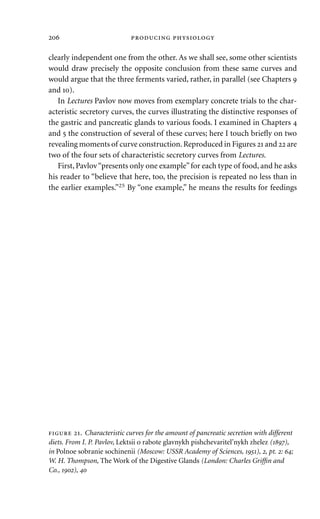
![with only one quantity of each food. These examples were carefully chosen
(see Appendix B). Second, the tension between Pavlov’s scientific vision and
the nature of his data emerges in a curious manner: the stereotypical milk
curve in Figure differs from the two curves for concrete trials with milk al-
ready provided to demonstrate the “astonishing precision” of the glands (see
Figure ).This reflects the problem created by Pavlov’s alternating reliance on
average data and on data from concrete trials. The stereotypical secretory
curve in Figure was apparently constructed from Val’ter’s average data; but
when Pavlov sought two concrete trials to make his point about the precision
of glandular work, he could not find two that both closely resembled one an-
other and conformed to the average data. In effect, then, in Lectures Pavlov
provides two different stereotypical curves for the amount of pancreatic se-
cretion elicited by a meal of cubic centimeters of milk. (This went un-
mentioned by reviewers and subsequent commentators, which perhaps tells
us something about the way people tend to read curves and data charts.)
Verifying the Stereotypicity of the Template Dogs
Buried at the end of a long paragraph near the conclusion of Lecture , a para-
graph devoted to demonstrating the reliability of the isolated sac, we find the
following sentence: “Lately, another dog with an isolated sac constructed ac-
cording to our method is stereotypically reproducing all the main facts col-
lected on our first [such] dog” (pp. ; ). Pavlov is referring here to Vol-
kovich’s trials with Sultan, which had started after Lectures had gone to press.
. Characteristic curves for the proteolytic power of gastric secretion after
meals of meat, bread, and milk. From I. P. Pavlov, Lektsii o rabote glavnykh
pishchevaritel’nykh zhelez (), in Polnoe sobranie sochinenii (Moscow: USSR
Academy of Sciences, ), , pt. : ; W. H. Thompson, The Work of the Digestive
Glands (London: Charles Griffin and Co., ), ](https://image.slidesharecdn.com/2002-pavlovsphysiologyfactory-160317043615/85/pavlov-s-physiology-factory-228-320.jpg)


![didVal’ter’s,fluctuating by over percent from experiment to experiment.32
Here again, however, the idiosyncrasies of individual dogs provided an expla-
nation that upheld the laboratory’s central idea.
Obviously, the stereotypical course of secretion that repeats itself in some
experiments can be acquired when the stomach, pancreas, and other parts
of the digestive system are consistently functioning in a precise and correct
manner. We have already spoken above of the many circumstances that can
disturb these [normal] relations.Not every dog presents a suitable object for
the analysis of normal relations. It was Val’ter’s especially good fortune to
work on a completely healthy dog who lived in the laboratory in complete
health for two years, who adapted completely to laboratory life and to the
new conditions created by the implantation of a pancreatic fistula. There-
fore, [Val’ter’s] typology of secretions preserves its correctness even today.
Dogs that do not possess the [fortunate] qualities of Val’ter’s Zhuchka are
not distinguished by that dog’s same pravil’nost’ in the work of the gland,
but in these other dogs,too,we can find the very same characteristic features
of secretion established by Val’ter.33
So, Zhuchka was accepted as “normal,” as a “suitable object for the analysis of
normal relations.”The divergent results produced by Bukhshtab’s dog were as-
cribed to its “unfortunate” nature and so were discarded. The isolated experi-
ments with this dog that did produce results corresponding to those obtained
earlier with the template dog were taken as confirmation of Val’ter’s charac-
teristic curves.
The Unification of Physiology and Medicine
In Lectures, Pavlov uses his own laboratory and research findings to offer his
views not just of the digestive factory but of modern experimental physiology
and its relationship to clinical medicine. Pavlov himself emerges as an exem-
plar of both the modern laboratory enterprise and a medically relevant,physi-
cian-friendly physiology.
The “Ladies and Gentlemen” whom Pavlov addresses at the beginning of
each lecture were primarily the physicians, medical students, and medical bu-
reaucrats of St. Petersburg, who comprised the most important constituency
for laboratory physiology.34
By Pavlov had accumulated more than
twenty years of experience as an intermediary between the laboratory and
medical practitioners—as a medical student, a member of the faculty of the
Military-Medical Academy, the manager of three laboratories (Botkin’s, and
his own at the Academy and the Institute) that were largely populated by
](https://image.slidesharecdn.com/2002-pavlovsphysiologyfactory-160317043615/85/pavlov-s-physiology-factory-232-320.jpg)
![physicians, and an active participant in the Society of Russian Physicians.35
The origin of Lectures as a series of addresses to a medical audience at the In-
stitute,together with Pavlov’s extensive experience with this audience,explains
much about its form, tone, and rhetorical qualities.
Pavlov also,no doubt,had a second primary audience in mind: Lectures was
his first synthetic statement to western physicians and physiologists. Having
limited his previous western publications to relatively narrow subjects, and
having for over a decade eschewed western scientific conferences entirely,
Pavlov clearly intended Lectures to be translated into western languages and to
secure for him a “European reputation.”36
Pavlov describes in Lectures a close relationship between the nature of the
laboratory and the quality of its products. Only a scientific enterprise that was
itself purposive, regular, and precise could divine these same qualities in the
digestive system. Previous investigators, bound by clumsy methodologies and
vulgar generalizations, had inevitably failed to discern the subtlety and preci-
sion of the digestive system. Working crudely, they perceived glands that re-
sponded bluntly and indiscriminately to mechanical, chemical, or thermal
agents. Pavlov’s laboratory, on the other hand, had perfected surgical and ex-
perimental methods with a precision appropriate to their object of investiga-
tion. The data thus obtained enabled him to “banish—one hopes forever—
[this] crude and fruitless idea” of the “bluntness” of the digestive glands by
revealing “the contours of an artistic mechanism imbued, like everything in
nature, with subtlety and internal purposiveness.”37
The distinctiveness of the
laboratory’s methodologies and technologies is underlined by the absence in
Lectures of references to contemporary work in other laboratories. Pavlov
praises Nicolas Blondlot and Rudolf Heidenhain for their contributions of
earlier decades, but in the new era defined by physiological surgery and the
chronic experiment, his own laboratory stands virtually alone.38
The very nature of Pavlov’s laboratory enterprise enabled him to offer not
merely his own interpretation but the “view of the laboratory,” the result of
thousands of experiments on hundreds of dogs by dozens of coworkers.“We,
the laboratory,” is on proud display in Lectures, where Pavlov praises his
coworkers,refers to twenty-one of their publications,and constantly cites their
experiments and specific discoveries. Like previous investigators, he and his
coworkers had, of course, committed their share of methodological and in-
terpretive errors. Their coordinated efforts, however, ensured the quality of
the laboratory’s products. The “laboratory view” was “constantly tested, fre-
quently corrected, and, consequently, the most correct.”39
Addressing himself to the medical practitioners in his audience,Pavlov em-
](https://image.slidesharecdn.com/2002-pavlovsphysiologyfactory-160317043615/85/pavlov-s-physiology-factory-233-320.jpg)

![among the “more intellectual and well-to-do classes” for two reasons: “First,
because among them there is greater intellectual activity and the various is-
sues in life are more unsettling; and second, because food is usually provided
in greater quantity than necessary [for the organism]. Among the simpler
classes—where intellectual life is more elementary and there is a greater ex-
penditure of muscular energy and a general insufficiency of nutrients—the
interest in food is normally strong and lively without any special measures”
[pp. ; ].)
Unfortunately, writes Pavlov, scientifically minded physicians had been led
astray by physiologists in recent times. Blondlot had emphasized the impor-
tance of appetite in his Traité analytique de la digestion (), but in subse-
quent decades physiologists, unable to transform this psychic moment into a
reliable laboratory phenomenon,had increasingly ignored it.They made“only
minor mention . . . of psychic gastric juice, which was treated as a mere cu-
riosity. Furthermore, great significance was ascribed to the mechanical irrita-
tion” of the digestive apparatus by food. Medical textbooks had followed suit,
reducing appetite to “an insignificant subjective symptom”; and scientifically
oriented practitioners, “attempting to find assistance in laboratory data and
not finding there facts relating to appetite, naturally cooled toward it in their
clinical practice” (pp. ; ).
The“progressive significance”of physicians’confidence in laboratory knowl-
edge was“indisputable,”but“here, as in all human affairs, there are errors and
extremes. One must not forget that the absence of one or another phenome-
non in given laboratory conditions does not mean that it is a fantasy.” Scien-
tists, Pavlov explains, frequently do not know all the conditions necessary to a
particular phenomenon and so cannot reproduce it in the laboratory. Physi-
cians should not, then, too readily relinquish their authority to the laboratory
wisdom of the day, nor should physiologists ignore time-tested medical prac-
tices when framing and interpreting their experiments.42
In this account, Pavlov and the practicing physician emerge as partners and
heroes. Pavlov had corrected the error committed by less skilled (and more
mechanistic) experimentalists,restoring appetite to its rightful place in the di-
gestive apparatus. In so doing, he had confirmed traditional clinical wisdom.
Practicing physicians, while often avoiding any “direct” mention of appetite,
had stubbornly continued to practice many therapeutic measures that were
oriented toward its promotion.For example,although the laboratory had pro-
vided no evidence in favor of the use of bitters, which had consequently been
“all but expunged from pharmaceutical lists,” physicians continued to rely on
them when treating patients. Now that Pavlov had affirmed the importance of
](https://image.slidesharecdn.com/2002-pavlovsphysiologyfactory-160317043615/85/pavlov-s-physiology-factory-235-320.jpg)
![appetite, this stubborn attachment to bitters was vindicated. The physician,
with his worldly experience, and Pavlov, whose vision and experimental skills
allowed him to affirm the physician’s wisdom, could together enjoy a moment
of triumph at the expense of mechanistic physiologists (pp. –; –).
Pavlov’s laboratory findings also validated other common medical prac-
tices and supported a broad conception of the physician’s authority.Physicians
had long fed milk to grievously ill patients—and Pavlov now demonstrated
that, in the absence of appetite, milk, with its rich chemical exciters, was in-
deed the most easily digested of foods. Physicians had long claimed that part
of their art was to adapt their treatment to a patient’s experiences and incli-
nations—and Pavlov now had proven scientifically the importance of indi-
viduality to the digestive process.And physicians had long emphasized the im-
portance of proper regimen—and Pavlov now underlined the significance of
managing the idiosyncratic psyche. Particularly in caring for people“who live
in the great [urban] centers, where life is especially tense,” the physician must
not only have the authority to prescribe travel or a stay in a hydropathic insti-
tution but should also cultivate among the public“a correct view of the process
of eating” (pp. ; ). This was particularly true for the Russian physician.
“Especially in Russia’s so-called intellectual classes, with its still utterly con-
fused ideas about life in general, one often encounters a completely unphysi-
ological, sometimes even contemptuously inattentive attitude toward eating”
(pp. ; ).43
In his closing (and subsequently much-quoted) peroration, Pavlov invites
physicians to engage in the necessary dialogue between laboratory and clinic
by alerting him to the deficiencies in his own work.
If the physiological data collected here help the physician to understand
anything in the sphere of his activity and facilitate a more correct and suc-
cessful approach to treatment, then the physician can secure for himself still
greater advantage by informing the physiologist of any corrections . . . that,
from his point of view, need to be made to the explanations offered here,
and by indicating those new dimensions of the subject that have been re-
vealed to the physician in the broad world of clinical observations but still
remain outside the physiologist’s field of sight. I believe profoundly that
only by such a lively exchange of views between the physiologist and the
physician will the goals of physiology as knowledge, and medicine as an ap-
plied science, be quickly and truly attained. (pp. ; )
The style and content of Pavlov’s research allowed him to assume this
rhetorical posture with great authority. Working with intact animals, he was
able to make specific recommendations about the treatment of intact patients
](https://image.slidesharecdn.com/2002-pavlovsphysiologyfactory-160317043615/85/pavlov-s-physiology-factory-236-320.jpg)


![porary psychology and psychiatry. The important role of insights from these
two disciplines in the birth of research on conditional reflexes has been ob-
scured by Pavlov’s tale about this episode, a tale repeated uncritically by sub-
sequent commentators.1
Vul’fson, Pavlov, and the Psyche’s Choices
In the s Pavlov’s laboratory devoted relatively little attention to the sali-
vary glands, but this line of research moved quickly along the standard inves-
tigatory sequence. In the chief assigned one praktikant, Sergei Ostro-
gorskii, to confirm nervous control over the glands.2 A former praktikant,
David Glinskii, working independently, accomplished the next step: develop-
ment of an improved salivary fistula.Glinskii’s fistula allowed the separate col-
lection of fluids from the three salivary glands (the parotid gland and the two
mucous glands—the submaxillary and sublingual). Using this fistula, Glinskii
confirmed Claude Bernard’s earlier observation that the various salivary
glands responded differently to the same exciter and that these glands were
“extraordinarily sensitive to the dryness of food.” In Pavlov reported to
the Society of Russian Physicians on Glinskii’s results, finding in them evi-
dence that, as for the pancreatic and gastric glands,“the work of the [salivary]
glands is entirely purposive and individualized.”3
In Lectures on the Work of the Main Digestive Glands, Pavlov devoted only a
few pages to the relatively unimportant salivary glands, but affirmed that, like
the main glands,they were controlled by nerves,responded only to specific ex-
citers (and not to mechanical irritation), and secreted purposively. Saliva was
the first fluid that greeted food on its entrance into the digestive factory. “It
must, therefore, provide a good welcome to the entering substances.” If an in-
gested food was dry, saliva moistened it; if it was hard and bulky, saliva cov-
ered it with mucin (mucus) in order to facilitate its passage down the narrow
esophagus. Saliva also initiated the chemical processing of some foods (such
as starch) and served as a “washing-out fluid” when injurious substances en-
tered the mouth.4
Even more markedly than the gastric and pancreatic glands, the salivary
glands responded to psychic excitation. This was long known to various in-
vestigators, and Pavlov presented it as a familiar observation: “Daily experi-
ence has shown us that the salivary glands become active even before food
reaches the mouth. With an empty stomach, the sight of food or even the
thought of it suffices for the salivary glands to immediately set to work; which
is the basis of the well-known expression that ‘one’s mouth is watering.’ So, a
](https://image.slidesharecdn.com/2002-pavlovsphysiologyfactory-160317043615/85/pavlov-s-physiology-factory-239-320.jpg)

![The salivary response to edible substances varied in quantity according to the
dryness of the food and was uniformly rich in mucin. Inedible substances
elicited “about the same” quantity of saliva as did foods, but its mucin level
was generally low and varied little from one inedible substance to another.
This,Vul’fson observed, made good“sense.”Mucin served to lubricate a food-
stuff for its passage down the digestive canal, and inedible substances were not
swallowed but, rather, ejected from the mouth. Mucin was unnecessary to this
latter task, so inedible substances elicited instead a watery saliva that served to
cleanse the mouth of any unexpelled remnants.9
The psyche’s role in this “strict purposiveness” was especially evident in a
number of “special facts.”Most important,“psychic secretion is a complete re-
flection of the direct,purely physiological secretion,differing only in amount.”
The participation of the psyche in the process of salivation is indubitable.
The very same results regarding quantity and quality of saliva that are ac-
quired when substances come into direct contact with the roof of the mouth
occur also when they are used for teasing alone. The very same dependence
of the quantity of saliva upon the dryness of food that occurs during feed-
ing is clearly manifest when the dog is merely teased with [dry food]. Just as
introducing unpleasant substances into the mouth elicits salivation, so does
a mere representation of the unpleasant substance elicit a rather strong se-
cretion from both types of glands. Substances that do not excite the salivary
glands by their direct contact with the mucous covering of the mouth also
do not elicit secretion by their psychic influence.So,teasing with water,even
when the dog is very thirsty, produces no effect. With respect to the com-
position of the secretion of the mucous glands, the reaction to teasing with
food is no less accurate: a thick secretion rich in mucin; and in reaction to
teasing with rejected substances the secretion is watery. But what is a simple
physiological reflex in the case of the direct contact of substances with the
roof of the mouth remains [in the case of psychic secretion] undefined and
subject to reinvestigation.10
In contrast to gastric and pancreatic secretions, then, the psychic secretion
from the salivary glands was essentially identical to secretion during the sec-
ond, nervous-chemical phase of digestion. This psychic secretion manifested
the same ability to differentiate among and respond purposively to substances
that, in the gastric and pancreatic glands, occurred only in the nervous-chem-
ical phase of digestion,when,according to laboratory doctrine,the specific ex-
citability of the nerve endings in the mucous membrane of the stomach and
duodenum generated distinctive responses to different foods.
Vul’fson observed in his report to the Society of Russian Physicians in Oc-
](https://image.slidesharecdn.com/2002-pavlovsphysiologyfactory-160317043615/85/pavlov-s-physiology-factory-241-320.jpg)
![tober that the highly specific responses of the salivary glands involved not
only “emotion, but also an element of thought—a representation about the
nature of the external substances falling into the roof of the mouth.”11
The
“adaptation” of salivary reactions to specific substances was “almost entirely
of a psychic nature.”12
“The task of the psyche,” he wrote, is “to sort out” ob-
jects, “to divide” them into two groups—accepted and rejected substances—
in order to respond to each with the appropriate salivation.13
The psyche ex-
hibited great “scrupulousness,” an unerring “judgment of particular circum-
stances,” and the ability to “generalize.”14
Two experiments were especially telling.The first concerned the salivary re-
sponse to a combination of meat and mustard oil. When the dog ate meat
alone, its saliva was rich in mucin, which facilitated the meat’s passage down
the digestive tract; when the dog was fed mustard oil (a most unpleasant sub-
stance), the glands produced a watery saliva to wash out the mouth. When
mustard oil was added to meat, the result was not a simple summing of the re-
sponses to the two substances but rather a watery saliva appropriate to a re-
jected substance. The psyche, then, had transcended mere chemical responses
to render a judgment: the combination of meat and mustard oil was catego-
rized as a rejected substance.15
A second important experiment underlined the same point.“Rocks intro-
duced into the dog’s mouth do not elicit salivation, [but] sand elicits a great
amount of saliva. What other than an evaluation of particular circumstances,
and so the psychic moment, could determine this difference in salivation?”16
Here again, the dog’s salivary response was governed not by the simple chem-
istry of the substance but rather by an acute judgment rendered by the psyche.
Rocks and sand were identical in chemical composition, but they presented
the salivary glands with different tasks: the dog simply ejects rocks from its
mouth (which requires no saliva) but must wash down its throat the small
grains of sand that invariably remain after its attempt to expel the sand. This
latter task required a mucin-rich saliva. Clearly,Vul’fson informed the Society
of Russian Physicians in March , further investigation of the salivary
glands “must move to the psychology of salivation”17
A delighted Pavlov echoed these sentiments. He lauded Vul’fson’s report
(which, of course, he had closely edited) for developing the doctrine of spe-
cific excitability by demonstrating the“subtle and sharp adaptation of the sali-
vary glands: everything edible elicits from the submaxillary gland a saliva rich
in mucin, and everything rejected yields a watery saliva.” It was especially in-
teresting, he continued, that in the work of this first part of the digestive sys-
tem“the participation of the psyche emerges clearly, so psychology almost en-
](https://image.slidesharecdn.com/2002-pavlovsphysiologyfactory-160317043615/85/pavlov-s-physiology-factory-242-320.jpg)


![ety of mental qualities that involved a broad range of capacities. He concluded
that psychic secretion reflected not high-level processes such as will,choice,and
judgment but rather the relatively low-level process of “visual associations.”
Snarskii developed this line of argument by constantly juxtaposing his
views to Vul’fson’s. He basically accepted Vul’fson’s methodology and empir-
ical results, but rejected his conclusion that “the psyche determines the corre-
sponding work of the glands.”23 This, Snarskii insisted, was a psychological
conclusion—and an amateurish one at that.
The method is entirely exact and, insofar as the problem concerns physiol-
ogy, it provides entirely clear and lawful conclusions. But these conclusions
enter the sphere of zoopsychology, and here, it seems to me, the author’s
conclusions are too hurried and constructed on an inexact and contradic-
tory terminology, which, in the sphere of psychology, too, should be com-
pletely exact and definite.
Apparently, [Vul’fson] was fascinated, on the one hand, by his discovery
of the purposive activity of the salivary glands, and on the other, by a cer-
tain participation of the psychic activity of the dog in the act of salivary se-
cretion. This leads him to the conclusion that “the psyche determines” and
that the dog, too, makes a “choice.” (p. )
Echoing Sechenov’s famous argument in Reflexes of the Brain, Snarskii pointed
out that “entirely purposive and complex acts are characteristic of even de-
capitated animals,”which obviously lack a psyche and are incapable of “choos-
ing” anything. (Sechenov had used the example of a beheaded frog that pur-
posively withdraws its leg from a drop of acid.)24
What, then, did Vul’fson mean by the word psyche? Was he referring to
“purely reflexive or instinctive” actions or to “conscious activity”?25 This was
a specifically psychological question, and neither Vul’fson nor Pavlov had ever
addressed it systematically. Snarskii’s response to it led him to greatly dimin-
ish the active role attributed to the psyche during salivation.
Judgingby[Vul’fson’suseof]thewords“determines,”and,especially,“choice,”
the author had in mind the latter [i.e.,conscious activity].It is proposed that
in each case of indirect irritation the dog consciously makes an evaluation
of the given substance, compares the sensation with previous ones, thinks it
over (perhaps even vacillates) and finally, confirming only one of various
possibilities, makes a choice—that is, a higher, conscious, willful, and vol-
untary act. In other words, it makes the decision to secrete one or another
saliva. Such, after all, is the meaning of the words “choice” and “decision” in
psychology. One can hardly acknowledge such a subtle and complex activ-
ity for each secretion of saliva, especially since such activity is possible only
](https://image.slidesharecdn.com/2002-pavlovsphysiologyfactory-160317043615/85/pavlov-s-physiology-factory-245-320.jpg)
![in the presence of representations in the precise meaning of that word—that
is, of memories of past sensations. In our experiments the psychic activity of
the dog is expressed in a much more elementary form: each time the dog
sees before it an irritating object it only recognizes it and, consequently, re-
ceives a so-called linked representation (as distinct from a free representa-
tion, which alone is an independent part of consciousness). (p. ; emphasis
in original)
The same psychic secretion that for Vul’fson and Pavlov represented the psy-
che’s active “judgment” and “determination” was for Snarskii a mere “linked
representation” independent of volition.26
Citing research by Ribot, Snarskii noted that various sensory impressions
were easily linked with specific foods and that various types of representations
thus became associated with one another in various patterns. Visual impres-
sions were grouped into “complex aggregates” and auditory impressions into
a “consequential series.” Snarskii’s analysis of the various animal senses led
him to the conclusion that a dog’s recognition of substances was based largely
on “visual associations.” For taste, these associations were formed with the
“tactile sensations from the roof of the mouth.”Edible and inedible substances
were recognized through“visual representations, for example, of the vessel, of
a certain shape, or of the tinting of the fluid in a certain color” (p. ). So, the
phenomenon of psychic secretion involved both the recognition of objects
and“a corresponding salivary reaction as a consequence of the established vi-
sual association.”
From a “psychological point of view,” Snarskii continued, one must ask
what “rung” this phenomenon occupied in the “general chain of psychic phe-
nomena.”Following such“authoritative teachers of psychology as Wundt and
Harald Hoffding,” Snarskii concluded that psychic secretion was the result of
“the simplest processes that unite new impressions with preceding impres-
sions—that is, elementary memory.” This process of recognition by means of
“newly established associations”—what Wundt termed recognition anew—
was of course a more complex act than those resulting directly from elemen-
tary animal appetites. This did not, however, justify Vul’fson’s sweeping attri-
bution to psychic secretion of higher-rung psychological qualities. “To draw
from this entirely elementary act the conclusion that the dog makes a ‘choice’
about which saliva to secrete in the given case is to make an unfounded logi-
cal leap. Direct recognition does not rise [to the level of] even a free represen-
tation, to say nothing of the long chain of psychic acts, such as the formation
of concepts, judgments and conclusions, which must precede a conscious
choice and decision” (p. ). Snarskii offered a better explanation.
](https://image.slidesharecdn.com/2002-pavlovsphysiologyfactory-160317043615/85/pavlov-s-physiology-factory-246-320.jpg)
![As long as there is direct irritation, the secretion of saliva is only a simple re-
flex.When the dog recognizes a previous irritant . . . it repeats a habitual re-
flex; but repeats it automatically, without any participation of conscious,
active will. Schematically, this would be expressed as follows: there is estab-
lished a common reflexive arc between the direct irritant, on the one hand,
and the act of salivation on the other. We can imagine that the centripetal
end of this arc is, so to speak, split; and therefore the very same salivary re-
flex can be received by the representations associated directly with the irri-
tation. But this very circumstance—that the secretion of saliva as the result
of association is ‘a complete reflection’ [these and subsequent quotes are
from Vulfson’s thesis] of the very same act during direct irritation, speaks
clearly against the possibility of ‘a choice’: the act is accomplished entirely
stereotypically, automatically, through a well-trod path. The consciousness
of the dog plays no ‘important’ role; it ‘chooses’ nothing and in itself does
not ‘determine’ the activity of the salivary glands. (pp. –)
Snarskii here used one of Pavlov’s favorite words, stereotypical, to make his
point: psychic secretion resulted not from judgment or any other volitional
process but from an association between the irritant, the act of salivation, and
associated (perhaps visual) representations. Or, “schematically,” the reflexive
response to the food irritation is split: part continues as the usual salivary re-
flex, while part is received by and becomes associated with other (say, visual)
irritations. This process was rooted not in the dog’s emotions but in its ap-
petites—that is, in a physiological form characterized by “stability, consis-
tency, automaticity, and the absence of the novelty and indecisiveness that ap-
pear together with consciousness.”“We are obviously dealing with purely vital,
physiological needs,” wrote Snarskii, which represent the same type of “ele-
mentary form of affective life” as the need for sleep and sex (p. ).
Snarskii used this schema throughout his thesis to reinterpret experimen-
tal results that Vul’fson and Pavlov had attributed to the psyche’s choices. For
example, when a substance, such as acid, that elicited a salivary reaction was
tinted black and poured into a dog’s mouth,“there is apparently established a
visual association between the caustic taste and the substance’s color; corre-
spondingly, a reflex is established.” If black-tinted water was then poured into
the dog’s mouth several times, however, the salivary response ceased, since the
roof of the mouth was not irritated by the water. If black-tinted acid was again
poured into the dog’s mouth and the experimenter then feigned putting black-
tinted water into the dog’s mouth, salivation again occurred: “It is clear that
the dog, on the basis of the just-established reflex, repeats the very same reflex,
defending the mucous [membrane] of the mouth from the corrosive action of
](https://image.slidesharecdn.com/2002-pavlovsphysiologyfactory-160317043615/85/pavlov-s-physiology-factory-247-320.jpg)


![erals and conservatives, populists and monarchists, materialists and idealists
were thus able to work together—in the laboratory or on the editorial board
of a journal—toward common professional and scientific goals.35
By the turn of the century, then, it was neither radical nor uncommon to
assert that what Pavlov termed psychic secretion might be explicable as a reflex.
Indeed,Pavlov’s longtime coworker Leon Orbeli recalled that when Pavlov dis-
cussed psychic secretion in his lectures on physiology at the Military-Medical
Academy, his interpretation was challenged by his student audience. “I re-
member those lively discussions that would occur in our auditorium. The lis-
teners often asked: but can’t this event be explained as a reflex, just one from
another sensory organ? Ivan Petrovich [Pavlov] then would present an entire
line of facts that contradicted this explanation and compelled one to relegate
‘psychic activity’ to a special group of facts. This was in –.”36 This
same sentiment was expressed by some Russian medical reviewers of Pavlov’s
work. One commentator wrote in the Russkii Arkhiv Patologii, Klinicheskoi
Meditsiny i Bakteriologii (RussianArchive of Pathology,Clinical Medicine,and
Bacteriology) in , for example, that what Pavlov termed igniter or psychic
juice was probably “the effect not so much of psychic excitation as of a direct
reflex.”37 Similarly, Pavlov’s former praktikant Petr Borisov, who became pro-
fessor of pharmacology and balneotherapy at Novorossiisk University in ,
expressed his opinion in the same year that, notwithstanding the opinion of
his “much-esteemed teacher,” “the secretion of gastric juice during so-called
sham-feeding is conditioned not by a psychic moment but rather by irritation
of the taste nerves and a reflex from them to the glands of the stomach.”38
Even closer to home, and of more direct impact, was the laboratory enter-
prise of Pavlov’s colleague at the Military-Medical Academy, Vladimir Bekh-
terev (–). The lives of these two researchers and scientific entrepre-
neurs were intertwined for over fifty years—in mutually respectful relations
from the mid-s until about , when, their research interests having
grown very close, a clash over experimental results precipitated an acrimo-
nious competition that lasted until Bekhterev’s death.39 Pavlov and Bekhterev
had been medical students together at the Military-Medical Academy (Bekh-
terev graduated in , Pavlov the year after), after which both had enrolled
in the Academy’s doctoral program. Pavlov had acquired his doctorate in
and Bekhterev in ; in the latter year both received a two-year scholarship
to study in Western Europe. Each spent some time in Carl Ludwig’s labora-
tory, at which point their paths diverged. Pavlov traveled to Rudolf Heiden-
hain’s physiological laboratory, and Bekhterev pursued research and training
in neurology and psychiatry with Paul Flechsig, Charcot, and Wundt.
](https://image.slidesharecdn.com/2002-pavlovsphysiologyfactory-160317043615/85/pavlov-s-physiology-factory-251-320.jpg)


![of Tolochinov’s research report of .In discussing the origins of his research,
for example,he writes not the usual“Professor Pavlov suggested . . .”but rather
“Ihadinmindtostudyinamoredetailedmannertheroleof thepsychicprocess
in salivary secretion; to do so I conducted in the physiological laboratory of
professor I. P. Pavlov . . . experiments on dogs with salivary fistulas.”48
The details of the Pavlov and Tolochinov collaboration during this research
are impossible to unravel from existing sources, but despite the men’s subse-
quent dispute, the versions provided by each agree in their general contours.
First, Tolochinov conducted most of the experiments, sometimes with Pav-
lov’s participation. Second, Tolochinov was largely responsible for the initial
experimental and conceptual breakthroughs; as Pavlov put it,“he was the first
to put his hand to it; priority, one could say, belonged to him.” And third,
Pavlov fundamentally reinterpreted Tolochinov’s findings—as reflected in his
replacing Tolochinov’s term for psychic secretion, reflex at a distance, with his
own term, conditional reflex—and conceived an experimental line of inquiry
to build upon Tolochinov’s initial results.49
From November until June , Tolochinov traveled from the Charity
Home to Pavlov’s laboratory several afternoons a week to conduct experiments
for about three hours at a time. Boris Babkin, who entered the laboratory in
,later recalled that sometimes Tolochinov and Pavlov worked together and
sometimes Tolochinov worked alone. Tolochinov later recalled that, to avoid
“extrinsic influences,” the experiments were conducted in a separate room “in
the presence of only the laboratory attendants; from time to time, [the exper-
iments] were checked by I. P. Pavlov.”50
Babkin provides the following sketch
of Tolochinov as experimentalist: “He was an extremely quiet and withered
man. It is impossible to remember without smiling the manner in which he
carried out his experiments. He slowly waved a rusk in the dog’s face a certain
number of times. The dog licked its chops and saliva dripped from the fistula
which had been made in one of its salivary glands for the purposes of these ex-
periments. This was a conditional reflex. Then Tolochinov invariably tapped
the dog gently on the head with the rusk, after which the animal was allowed
to eat it—this was an unconditional reflex. This ritual never varied and was al-
ways conducted in the same methodical and melancholy fashion.”51
Tolochinov initially intended“only to register more facts”about the psychic
secretion of the salivary glands,and he proceeded within the post-Snarskii lex-
icon, using “purely psychological terms such as ‘representation,’ ‘association,’
and so forth.”52
His first experiments involved measuring the salivary response
as he irritated the dog“at a distance”by waving various substances in its face—
toast, fingers smeared with meat powder, open bottles of mustard oil and hy-
](https://image.slidesharecdn.com/2002-pavlovsphysiologyfactory-160317043615/85/pavlov-s-physiology-factory-254-320.jpg)

![In this trial, Tolochinov was not interested in repeating each “irritation at a
distance” until the salivary response declined to zero.
In about ten trials conducted on Ryzhaia from February to February ,
however, Tolochinov did precisely this. Several times, as if to assure himself
that he had discovered a real phenomenon, he repeated this twice—bringing
the secretion to zero, renewing it by feeding the dog, and then bringing it to
zero again. The first instance of such a procedure comes in the only experi-
ment reported for February , :56
Over the next two weeks Tolochinov tested this phenomenon—soon to be
termed extinction—with various “irritations at a distance.” The following se-
ries, conducted on Ryzhaia on February , , is typical of these more com-
plex trials (p. ):
()
2:47 Wave dry toast, 1 min. 0.2
2:50 Wave dry toast, 1 min. 0.1
2:53 Wave dry toast, 1 min. 0.0
[Tolochinov tests this again one hour later.]
3:42 Wave dry toast, 1 min. 0.3
3:52 Wave dry toast, 1 min. 0.2
3:55 Wave dry toast, 1 min. 0.05
3:57 Wave dry toast, 1 min. 0.0
()
2:33 Wave dry toast, 1 min. 0.1
2:35 Wave dry toast, 1 min. 0.0
2.37 Wave dry toast, 1 min. 0.0
2:42 Sound of hidden toast scraped on plate, 1 min. 0.5
2:44 Sound of hidden toast scraped on plate, 1 min. 0.2
2:46 Sound of hidden toast scraped on plate, 1 min. 0.1
2:48 Sound of hidden toast scraped on plate, 1 min. 0.0
3:04 Wave dry toast, 1 min. 0.0
3:06 Sound of hidden toast scraped on plate, 1 min. 0.9
3:10 Sound of hidden toast scraped on plate, 1 min. 0.2
3:13 Sound of hidden toast scraped on plate, 1 min. 0.3
3:15 Sound of hidden toast scraped on plate, 1 min. 0.1
3:18 Sound of hidden toast scraped on plate, 1 min. 0.0](https://image.slidesharecdn.com/2002-pavlovsphysiologyfactory-160317043615/85/pavlov-s-physiology-factory-256-320.jpg)
![Tolochinov’s later account indicates that this discovery of extinction proved
to be a turning point—imparting “a new direction both to my work and to
that of subsequent investigators in this sphere”(p. )—precisely because of
his background as a psychiatrist and former coworker in Bekhterev’s labora-
tory. Explaining his decision “that it is irrational for a physiologist to resort
to psychological terms for the explanation of salivation when the animal is
shown foodstuffs,” Tolochinov recalled:
Resolution of this question presented no special difficulties because the in-
fluence at a distance of various factors upon the muscular work of certain
organs of our body had been noticed long ago. In the experiments [on irri-
tation at a distance] we are dealing with the very same influence on the work
of the glandular organ.
It was noticed long ago that in several patients knee reflexes sometimes
result, not only from the blow of a hammer, but even when this instrument
is merely waved with the intention to strike the lig. patel. propr.[patellar lig-
ament], although this latter reflex is much weaker than the former . . . It is
also remarkable that this phenomenon is to a certain degree involuntary;
therefore it is most easily understood as a reflexive act from the brain cor-
tex by means of waves of light, just as the reflexive response of the knee to a
blow is the result of mechanical waves. This is the same type of phenome-
non as the nictating reflex of the eyelid, which occurs, not only when the
eyelid is touched, but also when any object, or the investigator’s fingers,
makes a more or less rapid approach to the eye.
If one compares the irritation at a distance of the muscular organ and the
glandular organ, the difference consists only in the special function of each,
but the mechanism is one and the same.
On these foundations, I proposed that the phenomena of salivation dur-
ing irritation of the dogs at a distance by foodstuffs be considered a reflex at
a distance, which was accepted by prof. I. P. Pavlov, who termed it a condi-
tional reflex as distinct from the unconditional reflex received when the mu-
cous membrane of the roof of the mouth is irritated directly by edible and
inedible substances.
My conviction of the truth of this new view . . . was further strengthened
by the circumstance that the salivary reflex elicited at a distance obeyed the
same basic physiological law as the nictating reflex of the eyelid or the knee
reflex elicited at a distance. That is, it obeyed the law of extinction (ugasa-
niia) or decline (otklonenie) of the reflex, and, mainly, when certain condi-
tions were observed, it was distinguished by an involuntary, fatal (rokovoi)
character. If salivation sometimes did not occur in several dogs, I would ex-
plain this phenomenon by the declining irritation of a given center.
In general,one gets the impression that the stronger the irritation at a dis-
](https://image.slidesharecdn.com/2002-pavlovsphysiologyfactory-160317043615/85/pavlov-s-physiology-factory-257-320.jpg)
![tance, the more saliva is secreted; however, the amount of saliva during nu-
merous types of irritation rarely was as great as with the direct irritation of
the mucous membrane of the roof of the mouth by the very same foodstuffs,
just as the knee reflex elicited at a distance does not acquire the same force
as with the direct blow of the hammer. (pp. –; emphasis in original)
Like Snarskii, then, Tolochinov brought to Pavlov’s laboratory professional
experiences and expertise critical to the reevaluation of psychic secretion and
foreign to the chief himself. For Tolochinov, the extinction of psychic secre-
tion was reminiscent of his experiences in Bekhterev’s clinic with the knee and
eyelid reflexes. Bekhterev had devoted special attention to these reflexes and
regularly demonstrated to physicians like Tolochinov the usefulness of the
knee reflex as a diagnostic tool for nervous and mental diseases.57
Just as
Snarskii had drawn upon authorities in psychology to strip the “mind of the
glands”of will and judgment, to portray psychic secretion as a simple“associ-
ation” or “habitual reflex,” so did Tolochinov draw upon clinical psychiatry to
establish that psychic secretion behaved similarly to other“reflexes from a dis-
tance” that were “distinguished by an involuntary, fatal character.”
The phenomenon of extinction also gave Tolochinov some firm ground on
which to stand and observe other regularities governing his “complex reflex.”
For example, he soon discovered that an extinguished conditional reflex could
be rekindled by exciting the unconditional reflex on which it depended—that
is, for example, by feeding the dog in the following trials:58
()
4:16 Sound of scraping of toast hidden under experimental table, 0.05
1 min.
4:20 Toast fed to the dog (unconditional stimulus) 2.0
4:23 Sound of scraping of toast hidden under experimental table, 0.2
1 min.
4.25 Sound of scraping of toast hidden under experimental table, 0.0
1 min.
4:28 Sound of scraping of toast hidden under experimental table, 0.05
1 min.
4:30 Sound of scraping of toast hidden under experimental table, 0.0
1 min.
[The conditional reflex is extinguished.]](https://image.slidesharecdn.com/2002-pavlovsphysiologyfactory-160317043615/85/pavlov-s-physiology-factory-258-320.jpg)
![From mid-February through early June ,Tolochinov used extinction as
a background phenomenon for identifying increasingly complex regularities
governing conditional reflexes.59 He explored the secretory effects of alternat-
ing various irritants, of burning the dogs with hot wires on parts of their body
(some within reach of the dog’s mouth and so eliciting protective salivation,
some out of reach), of feeding one dog in the presence of another (this inhib-
ited secretion), and of denying the dog food for up to six days (the same reg-
ularities obtained, but in sharper form).
In July Tolochinov joined a delegation of Pavlov’s coworkers that de-
livered reports to the Northern Congress of Physiologists in Helsingfors (Hel-
sinki).60 In his short report, Tolochinov unveiled the term coined by the
chief—conditional reflex; explained how one obtained such a reflex in a labo-
ratory dog;and briefly discussed the phenomenon of extinction.Reporting his
discovery that a number of simple salivary reflexes originated with the trigem-
inal nerve that ran from the mucous membrane of the nose, Tolochinov ex-
plained:“This is why we oppose to the immediate and absolute reflexes—that
is,to the reflexes of the mucous [membrane] of the nose and mouth cavities—
all the other effects on the salivary glands that are ordinarily determined to be
psychic effects and which we term conditional reflexes (réflexes condition-
nels).”61 To obtain a conditional reflex, Tolochinov continued, not the “avid-
ity” but only the “attention” of the dog was required. The dog must be “more
or less starving,” and “to obtain the conditional reflex one must take advan-
tage of an immediate reflex.” Even a dog that was relatively indifferent to food
could be made to yield a conditional reflex,“which weakens little by little and
()
4:33 Toast fed to the dog (unconditional stimulus) 1.8
4:34 Sound of scraping of toast hidden under experimental table, 0.4
1 min.
[The unconditional reflex has renewed the conditional reflex.]
4:36 Sound of scraping of toast hidden under experimental table, 0.2
1 min.
4:40 Sound of scraping of toast hidden under experimental table, 0.0
1 min.
[The conditional reflex is extinguished again.]](https://image.slidesharecdn.com/2002-pavlovsphysiologyfactory-160317043615/85/pavlov-s-physiology-factory-259-320.jpg)

![volved both scientific and managerial decisions. Within Pavlov’s scientific vi-
sion, the key question was: could investigations of the psyche, like research on
digestion, generate precise, repeatable patterns that could be expressed quan-
titatively and interpreted according to their purposiveness? From an institu-
tional and managerial perspective, the key question was: could this line of re-
search consistently generate fresh dissertation topics that could be satisfactorily
completed within two years by physiologically untrained physicians? Only
when Pavlov decided that both questions could be answered affirmatively did
he shift the focus of laboratory research.
His decision was also influenced by two scientific developments that made
digestive physiology less appealing by introducing, as one praktikant later rec-
ollected,“a certain dissonance” into Pavlov’s approach to that subject.64 First,
the discovery of secretin by William Bayliss and Ernest Starling in un-
dermined Pavlov’s nervist portrayal of digestive processes, reopening and
complicating questions that he had considered closed. The secretion of pan-
creatic juice, the British physiologists announced, was elicited by this humoral
agent and“does not depend on a nervous reflex.”65 The significance of this de-
velopment for Pavlov’s nervist schema and for the experimental program
based on it was succinctly summarized by a defensive Russian reviewer in
Russkii Vrach (The Russian Physician): “In any case, the conclusions of I. P.
Pavlov’s experiments now need review, in the opinion of Bayliss and Starling
(most of all, in my view, it is their own experiments that demand a careful ver-
ification).”66
Pavlov had always found nervist explanations more aesthetically pleasing
than the alternatives, and throughout the s he had consistently avoided
topics that might compel him to confront humoral explanations.V.V. Savich,
a coworker at the Institute at the time of Bayliss and Starling’s discovery, de-
scribed Pavlov’s reaction this way: “I. P. [Pavlov] immediately assigned me to
verify Bayliss and Starling’s data about secretin. We began in his presence the
experiment that provided a complete verification of their views. I. P. stood for
a bit, left for his study in silence and half an hour later emerged and said: ‘Of
course they are right. You know, we cannot pretend to have the sole right to
the discovery of new facts!’”67 There is no reason to question this much-cited
account, but it does overstate Pavlov’s acquiescence to this new development.
In the laboratory’s first public response to Bayliss and Starling’s discovery, the
praktikanty Borisov and Val’ter confirmed that secretin was capable of elicit-
ing pancreatic secretion,but they also insisted that this secretion was relatively
weak, that secretin also elicited secretion from other glands, and that its action
depended on the participation of the nervous system. They therefore rejected
](https://image.slidesharecdn.com/2002-pavlovsphysiologyfactory-160317043615/85/pavlov-s-physiology-factory-261-320.jpg)

![mind and human behavior that he had imbibed in the s or his positivist
faith that a scientific understanding of these subjects was the surest path to im-
proving human society. Not until Tolochinov’s experiments, however, had it
seemed possible to address these subjects in a professional, truly scientific
(mature) fashion.
Whatever the emerging difficulties with digestive physiology or the visceral
attractiveness of this possible new line of investigation, the center of gravity in
Pavlov’s deliberations, in what he later described as his “difficult intellectual
struggle,”remained his scientific-managerial vision.The complexity of the sci-
entific and managerial issues at stake made Pavlov’s decision-making process
slow and contradictory. As one longtime coworker later recalled, “Of course,
I. P. [Pavlov] expected attacks on his new child and suffered through a great
series of doubts and vacillations.”72
So,judging fromA.F.Samoilov’s recollection about Pavlov’s behavior at the
Helsingfors conference in which Tolochinov delivered his report, one might
date Pavlov’s transition from July at the latest.
In the corridor of the university building he [Pavlov] laid out for several
people in a private meeting the facts he had established about conditional
reflexes. He was in a state of great agitation. Relating the very first experi-
ments, he already saw before him their subsequent fate and development.
He saw before him a broad new field of investigations,again on an intact an-
imal; investigations concerning the interaction between the animal and the
external environment, that is, investigations on the very soil upon which his
talent was greatest.He repeated:“Yes,we’ve got it,look what we’ve got!”And
he added: “You know, there is enough work here for many decades—I will
cease work on digestion, will leave it entirely for this new work.”73
In this same vein, a praktikant who arrived at the laboratory in fall later
recalled that “one could hear Ivan Petrovich frequently say ‘Down with the
physiology of digestion.And you all,’turning to his students,‘I will turn to the
study of the nervous system.’”74
The response of Pavlov’s colleagues in the Helsingfors corridor was, how-
ever,“restrained,”and Pavlov’s notes for his lectures on digestive physiology in
September indicate that he analyzed psychic secretion precisely as he had
before Tolochinov’s (and even Snarskii’s) work.
Recent investigations reveal psychic phenomena: the dog, for example, can
think, desire and express its feelings. It follows instructions, guesses, shows
what is pleasant and unpleasant for it. Psychic phenomena in connection
with the activity of the glands. We will build all our experiments upon the
](https://image.slidesharecdn.com/2002-pavlovsphysiologyfactory-160317043615/85/pavlov-s-physiology-factory-263-320.jpg)
![attention of the dog, but its attention depends upon the impressions pro-
duced upon it by the object. We will tease the dog with meat powder. The
salivary glands immediately begin to work.We will attract its attention with
meat: although its desire to eat the meat is greater [than for the meat pow-
der], it secretes less saliva since this is raw food. Adding dye to the acid in
order to color it, and pretending that we want to pour it into the dog’s
mouth. The dog guesses that this is an unpleasant substance; it knows this
from preceding experiments, and salivation [to wash the substance out] be-
gins. It is enough to show any dark liquid for the saliva to flow, since the dog
takes this for acid. But if we repeat this experiment several times, the dog
will become accustomed to it and there will be less and less saliva, and fi-
nally not a drop, because the dog will understand the deception. The same
with meat powder. This proves that this is a psychic phenomenon.75
This passage is especially interesting because Pavlov was here explaining psy-
chologically (the dog “will understand the deception”) the very same phe-
nomenon, extinction, that had convinced Tolochinov that psychic secretion
was a complex but determined reflex.
One looks in vain for a crucial experiment that convinced Pavlov that psy-
chic secretion could be productively approached as a reflex and thus launched
his new line of investigation. We are dealing, rather, with a complicated, non-
linear decision-making process involving a matrix of intellectual, managerial,
and even personal considerations. Before exploring the main line in this
process, we can orient ourselves with a few key dates.
In February praktikant N. M. Geiman delivered a paper to the Society
of Russian Physicians that signaled a significant shift in the laboratory’s long-
standing rejection of mechanical exciters of the glands—a somewhat embar-
rassing shift that was important to the emerging new line of investigation. In
April Pavlov delivered his first public address on conditional reflexes to
the Fourteenth International Congress of Physiologists in Madrid. The pat-
tern of praktikant assignments is also helpful. In only Tolochinov was
pursuing the investigation of psychic secretion, but the new praktikant Gei-
man was assigned to clarify, using acute experiments, the mechanism of sali-
vary responses to substances placed in the mouth. In only one of five new
praktikanty was assigned to the new line of investigation (A. P. Zel’geim, who
replaced the departing Tolochinov); but significantly, in October , Pavlov
pulled a favorite praktikant, Boris Babkin, off an important investigation of
the pancreas and assigned him to work on conditional reflexes. In , most
of Pavlov’s coworkers left for the front in the Russo-Japanese War. Still, he as-
signed one of his two new praktikanty, N. P. Tikhomirov, to the new line of in-
](https://image.slidesharecdn.com/2002-pavlovsphysiologyfactory-160317043615/85/pavlov-s-physiology-factory-264-320.jpg)


![Pavlov saw the conditional reflex as a suitable subject for physiological re-
search only if it could be revealed, in the final analysis, as a fully determined
conditioned reflex. As an experimentalist and laboratory manager, he defined
the question operationally: “To what extent can pravil’nye results be acquired
in the laboratory?” This is what made Tolochinov’s discovery of extinction so
important to Pavlov: it represented the first case in which conditional reflexes
behaved in a quantifiably repeatable, orderly fashion. After his report in Hel-
singfors, Tolochinov conducted a number of trials (ending in April ) that
gradually reinforced Pavlov’s intuition that research on conditional reflexes
could reveal “firm lawfulness,”“constantly recurring facts.” For example, con-
ditional reflexes diminished and disappeared if the conditional stimulus was
repeated without repetition of the unconditional stimulus on which it was
based, it was renewed by a strong unconditional stimulus, and it became
stronger when a stimulus excited several sensory organs rather than just one.
Babkin’s research of – further buttressed Pavlov’s growing confidence
that the conditional reflex would,with sufficient research,prove to be fully de-
termined.
This ability to generate pravil’nye results was the consistent theme of Pav-
lov’s initial speeches on the new line of investigation. In Madrid (), as we
have seen, he answered with an emphatic yes his own question about whether
the chaos of psychic experiments could be rendered pravil’nyi, and he enu-
merated the“main conditions guaranteeing [the experiments’] success,that is,
their constancy.”90 In his second public communication, “On the Psychic Se-
cretion of the Salivary Glands” (), he commented extensively on both the
complexity of conditional reflexes and the several“constant relationships”that
indicated the subject could “be studied with complete success.” By this time,
Babkin’s research had begun and Pavlov could claim that“the results obtained
in the laboratory by one worker were easily reproduced by others [sic] on new
dogs. It was clear that the path chosen for the study of complex nervous phe-
nomena was successful.”91 In his third statement,on accepting the Nobel Prize
in , he emphasized that“the observed relations between the external phe-
nomena and variations in the secretory work” of the salivary glands during
psychic experiments are“lawful (zakonomernye), since they can be repeated as
often as one wishes, like ordinary physiological phenomena, and can be sys-
tematized in a definite manner.”92 Babkin emphasized this same point in the
laboratory’s first doctoral dissertation devoted to conditional reflexes: “The
constancy of phenomena [and] the ease with which they can be reproduced
. . . leave no doubt that the salivary glands of the dog are a very convenient
object for investigation of several functions of the large hemispheres of the
brain.”93
](https://image.slidesharecdn.com/2002-pavlovsphysiologyfactory-160317043615/85/pavlov-s-physiology-factory-268-320.jpg)


![citability of the glands. These injected chemicals clearly interfered with nor-
mal salivation, so Geiman devised another technique to render his animals
motionless: he severed the spine of three experimental dogs, hoping in this
way to prevent movement while avoiding chemicals that interfered with nor-
mal salivation. The resultant trauma caused salivation to increase for several
hours and then to cease completely.According to Geiman,only with his thirty-
ninth experiment was he able to immobilize the dog without clearly disrupt-
ing normal salivation. His thesis makes clear that this experiment was con-
ducted in March —that is, after his report to the Society of Russian Phy-
sicians, and so after Pavlov had committed himself publicly to the new posi-
tion on mechanical excitation of the salivary glands.96
The discussion of Geiman’s results at the meeting serves to highlight the in-
terpretive choices behind that new position. This is especially striking because
of Bekhterev’s aggressive questioning. Well-acquainted with the work of the
Pavlov laboratory and keenly aware of the shift in perspective reflected in
Geiman’s report,Bekhterev was clearly determined to wrest from Pavlov an ad-
mission of previous error. Pavlov spoke first, summarizing Geiman’s results in
a manner calculated to deemphasize the change in the laboratory’s basic view.
Thanks to a series of investigations in our laboratory there have accumu-
lated many facts [testifying to] subtle adaptiveness. So, there arose a second
question about the nature of this adaptiveness.It was proposed that here the
irritation of the ends of the sensory nerves, based on specific conditions of
irritation, plays a role. This view was most easily verified with the salivary
glands, with regard to which there had already been established two facts:
first, that the dryer the food, the more the saliva; and second, that edible,
tasty food elicits a thick, mucin-rich saliva, while substances that are not
tasty, [are] repulsive, elicit a watery [saliva]. Clearly, these phenomena are
entirely purposive, but what is the nature of these purposive relations?
[Geiman’s] investigation confirms that it all resides in the specific irritabil-
ity of the nervous endings. With the contact of unpleasant substances, ap-
parently, the chemical endings of the nerves are irritated, but food sub-
stances irritate salivation mainly by a mechanical path, and in a purely
mechanical manner there is acquired a thick saliva. If these facts are con-
firmed by further investigations, everything will be reduced to simple re-
flexive relations.97
Pavlov thus emphasized the continuity between previous views and those ex-
pressed in Geiman’s report: the praktikant was merely elaborating the labora-
tory’s long-standing position on the purposiveness of salivary secretion.
Bekhterev was not going to let Pavlov get away with this so easily.
](https://image.slidesharecdn.com/2002-pavlovsphysiologyfactory-160317043615/85/pavlov-s-physiology-factory-271-320.jpg)
![Bekhterev: “It seems to me that your recent investigations do not entirely
accord with the data in Snarskii’s work, since there much attention is given to
various psychic phenomena.”
Pavlov:“Not in the least. In these experiments we are investigating the sim-
plest reflex, but this does not exclude the possible existence of a more complex
reflex, a psychic reflex. One must distinguish between these two forms of re-
flex. There is a simple salivary reflex from the mucous membrane of the
mouth, but a complex one from the eyes and olfactory organ. In certain con-
ditions [the complex reflex] occurs, but in others it does not.”
Bekhterev: “It seems to me that in the present work, for some reason, you
are especially emphasizing the mechanical moment.”
Pavlov:“The fact remains as before, only its interpretation has changed.We
already knew from Vul’fson’s experiments that the secretion of saliva is linked
to the dryness of food.We drew the conclusion that it was specifically this dry-
ness that influenced [salivation],without investigating more closely the causes
of this phenomenon. But, you know, [dryness] can influence [salivation] ei-
ther chemically or physically. Actual investigations make clear that here one
must seek this influence,apparently,in mechanical causes,but the form of me-
chanical irritation, undoubtedly, varies—and so its consequences vary as
well. . . .”
Bekhterev (pressing for an admission of previous error):“The experiments
with stones [and sand] always seemed unconvincing to me.”
Pavlov:“No, they all the same have their significance. Sand drives saliva, but
stones do not. What does this mean? Clearly, the sand clings to the mucous
membrane and must be lubricated for removal; this is absolutely unnecessary
for removal of the stones. So, this experiment indicates great purposiveness,
indicating that even mechanical influences must be differentiated.” (This was
not, of course, Pavlov’s original interpretation of this experiment.)
Bekhterev: “I also wanted to say that the experiment with the stones does
not correspond to irritation with food, since here there is another mechanical
action.” (Bekhterev is criticizing here the very form of experiments in which
the Pavlov laboratory evaluated the possible effect of the mechanical influence
of food.)
Pavlov (reacting to this general challenge):“But there is no hint whatsoever
in the stomach of mechanical sensitivity.”
Bekhterev (pressing the attack): “But here also mechanical influences have
enormous significance, since the mechanical activity of the stomach, like a
millstone, is indispensable for a pravil’nyi digestive process. This is why the
question occurs to me: are the data of previous authors regarding these me-
](https://image.slidesharecdn.com/2002-pavlovsphysiologyfactory-160317043615/85/pavlov-s-physiology-factory-272-320.jpg)
![chanical influences really entirely excluded and refuted? It is not clear how this
influence is expressed, but it is indubitable in such a complex organ as the
stomach with its motor function.”
At this point, Bekhterev mentioned related investigations in his own labo-
ratory, which allowed Pavlov to change the subject by attacking Bekhterev’s
methodology. Nikolai Kravkov, professor of pharmacology at the Military-
MedicalAcademy supported Bekhterev’s position,noting that“in the question
of the action of substances, especially food, on the mucous membrane it is ex-
traordinarily difficult to distinguish between mechanical and chemical irrita-
tion.” Geiman and Pavlov then summarized their experimental evidence for
the laboratory’s new position on the importance of mechanical exciters (for
the salivary glands, but not for the gastric glands).98 Their reinterpretation of
experimental results now provided the unconditional reflex on which the
more complex system of conditional reflexes was based.
Pavlov’s Tale
Pavlov himself related several times the story of his transition to research on
conditional reflexes, each time with the story line first presented in a speech of
at a London ceremony honoring T. H. Huxley.99 Especially interesting is
one aspect of this tale, presented here in the version Pavlov offered in the pref-
ace to Twenty-five Years of Objective Study of the Higher Nervous Activity (Be-
havior) of Animals ().
I began to investigate the question of this [psychic] secretion with my col-
laborators,Drs.Vul’fson and Snarskii.WhileVul’fson collected new and im-
portant material regarding the details of the psychic excitation of the sali-
vary glands, Snarskii undertook an analysis of the internal mechanism of
this excitation from the subjective point of view; that is, considering the
imagined internal world of the dogs (upon whom our experiments were
conducted) by analogy with our own thoughts, feelings, and desires. There
then occurred an event unprecedented in the laboratory.We differed sharply
from each other in our interpretations of this world and could not by any
further experiments come to agreement on any general conclusion, despite
the laboratory’s consistent practice by which new experiments undertaken
by mutual agreement usually resolved any disagreements and arguments.
Dr. Snarskii held to his subjective explanation of the phenomena, but I,
struck by the fantastic nature and barrenness for science of such an ap-
proach to the problem, began to seek another exit from this difficult posi-
tion. After persistent deliberation, after a difficult intellectual struggle, I de-
](https://image.slidesharecdn.com/2002-pavlovsphysiologyfactory-160317043615/85/pavlov-s-physiology-factory-273-320.jpg)


![tory-based scientific medicine in general and his own physiological enterprise
in particular. The notion of a scientific medicine had gained a great deal of
ground in the last decades of the nineteenth century, though its heroes were
not Bernard’s experimental physiologists but rather bacteriologists such as
Louis Pasteur and Robert Koch. Pavlov’s “natural gastric juice of the dog” was
a down payment on behalf of the Bernardian vision of a physiologically based
scientific medicine—the first specifically therapeutic product that his labora-
tory could offer the medical community.2
The development and success of the small gastric juice factory resulted not
simply from Pavlov’s ideas and skills but from his laboratory system as a whole.
Like the laboratory’s less tangible products,this medical innovation developed
through the fusion of the chief’s scientific-managerial vision with the institu-
tional context in which he worked—in particular, with the nature of his lab-
oratory’s workforce.
Physiologists, Physicians, and the Pepsin Market
Pavlov recognized immediately that his success with Ekaterina Shumova-
Simanovskaia in obtaining a plentiful psychic secretion by sham-feeding esoph-
agotomized dogs was significant not only for the scientific arguments it en-
abled them to make but also for the physical product of these experiments. In
their article“The Innervation of the Gastric Glands of the Dog”(),the au-
thors were primarily concerned with making several scientific points—specif-
ically, about the secretory role of the vagus nerves and of appetite; but they
also noted that sham-feeding esophagotomized dogs was a reliable means of
producing “a great mass” of pure gastric juice. “Now with the aid of our ex-
periment one can replace, so to speak, the chemical extraction of pepsin with
the physiological [extraction],which has the advantage of making available an
almost pure solution of pepsin without the admixture of other substances.”3
Generations of physiologists and clinicians had sought precisely that. Jo-
hann Eberle’s discovery in the early s that an extract of mammalian gas-
tric mucosa coagulated egg white sparked a search for the active agent. In
Johannes Müller and his pupil Theodor Schwann published an article on the
artificial digestion of egg white in which they concluded that the active prin-
ciple in gastric juice was an organic ferment, which in Schwann named
pepsin.4 In subsequent decades, those who investigated the properties of
pepsin were hampered by the difficulty of obtaining sufficient quantities in
pure form. Many pigs, goats, and cows were slaughtered in largely unsatisfac-
tory attempts to isolate and gather pepsin from the stomach’s mucous mem-
](https://image.slidesharecdn.com/2002-pavlovsphysiologyfactory-160317043615/85/pavlov-s-physiology-factory-281-320.jpg)


![placed in the stand it begins to squeal frenziedly; terror paralyzes its extremi-
ties and, apparently, temporarily halts the functioning of the gastric glands
completely, so not a drop of gastric juice is acquired. The pig turns out to be
a very nervous and sensitive animal, and so is extremely unsuitable for physi-
ological experiments requiring calm.”15
Why test pigs at all? Discussing his adventures with these noncompliant
creatures, Konovalov noted that dog juice would suffice “for physiological
goals,” but from a therapeutic perspective it raised the problem of “squea-
mishness” (p. ). Russians did not eat dog meat, and potential customers
might find ingestion of a dog’s bodily fluids aesthetically displeasing. Russians
did eat pork, however, and so would perhaps respond more enthusiastically to
pig juice. Furthermore, dogs were meat-eaters and therefore expensive to feed
in St.Petersburg,inevitably driving up the cost of their gastric juice.These two
concerns—squeamishness and expense—may also explain Konovalov’s con-
sideration of goats and calves, neither of which proved suitable since the
esophagotomy excised their cud, condemning them to a quick (and uneco-
nomical) death.
Whatever their disadvantages, dogs proved most cooperative producers.
Three or four weeks after implantation of an esophagotomy and gastric fis-
tula, a dog was ready for work. Upkeep was minimal: one needed to clean the
animal’s wounds three times a day (since digestive fluids dripped constantly
through the aperture of the esophagotomy and around the fistula) and feed it
solid food through the fistula and milk and water through a cannula.
After denying the dogs food for about twelve hours,Konovalov placed them
on a wooden stand and fastened them with leather straps to an overhead
wooden beam. Unlike the pigs, Konovalov’s two dogs stood “calmly,” making
extraction of their gastric juice most “convenient” (p. ). Konovalov then
opened the gastric fistula to drain the dog’s stomach of any mucus and undi-
gested food. The fistula was corked and a thin glass tube inserted through the
cork. Konovalov then waited another few minutes for the occasional “voli-
tional secretion” to pass. He then began slowly to feed the dog small pieces of
meat. “The dog eats with great enthusiasm,” he reported, “and the swallowed
pieces, moistened with copious saliva, fall through the opening in the diges-
tive tract [from the esophagotomy] and out into a vessel” (p. ). Five to ten
minutes later, transparent drops of “reflexive gastric juice” appeared in the
glass tube. Sometimes the juice contained bits of mucus, which Konovalov re-
moved with pincers or a glass filter. He usually collected to cubic cen-
timeters of juice in a one-hour session, setting it aside in five-minute portions
for later analysis. He concluded the session by feeding the dog a generous meal
](https://image.slidesharecdn.com/2002-pavlovsphysiologyfactory-160317043615/85/pavlov-s-physiology-factory-284-320.jpg)


![ation” than Frémont’s isolated-stomach procedure and yielded juice with an
acidity level much closer to that of “pure”juice.And“our dogs live many years
in flourishing health”; could Frémont say the same? Pavlov added that “the
juice of our dogs has for the past three or four years been used many times by
various Petersburg physicians for disturbances of gastric digestion and, judg-
ing by their oral testimonies, with good use.” Unfortunately, the pioneering
work in this direction by Konovalov (“in a dissertation completed in my lab-
oratory”) remained entirely unknown outside Russia.25
Frémont’s threat to Pavlov’s scientific priority, and his increasing success in
convincing French physicians of the merits of gastric juice therapy, was obvi-
ously much on Pavlov’s mind in , as is evident from Lectures on the Work
of the Main Digestive Glands. Here Pavlov noted that his method allowed one
to acquire juice from a dog“almost as milk is acquired from cows,”converting
the animal into “an inexhaustible manufactory of the purest product.” He re-
minded Russian physicians of Konovalov’s demonstration that the artificial
solutions of pepsin and hydrochloric acid they used “cannot even think of
competing” with the effectiveness of natural gastric juice. Pavlov’s frustration
with the unresponsiveness of Russian physicians is evident in the next passage
in Lectures.
That it is obtained from dogs can hardly be a serious obstacle to the use and
distribution of the gastric juice of dogs as a pharmaceutical preparation.
Numerous trials in the laboratory upon ourselves testified to its usefulness
rather than to any harm. Its taste is not at all unpleasant, no worse than a
solution of hydrochloric acid of corresponding strength. In view of preju-
dice [against the juice of dogs] it is entirely possible to acquire juice in this
manner from animals that people eat.I cannot refrain on this occasion from
expressing regret that this project, which at least deserves a serious trial, is
not progressing in Russia, although I have many times brought it to the at-
tention of comrade physicians . . .As of last year the pure gastric juice of the
dog, obtained by doctor Frémont from an isolated stomach on the princi-
ple of Thiry’s well-known intestinal fistula, is recommended abroad as a
therapeutic agent for various illnesses of the digestive canal.Will it prove the
case that this product long known to us will be more successful under a for-
eign flag?26
This digression from Pavlov’s narrative, ten pages into the first chapter of Lec-
tures, is interesting for several reasons. First, of course, Pavlov is clearly con-
cerned to establish his own scientific priority. Second, he attributes the failure
of natural gastric juice to catch on to “prejudice” against ingesting the juice of
a dog. This was indeed a problem, one that Pavlov exacerbated by stressing
](https://image.slidesharecdn.com/2002-pavlovsphysiologyfactory-160317043615/85/pavlov-s-physiology-factory-289-320.jpg)


![to economize by watering down the gastric juice to a / solution. Only on
the twelfth day of their treatment did they begin to notice an improvement in
their condition.The two peasant women remarked from the first day that“this
acidic medicine” was restoring their appetite; by the fourth day they were eat-
ing without pain. They ended their treatment after two weeks (pp. –).
Unlike the peasants and like the male intellectual, the urban woman was
well aware of the nature of the nostrum: she “initially ingested natural gastric
juice very reluctantly, with great revulsion; but I [Konarzhevskii] then consid-
ered it an urgent necessity at every meal. During the first two or three days she
ate little and without appetite, just as she had before taking the gastric juice;
but from the fourth day, that is, after the ingestion of an entire cc. flagon,
it was clear to all that her appetite was enhanced and that the symptoms of
chronic catarrh had noticeably subsided.She began to eat much and with clear
satisfaction,commenting that she was experiencing dog-like proclivities in the
form of a craving for food” (p. ). Possessing a good sense of humor, she was
clearly expressing her discomfort with the nature of the cure.
Konarzhevskii worked in a private hospital where his patients possessed at
least a modicum of discretionary funds.We can only estimate the cost of their
treatments, but clearly they were rather expensive. Assuming that the rural
girls who watered down their gastric juice terminated their treatment at the
first sign of improvement, they each purchased about five flagons at a cost of
rubles. The two peasant women, who ingested full-strength gastric juice for
two weeks, each spent rubles. The urban woman, who followed the standard
regimen for three weeks and then ingested reduced portions of juice during a
fourth week, probably spent about rubles. For the price of their treatments,
the rural girls could have purchased forty pounds of apples and the peasant
women eighty pounds of meat on the hoof; the urban woman could have paid
one week’s rent on a nice two-bedroom apartment in St. Petersburg.66
In their public comments, Pavlov’s coworkers discussed several obstacles to
the sale of natural gastric juice,but its expense took pride of place.Perhaps be-
cause they didn’t want to exacerbate the problem, none mentioned patients’
aesthetic resistance to ingesting dog juice. Babkin later concluded that the
chief obstacle was the “inconvenience of its administration”: “Even though
twice diluted with water, it still had an unpleasantly sour taste. The juice had
to be taken in large quantities, being sucked through a glass tube so that its
acid would not damage the teeth.”67
This observation was no doubt correct
for the relatively small group that could afford Pavlov’s nostrum. Boldyrev’s
diagnosis in , however, was closer to the mark as a general market analy-
](https://image.slidesharecdn.com/2002-pavlovsphysiologyfactory-160317043615/85/pavlov-s-physiology-factory-306-320.jpg)
![sis: unfortunately, he observed, the high cost of feeding a dog in St. Petersburg
drove the price up well beyond that affordable in the public clinics of rural
Russia and rendered it impractical for “practice among the poor.”68
The steadily increasing sales from to , then, almost certainly re-
flected purchases by physicians, pharmacies, and medical institutions catering
to St. Petersburg’s wealthy and, especially, to its growing middle classes. Un-
like Germany, Russia lacked national health insurance, and few peasants or
workers—together comprising over percent of the population—could af-
ford to indulge in such an expensive cure for their stomach ailments. Natural
gastric juice, then, never became a truly mass phenomenon, but its sales grew
with St. Petersburg’s middle classes, reaching fifteen thousand flagons annu-
ally by the eve of the First World War.69
Selling Scientific Medicine
Why did Pavlov not patent his natural gastric juice? This was, after all, a lu-
crative product of his scientific discoveries, and one with demonstrable po-
tential in both Russian and foreign markets. There are a number of possible
explanations, including Pavlov’s distaste for commercial ventures that he con-
sidered inappropriate to the life and values of the true scientist.70
The interesting point, though, is that, far from patenting this product,
Pavlov and his coworkers actively encouraged others to produce it themselves.
Konovalov’s dissertation () and Lectures itself () contained the basic
information necessary for aspiring creators of a gastric juice factory. When
Frémont and other westerners began producing their own juice, Pavlov ob-
jected only to their failure to acknowledge his scientific priority and to the pos-
sibility, hurtful to his patriotic pride, that Russians would eventually purchase
gasterine rather than Russian-made natural gastric juice. We have seen that
Finkel’shtein and Konarzhevskii received guided tours of the gastric juice op-
eration and were apprised of all necessary technical information to reproduce
what they saw there.Furthermore,in two of Pavlov’s coworkers,Boldyrev
and I. S. Tsitovich, published articles in Russkii Vrach specifically designed to
aid their countrymen in just such an endeavor. As Boldyrev explained, the
juice was expensive to produce in St. Petersburg, an obstacle to its use that “is
easily overcome, since the operations that transform the dog into a producer
of natural gastric juice, as is evident from their description [in his article], are
so simple that they can be performed by any physician with even a little mas-
tery over the knife.”He provided readers not just with precise instructions for
the care and feeding of the dogs but even with the address of the medical sup-
](https://image.slidesharecdn.com/2002-pavlovsphysiologyfactory-160317043615/85/pavlov-s-physiology-factory-307-320.jpg)


![Chapter 9
HAIL TO
THE CHIEF
I will even venture the opinion that Pavlov [is] . . . as great as
Claude Bernard.
— , An Ambassador’s Memoirs ()
That France’s last ambassador to the tsarist court would,
in his private diary (September , ), equate Ivan Pavlov
with Claude Bernard speaks volumes about the Russian’s
reputation. Paléologue’s assessment, moreover, echoed that
of more authoritative commentators. Even before Pavlov
became the first physiologist to win a Nobel Prize, his
French colleagues were comparing him to Bernard and
Charles Brown-Séquard, while Germans invoked the names
of Carl Ludwig and Rudolf Heidenhain.
Paléologue and his scientific contemporaries could each,
no doubt, have pointed to one or more of Pavlov’s particular
contributions,but when paying homage to the Russian phys-
iologist they usually emphasized the great number and range
of his achievements. Theoretical generalizations and esoteric
facts,new techniques for measuring secretions and surgically
altered animals, endless supplies of digestive fluids for in-
vestigative and therapeutic purposes—these and other lab-
oratory products formed the“material substrate”of Pavlov’s
reputation.
The composite Pavlov who emerged, however, was much
greater than the sum of his parts. As the single man associ-
ated with these many varied achievements, and as an effec-](https://image.slidesharecdn.com/2002-pavlovsphysiologyfactory-160317043615/85/pavlov-s-physiology-factory-310-320.jpg)


![mechanical excitation of the stomach by food contributed to gastric secretion,
a position that contradicted Khizhin’s report and undermined Pavlov’s claim
that the isolated sac faithfully mirrored secretion in the intact stomach. On
this issue Pavlov was adamant, insisting that here clinical experience was mis-
leading. “I invite you to my laboratory,” he responded. “You can tickle the
stomach [of a laboratory dog] as much as you please and will not receive even
a drop of juice.”8
One physician related his experiences with “starving patients with cancer-
ous constrictions of the digestive tract” to explain his skepticism about
Pavlov’s argument. These patients had a “fearsome appetite” and “think only
about food,” yet when the physician opened their stomachs he found “not a
drop of gastric juice.” After placing two tablespoons of food in the patients’
stomachs, he observed “the most enormous secretion of juice, entire cups of
it.” Pavlov professed himself “profoundly certain that there is an error here”
since the results of laboratory experiments were clear and consistent. “If you
take a dog with a gastric fistula and perform on it an esophagotomy . . . and
then force the dog to fast for two days, and then approach it with a piece of
meat, there will begin an ignitory secretion, and one will receive a mass of
juice. I would want personally to see your trials for gastric juice in the patients
you describe.”9
Ivan Lobasov’s report the following year prompted one physician in the au-
dience to discuss his own experiences with the responses of dyspeptic patients
to meat. Pavlov replied that the laboratory had this “in view,” and he offered
some advice. “I would like to turn the attention of physicians to the fact that
fat is a normal inhibitor of gastric secretion, and when the physician is strug-
gling with hypersecretion of the stomach and at the same time wants to acti-
vate the pancreas, fat is a wonderful means to do so. I think that this can also
be useful with an ulcer.”10
After Andrei Volkovich’s report to the Society in March , Pavlov com-
plained that physicians had paid too little attention to his laboratory’s find-
ings and that one recent physician-investigator,“based on clinical material,ex-
presses the conviction that there are no differences in the gastric juice elicited
by various types of food.”“Such a conclusion,” he asserted,“is explicable only
by the unsuitability of the clinical method for resolution of such questions.”
Pavlov also noted that one of Volkovich’s dogs had developed an ulcer, “the
symptoms of which corresponded entirely to those observed among patients
in the clinic.” Drawing upon laboratory experiences with this dog, he offered
physicians some advice about diagnosing similar cases.11
When Anton Val’ter reported to the Society about the distinctive pancre-
](https://image.slidesharecdn.com/2002-pavlovsphysiologyfactory-160317043615/85/pavlov-s-physiology-factory-315-320.jpg)
![atic responses to various foods,the potential clinical import of his research led
several members of the audience to press him on some sensitive details. Why,
asked one professor of clinical medicine, did Val’ter compare amounts of
various foods with equivalent nitrogenous content rather than with equiva-
lent amounts of carbohydrates or fats?“You know, I feed a patient, not so that
he will absorb nitrogen, but to give him strength—which means I have in
mind carbohydrates and fats . . . I see that if I want to introduce nitrogen, it is
best to feed [the patient] milk, but what should I do if I want to enhance nu-
trition?”Val’ter responded that this would be addressed in future experiments,
but that he had begun with amounts equivalent in nitrogen because“nitrogen
is the main component part of food.” His questioner, however, pressed the
point,noting that“in that case,you are comparing incomparable things,”since
the caloric content differed in the tested amounts of milk and bread.“From a
clinical point of view,it would be more interesting to determine what it is most
advantageous to feed [the patient] in order to [efficiently] introduce nutri-
ents.”At this point, Pavlov took the floor. The questioner’s point would be ad-
dressed more precisely in future experiments, he said, but Val’ter’s “approxi-
mate calculation of calories” already indicated that the most advantageous
food for that purpose was milk. Another physician suggested that pediatri-
cians would be especially interested in laboratory tests of mother’s milk,which
perhaps was more easily digested than cow’s milk; another added that a com-
parison of the digestibility of the milk of various animals would also be use-
ful.12
V.N.Sirotinin,professor of clinical medicine at the Military-Medical Acad-
emy, raised another point. Val’ter had demonstrated the “surprisingly ratio-
nal” nature of pancreatic secretion, but was this necessarily the result of ner-
vous reflexes? What happened when this reflex was destroyed experimentally?
Val’ter responded that it was impossible to test this experimentally,since“these
reflexive paths have not been elucidated anatomically and therefore cannot be
destroyed by vivisection.” Another professor objected that these paths could
surely be found in the spinal cord. Pavlov again rescued his floundering prak-
tikant. Severing the spinal cord was too “crude” an operation to yield defini-
tive results, he explained. The laboratory did, however, have supporting data
of another sort: unlike dogs with a Pavlov sac, dogs with a Heidenhain sac
manifested no“fluctuations in secretion.”Clearly, then, the severing of the va-
gus nerves in the Heidenhain sac destroyed a “subtle [nervous] reflex.” (Here,
of course, Pavlov was using an observation concerning gastric secretion to an-
swer a question about pancreatic secretion.)
Two other physicians—again, having in mind specific issues about the
](https://image.slidesharecdn.com/2002-pavlovsphysiologyfactory-160317043615/85/pavlov-s-physiology-factory-316-320.jpg)
![treatment of patients—pressed Val’ter about other details: how big were the
food particles fed to his dogs, and what was the temperature of the food and
the feeding time? Pavlov again stepped in,insisting on the experimenter’s need
first to identify basic patterns and only afterwards to confront complicating
variables.“In all our experiments,” he explained,“we constantly took bread as
bread,meat as meat,and milk as milk,since each type of food has its own char-
acter. There then arises the question: why does this occur, what depends upon
the food, what upon its volume, what upon various qualities of firm materi-
als? This already belongs to the province of analysis. For us, it was most nec-
essary to first characterize the work [of the glands] with each food, and then
there will be analysis.”13 Another clinician then related some experiences that
accorded withVal’ter’s (and Khizhin’s) conclusions, and the Society president,
Popov, engaged in an agreeable exchange with Val’ter about the importance of
a patient’s (or dog’s) individuality. Popov concluded the session by thanking
Pavlov for the “valuable data” generated by his laboratory and expressing his
hope that research on the questions discussed would continue.
When laboratory findings seemed to contradict clinical experiences,Pavlov
always insisted on the reliability of his results, but he sought, wherever possi-
ble, to reconcile the two. By both insisting on the precision of controlled lab-
oratory experiments and conceding that these experiments could not repro-
duce the complexities that the physician encountered in a patient, he upheld
the conclusions of his laboratory while leaving room for the sometimes con-
trasting experiences of physicians. For example, when one praktikant’s report
on the passage of food from the stomach to the intestines encountered objec-
tions based on medical practice, Pavlov responded, “I generally find that one
cannot compare clinical observations of chronic illnesses with a physiological
experiment: these [observations] cannot be refuted by the data of an experi-
ment. A mass of other influences enter into [clinical observations], and the
physician cannot eliminate these . . . In the physiological experiment all these
peripheral influences are eliminated,the phenomena are simplified,and so the
results stand out in greater relief.” The physicians in the audience were able to
agree that the laboratory had isolated one of several mechanisms in the pas-
sage of food from the stomach to the intestines and therefore the apparently
conflicting experiences of laboratory investigators and clinical observers could
be reconciled.14 Similarly, Pavlov once noted that“from ancient times” physi-
cians had used alkalies to treat gastric disorders in the belief that they excited
the secretion of gastric juice. This, his laboratory had discovered, was erro-
neous. Still, Pavlov took empirical medical wisdom on faith. Clinical observa-
tions, after all, were “incomparably broader than experimental observation”;
](https://image.slidesharecdn.com/2002-pavlovsphysiologyfactory-160317043615/85/pavlov-s-physiology-factory-317-320.jpg)
![it would therefore be “unjust” to conclude that alkalies had no therapeutic
benefits. It was simply “premature” to expect the laboratory to explain every-
thing that worked in practice.15
Pavlov did, however, insist on the fundamental “analogy” between labora-
tory findings with dogs and clinical realities with human patients, and some-
times moved easily between the two realms. For example, he noted that the
laboratory’s finding that cold foods disturbed gastric secretion was confirmed
by the frequent illness of peasants during harvest time (when they were too
rushed to prepare hot meals).16 When one physician drew upon his experi-
ences with patients to criticize a praktikant’s finding that fat inhibited the
movement of food through the digestive tract, Pavlov responded,“I think that
the fact related by the report is beyond doubt and that its meaning is clear. I
cannot allow that there is a fundamental difference between a human and a
dog in this regard. If doctor Akimov-Perets did not succeed in finding in peo-
ple the inhibitory influence of fat upon the movement of food, then one can
explain this only by the fact that his thought was not directed toward this. If
he would now repeat his experiments, then, probably, he would find in people
the very same as the reporter [i.e., the praktikant] found in dogs.”17 When an-
other clinician reported experiments on patients that confirmed the labora-
tory’s conclusions about the role of appetite, the chief noted approvingly,
“Your experiments demonstrate in the best possible manner that if one repeats
and verifies any investigation, one must perform the experiment under the
very same conditions . . .Clinicians have already attempted to verify your con-
clusions, but always depart from the conditions of the experiment, . . . having
a preformed idea,and,of course,do not acquire your results.Your service con-
sists in the fact that you have entered completely into the spirit of an experi-
menter . . . and so you have received entirely the same [results] as did the ex-
perimenters.”18
Pavlov repeatedly invoked his own experiences and attitude as exemplary
of the fruitful relationship between laboratory and clinic. On assuming the
vice-presidency of the Society of Russian Physicians in , he applauded its
practice of dividing the top posts between representatives of “practical and
theoretical laboratory medicine.”This policy was“the best guarantee of the vi-
tality and purposiveness of our Society” and embodied the “mutually benefi-
cial union” between laboratory and clinic.19
Similarly, he portrayed his relationship with Sergei Botkin as one between
exemplary representatives of the laboratory and the clinic. Recall that Botkin,
Russia’s most eminent physician until his death in , had in become
Pavlov’s patron by selecting him to manage the Botkin laboratory at the Mil-
](https://image.slidesharecdn.com/2002-pavlovsphysiologyfactory-160317043615/85/pavlov-s-physiology-factory-318-320.jpg)
![itary-Medical Academy.The choice of Pavlov rather than a clinician as speaker
on the fifth anniversary of Botkin’s death was itself symbolically meaningful.
Throughout his speech, Pavlov portrayed Botkin as the ideal “thinking physi-
cian,” possessing a broad clinical perspective, cognizant of his lack of physio-
logical expertise, and respectful of the laboratory’s potential contribution to
medicine. In this speech he recalled an instructive episode from the pre-
vious meeting of the Society.
My much-esteemed comrade, professor Tarkhanov, reporting on his animal
experiments, expressed a somewhat new view about sleep. At the end of his
report, with many reservations and labeling his own words almost auda-
cious, he permitted himself to propose the existence of a special sleep cen-
ter [in the brain]. Then a member of the audience clearly recalled that
years earlier the late Sergei Petrovich Botkin, at one of his lectures analyz-
ing cases of pathological sleep, bravely dwelled on his own view that these
cases were best understood if one acknowledged the existence of a special
sleep center. I find this case instructive and truly characteristic of the rela-
tionship of the physiologist and physician to certain issues. Therefore, it
seems to me desirable that physiologists be better acquainted with the clinic
and especially with clinical casuistry. How many cases one can find where
clinical observations led to the discovery of new physiological facts!20
The exchange Pavlov was describing here had occurred just two weeks previ-
ously,so many listeners surely remembered that the“member of the audience”
was Pavlov himself.21 In this anecdote, then, Pavlov both flattered physi-
cians—crediting their great representative, Botkin, with the initial insight—
and advertised himself as a physiologist respectful of the physician’s unique
perspective.(It was no doubt a bonus that he accomplished this at Tarkhanov’s
expense.)
Pavlov closed this address by invoking his own (idealized) relationship with
Botkin as an exemplary one between physiologist and physician: “I had the
pleasure of entering into special relations with the late Sergei Petrovich
[Botkin]. I was a laborant in his clinical laboratory. I well remember now and
will long recall those cases when I came to him with laboratory results. Sergei
Petrovich did not like to engage in physiological critiques, but, through his
extraordinary perspicacity, he immediately found confirmation of the facts
brought to him [by Pavlov], and these [facts] also elucidated for him murky
sides of clinical observations, . . . opening new perspectives for the posing of
new questions, for [the discovery of] new factors.I naturally hope that our ex-
change after my report today will have the very same fruitful character.”22 His
wish was granted.Clinicians in the audience shared their experiences with var-
](https://image.slidesharecdn.com/2002-pavlovsphysiologyfactory-160317043615/85/pavlov-s-physiology-factory-319-320.jpg)


![pletely satisfied . . . but, nevertheless, his profound intellect, not seduced by
his success, sought the key to the great puzzle: what is an ill person and how
to help him through the laboratory, through animal experiment. Under my
very eyes,he sent tens of his students into the laboratory.And this clinician’s
great appreciation of experiment comprises, in my conviction, Sergei Petro-
vich [Botkin’s] glory no less than does the clinical activity so well-known
throughout Russia.35
As Pavlov dominated the Society of Russian Physicians, his other labora-
tory products reinforced his position as the leading physiologist among St. Pe-
tersburg’s physicians. The laboratory’s various publications were reviewed
appreciatively by physician V. F. Orlovskii in his annual summary of develop-
ments in digestive physiology and their practical significance.36
The “natural
gastric juice of the dog” found a growing market among the capital’s practi-
tioners, and as laboratory alumni occupied positions throughout the Empire
they spread the word about laboratory achievements—occasionally, in arti-
cles that applied their scientific expertise to issues related to their subsequent
careers, ranging from the treatment of various ailments to the scientific feed-
ing of cattle.37
Professional Successes in Russia
By Pavlov had become Russia’s institutionally most powerful physiolo-
gist, and he enjoyed the various kinds of recognition that marked a successful
Russian scientist in his prime.
Laboratory products made solid if undramatic headway in Russia’s small
physiological community. The production of pure digestive juices facilitated
work in the burgeoning area of physiological chemistry by the physiologist
A.Ia.Danilevskii and by two chemists at the Institute,Marcel Nencki and Eka-
terina Shumova-Simanovskaia. Beginning in , E. S. London, head of the
Institute’s Division of General Pathology, used a dog with a Pavlov isolated sac
(created by Pavlov’s assistant A. P. Sokolov) in his pioneering studies of pro-
tein absorption.38
As of , however, the laboratory had launched only a
handful of alumni on a career in physiology. Pavlov’s favorite,Val’ter, had died
in a train accident in , prompting the chief’s lament that “there are no
physiologists now, and they are needed.”39
Pavlov ignored here two former
praktikanty who, although practicing physiologists, brought him no solace:
Alexander Samoilov had abandoned digestive studies for electrophysiology,
and Lev Popel’skii, as we shall see below, was hardly conducting himself as an
ideal alumnus. (A cohort of future physiologists—Babkin, Boldyrev, Orbeli,
](https://image.slidesharecdn.com/2002-pavlovsphysiologyfactory-160317043615/85/pavlov-s-physiology-factory-323-320.jpg)


![Dolinskii,and Popel’skii—Edkins noted that“the later experiments of Pawlow
and the St.Petersburg school have greatly amplified our knowledge of the ner-
vous influence”on the pancreas.48 Pavlov’s scientific contribution received no
special emphasis here. In his discussion of gastric secretion, Edkins devoted
more space to Khizhin’s research than to that of any other member of “the St.
Petersburg school,”crediting him with the important discovery that the course
of secretion differs for various foods.49
The German edition of Lectures, then, was Pavlov’s first effort to bring be-
fore a western audience the full range of laboratory products, his own syn-
thetic vision of the digestive system, and his role as laboratory chief. In Sep-
tember , even before the Russian edition had appeared, he wrote the
preface to the German translation: “These [lectures] present a connected and
complete review of everything that has previously been scattered among a
dozen separate articles. Several of these articles are written only in Russian,
others were published in the form of dissertations and reports to meetings,
and so remained entirely unknown to the scientific world of other countries.
This book contains that which, in its sum, was not accessible to foreign spe-
cialists and to the contemporary literature.”50
The German edition owed much to Pavlov’s Institute colleague Marcel
Nencki, who used his extensive European contacts to facilitate Pavlov’s nego-
tiations with the German publisher, and to Pavlov’s favorite praktikant of the
time,Anton Val’ter.Val’ter had completed his path-breaking thesis on pancre-
atic secretion in and received a grant from the Military-Medical Academy
to work in Ewald Hering’s laboratory of experimental pathology. By this time
he had also begun his German translation of Pavlov’s masterwork. Perhaps in
part as a result of his affection for and familiarity with the chief and his labo-
ratory, Val’ter succeeded in giving this translation the same authoritative, in-
formal, and lively tone as the Russian original.51 The German edition ap-
peared in , followed in by a French edition and in by an English
edition, translated fromVal’ter’s German (and including Pavlov’s address
to the Society of Russian Physicians).
Lectures was reviewed quickly, widely, and with uniform enthusiasm by
physicians, physiologists, and other laboratory scientists in Western Europe
and the United States. Reviewers did not fasten upon any single knowledge
claim, but rather commented consistently on the work’s great range, synthetic
quality, and relevance to medical practice. A brief summary of some typical
responses illustrates both the separate appeal of the different elements of Lec-
tures and the symbolic value that Pavlov himself acquired as the single figure
identified with them all.
](https://image.slidesharecdn.com/2002-pavlovsphysiologyfactory-160317043615/85/pavlov-s-physiology-factory-327-320.jpg)


![action at different times.” Mendel also mentioned a number of Pavlov’s nar-
rower knowledge claims and his development of new experimental methods.
These new methods, particularly those for acquiring pure digestive juices, had
acquired an importance independent of Pavlov’s scientific conclusions. As
Mendel noted with respect to his own field,“With pure digestive juices made
thus readily available, it is not surprising to find interest in the study of their
composition renewed.”For Mendel, as for Ostwald, Pavlov’s work and labora-
tory embodied larger developments in science, demonstrating the truth of
Michael Foster’s observation that“the heart of physiology is in the laboratory.
It is this which sends the life-blood through its frame; and in respect to this,
perhaps,more than anything else,has the progress of the past years been strik-
ing.”58
Pavlov’s various knowledge claims rapidly made their way into the special-
ized physiological literature and into textbooks. One important example is
Johns Hopkins University physiologist W. H. Howell’s American Text-Book of
Physiology (, ). Howell had read the German edition of Lectures and
structured his discussion of the mechanism of pancreatic and gastric secretion
according to that work. He related approvingly Pavlov’s experimental proofs
for the role of the vagus nerve in pancreatic and gastric secretion, the failure
of mechanical irritation to excite gastric secretion, the important role of the
psyche, and the two stages of gastric secretion. His response to Pavlov’s argu-
ment for precise, purposive secretion was respectful but cautious: Pavlov’s
findings were “suggestive” and, if borne out, would demonstrate “an adapta-
tion whose mechanism is very obscure.”59
Howell’s textbook illustrates dramatically the manner in which Lectures es-
tablished the chief’s intellectual credit for the work performed by his prak-
tikanty. Compare one section from the first edition of Howell’s text, published
in , before the publication of Lectures, with the same section in the second
edition of . Howell is discussing the nervous mechanisms of gastric se-
cretion.
First edition,
Some notable experiments recently made by Pawlow and Khigine [Khizhin]
. . . have, however, thrown some light upon this difficult problem . . . Khi-
gine has made similar experiments,but altered the operation so that the iso-
lated fundic sac retained its normal nerve supply,which in Heidenhain’s op-
erations was apparently injured. The results which he obtained are much
more complete than any hitherto reported. He was able in the first place to
determine the effect of various diets . . .
](https://image.slidesharecdn.com/2002-pavlovsphysiologyfactory-160317043615/85/pavlov-s-physiology-factory-330-320.jpg)
![Second edition,
The notable experiments recently made by Pawlow and his pupils . . . have,
however, thrown some light upon this difficult problem . . . This operation
has since been modified by Pawlow in such a way that the isolated fundic sac
retains its normal nerve supply . . . Pawlow has been led by his interesting
experiments to give a different explanation of the normal mechanism of se-
cretion . . . On a given diet the secretion will assume certain characteristics,
and Pawlow is convinced . . .60
The knowledge content of these passages is identical, but in the post-Lectures
version Pavlov emerges as laboratory chief and head of a school—and gains
the intellectual credit for the isolated-sac operation and the knowledge claims
that flowed from it.
Pavlov’s knowledge claims also permeated Robert Tigerstedt’s Lehrbuch der
Physiologie des Menschen (), which one leading physiologist characterized
as “the standard text-book of German [medical] students.”61
When Pavlov
sent Tigerstedt a copy of Lectures in , the Finnish physiologist replied that
“as you have perhaps seen from the first volume of my textbook on physiol-
ogy, I make use of your investigations of secretion and the qualities of diges-
tive juices . . . The summary of results on this subject in your lectures is ex-
tremely important. I am profoundly convinced that it will be received with
great gratitude by other specialists.”62
Pavlov edited the Russian translation of Tigerstedt’s textbook in , add-
ing a preface that praised its “outstanding qualities.” No doubt with the au-
thor’s blessing, Pavlov drew upon recent developments in his laboratory to
make some additions to Tigerstedt’s treatment of several aspects of digestive
physiology. His explanation exudes confidence in his growing international
authority.
As editor, I decided generally not to add notes. For what purpose? The au-
thor advances more than sufficient facts. To oppose my own opinion to the
guiding opinion of the author seems inappropriate—for this is his textbook
and not mine. And there are many other opinions besides mine. I permit-
ted myself the single exception of the section on the work of the digestive
glands—and this, I think, with good foundation. This sphere has for about
ten years been cultivated almost exclusively by my laboratory—and here my
opinion,my choice of facts,might well turn out to be closer to the truth than
that of anybody else. Nevertheless, even here I limited myself to but a few
[comments], since our facts have already been taken into account by the au-
thor.63
](https://image.slidesharecdn.com/2002-pavlovsphysiologyfactory-160317043615/85/pavlov-s-physiology-factory-331-320.jpg)


![The pathologist Gross spent over four months in Pavlov’s laboratory in
early , during which time he conducted work on gastric digestion along
the laboratory’s line of investigation. On returning to Heidelberg, he wrote an
article based on this research and sent it to Pavlov for his inspection. “If you
are agreed with the text of my article,” he wrote to Pavlov in June ,“please
be so kind as to send it to the journal that seems most appropriate. It seems to
me that the order in which experiments are presented should be changed,
some of them excluded, and data added from the articles of your pupils.”
Shortly thereafter, Gross became an assistant to Friedrich von Müller at the
medical clinic of Munich University. With Müller’s encouragement, in
Gross requested a return trip to St. Petersburg in order to “master your surgi-
cal method on dogs and conduct work in your laboratory under your guid-
ance.”75 He arrived in September of that year and continued research begun
by another foreign visitor, B. Lonnqvist.76 Like Pavlov’s praktikanty, Gross re-
ported on his results to the Society of Russian Physicians.77
The most eminent visitor of was Otto Cohnheim, who, according to
one modern commentator, “inaugurated the modern phase in the study of
protein absorption.” Before his trip to St. Petersburg, Cohnheim had pub-
lished a book on protein chemistry, and in he claimed to have identified
an enzyme, erepsin, that prepared proteins for absorption into the blood. In
he was investigating the origin of erepsin and its site of action, and, ap-
parently, thought Pavlov’s dog-technologies would facilitate this research.78
After returning from St. Petersburg in late , he wrote a letter to Pavlov “to
again express my heartfelt thanks for your kindness . . . You greeted me with
such kindness and so readily showed me your new and most interesting in-
vestigations that I will all my life recall with the greatest satisfaction the won-
derful weeks that I was permitted to spend in your laboratory. I will soon be-
gin to conduct here the operations that I studied [in St. Petersburg] . . . In
Leipzig, I attempted to perform the Eck fistula operation, but without success,
since the animal’s loss of blood was so great.” Five years later, Cohnheim in-
formed Pavlov that“our Institute is completely adapted for surgical operations
and I will diligently conduct the operations that I studied under you.” In
he sent Pavlov a number of his recent articles,“from the content of which you
will see that I have become your diligent student.”79
Another leading physiological chemist, Emil Abderhalden, wrote to Pavlov
in October to request assistance in the creation and maintenance of a dog
with a pancreatic fistula. Abderhalden was collaborating with H. E. Fischer
(who had won the Nobel Prize in Chemistry two years earlier).“For the split-
ting of synthetic polypeptides we need the most active pancreatic ferment pos-
](https://image.slidesharecdn.com/2002-pavlovsphysiologyfactory-160317043615/85/pavlov-s-physiology-factory-334-320.jpg)


![three pancreatic ferments—and because the laboratory had not been aware
that it was dealing with ferments that were in some combination of zymogenic
and active states—measurements of the “precise, purposive” response of that
gland to various foodstuffs may well have been skewed. Furthermore, the rate
of flow (which influenced the proportion of the pancreatic juice flowing out
of the fistula that had made contact with the duodenum),and even the elapsed
time between secretion and the measurement of ferment content, may well
have influenced the experimental data. At a meeting of the Society of Russian
Physicians,Pavlov conceded that,with the benefit of hindsight,there had been
signs of this possibility. “There actually were several indications of these dif-
ferent states of the albuminous ferment. For example, it was clear that while
sitting in the thermostat [after secretion from the animal] the juice became
stronger,that is,it digested more egg white.But this issue was not further elab-
orated until now.”88
Even after Shepoval’nikov’s discovery,however,the laboratory continued to
rely on its standard pancreatic fistula,the chief having redeemed it with a phys-
iological argument:“It was thought that this small piece [of duodenum] does
not secrete enterokinase, since it is subjected to a strong irritation, which, ac-
cording to laboratory experiments, inhibits the secretion of kinase.”89 So, in
Pavlov assigned another praktikant,I.I.Lintvarev,to use the standard fis-
tula in experiments designed to incorporate the discovery of enterokinase into
laboratory doctrine on the adaptiveness of pancreatic secretion.90
The Pavlov laboratory, however, did not monopolize discussions of this
question. Twenty-five years earlier, Heidenhain had obtained from the pan-
creas a substance that did not itself possess proteolytic power but from which
he could acquire an active ferment. He had named this substance zymogen, a
term that by the late s was commonly used for this entire class of sub-
stances (sometimes referred to as precursors or proferments). By this time, a
number of investigators were studying the physiological and chemical pro-
cesses that converted digestive zymogens to active enzymes—transforming,
for example,the pepsinogen secreted by the gastric glands into pepsin,and the
trypsinogen secreted by the pancreas into trypsin.91
In two physiologists at the Pasteur Institute, C. Delezenne and A.
Frouin, built upon the discovery of enterokinase to deliver a “severe blow” to
the Pavlov laboratory view.92 Using a catheter to obtain pancreatic juice that
had not passed over the duodenum, the French physiologists concluded that
the juice “does not possess its own digestive action vis-à-vis albumin.” Under
normal physiological conditions, then, pancreatic juice possessed no prote-
olytic power until it combined with the enterokinase secreted by the duode-
](https://image.slidesharecdn.com/2002-pavlovsphysiologyfactory-160317043615/85/pavlov-s-physiology-factory-339-320.jpg)
![num. Yet Pavlov and his coworkers had claimed to measure the varying pro-
teolytic power of pancreatic secretion in response to various foods—and had
built their characteristic curves upon just such data. “The positive results of-
fered by Pavlov and his pupils,”Delezenne and Frouin explained,“must be at-
tributed to the intervention of the intestinal juice secreted by the fragment of
[duodenal] mucous membrane” that supported the orifice of the pancreatic
duct in dogs with a pancreatic fistula.93 In a second report delivered the fol-
lowing year, they concluded that Pavlov’s evidence for the precise, purposive
adaptation of pancreatic secretion was, at least with regard to variations in
proteolytic power, an artifact of experimental error. Their new data, they
wrote, would “completely change the classical notions about the proteolytic
power of pancreatic secretion that resulted from the work of Heidenhain, and
from the numerous investigations of Pavlov and his pupils. The experiments
of Pavlov’s school that were apparently so suggestive about the adaptive vari-
ations of pancreatic secretion lose their significance.”94 By this time, Dele-
zenne and Frouin could cite two other investigators,one German and one Rus-
sian (see below), who had independently reached the same conclusion.
Pavlov assigned Boris Babkin to check the French physiologists’ results.
Babkin raised questions about the normalcy of Delezenne and Frouin’s dog-
technology and about some of their specific conclusions, but he confirmed
their critique of the pancreatic fistula and the results based upon it.95 Perhaps
the best indication of Pavlov’s state of mind regarding this question is that,
rather than assigning Babkin to continue his work on the pancreas, he instead
assigned him to write the laboratory’s first doctoral thesis on conditional re-
flexes.
These developments proved only the beginning of increasingly complex
discussions about the physiology and chemistry of digestive secretions, dis-
cussions in which some members of Pavlov’s laboratory group, including
Babkin and Savich, would participate actively. The question of the adaptive-
ness of pancreatic secretions was not settled and would prove contentious for
decades to come.Yet this challenge did undermine one of Pavlov’s key knowl-
edge claims and signaled a far-reaching change in the very nature of scientific
discourse on digestion.
That discourse was spiraling away from organ physiology toward studies of
intermediary metabolism. Fueled by the increasing intellectual and institu-
tional power of physiological chemistry,the center of gravity in digestive phys-
iology was, then, moving away from Pavlov’s aesthetic preferences and intel-
lectual strengths.96 Pavlov did not enjoy technical supremacy in this emerging
discourse,nor did he speak with special authority.This is clearly evident in the
](https://image.slidesharecdn.com/2002-pavlovsphysiologyfactory-160317043615/85/pavlov-s-physiology-factory-340-320.jpg)
![publications from his laboratory that did address these issues: in marked con-
trast to those of earlier years, these publications contained ubiquitous cita-
tions to data and interpretations generated by other laboratories. As we shall
see in Chapter , these forays into unfamiliar territory hardly enjoyed un-
mixed success.
’
Sometime in –, Pavlov’s former coworker Lev Popel’skii visited the lab-
oratory for a talk with the chief. Their encounter ended with a vintage explo-
sion of Pavlov’s temper. Babkin witnessed the aftermath: “After a stormy in-
terview in the laboratory at the Institute of Experimental Medicine, Pavlov
broke off relations with Popielski completely and refused to shake hands with
him on parting. It happened that I was working in the laboratory at the time.
The scene took place in Pavlov’s study on the second floor. We heard loud
shouts and then down the small winding staircase leading to our room came
Popielski [Popel’skii], almost falling downstairs in his hurry, and red as a lob-
ster. He quickly put on his coat and went out, without saying good-bye to any-
one. After this there was dead silence and it was a long time before Pavlov ap-
peared.”97
For Babkin, this incident illustrated Pavlov’s integrity, his unwillingness to
“compromise in matters relating to scientific truth.” The chief was “incensed
beyond words,”not because“of any personal considerations of Pavlov’s or be-
cause his pride was hurt by Popielski’s criticisms,” but “solely because Popiel-
ski had had the temerity to criticize Pavlov’s laboratory in print, after working
there for four years, and that he did so without performing a single new ex-
periment to prove his words. Pavlov would not have objected if Popielski had
based his criticism on experimental evidence, instead of which he had looked
for small discrepancies in the figures or illogical presentation of facts in the
M.D. theses of some of Pavlov’s students dealing with the adaptation of fer-
ments to food.”98 The notion of “experimental criticism” to which Babkin re-
ferred here was indeed part of Pavlov’s views on good science. Pavlov agreed
with Bernard that, since a “negative fact” did not refute a “positive fact,” phys-
iologists should ground their criticisms in experiments that limited or refuted
the conclusions of another scientist.Popel’skii’s criticisms,however,did in fact
draw upon his own experiments. In any case, it seems most unlikely that
Pavlov’s wrath was ignited by this epistemological nicety.
A much more likely source of Pavlov’s fury was Popel’skii’s “disloyalty” (to
which Babkin alludes). This was not simply a matter of personal allegiances.
](https://image.slidesharecdn.com/2002-pavlovsphysiologyfactory-160317043615/85/pavlov-s-physiology-factory-341-320.jpg)


![over time to an animal’s diet. If the latter claim was true, how could any one
animal produce the “stereotypical” secretory pattern identified in the first
proposition? Pavlov’s investigative assumptions were also, in Popel’skii’s view,
biochemically unsupportable. “In Vasil’ev’s, Iablonskii’s, and Lintvarev’s ex-
periments,”wrote Popel’skii,“professor I.P.Pavlov maintained dogs on a milk-
bread diet, expecting that the albumin ferment [would] disappear from pan-
creatic juice and that the gland [would] come to produce a heightened amount
of starch ferment, in correspondence to the food’s starch content. With meals
of meat,I.P.Pavlov expected that the starch ferment would disappear,and that
the gland [would] produce only albumin ferment . . .A simple chemical analy-
sis of these substances (a meal of milk-bread consists of albumins, fats, and
starch) . . . indicates that professor I. P. Pavlov’s attempt must turn out unsuc-
cessfully”(pp.–).Since Pavlov had succeeded in demonstrating this bio-
chemical impossibility, Popel’skii suggested that the secret of this “success”
must reside in the interpretation of data.
He proceeded to analyze in detail the data provided by the doctoral disser-
tations that sought to “justify” Pavlov’s doctrine of the purposiveness of pan-
creatic secretion—specifically, those of Vasil’ev, Iablonskii, Lintvarev, and
Val’ter. He pointed to significant differences in the results of identical experi-
ments and to what he perceived as a consistent pattern of ignoring differences
within a category (say, experiments on the secretory response to feedings of
meat) while emphasizing lesser differences between categories (say, between
the secretory responses to meat and bread) (pp. –). He adduced nu-
merous cases in which the experimental data seemed to contradict Pavlov’s
notion of purposiveness. For example, contrary to Pavlov’s theory, a diet of
milk and bread elicited a greater amount of albuminous ferment than did a
diet of meat (p. ). Similarly, the pancreatic juice poured upon fat con-
tained both albuminous and starch ferment, and this had no discernible pur-
pose. For Popel’skii, the experimental data actually fit a pattern that was pre-
cisely opposite to that predicted by Pavlov’s doctrine: “with small exceptions,
in [Val’ter’s] experiments there is visible a parallelism between the [rise and
fall] of the proteolytic power of all three ferments” (p. ). In other words,
if a meal elicited a high content of one ferment, it tended to elicit a high con-
tent of the other two ferments as well. (See the relevant curves from Lectures,
reproduced in Figure in Chapter .) There was no evidence, then, for the
specificity—let alone the purposive specificity—of pancreatic responses to
the three foods.
Popel’skii argued, further, that the very nature of the digestive process ren-
dered Pavlov’s theory highly improbable.
](https://image.slidesharecdn.com/2002-pavlovsphysiologyfactory-160317043615/85/pavlov-s-physiology-factory-345-320.jpg)
![Ingested food is subjected in the stomach to a fundamental physicochemi-
cal reprocessing, as a result of which: ) it is transformed into a homoge-
neous gruelly mass; ) it acquires an acidic reaction; ) albumins turn into
peptones; ) starch, due to [the ferments in] the saliva, [is] partially trans-
formed into sugar; ) fat, judging from Volhard’s investigations, in all prob-
ability is also subjected to certain alterations. If one considers all this, it is
understandable that there is no basis to speak about a specific action of the
component parts of food—of fat, starch, and albumins in their natural
state—on the pancreas.Furthermore,the acid in gastric juice obliterates the
differences between types of food: acid is such an energetic exciter of the
pancreas that the question of other exciters falls to the background.109
Reinterpreting Pavlov’s data, and offering the results of his own experi-
ments,110
Popel’skii proposed a sweeping alternative to Pavlov’s explanation
of the fluctuations in the course of pancreatic secretion. Rejecting Pavlov’s be-
lief in “a variety of specialized irritants” and nerve endings, Popel’skii argued
that physical and chemical exciters all acted on the same nerve. The amount
and proteolytic power of the pancreatic juice depended on the amount and
strength of the exciters.111
As for Pavlov’s insistence that the amount and pro-
teolytic power of pancreatic juices fluctuated independently (i.e., that some
substances elicited a great amount of weak juice, others a small amount of
strong juice), Popel’skii suggested that juice that seemed weak in proteolytic
power was actually strong in“proferment”and that this juice became fully“ki-
netic” only in the course of seven to ten hours.112
Our conclusion that the qualities of pancreatic juice are determined by the
force and amount of the irritant is very important for physiology, since it
eliminates prof. I. P. Pavlov’s complicated hypothesis of the existence in the
mucous membrane of the digestive canal of an entire mass of varied ner-
vous endings, capable of becoming active under the influence of strictly de-
fined, specific exciters.
In our view, at the basis of the work of the glands lies a simple nervous
apparatus (one type of nervous ending of the centripetal nerves, a reflexive
center from which there emanate secretory nerves), that, under the influ-
ence of the changing qualities of the irritant, of its strength and amount, can
condition the production of juices with the most varied qualities.113
Popel’skii first advanced these arguments in Russian—in a “preliminary
communication”in Vrach in and a detailed exposition in Russkii Vrach in
–.114
That, no doubt, would have sufficed to infuriate the chief. One can
imagine Pavlov’s reaction to the republication of Popel’skii’s preliminary com-
munication in Deutsche Medicinische Wochenschrift (November ) and to
](https://image.slidesharecdn.com/2002-pavlovsphysiologyfactory-160317043615/85/pavlov-s-physiology-factory-346-320.jpg)
![the appearance of a second article,which detailed Popel’skii’s experiments un-
dermining Val’ter’s thesis, in Centralblatt für Physiologie (May ).115
Shortly after writing these articles, Popel’skii left Russia for the University
of Lwow, where he became an eminent professor of pharmacology and direc-
tor of the Research Institute of Experimental Physio-Pharmacology.116 A
renowned European scientist, he would always be recalled with distaste by
Pavlov and his coworkers. Not only had Popel’skii violated the integrity of
“we, the laboratory,” but, as we shall see in Chapter , his timing had been
most unpropitious.
The“humoralist tide”that in the s had largely recast scientists’perception
of immunological processes reached the digestive system in with William
Bayliss and Ernest Starling’s discovery of secretin.117
The British physiologists had been following up Dolinskii’s discovery of
in Pavlov’s laboratory that the introduction of hydrochloric acid into the
duodenum elicited a pancreatic secretion. As we have seen, Popel’skii had ex-
plained this phenomenon as resulting from hypothesized nervous mecha-
nisms linking the duodenum with the pancreas.According to Bayliss and Star-
ling, further experiments by the French physiologist Emile Wertheimer had
convinced them that this secretion might be caused by the same “local re-
flexes”as those responsible for the intestinal movements (peristalsis) they had
been studying. They anesthetized a dog, isolated a loop of its duodenum, tied
it at both ends, and destroyed its nervous connections, creating a loop con-
nected to the rest of the body only by its blood vessels. A friend who was pres-
ent later recalled what followed: “On the introduction of some weak HCl
[hydrochloric acid] into the duodenum,secretion from the pancreas occurred
and continued for some minutes. After this had subsided a few cubic cen-
timeters of acid were introduced into the denervated loop of duodenum. To
our surprise a similarly marked secretion was produced. I remember Starling
saying ‘Then it must be a chemical reflex.’ Rapidly cutting off a further piece
of jejunum [duodenum] he rubbed its mucous membrane with sand and
weak HCl, filtered and injected it into the jugular vein of the animal. After a
few moments the pancreas responded by a much greater secretion than had
occurred before. It was a great afternoon.”118
Bayliss and Starling concluded that the active substance, which they named
secretin, was produced by the action of the hydrochloric acid on a precursor
stored in the mucous membrane of the duodenum. Traveling through the
blood, secretin excited pancreatic secretion.119
](https://image.slidesharecdn.com/2002-pavlovsphysiologyfactory-160317043615/85/pavlov-s-physiology-factory-347-320.jpg)

![In his lecture of , Starling accepted Pavlov’s demonstration of the ner-
vous character of the first, psychic phase of gastric secretion, but drawing on
Edkins’s research he rejected any role for the nerves in the second phase:
“Pawlow has shown that this second stage occurs even when both vagus nerves
are divided and the possibility is at once suggested that this stage is not due to
nervous processes at all, but is determined by some chemical mechanism sim-
ilar to that which we have studied in the case of the pancreas. Pawlow is ap-
parently of the opinion that the secondary secretion is due to local reflexes in
the wall of the viscus, but recent experiments by Edkins have shown that it is
unnecessary to invoke the aid of any such obscure mechanisms.” Analyzing
Edkins’s results by analogy with their own, Bayliss and Starling concluded that
“certain constituents of the food have a special influence in promoting the se-
cretion of gastric juice.”“These elements can by their action on the pyloric mu-
cous membrane give rise to the production of gastric secretin [i.e., Edkins’s
gastrin].”125
A problem emerged, however, when Bayliss and Starling sought to account
for the fine adaptation of the glands to various meals—as demonstrated by
Pavlov and his coworkers—by the action of a single chemical messenger for
each gland. According to their view, a precursor to secretin (prosecretin) was
stored in the mucous membrane of the duodenum until acid triggered the
production and release of secretin itself. Traveling through the blood to the
pancreas, secretin caused this gland to release its stored ferments. (They hy-
pothesized an analogous mechanism for gastrin and gastric secretion.) Here,
however, was the problem: how could this single agent account for the differ-
ences in amount and proteolytic power that Pavlov and his coworkers identi-
fied for specific foods, and for the ostensibly independent fluctuations of the
amount and proteolytic power of pancreatic secretion? How, in other words,
could it generate Pavlov’s stereotypical secretory curves? We have seen that
Pavlov handled this problem by hypothesizing the existence, first, of separate
secretory and trophic nerves (the former governing the production of fluids,
the latter the production of ferment bodies); and, second, of a variety of dif-
ferent nervous receptors that responded selectively to the extractive substances
in various foods. Bayliss and Starling’s humoral agents, however, did not af-
ford them such an explanation. Secretin and gastrin were unitary substances
elicited by undifferentiated exciters (secretin by the acid in the duodenum,
gastrin by peptogenous substances in the stomach), and they triggered the re-
lease of the entire stock of stored ferments in the pancreas and gastric glands.
They may well have been encouraged by Popel’skii’s articles (cited in both
Croonian Lectures) to solve this problem by questioning the data and inter-
](https://image.slidesharecdn.com/2002-pavlovsphysiologyfactory-160317043615/85/pavlov-s-physiology-factory-349-320.jpg)


![Epilogue: One Critic’s Concluding Assessment
In his Principles of General Physiology (), William Bayliss introduced his
discussion of the secretion of digestive juices with an imposing, almost full-
page photograph of Ivan Pavlov. “The modes in which the secretion of these
juices is set going,” he explained, “have been worked out almost entirely by
Pavlov and his coworkers and will be found described in his book [Lec-
tures].”133
Bayliss had not surrendered his earlier criticisms of Pavlov’s conclusions,
and his description of pancreatic and gastric secretion fully incorporated the
humoralist corrections to Lectures. (For example, “Whether the vagus takes
any part in the normal process [of pancreatic secretion] we have seen to be
doubtful.”) Still, much remained from the Russian’s now classic work: for ex-
ample, the ineffectiveness of mechanical excitation of the stomach, the role of
the vagus in gastric secretion, and the important role of appetite. (“When,
therefore, Macbeth wishes for his guests that‘good digestion’ may‘wait on ap-
petite,’ he is merely expressing a physiological fact.”) Bayliss also referred his
readers to Pavlov’s instructions for the creation of salivary and pancreatic fis-
tulas, and he lauded “the ingenious operation” by which the Russian had cre-
ated “a greatly improved form” of the Heidenhain sac.134
Even Pavlov’s British critic, then, considered him a father figure in the field.
The Russian physiologist’s reputation did not rest on any single knowledge
claim and had not been significantly tarnished by the suggestions of experi-
mental errors and tendentious interpretation. Bayliss did not even mention
Pavlov’s characteristic secretory curves, which would have fit only with great
difficulty into his own conception of digestive mechanisms. This, too, mat-
tered little. Pavlov had transformed digestive physiology through his labora-
tory’s many varied products and had become the very symbol of physiology’s
status as a modern,precise,medically relevant experimental science.As for the
digestive system itself, Pavlov had replaced the earlier image of a mousetrap-
like mechanism that responded bluntly to a wide variety of irritants with a new
image of a complex and coordinated system that responded subtly to specific
exciters. Bayliss and Pavlov, and the successors to each, might disagree about
the relative importance of various exciters, the degree of their specificity, and
the mechanism of their action, but these disagreements themselves transpired
within the basic framework established by the visionary factory physiologist
of Lopukhinskaya Street.
](https://image.slidesharecdn.com/2002-pavlovsphysiologyfactory-160317043615/85/pavlov-s-physiology-factory-352-320.jpg)


![These systematic researches have provided science with an entire series of
new methods,ingeniously conceived,which,as applied by their creator,have
led to the discovery of a number of extremely important facts regarding the
physiology and chemistry of the digestive glands and their secretions.
Guided by the correct principle that the study of physiological phenomena
should be conducted upon subjects that are as normal as possible, Mr.
Pavlov has conducted his experiments upon animals that have earlier been
operated upon and which are in a normal physiological condition. The en-
semble of these experiments, the number and fertility of which grows every
year, has provided the author with vast material for a profound analysis of
the mechanisms and laws governing the work of the digestive glands, and
subsequently for a synthetic conception of their work under diverse real
conditions. The incontestable importance of Mr. Pavlov’s work for pure
physiology and its application to practical medicine serve as sufficient proof
of the justice of our proposition.3
The fourth nominating letter attested to Pavlov’s international reputation
in the wake of the German edition of Lectures. The Johns Hopkins University
physiologist William Howell wrote, with the Committee’s selection criteria in
mind, that “Professor Pavlov’s work upon the physiology of digestion and se-
cretion seems to me the most important contribution to physiology in recent
years that can be traced solely or mainly to a single individual.”4
Forty-one candidates were nominated for the Nobel Prize in Physiology or
Medicine in ; Pavlov was one of twenty deemed worthy of further inves-
tigation. This task was passed to the sole physiologist on the Committee, the
Karolinska Institute’s professor of physiology J. E. Johansson. It was probably
Johansson who decided to enlist the aid of his former coworker Robert Tiger-
stedt and to visit St. Petersburg in order to witness Pavlov’s experiments first-
hand. Neither the use of an outside expert nor the site visit was unusual in the
early years of the Committee’s deliberations, when its experts were called
upon, if possible, to evaluate independently the truthfulness of a nominee’s
knowledge claims.5
Tigerstedt, as we have seen, was already acquainted with the nominee, who
had just edited the Russian edition of Tigerstedt’s textbook on human physi-
ology (see Chapter ). Johansson also had a previous connection with Pavlov,
though both men were probably unaware of it. After meeting Alfred Nobel in
October , the Swedish physiologist had, at Nobel’s request, conducted in
Nobel’s laboratory at Sevran “a certain number of tests connected with blood
transfusion in which [Nobel] took a special interest.”6
(I described in Chapter
Nobel’s identical proposal to the Imperial Institute and Pavlov’s subsequent
](https://image.slidesharecdn.com/2002-pavlovsphysiologyfactory-160317043615/85/pavlov-s-physiology-factory-355-320.jpg)
![transfusion experiments.) At Nobel’s urging, then, both physiologists had ex-
perimented briefly with blood transfusion in the early s.
Johansson had subsequently corresponded with Nobel and played an im-
portant role in discussions about the meaning of two key terms in Nobel’s will.
The philanthropist had specified that five separate awards were to be made to
those who “during the preceding year, shall have conferred the greatest benefit
on mankind,” and that one prize was for “the person who shall have made the
most important discovery within the domain of physiology or medicine.” On
deliberation,“preceding year”was interpreted to mean“recently,”and“the do-
main of physiology or medicine” was interpreted to encompass “all the theo-
retical as well as the practical medical sciences.”7
Having informed Pavlov of their visit beforehand, Johansson and Tiger-
stedt arrived in St. Petersburg on June , . The nominee had prepared“two
dozen dogs upon which various operations had been performed,” and for the
next ten days, from .. until or .., he used them to demonstrate his
“most important results.”8 Pavlov treated his visitors to an abbreviated live
version of Lectures (which, in turn, closely resembled his lectures on digestive
physiology to the Military-Medical Academy).
The two visiting physiologists were most favorably impressed. Their exten-
sive joint report of July , and Tigerstedt’s lengthy addition to it, became
part of the Nobel Committee’s permanent record, framing discussions of
Pavlov’s achievements during all four years of his candidacy. For some com-
bination of reasons—their appreciation of Pavlov’s scientific contributions
and, perhaps, shared disciplinary allegiances and personal relationships that
developed during their ten days together in St. Petersburg—Johansson and
Tigerstedt became Pavlov’s committed advocates.
Invoking their firsthand observations, Johansson and Tigerstedt testified to
the veracity of proposition after proposition advanced in Lectures on the sali-
vary, gastric, and pancreatic glands, and in Pavlov’s other publications on the
survival of vagotomized dogs, the role of enterokinase, and so forth. They wit-
nessed Pavlov’s creation of an isolated sac (“one of the most delicate [opera-
tions] in contemporary physiology”) and his demonstration that this sac
faithfully mirrored the activity of the intact portion of the stomach. They de-
scribed approvingly Pavlov’s experimental demonstration of the powerless-
ness of mechanical irritation to excite the gastric glands, the governing role of
nervous mechanisms, and the important role of the psyche in salivary, gastric,
and pancreatic secretion. Pavlov apparently did not demonstrate the existence
of his precise characteristic secretory curves, but the visiting physiologists did
report that on operated-upon animals,“one could observe that the gastric acid
](https://image.slidesharecdn.com/2002-pavlovsphysiologyfactory-160317043615/85/pavlov-s-physiology-factory-356-320.jpg)
![after ingestion of meat differs from that after the intake of bread. Therefore,
gastric secretion has a different course for different substances.”9
In the conclusion to their report, Johansson and Tigerstedt attested to the
truthfulness of Pavlov’s scientific findings. “Summarizing our observations,
which, as should be evident from [this report] extended to most of the areas
of prof. Pavlov’s work—in which a rigorous scientific precision has been ob-
served—we wish to emphasize that it is our certain conviction that the evi-
dence presented to us by prof. Pavlov must be considered to be fully and pos-
itively established—it can be presented at any time, naturally under the
presumption that the experiments are conducted with the necessary precision
and care.”10 Johansson and Tigerstedt’s submission of an extensive list of
Pavlov’s achievements is especially interesting in the light of the Committee’s
charge to “call attention to the special aspect of the [nominee’s] discovery
which [the expert] considers decisive.”11 Committed advocates of Pavlov’s
candidacy,they did not identify any single decisive“discovery.”Rather,they in-
dicated the great number and range of Pavlov’s contributions to his field.
A final comment in their report indicates that an important reservation
about Pavlov’s candidacy had already been raised: to what extent were Pavlov’s
works really Pavlov’s?“We also feel that we should mention,”wrote Johansson
and Tigerstedt, “that during our stay in prof. Pavlov’s laboratory we reached
the conclusion that all the works issued from it,whether or not they carry prof.
Pavlov’s name, to a substantial degree constitute his intellectual property, as
he has not only carried out all the operations on the animals used in the ex-
periments, but has also been the leader and organizer with regard to the plan-
ning, development, and implementation of the special investigations.”12
Tigerstedt was apparently dissatisfied with the case he and Johansson had
made, and shortly thereafter he submitted his individual appraisal of the can-
didate’s achievements. He began with the issue of intellectual credit. Pavlov’s
work, he conceded, indeed represented a synthesis of “a large number of spe-
cialized dissertations” written by other people. Yet Pavlov himself had “awak-
ened” these researchers’ interest in the subject, and their dissertations were
permeated by the chief’s“guiding idea.”These works“must therefore,to a sub-
stantial degree, be seen to constitute one single man’s intellectual property, al-
though this man, despite his clear work capability and his great endurance,
would not by himself have been capable of collecting the colossal amount of
material which has been observed and that [is] put forth in these works.”13
The practice of “coworkership,”then, should not“constitute any hindrance to
attributing these texts to prof. Pavlov.”
The “guiding idea” uniting all these works, Tigerstedt explained, was that
](https://image.slidesharecdn.com/2002-pavlovsphysiologyfactory-160317043615/85/pavlov-s-physiology-factory-357-320.jpg)



![to award him an undivided Nobel Prize. The Faculty Collegium approved this
decision.32
Pavlov’s candidacy proved substantially weaker the following year. He was
nominated in by five individuals—including Tigerstedt and Johans-
son—and both the chief investigator of his candidacy and the Committee’s
composition remained unchanged. But criticism of some of Pavlov’s key
knowledge claims over the past two years now entered the Committee’s delib-
erations.33 In his report Mörner concluded that, although Pavlov’s many
achievements still made him worthy of the honor,“I believe that it would not
be opportune to award Pavlov this year’s Nobel Prize.”34
Mörner mentioned“the emergence of vague questions”about four aspects
of Pavlov’s research (p.).First,Pavlov’s foray into physiological chemistry—
his identification of pepsin with rennet—had proven unconvincing.Some sci-
entists supported Pavlov’s position, others opposed it; the issue had not yet
been “definitively resolved” (pp. –). Second, and “more important,” was
Bayliss and Starling’s discovery of a humoral mechanism of pancreatic secre-
tion, which cast doubt on Pavlov’s broader notions of nervous control and
specific excitability. Mörner listed a number of important scientists who
agreed with Bayliss and Starling,but concluded,again,that this issue remained
unresolved (p. ). Third, alluding to the research of Delezenne and Frouin,
Mörner noted that Pavlov’s investigations on pancreatic secretion had been
conducted before scientists had fully appreciated the difference between zy-
mogenic and active ferments,and this realization had created“an opening”for
criticism of Pavlov’s conclusion about the specific and purposive secretion of
the pancreas (pp. –).35
Mörner devoted most attention, however, to the disturbing criticisms
raised by“one of Pavlov’s former disciples,”Lev Popel’skii.36 These went to the
very heart of Pavlov’s claim about the “precise adaptation” of pancreatic se-
cretion. Mörner reported that Popel’skii’s argument was grounded in “criti-
cism of some of the details of works conducted by some of Pavlov’s students,”
and cogently summarized Popel’skii’s critique of Vasil’ev’s,Iablonskii’s,Val’ter’s,
and Lintvarev’s theses. For example, he noted that “Popel’skii says that Lint-
varev selected certain data that agreed with the [laboratory’s] preconceived
view” and added that “Popel’skii cites the [complete] data, with a reference to
the page of the dissertation in which they appear.”37 Popel’skii’s critique of the
concept of precise and purposive secretion extended also to Pavlov’s analysis
of gastric and salivary secretion—and here, again, Mörner provided some de-
tail. He also mentioned that Popel’skii had himself conducted experiments on
](https://image.slidesharecdn.com/2002-pavlovsphysiologyfactory-160317043615/85/pavlov-s-physiology-factory-362-320.jpg)
![pancreatic secretion, and he described for the Committee Popel’skii’s alterna-
tive explanation of secretory patterns in the main glands.38
Pavlov had not replied to Popel’skii’s critique, and Mörner predicted that
the future would bring“both attack and defense.”Pavlov would certainly prove
able to refute some of the criticisms,but Popel’skii had established that“Pavlov
is certainly guilty of one-sidedness in his consistent finding that secretory ac-
tivity is governed by purposiveness.” Here, argued Mörner, Pavlov’s claims
clearly outstripped his evidence, and even the existing factual foundations
“may not be fully reliable.”39
Both in his lengthy report and in his remarks at the Nobel Committee’s
meeting of September , , Mörner made clear that he remained im-
pressed by the candidate’s achievements. Recent criticisms concerned “only a
part” of Pavlov’s results, and the more Mörner pondered the Russian’s corpus
as a whole, “the more important it seems.”40 He also agreed with Tigerstedt
and Johansson that Pavlov deserved intellectual credit for the work of his prak-
tikanty, since he remained “the soul and the leader even in the research that
his workers and students in the laboratory” carried out.41 Still, during the
Committee’s deliberations Mörner reiterated his position that, since “certain
aspects of Pavlov’s work are now under debate,” it would be “inopportune” to
award him the prize.
Nobody on the Committee took issue with this conclusion, and the com-
petition narrowed to Finsen and Koch. Finsen carried four votes out of five
and became the winner of the Nobel Prize for Physiology or Medicine.42
By , then, Pavlov was the sole finalist of who had not yet won the
prize. He again received multiple nominations, including one from Vinsens
Czerny, director of the surgical clinic at Heidelberg University, and another
submitted jointly by Johansson and C. G. Santesson, professor of pharmacol-
ogy at the Karolinska Institute.43 The Swedish scientists’ unusually lengthy
nominating letter signaled the beginning of a determined campaign to finally
gain the prize for Pavlov. They apparently identified four weaknesses in his
candidacy. The first was the issue of intellectual property, which the nomina-
tors dealt with by referring to Tigerstedt and Johansson’s conclusion of
that “the credit for the achievements in [the laboratory’s] works belongs to
Pavlov himself.” The second weakness was the recent objections to Pavlov’s
work reported by Mörner in ; these, they argued, were relatively minor
when viewed against the background of Pavlov’s many undeniable contribu-
tions, both methodologically and to scientific knowledge itself. Third, in a ref-
erence to Pavlov’s notion of “purposiveness,” they conceded that the Russian
physiologist“had given his doctrine a somewhat teleological formulation that
](https://image.slidesharecdn.com/2002-pavlovsphysiologyfactory-160317043615/85/pavlov-s-physiology-factory-363-320.jpg)

![and that the secretions elicited by different foods differed distinctively in their
amount and proteolytic power (Johansson here referred to Khizhin’s and
Lobasov’s dissertations) (p. ). Concerning the pancreatic gland, Pavlov had
demonstrated the governing role of the vagus and sympathetic nerves,the spe-
cific secretory roles of hydrochloric acid and fat, the characteristic nature of
the secretory response to fat and various foods, the adaptation of pancreatic
secretion over time to particular diets, and the role of enterokinase (Johans-
son here mentioned the dissertations of Kudrevetskii, Popel’skii, Dolinskii,
Damaskin, Val’ter, Vasil’ev, Iablonskii, and Lintvarev) (p. ). Johansson pro-
vided similar lists of Pavlov’s contributions regarding the salivary glands (three
knowledge claims), the gall bladder (three knowledge claims), and the passage
of food from the stomach to the duodenum (two knowledge claims) (pp. –
). These discoveries, united by Pavlov’s principles of specific excitability and
purposiveness, had yielded a fundamentally new view of the digestive canal,
which had been revealed as a sensitive, interconnected, and adaptive system.
Viewed against this background, Johansson insisted, the criticisms raised
recently against Pavlov’s work were, at the most, trivial. Bayliss and Starling’s
discovery of a possible humoral mechanism of pancreatic secretion did not
negate the importance of Pavlov’s nervous mechanisms.“Pavlov,so far as I can
see, assumed a reflex mechanism on good grounds. There is no decisive evi-
dence against this view.”Furthermore,“for the Nobel Committee, it should be
sufficient to state that [Pavlov’s] actual discovery of the two exciting sub-
stances [hydrochloric acid and fat] cannot be contradicted, that this discovery
is of the greatest importance for physiology, and that it forms the point of de-
parture for discussions of the importance of so-called secretin” (p. ).
Johansson directed his main fire against Popel’skii’s criticisms, which he
treated with disdain.Like Mörner,Johansson did not have access to Popel’skii’s
detailed critique, which was available only in Russian. He simply ignored
Popel’skii’s criticism of Val’ter’s thesis (this criticism had been important to
Mörner the year before), dealing only with criticisms directed against Vasil’ev,
Iablonskii, and Lintvarev. Johansson concluded that the basic patterns in their
data indeed supported the laboratory’s conclusions and that Popel’skii’s crit-
icism was “illegitimate.” Furthermore, although Popel’skii wanted “to insinu-
ate that some data [have] been hidden,” the experimental protocols were fully
reported in the dissertations and “one can fully follow the experiments”
(pp. –).48 Again invoking his authority as an eyewitness, Johansson ex-
pressed his own opinion on one scientific issue in dispute: “My view on this
question, which I base not only upon the above-mentioned experiments [as
reported in the published literature] but also upon the observations that I
](https://image.slidesharecdn.com/2002-pavlovsphysiologyfactory-160317043615/85/pavlov-s-physiology-factory-365-320.jpg)
![made myself during my visit to Pavlov’s laboratory with Tigerstedt, is that the
pancreatic juice really does lose its proteolytic power when [the animal] is fed
milk and bread for a long time.As for the other ferments, I believe that the ex-
periments are noteworthy, but that further proof is required” (p. ).
Johansson concluded that Pavlov, by virtue of his “pioneering operational
and experimental methods” and his “comprehensive revision” of scientists’
understanding of the digestive canal, was worthy of the Nobel Prize (p. ).49
A postscript written on this report in a different hand attested to the effec-
tiveness of Johansson’s argument: “I agree to the above stated. K. A. H.
Mörner.”Johansson had convinced Pavlov’s half-hearted critic of to sup-
port the Russian’s candidacy in .
By the Committee’s final session on September , the field had been win-
nowed to two finalists: Pavlov and Koch. The major weaknesses in Koch’s can-
didacy were that his “fundamental, epoch-making discoveries” regarding
cholera and typhoid had occurred long ago and that Committee members
considered his later contributions either derivative or untested. Koch’s fervent
advocate on the Committee, Ernst Almquist, presented a strong argument for
his favorite. Koch and Pavlov had each begun his research at about the same
time, in the late s, and each had“delivered one contribution after another
to the solution of a complex and comprehensive question.” In each case, no
single one of these contributions was “really worthy of a Nobel Prize,” but to-
gether they constituted“a great advance for science.”Koch had“established the
foundations for the rational struggle against epidemics,”and although not one
of his “beautiful discoveries after ” deserved a prize, if his work was re-
garded as a whole—in the same manner as Johansson was urging the Com-
mittee to view Pavlov’s—it certainly did. “I find Koch’s work to be of greater
importance,” Almquist concluded,“and give him my vote.”50
The other Committee members had decided otherwise. The perfunctori-
ness of their remarks testifies to the fact that the die was cast. Citing Johans-
son’s report and“Prof. Mörner’s concurrence,”Sundberg voted for Pavlov, ex-
plaining that his “discoveries, and especially the general acknowledgement of
these discoveries, are so contemporary . . . that they coincide with the spirit of
[Nobel’s] testament.” Johansson voted without comment. Medin briefly al-
luded to Johansson’s and Mörner’s position and to the lack of any “pioneer-
ing discovery” in Koch’s recent work, and he, too, voted for Pavlov. Mörner
commented briefly about the datedness of Koch’s most original work and cast
a final vote for the Russian physiologist. The Committee’s recommendation,
by a vote of four to one, was endorsed by the Faculty Collegium on October
, .
](https://image.slidesharecdn.com/2002-pavlovsphysiologyfactory-160317043615/85/pavlov-s-physiology-factory-366-320.jpg)
![On October , Mörner sent the following letter to Pavlov.
Most Respected Colleague!
I have the honor and the pleasure to inform you that the Collegium of
Professors of the Royal Karolinska Medical-Surgical Institute yesterday (/
X) decided to award you this year’s Nobel Prize in Physiology and Medicine
for your work on the physiology of digestion.
The financial value of a Nobel Prize is exactly , kroner and ere
(or , francs).
The decision of the Collegium of Professors will be published in news-
papers on December .
It would be preferable if you refrained from a premature disclosure of
this news.
We invite you to come to Stockholm for a personal audience on De-
cember.Do you intend to deliver a presentation,and if so in which language:
German, English, or French?
If you agree to deliver a presentation I will take all the necessary measures.
With profound respect, your devoted
Rector of the Royal Karolinska Medical-Surgical
Institute, Professor, Doctor of Medicine,
Graf Karl Mörner.51
In her memoirs,Serafima Pavlova recalled that her husband was“absolutely
stunned, so unexpected was this for him . . . He had never thought that his
work might be valued so highly, especially since [his] book . . . had enjoyed no
success in Russia. Having myself always considered I. P. [Pavlov’s] work bril-
liant,I was delighted that it was finally being properly appreciated.I.P.was not
happy with my attitude and said‘You have created for yourself an idol and now
enjoy kneeling before it. There is nothing special about my work. It consists
wholly of the logical development of thought on the basis of conclusions from
facts.’”52 He was clearly enjoying his role as the great man of science.
Tigerstedt invited the Pavlovs to spend a week with his family in Helsing-
fors on the way to Stockholm, and so, having “ordered an evening coat for I. P.
and two dresses and a nice fur coat” for Serafima, they departed for a week of
friendly evenings and formal receptions. The Pavlovs were feted no less gen-
erously in Stockholm, where they began what proved to be enduring relation-
ships with the Mörners and with Sir William Ramsay, who shared that year’s
Nobel Prize in Chemistry.53 There they also met Emmanuel Nobel, who years
earlier had negotiated Pavlov’s first “Nobel prize”—the , ruble gift of
that had financed the construction of his new laboratory and so made
possible the second Prize of (see Chapter ).
](https://image.slidesharecdn.com/2002-pavlovsphysiologyfactory-160317043615/85/pavlov-s-physiology-factory-367-320.jpg)


![mental pathology of digestion,” medical advice, and gastric juice for sale, so
did his later work feature an “experimental pathology of higher nervous pro-
cesses,” the diagnosis of psychiatric patients, and advice about treating them
with caffeine and bromides.Just as research on digestive physiology was struc-
tured by a metaphor rooted in Russian political economy of the day—the di-
gestive system as a complex chemical factory—so was research on higher ner-
vous activity increasingly informed by a metaphorical relationship between
excitation (which Pavlov equated with freedom) and inhibition (which he
equated with discipline), a metaphor that acquired force and meaning from
Pavlov’s life experience, particularly his response to the Bolshevik seizure of
power and its aftermath.4
The fundamental nature of the interpretive moments in Pavlov’s style of
“physiological thinking” also remained unchanged. As in earlier years, these
were rooted in the dynamic tension at the heart of his scientific vision—in his
determination both to encompass the complete animal whole and to attain the
precise, repeatable, determined results that were the hallmark of any true sci-
ence. In the years – he pursued this same dual goal in investigations of
the brain. This, of course, proved an immeasurably more difficult and com-
plex task. Pavlov had required only about six years to convert laboratory ex-
periments into a synthetic monograph on digestion; for his new subject he
would need twenty-five years.
Even then, the chief confessed to his coworkers that he was tormented by a
“beast of doubt”: uncertainty about the success of his great quest. Confident,
even aggressive, in public, Pavlov was constantly haunted by this “beast”
through at least the mid-s. His longtime coworker Vladimir Savich ob-
served in that the chief continually looked for basic reassurance in the re-
sults of new experiments:“Even many,many years later,when the new method
had already clearly recommended itself, I. P. [Pavlov] would often say: ‘Look,
this new fact entirely justifies our approach, we could hardly be greatly mis-
taken.’”5 In , speaking privately to a group of coworkers at a celebration
of the twenty-fifth anniversary of this research, Pavlov oscillated between self-
congratulation and confession.
I am unfortunately burdened by nature with two qualities. Perhaps they are
both objectively good, but one of them is very burdensome for me. On the
one hand,I am enthusiastic and surrender myself to my work with great pas-
sion; but together with this I am always weighed down by doubts.The small-
est obstacle disturbs my balance and I am tortured until I find an explana-
tion, until new facts bring me again into balance.
I must thank you for all your work, for the mass of collected facts—for
’ ](https://image.slidesharecdn.com/2002-pavlovsphysiologyfactory-160317043615/85/pavlov-s-physiology-factory-373-320.jpg)


![AppendixA. Praktikantyandthe
KnowledgeClaimsinLectures
This chart provides some indication of the great range of
knowledge claims in Lectures and of the dependence of
Pavlov’s work on the experiments conducted by his prak-
tikanty. Page numbers are from the first English edition of
Lectures (W.H.Thompson,TheWork of the Digestive Glands
[London: Charles Griffin and Co., ]) and refer only to
pages on which praktikanty are mentioned by name. This,
of course, understates the dependence of Lectures on their
experiments.
( / () ,
) ,
Lecture 1: A General Overview of the Subject—Methodology
Kuvshinskii (1888)a 6 Techniques for constructing
a pancreatic fistula
Vasil’ev (1893) 7 Proper diet for dogs with a
pancreatic fistula
Iablonskii (1894) 7 Proper diet for dogs with a
pancreatic fistula
Shumova-Simanovskaia 9 Technique for constructing
(unpublished)b
an esophagotomy
Konovalov (1893) 11 Qualities of natural gastric juice
Khizhin (1894) 12 Creation and qualities of isolated
sac](https://image.slidesharecdn.com/2002-pavlovsphysiologyfactory-160317043615/85/pavlov-s-physiology-factory-378-320.jpg)


![NOTES
Works frequently cited in the notes are identified by the following abbreviations:
Academy diss. Dissertation in the Military-Medical Academy Doctoral
Dissertation Series, St. Petersburg
Babkin, Pavlov Boris Babkin’s manuscript biography of Pavlov, held at the
(MS) archive of McGill University (a longer version of Babkin’s
Pavlov: A Biography [Chicago: University of Chicago Press,
]); the manuscript is paginated separately for each chapter
Heidenhain, R. Heidenhain [Geidengain], Rukovodstvo k fiziologii, vol. ,
Fiziologiia pt. of Fiziologiia otdelitel’nykh protsessov (St. Petersburg,
)
Pavlov, Lectures Authorized English translation of Pavlov’s Lektsii o rabote
(trans.) glavnykh pishchevaritel’nykh zhelez by W. H. Thompson, The
Work of the Digestive Glands (London: Charles Griffin and
Co., )
Pavlov, Lektsii Ivan Pavlov, Lektsii o rabote glavnykh pishchevaritel’nykh zhelez
(Lectures on the Work of the Main Digestive Glands) [],
in PSS, , pt.
PSS I. P. Pavlov, Polnoe sobranie sochinenii, vols. (Moscow: USSR
Academy of Sciences, –)
RGIA Rossiiskii Gosudarstvennyi Istoricheskii Arkhiv, St. Petersburg
SPF ARAN Sankt-Peterburgskii filial Arkhiva Rossiiskoi Akademii Nauk,
St. Petersburg
TsGIA SPb Tsentral’nyi Gosudarstvennyi Istoricheskii Arkhiv Sankt-
Peterburga, St. Petersburg](https://image.slidesharecdn.com/2002-pavlovsphysiologyfactory-160317043615/85/pavlov-s-physiology-factory-388-320.jpg)
![The location of Russian archival materials is identified as, for example, SPF
ARAN .a.: ,meaning the item is located in SPFARAN,collection (fond) ,
inventory (opis’) a, file (delo) , page (list) . Where pages of archival papers are
numbered only on the front side, the reverse side is indicated by ob; for example,
ob means the reverse side (“obverse”) of page (list) .
The journal Vrach was renamed Russkii Vrach in .
All English translations are my own, unless otherwise noted.
Introduction
. This was the physiologist Robert Tigerstedt’s characterization of the “totally
incorrect”opinion of some members of the Nobel Prize Committee. It appears in
his memo of September , , “P. M. angaende prof. J. P. Pawlowa arbeten,” in
P. M. Försändelser och Betänkanden , Nobel Archives, Karolinska Institute,
Stockholm.
. Among the many works that treat science as social production are Bruno La-
tour and Steve Woolgar, Laboratory Life: The Social Construction of Scientific Facts
(Beverly Hills: Sage,); Karin Knorr-Cetina,The Manufacture of Knowledge: An
Essay on the Constructivist and Contextual Nature of Science (Oxford: Pergamon
Press, ); Steven Shapin and Simon Schaffer, Leviathan and the Air-Pump:
Hobbes, Boyle, and the Experimental Life (Princeton: Princeton University Press,
); Adele Clarke and Joan Fujimura, eds., The Right Tools for the Job: At Work
in Twentieth-Century Life Sciences (Princeton: Princeton University Press, );
Steven Shapin, A Social History of Truth: Civility and Science in Seventeenth-Cen-
tury England (Chicago: University of Chicago Press, ); and Robert Kohler,
Lords of the Fly: Drosophila Genetics and the Experimental Life (Chicago: Univer-
sity of Chicago Press, ). I read Kohler’s splendid book closely while thinking
about Pavlov’s laboratory and acknowledge the benefit of his many insights.
Shapin provides a close analysis of the division of labor and work process in
Boyle’s workshop laboratory in Social History of Truth, –.
. For example, paging through Nature, one finds the following (this is only a
partial list): “The Schorlemmer Memorial Laboratory,” (May , ): –;
Alfred Earl, “Tonbridge School Laboratories,” (May , ): –; William
H. Welch, “The Evolution of Modern Scientific Laboratories,” (May , ):
–;“The Davy-Faraday Research Laboratory,” (July , ): –;“The
New Research Laboratory of the Royal College of Physicians of Edinburgh,”
(November , ): –; “The New Laboratories at Guy’s Hospital,” (June
,): –;“The New Physical Laboratory of the Owens College,Manchester,”
(October , ): –; “National Physical Laboratory,” (January ,
): –; “Some Scientific Centres: The Leipzig Chemical Laboratory,”
(June , ): –; [F.H.N.] “Some Scientific Centres: The Laboratory of Wil-
helm Ostwald,” (August , ): –; “Some Scientific Centres: The Lab-
xiii–xiv](https://image.slidesharecdn.com/2002-pavlovsphysiologyfactory-160317043615/85/pavlov-s-physiology-factory-389-320.jpg)
![oratory of Henri Moissan,” (January , ): –; “Some Scientific Cen-
tres: The Chemical Laboratory of the Royal Institutions,” (September , ):
–;“Opening of the Johnston Laboratories for Medical Research in the Uni-
versity College, Liverpool,” (May , ): –;“Some Scientific Centres:VI.
The Cavendish Laboratory,” (December , ): –; “New Buildings of
the University of Liverpool,” (November , ): –; and M. Foster,“Some
Scientific Centres:VII. The Physiological Research Laboratory of the University of
London,” (March , ): –.
. Welch,“Evolution of Modern Scientific Laboratories,” .
. For the differing scientific-managerial styles in six large chemistry laborato-
ries, see Joseph Fruton, Contrasts in Scientific Style: Research Groups in the Chem-
ical and Biochemical Sciences (Philadelphia: American Philosophical Society,
). No similar work exists for large physiological laboratories, but reminis-
cences and the observations of historians point to important differences among
them. See, for example, Gerald L. Geison, Michael Foster and the Cambridge School
of Physiology: The Scientific Enterprise in Late Victorian Society (Princeton: Prince-
ton University Press, ); Frederic L. Holmes, “The Formation of the Munich
School of Metabolism,” in The Investigative Enterprise: Experimental Physiology in
Nineteenth-Century Medicine, ed. William Coleman and Frederic L. Holmes
(Berkeley: University of California Press,),–; Simon Flexner and James
Thomas Flexner, William Henry Welch and the Heroic Age of American Medicine
(Baltimore: Johns Hopkins University Press, ), –; Robert Frank Jr.,
“American Physiologists in German Laboratories, –,” in Physiology in the
American Context, –, ed. Gerald Geison (Bethesda, Md.: American Philo-
sophical Society,),–,esp.–; Merriley Borell,“Instruments and an In-
dependent Physiology: The Harvard Physiological Laboratory, –,”in Gei-
son,Physiology in theAmerican Context,–;and E.M.Tansey,“TheWellcome
Physiological Research Laboratories –: The Home Office, Pharmaceuti-
cal Firms, and Animal Experiments,” Medical History (): –.
For the contrasting styles of Pavlov and his longtime rival, neurologist V. M.
Bekhterev, see Boris Babkin, Pavlov: A Biography (Chicago: University of Chicago
Press, ), –, –, –. Babkin described these laboratories more fully
in his original manuscript (Pavlov [MS]).Robert Frank Jr.of the University of Cal-
ifornia,LosAngeles,is currently writing a book on biomedical laboratories in Ger-
many and the United States, and I am indebted to him for sharing his extensive
knowledge of this subject in several conversations.
The comparison of laboratory and factory has a long history. For two quite dif-
ferent reflections, see Max Weber,“Science as a Vocation”[], in From Max We-
ber: Essays in Sociology, trans. and ed. H. H. Gerth and C. Wright Mills (New York:
Oxford University Press, ), ; and Bruno Latour, “The Costly Ghastly
Kitchen,”in The Laboratory Revolution in Medicine, ed.Andrew Cunningham and
Perry Williams (Cambridge: Cambridge University Press,), –, esp. .
xiv ](https://image.slidesharecdn.com/2002-pavlovsphysiologyfactory-160317043615/85/pavlov-s-physiology-factory-390-320.jpg)

![(Princeton: Princeton University Press, ); Shapin and Schaffer, Leviathan and
the Air-Pump; Latour and Woolgar, Laboratory Life; Kohler, Lords of the Fly; and
Andrew Pickering, The Mangle of Practice: Time, Agency, and Science (Chicago:
University of Chicago Press, ).
. Karl Marx, Capital, vol. [], online transcription of the English edition
of , available from http://csf.Colorado.edu/cgi-bin/mfs//csf/web/psn/
marx/Archive/-C/Part/ch.htm?. With respect to factory production,
the full passage is as follows: “Intelligence in production expands in only one di-
rection, because it vanishes in many others. What is lost by the detail labourer is
concentrated in the capital that employs them and the labourer is brought face-
to-face with the intellectual potencies of the material process of production as the
property of another, as a ruling power . . . The separation of the intellectual pow-
ers of production from the manual labour and the conversion of these powers into
the might of capital over labour, is . . . finally completed by modern industry
erected on the foundation of machinery.” From http://csf.Colorado.edu/cgi-bin/
mfs//csf/web/psn/marx/Archive/-C/Part/ch.htm?.
. Weber,“Science as aVocation,”–.According to Gerth andWright Mills,
this article originated as a speech in and was first published in .
Chapter . The Prince and His Palace
. Contemporary data indicated that European Russia regularly led Europe in
infant mortality (roughly % mortality for children under five) and in the inci-
dence of almost every serious infectious disease (e.g., smallpox, scarlatina, diph-
theria, typhus). G. Khopin and F. Erisman, “Meditsina i narodnoe zdravie v
Rossii,” in Rossiia [], ed. F. A. Brokgauz and I. A. Efron (Leningrad: Lenizdat,
), –.
. On the early history of the Imperial Institute of Experimental Medicine, see
A. P. Salomon, “Imperatorskii Institut Eksperimental’noi Meditsiny v S.-Peter-
burge,” Arkhiv Biologicheskikh Nauk (): –; N. A. Kharauzov,“K istorii In-
stituta Eksperimental’noi Meditsiny AMN SSSR,” in Ezhegodnik Instituta Eksper-
imental’noi Meditsiny za (Leningrad: Akademiia Meditsinskikh Nauk, ),
–; N. M. Gureeva, “K istorii organizatsii Instituta Eksperimental’noi Med-
itsiny,” in Ezhegodnik Instituta Eksperimental’noi Meditsiny za , –; N. A.
Chebysheva “Nauchno-organizatsionnaia rol’ I. P. Pavlova v Institute Eksperi-
mental’noi Meditsiny v – gg. (po materialam arkhiva IEM),” in Ezhegod-
nik Instituta Eksperimental’noi Meditsiny za , –; and Iu. P. Golikov and
K. A. Lange, “Stanovlenie pervogo v Rossii issledovatel’skogo uchrezhdeniia v
oblasti biologii i meditsiny,”in Pervyi v Rossii issledovatel’skii tsentr v oblasti biologii
i meditsiny (Leningrad: Nauka, ), –.
. P.Kh.Grebel’skii andA.B.Mirvis,Dom Romanovykh, d ed.(St.Petersburg,
), .
xvii– ](https://image.slidesharecdn.com/2002-pavlovsphysiologyfactory-160317043615/85/pavlov-s-physiology-factory-392-320.jpg)
![. See Adele Lindenmeyr, Poverty Is Not a Vice: Charity, Society, and the State
in Imperial Russia (Princeton: Princeton University Press,).Note that Russian
family names have male and female forms. So, it is Ivan Pavlov and Prince Ol’den-
burgskii, but Serafima Pavlova and Princess Ol’denburgskaia.
. A grand duchess (velikaia kniaginia) was a woman married to a son of the
royal family who was not a tsar but merely a grand duke (velikii kniaz’). Elena
Pavlovna’s husband was the Grand Duke Mikhail, son of Tsar Paul I.
. On the Sisters of Mercy and Russian Red Cross, see John F. Hutchinson,
Champions of Charity: War and the Rise of the Red Cross (Boulder, Colo.: Westview
Press, ).
. E. A. Annenkova and Iu. P. Golikov, Russkie Ol’denburgskie i ikh dvortsy (St.
Petersburg: Almaz, ), .
. P. P. Khizhin, Istoricheskii ocherk deiatel’nosti Ramonskoi lechebnitsy ee Im-
peratorskoi Vysochestva Printsessa E. M. Ol’denburgskoi so vremeni osnovaniia lecheb-
nitsy (Voronezh, ).
. Novoe Vremia, January [January ], , no. .
. Babkin, Pavlov (MS), chap. , p. .
. See NovoeVremia, January [January ],,no.,and January [Jan-
uary ], , no. : . On the Prince’s honorary citizenship, see Novosti i
Birzhevaia gazeta, January , , p. .
. S. Iu. Vitte [Witte], Vospominaniia (Moscow, ), : .
. Ibid.
. A.A. Mosolov, Pri dvore poslednego imperatora: zapiski nachal’nika kantseli-
arii ministra dvora [] (St. Petersburg: Nauka, ), .
. Babkin, Pavlov (MS), chap. , p. .
. Adrien Loir,Le PrinceAlexandre D’Oldenbourg,initiator de l’alliance Franco-
Russe, et ses relations avec Pasteur (Le Havre: Havre Eclair, ), .
. See Vrach, , no. : –; and TsGIA SPb ..: ob. The Insti-
tute’s “light treatment station,” Russia’s first, was based on the research and tech-
niques of Nils Finsen, who won the Nobel Prize in Physiology or Medicine in
(see my Chapter ). Established in , the station offered treatment for a vari-
ety of ailments, including skin cancer. Prince Ol’denburgskii’s vibrating table was
tested in the clinic of neurologist-psychiatristV.M.Bekhterev (who hoped to open
a psychoneurological section at the Prince’s Institute), where it was credited with
a “positive therapeutic effect on patients with various nervous problems, both
functional and organic, and also on one patient from the psychiatric ward.” See
Obozrenie psikhiatrii, nevrologii, i eksperimental’noi psikhologii (): .
. Gerald L.Geison devotes two fine chapters to Pasteur’s development of a ra-
bies vaccine in his The Private Science of Louis Pasteur (Princeton: Princeton Uni-
versity Press, ). For a different account, see Patrice Debré, Louis Pasteur, trans.
Elborg Forster (Baltimore: Johns Hopkins University Press, ).
–](https://image.slidesharecdn.com/2002-pavlovsphysiologyfactory-160317043615/85/pavlov-s-physiology-factory-393-320.jpg)

![. Pasteur referred to these anti-rabies facilities as instituts Pasteur in his let-
ter to Dr. Chautemps of July , . See Pasteur Vallery-Radot, ed., Correspon-
dance de Pasteur, – (Paris: Flammarion, ), : . Pasteur used the ex-
istence of these facilities to defend himself against charges that he was secretive
about his rabies treatment.
. Gel’man and Shperk also traveled to Ramon in to open an anti-rabies
station and a syphilis division at the hospital on the Ol’denburgskii estate. The
anti-rabies station remained open for only six months owing to the dearth of pa-
tients. See Khizhin, Istoricheskii ocherk, –.
. On Mechnikov’s life and thought, see Daniel P. Todes, “Mechnikov, Dar-
winism, and the Phagocytic Theory,” in Darwin without Malthus: The Struggle for
Existence in Russian Evolutionary Thought (New York: Oxford University Press,
), –; and Alfred Tauber and Leon Chernyak, Metchnikoff and the Origins
of Immunology: From Metaphor to Theory (New York: Oxford University Press,
).
. Gamaleia’s letter is cited according to Kharauzov, “K istorii Instituta,” .
Mechnikov discussed this proposal and his rejection of it in “Rasskaz o tom, kak i
pochemu ia poselilsia za granitsei” [], reprinted in Stranitsy vospominanii
(Moscow: Akademiia Nauk SSSR, ). For Pasteur’s delight at Mechnikov’s de-
cision to remain in Paris,see his letter of August ,,to Emile Roux,inVallery-
Radot, Correspondance de Pasteur, : –. See also Hutchinson, “Tsarist Russia
and the Bacteriological Revolution.”
. Ol’denburgskii mentioned this stipulation in a letter of November , ,
informing the Ministry of Justice of the Tsar’s decision. The letter is reproduced
in Kharauzov,“K istorii Instituta,” .
. RGIA ... Ol’denburgskii drew considerably from these funds in
and ,clearly using them as seed money for his new Institute.The ,
rubles, however, represented much less than half the costs of construction.
. PaulWeindling,“Scientific Elites and Laboratory Organisation in Fin de Siè-
cle Paris and Berlin: The Pasteur Institute and Robert Koch’s Institute for Infec-
tious Diseases Compared,” in The Laboratory Revolution in Medicine, ed. Andrew
Cunningham and PerryWilliams (Cambridge: Cambridge University Press,),
–.
. The garden soon gave rise to the Imperial Botanical Garden. In the eigh-
teenth and nineteenth centuries, Russia’s leading botanists lived on the island,
oversaw the garden,and delivered lectures there.See M.I.Pyliaev,Zabytoe proshloe
okrestnostei Peterburga [] (St. Petersburg: Liga, ), .
. Vrach, , no. : . Anrep had also participated in the work of the St.
George’s Commune, as had Kruglevskii, S. M. Luk’ianov (who served as Institute
director from to ), V. A. Manassein (editor of Vrach), and Pavlov.
. Vrach, , no. : .
–](https://image.slidesharecdn.com/2002-pavlovsphysiologyfactory-160317043615/85/pavlov-s-physiology-factory-395-320.jpg)