Tony Russell-Rose, PhDUXLabs  Ltd.Patterns of Personalisation
ContentsDefinitionsPersonalisation vs. customizationDimensions of PersonalisationProfiling DataProfiling MethodTargetScopePersistencePersonalization PatternsExamples2UXLabs - User Experience Research and Design - www.uxlabs.co.uk
DefinitionsPersonalisation vs. customisationSystem-led vs. user-ledLevels of personalisationWhat is minimum?Entry of postcodeRecently viewed / purchased (e.g. Amazon, Asda)Simple on-page display settings (e.g. Argos, Asda)Ability to provide an individual user experienceContrast with static site experience3UXLabs - User Experience Research and Design - www.uxlabs.co.uk
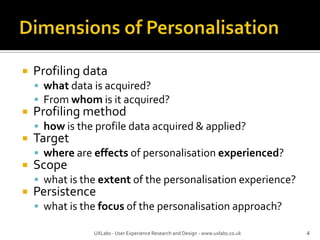
Dimensions of PersonalisationProfiling datawhat data is acquired?From whom is it acquired?Profiling methodhow is the profile data acquired & applied?Targetwhere are effects of personalisation experienced?Scopewhat is the extent of the personalisation experience?Persistencewhat is the focus of the personalisation approach?4UXLabs - User Experience Research and Design - www.uxlabs.co.uk
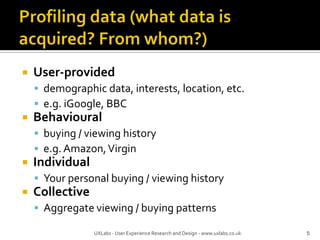
Profiling data (what data is acquired? From whom?)User-provideddemographic data, interests, location, etc.e.g. iGoogle, BBCBehaviouralbuying / viewing historye.g. Amazon, VirginIndividualYour personal buying / viewing historyCollectiveAggregate viewing / buying patterns5UXLabs - User Experience Research and Design - www.uxlabs.co.uk
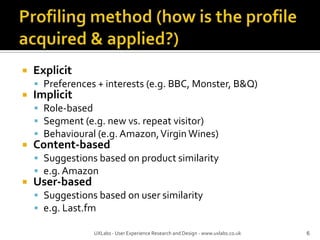
Profiling method (how is the profile acquired & applied?)ExplicitPreferences + interests (e.g. BBC, Monster, B&Q)ImplicitRole-basedSegment (e.g. new vs. repeat visitor)Behavioural (e.g. Amazon, Virgin Wines)Content-basedSuggestions based on product similaritye.g. AmazonUser-basedSuggestions based on user similaritye.g. Last.fm6UXLabs - User Experience Research and Design - www.uxlabs.co.uk
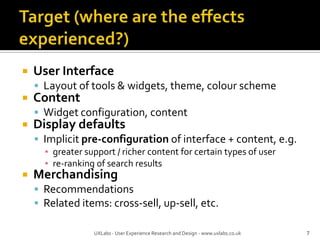
Target (where are the effects experienced?)User InterfaceLayout of tools & widgets, theme, colour schemeContentWidget configuration, contentDisplay defaultsImplicit pre-configuration of interface + content, e.g.greater support / richer content for certain types of userre-ranking of search resultsMerchandisingRecommendationsRelated items: cross-sell, up-sell, etc.7UXLabs - User Experience Research and Design - www.uxlabs.co.uk
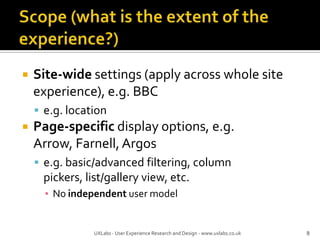
Scope (what is the extent of the experience?)Site-wide settings (apply across whole site experience), e.g. BBCe.g. locationPage-specific display options, e.g. Arrow, Farnell, Argose.g. basic/advanced filtering, column pickers, list/gallery view, etc.No independent user model8UXLabs - User Experience Research and Design - www.uxlabs.co.uk
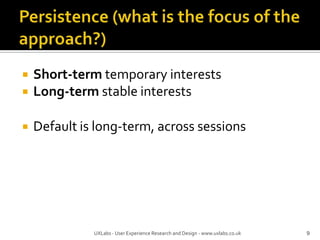
Persistence (what is the focus of the approach?)Short-term temporary interestsLong-term stable interestsDefault is long-term, across sessions9UXLabs - User Experience Research and Design - www.uxlabs.co.uk
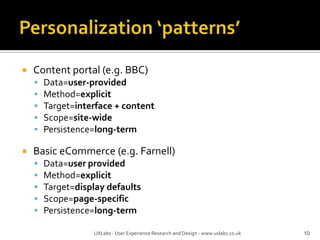
Personalization ‘patterns’Content portal (e.g. BBC)Data=user-providedMethod=explicitTarget=interface + contentScope=site-widePersistence=long-termBasic eCommerce (e.g. Farnell)Data=user providedMethod=explicitTarget=display defaultsScope=page-specificPersistence=long-term10UXLabs - User Experience Research and Design - www.uxlabs.co.uk
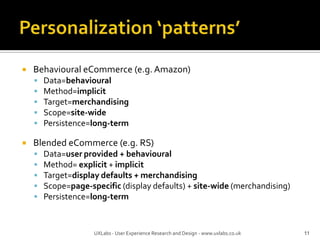
Personalization ‘patterns’Behavioural eCommerce (e.g. Amazon)Data=behaviouralMethod=implicitTarget=merchandisingScope=site-widePersistence=long-termBlended eCommerce (e.g. RS)Data=user provided + behaviouralMethod= explicit + implicitTarget=display defaults + merchandisingScope=page-specific (display defaults) + site-wide (merchandising)Persistence=long-term11UXLabs - User Experience Research and Design - www.uxlabs.co.uk
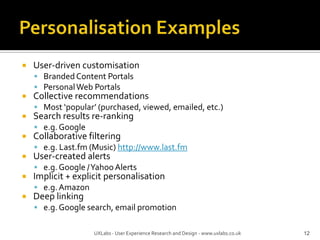
Personalisation ExamplesUser-driven customisationBranded Content PortalsPersonal Web PortalsCollective recommendationsMost ‘popular’ (purchased, viewed, emailed, etc.)Search results re-rankinge.g. GoogleCollaborative filteringe.g. Last.fm (Music) http://www.last.fmUser-created alertse.g. Google / Yahoo AlertsImplicit + explicit personalisatione.g. AmazonDeep linkinge.g. Google search, email promotion12UXLabs - User Experience Research and Design - www.uxlabs.co.uk
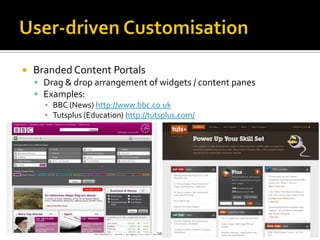
User-driven CustomisationBranded Content PortalsDrag & drop arrangement of widgets / content panesExamples:BBC (News) http://www.bbc.co.ukTutsplus (Education) http://tutsplus.com/13UXLabs - User Experience Research and Design - www.uxlabs.co.uk
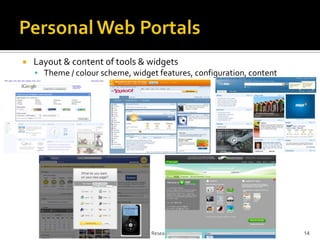
UXLabs - User Experience Research and Design - www.uxlabs.co.ukPersonal Web PortalsLayout & content of tools & widgetsTheme / colour scheme, widget features, configuration, content14
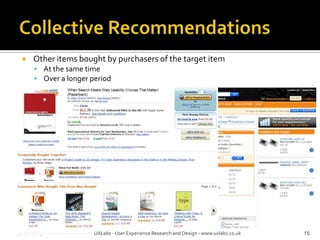
Collective RecommendationsOther items bought by purchasers of the target itemAt the same timeOver a longer period15UXLabs - User Experience Research and Design - www.uxlabs.co.uk
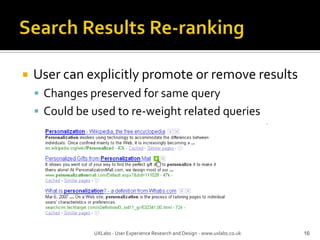
Search Results Re-rankingUser can explicitly promote or remove resultsChanges preserved for same queryCould be used to re-weight related queries16UXLabs - User Experience Research and Design - www.uxlabs.co.uk
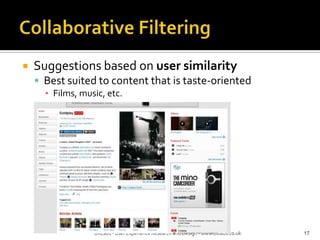
UXLabs - User Experience Research and Design - www.uxlabs.co.ukCollaborative FilteringSuggestions based on user similarityBest suited to content that is taste-orientedFilms, music, etc.17
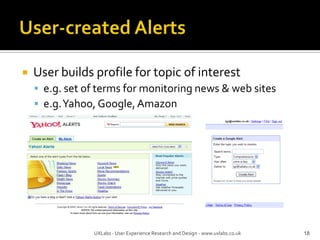
User-created AlertsUser builds profile for topic of intereste.g. set of terms for monitoring news & web sitese.g. Yahoo, Google, Amazon18UXLabs - User Experience Research and Design - www.uxlabs.co.uk
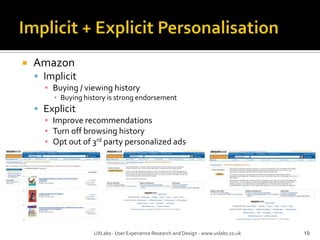
Implicit + Explicit PersonalisationAmazonImplicitBuying / viewing historyBuying history is strong endorsement ExplicitImprove recommendationsTurn off browsing historyOpt out of 3rd party personalized ads19UXLabs - User Experience Research and Design - www.uxlabs.co.uk
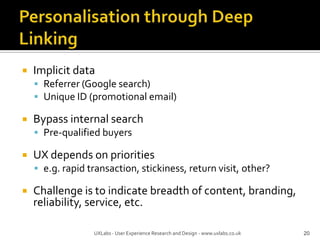
Personalisation through Deep LinkingImplicit dataReferrer (Google search)Unique ID (promotional email)Bypass internal searchPre-qualified buyersUX depends on prioritiese.g. rapid transaction, stickiness, return visit, other?Challenge is to indicate breadth of content, branding, reliability, service, etc.20UXLabs - User Experience Research and Design - www.uxlabs.co.uk
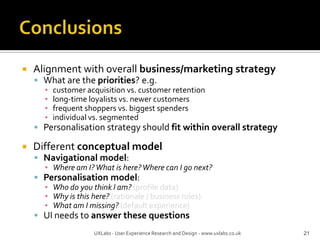
ConclusionsAlignment with overall business/marketing strategyWhat are the priorities? e.g.customer acquisition vs. customer retention long-time loyalists vs. newer customers frequent shoppers vs. biggest spenders individual vs. segmented Personalisation strategy should fitwithin overall strategyDifferent conceptual modelNavigational model:Where am I? What is here? Where can I go next?Personalisation model:Who do you think I am? (profile data)Why is this here? (rationale / business rules)What am I missing?(default experience)UI needs to answer these questions21UXLabs - User Experience Research and Design - www.uxlabs.co.uk
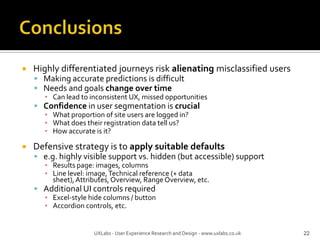
ConclusionsHighly differentiated journeys risk alienating misclassified usersMaking accurate predictions is difficultNeeds and goals change over timeCan lead to inconsistent UX, missed opportunitiesConfidence in user segmentation is crucialWhat proportion of site users are logged in?What does their registration data tell us?How accurate is it?Defensive strategy is to apply suitable defaultse.g. highly visible support vs. hidden (but accessible) supportResults page: images, columnsLine level: image, Technical reference (+ data sheet), Attributes, Overview, Range Overview, etc.Additional UI controls requiredExcel-style hide columns / buttonAccordion controls, etc.22UXLabs - User Experience Research and Design - www.uxlabs.co.uk
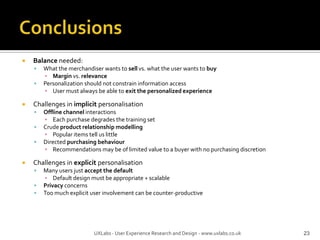
ConclusionsBalance needed:What the merchandiser wants to sell vs. what the user wants to buyMargin vs. relevancePersonalization should not constrain information accessUser must always be able to exit the personalized experienceChallenges in implicit personalisationOffline channel interactionsEach purchase degrades the training setCrude product relationship modellingPopular items tell us littleDirected purchasing behaviourRecommendations may be of limited value to a buyer with no purchasing discretionChallenges in explicit personalisationMany users just accept the defaultDefault design must be appropriate + scalablePrivacy concernsToo much explicit user involvement can be counter-productive23UXLabs - User Experience Research and Design - www.uxlabs.co.uk

Patterns of Personalization

  • 1.
    Tony Russell-Rose, PhDUXLabs Ltd.Patterns of Personalisation
  • 2.
    ContentsDefinitionsPersonalisation vs. customizationDimensionsof PersonalisationProfiling DataProfiling MethodTargetScopePersistencePersonalization PatternsExamples2UXLabs - User Experience Research and Design - www.uxlabs.co.uk
  • 3.
    DefinitionsPersonalisation vs. customisationSystem-ledvs. user-ledLevels of personalisationWhat is minimum?Entry of postcodeRecently viewed / purchased (e.g. Amazon, Asda)Simple on-page display settings (e.g. Argos, Asda)Ability to provide an individual user experienceContrast with static site experience3UXLabs - User Experience Research and Design - www.uxlabs.co.uk
  • 4.
    Dimensions of PersonalisationProfilingdatawhat data is acquired?From whom is it acquired?Profiling methodhow is the profile data acquired & applied?Targetwhere are effects of personalisation experienced?Scopewhat is the extent of the personalisation experience?Persistencewhat is the focus of the personalisation approach?4UXLabs - User Experience Research and Design - www.uxlabs.co.uk
  • 5.
    Profiling data (whatdata is acquired? From whom?)User-provideddemographic data, interests, location, etc.e.g. iGoogle, BBCBehaviouralbuying / viewing historye.g. Amazon, VirginIndividualYour personal buying / viewing historyCollectiveAggregate viewing / buying patterns5UXLabs - User Experience Research and Design - www.uxlabs.co.uk
  • 6.
    Profiling method (howis the profile acquired & applied?)ExplicitPreferences + interests (e.g. BBC, Monster, B&Q)ImplicitRole-basedSegment (e.g. new vs. repeat visitor)Behavioural (e.g. Amazon, Virgin Wines)Content-basedSuggestions based on product similaritye.g. AmazonUser-basedSuggestions based on user similaritye.g. Last.fm6UXLabs - User Experience Research and Design - www.uxlabs.co.uk
  • 7.
    Target (where arethe effects experienced?)User InterfaceLayout of tools & widgets, theme, colour schemeContentWidget configuration, contentDisplay defaultsImplicit pre-configuration of interface + content, e.g.greater support / richer content for certain types of userre-ranking of search resultsMerchandisingRecommendationsRelated items: cross-sell, up-sell, etc.7UXLabs - User Experience Research and Design - www.uxlabs.co.uk
  • 8.
    Scope (what isthe extent of the experience?)Site-wide settings (apply across whole site experience), e.g. BBCe.g. locationPage-specific display options, e.g. Arrow, Farnell, Argose.g. basic/advanced filtering, column pickers, list/gallery view, etc.No independent user model8UXLabs - User Experience Research and Design - www.uxlabs.co.uk
  • 9.
    Persistence (what isthe focus of the approach?)Short-term temporary interestsLong-term stable interestsDefault is long-term, across sessions9UXLabs - User Experience Research and Design - www.uxlabs.co.uk
  • 10.
    Personalization ‘patterns’Content portal(e.g. BBC)Data=user-providedMethod=explicitTarget=interface + contentScope=site-widePersistence=long-termBasic eCommerce (e.g. Farnell)Data=user providedMethod=explicitTarget=display defaultsScope=page-specificPersistence=long-term10UXLabs - User Experience Research and Design - www.uxlabs.co.uk
  • 11.
    Personalization ‘patterns’Behavioural eCommerce(e.g. Amazon)Data=behaviouralMethod=implicitTarget=merchandisingScope=site-widePersistence=long-termBlended eCommerce (e.g. RS)Data=user provided + behaviouralMethod= explicit + implicitTarget=display defaults + merchandisingScope=page-specific (display defaults) + site-wide (merchandising)Persistence=long-term11UXLabs - User Experience Research and Design - www.uxlabs.co.uk
  • 12.
    Personalisation ExamplesUser-driven customisationBrandedContent PortalsPersonal Web PortalsCollective recommendationsMost ‘popular’ (purchased, viewed, emailed, etc.)Search results re-rankinge.g. GoogleCollaborative filteringe.g. Last.fm (Music) http://www.last.fmUser-created alertse.g. Google / Yahoo AlertsImplicit + explicit personalisatione.g. AmazonDeep linkinge.g. Google search, email promotion12UXLabs - User Experience Research and Design - www.uxlabs.co.uk
  • 13.
    User-driven CustomisationBranded ContentPortalsDrag & drop arrangement of widgets / content panesExamples:BBC (News) http://www.bbc.co.ukTutsplus (Education) http://tutsplus.com/13UXLabs - User Experience Research and Design - www.uxlabs.co.uk
  • 14.
    UXLabs - UserExperience Research and Design - www.uxlabs.co.ukPersonal Web PortalsLayout & content of tools & widgetsTheme / colour scheme, widget features, configuration, content14
  • 15.
    Collective RecommendationsOther itemsbought by purchasers of the target itemAt the same timeOver a longer period15UXLabs - User Experience Research and Design - www.uxlabs.co.uk
  • 16.
    Search Results Re-rankingUsercan explicitly promote or remove resultsChanges preserved for same queryCould be used to re-weight related queries16UXLabs - User Experience Research and Design - www.uxlabs.co.uk
  • 17.
    UXLabs - UserExperience Research and Design - www.uxlabs.co.ukCollaborative FilteringSuggestions based on user similarityBest suited to content that is taste-orientedFilms, music, etc.17
  • 18.
    User-created AlertsUser buildsprofile for topic of intereste.g. set of terms for monitoring news & web sitese.g. Yahoo, Google, Amazon18UXLabs - User Experience Research and Design - www.uxlabs.co.uk
  • 19.
    Implicit + ExplicitPersonalisationAmazonImplicitBuying / viewing historyBuying history is strong endorsement ExplicitImprove recommendationsTurn off browsing historyOpt out of 3rd party personalized ads19UXLabs - User Experience Research and Design - www.uxlabs.co.uk
  • 20.
    Personalisation through DeepLinkingImplicit dataReferrer (Google search)Unique ID (promotional email)Bypass internal searchPre-qualified buyersUX depends on prioritiese.g. rapid transaction, stickiness, return visit, other?Challenge is to indicate breadth of content, branding, reliability, service, etc.20UXLabs - User Experience Research and Design - www.uxlabs.co.uk
  • 21.
    ConclusionsAlignment with overallbusiness/marketing strategyWhat are the priorities? e.g.customer acquisition vs. customer retention long-time loyalists vs. newer customers frequent shoppers vs. biggest spenders individual vs. segmented Personalisation strategy should fitwithin overall strategyDifferent conceptual modelNavigational model:Where am I? What is here? Where can I go next?Personalisation model:Who do you think I am? (profile data)Why is this here? (rationale / business rules)What am I missing?(default experience)UI needs to answer these questions21UXLabs - User Experience Research and Design - www.uxlabs.co.uk
  • 22.
    ConclusionsHighly differentiated journeysrisk alienating misclassified usersMaking accurate predictions is difficultNeeds and goals change over timeCan lead to inconsistent UX, missed opportunitiesConfidence in user segmentation is crucialWhat proportion of site users are logged in?What does their registration data tell us?How accurate is it?Defensive strategy is to apply suitable defaultse.g. highly visible support vs. hidden (but accessible) supportResults page: images, columnsLine level: image, Technical reference (+ data sheet), Attributes, Overview, Range Overview, etc.Additional UI controls requiredExcel-style hide columns / buttonAccordion controls, etc.22UXLabs - User Experience Research and Design - www.uxlabs.co.uk
  • 23.
    ConclusionsBalance needed:What themerchandiser wants to sell vs. what the user wants to buyMargin vs. relevancePersonalization should not constrain information accessUser must always be able to exit the personalized experienceChallenges in implicit personalisationOffline channel interactionsEach purchase degrades the training setCrude product relationship modellingPopular items tell us littleDirected purchasing behaviourRecommendations may be of limited value to a buyer with no purchasing discretionChallenges in explicit personalisationMany users just accept the defaultDefault design must be appropriate + scalablePrivacy concernsToo much explicit user involvement can be counter-productive23UXLabs - User Experience Research and Design - www.uxlabs.co.uk