Presentation-3
Topic-PATENT
presented
by
ARTINA DEKA_19056
8th Sem
What is Intellectual Property?
Intellectual property (IP) refers to creations of the mind, such as inventions; literary and artistic works; designs;
and symbols, names and images used in commerce.
Inventors, artists, scientists and businesses put a lot of time, money, energy and thought into developing their
innovations and creations. To encourage them to do that, they need the chance to make a fair return on their
investment. That means giving them rights to protect their intellectual property.
1
https://www.wipo.int/edocs/pubdocs/en/wipo_pub_450_2020.pdf
Intellectual
property
Trademarks
Trade Secrets
Patents
Industrial
Designs
Geographical
Indications
Semiconductor
Integrated
circuits Layout
design
2
Copyrights
Categories of Intellectual Property
Patents
3
A patent for an invention is the grant of a property right to the
inventor.
By patenting an invention, the patent owner gets exclusive rights
over it, meaning that he or she can stop anyone from using , making
or selling the invention without permission.
The patent owner has to disclose full details of the invention in the
published patent documents
The term of every patent granted is 20 years from the date of filing
of application.
Patent protection is a territorial right. There is no concept of global
patent.
What can be patented?
• The invention can be either a product or process .
• Should be new / novel .
• Should involve inventive step – something non-obvious.
• Capable of industrial application can be patented.
• Invention must not fall under non-patentable subject matter .
4
https://www.indiacode.nic.in/show-data?actid=AC_CEN_11_61_00002_197039_1517807321764&sectionId=15872&sectionno=4&orderno=4
Non-patentable subject matter in India
• an invention which is frivolous or which claims anything obviously contrary to well established natural laws;
• an invention the primary or intended use or commercial exploitation of which could be contrary to public
order or morality or which causes serious prejudice to human , animal or plant life or health or to the
environment;
• the mere discovery of a new form of a known substance which does not result in enhancement of the known
efficacy of that substance or the mere discovery of any new property or new use for a known substance or of
the mere use of a known process, machine or apparatus unless such known process results in a new product
or employs at least one new reactant;
• a substance obtained by mere admixture resulting only in the aggregation of the properties of the
components thereof or a process for producing such substance;
• inventions relating to atomic energy;
5
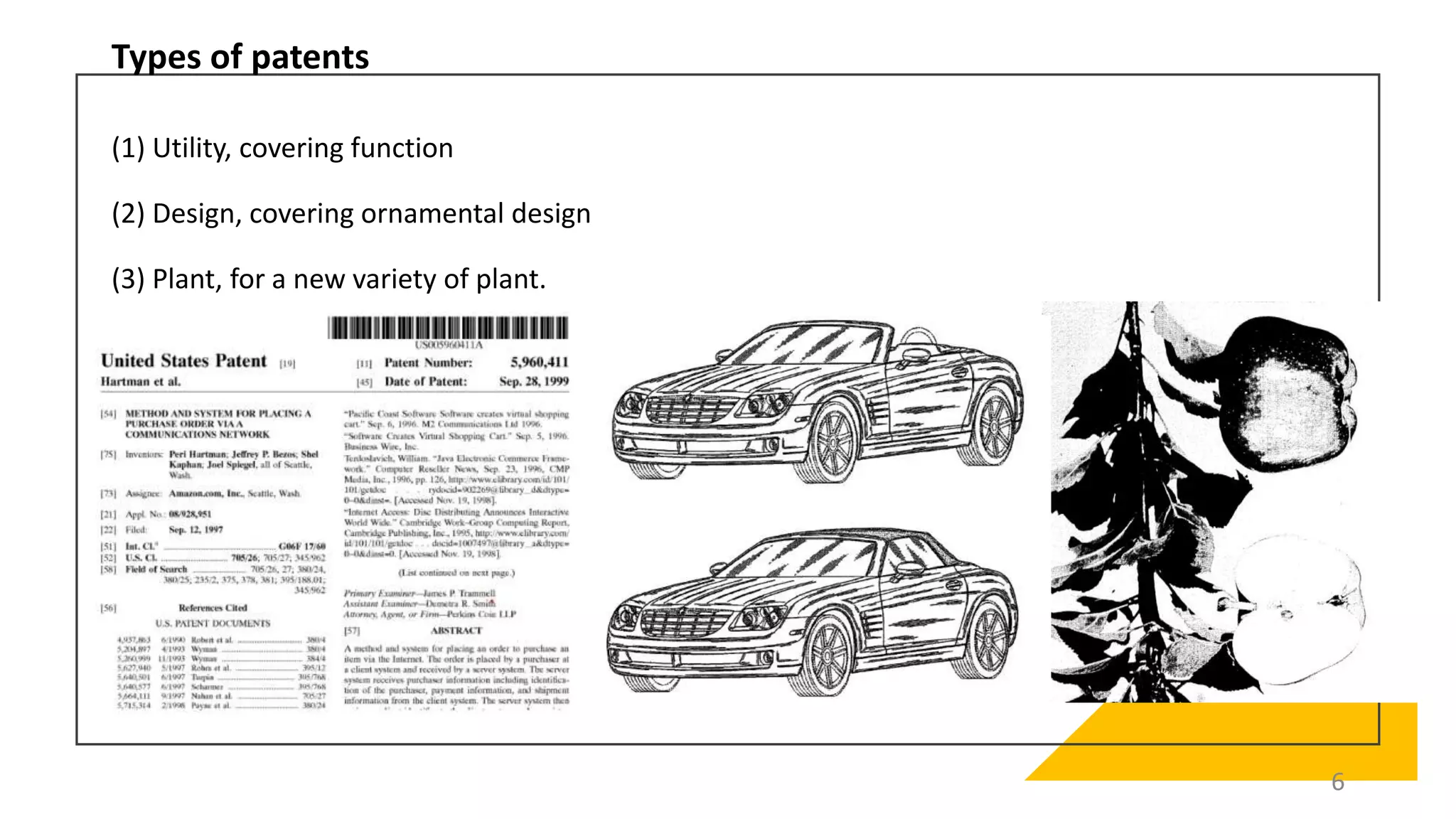
Types of patents
(1) Utility, covering function
(2) Design, covering ornamental design
(3) Plant, for a new variety of plant.
7
6
Process of filing a patent application
7
Commercialization of a Patent
8
licensing of a patent
Exclusive Licence Non-Exclusive Licence
The patent owner may grant permission to an individual/organization/industry to make, use, and
sell his patented invention .
The patent is sold to only one individual/organization
for a fixed time period.
A patentee can sell his patent rights to as many
individuals/parties as he likes.
Can a
Worldwide
Patent be
Obtained ?
• If one wishes to seek patent protection in several
countries worldwide, it is preferred to file an
international patent under the Patent Cooperation
Treaty (PCT).
• The only condition is that the applicant‘s country should
be a member of PCT.
• India, along with over 190 nations, is a member of PCT
9
Commonly
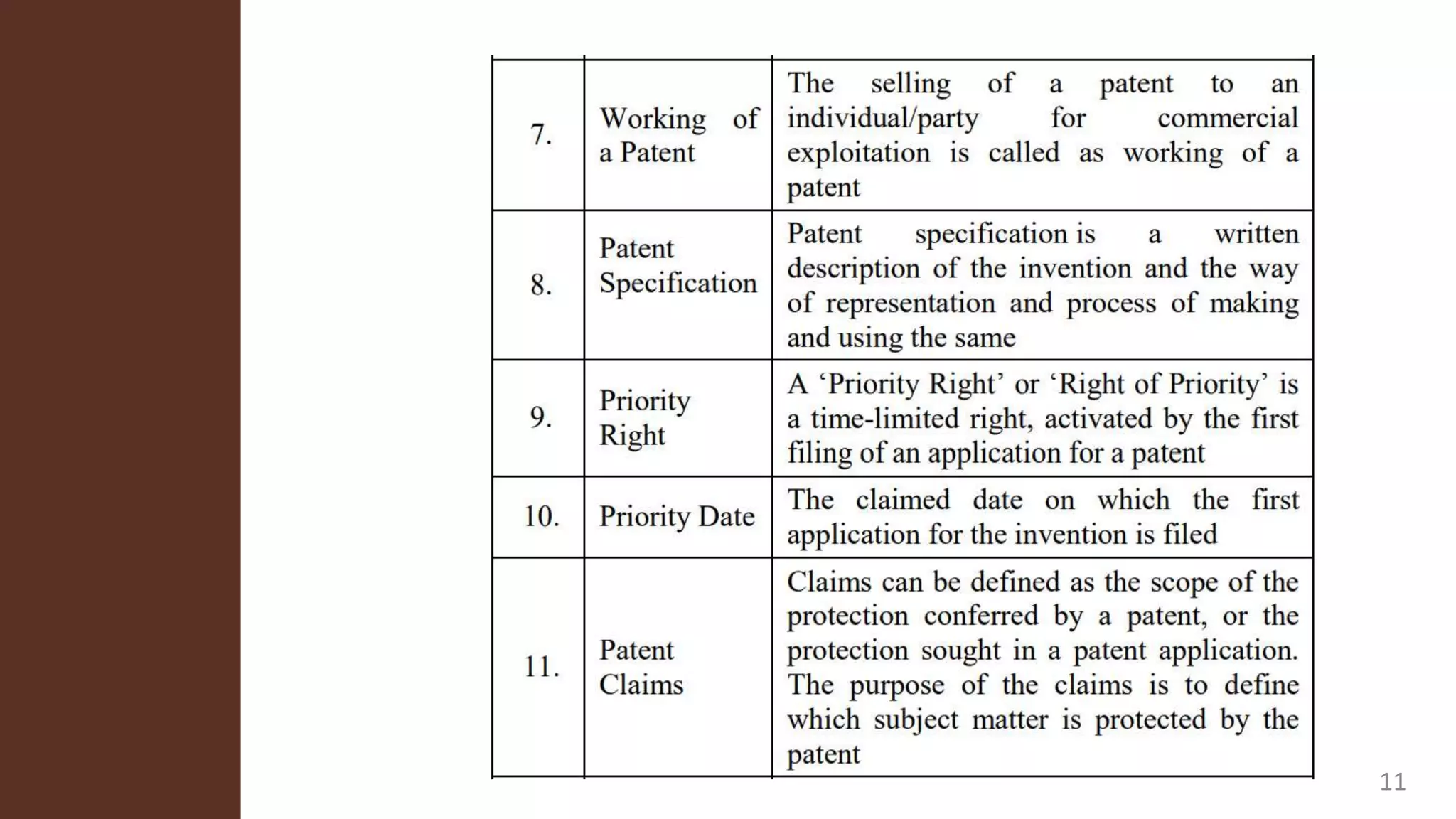
Used Terms
in Patenting
10
11
12
Types of Patent Applications
• Provisional Application - A patent application filed when the invention is
not fully finalized and some part of the invention is still under
experimentation.
• Ordinary Application - A patent application filed with complete
specifications and claims but without claiming any priority date .
• PCT Application - A single application can be filed to seek patent
protection and claim priority in all the member countries of PCT.
13
• Divisional Application - When an application claims more than one invention, the applicant on his
own or to meet the official objection on the ground of plurality may divide the application and file two or
more applications.
• Patent of Addition Application - When an invention is a slight modification of the earlier
invention for which the patentee has already applied for or has obtained a patent, the applicant can go for
“Patent of Addition”, if the modification in the invention is new.
• Convention Application - If a patent application has been filed in the Indian Patent Office, and
the applicant wishes to file the same invention in the one or more Convention countries by claiming the
same priority date on which application was filed in India, such an application is known as Convention
Application. The applicant has to file Convention Application within 12 months from the date of filing in
India to claim the same priority date
14
Challenges of patent literature
• Patents do not include product names.
• Patent language is difficult.
• Patents are not really scientific literature.
15
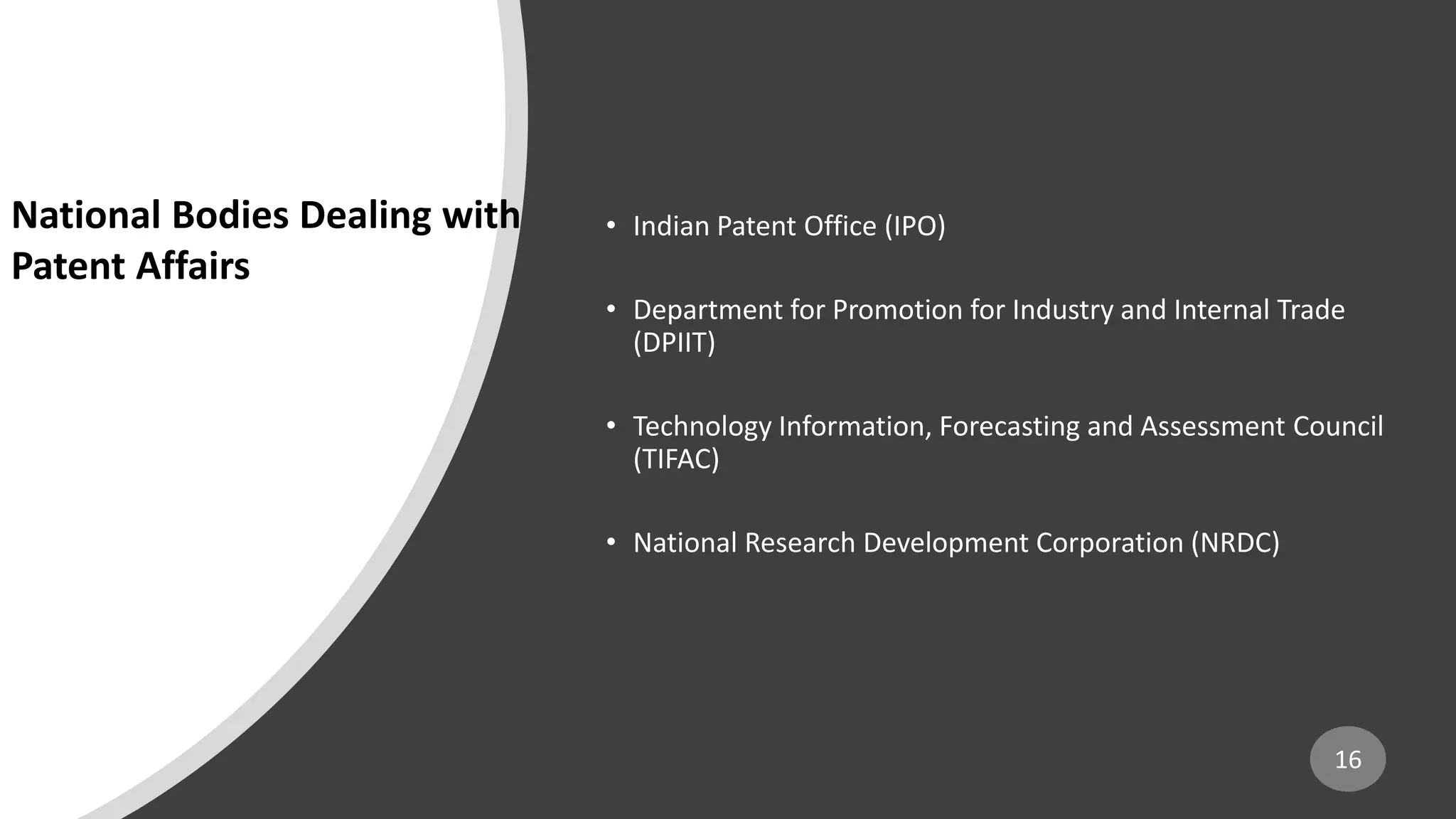
• Indian Patent Office (IPO)
• Department for Promotion for Industry and Internal Trade
(DPIIT)
• Technology Information, Forecasting and Assessment Council
(TIFAC)
• National Research Development Corporation (NRDC)
16
National Bodies Dealing with
Patent Affairs
Where can information related to published/ granted patent
application?
• The information relating to the patent application is published in the Patent office Journal issued
on every Friday. This is also available in electronic form on the website of the Patent Office,
www.ipindia.gov.in.
• Google Patents: patents.google.com
• Espacenet: espacenet.com
• USPTO
17
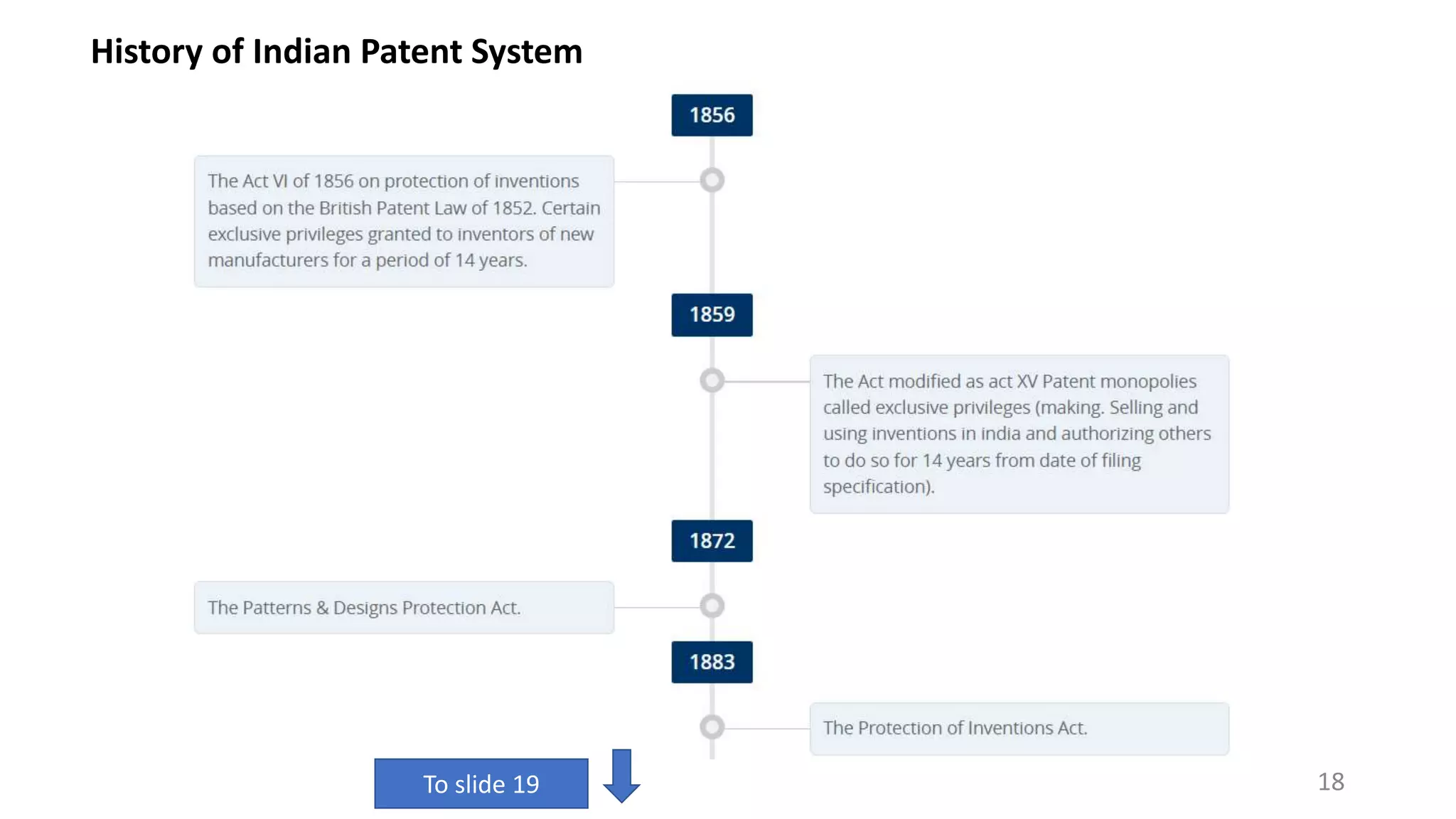
History of Indian Patent System
18
To slide 19
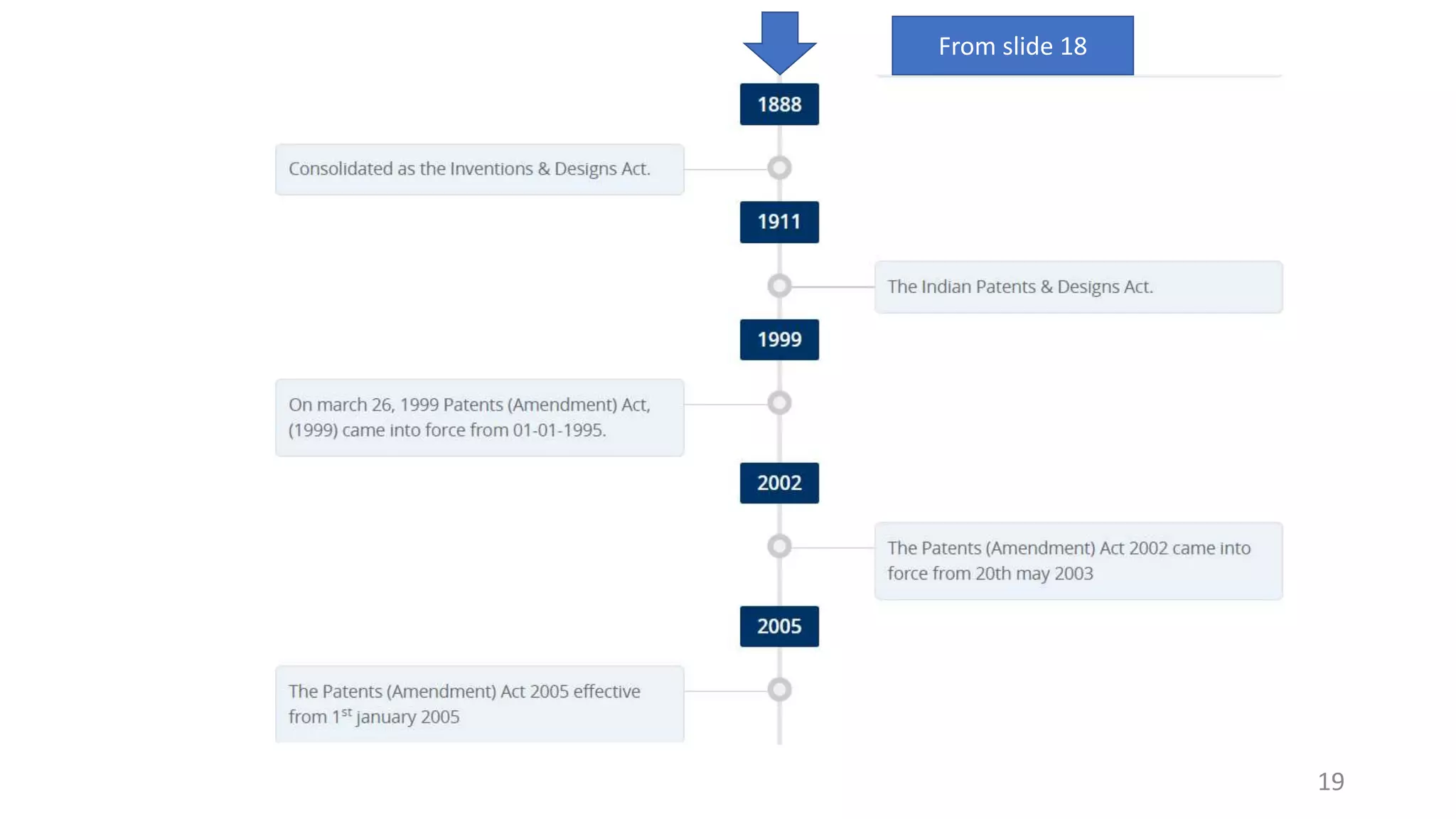
19
From slide 18
References
• https://www.wipo.int/about-
ip/en/#:~:text=Intellectual%20property%20(IP)%20refers%20to,and%20images%20used%20in%20commerce.
• https://www.ipindia.gov.in/history-of-indian-patent-system.htm
• https://dst.gov.in/sites/default/files/E-BOOK%20IPR.pdf
• https://ipindia.gov.in/writereaddata/Portal/Images/pdf/Final_FREQUENTLY_ASKED_QUESTIONS_-PATENT.pdf
• https://guides.library.yale.edu/ld.php?content_id=63491429
20
THE END

PATENT.pptx

  • 1.
  • 2.
    What is IntellectualProperty? Intellectual property (IP) refers to creations of the mind, such as inventions; literary and artistic works; designs; and symbols, names and images used in commerce. Inventors, artists, scientists and businesses put a lot of time, money, energy and thought into developing their innovations and creations. To encourage them to do that, they need the chance to make a fair return on their investment. That means giving them rights to protect their intellectual property. 1 https://www.wipo.int/edocs/pubdocs/en/wipo_pub_450_2020.pdf
  • 3.
  • 4.
    Patents 3 A patent foran invention is the grant of a property right to the inventor. By patenting an invention, the patent owner gets exclusive rights over it, meaning that he or she can stop anyone from using , making or selling the invention without permission. The patent owner has to disclose full details of the invention in the published patent documents The term of every patent granted is 20 years from the date of filing of application. Patent protection is a territorial right. There is no concept of global patent.
  • 5.
    What can bepatented? • The invention can be either a product or process . • Should be new / novel . • Should involve inventive step – something non-obvious. • Capable of industrial application can be patented. • Invention must not fall under non-patentable subject matter . 4 https://www.indiacode.nic.in/show-data?actid=AC_CEN_11_61_00002_197039_1517807321764&sectionId=15872&sectionno=4&orderno=4
  • 6.
    Non-patentable subject matterin India • an invention which is frivolous or which claims anything obviously contrary to well established natural laws; • an invention the primary or intended use or commercial exploitation of which could be contrary to public order or morality or which causes serious prejudice to human , animal or plant life or health or to the environment; • the mere discovery of a new form of a known substance which does not result in enhancement of the known efficacy of that substance or the mere discovery of any new property or new use for a known substance or of the mere use of a known process, machine or apparatus unless such known process results in a new product or employs at least one new reactant; • a substance obtained by mere admixture resulting only in the aggregation of the properties of the components thereof or a process for producing such substance; • inventions relating to atomic energy; 5
  • 7.
    Types of patents (1)Utility, covering function (2) Design, covering ornamental design (3) Plant, for a new variety of plant. 7 6
  • 8.
    Process of filinga patent application 7
  • 9.
    Commercialization of aPatent 8 licensing of a patent Exclusive Licence Non-Exclusive Licence The patent owner may grant permission to an individual/organization/industry to make, use, and sell his patented invention . The patent is sold to only one individual/organization for a fixed time period. A patentee can sell his patent rights to as many individuals/parties as he likes.
  • 10.
    Can a Worldwide Patent be Obtained? • If one wishes to seek patent protection in several countries worldwide, it is preferred to file an international patent under the Patent Cooperation Treaty (PCT). • The only condition is that the applicant‘s country should be a member of PCT. • India, along with over 190 nations, is a member of PCT 9
  • 11.
  • 12.
  • 13.
  • 14.
    Types of PatentApplications • Provisional Application - A patent application filed when the invention is not fully finalized and some part of the invention is still under experimentation. • Ordinary Application - A patent application filed with complete specifications and claims but without claiming any priority date . • PCT Application - A single application can be filed to seek patent protection and claim priority in all the member countries of PCT. 13
  • 15.
    • Divisional Application- When an application claims more than one invention, the applicant on his own or to meet the official objection on the ground of plurality may divide the application and file two or more applications. • Patent of Addition Application - When an invention is a slight modification of the earlier invention for which the patentee has already applied for or has obtained a patent, the applicant can go for “Patent of Addition”, if the modification in the invention is new. • Convention Application - If a patent application has been filed in the Indian Patent Office, and the applicant wishes to file the same invention in the one or more Convention countries by claiming the same priority date on which application was filed in India, such an application is known as Convention Application. The applicant has to file Convention Application within 12 months from the date of filing in India to claim the same priority date 14
  • 16.
    Challenges of patentliterature • Patents do not include product names. • Patent language is difficult. • Patents are not really scientific literature. 15
  • 17.
    • Indian PatentOffice (IPO) • Department for Promotion for Industry and Internal Trade (DPIIT) • Technology Information, Forecasting and Assessment Council (TIFAC) • National Research Development Corporation (NRDC) 16 National Bodies Dealing with Patent Affairs
  • 18.
    Where can informationrelated to published/ granted patent application? • The information relating to the patent application is published in the Patent office Journal issued on every Friday. This is also available in electronic form on the website of the Patent Office, www.ipindia.gov.in. • Google Patents: patents.google.com • Espacenet: espacenet.com • USPTO 17
  • 19.
    History of IndianPatent System 18 To slide 19
  • 20.
  • 21.
    References • https://www.wipo.int/about- ip/en/#:~:text=Intellectual%20property%20(IP)%20refers%20to,and%20images%20used%20in%20commerce. • https://www.ipindia.gov.in/history-of-indian-patent-system.htm •https://dst.gov.in/sites/default/files/E-BOOK%20IPR.pdf • https://ipindia.gov.in/writereaddata/Portal/Images/pdf/Final_FREQUENTLY_ASKED_QUESTIONS_-PATENT.pdf • https://guides.library.yale.edu/ld.php?content_id=63491429 20
  • 22.