BY
DURGADEVI.G
1st M.pharm
DEFINITION :
A patent is a set of exclusive rights granted by
government of India to an inventor for a limited period
of time, excluding others from making, using, selling,
importing the patented product or process producing
that product for these purposes.
PATENTEE :
A person to whom the patent is granted.
 To provide protection of creativity of creators.
 To promote the creativity of new creators.
 To accelerate the technological and industrial
development of the countries.
 To provide the exclusive right to invention and affords
protection against unauthorized use of invention by
third parties.
 Understand the meaning of specifications.
 To encourage inventions by promoting their protection
and utilization
 Any artistic creation.
 Mathematical methods.
 Business schemes.
 Anything against universal law.
 Inventions injurious to public health.
 Discovery of scientific principles or the formulation of an
abstract theory.
 Substance obtained by a mere admisture of properties of the
components.
 A method of agriculture or horticulture.
 Any process for the medicinal, surgical, curative, prophylactic or
other treatment of human beings and animals and plants to
render them free of diseases.
 Novelty : The matter disclosed in the specification is
not published in India or elsewhere before the date of
filling of the patent application in India.
 Industrially applicable : Invention should possess utility
so that it can be made or used in the industry.
 Incentive step : Invention is not clear to a person skilled
in the light of the prior publication / knowledge /
document.
 Novel
 New product or process
 Ordinary patent
 Patent of addition :
An addition for improvement in or modification for
a invention for which already patent has been applied
or granted.
 Convention patent :
A patent granted in respect of convention
application field under section 135 of act.
 National phase applications
To encourage and secure working of invention to fullest
extent without undue delay.
Not to use monopoly to unfairly prejudice (NEGATIVE
OPINION) interest of public.
Failure to discharge duties reasonably, would lead to
revocation of patent.
To furnish periodical statements to Controller, as to
extend to which invention has been worked.
Failure to provide statement to Controller is a punishable
offence.
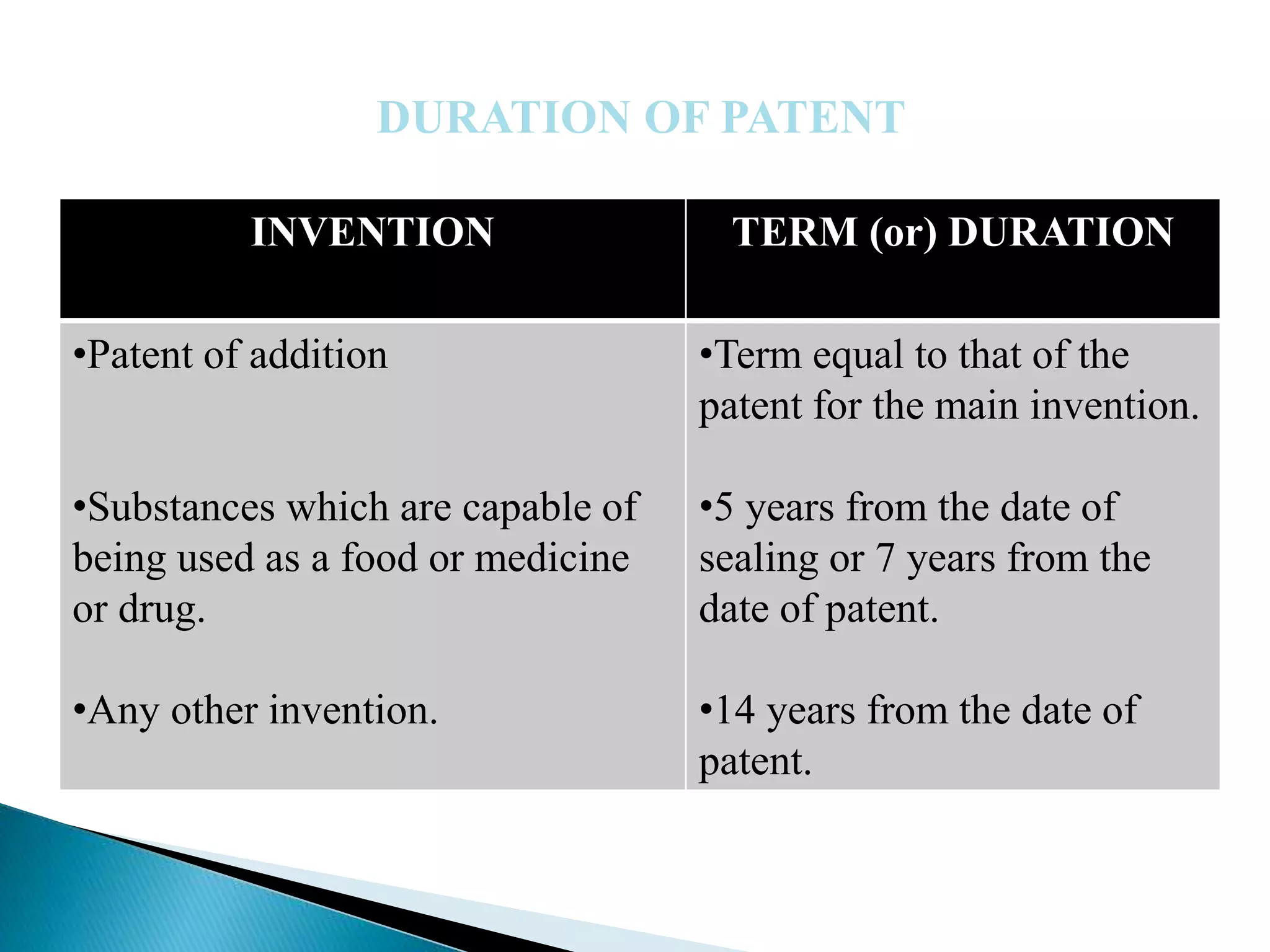
DURATION OF PATENT
INVENTION TERM (or) DURATION
•Patent of addition
•Substances which are capable of
being used as a food or medicine
or drug.
•Any other invention.
•Term equal to that of the
patent for the main invention.
•5 years from the date of
sealing or 7 years from the
date of patent.
•14 years from the date of
patent.
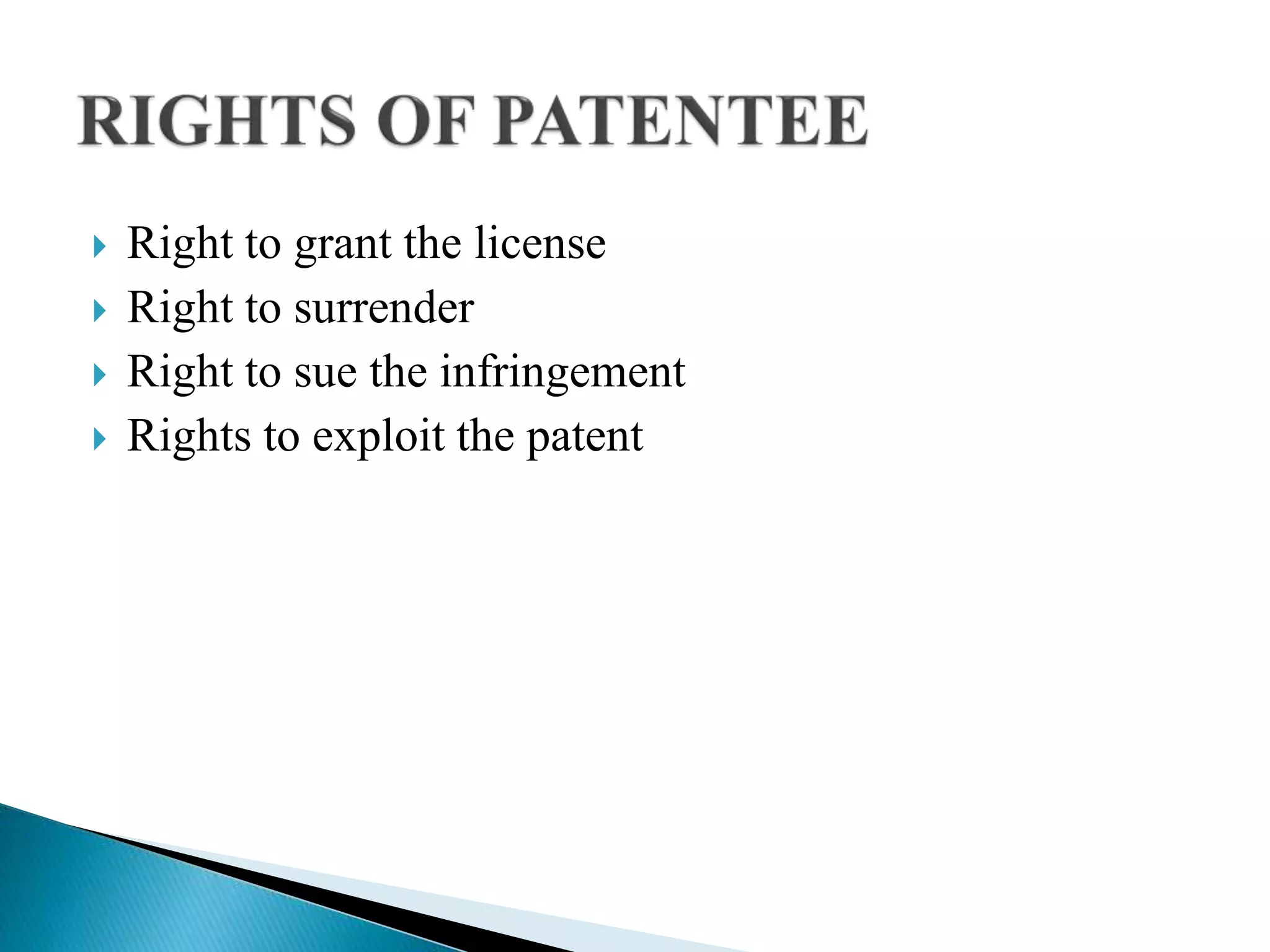
 Right to grant the license
 Right to surrender
 Right to sue the infringement
 Rights to exploit the patent
 Patent application : A patent application is a request
pending at a patent office for the grant of a patent for
invention described and claimed by that application.
 Direct filing : wherein complete specification is
initially filed with the Indian patent office without
filing any corresponding provisional specification.
 Subsequent filing : wherein complete specification is
filed subsequent to the filing of the corresponding
provisional specification and claiming priority from the
filed provisional specification.
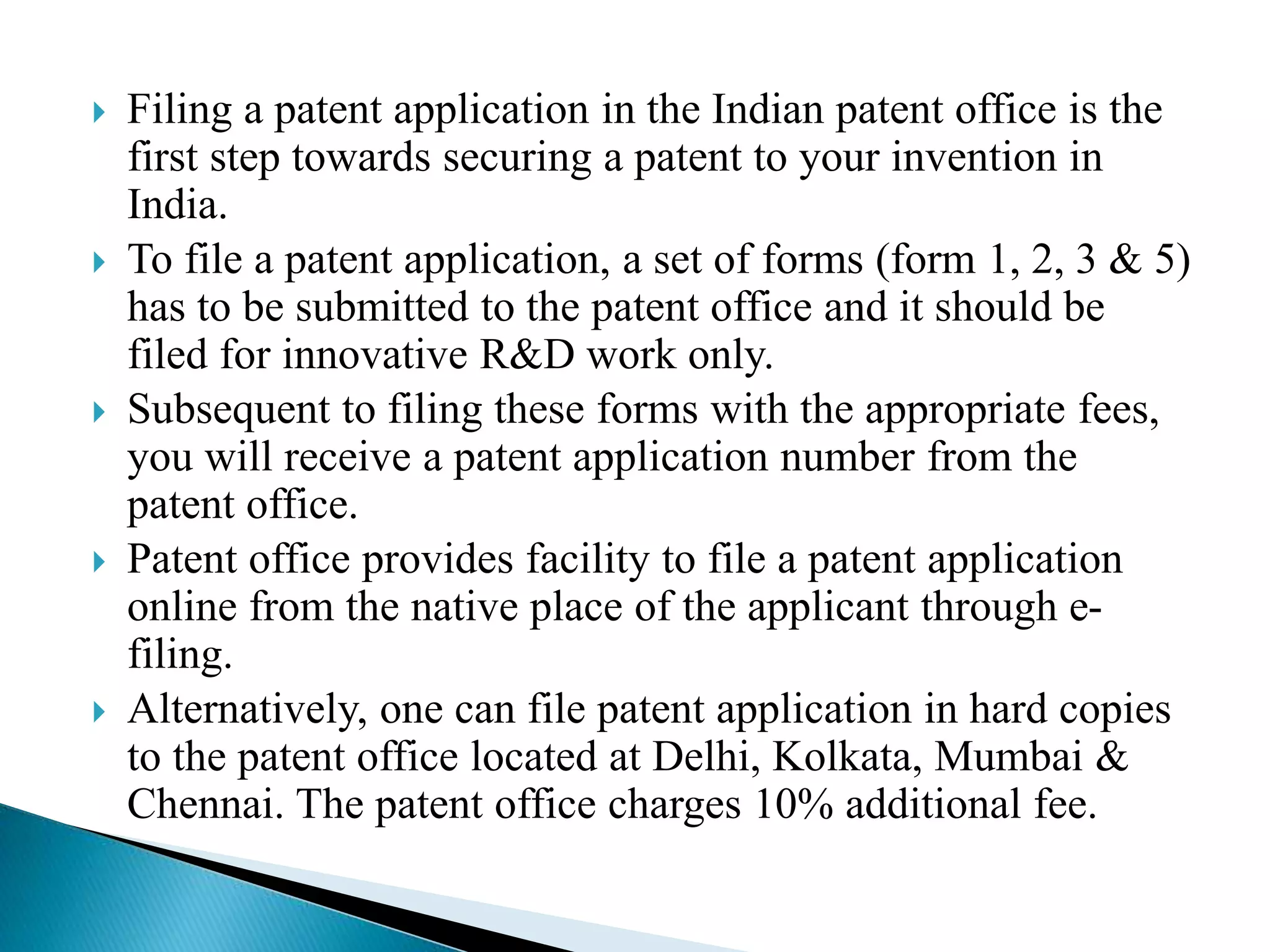
 Filing a patent application in the Indian patent office is the
first step towards securing a patent to your invention in
India.
 To file a patent application, a set of forms (form 1, 2, 3 & 5)
has to be submitted to the patent office and it should be
filed for innovative R&D work only.
 Subsequent to filing these forms with the appropriate fees,
you will receive a patent application number from the
patent office.
 Patent office provides facility to file a patent application
online from the native place of the applicant through e-
filing.
 Alternatively, one can file patent application in hard copies
to the patent office located at Delhi, Kolkata, Mumbai &
Chennai. The patent office charges 10% additional fee.
 Incase if our invention is maturing stage, we have the option to file the
provisional patent application and after that we can file the complete patent
specifications within 12 months from the date of filing of provisional
application.
 After filing the patent application it is published after 18 months from the
date of first filling.
 If we want to expedite our patent protection, place a request for early
publication in form-9.
 Next step would be filing a request for examination in form-18 to verify that
the invention matter is patentable or not.
 During the patent prosecution, the examiner submits the examination report.
The inventor has to analyze the report to respond the examination report
along with providing proper reasoning about his invention.
 After meeting the objection raised by the examiner, the application would be
placed order for grant and the grant will be notified in patent journal.
 Application Form in duplicate (Form 1) Provisional or
Complete Specification (Form 2)
 In case of provisional specification the complete
specification must be filed within 12 months.
 Drawing in duplicate if necessary
 Abstract of invention in duplicate Information of
Undertaking listing the no., filing date & current status of
each foreign patent application. (form 3) in duplicate
 Priority Document
 Declaration of Inventorship (form 5)
 Power of Attorney if filed through patent agent (form 26)
 Fees to be paid in Cash/ Cheque/ DD.
The list of forms that have to be submitted are
 Form 1 : Application for grant of patent
 Form 2 : Provisional / complete specification
 Form 3 : Statement & undertaking under section 8
 Form 5 : Declaration as to inventorship
 Form 9 : Request for publication
 Form 18 : Request for examination of application for
patent
FORM 1 :
 Application for grant of patent in India.
 In this form, one has to furnish information such as name and
address of the inventors, name and address of the applicant,
information corresponding to prior patent application which any
authorized entity has filled & some declarations among other
information.
FORM 2 :
 The patent specification can be provisional or a complete patent
specification depending on the type of patent application one is
filling.
 The number of sheets and claims is to be counted and the
appropriate fee is calculated. While counting the sheets, even the
drawing sheets will have to be taken into account.
FORM 3 :
 It is used to furnush information and action relating
to patent applications filed in other countries for the
current invention.
FORM 5 :
 Application used to declare the inventors of the
subject matter sought to be protected using the
current patent application.
FORM 9 :
 By filling this form, one can generally have the patent
specification published within 1 month from filling
this form.
FORM 18 :
 This form can be filled within 48 months from priority
date.
 The patent office will not consider a patent application
for examination unless this form is filled. Hence, if one
wishes to expedite the patenting process filing of form
9 & 18 at an early stage is advised.
The list of forms that have to be submitted and their respective
fees is provided.
FORMS APPLICANT-NATURAL APPLICANT-OTHER THAN
NATURAL PERSON
SMALL ENTITY OTHERS EXCEPT
SMALL ENTITY
FORM 1 1600 4000 8000
FORM 2 NO FEES NO FEES NO FEES
FORM 3 NO FEES NO FEES NO FEES
FORM 5 NO FEES NO FEES NO FEES
FORM 9 2500 6250 12500
FORM 18 4000 10000 20000
 A fee of 160/400/800 sheet, based on the type of
applicant, is applicable for each sheet exceeding 30
sheets in a patent specification.
 Further a fee of INR 320/800/1600/claim, based on the
type of the applicant, is applicable for each claim
exceeding 10 claims in the patent specification.
 Provisional application
 Ordinary or Non-provisional application
 Convention application
 PCT international application
 PCT national phase application
 Patent of addition
 Divisional application
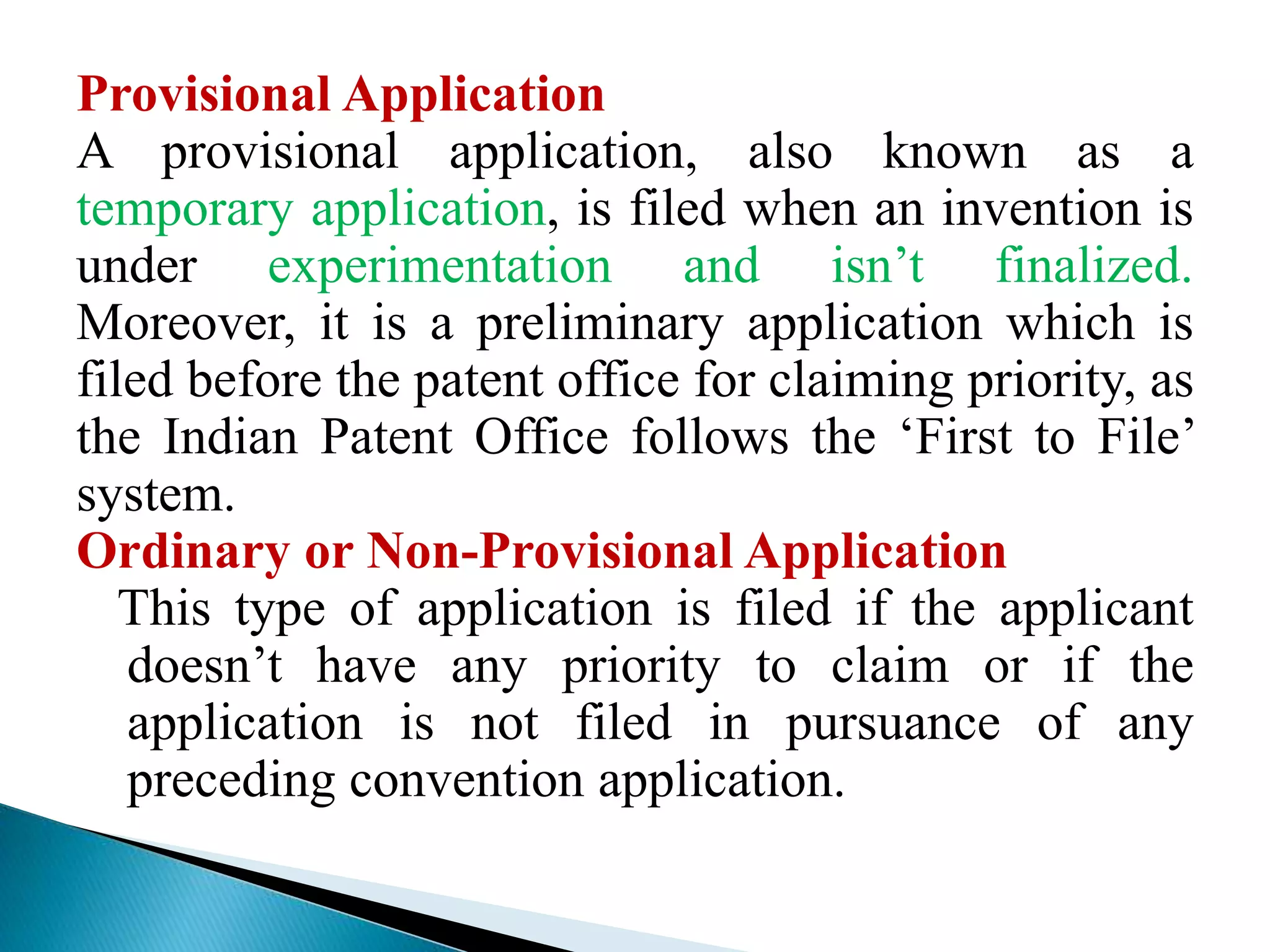
Provisional Application
A provisional application, also known as a
temporary application, is filed when an invention is
under experimentation and isn’t finalized.
Moreover, it is a preliminary application which is
filed before the patent office for claiming priority, as
the Indian Patent Office follows the ‘First to File’
system.
Ordinary or Non-Provisional Application
This type of application is filed if the applicant
doesn’t have any priority to claim or if the
application is not filed in pursuance of any
preceding convention application.
A complete specification contains the following:
 Title
 The technical field of the invention
 Background of the invention
 Objects of the invention
 Statement of the invention
 A brief description of the drawings
 A detailed description of the invention
 Claims
 Abstract
 A preamble to the invention
Convention Application
A convention application is filed for claiming a priority
date based on the same or substantially similar application
filed in any of the convention countries.
To avail a status of convention, an applicant is required to
file an application in the Indian Patent Office within a
year from the date of the initial filing of a similar
application in the convention country. To re-iterate in
simpler terms, a convention application entitles the
applicant to claim priority in all the convention countries.
PCT International Application
As can be deciphered from its name, a PCT Application is
an international application. Though the application does
not provide for the grant of an international patent, it
paves the way for a streamlined patent application process
in many countries at one go. It is governed by the Patent
Corporation Treaty and can be validated in up to 142
countries. Filing this application would protect an
invention from being replicated in these designated
countries.
.
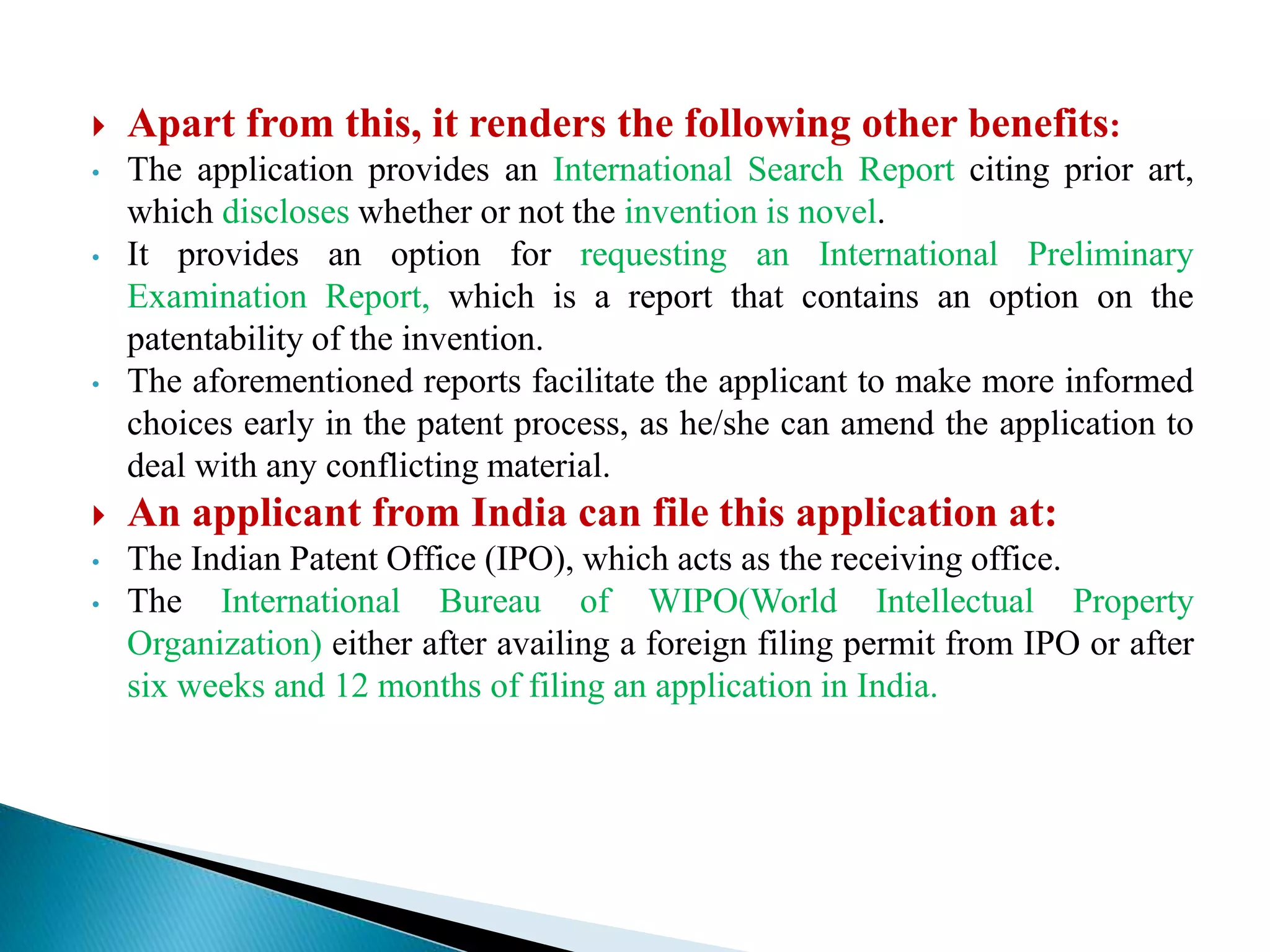
 Apart from this, it renders the following other benefits:
• The application provides an International Search Report citing prior art,
which discloses whether or not the invention is novel.
• It provides an option for requesting an International Preliminary
Examination Report, which is a report that contains an option on the
patentability of the invention.
• The aforementioned reports facilitate the applicant to make more informed
choices early in the patent process, as he/she can amend the application to
deal with any conflicting material.
 An applicant from India can file this application at:
• The Indian Patent Office (IPO), which acts as the receiving office.
• The International Bureau of WIPO(World Intellectual Property
Organization) either after availing a foreign filing permit from IPO or after
six weeks and 12 months of filing an application in India.
PCT National Phase Application
 It is considered essential for an applicant to file a national phase
application in each of the country wherein protection is sought for. The
time-frame for filing the same is scheduled within 31 months from the
priority date or the international filing date, whichever is earlier. The time-
limit could be enhanced through National Laws by each member country.
Patent of Addition
 This application must be filed if the applicant discovers that he has come
across an invention which is a slight modification of the invention which
has already been applied for or patented by the applicant.
 It can only be filed if the invention doesn’t involve a substantial inventive
step.
 A patent of addition is only granted after the grant of the parent patent, and
hence no separate renewal fee should be remitted during the term of the
main patent.
Divisional Application
An applicant may choose to divide an application and
furnish two or more applications if a particular
application claims for more than one invention. The
priority date for these applications is similar to that of
the parent application.
THANK YOU

Patent

  • 1.
  • 2.
    DEFINITION : A patentis a set of exclusive rights granted by government of India to an inventor for a limited period of time, excluding others from making, using, selling, importing the patented product or process producing that product for these purposes. PATENTEE : A person to whom the patent is granted.
  • 3.
     To provideprotection of creativity of creators.  To promote the creativity of new creators.  To accelerate the technological and industrial development of the countries.  To provide the exclusive right to invention and affords protection against unauthorized use of invention by third parties.  Understand the meaning of specifications.  To encourage inventions by promoting their protection and utilization
  • 4.
     Any artisticcreation.  Mathematical methods.  Business schemes.  Anything against universal law.  Inventions injurious to public health.  Discovery of scientific principles or the formulation of an abstract theory.  Substance obtained by a mere admisture of properties of the components.  A method of agriculture or horticulture.  Any process for the medicinal, surgical, curative, prophylactic or other treatment of human beings and animals and plants to render them free of diseases.
  • 5.
     Novelty :The matter disclosed in the specification is not published in India or elsewhere before the date of filling of the patent application in India.  Industrially applicable : Invention should possess utility so that it can be made or used in the industry.  Incentive step : Invention is not clear to a person skilled in the light of the prior publication / knowledge / document.  Novel  New product or process
  • 6.
     Ordinary patent Patent of addition : An addition for improvement in or modification for a invention for which already patent has been applied or granted.  Convention patent : A patent granted in respect of convention application field under section 135 of act.  National phase applications
  • 7.
    To encourage andsecure working of invention to fullest extent without undue delay. Not to use monopoly to unfairly prejudice (NEGATIVE OPINION) interest of public. Failure to discharge duties reasonably, would lead to revocation of patent. To furnish periodical statements to Controller, as to extend to which invention has been worked. Failure to provide statement to Controller is a punishable offence.
  • 8.
    DURATION OF PATENT INVENTIONTERM (or) DURATION •Patent of addition •Substances which are capable of being used as a food or medicine or drug. •Any other invention. •Term equal to that of the patent for the main invention. •5 years from the date of sealing or 7 years from the date of patent. •14 years from the date of patent.
  • 9.
     Right togrant the license  Right to surrender  Right to sue the infringement  Rights to exploit the patent
  • 10.
     Patent application: A patent application is a request pending at a patent office for the grant of a patent for invention described and claimed by that application.  Direct filing : wherein complete specification is initially filed with the Indian patent office without filing any corresponding provisional specification.  Subsequent filing : wherein complete specification is filed subsequent to the filing of the corresponding provisional specification and claiming priority from the filed provisional specification.
  • 11.
     Filing apatent application in the Indian patent office is the first step towards securing a patent to your invention in India.  To file a patent application, a set of forms (form 1, 2, 3 & 5) has to be submitted to the patent office and it should be filed for innovative R&D work only.  Subsequent to filing these forms with the appropriate fees, you will receive a patent application number from the patent office.  Patent office provides facility to file a patent application online from the native place of the applicant through e- filing.  Alternatively, one can file patent application in hard copies to the patent office located at Delhi, Kolkata, Mumbai & Chennai. The patent office charges 10% additional fee.
  • 12.
     Incase ifour invention is maturing stage, we have the option to file the provisional patent application and after that we can file the complete patent specifications within 12 months from the date of filing of provisional application.  After filing the patent application it is published after 18 months from the date of first filling.  If we want to expedite our patent protection, place a request for early publication in form-9.  Next step would be filing a request for examination in form-18 to verify that the invention matter is patentable or not.  During the patent prosecution, the examiner submits the examination report. The inventor has to analyze the report to respond the examination report along with providing proper reasoning about his invention.  After meeting the objection raised by the examiner, the application would be placed order for grant and the grant will be notified in patent journal.
  • 13.
     Application Formin duplicate (Form 1) Provisional or Complete Specification (Form 2)  In case of provisional specification the complete specification must be filed within 12 months.  Drawing in duplicate if necessary  Abstract of invention in duplicate Information of Undertaking listing the no., filing date & current status of each foreign patent application. (form 3) in duplicate  Priority Document  Declaration of Inventorship (form 5)  Power of Attorney if filed through patent agent (form 26)  Fees to be paid in Cash/ Cheque/ DD.
  • 14.
    The list offorms that have to be submitted are  Form 1 : Application for grant of patent  Form 2 : Provisional / complete specification  Form 3 : Statement & undertaking under section 8  Form 5 : Declaration as to inventorship  Form 9 : Request for publication  Form 18 : Request for examination of application for patent
  • 15.
    FORM 1 : Application for grant of patent in India.  In this form, one has to furnish information such as name and address of the inventors, name and address of the applicant, information corresponding to prior patent application which any authorized entity has filled & some declarations among other information. FORM 2 :  The patent specification can be provisional or a complete patent specification depending on the type of patent application one is filling.  The number of sheets and claims is to be counted and the appropriate fee is calculated. While counting the sheets, even the drawing sheets will have to be taken into account.
  • 16.
    FORM 3 : It is used to furnush information and action relating to patent applications filed in other countries for the current invention. FORM 5 :  Application used to declare the inventors of the subject matter sought to be protected using the current patent application. FORM 9 :  By filling this form, one can generally have the patent specification published within 1 month from filling this form.
  • 17.
    FORM 18 : This form can be filled within 48 months from priority date.  The patent office will not consider a patent application for examination unless this form is filled. Hence, if one wishes to expedite the patenting process filing of form 9 & 18 at an early stage is advised.
  • 18.
    The list offorms that have to be submitted and their respective fees is provided. FORMS APPLICANT-NATURAL APPLICANT-OTHER THAN NATURAL PERSON SMALL ENTITY OTHERS EXCEPT SMALL ENTITY FORM 1 1600 4000 8000 FORM 2 NO FEES NO FEES NO FEES FORM 3 NO FEES NO FEES NO FEES FORM 5 NO FEES NO FEES NO FEES FORM 9 2500 6250 12500 FORM 18 4000 10000 20000
  • 19.
     A feeof 160/400/800 sheet, based on the type of applicant, is applicable for each sheet exceeding 30 sheets in a patent specification.  Further a fee of INR 320/800/1600/claim, based on the type of the applicant, is applicable for each claim exceeding 10 claims in the patent specification.
  • 20.
     Provisional application Ordinary or Non-provisional application  Convention application  PCT international application  PCT national phase application  Patent of addition  Divisional application
  • 21.
    Provisional Application A provisionalapplication, also known as a temporary application, is filed when an invention is under experimentation and isn’t finalized. Moreover, it is a preliminary application which is filed before the patent office for claiming priority, as the Indian Patent Office follows the ‘First to File’ system. Ordinary or Non-Provisional Application This type of application is filed if the applicant doesn’t have any priority to claim or if the application is not filed in pursuance of any preceding convention application.
  • 22.
    A complete specificationcontains the following:  Title  The technical field of the invention  Background of the invention  Objects of the invention  Statement of the invention  A brief description of the drawings  A detailed description of the invention  Claims  Abstract  A preamble to the invention
  • 23.
    Convention Application A conventionapplication is filed for claiming a priority date based on the same or substantially similar application filed in any of the convention countries. To avail a status of convention, an applicant is required to file an application in the Indian Patent Office within a year from the date of the initial filing of a similar application in the convention country. To re-iterate in simpler terms, a convention application entitles the applicant to claim priority in all the convention countries.
  • 24.
    PCT International Application Ascan be deciphered from its name, a PCT Application is an international application. Though the application does not provide for the grant of an international patent, it paves the way for a streamlined patent application process in many countries at one go. It is governed by the Patent Corporation Treaty and can be validated in up to 142 countries. Filing this application would protect an invention from being replicated in these designated countries. .
  • 25.
     Apart fromthis, it renders the following other benefits: • The application provides an International Search Report citing prior art, which discloses whether or not the invention is novel. • It provides an option for requesting an International Preliminary Examination Report, which is a report that contains an option on the patentability of the invention. • The aforementioned reports facilitate the applicant to make more informed choices early in the patent process, as he/she can amend the application to deal with any conflicting material.  An applicant from India can file this application at: • The Indian Patent Office (IPO), which acts as the receiving office. • The International Bureau of WIPO(World Intellectual Property Organization) either after availing a foreign filing permit from IPO or after six weeks and 12 months of filing an application in India.
  • 26.
    PCT National PhaseApplication  It is considered essential for an applicant to file a national phase application in each of the country wherein protection is sought for. The time-frame for filing the same is scheduled within 31 months from the priority date or the international filing date, whichever is earlier. The time- limit could be enhanced through National Laws by each member country. Patent of Addition  This application must be filed if the applicant discovers that he has come across an invention which is a slight modification of the invention which has already been applied for or patented by the applicant.  It can only be filed if the invention doesn’t involve a substantial inventive step.  A patent of addition is only granted after the grant of the parent patent, and hence no separate renewal fee should be remitted during the term of the main patent.
  • 27.
    Divisional Application An applicantmay choose to divide an application and furnish two or more applications if a particular application claims for more than one invention. The priority date for these applications is similar to that of the parent application.
  • 28.