COLLEGE OF AGRICULTURE , RAICHUR .
DEPARTMENT OF AGRICULTURAL EXTENSION EDUCATION
SEMINAR
INTELLECTUAL PROPERTY RIGHTS
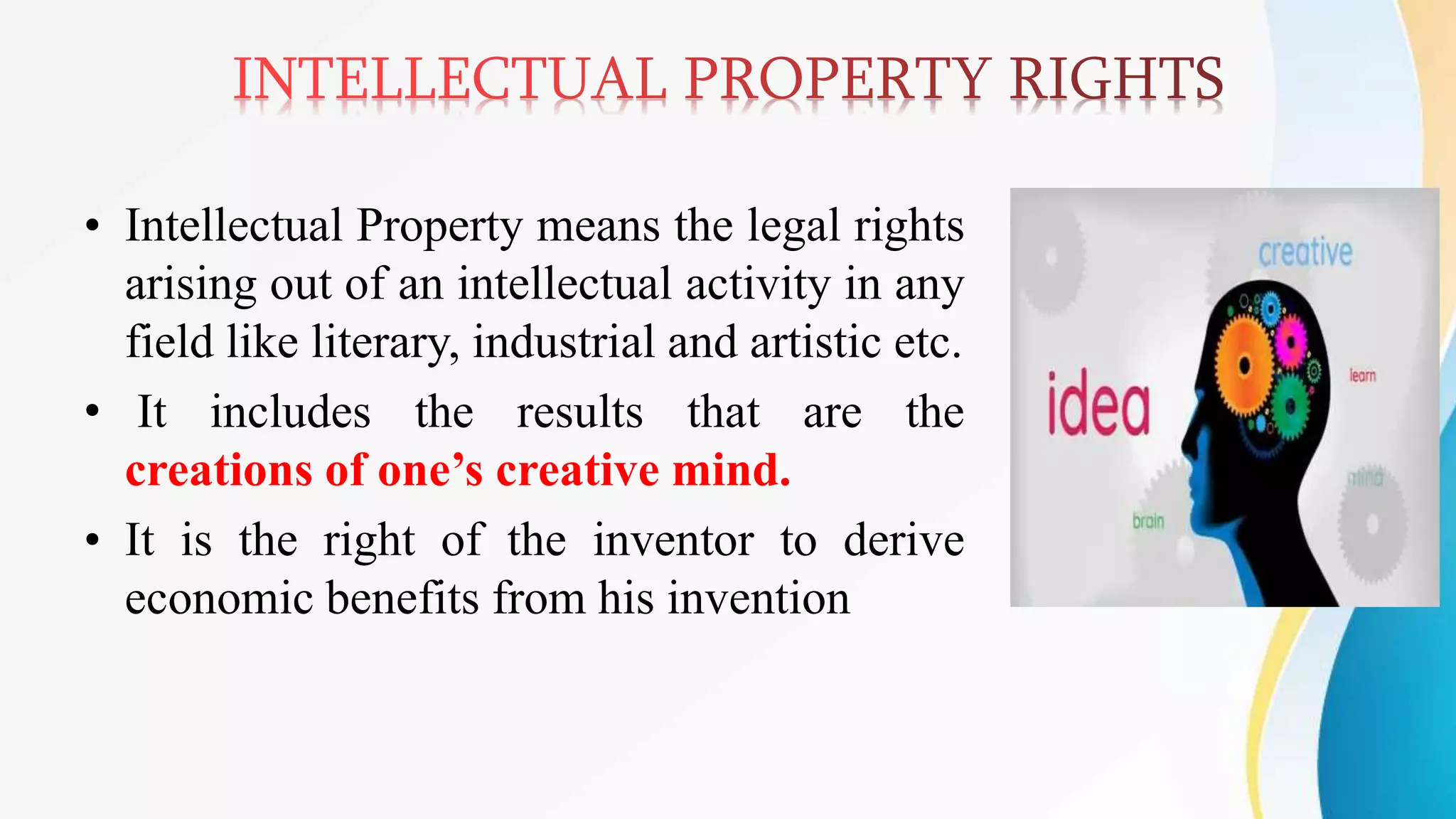
• Intellectual Property means the legal rights
arising out of an intellectual activity in any
field like literary, industrial and artistic etc.
• It includes the results that are the
creations of one’s creative mind.
• It is the right of the inventor to derive
economic benefits from his invention
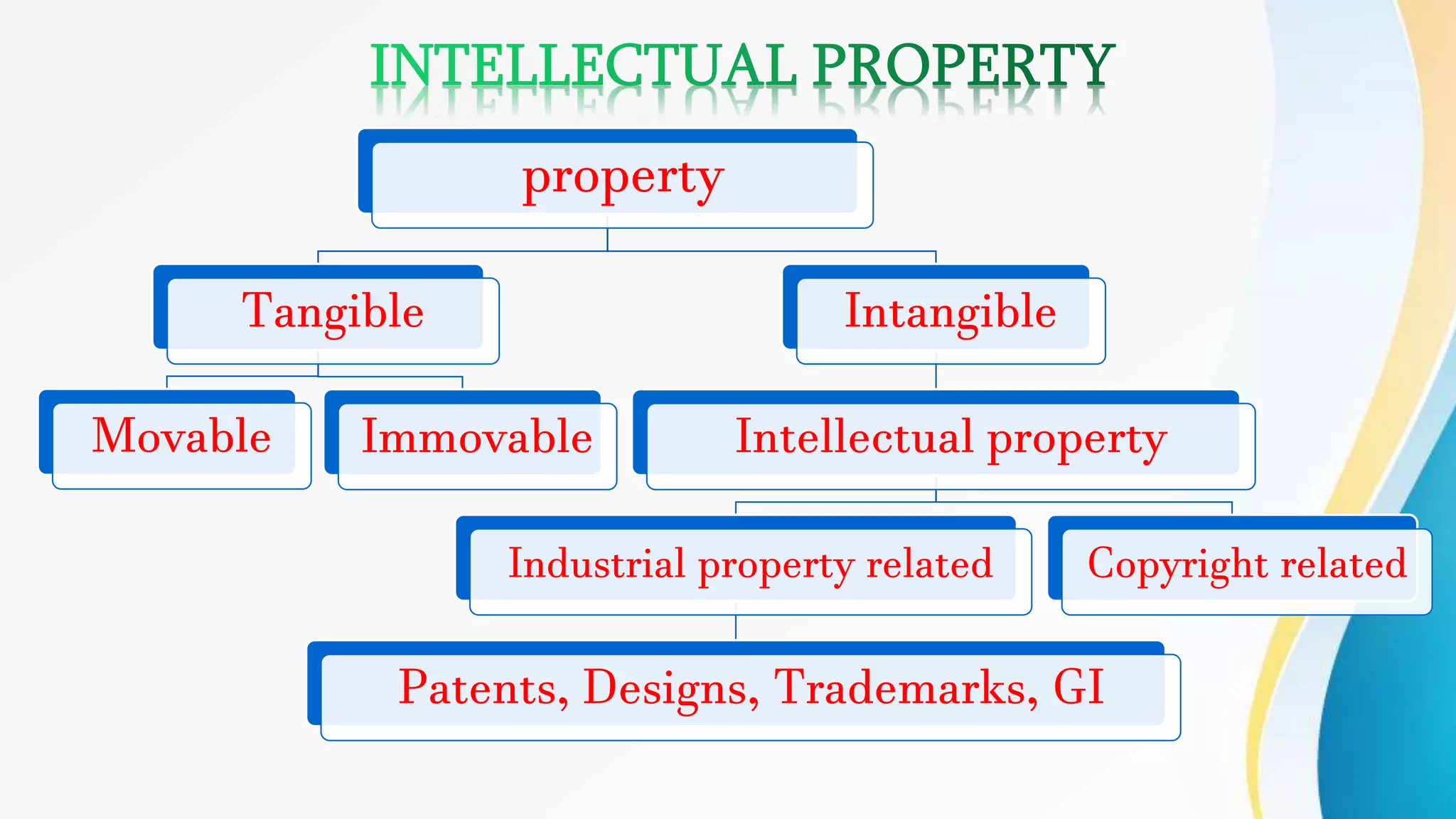
property
Tangible
Movable Immovable
Intangible
Intellectual property
Industrial property related
Patents, Designs, Trademarks, GI
Copyright related
TYPES OF IPR
• Exclusive rights given for a certain period of time
• Legal rights
• Monopoly
• Negative rights i.e., it prevents others to use his/her creation.
IPR
Patents
Trademarks
Geographicalindications Industrialdesign
CopyRights
The intellectual property rights were essentially
recognized and accepted all over the world due to some very
important reasons.
To provide an incentive to individuals for new creations
To accord due recognition to the creators and inventors
To ensure material reward for intellectual property
To make available genuine and original products.
• It is the exclusive right of inventor to prevent others from possessing,
using, selling, manufacturing and importing the patented invention or
offering to do any of these with in a definite geographical area.
• Patents have territorial jurisdiction i.e., we have to register the patents
in all countries where we have our interests.
Patents are granted for
1. Invention
2. Innovation
3. Process or Product of an invention
4. Concept
Types of Patents
1. Utility patent : Issued for any new and useful process, machine,
manufacture or composition of matter or any new and
useful improvement thereof.
2. Design patent : Issued for novel, non-obvious, ornamental design in an
article of manufacture / for its appearance.
3. Plant patent : Issued for new varieties of plants which are asexually
reproduced. plants discovered in nature are not patented
Qualities to be possessed for granting a patent
1. It should be novel.
2. It should have an inventive step or it must be non-obvious.
3. It should be capable of Industrial application.
• However it must not fall within the provisions of section 3 and
section 4 of the Patents Act, 1970.
Example:
Non-
patentable
Mere
discovery of
a scientific
principle
Mere
rearrangem
ent of
known
devices
Injurious to
Public Health
Method of
agriculture or
horticulture
Atomic
Energy
related
Discovery of
living thing
or non-living
substances in
nature
A
mathematical
or business
method or a
computer
program
Contrary to
well
established
natural laws
Frivolous or
obvious
TRADITIONAL KNOWLEDGE
The knowledge continually developed, acquired, used, practiced,
transmitted and sustained by communities/individuals through
generations is called TK.
In India TK including existing oral knowledge cannot be protected
under the provisions of existing IPR laws/acts.
The commercial exploitation or monopolization of
biological/genetic material as medicinal plant extracts, usually without
compensasting the indigenous people of a country from which the
material /knowledge is obtained is called as BIO-PIRACY.
Example of Indian leagal cases
: Granted patent for wound healing property in 1995 by US
patent office. The CSIR filed a re-examination case challenging the patent
on the grounds of “prior art”, i.e. existing public knowledge and submitted
a documentation proof in the form of research paper published in 1953.
thus US patent office upheld the objection and cancelled the patent in 1997.
2. Neem : European patent office granted a patent to a US company for
preparing a fungicide with neem seeds in 1994. Later India fought for its
rights and hence the patent was revoked in 2005.
3. Basmati rice: US patent office granted patent to US company which
affect the annual basmati exports from India and the brand name of Indian
Basmati. Though evidences are produced the patent was not revoked.
Porcess of patent application
Filling Application form
Publication of Application
Complete specification if not filed should be filed within 12 months
from provisional filing date
Examination of Patent
Request for examination to be applied within 48 months from filing or
priority date of patent application
Response to First Examination Report
FER will be issued by IPO and response to it should be submitted
within 6 months
Contd....
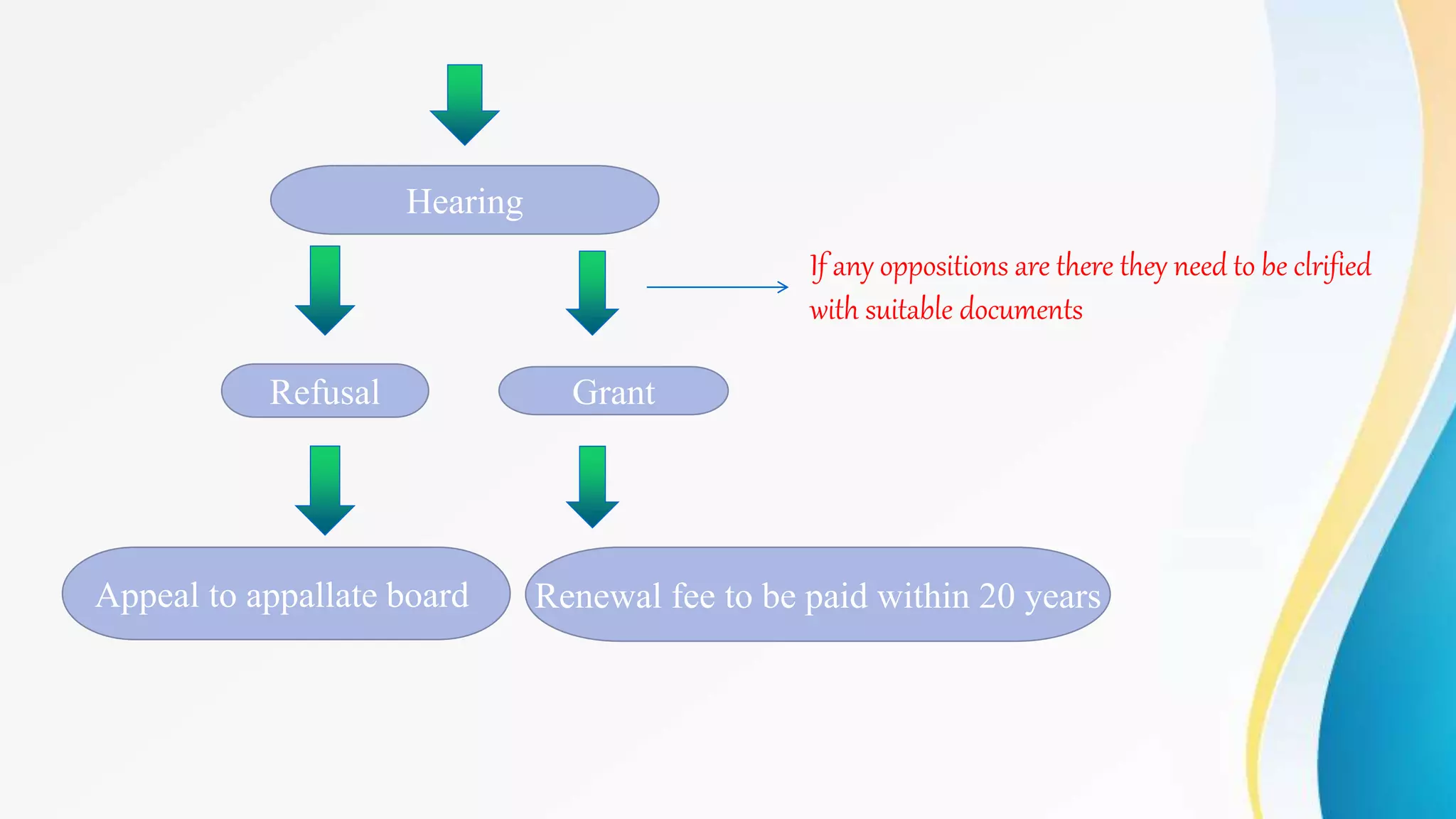
Hearing
Refusal Grant
Appeal to appallate board Renewal fee to be paid within 20 years
If any oppositions are there they need to be clrified
with suitable documents
COPYRIGHT
Copyright is a legal term describing rights given to
creators for their literary and artistic works.
Copyright law gives creators of original material the
exclusive right to further use and duplicate that material for a
given amount of time, at which point the copyrighted item
becomes public domain.
The works covered by Copyright include
• Literary works such as novels, poems, plays,
reference works,
• Newspapers and articles
• Computer programs and databases
• Films, musical compositions, dance & theatrical productions
• Artistic works such as paintings, drawings, photographs and sculptures
• Architecture, advertisements, maps, technical drawings and manuals.
Requirements of Copyright
1. Originality
2. Fixation
1. The right to distribute the copies of the work.
2. Play/perform/show the work in public and broadcasting it.
3. Make an adaptation of the work
If any third party does any of these acts without the copyrights owners
permission then infringement will arise.
Infringement is of two types
Primary infringement dealing with real act of copying.
Secondary infringement delas with works like selling the pirated books,
importing etc.
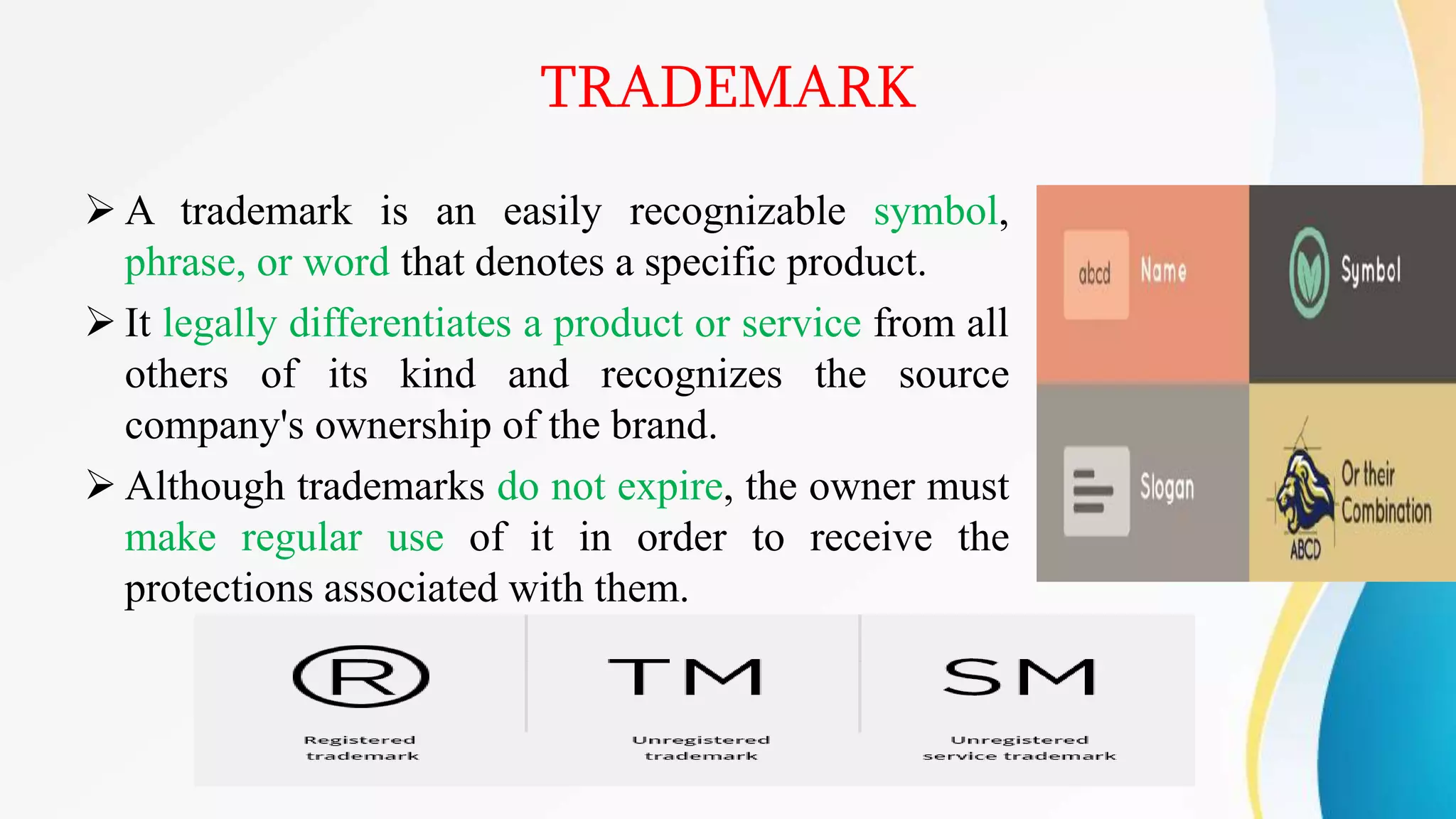
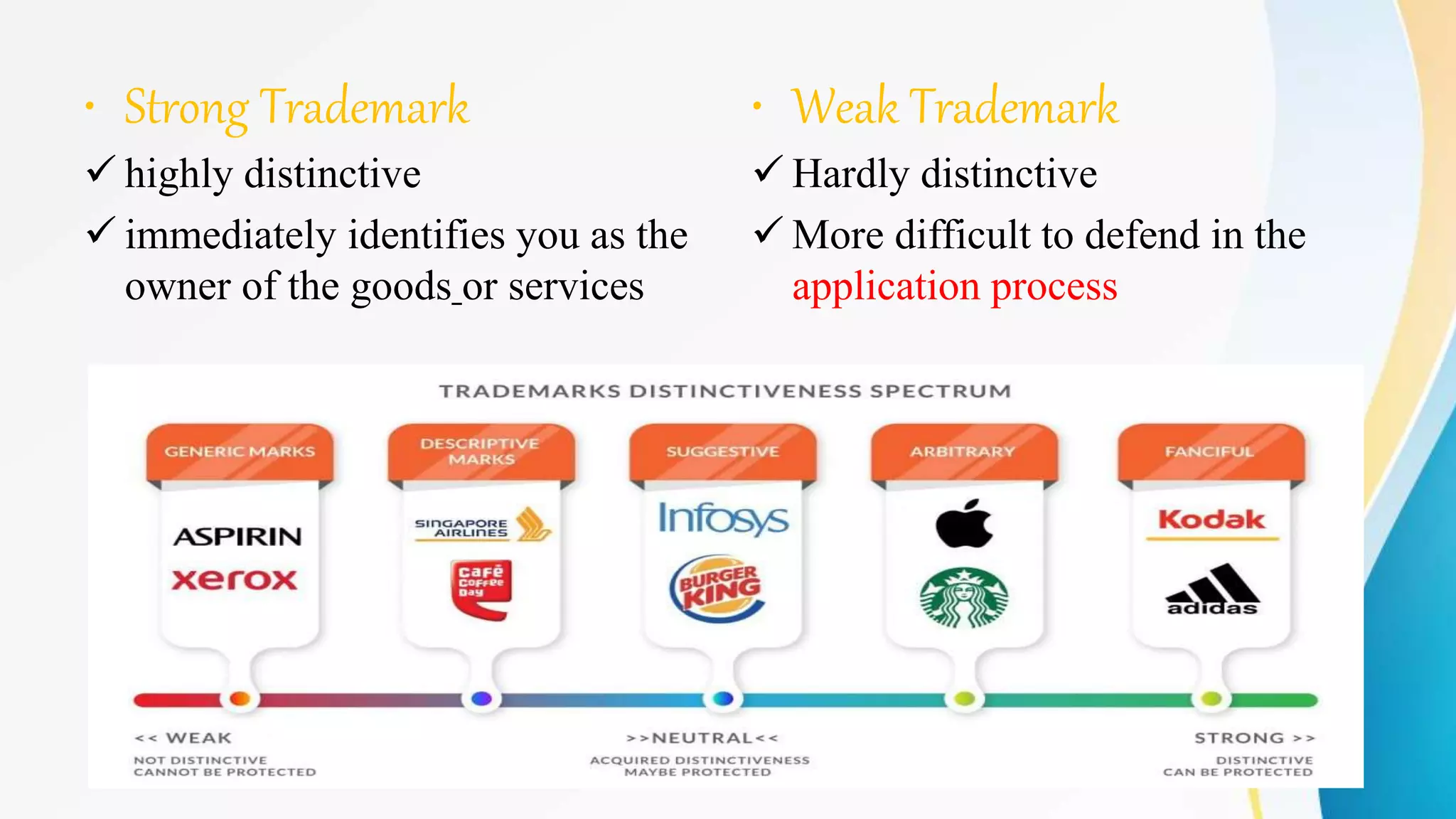
TRADEMARK
 A trademark is an easily recognizable symbol,
phrase, or word that denotes a specific product.
 It legally differentiates a product or service from all
others of its kind and recognizes the source
company's ownership of the brand.
 Although trademarks do not expire, the owner must
make regular use of it in order to receive the
protections associated with them.
Logos and symbols
• Strong Trademark
 highly distinctive
 immediately identifies you as the
owner of the goods or services
• Weak Trademark
 Hardly distinctive
 More difficult to defend in the
application process
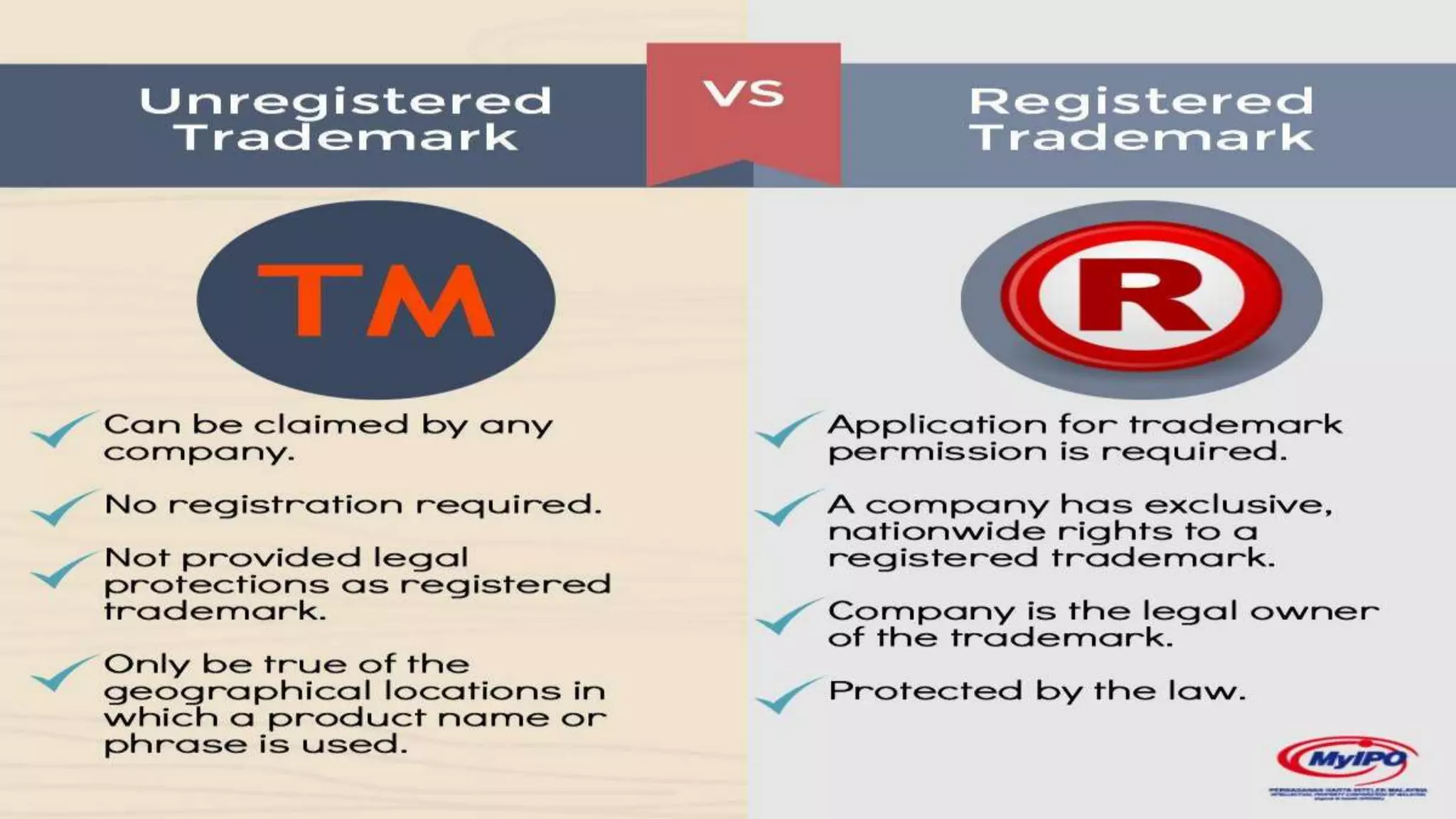
When a registered Trademark is used by other person who is not
entitled to use the mark under law, it constitutes infringement.
• GIs identify agricultural, natural or manufactured goods associated with
a territory/region/locality. It gives protection to the group of people or
associations involved in the production of the product using traditional
skills and knowledge
• The manufactured goods should be produced or processed or prepared in
that territory. This gives a special quality to the product due to
geographical environment, reputation, specific manufacturing/farming
skills, traditions and other characteristics attributable to origin.
• It consists of the name of the place of origin & originates from a definite
geographical territory
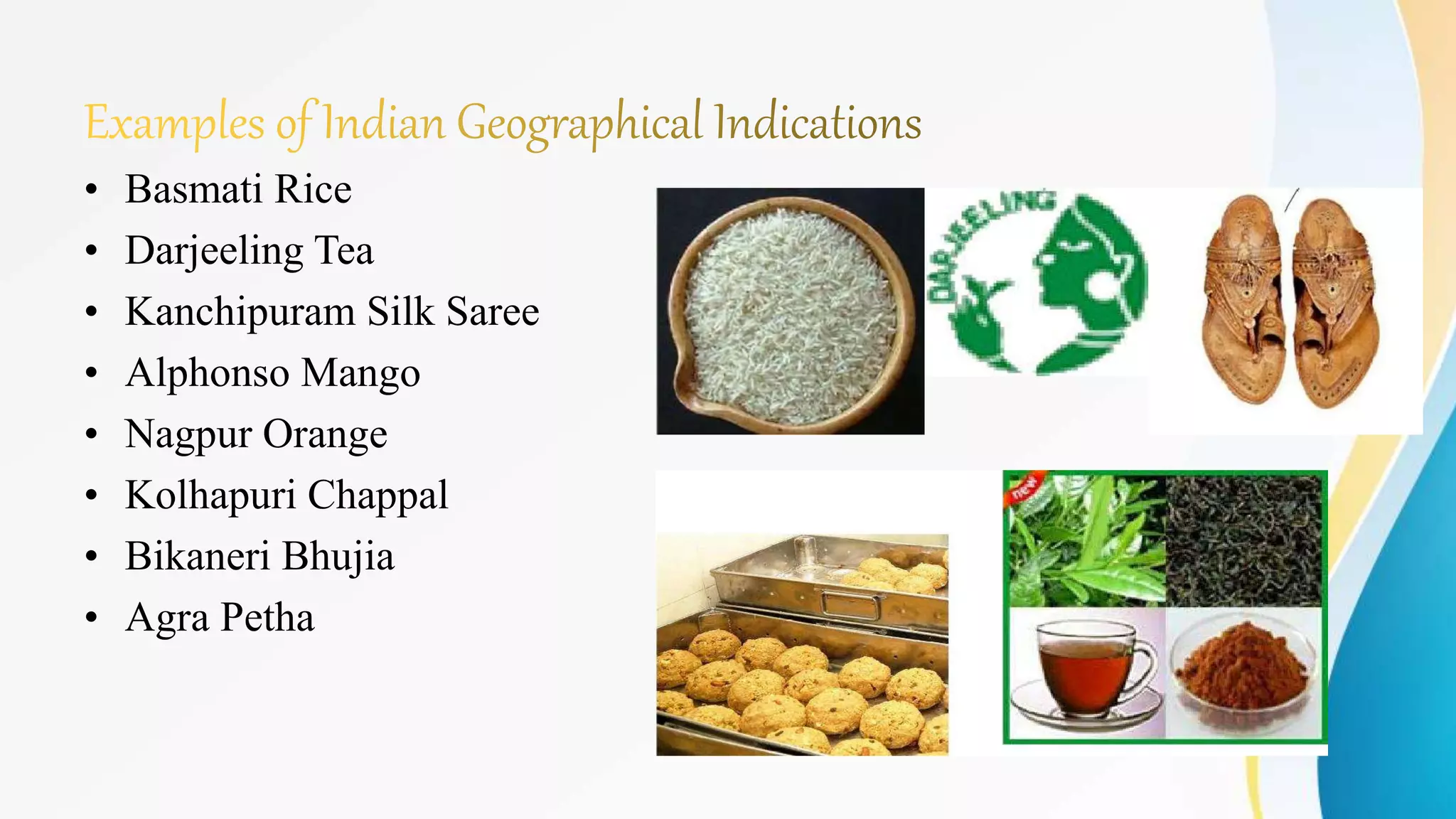
• Basmati Rice
• Darjeeling Tea
• Kanchipuram Silk Saree
• Alphonso Mango
• Nagpur Orange
• Kolhapuri Chappal
• Bikaneri Bhujia
• Agra Petha
INDUSTRIAL DESIGN
• Design makes the product attractive and appealing to the consumers
and adds to its commercial value for that reason.
• Ornamental or aesthetic aspect of a useful article of industry.
 Aspect that gives special appearance
 Aspect which differentiates from current products
• Only the aesthetic/visual form of a product
 Not the Technical (Patents)
 Nor Distinguishing Features (Trade Marks)
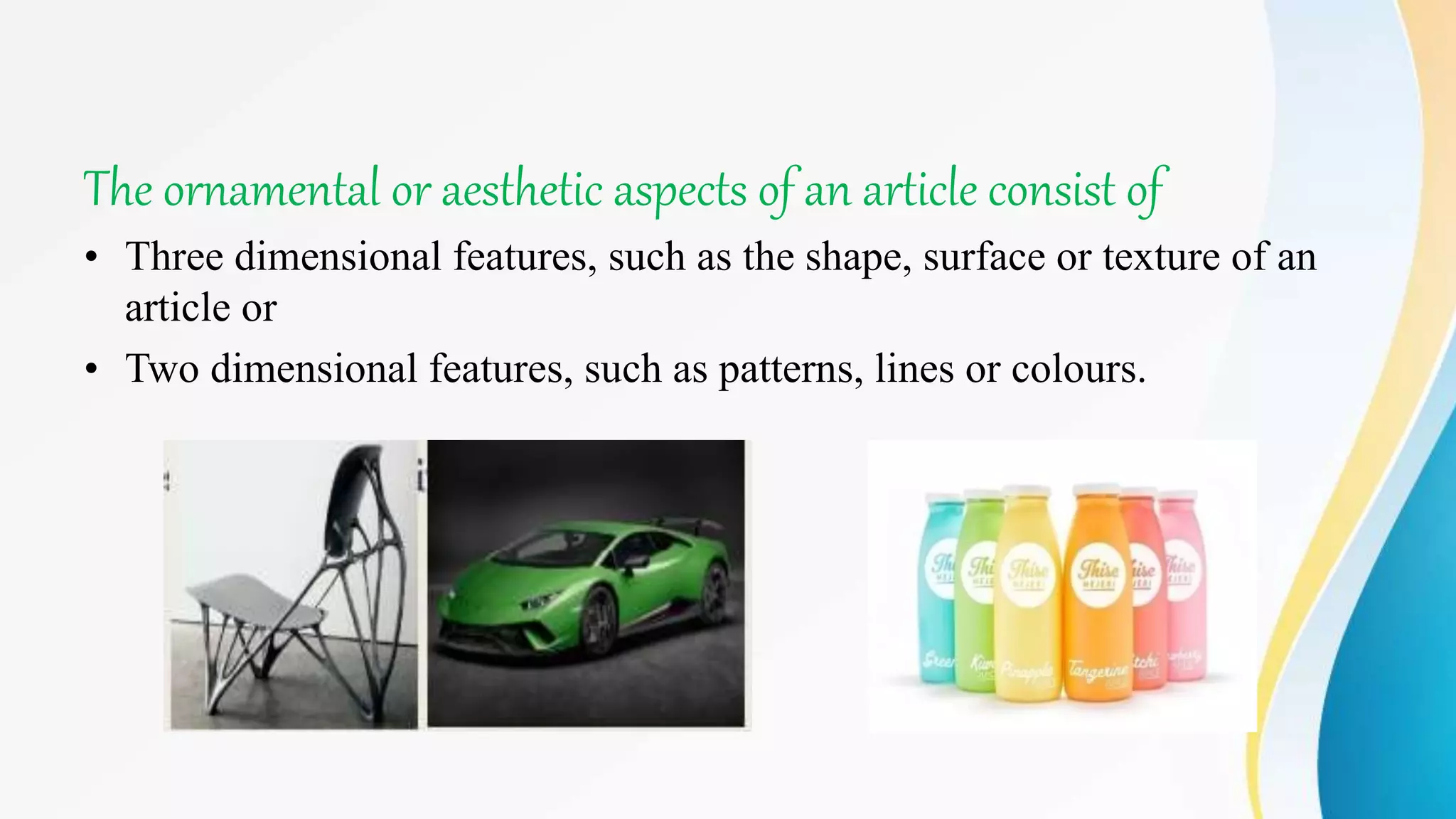
The ornamental or aesthetic aspects of an article consist of
• Three dimensional features, such as the shape, surface or texture of an
article or
• Two dimensional features, such as patterns, lines or colours.
Relation between IPRs
A single product can be protected by more than one
IPR
• The logo Coca-Cola is an example for
TRADEMARK.
• Shape of the bottle – an INDUSTRIAL DESIGN.
• PATENT may have been obtained in respect of
bottling equipment.
• COPYRIGHT – in respect of the text, database or
artistic work appearing on its website.
OFFICES FOR REGISTERING IPRs IN INDIA
IP adds value at every stage of the value chain from creative or innovative idea to
putting a new, better, and cheaper, productive/service in the market
Protection of Plant Varieties and Farmers Rights Act
• PVP was viewed in 2000 as necessary
in order to encourage food security, in
particular from the viewpoint of
business breeders, producers and agro-
biodiversity conservation.
• In order that the country can safeguard
and maintain its producers’ freedoms
on the one side and at the same moment
give privileges to plant breeders on the
other, it was necessary to have a PVP
sui generis scheme in India.
OBJECTIVES OF PPVFRA
General functions of PPVFRA
• Registration of new plant varieties, essentially derived varieties
(EDV), and extant varieties.
• Developing DUS( Distinctiveness, Uniformity and Stability) test
guideliness for new plant varieties.
• Developing characterization and documentation of registered
varieties.
• compulsory cataloging facilities for all variety of plants,
• Documentation of the National register of Plant varieties and
• Maintenance of National Gene Bank.
Plant Breeder’s right
It is the Right of a breeder to regulate production and marketing of
his variety for a period of 10 to 20 years.
:
 For cultivated plant species.
 Protect only the variety and not the standard breeding procedure.
 It also contains some breeders exemptions and farmers of privilege.
 Laws first framed in 1961 by International union for the protection of
new plant varieties (UPOV) revised in 1972, 1978 and 1991.
For plant breeders rights to be granted, the new variety must meet four
criteria under the rules established by UPOV.
Novel : should not have been offered for sale before one year from
date of filing of application. (condition varies in different
countries).
Distinct : should be clearly distinguishable from any other variety
atleast one esential characteristic.
Uniform : should be sufficiently uniform in its essential characteristics.
Stable : Essential characteristics should remain unchanged after
repeated propagation.
• Farmers priviledge
PBR system allows the farmers to use the materials of a
protected vari produced on their farm for planting of their new crop without
any obligations to the PBR title holder. this exemption is called farmers
priviledge.
• Farmers Rights
 Benefit sharing
 Compensation
 Rights as breeder
 Recognition as conserver
Continue local seed transactions
Free services
Prevalence over breeders rights in certain
matters - EDV authorization.
Protection from innocent infringement.
• Prevention of commercial exploitation of those variety which is
necessary to protect public morality to human, animal and plant
health and cause harm full effect to environment.
• Species involving any technology viz., Genetic Use Restriction
Technology( GURT) or Terminator Gene Technology.
Convention on Biological Diversity
Biological variety refers to the variety of “living organisms
from all sources and ecological complexes” within or between species and
habitats” according to Indian Biological Diversity Act 2002
 The immediate/indirect misappropriation of biological and genetic
resources by the states
 Sovereignty over their genetic resources and
 In particular, traditional expertise which was known as bio-piracy as well
Regulations of the Act
 No person shall, without prior approval of NBA, obtain
any biological resources occuring in India or knowledge
associated for research/ commercial utilization/ bio-
surevy and bio-utilization.
 Results of research not to be transferred to other countries
illegally without approval of NBA.
 All the citizens / corporate institutions of India should
take prior permission from concerned Biodiversity
boards for commercial use of resources.
These provisions shall not be applicable in case of GOI
approved collaborative research projects.
NATURAL RIGHT
BIOLOGICAL RESOURCES
CONCLUSION
 IPR’s gives the protection to the patentee, other right holder enabling
him to enjoy the right and to raise the capital for working his invention
on a commercial scale. in case of not obtaining any legal right the
product may be overtaken by others to commercialise its benefits
 IPR has been used in agriculture to stimulate Research and Development
(R&D) investments by providing market protection in order to recoup
investments.
 Part of the ensuring higher profits are reinvested into R&D to produce
the new rou of products that benefit farmers, consumers and the
environment.
 Geographical Indications: a “way out” from subsistence to commercial
agriculture result in developing a model of “industrial agriculture” by
providing global market for the local products.
 PVP&FRA encourage food security, in particular from the viewpoint of
business breeders, producers and agro-biodiversity conservation. Thus
the country can safeguard and maintain its producers’ freedoms on the
one side and at the same moment give privileges to plant breeders on the
other.
Intellectual Property Rights

Intellectual Property Rights

  • 1.
    COLLEGE OF AGRICULTURE, RAICHUR . DEPARTMENT OF AGRICULTURAL EXTENSION EDUCATION SEMINAR INTELLECTUAL PROPERTY RIGHTS
  • 2.
    • Intellectual Propertymeans the legal rights arising out of an intellectual activity in any field like literary, industrial and artistic etc. • It includes the results that are the creations of one’s creative mind. • It is the right of the inventor to derive economic benefits from his invention
  • 3.
    property Tangible Movable Immovable Intangible Intellectual property Industrialproperty related Patents, Designs, Trademarks, GI Copyright related
  • 4.
    TYPES OF IPR •Exclusive rights given for a certain period of time • Legal rights • Monopoly • Negative rights i.e., it prevents others to use his/her creation. IPR Patents Trademarks Geographicalindications Industrialdesign CopyRights
  • 5.
    The intellectual propertyrights were essentially recognized and accepted all over the world due to some very important reasons. To provide an incentive to individuals for new creations To accord due recognition to the creators and inventors To ensure material reward for intellectual property To make available genuine and original products.
  • 6.
    • It isthe exclusive right of inventor to prevent others from possessing, using, selling, manufacturing and importing the patented invention or offering to do any of these with in a definite geographical area. • Patents have territorial jurisdiction i.e., we have to register the patents in all countries where we have our interests. Patents are granted for 1. Invention 2. Innovation 3. Process or Product of an invention 4. Concept
  • 7.
    Types of Patents 1.Utility patent : Issued for any new and useful process, machine, manufacture or composition of matter or any new and useful improvement thereof. 2. Design patent : Issued for novel, non-obvious, ornamental design in an article of manufacture / for its appearance. 3. Plant patent : Issued for new varieties of plants which are asexually reproduced. plants discovered in nature are not patented
  • 8.
    Qualities to bepossessed for granting a patent 1. It should be novel. 2. It should have an inventive step or it must be non-obvious. 3. It should be capable of Industrial application. • However it must not fall within the provisions of section 3 and section 4 of the Patents Act, 1970. Example:
  • 9.
    Non- patentable Mere discovery of a scientific principle Mere rearrangem entof known devices Injurious to Public Health Method of agriculture or horticulture Atomic Energy related Discovery of living thing or non-living substances in nature A mathematical or business method or a computer program Contrary to well established natural laws Frivolous or obvious
  • 10.
    TRADITIONAL KNOWLEDGE The knowledgecontinually developed, acquired, used, practiced, transmitted and sustained by communities/individuals through generations is called TK. In India TK including existing oral knowledge cannot be protected under the provisions of existing IPR laws/acts. The commercial exploitation or monopolization of biological/genetic material as medicinal plant extracts, usually without compensasting the indigenous people of a country from which the material /knowledge is obtained is called as BIO-PIRACY.
  • 11.
    Example of Indianleagal cases : Granted patent for wound healing property in 1995 by US patent office. The CSIR filed a re-examination case challenging the patent on the grounds of “prior art”, i.e. existing public knowledge and submitted a documentation proof in the form of research paper published in 1953. thus US patent office upheld the objection and cancelled the patent in 1997. 2. Neem : European patent office granted a patent to a US company for preparing a fungicide with neem seeds in 1994. Later India fought for its rights and hence the patent was revoked in 2005. 3. Basmati rice: US patent office granted patent to US company which affect the annual basmati exports from India and the brand name of Indian Basmati. Though evidences are produced the patent was not revoked.
  • 12.
    Porcess of patentapplication Filling Application form Publication of Application Complete specification if not filed should be filed within 12 months from provisional filing date Examination of Patent Request for examination to be applied within 48 months from filing or priority date of patent application Response to First Examination Report FER will be issued by IPO and response to it should be submitted within 6 months Contd....
  • 13.
    Hearing Refusal Grant Appeal toappallate board Renewal fee to be paid within 20 years If any oppositions are there they need to be clrified with suitable documents
  • 14.
    COPYRIGHT Copyright is alegal term describing rights given to creators for their literary and artistic works. Copyright law gives creators of original material the exclusive right to further use and duplicate that material for a given amount of time, at which point the copyrighted item becomes public domain.
  • 15.
    The works coveredby Copyright include • Literary works such as novels, poems, plays, reference works, • Newspapers and articles • Computer programs and databases • Films, musical compositions, dance & theatrical productions • Artistic works such as paintings, drawings, photographs and sculptures • Architecture, advertisements, maps, technical drawings and manuals. Requirements of Copyright 1. Originality 2. Fixation
  • 16.
    1. The rightto distribute the copies of the work. 2. Play/perform/show the work in public and broadcasting it. 3. Make an adaptation of the work If any third party does any of these acts without the copyrights owners permission then infringement will arise. Infringement is of two types Primary infringement dealing with real act of copying. Secondary infringement delas with works like selling the pirated books, importing etc.
  • 18.
    TRADEMARK  A trademarkis an easily recognizable symbol, phrase, or word that denotes a specific product.  It legally differentiates a product or service from all others of its kind and recognizes the source company's ownership of the brand.  Although trademarks do not expire, the owner must make regular use of it in order to receive the protections associated with them.
  • 20.
  • 21.
    • Strong Trademark highly distinctive  immediately identifies you as the owner of the goods or services • Weak Trademark  Hardly distinctive  More difficult to defend in the application process
  • 22.
    When a registeredTrademark is used by other person who is not entitled to use the mark under law, it constitutes infringement.
  • 23.
    • GIs identifyagricultural, natural or manufactured goods associated with a territory/region/locality. It gives protection to the group of people or associations involved in the production of the product using traditional skills and knowledge • The manufactured goods should be produced or processed or prepared in that territory. This gives a special quality to the product due to geographical environment, reputation, specific manufacturing/farming skills, traditions and other characteristics attributable to origin. • It consists of the name of the place of origin & originates from a definite geographical territory
  • 24.
    • Basmati Rice •Darjeeling Tea • Kanchipuram Silk Saree • Alphonso Mango • Nagpur Orange • Kolhapuri Chappal • Bikaneri Bhujia • Agra Petha
  • 26.
    INDUSTRIAL DESIGN • Designmakes the product attractive and appealing to the consumers and adds to its commercial value for that reason. • Ornamental or aesthetic aspect of a useful article of industry.  Aspect that gives special appearance  Aspect which differentiates from current products • Only the aesthetic/visual form of a product  Not the Technical (Patents)  Nor Distinguishing Features (Trade Marks)
  • 27.
    The ornamental oraesthetic aspects of an article consist of • Three dimensional features, such as the shape, surface or texture of an article or • Two dimensional features, such as patterns, lines or colours.
  • 28.
    Relation between IPRs Asingle product can be protected by more than one IPR • The logo Coca-Cola is an example for TRADEMARK. • Shape of the bottle – an INDUSTRIAL DESIGN. • PATENT may have been obtained in respect of bottling equipment. • COPYRIGHT – in respect of the text, database or artistic work appearing on its website.
  • 30.
  • 31.
    IP adds valueat every stage of the value chain from creative or innovative idea to putting a new, better, and cheaper, productive/service in the market
  • 32.
    Protection of PlantVarieties and Farmers Rights Act • PVP was viewed in 2000 as necessary in order to encourage food security, in particular from the viewpoint of business breeders, producers and agro- biodiversity conservation. • In order that the country can safeguard and maintain its producers’ freedoms on the one side and at the same moment give privileges to plant breeders on the other, it was necessary to have a PVP sui generis scheme in India.
  • 33.
  • 34.
    General functions ofPPVFRA • Registration of new plant varieties, essentially derived varieties (EDV), and extant varieties. • Developing DUS( Distinctiveness, Uniformity and Stability) test guideliness for new plant varieties. • Developing characterization and documentation of registered varieties. • compulsory cataloging facilities for all variety of plants, • Documentation of the National register of Plant varieties and • Maintenance of National Gene Bank.
  • 35.
    Plant Breeder’s right Itis the Right of a breeder to regulate production and marketing of his variety for a period of 10 to 20 years. :  For cultivated plant species.  Protect only the variety and not the standard breeding procedure.  It also contains some breeders exemptions and farmers of privilege.  Laws first framed in 1961 by International union for the protection of new plant varieties (UPOV) revised in 1972, 1978 and 1991.
  • 36.
    For plant breedersrights to be granted, the new variety must meet four criteria under the rules established by UPOV. Novel : should not have been offered for sale before one year from date of filing of application. (condition varies in different countries). Distinct : should be clearly distinguishable from any other variety atleast one esential characteristic. Uniform : should be sufficiently uniform in its essential characteristics. Stable : Essential characteristics should remain unchanged after repeated propagation.
  • 37.
    • Farmers priviledge PBRsystem allows the farmers to use the materials of a protected vari produced on their farm for planting of their new crop without any obligations to the PBR title holder. this exemption is called farmers priviledge. • Farmers Rights  Benefit sharing  Compensation  Rights as breeder  Recognition as conserver Continue local seed transactions Free services Prevalence over breeders rights in certain matters - EDV authorization. Protection from innocent infringement.
  • 38.
    • Prevention ofcommercial exploitation of those variety which is necessary to protect public morality to human, animal and plant health and cause harm full effect to environment. • Species involving any technology viz., Genetic Use Restriction Technology( GURT) or Terminator Gene Technology.
  • 40.
    Convention on BiologicalDiversity Biological variety refers to the variety of “living organisms from all sources and ecological complexes” within or between species and habitats” according to Indian Biological Diversity Act 2002
  • 41.
     The immediate/indirectmisappropriation of biological and genetic resources by the states  Sovereignty over their genetic resources and  In particular, traditional expertise which was known as bio-piracy as well
  • 42.
    Regulations of theAct  No person shall, without prior approval of NBA, obtain any biological resources occuring in India or knowledge associated for research/ commercial utilization/ bio- surevy and bio-utilization.  Results of research not to be transferred to other countries illegally without approval of NBA.  All the citizens / corporate institutions of India should take prior permission from concerned Biodiversity boards for commercial use of resources. These provisions shall not be applicable in case of GOI approved collaborative research projects. NATURAL RIGHT BIOLOGICAL RESOURCES
  • 43.
    CONCLUSION  IPR’s givesthe protection to the patentee, other right holder enabling him to enjoy the right and to raise the capital for working his invention on a commercial scale. in case of not obtaining any legal right the product may be overtaken by others to commercialise its benefits  IPR has been used in agriculture to stimulate Research and Development (R&D) investments by providing market protection in order to recoup investments.  Part of the ensuring higher profits are reinvested into R&D to produce the new rou of products that benefit farmers, consumers and the environment.
  • 44.
     Geographical Indications:a “way out” from subsistence to commercial agriculture result in developing a model of “industrial agriculture” by providing global market for the local products.  PVP&FRA encourage food security, in particular from the viewpoint of business breeders, producers and agro-biodiversity conservation. Thus the country can safeguard and maintain its producers’ freedoms on the one side and at the same moment give privileges to plant breeders on the other.