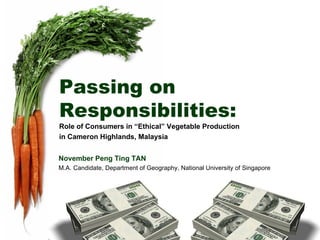
Passing on Responsibilities: Role of Consumers in “Ethical” Vegetable Production  in Cameron Highlands, Malaysia November Peng Ting TAN M.A. Candidate, Department of Geography, National University of Singapore
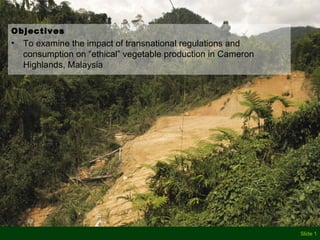
Objectives To examine the impact of transnational regulations and consumption on “ethical” vegetable production in Cameron Highlands, Malaysia Slide 1
Cameron Highlands Key Markets Kuala Lumpur Johor Bahru Singapore Ipoh Penang Other Export Markets Thailand Taiwan Japan 1 2 3 4 5 Slide 2
Slide 3
Potential “Ethical” Food Production Concerns on Cameron Highlands Land Clearing and Soil Erosion Deforestation and Biodiversity Loss Water Contamination Pesticides and Food Safety Migrant Labour Fair Trade Slide 4
40 interviewees were asked to rank (in order of influence, 1-Most Influential; 4-Least Influential) the following have on changing their business and farming practices towards a more “ethical” one. Malaysia Market Malaysia Law Singapore Market Singapore Law Slide 5 Methodology Respondents were asked, given a scenario  where if there was a push for “ethical food” by any of the 4, 1) which change would affect them 2) which one would they most likely  r espond to; and this was to be ranked in order of the factor that they would respond to first.
Methodology 100% Technology Intensive, High Capital Farms Mostly Singapore export-oriented Slide 6
Results Slide 10
Malaysia Market ranked #1 Results Most producers were still primarily concerned with domestic market and law Slide 12
Slide 7
Slide 8
Slide 9
Singapore Law ranked #1 Results Collectors / exporters who deal with Singapore Law on a daily basis as their key business are more aware of the regulations. Potential for ethical sourcing and trading Slide 11 2 3 4 1 MS C S 3 2 4 1 SM C S 3 2 4 1 SM C M 3 4 2 1 S H L 4 3 2 1 S C M 4 3 2 1 S S S M Law M Mkt S Mkt S Law Ranking Market Farming Method Size
Does Consumer Power Exist? YES! Singapore consumer demand for safety and quality Results in strict transnational regulations which does affect production Discussion Slide 13
Does Consumer Power Exist? NO! Market factor weakens “ethical” system Consumer maturity is lacking Absence of consumer or civil society action / pressure Discussion Slide 14
“ If I could turn back time, I would rather not take the high road [and not be an organic farmer]. Instead, it would have been easier if I could use some chemical pesticides while practicing organic soil fertility management” - Mr S, organic farming pioneer on Cameron Highlands Slide 15
Conclusion Law is interpreted differently at different scales There must always be business incentives. Consumer maturity and civil society action is a necessary ingredient.  Slide 16

Passing on Responsibilities

  • 1.
    Passing on Responsibilities:Role of Consumers in “Ethical” Vegetable Production in Cameron Highlands, Malaysia November Peng Ting TAN M.A. Candidate, Department of Geography, National University of Singapore
  • 2.
    Objectives To examinethe impact of transnational regulations and consumption on “ethical” vegetable production in Cameron Highlands, Malaysia Slide 1
  • 3.
    Cameron Highlands KeyMarkets Kuala Lumpur Johor Bahru Singapore Ipoh Penang Other Export Markets Thailand Taiwan Japan 1 2 3 4 5 Slide 2
  • 4.
  • 5.
    Potential “Ethical” FoodProduction Concerns on Cameron Highlands Land Clearing and Soil Erosion Deforestation and Biodiversity Loss Water Contamination Pesticides and Food Safety Migrant Labour Fair Trade Slide 4
  • 6.
    40 interviewees wereasked to rank (in order of influence, 1-Most Influential; 4-Least Influential) the following have on changing their business and farming practices towards a more “ethical” one. Malaysia Market Malaysia Law Singapore Market Singapore Law Slide 5 Methodology Respondents were asked, given a scenario where if there was a push for “ethical food” by any of the 4, 1) which change would affect them 2) which one would they most likely r espond to; and this was to be ranked in order of the factor that they would respond to first.
  • 7.
    Methodology 100% TechnologyIntensive, High Capital Farms Mostly Singapore export-oriented Slide 6
  • 8.
  • 9.
    Malaysia Market ranked#1 Results Most producers were still primarily concerned with domestic market and law Slide 12
  • 10.
  • 11.
  • 12.
  • 13.
    Singapore Law ranked#1 Results Collectors / exporters who deal with Singapore Law on a daily basis as their key business are more aware of the regulations. Potential for ethical sourcing and trading Slide 11 2 3 4 1 MS C S 3 2 4 1 SM C S 3 2 4 1 SM C M 3 4 2 1 S H L 4 3 2 1 S C M 4 3 2 1 S S S M Law M Mkt S Mkt S Law Ranking Market Farming Method Size
  • 14.
    Does Consumer PowerExist? YES! Singapore consumer demand for safety and quality Results in strict transnational regulations which does affect production Discussion Slide 13
  • 15.
    Does Consumer PowerExist? NO! Market factor weakens “ethical” system Consumer maturity is lacking Absence of consumer or civil society action / pressure Discussion Slide 14
  • 16.
    “ If Icould turn back time, I would rather not take the high road [and not be an organic farmer]. Instead, it would have been easier if I could use some chemical pesticides while practicing organic soil fertility management” - Mr S, organic farming pioneer on Cameron Highlands Slide 15
  • 17.
    Conclusion Law isinterpreted differently at different scales There must always be business incentives. Consumer maturity and civil society action is a necessary ingredient. Slide 16

Editor's Notes

  • #2 Part of masters dissertation on singapore’s foodprint and how our laws and market influences the production A lot of case studies are about existing projects but mine tries to find out why there is (or not) ethical production And what are the loopholes