
Elsevier Applications and Developer Network

Partner Spotlight
Akhilesh Pandey, M.D., Ph.D., Johns Hopkins University
Partner Spotlight Akhilesh Pandey, M.D., Ph.D.


As the world’s leading provider of scientific, technical and medical information and solutions, Elsevier is continuously
seeking new ways to accelerate scientific information search and discovery. Through the efforts of the Elsevier Developer
Network, new relationships are being forged to foster collaboration throughout the scientific community to develop
innovative workflow solutions that enhance researcher productivity and help solve research problems.


                     Partner Spotlight
                     Dr. Akhilesh Pandey
                     Professor, Institute of Genetic Medicine and Departments of Biological Chemistry, Oncology and Pathology, Johns Hopkins School of Medicine

                     Editorial Board member, Molecular and Cellular Proteomics, Journal of Proteome Research, Proteomics, Clinical Proteomics and DNA Research,
                     Genome Research (former) Associate Editor, BMC Bioinformatics


About Dr. Pandey                                                                 Dr. Pandey and Elsevier
As one of the top bioinformaticists in the world, Dr. Pandey has a vision to     In addition to his work at Johns Hopkins and IOB, Dr. Pandey has
invigorate and fuel popular interest in science on a global scale and take a     worked in conjunction with Elsevier for nearly a decade, partnering
systems biology approach by combining many Omics technologies.                   on publishing, research, and cultivation programs to push science
                                                                                 and discovery. Pandey sees Elsevier’s work in academic publishing as
Working in proteomics, Dr. Pandey developed the SILAC method, a                  beneficial to the advancement and propagation of the work done by the
mass spectrometry-based procedure that detects variances in protein              global scientific community.
abundance using non-radioactive isotopic labeling. To aid in his
research, Pandey founded the Institute of Bioinformatics in Bangalore,           With Dr. Pandey’s cutting-edge research and fervor for the globalization
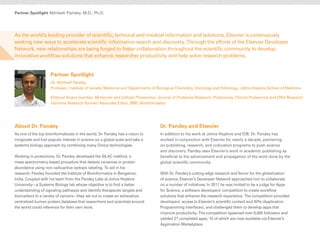
India. Coupled with his team from the Pandey Labs at Johns Hopkins               of science, Elsevier’s Developer Network approached him to collaborate
University—a Systems Biology lab whose objective is to find a better             on a number of initiatives. In 2011 he was invited to be a judge for Apps
understanding of signaling pathways and identify therapeutic targets and         for Science, a software developers’ competition to create workflow
biomarkers in a variety of cancers—they set out to create an exhaustive,         solutions that enhance the research experience. The competition provided
centralized human protein database that researchers and scientists around        developers’ access to Elsevier’s scientific content and APIs (Application
the world could reference for their own work.                                    Programming Interfaces), and challenged them to develop apps that
                                                                                 improve productivity. The competition spawned over 6,000 followers and
                                                                                 yielded 27 completed apps, 15 of which are now available via Elsevier’s
                                                                                 Application Marketplace.
Elsevier Developer Network |


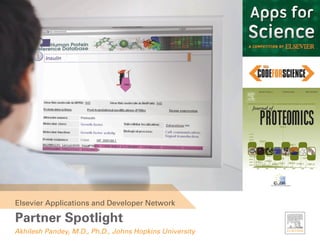
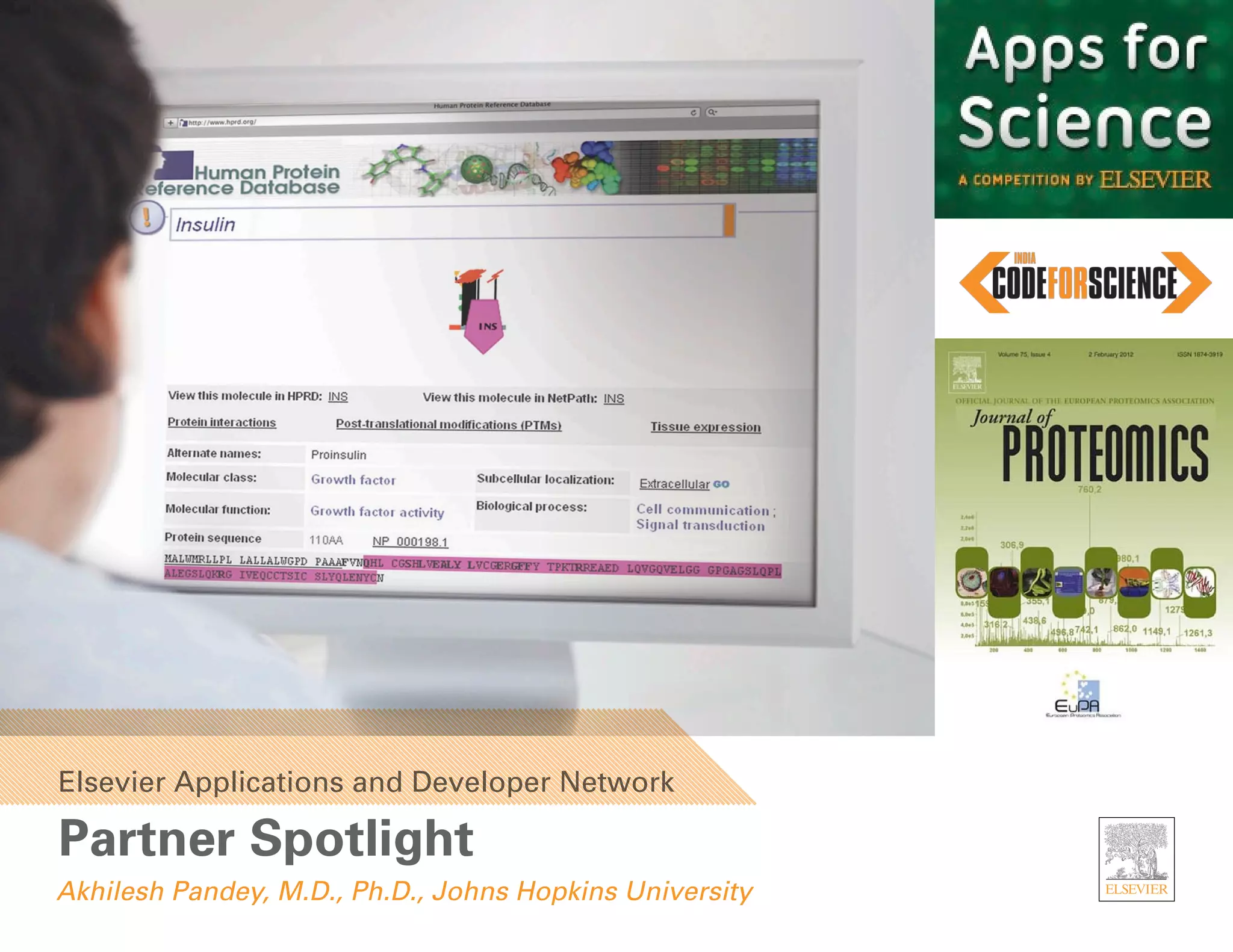
Following Apps for Science, the Developer Network approached Dr. Pandey
with the idea of a collaborative effort on his lab’s human protein database. By
linking to the ScienceDirect platform as an app, the protein database could
then be linked to full- text articles on ScienceDirect, making Pandey’s work      From the success of Apps for Science, coupled with the relationship
accessible to more than 15 million researchers, and alleviating his concerns      fostered while building the HPRD app, Elsevier asked Dr. Pandey to
on how to effectively make his research available to the broader scientific       co-chair Developer Network’s international challenge series, Code for
community. “I thought it would be a great thing to link the database via an       Science. Pandey and his teams from Johns Hopkins and the Institute of
app on ScienceDirect,” says Pandey about Elsevier’s approach.                     Bioinformatics in Bangalore have led the initiative currently underway
                                                                                  in India, with participants submitting over 100 application concepts in
“ e wanted to be part of the solution—not just using
 W                                                                                the first round of the competition. “They’re trying to reach the broader
 apps, but making ones that others could use.”                                    research- developer community,” says Dr. Pandey about the developer
                                                                                  competition Elsevier has established in recent years. “They’re not just
                                                                                  looking for scientist/developers that are reading journals; they’re looking
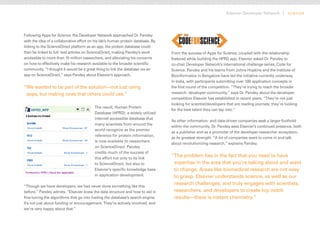
                                          The result, Human Protein
                                                                                  for the best talent they can tap into.”
                                          Database (HPRD), a widely utilized
                                          internet-accessible database that
                                                                                  As other information- and data-driven companies seek a larger foothold
                                          many scientists from around the
                                                                                  within the community, Dr. Pandey sees Elsevier’s continued presence, both
                                          world recognize as the premier
                                                                                  as a publisher and as a promoter of the developer-researcher ecosystem,
                                          reference for protein information,
                                                                                  as its greatest strength. “A lot of companies want to come in and talk
                                          is now available to researchers
                                                                                  about revolutionizing research,” explains Pandey.
                                          on ScienceDirect. Pandey
                                          credits much of the success of
                                          this effort not only to its link
                                                                                  “ he problem lies in the fact that you need to have
                                                                                   T
                                          to ScienceDirect, but also to            expertise in the area that you’re talking about and want
                                          Elsevier’s specific knowledge base       to change. Areas like biomedical research are not easy
                                          in application development.              to grasp. Elsevier understands science, as well as our
                                                                                   research challenges, and truly engages with scientists,
“Though we have developers, we had never done something like this
before,” Pandey admits. “Elsevier knew the data structure and how to aid in        researchers, and developers to create top notch
fine-tuning the algorithms that go into fueling the database’s search engine.      results—there is instant chemistry.”
It’s not just about funding or encouragement. They’re actively involved, and
we’re very happy about that.”
For More Information
visit developers.elsevier.com or email n.bhuva@elsevier.com

Partner Spotlight - Dr. Akhilesh Pandey

  • 1.
    Elsevier Applications andDeveloper Network Partner Spotlight Akhilesh Pandey, M.D., Ph.D., Johns Hopkins University
  • 2.
    Partner Spotlight AkhileshPandey, M.D., Ph.D. As the world’s leading provider of scientific, technical and medical information and solutions, Elsevier is continuously seeking new ways to accelerate scientific information search and discovery. Through the efforts of the Elsevier Developer Network, new relationships are being forged to foster collaboration throughout the scientific community to develop innovative workflow solutions that enhance researcher productivity and help solve research problems. Partner Spotlight Dr. Akhilesh Pandey Professor, Institute of Genetic Medicine and Departments of Biological Chemistry, Oncology and Pathology, Johns Hopkins School of Medicine Editorial Board member, Molecular and Cellular Proteomics, Journal of Proteome Research, Proteomics, Clinical Proteomics and DNA Research, Genome Research (former) Associate Editor, BMC Bioinformatics About Dr. Pandey Dr. Pandey and Elsevier As one of the top bioinformaticists in the world, Dr. Pandey has a vision to In addition to his work at Johns Hopkins and IOB, Dr. Pandey has invigorate and fuel popular interest in science on a global scale and take a worked in conjunction with Elsevier for nearly a decade, partnering systems biology approach by combining many Omics technologies. on publishing, research, and cultivation programs to push science and discovery. Pandey sees Elsevier’s work in academic publishing as Working in proteomics, Dr. Pandey developed the SILAC method, a beneficial to the advancement and propagation of the work done by the mass spectrometry-based procedure that detects variances in protein global scientific community. abundance using non-radioactive isotopic labeling. To aid in his research, Pandey founded the Institute of Bioinformatics in Bangalore, With Dr. Pandey’s cutting-edge research and fervor for the globalization India. Coupled with his team from the Pandey Labs at Johns Hopkins of science, Elsevier’s Developer Network approached him to collaborate University—a Systems Biology lab whose objective is to find a better on a number of initiatives. In 2011 he was invited to be a judge for Apps understanding of signaling pathways and identify therapeutic targets and for Science, a software developers’ competition to create workflow biomarkers in a variety of cancers—they set out to create an exhaustive, solutions that enhance the research experience. The competition provided centralized human protein database that researchers and scientists around developers’ access to Elsevier’s scientific content and APIs (Application the world could reference for their own work. Programming Interfaces), and challenged them to develop apps that improve productivity. The competition spawned over 6,000 followers and yielded 27 completed apps, 15 of which are now available via Elsevier’s Application Marketplace.
  • 3.
    Elsevier Developer Network| Following Apps for Science, the Developer Network approached Dr. Pandey with the idea of a collaborative effort on his lab’s human protein database. By linking to the ScienceDirect platform as an app, the protein database could then be linked to full- text articles on ScienceDirect, making Pandey’s work From the success of Apps for Science, coupled with the relationship accessible to more than 15 million researchers, and alleviating his concerns fostered while building the HPRD app, Elsevier asked Dr. Pandey to on how to effectively make his research available to the broader scientific co-chair Developer Network’s international challenge series, Code for community. “I thought it would be a great thing to link the database via an Science. Pandey and his teams from Johns Hopkins and the Institute of app on ScienceDirect,” says Pandey about Elsevier’s approach. Bioinformatics in Bangalore have led the initiative currently underway in India, with participants submitting over 100 application concepts in “ e wanted to be part of the solution—not just using W the first round of the competition. “They’re trying to reach the broader apps, but making ones that others could use.” research- developer community,” says Dr. Pandey about the developer competition Elsevier has established in recent years. “They’re not just looking for scientist/developers that are reading journals; they’re looking The result, Human Protein for the best talent they can tap into.” Database (HPRD), a widely utilized internet-accessible database that As other information- and data-driven companies seek a larger foothold many scientists from around the within the community, Dr. Pandey sees Elsevier’s continued presence, both world recognize as the premier as a publisher and as a promoter of the developer-researcher ecosystem, reference for protein information, as its greatest strength. “A lot of companies want to come in and talk is now available to researchers about revolutionizing research,” explains Pandey. on ScienceDirect. Pandey credits much of the success of this effort not only to its link “ he problem lies in the fact that you need to have T to ScienceDirect, but also to expertise in the area that you’re talking about and want Elsevier’s specific knowledge base to change. Areas like biomedical research are not easy in application development. to grasp. Elsevier understands science, as well as our research challenges, and truly engages with scientists, “Though we have developers, we had never done something like this before,” Pandey admits. “Elsevier knew the data structure and how to aid in researchers, and developers to create top notch fine-tuning the algorithms that go into fueling the database’s search engine. results—there is instant chemistry.” It’s not just about funding or encouragement. They’re actively involved, and we’re very happy about that.”
  • 4.
    For More Information visitdevelopers.elsevier.com or email n.bhuva@elsevier.com