6/20/22, 10:20 AM Partition Curve - an overview | ScienceDirect Topics
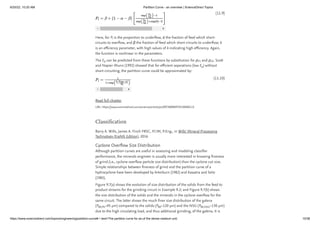
https://www.sciencedirect.com/topics/engineering/partition-curve#:~:text=The partition curve for an,of the dense medium unit. 1/38
Partition Curve
Fish hook partition curves can be modelled by summation of a
corrected partition curve (such as represented by Eqn(3)) and the
product of an inverted partition curve and a bypass fraction (Cilliers,
2000).
From: Progress in Filtration and Separation, 2015
Related terms:
Hydrocyclone, Separators, Partition Coefficient, Clean Coal, Density Fraction, Feed
Coal, Grinding Circuit, Separating Density
Dense Medium Separation (DMS)
Barry A. Wills, James A. Finch FRSC, FCIM, P.Eng., in Wills' Mineral Processing
Technology (Eighth Edition), 2016
Construction of Partition Curves
The
The partition curve
partition curve for an operating dense medium vessel can be determined by
for an operating dense medium vessel can be determined by
sampling the sink and float products and performing heavy liquid tests to
determine the amount of material in each density fraction. The range of liquid
densities applied must envelope the working density of the dense medium unit.
The results of heavy liquid tests on samples of floats and sinks from a vessel
separating coal (floats) from shale (sinks) are shown in Table 11.4. The calculations
are easily performed in a spreadsheet.
6/20/22, 10:20 AM Partition Curve - an overview | ScienceDirect Topics
https://www.sciencedirect.com/topics/engineering/partition-curve#:~:text=The partition curve for an,of the dense medium unit. 2/38
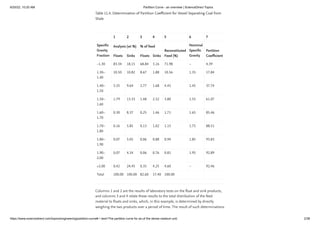
Table 11.4. Determination of Partition Coefficient for Vessel Separating Coal from
Shale
−1.30 83.34 18.15 68.84 3.16 71.98 – 4.39
1.30–
1.40
10.50 10.82 8.67 1.88 10.56 1.35 17.84
1.40–
1.50
3.35 9.64 2.77 1.68 4.45 1.45 37.74
1.50–
1.60
1.79 13.33 1.48 2.32 3.80 1.55 61.07
1.60–
1.70
0.30 8.37 0.25 1.46 1.71 1.65 85.46
1.70–
1.80
0.16 5.85 0.13 1.02 1.15 1.75 88.51
1.80–
1.90
0.07 5.05 0.06 0.88 0.94 1.85 93.83
1.90–
2.00
0.07 4.34 0.06 0.76 0.81 1.95 92.89
+2.00 0.42 24.45 0.35 4.25 4.60 – 92.46
Total 100.00 100.00 82.60 17.40 100.00
Columns 1 and 2 are the results of laboratory tests on the float and sink products,
and columns 3 and 4 relate these results to the total distribution of the feed
material to floats and sinks, which, in this example, is determined by directly
weighing the two products over a period of time. The result of such determinations
1 2 3 4 5 6 7
Specific
Gravity
Fraction
Analysis (wt %) % of feed
Reconstituted
Feed (%)
Nominal
Specific
Gravity
Partition
Coefficient
Floats Sinks Floats Sinks
6/20/22, 10:20 AM Partition Curve - an overview | ScienceDirect Topics
https://www.sciencedirect.com/topics/engineering/partition-curve#:~:text=The partition curve for an,of the dense medium unit. 3/38
showed that 82.60% of the feed reported to the floats product (and 17.40%
reported to the sinks) (see the Total row). Thus, for example, the first number in
column 3 is (83.34/100)×82.60 (=63.84) and in column 4 it is (18.15/100)×17.40
(=3.16). The weight fraction in columns 3 and 4 can be added together to produce
the reconstituted feed weight distribution in each density fraction (column 5).
Column 6 gives the nominal (average) specific gravity of each density range, for
example material in the density range 1.30–1.40 is assumed to have a specific
gravity lying midway between these densities, that is, 1.35. Since the −1.30 specific
gravity fraction and the +2.00 specific gravity fraction have no bound, no nominal
density is given.
The partition coefficient (column 7) is the percentage of feed material of a certain
nominal specific gravity which reports to sinks, that is:
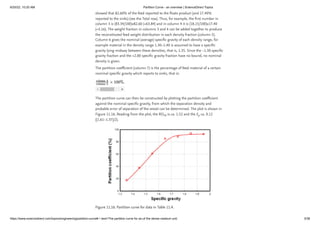
The partition curve can then be constructed by plotting the partition coefficient
against the nominal specific gravity, from which the separation density and
probable error of separation of the vessel can be determined. The plot is shown in
Figure 11.16. Reading from the plot, the RD is ca. 1.52 and the E ca. 0.12
((1.61−1.37)/2).
Figure 11.16. Partition curve for data in Table 11.4.
50 p
6/20/22, 10:20 AM Partition Curve - an overview | ScienceDirect Topics
https://www.sciencedirect.com/topics/engineering/partition-curve#:~:text=The partition curve for an,of the dense medium unit. 4/38
a.
The partition curve can also be determined by applying the mass balancing
procedure explained in Chapter 3, provided the density distributions of feed, as
well as sinks and floats, are available. Often the feed is difficult to sample, and thus
resort is made to direct measurement of sinks and floats flowrates. It must be
understood, however, that the mass balancing approach is the better way to
perform the calculations as redundant data are available to execute data
reconciliation. The mass balance/data reconciliation method is illustrated in
determination of the partition curve for a hydrocyclone in Chapter 9.
An alternative, rapid, method of determining the partition curve of a separator is to
use density tracers. Specially developed color-coded plastic tracers of known
density can be fed to the process, the partitioned products being collected and
hand sorted by density (color). It is then a simple matter to construct the partition
curve directly by noting the proportion of each density of tracer reporting to either
the sink or float product. Application of tracer methods has shown that
considerable uncertainties can exist in experimentally determined Tromp curves
unless an adequate number of tracers is used, and Napier-Munn (1985) presents
graphs that facilitate the selection of sample size and the calculation of confidence
limits. A system in operation in a US coal preparation plant uses sensitive metal
detectors that automatically spot and count the number of different types of tracers
passing through a stream (Chironis, 1987).
Partition curves can be used to predict the products that would be obtained if the
feed or separation density were changed. The curves are specific to the vessel for
which they were established and are not affected by the type of material fed to it,
provided:
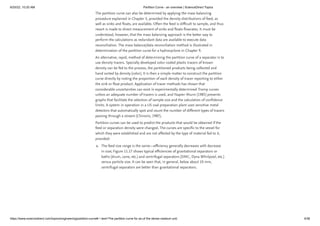
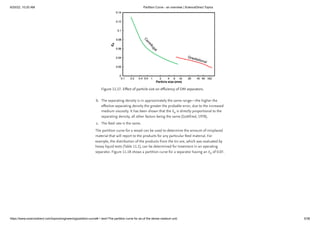
The feed size range is the same—efficiency generally decreases with decrease
in size; Figure 11.17 shows typical efficiencies of gravitational separators or
baths (drum, cone, etc.) and centrifugal separators (DMC, Dyna Whirlpool, etc.)
versus particle size. It can be seen that, in general, below about 10 mm,
centrifugal separators are better than gravitational separators.
6/20/22, 10:20 AM Partition Curve - an overview | ScienceDirect Topics
https://www.sciencedirect.com/topics/engineering/partition-curve#:~:text=The partition curve for an,of the dense medium unit. 5/38
b.
c.
Figure 11.17. Effect of particle size on efficiency of DM separators.
The separating density is in approximately the same range—the higher the
effective separating density the greater the probable error, due to the increased
medium viscosity. It has been shown that the E is directly proportional to the
separating density, all other factors being the same (Gottfried, 1978).
The feed rate is the same.
The partition curve for a vessel can be used to determine the amount of misplaced
material that will report to the products for any particular feed material. For
example, the distribution of the products from the tin ore, which was evaluated by
heavy liquid tests (Table 11.1), can be determined for treatment in an operating
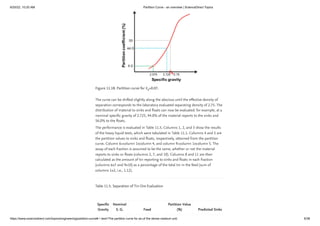
separator. Figure 11.18 shows a partition curve for a separator having an E of 0.07.
p
p
6/20/22, 10:20 AM Partition Curve - an overview | ScienceDirect Topics
https://www.sciencedirect.com/topics/engineering/partition-curve#:~:text=The partition curve for an,of the dense medium unit. 6/38
Figure 11.18. Partition curve for E =0.07.
The curve can be shifted slightly along the abscissa until the effective density of
separation corresponds to the laboratory evaluated separating density of 2.75. The
distribution of material to sinks and floats can now be evaluated: for example, at a
nominal specific gravity of 2.725, 44.0% of the material reports to the sinks and
56.0% to the floats.
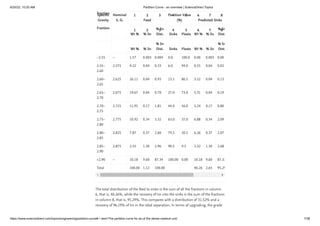
The performance is evaluated in Table 11.5. Columns 1, 2, and 3 show the results
of the heavy liquid tests, which were tabulated in Table 11.1. Columns 4 and 5 are
the partition values to sinks and floats, respectively, obtained from the partition
curve. Column 6=column 1×column 4, and column 9=column 1×column 5. The
assay of each fraction is assumed to be the same, whether or not the material
reports to sinks or floats (columns 2, 7, and 10). Columns 8 and 11 are then
calculated as the amount of tin reporting to sinks and floats in each fraction
(columns 6×7 and 9×10) as a percentage of the total tin in the feed (sum of
columns 1×2, i.e., 1.12).
Table 11.5. Separation of Tin Ore Evaluation
p
Specific
Gravity
Nominal
S. G. Feed
Partition Value
(%) Predicted Sinks
6/20/22, 10:20 AM Partition Curve - an overview | ScienceDirect Topics
https://www.sciencedirect.com/topics/engineering/partition-curve#:~:text=The partition curve for an,of the dense medium unit. 7/38
−2.55 – 1.57 0.003 0.004 0.0 100.0 0.00 0.003 0.00
2.55–
2.60
2.575 9.22 0.04 0.33 6.0 94.0 0.55 0.04 0.02
2.60–
2.65
2.625 26.11 0.04 0.93 13.5 86.5 3.52 0.04 0.13
2.65–
2.70
2.675 19.67 0.04 0.70 27.0 73.0 5.31 0.04 0.19
2.70–
2.75
2.725 11.91 0.17 1.81 44.0 56.0 5.24 0.17 0.80
2.75–
2.80
2.775 10.92 0.34 3.32 63.0 37.0 6.88 0.34 2.09
2.80–
2.85
2.825 7.87 0.37 2.60 79.5 20.5 6.26 0.37 2.07
2.85–
2.90
2.875 2.55 1.30 2.96 90.5 9.5 2.32 1.30 2.68
+2.90 – 10.18 9.60 87.34 100.00 0.00 10.18 9.60 87.31
Total 100.00 1.12 100.00 40.26 2.65 95.29
The total distribution of the feed to sinks is the sum of all the fractions in column
6, that is, 40.26%, while the recovery of tin into the sinks is the sum of the fractions
in column 8, that is, 95.29%. This compares with a distribution of 31.52% and a
recovery of 96.19% of tin in the ideal separation. In terms of upgrading, the grade
Fraction
Specific
Gravity
Fraction
Nominal
S. G. Feed
Partition Value
(%) Predicted Sinks
1
1
2
2
3
3
4
4
5
5
6
6
7
7
8
8
Wt %
Wt %
% Sn
% Sn
% Sn
Dist.
% Sn
Dist.
Sinks
Sinks
Floats
Floats
Wt %
Wt %
% Sn
% Sn
% Sn
Dist.
% Sn
Dist.
6/20/22, 10:20 AM Partition Curve - an overview | ScienceDirect Topics
https://www.sciencedirect.com/topics/engineering/partition-curve#:~:text=The partition curve for an,of the dense medium unit. 8/38
1.
2.
3.
(11.4)
4.
of tin in the sinks is now 2.65% (solving Eq. (11.1), i.e., 96.29×1.12/40.26)
compared to the ideal of 3.42% Sn.
This method of evaluating the performance of a separator on a particular feed is
tedious and is ideal for a spreadsheet, providing that the partition values for each
density fraction are known. These can be represented by a suitable mathematical
function. There is a large literature on the selection and application of such
functions. Some are arbitrary, and others have some theoretical or heuristic
justification. The key feature of the partition curve is its S-shaped character. In this
it bears a passing resemblance to a number of probability distribution functions,
and indeed the curve can be thought of as a statistical description of the DMS
process, describing the probability with which a particle of given density reports to
the sink product. Tromp himself recognized this in suggesting that the amount of
misplaced material relative to a suitably transformed density scale was normally
distributed, and Jowett (1986) showed that a partition curve for a process controlled
by simple probability factors should have a normal distribution form.
However, many real partition curves do not behave ideally like the one illustrated in
Figure 11.15. In particular, they are not asymptotic to 0 and 100%, but exhibit
evidence of short-circuit flow to one or both products (e.g., Figure 11.16). Stratford
and Napier-Munn (1986) identified four attributes required of a suitable function
to represent the partition curve:
It should have natural asymptotes, preferably described by separate parameters.
It should be capable of exhibiting asymmetry about the separating density; that
is, the differentiated form of the function should be capable of describing
skewed distributions.
It should be mathematically continuous.
Its parameters should be capable of estimation by accessible methods.
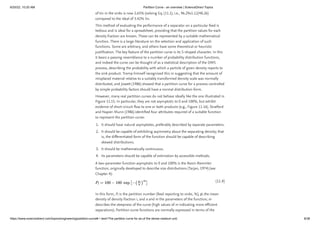
A two-parameter function asymptotic to 0 and 100% is the Rosin-Rammler
function, originally developed to describe size distributions (Tarjan, 1974) (see
Chapter 4):
In this form, P is the partition number (feed reporting to sinks, %), ρ the mean
density of density fraction i, and a and m the parameters of the function; m
describes the steepness of the curve (high values of m indicating more efficient
separations). Partition curve functions are normally expressed in terms of the
i i
6/20/22, 10:20 AM Partition Curve - an overview | ScienceDirect Topics
https://www.sciencedirect.com/topics/engineering/partition-curve#:~:text=The partition curve for an,of the dense medium unit. 9/38
(11.5)
(11.6)
(11.7)
(11.8)
normalized density, ρ/ρ , where ρ is the separating density (RD ). The
normalized curve is generally independent of cut-point and medium density, but is
dependent on particle size. Inserting this normalized density into Eq. (11.4), and
noting that P=50 for ρ=ρ (ρ/ρ =1), gives:
One of the advantages of Eq. (11.5) is that it can be linearized so that simple linear
regression can be used to estimate m and ρ from experimental data:
(This approach is less important today with any number of curve-fitting routines
available (and Excel Solver), the same point also made in Chapter 9 when curve-
fitting cyclone partition curves.)
Gottfried (1978) proposed a related function, the Weibull function, with additional
parameters to account for the fact that the curves do not always reach the 0 and
100% asymptotes due to short-circuit flow:
The six parameters of the function (c, f , ρ , x , a, and b) are not independent, so
by the argument of Eq. (11.5), x can be expressed as:
In this version of the function, representing percentage of feed to sinks, f is the
proportion of high-density material misplaced to floats, and 1−(c+f ) is the
proportion of low-density material misplaced to sinks, so that c+f ≤1. The curve
therefore varies from a minimum of 100[1−(c+f )] to a maximum of 100(1−f ).
The parameters of Eq. (11.8) have to be determined by nonlinear estimation. First
approximations of c, f , and ρ can be obtained from the curve itself.
King and Juckes (1988) used Whiten’s classification function (Lynch, 1977) with two
additional parameters to describe the short-circuit flows or by-pass:
50 50 50
50 50
50
0 50 0
0
0
0
0
0 0
0 50
6/20/22, 10:20 AM Partition Curve - an overview | ScienceDirect Topics
https://www.sciencedirect.com/topics/engineering/partition-curve#:~:text=The partition curve for an,of the dense medium unit. 10/38
(11.9)
(11.10)
Here, for P is the proportion to underflow, α the fraction of feed which short-
circuits to overflow, and β the fraction of feed which short-circuits to underflow; b
is an efficiency parameter, with high values of b indicating high efficiency. Again,
the function is nonlinear in the parameters.
The E can be predicted from these functions by substitution for ρ and ρ . Scott
and Napier-Munn (1992) showed that for efficient separations (low E ) without
short-circuiting, the partition curve could be approximated by:
Read full chapter
URL: https://www.sciencedirect.com/science/article/pii/B978008097053000011X
i
p 75 25
p
Classification
Barry A. Wills, James A. Finch FRSC, FCIM, P.Eng., in Wills' Mineral Processing
Technology (Eighth Edition), 2016
Cyclone Overflow Size Distribution
Although partition curves are useful in assessing and modeling classifier
performance, the minerals engineer is usually more interested in knowing fineness
of grind (i.e., cyclone overflow particle size distribution) than the cyclone cut-size.
Simple relationships between fineness of grind and the partition curve of a
hydrocyclone have been developed by Arterburn (1982) and Kawatra and Seitz
(1985).
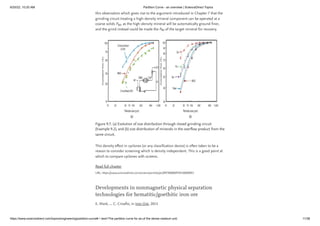
Figure 9.7(a) shows the evolution of size distribution of the solids from the feed to
product streams for the grinding circuit in Example 9.2; and Figure 9.7(b) shows
the size distribution of the solids and the minerals in the cyclone overflow for the
same circuit. The latter shows the much finer size distribution of the galena
(P ~45 μm) compared to the solids (P ~120 μm) and the NSG (P ~130 µm)
due to the high circulating load, and thus additional grinding, of the galena. It is
80,Pb 80 80,NSG
6/20/22, 10:20 AM Partition Curve - an overview | ScienceDirect Topics
https://www.sciencedirect.com/topics/engineering/partition-curve#:~:text=The partition curve for an,of the dense medium unit. 11/38
this observation which gives rise to the argument introduced in Chapter 7 that the
grinding circuit treating a high-density mineral component can be operated at a
coarse solids P , as the high-density mineral will be automatically ground finer,
and the grind instead could be made the P of the target mineral for recovery.
Figure 9.7. (a) Evolution of size distribution through closed grinding circuit
(Example 9.2), and (b) size distribution of minerals in the overflow product from the
same circuit.
This density effect in cyclones (or any classification device) is often taken to be a
reason to consider screening which is density independent. This is a good point at
which to compare cyclones with screens.
Read full chapter
URL: https://www.sciencedirect.com/science/article/pii/B9780080970530000091
80
80
Developments in nonmagnetic physical separation
technologies for hematitic/goethitic iron ore
E. Maré, ... C. Crisafio, in Iron Ore, 2015
6/20/22, 10:20 AM Partition Curve - an overview | ScienceDirect Topics
https://www.sciencedirect.com/topics/engineering/partition-curve#:~:text=The partition curve for an,of the dense medium unit. 12/38
10.2.3 DMS performance measurement
The performance of DMS unit operations is normally expressed in terms of at least
yield (sinks mass rate/feed mass rate), cut point, and efficiency.
Operational efficiency is usually best expressed in the form of a partition curve. The
partition curve exercise requires known throughput rates (t/h) and plant samples
that reliably represent the DMS unit operation in terms of its feed and its
corresponding sinks and floats. The three samples are carefully characterized in the
laboratory through a time-consuming densimetric analysis using heavy liquids of
varying densities. The data (rates and mass-by-density) allow the calculation of so-
called partition coefficients, which in iron ore operations represent the percentages
of feed material of given densities that actually report to the sinks.
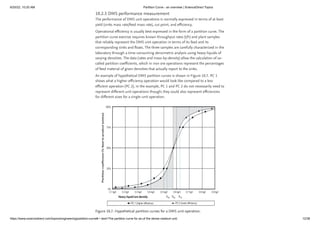
An example of hypothetical DMS partition curves is shown in Figure 10.7. PC 1
shows what a higher-efficiency operation would look like compared to a less
efficient operation (PC 2). In the example, PC 1 and PC 2 do not necessarily need to
represent different unit operations though; they could also represent efficiencies
for different sizes for a single-unit operation.
Figure 10.7. Hypothetical partition curves for a DMS unit operation.
6/20/22, 10:20 AM Partition Curve - an overview | ScienceDirect Topics
https://www.sciencedirect.com/topics/engineering/partition-curve#:~:text=The partition curve for an,of the dense medium unit. 13/38
(10.1)
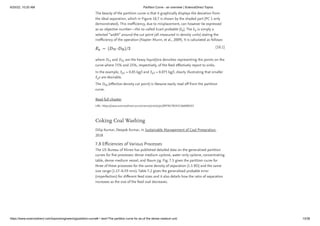
The beauty of the partition curve is that it graphically displays the deviation from
the ideal separation, which in Figure 10.7 is shown by the shaded part (PC 1 only
demonstrated). This inefficiency, due to misplacement, can however be expressed
as an objective number—the so-called Ecart probable (E ) The E is simply a
selected “width” around the cut point (all measured in density units) stating the
inefficiency of the operation (Napier-Munn, et al., 2009). It is calculated as follows:
where D and D are the heavy liquid/ore densities representing the points on the
curve where 75% and 25%, respectively, of the feed effectively report to sinks.
In the example, E  = 0.05 kg/l and E  = 0.075 kg/l, clearly illustrating that smaller
E s are desirable.
The D (effective density cut point) is likewise easily read off from the partition
curve.
Read full chapter
URL: https://www.sciencedirect.com/science/article/pii/B9781782421566000101
p . p
75 25
p1 p2
p
50
Coking Coal Washing
Dilip Kumar, Deepak Kumar, in Sustainable Management of Coal Preparation,
2018
7.8 Efficiencies of Various Processes
The US Bureau of Mines has published detailed data on the generalised partition
curves for five processes: dense medium cyclone, water-only cyclone, concentrating
table, dense medium vessel, and Baum jig. Fig. 7.5 gives the partition curve for
three of these processes for the same density of separation (1.5 RD) and the same
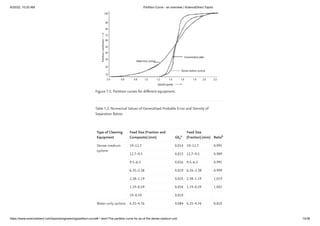
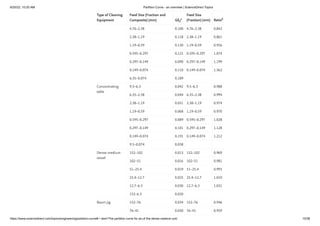
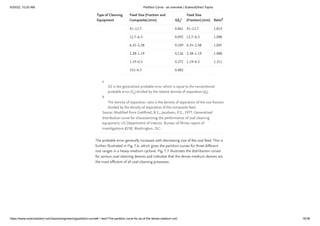
size range (1.17–0.59 mm). Table 7.2 gives the generalised probable error
(imperfection) for different feed sizes and it also details how the ratio of separation
increases as the size of the feed coal decreases.
6/20/22, 10:20 AM Partition Curve - an overview | ScienceDirect Topics
https://www.sciencedirect.com/topics/engineering/partition-curve#:~:text=The partition curve for an,of the dense medium unit. 14/38
Figure 7.5. Partition curves for different equipment.
Table 7.2. Numerical Values of Generalised Probable Error and Density of
Separation Ratios
Dense-medium
cyclone
19–12.7 0.014 19–12.7 0.995
12.7–9.5 0.015 12.7–9.5 0.989
9.5–6.3 0.016 9.5–6.3 0.991
6.35–2.38 0.019 6.35–2.38 0.999
2.38–1.19 0.025 2.38–1.19 1.019
1.19–0.59 0.034 1.19–0.59 1.042
19–0.59 0.019
Water-only cyclone 6.35–4.76 0.084 6.35–4.76 0.810
Type of Cleaning
Equipment
Feed Size (Fraction and
Composite) (mm) GEp
a
Feed Size
(Fraction) (mm) Ratiob
6/20/22, 10:20 AM Partition Curve - an overview | ScienceDirect Topics
https://www.sciencedirect.com/topics/engineering/partition-curve#:~:text=The partition curve for an,of the dense medium unit. 15/38
4.76–2.38 0.100 4.76–2.38 0.842
2.38–1.19 0.118 2.38–1.19 0.861
1.19–0.59 0.130 1.19–0.59 0.956
0.595–0.297 0.121 0.595–0.297 1.074
0.297–0.149 0.090 0.297–0.149 1.199
0.149–0.074 0.110 0.149–0.074 1.362
6.35–0.074 0.189
Concentrating
table
9.5–6.3 0.042 9.5–6.3 0.988
6.35–2.38 0.044 6.35–2.38 0.994
2.38–1.19 0.051 2.38–1.19 0.974
1.19–0.59 0.068 1.19–0.59 0.970
0.595–0.297 0.089 0.595–0.297 1.028
0.297–0.149 0.101 0.297–0.149 1.128
0.149–0.074 0.191 0.149–0.074 1.212
9.5–0.074 0.058
Dense-medium
vessel
152–102 0.013 152–102 0.969
102–51 0.016 102–51 0.981
51–25.4 0.019 51–25.4 0.993
25.4–12.7 0.025 25.4–12.7 1.010
12.7–6.3 0.030 12.7–6.3 1.031
152–6.3 0.020
Baum jig 152–76 0.034 152–76 0.946
76–41 0.030 76–41 0.959
Type of Cleaning
Equipment
Feed Size (Fraction and
Composite) (mm) GEp
a
Feed Size
(Fraction) (mm) Ratiob
6/20/22, 10:20 AM Partition Curve - an overview | ScienceDirect Topics
https://www.sciencedirect.com/topics/engineering/partition-curve#:~:text=The partition curve for an,of the dense medium unit. 16/38
41–12.7 0.061 41–12.7 1.014
12.7–6.3 0.092 12.7–6.3 1.088
6.35–2.38 0.109 6.35–2.38 1.047
2.38–1.19 0.126 2.38–1.19 1.088
1.19–0.3 0.272 1.19–0.3 1.311
152–0.3 0.082
a
GE is the generalised probable error which is equal to the conventional
probable error (E ) divided by the relative density of separation (d ).
b
The density of separation ratio is the density of separation of the size fraction
divided by the density of separation of the composite feed.
Source: Modified from Gottfried, B.S., Jacobsen, P.S., 1977. Generalised
distribution curve for characterising the performance of coal cleaning
equipment, US Department of Interior, Bureau of Mines report of
investigations 8238, Washington, DC.
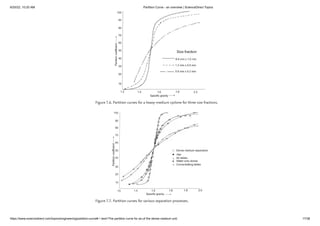
The probable error generally increases with decreasing size of the coal feed. This is
further illustrated in Fig. 7.6, which gives the partition curves for three different
size ranges in a heavy-medium cyclone. Fig. 7.7 illustrates the distribution curves
for various coal-cleaning devices and indicates that the dense-medium devices are
the most efficient of all coal-cleaning processes.
Type of Cleaning
Equipment
Feed Size (Fraction and
Composite) (mm) GEp
a
Feed Size
(Fraction) (mm) Ratiob
p p
6/20/22, 10:20 AM Partition Curve - an overview | ScienceDirect Topics
https://www.sciencedirect.com/topics/engineering/partition-curve#:~:text=The partition curve for an,of the dense medium unit. 17/38
Figure 7.6. Partition curves for a heavy-medium cyclone for three size fractions.
Figure 7.7. Partition curves for various separation processes.
6/20/22, 10:20 AM Partition Curve - an overview | ScienceDirect Topics
https://www.sciencedirect.com/topics/engineering/partition-curve#:~:text=The partition curve for an,of the dense medium unit. 18/38
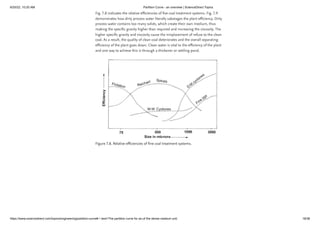
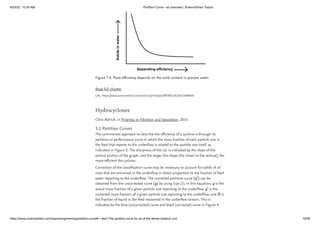
Fig. 7.8 indicates the relative efficiencies of five coal treatment systems. Fig. 7.9
demonstrates how dirty process water literally sabotages the plant efficiency. Dirty
process water contains too many solids, which create their own medium, thus
making the specific gravity higher than required and increasing the viscosity. The
higher specific gravity and viscosity cause the misplacement of refuse to the clean
coal. As a result, the quality of clean coal deteriorates and the overall separating
efficiency of the plant goes down. Clean water is vital to the efficiency of the plant
and one way to achieve this is through a thickener or settling pond.
Figure 7.8. Relative efficiencies of fine coal treatment systems.
6/20/22, 10:20 AM Partition Curve - an overview | ScienceDirect Topics
https://www.sciencedirect.com/topics/engineering/partition-curve#:~:text=The partition curve for an,of the dense medium unit. 19/38
Figure 7.9. Plant efficiency depends on the solid content in process water.
Read full chapter
URL: https://www.sciencedirect.com/science/article/pii/B9780128126325000070
Hydrocyclones
Chris Aldrich, in Progress in Filtration and Separation, 2015
3.1 Partition Curves
The commonest approach to describe the efficiency of a cyclone is through its
partition or performance curve in which the mass fraction of each particle size in
the feed that reports to the underflow is related to the particle size itself, as
indicated in Figure 3. The sharpness of the cut is indicated by the slope of the
central portion of the graph, and the larger this slope (the closer to the vertical), the
more efficient the cyclone.
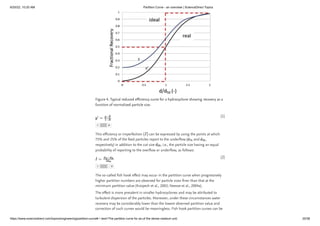
Correction of the classification curve may be necessary to account for solids of all
sizes that are entrained in the underflow in direct proportion to the fraction of feed
water reporting to the underflow. The corrected partition curve can be
obtained from the uncorrected curve by using Eqn (1). In this equation, is the
actual mass fraction of a given particle size reporting to the underflow, is the
corrected mass fraction of a given particle size reporting to the underflow, and is
the fraction of liquid in the feed recovered in the underflow stream. This is
indicated by the blue (uncorrected) curve and black (corrected) curve in Figure 4.
6/20/22, 10:20 AM Partition Curve - an overview | ScienceDirect Topics
https://www.sciencedirect.com/topics/engineering/partition-curve#:~:text=The partition curve for an,of the dense medium unit. 20/38
(1)
(2)
Figure 4. Typical reduced efficiency curve for a hydrocyclone showing recovery as a
function of normalized particle size.
This efficiency or imperfection can be expressed by using the points at which
75% and 25% of the feed particles report to the underflow ( and ,
respectively) in addition to the cut size , i.e., the particle size having an equal
probability of reporting to the overflow or underflow, as follows:
The so-called fish hook effect may occur in the partition curve when progressively
higher partition numbers are observed for particle sizes finer than that at the
minimum partition value (Kraipech et al., 2002; Neesse et al., 2004a).
The effect is more prevalent in smaller hydrocyclones and may be attributed to
turbulent dispersion of the particles. Moreover, under these circumstances water
recovery may be considerably lower than the lowest observed partition value and
correction of such curves would be meaningless. Fish hook partition curves can be
6/20/22, 10:20 AM Partition Curve - an overview | ScienceDirect Topics
https://www.sciencedirect.com/topics/engineering/partition-curve#:~:text=The partition curve for an,of the dense medium unit. 21/38
(3)
modelled by summation of a corrected partition curve (such as represented by
Eqn(3)) and the product of an inverted partition curve and a bypass fraction
(Cilliers, 2000).
Read full chapter
URL: https://www.sciencedirect.com/science/article/pii/B978012384746100001X
Gravity Separation
In Mineral Processing Design and Operations (Second Edition), 2016
16.8.4 Sink-Float Alternatives
Because of the importance of washability and sink-float analysis to the coal industry
and the health hazards associated with the presence of organic liquids,
considerable effort is being aimed at alternatives to the organic liquid method. To
determine the partition curve of a gravity separation unit, density tracers may be
used. These are plastic particles manufactured to precise density such as 0.005 SG
units [25]. These tracers are available in cubic shape from 1 to 64 mm or as crushed
particles to simulate real ore with sizes from 0.125 to 32 mm or more. Density
ranges are from 1.24 to 4.5 S.G. and can be colour coded or made magnetic or
fluorescent for ease of recovery. A range of tracers of different density and size are
added to the unit feed and retrieved from the floats and sinks fractions. The ratio of
numbers in the floats and feed will give the partition coefficient.
For an alternative to the sink-float analysis, the Julius Kruttschnitt Mineral Research
Centre (JKMRC) have developed an automatic gas pycnometer in which the dry
density of individual particles is determined by separate mass and volume
measurements [26]. The instrument is capable of analyzing 30 particles a minute. A
sink-float data analysis requiring about 3000 particles can be obtained in 100 min.
Read full chapter
URL: https://www.sciencedirect.com/science/article/pii/B9780444635891000162
6/20/22, 10:20 AM Partition Curve - an overview | ScienceDirect Topics
https://www.sciencedirect.com/topics/engineering/partition-curve#:~:text=The partition curve for an,of the dense medium unit. 22/38
MODULAR COAL PREPARATION PLANT
PHILOSOPHY TO SATISFY STRINGENT MARKET
REQUIREMENTS
C Tyler, in 1991 International Conference on Coal Science Proceedings, 1991
3 Performance Testing
Washability data can be used directly to provide an indication of the yield and
quality of a product from a Coal Preparation Plant assuming a perfect separation.
This assumption makes no allowance for the varying efficiencies of different
separation processes resulting in products containing misplaced material.
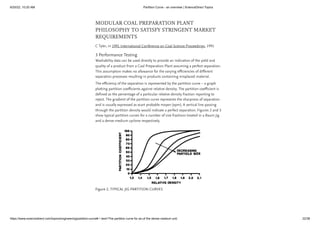
The efficiency of the separation is represented by the partition curve – a graph
plotting partition coefficients against relative density. The partition coefficient is
defined as the percentage of a particular relative density fraction reporting to
reject. The gradient of the partition curve represents the sharpness of separation
and is usually expressed as ecart probable moyen (epm). A vertical line passing
through the partition density would indicate a perfect separation. Figures 2 and 3
show typical partition curves for a number of size fractions treated in a Baum jig
and a dense medium cyclone respectively.
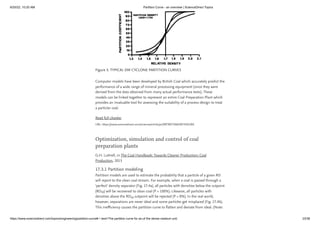
Figure 2. TYPICAL JIG PARTITION CURVES
6/20/22, 10:20 AM Partition Curve - an overview | ScienceDirect Topics
https://www.sciencedirect.com/topics/engineering/partition-curve#:~:text=The partition curve for an,of the dense medium unit. 23/38
Figure 3. TYPICAL DM CYCLONE PARTITION CURVES
Computer models have been developed by British Coal which accurately predict the
performance of a wide range of mineral processing equipment (since they were
derived from the data obtained from many actual performance tests). These
models can be linked together to represent an entire Coal Preparation Plant which
provides an invaluable tool for assessing the suitability of a process design to treat
a particlar coal.
Read full chapter
URL: https://www.sciencedirect.com/science/article/pii/B978075060387450228X
Optimization, simulation and control of coal
preparation plants
G.H. Luttrell, in The Coal Handbook: Towards Cleaner Production: Coal
Production, 2013
17.3.1 Partition modeling
Partition models are used to estimate the probability that a particle of a given RD
will report to the clean coal stream. For example, when a coal is passed through a
‘perfect’ density separator (Fig. 17.4a), all particles with densities below the cutpoint
(RD ) will be recovered to clean coal (P = 100%). Likewise, all particles with
densities above the RD cutpoint will be rejected (P = 0%). In the real world,
however, separations are never ideal and some particles get misplaced (Fig. 17.4b).
This inefficiency causes the partition curve to flatten and deviate from ideal. (Note:
50
50
6/20/22, 10:20 AM Partition Curve - an overview | ScienceDirect Topics
https://www.sciencedirect.com/topics/engineering/partition-curve#:~:text=The partition curve for an,of the dense medium unit. 24/38
[17.2]
In some countries, partition curves are plotted as RD vs the probability of reporting
to refuse. This convention provides a mirror image of the partition curve based on
clean coal partitioning.) The steepness of the partition curve, which reflects the
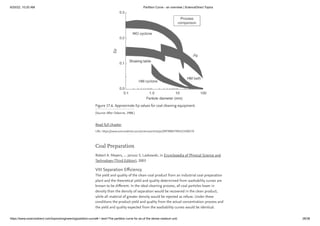
sharpness of the separation, is typically reported using an Ecart Probable (Ep) value
defined as:
Figure 17.4. Partition curves for (a) perfect and (b) imperfect separations.
in which RD and RD are the relative densities that correspond to probabilities
of 25% and 75%. A lower Ep is desirable, since it means that fewer particles are
misplaced during the separation.
25 75
6/20/22, 10:20 AM Partition Curve - an overview | ScienceDirect Topics
https://www.sciencedirect.com/topics/engineering/partition-curve#:~:text=The partition curve for an,of the dense medium unit. 25/38
[17.3]
[17.4]
Several detailed methods have been reported in the literature for establishing
partition curves (Luckie et al., 1969). However, the fastest and simplest method
involves the collection of representative samples of the feed, clean and refuse
streams around the cleaning unit. Once collected, the samples are dried and
representative splits subjected to ash analysis. From the ash values, the ratio (Z) of
reject tonnage to clean tonnage can be calculated using:
in which f, c, and r are the feed, clean, and refuse ash contents, respectively. For
example, the Z ratio for a dense medium separator coal treating a 25% feed ash
and generating a 10% clean ash and 70% reject ash would be:
This calculation indicates that 0.333 tons of reject would be generated for each ton
of clean coal. Representative splits of clean coal and refuse are then subjected to
float–sink (washability) testing. The float–sink tests provide the mass percent of dry
solids present in each density fraction. The first three columns of data in Table 17.3
(Columns 1–3) provide an example of the types of data obtained from such an
exercise. From these data, the partition factor (P) for each density class can be
quickly calculated using:
Table 17.3. Example of calculations for partition curve construction
Average RD Clean mass (%) Refuse mass (%) Partition factor
1.40 78.3 0.6 1.00
1.55 19.3 1.7 0.97
1.65 2.0 4.4 0.58
1.75 0.3 15.3 0.06
1 2 3 4
6/20/22, 10:20 AM Partition Curve - an overview | ScienceDirect Topics
https://www.sciencedirect.com/topics/engineering/partition-curve#:~:text=The partition curve for an,of the dense medium unit. 26/38
[17.5]
1.90 0.1 78.0 0.00
Totals 100.0 100.0 –
Column 4 = 1/(1 + Z (Column 3/Column 2)
Z = (Feed Ash – Clean Ash)/(Refuse Ash – Feed Ash).
in which R and C are the respective weight percentages of reject and clean coal in
each density class. In this case, the partition factor (P) represents the probability
that material of a given density in the feed will report to clean coal. These values,
which are listed in Column 4 for the example shown, were calculated as follows:
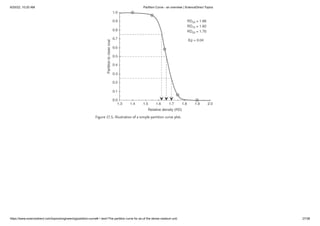
As shown in Fig. 17.5, the partition curve for the separator can be constructed by
plotting the partition factors (Column 4) as a function of the average RD of each
class (Column 1). For the example shown, the cutpoint (RD ) is 1.66 RD, which
corresponds to particles having an equal chance of reporting to either the clean or
reject streams. The Ep value is 0.04 (i.e., (1.70 – 1.62)/2 = 0.04), which can be
compared with tabular values, such as those shown in Fig. 17.6, to determine
whether the level of performance is acceptable for the equipment and size fraction
being evaluated.
1 2 3 4
50
6/20/22, 10:20 AM Partition Curve - an overview | ScienceDirect Topics
https://www.sciencedirect.com/topics/engineering/partition-curve#:~:text=The partition curve for an,of the dense medium unit. 27/38
Figure 17.5. Illustration of a simple partition curve plot.
6/20/22, 10:20 AM Partition Curve - an overview | ScienceDirect Topics
https://www.sciencedirect.com/topics/engineering/partition-curve#:~:text=The partition curve for an,of the dense medium unit. 28/38
Figure 17.6. Approximate Ep values for coal cleaning equipment.
(Source: After Osborne, 1988.)
Read full chapter
URL: https://www.sciencedirect.com/science/article/pii/B9780857094223500170
Coal Preparation
Robert A. Meyers, ... Janusz S. Laskowski, in Encyclopedia of Physical Science and
Technology (Third Edition), 2003
VIII Separation Efficiency
The yield and quality of the clean-coal product from an industrial coal preparation
plant and the theoretical yield and quality determined from washability curves are
known to be different. In the ideal cleaning process, all coal particles lower in
density than the density of separation would be recovered in the clean product,
while all material of greater density would be rejected as refuse. Under these
conditions the product yield and quality from the actual concentration process and
the yield and quality expected from the washability curves would be identical.
6/20/22, 10:20 AM Partition Curve - an overview | ScienceDirect Topics
https://www.sciencedirect.com/topics/engineering/partition-curve#:~:text=The partition curve for an,of the dense medium unit. 29/38
The performance of separators is, however, never ideal. As a result, some coal
particles of lower than the separation density report to rejects, and some high-ash
particles of higher than the separation density report to clean coal. These are
referred to as misplaced material.
Coal particles of density well below the density of separation and mineral particles
of density well above the density of separation report to their proper products:
clean coal and refuse. But as the density of separation is approached, the
proportion of the misplaced material reporting to an improper product increases
rapidly.
Tromp, in a study of jig washing, observed that the displacement of migrating
particles was a normal or near-normal frequency (gaussian curve), and from this
observation the partition curve (distribution, Tromp curve) in the form of an ogive
was evolved.
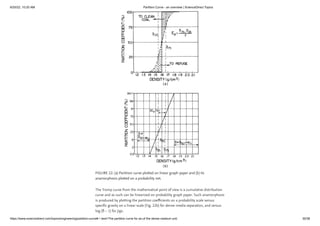
The partition curve, the solid line in Fig. 22a, illustrates the ideal separation case
(E  = 0), and the broken-line curve represents the performance of a true separating
device. The shaded areas represent the misplaced material. The curves are plotted
according to European convention and represent the percent of feed reporting to
reject. In American practice, Tromp curves usually give the percent of feed
reporting to washed coal.
p
6/20/22, 10:20 AM Partition Curve - an overview | ScienceDirect Topics
https://www.sciencedirect.com/topics/engineering/partition-curve#:~:text=The partition curve for an,of the dense medium unit. 30/38
FIGURE 22. (a) Partition curve plotted on linear graph paper and (b) its
anamorphosis plotted on a probability net.
The Tromp curve from the mathematical point of view is a cumulative distribution
curve and as such can be linearized on probability graph paper. Such anamorphosis
is produced by plotting the partition coefficients on a probability scale versus
specific gravity on a linear scale (Fig. 22b) for dense-media separation, and versus
log (δ − 1) for jigs.
6/20/22, 10:20 AM Partition Curve - an overview | ScienceDirect Topics
https://www.sciencedirect.com/topics/engineering/partition-curve#:~:text=The partition curve for an,of the dense medium unit. 31/38
To determine the partition curve for a cleaning operation, one needs the yield of
clean coal from this operation and the results of float–sink tests for both products
—that is, for the clean coal and the refuse. Such data allow the reconstituted feed
to be calculated, and from this can be found the partition coefficients, which give
the percentage of each density fraction reporting to reject. As seen in Fig. 22b, the
particles with densities below δ  − 4E and the particles of density above δ  + 4E
report entirely to their proper products. The density fractions within δ  ± 4E are
misplaced. Material of density very close to δ (near-density material) is misplaced
the most. As postulated by Tromp, 37.5% of fractions within δ  – δ and δ  – δ
are misplaced (this corresponds to δ  ± E ), and this percentage falls off drastically
with the distance of the actual density fraction from the δ density.
Figure 23 shows partition curves for the major U.S. coal-cleaning devices. As seen,
the sharpness of separation in dense-media separators is much better than in jigs
or water-only hydrocyclones. Figure 24 shows E values plotted versus the size of
treated particles for various cleaning devices. E values for the dense-medium bath
and dense-medium cyclone are in the range of 0.02–0.04 for particles larger than
5 mm; E values of jigs and concentrating tables are in the range of 0.08–0.15; and
for water-only cyclones, E values exceed 0.2. As seen, in all cases the efficiency of
separation as given by E values decreases sharply for finer particles.
50 p 50 p
50 p
50
50 25 75 50
50 p
50
p
p
p
p
p
6/20/22, 10:20 AM Partition Curve - an overview | ScienceDirect Topics
https://www.sciencedirect.com/topics/engineering/partition-curve#:~:text=The partition curve for an,of the dense medium unit. 32/38
FIGURE 23. Performance of gravity separators. ▴, hydrocyclones, in. ×200 mesh;
▿, air tables, 2 in.×200 mesh; •, jigs: Baum, 6 in.× in.; Batac in.×28 mesh; □,
concentrating tables, in.×200 mesh; ○, dense-medium separators: cyclone,
in.×28 mesh; vessel, 6 in.× in. [From Killmeyer, R. P. “Performance characteristics
of coal-washing equipment: Baum and Batac jigs,” U.S. Department of Energy, RI-
PMTC-9(80).]
6/20/22, 10:20 AM Partition Curve - an overview | ScienceDirect Topics
https://www.sciencedirect.com/topics/engineering/partition-curve#:~:text=The partition curve for an,of the dense medium unit. 33/38
(6)
FIGURE 24. Probable error E vs mean size of the treated coal for dense-media
baths (DMB), dense-media cyclones (DMC), jigs, concentrating tables, and water-
only cyclones (WOC). [After Mikhail, M. W., Picard, J. L., and Humeniuk, O. E.
(1982). “Performance evaluation of gravity separators in Canadian washeries.”
Paper presented at 2nd Technical Conference on Western Canadian Coals, Edmonton,
June 3–5.].
Another index developed to characterize the sharpness of separation is the
imperfection I.
for dense-medium separation, and
p
6/20/22, 10:20 AM Partition Curve - an overview | ScienceDirect Topics
https://www.sciencedirect.com/topics/engineering/partition-curve#:~:text=The partition curve for an,of the dense medium unit. 34/38
(7)
for jigs.
According to some authors, I values vary from 0.07 for dense-medium cyclones
and 0.175 for jigs to above 0.2 for flotation machines.
Conventional float and sink methods for the derivation of the partition curve are
expensive and time-consuming. In the diamond and iron ore industries, the
density tracer technique has been developed to evaluate the separation efficiency.
This technique has also been adopted for studies of coal separation.
The tracers, usually plastic cubes prepared to known specific gravities rendered
identifiable through color coding, are introduced into a separating device, and on
recovery from the product and reject streams, are sorted into the appropriate
specific gravity fractions and counted. This allows the points for the partition curve
to be calculated. The technique, as described above, was adopted at the Julius
Kruttschnitt Mineral Research Centre, Brisbane, while tracers made from plastic–
metal composites that can be detected with metal detectors mounted over
conveyer belts, known as the Sentrex system, were developed in the United States.
Read full chapter
URL: https://www.sciencedirect.com/science/article/pii/B012227410500867X
Gravity Concentration
Barry A. Wills, James A. Finch FRSC, FCIM, P.Eng., in Wills' Mineral Processing
Technology (Eighth Edition), 2016
Single Versus Two Stages of Spirals
As noted, one of the innovations in coal processing is to incorporate circuits. By
making some simplifying assumptions, it is possible to deduce an analytical
solution for a circuit, as Luttrell (2002) demonstrates based on the work of Meloy
(1983). (The same approach is used quite extensively in Chapter 12, Section 12.11.)
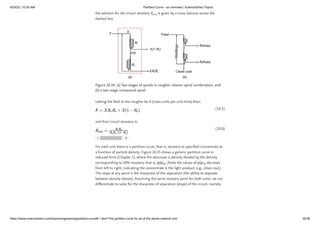
Figure 10.34(a) shows two stages of spiral in a possible coal application: the
rougher gives a final discard heavy product (refuse) and light product that is sent to
a cleaner stage which gives the final light product (i.e., clean coal) with the heavy
product (middlings) being recycled to the rougher. For this rougher-cleaner circuit
6/20/22, 10:20 AM Partition Curve - an overview | ScienceDirect Topics
https://www.sciencedirect.com/topics/engineering/partition-curve#:~:text=The partition curve for an,of the dense medium unit. 35/38
(10.5)
(10.6)
the solution for the circuit recovery R is given by a mass balance across the
dashed box.
Figure 10.34. (a) Two stages of spirals in rougher-cleaner spiral combination, and
(b) a two-stage compound spiral.
Letting the feed to the rougher be X (mass units per unit time) then:
and thus circuit recovery is:
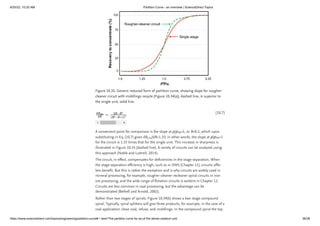
For each unit there is a partition curve, that is, recovery to specified concentrate as
a function of particle density. Figure 10.35 shows a generic partition curve in
reduced form (Chapter 1), where the abscissae is density divided by the density
corresponding to 50% recovery, that is, ρ/ρ . (Note the values of ρ/ρ decrease
from left to right, indicating the concentrate is the light product, e.g., clean coal.)
The slope at any point is the sharpness of the separation (the ability to separate
between density classes). Assuming the same recovery point for both units, we can
differentiate to solve for the sharpness of separation (slope) of the circuit, namely:
circ
50 50
6/20/22, 10:20 AM Partition Curve - an overview | ScienceDirect Topics
https://www.sciencedirect.com/topics/engineering/partition-curve#:~:text=The partition curve for an,of the dense medium unit. 36/38
(10.7)
Figure 10.35. Generic reduced form of partition curve, showing slope for rougher-
cleaner circuit with middlings recycle (Figure 10.34(a)), dashed line, is superior to
the single unit, solid line.
A convenient point for comparison is the slope at ρ/ρ =1, or R=0.5, which upon
substituting in Eq. (10.7) gives dR /dR=1.33; in other words, the slope at ρ/ρ =1
for the circuit is 1.33 times that for the single unit. This increase in sharpness is
illustrated in Figure 10.35 (dashed line). A variety of circuits can be analyzed using
this approach (Noble and Luttrell, 2014).
The circuit, in effect, compensates for deficiencies in the stage separation. When
the stage separation efficiency is high, such as in DMS (Chapter 11), circuits offer
less benefit. But this is rather the exception and is why circuits are widely used in
mineral processing, for example, rougher-cleaner-recleaner spiral circuits in iron
ore processing, and the wide range of flotation circuits is evident in Chapter 12.
Circuits are less common in coal processing, but the advantage can be
demonstrated (Bethell and Arnold, 2002).
Rather than two stages of spirals, Figure 10.34(b) shows a two-stage compound
spiral. Typically, spiral splitters will give three products, for example, in the case of a
coal application: clean coal, refuse, and middlings. In the compound spiral the top
50
circ 50
6/20/22, 10:20 AM Partition Curve - an overview | ScienceDirect Topics
https://www.sciencedirect.com/topics/engineering/partition-curve#:~:text=The partition curve for an,of the dense medium unit. 37/38
Recommended publications
Fuel Processing Technology
Journal
Fuel
Journal
Journal of Petroleum Science and Engineering
Journal
Sustainable Management of Coal Preparation
three-turn spiral (in this example) produces final refuse, and the clean coal and
middlings are combined and sent to the lower four-turn spiral, which produces
another final refuse, final clean coal, and a middlings, which is recycled. Bethell
and Arnold (2002) report that compared to two stages of spirals, the compound
spiral had reduced floor space requirements with reduced capital and operating
costs and was selected for a plant expansion.
Read full chapter
URL: https://www.sciencedirect.com/science/article/pii/B9780080970530000108
6/20/22, 10:20 AM Partition Curve - an overview | ScienceDirect Topics
https://www.sciencedirect.com/topics/engineering/partition-curve#:~:text=The partition curve for an,of the dense medium unit. 38/38
Book • 2018
Copyright © 2022 Elsevier B.V. or its licensors or contributors.
ScienceDirect ® is a registered trademark of Elsevier B.V.

Partition Curve - an overview _ ScienceDirect Topics (1).pdf

  • 1.
    6/20/22, 10:20 AMPartition Curve - an overview | ScienceDirect Topics https://www.sciencedirect.com/topics/engineering/partition-curve#:~:text=The partition curve for an,of the dense medium unit. 1/38 Partition Curve Fish hook partition curves can be modelled by summation of a corrected partition curve (such as represented by Eqn(3)) and the product of an inverted partition curve and a bypass fraction (Cilliers, 2000). From: Progress in Filtration and Separation, 2015 Related terms: Hydrocyclone, Separators, Partition Coefficient, Clean Coal, Density Fraction, Feed Coal, Grinding Circuit, Separating Density Dense Medium Separation (DMS) Barry A. Wills, James A. Finch FRSC, FCIM, P.Eng., in Wills' Mineral Processing Technology (Eighth Edition), 2016 Construction of Partition Curves The The partition curve partition curve for an operating dense medium vessel can be determined by for an operating dense medium vessel can be determined by sampling the sink and float products and performing heavy liquid tests to sampling the sink and float products and performing heavy liquid tests to determine the amount of material in each density fraction. The range of liquid determine the amount of material in each density fraction. The range of liquid densities applied must envelope the working density of the dense medium unit. densities applied must envelope the working density of the dense medium unit. The results of heavy liquid tests on samples of floats and sinks from a vessel separating coal (floats) from shale (sinks) are shown in Table 11.4. The calculations are easily performed in a spreadsheet.
  • 2.
    6/20/22, 10:20 AMPartition Curve - an overview | ScienceDirect Topics https://www.sciencedirect.com/topics/engineering/partition-curve#:~:text=The partition curve for an,of the dense medium unit. 2/38 Table 11.4. Determination of Partition Coefficient for Vessel Separating Coal from Shale −1.30 83.34 18.15 68.84 3.16 71.98 – 4.39 1.30– 1.40 10.50 10.82 8.67 1.88 10.56 1.35 17.84 1.40– 1.50 3.35 9.64 2.77 1.68 4.45 1.45 37.74 1.50– 1.60 1.79 13.33 1.48 2.32 3.80 1.55 61.07 1.60– 1.70 0.30 8.37 0.25 1.46 1.71 1.65 85.46 1.70– 1.80 0.16 5.85 0.13 1.02 1.15 1.75 88.51 1.80– 1.90 0.07 5.05 0.06 0.88 0.94 1.85 93.83 1.90– 2.00 0.07 4.34 0.06 0.76 0.81 1.95 92.89 +2.00 0.42 24.45 0.35 4.25 4.60 – 92.46 Total 100.00 100.00 82.60 17.40 100.00 Columns 1 and 2 are the results of laboratory tests on the float and sink products, and columns 3 and 4 relate these results to the total distribution of the feed material to floats and sinks, which, in this example, is determined by directly weighing the two products over a period of time. The result of such determinations 1 2 3 4 5 6 7 Specific Gravity Fraction Analysis (wt %) % of feed Reconstituted Feed (%) Nominal Specific Gravity Partition Coefficient Floats Sinks Floats Sinks
  • 3.
    6/20/22, 10:20 AMPartition Curve - an overview | ScienceDirect Topics https://www.sciencedirect.com/topics/engineering/partition-curve#:~:text=The partition curve for an,of the dense medium unit. 3/38 showed that 82.60% of the feed reported to the floats product (and 17.40% reported to the sinks) (see the Total row). Thus, for example, the first number in column 3 is (83.34/100)×82.60 (=63.84) and in column 4 it is (18.15/100)×17.40 (=3.16). The weight fraction in columns 3 and 4 can be added together to produce the reconstituted feed weight distribution in each density fraction (column 5). Column 6 gives the nominal (average) specific gravity of each density range, for example material in the density range 1.30–1.40 is assumed to have a specific gravity lying midway between these densities, that is, 1.35. Since the −1.30 specific gravity fraction and the +2.00 specific gravity fraction have no bound, no nominal density is given. The partition coefficient (column 7) is the percentage of feed material of a certain nominal specific gravity which reports to sinks, that is: The partition curve can then be constructed by plotting the partition coefficient against the nominal specific gravity, from which the separation density and probable error of separation of the vessel can be determined. The plot is shown in Figure 11.16. Reading from the plot, the RD is ca. 1.52 and the E ca. 0.12 ((1.61−1.37)/2). Figure 11.16. Partition curve for data in Table 11.4. 50 p
  • 4.
    6/20/22, 10:20 AMPartition Curve - an overview | ScienceDirect Topics https://www.sciencedirect.com/topics/engineering/partition-curve#:~:text=The partition curve for an,of the dense medium unit. 4/38 a. The partition curve can also be determined by applying the mass balancing procedure explained in Chapter 3, provided the density distributions of feed, as well as sinks and floats, are available. Often the feed is difficult to sample, and thus resort is made to direct measurement of sinks and floats flowrates. It must be understood, however, that the mass balancing approach is the better way to perform the calculations as redundant data are available to execute data reconciliation. The mass balance/data reconciliation method is illustrated in determination of the partition curve for a hydrocyclone in Chapter 9. An alternative, rapid, method of determining the partition curve of a separator is to use density tracers. Specially developed color-coded plastic tracers of known density can be fed to the process, the partitioned products being collected and hand sorted by density (color). It is then a simple matter to construct the partition curve directly by noting the proportion of each density of tracer reporting to either the sink or float product. Application of tracer methods has shown that considerable uncertainties can exist in experimentally determined Tromp curves unless an adequate number of tracers is used, and Napier-Munn (1985) presents graphs that facilitate the selection of sample size and the calculation of confidence limits. A system in operation in a US coal preparation plant uses sensitive metal detectors that automatically spot and count the number of different types of tracers passing through a stream (Chironis, 1987). Partition curves can be used to predict the products that would be obtained if the feed or separation density were changed. The curves are specific to the vessel for which they were established and are not affected by the type of material fed to it, provided: The feed size range is the same—efficiency generally decreases with decrease in size; Figure 11.17 shows typical efficiencies of gravitational separators or baths (drum, cone, etc.) and centrifugal separators (DMC, Dyna Whirlpool, etc.) versus particle size. It can be seen that, in general, below about 10 mm, centrifugal separators are better than gravitational separators.
  • 5.
    6/20/22, 10:20 AMPartition Curve - an overview | ScienceDirect Topics https://www.sciencedirect.com/topics/engineering/partition-curve#:~:text=The partition curve for an,of the dense medium unit. 5/38 b. c. Figure 11.17. Effect of particle size on efficiency of DM separators. The separating density is in approximately the same range—the higher the effective separating density the greater the probable error, due to the increased medium viscosity. It has been shown that the E is directly proportional to the separating density, all other factors being the same (Gottfried, 1978). The feed rate is the same. The partition curve for a vessel can be used to determine the amount of misplaced material that will report to the products for any particular feed material. For example, the distribution of the products from the tin ore, which was evaluated by heavy liquid tests (Table 11.1), can be determined for treatment in an operating separator. Figure 11.18 shows a partition curve for a separator having an E of 0.07. p p
  • 6.
    6/20/22, 10:20 AMPartition Curve - an overview | ScienceDirect Topics https://www.sciencedirect.com/topics/engineering/partition-curve#:~:text=The partition curve for an,of the dense medium unit. 6/38 Figure 11.18. Partition curve for E =0.07. The curve can be shifted slightly along the abscissa until the effective density of separation corresponds to the laboratory evaluated separating density of 2.75. The distribution of material to sinks and floats can now be evaluated: for example, at a nominal specific gravity of 2.725, 44.0% of the material reports to the sinks and 56.0% to the floats. The performance is evaluated in Table 11.5. Columns 1, 2, and 3 show the results of the heavy liquid tests, which were tabulated in Table 11.1. Columns 4 and 5 are the partition values to sinks and floats, respectively, obtained from the partition curve. Column 6=column 1×column 4, and column 9=column 1×column 5. The assay of each fraction is assumed to be the same, whether or not the material reports to sinks or floats (columns 2, 7, and 10). Columns 8 and 11 are then calculated as the amount of tin reporting to sinks and floats in each fraction (columns 6×7 and 9×10) as a percentage of the total tin in the feed (sum of columns 1×2, i.e., 1.12). Table 11.5. Separation of Tin Ore Evaluation p Specific Gravity Nominal S. G. Feed Partition Value (%) Predicted Sinks
  • 7.
    6/20/22, 10:20 AMPartition Curve - an overview | ScienceDirect Topics https://www.sciencedirect.com/topics/engineering/partition-curve#:~:text=The partition curve for an,of the dense medium unit. 7/38 −2.55 – 1.57 0.003 0.004 0.0 100.0 0.00 0.003 0.00 2.55– 2.60 2.575 9.22 0.04 0.33 6.0 94.0 0.55 0.04 0.02 2.60– 2.65 2.625 26.11 0.04 0.93 13.5 86.5 3.52 0.04 0.13 2.65– 2.70 2.675 19.67 0.04 0.70 27.0 73.0 5.31 0.04 0.19 2.70– 2.75 2.725 11.91 0.17 1.81 44.0 56.0 5.24 0.17 0.80 2.75– 2.80 2.775 10.92 0.34 3.32 63.0 37.0 6.88 0.34 2.09 2.80– 2.85 2.825 7.87 0.37 2.60 79.5 20.5 6.26 0.37 2.07 2.85– 2.90 2.875 2.55 1.30 2.96 90.5 9.5 2.32 1.30 2.68 +2.90 – 10.18 9.60 87.34 100.00 0.00 10.18 9.60 87.31 Total 100.00 1.12 100.00 40.26 2.65 95.29 The total distribution of the feed to sinks is the sum of all the fractions in column 6, that is, 40.26%, while the recovery of tin into the sinks is the sum of the fractions in column 8, that is, 95.29%. This compares with a distribution of 31.52% and a recovery of 96.19% of tin in the ideal separation. In terms of upgrading, the grade Fraction Specific Gravity Fraction Nominal S. G. Feed Partition Value (%) Predicted Sinks 1 1 2 2 3 3 4 4 5 5 6 6 7 7 8 8 Wt % Wt % % Sn % Sn % Sn Dist. % Sn Dist. Sinks Sinks Floats Floats Wt % Wt % % Sn % Sn % Sn Dist. % Sn Dist.
  • 8.
    6/20/22, 10:20 AMPartition Curve - an overview | ScienceDirect Topics https://www.sciencedirect.com/topics/engineering/partition-curve#:~:text=The partition curve for an,of the dense medium unit. 8/38 1. 2. 3. (11.4) 4. of tin in the sinks is now 2.65% (solving Eq. (11.1), i.e., 96.29×1.12/40.26) compared to the ideal of 3.42% Sn. This method of evaluating the performance of a separator on a particular feed is tedious and is ideal for a spreadsheet, providing that the partition values for each density fraction are known. These can be represented by a suitable mathematical function. There is a large literature on the selection and application of such functions. Some are arbitrary, and others have some theoretical or heuristic justification. The key feature of the partition curve is its S-shaped character. In this it bears a passing resemblance to a number of probability distribution functions, and indeed the curve can be thought of as a statistical description of the DMS process, describing the probability with which a particle of given density reports to the sink product. Tromp himself recognized this in suggesting that the amount of misplaced material relative to a suitably transformed density scale was normally distributed, and Jowett (1986) showed that a partition curve for a process controlled by simple probability factors should have a normal distribution form. However, many real partition curves do not behave ideally like the one illustrated in Figure 11.15. In particular, they are not asymptotic to 0 and 100%, but exhibit evidence of short-circuit flow to one or both products (e.g., Figure 11.16). Stratford and Napier-Munn (1986) identified four attributes required of a suitable function to represent the partition curve: It should have natural asymptotes, preferably described by separate parameters. It should be capable of exhibiting asymmetry about the separating density; that is, the differentiated form of the function should be capable of describing skewed distributions. It should be mathematically continuous. Its parameters should be capable of estimation by accessible methods. A two-parameter function asymptotic to 0 and 100% is the Rosin-Rammler function, originally developed to describe size distributions (Tarjan, 1974) (see Chapter 4): In this form, P is the partition number (feed reporting to sinks, %), ρ the mean density of density fraction i, and a and m the parameters of the function; m describes the steepness of the curve (high values of m indicating more efficient separations). Partition curve functions are normally expressed in terms of the i i
  • 9.
    6/20/22, 10:20 AMPartition Curve - an overview | ScienceDirect Topics https://www.sciencedirect.com/topics/engineering/partition-curve#:~:text=The partition curve for an,of the dense medium unit. 9/38 (11.5) (11.6) (11.7) (11.8) normalized density, ρ/ρ , where ρ is the separating density (RD ). The normalized curve is generally independent of cut-point and medium density, but is dependent on particle size. Inserting this normalized density into Eq. (11.4), and noting that P=50 for ρ=ρ (ρ/ρ =1), gives: One of the advantages of Eq. (11.5) is that it can be linearized so that simple linear regression can be used to estimate m and ρ from experimental data: (This approach is less important today with any number of curve-fitting routines available (and Excel Solver), the same point also made in Chapter 9 when curve- fitting cyclone partition curves.) Gottfried (1978) proposed a related function, the Weibull function, with additional parameters to account for the fact that the curves do not always reach the 0 and 100% asymptotes due to short-circuit flow: The six parameters of the function (c, f , ρ , x , a, and b) are not independent, so by the argument of Eq. (11.5), x can be expressed as: In this version of the function, representing percentage of feed to sinks, f is the proportion of high-density material misplaced to floats, and 1−(c+f ) is the proportion of low-density material misplaced to sinks, so that c+f ≤1. The curve therefore varies from a minimum of 100[1−(c+f )] to a maximum of 100(1−f ). The parameters of Eq. (11.8) have to be determined by nonlinear estimation. First approximations of c, f , and ρ can be obtained from the curve itself. King and Juckes (1988) used Whiten’s classification function (Lynch, 1977) with two additional parameters to describe the short-circuit flows or by-pass: 50 50 50 50 50 50 0 50 0 0 0 0 0 0 0 0 50
  • 10.
    6/20/22, 10:20 AMPartition Curve - an overview | ScienceDirect Topics https://www.sciencedirect.com/topics/engineering/partition-curve#:~:text=The partition curve for an,of the dense medium unit. 10/38 (11.9) (11.10) Here, for P is the proportion to underflow, α the fraction of feed which short- circuits to overflow, and β the fraction of feed which short-circuits to underflow; b is an efficiency parameter, with high values of b indicating high efficiency. Again, the function is nonlinear in the parameters. The E can be predicted from these functions by substitution for ρ and ρ . Scott and Napier-Munn (1992) showed that for efficient separations (low E ) without short-circuiting, the partition curve could be approximated by: Read full chapter URL: https://www.sciencedirect.com/science/article/pii/B978008097053000011X i p 75 25 p Classification Barry A. Wills, James A. Finch FRSC, FCIM, P.Eng., in Wills' Mineral Processing Technology (Eighth Edition), 2016 Cyclone Overflow Size Distribution Although partition curves are useful in assessing and modeling classifier performance, the minerals engineer is usually more interested in knowing fineness of grind (i.e., cyclone overflow particle size distribution) than the cyclone cut-size. Simple relationships between fineness of grind and the partition curve of a hydrocyclone have been developed by Arterburn (1982) and Kawatra and Seitz (1985). Figure 9.7(a) shows the evolution of size distribution of the solids from the feed to product streams for the grinding circuit in Example 9.2; and Figure 9.7(b) shows the size distribution of the solids and the minerals in the cyclone overflow for the same circuit. The latter shows the much finer size distribution of the galena (P ~45 μm) compared to the solids (P ~120 μm) and the NSG (P ~130 µm) due to the high circulating load, and thus additional grinding, of the galena. It is 80,Pb 80 80,NSG
  • 11.
    6/20/22, 10:20 AMPartition Curve - an overview | ScienceDirect Topics https://www.sciencedirect.com/topics/engineering/partition-curve#:~:text=The partition curve for an,of the dense medium unit. 11/38 this observation which gives rise to the argument introduced in Chapter 7 that the grinding circuit treating a high-density mineral component can be operated at a coarse solids P , as the high-density mineral will be automatically ground finer, and the grind instead could be made the P of the target mineral for recovery. Figure 9.7. (a) Evolution of size distribution through closed grinding circuit (Example 9.2), and (b) size distribution of minerals in the overflow product from the same circuit. This density effect in cyclones (or any classification device) is often taken to be a reason to consider screening which is density independent. This is a good point at which to compare cyclones with screens. Read full chapter URL: https://www.sciencedirect.com/science/article/pii/B9780080970530000091 80 80 Developments in nonmagnetic physical separation technologies for hematitic/goethitic iron ore E. Maré, ... C. Crisafio, in Iron Ore, 2015
  • 12.
    6/20/22, 10:20 AMPartition Curve - an overview | ScienceDirect Topics https://www.sciencedirect.com/topics/engineering/partition-curve#:~:text=The partition curve for an,of the dense medium unit. 12/38 10.2.3 DMS performance measurement The performance of DMS unit operations is normally expressed in terms of at least yield (sinks mass rate/feed mass rate), cut point, and efficiency. Operational efficiency is usually best expressed in the form of a partition curve. The partition curve exercise requires known throughput rates (t/h) and plant samples that reliably represent the DMS unit operation in terms of its feed and its corresponding sinks and floats. The three samples are carefully characterized in the laboratory through a time-consuming densimetric analysis using heavy liquids of varying densities. The data (rates and mass-by-density) allow the calculation of so- called partition coefficients, which in iron ore operations represent the percentages of feed material of given densities that actually report to the sinks. An example of hypothetical DMS partition curves is shown in Figure 10.7. PC 1 shows what a higher-efficiency operation would look like compared to a less efficient operation (PC 2). In the example, PC 1 and PC 2 do not necessarily need to represent different unit operations though; they could also represent efficiencies for different sizes for a single-unit operation. Figure 10.7. Hypothetical partition curves for a DMS unit operation.
  • 13.
    6/20/22, 10:20 AMPartition Curve - an overview | ScienceDirect Topics https://www.sciencedirect.com/topics/engineering/partition-curve#:~:text=The partition curve for an,of the dense medium unit. 13/38 (10.1) The beauty of the partition curve is that it graphically displays the deviation from the ideal separation, which in Figure 10.7 is shown by the shaded part (PC 1 only demonstrated). This inefficiency, due to misplacement, can however be expressed as an objective number—the so-called Ecart probable (E ) The E is simply a selected “width” around the cut point (all measured in density units) stating the inefficiency of the operation (Napier-Munn, et al., 2009). It is calculated as follows: where D and D are the heavy liquid/ore densities representing the points on the curve where 75% and 25%, respectively, of the feed effectively report to sinks. In the example, E  = 0.05 kg/l and E  = 0.075 kg/l, clearly illustrating that smaller E s are desirable. The D (effective density cut point) is likewise easily read off from the partition curve. Read full chapter URL: https://www.sciencedirect.com/science/article/pii/B9781782421566000101 p . p 75 25 p1 p2 p 50 Coking Coal Washing Dilip Kumar, Deepak Kumar, in Sustainable Management of Coal Preparation, 2018 7.8 Efficiencies of Various Processes The US Bureau of Mines has published detailed data on the generalised partition curves for five processes: dense medium cyclone, water-only cyclone, concentrating table, dense medium vessel, and Baum jig. Fig. 7.5 gives the partition curve for three of these processes for the same density of separation (1.5 RD) and the same size range (1.17–0.59 mm). Table 7.2 gives the generalised probable error (imperfection) for different feed sizes and it also details how the ratio of separation increases as the size of the feed coal decreases.
  • 14.
    6/20/22, 10:20 AMPartition Curve - an overview | ScienceDirect Topics https://www.sciencedirect.com/topics/engineering/partition-curve#:~:text=The partition curve for an,of the dense medium unit. 14/38 Figure 7.5. Partition curves for different equipment. Table 7.2. Numerical Values of Generalised Probable Error and Density of Separation Ratios Dense-medium cyclone 19–12.7 0.014 19–12.7 0.995 12.7–9.5 0.015 12.7–9.5 0.989 9.5–6.3 0.016 9.5–6.3 0.991 6.35–2.38 0.019 6.35–2.38 0.999 2.38–1.19 0.025 2.38–1.19 1.019 1.19–0.59 0.034 1.19–0.59 1.042 19–0.59 0.019 Water-only cyclone 6.35–4.76 0.084 6.35–4.76 0.810 Type of Cleaning Equipment Feed Size (Fraction and Composite) (mm) GEp a Feed Size (Fraction) (mm) Ratiob
  • 15.
    6/20/22, 10:20 AMPartition Curve - an overview | ScienceDirect Topics https://www.sciencedirect.com/topics/engineering/partition-curve#:~:text=The partition curve for an,of the dense medium unit. 15/38 4.76–2.38 0.100 4.76–2.38 0.842 2.38–1.19 0.118 2.38–1.19 0.861 1.19–0.59 0.130 1.19–0.59 0.956 0.595–0.297 0.121 0.595–0.297 1.074 0.297–0.149 0.090 0.297–0.149 1.199 0.149–0.074 0.110 0.149–0.074 1.362 6.35–0.074 0.189 Concentrating table 9.5–6.3 0.042 9.5–6.3 0.988 6.35–2.38 0.044 6.35–2.38 0.994 2.38–1.19 0.051 2.38–1.19 0.974 1.19–0.59 0.068 1.19–0.59 0.970 0.595–0.297 0.089 0.595–0.297 1.028 0.297–0.149 0.101 0.297–0.149 1.128 0.149–0.074 0.191 0.149–0.074 1.212 9.5–0.074 0.058 Dense-medium vessel 152–102 0.013 152–102 0.969 102–51 0.016 102–51 0.981 51–25.4 0.019 51–25.4 0.993 25.4–12.7 0.025 25.4–12.7 1.010 12.7–6.3 0.030 12.7–6.3 1.031 152–6.3 0.020 Baum jig 152–76 0.034 152–76 0.946 76–41 0.030 76–41 0.959 Type of Cleaning Equipment Feed Size (Fraction and Composite) (mm) GEp a Feed Size (Fraction) (mm) Ratiob
  • 16.
    6/20/22, 10:20 AMPartition Curve - an overview | ScienceDirect Topics https://www.sciencedirect.com/topics/engineering/partition-curve#:~:text=The partition curve for an,of the dense medium unit. 16/38 41–12.7 0.061 41–12.7 1.014 12.7–6.3 0.092 12.7–6.3 1.088 6.35–2.38 0.109 6.35–2.38 1.047 2.38–1.19 0.126 2.38–1.19 1.088 1.19–0.3 0.272 1.19–0.3 1.311 152–0.3 0.082 a GE is the generalised probable error which is equal to the conventional probable error (E ) divided by the relative density of separation (d ). b The density of separation ratio is the density of separation of the size fraction divided by the density of separation of the composite feed. Source: Modified from Gottfried, B.S., Jacobsen, P.S., 1977. Generalised distribution curve for characterising the performance of coal cleaning equipment, US Department of Interior, Bureau of Mines report of investigations 8238, Washington, DC. The probable error generally increases with decreasing size of the coal feed. This is further illustrated in Fig. 7.6, which gives the partition curves for three different size ranges in a heavy-medium cyclone. Fig. 7.7 illustrates the distribution curves for various coal-cleaning devices and indicates that the dense-medium devices are the most efficient of all coal-cleaning processes. Type of Cleaning Equipment Feed Size (Fraction and Composite) (mm) GEp a Feed Size (Fraction) (mm) Ratiob p p
  • 17.
    6/20/22, 10:20 AMPartition Curve - an overview | ScienceDirect Topics https://www.sciencedirect.com/topics/engineering/partition-curve#:~:text=The partition curve for an,of the dense medium unit. 17/38 Figure 7.6. Partition curves for a heavy-medium cyclone for three size fractions. Figure 7.7. Partition curves for various separation processes.
  • 18.
    6/20/22, 10:20 AMPartition Curve - an overview | ScienceDirect Topics https://www.sciencedirect.com/topics/engineering/partition-curve#:~:text=The partition curve for an,of the dense medium unit. 18/38 Fig. 7.8 indicates the relative efficiencies of five coal treatment systems. Fig. 7.9 demonstrates how dirty process water literally sabotages the plant efficiency. Dirty process water contains too many solids, which create their own medium, thus making the specific gravity higher than required and increasing the viscosity. The higher specific gravity and viscosity cause the misplacement of refuse to the clean coal. As a result, the quality of clean coal deteriorates and the overall separating efficiency of the plant goes down. Clean water is vital to the efficiency of the plant and one way to achieve this is through a thickener or settling pond. Figure 7.8. Relative efficiencies of fine coal treatment systems.
  • 19.
    6/20/22, 10:20 AMPartition Curve - an overview | ScienceDirect Topics https://www.sciencedirect.com/topics/engineering/partition-curve#:~:text=The partition curve for an,of the dense medium unit. 19/38 Figure 7.9. Plant efficiency depends on the solid content in process water. Read full chapter URL: https://www.sciencedirect.com/science/article/pii/B9780128126325000070 Hydrocyclones Chris Aldrich, in Progress in Filtration and Separation, 2015 3.1 Partition Curves The commonest approach to describe the efficiency of a cyclone is through its partition or performance curve in which the mass fraction of each particle size in the feed that reports to the underflow is related to the particle size itself, as indicated in Figure 3. The sharpness of the cut is indicated by the slope of the central portion of the graph, and the larger this slope (the closer to the vertical), the more efficient the cyclone. Correction of the classification curve may be necessary to account for solids of all sizes that are entrained in the underflow in direct proportion to the fraction of feed water reporting to the underflow. The corrected partition curve can be obtained from the uncorrected curve by using Eqn (1). In this equation, is the actual mass fraction of a given particle size reporting to the underflow, is the corrected mass fraction of a given particle size reporting to the underflow, and is the fraction of liquid in the feed recovered in the underflow stream. This is indicated by the blue (uncorrected) curve and black (corrected) curve in Figure 4.
  • 20.
    6/20/22, 10:20 AMPartition Curve - an overview | ScienceDirect Topics https://www.sciencedirect.com/topics/engineering/partition-curve#:~:text=The partition curve for an,of the dense medium unit. 20/38 (1) (2) Figure 4. Typical reduced efficiency curve for a hydrocyclone showing recovery as a function of normalized particle size. This efficiency or imperfection can be expressed by using the points at which 75% and 25% of the feed particles report to the underflow ( and , respectively) in addition to the cut size , i.e., the particle size having an equal probability of reporting to the overflow or underflow, as follows: The so-called fish hook effect may occur in the partition curve when progressively higher partition numbers are observed for particle sizes finer than that at the minimum partition value (Kraipech et al., 2002; Neesse et al., 2004a). The effect is more prevalent in smaller hydrocyclones and may be attributed to turbulent dispersion of the particles. Moreover, under these circumstances water recovery may be considerably lower than the lowest observed partition value and correction of such curves would be meaningless. Fish hook partition curves can be
  • 21.
    6/20/22, 10:20 AMPartition Curve - an overview | ScienceDirect Topics https://www.sciencedirect.com/topics/engineering/partition-curve#:~:text=The partition curve for an,of the dense medium unit. 21/38 (3) modelled by summation of a corrected partition curve (such as represented by Eqn(3)) and the product of an inverted partition curve and a bypass fraction (Cilliers, 2000). Read full chapter URL: https://www.sciencedirect.com/science/article/pii/B978012384746100001X Gravity Separation In Mineral Processing Design and Operations (Second Edition), 2016 16.8.4 Sink-Float Alternatives Because of the importance of washability and sink-float analysis to the coal industry and the health hazards associated with the presence of organic liquids, considerable effort is being aimed at alternatives to the organic liquid method. To determine the partition curve of a gravity separation unit, density tracers may be used. These are plastic particles manufactured to precise density such as 0.005 SG units [25]. These tracers are available in cubic shape from 1 to 64 mm or as crushed particles to simulate real ore with sizes from 0.125 to 32 mm or more. Density ranges are from 1.24 to 4.5 S.G. and can be colour coded or made magnetic or fluorescent for ease of recovery. A range of tracers of different density and size are added to the unit feed and retrieved from the floats and sinks fractions. The ratio of numbers in the floats and feed will give the partition coefficient. For an alternative to the sink-float analysis, the Julius Kruttschnitt Mineral Research Centre (JKMRC) have developed an automatic gas pycnometer in which the dry density of individual particles is determined by separate mass and volume measurements [26]. The instrument is capable of analyzing 30 particles a minute. A sink-float data analysis requiring about 3000 particles can be obtained in 100 min. Read full chapter URL: https://www.sciencedirect.com/science/article/pii/B9780444635891000162
  • 22.
    6/20/22, 10:20 AMPartition Curve - an overview | ScienceDirect Topics https://www.sciencedirect.com/topics/engineering/partition-curve#:~:text=The partition curve for an,of the dense medium unit. 22/38 MODULAR COAL PREPARATION PLANT PHILOSOPHY TO SATISFY STRINGENT MARKET REQUIREMENTS C Tyler, in 1991 International Conference on Coal Science Proceedings, 1991 3 Performance Testing Washability data can be used directly to provide an indication of the yield and quality of a product from a Coal Preparation Plant assuming a perfect separation. This assumption makes no allowance for the varying efficiencies of different separation processes resulting in products containing misplaced material. The efficiency of the separation is represented by the partition curve – a graph plotting partition coefficients against relative density. The partition coefficient is defined as the percentage of a particular relative density fraction reporting to reject. The gradient of the partition curve represents the sharpness of separation and is usually expressed as ecart probable moyen (epm). A vertical line passing through the partition density would indicate a perfect separation. Figures 2 and 3 show typical partition curves for a number of size fractions treated in a Baum jig and a dense medium cyclone respectively. Figure 2. TYPICAL JIG PARTITION CURVES
  • 23.
    6/20/22, 10:20 AMPartition Curve - an overview | ScienceDirect Topics https://www.sciencedirect.com/topics/engineering/partition-curve#:~:text=The partition curve for an,of the dense medium unit. 23/38 Figure 3. TYPICAL DM CYCLONE PARTITION CURVES Computer models have been developed by British Coal which accurately predict the performance of a wide range of mineral processing equipment (since they were derived from the data obtained from many actual performance tests). These models can be linked together to represent an entire Coal Preparation Plant which provides an invaluable tool for assessing the suitability of a process design to treat a particlar coal. Read full chapter URL: https://www.sciencedirect.com/science/article/pii/B978075060387450228X Optimization, simulation and control of coal preparation plants G.H. Luttrell, in The Coal Handbook: Towards Cleaner Production: Coal Production, 2013 17.3.1 Partition modeling Partition models are used to estimate the probability that a particle of a given RD will report to the clean coal stream. For example, when a coal is passed through a ‘perfect’ density separator (Fig. 17.4a), all particles with densities below the cutpoint (RD ) will be recovered to clean coal (P = 100%). Likewise, all particles with densities above the RD cutpoint will be rejected (P = 0%). In the real world, however, separations are never ideal and some particles get misplaced (Fig. 17.4b). This inefficiency causes the partition curve to flatten and deviate from ideal. (Note: 50 50
  • 24.
    6/20/22, 10:20 AMPartition Curve - an overview | ScienceDirect Topics https://www.sciencedirect.com/topics/engineering/partition-curve#:~:text=The partition curve for an,of the dense medium unit. 24/38 [17.2] In some countries, partition curves are plotted as RD vs the probability of reporting to refuse. This convention provides a mirror image of the partition curve based on clean coal partitioning.) The steepness of the partition curve, which reflects the sharpness of the separation, is typically reported using an Ecart Probable (Ep) value defined as: Figure 17.4. Partition curves for (a) perfect and (b) imperfect separations. in which RD and RD are the relative densities that correspond to probabilities of 25% and 75%. A lower Ep is desirable, since it means that fewer particles are misplaced during the separation. 25 75
  • 25.
    6/20/22, 10:20 AMPartition Curve - an overview | ScienceDirect Topics https://www.sciencedirect.com/topics/engineering/partition-curve#:~:text=The partition curve for an,of the dense medium unit. 25/38 [17.3] [17.4] Several detailed methods have been reported in the literature for establishing partition curves (Luckie et al., 1969). However, the fastest and simplest method involves the collection of representative samples of the feed, clean and refuse streams around the cleaning unit. Once collected, the samples are dried and representative splits subjected to ash analysis. From the ash values, the ratio (Z) of reject tonnage to clean tonnage can be calculated using: in which f, c, and r are the feed, clean, and refuse ash contents, respectively. For example, the Z ratio for a dense medium separator coal treating a 25% feed ash and generating a 10% clean ash and 70% reject ash would be: This calculation indicates that 0.333 tons of reject would be generated for each ton of clean coal. Representative splits of clean coal and refuse are then subjected to float–sink (washability) testing. The float–sink tests provide the mass percent of dry solids present in each density fraction. The first three columns of data in Table 17.3 (Columns 1–3) provide an example of the types of data obtained from such an exercise. From these data, the partition factor (P) for each density class can be quickly calculated using: Table 17.3. Example of calculations for partition curve construction Average RD Clean mass (%) Refuse mass (%) Partition factor 1.40 78.3 0.6 1.00 1.55 19.3 1.7 0.97 1.65 2.0 4.4 0.58 1.75 0.3 15.3 0.06 1 2 3 4
  • 26.
    6/20/22, 10:20 AMPartition Curve - an overview | ScienceDirect Topics https://www.sciencedirect.com/topics/engineering/partition-curve#:~:text=The partition curve for an,of the dense medium unit. 26/38 [17.5] 1.90 0.1 78.0 0.00 Totals 100.0 100.0 – Column 4 = 1/(1 + Z (Column 3/Column 2) Z = (Feed Ash – Clean Ash)/(Refuse Ash – Feed Ash). in which R and C are the respective weight percentages of reject and clean coal in each density class. In this case, the partition factor (P) represents the probability that material of a given density in the feed will report to clean coal. These values, which are listed in Column 4 for the example shown, were calculated as follows: As shown in Fig. 17.5, the partition curve for the separator can be constructed by plotting the partition factors (Column 4) as a function of the average RD of each class (Column 1). For the example shown, the cutpoint (RD ) is 1.66 RD, which corresponds to particles having an equal chance of reporting to either the clean or reject streams. The Ep value is 0.04 (i.e., (1.70 – 1.62)/2 = 0.04), which can be compared with tabular values, such as those shown in Fig. 17.6, to determine whether the level of performance is acceptable for the equipment and size fraction being evaluated. 1 2 3 4 50
  • 27.
    6/20/22, 10:20 AMPartition Curve - an overview | ScienceDirect Topics https://www.sciencedirect.com/topics/engineering/partition-curve#:~:text=The partition curve for an,of the dense medium unit. 27/38 Figure 17.5. Illustration of a simple partition curve plot.
  • 28.
    6/20/22, 10:20 AMPartition Curve - an overview | ScienceDirect Topics https://www.sciencedirect.com/topics/engineering/partition-curve#:~:text=The partition curve for an,of the dense medium unit. 28/38 Figure 17.6. Approximate Ep values for coal cleaning equipment. (Source: After Osborne, 1988.) Read full chapter URL: https://www.sciencedirect.com/science/article/pii/B9780857094223500170 Coal Preparation Robert A. Meyers, ... Janusz S. Laskowski, in Encyclopedia of Physical Science and Technology (Third Edition), 2003 VIII Separation Efficiency The yield and quality of the clean-coal product from an industrial coal preparation plant and the theoretical yield and quality determined from washability curves are known to be different. In the ideal cleaning process, all coal particles lower in density than the density of separation would be recovered in the clean product, while all material of greater density would be rejected as refuse. Under these conditions the product yield and quality from the actual concentration process and the yield and quality expected from the washability curves would be identical.
  • 29.
    6/20/22, 10:20 AMPartition Curve - an overview | ScienceDirect Topics https://www.sciencedirect.com/topics/engineering/partition-curve#:~:text=The partition curve for an,of the dense medium unit. 29/38 The performance of separators is, however, never ideal. As a result, some coal particles of lower than the separation density report to rejects, and some high-ash particles of higher than the separation density report to clean coal. These are referred to as misplaced material. Coal particles of density well below the density of separation and mineral particles of density well above the density of separation report to their proper products: clean coal and refuse. But as the density of separation is approached, the proportion of the misplaced material reporting to an improper product increases rapidly. Tromp, in a study of jig washing, observed that the displacement of migrating particles was a normal or near-normal frequency (gaussian curve), and from this observation the partition curve (distribution, Tromp curve) in the form of an ogive was evolved. The partition curve, the solid line in Fig. 22a, illustrates the ideal separation case (E  = 0), and the broken-line curve represents the performance of a true separating device. The shaded areas represent the misplaced material. The curves are plotted according to European convention and represent the percent of feed reporting to reject. In American practice, Tromp curves usually give the percent of feed reporting to washed coal. p
  • 30.
    6/20/22, 10:20 AMPartition Curve - an overview | ScienceDirect Topics https://www.sciencedirect.com/topics/engineering/partition-curve#:~:text=The partition curve for an,of the dense medium unit. 30/38 FIGURE 22. (a) Partition curve plotted on linear graph paper and (b) its anamorphosis plotted on a probability net. The Tromp curve from the mathematical point of view is a cumulative distribution curve and as such can be linearized on probability graph paper. Such anamorphosis is produced by plotting the partition coefficients on a probability scale versus specific gravity on a linear scale (Fig. 22b) for dense-media separation, and versus log (δ − 1) for jigs.
  • 31.
    6/20/22, 10:20 AMPartition Curve - an overview | ScienceDirect Topics https://www.sciencedirect.com/topics/engineering/partition-curve#:~:text=The partition curve for an,of the dense medium unit. 31/38 To determine the partition curve for a cleaning operation, one needs the yield of clean coal from this operation and the results of float–sink tests for both products —that is, for the clean coal and the refuse. Such data allow the reconstituted feed to be calculated, and from this can be found the partition coefficients, which give the percentage of each density fraction reporting to reject. As seen in Fig. 22b, the particles with densities below δ  − 4E and the particles of density above δ  + 4E report entirely to their proper products. The density fractions within δ  ± 4E are misplaced. Material of density very close to δ (near-density material) is misplaced the most. As postulated by Tromp, 37.5% of fractions within δ  – δ and δ  – δ are misplaced (this corresponds to δ  ± E ), and this percentage falls off drastically with the distance of the actual density fraction from the δ density. Figure 23 shows partition curves for the major U.S. coal-cleaning devices. As seen, the sharpness of separation in dense-media separators is much better than in jigs or water-only hydrocyclones. Figure 24 shows E values plotted versus the size of treated particles for various cleaning devices. E values for the dense-medium bath and dense-medium cyclone are in the range of 0.02–0.04 for particles larger than 5 mm; E values of jigs and concentrating tables are in the range of 0.08–0.15; and for water-only cyclones, E values exceed 0.2. As seen, in all cases the efficiency of separation as given by E values decreases sharply for finer particles. 50 p 50 p 50 p 50 50 25 75 50 50 p 50 p p p p p
  • 32.
    6/20/22, 10:20 AMPartition Curve - an overview | ScienceDirect Topics https://www.sciencedirect.com/topics/engineering/partition-curve#:~:text=The partition curve for an,of the dense medium unit. 32/38 FIGURE 23. Performance of gravity separators. ▴, hydrocyclones, in. ×200 mesh; ▿, air tables, 2 in.×200 mesh; •, jigs: Baum, 6 in.× in.; Batac in.×28 mesh; □, concentrating tables, in.×200 mesh; ○, dense-medium separators: cyclone, in.×28 mesh; vessel, 6 in.× in. [From Killmeyer, R. P. “Performance characteristics of coal-washing equipment: Baum and Batac jigs,” U.S. Department of Energy, RI- PMTC-9(80).]
  • 33.
    6/20/22, 10:20 AMPartition Curve - an overview | ScienceDirect Topics https://www.sciencedirect.com/topics/engineering/partition-curve#:~:text=The partition curve for an,of the dense medium unit. 33/38 (6) FIGURE 24. Probable error E vs mean size of the treated coal for dense-media baths (DMB), dense-media cyclones (DMC), jigs, concentrating tables, and water- only cyclones (WOC). [After Mikhail, M. W., Picard, J. L., and Humeniuk, O. E. (1982). “Performance evaluation of gravity separators in Canadian washeries.” Paper presented at 2nd Technical Conference on Western Canadian Coals, Edmonton, June 3–5.]. Another index developed to characterize the sharpness of separation is the imperfection I. for dense-medium separation, and p
  • 34.
    6/20/22, 10:20 AMPartition Curve - an overview | ScienceDirect Topics https://www.sciencedirect.com/topics/engineering/partition-curve#:~:text=The partition curve for an,of the dense medium unit. 34/38 (7) for jigs. According to some authors, I values vary from 0.07 for dense-medium cyclones and 0.175 for jigs to above 0.2 for flotation machines. Conventional float and sink methods for the derivation of the partition curve are expensive and time-consuming. In the diamond and iron ore industries, the density tracer technique has been developed to evaluate the separation efficiency. This technique has also been adopted for studies of coal separation. The tracers, usually plastic cubes prepared to known specific gravities rendered identifiable through color coding, are introduced into a separating device, and on recovery from the product and reject streams, are sorted into the appropriate specific gravity fractions and counted. This allows the points for the partition curve to be calculated. The technique, as described above, was adopted at the Julius Kruttschnitt Mineral Research Centre, Brisbane, while tracers made from plastic– metal composites that can be detected with metal detectors mounted over conveyer belts, known as the Sentrex system, were developed in the United States. Read full chapter URL: https://www.sciencedirect.com/science/article/pii/B012227410500867X Gravity Concentration Barry A. Wills, James A. Finch FRSC, FCIM, P.Eng., in Wills' Mineral Processing Technology (Eighth Edition), 2016 Single Versus Two Stages of Spirals As noted, one of the innovations in coal processing is to incorporate circuits. By making some simplifying assumptions, it is possible to deduce an analytical solution for a circuit, as Luttrell (2002) demonstrates based on the work of Meloy (1983). (The same approach is used quite extensively in Chapter 12, Section 12.11.) Figure 10.34(a) shows two stages of spiral in a possible coal application: the rougher gives a final discard heavy product (refuse) and light product that is sent to a cleaner stage which gives the final light product (i.e., clean coal) with the heavy product (middlings) being recycled to the rougher. For this rougher-cleaner circuit
  • 35.
    6/20/22, 10:20 AMPartition Curve - an overview | ScienceDirect Topics https://www.sciencedirect.com/topics/engineering/partition-curve#:~:text=The partition curve for an,of the dense medium unit. 35/38 (10.5) (10.6) the solution for the circuit recovery R is given by a mass balance across the dashed box. Figure 10.34. (a) Two stages of spirals in rougher-cleaner spiral combination, and (b) a two-stage compound spiral. Letting the feed to the rougher be X (mass units per unit time) then: and thus circuit recovery is: For each unit there is a partition curve, that is, recovery to specified concentrate as a function of particle density. Figure 10.35 shows a generic partition curve in reduced form (Chapter 1), where the abscissae is density divided by the density corresponding to 50% recovery, that is, ρ/ρ . (Note the values of ρ/ρ decrease from left to right, indicating the concentrate is the light product, e.g., clean coal.) The slope at any point is the sharpness of the separation (the ability to separate between density classes). Assuming the same recovery point for both units, we can differentiate to solve for the sharpness of separation (slope) of the circuit, namely: circ 50 50
  • 36.
    6/20/22, 10:20 AMPartition Curve - an overview | ScienceDirect Topics https://www.sciencedirect.com/topics/engineering/partition-curve#:~:text=The partition curve for an,of the dense medium unit. 36/38 (10.7) Figure 10.35. Generic reduced form of partition curve, showing slope for rougher- cleaner circuit with middlings recycle (Figure 10.34(a)), dashed line, is superior to the single unit, solid line. A convenient point for comparison is the slope at ρ/ρ =1, or R=0.5, which upon substituting in Eq. (10.7) gives dR /dR=1.33; in other words, the slope at ρ/ρ =1 for the circuit is 1.33 times that for the single unit. This increase in sharpness is illustrated in Figure 10.35 (dashed line). A variety of circuits can be analyzed using this approach (Noble and Luttrell, 2014). The circuit, in effect, compensates for deficiencies in the stage separation. When the stage separation efficiency is high, such as in DMS (Chapter 11), circuits offer less benefit. But this is rather the exception and is why circuits are widely used in mineral processing, for example, rougher-cleaner-recleaner spiral circuits in iron ore processing, and the wide range of flotation circuits is evident in Chapter 12. Circuits are less common in coal processing, but the advantage can be demonstrated (Bethell and Arnold, 2002). Rather than two stages of spirals, Figure 10.34(b) shows a two-stage compound spiral. Typically, spiral splitters will give three products, for example, in the case of a coal application: clean coal, refuse, and middlings. In the compound spiral the top 50 circ 50
  • 37.
    6/20/22, 10:20 AMPartition Curve - an overview | ScienceDirect Topics https://www.sciencedirect.com/topics/engineering/partition-curve#:~:text=The partition curve for an,of the dense medium unit. 37/38 Recommended publications Fuel Processing Technology Journal Fuel Journal Journal of Petroleum Science and Engineering Journal Sustainable Management of Coal Preparation three-turn spiral (in this example) produces final refuse, and the clean coal and middlings are combined and sent to the lower four-turn spiral, which produces another final refuse, final clean coal, and a middlings, which is recycled. Bethell and Arnold (2002) report that compared to two stages of spirals, the compound spiral had reduced floor space requirements with reduced capital and operating costs and was selected for a plant expansion. Read full chapter URL: https://www.sciencedirect.com/science/article/pii/B9780080970530000108
  • 38.
    6/20/22, 10:20 AMPartition Curve - an overview | ScienceDirect Topics https://www.sciencedirect.com/topics/engineering/partition-curve#:~:text=The partition curve for an,of the dense medium unit. 38/38 Book • 2018 Copyright © 2022 Elsevier B.V. or its licensors or contributors. ScienceDirect ® is a registered trademark of Elsevier B.V.