Part 3: IIR Filters – Bilinear Transformation
                                Method

                        Tutorial ISCAS 2007


                        Copyright © 2007 Andreas Antoniou
                               Victoria, BC, Canada
                           Email: aantoniou@ieee.org

                                     July 24, 2007


Frame # 1   Slide # 1        A. Antoniou       Part3: IIR Filters – Bilinear Transformation Method
Introduction
            t A procedure for the design of IIR filters that would satisfy
               arbitrary prescribed specifications will be described.


Frame # 2    Slide # 2           A. Antoniou   Part3: IIR Filters – Bilinear Transformation Method
Introduction
            t A procedure for the design of IIR filters that would satisfy
               arbitrary prescribed specifications will be described.
            t The method is based on the bilinear transformation and it
               can be used to design lowpass (LP), highpass (HP),
               bandpass (BP), and bandstop (BS), Butterworth,
               Chebyshev, Inverse-Chebyshev, and Elliptic filters.
               Note: The material for this module is taken from Antoniou,
               Digital Signal Processing: Signals, Systems, and Filters,
               Chap. 12.)


Frame # 2    Slide # 3           A. Antoniou   Part3: IIR Filters – Bilinear Transformation Method
Introduction Cont’d
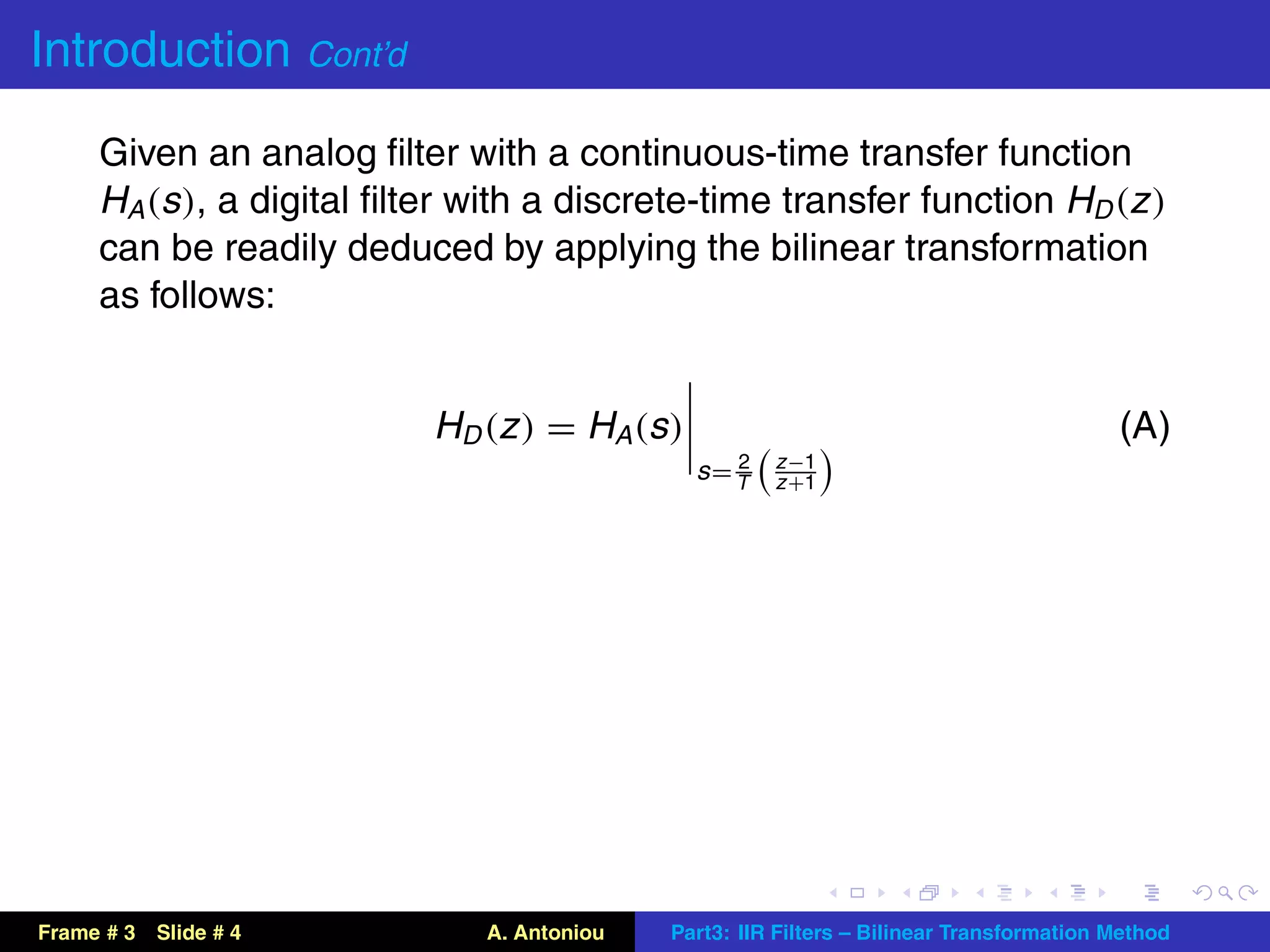
     Given an analog filter with a continuous-time transfer function
     HA (s ), a digital filter with a discrete-time transfer function HD (z )
     can be readily deduced by applying the bilinear transformation
     as follows:


                           H D (z ) = H A (s )                                            (A)
                                                    2   z −1
                                                 s= T   z +1


Frame # 3   Slide # 4          A. Antoniou   Part3: IIR Filters – Bilinear Transformation Method
Introduction Cont’d
     The bilinear transformation method has the following important
     features:
            t A stable analog filter gives a stable digital filter.


Frame # 4    Slide # 5            A. Antoniou   Part3: IIR Filters – Bilinear Transformation Method
Introduction Cont’d
     The bilinear transformation method has the following important
     features:
            t A stable analog filter gives a stable digital filter.
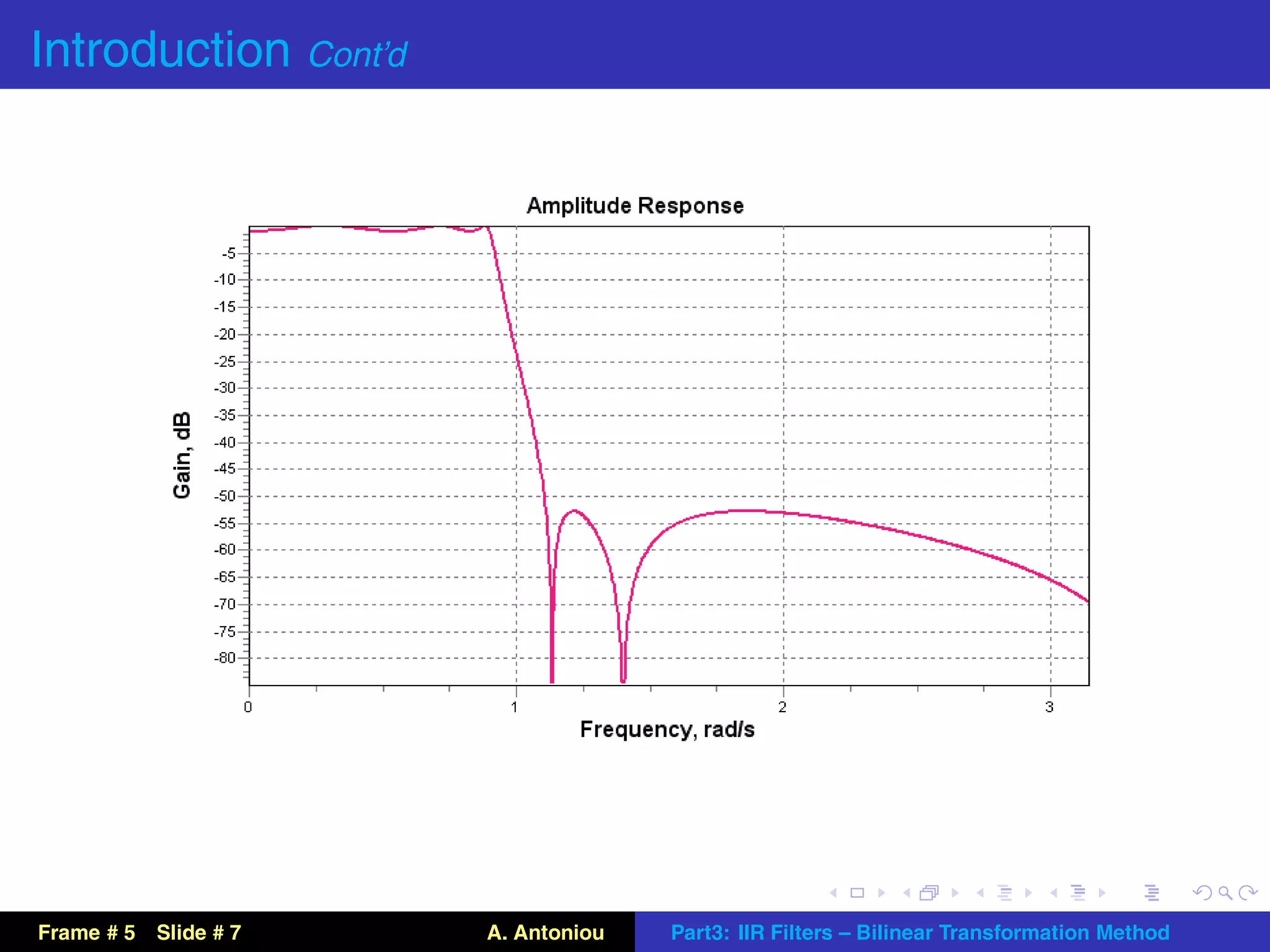
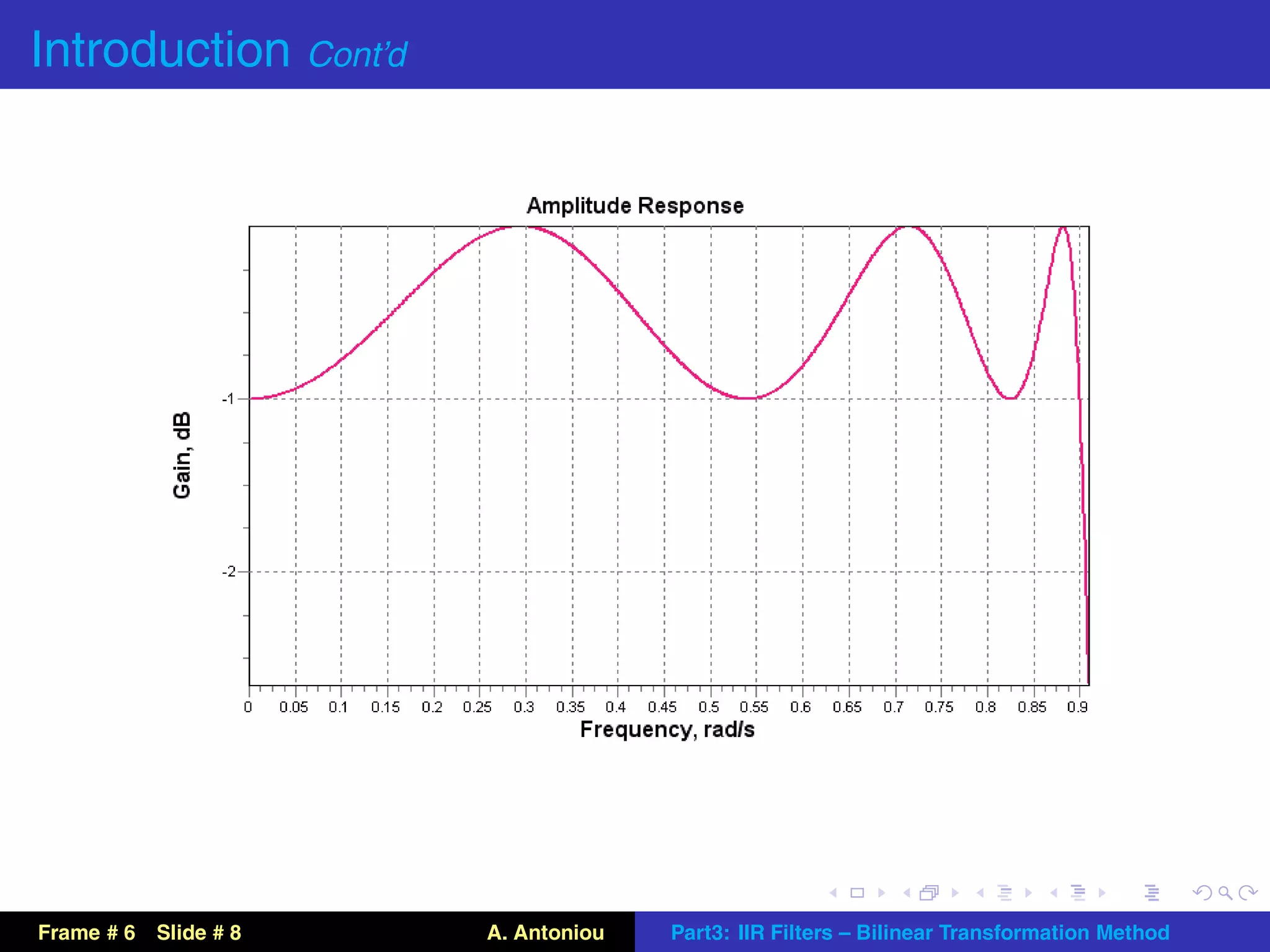
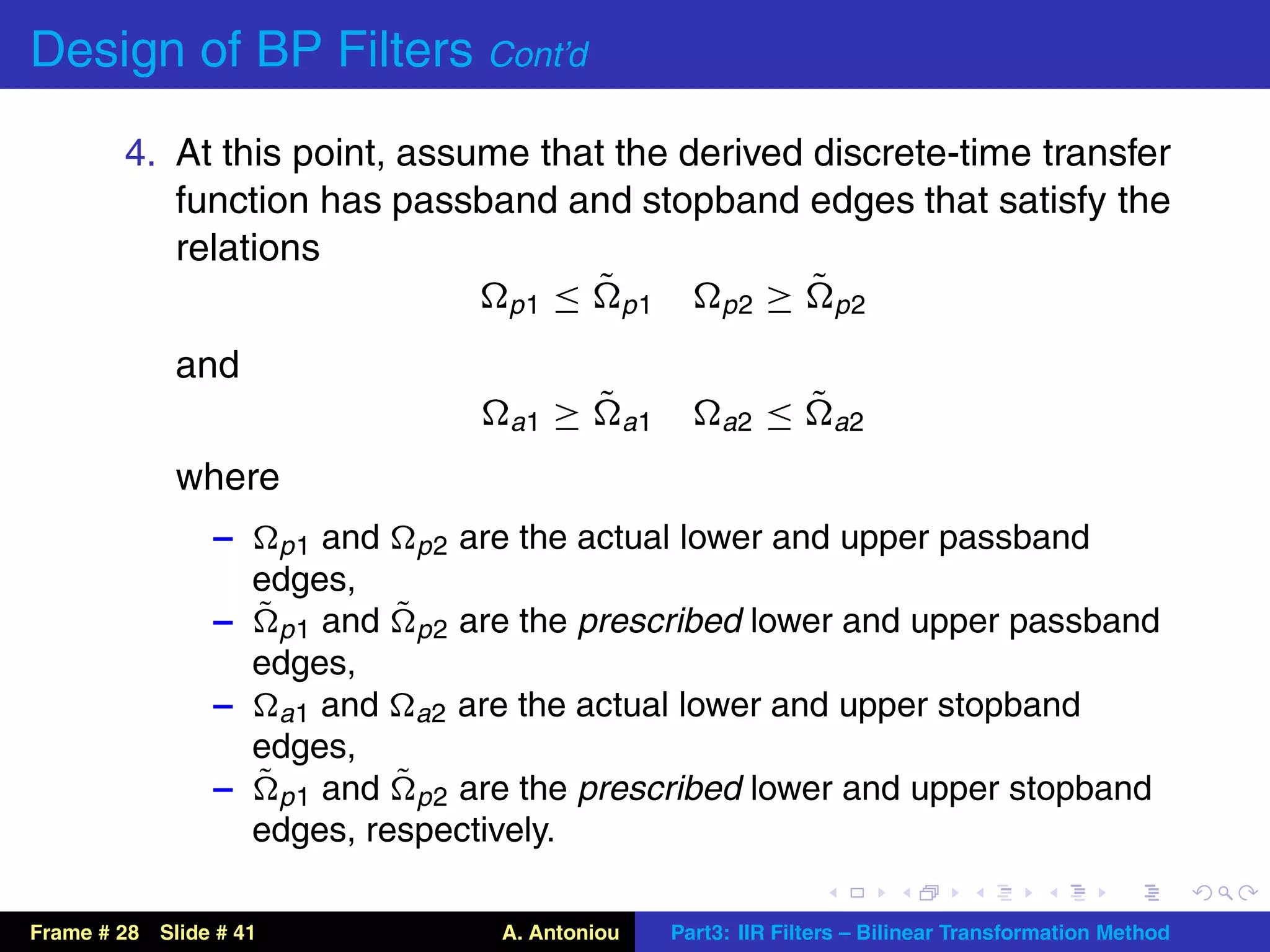
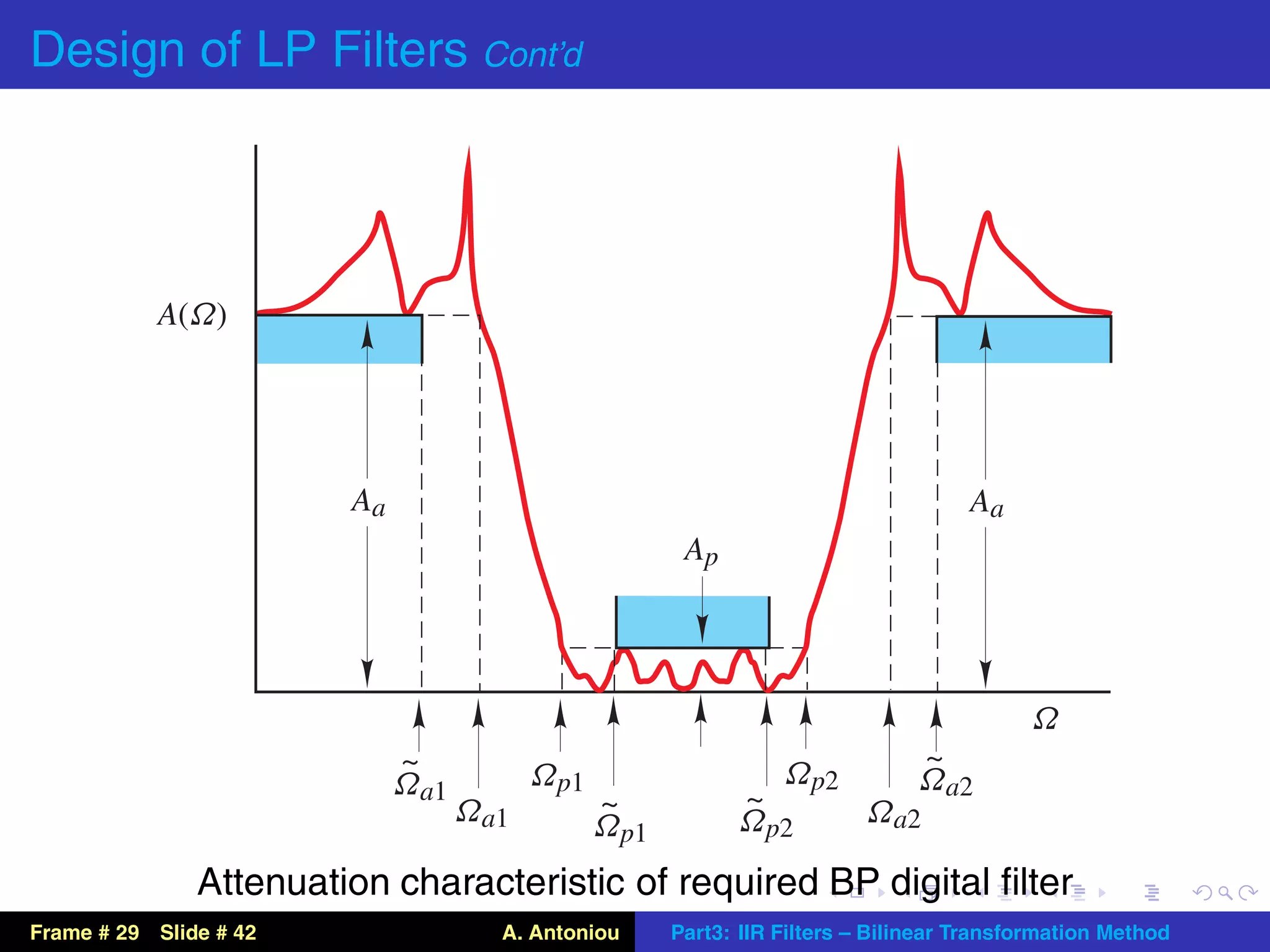
            t The maxima and minima of the amplitude response in the
               analog filter are preserved in the digital filter.
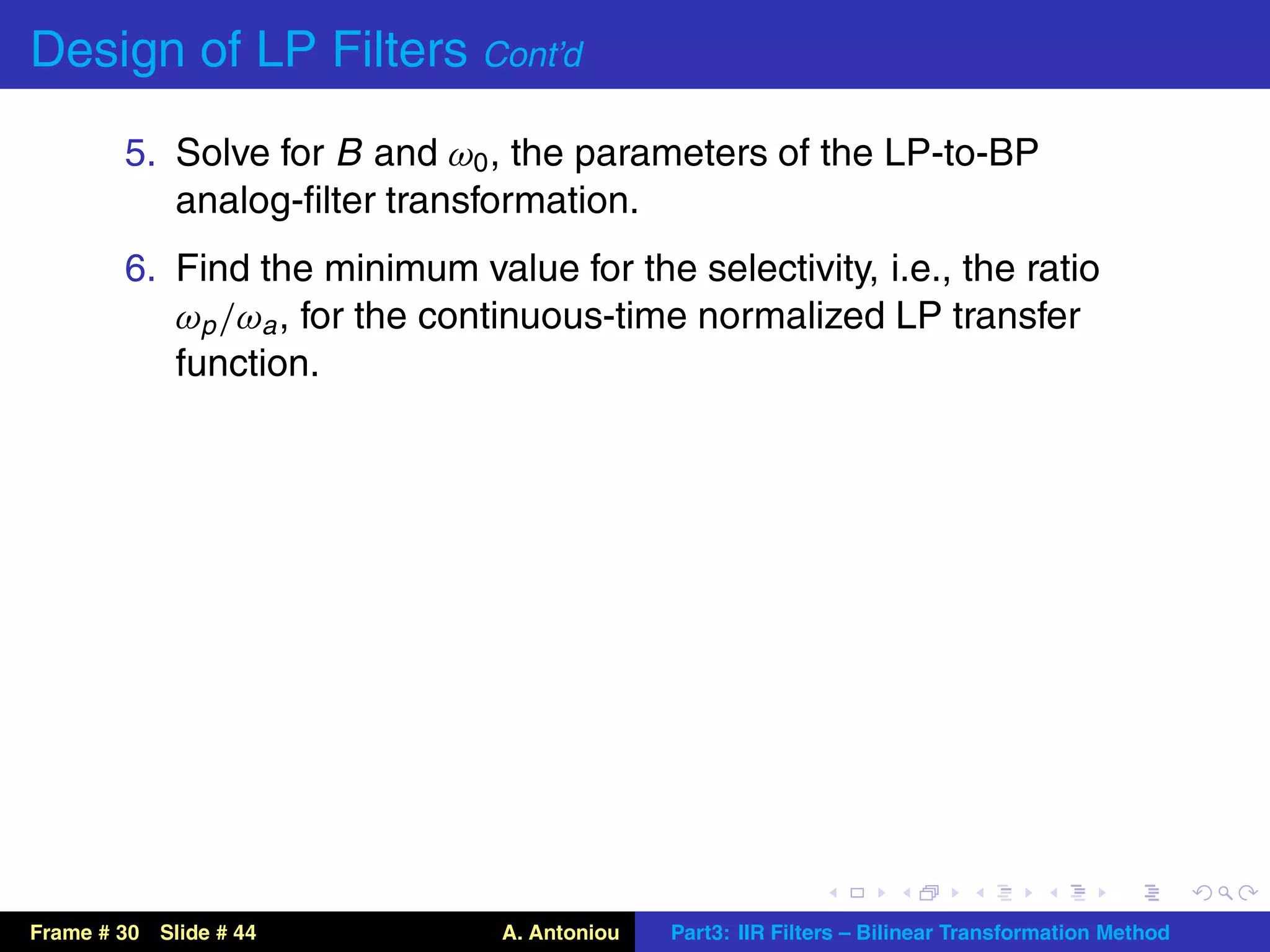
               As a consequence,
                   – the passband ripple, and
                   – the minimum stopband attenuation
               of the analog filter are preserved in the digital filter.


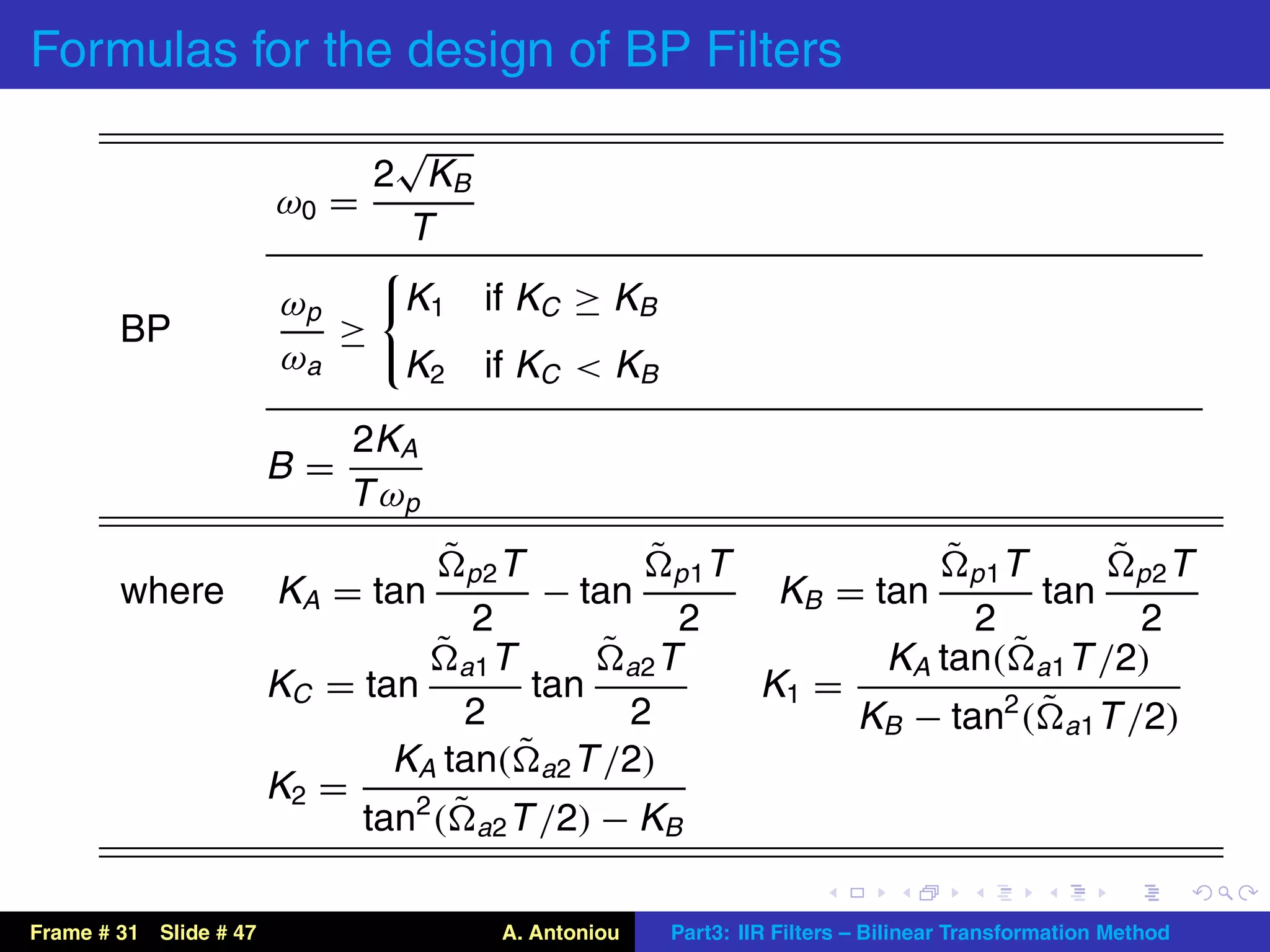
Frame # 4    Slide # 6             A. Antoniou   Part3: IIR Filters – Bilinear Transformation Method
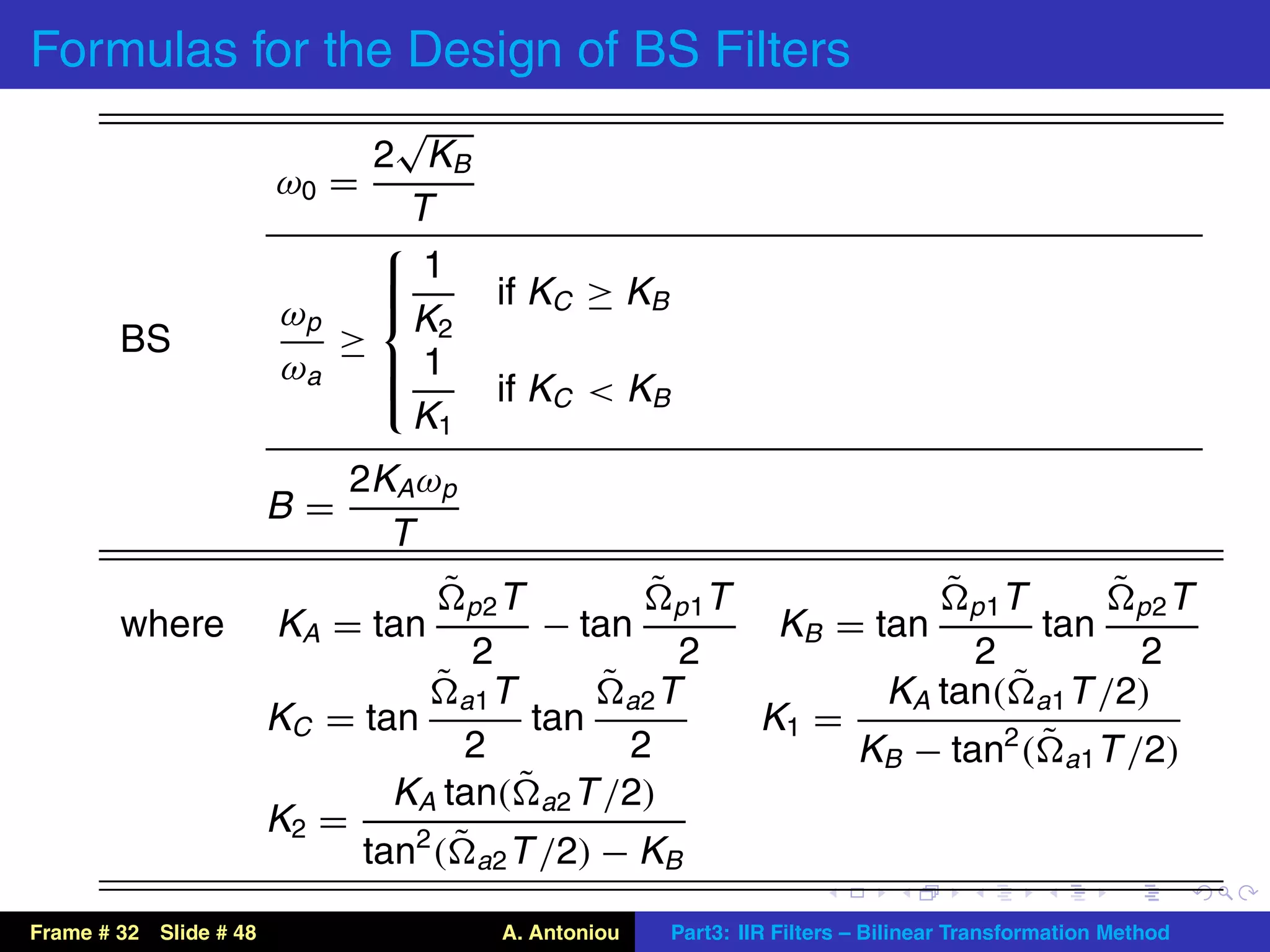
Introduction Cont’d


Frame # 5   Slide # 7   A. Antoniou   Part3: IIR Filters – Bilinear Transformation Method
Introduction Cont’d


Frame # 6   Slide # 8   A. Antoniou   Part3: IIR Filters – Bilinear Transformation Method
The Warping Effect
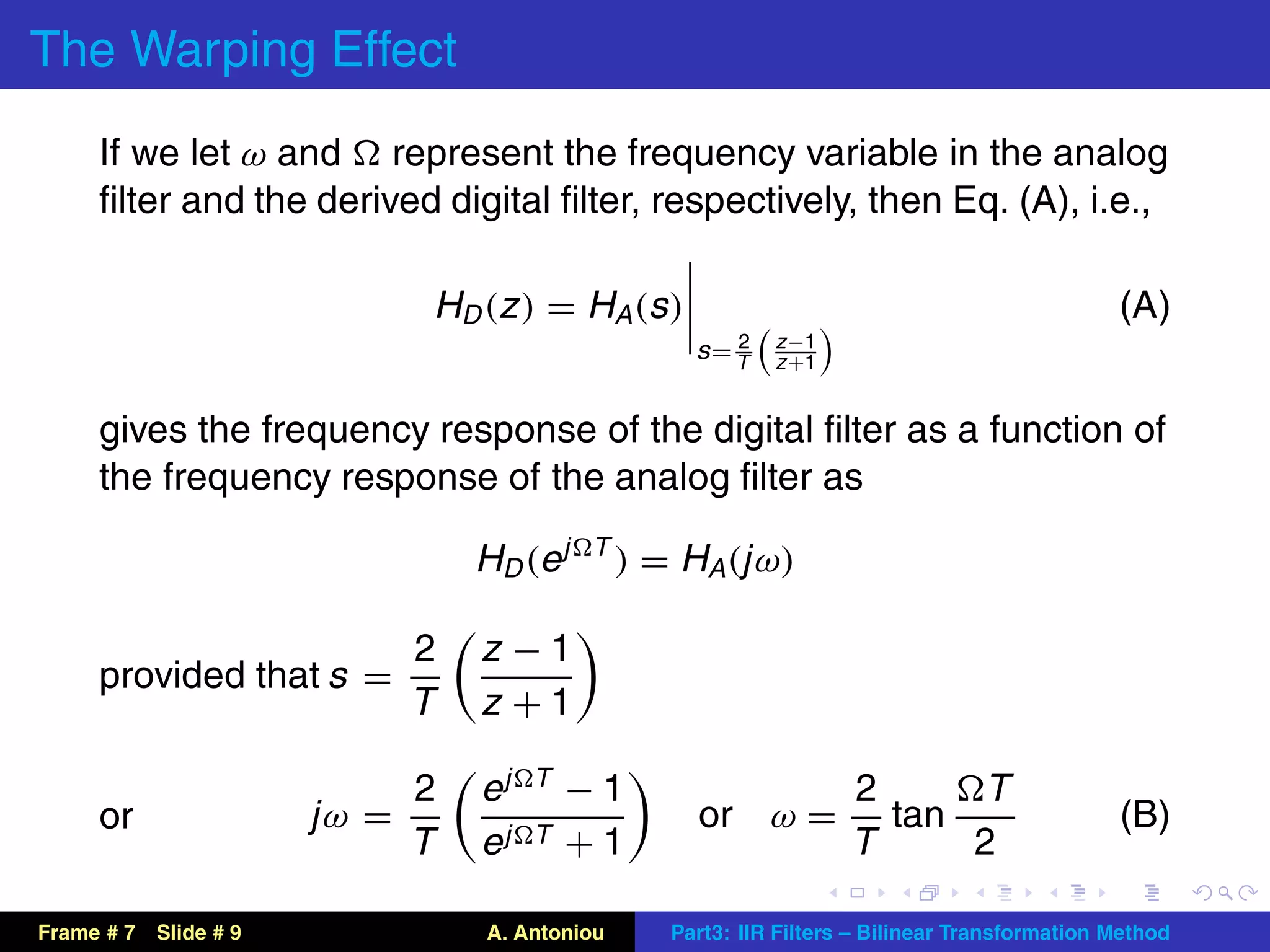
     If we let ω and represent the frequency variable in the analog
     filter and the derived digital filter, respectively, then Eq. (A), i.e.,

                               H D (z ) = H A (s )                                                (A)
                                                          2
                                                       s= T    z −1
                                                               z +1


     gives the frequency response of the digital filter as a function of
     the frequency response of the analog filter as

                                   H D (e j   T
                                                  ) = HA (j ω)

                               2   z −1
     provided that s =
                               T   z +1

                               2   ej   T
                                            −1                         2      T
     or                 jω =                           or ω =            tan                      (B)
                               T   ej   T   +1                         T     2

Frame # 7   Slide # 9               A. Antoniou      Part3: IIR Filters – Bilinear Transformation Method
The Warping Effect Cont’d
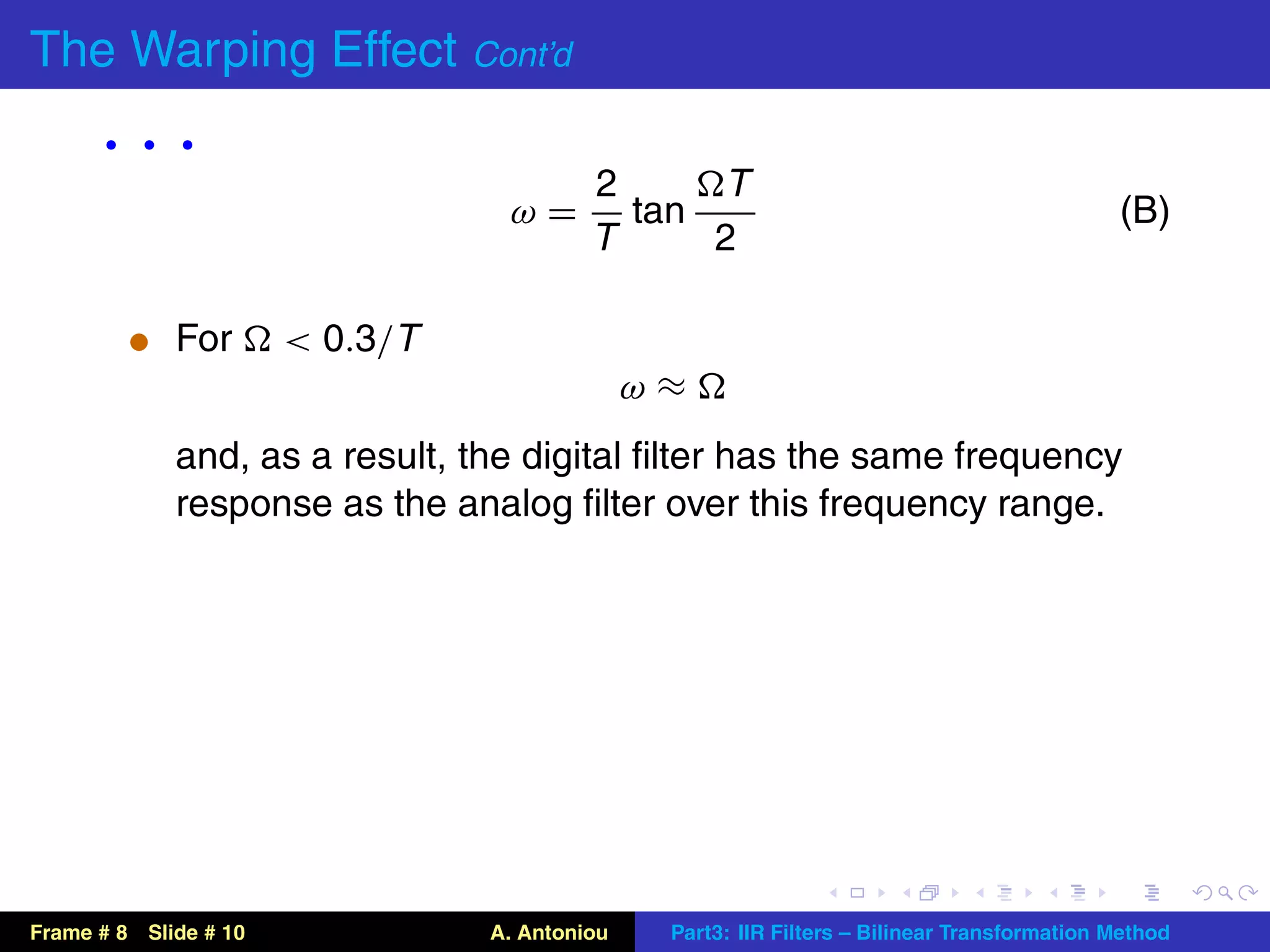
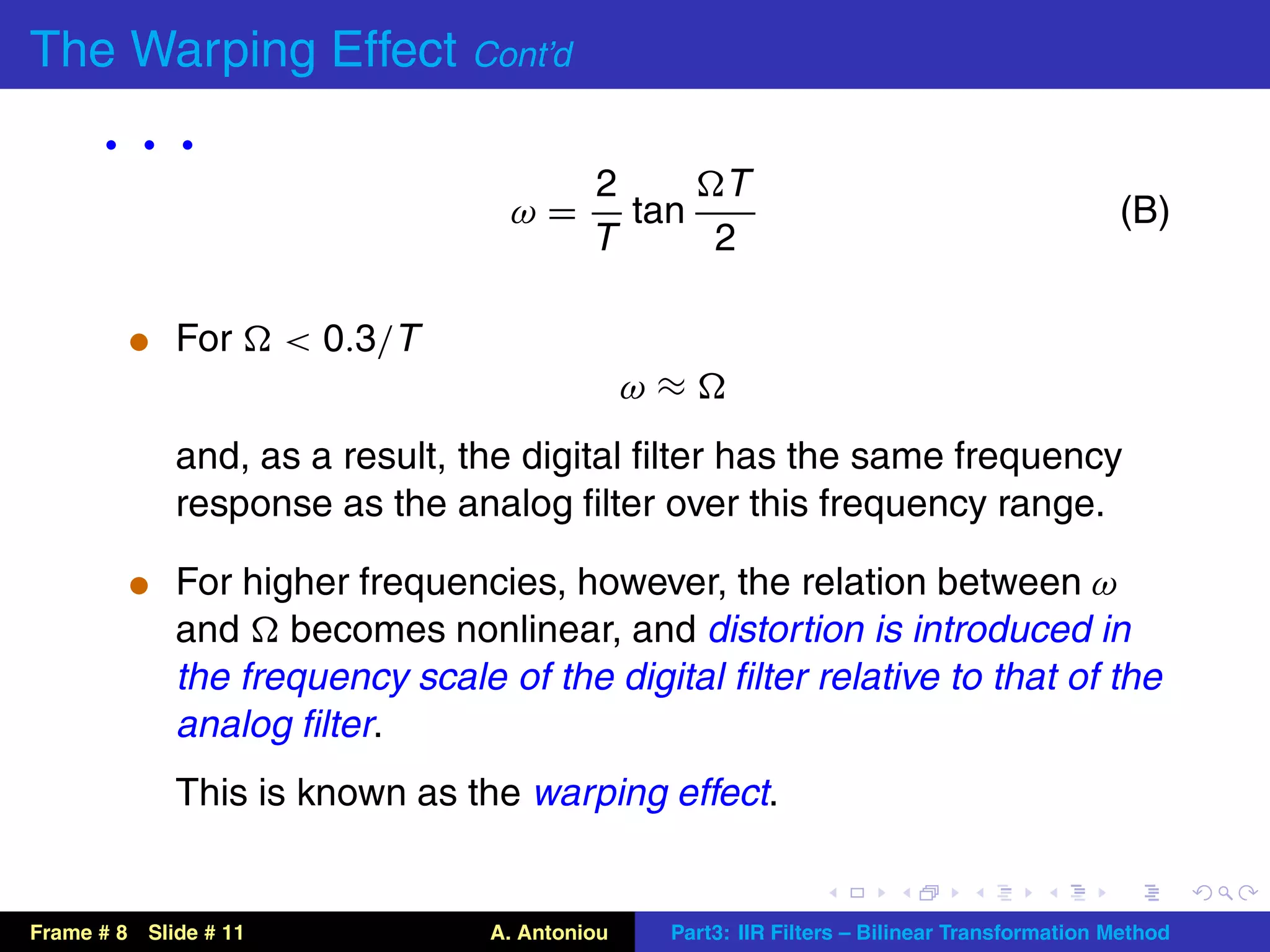
      ···                                 2     T
                                  ω=        tan                                              (B)
                                          T     2

          t For        < 0.3/T
                                               ω≈
             and, as a result, the digital filter has the same frequency
             response as the analog filter over this frequency range.


Frame # 8 Slide # 10             A. Antoniou    Part3: IIR Filters – Bilinear Transformation Method
The Warping Effect Cont’d
      ···                                 2     T
                                  ω=        tan                                              (B)
                                          T     2

          t For        < 0.3/T
                                               ω≈
             and, as a result, the digital filter has the same frequency
             response as the analog filter over this frequency range.
          t For higher frequencies, however, the relation between ω
             and becomes nonlinear, and distortion is introduced in
             the frequency scale of the digital filter relative to that of the
             analog filter.
             This is known as the warping effect.


Frame # 8 Slide # 11             A. Antoniou    Part3: IIR Filters – Bilinear Transformation Method
The Warping Effect Cont’d
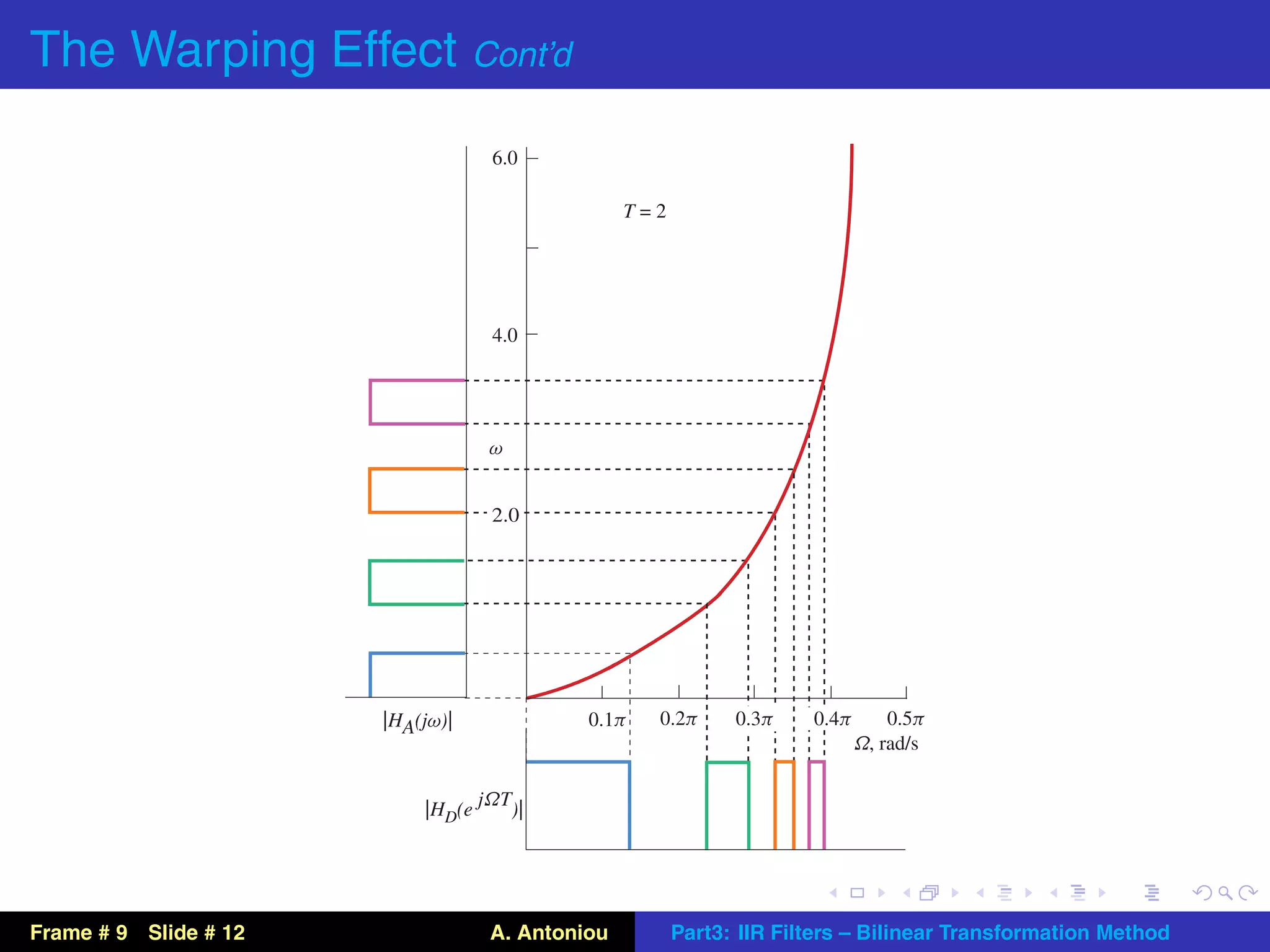
                                  6.0

                                                T=2


                                  4.0


                                  ω


                                  2.0


                       |HA(jω)|            0.1π   0.2π      0.3π    0.4π       0.5π
                                                                           Ω, rad/s


                           |HD(e jΩT)|


Frame # 9 Slide # 12              A. Antoniou         Part3: IIR Filters – Bilinear Transformation Method
The Warping Effect Cont’d
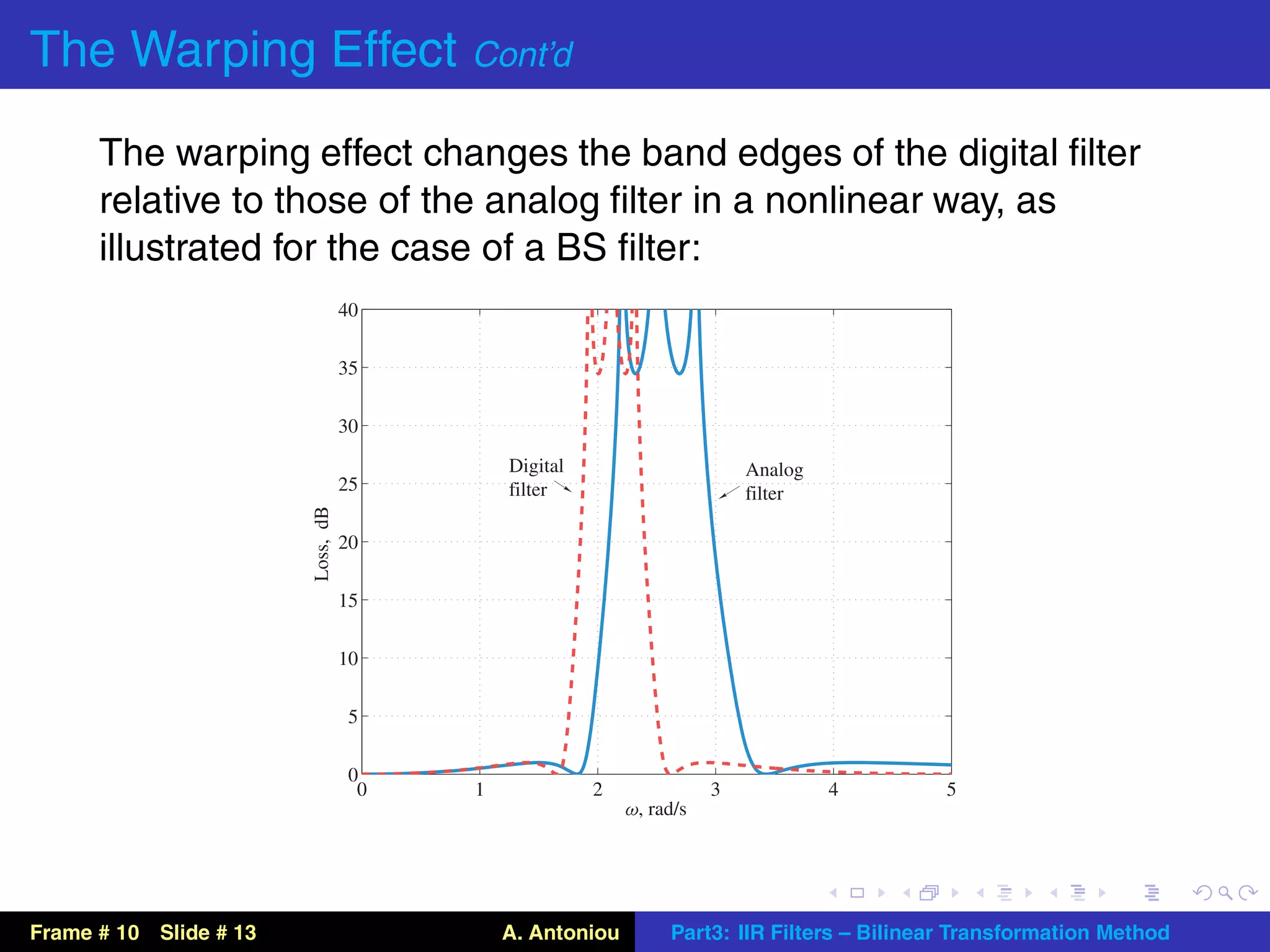
      The warping effect changes the band edges of the digital filter
      relative to those of the analog filter in a nonlinear way, as
      illustrated for the case of a BS filter:
                                   40

                                   35

                                   30
                                             Digital                      Analog
                                   25        filter                       filter
                        Loss, dB


                                   20

                                   15

                                   10

                                    5

                                    0
                                     0   1             2              3            4        5
                                                           ω, rad/s


Frame # 10 Slide # 13                        A. Antoniou        Part3: IIR Filters – Bilinear Transformation Method
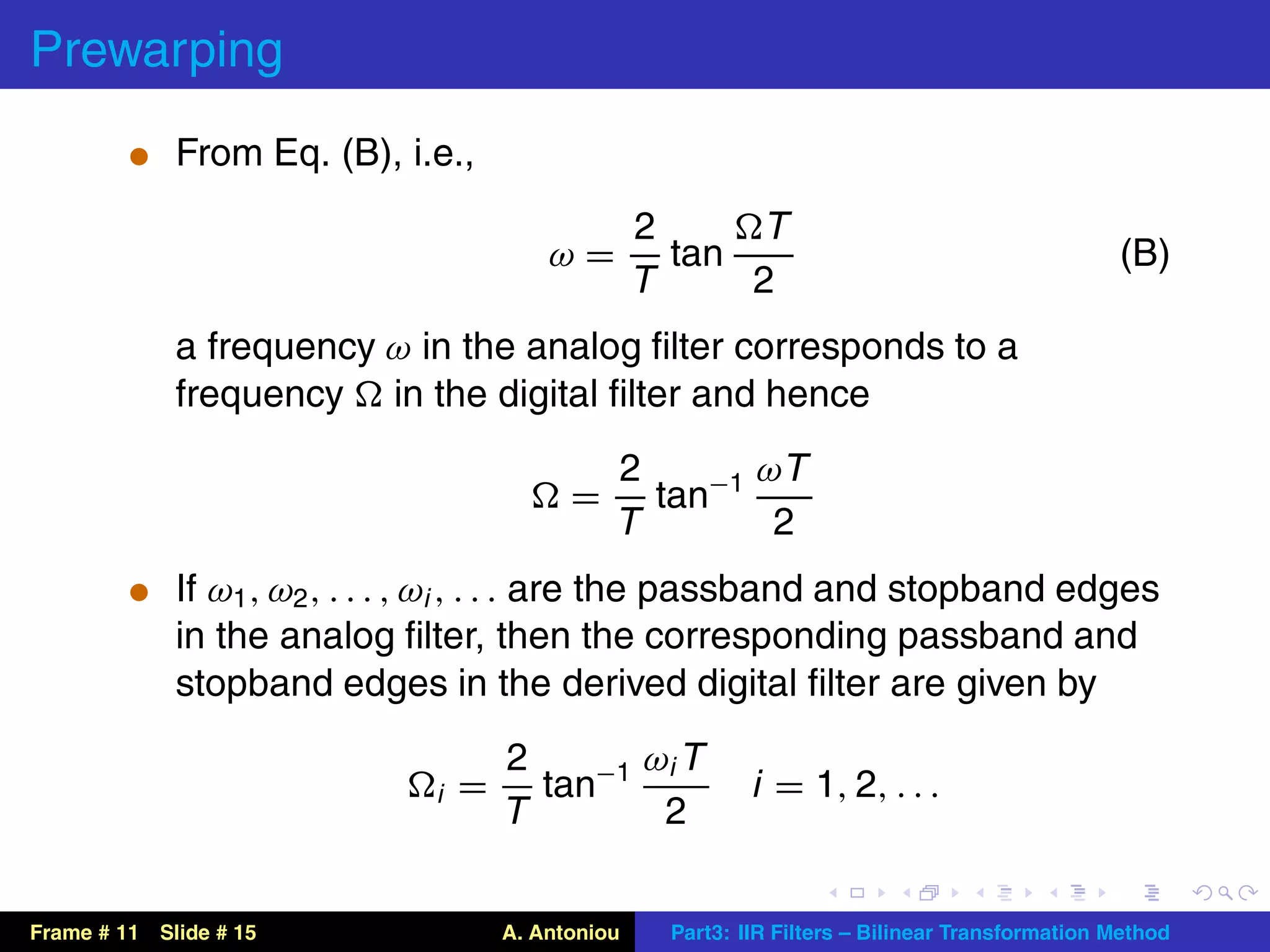
Prewarping
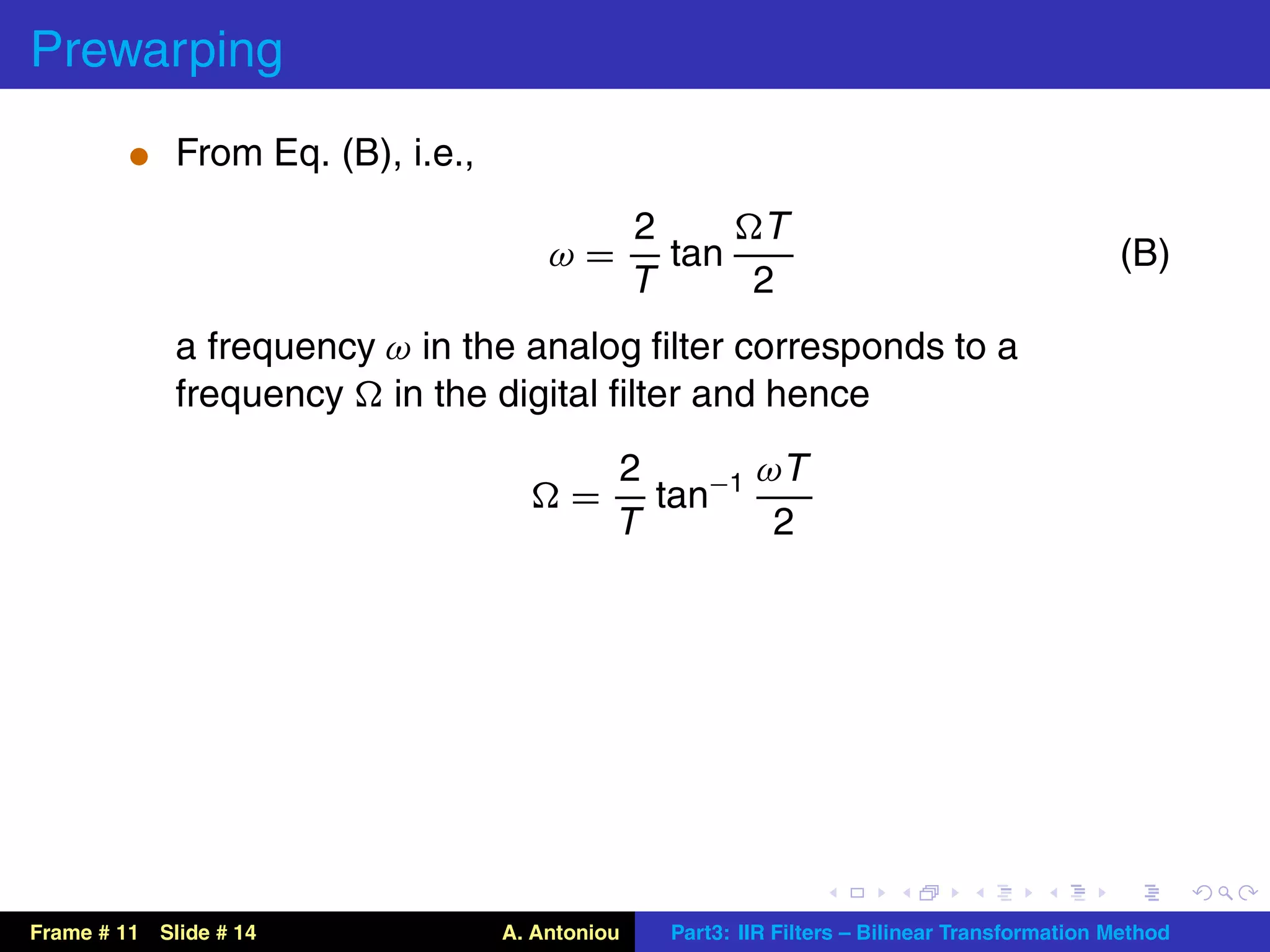
          t From Eq. (B), i.e.,

                                                2     T
                                      ω=          tan                                         (B)
                                                T     2
             a frequency ω in the analog filter corresponds to a
             frequency in the digital filter and hence
                                            2       ωT
                                        =     tan−1
                                            T        2


Frame # 11 Slide # 14             A. Antoniou    Part3: IIR Filters – Bilinear Transformation Method
Prewarping
          t From Eq. (B), i.e.,

                                                    2     T
                                          ω=          tan                                         (B)
                                                    T     2
             a frequency ω in the analog filter corresponds to a
             frequency in the digital filter and hence
                                                2       ωT
                                            =     tan−1
                                                T        2
          t If ω1 , ω2 , . . . , ωi , . . . are the passband and stopband edges
             in the analog filter, then the corresponding passband and
             stopband edges in the derived digital filter are given by
                                      2       ωi T
                              i   =     tan−1                i = 1, 2, . . .
                                      T        2


Frame # 11 Slide # 15                 A. Antoniou    Part3: IIR Filters – Bilinear Transformation Method
Prewarping Cont’d
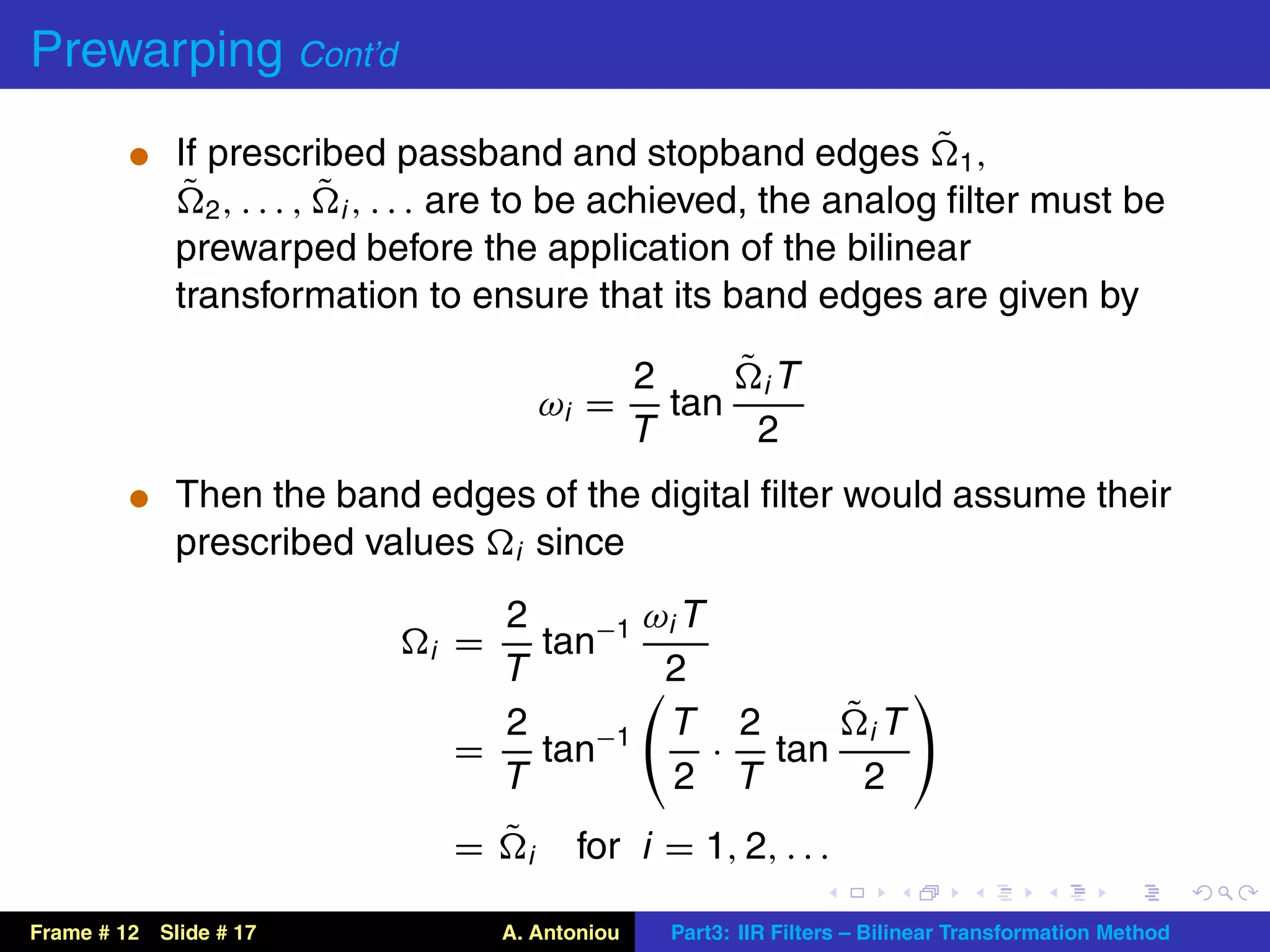
          t If prescribed passband and stopband edges ˜ 1 ,
              ˜ 2 , . . . , ˜ i , . . . are to be achieved, the analog filter must be
             prewarped before the application of the bilinear
             transformation to ensure that its band edges are given by

                                                  2     ˜ iT
                                       ωi =         tan
                                                  T      2


Frame # 12 Slide # 16               A. Antoniou     Part3: IIR Filters – Bilinear Transformation Method
Prewarping Cont’d
          t If prescribed passband and stopband edges ˜ 1 ,
              ˜ 2 , . . . , ˜ i , . . . are to be achieved, the analog filter must be
             prewarped before the application of the bilinear
             transformation to ensure that its band edges are given by

                                                     2     ˜ iT
                                            ωi =       tan
                                                     T      2
          t Then the band edges of the digital filter would assume their
             prescribed values          i   since
                                     2       ωi T
                               i   =   tan−1
                                     T        2
                                     2        T 2       ˜ iT
                                   =   tan−1      · tan
                                     T         2 T       2
                                   = ˜i       for i = 1, 2, . . .

Frame # 12 Slide # 17                  A. Antoniou     Part3: IIR Filters – Bilinear Transformation Method
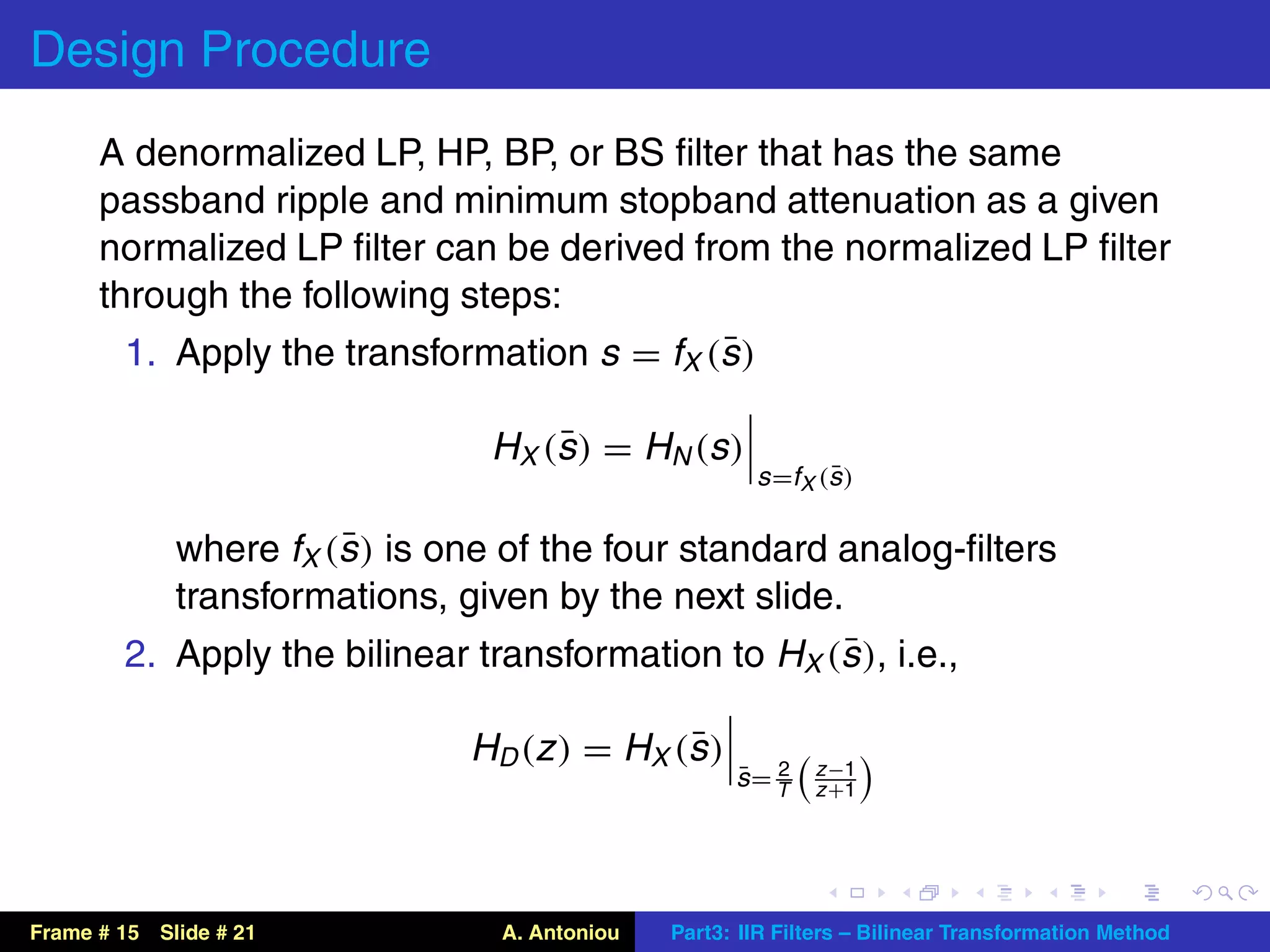
Design Procedure
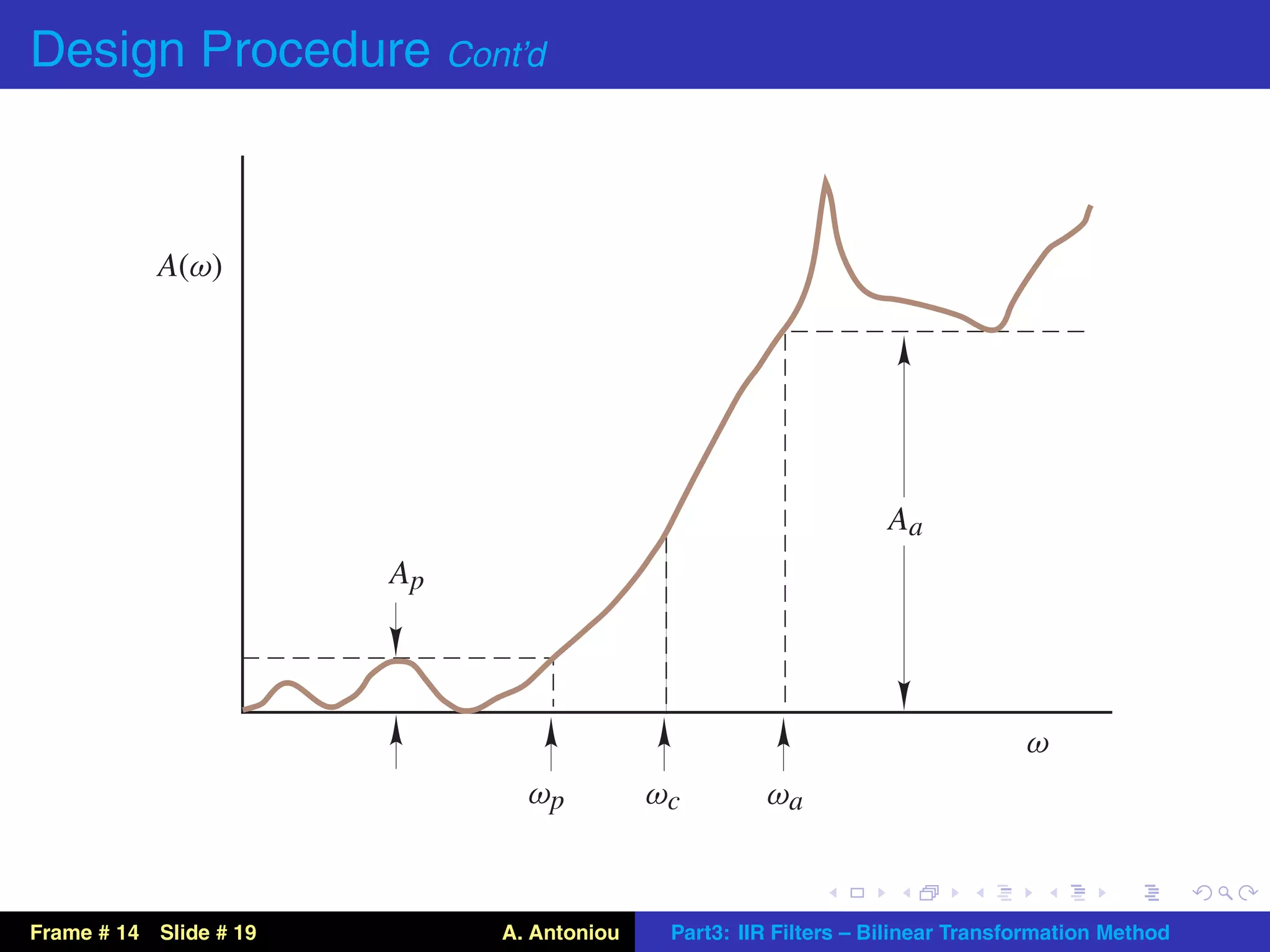
      Consider a normalized analog LP filter characterized by HN (s )
      with an attenuation

                                                    1
                            AN (ω) = 20 log
                                                 |HN (j ω)|
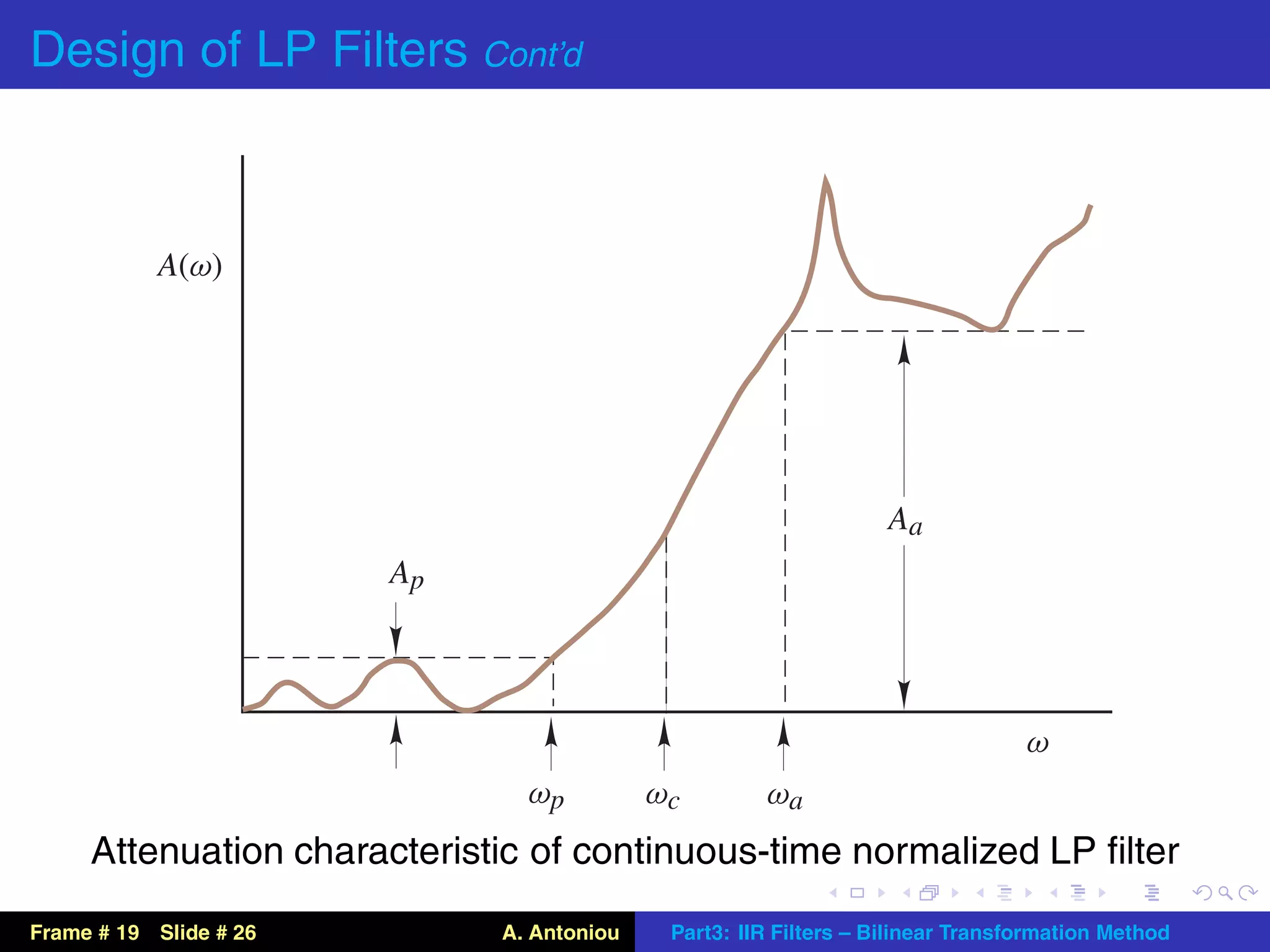
      (also known as loss) and assume that

                        0 ≤ AN (ω) ≤ Ap       for 0 ≤ |ω| ≤ ωp
                         AN (ω) ≥ Aa     for ωa ≤ |ω| ≤ ∞

      Note: The transfer functions of analog LP filters are reported in
      the literature in normalized form whereby the passband edge is
      typically of the order of unity.


Frame # 13 Slide # 18           A. Antoniou    Part3: IIR Filters – Bilinear Transformation Method
Design Procedure Cont’d


           A(ω)


                                                                  Aa
                        Ap


                                                                                ω
                               ωp          ωc        ωa


Frame # 14 Slide # 19        A. Antoniou    Part3: IIR Filters – Bilinear Transformation Method
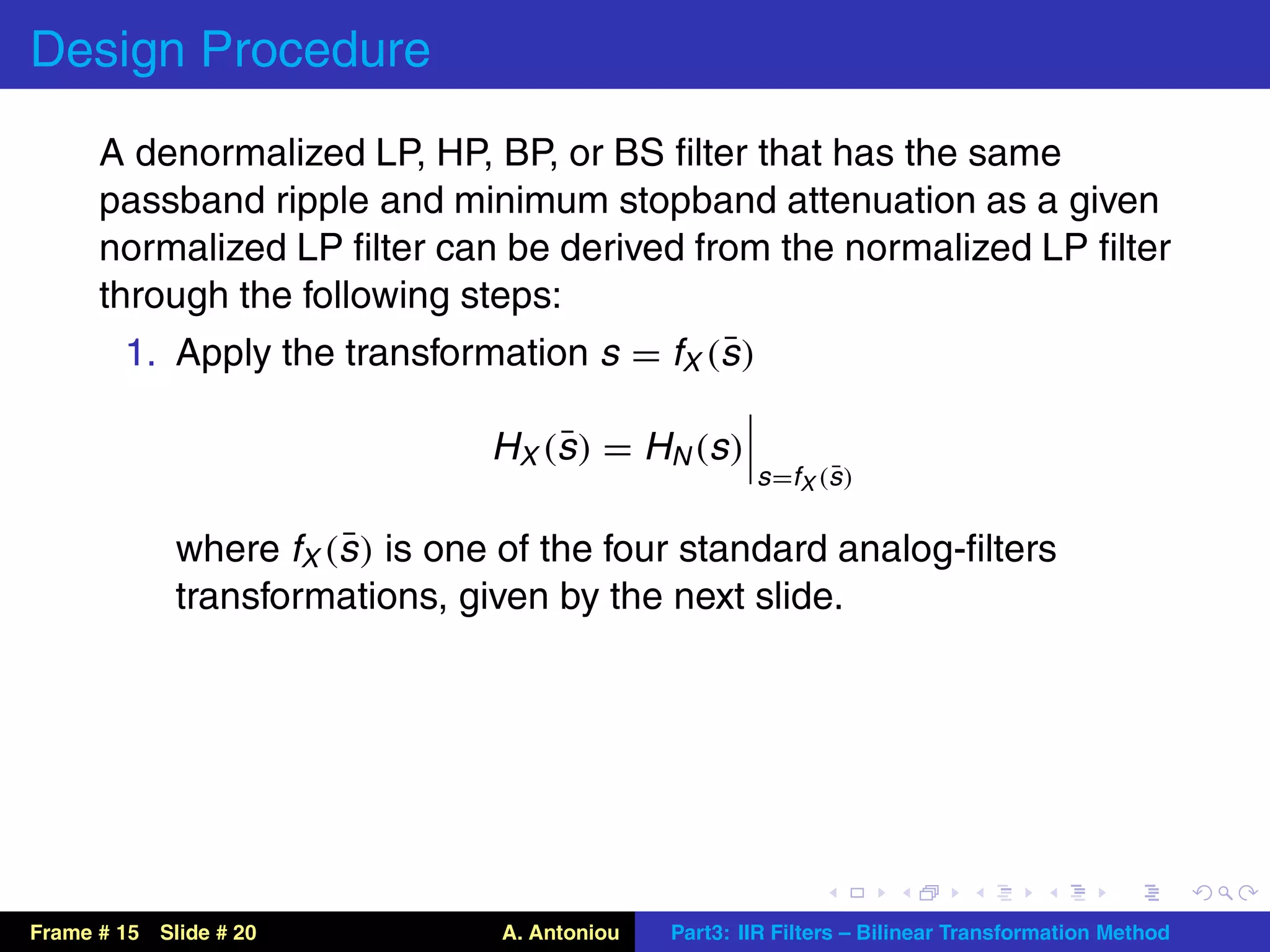
Design Procedure
      A denormalized LP, HP, BP, or BS filter that has the same
      passband ripple and minimum stopband attenuation as a given
      normalized LP filter can be derived from the normalized LP filter
      through the following steps:
                                            ¯
        1. Apply the transformation s = fX (s )
                                     ¯
                                H X (s ) = H N (s )
                                                              ¯
                                                       s =fX (s )

                       ¯
             where fX (s ) is one of the four standard analog-filters
             transformations, given by the next slide.


Frame # 15 Slide # 20            A. Antoniou   Part3: IIR Filters – Bilinear Transformation Method
Design Procedure
      A denormalized LP, HP, BP, or BS filter that has the same
      passband ripple and minimum stopband attenuation as a given
      normalized LP filter can be derived from the normalized LP filter
      through the following steps:
                                            ¯
        1. Apply the transformation s = fX (s )

                                   ¯
                              H X (s ) = H N (s )
                                                            ¯
                                                     s =fX (s )

                     ¯
           where fX (s ) is one of the four standard analog-filters
           transformations, given by the next slide.
                                                     ¯
        2. Apply the bilinear transformation to HX (s ), i.e.,

                                             ¯
                             H D (z ) = H X (s )           z −1
                                                   ¯ 2
                                                   s= T    z +1


Frame # 15 Slide # 21          A. Antoniou   Part3: IIR Filters – Bilinear Transformation Method
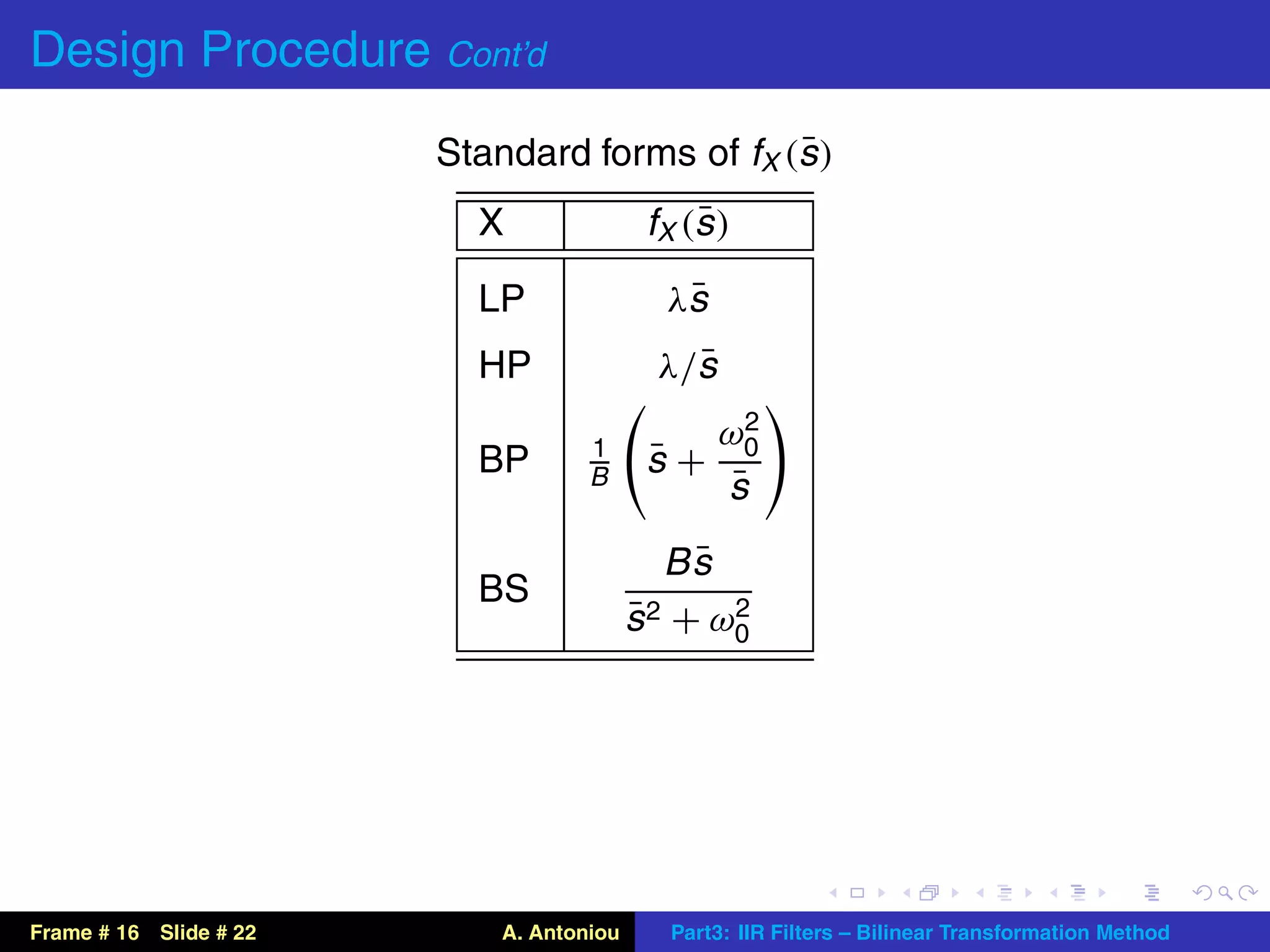
Design Procedure Cont’d
                                              ¯
                        Standard forms of fX (s )
                          X                    ¯
                                           fX (s )
                          LP                 ¯
                                            λs
                          HP                  ¯
                                            λ/s
                                                  ω02
                          BP        1      ¯
                                           s+
                                    B             s¯

                                             Bs¯
                          BS
                                          ¯
                                          s 2 + ω0
                                                 2


Frame # 16 Slide # 22       A. Antoniou      Part3: IIR Filters – Bilinear Transformation Method
Design Procedure Cont’d
          t The digital filter designed by this method will have the
             required passband and stopband edges only if the
             parameters λ, ω0 , and B of the analog-filter transformations
             and the order of the continuous-time normalized LP
             transfer function, HN (s ), are chosen appropriately.


Frame # 17 Slide # 23           A. Antoniou   Part3: IIR Filters – Bilinear Transformation Method
Design Procedure Cont’d
          t The digital filter designed by this method will have the
             required passband and stopband edges only if the
             parameters λ, ω0 , and B of the analog-filter transformations
             and the order of the continuous-time normalized LP
             transfer function, HN (s ), are chosen appropriately.
          t This is obviously a difficult problem but general solutions
             are available for LP, HP, BP, and BS, Butterworth,
             Chebyshev, inverse-Chebyshev, and Elliptic filters.


Frame # 17 Slide # 24           A. Antoniou   Part3: IIR Filters – Bilinear Transformation Method
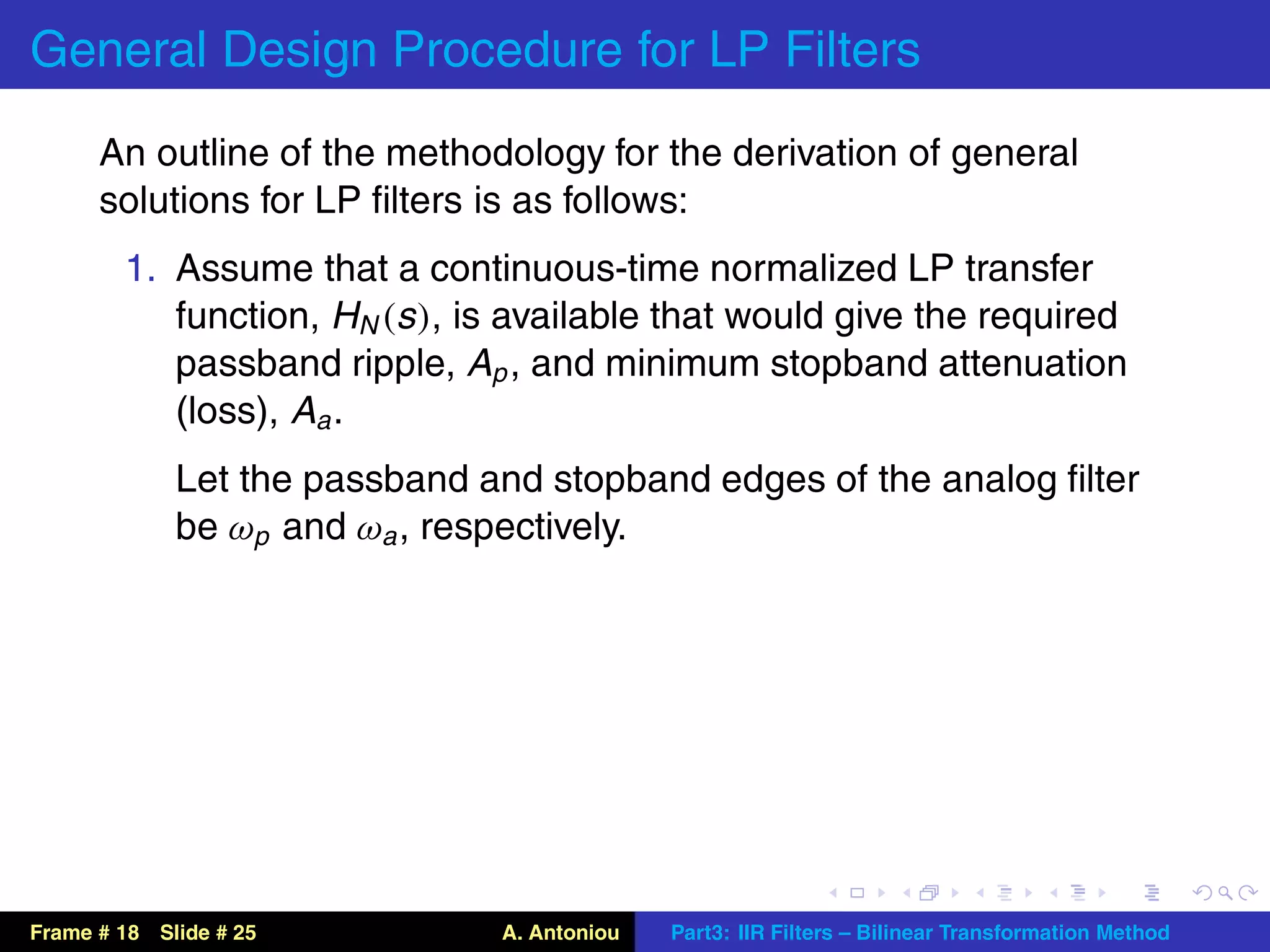
General Design Procedure for LP Filters
      An outline of the methodology for the derivation of general
      solutions for LP filters is as follows:
        1. Assume that a continuous-time normalized LP transfer
           function, HN (s ), is available that would give the required
           passband ripple, Ap , and minimum stopband attenuation
           (loss), Aa .
             Let the passband and stopband edges of the analog filter
             be ωp and ωa , respectively.


Frame # 18 Slide # 25          A. Antoniou   Part3: IIR Filters – Bilinear Transformation Method
Design of LP Filters Cont’d


           A(ω)


                                                                  Aa
                        Ap


                                                                                ω
                               ωp          ωc        ωa
     Attenuation characteristic of continuous-time normalized LP filter
Frame # 19 Slide # 26        A. Antoniou    Part3: IIR Filters – Bilinear Transformation Method
Design of LP Filters Cont’d
        2. Apply the LP-to-LP analog-filter transformation to HN (s ) to
           obtain a denormalized discrete-time transfer function
                ¯
           HLP (s ).


Frame # 20 Slide # 27          A. Antoniou   Part3: IIR Filters – Bilinear Transformation Method
Design of LP Filters Cont’d
        2. Apply the LP-to-LP analog-filter transformation to HN (s ) to
           obtain a denormalized discrete-time transfer function
                ¯
           HLP (s ).
                                                     ¯
        3. Apply the bilinear transformation to HLP (s ) to obtain a
           discrete-time transfer function HD (z ).


Frame # 20 Slide # 28          A. Antoniou   Part3: IIR Filters – Bilinear Transformation Method
Design of LP Filters Cont’d
        2. Apply the LP-to-LP analog-filter transformation to HN (s ) to
           obtain a denormalized discrete-time transfer function
                ¯
           HLP (s ).
                                                     ¯
        3. Apply the bilinear transformation to HLP (s ) to obtain a
           discrete-time transfer function HD (z ).
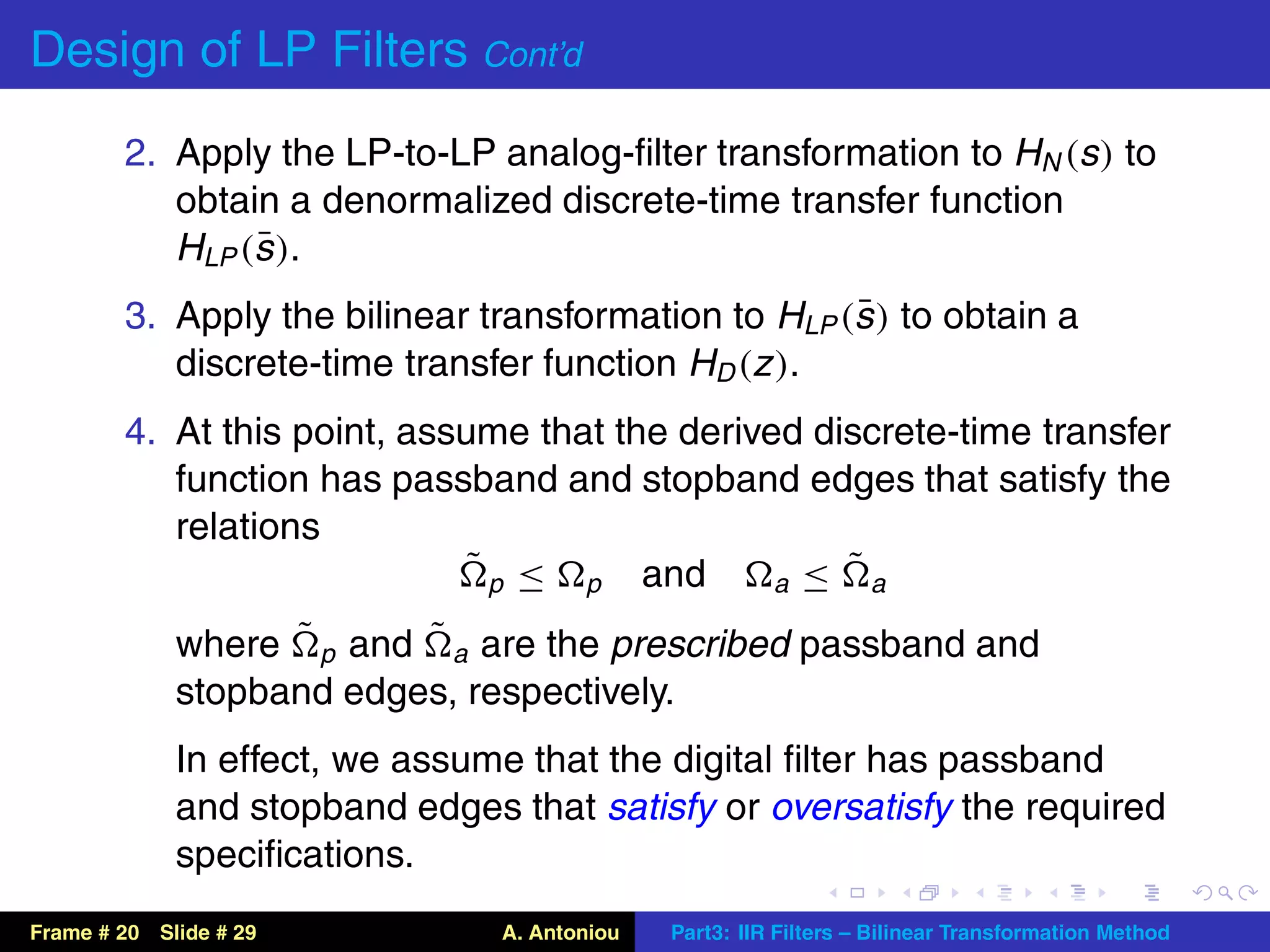
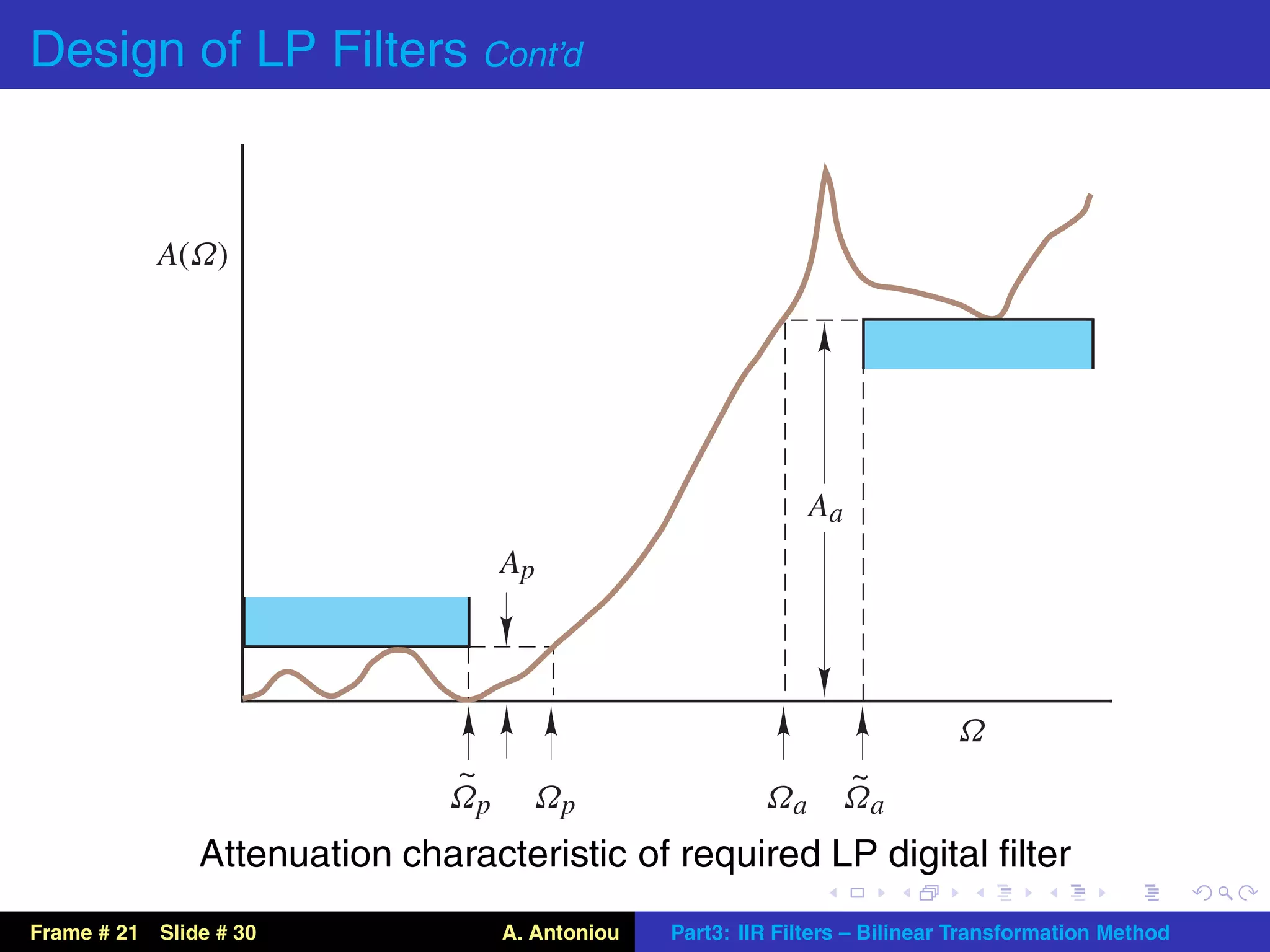
        4. At this point, assume that the derived discrete-time transfer
           function has passband and stopband edges that satisfy the
           relations
                              ˜ p ≤ p and       a ≤ ˜a

             where ˜ p and ˜ a are the prescribed passband and
             stopband edges, respectively.
             In effect, we assume that the digital filter has passband
             and stopband edges that satisfy or oversatisfy the required
             specifications.
Frame # 20 Slide # 29           A. Antoniou   Part3: IIR Filters – Bilinear Transformation Method
Design of LP Filters Cont’d


           A(Ω)


                                                               Aa
                                   Ap


                                                                              Ω
                              ~                                   ~
                              Ωp     Ωp                   Ωa      Ωa
               Attenuation characteristic of required LP digital filter
Frame # 21 Slide # 30              A. Antoniou   Part3: IIR Filters – Bilinear Transformation Method
Design of LP Filters Cont’d
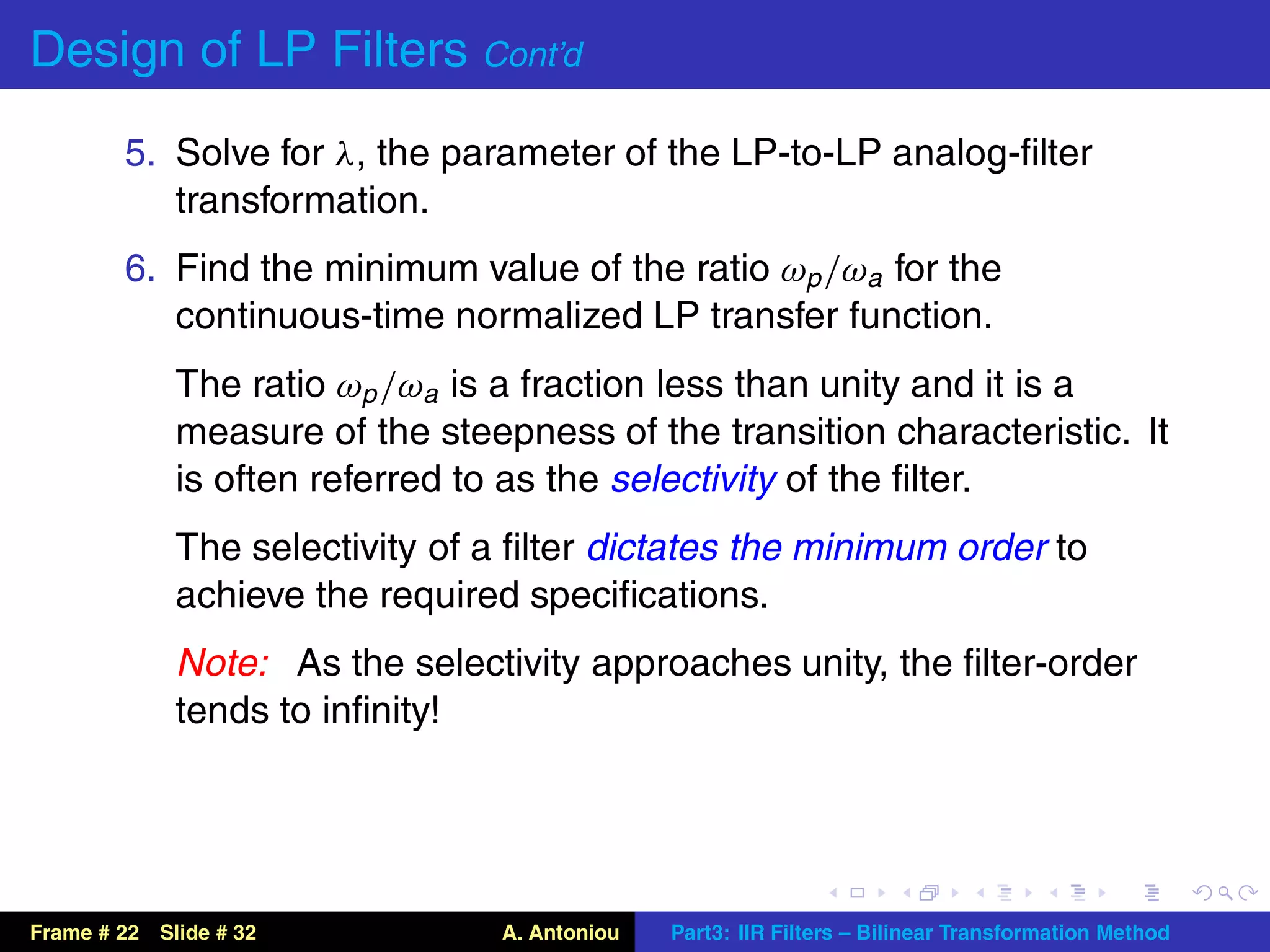
        5. Solve for λ, the parameter of the LP-to-LP analog-filter
           transformation.


Frame # 22 Slide # 31         A. Antoniou   Part3: IIR Filters – Bilinear Transformation Method
Design of LP Filters Cont’d
        5. Solve for λ, the parameter of the LP-to-LP analog-filter
           transformation.
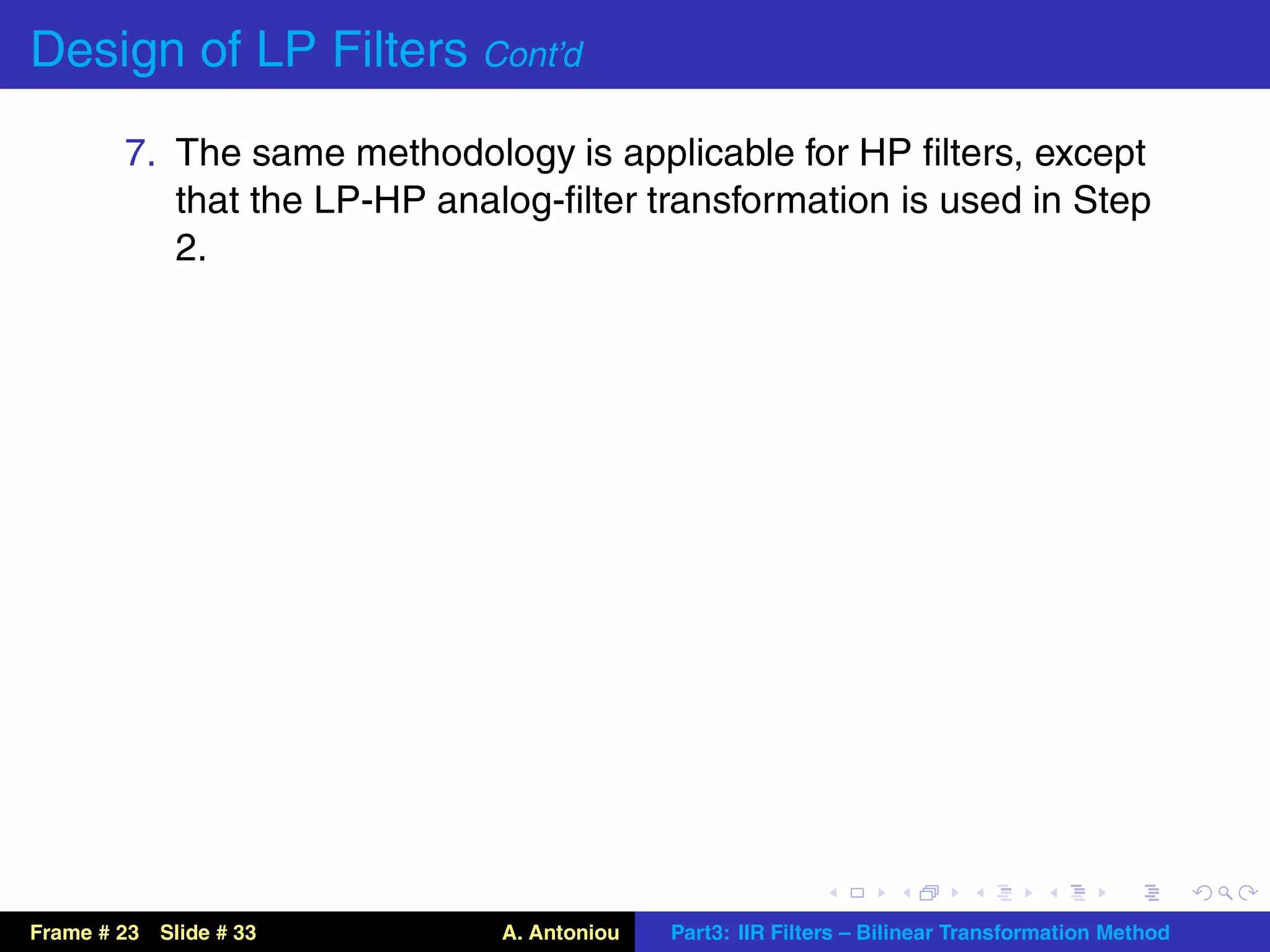
        6. Find the minimum value of the ratio ωp /ωa for the
           continuous-time normalized LP transfer function.
             The ratio ωp /ωa is a fraction less than unity and it is a
             measure of the steepness of the transition characteristic. It
             is often referred to as the selectivity of the filter.
             The selectivity of a filter dictates the minimum order to
             achieve the required specifications.
             Note: As the selectivity approaches unity, the filter-order
             tends to infinity!


Frame # 22 Slide # 32            A. Antoniou   Part3: IIR Filters – Bilinear Transformation Method
Design of LP Filters Cont’d
        7. The same methodology is applicable for HP filters, except
           that the LP-HP analog-filter transformation is used in Step
           2.


Frame # 23 Slide # 33         A. Antoniou   Part3: IIR Filters – Bilinear Transformation Method
Design of LP Filters Cont’d
        7. The same methodology is applicable for HP filters, except
           that the LP-HP analog-filter transformation is used in Step
           2.
        8. The application of this methodology yields the formulas
           summarized by the table shown in the next slide.


Frame # 23 Slide # 34         A. Antoniou   Part3: IIR Filters – Bilinear Transformation Method
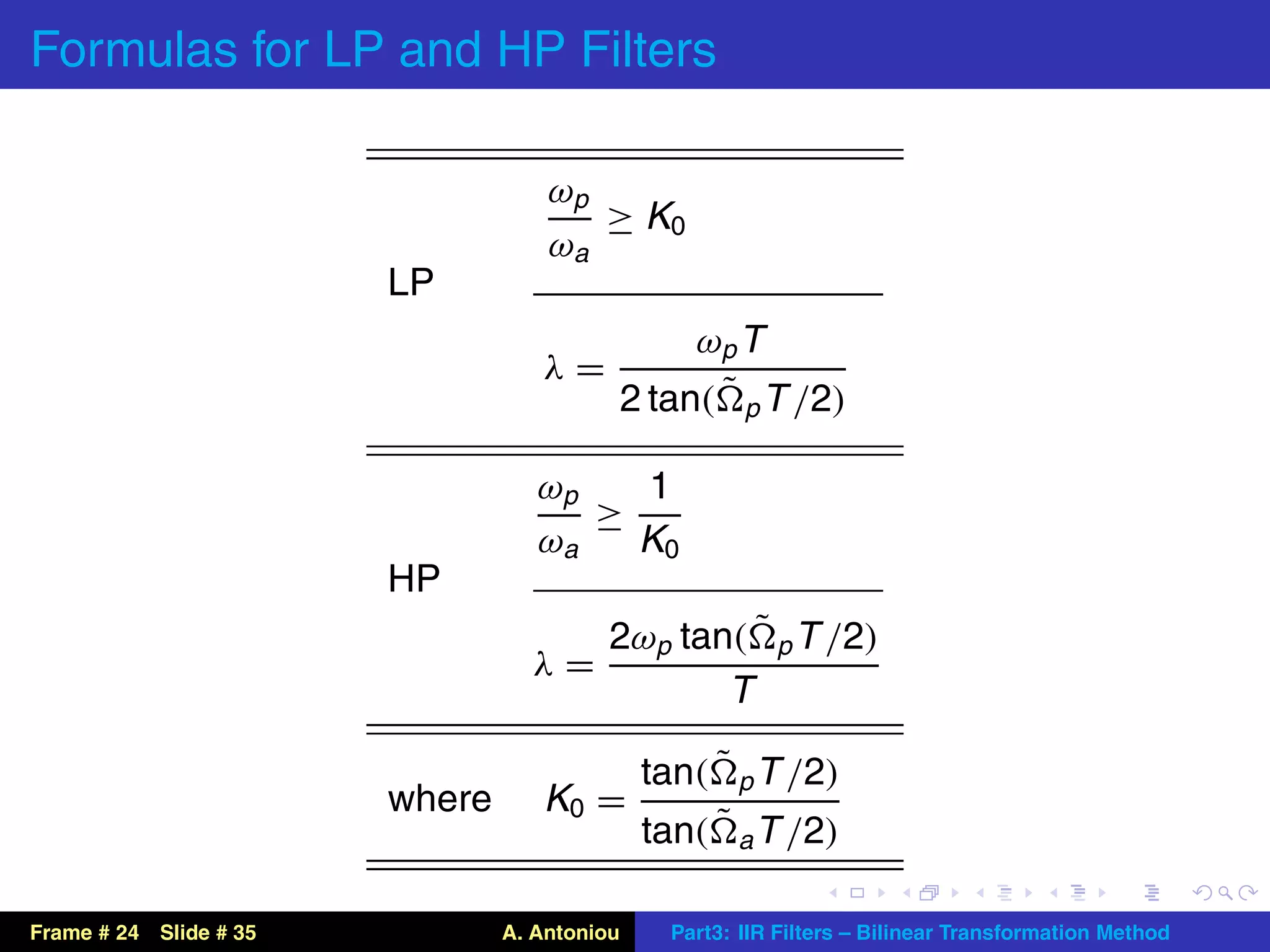
Formulas for LP and HP Filters

                                    ωp
                                       ≥ K0
                                    ωa
                        LP
                                                   ωp T
                                   λ=
                                              2 tan( ˜ p T /2)

                                   ωp   1
                                      ≥
                                   ωa   K0
                        HP
                                          2ωp tan( ˜ p T /2)
                                  λ=
                                                 T

                                               tan( ˜ p T /2)
                        where      K0 =
                                               tan( ˜ a T /2)

Frame # 24 Slide # 35           A. Antoniou      Part3: IIR Filters – Bilinear Transformation Method
Design of LP Filters Cont’d
          t The table of formulas presented is applicable to all the
             classical types of analog filters, namely,
                 – Butterworth
                 – Chebyshev
                 – Inverse-Chebyshev
                 – Elliptic


Frame # 25 Slide # 36            A. Antoniou   Part3: IIR Filters – Bilinear Transformation Method
Design of LP Filters Cont’d
          t The table of formulas presented is applicable to all the
             classical types of analog filters, namely,
                 – Butterworth
                 – Chebyshev
                 – Inverse-Chebyshev
                 – Elliptic
          t Formulas that can be used to design digital versions of
             these filters will be presented later.


Frame # 25 Slide # 37            A. Antoniou   Part3: IIR Filters – Bilinear Transformation Method
General Design Procedure for BP Filters
      An outline of the methodology for the derivation of general
      solutions for BP filters is as follows:
        1. Assume that a continuous-time normalized LP transfer
           function, HN (s ), is available that would give the required
           passband ripple, Ap , and minimum stopband attenuation,
           Aa .
             Let the passband and stopband edges of the analog filter
             be ωp and ωa , respectively.


Frame # 26 Slide # 38          A. Antoniou   Part3: IIR Filters – Bilinear Transformation Method
Design of BP Filters Cont’d
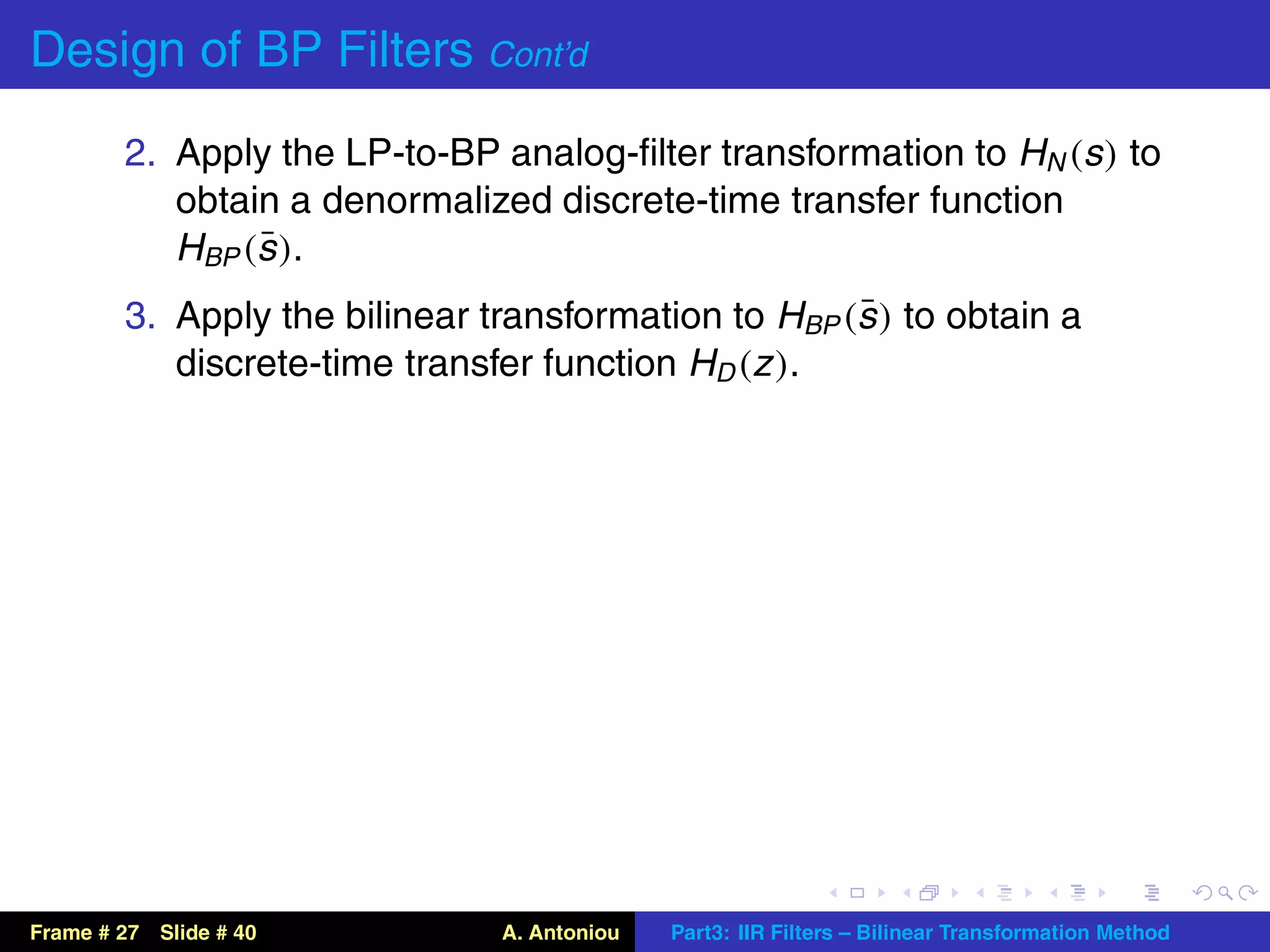
        2. Apply the LP-to-BP analog-filter transformation to HN (s ) to
           obtain a denormalized discrete-time transfer function
                ¯
           HBP (s ).


Frame # 27 Slide # 39         A. Antoniou   Part3: IIR Filters – Bilinear Transformation Method
Design of BP Filters Cont’d
        2. Apply the LP-to-BP analog-filter transformation to HN (s ) to
           obtain a denormalized discrete-time transfer function
                ¯
           HBP (s ).
                                                     ¯
        3. Apply the bilinear transformation to HBP (s ) to obtain a
           discrete-time transfer function HD (z ).


Frame # 27 Slide # 40          A. Antoniou   Part3: IIR Filters – Bilinear Transformation Method
Design of BP Filters Cont’d
        4. At this point, assume that the derived discrete-time transfer
           function has passband and stopband edges that satisfy the
           relations
                                     ˜
                               p1 ≤ p1
                                                  ˜
                                            p2 ≥ p2

             and
                                    a1   ≥ ˜ a1        a2   ≤ ˜ a2
             where
                 –   p 1 and p 2 are the actual lower and upper passband
                   edges,
                 – ˜ p 1 and ˜ p 2 are the prescribed lower and upper passband
                   edges,
                 – a1 and a2 are the actual lower and upper stopband
                   edges,
                 – ˜ p 1 and ˜ p 2 are the prescribed lower and upper stopband
                   edges, respectively.

Frame # 28 Slide # 41              A. Antoniou    Part3: IIR Filters – Bilinear Transformation Method
Design of LP Filters Cont’d


           A(Ω)


                        Aa                                                         Aa
                                                      Ap


                                                                                         Ω
                             ~                                                ~
                             Ωa1         Ωp1                 Ωp2              Ωa2
                                   Ωa1         ~           ~     Ωa2
                                               Ωp1         Ωp2
               Attenuation characteristic of required BP digital filter
Frame # 29 Slide # 42                A. Antoniou     Part3: IIR Filters – Bilinear Transformation Method
Design of LP Filters Cont’d
        5. Solve for B and ω0 , the parameters of the LP-to-BP
           analog-filter transformation.


Frame # 30 Slide # 43         A. Antoniou   Part3: IIR Filters – Bilinear Transformation Method
Design of LP Filters Cont’d
        5. Solve for B and ω0 , the parameters of the LP-to-BP
           analog-filter transformation.
        6. Find the minimum value for the selectivity, i.e., the ratio
           ωp /ωa , for the continuous-time normalized LP transfer
           function.


Frame # 30 Slide # 44          A. Antoniou   Part3: IIR Filters – Bilinear Transformation Method
Design of LP Filters Cont’d
        5. Solve for B and ω0 , the parameters of the LP-to-BP
           analog-filter transformation.
        6. Find the minimum value for the selectivity, i.e., the ratio
           ωp /ωa , for the continuous-time normalized LP transfer
           function.
        7. The same methodology can be used for the design of BS
           filters except that the LP-to-BS transformation is used in
           Step 2.


Frame # 30 Slide # 45          A. Antoniou   Part3: IIR Filters – Bilinear Transformation Method
Design of LP Filters Cont’d
        5. Solve for B and ω0 , the parameters of the LP-to-BP
           analog-filter transformation.
        6. Find the minimum value for the selectivity, i.e., the ratio
           ωp /ωa , for the continuous-time normalized LP transfer
           function.
        7. The same methodology can be used for the design of BS
           filters except that the LP-to-BS transformation is used in
           Step 2.
        8. The application of this methodology yields the formulas
           summarized in the next two slides.


Frame # 30 Slide # 46          A. Antoniou   Part3: IIR Filters – Bilinear Transformation Method
Formulas for the design of BP Filters
                              √
                             2 KB
                        ω0 =
                              T
                         ωp   K1       if KC ≥ KB
        BP                  ≥
                         ωa   K2       if KC < KB
                             2KA
                        B=
                             T ωp
                                    ˜ p2T             ˜ p 1T                       ˜ p 1T           ˜ p2T
        where           KA = tan            − tan                KB = tan                   tan
                                     2                2                     2            2
                                  ˜ a1 T        ˜ a2 T                KA tan( ˜ a1 T /2)
                        KC = tan          tan                   K1 =
                                     2            2                  KB − tan2 ( ˜ a1 T /2)
                               KA tan(   ˜ a2 T /2)
                        K2 =
                             tan2 ( ˜ a2 T /2) − KB

Frame # 31 Slide # 47                   A. Antoniou    Part3: IIR Filters – Bilinear Transformation Method
Formulas for the Design of BS Filters
                              √
                             2 KB
                        ω0 =
                               T
                             ⎧
                             ⎪1
                             ⎪
                             ⎨    if KC ≥ KB
                        ωp     K2
        BS                 ≥
                        ωa ⎪ 1
                             ⎪
                             ⎩    if KC < KB
                               K1
                             2KA ωp
                        B=
                                T
                                    ˜ p2T            ˜ p 1T            ˜ p 1T      ˜ p2T
        where           KA = tan            − tan            KB = tan         tan
                                      2                2                 2           2
                                   ˜ a1 T        ˜ a2 T            KA tan( ˜ a1 T /2)
                        KC = tan           tan              K1 =
                                      2            2             KB − tan2 ( ˜ a1 T /2)
                                KA tan(   ˜ a2 T /2)
                        K2 =
                              tan2 ( ˜ a2 T /2) − KB
Frame # 32 Slide # 48                   A. Antoniou   Part3: IIR Filters – Bilinear Transformation Method
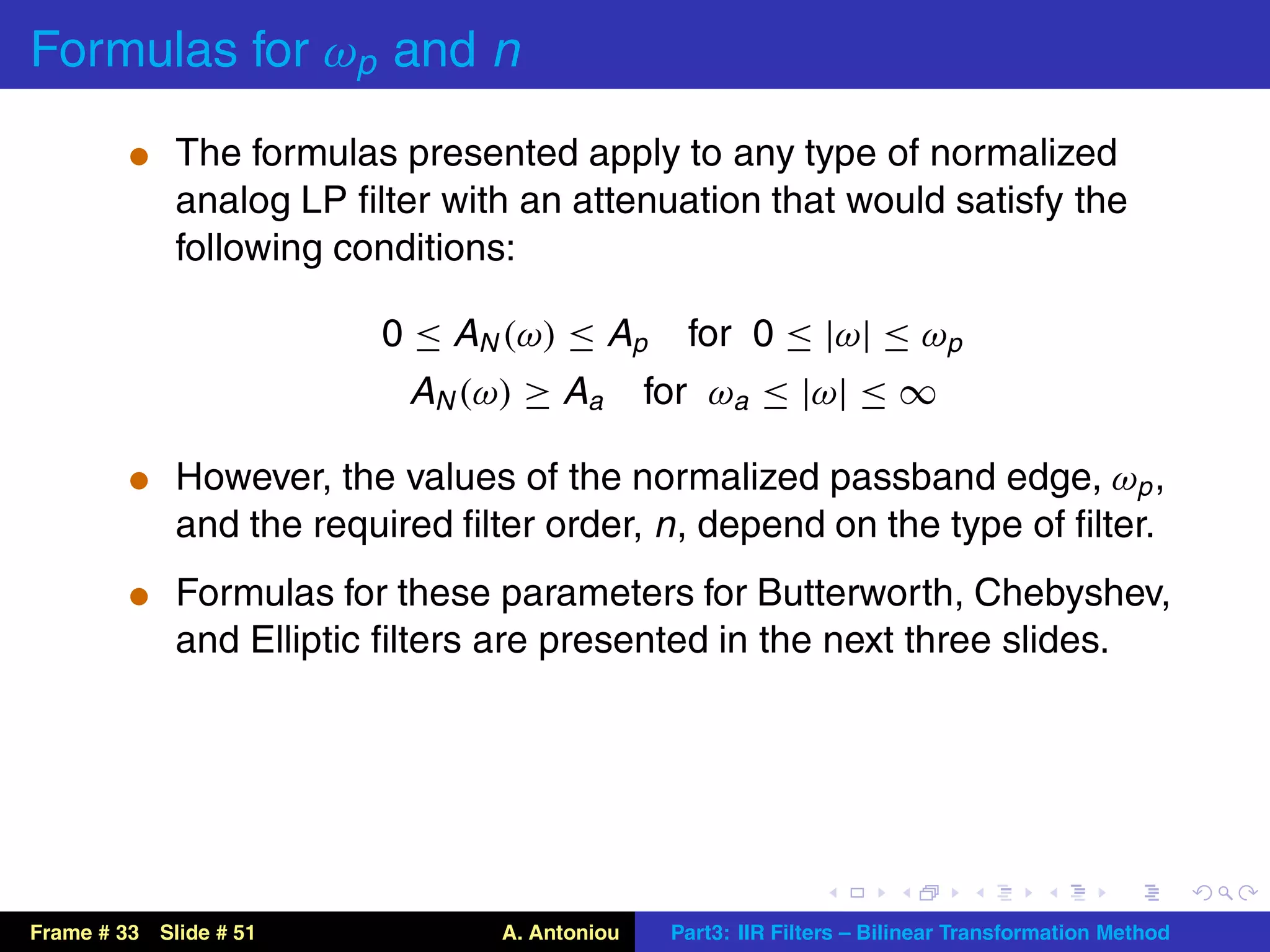
Formulas for ωp and n
          t The formulas presented apply to any type of normalized
             analog LP filter with an attenuation that would satisfy the
             following conditions:

                         0 ≤ AN (ω) ≤ Ap        for 0 ≤ |ω| ≤ ωp
                           AN (ω) ≥ Aa        for ωa ≤ |ω| ≤ ∞


Frame # 33 Slide # 49           A. Antoniou    Part3: IIR Filters – Bilinear Transformation Method
Formulas for ωp and n
          t The formulas presented apply to any type of normalized
             analog LP filter with an attenuation that would satisfy the
             following conditions:

                          0 ≤ AN (ω) ≤ Ap        for 0 ≤ |ω| ≤ ωp
                           AN (ω) ≥ Aa         for ωa ≤ |ω| ≤ ∞

          t However, the values of the normalized passband edge, ωp ,
             and the required filter order, n , depend on the type of filter.


Frame # 33 Slide # 50            A. Antoniou    Part3: IIR Filters – Bilinear Transformation Method
Formulas for ωp and n
          t The formulas presented apply to any type of normalized
             analog LP filter with an attenuation that would satisfy the
             following conditions:

                          0 ≤ AN (ω) ≤ Ap        for 0 ≤ |ω| ≤ ωp
                           AN (ω) ≥ Aa         for ωa ≤ |ω| ≤ ∞

          t However, the values of the normalized passband edge, ωp ,
             and the required filter order, n , depend on the type of filter.
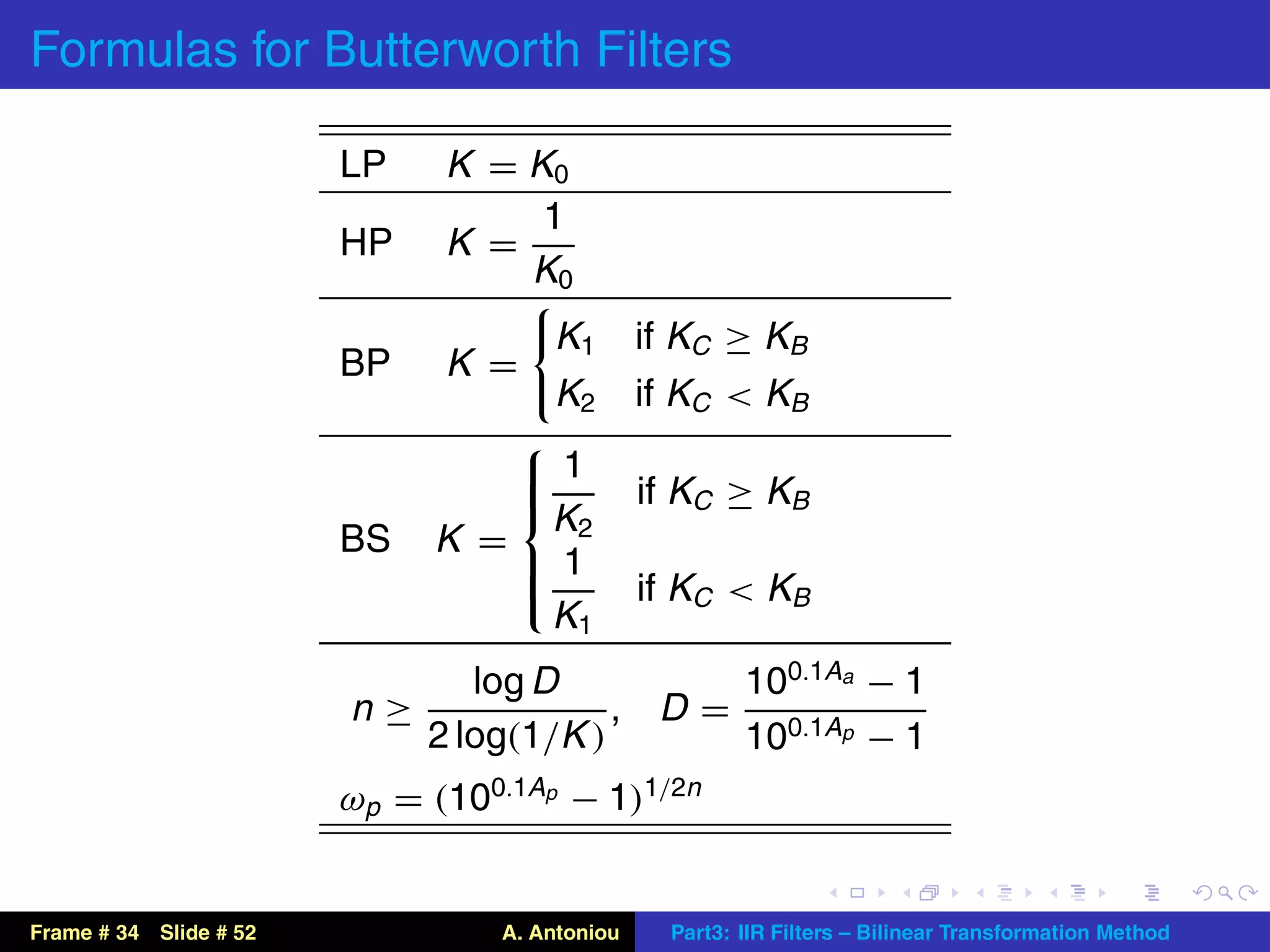
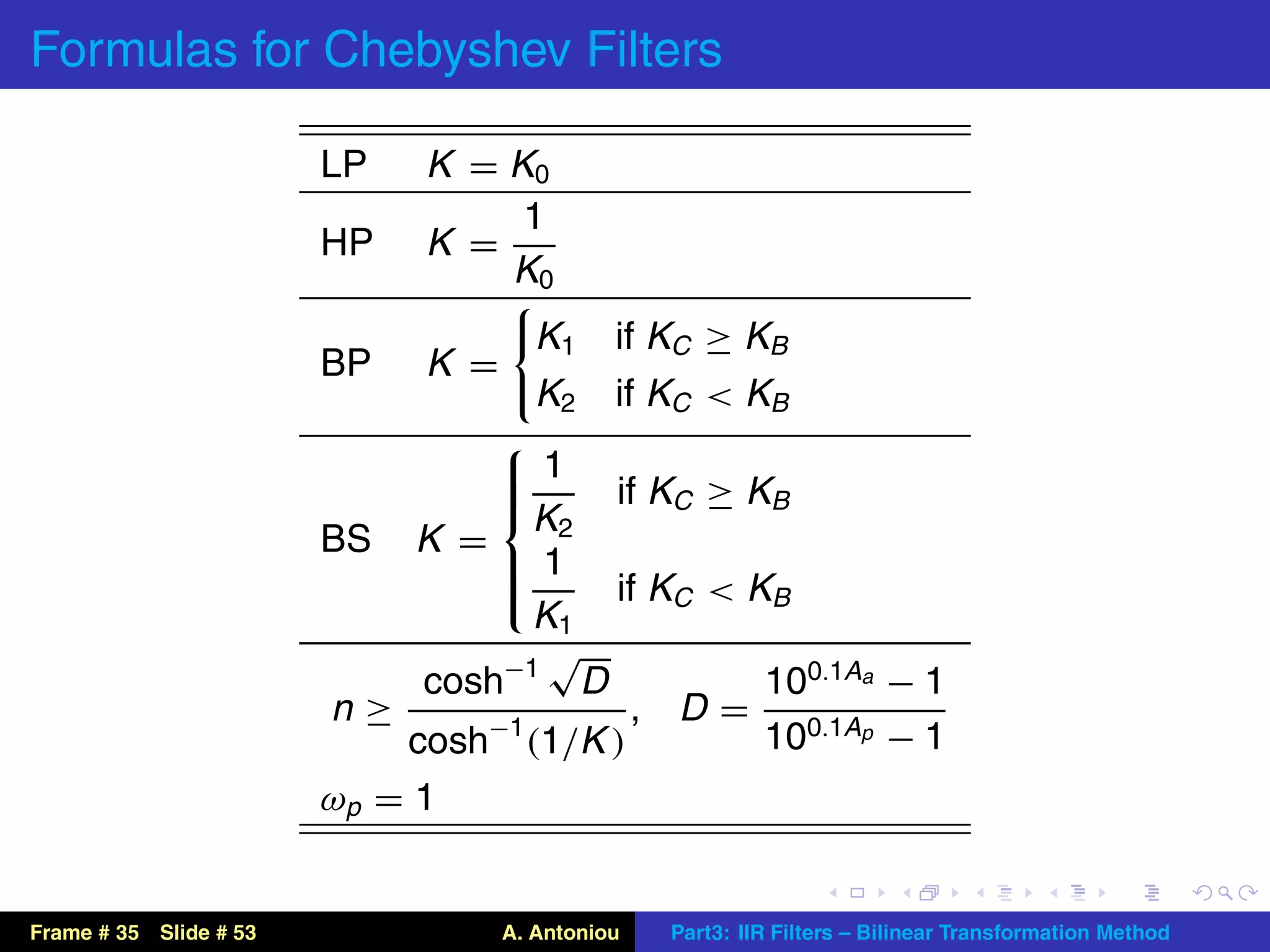
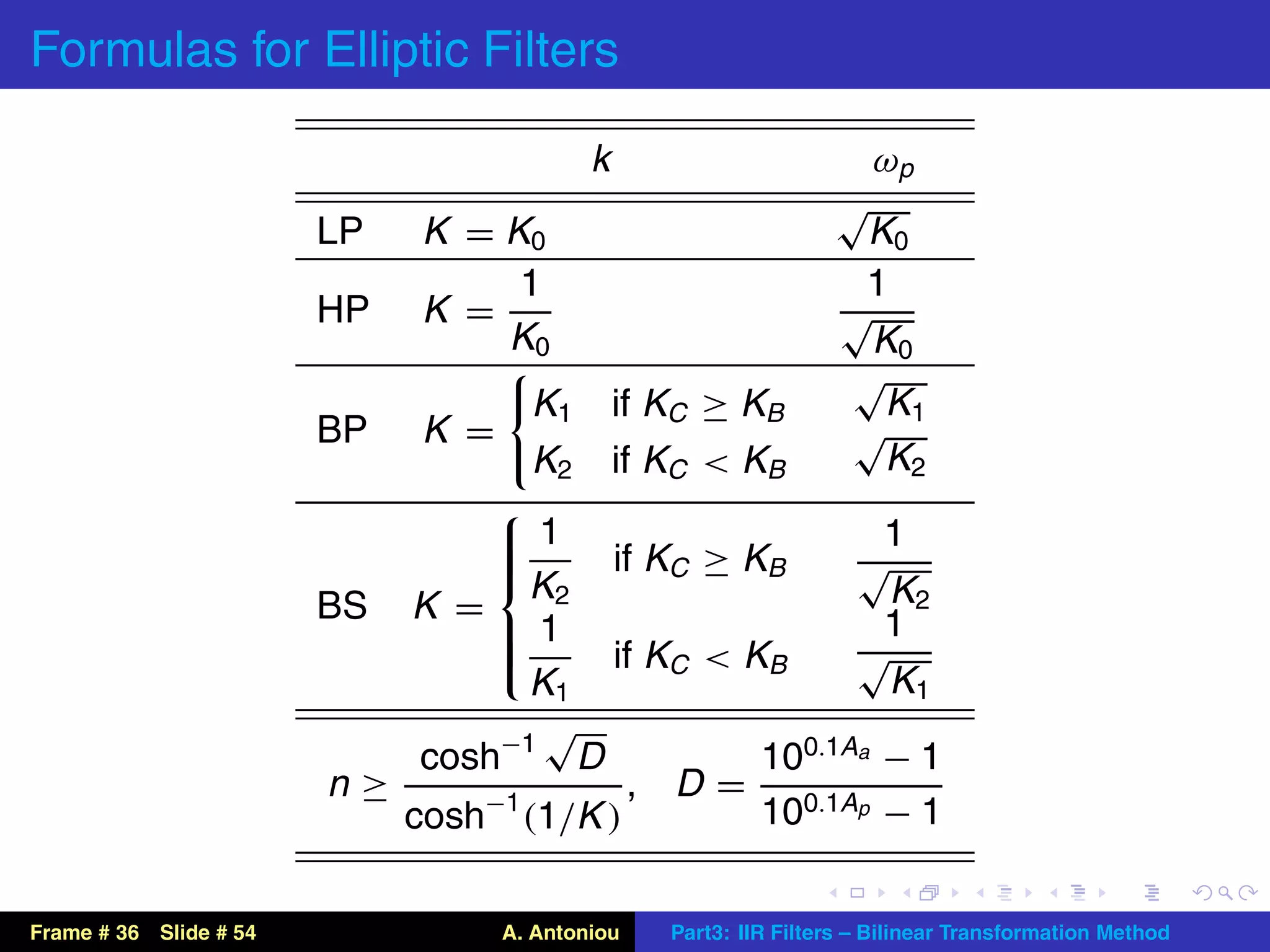
          t Formulas for these parameters for Butterworth, Chebyshev,
             and Elliptic filters are presented in the next three slides.


Frame # 33 Slide # 51            A. Antoniou    Part3: IIR Filters – Bilinear Transformation Method
Formulas for Butterworth Filters

                        LP    K = K0
                                   1
                        HP    K =
                                  K0
                                     K1        if KC ≥ KB
                        BP    K =
                                     K2        if KC < KB
                                 ⎧
                                 ⎪1
                                 ⎪             if KC ≥ KB
                                 ⎨
                                   K2
                        BS   K =
                                 ⎪1
                                 ⎪
                                 ⎩             if KC < KB
                                   K1
                                log D         100.1Aa − 1
                        n≥               , D=
                             2 log(1/K )      100.1Ap − 1
                        ωp = (100.1Ap − 1)1/2n


Frame # 34 Slide # 52            A. Antoniou     Part3: IIR Filters – Bilinear Transformation Method
Formulas for Chebyshev Filters

                        LP   K = K0
                                  1
                        HP   K =
                                 K0
                                      K1     if KC ≥ KB
                        BP   K =
                                      K2     if KC < KB
                                ⎧
                                ⎪ 1 if K ≥ K
                                ⎪
                                ⎨          C    B
                                  K2
                        BS K =
                                ⎪1
                                ⎪
                                ⎩      if KC < KB
                                  K1
                                   √
                            cosh−1 D            100.1Aa − 1
                        n≥               , D=
                           cosh−1 (1/K )        100.1Ap − 1
                        ωp = 1


Frame # 35 Slide # 53              A. Antoniou   Part3: IIR Filters – Bilinear Transformation Method
Formulas for Elliptic Filters

                                           k                          ωp
                                                                  √
                        LP   K = K0                                 K0
                                  1                                 1
                        HP   K =                                   √
                                 K0                                  K0
                                                                   √
                                     K1        if KC ≥ KB             K
                        BP   K =                                   √ 1
                                     K2        if KC < KB             K2
                                ⎧
                                ⎪1
                                ⎪                       1
                                ⎨      if KC ≥ KB     √
                                  K2                    K2
                        BS K =
                                ⎪1
                                ⎪                       1
                                ⎩      if KC < KB     √
                                  K1                    K1
                                   √
                            cosh−1 D            100.1Aa − 1
                        n≥               , D=
                           cosh−1 (1/K )        100.1Ap − 1


Frame # 36 Slide # 54              A. Antoniou    Part3: IIR Filters – Bilinear Transformation Method
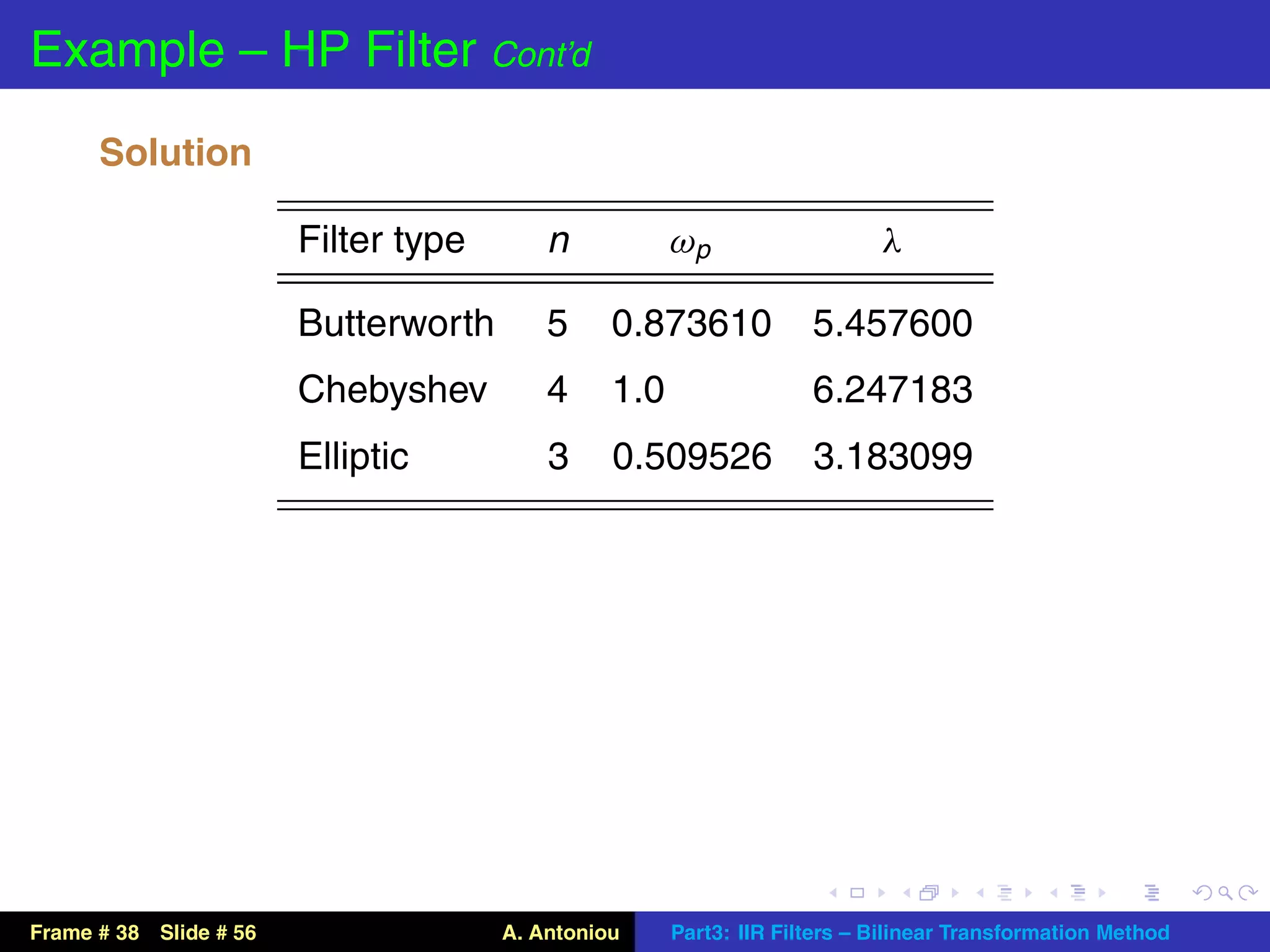
Example – HP Filter
      An HP filter that would satisfy the following specifications is
      required:

                        Ap = 1 dB, Aa = 45 dB,           ˜ p = 3.5 rad/s,

                             ˜ a = 1.5 rad/s, ωs = 10 rad/s.

      Design a Butterworth, a Chebyshev, and then an Elliptic digital
      filter.


Frame # 37 Slide # 55               A. Antoniou   Part3: IIR Filters – Bilinear Transformation Method
Example – HP Filter Cont’d
      Solution

                        Filter type       n           ωp                   λ

                        Butterworth       5     0.873610            5.457600
                        Chebyshev         4     1.0                 6.247183
                        Elliptic          3     0.509526            3.183099


Frame # 38 Slide # 56                 A. Antoniou     Part3: IIR Filters – Bilinear Transformation Method
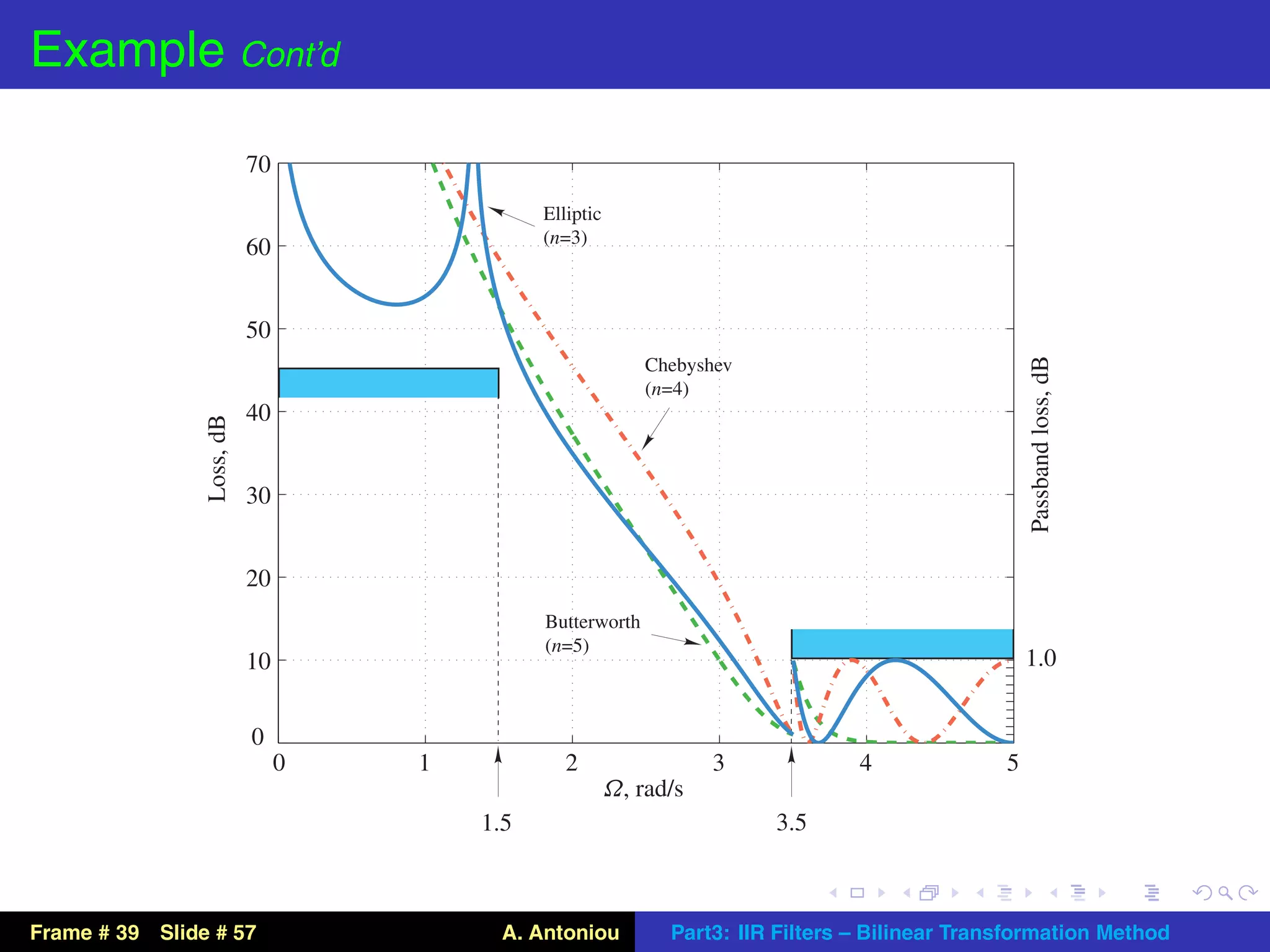
Example Cont’d

                           70
                                              Elliptic
                                              (n=3)
                           60


                           50


                                                                                                     Passband loss, dB
                                                             Chebyshev
                                                             (n=4)
                           40
                Loss, dB


                           30


                           20
                                              Butterworth
                                              (n=5)
                           10                                                                        1.0


                           0
                                0   1            2                  3             4              5
                                                         Ω, rad/s
                                        1.5                              3.5


Frame # 39 Slide # 57                     A. Antoniou          Part3: IIR Filters – Bilinear Transformation Method
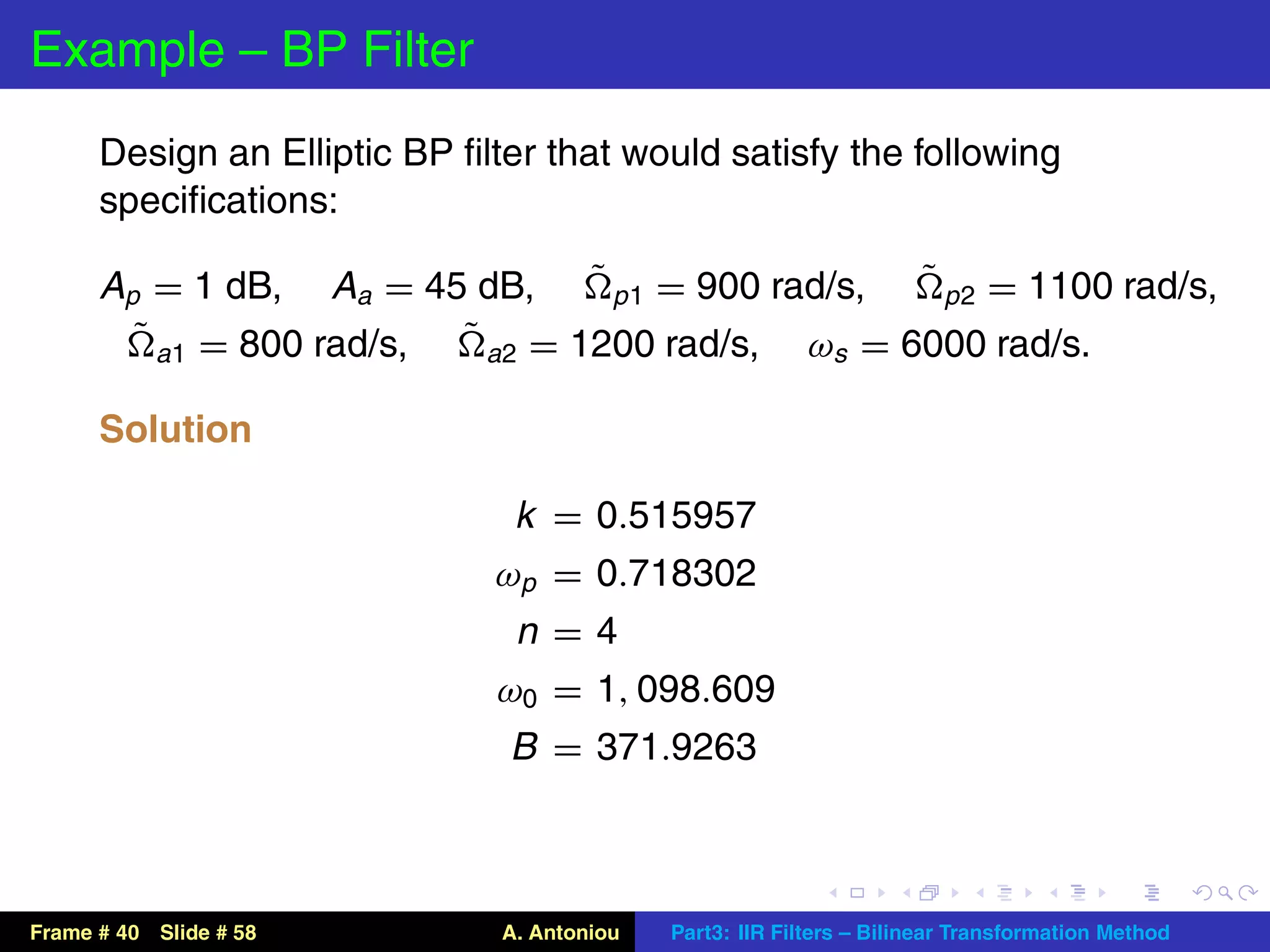
Example – BP Filter
      Design an Elliptic BP filter that would satisfy the following
      specifications:

      Ap = 1 dB, Aa = 45 dB, ˜ p 1 = 900 rad/s, ˜ p 2 = 1100 rad/s,
        ˜ a1 = 800 rad/s, ˜ a2 = 1200 rad/s, ωs = 6000 rad/s.

      Solution

                               k   = 0.515957
                              ωp   = 0.718302
                               n   =4
                              ω0   = 1, 098.609
                               B   = 371.9263


Frame # 40 Slide # 58          A. Antoniou   Part3: IIR Filters – Bilinear Transformation Method
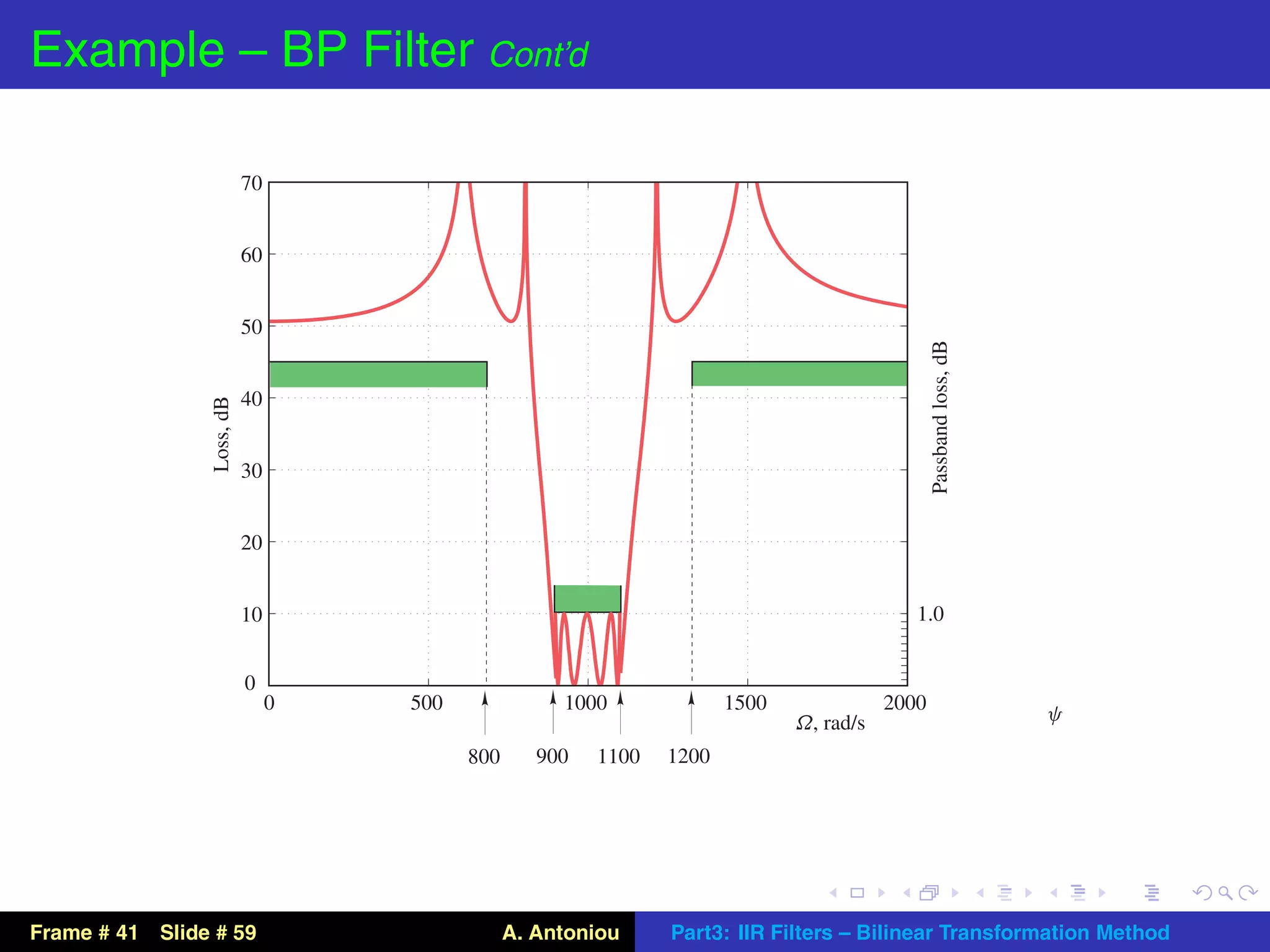
Example – BP Filter Cont’d

                           70


                           60


                           50


                                                                                                Passband loss, dB
                           40
                Loss, dB


                           30


                           20


                           10                                                               1.0


                           0
                                0   500              1000              1500              2000
                                                                              Ω, rad/s                              ψ
                                          800      900   1100   1200


Frame # 41 Slide # 59                           A. Antoniou     Part3: IIR Filters – Bilinear Transformation Method
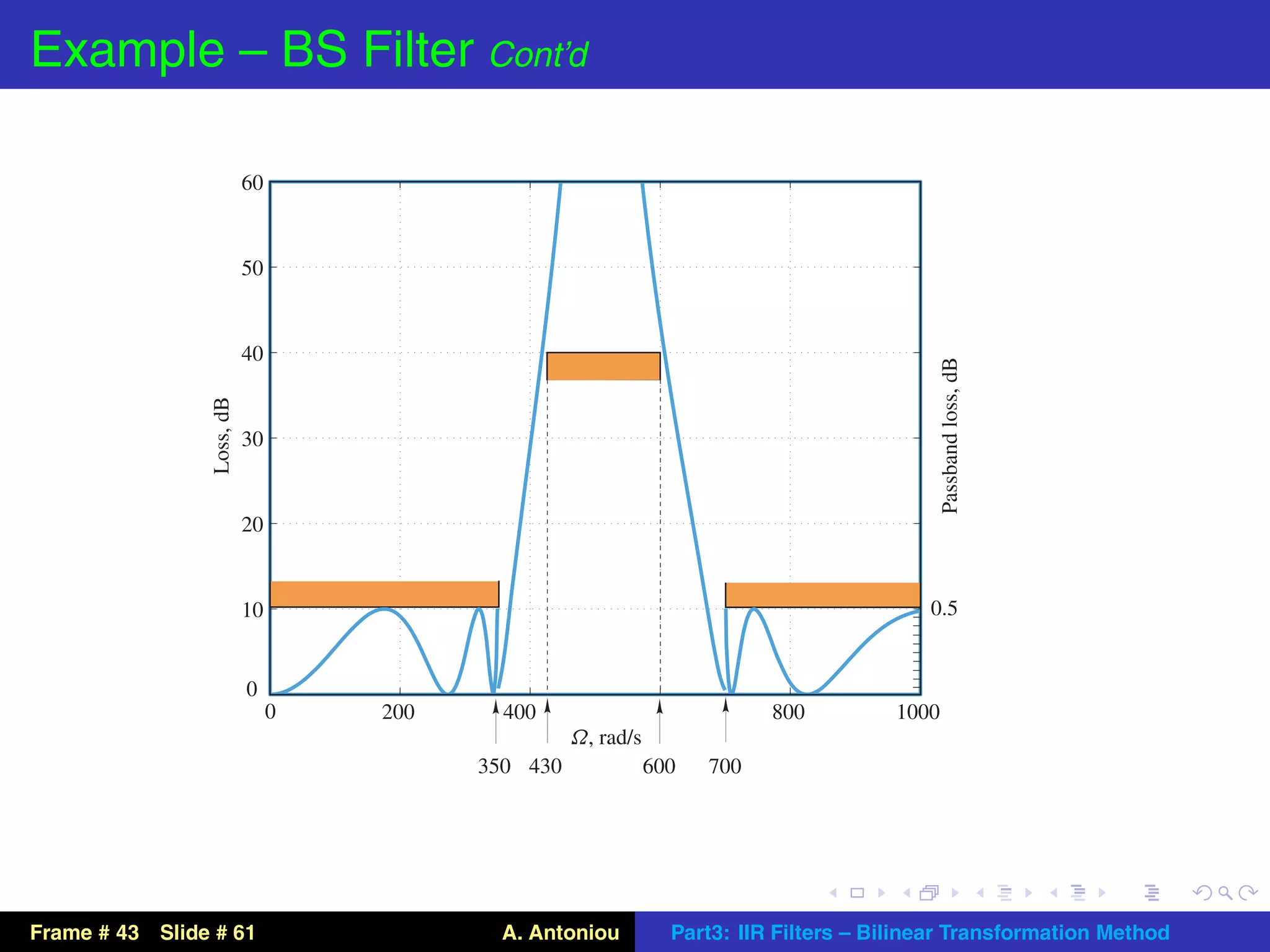
Example – BS Filter
      Design a Chebyshev BS filter that would satisfy the following
      specifications:

      Ap = 0.5 dB, Aa = 40 dB,            ˜ p 1 = 350 rad/s,            ˜ p 2 = 700 rad/s,

              ˜ a1 = 430 rad/s,   ˜ a2 = 600 rad/s,           ωs = 3000 rad/s.
      Solution

                                  ωp = 1.0
                                   n =5
                                  ω0 = 561, 4083
                                   B = 493, 2594


Frame # 42 Slide # 60             A. Antoniou   Part3: IIR Filters – Bilinear Transformation Method
Example – BS Filter Cont’d

                           60


                           50


                           40


                                                                                               Passband loss, dB
                Loss, dB


                           30


                           20


                           10                                                              0.5


                           0
                                0   200     400                            800          1000
                                                    Ω, rad/s
                                          350 430              600   700


Frame # 43 Slide # 61                       A. Antoniou          Part3: IIR Filters – Bilinear Transformation Method
D-Filter
      A DSP software package that incorporates the design
      techniques described in this presentation is D-Filter. Please see
             http://www.d-filter.ece.uvic.ca
      for more information.


Frame # 44 Slide # 62           A. Antoniou   Part3: IIR Filters – Bilinear Transformation Method
Summary
          t A design method for IIR filters that leads to a complete
             description of the transfer function in closed form either in
             terms of its zeros and poles or its coefficients has been
             described.


Frame # 45 Slide # 63            A. Antoniou   Part3: IIR Filters – Bilinear Transformation Method
Summary
          t A design method for IIR filters that leads to a complete
             description of the transfer function in closed form either in
             terms of its zeros and poles or its coefficients has been
             described.
          t The method requires very little computation and leads to
             very precise optimal designs.


Frame # 45 Slide # 64            A. Antoniou   Part3: IIR Filters – Bilinear Transformation Method
Summary
          t A design method for IIR filters that leads to a complete
             description of the transfer function in closed form either in
             terms of its zeros and poles or its coefficients has been
             described.
          t The method requires very little computation and leads to
             very precise optimal designs.
          t It can be used to design LP, HP, BP, and BS filters of the
             Butterworth, Chebyshev, Inverse-Chebyshev, Elliptic types.


Frame # 45 Slide # 65            A. Antoniou   Part3: IIR Filters – Bilinear Transformation Method
Summary
          t A design method for IIR filters that leads to a complete
             description of the transfer function in closed form either in
             terms of its zeros and poles or its coefficients has been
             described.
          t The method requires very little computation and leads to
             very precise optimal designs.
          t It can be used to design LP, HP, BP, and BS filters of the
             Butterworth, Chebyshev, Inverse-Chebyshev, Elliptic types.
          t All these designs can be carried out by using DSP software
             package D-Filter.


Frame # 45 Slide # 66            A. Antoniou   Part3: IIR Filters – Bilinear Transformation Method
References
          t A. Antoniou, Digital Signal Processing: Signals, Systems,
             and Filters, Chap. 15, McGraw-Hill, 2005.
          t A. Antoniou, Digital Signal Processing: Signals, Systems,
             and Filters, Chap. 15, McGraw-Hill, 2005.


Frame # 46 Slide # 67           A. Antoniou   Part3: IIR Filters – Bilinear Transformation Method
This slide concludes the presentation.
                Thank you for your attention.


Frame # 47 Slide # 68   A. Antoniou   Part3: IIR Filters – Bilinear Transformation Method

Warping Concept (iir filters-bilinear transformation method)

  • 1.
    Part 3: IIRFilters – Bilinear Transformation Method Tutorial ISCAS 2007 Copyright © 2007 Andreas Antoniou Victoria, BC, Canada Email: aantoniou@ieee.org July 24, 2007 Frame # 1 Slide # 1 A. Antoniou Part3: IIR Filters – Bilinear Transformation Method
  • 2.
    Introduction t A procedure for the design of IIR filters that would satisfy arbitrary prescribed specifications will be described. Frame # 2 Slide # 2 A. Antoniou Part3: IIR Filters – Bilinear Transformation Method
  • 3.
    Introduction t A procedure for the design of IIR filters that would satisfy arbitrary prescribed specifications will be described. t The method is based on the bilinear transformation and it can be used to design lowpass (LP), highpass (HP), bandpass (BP), and bandstop (BS), Butterworth, Chebyshev, Inverse-Chebyshev, and Elliptic filters. Note: The material for this module is taken from Antoniou, Digital Signal Processing: Signals, Systems, and Filters, Chap. 12.) Frame # 2 Slide # 3 A. Antoniou Part3: IIR Filters – Bilinear Transformation Method
  • 4.
    Introduction Cont’d Given an analog filter with a continuous-time transfer function HA (s ), a digital filter with a discrete-time transfer function HD (z ) can be readily deduced by applying the bilinear transformation as follows: H D (z ) = H A (s ) (A) 2 z −1 s= T z +1 Frame # 3 Slide # 4 A. Antoniou Part3: IIR Filters – Bilinear Transformation Method
  • 5.
    Introduction Cont’d The bilinear transformation method has the following important features: t A stable analog filter gives a stable digital filter. Frame # 4 Slide # 5 A. Antoniou Part3: IIR Filters – Bilinear Transformation Method
  • 6.
    Introduction Cont’d The bilinear transformation method has the following important features: t A stable analog filter gives a stable digital filter. t The maxima and minima of the amplitude response in the analog filter are preserved in the digital filter. As a consequence, – the passband ripple, and – the minimum stopband attenuation of the analog filter are preserved in the digital filter. Frame # 4 Slide # 6 A. Antoniou Part3: IIR Filters – Bilinear Transformation Method
  • 7.
    Introduction Cont’d Frame #5 Slide # 7 A. Antoniou Part3: IIR Filters – Bilinear Transformation Method
  • 8.
    Introduction Cont’d Frame #6 Slide # 8 A. Antoniou Part3: IIR Filters – Bilinear Transformation Method
  • 9.
    The Warping Effect If we let ω and represent the frequency variable in the analog filter and the derived digital filter, respectively, then Eq. (A), i.e., H D (z ) = H A (s ) (A) 2 s= T z −1 z +1 gives the frequency response of the digital filter as a function of the frequency response of the analog filter as H D (e j T ) = HA (j ω) 2 z −1 provided that s = T z +1 2 ej T −1 2 T or jω = or ω = tan (B) T ej T +1 T 2 Frame # 7 Slide # 9 A. Antoniou Part3: IIR Filters – Bilinear Transformation Method
  • 10.
    The Warping EffectCont’d ··· 2 T ω= tan (B) T 2 t For < 0.3/T ω≈ and, as a result, the digital filter has the same frequency response as the analog filter over this frequency range. Frame # 8 Slide # 10 A. Antoniou Part3: IIR Filters – Bilinear Transformation Method
  • 11.
    The Warping EffectCont’d ··· 2 T ω= tan (B) T 2 t For < 0.3/T ω≈ and, as a result, the digital filter has the same frequency response as the analog filter over this frequency range. t For higher frequencies, however, the relation between ω and becomes nonlinear, and distortion is introduced in the frequency scale of the digital filter relative to that of the analog filter. This is known as the warping effect. Frame # 8 Slide # 11 A. Antoniou Part3: IIR Filters – Bilinear Transformation Method
  • 12.
    The Warping EffectCont’d 6.0 T=2 4.0 ω 2.0 |HA(jω)| 0.1π 0.2π 0.3π 0.4π 0.5π Ω, rad/s |HD(e jΩT)| Frame # 9 Slide # 12 A. Antoniou Part3: IIR Filters – Bilinear Transformation Method
  • 13.
    The Warping EffectCont’d The warping effect changes the band edges of the digital filter relative to those of the analog filter in a nonlinear way, as illustrated for the case of a BS filter: 40 35 30 Digital Analog 25 filter filter Loss, dB 20 15 10 5 0 0 1 2 3 4 5 ω, rad/s Frame # 10 Slide # 13 A. Antoniou Part3: IIR Filters – Bilinear Transformation Method
  • 14.
    Prewarping t From Eq. (B), i.e., 2 T ω= tan (B) T 2 a frequency ω in the analog filter corresponds to a frequency in the digital filter and hence 2 ωT = tan−1 T 2 Frame # 11 Slide # 14 A. Antoniou Part3: IIR Filters – Bilinear Transformation Method
  • 15.
    Prewarping t From Eq. (B), i.e., 2 T ω= tan (B) T 2 a frequency ω in the analog filter corresponds to a frequency in the digital filter and hence 2 ωT = tan−1 T 2 t If ω1 , ω2 , . . . , ωi , . . . are the passband and stopband edges in the analog filter, then the corresponding passband and stopband edges in the derived digital filter are given by 2 ωi T i = tan−1 i = 1, 2, . . . T 2 Frame # 11 Slide # 15 A. Antoniou Part3: IIR Filters – Bilinear Transformation Method
  • 16.
    Prewarping Cont’d t If prescribed passband and stopband edges ˜ 1 , ˜ 2 , . . . , ˜ i , . . . are to be achieved, the analog filter must be prewarped before the application of the bilinear transformation to ensure that its band edges are given by 2 ˜ iT ωi = tan T 2 Frame # 12 Slide # 16 A. Antoniou Part3: IIR Filters – Bilinear Transformation Method
  • 17.
    Prewarping Cont’d t If prescribed passband and stopband edges ˜ 1 , ˜ 2 , . . . , ˜ i , . . . are to be achieved, the analog filter must be prewarped before the application of the bilinear transformation to ensure that its band edges are given by 2 ˜ iT ωi = tan T 2 t Then the band edges of the digital filter would assume their prescribed values i since 2 ωi T i = tan−1 T 2 2 T 2 ˜ iT = tan−1 · tan T 2 T 2 = ˜i for i = 1, 2, . . . Frame # 12 Slide # 17 A. Antoniou Part3: IIR Filters – Bilinear Transformation Method
  • 18.
    Design Procedure Consider a normalized analog LP filter characterized by HN (s ) with an attenuation 1 AN (ω) = 20 log |HN (j ω)| (also known as loss) and assume that 0 ≤ AN (ω) ≤ Ap for 0 ≤ |ω| ≤ ωp AN (ω) ≥ Aa for ωa ≤ |ω| ≤ ∞ Note: The transfer functions of analog LP filters are reported in the literature in normalized form whereby the passband edge is typically of the order of unity. Frame # 13 Slide # 18 A. Antoniou Part3: IIR Filters – Bilinear Transformation Method
  • 19.
    Design Procedure Cont’d A(ω) Aa Ap ω ωp ωc ωa Frame # 14 Slide # 19 A. Antoniou Part3: IIR Filters – Bilinear Transformation Method
  • 20.
    Design Procedure A denormalized LP, HP, BP, or BS filter that has the same passband ripple and minimum stopband attenuation as a given normalized LP filter can be derived from the normalized LP filter through the following steps: ¯ 1. Apply the transformation s = fX (s ) ¯ H X (s ) = H N (s ) ¯ s =fX (s ) ¯ where fX (s ) is one of the four standard analog-filters transformations, given by the next slide. Frame # 15 Slide # 20 A. Antoniou Part3: IIR Filters – Bilinear Transformation Method
  • 21.
    Design Procedure A denormalized LP, HP, BP, or BS filter that has the same passband ripple and minimum stopband attenuation as a given normalized LP filter can be derived from the normalized LP filter through the following steps: ¯ 1. Apply the transformation s = fX (s ) ¯ H X (s ) = H N (s ) ¯ s =fX (s ) ¯ where fX (s ) is one of the four standard analog-filters transformations, given by the next slide. ¯ 2. Apply the bilinear transformation to HX (s ), i.e., ¯ H D (z ) = H X (s ) z −1 ¯ 2 s= T z +1 Frame # 15 Slide # 21 A. Antoniou Part3: IIR Filters – Bilinear Transformation Method
  • 22.
    Design Procedure Cont’d ¯ Standard forms of fX (s ) X ¯ fX (s ) LP ¯ λs HP ¯ λ/s ω02 BP 1 ¯ s+ B s¯ Bs¯ BS ¯ s 2 + ω0 2 Frame # 16 Slide # 22 A. Antoniou Part3: IIR Filters – Bilinear Transformation Method
  • 23.
    Design Procedure Cont’d t The digital filter designed by this method will have the required passband and stopband edges only if the parameters λ, ω0 , and B of the analog-filter transformations and the order of the continuous-time normalized LP transfer function, HN (s ), are chosen appropriately. Frame # 17 Slide # 23 A. Antoniou Part3: IIR Filters – Bilinear Transformation Method
  • 24.
    Design Procedure Cont’d t The digital filter designed by this method will have the required passband and stopband edges only if the parameters λ, ω0 , and B of the analog-filter transformations and the order of the continuous-time normalized LP transfer function, HN (s ), are chosen appropriately. t This is obviously a difficult problem but general solutions are available for LP, HP, BP, and BS, Butterworth, Chebyshev, inverse-Chebyshev, and Elliptic filters. Frame # 17 Slide # 24 A. Antoniou Part3: IIR Filters – Bilinear Transformation Method
  • 25.
    General Design Procedurefor LP Filters An outline of the methodology for the derivation of general solutions for LP filters is as follows: 1. Assume that a continuous-time normalized LP transfer function, HN (s ), is available that would give the required passband ripple, Ap , and minimum stopband attenuation (loss), Aa . Let the passband and stopband edges of the analog filter be ωp and ωa , respectively. Frame # 18 Slide # 25 A. Antoniou Part3: IIR Filters – Bilinear Transformation Method
  • 26.
    Design of LPFilters Cont’d A(ω) Aa Ap ω ωp ωc ωa Attenuation characteristic of continuous-time normalized LP filter Frame # 19 Slide # 26 A. Antoniou Part3: IIR Filters – Bilinear Transformation Method
  • 27.
    Design of LPFilters Cont’d 2. Apply the LP-to-LP analog-filter transformation to HN (s ) to obtain a denormalized discrete-time transfer function ¯ HLP (s ). Frame # 20 Slide # 27 A. Antoniou Part3: IIR Filters – Bilinear Transformation Method
  • 28.
    Design of LPFilters Cont’d 2. Apply the LP-to-LP analog-filter transformation to HN (s ) to obtain a denormalized discrete-time transfer function ¯ HLP (s ). ¯ 3. Apply the bilinear transformation to HLP (s ) to obtain a discrete-time transfer function HD (z ). Frame # 20 Slide # 28 A. Antoniou Part3: IIR Filters – Bilinear Transformation Method
  • 29.
    Design of LPFilters Cont’d 2. Apply the LP-to-LP analog-filter transformation to HN (s ) to obtain a denormalized discrete-time transfer function ¯ HLP (s ). ¯ 3. Apply the bilinear transformation to HLP (s ) to obtain a discrete-time transfer function HD (z ). 4. At this point, assume that the derived discrete-time transfer function has passband and stopband edges that satisfy the relations ˜ p ≤ p and a ≤ ˜a where ˜ p and ˜ a are the prescribed passband and stopband edges, respectively. In effect, we assume that the digital filter has passband and stopband edges that satisfy or oversatisfy the required specifications. Frame # 20 Slide # 29 A. Antoniou Part3: IIR Filters – Bilinear Transformation Method
  • 30.
    Design of LPFilters Cont’d A(Ω) Aa Ap Ω ~ ~ Ωp Ωp Ωa Ωa Attenuation characteristic of required LP digital filter Frame # 21 Slide # 30 A. Antoniou Part3: IIR Filters – Bilinear Transformation Method
  • 31.
    Design of LPFilters Cont’d 5. Solve for λ, the parameter of the LP-to-LP analog-filter transformation. Frame # 22 Slide # 31 A. Antoniou Part3: IIR Filters – Bilinear Transformation Method
  • 32.
    Design of LPFilters Cont’d 5. Solve for λ, the parameter of the LP-to-LP analog-filter transformation. 6. Find the minimum value of the ratio ωp /ωa for the continuous-time normalized LP transfer function. The ratio ωp /ωa is a fraction less than unity and it is a measure of the steepness of the transition characteristic. It is often referred to as the selectivity of the filter. The selectivity of a filter dictates the minimum order to achieve the required specifications. Note: As the selectivity approaches unity, the filter-order tends to infinity! Frame # 22 Slide # 32 A. Antoniou Part3: IIR Filters – Bilinear Transformation Method
  • 33.
    Design of LPFilters Cont’d 7. The same methodology is applicable for HP filters, except that the LP-HP analog-filter transformation is used in Step 2. Frame # 23 Slide # 33 A. Antoniou Part3: IIR Filters – Bilinear Transformation Method
  • 34.
    Design of LPFilters Cont’d 7. The same methodology is applicable for HP filters, except that the LP-HP analog-filter transformation is used in Step 2. 8. The application of this methodology yields the formulas summarized by the table shown in the next slide. Frame # 23 Slide # 34 A. Antoniou Part3: IIR Filters – Bilinear Transformation Method
  • 35.
    Formulas for LPand HP Filters ωp ≥ K0 ωa LP ωp T λ= 2 tan( ˜ p T /2) ωp 1 ≥ ωa K0 HP 2ωp tan( ˜ p T /2) λ= T tan( ˜ p T /2) where K0 = tan( ˜ a T /2) Frame # 24 Slide # 35 A. Antoniou Part3: IIR Filters – Bilinear Transformation Method
  • 36.
    Design of LPFilters Cont’d t The table of formulas presented is applicable to all the classical types of analog filters, namely, – Butterworth – Chebyshev – Inverse-Chebyshev – Elliptic Frame # 25 Slide # 36 A. Antoniou Part3: IIR Filters – Bilinear Transformation Method
  • 37.
    Design of LPFilters Cont’d t The table of formulas presented is applicable to all the classical types of analog filters, namely, – Butterworth – Chebyshev – Inverse-Chebyshev – Elliptic t Formulas that can be used to design digital versions of these filters will be presented later. Frame # 25 Slide # 37 A. Antoniou Part3: IIR Filters – Bilinear Transformation Method
  • 38.
    General Design Procedurefor BP Filters An outline of the methodology for the derivation of general solutions for BP filters is as follows: 1. Assume that a continuous-time normalized LP transfer function, HN (s ), is available that would give the required passband ripple, Ap , and minimum stopband attenuation, Aa . Let the passband and stopband edges of the analog filter be ωp and ωa , respectively. Frame # 26 Slide # 38 A. Antoniou Part3: IIR Filters – Bilinear Transformation Method
  • 39.
    Design of BPFilters Cont’d 2. Apply the LP-to-BP analog-filter transformation to HN (s ) to obtain a denormalized discrete-time transfer function ¯ HBP (s ). Frame # 27 Slide # 39 A. Antoniou Part3: IIR Filters – Bilinear Transformation Method
  • 40.
    Design of BPFilters Cont’d 2. Apply the LP-to-BP analog-filter transformation to HN (s ) to obtain a denormalized discrete-time transfer function ¯ HBP (s ). ¯ 3. Apply the bilinear transformation to HBP (s ) to obtain a discrete-time transfer function HD (z ). Frame # 27 Slide # 40 A. Antoniou Part3: IIR Filters – Bilinear Transformation Method
  • 41.
    Design of BPFilters Cont’d 4. At this point, assume that the derived discrete-time transfer function has passband and stopband edges that satisfy the relations ˜ p1 ≤ p1 ˜ p2 ≥ p2 and a1 ≥ ˜ a1 a2 ≤ ˜ a2 where – p 1 and p 2 are the actual lower and upper passband edges, – ˜ p 1 and ˜ p 2 are the prescribed lower and upper passband edges, – a1 and a2 are the actual lower and upper stopband edges, – ˜ p 1 and ˜ p 2 are the prescribed lower and upper stopband edges, respectively. Frame # 28 Slide # 41 A. Antoniou Part3: IIR Filters – Bilinear Transformation Method
  • 42.
    Design of LPFilters Cont’d A(Ω) Aa Aa Ap Ω ~ ~ Ωa1 Ωp1 Ωp2 Ωa2 Ωa1 ~ ~ Ωa2 Ωp1 Ωp2 Attenuation characteristic of required BP digital filter Frame # 29 Slide # 42 A. Antoniou Part3: IIR Filters – Bilinear Transformation Method
  • 43.
    Design of LPFilters Cont’d 5. Solve for B and ω0 , the parameters of the LP-to-BP analog-filter transformation. Frame # 30 Slide # 43 A. Antoniou Part3: IIR Filters – Bilinear Transformation Method
  • 44.
    Design of LPFilters Cont’d 5. Solve for B and ω0 , the parameters of the LP-to-BP analog-filter transformation. 6. Find the minimum value for the selectivity, i.e., the ratio ωp /ωa , for the continuous-time normalized LP transfer function. Frame # 30 Slide # 44 A. Antoniou Part3: IIR Filters – Bilinear Transformation Method
  • 45.
    Design of LPFilters Cont’d 5. Solve for B and ω0 , the parameters of the LP-to-BP analog-filter transformation. 6. Find the minimum value for the selectivity, i.e., the ratio ωp /ωa , for the continuous-time normalized LP transfer function. 7. The same methodology can be used for the design of BS filters except that the LP-to-BS transformation is used in Step 2. Frame # 30 Slide # 45 A. Antoniou Part3: IIR Filters – Bilinear Transformation Method
  • 46.
    Design of LPFilters Cont’d 5. Solve for B and ω0 , the parameters of the LP-to-BP analog-filter transformation. 6. Find the minimum value for the selectivity, i.e., the ratio ωp /ωa , for the continuous-time normalized LP transfer function. 7. The same methodology can be used for the design of BS filters except that the LP-to-BS transformation is used in Step 2. 8. The application of this methodology yields the formulas summarized in the next two slides. Frame # 30 Slide # 46 A. Antoniou Part3: IIR Filters – Bilinear Transformation Method
  • 47.
    Formulas for thedesign of BP Filters √ 2 KB ω0 = T ωp K1 if KC ≥ KB BP ≥ ωa K2 if KC < KB 2KA B= T ωp ˜ p2T ˜ p 1T ˜ p 1T ˜ p2T where KA = tan − tan KB = tan tan 2 2 2 2 ˜ a1 T ˜ a2 T KA tan( ˜ a1 T /2) KC = tan tan K1 = 2 2 KB − tan2 ( ˜ a1 T /2) KA tan( ˜ a2 T /2) K2 = tan2 ( ˜ a2 T /2) − KB Frame # 31 Slide # 47 A. Antoniou Part3: IIR Filters – Bilinear Transformation Method
  • 48.
    Formulas for theDesign of BS Filters √ 2 KB ω0 = T ⎧ ⎪1 ⎪ ⎨ if KC ≥ KB ωp K2 BS ≥ ωa ⎪ 1 ⎪ ⎩ if KC < KB K1 2KA ωp B= T ˜ p2T ˜ p 1T ˜ p 1T ˜ p2T where KA = tan − tan KB = tan tan 2 2 2 2 ˜ a1 T ˜ a2 T KA tan( ˜ a1 T /2) KC = tan tan K1 = 2 2 KB − tan2 ( ˜ a1 T /2) KA tan( ˜ a2 T /2) K2 = tan2 ( ˜ a2 T /2) − KB Frame # 32 Slide # 48 A. Antoniou Part3: IIR Filters – Bilinear Transformation Method
  • 49.
    Formulas for ωpand n t The formulas presented apply to any type of normalized analog LP filter with an attenuation that would satisfy the following conditions: 0 ≤ AN (ω) ≤ Ap for 0 ≤ |ω| ≤ ωp AN (ω) ≥ Aa for ωa ≤ |ω| ≤ ∞ Frame # 33 Slide # 49 A. Antoniou Part3: IIR Filters – Bilinear Transformation Method
  • 50.
    Formulas for ωpand n t The formulas presented apply to any type of normalized analog LP filter with an attenuation that would satisfy the following conditions: 0 ≤ AN (ω) ≤ Ap for 0 ≤ |ω| ≤ ωp AN (ω) ≥ Aa for ωa ≤ |ω| ≤ ∞ t However, the values of the normalized passband edge, ωp , and the required filter order, n , depend on the type of filter. Frame # 33 Slide # 50 A. Antoniou Part3: IIR Filters – Bilinear Transformation Method
  • 51.
    Formulas for ωpand n t The formulas presented apply to any type of normalized analog LP filter with an attenuation that would satisfy the following conditions: 0 ≤ AN (ω) ≤ Ap for 0 ≤ |ω| ≤ ωp AN (ω) ≥ Aa for ωa ≤ |ω| ≤ ∞ t However, the values of the normalized passband edge, ωp , and the required filter order, n , depend on the type of filter. t Formulas for these parameters for Butterworth, Chebyshev, and Elliptic filters are presented in the next three slides. Frame # 33 Slide # 51 A. Antoniou Part3: IIR Filters – Bilinear Transformation Method
  • 52.
    Formulas for ButterworthFilters LP K = K0 1 HP K = K0 K1 if KC ≥ KB BP K = K2 if KC < KB ⎧ ⎪1 ⎪ if KC ≥ KB ⎨ K2 BS K = ⎪1 ⎪ ⎩ if KC < KB K1 log D 100.1Aa − 1 n≥ , D= 2 log(1/K ) 100.1Ap − 1 ωp = (100.1Ap − 1)1/2n Frame # 34 Slide # 52 A. Antoniou Part3: IIR Filters – Bilinear Transformation Method
  • 53.
    Formulas for ChebyshevFilters LP K = K0 1 HP K = K0 K1 if KC ≥ KB BP K = K2 if KC < KB ⎧ ⎪ 1 if K ≥ K ⎪ ⎨ C B K2 BS K = ⎪1 ⎪ ⎩ if KC < KB K1 √ cosh−1 D 100.1Aa − 1 n≥ , D= cosh−1 (1/K ) 100.1Ap − 1 ωp = 1 Frame # 35 Slide # 53 A. Antoniou Part3: IIR Filters – Bilinear Transformation Method
  • 54.
    Formulas for EllipticFilters k ωp √ LP K = K0 K0 1 1 HP K = √ K0 K0 √ K1 if KC ≥ KB K BP K = √ 1 K2 if KC < KB K2 ⎧ ⎪1 ⎪ 1 ⎨ if KC ≥ KB √ K2 K2 BS K = ⎪1 ⎪ 1 ⎩ if KC < KB √ K1 K1 √ cosh−1 D 100.1Aa − 1 n≥ , D= cosh−1 (1/K ) 100.1Ap − 1 Frame # 36 Slide # 54 A. Antoniou Part3: IIR Filters – Bilinear Transformation Method
  • 55.
    Example – HPFilter An HP filter that would satisfy the following specifications is required: Ap = 1 dB, Aa = 45 dB, ˜ p = 3.5 rad/s, ˜ a = 1.5 rad/s, ωs = 10 rad/s. Design a Butterworth, a Chebyshev, and then an Elliptic digital filter. Frame # 37 Slide # 55 A. Antoniou Part3: IIR Filters – Bilinear Transformation Method
  • 56.
    Example – HPFilter Cont’d Solution Filter type n ωp λ Butterworth 5 0.873610 5.457600 Chebyshev 4 1.0 6.247183 Elliptic 3 0.509526 3.183099 Frame # 38 Slide # 56 A. Antoniou Part3: IIR Filters – Bilinear Transformation Method
  • 57.
    Example Cont’d 70 Elliptic (n=3) 60 50 Passband loss, dB Chebyshev (n=4) 40 Loss, dB 30 20 Butterworth (n=5) 10 1.0 0 0 1 2 3 4 5 Ω, rad/s 1.5 3.5 Frame # 39 Slide # 57 A. Antoniou Part3: IIR Filters – Bilinear Transformation Method
  • 58.
    Example – BPFilter Design an Elliptic BP filter that would satisfy the following specifications: Ap = 1 dB, Aa = 45 dB, ˜ p 1 = 900 rad/s, ˜ p 2 = 1100 rad/s, ˜ a1 = 800 rad/s, ˜ a2 = 1200 rad/s, ωs = 6000 rad/s. Solution k = 0.515957 ωp = 0.718302 n =4 ω0 = 1, 098.609 B = 371.9263 Frame # 40 Slide # 58 A. Antoniou Part3: IIR Filters – Bilinear Transformation Method
  • 59.
    Example – BPFilter Cont’d 70 60 50 Passband loss, dB 40 Loss, dB 30 20 10 1.0 0 0 500 1000 1500 2000 Ω, rad/s ψ 800 900 1100 1200 Frame # 41 Slide # 59 A. Antoniou Part3: IIR Filters – Bilinear Transformation Method
  • 60.
    Example – BSFilter Design a Chebyshev BS filter that would satisfy the following specifications: Ap = 0.5 dB, Aa = 40 dB, ˜ p 1 = 350 rad/s, ˜ p 2 = 700 rad/s, ˜ a1 = 430 rad/s, ˜ a2 = 600 rad/s, ωs = 3000 rad/s. Solution ωp = 1.0 n =5 ω0 = 561, 4083 B = 493, 2594 Frame # 42 Slide # 60 A. Antoniou Part3: IIR Filters – Bilinear Transformation Method
  • 61.
    Example – BSFilter Cont’d 60 50 40 Passband loss, dB Loss, dB 30 20 10 0.5 0 0 200 400 800 1000 Ω, rad/s 350 430 600 700 Frame # 43 Slide # 61 A. Antoniou Part3: IIR Filters – Bilinear Transformation Method
  • 62.
    D-Filter A DSP software package that incorporates the design techniques described in this presentation is D-Filter. Please see http://www.d-filter.ece.uvic.ca for more information. Frame # 44 Slide # 62 A. Antoniou Part3: IIR Filters – Bilinear Transformation Method
  • 63.
    Summary t A design method for IIR filters that leads to a complete description of the transfer function in closed form either in terms of its zeros and poles or its coefficients has been described. Frame # 45 Slide # 63 A. Antoniou Part3: IIR Filters – Bilinear Transformation Method
  • 64.
    Summary t A design method for IIR filters that leads to a complete description of the transfer function in closed form either in terms of its zeros and poles or its coefficients has been described. t The method requires very little computation and leads to very precise optimal designs. Frame # 45 Slide # 64 A. Antoniou Part3: IIR Filters – Bilinear Transformation Method
  • 65.
    Summary t A design method for IIR filters that leads to a complete description of the transfer function in closed form either in terms of its zeros and poles or its coefficients has been described. t The method requires very little computation and leads to very precise optimal designs. t It can be used to design LP, HP, BP, and BS filters of the Butterworth, Chebyshev, Inverse-Chebyshev, Elliptic types. Frame # 45 Slide # 65 A. Antoniou Part3: IIR Filters – Bilinear Transformation Method
  • 66.
    Summary t A design method for IIR filters that leads to a complete description of the transfer function in closed form either in terms of its zeros and poles or its coefficients has been described. t The method requires very little computation and leads to very precise optimal designs. t It can be used to design LP, HP, BP, and BS filters of the Butterworth, Chebyshev, Inverse-Chebyshev, Elliptic types. t All these designs can be carried out by using DSP software package D-Filter. Frame # 45 Slide # 66 A. Antoniou Part3: IIR Filters – Bilinear Transformation Method
  • 67.
    References t A. Antoniou, Digital Signal Processing: Signals, Systems, and Filters, Chap. 15, McGraw-Hill, 2005. t A. Antoniou, Digital Signal Processing: Signals, Systems, and Filters, Chap. 15, McGraw-Hill, 2005. Frame # 46 Slide # 67 A. Antoniou Part3: IIR Filters – Bilinear Transformation Method
  • 68.
    This slide concludesthe presentation. Thank you for your attention. Frame # 47 Slide # 68 A. Antoniou Part3: IIR Filters – Bilinear Transformation Method