Let’s take a little trip… To a place in France, called Paris…be sure to hold on
Of course you’ve heard of Paris, right?
 
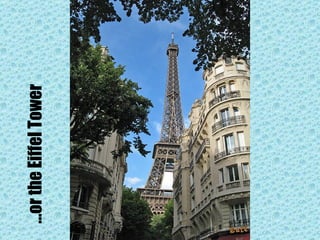
… or the Eiffel Tower
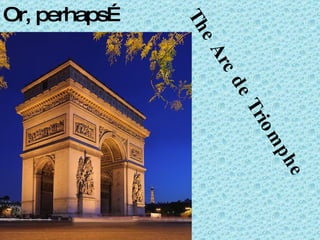
Or, perhaps… The Arc de Triomphe
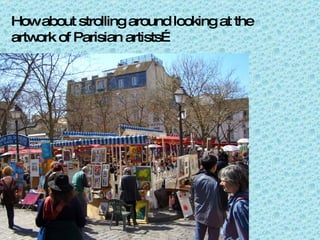
How about strolling around looking at the artwork of Parisian artists…
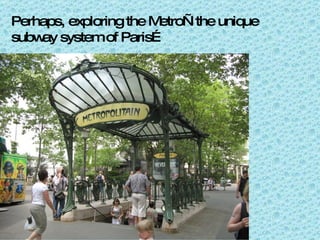
Perhaps, exploring the Metro—the unique subway system of Paris…
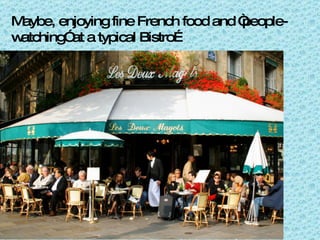
Maybe, enjoying fine French food and “people-watching” at a typical Bistro…
Or, for you serious shoppers, Champs Elysees
I know… A place a place in France you’ve probably not heard of before…
today I’m going to tell you about a different place in Paris…a place that most people  don’t even know about! … the Catacombs of Paris
“ The City  of the  Dead ” Also known as…
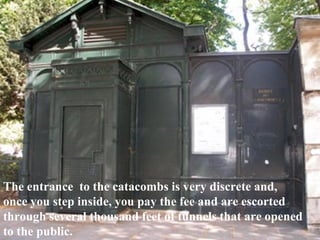
The entrance  to the catacombs is very discrete and, once you step inside, you pay the fee and are escorted  through several thousand feet of tunnels that are opened to the public.
 
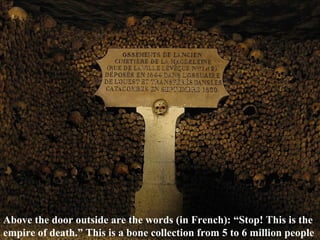
Above the door outside are the words (in French): “Stop! This is the empire of death.” This is a bone collection from 5 to 6 million people
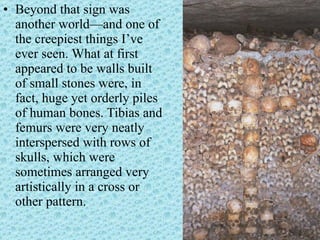
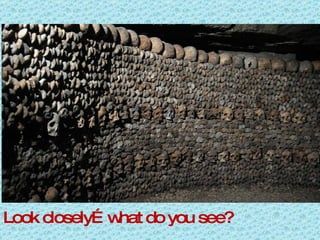
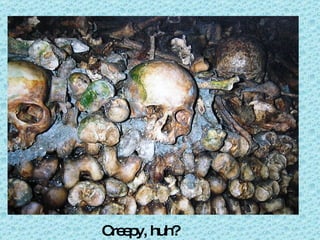
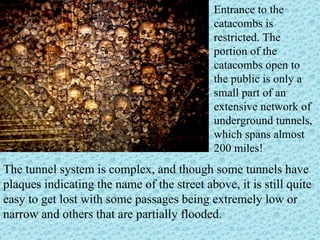
Beyond that sign was another world—and one of the creepiest things I’ve ever seen. What at first appeared to be walls built of small stones were, in fact, huge yet orderly piles of human bones. Tibias and femurs were very neatly interspersed with rows of skulls, which were sometimes arranged very artistically in a cross or other pattern.
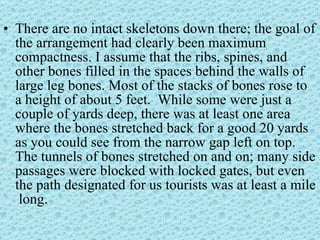
There are no intact skeletons down there; the goal of the arrangement had clearly been maximum compactness. I assume that the ribs, spines, and other bones filled in the spaces behind the walls of large leg bones. Most of the stacks of bones rose to a height of about 5 feet.  While some were just a couple of yards deep, there was at least one area where the bones stretched back for a good 20 yards  as you could see from the narrow gap left on top. The tunnels of bones stretched on and on; many side passages were blocked with locked gates, but even the path designated for us tourists was at least a mile  long.
A little history… Most of the larger churches in Paris once had their own cemeteries, but city growth and generations of dead began to become  overwhelming. From the late seventeenth century, Paris' largest Les Innocents cemetery (near the Les Halles district in the middle of the city) was saturated to a point where its neighbors were suffering from disease due to contamination caused by improper burials, open mass graves, and earth charged with decomposing organic matter.
Look closely…what do you see?
After almost a century of ineffective decrees condemning the cemetery, it was finally decided to create three new large-scale suburban cemeteries and to condemn all others existing within the city limits. The remains of all the condemned cemeteries would be moved discreetly to a renovated section of Paris's abandoned quarries. The use of the depleted quarries for the storage of bones was based on the idea of Police Lieutenant General Alexandre Lenoir
Creepy, huh?
The catacomb walls are covered in graffiti dating from the eighteenth century onwards. Victor Hugo used his knowledge about the tunnel system in  Les Misérables .  During World War II, Parisian members of the French Resistance used the tunnel system.  Also during this period, German soldiers established an underground bunker in the catacombs below Lycee Montaigne, which is a high school in the 6th arrondissement.
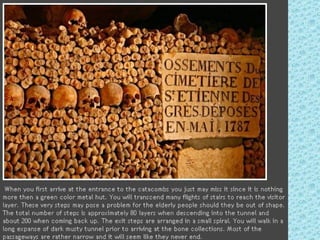
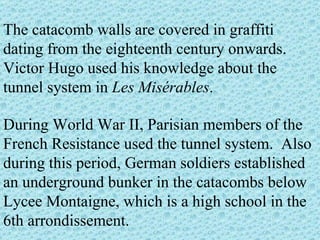
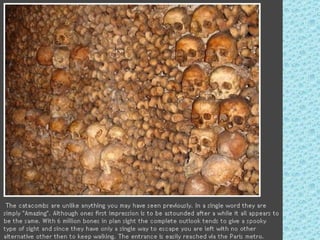
As you walk through the catacombs, you’ll see that the walls are completely lined with nicely arranged bones—I guess as nicely arranged as can be with bones!
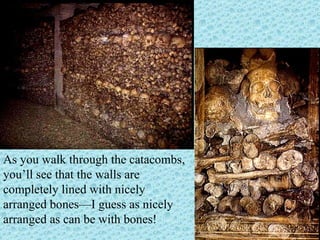
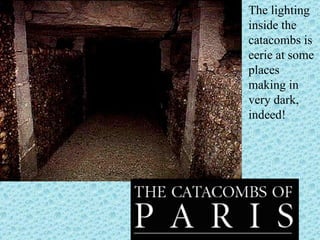
The lighting inside the catacombs is eerie at some places making in very dark, indeed!
The tunnel system is complex, and though some tunnels have plaques indicating the name of the street above, it is still quite easy to get lost with some passages being extremely low or narrow and others that are partially flooded.  Entrance to the catacombs is restricted. The portion of the catacombs open to the public is only a small part of an extensive network of underground tunnels, which spans almost 200 miles!
There are also aging telephone wires, pipes,  and things like that which can hinder progress.  Cave-ins, although somewhat rare, do occasionally occur.  So a good guide is necessary, even though many of the guides will still refer to a map from time to time. Because of these potential dangers, since November 1955, it has been illegal to access the catacombs unescorted by officials and there are special police who patrol the catacombs. However, secret entrances do exist throughout Paris and it is possible to enter the catacombs via the sewers, metro, and certain manholes.  Some unofficial visitors also hold keys to certain official entrances. 
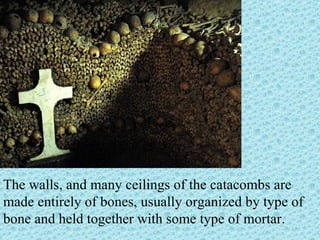
The walls, and many ceilings of the catacombs are made entirely of bones, usually organized by type of bone and held together with some type of mortar.
 
Finis (French for the end)… Thanks for your time…any questions?

Paris Class Presentation

  • 1.
  • 2.
    Let’s take alittle trip… To a place in France, called Paris…be sure to hold on
  • 3.
    Of course you’veheard of Paris, right?
  • 4.
  • 5.
    … or theEiffel Tower
  • 6.
    Or, perhaps… TheArc de Triomphe
  • 7.
    How about strollingaround looking at the artwork of Parisian artists…
  • 8.
    Perhaps, exploring theMetro—the unique subway system of Paris…
  • 9.
    Maybe, enjoying fineFrench food and “people-watching” at a typical Bistro…
  • 10.
    Or, for youserious shoppers, Champs Elysees
  • 11.
    I know… Aplace a place in France you’ve probably not heard of before…
  • 12.
    today I’m goingto tell you about a different place in Paris…a place that most people don’t even know about! … the Catacombs of Paris
  • 13.
    “ The City of the Dead ” Also known as…
  • 14.
    The entrance to the catacombs is very discrete and, once you step inside, you pay the fee and are escorted through several thousand feet of tunnels that are opened to the public.
  • 15.
  • 16.
    Above the dooroutside are the words (in French): “Stop! This is the empire of death.” This is a bone collection from 5 to 6 million people
  • 17.
    Beyond that signwas another world—and one of the creepiest things I’ve ever seen. What at first appeared to be walls built of small stones were, in fact, huge yet orderly piles of human bones. Tibias and femurs were very neatly interspersed with rows of skulls, which were sometimes arranged very artistically in a cross or other pattern.
  • 18.
    There are nointact skeletons down there; the goal of the arrangement had clearly been maximum compactness. I assume that the ribs, spines, and other bones filled in the spaces behind the walls of large leg bones. Most of the stacks of bones rose to a height of about 5 feet. While some were just a couple of yards deep, there was at least one area where the bones stretched back for a good 20 yards as you could see from the narrow gap left on top. The tunnels of bones stretched on and on; many side passages were blocked with locked gates, but even the path designated for us tourists was at least a mile long.
  • 19.
    A little history…Most of the larger churches in Paris once had their own cemeteries, but city growth and generations of dead began to become overwhelming. From the late seventeenth century, Paris' largest Les Innocents cemetery (near the Les Halles district in the middle of the city) was saturated to a point where its neighbors were suffering from disease due to contamination caused by improper burials, open mass graves, and earth charged with decomposing organic matter.
  • 20.
  • 21.
    After almost acentury of ineffective decrees condemning the cemetery, it was finally decided to create three new large-scale suburban cemeteries and to condemn all others existing within the city limits. The remains of all the condemned cemeteries would be moved discreetly to a renovated section of Paris's abandoned quarries. The use of the depleted quarries for the storage of bones was based on the idea of Police Lieutenant General Alexandre Lenoir
  • 22.
  • 23.
    The catacomb wallsare covered in graffiti dating from the eighteenth century onwards. Victor Hugo used his knowledge about the tunnel system in Les Misérables . During World War II, Parisian members of the French Resistance used the tunnel system.  Also during this period, German soldiers established an underground bunker in the catacombs below Lycee Montaigne, which is a high school in the 6th arrondissement.
  • 24.
    As you walkthrough the catacombs, you’ll see that the walls are completely lined with nicely arranged bones—I guess as nicely arranged as can be with bones!
  • 25.
    The lighting insidethe catacombs is eerie at some places making in very dark, indeed!
  • 26.
    The tunnel systemis complex, and though some tunnels have plaques indicating the name of the street above, it is still quite easy to get lost with some passages being extremely low or narrow and others that are partially flooded. Entrance to the catacombs is restricted. The portion of the catacombs open to the public is only a small part of an extensive network of underground tunnels, which spans almost 200 miles!
  • 27.
    There are alsoaging telephone wires, pipes, and things like that which can hinder progress. Cave-ins, although somewhat rare, do occasionally occur.  So a good guide is necessary, even though many of the guides will still refer to a map from time to time. Because of these potential dangers, since November 1955, it has been illegal to access the catacombs unescorted by officials and there are special police who patrol the catacombs. However, secret entrances do exist throughout Paris and it is possible to enter the catacombs via the sewers, metro, and certain manholes.  Some unofficial visitors also hold keys to certain official entrances. 
  • 28.
    The walls, andmany ceilings of the catacombs are made entirely of bones, usually organized by type of bone and held together with some type of mortar.
  • 29.
  • 30.
    Finis (French forthe end)… Thanks for your time…any questions?