How can parentsbe involved?
becoming part of school boards
showing dedication in their children's learning
through availing themselves during parents
meetings in order to gain a better
understanding of the performance of their
children.
being concerned about their children's
academic performance
9.
Parents can alsobe involved by means
of follow-ups with their children's
subject teachers in order to identify
areas where the children are facing
challenges.
Parental involvement is a significant
element in education
10.
PARENTS INVOLVEMENT
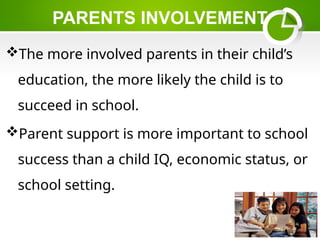
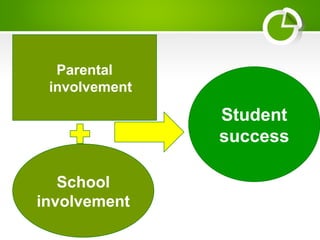
The moreinvolved parents in their child’s
education, the more likely the child is to
succeed in school.
Parent support is more important to school
success than a child IQ, economic status, or
school setting.
11.
Parent communication withschool and parent
participation can be influenced by schools.
Teachers and parents play different roles
in a child's education.
A good relationship between a teacher and a
parent, based on mutual respect and trust,
benefits.
12.
What happens whenparents are
involved?
Parent-teacher partnership makes
tremendous impact on children's
education.
• Children have better attitudes and
behavior
• Children complete more homework
• It improves academic performance
• Learners become more focused in their
school work
13.
This motivateslearners not to give up easily when they do
not understand a particular topic and will not bunk
classes because they know that their parents are always
monitoring their school attendance.
They learn to be punctual from young
age.
They learn to be persistent as the
parents would be continuously
enquiring about their progress.
14.
COMMUNICATING WITH PARENTS
Designmore effective forms of school-to-home
and home-to-school communications with all
families each month about school programs
and their children's progress.
Weekly or monthly folders of student work are
sent home and reviewed, parental comments
returned to teacher.
15.
LEARNING AT HOME
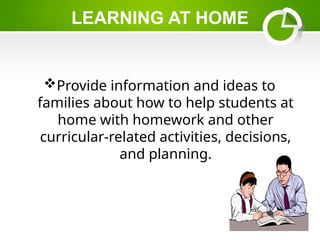
Provideinformation and ideas to
families about how to help students at
home with homework and other
curricular-related activities, decisions,
and planning.
16.
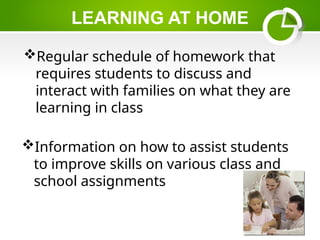
Information on howto assist students
to improve skills on various class and
school assignments
Regular schedule of homework that
requires students to discuss and
interact with families on what they are
learning in class
LEARNING AT HOME
#7 Now that we have had a chance to share some of the successes and challenges schools face when implementing parental involvement activities, let’s take a look at the requirements.
A synthesis of research is clear, positive, and convincing that families have a major influence on their children’s achievement in school and through life. (Read the slide as is. . .)
Other Resource: What Research Says About Parent Involvement in Children’s Education in Relation to Academic Achievement (Michigan Department of Education, March 2002).
Based on the needs of your audience you might want to refer to this document in the handouts.
#18 Research on Parental Involvement
Over 30 years of research has proven beyond dispute the positive connection between parent involvement and student achievement. Effectively engaging parents and families in the education of their children has the potential to be far more transformational than any other type of education reform. A few of the resources include: A New Wave of Evidence (2002); The Evidence Grows (1981); The Evidence Continues to Grow (1987); and A New Generation of Evidence: The Family Is Critical to Student Achievement (1995).
You may also want to discuss the following research findings and how they benefit parents, districts/schools, and students in long-term capacities.
Children from diverse cultural backgrounds tend to do better when parents and professionals collaborate to bridge the gap between the culture at home and the learning institution.
Students are more likely to fall behind in academic performance if their parents do not participate in school events, develop a working relationship with their child's educators, or keep up with what is happening in their child's school.
The benefits of involving parents are not confined to the early years; there are significant gains at all ages and grade levels.
Junior and senior high school students whose parents remain involved make better transitions, maintain the quality of their work, and develop realistic plans for their future. Students whose parents are not involved, on the other hand, are more likely to drop out of school.
Handout in packet:
Parental Involvement: Title I, Part A, Non-Regulatory Guidance, “Appendix C: Research-Based Resource,” USDE, April 2004
Sources:
(Condition of Education 2000, USDE, Henderson and Mapp 2002, Henderson and Berla 1994, Clark 1983; Comer 1980, 1988; Eccles, Arbreton, et al., 1993, Eccles-Parsons, Adler and Kaczala 1982; Epstein 1983, 1984; Marjoribanks 1979 as cited in Eccles and Harold 1996) Anne Henderson and Nancy Berla: The Evidence Grows (1981); The Evidence Continues to Grow (1987); and A New Generation of Evidence: The Family Is Critical to Student Achievement ,(1995).