Deep, Down Under
the Middle School
   Experience
     Ashley Horgan
     Laura Jamieson
      Daniel A. Noe
A view of a 21st Century Learner...
        A.K.A. Your Child!
SCIENCE!
Evening
Overview
All Shapes and Sizes
Dumbo and Pinocchio
Help Us From Home
Our Classroom
What YOU Can Do
Emotional Rollercoaster
One or Two Steps Ahead
All Shapes and Sizes
     There is no such thing as
     Normal!
     Need to release energy & are
     uncomfortable
       Stand in the back of the
       room
       Seat cushions
     Varying sizes of desks and
     chairs
Dumbo and Pinocchio
 • Release energy
   • Include movement
     in lessons
   • Quick 5-10 minute
     break
 • Comparing students?
 • Clumsy?
   • Pick-Up Policy
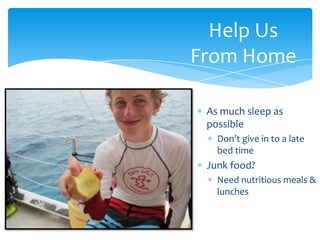
Help Us
From Home

 As much sleep as
 possible
   Don’t give in to a late
   bed time
 Junk food?
   Need nutritious meals &
   lunches
Our
   Classroom

Fans in the classroom
Mirror in classroom and
hallway
Partner presentations
No popsicle sticks
Voice changing
  Only volunteers
What YOU
     Can Do
Puberty
  Deodorant, feminine
  products, shaving, etc.
Risky dieting practices
  Boost their ego’s 
    Prince or princess of the
    sea!
Risk Taking
Students may engage in risky
behavior
Emotional
    Rollercoaster

• New friendships will evolve.
  • Independence from parents.
  • Cliques and/or gangs.
• It can be a cruel social world.
One or Two Steps Ahead


       Big social mistake
         Privacy from parents
       Experience mood swings
       Overreact over small things
Appreciate the positive!
                            Reward your
                             child for the
                             good things
                             they do!
                            Remember you
                             are your child’s
                             biggest role
                             model a lot of
                             the time.
                            Open doors
                             instead of
                             closing them.
Books:
                       Staying In Control: Anger
    Resources           Management Skills for
                        Parents of Young
 available to help      Adolescents by Millicent H.
                        Hellner

you swim together      The Roller-Coaster Years
                        by Charlene C. Giannetti
                        and Margaret Sagarese

                       Safeguarding Your
                        Teenagers from the
                        Dragons of Life: A Parent's
                        Guide to the Adolescent
                        Years By Bettie B. Youngs

                       Yes, Your Teen is Crazy!:
                        Loving Your Kid Without
                        Losing Your Mind by
                        Michael J. Bradley
http://family.go.com/parenting/
pkg-tween/                        Website Resources
http://onetoughjob.org/parenti
ng/communication

http://family.go.com/parenting/
pkg-tween/article-787172-
making-the-middle-school-
transition--t/

http://www.youtube.com/user/
AkronChildrens#p/u/35/CmcJqf
2Fuew
Parent Night Presentation

Parent Night Presentation

  • 1.
    Deep, Down Under theMiddle School Experience Ashley Horgan Laura Jamieson Daniel A. Noe
  • 2.
    A view ofa 21st Century Learner... A.K.A. Your Child!
  • 3.
  • 4.
    Evening Overview All Shapes andSizes Dumbo and Pinocchio Help Us From Home Our Classroom What YOU Can Do Emotional Rollercoaster One or Two Steps Ahead
  • 5.
    All Shapes andSizes There is no such thing as Normal! Need to release energy & are uncomfortable Stand in the back of the room Seat cushions Varying sizes of desks and chairs
  • 6.
    Dumbo and Pinocchio • Release energy • Include movement in lessons • Quick 5-10 minute break • Comparing students? • Clumsy? • Pick-Up Policy
  • 7.
    Help Us From Home As much sleep as possible Don’t give in to a late bed time Junk food? Need nutritious meals & lunches
  • 8.
    Our Classroom Fans in the classroom Mirror in classroom and hallway Partner presentations No popsicle sticks Voice changing Only volunteers
  • 9.
    What YOU Can Do Puberty Deodorant, feminine products, shaving, etc. Risky dieting practices Boost their ego’s  Prince or princess of the sea!
  • 10.
    Risk Taking Students mayengage in risky behavior
  • 11.
    Emotional Rollercoaster • New friendships will evolve. • Independence from parents. • Cliques and/or gangs. • It can be a cruel social world.
  • 12.
    One or TwoSteps Ahead Big social mistake Privacy from parents Experience mood swings Overreact over small things
  • 13.
    Appreciate the positive!  Reward your child for the good things they do!  Remember you are your child’s biggest role model a lot of the time.  Open doors instead of closing them.
  • 14.
    Books:  Staying In Control: Anger Resources Management Skills for Parents of Young available to help Adolescents by Millicent H. Hellner you swim together  The Roller-Coaster Years by Charlene C. Giannetti and Margaret Sagarese  Safeguarding Your Teenagers from the Dragons of Life: A Parent's Guide to the Adolescent Years By Bettie B. Youngs  Yes, Your Teen is Crazy!: Loving Your Kid Without Losing Your Mind by Michael J. Bradley
  • 15.
    http://family.go.com/parenting/ pkg-tween/ Website Resources http://onetoughjob.org/parenti ng/communication http://family.go.com/parenting/ pkg-tween/article-787172- making-the-middle-school- transition--t/ http://www.youtube.com/user/ AkronChildrens#p/u/35/CmcJqf 2Fuew

Editor's Notes

  • #2 First off, I want to welcome you as parents to “Deep, Down Under the Middle School Experience”!
  • #3 This video was produced a few years ago but accurately portrays today's student. This will give you a glimpse into what they are expecting from us as teachers as well as many activities they partake in and outside of the classroom. You may be surprised at what you see! The world of education has changed quite a bit since you were all in your child's shoes. We are committed to teaching your kids with all the resources available to us. They are at different levels in their development and we work with them to individualize their learning whenever we can. This may come in the form of a group video assignment instead of a traditional pen and paper test or essay. They are able to demonstrate what they have learned in so many ways than what the past has offered. The doors are open here to technology and who knows you might be able to learn a thing or two as parents along the way!
  • #4 We are committed to engaging students as much as possible and understand their needs as middle school students. We vow never to make your child sit at a desk all day every day and copy the same notes the teacher has been using for the past fifteen years. This may have been the way we were all taught but times have changed… drastically. Kids at this age prefer active learning over passive and a more hands on curriculum is what we have developed to cater that want and need. We try and make school a place that your child wants to come to everyday. Where they are challenged and are pushed to work together to achieve their academic goals. We also try and link as many thinks as we can to real life situations in our teaching here. Students learn and retain more information if they are able to relate a subject matter that they are familiar with in their own world.
  • #5 Here are the topics that we will be going over for tonight's presentation.
  • #6 The most important aspect to get across when speaking about a young adolescent is that there is no normal! The only thing that they all share and have in common is that they are all different. Each child grows, matures, sinks and swims at their own rate. Each student is at a different place in this awkward stage in their development and will swim through it at their own pace. At this age, students vary in size, shape and color just about as much as the fish of the sea do! On a different note, how many of your young adolescents can not sit still for a long period of time? To fix this problem, we as teachers have made a few accommodations'. First, students are going to be given the ability to stand in the back of the room if they do not wish to sit at their seat at the time or simply need to get up out of their seat. I have also put together a class set of seat cushions that students will have to use if they wish that will make their chair at least a little more comfortable to them. With their chairs in mind, we know that this is the age where you may have a child that is four feet tall and a child that is around six feet tall, and since we have a varying student height within the classroom, we will also have chairs and desks of different heights. This way everyone will have a chair where their feet will touch the ground and a desk that their knees can fit under.
  • #7 Young adolescents need daily physical activity because of increased energy. We as teachers are going to include movement and activities into as many lessons as possible. Also, sometimes to get a student back into a focused mentality on an assignment, they may just need to get up and move around for few minutes or go for a quick swim. If we notice that much of the class needs to release some energy, we may bring everyone outside to play a quick game that includes running around and fresh air. Some may view this as a waste of five or ten minutes, but if your students are able to focus when they get back into the room, then that was better than wasting the rest of the class time because of their need to release some bottled up energy. Next, young adolescents are concerned with the bodily changes that accompany sexual maturation. Some of these changes include increased nose size, protruding ears, long arms, and awkward posture. Even though we may not notice these concerns, this age has them. Therefore, it is important to not compare students in any way, not even with their height. Each young adolescent is just as different from one another as the fish and critters of the sea are different from each other. Again, even though some characteristics such as size, height, or color may be obvious, its important to not point them out. When attention is brought to this physical attribute, students concern with it grows, so there will not be any pointing out a blue fish from a red fish. Now, with students experiencing rapid, irregular growth, clumsiness is bound to occur. So big hands or feet are bound to knock something over and this is not going to be a big deal at all! We just are going to ask students to clean up whatever they happen to knock over and possibly relocate the item that was knocked over to it is less likely to happen again.
  • #8 How many of your children complain about their bed time and try to push it later and later? Even though your children may want to stay up later, please try to get them to bed at a decent time. Young adolescents experience restlessness and fatigue because of the hormonal changes that are occurring within their body. Your students need as much energy as possible to continue to swim along with their peers! Also, because young adolescents are growing rapidly, they need good nutrition. At this age many kids have a preference for junk food, but this food does not meet their bodies needs nutritionally. Therefore, when at home and when packing your child’s lunch, please keep in mind the food that is considered nutritional and what will give them their energy to continue on throughout the day!
  • #9 Because of hormonal changes taking place, perspiration is going to happen. To try to get rid of any stinky smells, fans are going to be circulating the classroom throughout the day. Circulating fans will blow odors out of the classroom on hot days. Because this is the age where physical appearances matter most, mirrors are going to be in the classrooms along with the hallways. Also, because this is the age in which students are going to go through puberty, students are not going to be required to do individual presentations. Instead students will be assigned a partner or two to present, to get rid of much anxiety. Another way we are going to try to rid anxiety in our classroom is we are not going to use popsicle sticks when looking for a volunteer for an activity. Another aspect of puberty is voice change and another way we are going to try to get rid of anxiety in our classrooms is that are are going to only take volunteers for reading out loud.
  • #10 Keep in mind that this is the age where most children undergo puberty, as in the onset of menstruation, growth spurts, and gain weight. Therefore, be ready with the materials that are a necessity for this process and the conversation you may want to have with your child. Such as the importance of deodorant, feminine products, shaving, etc. Remember, our goal is to help them swim along with all of their peers and nobody wants to be the stinky kid. Also, many young adolescents are prone to risky dieting practices in order to lose or gain weight. So with this in mind, keep it your goal to boost your child’s positive thoughts of themselves. Do not offer opinions about their needing to lose or gain weight. Just think positive and only positive and make it your goal to boost their ego! Tell them they are best looking prince or princess of the sea!
  • #11 Over the course of the next couple years a lot of changes will be happening with your child. This of course is normal because they are discovering who they are. This may involve one of many risky behaviors. From sexual exploration to eating disorders. These things are a serious concern for our society and you can help prevent these things as parents. The first step is to talk to your child about the dangers that they may be facing in the future. Your child is at a stage in their life where trustworthy adults are somewhere they can go to seek guidance and look for advice. So opening the door to a topic such as underage drinking and drug use would be a great thing to bring up. Sexual exploration is happening at a much younger age on average these days. We do sex education here once a year but we believe and studies show that you the parent are the best teacher for this subject. This is a subject that most students will perk their ears up at and will actually appreciate an honest approach from a parent or guardian that they love and trust.
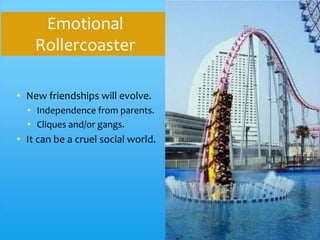
  • #12  Many times in middle school friendships that formed in elementary school dissolve in this ocean of the middle school experience. Usually one middle school studentstarts to drift away from another leaving the once friend hurt and feeling alone. When your middle school studentchooses a new friendship it can be worrisome of who that new friend is. It could be someone of the opposite sex or same sex. New friends can affect behavior and areas of their lives greatly from grades to how they act at the arcade. The emotions of a young adolescent are a continuous rollercoaster.
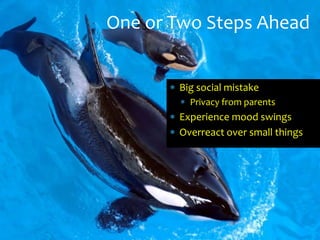
  • #13  Being in middle school means that if you’re seen with a parent it can be a big social mistake. It’s a part of the middle school age where they need to be alone to process the changes and adjust their thinking. When a middle school student is in public with a parent they tend to walk one or two steps in front or behind. Parents who go to school functions with their children should expect not to be spoken too. It’s not a reflect on how you are as a parent but your middle school student feels more like a child when around parents and their friends. They need to be separated from parents in order to find independence. Some adjustments you can make are to let them have that alone time they so desire. Some middle school student’s lives are full of activity, in and outside of school, that they will need time alone to gather their own thoughts. Use indirect questions because direct questions won’t get you anywhere. Examples of indirect questions are “Make sure you’re home by 8pm” “dinner is at 6 so be home by then”. Using the phrase “by” is helpful because they know they can be home anytime before then. It gives them a sense of more responsibility.Middle school student and younger teens often experience mood swings. They can feel angry, sad, happy, and outgoing all in one day. Take the time to listen to your kids if they decide they want to talk to you. Getting through the mood swings will be much easier if they know you are there for them. Overreact: They often exaggerate over small concerns and think they are the only ones that are going through this. Again, just listen to them because it will make them feel better.
  • #14 You child needs positive attention from you as much as possible. A lot of interaction kids receive from parents can be viewed as negative. This can be from scolding them for doing something wrong or punishing them for a bad grade or missing assignment at school. This discipline is okay but remember you child does a lot more positive things that may not go unnoticed but more times than not is not rewarded. If you as a parent are rewarding positive things in your child’s life than they are more likely to continue those things. You need to remember that you are a huge influence on your young adolescent and he or she is going to be watching your every move. Try and move away from the “do as I say and not as I do” and really live the way you want your child to grow up to live like. This is the time that your student is going to be developing into who they want to be and with your positive reinforcement and a great example of an adult to look at they will more than likely follow in your shoes. Finally it is important to remember that your middle school student’s brain is in a crucial development point during these next couple years. They may be interested in Mathematics but their brains have not caught up to their interests yet. This may discourage them and make them close the door to that particular subject forever. If you encourage them to not give up and keep trying it their brain will catch up to that interest and they can run through that door instead of closing it off and boarding it up.
  • #15 Here are some resources available to help you be able to swim along with your child. These books include topics such as ways to control your anger with your child along with explaining exactly why your teen may seem a little bit crazy.
  • #16 There are a lot of great resources out there on the web. Its almost like a vast ocean and that may make it hard to know which resources are the best. We swam through everything out there and found these amazing websites catered just to you the parent of a young adolescent.
  • #17 We would like to thank you all for coming out for our presentation. You all will play a key role in your child’s success and the first and largest step in seeing that you child does succeed is getting involved with their school. We couldn’t be happier that all of you were able to make it tonight. I hope you will take the time to fill out one of our surveys about tonight's presentation before you go. We would love to hear your thoughts about what we showed you and welcome comments and feedback. Also we will be sending you home with a pamphlet with some key features from tonight's presentation as well as some information we did not cover. The entire slide show that you saw tonight is available for free online and you can find that website in the pamphlet as well. Thanks again and have a great night.