Paper ClipsA common item with an uncommon story
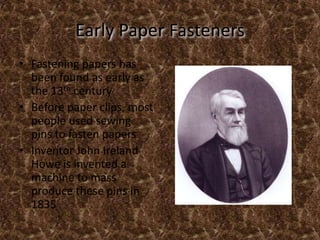
Early Paper FastenersFastening papers has been found as early as the 13th centuryBefore paper clips, most people used sewing pins to fasten papersInventor John Ireland Howe is invented a machine to mass produce these pins in 1835
Early Paper ClipsThere are over 50 patents for devices that claim to “fasten papers together”The first paper clips showed up in the 1860sThere are three people commonly credited for inventing the paper clip
George McGillOne of the most know inventors of paper clips. Due largely to the fact that he was granted 15 different patents from 1888 to 1903.His patent from 1903 is similar to the common paper clip today. However, he doesn’t receive credit inventing it because that design had already been invented and patented years earlier.
Paper Clips ProjectLinda Hooper, a middle school teacher in Whitewell, TN, wanted her students to truly understand how vast the number of Jews executed during the Holocaust was.How did she do it?
Paper ClipsProduced by Joe FabShown for the first time in 2003 in WhitewellOfficially released in 2004Won many awards at various film festivals
Six Million Paper ClipsWritten by Peter Schroeder and Dagmar Schroeder- HildebrandCopyrighted in 2004
ClippitIntroduced in Microsoft Office 97Nicknamed “Clippy”Meant to provide help and tips for Microsoft Office usersSadly,  Clippy was laid to rest after Microsoft Office 2004
OriginJohan Vaaler is commonly credited with inventing the paper clip.However, William Middlebrook created the common paper clip.Cushman and Dennison bought Middlebrook’s patent in 1899 and began selling it as the “Gem clip.”The Gem clip is the best selling paper clip in the US.
One Red Paper ClipOn July 14, 2005, Kyle MacDonald traded a red paper clip for a fish shaped pen.This began a year long journey during which MacDonald eventually bartered his way up to a house.
Cultural ImpactMiddle school students collected well over 6 million paper clips to represent the 6 million executed during the Holocaust in what was called the “Paper Clips Project.”This resulted in a documentary and a book about the project.Clippit, or “Clippy” was a Microsoft Office program that helped users become familiar with Office.

Paper clips

  • 1.
    Paper ClipsA commonitem with an uncommon story
  • 2.
    Early Paper FastenersFasteningpapers has been found as early as the 13th centuryBefore paper clips, most people used sewing pins to fasten papersInventor John Ireland Howe is invented a machine to mass produce these pins in 1835
  • 3.
    Early Paper ClipsThereare over 50 patents for devices that claim to “fasten papers together”The first paper clips showed up in the 1860sThere are three people commonly credited for inventing the paper clip
  • 4.
    George McGillOne ofthe most know inventors of paper clips. Due largely to the fact that he was granted 15 different patents from 1888 to 1903.His patent from 1903 is similar to the common paper clip today. However, he doesn’t receive credit inventing it because that design had already been invented and patented years earlier.
  • 14.
    Paper Clips ProjectLindaHooper, a middle school teacher in Whitewell, TN, wanted her students to truly understand how vast the number of Jews executed during the Holocaust was.How did she do it?
  • 15.
    Paper ClipsProduced byJoe FabShown for the first time in 2003 in WhitewellOfficially released in 2004Won many awards at various film festivals
  • 16.
    Six Million PaperClipsWritten by Peter Schroeder and Dagmar Schroeder- HildebrandCopyrighted in 2004
  • 17.
    ClippitIntroduced in MicrosoftOffice 97Nicknamed “Clippy”Meant to provide help and tips for Microsoft Office usersSadly, Clippy was laid to rest after Microsoft Office 2004
  • 18.
    OriginJohan Vaaler iscommonly credited with inventing the paper clip.However, William Middlebrook created the common paper clip.Cushman and Dennison bought Middlebrook’s patent in 1899 and began selling it as the “Gem clip.”The Gem clip is the best selling paper clip in the US.
  • 19.
    One Red PaperClipOn July 14, 2005, Kyle MacDonald traded a red paper clip for a fish shaped pen.This began a year long journey during which MacDonald eventually bartered his way up to a house.
  • 20.
    Cultural ImpactMiddle schoolstudents collected well over 6 million paper clips to represent the 6 million executed during the Holocaust in what was called the “Paper Clips Project.”This resulted in a documentary and a book about the project.Clippit, or “Clippy” was a Microsoft Office program that helped users become familiar with Office.

Editor's Notes

  • #2 IntroThesis- “Believe it or not, paper clips have an interesting story.”Summary of points- Origin, cultural, economic
  • #6 Patented by Samuel B. Fay in 1867First paper clip everBelieved to not have been advertised until 1899, so it is believed that it didn’t sell very well until the late 1890s
  • #7 Gem paper clipInvented in 1899 by William MiddlebrookMiddlebrook also patented a paper clip making machinePatent sold to Cushman and Dennison in 1899Best selling paper clip in the US
  • #8 One clear challenge to the Gem was patented (#1,985,866) in 1934 and has come to be known as the Gothic clip, because its loops are pointed more to resemble Gothic arches than the rounded Romanesque ones of the Gem. Henry Lankenau's patent application for the "perfect Gem" also listed ease of applying to papers as one of the invention's advantages.
  • #9 Johan VaalerCommonly discredited as the inventor of the paper clipFrom NorwayPatented his design in 1899 (Germany) and 1901 (US)
  • #10 The Vaaler ClipSimilar to Gem, but not as effectiveLacking inner loop
  • #11 Norwegians have proudly embraced their countryman, Johan Vaaler, as the true inventor. During the Nazi occupation of Norway in World War II, Norwegians made the paper clip a symbol of national unity. Prohibited from wearing buttons imprinted with the Norwegian king’s initials, they fastened paper clips to their lapels in a show of solidarity and opposition to the occupation. Wearing a paper clip was often reason enough for arrest.
  • #12 One red paperclip-Through a series of trades Kyle MacDonald traded a red paperclip up to a house in Kipling, SaskatchewanHe started on July 14, 2005 and ended on July 5, 2006
  • #13 On July 14, 2005, he went to Vancouver and traded the paperclip for a fish-shaped pen.He then traded the pen the same day for a hand-sculpteddoorknob from Seattle, Washington, which he nicknamed "Knob-T".On July 25, 2005, he traveled to Amherst, Massachusetts, with a friend to trade the Knob-T for a Colemancamp stove (with fuel).On September 24, 2005, he went to San Clemente, California, and traded the camp stove for a Hondagenerator.On November 16, 2005, he made a second (and successful) attempt (after having the generator confiscated by the New York City Fire Department) in Maspeth, Queens, to trade the generator for an "instant party": an empty keg, an IOU for filling the keg with the beer of the holder's choice, and a neon Budweisersign. Kyle MacDonald's houseOn December 8, 2005, he traded the "instant party" to Quebec comedian and radio personality Michel Barrette for a Ski-doo snowmobile.Within a week of that, he traded the snowmobile for a two-person trip to Yahk, British Columbia, in February 2006.
  • #14 On or about January 7, 2006, the second person on the trip to Yahk traded Kyle a cube van for the privilege.On or about February 22, 2006, he traded the cube van for a recording contract with Metal Works in Toronto.On or about April 11, 2006, he traded the recording contract to Jody Gnant for a year's rent in Phoenix, Arizona.On or about April 26, 2006, he traded the one year's rent in Phoenix, Arizona, for one afternoon with Alice Cooper.On or about May 26, 2006, he traded the one afternoon with Alice Cooper for a KISS motorized snow globe.On or about June 2, 2006, he traded the KISS motorized snow globe to Corbin Bernsen for a role in the film Donna on Demand.[2]On or about July 5, 2006, he traded the movie role for a two-story farmhouse in Kipling, Saskatchewan