Pairs of Angles :
Types• Adjacent angles
• Vertically opposite angles
• Complementary angles
• Supplementary angles
• Linear pairs of angles
Adjacent Angles
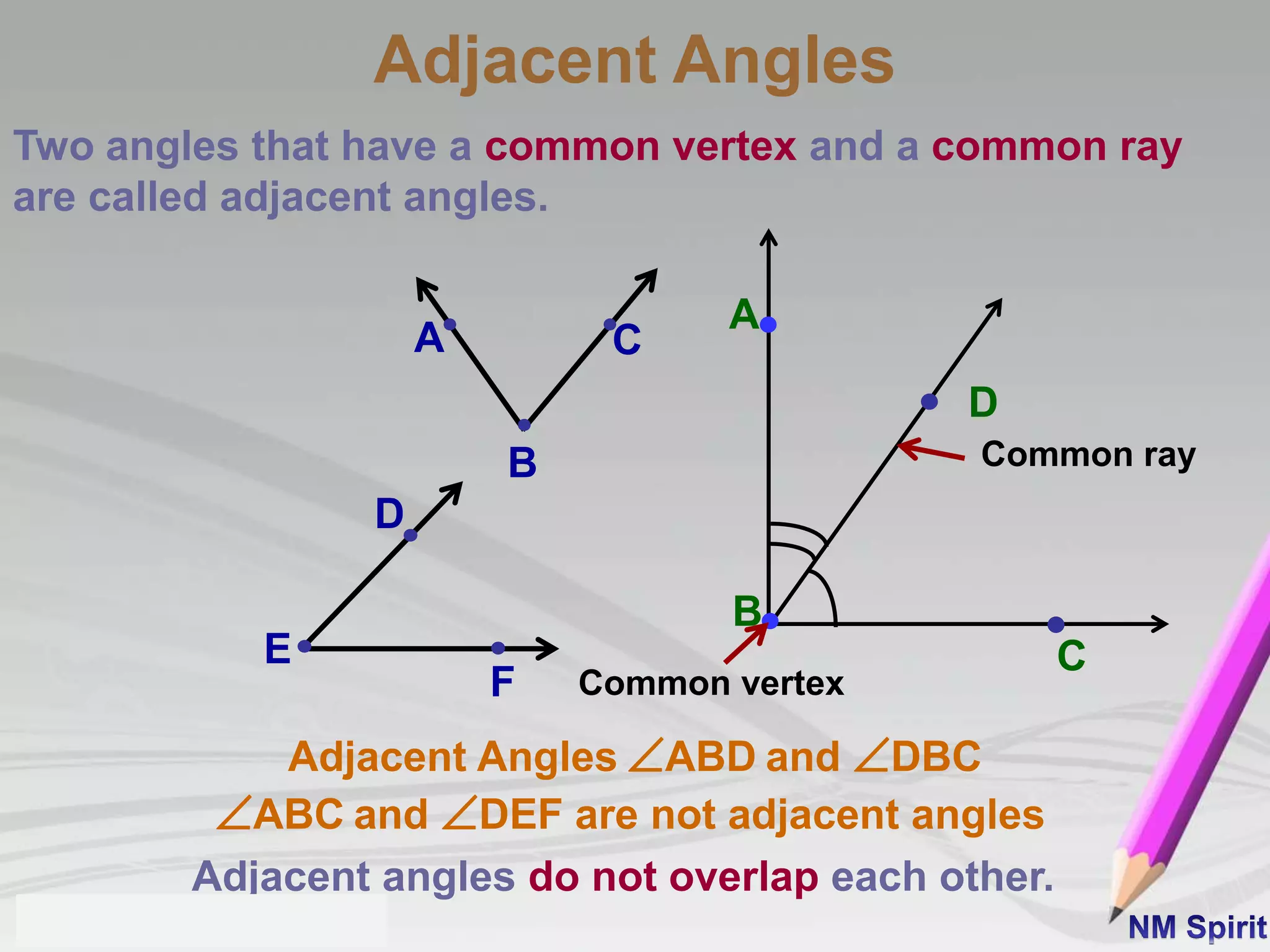
Two angles that have a common vertex and a common ray
are called adjacent angles.
C
D
B
A
Common ray
Common vertex
Adjacent Angles ABD and DBC
Adjacent angles do not overlap each other.
D
E
F
A
B
C
ABC and DEF are not adjacent angles
Vertically Opposite Angles
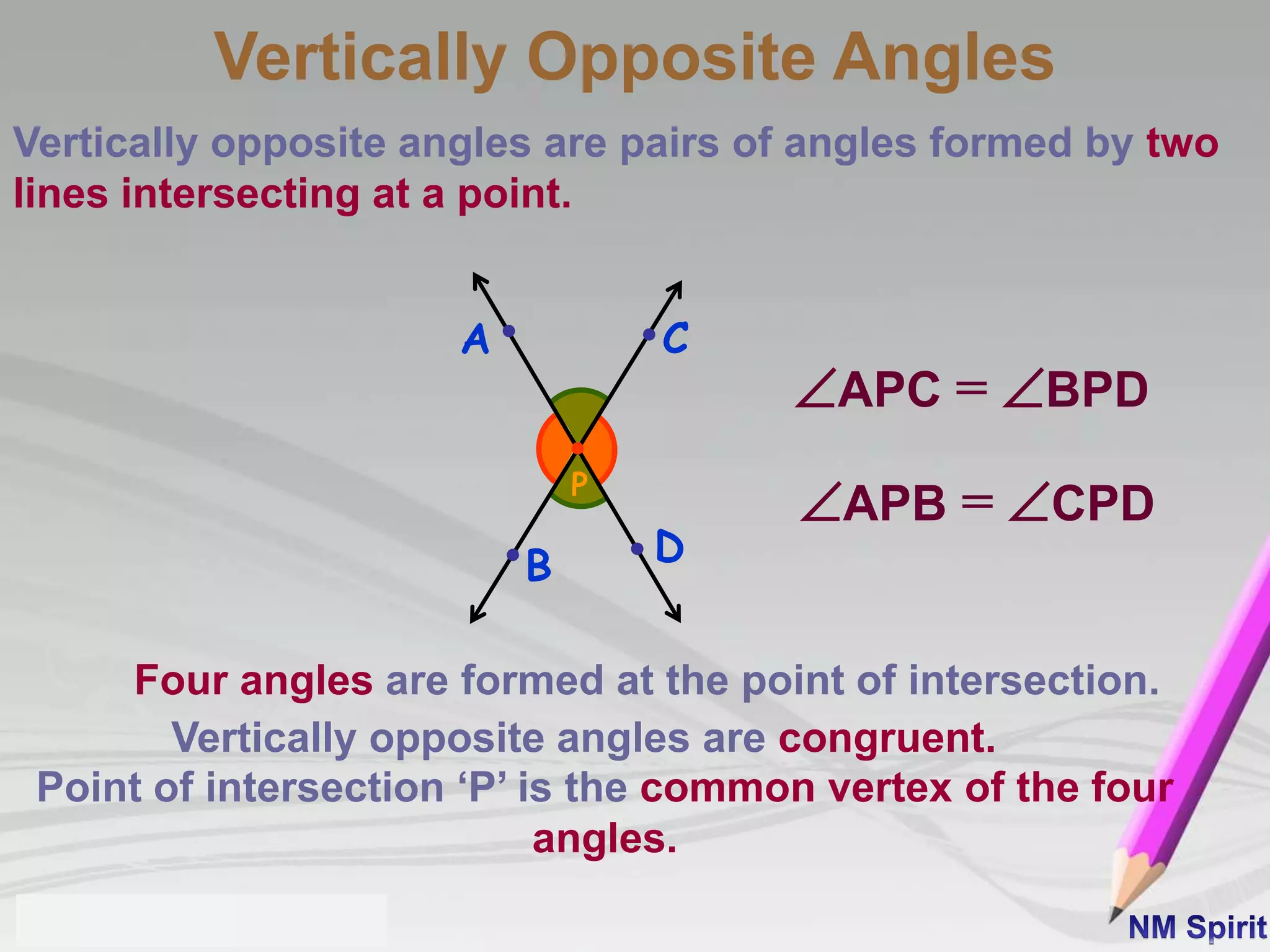
Vertically opposite angles are pairs of angles formed by two
lines intersecting at a point.
APC = BPD
APB = CPD
A
DB
C
P
Four angles are formed at the point of intersection.
Point of intersection ‘P’ is the common vertex of the four
angles.
Vertically opposite angles are congruent.
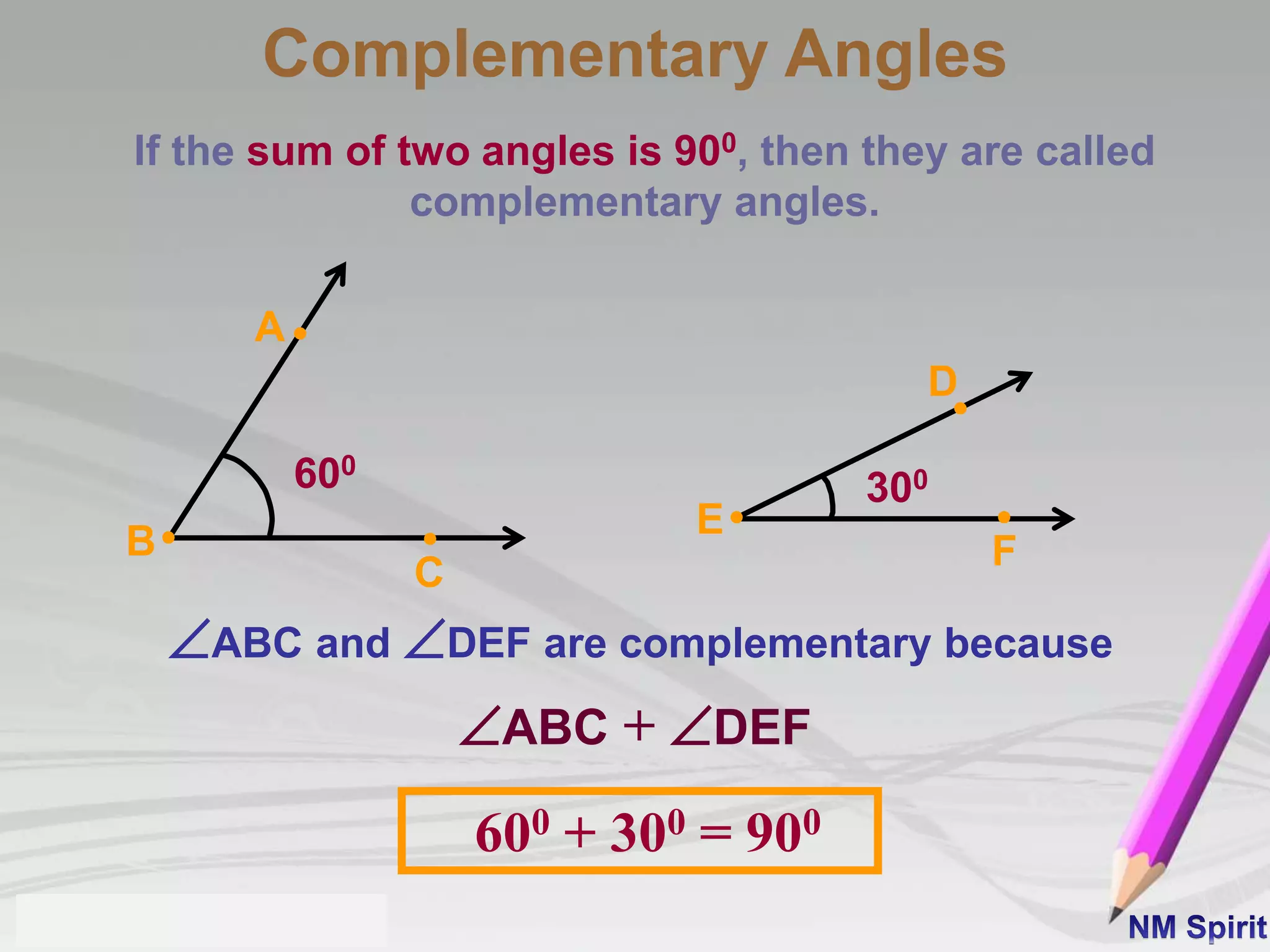
If the sum of two angles is 900, then they are called
complementary angles.
600
A
B
C
300
D
E
F
ABC and DEF are complementary because
600 + 300 = 900
ABC + DEF
Complementary Angles
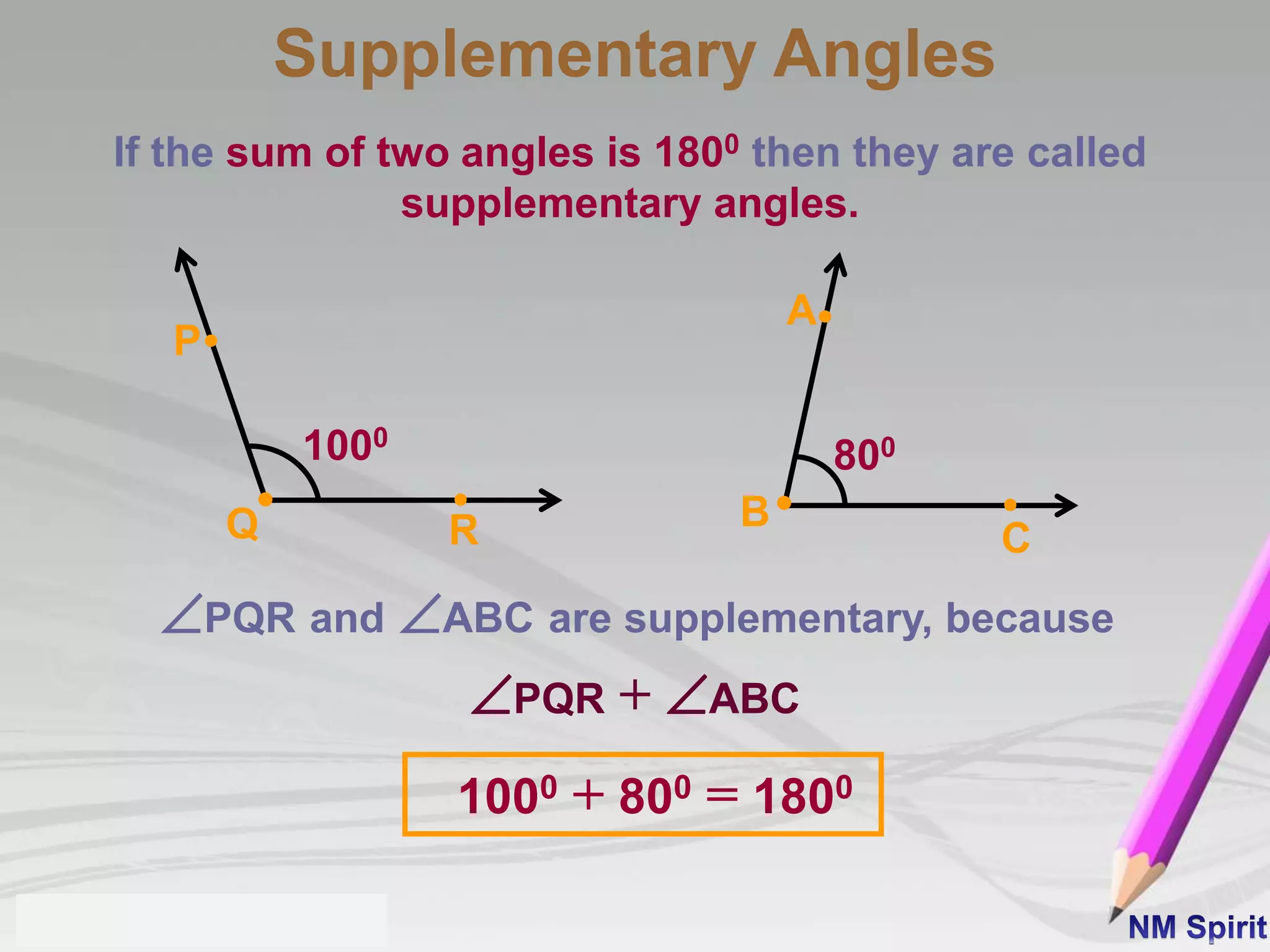
If the sum of two angles is 1800 then they are called
supplementary angles.
PQR and ABC are supplementary, because
1000 + 800 = 1800
RQ
P
A
B
C
1000
800
PQR + ABC
Supplementary Angles
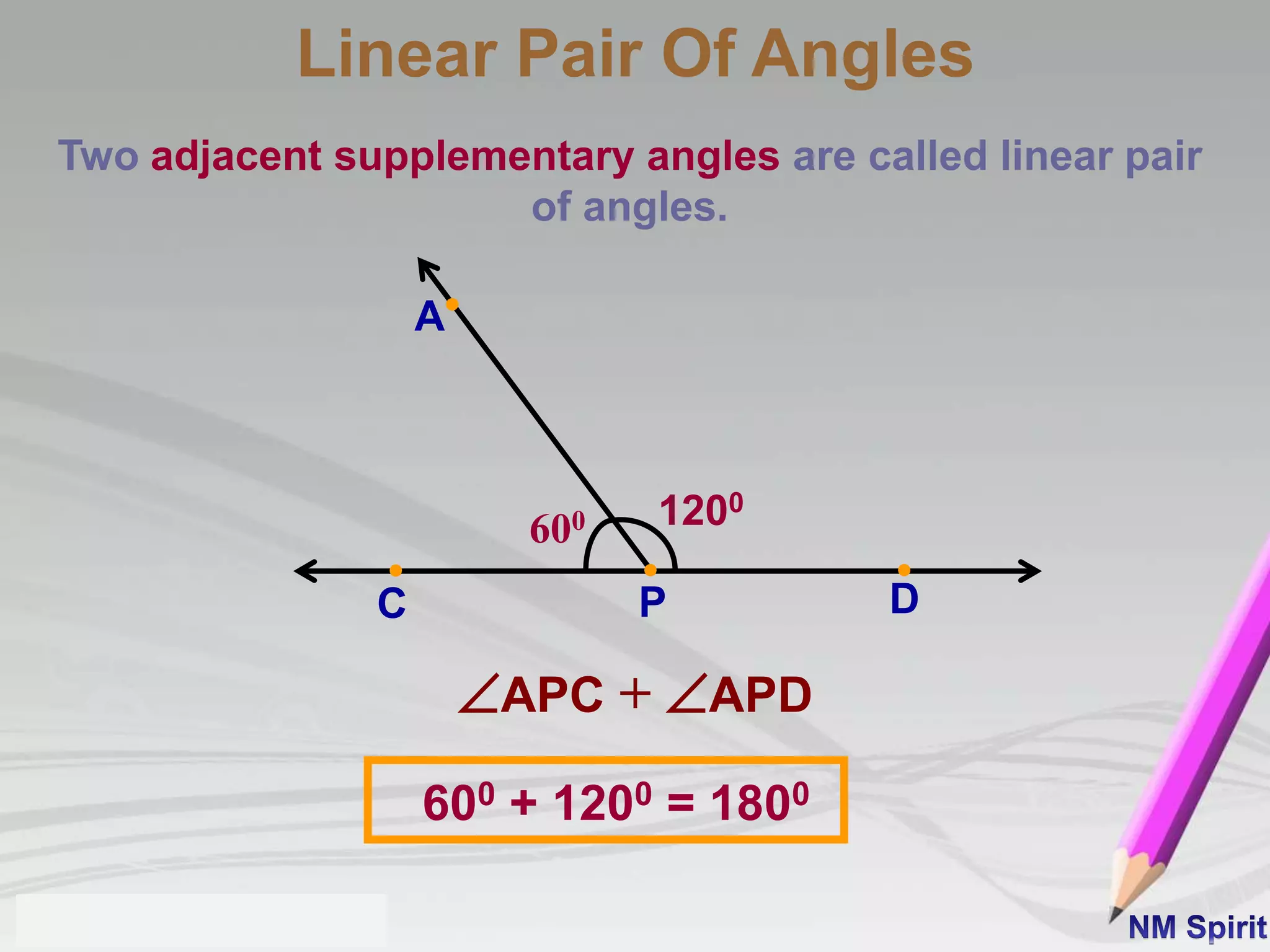
Two adjacent supplementary angles are called linear pair
of angles.
A
600 1200
PC D
600 + 1200 = 1800
APC + APD
Linear Pair Of Angles
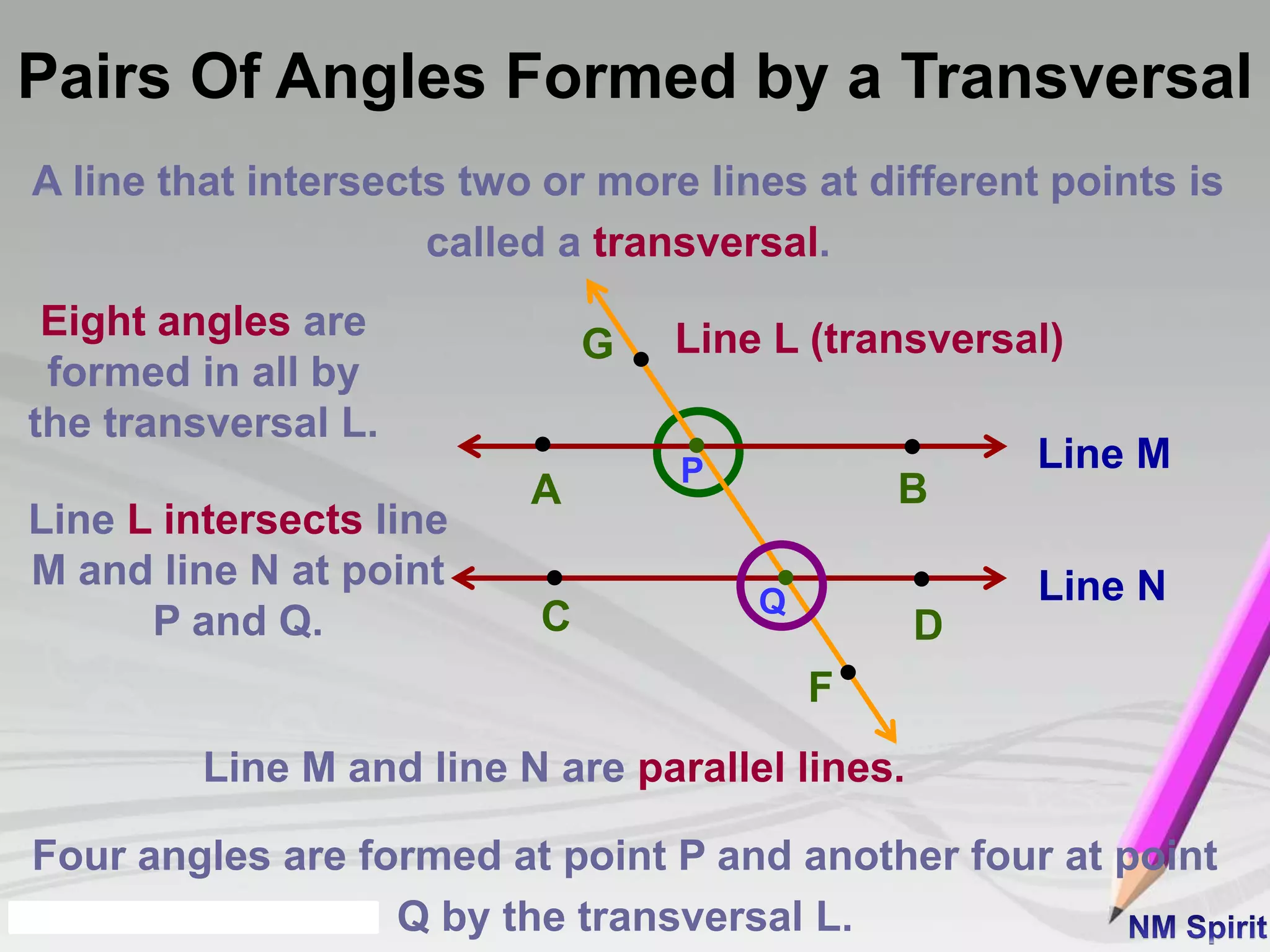
A line that intersects two or more lines at different points is
called a transversal.
Line L (transversal)
BA
Line M
Line N
DC
P
Q
G
F
Pairs Of Angles Formed by a Transversal
Line M and line N are parallel lines.
Line L intersects line
M and line N at point
P and Q.
Four angles are formed at point P and another four at point
Q by the transversal L.
Eight angles are
formed in all by
the transversal L.
Pairs Of Angles Formed by a Transversal
• Corresponding angles
• Alternate angles
• Interior angles
Corresponding Angles
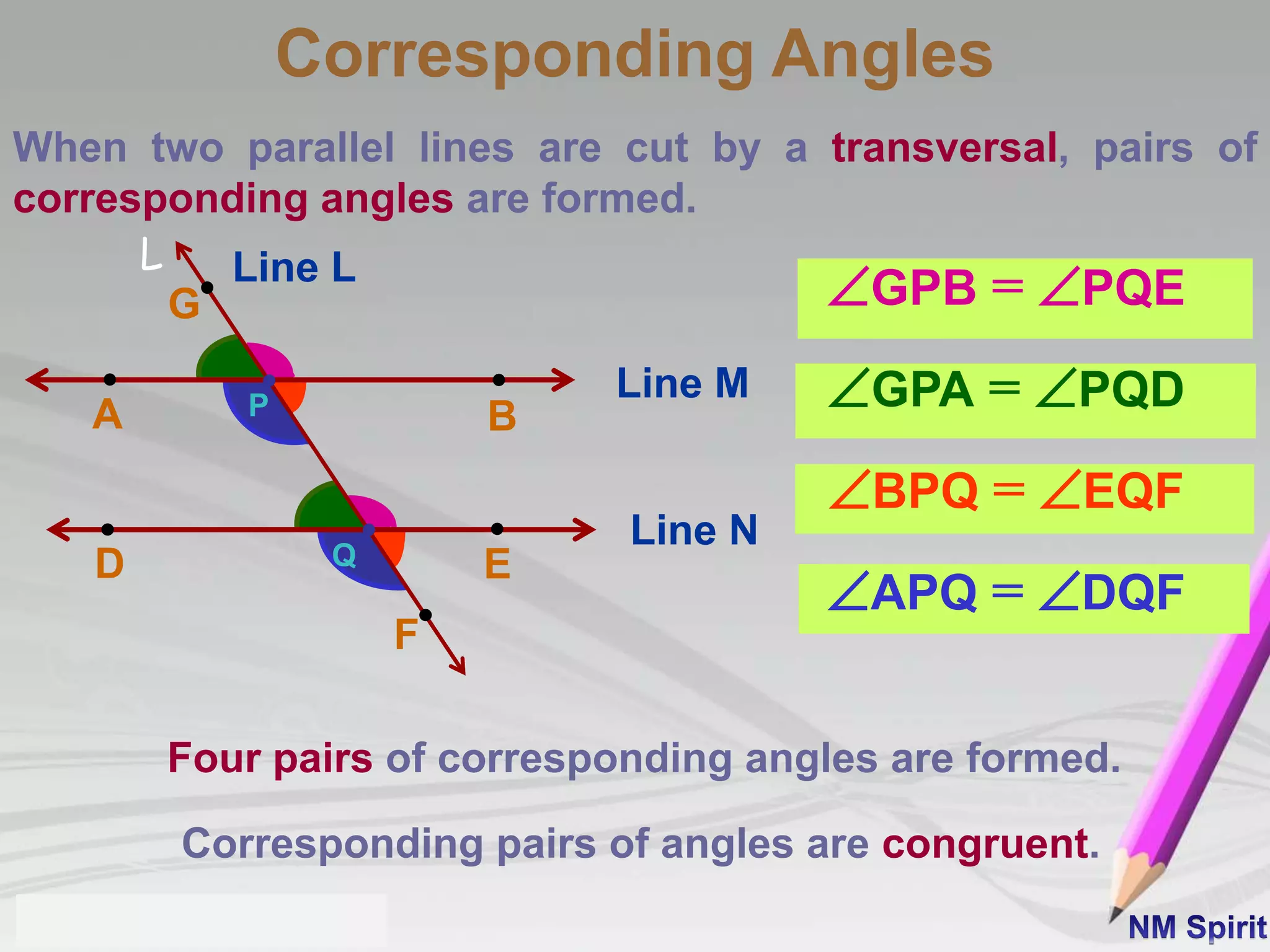
When two parallel lines are cut by a transversal, pairs of
corresponding angles are formed.
Four pairs of corresponding angles are formed.
Corresponding pairs of angles are congruent.
GPB = PQE
GPA = PQD
BPQ = EQF
APQ = DQF
Line M
BA
Line N
D E
L
P
Q
G
F
Line L
Alternate Angles
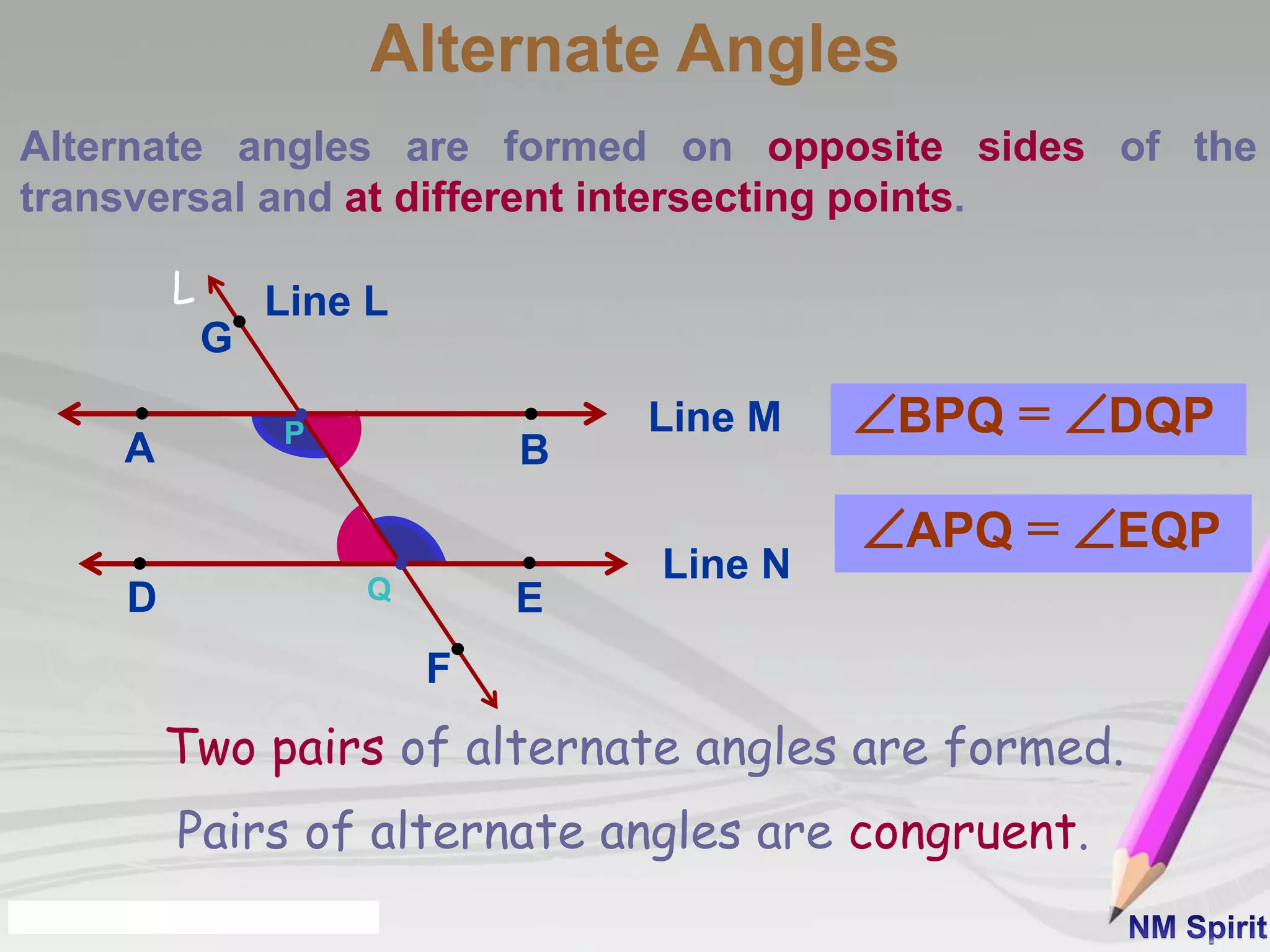
Alternate angles are formed on opposite sides of the
transversal and at different intersecting points.
Line M
BA
Line N
D E
L
P
Q
G
F
Line L
BPQ = DQP
APQ = EQP
Pairs of alternate angles are congruent.
Two pairs of alternate angles are formed.
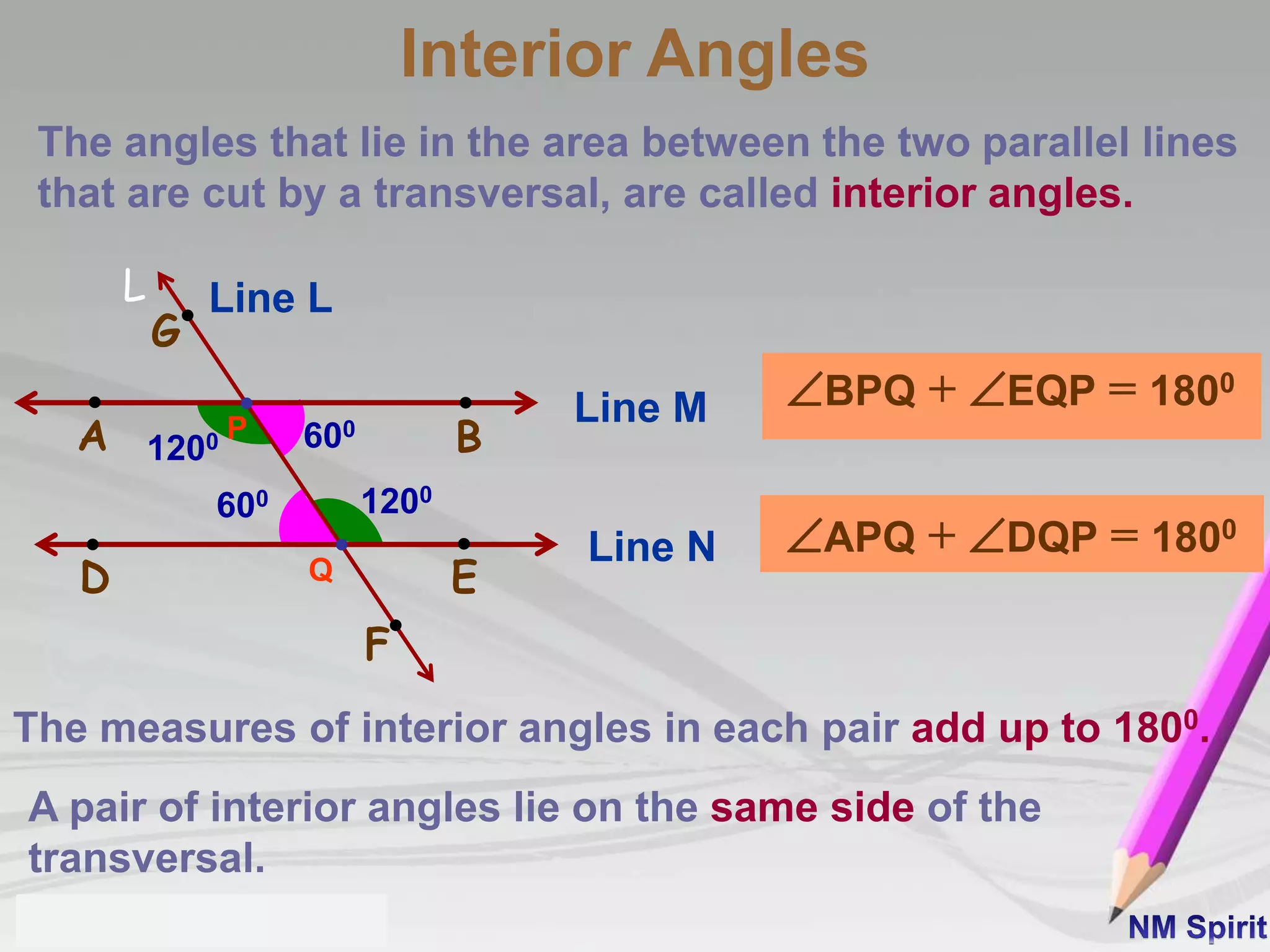
The angles that lie in the area between the two parallel lines
that are cut by a transversal, are called interior angles.
A pair of interior angles lie on the same side of the
transversal.
The measures of interior angles in each pair add up to 1800.
Interior Angles
Line M
BA
Line N
D E
L
P
Q
G
F
Line L
600
1200
1200
600
BPQ + EQP = 1800
APQ + DQP = 1800

Pairs of Angles

  • 1.
    Pairs of Angles: Types• Adjacent angles • Vertically opposite angles • Complementary angles • Supplementary angles • Linear pairs of angles
  • 2.
    Adjacent Angles Two anglesthat have a common vertex and a common ray are called adjacent angles. C D B A Common ray Common vertex Adjacent Angles ABD and DBC Adjacent angles do not overlap each other. D E F A B C ABC and DEF are not adjacent angles
  • 3.
    Vertically Opposite Angles Verticallyopposite angles are pairs of angles formed by two lines intersecting at a point. APC = BPD APB = CPD A DB C P Four angles are formed at the point of intersection. Point of intersection ‘P’ is the common vertex of the four angles. Vertically opposite angles are congruent.
  • 4.
    If the sumof two angles is 900, then they are called complementary angles. 600 A B C 300 D E F ABC and DEF are complementary because 600 + 300 = 900 ABC + DEF Complementary Angles
  • 5.
    If the sumof two angles is 1800 then they are called supplementary angles. PQR and ABC are supplementary, because 1000 + 800 = 1800 RQ P A B C 1000 800 PQR + ABC Supplementary Angles
  • 6.
    Two adjacent supplementaryangles are called linear pair of angles. A 600 1200 PC D 600 + 1200 = 1800 APC + APD Linear Pair Of Angles
  • 7.
    A line thatintersects two or more lines at different points is called a transversal. Line L (transversal) BA Line M Line N DC P Q G F Pairs Of Angles Formed by a Transversal Line M and line N are parallel lines. Line L intersects line M and line N at point P and Q. Four angles are formed at point P and another four at point Q by the transversal L. Eight angles are formed in all by the transversal L.
  • 8.
    Pairs Of AnglesFormed by a Transversal • Corresponding angles • Alternate angles • Interior angles
  • 9.
    Corresponding Angles When twoparallel lines are cut by a transversal, pairs of corresponding angles are formed. Four pairs of corresponding angles are formed. Corresponding pairs of angles are congruent. GPB = PQE GPA = PQD BPQ = EQF APQ = DQF Line M BA Line N D E L P Q G F Line L
  • 10.
    Alternate Angles Alternate anglesare formed on opposite sides of the transversal and at different intersecting points. Line M BA Line N D E L P Q G F Line L BPQ = DQP APQ = EQP Pairs of alternate angles are congruent. Two pairs of alternate angles are formed.
  • 11.
    The angles thatlie in the area between the two parallel lines that are cut by a transversal, are called interior angles. A pair of interior angles lie on the same side of the transversal. The measures of interior angles in each pair add up to 1800. Interior Angles Line M BA Line N D E L P Q G F Line L 600 1200 1200 600 BPQ + EQP = 1800 APQ + DQP = 1800