Download to read offline
![International Research Journal of Engineering and Technology (IRJET) e-ISSN: 2395-0056
Volume: 09 Issue: 08 | Aug 2022 www.irjet.net p-ISSN: 2395-0072
© 2022, IRJET | Impact Factor value: 7.529 | ISO 9001:2008 Certified Journal | Page 1649
PADDY CROP DISEASE DETECTION USING SVM AND CNN ALGORITHM
Banda Pavani1, Dr.R. Maruthamuthu2 M.C.A., Ph.D.
Assistant Professor2
Department of Computer Applications1,2
Madanapalle Institute of Technology and Science, Angallu, AP, India
-------------------------------------------------------------------------***------------------------------------------------------------------------
Abstract
Rice is one of the most important crops in India
and suffers from various diseases during different stages
of cultivation. It is very difficult for farmers with limited
knowledge to accurately identify these diseases
manually. Recent developments in deep learning show
that automatic image recognition systems using
convolutional neural networks (CNN) and transfer
learning (TL) and support vector machine (SVM) models
are very useful for such problems. Since rice leaf disease
image datasets are not readily available, we created our
own small dataset. Therefore, I developed a deep
learning model using transfer learning. The proposed
CNN architecture is based on Mobile Net and is trained
and tested using paddy field and internet datasets.
Keywords: Convolutional Neural Network, Deep
Learning, SVM, Rice Leaf Diseases, Transfer Learning.
I. Introduction
Rice is a major food source not only in India but
around the world. At different stages of cultivation, it is
attacked by different diseases. To support the plight of
farmers and improve the accuracy of crop disease
detection, research has been done using various machine
learning algorithms disease detection, research has been
done using various machine learning algorithm such as
support vector machines (SVMs) and artificial neural
networks.
However, the accuracy of such systems is highly
dependent on the feature selection technique. Recent
work on convolutional neural networks has provided
major break throughs in image-based detection
eliminating the need for image pre-processing and
providing integrated feature selection.
Advances in computing electricity have
revolutionized now no longer best the variety of
applications, however additionally the cap potential to
method massive quantities of data. Neural networks, as
soon as restricted to 3 layers of neurons, can now span
more than one layers, every containing hundreds of
computational neurons, because of big upgrades in
computing hardware. This shape has advanced neural
networks into extra effective computational equipment
that intently mimic human intelligence.
Recent work on convolutional neural networks
has provided major breakthroughs in image-based
detection, eliminating the need for image pre-processing,
and providing integrated feature selection. Today,
mobile phones are accessible to everyone, so I came up
with the idea of an automated system that would allow
farmers to upload pictures of diseased leaves and post
them on a server. The system uses neural networks to
classify diseases and illnesses and remedies can be
returned to farmers.
II. Literature Survey
Recently R. R. Atole,[1] D. Park have done the
research on paddy disease detection by using
Convolutional neural network Classifier for Detection of
Common Rice leaf is having disease or not.
Author Konstantinos Ferentinos [2] have done
research on paddy crop disease detection and diagnosis.
Constantine et al. [16] developed a deep learning method
based on CNN models to present plant disease detection
and diagnosis. Marco et al. [17] proposed a new two-
level neural network architecture for classifying plant
diseases.
Author Y. Lu, S. Yi, N. Zeng,[3] Y. Liu, and Y. Zhang have
done research on paddy crop Recent developments in
deep learning-based convolutional neural networks
(CNNs) have allowed researchers to significantly
improve the accuracy of image classification. This article
presents a deep learning-based approach for detecting
rice diseases and pests from images captured in real
landscapes with heterogeneous backgrounds.
[4] Y. Es-saady,T. El Massi, M. El Yassa,D. Mammass, and
A. Benazoun, have done research paddy crop disease
detection. In this paper presents a machine vision system
for automatic detection of plant leaf diseases from
images. The proposed system is based on the serial
combination technique of two of his SVM classifiers. The
first classifier classifies images using colour. At this
stage, diseases of similar or similar colour are assumed
to belong to the same class. A second classifier is then](https://image.slidesharecdn.com/irjet-v9i8269-221029081240-b32d4919/85/PADDY-CROP-DISEASE-DETECTION-USING-SVM-AND-CNN-ALGORITHM-1-320.jpg)
![International Research Journal of Engineering and Technology (IRJET) e-ISSN: 2395-0056
Volume: 09 Issue: 08 | Aug 2022 www.irjet.net p-ISSN: 2395-0072
© 2022, IRJET | Impact Factor value: 7.529 | ISO 9001:2008 Certified Journal | Page 1649
PADDY CROP DISEASE DETECTION USING SVM AND CNN ALGORITHM
Banda Pavani1, Dr.R. Maruthamuthu2 M.C.A., Ph.D.
Assistant Professor2
Department of Computer Applications1,2
Madanapalle Institute of Technology and Science, Angallu, AP, India
-------------------------------------------------------------------------***------------------------------------------------------------------------
Abstract
Rice is one of the most important crops in India
and suffers from various diseases during different stages
of cultivation. It is very difficult for farmers with limited
knowledge to accurately identify these diseases
manually. Recent developments in deep learning show
that automatic image recognition systems using
convolutional neural networks (CNN) and transfer
learning (TL) and support vector machine (SVM) models
are very useful for such problems. Since rice leaf disease
image datasets are not readily available, we created our
own small dataset. Therefore, I developed a deep
learning model using transfer learning. The proposed
CNN architecture is based on Mobile Net and is trained
and tested using paddy field and internet datasets.
Keywords: Convolutional Neural Network, Deep
Learning, SVM, Rice Leaf Diseases, Transfer Learning.
I. Introduction
Rice is a major food source not only in India but
around the world. At different stages of cultivation, it is
attacked by different diseases. To support the plight of
farmers and improve the accuracy of crop disease
detection, research has been done using various machine
learning algorithms disease detection, research has been
done using various machine learning algorithm such as
support vector machines (SVMs) and artificial neural
networks.
However, the accuracy of such systems is highly
dependent on the feature selection technique. Recent
work on convolutional neural networks has provided
major break throughs in image-based detection
eliminating the need for image pre-processing and
providing integrated feature selection.
Advances in computing electricity have
revolutionized now no longer best the variety of
applications, however additionally the cap potential to
method massive quantities of data. Neural networks, as
soon as restricted to 3 layers of neurons, can now span
more than one layers, every containing hundreds of
computational neurons, because of big upgrades in
computing hardware. This shape has advanced neural
networks into extra effective computational equipment
that intently mimic human intelligence.
Recent work on convolutional neural networks
has provided major breakthroughs in image-based
detection, eliminating the need for image pre-processing,
and providing integrated feature selection. Today,
mobile phones are accessible to everyone, so I came up
with the idea of an automated system that would allow
farmers to upload pictures of diseased leaves and post
them on a server. The system uses neural networks to
classify diseases and illnesses and remedies can be
returned to farmers.
II. Literature Survey
Recently R. R. Atole,[1] D. Park have done the
research on paddy disease detection by using
Convolutional neural network Classifier for Detection of
Common Rice leaf is having disease or not.
Author Konstantinos Ferentinos [2] have done
research on paddy crop disease detection and diagnosis.
Constantine et al. [16] developed a deep learning method
based on CNN models to present plant disease detection
and diagnosis. Marco et al. [17] proposed a new two-
level neural network architecture for classifying plant
diseases.
Author Y. Lu, S. Yi, N. Zeng,[3] Y. Liu, and Y. Zhang have
done research on paddy crop Recent developments in
deep learning-based convolutional neural networks
(CNNs) have allowed researchers to significantly
improve the accuracy of image classification. This article
presents a deep learning-based approach for detecting
rice diseases and pests from images captured in real
landscapes with heterogeneous backgrounds.
[4] Y. Es-saady,T. El Massi, M. El Yassa,D. Mammass, and
A. Benazoun, have done research paddy crop disease
detection. In this paper presents a machine vision system
for automatic detection of plant leaf diseases from
images. The proposed system is based on the serial
combination technique of two of his SVM classifiers. The
first classifier classifies images using colour. At this
stage, diseases of similar or similar colour are assumed
to belong to the same class. A second classifier is then](https://image.slidesharecdn.com/irjet-v9i8269-221029081240-b32d4919/75/PADDY-CROP-DISEASE-DETECTION-USING-SVM-AND-CNN-ALGORITHM-1-2048.jpg)
![International Research Journal of Engineering and Technology (IRJET) e-ISSN: 2395-0056
Volume: 09 Issue: 08 | Aug 2022 www.irjet.net p-ISSN: 2395-0072
© 2022, IRJET | Impact Factor value: 7.529 | ISO 9001:2008 Certified Journal | Page 1651
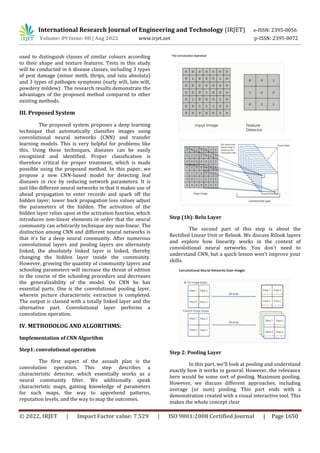
Step 3: Flattening
Here's a quick breakdown of the flattening
process and how to move from pooled to flattened layers
when using convolutional neural networks.
Step 4: Full Connection
This part brings together everything that was
discussed in this section. Learning this will give you a
more complete understanding of how convolutional
neural networks work and how the resulting "neurons"
learn to classify images.
1.Input Layer: In input layer we consider images as
input. Here we considering the input layer is the pre-
trained model Mobile Net.
2.Convolution Layer: In Convolution layer, we convert
image into matric format. Here matrix size is 1024 X
1024 (rows X columns).
3.Pooling Layer: In the pooling layer the numerical
values will be stored. To change the numerical data to
binary data, we use machine learning algorithm named
SoftMax (supervised learning algorithm). In SoftMax
layer we will convert the numerical data to binary.
4.In flatten layer and dense the classes of total dataset (5
types) is stored which will be in the binary data format.
We use fit_generator method for saving the data in the
form of .h5. Here model is a format for storing the binary
data.
Architecture of CNN Algorithm:
The architecture of Paddy crop disease detection
displays the how image is processed using algorithms
and how user get the accurate output.
Step by step process in this project is as shown below:
Step-1: Take paddy leaf image and image uploaded by
user.
Step-2: Initially, we are using SVM Algorithm Here the
process is done with SVMs where the algorithm did not
work accurately and failed to reach adequate accurately
and failed to reach adequate accuracy.
Step3: Finally, we are using CNN Algorithm For
automatic image recognition to identify the disease
Step-4: By Using CNN Algorithm we can easily identify
the disease. And we can get accurate result.
Step5: After prediction, we get 5 [brown spots, healthy,
leaf blight, leaf blight & weeds] value.
Experimental Analysis and Result:
This experiment is conducted by using Jupiter
Notebook and the paddy image dataset is collected from
the Kaggle website. And the collected data directly
uploaded to the Jupiter Notebook. The dataset contains
two types of data they are training data and testing data](https://image.slidesharecdn.com/irjet-v9i8269-221029081240-b32d4919/85/PADDY-CROP-DISEASE-DETECTION-USING-SVM-AND-CNN-ALGORITHM-3-320.jpg)
![International Research Journal of Engineering and Technology (IRJET) e-ISSN: 2395-0056
Volume: 09 Issue: 08 | Aug 2022 www.irjet.net p-ISSN: 2395-0072
© 2022, IRJET | Impact Factor value: 7.529 | ISO 9001:2008 Certified Journal | Page 1652
By conducting these experiment by using CNN
Algorithm we can get accurate result
V. Conclusion:
In this paper, we succeeded in developing an
application that can detect and detect paddy field
diseases. Here, we developed a method using CNN with
transfer learning (MobileNet) and SVM algorithms. Here,
we examined a data set of rice leaf images consisting of
four different types (Brown Spot, Healthy, Leaf Blight,
Leaf Blight) and weed images. After training, the dataset
results were tested, uploaded images and classified.
VI. Future Work
In the future, we would like to collect more
images of fields and agricultural research institutes to
further improve the accuracy. We hope to add a cross-
validation process in the future to validate our results.
We also want to use better deep learning models and
other state-of-the-art research to compare with the
results obtained. Using the developed model, other
foliage diseases of plants that are important crops in
India can also be detected in the future.
VII. References
[1] T. Gupta, ”Plant leaf disease analysis using image
processing technique with modified SVM-CS classifier,”
Int. J. Eng. Manag. Technol, no. 5, pp. 11-17, 2017.
[2] Y. Es-saady,T. El Massi,M. El Yassa,D. Mammass, and
A. Benazoun, ”Automatic recognition of plant leaves
diseases based on serial combination of two SVM
classifiers,” International Conference on Electrical and
Information Technologies (ICEIT) pp. 561-566, 2016.
[3] P. B. Padol and A. A. Yadav, “SVM classifier based
grape leaf disease detection,” Conference on Advances in
Signal Processing (CASP), pp. 175-179, 2016.
[4] L. Liu and G. Zhou, “Extraction of the rice leaf disease
image based on BP neural network,” International
Conference on Computational Intelligence and Software
Engineering ,pp. 1-3,2009.
[5] S. Arivazhagan and S.V. Ligi, “Mango Leaf Diseases
Identification Using Convolutional Neural Network,”
International Journal of Pure and Applied Mathematics,
vol. 120,no. 6, pp. 11067-11079,2008.
[6] B. Liu,Y. Zhang, D. He and Y. Li, “Identification of
Apple Leaf Diseases Based on Deep Convolutional Neural
Networks Symmetry,” X. X. & Suen, C. Y. A novel hybrid
CNN–SVM classifier for recognizing handwritten digits.
Pattern Recognition,vol. 45,pp. 1318–1325,2012.](https://image.slidesharecdn.com/irjet-v9i8269-221029081240-b32d4919/85/PADDY-CROP-DISEASE-DETECTION-USING-SVM-AND-CNN-ALGORITHM-4-320.jpg)
![International Research Journal of Engineering and Technology (IRJET) e-ISSN: 2395-0056
Volume: 09 Issue: 08 | Aug 2022 www.irjet.net p-ISSN: 2395-0072
© 2022, IRJET | Impact Factor value: 7.529 | ISO 9001:2008 Certified Journal | Page 1653
[7] Y. Lu, S. Yi,N. Zeng,Y. Liu, and Y. Zhang, “Identification
of Rice Diseases Using Deep Convolutional Neural
Networks,” Neurocomputing, 267, pp. 378-384,2017.
[8] R. R. Atole, D. Park, “A Multiclass Deep Convolutional
Neural Network Classifier for Detection of Common Rice
Plant Anomalies,” International Journal Of Advanced
Computer Science And Applications,vol. 9,no. 1,pp. 67–
70,2018.
[9] V. Singh, A. Misra, “Detection of Plant Leaf Diseases
Using Image Segmentation and Soft Computing
Techniques,” Information Processing in Agriculture, Vol.
4 ,no. 1,pp. 41–49,2017.
[10] P. Konstantinos Ferentinos, “Deep Learning Models
for Plant Disease Detection and Diagnosis,” Computers
and Electronics in Agriculture ,vol. 145,pp. 311–
318,2018.
[11] S. P. Mohanty, D. P. Hughes, M. Salath´e, “Using Deep
Learning for Image-Based Plant Disease Detection,”
Frontiers in plant science ,vol. 7.
[12] S. Xie, T. Yang, X. Wang, and Y. Lin, “Hyper-class
augmented and regularized deep learning for fine-
grained image classification,” IEEE Conference on
Computer Vision and Pattern Recognition,CVPR2015,pp.
2645–2654,June 2015.
[13] Y. Lu, S. Yi, N. Zeng, Y. Liu, Y. Zhang, ” Identification
of rice diseases using deep convolutional neural
networks”, Neurocomputing 267,pp. 378–384,2017. [14]
K. Simonyan, A. Zisserman, “Very Deep Convolutional
Networks for LargeScale Image Recognition”, Arxiv
preprint arXiv: arXiv,pp. 1409- 1556,2015.](https://image.slidesharecdn.com/irjet-v9i8269-221029081240-b32d4919/85/PADDY-CROP-DISEASE-DETECTION-USING-SVM-AND-CNN-ALGORITHM-5-320.jpg)

- The document discusses a study on detecting diseases in paddy/rice crops using deep learning algorithms like convolutional neural networks (CNN) and support vector machines (SVM). - A dataset of rice leaf images was created and a CNN model using transfer learning with MobileNet was developed and trained on the dataset to classify rice diseases. - The proposed method aims to automatically classify rice disease images to help farmers more accurately identify diseases, as manual identification can be difficult and inaccurate. This could help improve treatment and support farmers.


