Department of Vegetable science
COLLEGE OF HORTICULTURE, BAGALKOTE
5-Apr-21 1
Dept. of VSC
Couse title: Seed certification, Processing and Storage of vegetable seeds
VSC604 (2+1)
Topic: Seed Packaging, Labelling and Equipments used for packaging of
vegetable seeds.
Presented To
Mr. H. P Hadimani
Asst. Professor
Department of vegetable science
COH, Bagalkot
Presented By
Sanmathi Naik A T S
1ST Ph. D (Hort.)
Department of vegetable science
COH, Bagalkot
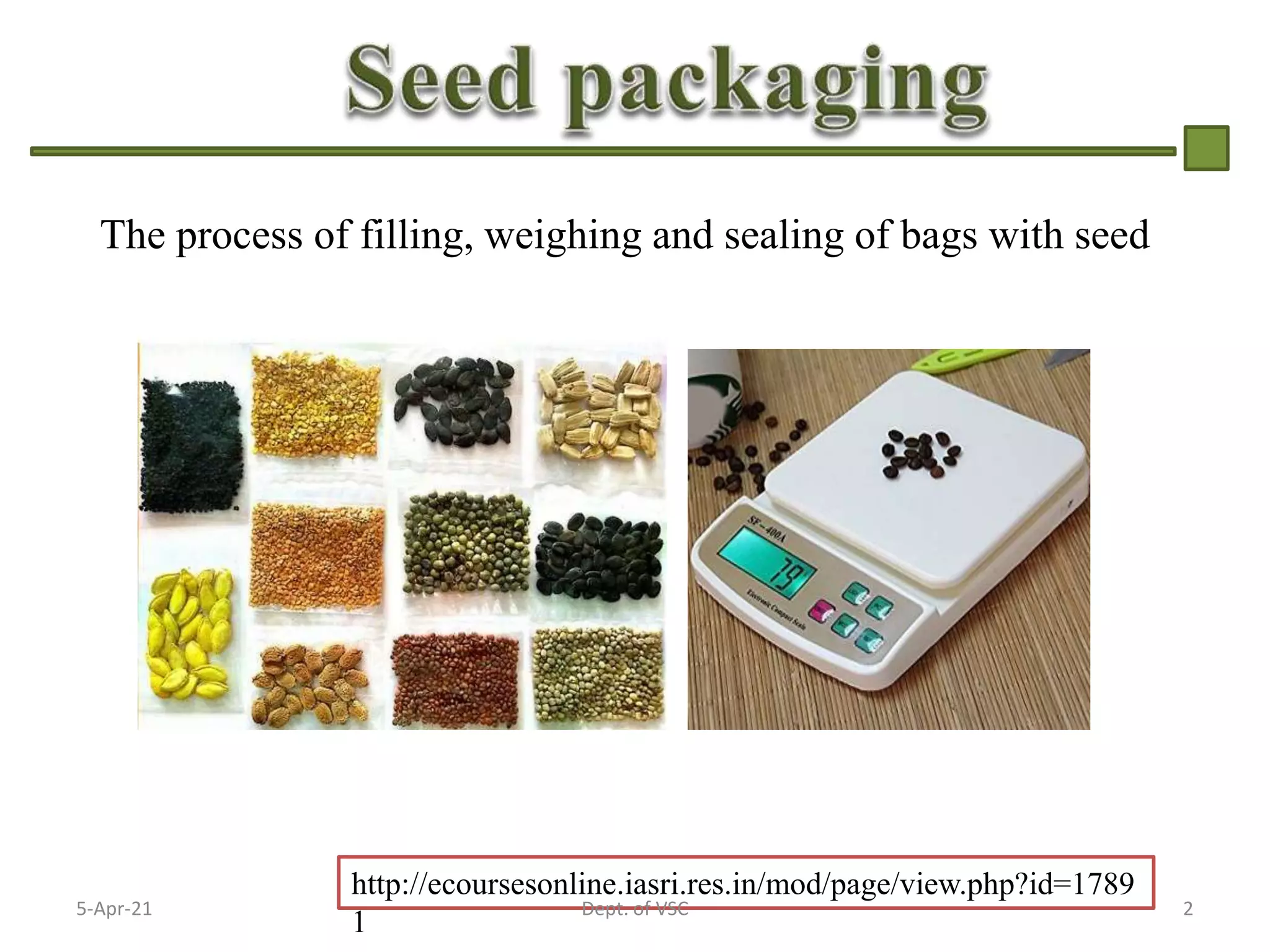
The process of filling, weighing and sealing of bags with seed
http://ecoursesonline.iasri.res.in/mod/page/view.php?id=1789
1
5-Apr-21 2
Dept. of VSC
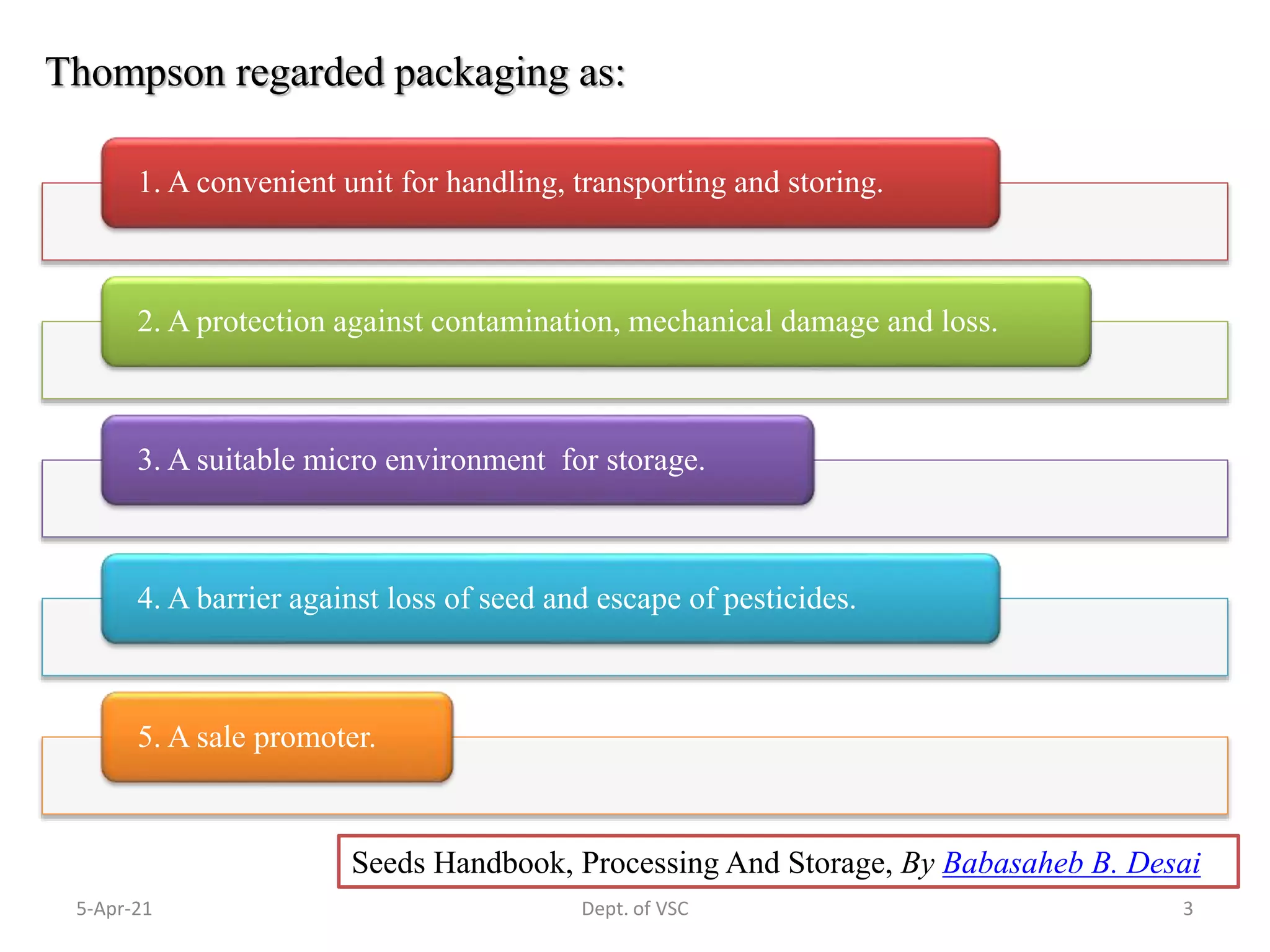
Thompson regarded packaging as:
Seeds Handbook, Processing And Storage, By Babasaheb B. Desai
1. A convenient unit for handling, transporting and storing.
2. A protection against contamination, mechanical damage and loss.
3. A suitable micro environment for storage.
4. A barrier against loss of seed and escape of pesticides.
5. A sale promoter.
5-Apr-21 3
Dept. of VSC
VI. Seed Packaging, Bioversity international
Seeds are packaged to prevent absorption of water from the atmosphere
after drying, to keep each accession separate and prevent contamination of the seeds
from insects and diseases.
5-Apr-21 4
Dept. of VSC
The best time to package seeds is directly after the moisture content has been
determined and found to be within the required limits for safe storage.
Seeds will always show an equilibrium between their moisture content and the relative
humidity of the environment and therefore, if possible, seeds should be packaged into
containers and hermetically sealed in the drying room.
5-Apr-21 5
Dept. of VSC
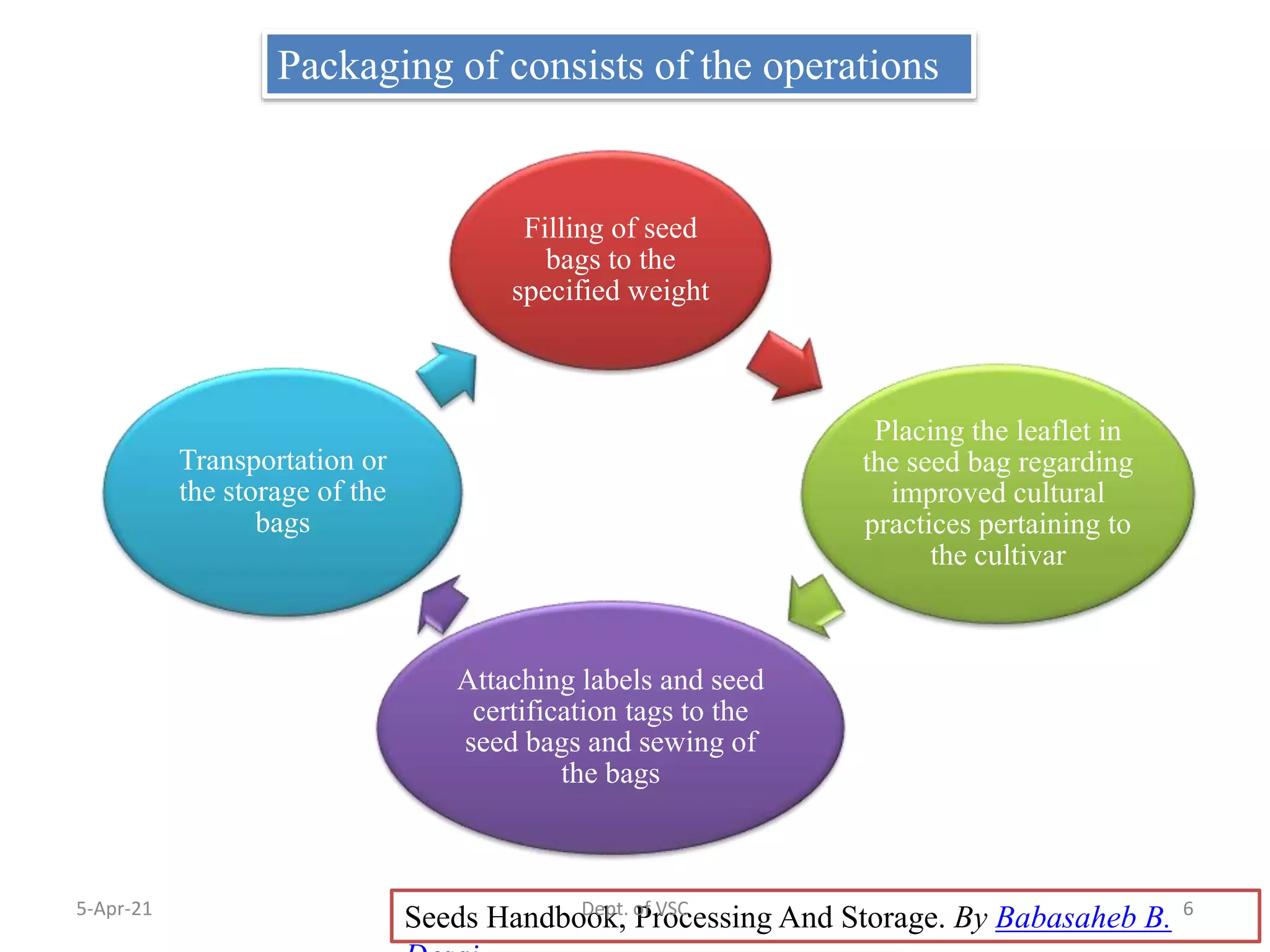
Packaging of consists of the operations
Seeds Handbook, Processing And Storage. By Babasaheb B.
Filling of seed
bags to the
specified weight
Placing the leaflet in
the seed bag regarding
improved cultural
practices pertaining to
the cultivar
Attaching labels and seed
certification tags to the
seed bags and sewing of
the bags
Transportation or
the storage of the
bags
5-Apr-21 6
Dept. of VSC
Different containers and special equipments are available for sealing and
storage of seeds.
Storage containers for base collections should be hermetically sealed and
moisture-proof.
Cans, bottles, and laminated alluminium foil containers are all acceptable for
both base and active collections.
The techniques used will vary with the type of container and the equipment
that your genebank is using.
VI. Seed Packaging, Bioversity international
How seeds are packed?
5-Apr-21 7
Dept. of VSC
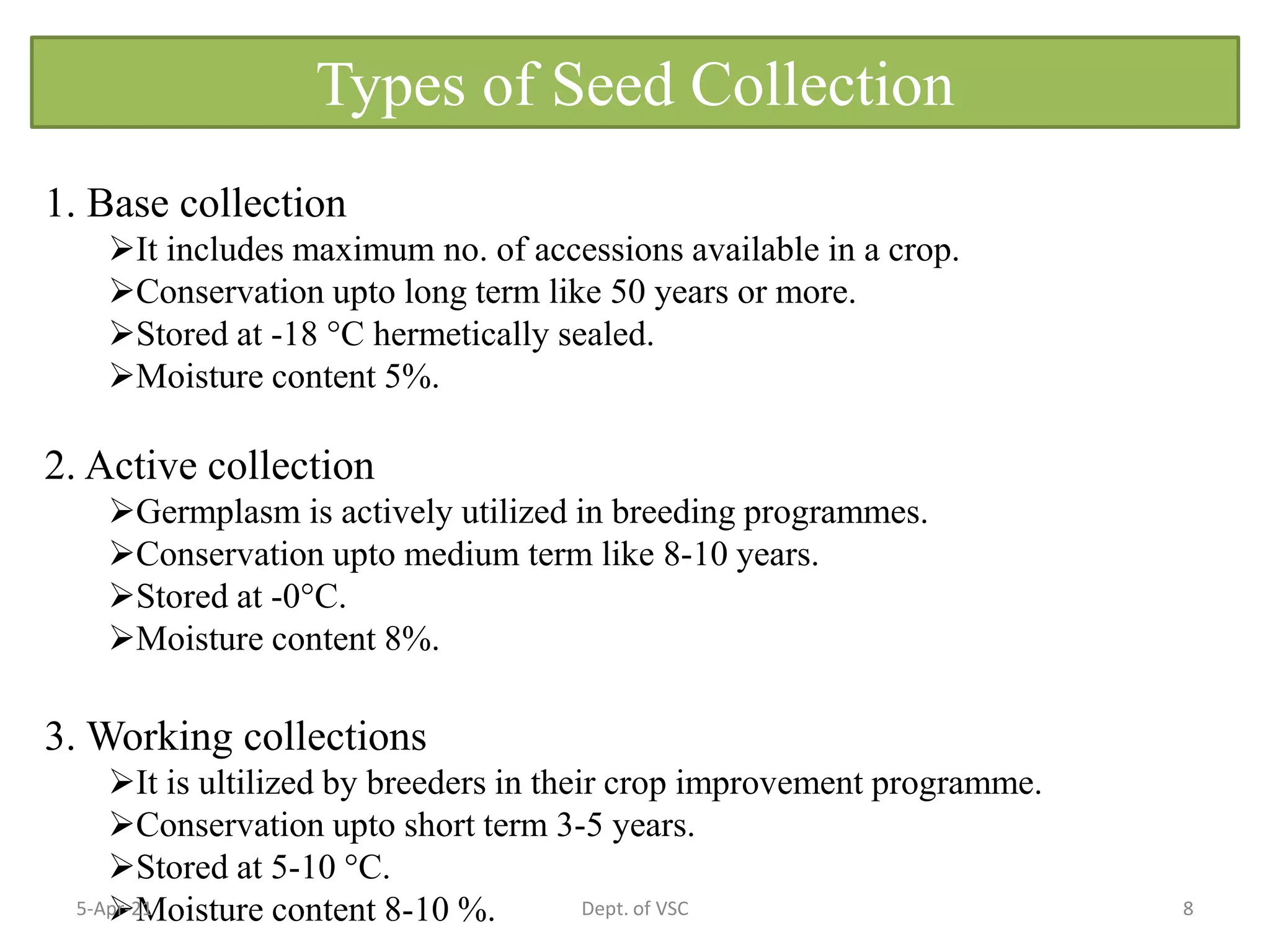
1. Base collection
It includes maximum no. of accessions available in a crop.
Conservation upto long term like 50 years or more.
Stored at -18 °C hermetically sealed.
Moisture content 5%.
2. Active collection
Germplasm is actively utilized in breeding programmes.
Conservation upto medium term like 8-10 years.
Stored at -0°C.
Moisture content 8%.
3. Working collections
It is ultilized by breeders in their crop improvement programme.
Conservation upto short term 3-5 years.
Stored at 5-10 °C.
Moisture content 8-10 %.
Types of Seed Collection
5-Apr-21 8
Dept. of VSC
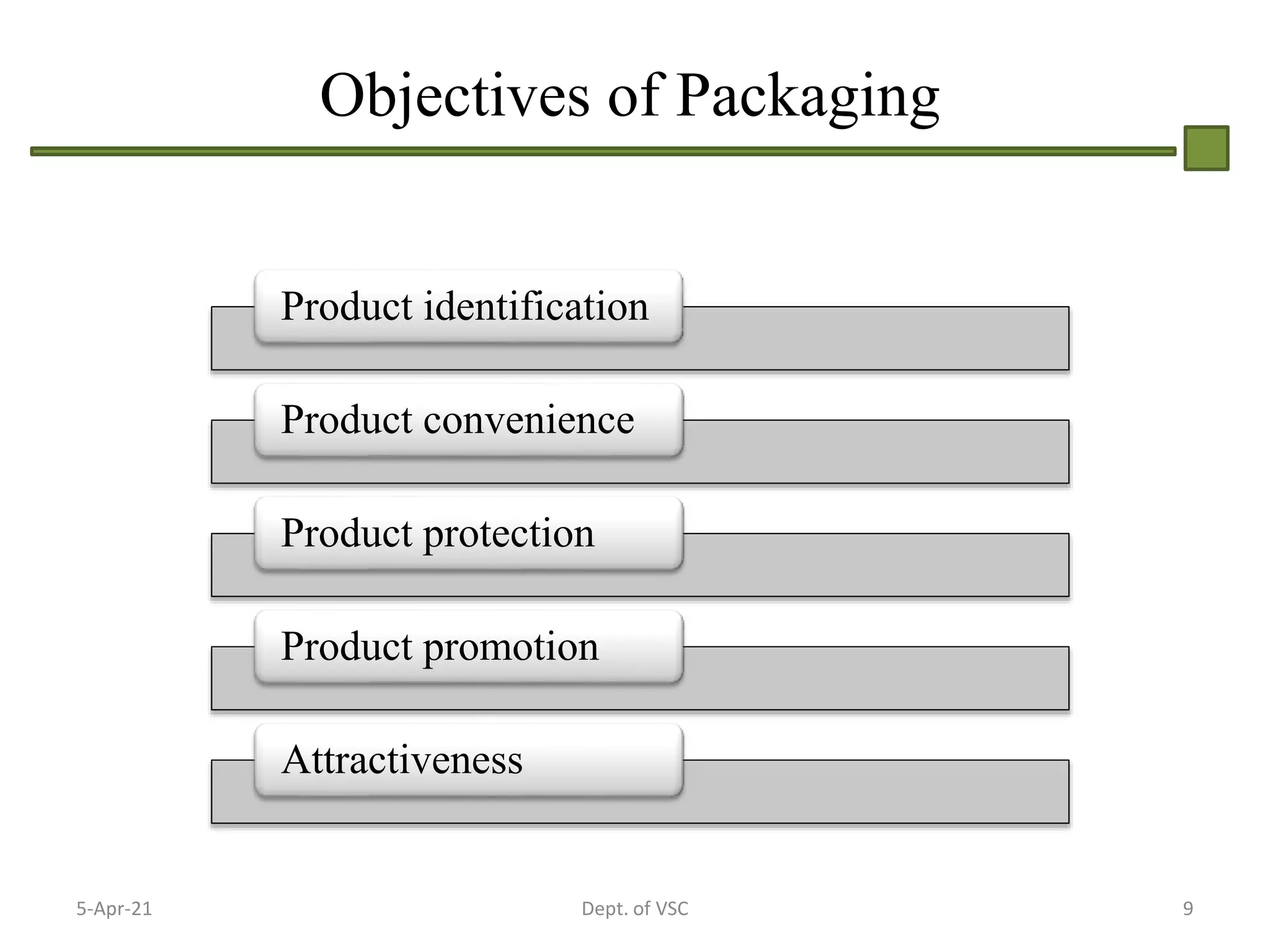
Objectives of Packaging
Product identification
Product convenience
Product protection
Product promotion
Attractiveness
5-Apr-21 9
Dept. of VSC
How many seeds should be packed?
The number of seeds to be packed for storage will depend on the species being
conserved and how often seeds will be removed for monitoring, distribution or
regeneration.
The FAO/ IPGRI Genebank Standards (1994) recommend that:
1. Material which shows little morphological variation (genetically
homogenous accessions): 3000 seeds are acceptable, but 4000 seeds are
preferable to represent each accession.
2. Materials showing large morphological variation (genetically heterogeneous
accessions): An accession should consist of at least 4000 seeds are preferred.
5-Apr-21 10
Dept. of VSC
In Genebanks, it is easier to work in
weights, but seed number can
easily be converted from
weights if the 100-seed or 1000-
seed weight is known.
For example, to determine the
number of seeds in a sample for
which the 100-seed weight is
known:
5-Apr-21 11
Dept. of VSC
Essentials of Good Packaging
Should be attractive
Should protect the content
Should be convenient
Prevention from adulteration
Extends product life
5-Apr-21 12
Dept. of VSC
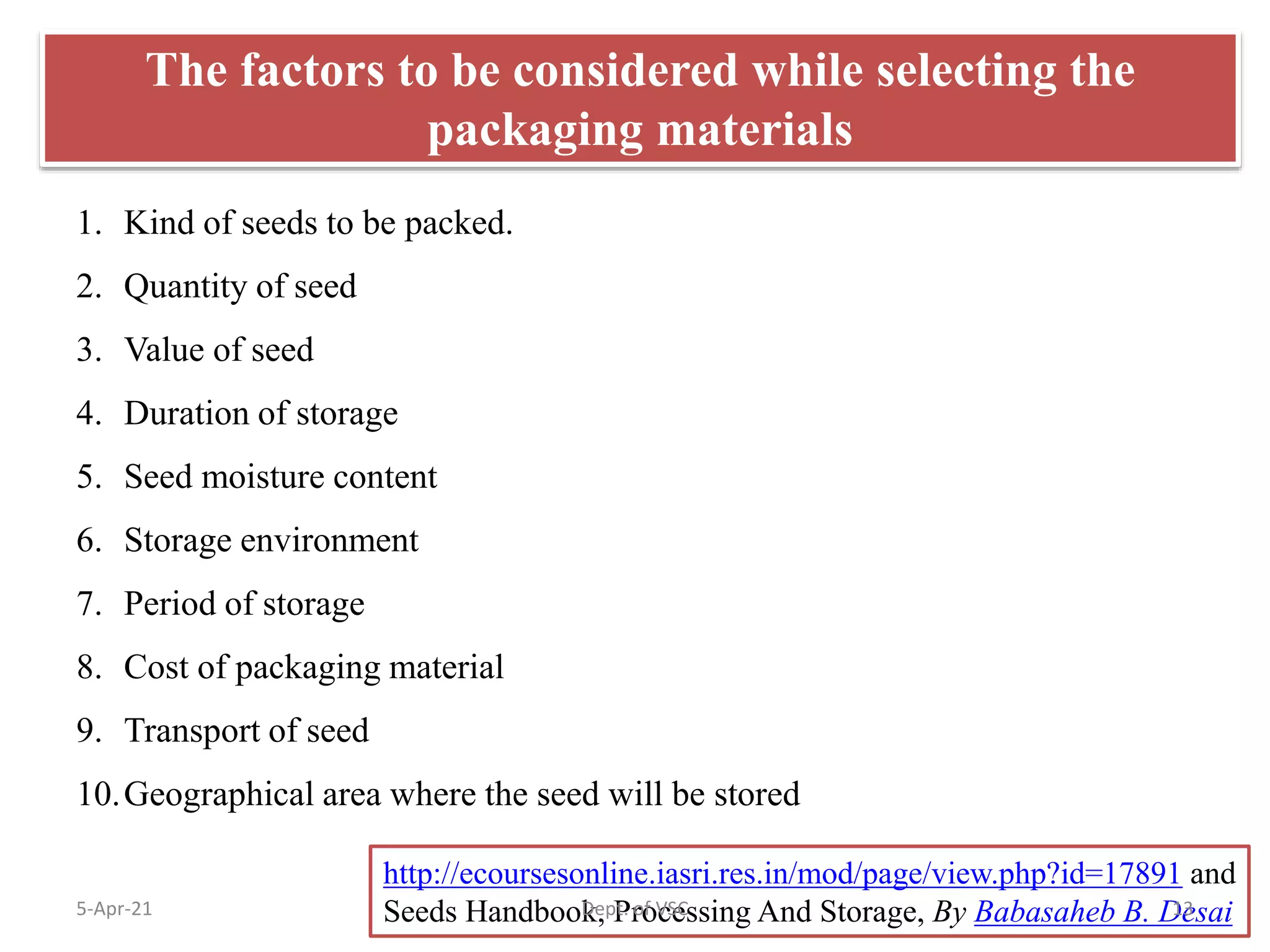
1. Kind of seeds to be packed.
2. Quantity of seed
3. Value of seed
4. Duration of storage
5. Seed moisture content
6. Storage environment
7. Period of storage
8. Cost of packaging material
9. Transport of seed
10.Geographical area where the seed will be stored
http://ecoursesonline.iasri.res.in/mod/page/view.php?id=17891 and
Seeds Handbook, Processing And Storage, By Babasaheb B. Desai
The factors to be considered while selecting the
packaging materials
5-Apr-21 13
Dept. of VSC
1. Moisture and vapour pervious container: These containers allow entry of
water in the form of vapour and liquid. These are suited for short term storage.
 e.g., jute bag, cloth bag, paper bag, multiwall paper bag, non-wooven bags
5-Apr-21 14
Dept. of VSC
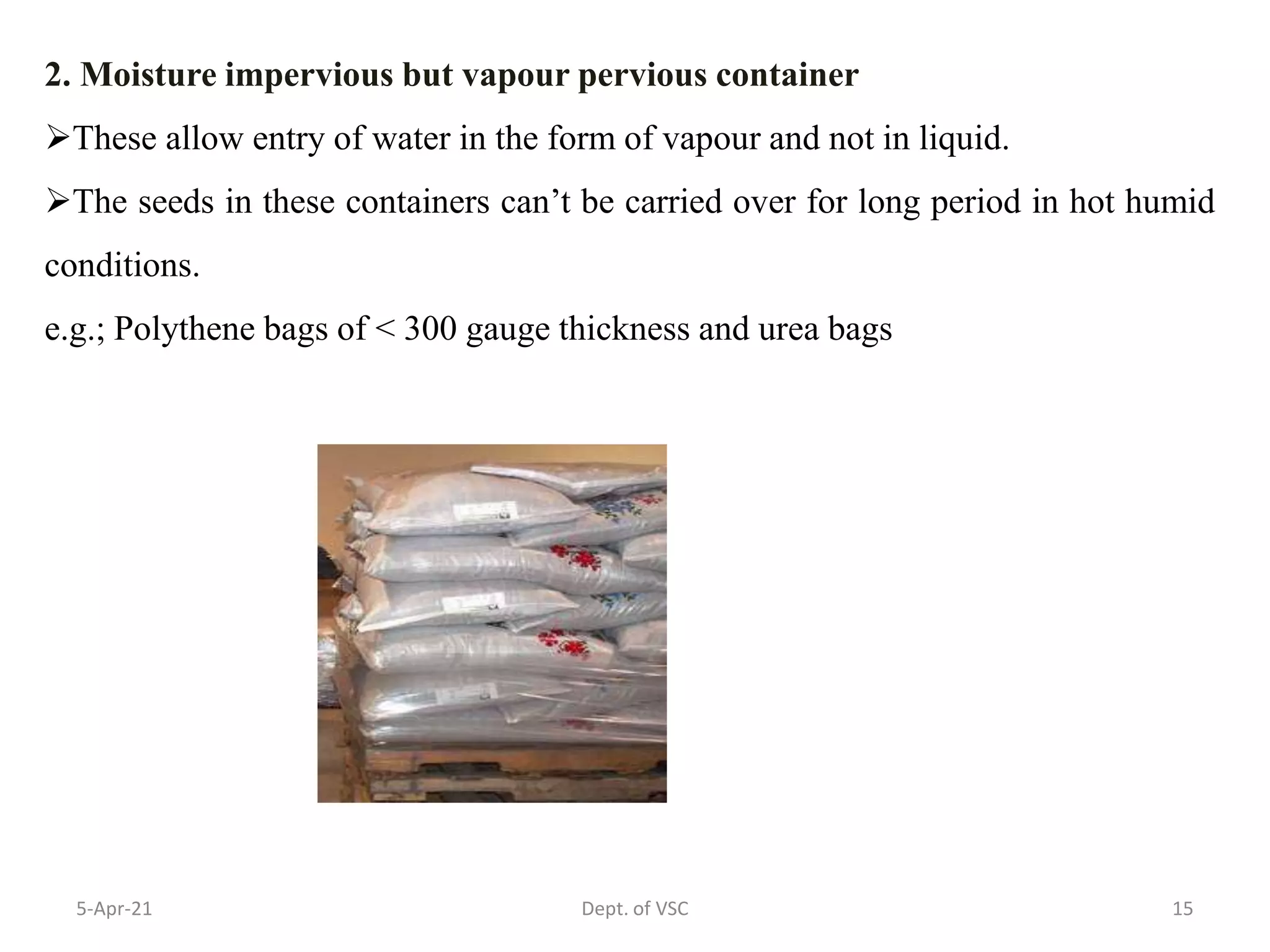
2. Moisture impervious but vapour pervious container
These allow entry of water in the form of vapour and not in liquid.
The seeds in these containers can’t be carried over for long period in hot humid
conditions.
e.g.; Polythene bags of < 300 gauge thickness and urea bags
5-Apr-21 15
Dept. of VSC
3. Moisture vapour proof container
It is very much suitable for short or medium term storage and has given excellent results.
For e.g., polythene bags of > 700 gauge thickness, aluminium foil pouches, rigid plastics, tin
cans, glass bottles etc.
5-Apr-21 16
Dept. of VSC
Vapour proof containers: Moisture content for foundation and
certified seed recommended by Indian minimum seed standards
 Lower internal seed moisture is found beneficial in increasing seed germination
in vacuum packed and air-tight containers than cloth bags and polyethylene
bags.
 Higher seed moisture and relative humidity content are congenial for seed
metabolites as well as for growth of fungus.
5-Apr-21 17
Dept. of VSC
5-Apr-21 18
Dept. of VSC
5-Apr-21 19
Dept. of VSC
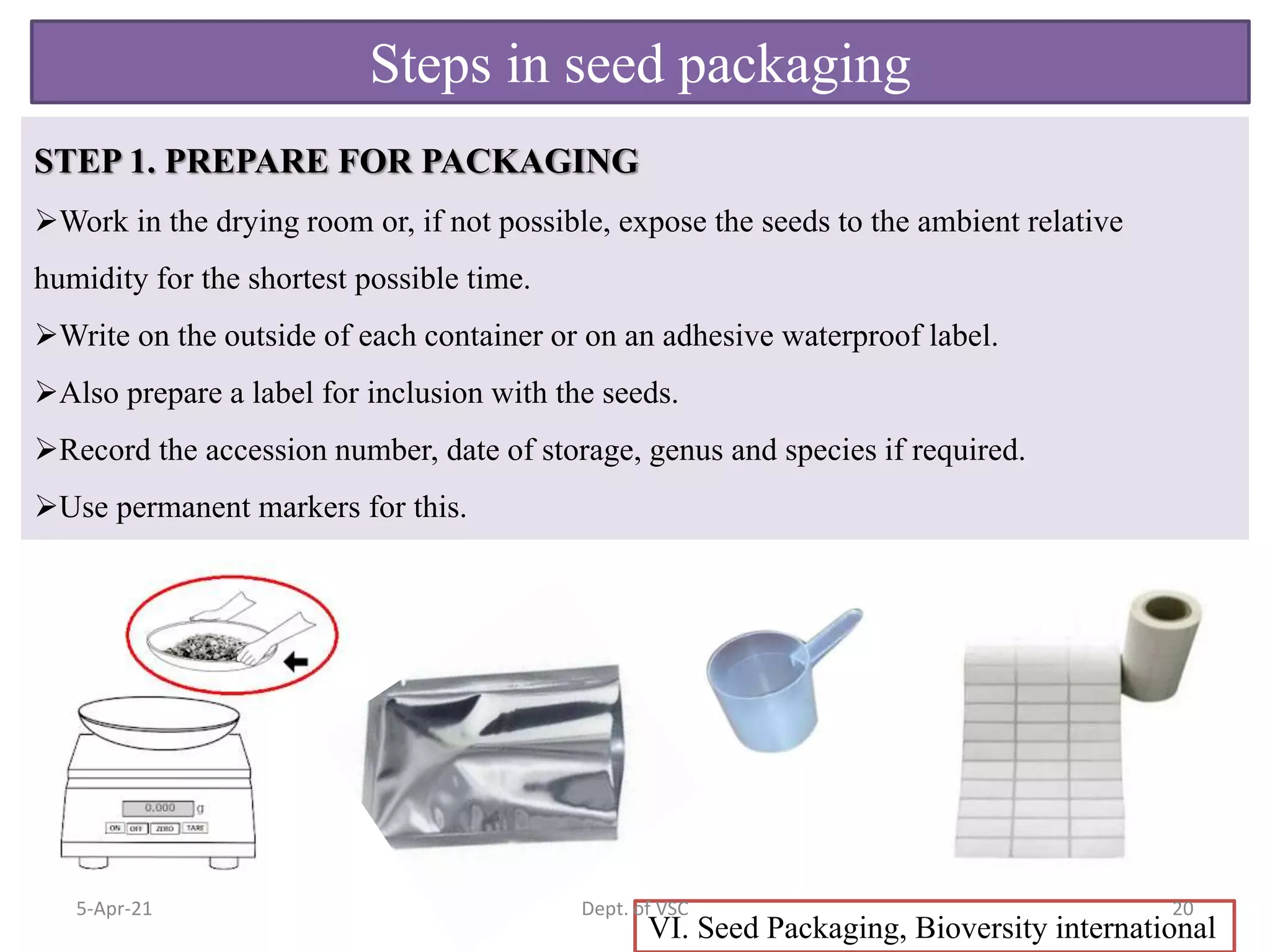
STEP 1. PREPARE FOR PACKAGING
Work in the drying room or, if not possible, expose the seeds to the ambient relative
humidity for the shortest possible time.
Write on the outside of each container or on an adhesive waterproof label.
Also prepare a label for inclusion with the seeds.
Record the accession number, date of storage, genus and species if required.
Use permanent markers for this.
VI. Seed Packaging, Bioversity international
Steps in seed packaging
5-Apr-21 20
Dept. of VSC
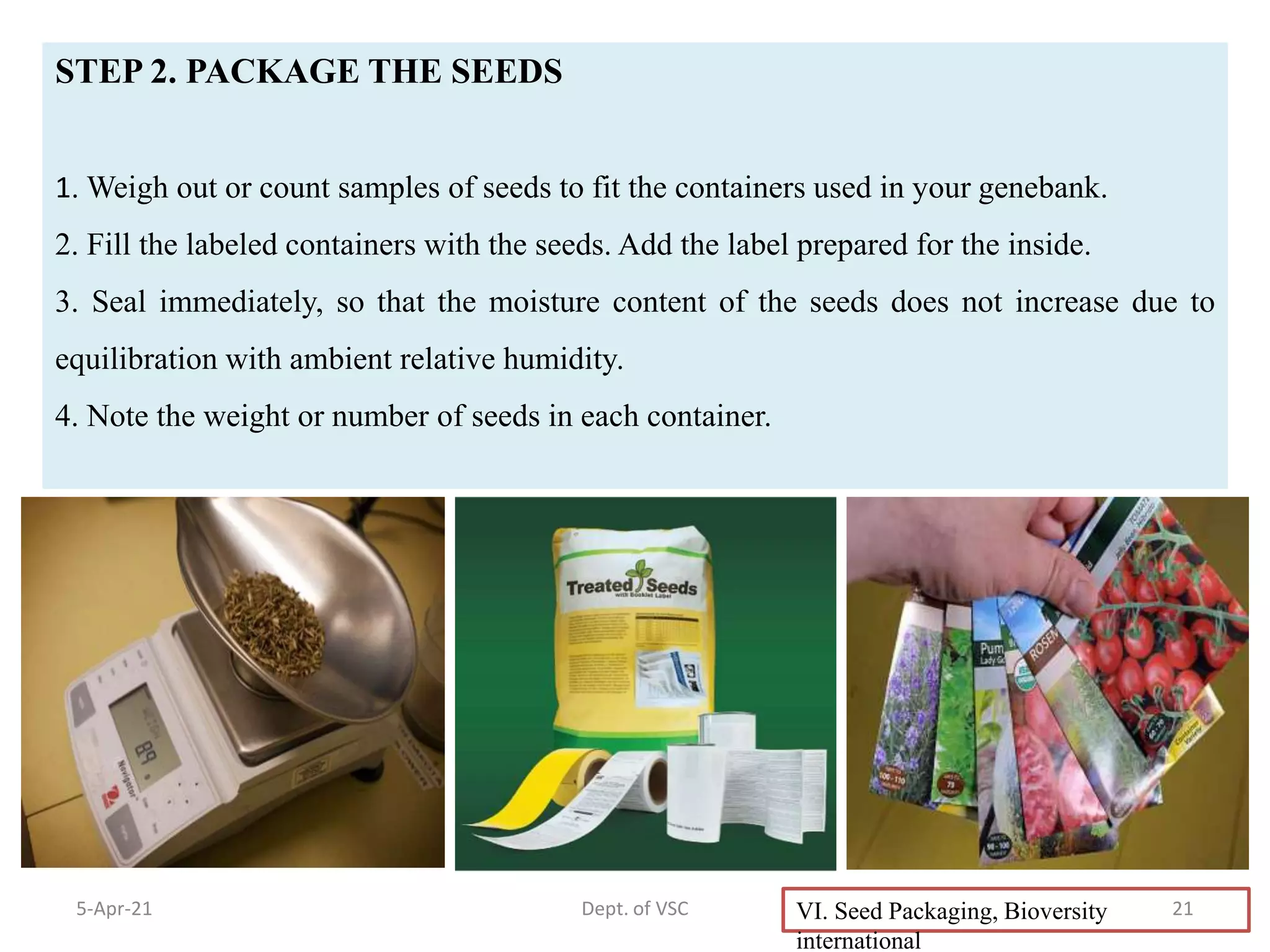
STEP 2. PACKAGE THE SEEDS
1. Weigh out or count samples of seeds to fit the containers used in your genebank.
2. Fill the labeled containers with the seeds. Add the label prepared for the inside.
3. Seal immediately, so that the moisture content of the seeds does not increase due to
equilibration with ambient relative humidity.
4. Note the weight or number of seeds in each container.
VI. Seed Packaging, Bioversity
international
5-Apr-21 21
Dept. of VSC
STEP 3. ENTER THE DATA INTO THE DATA FILES
 Enter the relevant data about each accession into the data file.
 The data should include number of containers per accession, number or weight of seeds per
container, type of container (if not standard) and the date of packaging.
5-Apr-21 22
Dept. of VSC
STEP 4. CHECK THE QUALITY OF THE CONTAINERS
After sealing, make a visual examination of each container to make sure that there is no obvious
damage and that the seals do not leak.
Any containers that are below standard should be replaced immediately.
At regular intervals the containers should be checked to see that they remain in good condition, check
should be carried out routinely once a year and that individual containers should also be checked
whenever they are removed from the genebank.
If containers are found to have been leaking and the relative humidity of the store was not controlled,
determine the seed moisture again and dry the seeds to required moisture content and enter the data in to
the file.
Check the inventory data file for the descriptor 'date of packaging' and make a list of any other
accessions which were packaged in similar containers on the same day or one day before or after.
Check the containers on this list for leaks and poor condition and replace any that are faulty using the
methods described above.
Remember that any containers removed from the cold store should be allowed to warm to room
temperature before opening. This may take several hours especially with large volumes of seeds.
VI. Seed Packaging, Bioversity international
5-Apr-21 23
Dept. of VSC
Fill the containers with silica gel and seal it in the same way in which seeds are stored.
Accurately determine the weight of the containers with an analytical balance.
Hold the containers over water (but not touching it) in a desiccators for about a week.
Remove the containers from the desiccators and allow the surface to dry.
Weigh the containers, record the change in weight and examine the colour of the silica gel.
If the weight of the containers remains constant, then they are moisture proof and the seal
is good.
If the weight of the containers increases and the silica gel has turned pale blue or pink,
then they are of poor quality or the seal is leaking moisture.
Adjust the seal and repeat the test to confirm the quality of the container.
Testing Quality of Containers
5-Apr-21 24
Dept. of VSC
Information Recorded on Seed Packaging
Date of packaging
Accession number
Type of container
Container number
Weight of container empty
Weight of container and seeds
Weight of seeds
5-Apr-21 25
Dept. of VSC
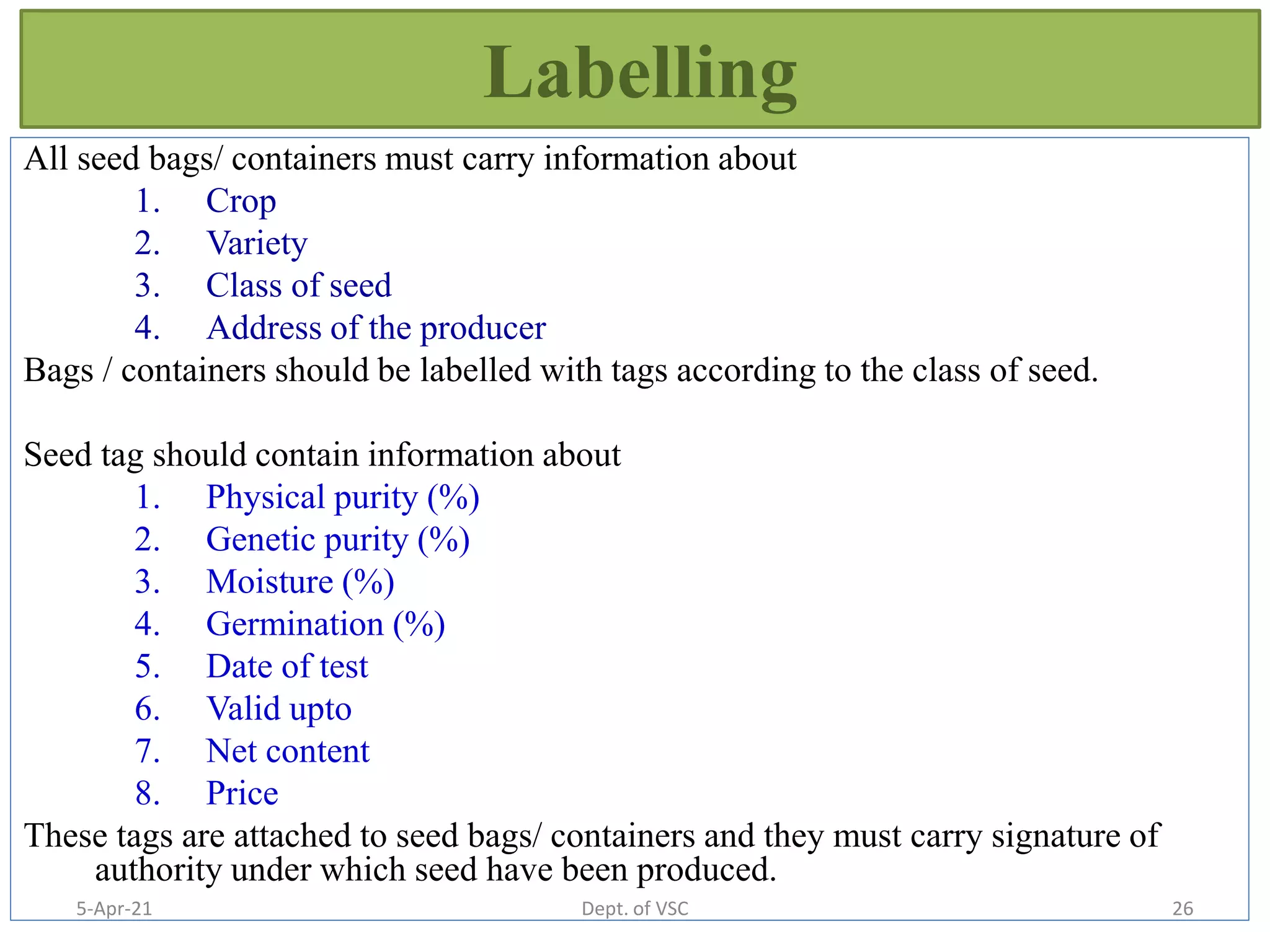
Labelling
All seed bags/ containers must carry information about
1. Crop
2. Variety
3. Class of seed
4. Address of the producer
Bags / containers should be labelled with tags according to the class of seed.
Seed tag should contain information about
1. Physical purity (%)
2. Genetic purity (%)
3. Moisture (%)
4. Germination (%)
5. Date of test
6. Valid upto
7. Net content
8. Price
These tags are attached to seed bags/ containers and they must carry signature of
authority under which seed have been produced.
5-Apr-21 26
Dept. of VSC
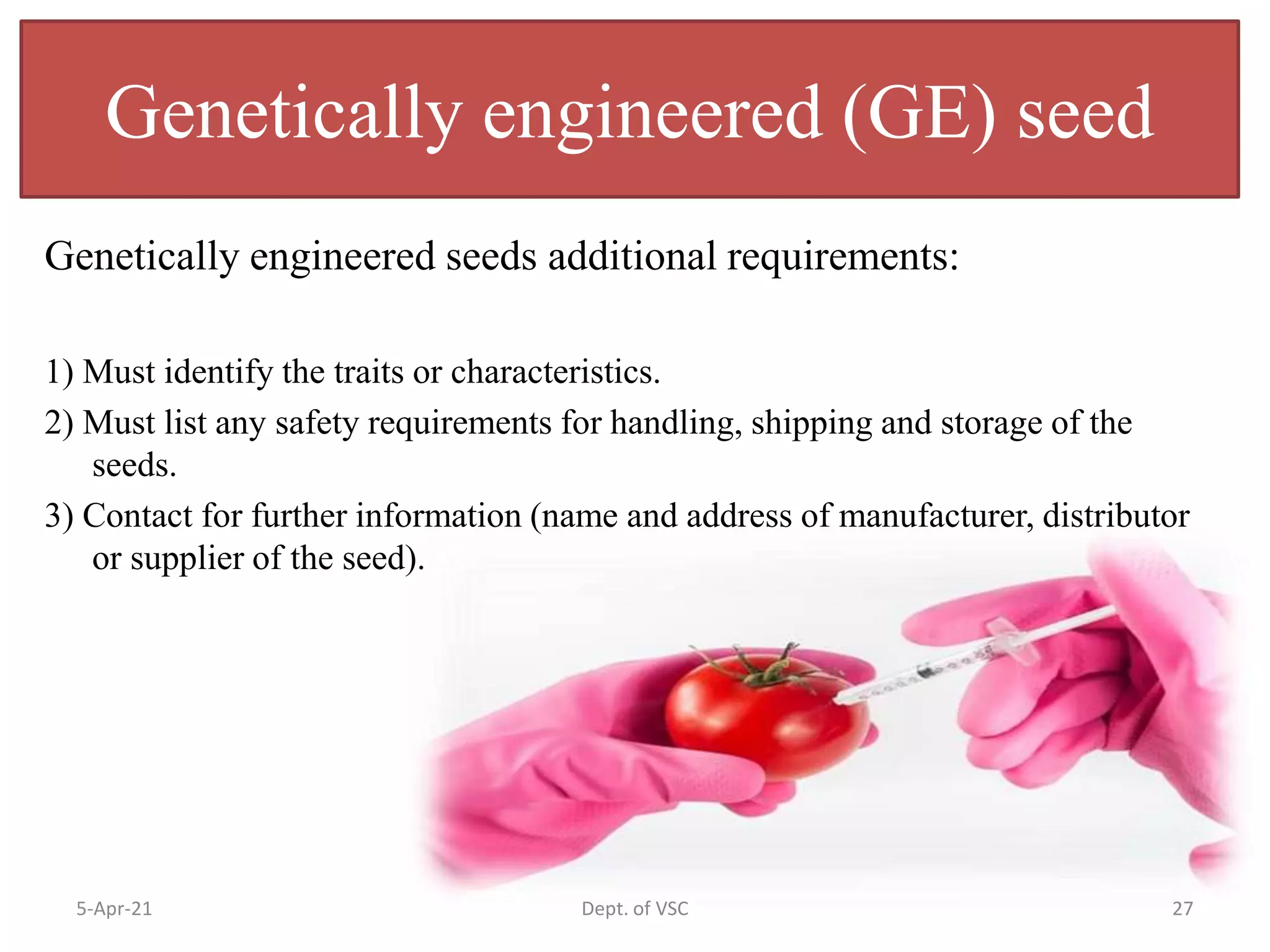
Genetically engineered (GE) seed
Genetically engineered seeds additional requirements:
1) Must identify the traits or characteristics.
2) Must list any safety requirements for handling, shipping and storage of the
seeds.
3) Contact for further information (name and address of manufacturer, distributor
or supplier of the seed).
5-Apr-21 Dept. of VSC 27
Treated seeds
1) Must state that the seeds have been treated.
2) Common chemical name of the applied substance.
3) Any cautionary statements if the substance is harmful to humans or
vertebrate animals.
4) If substance is toxic, a poison statement or symbol must be on the label.
5) If an inoculant has been used, the date of expiration of the inoculant must
be on the label
5-Apr-21 Dept. of VSC 28
Colour tags of different classes of seeds
5-Apr-21 Dept. of VSC 29
Breeder seeds
Foundation seeds
Certified seeds
Truthfully labeled seeds
Bar-coding is a computerized coding
system that uses a printed pattern of bars of
varying widths to uniquely identify
accessions.
Bar-codes are read by optically scanning
the printed pattern and using a computer
program to decode the pattern.
The data contained in a bar-code can vary:
in its simplest form, it can be just an
accession number while in other cases; the
bar-code can hold more elaborate passport
and inventory details
5-Apr-21 30
Dept. of VSC
Equipments Used in Packing
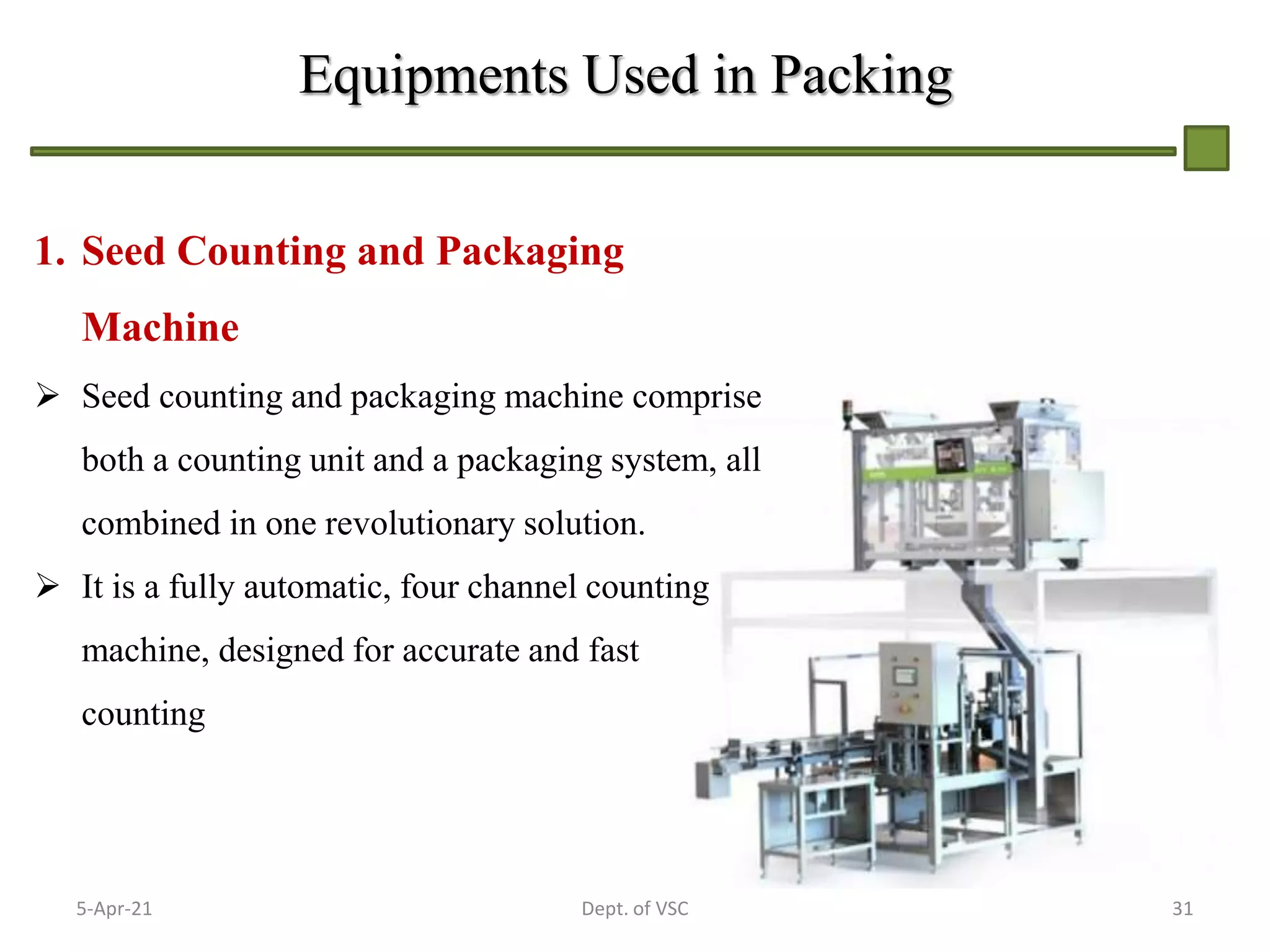
1. Seed Counting and Packaging
Machine
 Seed counting and packaging machine comprise
both a counting unit and a packaging system, all
combined in one revolutionary solution.
 It is a fully automatic, four channel counting
machine, designed for accurate and fast
counting
5-Apr-21 31
Dept. of VSC
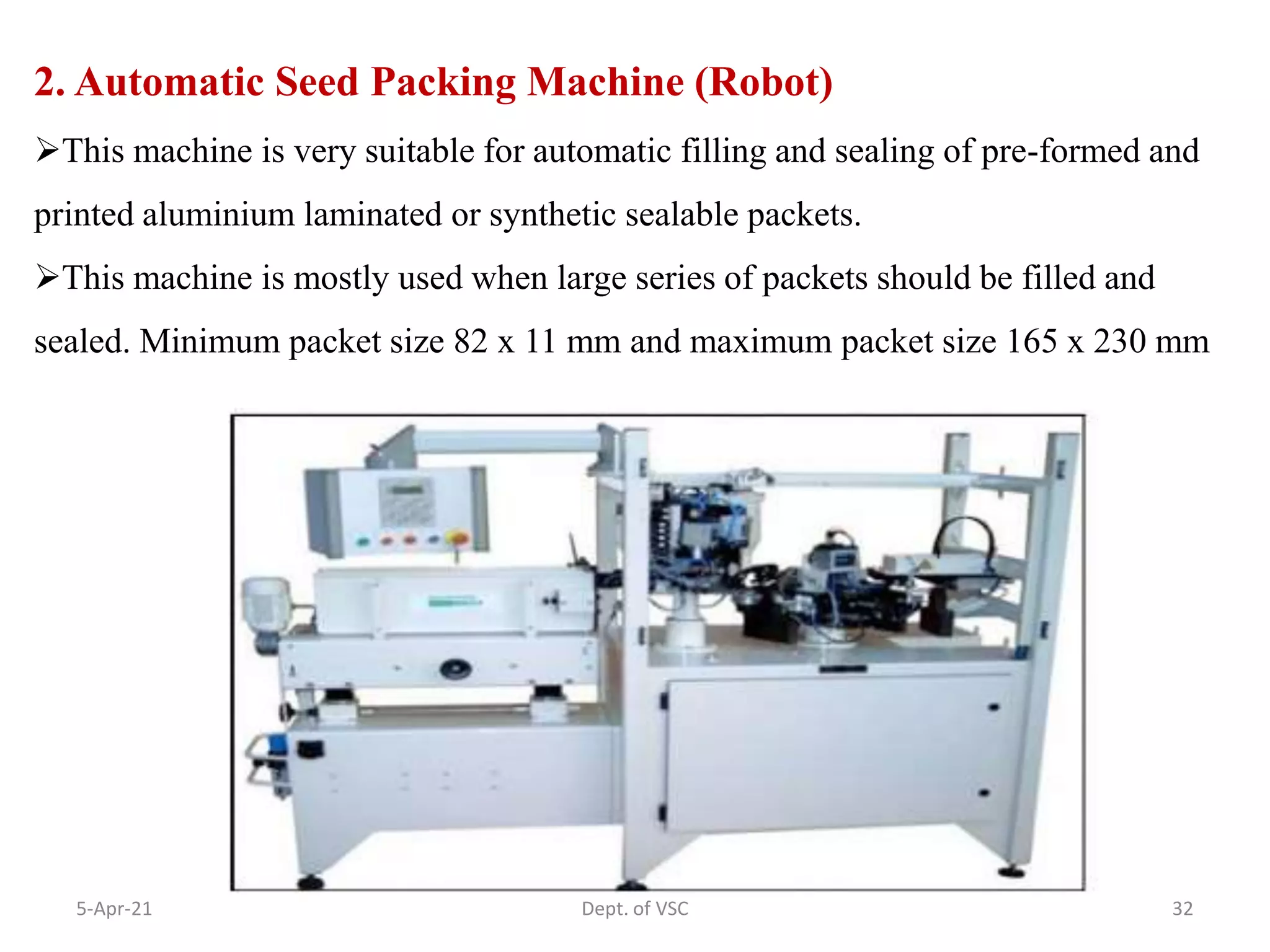
2. Automatic Seed Packing Machine (Robot)
This machine is very suitable for automatic filling and sealing of pre-formed and
printed aluminium laminated or synthetic sealable packets.
This machine is mostly used when large series of packets should be filled and
sealed. Minimum packet size 82 x 11 mm and maximum packet size 165 x 230 mm
5-Apr-21 32
Dept. of VSC
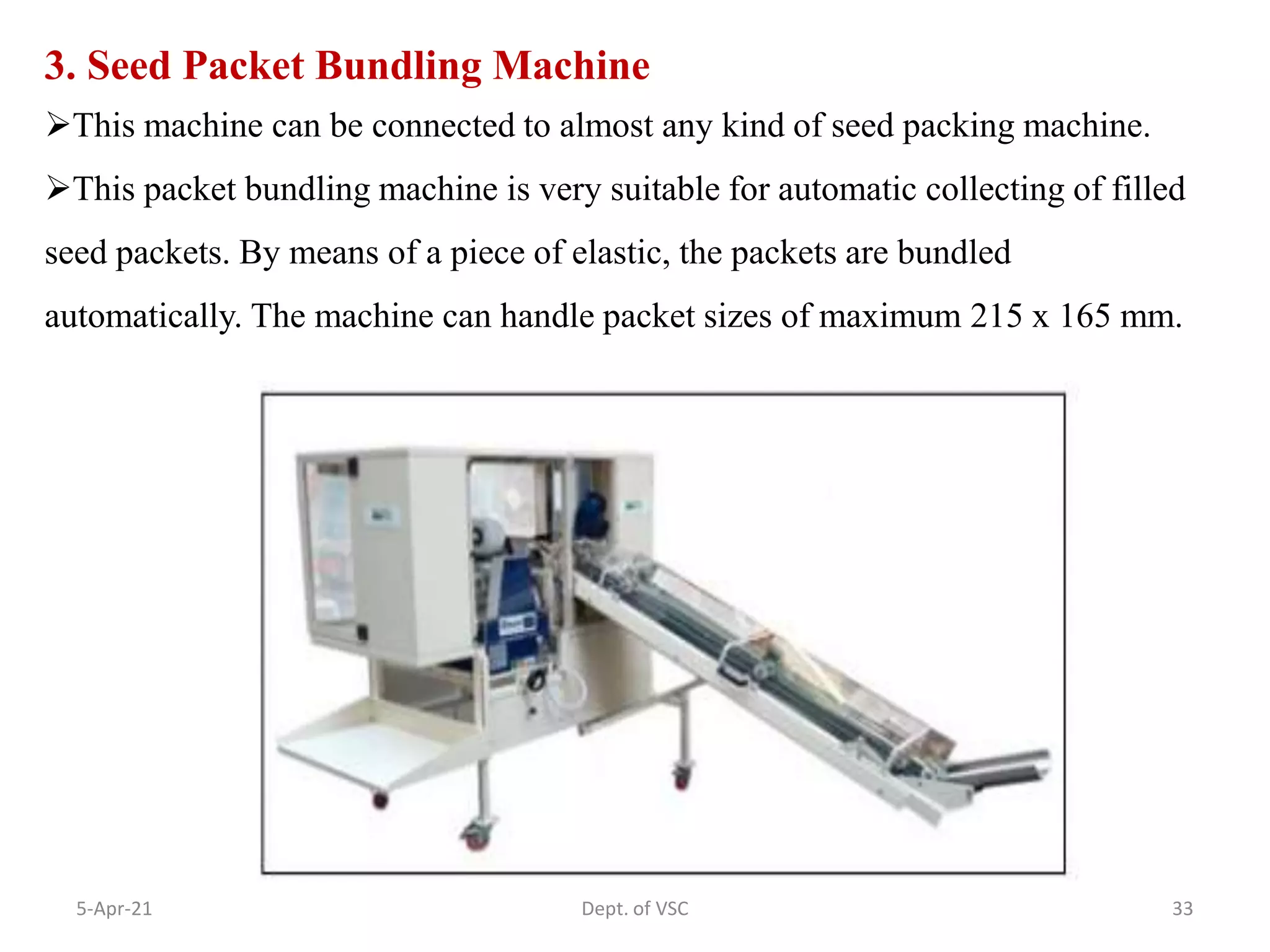
3. Seed Packet Bundling Machine
This machine can be connected to almost any kind of seed packing machine.
This packet bundling machine is very suitable for automatic collecting of filled
seed packets. By means of a piece of elastic, the packets are bundled
automatically. The machine can handle packet sizes of maximum 215 x 165 mm.
5-Apr-21 33
Dept. of VSC
4. Seed Packet Collecting Machine
This machine is used for automatic collection of filled packages in paper window
boxes.
This machine can be connected with our automatic seed packing machine (robot).
The paper box must be closed manually
5-Apr-21 34
Dept. of VSC
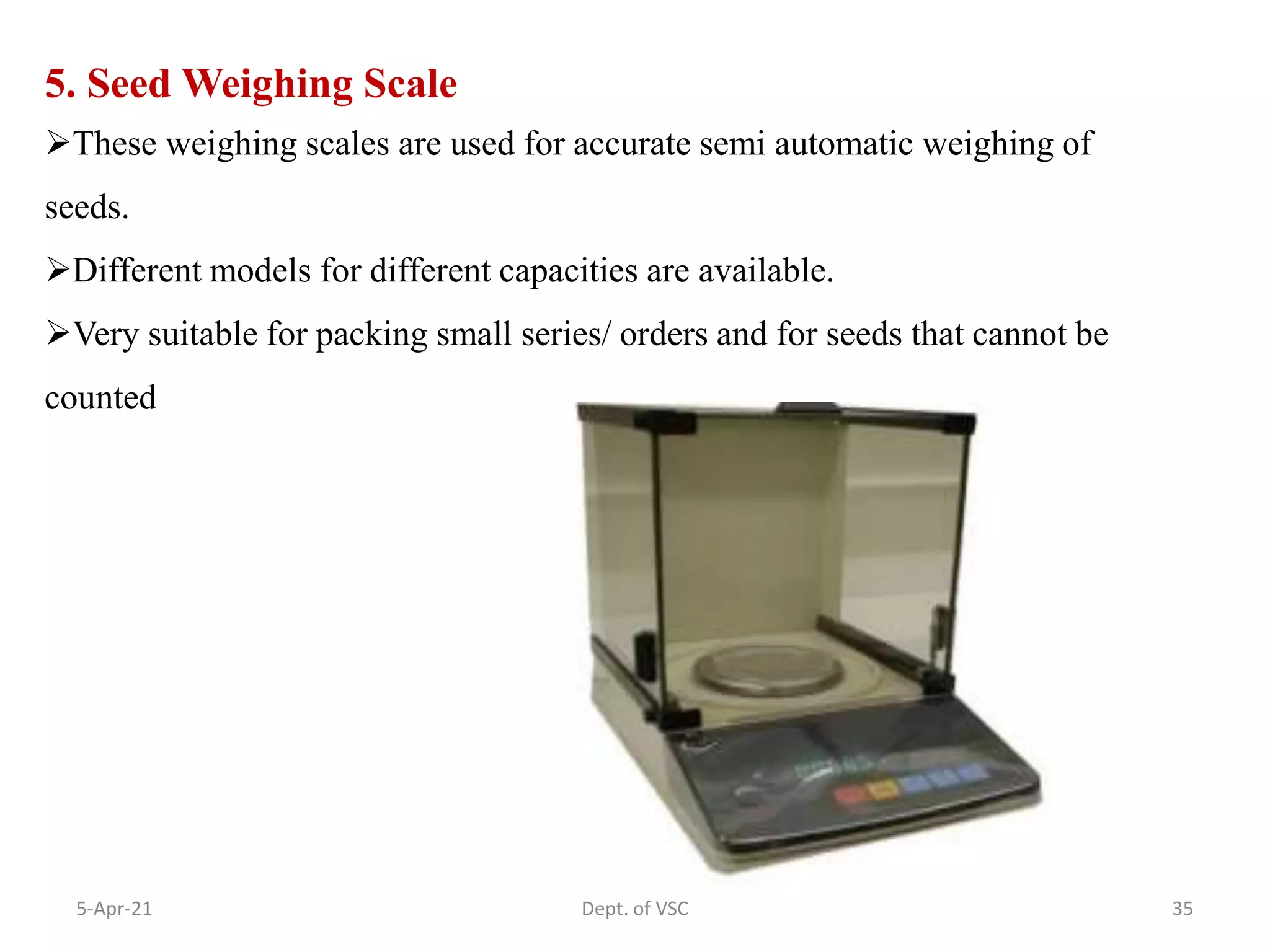
5. Seed Weighing Scale
These weighing scales are used for accurate semi automatic weighing of
seeds.
Different models for different capacities are available.
Very suitable for packing small series/ orders and for seeds that cannot be
counted
5-Apr-21 35
Dept. of VSC
6. Seed Weighing Machine
This seed weighing is used for automatic, accurate and fast weighing
of all kind of seeds.
This machine can be used as stand alone for manual filling, but also in
combination with our packing machines.
Different capacities are available
5-Apr-21 36
Dept. of VSC
7. Mobile Seed Weigher
This seed weigher is used for automatic weighing of all kind of seeds.
This set-up is transportable and therefore can be moved easily to any other seed
department.
You can collect the seeds in bags or buckets
5-Apr-21 37
Dept. of VSC
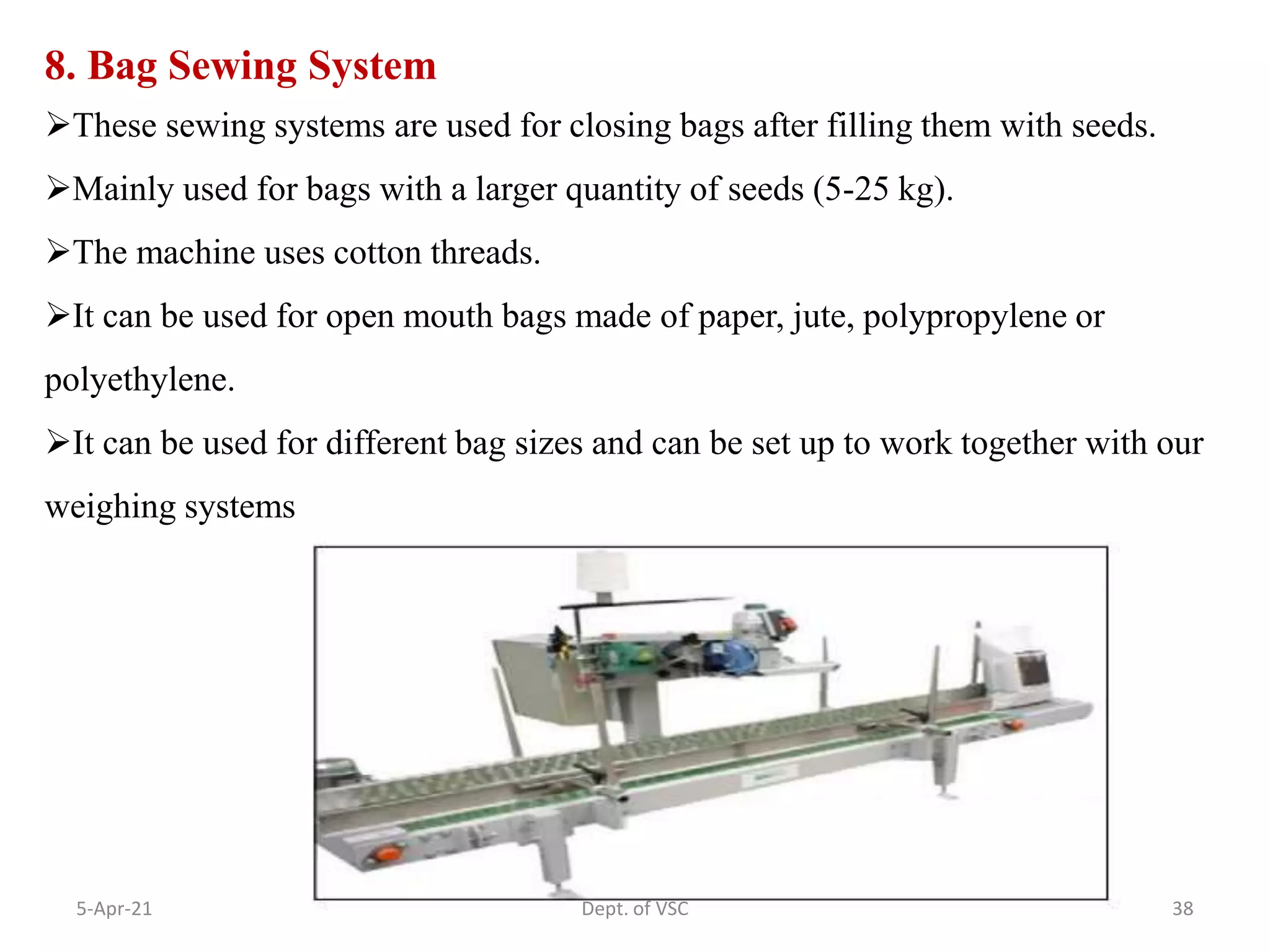
8. Bag Sewing System
These sewing systems are used for closing bags after filling them with seeds.
Mainly used for bags with a larger quantity of seeds (5-25 kg).
The machine uses cotton threads.
It can be used for open mouth bags made of paper, jute, polypropylene or
polyethylene.
It can be used for different bag sizes and can be set up to work together with our
weighing systems
5-Apr-21 38
Dept. of VSC
9. Packet Sealer
This vertical belt sealer is suitable for sealing aluminium, PE, PP and thin
laminate packets.
Pre-made bags are sealed standing up, which is ideal for seed bags that would
spill if sealed laying flat
5-Apr-21 39
Dept. of VSC
5-Apr-21 Dept. of VSC 40
Conclusion
Selection of proper packaging material will decides the storage
life, germination vigour of the seed.
Standardization should be done for packaging material should
be done for various vegetable crops of economic importance.
5-Apr-21 41
Dept. of VSC

Packaging, labeling and packaging materials for seeds

  • 1.
    Department of Vegetablescience COLLEGE OF HORTICULTURE, BAGALKOTE 5-Apr-21 1 Dept. of VSC Couse title: Seed certification, Processing and Storage of vegetable seeds VSC604 (2+1) Topic: Seed Packaging, Labelling and Equipments used for packaging of vegetable seeds. Presented To Mr. H. P Hadimani Asst. Professor Department of vegetable science COH, Bagalkot Presented By Sanmathi Naik A T S 1ST Ph. D (Hort.) Department of vegetable science COH, Bagalkot
  • 2.
    The process offilling, weighing and sealing of bags with seed http://ecoursesonline.iasri.res.in/mod/page/view.php?id=1789 1 5-Apr-21 2 Dept. of VSC
  • 3.
    Thompson regarded packagingas: Seeds Handbook, Processing And Storage, By Babasaheb B. Desai 1. A convenient unit for handling, transporting and storing. 2. A protection against contamination, mechanical damage and loss. 3. A suitable micro environment for storage. 4. A barrier against loss of seed and escape of pesticides. 5. A sale promoter. 5-Apr-21 3 Dept. of VSC
  • 4.
    VI. Seed Packaging,Bioversity international Seeds are packaged to prevent absorption of water from the atmosphere after drying, to keep each accession separate and prevent contamination of the seeds from insects and diseases. 5-Apr-21 4 Dept. of VSC
  • 5.
    The best timeto package seeds is directly after the moisture content has been determined and found to be within the required limits for safe storage. Seeds will always show an equilibrium between their moisture content and the relative humidity of the environment and therefore, if possible, seeds should be packaged into containers and hermetically sealed in the drying room. 5-Apr-21 5 Dept. of VSC
  • 6.
    Packaging of consistsof the operations Seeds Handbook, Processing And Storage. By Babasaheb B. Filling of seed bags to the specified weight Placing the leaflet in the seed bag regarding improved cultural practices pertaining to the cultivar Attaching labels and seed certification tags to the seed bags and sewing of the bags Transportation or the storage of the bags 5-Apr-21 6 Dept. of VSC
  • 7.
    Different containers andspecial equipments are available for sealing and storage of seeds. Storage containers for base collections should be hermetically sealed and moisture-proof. Cans, bottles, and laminated alluminium foil containers are all acceptable for both base and active collections. The techniques used will vary with the type of container and the equipment that your genebank is using. VI. Seed Packaging, Bioversity international How seeds are packed? 5-Apr-21 7 Dept. of VSC
  • 8.
    1. Base collection Itincludes maximum no. of accessions available in a crop. Conservation upto long term like 50 years or more. Stored at -18 °C hermetically sealed. Moisture content 5%. 2. Active collection Germplasm is actively utilized in breeding programmes. Conservation upto medium term like 8-10 years. Stored at -0°C. Moisture content 8%. 3. Working collections It is ultilized by breeders in their crop improvement programme. Conservation upto short term 3-5 years. Stored at 5-10 °C. Moisture content 8-10 %. Types of Seed Collection 5-Apr-21 8 Dept. of VSC
  • 9.
    Objectives of Packaging Productidentification Product convenience Product protection Product promotion Attractiveness 5-Apr-21 9 Dept. of VSC
  • 10.
    How many seedsshould be packed? The number of seeds to be packed for storage will depend on the species being conserved and how often seeds will be removed for monitoring, distribution or regeneration. The FAO/ IPGRI Genebank Standards (1994) recommend that: 1. Material which shows little morphological variation (genetically homogenous accessions): 3000 seeds are acceptable, but 4000 seeds are preferable to represent each accession. 2. Materials showing large morphological variation (genetically heterogeneous accessions): An accession should consist of at least 4000 seeds are preferred. 5-Apr-21 10 Dept. of VSC
  • 11.
    In Genebanks, itis easier to work in weights, but seed number can easily be converted from weights if the 100-seed or 1000- seed weight is known. For example, to determine the number of seeds in a sample for which the 100-seed weight is known: 5-Apr-21 11 Dept. of VSC
  • 12.
    Essentials of GoodPackaging Should be attractive Should protect the content Should be convenient Prevention from adulteration Extends product life 5-Apr-21 12 Dept. of VSC
  • 13.
    1. Kind ofseeds to be packed. 2. Quantity of seed 3. Value of seed 4. Duration of storage 5. Seed moisture content 6. Storage environment 7. Period of storage 8. Cost of packaging material 9. Transport of seed 10.Geographical area where the seed will be stored http://ecoursesonline.iasri.res.in/mod/page/view.php?id=17891 and Seeds Handbook, Processing And Storage, By Babasaheb B. Desai The factors to be considered while selecting the packaging materials 5-Apr-21 13 Dept. of VSC
  • 14.
    1. Moisture andvapour pervious container: These containers allow entry of water in the form of vapour and liquid. These are suited for short term storage.  e.g., jute bag, cloth bag, paper bag, multiwall paper bag, non-wooven bags 5-Apr-21 14 Dept. of VSC
  • 15.
    2. Moisture imperviousbut vapour pervious container These allow entry of water in the form of vapour and not in liquid. The seeds in these containers can’t be carried over for long period in hot humid conditions. e.g.; Polythene bags of < 300 gauge thickness and urea bags 5-Apr-21 15 Dept. of VSC
  • 16.
    3. Moisture vapourproof container It is very much suitable for short or medium term storage and has given excellent results. For e.g., polythene bags of > 700 gauge thickness, aluminium foil pouches, rigid plastics, tin cans, glass bottles etc. 5-Apr-21 16 Dept. of VSC
  • 17.
    Vapour proof containers:Moisture content for foundation and certified seed recommended by Indian minimum seed standards  Lower internal seed moisture is found beneficial in increasing seed germination in vacuum packed and air-tight containers than cloth bags and polyethylene bags.  Higher seed moisture and relative humidity content are congenial for seed metabolites as well as for growth of fungus. 5-Apr-21 17 Dept. of VSC
  • 18.
  • 19.
  • 20.
    STEP 1. PREPAREFOR PACKAGING Work in the drying room or, if not possible, expose the seeds to the ambient relative humidity for the shortest possible time. Write on the outside of each container or on an adhesive waterproof label. Also prepare a label for inclusion with the seeds. Record the accession number, date of storage, genus and species if required. Use permanent markers for this. VI. Seed Packaging, Bioversity international Steps in seed packaging 5-Apr-21 20 Dept. of VSC
  • 21.
    STEP 2. PACKAGETHE SEEDS 1. Weigh out or count samples of seeds to fit the containers used in your genebank. 2. Fill the labeled containers with the seeds. Add the label prepared for the inside. 3. Seal immediately, so that the moisture content of the seeds does not increase due to equilibration with ambient relative humidity. 4. Note the weight or number of seeds in each container. VI. Seed Packaging, Bioversity international 5-Apr-21 21 Dept. of VSC
  • 22.
    STEP 3. ENTERTHE DATA INTO THE DATA FILES  Enter the relevant data about each accession into the data file.  The data should include number of containers per accession, number or weight of seeds per container, type of container (if not standard) and the date of packaging. 5-Apr-21 22 Dept. of VSC
  • 23.
    STEP 4. CHECKTHE QUALITY OF THE CONTAINERS After sealing, make a visual examination of each container to make sure that there is no obvious damage and that the seals do not leak. Any containers that are below standard should be replaced immediately. At regular intervals the containers should be checked to see that they remain in good condition, check should be carried out routinely once a year and that individual containers should also be checked whenever they are removed from the genebank. If containers are found to have been leaking and the relative humidity of the store was not controlled, determine the seed moisture again and dry the seeds to required moisture content and enter the data in to the file. Check the inventory data file for the descriptor 'date of packaging' and make a list of any other accessions which were packaged in similar containers on the same day or one day before or after. Check the containers on this list for leaks and poor condition and replace any that are faulty using the methods described above. Remember that any containers removed from the cold store should be allowed to warm to room temperature before opening. This may take several hours especially with large volumes of seeds. VI. Seed Packaging, Bioversity international 5-Apr-21 23 Dept. of VSC
  • 24.
    Fill the containerswith silica gel and seal it in the same way in which seeds are stored. Accurately determine the weight of the containers with an analytical balance. Hold the containers over water (but not touching it) in a desiccators for about a week. Remove the containers from the desiccators and allow the surface to dry. Weigh the containers, record the change in weight and examine the colour of the silica gel. If the weight of the containers remains constant, then they are moisture proof and the seal is good. If the weight of the containers increases and the silica gel has turned pale blue or pink, then they are of poor quality or the seal is leaking moisture. Adjust the seal and repeat the test to confirm the quality of the container. Testing Quality of Containers 5-Apr-21 24 Dept. of VSC
  • 25.
    Information Recorded onSeed Packaging Date of packaging Accession number Type of container Container number Weight of container empty Weight of container and seeds Weight of seeds 5-Apr-21 25 Dept. of VSC
  • 26.
    Labelling All seed bags/containers must carry information about 1. Crop 2. Variety 3. Class of seed 4. Address of the producer Bags / containers should be labelled with tags according to the class of seed. Seed tag should contain information about 1. Physical purity (%) 2. Genetic purity (%) 3. Moisture (%) 4. Germination (%) 5. Date of test 6. Valid upto 7. Net content 8. Price These tags are attached to seed bags/ containers and they must carry signature of authority under which seed have been produced. 5-Apr-21 26 Dept. of VSC
  • 27.
    Genetically engineered (GE)seed Genetically engineered seeds additional requirements: 1) Must identify the traits or characteristics. 2) Must list any safety requirements for handling, shipping and storage of the seeds. 3) Contact for further information (name and address of manufacturer, distributor or supplier of the seed). 5-Apr-21 Dept. of VSC 27
  • 28.
    Treated seeds 1) Muststate that the seeds have been treated. 2) Common chemical name of the applied substance. 3) Any cautionary statements if the substance is harmful to humans or vertebrate animals. 4) If substance is toxic, a poison statement or symbol must be on the label. 5) If an inoculant has been used, the date of expiration of the inoculant must be on the label 5-Apr-21 Dept. of VSC 28
  • 29.
    Colour tags ofdifferent classes of seeds 5-Apr-21 Dept. of VSC 29 Breeder seeds Foundation seeds Certified seeds Truthfully labeled seeds
  • 30.
    Bar-coding is acomputerized coding system that uses a printed pattern of bars of varying widths to uniquely identify accessions. Bar-codes are read by optically scanning the printed pattern and using a computer program to decode the pattern. The data contained in a bar-code can vary: in its simplest form, it can be just an accession number while in other cases; the bar-code can hold more elaborate passport and inventory details 5-Apr-21 30 Dept. of VSC
  • 31.
    Equipments Used inPacking 1. Seed Counting and Packaging Machine  Seed counting and packaging machine comprise both a counting unit and a packaging system, all combined in one revolutionary solution.  It is a fully automatic, four channel counting machine, designed for accurate and fast counting 5-Apr-21 31 Dept. of VSC
  • 32.
    2. Automatic SeedPacking Machine (Robot) This machine is very suitable for automatic filling and sealing of pre-formed and printed aluminium laminated or synthetic sealable packets. This machine is mostly used when large series of packets should be filled and sealed. Minimum packet size 82 x 11 mm and maximum packet size 165 x 230 mm 5-Apr-21 32 Dept. of VSC
  • 33.
    3. Seed PacketBundling Machine This machine can be connected to almost any kind of seed packing machine. This packet bundling machine is very suitable for automatic collecting of filled seed packets. By means of a piece of elastic, the packets are bundled automatically. The machine can handle packet sizes of maximum 215 x 165 mm. 5-Apr-21 33 Dept. of VSC
  • 34.
    4. Seed PacketCollecting Machine This machine is used for automatic collection of filled packages in paper window boxes. This machine can be connected with our automatic seed packing machine (robot). The paper box must be closed manually 5-Apr-21 34 Dept. of VSC
  • 35.
    5. Seed WeighingScale These weighing scales are used for accurate semi automatic weighing of seeds. Different models for different capacities are available. Very suitable for packing small series/ orders and for seeds that cannot be counted 5-Apr-21 35 Dept. of VSC
  • 36.
    6. Seed WeighingMachine This seed weighing is used for automatic, accurate and fast weighing of all kind of seeds. This machine can be used as stand alone for manual filling, but also in combination with our packing machines. Different capacities are available 5-Apr-21 36 Dept. of VSC
  • 37.
    7. Mobile SeedWeigher This seed weigher is used for automatic weighing of all kind of seeds. This set-up is transportable and therefore can be moved easily to any other seed department. You can collect the seeds in bags or buckets 5-Apr-21 37 Dept. of VSC
  • 38.
    8. Bag SewingSystem These sewing systems are used for closing bags after filling them with seeds. Mainly used for bags with a larger quantity of seeds (5-25 kg). The machine uses cotton threads. It can be used for open mouth bags made of paper, jute, polypropylene or polyethylene. It can be used for different bag sizes and can be set up to work together with our weighing systems 5-Apr-21 38 Dept. of VSC
  • 39.
    9. Packet Sealer Thisvertical belt sealer is suitable for sealing aluminium, PE, PP and thin laminate packets. Pre-made bags are sealed standing up, which is ideal for seed bags that would spill if sealed laying flat 5-Apr-21 39 Dept. of VSC
  • 40.
    5-Apr-21 Dept. ofVSC 40 Conclusion Selection of proper packaging material will decides the storage life, germination vigour of the seed. Standardization should be done for packaging material should be done for various vegetable crops of economic importance.
  • 41.