These Self-Study Modules are meant for each student to work through individually, not as
a group or with a partner.
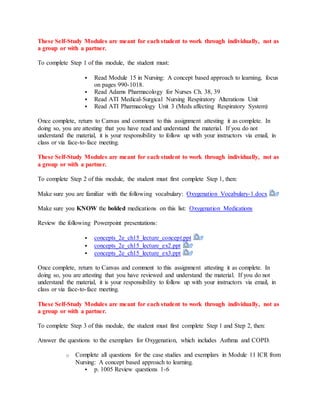
To complete Step 1 of this module, the student must:
 Read Module 15 in Nursing: A concept based approach to learning, focus
on pages 990-1018.
 Read Adams Pharmacology for Nurses Ch. 38, 39
 Read ATI Medical-Surgical Nursing Respiratory Alterations Unit
 Read ATI Pharmacology Unit 3 (Meds affecting Respiratory System)
Once complete, return to Canvas and comment to this assignment attesting it as complete. In
doing so, you are attesting that you have read and understand the material. If you do not
understand the material, it is your responsibility to follow up with your instructors via email, in
class or via face-to-face meeting.
These Self-Study Modules are meant for each student to work through individually, not as
a group or with a partner.
To complete Step 2 of this module, the student must first complete Step 1, then:
Make sure you are familiar with the following vocabulary: Oxygenation Vocabulary-1.docx
Make sure you KNOW the bolded medications on this list: Oxygenation Medications
Review the following Powerpoint presentations:
 concepts_2e_ch15_lecture_concept.ppt
 concepts_2e_ch15_lecture_ex2.ppt
 concepts_2e_ch15_lecture_ex3.ppt
Once complete, return to Canvas and comment to this assignment attesting it as complete. In
doing so, you are attesting that you have reviewed and understand the material. If you do not
understand the material, it is your responsibility to follow up with your instructors via email, in
class or via face-to-face meeting.
These Self-Study Modules are meant for each student to work through individually, not as
a group or with a partner.
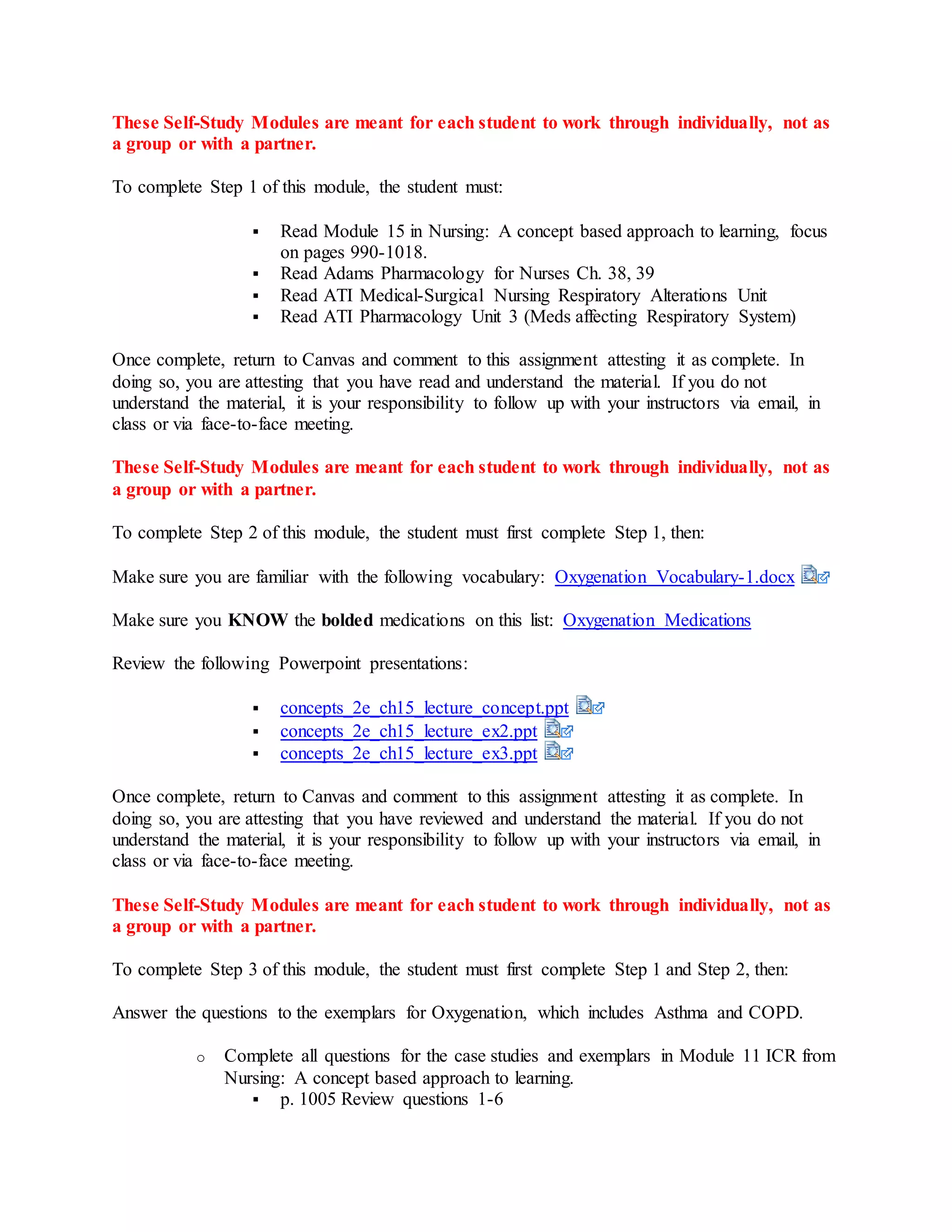
To complete Step 3 of this module, the student must first complete Step 1 and Step 2, then:
Answer the questions to the exemplars for Oxygenation, which includes Asthma and COPD.
o Complete all questions for the case studies and exemplars in Module 11 ICR from
Nursing: A concept based approach to learning.
 p. 1005 Review questions 1-6
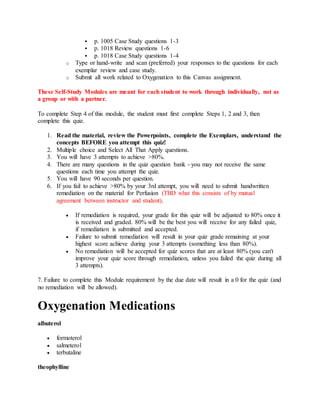
 p. 1005 Case Study questions 1-3
 p. 1018 Review questions 1-6
 p. 1018 Case Study questions 1-4
o Type or hand-write and scan (preferred) your responses to the questions for each
exemplar review and case study.
o Submit all work related to Oxygenation to this Canvas assignment.
These Self-Study Modules are meant for each student to work through individually, not as
a group or with a partner.
To complete Step 4 of this module, the student must first complete Steps 1, 2 and 3, then
complete this quiz.
1. Read the material, review the Powerpoints, complete the Exemplars, understand the
concepts BEFORE you attempt this quiz!
2. Multiple choice and Select All That Apply questions.
3. You will have 3 attempts to achieve >80%.
4. There are many questions in the quiz question bank - you may not receive the same
questions each time you attempt the quiz.
5. You will have 90 seconds per question.
6. If you fail to achieve >80% by your 3rd attempt, you will need to submit handwritten
remediation on the material for Perfusion (TBD what this consists of by mutual
agreement between instructor and student).
 If remediation is required, your grade for this quiz will be adjusted to 80% once it
is received and graded. 80% will be the best you will receive for any failed quiz,
if remediation is submitted and accepted.
 Failure to submit remediation will result in your quiz grade remaining at your
highest score achieve during your 3 attempts (something less than 80%).
 No remediation will be accepted for quiz scores that are at least 80% (you can't
improve your quiz score through remediation, unless you failed the quiz during all
3 attempts).
7. Failure to complete this Module requirement by the due date will result in a 0 for the quiz (and
no remediation will be allowed).
Oxygenation Medications
albuterol
 formoterol
 salmeterol
 terbutaline
theophylline
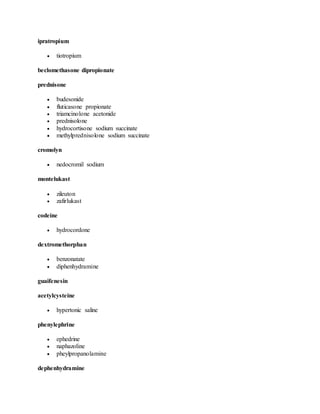
ipratropium
 tiotropium
beclomethasone dipropionate
prednisone
 budesonide
 fluticasone propionate
 triamcinolone acetonide
 prednisolone
 hydrocortisone sodium succinate
 methylprednisolone sodium succinate
cromolyn
 nedocromil sodium
montelukast
 zileuton
 zafirlukast
codeine
 hydrocordone
dextromethorphan
 benzonatate
 diphenhydramine
guaifenesin
acetylcysteine
 hypertonic saline
phenylephrine
 ephedrine
 naphazoline
 pheylpropanolamine
dephenhydramine
promethazine
dimenhydrinate
 loratadine
 cetirizine
 fexofenadine
 desloratadine
OxygenationVocabulary
 Acidosis
 Adenocarcinoma
 Advisory Committee onImmunizationPractices(APIC)
 Affinity
 Airtrapping
 Airwayremodeling
 Airwayresistance
 Alkalosis
 Alveolarducts
 Alveolarmacrophage
 AlveolarPO2 (PAO2)
 Alveolarsac
 Alveolarventilation
 Anatomicdeadspace
 Anatomicshunt
 Angiotensinconvertingenzyme (ACE)
 AngiotensinI
 AngiotensinII
 Antigenicdrift
 Antigenicshift
 Apnea
 Apneusticcenter
 Arterial bloodgas(ABG)
 Arterial PO2 (PaO2)
 Aspirationpneumonia
 Asthma
 Atelectasis
 Atmosphericpressure
 Atypical pneumonia
 Auscultation
 Barrel chest
 Bicarbonate
 Bradykinin
 Bradypnea
 Bronchi
 Bronchial circulation
 Bronchial washings
 Bronchioles
 Bronchitis
 Bronchopulmonarydysplasia
 Bronchoscopy
 Bronchovesicular
 Carbaminohemoglobin
 Carbonicacid (H2CO3)
 Carbonicanhydrase
 Carina
 Cartilaginous
 CD4 cells
 CentersforDisease Control andPrevention(CDC)
 Chemoreceptors
 Chestx-ray(CXR)
 Chronicbronchitis
 Chronicobstructive pulmonarydisease(COPD)
 Clubbing
 Communityacquiredpneumonia
 Compliance
 Conductingairway
 Cor pulmonale
 Crackles
 Croup
 Cushingsyndrome
 Cyanosis
 Deadair space
 Deoxygenatedblood
 Deoxygenatedhemoglobin
 Diaphragm
 Diffuse pulmonaryfibrosis
 Diffusion
 Dimorphic
 Distensibility
 Dropletnuclei
 Dysplasia
 Dyspnea
 Edema
 Efficiencyof breathing
 Emphysema
 Epiglottis
 Epiglottitis
 Etiology
 Eupnea
 Exacerbations
 Expectorate
 Expiration
 Expiratoryreserve volume (ERV)
 Forcedexpiratoryvolume (FEV1.0)
 Forcedexpiratoryvolume in1second(FEV1)
 Forcedinspiratoryflowrate (FIF25%-75%)
 Forcedmidexpiratoryflowrate (FEF25%-75%)
 Forcedvital capacity(FVC)
 Functional residualcapacity(FRC)
 Ghon complex
 Grunting
 Guillain-Barre syndrome
 HelperT lymphocytes
 Hemoglobin
 Heparinsecretingcells(inthe lungs)
 Hepatomegaloy
 Hilus
 Histoplasmacasulatum
 Histoplasmosis
 Hospital acquiredpneumonia
 Hyaline membrane disease
 Hyperbaric
 Hypercapnia
 Hypercarbia
 Hyperresponsiveness
 Hyperventilation
 Hyphae
 Hypoplasia
 Hypoxemia
 Hypoxemic
 Iatrogenic
 Immunization
 Immunocompromised
 Incentive spirometry
 Influenza
 Inspiration
 Inspiratorycapacity(IC)
 Inspiratory reserve volume (IRV)
 Inspiratoryretractions
 Irritantreceptor
 Isoniazid(INH)
 Juxtacapillaryreceptor
 Laminarairflow
 Laryngotracheal airway
 Laryngotracheobronchitis
 Larynx
 Latenttuberculosis
 Legionellapneumophila
 Legionnaires’disease
 Live attenuatedinfluenzavaccine (LAIV3)
 Lobule
 Low-dose computedtomography(LDCT)
 Lung apex
 Lung base
 Manifestations
 Maximumvoluntaryventilation(MVV)
 Mediastinum
 Metastasis
 Metastasized
 Militarytuberculosis
 Minute volume
 MismatchedV-Q
 Mucociliary
 Mucociliary blanket
 Mucolyticagents
 Multifactorial
 Mycobacterium
 Mycobacteriumtuberculosis
 Nasal flaring
 Nasopharyngeal airway
 Neonate
 Non-small cell carcinoma
 Non-small cell lungcancer
 Nosocomial pneumonia
 Orthopnea
 Orthopneicposition
 Oxygen
 Oxygenation
 Oxygen-hemoglobindissociationcurve
 Oxyhemoglobin
 Palpation
 Papanicolaou(pap) test
 Partial pressure
 Partial pressure of carbondioxide (PCO2)
 Partial pressure of oxygen(PO2)
 Patentairway
 Pathogenesis
 Peakexpiratoryflowrate (PEFR)
 Percentage of forcedvital capacity([FEV1.0/FVC%]x100)
 Percussion
 Perfusion
 Periorbital
 Pharynx
 Physiologicshunt
 Physiological deadspace
 Pleura
 Pleural effusion
 Pneumonia
 Pneumotaxiccenter
 Pneumothorax
 Pore of Kohn
 Positronemissiontomography(PET)
 Postural drainage
 Primary tuberculosis
 Pulmonarycirculation
 Pulmonaryfunctionstudy
 Pulmonaryfunctiontest(PFTs)
 Pulmonaryhypertension
 Pulmonaryventilation
 Pulse oximetry
 Pursed-lippedbreathing
 Purulentsputum
 Pyrazinamide
 Quadrivalentlive attenuatedinfluenzavaccine (LAIV4)
 Radius
 Recoil
 Reducedhemoglobin
 Residual volume(RV)
 Resistance
 Respiration
 Respiratoryairway
 Respiratorycenter
 Respiratorydistresssyndrome
 Respiratoryfailure
 Retractions
 Reye syndrome
 Rhinitis
 Rhinorrhea
 Rhinosinusitis
 Rhinotracheitis
 Rhonchi
 Rifampin
 San Joaquinfever(Valleyfever)
 Secondarytuberculosis
 Shunt
 Sinusitis
 Small cell carcinoma
 Small cell lungcancer
 Spasm
 Spasmodic
 Spirometer
 Sputum
 Squamouscell carcinoma
 Statusasthmaticus
 Stretchreceptor
 Stridor
 Suctioning
 Superiorvenacavasyndrome
 Surface tension
 Surfactant
 Symmetry
 Syndrome of Inappropriate antidiuretichormone(SAIDH) syndrome
 Synthesis
 Tachypnea
 Tamiflu
 The common cold
 Thorocentesis
 Thymusgland
 Tidal volume (TV)
 Total lungcapacity(TLC)
 Trachea
 Tracheobronchial airway
 Tripodposition
 Trivalentinfluenzavaccine (TIIV)
 Tubercle
 Tuberculosis
 Tubular
 Tumor,Node,Metastasis(TNM)
 Turbulentairflow
 Typical pneumonia
 Vaccine
 Ventilation
 Ventilation-perfusion(V-Q)
 Vesicular
 Vibration
 Vital capacity(VC)
 Volume
 Wheezing
 Work of breathing
Oxygenation Self-Study Module

Oxygenation Self-Study Module

  • 1.
    These Self-Study Modulesare meant for each student to work through individually, not as a group or with a partner. To complete Step 1 of this module, the student must:  Read Module 15 in Nursing: A concept based approach to learning, focus on pages 990-1018.  Read Adams Pharmacology for Nurses Ch. 38, 39  Read ATI Medical-Surgical Nursing Respiratory Alterations Unit  Read ATI Pharmacology Unit 3 (Meds affecting Respiratory System) Once complete, return to Canvas and comment to this assignment attesting it as complete. In doing so, you are attesting that you have read and understand the material. If you do not understand the material, it is your responsibility to follow up with your instructors via email, in class or via face-to-face meeting. These Self-Study Modules are meant for each student to work through individually, not as a group or with a partner. To complete Step 2 of this module, the student must first complete Step 1, then: Make sure you are familiar with the following vocabulary: Oxygenation Vocabulary-1.docx Make sure you KNOW the bolded medications on this list: Oxygenation Medications Review the following Powerpoint presentations:  concepts_2e_ch15_lecture_concept.ppt  concepts_2e_ch15_lecture_ex2.ppt  concepts_2e_ch15_lecture_ex3.ppt Once complete, return to Canvas and comment to this assignment attesting it as complete. In doing so, you are attesting that you have reviewed and understand the material. If you do not understand the material, it is your responsibility to follow up with your instructors via email, in class or via face-to-face meeting. These Self-Study Modules are meant for each student to work through individually, not as a group or with a partner. To complete Step 3 of this module, the student must first complete Step 1 and Step 2, then: Answer the questions to the exemplars for Oxygenation, which includes Asthma and COPD. o Complete all questions for the case studies and exemplars in Module 11 ICR from Nursing: A concept based approach to learning.  p. 1005 Review questions 1-6
  • 2.
     p. 1005Case Study questions 1-3  p. 1018 Review questions 1-6  p. 1018 Case Study questions 1-4 o Type or hand-write and scan (preferred) your responses to the questions for each exemplar review and case study. o Submit all work related to Oxygenation to this Canvas assignment. These Self-Study Modules are meant for each student to work through individually, not as a group or with a partner. To complete Step 4 of this module, the student must first complete Steps 1, 2 and 3, then complete this quiz. 1. Read the material, review the Powerpoints, complete the Exemplars, understand the concepts BEFORE you attempt this quiz! 2. Multiple choice and Select All That Apply questions. 3. You will have 3 attempts to achieve >80%. 4. There are many questions in the quiz question bank - you may not receive the same questions each time you attempt the quiz. 5. You will have 90 seconds per question. 6. If you fail to achieve >80% by your 3rd attempt, you will need to submit handwritten remediation on the material for Perfusion (TBD what this consists of by mutual agreement between instructor and student).  If remediation is required, your grade for this quiz will be adjusted to 80% once it is received and graded. 80% will be the best you will receive for any failed quiz, if remediation is submitted and accepted.  Failure to submit remediation will result in your quiz grade remaining at your highest score achieve during your 3 attempts (something less than 80%).  No remediation will be accepted for quiz scores that are at least 80% (you can't improve your quiz score through remediation, unless you failed the quiz during all 3 attempts). 7. Failure to complete this Module requirement by the due date will result in a 0 for the quiz (and no remediation will be allowed). Oxygenation Medications albuterol  formoterol  salmeterol  terbutaline theophylline
  • 3.
    ipratropium  tiotropium beclomethasone dipropionate prednisone budesonide  fluticasone propionate  triamcinolone acetonide  prednisolone  hydrocortisone sodium succinate  methylprednisolone sodium succinate cromolyn  nedocromil sodium montelukast  zileuton  zafirlukast codeine  hydrocordone dextromethorphan  benzonatate  diphenhydramine guaifenesin acetylcysteine  hypertonic saline phenylephrine  ephedrine  naphazoline  pheylpropanolamine dephenhydramine
  • 4.
    promethazine dimenhydrinate  loratadine  cetirizine fexofenadine  desloratadine OxygenationVocabulary  Acidosis  Adenocarcinoma  Advisory Committee onImmunizationPractices(APIC)  Affinity  Airtrapping  Airwayremodeling  Airwayresistance  Alkalosis  Alveolarducts  Alveolarmacrophage  AlveolarPO2 (PAO2)  Alveolarsac  Alveolarventilation  Anatomicdeadspace  Anatomicshunt  Angiotensinconvertingenzyme (ACE)  AngiotensinI  AngiotensinII  Antigenicdrift  Antigenicshift  Apnea  Apneusticcenter  Arterial bloodgas(ABG)  Arterial PO2 (PaO2)  Aspirationpneumonia  Asthma  Atelectasis  Atmosphericpressure  Atypical pneumonia  Auscultation  Barrel chest  Bicarbonate
  • 5.
     Bradykinin  Bradypnea Bronchi  Bronchial circulation  Bronchial washings  Bronchioles  Bronchitis  Bronchopulmonarydysplasia  Bronchoscopy  Bronchovesicular  Carbaminohemoglobin  Carbonicacid (H2CO3)  Carbonicanhydrase  Carina  Cartilaginous  CD4 cells  CentersforDisease Control andPrevention(CDC)  Chemoreceptors  Chestx-ray(CXR)  Chronicbronchitis  Chronicobstructive pulmonarydisease(COPD)  Clubbing  Communityacquiredpneumonia  Compliance  Conductingairway  Cor pulmonale  Crackles  Croup  Cushingsyndrome  Cyanosis  Deadair space  Deoxygenatedblood  Deoxygenatedhemoglobin  Diaphragm  Diffuse pulmonaryfibrosis  Diffusion  Dimorphic  Distensibility  Dropletnuclei  Dysplasia  Dyspnea  Edema  Efficiencyof breathing  Emphysema
  • 6.
     Epiglottis  Epiglottitis Etiology  Eupnea  Exacerbations  Expectorate  Expiration  Expiratoryreserve volume (ERV)  Forcedexpiratoryvolume (FEV1.0)  Forcedexpiratoryvolume in1second(FEV1)  Forcedinspiratoryflowrate (FIF25%-75%)  Forcedmidexpiratoryflowrate (FEF25%-75%)  Forcedvital capacity(FVC)  Functional residualcapacity(FRC)  Ghon complex  Grunting  Guillain-Barre syndrome  HelperT lymphocytes  Hemoglobin  Heparinsecretingcells(inthe lungs)  Hepatomegaloy  Hilus  Histoplasmacasulatum  Histoplasmosis  Hospital acquiredpneumonia  Hyaline membrane disease  Hyperbaric  Hypercapnia  Hypercarbia  Hyperresponsiveness  Hyperventilation  Hyphae  Hypoplasia  Hypoxemia  Hypoxemic  Iatrogenic  Immunization  Immunocompromised  Incentive spirometry  Influenza  Inspiration  Inspiratorycapacity(IC)  Inspiratory reserve volume (IRV)  Inspiratoryretractions
  • 7.
     Irritantreceptor  Isoniazid(INH) Juxtacapillaryreceptor  Laminarairflow  Laryngotracheal airway  Laryngotracheobronchitis  Larynx  Latenttuberculosis  Legionellapneumophila  Legionnaires’disease  Live attenuatedinfluenzavaccine (LAIV3)  Lobule  Low-dose computedtomography(LDCT)  Lung apex  Lung base  Manifestations  Maximumvoluntaryventilation(MVV)  Mediastinum  Metastasis  Metastasized  Militarytuberculosis  Minute volume  MismatchedV-Q  Mucociliary  Mucociliary blanket  Mucolyticagents  Multifactorial  Mycobacterium  Mycobacteriumtuberculosis  Nasal flaring  Nasopharyngeal airway  Neonate  Non-small cell carcinoma  Non-small cell lungcancer  Nosocomial pneumonia  Orthopnea  Orthopneicposition  Oxygen  Oxygenation  Oxygen-hemoglobindissociationcurve  Oxyhemoglobin  Palpation  Papanicolaou(pap) test  Partial pressure
  • 8.
     Partial pressureof carbondioxide (PCO2)  Partial pressure of oxygen(PO2)  Patentairway  Pathogenesis  Peakexpiratoryflowrate (PEFR)  Percentage of forcedvital capacity([FEV1.0/FVC%]x100)  Percussion  Perfusion  Periorbital  Pharynx  Physiologicshunt  Physiological deadspace  Pleura  Pleural effusion  Pneumonia  Pneumotaxiccenter  Pneumothorax  Pore of Kohn  Positronemissiontomography(PET)  Postural drainage  Primary tuberculosis  Pulmonarycirculation  Pulmonaryfunctionstudy  Pulmonaryfunctiontest(PFTs)  Pulmonaryhypertension  Pulmonaryventilation  Pulse oximetry  Pursed-lippedbreathing  Purulentsputum  Pyrazinamide  Quadrivalentlive attenuatedinfluenzavaccine (LAIV4)  Radius  Recoil  Reducedhemoglobin  Residual volume(RV)  Resistance  Respiration  Respiratoryairway  Respiratorycenter  Respiratorydistresssyndrome  Respiratoryfailure  Retractions  Reye syndrome  Rhinitis
  • 9.
     Rhinorrhea  Rhinosinusitis Rhinotracheitis  Rhonchi  Rifampin  San Joaquinfever(Valleyfever)  Secondarytuberculosis  Shunt  Sinusitis  Small cell carcinoma  Small cell lungcancer  Spasm  Spasmodic  Spirometer  Sputum  Squamouscell carcinoma  Statusasthmaticus  Stretchreceptor  Stridor  Suctioning  Superiorvenacavasyndrome  Surface tension  Surfactant  Symmetry  Syndrome of Inappropriate antidiuretichormone(SAIDH) syndrome  Synthesis  Tachypnea  Tamiflu  The common cold  Thorocentesis  Thymusgland  Tidal volume (TV)  Total lungcapacity(TLC)  Trachea  Tracheobronchial airway  Tripodposition  Trivalentinfluenzavaccine (TIIV)  Tubercle  Tuberculosis  Tubular  Tumor,Node,Metastasis(TNM)  Turbulentairflow  Typical pneumonia  Vaccine
  • 10.
     Ventilation  Ventilation-perfusion(V-Q) Vesicular  Vibration  Vital capacity(VC)  Volume  Wheezing  Work of breathing