Media and Ownership Patterns of
Mass Media
(Media Law)
By Manas Bulchandani
B.A.LL.B.(Hons.)-IV Year
Department of Legal Studies & Research,
Barkatullah University, Bhopal.
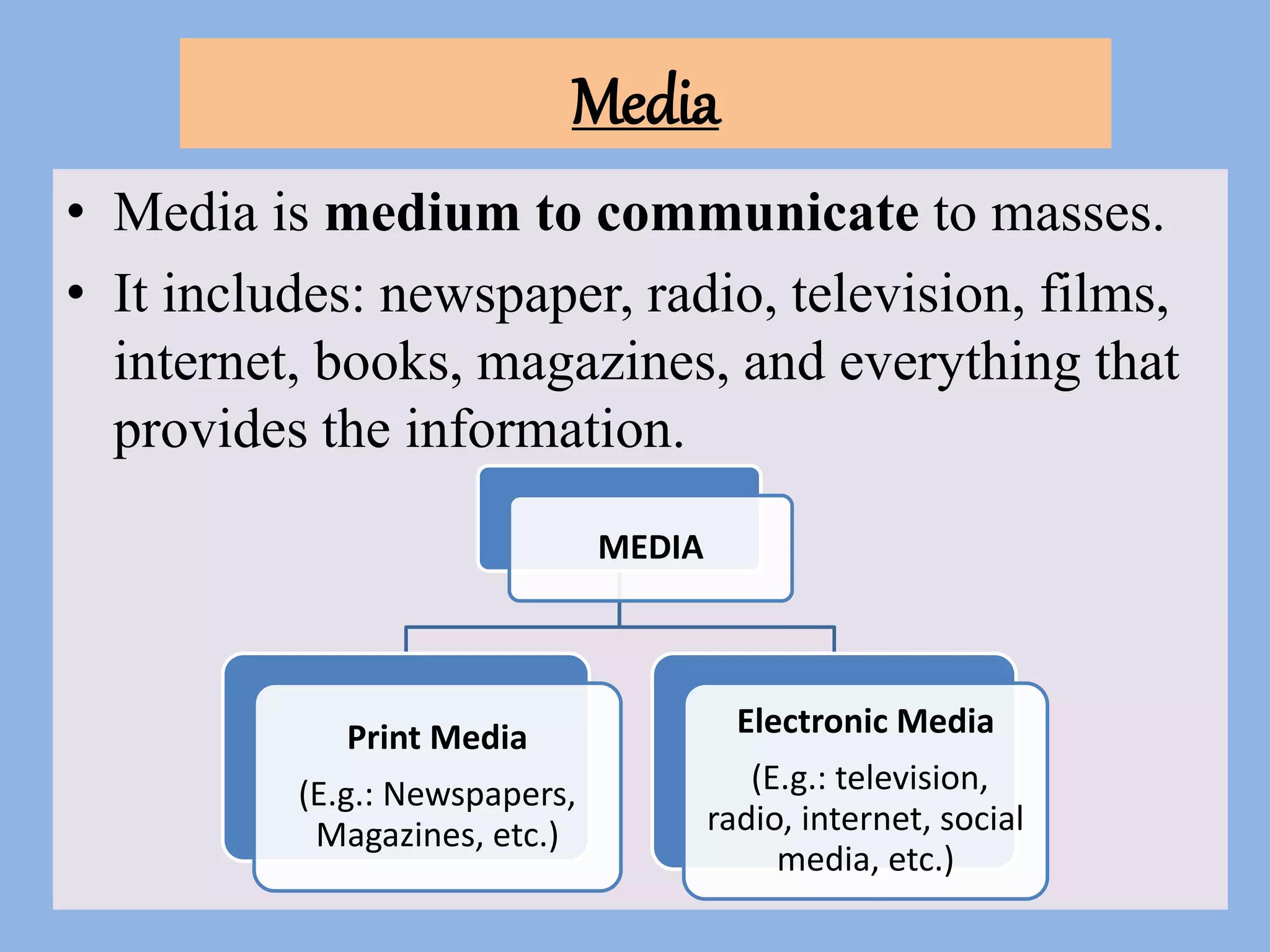
Media
• Media is medium to communicate to masses.
• It includes: newspaper, radio, television, films,
internet, books, magazines, and everything that
provides the information.
MEDIA
Print Media
(E.g.: Newspapers,
Magazines, etc.)
Electronic Media
(E.g.: television,
radio, internet, social
media, etc.)
Need of Media
• Media is considered as fourth pillar of
democracy because it provides information,
source of entertainment, debates and
discussions, virtual classes, platform to express
views and opinions and to raise voice against
unfavourable schemes of government.
• It helps in building qualities of leadership, self-
confidence, truth, non-violence and trustworthy.
Ownership Patterns of Mass Media
India follows socialism and has mixed
economy. Therefore, public as well as private
sector both plays an important role in the growth
of nation.
Likely in the case of media, public authorities as
well as private individuals both own the media
in one or the other way.
The ownership pattern changes from private to
third party or public to autonomous body.
Newspapers & Magazines
(OWNERSHIP pattern)
Private Ownership:
It can be owned by:-
• Individual (Businessman/Industrialist)
• Partnership
• Association/Trust
• Joint Stock Company
In India, mostly around 70% of newspapers are
owned by private individuals.
Newspapers & Magazines
(OWNERSHIP pattern)
Public Ownership/ Governmental Organisations:
Generally, the government does not own any
newspaper and magazine. There are certain
governmental media related organisations that
releases information of various ministries in public
domain.
They are as:-
• Press Information Bureau(PIB)
• Publication Division
• Research & Reference Division
• Photo Division
• Press Council of India
Films
(OWNERSHIP pattern)
Private Ownership Pattern:
As soon as film is completed in its shoot, the
producer contacts distributors of one territory or
more distributors of different areas so as to sell its
film in the cinema halls. All rights of a film are
sold to distributors.
The distributor then negotiates with the
exhibitors who own chain of theatres.
Hence, private ownership of the films gets
transferred to distributors.
Films
(OWNERSHIP pattern)
Media-related Governmental Organisations:
There are certain media-related governmental
organisations:-
• Film Division
• Central Board of Film Certification (CBFC)
• National Film Archive of India
• National Film Development Corporation (NFDC)
Radio
(OWNERSHIP pattern)
Media(Radio) -related Governmental Organisations:
Indian Broadcasting Company came under the control of
government after its liquidation. It became Indian
Broadcasting Service.
It was later renamed to ‘All India Radio’ in 1936 and came
to be known as ‘Akashvani’ from 1957.
Radio-related governmental organisations are:
• News Service Division
• External Services Division
• Commercial Broadcasting Service
Radio
(OWNERSHIP pattern)
Private Ownership:
There are wide number of FM channels of
various companies/industrialists/businessman to
earn profit. Mostly, the license is granted to
them by government on periodic basis.
• Examples of FM Channels:
o Radio Mirchi Channel
o Channel by Surya Network
CONCLUSION
• Media is channel of communication. It has both
pros and cons. The media cant be provided with
absolute rights and privileges. Certain checks are
necessary in accordance with Article 19(2) of
Indian Constitution.
• The government holds control over media
through various organisations which works
under Ministry of Information & Broadcasting.
THANKYOU

Ownership Patterns of Mass Media

  • 1.
    Media and OwnershipPatterns of Mass Media (Media Law) By Manas Bulchandani B.A.LL.B.(Hons.)-IV Year Department of Legal Studies & Research, Barkatullah University, Bhopal.
  • 2.
    Media • Media ismedium to communicate to masses. • It includes: newspaper, radio, television, films, internet, books, magazines, and everything that provides the information. MEDIA Print Media (E.g.: Newspapers, Magazines, etc.) Electronic Media (E.g.: television, radio, internet, social media, etc.)
  • 3.
    Need of Media •Media is considered as fourth pillar of democracy because it provides information, source of entertainment, debates and discussions, virtual classes, platform to express views and opinions and to raise voice against unfavourable schemes of government. • It helps in building qualities of leadership, self- confidence, truth, non-violence and trustworthy.
  • 4.
    Ownership Patterns ofMass Media India follows socialism and has mixed economy. Therefore, public as well as private sector both plays an important role in the growth of nation. Likely in the case of media, public authorities as well as private individuals both own the media in one or the other way. The ownership pattern changes from private to third party or public to autonomous body.
  • 5.
    Newspapers & Magazines (OWNERSHIPpattern) Private Ownership: It can be owned by:- • Individual (Businessman/Industrialist) • Partnership • Association/Trust • Joint Stock Company In India, mostly around 70% of newspapers are owned by private individuals.
  • 6.
    Newspapers & Magazines (OWNERSHIPpattern) Public Ownership/ Governmental Organisations: Generally, the government does not own any newspaper and magazine. There are certain governmental media related organisations that releases information of various ministries in public domain. They are as:- • Press Information Bureau(PIB) • Publication Division • Research & Reference Division • Photo Division • Press Council of India
  • 7.
    Films (OWNERSHIP pattern) Private OwnershipPattern: As soon as film is completed in its shoot, the producer contacts distributors of one territory or more distributors of different areas so as to sell its film in the cinema halls. All rights of a film are sold to distributors. The distributor then negotiates with the exhibitors who own chain of theatres. Hence, private ownership of the films gets transferred to distributors.
  • 8.
    Films (OWNERSHIP pattern) Media-related GovernmentalOrganisations: There are certain media-related governmental organisations:- • Film Division • Central Board of Film Certification (CBFC) • National Film Archive of India • National Film Development Corporation (NFDC)
  • 9.
    Radio (OWNERSHIP pattern) Media(Radio) -relatedGovernmental Organisations: Indian Broadcasting Company came under the control of government after its liquidation. It became Indian Broadcasting Service. It was later renamed to ‘All India Radio’ in 1936 and came to be known as ‘Akashvani’ from 1957. Radio-related governmental organisations are: • News Service Division • External Services Division • Commercial Broadcasting Service
  • 10.
    Radio (OWNERSHIP pattern) Private Ownership: Thereare wide number of FM channels of various companies/industrialists/businessman to earn profit. Mostly, the license is granted to them by government on periodic basis. • Examples of FM Channels: o Radio Mirchi Channel o Channel by Surya Network
  • 11.
    CONCLUSION • Media ischannel of communication. It has both pros and cons. The media cant be provided with absolute rights and privileges. Certain checks are necessary in accordance with Article 19(2) of Indian Constitution. • The government holds control over media through various organisations which works under Ministry of Information & Broadcasting.
  • 12.