Introduction
Apart from the direct expenses of an enterprises, every form of production involves expenses that
cannot be conveniently traced to or identified with the articles produced or services provided. Such
expenses are incurred for output generally and not for a particular work order e.g., wages paid to
watch and ward staff, heating and lighting expenses of factory etc. Thus, the total cost is classified
into direct cost and indirect cost. The total of all direct costs is known as Prime Cost and the total
of all indirect costs is termed as indirect costs.
Indirect expenses or overheads are not associated with individual jobs or products; they represent
the cost of the facilities required for carrying on the operations. They are not directly related to the
generation of profit; they are still important because they provide vital support for the activities of
profit-making. In the contemporary industrial operations, overhead forms part as a very large
proportion of the total cost, at times, even exceeding direct wages and direct labour, and therefore,
a good deal of attention has to be paid to them.
For instance, a boiler house produces steam so that machines may run and, without the generation
of steam, production would be seriously hampered. But if machines do not run or do not require
steam, the boiler house would be useless and the expenses incurred would be a waste.
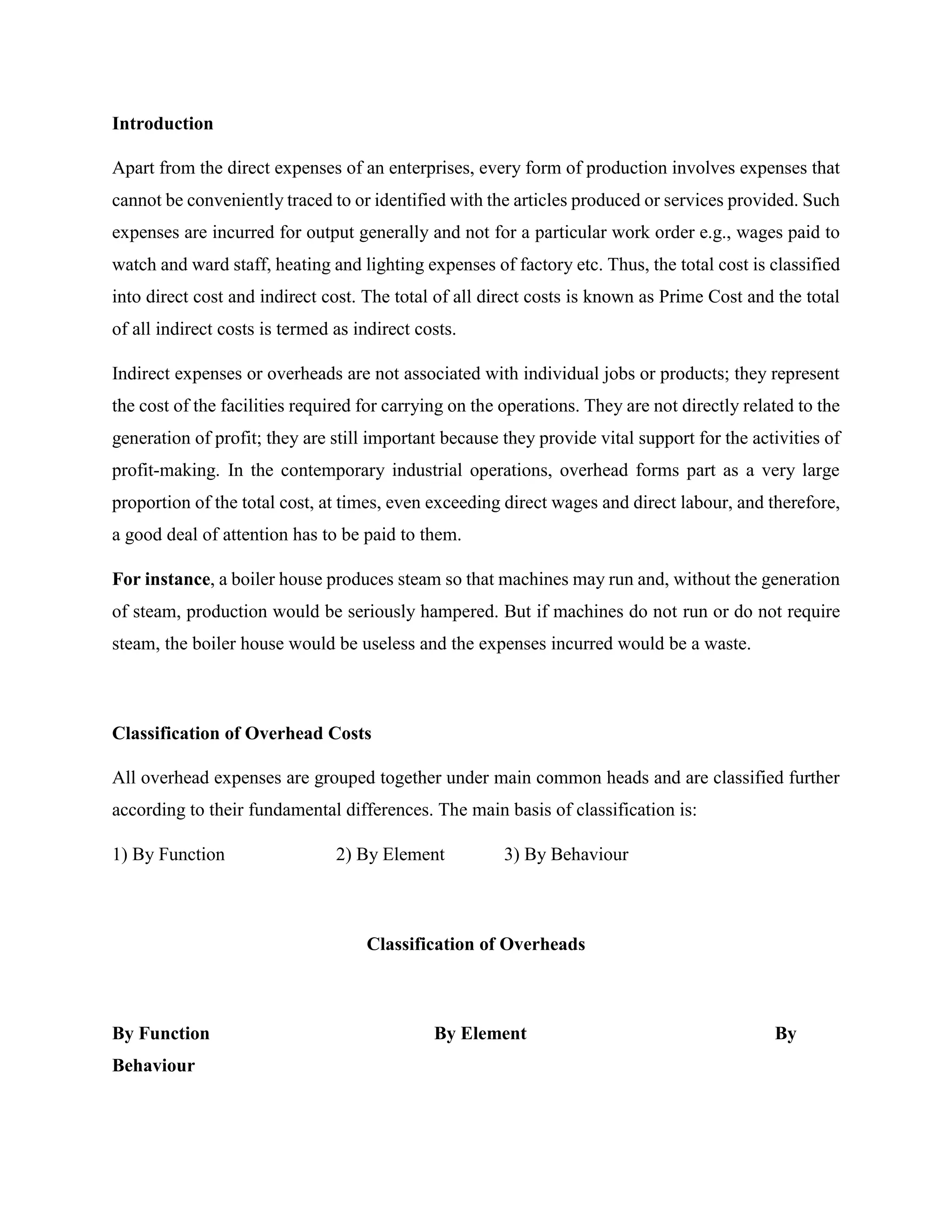
Classification of Overhead Costs
All overhead expenses are grouped together under main common heads and are classified further
according to their fundamental differences. The main basis of classification is:
1) By Function 2) By Element 3) By Behaviour
Classification of Overheads
By Function By Element By
Behaviour
•Production Overhead • Indirect Materials •
Fixed
• Administration overheads • Indirect labour • Variable
• Selling and Distribution overheads • Indirect labour •
Semi-Variable
1. Classification on the basis of functions
a) Production Overhead: These are overheads or indirect costs incurred in the process of
transforming raw materials to finished goods. All production overheads are factory costs
that are not directly attributable to the manufactured product. Examples: depreciation of
plant and machinery, wages of factory workers, factory electricity, the proportion of rent
of the building apportioned to the factory, and so on.
b) Selling and Distribution overheads: Selling overheads are overheads relating to selling
the product or getting orders for the goods. And, Distribution overhead costs are incurred
to move the product from its present location (warehouse, stores) to the consumers or
customers. Examples: advertising, salesmen salaries, repairs of a delivery van, delivery
men’s salaries.
c) Administration overheads: Administrative overheads: This cost is incurred by
management in planning, making decisions, supervision, and controlling every aspect of a
business. These overheads are of general nature and are not directly related to production
or selling. Examples: office electricity bill, admin staff salary, stationery and printing,
legal charges, etc.
2. Classification on the basis of element
a) Indirect Materials: They are material costs can only be apportioned and not allocated over
products or cost centres. They do not form part of the body of finished products. Example:
stores consumed in repairs and maintenance, lubricants, cotton waste, stationery, packing
materials, normal loss of materials, tools for general use etc.
b) Indirect Labour: Indirect wages are those which cannot be allocated but which are to be
apportioned or absorbed by cost centres. It is wage paid to workers who are not engaged in
conversion of raw materials into finished products. Example: employer’s contribution to
P.F, salary to people working in general office, sales department, stores department, labour
department, security department etc.
c) Indirect Expenses: All indirect expenses other than indirect materials and indirect labour
are classified as indirect expenses. They also are to be apportioned. Example: rent,
insurance, taxes, advertisement, depreciation, lighting etc.
3. Classification on the basis of nature
a) Fixed overheads: Expenses which remain constant in total irrespective of changes in
volume of activity are called fixed overheads. They do not change when volume of
production changes within the present capacity. Even if there is no production these
expenses are incurred. Also, Fixed overheads per unit changes in inverse proportion to
changes in production volume. When production increases fixed overheads are borne by
larger number of units, fixed overheads per unit decreases as the amount of expenses is
borne by larger number of units and vice versa fixed overhead increases when production
decreases. Example: rent, insurance, office salary, security staff salary, etc.
b) Variable Overheads: Variable overheads change in total in direct proportion to changes
in volume of production. If production increases variable overheads also increase
proportionately. If production decreases variable overheads will also decrease in the same
proportion. Variable overheads per unit remains fixed. Example: indirect material, indirect
labour, power, light, etc.
c) Semi-variable overheads: These overheads are partly fixed and partly variable. Semi
variable cost varies in part with the volume of production and in part they are constant.
They have the characteristics of both fixed and variable costs. They remain stable within a
certain range of production, then increases or decreases to next level when production
range changes. Example: supervisory salary, depreciation, repairs and maintenance, etc.
4. Overheads Distribution
Overheads are by nature those costs which cannot be directly related to a product or to any other
cost unit. Yet for working out the total cost of a product or a unit of service, the overheads must
be included. Thus we have to find out a way by which the overheads can be distributed over the
various units of production. The method to work out on accounting and controlling of overheads
is pre-determining rates for absorbing overheads. Before the accounting period starts, these rates
are determined by calculating the sum of overheads and the level of operation in the following
period. Thus, as soon as the premium cost of a commodity or work is available, these prices are
paid for the different overheads on an approximate basis. Later, the difference between the
overheads paid to the goods and real overheads is worked out and changed when the actual
overheads are known. A control account under the name of Manufacturing Overhead Control
Account is opened in the Cost Ledger. This account is debited by indirect material, indirect labour
and indirect expenses incurred.
 Steps in overhead distribution
1. Classification and collection
2. Allocation
3. Apportionment
4. Re-apportionment
5. Absorption
a) Classification and collection: overheads can be classified according to different basis as
discussed. The next stage is to estimate the amount of overheads, keeping in view the past
figures and adjusting them for known future changes. There are collected from four main
sources: invoices, stores requisition, wage analysis book, journal entries.
b) Allocation: The term ‘allocation’ refers to assignment or allotment of an entire item of cost to
a particular cost centre or cost unit. It implies relating overheads directly to the various
departments. The estimated amount of various items of manufacturing overheads should be
allocated to various cost centres or departments.
c) Apportionment: There are some items of estimated overheads like the salary of the works
manager which cannot be directly allocated to the various departments and cost centres. Such
unallocable expenses are to be spread over the various departments or cost centres on an
appropriate basis. This is called apportionment.
d) Re-apportionment (Secondary Distribution): Till this stage all overheads are allocated and
apportioned to all the departments- both production and service departments. But service
departments do not directly take part in the production of goods. Thus, overheads of these
departments are to be shared by the production departments. This process of assigning service
department overheads to production departments is called reassignment or re-apportionment.
Re-apportionment of Service Department Overheads
Re-apportionment can be done from two methods:
1. Apportionment to production departments only- In this case cost of each service department
is only apportioned to production departments.
2. Apportionment to production and other service departments also- When one service
department renders services not only to production department but also to other service
departments, this inter service cost is apportioned either on reciprocal basis or non-reciprocal basis.
a) Non-reciprocal basis: This method is used when a service department renders service
to other service departments but does not receive service of other service departments. In
this method service departments are arranged in descending order of their serviceability,
and then the cost of the department which serves to most number of departments is first
apportioned to other departments. Next, costs of the department which serves to second
most departments is apportioned including the apportioned cost of first department. This
process is continued till the cost of last service department is apportioned.
b) Reciprocal: This method is used when service departments are mutually dependent.
That is, it not only provides service to other departments but also receives services of other
service departments. The following three methods are used for apportionment on reciprocal
basis.
i) Simultaneous distribution method: In this method, linear algebraic equations
are used to find out cost of service departments.
ii) Repeated distribution method: According to this method service department
costs are apportioned over other departments, according to the agreed percentages
and this process is repeated until the total costs of the service departments are nil
or the figures become too small to be considered for further apportionment. It is
done in following steps-
1. The costs of the first service department are apportioned in the normal way
according to the given percentages. This will close the account of the first service
department.
2. Then apply the given percentages for the apportionment of second service
department costs which include their own cost plus amount apportioned from the
first service department. This closes the account of the second service department
but reopens the account of the first service department.
3. The same procedure should be followed in the case of all other service
departments. This completes the first cycle of apportionment.
4. The procedure should be repeated again starting with the first service department
whose total now consists only of amounts apportioned from other service
departments. In this way, service department costs keep on reducing with each
cycle of distribution because each time, a substantial amount is charged to the
production departments.
5. This process is continued until the amounts involved become insignificant.
iii)Trial and error method: In this method the cost of first service department is
apportioned to other service departments only in the given percentage. The cost of
the second service department then is apportioned to the first and other service
departments. In this way, when the cost of all service departments has been
apportioned, the process is repeated till the service department costs are reduced to
negligible amounts. In this way, the total cost of each service department is found
out by trial and error.
In next step, a Secondary Distribution Summary can be prepared in the same way
as is done in Simultaneous Equations Method. This method is a mere modification
of repeated distribution method where production departments are initially ignored
for the purpose of redistribution.
Irrespective of the process all the three methods produce the same result.
e) Absorption: After completing the distribution the overheads charged to department are to be
recovered from the output produced in respective departments. This is the last step in
distribution. This process of recovering overheads of a department or any other cost centre
from its output is called absorption. The overhead expenses are absorbed by adopting a pre-
determined overhead absorption rate. There are two steps in the absorption of overheads:
1. Computation of overheads absorption rate; and
2. Application of these rates to cost units.
a) Computation of Overheads Absorption Rate: The overhead rate is computed
by dividing the total amount of overheads of department or cost centre by the
number of units in the base, such as number of cost units, machine hours, labour
hours, direct labour cost, price cost, etc. Generally,
𝑂𝑣𝑒𝑟ℎ𝑒𝑎𝑑𝑠 𝑎𝑏𝑠𝑜𝑟𝑝𝑡𝑖𝑜𝑛 𝑟𝑎𝑡𝑒 =
𝑇𝑜𝑡𝑎𝑙 𝑜𝑣𝑒𝑟ℎ𝑒𝑎𝑑𝑠 𝑜𝑓 cos 𝑡 𝑐𝑒𝑛𝑡𝑟𝑒
𝑇𝑜𝑡𝑎𝑙 𝑢𝑛𝑖𝑡𝑠 𝑖𝑛 𝑏𝑎𝑠𝑒
But it is further determined from different methods of absorption. The main
methods are:
a) Direct materials cost percentage rate: Under this method, the amount
of overheads to be absorbed by a cost unit is determined by the cost of direct
materials consumed in producing it. This rate is computed by dividing the
total overheads by the total cost of direct materials consumed in the
department.
𝑂𝑣𝑒𝑟ℎ𝑒𝑎𝑑𝑠 𝑎𝑏𝑠𝑜𝑟𝑝𝑡𝑖𝑜𝑛 𝑟𝑎𝑡𝑒 =
Pr 𝑜 𝑑𝑢𝑐𝑡𝑖𝑜𝑛 𝑜𝑣𝑒𝑟ℎ𝑒𝑎𝑑𝑠
𝐷𝑖𝑟𝑒𝑐𝑡 𝑚𝑎𝑡𝑒𝑟𝑖𝑎𝑙𝑠
b) Direct labour cost percentage rate: The overhead rate under this
method is computed by dividing the production overheads by the direct
labour cost.
𝑂𝑣𝑒𝑟ℎ𝑒𝑎𝑑𝑠 𝑎𝑏𝑠𝑜𝑟𝑝𝑡𝑖𝑜𝑛 𝑟𝑎𝑡𝑒 =
Pr 𝑜 𝑑𝑢𝑐𝑡𝑖𝑜𝑛 𝑜𝑣𝑒𝑟ℎ𝑒𝑎𝑑𝑠
𝐷𝑖𝑟𝑒𝑐𝑡 𝑙𝑎𝑏𝑜𝑢𝑟 cos𝑡
c) Machine hour rate: Machine hour rate is the overhead cost of running a
machine for one hour. This rate is obtained by dividing the amount of
factory overheads apportioned to a machine by the number of machine
hours for the period under consideration.
𝑀𝑎𝑐ℎ𝑖𝑛𝑒 𝐻𝑜𝑢𝑟 𝑟𝑎𝑡𝑒 =
Pr 𝑜 𝑑𝑢𝑐𝑡𝑖𝑜𝑛 𝑜𝑣𝑒𝑟ℎ𝑒𝑎𝑑𝑠
𝑁𝑜. 𝑜𝑓 𝑀𝑎𝑐ℎ𝑖𝑛𝑒 𝐻𝑜𝑢𝑟𝑠
Basis of apportionment of different overheads to machine-
Items of overheads Basis of apportionment
1. Rent and rates Ratio of floor area occupied by each machine
2. Insurance Insured value of each machine
3. Supervision Estimated time devoted to each machine
4. Lighting No. of light points used for each machine
5 Depreciation Machine hours
6. Repairs and maintenance Machine hours
7. other consumables Machine hours
b) Application of rates to cost units: In order to arrive at the overhead cost of each
cost unit, the overhead rate is multiplied by the number of units of base in the cost
unit.
Thus, Overhead absorbed = No. of units of base in the cost unit x Overhead rate for
example, machine hour rate is Rs. 25 and a cost unit has used 12 hours of the
machine, overheads absorbed will be = 12 hours x 25 = 300.
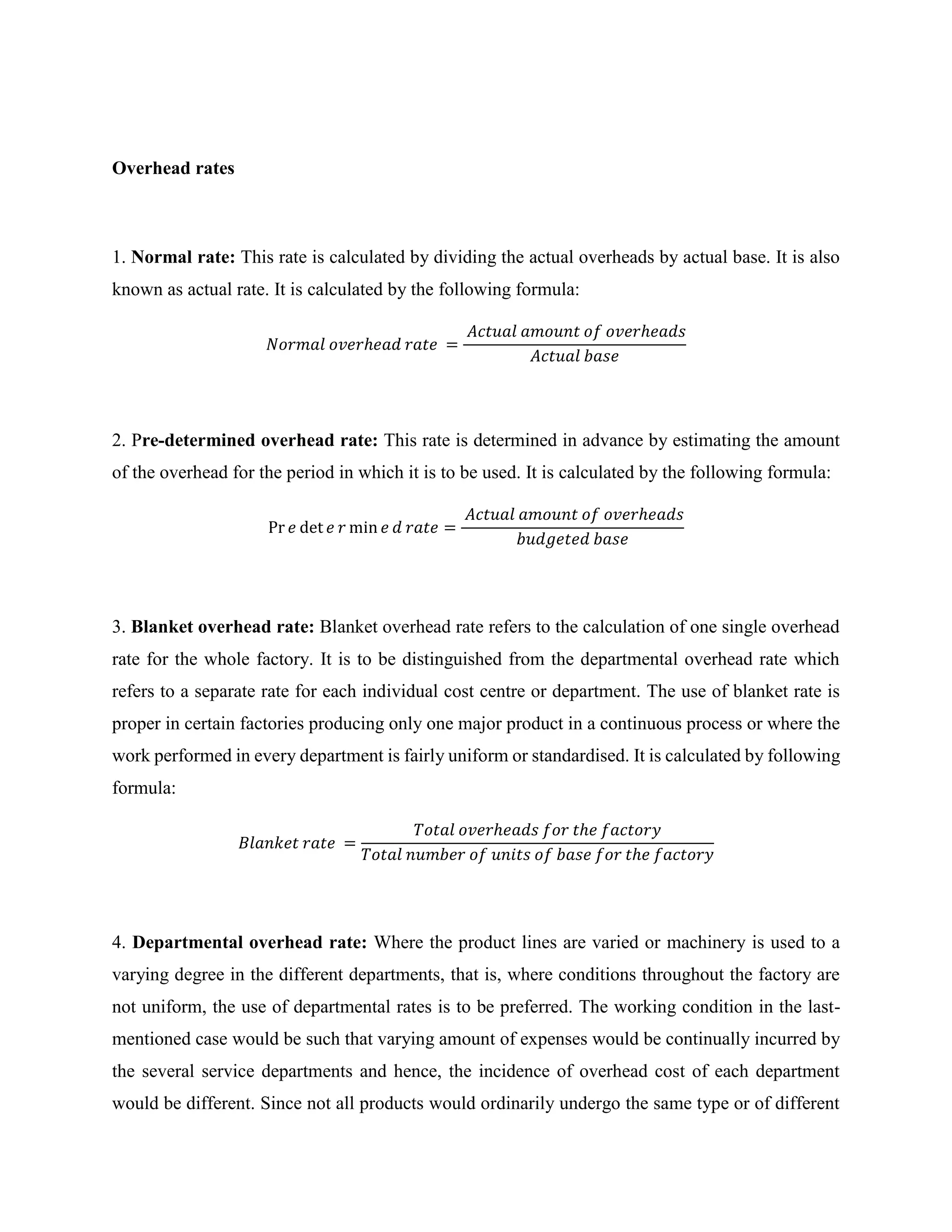
Overhead rates
1. Normal rate: This rate is calculated by dividing the actual overheads by actual base. It is also
known as actual rate. It is calculated by the following formula:
𝑁𝑜𝑟𝑚𝑎𝑙 𝑜𝑣𝑒𝑟ℎ𝑒𝑎𝑑 𝑟𝑎𝑡𝑒 =
𝐴𝑐𝑡𝑢𝑎𝑙 𝑎𝑚𝑜𝑢𝑛𝑡 𝑜𝑓 𝑜𝑣𝑒𝑟ℎ𝑒𝑎𝑑𝑠
𝐴𝑐𝑡𝑢𝑎𝑙 𝑏𝑎𝑠𝑒
2. Pre-determined overhead rate: This rate is determined in advance by estimating the amount
of the overhead for the period in which it is to be used. It is calculated by the following formula:
Pr 𝑒 det 𝑒 𝑟 min 𝑒 𝑑 𝑟𝑎𝑡𝑒 =
𝐴𝑐𝑡𝑢𝑎𝑙 𝑎𝑚𝑜𝑢𝑛𝑡 𝑜𝑓 𝑜𝑣𝑒𝑟ℎ𝑒𝑎𝑑𝑠
𝑏𝑢𝑑𝑔𝑒𝑡𝑒𝑑 𝑏𝑎𝑠𝑒
3. Blanket overhead rate: Blanket overhead rate refers to the calculation of one single overhead
rate for the whole factory. It is to be distinguished from the departmental overhead rate which
refers to a separate rate for each individual cost centre or department. The use of blanket rate is
proper in certain factories producing only one major product in a continuous process or where the
work performed in every department is fairly uniform or standardised. It is calculated by following
formula:
𝐵𝑙𝑎𝑛𝑘𝑒𝑡 𝑟𝑎𝑡𝑒 =
𝑇𝑜𝑡𝑎𝑙 𝑜𝑣𝑒𝑟ℎ𝑒𝑎𝑑𝑠 𝑓𝑜𝑟 𝑡ℎ𝑒 𝑓𝑎𝑐𝑡𝑜𝑟𝑦
𝑇𝑜𝑡𝑎𝑙 𝑛𝑢𝑚𝑏𝑒𝑟 𝑜𝑓 𝑢𝑛𝑖𝑡𝑠 𝑜𝑓 𝑏𝑎𝑠𝑒 𝑓𝑜𝑟 𝑡ℎ𝑒 𝑓𝑎𝑐𝑡𝑜𝑟𝑦
4. Departmental overhead rate: Where the product lines are varied or machinery is used to a
varying degree in the different departments, that is, where conditions throughout the factory are
not uniform, the use of departmental rates is to be preferred. The working condition in the last-
mentioned case would be such that varying amount of expenses would be continually incurred by
the several service departments and hence, the incidence of overhead cost of each department
would be different. Since not all products would ordinarily undergo the same type or of different
type of operations in different departments, the charging of a single overhead rate in such a case
would give misleading results. This overhead rate is determined by the following formula:
𝐷𝑒𝑝𝑎𝑟𝑡𝑚𝑒𝑛𝑡𝑎𝑙 𝑜𝑣𝑒𝑟ℎ𝑒𝑎𝑑 𝑟𝑎𝑡𝑒 =
𝑂𝑣𝑒𝑟ℎ𝑒𝑎𝑑 𝑜𝑓 𝑑𝑒𝑝𝑎𝑟𝑡𝑚𝑒𝑛𝑡 𝑜𝑟 cos 𝑡 𝑐𝑒𝑛𝑡𝑒𝑟
𝐶𝑜𝑟𝑟𝑒𝑠𝑝𝑜𝑛𝑑𝑖𝑛𝑔 𝑏𝑎𝑠𝑒
Treatment of under-absorbed and Over-absorbed Overheads in Cost Accounting:
Overhead expenses are usually applied to production on the basis of pre-determined rates.
Production overheads are to be determined in advance as follows for fixing selling price, quote
tender price and to formulate budgets etc. The actual overhead rate rarely coincides with the pre-
determined overhead rate, due to variation in pre-determined overhead rate and actual overhead
rate. Such a variation may arise due to any one of the following situations:
(i) Estimated overheads for the period under consideration may remain the same or they
coincide with actual overheads but the number of units produced during the period is either
more or less in comparison with budgeted figure. In the former case actual overhead rate
will be less and in the latter case, actual overhead rate will be more than the pre-determined
overhead rate, hence over-absorption and under-absorption will occur respectively.
(ii) Similarly, if the number of units actually produced during the period remains the same
as budgeted figure but the actual overheads incurred are more or less than the estimated
overheads for the period, then a situation of under-absorption or over-absorption will arise
respectively.
(iii) If changes occur in different proportion both in the actual overheads and in the number
of units produced during the period, then a situation of under or over-absorption depending
upon the situation will arise.
(iv) If the changes in actual overheads and in number of units produced occur uniformly
without changing the proportion between the two then neither under nor over-absorption
occurs.
Such over or under-absorption as arrived at under different situations may also be termed as
overhead variance. The amount of over-absorption being represented by a credit balance in the
account and conversely, the amount of under-absorption being a debit balance. As regards the
treatment of such debit or credit balances, the general view is that if the balances are small, they
should be transferred to the Costing Profit and Loss Account and the cost of individual products
should not be increased or reduced as these would be representing normal cost. Where, however
the difference is large and due to wrong estimation, it would be desirable to adjust the cost of
products manufactured, as otherwise the cost figures would convey a misleading impression. Such
adjustments usually take the form of supplementary rates where there is a debit balance in the
overhead account and a credit in the other case.
Now, the production of any period can be identified in three forms, goods finished and sold, goods
finished but held in stock (not yet sold) and semi-finished goods (work in progress). So far as the
first category of goods is concerned, it is arguable that the post-mortem of the costs of individual
products long after they have been sold may have some academic utility but it is frequently devoid
of any practical significance. Therefore, it is suggested that the total variance concerning goods
finished and sold should be adjusted by transferring the amount to the Cost of Sale Account, the
costs of the individual items of such goods not being affected. As regards the variance pertaining
to goods finished and held in stock (i.e. not yet sold), it would be necessary to adjust the value of
the stock; similarly, the value of work-in-progress should be adjusted. However, over or under
recovery of overheads due to abnormal reasons such as abnormal over or under capacity utilisation
should be transferred to the Costing Profit and Loss Account.
Administrative Overheads
1. Accounting of Administrative Overheads: There are three distinct methods of accounting of
administrative overheads, which are briefly discussed below:
(a) Apportioning Administrative Overheads between Production and Sales
Departments: According to this method administrative overheads are apportioned over
production and sales departments. The reason for the apportionment of overhead expenses
over these departments, recognises the fact that administrative overheads are incurred for
the benefit of both of these departments. Therefore, each department should be charged
with the proportion- ate share of the same. When this method is adopted, administrative
overheads lose their identity and get merged with production and selling and distribution
overheads.
(b) Charging to Profit and Loss Account: According to this method administrative
overheads are charged to Costing Profit & Loss Account. The reason for charging to
Costing Profit & Loss are firstly; the administrative overheads are concerned with the
formulation of policies and thus are not directly concerned with either the production or
the selling and distribution functions. Secondly, it is difficult to determine a suitable basis
for apportioning administrative overheads over production and sales departments. Lastly,
these overheads are the fixed costs. In view of these arguments, administrative overheads
should be charged to Profit and Loss Account.
(c) Treating Administrative Overheads as a separate addition to Cost of Production/
Sales: This method considers administration as a separate function like production and
sales and, as such costs relating to formulating the policy, directing the organization and
controlling the operations are taken as a separate charge to the cost of the jobs or a product,
sold along with the cost of other functions. The basis which are generally used for
apportionment are :
(i) Works cost
(ii) Sales value or quantity
(iii) Gross profit on sales
(iv) Quantity produced
(v) Conversion cost, etc.
2. Control of Administrative Overheads: Mostly administrative overheads are of fixed nature,
and they arise as a result of management policies. The methods usually adopted for controlling
administrative overheads are as follows:
(i) Classification and analysis of overheads by administrative departments according
to their functions: According to this method the expenses incurred by each administrative
department are collected under standing order numbers for each class of expenditure. These
are compared with similar figures of the previous period in relation to accomplishment.
Such a comparison will reveal efficiency or inefficiency of the concerned department.
However, this method provides only a limited degree of control and comparison does not
give useful results if the level of activity is not constant during the periods under
comparison. To overcome this difficulty, overhead absorption rates may also be compared
from period to period; the extent of over or under absorption will reveal the efficiency or
otherwise of the department. It may be possible to compare the cost of a service department
with that of similar services obtainable from outside and a decision may be taken whether
it is economical to continue the department or entrust the work to outsiders.
(ii) Control through Budgets: According to this method, administration budgets (monthly
or annually) are prepared for each department. The budgeted figures are compared with
actual ones to determine variances. The variances are analysed and responsibility assigned
to the concerned department to control these variances.
(iii) Control through Standard: Under this method, standards of performance are fixed
for each administrative activity, and the actual performance is compared with the standards
set. In this way, standards serve not only as yardstick of performance but also facilitate
control of costs.
Selling and Distribution Overheads
1. Accounting of selling and distribution overheads: The collection and accumulation of each
expense is made by means of appropriate standing order numbers in the usual way. Where it is
decided to apportion a part of the administrative overhead to the selling division the same should
also be collected through appropriate standing order numbers. The bases usually adopted are: (a)
Sales value of goods, (b) Cost of goods sold, (c) Gross Profit on sales and (d) Number of orders or
units sold.
It is considered that the sale value is ordinarily the most logical basis, there being some connection
between the amount of sales and the amount of expenses incurred to achieve them. The cost of
production, however, is not so satisfactory on basis as it is difficult to conceive of any relationship
even remote, between the cost of production of any article and its selling cost. Articles having a
high cost of production may require little effort in their sale and vice versa. The basis of gross
profit on sales results in a larger share of the selling overhead being applied to goods yielding a
large margin of profit and vice versa. The basis therefore follows the principle of ‘ability to pay,
it may not reflect costs or incurred efforts.
The best method for absorbing selling and distributing expenses over various products is to
separate fixed expenses from variable expenses. Apportion the fixed expenses according to the
benefit derived by each product and thus ascertaining the fixed expenses per unit. We give below
some of the fixed expenses and the basis of apportionment:
If a suitable basis for apportioning expenses does not exist it may be apportioned in the proportion
of sales of various products. The total of fixed expenses apportioned in this manner, divided by
the number of units sold or likely to be sold, will give the fixed expenses per unit. To this should
be added the variable expenses which will be different for each product. These expenses are,
packaging, freight outwards, insurance in transit, commission payable to salesmen, rebate allowed
to customers, etc. All these items will be worked out per unit for each product separately. These
items added to fixed expenses per unit will give an estimated amount of the selling and distribution
expenses per unit.
2. Control of Selling & Distribution Overheads: Control of selling and distribution expenses is
a difficult task. The reasons for this are as follows:
1. The incidence of selling and distribution overheads depends mainly on external factors,
such as distance of market, extent and nature of competition, terms of sales, etc. which are
beyond the control of management.
2. These overheads are dependent upon the customers, behaviour, their liking and disliking,
tastes etc. Therefore, as such control over the overheads may result in loss of customers.
3. These expenses being of the nature of policy costs, are not amenable to control.
In spite of the above difficulties, the following methods may be used for controlling them.
(a) Comparison with past performance: According to this method, selling and
distribution overheads are compared with the figures of the previous period. Alternatively,
the expenses may be expressed as a percentage of sales, and the percentages may be
compared with those of the past period. This method is suitable for small concerns.
(b) Budgetary Control: A budget is set up for selling and distribution expenses. The
expenses are classified into fixed and variable. If necessary, a flexible budget may be
prepared indi- cating the expenses at different levels of sales. The actual expenses are
compared with the budgeted figures and in the case of variances suitable actions are taken.
(c) Standard Costing: Under this method standards are set up in relation to the standard
sales volume. Standards may be set up for salesmen, territories, products etc. Once the
standards are set up, comparison is made between the actuals and standards, variances are
enquired into and suitable action is taken.
EXAMPLES:
Overhead costs are important in determining how much a company must charge for its
products or services in order to generate a profit. The most common overhead costs that
any business incur include:
1. Rent
Rent is the cost that a business pays for using its business premises. If the property is
purchased, then the business will book depreciation expense.
Rent is payable monthly, quarterly, or annually, as agreed in the tenant agreement with the
landlord. When the business is experiencing slow sales, it can reduce this cost by
negotiating the rental charges or by moving to less expensive premises.
2. Administrative costs
Administrative costs are costs related to the normal running of the business and may
include costs incurred in paying salaries to a receptionist, accountant, cleaner, etc. Such
costs are treated as overhead costs since they are not directly tied to a particular function
of the business and they do not directly result in profit generation. Rather, administrative
costs support the general running of the business.
Examples of administrative costs may include audit fees, legal fees, employee salaries, and
entertainment costs. A business can reduce administrative expenses by laying off some of
its employees, switching employees from full-time to part-time, hiring employees on a
contract basis, or by eliminating certain expenses, such as entertainment and office
supplies.
3. Utilities
Utilities are the basic services that the business requires to support its main functions.
Examples of utilities include water, gas, electricity, internet, sewer, and phone service.
A business may be able to reduce utility expenses by negotiating for lower rates from
suppliers.
4. Insurance
Insurance is a cost incurred by a business to protect itself from financial loss. There are
various types of insurance coverage, depending on the risk that may cause loss to the
business. For example, a business may purchase property insurance to protect its property
or business premises from certain risks such as flood, damage, or theft.
Another type of insurance is professional liability insurance that protects the business (such
as an accounting firm or law firm) from liability arising from malpractice. Other types of
insurance include health insurance, home insurance, renter’s insurance, flood insurance,
life insurance, disability insurance, etc.
5. Sales and marketing
Sales and marketing overheads are costs incurred in the marketing of a company’s products
or services to potential customers. Examples of sales and marketing overheads include
promotional materials, trade shows, paid advertisements, wages of salespeople, and
commissions for sales staff. The activities are geared toward making the company’s
products and services popular among customers and to compete with similar products in
the market.
6. Repair and maintenance of motor vehicles and machinery
Rent and maintenance overheads are incurred in businesses that rely on motor vehicles and
equipment in their normal functions. Such businesses include distributors, parcel delivery
services, landscaping, transport services, and equipment leasing.
Motor vehicles and machinery need to be maintained on a continuous basis and repaired
whenever they break down.

Overhead Costs (1).docx

  • 1.
    Introduction Apart from thedirect expenses of an enterprises, every form of production involves expenses that cannot be conveniently traced to or identified with the articles produced or services provided. Such expenses are incurred for output generally and not for a particular work order e.g., wages paid to watch and ward staff, heating and lighting expenses of factory etc. Thus, the total cost is classified into direct cost and indirect cost. The total of all direct costs is known as Prime Cost and the total of all indirect costs is termed as indirect costs. Indirect expenses or overheads are not associated with individual jobs or products; they represent the cost of the facilities required for carrying on the operations. They are not directly related to the generation of profit; they are still important because they provide vital support for the activities of profit-making. In the contemporary industrial operations, overhead forms part as a very large proportion of the total cost, at times, even exceeding direct wages and direct labour, and therefore, a good deal of attention has to be paid to them. For instance, a boiler house produces steam so that machines may run and, without the generation of steam, production would be seriously hampered. But if machines do not run or do not require steam, the boiler house would be useless and the expenses incurred would be a waste. Classification of Overhead Costs All overhead expenses are grouped together under main common heads and are classified further according to their fundamental differences. The main basis of classification is: 1) By Function 2) By Element 3) By Behaviour Classification of Overheads By Function By Element By Behaviour
  • 2.
    •Production Overhead •Indirect Materials • Fixed • Administration overheads • Indirect labour • Variable • Selling and Distribution overheads • Indirect labour • Semi-Variable 1. Classification on the basis of functions a) Production Overhead: These are overheads or indirect costs incurred in the process of transforming raw materials to finished goods. All production overheads are factory costs that are not directly attributable to the manufactured product. Examples: depreciation of plant and machinery, wages of factory workers, factory electricity, the proportion of rent of the building apportioned to the factory, and so on. b) Selling and Distribution overheads: Selling overheads are overheads relating to selling the product or getting orders for the goods. And, Distribution overhead costs are incurred to move the product from its present location (warehouse, stores) to the consumers or customers. Examples: advertising, salesmen salaries, repairs of a delivery van, delivery men’s salaries. c) Administration overheads: Administrative overheads: This cost is incurred by management in planning, making decisions, supervision, and controlling every aspect of a business. These overheads are of general nature and are not directly related to production or selling. Examples: office electricity bill, admin staff salary, stationery and printing, legal charges, etc. 2. Classification on the basis of element
  • 3.
    a) Indirect Materials:They are material costs can only be apportioned and not allocated over products or cost centres. They do not form part of the body of finished products. Example: stores consumed in repairs and maintenance, lubricants, cotton waste, stationery, packing materials, normal loss of materials, tools for general use etc. b) Indirect Labour: Indirect wages are those which cannot be allocated but which are to be apportioned or absorbed by cost centres. It is wage paid to workers who are not engaged in conversion of raw materials into finished products. Example: employer’s contribution to P.F, salary to people working in general office, sales department, stores department, labour department, security department etc. c) Indirect Expenses: All indirect expenses other than indirect materials and indirect labour are classified as indirect expenses. They also are to be apportioned. Example: rent, insurance, taxes, advertisement, depreciation, lighting etc. 3. Classification on the basis of nature a) Fixed overheads: Expenses which remain constant in total irrespective of changes in volume of activity are called fixed overheads. They do not change when volume of production changes within the present capacity. Even if there is no production these expenses are incurred. Also, Fixed overheads per unit changes in inverse proportion to changes in production volume. When production increases fixed overheads are borne by larger number of units, fixed overheads per unit decreases as the amount of expenses is borne by larger number of units and vice versa fixed overhead increases when production decreases. Example: rent, insurance, office salary, security staff salary, etc.
  • 4.
    b) Variable Overheads:Variable overheads change in total in direct proportion to changes in volume of production. If production increases variable overheads also increase proportionately. If production decreases variable overheads will also decrease in the same proportion. Variable overheads per unit remains fixed. Example: indirect material, indirect labour, power, light, etc. c) Semi-variable overheads: These overheads are partly fixed and partly variable. Semi variable cost varies in part with the volume of production and in part they are constant. They have the characteristics of both fixed and variable costs. They remain stable within a certain range of production, then increases or decreases to next level when production range changes. Example: supervisory salary, depreciation, repairs and maintenance, etc. 4. Overheads Distribution Overheads are by nature those costs which cannot be directly related to a product or to any other cost unit. Yet for working out the total cost of a product or a unit of service, the overheads must be included. Thus we have to find out a way by which the overheads can be distributed over the various units of production. The method to work out on accounting and controlling of overheads is pre-determining rates for absorbing overheads. Before the accounting period starts, these rates are determined by calculating the sum of overheads and the level of operation in the following period. Thus, as soon as the premium cost of a commodity or work is available, these prices are paid for the different overheads on an approximate basis. Later, the difference between the overheads paid to the goods and real overheads is worked out and changed when the actual overheads are known. A control account under the name of Manufacturing Overhead Control Account is opened in the Cost Ledger. This account is debited by indirect material, indirect labour and indirect expenses incurred.  Steps in overhead distribution 1. Classification and collection 2. Allocation 3. Apportionment
  • 5.
    4. Re-apportionment 5. Absorption a)Classification and collection: overheads can be classified according to different basis as discussed. The next stage is to estimate the amount of overheads, keeping in view the past figures and adjusting them for known future changes. There are collected from four main sources: invoices, stores requisition, wage analysis book, journal entries. b) Allocation: The term ‘allocation’ refers to assignment or allotment of an entire item of cost to a particular cost centre or cost unit. It implies relating overheads directly to the various departments. The estimated amount of various items of manufacturing overheads should be allocated to various cost centres or departments. c) Apportionment: There are some items of estimated overheads like the salary of the works manager which cannot be directly allocated to the various departments and cost centres. Such unallocable expenses are to be spread over the various departments or cost centres on an appropriate basis. This is called apportionment. d) Re-apportionment (Secondary Distribution): Till this stage all overheads are allocated and apportioned to all the departments- both production and service departments. But service departments do not directly take part in the production of goods. Thus, overheads of these departments are to be shared by the production departments. This process of assigning service department overheads to production departments is called reassignment or re-apportionment. Re-apportionment of Service Department Overheads Re-apportionment can be done from two methods: 1. Apportionment to production departments only- In this case cost of each service department is only apportioned to production departments.
  • 6.
    2. Apportionment toproduction and other service departments also- When one service department renders services not only to production department but also to other service departments, this inter service cost is apportioned either on reciprocal basis or non-reciprocal basis. a) Non-reciprocal basis: This method is used when a service department renders service to other service departments but does not receive service of other service departments. In this method service departments are arranged in descending order of their serviceability, and then the cost of the department which serves to most number of departments is first apportioned to other departments. Next, costs of the department which serves to second most departments is apportioned including the apportioned cost of first department. This process is continued till the cost of last service department is apportioned. b) Reciprocal: This method is used when service departments are mutually dependent. That is, it not only provides service to other departments but also receives services of other service departments. The following three methods are used for apportionment on reciprocal basis. i) Simultaneous distribution method: In this method, linear algebraic equations are used to find out cost of service departments. ii) Repeated distribution method: According to this method service department costs are apportioned over other departments, according to the agreed percentages and this process is repeated until the total costs of the service departments are nil or the figures become too small to be considered for further apportionment. It is done in following steps- 1. The costs of the first service department are apportioned in the normal way according to the given percentages. This will close the account of the first service department.
  • 7.
    2. Then applythe given percentages for the apportionment of second service department costs which include their own cost plus amount apportioned from the first service department. This closes the account of the second service department but reopens the account of the first service department. 3. The same procedure should be followed in the case of all other service departments. This completes the first cycle of apportionment. 4. The procedure should be repeated again starting with the first service department whose total now consists only of amounts apportioned from other service departments. In this way, service department costs keep on reducing with each cycle of distribution because each time, a substantial amount is charged to the production departments. 5. This process is continued until the amounts involved become insignificant. iii)Trial and error method: In this method the cost of first service department is apportioned to other service departments only in the given percentage. The cost of the second service department then is apportioned to the first and other service departments. In this way, when the cost of all service departments has been apportioned, the process is repeated till the service department costs are reduced to negligible amounts. In this way, the total cost of each service department is found out by trial and error. In next step, a Secondary Distribution Summary can be prepared in the same way as is done in Simultaneous Equations Method. This method is a mere modification of repeated distribution method where production departments are initially ignored for the purpose of redistribution.
  • 8.
    Irrespective of theprocess all the three methods produce the same result. e) Absorption: After completing the distribution the overheads charged to department are to be recovered from the output produced in respective departments. This is the last step in distribution. This process of recovering overheads of a department or any other cost centre from its output is called absorption. The overhead expenses are absorbed by adopting a pre- determined overhead absorption rate. There are two steps in the absorption of overheads: 1. Computation of overheads absorption rate; and 2. Application of these rates to cost units. a) Computation of Overheads Absorption Rate: The overhead rate is computed by dividing the total amount of overheads of department or cost centre by the number of units in the base, such as number of cost units, machine hours, labour hours, direct labour cost, price cost, etc. Generally, 𝑂𝑣𝑒𝑟ℎ𝑒𝑎𝑑𝑠 𝑎𝑏𝑠𝑜𝑟𝑝𝑡𝑖𝑜𝑛 𝑟𝑎𝑡𝑒 = 𝑇𝑜𝑡𝑎𝑙 𝑜𝑣𝑒𝑟ℎ𝑒𝑎𝑑𝑠 𝑜𝑓 cos 𝑡 𝑐𝑒𝑛𝑡𝑟𝑒 𝑇𝑜𝑡𝑎𝑙 𝑢𝑛𝑖𝑡𝑠 𝑖𝑛 𝑏𝑎𝑠𝑒 But it is further determined from different methods of absorption. The main methods are: a) Direct materials cost percentage rate: Under this method, the amount of overheads to be absorbed by a cost unit is determined by the cost of direct materials consumed in producing it. This rate is computed by dividing the total overheads by the total cost of direct materials consumed in the department. 𝑂𝑣𝑒𝑟ℎ𝑒𝑎𝑑𝑠 𝑎𝑏𝑠𝑜𝑟𝑝𝑡𝑖𝑜𝑛 𝑟𝑎𝑡𝑒 = Pr 𝑜 𝑑𝑢𝑐𝑡𝑖𝑜𝑛 𝑜𝑣𝑒𝑟ℎ𝑒𝑎𝑑𝑠 𝐷𝑖𝑟𝑒𝑐𝑡 𝑚𝑎𝑡𝑒𝑟𝑖𝑎𝑙𝑠 b) Direct labour cost percentage rate: The overhead rate under this method is computed by dividing the production overheads by the direct labour cost.
  • 9.
    𝑂𝑣𝑒𝑟ℎ𝑒𝑎𝑑𝑠 𝑎𝑏𝑠𝑜𝑟𝑝𝑡𝑖𝑜𝑛 𝑟𝑎𝑡𝑒= Pr 𝑜 𝑑𝑢𝑐𝑡𝑖𝑜𝑛 𝑜𝑣𝑒𝑟ℎ𝑒𝑎𝑑𝑠 𝐷𝑖𝑟𝑒𝑐𝑡 𝑙𝑎𝑏𝑜𝑢𝑟 cos𝑡 c) Machine hour rate: Machine hour rate is the overhead cost of running a machine for one hour. This rate is obtained by dividing the amount of factory overheads apportioned to a machine by the number of machine hours for the period under consideration. 𝑀𝑎𝑐ℎ𝑖𝑛𝑒 𝐻𝑜𝑢𝑟 𝑟𝑎𝑡𝑒 = Pr 𝑜 𝑑𝑢𝑐𝑡𝑖𝑜𝑛 𝑜𝑣𝑒𝑟ℎ𝑒𝑎𝑑𝑠 𝑁𝑜. 𝑜𝑓 𝑀𝑎𝑐ℎ𝑖𝑛𝑒 𝐻𝑜𝑢𝑟𝑠 Basis of apportionment of different overheads to machine- Items of overheads Basis of apportionment 1. Rent and rates Ratio of floor area occupied by each machine 2. Insurance Insured value of each machine 3. Supervision Estimated time devoted to each machine 4. Lighting No. of light points used for each machine 5 Depreciation Machine hours 6. Repairs and maintenance Machine hours 7. other consumables Machine hours b) Application of rates to cost units: In order to arrive at the overhead cost of each cost unit, the overhead rate is multiplied by the number of units of base in the cost unit. Thus, Overhead absorbed = No. of units of base in the cost unit x Overhead rate for example, machine hour rate is Rs. 25 and a cost unit has used 12 hours of the machine, overheads absorbed will be = 12 hours x 25 = 300.
  • 10.
    Overhead rates 1. Normalrate: This rate is calculated by dividing the actual overheads by actual base. It is also known as actual rate. It is calculated by the following formula: 𝑁𝑜𝑟𝑚𝑎𝑙 𝑜𝑣𝑒𝑟ℎ𝑒𝑎𝑑 𝑟𝑎𝑡𝑒 = 𝐴𝑐𝑡𝑢𝑎𝑙 𝑎𝑚𝑜𝑢𝑛𝑡 𝑜𝑓 𝑜𝑣𝑒𝑟ℎ𝑒𝑎𝑑𝑠 𝐴𝑐𝑡𝑢𝑎𝑙 𝑏𝑎𝑠𝑒 2. Pre-determined overhead rate: This rate is determined in advance by estimating the amount of the overhead for the period in which it is to be used. It is calculated by the following formula: Pr 𝑒 det 𝑒 𝑟 min 𝑒 𝑑 𝑟𝑎𝑡𝑒 = 𝐴𝑐𝑡𝑢𝑎𝑙 𝑎𝑚𝑜𝑢𝑛𝑡 𝑜𝑓 𝑜𝑣𝑒𝑟ℎ𝑒𝑎𝑑𝑠 𝑏𝑢𝑑𝑔𝑒𝑡𝑒𝑑 𝑏𝑎𝑠𝑒 3. Blanket overhead rate: Blanket overhead rate refers to the calculation of one single overhead rate for the whole factory. It is to be distinguished from the departmental overhead rate which refers to a separate rate for each individual cost centre or department. The use of blanket rate is proper in certain factories producing only one major product in a continuous process or where the work performed in every department is fairly uniform or standardised. It is calculated by following formula: 𝐵𝑙𝑎𝑛𝑘𝑒𝑡 𝑟𝑎𝑡𝑒 = 𝑇𝑜𝑡𝑎𝑙 𝑜𝑣𝑒𝑟ℎ𝑒𝑎𝑑𝑠 𝑓𝑜𝑟 𝑡ℎ𝑒 𝑓𝑎𝑐𝑡𝑜𝑟𝑦 𝑇𝑜𝑡𝑎𝑙 𝑛𝑢𝑚𝑏𝑒𝑟 𝑜𝑓 𝑢𝑛𝑖𝑡𝑠 𝑜𝑓 𝑏𝑎𝑠𝑒 𝑓𝑜𝑟 𝑡ℎ𝑒 𝑓𝑎𝑐𝑡𝑜𝑟𝑦 4. Departmental overhead rate: Where the product lines are varied or machinery is used to a varying degree in the different departments, that is, where conditions throughout the factory are not uniform, the use of departmental rates is to be preferred. The working condition in the last- mentioned case would be such that varying amount of expenses would be continually incurred by the several service departments and hence, the incidence of overhead cost of each department would be different. Since not all products would ordinarily undergo the same type or of different
  • 11.
    type of operationsin different departments, the charging of a single overhead rate in such a case would give misleading results. This overhead rate is determined by the following formula: 𝐷𝑒𝑝𝑎𝑟𝑡𝑚𝑒𝑛𝑡𝑎𝑙 𝑜𝑣𝑒𝑟ℎ𝑒𝑎𝑑 𝑟𝑎𝑡𝑒 = 𝑂𝑣𝑒𝑟ℎ𝑒𝑎𝑑 𝑜𝑓 𝑑𝑒𝑝𝑎𝑟𝑡𝑚𝑒𝑛𝑡 𝑜𝑟 cos 𝑡 𝑐𝑒𝑛𝑡𝑒𝑟 𝐶𝑜𝑟𝑟𝑒𝑠𝑝𝑜𝑛𝑑𝑖𝑛𝑔 𝑏𝑎𝑠𝑒 Treatment of under-absorbed and Over-absorbed Overheads in Cost Accounting: Overhead expenses are usually applied to production on the basis of pre-determined rates. Production overheads are to be determined in advance as follows for fixing selling price, quote tender price and to formulate budgets etc. The actual overhead rate rarely coincides with the pre- determined overhead rate, due to variation in pre-determined overhead rate and actual overhead rate. Such a variation may arise due to any one of the following situations: (i) Estimated overheads for the period under consideration may remain the same or they coincide with actual overheads but the number of units produced during the period is either more or less in comparison with budgeted figure. In the former case actual overhead rate will be less and in the latter case, actual overhead rate will be more than the pre-determined overhead rate, hence over-absorption and under-absorption will occur respectively. (ii) Similarly, if the number of units actually produced during the period remains the same as budgeted figure but the actual overheads incurred are more or less than the estimated overheads for the period, then a situation of under-absorption or over-absorption will arise respectively. (iii) If changes occur in different proportion both in the actual overheads and in the number of units produced during the period, then a situation of under or over-absorption depending upon the situation will arise. (iv) If the changes in actual overheads and in number of units produced occur uniformly without changing the proportion between the two then neither under nor over-absorption occurs.
  • 12.
    Such over orunder-absorption as arrived at under different situations may also be termed as overhead variance. The amount of over-absorption being represented by a credit balance in the account and conversely, the amount of under-absorption being a debit balance. As regards the treatment of such debit or credit balances, the general view is that if the balances are small, they should be transferred to the Costing Profit and Loss Account and the cost of individual products should not be increased or reduced as these would be representing normal cost. Where, however the difference is large and due to wrong estimation, it would be desirable to adjust the cost of products manufactured, as otherwise the cost figures would convey a misleading impression. Such adjustments usually take the form of supplementary rates where there is a debit balance in the overhead account and a credit in the other case. Now, the production of any period can be identified in three forms, goods finished and sold, goods finished but held in stock (not yet sold) and semi-finished goods (work in progress). So far as the first category of goods is concerned, it is arguable that the post-mortem of the costs of individual products long after they have been sold may have some academic utility but it is frequently devoid of any practical significance. Therefore, it is suggested that the total variance concerning goods finished and sold should be adjusted by transferring the amount to the Cost of Sale Account, the costs of the individual items of such goods not being affected. As regards the variance pertaining to goods finished and held in stock (i.e. not yet sold), it would be necessary to adjust the value of the stock; similarly, the value of work-in-progress should be adjusted. However, over or under recovery of overheads due to abnormal reasons such as abnormal over or under capacity utilisation should be transferred to the Costing Profit and Loss Account. Administrative Overheads 1. Accounting of Administrative Overheads: There are three distinct methods of accounting of administrative overheads, which are briefly discussed below:
  • 13.
    (a) Apportioning AdministrativeOverheads between Production and Sales Departments: According to this method administrative overheads are apportioned over production and sales departments. The reason for the apportionment of overhead expenses over these departments, recognises the fact that administrative overheads are incurred for the benefit of both of these departments. Therefore, each department should be charged with the proportion- ate share of the same. When this method is adopted, administrative overheads lose their identity and get merged with production and selling and distribution overheads. (b) Charging to Profit and Loss Account: According to this method administrative overheads are charged to Costing Profit & Loss Account. The reason for charging to Costing Profit & Loss are firstly; the administrative overheads are concerned with the formulation of policies and thus are not directly concerned with either the production or the selling and distribution functions. Secondly, it is difficult to determine a suitable basis for apportioning administrative overheads over production and sales departments. Lastly, these overheads are the fixed costs. In view of these arguments, administrative overheads should be charged to Profit and Loss Account. (c) Treating Administrative Overheads as a separate addition to Cost of Production/ Sales: This method considers administration as a separate function like production and sales and, as such costs relating to formulating the policy, directing the organization and controlling the operations are taken as a separate charge to the cost of the jobs or a product, sold along with the cost of other functions. The basis which are generally used for apportionment are : (i) Works cost (ii) Sales value or quantity (iii) Gross profit on sales (iv) Quantity produced
  • 14.
    (v) Conversion cost,etc. 2. Control of Administrative Overheads: Mostly administrative overheads are of fixed nature, and they arise as a result of management policies. The methods usually adopted for controlling administrative overheads are as follows: (i) Classification and analysis of overheads by administrative departments according to their functions: According to this method the expenses incurred by each administrative department are collected under standing order numbers for each class of expenditure. These are compared with similar figures of the previous period in relation to accomplishment. Such a comparison will reveal efficiency or inefficiency of the concerned department. However, this method provides only a limited degree of control and comparison does not give useful results if the level of activity is not constant during the periods under comparison. To overcome this difficulty, overhead absorption rates may also be compared from period to period; the extent of over or under absorption will reveal the efficiency or otherwise of the department. It may be possible to compare the cost of a service department with that of similar services obtainable from outside and a decision may be taken whether it is economical to continue the department or entrust the work to outsiders. (ii) Control through Budgets: According to this method, administration budgets (monthly or annually) are prepared for each department. The budgeted figures are compared with actual ones to determine variances. The variances are analysed and responsibility assigned to the concerned department to control these variances. (iii) Control through Standard: Under this method, standards of performance are fixed for each administrative activity, and the actual performance is compared with the standards set. In this way, standards serve not only as yardstick of performance but also facilitate control of costs.
  • 15.
    Selling and DistributionOverheads 1. Accounting of selling and distribution overheads: The collection and accumulation of each expense is made by means of appropriate standing order numbers in the usual way. Where it is decided to apportion a part of the administrative overhead to the selling division the same should also be collected through appropriate standing order numbers. The bases usually adopted are: (a) Sales value of goods, (b) Cost of goods sold, (c) Gross Profit on sales and (d) Number of orders or units sold. It is considered that the sale value is ordinarily the most logical basis, there being some connection between the amount of sales and the amount of expenses incurred to achieve them. The cost of production, however, is not so satisfactory on basis as it is difficult to conceive of any relationship even remote, between the cost of production of any article and its selling cost. Articles having a high cost of production may require little effort in their sale and vice versa. The basis of gross profit on sales results in a larger share of the selling overhead being applied to goods yielding a large margin of profit and vice versa. The basis therefore follows the principle of ‘ability to pay, it may not reflect costs or incurred efforts. The best method for absorbing selling and distributing expenses over various products is to separate fixed expenses from variable expenses. Apportion the fixed expenses according to the benefit derived by each product and thus ascertaining the fixed expenses per unit. We give below some of the fixed expenses and the basis of apportionment: If a suitable basis for apportioning expenses does not exist it may be apportioned in the proportion of sales of various products. The total of fixed expenses apportioned in this manner, divided by the number of units sold or likely to be sold, will give the fixed expenses per unit. To this should be added the variable expenses which will be different for each product. These expenses are, packaging, freight outwards, insurance in transit, commission payable to salesmen, rebate allowed to customers, etc. All these items will be worked out per unit for each product separately. These items added to fixed expenses per unit will give an estimated amount of the selling and distribution expenses per unit.
  • 16.
    2. Control ofSelling & Distribution Overheads: Control of selling and distribution expenses is a difficult task. The reasons for this are as follows: 1. The incidence of selling and distribution overheads depends mainly on external factors, such as distance of market, extent and nature of competition, terms of sales, etc. which are beyond the control of management. 2. These overheads are dependent upon the customers, behaviour, their liking and disliking, tastes etc. Therefore, as such control over the overheads may result in loss of customers. 3. These expenses being of the nature of policy costs, are not amenable to control. In spite of the above difficulties, the following methods may be used for controlling them. (a) Comparison with past performance: According to this method, selling and distribution overheads are compared with the figures of the previous period. Alternatively, the expenses may be expressed as a percentage of sales, and the percentages may be compared with those of the past period. This method is suitable for small concerns. (b) Budgetary Control: A budget is set up for selling and distribution expenses. The expenses are classified into fixed and variable. If necessary, a flexible budget may be prepared indi- cating the expenses at different levels of sales. The actual expenses are compared with the budgeted figures and in the case of variances suitable actions are taken. (c) Standard Costing: Under this method standards are set up in relation to the standard sales volume. Standards may be set up for salesmen, territories, products etc. Once the
  • 17.
    standards are setup, comparison is made between the actuals and standards, variances are enquired into and suitable action is taken. EXAMPLES: Overhead costs are important in determining how much a company must charge for its products or services in order to generate a profit. The most common overhead costs that any business incur include: 1. Rent Rent is the cost that a business pays for using its business premises. If the property is purchased, then the business will book depreciation expense. Rent is payable monthly, quarterly, or annually, as agreed in the tenant agreement with the landlord. When the business is experiencing slow sales, it can reduce this cost by negotiating the rental charges or by moving to less expensive premises. 2. Administrative costs Administrative costs are costs related to the normal running of the business and may include costs incurred in paying salaries to a receptionist, accountant, cleaner, etc. Such costs are treated as overhead costs since they are not directly tied to a particular function of the business and they do not directly result in profit generation. Rather, administrative costs support the general running of the business. Examples of administrative costs may include audit fees, legal fees, employee salaries, and entertainment costs. A business can reduce administrative expenses by laying off some of its employees, switching employees from full-time to part-time, hiring employees on a contract basis, or by eliminating certain expenses, such as entertainment and office supplies. 3. Utilities Utilities are the basic services that the business requires to support its main functions. Examples of utilities include water, gas, electricity, internet, sewer, and phone service.
  • 18.
    A business maybe able to reduce utility expenses by negotiating for lower rates from suppliers. 4. Insurance Insurance is a cost incurred by a business to protect itself from financial loss. There are various types of insurance coverage, depending on the risk that may cause loss to the business. For example, a business may purchase property insurance to protect its property or business premises from certain risks such as flood, damage, or theft. Another type of insurance is professional liability insurance that protects the business (such as an accounting firm or law firm) from liability arising from malpractice. Other types of insurance include health insurance, home insurance, renter’s insurance, flood insurance, life insurance, disability insurance, etc. 5. Sales and marketing Sales and marketing overheads are costs incurred in the marketing of a company’s products or services to potential customers. Examples of sales and marketing overheads include promotional materials, trade shows, paid advertisements, wages of salespeople, and commissions for sales staff. The activities are geared toward making the company’s products and services popular among customers and to compete with similar products in the market. 6. Repair and maintenance of motor vehicles and machinery Rent and maintenance overheads are incurred in businesses that rely on motor vehicles and equipment in their normal functions. Such businesses include distributors, parcel delivery services, landscaping, transport services, and equipment leasing. Motor vehicles and machinery need to be maintained on a continuous basis and repaired whenever they break down.