

INTERNET PROTOCOL LAYERS
• How does the communication take place between different devices
on internet?
• End systems(hosts), switch, routers
• How do we make the internet architecture simple?
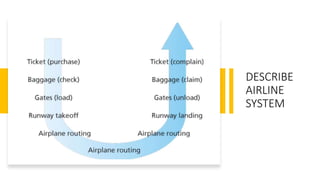
DESCRIBE
AIRLINE
SYSTEM
ARE YOU ABLE TO CONNECT
TO COMPUTER NETWORKS?
• You are being shipped from source to
destination by the airline
• A packet is shipped from source host to
destination host in the Internet.
• We have still not been able to find a
structure.
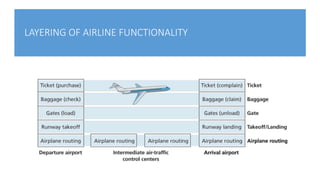
LAYERING OF AIRLINE FUNCTIONALITY
CANY YOU THINK OF ANY OTHER SUCH
ANOLOGY?
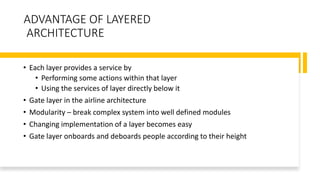
ADVANTAGE OF LAYERED
ARCHITECTURE
• Each layer provides a service by
• Performing some actions within that layer
• Using the services of layer directly below it
• Gate layer in the airline architecture
• Modularity – break complex system into well defined modules
• Changing implementation of a layer becomes easy
• Gate layer onboards and deboards people according to their height
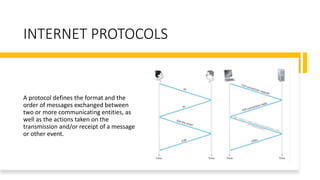
INTERNET PROTOCOLS
A protocol defines the format and the
order of messages exchanged between
two or more communicating entities, as
well as the actions taken on the
transmission and/or receipt of a message
or other event.
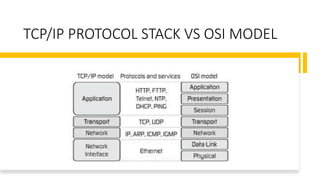
TCP/IP PROTOCOL STACK VS OSI MODEL
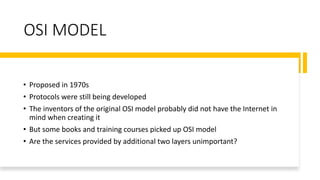
OSI MODEL
• Proposed in 1970s
• Protocols were still being developed
• The inventors of the original OSI model probably did not have the Internet in
mind when creating it
• But some books and training courses picked up OSI model
• Are the services provided by additional two layers unimportant?
REMEMBER THE END GOAL IN NETWORKING
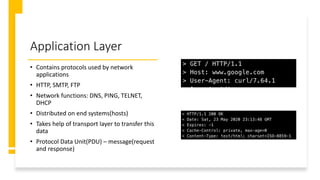
Application Layer
• Contains protocols used by network
applications
• HTTP, SMTP, FTP
• Network functions: DNS, PING, TELNET,
DHCP
• Distributed on end systems(hosts)
• Takes help of transport layer to transfer this
data
• Protocol Data Unit(PDU) – message(request
and response)
TRANSPORT LAYER
• Transfers application layer messages between hosts
• TCP and UDP
• TCP – reliable transfer of messages
• Each networking application runs on a port
• Header: Source port and destination port
• PDU - Segment
• Takes help of the the network layer to transfer segment packet
NETWORK LAYER
• Transport layer passes the segment packet and a destination address to the network layer
• Network layer helps in delivering the segment to transport layer in the destination host.
• Unreliable
• IP protocol
• Source and destination IP address
• Routing protocols
• PDU – Datagrams
• Asks data link layer to transfer datagram from one host or router to another
Data Link Layer
• Moves a datagram from one node(host or router) to the next node on the route.
• Ethernet, WiFi and PPP
• A datagram may be handled by different link-layer protocols at different links in the
route
• Source and destination MAC address
• PDU – Frames
• Data link layer asks the physical layer to transfer the frames from one node to another
PHYSICAL LAYER
• Move individual bits within the frames from one node to next node
• Different protocols for different mediums like twisted-pair copper wire, fiber,
coaxial cable etc.
QUESTIONS?
• Are these layers implemented in software, hardware or a combination of
both?
• Does these layers reside on my laptop or router or the server?
• Where are all these layers/protocol implemented?
• How does communication takes place using these protocols?

OSI Model Layers and Internet Protocol Stack

  • 1.
  • 2.
    • How doesthe communication take place between different devices on internet? • End systems(hosts), switch, routers • How do we make the internet architecture simple?
  • 3.
  • 4.
    ARE YOU ABLETO CONNECT TO COMPUTER NETWORKS? • You are being shipped from source to destination by the airline • A packet is shipped from source host to destination host in the Internet. • We have still not been able to find a structure.
  • 5.
    LAYERING OF AIRLINEFUNCTIONALITY
  • 6.
    CANY YOU THINKOF ANY OTHER SUCH ANOLOGY?
  • 7.
    ADVANTAGE OF LAYERED ARCHITECTURE •Each layer provides a service by • Performing some actions within that layer • Using the services of layer directly below it • Gate layer in the airline architecture • Modularity – break complex system into well defined modules • Changing implementation of a layer becomes easy • Gate layer onboards and deboards people according to their height
  • 8.
    INTERNET PROTOCOLS A protocoldefines the format and the order of messages exchanged between two or more communicating entities, as well as the actions taken on the transmission and/or receipt of a message or other event.
  • 9.
  • 10.
    OSI MODEL • Proposedin 1970s • Protocols were still being developed • The inventors of the original OSI model probably did not have the Internet in mind when creating it • But some books and training courses picked up OSI model • Are the services provided by additional two layers unimportant?
  • 11.
    REMEMBER THE ENDGOAL IN NETWORKING
  • 12.
    Application Layer • Containsprotocols used by network applications • HTTP, SMTP, FTP • Network functions: DNS, PING, TELNET, DHCP • Distributed on end systems(hosts) • Takes help of transport layer to transfer this data • Protocol Data Unit(PDU) – message(request and response)
  • 13.
    TRANSPORT LAYER • Transfersapplication layer messages between hosts • TCP and UDP • TCP – reliable transfer of messages • Each networking application runs on a port • Header: Source port and destination port • PDU - Segment • Takes help of the the network layer to transfer segment packet
  • 14.
    NETWORK LAYER • Transportlayer passes the segment packet and a destination address to the network layer • Network layer helps in delivering the segment to transport layer in the destination host. • Unreliable • IP protocol • Source and destination IP address • Routing protocols • PDU – Datagrams • Asks data link layer to transfer datagram from one host or router to another
  • 15.
    Data Link Layer •Moves a datagram from one node(host or router) to the next node on the route. • Ethernet, WiFi and PPP • A datagram may be handled by different link-layer protocols at different links in the route • Source and destination MAC address • PDU – Frames • Data link layer asks the physical layer to transfer the frames from one node to another
  • 16.
    PHYSICAL LAYER • Moveindividual bits within the frames from one node to next node • Different protocols for different mediums like twisted-pair copper wire, fiber, coaxial cable etc.
  • 17.
    QUESTIONS? • Are theselayers implemented in software, hardware or a combination of both? • Does these layers reside on my laptop or router or the server? • Where are all these layers/protocol implemented? • How does communication takes place using these protocols?