“Anti-OnlineSexual Abuseor
Exploitationof Children(OSAEC) and
Anti-ChildSexualAbuseor
ExploitationMaterials(CSAEM)Act”
R.A. NO. 11930, July 30, 2022
TheOSAECLaw
repealed theAnti-
Child
Pornography Law
 The OSAEC Law replaces the term ‘child pornography’
with the more aptly descriptive term ‘child sexual
abuse or exploitation material or child sexual abuse
material;
 The OSAEC expanded the coverage of the law to
include materials that focuses on the genitalia or other
private body parts of the child, removing the previous
qualification that such exhibition must be lascivious;
 The child-victim is not required to be presented in
court during trial and shall testify in accordance with
“Rule on Examination of a Child Witness”;
DEFINTIONOF
TERMS
 Child refers to a person below eighteen (18) years of
age or those over but are unable to fully take care of
themselves or protect themselves from abuse, neglect,
cruelty, exploitation or discrimination because of
physical, mental, intellectual or sensory disability or
condition. For purposes of this Act, a child shall also
refer to:
 (1) A person regardless of age who is presented, depicted
or portrayed as a child as defined herein; and
 (2) Computer-generated, digitally or manually crafted
images, or graphics of a person who is represented or
who is made to appear to be a child as defined herein.
DEFINTIONOF
TERMS
 Child sexual abuse refers to any form of
communication through any platform or format, or any
physical interaction between a child and any person
when the child is being used for any act or activity
inducing sexual stimulation or for the purpose of
sexual gratification or in pursuit of the desire to have
carnal knowledge of the child, regardless of the gender
of the perpetrator or the victim, or the consent of the
victim;
DEFINTIONOF
TERMS
 Child sexual abuse or exploitation material or child
sexual abuse material (CSAEM/CSAM) refers to any
representation, whether offline, or by, through or with
the use of ICT, by means of visual, video, audio,
written, or any combination thereof, by electronic,
mechanical, digital, optical, magnetic or any other
means, of a child engaged or involved in real or
simulated sexual activities, or depicting acts of sexual
abuse or exploitation of a child as a sexual object. It
shall also include materials that focus on the genitalia
or other private body parts of a child.
DEFINTIONOF
TERMS
 Child sexual exploitation refers to any of the following acts even if
consent appears to have been granted by the child:
 (1) Child sexual abuse with consideration whether monetary or
nonmonetary consideration, favor, or benefit in exchange for the
opportunity to perform such abusive or exploitative act
 (2) Actual sexual intercourse with a child or children with or
without consideration;
 (3) Employing fraud, machination, undue influence, intimidation,
threat or deception by any person to commit sexual abuse of or
sexual intercourse with a child or children; or
 (4) Any other similar or analogous acts related to child abuse,
cruelty or exploitation or to be responsible for other conditions
prejudicial to the development of the child;
DEFINTIONOF
TERMS
 Grooming refers to predatory conduct, act, or pattern of
acts, of establishing a relationship of trust, or
emotional connection by another, with a child or
someone who is believed to be a child, and/or the
family, guardian, and/or caregivers, whether in person
or via electronic and other similar devices, for the
purpose of perpetrating sexual abuse or exploitation or
the production of any form of CSAEM;
DEFINTIONOF
TERMS
 Image-based sexual abuse (ISA) refers to a form of
technology-facilitated sexual violence. The term
describes a pattern of behavior involving the
nonconsensual creation, distribution, or threats to
distribute nude or sexual images. It includes a
diversity of behaviors including, but not limited to,
"sextortion scams," the use of artificial intelligence to
construct "deepfake" pornographic videos, threats to
distribute photographs and videos; and the taking or
sharing of sexual assault imagery;
DEFINTIONOF
TERMS
 Luring refers to the act of communicating, by means of
a computer system, with a child or someone who the
offender believes to be a child for the purpose of
facilitating the commission of sexual activity or
production of any form of CSAEM;
DEFINTIONOF
TERMS
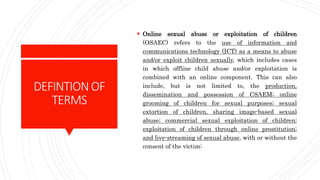
 Online sexual abuse or exploitation of children
(OSAEC) refers to the use of information and
communications technology (ICT) as a means to abuse
and/or exploit children sexually, which includes cases
in which offline child abuse and/or exploitation is
combined with an online component. This can also
include, but is not limited to, the production,
dissemination and possession of CSAEM; online
grooming of children for sexual purposes; sexual
extortion of children, sharing image-based sexual
abuse; commercial sexual exploitation of children;
exploitation of children through online prostitution;
and live-streaming of sexual abuse, with or without the
consent of the victim;
DEFINTIONOF
TERMS
 Sexual activity includes the following acts, whether actually performed
or simulated:
 (1) Sexual intercourse or lascivious act, including contact involving the
genitalia, oral stimulation of the genitals or oral stimulation of the anus,
whether between persons of the same or opposite sex;
 (2) Masturbation;
 (3) Sadistic or masochistic abuse;
 (4) Lascivious exhibition of the genitals, buttocks, breasts, pubic area and
anus;
 (5) Bestiality;
 (6) Use of any object or instrument for lascivious acts; or
 (7) Any other analogous circumstance.
DEFINTIONOF
TERMS
 Sexualization of a child refers to the act of using a child
as an object for the sexual desire or satisfaction of
another, even if there is no actual sexual intercourse or
no private part of the body of the child has been shown;
DEFINTIONOF
TERMS
 Streaming refers to the broadcasting or viewing
through the use of information and communications
technology (ICT), whether the viewer is passively
watching or actively directing the content. It is
considered live-streaming when the broadcasting or
viewing occurs in real-time;
Unlawfulor
ProhibitedActs.
 (a) To hire, employ, use, persuade, induce, extort,
engage, or coerce a child to perform or participate in
whatever way in the creation or production of any form
of OSAEC and CSAEM;
 (b) To produce, direct, manufacture, facilitate, or create
any form of CSAEM, or participate in the production,
direction, manufacture, facilitation or creation of the
same;
 (c) To offer, sell, distribute, advertise, promote, export,
or import, by any means, any form of CSAEM;
 (d) To knowingly publish, transmit and broadcast, by
any means, any form of CSAEM;
 (e) To permit or influence the child to engage,
participate or assist in any form of CSAEM;
Unlawfulor
ProhibitedActs.
 (f) To produce, direct, create, hire, employ or pay a
facilitator to stream or livestream acts of child sexual
abuse or exploitation;
 (g) To stream or live-stream acts of, or any form of,
child sexual abuse and exploitation;
 (h) To recruit, transport, transfer, harbor, provide, or
receive a child or to induce or influence the same, for
the purpose of violating this Act;
 (i) To introduce or match a child to a foreign national or
to any person for the purpose of committing any of the
offenses under this Act;
 (j) For film distributors, theaters and ICT services by
themselves or in cooperation with other entities, to
distribute any form of CSAEM or to facilitate the
commission of any of the offenses under this Act;
Unlawfulor
ProhibitedActs.
 (k) To knowingly benefit from, financial or otherwise,
the commission of any of the offenses of this Act;
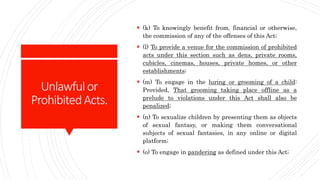
 (l) To provide a venue for the commission of prohibited
acts under this section such as dens, private rooms,
cubicles, cinemas, houses, private homes, or other
establishments;
 (m) To engage in the luring or grooming of a child:
Provided, That grooming taking place offline as a
prelude to violations under this Act shall also be
penalized;
 (n) To sexualize children by presenting them as objects
of sexual fantasy, or making them conversational
subjects of sexual fantasies, in any online or digital
platform;
 (o) To engage in pandering as defined under this Act;
Unlawfulor
ProhibitedActs.
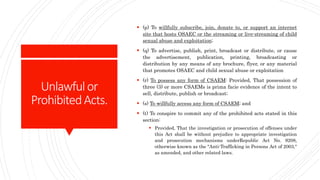
 (p) To willfully subscribe, join, donate to, or support an internet
site that hosts OSAEC or the streaming or live-streaming of child
sexual abuse and exploitation;
 (q) To advertise, publish, print, broadcast or distribute, or cause
the advertisement, publication, printing, broadcasting or
distribution by any means of any brochure, flyer, or any material
that promotes OSAEC and child sexual abuse or exploitation
 (r) To possess any form of CSAEM: Provided, That possession of
three (3) or more CSAEMs is prima facie evidence of the intent to
sell, distribute, publish or broadcast;
 (s) To willfully access any form of CSAEM; and
 (t) To conspire to commit any of the prohibited acts stated in this
section:
 Provided, That the investigation or prosecution of offenses under
this Act shall be without prejudice to appropriate investigation
and prosecution mechanisms underRepublic Act No. 9208,
otherwise known as the "Anti-Trafficking in Persons Act of 2003,"
as amended, and other related laws.
Effectof
Consentofthe
Victim.
 The consent of the victim is not material or relevant
and shall not be available as a defense in the
prosecution of the unlawful acts prohibited under this
Act.
Protectionofa
Good
Samaritan.
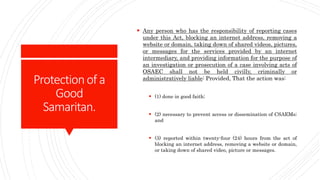
 Any person who has the responsibility of reporting cases
under this Act, blocking an internet address, removing a
website or domain, taking down of shared videos, pictures,
or messages for the services provided by an internet
intermediary, and providing information for the purpose of
an investigation or prosecution of a case involving acts of
OSAEC shall not be held civilly, criminally or
administratively liable: Provided, That the action was:
 (1) done in good faith;
 (2) necessary to prevent access or dissemination of CSAEMs;
and
 (3) reported within twenty-four (24) hours from the act of
blocking an internet address, removing a website or domain,
or taking down of shared video, picture or messages.
Who MayFilea
Complaint.
 (1) Offended party;
 (2) Parents or guardians;
 (3) Ascendant or collateral relative within the third (3rd)
degree of consanguinity;
 (4) Officer, social worker or representative of a licensed
child-caring institution;
 (5) Officer or social worker of the DSWD;
 (6) Local social welfare development officer;
 (7) Any barangay official;
 (8) Any law enforcement officer;
 (9) At least three (3) concerned responsible citizens
residing in the place where the violation occurred; or
 (10) Any person who has personal knowledge of the
circumstances of the commission of any offense under this
Act.
Affidavitof
Desistance.
 Cases involving OSAEC and CSAEM shall not be
dismissed based on the affidavit of desistance executed
by the victims or their parents or legal guardians.
Public and private prosecutors are directed to
vigorously oppose and manifest objections to motions
for dismissal. Any act that unduly pressures the
complainant to execute an affidavit of desistance shall
be punishable under this Act.
-END-
Prepared by:
Atty. Sabrina v. Suarez
Anti-VAWC Paralegal Office-Gender
and Development Office
THIS LECTURE IS SOLELY FOR VIEWING PURPOSES
OF CITY COLLEGE OF ANGELES CITY. YOU MAY NOT
COPY, REPRODUCE, DISTRIBUTE, PUBLISH, DISPLAY,
PERFORM, MODIFY, CREATE DERIVATIVE WORKS,
TRANSMIT, OR IN ANY WAY EXPLOIT ANY SUCH
CONTENT, SELL OR OFFER IT FOR SALE WITHOUT
THE CONSENT OF ATTY. SABRINA V. SUAREZ.

OSAEC - pptx

  • 1.
    “Anti-OnlineSexual Abuseor Exploitationof Children(OSAEC)and Anti-ChildSexualAbuseor ExploitationMaterials(CSAEM)Act” R.A. NO. 11930, July 30, 2022
  • 2.
    TheOSAECLaw repealed theAnti- Child Pornography Law The OSAEC Law replaces the term ‘child pornography’ with the more aptly descriptive term ‘child sexual abuse or exploitation material or child sexual abuse material;  The OSAEC expanded the coverage of the law to include materials that focuses on the genitalia or other private body parts of the child, removing the previous qualification that such exhibition must be lascivious;  The child-victim is not required to be presented in court during trial and shall testify in accordance with “Rule on Examination of a Child Witness”;
  • 3.
    DEFINTIONOF TERMS  Child refersto a person below eighteen (18) years of age or those over but are unable to fully take care of themselves or protect themselves from abuse, neglect, cruelty, exploitation or discrimination because of physical, mental, intellectual or sensory disability or condition. For purposes of this Act, a child shall also refer to:  (1) A person regardless of age who is presented, depicted or portrayed as a child as defined herein; and  (2) Computer-generated, digitally or manually crafted images, or graphics of a person who is represented or who is made to appear to be a child as defined herein.
  • 4.
    DEFINTIONOF TERMS  Child sexualabuse refers to any form of communication through any platform or format, or any physical interaction between a child and any person when the child is being used for any act or activity inducing sexual stimulation or for the purpose of sexual gratification or in pursuit of the desire to have carnal knowledge of the child, regardless of the gender of the perpetrator or the victim, or the consent of the victim;
  • 5.
    DEFINTIONOF TERMS  Child sexualabuse or exploitation material or child sexual abuse material (CSAEM/CSAM) refers to any representation, whether offline, or by, through or with the use of ICT, by means of visual, video, audio, written, or any combination thereof, by electronic, mechanical, digital, optical, magnetic or any other means, of a child engaged or involved in real or simulated sexual activities, or depicting acts of sexual abuse or exploitation of a child as a sexual object. It shall also include materials that focus on the genitalia or other private body parts of a child.
  • 6.
    DEFINTIONOF TERMS  Child sexualexploitation refers to any of the following acts even if consent appears to have been granted by the child:  (1) Child sexual abuse with consideration whether monetary or nonmonetary consideration, favor, or benefit in exchange for the opportunity to perform such abusive or exploitative act  (2) Actual sexual intercourse with a child or children with or without consideration;  (3) Employing fraud, machination, undue influence, intimidation, threat or deception by any person to commit sexual abuse of or sexual intercourse with a child or children; or  (4) Any other similar or analogous acts related to child abuse, cruelty or exploitation or to be responsible for other conditions prejudicial to the development of the child;
  • 7.
    DEFINTIONOF TERMS  Grooming refersto predatory conduct, act, or pattern of acts, of establishing a relationship of trust, or emotional connection by another, with a child or someone who is believed to be a child, and/or the family, guardian, and/or caregivers, whether in person or via electronic and other similar devices, for the purpose of perpetrating sexual abuse or exploitation or the production of any form of CSAEM;
  • 8.
    DEFINTIONOF TERMS  Image-based sexualabuse (ISA) refers to a form of technology-facilitated sexual violence. The term describes a pattern of behavior involving the nonconsensual creation, distribution, or threats to distribute nude or sexual images. It includes a diversity of behaviors including, but not limited to, "sextortion scams," the use of artificial intelligence to construct "deepfake" pornographic videos, threats to distribute photographs and videos; and the taking or sharing of sexual assault imagery;
  • 9.
    DEFINTIONOF TERMS  Luring refersto the act of communicating, by means of a computer system, with a child or someone who the offender believes to be a child for the purpose of facilitating the commission of sexual activity or production of any form of CSAEM;
  • 10.
    DEFINTIONOF TERMS  Online sexualabuse or exploitation of children (OSAEC) refers to the use of information and communications technology (ICT) as a means to abuse and/or exploit children sexually, which includes cases in which offline child abuse and/or exploitation is combined with an online component. This can also include, but is not limited to, the production, dissemination and possession of CSAEM; online grooming of children for sexual purposes; sexual extortion of children, sharing image-based sexual abuse; commercial sexual exploitation of children; exploitation of children through online prostitution; and live-streaming of sexual abuse, with or without the consent of the victim;
  • 11.
    DEFINTIONOF TERMS  Sexual activityincludes the following acts, whether actually performed or simulated:  (1) Sexual intercourse or lascivious act, including contact involving the genitalia, oral stimulation of the genitals or oral stimulation of the anus, whether between persons of the same or opposite sex;  (2) Masturbation;  (3) Sadistic or masochistic abuse;  (4) Lascivious exhibition of the genitals, buttocks, breasts, pubic area and anus;  (5) Bestiality;  (6) Use of any object or instrument for lascivious acts; or  (7) Any other analogous circumstance.
  • 12.
    DEFINTIONOF TERMS  Sexualization ofa child refers to the act of using a child as an object for the sexual desire or satisfaction of another, even if there is no actual sexual intercourse or no private part of the body of the child has been shown;
  • 13.
    DEFINTIONOF TERMS  Streaming refersto the broadcasting or viewing through the use of information and communications technology (ICT), whether the viewer is passively watching or actively directing the content. It is considered live-streaming when the broadcasting or viewing occurs in real-time;
  • 14.
    Unlawfulor ProhibitedActs.  (a) Tohire, employ, use, persuade, induce, extort, engage, or coerce a child to perform or participate in whatever way in the creation or production of any form of OSAEC and CSAEM;  (b) To produce, direct, manufacture, facilitate, or create any form of CSAEM, or participate in the production, direction, manufacture, facilitation or creation of the same;  (c) To offer, sell, distribute, advertise, promote, export, or import, by any means, any form of CSAEM;  (d) To knowingly publish, transmit and broadcast, by any means, any form of CSAEM;  (e) To permit or influence the child to engage, participate or assist in any form of CSAEM;
  • 15.
    Unlawfulor ProhibitedActs.  (f) Toproduce, direct, create, hire, employ or pay a facilitator to stream or livestream acts of child sexual abuse or exploitation;  (g) To stream or live-stream acts of, or any form of, child sexual abuse and exploitation;  (h) To recruit, transport, transfer, harbor, provide, or receive a child or to induce or influence the same, for the purpose of violating this Act;  (i) To introduce or match a child to a foreign national or to any person for the purpose of committing any of the offenses under this Act;  (j) For film distributors, theaters and ICT services by themselves or in cooperation with other entities, to distribute any form of CSAEM or to facilitate the commission of any of the offenses under this Act;
  • 16.
    Unlawfulor ProhibitedActs.  (k) Toknowingly benefit from, financial or otherwise, the commission of any of the offenses of this Act;  (l) To provide a venue for the commission of prohibited acts under this section such as dens, private rooms, cubicles, cinemas, houses, private homes, or other establishments;  (m) To engage in the luring or grooming of a child: Provided, That grooming taking place offline as a prelude to violations under this Act shall also be penalized;  (n) To sexualize children by presenting them as objects of sexual fantasy, or making them conversational subjects of sexual fantasies, in any online or digital platform;  (o) To engage in pandering as defined under this Act;
  • 17.
    Unlawfulor ProhibitedActs.  (p) Towillfully subscribe, join, donate to, or support an internet site that hosts OSAEC or the streaming or live-streaming of child sexual abuse and exploitation;  (q) To advertise, publish, print, broadcast or distribute, or cause the advertisement, publication, printing, broadcasting or distribution by any means of any brochure, flyer, or any material that promotes OSAEC and child sexual abuse or exploitation  (r) To possess any form of CSAEM: Provided, That possession of three (3) or more CSAEMs is prima facie evidence of the intent to sell, distribute, publish or broadcast;  (s) To willfully access any form of CSAEM; and  (t) To conspire to commit any of the prohibited acts stated in this section:  Provided, That the investigation or prosecution of offenses under this Act shall be without prejudice to appropriate investigation and prosecution mechanisms underRepublic Act No. 9208, otherwise known as the "Anti-Trafficking in Persons Act of 2003," as amended, and other related laws.
  • 18.
    Effectof Consentofthe Victim.  The consentof the victim is not material or relevant and shall not be available as a defense in the prosecution of the unlawful acts prohibited under this Act.
  • 19.
    Protectionofa Good Samaritan.  Any personwho has the responsibility of reporting cases under this Act, blocking an internet address, removing a website or domain, taking down of shared videos, pictures, or messages for the services provided by an internet intermediary, and providing information for the purpose of an investigation or prosecution of a case involving acts of OSAEC shall not be held civilly, criminally or administratively liable: Provided, That the action was:  (1) done in good faith;  (2) necessary to prevent access or dissemination of CSAEMs; and  (3) reported within twenty-four (24) hours from the act of blocking an internet address, removing a website or domain, or taking down of shared video, picture or messages.
  • 20.
    Who MayFilea Complaint.  (1)Offended party;  (2) Parents or guardians;  (3) Ascendant or collateral relative within the third (3rd) degree of consanguinity;  (4) Officer, social worker or representative of a licensed child-caring institution;  (5) Officer or social worker of the DSWD;  (6) Local social welfare development officer;  (7) Any barangay official;  (8) Any law enforcement officer;  (9) At least three (3) concerned responsible citizens residing in the place where the violation occurred; or  (10) Any person who has personal knowledge of the circumstances of the commission of any offense under this Act.
  • 21.
    Affidavitof Desistance.  Cases involvingOSAEC and CSAEM shall not be dismissed based on the affidavit of desistance executed by the victims or their parents or legal guardians. Public and private prosecutors are directed to vigorously oppose and manifest objections to motions for dismissal. Any act that unduly pressures the complainant to execute an affidavit of desistance shall be punishable under this Act.
  • 22.
    -END- Prepared by: Atty. Sabrinav. Suarez Anti-VAWC Paralegal Office-Gender and Development Office THIS LECTURE IS SOLELY FOR VIEWING PURPOSES OF CITY COLLEGE OF ANGELES CITY. YOU MAY NOT COPY, REPRODUCE, DISTRIBUTE, PUBLISH, DISPLAY, PERFORM, MODIFY, CREATE DERIVATIVE WORKS, TRANSMIT, OR IN ANY WAY EXPLOIT ANY SUCH CONTENT, SELL OR OFFER IT FOR SALE WITHOUT THE CONSENT OF ATTY. SABRINA V. SUAREZ.