The document summarizes key concepts in process synchronization and concurrency control, including:
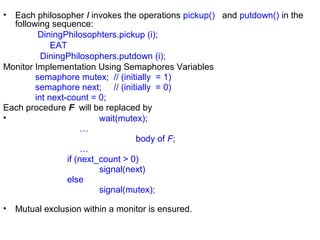
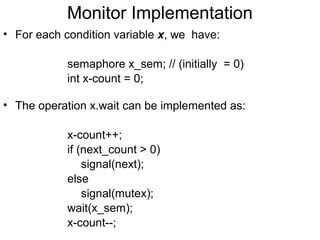
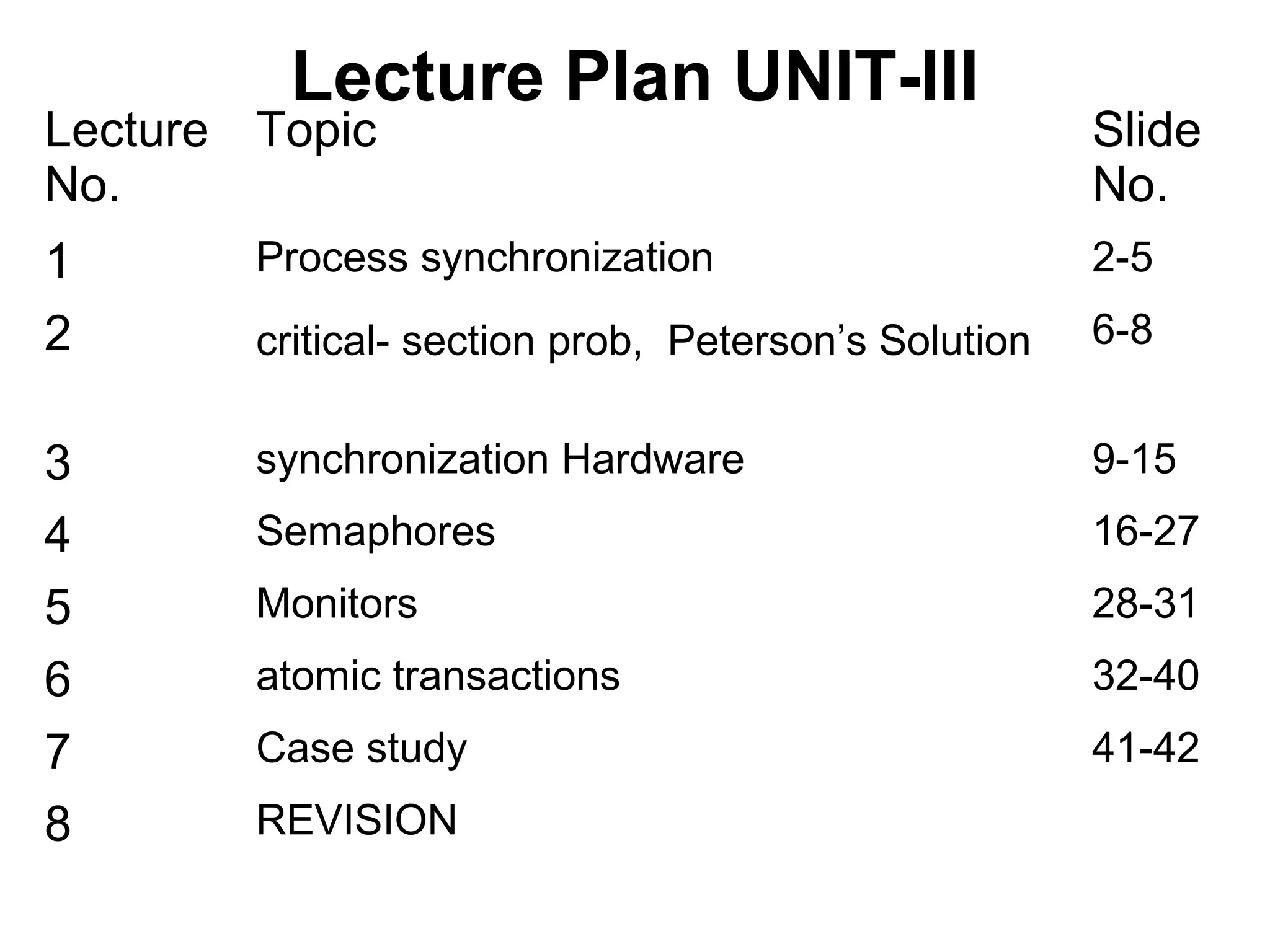
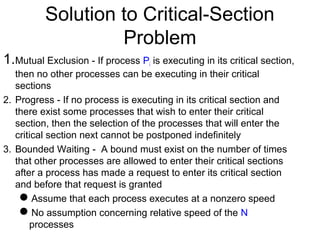
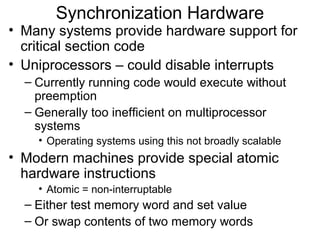
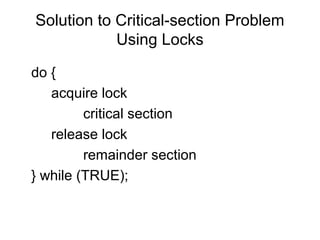
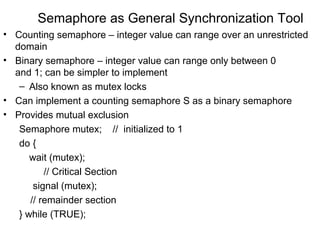
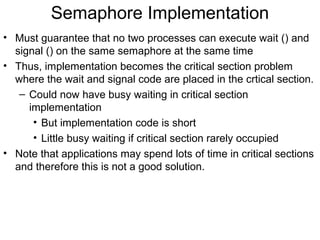
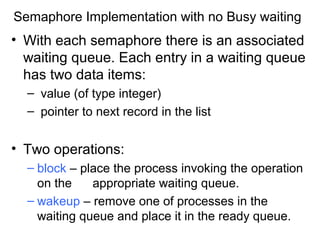
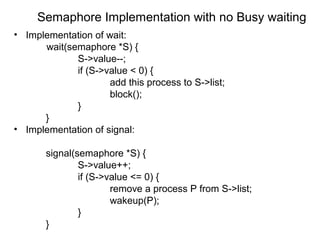
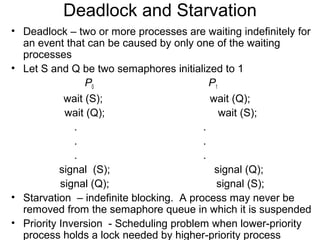
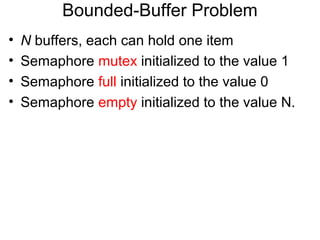
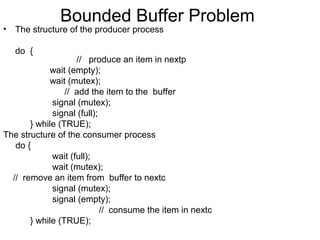
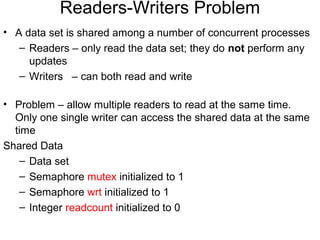
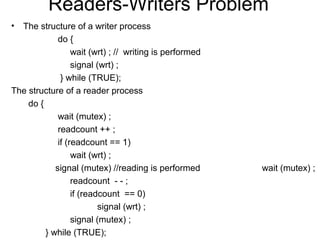
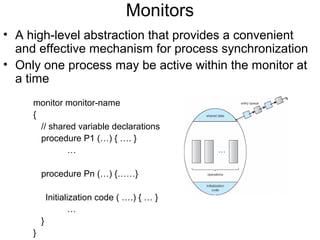
1) Process synchronization techniques like semaphores, monitors, and atomic transactions that ensure orderly access to shared resources. Semaphores use wait() and signal() operations while monitors provide mutual exclusion through condition variables.
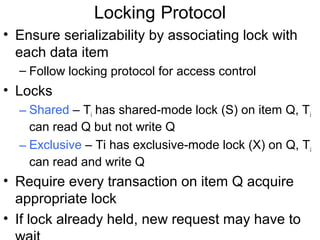
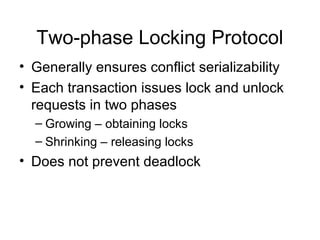
2) Concurrency control algorithms like locking and two-phase locking that ensure serializability of concurrent transactions accessing a database. Locking associates locks with data items to control concurrent access.
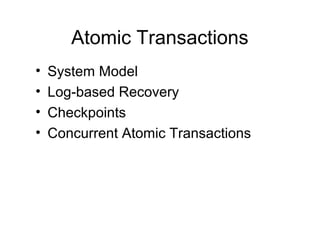
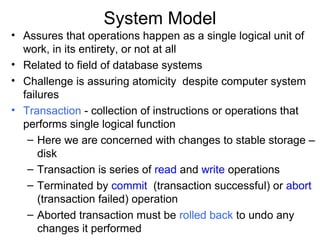
3) Challenges in concurrency control like deadlocks, priority inversion, and starvation that synchronization mechanisms aim to prevent. Log-based recovery with write-ahead logging and checkpoints is used to ensure atomicity of transactions in
![Producer
while (true) {
/* produce an item and put in
nextProduced */
while (count == BUFFER_SIZE)
; // do nothing
buffer [in] = nextProduced;
in = (in + 1) % BUFFER_SIZE;
count++;
}](https://image.slidesharecdn.com/osppt3unit-120825100343-phpapp01/85/OS-Process-Synchronization-semaphore-and-Monitors-3-320.jpg)
![Consumer
while (true) {
while (count == 0)
; // do nothing
nextConsumed = buffer[out];
out = (out + 1) % BUFFER_SIZE;
count--;
/* consume the item in
nextConsumed
}](https://image.slidesharecdn.com/osppt3unit-120825100343-phpapp01/85/OS-Process-Synchronization-semaphore-and-Monitors-4-320.jpg)
![Peterson’s Solution
• Two process solution
• Assume that the LOAD and STORE
instructions are atomic; that is, cannot be
interrupted.
• The two processes share two variables:
– int turn;
– Boolean flag[2]
• The variable turn indicates whose turn it is to
enter the critical section.
• The flag array is used to indicate if a process
is ready to enter the critical section. flag[i] =
true implies that process Pi is ready!](https://image.slidesharecdn.com/osppt3unit-120825100343-phpapp01/85/OS-Process-Synchronization-semaphore-and-Monitors-7-320.jpg)
![Algorithm for Process Pi
do {
flag[i] = TRUE;
turn = j;
while (flag[j] && turn == j);
critical section
flag[i] = FALSE;
remainder section
} while (TRUE);](https://image.slidesharecdn.com/osppt3unit-120825100343-phpapp01/85/OS-Process-Synchronization-semaphore-and-Monitors-8-320.jpg)
![Bounded-waiting Mutual Exclusion with TestandSet()
do {
waiting[i] = TRUE;
key = TRUE;
while (waiting[i] && key)
key = TestAndSet(&lock);
waiting[i] = FALSE;
// critical section
j = (i + 1) % n;
while ((j != i) && !waiting[j])
j = (j + 1) % n;
if (j == i)
lock = FALSE;
else
waiting[j] = FALSE;
// remainder section
} while (TRUE);](https://image.slidesharecdn.com/osppt3unit-120825100343-phpapp01/85/OS-Process-Synchronization-semaphore-and-Monitors-15-320.jpg)
![Dining-Philosophers Problem
• Shared data
– Bowl of rice (data set)
– Semaphore chopstick [5] initialized to 1
do {
wait ( chopstick[i] );
wait ( chopStick[ (i + 1) % 5] );
// eat
signal ( chopstick[i] );
signal (chopstick[ (i + 1) %
5] );
// think
} while (TRUE);](https://image.slidesharecdn.com/osppt3unit-120825100343-phpapp01/85/OS-Process-Synchronization-semaphore-and-Monitors-26-320.jpg)
![Solution to Dining Philosophers
monitor DP
{ enum { THINKING; HUNGRY, EATING) state [5] ;
condition self [5];
void pickup (int i) {
state[i] = HUNGRY;
test(i);
if (state[i] != EATING) self [i].wait;
}
void putdown (int i) {
state[i] = THINKING;
// test left and right neighbors
test((i + 4) % 5);
test((i + 1) % 5);
}
void test (int i) {
if ( (state[(i + 4) % 5] != EATING) &&
(state[i] == HUNGRY) &&
(state[(i + 1) % 5] != EATING) ) {
state[i] = EATING ;
self[i].signal () ;
} }
initialization_code() {
for (int i = 0; i < 5; i++)
state[i] = THINKING;
} }](https://image.slidesharecdn.com/osppt3unit-120825100343-phpapp01/85/OS-Process-Synchronization-semaphore-and-Monitors-28-320.jpg)