

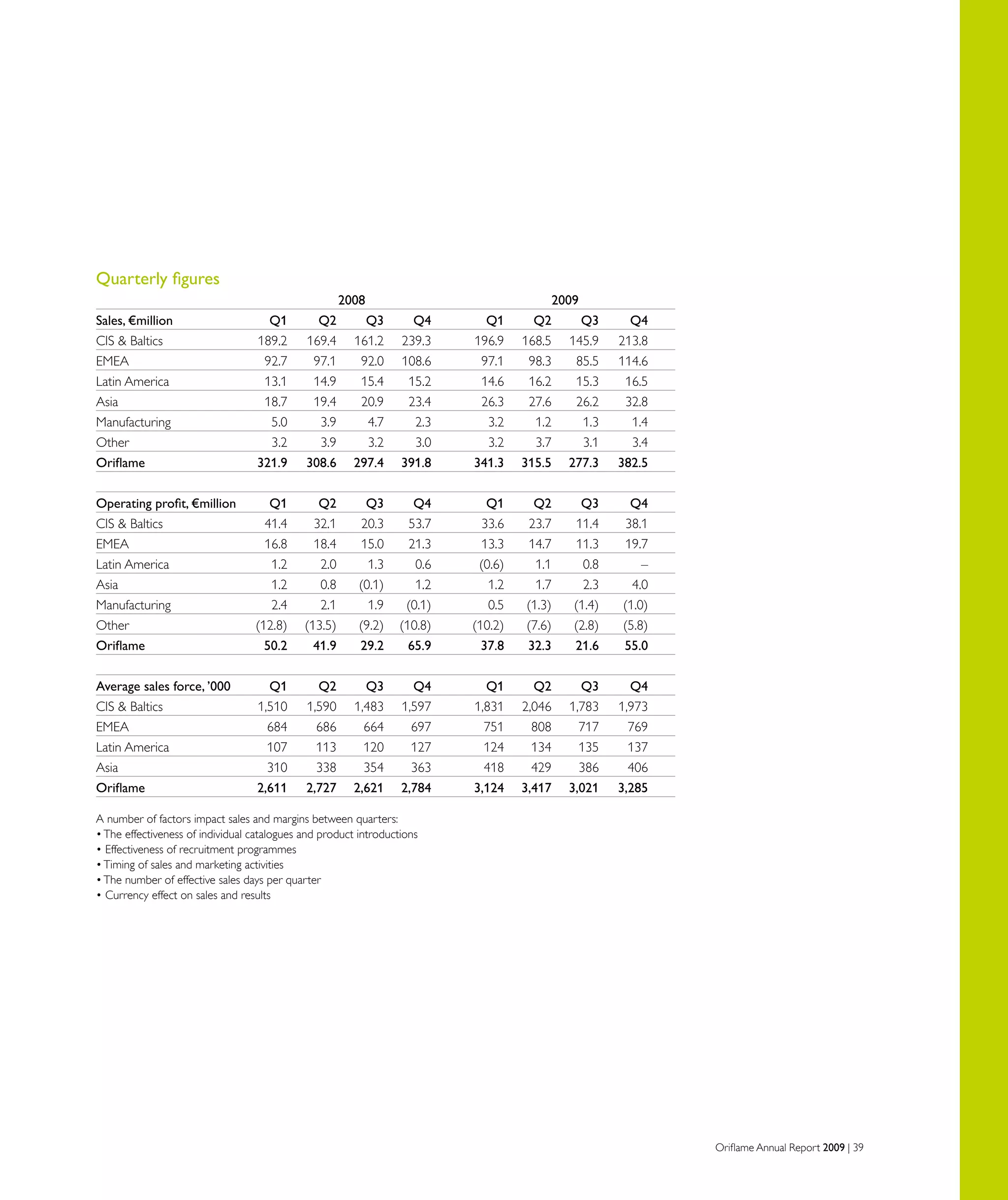
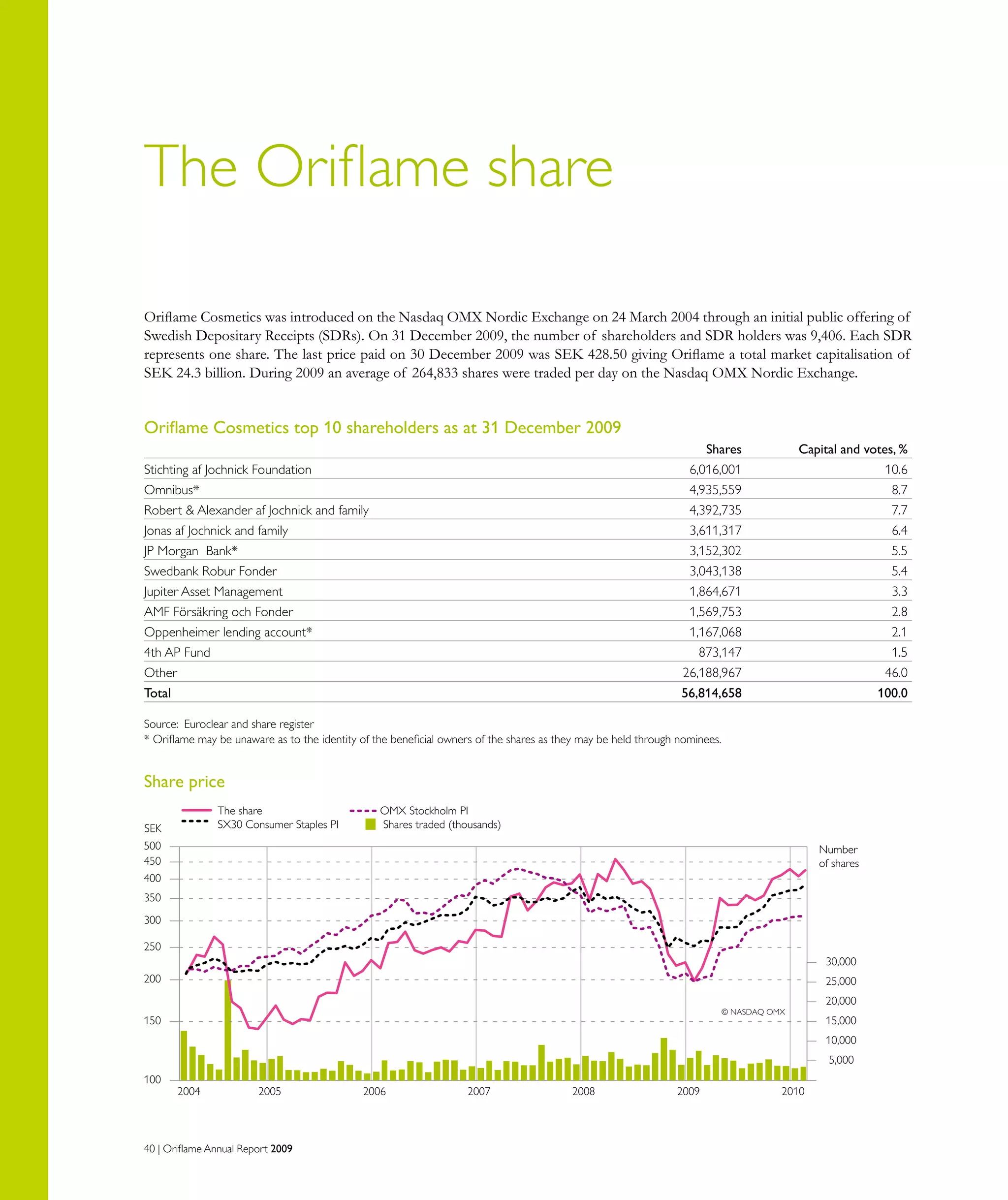
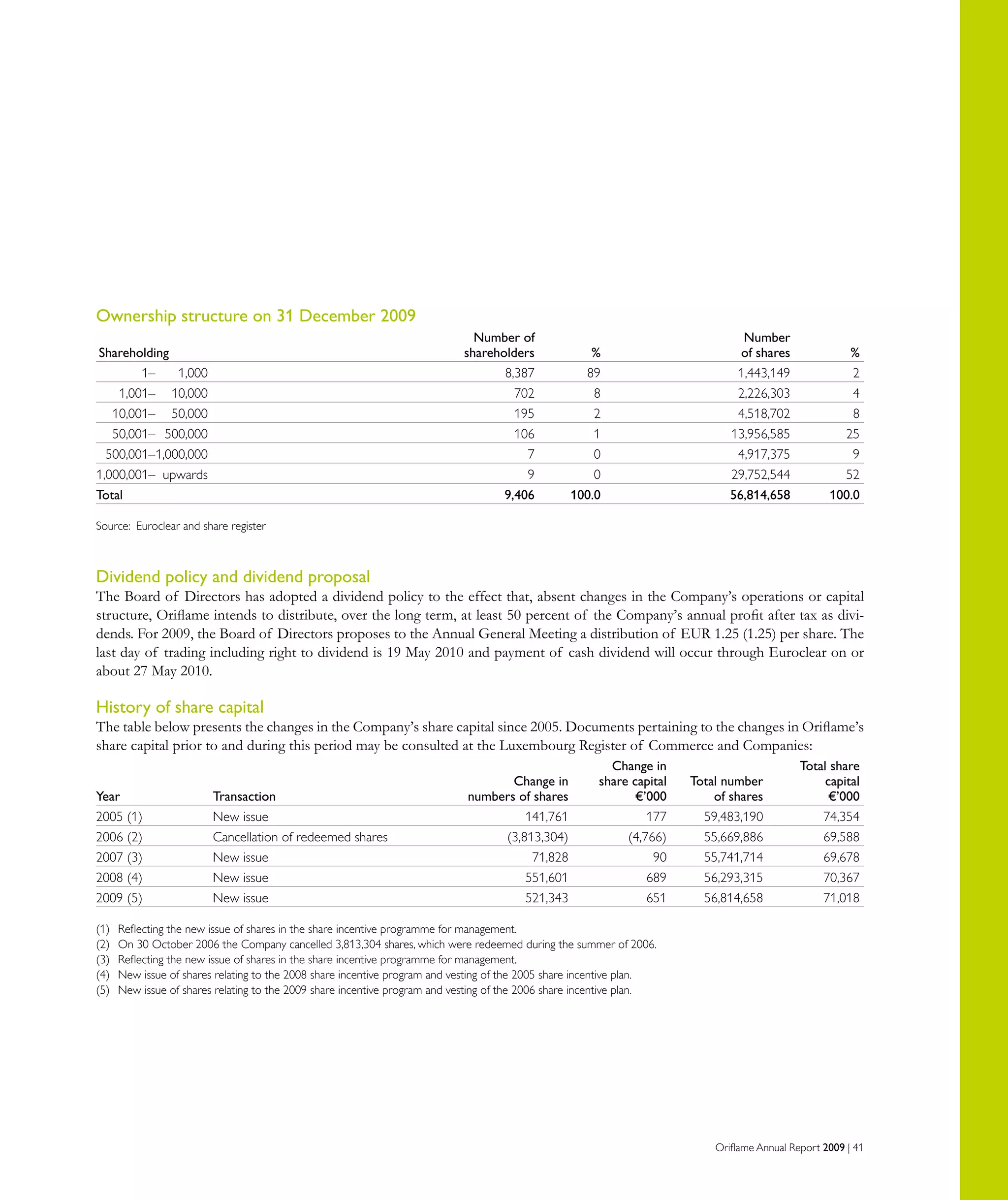
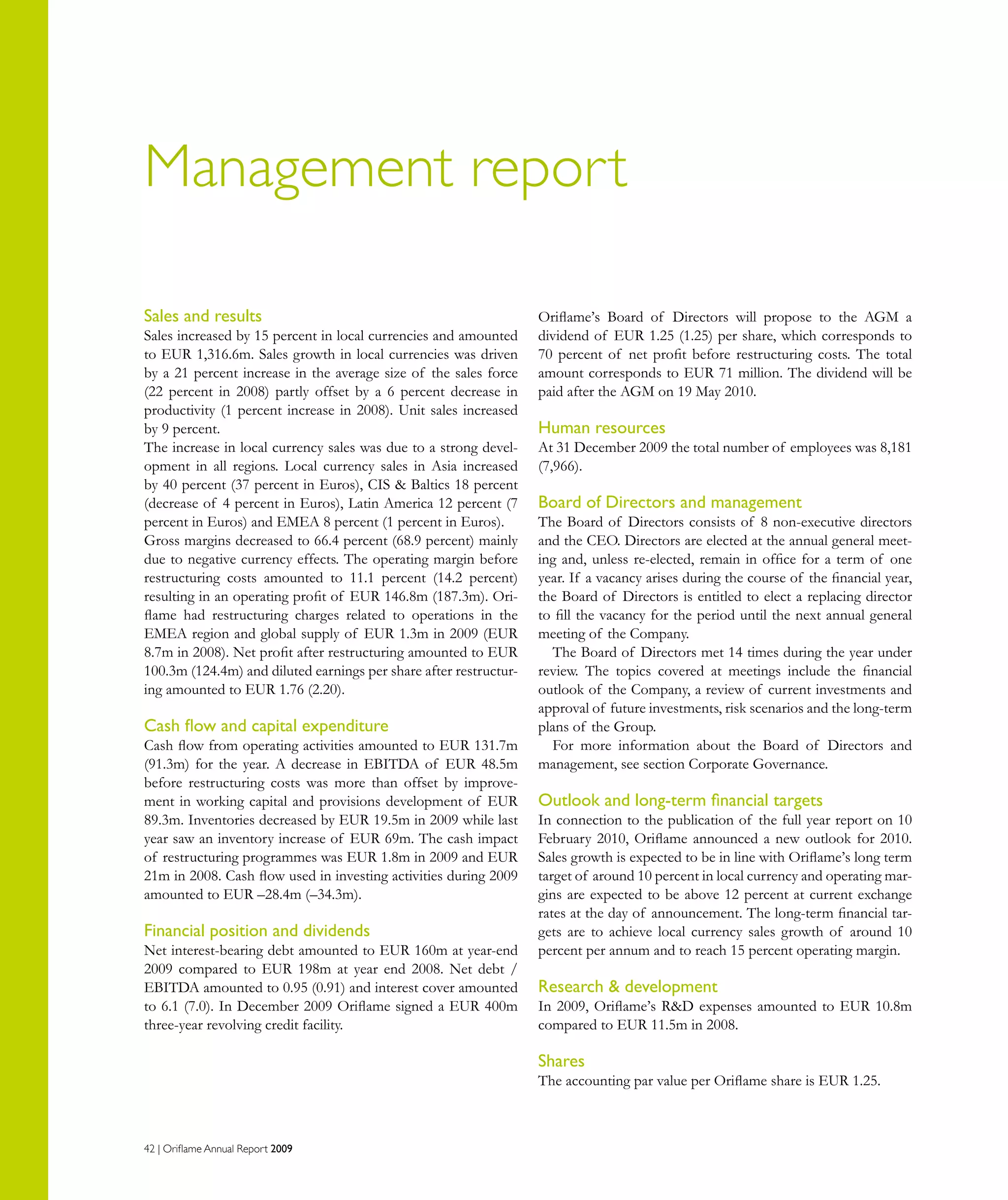




Oriflame Annual Report 2009 | 1
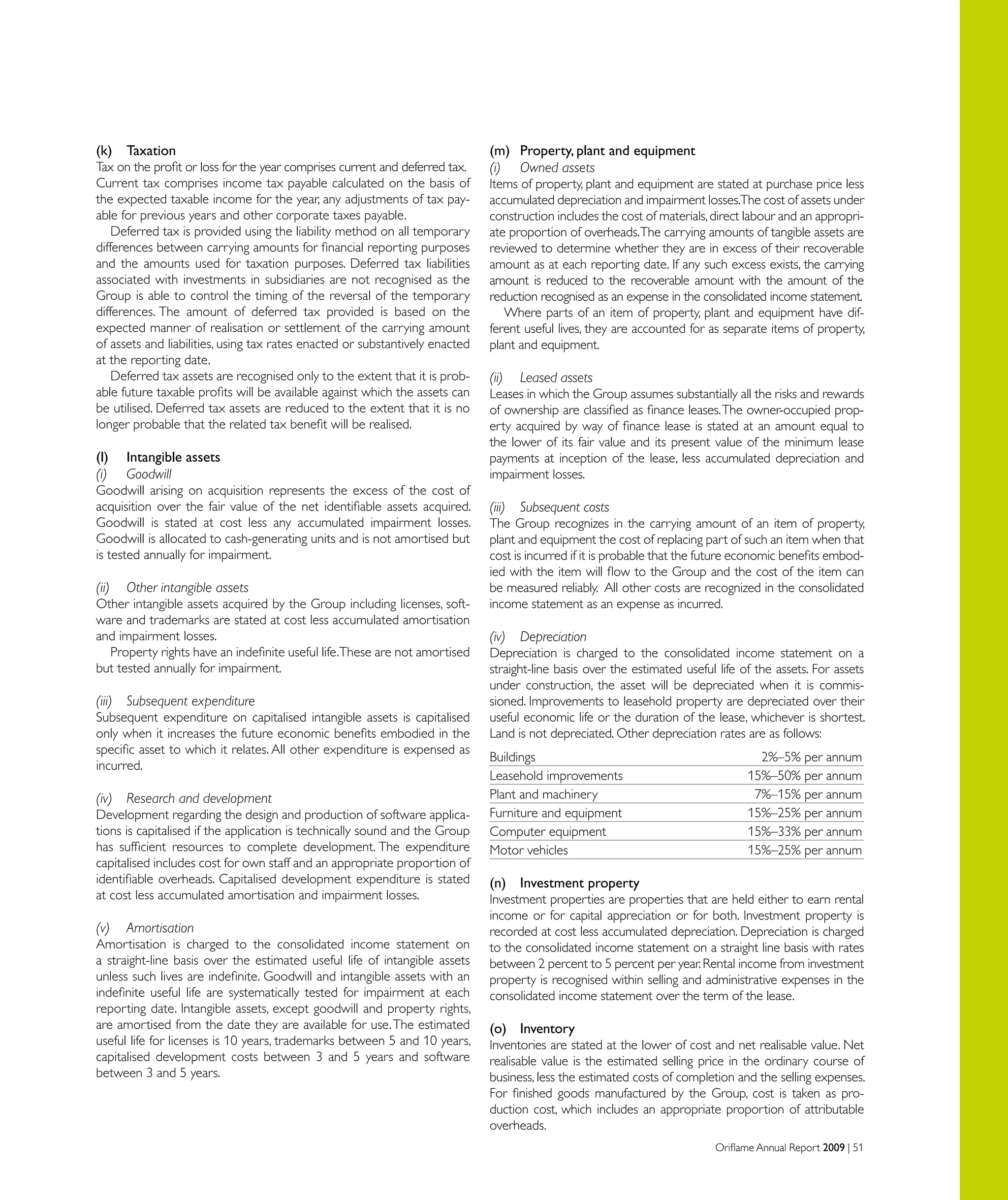
A N N UA L R E P O RT 2 0 0 9
ORIFLAME
COSMETICS
Quickguide
Oriflame in brief	 inside cover, 2-3
Company overview – goals, strategies, history, market outlook & product offering
Financial overview – key events, key figures 2009/2008, ownership structure
Statements	 4-7
Statement from the Chairman of the board	
Statement from the CEO	
Business model	 8-15
Business model – method, offer, business, culture, channels	
Direct Selling – a sales method in tune with time	
Working as a sales consultant – career opportunity, support tools, sales compensation
The Oriflame catalogue – our main marketing channel 	
Organisation	 16-19
Promoting entrepreneurship, creativity and core values	
Establishing long-term human resource processes	
Products	 20-23
Product overview – highlights and sales growth	
Product offering – product categories, trends and best-sellers	
Research & Development	 24-25
Product development from idea to launch and skin research	
Supply	 26-27
Supply chain, manufacturing and sourcing	
Quality Assurance and code of practice	
Market	 28-29
General outlook – market position, market shares, market forecast and competittion	
Regional highlights	
Corporate Social Responsibility	 30-33
Social responsibility – responsible business model, charity initiatives	
Environmental responsibility – manufacturing, packaging and distributing	
Key figures, year on year and quarterly	 2-3, 34-35
Sales (Total sales, sales by product category, sales by region)	
Gross profit	
Gross margin, %	
EBITDA	
Operating profit	
Operating margin, %
Profit before tax	
Net profit
Cash generated from operations	
Cash flow from operating activities	
Cash flow from operating activities, per share
Average operating capital
Return on operating capital, %
Average capital employed	
Return on capital employed, ROCE %	
Net interest-bearing debt	
Interest cover
Equity/asset ratio, %
Earnings per share, basic, €	
Earnings per share, diluted, €	
Average number of employees
Average sales force
Closing sales force	
The Oriflame Share	 36-37
The share capital and development	
Ownership structure	
Management report	 38
Financial overview, position, dividend proposal, outlook and targets	
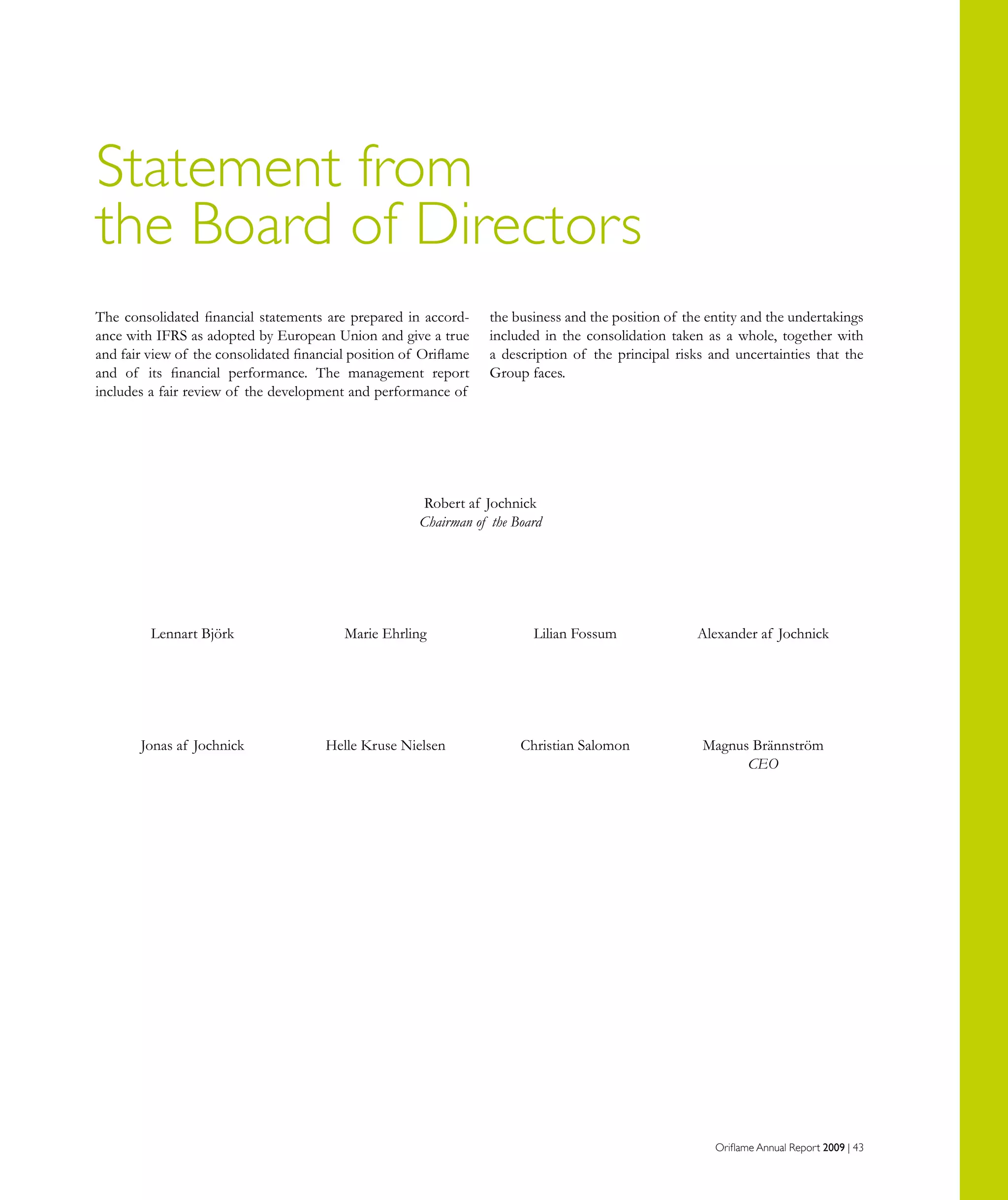
Statement from the Board of Directors	 39
Financial consolidated statements	 40-44
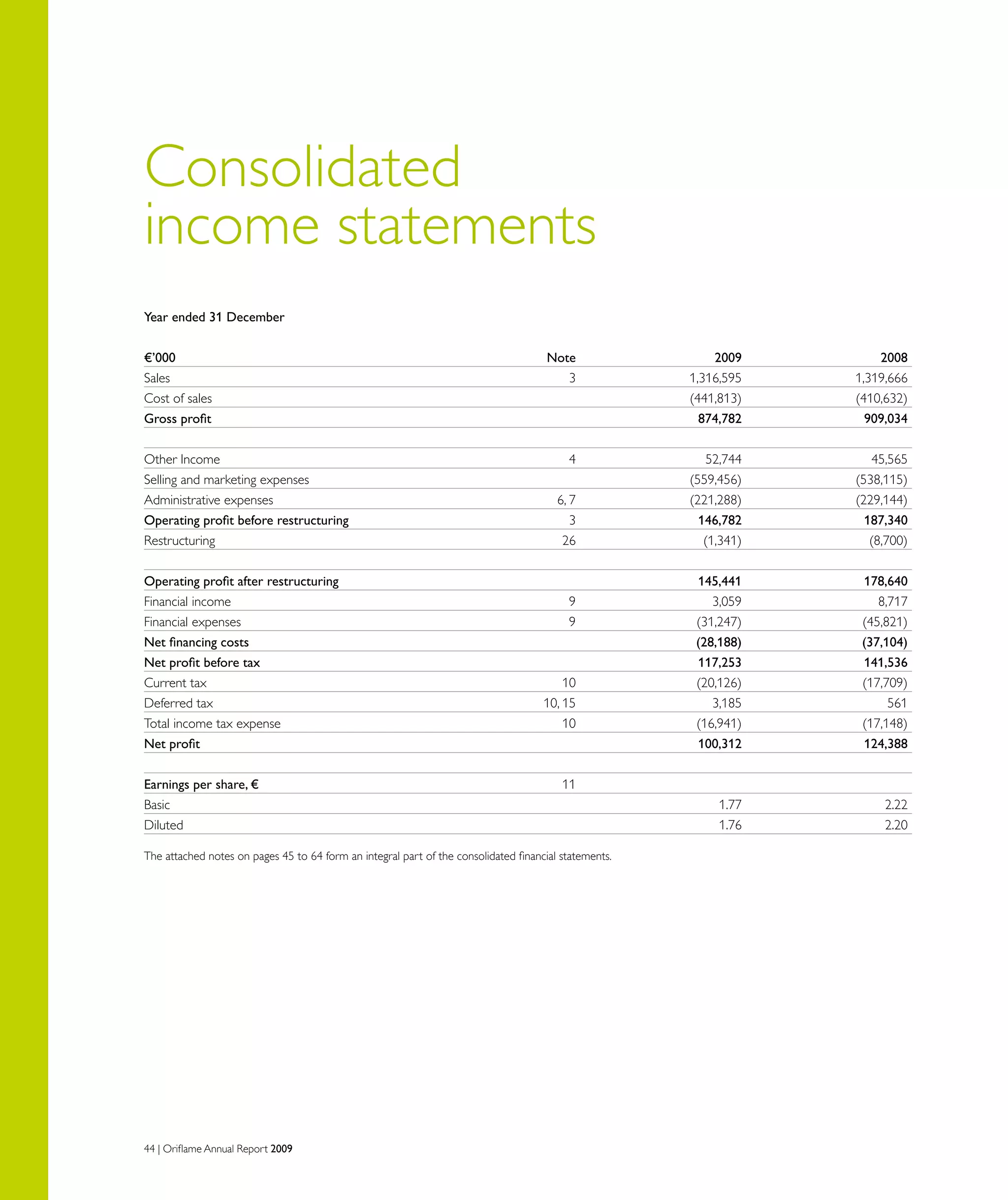
Consolidated income statements	
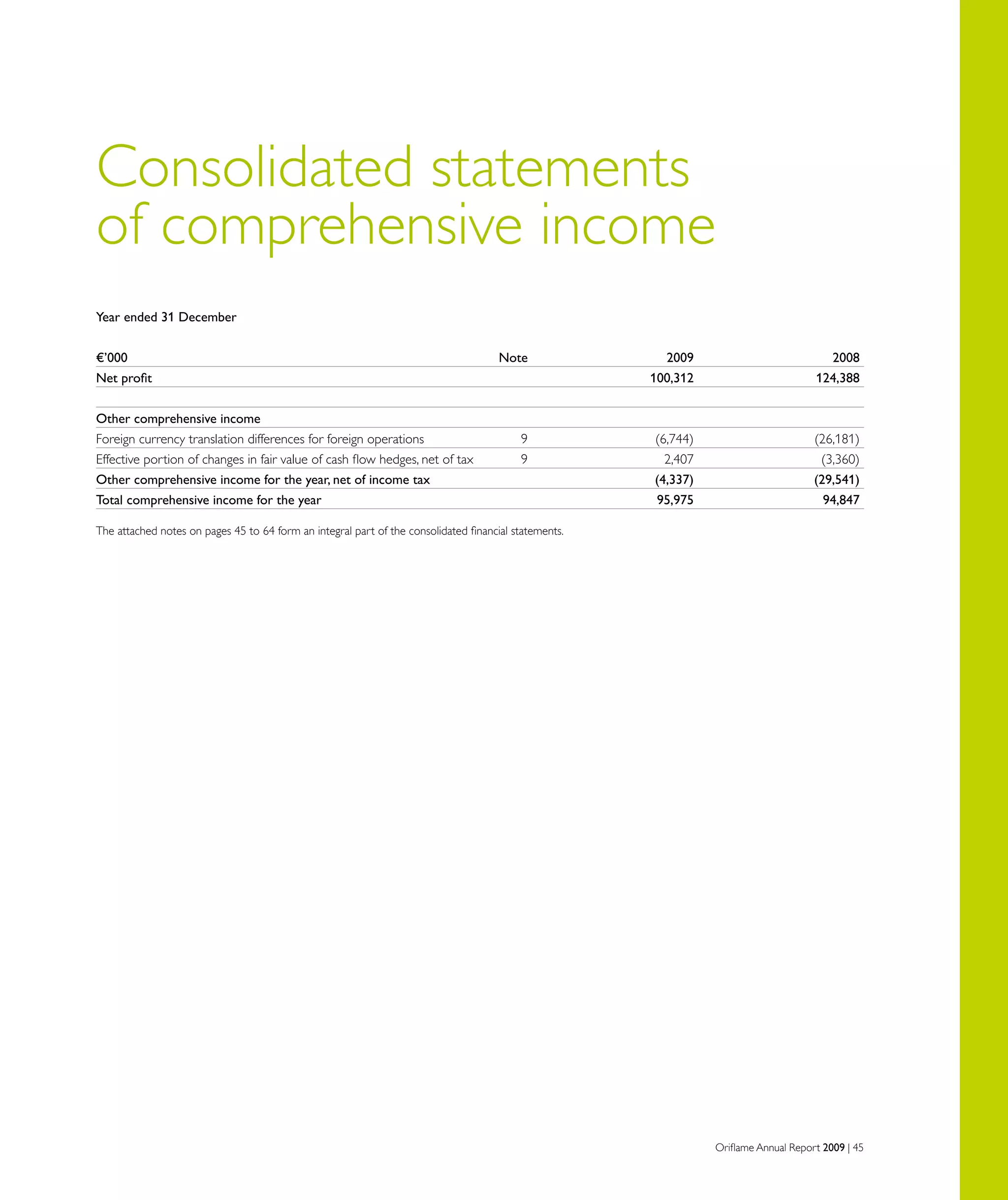
Consolidated statements of comprehensive income	
Consolidated statements of financial position	
Consolidated statements of changes in equity	
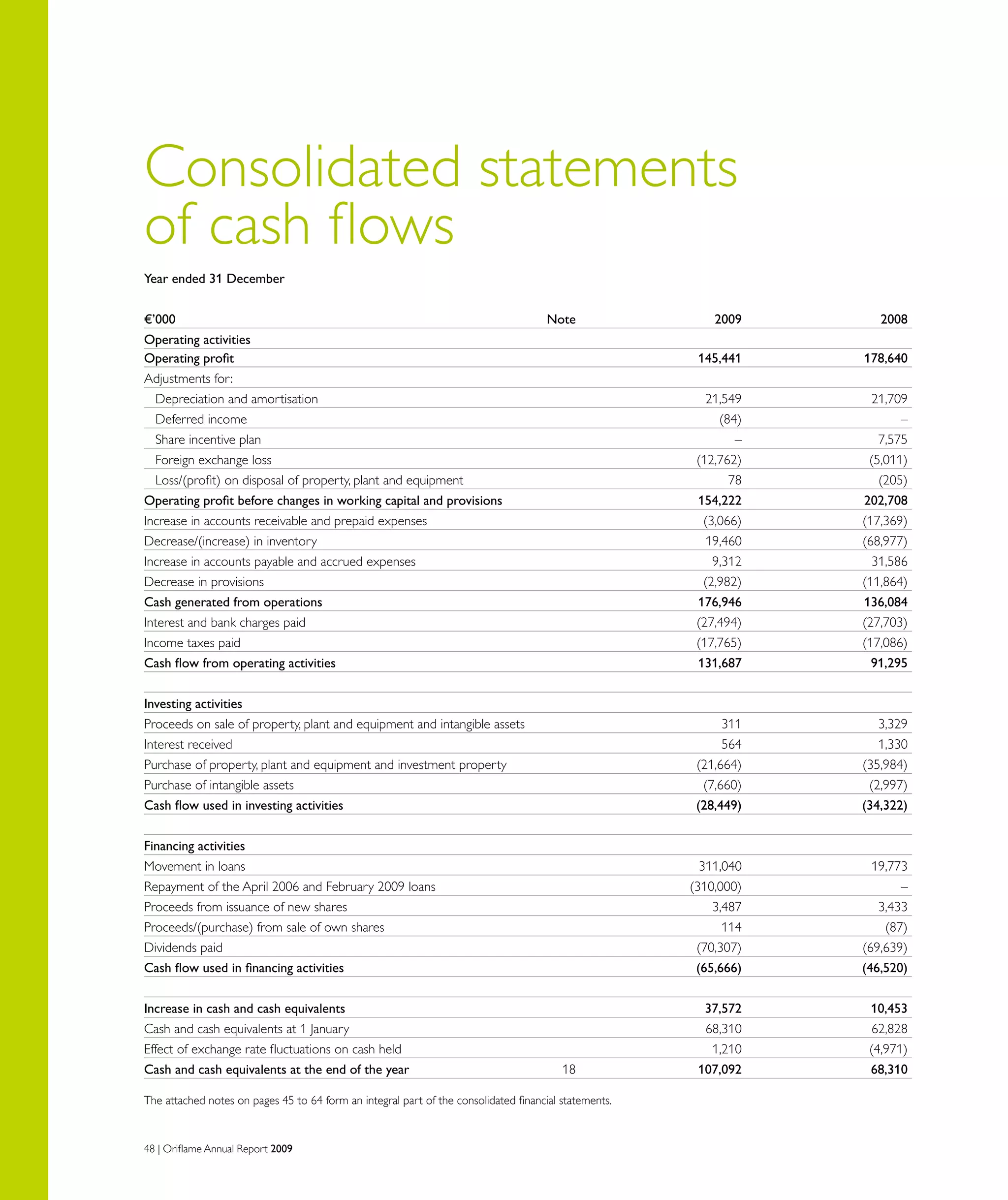
Consolidated statements of cash flows	
Notes to the consolidated financial statements	 45-64
Note 1: Status and principal activity	
Note 2: Basis of preparation and summary of significant accounting policies	
Note 3: Segment reporting	
Note 4: Other income	
Note 5: Employee benefit expense	
Note 6:Auditor’s remuneration	
Note 7: Research and development	
Note 8: Depreciation and Amortisation	
Note 9: Financial income and expense	
Note 10: Income tax expense	
Note 11: Earnings per share	
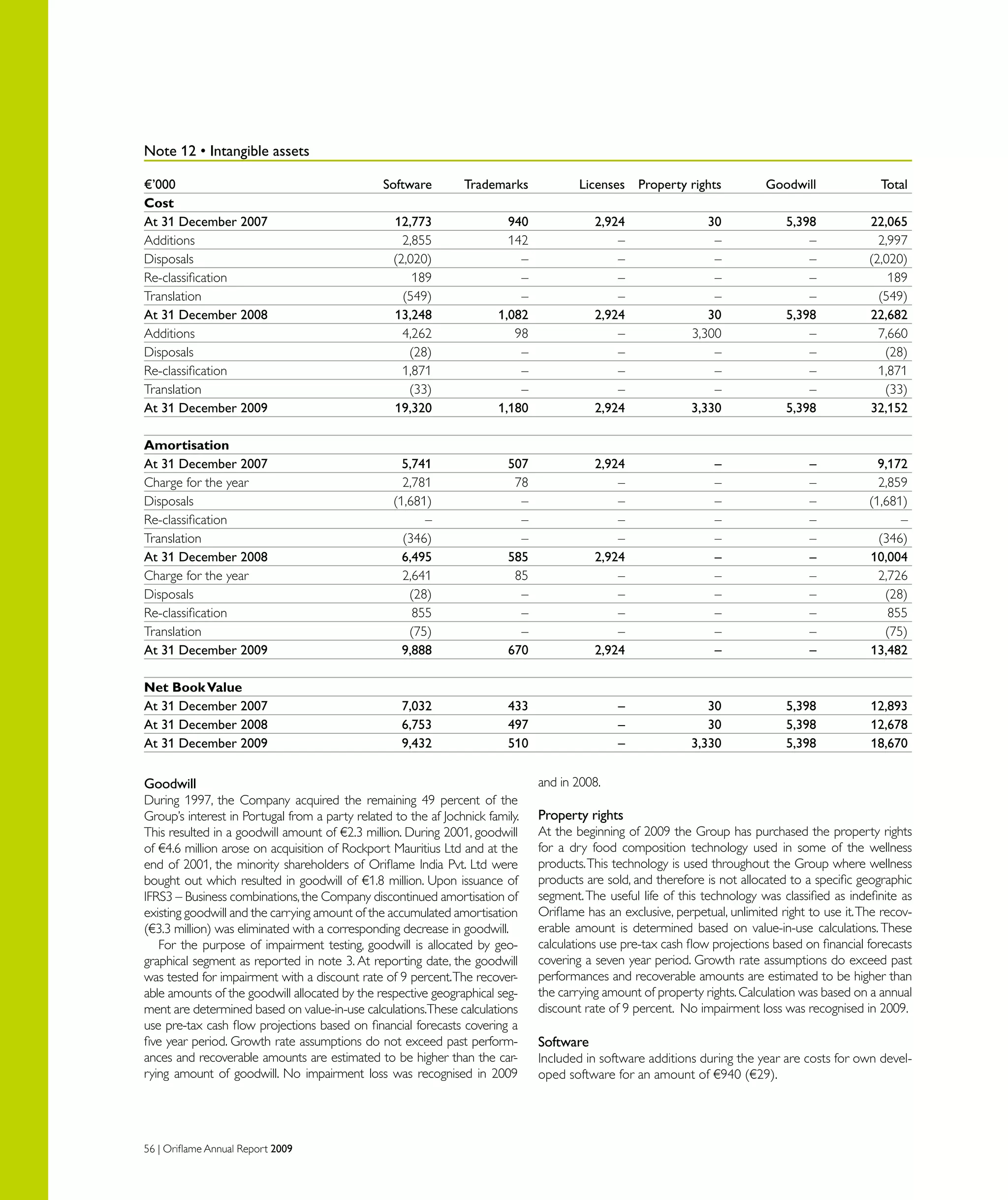
Note 12: Intangible assets	
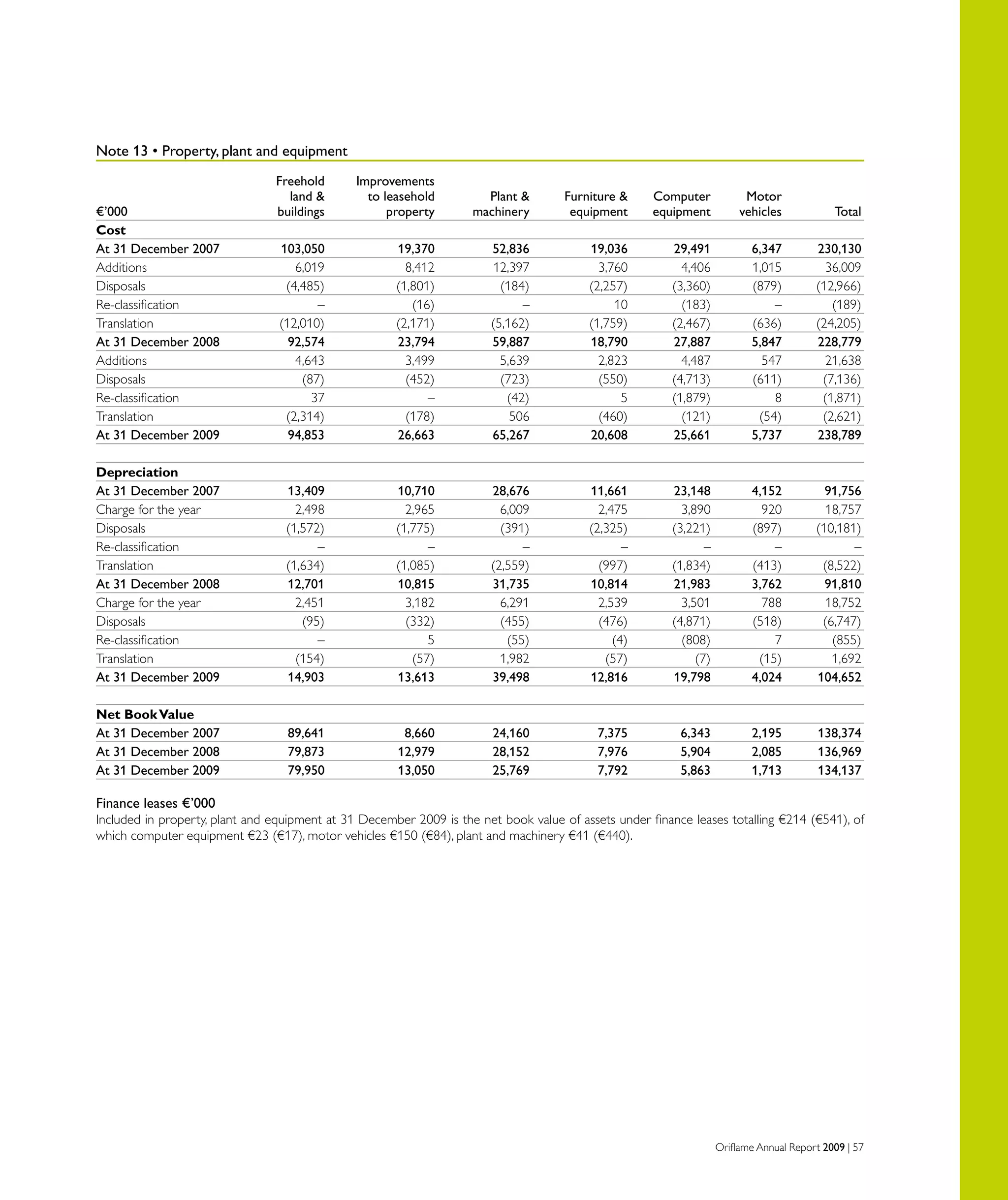
Note 13: Property, plant and equipment	
Note 14: Investment property	
Note 15: Deferred taxation	
Note 16: Inventories	
Note 17:Accounts receivable and prepaid expenses	
Note 18: Cash and cash equivalents	
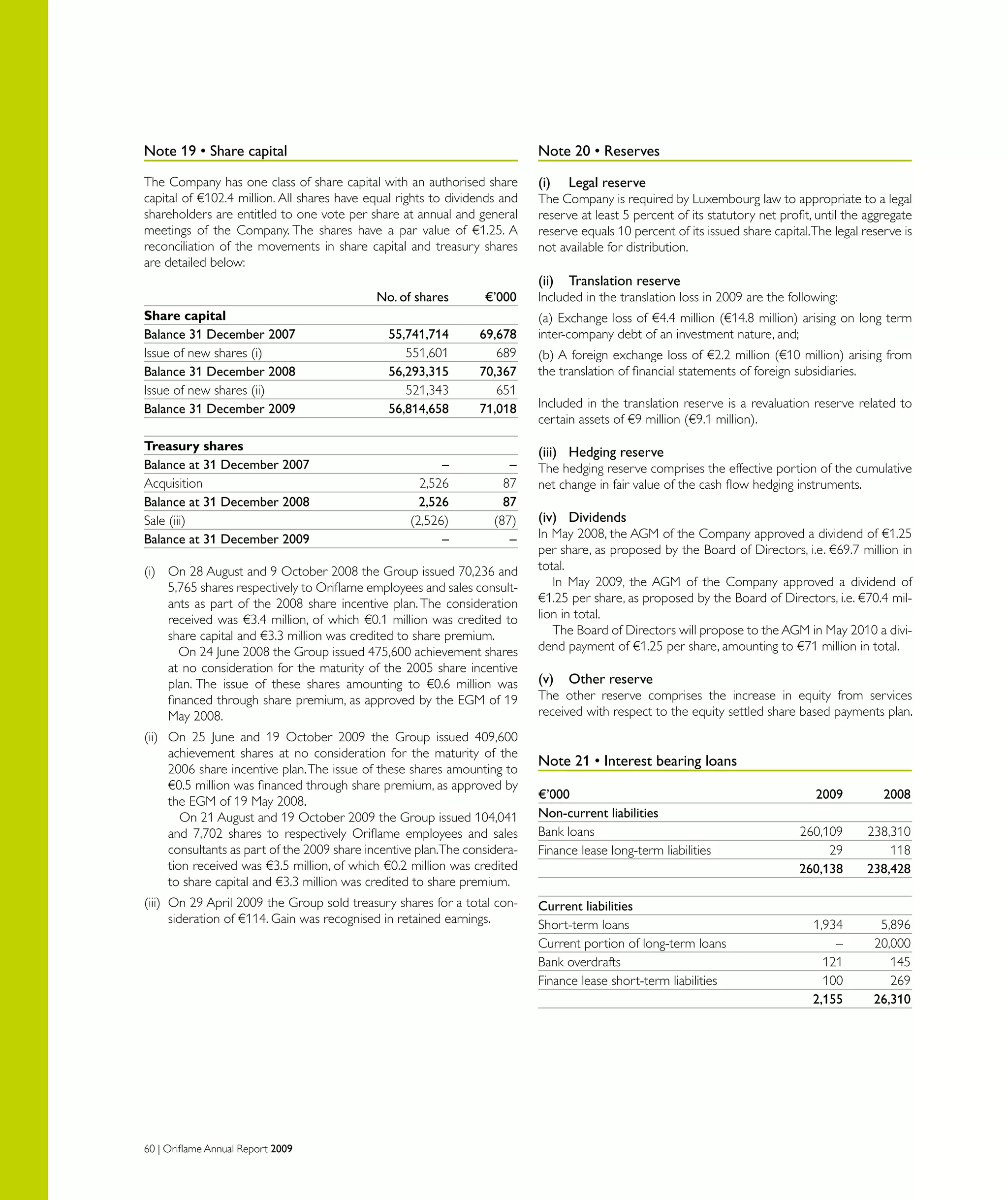
Note 19: Share capital	
Note 20: Reserves	
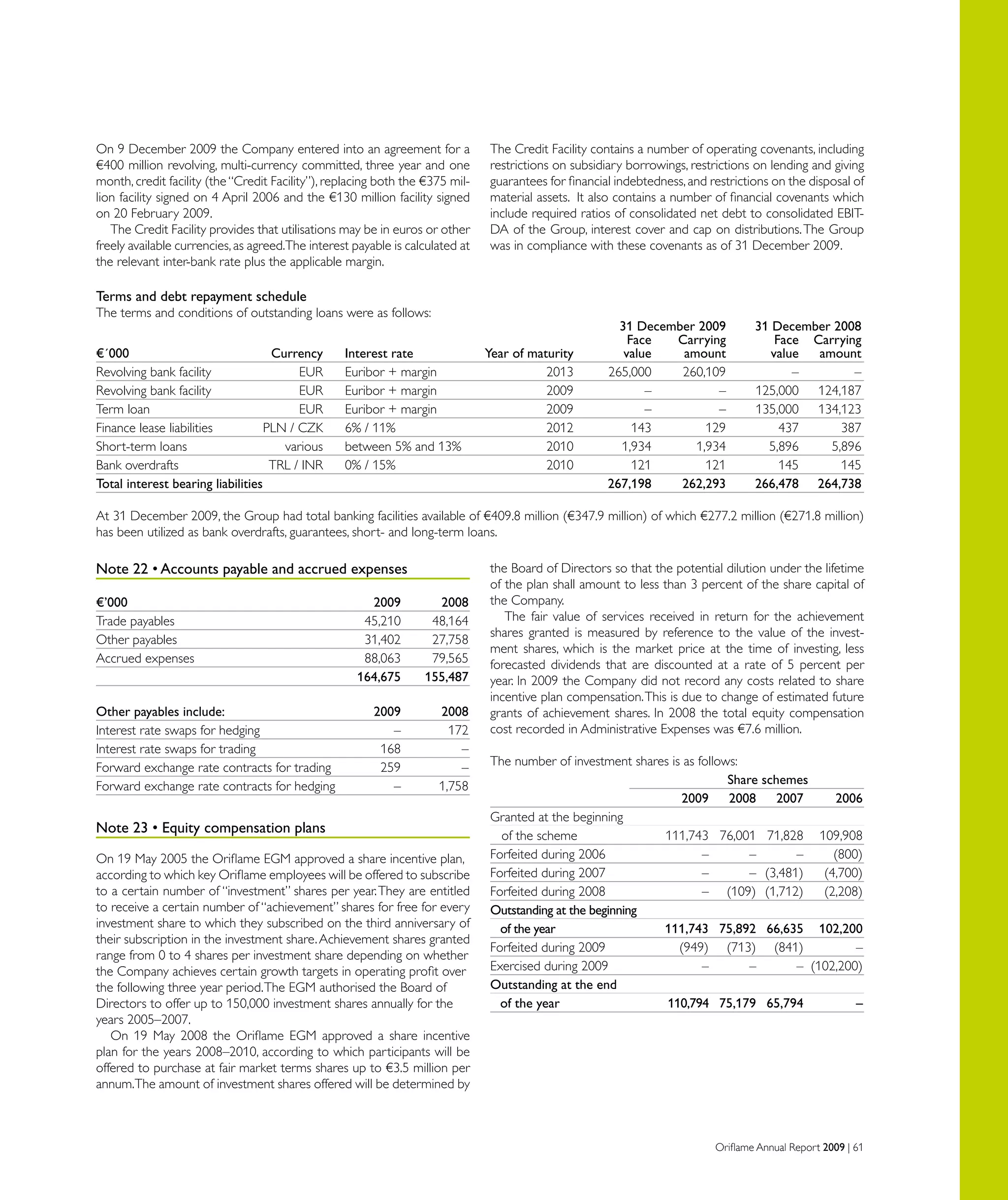
Note 21: Interest bearing loans	
Note 22:Accounts payable and accrued expenses	
Note 23: Equity compensation plans	
Note 24: Related parties	
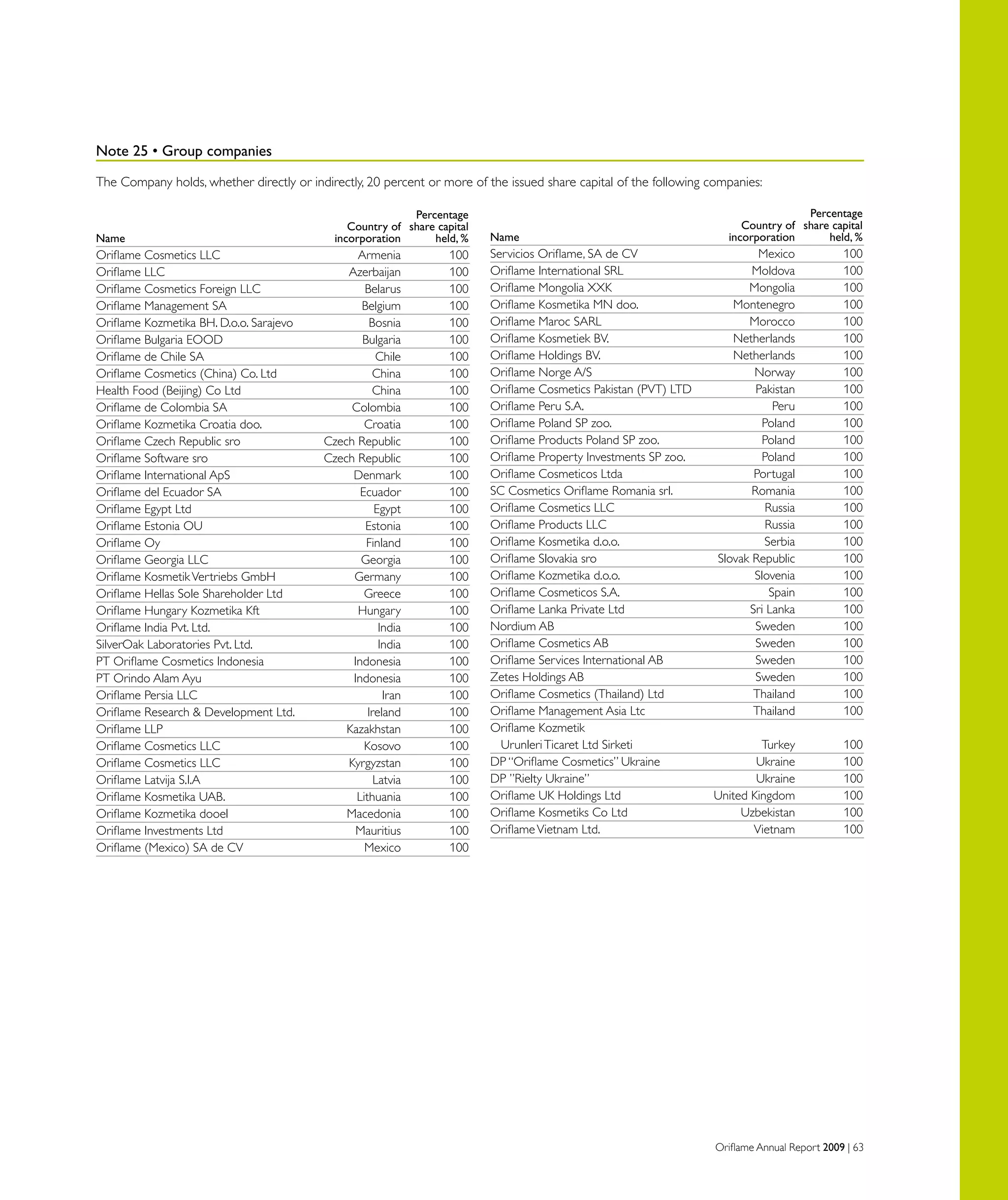
Note 25: Group companies	
Note 26: Provisions, commitments and contingent liabilities	
Note 27: Pensions	
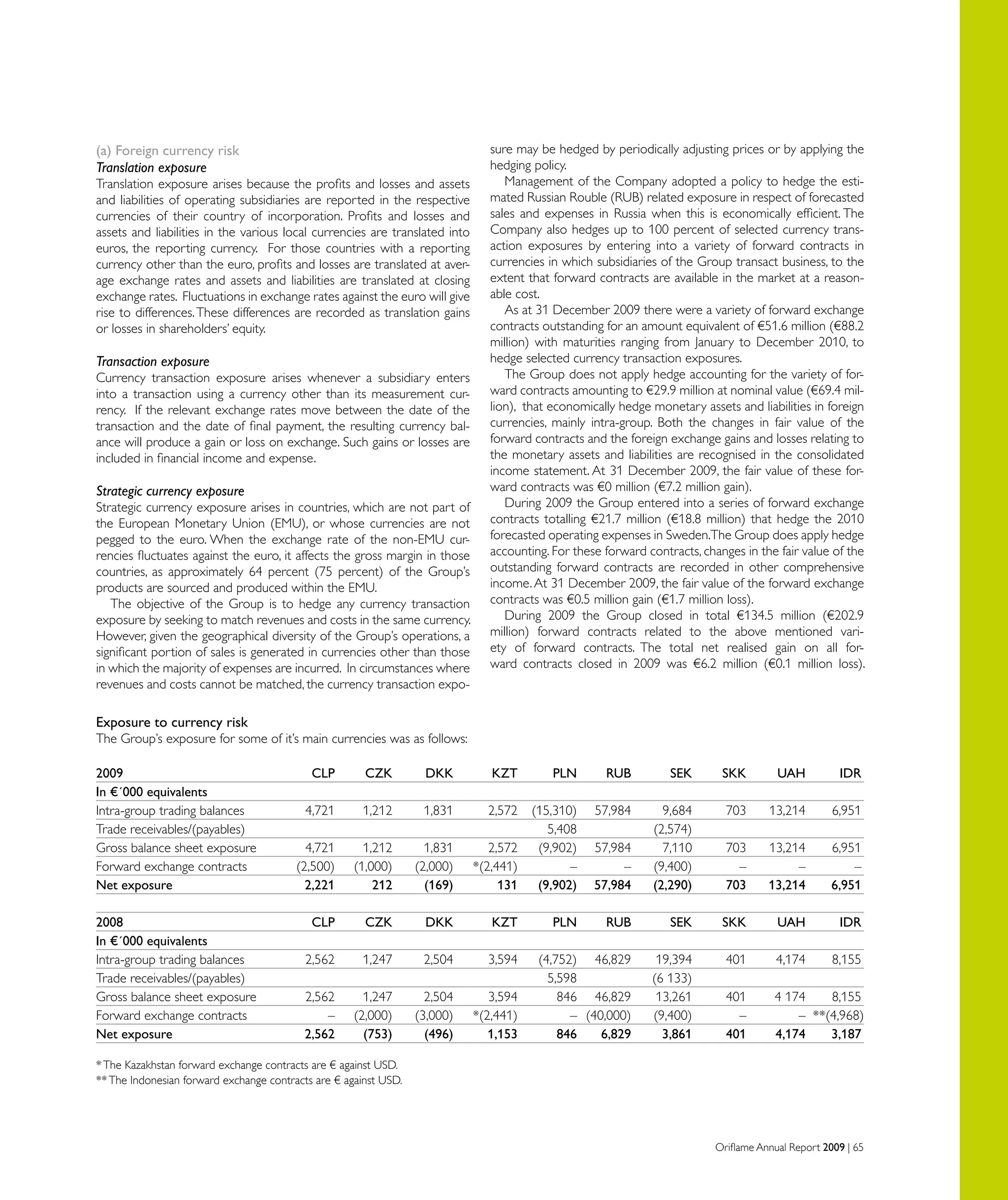
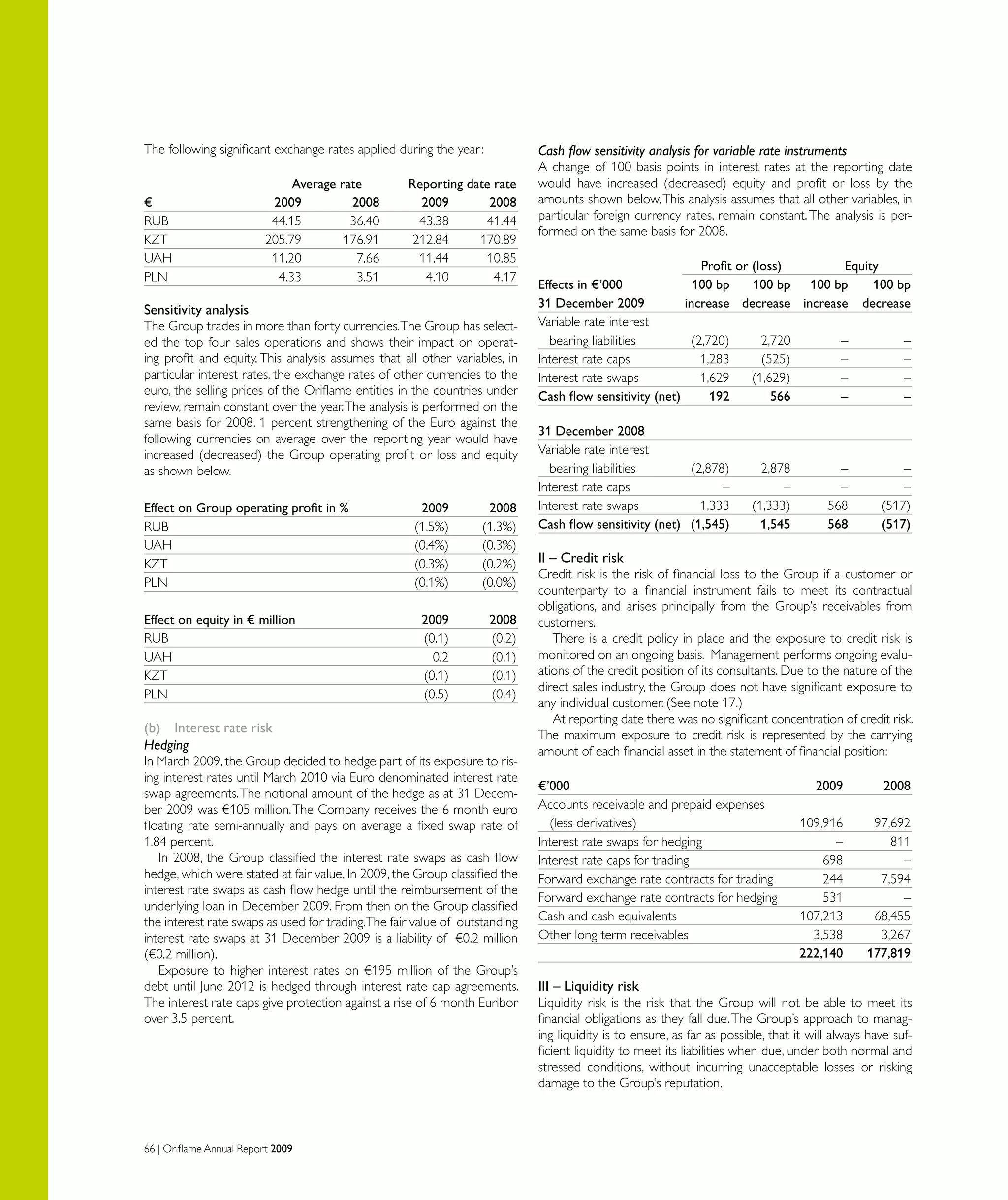
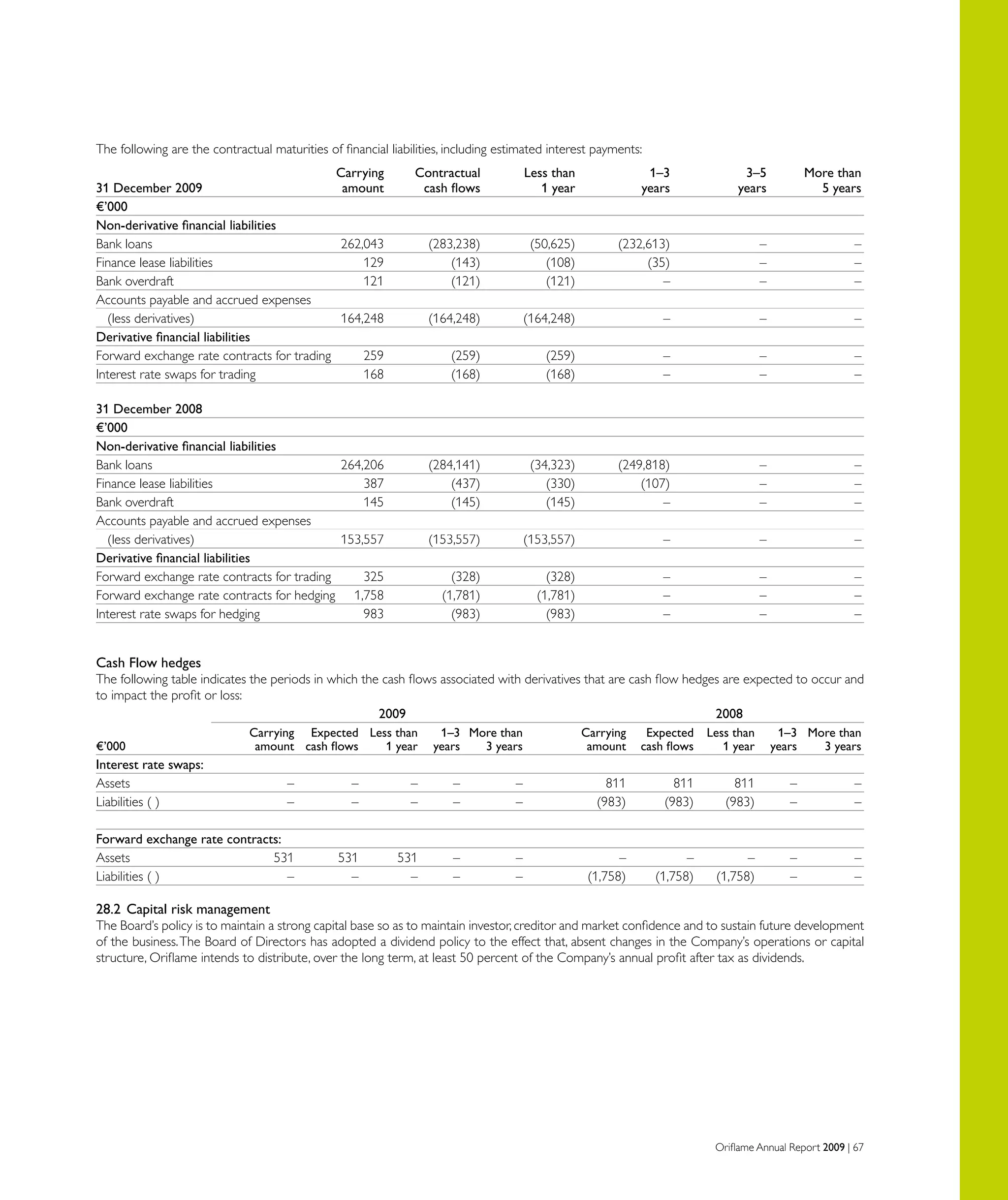
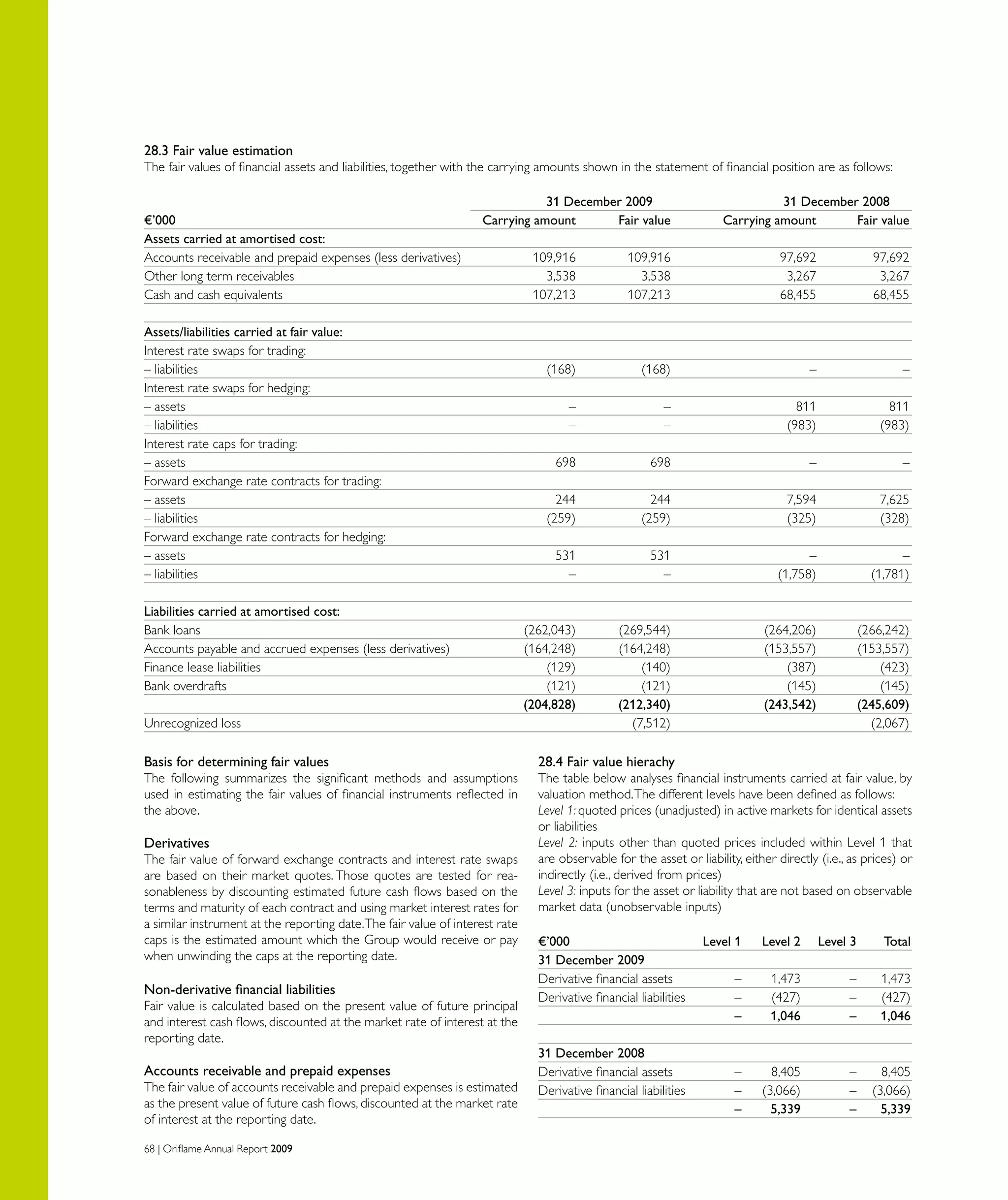
Note 28: Financial instruments and financial risk management	
Report of the independent auditors	 65
Corporate governance report	 66-72
General Meetings	
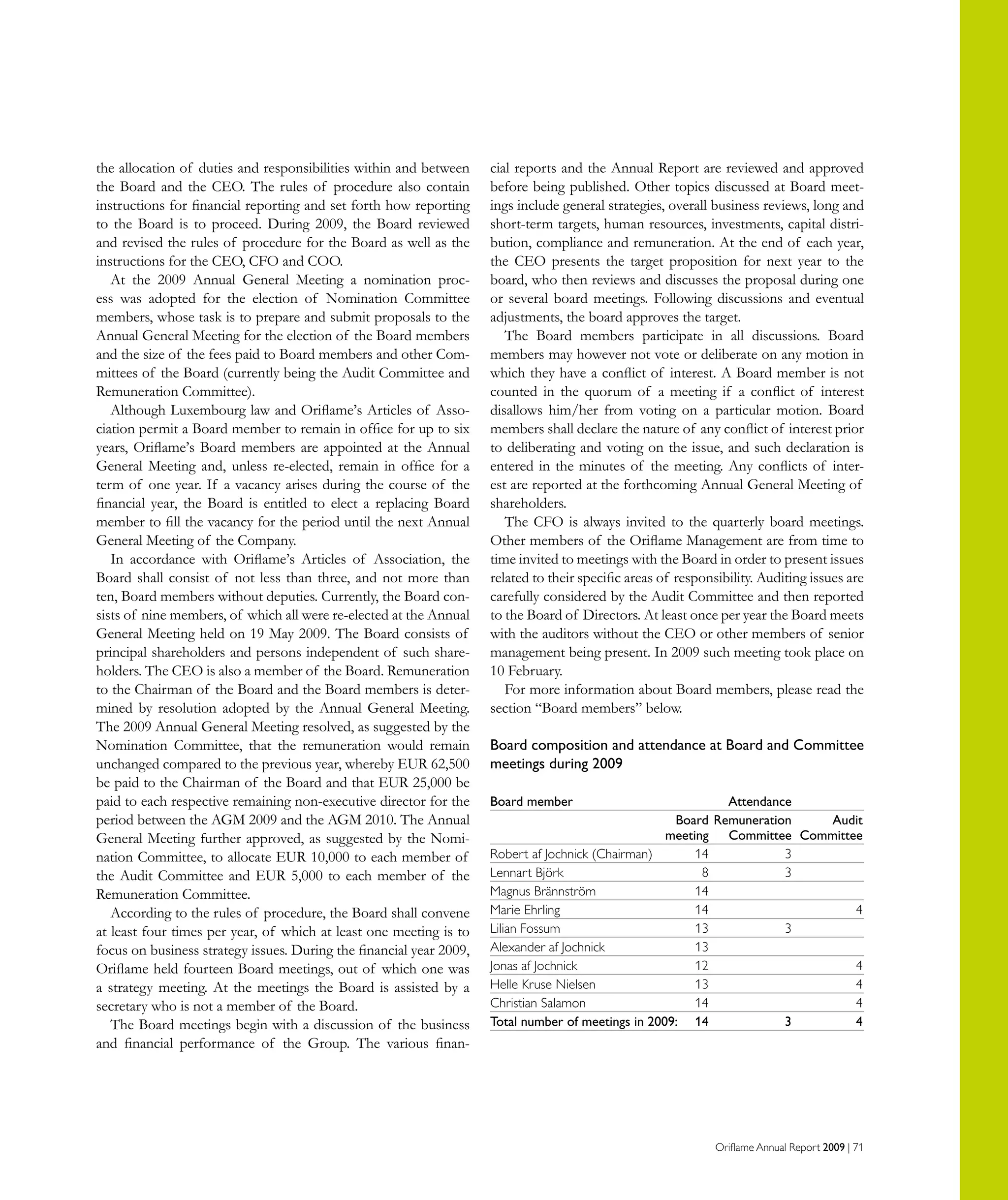
Board composition,the work of the Board and attendance at meetings during 2009	
Nomination Committee and nomination process	
Remuneration Committee	
Audit Committee	
Auditor	
Oriflame Management and Organisation
CEO and Corporate Committee	
Executive Business Review	
Regional management	
Global Support and Service	
Principles of remuneration for senior executives	
Non-monetary benefits	
Risk management	
Comply or Explain	
Report on internal control and monitoring	 	
The members of the Board 	 74-75
Senior Management	 76-77
Financial calendar	 78
Policy for distribution of the annual report	 78
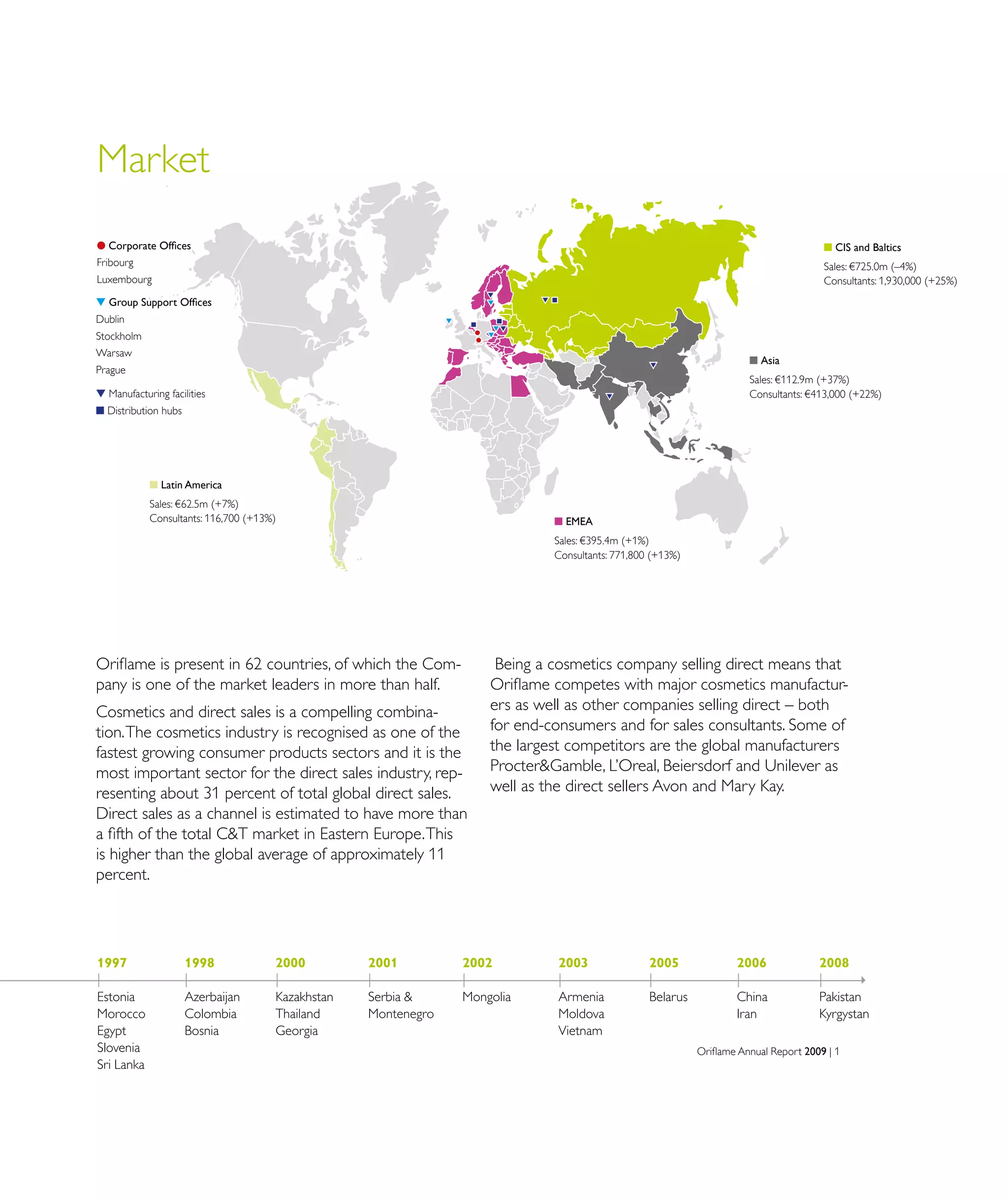
n CIS and Baltics
Sales: €725.0m (–4%)
Consultants: 1,930,000 (+25%)
n EMEA
Sales: €395.4m (+1%)
Consultants: 771,800 (+13%)
n Latin America
Sales: €62.5m (+7%)
Consultants: 116,700 (+13%)
n Asia
Sales: €112.9m (+37%)
Consultants: €413,000 (+22%)
1997
Estonia
Morocco
Egypt
Slovenia
Sri Lanka
1998
Azerbaijan
Colombia
Bosnia
2000
Kazakhstan
Thailand
Georgia
2001
Serbia &
Montenegro
2002
Mongolia
2003
Armenia
Moldova
Vietnam
2005
Belarus
2006
China
Iran
2008
Pakistan
Kyrgystan
Oriflame is present in 62 countries, of which the Com-
pany is one of the market leaders in more than half.
Cosmetics and direct sales is a compelling combina-
tion.The cosmetics industry is recognised as one of the
fastest growing consumer products sectors and it is the
most important sector for the direct sales industry, rep-
resenting about 31 percent of total global direct sales.
Direct sales as a channel is estimated to have more than
a fifth of the total C&T market in Eastern Europe.This
is higher than the global average of approximately 11
percent.
Being a cosmetics company selling direct means that
Oriflame competes with major cosmetics manufactur-
ers as well as other companies selling direct – both
for end-consumers and for sales consultants. Some of
the largest competitors are the global manufacturers
Procter&Gamble, L’Oreal, Beiersdorf and Unilever as
well as the direct sellers Avon and Mary Kay.
Market
t Manufacturing facilities
n Distribution hubs
t
t
t
t
t
t
n
n
n
Oriflame Annual Report 2009 | 1
l Corporate Offices
Fribourg
Luxembourg
t Group Support Offices
Dublin
Stockholm
Warsaw
Prague
l
l
t
t
t
Market entries
1967
Sweden
Denmark
1968
Finland
1969
Norway
1970
UK
1972
Netherlands
1978
Spain
1985
Portugal
1986
Indonesia
Oriflame in brief
Business model
Oriflame offers the leading business opportunity for
people who want to start making money the same
day they join and work towards fulfilling their personal
dreams and ambitions through its unique business
concept – Make MoneyToday and FulfilYour Dreams
Tomorrow™.
A sales force of approximately 3.2 million independent
consultants has seized this opportunity and is success-
fully marketing Oriflame’s wide portfolio of Swedish,
natural, innovative beauty products, together creating
annual sales exceeding €1.3 billion.
History in brief
Oriflame was founded in Sweden in 1967 by the broth-
ers Jonas and Robert af Jochnick and Bengt Hellsten.
They wanted to give people the opportunity to benefit
from good skin care and attractive cosmetics, and they
wanted their products to be inspired by the natural
beauty that the world associates with Sweden.
Rather than investing in a chain of shops, they decided
to move the retail operations into the homes of Swed-
ish consumers.They had sales consultants all over the
country, and each and every one of them had the heart
and ambition of an entrepreneur.The products were
distributed to their homes, and from day one they had
a network of potential customers in their friends, col-
leagues and neighbours.
For more than 40 years Oriflame has remained true to
its original concept of natural Swedish cosmetics and
an entrepreneurial culture.Today, Oriflame is one of the
fastest growing international beauty companies, selling
direct in 62 countries worldwide.
Business strategy
Oriflame’s strategic focus can be summarised in these
seven key points:
• Low entrance fee, credit offered and no stock re-
quired – easy to join and no risk.
• Wide portfolio of Swedish, natural, innovative, quality
beauty products at affordable prices.
• Frequent, dynamic and attractive catalogues with
many new products that make selling easy.
• Flexible and reliable ordering, delivery and payment
system – easy to do business with.
• Personal growth and development through Oriflame
University and SARPIO (Sales and Recruitment Pro-
cess in Oriflame)– at no cost.
• Unlimited earning and career opportunity.
• Enjoy a direct selling company with a human touch
and a sense of belonging to a friendly, energetic and
fun global community.
By continuously improving on the seven key areas,
Oriflame will attract an increasing number of consul-
tants. By consistently evaluating and prioritising with the
consultants in focus, management will ensure that the
allocation of resources is optimised.
Company overview
ORIFLAME IN BRIEF
1993
Ukraine
Slovakia
Greece
1994
Bulgaria
1995
Peru
Lithuania
Romania
1996
Macedonia
Ecuador
Croatia
India
1989
Chile
1990
Czecho-
slovakia
1991
Poland
Hungary
Mexico
1992
Russia
Turkey
Latvia
Oriflame’s product offering is building on more than 40 years of
skincare and cosmetics expertise – combining the wisdom of nature
with the best of science.The Company is providing a wide assort-
ment of distinct product brands at affordable prices:
• Assured product performance at value for money
• High purity ingredients and strict manufacturing standards
• High ethical standards and stringent environmental policies
Product offering
Skin Care
Oriflame has a wide range of
innovative skin care products,
developed and tested by the Skin
Care Research Centre in Ireland.
Oriflame Skin Care offers proven,
effective solutions to everyday skin
care needs.
• Facial moisturisers
• Anti ageing
• Hand  Body
Colour Cosmetics
Oriflame’s portfolio offers a wide
and sophisticated range of products
with formulations and trendy pack-
aging that enhances every woman’s
natural beauty.
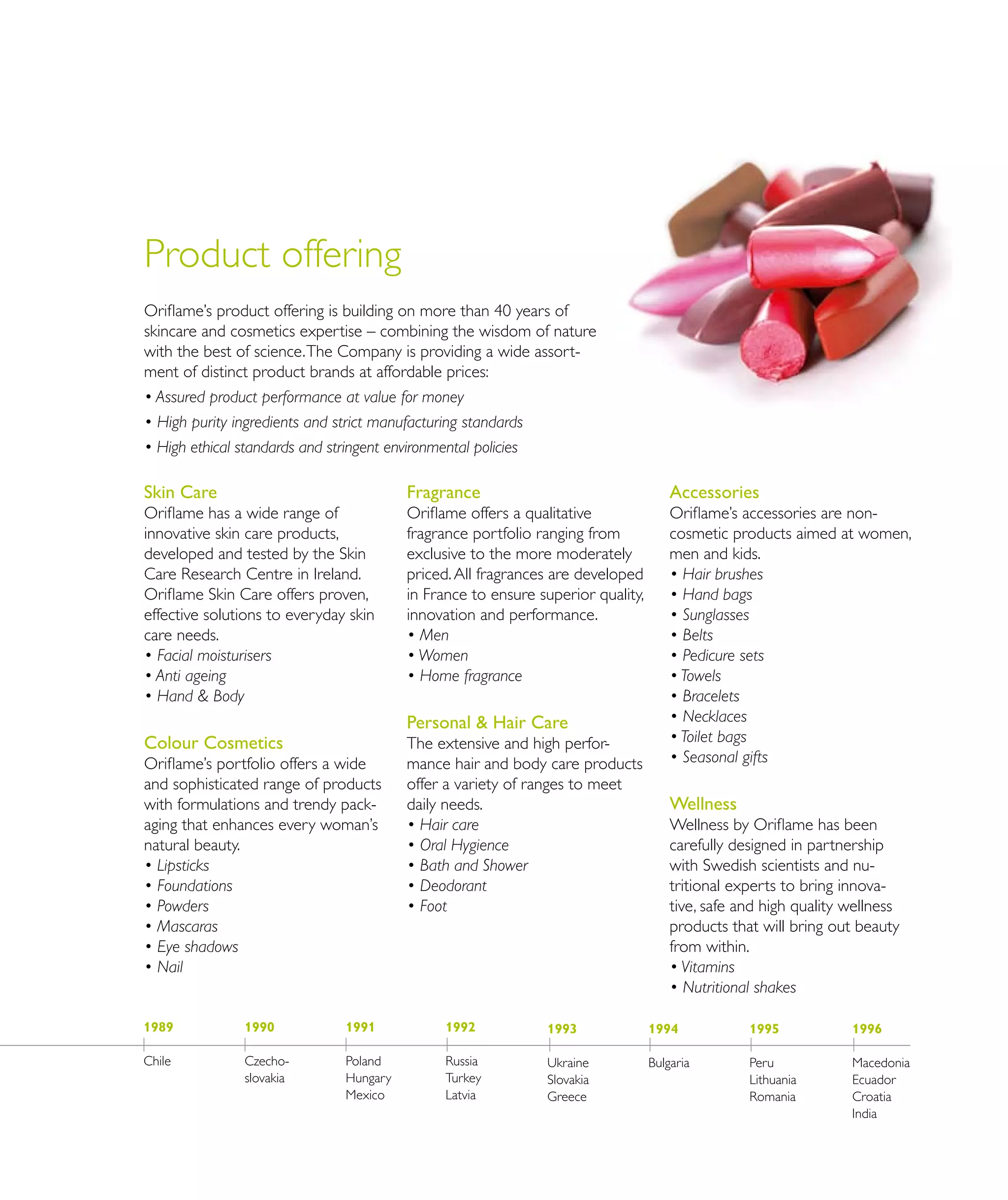
• Lipsticks
• Foundations
• Powders
• Mascaras
• Eye shadows
• Nail
Fragrance
Oriflame offers a qualitative
fragrance portfolio ranging from
exclusive to the more moderately
priced.All fragrances are developed
in France to ensure superior quality,
innovation and performance.
• Men
• Women
• Home fragrance
Personal  Hair Care
The extensive and high perfor-
mance hair and body care products
offer a variety of ranges to meet
daily needs.
• Hair care
• Oral Hygience
• Bath and Shower
• Deodorant
• Foot
Accessories
Oriflame’s accessories are non-
cosmetic products aimed at women,
men and kids.
• Hair brushes
• Hand bags
• Sunglasses
• Belts
• Pedicure sets
• Towels
• Bracelets
• Necklaces
• Toilet bags
• Seasonal gifts
Wellness
Wellness by Oriflame has been
carefully designed in partnership
with Swedish scientists and nu-
tritional experts to bring innova-
tive, safe and high quality wellness
products that will bring out beauty
from within.
• Vitamins
• Nutritional shakes
6 | Oriflame Annual Report 20096 | Oriflame Annual Report 2009
2009 IN BRIEF
Financial overview
Key events in 2009
• In December, Oriflame Cosmetics S.A. signed a EUR
400m, three-year revolving credit facility with its core
relationship banks.
• Oriflame announced that it would build a new EUR
150 – 200m unit production facility and distribution
centre in Russia.
Long-term financial targets
• Oriflame Cosmetics aims to achieve local currency
sales growth of approximately 10 percent per annum
and an operating margin of 15 percent.
• Over the next five years, the Group will continue to
invest in growth both organically, with capital expendi-
ture on existing and new manufacturing facilities, and
through expansions into new markets.
Financial achievements 12 months 2009
• Local currency sales increased by 15 percent and Euro
sales amounted to EUR 1,316.6m (1,319.7m).
• Operating margins before restructuring costs were
11.1 percent (14.2) resulting in an operating profit
of EUR 146.8m (187.3m).
• Net profit before restructuring costs amounted to
EUR 101.7m (133.1m).
• Diluted EPS before restructuring costs amounted to
EUR 1.78 (2.36). Diluted EPS after restructuring costs
amounted to EUR 1.76 (2.20).
• Cash flow from operating activities improved to EUR
131.7m (91.3m)
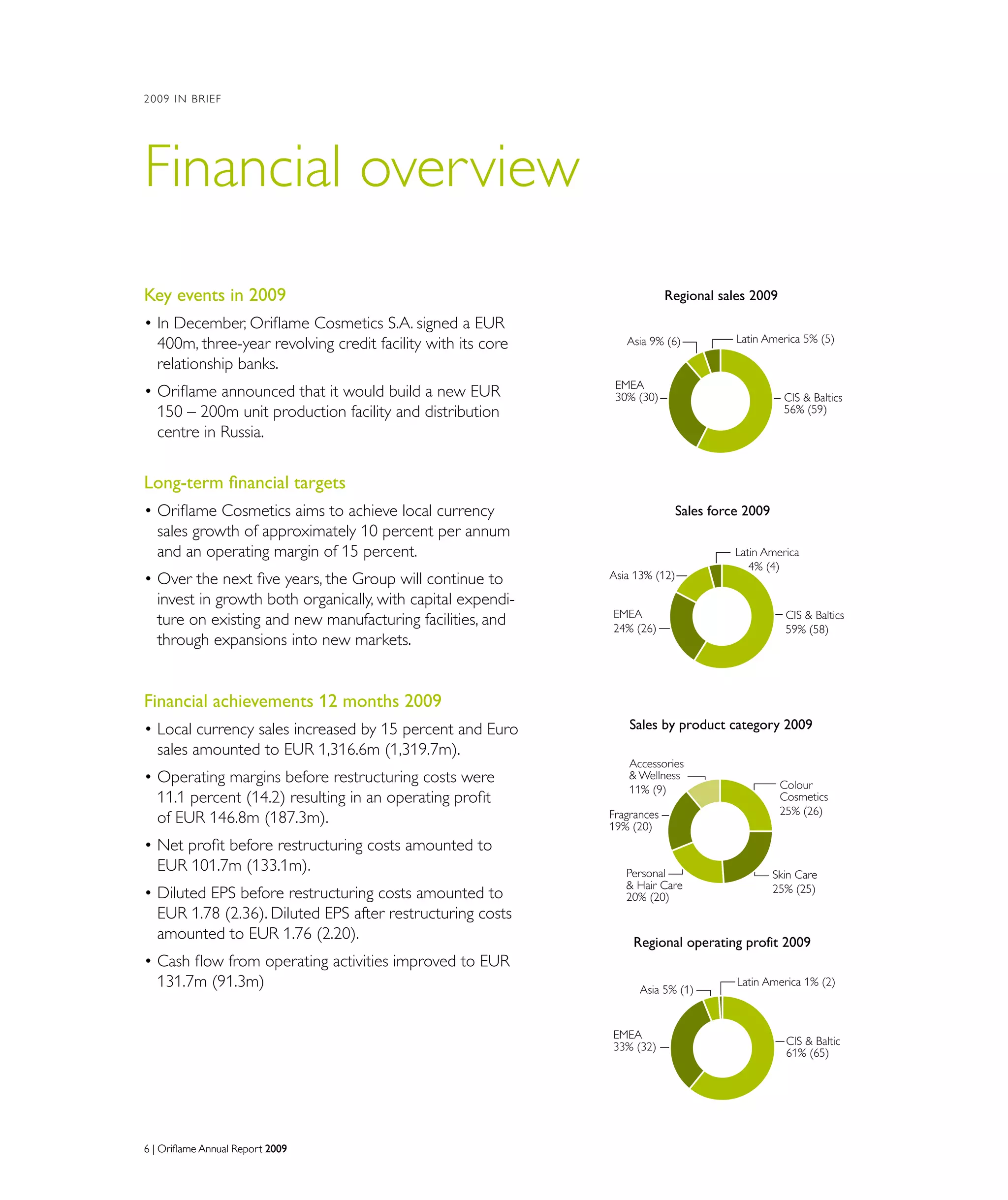
Colour
Cosmetics
25% (26)
Sales by product category 2009
Accessories
 Wellness
11% (9)
Personal
 Hair Care
20% (20)
Skin Care
25% (25)
Fragrances
19% (20)
CIS  Baltics
56% (59)
Regional sales 2009
Latin America 5% (5)Asia 9% (6)
EMEA
30% (30)
CIS  Baltic
61% (65)
Regional operating profit 2009
Asia 5% (1)
Latin America 1% (2)
EMEA
33% (32)
CIS  Baltics
59% (58)
Sales force 2009
Latin America
4% (4)
Asia 13% (12)
EMEA
24% (26)
Oriflame Annual Report 2009 | 7Oriflame Annual Report 2009 | 7
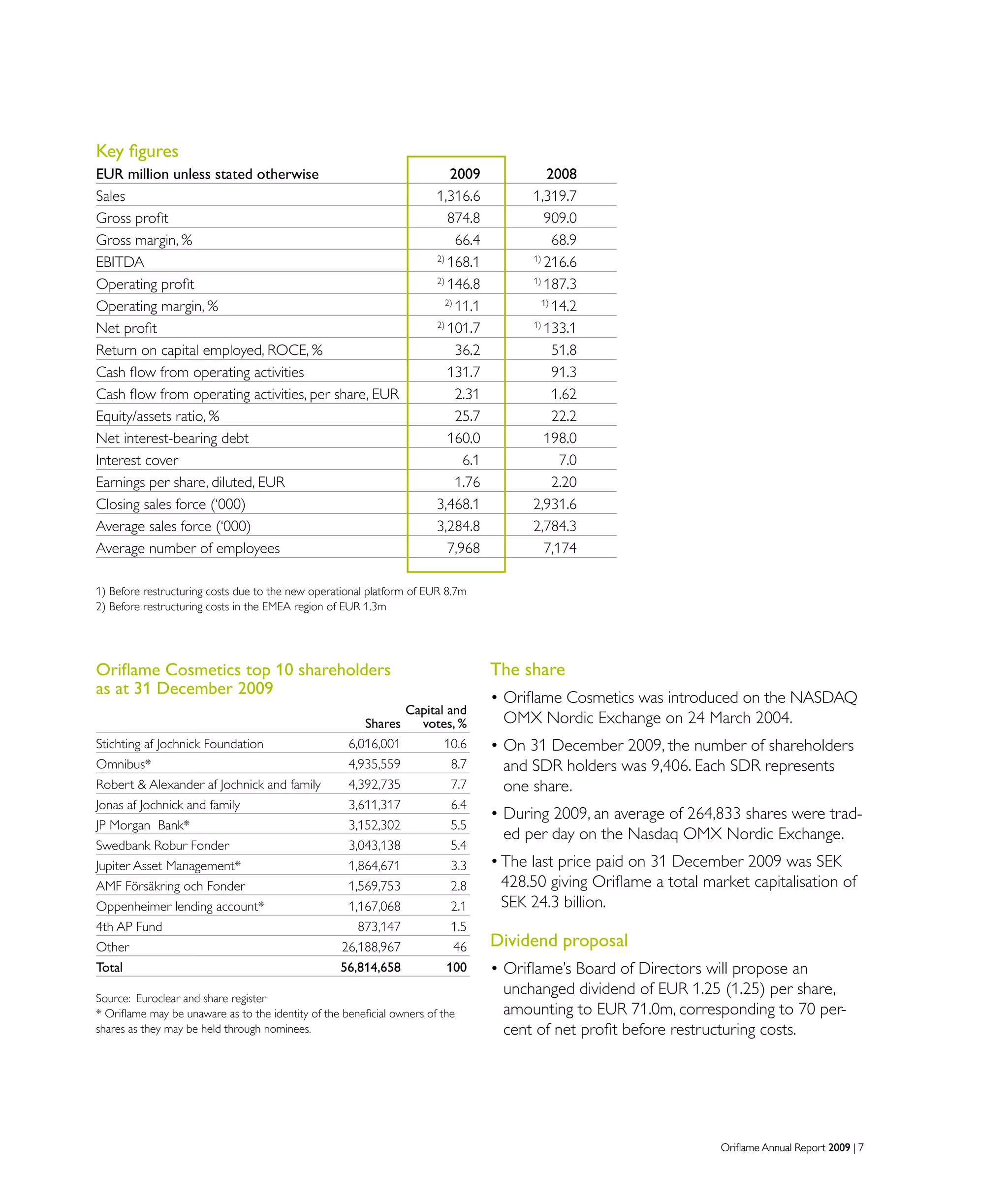
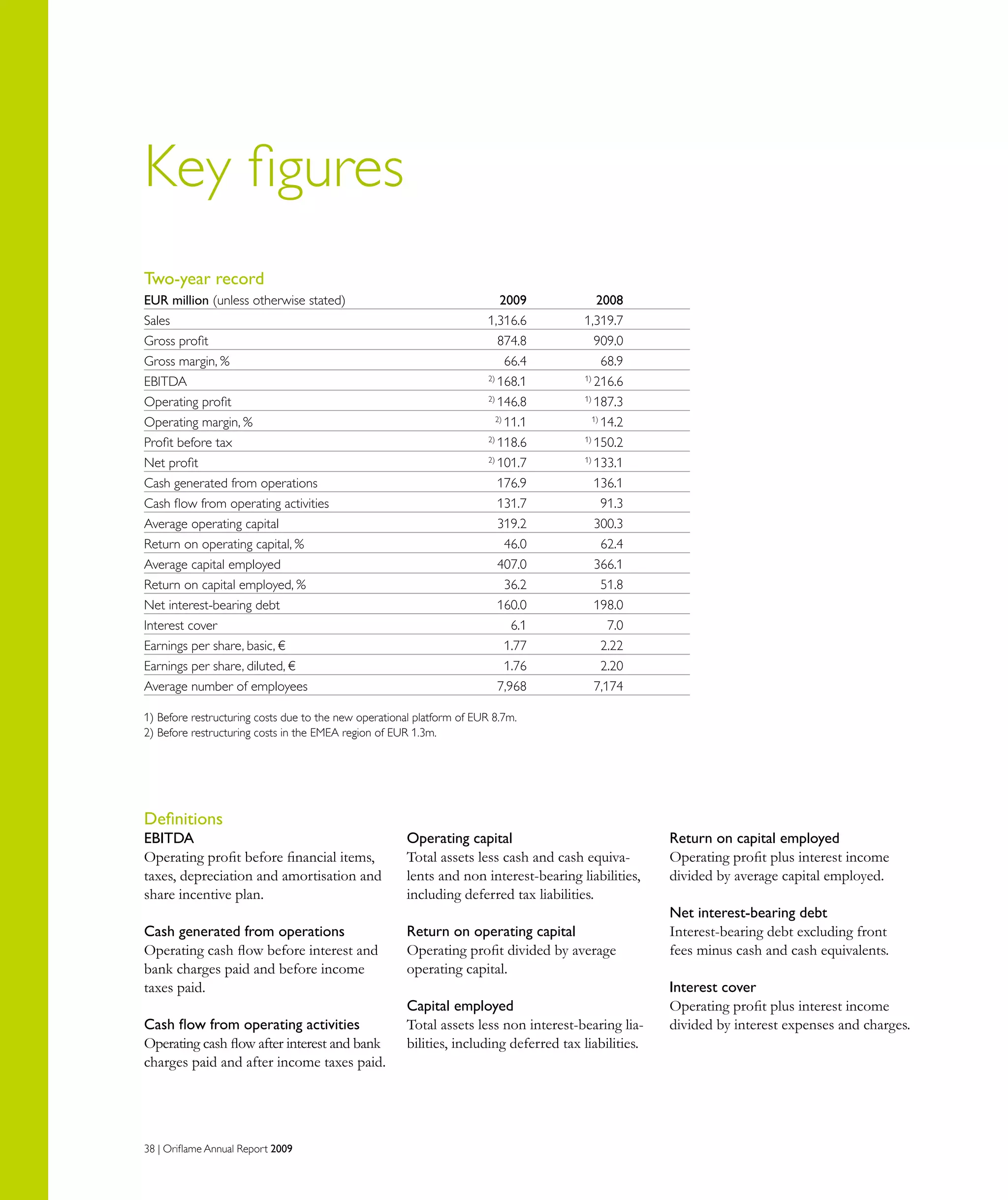
Key figures
EUR million unless stated otherwise	 2009	 2008			
Sales	 1,316.6	 1,319.7			
Gross profit	 874.8	 909.0			
Gross margin, %	 66.4	 68.9			
EBITDA	 2)
168.1	 1)
216.6			
Operating profit	 2)
146.8	 1)
187.3			
Operating margin, %	 2)
11.1	 1)
14.2			
Net profit	 2)
101.7	 1)
133.1			
Return on capital employed, ROCE, %	 36.2	 51.8			
Cash flow from operating activities	 131.7	 91.3			
Cash flow from operating activities, per share, EUR	 2.31	 1.62			
Equity/assets ratio, %	 25.7	 22.2			
Net interest-bearing debt	 160.0	 198.0			
Interest cover	 6.1	 7.0			
Earnings per share, diluted, EUR	 1.76	 2.20
Closing sales force (‘000)	 3,468.1	 2,931.6
Average sales force (‘000)	 3,284.8	 2,784.3
Average number of employees	 7,968	 7,174
1) Before restructuring costs due to the new operational platform of EUR 8.7m
2) Before restructuring costs in the EMEA region of EUR 1.3m
Oriflame Cosmetics top 10 shareholders
as at 31 December 2009
			Capital and
		 Shares	 votes, %
Stichting af Jochnick Foundation		 6,016,001	 10.6
Omnibus*		 4,935,559	 8.7
Robert  Alexander af Jochnick and family		 4,392,735	 7.7
Jonas af Jochnick and family		 3,611,317	 6.4
JP Morgan Bank*		 3,152,302	 5.5
Swedbank Robur Fonder		 3,043,138	 5.4
Jupiter Asset Management*		 1,864,671	 3.3
AMF Försäkring och Fonder		 1,569,753	 2.8
Oppenheimer lending account*		 1,167,068	 2.1
4th AP Fund		 873,147	 1.5
Other		 26,188,967	 46
Total		 56,814,658	 100
Source: Euroclear and share register
* Oriflame may be unaware as to the identity of the beneficial owners of the
shares as they may be held through nominees.
The share
• Oriflame Cosmetics was introduced on the NASDAQ
OMX Nordic Exchange on 24 March 2004.
• On 31 December 2009, the number of shareholders
and SDR holders was 9,406. Each SDR represents
one share.
• During 2009, an average of 264,833 shares were trad-
ed per day on the Nasdaq OMX Nordic Exchange.
•The last price paid on 31 December 2009 was SEK
428.50 giving Oriflame a total market capitalisation of
SEK 24.3 billion.
Dividend proposal
• Oriflame’s Board of Directors will propose an
unchanged dividend of EUR 1.25 (1.25) per share,
amounting to EUR 71.0m, corresponding to 70 per-
cent of net profit before restructuring costs.
8 | Oriflame Annual Report 20098 | Oriflame Annual Report 2009
Make money today and fulfil
your dreams tomorrowTM
– a sustainable business model
providing a beautiful future for
3.2 million sales consultants
around the world.
STATEMENTS
Oriflame Annual Report 2009 | 9Oriflame Annual Report 2009 | 9
10 | Oriflame Annual Report 200910 | Oriflame Annual Report 2009
STATEMENTS
Statement from the Chairman
During 2009, many of our markets suf-
fered from the global economic turmoil,
with strong currency movements affect-
ing the Group’s result. However, the
underlying business is progressing well,
proving that our business model is strong
and that we have responded to the nega-
tive macro environment in a professional
and constructive way. With 15 percent
growth in local currencies, we managed
to continue to gain market share in our
largest region – CIS – and several other
key markets. It is especially encouraging
that Oriflame has upheld its position as
the number one cosmetic brand in Russia
and CIS. Entering a challenging year, we
stayed true to our strategy and emerged
stronger from a period when many com-
panies and nations have weakened.
The key to our success is a strong
corporate culture based on dedicated
employees, network leaders and sales
consultants. We are pleased that 2009 was
another year of successful recruitment
of sales consultants and that the average
number of sales consultants was 3.2 mil-
lion – an increase of 21 percent!
But we cannot be content. The crisis
is not over, and we have many challenges
ahead. At the same time, we will continue
to make long-term decisions, prioritising
the strength of our direct sales offering
and market share, especially in strategic
markets, over short-term profitability.
In 2009, for example, we invested in our
nutritional line “wellness”, a long-term
effort to which we are strongly commit-
ted. We have also decided to strengthen
our skincare research through a new
RD facility in Stockholm. Further, we
continue to work hard to improve Ori-
flame’s production and supply chain
structure.
We have also continued to strengthen
our important sustainability work, where
issues such as climate change and eco-
system degradation are key issues that all
companies need to address in a structured
and ambitious way. The environment has
been a priority from day one and we have
made good progress, but there are always
new issues to address, which we see as
a stimulating challenge in our efforts to
serve as a role model among beauty com-
panies selling direct.
Moreover, we have started the Ori-
flame Foundation, an initiative to
strengthen and coordinate Oriflame’s
continued charity work. Oriflame and my
family have been involved in charitable
work for many years and it is very satis-
fying that despite the tough economic
climate, we are increasing our efforts.
Oriflame is a natural, progressive and
ethical company and we will continue to
pursue our core values.
Once again, I am proud to be a part
of Oriflame and what we have achieved
around the world. Thanks to all dedicated
Oriflame people, we have continued to
prove the strength of Oriflame’s business
model, and I look forward to yet another
successful year.
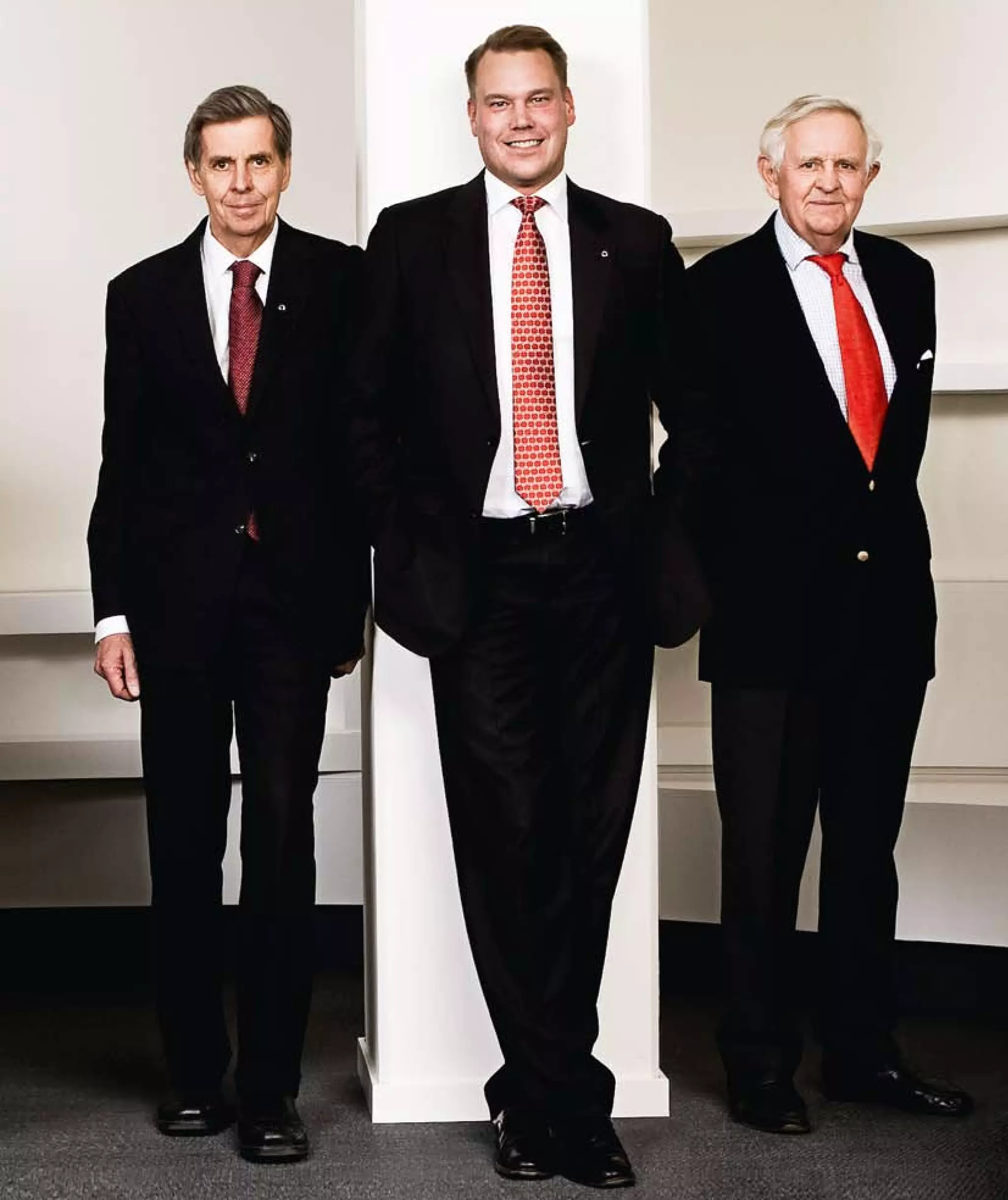
Robert af Jochnick
Chairman
The environment has been a priority from day one
“We have responded to
the negative macro envi-
ronment in a professional
and constructive way.”
Oriflame Annual Report 2009 | 11Oriflame Annual Report 2009 | 11
Statement from the CEO
At year-end, we were happy to report
continued sales increases, strong cash-
flow and a sales force that had grown to
3.5 million consultants throughout our
62 markets. In a difficult global economic
environment – especially affecting many
of our key markets – we have yet again
proven the strength in the Oriflame busi-
ness model and captured considerable
market shares in many of our key markets.
Oriflame offers a complete range of
high-quality beauty products inspired by
the purity and power of Swedish nature.
The key words are natural, progressive
and ethical. This is the firm foundation
of the brand and what distinguishes Ori-
flame from its competitors and makes
the brand unique. The products are sold
through our direct sales model, where
new consultants are provided with the
opportunity to make money the same day
they join, while starting to build a sales
network and striving towards fulfilling
their dreams.
For some, selling our products means
an extra income to help make ends meet
or a way of having fun with friends,
neighbours and colleagues. But for oth-
ers, it is a way of fundamentally changing
their lives. These, mostly very ambitious
women, quickly build up their own net-
works of sales consultants. They become
strong and independent leaders, build
successful careers and, not least, have the
opportunity to make a lot of money.
Going forward, our biggest challenge
will be to continue maintaining the Ori-
flame attraction and successfully pursu-
ing the Oriflame core values “together-
ness, spirit and passion” throughout the
fast growing organization. In Oriflame
Academy, we offer a three-step develop-
ment programme created to support and
strengthen our culture, by ensuring that
all employees understand our core values
and operating principles. It is also aimed
at increasing integration, strategic under-
standing, leadership and management
skills. To date, some 1,500 colleagues
have completed the first step of the
programme, and we will continue until
we have reached every individual in our
organization and, ultimately, throughout
our network of sales consultants.
This is of course an everlasting effort
and I will personally keep spending a lot
of time travelling around the world to
meet, inspire and be inspired by people in
our fantastic organization and network.
Most are women and thanks to their
ambition to strive towards their personal
goals, we have more than doubled the
size of the Company in five years, taking
us closer towards realizing our vision.
In order for us to be able to achieve our
vision, we will continue to focus on top-
line growth as we have always done, bear-
ing with us our long-term financial goals
of 10 percent annual local sales growth
and a 15 percent operating margin. Given
the need for efficient logistics and the
challenging currency situation in Russia
and Eastern Europe, we have decided to
build a new production facility and dis-
tribution centre in Russia. By doing so,
we will increase our capacity and service
levels – while creating a natural currency
hedge in our most important market.
Finally, I am proud of being part of
this fantastic Company, with all of its
amazing people helping each other and
themselves on the way to fulfilling each
and every one’s individual dream – and
to make Oriflame the number one beauty
company selling direct.
Magnus Brännström
Chief Executive Officer
Always striving for improvement
12 | Oriflame Annual Report 2009
THE BUSINESS MODEL
This is Oriflame
Oriflame’s success is based on a strong and consistent company culture, promoting an entre-
preneurial spirit and a clear set of values. Our mission and passion is to fulfil dreams for people
around the world, a dream often focused on building a better quality of life by belonging to the
Oriflame sales network.
Some people think Oriflame is a cos-
metics company. That is true – Oriflame
does sell beauty products. In fact, Ori-
flame sells beauty products to millions
of people all over the world. But that
is not all the Company does. Oriflame
offers people a chance to change their
lives – whether it’s entrepreneurial chal-
lenges for the consultants, attractive
career opportunities for the employees
or unique shopping experiences for the
customers – Oriflame’s business is about
making money and fulfilling dreams.
Oriflame has given people in Russia,
Europe, Asia, South America and Africa
the opportunity to start their own busi-
ness, often in countries where the free-
dom to do business was discouraged or
restricted to a self-appointed elite. In this
sense, Oriflame has helped tear down
walls. Oriflame built the first cosmetic
factory in Warsaw after the fall of the
Berlin wall, was early to enter countries
such as India (1996)   and   one of the
first companies to be given a direct sales
licence in China (2006).
Our method: Selling direct
Oriflame launched its direct sales method
in 1967 – when the Company was found-
ed – as a vital part of its innovative busi-
ness concept. The model has proven its
resilience, sustainability and validity for
more than 40 years. It has proven to be
a successful marketing method in emerg-
ing, as well as mature, markets.
Becoming an Oriflame consultant can
provide a way of supporting the family,
while fulfilling a career dream. However,
it is also a way to achieve a more flexible
life or make extra money while studying,
being in between jobs or simply to extend
one’s social life. As a matter of fact, the
increasing number of sales consultants as
a result of the current recession is proof
of our attractive career opportunity. For
consumers, the driving force is a more
flexible, relaxed and individual way of
shopping, receiving personal advice from
someone familiar.
Our offer: Look great,
make money and have fun
Oriflame offers a complete range of high-
quality beauty products marketed through
a sales force of independent sales con-
sultants. Oriflame also provides earn-
ing opportunities for millions of people
who join the Company as sales consult-
ants. The main three drivers for joining
Oriflame – regardless of market – are the
products, the financial rewards and the
opportunity of personal development, i.e.
look great, make money and have fun.
Over the years, Oriflame has launched
thousands of products within Skin Care,
ColourCosmetics,Fragrances,Personal
Hair Care, Accessories and Wellness. The
eternal favourite Tender Care Protecting
Balm, as well as later best-sellers, all con-
vey the Swedish aspects of the Oriflame
brand, symbolised by key attributes such
as natural, progressive and ethical. This
is the firm foundation of the brand and
also the key to continued success.
Our business:
The world is our arena
Oriflame is a truly global company. The
Company has a sales force of 3.2 million
independent consultants and over 8,000
employees in our countries world wide,
who manage everything from research,
manufacturing and supply chain to the
distribution of catalogues. The global
platform keeps Oriflame close to fashion
trends and customer preferences in dif-
ferent markets.
The beauty and direct selling indus-
try is well-positioned for future growth
and Oriflame is one of the leaders in the
industry, growing faster than most of our
global competitors. Globalisation has
opened up extensive potential markets
around the world, where our business
model has a very good fit.
12 | Oriflame Annual Report 2009
Oriflame Annual Report 2009 | 13Oriflame Annual Report 2009 | 13
Our culture:The Oriflame Way
Oriflame’s corporate culture was created
in the early years of the Company and
formed in conditions of strong com-
petition and financial challenges. The
culture is a direct result of the approach
that proved most stimulating and effec-
tive. It is built on values such as mutual
trust and respect, entrepreneurial spirit,
customer focus and quality demands and
it is reflected in all parts of the organisa-
tion, as well as in the approach to social
responsibility.
Oriflame’s corporate culture can be
summarised in three key values; togeth-
erness, spirit and passion. All employees
are required to be familiar with the Com-
pany’s values, history and driving forces,
called The Oriflame Way, as these are the
keys to Oriflame’s continued success.
Protecting the corporate culture has been
one of the greatest and most important
challenges to the Company during its
strong growth.
Our catalogue: The ultimate
shopping experience
The Oriflame catalogue is how the brands
and products come to life for our consult-
ants and consumers. The catalogues are
literally shops without walls, providing
our consultants with their most impor-
tant, tangible sales tool. A new catalogue
is distributed every three to four weeks,
which means between 12 and 17 editions
a year, depending on local market condi-
tions. Each edition is published in four
regional versions – and in 35 languages.
Each catalogue includes a display of
Oriflame’s products, new offers and pro-
motions. Great efforts are made in differ-
entiating between the catalogues to make
sure that each offers a new and exciting
shopping experience.
Our channels:
Online brand presence
Alongside the catalogue, the Internet is
becoming the first point of contact and
the most important channel of con-
sumer influence in many of Oriflame’s
major markets, supported by PR, events,
leaflets, posters in service centres and, for
major launches in key markets – TV, print
and billboards. Around 50 percent of the
sales force uses the online services and
more than half of all orders are placed
through the online ordering system.
During 2009, Oriflame re-designed its
global Internet platform to further align
the online brand presence with all com-
munication channels. Efforts are focused
on featuring dynamic presentations of
the products, as well as the business
opportunity that Oriflame offers. Look-
ing into the future, there is further poten-
tial in the current development of online
social networks, which will become sig-
nificant grounds for sales and recruitment
activities.
Online social networking is
the next frontier for direct
sellers to reach out, make contact, sell
and recruit online.The companies that
best integrate this new channel with
their traditional model will be the win-
ners of tomorrow.
Michael Cervell,
SeniorVice President
Global Direct Sales
Joining Oriflame, I was
pleasantly surprised by the
diversity of the consultants ranging
from teachers and doctors to street
vendors and managers, all with diffe-
rent perspectives, values and concerns.
You need to genuinely love dealing with
people and challenges.
Supraporn SC Pao,
Managing Director,Thailand
14 | Oriflame Annual Report 200914 | Oriflame Annual Report 2009
THE BUSINESS MODEL
Direct Selling – a resilient
business model in tune
with time
Oriflame’s direct sales model has proven its sustainability and validity for more than 40 years.
Current lifestyle trends confirm that our business concept is even more appropriate today than it
was 40 years ago, in emerging, as well as mature markets. Oriflame is active in those parts of the
world with the fastest growth rates, offering jobs as well as beauty products, putting traditional
retail to the test.
The modern life cycle
Yesterday’s life in the western world was
more linear, with fewer and predestined
life stages: childhood, adulthood, lifelong
employment,parenting followed by retire-
ment. Modern life is more complex, the
nuclear family norm is being challenged
and work is becoming about more than
just making money – people fulfil them-
selves through their careers. Changing
employers, roles or priorities has become
a way to reinvention. In parallel with this
trend, people are confronted with peri-
ods of unemployment over a lifetime due
to the fast-moving global labour market
or times of recession. Moreover, people
retiring are in better condition than ever
and have the choice to continue profes-
sional or voluntary activities.
Based on these trends, direct selling is
truly in tune with time. The key drivers,
such as being your own boss, setting your
own goals, the low barriers of entry and
exit, the lack of discrimination regardless
of one’s sex, ethnicity, age, education,
physical condition or financial resources,
are all in line with a growing population
of entrepreneurs who is less dependant
on secure employments.
Prosperity – with less spare time
We tend to spend more time at work and
as societies are becoming more gender
equal, the amount of working hours per
household is increasing. With more work
comes higher income, but also less flex-
ibility and spare time. Therefore, demand
for timesaving services outside the office
increases according to Fredrik Bergström,
PhD and former CEO of Handelns
Utredningsinstitut, HUI (Swedish Retail
Institute). By bringing daily duties, such
as paying bills and buying food, into the
home, as well as extraordinary events
such as buying clothes and finding the
perfect summer house, each household
has become a point of sale. From our
homes, we search for interesting prod-
ucts, we compare prices and we make
purchasing decisions at a click.
New sources of information
Trust is a vital measure for PR when the
objective is to generate consumer con-
fidence in a product message benefit or
educate the consumer on a topic. The key
source for consumer information used to
be formal marketing material or personal
advice from shop assistants, but now it is
more word of mouth spread in Internet
forums, blogs, fan clubs or during infor-
mal gatherings with friends. According to
14 | Oriflame Annual Report 2009
Oriflame Annual Report 2009 | 15Oriflame Annual Report 2009 | 15
the GolinHarris US/UK 2009 Trusted
Media Index (TMI), which looks at media
channels and the levels of trust placed in
them, word of mouth had an index of
65, which was the channel with highest
credibility above e.g. television.
This trend is particularly strong when it
comes to shopping for cosmetics accord-
ing to a recent survey among 3,500 wom-
en in Sweden. Consumers prefer advice
based on personal experience, confirmed
by a wide and well-known network of ref-
erences. The direct seller is a familiar and
trustworthy source of information about
the product, brand, company, industry
and supplier. As the competition for con-
sumers’ attention and confidence increas-
es, direct selling is offering a unique way
of gaining loyal customers.
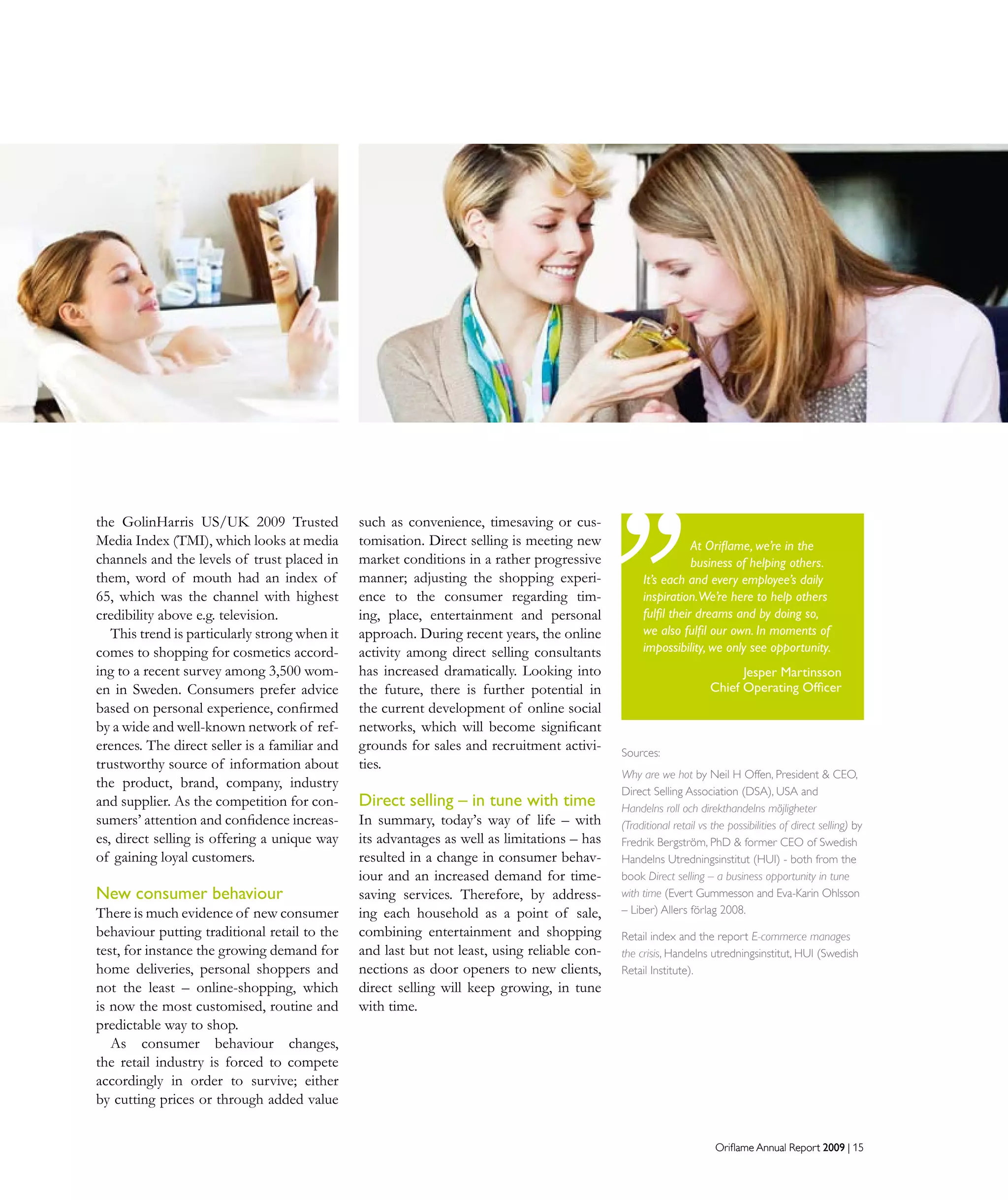
New consumer behaviour
There is much evidence of new consumer
behaviour putting traditional retail to the
test, for instance the growing demand for
home deliveries, personal shoppers and
not the least – online-shopping, which
is now the most customised, routine and
predictable way to shop.
As consumer behaviour changes,
the retail industry is forced to compete
accordingly in order to survive; either
by cutting prices or through added value
such as convenience, timesaving or cus-
tomisation. Direct selling is meeting new
market conditions in a rather progressive
manner; adjusting the shopping experi-
ence to the consumer regarding tim-
ing, place, entertainment and personal
approach. During recent years, the online
activity among direct selling consultants
has increased dramatically. Looking into
the future, there is further potential in
the current development of online social
networks, which will become significant
grounds for sales and recruitment activi-
ties.
Direct selling – in tune with time
In summary, today’s way of life – with
its advantages as well as limitations – has
resulted in a change in consumer behav-
iour and an increased demand for time-
saving services. Therefore, by address-
ing each household as a point of sale,
combining entertainment and shopping
and last but not least, using reliable con-
nections as door openers to new clients,
direct selling will keep growing, in tune
with time.
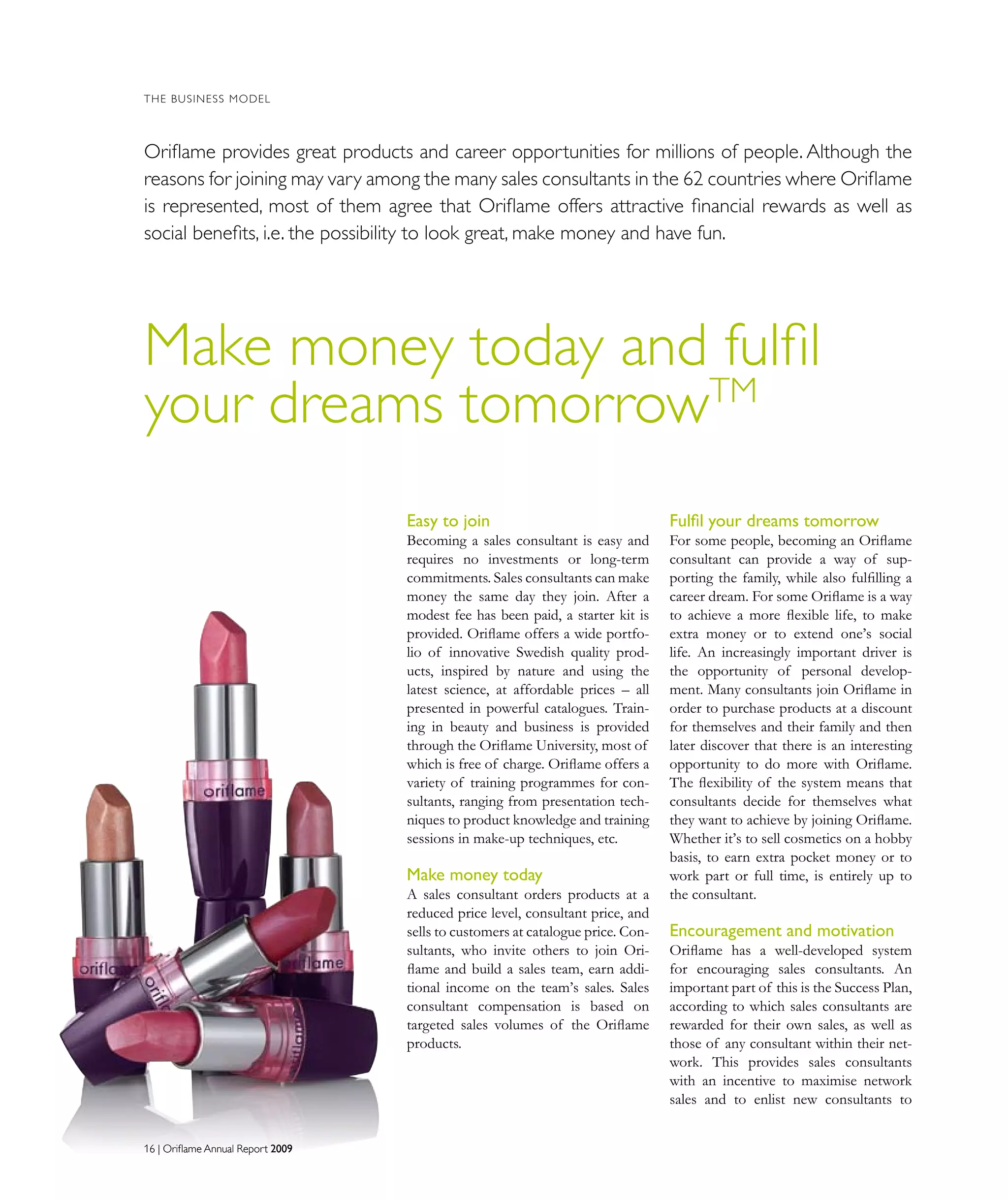
At Oriflame, we’re in the
business of helping others.
It’s each and every employee’s daily
inspiration.We’re here to help others
fulfil their dreams and by doing so,
we also fulfil our own. In moments of
impossibility, we only see opportunity.
Jesper Martinsson
Chief Operating Officer
Sources:
Why are we hot by Neil H Offen, President  CEO,
Direct Selling Association (DSA), USA and
Handelns roll och direkthandelns möjligheter
(Traditional retail vs the possibilities of direct selling) by
Fredrik Bergström, PhD  former CEO of Swedish
Handelns Utredningsinstitut (HUI) - both from the
book Direct selling – a business opportunity in tune
with time (Evert Gummesson and Eva-Karin Ohlsson
– Liber) Allers förlag 2008.
Retail index and the report E-commerce manages
the crisis, Handelns utredningsinstitut, HUI (Swedish
Retail Institute).
16 | Oriflame Annual Report 200916 | Oriflame Annual Report 2009
THE BUSINESS MODEL
Make money today and fulfil
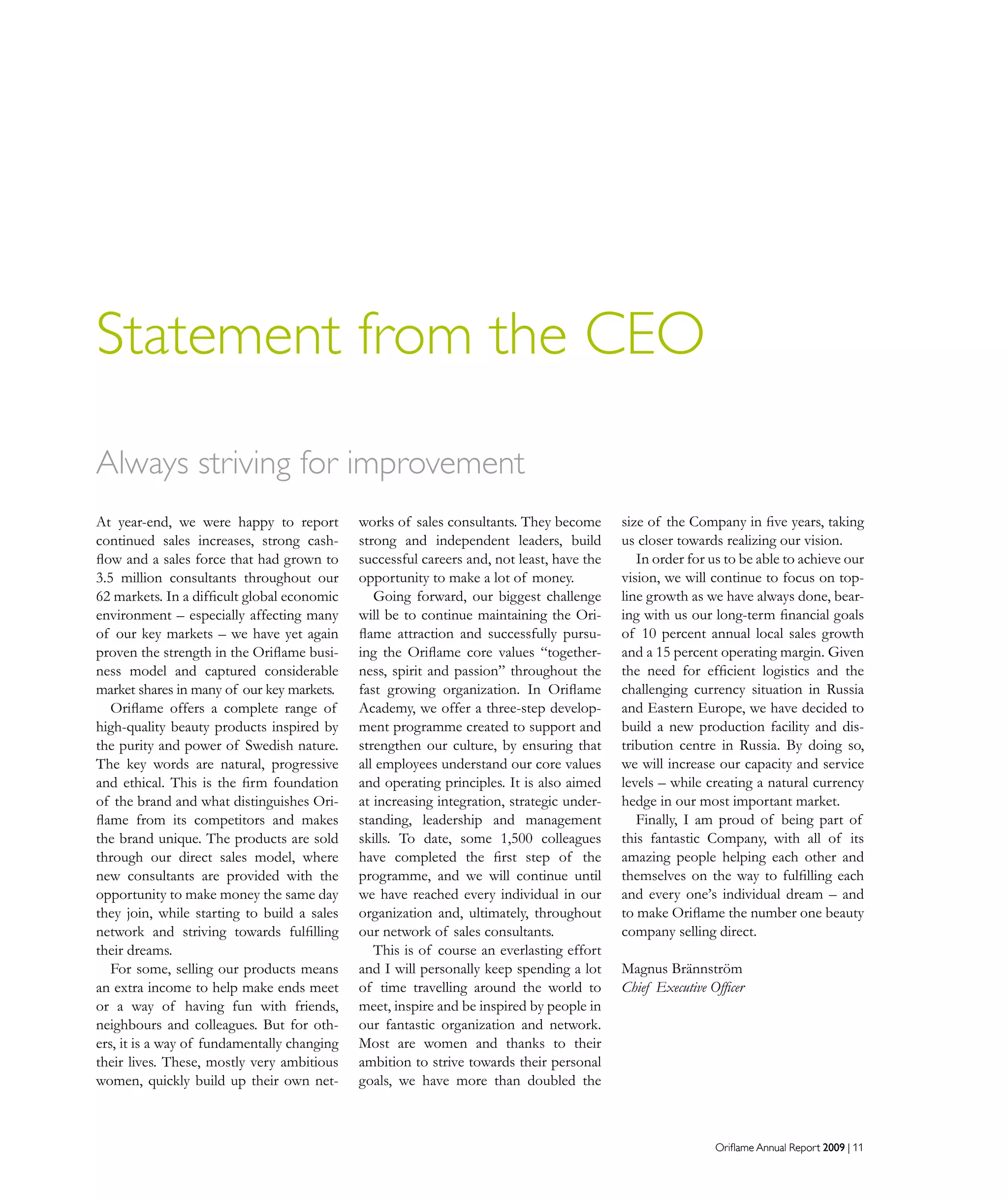
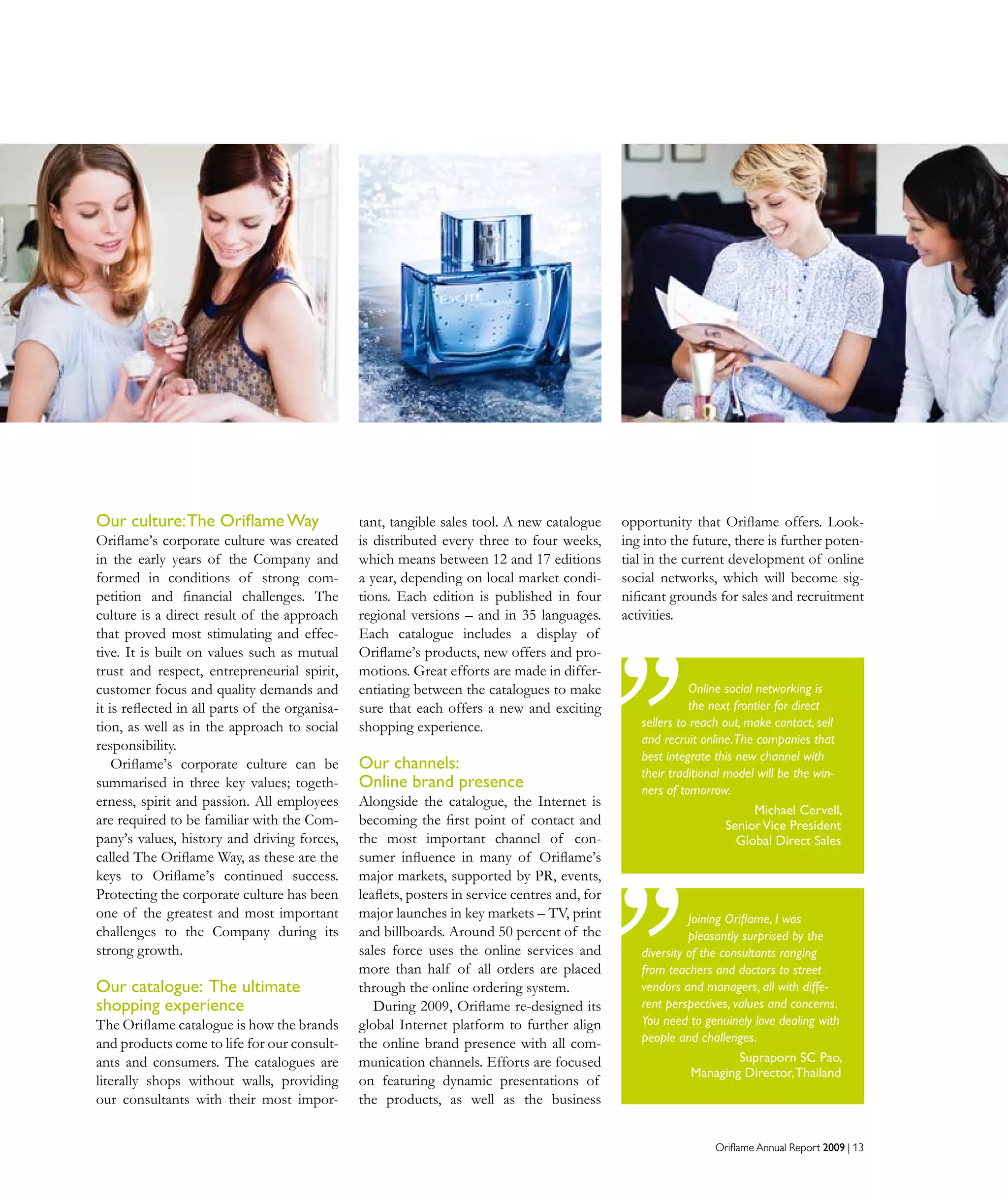
your dreams tomorrowTM
Oriflame provides great products and career opportunities for millions of people. Although the
reasons for joining may vary among the many sales consultants in the 62 countries where Oriflame
is represented, most of them agree that Oriflame offers attractive financial rewards as well as
social benefits, i.e. the possibility to look great, make money and have fun.
Easy to join
Becoming a sales consultant is easy and
requires no investments or long-term
commitments. Sales consultants can make
money the same day they join. After a
modest fee has been paid, a starter kit is
provided. Oriflame offers a wide portfo-
lio of innovative Swedish quality prod-
ucts, inspired by nature and using the
latest science, at affordable prices – all
presented in powerful catalogues. Train-
ing in beauty and business is provided
through the Oriflame University, most of
which is free of charge. Oriflame offers a
variety of training programmes for con-
sultants, ranging from presentation tech-
niques to product knowledge and training
sessions in make-up techniques, etc.
Make money today
A sales consultant orders products at a
reduced price level, consultant price, and
sells to customers at catalogue price. Con-
sultants, who invite others to join Ori-
flame and build a sales team, earn addi-
tional income on the team’s sales. Sales
consultant compensation is based on
targeted sales volumes of the Oriflame
products.
Fulfil your dreams tomorrow
For some people, becoming an Oriflame
consultant can provide a way of sup-
porting the family, while also fulfilling a
career dream. For some Oriflame is a way
to achieve a more flexible life, to make
extra money or to extend one’s social
life. An increasingly important driver is
the opportunity of personal develop-
ment. Many consultants join Oriflame in
order to purchase products at a discount
for themselves and their family and then
later discover that there is an interesting
opportunity to do more with Oriflame.
The flexibility of the system means that
consultants decide for themselves what
they want to achieve by joining Oriflame.
Whether it’s to sell cosmetics on a hobby
basis, to earn extra pocket money or to
work part or full time, is entirely up to
the consultant.
Encouragement and motivation
Oriflame has a well-developed system
for encouraging sales consultants. An
important part of this is the Success Plan,
according to which sales consultants are
rewarded for their own sales, as well as
those of any consultant within their net-
work. This provides sales consultants
with an incentive to maximise network
sales and to enlist new consultants to
Oriflame Annual Report 2009 | 17Oriflame Annual Report 2009 | 17
SALES COMPENSATION
Immediate profit – Sales consultants buy•	
products from Oriflame at a discount on
the catalogue price and earn a 30-percent
mark-up when selling them on to their con-
sumers.
Volume discounts – Sales consultants can•	
earn an additional 3–21 percent on their
personal sales and the sales of those con-
sultants they have recruited to sell Oriflame
products.
Cash awards and bonuses – Sales consult-•	
ants are also rewarded for separate achieve-
ments related to leadership development,
training and motivation of the people they
have recruited
grow the scope of their network. Apart
from the financial rewards, successful
sales consultants and network builders
are also rewarded with Senior Manager
and Director titles depending on their
achievements.
Increasingly important means of
encouragement are the cost-free training
programmes and seminars that Oriflame
offers. Every year, Oriflame hosts three
major international conferences in exotic
locations. The conferences are an integral
part of the overall Success Plan where a
title has to be met in combination with
reaching a certain qualification each year.
At the conferences, the Company has an
opportunity to launch key initiatives for
the leaders and have product experts pre-
senting the science behind the products.
An equally important aspect is the venue
that the conferences provide for leaders
to exchange ideas with top management
and between themselves. Last year’s Gold
Conference in Rome hosted a record
number of 4,800 attendees from 58 coun-
tries. Oriflame has been awarded several
times for these extraordinary events.
Support tools
Sales consultants are offered a number of
tools to help them succeed, coordinated in
SARPIO – Sales and Recruitment Proc-
esses in Oriflame. SARPIO is the glo-
bal platform for processes, training and
communication. It has been developed
in order to offer consultants support in
developing and managing themselves and
their businesses, while ensuring that they
convey the Oriflame brand in a consist-
ent way.
In 2009, Oriflame launched a new man-
agement tool for the sales force in most
markets. This tool helps sales consultants
to track performance of their network
and identify action areas that can improve
business effectiveness. It also improves
communication with the sales force.
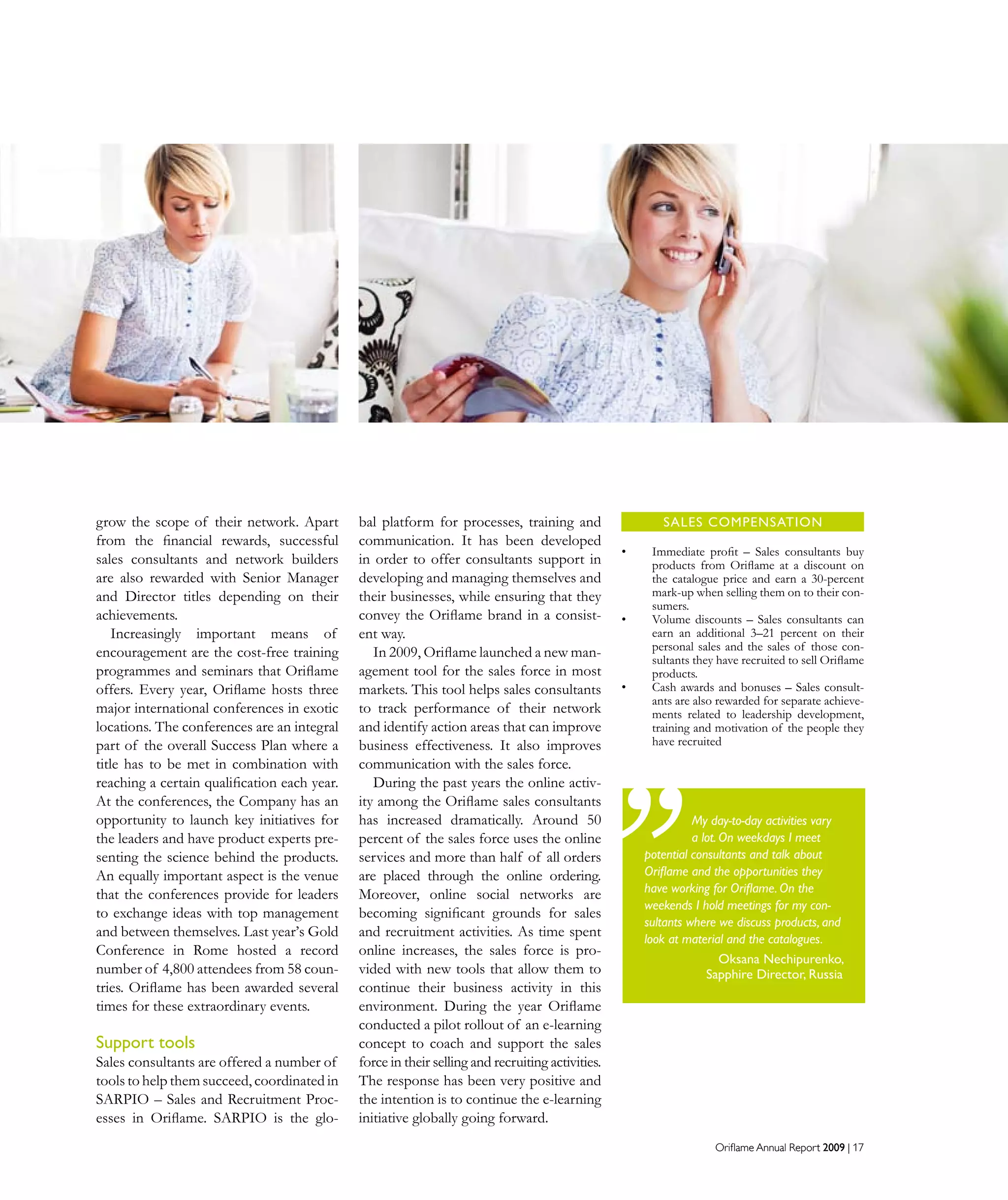
During the past years the online activ-
ity among the Oriflame sales consultants
has increased dramatically. Around 50
percent of the sales force uses the online
services and more than half of all orders
are placed through the online ordering.
Moreover, online social networks are
becoming significant grounds for sales
and recruitment activities. As time spent
online increases, the sales force is pro-
vided with new tools that allow them to
continue their business activity in this
environment. During the year Oriflame
conducted a pilot rollout of an e-learning
concept to coach and support the sales
force in their selling and recruiting activities.
The response has been very positive and
the intention is to continue the e-learning
initiative globally going forward.
My day-to-day activities vary
a lot. On weekdays I meet
potential consultants and talk about
Oriflame and the opportunities they
have working for Oriflame. On the
weekends I hold meetings for my con-
sultants where we discuss products, and
look at material and the catalogues.
Oksana Nechipurenko,
Sapphire Director, Russia
Creating the ultimate
shopping experience
THE BUSINESS MODEL
The Oriflame catalogues are literally shops without walls, providing our consultants with
their most important and tangible sales tool – making the whole difference between good
sales and great sales.
The ultimate shopping experience
By providing the ultimate shopping
experience to consumers, the Oriflame
catalogue supports the ultimate busi-
ness opportunity to its consultants. The
stronger the consumer offer, the greater
the potential to sell and grow the busi-
ness. By constantly creating exciting new
catalogues, Oriflame is also providing the
motivation and confidence to its consult-
ants to actively show the latest catalogue
to existing and potential new customers.
A unique challenge
A new Oriflame catalogue is distributed
every three to four weeks offering each
sales consultant a new marketing oppor-
tunity and each customer a new shopping
experience at a preferred time and place.
This means between 12 and 17 editions
per year, depending on local market con-
ditions. Each edition is published in four
regional versions, in 62 countries – and
in 35 languages. Great efforts are made
to differentiate the catalogues to make
sure that they offer new and exciting
shopping experiences. Each edition has
its own theme and includes a display of
existing Oriflame products as well as new
offers and seasonal promotions, altogeth-
er presenting around 500 products. It is
hard to imagine the amount of thought,
effort, and strategy behind each edition.
It is an enormous publication even by
global standards – and the whole produc-
tion process takes place under Oriflame’s
roof.
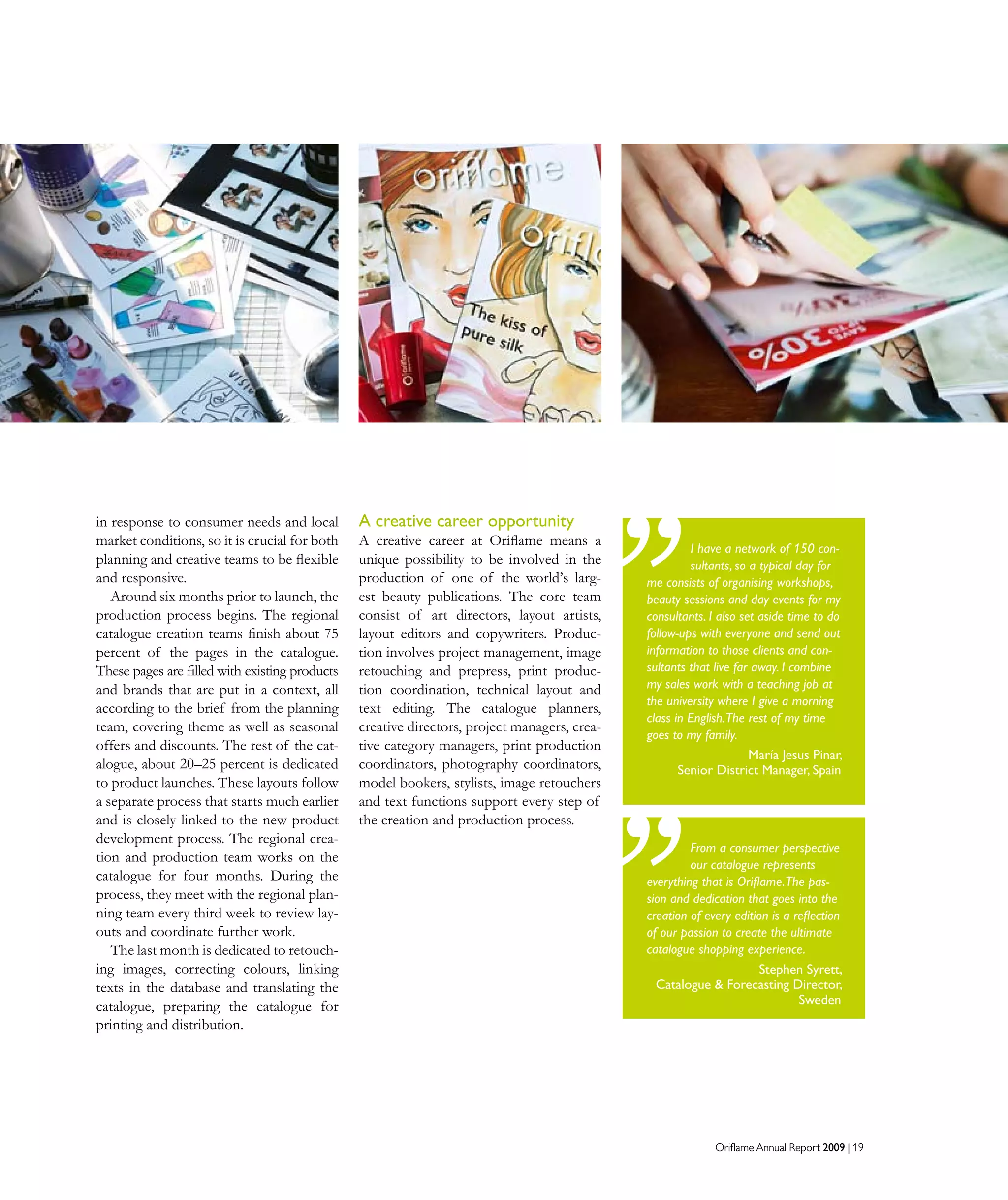
Creating a catalogue
Creating a catalogue is about much more
than filling blank pages with glossy adver-
tisements. The outline of a new catalogue
begins more than one year prior to publi-
cation. The regional planning teams cre-
ate a catalogue plan that includes ideas
for the themes, what products will be
shown in each catalogue, what page they
will appear on and what the offers will
be. The process involves a lot of analysis
of current and historic results together
with market trends, but also creativity in
developing new exciting ideas and pro-
motions. The regional plans are commu-
nicated and discussed with local markets
– an important process that optimises
the combination of product and price
in every catalogue. The completed plan
is then formally briefed to the region’s
catalogue creation team. There are con-
stant updates and changes along the way
18 | Oriflame Annual Report 2009
Oriflame Annual Report 2009 | 19Oriflame Annual Report 2009 | 19
in response to consumer needs and local
market conditions, so it is crucial for both
planning and creative teams to be flexible
and responsive.
Around six months prior to launch, the
production process begins. The regional
catalogue creation teams finish about 75
percent of the pages in the catalogue.
These pages are filled with existing products
and brands that are put in a context, all
according to the brief from the planning
team, covering theme as well as seasonal
offers and discounts. The rest of the cat-
alogue, about 20–25 percent is dedicated
to product launches. These layouts follow
a separate process that starts much earlier
and is closely linked to the new product
development process. The regional crea-
tion and production team works on the
catalogue for four months. During the
process, they meet with the regional plan-
ning team every third week to review lay-
outs and coordinate further work.
The last month is dedicated to retouch-
ing images, correcting colours, linking
texts in the database and translating the
catalogue, preparing the catalogue for
printing and distribution.
A creative career opportunity
A creative career at Oriflame means a
unique possibility to be involved in the
production of one of the world’s larg-
est beauty publications. The core team
consist of art directors, layout artists,
layout editors and copywriters. Produc-
tion involves project management, image
retouching and prepress, print produc-
tion coordination, technical layout and
text editing. The catalogue planners,
creative directors, project managers, crea-
tive category managers, print production
coordinators, photography coordinators,
model bookers, stylists, image retouchers
and text functions support every step of
the creation and production process.
I have a network of 150 con-
sultants, so a typical day for
me consists of organising workshops,
beauty sessions and day events for my
consultants. I also set aside time to do
follow-ups with everyone and send out
information to those clients and con-
sultants that live far away. I combine
my sales work with a teaching job at
the university where I give a morning
class in English.The rest of my time
goes to my family.
María Jesus Pinar,
Senior District Manager, Spain
From a consumer perspective
our catalogue represents
everything that is Oriflame.The pas-
sion and dedication that goes into the
creation of every edition is a reflection
of our passion to create the ultimate
catalogue shopping experience.
Stephen Syrett,
Catalogue  Forecasting Director,
Sweden
20 | Oriflame Annual Report 200920 | Oriflame Annual Report 2009
THE ORGANISATION
Striving to become the number
one workplace
Attract, develop and retain
Oriflame has 3.2 million independent
sales consultants in 62 countries. In addi-
tion to this the Company has over 8,000
employees located in offices all over the
world. To retain these people and to be
able to attract outstanding profession-
als, Oriflame must offer motivation and
potential for development. The Company
presents a stimulating and entrepreneurial
working environment that empowers peo-
ple to grow as people and professionals,
whether they are employees or independ-
ent sales consultants.
Oriflame consultants get the chance
to run their own company – setting their
own targets, planning income and working
hours and sometimes even changing their
lives. Oriflame’s employees develop both
in their day-to-day work and in Oriflame
Academy, a unique training program cre-
ated to support and strengthen Oriflame’s
culture. Oriflame has also implemented
a new strategy for compensation and
benefits. In order to find the right person
for each position, a performance manage-
ment and an internal succession planning
system have been adopted.
Corporate culture
Oriflame is a fast growing company, with
ambitions to constantly attract new peo-
ple and add new markets to its world. The
people behind Oriflame are the reason
for the Company’s success. But how does
one run a company with more than three
million consultants all over the world who
speak different languages and hold dif-
ferent values, religious beliefs and politi-
cal convictions? The key is the corporate
culture. A common culture is an invisible
bond. It has the power to unite, enthuse
and lead people over borders and bound-
aries that might otherwise separate them.
Oriflame’s culture is based on entrepe-
neurship as well as respect for and belief
in peoples’ capability.
The OriflameWay
Oriflame wants to ensure that all employ-
ees understand the core values and oper-
ating principles of the Oriflame culture.
Striving to become the number one beauty company selling direct,Oriflame needs to become the
number one workplace. Oriflame presents a stimulating, creative and dynamic working environ-
ment that empowers people to grow as people and professionals, whether they are employees
or independent sales consultants.The greatest challenge is to preserve core values and a genuine
sense of entrepreneurship, as Oriflame grows and requires more structure.
Togetherness – people who work together
and share the same goals achieve greater
results. They motivate each other and know
that pulling together is more rewarding than
doing it alone.
Spirit – people with a can-do spirit have a
winning attitude and never give up. They are
prepared and committed to do what it takes
to succeed.
Passion – passionate people have the power
to change the world. They love what they do,
they believe in it. They know deep down that
they can make a difference.
Core VALUES
Promoting entrepreneurship, creativity and core values...
Oriflame Annual Report 2009 | 21Oriflame Annual Report 2009 | 21
Oriflame takes pride in offering the peo-
ple who join the Company an opportu-
nity to work abroad in one of the many
countries where we have a presence. Ori-
flame has offices in more than 60 coun-
tries, each of which is a venue for diver-
sity and common experience, not least
the Stockholm office where people from
more than 30 countries work together
towards the same goals – a truly unique
working environment.
Oriflame hosts three major interna-
tional conferences every year in various,
carefully chosen locations. The confer-
ences provide an opportunity for leaders
to exchange experience and ideas with top
management and colleagues from all over
the world. Last year´s Gold Conference in
Rome hosted a record number of 4,800
attendees from 58 markets.
The Oriflame Way is a one-day seminar
presented by senior manager trained for
this purpose. The seminar is given in Eng-
lish, Russian and Spanish to fully reach its
target audience. To date, 1,380 employees
have attended the Oriflame Way and the
CEO and President Magnus Brännström
has personally conducted 50 of these
training sessions, as it is a highly prioritised
matter in the Company.
Diversity as a source of our
strength
Embracing and actively working to sus-
tain diversity, Oriflame aspires to be a
company that reflects the globally diverse
audience that we serve. In addition to hir-
ing the best talent, Oriflame believes that
diversity of gender, nationalities and cul-
tures leads to the creation of better per-
spectives, ideas and products. The diversi-
ty of employees and partners serves as the
foundation of better service for customers
and stakeholders all over the world.
A typical day at Oriflame can
range from a web conference
with our development team in the
Czech Republic to creating a design for
an upcoming product launch campaign,
or supporting one of our Latin Ameri-
canWebmasters with design advice for
their next recruitment campaign
Annica Wallin,
Online Art Director
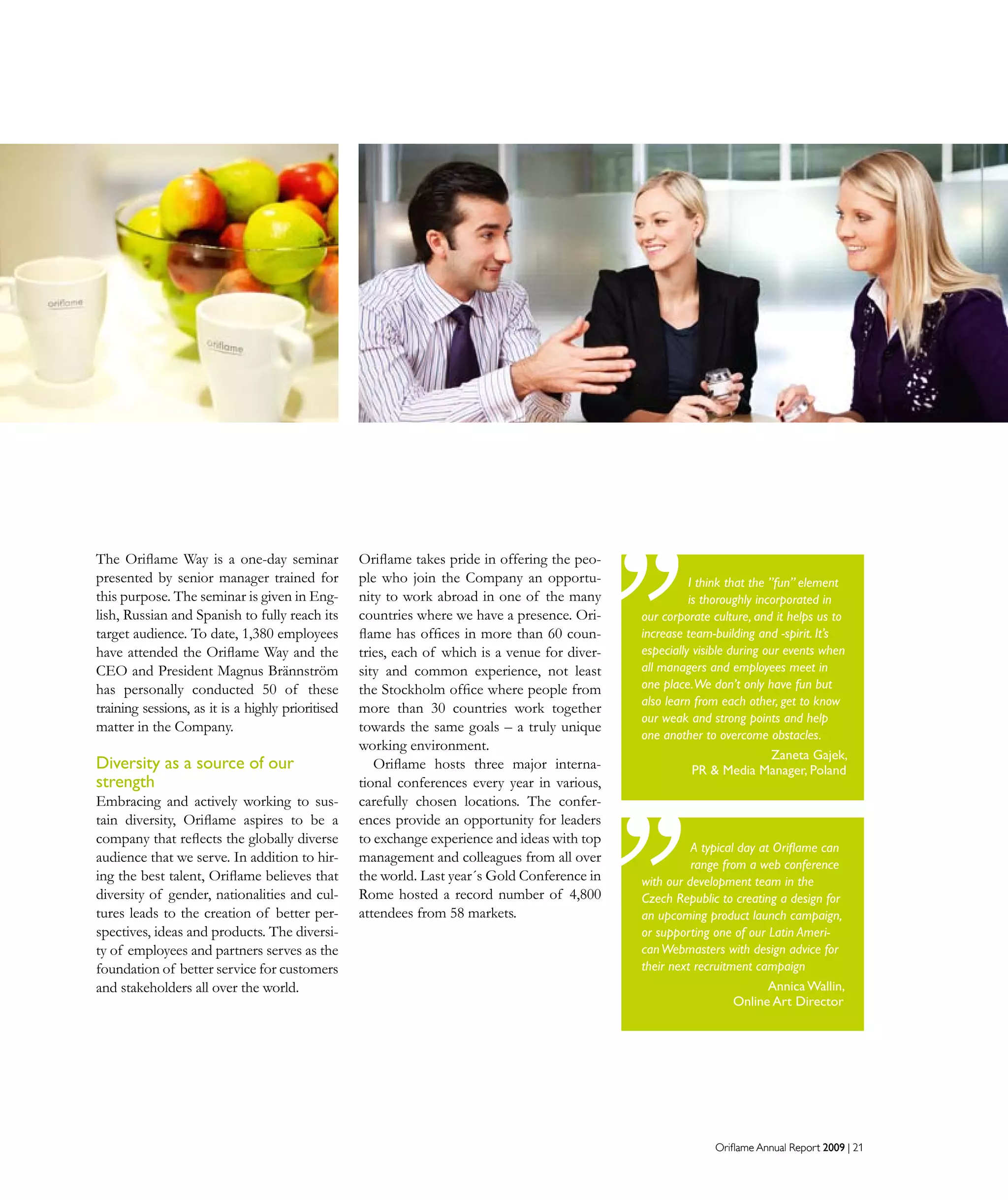
I think that the ”fun” element
is thoroughly incorporated in
our corporate culture, and it helps us to
increase team-building and -spirit. It’s
especially visible during our events when
all managers and employees meet in
one place.We don’t only have fun but
also learn from each other, get to know
our weak and strong points and help
one another to overcome obstacles.
Zaneta Gajek,
PR  Media Manager, Poland
THE ORGANISATION
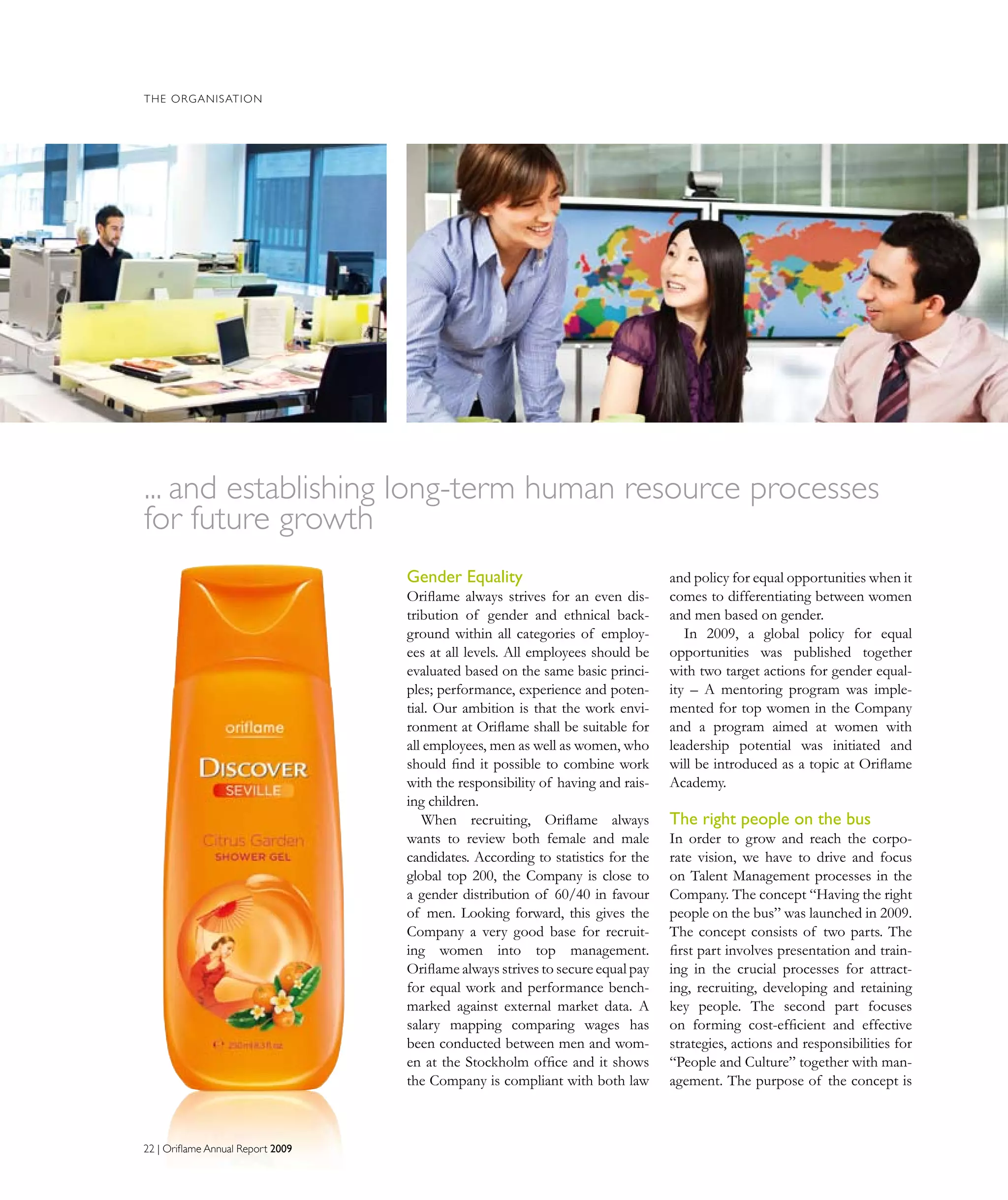
Gender Equality
Oriflame always strives for an even dis-
tribution of gender and ethnical back-
ground within all categories of employ-
ees at all levels. All employees should be
evaluated based on the same basic princi-
ples; performance, experience and poten-
tial. Our ambition is that the work envi-
ronment at Oriflame shall be suitable for
all employees, men as well as women, who
should find it possible to combine work
with the responsibility of having and rais-
ing children.
When recruiting, Oriflame always
wants to review both female and male
candidates. According to statistics for the
global top 200, the Company is close to
a gender distribution of 60/40 in favour
of men. Looking forward, this gives the
Company a very good base for recruit-
ing women into top management.
Oriflame always strives to secure equal pay
for equal work and performance bench-
marked against external market data. A
salary mapping comparing wages has
been conducted between men and wom-
en at the Stockholm office and it shows
the Company is compliant with both law
and policy for equal opportunities when it
comes to differentiating between women
and men based on gender.
In 2009, a global policy for equal
opportunities was published together
with two target actions for gender equal-
ity – A mentoring program was imple-
mented for top women in the Company
and a program aimed at women with
leadership potential was initiated and
will be introduced as a topic at Oriflame
Academy.
The right people on the bus
In order to grow and reach the corpo-
rate vision, we have to drive and focus
on Talent Management processes in the
Company. The concept “Having the right
people on the bus” was launched in 2009.
The concept consists of two parts. The
first part involves presentation and train-
ing in the crucial processes for attract-
ing, recruiting, developing and retaining
key people. The second part focuses
on forming cost-efficient and effective
strategies, actions and responsibilities for
“People and Culture” together with man-
agement. The purpose of the concept is
... and establishing long-term human resource processes
for future growth
22 | Oriflame Annual Report 2009
Oriflame Annual Report 2009 | 23
to establish a structured framework, an
explicit ownership and a sharp agenda
in each Region/Market/Department in
Oriflame.
The Oriflame Academy
Oriflame’s most important training pro-
grammes for managers are found in Ori-
flame Academy, implemented in 2006.
The internal three-step development
programme for managers has been creat-
ed to support and strengthen Oriflame’s
culture, increasing integration, strategic
understanding as well as leadership and
management skills.
Global Induction Programme
In 2009, a new global introduction proc-
ess was implemented as a way of wel-
coming new hires to Oriflame. The proc-
ess begins before a new employee arrives
and lasts up to a year or longer after the
employee is in place. The purpose of the
process is to ensure that all new hires get
up to full speed as quickly and smoothly
as possible, feeling that they made the
right choice when they decided to join
Oriflame.
Oriflame Annual Report 2009 | 23
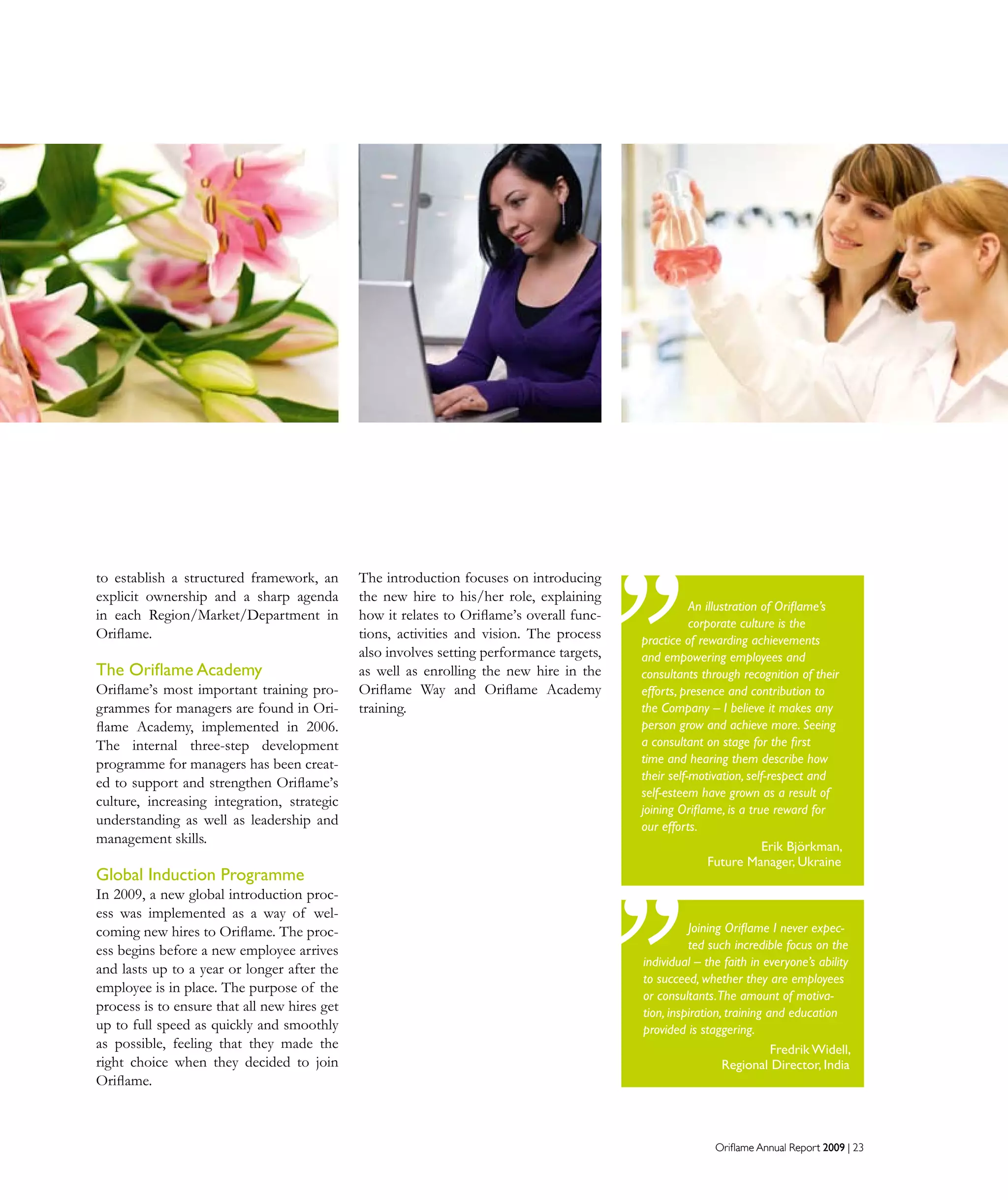
Joining Oriflame I never expec-
ted such incredible focus on the
individual – the faith in everyone’s ability
to succeed, whether they are employees
or consultants.The amount of motiva-
tion, inspiration, training and education
provided is staggering.
Fredrik Widell,
Regional Director, India
The introduction focuses on introducing
the new hire to his/her role, explaining
how it relates to Oriflame’s overall func-
tions, activities and vision. The process
also involves setting performance targets,
as well as enrolling the new hire in the
Oriflame Way and Oriflame Academy
training.
An illustration of Oriflame’s
corporate culture is the
practice of rewarding achievements
and empowering employees and
consultants through recognition of their
efforts, presence and contribution to
the Company – I believe it makes any
person grow and achieve more. Seeing
a consultant on stage for the first
time and hearing them describe how
their self-motivation, self-respect and
self-esteem have grown as a result of
joining Oriflame, is a true reward for
our efforts.
Erik Björkman,
Future Manager, Ukraine
24 | Oriflame Annual Report 200924 | Oriflame Annual Report 2009
THE PRODUCTS
The product overview
CATEGORIES
SKIN care
EXAMPLES OF TOP SELLERS IN 2009
Colour
COSMETICS
FRAGRANCES
PERSONAL
 HAIR CARE
ACCESSORIES
 WELLNESS
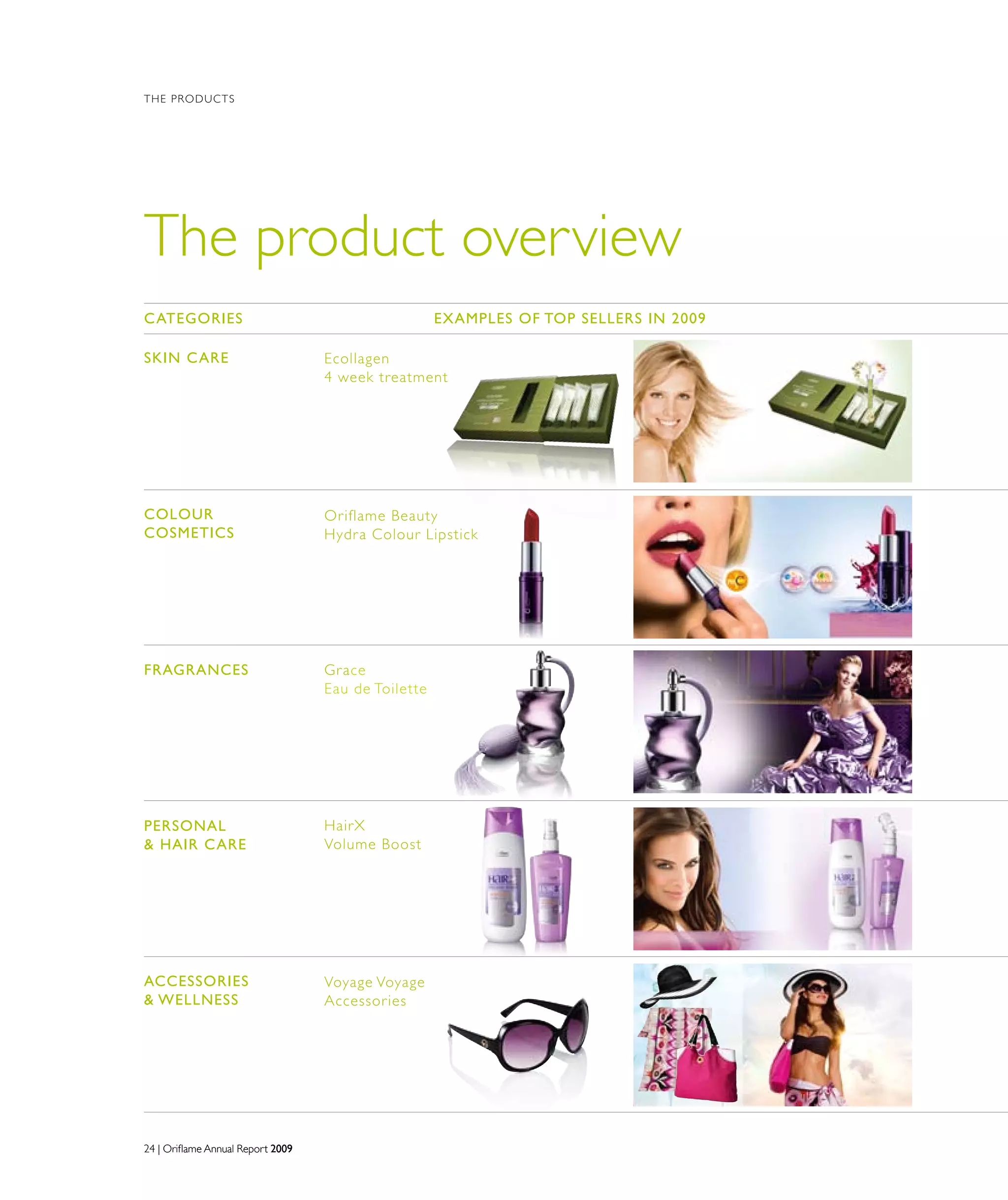
Ecollagen
4 week treatment
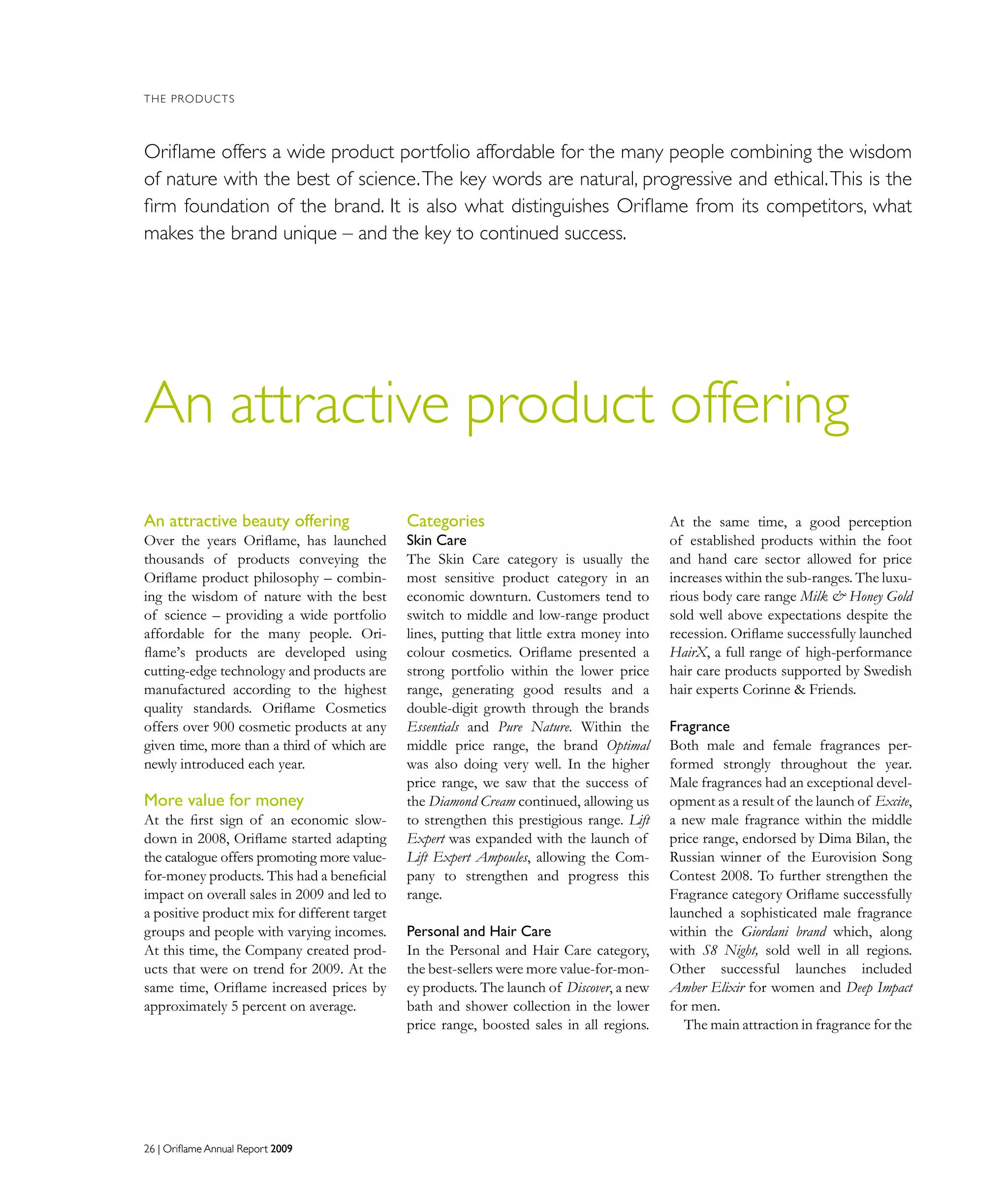
Oriflame Beauty
Hydra Colour Lipstick
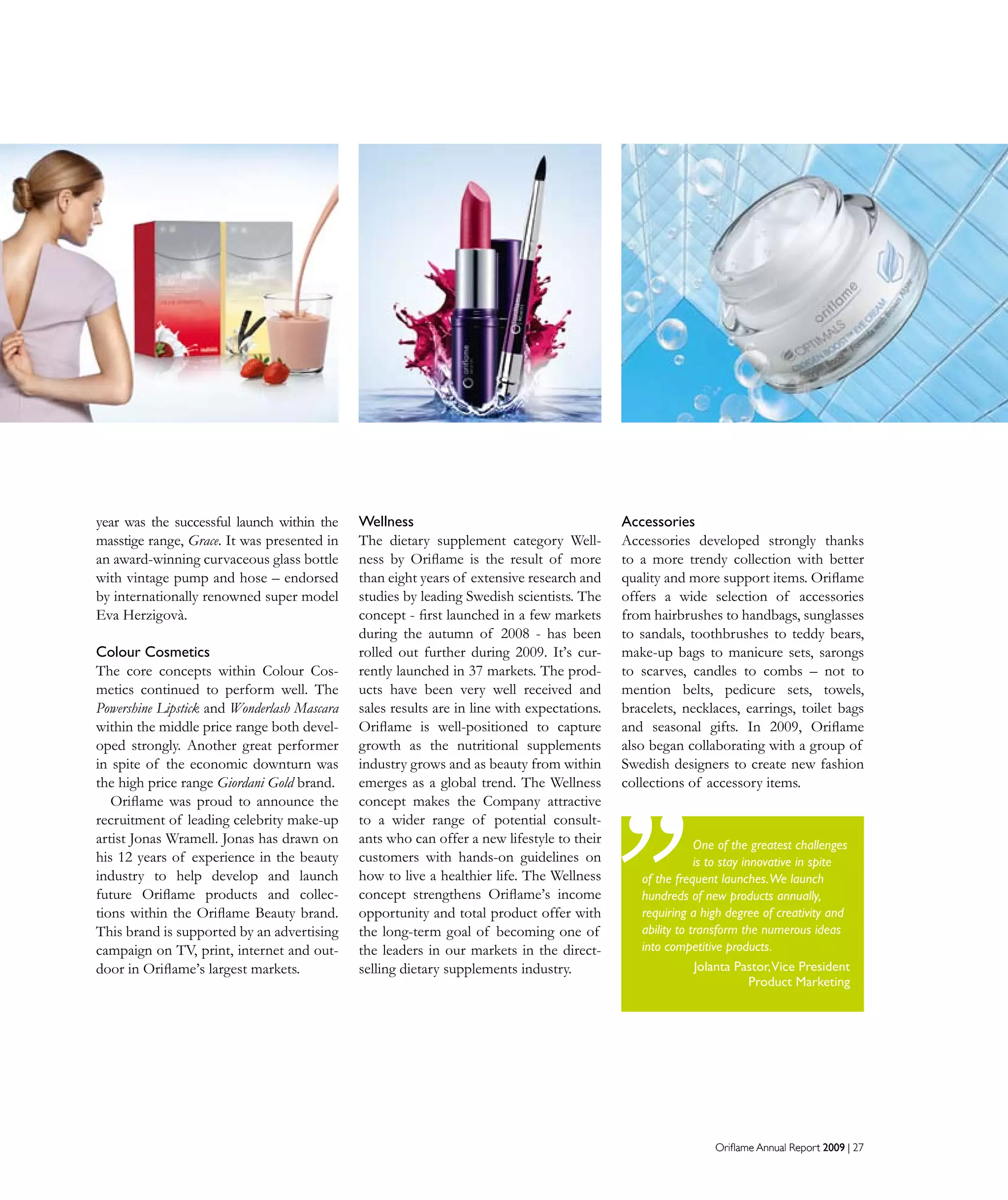
Grace
Eau de Toilette
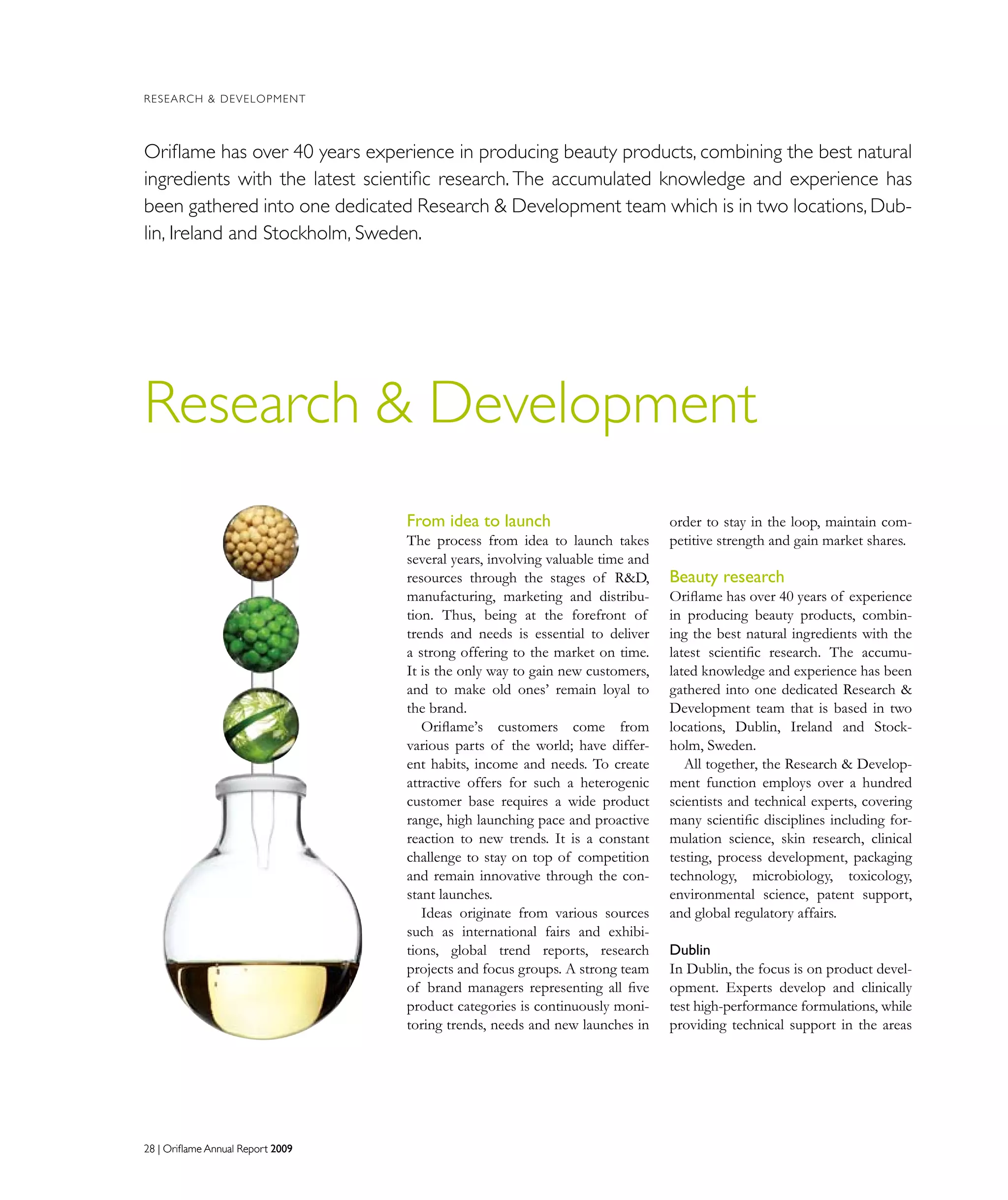
HairX
Volume Boost
Voyage Voyage
Accessories
Oriflame Annual Report 2009 | 25Oriflame Annual Report 2009 | 25
SALES CONTRIBUTION development in 2009SALES GROWTH
Skin Care grew by 11 percent in local currency
and decreased by 2 percent in Euro during the
year.Sales were driven by the successful launch-
es ofTime Reversing InTense Cream andTender
Care Caramel.The heritage brandTender Care is
still Oriflame’s number one product in terms of
sales and units in the Skin Care category.
Colour Cosmetics grew by 8 percent in local
currency and decreased by 6 percent in Euro.
The core concepts continued to perform well.
The Powershine Lipstick and Wonderlash
Mascara within the middle price range, as well
as the high price range Giordani Gold brand,
developed strongly in spite of the economic
downturn.
Fragrance continued to perform strongly in
2009. Sales grew by 16 percent in local cur-
rency and was stable in Euro terms. During the
year Oriflame launched the female fragrance
Grace featuring Eva Herzigova and the men‘s
fragrances Giordani Men and Glacier.
Personal  Hair Care grew by 15 percent in
local currency and decreased by 1 percent in
Euro.The best-sellers were more value-for-
money products. The launch of HairX, a new
hair care range, boosted sales in all regions. But
high price range brands also sold well.
The Accessories  Wellness categories also
showed large growth in 2009 with 27 percent
increase in local currency resp. 10 percent in
Euro thanks to more trendy accessories and
successful take-off of the newWellness category.
During the year, Oriflame began collaborating
with a group of Swedish designers to create
more fashion collections of accessory items.
25%
25%
19%
20%
11%
EUR million
05 06 07 08 09
0
100
200
300
400
0
100
200
300
400
EUR million
05 06 07 08 09
0
100
200
300
400
0
100
200
300
400
EUR million EUR million
05 06 07 08 09
0
100
200
300
400
0
100
200
300
400
EUR million EUR million
05 06 07 08 09
0
100
200
300
400
0
100
200
300
400
EUR million EUR million
05 06 07 08 09
0
100
200
300
400
0
100
200
300
400
EUR million EUR million
26 | Oriflame Annual Report 200926 | Oriflame Annual Report 2009
An attractive product offering
THE PRODUCTS
Oriflame offers a wide product portfolio affordable for the many people combining the wisdom
of nature with the best of science.The key words are natural, progressive and ethical.This is the
firm foundation of the brand. It is also what distinguishes Oriflame from its competitors, what
makes the brand unique – and the key to continued success.
Categories
Skin Care
The Skin Care category is usually the
most sensitive product category in an
economic downturn. Customers tend to
switch to middle and low-range product
lines, putting that little extra money into
colour cosmetics. Oriflame presented a
strong portfolio within the lower price
range, generating good results and a
double-digit growth through the brands
Essentials and Pure Nature. Within the
middle price range, the brand Optimal
was also doing very well. In the higher
price range, we saw that the success of
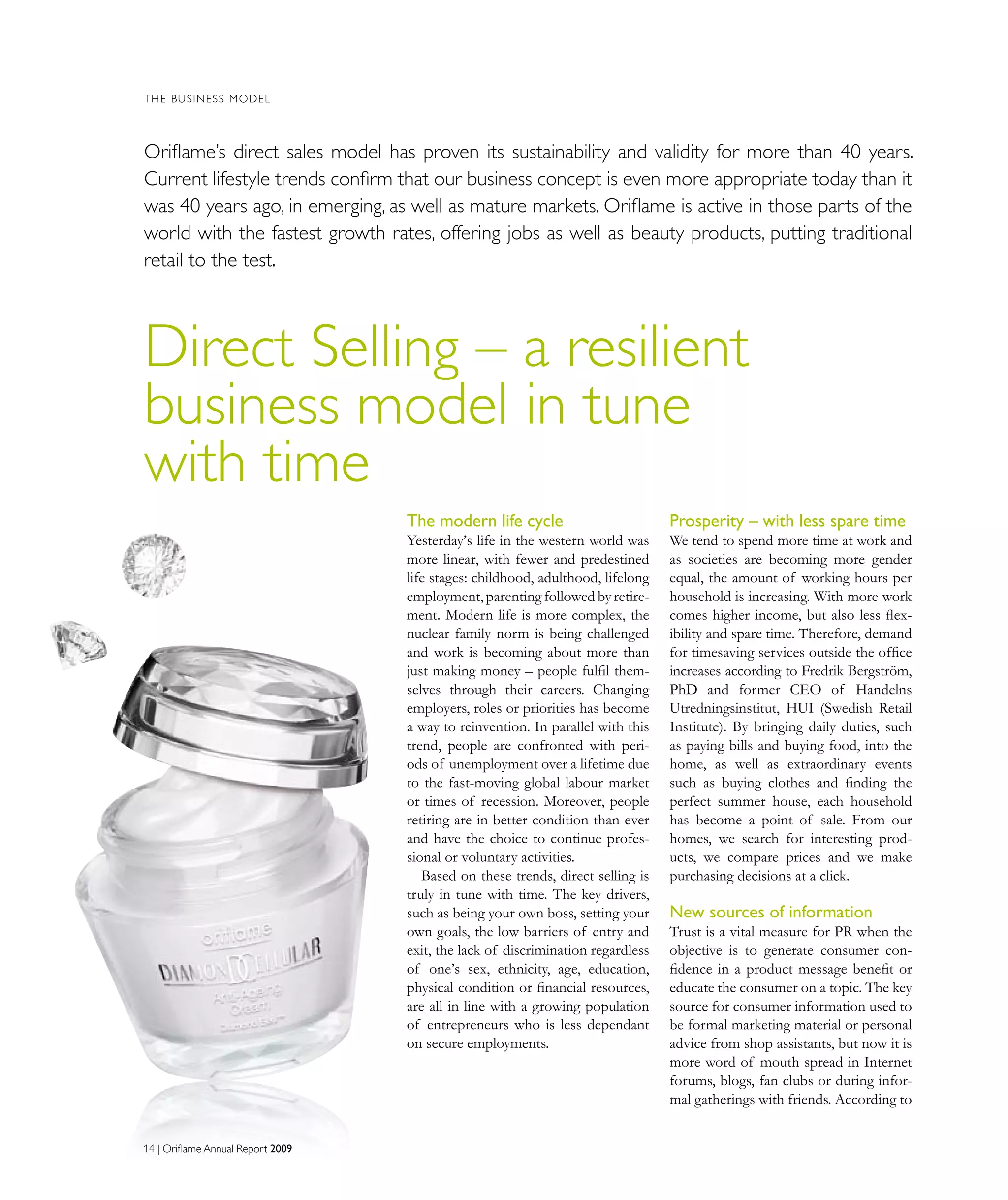
the Diamond Cream continued, allowing us
to strengthen this prestigious range. Lift
Expert was expanded with the launch of
Lift Expert Ampoules, allowing the Com-
pany to strengthen and progress this
range.
Personal and Hair Care
In the Personal and Hair Care category,
the best-sellers were more value-for-mon-
ey products. The launch of Discover, a new
bath and shower collection in the lower
price range, boosted sales in all regions.
At the same time, a good perception
of established products within the foot
and hand care sector allowed for price
increases within the sub-ranges. The luxu-
rious body care range Milk  Honey Gold
sold well above expectations despite the
recession. Oriflame successfully launched
HairX, a full range of high-performance
hair care products supported by Swedish
hair experts Corinne  Friends.
Fragrance
Both male and female fragrances per-
formed strongly throughout the year.
Male fragrances had an exceptional devel-
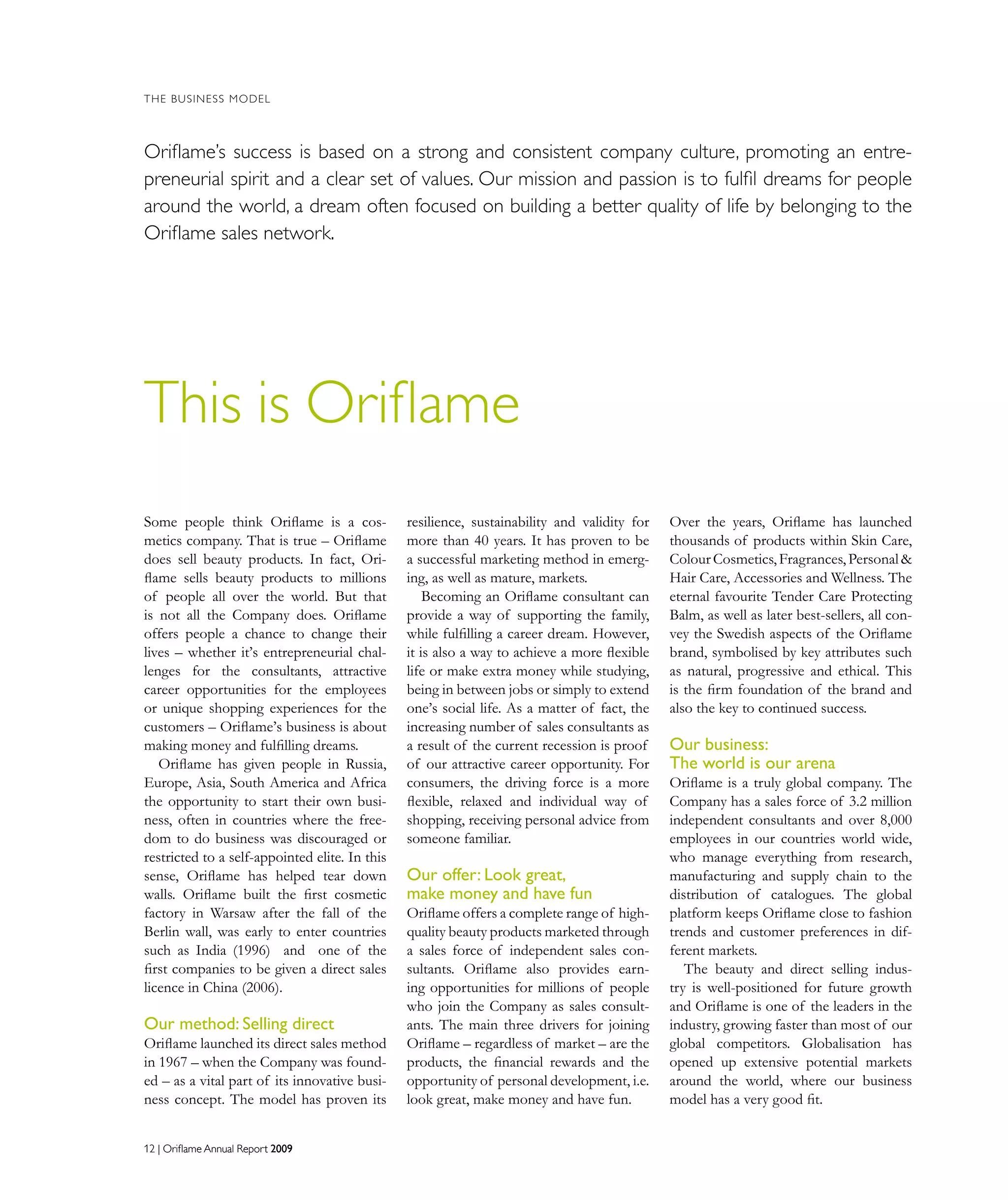
opment as a result of the launch of Excite,
a new male fragrance within the middle
price range, endorsed by Dima Bilan, the
Russian winner of the Eurovision Song
Contest 2008. To further strengthen the
Fragrance category Oriflame successfully
launched a sophisticated male fragrance
within the Giordani brand which, along
with S8 Night, sold well in all regions.
Other successful launches included
Amber Elixir for women and Deep Impact
for men.
The main attraction in fragrance for the
An attractive beauty offering
Over the years Oriflame, has launched
thousands of products conveying the
Oriflame product philosophy – combin-
ing the wisdom of nature with the best
of science – providing a wide portfolio
affordable for the many people. Ori-
flame’s products are developed using
cutting-edge technology and products are
manufactured according to the highest
quality standards. Oriflame Cosmetics
offers over 900 cosmetic products at any
given time, more than a third of which are
newly introduced each year.
More value for money
At the first sign of an economic slow-
down in 2008, Oriflame started adapting
the catalogue offers promoting more value-
for-money products. This had a beneficial
impact on overall sales in 2009 and led to
a positive product mix for different target
groups and people with varying incomes.
At this time, the Company created prod-
ucts that were on trend for 2009. At the
same time, Oriflame increased prices by
approximately 5 percent on average.
Oriflame Annual Report 2009 | 27Oriflame Annual Report 2009 | 27
year was the successful launch within the
masstige range, Grace. It was presented in
an award-winning curvaceous glass bottle
with vintage pump and hose – endorsed
by internationally renowned super model
Eva Herzigovà.
Colour Cosmetics
The core concepts within Colour Cos-
metics continued to perform well. The
Powershine Lipstick and Wonderlash Mascara
within the middle price range both devel-
oped strongly. Another great performer
in spite of the economic downturn was
the high price range Giordani Gold brand.
Oriflame was proud to announce the
recruitment of leading celebrity make-up
artist Jonas Wramell. Jonas has drawn on
his 12 years of experience in the beauty
industry to help develop and launch
future Oriflame products and collec-
tions within the Oriflame Beauty brand.
This brand is supported by an advertising
campaign on TV, print, internet and out-
door in Oriflame’s largest markets.
Wellness
The dietary supplement category Well-
ness by Oriflame is the result of more
than eight years of extensive research and
studies by leading Swedish scientists. The
concept - first launched in a few markets
during the autumn of 2008 - has been
rolled out further during 2009. It’s cur-
rently launched in 37 markets. The prod-
ucts have been very well received and
sales results are in line with expectations.
Oriflame is well-positioned to capture
growth as the nutritional supplements
industry grows and as beauty from within
emerges as a global trend. The Wellness
concept makes the Company attractive
to a wider range of potential consult-
ants who can offer a new lifestyle to their
customers with hands-on guidelines on
how to live a healthier life. The Wellness
concept strengthens Oriflame’s income
opportunity and total product offer with
the long-term goal of becoming one of
the leaders in our markets in the direct-
selling dietary supplements industry.
One of the greatest challenges
is to stay innovative in spite
of the frequent launches.We launch
hundreds of new products annually,
requiring a high degree of creativity and
ability to transform the numerous ideas
into competitive products.
Jolanta Pastor,Vice President
Product Marketing
Accessories
Accessories developed strongly thanks
to a more trendy collection with better
quality and more support items. Oriflame
offers a wide selection of accessories
from hairbrushes to handbags, sunglasses
to sandals, toothbrushes to teddy bears,
make-up bags to manicure sets, sarongs
to scarves, candles to combs – not to
mention belts, pedicure sets, towels,
bracelets, necklaces, earrings, toilet bags
and seasonal gifts. In 2009, Oriflame
also began collaborating with a group of
Swedish designers to create new fashion
collections of accessory items.
28 | Oriflame Annual Report 200928 | Oriflame Annual Report 2009
Research  Development
RESEARCH  DEVELOPMENT
Oriflame has over 40 years experience in producing beauty products, combining the best natural
ingredients with the latest scientific research. The accumulated knowledge and experience has
been gathered into one dedicated Research  Development team which is in two locations, Dub-
lin, Ireland and Stockholm, Sweden.
From idea to launch
The process from idea to launch takes
several years, involving valuable time and
resources through the stages of RD,
manufacturing, marketing and distribu-
tion. Thus, being at the forefront of
trends and needs is essential to deliver
a strong offering to the market on time.
It is the only way to gain new customers,
and to make old ones’ remain loyal to
the brand.
Oriflame’s customers come from
various parts of the world; have differ-
ent habits, income and needs. To create
attractive offers for such a heterogenic
customer base requires a wide product
range, high launching pace and proactive
reaction to new trends. It is a constant
challenge to stay on top of competition
and remain innovative through the con-
stant launches.
Ideas originate from various sources
such as international fairs and exhibi-
tions, global trend reports, research
projects and focus groups. A strong team
of brand managers representing all five
product categories is continuously moni-
toring trends, needs and new launches in
order to stay in the loop, maintain com-
petitive strength and gain market shares.
Beauty research
Oriflame has over 40 years of experience
in producing beauty products, combin-
ing the best natural ingredients with the
latest scientific research. The accumu-
lated knowledge and experience has been
gathered into one dedicated Research 
Development team that is based in two
locations, Dublin, Ireland and Stock-
holm, Sweden.
All together, the Research  Develop-
ment function employs over a hundred
scientists and technical experts, covering
many scientific disciplines including for-
mulation science, skin research, clinical
testing, process development, packaging
technology, microbiology, toxicology,
environmental science, patent support,
and global regulatory affairs.
Dublin
In Dublin, the focus is on product devel-
opment. Experts develop and clinically
test high-performance formulations, while
providing technical support in the areas
Oriflame Annual Report 2009 | 29Oriflame Annual Report 2009 | 29
of regulatory affairs, product safety and
industrialisation to the manufacturing facili-
ties. These projects deliver technology and
innovative new products into the product
categories of skin care, colour, fragrance
and personal care.
Stockholm
In Stockholm, at the Skin Research Insti-
tute, our scientists work at a biological
level aimed at generating Oriflame’s next
portfolioof uniquetechnologiesandactive
ingredients which will be incorporated
into the future generation of products.
Ensuring the highest standard
Oriflame’s core competencies embrace a
wide range of technologies and products,
with the accent placed squarely on deliver-
ing innovative, high performance formu-
lations with proven scientific consumer
benefits. The products comply with the
most stringent international regulatory
requirements, and are extensively tested
to ensure optimum safety, efficiency and
quality as well as ethical and environmen-
tal integrity. No Oriflame product has
ever been tested on animals.
Having an in-house Research and Develop-
ment centre provides Oriflame greater flex-
ibility over product development in line with
the Company’s natural Swedish heritage,
ensuring delivery of the highest standard
product in the shortest possible time.
The best thing about working
for Oriflame is the dynamism
and creativity that permeates the RD
centre, as well as the entire Company.
It’s an example of how the Company
links the heritage of the natural Swedish
with the technology and innovation.
Dr. Natasha Williams O’Hanlon,
Regulatory Manager, Policies and
Technical Information
Working at the Skin Research
Institute, I’m part of an expe-
rienced team striving to spearhead re-
search and become a key player in the
world of cosmetic research. Our chal-
lenge is to create newness, strengthen
Oriflame’s offer, enhancing the visibility
of the technology and originality behind
every product.
Dr.Alain Mavon,
Skin Delivery Director
30 | Oriflame Annual Report 200930 | Oriflame Annual Report 2009
GLOBAL SUPPLY
The Oriflame “Business Opportunity
Concept” is built on four Strategic Cor-
nerstones; Brands  Products, Network
Marketing, World Class Service and Peo-
ple  Culture. The Oriflame supply chain
organization is one of the main pillars of
the strategic cornerstone; “World Class
Service”. It is the ultimate objective of
the supply chain organization to deliver
an industry leading service to the Ori-
flame sales organization, to the consult-
ants and to the end customers.
Supply Chain and sourcing
The Product Fulfilment Project,
Oriflame’s review of its entire supply
chain, was initiated in 2006 and imple-
mentation is ongoing. The main task is
to make the Oriflame experience easy,
reliable and friendly for the consultants
by better aligning supply and sales in the
Group. The strategy involves cutting lead-
times and increasing flexibility in the end-
to-end supply chain, as well as building
capacity to support growth, increasing in-
house manufacturing and sourcing locally
where appropriate. The target is to have
a base of flexible, efficient and quality-
orientated suppliers who ensure product
availability, quality and claims, delivery
times, delivery reliability and accuracy in
all of Oriflame’s markets.
A new operating platform
In recent years, Oriflame has imple-
mented a new operating platform, locat-
ing Oriflame’s marketing, catalogue and
supply functions to Stockholm, Sweden
and expanding central and regional logis-
tic hubs in Warsaw, Poland and Moscow,
Russia. In 2009 the integration of the
Baltic markets into the Warsaw Group
Distribution Centre was finalized. During
the year a new supply chain management
system was implemented, providing high-
er transparency and better responsiveness
throughout the planning cycle.
The roll-out to Oriflame markets will
continue as planned during 2010. A new
Group Distribution Centre will be estab-
lished in Budapest serving neighbouring
countries. By consolidating the inven-
tory closer to the consultants and by
eliminating intermediate warehouses in
the various markets, the lead times will
be shortened, product availability will be
improved and the inventory will be better
controlled and managed.
Manufacturing and logistics
Oriflame’s products are manufactured
both in-house and by various subcontrac-
tors with expertise in specific product
areas. Oriflame’s owns five manufactur-
ing units based in Poland, Sweden, India,
Global Supply
Global Supply is the manufacturing, sourcing and logistics part of Oriflame, enabling products to
be sourced and delivered according to promise to the consultants and customers. Supply plan-
ning plans more than 600 million units annually from more than 50 suppliers worldwide and the
distribution planning department plans deliveries globally to 62 markets in four regions.
Cut lead-times and increase flexibility•	
in the end-to-end supply chain
Better align supply and sales in the•	
Group, sourcing locally where ap-
propriate
Build capacity to support growth and•	
increase in-house manufacturing
Make the Oriflame experience•	
easy, reliable and friendly for the
consultants
Assuring consistent and high•	
quality products no matter place
of manufacture
GLOBAL SUPPLY STRATEGY
Oriflame Annual Report 2009 | 31Oriflame Annual Report 2009 | 31
China and Russia. These factories focus
primarily on the production of Skin Care,
Fragrances, Personal and Hair Care and
ColourCosmetics-areasinwhichthereare
sufficient volumes to achieve economies
of scale. Oriflame is continuously explor-
ing new sourcing opportunities closer to
its main markets. In 2009, Oriflame has
successfully ramped up the production at
its new Moscow site and the year before,
Oriflame initiated bottling and packag-
ing of fragrance products in Ukraine.
Oriflame is also continuously striving to
increase energy efficiency. The Swedish
facility is now only using clean hydroelec-
tric power and minimizing energy needs
through the use of heat pumps.
Quality assurance
Oriflame’s quality assurance team works
both with in-house manufacturing opera-
tions and subcontracted suppliers to
achieve consistent adherence to the high
quality, safety and ethical standards set
by the Company, no matter the loca-
tion of the manufacturing site. Oriflame
maintains a policy of global compliance
for all its products to ensure conformity
with the highest market standards. Exam-
ples include adherence to stringent water
quality standards and a strict control over
other raw materials used in production.
Supply Chain is a transversal
function connecting all
departments at Oriflame. Our role is
to coordinate the various operating
processes, reaching from RD to
manufacturing and distribution, a
difficult but stimulating task offering
new challenges on a daily basis.
Didier Jourdan,
Vice president Global Planning
Code of Practice
During 2009 Oriflame integrated the
new ISO Cosmetic Good Manufacturing
Practice (GMP) Standard with the Com-
pany’s Code of Practice. This new ISO
standard gives guidelines for the produc-
tion, control, storage and shipment of
cosmetic products. All Oriflame suppliers
are audited on a regular basis to ensure
compliance with the Code of Practice
and the Code of Ethics. Oriflame car-
ries out Corporate Social Responsibility
(CSR)  Quality Audits on all accessories
suppliers in China, to ensure that they not
only meet Quality standards, but that they
also comply with the Company’s Ethical
Policies. This is an extra layer of audit, in
addition to the frequent audits carried out
by Oriflame’s sourcing and procurement
partners.
Working at Oriflame I meet
new challenges on a daily
basis.Whether I’m dealing with delivery
problems or actual earthquakes, I am
always striving to exceed expectations
and provide word-class service.To me,
that’s the ultimate challenge.
Sanjay Pushkarna,
Operations Director, India
32 | Oriflame Annual Report 200932 | Oriflame Annual Report 2009
Market
THE MARKET
The cosmetics market has seen consumers trading down from premium to masstige prod-
ucts, in search of savvy ways to remain fashionable and indulge themselves in an affordable way.
The challenge for many companies is to maintain consumer attractiveness by innovating so to
remain relevant to consumers.
General Outlook
In total, the market for cosmetics, person-
al and hair care increased by 3.7 percent
in 2009 amounting to EUR 249.7 billion.
The market growth in many of Oriflame’s
key markets was weak as a result of the
global recession. The recession has taken
hold leading to record low levels of con-
sumers’ confidence. However, cosmetics
are usually seen as more resistant than
other products to an economic downturn,
as women turn to cosmetics for a source
of affordable cheer. Russia alone was up
by 5.3 percent to a value of EUR 7.6 bil-
lion while average growth rate in last five
years was 12.3 percent. Turkey increased
by 9.3 percent to EUR 1.9 billion. Czech
Republic decreased by 1.6 percent and
Portugal increased by 1.6 percent. Some
of the best performing markets were seen
in Asia, with India growing by 12.3 per-
cent and China by 8.7 percent. Growth in
Mexico was 6.9 percent in 2009.
In most markets of Central and East-
ern Europe, Oriflame enjoys a leading
position, being either the largest or the
second largest cosmetics company among
direct sellers. In these and other emerging
markets, direct selling is well suited, and it
generally takes longer for cosmetic com-
panies selling through retail to get a foot-
hold. In difficult times as in 2009, direct
selling companies normally have a good
opportunity to gain market share in the
overall market.
Growth of the cosmetics markets is
expected to pick up in 2010 and for the
next five-year period, the global market
for cosmetics and toiletries is forecast-
ed to grow by an annual average of 2.7
percent at constant prices in the 2009 –
2014 period reaching EUR 285.3 billion
in 2014. Skin care is expected to be the
fastest growing product category with a
6.1 percent annual increase on average
between 2009 – 2014 in the markets were
Oriflame is present.
Competitors
Being a cosmetics company selling direct
means that Oriflame competes both with
major cosmetics manufacturers for end
customers as well as with other direct sell-
ers for consultants.
Some of the largest competitors to
Oriflame in Eastern Europe are the glo-
bal manufacturers Procter  Gamble,
L’Oreal, Beiersdorf and Unilever, while
the Russian company Kalina has been
very successful in key markets such as
Russia, Ukraine and Kazakhstan. The two
largest cosmetics companies selling direct
in Eastern Europe, are by a wide margin
Oriflame and Avon, but there are many
other direct sellers that compete for con-
sultants. Russian Faberlic and the Ameri-
%
Forecast market growth,
CAGR 2009 – 2014
0
1
2
3
4
5
6
7
0
1
2
3
4
5
6
7
World
Oriflame markets
Euromonitor IMS 2009
*The data for Personal and Hair Care growth is calculated
as the average growth for the categories Beauty and
Personal Care, Baby Care, Bath and Shower, Deodorants,
Hair Care, Oral care and Sun Care.
Skin care Colour
cosmetics
Fragrances Personal
 Hair care
%
Oriflame Annual Report 2009 | 33Oriflame Annual Report 2009 | 33
can direct sellers Mary Kay and Amway
are some of the companies that have built
a large sales force of consultants during
recent years. Direct sales as a channel is
estimated to have more than 20 percent of
the total CT market in Eastern Europe.
This is higher than the global average of
approximately 11 percent.
In Latin America, Oriflame is still a
small player in the cosmetics market.
Avon has been very successful in this
region as well as many local companies,
such as Natura, Esika, Yanbal and Jafra.
Direct sales is very popular in this region
and depending on country, it is estimated
that this channel has taken about 30 per-
cent of the total CT market.
According to Euromonitor, the largest
cosmetics manufacturers in Oriflame’s
Asian markets are Unilever, Procter 
Gamble and L’Oreal. Direct sales has a
significant share of the market in China,
with Amway, Avon and Mary Kay being
the largest direct sellers, while Amway and
Oriflame have the largest market share
among direct sellers in Indonesia and
India.
Regional Highlights
CIS  Baltics
Local currency sales in 2009 increased
by 18 percent as a result of a 25 percent
increase in the average size of the sales
force partly offset by a 7 percent pro-
ductivity decrease compared to last year.
Euro sales decreased by 4 percent to EUR
725.0m (759.1m) and closing sales force
was up by 22 percent to 2.0m consultants.
The strongest performing markets were
Ukraine and Azerbaijan. Sales growth in
Russia was 16 percent in local currency
during the year. Operating margins were
14.7 percent (19.4) resulting in an operat-
ing profit of EUR 106.8 (147.5m).
EMEA
Local currency sales in 2009 increased
by 8 percent as a result of a 13 percent
increase in the average size of the sales
force partly offset by a 5 percent produc-
tivity decrease compared to last year. Euro
sales was up by 1 percent to EUR 395.4m
(390.3m) and closing sales force was up
by 12 percent to 0.8 million consultants.
The strongest performing markets were
Turkey and Morocco. Operating margins
were 14.9 percent (18.3) resulting in an
operating profit of EUR 59.1 (71.4m).
Asia
Local currency sales in 2009 increased
by 40 percent as a result of a 22 percent
increase in the average size of the sales
force and an 18 percent productivity
What distinguishes Oriflame
is the culture of putting people
above everything else.This is truly a
people business and doing well for the
people in the Company means doing
well for the brand and the business.
PriyankaVerma,
Public Relations, India
n CIS and Baltics
n EMEA
n Latin America
n Asia
Oriflame’s market
increase compared to 2008. Euro sales
were up by 37 percent to EUR 112.9m
(82.4) and closing sales force was up by
17 percent to 457,100 consultants. The
strongest performing markets were Iran
and China. Operating margins were 8.1
percent (4.0) resulting in an operating
profit of EUR 9.1 (3.3m).
Latin America
Local currency sales in 2009 increased
by 12 percent as a result of a 13 percent
increase in the average size of the sales
force partly offset by a 1 percent pro-
ductivity decrease compared to last year.
Euro sales were up by 7 percent to EUR
62.5m (58.5m) and closing sales force was
up by 9 percent to 136,300 consultants.
The strongest performing markets were
Mexico and Colombia. Operating margins
were 2.1 percent (8.9) resulting in an oper-
ating profit of EUR 1.3 (5.2m).
34 | Oriflame Annual Report 200934 | Oriflame Annual Report 2009
The various charity activities in which
Oriflame is involved include funding,
product donations and the time and ener-
gy of employees spent in numerous social
causes. One of these is the World Child-
hood Foundation under the patronage
of HM Queen Silvia of Sweden, which
Oriflame co-founded in 1999. Another
is the Af Jochnick Foundation that con-
tinues to provide grants to local chari-
ties. Their objective is to assist 100,000
children with education over a period of
ten years to ensure their survival, secu-
rity and progress. Meanwhile, each day in
communities around the globe, many of
Oriflame’s employees and consultants are
committing their time to support charita-
ble initiatives.
Oriflame Foundation
Oriflame is proud of all good work, but
realise that as the business continues to
grow and the Oriflame brand becomes
more recognised around the world, there
is a need to better coordinate, support,
and ultimately increase the charitable
work undertaken across our markets.
The decision was therefore taken during
2009 to set in motion a process designed
to enhance and expand Oriflame’s chari-
Being a good corporate citizen…
Oriflame’s view of Corporate Social
Responsibility (CSR) encompasses apply-
ing a responsible business model, which
empowers people and provides them
with tools to enrich their lives. Becoming
a sales consultant for Oriflame provides
financial opportunities from the first day
– but never any risk. Apart from contrib-
uting to the communities in which the
Company operates by providing employ-
ment and business opportunities, Ori-
flame also supports charities on a local,
regional and global level. In addition, the
Company continuously strives to mini-
mise negative impact on the environment
in all areas of its operations.
Oriflame is committed to the ten prin-
ciples of the United Nations Global Com-
pact. These apply to the areas of human
rights, labour standards, the environ-
ment and anti-corruption. The Company
worked during the year to integrate these
principles into the Code of Conduct and
to ensure that they permeate all aspects of
the business.
Oriflame strives to make sure that its
suppliers are committed to operating in
linewithpoliciesandrequirementsregard-
ing wages, working hours, child labour,
etc. Oriflame manufactures 46 percent of
all products in-house, five internal facto-
ries produce skincare creams and liquids,
foundations, mascaras, lipsticks, per-
sonal care and haircare products as well
as fragrances. The remaining part of the
product range, which includes cosmetics,
accessories and food supplements is pro-
duced by external suppliers in Europe,
the United States and Asia, both for fin-
ished products and accessories.
In 2008, Oriflame launched an initia-
tive to review the audit process used for
accessories suppliers. In addition to all
the audits conducted by the company’s
sourcing partners, Oriflame has now
implemented an additional layer of audit
and oversight to ensure a robust audit
process.
Charity initiatives
Oriflame is a grass roots company, which
means that it is provided with a unique
insight into the lives, conditions and
needs of people around the world. Ori-
flame has a long tradition of supporting
projects aimed at improving living condi-
tions for the underprivileged in the coun-
tries where the Company operates. The
purpose of these initiatives is primarily to
defend the rights of children.
CORPORATE SOCIAL RESPONSIBILITY
CSR – a natural part
of our business model
At Oriflame, we believe that companies have the same moral responsibilities as individuals.This
belief has guided our operations for over 40 years, and continues to shape the Company’s social
and environmental responsibility. It is about fulfilling dreams in a natural, progressive and ethical
way and it is particularly important for an international company like Oriflame, which operates in
many different countries and cultures.
Oriflame Annual Report 2009 | 35Oriflame Annual Report 2009 | 35
…and contributing to the communities where we operate
table giving program, under the global
framework of the Oriflame Foundation.
Oriflame Foundation’s mission is pro-
viding help to children and young women
through a wide range of educational ini-
tiatives so that they can have the oppor-
tunity to change their lives for the better
and are empowered to turn their dreams
into reality. By offering a selection of
charity products and accessories, the aim
is to raise one million euros during the
Foundation’s first year, and to double this
amount during the following two years.
In order to create greater impact and
focus for the charitable efforts in a more
determined and sustainable way, Oriflame
will partner with a global NGO that sup-
ports focus and can assist the Company
in establishing charity initiatives in all
markets around the world.
A few of Oriflame’s projects
Support for foster care children
in Poland
Oriflame Poland has partnered with the
Przyjaciółka Foundation, an organisation
that supports children from foster homes
and raises awareness around foster care
issues. Over 50,000 children are in fos-
ter care in Poland, and through a project
named “a KuKu” (peek-a-boo), Oriflame
is helping to restore a sense of normal-
ity to some of these childrens’ lives. The
Polish consultants and employees sup-
port a KuKu in various ways, from taking
foster children to school to helping them
to develop their hobbies and interests.
Social rehabilitation for teenagers
in Latvia
Oriflame is a proud contributor to The
Livslust Foundation, a charity providing
essential vocational education and social
rehabilitation to disadvantaged teen-
agers. In Latvia, its sister organisation
Dzīvesprieks helps needy youngsters to
complete their education and learn the
necessary skills that will enable them to
lead independent lives. Oriflame Scholar-
ships make it possible for Dzīvesprieks
students to improve their prospects by
continuing their high school studies or
starting their own businesses.
Education for girls in Turkey
Oriflame wants to help girls in Turkey
that are growing up in poor families,
with parents who are unable to send their
daughters to school and instead encour-
age them to marry at a very young age.
Oriflame Turkey has therefore partnered
with the Association in Support of Con-
temporary Living (ASCL) to help young
girls to complete their secondary educa-
tion, providing them with opportunities
they would otherwise be denied. Under
Oriflame’s Contemporary Girls initia-
tive, 500 young girls are being supported
throughout the entire course of their sec-
ondary school studies, from 2005 until
2011. At the end of the first year, 459
girls passed their exams and 156 were
included in the honour list.
We have to increase focus
on all the charity activities
that are being carried out in
Oriflame’s markets, providing children
and young women with education so
they can be empowered to fulfil their
dreams. Our business mission is to fulfil
dreams – and the same goes for our
charity work.
Nilgun Carlson, Corporate
Communications Manager
36 | Oriflame Annual Report 200936 | Oriflame Annual Report 2009
Acting with responsibility...
For 40 years, Oriflame has been reinforc-
ing that what distinguishes the Com-
pany from its competitors is the Swedish
aspect of the brand, symbolised by the
words natural, progressive and ethical.
In 2009, Oriflame has restructured its
environmental organization, highlight-
ing the importance placed on this aspect
of the business. A Senior Advisor on
Environmental Sustainability has been
appointed. This person reports directly
to the CEO and works closely with the
existing CSR organization where environ-
mental concerns are considered at all lev-
els and in all parts of the organization.
During the past year Oriflame has con-
ducted a Life Cycle Assessment of the
Company’s operations. The analysis takes
all phases of the life cycle into account,
from raw material production to disposal,
with the main focus on the carbon foot-
print of the Company, i.e. the climate
impact. The goal has been to map the
environmental impact across Oriflame’s
value chain in order to identify key areas
of improvement as well as areas of best
practice. The results from this study will
act as the foundation for how environ-
mental concerns are managed going for-
…and being aware of our impact on the environment
ward. They are currently being used to set
goals and identify actions that will reduce
environmental impact in an informed,
efficient and responsible manner.
...when formulating
When formulating new products, Ori-
flame makes a point of striving to use
natural ingredients that are in line with
the Company’s Environmental Policies
and are not harmful to the environment.
All primary surfactants and preservatives
have a good biodegradability profile. Sci-
entific reports on environmental issues
are continuously being monitored to
ensure that action can be taken to replace
suspect ingredients or packaging materi-
als. Oriflame was one of the first compa-
nies to utilise plant extracts in skin care
products and has always tried to optimise
the use of ingredients from renewable
plant sources.
Oriflame has strong animal welfare
policies. No Oriflame products contain
ingredients which cause suffering to ani-
mals. Oriflame products have never been
tested on animals.
Consumer safety has always been
considered a top priority for Oriflame
and the Company has very strict poli-
cies for ingredient selection, formulation
and safety testing. All Oriflame cosmetic
products are fully compliant with the
latest European and other international
regulations. All cosmetic products are
manufactured in line with the interna-
tional guidelines on Good Manufacturing
Practices for cosmetics.
... when manufacturing
At present, Oriflame owns and operates
five cosmetic manufacturing plants – in
Poland, Sweden, India, China and Rus-
sia. Energy conservation, greenhouse gas
reduction, waste reduction and water use
are key considerations in the design of
these plants and the production equip-
ment used there. Oriflame work continu-
ously to monitor environmental data at
our factories to identify opportunities for
improvement. Moreover, as regulatory
requirements vary in different parts of the
world, Oriflame adapts its policies to com-
ply with the ever changing and increasing-
ly demanding environmental legislation at
local and international levels.
Energy and Greenhouse Gases
Oriflame is highly conscious of its impact
on global warming. The Company meas-
CORPORATE SOCIAL RESPONSIBILITY
Oriflame Annual Report 2009 | 37Oriflame Annual Report 2009 | 37
ures and reports its greenhouse gas emis-
sions and climate change strategies via the
Carbon Disclosure Project. During the
past five years, at the two largest plants,
in Poland and Sweden, Oriflame has suc-
cessfully managed to achieve a combined
reduction of energy use by 30 percent
and CO2 emissions by approximately 20
percent (per unit produced). The Swed-
ish facility (OPS) near Stockholm is an
integral part of the local community and
works very closely with the local authori-
ties to minimise its impact on the environ-
ment, for example by using only hydro-
electric power. The goal is to continue on
this ambitious track. From 2010–2015,
Oriflame aims to deliver an additional
20 percent reduction in Greenhouse Gas
emissions (per unit production) at the
manufacturing facilities. The Company
also aims to reduce the consumption of
energy per unit produced by 15 percent
within the manufacturing operations.
Waste
Oriflame is committed to minimizing
the waste produced, having numerous
ongoing initiatives to reduce the amount
of waste generated. For example, the
Company has decreased its total effluent
waste by introducing site treatment at two
facilities. Oriflame is continuing to reduce
total waste in the manufacturing opera-
tions and the goal is to achieve an addi-
tional 10 percent reduction in total waste
generated per unit production.
Water
With operations in countries like India
and China, reducing water use is of course
another key priority for Oriflame. During
the past five years the Company has man-
aged to achieve a combined reduction of
35 percent in water use at the manufac-
turing operations. From 2010 to 2015, the
goal is to deliver an additional 10 percent
reduction (per unit production) in water
use at the manufacturing facilities leading
to a total reduction over a decade of at
least 45 percent.
... and when packaging and
distributing
Oriflame Cosmetics aims to produce
recyclable packaging whenever possible,
with the main packaging material indi-
cated on each product to facilitate recy-
cling. The ambition is to further decrease
product packaging in an effort to reduce
waste volumes. Whenever possible cata-
logues are produced using paper that is
sourced from sustainable forests and
that is bleached using environmentally
respectful processes. The strategy is to
move catalogue-printing closer to the
markets, in order to reduce the environ-
mental impact from transportation.
During production and transportation,
Oriflame endeavours to save energy and
minimise impact on the environment. In
the past few years, significant energy sav-
ings have been achieved by the relocation
of distribution hubs as part of the Prod-
uct Fulfilment project, a major re-engi-
neering of the Oriflame supply chain.
The goals above are a selection of Oriflame’s
existing environmental goals. Oriflame conti-
nuously monitors progress and sets additional
goals around key areas of risk and opportunity
for the business.
–15%
–20%
–10%
–10%
ENERGY USE
TOTAL WASTE
WATER USE
GREENHOUSE GAS EMISSIONS
REDUCTION PER UNIT
PRODUCED AT MANUFACTURING
FROM 2010–2015
38 | Oriflame Annual Report 2009
Key figures
Two-year record
EUR million (unless otherwise stated)	 2009	 2008			
Sales	 1,316.6	 1,319.7			
Gross profit	 874.8	 909.0			
Gross margin, %	 66.4	 68.9			
EBITDA	 2)
168.1	 1)
216.6			
Operating profit	 2)
146.8	 1)
187.3			
Operating margin, %	 2)
11.1	 1)
14.2			
Profit before tax	 2)
118.6	 1)
150.2			
Net profit	 2)
101.7	 1)
133.1			
Cash generated from operations	 176.9	 136.1			
Cash flow from operating activities	 131.7	 91.3			
Average operating capital	 319.2	 300.3			
Return on operating capital, %	 46.0	 62.4			
Average capital employed	 407.0	 366.1			
Return on capital employed, %	 36.2	 51.8		
Net interest-bearing debt	 160.0	 198.0			
Interest cover	 6.1	 7.0			
Earnings per share, basic, €	 1.77	 2.22			
Earnings per share, diluted, €	 1.76	 2.20			
Average number of employees	 7,968	 7,174			
1) Before restructuring costs due to the new operational platform of EUR 8.7m.
2) Before restructuring costs in the EMEA region of EUR 1.3m.
Definitions
EBITDA
Operating profit before financial items,
taxes, depreciation and amortisation and
share incentive plan.
Cash generated from operations
Operating cash flow before interest and
bank charges paid and before income
taxes paid.
Cash flow from operating activities
Operating cash flow after interest and bank
charges paid and after income taxes paid.
Operating capital
Total assets less cash and cash equiva-
lents and non interest-bearing liabilities,
including deferred tax liabilities.
Return on operating capital
Operating profit divided by average
operating capital.
Capital employed
Total assets less non interest-bearing lia-
bilities, including deferred tax liabilities.
Return on capital employed
Operating profit plus interest income
divided by average capital employed.
Net interest-bearing debt
Interest-bearing debt excluding front
fees minus cash and cash equivalents.
Interest cover
Operating profit plus interest income
divided by interest expenses and charges.
Oriflame Annual Report 2009 | 39
Quarterly figures
	 2008	 2009
Sales, €million	 Q1	 Q2	 Q3	 Q4	 Q1	 Q2	 Q3	 Q4
CIS  Baltics	 189.2	 169.4	 161.2	 239.3	 196.9	 168.5	 145.9	 213.8
EMEA	 92.7	 97.1	 92.0	 108.6	 97.1	 98.3	 85.5	 114.6
Latin America	 13.1	 14.9	 15.4	 15.2	 14.6	 16.2	 15.3	 16.5
Asia	 18.7	 19.4	 20.9	 23.4	 26.3	 27.6	 26.2	 32.8
Manufacturing	 5.0	 3.9	 4.7	 2.3	 3.2	 1.2	 1.3	 1.4
Other	 3.2	 3.9	 3.2	 3.0	 3.2	 3.7	 3.1	 3.4
Oriflame	 321.9	 308.6	 297.4	 391.8	 341.3	 315.5	 277.3	 382.5
								
Operating profit, €million	 Q1	 Q2	 Q3	 Q4	 Q1	 Q2	 Q3	 Q4
CIS  Baltics	 41.4	 32.1	 20.3	 53.7	 33.6	 23.7	 11.4	 38.1
EMEA	 16.8	 18.4	 15.0	 21.3	 13.3	 14.7	 11.3	 19.7
Latin America	 1.2	 2.0	 1.3	 0.6	 (0.6)	 1.1	 0.8	 –
Asia	 1.2	 0.8	 (0.1)	 1.2	 1.2	 1.7	 2.3	 4.0
Manufacturing	 2.4	 2.1	 1.9	 (0.1)	 0.5	 (1.3)	 (1.4)	 (1.0)
Other	 (12.8)	 (13.5)	 (9.2)	 (10.8)	 (10.2)	 (7.6)	 (2.8)	 (5.8)
Oriflame	 50.2	 41.9	 29.2	 65.9	 37.8	 32.3	 21.6	 55.0
Average sales force, ’000	 Q1	 Q2	 Q3	 Q4	 Q1	 Q2	 Q3	 Q4
CIS  Baltics	 1,510	 1,590	 1,483	 1,597	 1,831	 2,046	 1,783	 1,973
EMEA	 684	 686	 664	 697	 751	 808	 717	 769
Latin America	 107	 113	 120	 127	 124	 134	 135	 137
Asia	 310	 338	 354	 363	 418	 429	 386	 406
Oriflame	 2,611	 2,727	 2,621	 2,784	 3,124	 3,417	 3,021	 3,285
A number of factors impact sales and margins between quarters:
•The effectiveness of individual catalogues and product introductions
• Effectiveness of recruitment programmes
•Timing of sales and marketing activities
•The number of effective sales days per quarter
• Currency effect on sales and results
40 | Oriflame Annual Report 2009
The Oriflame share
Oriflame Cosmetics top 10 shareholders as at 31 December 2009
		 Shares	 Capital and votes, %
Stichting af Jochnick Foundation		 6,016,001	 10.6
Omnibus*		 4,935,559	 8.7
Robert  Alexander af Jochnick and family		 4,392,735	 7.7
Jonas af Jochnick and family		 3,611,317	 6.4
JP Morgan Bank*		 3,152,302	 5.5
Swedbank Robur Fonder		 3,043,138	 5.4
Jupiter Asset Management		 1,864,671	 3.3
AMF Försäkring och Fonder		 1,569,753	 2.8
Oppenheimer lending account*		 1,167,068	 2.1
4th AP Fund		 873,147	 1.5
Other		 26,188,967	 46.0
Total		 56,814,658	 100.0
Source: Euroclear and share register
* Oriflame may be unaware as to the identity of the beneficial owners of the shares as they may be held through nominees.
Oriflame Cosmetics was introduced on the Nasdaq OMX Nordic Exchange on 24 March 2004 through an initial public offering of
Swedish Depositary Receipts (SDRs). On 31 December 2009, the number of shareholders and SDR holders was 9,406. Each SDR
represents one share. The last price paid on 30 December 2009 was SEK 428.50 giving Oriflame a total market capitalisation of
SEK 24.3 billion. During 2009 an average of 264,833 shares were traded per day on the Nasdaq OMX Nordic Exchange.
The share OMX Stockholm PI
SX30 Consumer Staples PI Shares traded (thousands)
5,000
10,000
15,000
20,000
25,000
30,000
2004 2005 2006 2007 2008 2009 2010
100
150
200
250
300
350
400
450
500
© NASDAQ OMX
Number
of shares
SEK
Share price
Oriflame Annual Report 2009 | 41
Ownership structure on 31 December 2009
			 Number of		 Number	
	Shareholding		 shareholders	 %	 of shares	 %
	 1–	 1,000	 8,387	 89	 1,443,149	 2
	 1,001–	 10,000	 702	 8	 2,226,303	 4
	 10,001–	 50,000	 195	 2	 4,518,702	 8
	 50,001–	 500,000	 106	 1	 13,956,585	 25
	 500,001–	1,000,000	 7	 0	 4,917,375	 9
	1,000,001–	 upwards	 9	 0	 29,752,544	 52
Total			 9,406	 100.0	 56,814,658	 100.0
Source: Euroclear and share register
Dividend policy and dividend proposal
The Board of Directors has adopted a dividend policy to the effect that, absent changes in the Company’s operations or capital
structure, Oriflame intends to distribute, over the long term, at least 50 percent of the Company’s annual profit after tax as divi-
dends. For 2009, the Board of Directors proposes to the Annual General Meeting a distribution of EUR 1.25 (1.25) per share. The
last day of trading including right to dividend is 19 May 2010 and payment of cash dividend will occur through Euroclear on or
about 27 May 2010.
History of share capital
The table below presents the changes in the Company’s share capital since 2005. Documents pertaining to the changes in Oriflame’s
share capital prior to and during this period may be consulted at the Luxembourg Register of Commerce and Companies:
			 Change in		 Total share
		 Change in	 share capital	 Total number	 capital
Year	 Transaction	 numbers of shares	 €’000	 of shares	 €’000
2005 (1)	 New issue	 141,761	 177	 59,483,190	 74,354
2006 (2)	 Cancellation of redeemed shares	 (3,813,304)	 (4,766)	 55,669,886	 69,588
2007 (3)	 New issue	 71,828	 90	 55,741,714	 69,678
2008 (4)	 New issue	 551,601	 689	 56,293,315	 70,367
2009 (5)	 New issue	 521,343	 651	 56,814,658	 71,018
(1)	Reflecting the new issue of shares in the share incentive programme for management.
(2)	On 30 October 2006 the Company cancelled 3,813,304 shares, which were redeemed during the summer of 2006.
(3)	 Reflecting the new issue of shares in the share incentive programme for management.
(4)	 New issue of shares relating to the 2008 share incentive program and vesting of the 2005 share incentive plan.
(5)	 New issue of shares relating to the 2009 share incentive program and vesting of the 2006 share incentive plan.
42 | Oriflame Annual Report 2009
Management report
Sales and results
Sales increased by 15 percent in local currencies and amounted
to EUR 1,316.6m. Sales growth in local currencies was driven
by a 21 percent increase in the average size of the sales force
(22 percent in 2008) partly offset by a 6 percent decrease in
productivity (1 percent increase in 2008). Unit sales increased
by 9 percent.
The increase in local currency sales was due to a strong devel-
opment in all regions. Local currency sales in Asia increased
by 40 percent (37 percent in Euros), CIS  Baltics 18 percent
(decrease of 4 percent in Euros), Latin America 12 percent (7
percent in Euros) and EMEA 8 percent (1 percent in Euros).
Gross margins decreased to 66.4 percent (68.9 percent) mainly
due to negative currency effects. The operating margin before
restructuring costs amounted to 11.1 percent (14.2 percent)
resulting in an operating profit of EUR 146.8m (187.3m). Ori-
flame had restructuring charges related to operations in the
EMEA region and global supply of EUR 1.3m in 2009 (EUR
8.7m in 2008). Net profit after restructuring amounted to EUR
100.3m (124.4m) and diluted earnings per share after restructur-
ing amounted to EUR 1.76 (2.20).
Cash flow and capital expenditure
Cash flow from operating activities amounted to EUR 131.7m
(91.3m) for the year. A decrease in EBITDA of EUR 48.5m
before restructuring costs was more than offset by improve-
ment in working capital and provisions development of EUR
89.3m. Inventories decreased by EUR 19.5m in 2009 while last
year saw an inventory increase of EUR 69m. The cash impact
of restructuring programmes was EUR 1.8m in 2009 and EUR
21m in 2008. Cash flow used in investing activities during 2009
amounted to EUR –28.4m (–34.3m).
Financial position and dividends
Net interest-bearing debt amounted to EUR 160m at year-end
2009 compared to EUR 198m at year end 2008. Net debt /
EBITDA amounted to 0.95 (0.91) and interest cover amounted
to 6.1 (7.0). In December 2009 Oriflame signed a EUR 400m
three-year revolving credit facility.
Oriflame’s Board of Directors will propose to the AGM a
dividend of EUR 1.25 (1.25) per share, which corresponds to
70 percent of net profit before restructuring costs. The total
amount corresponds to EUR 71 million. The dividend will be
paid after the AGM on 19 May 2010.
Human resources
At 31 December 2009 the total number of employees was 8,181
(7,966).
Board of Directors and management
The Board of Directors consists of 8 non-executive directors
and the CEO. Directors are elected at the annual general meet-
ing and, unless re-elected, remain in office for a term of one
year. If a vacancy arises during the course of the financial year,
the Board of Directors is entitled to elect a replacing director
to fill the vacancy for the period until the next annual general
meeting of the Company.
The Board of Directors met 14 times during the year under
review. The topics covered at meetings include the financial
outlook of the Company, a review of current investments and
approval of future investments, risk scenarios and the long-term
plans of the Group.
For more information about the Board of Directors and
management, see section Corporate Governance.
Outlook and long-term financial targets
In connection to the publication of the full year report on 10
February 2010, Oriflame announced a new outlook for 2010.
Sales growth is expected to be in line with Oriflame’s long term
target of around 10 percent in local currency and operating mar-
gins are expected to be above 12 percent at current exchange
rates at the day of announcement. The long-term financial tar-
gets are to achieve local currency sales growth of around 10
percent per annum and to reach 15 percent operating margin.
Research  development
In 2009, Oriflame’s RD expenses amounted to EUR 10.8m
compared to EUR 11.5m in 2008.
Shares
The accounting par value per Oriflame share is EUR 1.25.
Oriflame Annual Report 2009 | 43
The consolidated financial statements are prepared in accord-
ance with IFRS as adopted by European Union and give a true
and fair view of the consolidated financial position of Oriflame
and of its financial performance. The management report
includes a fair review of the development and performance of
the business and the position of the entity and the undertakings
included in the consolidation taken as a whole, together with
a description of the principal risks and uncertainties that the
Group faces.
Statement from
the Board of Directors
	 Robert af Jochnick
	 Chairman of the Board
	 Lennart Björk 	 Marie Ehrling 	 Lilian Fossum	 Alexander af Jochnick	
	 Jonas af Jochnick	 Helle Kruse Nielsen 	 Christian Salomon	 Magnus Brännström
				 CEO
44 | Oriflame Annual Report 2009
Consolidated
income statements
Year ended 31 December
€’000	 Note	 2009	 2008
Sales	 3	 1,316,595	 1,319,666
Cost of sales		 (441,813)	 (410,632)
Gross profit		 874,782	 909,034
		
Other Income	 4	 52,744	 45,565
Selling and marketing expenses		 (559,456)	 (538,115)
Administrative expenses	 6, 7	 (221,288)	 (229,144)
Operating profit before restructuring 	 3	 146,782	 187,340
Restructuring	 26	 (1,341)	 (8,700)
		
Operating profit after restructuring 		 145,441	 178,640
Financial income	 9	 3,059	 8,717
Financial expenses	 9 	 (31,247)	 (45,821)
Net financing costs		 (28,188)	 (37,104)
Net profit before tax		 117,253	 141,536
Current tax 	 10	 (20,126)	 (17,709)
Deferred tax	 10, 15	 3,185	 561
Total income tax expense	 10	 (16,941)	 (17,148)
Net profit 		 100,312	 124,388
		
Earnings per share, €	 11		
Basic		 1.77	 2.22
Diluted		 1.76	 2.20
The attached notes on pages 45 to 64 form an integral part of the consolidated financial statements.
Oriflame Annual Report 2009 | 45
Consolidated statements
of comprehensive income
Year ended 31 December
€’000	 Note	 2009	 2008
Net profit 		 100,312	 124,388
Other comprehensive income		
Foreign currency translation differences for foreign operations 	 9	 (6,744)	 (26,181)
Effective portion of changes in fair value of cash flow hedges, net of tax	 9	 2,407	 (3,360)
Other comprehensive income for the year, net of income tax		 (4,337)	 (29,541)
Total comprehensive income for the year		 95,975	 94,847
The attached notes on pages 45 to 64 form an integral part of the consolidated financial statements.
46 | Oriflame Annual Report 2009
Consolidated statements
of financial position
		 31 December	 31 December
€’000	 Note	 2009	 2008
Assets
Intangible assets	 12	 18,670	 12,678
Property, plant and equipment	 13	 134,137	 136,969
Investment property 	 14	 1,797	 1,742
Deferred tax assets 	 15	 17,187	 14,124
Other long-term receivables		 3,538	 3,267
Total non-current assets		 175,329	 168,780
Inventories	 16	 221,309	 237,982
Accounts receivable and prepaid expenses	 17	 111,389	 104,961
Cash and cash equivalents	 18	 107,213	 68,455
Total current assets		 439,911	 411,398
Total assets		 615,240	 580,178
Equity
Share capital 	 19	 71,018	 70,367
Reserves 	 20	 (65,985)	 (55,587)
Retained earnings		 153,088	 114,132
Total capital and reserves		 158,121	 128,912
Liabilities
Interest-bearing loans	 21	 260,138	 238,428
Other long-term non interest-bearing liabilities		 418	 360
Deferred income		 455	 539
Deferred tax liabilities	 15	 4,098	 4,538
Total non-current liabilities		 265,109	 243,865
		
Current portion of interest-bearing loans	 21	 2,155	 26,310
Taxes payable		 14,568	 10,657
Accounts payable and accrued expenses	 22	 164,675	 155,487
Pensions reserve		 1,111	 2,464
Provisions	 26	 9,501	 12,483
Total current liabilities		 192,010	 207,401
Total equity and liabilities		 615,240	 580,178
The attached notes on pages 45 to 64 form an integral part of the consolidated financial statements.
Oriflame Annual Report 2009 | 47
At 31 December (Attributable to equity holders of the Company)	
	 Share	 Treasury	 Share	 Legal 	 Special	 Translation	 Hedging	 Other	 Total	 Retained	 Total
€’000	 capital	 Shares	 premium	 reserve	 reserve	 reserve	 reserve	 reserves	 reserves	 earnings	 Equity
At 1 January 2008 	 69,678	 – 	 2,652	 7,363	 5,313	 (54,115)	 1,431	 11,772	 (25,584)	 48,727	 92,821
Net profit	 –	 –	 –	 –	 –	 –	 –	 –	 –	 124,388	 124,388
Other comprehensive income	 –	 – 	 –	 –	 –	 (26,181)	 (3,360)	 –	 (29,541)	 – 	 (29,541)
Total comprehensive
income for the year 	 –	 – 	 –	 – 	 –	 (26,181)	 (3,360)	 –	 (29,541)	 124,388	 94,847
Issuance of new shares	 689	 – 	 2,744	 – 	 – 	 – 	 – 	 – 	 2,744	 – 	 3,433
Acquisition of own shares	 – 	 (87)	 – 	 – 	 – 	 – 	 – 	 – 	 (87)	 – 	 (87)
Share incentive plan	 – 	 – 	 – 	 – 	 – 	 – 	 – 	 2,194	 2,194	 5,381	 7,575
Dividends	 – 	 – 	 – 	 – 	 (5,313)	 – 	 – 		 (5,313)	 (64,364)	 (69,677)
At 31 December 2008	 70,367	 (87)	 5,396	 7,363	 – 	 (80,296)	 (1,929)	 13,966	 (55,587)	 114,132	 128,912
Net profit	 – 	 – 	 – 	 – 	 – 	 – 	 – 	 – 	 – 	100,312	 100,312
Other comprehensive income	 – 	 – 	 – 	 – 	 – 	 (6,744)	 2,407	 – 	 (4,337)	 – 	 (4,337)
Total comprehensive
income for the year 	 –	 – 	 – 	 – 	 – 	 (6,744)	 2,407	 – 	 (4,337)	 100,312	 95,975
Issuance of new shares, note 19	 651	 – 	 2,836	 – 	 – 	 – 	 – 	 – 	 2,836	 – 	 3,487
Sale of own shares, note 19	 – 	 87	 – 	 – 	 – 	 – 	 – 	 – 	 87	 27	 114
Share incentive plan	 – 	 – 	 – 	 – 	 – 	 – 	 – 	(8,984)	 (8,984)	 8,984	 –
Dividends, note 20	 – 	 – 	 – 	 – 	 – 	 – 	 – 	 – 	 – 	(70,367)	 (70,367)
At 31 December 2009	 71,018	 – 	 8,232	 7,363	 – 	 (87,040)	 478	 4,982	 (65,985)	 153,088	 158,121
The attached notes on pages 45 to 64 form an integral part of the consolidated financial statements.
Consolidated statements
of changes in equity
48 | Oriflame Annual Report 2009
Consolidated statements
of cash flows
Year ended 31 December
€’000	 Note	 2009	 2008
Operating activities		
Operating profit		 145,441	 178,640
Adjustments for:		
Depreciation and amortisation		 21,549	 21,709
Deferred income		 (84)	 –
Share incentive plan		 –	 7,575
Foreign exchange loss		 (12,762)	 (5,011)
Loss/(profit) on disposal of property, plant and equipment		 78	 (205)
Operating profit before changes in working capital and provisions		 154,222	 202,708
Increase in accounts receivable and prepaid expenses		 (3,066)	 (17,369)
Decrease/(increase) in inventory		 19,460	 (68,977)
Increase in accounts payable and accrued expenses		 9,312	 31,586
Decrease in provisions		 (2,982)	 (11,864)
Cash generated from operations		 176,946	 136,084
Interest and bank charges paid		 (27,494)	 (27,703)
Income taxes paid		 (17,765)	 (17,086)
Cash flow from operating activities		 131,687	 91,295
Investing activities		
Proceeds on sale of property, plant and equipment and intangible assets		 311	 3,329
Interest received		 564	 1,330
Purchase of property, plant and equipment and investment property		 (21,664)	 (35,984)
Purchase of intangible assets		 (7,660)	 (2,997)
Cash flow used in investing activities		 (28,449)	 (34,322)
		
Financing activities		
Movement in loans		 311,040	 19,773
Repayment of the April 2006 and February 2009 loans		 (310,000)	 –
Proceeds from issuance of new shares		 3,487	 3,433
Proceeds/(purchase) from sale of own shares		 114	 (87)
Dividends paid		 (70,307)	 (69,639)
Cash flow used in financing activities		 (65,666)	 (46,520)
Increase in cash and cash equivalents		 37,572	 10,453
Cash and cash equivalents at 1 January		 68,310	 62,828
Effect of exchange rate fluctuations on cash held		 1,210	 (4,971)
Cash and cash equivalents at the end of the year 	 18	 107,092	 68,310
The attached notes on pages 45 to 64 form an integral part of the consolidated financial statements.
Oriflame Annual Report 2009 | 49
Notes to the consolidated
financial statements
Note 1 • Status and principal activity
Oriflame Cosmetics S.A. (“OCSA” or the “Company”) is a holding
company incorporated in Luxembourg and registered at 24 Avenue
Emile Reuter, L-2420 Luxembourg.The principal activity of the Com-
pany’s subsidiaries is the direct sale of cosmetics. The consolidated
financial statements of the Company as at and for the year ended 31
December 2009 comprise the Company and its subsidiaries (together
referred to as the “Group”).
Note 2 • Basis of preparation and summary
of significant accounting policies
(a)	 Statement of compliance
The consolidated financial statements of Oriflame Cosmetics S.A. have
been prepared by management in accordance with International Finan-
cial Reporting Standards (IFRS) as adopted by the European Union
and the interpretations issued by the International Financial Reporting
Interpretations Committee (“IFRIC”). The Company prepared statu-
tory financial statements in accordance with Luxembourg law which
are published on the www.oriflame.com website.
The financial statements were authorised for issue by the Board of
Directors on 14 April 2010.
(b)	 Basis of preparation
The consolidated financial statements are presented in euro, rounded
to the nearest thousand. They are prepared on a historic cost basis,
except for financial instruments that are stated at fair value.
(c)	 Use of estimates and judgements
The preparation of the consolidated financial statements in conformity
with IFRS requires management to make judgements, estimates and
assumptions that affect the application of policies and reported amounts
of assets and liabilities, income and expenses.The estimates and associ-
ated assumptions are based on historical experience and various other
factors that are believed to be reasonable under the circumstances, the
results of which form the basis of making the judgements about car-
rying values of assets and liabilities that are not readily apparent from
other sources. Actual results may differ from these estimates.
In particular, information about significant areas of estimation uncer-
tainty and critical judgments in applying accounting policies that have
the most significant effect on the amounts recognised in the consoli-
dated financial statements is included in the following notes:
• Note 10 and 15 – utilisation of tax losses
• Note 23 – measurement of share-based payments
• Note 26 – provisions and contingencies
• Note 28 – valuation of financial instruments.
The estimates and underlying assumptions are reviewed on an ongoing
basis. Revisions to accounting estimates are recognized in the period in
which the estimate is revised if the revision affects only that period or
in the period of the revision and future periods if the revision affects
both current and future periods.
(d)	 Changes in accounting policies and presentation
As of 1 January 2009, Oriflame Cosmetics S.A. adopted the following
new standards and amendments to standards:
IAS 1 Revised – Presentation of financial statements
The Group presents a consolidated income statement and a con-
solidated statement of comprehensive income separately to meet the
revised disclosure requirements.
IFRS 8 Operating segments
This standard requires a management approach under which segment
information is presented on the same basis as that used for internal
reporting purposes.
These new accounting standards did not have a significant impact on
the Group’s consolidated financial statements, except for disclosing the
manufacturing division as a separate segment.
Changes in presentation
Consolidated income statements
The Group has enhanced the presentation of its consolidated income
statement by disclosing revenue coming from sales of catalogues, han-
dling and freight fees in a separate line as “Other income”. In addition
the Group reclassified costs related to sales programmes and recruit-
ment campaigns into respectively “Sales”, “Cost of sales” and “Selling
and marketing expenses”. These reclassifications have had no impact
on the operating profit.
Consolidated statements of financial position
The pension reserve was reclassified from provisions into a separate line.
Comparative information has been re-presented so that it also is
in conformity with the revised standards and presentation. Since the
changes in accounting policies only impact presentation and disclosure,
there is no impact on net income or earnings per share.
The accounting policies set out below have been applied consistently
to all periods presented in these consolidated financial statements, and
have been applied consistently by Group entities, except as explained
in note 2(d).
(e)	 Basis and scope of consolidation
The Company prepares consolidated financial statements that aggre-
gate the assets and liabilities and income and expenses of the Company
and its subsidiaries. Subsidiaries are defined as entities over which the
Company has the power, directly or indirectly, to govern the financial
50 | Oriflame Annual Report 2009
and operating policies of an entity so as to obtain benefits from its
activities. The financial statements of subsidiaries are included in the
consolidated financial statements from the date that control commenc-
es until the date control ceases.
Intra-group balances and any unrealised gains and losses or income
and expenses arising from intra-group transactions, are eliminated in
preparing the consolidated financial statements.
The scope of consolidation is affected by acquisitions and disposals.
In 2009, there were no major acquisitions and disposals.
(f)	 Foreign currencies
Transactions in foreign currencies are translated at the foreign exchange
rate ruling at the date of the transaction. Monetary assets and liabili-
ties denominated in foreign currencies at the reporting date are trans-
lated to euro at the foreign exchange rate ruling at that date. Foreign
exchange differences arising on revaluation of monetary assets and
liabilities are recognised in the consolidated income statement. Non-
monetary assets and liabilities that are measured in terms of historical
cost in a foreign currency are translated using the exchange rate at the
date of the transaction. Non-monetary assets and liabilities denomi-
nated in foreign currencies that are stated at fair value are translated
to euro at foreign exchange rates ruling at the dates the fair value was
determined.
Assets and liabilities of foreign operations, including goodwill and
fair value adjustments arising on consolidation, are translated at the
closing rate of exchange at the reporting date and profits and losses at
monthly average rates. Exchange differences arising on trading transac-
tions are included in earnings for the period and exchange differences
arising on the translation of the financial statements of foreign sub-
sidiaries are reported as movements in translation reserves. Exchange
differences arising on loans between subsidiaries which are of a long
term investment nature, where settlement is not planned or anticipated
in the foreseeable future, are reported as movements in translation
reserves until the disposal of the net investment, at which time they are
recognised in the consolidated income statement.
(g)	 Derivative financial instruments
The Company uses derivative financial instruments to hedge its expo-
sure to foreign exchange and interest rate risks arising from opera-
tional, investing and financing activities. The Company does not hold
or issue derivative financial instruments for trading purposes. However,
derivates that do not qualify for hedge accounting are accounted for as
trading instruments.
Derivative financial instruments are recognised initially at cost. Sub-
sequent to initial recognition, derivative financial instruments are stated
at fair value.The gain or loss on re-measurement to fair value is recog-
nised immediately in profit or loss. However, where derivatives qualify
for hedge accounting, recognition of any resultant gain or loss depends
on the nature of the item being hedged (see accounting policy (h)).
The fair value of interest swaps is the estimated amount which the
Group would receive or pay to terminate the swap at the reporting
date, taking into account current interest rates and the current credit-
worthiness of the swap counterparties.
The fair value of forward exchange contracts is their quoted mar-
ket price at the reporting date, being the present value of the quoted
forward price.
The fair value of interest rate caps is the estimated amount which
the Group would receive or pay when unwinding the caps at the
reporting date.
(h)	 Hedging
(i)	 Cash flow hedges
Where a derivative financial instrument is designated as a hedge of the
variability on cash flows of a recognised liability, a firm commitment or a
highly probable transaction, the effective part of any gain or loss on the
derivative financial instrument is recognised directly in equity.When the
firm commitment or forecasted transaction results in the recognition of
an asset or a liability, the cumulative gain or loss is removed from equity
and included in the initial measurement of the asset or liability. Other-
wise the cumulative gain or loss is removed from equity and recognised
in the consolidated income statement at the same time as the hedged
transaction. The ineffective part of any gain or loss is recognised in the
consolidated income statement immediately.
When a hedging instrument expires or is sold, terminated or exer-
cised, or the entity revokes designation of the hedge relationship but
the hedged forecast transaction is still expected to occur, the cumula-
tive gain or loss at that point remains in equity and is recognised in
accordance with the above policy when the transaction occurs. If the
hedged transaction is no longer expected to take place, the cumulative
unrealised gain or loss recognised in equity is recognised immediately in
the consolidated income statement.
(ii)	 Hedges of monetary assets and liabilities
Where a derivative financial instrument is used economically to hedge
the foreign exchange exposure of a recognised monetary asset or liabil-
ity, no hedge accounting is applied and any gain or loss on the hedging
instrument is recognised in the consolidated income statement.
(iii)	 Hedge of net investment in foreign operation
Where a foreign currency liability hedges a net investment in a foreign
operation, foreign exchange differences arising on translation of the
liability are recognised directly in equity.
(i)	 Sales revenue and other income
Revenue, which excludes value added tax and other applicable turn-
over taxes, represent sales to individual sales consultants and licensed
distributors or, in the case of mail order and retail sales, to individual
customers. Sales are recognised in the consolidated income statement
when the significant risks and rewards of ownership have transferred to
the buyer. No revenue is recognised if there are significant uncertainties
regarding recovery of the consideration due.
Other income comprises catalogues sales and freight income.
(j)	 Employee benefits
(i)	 Pension obligations
Obligations for contributions to defined contribution pension plans are
recognised as an expense in the consolidated income statement as
incurred.
(ii)	 Equity related compensation
Share options granted under Company stock option programmes
allow employees to acquire shares of the Company. The fair value of
the options granted is recognised as an employee expense with a cor-
responding increase in equity.The fair value is measured at the grant
date and spread over the period during which the employees become
unconditionally entitled to the options.The amount recognised as an
expense is adjusted to reflect the actual number of share options that vest.
Oriflame Annual Report 2009 | 51
(k)	 Taxation
Tax on the profit or loss for the year comprises current and deferred tax.
Current tax comprises income tax payable calculated on the basis of
the expected taxable income for the year, any adjustments of tax pay-
able for previous years and other corporate taxes payable.
Deferred tax is provided using the liability method on all temporary
differences between carrying amounts for financial reporting purposes
and the amounts used for taxation purposes. Deferred tax liabilities
associated with investments in subsidiaries are not recognised as the
Group is able to control the timing of the reversal of the temporary
differences. The amount of deferred tax provided is based on the
expected manner of realisation or settlement of the carrying amount
of assets and liabilities, using tax rates enacted or substantively enacted
at the reporting date.
Deferred tax assets are recognised only to the extent that it is prob-
able future taxable profits will be available against which the assets can
be utilised. Deferred tax assets are reduced to the extent that it is no
longer probable that the related tax benefit will be realised.
(l)	 Intangible assets
(i)	 Goodwill
Goodwill arising on acquisition represents the excess of the cost of
acquisition over the fair value of the net identifiable assets acquired.
Goodwill is stated at cost less any accumulated impairment losses.
Goodwill is allocated to cash-generating units and is not amortised but
is tested annually for impairment.
(ii)	 Other intangible assets
Other intangible assets acquired by the Group including licenses, soft-
ware and trademarks are stated at cost less accumulated amortisation
and impairment losses.
Property rights have an indefinite useful life.These are not amortised
but tested annually for impairment.
(iii)	 Subsequent expenditure
Subsequent expenditure on capitalised intangible assets is capitalised
only when it increases the future economic benefits embodied in the
specific asset to which it relates. All other expenditure is expensed as
incurred.
(iv)	 Research and development
Development regarding the design and production of software applica-
tions is capitalised if the application is technically sound and the Group
has sufficient resources to complete development. The expenditure
capitalised includes cost for own staff and an appropriate proportion of
identifiable overheads. Capitalised development expenditure is stated
at cost less accumulated amortisation and impairment losses.
(v)	 Amortisation
Amortisation is charged to the consolidated income statement on
a straight-line basis over the estimated useful life of intangible assets
unless such lives are indefinite. Goodwill and intangible assets with an
indefinite useful life are systematically tested for impairment at each
reporting date. Intangible assets, except goodwill and property rights,
are amortised from the date they are available for use.The estimated
useful life for licenses is 10 years, trademarks between 5 and 10 years,
capitalised development costs between 3 and 5 years and software
between 3 and 5 years.
(m)	 Property, plant and equipment
(i)	 Owned assets
Items of property, plant and equipment are stated at purchase price less
accumulated depreciation and impairment losses.The cost of assets under
construction includes the cost of materials,direct labour and an appropri-
ate proportion of overheads.The carrying amounts of tangible assets are
reviewed to determine whether they are in excess of their recoverable
amount as at each reporting date. If any such excess exists, the carrying
amount is reduced to the recoverable amount with the amount of the
reduction recognised as an expense in the consolidated income statement.
Where parts of an item of property, plant and equipment have dif-
ferent useful lives, they are accounted for as separate items of property,
plant and equipment.
(ii)	 Leased assets
Leases in which the Group assumes substantially all the risks and rewards
of ownership are classified as finance leases.The owner-occupied prop-
erty acquired by way of finance lease is stated at an amount equal to
the lower of its fair value and its present value of the minimum lease
payments at inception of the lease, less accumulated depreciation and
impairment losses.
(iii)	 Subsequent costs
The Group recognizes in the carrying amount of an item of property,
plant and equipment the cost of replacing part of such an item when that
cost is incurred if it is probable that the future economic benefits embod-
ied with the item will flow to the Group and the cost of the item can
be measured reliably. All other costs are recognized in the consolidated
income statement as an expense as incurred.
(iv)	 Depreciation
Depreciation is charged to the consolidated income statement on a
straight-line basis over the estimated useful life of the assets. For assets
under construction, the asset will be depreciated when it is commis-
sioned. Improvements to leasehold property are depreciated over their
useful economic life or the duration of the lease, whichever is shortest.
Land is not depreciated. Other depreciation rates are as follows:
Buildings	 2%–5% per annum
Leasehold improvements	 15%–50% per annum
Plant and machinery	 7%–15% per annum
Furniture and equipment	 15%–25% per annum
Computer equipment	 15%–33% per annum
Motor vehicles	 15%–25% per annum
(n)	 Investment property
Investment properties are properties that are held either to earn rental
income or for capital appreciation or for both. Investment property is
recorded at cost less accumulated depreciation. Depreciation is charged
to the consolidated income statement on a straight line basis with rates
between 2 percent to 5 percent per year.Rental income from investment
property is recognised within selling and administrative expenses in the
consolidated income statement over the term of the lease.
(o)	 Inventory
Inventories are stated at the lower of cost and net realisable value. Net
realisable value is the estimated selling price in the ordinary course of
business, less the estimated costs of completion and the selling expenses.
For finished goods manufactured by the Group, cost is taken as pro-
duction cost, which includes an appropriate proportion of attributable
overheads.
52 | Oriflame Annual Report 2009
The cost of inventory is based on the first-in first-out principle and
includes expenditure incurred in acquiring the inventories and bringing
them to their final location and condition. In the case of manufactured
inventories and work in progress, cost includes an appropriate share of
overheads based on normal operating capacity.
Provision is made for obsolete, slow moving or defective items,
where appropriate.
(p)	 Accounts receivable and prepaid expenses
Accounts receivable are stated at cost less impairment losses (see
accounting policy r).
(q)	 Cash and cash equivalents
Cash consists of cash at bank and in hand together with term depos-
its and highly liquid debt instruments with original maturities of three
months or less. Bank overdrafts that are repayable on demand and
form an integral part of the Group’s cash management are included
as a component of cash and cash equivalents for the purpose of the
consolidated statement of cash flows.
(r)	 Impairment
The carrying amount of the Group’s assets, other than inventories (see
accounting policy o) and deferred tax assets (see accounting policy k),
are reviewed at each reporting date to determine whether there is an
indication of impairment of the carrying value. If such indication exists,
the assets’ recoverable amount is estimated.
For goodwill and assets that have an indefinite useful life the recover-
able amount is estimated at each reporting date.
An impairment loss is recognised whenever the carrying amount of
the asset, or its cash-generating unit, exceeds its recoverable amount.
Impairment losses are recognised in the consolidated income statement.
The recoverable amount of assets is the greater of their fair value
less cost to sell and value in use. In assessing value in use, the estimated
future cash flows are discounted to their present value using a pre-
tax discount rate that reflects current market assessments of the time
value of money and the risks specific to the asset.For an asset that does
not generate largely independent cash inflows, the recoverable amount
is determined for the cash-generating unit to which the asset belongs.
(s)	 Share capital
Dividends are recognised as a liability in the period in which they are
declared.
Own shares reacquired (treasury shares) are recognised at cost and
deducted from equity. No gain or loss is recognised in the consolidated
income statement on the acquisition, sale, issue or cancellation of the
Group’s own shares. Any difference between the carrying amount and
the consideration is recognised in retained earnings.
(t)	 Interest bearing borrowings
Interest bearing borrowings are recognised initially at fair value less
attributable transaction costs. Subsequent to initial recognition, interest
bearing borrowings are stated at amortised costs with the difference
between the costs and redemption value being recognised in the con-
solidated income statement over the period of the borrowings on an
effective interest basis.
(u)	 Government grants
Government grants are recognised when there is reasonable assur-
ance that the grant will be received and the Group will comply with all
attached conditions. When the grant relates to an expense item, it is
recognised as income over the period necessary to match the grant on
a systematic basis netted to the costs that it is intended to compensate.
When the grant relates to an asset, it is recognised in deferred income
and released to income in equal amounts over the expected useful life
of the related asset.
(v)	 Accounts payable and accrued expenses
Accounts payable and accrued expenses are stated at cost.
(w)	 Provisions
A provision is recognised in the consolidated statement of financial
position when the Group has a present legal or constructive obligation
as a result of a past event, and it is probable that an outflow of eco-
nomic benefits will be required to settle the obligation. If the effect is
material, provisions are determined by discounting the expected future
cash flows at a pre-tax rate that reflects current market assessments
of the time value of money and, where appropriate, the risks specific
to the liability.
(x)	 Expenses
(i)	 Operating lease payments
Payments made under operating leases are recognized in the consoli-
dated income statement on a straight line basis over the term of the
lease. Lease incentives received are recognized in the consolidated
income statement as an integral part of the total lease expense.
(ii)	 Finance lease payments
Minimum lease payments are apportioned between the finance charge
and the reduction of the outstanding liability.The finance charge is allo-
cated to each period during the lease term so as to produce a constant
periodic rate of interest on the remaining balance of the liability.
(iii)	 Net financing costs
Net financing costs comprise interest payable on borrowings calculated
using the effective interest rate method, foreign exchange gains and
losses, and gains and losses on hedging instruments that are recognised
in the consolidated income statement.
Interest income is recognised in the consolidated income statement
as it accrues, using the effective interest method.The interest expense
component of finance lease payments is recognised in the consolidated
income statement using the effective interest rate method.
(y)	 Segment reporting
As of 1 January 2009 the Group determines and presents operating
segments based on the information that internally is provided to the
Executive Committee, which is the Group’s chief operating decision
maker.This change in accounting policy is due to the adoption of IFRS 8
Operating Segments. Previously operating segments were determined
and presented in accordance with IAS 14 Segment Reporting.
An operating segment is a component of the Group that engages in
business activities from which it may earn revenues and incur expenses.
Operating segment’s operating results are reviewed regularly by the
Executive Committee to make decisions about resources to be allocat-
ed to the segment and assess its performance, and for which discrete
financial information is available. Segment results that are reported
to the Executive Committee include items directly attributable to a
segment as well as those that can be allocated on a reasonable basis.
Unallocated items comprise mainly corporate and overhead assets,
liabilities and expenses not allocated to the operating segments. Seg-
ment capital expenditure is the total cost incurred during the period
to acquire property, plant and equipment, and intangible assets other
than goodwill.
Oriflame Annual Report 2009 | 53
Comparative segment information has been re-presented in conform-
ity with the transitional requirements of such standard.Since the change
in accounting policy only impacts presentation and disclosure aspects,
there is no impact on earnings per share.
Standard/Interpretation		 Effective date	 Planned application
IFRS 3 revised – Business Combinations	 *	 1 July 2009	 Reporting year 2010
Improvements to IFRSs 2008 – Amendments to IFRS 5
amended – Non-current Assets Held for Sale and Discontinued Operations	 *	 1 July 2009	 Reporting year 2010
IAS 27 amended – Consolidated and Separate Financial statements 	 *	 1 July 2009	 Reporting year 2010
IAS 39 amended – Financial Instruments:
Recognition and Measurement – Eligible Hedged Items	 ***	 1 July 2009	 Reporting year 2010
IFRIC 17 – Distributions of Non-cash Assets to Owners	 *	 1 July 2009	 Reporting year 2010
Improvements to IFRSs (April 2009)	 *	 1 July 2009
		 1 January 2010	 Reporting year 2010
IFRS 1 revised – FirstTime Adoption of IFRS	 *	 1 July 2009	 Reporting year 2010
IFRS 2 amended – Group Cash-settled Share-based PaymentTransactions	 *	 1 January 2010	 Reporting year 2010
IFRS 1 amended – First-time Adoption of International Financial Reporting
Standards – Additional Exemptions 	 *	 1 January 2010	 Reporting year 2010
IAS 32 amended – Financial Instruments: Presentation - Classification of Rights Issues	 *	 1 February 2010	 Reporting year 2011
IFRIC 19 – Extinguishing Financial Liabilities with Equity Instruments	 *	 1 July 2010	 Reporting year 2011
IAS 24 Related Party Disclosures (revised 2009)	 **	 1 January 2011	 Reporting year 2011
IFRIC 14 amended : IAS 19 –The Limit on a Defined Benefit Asset, Minimum Funding
Requirements and their Interaction – Prepayments of a Minimum Funding Requirement	 *	 1 January 2011	 Reporting year 2011
IFRS 9 – Financial Instruments: Measurement and Classification	 ***	 1 January 2013	 Reporting year 2013
* No impact or no significant impact is expected on the consolidated financial statements.
**The impact on the consolidated financial statements is expected to result in additional disclosures or changes in presentation.
***The impact on the consolidated financial statements cannot yet be determined with sufficient reliability.
Note 3 • Segment reporting
Oriflame’s only operating segment is cosmetics. For presentation purposes the financial information below is based on geographic cosmetics sales
and the segment manufacturing.The presentation consists of CIS  Baltics, EMEA, Latin America,Asia plus Manufacturing, as this is the structure of
financial information reviewed by the Executive Committee.“All other segments” includes mail order business and licensee sales.
The accounting policies of the reportable segments are the same as described in note 2.
As per 31 December 2009
		 CIS 		 Latin		 Manu-	 All other	 Total	 Unallocated
€’000	 Baltics	 EMEA	 America	 Asia	 facturing	 segments	 segments 	 items	 Total
Sales		 725,044 	 395,425 	 62,533 	 112,933 	 6,983 	 13,677 	1,316,595	 –	 1,316,595
Operating profit before restructuring	 106,787 	 59,134 	 1,295 	 9,138 	 (3,161)	 1,461 	 174,654 	 (27,872)	 146,782
Restructuring									 (1,341)
Net financing costs									 (28,188)
Net profit before tax									 117,253
Total income tax expense									 (16,941)
Net profit									 100,312
Capital expenditure	 (6,911) 	 (1,857) 	 (1,846) 	 (2,248) 	 (4,783) 	 – 	 (17,645) 	 (11,679) 	 (29,324)
Depreciation  amortisation	 (4,718) 	 (556) 	 (820) 	 (1,541) 	 (5,053) 	 (47) 	 (12,735) 	 (8,814) 	 (21,549)
Segment Assets	 281,864 	 158,509 	 30,514 	 54,911 	 91,891 	 34,770 	 652,459 	 (37,219)	 615,240
Segment Liabilities	 39,630 	 23,364 	 6,269 	 14,481 	 45,067 	 418 	 129,229 	 327,890 	 457,119
Goodwill	 – 	 1,053 	 – 	 4,345 	 – 	 – 	 5,398 	 – 	 5,398
(z) New standards and interpretations not yet adopted
The following new and revised Standards and Interpretations have
been issued, but are not yet effective.They have not been applied early
in these consolidated financial statements.Their impact on the consoli-
dated financial statements of the Group has not yet been systematically
analyzed. However, a preliminary assessment has been conducted by
Group management and the expected impact of each Standard and
Interpretation is presented below.
54 | Oriflame Annual Report 2009
2008
		 CIS 		 Latin		 Manu-	 All other	 Total	 Unallocated
€’000	 Baltics	 EMEA	 America	 Asia	 facturing	 segments	 segments 	 items	 Total
Sales	 	 759,082 	 390,347 	 58,519 	 82,376 	 15,935 	 13,407 	1,319,666 	 –	 1,319,666
Operating profit before restructuring	 147,514 	 71,423 	 5,148 	 3,436 	 6,234 	 1,211 	 234,966 	 (47,626)	 187,340
Restructuring									 ( 8,700)
Net financing costs									 (37,104)
Net profit before tax									 141,536
Total income tax expense									 (17,148)
Net profit									 124,388
Capital expenditure	 (13,283) 	 (2,820) 	 (1,468) 	 (2,006) 	 (9,038) 	 (8) 	 (28,623) 	 (10,358) 	 (38,981)
Depreciation  amortisation	 (5,008) 	 (2,713) 	 (527) 	 (1,112) 	 (5,076) 	 (56) 	 (14,492) 	 (7,217) 	 (21,709)
Segment Assets	 296,080 	 163,630 	 25,533 	 41,826 	 112,273 	 33,864 	 673,206 	 (93,028)	 580,178
Segment Liabilities	 38,859 	 22,878 	 5,259 	 12,198 	 48,890 	 440 	 128,524 	 322,742 	 451,266
Goodwill	 – 	 1,053 	 – 	 4,345 	 – 	 – 	 5,398 	 – 	 5,398
Note 4 • Other income
Other income are composed of:
€’000	 2009	 2008
Freight income	 32,696	 29,066
Printing income 	 20,048	 16,499
Other income	 52,744	 45,565
Note 5 • Employee benefit expense
€’000	 2009	 2008
Salaries and wages	 114,379	 114,677
Social security contributions 	 23,141	 22,304
Pension expenses 	 3,725	 4,714
Equity settled transactions 	 –	 7,575
	 141,245	 149,270
The average number of employees in 2009 was 7,968 (7,174).
Note 6 • Auditor’s remuneration
€’000	 2009	 2008
Auditors’ remuneration 	 1,418	 1,451
Auditors’ remuneration for non-audit services 	 179	 202
	 1,597	 1,653
Note 7 • Research and Development
€’000	 2009	 2008
Research and development	 10,780	 11,461
Note 8 • Depreciation and Amortisation
€’000	 2009	 2008
Depreciation 	 18,823	 18,850
Amortisation 	 2,726	 2,859
Depreciation and amortisation expenses 	 21,549	 21,709
In 2009 amortisation expenses includes €58 (€69) which were pre-
sented in cost of sales.
Note 9 • Financial income and expense
Recognised in profit or loss
€’000	 2009	 2008
Interest income on bank deposits	 564	 1,330
Change in fair value of financial
assets and liabilities designated at fair value:
– Forward exchange rate contracts income	 –	 6,297
– Interest rate swaps income	 –	 1,090
Foreign exchange gains, net	 2,495	 –
Total financial income	 3,059	 8,717
Bank charges and interest expense
on financial liabilities	 (23,137)	 (27,068)
Change in fair value of financial
assets and liabilities designated at fair value:
– Forward exchange rate contracts expense	 (7,283)	 –
– Interest rate swaps expense	 (736)	 –
– Interest rate caps expense	 (91)	 –
Foreign exchange losses, net	 –	 (18,753)
Total financial expense	 (31,247)	 (45,821)
Total net financial expense	 (28,188)	 (37,104)
Oriflame Annual Report 2009 | 55
Recognised in other comprehensive income
€’000	 2009	 2008
Effective portion of fair value of cash flow hedge	 531	 (1,930)
Income tax on effective portion of
fair value of cash flow hedge	 (53)	 –
Effective portion of fair value
of cash flow hedge, net of tax	 478	 (1,930)
Net gain / (loss) on revaluation of cash flow hedges	 528	 (340)
Net change in fair value of cash flow hedges
transferred to profit or loss:		
Administrative expense	 1,574	 –
Financial income	 (173)	 (1,090)
Effective portion of changes in fair
value of cash flow hedges, net of tax	 2,407	 (3,360)
Foreign currency translation differences
for foreign operations	 (6,744)	 (26,181)
Financial expense recognized in other
comprehensive income, net of tax	 (4,337)	 (29,541)
Note 10 • Income tax expense
€’000	 2009	 2008
Recognised in the consolidated income statement		
Current tax expense	 20,126	 17,709
Deferred tax income:		
Origination and reversal 		
of temporary differences	 (972)	 664
Utilisation of losses brought forward	 (158)	 (122)
Utilisation of previously unrecognised
losses brought forward	 (2,055)	 (1,103)
	 (3,185)	 (561)
Total income tax expense 		
in the consolidated income statement	 16,941	 17,148
Reconciliation of effective tax rate		
Net profit before tax	 117,253	 141,536
Average applicable tax rate, %	 11.0	 9.0
Tax at applicable tax rate	 12,932	 12,693
Adjustment to tax expense		
Non-deductible expenses	 4,504	 3,975
Release of tax provision	 (698)	 (1,740)
Utilisation of tax losses brought forward	 (158)	 (122)
Utilisation of previously unrecognised
losses brought forward	 (2,055)	 (1,103)
Withholding taxes	 1,934	 1,485
Other taxes	 446	 1,940
Adjustments in respect of prior years	 36	 20
Tax expense	 16,941	 17,148
Effective tax rate, %	 14.4	 12.1
Average applicable tax rate increased due to business volume move-
ment in countries where applicable tax rate is higher.
The tax rates of the Group’s subsidiaries range between 0 percent
and 39 percent.The Group benefits from favourable tax regimes in a
number of countries, the benefits of which are expected to continue
in foreseeable future.
Note 11 • Earnings per share
(a)	 Basic
Earnings per share are based on the net profit attributable to ordi-
nary shareholders of €100,312 (€124,388) and the weighted average
number of shares outstanding during the year. The weighted average
number of shares used in the computation was 56,536,181 for the year
to 31 December 2009 (56,013,187).Treasury shares were deducted in
calculating the weighted average number of shares outstanding.
(b) 	 Diluted
Diluted earnings per share are calculated taking into account the poten-
tial dilutive effect of the achievement share options granted under the
share incentive scheme (see note 23).The weighted average number
of ordinary shares adjusted for the share schemes can be specified as
follows:
Number of shares	 2009	 2008
Weighted average number
of shares outstanding (basic)	 56,536,181	 56,013,187
Effect of share schemes	 467,629	 399,388
Weighted average number
of shares outstanding (diluted)	 57,003,810	 56,412,575
Diluted earnings per share are based on the same net profit for the
year as used in calculating basic earnings per share, because the total
number of shares has been increased by the number of shares deemed
to have been issued for no consideration.
56 | Oriflame Annual Report 2009
Note 12 • Intangible assets				
€’000	 Software	 Trademarks	 Licenses	 Property rights	 Goodwill	 Total
Cost 	
At 31 December 2007	 12,773	 940	 2,924	 30	 5,398	 22,065
Additions	 2,855	 142	 –	 –	 –	 2,997
Disposals	 (2,020)	 –	 –	 –	 –	 (2,020)
Re-classification	 189	 –	 –	 –	 –	 189
Translation	 (549)	 –	 –	 –	 –	 (549)
At 31 December 2008	 13,248	 1,082	 2,924	 30	 5,398	 22,682
Additions	 4,262	 98	 –	 3,300	 –	 7,660
Disposals	 (28)	 –	 –	 –	 –	 (28)
Re-classification	 1,871	 –	 –	 –	 –	 1,871
Translation	 (33)	 –	 –	 –	 –	 (33)
At 31 December 2009	 19,320	 1,180	 2,924	 3,330	 5,398	 32,152
					
Amortisation
At 31 December 2007	 5,741	 507	 2,924	 –	 –	 9,172
Charge for the year	 2,781	 78	 –	 –	 –	 2,859
Disposals	 (1,681)	 –	 –	 –	 –	 (1,681)
Re-classification	 –	 –	 –	 –	 –	 –
Translation	 (346)	 –	 –	 –	 –	 (346)
At 31 December 2008	 6,495	 585	 2,924	 –	 –	 10,004
Charge for the year	 2,641	 85	 –	 –	 –	 2,726
Disposals	 (28)	 –	 –	 –	 –	 (28)
Re-classification	 855	 –	 –	 –	 –	 855
Translation	 (75)	 –	 –	 –	 –	 (75)
At 31 December 2009	 9,888	 670	 2,924	 –	 –	 13,482
					
Net BookValue 					
At 31 December 2007	 7,032	 433	 –	 30	 5,398	 12,893
At 31 December 2008	 6,753	 497	 –	 30	 5,398	 12,678
At 31 December 2009	 9,432	 510	 –	 3,330	 5,398	 18,670
Goodwill
During 1997, the Company acquired the remaining 49 percent of the
Group’s interest in Portugal from a party related to the af Jochnick family.
This resulted in a goodwill amount of €2.3 million. During 2001, goodwill
of €4.6 million arose on acquisition of Rockport Mauritius Ltd and at the
end of 2001, the minority shareholders of Oriflame India Pvt. Ltd were
bought out which resulted in goodwill of €1.8 million. Upon issuance of
IFRS3 – Business combinations,the Company discontinued amortisation of
existing goodwill and the carrying amount of the accumulated amortisation
(€3.3 million) was eliminated with a corresponding decrease in goodwill.
For the purpose of impairment testing, goodwill is allocated by geo-
graphical segment as reported in note 3. At reporting date, the goodwill
was tested for impairment with a discount rate of 9 percent.The recover-
able amounts of the goodwill allocated by the respective geographical seg-
ment are determined based on value-in-use calculations.These calculations
use pre-tax cash flow projections based on financial forecasts covering a
five year period. Growth rate assumptions do not exceed past perform-
ances and recoverable amounts are estimated to be higher than the car-
rying amount of goodwill. No impairment loss was recognised in 2009
and in 2008.
Property rights
At the beginning of 2009 the Group has purchased the property rights
for a dry food composition technology used in some of the wellness
products.This technology is used throughout the Group where wellness
products are sold, and therefore is not allocated to a specific geographic
segment.The useful life of this technology was classified as indefinite as
Oriflame has an exclusive, perpetual, unlimited right to use it.The recov-
erable amount is determined based on value-in-use calculations. These
calculations use pre-tax cash flow projections based on financial forecasts
covering a seven year period. Growth rate assumptions do exceed past
performances and recoverable amounts are estimated to be higher than
the carrying amount of property rights.Calculation was based on a annual
discount rate of 9 percent. No impairment loss was recognised in 2009.
Software
Included in software additions during the year are costs for own devel-
oped software for an amount of €940 (€29).
Oriflame Annual Report 2009 | 57
Note 13 • Property, plant and equipment				
	 Freehold	 Improvements	
	 land 	 to leasehold	 Plant 	 Furniture 	 Computer	 Motor	
€’000	 buildings	 property	 machinery	 equipment	 equipment	 vehicles	 Total
Cost 						
At 31 December 2007	 103,050	 19,370	 52,836	 19,036	 29,491	 6,347	 230,130
Additions	 6,019	 8,412	 12,397	 3,760	 4,406	 1,015	 36,009
Disposals	 (4,485)	 (1,801)	 (184)	 (2,257)	 (3,360)	 (879)	 (12,966)
Re-classification	 –	 (16)	 –	 10	 (183)	 –	 (189)
Translation	 (12,010)	 (2,171)	 (5,162)	 (1,759)	 (2,467)	 (636)	 (24,205)
At 31 December 2008	 92,574	 23,794	 59,887	 18,790	 27,887	 5,847	 228,779
Additions	 4,643	 3,499	 5,639	 2,823	 4,487	 547	 21,638
Disposals	 (87)	 (452)	 (723)	 (550)	 (4,713)	 (611)	 (7,136)
Re-classification	 37	 – 	 (42)	 5	 (1,879)	 8	 (1,871)
Translation	 (2,314)	 (178)	 506	 (460)	 (121)	 (54)	 (2,621)
At 31 December 2009	 94,853	 26,663	 65,267	 20,608	 25,661	 5,737	 238,789
Depreciation
At 31 December 2007	 13,409	 10,710	 28,676	 11,661	 23,148	 4,152	 91,756
Charge for the year	 2,498	 2,965	 6,009	 2,475	 3,890	 920	 18,757
Disposals	 (1,572) 	 (1,775)	 (391)	 (2,325)	 (3,221)	 (897)	 (10,181)
Re-classification	 –	 –	 –	 –	 –	 –	 –
Translation	 (1,634)	 (1,085)	 (2,559)	 (997)	 (1,834)	 (413)	 (8,522)
At 31 December 2008	 12,701	 10,815	 31,735	 10,814	 21,983	 3,762	 91,810
Charge for the year	 2,451	 3,182	 6,291	 2,539	 3,501	 788	 18,752
Disposals	 (95) 	 (332)	 (455)	 (476)	 (4,871)	 (518)	 (6,747)
Re-classification	 –	 5	 (55)	 (4)	 (808)	 7	 (855)
Translation	 (154)	 (57)	 1,982	 (57)	 (7)	 (15)	 1,692
At 31 December 2009	 14,903	 13,613	 39,498	 12,816	 19,798	 4,024	 104,652
Net BookValue
At 31 December 2007	 89,641	 8,660	 24,160	 7,375	 6,343	 2,195	 138,374
At 31 December 2008	 79,873	 12,979	 28,152	 7,976	 5,904	 2,085	 136,969
At 31 December 2009	 79,950	 13,050	 25,769	 7,792	 5,863	 1,713	 134,137
Finance leases €’000
Included in property, plant and equipment at 31 December 2009 is the net book value of assets under finance leases totalling €214 (€541), of
which computer equipment €23 (€17), motor vehicles €150 (€84), plant and machinery €41 (€440).
58 | Oriflame Annual Report 2009
Note 14 • Investment property
€’000	 2009	 2008
Gross carrying value at January 1	 2,467	 3,184
Additions	 26	 –
Translation effects	 97	 (717)
Gross carrying value at December 31	 2,590	 2,467
Accumulated depreciation at January 1	 725	 930
Charge of the year	 71	 93
Translation effects	 (3)	 (298)
Accumulated depreciation at December 31	 793	 725
Net book value at year end	 1,797	 1,742
Investment property includes commercial and warehouses premises
leased to third parties as well as a plot of land.
The related contractual leases contain initial non-cancellable periods
from 2 to 3 years. Subsequent automatic renewal periods of 2 years
are considered for one of the lease contracts.
Amounts included in the consolidated income statements:
€’000	 2009	 2008
Rental income from investment property	 503	 631
Direct operating expenses	 (30)	 (27)
Depreciation	 (71)	 (93)
Net rental income	 402	 511
The fair value of investment properties has been determined through
evaluations of independent valuers and has been estimated to be €6.4
million (€6.9 million).
Note 15 • Deferred taxation
Deferred tax assets and liabilities at 31 December 2009 are attributable to the items detailed in the table below:
		 2009			 2008	
€’000	 Assets	 Liabilities	 Net	 Assets	 Liabilities	 Net 	 Movement
Property, plant and equipment  intangible assets	 8,844	 (3,028)	 5,816	 190	 (3,075)	 (2,885)	 8,701
Inventories	 3,954	 (149)	 3,805	 5,822	 (519)	 5,303	 (1,498)
Accounts receivable and prepaid expenses	 370	 (188)	 182	 723	 (318)	 405	 (223)
Accruals	 1,341	 (6)	 1,335	 3,612	 (2)	 3,610	 (2,275)
Other liabilities	 646	 (727)	 (81)	 1,657	 (624)	 1,033	 (1,114)
Tax losses carried forward 	 2,032	 –	 2,032	 2,120	 –	 2,120	 (88)
Tax assets/(liabilities)	 17,187	 (4,098)	 13,089	 14,124	 (4,538)	 9,586	 3,503
Translation difference					 		 (318)
Deferred tax income							 3,185
During the year the Group derecognised €3.0 million (€4.5 million) of deferred tax assets.
Unrecognised deferred tax assets
Deferred tax assets have not been recognised in respect of the fol-
lowing items:
€’000	 2009	 2008
Deductible temporary differences (a)	 38,715	 100,963
Tax losses (b)	 142,794	 56,443
Total	 181,509	 157,406	
(a)The deductible temporary differences do not expire under current
tax legislation.
(b) Of which €3 million (€7.4 million) expire within one year, €34.3
million (€13.7 million) expire between one and five years and €105.5
million (€35.3 million) in more than 5 years.
Deferred tax assets have not been recognised in respect of these
items because it is not probable that future taxable profits will be avail-
able against which the Group can utilise the benefits.
Note 16 • Inventories
€’000	 2009	 2008
Raw materials	 16,829	 19,019
Work in progress	 219	 182
Finished goods	 195,222	 206,776
Other inventories	 31,534	 32,764
Inventory reserves	 (22,495)	 (20,759)
	 221,309	 237,982
During 2009 the Company wrote down €11.2 million (€14.5 million)
inventory mainly due to obsolescence.
Oriflame Annual Report 2009 | 59
Note 17 •Accounts receivable and prepaid expenses
€’000	 2009	 2008
Trade receivables	 44,484	 38,797
Other receivables	 27,617	 31,149
Prepaid expenses	 39,288	 35,015
	 111,389	 104,961
Other receivables include:	 2009	 2008
Interest rate caps for trading	 698	 –
Forward exchange rate contracts for hedging	 531	 –
Forward exchange rate contracts for trading 	 244	 7,269
Exposure to credit risk
The maximum exposure to credit risk for trade receivables at the
reporting date by geographic region was:
Carrying amount
€’000	 2009	 2008
CIS  Baltics	 9,109	 11,238
EMEA	 27,297	 20,359
Latin America	 6,251	 5,452
Asia	 1,827	 1,748
	 44,484	 38,797
Impairment losses
The aging of trade receivables at the reporting date was:
		 Impair-		 Impair-
	 Gross	 ment	 Gross	 ment
€’000	 2009	 2009	 2008	 2008
Not past due	 37,691	 683	 31,653	 397
Past due 21–180 days	 9,066	 2,791	 9,492	 2,716
Past due 181–360 days	 3,256	 2,767	 2,833	 2,209
Past due 12–18 months	 3,104	 2,644	 2,744	 2,620
Past due 18 months	 14,987	 14,735	 13,380	 13,363
	 68,104	 23,620	 60,102	 21,305
Based on experience the Group records an impairment allowance on
trade receivables not past due, which usually is around 1 percent.This
allowance varies from market to market depending on the latest trends
in collectability of the trade receivables.
The movement in the allowance for impairment in respect of trade
receivables during the year was as follows:
	
€’000	 2009	 2008
Balance at 1st of January	 21,305	 19,948
Impairment loss recognised	 4,659	 3,973
Specific debt write offs against provision	 (2,344)	 (2,616)
Balance at 31 December	 23,620	 21,305
The allowance accounts in respect of trade receivables are used to
record impairment losses unless the Group is satisfied that no recovery
of the amount owing is possible. At that point the amount considered
irrecoverable is written off against the financial asset directly.
The impairment loss on trade receivables recognised in the consoli-
dated income statement is included in ‘selling and marketing expenses’.
Note 18 • Cash and cash equivalents
Cash and cash equivalents included in the cash flow statement comprise the following statement of financial position amounts:
		 Short term		 Bank
€’000	 Cash	 deposits	 Total cash	 overdrafts	 Total
At 31 December 2007	 61,800	 1,280	 63,080	 (252)	 62,828
Net flow	 10,292	 54	 10,346	 107	 10,453
Exchange differences	 (4,881)	 (90)	 (4,971)	 –	 (4,971)
At 31 December 2008	 67,211	 1,244	 68,455	 (145)	 68,310
Net flow	 16,004	 21,544	 37,548	 24	 37,572
Exchange differences	 950	 260	 1,210	 –	 1,210
At 31 December 2009	 84,165	 23,048	 107,213	 (121)	 107,092
The Group’s exposure to interest rate risk and a sensitivity analysis for financial assets and liabilities is disclosed in note 28.
60 | Oriflame Annual Report 2009
Note 19 • Share capital
The Company has one class of share capital with an authorised share
capital of €102.4 million. All shares have equal rights to dividends and
shareholders are entitled to one vote per share at annual and general
meetings of the Company. The shares have a par value of €1.25. A
reconciliation of the movements in share capital and treasury shares
are detailed below:
	 No. of shares 	 €’000
Share capital		
Balance 31 December 2007	 55,741,714	 69,678
Issue of new shares (i)	 551,601	 689
Balance 31 December 2008	 56,293,315	 70,367
Issue of new shares (ii)	 521,343	 651
Balance 31 December 2009	 56,814,658	 71,018
Treasury shares
Balance at 31 December 2007	 –	 –
Acquisition	 2,526	 87
Balance at 31 December 2008	 2,526	 87
Sale (iii)	 (2,526)	 (87)
Balance at 31 December 2009	 –	 –
(i)	On 28 August and 9 October 2008 the Group issued 70,236 and
5,765 shares respectively to Oriflame employees and sales consult-
ants as part of the 2008 share incentive plan. The consideration
received was €3.4 million, of which €0.1 million was credited to
share capital and €3.3 million was credited to share premium.
	 On 24 June 2008 the Group issued 475,600 achievement shares
at no consideration for the maturity of the 2005 share incentive
plan. The issue of these shares amounting to €0.6 million was
financed through share premium, as approved by the EGM of 19
May 2008.
(ii)	On 25 June and 19 October 2009 the Group issued 409,600
achievement shares at no consideration for the maturity of the
2006 share incentive plan.The issue of these shares amounting to
€0.5 million was financed through share premium, as approved by
the EGM of 19 May 2008.
	 On 21 August and 19 October 2009 the Group issued 104,041
and 7,702 shares to respectively Oriflame employees and sales
consultants as part of the 2009 share incentive plan.The considera-
tion received was €3.5 million, of which €0.2 million was credited
to share capital and €3.3 million was credited to share premium.
(iii)	On 29 April 2009 the Group sold treasury shares for a total con-
sideration of €114. Gain was recognised in retained earnings.
Note 20 • Reserves
(i)	 Legal reserve
The Company is required by Luxembourg law to appropriate to a legal
reserve at least 5 percent of its statutory net profit, until the aggregate
reserve equals 10 percent of its issued share capital.The legal reserve is
not available for distribution.
(ii)	 Translation reserve
Included in the translation loss in 2009 are the following:
(a) Exchange loss of €4.4 million (€14.8 million) arising on long term
inter-company debt of an investment nature, and;
(b) A foreign exchange loss of €2.2 million (€10 million) arising from
the translation of financial statements of foreign subsidiaries.
Included in the translation reserve is a revaluation reserve related to
certain assets of €9 million (€9.1 million).
(iii)	 Hedging reserve
The hedging reserve comprises the effective portion of the cumulative
net change in fair value of the cash flow hedging instruments.
(iv)	 Dividends
In May 2008, the AGM of the Company approved a dividend of €1.25
per share, as proposed by the Board of Directors, i.e. €69.7 million in
total.
In May 2009, the AGM of the Company approved a dividend of
€1.25 per share, as proposed by the Board of Directors, i.e. €70.4 mil-
lion in total.
The Board of Directors will propose to the AGM in May 2010 a divi-
dend payment of €1.25 per share, amounting to €71 million in total.
(v)	 Other reserve
The other reserve comprises the increase in equity from services
received with respect to the equity settled share based payments plan.
Note 21 • Interest bearing loans
€’000	 2009	 2008
Non-current liabilities
Bank loans	 260,109	 238,310
Finance lease long-term liabilities	 29	 118
	 260,138	 238,428
Current liabilities
Short-term loans	 1,934	 5,896
Current portion of long-term loans	 –	 20,000
Bank overdrafts	 121	 145
Finance lease short-term liabilities	 100	 269
	 2,155	 26,310
Oriflame Annual Report 2009 | 61
the Board of Directors so that the potential dilution under the lifetime
of the plan shall amount to less than 3 percent of the share capital of
the Company.
The fair value of services received in return for the achievement
shares granted is measured by reference to the value of the invest-
ment shares, which is the market price at the time of investing, less
forecasted dividends that are discounted at a rate of 5 percent per
year. In 2009 the Company did not record any costs related to share
incentive plan compensation.This is due to change of estimated future
grants of achievement shares. In 2008 the total equity compensation
cost recorded in Administrative Expenses was €7.6 million.
The number of investment shares is as follows:
	 Share schemes
	 2009	 2008	 2007	 2006
Granted at the beginning
of the scheme	 111,743	 76,001	 71,828	 109,908
Forfeited during 2006	 –	 –	 –	 (800)
Forfeited during 2007	 –	 –	 (3,481)	 (4,700)
Forfeited during 2008	 –	 (109)	 (1,712)	 (2,208)
Outstanding at the beginning
of the year	 111,743	 75,892	 66,635	 102,200
Forfeited during 2009	 (949)	 (713)	 (841)	 –
Exercised during 2009	 –	 –	 –	 (102,200)
Outstanding at the end
of the year	 110,794	 75,179	 65,794	 –
Terms and debt repayment schedule
The terms and conditions of outstanding loans were as follows:
				 31 December 2009	 31 December 2008
				 Face	 Carrying	 Face	 Carrying
€´000	 Currency	 Interest rate	 Year of maturity	 value	 amount	 value	 amount
Revolving bank facility	 EUR	 Euribor + margin	 2013	 265,000	 260,109	 –	 –
Revolving bank facility	 EUR	 Euribor + margin	 2009	 –	 –	 125,000	 124,187
Term loan	 EUR	 Euribor + margin	 2009	 –	 –	 135,000	 134,123
Finance lease liabilities	 PLN / CZK	 6% / 11%	 2012	 143	 129	 437	 387
Short-term loans	 various	 between 5% and 13%	 2010	 1,934	 1,934	 5,896	 5,896
Bank overdrafts	 TRL / INR	 0% / 15%	 2010	 121	 121	 145	 145
Total interest bearing liabilities				 267,198	 262,293	 266,478	 264,738
At 31 December 2009, the Group had total banking facilities available of €409.8 million (€347.9 million) of which €277.2 million (€271.8 million)
has been utilized as bank overdrafts, guarantees, short- and long-term loans.
Note 22 • Accounts payable and accrued expenses
€’000	 2009	 2008
Trade payables	 45,210	 48,164
Other payables	 31,402	 27,758
Accrued expenses	 88,063	 79,565
	 164,675	 155,487
Other payables include:	 2009	 2008
Interest rate swaps for hedging	 –	 172
Interest rate swaps for trading	 168	 –
Forward exchange rate contracts for trading 	 259	 –
Forward exchange rate contracts for hedging 	 –	 1,758
Note 23 • Equity compensation plans
On 19 May 2005 the Oriflame EGM approved a share incentive plan,
according to which key Oriflame employees will be offered to subscribe
to a certain number of “investment” shares per year.They are entitled
to receive a certain number of “achievement” shares for free for every
investment share to which they subscribed on the third anniversary of
their subscription in the investment share.Achievement shares granted
range from 0 to 4 shares per investment share depending on whether
the Company achieves certain growth targets in operating profit over
the following three year period.The EGM authorised the Board of
Directors to offer up to 150,000 investment shares annually for the
years 2005–2007.
On 19 May 2008 the Oriflame EGM approved a share incentive
plan for the years 2008–2010, according to which participants will be
offered to purchase at fair market terms shares up to €3.5 million per
annum.The amount of investment shares offered will be determined by
On 9 December 2009 the Company entered into an agreement for a
€400 million revolving, multi-currency committed, three year and one
month, credit facility (the“Credit Facility”), replacing both the €375 mil-
lion facility signed on 4 April 2006 and the €130 million facility signed
on 20 February 2009.
The Credit Facility provides that utilisations may be in euros or other
freely available currencies,as agreed.The interest payable is calculated at
the relevant inter-bank rate plus the applicable margin.
The Credit Facility contains a number of operating covenants, including
restrictions on subsidiary borrowings, restrictions on lending and giving
guarantees for financial indebtedness,and restrictions on the disposal of
material assets. It also contains a number of financial covenants which
include required ratios of consolidated net debt to consolidated EBIT-
DA of the Group, interest cover and cap on distributions.The Group
was in compliance with these covenants as of 31 December 2009.
62 | Oriflame Annual Report 2009
Note 24 • Related parties
Identity of related parties
The Group has a related party relationship with its subsidiaries (see
note 25), its directors and executive officers, and a number of compa-
nies related through common key management personnel or owner-
ship interests.
Transactions with key management personnel
The Board of Directors and key management personnel of the Com-
pany held beneficial interests in the shares of the Company at 31
December 2009 as follows:
	 Number of shares 2009
R. af Jochnick and family		 3,973,851
J. af Jochnick and family		 3,611,317
Alexander af Jochnick		 418,884
Christian Salamon		 9,240
Marie Ehrling		 300
Lilian Fossum		 500
Helle Kruse Nielsen		 1,000
Lennart Björk		 20,000
Magnus Brännström		 224,030
Jesper Martinsson		 196,188
Gabriel Bennet		 12,235
The major shareholders, the af Jochnick family and the Stichting af
Jochnick Foundation, jointly exercise control over 14,020,053 shares
which represents 24.7 percent of the outstanding total shares as at 31
December 2009.
The key management personnel compensation is as follows:
For the year ended 31 December 2009, the members of the Board of
Directors (excluding Magnus Brännström who in his capacity as Chief
Executive Officer is an employee) received total compensation of €293
(€293). The Chairman received €68 (€68).
For the year ended 31 December 2009, the Chief Executive Offic-
er received total compensation of €2,038 (€1,549), of which €885
(€1,338) was salary and bonus, €1,000 (€0) share incentive plan, €112
(€180) pension contributions under the pension scheme for senior
management, and €41 (€31) other benefits and allowances.
Total compensation to the members of the Corporate Commit-
tee, which consists of the Chief Executive Officer, the Chief Operating
Officer and the Chief Financial Officer (excluding the Chief Executive
Officer) who were employed in the year ended 31 December 2009,
were €1,955 (€1,738), which was made up of €965 (€1,483) in salaries
and bonuses, €727 (€0) share incentive plan, €116 (€200) in payments
into pension schemes and €147 (€55) of other benefits and allow-
ances.
Other related party transactions
The aggregate value of transactions and outstanding balances relating to key management personnel and entities over which they have control or
significant influence were as follows:
	 Transaction value	 Balance outstanding
	 Year ended 31 December	 As at 31 December
€’000	 2009	 2008	 2009	 2008
Services provided by Credus Management AB	 5	 1	 (1)	 –
Cost recharged to Credus Management AB for office services	 –	 (11)	 –	 –
Expenses and employee costs incurred on behalf of and recharged to Medicover S.A.	 (1,675)	 (1,765)	 (182)	 (186)
Medicover health care services	 344	 322	 –	 –
All transactions with related parties are done on arm’s length basis.
Credus Management AB, a Swedish company wholly owned by Robert af Jochnick, Chairman of the Company, invoiced Oriflame for consultancy
fees to Oriflame by employees of Credus, other than Robert af Jochnick and Alexander af Jochnick, who was employed by Credus Management
AB. In 2008 Oriflame recharged some costs that were incurred on behalf of Credus Management AB.
Administrative and employee costs are incurred on behalf of Medicover Holding S.A. in connection with the shared office facilities in Waterloo,
Brussels. These costs are recharged to Medicover. Jonas af Jochnick is the Chairman of, and a major shareholder in Medicover. Robert af Jochnick
is a board member of Medicover. In addition, Medicover has entered into agreements with certain of the Group’s subsidiaries in Poland, Romania,
Hungary, the Czech Republic and Estonia to provide private health care benefits to employees.
Oriflame Annual Report 2009 | 63
	 	 Percentage
	 Country of 	 share capital
Name	 incorporation	 held, %
Oriflame Cosmetics LLC	 Armenia	 100
Oriflame LLC 	 Azerbaijan	 100
Oriflame Cosmetics Foreign LLC	 Belarus	 100
Oriflame Management SA	 Belgium	 100
Oriflame Kozmetika BH. D.o.o. Sarajevo	 Bosnia	 100
Oriflame Bulgaria EOOD	 Bulgaria	 100
Oriflame de Chile SA	 Chile	 100
Oriflame Cosmetics (China) Co. Ltd	 China	 100
Health Food (Beijing) Co Ltd	 China	 100
Oriflame de Colombia SA 	 Colombia	 100
Oriflame Kozmetika Croatia doo.	 Croatia	 100
Oriflame Czech Republic sro	 Czech Republic	 100
Oriflame Software sro	 Czech Republic	 100
Oriflame International ApS	 Denmark	 100
Oriflame del Ecuador SA	 Ecuador	 100
Oriflame Egypt Ltd	 Egypt	 100
Oriflame Estonia OU	 Estonia	 100
Oriflame Oy	 Finland	 100
Oriflame Georgia LLC	 Georgia	 100
Oriflame KosmetikVertriebs GmbH	 Germany	 100
Oriflame Hellas Sole Shareholder Ltd	 Greece	 100
Oriflame Hungary Kozmetika Kft	 Hungary	 100
Oriflame India Pvt. Ltd.	 India	 100
SilverOak Laboratories Pvt. Ltd.	 India	 100
PT Oriflame Cosmetics Indonesia	 Indonesia	 100
PT Orindo Alam Ayu	 Indonesia 	 100
Oriflame Persia LLC	 Iran	 100
Oriflame Research  Development Ltd.	 Ireland	 100
Oriflame LLP	 Kazakhstan	 100
Oriflame Cosmetics LLC	 Kosovo	 100
Oriflame Cosmetics LLC	 Kyrgyzstan	 100
Oriflame Latvija S.I.A	 Latvia	 100
Oriflame Kosmetika UAB.	 Lithuania	 100
Oriflame Kozmetika dooel	 Macedonia	 100
Oriflame Investments Ltd	 Mauritius	 100
Oriflame (Mexico) SA de CV	 Mexico	 100
	 	
		 Percentage
	 Country of 	 share capital
Name	 incorporation	 held, %
Servicios Oriflame, SA de CV	 Mexico	 100
Oriflame International SRL	 Moldova	 100
Oriflame Mongolia XXK	 Mongolia	 100
Oriflame Kosmetika MN doo.	 Montenegro	 100
Oriflame Maroc SARL	 Morocco	 100
Oriflame Kosmetiek BV.	 Netherlands	 100
Oriflame Holdings BV.	 Netherlands	 100
Oriflame Norge A/S	 Norway	 100
Oriflame Cosmetics Pakistan (PVT) LTD	 Pakistan	 100
Oriflame Peru S.A.	 Peru	 100
Oriflame Poland SP zoo.	 Poland	 100
Oriflame Products Poland SP zoo.	 Poland	 100
Oriflame Property Investments SP zoo.	 Poland	 100
Oriflame Cosmeticos Ltda	 Portugal	 100
SC Cosmetics Oriflame Romania srl.	 Romania	 100
Oriflame Cosmetics LLC	 Russia	 100
Oriflame Products LLC	 Russia	 100
Oriflame Kosmetika d.o.o.	 Serbia	 100
Oriflame Slovakia sro	 Slovak Republic	 100
Oriflame Kozmetika d.o.o.	 Slovenia	 100
Oriflame Cosmeticos S.A.	 Spain	 100
Oriflame Lanka Private Ltd	 Sri Lanka	 100
Nordium AB	 Sweden	 100
Oriflame Cosmetics AB	 Sweden	 100
Oriflame Services International AB	 Sweden	 100
Zetes Holdings AB	 Sweden	 100
Oriflame Cosmetics (Thailand) Ltd	 Thailand	 100
Oriflame Management Asia Ltc	 Thailand	 100
Oriflame Kozmetik
UrunleriTicaret Ltd Sirketi	 Turkey	 100
DP “Oriflame Cosmetics” Ukraine 	 Ukraine	 100
DP ”Rielty Ukraine”	 Ukraine	 100
Oriflame UK Holdings Ltd	 United Kingdom	 100
Oriflame Kosmetiks Co Ltd	 Uzbekistan	 100
OriflameVietnam Ltd.	 Vietnam	 100
Note 25 • Group companies
The Company holds, whether directly or indirectly, 20 percent or more of the issued share capital of the following companies:
64 | Oriflame Annual Report 2009
Note 26 • Provisions, commitments and contingent liabilities
(a) Provisions
	 Tax		 Employee	 Claim and	
€’000	 litigations	 Restructuring	 incentive schemes	 other	 Total
Balance at 1 January 2009	 6,253	 1,778	 2,923	 1,529	 12,483
Provisions made during the year	 1,396	 1,277	 –	 2,046	 4,719
Provisions used during the year	 (100)	 (1,778)	 (2,923)	 (906)	 (5,707)
Provisions reversed during the year	 (1,994)	 –	 –	 –	 (1,994)
Balance at 31 December 2009	 5,555	 1,277	 –	 2,669	 9,501
Tax litigation reserves relate to several jurisdictions where the Group
has received tax assessments and is in the process of defending its
tax positions. The provisions are based on management’s experience
in each jurisdiction, external advice related to the case, the state of
development of the country’s tax system, and consider likely outcomes
to determine the level of accruals.The outcome of these litigations is
expected to be decided within up to one year.
Restructuring provision of €1.3 million relates to the restructuring of
operation in the EMEA region and global supply. It is estimated to lead
to total restructuring charges of €5–7 million which should be finalized
within the next 12–24 months.
(b) The Group had minimum annual lease commitments under non-
cancellable operating leases at 31 December as follows:
€’000	 2009	 2008
Within one year	 18,361	 13,145
Between one and three years	 26,346	 13,595
Between three and five years	 16,513	 15,328
Over five years	 21,044	 6,001
	 82,264	 48,069
The Group’s lease agreements consist mainly of office and warehouse
rentals, none of which are individually significant. There are no sub-
leases.
During the year ending 31 December 2009 €29.6 million (€24.8 mil-
lion) was recognised as an expense in the consolidated income state-
ment in respect of operating leases.
(c) At 31 December 2009, the Group had bank guarantees in place of
€11 million (€7.6 million).
(d) Certain of the Company’s subsidiaries are involved in litigation in
respect of which the Board of Directors consider that either the timing
and outcome of the litigation is too uncertain to quantify at this stage
and/or the possibility of an adverse outcome is remote and/or in the
event that there was such an adverse outcome, the financial conse-
quence is not likely to be material. The Company continues to actively
monitor and defend such litigation.
Note 27 • Pensions
All subsidiaries within the Group operate defined contribution schemes.
Pension costs charged for the year for these schemes amounted to
€3.8 million (€4.0 million).
Note 28 • Financial instruments and financial risk management
28.1 Financial risk factors
Overview
The Group has exposure to the following risks from its use of financial
instruments:
• Market risk
• Credit risk
• Liquidity risk
This note presents information about the Group’s exposure to each
of the above risks, the Group’s objectives, policies and processes for
measuring and managing risk, and the Group’s management of capital.
Further quantitative disclosures are included throughout these consoli-
dated financial statements.
The Board of Directors has overall responsibility for the establish-
ment and oversight of the Group’s risk management framework.The
Group’s risk management policies are established to identify and ana-
lyze the risks faced by the Group, to set appropriate risk limits and con-
trols, and to monitor risks and adherence to limits. Risk management
policies and systems are reviewed regularly to reflect changes in market
conditions and the Group’s activities.
I – Market Risk
Market risk is the risk that changes in market prices, such as foreign
exchange rates or interest rates will affect the Group’s income or the
value of its holdings of financial instruments.The market risk manage-
ment objective is to manage and control market risk exposures within
acceptable parameters, while optimising the return on risk.
The Group buys and sells derivatives in the ordinary course of business,
and also incurs financial liabilities, in order to manage market risks. Gen-
erally the Group seeks to apply hedge accounting in order to manage
volatility in profit or loss.
Oriflame Annual Report 2009 | 65
(a) Foreign currency risk
Translation exposure
Translation exposure arises because the profits and losses and assets
and liabilities of operating subsidiaries are reported in the respective
currencies of their country of incorporation. Profits and losses and
assets and liabilities in the various local currencies are translated into
euros, the reporting currency. For those countries with a reporting
currency other than the euro, profits and losses are translated at aver-
age exchange rates and assets and liabilities are translated at closing
exchange rates. Fluctuations in exchange rates against the euro will give
rise to differences.These differences are recorded as translation gains
or losses in shareholders’ equity.
Transaction exposure
Currency transaction exposure arises whenever a subsidiary enters
into a transaction using a currency other than its measurement cur-
rency. If the relevant exchange rates move between the date of the
transaction and the date of final payment, the resulting currency bal-
ance will produce a gain or loss on exchange. Such gains or losses are
included in financial income and expense.
Strategic currency exposure
Strategic currency exposure arises in countries, which are not part of
the European Monetary Union (EMU), or whose currencies are not
pegged to the euro. When the exchange rate of the non-EMU cur-
rencies fluctuates against the euro, it affects the gross margin in those
countries, as approximately 64 percent (75 percent) of the Group’s
products are sourced and produced within the EMU.
The objective of the Group is to hedge any currency transaction
exposure by seeking to match revenues and costs in the same currency.
However, given the geographical diversity of the Group’s operations, a
significant portion of sales is generated in currencies other than those
in which the majority of expenses are incurred. In circumstances where
revenues and costs cannot be matched, the currency transaction expo-
sure may be hedged by periodically adjusting prices or by applying the
hedging policy.
Management of the Company adopted a policy to hedge the esti-
mated Russian Rouble (RUB) related exposure in respect of forecasted
sales and expenses in Russia when this is economically efficient. The
Company also hedges up to 100 percent of selected currency trans-
action exposures by entering into a variety of forward contracts in
currencies in which subsidiaries of the Group transact business, to the
extent that forward contracts are available in the market at a reason-
able cost.
As at 31 December 2009 there were a variety of forward exchange
contracts outstanding for an amount equivalent of €51.6 million (€88.2
million) with maturities ranging from January to December 2010, to
hedge selected currency transaction exposures.
The Group does not apply hedge accounting for the variety of for-
ward contracts amounting to €29.9 million at nominal value (€69.4 mil-
lion), that economically hedge monetary assets and liabilities in foreign
currencies, mainly intra-group. Both the changes in fair value of the
forward contracts and the foreign exchange gains and losses relating to
the monetary assets and liabilities are recognised in the consolidated
income statement. At 31 December 2009, the fair value of these for-
ward contracts was €0 million (€7.2 million gain).
During 2009 the Group entered into a series of forward exchange
contracts totalling €21.7 million (€18.8 million) that hedge the 2010
forecasted operating expenses in Sweden.The Group does apply hedge
accounting. For these forward contracts, changes in the fair value of the
outstanding forward contracts are recorded in other comprehensive
income.At 31 December 2009, the fair value of the forward exchange
contracts was €0.5 million gain (€1.7 million loss).
During 2009 the Group closed in total €134.5 million (€202.9
million) forward contracts related to the above mentioned vari-
ety of forward contracts. The total net realised gain on all for-
ward contracts closed in 2009 was €6.2 million (€0.1 million loss).
Exposure to currency risk
The Group’s exposure for some of it’s main currencies was as follows:
2009	 CLP	 CZK	 DKK	 KZT	 PLN	 RUB	 SEK	 SKK	 UAH	 IDR
In €´000 equivalents									
Intra-group trading balances	 4,721 	 1,212 	 1,831 	 2,572 	 (15,310)	 57,984 	 9,684 	 703 	 13,214 	 6,951
Trade receivables/(payables)					 5,408 		 (2,574)
Gross balance sheet exposure	 4,721 	 1,212 	 1,831 	 2,572 	 (9,902)	 57,984 	 7,110 	 703 	 13,214 	 6,951
Forward exchange contracts	 (2,500)	 (1,000)	 (2,000)	 *(2,441)	 –	 –	 (9,400)	 – 	 –	 –
Net exposure	 2,221 	 212 	 (169)	 131 	 (9,902)	 57,984 	 (2,290)	 703 	 13,214 	 6,951
2008	 CLP	 CZK	 DKK	 KZT	 PLN	 RUB	 SEK	 SKK	 UAH	 IDR
In €´000 equivalents									
Intra-group trading balances	 2,562 	 1,247 	 2,504 	 3,594 	 (4,752)	 46,829 	 19,394 	 401 	 4,174 	 8,155
Trade receivables/(payables)					 5,598 		 (6 133)
Gross balance sheet exposure	 2,562 	 1,247 	 2,504 	 3,594 	 846 	 46,829 	 13,261 	 401 	 4 174 	 8,155
Forward exchange contracts	 –	 (2,000)	 (3,000)	 *(2,441)	 – 	(40,000)	 (9,400)	 –	 – 	**(4,968)
Net exposure	 2,562 	 (753)	 (496)	 1,153 	 846 	 6,829 	 3,861 	 401 	 4,174 	 3,187
*The Kazakhstan forward exchange contracts are € against USD.
**The Indonesian forward exchange contracts are € against USD.
66 | Oriflame Annual Report 2009
The following significant exchange rates applied during the year:
	 Average rate	 Reporting date rate
€	 2009	 2008	 2009	 2008
RUB	 44.15	 36.40	 43.38	 41.44
KZT	 205.79	 176.91	 212.84	 170.89
UAH	 11.20	 7.66	 11.44	 10.85
PLN	 4.33	 3.51	 4.10	 4.17
Sensitivity analysis
The Group trades in more than forty currencies.The Group has select-
ed the top four sales operations and shows their impact on operat-
ing profit and equity. This analysis assumes that all other variables, in
particular interest rates, the exchange rates of other currencies to the
euro, the selling prices of the Oriflame entities in the countries under
review, remain constant over the year.The analysis is performed on the
same basis for 2008. 1 percent strengthening of the Euro against the
following currencies on average over the reporting year would have
increased (decreased) the Group operating profit or loss and equity
as shown below.
Effect on Group operating profit in %	 2009	 2008
RUB	 (1.5%)	 (1.3%)
UAH	 (0.4%)	 (0.3%)
KZT	 (0.3%)	 (0.2%)
PLN	 (0.1%)	 (0.0%)
Effect on equity in € million	 2009	 2008
RUB	 (0.1)	 (0.2)
UAH	 0.2	 (0.1)
KZT	 (0.1)	 (0.1)
PLN	 (0.5)	 (0.4)
(b)	 Interest rate risk
Hedging
In March 2009, the Group decided to hedge part of its exposure to ris-
ing interest rates until March 2010 via Euro denominated interest rate
swap agreements.The notional amount of the hedge as at 31 Decem-
ber 2009 was €105 million.The Company receives the 6 month euro
floating rate semi-annually and pays on average a fixed swap rate of
1.84 percent.
In 2008, the Group classified the interest rate swaps as cash flow
hedge, which were stated at fair value. In 2009, the Group classified the
interest rate swaps as cash flow hedge until the reimbursement of the
underlying loan in December 2009. From then on the Group classified
the interest rate swaps as used for trading.The fair value of outstanding
interest rate swaps at 31 December 2009 is a liability of €0.2 million
(€0.2 million).
Exposure to higher interest rates on €195 million of the Group’s
debt until June 2012 is hedged through interest rate cap agreements.
The interest rate caps give protection against a rise of 6 month Euribor
over 3.5 percent.
Cash flow sensitivity analysis for variable rate instruments
A change of 100 basis points in interest rates at the reporting date
would have increased (decreased) equity and profit or loss by the
amounts shown below.This analysis assumes that all other variables, in
particular foreign currency rates, remain constant. The analysis is per-
formed on the same basis for 2008.
	 Profit or (loss)	 Equity
Effects in €’000	 100 bp	 100 bp	 100 bp	 100 bp
31 December 2009	 increase	 decrease	 increase	 decrease
Variable rate interest
bearing liabilities	 (2,720)	 2,720	 –	 –
Interest rate caps	 1,283	 (525)	 –	 –
Interest rate swaps	 1,629	 (1,629)	 –	 –
Cash flow sensitivity (net)	 192	 566	 –	 –
31 December 2008
Variable rate interest
bearing liabilities	 (2,878)	 2,878	 –	 –
Interest rate caps	 –	 –	 –	 –
Interest rate swaps	 1,333	 (1,333)	 568	 (517)
Cash flow sensitivity (net)	 (1,545)	 1,545	 568	 (517)
II – Credit risk
Credit risk is the risk of financial loss to the Group if a customer or
counterparty to a financial instrument fails to meet its contractual
obligations, and arises principally from the Group’s receivables from
customers.
There is a credit policy in place and the exposure to credit risk is
monitored on an ongoing basis. Management performs ongoing evalu-
ations of the credit position of its consultants. Due to the nature of the
direct sales industry, the Group does not have significant exposure to
any individual customer. (See note 17.)
At reporting date there was no significant concentration of credit risk.
The maximum exposure to credit risk is represented by the carrying
amount of each financial asset in the statement of financial position:
€’000			 2009	 2008
Accounts receivable and prepaid expenses
(less derivatives)			 109,916 	 97,692
Interest rate swaps for hedging		 –	 811
Interest rate caps for trading			 698 	 –
Forward exchange rate contracts for trading		 244 	 7,594
Forward exchange rate contracts for hedging	 531 	 –
Cash and cash equivalents			 107,213	 68,455
Other long term receivables			 3,538 	 3,267
			 222,140	 177,819
III – Liquidity risk
Liquidity risk is the risk that the Group will not be able to meet its
financial obligations as they fall due.The Group’s approach to manag-
ing liquidity is to ensure, as far as possible, that it will always have suf-
ficient liquidity to meet its liabilities when due, under both normal and
stressed conditions, without incurring unacceptable losses or risking
damage to the Group’s reputation.
Oriflame Annual Report 2009 | 67
The following are the contractual maturities of financial liabilities, including estimated interest payments:
	 Carrying	 Contractual	 Less than	 1–3	 3–5	 More than
31 December 2009	 amount	 cash flows	 1 year	 years	 years	 5 years
€’000
Non-derivative financial liabilities
Bank loans	 262,043	 (283,238)	 (50,625)	 (232,613)	 –	 –
Finance lease liabilities	 129	 (143)	 (108)	 (35)	 –	 –
Bank overdraft	 121	 (121)	 (121)	 –	 –	 –
Accounts payable and accrued expenses
(less derivatives)	 164,248	 (164,248)	 (164,248)	 –	 –	 –
Derivative financial liabilities
Forward exchange rate contracts for trading	 259	 (259)	 (259)	 –	 –	 –
Interest rate swaps for trading	 168	 (168)	 (168)	 –	 –	 –
31 December 2008
€’000
Non-derivative financial liabilities
Bank loans	 264,206	 (284,141)	 (34,323)	 (249,818)	 –	 –
Finance lease liabilities	 387	 (437)	 (330)	 (107)	 –	 –
Bank overdraft	 145	 (145)	 (145)	 –	 –	 –
Accounts payable and accrued expenses
(less derivatives)	 153,557	 (153,557)	 (153,557)	 –	 –	 –
Derivative financial liabilities
Forward exchange rate contracts for trading	 325	 (328)	 (328)	 –	 –	 –
Forward exchange rate contracts for hedging	 1,758	 (1,781)	 (1,781)	 –	 –	 –
Interest rate swaps for hedging	 983	 (983)	 (983)	 –	 –	 –
Cash Flow hedges
The following table indicates the periods in which the cash flows associated with derivatives that are cash flow hedges are expected to occur and
to impact the profit or loss:
	 2009	 2008
	 Carrying	 Expected	 Less than	 1–3	 More than	 Carrying	 Expected	 Less than	 1–3	 More than
€’000	 amount	 cash flows	 1 year	 years	 3 years	 amount	 cash flows	 1 year	 years	 3 years
Interest rate swaps:
Assets	 –	 –	 –	 –	 –	 811	 811	 811	 –	 –
Liabilities ( )	 –	 –	 –	 –	 –	 (983)	 (983)	 (983)	 –	 –
Forward exchange rate contracts:
Assets	 531	 531	 531	 –	 –	 –	 –	 –	 –	 –
Liabilities ( )	 –	 –	 –	 –	 –	 (1,758)	 (1,758)	 (1,758)	 –	 –
28.2	Capital risk management
The Board’s policy is to maintain a strong capital base so as to maintain investor, creditor and market confidence and to sustain future development
of the business.The Board of Directors has adopted a dividend policy to the effect that, absent changes in the Company’s operations or capital
structure, Oriflame intends to distribute, over the long term, at least 50 percent of the Company’s annual profit after tax as dividends.
68 | Oriflame Annual Report 2009
28.3 Fair value estimation
The fair values of financial assets and liabilities, together with the carrying amounts shown in the statement of financial position are as follows:
	 31 December 2009	 31 December 2008
€’000	 Carrying amount	 Fair value	 Carrying amount	 Fair value
Assets carried at amortised cost:				
Accounts receivable and prepaid expenses (less derivatives)	 109,916	 109,916	 97,692	 97,692
Other long term receivables	 3,538	 3,538	 3,267	 3,267
Cash and cash equivalents	 107,213	 107,213	 68,455	 68,455
Assets/liabilities carried at fair value:				
Interest rate swaps for trading:
– liabilities	 (168)	 (168)	 –	 –
Interest rate swaps for hedging:				
– assets	 –	 –	 811	 811
– liabilities	 –	 –	 (983)	 (983)
Interest rate caps for trading:
– assets	 698	 698	 –	 –
Forward exchange rate contracts for trading:	
– assets	 244	 244	 7,594	 7,625
– liabilities	 (259)	 (259)	 (325)	 (328)
Forward exchange rate contracts for hedging:		
– assets	 531	 531	 –	 –
– liabilities	 –	 –	 (1,758)	 (1,781)
Liabilities carried at amortised cost:				
Bank loans	 (262,043)	 (269,544)	 (264,206)	 (266,242)
Accounts payable and accrued expenses (less derivatives)	 (164,248)	 (164,248)	 (153,557)	 (153,557)
Finance lease liabilities	 (129)	 (140)	 (387)	 (423)
Bank overdrafts	 (121)	 (121)	 (145)	 (145)
	 (204,828)	 (212,340)	 (243,542)	 (245,609)
Unrecognized loss		 (7,512)		 (2,067)
Basis for determining fair values
The following summarizes the significant methods and assumptions
used in estimating the fair values of financial instruments reflected in
the above.
Derivatives
The fair value of forward exchange contracts and interest rate swaps
are based on their market quotes. Those quotes are tested for rea-
sonableness by discounting estimated future cash flows based on the
terms and maturity of each contract and using market interest rates for
a similar instrument at the reporting date.The fair value of interest rate
caps is the estimated amount which the Group would receive or pay
when unwinding the caps at the reporting date.
Non-derivative financial liabilities
Fair value is calculated based on the present value of future principal
and interest cash flows, discounted at the market rate of interest at the
reporting date.
Accounts receivable and prepaid expenses
The fair value of accounts receivable and prepaid expenses is estimated
as the present value of future cash flows, discounted at the market rate
of interest at the reporting date.
28.4 Fair value hierachy
The table below analyses financial instruments carried at fair value, by
valuation method.The different levels have been defined as follows:
Level 1: quoted prices (unadjusted) in active markets for identical assets
or liabilities
Level 2: inputs other than quoted prices included within Level 1 that
are observable for the asset or liability, either directly (i.e., as prices) or
indirectly (i.e., derived from prices)
Level 3: inputs for the asset or liability that are not based on observable
market data (unobservable inputs)
€’000	 Level 1	 Level 2	 Level 3 	 Total
31 December 2009
Derivative financial assets	 –	 1,473	 –	 1,473
Derivative financial liabilities	 –	 (427)	 –	 (427)
	 –	 1,046	 –	 1,046
31 December 2008
Derivative financial assets	 –	 8,405	 –	 8,405
Derivative financial liabilities	 –	 (3,066)	 –	 (3,066)
	 –	 5,339	 –	 5,339
Oriflame Annual Report 2009 | 69
Report of the
independent auditors
Report on the consolidated financial statements
Following our appointment by the General Meeting of the
Shareholders dated 19 May 2009, we have audited the accompa-
nying consolidated financial statements of Oriflame Cosmetics
S.A., which comprise the consolidated statement of financial
position as at 31 December 2009 and the consolidated income
statement, consolidated statement of comprehensive income,
consolidated statement of changes in equity and consolidated
statement of cash flows for the year then ended, and a summary
of significant accounting policies and other explanatory notes,
as set out on pages 40 to 64.
Board of Directors’ responsibility for the
consolidated financial statements
The Board of Directors is responsible for the preparation and
fair presentation of these consolidated financial statements in
accordance with International Financial Reporting Standards as
adopted by the European Union. This responsibility includes:
designing, implementing and maintaining internal control rel-
evant to the preparation and fair presentation of consolidated
financial statements that are free from material misstatement,
whether due to fraud or error; selecting and applying appropri-
ate accounting policies; and making accounting estimates that
are reasonable in the circumstances.
Responsibility of the Réviseur d’Entreprises
Our responsibility is to express an opinion on these consolidat-
ed financial statements based on our audit. We conducted our
audit in accordance with International Standards on Auditing
as adopted by the Institut des Réviseurs d’Entreprises. Those
standards require that we comply with ethical requirements
and plan and perform the audit to obtain reasonable assurance
whether the consolidated financial statements are free from
material misstatement.
An audit involves performing procedures to obtain audit evi-
dence about the amounts and disclosures in the consolidated
financial statements. The procedures selected depend on the
judgement of the Réviseur d’Entreprises, including the assess-
ment of the risks of material misstatement of the consolidated
financial statements, whether due to fraud or error. In mak-
ing those risk assessments, the Réviseur d’Entreprises consid-
To the Shareholders of Oriflame Cosmetics S.A.
ers internal control relevant to the entity’s preparation and fair
presentation of the consolidated financial statements in order
to design audit procedures that are appropriate in the circum-
stances, but not for the purpose of expressing an opinion on
the effectiveness of the entity’s internal control. An audit also
includes evaluating the appropriateness of accounting policies
used and the reasonableness of accounting estimates made by
the Board of Directors, as well as evaluating the overall presen-
tation of the consolidated financial statements.
We believe that the audit evidence we have obtained is suffi-
cient and appropriate to provide a basis for our audit opinion.
Opinion
In our opinion, the consolidated financial statements give a true
and fair view of the consolidated financial position of Oriflame
Cosmetics S.A. as of 31 December 2009, and of its financial
performance and its consolidated cash flows for the year then
ended in accordance with International Financial Reporting
Standards as adopted by the European Union, as set out on
pages 40 to 64.
Other matter
Supplementary information, including the corporate govern-
ance report, included in the annual report has been reviewed
in the context of our mandate. As there are no specific audit
procedures carried out in accordance with all the standards
described above, we express no opinion on such supplementary
information. However, we have no observation to make con-
cerning such supplementary information in the context of the
consolidated financial statements taken as a whole.
Report on other legal and regulatory requirements
The consolidated management report, which is the responsibili-
ty of the Board of Directors, is consistent with the consolidated
financial statements.
Luxembourg, 14 April 2010
KPMG Audit S.à r.l.
Réviseurs d’Entreprises
D.G. Robertson
70 | Oriflame Annual Report 2009
Corporate governance report
Corporate governance, management and control of the Oriflame
Group is apportioned between the shareholders / SDR holders
at the General Meetings of shareholders (“General Meeting(s)”),
the Board of Directors (the “Board”), its elected committees
and the Corporate Officers in accordance with Luxembourg law,
Oriflame’s Articles of Association together with the Board and
Officer Instructions. Oriflame complies with the Swedish Code
of Corporate Governance (the “Code”) to the extent that the
Code is not in conflict with Luxembourg law or regulations.
This Corporate Governance Report has been reviewed by
Oriflame’s auditors. As most EU corporate governance codes,
the Swedish Code sets out recommendations rather than man-
datory rules. The Code is based on the principle of ‘comply or
explain’, where deviations from the Codes recommendations are
to be reported and explained in the corporate governance report.
Oriflame’s deviations are reported under the heading “Comply
or Explain”.
General Meetings
In accordance with Oriflame’s Articles of Association, the
Annual General Meeting (AGM) of Oriflame shall be held on 19
May of each calendar year, or the next following weekday should
19 May be a holiday or weekend.
At the General Meetings, being Oriflame’s highest decision-
making forum, resolutions are passed with respect to adoption
of the profit and loss account and balance sheet as well as the
consolidated income statement and consolidated statement of
financial position; dispositions of Oriflame’s profit and loss
according to the adopted balance sheet; discharge from liability
for the Board members and Auditor; election of Board members
and certain other matters provided by law and the Articles of
Association. In accordance with Luxembourg law any changes to
the Articles of Association needs to be approved by an Extraor-
dinary General Meeting (EGM), which is why the Company
sometimes hosts an EGM in connection with the AGM.
A shareholder may attend and vote at General Meetings in
person or by proxy. A SDR holder who has been duly registered
as such with the Swedish Securities Register Centre (Euroclear),
may vote at the meeting by proxy, yet not in person. SDR hold-
ers can convert their SDRs into shares if they wish. More infor-
mation about conversion can be found on www.oriflame.com/
investors. A SDR holder wishing to attend a General Meeting
must notify Oriflame of his/her intention to attend. The manner
in which to notify Oriflame and in which to issue proxy cards is
described in the notice convening the General Meeting.
The General Meetings offer shareholders and SDR holders the
opportunity to raise matters and questions concerning Oriflame
and the results of the year under review, whereby shareholders
and SDR holders are entitled to have matters considered at the
General Meetings. To ensure inclusion in the convening notice,
a request for a matter to be raised must have reached Oriflame
(corporate.governance@oriflame.com) at the latest seven weeks
before the General Meeting. Notice to convene the General
Meeting shall be submitted by Oriflame at the earliest six and at
the latest four weeks before the meeting.
The location for Oriflame General Meetings is Luxembourg.
Oriflame does not enable for participation in General Meetings
at a distance. Oriflame did however, in order to compensate for
the above and in light of being listed on the Nasdaq OMX Nor-
dic Exchange, host a shareholders’ day in Stockholm on 4 May
2009 where shareholders/SDR holders had the opportunity to
meet with members of the Board and Management and to ask
questions related to the Annual General Meeting. In advance of
the Annual General Meeting 2010 such shareholders’ day will
be held on 5 May (exact time and location will be announced in
connection with the notice to the Annual General Meeting and
will be posted on Oriflame’s web site).
Board of Directors
In accordance with Luxembourg law, the Board is responsible
for the management of the Company’s affairs. The Board also
monitors the performance of the obligations of the CEO, CFO
and COO, is responsible for ensuring that the Company’s organ-
isation fulfils its purpose, and conducts continuous evaluations
of the Company’s procedures and guidelines for management
and investment of the Company’s funds.
The Board has established rules of procedure which set forth
how and when the Board convenes, and includes instructions for
The Swedish Code of Corporate Governance as first published in December 2005, including any amendments and instructions issued by the Swedish Corporate
Governance Board up until 31 December 2009.
Oriflame Annual Report 2009 | 71
the allocation of duties and responsibilities within and between
the Board and the CEO. The rules of procedure also contain
instructions for financial reporting and set forth how reporting
to the Board is to proceed. During 2009, the Board reviewed
and revised the rules of procedure for the Board as well as the
instructions for the CEO, CFO and COO.
At the 2009 Annual General Meeting a nomination proc-
ess was adopted for the election of Nomination Committee
members, whose task is to prepare and submit proposals to the
Annual General Meeting for the election of the Board members
and the size of the fees paid to Board members and other Com-
mittees of the Board (currently being the Audit Committee and
Remuneration Committee).
Although Luxembourg law and Oriflame’s Articles of Asso-
ciation permit a Board member to remain in office for up to six
years, Oriflame’s Board members are appointed at the Annual
General Meeting and, unless re-elected, remain in office for a
term of one year. If a vacancy arises during the course of the
financial year, the Board is entitled to elect a replacing Board
member to fill the vacancy for the period until the next Annual
General Meeting of the Company.
In accordance with Oriflame’s Articles of Association, the
Board shall consist of not less than three, and not more than
ten, Board members without deputies. Currently, the Board con-
sists of nine members, of which all were re-elected at the Annual
General Meeting held on 19 May 2009. The Board consists of
principal shareholders and persons independent of such share-
holders. The CEO is also a member of the Board. Remuneration
to the Chairman of the Board and the Board members is deter-
mined by resolution adopted by the Annual General Meeting.
The 2009 Annual General Meeting resolved, as suggested by the
Nomination Committee, that the remuneration would remain
unchanged compared to the previous year, whereby EUR 62,500
be paid to the Chairman of the Board and that EUR 25,000 be
paid to each respective remaining non-executive director for the
period between the AGM 2009 and the AGM 2010. The Annual
General Meeting further approved, as suggested by the Nomi-
nation Committee, to allocate EUR 10,000 to each member of
the Audit Committee and EUR 5,000 to each member of the
Remuneration Committee.
According to the rules of procedure, the Board shall convene
at least four times per year, of which at least one meeting is to
focus on business strategy issues. During the financial year 2009,
Oriflame held fourteen Board meetings, out of which one was
a strategy meeting. At the meetings the Board is assisted by a
secretary who is not a member of the Board.
The Board meetings begin with a discussion of the business
and financial performance of the Group. The various finan-
cial reports and the Annual Report are reviewed and approved
before being published. Other topics discussed at Board meet-
ings include general strategies, overall business reviews, long and
short-term targets, human resources, investments, capital distri-
bution, compliance and remuneration. At the end of each year,
the CEO presents the target proposition for next year to the
board, who then reviews and discusses the proposal during one
or several board meetings. Following discussions and eventual
adjustments, the board approves the target.
The Board members participate in all discussions. Board
members may however not vote or deliberate on any motion in
which they have a conflict of interest. A Board member is not
counted in the quorum of a meeting if a conflict of interest
disallows him/her from voting on a particular motion. Board
members shall declare the nature of any conflict of interest prior
to deliberating and voting on the issue, and such declaration is
entered in the minutes of the meeting. Any conflicts of inter-
est are reported at the forthcoming Annual General Meeting of
shareholders.
The CFO is always invited to the quarterly board meetings.
Other members of the Oriflame Management are from time to
time invited to meetings with the Board in order to present issues
related to their specific areas of responsibility. Auditing issues are
carefully considered by the Audit Committee and then reported
to the Board of Directors. At least once per year the Board meets
with the auditors without the CEO or other members of senior
management being present. In 2009 such meeting took place on
10 February.
For more information about Board members, please read the
section “Board members” below.
Board composition and attendance at Board and Committee
meetings during 2009
Board member	 Attendance
	 Board	Remuneration	 Audit
	 meeting	 Committee 	Committee
Robert af Jochnick (Chairman)	 14	 3
Lennart Björk	 8	 3
Magnus Brännström	 14
Marie Ehrling	 14		 4
Lilian Fossum	 13	 3
Alexander af Jochnick	 13
Jonas af Jochnick	 12		 4
Helle Kruse Nielsen	 13		 4
Christian Salamon	 14		 4
Total number of meetings in 2009:	 14	 3	 4
72 | Oriflame Annual Report 2009
Nomination Committee and nomination process
At the Annual General Meeting held on 19 May 2009, the meet-
ing resolved to approve the following nomination process for
the election of the Nomination Committee:
• the Chairman of the Board shall convene the five largest
shareholders of the Company, as it is known by the Company
at that time, at the end of the third quarter of the year. These
shareholders then have the right to appoint a member each of
the Committee. If any of the five largest shareholders declines
its right to appoint a member of the Committee, or if a mem-
ber resigns from the Committee and is not replaced by a new
member appointed by the same shareholder, the shareholder
next in size shall be given the opportunity to appoint a member
of the Committee. If several of the shareholders decline their
right to appoint members of the Committee, no more than the
eight largest shareholders need to be contacted. The Committee
should be chaired by one of its members. No more than two
of the Committee’s members should also be members of the
Board. If any of the shareholders having appointed a member
to the Committee sells a not insignificant part of their shares in
the Company and ceases to qualify as a large shareholder with
rights to appoint a member to the Committee, the respective
member should resign from the Committee, and a new mem-
ber should be appointed by the next large shareholder. The
Chairman of the Board shall, as part of the Committees’ work,
present any matters regarding the Board’s work that may be of
importance for the Committee’s work, including an evaluation
of the work of the Board and the requirements and skills set to
be represented by the Directors, to the Committee;
• individual shareholders shall have the possibility to give sugges-
tions regarding members of the Board to the Committee for
further assessment within its scope of work;
• information regarding the composition of the Committee shall
be made public at least six months before the Annual General
Meeting; and
• the Committee shall have the right to charge the Company costs
for recruitment consultants, if it is deemed necessary to get an
adequate selection of candidates for members of the Board.
The task of the Nomination Committee is to prepare and sub-
mit proposals to the Annual General Meeting for the election of
Board members and the size of the fees paid to Board members
and other Committees of the Board (currently being the Audit
Committee and Remuneration Committee).
The Nomination Committee is intended to meet as often as nec-
essary, but at least once per year. During 2009 the Nomination
Committee met three times. All meetings were attended by each
and everyone of the committee members.
In accordance with the nomination process approved by the
Annual General Meeting, the Chairman of the Board, Robert af
Jochnick, may be elected to the Nomination Committee, which
did indeed occur in 2009. Per Hesselmark, Stichting af Jochnick
Foundation; Åsa Nisell, Swedbank Robur AB; Peter Lindell,
AMF; Hans Ek, SEB Investment Management AB, were also
appointed to the Committee. Per Hesselmark has acted chairman
of the Nomination Committee. No remunerations were paid to
the members of the Nomination Committee.
The work of the Nomination Committee constituted in 2009
comprised the following: As a basis for the Committee’s work,
information on the Company’s operations and strategic focus was
presented by the Chairman of the Board at the first meeting. The
Chairman of the Board also reported on the Board’s work during
the year. As a basis for its work, the Nomination Committee also
received a presentation and report of an evaluation conducted by
an external consultant concerning the Board and its work. The
evaluation revealed that the current Board Members represent a
broad spectrum of expertise with genuine industry knowledge and
extensive financial know-how with regard to international condi-
tions and markets. The evaluation also showed that the attend-
ance rate at Board meetings was high and that all Board members
demonstrated a high level of commitment. After evaluating the
work of the Board the Committee drew the conclusion that the
Board has been functioning well and that the critical competences
have been adequately represented on the Board. The aim of the
principal owners is that elected Board members shall represent
knowledge and competence relevant for Oriflame’s operations.
Independent Board members are included in full compliance with
requirements that apply for publicly listed companies in Sweden.
The Nomination Committee has thereafter formulated propos-
als for the Annual General Meeting to be held on 19 May 2010.
The proposals have encompassed details relating to the:
i.	 composition of the Board of Directors;
ii.	 fees paid to Board members; and
iii.	 appointment of Auditors.
The Nomination Committee has decided to propose to the 2010
Annual General Meeting that it re-elects current board members
Robert af Jochnick (Chairman), Magnus Brännström, Marie Ehr-
ling, Lilian Fossum, Alexander af Jochnick, Jonas af Jochnick,
Helle Kruse Nielsen and Christian Salamon. Lennart Björk has
declined re-election. The Nomination Committee has further-
more proposed to elect Anders Dahlvig as new board member.
Being the former CEO of the IKEA Group Dahlvig brings
extensive experience from the fields of consumer marketing and
Oriflame Annual Report 2009 | 73
operations. Anders Dahlvig, Marie Ehrling, Lilian Fossum, Helle
Kruse Nielsen and Christian Salamon are independent of the
Company, the Company’s Management and the Company’s large
shareholders.
Magnus Brännström is not independent from the Company,
being the Company’s CEO. Robert, Jonas and Alexander af Joch-
nick are not independent from the Company nor from its major
shareholders: Robert and Jonas af Jochnick are co-founders of the
Company and together with other members of the af Jochnick
family they constitute the largest shareholder of the Company.
They have been members of the Board for more than 13 years.
Alexander af Jochnick was an employee of the Company from
1999 to 2007. Alexander af Jochnick continues to be involved in
the Company outside his duties as a Board member on a request
and availability basis determined by the CEO. Remuneration for
his assignments outside the directorship is on a time spent basis
and does not exceed EUR 100,000 per annum and the Board is
continuously informed of his assignments for the Company.
After a review of the Board’s compensation the Nomination
Committee resolved to propose to the 2010 Annual General Meet-
ing to leave the board and committee remuneration unchanged.
The Nomination Committee resolved to propose to the 2010
Annual General Meeting that the current Auditors, KPMG, be
re-elected.
Remuneration Committee
Each year following the Annual General Meeting, the Board
appoints a Remuneration Committee. The Remuneration Com-
mittee elected in 2009 consisted of the same three members as
the preceding two years, being Lennart Björk, Lilian Fossum and
Robert af Jochnick. The task of the Committee is to review remu-
neration and other material terms of employment for the Com-
pany’s executive directors, senior executives and other key person-
nel. Based on its reviews the Remuneration Committee prepares
proposals for resolutions, subject to final approval by the Board.
The Remuneration Committee meets when necessary. During
2009 the Remuneration Committee has met three times.
Audit Committee
The Company’s Audit Committee is appointed by the Board each
year following the Annual General Meeting. The Audit Committee
reviews internal and external information, works with the external
Auditor on the audit plan and internal controls, and discusses with
management the audit results. The Audit Committee reviews mat-
ters related to the Company’s and the Group’s accounting, financial
reporting and internal control as well as financial risk exposure and
risk management. It furthermore reviews the work of the Auditors.
Based on their reviews the Audit Committee prepares proposals
for resolutions, subject to final approval by the Board. The Audit
Committee meets at least biannually. In 2009 the Audit Committee
met four times. The composition of the the Audit Committee has
remained unchanged since 2007 and comprises Marie Ehrling,
Jonas af Jochnick, Helle Kruse Nielsen and Christian Salamon.
Christian Salamon has acted chairman of the committee.
Auditor
The Annual General Meeting held on 19 May 2009 resolved to
elect KPMG Audit S.à r.l. as independent auditor in respect of
the statutory accounts and consolidated financial statements until
the close of business of the next Annual General Meeting to be
held on 19 May 2010. KPMG Audit S.à r.l. is the Luxembourg
member firm of KPMG International and has been engaged as
Oriflame’s independent auditor since 21 May 2007. The KPMG
Audit S.à r.l. team is headed by Dennis Robertson. During the
past three years, KPMG Audit S.à r.l. has provided advice to the
Company on fiscal matters. Apart from his engagement with Ori-
flame, Dennis Robertson holds no assignments for any persons
affiliated with Oriflame or for any of Oriflame’s larger sharehold-
ers. Dennis Robertson and members of his team met with the
Board on 10 February 2009 and on 9 February 2010 in order to
present their findings and report on their views on the quality of
Group reporting and affiliated matters related to Group auditing.
KPMG members have also regularly met with the Audit Commit-
tee during the year.
Oriflame Management and Organisation
CEO and Corporate Committee
The CEO is appointed by the Board and is responsible for the day-
to-day control of the Group. Oriflame’s Chief Executive Officer
Magnus Brännström was born in Sweden in 1966. He studied law
and received his Masters of Science in Business Administration and
Economics from Uppsala University. Mr. Brännström worked for
Spendrups, a Swedish brewery, before joining Oriflame as Managing
Director of Russia in 1997. He then became Regional Director for
the CIS and Asia regions. Mr. Brännström assumed his position as
CEO of Oriflame in March 2005.
The Corporate Committee is responsible for the implementa-
tion of the Group strategy, business control and the distribution
of resources between the regions. The Corporate Committee is
headed by the CEO. In addition to the CEO, the Corporate Com-
mittee consists of Jesper Martinsson (Chief Operating Officer) and
Gabriel Bennet (Chief Financial Officer).
Executive Business Review
The day-to-day business of the Group is in turn reviewed in a
cross-functional Integrated Business Management Procedure. Once
per month, the Corporate Committee invites certain senior man-
agers to an Executive Business Review meeting, in which the cur-
rent supply and demand status within the Group is reviewed and
decisions are taken to alter any direction (if any). The Executive
Business Review covers all core business processes within Oriflame,
such as New Product Development, Demand  Catalogue and Sup-
ply Chain. The process is illustrated in the model overleaf.
74 | Oriflame Annual Report 2009
Regional management
Oriflame distributes its products through a network of more
than 3 million independent sales consultants in 62 countries.
Group segmentation is based on geographic cosmetics sales by
region, currently being CIS  Baltics, EMEA, Asia and Latin
America. Each region has its own staff and resources to facili-
tate its effective control and is headed by a Regional Director.
Each Regional Director reports to the COO.
In addition to daily operations, the tasks of regional manage-
ment include drawing up proposals for strategic regional devel-
opment and investment. These are reviewed by the corporate
functions and presented to the Board for approval within the
strategy and target review meetings.
Oriflame has local presence in each region in the form of
wholly owned sales companies in a total of 50 markets. In 12
markets, Oriflame acts through franchise arrangements with
local distributors rather than through subsidiaries. Oriflame has
a decentralised organisation where the local sales companies take
full responsibility for managing their sales consultants. The sales
companies are organised into three main areas: Sales and Mar-
keting, Operations and Finance  Administration. Many sales
companies operate with their own warehouse facilities, others
are supplied by regional warehouse hubs. Each sales company is
headed by a managing director.
Global Support and Service
The sales companies are supported by global service functions.
The global support and service functions consist of directors
and staff for the Finance, Supply, IT and Online, Marketing and
Sales Support functions. Today, Oriflame’s global support and
service functions are located primarily in Fribourg, Switzerland;
Warzaw, Poland; Stockholm, Sweden; Prague, Czech Repub-
lic and Bray, Ireland where support functions in the fields of
RD, Marketing, Sales Support, Global Supply, IT, Online and
Finance are placed. The teams work together with the common
objective of giving Oriflame a competitive advantage by supply-
ing first class service and support to the local sales companies.
Principles of remuneration for senior executives
Salaries
Oriflame offers competitive salaries according to position and
market in order to attract and retain the best individuals for the
positions.
Financial appraisal
STRATEGY
BUSINESS PLAN
PERFORMANCE
Demand  Cat.
Review
Chaired by the COO
Executive
Business Review
Chaired by the CEO
Product Review
Chaired by the
Chief Marketing Officer
Supply Review
Chaired by the
Global Supply Director
Integrated Reconcilitation
Latest view 
recommendation
Oriflame Annual Report 2009 | 75
Fixed and variable components
Oriflame allocates 6.5 percent of any increase in operating
profit to profit sharing to be shared among the Company’s top
management, however for each individual never more than an
equivalent of 12 months salary. The allocation is according to
position and flexed according to performance in the year. The
6.5 percent includes company cost for social charges.
Moreover, the Company offers a share incentive plan which
covers the top (approx.) 200 Executives and Managers. Each
year the individuals covered by the plan are invited to invest in a
number of shares at the current market price. In return for this
they will receive between 0 and 4 free shares in three years time,
depending on the increase in operating profit. For further infor-
mation, see Note 23 to the consolidated financial statements in
the Annual Report.
Pensions
Members of the Senior Management are offered pension ben-
efits that are competitive in the country where the individual is
resident. Oriflame pays pensions into an independent defined
contribution scheme. In addition, Oriflame has defined contri-
bution schemes for some of its employees in compliance with
pension requirements in the countries in which it operates.
Non-monetary benefits
Members of the Corporate Committee and certain other Exec-
utives are entitled to customary non-monetary benefits such
as company cars and company health care. Moreover, certain
individuals may be offered company housing and other benefits
including school fees.
Risk management
Strategic and operational risks
Oriflame’s business depends significantly upon its ability to
retain its existing sales consultants and recruit new sales con-
sultants. If management is unsuccessful in this regard, the Com-
pany’s sales are likely to decline. In addition, the loss of key
high-level sales consultants could adversely impact the growth
of the distribution network and, as a result, sales.
Oriflame’s operations in the CIS region accounted for over
50 percent of Group sales and profits in 2009. The Company’s
business could be materially adversely affected by political and
economic instability in this region.
Sales of Oriflame products depend to a significant extent
upon brand recognition and the goodwill associated with the
Company’s trademarks and trade names, and its business could
be harmed if its brand recognition is hurt or if management is
unable to protect the trademarks and trade names.
Oriflame is dependent on its manufacturing facilities in
Poland, Sweden, India, China and Russia as well as on third-
party manufacturing facilities. Any interruption in these facili-
ties, or the loss of a third-party manufacturer, could negatively
impact the business, financial condition and results of opera-
tions.
Financial risks
Given the significant international aspects of Oriflame’s busi-
ness, governmental authorities may question its inter-company
transfer pricing policies, assert conflicting claims over the taxa-
tion of company profits or change their laws in a manner that
could increase its effective tax rate or otherwise harm the busi-
ness. Oriflame is exposed to the risk of currency fluctuations
in many countries and these fluctuations may have a material
effect on the results of operations and financial condition. The
Company experiences both currency translation and currency
transaction exposure. Currency fluctuations may affect the com-
parability of Oriflame’s results between financial periods.
Other risks
Oriflame is exposed to economic, political, legal and business
risks associated with its international sales and operations, par-
ticularly in emerging markets.
Comply or Explain
According to the Code, the Nomination Committee is to make
recommendations on audit fees. The Nomination Committee
has resolved not to propose the Auditor’s remuneration to the
Annual General Meeting as this is not a matter for General
Meetings under the Articles of Association of the Company or
under the laws of Luxembourg.
Oriflame does not host its General Meeting in the Swedish
language as it is a Luxembourg Company, the location for Ori-
flame General Meetings is Luxembourg and as the majority of
voting rights are held by individuals and entities located outside
Sweden.
Report on internal control and monitoring
Control environment
The Board has the overall responsibility to ensure that the Com-
pany’s system for management and internal control is effective.
The Company’s internal control procedures cover all units with-
in the Group and include policies for measurement, acquisition
and protection of assets, controlling the accuracy and reliability
of reports, benchmarking between units to share best practice
and ensuring compliance with defined guidelines. The policies
and guidelines are intended to create a foundation for good
internal control.
The Board has also ensured that the organizational structure
is logical and transparent, with clearly defined roles, responsi-
bilities and processes that facilitate the effective management of
76 | Oriflame Annual Report 2009
operational risks and ensure that the Company fulfills its goals.
The structure includes the evaluation by the Board of the busi-
ness performance and results through reports that contain
results, forecasts and targets. The Board reviews the interim
and annual reports before they are presented.
The Audit Committee monitors effectiveness of internal
controls, considers critical accounting questions and regulatory
compliance. The auditors are invited to participate in the regu-
lar meetings of the Audit Committee.
Control structure
Control activities have been implemented in financial reporting.
Each region and the Supply division has appointed a controller
who reports directly to the CFO. The controllers are responsi-
ble for the implementation and maintenance of internal con-
trols as well as reporting in accordance with Group guidelines
and ensuring that local laws and regulations are followed. They
monitor the operations performing analytical controls such as
follow-up on forecasts and budgets, analysis of results and bal-
ance sheet items. The results of this work are regularly reported
to management and Group functions concerned. The functions
regularly monitor their respective areas of responsibility in order
to identify potential risks and errors.
Information and communication
The Company has information and communication channels
intended to ensure the effective provision of accurate informa-
tion regarding financial information. Policies and guidelines on
financial reporting are revised and updated continuously and are
made available throughout the organization on the Company’s
intranet and via memorandums and internal meetings. There
are also formal and informal information channels that enable
employees to communicate important information to relevant
recipients.
A clearly defined policy for communication and information
with external parties is in place on Company’s intranet to ensure
that accurate and appropriate information is provided to exter-
nal parties.
Follow up
In 2008 the Audit Committee approved and together with the
Executive Committee organized and launched internal control
project and risk management assessment of the Company. The
project has several stages starting with review of Financial State-
ment Risk Assessment (FSRA). A comprehensive FSRA was
performed by one of the “Big Four” audit firms supported
by appointed Steering Group from the Company. The review
focused on risks that could have a material impact on the finan-
cial statements. Gap analysis between existing controls and
necessary controls was performed at most significant locations.
A self-assessment questionnaire encompassing significant finan-
cial risks and suggested controls at Oriflame was produced. The
questionnaire was completed by Oriflame entities as at the end
of 2008. The results were reviewed by the regional control-
lers. In 2009 documentation of process flows at pilot locations
and identification of company level monitoring controls were
performed. This stage was concluded with the preparation of
self-assessment programs on lower risk items that would enable
on-going testing performed by management.
The project continues in 2010 with risk-based evaluation and
test of the operating effectiveness of the documented controls
in pilot companies. Self assessment and other monitoring activi-
ties will be used as evidence of testing for low-risk controls.
The testing will be embedded in the work performed by the
regional controllers routinely and will be supported by audit
plan and self assessment audit programs.
For 2010, the aim is to finalize the process descriptions and
self-assessment questionnaires for sales companies in four are-
as: Inventory processes, Cash and bank processes, Sales proc-
esses, Bonus and performance discount processes. The proc-
ess description defines clear internal controls in all areas of the
processes and reliable evidence. The four process descriptions
and the self assessing questionnaires will be distributed to the
ten biggest markets. Based on the result of the self assessment,
the questionnaire will be launched in the remaining sales entities
and actions will be taken where needed.
The purpose of the project is to further develop a sustainable
control process embedded into the Company’s business rather
than through the introduction of a separate internal audit function.
The Board resolved in its meeting held on 9 February 2010
to, in accordance with the recommendation from the Audit
Committee, continue with the further development of a formal
internal audit function.
This report on internal control and monitoring has been
reviewed by Oriflame’s auditors.
Oriflame Annual Report 2009 | 77
78 | Oriflame Annual Report 2009
Board of directors
Robert af Jochnick
Born in 1940.
Co-founder of Oriflame and
Chairman of the Board since
2000.
Elected to the Board in 1970.
Member of the Nomination
Committee and the
Remuneration Committee.
LLB Stockholm University
and BSc in Business Adminis-
tration Stockholm School of
Economics.
Chairman of Credus Man-
agement AB, Mint Capital
Ltd and the af Jochnick
Foundation.
Board member of Medicover
Holding S.A., the World
Childhood Foundation,
GoodCause Foundation,
GoodCause Holding AB
and Research Institute of
Industrial Economics.
Shareholding in Oriflame
as at 31 December 2009
(including immediate family
members): 3,973,851.
Not independent from the
Company nor its major
shareholders.
Lennart Björk
Born in 1942.
Elected to the Board in 2005.
Member of the
Remuneration Committee.
Chairman of the board of
Gant Company AB.
Shareholding in Oriflame
as at 31 December 2009
(including immediate family
members): 20,000.
Independent from the
Company and its major
shareholders.
Marie Ehrling
Born in 1955.
Elected to the Board in 2007.
Member of the Audit
Committee.
BSc Stockholm School of
Economics.
Board member of Nordea
Bank AB, Securitas AB, Schib-
sted ASA, Loomis AB, Invest-
ment in Sweden Agency ISA,
Safegate AB,World Child-
hood Foundation, Business
Executive Council IVA and
CASL at Stockholm School
of Economics.
Shareholding in Oriflame
as at 31 December 2009
(including immediate family
members): 300.
Independent from the
Company and its major
shareholders.
Lilian Fossum
Born in 1962.
Elected to the Board in 2007.
Member of the
Remuneration Committee.
BSc in Business Administra-
tion Stockholm School of
Economics.
Member of the board of
Axel Johnson International
AB, Holmen AB, Novax AB,
Retail and Brands AB (as of
2009), Servera AB, Svensk
BevakningsTjänst AB and
Åhléns AB.
ExecutiveVice President and
CFO of Axel Johnson AB.
Shareholding in Oriflame
as at 31 December 2009
(including immediate family
members): 500.
Independent from the
Company and its major
shareholders.
Alexander af Jochnick
Born in 1971.
Elected to the Board in 2007.
MSc in Business Administra-
tion Stockholm School of
Economics.
Member of the board of
Cibes Lift AB and Credus
Management AB.
Founder and board member
of Serious Nature AB.
Shareholding in Oriflame
as at 31 December 2009:
418,884.
Not independent from the
Company nor its major
shareholders.
Jonas af Jochnick
Born in 1937.
Co-founder of Oriflame.
Elected to the Board in 1970.
Member of the Audit
Committee.
LLB Stockholm Univer-
sity. MBA Harvard Business
School and Dr h c Stock-
holm School of Economics.
Chairman of Medicover
Holding S.A., Celox S.A. and
OresaVentures S.A.
Shareholding in Oriflame
as at 31 December 2009
(including immediate family
members): 3,611,317.
Not independent from the
Company nor its major
shareholders.
Helle Kruse Nielsen
Born in 1953.
Elected to the Board in 2005.
Member of the Audit
Committee.
BSc from Copenhagen
Business School.
Board member of New
Wave Group AB, Gumlink
A/S, Swedbank,Aker BioMa-
rine ASA
Shareholding in Oriflame as
at 31 December 2009: 1,000.
Independent from the
Company and its major
shareholders.
Christian Salamon
Born in 1961.
Elected to the Board in 1999.
Member of the Audit
Committee.
MSc Royal Institute of
Technology. MBA Harvard
Business School.
Chairman of the board of
OSM Holding AB and NCAB
Holding AB.
Board member of Lamiflex
International AB, Unlimited
Travel Group AB and Oresa
Ventures S.A.Advisory board
member of SustainableTech-
nologies Fund and Invest-
ment. Committee member
of Fagerberg  Partners.
Shareholding in Oriflame as
at 31 December 2009: 9,240
Independent from the
Company and its major
shareholders.
Magnus Brännström
Born in 1966.
Chief Executive Officer.
Elected to the Board in 2005.
Law studies and MSc,
Uppsala University.
Shareholding in Oriflame
as at 31 December 2009
(including immediate family
members): 224,030.
Not independent from the
Company being CEO.
Oriflame Annual Report 2009 | 79
Christian Salamon Lilian Fossum Alexander af Jochnick Helle Kruse Nielsen Robert af Jochnick Magnus Brännström Jonas af Jochnick Marie Ehrling Lennart Björk
80 | Oriflame Annual Report 2009
Global senior
management team
Torsten Hustert
VP Finance
Marketing and RD
Georgi Karapanchev
VP Group Finance
Michaela Beltcheva
VP Legal
Gabriel Bennet
CFO
Christian Jönsson
VP
Information
Technology
Kjell
Blydt Hansen
VP Finance
Supply
Robbin Chibba
VP Finance –
Latin America
Tatiana Egorova
VP Finance –
CIS  Baltics
Rolf Berg
EVP
Global Human
Resources
Magnus Brännström
CEO
 President
Pontus Muntzing
VP Finance – Asia
Carlos
Gonzalesguerra
VP Finance –
EMEA
Oriflame Annual Report 2009 | 81
Michael Cervell
SVP
Direct Sales
Mats Palmquist
SVP and Head
of CIS  Baltics
Thomas Ekberg
SVP and
Head of Asia
Pavlina Marinova
VP
Sales Operations
Development
Jesper
Martinsson
COO
Sergei Kanashin
VP and Head of
Russia and HR
CIS  Baltics
Johan
Nordström
SVP and
Head of EMEA
Sandro Ragonesi
SVP and
Head of Latin
America
Stefan Karlsson
EVP
Business
Development
Mary Lord
SVP
Research 
Development
Johan Rosenberg
EVP
Global Marketing
and RD
Neil Holden
VP
NPD  Artwork
Jolanta Pastor
VP
Product Marketing
Yulianna Sokolovskaya
VP
Marketing –
CIS  Baltics
Maciej Zyhatynsky
VP Logistics
Joanna Poplawska
SVP
Manufacturing
Jonathan Kimber
EVP
Global Supply
Edwin Koehler
VP Purchasing
Didier Jourdan
VP Planning
Stephen Syrett
VP
Catalogue 
Forecasting
82 | Oriflame Annual Report 200982 | Oriflame Annual Report 2009
Distribution principles
The annual report is available at www.oriflame.com, as are interim reports, previous
annual reports and other financial materials. For environmental reasons, printed ver-
sions of the annual report are only distributed upon request.A printed version of the
annual report can be ordered through www.oriflame.com.
Financial calendar 2010
• First quarter 2010 on 21 April
• Annual General Meeting on 19 May
• Second quarter 2010 on 11 August
•Third quarter 2010 on 26 October
Front cover:
One of the new
corporate brand images.
Copyright © 2010 by Oriflame Cosmetics S.A.All rights reserved.
Oriflame Annual Report 2009 | 83Fragrance launch 2009
84 | Oriflame Annual Report 200984 | Oriflame Annual Report 2009
KAPITEL
Huvudrubrik
Accessories launch 2009
Oriflame Annual Report 2009 | 85Oriflame Annual Report 2009 | 85Skin Care launch 2009
86 | Oriflame Annual Report 200986 | Oriflame Annual Report 2009
KAPITEL
Huvudrubrik
Copyright©2010byOriflameCosmeticsS.A.Allrightsreserved.ThisannualreportisproducedbyOriflameCosmeticsincooperationwithVeroKommunikationandSoformia.Photos:MatsHögbergandOriflameCosmetics.Printing:Tryckfolket,Malmö
Reports and information can be obtained from:
www.oriflame.com

Oriflame annual-report-en-2009

  • 1.
    Oriflame Annual Report2009 | 1 A N N UA L R E P O RT 2 0 0 9 ORIFLAME COSMETICS
  • 2.
    Quickguide Oriflame in brief inside cover, 2-3 Company overview – goals, strategies, history, market outlook & product offering Financial overview – key events, key figures 2009/2008, ownership structure Statements 4-7 Statement from the Chairman of the board Statement from the CEO Business model 8-15 Business model – method, offer, business, culture, channels Direct Selling – a sales method in tune with time Working as a sales consultant – career opportunity, support tools, sales compensation The Oriflame catalogue – our main marketing channel Organisation 16-19 Promoting entrepreneurship, creativity and core values Establishing long-term human resource processes Products 20-23 Product overview – highlights and sales growth Product offering – product categories, trends and best-sellers Research & Development 24-25 Product development from idea to launch and skin research Supply 26-27 Supply chain, manufacturing and sourcing Quality Assurance and code of practice Market 28-29 General outlook – market position, market shares, market forecast and competittion Regional highlights Corporate Social Responsibility 30-33 Social responsibility – responsible business model, charity initiatives Environmental responsibility – manufacturing, packaging and distributing Key figures, year on year and quarterly 2-3, 34-35 Sales (Total sales, sales by product category, sales by region) Gross profit Gross margin, % EBITDA Operating profit Operating margin, % Profit before tax Net profit Cash generated from operations Cash flow from operating activities Cash flow from operating activities, per share Average operating capital Return on operating capital, % Average capital employed Return on capital employed, ROCE % Net interest-bearing debt Interest cover Equity/asset ratio, % Earnings per share, basic, € Earnings per share, diluted, € Average number of employees Average sales force Closing sales force The Oriflame Share 36-37 The share capital and development Ownership structure Management report 38 Financial overview, position, dividend proposal, outlook and targets Statement from the Board of Directors 39 Financial consolidated statements 40-44 Consolidated income statements Consolidated statements of comprehensive income Consolidated statements of financial position Consolidated statements of changes in equity Consolidated statements of cash flows Notes to the consolidated financial statements 45-64 Note 1: Status and principal activity Note 2: Basis of preparation and summary of significant accounting policies Note 3: Segment reporting Note 4: Other income Note 5: Employee benefit expense Note 6:Auditor’s remuneration Note 7: Research and development Note 8: Depreciation and Amortisation Note 9: Financial income and expense Note 10: Income tax expense Note 11: Earnings per share Note 12: Intangible assets Note 13: Property, plant and equipment Note 14: Investment property Note 15: Deferred taxation Note 16: Inventories Note 17:Accounts receivable and prepaid expenses Note 18: Cash and cash equivalents Note 19: Share capital Note 20: Reserves Note 21: Interest bearing loans Note 22:Accounts payable and accrued expenses Note 23: Equity compensation plans Note 24: Related parties Note 25: Group companies Note 26: Provisions, commitments and contingent liabilities Note 27: Pensions Note 28: Financial instruments and financial risk management Report of the independent auditors 65 Corporate governance report 66-72 General Meetings Board composition,the work of the Board and attendance at meetings during 2009 Nomination Committee and nomination process Remuneration Committee Audit Committee Auditor Oriflame Management and Organisation CEO and Corporate Committee Executive Business Review Regional management Global Support and Service Principles of remuneration for senior executives Non-monetary benefits Risk management Comply or Explain Report on internal control and monitoring The members of the Board 74-75 Senior Management 76-77 Financial calendar 78 Policy for distribution of the annual report 78
  • 3.
    n CIS andBaltics Sales: €725.0m (–4%) Consultants: 1,930,000 (+25%) n EMEA Sales: €395.4m (+1%) Consultants: 771,800 (+13%) n Latin America Sales: €62.5m (+7%) Consultants: 116,700 (+13%) n Asia Sales: €112.9m (+37%) Consultants: €413,000 (+22%) 1997 Estonia Morocco Egypt Slovenia Sri Lanka 1998 Azerbaijan Colombia Bosnia 2000 Kazakhstan Thailand Georgia 2001 Serbia & Montenegro 2002 Mongolia 2003 Armenia Moldova Vietnam 2005 Belarus 2006 China Iran 2008 Pakistan Kyrgystan Oriflame is present in 62 countries, of which the Com- pany is one of the market leaders in more than half. Cosmetics and direct sales is a compelling combina- tion.The cosmetics industry is recognised as one of the fastest growing consumer products sectors and it is the most important sector for the direct sales industry, rep- resenting about 31 percent of total global direct sales. Direct sales as a channel is estimated to have more than a fifth of the total C&T market in Eastern Europe.This is higher than the global average of approximately 11 percent. Being a cosmetics company selling direct means that Oriflame competes with major cosmetics manufactur- ers as well as other companies selling direct – both for end-consumers and for sales consultants. Some of the largest competitors are the global manufacturers Procter&Gamble, L’Oreal, Beiersdorf and Unilever as well as the direct sellers Avon and Mary Kay. Market t Manufacturing facilities n Distribution hubs t t t t t t n n n Oriflame Annual Report 2009 | 1 l Corporate Offices Fribourg Luxembourg t Group Support Offices Dublin Stockholm Warsaw Prague l l t t t
  • 4.
    Market entries 1967 Sweden Denmark 1968 Finland 1969 Norway 1970 UK 1972 Netherlands 1978 Spain 1985 Portugal 1986 Indonesia Oriflame inbrief Business model Oriflame offers the leading business opportunity for people who want to start making money the same day they join and work towards fulfilling their personal dreams and ambitions through its unique business concept – Make MoneyToday and FulfilYour Dreams Tomorrow™. A sales force of approximately 3.2 million independent consultants has seized this opportunity and is success- fully marketing Oriflame’s wide portfolio of Swedish, natural, innovative beauty products, together creating annual sales exceeding €1.3 billion. History in brief Oriflame was founded in Sweden in 1967 by the broth- ers Jonas and Robert af Jochnick and Bengt Hellsten. They wanted to give people the opportunity to benefit from good skin care and attractive cosmetics, and they wanted their products to be inspired by the natural beauty that the world associates with Sweden. Rather than investing in a chain of shops, they decided to move the retail operations into the homes of Swed- ish consumers.They had sales consultants all over the country, and each and every one of them had the heart and ambition of an entrepreneur.The products were distributed to their homes, and from day one they had a network of potential customers in their friends, col- leagues and neighbours. For more than 40 years Oriflame has remained true to its original concept of natural Swedish cosmetics and an entrepreneurial culture.Today, Oriflame is one of the fastest growing international beauty companies, selling direct in 62 countries worldwide. Business strategy Oriflame’s strategic focus can be summarised in these seven key points: • Low entrance fee, credit offered and no stock re- quired – easy to join and no risk. • Wide portfolio of Swedish, natural, innovative, quality beauty products at affordable prices. • Frequent, dynamic and attractive catalogues with many new products that make selling easy. • Flexible and reliable ordering, delivery and payment system – easy to do business with. • Personal growth and development through Oriflame University and SARPIO (Sales and Recruitment Pro- cess in Oriflame)– at no cost. • Unlimited earning and career opportunity. • Enjoy a direct selling company with a human touch and a sense of belonging to a friendly, energetic and fun global community. By continuously improving on the seven key areas, Oriflame will attract an increasing number of consul- tants. By consistently evaluating and prioritising with the consultants in focus, management will ensure that the allocation of resources is optimised. Company overview ORIFLAME IN BRIEF
  • 5.
    1993 Ukraine Slovakia Greece 1994 Bulgaria 1995 Peru Lithuania Romania 1996 Macedonia Ecuador Croatia India 1989 Chile 1990 Czecho- slovakia 1991 Poland Hungary Mexico 1992 Russia Turkey Latvia Oriflame’s product offeringis building on more than 40 years of skincare and cosmetics expertise – combining the wisdom of nature with the best of science.The Company is providing a wide assort- ment of distinct product brands at affordable prices: • Assured product performance at value for money • High purity ingredients and strict manufacturing standards • High ethical standards and stringent environmental policies Product offering Skin Care Oriflame has a wide range of innovative skin care products, developed and tested by the Skin Care Research Centre in Ireland. Oriflame Skin Care offers proven, effective solutions to everyday skin care needs. • Facial moisturisers • Anti ageing • Hand Body Colour Cosmetics Oriflame’s portfolio offers a wide and sophisticated range of products with formulations and trendy pack- aging that enhances every woman’s natural beauty. • Lipsticks • Foundations • Powders • Mascaras • Eye shadows • Nail Fragrance Oriflame offers a qualitative fragrance portfolio ranging from exclusive to the more moderately priced.All fragrances are developed in France to ensure superior quality, innovation and performance. • Men • Women • Home fragrance Personal Hair Care The extensive and high perfor- mance hair and body care products offer a variety of ranges to meet daily needs. • Hair care • Oral Hygience • Bath and Shower • Deodorant • Foot Accessories Oriflame’s accessories are non- cosmetic products aimed at women, men and kids. • Hair brushes • Hand bags • Sunglasses • Belts • Pedicure sets • Towels • Bracelets • Necklaces • Toilet bags • Seasonal gifts Wellness Wellness by Oriflame has been carefully designed in partnership with Swedish scientists and nu- tritional experts to bring innova- tive, safe and high quality wellness products that will bring out beauty from within. • Vitamins • Nutritional shakes
  • 6.
    6 | OriflameAnnual Report 20096 | Oriflame Annual Report 2009 2009 IN BRIEF Financial overview Key events in 2009 • In December, Oriflame Cosmetics S.A. signed a EUR 400m, three-year revolving credit facility with its core relationship banks. • Oriflame announced that it would build a new EUR 150 – 200m unit production facility and distribution centre in Russia. Long-term financial targets • Oriflame Cosmetics aims to achieve local currency sales growth of approximately 10 percent per annum and an operating margin of 15 percent. • Over the next five years, the Group will continue to invest in growth both organically, with capital expendi- ture on existing and new manufacturing facilities, and through expansions into new markets. Financial achievements 12 months 2009 • Local currency sales increased by 15 percent and Euro sales amounted to EUR 1,316.6m (1,319.7m). • Operating margins before restructuring costs were 11.1 percent (14.2) resulting in an operating profit of EUR 146.8m (187.3m). • Net profit before restructuring costs amounted to EUR 101.7m (133.1m). • Diluted EPS before restructuring costs amounted to EUR 1.78 (2.36). Diluted EPS after restructuring costs amounted to EUR 1.76 (2.20). • Cash flow from operating activities improved to EUR 131.7m (91.3m) Colour Cosmetics 25% (26) Sales by product category 2009 Accessories Wellness 11% (9) Personal Hair Care 20% (20) Skin Care 25% (25) Fragrances 19% (20) CIS Baltics 56% (59) Regional sales 2009 Latin America 5% (5)Asia 9% (6) EMEA 30% (30) CIS Baltic 61% (65) Regional operating profit 2009 Asia 5% (1) Latin America 1% (2) EMEA 33% (32) CIS Baltics 59% (58) Sales force 2009 Latin America 4% (4) Asia 13% (12) EMEA 24% (26)
  • 7.
    Oriflame Annual Report2009 | 7Oriflame Annual Report 2009 | 7 Key figures EUR million unless stated otherwise 2009 2008 Sales 1,316.6 1,319.7 Gross profit 874.8 909.0 Gross margin, % 66.4 68.9 EBITDA 2) 168.1 1) 216.6 Operating profit 2) 146.8 1) 187.3 Operating margin, % 2) 11.1 1) 14.2 Net profit 2) 101.7 1) 133.1 Return on capital employed, ROCE, % 36.2 51.8 Cash flow from operating activities 131.7 91.3 Cash flow from operating activities, per share, EUR 2.31 1.62 Equity/assets ratio, % 25.7 22.2 Net interest-bearing debt 160.0 198.0 Interest cover 6.1 7.0 Earnings per share, diluted, EUR 1.76 2.20 Closing sales force (‘000) 3,468.1 2,931.6 Average sales force (‘000) 3,284.8 2,784.3 Average number of employees 7,968 7,174 1) Before restructuring costs due to the new operational platform of EUR 8.7m 2) Before restructuring costs in the EMEA region of EUR 1.3m Oriflame Cosmetics top 10 shareholders as at 31 December 2009 Capital and Shares votes, % Stichting af Jochnick Foundation 6,016,001 10.6 Omnibus* 4,935,559 8.7 Robert Alexander af Jochnick and family 4,392,735 7.7 Jonas af Jochnick and family 3,611,317 6.4 JP Morgan Bank* 3,152,302 5.5 Swedbank Robur Fonder 3,043,138 5.4 Jupiter Asset Management* 1,864,671 3.3 AMF Försäkring och Fonder 1,569,753 2.8 Oppenheimer lending account* 1,167,068 2.1 4th AP Fund 873,147 1.5 Other 26,188,967 46 Total 56,814,658 100 Source: Euroclear and share register * Oriflame may be unaware as to the identity of the beneficial owners of the shares as they may be held through nominees. The share • Oriflame Cosmetics was introduced on the NASDAQ OMX Nordic Exchange on 24 March 2004. • On 31 December 2009, the number of shareholders and SDR holders was 9,406. Each SDR represents one share. • During 2009, an average of 264,833 shares were trad- ed per day on the Nasdaq OMX Nordic Exchange. •The last price paid on 31 December 2009 was SEK 428.50 giving Oriflame a total market capitalisation of SEK 24.3 billion. Dividend proposal • Oriflame’s Board of Directors will propose an unchanged dividend of EUR 1.25 (1.25) per share, amounting to EUR 71.0m, corresponding to 70 per- cent of net profit before restructuring costs.
  • 8.
    8 | OriflameAnnual Report 20098 | Oriflame Annual Report 2009 Make money today and fulfil your dreams tomorrowTM – a sustainable business model providing a beautiful future for 3.2 million sales consultants around the world. STATEMENTS
  • 9.
    Oriflame Annual Report2009 | 9Oriflame Annual Report 2009 | 9
  • 10.
    10 | OriflameAnnual Report 200910 | Oriflame Annual Report 2009 STATEMENTS Statement from the Chairman During 2009, many of our markets suf- fered from the global economic turmoil, with strong currency movements affect- ing the Group’s result. However, the underlying business is progressing well, proving that our business model is strong and that we have responded to the nega- tive macro environment in a professional and constructive way. With 15 percent growth in local currencies, we managed to continue to gain market share in our largest region – CIS – and several other key markets. It is especially encouraging that Oriflame has upheld its position as the number one cosmetic brand in Russia and CIS. Entering a challenging year, we stayed true to our strategy and emerged stronger from a period when many com- panies and nations have weakened. The key to our success is a strong corporate culture based on dedicated employees, network leaders and sales consultants. We are pleased that 2009 was another year of successful recruitment of sales consultants and that the average number of sales consultants was 3.2 mil- lion – an increase of 21 percent! But we cannot be content. The crisis is not over, and we have many challenges ahead. At the same time, we will continue to make long-term decisions, prioritising the strength of our direct sales offering and market share, especially in strategic markets, over short-term profitability. In 2009, for example, we invested in our nutritional line “wellness”, a long-term effort to which we are strongly commit- ted. We have also decided to strengthen our skincare research through a new RD facility in Stockholm. Further, we continue to work hard to improve Ori- flame’s production and supply chain structure. We have also continued to strengthen our important sustainability work, where issues such as climate change and eco- system degradation are key issues that all companies need to address in a structured and ambitious way. The environment has been a priority from day one and we have made good progress, but there are always new issues to address, which we see as a stimulating challenge in our efforts to serve as a role model among beauty com- panies selling direct. Moreover, we have started the Ori- flame Foundation, an initiative to strengthen and coordinate Oriflame’s continued charity work. Oriflame and my family have been involved in charitable work for many years and it is very satis- fying that despite the tough economic climate, we are increasing our efforts. Oriflame is a natural, progressive and ethical company and we will continue to pursue our core values. Once again, I am proud to be a part of Oriflame and what we have achieved around the world. Thanks to all dedicated Oriflame people, we have continued to prove the strength of Oriflame’s business model, and I look forward to yet another successful year. Robert af Jochnick Chairman The environment has been a priority from day one “We have responded to the negative macro envi- ronment in a professional and constructive way.”
  • 11.
    Oriflame Annual Report2009 | 11Oriflame Annual Report 2009 | 11 Statement from the CEO At year-end, we were happy to report continued sales increases, strong cash- flow and a sales force that had grown to 3.5 million consultants throughout our 62 markets. In a difficult global economic environment – especially affecting many of our key markets – we have yet again proven the strength in the Oriflame busi- ness model and captured considerable market shares in many of our key markets. Oriflame offers a complete range of high-quality beauty products inspired by the purity and power of Swedish nature. The key words are natural, progressive and ethical. This is the firm foundation of the brand and what distinguishes Ori- flame from its competitors and makes the brand unique. The products are sold through our direct sales model, where new consultants are provided with the opportunity to make money the same day they join, while starting to build a sales network and striving towards fulfilling their dreams. For some, selling our products means an extra income to help make ends meet or a way of having fun with friends, neighbours and colleagues. But for oth- ers, it is a way of fundamentally changing their lives. These, mostly very ambitious women, quickly build up their own net- works of sales consultants. They become strong and independent leaders, build successful careers and, not least, have the opportunity to make a lot of money. Going forward, our biggest challenge will be to continue maintaining the Ori- flame attraction and successfully pursu- ing the Oriflame core values “together- ness, spirit and passion” throughout the fast growing organization. In Oriflame Academy, we offer a three-step develop- ment programme created to support and strengthen our culture, by ensuring that all employees understand our core values and operating principles. It is also aimed at increasing integration, strategic under- standing, leadership and management skills. To date, some 1,500 colleagues have completed the first step of the programme, and we will continue until we have reached every individual in our organization and, ultimately, throughout our network of sales consultants. This is of course an everlasting effort and I will personally keep spending a lot of time travelling around the world to meet, inspire and be inspired by people in our fantastic organization and network. Most are women and thanks to their ambition to strive towards their personal goals, we have more than doubled the size of the Company in five years, taking us closer towards realizing our vision. In order for us to be able to achieve our vision, we will continue to focus on top- line growth as we have always done, bear- ing with us our long-term financial goals of 10 percent annual local sales growth and a 15 percent operating margin. Given the need for efficient logistics and the challenging currency situation in Russia and Eastern Europe, we have decided to build a new production facility and dis- tribution centre in Russia. By doing so, we will increase our capacity and service levels – while creating a natural currency hedge in our most important market. Finally, I am proud of being part of this fantastic Company, with all of its amazing people helping each other and themselves on the way to fulfilling each and every one’s individual dream – and to make Oriflame the number one beauty company selling direct. Magnus Brännström Chief Executive Officer Always striving for improvement
  • 12.
    12 | OriflameAnnual Report 2009 THE BUSINESS MODEL This is Oriflame Oriflame’s success is based on a strong and consistent company culture, promoting an entre- preneurial spirit and a clear set of values. Our mission and passion is to fulfil dreams for people around the world, a dream often focused on building a better quality of life by belonging to the Oriflame sales network. Some people think Oriflame is a cos- metics company. That is true – Oriflame does sell beauty products. In fact, Ori- flame sells beauty products to millions of people all over the world. But that is not all the Company does. Oriflame offers people a chance to change their lives – whether it’s entrepreneurial chal- lenges for the consultants, attractive career opportunities for the employees or unique shopping experiences for the customers – Oriflame’s business is about making money and fulfilling dreams. Oriflame has given people in Russia, Europe, Asia, South America and Africa the opportunity to start their own busi- ness, often in countries where the free- dom to do business was discouraged or restricted to a self-appointed elite. In this sense, Oriflame has helped tear down walls. Oriflame built the first cosmetic factory in Warsaw after the fall of the Berlin wall, was early to enter countries such as India (1996)   and   one of the first companies to be given a direct sales licence in China (2006). Our method: Selling direct Oriflame launched its direct sales method in 1967 – when the Company was found- ed – as a vital part of its innovative busi- ness concept. The model has proven its resilience, sustainability and validity for more than 40 years. It has proven to be a successful marketing method in emerg- ing, as well as mature, markets. Becoming an Oriflame consultant can provide a way of supporting the family, while fulfilling a career dream. However, it is also a way to achieve a more flexible life or make extra money while studying, being in between jobs or simply to extend one’s social life. As a matter of fact, the increasing number of sales consultants as a result of the current recession is proof of our attractive career opportunity. For consumers, the driving force is a more flexible, relaxed and individual way of shopping, receiving personal advice from someone familiar. Our offer: Look great, make money and have fun Oriflame offers a complete range of high- quality beauty products marketed through a sales force of independent sales con- sultants. Oriflame also provides earn- ing opportunities for millions of people who join the Company as sales consult- ants. The main three drivers for joining Oriflame – regardless of market – are the products, the financial rewards and the opportunity of personal development, i.e. look great, make money and have fun. Over the years, Oriflame has launched thousands of products within Skin Care, ColourCosmetics,Fragrances,Personal Hair Care, Accessories and Wellness. The eternal favourite Tender Care Protecting Balm, as well as later best-sellers, all con- vey the Swedish aspects of the Oriflame brand, symbolised by key attributes such as natural, progressive and ethical. This is the firm foundation of the brand and also the key to continued success. Our business: The world is our arena Oriflame is a truly global company. The Company has a sales force of 3.2 million independent consultants and over 8,000 employees in our countries world wide, who manage everything from research, manufacturing and supply chain to the distribution of catalogues. The global platform keeps Oriflame close to fashion trends and customer preferences in dif- ferent markets. The beauty and direct selling indus- try is well-positioned for future growth and Oriflame is one of the leaders in the industry, growing faster than most of our global competitors. Globalisation has opened up extensive potential markets around the world, where our business model has a very good fit. 12 | Oriflame Annual Report 2009
  • 13.
    Oriflame Annual Report2009 | 13Oriflame Annual Report 2009 | 13 Our culture:The Oriflame Way Oriflame’s corporate culture was created in the early years of the Company and formed in conditions of strong com- petition and financial challenges. The culture is a direct result of the approach that proved most stimulating and effec- tive. It is built on values such as mutual trust and respect, entrepreneurial spirit, customer focus and quality demands and it is reflected in all parts of the organisa- tion, as well as in the approach to social responsibility. Oriflame’s corporate culture can be summarised in three key values; togeth- erness, spirit and passion. All employees are required to be familiar with the Com- pany’s values, history and driving forces, called The Oriflame Way, as these are the keys to Oriflame’s continued success. Protecting the corporate culture has been one of the greatest and most important challenges to the Company during its strong growth. Our catalogue: The ultimate shopping experience The Oriflame catalogue is how the brands and products come to life for our consult- ants and consumers. The catalogues are literally shops without walls, providing our consultants with their most impor- tant, tangible sales tool. A new catalogue is distributed every three to four weeks, which means between 12 and 17 editions a year, depending on local market condi- tions. Each edition is published in four regional versions – and in 35 languages. Each catalogue includes a display of Oriflame’s products, new offers and pro- motions. Great efforts are made in differ- entiating between the catalogues to make sure that each offers a new and exciting shopping experience. Our channels: Online brand presence Alongside the catalogue, the Internet is becoming the first point of contact and the most important channel of con- sumer influence in many of Oriflame’s major markets, supported by PR, events, leaflets, posters in service centres and, for major launches in key markets – TV, print and billboards. Around 50 percent of the sales force uses the online services and more than half of all orders are placed through the online ordering system. During 2009, Oriflame re-designed its global Internet platform to further align the online brand presence with all com- munication channels. Efforts are focused on featuring dynamic presentations of the products, as well as the business opportunity that Oriflame offers. Look- ing into the future, there is further poten- tial in the current development of online social networks, which will become sig- nificant grounds for sales and recruitment activities. Online social networking is the next frontier for direct sellers to reach out, make contact, sell and recruit online.The companies that best integrate this new channel with their traditional model will be the win- ners of tomorrow. Michael Cervell, SeniorVice President Global Direct Sales Joining Oriflame, I was pleasantly surprised by the diversity of the consultants ranging from teachers and doctors to street vendors and managers, all with diffe- rent perspectives, values and concerns. You need to genuinely love dealing with people and challenges. Supraporn SC Pao, Managing Director,Thailand
  • 14.
    14 | OriflameAnnual Report 200914 | Oriflame Annual Report 2009 THE BUSINESS MODEL Direct Selling – a resilient business model in tune with time Oriflame’s direct sales model has proven its sustainability and validity for more than 40 years. Current lifestyle trends confirm that our business concept is even more appropriate today than it was 40 years ago, in emerging, as well as mature markets. Oriflame is active in those parts of the world with the fastest growth rates, offering jobs as well as beauty products, putting traditional retail to the test. The modern life cycle Yesterday’s life in the western world was more linear, with fewer and predestined life stages: childhood, adulthood, lifelong employment,parenting followed by retire- ment. Modern life is more complex, the nuclear family norm is being challenged and work is becoming about more than just making money – people fulfil them- selves through their careers. Changing employers, roles or priorities has become a way to reinvention. In parallel with this trend, people are confronted with peri- ods of unemployment over a lifetime due to the fast-moving global labour market or times of recession. Moreover, people retiring are in better condition than ever and have the choice to continue profes- sional or voluntary activities. Based on these trends, direct selling is truly in tune with time. The key drivers, such as being your own boss, setting your own goals, the low barriers of entry and exit, the lack of discrimination regardless of one’s sex, ethnicity, age, education, physical condition or financial resources, are all in line with a growing population of entrepreneurs who is less dependant on secure employments. Prosperity – with less spare time We tend to spend more time at work and as societies are becoming more gender equal, the amount of working hours per household is increasing. With more work comes higher income, but also less flex- ibility and spare time. Therefore, demand for timesaving services outside the office increases according to Fredrik Bergström, PhD and former CEO of Handelns Utredningsinstitut, HUI (Swedish Retail Institute). By bringing daily duties, such as paying bills and buying food, into the home, as well as extraordinary events such as buying clothes and finding the perfect summer house, each household has become a point of sale. From our homes, we search for interesting prod- ucts, we compare prices and we make purchasing decisions at a click. New sources of information Trust is a vital measure for PR when the objective is to generate consumer con- fidence in a product message benefit or educate the consumer on a topic. The key source for consumer information used to be formal marketing material or personal advice from shop assistants, but now it is more word of mouth spread in Internet forums, blogs, fan clubs or during infor- mal gatherings with friends. According to 14 | Oriflame Annual Report 2009
  • 15.
    Oriflame Annual Report2009 | 15Oriflame Annual Report 2009 | 15 the GolinHarris US/UK 2009 Trusted Media Index (TMI), which looks at media channels and the levels of trust placed in them, word of mouth had an index of 65, which was the channel with highest credibility above e.g. television. This trend is particularly strong when it comes to shopping for cosmetics accord- ing to a recent survey among 3,500 wom- en in Sweden. Consumers prefer advice based on personal experience, confirmed by a wide and well-known network of ref- erences. The direct seller is a familiar and trustworthy source of information about the product, brand, company, industry and supplier. As the competition for con- sumers’ attention and confidence increas- es, direct selling is offering a unique way of gaining loyal customers. New consumer behaviour There is much evidence of new consumer behaviour putting traditional retail to the test, for instance the growing demand for home deliveries, personal shoppers and not the least – online-shopping, which is now the most customised, routine and predictable way to shop. As consumer behaviour changes, the retail industry is forced to compete accordingly in order to survive; either by cutting prices or through added value such as convenience, timesaving or cus- tomisation. Direct selling is meeting new market conditions in a rather progressive manner; adjusting the shopping experi- ence to the consumer regarding tim- ing, place, entertainment and personal approach. During recent years, the online activity among direct selling consultants has increased dramatically. Looking into the future, there is further potential in the current development of online social networks, which will become significant grounds for sales and recruitment activi- ties. Direct selling – in tune with time In summary, today’s way of life – with its advantages as well as limitations – has resulted in a change in consumer behav- iour and an increased demand for time- saving services. Therefore, by address- ing each household as a point of sale, combining entertainment and shopping and last but not least, using reliable con- nections as door openers to new clients, direct selling will keep growing, in tune with time. At Oriflame, we’re in the business of helping others. It’s each and every employee’s daily inspiration.We’re here to help others fulfil their dreams and by doing so, we also fulfil our own. In moments of impossibility, we only see opportunity. Jesper Martinsson Chief Operating Officer Sources: Why are we hot by Neil H Offen, President CEO, Direct Selling Association (DSA), USA and Handelns roll och direkthandelns möjligheter (Traditional retail vs the possibilities of direct selling) by Fredrik Bergström, PhD former CEO of Swedish Handelns Utredningsinstitut (HUI) - both from the book Direct selling – a business opportunity in tune with time (Evert Gummesson and Eva-Karin Ohlsson – Liber) Allers förlag 2008. Retail index and the report E-commerce manages the crisis, Handelns utredningsinstitut, HUI (Swedish Retail Institute).
  • 16.
    16 | OriflameAnnual Report 200916 | Oriflame Annual Report 2009 THE BUSINESS MODEL Make money today and fulfil your dreams tomorrowTM Oriflame provides great products and career opportunities for millions of people. Although the reasons for joining may vary among the many sales consultants in the 62 countries where Oriflame is represented, most of them agree that Oriflame offers attractive financial rewards as well as social benefits, i.e. the possibility to look great, make money and have fun. Easy to join Becoming a sales consultant is easy and requires no investments or long-term commitments. Sales consultants can make money the same day they join. After a modest fee has been paid, a starter kit is provided. Oriflame offers a wide portfo- lio of innovative Swedish quality prod- ucts, inspired by nature and using the latest science, at affordable prices – all presented in powerful catalogues. Train- ing in beauty and business is provided through the Oriflame University, most of which is free of charge. Oriflame offers a variety of training programmes for con- sultants, ranging from presentation tech- niques to product knowledge and training sessions in make-up techniques, etc. Make money today A sales consultant orders products at a reduced price level, consultant price, and sells to customers at catalogue price. Con- sultants, who invite others to join Ori- flame and build a sales team, earn addi- tional income on the team’s sales. Sales consultant compensation is based on targeted sales volumes of the Oriflame products. Fulfil your dreams tomorrow For some people, becoming an Oriflame consultant can provide a way of sup- porting the family, while also fulfilling a career dream. For some Oriflame is a way to achieve a more flexible life, to make extra money or to extend one’s social life. An increasingly important driver is the opportunity of personal develop- ment. Many consultants join Oriflame in order to purchase products at a discount for themselves and their family and then later discover that there is an interesting opportunity to do more with Oriflame. The flexibility of the system means that consultants decide for themselves what they want to achieve by joining Oriflame. Whether it’s to sell cosmetics on a hobby basis, to earn extra pocket money or to work part or full time, is entirely up to the consultant. Encouragement and motivation Oriflame has a well-developed system for encouraging sales consultants. An important part of this is the Success Plan, according to which sales consultants are rewarded for their own sales, as well as those of any consultant within their net- work. This provides sales consultants with an incentive to maximise network sales and to enlist new consultants to
  • 17.
    Oriflame Annual Report2009 | 17Oriflame Annual Report 2009 | 17 SALES COMPENSATION Immediate profit – Sales consultants buy• products from Oriflame at a discount on the catalogue price and earn a 30-percent mark-up when selling them on to their con- sumers. Volume discounts – Sales consultants can• earn an additional 3–21 percent on their personal sales and the sales of those con- sultants they have recruited to sell Oriflame products. Cash awards and bonuses – Sales consult-• ants are also rewarded for separate achieve- ments related to leadership development, training and motivation of the people they have recruited grow the scope of their network. Apart from the financial rewards, successful sales consultants and network builders are also rewarded with Senior Manager and Director titles depending on their achievements. Increasingly important means of encouragement are the cost-free training programmes and seminars that Oriflame offers. Every year, Oriflame hosts three major international conferences in exotic locations. The conferences are an integral part of the overall Success Plan where a title has to be met in combination with reaching a certain qualification each year. At the conferences, the Company has an opportunity to launch key initiatives for the leaders and have product experts pre- senting the science behind the products. An equally important aspect is the venue that the conferences provide for leaders to exchange ideas with top management and between themselves. Last year’s Gold Conference in Rome hosted a record number of 4,800 attendees from 58 coun- tries. Oriflame has been awarded several times for these extraordinary events. Support tools Sales consultants are offered a number of tools to help them succeed, coordinated in SARPIO – Sales and Recruitment Proc- esses in Oriflame. SARPIO is the glo- bal platform for processes, training and communication. It has been developed in order to offer consultants support in developing and managing themselves and their businesses, while ensuring that they convey the Oriflame brand in a consist- ent way. In 2009, Oriflame launched a new man- agement tool for the sales force in most markets. This tool helps sales consultants to track performance of their network and identify action areas that can improve business effectiveness. It also improves communication with the sales force. During the past years the online activ- ity among the Oriflame sales consultants has increased dramatically. Around 50 percent of the sales force uses the online services and more than half of all orders are placed through the online ordering. Moreover, online social networks are becoming significant grounds for sales and recruitment activities. As time spent online increases, the sales force is pro- vided with new tools that allow them to continue their business activity in this environment. During the year Oriflame conducted a pilot rollout of an e-learning concept to coach and support the sales force in their selling and recruiting activities. The response has been very positive and the intention is to continue the e-learning initiative globally going forward. My day-to-day activities vary a lot. On weekdays I meet potential consultants and talk about Oriflame and the opportunities they have working for Oriflame. On the weekends I hold meetings for my con- sultants where we discuss products, and look at material and the catalogues. Oksana Nechipurenko, Sapphire Director, Russia
  • 18.
    Creating the ultimate shoppingexperience THE BUSINESS MODEL The Oriflame catalogues are literally shops without walls, providing our consultants with their most important and tangible sales tool – making the whole difference between good sales and great sales. The ultimate shopping experience By providing the ultimate shopping experience to consumers, the Oriflame catalogue supports the ultimate busi- ness opportunity to its consultants. The stronger the consumer offer, the greater the potential to sell and grow the busi- ness. By constantly creating exciting new catalogues, Oriflame is also providing the motivation and confidence to its consult- ants to actively show the latest catalogue to existing and potential new customers. A unique challenge A new Oriflame catalogue is distributed every three to four weeks offering each sales consultant a new marketing oppor- tunity and each customer a new shopping experience at a preferred time and place. This means between 12 and 17 editions per year, depending on local market con- ditions. Each edition is published in four regional versions, in 62 countries – and in 35 languages. Great efforts are made to differentiate the catalogues to make sure that they offer new and exciting shopping experiences. Each edition has its own theme and includes a display of existing Oriflame products as well as new offers and seasonal promotions, altogeth- er presenting around 500 products. It is hard to imagine the amount of thought, effort, and strategy behind each edition. It is an enormous publication even by global standards – and the whole produc- tion process takes place under Oriflame’s roof. Creating a catalogue Creating a catalogue is about much more than filling blank pages with glossy adver- tisements. The outline of a new catalogue begins more than one year prior to publi- cation. The regional planning teams cre- ate a catalogue plan that includes ideas for the themes, what products will be shown in each catalogue, what page they will appear on and what the offers will be. The process involves a lot of analysis of current and historic results together with market trends, but also creativity in developing new exciting ideas and pro- motions. The regional plans are commu- nicated and discussed with local markets – an important process that optimises the combination of product and price in every catalogue. The completed plan is then formally briefed to the region’s catalogue creation team. There are con- stant updates and changes along the way 18 | Oriflame Annual Report 2009
  • 19.
    Oriflame Annual Report2009 | 19Oriflame Annual Report 2009 | 19 in response to consumer needs and local market conditions, so it is crucial for both planning and creative teams to be flexible and responsive. Around six months prior to launch, the production process begins. The regional catalogue creation teams finish about 75 percent of the pages in the catalogue. These pages are filled with existing products and brands that are put in a context, all according to the brief from the planning team, covering theme as well as seasonal offers and discounts. The rest of the cat- alogue, about 20–25 percent is dedicated to product launches. These layouts follow a separate process that starts much earlier and is closely linked to the new product development process. The regional crea- tion and production team works on the catalogue for four months. During the process, they meet with the regional plan- ning team every third week to review lay- outs and coordinate further work. The last month is dedicated to retouch- ing images, correcting colours, linking texts in the database and translating the catalogue, preparing the catalogue for printing and distribution. A creative career opportunity A creative career at Oriflame means a unique possibility to be involved in the production of one of the world’s larg- est beauty publications. The core team consist of art directors, layout artists, layout editors and copywriters. Produc- tion involves project management, image retouching and prepress, print produc- tion coordination, technical layout and text editing. The catalogue planners, creative directors, project managers, crea- tive category managers, print production coordinators, photography coordinators, model bookers, stylists, image retouchers and text functions support every step of the creation and production process. I have a network of 150 con- sultants, so a typical day for me consists of organising workshops, beauty sessions and day events for my consultants. I also set aside time to do follow-ups with everyone and send out information to those clients and con- sultants that live far away. I combine my sales work with a teaching job at the university where I give a morning class in English.The rest of my time goes to my family. María Jesus Pinar, Senior District Manager, Spain From a consumer perspective our catalogue represents everything that is Oriflame.The pas- sion and dedication that goes into the creation of every edition is a reflection of our passion to create the ultimate catalogue shopping experience. Stephen Syrett, Catalogue Forecasting Director, Sweden
  • 20.
    20 | OriflameAnnual Report 200920 | Oriflame Annual Report 2009 THE ORGANISATION Striving to become the number one workplace Attract, develop and retain Oriflame has 3.2 million independent sales consultants in 62 countries. In addi- tion to this the Company has over 8,000 employees located in offices all over the world. To retain these people and to be able to attract outstanding profession- als, Oriflame must offer motivation and potential for development. The Company presents a stimulating and entrepreneurial working environment that empowers peo- ple to grow as people and professionals, whether they are employees or independ- ent sales consultants. Oriflame consultants get the chance to run their own company – setting their own targets, planning income and working hours and sometimes even changing their lives. Oriflame’s employees develop both in their day-to-day work and in Oriflame Academy, a unique training program cre- ated to support and strengthen Oriflame’s culture. Oriflame has also implemented a new strategy for compensation and benefits. In order to find the right person for each position, a performance manage- ment and an internal succession planning system have been adopted. Corporate culture Oriflame is a fast growing company, with ambitions to constantly attract new peo- ple and add new markets to its world. The people behind Oriflame are the reason for the Company’s success. But how does one run a company with more than three million consultants all over the world who speak different languages and hold dif- ferent values, religious beliefs and politi- cal convictions? The key is the corporate culture. A common culture is an invisible bond. It has the power to unite, enthuse and lead people over borders and bound- aries that might otherwise separate them. Oriflame’s culture is based on entrepe- neurship as well as respect for and belief in peoples’ capability. The OriflameWay Oriflame wants to ensure that all employ- ees understand the core values and oper- ating principles of the Oriflame culture. Striving to become the number one beauty company selling direct,Oriflame needs to become the number one workplace. Oriflame presents a stimulating, creative and dynamic working environ- ment that empowers people to grow as people and professionals, whether they are employees or independent sales consultants.The greatest challenge is to preserve core values and a genuine sense of entrepreneurship, as Oriflame grows and requires more structure. Togetherness – people who work together and share the same goals achieve greater results. They motivate each other and know that pulling together is more rewarding than doing it alone. Spirit – people with a can-do spirit have a winning attitude and never give up. They are prepared and committed to do what it takes to succeed. Passion – passionate people have the power to change the world. They love what they do, they believe in it. They know deep down that they can make a difference. Core VALUES Promoting entrepreneurship, creativity and core values...
  • 21.
    Oriflame Annual Report2009 | 21Oriflame Annual Report 2009 | 21 Oriflame takes pride in offering the peo- ple who join the Company an opportu- nity to work abroad in one of the many countries where we have a presence. Ori- flame has offices in more than 60 coun- tries, each of which is a venue for diver- sity and common experience, not least the Stockholm office where people from more than 30 countries work together towards the same goals – a truly unique working environment. Oriflame hosts three major interna- tional conferences every year in various, carefully chosen locations. The confer- ences provide an opportunity for leaders to exchange experience and ideas with top management and colleagues from all over the world. Last year´s Gold Conference in Rome hosted a record number of 4,800 attendees from 58 markets. The Oriflame Way is a one-day seminar presented by senior manager trained for this purpose. The seminar is given in Eng- lish, Russian and Spanish to fully reach its target audience. To date, 1,380 employees have attended the Oriflame Way and the CEO and President Magnus Brännström has personally conducted 50 of these training sessions, as it is a highly prioritised matter in the Company. Diversity as a source of our strength Embracing and actively working to sus- tain diversity, Oriflame aspires to be a company that reflects the globally diverse audience that we serve. In addition to hir- ing the best talent, Oriflame believes that diversity of gender, nationalities and cul- tures leads to the creation of better per- spectives, ideas and products. The diversi- ty of employees and partners serves as the foundation of better service for customers and stakeholders all over the world. A typical day at Oriflame can range from a web conference with our development team in the Czech Republic to creating a design for an upcoming product launch campaign, or supporting one of our Latin Ameri- canWebmasters with design advice for their next recruitment campaign Annica Wallin, Online Art Director I think that the ”fun” element is thoroughly incorporated in our corporate culture, and it helps us to increase team-building and -spirit. It’s especially visible during our events when all managers and employees meet in one place.We don’t only have fun but also learn from each other, get to know our weak and strong points and help one another to overcome obstacles. Zaneta Gajek, PR Media Manager, Poland
  • 22.
    THE ORGANISATION Gender Equality Oriflamealways strives for an even dis- tribution of gender and ethnical back- ground within all categories of employ- ees at all levels. All employees should be evaluated based on the same basic princi- ples; performance, experience and poten- tial. Our ambition is that the work envi- ronment at Oriflame shall be suitable for all employees, men as well as women, who should find it possible to combine work with the responsibility of having and rais- ing children. When recruiting, Oriflame always wants to review both female and male candidates. According to statistics for the global top 200, the Company is close to a gender distribution of 60/40 in favour of men. Looking forward, this gives the Company a very good base for recruit- ing women into top management. Oriflame always strives to secure equal pay for equal work and performance bench- marked against external market data. A salary mapping comparing wages has been conducted between men and wom- en at the Stockholm office and it shows the Company is compliant with both law and policy for equal opportunities when it comes to differentiating between women and men based on gender. In 2009, a global policy for equal opportunities was published together with two target actions for gender equal- ity – A mentoring program was imple- mented for top women in the Company and a program aimed at women with leadership potential was initiated and will be introduced as a topic at Oriflame Academy. The right people on the bus In order to grow and reach the corpo- rate vision, we have to drive and focus on Talent Management processes in the Company. The concept “Having the right people on the bus” was launched in 2009. The concept consists of two parts. The first part involves presentation and train- ing in the crucial processes for attract- ing, recruiting, developing and retaining key people. The second part focuses on forming cost-efficient and effective strategies, actions and responsibilities for “People and Culture” together with man- agement. The purpose of the concept is ... and establishing long-term human resource processes for future growth 22 | Oriflame Annual Report 2009
  • 23.
    Oriflame Annual Report2009 | 23 to establish a structured framework, an explicit ownership and a sharp agenda in each Region/Market/Department in Oriflame. The Oriflame Academy Oriflame’s most important training pro- grammes for managers are found in Ori- flame Academy, implemented in 2006. The internal three-step development programme for managers has been creat- ed to support and strengthen Oriflame’s culture, increasing integration, strategic understanding as well as leadership and management skills. Global Induction Programme In 2009, a new global introduction proc- ess was implemented as a way of wel- coming new hires to Oriflame. The proc- ess begins before a new employee arrives and lasts up to a year or longer after the employee is in place. The purpose of the process is to ensure that all new hires get up to full speed as quickly and smoothly as possible, feeling that they made the right choice when they decided to join Oriflame. Oriflame Annual Report 2009 | 23 Joining Oriflame I never expec- ted such incredible focus on the individual – the faith in everyone’s ability to succeed, whether they are employees or consultants.The amount of motiva- tion, inspiration, training and education provided is staggering. Fredrik Widell, Regional Director, India The introduction focuses on introducing the new hire to his/her role, explaining how it relates to Oriflame’s overall func- tions, activities and vision. The process also involves setting performance targets, as well as enrolling the new hire in the Oriflame Way and Oriflame Academy training. An illustration of Oriflame’s corporate culture is the practice of rewarding achievements and empowering employees and consultants through recognition of their efforts, presence and contribution to the Company – I believe it makes any person grow and achieve more. Seeing a consultant on stage for the first time and hearing them describe how their self-motivation, self-respect and self-esteem have grown as a result of joining Oriflame, is a true reward for our efforts. Erik Björkman, Future Manager, Ukraine
  • 24.
    24 | OriflameAnnual Report 200924 | Oriflame Annual Report 2009 THE PRODUCTS The product overview CATEGORIES SKIN care EXAMPLES OF TOP SELLERS IN 2009 Colour COSMETICS FRAGRANCES PERSONAL HAIR CARE ACCESSORIES WELLNESS Ecollagen 4 week treatment Oriflame Beauty Hydra Colour Lipstick Grace Eau de Toilette HairX Volume Boost Voyage Voyage Accessories
  • 25.
    Oriflame Annual Report2009 | 25Oriflame Annual Report 2009 | 25 SALES CONTRIBUTION development in 2009SALES GROWTH Skin Care grew by 11 percent in local currency and decreased by 2 percent in Euro during the year.Sales were driven by the successful launch- es ofTime Reversing InTense Cream andTender Care Caramel.The heritage brandTender Care is still Oriflame’s number one product in terms of sales and units in the Skin Care category. Colour Cosmetics grew by 8 percent in local currency and decreased by 6 percent in Euro. The core concepts continued to perform well. The Powershine Lipstick and Wonderlash Mascara within the middle price range, as well as the high price range Giordani Gold brand, developed strongly in spite of the economic downturn. Fragrance continued to perform strongly in 2009. Sales grew by 16 percent in local cur- rency and was stable in Euro terms. During the year Oriflame launched the female fragrance Grace featuring Eva Herzigova and the men‘s fragrances Giordani Men and Glacier. Personal Hair Care grew by 15 percent in local currency and decreased by 1 percent in Euro.The best-sellers were more value-for- money products. The launch of HairX, a new hair care range, boosted sales in all regions. But high price range brands also sold well. The Accessories Wellness categories also showed large growth in 2009 with 27 percent increase in local currency resp. 10 percent in Euro thanks to more trendy accessories and successful take-off of the newWellness category. During the year, Oriflame began collaborating with a group of Swedish designers to create more fashion collections of accessory items. 25% 25% 19% 20% 11% EUR million 05 06 07 08 09 0 100 200 300 400 0 100 200 300 400 EUR million 05 06 07 08 09 0 100 200 300 400 0 100 200 300 400 EUR million EUR million 05 06 07 08 09 0 100 200 300 400 0 100 200 300 400 EUR million EUR million 05 06 07 08 09 0 100 200 300 400 0 100 200 300 400 EUR million EUR million 05 06 07 08 09 0 100 200 300 400 0 100 200 300 400 EUR million EUR million
  • 26.
    26 | OriflameAnnual Report 200926 | Oriflame Annual Report 2009 An attractive product offering THE PRODUCTS Oriflame offers a wide product portfolio affordable for the many people combining the wisdom of nature with the best of science.The key words are natural, progressive and ethical.This is the firm foundation of the brand. It is also what distinguishes Oriflame from its competitors, what makes the brand unique – and the key to continued success. Categories Skin Care The Skin Care category is usually the most sensitive product category in an economic downturn. Customers tend to switch to middle and low-range product lines, putting that little extra money into colour cosmetics. Oriflame presented a strong portfolio within the lower price range, generating good results and a double-digit growth through the brands Essentials and Pure Nature. Within the middle price range, the brand Optimal was also doing very well. In the higher price range, we saw that the success of the Diamond Cream continued, allowing us to strengthen this prestigious range. Lift Expert was expanded with the launch of Lift Expert Ampoules, allowing the Com- pany to strengthen and progress this range. Personal and Hair Care In the Personal and Hair Care category, the best-sellers were more value-for-mon- ey products. The launch of Discover, a new bath and shower collection in the lower price range, boosted sales in all regions. At the same time, a good perception of established products within the foot and hand care sector allowed for price increases within the sub-ranges. The luxu- rious body care range Milk Honey Gold sold well above expectations despite the recession. Oriflame successfully launched HairX, a full range of high-performance hair care products supported by Swedish hair experts Corinne Friends. Fragrance Both male and female fragrances per- formed strongly throughout the year. Male fragrances had an exceptional devel- opment as a result of the launch of Excite, a new male fragrance within the middle price range, endorsed by Dima Bilan, the Russian winner of the Eurovision Song Contest 2008. To further strengthen the Fragrance category Oriflame successfully launched a sophisticated male fragrance within the Giordani brand which, along with S8 Night, sold well in all regions. Other successful launches included Amber Elixir for women and Deep Impact for men. The main attraction in fragrance for the An attractive beauty offering Over the years Oriflame, has launched thousands of products conveying the Oriflame product philosophy – combin- ing the wisdom of nature with the best of science – providing a wide portfolio affordable for the many people. Ori- flame’s products are developed using cutting-edge technology and products are manufactured according to the highest quality standards. Oriflame Cosmetics offers over 900 cosmetic products at any given time, more than a third of which are newly introduced each year. More value for money At the first sign of an economic slow- down in 2008, Oriflame started adapting the catalogue offers promoting more value- for-money products. This had a beneficial impact on overall sales in 2009 and led to a positive product mix for different target groups and people with varying incomes. At this time, the Company created prod- ucts that were on trend for 2009. At the same time, Oriflame increased prices by approximately 5 percent on average.
  • 27.
    Oriflame Annual Report2009 | 27Oriflame Annual Report 2009 | 27 year was the successful launch within the masstige range, Grace. It was presented in an award-winning curvaceous glass bottle with vintage pump and hose – endorsed by internationally renowned super model Eva Herzigovà. Colour Cosmetics The core concepts within Colour Cos- metics continued to perform well. The Powershine Lipstick and Wonderlash Mascara within the middle price range both devel- oped strongly. Another great performer in spite of the economic downturn was the high price range Giordani Gold brand. Oriflame was proud to announce the recruitment of leading celebrity make-up artist Jonas Wramell. Jonas has drawn on his 12 years of experience in the beauty industry to help develop and launch future Oriflame products and collec- tions within the Oriflame Beauty brand. This brand is supported by an advertising campaign on TV, print, internet and out- door in Oriflame’s largest markets. Wellness The dietary supplement category Well- ness by Oriflame is the result of more than eight years of extensive research and studies by leading Swedish scientists. The concept - first launched in a few markets during the autumn of 2008 - has been rolled out further during 2009. It’s cur- rently launched in 37 markets. The prod- ucts have been very well received and sales results are in line with expectations. Oriflame is well-positioned to capture growth as the nutritional supplements industry grows and as beauty from within emerges as a global trend. The Wellness concept makes the Company attractive to a wider range of potential consult- ants who can offer a new lifestyle to their customers with hands-on guidelines on how to live a healthier life. The Wellness concept strengthens Oriflame’s income opportunity and total product offer with the long-term goal of becoming one of the leaders in our markets in the direct- selling dietary supplements industry. One of the greatest challenges is to stay innovative in spite of the frequent launches.We launch hundreds of new products annually, requiring a high degree of creativity and ability to transform the numerous ideas into competitive products. Jolanta Pastor,Vice President Product Marketing Accessories Accessories developed strongly thanks to a more trendy collection with better quality and more support items. Oriflame offers a wide selection of accessories from hairbrushes to handbags, sunglasses to sandals, toothbrushes to teddy bears, make-up bags to manicure sets, sarongs to scarves, candles to combs – not to mention belts, pedicure sets, towels, bracelets, necklaces, earrings, toilet bags and seasonal gifts. In 2009, Oriflame also began collaborating with a group of Swedish designers to create new fashion collections of accessory items.
  • 28.
    28 | OriflameAnnual Report 200928 | Oriflame Annual Report 2009 Research Development RESEARCH DEVELOPMENT Oriflame has over 40 years experience in producing beauty products, combining the best natural ingredients with the latest scientific research. The accumulated knowledge and experience has been gathered into one dedicated Research Development team which is in two locations, Dub- lin, Ireland and Stockholm, Sweden. From idea to launch The process from idea to launch takes several years, involving valuable time and resources through the stages of RD, manufacturing, marketing and distribu- tion. Thus, being at the forefront of trends and needs is essential to deliver a strong offering to the market on time. It is the only way to gain new customers, and to make old ones’ remain loyal to the brand. Oriflame’s customers come from various parts of the world; have differ- ent habits, income and needs. To create attractive offers for such a heterogenic customer base requires a wide product range, high launching pace and proactive reaction to new trends. It is a constant challenge to stay on top of competition and remain innovative through the con- stant launches. Ideas originate from various sources such as international fairs and exhibi- tions, global trend reports, research projects and focus groups. A strong team of brand managers representing all five product categories is continuously moni- toring trends, needs and new launches in order to stay in the loop, maintain com- petitive strength and gain market shares. Beauty research Oriflame has over 40 years of experience in producing beauty products, combin- ing the best natural ingredients with the latest scientific research. The accumu- lated knowledge and experience has been gathered into one dedicated Research Development team that is based in two locations, Dublin, Ireland and Stock- holm, Sweden. All together, the Research Develop- ment function employs over a hundred scientists and technical experts, covering many scientific disciplines including for- mulation science, skin research, clinical testing, process development, packaging technology, microbiology, toxicology, environmental science, patent support, and global regulatory affairs. Dublin In Dublin, the focus is on product devel- opment. Experts develop and clinically test high-performance formulations, while providing technical support in the areas
  • 29.
    Oriflame Annual Report2009 | 29Oriflame Annual Report 2009 | 29 of regulatory affairs, product safety and industrialisation to the manufacturing facili- ties. These projects deliver technology and innovative new products into the product categories of skin care, colour, fragrance and personal care. Stockholm In Stockholm, at the Skin Research Insti- tute, our scientists work at a biological level aimed at generating Oriflame’s next portfolioof uniquetechnologiesandactive ingredients which will be incorporated into the future generation of products. Ensuring the highest standard Oriflame’s core competencies embrace a wide range of technologies and products, with the accent placed squarely on deliver- ing innovative, high performance formu- lations with proven scientific consumer benefits. The products comply with the most stringent international regulatory requirements, and are extensively tested to ensure optimum safety, efficiency and quality as well as ethical and environmen- tal integrity. No Oriflame product has ever been tested on animals. Having an in-house Research and Develop- ment centre provides Oriflame greater flex- ibility over product development in line with the Company’s natural Swedish heritage, ensuring delivery of the highest standard product in the shortest possible time. The best thing about working for Oriflame is the dynamism and creativity that permeates the RD centre, as well as the entire Company. It’s an example of how the Company links the heritage of the natural Swedish with the technology and innovation. Dr. Natasha Williams O’Hanlon, Regulatory Manager, Policies and Technical Information Working at the Skin Research Institute, I’m part of an expe- rienced team striving to spearhead re- search and become a key player in the world of cosmetic research. Our chal- lenge is to create newness, strengthen Oriflame’s offer, enhancing the visibility of the technology and originality behind every product. Dr.Alain Mavon, Skin Delivery Director
  • 30.
    30 | OriflameAnnual Report 200930 | Oriflame Annual Report 2009 GLOBAL SUPPLY The Oriflame “Business Opportunity Concept” is built on four Strategic Cor- nerstones; Brands Products, Network Marketing, World Class Service and Peo- ple Culture. The Oriflame supply chain organization is one of the main pillars of the strategic cornerstone; “World Class Service”. It is the ultimate objective of the supply chain organization to deliver an industry leading service to the Ori- flame sales organization, to the consult- ants and to the end customers. Supply Chain and sourcing The Product Fulfilment Project, Oriflame’s review of its entire supply chain, was initiated in 2006 and imple- mentation is ongoing. The main task is to make the Oriflame experience easy, reliable and friendly for the consultants by better aligning supply and sales in the Group. The strategy involves cutting lead- times and increasing flexibility in the end- to-end supply chain, as well as building capacity to support growth, increasing in- house manufacturing and sourcing locally where appropriate. The target is to have a base of flexible, efficient and quality- orientated suppliers who ensure product availability, quality and claims, delivery times, delivery reliability and accuracy in all of Oriflame’s markets. A new operating platform In recent years, Oriflame has imple- mented a new operating platform, locat- ing Oriflame’s marketing, catalogue and supply functions to Stockholm, Sweden and expanding central and regional logis- tic hubs in Warsaw, Poland and Moscow, Russia. In 2009 the integration of the Baltic markets into the Warsaw Group Distribution Centre was finalized. During the year a new supply chain management system was implemented, providing high- er transparency and better responsiveness throughout the planning cycle. The roll-out to Oriflame markets will continue as planned during 2010. A new Group Distribution Centre will be estab- lished in Budapest serving neighbouring countries. By consolidating the inven- tory closer to the consultants and by eliminating intermediate warehouses in the various markets, the lead times will be shortened, product availability will be improved and the inventory will be better controlled and managed. Manufacturing and logistics Oriflame’s products are manufactured both in-house and by various subcontrac- tors with expertise in specific product areas. Oriflame’s owns five manufactur- ing units based in Poland, Sweden, India, Global Supply Global Supply is the manufacturing, sourcing and logistics part of Oriflame, enabling products to be sourced and delivered according to promise to the consultants and customers. Supply plan- ning plans more than 600 million units annually from more than 50 suppliers worldwide and the distribution planning department plans deliveries globally to 62 markets in four regions. Cut lead-times and increase flexibility• in the end-to-end supply chain Better align supply and sales in the• Group, sourcing locally where ap- propriate Build capacity to support growth and• increase in-house manufacturing Make the Oriflame experience• easy, reliable and friendly for the consultants Assuring consistent and high• quality products no matter place of manufacture GLOBAL SUPPLY STRATEGY
  • 31.
    Oriflame Annual Report2009 | 31Oriflame Annual Report 2009 | 31 China and Russia. These factories focus primarily on the production of Skin Care, Fragrances, Personal and Hair Care and ColourCosmetics-areasinwhichthereare sufficient volumes to achieve economies of scale. Oriflame is continuously explor- ing new sourcing opportunities closer to its main markets. In 2009, Oriflame has successfully ramped up the production at its new Moscow site and the year before, Oriflame initiated bottling and packag- ing of fragrance products in Ukraine. Oriflame is also continuously striving to increase energy efficiency. The Swedish facility is now only using clean hydroelec- tric power and minimizing energy needs through the use of heat pumps. Quality assurance Oriflame’s quality assurance team works both with in-house manufacturing opera- tions and subcontracted suppliers to achieve consistent adherence to the high quality, safety and ethical standards set by the Company, no matter the loca- tion of the manufacturing site. Oriflame maintains a policy of global compliance for all its products to ensure conformity with the highest market standards. Exam- ples include adherence to stringent water quality standards and a strict control over other raw materials used in production. Supply Chain is a transversal function connecting all departments at Oriflame. Our role is to coordinate the various operating processes, reaching from RD to manufacturing and distribution, a difficult but stimulating task offering new challenges on a daily basis. Didier Jourdan, Vice president Global Planning Code of Practice During 2009 Oriflame integrated the new ISO Cosmetic Good Manufacturing Practice (GMP) Standard with the Com- pany’s Code of Practice. This new ISO standard gives guidelines for the produc- tion, control, storage and shipment of cosmetic products. All Oriflame suppliers are audited on a regular basis to ensure compliance with the Code of Practice and the Code of Ethics. Oriflame car- ries out Corporate Social Responsibility (CSR) Quality Audits on all accessories suppliers in China, to ensure that they not only meet Quality standards, but that they also comply with the Company’s Ethical Policies. This is an extra layer of audit, in addition to the frequent audits carried out by Oriflame’s sourcing and procurement partners. Working at Oriflame I meet new challenges on a daily basis.Whether I’m dealing with delivery problems or actual earthquakes, I am always striving to exceed expectations and provide word-class service.To me, that’s the ultimate challenge. Sanjay Pushkarna, Operations Director, India
  • 32.
    32 | OriflameAnnual Report 200932 | Oriflame Annual Report 2009 Market THE MARKET The cosmetics market has seen consumers trading down from premium to masstige prod- ucts, in search of savvy ways to remain fashionable and indulge themselves in an affordable way. The challenge for many companies is to maintain consumer attractiveness by innovating so to remain relevant to consumers. General Outlook In total, the market for cosmetics, person- al and hair care increased by 3.7 percent in 2009 amounting to EUR 249.7 billion. The market growth in many of Oriflame’s key markets was weak as a result of the global recession. The recession has taken hold leading to record low levels of con- sumers’ confidence. However, cosmetics are usually seen as more resistant than other products to an economic downturn, as women turn to cosmetics for a source of affordable cheer. Russia alone was up by 5.3 percent to a value of EUR 7.6 bil- lion while average growth rate in last five years was 12.3 percent. Turkey increased by 9.3 percent to EUR 1.9 billion. Czech Republic decreased by 1.6 percent and Portugal increased by 1.6 percent. Some of the best performing markets were seen in Asia, with India growing by 12.3 per- cent and China by 8.7 percent. Growth in Mexico was 6.9 percent in 2009. In most markets of Central and East- ern Europe, Oriflame enjoys a leading position, being either the largest or the second largest cosmetics company among direct sellers. In these and other emerging markets, direct selling is well suited, and it generally takes longer for cosmetic com- panies selling through retail to get a foot- hold. In difficult times as in 2009, direct selling companies normally have a good opportunity to gain market share in the overall market. Growth of the cosmetics markets is expected to pick up in 2010 and for the next five-year period, the global market for cosmetics and toiletries is forecast- ed to grow by an annual average of 2.7 percent at constant prices in the 2009 – 2014 period reaching EUR 285.3 billion in 2014. Skin care is expected to be the fastest growing product category with a 6.1 percent annual increase on average between 2009 – 2014 in the markets were Oriflame is present. Competitors Being a cosmetics company selling direct means that Oriflame competes both with major cosmetics manufacturers for end customers as well as with other direct sell- ers for consultants. Some of the largest competitors to Oriflame in Eastern Europe are the glo- bal manufacturers Procter Gamble, L’Oreal, Beiersdorf and Unilever, while the Russian company Kalina has been very successful in key markets such as Russia, Ukraine and Kazakhstan. The two largest cosmetics companies selling direct in Eastern Europe, are by a wide margin Oriflame and Avon, but there are many other direct sellers that compete for con- sultants. Russian Faberlic and the Ameri- % Forecast market growth, CAGR 2009 – 2014 0 1 2 3 4 5 6 7 0 1 2 3 4 5 6 7 World Oriflame markets Euromonitor IMS 2009 *The data for Personal and Hair Care growth is calculated as the average growth for the categories Beauty and Personal Care, Baby Care, Bath and Shower, Deodorants, Hair Care, Oral care and Sun Care. Skin care Colour cosmetics Fragrances Personal Hair care %
  • 33.
    Oriflame Annual Report2009 | 33Oriflame Annual Report 2009 | 33 can direct sellers Mary Kay and Amway are some of the companies that have built a large sales force of consultants during recent years. Direct sales as a channel is estimated to have more than 20 percent of the total CT market in Eastern Europe. This is higher than the global average of approximately 11 percent. In Latin America, Oriflame is still a small player in the cosmetics market. Avon has been very successful in this region as well as many local companies, such as Natura, Esika, Yanbal and Jafra. Direct sales is very popular in this region and depending on country, it is estimated that this channel has taken about 30 per- cent of the total CT market. According to Euromonitor, the largest cosmetics manufacturers in Oriflame’s Asian markets are Unilever, Procter Gamble and L’Oreal. Direct sales has a significant share of the market in China, with Amway, Avon and Mary Kay being the largest direct sellers, while Amway and Oriflame have the largest market share among direct sellers in Indonesia and India. Regional Highlights CIS Baltics Local currency sales in 2009 increased by 18 percent as a result of a 25 percent increase in the average size of the sales force partly offset by a 7 percent pro- ductivity decrease compared to last year. Euro sales decreased by 4 percent to EUR 725.0m (759.1m) and closing sales force was up by 22 percent to 2.0m consultants. The strongest performing markets were Ukraine and Azerbaijan. Sales growth in Russia was 16 percent in local currency during the year. Operating margins were 14.7 percent (19.4) resulting in an operat- ing profit of EUR 106.8 (147.5m). EMEA Local currency sales in 2009 increased by 8 percent as a result of a 13 percent increase in the average size of the sales force partly offset by a 5 percent produc- tivity decrease compared to last year. Euro sales was up by 1 percent to EUR 395.4m (390.3m) and closing sales force was up by 12 percent to 0.8 million consultants. The strongest performing markets were Turkey and Morocco. Operating margins were 14.9 percent (18.3) resulting in an operating profit of EUR 59.1 (71.4m). Asia Local currency sales in 2009 increased by 40 percent as a result of a 22 percent increase in the average size of the sales force and an 18 percent productivity What distinguishes Oriflame is the culture of putting people above everything else.This is truly a people business and doing well for the people in the Company means doing well for the brand and the business. PriyankaVerma, Public Relations, India n CIS and Baltics n EMEA n Latin America n Asia Oriflame’s market increase compared to 2008. Euro sales were up by 37 percent to EUR 112.9m (82.4) and closing sales force was up by 17 percent to 457,100 consultants. The strongest performing markets were Iran and China. Operating margins were 8.1 percent (4.0) resulting in an operating profit of EUR 9.1 (3.3m). Latin America Local currency sales in 2009 increased by 12 percent as a result of a 13 percent increase in the average size of the sales force partly offset by a 1 percent pro- ductivity decrease compared to last year. Euro sales were up by 7 percent to EUR 62.5m (58.5m) and closing sales force was up by 9 percent to 136,300 consultants. The strongest performing markets were Mexico and Colombia. Operating margins were 2.1 percent (8.9) resulting in an oper- ating profit of EUR 1.3 (5.2m).
  • 34.
    34 | OriflameAnnual Report 200934 | Oriflame Annual Report 2009 The various charity activities in which Oriflame is involved include funding, product donations and the time and ener- gy of employees spent in numerous social causes. One of these is the World Child- hood Foundation under the patronage of HM Queen Silvia of Sweden, which Oriflame co-founded in 1999. Another is the Af Jochnick Foundation that con- tinues to provide grants to local chari- ties. Their objective is to assist 100,000 children with education over a period of ten years to ensure their survival, secu- rity and progress. Meanwhile, each day in communities around the globe, many of Oriflame’s employees and consultants are committing their time to support charita- ble initiatives. Oriflame Foundation Oriflame is proud of all good work, but realise that as the business continues to grow and the Oriflame brand becomes more recognised around the world, there is a need to better coordinate, support, and ultimately increase the charitable work undertaken across our markets. The decision was therefore taken during 2009 to set in motion a process designed to enhance and expand Oriflame’s chari- Being a good corporate citizen… Oriflame’s view of Corporate Social Responsibility (CSR) encompasses apply- ing a responsible business model, which empowers people and provides them with tools to enrich their lives. Becoming a sales consultant for Oriflame provides financial opportunities from the first day – but never any risk. Apart from contrib- uting to the communities in which the Company operates by providing employ- ment and business opportunities, Ori- flame also supports charities on a local, regional and global level. In addition, the Company continuously strives to mini- mise negative impact on the environment in all areas of its operations. Oriflame is committed to the ten prin- ciples of the United Nations Global Com- pact. These apply to the areas of human rights, labour standards, the environ- ment and anti-corruption. The Company worked during the year to integrate these principles into the Code of Conduct and to ensure that they permeate all aspects of the business. Oriflame strives to make sure that its suppliers are committed to operating in linewithpoliciesandrequirementsregard- ing wages, working hours, child labour, etc. Oriflame manufactures 46 percent of all products in-house, five internal facto- ries produce skincare creams and liquids, foundations, mascaras, lipsticks, per- sonal care and haircare products as well as fragrances. The remaining part of the product range, which includes cosmetics, accessories and food supplements is pro- duced by external suppliers in Europe, the United States and Asia, both for fin- ished products and accessories. In 2008, Oriflame launched an initia- tive to review the audit process used for accessories suppliers. In addition to all the audits conducted by the company’s sourcing partners, Oriflame has now implemented an additional layer of audit and oversight to ensure a robust audit process. Charity initiatives Oriflame is a grass roots company, which means that it is provided with a unique insight into the lives, conditions and needs of people around the world. Ori- flame has a long tradition of supporting projects aimed at improving living condi- tions for the underprivileged in the coun- tries where the Company operates. The purpose of these initiatives is primarily to defend the rights of children. CORPORATE SOCIAL RESPONSIBILITY CSR – a natural part of our business model At Oriflame, we believe that companies have the same moral responsibilities as individuals.This belief has guided our operations for over 40 years, and continues to shape the Company’s social and environmental responsibility. It is about fulfilling dreams in a natural, progressive and ethical way and it is particularly important for an international company like Oriflame, which operates in many different countries and cultures.
  • 35.
    Oriflame Annual Report2009 | 35Oriflame Annual Report 2009 | 35 …and contributing to the communities where we operate table giving program, under the global framework of the Oriflame Foundation. Oriflame Foundation’s mission is pro- viding help to children and young women through a wide range of educational ini- tiatives so that they can have the oppor- tunity to change their lives for the better and are empowered to turn their dreams into reality. By offering a selection of charity products and accessories, the aim is to raise one million euros during the Foundation’s first year, and to double this amount during the following two years. In order to create greater impact and focus for the charitable efforts in a more determined and sustainable way, Oriflame will partner with a global NGO that sup- ports focus and can assist the Company in establishing charity initiatives in all markets around the world. A few of Oriflame’s projects Support for foster care children in Poland Oriflame Poland has partnered with the Przyjaciółka Foundation, an organisation that supports children from foster homes and raises awareness around foster care issues. Over 50,000 children are in fos- ter care in Poland, and through a project named “a KuKu” (peek-a-boo), Oriflame is helping to restore a sense of normal- ity to some of these childrens’ lives. The Polish consultants and employees sup- port a KuKu in various ways, from taking foster children to school to helping them to develop their hobbies and interests. Social rehabilitation for teenagers in Latvia Oriflame is a proud contributor to The Livslust Foundation, a charity providing essential vocational education and social rehabilitation to disadvantaged teen- agers. In Latvia, its sister organisation Dzīvesprieks helps needy youngsters to complete their education and learn the necessary skills that will enable them to lead independent lives. Oriflame Scholar- ships make it possible for Dzīvesprieks students to improve their prospects by continuing their high school studies or starting their own businesses. Education for girls in Turkey Oriflame wants to help girls in Turkey that are growing up in poor families, with parents who are unable to send their daughters to school and instead encour- age them to marry at a very young age. Oriflame Turkey has therefore partnered with the Association in Support of Con- temporary Living (ASCL) to help young girls to complete their secondary educa- tion, providing them with opportunities they would otherwise be denied. Under Oriflame’s Contemporary Girls initia- tive, 500 young girls are being supported throughout the entire course of their sec- ondary school studies, from 2005 until 2011. At the end of the first year, 459 girls passed their exams and 156 were included in the honour list. We have to increase focus on all the charity activities that are being carried out in Oriflame’s markets, providing children and young women with education so they can be empowered to fulfil their dreams. Our business mission is to fulfil dreams – and the same goes for our charity work. Nilgun Carlson, Corporate Communications Manager
  • 36.
    36 | OriflameAnnual Report 200936 | Oriflame Annual Report 2009 Acting with responsibility... For 40 years, Oriflame has been reinforc- ing that what distinguishes the Com- pany from its competitors is the Swedish aspect of the brand, symbolised by the words natural, progressive and ethical. In 2009, Oriflame has restructured its environmental organization, highlight- ing the importance placed on this aspect of the business. A Senior Advisor on Environmental Sustainability has been appointed. This person reports directly to the CEO and works closely with the existing CSR organization where environ- mental concerns are considered at all lev- els and in all parts of the organization. During the past year Oriflame has con- ducted a Life Cycle Assessment of the Company’s operations. The analysis takes all phases of the life cycle into account, from raw material production to disposal, with the main focus on the carbon foot- print of the Company, i.e. the climate impact. The goal has been to map the environmental impact across Oriflame’s value chain in order to identify key areas of improvement as well as areas of best practice. The results from this study will act as the foundation for how environ- mental concerns are managed going for- …and being aware of our impact on the environment ward. They are currently being used to set goals and identify actions that will reduce environmental impact in an informed, efficient and responsible manner. ...when formulating When formulating new products, Ori- flame makes a point of striving to use natural ingredients that are in line with the Company’s Environmental Policies and are not harmful to the environment. All primary surfactants and preservatives have a good biodegradability profile. Sci- entific reports on environmental issues are continuously being monitored to ensure that action can be taken to replace suspect ingredients or packaging materi- als. Oriflame was one of the first compa- nies to utilise plant extracts in skin care products and has always tried to optimise the use of ingredients from renewable plant sources. Oriflame has strong animal welfare policies. No Oriflame products contain ingredients which cause suffering to ani- mals. Oriflame products have never been tested on animals. Consumer safety has always been considered a top priority for Oriflame and the Company has very strict poli- cies for ingredient selection, formulation and safety testing. All Oriflame cosmetic products are fully compliant with the latest European and other international regulations. All cosmetic products are manufactured in line with the interna- tional guidelines on Good Manufacturing Practices for cosmetics. ... when manufacturing At present, Oriflame owns and operates five cosmetic manufacturing plants – in Poland, Sweden, India, China and Rus- sia. Energy conservation, greenhouse gas reduction, waste reduction and water use are key considerations in the design of these plants and the production equip- ment used there. Oriflame work continu- ously to monitor environmental data at our factories to identify opportunities for improvement. Moreover, as regulatory requirements vary in different parts of the world, Oriflame adapts its policies to com- ply with the ever changing and increasing- ly demanding environmental legislation at local and international levels. Energy and Greenhouse Gases Oriflame is highly conscious of its impact on global warming. The Company meas- CORPORATE SOCIAL RESPONSIBILITY
  • 37.
    Oriflame Annual Report2009 | 37Oriflame Annual Report 2009 | 37 ures and reports its greenhouse gas emis- sions and climate change strategies via the Carbon Disclosure Project. During the past five years, at the two largest plants, in Poland and Sweden, Oriflame has suc- cessfully managed to achieve a combined reduction of energy use by 30 percent and CO2 emissions by approximately 20 percent (per unit produced). The Swed- ish facility (OPS) near Stockholm is an integral part of the local community and works very closely with the local authori- ties to minimise its impact on the environ- ment, for example by using only hydro- electric power. The goal is to continue on this ambitious track. From 2010–2015, Oriflame aims to deliver an additional 20 percent reduction in Greenhouse Gas emissions (per unit production) at the manufacturing facilities. The Company also aims to reduce the consumption of energy per unit produced by 15 percent within the manufacturing operations. Waste Oriflame is committed to minimizing the waste produced, having numerous ongoing initiatives to reduce the amount of waste generated. For example, the Company has decreased its total effluent waste by introducing site treatment at two facilities. Oriflame is continuing to reduce total waste in the manufacturing opera- tions and the goal is to achieve an addi- tional 10 percent reduction in total waste generated per unit production. Water With operations in countries like India and China, reducing water use is of course another key priority for Oriflame. During the past five years the Company has man- aged to achieve a combined reduction of 35 percent in water use at the manufac- turing operations. From 2010 to 2015, the goal is to deliver an additional 10 percent reduction (per unit production) in water use at the manufacturing facilities leading to a total reduction over a decade of at least 45 percent. ... and when packaging and distributing Oriflame Cosmetics aims to produce recyclable packaging whenever possible, with the main packaging material indi- cated on each product to facilitate recy- cling. The ambition is to further decrease product packaging in an effort to reduce waste volumes. Whenever possible cata- logues are produced using paper that is sourced from sustainable forests and that is bleached using environmentally respectful processes. The strategy is to move catalogue-printing closer to the markets, in order to reduce the environ- mental impact from transportation. During production and transportation, Oriflame endeavours to save energy and minimise impact on the environment. In the past few years, significant energy sav- ings have been achieved by the relocation of distribution hubs as part of the Prod- uct Fulfilment project, a major re-engi- neering of the Oriflame supply chain. The goals above are a selection of Oriflame’s existing environmental goals. Oriflame conti- nuously monitors progress and sets additional goals around key areas of risk and opportunity for the business. –15% –20% –10% –10% ENERGY USE TOTAL WASTE WATER USE GREENHOUSE GAS EMISSIONS REDUCTION PER UNIT PRODUCED AT MANUFACTURING FROM 2010–2015
  • 38.
    38 | OriflameAnnual Report 2009 Key figures Two-year record EUR million (unless otherwise stated) 2009 2008 Sales 1,316.6 1,319.7 Gross profit 874.8 909.0 Gross margin, % 66.4 68.9 EBITDA 2) 168.1 1) 216.6 Operating profit 2) 146.8 1) 187.3 Operating margin, % 2) 11.1 1) 14.2 Profit before tax 2) 118.6 1) 150.2 Net profit 2) 101.7 1) 133.1 Cash generated from operations 176.9 136.1 Cash flow from operating activities 131.7 91.3 Average operating capital 319.2 300.3 Return on operating capital, % 46.0 62.4 Average capital employed 407.0 366.1 Return on capital employed, % 36.2 51.8 Net interest-bearing debt 160.0 198.0 Interest cover 6.1 7.0 Earnings per share, basic, € 1.77 2.22 Earnings per share, diluted, € 1.76 2.20 Average number of employees 7,968 7,174 1) Before restructuring costs due to the new operational platform of EUR 8.7m. 2) Before restructuring costs in the EMEA region of EUR 1.3m. Definitions EBITDA Operating profit before financial items, taxes, depreciation and amortisation and share incentive plan. Cash generated from operations Operating cash flow before interest and bank charges paid and before income taxes paid. Cash flow from operating activities Operating cash flow after interest and bank charges paid and after income taxes paid. Operating capital Total assets less cash and cash equiva- lents and non interest-bearing liabilities, including deferred tax liabilities. Return on operating capital Operating profit divided by average operating capital. Capital employed Total assets less non interest-bearing lia- bilities, including deferred tax liabilities. Return on capital employed Operating profit plus interest income divided by average capital employed. Net interest-bearing debt Interest-bearing debt excluding front fees minus cash and cash equivalents. Interest cover Operating profit plus interest income divided by interest expenses and charges.
  • 39.
    Oriflame Annual Report2009 | 39 Quarterly figures 2008 2009 Sales, €million Q1 Q2 Q3 Q4 Q1 Q2 Q3 Q4 CIS Baltics 189.2 169.4 161.2 239.3 196.9 168.5 145.9 213.8 EMEA 92.7 97.1 92.0 108.6 97.1 98.3 85.5 114.6 Latin America 13.1 14.9 15.4 15.2 14.6 16.2 15.3 16.5 Asia 18.7 19.4 20.9 23.4 26.3 27.6 26.2 32.8 Manufacturing 5.0 3.9 4.7 2.3 3.2 1.2 1.3 1.4 Other 3.2 3.9 3.2 3.0 3.2 3.7 3.1 3.4 Oriflame 321.9 308.6 297.4 391.8 341.3 315.5 277.3 382.5 Operating profit, €million Q1 Q2 Q3 Q4 Q1 Q2 Q3 Q4 CIS Baltics 41.4 32.1 20.3 53.7 33.6 23.7 11.4 38.1 EMEA 16.8 18.4 15.0 21.3 13.3 14.7 11.3 19.7 Latin America 1.2 2.0 1.3 0.6 (0.6) 1.1 0.8 – Asia 1.2 0.8 (0.1) 1.2 1.2 1.7 2.3 4.0 Manufacturing 2.4 2.1 1.9 (0.1) 0.5 (1.3) (1.4) (1.0) Other (12.8) (13.5) (9.2) (10.8) (10.2) (7.6) (2.8) (5.8) Oriflame 50.2 41.9 29.2 65.9 37.8 32.3 21.6 55.0 Average sales force, ’000 Q1 Q2 Q3 Q4 Q1 Q2 Q3 Q4 CIS Baltics 1,510 1,590 1,483 1,597 1,831 2,046 1,783 1,973 EMEA 684 686 664 697 751 808 717 769 Latin America 107 113 120 127 124 134 135 137 Asia 310 338 354 363 418 429 386 406 Oriflame 2,611 2,727 2,621 2,784 3,124 3,417 3,021 3,285 A number of factors impact sales and margins between quarters: •The effectiveness of individual catalogues and product introductions • Effectiveness of recruitment programmes •Timing of sales and marketing activities •The number of effective sales days per quarter • Currency effect on sales and results
  • 40.
    40 | OriflameAnnual Report 2009 The Oriflame share Oriflame Cosmetics top 10 shareholders as at 31 December 2009 Shares Capital and votes, % Stichting af Jochnick Foundation 6,016,001 10.6 Omnibus* 4,935,559 8.7 Robert Alexander af Jochnick and family 4,392,735 7.7 Jonas af Jochnick and family 3,611,317 6.4 JP Morgan Bank* 3,152,302 5.5 Swedbank Robur Fonder 3,043,138 5.4 Jupiter Asset Management 1,864,671 3.3 AMF Försäkring och Fonder 1,569,753 2.8 Oppenheimer lending account* 1,167,068 2.1 4th AP Fund 873,147 1.5 Other 26,188,967 46.0 Total 56,814,658 100.0 Source: Euroclear and share register * Oriflame may be unaware as to the identity of the beneficial owners of the shares as they may be held through nominees. Oriflame Cosmetics was introduced on the Nasdaq OMX Nordic Exchange on 24 March 2004 through an initial public offering of Swedish Depositary Receipts (SDRs). On 31 December 2009, the number of shareholders and SDR holders was 9,406. Each SDR represents one share. The last price paid on 30 December 2009 was SEK 428.50 giving Oriflame a total market capitalisation of SEK 24.3 billion. During 2009 an average of 264,833 shares were traded per day on the Nasdaq OMX Nordic Exchange. The share OMX Stockholm PI SX30 Consumer Staples PI Shares traded (thousands) 5,000 10,000 15,000 20,000 25,000 30,000 2004 2005 2006 2007 2008 2009 2010 100 150 200 250 300 350 400 450 500 © NASDAQ OMX Number of shares SEK Share price
  • 41.
    Oriflame Annual Report2009 | 41 Ownership structure on 31 December 2009 Number of Number Shareholding shareholders % of shares % 1– 1,000 8,387 89 1,443,149 2 1,001– 10,000 702 8 2,226,303 4 10,001– 50,000 195 2 4,518,702 8 50,001– 500,000 106 1 13,956,585 25 500,001– 1,000,000 7 0 4,917,375 9 1,000,001– upwards 9 0 29,752,544 52 Total 9,406 100.0 56,814,658 100.0 Source: Euroclear and share register Dividend policy and dividend proposal The Board of Directors has adopted a dividend policy to the effect that, absent changes in the Company’s operations or capital structure, Oriflame intends to distribute, over the long term, at least 50 percent of the Company’s annual profit after tax as divi- dends. For 2009, the Board of Directors proposes to the Annual General Meeting a distribution of EUR 1.25 (1.25) per share. The last day of trading including right to dividend is 19 May 2010 and payment of cash dividend will occur through Euroclear on or about 27 May 2010. History of share capital The table below presents the changes in the Company’s share capital since 2005. Documents pertaining to the changes in Oriflame’s share capital prior to and during this period may be consulted at the Luxembourg Register of Commerce and Companies: Change in Total share Change in share capital Total number capital Year Transaction numbers of shares €’000 of shares €’000 2005 (1) New issue 141,761 177 59,483,190 74,354 2006 (2) Cancellation of redeemed shares (3,813,304) (4,766) 55,669,886 69,588 2007 (3) New issue 71,828 90 55,741,714 69,678 2008 (4) New issue 551,601 689 56,293,315 70,367 2009 (5) New issue 521,343 651 56,814,658 71,018 (1) Reflecting the new issue of shares in the share incentive programme for management. (2) On 30 October 2006 the Company cancelled 3,813,304 shares, which were redeemed during the summer of 2006. (3) Reflecting the new issue of shares in the share incentive programme for management. (4) New issue of shares relating to the 2008 share incentive program and vesting of the 2005 share incentive plan. (5) New issue of shares relating to the 2009 share incentive program and vesting of the 2006 share incentive plan.
  • 42.
    42 | OriflameAnnual Report 2009 Management report Sales and results Sales increased by 15 percent in local currencies and amounted to EUR 1,316.6m. Sales growth in local currencies was driven by a 21 percent increase in the average size of the sales force (22 percent in 2008) partly offset by a 6 percent decrease in productivity (1 percent increase in 2008). Unit sales increased by 9 percent. The increase in local currency sales was due to a strong devel- opment in all regions. Local currency sales in Asia increased by 40 percent (37 percent in Euros), CIS Baltics 18 percent (decrease of 4 percent in Euros), Latin America 12 percent (7 percent in Euros) and EMEA 8 percent (1 percent in Euros). Gross margins decreased to 66.4 percent (68.9 percent) mainly due to negative currency effects. The operating margin before restructuring costs amounted to 11.1 percent (14.2 percent) resulting in an operating profit of EUR 146.8m (187.3m). Ori- flame had restructuring charges related to operations in the EMEA region and global supply of EUR 1.3m in 2009 (EUR 8.7m in 2008). Net profit after restructuring amounted to EUR 100.3m (124.4m) and diluted earnings per share after restructur- ing amounted to EUR 1.76 (2.20). Cash flow and capital expenditure Cash flow from operating activities amounted to EUR 131.7m (91.3m) for the year. A decrease in EBITDA of EUR 48.5m before restructuring costs was more than offset by improve- ment in working capital and provisions development of EUR 89.3m. Inventories decreased by EUR 19.5m in 2009 while last year saw an inventory increase of EUR 69m. The cash impact of restructuring programmes was EUR 1.8m in 2009 and EUR 21m in 2008. Cash flow used in investing activities during 2009 amounted to EUR –28.4m (–34.3m). Financial position and dividends Net interest-bearing debt amounted to EUR 160m at year-end 2009 compared to EUR 198m at year end 2008. Net debt / EBITDA amounted to 0.95 (0.91) and interest cover amounted to 6.1 (7.0). In December 2009 Oriflame signed a EUR 400m three-year revolving credit facility. Oriflame’s Board of Directors will propose to the AGM a dividend of EUR 1.25 (1.25) per share, which corresponds to 70 percent of net profit before restructuring costs. The total amount corresponds to EUR 71 million. The dividend will be paid after the AGM on 19 May 2010. Human resources At 31 December 2009 the total number of employees was 8,181 (7,966). Board of Directors and management The Board of Directors consists of 8 non-executive directors and the CEO. Directors are elected at the annual general meet- ing and, unless re-elected, remain in office for a term of one year. If a vacancy arises during the course of the financial year, the Board of Directors is entitled to elect a replacing director to fill the vacancy for the period until the next annual general meeting of the Company. The Board of Directors met 14 times during the year under review. The topics covered at meetings include the financial outlook of the Company, a review of current investments and approval of future investments, risk scenarios and the long-term plans of the Group. For more information about the Board of Directors and management, see section Corporate Governance. Outlook and long-term financial targets In connection to the publication of the full year report on 10 February 2010, Oriflame announced a new outlook for 2010. Sales growth is expected to be in line with Oriflame’s long term target of around 10 percent in local currency and operating mar- gins are expected to be above 12 percent at current exchange rates at the day of announcement. The long-term financial tar- gets are to achieve local currency sales growth of around 10 percent per annum and to reach 15 percent operating margin. Research development In 2009, Oriflame’s RD expenses amounted to EUR 10.8m compared to EUR 11.5m in 2008. Shares The accounting par value per Oriflame share is EUR 1.25.
  • 43.
    Oriflame Annual Report2009 | 43 The consolidated financial statements are prepared in accord- ance with IFRS as adopted by European Union and give a true and fair view of the consolidated financial position of Oriflame and of its financial performance. The management report includes a fair review of the development and performance of the business and the position of the entity and the undertakings included in the consolidation taken as a whole, together with a description of the principal risks and uncertainties that the Group faces. Statement from the Board of Directors Robert af Jochnick Chairman of the Board Lennart Björk Marie Ehrling Lilian Fossum Alexander af Jochnick Jonas af Jochnick Helle Kruse Nielsen Christian Salomon Magnus Brännström CEO
  • 44.
    44 | OriflameAnnual Report 2009 Consolidated income statements Year ended 31 December €’000 Note 2009 2008 Sales 3 1,316,595 1,319,666 Cost of sales (441,813) (410,632) Gross profit 874,782 909,034 Other Income 4 52,744 45,565 Selling and marketing expenses (559,456) (538,115) Administrative expenses 6, 7 (221,288) (229,144) Operating profit before restructuring 3 146,782 187,340 Restructuring 26 (1,341) (8,700) Operating profit after restructuring 145,441 178,640 Financial income 9 3,059 8,717 Financial expenses 9 (31,247) (45,821) Net financing costs (28,188) (37,104) Net profit before tax 117,253 141,536 Current tax 10 (20,126) (17,709) Deferred tax 10, 15 3,185 561 Total income tax expense 10 (16,941) (17,148) Net profit 100,312 124,388 Earnings per share, € 11 Basic 1.77 2.22 Diluted 1.76 2.20 The attached notes on pages 45 to 64 form an integral part of the consolidated financial statements.
  • 45.
    Oriflame Annual Report2009 | 45 Consolidated statements of comprehensive income Year ended 31 December €’000 Note 2009 2008 Net profit 100,312 124,388 Other comprehensive income Foreign currency translation differences for foreign operations 9 (6,744) (26,181) Effective portion of changes in fair value of cash flow hedges, net of tax 9 2,407 (3,360) Other comprehensive income for the year, net of income tax (4,337) (29,541) Total comprehensive income for the year 95,975 94,847 The attached notes on pages 45 to 64 form an integral part of the consolidated financial statements.
  • 46.
    46 | OriflameAnnual Report 2009 Consolidated statements of financial position 31 December 31 December €’000 Note 2009 2008 Assets Intangible assets 12 18,670 12,678 Property, plant and equipment 13 134,137 136,969 Investment property 14 1,797 1,742 Deferred tax assets 15 17,187 14,124 Other long-term receivables 3,538 3,267 Total non-current assets 175,329 168,780 Inventories 16 221,309 237,982 Accounts receivable and prepaid expenses 17 111,389 104,961 Cash and cash equivalents 18 107,213 68,455 Total current assets 439,911 411,398 Total assets 615,240 580,178 Equity Share capital 19 71,018 70,367 Reserves 20 (65,985) (55,587) Retained earnings 153,088 114,132 Total capital and reserves 158,121 128,912 Liabilities Interest-bearing loans 21 260,138 238,428 Other long-term non interest-bearing liabilities 418 360 Deferred income 455 539 Deferred tax liabilities 15 4,098 4,538 Total non-current liabilities 265,109 243,865 Current portion of interest-bearing loans 21 2,155 26,310 Taxes payable 14,568 10,657 Accounts payable and accrued expenses 22 164,675 155,487 Pensions reserve 1,111 2,464 Provisions 26 9,501 12,483 Total current liabilities 192,010 207,401 Total equity and liabilities 615,240 580,178 The attached notes on pages 45 to 64 form an integral part of the consolidated financial statements.
  • 47.
    Oriflame Annual Report2009 | 47 At 31 December (Attributable to equity holders of the Company) Share Treasury Share Legal Special Translation Hedging Other Total Retained Total €’000 capital Shares premium reserve reserve reserve reserve reserves reserves earnings Equity At 1 January 2008 69,678 – 2,652 7,363 5,313 (54,115) 1,431 11,772 (25,584) 48,727 92,821 Net profit – – – – – – – – – 124,388 124,388 Other comprehensive income – – – – – (26,181) (3,360) – (29,541) – (29,541) Total comprehensive income for the year – – – – – (26,181) (3,360) – (29,541) 124,388 94,847 Issuance of new shares 689 – 2,744 – – – – – 2,744 – 3,433 Acquisition of own shares – (87) – – – – – – (87) – (87) Share incentive plan – – – – – – – 2,194 2,194 5,381 7,575 Dividends – – – – (5,313) – – (5,313) (64,364) (69,677) At 31 December 2008 70,367 (87) 5,396 7,363 – (80,296) (1,929) 13,966 (55,587) 114,132 128,912 Net profit – – – – – – – – – 100,312 100,312 Other comprehensive income – – – – – (6,744) 2,407 – (4,337) – (4,337) Total comprehensive income for the year – – – – – (6,744) 2,407 – (4,337) 100,312 95,975 Issuance of new shares, note 19 651 – 2,836 – – – – – 2,836 – 3,487 Sale of own shares, note 19 – 87 – – – – – – 87 27 114 Share incentive plan – – – – – – – (8,984) (8,984) 8,984 – Dividends, note 20 – – – – – – – – – (70,367) (70,367) At 31 December 2009 71,018 – 8,232 7,363 – (87,040) 478 4,982 (65,985) 153,088 158,121 The attached notes on pages 45 to 64 form an integral part of the consolidated financial statements. Consolidated statements of changes in equity
  • 48.
    48 | OriflameAnnual Report 2009 Consolidated statements of cash flows Year ended 31 December €’000 Note 2009 2008 Operating activities Operating profit 145,441 178,640 Adjustments for: Depreciation and amortisation 21,549 21,709 Deferred income (84) – Share incentive plan – 7,575 Foreign exchange loss (12,762) (5,011) Loss/(profit) on disposal of property, plant and equipment 78 (205) Operating profit before changes in working capital and provisions 154,222 202,708 Increase in accounts receivable and prepaid expenses (3,066) (17,369) Decrease/(increase) in inventory 19,460 (68,977) Increase in accounts payable and accrued expenses 9,312 31,586 Decrease in provisions (2,982) (11,864) Cash generated from operations 176,946 136,084 Interest and bank charges paid (27,494) (27,703) Income taxes paid (17,765) (17,086) Cash flow from operating activities 131,687 91,295 Investing activities Proceeds on sale of property, plant and equipment and intangible assets 311 3,329 Interest received 564 1,330 Purchase of property, plant and equipment and investment property (21,664) (35,984) Purchase of intangible assets (7,660) (2,997) Cash flow used in investing activities (28,449) (34,322) Financing activities Movement in loans 311,040 19,773 Repayment of the April 2006 and February 2009 loans (310,000) – Proceeds from issuance of new shares 3,487 3,433 Proceeds/(purchase) from sale of own shares 114 (87) Dividends paid (70,307) (69,639) Cash flow used in financing activities (65,666) (46,520) Increase in cash and cash equivalents 37,572 10,453 Cash and cash equivalents at 1 January 68,310 62,828 Effect of exchange rate fluctuations on cash held 1,210 (4,971) Cash and cash equivalents at the end of the year 18 107,092 68,310 The attached notes on pages 45 to 64 form an integral part of the consolidated financial statements.
  • 49.
    Oriflame Annual Report2009 | 49 Notes to the consolidated financial statements Note 1 • Status and principal activity Oriflame Cosmetics S.A. (“OCSA” or the “Company”) is a holding company incorporated in Luxembourg and registered at 24 Avenue Emile Reuter, L-2420 Luxembourg.The principal activity of the Com- pany’s subsidiaries is the direct sale of cosmetics. The consolidated financial statements of the Company as at and for the year ended 31 December 2009 comprise the Company and its subsidiaries (together referred to as the “Group”). Note 2 • Basis of preparation and summary of significant accounting policies (a) Statement of compliance The consolidated financial statements of Oriflame Cosmetics S.A. have been prepared by management in accordance with International Finan- cial Reporting Standards (IFRS) as adopted by the European Union and the interpretations issued by the International Financial Reporting Interpretations Committee (“IFRIC”). The Company prepared statu- tory financial statements in accordance with Luxembourg law which are published on the www.oriflame.com website. The financial statements were authorised for issue by the Board of Directors on 14 April 2010. (b) Basis of preparation The consolidated financial statements are presented in euro, rounded to the nearest thousand. They are prepared on a historic cost basis, except for financial instruments that are stated at fair value. (c) Use of estimates and judgements The preparation of the consolidated financial statements in conformity with IFRS requires management to make judgements, estimates and assumptions that affect the application of policies and reported amounts of assets and liabilities, income and expenses.The estimates and associ- ated assumptions are based on historical experience and various other factors that are believed to be reasonable under the circumstances, the results of which form the basis of making the judgements about car- rying values of assets and liabilities that are not readily apparent from other sources. Actual results may differ from these estimates. In particular, information about significant areas of estimation uncer- tainty and critical judgments in applying accounting policies that have the most significant effect on the amounts recognised in the consoli- dated financial statements is included in the following notes: • Note 10 and 15 – utilisation of tax losses • Note 23 – measurement of share-based payments • Note 26 – provisions and contingencies • Note 28 – valuation of financial instruments. The estimates and underlying assumptions are reviewed on an ongoing basis. Revisions to accounting estimates are recognized in the period in which the estimate is revised if the revision affects only that period or in the period of the revision and future periods if the revision affects both current and future periods. (d) Changes in accounting policies and presentation As of 1 January 2009, Oriflame Cosmetics S.A. adopted the following new standards and amendments to standards: IAS 1 Revised – Presentation of financial statements The Group presents a consolidated income statement and a con- solidated statement of comprehensive income separately to meet the revised disclosure requirements. IFRS 8 Operating segments This standard requires a management approach under which segment information is presented on the same basis as that used for internal reporting purposes. These new accounting standards did not have a significant impact on the Group’s consolidated financial statements, except for disclosing the manufacturing division as a separate segment. Changes in presentation Consolidated income statements The Group has enhanced the presentation of its consolidated income statement by disclosing revenue coming from sales of catalogues, han- dling and freight fees in a separate line as “Other income”. In addition the Group reclassified costs related to sales programmes and recruit- ment campaigns into respectively “Sales”, “Cost of sales” and “Selling and marketing expenses”. These reclassifications have had no impact on the operating profit. Consolidated statements of financial position The pension reserve was reclassified from provisions into a separate line. Comparative information has been re-presented so that it also is in conformity with the revised standards and presentation. Since the changes in accounting policies only impact presentation and disclosure, there is no impact on net income or earnings per share. The accounting policies set out below have been applied consistently to all periods presented in these consolidated financial statements, and have been applied consistently by Group entities, except as explained in note 2(d). (e) Basis and scope of consolidation The Company prepares consolidated financial statements that aggre- gate the assets and liabilities and income and expenses of the Company and its subsidiaries. Subsidiaries are defined as entities over which the Company has the power, directly or indirectly, to govern the financial
  • 50.
    50 | OriflameAnnual Report 2009 and operating policies of an entity so as to obtain benefits from its activities. The financial statements of subsidiaries are included in the consolidated financial statements from the date that control commenc- es until the date control ceases. Intra-group balances and any unrealised gains and losses or income and expenses arising from intra-group transactions, are eliminated in preparing the consolidated financial statements. The scope of consolidation is affected by acquisitions and disposals. In 2009, there were no major acquisitions and disposals. (f) Foreign currencies Transactions in foreign currencies are translated at the foreign exchange rate ruling at the date of the transaction. Monetary assets and liabili- ties denominated in foreign currencies at the reporting date are trans- lated to euro at the foreign exchange rate ruling at that date. Foreign exchange differences arising on revaluation of monetary assets and liabilities are recognised in the consolidated income statement. Non- monetary assets and liabilities that are measured in terms of historical cost in a foreign currency are translated using the exchange rate at the date of the transaction. Non-monetary assets and liabilities denomi- nated in foreign currencies that are stated at fair value are translated to euro at foreign exchange rates ruling at the dates the fair value was determined. Assets and liabilities of foreign operations, including goodwill and fair value adjustments arising on consolidation, are translated at the closing rate of exchange at the reporting date and profits and losses at monthly average rates. Exchange differences arising on trading transac- tions are included in earnings for the period and exchange differences arising on the translation of the financial statements of foreign sub- sidiaries are reported as movements in translation reserves. Exchange differences arising on loans between subsidiaries which are of a long term investment nature, where settlement is not planned or anticipated in the foreseeable future, are reported as movements in translation reserves until the disposal of the net investment, at which time they are recognised in the consolidated income statement. (g) Derivative financial instruments The Company uses derivative financial instruments to hedge its expo- sure to foreign exchange and interest rate risks arising from opera- tional, investing and financing activities. The Company does not hold or issue derivative financial instruments for trading purposes. However, derivates that do not qualify for hedge accounting are accounted for as trading instruments. Derivative financial instruments are recognised initially at cost. Sub- sequent to initial recognition, derivative financial instruments are stated at fair value.The gain or loss on re-measurement to fair value is recog- nised immediately in profit or loss. However, where derivatives qualify for hedge accounting, recognition of any resultant gain or loss depends on the nature of the item being hedged (see accounting policy (h)). The fair value of interest swaps is the estimated amount which the Group would receive or pay to terminate the swap at the reporting date, taking into account current interest rates and the current credit- worthiness of the swap counterparties. The fair value of forward exchange contracts is their quoted mar- ket price at the reporting date, being the present value of the quoted forward price. The fair value of interest rate caps is the estimated amount which the Group would receive or pay when unwinding the caps at the reporting date. (h) Hedging (i) Cash flow hedges Where a derivative financial instrument is designated as a hedge of the variability on cash flows of a recognised liability, a firm commitment or a highly probable transaction, the effective part of any gain or loss on the derivative financial instrument is recognised directly in equity.When the firm commitment or forecasted transaction results in the recognition of an asset or a liability, the cumulative gain or loss is removed from equity and included in the initial measurement of the asset or liability. Other- wise the cumulative gain or loss is removed from equity and recognised in the consolidated income statement at the same time as the hedged transaction. The ineffective part of any gain or loss is recognised in the consolidated income statement immediately. When a hedging instrument expires or is sold, terminated or exer- cised, or the entity revokes designation of the hedge relationship but the hedged forecast transaction is still expected to occur, the cumula- tive gain or loss at that point remains in equity and is recognised in accordance with the above policy when the transaction occurs. If the hedged transaction is no longer expected to take place, the cumulative unrealised gain or loss recognised in equity is recognised immediately in the consolidated income statement. (ii) Hedges of monetary assets and liabilities Where a derivative financial instrument is used economically to hedge the foreign exchange exposure of a recognised monetary asset or liabil- ity, no hedge accounting is applied and any gain or loss on the hedging instrument is recognised in the consolidated income statement. (iii) Hedge of net investment in foreign operation Where a foreign currency liability hedges a net investment in a foreign operation, foreign exchange differences arising on translation of the liability are recognised directly in equity. (i) Sales revenue and other income Revenue, which excludes value added tax and other applicable turn- over taxes, represent sales to individual sales consultants and licensed distributors or, in the case of mail order and retail sales, to individual customers. Sales are recognised in the consolidated income statement when the significant risks and rewards of ownership have transferred to the buyer. No revenue is recognised if there are significant uncertainties regarding recovery of the consideration due. Other income comprises catalogues sales and freight income. (j) Employee benefits (i) Pension obligations Obligations for contributions to defined contribution pension plans are recognised as an expense in the consolidated income statement as incurred. (ii) Equity related compensation Share options granted under Company stock option programmes allow employees to acquire shares of the Company. The fair value of the options granted is recognised as an employee expense with a cor- responding increase in equity.The fair value is measured at the grant date and spread over the period during which the employees become unconditionally entitled to the options.The amount recognised as an expense is adjusted to reflect the actual number of share options that vest.
  • 51.
    Oriflame Annual Report2009 | 51 (k) Taxation Tax on the profit or loss for the year comprises current and deferred tax. Current tax comprises income tax payable calculated on the basis of the expected taxable income for the year, any adjustments of tax pay- able for previous years and other corporate taxes payable. Deferred tax is provided using the liability method on all temporary differences between carrying amounts for financial reporting purposes and the amounts used for taxation purposes. Deferred tax liabilities associated with investments in subsidiaries are not recognised as the Group is able to control the timing of the reversal of the temporary differences. The amount of deferred tax provided is based on the expected manner of realisation or settlement of the carrying amount of assets and liabilities, using tax rates enacted or substantively enacted at the reporting date. Deferred tax assets are recognised only to the extent that it is prob- able future taxable profits will be available against which the assets can be utilised. Deferred tax assets are reduced to the extent that it is no longer probable that the related tax benefit will be realised. (l) Intangible assets (i) Goodwill Goodwill arising on acquisition represents the excess of the cost of acquisition over the fair value of the net identifiable assets acquired. Goodwill is stated at cost less any accumulated impairment losses. Goodwill is allocated to cash-generating units and is not amortised but is tested annually for impairment. (ii) Other intangible assets Other intangible assets acquired by the Group including licenses, soft- ware and trademarks are stated at cost less accumulated amortisation and impairment losses. Property rights have an indefinite useful life.These are not amortised but tested annually for impairment. (iii) Subsequent expenditure Subsequent expenditure on capitalised intangible assets is capitalised only when it increases the future economic benefits embodied in the specific asset to which it relates. All other expenditure is expensed as incurred. (iv) Research and development Development regarding the design and production of software applica- tions is capitalised if the application is technically sound and the Group has sufficient resources to complete development. The expenditure capitalised includes cost for own staff and an appropriate proportion of identifiable overheads. Capitalised development expenditure is stated at cost less accumulated amortisation and impairment losses. (v) Amortisation Amortisation is charged to the consolidated income statement on a straight-line basis over the estimated useful life of intangible assets unless such lives are indefinite. Goodwill and intangible assets with an indefinite useful life are systematically tested for impairment at each reporting date. Intangible assets, except goodwill and property rights, are amortised from the date they are available for use.The estimated useful life for licenses is 10 years, trademarks between 5 and 10 years, capitalised development costs between 3 and 5 years and software between 3 and 5 years. (m) Property, plant and equipment (i) Owned assets Items of property, plant and equipment are stated at purchase price less accumulated depreciation and impairment losses.The cost of assets under construction includes the cost of materials,direct labour and an appropri- ate proportion of overheads.The carrying amounts of tangible assets are reviewed to determine whether they are in excess of their recoverable amount as at each reporting date. If any such excess exists, the carrying amount is reduced to the recoverable amount with the amount of the reduction recognised as an expense in the consolidated income statement. Where parts of an item of property, plant and equipment have dif- ferent useful lives, they are accounted for as separate items of property, plant and equipment. (ii) Leased assets Leases in which the Group assumes substantially all the risks and rewards of ownership are classified as finance leases.The owner-occupied prop- erty acquired by way of finance lease is stated at an amount equal to the lower of its fair value and its present value of the minimum lease payments at inception of the lease, less accumulated depreciation and impairment losses. (iii) Subsequent costs The Group recognizes in the carrying amount of an item of property, plant and equipment the cost of replacing part of such an item when that cost is incurred if it is probable that the future economic benefits embod- ied with the item will flow to the Group and the cost of the item can be measured reliably. All other costs are recognized in the consolidated income statement as an expense as incurred. (iv) Depreciation Depreciation is charged to the consolidated income statement on a straight-line basis over the estimated useful life of the assets. For assets under construction, the asset will be depreciated when it is commis- sioned. Improvements to leasehold property are depreciated over their useful economic life or the duration of the lease, whichever is shortest. Land is not depreciated. Other depreciation rates are as follows: Buildings 2%–5% per annum Leasehold improvements 15%–50% per annum Plant and machinery 7%–15% per annum Furniture and equipment 15%–25% per annum Computer equipment 15%–33% per annum Motor vehicles 15%–25% per annum (n) Investment property Investment properties are properties that are held either to earn rental income or for capital appreciation or for both. Investment property is recorded at cost less accumulated depreciation. Depreciation is charged to the consolidated income statement on a straight line basis with rates between 2 percent to 5 percent per year.Rental income from investment property is recognised within selling and administrative expenses in the consolidated income statement over the term of the lease. (o) Inventory Inventories are stated at the lower of cost and net realisable value. Net realisable value is the estimated selling price in the ordinary course of business, less the estimated costs of completion and the selling expenses. For finished goods manufactured by the Group, cost is taken as pro- duction cost, which includes an appropriate proportion of attributable overheads.
  • 52.
    52 | OriflameAnnual Report 2009 The cost of inventory is based on the first-in first-out principle and includes expenditure incurred in acquiring the inventories and bringing them to their final location and condition. In the case of manufactured inventories and work in progress, cost includes an appropriate share of overheads based on normal operating capacity. Provision is made for obsolete, slow moving or defective items, where appropriate. (p) Accounts receivable and prepaid expenses Accounts receivable are stated at cost less impairment losses (see accounting policy r). (q) Cash and cash equivalents Cash consists of cash at bank and in hand together with term depos- its and highly liquid debt instruments with original maturities of three months or less. Bank overdrafts that are repayable on demand and form an integral part of the Group’s cash management are included as a component of cash and cash equivalents for the purpose of the consolidated statement of cash flows. (r) Impairment The carrying amount of the Group’s assets, other than inventories (see accounting policy o) and deferred tax assets (see accounting policy k), are reviewed at each reporting date to determine whether there is an indication of impairment of the carrying value. If such indication exists, the assets’ recoverable amount is estimated. For goodwill and assets that have an indefinite useful life the recover- able amount is estimated at each reporting date. An impairment loss is recognised whenever the carrying amount of the asset, or its cash-generating unit, exceeds its recoverable amount. Impairment losses are recognised in the consolidated income statement. The recoverable amount of assets is the greater of their fair value less cost to sell and value in use. In assessing value in use, the estimated future cash flows are discounted to their present value using a pre- tax discount rate that reflects current market assessments of the time value of money and the risks specific to the asset.For an asset that does not generate largely independent cash inflows, the recoverable amount is determined for the cash-generating unit to which the asset belongs. (s) Share capital Dividends are recognised as a liability in the period in which they are declared. Own shares reacquired (treasury shares) are recognised at cost and deducted from equity. No gain or loss is recognised in the consolidated income statement on the acquisition, sale, issue or cancellation of the Group’s own shares. Any difference between the carrying amount and the consideration is recognised in retained earnings. (t) Interest bearing borrowings Interest bearing borrowings are recognised initially at fair value less attributable transaction costs. Subsequent to initial recognition, interest bearing borrowings are stated at amortised costs with the difference between the costs and redemption value being recognised in the con- solidated income statement over the period of the borrowings on an effective interest basis. (u) Government grants Government grants are recognised when there is reasonable assur- ance that the grant will be received and the Group will comply with all attached conditions. When the grant relates to an expense item, it is recognised as income over the period necessary to match the grant on a systematic basis netted to the costs that it is intended to compensate. When the grant relates to an asset, it is recognised in deferred income and released to income in equal amounts over the expected useful life of the related asset. (v) Accounts payable and accrued expenses Accounts payable and accrued expenses are stated at cost. (w) Provisions A provision is recognised in the consolidated statement of financial position when the Group has a present legal or constructive obligation as a result of a past event, and it is probable that an outflow of eco- nomic benefits will be required to settle the obligation. If the effect is material, provisions are determined by discounting the expected future cash flows at a pre-tax rate that reflects current market assessments of the time value of money and, where appropriate, the risks specific to the liability. (x) Expenses (i) Operating lease payments Payments made under operating leases are recognized in the consoli- dated income statement on a straight line basis over the term of the lease. Lease incentives received are recognized in the consolidated income statement as an integral part of the total lease expense. (ii) Finance lease payments Minimum lease payments are apportioned between the finance charge and the reduction of the outstanding liability.The finance charge is allo- cated to each period during the lease term so as to produce a constant periodic rate of interest on the remaining balance of the liability. (iii) Net financing costs Net financing costs comprise interest payable on borrowings calculated using the effective interest rate method, foreign exchange gains and losses, and gains and losses on hedging instruments that are recognised in the consolidated income statement. Interest income is recognised in the consolidated income statement as it accrues, using the effective interest method.The interest expense component of finance lease payments is recognised in the consolidated income statement using the effective interest rate method. (y) Segment reporting As of 1 January 2009 the Group determines and presents operating segments based on the information that internally is provided to the Executive Committee, which is the Group’s chief operating decision maker.This change in accounting policy is due to the adoption of IFRS 8 Operating Segments. Previously operating segments were determined and presented in accordance with IAS 14 Segment Reporting. An operating segment is a component of the Group that engages in business activities from which it may earn revenues and incur expenses. Operating segment’s operating results are reviewed regularly by the Executive Committee to make decisions about resources to be allocat- ed to the segment and assess its performance, and for which discrete financial information is available. Segment results that are reported to the Executive Committee include items directly attributable to a segment as well as those that can be allocated on a reasonable basis. Unallocated items comprise mainly corporate and overhead assets, liabilities and expenses not allocated to the operating segments. Seg- ment capital expenditure is the total cost incurred during the period to acquire property, plant and equipment, and intangible assets other than goodwill.
  • 53.
    Oriflame Annual Report2009 | 53 Comparative segment information has been re-presented in conform- ity with the transitional requirements of such standard.Since the change in accounting policy only impacts presentation and disclosure aspects, there is no impact on earnings per share. Standard/Interpretation Effective date Planned application IFRS 3 revised – Business Combinations * 1 July 2009 Reporting year 2010 Improvements to IFRSs 2008 – Amendments to IFRS 5 amended – Non-current Assets Held for Sale and Discontinued Operations * 1 July 2009 Reporting year 2010 IAS 27 amended – Consolidated and Separate Financial statements * 1 July 2009 Reporting year 2010 IAS 39 amended – Financial Instruments: Recognition and Measurement – Eligible Hedged Items *** 1 July 2009 Reporting year 2010 IFRIC 17 – Distributions of Non-cash Assets to Owners * 1 July 2009 Reporting year 2010 Improvements to IFRSs (April 2009) * 1 July 2009 1 January 2010 Reporting year 2010 IFRS 1 revised – FirstTime Adoption of IFRS * 1 July 2009 Reporting year 2010 IFRS 2 amended – Group Cash-settled Share-based PaymentTransactions * 1 January 2010 Reporting year 2010 IFRS 1 amended – First-time Adoption of International Financial Reporting Standards – Additional Exemptions * 1 January 2010 Reporting year 2010 IAS 32 amended – Financial Instruments: Presentation - Classification of Rights Issues * 1 February 2010 Reporting year 2011 IFRIC 19 – Extinguishing Financial Liabilities with Equity Instruments * 1 July 2010 Reporting year 2011 IAS 24 Related Party Disclosures (revised 2009) ** 1 January 2011 Reporting year 2011 IFRIC 14 amended : IAS 19 –The Limit on a Defined Benefit Asset, Minimum Funding Requirements and their Interaction – Prepayments of a Minimum Funding Requirement * 1 January 2011 Reporting year 2011 IFRS 9 – Financial Instruments: Measurement and Classification *** 1 January 2013 Reporting year 2013 * No impact or no significant impact is expected on the consolidated financial statements. **The impact on the consolidated financial statements is expected to result in additional disclosures or changes in presentation. ***The impact on the consolidated financial statements cannot yet be determined with sufficient reliability. Note 3 • Segment reporting Oriflame’s only operating segment is cosmetics. For presentation purposes the financial information below is based on geographic cosmetics sales and the segment manufacturing.The presentation consists of CIS Baltics, EMEA, Latin America,Asia plus Manufacturing, as this is the structure of financial information reviewed by the Executive Committee.“All other segments” includes mail order business and licensee sales. The accounting policies of the reportable segments are the same as described in note 2. As per 31 December 2009 CIS Latin Manu- All other Total Unallocated €’000 Baltics EMEA America Asia facturing segments segments items Total Sales 725,044 395,425 62,533 112,933 6,983 13,677 1,316,595 – 1,316,595 Operating profit before restructuring 106,787 59,134 1,295 9,138 (3,161) 1,461 174,654 (27,872) 146,782 Restructuring (1,341) Net financing costs (28,188) Net profit before tax 117,253 Total income tax expense (16,941) Net profit 100,312 Capital expenditure (6,911) (1,857) (1,846) (2,248) (4,783) – (17,645) (11,679) (29,324) Depreciation amortisation (4,718) (556) (820) (1,541) (5,053) (47) (12,735) (8,814) (21,549) Segment Assets 281,864 158,509 30,514 54,911 91,891 34,770 652,459 (37,219) 615,240 Segment Liabilities 39,630 23,364 6,269 14,481 45,067 418 129,229 327,890 457,119 Goodwill – 1,053 – 4,345 – – 5,398 – 5,398 (z) New standards and interpretations not yet adopted The following new and revised Standards and Interpretations have been issued, but are not yet effective.They have not been applied early in these consolidated financial statements.Their impact on the consoli- dated financial statements of the Group has not yet been systematically analyzed. However, a preliminary assessment has been conducted by Group management and the expected impact of each Standard and Interpretation is presented below.
  • 54.
    54 | OriflameAnnual Report 2009 2008 CIS Latin Manu- All other Total Unallocated €’000 Baltics EMEA America Asia facturing segments segments items Total Sales 759,082 390,347 58,519 82,376 15,935 13,407 1,319,666 – 1,319,666 Operating profit before restructuring 147,514 71,423 5,148 3,436 6,234 1,211 234,966 (47,626) 187,340 Restructuring ( 8,700) Net financing costs (37,104) Net profit before tax 141,536 Total income tax expense (17,148) Net profit 124,388 Capital expenditure (13,283) (2,820) (1,468) (2,006) (9,038) (8) (28,623) (10,358) (38,981) Depreciation amortisation (5,008) (2,713) (527) (1,112) (5,076) (56) (14,492) (7,217) (21,709) Segment Assets 296,080 163,630 25,533 41,826 112,273 33,864 673,206 (93,028) 580,178 Segment Liabilities 38,859 22,878 5,259 12,198 48,890 440 128,524 322,742 451,266 Goodwill – 1,053 – 4,345 – – 5,398 – 5,398 Note 4 • Other income Other income are composed of: €’000 2009 2008 Freight income 32,696 29,066 Printing income 20,048 16,499 Other income 52,744 45,565 Note 5 • Employee benefit expense €’000 2009 2008 Salaries and wages 114,379 114,677 Social security contributions 23,141 22,304 Pension expenses 3,725 4,714 Equity settled transactions – 7,575 141,245 149,270 The average number of employees in 2009 was 7,968 (7,174). Note 6 • Auditor’s remuneration €’000 2009 2008 Auditors’ remuneration 1,418 1,451 Auditors’ remuneration for non-audit services 179 202 1,597 1,653 Note 7 • Research and Development €’000 2009 2008 Research and development 10,780 11,461 Note 8 • Depreciation and Amortisation €’000 2009 2008 Depreciation 18,823 18,850 Amortisation 2,726 2,859 Depreciation and amortisation expenses 21,549 21,709 In 2009 amortisation expenses includes €58 (€69) which were pre- sented in cost of sales. Note 9 • Financial income and expense Recognised in profit or loss €’000 2009 2008 Interest income on bank deposits 564 1,330 Change in fair value of financial assets and liabilities designated at fair value: – Forward exchange rate contracts income – 6,297 – Interest rate swaps income – 1,090 Foreign exchange gains, net 2,495 – Total financial income 3,059 8,717 Bank charges and interest expense on financial liabilities (23,137) (27,068) Change in fair value of financial assets and liabilities designated at fair value: – Forward exchange rate contracts expense (7,283) – – Interest rate swaps expense (736) – – Interest rate caps expense (91) – Foreign exchange losses, net – (18,753) Total financial expense (31,247) (45,821) Total net financial expense (28,188) (37,104)
  • 55.
    Oriflame Annual Report2009 | 55 Recognised in other comprehensive income €’000 2009 2008 Effective portion of fair value of cash flow hedge 531 (1,930) Income tax on effective portion of fair value of cash flow hedge (53) – Effective portion of fair value of cash flow hedge, net of tax 478 (1,930) Net gain / (loss) on revaluation of cash flow hedges 528 (340) Net change in fair value of cash flow hedges transferred to profit or loss: Administrative expense 1,574 – Financial income (173) (1,090) Effective portion of changes in fair value of cash flow hedges, net of tax 2,407 (3,360) Foreign currency translation differences for foreign operations (6,744) (26,181) Financial expense recognized in other comprehensive income, net of tax (4,337) (29,541) Note 10 • Income tax expense €’000 2009 2008 Recognised in the consolidated income statement Current tax expense 20,126 17,709 Deferred tax income: Origination and reversal of temporary differences (972) 664 Utilisation of losses brought forward (158) (122) Utilisation of previously unrecognised losses brought forward (2,055) (1,103) (3,185) (561) Total income tax expense in the consolidated income statement 16,941 17,148 Reconciliation of effective tax rate Net profit before tax 117,253 141,536 Average applicable tax rate, % 11.0 9.0 Tax at applicable tax rate 12,932 12,693 Adjustment to tax expense Non-deductible expenses 4,504 3,975 Release of tax provision (698) (1,740) Utilisation of tax losses brought forward (158) (122) Utilisation of previously unrecognised losses brought forward (2,055) (1,103) Withholding taxes 1,934 1,485 Other taxes 446 1,940 Adjustments in respect of prior years 36 20 Tax expense 16,941 17,148 Effective tax rate, % 14.4 12.1 Average applicable tax rate increased due to business volume move- ment in countries where applicable tax rate is higher. The tax rates of the Group’s subsidiaries range between 0 percent and 39 percent.The Group benefits from favourable tax regimes in a number of countries, the benefits of which are expected to continue in foreseeable future. Note 11 • Earnings per share (a) Basic Earnings per share are based on the net profit attributable to ordi- nary shareholders of €100,312 (€124,388) and the weighted average number of shares outstanding during the year. The weighted average number of shares used in the computation was 56,536,181 for the year to 31 December 2009 (56,013,187).Treasury shares were deducted in calculating the weighted average number of shares outstanding. (b) Diluted Diluted earnings per share are calculated taking into account the poten- tial dilutive effect of the achievement share options granted under the share incentive scheme (see note 23).The weighted average number of ordinary shares adjusted for the share schemes can be specified as follows: Number of shares 2009 2008 Weighted average number of shares outstanding (basic) 56,536,181 56,013,187 Effect of share schemes 467,629 399,388 Weighted average number of shares outstanding (diluted) 57,003,810 56,412,575 Diluted earnings per share are based on the same net profit for the year as used in calculating basic earnings per share, because the total number of shares has been increased by the number of shares deemed to have been issued for no consideration.
  • 56.
    56 | OriflameAnnual Report 2009 Note 12 • Intangible assets €’000 Software Trademarks Licenses Property rights Goodwill Total Cost At 31 December 2007 12,773 940 2,924 30 5,398 22,065 Additions 2,855 142 – – – 2,997 Disposals (2,020) – – – – (2,020) Re-classification 189 – – – – 189 Translation (549) – – – – (549) At 31 December 2008 13,248 1,082 2,924 30 5,398 22,682 Additions 4,262 98 – 3,300 – 7,660 Disposals (28) – – – – (28) Re-classification 1,871 – – – – 1,871 Translation (33) – – – – (33) At 31 December 2009 19,320 1,180 2,924 3,330 5,398 32,152 Amortisation At 31 December 2007 5,741 507 2,924 – – 9,172 Charge for the year 2,781 78 – – – 2,859 Disposals (1,681) – – – – (1,681) Re-classification – – – – – – Translation (346) – – – – (346) At 31 December 2008 6,495 585 2,924 – – 10,004 Charge for the year 2,641 85 – – – 2,726 Disposals (28) – – – – (28) Re-classification 855 – – – – 855 Translation (75) – – – – (75) At 31 December 2009 9,888 670 2,924 – – 13,482 Net BookValue At 31 December 2007 7,032 433 – 30 5,398 12,893 At 31 December 2008 6,753 497 – 30 5,398 12,678 At 31 December 2009 9,432 510 – 3,330 5,398 18,670 Goodwill During 1997, the Company acquired the remaining 49 percent of the Group’s interest in Portugal from a party related to the af Jochnick family. This resulted in a goodwill amount of €2.3 million. During 2001, goodwill of €4.6 million arose on acquisition of Rockport Mauritius Ltd and at the end of 2001, the minority shareholders of Oriflame India Pvt. Ltd were bought out which resulted in goodwill of €1.8 million. Upon issuance of IFRS3 – Business combinations,the Company discontinued amortisation of existing goodwill and the carrying amount of the accumulated amortisation (€3.3 million) was eliminated with a corresponding decrease in goodwill. For the purpose of impairment testing, goodwill is allocated by geo- graphical segment as reported in note 3. At reporting date, the goodwill was tested for impairment with a discount rate of 9 percent.The recover- able amounts of the goodwill allocated by the respective geographical seg- ment are determined based on value-in-use calculations.These calculations use pre-tax cash flow projections based on financial forecasts covering a five year period. Growth rate assumptions do not exceed past perform- ances and recoverable amounts are estimated to be higher than the car- rying amount of goodwill. No impairment loss was recognised in 2009 and in 2008. Property rights At the beginning of 2009 the Group has purchased the property rights for a dry food composition technology used in some of the wellness products.This technology is used throughout the Group where wellness products are sold, and therefore is not allocated to a specific geographic segment.The useful life of this technology was classified as indefinite as Oriflame has an exclusive, perpetual, unlimited right to use it.The recov- erable amount is determined based on value-in-use calculations. These calculations use pre-tax cash flow projections based on financial forecasts covering a seven year period. Growth rate assumptions do exceed past performances and recoverable amounts are estimated to be higher than the carrying amount of property rights.Calculation was based on a annual discount rate of 9 percent. No impairment loss was recognised in 2009. Software Included in software additions during the year are costs for own devel- oped software for an amount of €940 (€29).
  • 57.
    Oriflame Annual Report2009 | 57 Note 13 • Property, plant and equipment Freehold Improvements land to leasehold Plant Furniture Computer Motor €’000 buildings property machinery equipment equipment vehicles Total Cost At 31 December 2007 103,050 19,370 52,836 19,036 29,491 6,347 230,130 Additions 6,019 8,412 12,397 3,760 4,406 1,015 36,009 Disposals (4,485) (1,801) (184) (2,257) (3,360) (879) (12,966) Re-classification – (16) – 10 (183) – (189) Translation (12,010) (2,171) (5,162) (1,759) (2,467) (636) (24,205) At 31 December 2008 92,574 23,794 59,887 18,790 27,887 5,847 228,779 Additions 4,643 3,499 5,639 2,823 4,487 547 21,638 Disposals (87) (452) (723) (550) (4,713) (611) (7,136) Re-classification 37 – (42) 5 (1,879) 8 (1,871) Translation (2,314) (178) 506 (460) (121) (54) (2,621) At 31 December 2009 94,853 26,663 65,267 20,608 25,661 5,737 238,789 Depreciation At 31 December 2007 13,409 10,710 28,676 11,661 23,148 4,152 91,756 Charge for the year 2,498 2,965 6,009 2,475 3,890 920 18,757 Disposals (1,572) (1,775) (391) (2,325) (3,221) (897) (10,181) Re-classification – – – – – – – Translation (1,634) (1,085) (2,559) (997) (1,834) (413) (8,522) At 31 December 2008 12,701 10,815 31,735 10,814 21,983 3,762 91,810 Charge for the year 2,451 3,182 6,291 2,539 3,501 788 18,752 Disposals (95) (332) (455) (476) (4,871) (518) (6,747) Re-classification – 5 (55) (4) (808) 7 (855) Translation (154) (57) 1,982 (57) (7) (15) 1,692 At 31 December 2009 14,903 13,613 39,498 12,816 19,798 4,024 104,652 Net BookValue At 31 December 2007 89,641 8,660 24,160 7,375 6,343 2,195 138,374 At 31 December 2008 79,873 12,979 28,152 7,976 5,904 2,085 136,969 At 31 December 2009 79,950 13,050 25,769 7,792 5,863 1,713 134,137 Finance leases €’000 Included in property, plant and equipment at 31 December 2009 is the net book value of assets under finance leases totalling €214 (€541), of which computer equipment €23 (€17), motor vehicles €150 (€84), plant and machinery €41 (€440).
  • 58.
    58 | OriflameAnnual Report 2009 Note 14 • Investment property €’000 2009 2008 Gross carrying value at January 1 2,467 3,184 Additions 26 – Translation effects 97 (717) Gross carrying value at December 31 2,590 2,467 Accumulated depreciation at January 1 725 930 Charge of the year 71 93 Translation effects (3) (298) Accumulated depreciation at December 31 793 725 Net book value at year end 1,797 1,742 Investment property includes commercial and warehouses premises leased to third parties as well as a plot of land. The related contractual leases contain initial non-cancellable periods from 2 to 3 years. Subsequent automatic renewal periods of 2 years are considered for one of the lease contracts. Amounts included in the consolidated income statements: €’000 2009 2008 Rental income from investment property 503 631 Direct operating expenses (30) (27) Depreciation (71) (93) Net rental income 402 511 The fair value of investment properties has been determined through evaluations of independent valuers and has been estimated to be €6.4 million (€6.9 million). Note 15 • Deferred taxation Deferred tax assets and liabilities at 31 December 2009 are attributable to the items detailed in the table below: 2009 2008 €’000 Assets Liabilities Net Assets Liabilities Net Movement Property, plant and equipment intangible assets 8,844 (3,028) 5,816 190 (3,075) (2,885) 8,701 Inventories 3,954 (149) 3,805 5,822 (519) 5,303 (1,498) Accounts receivable and prepaid expenses 370 (188) 182 723 (318) 405 (223) Accruals 1,341 (6) 1,335 3,612 (2) 3,610 (2,275) Other liabilities 646 (727) (81) 1,657 (624) 1,033 (1,114) Tax losses carried forward 2,032 – 2,032 2,120 – 2,120 (88) Tax assets/(liabilities) 17,187 (4,098) 13,089 14,124 (4,538) 9,586 3,503 Translation difference (318) Deferred tax income 3,185 During the year the Group derecognised €3.0 million (€4.5 million) of deferred tax assets. Unrecognised deferred tax assets Deferred tax assets have not been recognised in respect of the fol- lowing items: €’000 2009 2008 Deductible temporary differences (a) 38,715 100,963 Tax losses (b) 142,794 56,443 Total 181,509 157,406 (a)The deductible temporary differences do not expire under current tax legislation. (b) Of which €3 million (€7.4 million) expire within one year, €34.3 million (€13.7 million) expire between one and five years and €105.5 million (€35.3 million) in more than 5 years. Deferred tax assets have not been recognised in respect of these items because it is not probable that future taxable profits will be avail- able against which the Group can utilise the benefits. Note 16 • Inventories €’000 2009 2008 Raw materials 16,829 19,019 Work in progress 219 182 Finished goods 195,222 206,776 Other inventories 31,534 32,764 Inventory reserves (22,495) (20,759) 221,309 237,982 During 2009 the Company wrote down €11.2 million (€14.5 million) inventory mainly due to obsolescence.
  • 59.
    Oriflame Annual Report2009 | 59 Note 17 •Accounts receivable and prepaid expenses €’000 2009 2008 Trade receivables 44,484 38,797 Other receivables 27,617 31,149 Prepaid expenses 39,288 35,015 111,389 104,961 Other receivables include: 2009 2008 Interest rate caps for trading 698 – Forward exchange rate contracts for hedging 531 – Forward exchange rate contracts for trading 244 7,269 Exposure to credit risk The maximum exposure to credit risk for trade receivables at the reporting date by geographic region was: Carrying amount €’000 2009 2008 CIS Baltics 9,109 11,238 EMEA 27,297 20,359 Latin America 6,251 5,452 Asia 1,827 1,748 44,484 38,797 Impairment losses The aging of trade receivables at the reporting date was: Impair- Impair- Gross ment Gross ment €’000 2009 2009 2008 2008 Not past due 37,691 683 31,653 397 Past due 21–180 days 9,066 2,791 9,492 2,716 Past due 181–360 days 3,256 2,767 2,833 2,209 Past due 12–18 months 3,104 2,644 2,744 2,620 Past due 18 months 14,987 14,735 13,380 13,363 68,104 23,620 60,102 21,305 Based on experience the Group records an impairment allowance on trade receivables not past due, which usually is around 1 percent.This allowance varies from market to market depending on the latest trends in collectability of the trade receivables. The movement in the allowance for impairment in respect of trade receivables during the year was as follows: €’000 2009 2008 Balance at 1st of January 21,305 19,948 Impairment loss recognised 4,659 3,973 Specific debt write offs against provision (2,344) (2,616) Balance at 31 December 23,620 21,305 The allowance accounts in respect of trade receivables are used to record impairment losses unless the Group is satisfied that no recovery of the amount owing is possible. At that point the amount considered irrecoverable is written off against the financial asset directly. The impairment loss on trade receivables recognised in the consoli- dated income statement is included in ‘selling and marketing expenses’. Note 18 • Cash and cash equivalents Cash and cash equivalents included in the cash flow statement comprise the following statement of financial position amounts: Short term Bank €’000 Cash deposits Total cash overdrafts Total At 31 December 2007 61,800 1,280 63,080 (252) 62,828 Net flow 10,292 54 10,346 107 10,453 Exchange differences (4,881) (90) (4,971) – (4,971) At 31 December 2008 67,211 1,244 68,455 (145) 68,310 Net flow 16,004 21,544 37,548 24 37,572 Exchange differences 950 260 1,210 – 1,210 At 31 December 2009 84,165 23,048 107,213 (121) 107,092 The Group’s exposure to interest rate risk and a sensitivity analysis for financial assets and liabilities is disclosed in note 28.
  • 60.
    60 | OriflameAnnual Report 2009 Note 19 • Share capital The Company has one class of share capital with an authorised share capital of €102.4 million. All shares have equal rights to dividends and shareholders are entitled to one vote per share at annual and general meetings of the Company. The shares have a par value of €1.25. A reconciliation of the movements in share capital and treasury shares are detailed below: No. of shares €’000 Share capital Balance 31 December 2007 55,741,714 69,678 Issue of new shares (i) 551,601 689 Balance 31 December 2008 56,293,315 70,367 Issue of new shares (ii) 521,343 651 Balance 31 December 2009 56,814,658 71,018 Treasury shares Balance at 31 December 2007 – – Acquisition 2,526 87 Balance at 31 December 2008 2,526 87 Sale (iii) (2,526) (87) Balance at 31 December 2009 – – (i) On 28 August and 9 October 2008 the Group issued 70,236 and 5,765 shares respectively to Oriflame employees and sales consult- ants as part of the 2008 share incentive plan. The consideration received was €3.4 million, of which €0.1 million was credited to share capital and €3.3 million was credited to share premium. On 24 June 2008 the Group issued 475,600 achievement shares at no consideration for the maturity of the 2005 share incentive plan. The issue of these shares amounting to €0.6 million was financed through share premium, as approved by the EGM of 19 May 2008. (ii) On 25 June and 19 October 2009 the Group issued 409,600 achievement shares at no consideration for the maturity of the 2006 share incentive plan.The issue of these shares amounting to €0.5 million was financed through share premium, as approved by the EGM of 19 May 2008. On 21 August and 19 October 2009 the Group issued 104,041 and 7,702 shares to respectively Oriflame employees and sales consultants as part of the 2009 share incentive plan.The considera- tion received was €3.5 million, of which €0.2 million was credited to share capital and €3.3 million was credited to share premium. (iii) On 29 April 2009 the Group sold treasury shares for a total con- sideration of €114. Gain was recognised in retained earnings. Note 20 • Reserves (i) Legal reserve The Company is required by Luxembourg law to appropriate to a legal reserve at least 5 percent of its statutory net profit, until the aggregate reserve equals 10 percent of its issued share capital.The legal reserve is not available for distribution. (ii) Translation reserve Included in the translation loss in 2009 are the following: (a) Exchange loss of €4.4 million (€14.8 million) arising on long term inter-company debt of an investment nature, and; (b) A foreign exchange loss of €2.2 million (€10 million) arising from the translation of financial statements of foreign subsidiaries. Included in the translation reserve is a revaluation reserve related to certain assets of €9 million (€9.1 million). (iii) Hedging reserve The hedging reserve comprises the effective portion of the cumulative net change in fair value of the cash flow hedging instruments. (iv) Dividends In May 2008, the AGM of the Company approved a dividend of €1.25 per share, as proposed by the Board of Directors, i.e. €69.7 million in total. In May 2009, the AGM of the Company approved a dividend of €1.25 per share, as proposed by the Board of Directors, i.e. €70.4 mil- lion in total. The Board of Directors will propose to the AGM in May 2010 a divi- dend payment of €1.25 per share, amounting to €71 million in total. (v) Other reserve The other reserve comprises the increase in equity from services received with respect to the equity settled share based payments plan. Note 21 • Interest bearing loans €’000 2009 2008 Non-current liabilities Bank loans 260,109 238,310 Finance lease long-term liabilities 29 118 260,138 238,428 Current liabilities Short-term loans 1,934 5,896 Current portion of long-term loans – 20,000 Bank overdrafts 121 145 Finance lease short-term liabilities 100 269 2,155 26,310
  • 61.
    Oriflame Annual Report2009 | 61 the Board of Directors so that the potential dilution under the lifetime of the plan shall amount to less than 3 percent of the share capital of the Company. The fair value of services received in return for the achievement shares granted is measured by reference to the value of the invest- ment shares, which is the market price at the time of investing, less forecasted dividends that are discounted at a rate of 5 percent per year. In 2009 the Company did not record any costs related to share incentive plan compensation.This is due to change of estimated future grants of achievement shares. In 2008 the total equity compensation cost recorded in Administrative Expenses was €7.6 million. The number of investment shares is as follows: Share schemes 2009 2008 2007 2006 Granted at the beginning of the scheme 111,743 76,001 71,828 109,908 Forfeited during 2006 – – – (800) Forfeited during 2007 – – (3,481) (4,700) Forfeited during 2008 – (109) (1,712) (2,208) Outstanding at the beginning of the year 111,743 75,892 66,635 102,200 Forfeited during 2009 (949) (713) (841) – Exercised during 2009 – – – (102,200) Outstanding at the end of the year 110,794 75,179 65,794 – Terms and debt repayment schedule The terms and conditions of outstanding loans were as follows: 31 December 2009 31 December 2008 Face Carrying Face Carrying €´000 Currency Interest rate Year of maturity value amount value amount Revolving bank facility EUR Euribor + margin 2013 265,000 260,109 – – Revolving bank facility EUR Euribor + margin 2009 – – 125,000 124,187 Term loan EUR Euribor + margin 2009 – – 135,000 134,123 Finance lease liabilities PLN / CZK 6% / 11% 2012 143 129 437 387 Short-term loans various between 5% and 13% 2010 1,934 1,934 5,896 5,896 Bank overdrafts TRL / INR 0% / 15% 2010 121 121 145 145 Total interest bearing liabilities 267,198 262,293 266,478 264,738 At 31 December 2009, the Group had total banking facilities available of €409.8 million (€347.9 million) of which €277.2 million (€271.8 million) has been utilized as bank overdrafts, guarantees, short- and long-term loans. Note 22 • Accounts payable and accrued expenses €’000 2009 2008 Trade payables 45,210 48,164 Other payables 31,402 27,758 Accrued expenses 88,063 79,565 164,675 155,487 Other payables include: 2009 2008 Interest rate swaps for hedging – 172 Interest rate swaps for trading 168 – Forward exchange rate contracts for trading 259 – Forward exchange rate contracts for hedging – 1,758 Note 23 • Equity compensation plans On 19 May 2005 the Oriflame EGM approved a share incentive plan, according to which key Oriflame employees will be offered to subscribe to a certain number of “investment” shares per year.They are entitled to receive a certain number of “achievement” shares for free for every investment share to which they subscribed on the third anniversary of their subscription in the investment share.Achievement shares granted range from 0 to 4 shares per investment share depending on whether the Company achieves certain growth targets in operating profit over the following three year period.The EGM authorised the Board of Directors to offer up to 150,000 investment shares annually for the years 2005–2007. On 19 May 2008 the Oriflame EGM approved a share incentive plan for the years 2008–2010, according to which participants will be offered to purchase at fair market terms shares up to €3.5 million per annum.The amount of investment shares offered will be determined by On 9 December 2009 the Company entered into an agreement for a €400 million revolving, multi-currency committed, three year and one month, credit facility (the“Credit Facility”), replacing both the €375 mil- lion facility signed on 4 April 2006 and the €130 million facility signed on 20 February 2009. The Credit Facility provides that utilisations may be in euros or other freely available currencies,as agreed.The interest payable is calculated at the relevant inter-bank rate plus the applicable margin. The Credit Facility contains a number of operating covenants, including restrictions on subsidiary borrowings, restrictions on lending and giving guarantees for financial indebtedness,and restrictions on the disposal of material assets. It also contains a number of financial covenants which include required ratios of consolidated net debt to consolidated EBIT- DA of the Group, interest cover and cap on distributions.The Group was in compliance with these covenants as of 31 December 2009.
  • 62.
    62 | OriflameAnnual Report 2009 Note 24 • Related parties Identity of related parties The Group has a related party relationship with its subsidiaries (see note 25), its directors and executive officers, and a number of compa- nies related through common key management personnel or owner- ship interests. Transactions with key management personnel The Board of Directors and key management personnel of the Com- pany held beneficial interests in the shares of the Company at 31 December 2009 as follows: Number of shares 2009 R. af Jochnick and family 3,973,851 J. af Jochnick and family 3,611,317 Alexander af Jochnick 418,884 Christian Salamon 9,240 Marie Ehrling 300 Lilian Fossum 500 Helle Kruse Nielsen 1,000 Lennart Björk 20,000 Magnus Brännström 224,030 Jesper Martinsson 196,188 Gabriel Bennet 12,235 The major shareholders, the af Jochnick family and the Stichting af Jochnick Foundation, jointly exercise control over 14,020,053 shares which represents 24.7 percent of the outstanding total shares as at 31 December 2009. The key management personnel compensation is as follows: For the year ended 31 December 2009, the members of the Board of Directors (excluding Magnus Brännström who in his capacity as Chief Executive Officer is an employee) received total compensation of €293 (€293). The Chairman received €68 (€68). For the year ended 31 December 2009, the Chief Executive Offic- er received total compensation of €2,038 (€1,549), of which €885 (€1,338) was salary and bonus, €1,000 (€0) share incentive plan, €112 (€180) pension contributions under the pension scheme for senior management, and €41 (€31) other benefits and allowances. Total compensation to the members of the Corporate Commit- tee, which consists of the Chief Executive Officer, the Chief Operating Officer and the Chief Financial Officer (excluding the Chief Executive Officer) who were employed in the year ended 31 December 2009, were €1,955 (€1,738), which was made up of €965 (€1,483) in salaries and bonuses, €727 (€0) share incentive plan, €116 (€200) in payments into pension schemes and €147 (€55) of other benefits and allow- ances. Other related party transactions The aggregate value of transactions and outstanding balances relating to key management personnel and entities over which they have control or significant influence were as follows: Transaction value Balance outstanding Year ended 31 December As at 31 December €’000 2009 2008 2009 2008 Services provided by Credus Management AB 5 1 (1) – Cost recharged to Credus Management AB for office services – (11) – – Expenses and employee costs incurred on behalf of and recharged to Medicover S.A. (1,675) (1,765) (182) (186) Medicover health care services 344 322 – – All transactions with related parties are done on arm’s length basis. Credus Management AB, a Swedish company wholly owned by Robert af Jochnick, Chairman of the Company, invoiced Oriflame for consultancy fees to Oriflame by employees of Credus, other than Robert af Jochnick and Alexander af Jochnick, who was employed by Credus Management AB. In 2008 Oriflame recharged some costs that were incurred on behalf of Credus Management AB. Administrative and employee costs are incurred on behalf of Medicover Holding S.A. in connection with the shared office facilities in Waterloo, Brussels. These costs are recharged to Medicover. Jonas af Jochnick is the Chairman of, and a major shareholder in Medicover. Robert af Jochnick is a board member of Medicover. In addition, Medicover has entered into agreements with certain of the Group’s subsidiaries in Poland, Romania, Hungary, the Czech Republic and Estonia to provide private health care benefits to employees.
  • 63.
    Oriflame Annual Report2009 | 63 Percentage Country of share capital Name incorporation held, % Oriflame Cosmetics LLC Armenia 100 Oriflame LLC Azerbaijan 100 Oriflame Cosmetics Foreign LLC Belarus 100 Oriflame Management SA Belgium 100 Oriflame Kozmetika BH. D.o.o. Sarajevo Bosnia 100 Oriflame Bulgaria EOOD Bulgaria 100 Oriflame de Chile SA Chile 100 Oriflame Cosmetics (China) Co. Ltd China 100 Health Food (Beijing) Co Ltd China 100 Oriflame de Colombia SA Colombia 100 Oriflame Kozmetika Croatia doo. Croatia 100 Oriflame Czech Republic sro Czech Republic 100 Oriflame Software sro Czech Republic 100 Oriflame International ApS Denmark 100 Oriflame del Ecuador SA Ecuador 100 Oriflame Egypt Ltd Egypt 100 Oriflame Estonia OU Estonia 100 Oriflame Oy Finland 100 Oriflame Georgia LLC Georgia 100 Oriflame KosmetikVertriebs GmbH Germany 100 Oriflame Hellas Sole Shareholder Ltd Greece 100 Oriflame Hungary Kozmetika Kft Hungary 100 Oriflame India Pvt. Ltd. India 100 SilverOak Laboratories Pvt. Ltd. India 100 PT Oriflame Cosmetics Indonesia Indonesia 100 PT Orindo Alam Ayu Indonesia 100 Oriflame Persia LLC Iran 100 Oriflame Research Development Ltd. Ireland 100 Oriflame LLP Kazakhstan 100 Oriflame Cosmetics LLC Kosovo 100 Oriflame Cosmetics LLC Kyrgyzstan 100 Oriflame Latvija S.I.A Latvia 100 Oriflame Kosmetika UAB. Lithuania 100 Oriflame Kozmetika dooel Macedonia 100 Oriflame Investments Ltd Mauritius 100 Oriflame (Mexico) SA de CV Mexico 100 Percentage Country of share capital Name incorporation held, % Servicios Oriflame, SA de CV Mexico 100 Oriflame International SRL Moldova 100 Oriflame Mongolia XXK Mongolia 100 Oriflame Kosmetika MN doo. Montenegro 100 Oriflame Maroc SARL Morocco 100 Oriflame Kosmetiek BV. Netherlands 100 Oriflame Holdings BV. Netherlands 100 Oriflame Norge A/S Norway 100 Oriflame Cosmetics Pakistan (PVT) LTD Pakistan 100 Oriflame Peru S.A. Peru 100 Oriflame Poland SP zoo. Poland 100 Oriflame Products Poland SP zoo. Poland 100 Oriflame Property Investments SP zoo. Poland 100 Oriflame Cosmeticos Ltda Portugal 100 SC Cosmetics Oriflame Romania srl. Romania 100 Oriflame Cosmetics LLC Russia 100 Oriflame Products LLC Russia 100 Oriflame Kosmetika d.o.o. Serbia 100 Oriflame Slovakia sro Slovak Republic 100 Oriflame Kozmetika d.o.o. Slovenia 100 Oriflame Cosmeticos S.A. Spain 100 Oriflame Lanka Private Ltd Sri Lanka 100 Nordium AB Sweden 100 Oriflame Cosmetics AB Sweden 100 Oriflame Services International AB Sweden 100 Zetes Holdings AB Sweden 100 Oriflame Cosmetics (Thailand) Ltd Thailand 100 Oriflame Management Asia Ltc Thailand 100 Oriflame Kozmetik UrunleriTicaret Ltd Sirketi Turkey 100 DP “Oriflame Cosmetics” Ukraine Ukraine 100 DP ”Rielty Ukraine” Ukraine 100 Oriflame UK Holdings Ltd United Kingdom 100 Oriflame Kosmetiks Co Ltd Uzbekistan 100 OriflameVietnam Ltd. Vietnam 100 Note 25 • Group companies The Company holds, whether directly or indirectly, 20 percent or more of the issued share capital of the following companies:
  • 64.
    64 | OriflameAnnual Report 2009 Note 26 • Provisions, commitments and contingent liabilities (a) Provisions Tax Employee Claim and €’000 litigations Restructuring incentive schemes other Total Balance at 1 January 2009 6,253 1,778 2,923 1,529 12,483 Provisions made during the year 1,396 1,277 – 2,046 4,719 Provisions used during the year (100) (1,778) (2,923) (906) (5,707) Provisions reversed during the year (1,994) – – – (1,994) Balance at 31 December 2009 5,555 1,277 – 2,669 9,501 Tax litigation reserves relate to several jurisdictions where the Group has received tax assessments and is in the process of defending its tax positions. The provisions are based on management’s experience in each jurisdiction, external advice related to the case, the state of development of the country’s tax system, and consider likely outcomes to determine the level of accruals.The outcome of these litigations is expected to be decided within up to one year. Restructuring provision of €1.3 million relates to the restructuring of operation in the EMEA region and global supply. It is estimated to lead to total restructuring charges of €5–7 million which should be finalized within the next 12–24 months. (b) The Group had minimum annual lease commitments under non- cancellable operating leases at 31 December as follows: €’000 2009 2008 Within one year 18,361 13,145 Between one and three years 26,346 13,595 Between three and five years 16,513 15,328 Over five years 21,044 6,001 82,264 48,069 The Group’s lease agreements consist mainly of office and warehouse rentals, none of which are individually significant. There are no sub- leases. During the year ending 31 December 2009 €29.6 million (€24.8 mil- lion) was recognised as an expense in the consolidated income state- ment in respect of operating leases. (c) At 31 December 2009, the Group had bank guarantees in place of €11 million (€7.6 million). (d) Certain of the Company’s subsidiaries are involved in litigation in respect of which the Board of Directors consider that either the timing and outcome of the litigation is too uncertain to quantify at this stage and/or the possibility of an adverse outcome is remote and/or in the event that there was such an adverse outcome, the financial conse- quence is not likely to be material. The Company continues to actively monitor and defend such litigation. Note 27 • Pensions All subsidiaries within the Group operate defined contribution schemes. Pension costs charged for the year for these schemes amounted to €3.8 million (€4.0 million). Note 28 • Financial instruments and financial risk management 28.1 Financial risk factors Overview The Group has exposure to the following risks from its use of financial instruments: • Market risk • Credit risk • Liquidity risk This note presents information about the Group’s exposure to each of the above risks, the Group’s objectives, policies and processes for measuring and managing risk, and the Group’s management of capital. Further quantitative disclosures are included throughout these consoli- dated financial statements. The Board of Directors has overall responsibility for the establish- ment and oversight of the Group’s risk management framework.The Group’s risk management policies are established to identify and ana- lyze the risks faced by the Group, to set appropriate risk limits and con- trols, and to monitor risks and adherence to limits. Risk management policies and systems are reviewed regularly to reflect changes in market conditions and the Group’s activities. I – Market Risk Market risk is the risk that changes in market prices, such as foreign exchange rates or interest rates will affect the Group’s income or the value of its holdings of financial instruments.The market risk manage- ment objective is to manage and control market risk exposures within acceptable parameters, while optimising the return on risk. The Group buys and sells derivatives in the ordinary course of business, and also incurs financial liabilities, in order to manage market risks. Gen- erally the Group seeks to apply hedge accounting in order to manage volatility in profit or loss.
  • 65.
    Oriflame Annual Report2009 | 65 (a) Foreign currency risk Translation exposure Translation exposure arises because the profits and losses and assets and liabilities of operating subsidiaries are reported in the respective currencies of their country of incorporation. Profits and losses and assets and liabilities in the various local currencies are translated into euros, the reporting currency. For those countries with a reporting currency other than the euro, profits and losses are translated at aver- age exchange rates and assets and liabilities are translated at closing exchange rates. Fluctuations in exchange rates against the euro will give rise to differences.These differences are recorded as translation gains or losses in shareholders’ equity. Transaction exposure Currency transaction exposure arises whenever a subsidiary enters into a transaction using a currency other than its measurement cur- rency. If the relevant exchange rates move between the date of the transaction and the date of final payment, the resulting currency bal- ance will produce a gain or loss on exchange. Such gains or losses are included in financial income and expense. Strategic currency exposure Strategic currency exposure arises in countries, which are not part of the European Monetary Union (EMU), or whose currencies are not pegged to the euro. When the exchange rate of the non-EMU cur- rencies fluctuates against the euro, it affects the gross margin in those countries, as approximately 64 percent (75 percent) of the Group’s products are sourced and produced within the EMU. The objective of the Group is to hedge any currency transaction exposure by seeking to match revenues and costs in the same currency. However, given the geographical diversity of the Group’s operations, a significant portion of sales is generated in currencies other than those in which the majority of expenses are incurred. In circumstances where revenues and costs cannot be matched, the currency transaction expo- sure may be hedged by periodically adjusting prices or by applying the hedging policy. Management of the Company adopted a policy to hedge the esti- mated Russian Rouble (RUB) related exposure in respect of forecasted sales and expenses in Russia when this is economically efficient. The Company also hedges up to 100 percent of selected currency trans- action exposures by entering into a variety of forward contracts in currencies in which subsidiaries of the Group transact business, to the extent that forward contracts are available in the market at a reason- able cost. As at 31 December 2009 there were a variety of forward exchange contracts outstanding for an amount equivalent of €51.6 million (€88.2 million) with maturities ranging from January to December 2010, to hedge selected currency transaction exposures. The Group does not apply hedge accounting for the variety of for- ward contracts amounting to €29.9 million at nominal value (€69.4 mil- lion), that economically hedge monetary assets and liabilities in foreign currencies, mainly intra-group. Both the changes in fair value of the forward contracts and the foreign exchange gains and losses relating to the monetary assets and liabilities are recognised in the consolidated income statement. At 31 December 2009, the fair value of these for- ward contracts was €0 million (€7.2 million gain). During 2009 the Group entered into a series of forward exchange contracts totalling €21.7 million (€18.8 million) that hedge the 2010 forecasted operating expenses in Sweden.The Group does apply hedge accounting. For these forward contracts, changes in the fair value of the outstanding forward contracts are recorded in other comprehensive income.At 31 December 2009, the fair value of the forward exchange contracts was €0.5 million gain (€1.7 million loss). During 2009 the Group closed in total €134.5 million (€202.9 million) forward contracts related to the above mentioned vari- ety of forward contracts. The total net realised gain on all for- ward contracts closed in 2009 was €6.2 million (€0.1 million loss). Exposure to currency risk The Group’s exposure for some of it’s main currencies was as follows: 2009 CLP CZK DKK KZT PLN RUB SEK SKK UAH IDR In €´000 equivalents Intra-group trading balances 4,721 1,212 1,831 2,572 (15,310) 57,984 9,684 703 13,214 6,951 Trade receivables/(payables) 5,408 (2,574) Gross balance sheet exposure 4,721 1,212 1,831 2,572 (9,902) 57,984 7,110 703 13,214 6,951 Forward exchange contracts (2,500) (1,000) (2,000) *(2,441) – – (9,400) – – – Net exposure 2,221 212 (169) 131 (9,902) 57,984 (2,290) 703 13,214 6,951 2008 CLP CZK DKK KZT PLN RUB SEK SKK UAH IDR In €´000 equivalents Intra-group trading balances 2,562 1,247 2,504 3,594 (4,752) 46,829 19,394 401 4,174 8,155 Trade receivables/(payables) 5,598 (6 133) Gross balance sheet exposure 2,562 1,247 2,504 3,594 846 46,829 13,261 401 4 174 8,155 Forward exchange contracts – (2,000) (3,000) *(2,441) – (40,000) (9,400) – – **(4,968) Net exposure 2,562 (753) (496) 1,153 846 6,829 3,861 401 4,174 3,187 *The Kazakhstan forward exchange contracts are € against USD. **The Indonesian forward exchange contracts are € against USD.
  • 66.
    66 | OriflameAnnual Report 2009 The following significant exchange rates applied during the year: Average rate Reporting date rate € 2009 2008 2009 2008 RUB 44.15 36.40 43.38 41.44 KZT 205.79 176.91 212.84 170.89 UAH 11.20 7.66 11.44 10.85 PLN 4.33 3.51 4.10 4.17 Sensitivity analysis The Group trades in more than forty currencies.The Group has select- ed the top four sales operations and shows their impact on operat- ing profit and equity. This analysis assumes that all other variables, in particular interest rates, the exchange rates of other currencies to the euro, the selling prices of the Oriflame entities in the countries under review, remain constant over the year.The analysis is performed on the same basis for 2008. 1 percent strengthening of the Euro against the following currencies on average over the reporting year would have increased (decreased) the Group operating profit or loss and equity as shown below. Effect on Group operating profit in % 2009 2008 RUB (1.5%) (1.3%) UAH (0.4%) (0.3%) KZT (0.3%) (0.2%) PLN (0.1%) (0.0%) Effect on equity in € million 2009 2008 RUB (0.1) (0.2) UAH 0.2 (0.1) KZT (0.1) (0.1) PLN (0.5) (0.4) (b) Interest rate risk Hedging In March 2009, the Group decided to hedge part of its exposure to ris- ing interest rates until March 2010 via Euro denominated interest rate swap agreements.The notional amount of the hedge as at 31 Decem- ber 2009 was €105 million.The Company receives the 6 month euro floating rate semi-annually and pays on average a fixed swap rate of 1.84 percent. In 2008, the Group classified the interest rate swaps as cash flow hedge, which were stated at fair value. In 2009, the Group classified the interest rate swaps as cash flow hedge until the reimbursement of the underlying loan in December 2009. From then on the Group classified the interest rate swaps as used for trading.The fair value of outstanding interest rate swaps at 31 December 2009 is a liability of €0.2 million (€0.2 million). Exposure to higher interest rates on €195 million of the Group’s debt until June 2012 is hedged through interest rate cap agreements. The interest rate caps give protection against a rise of 6 month Euribor over 3.5 percent. Cash flow sensitivity analysis for variable rate instruments A change of 100 basis points in interest rates at the reporting date would have increased (decreased) equity and profit or loss by the amounts shown below.This analysis assumes that all other variables, in particular foreign currency rates, remain constant. The analysis is per- formed on the same basis for 2008. Profit or (loss) Equity Effects in €’000 100 bp 100 bp 100 bp 100 bp 31 December 2009 increase decrease increase decrease Variable rate interest bearing liabilities (2,720) 2,720 – – Interest rate caps 1,283 (525) – – Interest rate swaps 1,629 (1,629) – – Cash flow sensitivity (net) 192 566 – – 31 December 2008 Variable rate interest bearing liabilities (2,878) 2,878 – – Interest rate caps – – – – Interest rate swaps 1,333 (1,333) 568 (517) Cash flow sensitivity (net) (1,545) 1,545 568 (517) II – Credit risk Credit risk is the risk of financial loss to the Group if a customer or counterparty to a financial instrument fails to meet its contractual obligations, and arises principally from the Group’s receivables from customers. There is a credit policy in place and the exposure to credit risk is monitored on an ongoing basis. Management performs ongoing evalu- ations of the credit position of its consultants. Due to the nature of the direct sales industry, the Group does not have significant exposure to any individual customer. (See note 17.) At reporting date there was no significant concentration of credit risk. The maximum exposure to credit risk is represented by the carrying amount of each financial asset in the statement of financial position: €’000 2009 2008 Accounts receivable and prepaid expenses (less derivatives) 109,916 97,692 Interest rate swaps for hedging – 811 Interest rate caps for trading 698 – Forward exchange rate contracts for trading 244 7,594 Forward exchange rate contracts for hedging 531 – Cash and cash equivalents 107,213 68,455 Other long term receivables 3,538 3,267 222,140 177,819 III – Liquidity risk Liquidity risk is the risk that the Group will not be able to meet its financial obligations as they fall due.The Group’s approach to manag- ing liquidity is to ensure, as far as possible, that it will always have suf- ficient liquidity to meet its liabilities when due, under both normal and stressed conditions, without incurring unacceptable losses or risking damage to the Group’s reputation.
  • 67.
    Oriflame Annual Report2009 | 67 The following are the contractual maturities of financial liabilities, including estimated interest payments: Carrying Contractual Less than 1–3 3–5 More than 31 December 2009 amount cash flows 1 year years years 5 years €’000 Non-derivative financial liabilities Bank loans 262,043 (283,238) (50,625) (232,613) – – Finance lease liabilities 129 (143) (108) (35) – – Bank overdraft 121 (121) (121) – – – Accounts payable and accrued expenses (less derivatives) 164,248 (164,248) (164,248) – – – Derivative financial liabilities Forward exchange rate contracts for trading 259 (259) (259) – – – Interest rate swaps for trading 168 (168) (168) – – – 31 December 2008 €’000 Non-derivative financial liabilities Bank loans 264,206 (284,141) (34,323) (249,818) – – Finance lease liabilities 387 (437) (330) (107) – – Bank overdraft 145 (145) (145) – – – Accounts payable and accrued expenses (less derivatives) 153,557 (153,557) (153,557) – – – Derivative financial liabilities Forward exchange rate contracts for trading 325 (328) (328) – – – Forward exchange rate contracts for hedging 1,758 (1,781) (1,781) – – – Interest rate swaps for hedging 983 (983) (983) – – – Cash Flow hedges The following table indicates the periods in which the cash flows associated with derivatives that are cash flow hedges are expected to occur and to impact the profit or loss: 2009 2008 Carrying Expected Less than 1–3 More than Carrying Expected Less than 1–3 More than €’000 amount cash flows 1 year years 3 years amount cash flows 1 year years 3 years Interest rate swaps: Assets – – – – – 811 811 811 – – Liabilities ( ) – – – – – (983) (983) (983) – – Forward exchange rate contracts: Assets 531 531 531 – – – – – – – Liabilities ( ) – – – – – (1,758) (1,758) (1,758) – – 28.2 Capital risk management The Board’s policy is to maintain a strong capital base so as to maintain investor, creditor and market confidence and to sustain future development of the business.The Board of Directors has adopted a dividend policy to the effect that, absent changes in the Company’s operations or capital structure, Oriflame intends to distribute, over the long term, at least 50 percent of the Company’s annual profit after tax as dividends.
  • 68.
    68 | OriflameAnnual Report 2009 28.3 Fair value estimation The fair values of financial assets and liabilities, together with the carrying amounts shown in the statement of financial position are as follows: 31 December 2009 31 December 2008 €’000 Carrying amount Fair value Carrying amount Fair value Assets carried at amortised cost: Accounts receivable and prepaid expenses (less derivatives) 109,916 109,916 97,692 97,692 Other long term receivables 3,538 3,538 3,267 3,267 Cash and cash equivalents 107,213 107,213 68,455 68,455 Assets/liabilities carried at fair value: Interest rate swaps for trading: – liabilities (168) (168) – – Interest rate swaps for hedging: – assets – – 811 811 – liabilities – – (983) (983) Interest rate caps for trading: – assets 698 698 – – Forward exchange rate contracts for trading: – assets 244 244 7,594 7,625 – liabilities (259) (259) (325) (328) Forward exchange rate contracts for hedging: – assets 531 531 – – – liabilities – – (1,758) (1,781) Liabilities carried at amortised cost: Bank loans (262,043) (269,544) (264,206) (266,242) Accounts payable and accrued expenses (less derivatives) (164,248) (164,248) (153,557) (153,557) Finance lease liabilities (129) (140) (387) (423) Bank overdrafts (121) (121) (145) (145) (204,828) (212,340) (243,542) (245,609) Unrecognized loss (7,512) (2,067) Basis for determining fair values The following summarizes the significant methods and assumptions used in estimating the fair values of financial instruments reflected in the above. Derivatives The fair value of forward exchange contracts and interest rate swaps are based on their market quotes. Those quotes are tested for rea- sonableness by discounting estimated future cash flows based on the terms and maturity of each contract and using market interest rates for a similar instrument at the reporting date.The fair value of interest rate caps is the estimated amount which the Group would receive or pay when unwinding the caps at the reporting date. Non-derivative financial liabilities Fair value is calculated based on the present value of future principal and interest cash flows, discounted at the market rate of interest at the reporting date. Accounts receivable and prepaid expenses The fair value of accounts receivable and prepaid expenses is estimated as the present value of future cash flows, discounted at the market rate of interest at the reporting date. 28.4 Fair value hierachy The table below analyses financial instruments carried at fair value, by valuation method.The different levels have been defined as follows: Level 1: quoted prices (unadjusted) in active markets for identical assets or liabilities Level 2: inputs other than quoted prices included within Level 1 that are observable for the asset or liability, either directly (i.e., as prices) or indirectly (i.e., derived from prices) Level 3: inputs for the asset or liability that are not based on observable market data (unobservable inputs) €’000 Level 1 Level 2 Level 3 Total 31 December 2009 Derivative financial assets – 1,473 – 1,473 Derivative financial liabilities – (427) – (427) – 1,046 – 1,046 31 December 2008 Derivative financial assets – 8,405 – 8,405 Derivative financial liabilities – (3,066) – (3,066) – 5,339 – 5,339
  • 69.
    Oriflame Annual Report2009 | 69 Report of the independent auditors Report on the consolidated financial statements Following our appointment by the General Meeting of the Shareholders dated 19 May 2009, we have audited the accompa- nying consolidated financial statements of Oriflame Cosmetics S.A., which comprise the consolidated statement of financial position as at 31 December 2009 and the consolidated income statement, consolidated statement of comprehensive income, consolidated statement of changes in equity and consolidated statement of cash flows for the year then ended, and a summary of significant accounting policies and other explanatory notes, as set out on pages 40 to 64. Board of Directors’ responsibility for the consolidated financial statements The Board of Directors is responsible for the preparation and fair presentation of these consolidated financial statements in accordance with International Financial Reporting Standards as adopted by the European Union. This responsibility includes: designing, implementing and maintaining internal control rel- evant to the preparation and fair presentation of consolidated financial statements that are free from material misstatement, whether due to fraud or error; selecting and applying appropri- ate accounting policies; and making accounting estimates that are reasonable in the circumstances. Responsibility of the Réviseur d’Entreprises Our responsibility is to express an opinion on these consolidat- ed financial statements based on our audit. We conducted our audit in accordance with International Standards on Auditing as adopted by the Institut des Réviseurs d’Entreprises. Those standards require that we comply with ethical requirements and plan and perform the audit to obtain reasonable assurance whether the consolidated financial statements are free from material misstatement. An audit involves performing procedures to obtain audit evi- dence about the amounts and disclosures in the consolidated financial statements. The procedures selected depend on the judgement of the Réviseur d’Entreprises, including the assess- ment of the risks of material misstatement of the consolidated financial statements, whether due to fraud or error. In mak- ing those risk assessments, the Réviseur d’Entreprises consid- To the Shareholders of Oriflame Cosmetics S.A. ers internal control relevant to the entity’s preparation and fair presentation of the consolidated financial statements in order to design audit procedures that are appropriate in the circum- stances, but not for the purpose of expressing an opinion on the effectiveness of the entity’s internal control. An audit also includes evaluating the appropriateness of accounting policies used and the reasonableness of accounting estimates made by the Board of Directors, as well as evaluating the overall presen- tation of the consolidated financial statements. We believe that the audit evidence we have obtained is suffi- cient and appropriate to provide a basis for our audit opinion. Opinion In our opinion, the consolidated financial statements give a true and fair view of the consolidated financial position of Oriflame Cosmetics S.A. as of 31 December 2009, and of its financial performance and its consolidated cash flows for the year then ended in accordance with International Financial Reporting Standards as adopted by the European Union, as set out on pages 40 to 64. Other matter Supplementary information, including the corporate govern- ance report, included in the annual report has been reviewed in the context of our mandate. As there are no specific audit procedures carried out in accordance with all the standards described above, we express no opinion on such supplementary information. However, we have no observation to make con- cerning such supplementary information in the context of the consolidated financial statements taken as a whole. Report on other legal and regulatory requirements The consolidated management report, which is the responsibili- ty of the Board of Directors, is consistent with the consolidated financial statements. Luxembourg, 14 April 2010 KPMG Audit S.à r.l. Réviseurs d’Entreprises D.G. Robertson
  • 70.
    70 | OriflameAnnual Report 2009 Corporate governance report Corporate governance, management and control of the Oriflame Group is apportioned between the shareholders / SDR holders at the General Meetings of shareholders (“General Meeting(s)”), the Board of Directors (the “Board”), its elected committees and the Corporate Officers in accordance with Luxembourg law, Oriflame’s Articles of Association together with the Board and Officer Instructions. Oriflame complies with the Swedish Code of Corporate Governance (the “Code”) to the extent that the Code is not in conflict with Luxembourg law or regulations. This Corporate Governance Report has been reviewed by Oriflame’s auditors. As most EU corporate governance codes, the Swedish Code sets out recommendations rather than man- datory rules. The Code is based on the principle of ‘comply or explain’, where deviations from the Codes recommendations are to be reported and explained in the corporate governance report. Oriflame’s deviations are reported under the heading “Comply or Explain”. General Meetings In accordance with Oriflame’s Articles of Association, the Annual General Meeting (AGM) of Oriflame shall be held on 19 May of each calendar year, or the next following weekday should 19 May be a holiday or weekend. At the General Meetings, being Oriflame’s highest decision- making forum, resolutions are passed with respect to adoption of the profit and loss account and balance sheet as well as the consolidated income statement and consolidated statement of financial position; dispositions of Oriflame’s profit and loss according to the adopted balance sheet; discharge from liability for the Board members and Auditor; election of Board members and certain other matters provided by law and the Articles of Association. In accordance with Luxembourg law any changes to the Articles of Association needs to be approved by an Extraor- dinary General Meeting (EGM), which is why the Company sometimes hosts an EGM in connection with the AGM. A shareholder may attend and vote at General Meetings in person or by proxy. A SDR holder who has been duly registered as such with the Swedish Securities Register Centre (Euroclear), may vote at the meeting by proxy, yet not in person. SDR hold- ers can convert their SDRs into shares if they wish. More infor- mation about conversion can be found on www.oriflame.com/ investors. A SDR holder wishing to attend a General Meeting must notify Oriflame of his/her intention to attend. The manner in which to notify Oriflame and in which to issue proxy cards is described in the notice convening the General Meeting. The General Meetings offer shareholders and SDR holders the opportunity to raise matters and questions concerning Oriflame and the results of the year under review, whereby shareholders and SDR holders are entitled to have matters considered at the General Meetings. To ensure inclusion in the convening notice, a request for a matter to be raised must have reached Oriflame (corporate.governance@oriflame.com) at the latest seven weeks before the General Meeting. Notice to convene the General Meeting shall be submitted by Oriflame at the earliest six and at the latest four weeks before the meeting. The location for Oriflame General Meetings is Luxembourg. Oriflame does not enable for participation in General Meetings at a distance. Oriflame did however, in order to compensate for the above and in light of being listed on the Nasdaq OMX Nor- dic Exchange, host a shareholders’ day in Stockholm on 4 May 2009 where shareholders/SDR holders had the opportunity to meet with members of the Board and Management and to ask questions related to the Annual General Meeting. In advance of the Annual General Meeting 2010 such shareholders’ day will be held on 5 May (exact time and location will be announced in connection with the notice to the Annual General Meeting and will be posted on Oriflame’s web site). Board of Directors In accordance with Luxembourg law, the Board is responsible for the management of the Company’s affairs. The Board also monitors the performance of the obligations of the CEO, CFO and COO, is responsible for ensuring that the Company’s organ- isation fulfils its purpose, and conducts continuous evaluations of the Company’s procedures and guidelines for management and investment of the Company’s funds. The Board has established rules of procedure which set forth how and when the Board convenes, and includes instructions for The Swedish Code of Corporate Governance as first published in December 2005, including any amendments and instructions issued by the Swedish Corporate Governance Board up until 31 December 2009.
  • 71.
    Oriflame Annual Report2009 | 71 the allocation of duties and responsibilities within and between the Board and the CEO. The rules of procedure also contain instructions for financial reporting and set forth how reporting to the Board is to proceed. During 2009, the Board reviewed and revised the rules of procedure for the Board as well as the instructions for the CEO, CFO and COO. At the 2009 Annual General Meeting a nomination proc- ess was adopted for the election of Nomination Committee members, whose task is to prepare and submit proposals to the Annual General Meeting for the election of the Board members and the size of the fees paid to Board members and other Com- mittees of the Board (currently being the Audit Committee and Remuneration Committee). Although Luxembourg law and Oriflame’s Articles of Asso- ciation permit a Board member to remain in office for up to six years, Oriflame’s Board members are appointed at the Annual General Meeting and, unless re-elected, remain in office for a term of one year. If a vacancy arises during the course of the financial year, the Board is entitled to elect a replacing Board member to fill the vacancy for the period until the next Annual General Meeting of the Company. In accordance with Oriflame’s Articles of Association, the Board shall consist of not less than three, and not more than ten, Board members without deputies. Currently, the Board con- sists of nine members, of which all were re-elected at the Annual General Meeting held on 19 May 2009. The Board consists of principal shareholders and persons independent of such share- holders. The CEO is also a member of the Board. Remuneration to the Chairman of the Board and the Board members is deter- mined by resolution adopted by the Annual General Meeting. The 2009 Annual General Meeting resolved, as suggested by the Nomination Committee, that the remuneration would remain unchanged compared to the previous year, whereby EUR 62,500 be paid to the Chairman of the Board and that EUR 25,000 be paid to each respective remaining non-executive director for the period between the AGM 2009 and the AGM 2010. The Annual General Meeting further approved, as suggested by the Nomi- nation Committee, to allocate EUR 10,000 to each member of the Audit Committee and EUR 5,000 to each member of the Remuneration Committee. According to the rules of procedure, the Board shall convene at least four times per year, of which at least one meeting is to focus on business strategy issues. During the financial year 2009, Oriflame held fourteen Board meetings, out of which one was a strategy meeting. At the meetings the Board is assisted by a secretary who is not a member of the Board. The Board meetings begin with a discussion of the business and financial performance of the Group. The various finan- cial reports and the Annual Report are reviewed and approved before being published. Other topics discussed at Board meet- ings include general strategies, overall business reviews, long and short-term targets, human resources, investments, capital distri- bution, compliance and remuneration. At the end of each year, the CEO presents the target proposition for next year to the board, who then reviews and discusses the proposal during one or several board meetings. Following discussions and eventual adjustments, the board approves the target. The Board members participate in all discussions. Board members may however not vote or deliberate on any motion in which they have a conflict of interest. A Board member is not counted in the quorum of a meeting if a conflict of interest disallows him/her from voting on a particular motion. Board members shall declare the nature of any conflict of interest prior to deliberating and voting on the issue, and such declaration is entered in the minutes of the meeting. Any conflicts of inter- est are reported at the forthcoming Annual General Meeting of shareholders. The CFO is always invited to the quarterly board meetings. Other members of the Oriflame Management are from time to time invited to meetings with the Board in order to present issues related to their specific areas of responsibility. Auditing issues are carefully considered by the Audit Committee and then reported to the Board of Directors. At least once per year the Board meets with the auditors without the CEO or other members of senior management being present. In 2009 such meeting took place on 10 February. For more information about Board members, please read the section “Board members” below. Board composition and attendance at Board and Committee meetings during 2009 Board member Attendance Board Remuneration Audit meeting Committee Committee Robert af Jochnick (Chairman) 14 3 Lennart Björk 8 3 Magnus Brännström 14 Marie Ehrling 14 4 Lilian Fossum 13 3 Alexander af Jochnick 13 Jonas af Jochnick 12 4 Helle Kruse Nielsen 13 4 Christian Salamon 14 4 Total number of meetings in 2009: 14 3 4
  • 72.
    72 | OriflameAnnual Report 2009 Nomination Committee and nomination process At the Annual General Meeting held on 19 May 2009, the meet- ing resolved to approve the following nomination process for the election of the Nomination Committee: • the Chairman of the Board shall convene the five largest shareholders of the Company, as it is known by the Company at that time, at the end of the third quarter of the year. These shareholders then have the right to appoint a member each of the Committee. If any of the five largest shareholders declines its right to appoint a member of the Committee, or if a mem- ber resigns from the Committee and is not replaced by a new member appointed by the same shareholder, the shareholder next in size shall be given the opportunity to appoint a member of the Committee. If several of the shareholders decline their right to appoint members of the Committee, no more than the eight largest shareholders need to be contacted. The Committee should be chaired by one of its members. No more than two of the Committee’s members should also be members of the Board. If any of the shareholders having appointed a member to the Committee sells a not insignificant part of their shares in the Company and ceases to qualify as a large shareholder with rights to appoint a member to the Committee, the respective member should resign from the Committee, and a new mem- ber should be appointed by the next large shareholder. The Chairman of the Board shall, as part of the Committees’ work, present any matters regarding the Board’s work that may be of importance for the Committee’s work, including an evaluation of the work of the Board and the requirements and skills set to be represented by the Directors, to the Committee; • individual shareholders shall have the possibility to give sugges- tions regarding members of the Board to the Committee for further assessment within its scope of work; • information regarding the composition of the Committee shall be made public at least six months before the Annual General Meeting; and • the Committee shall have the right to charge the Company costs for recruitment consultants, if it is deemed necessary to get an adequate selection of candidates for members of the Board. The task of the Nomination Committee is to prepare and sub- mit proposals to the Annual General Meeting for the election of Board members and the size of the fees paid to Board members and other Committees of the Board (currently being the Audit Committee and Remuneration Committee). The Nomination Committee is intended to meet as often as nec- essary, but at least once per year. During 2009 the Nomination Committee met three times. All meetings were attended by each and everyone of the committee members. In accordance with the nomination process approved by the Annual General Meeting, the Chairman of the Board, Robert af Jochnick, may be elected to the Nomination Committee, which did indeed occur in 2009. Per Hesselmark, Stichting af Jochnick Foundation; Åsa Nisell, Swedbank Robur AB; Peter Lindell, AMF; Hans Ek, SEB Investment Management AB, were also appointed to the Committee. Per Hesselmark has acted chairman of the Nomination Committee. No remunerations were paid to the members of the Nomination Committee. The work of the Nomination Committee constituted in 2009 comprised the following: As a basis for the Committee’s work, information on the Company’s operations and strategic focus was presented by the Chairman of the Board at the first meeting. The Chairman of the Board also reported on the Board’s work during the year. As a basis for its work, the Nomination Committee also received a presentation and report of an evaluation conducted by an external consultant concerning the Board and its work. The evaluation revealed that the current Board Members represent a broad spectrum of expertise with genuine industry knowledge and extensive financial know-how with regard to international condi- tions and markets. The evaluation also showed that the attend- ance rate at Board meetings was high and that all Board members demonstrated a high level of commitment. After evaluating the work of the Board the Committee drew the conclusion that the Board has been functioning well and that the critical competences have been adequately represented on the Board. The aim of the principal owners is that elected Board members shall represent knowledge and competence relevant for Oriflame’s operations. Independent Board members are included in full compliance with requirements that apply for publicly listed companies in Sweden. The Nomination Committee has thereafter formulated propos- als for the Annual General Meeting to be held on 19 May 2010. The proposals have encompassed details relating to the: i. composition of the Board of Directors; ii. fees paid to Board members; and iii. appointment of Auditors. The Nomination Committee has decided to propose to the 2010 Annual General Meeting that it re-elects current board members Robert af Jochnick (Chairman), Magnus Brännström, Marie Ehr- ling, Lilian Fossum, Alexander af Jochnick, Jonas af Jochnick, Helle Kruse Nielsen and Christian Salamon. Lennart Björk has declined re-election. The Nomination Committee has further- more proposed to elect Anders Dahlvig as new board member. Being the former CEO of the IKEA Group Dahlvig brings extensive experience from the fields of consumer marketing and
  • 73.
    Oriflame Annual Report2009 | 73 operations. Anders Dahlvig, Marie Ehrling, Lilian Fossum, Helle Kruse Nielsen and Christian Salamon are independent of the Company, the Company’s Management and the Company’s large shareholders. Magnus Brännström is not independent from the Company, being the Company’s CEO. Robert, Jonas and Alexander af Joch- nick are not independent from the Company nor from its major shareholders: Robert and Jonas af Jochnick are co-founders of the Company and together with other members of the af Jochnick family they constitute the largest shareholder of the Company. They have been members of the Board for more than 13 years. Alexander af Jochnick was an employee of the Company from 1999 to 2007. Alexander af Jochnick continues to be involved in the Company outside his duties as a Board member on a request and availability basis determined by the CEO. Remuneration for his assignments outside the directorship is on a time spent basis and does not exceed EUR 100,000 per annum and the Board is continuously informed of his assignments for the Company. After a review of the Board’s compensation the Nomination Committee resolved to propose to the 2010 Annual General Meet- ing to leave the board and committee remuneration unchanged. The Nomination Committee resolved to propose to the 2010 Annual General Meeting that the current Auditors, KPMG, be re-elected. Remuneration Committee Each year following the Annual General Meeting, the Board appoints a Remuneration Committee. The Remuneration Com- mittee elected in 2009 consisted of the same three members as the preceding two years, being Lennart Björk, Lilian Fossum and Robert af Jochnick. The task of the Committee is to review remu- neration and other material terms of employment for the Com- pany’s executive directors, senior executives and other key person- nel. Based on its reviews the Remuneration Committee prepares proposals for resolutions, subject to final approval by the Board. The Remuneration Committee meets when necessary. During 2009 the Remuneration Committee has met three times. Audit Committee The Company’s Audit Committee is appointed by the Board each year following the Annual General Meeting. The Audit Committee reviews internal and external information, works with the external Auditor on the audit plan and internal controls, and discusses with management the audit results. The Audit Committee reviews mat- ters related to the Company’s and the Group’s accounting, financial reporting and internal control as well as financial risk exposure and risk management. It furthermore reviews the work of the Auditors. Based on their reviews the Audit Committee prepares proposals for resolutions, subject to final approval by the Board. The Audit Committee meets at least biannually. In 2009 the Audit Committee met four times. The composition of the the Audit Committee has remained unchanged since 2007 and comprises Marie Ehrling, Jonas af Jochnick, Helle Kruse Nielsen and Christian Salamon. Christian Salamon has acted chairman of the committee. Auditor The Annual General Meeting held on 19 May 2009 resolved to elect KPMG Audit S.à r.l. as independent auditor in respect of the statutory accounts and consolidated financial statements until the close of business of the next Annual General Meeting to be held on 19 May 2010. KPMG Audit S.à r.l. is the Luxembourg member firm of KPMG International and has been engaged as Oriflame’s independent auditor since 21 May 2007. The KPMG Audit S.à r.l. team is headed by Dennis Robertson. During the past three years, KPMG Audit S.à r.l. has provided advice to the Company on fiscal matters. Apart from his engagement with Ori- flame, Dennis Robertson holds no assignments for any persons affiliated with Oriflame or for any of Oriflame’s larger sharehold- ers. Dennis Robertson and members of his team met with the Board on 10 February 2009 and on 9 February 2010 in order to present their findings and report on their views on the quality of Group reporting and affiliated matters related to Group auditing. KPMG members have also regularly met with the Audit Commit- tee during the year. Oriflame Management and Organisation CEO and Corporate Committee The CEO is appointed by the Board and is responsible for the day- to-day control of the Group. Oriflame’s Chief Executive Officer Magnus Brännström was born in Sweden in 1966. He studied law and received his Masters of Science in Business Administration and Economics from Uppsala University. Mr. Brännström worked for Spendrups, a Swedish brewery, before joining Oriflame as Managing Director of Russia in 1997. He then became Regional Director for the CIS and Asia regions. Mr. Brännström assumed his position as CEO of Oriflame in March 2005. The Corporate Committee is responsible for the implementa- tion of the Group strategy, business control and the distribution of resources between the regions. The Corporate Committee is headed by the CEO. In addition to the CEO, the Corporate Com- mittee consists of Jesper Martinsson (Chief Operating Officer) and Gabriel Bennet (Chief Financial Officer). Executive Business Review The day-to-day business of the Group is in turn reviewed in a cross-functional Integrated Business Management Procedure. Once per month, the Corporate Committee invites certain senior man- agers to an Executive Business Review meeting, in which the cur- rent supply and demand status within the Group is reviewed and decisions are taken to alter any direction (if any). The Executive Business Review covers all core business processes within Oriflame, such as New Product Development, Demand Catalogue and Sup- ply Chain. The process is illustrated in the model overleaf.
  • 74.
    74 | OriflameAnnual Report 2009 Regional management Oriflame distributes its products through a network of more than 3 million independent sales consultants in 62 countries. Group segmentation is based on geographic cosmetics sales by region, currently being CIS Baltics, EMEA, Asia and Latin America. Each region has its own staff and resources to facili- tate its effective control and is headed by a Regional Director. Each Regional Director reports to the COO. In addition to daily operations, the tasks of regional manage- ment include drawing up proposals for strategic regional devel- opment and investment. These are reviewed by the corporate functions and presented to the Board for approval within the strategy and target review meetings. Oriflame has local presence in each region in the form of wholly owned sales companies in a total of 50 markets. In 12 markets, Oriflame acts through franchise arrangements with local distributors rather than through subsidiaries. Oriflame has a decentralised organisation where the local sales companies take full responsibility for managing their sales consultants. The sales companies are organised into three main areas: Sales and Mar- keting, Operations and Finance Administration. Many sales companies operate with their own warehouse facilities, others are supplied by regional warehouse hubs. Each sales company is headed by a managing director. Global Support and Service The sales companies are supported by global service functions. The global support and service functions consist of directors and staff for the Finance, Supply, IT and Online, Marketing and Sales Support functions. Today, Oriflame’s global support and service functions are located primarily in Fribourg, Switzerland; Warzaw, Poland; Stockholm, Sweden; Prague, Czech Repub- lic and Bray, Ireland where support functions in the fields of RD, Marketing, Sales Support, Global Supply, IT, Online and Finance are placed. The teams work together with the common objective of giving Oriflame a competitive advantage by supply- ing first class service and support to the local sales companies. Principles of remuneration for senior executives Salaries Oriflame offers competitive salaries according to position and market in order to attract and retain the best individuals for the positions. Financial appraisal STRATEGY BUSINESS PLAN PERFORMANCE Demand Cat. Review Chaired by the COO Executive Business Review Chaired by the CEO Product Review Chaired by the Chief Marketing Officer Supply Review Chaired by the Global Supply Director Integrated Reconcilitation Latest view recommendation
  • 75.
    Oriflame Annual Report2009 | 75 Fixed and variable components Oriflame allocates 6.5 percent of any increase in operating profit to profit sharing to be shared among the Company’s top management, however for each individual never more than an equivalent of 12 months salary. The allocation is according to position and flexed according to performance in the year. The 6.5 percent includes company cost for social charges. Moreover, the Company offers a share incentive plan which covers the top (approx.) 200 Executives and Managers. Each year the individuals covered by the plan are invited to invest in a number of shares at the current market price. In return for this they will receive between 0 and 4 free shares in three years time, depending on the increase in operating profit. For further infor- mation, see Note 23 to the consolidated financial statements in the Annual Report. Pensions Members of the Senior Management are offered pension ben- efits that are competitive in the country where the individual is resident. Oriflame pays pensions into an independent defined contribution scheme. In addition, Oriflame has defined contri- bution schemes for some of its employees in compliance with pension requirements in the countries in which it operates. Non-monetary benefits Members of the Corporate Committee and certain other Exec- utives are entitled to customary non-monetary benefits such as company cars and company health care. Moreover, certain individuals may be offered company housing and other benefits including school fees. Risk management Strategic and operational risks Oriflame’s business depends significantly upon its ability to retain its existing sales consultants and recruit new sales con- sultants. If management is unsuccessful in this regard, the Com- pany’s sales are likely to decline. In addition, the loss of key high-level sales consultants could adversely impact the growth of the distribution network and, as a result, sales. Oriflame’s operations in the CIS region accounted for over 50 percent of Group sales and profits in 2009. The Company’s business could be materially adversely affected by political and economic instability in this region. Sales of Oriflame products depend to a significant extent upon brand recognition and the goodwill associated with the Company’s trademarks and trade names, and its business could be harmed if its brand recognition is hurt or if management is unable to protect the trademarks and trade names. Oriflame is dependent on its manufacturing facilities in Poland, Sweden, India, China and Russia as well as on third- party manufacturing facilities. Any interruption in these facili- ties, or the loss of a third-party manufacturer, could negatively impact the business, financial condition and results of opera- tions. Financial risks Given the significant international aspects of Oriflame’s busi- ness, governmental authorities may question its inter-company transfer pricing policies, assert conflicting claims over the taxa- tion of company profits or change their laws in a manner that could increase its effective tax rate or otherwise harm the busi- ness. Oriflame is exposed to the risk of currency fluctuations in many countries and these fluctuations may have a material effect on the results of operations and financial condition. The Company experiences both currency translation and currency transaction exposure. Currency fluctuations may affect the com- parability of Oriflame’s results between financial periods. Other risks Oriflame is exposed to economic, political, legal and business risks associated with its international sales and operations, par- ticularly in emerging markets. Comply or Explain According to the Code, the Nomination Committee is to make recommendations on audit fees. The Nomination Committee has resolved not to propose the Auditor’s remuneration to the Annual General Meeting as this is not a matter for General Meetings under the Articles of Association of the Company or under the laws of Luxembourg. Oriflame does not host its General Meeting in the Swedish language as it is a Luxembourg Company, the location for Ori- flame General Meetings is Luxembourg and as the majority of voting rights are held by individuals and entities located outside Sweden. Report on internal control and monitoring Control environment The Board has the overall responsibility to ensure that the Com- pany’s system for management and internal control is effective. The Company’s internal control procedures cover all units with- in the Group and include policies for measurement, acquisition and protection of assets, controlling the accuracy and reliability of reports, benchmarking between units to share best practice and ensuring compliance with defined guidelines. The policies and guidelines are intended to create a foundation for good internal control. The Board has also ensured that the organizational structure is logical and transparent, with clearly defined roles, responsi- bilities and processes that facilitate the effective management of
  • 76.
    76 | OriflameAnnual Report 2009 operational risks and ensure that the Company fulfills its goals. The structure includes the evaluation by the Board of the busi- ness performance and results through reports that contain results, forecasts and targets. The Board reviews the interim and annual reports before they are presented. The Audit Committee monitors effectiveness of internal controls, considers critical accounting questions and regulatory compliance. The auditors are invited to participate in the regu- lar meetings of the Audit Committee. Control structure Control activities have been implemented in financial reporting. Each region and the Supply division has appointed a controller who reports directly to the CFO. The controllers are responsi- ble for the implementation and maintenance of internal con- trols as well as reporting in accordance with Group guidelines and ensuring that local laws and regulations are followed. They monitor the operations performing analytical controls such as follow-up on forecasts and budgets, analysis of results and bal- ance sheet items. The results of this work are regularly reported to management and Group functions concerned. The functions regularly monitor their respective areas of responsibility in order to identify potential risks and errors. Information and communication The Company has information and communication channels intended to ensure the effective provision of accurate informa- tion regarding financial information. Policies and guidelines on financial reporting are revised and updated continuously and are made available throughout the organization on the Company’s intranet and via memorandums and internal meetings. There are also formal and informal information channels that enable employees to communicate important information to relevant recipients. A clearly defined policy for communication and information with external parties is in place on Company’s intranet to ensure that accurate and appropriate information is provided to exter- nal parties. Follow up In 2008 the Audit Committee approved and together with the Executive Committee organized and launched internal control project and risk management assessment of the Company. The project has several stages starting with review of Financial State- ment Risk Assessment (FSRA). A comprehensive FSRA was performed by one of the “Big Four” audit firms supported by appointed Steering Group from the Company. The review focused on risks that could have a material impact on the finan- cial statements. Gap analysis between existing controls and necessary controls was performed at most significant locations. A self-assessment questionnaire encompassing significant finan- cial risks and suggested controls at Oriflame was produced. The questionnaire was completed by Oriflame entities as at the end of 2008. The results were reviewed by the regional control- lers. In 2009 documentation of process flows at pilot locations and identification of company level monitoring controls were performed. This stage was concluded with the preparation of self-assessment programs on lower risk items that would enable on-going testing performed by management. The project continues in 2010 with risk-based evaluation and test of the operating effectiveness of the documented controls in pilot companies. Self assessment and other monitoring activi- ties will be used as evidence of testing for low-risk controls. The testing will be embedded in the work performed by the regional controllers routinely and will be supported by audit plan and self assessment audit programs. For 2010, the aim is to finalize the process descriptions and self-assessment questionnaires for sales companies in four are- as: Inventory processes, Cash and bank processes, Sales proc- esses, Bonus and performance discount processes. The proc- ess description defines clear internal controls in all areas of the processes and reliable evidence. The four process descriptions and the self assessing questionnaires will be distributed to the ten biggest markets. Based on the result of the self assessment, the questionnaire will be launched in the remaining sales entities and actions will be taken where needed. The purpose of the project is to further develop a sustainable control process embedded into the Company’s business rather than through the introduction of a separate internal audit function. The Board resolved in its meeting held on 9 February 2010 to, in accordance with the recommendation from the Audit Committee, continue with the further development of a formal internal audit function. This report on internal control and monitoring has been reviewed by Oriflame’s auditors.
  • 77.
  • 78.
    78 | OriflameAnnual Report 2009 Board of directors Robert af Jochnick Born in 1940. Co-founder of Oriflame and Chairman of the Board since 2000. Elected to the Board in 1970. Member of the Nomination Committee and the Remuneration Committee. LLB Stockholm University and BSc in Business Adminis- tration Stockholm School of Economics. Chairman of Credus Man- agement AB, Mint Capital Ltd and the af Jochnick Foundation. Board member of Medicover Holding S.A., the World Childhood Foundation, GoodCause Foundation, GoodCause Holding AB and Research Institute of Industrial Economics. Shareholding in Oriflame as at 31 December 2009 (including immediate family members): 3,973,851. Not independent from the Company nor its major shareholders. Lennart Björk Born in 1942. Elected to the Board in 2005. Member of the Remuneration Committee. Chairman of the board of Gant Company AB. Shareholding in Oriflame as at 31 December 2009 (including immediate family members): 20,000. Independent from the Company and its major shareholders. Marie Ehrling Born in 1955. Elected to the Board in 2007. Member of the Audit Committee. BSc Stockholm School of Economics. Board member of Nordea Bank AB, Securitas AB, Schib- sted ASA, Loomis AB, Invest- ment in Sweden Agency ISA, Safegate AB,World Child- hood Foundation, Business Executive Council IVA and CASL at Stockholm School of Economics. Shareholding in Oriflame as at 31 December 2009 (including immediate family members): 300. Independent from the Company and its major shareholders. Lilian Fossum Born in 1962. Elected to the Board in 2007. Member of the Remuneration Committee. BSc in Business Administra- tion Stockholm School of Economics. Member of the board of Axel Johnson International AB, Holmen AB, Novax AB, Retail and Brands AB (as of 2009), Servera AB, Svensk BevakningsTjänst AB and Åhléns AB. ExecutiveVice President and CFO of Axel Johnson AB. Shareholding in Oriflame as at 31 December 2009 (including immediate family members): 500. Independent from the Company and its major shareholders. Alexander af Jochnick Born in 1971. Elected to the Board in 2007. MSc in Business Administra- tion Stockholm School of Economics. Member of the board of Cibes Lift AB and Credus Management AB. Founder and board member of Serious Nature AB. Shareholding in Oriflame as at 31 December 2009: 418,884. Not independent from the Company nor its major shareholders. Jonas af Jochnick Born in 1937. Co-founder of Oriflame. Elected to the Board in 1970. Member of the Audit Committee. LLB Stockholm Univer- sity. MBA Harvard Business School and Dr h c Stock- holm School of Economics. Chairman of Medicover Holding S.A., Celox S.A. and OresaVentures S.A. Shareholding in Oriflame as at 31 December 2009 (including immediate family members): 3,611,317. Not independent from the Company nor its major shareholders. Helle Kruse Nielsen Born in 1953. Elected to the Board in 2005. Member of the Audit Committee. BSc from Copenhagen Business School. Board member of New Wave Group AB, Gumlink A/S, Swedbank,Aker BioMa- rine ASA Shareholding in Oriflame as at 31 December 2009: 1,000. Independent from the Company and its major shareholders. Christian Salamon Born in 1961. Elected to the Board in 1999. Member of the Audit Committee. MSc Royal Institute of Technology. MBA Harvard Business School. Chairman of the board of OSM Holding AB and NCAB Holding AB. Board member of Lamiflex International AB, Unlimited Travel Group AB and Oresa Ventures S.A.Advisory board member of SustainableTech- nologies Fund and Invest- ment. Committee member of Fagerberg Partners. Shareholding in Oriflame as at 31 December 2009: 9,240 Independent from the Company and its major shareholders. Magnus Brännström Born in 1966. Chief Executive Officer. Elected to the Board in 2005. Law studies and MSc, Uppsala University. Shareholding in Oriflame as at 31 December 2009 (including immediate family members): 224,030. Not independent from the Company being CEO.
  • 79.
    Oriflame Annual Report2009 | 79 Christian Salamon Lilian Fossum Alexander af Jochnick Helle Kruse Nielsen Robert af Jochnick Magnus Brännström Jonas af Jochnick Marie Ehrling Lennart Björk
  • 80.
    80 | OriflameAnnual Report 2009 Global senior management team Torsten Hustert VP Finance Marketing and RD Georgi Karapanchev VP Group Finance Michaela Beltcheva VP Legal Gabriel Bennet CFO Christian Jönsson VP Information Technology Kjell Blydt Hansen VP Finance Supply Robbin Chibba VP Finance – Latin America Tatiana Egorova VP Finance – CIS Baltics Rolf Berg EVP Global Human Resources Magnus Brännström CEO President Pontus Muntzing VP Finance – Asia Carlos Gonzalesguerra VP Finance – EMEA
  • 81.
    Oriflame Annual Report2009 | 81 Michael Cervell SVP Direct Sales Mats Palmquist SVP and Head of CIS Baltics Thomas Ekberg SVP and Head of Asia Pavlina Marinova VP Sales Operations Development Jesper Martinsson COO Sergei Kanashin VP and Head of Russia and HR CIS Baltics Johan Nordström SVP and Head of EMEA Sandro Ragonesi SVP and Head of Latin America Stefan Karlsson EVP Business Development Mary Lord SVP Research Development Johan Rosenberg EVP Global Marketing and RD Neil Holden VP NPD Artwork Jolanta Pastor VP Product Marketing Yulianna Sokolovskaya VP Marketing – CIS Baltics Maciej Zyhatynsky VP Logistics Joanna Poplawska SVP Manufacturing Jonathan Kimber EVP Global Supply Edwin Koehler VP Purchasing Didier Jourdan VP Planning Stephen Syrett VP Catalogue Forecasting
  • 82.
    82 | OriflameAnnual Report 200982 | Oriflame Annual Report 2009 Distribution principles The annual report is available at www.oriflame.com, as are interim reports, previous annual reports and other financial materials. For environmental reasons, printed ver- sions of the annual report are only distributed upon request.A printed version of the annual report can be ordered through www.oriflame.com. Financial calendar 2010 • First quarter 2010 on 21 April • Annual General Meeting on 19 May • Second quarter 2010 on 11 August •Third quarter 2010 on 26 October Front cover: One of the new corporate brand images. Copyright © 2010 by Oriflame Cosmetics S.A.All rights reserved.
  • 83.
    Oriflame Annual Report2009 | 83Fragrance launch 2009
  • 84.
    84 | OriflameAnnual Report 200984 | Oriflame Annual Report 2009 KAPITEL Huvudrubrik Accessories launch 2009
  • 85.
    Oriflame Annual Report2009 | 85Oriflame Annual Report 2009 | 85Skin Care launch 2009
  • 86.
    86 | OriflameAnnual Report 200986 | Oriflame Annual Report 2009 KAPITEL Huvudrubrik Copyright©2010byOriflameCosmeticsS.A.Allrightsreserved.ThisannualreportisproducedbyOriflameCosmeticsincooperationwithVeroKommunikationandSoformia.Photos:MatsHögbergandOriflameCosmetics.Printing:Tryckfolket,Malmö Reports and information can be obtained from: www.oriflame.com