COMPUT
ER
SCIENCE
Fares Yousef
INTRODUCTI
ON
computer science focuses on the
development and testing of
software and software systems. It
involves working with
mathematical models, data analysis
and security, algorithms, and
computational theory
VISION &
MISION
Our Vision
Our Mission
Provide the ambience to become industry ready
Professionals, Researchers and Entrepreneurs by
offering courses on cutting edge technology and
advanced laboratory courses for the students.
To be the front runner in Computer Science
education and to foster the students into
globally competent professionals with
expertise in software development and
aptitude for research and ethical values.
WHAT IS
COMPUTER
SCIENCE?
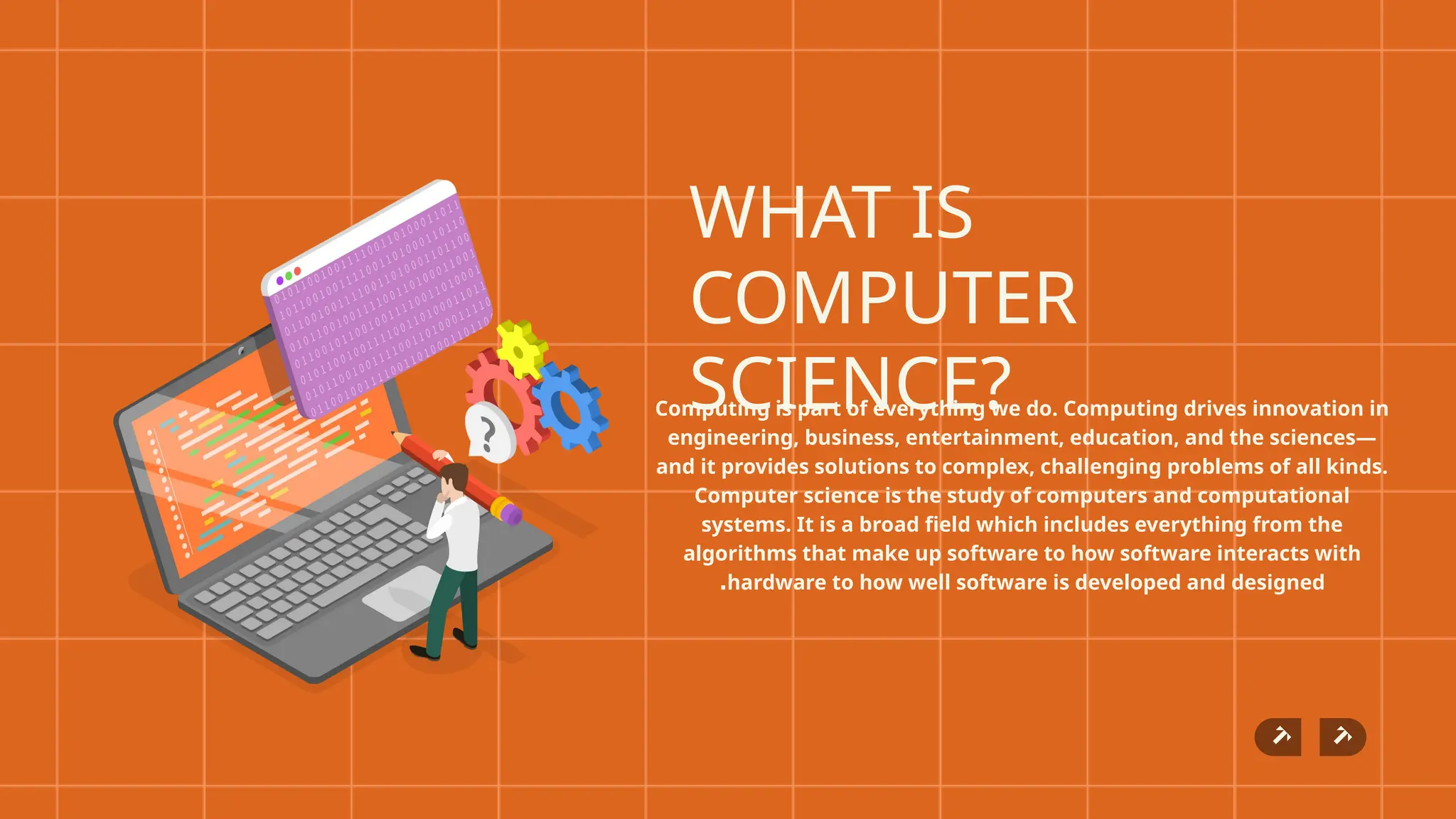
Computing is part of everything we do. Computing drives innovation in
engineering, business, entertainment, education, and the sciences—
and it provides solutions to complex, challenging problems of all kinds.
Computer science is the study of computers and computational
systems. It is a broad field which includes everything from the
algorithms that make up software to how software interacts with
hardware to how well software is developed and designed
.
WHAT DO WE LEARN?
Basics of Computer Cybersecurity Data Protection
A computer is an electronic
device that manipulates
information, or data. It has the
ability to store, retrieve, and
process data. You may already
know that you can use a
computer to type documents,
send email, play games, and
browse the Web. You can also
use it to edit or create
spreadsheets, presentations,
and even videos.
how individuals and
organisations reduce the
risk of cyber attack. Cyber
security's core function is
to protect the devices we
all use (smartphones,
laptops, tablets and
computers), and the
services we access - both
online and at work - from
theft or damage
the process of protecting
sensitive information from
damage, loss, or corruption.
As the amount of data being
created and stored has
increased at an
unprecedented rate, making
data protection increasingly
important
THANK YOU

Orange and Green Illustration Computer Science Presentation (1).pptx

  • 1.
  • 2.
    INTRODUCTI ON computer science focuseson the development and testing of software and software systems. It involves working with mathematical models, data analysis and security, algorithms, and computational theory
  • 3.
    VISION & MISION Our Vision OurMission Provide the ambience to become industry ready Professionals, Researchers and Entrepreneurs by offering courses on cutting edge technology and advanced laboratory courses for the students. To be the front runner in Computer Science education and to foster the students into globally competent professionals with expertise in software development and aptitude for research and ethical values.
  • 4.
    WHAT IS COMPUTER SCIENCE? Computing ispart of everything we do. Computing drives innovation in engineering, business, entertainment, education, and the sciences— and it provides solutions to complex, challenging problems of all kinds. Computer science is the study of computers and computational systems. It is a broad field which includes everything from the algorithms that make up software to how software interacts with hardware to how well software is developed and designed .
  • 5.
    WHAT DO WELEARN? Basics of Computer Cybersecurity Data Protection A computer is an electronic device that manipulates information, or data. It has the ability to store, retrieve, and process data. You may already know that you can use a computer to type documents, send email, play games, and browse the Web. You can also use it to edit or create spreadsheets, presentations, and even videos. how individuals and organisations reduce the risk of cyber attack. Cyber security's core function is to protect the devices we all use (smartphones, laptops, tablets and computers), and the services we access - both online and at work - from theft or damage the process of protecting sensitive information from damage, loss, or corruption. As the amount of data being created and stored has increased at an unprecedented rate, making data protection increasingly important
  • 6.