Local
anaesthesia
Definition :
Local anaesthesia is defined
as a reversible loss of
sensation in a circumscribed
area of a body caused by
depression of excitation in
nerve endings or an inhibition
of conduction process in
peripheral nerves.
Methods of inducing local anaesthesia:
◈ Low temperature
◈ Mechanical trauma
◈ Anoxia
◈ Neurolytic agents such as alcohol & phenol
◈ Chemical agents such as local anaesthetics
Properties of local anaesthesia :
◈ Should be non irritating to tissues
◈ Should not cause permanent alteration of nerve structure
◈ Systemic toxicity should be low
◈ Time of onset should be short
◈ Should be effective regardless of site of injection
◈ Duration of cation should be long
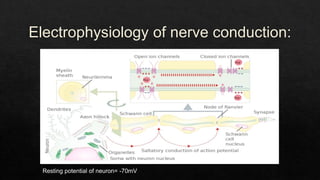
Electrophysiology of nerve conduction:
Resting potential of neuron= -70mV
Mechanism of action of local
anaesthesia
Local anaesthesia agent achieves interference with excitation process
in nerve membrane in one of following ways:
• Altering basic resting potential of nerve membrane
• Altering threshold potential
• Decreasing rate of depolarisation
• Prolonging rate of repolarization
Theories of mechanism of mechanism of
action of local anaesthetic agent
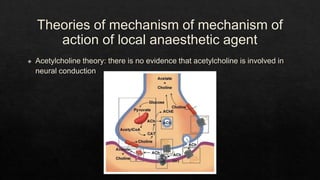
◈ Acetylcholine theory: there is no evidence that acetylcholine is involved in
neural conduction
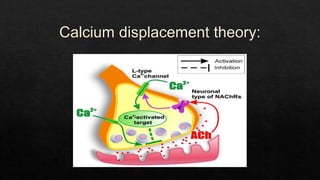
Calcium displacement theory:
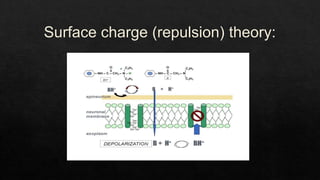
Surface charge (repulsion) theory:
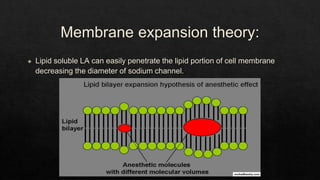
Membrane expansion theory:
◈ Lipid soluble LA can easily penetrate the lipid portion of cell membrane
decreasing the diameter of sodium channel.
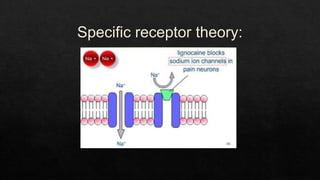
Specific receptor theory:
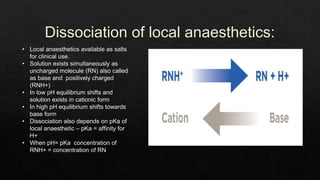
Dissociation of local anaesthetics:
• Local anaesthetics available as salts
for clinical use.
• Solution exists simultaneously as
uncharged molecule (RN) also called
as base and positively charged
(RNH+)
• In low pH equilibrium shifts and
solution exists in cationic form
• In high pH equilibrium shifts towards
base form
• Dissociation also depends on pKa of
local anaesthetic – pKa = affinity for
H+
• When pH= pKa concentration of
RNH+ = concentration of RN
Contents of local anaesthetic agent:
◈ Local anaesthetic agent (xylocaine, lignocaine 2%)
◈ vasoconstrictor ( adrenaline 1:80000) : to decrease the blood flow to injection site
absorption od LA into systemic circulation
decrease systemic toxicity
Maximum dose - 0.2mg & for patient with cardiovascular history - 0.4mg
◈ Reducing agent ( sodium metabisulphite) : vasoconstrictors are unstable in solution may get
oxidised on long standing and change the colour of solution. Hence, Na- bisulphite added it
competes for oxygen.
◈ Preservative ( methyl paraben, capryl hydrocuprienotoxin) : to maintain the sterility and allow
long standing pf LA . Some subjects may be allergic towards methylparaben.
◈ Fungicide ( thymol)
◈ Vehicle ( distilled water, NaCl) : to maintain the isotonicity which minimizes the discomfort during
injection
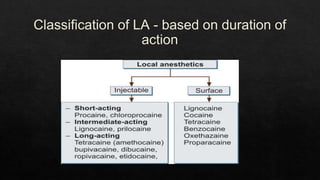
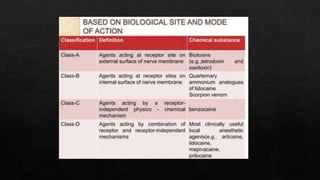
Classification of LA - based on duration of
action
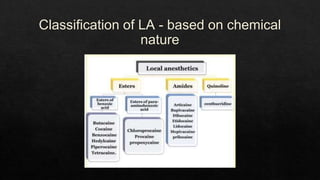
Classification of LA - based on chemical
nature
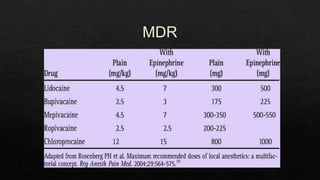
MDR
Armanterium required
◈ Syringe
◈ Needle
◈ Cartrige
◈ Other- topical anaesthesia : ointment, gels, pastes, sprays
applicator tips
cotton gauze
Oral surgery basic introduction

Oral surgery basic introduction

  • 1.
  • 2.
    Definition : Local anaesthesiais defined as a reversible loss of sensation in a circumscribed area of a body caused by depression of excitation in nerve endings or an inhibition of conduction process in peripheral nerves.
  • 3.
    Methods of inducinglocal anaesthesia: ◈ Low temperature ◈ Mechanical trauma ◈ Anoxia ◈ Neurolytic agents such as alcohol & phenol ◈ Chemical agents such as local anaesthetics
  • 4.
    Properties of localanaesthesia : ◈ Should be non irritating to tissues ◈ Should not cause permanent alteration of nerve structure ◈ Systemic toxicity should be low ◈ Time of onset should be short ◈ Should be effective regardless of site of injection ◈ Duration of cation should be long
  • 5.
    Electrophysiology of nerveconduction: Resting potential of neuron= -70mV
  • 6.
    Mechanism of actionof local anaesthesia Local anaesthesia agent achieves interference with excitation process in nerve membrane in one of following ways: • Altering basic resting potential of nerve membrane • Altering threshold potential • Decreasing rate of depolarisation • Prolonging rate of repolarization
  • 7.
    Theories of mechanismof mechanism of action of local anaesthetic agent ◈ Acetylcholine theory: there is no evidence that acetylcholine is involved in neural conduction
  • 8.
  • 9.
  • 10.
    Membrane expansion theory: ◈Lipid soluble LA can easily penetrate the lipid portion of cell membrane decreasing the diameter of sodium channel.
  • 11.
  • 12.
    Dissociation of localanaesthetics: • Local anaesthetics available as salts for clinical use. • Solution exists simultaneously as uncharged molecule (RN) also called as base and positively charged (RNH+) • In low pH equilibrium shifts and solution exists in cationic form • In high pH equilibrium shifts towards base form • Dissociation also depends on pKa of local anaesthetic – pKa = affinity for H+ • When pH= pKa concentration of RNH+ = concentration of RN
  • 13.
    Contents of localanaesthetic agent: ◈ Local anaesthetic agent (xylocaine, lignocaine 2%) ◈ vasoconstrictor ( adrenaline 1:80000) : to decrease the blood flow to injection site absorption od LA into systemic circulation decrease systemic toxicity Maximum dose - 0.2mg & for patient with cardiovascular history - 0.4mg ◈ Reducing agent ( sodium metabisulphite) : vasoconstrictors are unstable in solution may get oxidised on long standing and change the colour of solution. Hence, Na- bisulphite added it competes for oxygen. ◈ Preservative ( methyl paraben, capryl hydrocuprienotoxin) : to maintain the sterility and allow long standing pf LA . Some subjects may be allergic towards methylparaben. ◈ Fungicide ( thymol) ◈ Vehicle ( distilled water, NaCl) : to maintain the isotonicity which minimizes the discomfort during injection
  • 14.
    Classification of LA- based on duration of action
  • 15.
    Classification of LA- based on chemical nature
  • 17.
  • 18.
    Armanterium required ◈ Syringe ◈Needle ◈ Cartrige ◈ Other- topical anaesthesia : ointment, gels, pastes, sprays applicator tips cotton gauze