2017 United States RCM Coding and Clinical
Documentation Market Leadership Award
BEST PRACTICES RESEARCH
© Frost & Sullivan 2017 2 “We Accelerate Growth”
Contents
Background and Company Performance ........................................................................3
Industry Challenges..............................................................................................3
Market Leadership................................................................................................4
Conclusion...........................................................................................................7
Significance of Market Leadership.................................................................................8
Understanding Market Leadership.................................................................................8
Best Practices Recognition: 10 Steps to Researching, Identifying, and Recognizing Best
Practices .................................................................................................................10
The Intersection between 360-Degree Research and Best Practices Awards.....................11
Research Methodology ........................................................................................11
About Frost & Sullivan ..............................................................................................11
BEST PRACTICES RESEARCH
© Frost & Sullivan 2017 3 “We Accelerate Growth”
Background and Company Performance
Industry Challenges
The U.S. healthcare industry is in need of revenue cycle solutions that support healthcare
organizations in the transition to various reimbursement models. Prevalent financial
solutions often fail to effectively capture full reimbursement from payers for a wide variety
of patient services commonly rendered by hospitals and physician practices. Many
services are related to complex chronic conditions and associated complications that
require advanced clinical documentation and coding.
The recent transition from ICD-9 to ICD-10 (International Classification of Diseases) codes
helped providers realize that their underlying health information management (HIM)
encoders are not adequately equipped to manage the increased coding specificities of ICD-
10, which include 28 times as many procedure codes and five times as many diagnosis
codes. Frost & Sullivan notes that the productivity of in-house coders has also dropped
significantly, as most point-of-care physicians are still opposed to the idea of having to
pursue coding and practice medicine simultaneously and remain noncompliant with
specific documentation/coding standards; this is due to their lack of interest in or inability
to digitally identify and attribute appropriate codes for each patient. The increasing
reliance on high-wage coders to edit claims to prevent denials is compelling provider
executives to embrace clinical documentation improvement (CDI) and computer-assisted
coding (CAC) solutions that automate the coding process from clinical documentation,
standardize coding workflows at an enterprise level, and streamline the cost of clinical
documentation and coding per claim.
Medical coders provide a critical service, so their role obviously cannot be eliminated;
however, Frost & Sullivan points out that proper access to CDI and CAC products can help
them produce accurate claims more quickly by digitally tracing appropriate codes from
thousands of possible options.
Frost & Sullivan research shows that the value proposition of CDIs and CACs will continue
to be quite substantial due to the following factors:
• The average patient footprint per hospital remains strong amid the prevalence of
chronic diseases. This will increase the volume of specialty-specific claims that must be
processed digitally.
• Providers will embrace accountable care approaches due to increasing scrutiny from
the Centers for Medicare and Medicaid Services and private payers. Automated coding
will be used to detect any potential patterns of error or fraud.
Overall, ICD-10, payer-specific coding requirements and higher scrutiny for coding
compliance are driving providers to opt for more efficient coding products that primarily
include CDI and CAC solutions.
BEST PRACTICES RESEARCH
© Frost & Sullivan 2017 4 “We Accelerate Growth”
Market Leadership
Growth Strategy Excellence
Frost & Sullivan’s independent research of the U.S. RCM market reveals that the
digitization and standardization of RCM middle-end processes, which include clinical
documentation and coding, can provide substantial cost competitiveness to providers.
Historically, providers spent $25 per claim to reprocess those that were denied or required
editing—generally, 5–20 percent of all claims. More efficient clinical documentation and
coding would have helped them prevent more denials-and realize better revenue collection
worth millions of dollars.
• Frost & Sullivan observes how Optum Enterprise CAC and CDI 3D solutions are
positioned to help providers improve revenue cycle performance and can:
• Review clinical documentation in real time: The CDI 3D case-finding feature
identifies gaps in documentation and potential quality events at point of care – to
address as they occur. Seamless workflow between CDI and coding teams ensures
more complete and accurate documentation – leading to more complete and
accurate coding and reimbursement.
• Capture appropriate codes: Optum NLP technology applies both basic terminology
matching skills and advanced artificial intelligence capabilities to auto-identify
current procedural terminology and diagnostic codes within clinical documentation
for coding staff review. Assigned codes are connected to documentation supporting
the code assignment.
• Increase staff productivity: Automated clinical documentation review and code
attribution ensure coders spend less time searching for the right codes to assign.
Product Differentiation and Implementation Excellence
Frost & Sullivan observes that the adoption of CAC and CDI products is mainly to
integrated delivery networks, multispecialty hospital systems, and large physician
practices that primarily deploy at least 50 physicians. These provider groups must
successfully process a high volume of specialty-specific claims tied to value-based
reimbursement, and have the ability to invest substantial capital in progressive financial IT
solutions. C-level executives strive to ensure that the products in use sustain a 95 to 98%
clean claims rate for submissions to payers, and evaluate the quality and usability of CAC
and CDI solutions before choosing a vendor.
Frost & Sullivan finds that Optum Enterprise CAC and Optum CDI 3D products are
technologically superior, as they foster seamless interoperability between CDI and coding
departments. Both of these products share the Optum LifeCode NLP technology that
automates identification of correct codes based on physician documentation. The Optum
CDI 3D solution is also exclusive; powered by natural language processing (NLP)
BEST PRACTICES RESEARCH
© Frost & Sullivan 2017 5 “We Accelerate Growth”
technology and clinical-based algorithms, it improves RCM staff efficiency via concurrent,
automated review of clinical documentation for deficiencies. CDI 3D case-finding identifies
the cases with gaps in documentation or potential quality events for review. A wide variety
of encoding tools and services ensure that the CDI and CAC processes are standardized
and drive measurable results. Value benefits such as CDI automation, NLP-based case
reviews, work-list-enabled chart review prioritization, transparent governance of CDI
operations via on-demand dashboards and KPI benchmarking for executives allow health
systems to improve clinical documentation integrity and coding efficiency at an enterprise
level. The tangible benefits of the Optum CAC and CDI technologies for providers that
historically generated non standardized reports are equally important for every vendor in
this space. In 2016, Enterprise CAC customers were able to process over 800 million unique
clinical documents that were prepared across multiple care settings and via a diverse set
of underlying technology platforms, including electronic health record (EHR) and RCM
systems. Optum supports a wide range of document formats originating from disparate
care departments including inpatient, emergency medicine, ambulatory surgery, and
observation care, in addition to imaging, labs, and diagnostic testing systems.
Such comprehensive clinical documentation and coding capabilities have helped Optum
sustain a favorable mindshare among the most prestigious health systems in the United
States.
Today, Optum is successfully catering to both acquired and replaced markets, since its
CAC and CDI capabilities are broadly perceived as HIM encoder agnostic.
The Optum Enterprise CAC Platform can include its coding & reimbursement module,
which provides all encoding tools within a single application. This pioneering value
proposition drives provider systems to consider Optum CDI and CAC products as the
single solution for all hospitals CDI and coding needs.
In this way, a wide range of CAC and CDI users who either renewed long-term value-
driven contracts with Optum360 or migrated from competing products have completed a
seamless transition to more streamlined and efficient coding workflows that are also
manageable and measurable in real time via dashboard reporting. Such favorable
customer responses resulted in significant increase of market share for Optum360 over
the last few years.
Brand Strength
Optum, a leading IT company based in Eden Prairie, MN, earned $83.6 billion in 2016—
24% higher than its 2015 revenue. Average revenue per customer for OptumHealth,
which was reported as $54.2 million for 83 customers in Q4 2016, grew by 14.34% year
over year. OptumHealth provides clinical and financial IT solutions to payers and
providers. The company is also poised to grow inorganically with its unmatched appetite
for primary care providers and leading health care companies. OptumCare®
, which
comprises urgent care centers and community health clinics, has been on an acquisition
BEST PRACTICES RESEARCH
© Frost & Sullivan 2017 6 “We Accelerate Growth”
spree for U.S.-based physician practices since 2015: In January 2016, it acquired
MedExpress, which has a footprint in 14 U.S. states and serves close to 7 million patients
who are covered by more than 150 different health plans. In January 2017, UnitedHealth
Group acquired Surgical Care Affiliates for a whopping $2 billion and merged it with
OptumCare. In April 2017, it acquired American Health Network for $184 million. In
August 2017, Optum announced its plan to acquire The Advisory Board health care
business for $1.3 billion, and leverage its key product offerings tied to health care
research, technology and advisory services.
Frost & Sullivan recognizes that this aggressive acquisition strategy that expanded the
Optum health care portfolio is a key reason why the company is able to consolidate a vast
amount of patient data that can be assessed to help providers take the right step in
regards to evidence-based RCM and population health management.
Product Quality and Technology Leverage
Optum LifeCode NLP technology holds 5 patents that cumulatively enable users to practice
a variety of advanced clinical documentation and coding techniques. This includes the
ability to:
• Apply statistical algorithms for the purpose of differentiating medical facts from
generic clinical documentation,
• Promote usage of appropriate clinical definitions during documentation based on
automated assessment of multiple disease factors (e.g., acuity, history, body
location, timing),
• Stratify key clinical context from free texts and single phrases, which are
commonly provided by most physicians today, and
• Effectively audit clinical documents and coding workflows to highlight potential
gaps.
Since Optum Enterprise CAC and CDI 3D tools are driven by the unique capabilities of
Optum LifeCode, provider customers can accelerate clinical documentation improvement and
accurate code assignment, contributing to revenue integrity and operational efficiency. The Optum
team of consultants, trainers, IT implementers, and performance management experts
ensure that every provider can achieve measurable results and receive support throughout
the engagement to manage the transition toward accountable financial management.
BEST PRACTICES RESEARCH
© Frost & Sullivan 2017 7 “We Accelerate Growth”
Conclusion
Frost & Sullivan independent analysis confirms that Optum is the proven market leader in
the important RCM IT segment of CAC and CDI. The company’s visionary technological
capabilities are fortified by its corporate thought leadership that promotes continual
product improvements via organic and inorganic approaches. Patented technologies,
coupled with experienced support staff ensure that Optum customers thrive with better
financial outcomes. For example, Mission Health System in Asheville, NC, recently
achieved $297,000 in higher diagnosis-related group reimbursements per month, and
Trinity Health, which serves North Dakota and eastern Montana, improved outpatient
coding productivity by 72%, resulting in a 15% reduction in accounts receivable days.
With its strong overall performance, Optum has earned the 2017 Frost & Sullivan Market
Leadership Award.
BEST PRACTICES RESEARCH
© Frost & Sullivan 2017 8 “We Accelerate Growth”
Significance of Market Leadership
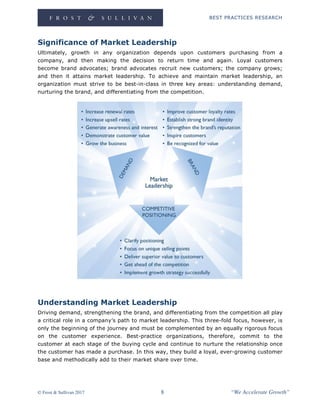
Ultimately, growth in any organization depends upon customers purchasing from a
company, and then making the decision to return time and again. Loyal customers
become brand advocates; brand advocates recruit new customers; the company grows;
and then it attains market leadership. To achieve and maintain market leadership, an
organization must strive to be best-in-class in three key areas: understanding demand,
nurturing the brand, and differentiating from the competition.
Understanding Market Leadership
Driving demand, strengthening the brand, and differentiating from the competition all play
a critical role in a company’s path to market leadership. This three-fold focus, however, is
only the beginning of the journey and must be complemented by an equally rigorous focus
on the customer experience. Best-practice organizations, therefore, commit to the
customer at each stage of the buying cycle and continue to nurture the relationship once
the customer has made a purchase. In this way, they build a loyal, ever-growing customer
base and methodically add to their market share over time.
BEST PRACTICES RESEARCH
© Frost & Sullivan 2017 9 “We Accelerate Growth”
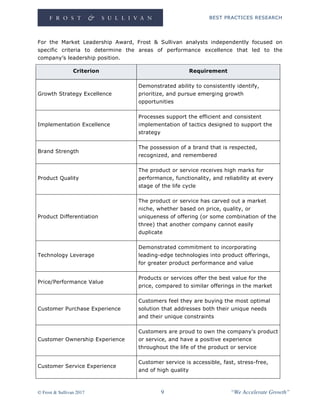
For the Market Leadership Award, Frost & Sullivan analysts independently focused on
specific criteria to determine the areas of performance excellence that led to the
company’s leadership position.
Criterion Requirement
Growth Strategy Excellence
Demonstrated ability to consistently identify,
prioritize, and pursue emerging growth
opportunities
Implementation Excellence
Processes support the efficient and consistent
implementation of tactics designed to support the
strategy
Brand Strength
The possession of a brand that is respected,
recognized, and remembered
Product Quality
The product or service receives high marks for
performance, functionality, and reliability at every
stage of the life cycle
Product Differentiation
The product or service has carved out a market
niche, whether based on price, quality, or
uniqueness of offering (or some combination of the
three) that another company cannot easily
duplicate
Technology Leverage
Demonstrated commitment to incorporating
leading-edge technologies into product offerings,
for greater product performance and value
Price/Performance Value
Products or services offer the best value for the
price, compared to similar offerings in the market
Customer Purchase Experience
Customers feel they are buying the most optimal
solution that addresses both their unique needs
and their unique constraints
Customer Ownership Experience
Customers are proud to own the company’s product
or service, and have a positive experience
throughout the life of the product or service
Customer Service Experience
Customer service is accessible, fast, stress-free,
and of high quality
BEST PRACTICES RESEARCH
© Frost & Sullivan 2017 10 “We Accelerate Growth”
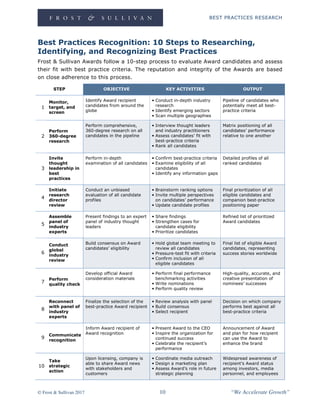
Best Practices Recognition: 10 Steps to Researching,
Identifying, and Recognizing Best Practices
Frost & Sullivan Awards follow a 10-step process to evaluate Award candidates and assess
their fit with best practice criteria. The reputation and integrity of the Awards are based
on close adherence to this process.
STEP OBJECTIVE KEY ACTIVITIES OUTPUT
1
Monitor,
target, and
screen
Identify Award recipient
candidates from around the
globe
• Conduct in-depth industry
research
• Identify emerging sectors
• Scan multiple geographies
Pipeline of candidates who
potentially meet all best-
practice criteria
2
Perform
360-degree
research
Perform comprehensive,
360-degree research on all
candidates in the pipeline
• Interview thought leaders
and industry practitioners
• Assess candidates’ fit with
best-practice criteria
• Rank all candidates
Matrix positioning of all
candidates’ performance
relative to one another
3
Invite
thought
leadership in
best
practices
Perform in-depth
examination of all candidates
• Confirm best-practice criteria
• Examine eligibility of all
candidates
• Identify any information gaps
Detailed profiles of all
ranked candidates
4
Initiate
research
director
review
Conduct an unbiased
evaluation of all candidate
profiles
• Brainstorm ranking options
• Invite multiple perspectives
on candidates’ performance
• Update candidate profiles
Final prioritization of all
eligible candidates and
companion best-practice
positioning paper
5
Assemble
panel of
industry
experts
Present findings to an expert
panel of industry thought
leaders
• Share findings
• Strengthen cases for
candidate eligibility
• Prioritize candidates
Refined list of prioritized
Award candidates
6
Conduct
global
industry
review
Build consensus on Award
candidates’ eligibility
• Hold global team meeting to
review all candidates
• Pressure-test fit with criteria
• Confirm inclusion of all
eligible candidates
Final list of eligible Award
candidates, representing
success stories worldwide
7
Perform
quality check
Develop official Award
consideration materials
• Perform final performance
benchmarking activities
• Write nominations
• Perform quality review
High-quality, accurate, and
creative presentation of
nominees’ successes
8
Reconnect
with panel of
industry
experts
Finalize the selection of the
best-practice Award recipient
• Review analysis with panel
• Build consensus
• Select recipient
Decision on which company
performs best against all
best-practice criteria
9
Communicate
recognition
Inform Award recipient of
Award recognition
• Present Award to the CEO
• Inspire the organization for
continued success
• Celebrate the recipient’s
performance
Announcement of Award
and plan for how recipient
can use the Award to
enhance the brand
10
Take
strategic
action
Upon licensing, company is
able to share Award news
with stakeholders and
customers
• Coordinate media outreach
• Design a marketing plan
• Assess Award’s role in future
strategic planning
Widespread awareness of
recipient’s Award status
among investors, media
personnel, and employees
BEST PRACTICES RESEARCH
© Frost & Sullivan 2017 11 “We Accelerate Growth”
The Intersection between 360-Degree Research and Best
Practices Awards
Research Methodology
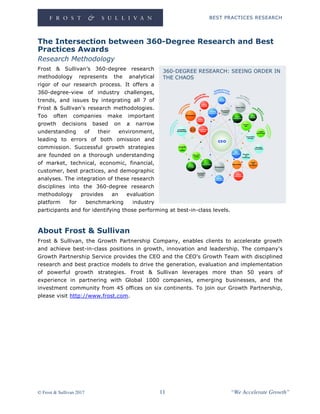
Frost & Sullivan’s 360-degree research
methodology represents the analytical
rigor of our research process. It offers a
360-degree-view of industry challenges,
trends, and issues by integrating all 7 of
Frost & Sullivan's research methodologies.
Too often companies make important
growth decisions based on a narrow
understanding of their environment,
leading to errors of both omission and
commission. Successful growth strategies
are founded on a thorough understanding
of market, technical, economic, financial,
customer, best practices, and demographic
analyses. The integration of these research
disciplines into the 360-degree research
methodology provides an evaluation
platform for benchmarking industry
participants and for identifying those performing at best-in-class levels.
About Frost & Sullivan
Frost & Sullivan, the Growth Partnership Company, enables clients to accelerate growth
and achieve best-in-class positions in growth, innovation and leadership. The company's
Growth Partnership Service provides the CEO and the CEO's Growth Team with disciplined
research and best practice models to drive the generation, evaluation and implementation
of powerful growth strategies. Frost & Sullivan leverages more than 50 years of
experience in partnering with Global 1000 companies, emerging businesses, and the
investment community from 45 offices on six continents. To join our Growth Partnership,
please visit http://www.frost.com.
360-DEGREE RESEARCH: SEEING ORDER IN
THE CHAOS

Optum Award Write Up

  • 1.
    2017 United StatesRCM Coding and Clinical Documentation Market Leadership Award
  • 2.
    BEST PRACTICES RESEARCH ©Frost & Sullivan 2017 2 “We Accelerate Growth” Contents Background and Company Performance ........................................................................3 Industry Challenges..............................................................................................3 Market Leadership................................................................................................4 Conclusion...........................................................................................................7 Significance of Market Leadership.................................................................................8 Understanding Market Leadership.................................................................................8 Best Practices Recognition: 10 Steps to Researching, Identifying, and Recognizing Best Practices .................................................................................................................10 The Intersection between 360-Degree Research and Best Practices Awards.....................11 Research Methodology ........................................................................................11 About Frost & Sullivan ..............................................................................................11
  • 3.
    BEST PRACTICES RESEARCH ©Frost & Sullivan 2017 3 “We Accelerate Growth” Background and Company Performance Industry Challenges The U.S. healthcare industry is in need of revenue cycle solutions that support healthcare organizations in the transition to various reimbursement models. Prevalent financial solutions often fail to effectively capture full reimbursement from payers for a wide variety of patient services commonly rendered by hospitals and physician practices. Many services are related to complex chronic conditions and associated complications that require advanced clinical documentation and coding. The recent transition from ICD-9 to ICD-10 (International Classification of Diseases) codes helped providers realize that their underlying health information management (HIM) encoders are not adequately equipped to manage the increased coding specificities of ICD- 10, which include 28 times as many procedure codes and five times as many diagnosis codes. Frost & Sullivan notes that the productivity of in-house coders has also dropped significantly, as most point-of-care physicians are still opposed to the idea of having to pursue coding and practice medicine simultaneously and remain noncompliant with specific documentation/coding standards; this is due to their lack of interest in or inability to digitally identify and attribute appropriate codes for each patient. The increasing reliance on high-wage coders to edit claims to prevent denials is compelling provider executives to embrace clinical documentation improvement (CDI) and computer-assisted coding (CAC) solutions that automate the coding process from clinical documentation, standardize coding workflows at an enterprise level, and streamline the cost of clinical documentation and coding per claim. Medical coders provide a critical service, so their role obviously cannot be eliminated; however, Frost & Sullivan points out that proper access to CDI and CAC products can help them produce accurate claims more quickly by digitally tracing appropriate codes from thousands of possible options. Frost & Sullivan research shows that the value proposition of CDIs and CACs will continue to be quite substantial due to the following factors: • The average patient footprint per hospital remains strong amid the prevalence of chronic diseases. This will increase the volume of specialty-specific claims that must be processed digitally. • Providers will embrace accountable care approaches due to increasing scrutiny from the Centers for Medicare and Medicaid Services and private payers. Automated coding will be used to detect any potential patterns of error or fraud. Overall, ICD-10, payer-specific coding requirements and higher scrutiny for coding compliance are driving providers to opt for more efficient coding products that primarily include CDI and CAC solutions.
  • 4.
    BEST PRACTICES RESEARCH ©Frost & Sullivan 2017 4 “We Accelerate Growth” Market Leadership Growth Strategy Excellence Frost & Sullivan’s independent research of the U.S. RCM market reveals that the digitization and standardization of RCM middle-end processes, which include clinical documentation and coding, can provide substantial cost competitiveness to providers. Historically, providers spent $25 per claim to reprocess those that were denied or required editing—generally, 5–20 percent of all claims. More efficient clinical documentation and coding would have helped them prevent more denials-and realize better revenue collection worth millions of dollars. • Frost & Sullivan observes how Optum Enterprise CAC and CDI 3D solutions are positioned to help providers improve revenue cycle performance and can: • Review clinical documentation in real time: The CDI 3D case-finding feature identifies gaps in documentation and potential quality events at point of care – to address as they occur. Seamless workflow between CDI and coding teams ensures more complete and accurate documentation – leading to more complete and accurate coding and reimbursement. • Capture appropriate codes: Optum NLP technology applies both basic terminology matching skills and advanced artificial intelligence capabilities to auto-identify current procedural terminology and diagnostic codes within clinical documentation for coding staff review. Assigned codes are connected to documentation supporting the code assignment. • Increase staff productivity: Automated clinical documentation review and code attribution ensure coders spend less time searching for the right codes to assign. Product Differentiation and Implementation Excellence Frost & Sullivan observes that the adoption of CAC and CDI products is mainly to integrated delivery networks, multispecialty hospital systems, and large physician practices that primarily deploy at least 50 physicians. These provider groups must successfully process a high volume of specialty-specific claims tied to value-based reimbursement, and have the ability to invest substantial capital in progressive financial IT solutions. C-level executives strive to ensure that the products in use sustain a 95 to 98% clean claims rate for submissions to payers, and evaluate the quality and usability of CAC and CDI solutions before choosing a vendor. Frost & Sullivan finds that Optum Enterprise CAC and Optum CDI 3D products are technologically superior, as they foster seamless interoperability between CDI and coding departments. Both of these products share the Optum LifeCode NLP technology that automates identification of correct codes based on physician documentation. The Optum CDI 3D solution is also exclusive; powered by natural language processing (NLP)
  • 5.
    BEST PRACTICES RESEARCH ©Frost & Sullivan 2017 5 “We Accelerate Growth” technology and clinical-based algorithms, it improves RCM staff efficiency via concurrent, automated review of clinical documentation for deficiencies. CDI 3D case-finding identifies the cases with gaps in documentation or potential quality events for review. A wide variety of encoding tools and services ensure that the CDI and CAC processes are standardized and drive measurable results. Value benefits such as CDI automation, NLP-based case reviews, work-list-enabled chart review prioritization, transparent governance of CDI operations via on-demand dashboards and KPI benchmarking for executives allow health systems to improve clinical documentation integrity and coding efficiency at an enterprise level. The tangible benefits of the Optum CAC and CDI technologies for providers that historically generated non standardized reports are equally important for every vendor in this space. In 2016, Enterprise CAC customers were able to process over 800 million unique clinical documents that were prepared across multiple care settings and via a diverse set of underlying technology platforms, including electronic health record (EHR) and RCM systems. Optum supports a wide range of document formats originating from disparate care departments including inpatient, emergency medicine, ambulatory surgery, and observation care, in addition to imaging, labs, and diagnostic testing systems. Such comprehensive clinical documentation and coding capabilities have helped Optum sustain a favorable mindshare among the most prestigious health systems in the United States. Today, Optum is successfully catering to both acquired and replaced markets, since its CAC and CDI capabilities are broadly perceived as HIM encoder agnostic. The Optum Enterprise CAC Platform can include its coding & reimbursement module, which provides all encoding tools within a single application. This pioneering value proposition drives provider systems to consider Optum CDI and CAC products as the single solution for all hospitals CDI and coding needs. In this way, a wide range of CAC and CDI users who either renewed long-term value- driven contracts with Optum360 or migrated from competing products have completed a seamless transition to more streamlined and efficient coding workflows that are also manageable and measurable in real time via dashboard reporting. Such favorable customer responses resulted in significant increase of market share for Optum360 over the last few years. Brand Strength Optum, a leading IT company based in Eden Prairie, MN, earned $83.6 billion in 2016— 24% higher than its 2015 revenue. Average revenue per customer for OptumHealth, which was reported as $54.2 million for 83 customers in Q4 2016, grew by 14.34% year over year. OptumHealth provides clinical and financial IT solutions to payers and providers. The company is also poised to grow inorganically with its unmatched appetite for primary care providers and leading health care companies. OptumCare® , which comprises urgent care centers and community health clinics, has been on an acquisition
  • 6.
    BEST PRACTICES RESEARCH ©Frost & Sullivan 2017 6 “We Accelerate Growth” spree for U.S.-based physician practices since 2015: In January 2016, it acquired MedExpress, which has a footprint in 14 U.S. states and serves close to 7 million patients who are covered by more than 150 different health plans. In January 2017, UnitedHealth Group acquired Surgical Care Affiliates for a whopping $2 billion and merged it with OptumCare. In April 2017, it acquired American Health Network for $184 million. In August 2017, Optum announced its plan to acquire The Advisory Board health care business for $1.3 billion, and leverage its key product offerings tied to health care research, technology and advisory services. Frost & Sullivan recognizes that this aggressive acquisition strategy that expanded the Optum health care portfolio is a key reason why the company is able to consolidate a vast amount of patient data that can be assessed to help providers take the right step in regards to evidence-based RCM and population health management. Product Quality and Technology Leverage Optum LifeCode NLP technology holds 5 patents that cumulatively enable users to practice a variety of advanced clinical documentation and coding techniques. This includes the ability to: • Apply statistical algorithms for the purpose of differentiating medical facts from generic clinical documentation, • Promote usage of appropriate clinical definitions during documentation based on automated assessment of multiple disease factors (e.g., acuity, history, body location, timing), • Stratify key clinical context from free texts and single phrases, which are commonly provided by most physicians today, and • Effectively audit clinical documents and coding workflows to highlight potential gaps. Since Optum Enterprise CAC and CDI 3D tools are driven by the unique capabilities of Optum LifeCode, provider customers can accelerate clinical documentation improvement and accurate code assignment, contributing to revenue integrity and operational efficiency. The Optum team of consultants, trainers, IT implementers, and performance management experts ensure that every provider can achieve measurable results and receive support throughout the engagement to manage the transition toward accountable financial management.
  • 7.
    BEST PRACTICES RESEARCH ©Frost & Sullivan 2017 7 “We Accelerate Growth” Conclusion Frost & Sullivan independent analysis confirms that Optum is the proven market leader in the important RCM IT segment of CAC and CDI. The company’s visionary technological capabilities are fortified by its corporate thought leadership that promotes continual product improvements via organic and inorganic approaches. Patented technologies, coupled with experienced support staff ensure that Optum customers thrive with better financial outcomes. For example, Mission Health System in Asheville, NC, recently achieved $297,000 in higher diagnosis-related group reimbursements per month, and Trinity Health, which serves North Dakota and eastern Montana, improved outpatient coding productivity by 72%, resulting in a 15% reduction in accounts receivable days. With its strong overall performance, Optum has earned the 2017 Frost & Sullivan Market Leadership Award.
  • 8.
    BEST PRACTICES RESEARCH ©Frost & Sullivan 2017 8 “We Accelerate Growth” Significance of Market Leadership Ultimately, growth in any organization depends upon customers purchasing from a company, and then making the decision to return time and again. Loyal customers become brand advocates; brand advocates recruit new customers; the company grows; and then it attains market leadership. To achieve and maintain market leadership, an organization must strive to be best-in-class in three key areas: understanding demand, nurturing the brand, and differentiating from the competition. Understanding Market Leadership Driving demand, strengthening the brand, and differentiating from the competition all play a critical role in a company’s path to market leadership. This three-fold focus, however, is only the beginning of the journey and must be complemented by an equally rigorous focus on the customer experience. Best-practice organizations, therefore, commit to the customer at each stage of the buying cycle and continue to nurture the relationship once the customer has made a purchase. In this way, they build a loyal, ever-growing customer base and methodically add to their market share over time.
  • 9.
    BEST PRACTICES RESEARCH ©Frost & Sullivan 2017 9 “We Accelerate Growth” For the Market Leadership Award, Frost & Sullivan analysts independently focused on specific criteria to determine the areas of performance excellence that led to the company’s leadership position. Criterion Requirement Growth Strategy Excellence Demonstrated ability to consistently identify, prioritize, and pursue emerging growth opportunities Implementation Excellence Processes support the efficient and consistent implementation of tactics designed to support the strategy Brand Strength The possession of a brand that is respected, recognized, and remembered Product Quality The product or service receives high marks for performance, functionality, and reliability at every stage of the life cycle Product Differentiation The product or service has carved out a market niche, whether based on price, quality, or uniqueness of offering (or some combination of the three) that another company cannot easily duplicate Technology Leverage Demonstrated commitment to incorporating leading-edge technologies into product offerings, for greater product performance and value Price/Performance Value Products or services offer the best value for the price, compared to similar offerings in the market Customer Purchase Experience Customers feel they are buying the most optimal solution that addresses both their unique needs and their unique constraints Customer Ownership Experience Customers are proud to own the company’s product or service, and have a positive experience throughout the life of the product or service Customer Service Experience Customer service is accessible, fast, stress-free, and of high quality
  • 10.
    BEST PRACTICES RESEARCH ©Frost & Sullivan 2017 10 “We Accelerate Growth” Best Practices Recognition: 10 Steps to Researching, Identifying, and Recognizing Best Practices Frost & Sullivan Awards follow a 10-step process to evaluate Award candidates and assess their fit with best practice criteria. The reputation and integrity of the Awards are based on close adherence to this process. STEP OBJECTIVE KEY ACTIVITIES OUTPUT 1 Monitor, target, and screen Identify Award recipient candidates from around the globe • Conduct in-depth industry research • Identify emerging sectors • Scan multiple geographies Pipeline of candidates who potentially meet all best- practice criteria 2 Perform 360-degree research Perform comprehensive, 360-degree research on all candidates in the pipeline • Interview thought leaders and industry practitioners • Assess candidates’ fit with best-practice criteria • Rank all candidates Matrix positioning of all candidates’ performance relative to one another 3 Invite thought leadership in best practices Perform in-depth examination of all candidates • Confirm best-practice criteria • Examine eligibility of all candidates • Identify any information gaps Detailed profiles of all ranked candidates 4 Initiate research director review Conduct an unbiased evaluation of all candidate profiles • Brainstorm ranking options • Invite multiple perspectives on candidates’ performance • Update candidate profiles Final prioritization of all eligible candidates and companion best-practice positioning paper 5 Assemble panel of industry experts Present findings to an expert panel of industry thought leaders • Share findings • Strengthen cases for candidate eligibility • Prioritize candidates Refined list of prioritized Award candidates 6 Conduct global industry review Build consensus on Award candidates’ eligibility • Hold global team meeting to review all candidates • Pressure-test fit with criteria • Confirm inclusion of all eligible candidates Final list of eligible Award candidates, representing success stories worldwide 7 Perform quality check Develop official Award consideration materials • Perform final performance benchmarking activities • Write nominations • Perform quality review High-quality, accurate, and creative presentation of nominees’ successes 8 Reconnect with panel of industry experts Finalize the selection of the best-practice Award recipient • Review analysis with panel • Build consensus • Select recipient Decision on which company performs best against all best-practice criteria 9 Communicate recognition Inform Award recipient of Award recognition • Present Award to the CEO • Inspire the organization for continued success • Celebrate the recipient’s performance Announcement of Award and plan for how recipient can use the Award to enhance the brand 10 Take strategic action Upon licensing, company is able to share Award news with stakeholders and customers • Coordinate media outreach • Design a marketing plan • Assess Award’s role in future strategic planning Widespread awareness of recipient’s Award status among investors, media personnel, and employees
  • 11.
    BEST PRACTICES RESEARCH ©Frost & Sullivan 2017 11 “We Accelerate Growth” The Intersection between 360-Degree Research and Best Practices Awards Research Methodology Frost & Sullivan’s 360-degree research methodology represents the analytical rigor of our research process. It offers a 360-degree-view of industry challenges, trends, and issues by integrating all 7 of Frost & Sullivan's research methodologies. Too often companies make important growth decisions based on a narrow understanding of their environment, leading to errors of both omission and commission. Successful growth strategies are founded on a thorough understanding of market, technical, economic, financial, customer, best practices, and demographic analyses. The integration of these research disciplines into the 360-degree research methodology provides an evaluation platform for benchmarking industry participants and for identifying those performing at best-in-class levels. About Frost & Sullivan Frost & Sullivan, the Growth Partnership Company, enables clients to accelerate growth and achieve best-in-class positions in growth, innovation and leadership. The company's Growth Partnership Service provides the CEO and the CEO's Growth Team with disciplined research and best practice models to drive the generation, evaluation and implementation of powerful growth strategies. Frost & Sullivan leverages more than 50 years of experience in partnering with Global 1000 companies, emerging businesses, and the investment community from 45 offices on six continents. To join our Growth Partnership, please visit http://www.frost.com. 360-DEGREE RESEARCH: SEEING ORDER IN THE CHAOS