Copyright © 2014, Oracle and/or its affiliates. All rights reserved. | 
Copyright © 2014, Oracle and/or its affiliates. All rights reserved. 
Chaithra M G Software engineer MySQL, Oracle October 17, 2014 
MySQL 5.7: What’s New in the Parser and the Optimizer?
Copyright © 2014, Oracle and/or its affiliates. All rights reserved. | 
Safe Harbor Statement 
The following is intended to outline our general product direction. It is intended for information purposes only, and may not be incorporated into any contract. It is not a commitment to deliver any material, code, or functionality, and should not be relied upon in making purchasing decisions. The development, release, and timing of any features or functionality described for Oracle’s products remains at the sole discretion of Oracle.
Copyright © 2014, Oracle and/or its affiliates. All rights reserved. | 
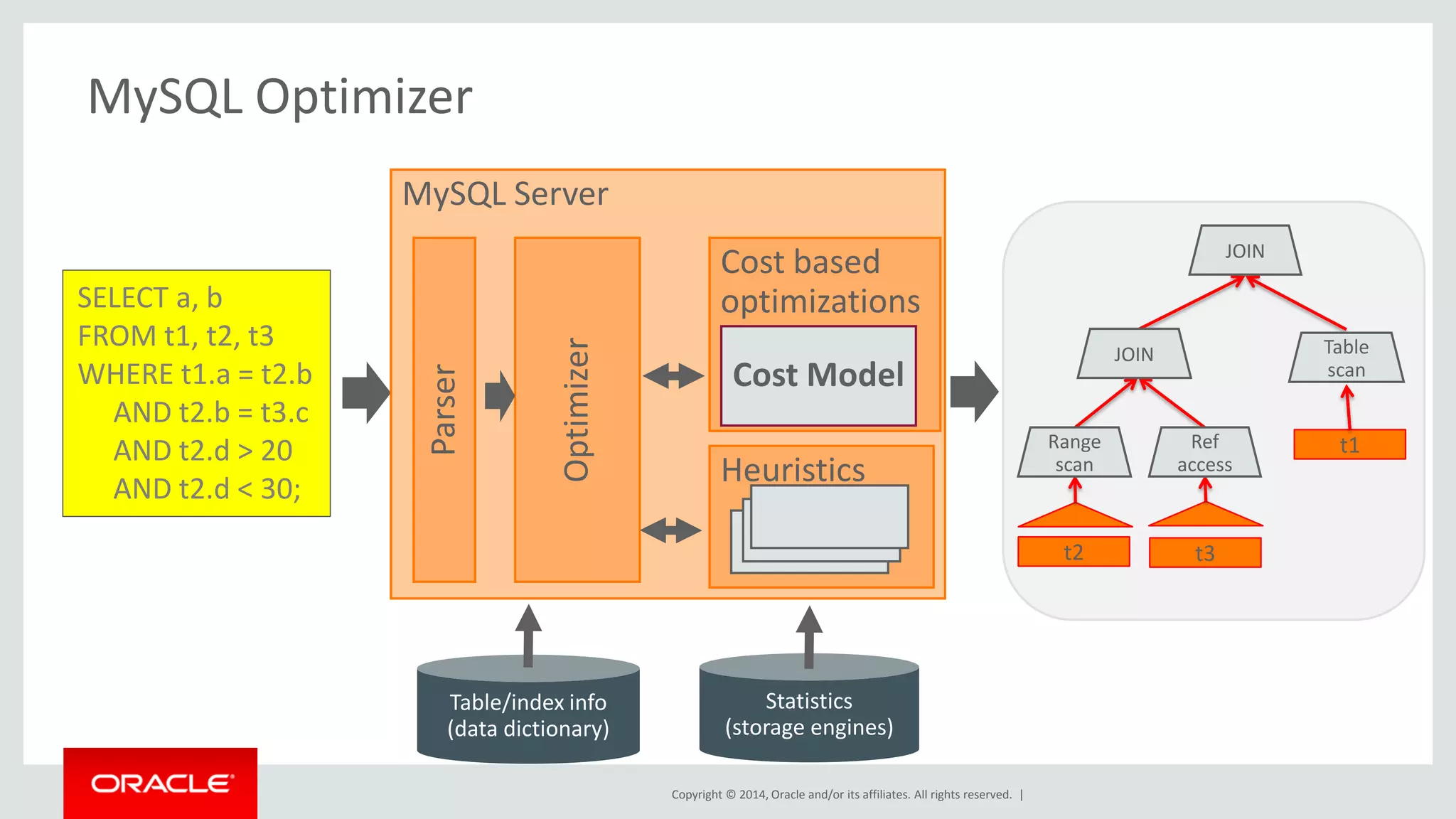
MySQL Optimizer 
SELECT a, b 
FROM t1, t2, t3 
WHERE t1.a = t2.b 
AND t2.b = t3.c 
AND t2.d > 20 
AND t2.d < 30; 
MySQL Server 
Cost based optimizations 
Heuristics 
Cost Model 
Optimizer 
Table/index info 
(data dictionary) 
Statistics 
(storage engines) 
t2 
t3 
t1 
Table 
scan 
Range 
scan 
Ref access 
JOIN 
JOIN 
Parser
Copyright © 2014, Oracle and/or its affiliates. All rights reserved. | 
MySQL Optimizer: Design Principles 
•Best out of the box performance 
•Easy to use, minimum tuning needed 
•When you need to understand: explain and trace 
•Flexibility through optimizer switches, hints and plugins 
•Fast evolving
Copyright © 2014, Oracle and/or its affiliates. All rights reserved. | 
MySQL 5.7 Parser and Optimizer Improvements 
•Parser and optimizer refactoring 
•Improved cost model: better record estimation for JOIN 
•Improved cost model: configurable cost constants 
•Query rewrite plugin 
•Explain on a running query
Copyright © 2014, Oracle and/or its affiliates. All rights reserved. | 
MySQL 5.7 Optimizer Improvements 
•Generated columns 
•UNION ALL queries no longer use temporary tables 
•Improved optimizations for queries with IN expressions 
•Optimized full text search
Copyright © 2014, Oracle and/or its affiliates. All rights reserved. | 
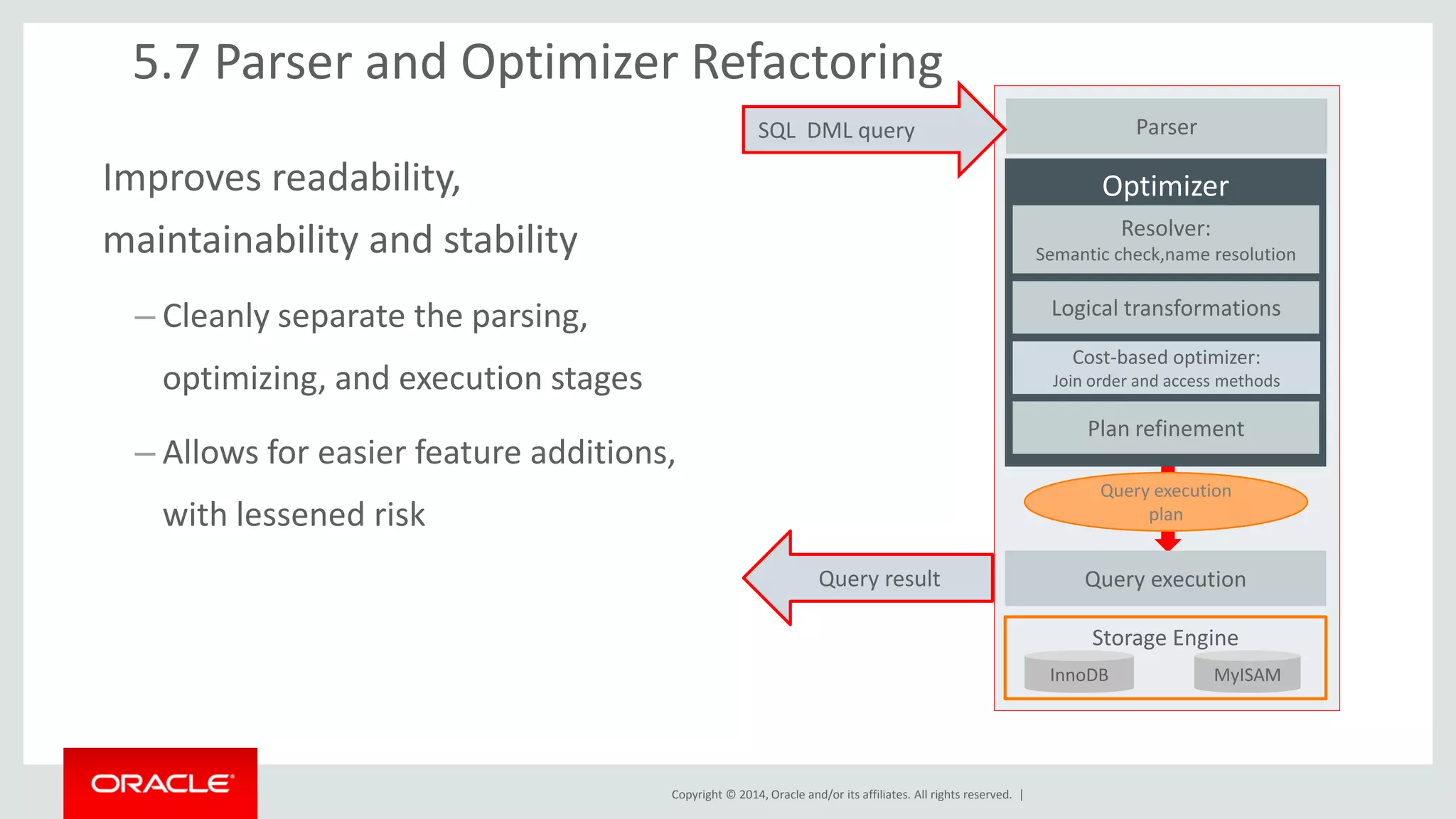
5.7 Parser and Optimizer Refactoring 
Optimizer 
Logical transformations 
Cost-based optimizer: 
Join order and access methods 
Plan refinement 
Query execution plan 
Query execution 
Parser 
Resolver: 
Semantic check,name resolution 
SQL DML query 
Query result 
Storage Engine 
InnoDB 
MyISAM 
Improves readability, maintainability and stability 
–Cleanly separate the parsing, optimizing, and execution stages 
–Allows for easier feature additions, with lessened risk
Copyright © 2014, Oracle and/or its affiliates. All rights reserved. | 
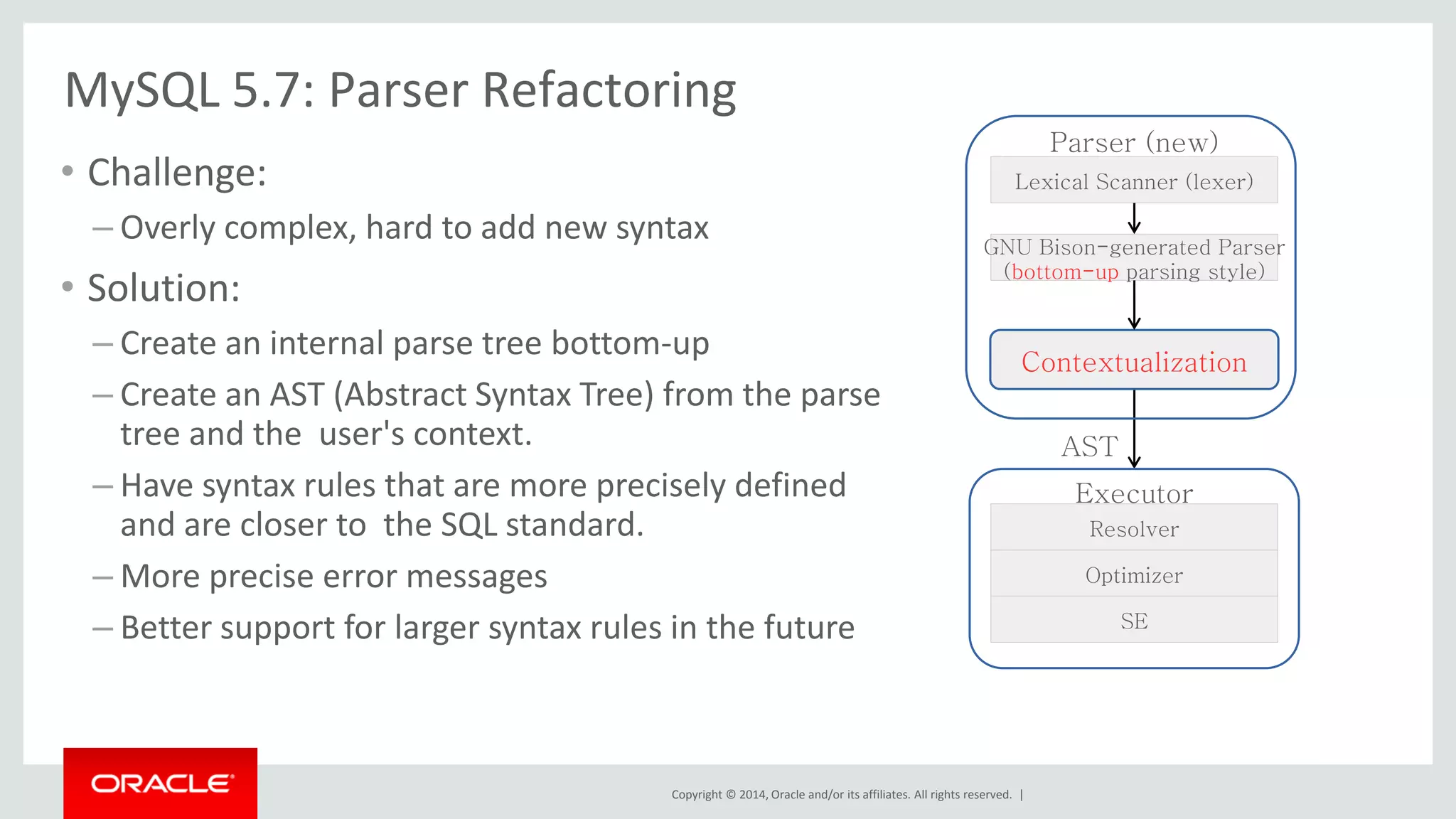
MySQL 5.7: Parser Refactoring 
•Challenge: 
–Overly complex, hard to add new syntax 
•Solution: 
–Create an internal parse tree bottom-up 
–Create an AST (Abstract Syntax Tree) from the parse tree and the user's context. 
–Have syntax rules that are more precisely defined and are closer to the SQL standard. 
–More precise error messages 
–Better support for larger syntax rules in the future 
Resolver 
Optimizer 
SE 
Lexical Scanner (lexer) 
GNU Bison-generated Parser 
(bottom-up parsing style) 
Contextualization 
Parser (new) 
Executor 
AST
Copyright © 2014, Oracle and/or its affiliates. All rights reserved. | 
Motivation for Changing the Cost Model 
•Adopt to new hardware architectures 
–SSD, larger memories, caches 
•Allows storage engines to provide accurate and dynamic cost estimate 
–Whether the data is in RAM, SSD, HDD? 
•More maintainable cost model implementation 
–Avoid hard coded constants 
–Refactoring of existing cost model code 
•Tunable/configurable 
•Replace heuristics with cost based decisions
Copyright © 2014, Oracle and/or its affiliates. All rights reserved. | 
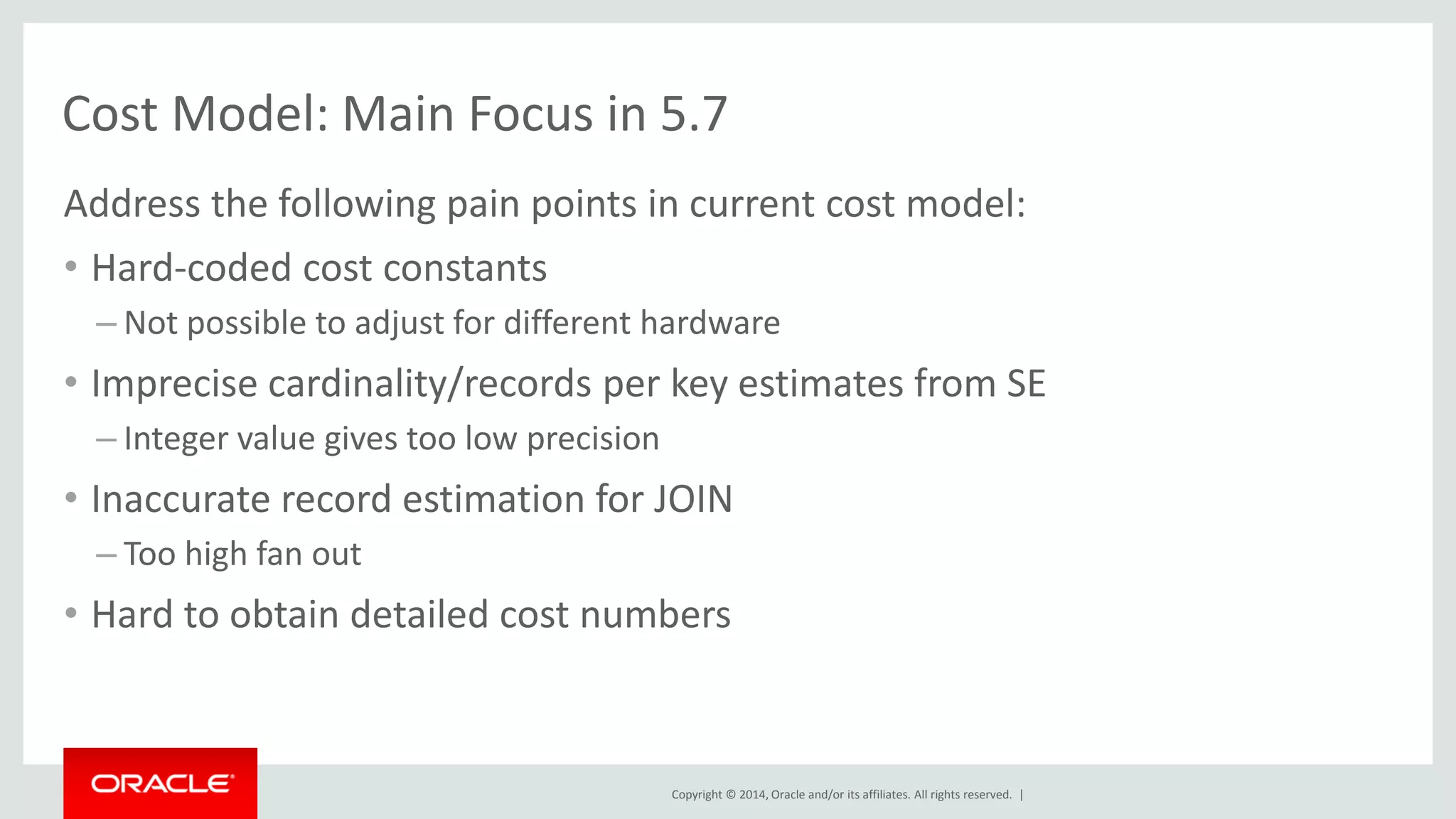
Cost Model: Main Focus in 5.7 
Address the following pain points in current cost model: 
•Hard-coded cost constants 
–Not possible to adjust for different hardware 
•Imprecise cardinality/records per key estimates from SE 
–Integer value gives too low precision 
•Inaccurate record estimation for JOIN 
–Too high fan out 
•Hard to obtain detailed cost numbers
Copyright © 2014, Oracle and/or its affiliates. All rights reserved. | 
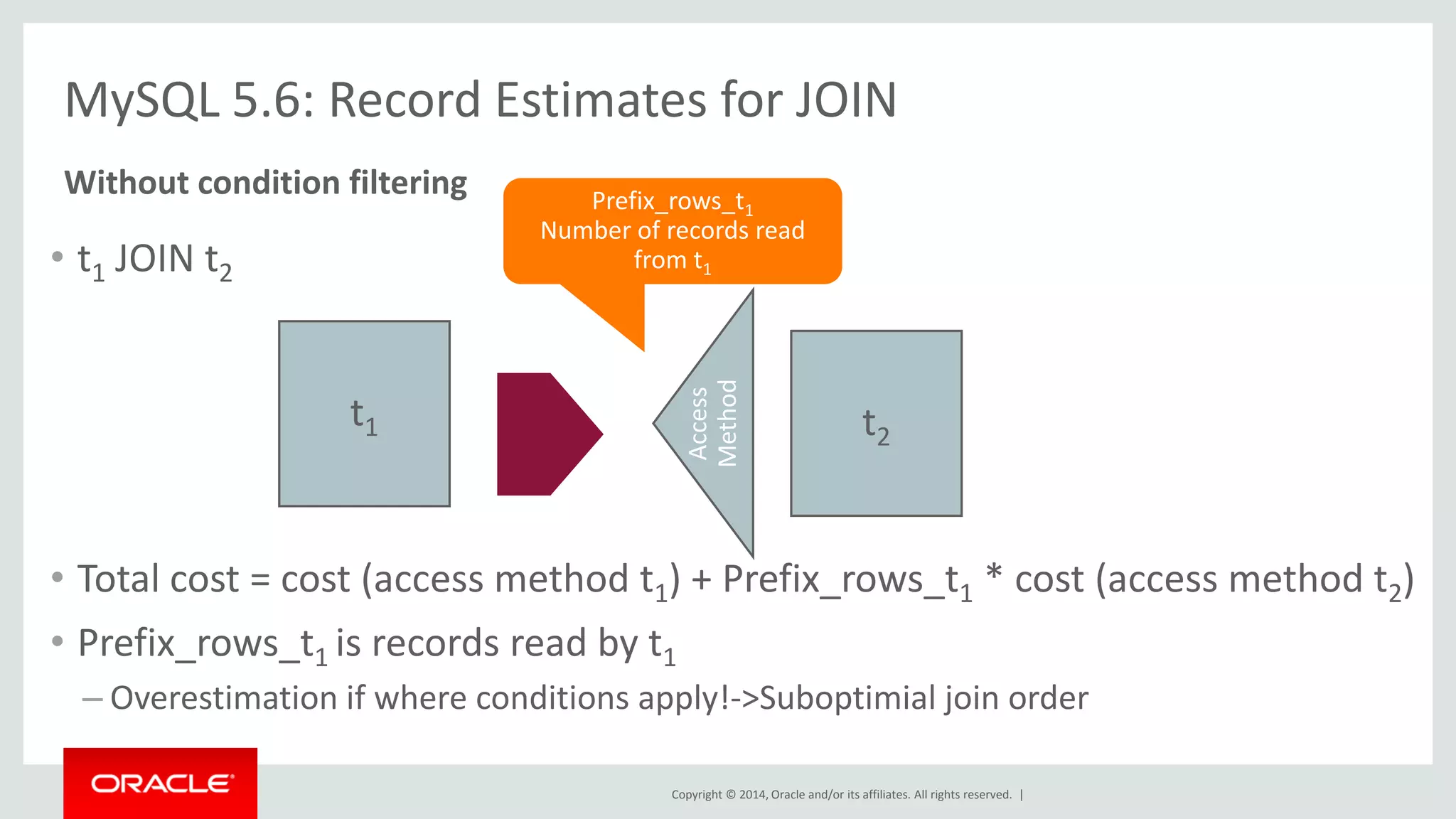
MySQL 5.6: Record Estimates for JOIN 
•t1 JOIN t2 
•Total cost = cost (access method t1) + Prefix_rows_t1 * cost (access method t2) 
•Prefix_rows_t1 is records read by t1 
–Overestimation if where conditions apply!->Suboptimial join order 
Without condition filtering 
t1 
t2 
Access 
Method 
Prefix_rows_t1 
Number of records read from t1
Copyright © 2014, Oracle and/or its affiliates. All rights reserved. | 
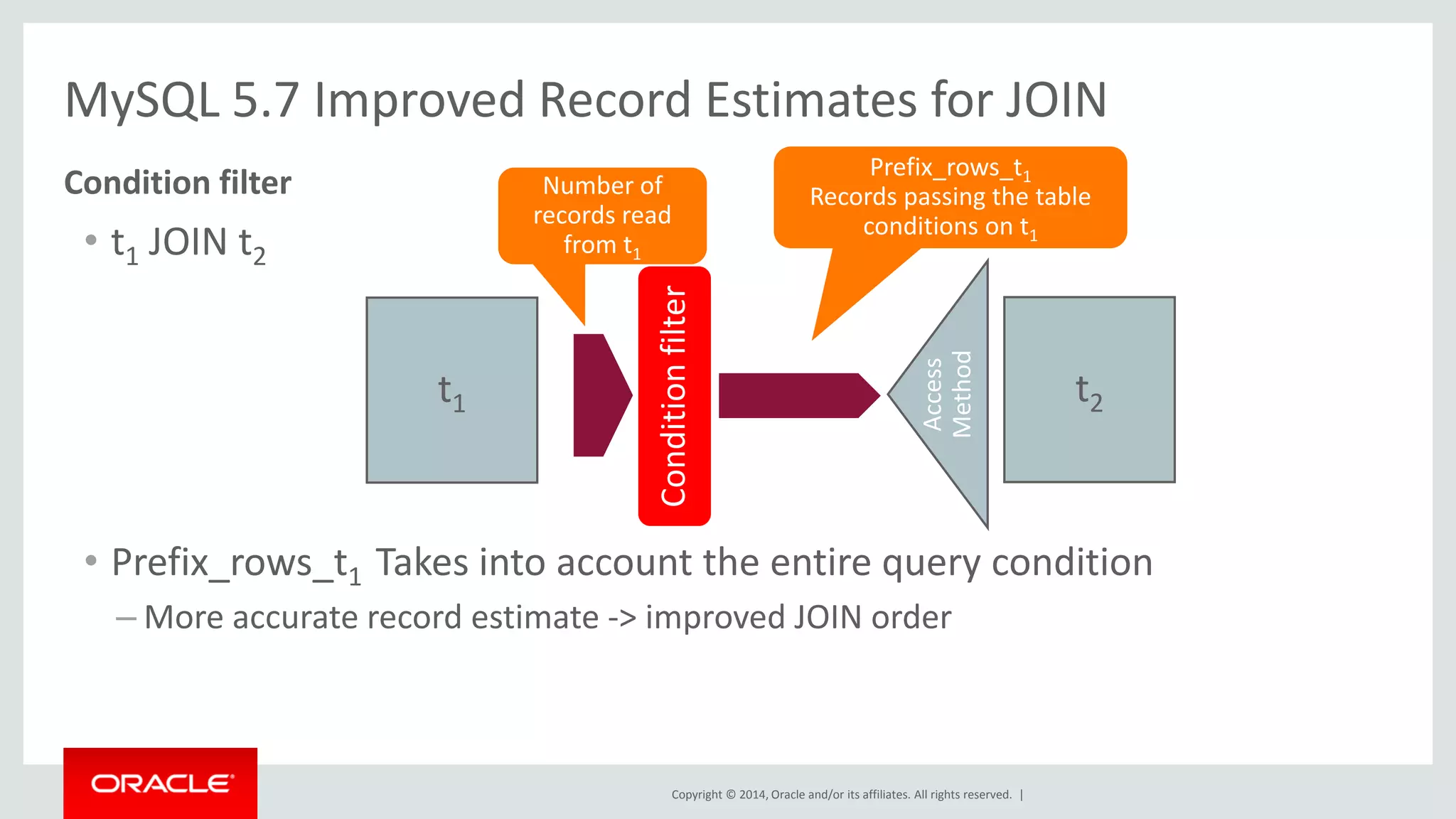
MySQL 5.7 Improved Record Estimates for JOIN 
•t1 JOIN t2 
•Prefix_rows_t1 Takes into account the entire query condition 
–More accurate record estimate -> improved JOIN order 
Condition filter 
t1 
t2 
Access Method 
Number of records read from t1 
Condition filter 
Prefix_rows_t1 Records passing the table conditions on t1
Copyright © 2014, Oracle and/or its affiliates. All rights reserved. | 
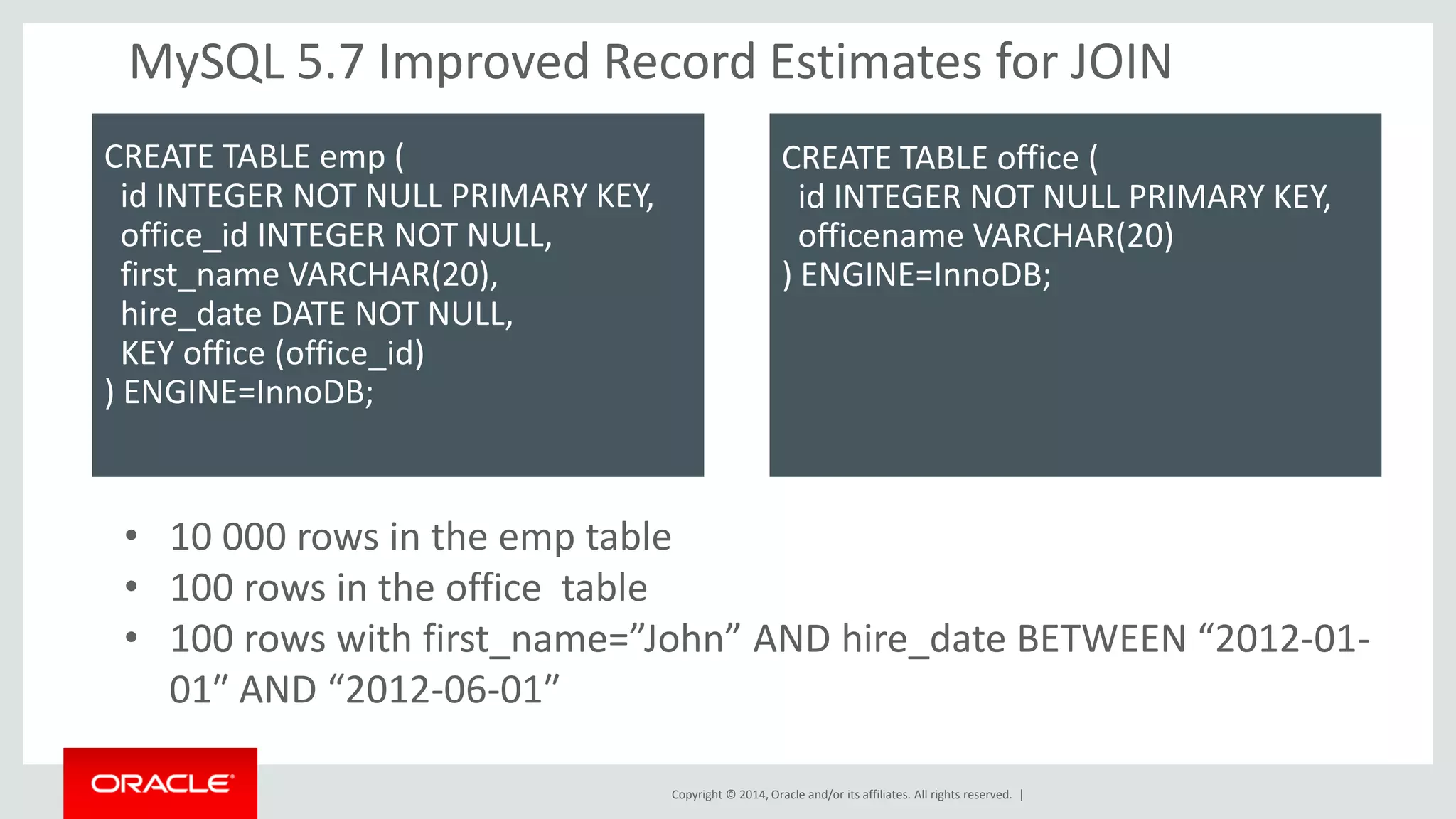
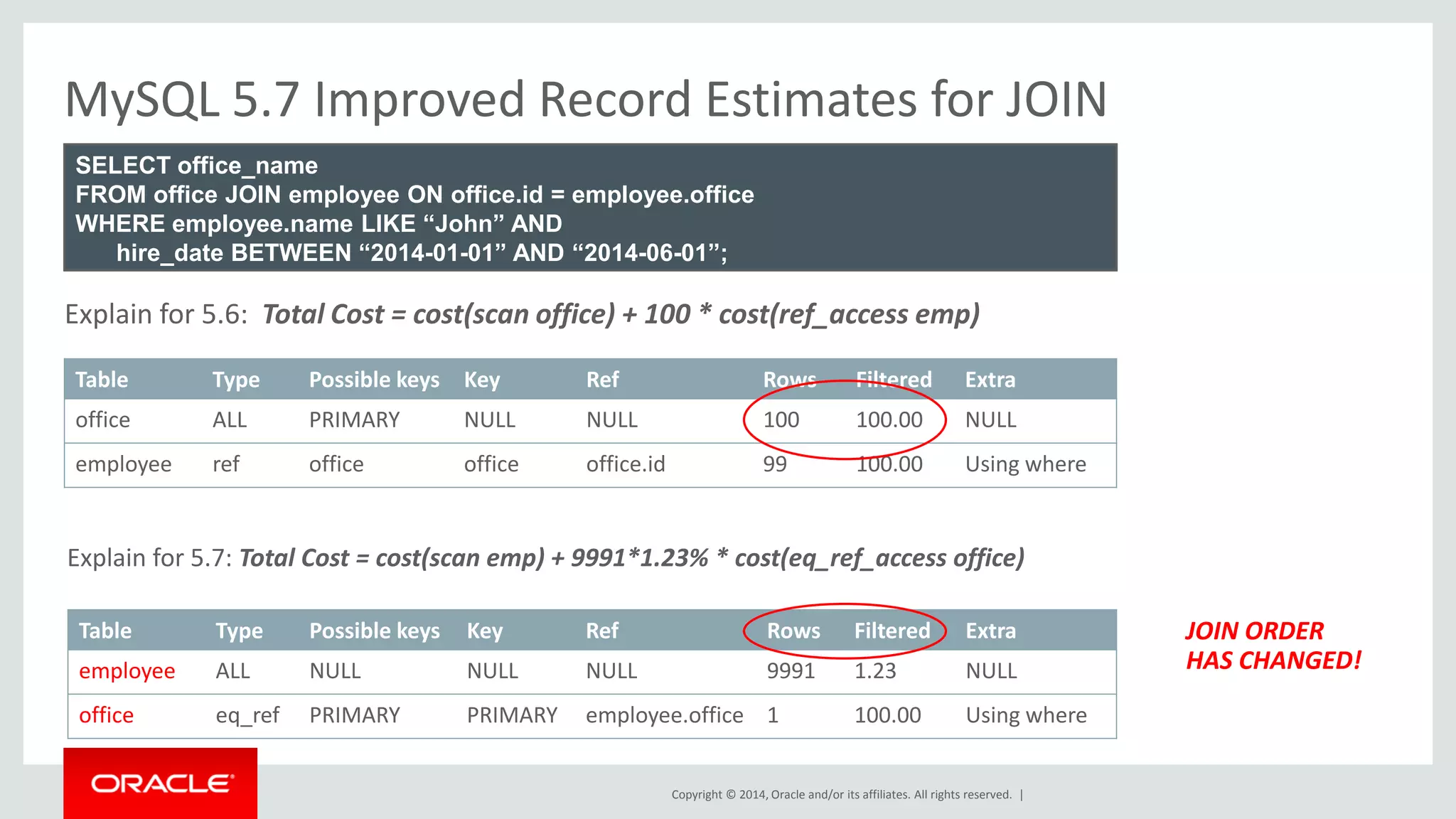
•10 000 rows in the emp table 
•100 rows in the office table 
•100 rows with first_name=”John” AND hire_date BETWEEN “2012-01- 01″ AND “2012-06-01″ 
MySQL 5.7 Improved Record Estimates for JOIN 
CREATE TABLE emp ( id INTEGER NOT NULL PRIMARY KEY, office_id INTEGER NOT NULL, first_name VARCHAR(20), hire_date DATE NOT NULL, KEY office (office_id) ) ENGINE=InnoDB; 
CREATE TABLE office ( id INTEGER NOT NULL PRIMARY KEY, officename VARCHAR(20) ) ENGINE=InnoDB;
Copyright © 2014, Oracle and/or its affiliates. All rights reserved. | 
Table 
Type 
Possible keys 
Key 
Ref 
Rows 
Filtered 
Extra 
office 
ALL 
PRIMARY 
NULL 
NULL 
100 
100.00 
NULL 
employee 
ref 
office 
office 
office.id 
99 
100.00 
Using where 
MySQL 5.7 Improved Record Estimates for JOIN 
Explain for 5.6: Total Cost = cost(scan office) + 100 * cost(ref_access emp) 
SELECT office_name FROM office JOIN employee ON office.id = employee.office WHERE employee.name LIKE “John” AND hire_date BETWEEN “2014-01-01” AND “2014-06-01”; 
Table 
Type 
Possible keys 
Key 
Ref 
Rows 
Filtered 
Extra 
employee 
ALL 
NULL 
NULL 
NULL 
9991 
1.23 
NULL 
office 
eq_ref 
PRIMARY 
PRIMARY 
employee.office 
1 
100.00 
Using where 
JOIN ORDER HAS CHANGED! 
Explain for 5.7: Total Cost = cost(scan emp) + 9991*1.23% * cost(eq_ref_access office)
Copyright © 2014, Oracle and/or its affiliates. All rights reserved. | 
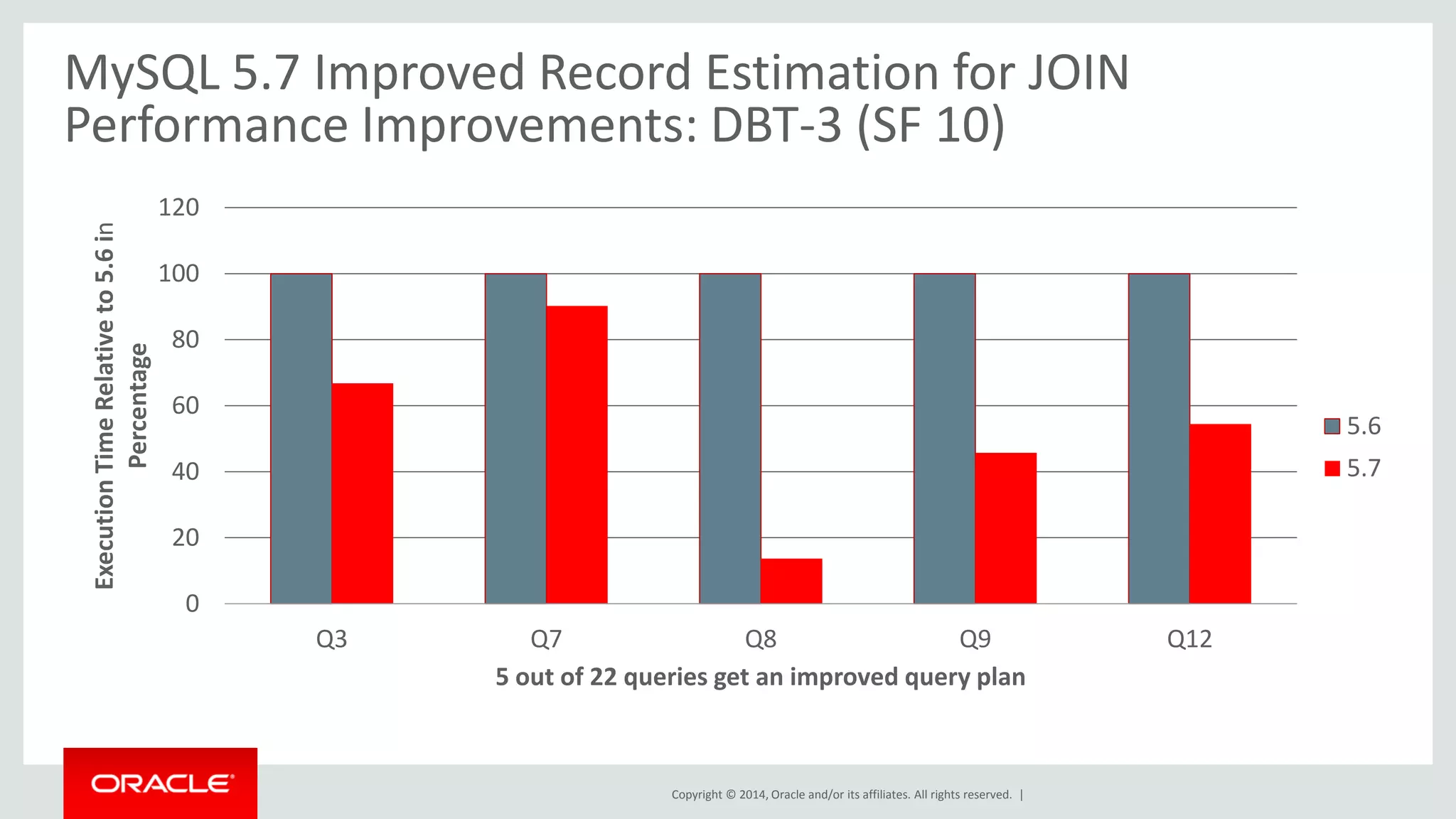
MySQL 5.7 Improved Record Estimation for JOIN Performance Improvements: DBT-3 (SF 10) 
0 
20 
40 
60 
80 
100 
120 
Q3 
Q7 
Q8 
Q9 
Q12 
Execution Time Relative to 5.6 in Percentage 
5 out of 22 queries get an improved query plan 
5.6 
5.7
Copyright © 2014, Oracle and/or its affiliates. All rights reserved. | 
MySQL 5.7 Additional Cost Data in JSON Explain 
JSON 
s 
mysql> EXPLAIN FORMAT=JSON SELECT SUM(o_totalprice) FROM orders WHERE o_orderdate BETWEEN '1994-01-01' AND '1994-12-31'; 
{ "query_block": { "select_id": 1, "cost_info": { "query_cost": "3118848.00" }, "table": { "table_name": "orders", "access_type": "ALL", "possible_keys": [ "i_o_orderdate" ], "rows_examined_per_scan": 15000000, "rows_produced_per_join": 4489990, "filtered": 29.933, "cost_info": { "read_cost": "2220850.00", "eval_cost": "897998.00", "prefix_cost": "3118848.00", "data_read_per_join": "582M" }, "used_columns": [ "o_totalprice", "o_orderDATE" ], "attached_condition": "(`dbt3`.`orders`.`o_orderDATE` between '1994-01-01' and '1994-12-31')" } } } 
Total query cost of a query block 
Cost per table 
Cost of sorting operation 
Cost of reading data 
Cost of evaluating conditions 
Cost of prefix join 
Rows examined/produced per join 
Used columns 
Data read per join – 
(# of rows)*(record width) in byte
Copyright © 2014, Oracle and/or its affiliates. All rights reserved. | 
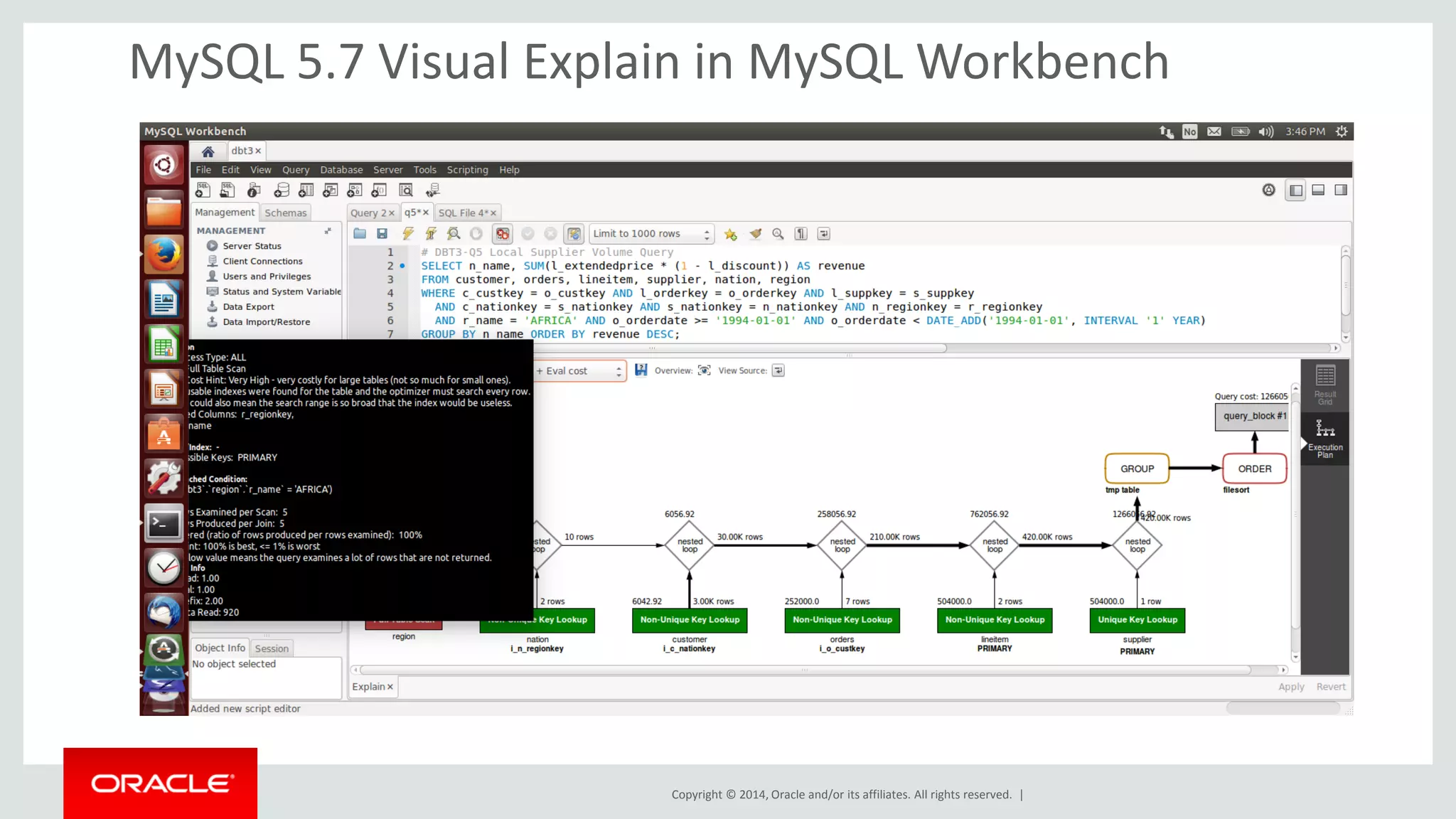
MySQL 5.7 Visual Explain in MySQL Workbench
Copyright © 2014, Oracle and/or its affiliates. All rights reserved. | 
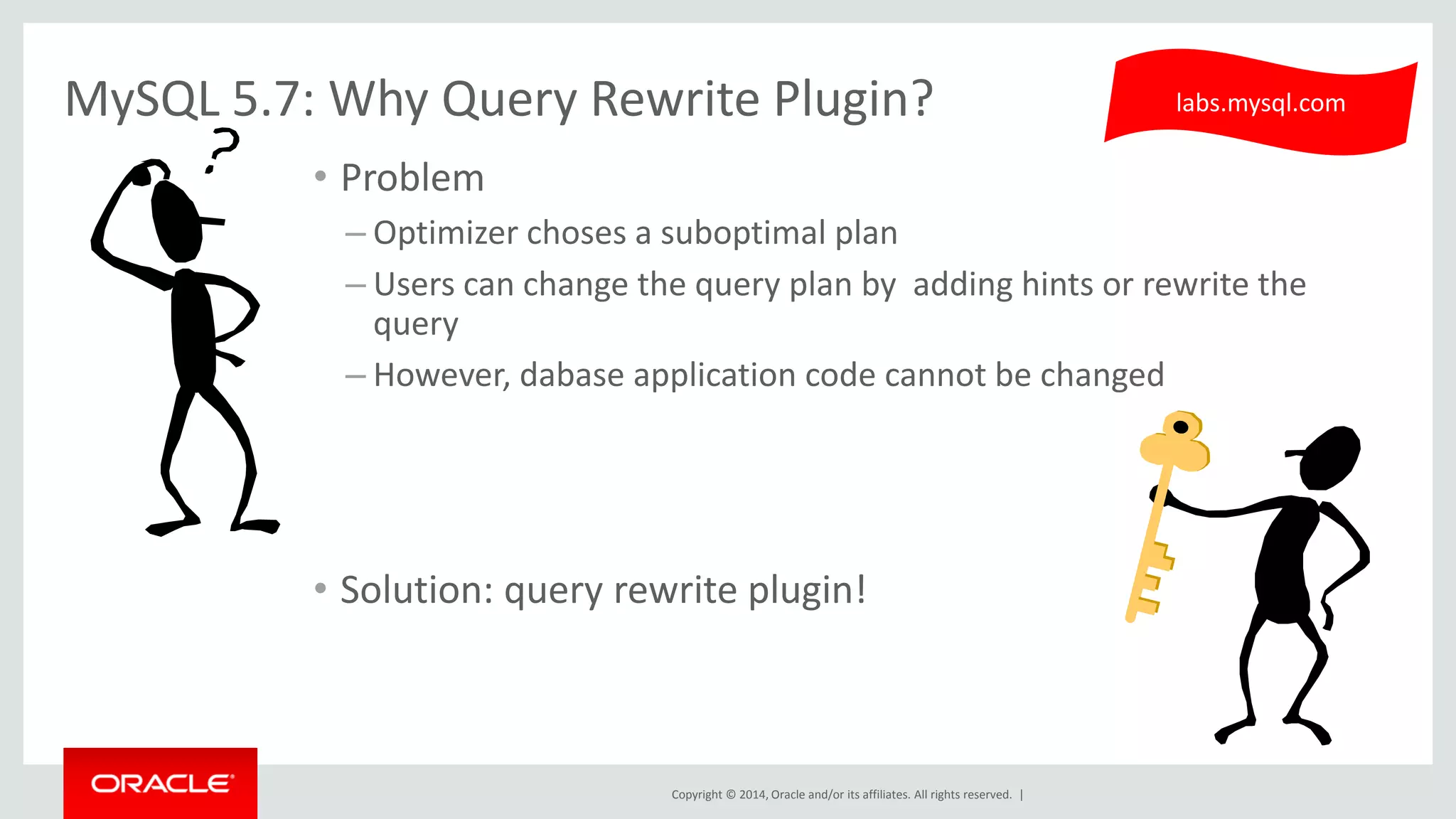
MySQL 5.7: Why Query Rewrite Plugin? 
• Problem 
– Optimizer choses a suboptimal plan 
– Users can change the query plan by adding hints or rewrite the 
query 
– However, dabase application code cannot be changed 
• Solution: query rewrite plugin! 
labs.mysql.com
Copyright © 2014, Oracle and/or its affiliates. All rights reserved. | 
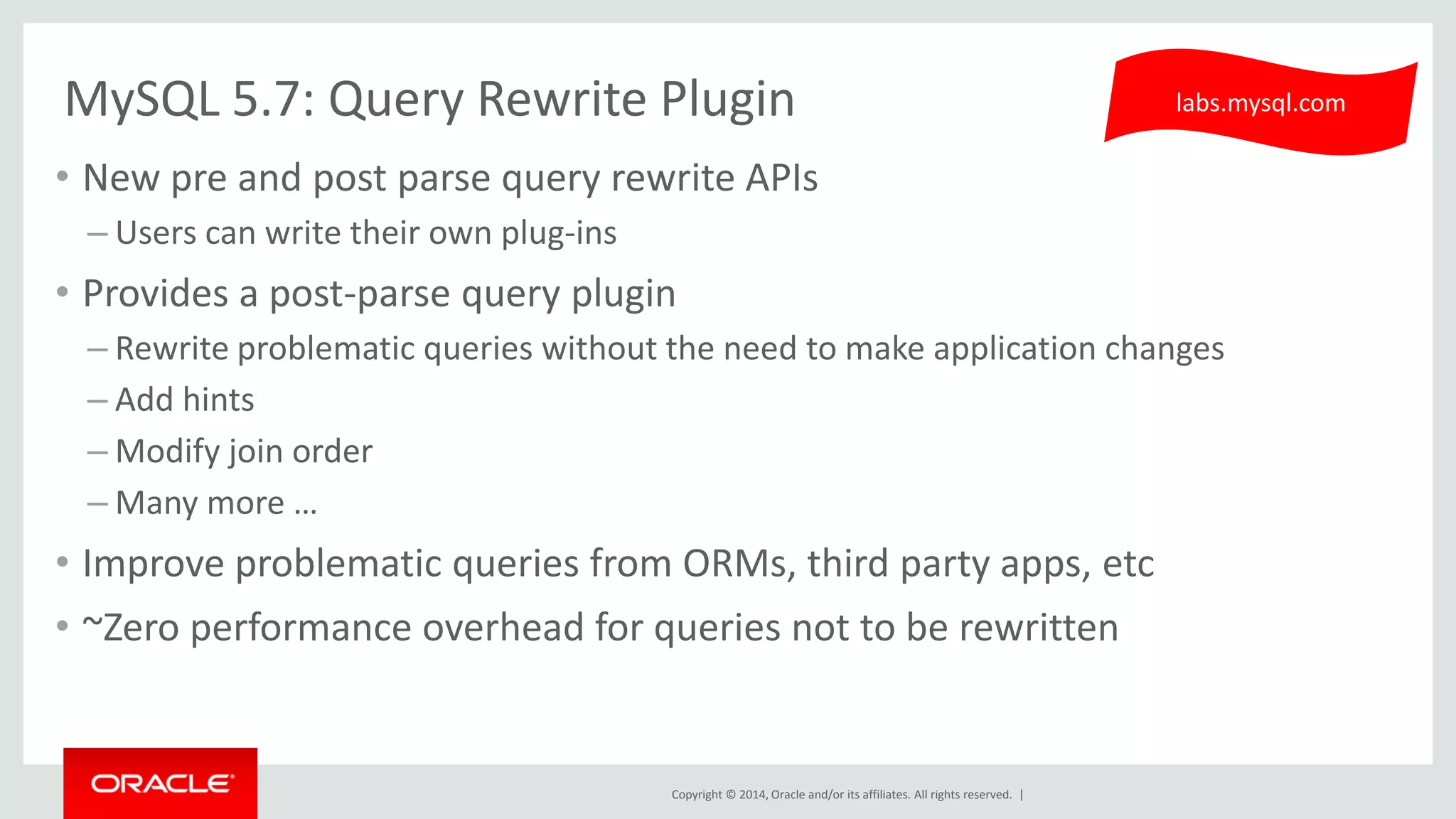
MySQL 5.7: Query Rewrite Plugin 
•New pre and post parse query rewrite APIs 
–Users can write their own plug-ins 
•Provides a post-parse query plugin 
–Rewrite problematic queries without the need to make application changes 
–Add hints 
–Modify join order 
–Many more … 
•Improve problematic queries from ORMs, third party apps, etc 
•~Zero performance overhead for queries not to be rewritten 
labs.mysql.com
Copyright © 2014, Oracle and/or its affiliates. All rights reserved. | 
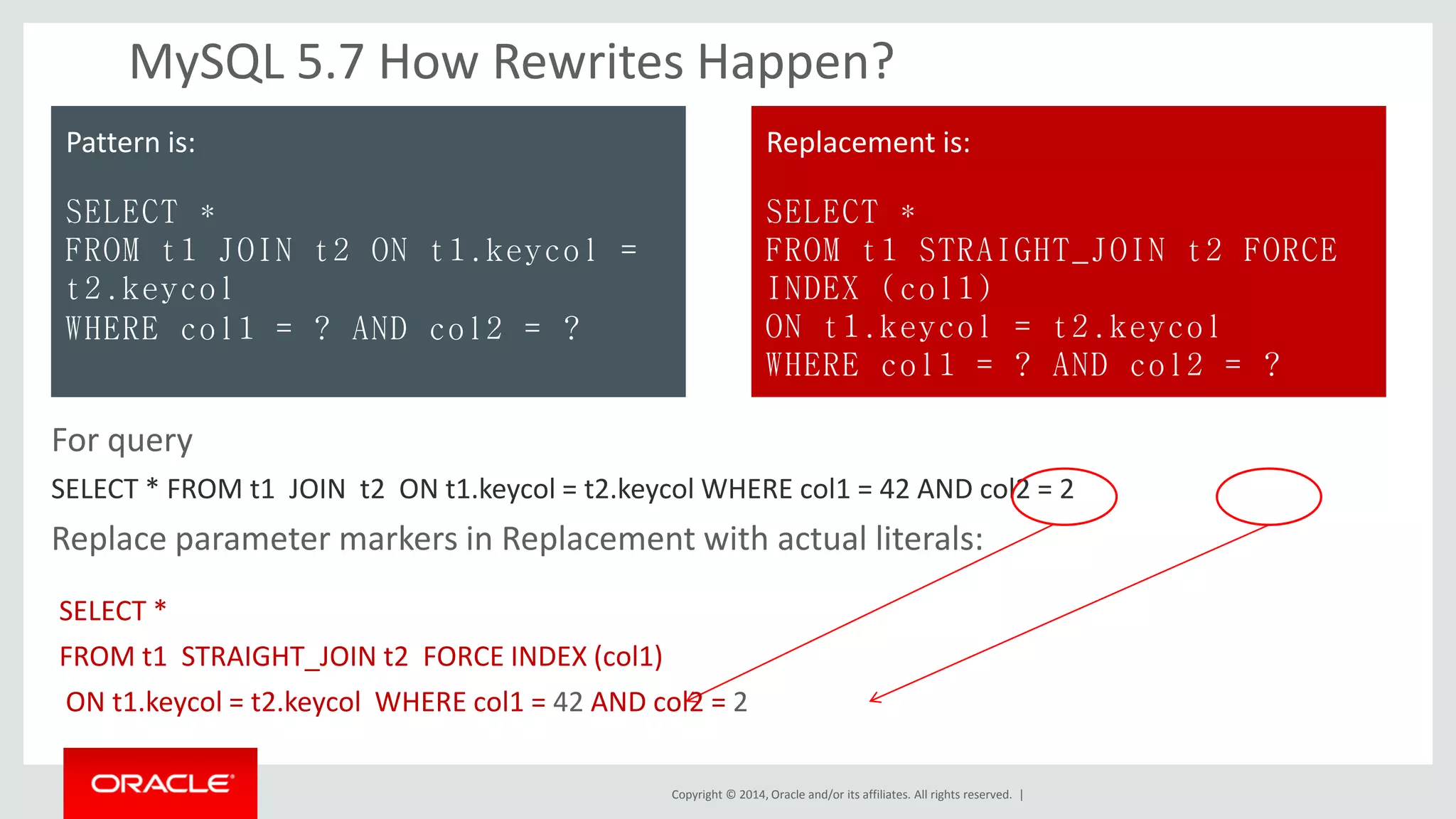
MySQL 5.7 How Rewrites Happen? 
For query 
SELECT * FROM t1 JOIN t2 ON t1.keycol = t2.keycol WHERE col1 = 42 AND col2 = 2 
Replace parameter markers in Replacement with actual literals: 
Pattern is: 
SELECT * 
FROM t1 JOIN t2 ON t1.keycol = t2.keycol 
WHERE col1 = ? AND col2 = ? 
Replacement is: 
SELECT * 
FROM t1 STRAIGHT_JOIN t2 FORCE INDEX (col1) 
ON t1.keycol = t2.keycol 
WHERE col1 = ? AND col2 = ? 
SELECT * 
FROM t1 STRAIGHT_JOIN t2 FORCE INDEX (col1) 
ON t1.keycol = t2.keycol WHERE col1 = 42 AND col2 = 2
Copyright © 2014, Oracle and/or its affiliates. All rights reserved. | 
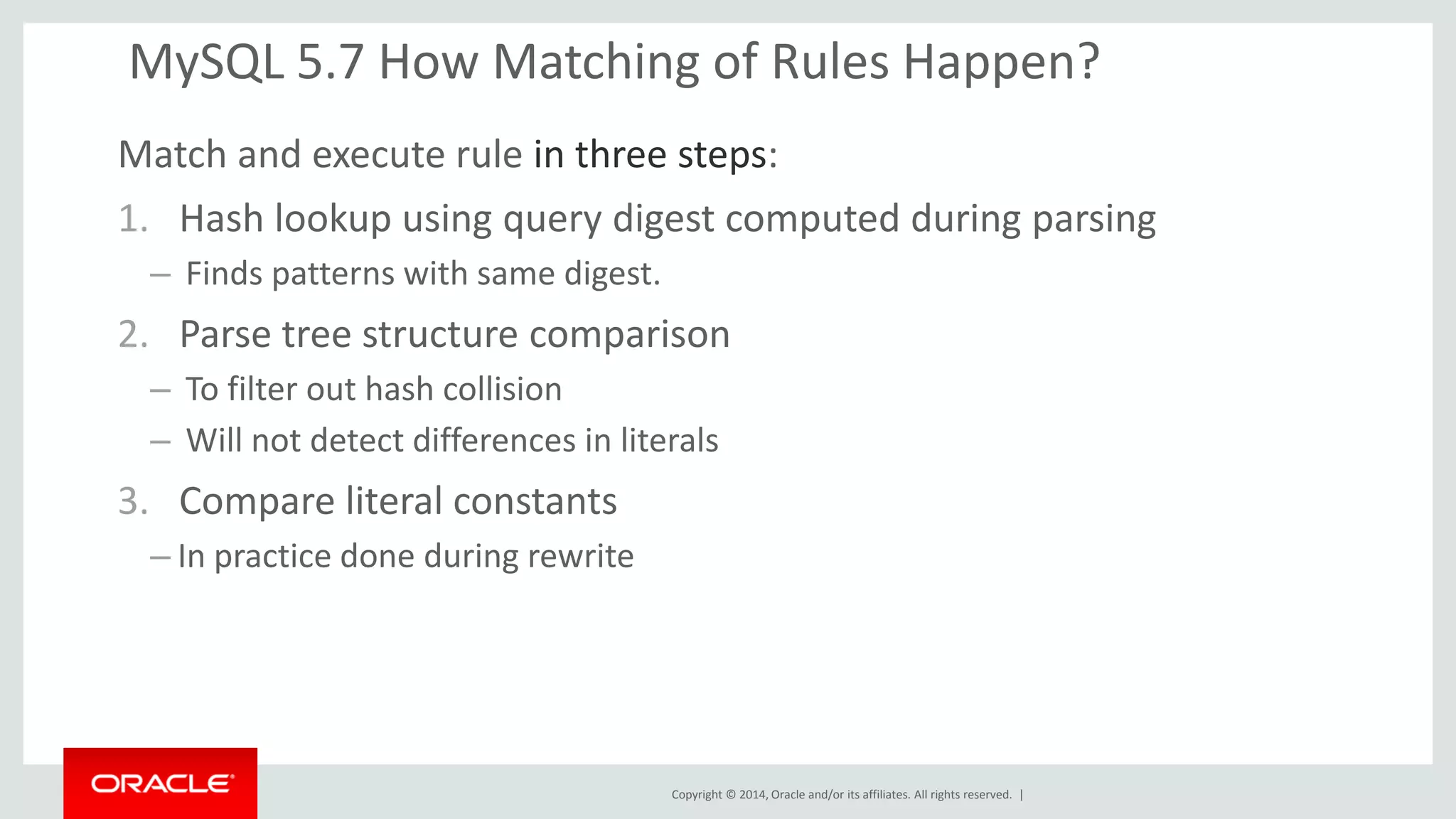
MySQL 5.7 How Matching of Rules Happen? 
Match and execute rule in three steps: 
1.Hash lookup using query digest computed during parsing 
– Finds patterns with same digest. 
2.Parse tree structure comparison 
– To filter out hash collision 
– Will not detect differences in literals 
3.Compare literal constants 
–In practice done during rewrite
Copyright © 2014, Oracle and/or its affiliates. All rights reserved. | 
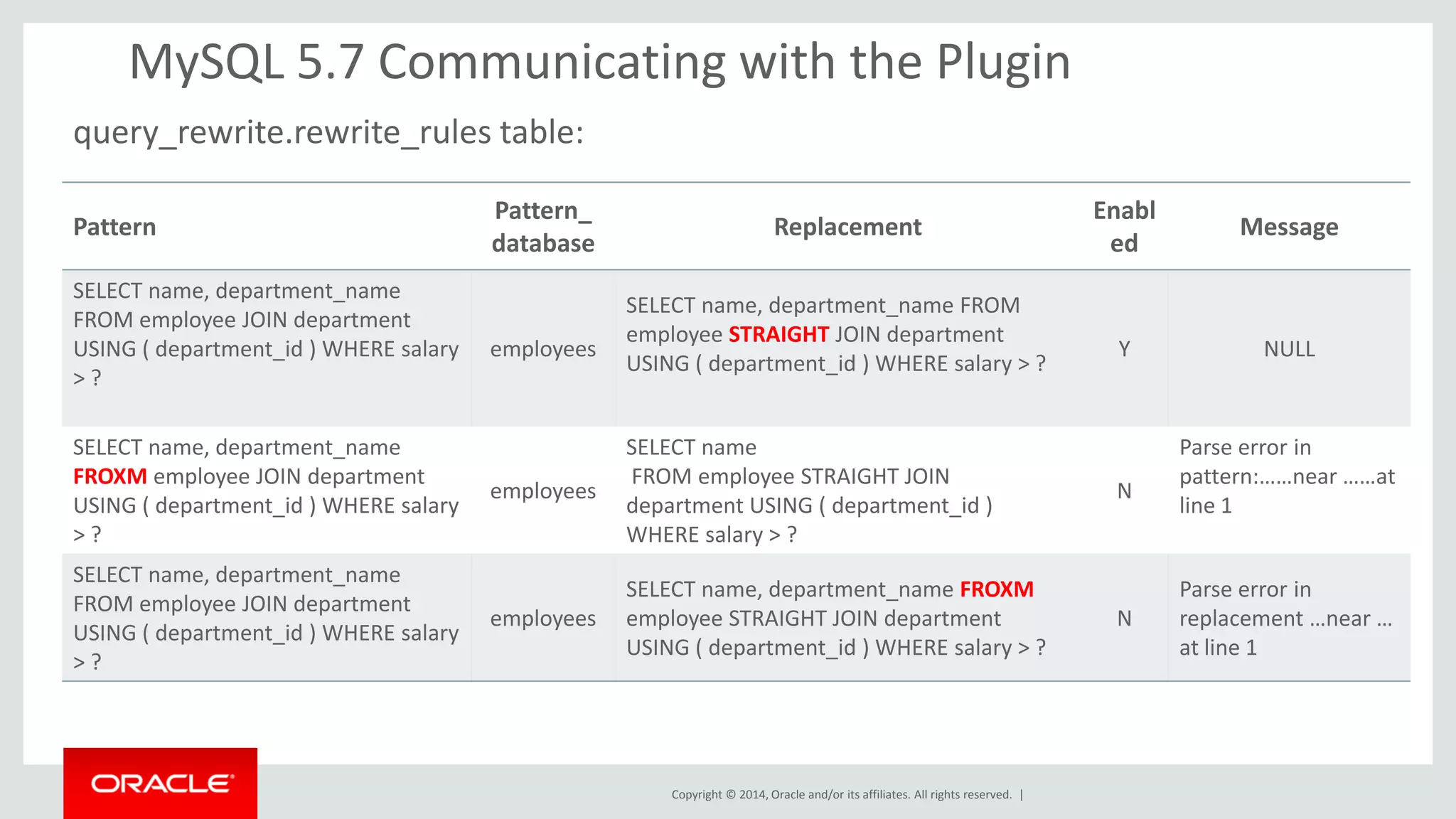
MySQL 5.7 Communicating with the Plugin 
query_rewrite.rewrite_rules table: 
Pattern 
Pattern_ 
database 
Replacement 
Enabled 
Message 
SELECT name, department_name FROM employee JOIN department USING ( department_id ) WHERE salary > ? 
employees 
SELECT name, department_name FROM employee STRAIGHT JOIN department USING ( department_id ) WHERE salary > ? 
Y 
NULL 
SELECT name, department_name FROXM employee JOIN department USING ( department_id ) WHERE salary > ? 
employees 
SELECT name 
FROM employee STRAIGHT JOIN department USING ( department_id ) WHERE salary > ? 
N 
Parse error in pattern:……near ……at line 1 
SELECT name, department_name FROM employee JOIN department USING ( department_id ) WHERE salary > ? 
employees 
SELECT name, department_name FROXM employee STRAIGHT JOIN department USING ( department_id ) WHERE salary > ? 
N 
Parse error in replacement …near … at line 1
Copyright © 2014, Oracle and/or its affiliates. All rights reserved. | 
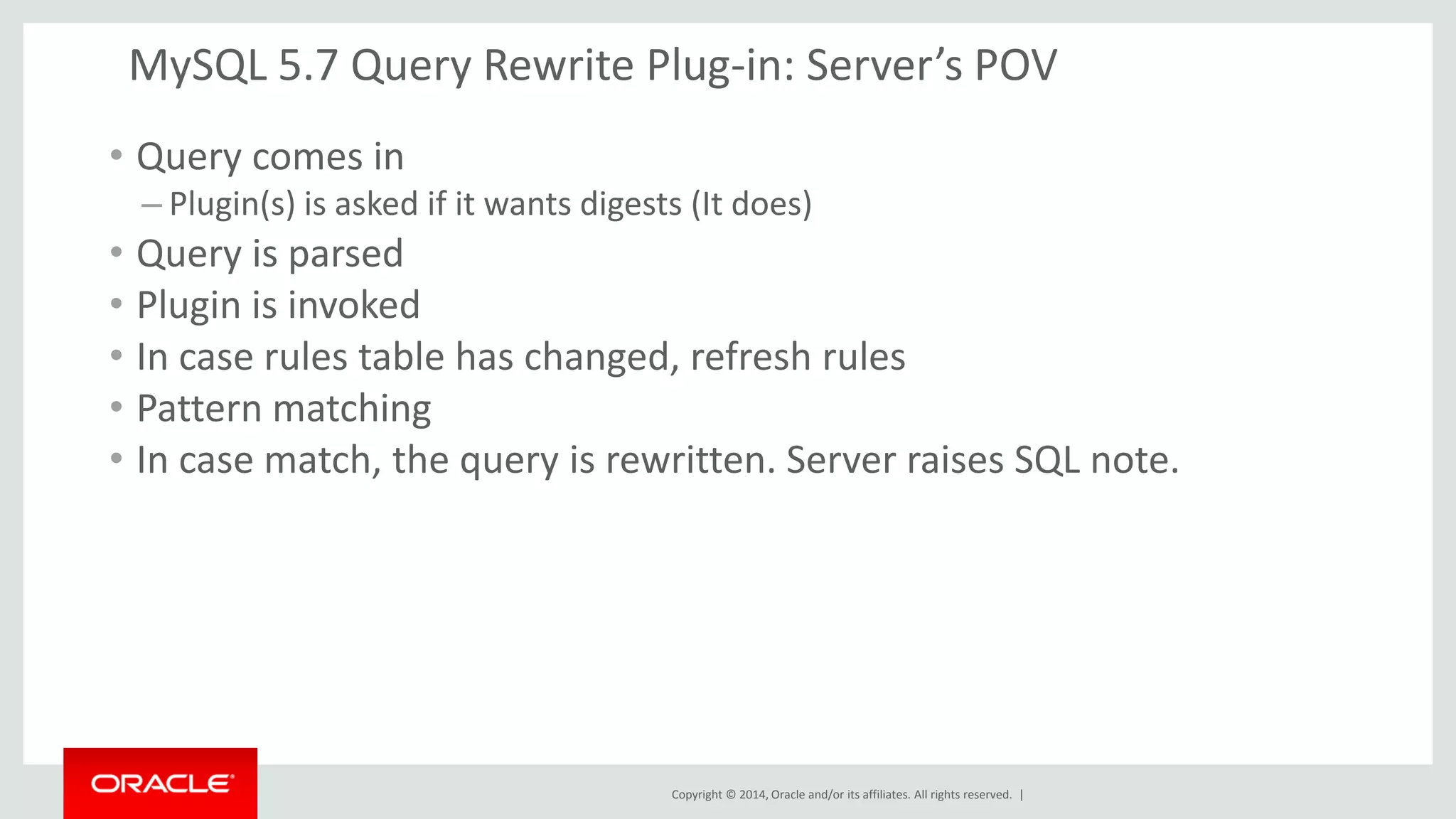
MySQL 5.7 Query Rewrite Plug-in: Server’s POV 
•Query comes in 
–Plugin(s) is asked if it wants digests (It does) 
•Query is parsed 
•Plugin is invoked 
•In case rules table has changed, refresh rules 
•Pattern matching 
•In case match, the query is rewritten. Server raises SQL note.
Copyright © 2014, Oracle and/or its affiliates. All rights reserved. | 
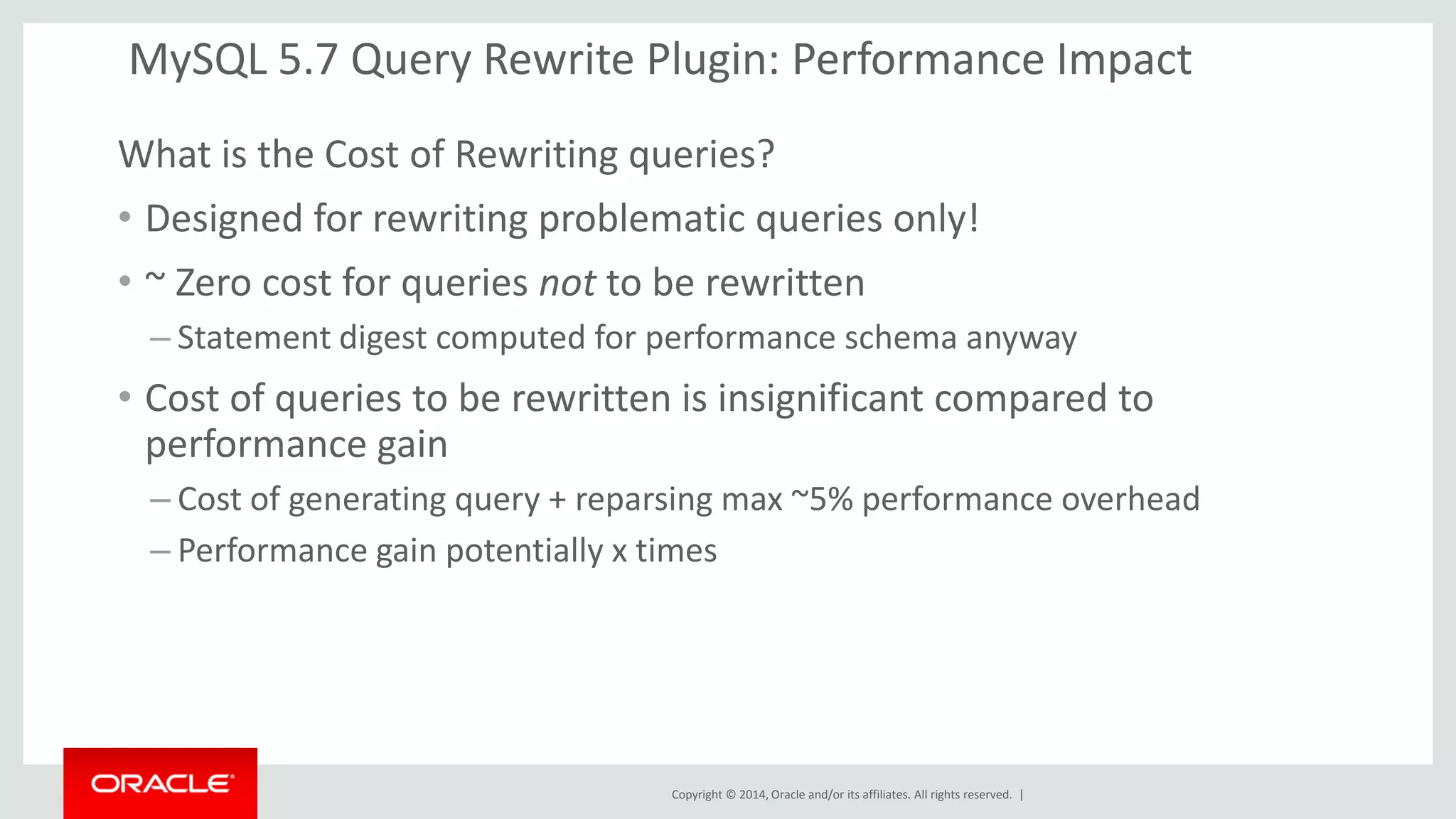
MySQL 5.7 Query Rewrite Plugin: Performance Impact 
What is the Cost of Rewriting queries? 
•Designed for rewriting problematic queries only! 
•~ Zero cost for queries not to be rewritten 
–Statement digest computed for performance schema anyway 
•Cost of queries to be rewritten is insignificant compared to performance gain 
–Cost of generating query + reparsing max ~5% performance overhead 
–Performance gain potentially x times
Copyright © 2014, Oracle and/or its affiliates. All rights reserved. | 
MySQL 5.7 Explain on a Running Query 
EXPLAIN [FORMAT=(JSON|TRADITIONAL)] [EXTENDED] FOR 
CONNECTION <id>; 
•Shows query plan on connection <id> 
•Useful for diagnostic on long running queries 
•Plan isn’t available when query plan is under creation 
•Applicable to SELECT/INSERT/DELETE/UPDATE
Copyright © 2014, Oracle and/or its affiliates. All rights reserved. | 
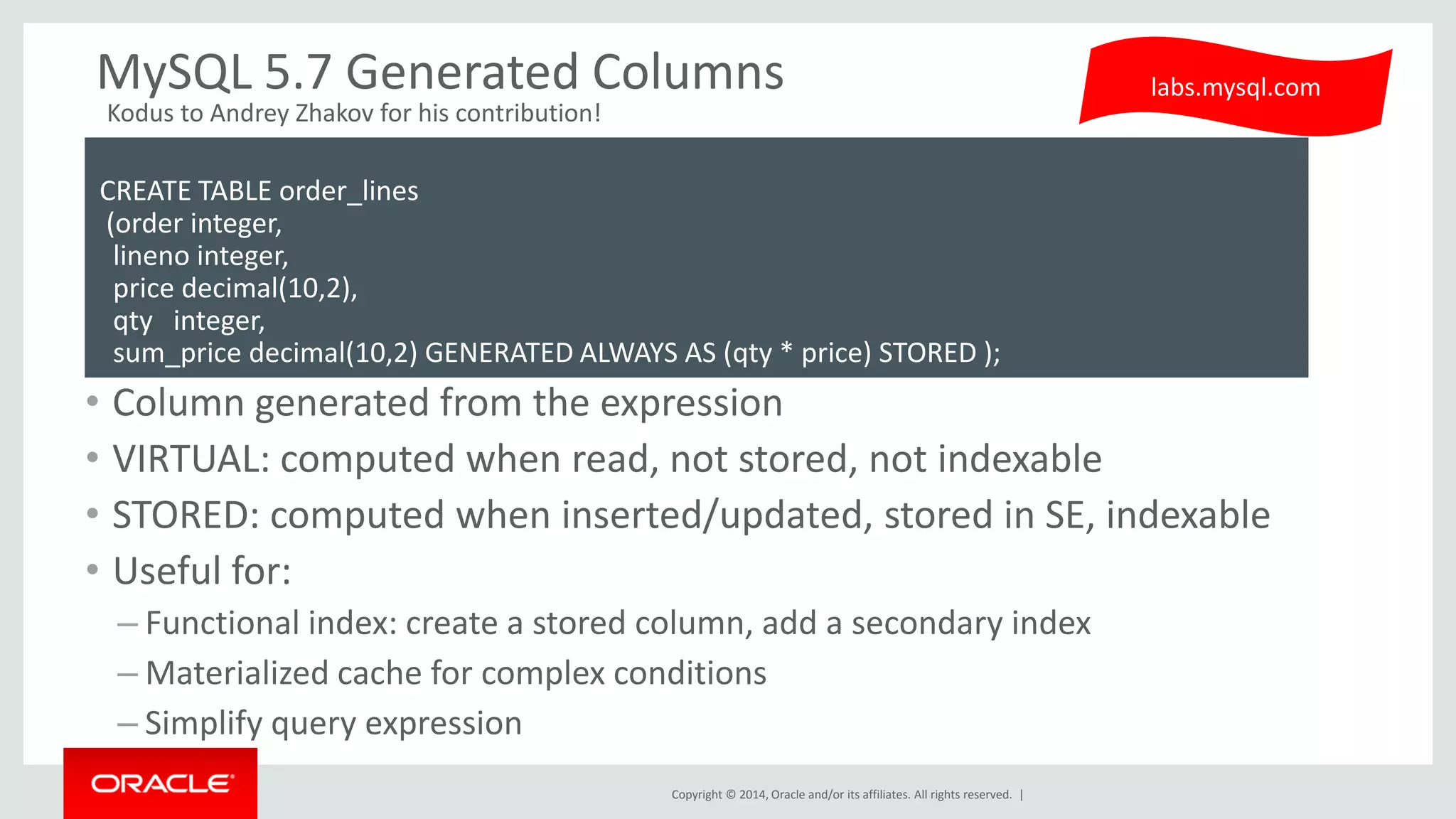
MySQL 5.7 Generated Columns 
•Column generated from the expression 
•VIRTUAL: computed when read, not stored, not indexable 
•STORED: computed when inserted/updated, stored in SE, indexable 
•Useful for: 
–Functional index: create a stored column, add a secondary index 
–Materialized cache for complex conditions 
–Simplify query expression 
labs.mysql.com 
CREATE TABLE order_lines (order integer, lineno integer, price decimal(10,2), qty integer, sum_price decimal(10,2) GENERATED ALWAYS AS (qty * price) STORED ); 
Kodus to Andrey Zhakov for his contribution!
Copyright © 2014, Oracle and/or its affiliates. All rights reserved. | 
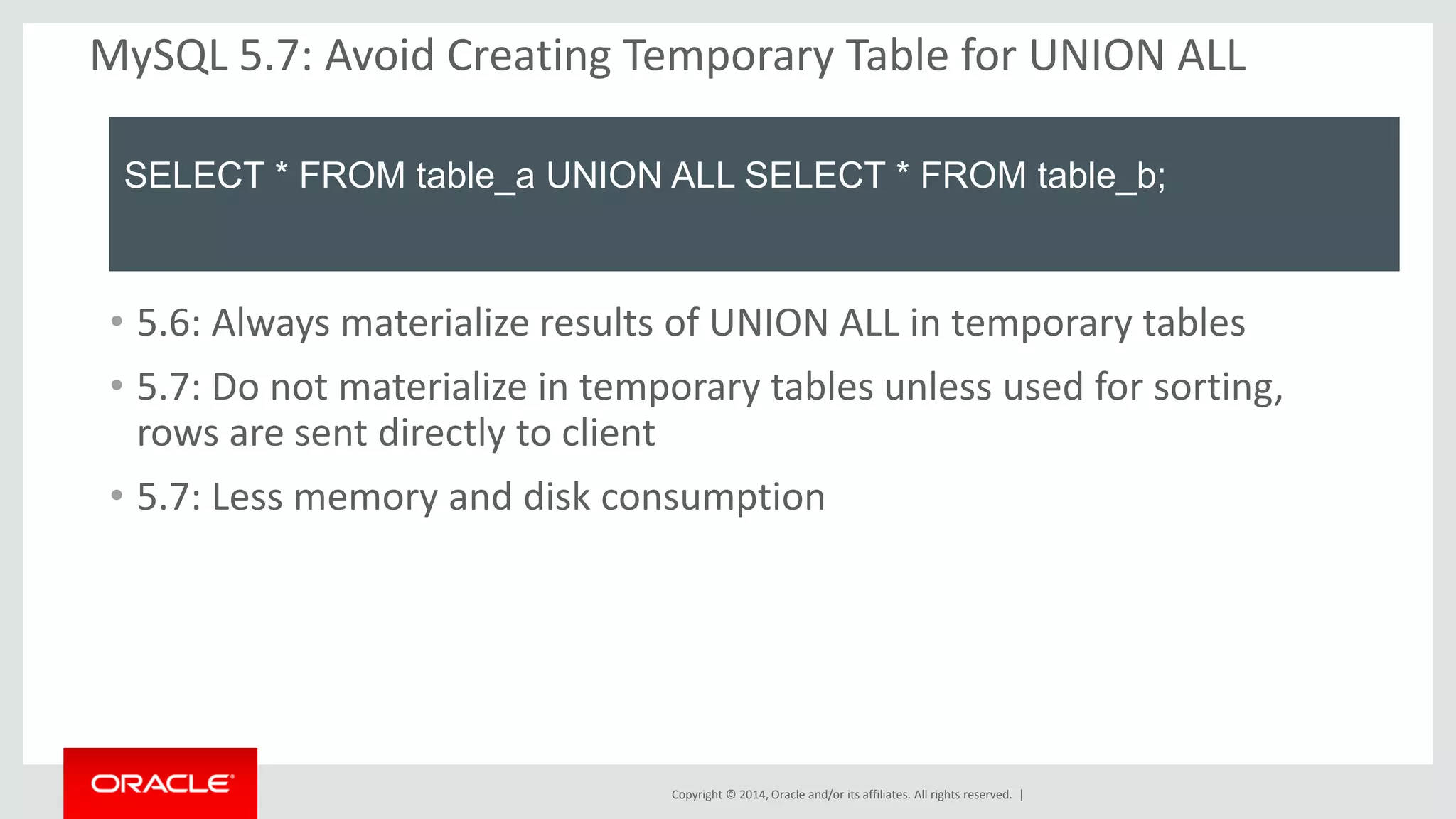
MySQL 5.7: Avoid Creating Temporary Table for UNION ALL 
SELECT * FROM table_a UNION ALL SELECT * FROM table_b; 
•5.6: Always materialize results of UNION ALL in temporary tables 
•5.7: Do not materialize in temporary tables unless used for sorting, rows are sent directly to client 
•5.7: Less memory and disk consumption
Copyright © 2014, Oracle and/or its affiliates. All rights reserved. | 
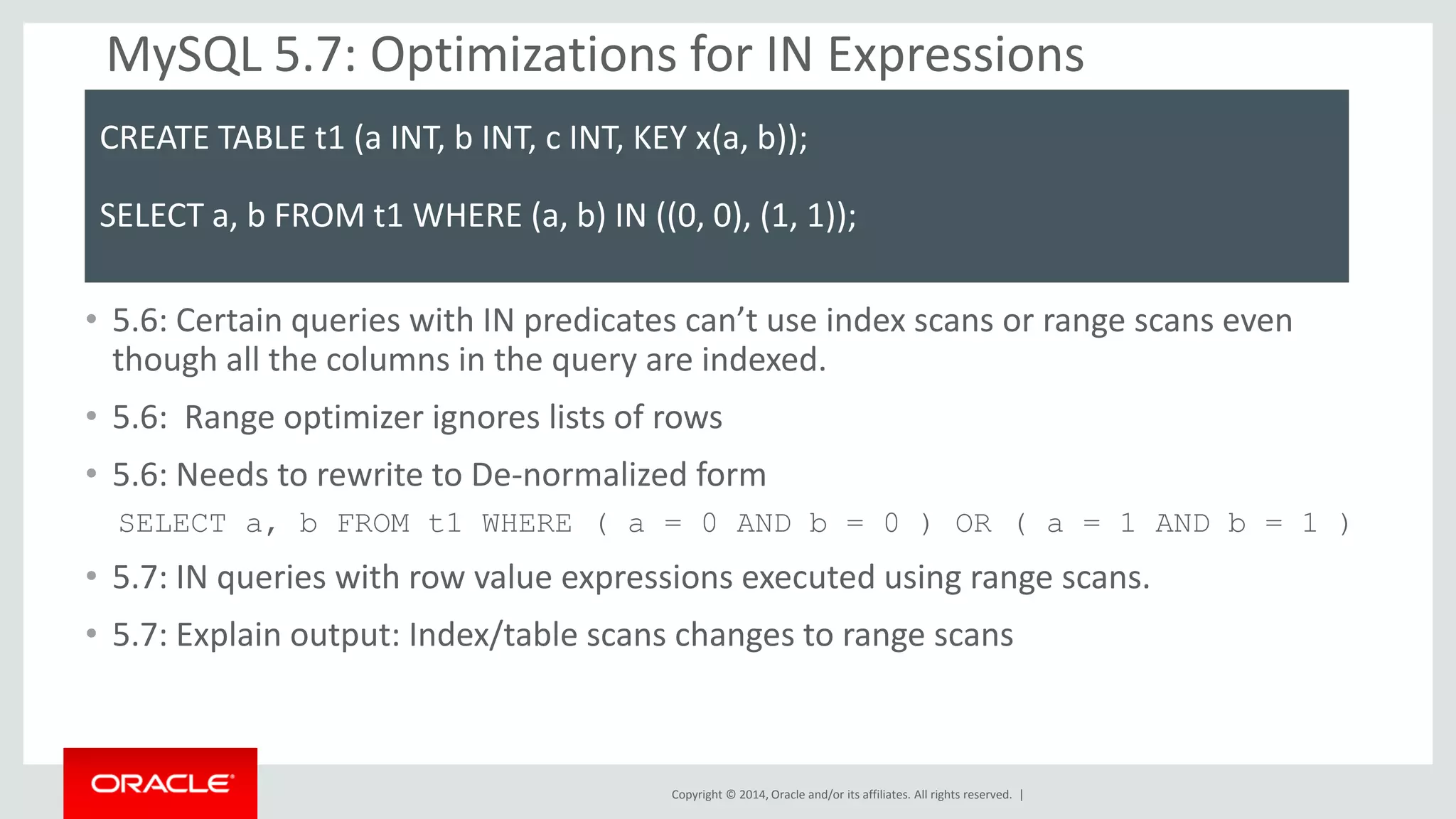
MySQL 5.7: Optimizations for IN Expressions 
•5.6: Certain queries with IN predicates can’t use index scans or range scans even though all the columns in the query are indexed. 
•5.6: Range optimizer ignores lists of rows 
•5.6: Needs to rewrite to De-normalized form 
SELECT a, b FROM t1 WHERE ( a = 0 AND b = 0 ) OR ( a = 1 AND b = 1 ) 
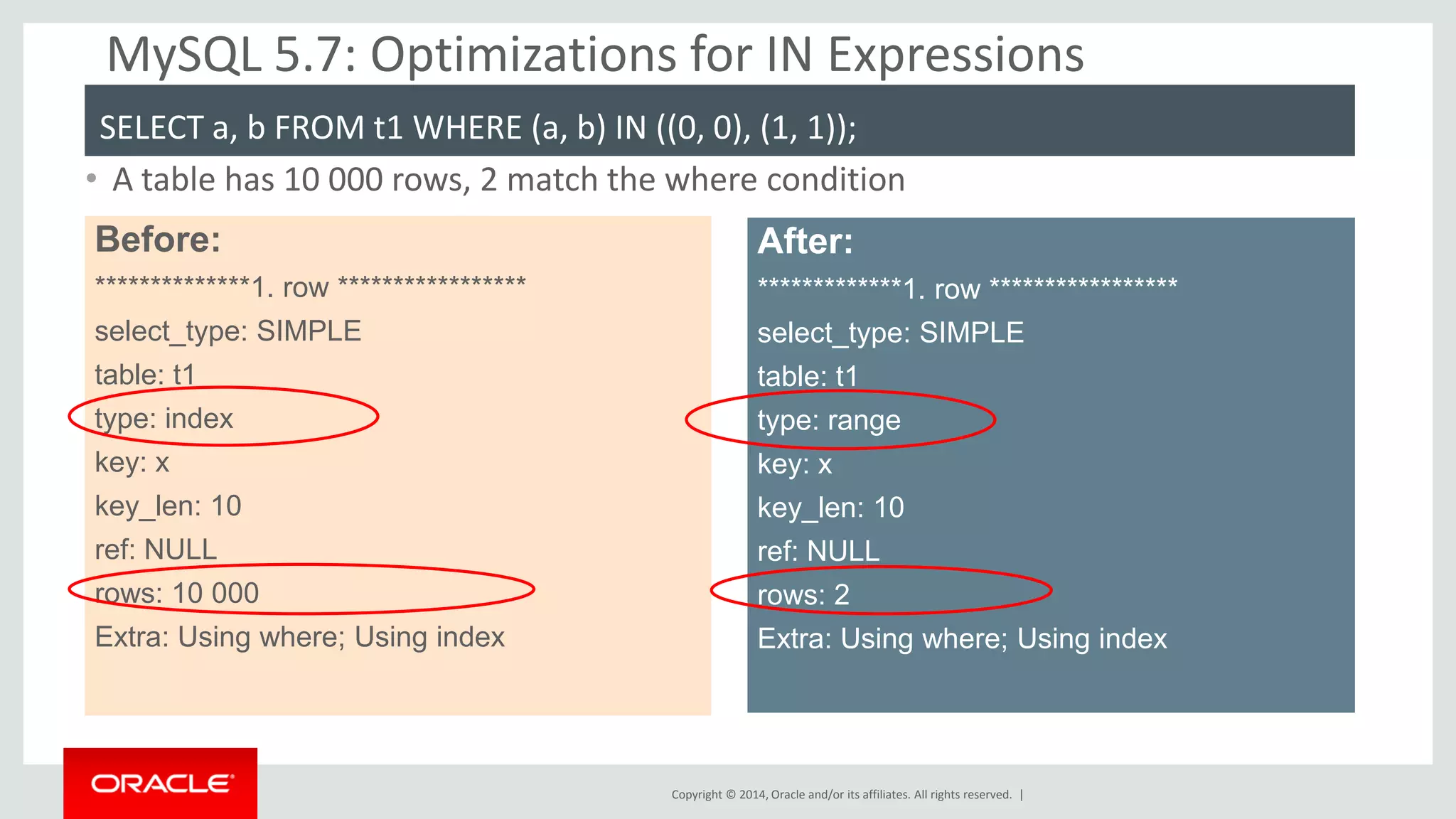
•5.7: IN queries with row value expressions executed using range scans. 
•5.7: Explain output: Index/table scans changes to range scans 
CREATE TABLE t1 (a INT, b INT, c INT, KEY x(a, b)); 
SELECT a, b FROM t1 WHERE (a, b) IN ((0, 0), (1, 1));
Copyright © 2014, Oracle and/or its affiliates. All rights reserved. | 
MySQL 5.7: Optimizations for IN Expressions 
•A table has 10 000 rows, 2 match the where condition 
Before: 
**************1. row ***************** 
select_type: SIMPLE 
table: t1 
type: index 
key: x 
key_len: 10 
ref: NULL 
rows: 10 000 
Extra: Using where; Using index 
After: 
*************1. row ***************** 
select_type: SIMPLE 
table: t1 
type: range 
key: x 
key_len: 10 
ref: NULL 
rows: 2 
Extra: Using where; Using index 
SELECT a, b FROM t1 WHERE (a, b) IN ((0, 0), (1, 1));
Copyright © 2014, Oracle and/or its affiliates. All rights reserved. | 
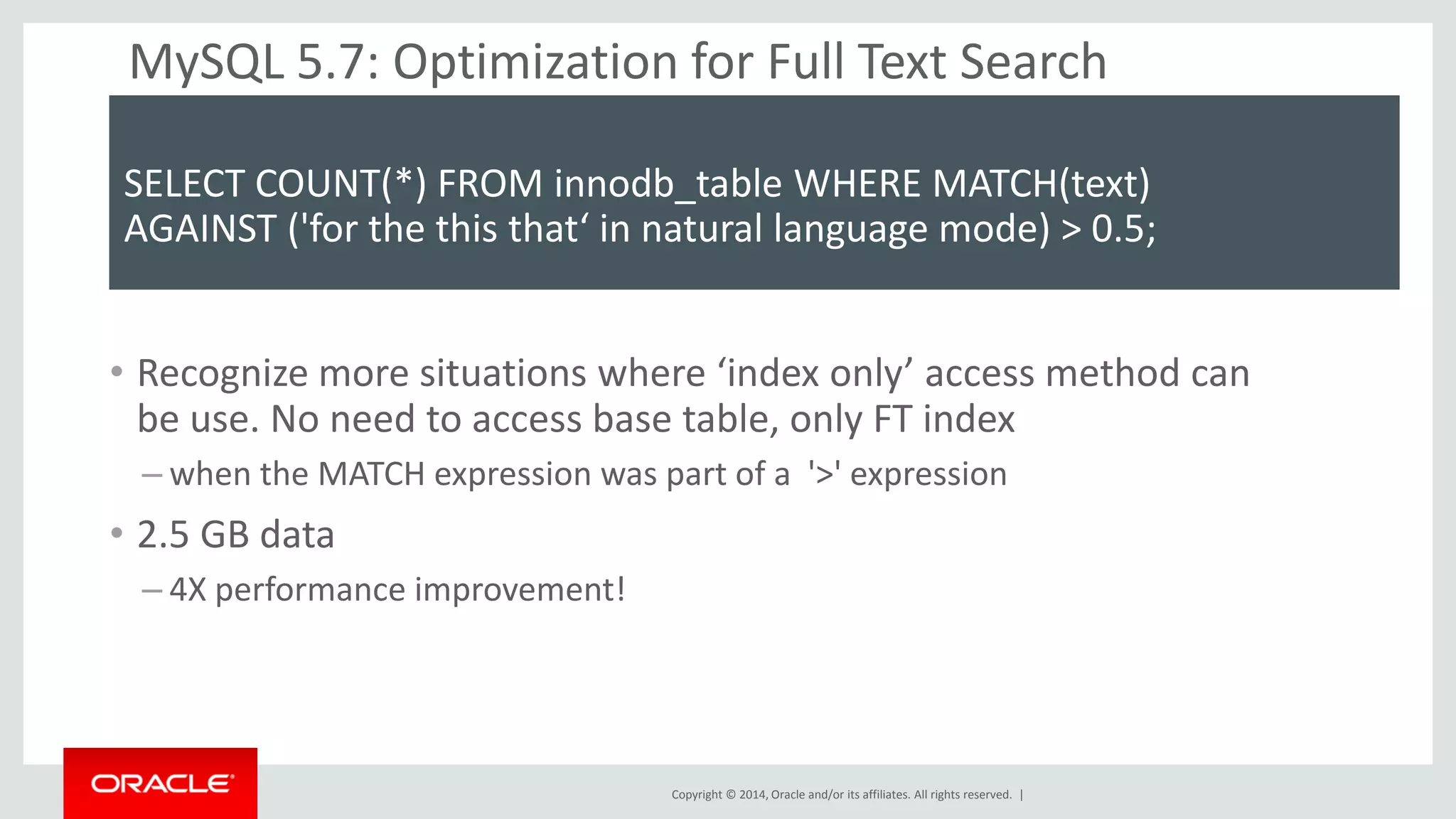
MySQL 5.7: Optimization for Full Text Search 
SELECT COUNT(*) FROM innodb_table WHERE MATCH(text) 
AGAINST ('for the this that‘ in natural language mode) > 0.5; 
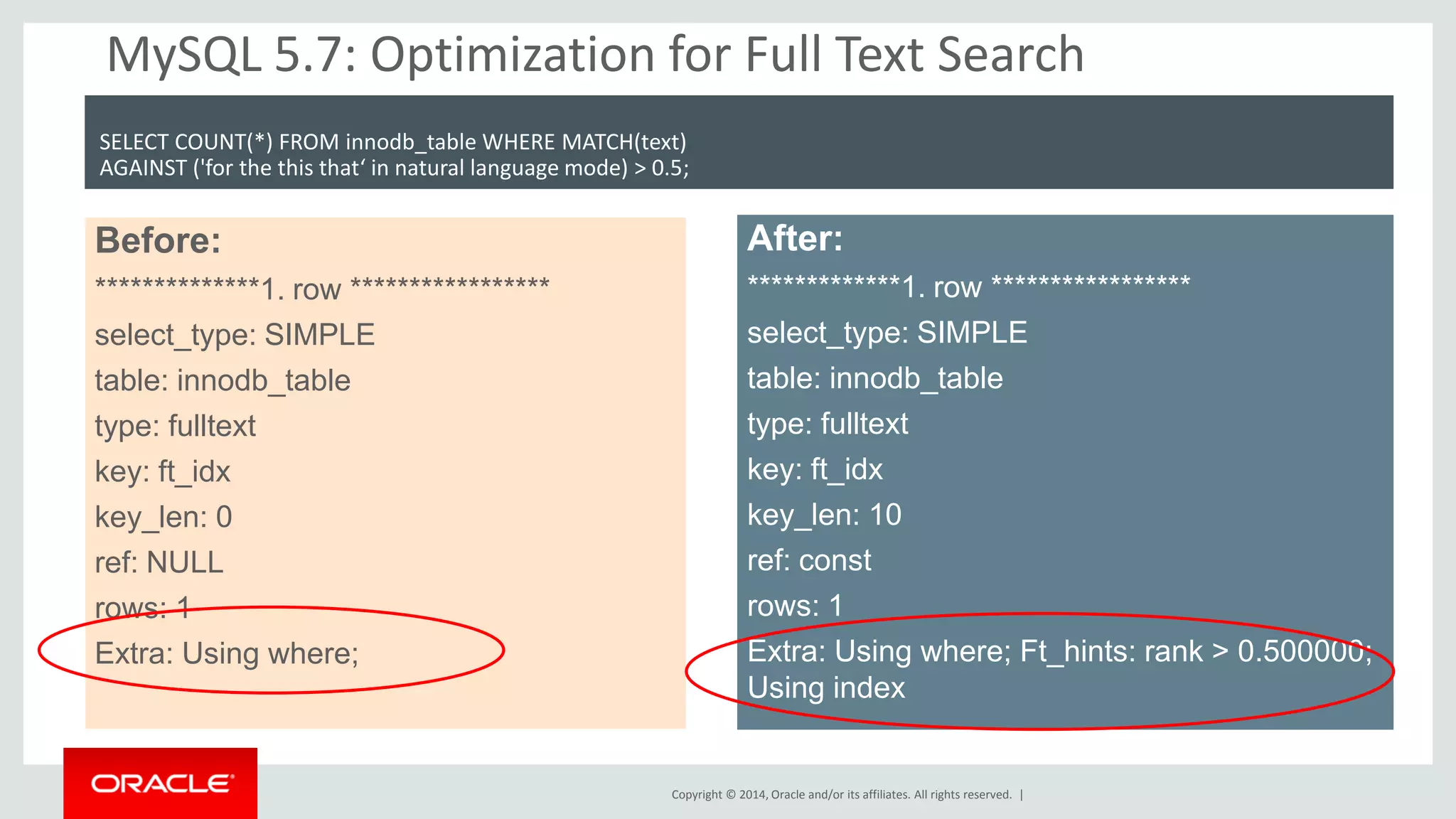
•Recognize more situations where ‘index only’ access method can be use. No need to access base table, only FT index 
–when the MATCH expression was part of a '>' expression 
•2.5 GB data 
–4X performance improvement!
Copyright © 2014, Oracle and/or its affiliates. All rights reserved. | 
MySQL 5.7: Optimization for Full Text Search 
Before: 
**************1. row ***************** 
select_type: SIMPLE 
table: innodb_table 
type: fulltext 
key: ft_idx 
key_len: 0 
ref: NULL 
rows: 1 
Extra: Using where; 
After: 
*************1. row ***************** 
select_type: SIMPLE 
table: innodb_table 
type: fulltext 
key: ft_idx 
key_len: 10 
ref: const 
rows: 1 
Extra: Using where; Ft_hints: rank > 0.500000; Using index 
SELECT COUNT(*) FROM innodb_table WHERE MATCH(text) 
AGAINST ('for the this that‘ in natural language mode) > 0.5;
Copyright © 2014, Oracle and/or its affiliates. All rights reserved. |

Optimizer overviewoow2014

  • 1.
    Copyright © 2014,Oracle and/or its affiliates. All rights reserved. | Copyright © 2014, Oracle and/or its affiliates. All rights reserved. Chaithra M G Software engineer MySQL, Oracle October 17, 2014 MySQL 5.7: What’s New in the Parser and the Optimizer?
  • 2.
    Copyright © 2014,Oracle and/or its affiliates. All rights reserved. | Safe Harbor Statement The following is intended to outline our general product direction. It is intended for information purposes only, and may not be incorporated into any contract. It is not a commitment to deliver any material, code, or functionality, and should not be relied upon in making purchasing decisions. The development, release, and timing of any features or functionality described for Oracle’s products remains at the sole discretion of Oracle.
  • 3.
    Copyright © 2014,Oracle and/or its affiliates. All rights reserved. | MySQL Optimizer SELECT a, b FROM t1, t2, t3 WHERE t1.a = t2.b AND t2.b = t3.c AND t2.d > 20 AND t2.d < 30; MySQL Server Cost based optimizations Heuristics Cost Model Optimizer Table/index info (data dictionary) Statistics (storage engines) t2 t3 t1 Table scan Range scan Ref access JOIN JOIN Parser
  • 4.
    Copyright © 2014,Oracle and/or its affiliates. All rights reserved. | MySQL Optimizer: Design Principles •Best out of the box performance •Easy to use, minimum tuning needed •When you need to understand: explain and trace •Flexibility through optimizer switches, hints and plugins •Fast evolving
  • 5.
    Copyright © 2014,Oracle and/or its affiliates. All rights reserved. | MySQL 5.7 Parser and Optimizer Improvements •Parser and optimizer refactoring •Improved cost model: better record estimation for JOIN •Improved cost model: configurable cost constants •Query rewrite plugin •Explain on a running query
  • 6.
    Copyright © 2014,Oracle and/or its affiliates. All rights reserved. | MySQL 5.7 Optimizer Improvements •Generated columns •UNION ALL queries no longer use temporary tables •Improved optimizations for queries with IN expressions •Optimized full text search
  • 7.
    Copyright © 2014,Oracle and/or its affiliates. All rights reserved. | 5.7 Parser and Optimizer Refactoring Optimizer Logical transformations Cost-based optimizer: Join order and access methods Plan refinement Query execution plan Query execution Parser Resolver: Semantic check,name resolution SQL DML query Query result Storage Engine InnoDB MyISAM Improves readability, maintainability and stability –Cleanly separate the parsing, optimizing, and execution stages –Allows for easier feature additions, with lessened risk
  • 8.
    Copyright © 2014,Oracle and/or its affiliates. All rights reserved. | MySQL 5.7: Parser Refactoring •Challenge: –Overly complex, hard to add new syntax •Solution: –Create an internal parse tree bottom-up –Create an AST (Abstract Syntax Tree) from the parse tree and the user's context. –Have syntax rules that are more precisely defined and are closer to the SQL standard. –More precise error messages –Better support for larger syntax rules in the future Resolver Optimizer SE Lexical Scanner (lexer) GNU Bison-generated Parser (bottom-up parsing style) Contextualization Parser (new) Executor AST
  • 9.
    Copyright © 2014,Oracle and/or its affiliates. All rights reserved. | Motivation for Changing the Cost Model •Adopt to new hardware architectures –SSD, larger memories, caches •Allows storage engines to provide accurate and dynamic cost estimate –Whether the data is in RAM, SSD, HDD? •More maintainable cost model implementation –Avoid hard coded constants –Refactoring of existing cost model code •Tunable/configurable •Replace heuristics with cost based decisions
  • 10.
    Copyright © 2014,Oracle and/or its affiliates. All rights reserved. | Cost Model: Main Focus in 5.7 Address the following pain points in current cost model: •Hard-coded cost constants –Not possible to adjust for different hardware •Imprecise cardinality/records per key estimates from SE –Integer value gives too low precision •Inaccurate record estimation for JOIN –Too high fan out •Hard to obtain detailed cost numbers
  • 11.
    Copyright © 2014,Oracle and/or its affiliates. All rights reserved. | MySQL 5.6: Record Estimates for JOIN •t1 JOIN t2 •Total cost = cost (access method t1) + Prefix_rows_t1 * cost (access method t2) •Prefix_rows_t1 is records read by t1 –Overestimation if where conditions apply!->Suboptimial join order Without condition filtering t1 t2 Access Method Prefix_rows_t1 Number of records read from t1
  • 12.
    Copyright © 2014,Oracle and/or its affiliates. All rights reserved. | MySQL 5.7 Improved Record Estimates for JOIN •t1 JOIN t2 •Prefix_rows_t1 Takes into account the entire query condition –More accurate record estimate -> improved JOIN order Condition filter t1 t2 Access Method Number of records read from t1 Condition filter Prefix_rows_t1 Records passing the table conditions on t1
  • 13.
    Copyright © 2014,Oracle and/or its affiliates. All rights reserved. | •10 000 rows in the emp table •100 rows in the office table •100 rows with first_name=”John” AND hire_date BETWEEN “2012-01- 01″ AND “2012-06-01″ MySQL 5.7 Improved Record Estimates for JOIN CREATE TABLE emp ( id INTEGER NOT NULL PRIMARY KEY, office_id INTEGER NOT NULL, first_name VARCHAR(20), hire_date DATE NOT NULL, KEY office (office_id) ) ENGINE=InnoDB; CREATE TABLE office ( id INTEGER NOT NULL PRIMARY KEY, officename VARCHAR(20) ) ENGINE=InnoDB;
  • 14.
    Copyright © 2014,Oracle and/or its affiliates. All rights reserved. | Table Type Possible keys Key Ref Rows Filtered Extra office ALL PRIMARY NULL NULL 100 100.00 NULL employee ref office office office.id 99 100.00 Using where MySQL 5.7 Improved Record Estimates for JOIN Explain for 5.6: Total Cost = cost(scan office) + 100 * cost(ref_access emp) SELECT office_name FROM office JOIN employee ON office.id = employee.office WHERE employee.name LIKE “John” AND hire_date BETWEEN “2014-01-01” AND “2014-06-01”; Table Type Possible keys Key Ref Rows Filtered Extra employee ALL NULL NULL NULL 9991 1.23 NULL office eq_ref PRIMARY PRIMARY employee.office 1 100.00 Using where JOIN ORDER HAS CHANGED! Explain for 5.7: Total Cost = cost(scan emp) + 9991*1.23% * cost(eq_ref_access office)
  • 15.
    Copyright © 2014,Oracle and/or its affiliates. All rights reserved. | MySQL 5.7 Improved Record Estimation for JOIN Performance Improvements: DBT-3 (SF 10) 0 20 40 60 80 100 120 Q3 Q7 Q8 Q9 Q12 Execution Time Relative to 5.6 in Percentage 5 out of 22 queries get an improved query plan 5.6 5.7
  • 16.
    Copyright © 2014,Oracle and/or its affiliates. All rights reserved. | MySQL 5.7 Additional Cost Data in JSON Explain JSON s mysql> EXPLAIN FORMAT=JSON SELECT SUM(o_totalprice) FROM orders WHERE o_orderdate BETWEEN '1994-01-01' AND '1994-12-31'; { "query_block": { "select_id": 1, "cost_info": { "query_cost": "3118848.00" }, "table": { "table_name": "orders", "access_type": "ALL", "possible_keys": [ "i_o_orderdate" ], "rows_examined_per_scan": 15000000, "rows_produced_per_join": 4489990, "filtered": 29.933, "cost_info": { "read_cost": "2220850.00", "eval_cost": "897998.00", "prefix_cost": "3118848.00", "data_read_per_join": "582M" }, "used_columns": [ "o_totalprice", "o_orderDATE" ], "attached_condition": "(`dbt3`.`orders`.`o_orderDATE` between '1994-01-01' and '1994-12-31')" } } } Total query cost of a query block Cost per table Cost of sorting operation Cost of reading data Cost of evaluating conditions Cost of prefix join Rows examined/produced per join Used columns Data read per join – (# of rows)*(record width) in byte
  • 17.
    Copyright © 2014,Oracle and/or its affiliates. All rights reserved. | MySQL 5.7 Visual Explain in MySQL Workbench
  • 18.
    Copyright © 2014,Oracle and/or its affiliates. All rights reserved. | MySQL 5.7: Why Query Rewrite Plugin? • Problem – Optimizer choses a suboptimal plan – Users can change the query plan by adding hints or rewrite the query – However, dabase application code cannot be changed • Solution: query rewrite plugin! labs.mysql.com
  • 19.
    Copyright © 2014,Oracle and/or its affiliates. All rights reserved. | MySQL 5.7: Query Rewrite Plugin •New pre and post parse query rewrite APIs –Users can write their own plug-ins •Provides a post-parse query plugin –Rewrite problematic queries without the need to make application changes –Add hints –Modify join order –Many more … •Improve problematic queries from ORMs, third party apps, etc •~Zero performance overhead for queries not to be rewritten labs.mysql.com
  • 20.
    Copyright © 2014,Oracle and/or its affiliates. All rights reserved. | MySQL 5.7 How Rewrites Happen? For query SELECT * FROM t1 JOIN t2 ON t1.keycol = t2.keycol WHERE col1 = 42 AND col2 = 2 Replace parameter markers in Replacement with actual literals: Pattern is: SELECT * FROM t1 JOIN t2 ON t1.keycol = t2.keycol WHERE col1 = ? AND col2 = ? Replacement is: SELECT * FROM t1 STRAIGHT_JOIN t2 FORCE INDEX (col1) ON t1.keycol = t2.keycol WHERE col1 = ? AND col2 = ? SELECT * FROM t1 STRAIGHT_JOIN t2 FORCE INDEX (col1) ON t1.keycol = t2.keycol WHERE col1 = 42 AND col2 = 2
  • 21.
    Copyright © 2014,Oracle and/or its affiliates. All rights reserved. | MySQL 5.7 How Matching of Rules Happen? Match and execute rule in three steps: 1.Hash lookup using query digest computed during parsing – Finds patterns with same digest. 2.Parse tree structure comparison – To filter out hash collision – Will not detect differences in literals 3.Compare literal constants –In practice done during rewrite
  • 22.
    Copyright © 2014,Oracle and/or its affiliates. All rights reserved. | MySQL 5.7 Communicating with the Plugin query_rewrite.rewrite_rules table: Pattern Pattern_ database Replacement Enabled Message SELECT name, department_name FROM employee JOIN department USING ( department_id ) WHERE salary > ? employees SELECT name, department_name FROM employee STRAIGHT JOIN department USING ( department_id ) WHERE salary > ? Y NULL SELECT name, department_name FROXM employee JOIN department USING ( department_id ) WHERE salary > ? employees SELECT name FROM employee STRAIGHT JOIN department USING ( department_id ) WHERE salary > ? N Parse error in pattern:……near ……at line 1 SELECT name, department_name FROM employee JOIN department USING ( department_id ) WHERE salary > ? employees SELECT name, department_name FROXM employee STRAIGHT JOIN department USING ( department_id ) WHERE salary > ? N Parse error in replacement …near … at line 1
  • 23.
    Copyright © 2014,Oracle and/or its affiliates. All rights reserved. | MySQL 5.7 Query Rewrite Plug-in: Server’s POV •Query comes in –Plugin(s) is asked if it wants digests (It does) •Query is parsed •Plugin is invoked •In case rules table has changed, refresh rules •Pattern matching •In case match, the query is rewritten. Server raises SQL note.
  • 24.
    Copyright © 2014,Oracle and/or its affiliates. All rights reserved. | MySQL 5.7 Query Rewrite Plugin: Performance Impact What is the Cost of Rewriting queries? •Designed for rewriting problematic queries only! •~ Zero cost for queries not to be rewritten –Statement digest computed for performance schema anyway •Cost of queries to be rewritten is insignificant compared to performance gain –Cost of generating query + reparsing max ~5% performance overhead –Performance gain potentially x times
  • 25.
    Copyright © 2014,Oracle and/or its affiliates. All rights reserved. | MySQL 5.7 Explain on a Running Query EXPLAIN [FORMAT=(JSON|TRADITIONAL)] [EXTENDED] FOR CONNECTION <id>; •Shows query plan on connection <id> •Useful for diagnostic on long running queries •Plan isn’t available when query plan is under creation •Applicable to SELECT/INSERT/DELETE/UPDATE
  • 26.
    Copyright © 2014,Oracle and/or its affiliates. All rights reserved. | MySQL 5.7 Generated Columns •Column generated from the expression •VIRTUAL: computed when read, not stored, not indexable •STORED: computed when inserted/updated, stored in SE, indexable •Useful for: –Functional index: create a stored column, add a secondary index –Materialized cache for complex conditions –Simplify query expression labs.mysql.com CREATE TABLE order_lines (order integer, lineno integer, price decimal(10,2), qty integer, sum_price decimal(10,2) GENERATED ALWAYS AS (qty * price) STORED ); Kodus to Andrey Zhakov for his contribution!
  • 27.
    Copyright © 2014,Oracle and/or its affiliates. All rights reserved. | MySQL 5.7: Avoid Creating Temporary Table for UNION ALL SELECT * FROM table_a UNION ALL SELECT * FROM table_b; •5.6: Always materialize results of UNION ALL in temporary tables •5.7: Do not materialize in temporary tables unless used for sorting, rows are sent directly to client •5.7: Less memory and disk consumption
  • 28.
    Copyright © 2014,Oracle and/or its affiliates. All rights reserved. | MySQL 5.7: Optimizations for IN Expressions •5.6: Certain queries with IN predicates can’t use index scans or range scans even though all the columns in the query are indexed. •5.6: Range optimizer ignores lists of rows •5.6: Needs to rewrite to De-normalized form SELECT a, b FROM t1 WHERE ( a = 0 AND b = 0 ) OR ( a = 1 AND b = 1 ) •5.7: IN queries with row value expressions executed using range scans. •5.7: Explain output: Index/table scans changes to range scans CREATE TABLE t1 (a INT, b INT, c INT, KEY x(a, b)); SELECT a, b FROM t1 WHERE (a, b) IN ((0, 0), (1, 1));
  • 29.
    Copyright © 2014,Oracle and/or its affiliates. All rights reserved. | MySQL 5.7: Optimizations for IN Expressions •A table has 10 000 rows, 2 match the where condition Before: **************1. row ***************** select_type: SIMPLE table: t1 type: index key: x key_len: 10 ref: NULL rows: 10 000 Extra: Using where; Using index After: *************1. row ***************** select_type: SIMPLE table: t1 type: range key: x key_len: 10 ref: NULL rows: 2 Extra: Using where; Using index SELECT a, b FROM t1 WHERE (a, b) IN ((0, 0), (1, 1));
  • 30.
    Copyright © 2014,Oracle and/or its affiliates. All rights reserved. | MySQL 5.7: Optimization for Full Text Search SELECT COUNT(*) FROM innodb_table WHERE MATCH(text) AGAINST ('for the this that‘ in natural language mode) > 0.5; •Recognize more situations where ‘index only’ access method can be use. No need to access base table, only FT index –when the MATCH expression was part of a '>' expression •2.5 GB data –4X performance improvement!
  • 31.
    Copyright © 2014,Oracle and/or its affiliates. All rights reserved. | MySQL 5.7: Optimization for Full Text Search Before: **************1. row ***************** select_type: SIMPLE table: innodb_table type: fulltext key: ft_idx key_len: 0 ref: NULL rows: 1 Extra: Using where; After: *************1. row ***************** select_type: SIMPLE table: innodb_table type: fulltext key: ft_idx key_len: 10 ref: const rows: 1 Extra: Using where; Ft_hints: rank > 0.500000; Using index SELECT COUNT(*) FROM innodb_table WHERE MATCH(text) AGAINST ('for the this that‘ in natural language mode) > 0.5;
  • 32.
    Copyright © 2014,Oracle and/or its affiliates. All rights reserved. |