Query Optimization with MySQL 5.6:
Old and New Tricks
Jaime Crespo
Senior MySQL Instructor
Percona Live London 2013
November 11, 2013
About This Presentation
•  Objective #1:
-  Get faster queries
•  Reminder of some well-known query
optimization techniques
-  Focus on new 5.6 query features
•  For other performance tricks with MySQL &
InnoDB:
-  InnoDB Architecture and Performance
Optimization with Peter Zaitsev at 2pm

2

www.percona.com
Agenda
1.  Introduction and Environment Setup
2.  Server Update and Configuration
3.  Tools for Query Profiling
4.  Indexing: Old and New Strategies
5.  New Query Planner Features
6.  Results and wrap-up

3

www.percona.com
Example Platform
•  Sample LAMP Application
-  'My Movies' PHP Script
-  Example movie database

•  Distributed as a VirtualBox VM
- 
- 
- 
- 

Import percona_live.ova
User: percona / pass: percona
Make sure httpd and PS are running
Optionally: startxfce4

•  Currently no design optimization, no indexes
(except PK), no proper query design
4

www.percona.com
Query Optimization with MySQL 5.6: Old and New Tricks

SERVER UPDATE AND
CONFIGURATION
5

www.percona.com

5
Basic Configuration Review
•  InnoDB as the default engine (default in 5.5)
•  InnoDB File Per Table (default in 5.6)
•  Larger Buffer Pool and Transaction Log
(changed in 5.6)
•  Row Based Replication and tx_isolation
•  Performance Schema overhead (enabled by
default in 5.6)
•  InnoDB page checksum (changed in 5.6)
•  InnoDB Old Blocks time (changed in 5.6)

6

www.percona.com
Query Optimization with MySQL 5.6: Old and New Tricks

TOOLS FOR QUERY PROFILING
7

www.percona.com

5
EXPLAIN
•  EXPLAIN is most important tool for the
MySQL DBA and Developer
•  It provides:
- 
- 
- 
- 

8

The query plan strategy
The index(es) to be used
The order of table access
An estimation of the number of rows to be
examined!

www.percona.com

5
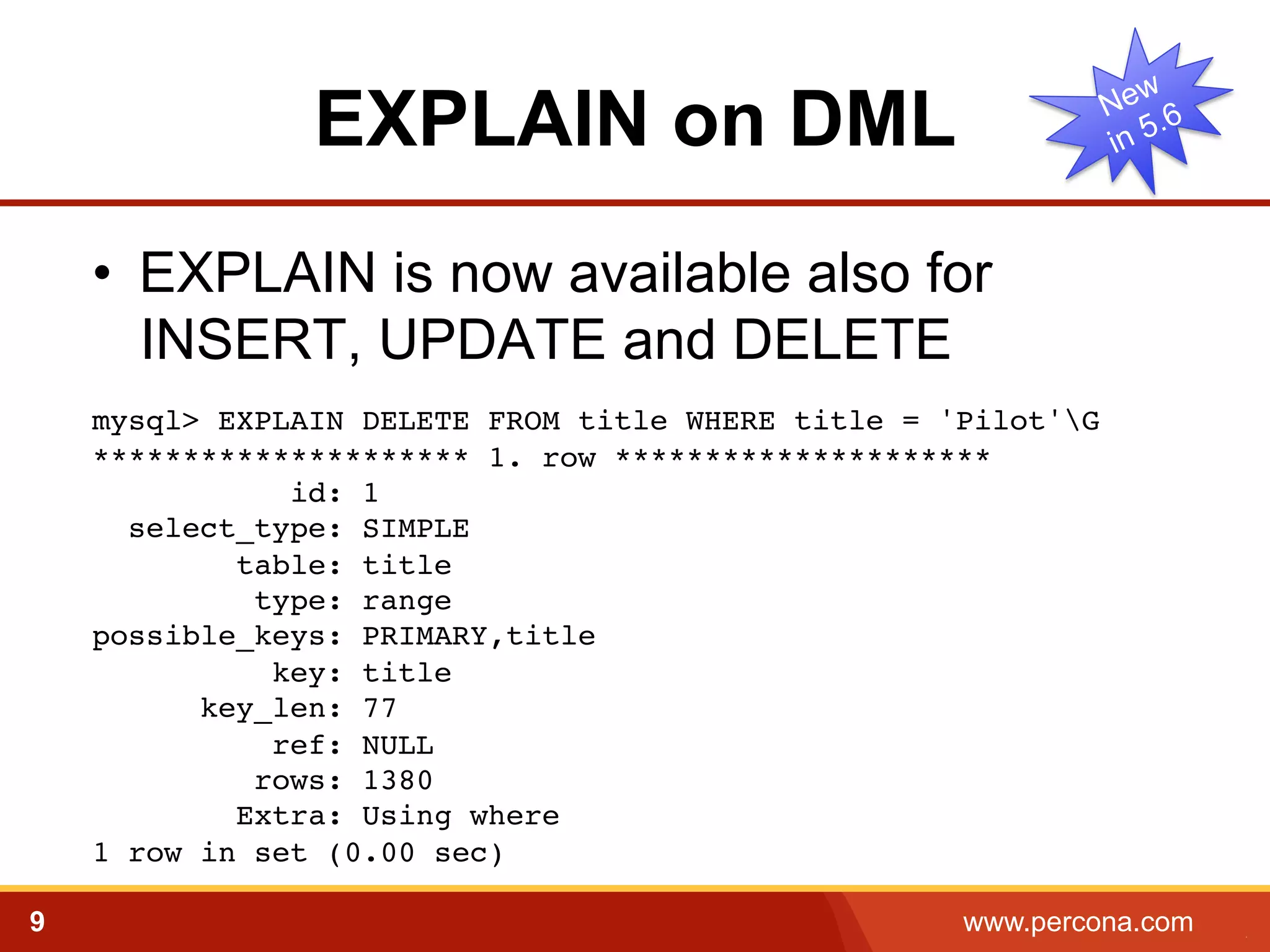
EXPLAIN on DML
•  EXPLAIN is now available also for
INSERT, UPDATE and DELETE
mysql> EXPLAIN DELETE FROM title WHERE title = 'Pilot'G!
********************* 1. row *********************!
id: 1!
select_type: SIMPLE!
table: title!
type: range!
possible_keys: PRIMARY,title!
key: title!
key_len: 77!
ref: NULL!
rows: 1380!
Extra: Using where!
1 row in set (0.00 sec)!
9

www.percona.com

5
Structured EXPLAIN
mysql> EXPLAIN FORMAT=JSON SELECT COUNT(*) FROM title 

WHERE (title = 'Pilot' OR production_year > 2010) 

AND kind_id < 4G

*************************** 1. row ***************************!
EXPLAIN: {!
"query_block": {!
"select_id": 1,!
"table": {!
"table_name": "title",!
"access_type": "index_merge",!
"possible_keys": [!
"title",!
"production_year"!
],!
"key": "sort_union(title,production_year)",!
"key_length": "77,5",!
"rows": 4434,!
"filtered": 100,!
"attached_condition": "(((`imdb`.`title`.`title` = 'Pilot') or
(`imdb`.`title`.`production_year` > 2010)) and
(`imdb`.`title`.`kind_id` < 4))"!
}!
}!
}!

10

www.percona.com

5
Optimizer Trace
•  Allows profiling of MySQL query planner
•  It shows not only information about the
final query plan (EXPLAIN), but also about
other discarded strategies, and its
“execution cost”
•  It can be accessed via the
INFORMATION_SCHEMA database
•  It is off by default
11

www.percona.com

5
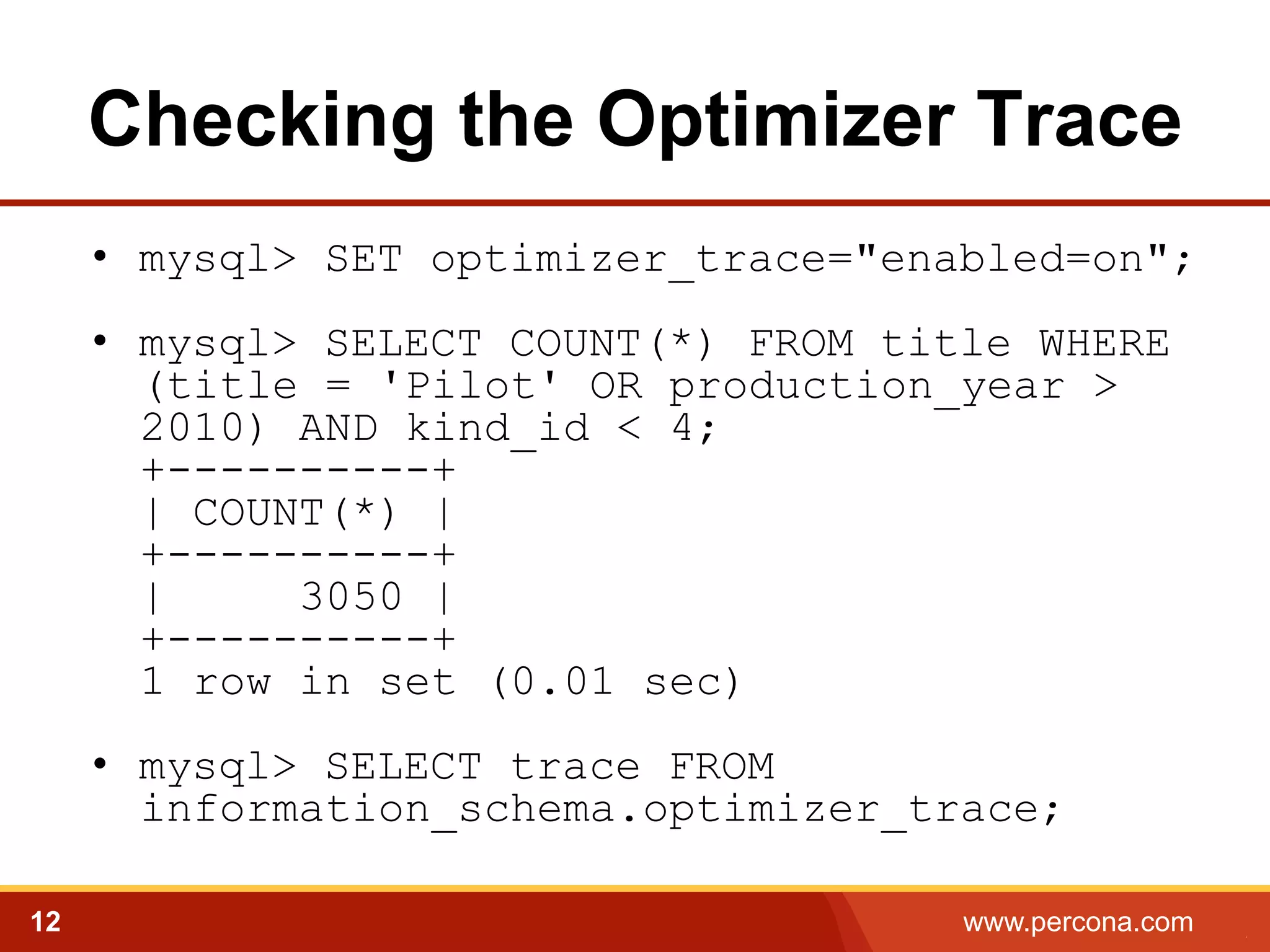
Checking the Optimizer Trace
•  mysql> SET optimizer_trace="enabled=on";
•  mysql> SELECT COUNT(*) FROM title WHERE
(title = 'Pilot' OR production_year >
2010) AND kind_id < 4;
+----------+
| COUNT(*) |
+----------+
|
3050 |
+----------+
1 row in set (0.01 sec)
•  mysql> SELECT trace FROM
information_schema.optimizer_trace;
12

www.percona.com

5
Checking the Optimizer Trace
(cont.)
{
"range_scan_alternatives": [
{
"index": "production_year",
"ranges": [
"2010 < production_year"
],
"index_dives_for_eq_ranges": true,
"rowid_ordered": false,
"using_mrr": false,
"index_only": true,
"rows": 3054,
"cost": 615.16,
"chosen": true
}
],
"index_to_merge": "production_year",
"cumulated_cost": 905.69
}
],
"cost_of_reading_ranges": 905.69,
"cost_sort_rowid_and_read_disk": 3672.8,
"cost_duplicate_removal": 9467.6,
"total_cost": 14046
}
],
"chosen_range_access_summary": {
"range_access_plan": {
"type": "index_merge",
"index_merge_of": [

13

www.percona.com

5
Limitations of EXPLAIN
•  It does not really execute the query
-  Not even subqueries any more

•  The row statistics can be sometimes very
off
•  It does not give us information about
temporary tables (on disk or memory?),
subtask timing, query cache hit, etc.

14

www.percona.com

5
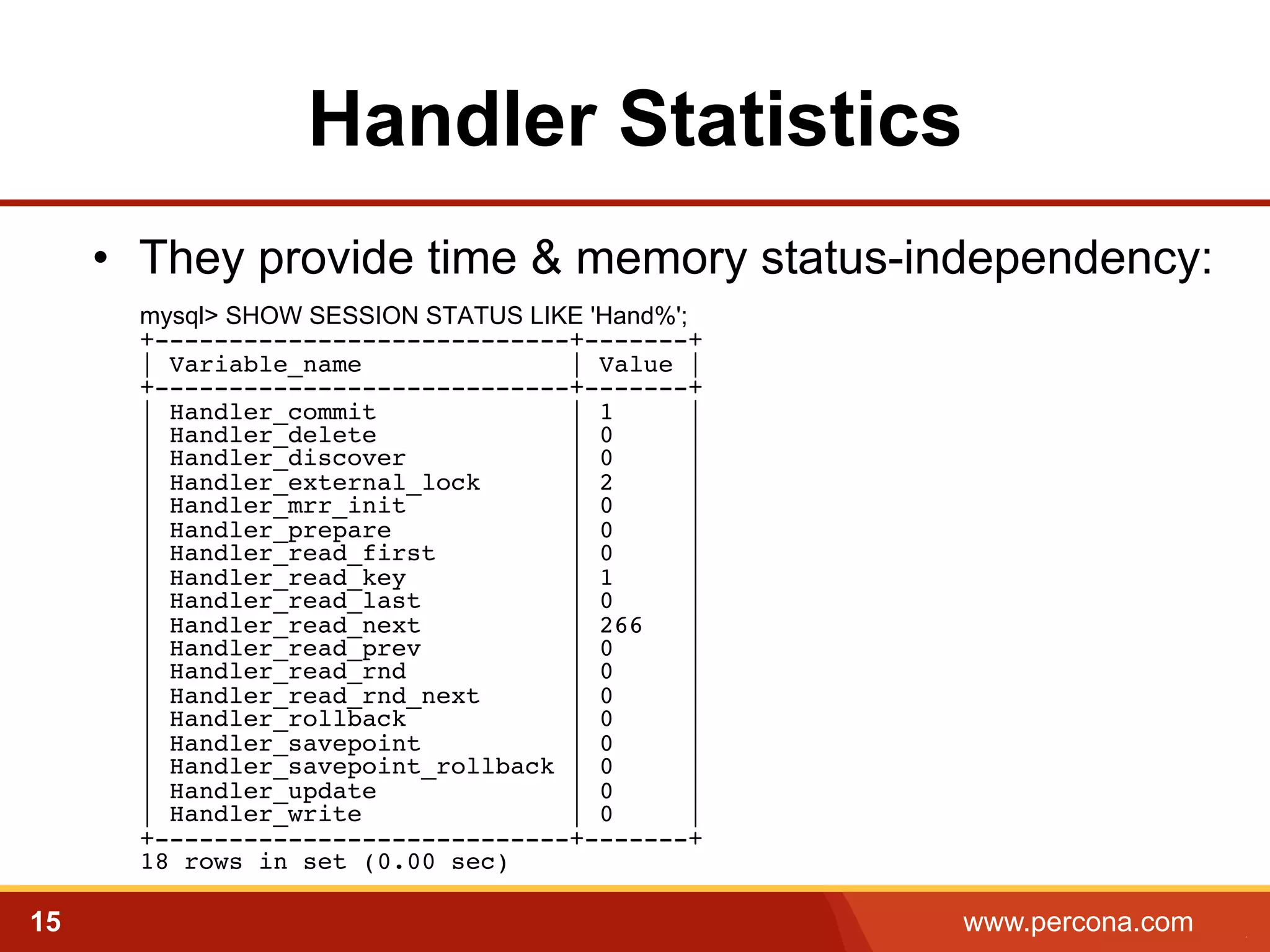
Handler Statistics
•  They provide time & memory status-independency:
mysql> SHOW SESSION STATUS LIKE 'Hand%';

+----------------------------+-------+

| Variable_name
| Value |

+----------------------------+-------+

| Handler_commit
| 1
|

| Handler_delete
| 0
|

| Handler_discover
| 0
|

| Handler_external_lock
| 2
|

| Handler_mrr_init
| 0
|

| Handler_prepare
| 0
|

| Handler_read_first
| 0
|

| Handler_read_key
| 1
|

| Handler_read_last
| 0
|

| Handler_read_next
| 266
|

| Handler_read_prev
| 0
|

| Handler_read_rnd
| 0
|

| Handler_read_rnd_next
| 0
|

| Handler_rollback
| 0
|

| Handler_savepoint
| 0
|

| Handler_savepoint_rollback | 0
|

| Handler_update
| 0
|

| Handler_write
| 0
|

+----------------------------+-------+

18 rows in set (0.00 sec)

15

www.percona.com

5
Slow Query Log and pt-querydigest
•  Works on all MySQL versions
-  Specially useful in combination with the
extended log statistics in Percona Server
SET GLOBAL log_slow_verbosity = 'full';

!
# Time: 130601 8:01:06.058915
# User@Host: root[root] @ localhost [] Id: 42
# Schema: imdb Last_errno: 0 Killed: 0
# Query_time: 7.725616 Lock_time: 0.000328 Rows_sent: 4 Rows_examined: 1543720
Rows_affected: 0
# Bytes_sent: 272 Tmp_tables: 0 Tmp_disk_tables: 0 Tmp_table_sizes: 0
# QC_Hit: No Full_scan: Yes Full_join: No Tmp_table: No Tmp_table_on_disk: No
# Filesort: No Filesort_on_disk: No Merge_passes: 0
SET timestamp=1370073666;
SELECT id,title,production_year FROM title WHERE title = 'Bambi';

!

16

www.percona.com
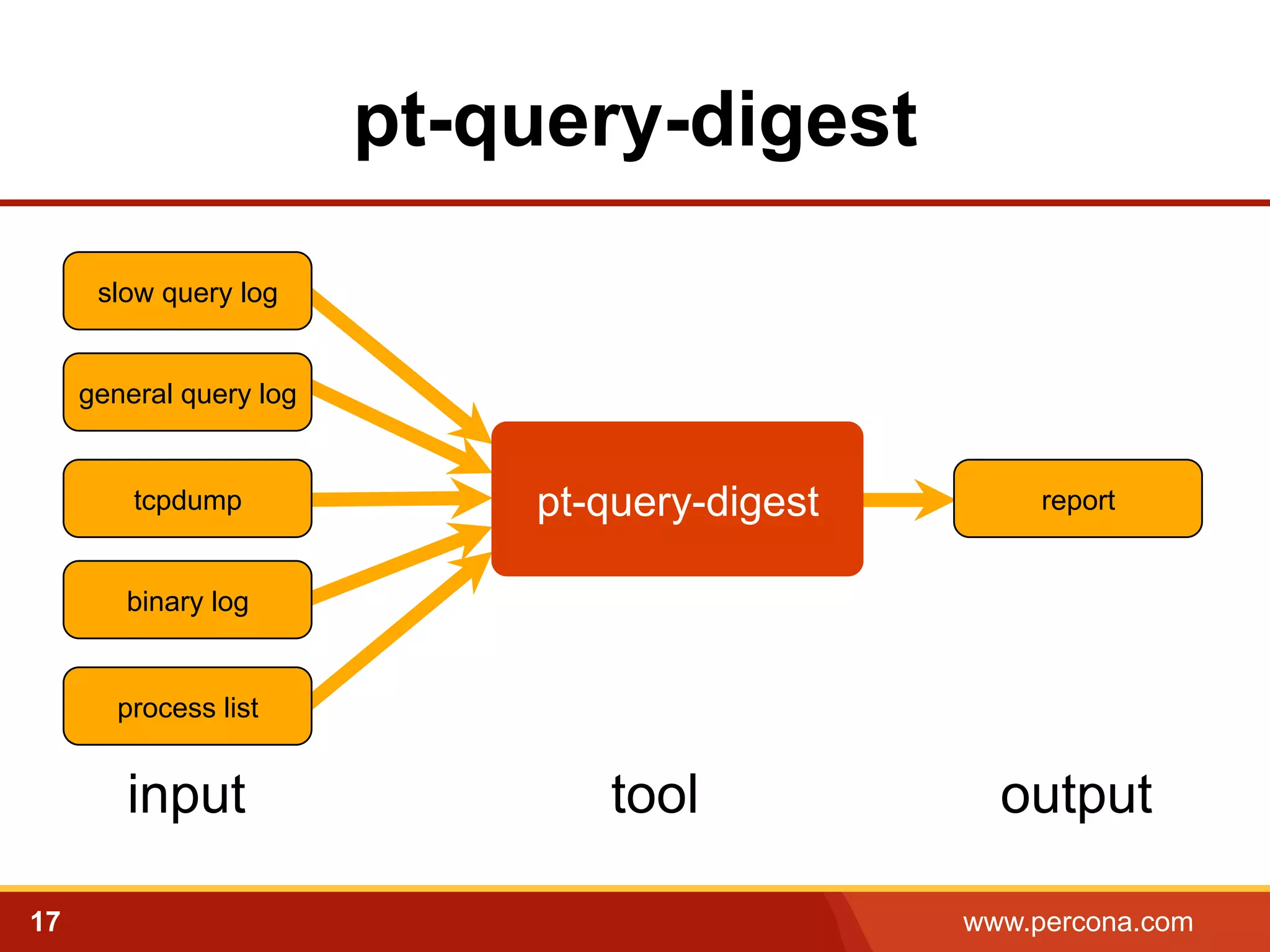
pt-query-digest
slow query log
general query log

tcpdump

pt-query-digest

report

binary log

process list

input
17

tool

output
www.percona.com
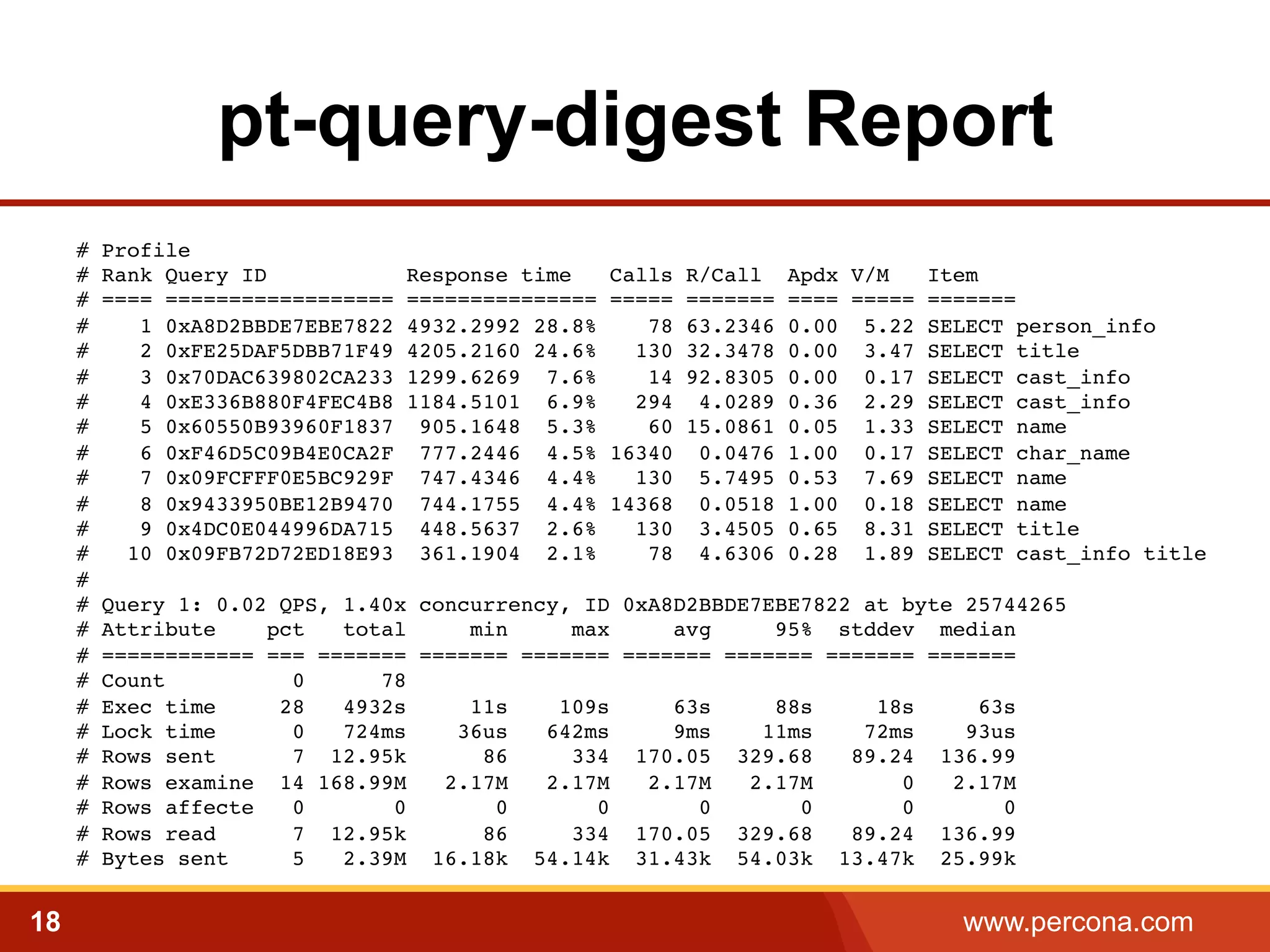
pt-query-digest Report
# Profile!
# Rank Query ID
Response time
Calls R/Call Apdx V/M
Item!
# ==== ================== =============== ===== ======= ==== ===== =======!
#
1 0xA8D2BBDE7EBE7822 4932.2992 28.8%
78 63.2346 0.00 5.22 SELECT person_info!
#
2 0xFE25DAF5DBB71F49 4205.2160 24.6%
130 32.3478 0.00 3.47 SELECT title!
#
3 0x70DAC639802CA233 1299.6269 7.6%
14 92.8305 0.00 0.17 SELECT cast_info!
#
4 0xE336B880F4FEC4B8 1184.5101 6.9%
294 4.0289 0.36 2.29 SELECT cast_info!
#
5 0x60550B93960F1837 905.1648 5.3%
60 15.0861 0.05 1.33 SELECT name!
#
6 0xF46D5C09B4E0CA2F 777.2446 4.5% 16340 0.0476 1.00 0.17 SELECT char_name!
#
7 0x09FCFFF0E5BC929F 747.4346 4.4%
130 5.7495 0.53 7.69 SELECT name!
#
8 0x9433950BE12B9470 744.1755 4.4% 14368 0.0518 1.00 0.18 SELECT name!
#
9 0x4DC0E044996DA715 448.5637 2.6%
130 3.4505 0.65 8.31 SELECT title!
#
10 0x09FB72D72ED18E93 361.1904 2.1%
78 4.6306 0.28 1.89 SELECT cast_info title

#!
# Query 1: 0.02 QPS, 1.40x concurrency, ID 0xA8D2BBDE7EBE7822 at byte 25744265!
# Attribute
pct
total
min
max
avg
95% stddev median!
# ============ === ======= ======= ======= ======= ======= ======= =======!
# Count
0
78!
# Exec time
28
4932s
11s
109s
63s
88s
18s
63s!
# Lock time
0
724ms
36us
642ms
9ms
11ms
72ms
93us!
# Rows sent
7 12.95k
86
334 170.05 329.68
89.24 136.99!
# Rows examine 14 168.99M
2.17M
2.17M
2.17M
2.17M
0
2.17M!
# Rows affecte
0
0
0
0
0
0
0
0!
# Rows read
7 12.95k
86
334 170.05 329.68
89.24 136.99!
# Bytes sent
5
2.39M 16.18k 54.14k 31.43k 54.03k 13.47k 25.99k!

18

www.percona.com
performance_schema
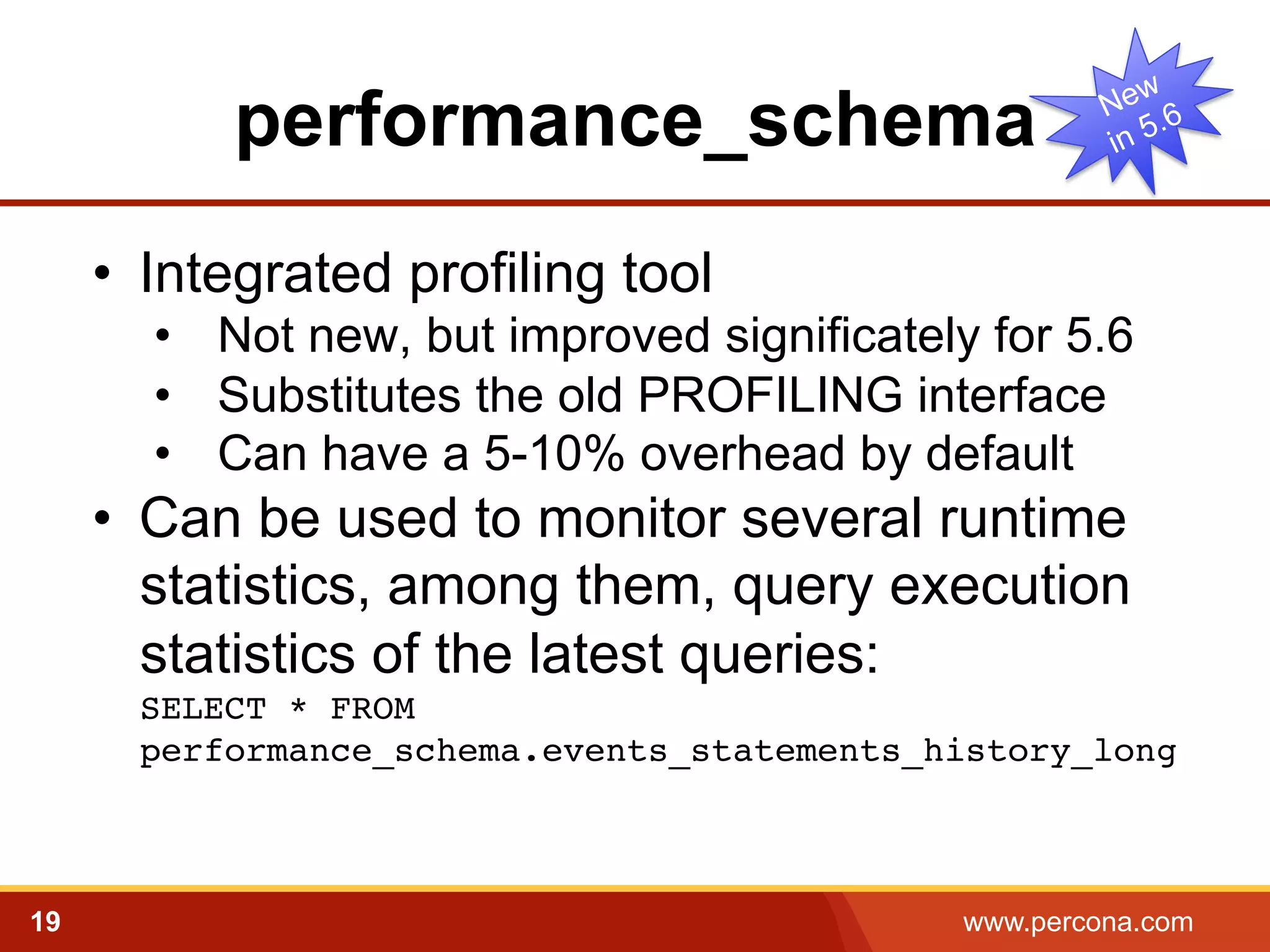
•  Integrated profiling tool
•  Not new, but improved significately for 5.6
•  Substitutes the old PROFILING interface
•  Can have a 5-10% overhead by default

•  Can be used to monitor several runtime
statistics, among them, query execution
statistics of the latest queries:
SELECT * FROM
performance_schema.events_statements_history_long

!

19

www.percona.com
Query Optimization with MySQL 5.6: Old and New Tricks

INDEXING: OLD AND NEW
STRATEGIES
20

www.percona.com

5
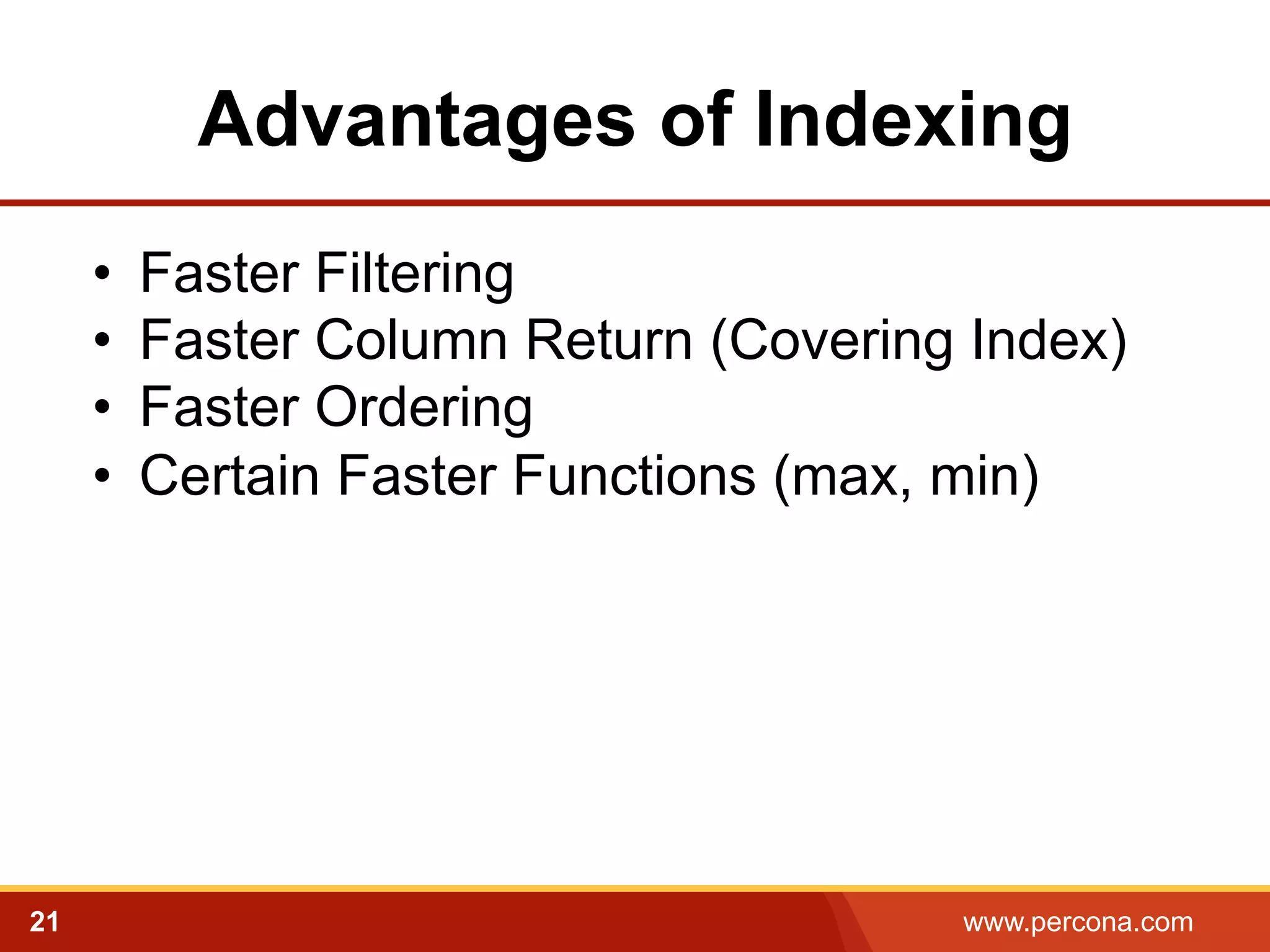
Advantages of Indexing
• 
• 
• 
• 

21

Faster Filtering
Faster Column Return (Covering Index)
Faster Ordering
Certain Faster Functions (max, min)

www.percona.com
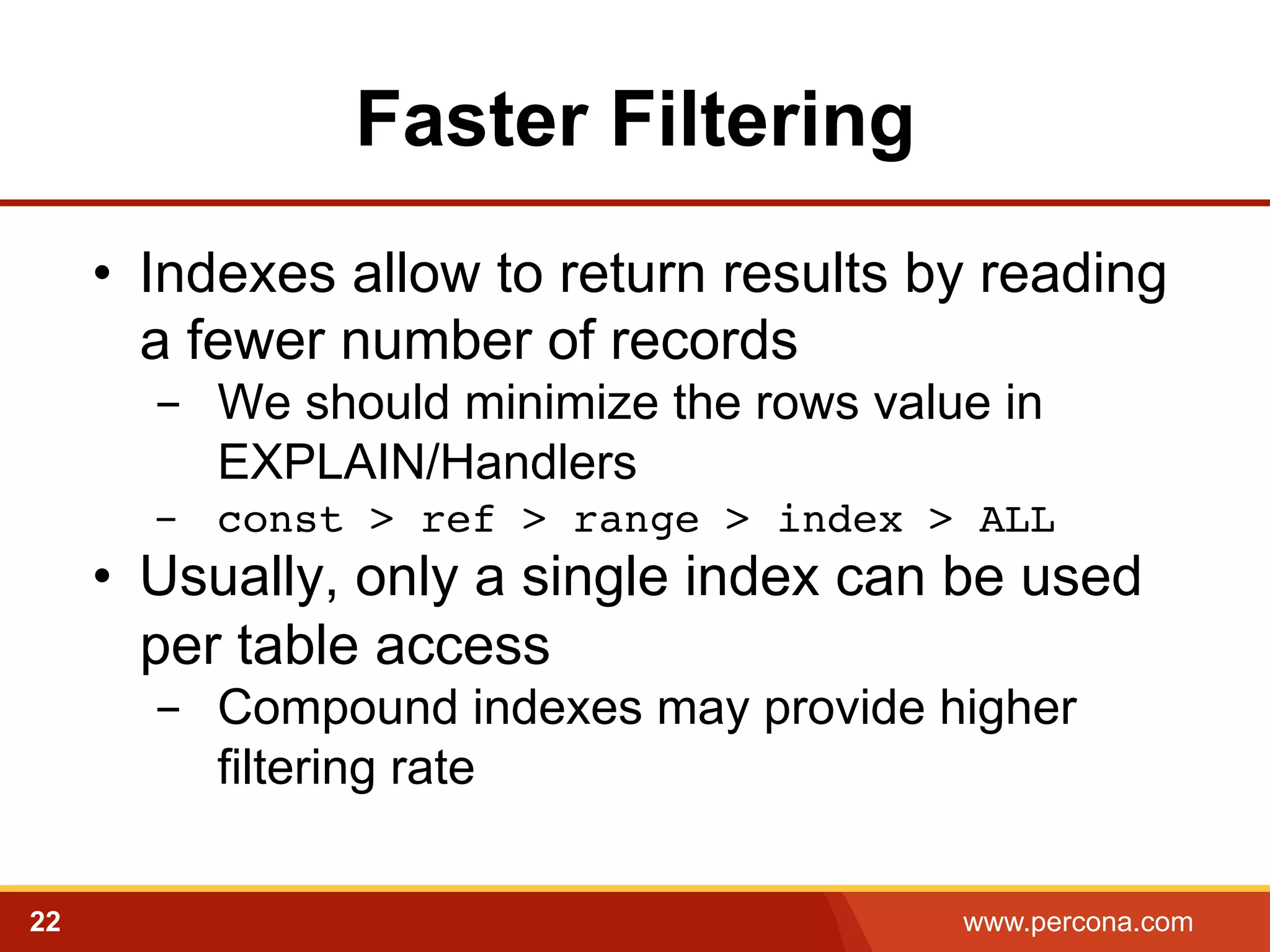
Faster Filtering
•  Indexes allow to return results by reading
a fewer number of records
-  We should minimize the rows value in
EXPLAIN/Handlers

-  const > ref > range > index > ALL!

•  Usually, only a single index can be used
per table access
-  Compound indexes may provide higher
filtering rate
22

www.percona.com
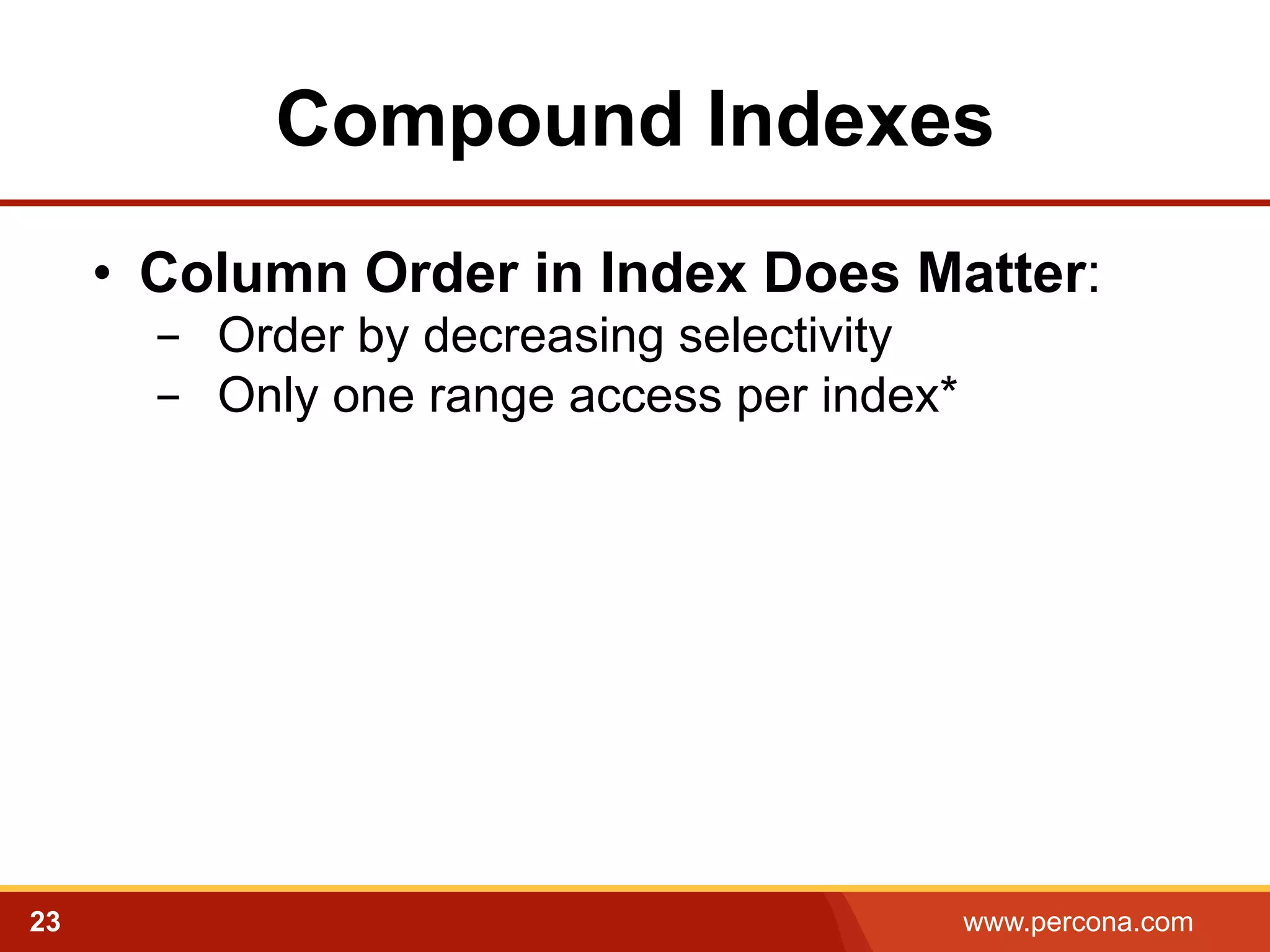
Compound Indexes
•  Column Order in Index Does Matter:
-  Order by decreasing selectivity
-  Only one range access per index*

23

www.percona.com
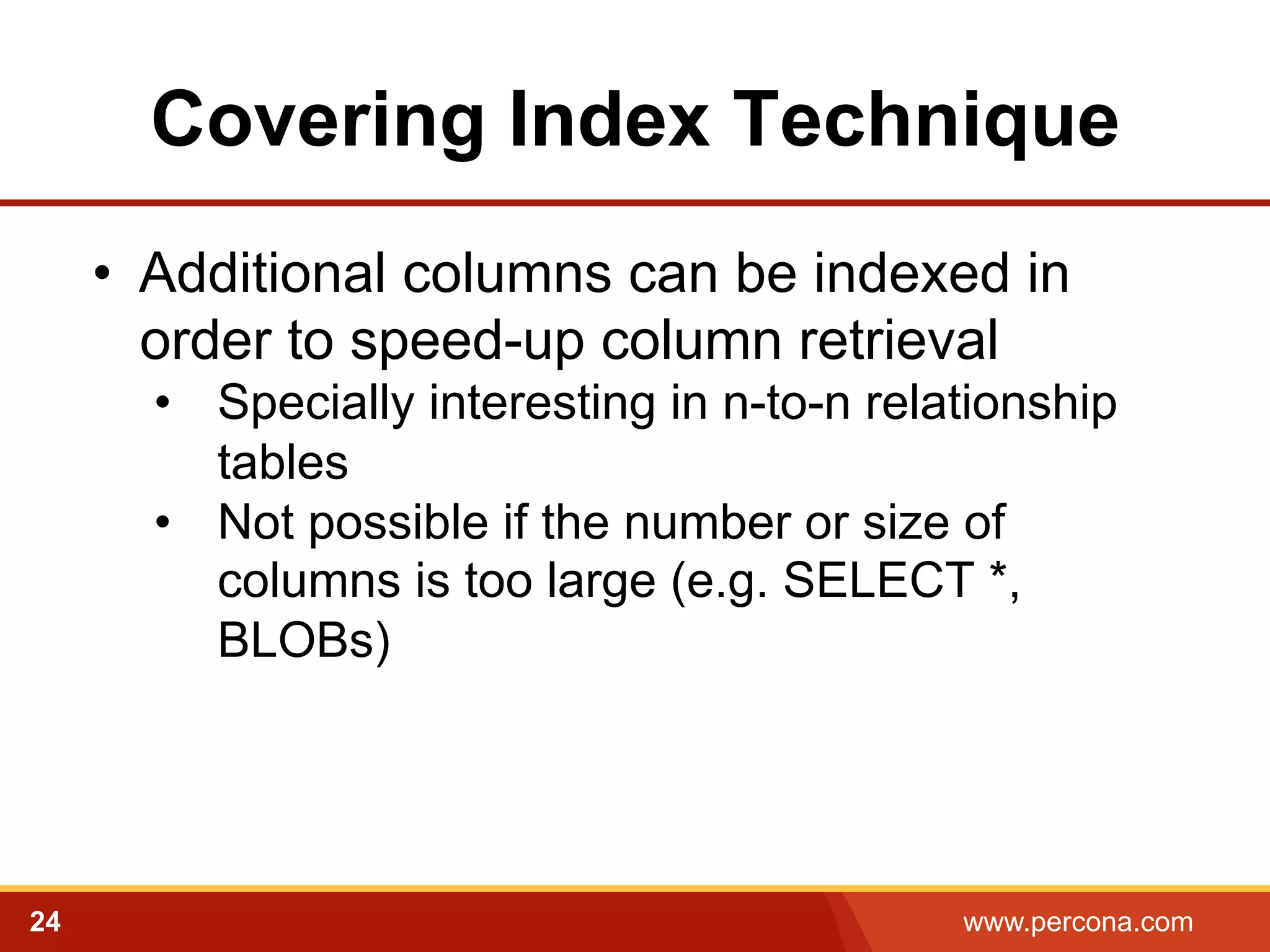
Covering Index Technique
•  Additional columns can be indexed in
order to speed-up column retrieval
•  Specially interesting in n-to-n relationship
tables
•  Not possible if the number or size of
columns is too large (e.g. SELECT *,
BLOBs)

24

www.percona.com
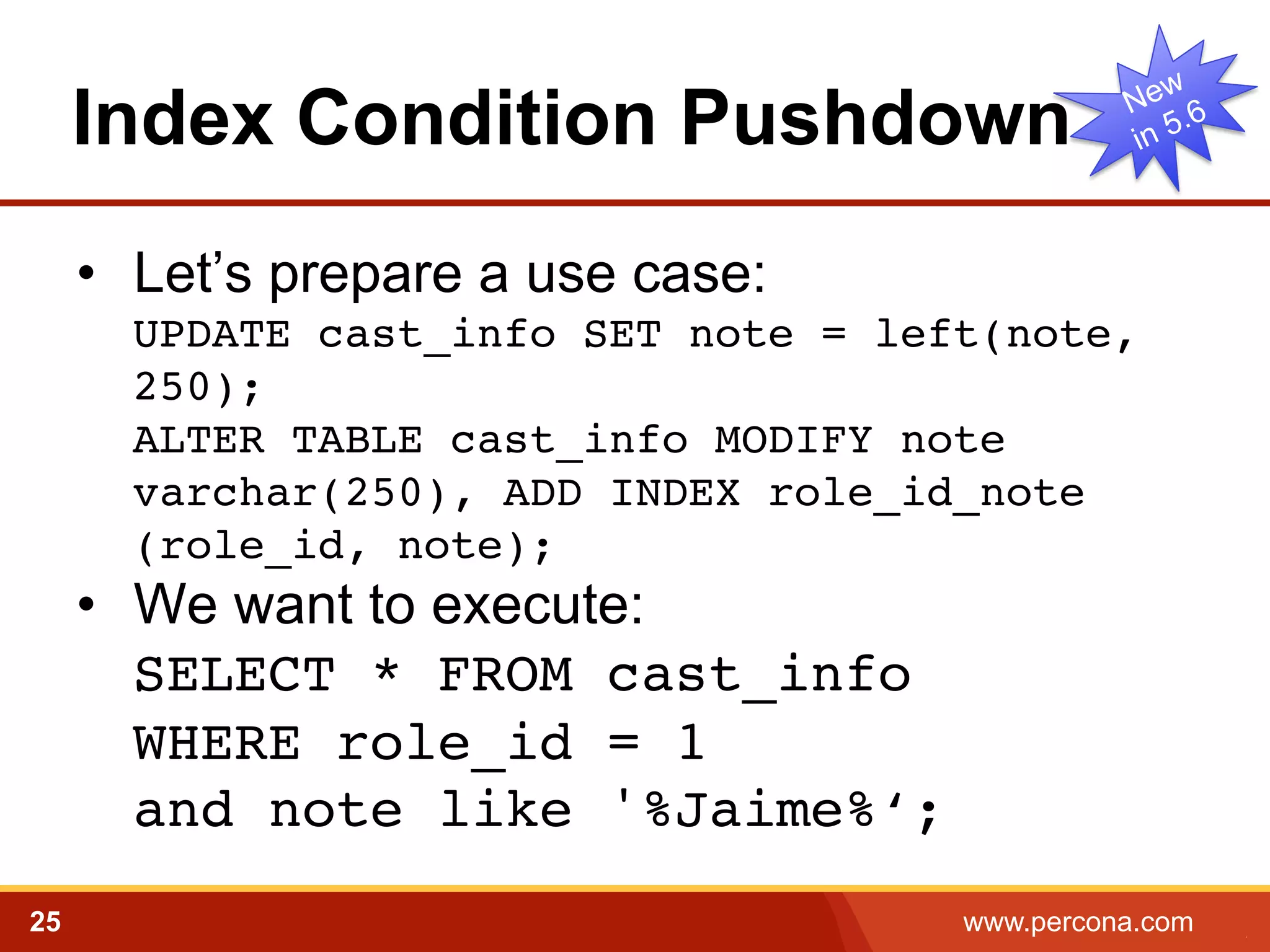
Index Condition Pushdown
•  Let’s prepare a use case:
UPDATE cast_info SET note = left(note,
250);

ALTER TABLE cast_info MODIFY note
varchar(250), ADD INDEX role_id_note
(role_id, note); !

•  We want to execute:
SELECT * FROM cast_info 

WHERE role_id = 1 

and note like '%Jaime%‘;!
25

www.percona.com

5
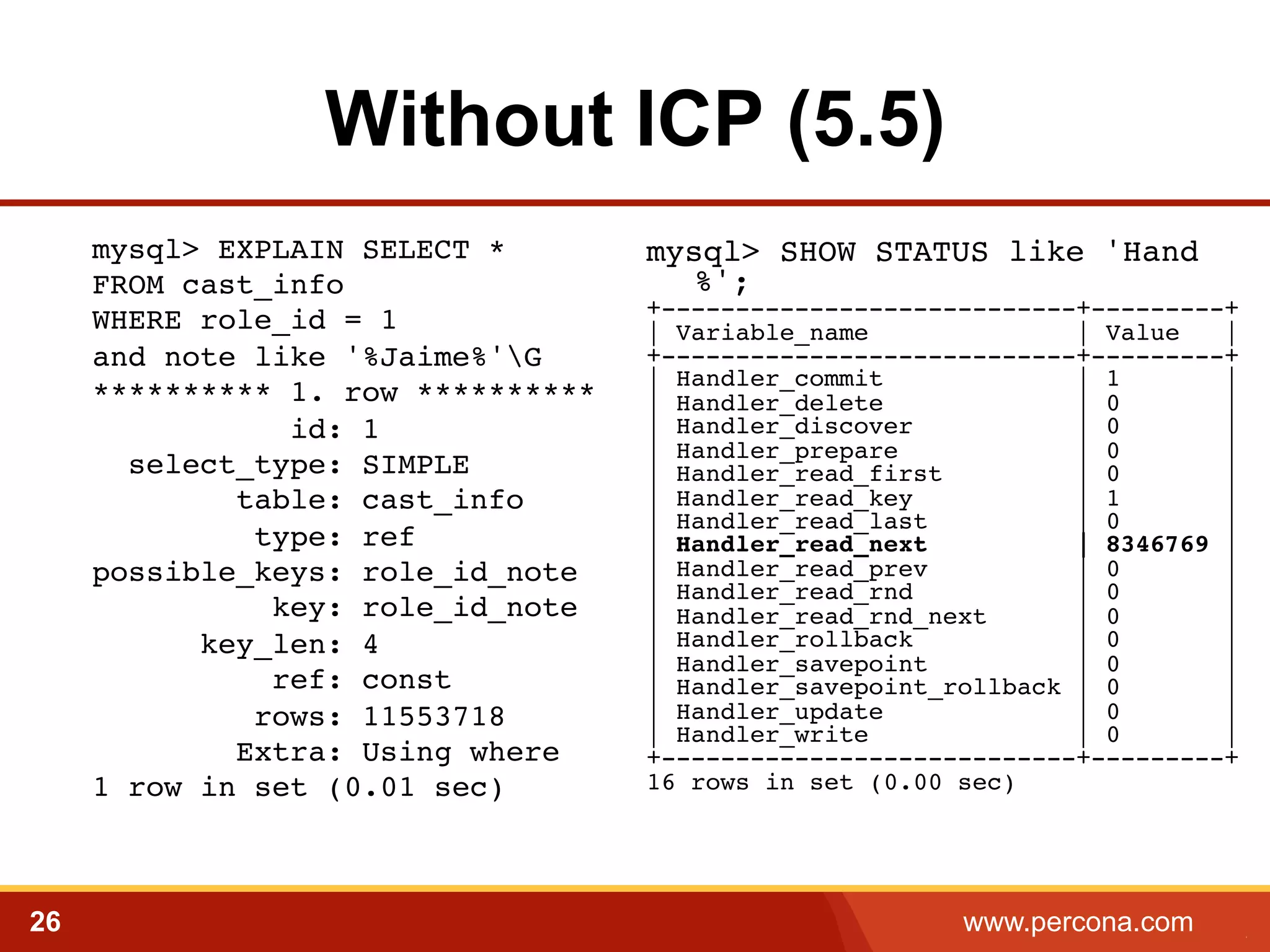
Without ICP (5.5)
mysql> EXPLAIN SELECT * 

FROM cast_info 

WHERE role_id = 1 

and note like '%Jaime%'G

********** 1. row **********

id: 1

select_type: SIMPLE

table: cast_info

type: ref

possible_keys: role_id_note

key: role_id_note

key_len: 4

ref: const

rows: 11553718

Extra: Using where

1 row in set (0.01 sec)!

26

mysql> SHOW STATUS like 'Hand
%';!

+----------------------------+---------+!
| Variable_name
| Value
|!
+----------------------------+---------+!
| Handler_commit
| 1
|!
| Handler_delete
| 0
|!
| Handler_discover
| 0
|!
| Handler_prepare
| 0
|!
| Handler_read_first
| 0
|!
| Handler_read_key
| 1
|!
| Handler_read_last
| 0
|!
| Handler_read_next
| 8346769 |!
| Handler_read_prev
| 0
|!
| Handler_read_rnd
| 0
|!
| Handler_read_rnd_next
| 0
|!
| Handler_rollback
| 0
|!
| Handler_savepoint
| 0
|!
| Handler_savepoint_rollback | 0
|!
| Handler_update
| 0
|!
| Handler_write
| 0
|!
+----------------------------+---------+!
16 rows in set (0.00 sec)!

www.percona.com

5
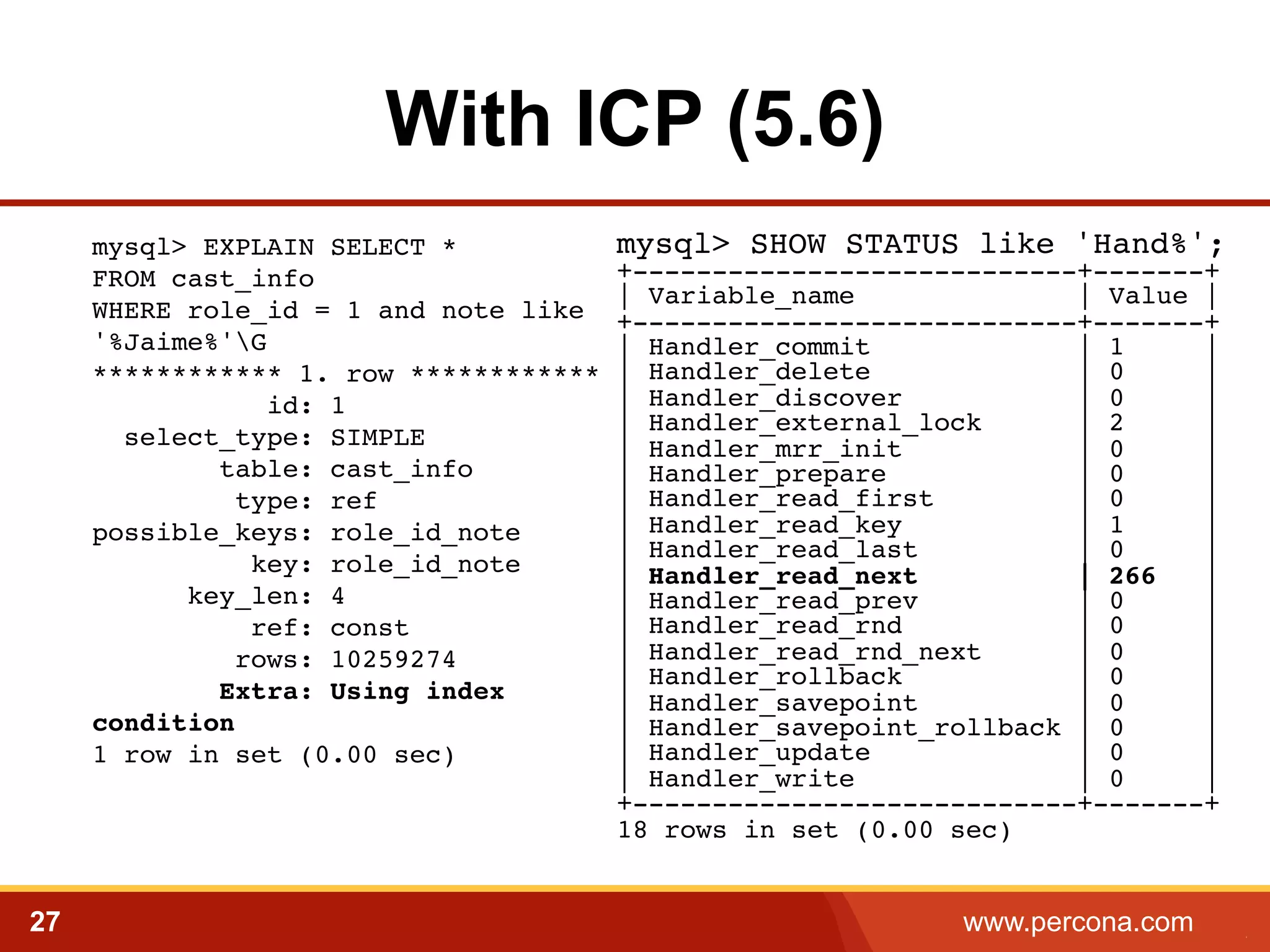
With ICP (5.6)
mysql> EXPLAIN SELECT * 

FROM cast_info 

WHERE role_id = 1 and note like
'%Jaime%'G

************ 1. row ************

id: 1

select_type: SIMPLE

table: cast_info

type: ref

possible_keys: role_id_note

key: role_id_note

key_len: 4

ref: const

rows: 10259274

Extra: Using index
condition

1 row in set (0.00 sec)!

27

mysql> SHOW STATUS like 'Hand%';!
+----------------------------+-------+!
| Variable_name
| Value |!
+----------------------------+-------+!
| Handler_commit
| 1
|!
| Handler_delete
| 0
|!
| Handler_discover
| 0
|!
| Handler_external_lock
| 2
|!
| Handler_mrr_init
| 0
|!
| Handler_prepare
| 0
|!
| Handler_read_first
| 0
|!
| Handler_read_key
| 1
|!
| Handler_read_last
| 0
|!
| Handler_read_next
| 266
|!
| Handler_read_prev
| 0
|!
| Handler_read_rnd
| 0
|!
| Handler_read_rnd_next
| 0
|!
| Handler_rollback
| 0
|!
| Handler_savepoint
| 0
|!
| Handler_savepoint_rollback | 0
|!
| Handler_update
| 0
|!
| Handler_write
| 0
|!
+----------------------------+-------+!
18 rows in set (0.00 sec)

www.percona.com

5
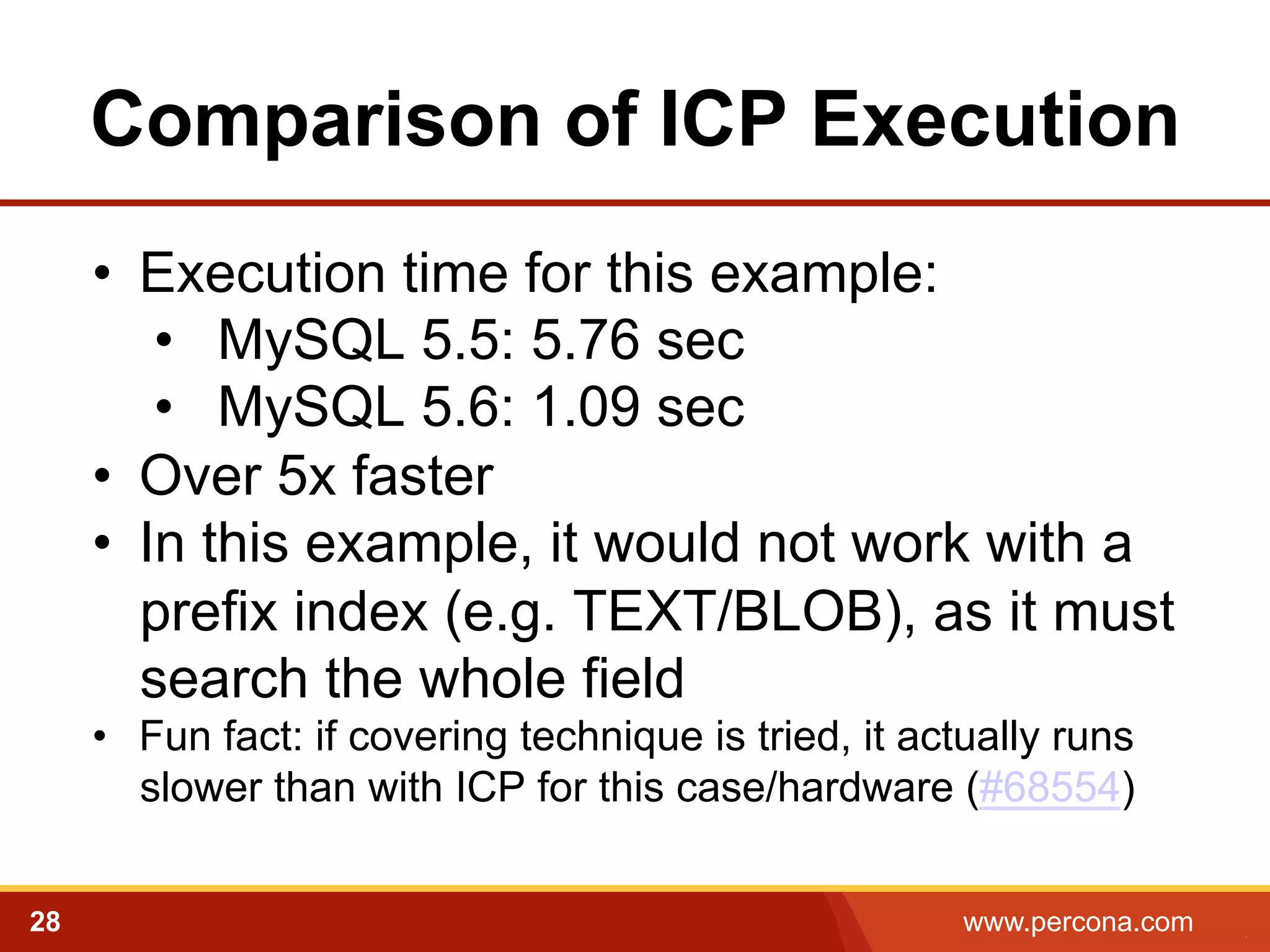
Comparison of ICP Execution
•  Execution time for this example:
•  MySQL 5.5: 5.76 sec
•  MySQL 5.6: 1.09 sec
•  Over 5x faster
•  In this example, it would not work with a
prefix index (e.g. TEXT/BLOB), as it must
search the whole field
•  Fun fact: if covering technique is tried, it actually runs
slower than with ICP for this case/hardware (#68554)
28

www.percona.com

5
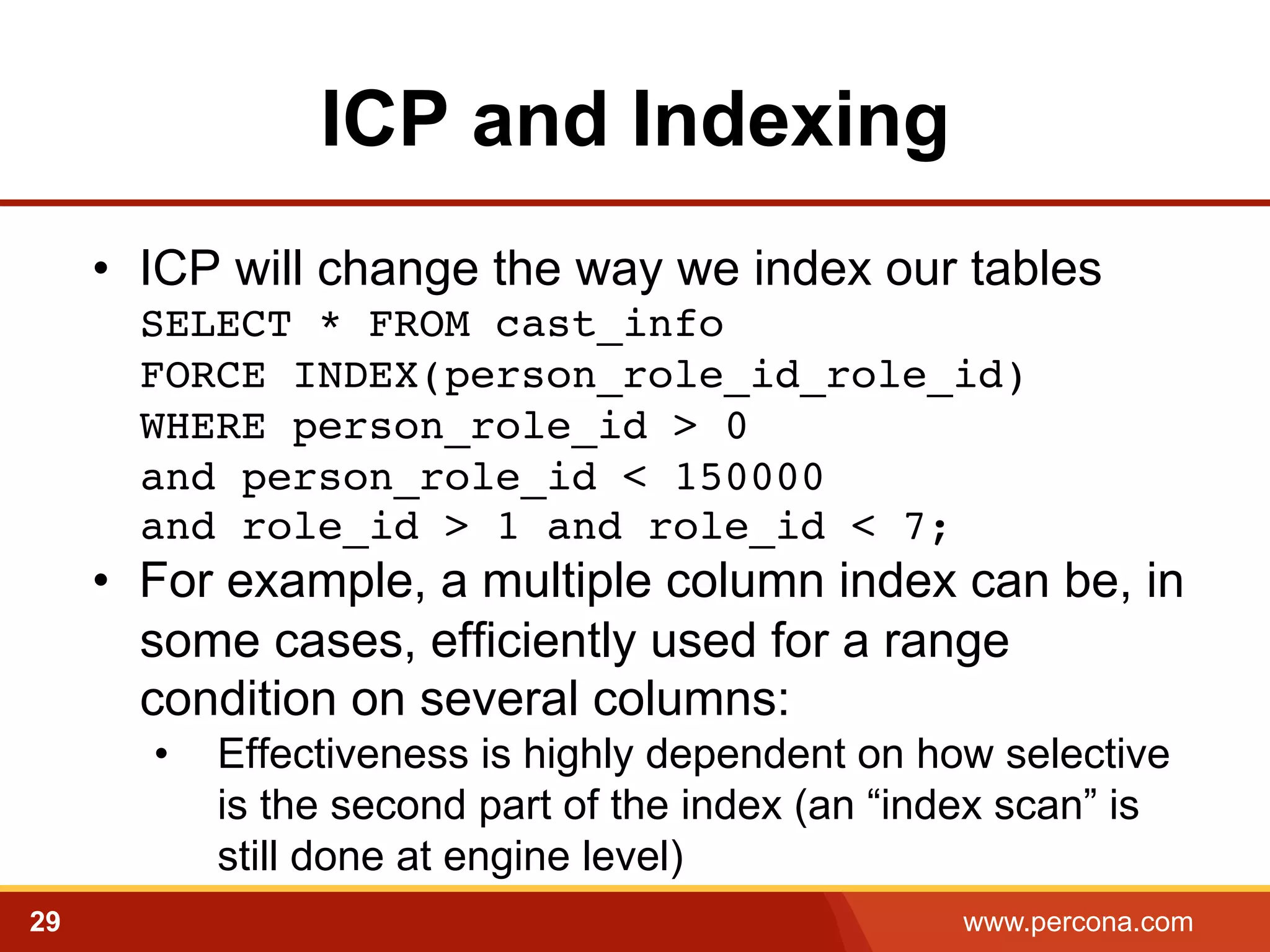
ICP and Indexing
•  ICP will change the way we index our tables
SELECT * FROM cast_info 

FORCE INDEX(person_role_id_role_id)

WHERE person_role_id > 0 

and person_role_id < 150000 

and role_id > 1 and role_id < 7;!

•  For example, a multiple column index can be, in
some cases, efficiently used for a range
condition on several columns:
• 

29

Effectiveness is highly dependent on how selective
is the second part of the index (an “index scan” is
still done at engine level)
www.percona.com
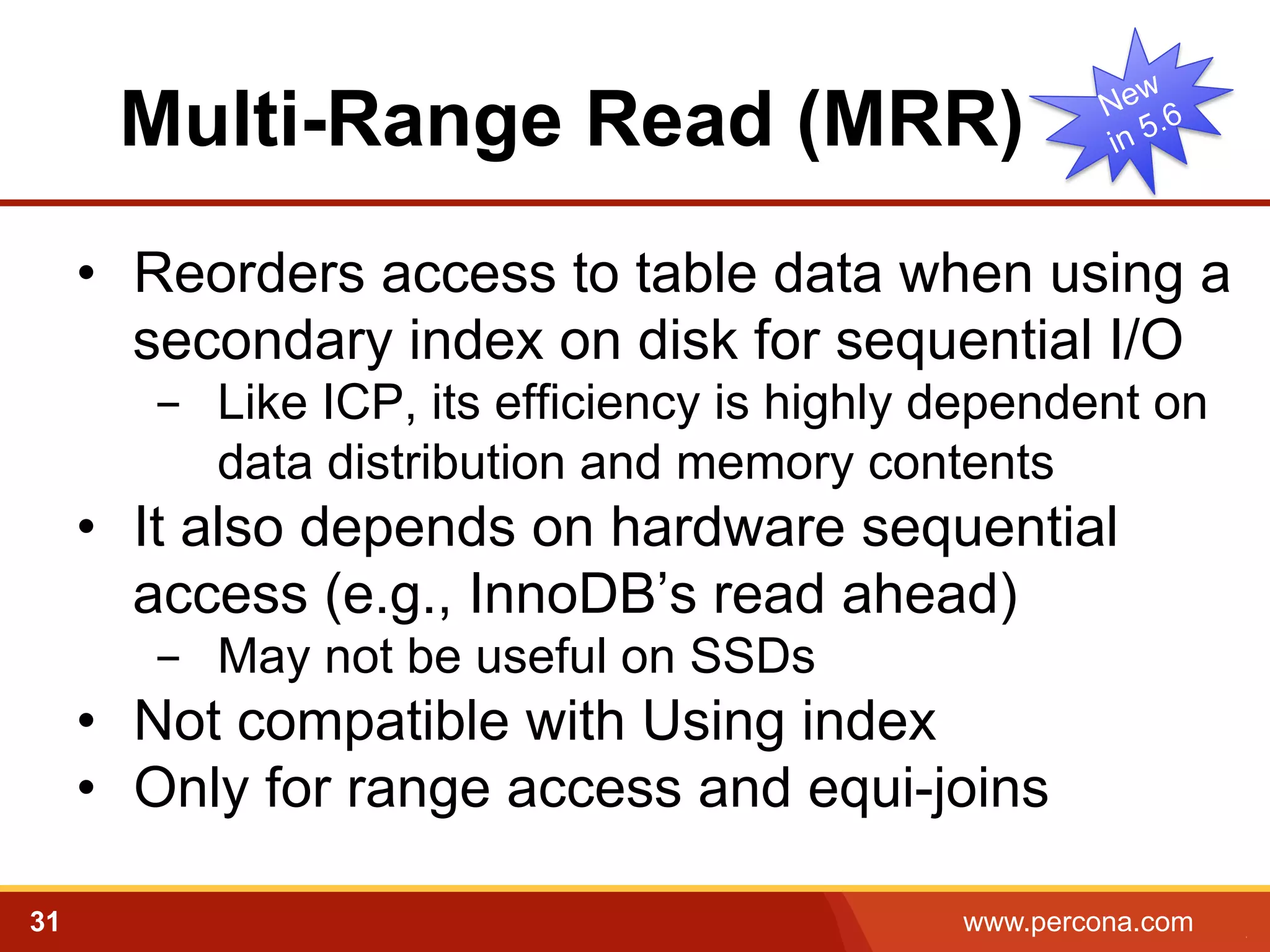
Index for Sorts
•  Additional columns can be indexed in
order to speed up ordering of rows
•  Only effective in simple patterns
•  GROUP BY operations are essentially
sorts
•  They can also be greatly improved
with the right indexes in some cases

30

www.percona.com
Multi-Range Read (MRR)
•  Reorders access to table data when using a
secondary index on disk for sequential I/O
-  Like ICP, its efficiency is highly dependent on
data distribution and memory contents

•  It also depends on hardware sequential
access (e.g., InnoDB’s read ahead)
-  May not be useful on SSDs

•  Not compatible with Using index
•  Only for range access and equi-joins
31

www.percona.com

5
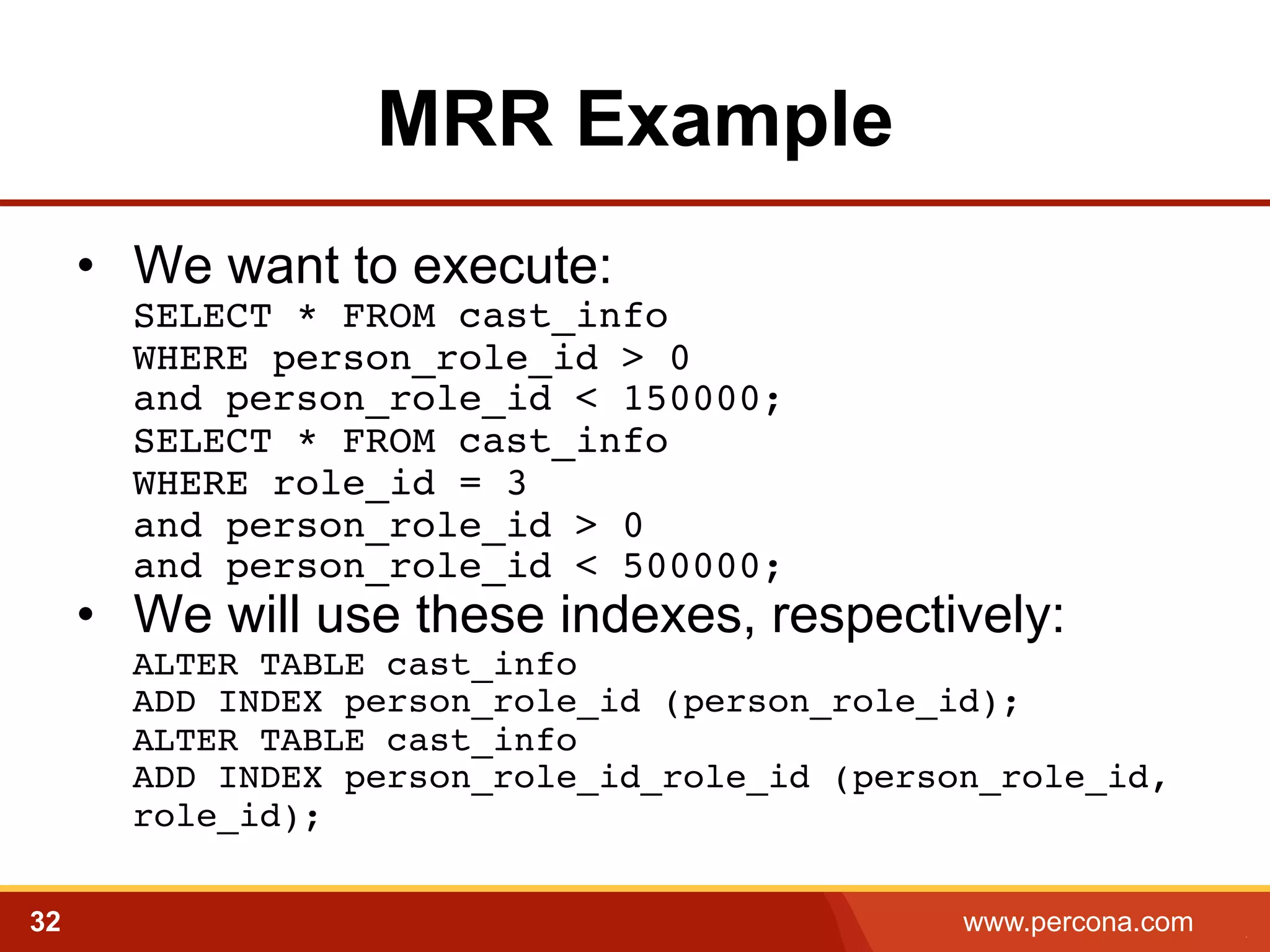
MRR Example
•  We want to execute:
SELECT * FROM cast_info 

WHERE person_role_id > 0 

and person_role_id < 150000;

SELECT * FROM cast_info 

WHERE role_id = 3 

and person_role_id > 0 

and person_role_id < 500000;!

•  We will use these indexes, respectively:
ALTER TABLE cast_info 

ADD INDEX person_role_id (person_role_id);

ALTER TABLE cast_info 

ADD INDEX person_role_id_role_id (person_role_id,
role_id);!
32

www.percona.com

5
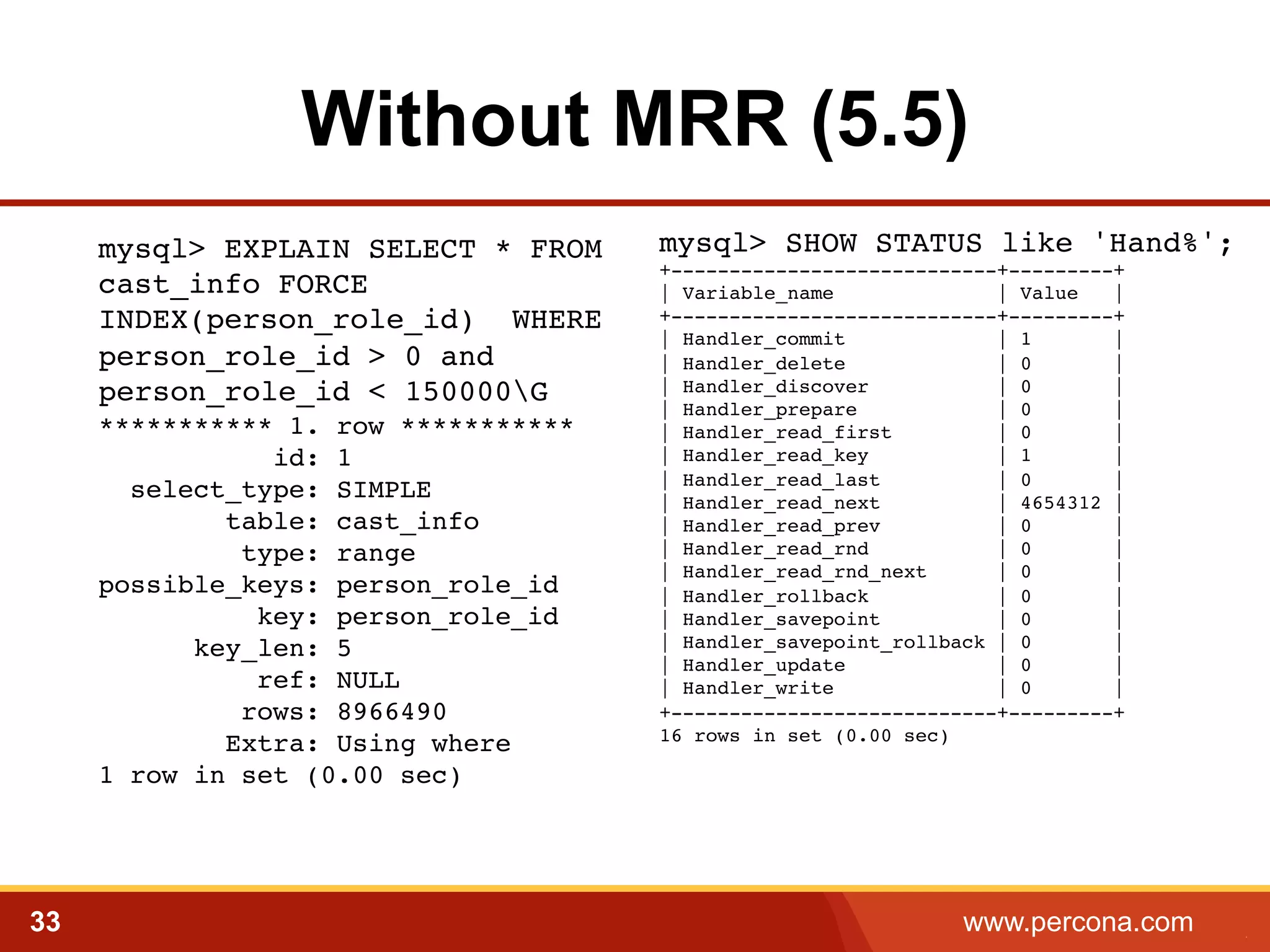
Without MRR (5.5)
mysql> EXPLAIN SELECT * FROM
cast_info FORCE
INDEX(person_role_id) WHERE
person_role_id > 0 and
person_role_id < 150000G

*********** 1. row ***********

id: 1

select_type: SIMPLE

table: cast_info

type: range

possible_keys: person_role_id

key: person_role_id

key_len: 5

ref: NULL

rows: 8966490

Extra: Using where

1 row in set (0.00 sec)!

33

mysql> SHOW STATUS like 'Hand%';!
+----------------------------+---------+!
| Variable_name
| Value
|!
+----------------------------+---------+!
| Handler_commit
| 1
|!
| Handler_delete
| 0
|!
| Handler_discover
| 0
|!
| Handler_prepare
| 0
|!
| Handler_read_first
| 0
|!
| Handler_read_key
| 1
|!
| Handler_read_last
| 0
|!
| Handler_read_next
| 4654312 |!
| Handler_read_prev
| 0
|!
| Handler_read_rnd
| 0
|!
| Handler_read_rnd_next
| 0
|!
| Handler_rollback
| 0
|!
| Handler_savepoint
| 0
|!
| Handler_savepoint_rollback | 0
|!
| Handler_update
| 0
|!
| Handler_write
| 0
|!
+----------------------------+---------+!
16 rows in set (0.00 sec)

www.percona.com

5
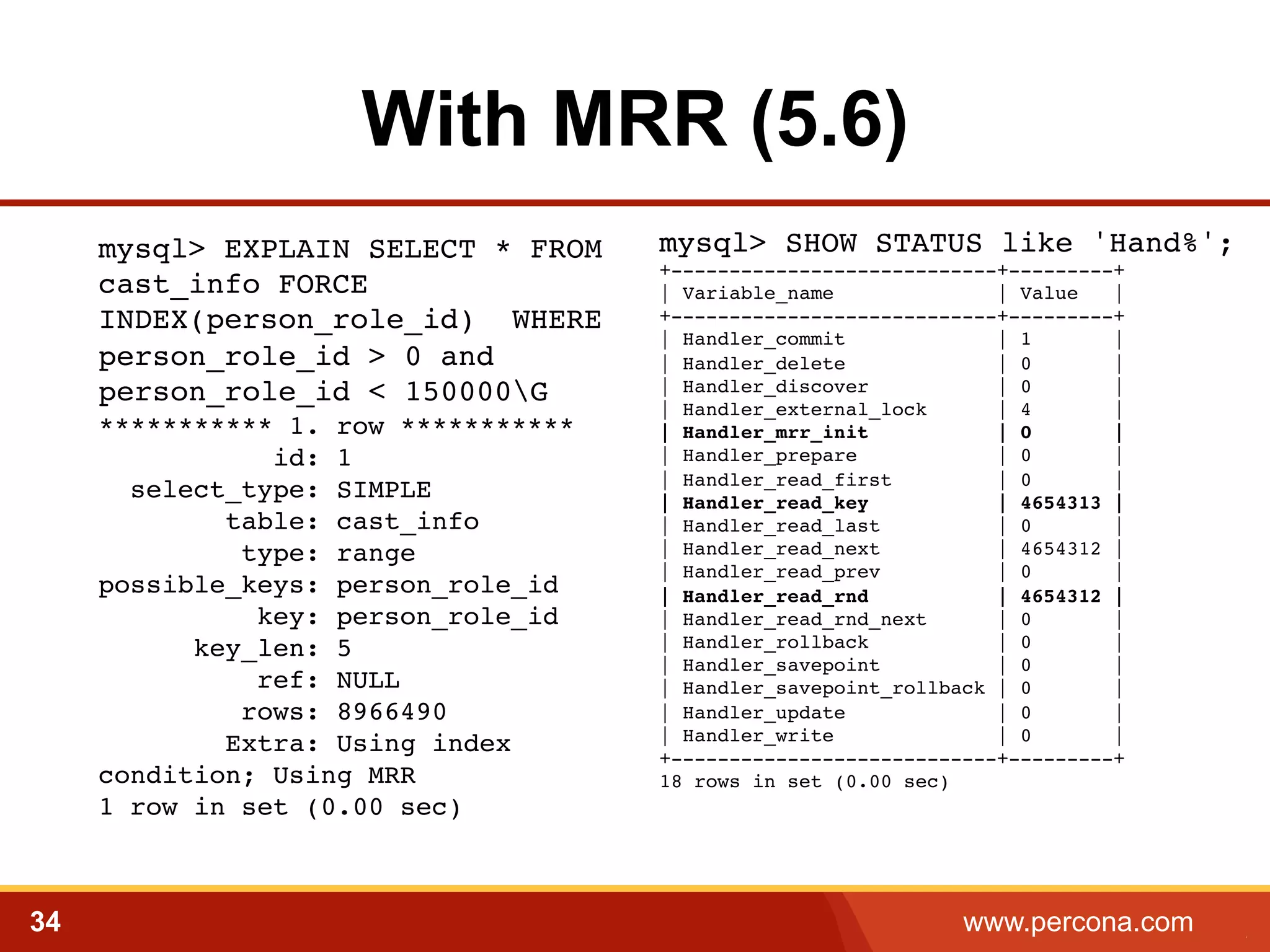
With MRR (5.6)
mysql> EXPLAIN SELECT * FROM
cast_info FORCE
INDEX(person_role_id) WHERE
person_role_id > 0 and
person_role_id < 150000G

*********** 1. row ***********

id: 1

select_type: SIMPLE

table: cast_info

type: range

possible_keys: person_role_id

key: person_role_id

key_len: 5

ref: NULL

rows: 8966490

Extra: Using index

condition; Using MRR

1 row in set (0.00 sec)!

34

mysql> SHOW STATUS like 'Hand%';!
+----------------------------+---------+!
| Variable_name
| Value
|!
+----------------------------+---------+!
| Handler_commit
| 1
|!
| Handler_delete
| 0
|!
| Handler_discover
| 0
|!
| Handler_external_lock
| 4
|!
| Handler_mrr_init
| 0
|!
| Handler_prepare
| 0
|!
| Handler_read_first
| 0
|!
| Handler_read_key
| 4654313 |!
| Handler_read_last
| 0
|!
| Handler_read_next
| 4654312 |!
| Handler_read_prev
| 0
|!
| Handler_read_rnd
| 4654312 |!
| Handler_read_rnd_next
| 0
|!
| Handler_rollback
| 0
|!
| Handler_savepoint
| 0
|!
| Handler_savepoint_rollback | 0
|!
| Handler_update
| 0
|!
| Handler_write
| 0
|!
+----------------------------+---------+!
18 rows in set (0.00 sec)

www.percona.com

5
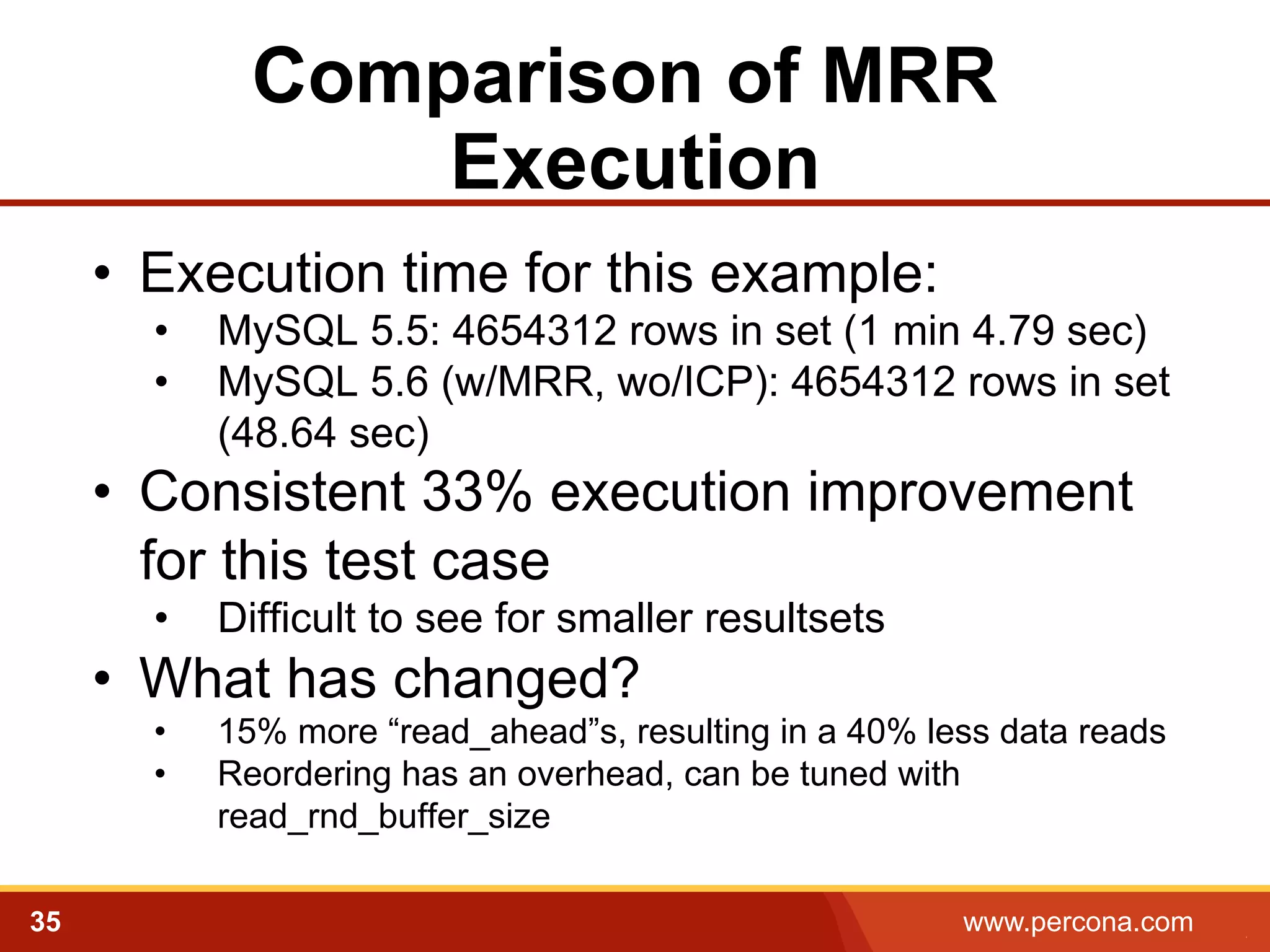
Comparison of MRR
Execution
•  Execution time for this example:
• 
• 

MySQL 5.5: 4654312 rows in set (1 min 4.79 sec)
MySQL 5.6 (w/MRR, wo/ICP): 4654312 rows in set
(48.64 sec)

•  Consistent 33% execution improvement
for this test case
• 

Difficult to see for smaller resultsets

•  What has changed?
• 
• 

35

15% more “read_ahead”s, resulting in a 40% less data reads
Reordering has an overhead, can be tuned with
read_rnd_buffer_size
www.percona.com

5
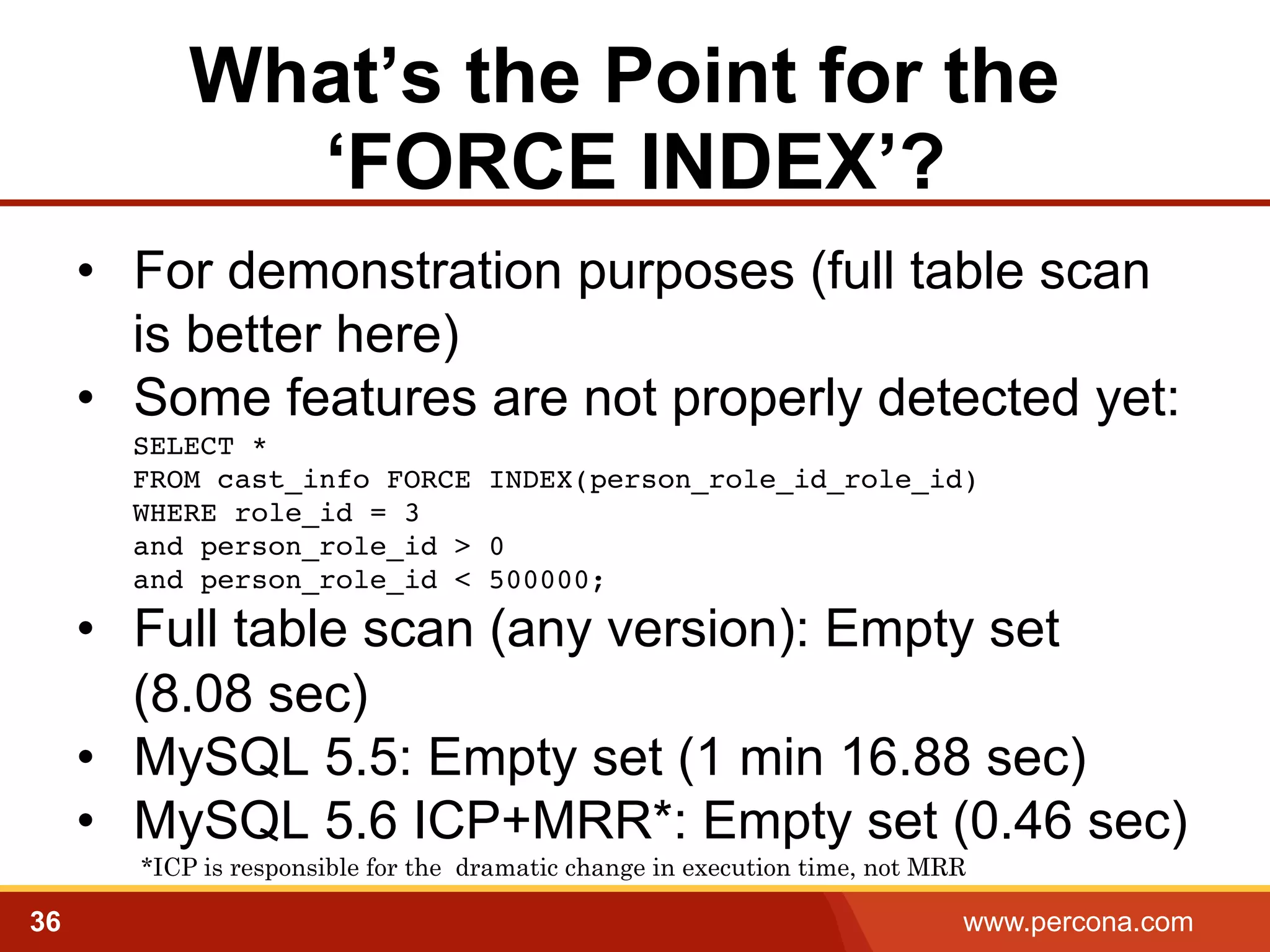
What’s the Point for the
‘FORCE INDEX’?
•  For demonstration purposes (full table scan
is better here)
•  Some features are not properly detected yet:
SELECT * 

FROM cast_info FORCE INDEX(person_role_id_role_id) 

WHERE role_id = 3 

and person_role_id > 0 

and person_role_id < 500000;

•  Full table scan (any version): Empty set
(8.08 sec)
•  MySQL 5.5: Empty set (1 min 16.88 sec)
•  MySQL 5.6 ICP+MRR*: Empty set (0.46 sec)
*ICP is responsible for the dramatic change in execution time, not MRR

36

www.percona.com
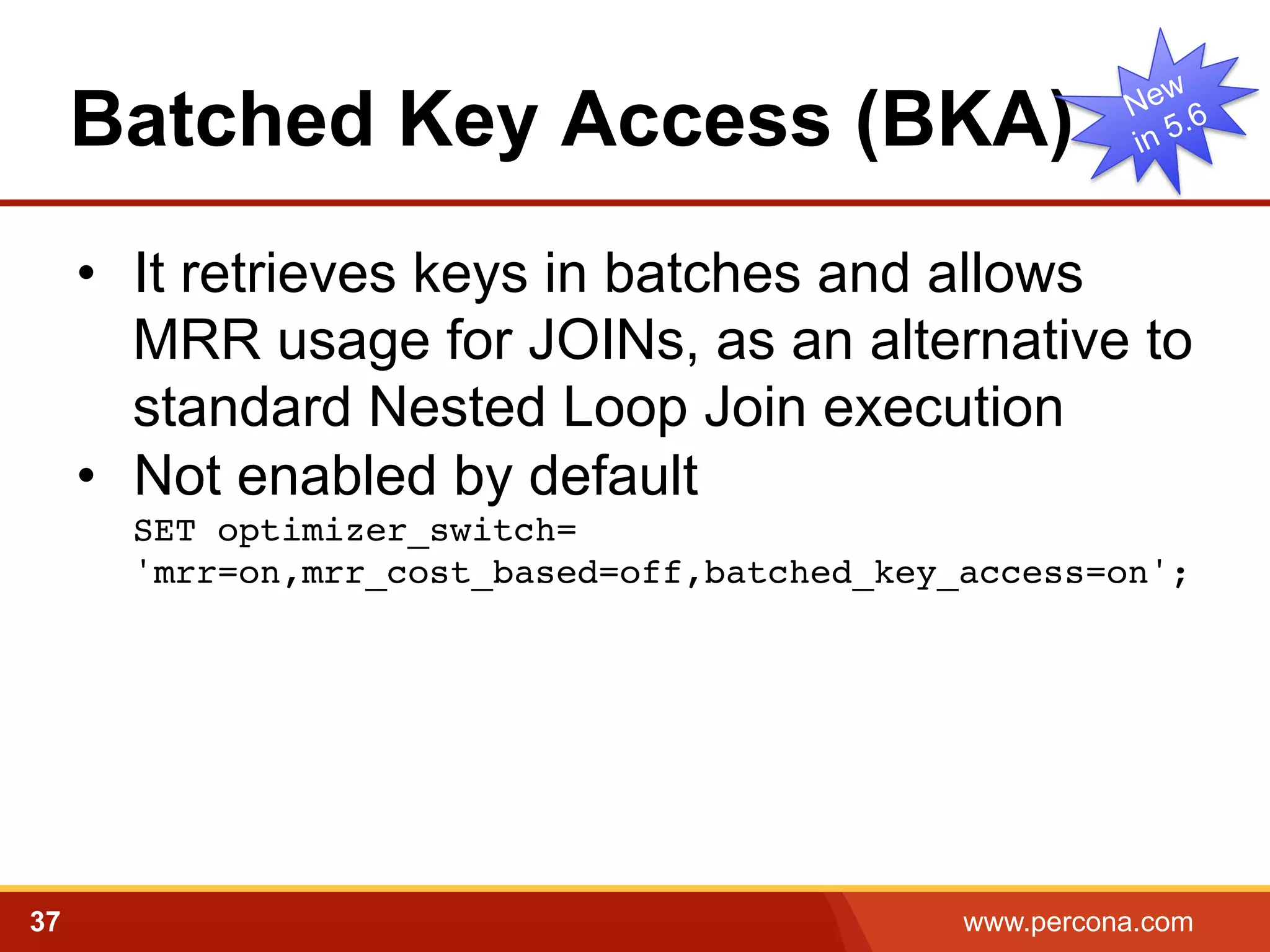
Batched Key Access (BKA)
•  It retrieves keys in batches and allows
MRR usage for JOINs, as an alternative to
standard Nested Loop Join execution
•  Not enabled by default
SET optimizer_switch=

'mrr=on,mrr_cost_based=off,batched_key_access=on';
!

37

www.percona.com
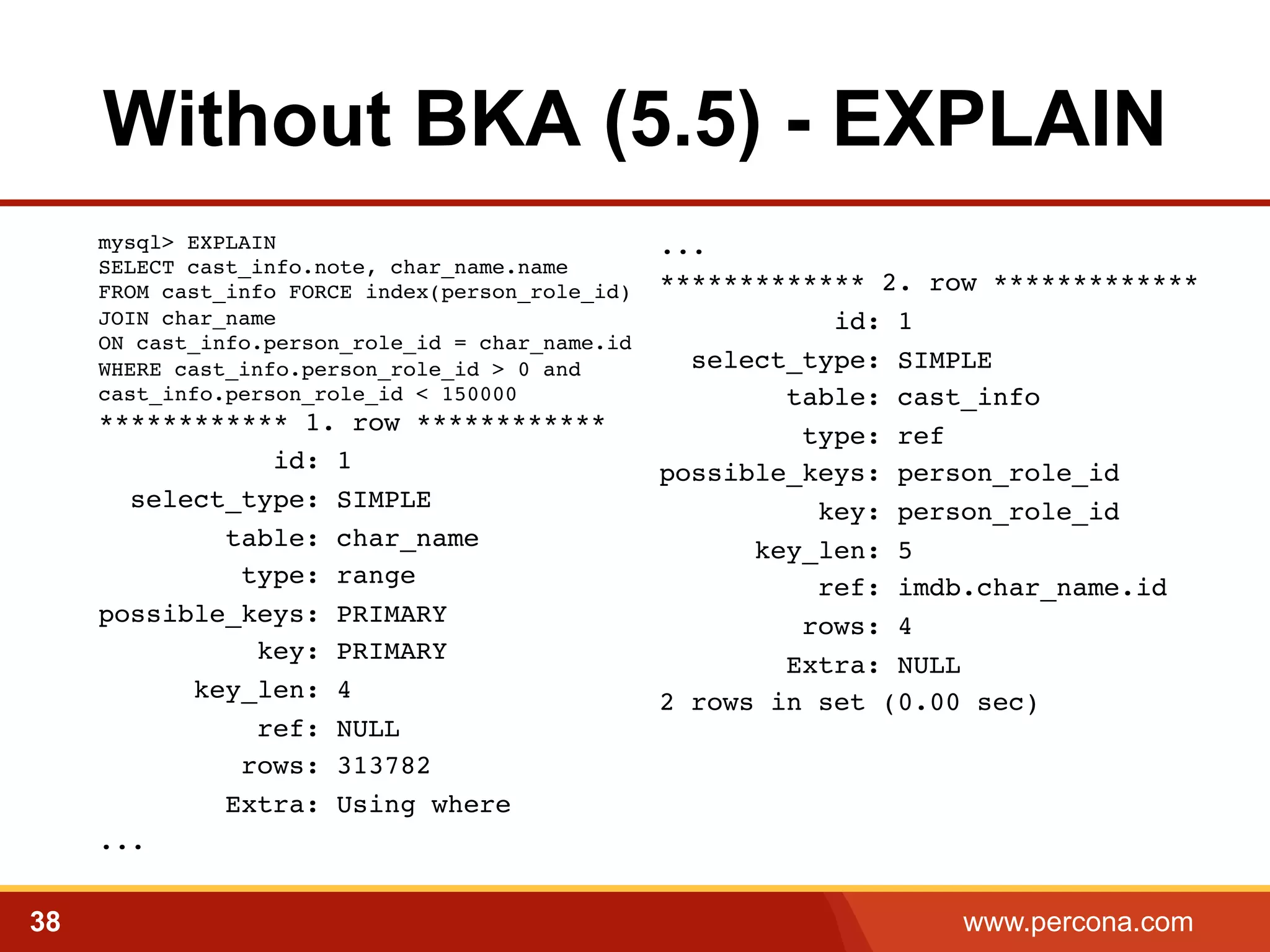
Without BKA (5.5) - EXPLAIN
mysql> EXPLAIN 

SELECT cast_info.note, char_name.name 

FROM cast_info FORCE index(person_role_id) 

JOIN char_name 

ON cast_info.person_role_id = char_name.id 

WHERE cast_info.person_role_id > 0 and
cast_info.person_role_id < 150000


************ 1. row ************!
id: 1!
select_type: SIMPLE!
table: char_name!
type: range!
possible_keys: PRIMARY!
key: PRIMARY!
key_len: 4!
ref: NULL!
rows: 313782!
Extra: Using where!
...!

38

...!
************* 2. row *************
id: 1!
select_type: SIMPLE!
table: cast_info!
type: ref!
possible_keys: person_role_id!
key: person_role_id!
key_len: 5!
ref: imdb.char_name.id!
rows: 4!
Extra: NULL!
2 rows in set (0.00 sec)!

www.percona.com
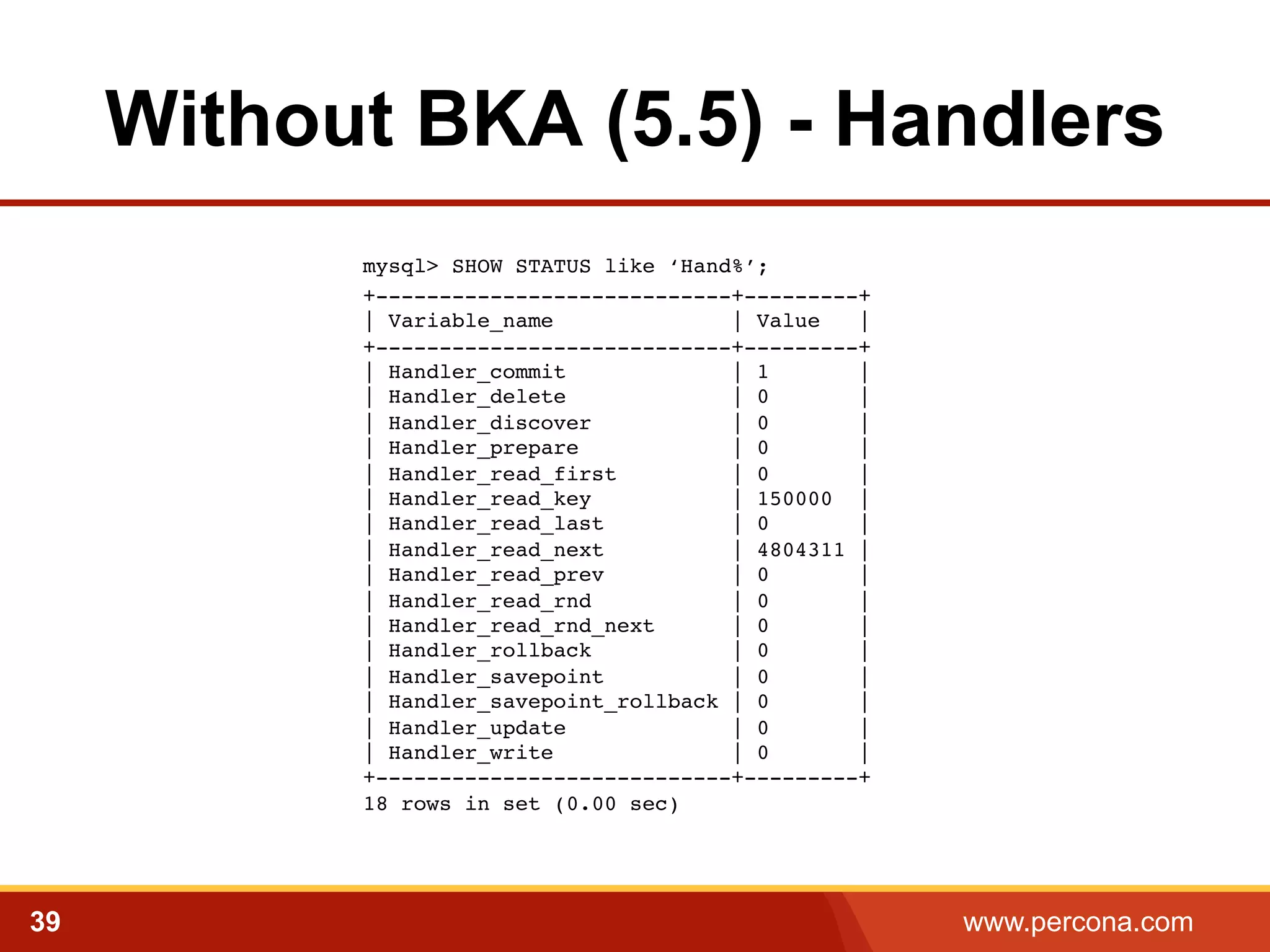
Without BKA (5.5) - Handlers
mysql> SHOW STATUS like ‘Hand%’;!
+----------------------------+---------+

| Variable_name
| Value
|

+----------------------------+---------+

| Handler_commit
| 1
|

| Handler_delete
| 0
|

| Handler_discover
| 0
|

| Handler_prepare
| 0
|

| Handler_read_first
| 0
|

| Handler_read_key
| 150000 |

| Handler_read_last
| 0
|

| Handler_read_next
| 4804311 |

| Handler_read_prev
| 0
|

| Handler_read_rnd
| 0
|

| Handler_read_rnd_next
| 0
|

| Handler_rollback
| 0
|

| Handler_savepoint
| 0
|

| Handler_savepoint_rollback | 0
|

| Handler_update
| 0
|

| Handler_write
| 0
|

+----------------------------+---------+

18 rows in set (0.00 sec)!

39

www.percona.com
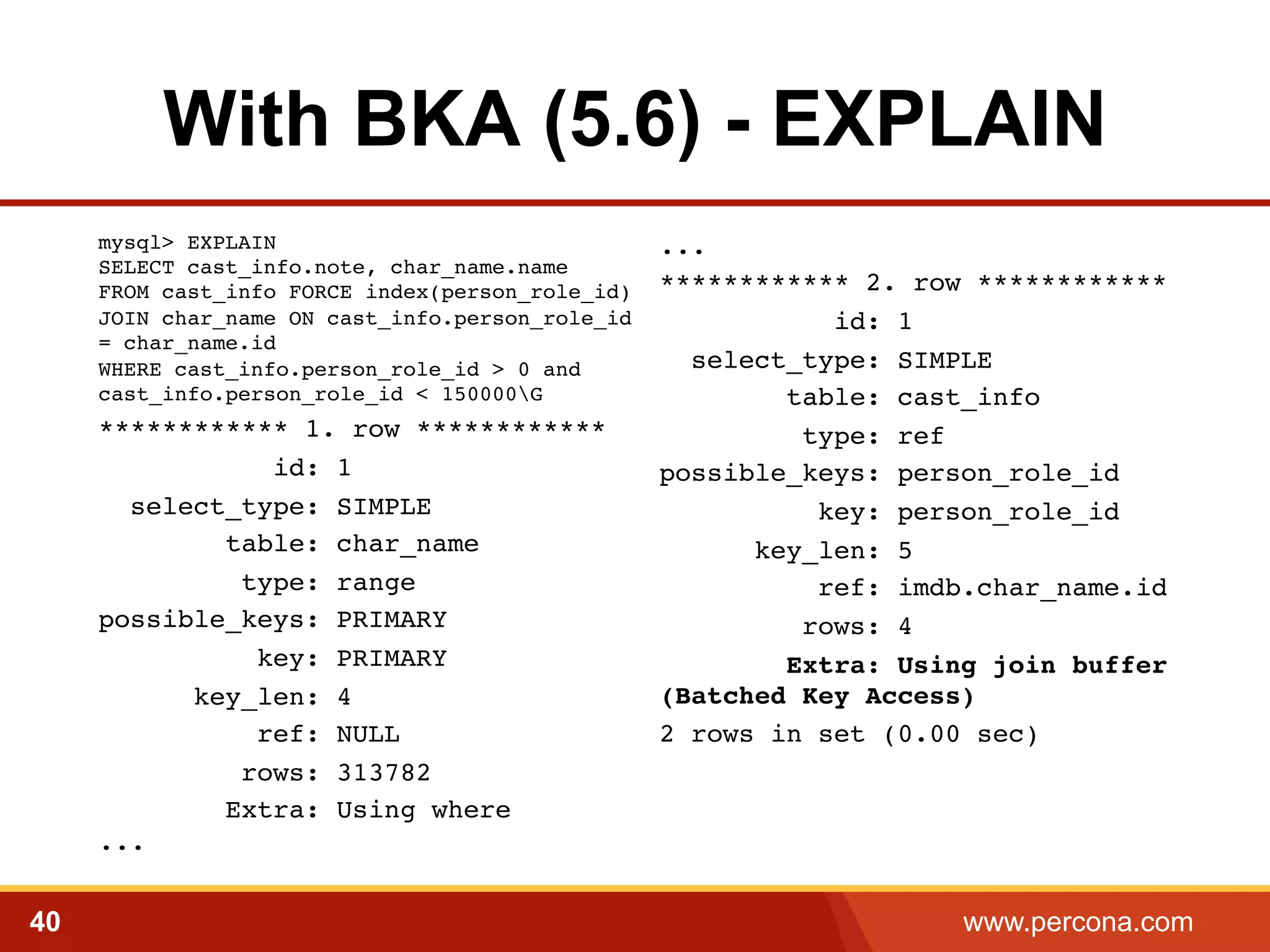
With BKA (5.6) - EXPLAIN
mysql> EXPLAIN 

SELECT cast_info.note, char_name.name 

FROM cast_info FORCE index(person_role_id)
JOIN char_name ON cast_info.person_role_id
= char_name.id 

WHERE cast_info.person_role_id > 0 and
cast_info.person_role_id < 150000G!

************ 1. row ************!
id: 1!
select_type: SIMPLE!
table: char_name!
type: range!
possible_keys: PRIMARY!
key: PRIMARY!
key_len: 4!
ref: NULL!
rows: 313782!
Extra: Using where

...!

40

...!
************ 2. row ************!
id: 1!
select_type: SIMPLE!
table: cast_info!
type: ref!
possible_keys: person_role_id!
key: person_role_id!
key_len: 5!
ref: imdb.char_name.id!
rows: 4!
Extra: Using join buffer
(Batched Key Access)!
2 rows in set (0.00 sec)!

www.percona.com
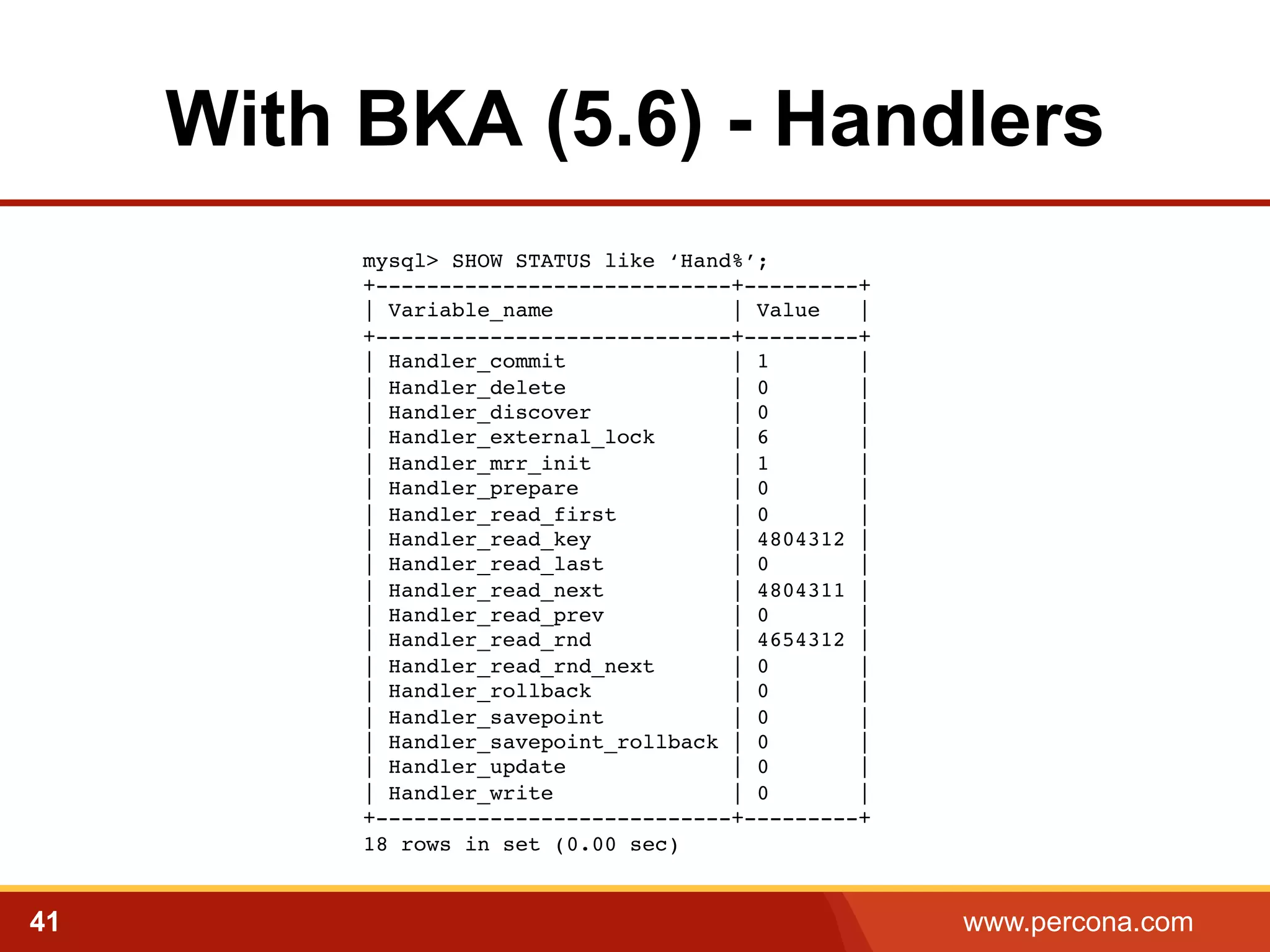
With BKA (5.6) - Handlers
mysql> SHOW STATUS like ‘Hand%’;

+----------------------------+---------+

| Variable_name
| Value
|

+----------------------------+---------+

| Handler_commit
| 1
|

| Handler_delete
| 0
|

| Handler_discover
| 0
|

| Handler_external_lock
| 6
|

| Handler_mrr_init
| 1
|

| Handler_prepare
| 0
|

| Handler_read_first
| 0
|

| Handler_read_key
| 4804312 |

| Handler_read_last
| 0
|

| Handler_read_next
| 4804311 |

| Handler_read_prev
| 0
|

| Handler_read_rnd
| 4654312 |

| Handler_read_rnd_next
| 0
|

| Handler_rollback
| 0
|

| Handler_savepoint
| 0
|

| Handler_savepoint_rollback | 0
|

| Handler_update
| 0
|

| Handler_write
| 0
|

+----------------------------+---------+

18 rows in set (0.00 sec)!

41

www.percona.com
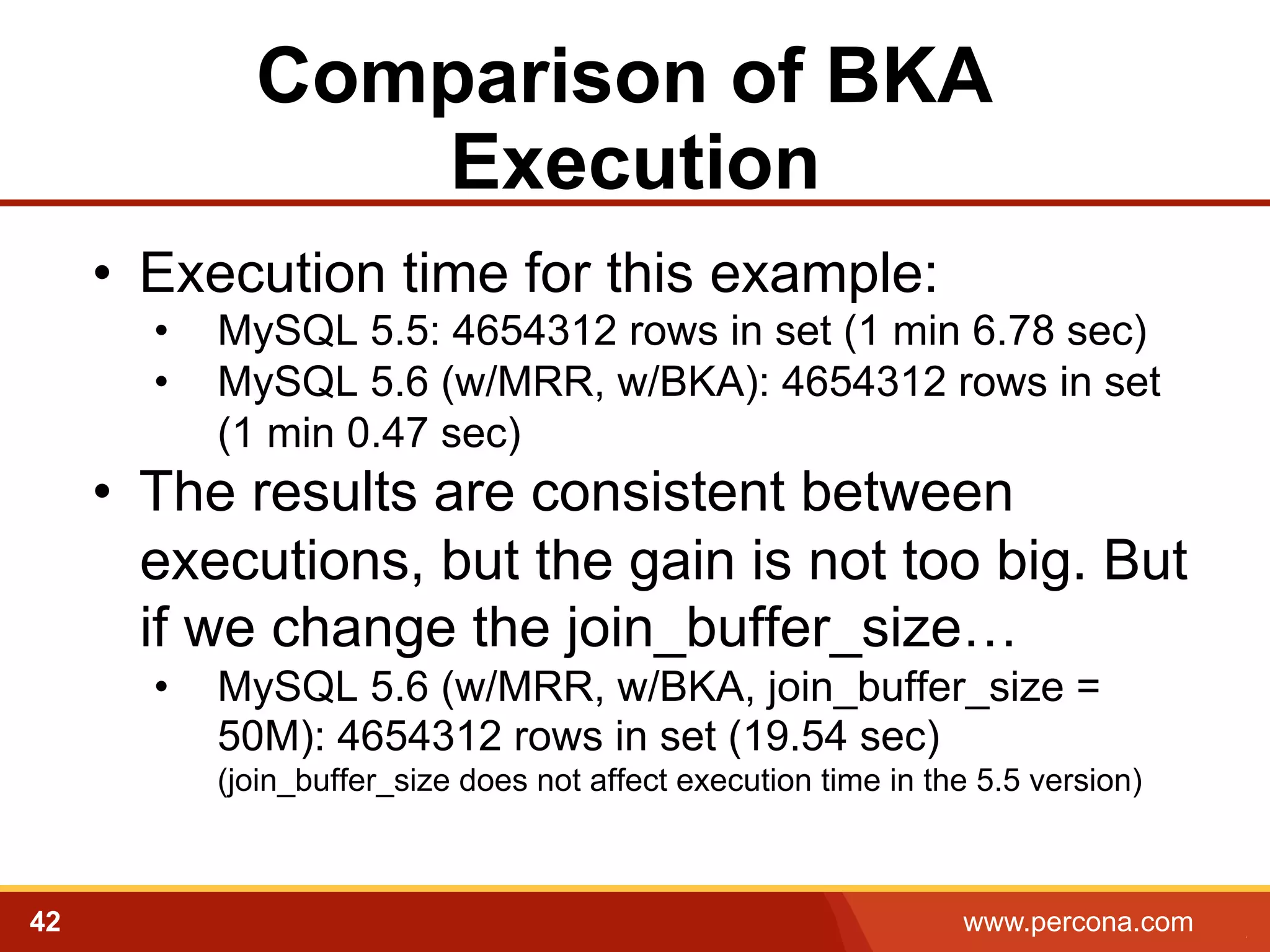
Comparison of BKA
Execution
•  Execution time for this example:
• 
• 

MySQL 5.5: 4654312 rows in set (1 min 6.78 sec)
MySQL 5.6 (w/MRR, w/BKA): 4654312 rows in set
(1 min 0.47 sec)

•  The results are consistent between
executions, but the gain is not too big. But
if we change the join_buffer_size…
• 

MySQL 5.6 (w/MRR, w/BKA, join_buffer_size =
50M): 4654312 rows in set (19.54 sec)
(join_buffer_size does not affect execution time in the 5.5 version)

42

www.percona.com

5
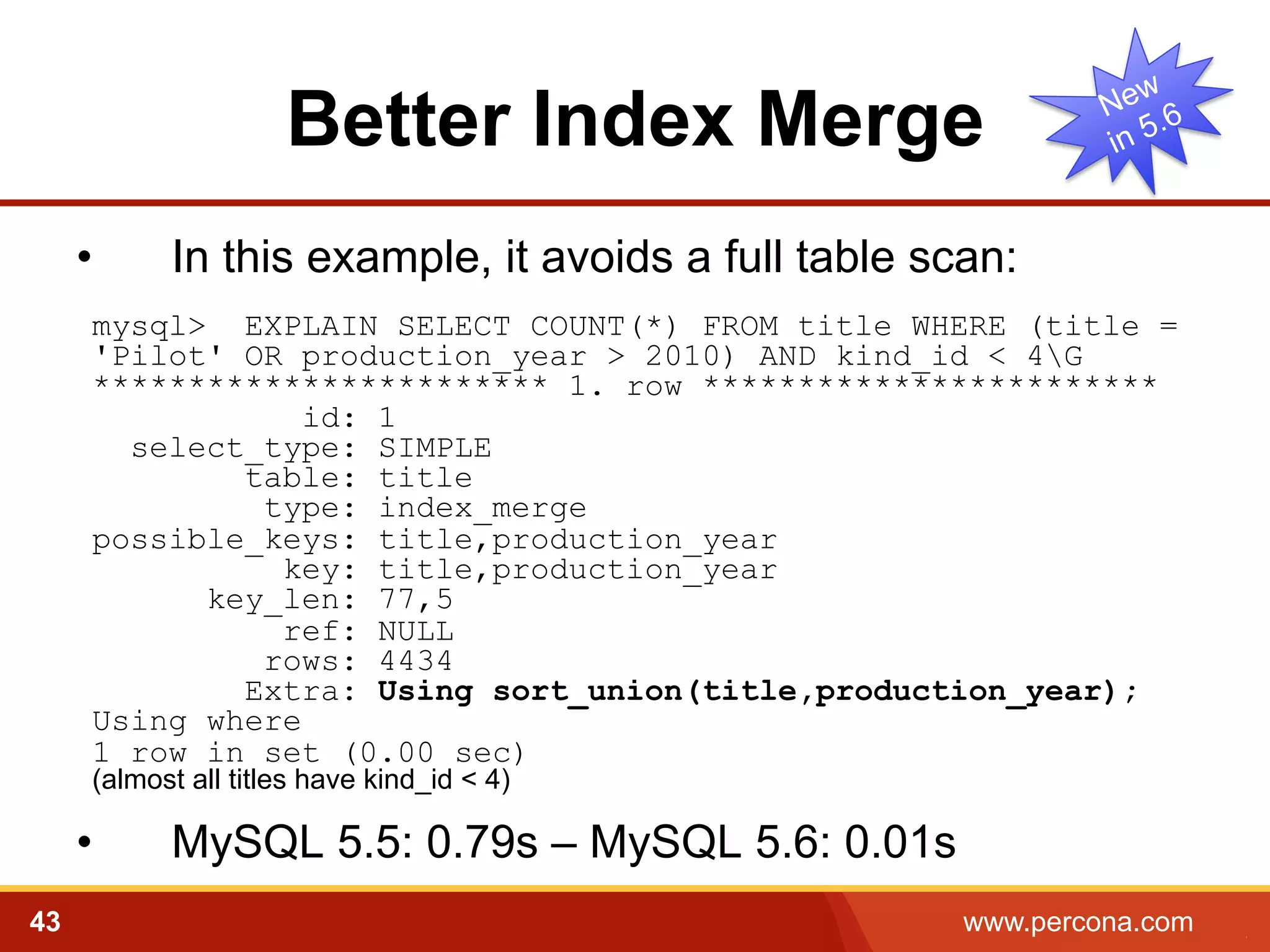
Better Index Merge
• 

In this example, it avoids a full table scan:

mysql> EXPLAIN SELECT COUNT(*) FROM title WHERE (title =
'Pilot' OR production_year > 2010) AND kind_id < 4G
************************ 1. row ************************
id: 1
select_type: SIMPLE
table: title
type: index_merge
possible_keys: title,production_year
key: title,production_year
key_len: 77,5
ref: NULL
rows: 4434
Extra: Using sort_union(title,production_year);
Using where
1 row in set (0.00 sec)
(almost all titles have kind_id < 4)

• 
43

MySQL 5.5: 0.79s – MySQL 5.6: 0.01s
www.percona.com

5
Extended Secondary Keys
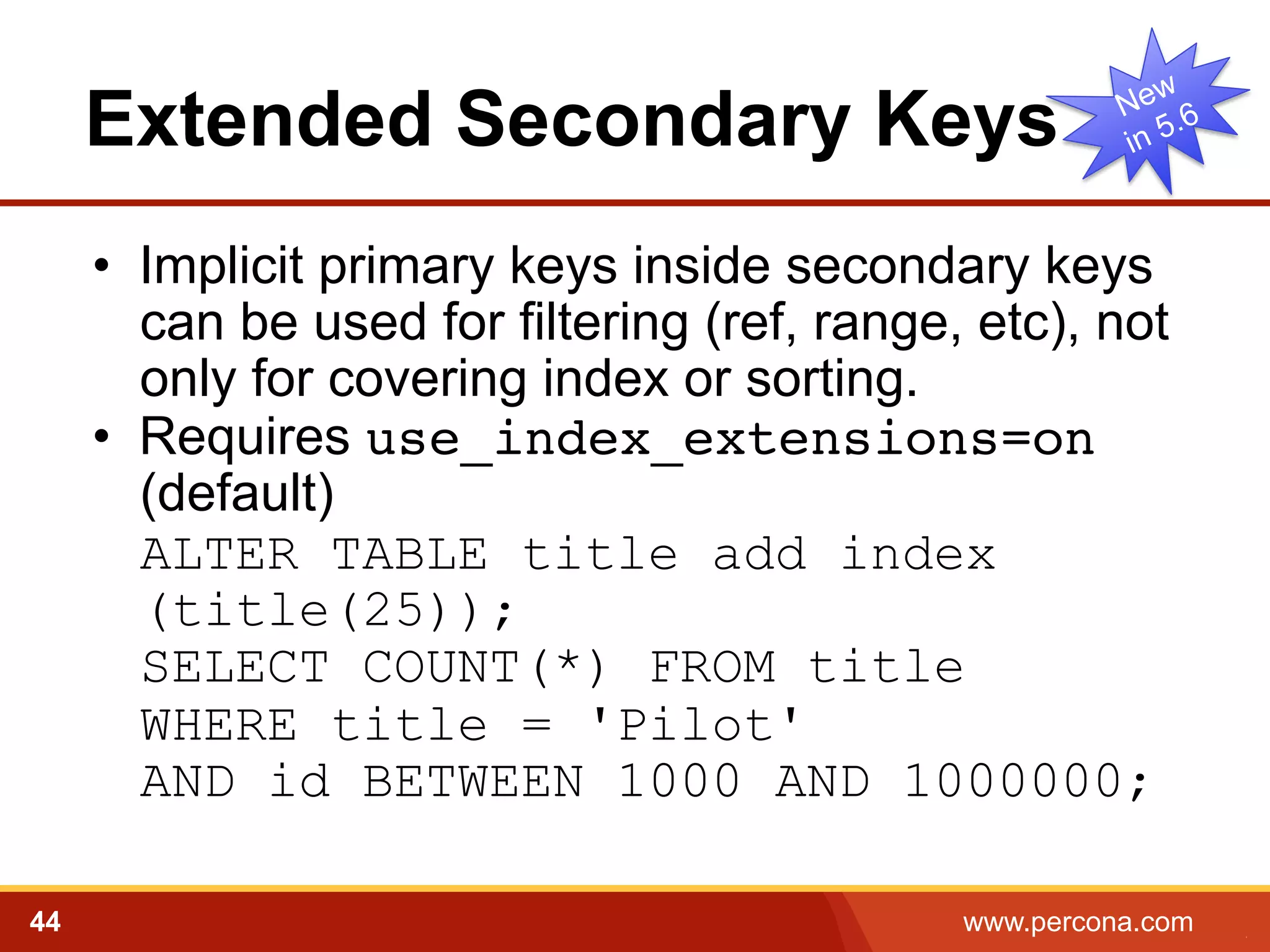
•  Implicit primary keys inside secondary keys
can be used for filtering (ref, range, etc), not
only for covering index or sorting.
•  Requires use_index_extensions=on
(default)
ALTER TABLE title add index
(title(25));
SELECT COUNT(*) FROM title
WHERE title = 'Pilot'
AND id BETWEEN 1000 AND 1000000;
44

www.percona.com

5
Extended Secondary Keys
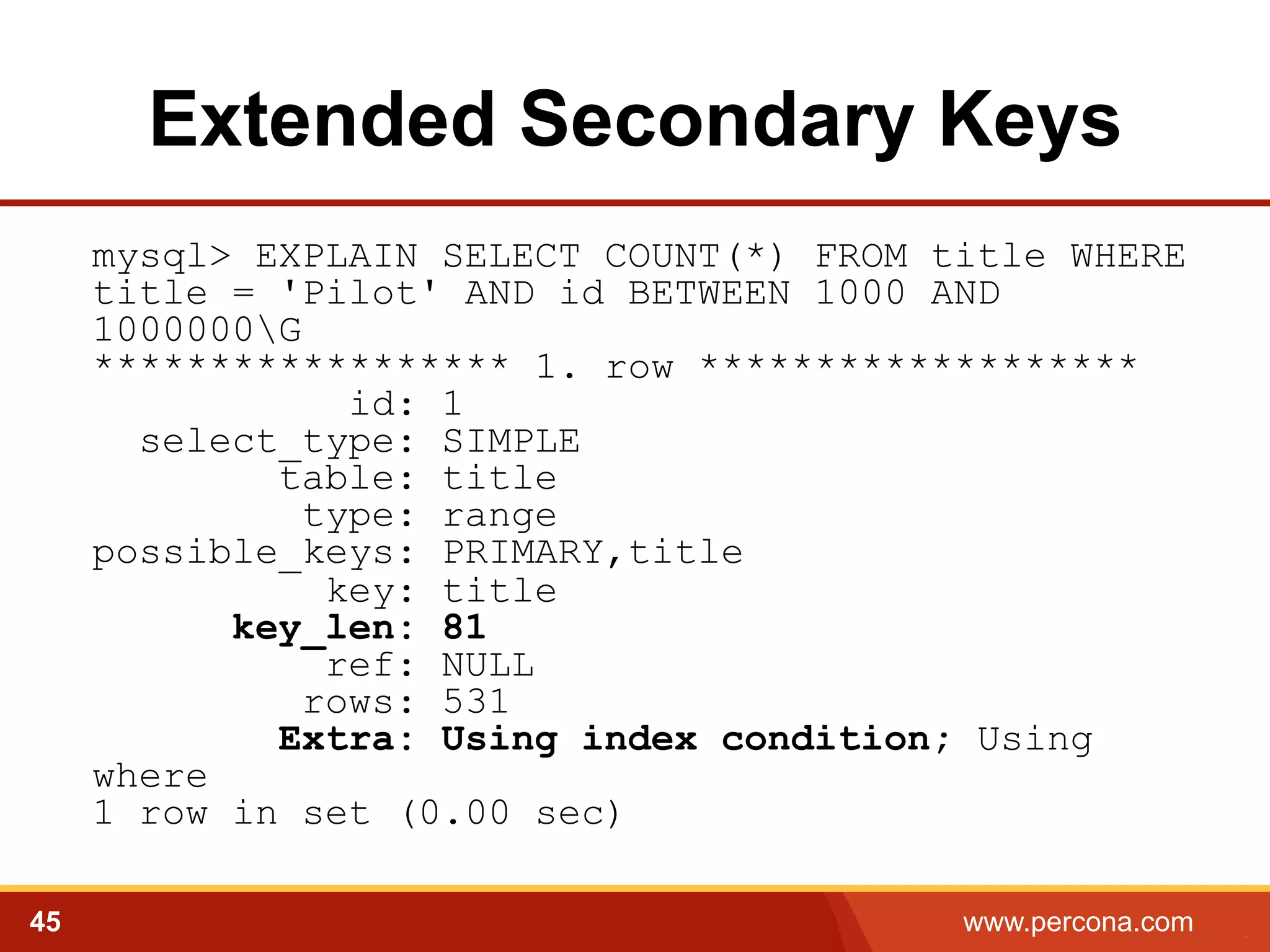
mysql> EXPLAIN SELECT COUNT(*) FROM title WHERE
title = 'Pilot' AND id BETWEEN 1000 AND
1000000G
****************** 1. row *******************
id: 1
select_type: SIMPLE
table: title
type: range
possible_keys: PRIMARY,title
key: title
key_len: 81
ref: NULL
rows: 531
Extra: Using index condition; Using
where
1 row in set (0.00 sec)
45

www.percona.com

5
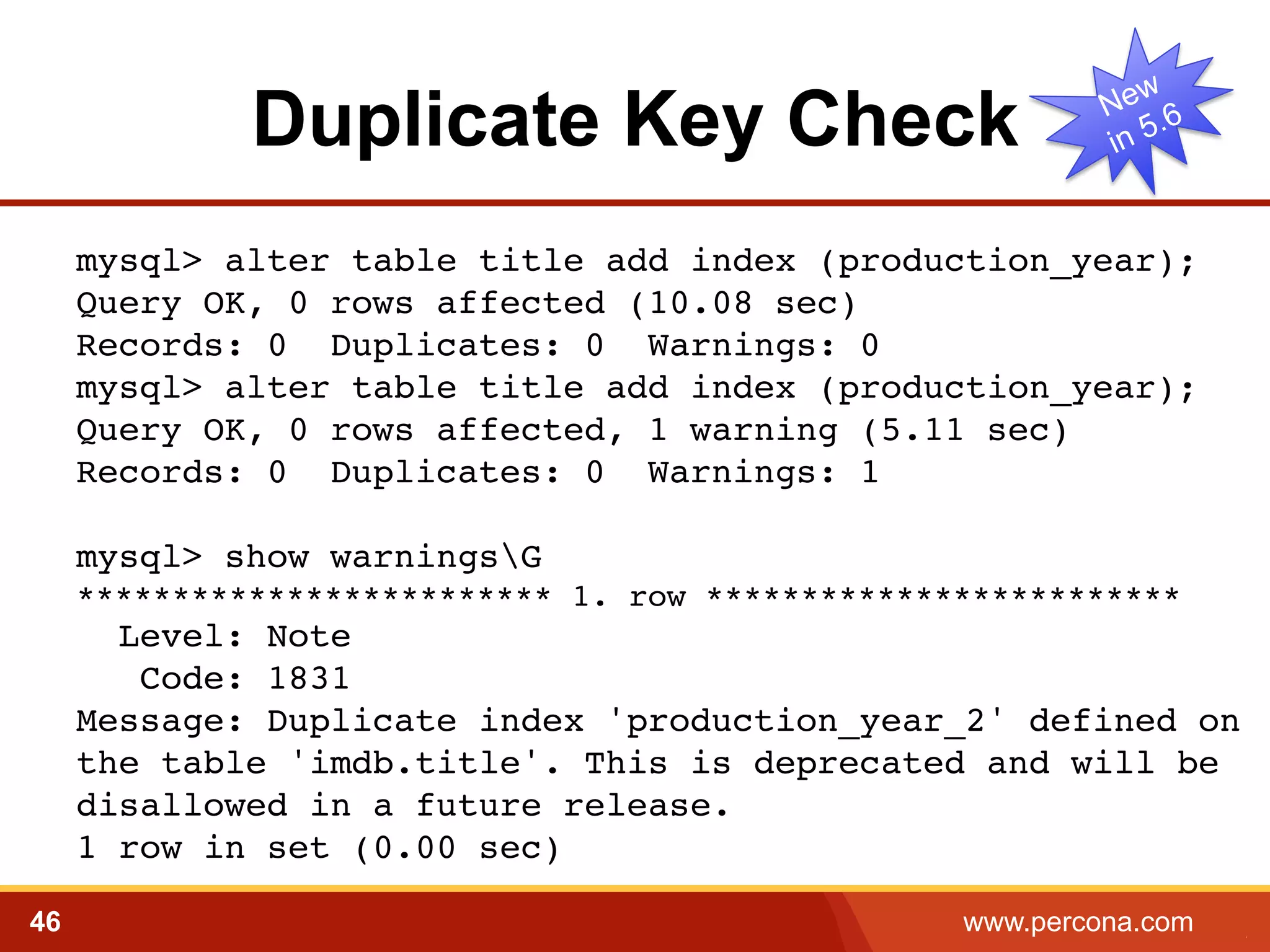
Duplicate Key Check
mysql> alter table title add index (production_year);!
Query OK, 0 rows affected (10.08 sec)!
Records: 0 Duplicates: 0 Warnings: 0!
mysql> alter table title add index (production_year);
Query OK, 0 rows affected, 1 warning (5.11 sec)
Records: 0 Duplicates: 0 Warnings: 1!
!
mysql> show warningsG!
************************* 1. row *************************!

Level: Note!
Code: 1831!
Message: Duplicate index 'production_year_2' defined on
the table 'imdb.title'. This is deprecated and will be
disallowed in a future release.!
1 row in set (0.00 sec)!
46

www.percona.com

5
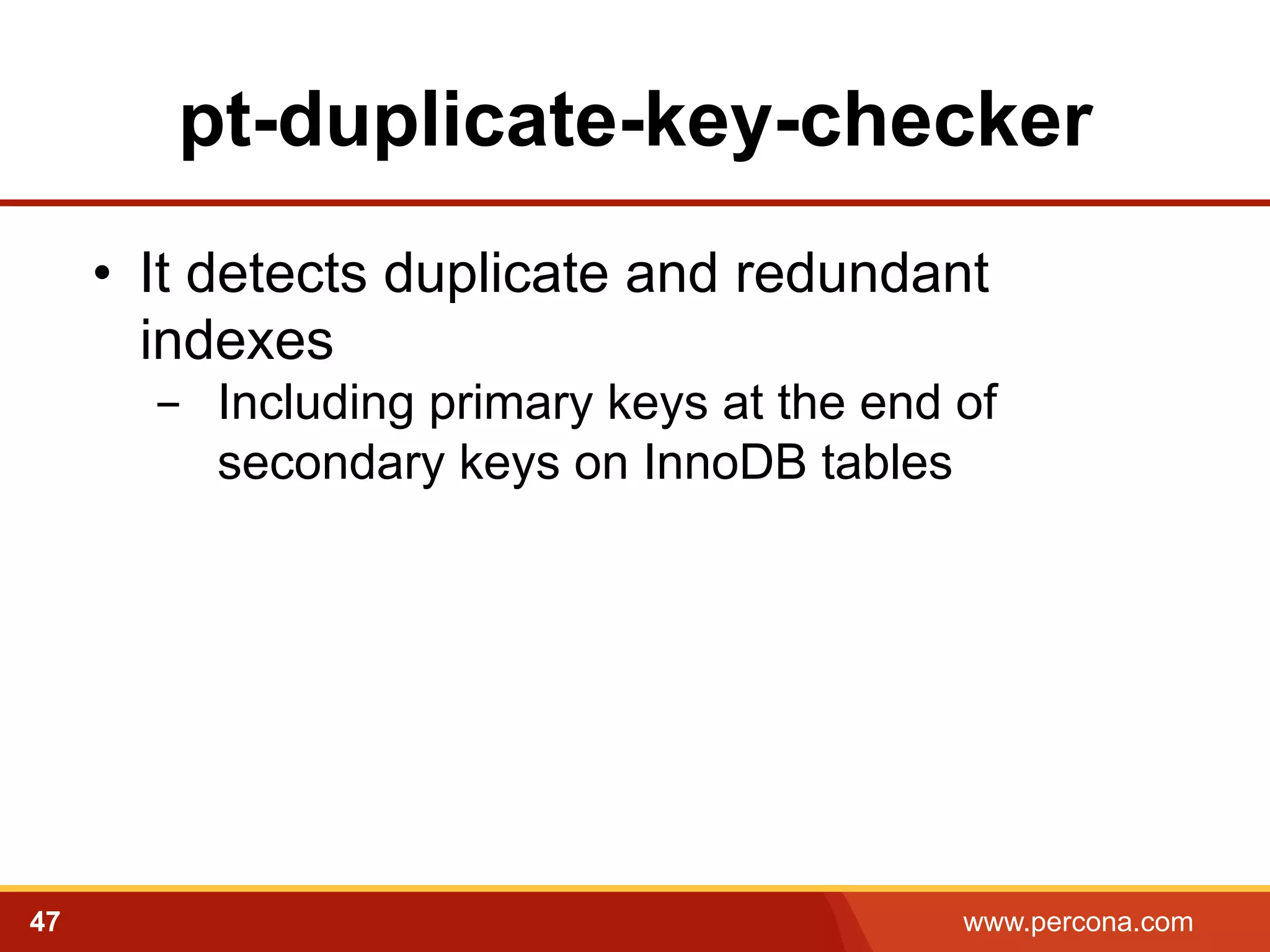
pt-duplicate-key-checker
•  It detects duplicate and redundant
indexes
-  Including primary keys at the end of
secondary keys on InnoDB tables

47

www.percona.com
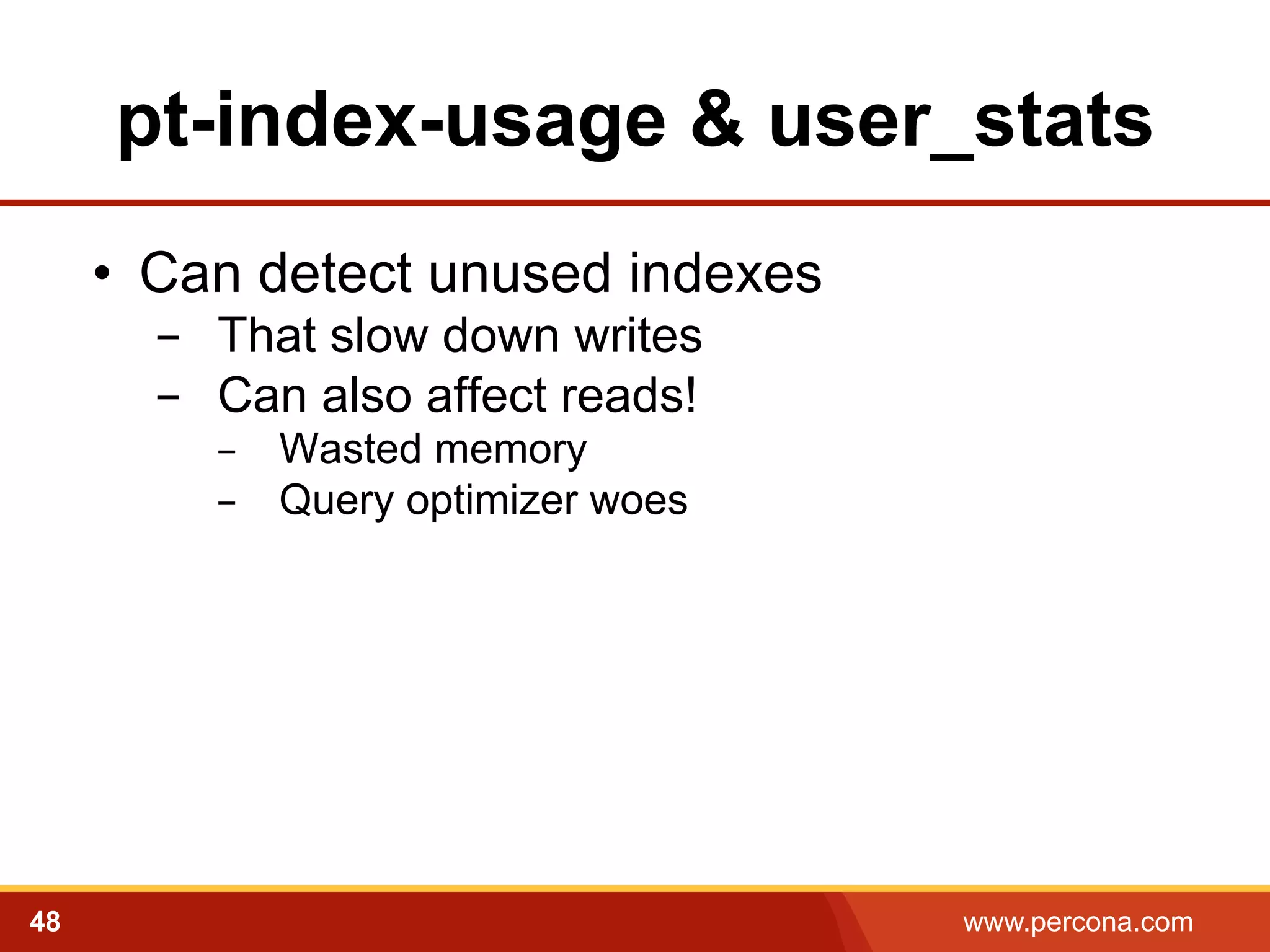
pt-index-usage & user_stats
•  Can detect unused indexes
-  That slow down writes
-  Can also affect reads!
-  Wasted memory
-  Query optimizer woes

48

www.percona.com
Query Optimization with MySQL 5.6: Old and New Tricks

NEW QUERY PLANNER FEATURES
49

www.percona.com

5
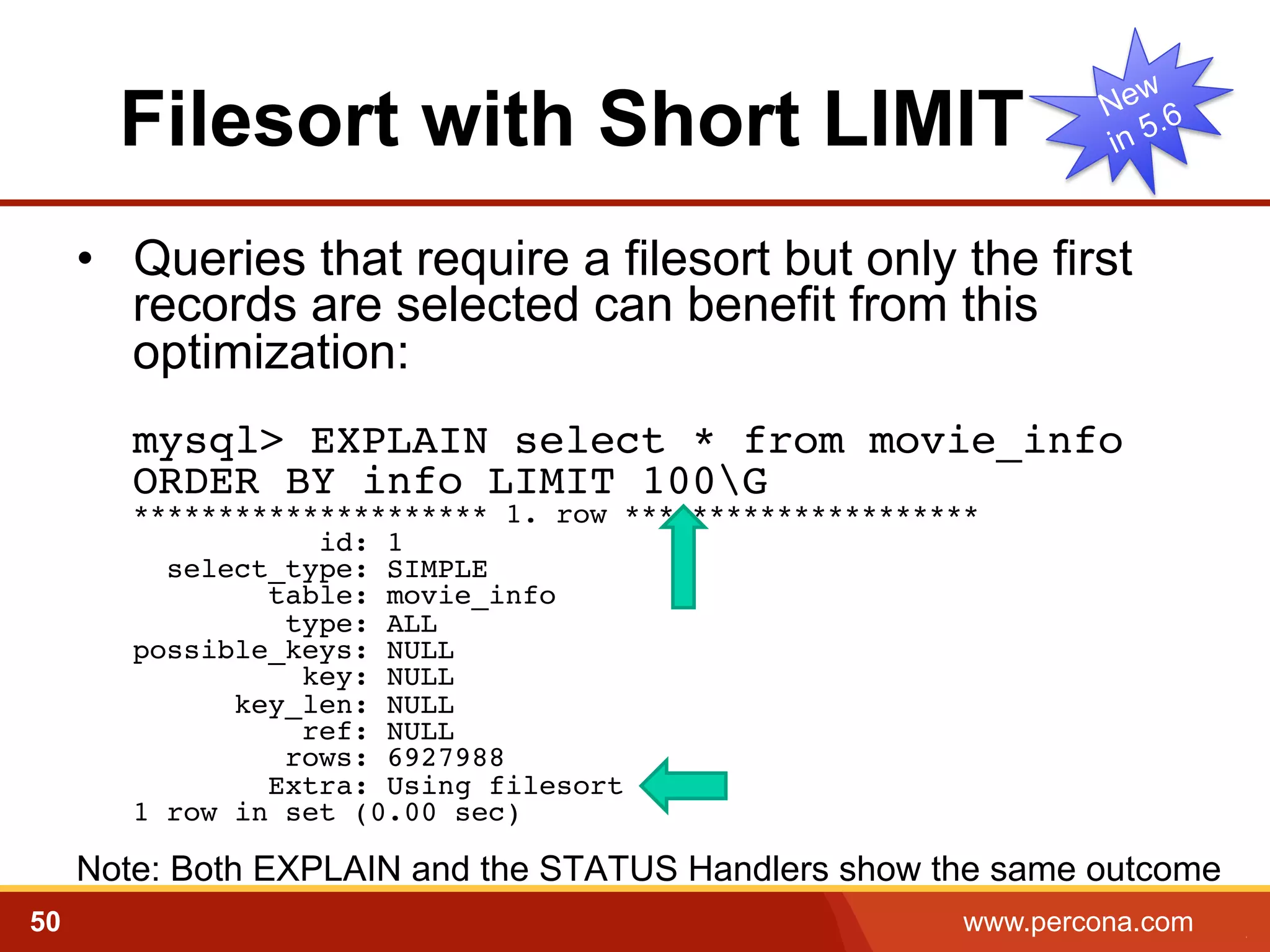
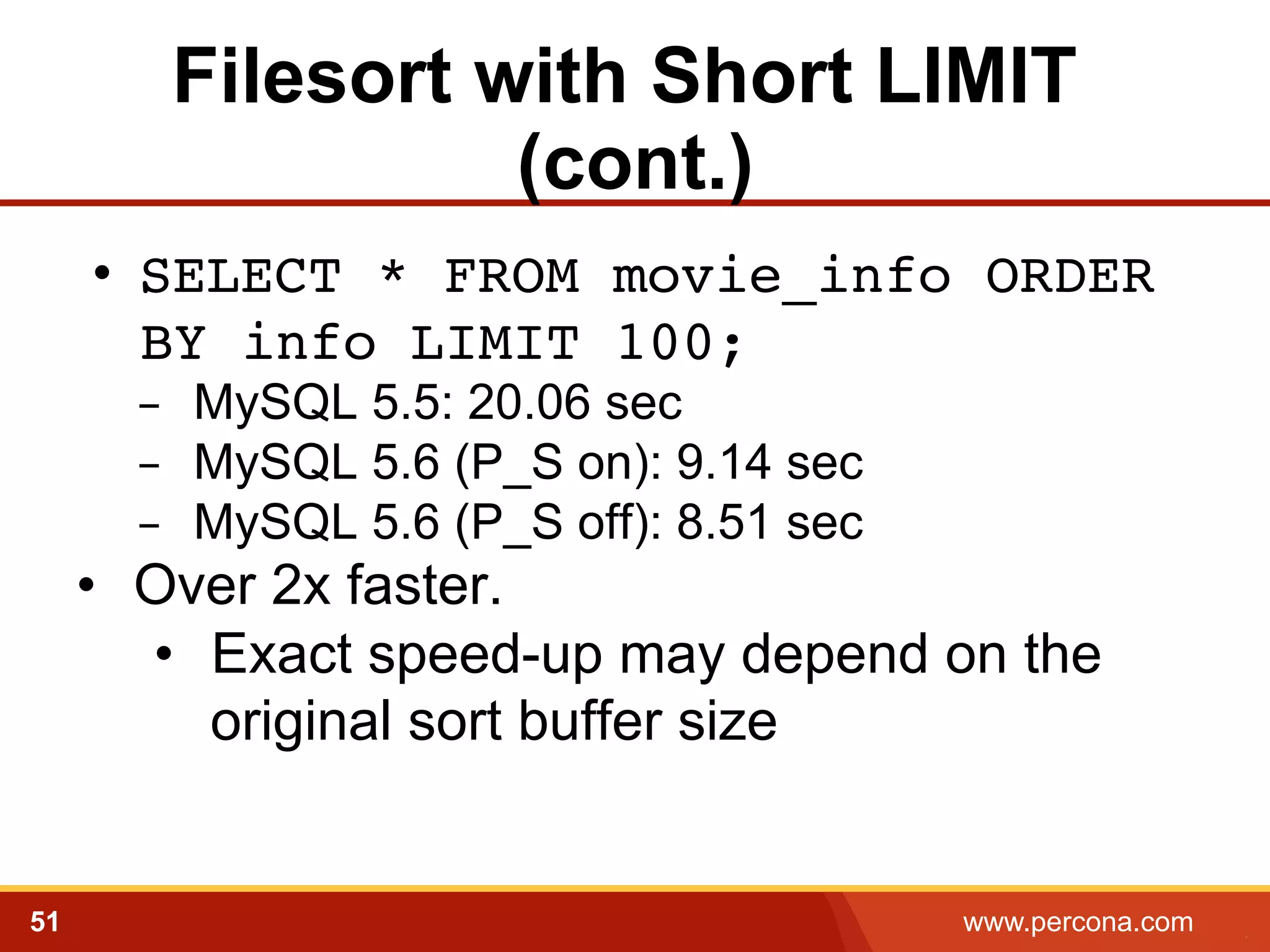
Filesort with Short LIMIT
•  Queries that require a filesort but only the first
records are selected can benefit from this
optimization:
mysql> EXPLAIN select * from movie_info 

ORDER BY info LIMIT 100G

********************* 1. row *********************

id: 1

select_type: SIMPLE

table: movie_info

type: ALL

possible_keys: NULL

key: NULL

key_len: NULL

ref: NULL

rows: 6927988

Extra: Using filesort

1 row in set (0.00 sec)

!

Note: Both EXPLAIN and the STATUS Handlers show the same outcome
50

www.percona.com

5
Filesort with Short LIMIT
(cont.)
•  SELECT * FROM movie_info ORDER
BY info LIMIT 100;!
-  MySQL 5.5: 20.06 sec
-  MySQL 5.6 (P_S on): 9.14 sec
-  MySQL 5.6 (P_S off): 8.51 sec

•  Over 2x faster.
•  Exact speed-up may depend on the
original sort buffer size

51

www.percona.com

5
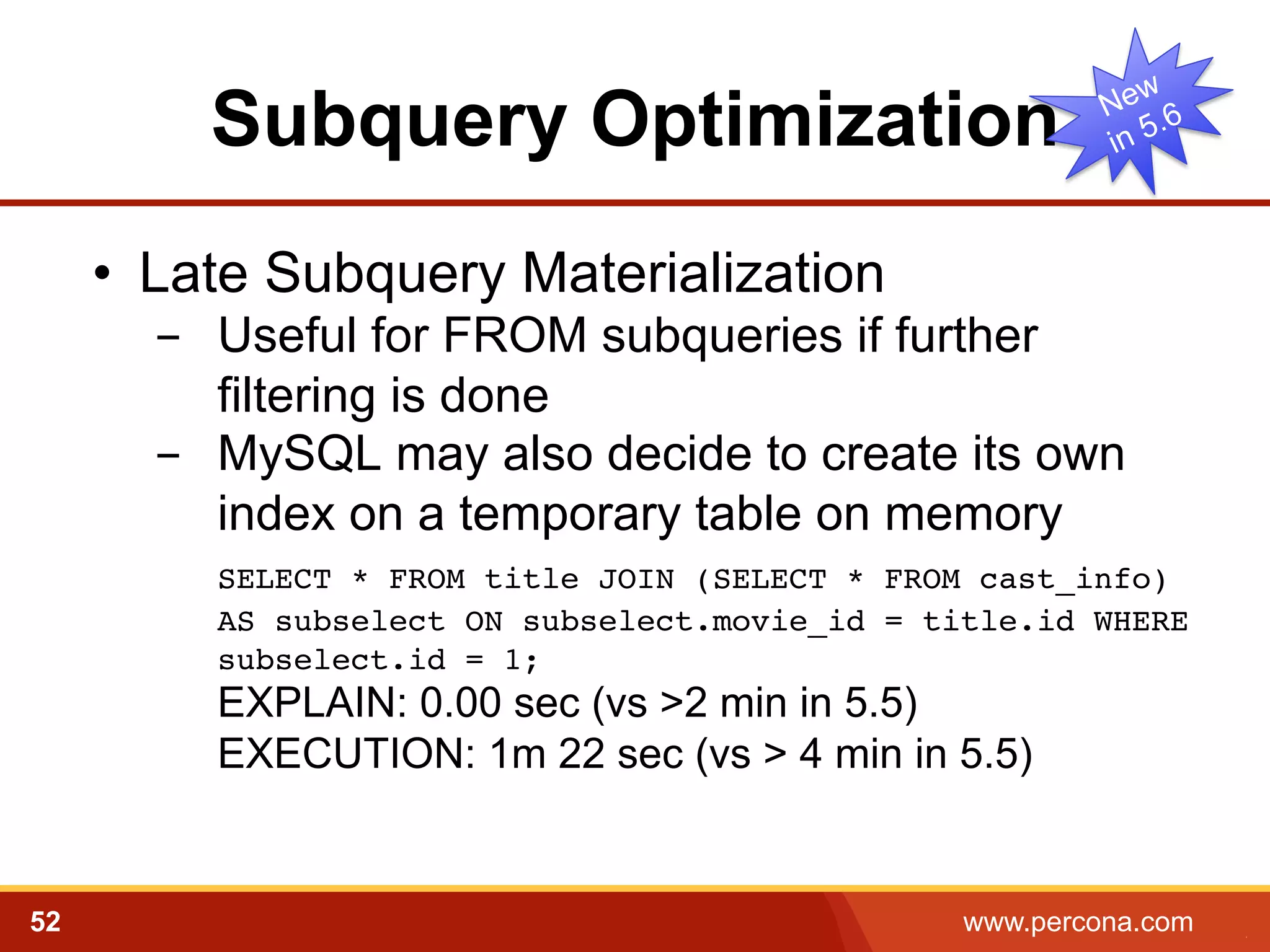
Subquery Optimization
•  Late Subquery Materialization
-  Useful for FROM subqueries if further
filtering is done
-  MySQL may also decide to create its own
index on a temporary table on memory

SELECT * FROM title JOIN (SELECT * FROM cast_info)
AS subselect ON subselect.movie_id = title.id WHERE
subselect.id = 1;


EXPLAIN: 0.00 sec (vs >2 min in 5.5)
EXECUTION: 1m 22 sec (vs > 4 min in 5.5)

52

www.percona.com

5
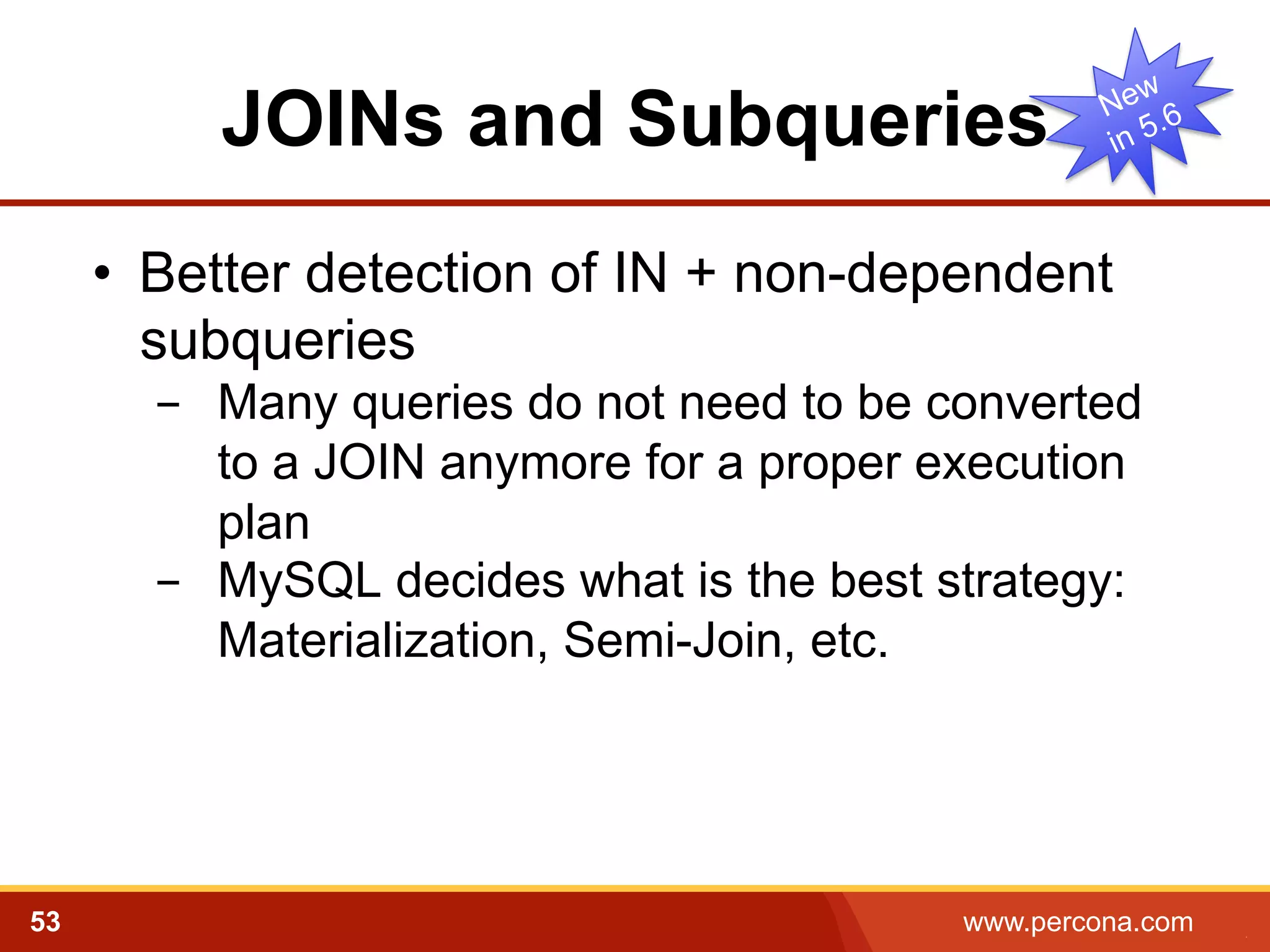
JOINs and Subqueries
•  Better detection of IN + non-dependent
subqueries
-  Many queries do not need to be converted
to a JOIN anymore for a proper execution
plan
-  MySQL decides what is the best strategy:
Materialization, Semi-Join, etc.

53

www.percona.com

5
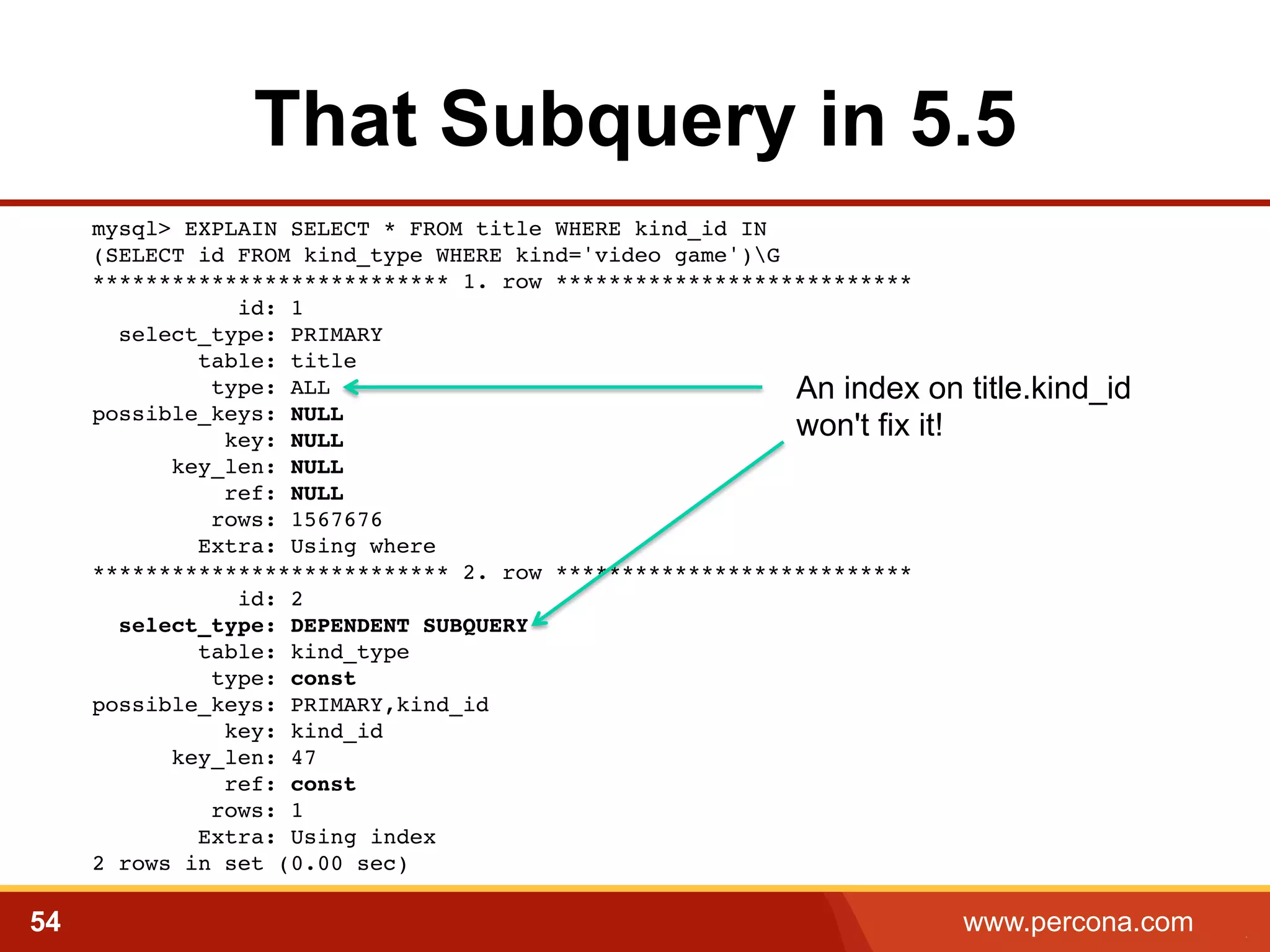
That Subquery in 5.5
mysql> EXPLAIN SELECT * FROM title WHERE kind_id IN 

(SELECT id FROM kind_type WHERE kind='video game')G

*************************** 1. row ***************************

id: 1

select_type: PRIMARY

table: title

type: ALL

An index on
possible_keys: NULL

won't fix it!
key: NULL

key_len: NULL

ref: NULL

rows: 1567676

Extra: Using where

*************************** 2. row ***************************

id: 2

select_type: DEPENDENT SUBQUERY

table: kind_type

type: const

possible_keys: PRIMARY,kind_id

key: kind_id

key_len: 47

ref: const

rows: 1

Extra: Using index

2 rows in set (0.00 sec)!

54

title.kind_id

www.percona.com

5
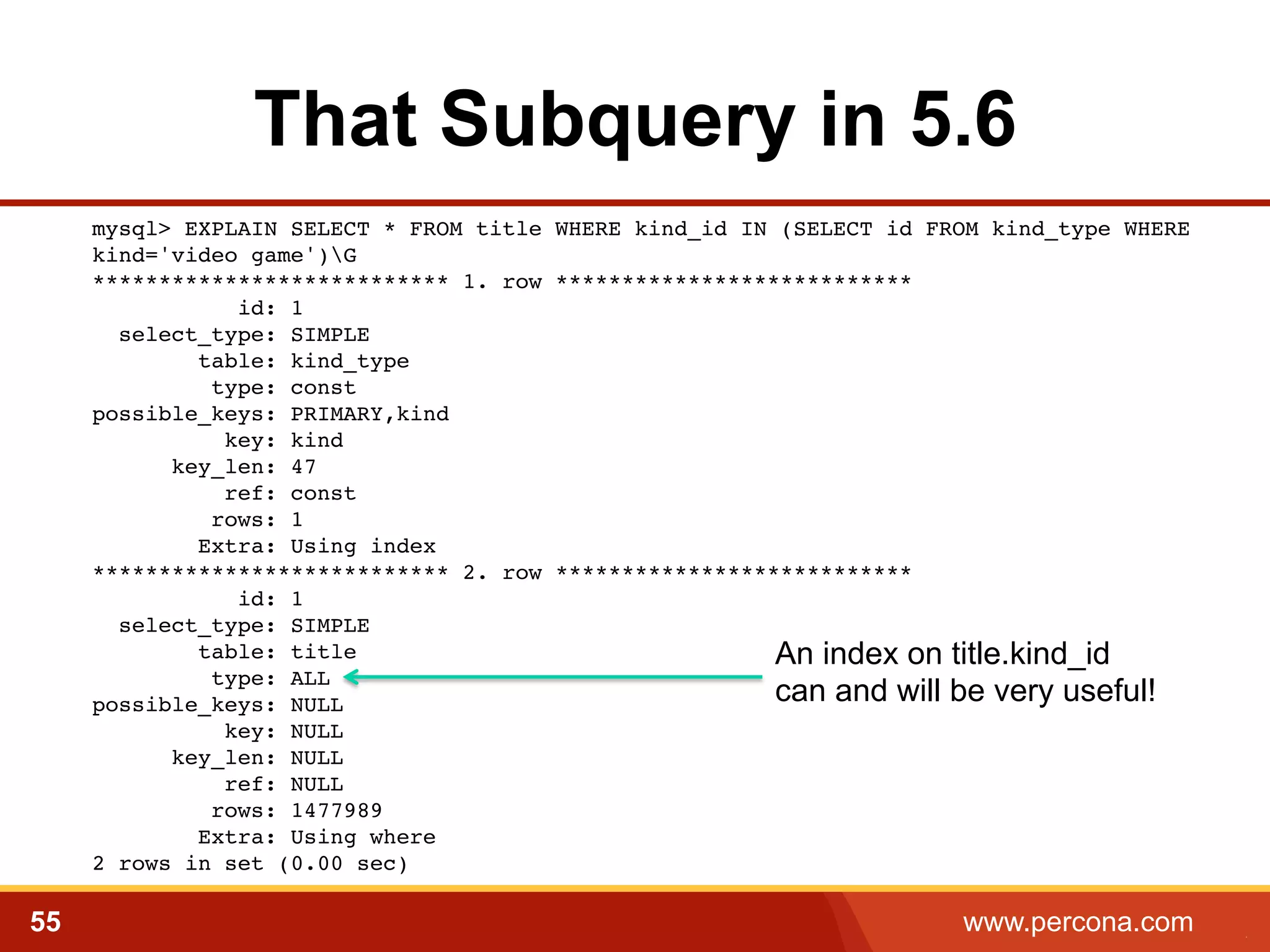
That Subquery in 5.6
mysql> EXPLAIN SELECT * FROM title WHERE kind_id IN (SELECT id FROM kind_type WHERE
kind='video game')G

*************************** 1. row ***************************

id: 1

select_type: SIMPLE

table: kind_type

type: const

possible_keys: PRIMARY,kind

key: kind

key_len: 47

ref: const

rows: 1

Extra: Using index

*************************** 2. row ***************************

id: 1

select_type: SIMPLE

table: title

An index on title.kind_id
type: ALL

can and will be very useful!
possible_keys: NULL

key: NULL

key_len: NULL

ref: NULL

rows: 1477989

Extra: Using where

2 rows in set (0.00 sec)!

55

www.percona.com

5
Join Order
•  Table order algorithm has been
optimized, which leads to better query
plans when joining many tables

56

www.percona.com

5
Persistent Optimizer
Statistics
•  InnoDB index statistics are no longer
discarded on server shutdown and
recomputed the next time a table is
accessed
•  Controlled by variable:
innodb_stats_persistent = ON
(default)
•  Remember that SHOW commands/accessing to
I_S do not automatically regenerate statistics by
default
57

www.percona.com

5
READ ONLY Transactions
•  START TRANSACTION READ ONLY;
-  It avoids some overhead of R/W
transactions (MVCC)
-  Automatically used for SELECT in
auto_commit
-  Once started, a new transaction has to be
started to perform a write

58

www.percona.com

5
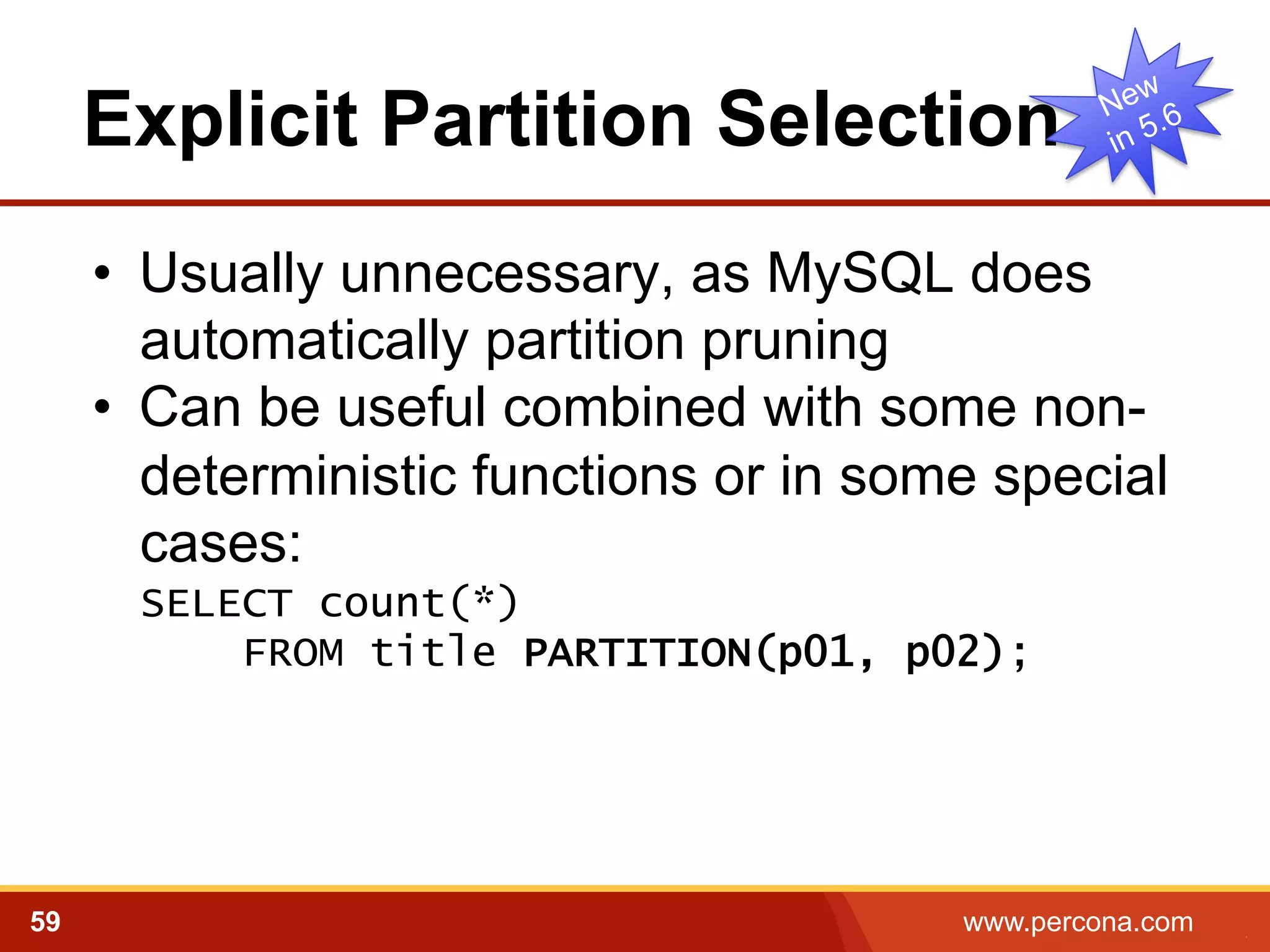
Explicit Partition Selection
•  Usually unnecessary, as MySQL does
automatically partition pruning
•  Can be useful combined with some nondeterministic functions or in some special
cases:
SELECT count(*)
FROM title PARTITION(p01, p02);

59

www.percona.com

5
Query Optimization with MySQL 5.6: Old and New Tricks

RESULTS AND WRAP-UP
60

www.percona.com

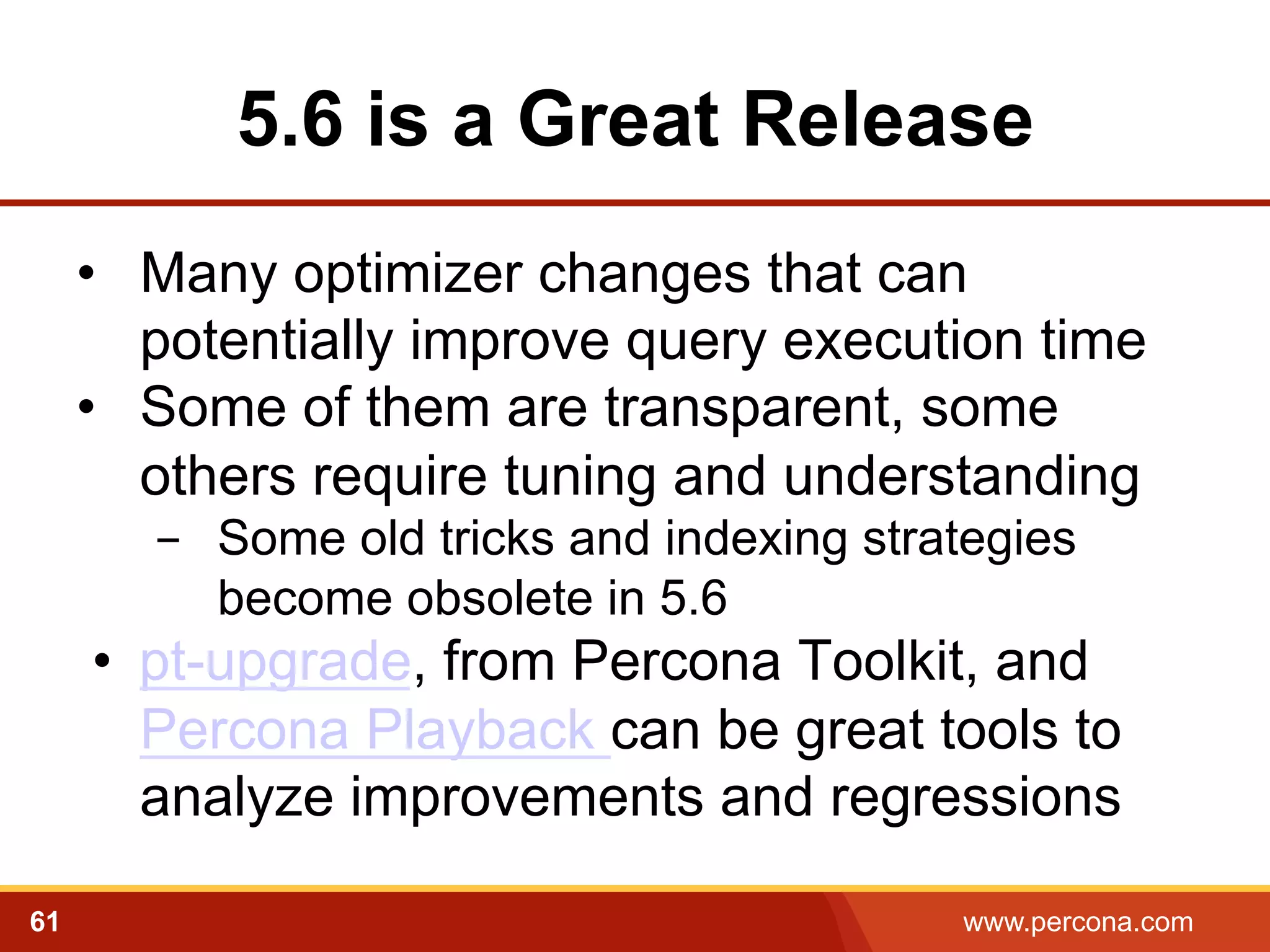
5
5.6 is a Great Release
•  Many optimizer changes that can
potentially improve query execution time
•  Some of them are transparent, some
others require tuning and understanding
-  Some old tricks and indexing strategies
become obsolete in 5.6

•  pt-upgrade, from Percona Toolkit, and
Percona Playback can be great tools to
analyze improvements and regressions
61

www.percona.com
Where to Learn More ?
•  More query and server optimization
techniques in our training courses (
http://www.percona.com/training):

-  Scaling and Optimization for MySQL
-  Operations and Troubleshooting with
MySQL
-  Moving to MySQL 5.6
-  Analysing Queries with Percona Toolkit
-  Percona Server and Tools (NEW!)
•  Ask me for a discount (only to PLUK
attendants)!
62

www.percona.com
Where to Learn More ? (cont.)
•  Books:
•  High Performance MySQL, 3rd Edition
•  SQL Antipatterns
•  Free MySQL Webinars:
•  http://www.percona.com/resources/
mysql-webinars

63

www.percona.com
Percona Live MySQL
Conference and Expo 2014

•  For more information and to register:
Visit: http://www.percona.com/live/mysql-conference-2014/
Thank You!
Jaime Crespo
jaime.crespo@percona.com

65

www.percona.com
www.percona.com

Query Optimization with MySQL 5.6: Old and New Tricks - Percona Live London 2013

  • 1.
    Query Optimization withMySQL 5.6: Old and New Tricks Jaime Crespo Senior MySQL Instructor Percona Live London 2013 November 11, 2013
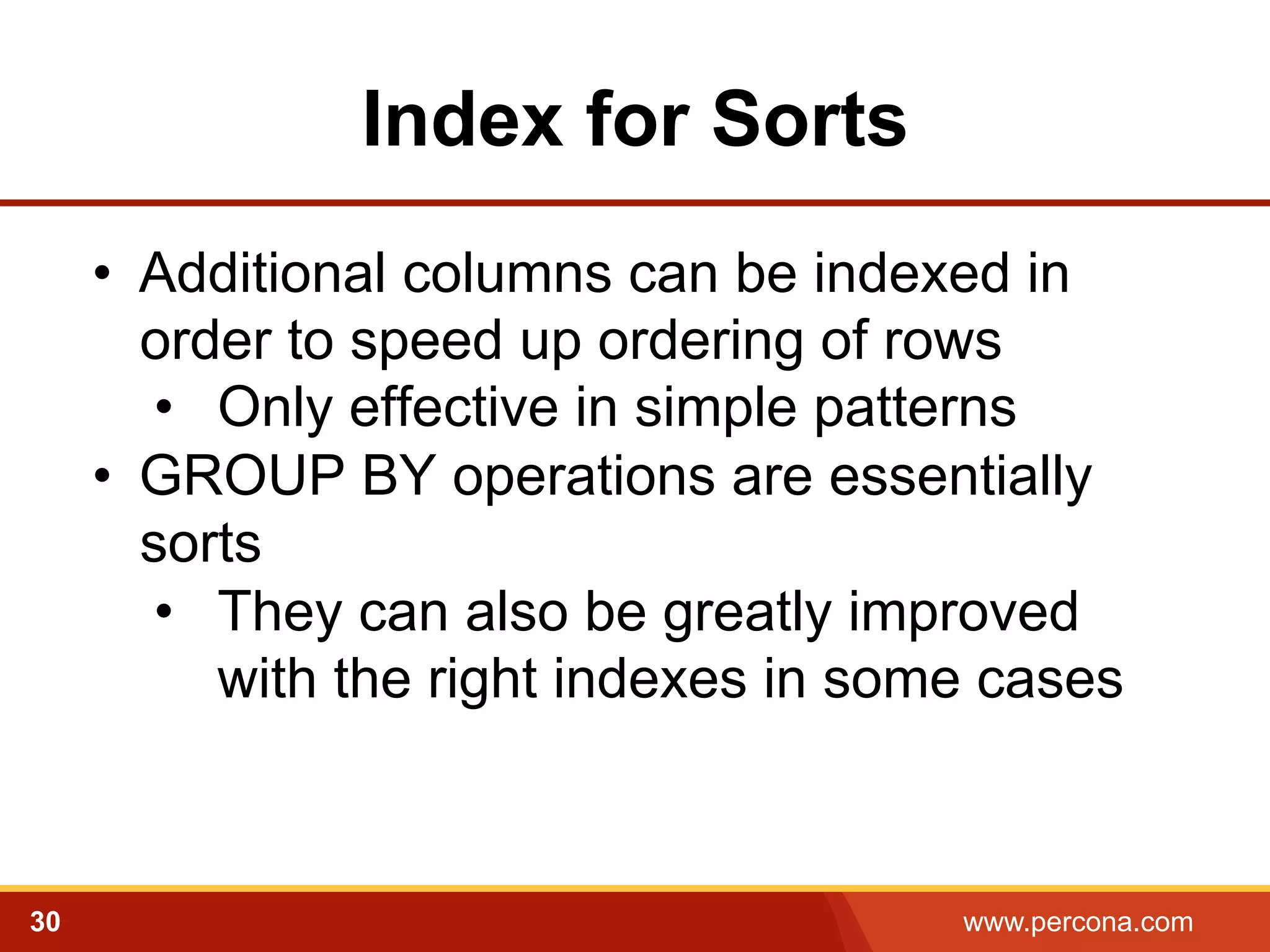
  • 2.
    About This Presentation • Objective #1: -  Get faster queries •  Reminder of some well-known query optimization techniques -  Focus on new 5.6 query features •  For other performance tricks with MySQL & InnoDB: -  InnoDB Architecture and Performance Optimization with Peter Zaitsev at 2pm 2 www.percona.com
  • 3.
    Agenda 1.  Introduction andEnvironment Setup 2.  Server Update and Configuration 3.  Tools for Query Profiling 4.  Indexing: Old and New Strategies 5.  New Query Planner Features 6.  Results and wrap-up 3 www.percona.com
  • 4.
    Example Platform •  SampleLAMP Application -  'My Movies' PHP Script -  Example movie database •  Distributed as a VirtualBox VM -  -  -  -  Import percona_live.ova User: percona / pass: percona Make sure httpd and PS are running Optionally: startxfce4 •  Currently no design optimization, no indexes (except PK), no proper query design 4 www.percona.com
  • 5.
    Query Optimization withMySQL 5.6: Old and New Tricks SERVER UPDATE AND CONFIGURATION 5 www.percona.com 5
  • 6.
    Basic Configuration Review • InnoDB as the default engine (default in 5.5) •  InnoDB File Per Table (default in 5.6) •  Larger Buffer Pool and Transaction Log (changed in 5.6) •  Row Based Replication and tx_isolation •  Performance Schema overhead (enabled by default in 5.6) •  InnoDB page checksum (changed in 5.6) •  InnoDB Old Blocks time (changed in 5.6) 6 www.percona.com
  • 7.
    Query Optimization withMySQL 5.6: Old and New Tricks TOOLS FOR QUERY PROFILING 7 www.percona.com 5
  • 8.
    EXPLAIN •  EXPLAIN ismost important tool for the MySQL DBA and Developer •  It provides: -  -  -  -  8 The query plan strategy The index(es) to be used The order of table access An estimation of the number of rows to be examined! www.percona.com 5
  • 9.
    EXPLAIN on DML • EXPLAIN is now available also for INSERT, UPDATE and DELETE mysql> EXPLAIN DELETE FROM title WHERE title = 'Pilot'G! ********************* 1. row *********************! id: 1! select_type: SIMPLE! table: title! type: range! possible_keys: PRIMARY,title! key: title! key_len: 77! ref: NULL! rows: 1380! Extra: Using where! 1 row in set (0.00 sec)! 9 www.percona.com 5
  • 10.
    Structured EXPLAIN mysql> EXPLAINFORMAT=JSON SELECT COUNT(*) FROM title 
 WHERE (title = 'Pilot' OR production_year > 2010) 
 AND kind_id < 4G
 *************************** 1. row ***************************! EXPLAIN: {! "query_block": {! "select_id": 1,! "table": {! "table_name": "title",! "access_type": "index_merge",! "possible_keys": [! "title",! "production_year"! ],! "key": "sort_union(title,production_year)",! "key_length": "77,5",! "rows": 4434,! "filtered": 100,! "attached_condition": "(((`imdb`.`title`.`title` = 'Pilot') or (`imdb`.`title`.`production_year` > 2010)) and (`imdb`.`title`.`kind_id` < 4))"! }! }! }! 10 www.percona.com 5
  • 11.
    Optimizer Trace •  Allowsprofiling of MySQL query planner •  It shows not only information about the final query plan (EXPLAIN), but also about other discarded strategies, and its “execution cost” •  It can be accessed via the INFORMATION_SCHEMA database •  It is off by default 11 www.percona.com 5
  • 12.
    Checking the OptimizerTrace •  mysql> SET optimizer_trace="enabled=on"; •  mysql> SELECT COUNT(*) FROM title WHERE (title = 'Pilot' OR production_year > 2010) AND kind_id < 4; +----------+ | COUNT(*) | +----------+ | 3050 | +----------+ 1 row in set (0.01 sec) •  mysql> SELECT trace FROM information_schema.optimizer_trace; 12 www.percona.com 5
  • 13.
    Checking the OptimizerTrace (cont.) { "range_scan_alternatives": [ { "index": "production_year", "ranges": [ "2010 < production_year" ], "index_dives_for_eq_ranges": true, "rowid_ordered": false, "using_mrr": false, "index_only": true, "rows": 3054, "cost": 615.16, "chosen": true } ], "index_to_merge": "production_year", "cumulated_cost": 905.69 } ], "cost_of_reading_ranges": 905.69, "cost_sort_rowid_and_read_disk": 3672.8, "cost_duplicate_removal": 9467.6, "total_cost": 14046 } ], "chosen_range_access_summary": { "range_access_plan": { "type": "index_merge", "index_merge_of": [ 13 www.percona.com 5
  • 14.
    Limitations of EXPLAIN • It does not really execute the query -  Not even subqueries any more •  The row statistics can be sometimes very off •  It does not give us information about temporary tables (on disk or memory?), subtask timing, query cache hit, etc. 14 www.percona.com 5
  • 15.
    Handler Statistics •  Theyprovide time & memory status-independency: mysql> SHOW SESSION STATUS LIKE 'Hand%';
 +----------------------------+-------+
 | Variable_name | Value |
 +----------------------------+-------+
 | Handler_commit | 1 |
 | Handler_delete | 0 |
 | Handler_discover | 0 |
 | Handler_external_lock | 2 |
 | Handler_mrr_init | 0 |
 | Handler_prepare | 0 |
 | Handler_read_first | 0 |
 | Handler_read_key | 1 |
 | Handler_read_last | 0 |
 | Handler_read_next | 266 |
 | Handler_read_prev | 0 |
 | Handler_read_rnd | 0 |
 | Handler_read_rnd_next | 0 |
 | Handler_rollback | 0 |
 | Handler_savepoint | 0 |
 | Handler_savepoint_rollback | 0 |
 | Handler_update | 0 |
 | Handler_write | 0 |
 +----------------------------+-------+
 18 rows in set (0.00 sec) 15 www.percona.com 5
  • 16.
    Slow Query Logand pt-querydigest •  Works on all MySQL versions -  Specially useful in combination with the extended log statistics in Percona Server SET GLOBAL log_slow_verbosity = 'full';
 ! # Time: 130601 8:01:06.058915 # User@Host: root[root] @ localhost [] Id: 42 # Schema: imdb Last_errno: 0 Killed: 0 # Query_time: 7.725616 Lock_time: 0.000328 Rows_sent: 4 Rows_examined: 1543720 Rows_affected: 0 # Bytes_sent: 272 Tmp_tables: 0 Tmp_disk_tables: 0 Tmp_table_sizes: 0 # QC_Hit: No Full_scan: Yes Full_join: No Tmp_table: No Tmp_table_on_disk: No # Filesort: No Filesort_on_disk: No Merge_passes: 0 SET timestamp=1370073666; SELECT id,title,production_year FROM title WHERE title = 'Bambi'; ! 16 www.percona.com
  • 17.
    pt-query-digest slow query log generalquery log tcpdump pt-query-digest report binary log process list input 17 tool output www.percona.com
  • 18.
    pt-query-digest Report # Profile! #Rank Query ID Response time Calls R/Call Apdx V/M Item! # ==== ================== =============== ===== ======= ==== ===== =======! # 1 0xA8D2BBDE7EBE7822 4932.2992 28.8% 78 63.2346 0.00 5.22 SELECT person_info! # 2 0xFE25DAF5DBB71F49 4205.2160 24.6% 130 32.3478 0.00 3.47 SELECT title! # 3 0x70DAC639802CA233 1299.6269 7.6% 14 92.8305 0.00 0.17 SELECT cast_info! # 4 0xE336B880F4FEC4B8 1184.5101 6.9% 294 4.0289 0.36 2.29 SELECT cast_info! # 5 0x60550B93960F1837 905.1648 5.3% 60 15.0861 0.05 1.33 SELECT name! # 6 0xF46D5C09B4E0CA2F 777.2446 4.5% 16340 0.0476 1.00 0.17 SELECT char_name! # 7 0x09FCFFF0E5BC929F 747.4346 4.4% 130 5.7495 0.53 7.69 SELECT name! # 8 0x9433950BE12B9470 744.1755 4.4% 14368 0.0518 1.00 0.18 SELECT name! # 9 0x4DC0E044996DA715 448.5637 2.6% 130 3.4505 0.65 8.31 SELECT title! # 10 0x09FB72D72ED18E93 361.1904 2.1% 78 4.6306 0.28 1.89 SELECT cast_info title
 #! # Query 1: 0.02 QPS, 1.40x concurrency, ID 0xA8D2BBDE7EBE7822 at byte 25744265! # Attribute pct total min max avg 95% stddev median! # ============ === ======= ======= ======= ======= ======= ======= =======! # Count 0 78! # Exec time 28 4932s 11s 109s 63s 88s 18s 63s! # Lock time 0 724ms 36us 642ms 9ms 11ms 72ms 93us! # Rows sent 7 12.95k 86 334 170.05 329.68 89.24 136.99! # Rows examine 14 168.99M 2.17M 2.17M 2.17M 2.17M 0 2.17M! # Rows affecte 0 0 0 0 0 0 0 0! # Rows read 7 12.95k 86 334 170.05 329.68 89.24 136.99! # Bytes sent 5 2.39M 16.18k 54.14k 31.43k 54.03k 13.47k 25.99k! 18 www.percona.com
  • 19.
    performance_schema •  Integrated profilingtool •  Not new, but improved significately for 5.6 •  Substitutes the old PROFILING interface •  Can have a 5-10% overhead by default •  Can be used to monitor several runtime statistics, among them, query execution statistics of the latest queries: SELECT * FROM performance_schema.events_statements_history_long ! 19 www.percona.com
  • 20.
    Query Optimization withMySQL 5.6: Old and New Tricks INDEXING: OLD AND NEW STRATEGIES 20 www.percona.com 5
  • 21.
    Advantages of Indexing •  •  •  •  21 FasterFiltering Faster Column Return (Covering Index) Faster Ordering Certain Faster Functions (max, min) www.percona.com
  • 22.
    Faster Filtering •  Indexesallow to return results by reading a fewer number of records -  We should minimize the rows value in EXPLAIN/Handlers -  const > ref > range > index > ALL! •  Usually, only a single index can be used per table access -  Compound indexes may provide higher filtering rate 22 www.percona.com
  • 23.
    Compound Indexes •  ColumnOrder in Index Does Matter: -  Order by decreasing selectivity -  Only one range access per index* 23 www.percona.com
  • 24.
    Covering Index Technique • Additional columns can be indexed in order to speed-up column retrieval •  Specially interesting in n-to-n relationship tables •  Not possible if the number or size of columns is too large (e.g. SELECT *, BLOBs) 24 www.percona.com
  • 25.
    Index Condition Pushdown • Let’s prepare a use case: UPDATE cast_info SET note = left(note, 250);
 ALTER TABLE cast_info MODIFY note varchar(250), ADD INDEX role_id_note (role_id, note); ! •  We want to execute: SELECT * FROM cast_info 
 WHERE role_id = 1 
 and note like '%Jaime%‘;! 25 www.percona.com 5
  • 26.
    Without ICP (5.5) mysql>EXPLAIN SELECT * 
 FROM cast_info 
 WHERE role_id = 1 
 and note like '%Jaime%'G
 ********** 1. row **********
 id: 1
 select_type: SIMPLE
 table: cast_info
 type: ref
 possible_keys: role_id_note
 key: role_id_note
 key_len: 4
 ref: const
 rows: 11553718
 Extra: Using where
 1 row in set (0.01 sec)! 26 mysql> SHOW STATUS like 'Hand %';! +----------------------------+---------+! | Variable_name | Value |! +----------------------------+---------+! | Handler_commit | 1 |! | Handler_delete | 0 |! | Handler_discover | 0 |! | Handler_prepare | 0 |! | Handler_read_first | 0 |! | Handler_read_key | 1 |! | Handler_read_last | 0 |! | Handler_read_next | 8346769 |! | Handler_read_prev | 0 |! | Handler_read_rnd | 0 |! | Handler_read_rnd_next | 0 |! | Handler_rollback | 0 |! | Handler_savepoint | 0 |! | Handler_savepoint_rollback | 0 |! | Handler_update | 0 |! | Handler_write | 0 |! +----------------------------+---------+! 16 rows in set (0.00 sec)! www.percona.com 5
  • 27.
    With ICP (5.6) mysql>EXPLAIN SELECT * 
 FROM cast_info 
 WHERE role_id = 1 and note like '%Jaime%'G
 ************ 1. row ************
 id: 1
 select_type: SIMPLE
 table: cast_info
 type: ref
 possible_keys: role_id_note
 key: role_id_note
 key_len: 4
 ref: const
 rows: 10259274
 Extra: Using index condition
 1 row in set (0.00 sec)! 27 mysql> SHOW STATUS like 'Hand%';! +----------------------------+-------+! | Variable_name | Value |! +----------------------------+-------+! | Handler_commit | 1 |! | Handler_delete | 0 |! | Handler_discover | 0 |! | Handler_external_lock | 2 |! | Handler_mrr_init | 0 |! | Handler_prepare | 0 |! | Handler_read_first | 0 |! | Handler_read_key | 1 |! | Handler_read_last | 0 |! | Handler_read_next | 266 |! | Handler_read_prev | 0 |! | Handler_read_rnd | 0 |! | Handler_read_rnd_next | 0 |! | Handler_rollback | 0 |! | Handler_savepoint | 0 |! | Handler_savepoint_rollback | 0 |! | Handler_update | 0 |! | Handler_write | 0 |! +----------------------------+-------+! 18 rows in set (0.00 sec) www.percona.com 5
  • 28.
    Comparison of ICPExecution •  Execution time for this example: •  MySQL 5.5: 5.76 sec •  MySQL 5.6: 1.09 sec •  Over 5x faster •  In this example, it would not work with a prefix index (e.g. TEXT/BLOB), as it must search the whole field •  Fun fact: if covering technique is tried, it actually runs slower than with ICP for this case/hardware (#68554) 28 www.percona.com 5
  • 29.
    ICP and Indexing • ICP will change the way we index our tables SELECT * FROM cast_info 
 FORCE INDEX(person_role_id_role_id)
 WHERE person_role_id > 0 
 and person_role_id < 150000 
 and role_id > 1 and role_id < 7;! •  For example, a multiple column index can be, in some cases, efficiently used for a range condition on several columns: •  29 Effectiveness is highly dependent on how selective is the second part of the index (an “index scan” is still done at engine level) www.percona.com
  • 30.
    Index for Sorts • Additional columns can be indexed in order to speed up ordering of rows •  Only effective in simple patterns •  GROUP BY operations are essentially sorts •  They can also be greatly improved with the right indexes in some cases 30 www.percona.com
  • 31.
    Multi-Range Read (MRR) • Reorders access to table data when using a secondary index on disk for sequential I/O -  Like ICP, its efficiency is highly dependent on data distribution and memory contents •  It also depends on hardware sequential access (e.g., InnoDB’s read ahead) -  May not be useful on SSDs •  Not compatible with Using index •  Only for range access and equi-joins 31 www.percona.com 5
  • 32.
    MRR Example •  Wewant to execute: SELECT * FROM cast_info 
 WHERE person_role_id > 0 
 and person_role_id < 150000;
 SELECT * FROM cast_info 
 WHERE role_id = 3 
 and person_role_id > 0 
 and person_role_id < 500000;! •  We will use these indexes, respectively: ALTER TABLE cast_info 
 ADD INDEX person_role_id (person_role_id);
 ALTER TABLE cast_info 
 ADD INDEX person_role_id_role_id (person_role_id, role_id);! 32 www.percona.com 5
  • 33.
    Without MRR (5.5) mysql>EXPLAIN SELECT * FROM cast_info FORCE INDEX(person_role_id) WHERE person_role_id > 0 and person_role_id < 150000G
 *********** 1. row ***********
 id: 1
 select_type: SIMPLE
 table: cast_info
 type: range
 possible_keys: person_role_id
 key: person_role_id
 key_len: 5
 ref: NULL
 rows: 8966490
 Extra: Using where
 1 row in set (0.00 sec)! 33 mysql> SHOW STATUS like 'Hand%';! +----------------------------+---------+! | Variable_name | Value |! +----------------------------+---------+! | Handler_commit | 1 |! | Handler_delete | 0 |! | Handler_discover | 0 |! | Handler_prepare | 0 |! | Handler_read_first | 0 |! | Handler_read_key | 1 |! | Handler_read_last | 0 |! | Handler_read_next | 4654312 |! | Handler_read_prev | 0 |! | Handler_read_rnd | 0 |! | Handler_read_rnd_next | 0 |! | Handler_rollback | 0 |! | Handler_savepoint | 0 |! | Handler_savepoint_rollback | 0 |! | Handler_update | 0 |! | Handler_write | 0 |! +----------------------------+---------+! 16 rows in set (0.00 sec) www.percona.com 5
  • 34.
    With MRR (5.6) mysql>EXPLAIN SELECT * FROM cast_info FORCE INDEX(person_role_id) WHERE person_role_id > 0 and person_role_id < 150000G
 *********** 1. row ***********
 id: 1
 select_type: SIMPLE
 table: cast_info
 type: range
 possible_keys: person_role_id
 key: person_role_id
 key_len: 5
 ref: NULL
 rows: 8966490
 Extra: Using index
 condition; Using MRR
 1 row in set (0.00 sec)! 34 mysql> SHOW STATUS like 'Hand%';! +----------------------------+---------+! | Variable_name | Value |! +----------------------------+---------+! | Handler_commit | 1 |! | Handler_delete | 0 |! | Handler_discover | 0 |! | Handler_external_lock | 4 |! | Handler_mrr_init | 0 |! | Handler_prepare | 0 |! | Handler_read_first | 0 |! | Handler_read_key | 4654313 |! | Handler_read_last | 0 |! | Handler_read_next | 4654312 |! | Handler_read_prev | 0 |! | Handler_read_rnd | 4654312 |! | Handler_read_rnd_next | 0 |! | Handler_rollback | 0 |! | Handler_savepoint | 0 |! | Handler_savepoint_rollback | 0 |! | Handler_update | 0 |! | Handler_write | 0 |! +----------------------------+---------+! 18 rows in set (0.00 sec) www.percona.com 5
  • 35.
    Comparison of MRR Execution • Execution time for this example: •  •  MySQL 5.5: 4654312 rows in set (1 min 4.79 sec) MySQL 5.6 (w/MRR, wo/ICP): 4654312 rows in set (48.64 sec) •  Consistent 33% execution improvement for this test case •  Difficult to see for smaller resultsets •  What has changed? •  •  35 15% more “read_ahead”s, resulting in a 40% less data reads Reordering has an overhead, can be tuned with read_rnd_buffer_size www.percona.com 5
  • 36.
    What’s the Pointfor the ‘FORCE INDEX’? •  For demonstration purposes (full table scan is better here) •  Some features are not properly detected yet: SELECT * 
 FROM cast_info FORCE INDEX(person_role_id_role_id) 
 WHERE role_id = 3 
 and person_role_id > 0 
 and person_role_id < 500000; •  Full table scan (any version): Empty set (8.08 sec) •  MySQL 5.5: Empty set (1 min 16.88 sec) •  MySQL 5.6 ICP+MRR*: Empty set (0.46 sec) *ICP is responsible for the dramatic change in execution time, not MRR 36 www.percona.com
  • 37.
    Batched Key Access(BKA) •  It retrieves keys in batches and allows MRR usage for JOINs, as an alternative to standard Nested Loop Join execution •  Not enabled by default SET optimizer_switch=
 'mrr=on,mrr_cost_based=off,batched_key_access=on'; ! 37 www.percona.com
  • 38.
    Without BKA (5.5)- EXPLAIN mysql> EXPLAIN 
 SELECT cast_info.note, char_name.name 
 FROM cast_info FORCE index(person_role_id) 
 JOIN char_name 
 ON cast_info.person_role_id = char_name.id 
 WHERE cast_info.person_role_id > 0 and cast_info.person_role_id < 150000
 ************ 1. row ************! id: 1! select_type: SIMPLE! table: char_name! type: range! possible_keys: PRIMARY! key: PRIMARY! key_len: 4! ref: NULL! rows: 313782! Extra: Using where! ...! 38 ...! ************* 2. row ************* id: 1! select_type: SIMPLE! table: cast_info! type: ref! possible_keys: person_role_id! key: person_role_id! key_len: 5! ref: imdb.char_name.id! rows: 4! Extra: NULL! 2 rows in set (0.00 sec)! www.percona.com
  • 39.
    Without BKA (5.5)- Handlers mysql> SHOW STATUS like ‘Hand%’;! +----------------------------+---------+
 | Variable_name | Value |
 +----------------------------+---------+
 | Handler_commit | 1 |
 | Handler_delete | 0 |
 | Handler_discover | 0 |
 | Handler_prepare | 0 |
 | Handler_read_first | 0 |
 | Handler_read_key | 150000 |
 | Handler_read_last | 0 |
 | Handler_read_next | 4804311 |
 | Handler_read_prev | 0 |
 | Handler_read_rnd | 0 |
 | Handler_read_rnd_next | 0 |
 | Handler_rollback | 0 |
 | Handler_savepoint | 0 |
 | Handler_savepoint_rollback | 0 |
 | Handler_update | 0 |
 | Handler_write | 0 |
 +----------------------------+---------+
 18 rows in set (0.00 sec)! 39 www.percona.com
  • 40.
    With BKA (5.6)- EXPLAIN mysql> EXPLAIN 
 SELECT cast_info.note, char_name.name 
 FROM cast_info FORCE index(person_role_id) JOIN char_name ON cast_info.person_role_id = char_name.id 
 WHERE cast_info.person_role_id > 0 and cast_info.person_role_id < 150000G! ************ 1. row ************! id: 1! select_type: SIMPLE! table: char_name! type: range! possible_keys: PRIMARY! key: PRIMARY! key_len: 4! ref: NULL! rows: 313782! Extra: Using where
 ...! 40 ...! ************ 2. row ************! id: 1! select_type: SIMPLE! table: cast_info! type: ref! possible_keys: person_role_id! key: person_role_id! key_len: 5! ref: imdb.char_name.id! rows: 4! Extra: Using join buffer (Batched Key Access)! 2 rows in set (0.00 sec)! www.percona.com
  • 41.
    With BKA (5.6)- Handlers mysql> SHOW STATUS like ‘Hand%’;
 +----------------------------+---------+
 | Variable_name | Value |
 +----------------------------+---------+
 | Handler_commit | 1 |
 | Handler_delete | 0 |
 | Handler_discover | 0 |
 | Handler_external_lock | 6 |
 | Handler_mrr_init | 1 |
 | Handler_prepare | 0 |
 | Handler_read_first | 0 |
 | Handler_read_key | 4804312 |
 | Handler_read_last | 0 |
 | Handler_read_next | 4804311 |
 | Handler_read_prev | 0 |
 | Handler_read_rnd | 4654312 |
 | Handler_read_rnd_next | 0 |
 | Handler_rollback | 0 |
 | Handler_savepoint | 0 |
 | Handler_savepoint_rollback | 0 |
 | Handler_update | 0 |
 | Handler_write | 0 |
 +----------------------------+---------+
 18 rows in set (0.00 sec)! 41 www.percona.com
  • 42.
    Comparison of BKA Execution • Execution time for this example: •  •  MySQL 5.5: 4654312 rows in set (1 min 6.78 sec) MySQL 5.6 (w/MRR, w/BKA): 4654312 rows in set (1 min 0.47 sec) •  The results are consistent between executions, but the gain is not too big. But if we change the join_buffer_size… •  MySQL 5.6 (w/MRR, w/BKA, join_buffer_size = 50M): 4654312 rows in set (19.54 sec) (join_buffer_size does not affect execution time in the 5.5 version) 42 www.percona.com 5
  • 43.
    Better Index Merge •  Inthis example, it avoids a full table scan: mysql> EXPLAIN SELECT COUNT(*) FROM title WHERE (title = 'Pilot' OR production_year > 2010) AND kind_id < 4G ************************ 1. row ************************ id: 1 select_type: SIMPLE table: title type: index_merge possible_keys: title,production_year key: title,production_year key_len: 77,5 ref: NULL rows: 4434 Extra: Using sort_union(title,production_year); Using where 1 row in set (0.00 sec) (almost all titles have kind_id < 4) •  43 MySQL 5.5: 0.79s – MySQL 5.6: 0.01s www.percona.com 5
  • 44.
    Extended Secondary Keys • Implicit primary keys inside secondary keys can be used for filtering (ref, range, etc), not only for covering index or sorting. •  Requires use_index_extensions=on (default) ALTER TABLE title add index (title(25)); SELECT COUNT(*) FROM title WHERE title = 'Pilot' AND id BETWEEN 1000 AND 1000000; 44 www.percona.com 5
  • 45.
    Extended Secondary Keys mysql>EXPLAIN SELECT COUNT(*) FROM title WHERE title = 'Pilot' AND id BETWEEN 1000 AND 1000000G ****************** 1. row ******************* id: 1 select_type: SIMPLE table: title type: range possible_keys: PRIMARY,title key: title key_len: 81 ref: NULL rows: 531 Extra: Using index condition; Using where 1 row in set (0.00 sec) 45 www.percona.com 5
  • 46.
    Duplicate Key Check mysql>alter table title add index (production_year);! Query OK, 0 rows affected (10.08 sec)! Records: 0 Duplicates: 0 Warnings: 0! mysql> alter table title add index (production_year); Query OK, 0 rows affected, 1 warning (5.11 sec) Records: 0 Duplicates: 0 Warnings: 1! ! mysql> show warningsG! ************************* 1. row *************************! Level: Note! Code: 1831! Message: Duplicate index 'production_year_2' defined on the table 'imdb.title'. This is deprecated and will be disallowed in a future release.! 1 row in set (0.00 sec)! 46 www.percona.com 5
  • 47.
    pt-duplicate-key-checker •  It detectsduplicate and redundant indexes -  Including primary keys at the end of secondary keys on InnoDB tables 47 www.percona.com
  • 48.
    pt-index-usage & user_stats • Can detect unused indexes -  That slow down writes -  Can also affect reads! -  Wasted memory -  Query optimizer woes 48 www.percona.com
  • 49.
    Query Optimization withMySQL 5.6: Old and New Tricks NEW QUERY PLANNER FEATURES 49 www.percona.com 5
  • 50.
    Filesort with ShortLIMIT •  Queries that require a filesort but only the first records are selected can benefit from this optimization: mysql> EXPLAIN select * from movie_info 
 ORDER BY info LIMIT 100G
 ********************* 1. row *********************
 id: 1
 select_type: SIMPLE
 table: movie_info
 type: ALL
 possible_keys: NULL
 key: NULL
 key_len: NULL
 ref: NULL
 rows: 6927988
 Extra: Using filesort
 1 row in set (0.00 sec)
 ! Note: Both EXPLAIN and the STATUS Handlers show the same outcome 50 www.percona.com 5
  • 51.
    Filesort with ShortLIMIT (cont.) •  SELECT * FROM movie_info ORDER BY info LIMIT 100;! -  MySQL 5.5: 20.06 sec -  MySQL 5.6 (P_S on): 9.14 sec -  MySQL 5.6 (P_S off): 8.51 sec •  Over 2x faster. •  Exact speed-up may depend on the original sort buffer size 51 www.percona.com 5
  • 52.
    Subquery Optimization •  LateSubquery Materialization -  Useful for FROM subqueries if further filtering is done -  MySQL may also decide to create its own index on a temporary table on memory  SELECT * FROM title JOIN (SELECT * FROM cast_info) AS subselect ON subselect.movie_id = title.id WHERE subselect.id = 1;
 EXPLAIN: 0.00 sec (vs >2 min in 5.5) EXECUTION: 1m 22 sec (vs > 4 min in 5.5) 52 www.percona.com 5
  • 53.
    JOINs and Subqueries • Better detection of IN + non-dependent subqueries -  Many queries do not need to be converted to a JOIN anymore for a proper execution plan -  MySQL decides what is the best strategy: Materialization, Semi-Join, etc. 53 www.percona.com 5
  • 54.
    That Subquery in5.5 mysql> EXPLAIN SELECT * FROM title WHERE kind_id IN 
 (SELECT id FROM kind_type WHERE kind='video game')G
 *************************** 1. row ***************************
 id: 1
 select_type: PRIMARY
 table: title
 type: ALL
 An index on possible_keys: NULL
 won't fix it! key: NULL
 key_len: NULL
 ref: NULL
 rows: 1567676
 Extra: Using where
 *************************** 2. row ***************************
 id: 2
 select_type: DEPENDENT SUBQUERY
 table: kind_type
 type: const
 possible_keys: PRIMARY,kind_id
 key: kind_id
 key_len: 47
 ref: const
 rows: 1
 Extra: Using index
 2 rows in set (0.00 sec)! 54 title.kind_id www.percona.com 5
  • 55.
    That Subquery in5.6 mysql> EXPLAIN SELECT * FROM title WHERE kind_id IN (SELECT id FROM kind_type WHERE kind='video game')G
 *************************** 1. row ***************************
 id: 1
 select_type: SIMPLE
 table: kind_type
 type: const
 possible_keys: PRIMARY,kind
 key: kind
 key_len: 47
 ref: const
 rows: 1
 Extra: Using index
 *************************** 2. row ***************************
 id: 1
 select_type: SIMPLE
 table: title
 An index on title.kind_id type: ALL
 can and will be very useful! possible_keys: NULL
 key: NULL
 key_len: NULL
 ref: NULL
 rows: 1477989
 Extra: Using where
 2 rows in set (0.00 sec)! 55 www.percona.com 5
  • 56.
    Join Order •  Tableorder algorithm has been optimized, which leads to better query plans when joining many tables 56 www.percona.com 5
  • 57.
    Persistent Optimizer Statistics •  InnoDBindex statistics are no longer discarded on server shutdown and recomputed the next time a table is accessed •  Controlled by variable: innodb_stats_persistent = ON (default) •  Remember that SHOW commands/accessing to I_S do not automatically regenerate statistics by default 57 www.percona.com 5
  • 58.
    READ ONLY Transactions • START TRANSACTION READ ONLY; -  It avoids some overhead of R/W transactions (MVCC) -  Automatically used for SELECT in auto_commit -  Once started, a new transaction has to be started to perform a write 58 www.percona.com 5
  • 59.
    Explicit Partition Selection • Usually unnecessary, as MySQL does automatically partition pruning •  Can be useful combined with some nondeterministic functions or in some special cases: SELECT count(*) FROM title PARTITION(p01, p02); 59 www.percona.com 5
  • 60.
    Query Optimization withMySQL 5.6: Old and New Tricks RESULTS AND WRAP-UP 60 www.percona.com 5
  • 61.
    5.6 is aGreat Release •  Many optimizer changes that can potentially improve query execution time •  Some of them are transparent, some others require tuning and understanding -  Some old tricks and indexing strategies become obsolete in 5.6 •  pt-upgrade, from Percona Toolkit, and Percona Playback can be great tools to analyze improvements and regressions 61 www.percona.com
  • 62.
    Where to LearnMore ? •  More query and server optimization techniques in our training courses ( http://www.percona.com/training): -  Scaling and Optimization for MySQL -  Operations and Troubleshooting with MySQL -  Moving to MySQL 5.6 -  Analysing Queries with Percona Toolkit -  Percona Server and Tools (NEW!) •  Ask me for a discount (only to PLUK attendants)! 62 www.percona.com
  • 63.
    Where to LearnMore ? (cont.) •  Books: •  High Performance MySQL, 3rd Edition •  SQL Antipatterns •  Free MySQL Webinars: •  http://www.percona.com/resources/ mysql-webinars 63 www.percona.com
  • 64.
    Percona Live MySQL Conferenceand Expo 2014 •  For more information and to register: Visit: http://www.percona.com/live/mysql-conference-2014/
  • 65.