Optical Switchingnetworking And Computing For
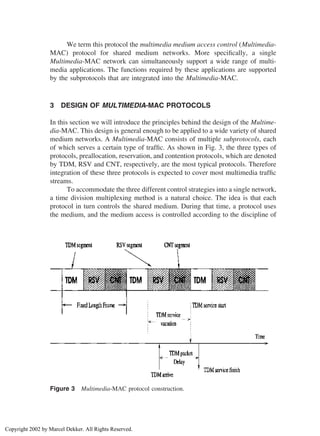
Multimedia Systems 1st Mohsen Guizani download
https://ebookbell.com/product/optical-switchingnetworking-and-
computing-for-multimedia-systems-1st-mohsen-guizani-976726
Explore and download more ebooks at ebookbell.com
Here are some recommended products that we believe you will be
interested in. You can click the link to download.
Optical Switching And Networking Handbook 1st Regis Bud Bates
https://ebookbell.com/product/optical-switching-and-networking-
handbook-1st-regis-bud-bates-917690
Optical Switching Device Technology And Applications In Networks Dalia
Nandi
https://ebookbell.com/product/optical-switching-device-technology-and-
applications-in-networks-dalia-nandi-43887968
Optical Switching In Next Generation Data Centers Pavesi Lorenzo Testa
https://ebookbell.com/product/optical-switching-in-next-generation-
data-centers-pavesi-lorenzo-testa-6752628
Optical Switching 1st Edition Tarek S Elbawab
https://ebookbell.com/product/optical-switching-1st-edition-tarek-s-
elbawab-1222698
Optical Switching Networks Martin Maier
https://ebookbell.com/product/optical-switching-networks-martin-
maier-1222700
Solid State Lasers Tunable Sources And Passive Qswitching Elements
Yehoshua Kalisky
https://ebookbell.com/product/solid-state-lasers-tunable-sources-and-
passive-qswitching-elements-yehoshua-kalisky-4965424
Optimal Design Of Switching Power Supply Ma Hongtao Sha Zhanyou Wang
https://ebookbell.com/product/optimal-design-of-switching-power-
supply-ma-hongtao-sha-zhanyou-wang-5311696
Optical Nonlinearities In Nanostructured Systems Carlos Torrestorres
https://ebookbell.com/product/optical-nonlinearities-in-
nanostructured-systems-carlos-torrestorres-46074278
Optical Wireless Communication Xizheng Ke Ke Dong
https://ebookbell.com/product/optical-wireless-communication-xizheng-
ke-ke-dong-46076490
Marcel Dekker, Inc. New York • Basel
TM
Optical
Switching/Networking
and Computing for
Multimedia Systems
Mohsen Guizani
University of West Florida
Pensacola, Florida
Abdella Battou
firstwave Intelligent Optical Networks
Greenbelt, Maryland
edited by
Copyright 2002 by Marcel Dekker. All Rights Reserved.
ISBN: 0-8247-0707-9
This book is printed on acid-free paper.
Headquarters
Marcel Dekker, Inc.
270 Madison Avenue, New York, NY 10016
tel: 212-696-9000; fax: 212-685-4540
Eastern Hemisphere Distribution
Marcel Dekker AG
Hutgasse 4, Postfach 812, CH-4001 Basel, Switzerland
tel: 41-61-261-8482; fax: 41-61-261-8896
World Wide Web
http://www.dekker.com
The publisher offers discounts on this book when ordered in bulk quantities. For more
information, write to Special Sales/Professional Marketing at the headquarters address
above.
Copyright  2002 by Marcel Dekker, Inc. All Rights Reserved.
Neither this book nor any part may be reproduced or transmitted in any form or by any
means, electronic or mechanical, including photocopying, microfilming, and recording,
or by any information storage and retrieval system, without permission in writing from
the publisher.
Current printing (last digit):
10 9 8 7 6 5 4 3 2 1
PRINTED IN THE UNITED STATES OF AMERICA
Copyright 2002 by Marcel Dekker. All Rights Reserved.
OPTICAL ENGINEERING
Founding Editor
Brian J. Thompson
University of Rochester
Rochester, New York
Editorial Board
Toshimitsu Asakura
Hokkai-Gakuen University
Sapporo, Hokkaido, Japan
Nicholas F. Borrelli
Corning, Inc.
Corning, New York
Chris Dainty
Imperial College of Science,
Technology, and Medicine
London, England
Bahram Javidi
University of Connecticut
Storrs, Connecticut
Mark Kuzyk
Washington State University
Pullman, Washington
Hiroshi Murata
The Furukawa Electric Co., Ltd.
Yokohama, Japan
Edmond J. Murphy
JDS/Uniphase
Bloomfield, Connecticut
Dennis R. Pape
Photonic Systems Inc.
Melbourne, Florida
Joseph Shamir
Technion–Israel Institute
of Technology
Hafai, Israel
David S. Weiss
Heidelberg Digital L.L.C.
Rochester, New York
Copyright 2002 by Marcel Dekker. All Rights Reserved.
1. Electron and Ion Microscopy and Microanalysis: Principles and Applications,
Lawrence E. Murr
2. Acousto-Optic Signal Processing: Theory and Implementation, edited by Nor
man J. Berg and John N. Lee
3. Electro-Optic and Acousto-Optic Scanning and Deflection, Milton Gottlieb, Clive
L. M. Ireland, and John Martin Ley
4. Single-Mode Fiber Optics: Principles and Applications, Luc B. Jeunhomme
5. Pulse Code Formats for Fiber Optical Data Communication: Basic Principles and
Applications, David J. Morris
6. Optical Materials: An Introduction to Selection and Application, Solomon
Musikant
7. Infrared Methods for Gaseous Measurements: Theory and Practice, edited by
Joda Wormhoudt
8. Laser Beam Scanning: Opto-Mechanical Devices, Systems, and Data Storage
Optics, edited by Gerald F. Marshall
9. Opto-Mechanical Systems Design, Paul R. Yoder, Jr.
10. Optical Fiber Splices and Connectors: Theory and Methods, Calvin M. Miller with
Stephen C. Mettler and Ian A. White
11. Laser Spectroscopy and Its Applications, edited by Leon J. Radziemski, Richard
W. Solarz, and Jeffrey A. Paisner
12. Infrared Optoelectronics: Devices and Applications, William Nunley and J. Scott
Bechtel
13. Integrated Optical Circuits and Components: Design and Applications, edited by
Lynn D. Hutcheson
14. Handbook of Molecular Lasers, edited by Peter K. Cheo
15. Handbook of Optical Fibers and Cables, Hiroshi Murata
16. Acousto-Optics, Adrian Korpel
17. Procedures in Applied Optics, John Strong
18. Handbook of Solid-State Lasers, edited by Peter K. Cheo
19. Optical Computing: Digital and Symbolic, edited by Raymond Arrathoon
20. Laser Applications in Physical Chemistry, edited by D. K. Evans
21. Laser-Induced Plasmas and Applications, edited by Leon J. Radziemski and
David A. Cremers
22. Infrared Technology Fundamentals, Irving J. Spiro and Monroe Schlessinger
23. Single-Mode Fiber Optics: Principles and Applications, Second Edition, Re vised
and Expanded, Luc B. Jeunhomme
24. Image Analysis Applications, edited by Rangachar Kasturi and Mohan M. Trivedi
25. Photoconductivity: Art, Science, and Technology, N. V. Joshi
26. Principles of Optical Circuit Engineering, Mark A. Mentzer
27. Lens Design, Milton Laikin
28. Optical Components, Systems, and Measurement Techniques, Rajpal S. Sirohi
and M. P. Kothiyal
29. Electron and Ion Microscopy and Microanalysis: Principles and Applications,
Second Edition, Revised and Expanded, Lawrence E. Murr
30. Handbook of Infrared Optical Materials, edited by Paul Klocek
31. Optical Scanning, edited by Gerald F. Marshall
32. Polymers for Lightwave and Integrated Optics: Technology and Applications,
edited by Lawrence A. Hornak
33. Electro-Optical Displays, edited by Mohammad A. Karim
34. Mathematical Morphology in Image Processing, edited by Edward R. Dougherty
35. Opto-Mechanical Systems Design: Second Edition, Revised and Expanded, Paul
R. Yoder, Jr.
36. Polarized Light: Fundamentals and Applications, Edward Collett
37. Rare Earth Doped Fiber Lasers and Amplifiers, edited by Michel J. F. Digonnet
38. Speckle Metrology, edited by Rajpal S. Sirohi
Copyright 2002 by Marcel Dekker. All Rights Reserved.
39. Organic Photoreceptors for Imaging Systems, Paul M. Borsenberger and David
S. Weiss
40. Photonic Switching and Interconnects, edited by Abdellatif Marrakchi
41. Design and Fabrication of Acousto-Optic Devices, edited by Akis P. Goutzoulis
and Dennis R. Pape
42. Digital Image Processing Methods, edited by Edward R. Dougherty
43. Visual Science and Engineering: Models and Applications, edited by D. H. Kelly
44. Handbook of Lens Design, Daniel Malacara and Zacarias Malacara
45. Photonic Devices and Systems, edited by Robert G. Hunsberger
46. Infrared Technology Fundamentals: Second Edition, Revised and Expanded,
edited by Monroe Schlessinger
47. Spatial Light Modulator Technology: Materials, Devices, and Applications, edited
by Uzi Efron
48. Lens Design: Second Edition, Revised and Expanded, Milton Laikin
49. Thin Films for Optical Systems, edited by Francoise R. Flory
50. Tunable Laser Applications, edited by F. J. Duarte
51. Acousto-Optic Signal Processing: Theory and Implementation, Second Edition,
edited by Norman J. Berg and John M. Pellegrino
52. Handbook of Nonlinear Optics, Richard L. Sutherland
53. Handbook of Optical Fibers and Cables: Second Edition, Hiroshi Murata
54. Optical Storage and Retrieval: Memory, Neural Networks, and Fractals, edited by
Francis T. S. Yu and Suganda Jutamulia
55. Devices for Optoelectronics, Wallace B. Leigh
56. Practical Design and Production of Optical Thin Films, Ronald R. Willey
57. Acousto-Optics: Second Edition, Adrian Korpel
58. Diffraction Gratings and Applications, Erwin G. Loewen and Evgeny Popov
59. Organic Photoreceptors for Xerography, Paul M. Borsenberger and David S.
Weiss
60. Characterization Techniques and Tabulations for Organic Nonlinear Optical
Materials, edited by Mark G. Kuzyk and Carl W. Dirk
61. Interferogram Analysis for Optical Testing, Daniel Malacara, Manuel Servin, and
Zacarias Malacara
62. Computational Modeling of Vision: The Role of Combination, William R. Uttal,
Ramakrishna Kakarala, Spiram Dayanand, Thomas Shepherd, Jagadeesh Kalki,
Charles F. Lunskis, Jr., and Ning Liu
63. Microoptics Technology: Fabrication and Applications of Lens Arrays and De-
vices, Nicholas Borrelli
64. Visual Information Representation, Communication, and Image Processing,
edited by Chang Wen Chen and Ya-Qin Zhang
65. Optical Methods of Measurement, Rajpal S. Sirohi and F. S. Chau
66. Integrated Optical Circuits and Components: Design and Applications, edited by
Edmond J. Murphy
67. Adaptive Optics Engineering Handbook, edited by Robert K. Tyson
68. Entropy and Information Optics, Francis T. S. Yu
69. Computational Methods for Electromagnetic and Optical Systems, John M.
Jarem and Partha P. Banerjee
70. Laser Beam Shaping, Fred M. Dickey and Scott C. Holswade
71. Rare-Earth-Doped Fiber Lasers and Amplifiers: Second Edition, Revised and
Expanded, edited by Michel J. F. Digonnet
72. Lens Design: Third Edition, Revised and Expanded, Milton Laikin
73. Handbook of Optical Engineering, edited by Daniel Malacara and Brian J.
Thompson
74. Handbook of Imaging Materials: Second Edition, Revised and Expanded, edited
by Arthur S. Diamond and David S. Weiss
75. Handbook of Image Quality: Characterization and Prediction, Brian W. Keelan
Copyright 2002 by Marcel Dekker. All Rights Reserved.
76. Fiber Optic Sensors, edited by Francis T. S. Yu and Shizhuo Yin
77. Optical Switching/Networking and Computing for Multimedia Systems, edited by
Mohsen Guizani and Abdella Battou
78. Image Recognition and Classification: Algorithms, Systems, and Applications,
edited by Bahram Javidi
79. Practical Design and Production of Optical Thin Films: Second Edition, Revised
and Expanded, Ronald R. Willey
80. Ultrafast Lasers: Technology and Applications, edited by Martin E. Fermann,
Almantas Galvanauskas, and Gregg Sucha
81. Light Propagation in Periodic Media: Differential Theory and Design, Michel
Nevière and Evgeny Popov
82. Handbook of Nonlinear Optics, Second Edition, Revised and Expanded,
Richard L. Sutherland
Additional Volumes in Preparation
Optical Remote Sensing: Science and Technology, Walter Egan
Copyright 2002 by Marcel Dekker. All Rights Reserved.
Foreword
We have witnessed the rapid growth in the popularity of the Internet technology
over the past few years. The current network technologies provide ubiquitous
access to a vast amount of information on a huge variety of topics, but limited
bandwidth has constrained the impact and growth of broadband multimedia appli-
cations. To allow new broadband services to reach their potential will require an
exponential increase in bandwidth availability to all users. These demanding high
data rate applications will require the development of a robust and stable network
infrastructure.
At the current time, optical fiber is the medium of choice both to accommo-
date this bandwidth explosion and to meet the increasing demands for quality-
of-service (QoS) required by the emerging multimedia applications. Dense wave-
length division multiplexing (DWDM) has provided the technological solution
to increased network transport capacity. The next step in this evolutionary process
is the implementation of photonic packet switching to offer high-speed data rate/
format transparency and configurability. This transformation to a packet-based
environment is required to allow all the different forms of data and multimedia
content that will need to be supported in tomorrow’s networks. While the debate
about whether to have an optoelectronic or an all-optical (end-to-end) network
rages on, the cost per bit continues to decline, and network operators continue
to upgrade and improve their fiber-based networks to try to meet the needs of
tomorrow’s broadband market.
It is a pleasure to introduce this book, which discusses some of the funda-
mental concepts necessary for broadband multimedia applications that will need
to be supported by the optical network infrastructure. This includes issues relating
to optical networking capabilities for the next generation Internet, the design and
performance of a lightwave data storage network using computer analysis and
simulation, analysis of multimedia access protocols for shared medium networks,
scalable electro-optical Clos switch architectures, different routing issues in opti-
cal switching and networking, and all-optical computing architectures. I believe
Copyright 2002 by Marcel Dekker. All Rights Reserved.
this book to be a fine collection of research work written by experts in the field.
The presentations stress some fundamental as well as advanced issues in light-
wave technology, the future of optics in the multimedia technology, important
optical switch and network architectures, routing and control for optical multi-
media support, and QoS requirements. The book is intended as a reference for
systems designers, hardware and software engineers, R&D managers, and market
planners who seek an understanding of optical broadband networks that support
multimedia systems.
Scott Hinton
Distinguished Professor and Chair
Electrical Engineering and Computer Science
The University of Kansas
Lawrence, Kansas
Copyright 2002 by Marcel Dekker. All Rights Reserved.
Preface
The last few years have witnessed an explosive growth in the development and
deployment of networked applications that transmit and receive audio and video
content over the Internet. New multimedia networking applications such as enter-
tainment video, IP (Internet Protocol) telephony, Internet radio, teleconferencing,
interactive games, and distance education are announced on a daily basis. The
service requirements of these applications differ significantly from those of tradi-
tional voice-oriented applications. In particular, multimedia applications are sensi-
tive to end-to-end delay and delay variation but can tolerate occasional loss of
data. These fundamentally different service requirements suggest that a network
architecture that has been designed primarily for data communication may not be
well suited for supporting multimedia applications. In this book, we investigate
some of the supporting network architectures as well as some multimedia protocols
that are supported by the high-speed networks. Our emphasis is on the optical part
of the network architecture that includes the hardware as well as the protocol levels.
As telecommunications and computer networking continue to converge,
data traffic is gradually exceeding voice traffic. This means that many of the
existing connection-oriented or circuit-switched networks will need to be up-
graded to support packet-switched data traffic. The concept of wavelength divi-
sion multiplexing (WDM) has provided us an opportunity to multiply network
capacity. Current optical switching technologies allow us to deliver rapidly the
enormous bandwidth of WDM networks. Of all the switching schemes, photonic
packet switching appears to be a strong candidate because of the high speed, data
rate/format transparency, and configurability it offers. Therefore the use of all-
optical networking and switching to support the new multimedia applications
seems inevitable.
Optical networks are those in which the dominant physical layer technology
for transport is optical fiber. They can be opaque or all-optical, and can be single-
wavelength or based on dense wavelength division multiplexing (DWDM). In
opaque networks, the path between end users is interrupted at intermediate nodes
Copyright 2002 by Marcel Dekker. All Rights Reserved.
by optical-electronic-optical (OEO) conversion operations. The traditional syn-
chronous optical networks/synchronous digital hierarchy (SONET/SDH) is an
opaque single-wavelength system. The intermediate nodes, being either elec-
tronic/optical add-drop multiplexes (OADMs) or optical crossconnects (OXCs),
actually have electronic bit handling in the signal path. None of these opaque
systems has the versatility and power of the all-optical network.
In addition to meeting the newly acquired data transmission demands, an
all-optical network has other advantages. Optical fibers offer abundant band-
width, low attenuation, and high speed. New optical equipment has recently been
developed and deployed. Commercial systems with up to 160 OC-48 (10 Gb/s)
channels have been announced that can communicate over paths thousands of
kilometers long, uninterruped by OEO conversions. Advances in optical materials
have contributed to the declining cost of optical elements that has made all-optical
networks affordable. Offering service and maintenance is potentially much sim-
pler for all-optical elements than for the traditional OEO systems. An all-optical
network also has inherent robustness. The new physical layer can provide not
only basic transport but also several other network-wide rerouting functions that
allow the optical layer to exhibit extremely high service availability. New proto-
cols at the medium access control (MAC) layer have been developed for new
and ever changing environments. Optical networking architects were concerned
with MAC protocols for optical packet switching, the combinatorics of wave-
length conversion, and optimal forms of network topology. As the field has ma-
tured, it has become clear that the more important problems relate to the network
‘‘control plane’’ and to ensuring the service integrity of the optical layer, which
increasingly carries large routed chunks of precious traffic on which depends the
viable operation of many institutions and businesses, public and private.
One of the exciting things about the two-layer story is that both the optical
networking community and the IP community have begun to agree that the way
to control both layers is by multiprotocol label switching (MPLS) or, in the case
of the optical layer, a slightly modified version called multiprotocol lambda
switching (MPλS). Each of these control planes has two phases, the transient
one in which paths are set up and the steady-state or traffic phase in which the
state information, which has been set up in each node to define the paths, then
acts to forward packets in a way that provides much of the long-missing quality-
of-service (QoS) capability. The control phases of these two emerging standards
provide a unified, agreed-upon way for the nodes in the IP and optical layers to
set up and tear down their portions of virtual point-to-point IP packet connections
between end users. There are a number of reasons for MPλS to replace the many
variants in current practice in the lower communication layers (especially
SONET/SDH) and the IP layer. These traditional control software families (IP
and SONET/SDH) are very much vendor-dependent, their control structures
Copyright 2002 by Marcel Dekker. All Rights Reserved.
are totally different from each other, and both are too slow to satisfy anticipated
needs, not just for protection but also for restoration and provisioning.
The first of the optical layer integrity processes to receive attention has
been protection switching, the millisecond-scale substitution of a new lightpath
for a failed one. This action usually requires prescanned algorithms akin to the
SONET/SDH protection switching algorithms and invokes only a very localized
part of the network, usually no more than a single span, string, or ring of notes.
Conventional protection switching is often triggered by some bit-level process.
In optical protection switching, the trigger can be loss of optical signal-to-noise
ratio (OSNR).
The second process is restoration, the replacement of the failed optical path
within the network, or part of the network, by another—that is, providing a new
backup for the former one, now playing the role of the service path. Since one
can allow minutes or even longer to do this, it is possible not only to have real-
time software do the job but also to involve much larger portions of the network
in the process that can be tolerated for protection switching.
Finally, there is provisioning or reconfiguration, in which one relieves
stranded bandwidth conditions, arranges for the brokering of bandwidth between
service providers using the optical facility, or even setting up rent-a-wavelength
conditions. Provisioning/reconfiguration can involve optimization over the entire
optical network portion or even several of them. Today, all these actions are
expected to be available in the access, metro, and long-haul environments.
These issues and more are discussed in this fine collection of chapters. This
volume brings together work by some of the leading international experts in the
field. The first chapter, by Ali and Kurtz, gives an overall picture of optical net-
working capabilities for the next generation Internet. They address some key
issues as to how the legacy SONET-based infrastructure currently in place will
make a graceful transition to the next generation datacentric networking para-
digm. They carefully address the problems with today’s legacy networking infra-
structure and identify challenges facing both carriers and service providers. They
provide an understanding of the current and future service portfolio and associ-
ated requirements.
Next, Wang and Hamdi investigate the analysis of multimedia access proto-
cols for shared medium networks. They propose a methodology for integrating
different MAC protocols into a single shared medium network to accommodate
efficiently various types of multimedia traffic streams with different characteris-
tics and QoS demands. In particular, they provide an integrated MAC protocol,
termed the Multimedia Medium Access Control (Multimedia-MAC) protocol,
that can efficiently and simultaneously serve three types of multimedia traffic
streams: a constant bit rate (CBR) traffic and two classes of variable bit rate
(VBR) traffic. Then a queuing system with vacation model is developed to estab-
Copyright 2002 by Marcel Dekker. All Rights Reserved.
lish a mathematical framework for the analysis and performance evaluation of
the proposed Multimedia-MAC protocol. The Multimedia-MAC design approach
and performance evaluation schemes are applied to a wavelength division multi-
plexing network, and it is shown that the proposed protocol design approach is
general enough to be used in various shared medium networks.
Then, Ramesh and Tanzer present the design and performance of a light-
wave data storage network using computer analysis and simulation. This type of
network, composed of broadcasting star couplers, cascading optical amplifiers,
and intensity-modulated/direct detection transmission at data rates of 1 to 20
Gbps, is simulated using MATLAB and SIMULINK
software to predict network
performance factors. This involves both modeling system components and evalu-
ating system performance measures. It is concluded that large network sizes are
configurable, and scaling projections at 10 Gb/s show that cascaded optical ampli-
fiers can extend to reach to several thousand end users, while WDM implementa-
tion can produce aggregate network capacities of a hundred terabits per second.
The next four chapters discuss different routing techniques in WDM net-
works. First, Wang and Hamdi present a survey of routed wavelength WDM
networks. The survey covers important issues related to their design and opera-
tion, including virtual topology mapping, wavelength routing and assignment,
dynamic routing, wavelength conversion, QoS provision, and multicasting. Sec-
ond, Battou, Ben Brahim, and Khan present a thorough study and implementation
of an optical network control plane. They describe the design of the optical net-
work control plane, with particular emphasis on the difficult issues in optical
network management, and lightpath signaling and routing. Next, Znati and Mel-
hem describe routing and path establishment for point-to-point and point-to-
multipoint communications over WDM networks. In order to address the QoS
requirements, in terms of bandwidth and end-to-end delay of the underlying appli-
cations, a low-cost, conversion-bound heuristic is proposed. The heuristic estab-
lishes a tree of semi-lightpaths between a source and a group of destination nodes.
The unique feature of this heuristic is that it decouples the cost of establishing
the multicast tree from the delay incurred by data transmission due to lightwave
conversion and processing at intermediate nodes along the transmission path.
Finally, in this group, Shen, Pan, and Horiguchi provide an overview on recent
developments on efficient routing in multihop optical networks supported by
WDM with limited wavelength conversion. It addresses offline and online routing
in both reliable and unreliable networks for point-to-point, multicast, and multiple
multicast communication patterns. Group membership updating schemes for the
three patterns are also discussed.
The last category is a set of chapters dealing with optical architectures
that serve as the backbone for the all-optical network. We provide description
of free-space optical switch and network architectures as well as arithmetic,
logic, and image processing ones. Guizani gives an overview of different types
Copyright 2002 by Marcel Dekker. All Rights Reserved.
of photonic ATM architectures based on three different switching techniques.
Liotopoulos describes a three-stage Clos switch architecture, based on a two-
level hierarchy of optical cross connects, which can be implemented with AWGFs
and ODFs. A number of important related research issues are identified. Li and
Esener describe a parallel free-space optical interconnection with all design
methodologies and requirements. Advances in this area are reviewed. A num-
ber of 3D optical components necessary for such architectures are presented. Fi-
nally, Cherri and Alam present two chapters that discuss optical architectures
that achieve ultrafast arithmetic, logical, and image processing operations using
trinary signed-digit arithmetic and polarization-encoded optical shadow-casting.
ACKNOWLEDGMENTS
We would like to take this opportunity to thank the University of West Florida
and the NRL for their support while this book was developed. Special thanks to
all the authors who contributed to this book—in particular, Mounir Hamdi, Ghas-
sen Ben Brahim, Bilal Khan, and Taieb F. Znati—for their patience and en-
couragement, without which this work would not have been completed on time.
Rita Lazazzaro and Eric Stannard have been very cooperative throughout this
project—many thanks to both of them.
We are grateful to our families for their support. Mohsen thanks his parents
and family, in particular, his wife, Saida, and all the kids—for their patience
and understanding during the many hours consumed in preparing the manuscript.
Abdella thanks his family for their love and support during this project.
Further, we acknowledge our teachers, friends, and colleagues, who have
provided us with so much intellectual stimulation throughout our careers.
The editors and authors welcome any comments and suggestions for im-
provements or changes that could be implemented in forthcoming editions of this
book. Comments can be sent to mguizani@cs.uwf.edu.
Mohsen Guizani
Abdella Battou
Copyright 2002 by Marcel Dekker. All Rights Reserved.
Contents
Foreword Scott Hinton
Preface
Contributors
1. Optical Networking Capabilities for the Next-Generation
Internet
Mohamed A. Ali and Russ Kurtz
2. Analysis of Multimedia Access Protocols for Shared Medium
Networks
Lixin Wang and Mounir Hamdi
3. The Design and Performance of a Lightwave Data Storage
Network Using Computer Analysis and Simulation
S. K. Ramesh and Herbert J. Tanzer
4. Routed Wavelength WDM Networks
Lixin Wang and Mounir Hamdi
5. The Optical Network Control Plane
Abdella Battou, Ghassen Ben Brahim, and Bilal Khan
6. Routing and Path Establishment for Point-to-Point and
Point-to-Multipoint Communications over WDM Networks
Taieb F. Znati and Rami Melhem
7. Routing in Multihop Optical WDM Networks with Limited
Wavelength Conversion
Hong Shen, Yi Pan, and Susumu Horiguchi
8. Optical Switching Architectures
Mohsen Guizani
9. Scalable Electro-Optical Clos Switch Architectures
Fotios K. Liotopoulos
10. Parallel Free-Space Optical Interconnection
Guoqiang Li and Sadik Esener
Copyright 2002 by Marcel Dekker. All Rights Reserved.
11. Optical Computing Using Trinary Signed-Digit Arithmetic
Abdallah K. Cherri and Mohammad S. Alam
12. Ultrafast Arithmetic, Logical, and Image Processing Operations
Using Polarization-Encoded Optical Shadow-Casting
Abdallah K. Cherri and Mohammad S. Alam
Copyright 2002 by Marcel Dekker. All Rights Reserved.
Contributors
Mohammad S. Alam The University of South Alabama, Mobile, Alabama
Mohamed A. Ali City College of the City University of New York, New York,
New York
Abdella Battou firstwave Intelligent Optical Networks, Greenbelt, Maryland
Ghassen Ben Brahim Princeton Optical Systems, Princeton, New Jersey
Abdallah K. Cherri Kuwait University, Safat, Kuwait
Sadik Esener University of California, San Diego, La Jolla, California
Mohsen Guizani University of West Florida, Pensacola, Florida
Mounir Hamdi Hong Kong University of Science and Technology, Kowloon,
Hong Kong
Susumu Horiguchi Japan Advanced Institute of Science and Technology,
Tatsunokuchi, Japan
Bilal Khan Center for Computational Science at the Naval Research Labora-
tory, Washington, D.C.
Russ Kurtz REALTECH Systems Corporation, Edison, New Jersey
Guoqiang Li University of California, San Diego, La Jolla, California, and
Shanghai Institute of Optics and Fine Mechanics, Shanghai, People’s Republic
of China
Copyright 2002 by Marcel Dekker. All Rights Reserved.
Fotios K. Liotopoulos Computer Technology Institute, Athens, Greece
Rami Melhem University of Pittsburgh, Pittsburgh, Pennsylvania
Yi Pan Georgia State University, Atlanta, Georgia
S. K. Ramesh California State University, Sacramento, California
Hong Shen Japan Advanced Institute of Science and Technology, Tatsuno-
kuchi, Japan
Herbert J. Tanzer Hewlett Packard Co., Roseville, California
Lixin Wang Hong Kong University of Science and Technology, Kowloon,
Hong Kong
Taieb F. Znati University of Pittsburgh, Pittsburgh, Pennsylvania
Copyright 2002 by Marcel Dekker. All Rights Reserved.
1
Optical Networking Capabilities for
the Next-Generation Internet
Mohamed A. Ali
City College of the City University of New York, New York, New York
Russ Kurtz
REALTECH Systems Corporation, Edison, New Jersey
1 INTRODUCTION
Over the past few years, the field of computer and telecommunications net-
working has experienced tremendous growth. Traffic demand has increased sub-
stantially, somewhat unexpectedly, prompting carriers to add capacity quickly
and in the most cost-effective way possible. There is no sign that this increase
is an anomaly, and both traffic and backbone capacity are likely to continue a
rapid increase into the foreseeable future. The leaders of the data communications
industry are not the same companies that lead the marketplace today in sales of
telecommunications equipment, so one cannot extrapolate to the future by simply
assuming the network element types deployed today will increase in speed and
number to meet the capacity growth required in the future.
The change in the fundamental character of backbone network traffic, as
demonstrated by the current shift in the telecommunications industry from the
traditional voice-centric TDM/SONET/SDH (time division multiplexing/syn-
chronous optical networks/synchronous digital hierarchy) optimized circuit-
switched networking paradigm to the data-centric packet-optimized networking
paradigm, is leading to revolutionary changes in the traditional concepts of how
networks are constructed. The primary reason for the paradigm shift in network
Copyright 2002 by Marcel Dekker. All Rights Reserved.
design is the nature of the traffic crossing today’s long-haul backbones. Specifi-
cally, internet protocol (IP) applications are the fastest growing segment of a
service provider’s network traffic. This growth is expected to continue well into
this century.
Concurrently with the emerging data-centric networking paradigm, there
has been a well-publicized ‘‘explosion’’ of attention centered on the topic of
optical networking. With skyrocketing optical networking startups, valuations,
mergers, and acquisitions, the rest of the world has turned its attention to optical
networking as the vehicle that promises to transform the Internet, blowing away
bandwidth bottlenecks and almost eliminating delays. However, in the midst of
much debate and excitement over the likely winners in the race to roll out optical
networking technologies, no one seems to be certain of what, exactly, our industry
is trying to accomplish. How can our industry bring this technology into the
network quickly and cost-effectively? Where are we going with technology? Is
it simply more bandwidth?
One might argue that the end goal of our industry is the creation of an all-
optical Internet, one that is free from all bandwidth and scalability restrictions,
as well as distance limitations. While the vision for creating such a network of
networks seems to be gaining momentum, the implications of implementing this
vision are far-reaching: all conventional aspects of networking functionality have
to be reconsidered; the most basic assumptions of how networks are constructed
are being called into question. At a minimum, service providers, carriers, and
enterprise network managers will be forced to rethink fully routing, switching,
and traffic engineering for the emerging data-centric networking paradigm.
The myriad innovations in dense wavelength division multiplexing
(DWDM) technology that increase the number of wavelengths, generate more
bandwidth, send multigigabit signals faster and longer distances, and those en-
abling optical crossconnects (OXCs) with the ability to add, drop, and in effect
construct wavelength-switched and wavelength-routed networks, are moving us
towards this point. High-performance routers (IP layer) plus an intelligent optical
transport layer (DWDM layer) equipped with a new breed of photonic networking
equipment hold the keys to the two pieces of the puzzle that will comprise the
next generation optical Internet. Of course, there are several visions of how best
to marry these two technologies. The key question appears to be whether carriers
should control their next-generation data-centric networks using only routers, or
some combination of routers and OXC equipment.
The realm in which we are likely to see the first real deployments of high-
performance routers interconnected by intelligent optical core networks that uti-
lize optical networking technology will likely be within the long-haul backbone.
Several carriers have already completed field trials of all-optical systems, and
many others have trials in process. So how will the migration to this new data-
centric optical networking paradigm evolve?
Copyright 2002 by Marcel Dekker. All Rights Reserved.
The key ingredient to the success of any migration strategy is that the new
networking paradigm must coexist with the aging TDM circuit switching infra-
structure, offer the network reliability inherent in legacy SONET/SDH systems,
and at the same time meet the surging demand for packet traffic. In other words,
how the legacy SONET-based infrastructure currently in place can make a grace-
ful transition to the next generation data-centric networking paradigm is the real
challenge. To assess which architecture will enable the most effective migration
strategy, the following two issues must be carefully addressed: (1) problems with
today’s legacy networking infrastructure as well as challenges facing both carriers
and service providers must be fully identified; (2) current and future service port-
folio and associated requirements must be thoroughly understood.
1.1 Today’s Problems
The fundamental problem facing both carriers and service providers is that In-
ternet traffic is already skyrocketing, and looks certain to accelerate even further
as broadband access technologies such as DSL (digital subscriber line) and cable
modems are rolled out to the masses. Service providers are faced with daunting
challenges that span both the access and backbone transport network require-
ments. They must offer service breadth—IP, frame relay, ATM, Ethernet, and
TDM-based voice—plus the flexibility to add and modify new services as market
conditions warrant. While transporting data services, the new data-centric net-
working paradigm must coexist with the voice infrastructure and offer the net-
work reliability inherent in legacy SONET/SDH systems.
Let us first consider the trouble with today’s most widely used standard,
SONET. SONET infrastructure has been the standard for wide area networking
for the past 15 years, ideally designed to handle circuit-switched voice and point-
to-point TDM connections, it began to feel burdened by growing data traffic
demands and the need to deliver real-time circuit provisioning. This is because
SONET was designed before the explosion of the asynchronous and unpredict-
able Interne-based traffic profiles.
The asynchronous and unpredictable nature of Internet-based traffic profiles
makes forecasting for growth all the more difficult, and the issue of scalability
a major concern. Unfortunately, SONET was never designed to deal with these
problems. SONET networks are always built under the assumption that transmit/
receive traffic is always balanced and predictable, so that growth would be easy
to forecast.
SONET’s inability to handle the huge influx of data traffic, and the associ-
ated unpredictable traffic patterns, signaled the end of this standard’s long reign
in the backbone transport network. While long-haul architectures based solely on
SONET will be far too expensive and complex to meet the needs of tomorrow’s
backbones, some of the functionality SONET encompasses will live on in differ-
Copyright 2002 by Marcel Dekker. All Rights Reserved.
ent, more efficient vehicles. The emerging data-centric networking paradigm, a
purely optical Internet, by contrast, will bypass SONET altogether, providing for
a backbone without capacity restrictions or distance limitations.
SONET provides four primary functions: (1) intermediate multiplexing, (2)
network survivability, (3) performance monitoring, and (4) bandwidth provi-
sioning. The incorporation of these into any near-term optical Internet architec-
ture is a prerequisite for any graceful transition. In the near term, optical net-
working systems and technologies combined with high-performance multigigabit
or terabit routers will be able to perform these functions. These systems are al-
ready in late-stage development, and we can expect to see true commercial devel-
opments beginning by the end of this year. So, while some SONET functionality
is still needed, a separate SONET layer is not.
That is not the end of the traditional network’s troubles. Another major
issue facing today’s service providers is the static and cumbersome process of
provisioning end-to-end circuits. Provisioning a cross-country OC-48 service is
extremely manual, involves complex network planning and roll-out activities,
and generally takes several months to accomplish. The roll-out of DWDM has
led to another problem; current digital crossconnects simply aren’t big enough to
handle the number of connections running across backbones. Carriers can foresee
needing huge switch fabrics with thousands of ports, and right now, they do not
exist.
1.2 Tomorrow’s Promises
All of this is about to change. Several dramatic advances in the optical-net-
working arena in recent years have emerged to set the foundation for the next-
generation optical Internet and to challenge both the traditional view of net-
working (e.g., routing, switching, provisioning, protection, and restoration) and
the conventional approaches of networks design that have always addressed tech-
nology first and management second. First, the abundance of bandwidth propelled
by the explosion of DWDM poses, for the first time, a new challenge to network
architects. Whereas in the past, IP, ATM, and related routing protocols have
focused on managing the scarcity of bandwidth, the new challenge is managing
the abundance of bandwidth.
Second, rapid advances in DWDM technology—dense WDM add/drop
multiplexers (ADMs), wideband optical amplifiers, stable single frequency lasers,
novel optical crossconnects (OXCs)—with the ability to add, drop, and in effect
construct wavelength-switched and wavelength-routed networks, are now begin-
ning to shift the focus more toward optical networking and network-level issues.
Thus, there is an attractive opportunity to evolve DWDM technology toward an
optical networking infrastructure with transport, multiplexing, switching, routing,
Copyright 2002 by Marcel Dekker. All Rights Reserved.
survivability, bandwidth provisioning, and performance monitoring, supported at
the optical layer.
Harnessing the newly available bandwidth is difficult because today’s core
network architecture, and the networking equipment it is built on, lack both the
scale and functionality necessary to deliver the large amounts of bandwidth re-
quired in the form of ubiquitous, rapidly scalable, multigigabit services. Today’s
core network architecture model has four layers: IP and other content-bearing
traffic, over ATM for traffic engineering, over SONET for transport, and over
WDM for fiber capacity. This approach has functional overlap among its layers,
contains outdated functionality, and will not be able to scale to meet the exploding
volume of future data traffic, which makes it ineffective as the envisioned archi-
tecture for a next-generation data-centric networking paradigm.
A simplified two-tiered architecture that requires two types of subsystems
will set the stage for a truly optical Internet: service delivery platforms that en-
force service policies, and transport platforms that intelligently deliver the neces-
sary bandwidth to these service platforms. If IP can be mapped directly onto the
WDM layer, some of the unnecessary network layers can be eliminated, opening
up new possibilities for the potential of collapsing today’s vertically layered net-
work architecture into a horizontal model where all network elements work as
peers dynamically to establish optical paths through the network.
High-performance routers (IP layer) plus an intelligent optical transport
layer (DWDM layer) equipped with a new breed of photonic networking equip-
ment hold the keys to the two pieces of the puzzle that will compose the optical
Internet. Closer and efficient interworking of these two pieces is the key to solving
the puzzle. Specifically, linking the routing decision at the IP layer with the point-
and-click provisioning capabilities of optical switches at the transport layer, in
our opinion, is the cornerstone to the puzzle’s solution. This will allow routers
and ATM switches to request bandwidth where and when they need it.
Now that the basic building blocks are available for building such a network
of networks, the key innovations will come from adding intelligence that enables
the interworking of all the network elements (routers, ATM switches, DWDM
transmission systems and OXCs). The IETF has already addressed the interwork-
ing of routers and optical switches through the multiprotocol lambda switching
(MPλS) initiative [1]. The main goal of this initiative is to provide a framework
for real-time provisioning of optical channels, through combining recent ad-
vances in multiprotocol label switching (MPLS) traffic-engineering control plane
with emerging optical switching technology in a hybrid IP-centric optical net-
work. However, only a high-level discussion has been presented.
This work presents a balanced view of the vision of the next generation
optical Internet and describe, two practical near-term optical Internet candidate
model architectures along with a high-level discussion of their relative advantages
Copyright 2002 by Marcel Dekker. All Rights Reserved.
and disadvantages: (1) a router-centric architecture deployed on a thin optical
layer, and (2) a hybrid router/OXC-centric architecture deployed on a rich and
intelligent optical transport layer. A router-centric model assumes that IP-based
traffic is driving all the growth in the network, and the most cost-effective solution
is to terminate all optical links directly on the router. The granularity at which
data can be switched is at the packet level. In a hybrid router/OXC model, all
optical links coming into a core node are terminated on an OXC. The cross-
connect switches transit traffic (data destined for another core node) directly to
outbound connections, while switching access traffic (data destined for this core
node) to ports connected to an access router. The granularity at which data can
be switched is at the entire wavelength level, e.g., OC-48 or OC-192.
Both models are based on the two-layer model, IP directly over WDM,
and therefore DWDM equipment is available to provide the underlying band-
width. The main issue is really about the efficiency of a pure packet-switched
network versus a hybrid, which packet switches only at the access point and
circuit switches through the network. The distinction between these two models
is based on the way that the routing and signaling protocols are run over the IP
and the optical subnetwork layers.
A special consideration will be given to the hybrid router/OXC-centric
model, referred to as the integrated model in a recent IETF draft [2], since it is
our opinion that this model represents a credible starting point toward achieving
an all-optical Internet. This model aims at a tighter and more coordinated integra-
tion between the IP layer and the underlying DWDM-based optical transport
layer.
The work presented here builds on the recent IETF initiatives [1,2] and
other related work on the (MPλS) [3,4] and addresses the implementation issues
of the path selection component of the traffic engineering problem in a hybrid
IP-centric DWDM-based optical network. An overview of the methodologies and
associated algorithms for dynamic lightpath computation, that is based on a fully
distributed implementation, is presented. Specifically, we show how the complex
problem of real-time provisioning of optical channels can be simplified by using
a simple dynamic constraint-based routing and wavelength assignment (RWA)
algorithm that computes solutions to three subproblems: the routing problem, the
constrained-based shortest route selection problem, and the wavelength assign-
ment problem.
We present two different schemes for dynamic provisioning of the optical
channels. The first scheme is conceptually simple, but the overhead involved is
excessive. The second scheme is not as overhead consuming as the first one but
has the drawback that the chosen wavelength is only locally optimized along the
selected route; consequently the utilization of network resources is not globally
optimized. Two different scenarios are then considered: provisioning lightpaths
Copyright 2002 by Marcel Dekker. All Rights Reserved.
in a network with full wavelength conversion capability, and provisioning
lightpaths in a network without wavelength conversion capability
The remainder of this chapter is organized into four sections. Section 2
presents the case for building an optical Internet. Section 3 describes two near-
term optical Internet candidate models. In Section 4, we present an overview of
real-time provisioning at the optical layer and describe two different schemes for
dynamic provisioning of the optical channels. Finally, section 5 offers summary
and conclusion.
2 THE CASE FOR BUILDING AN OPTICAL INTERNET
2.1 Overview
There is considerable debate in the telecommunications industry about the best
technology for transporting IP services. Carriers are generally more committed
to ATM as the common network technology. One of the underlying assumptions
of the carriers is that data services would be one of many competing services in
a portfolio of service types. As such, ATM networks are optimized to carry a
mix of different service types rather than being optimized for one specific service
type. The ATM virtual paths make it easier to construct router networks by giving
routers the appearance of being only one hop apart, whereas in reality the virtual
path may traverse many intermediate ATM switches. ATM does also provide a
powerful set of capabilities in terms of traffic engineering.
On the other hand, there are many in the Internet community who believe
that soon, just about everything will ride over IP, so that a network optimized
to carry IP is the most appropriate. While there are compelling arguments for
both sides of the debate, the most likely near-term outcome is that IP over ATM
and IP/MPLS directly over WDM services will exist in parallel to meet the spec-
trum of customer requirements for IP networking. This is particularly true with
the advent of DWDM-based optical transport systems as the main (and sole)
underlying transport infrastructure that can support a multitude of transport ser-
vice delivery mechanisms from traditional SONET/SDH services to the new opti-
cal ATM and IP architectures.
The case therefore for an optical Internet essentially rests on the predicted
volumes for Internet traffic growth and the expected predominant types of In-
ternet applications. If Internet traffic continues to grow exponentially, and if for
the bulk of traffic all that is required is a ‘‘best efforts’’ or an ‘‘ensured’’ delivery
service, then high-volume IP pipes would seem to be the most appropriate tech-
nology. In that scenario, it seems appropriate to build a network, first and fore-
most, that is optimized for the delivery of that type of service. The remaining
services can then be delivered on top of an IP network (which may or may not
Copyright 2002 by Marcel Dekker. All Rights Reserved.
be less than optimal) or continue to be delivered over a parallel ATM network.
We will refer to this data-centric networking solution as a router-centric architec-
ture. The details of this architecture will be considered in the next section.
On the other hand, if data services are treated as one of many competing
services in a portfolio of service types, then it seems appropriate to build a net-
work that is optimized to carry a mix of different service types rather than being
optimized for one specific service type. We will refer to this networking solution
as a hybrid router/OXC-centric architecture, the details of which will also be
considered in the next section.
2.2 The Envisioned Data-Centric Networking Paradigm:
Optical Internet
Recently there have been several initiatives in building an optical Internet where
IP routes are interconnected directly with WDM links [5]. A simplified two-tiered
architecture that require two types of subsystems will set the stage for a truly
optical Internet: service delivery platforms that enforce service policies and trans-
port platforms that intelligently deliver the necessary bandwidth to these service
platforms. High-performance routers plus an intelligent optical transport layer
equipped with a new breed of photonic networking equipment hold the keys to
the two pieces of the puzzle that will compose the optical Internet.
However, closer and efficient interworking of these two pieces is the key
to solving the puzzle. Specifically, linking the routing decision at the IP layer
with the point-and-click provisioning capabilities of optical switches at the trans-
port layer, in our opinion, is the cornerstone to the puzzle’s solution. This will
allow routers and ATM switches to request bandwidth where and when they need
it.
As high-performance routers emerge with high bit rate optical interfaces
(like OC-48c and OC-192c), the high bit rate multiplexing traditionally per-
formed by a SONET terminal is no longer necessary. These routers, which repre-
sent the first piece of the two-tiered networking model, can also handle equipment
protection, further diminishing the need for SONET. On the other hand, in order
for this new two-tiered model to be truly viable, optical networking technologies
and systems must support additional functionality, including multiplexing, rout-
ing, switching, survivability, bandwidth provisioning, and performance monitor-
ing. These emerging sets of optical networking functionality and equipment is
the second piece of the two-tiered puzzle that will compose the optical Internet.
The following are some of the salient features and associated dramatic tech-
nological changes that should take place en route towards implementing the envi-
sioned optical Internet: (1) SONET transport should give way to optical transport;
fast restoration (50 ms) is necessary; without it, a significant availability and
reliability benchmark set by SONET would be lost; (2) bandwidth is provisioned,
Copyright 2002 by Marcel Dekker. All Rights Reserved.
not at TDM granularities, but rather at wavelength granularity; to meet exponen-
tial growth rates, rapid provisioning must be an integral part of the new architec-
ture; (3) as future data network cores continue to scale—as traffic between pairs
of backbone routers reaches just a single OC-48c/OC-192c—ATM’s virtual path
becomes equivalent to a wavelength; (4) ATM cell granularity and traffic engi-
neering are made obsolete by the use of MPLS at the IP level and wavelength
traffic engineering at the optical transport layer; (5) restoration will take place
at the optical transport layer in a fast, scalable manner. The service layer will be
informed of the event only if the transport layer cannot restore due to lack of
transport resources. Then the service layer will be advised to perform its restora-
tion functions. The two will perform in a nonoverlapping, predictable, and scal-
able manner.
This simplified two-tiered architecture optical Internet is defined here as
mapping IP traffic directly over the optical layer, as there is no underlying
SONET/SDH and ATM transport layer/protocol. This architecture is commonly
referred to as the IP-over-WDM problem. The IP-over-WDM problem has two
fundamental sub-problems: the user-plane protocol stack problem and the routing
problem. The user-plane protocol stack problem consists of defining the protocol
stack for carrying IP packets over multiwavelength optical links, and the corre-
sponding network architecture.
Candidate protocol stacks include (1) IP over AAL/ATM over SONET/
SDH over WDM, (2) IP over PPP/HDLC over SONET/SDH over WDM, (3)
IP over PPP/HDLC over WDM, and (4) IP directly over WDM. In accordance
with the two-tiered architecture definition of an optical Internet described above,
this work considers the two-layer protocol stack (IP directly over WDM) as the
only viable candidate model for building the next generation optical Internet.
3 POSSIBLE NEAR-TERM GRACEFUL OPTICAL
INTERNET TRANSITIONAL ARCHITECTURAL OPTIONS
3.1 Overview
Clearly, there are several feasible optical Internet architectures that will emerge
to challenge embedded infrastructure. Near-term transition strategies for wider
deployment need to look at service requirements and product availability. High-
performance routers (IP layer) plus an intelligent optical transport layer (DWDM
layer) equipped with a new breed of photonic networking equipment hold the
keys to the two pieces of the puzzle that will compose the next generation optical
Internet. Of course, there are several visions of how best to marry these two
technologies. The key question appears to be whether carriers should control their
next generation data-centric networks using only routers, or some combination
of routers and OXC equipment. The debate is really about the efficiency of a
Copyright 2002 by Marcel Dekker. All Rights Reserved.
pure packet-switched network versus a hybrid, which packet switches only at the
access point and circuit switches through the network.
The realm in which we are likely to see the first real deployments of high-
performance routers interconnected by intelligent optical core networks that uti-
lize optical networking technology will likely be within the long-haul backbone.
Several carriers have already completed field trials of all-optical systems, and
many others have trials in process. The key ingredient to the success of any
migration strategy is that the new networking paradigm must coexist with the
aging TDM circuit switching infrastructure, offer the network reliability inherent
in legacy SONET/SDH systems, and at the same time meet the surging demand
for packet traffic.
3.2 The Router-Centric Model
The notion of this model is to build a dedicated optical Internet network for large-
volume backbone pipes that does not require an underlying multiservice SONET/
SDH and ATM transport protocols. In this model, IP routers are interconnected
directly with point-to-point physical links on which multiple WDM channels are
carried. A router-centric model assumes that IP-based traffic is driving all the
growth in the network, and the most cost-effective solution is to terminate all
optical links directly on the router. The router handles all traffic in a PoP (point
of presence). All packets go through the router whether they are accessing the
network through that PoP or entering and exiting via backbone connections. The
granularity at which data can be switched is at the packet level.
The case for building such a router-centric model is based on the following
facts/predictions: (1) if networks of the future are predominantly ‘‘datagram
based,’’ then there may not be a need for complex optical switching technology;
(2) as interface rates approach line rates, aggregation is pushed to the edge of
the network and handled locally by routers, thus making the multiplexing func-
tionality in the backbone nodes redundant.
The router at the edge, rather than an optical switching device at the core,
becomes the prime intelligent device for routing and switching packets between
various optical links. Traffic engineering of this network can now be accom-
plished only at the IP layer as there is no underlying transport layer, and so
protocols like MPLS becomes essential for the fast restoring, protection, effective
management, and engineering of the network.
The optical layer is completely separate from the IP layer, and optical trans-
port offers only higher capacity and higher reliability. In this scenario, the optical
network provides point-to-point optical links for the transport of IP packets
through the optical domain. IP is more or less independent of the optical subnet-
work. The IP/MPLS routing, topology distribution, and signaling protocols are
independent of the routing, topology distribution, and signaling protocols at the
Copyright 2002 by Marcel Dekker. All Rights Reserved.
optical layer. This model is conceptually similar to the conventional IP over ATM
or MPOA models, but it is applied to an optical subnetwork directly.
If full layer-3-based restoration speed is acceptable for IP applications, then
significant bandwidth efficiency can be gained at the transport layer by the elimi-
nation of the protection bandwidth. It is anticipated that layer 3 restoration capa-
bilities will reach Carrier class performance using MPLS (this is not yet quite
clear). But if bandwidth is cheap (WDM has significantly reduced the cost/bit),
protection bandwidth is a small cost, so additional motivations are required to
build the case for full layer 3 restoration.
Router-only advocates stress that as the majority of traffic becomes IP (pre-
dicted to be more than 95% by early next decade), it is more efficient to build
a network strictly to optimize for IP. This minimizes the cost by requiring fewer
boxes in the PoP and decreases the network management load. The downside to
the router approach is that carriers need to map multiple protocols to IP, it requires
the creation and management of IP routing adjacencies over the optical network,
and routed networks are not considered as reliable or as capable of fast restora-
tion.
3.3 The Hybrid Router/OXC-Centric Architecture
Integrated Model
As architectures and needs evolve, we see that the functionality within IP and
the DWDM-based optical networking technologies and components converge.
While these components overlap in some capabilities, they complement each oth-
er’s strength. High-performance routers plus a smart optical transport layer
equipped with a new breed of photonic networking components and subsystems
together are setting the foundation for the next generation networking paradigm.
These are the elements that will form the essence of the hybrid router/OXC-
centric architecture or the integrated model.
In a hybrid router/OXC model, all optical links coming into a PoP are
terminated on an OXC. The crossconnect switches transit traffic (data destined
for another PoP) directly to outbound connections while switching access traffic
(data destined for this PoP) to ports connected to an access router. The router
handles only the packets accessing the network through that PoP. Packets enter-
ing and exiting via backbone connections are handled by a crossconnection, ei-
ther at a TDM level or as an entire wavelength. All connections will need to
terminate on the crossconnect to provide reconfigurability of the network. Under
this hybrid model, the IP and optical networks are treated together as a single
integrated network managed and traffic engineered in a unified manner. In this
regard, the OXCs are treated just like any other router as far as the control plane
is concerned.
One of the main goals of the integration architecture is to make optical
Copyright 2002 by Marcel Dekker. All Rights Reserved.
channel provisioning driven by IP data paths and traffic engineering mechanisms.
This will require a tight cooperation of routing and resource management proto-
cols at the two layers. Multiprotocol label switching (MPLS) for IP packets is
believed to be the best integrating structure between IP and WDM. MPLS brings
two main advantages. First, it can be used as a powerful instrument for traffic
engineering. Second, it fits naturally to WDM when wavelengths are used as
labels. This extension of the MPLS is called multiprotocol lambda switching [1–
4]. The main characteristics of this model is that the IP/MPLS layers act as peers
of the optical transport network, so that a single routing protocol instance runs
over both the IP/MPLS and optical domains.
Hybrid advocates argue that routing is expensive and should be used only
for access, because circuit switching is better for asynchronous traffic, and restor-
ing traffic at the optical layer is faster and well understood. In addition, this model
allows seamless interconnection of IP and optical networks. The downside to this
approach is that hybrid networks have the disadvantages inherent to a circuit
switch model—they waste bandwidth and introduce an N2
problem, e.g., to con-
nect 30 routers in the east with 30 routers in the west requires more than 900
connections. Another disadvantage of the hybrid approach is that it requires rout-
ing information specific to optical networks to be known to routers. Finally, as
it is assumed they will need a router, hybrid solutions include another device to
manage.
In the following subsections, we start off with an overview of MPLS. The
architecture of the hybrid router/OXC-centric model considered here is then pre-
sented. Finally, we consider the implementation issues of the dynamic path selec-
tion component of the traffic engineering problem in the hybrid router/OXC-
centric model.
3.3.1 Overview of MPLS
MPLS introduces a new forwarding paradigm for IP networks. The idea is similar
to that in ATM and frame relay networks. A path is first established using a
signaling protocol; then a label in the packet header, rather than the IP destination
address, is used for making forwarding decisions in the network. In this way,
MPLS introduces the notion of connection-oriented forwarding in an IP network.
In the absence of MPLS, providing even the simplest traffic engineering functions
(e.g., explicit routing) in an IP network is very cumbersome.
Two signaling protocols may be used for path setup in MPLS: the
Constraint-Based Routed Label Distribution Protocol (CR-LDP) and extensions
to Resource Reservation Protocol (RSVP) [6]. The path set up by the signaling
protocol is called a label-switched path (LSP). Routers that support MPLS are
called label-switched routers (LSRs). An LSP typically originates at an edge LSR,
traverses one or more core LSRs, and then terminates at another edge LSR. The
Copyright 2002 by Marcel Dekker. All Rights Reserved.
ingress edge LSR maps the incoming traffic onto LSPs using the notion of a
forwarding equivalence class (FEC). An FEC is described by a set of attributes
such as the destination IP address prefix, type of service (TOS) fields, or IP
protocol. All packets that match a given FEC will be sent on the LSP correspond-
ing to that FEC. This is done by prepending the appropriate label to the IP packet.
The core LSRs forward labeled packets using only information contained in the
label; the rest of the IP header is not consulted. When an LSR receives a packet,
it looks up the entry in its label information base (LIB), and determines the output
interface and new outgoing label for the packet. Finally, the egress edge LSR
will remove the label from the packet and forward it as a regular IP packet.
3.3.2 The Hybrid Network Model
The network model considered here consists of IP/LSR routers attached to an
optical core network. As shown in Fig. 1, the optical network consists of multi-
ple optical crossconnects (OXCs) interconnected via WDM links in a general
mesh topology. Each OXC can switch high-speed optical signals (e.g., OC-48,
Figure 1 A hybrid router/OXC-centric architecture.
Copyright 2002 by Marcel Dekker. All Rights Reserved.
OC-192) from input ports to output ports. The switching fabric may be purely
optical or electrical or a combination. The LSRs are clients of the optical network
and are connected to their peers over switched optical paths (lightpaths) spanning
potentially multiple OXCs. LSRs process traffic in the electrical domain on a
packet-by-packet basis. The OXC processing unit is one wavelength.
A lightpath is a fixed bandwidth connection between two network elements
such as IP/LSR routers established via the OXCs. Two IP/LSR routers are logi-
cally connected to each other by a single-hop channel. This logical channel is
the so-called lightpath. A continuous lightpath is a path that uses the same wave-
length on all links along the whole route from source to destination.
Each node in this network consists of an IP router and a dynamically recon-
figurable OXC. The IP/LSR router includes software for monitoring packet flows.
The router is responsible for all nonlocal management functions, including the
management of optical resources, configuration and capacity management, ad-
dressing, routing, topology discovery, traffic engineering, and restoration. In gen-
eral, the router may be traffic bearing, or it may function purely as a controller
for the optical layer and carry no IP data traffic [2]. In this work, it is assumed
to be a combination of both. The node may be implemented using a stand-alone
router interfacing with the OXC through a defined interface, or it may be an
integrated system, in which the router is part of the OXC system.
These OXCs may be equipped with full wavelength conversion capability,
limited wavelength conversion capability, or no wavelength conversion capability
at all. If the WDM systems contain transponders or if electronic OXCs are used,
then it is implied that a channel associated with a specific wavelength in the
WDM input can be converted to an output channel associated with a different
wavelength in the WDM output (i.e., wavelength conversion is inherent). How-
ever, if the switching fabric is optical and there is no transponder function in the
WDM system, then wavelength conversion is only implemented if optical-to-
electronic conversion is performed at the input or output ports, or if optical wave-
length converters are introduced to the OXC.
Some of the processing capabilities and functionality of the hybrid nodes
(wavelength conversion capable or incapable) comprising the core network are
shown in Figs. 2, 3, and 4, respectively. These include, but are not limited to,
wavelength merging, flow aggregation (grooming) into a continuous lightpath,
flow switching to a different lightpath, and flow processing/termination at an
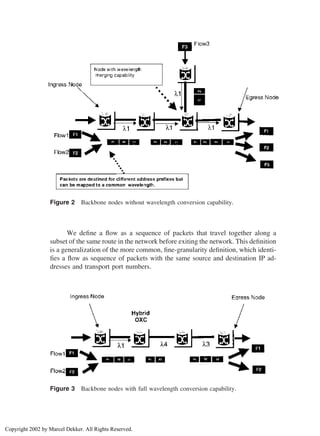
intermediate node along a continuous lightpath. Wavelength merging is a strategy
for reusing precious wavelengths that allows tributary flows to be aggregated by
merging packets from several streams. The OXC requires enhanced capabilities
to perform this merging function [7]. The device would be able to route the same
wavelength from different incoming fibers into a single outgoing fiber. The key
property of this device is that contention between bits on the wavelength must
be resolved before they are multiplexed into the common outgoing fiber.
Copyright 2002 by Marcel Dekker. All Rights Reserved.
Figure 2 Backbone nodes without wavelength conversion capability.
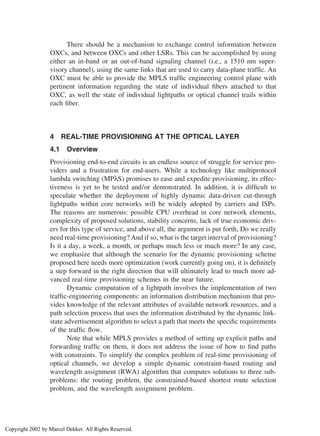
We define a flow as a sequence of packets that travel together along a
subset of the same route in the network before exiting the network. This definition
is a generalization of the more common, fine-granularity definition, which identi-
fies a flow as sequence of packets with the same source and destination IP ad-
dresses and transport port numbers.
Figure 3 Backbone nodes with full wavelength conversion capability.
Copyright 2002 by Marcel Dekker. All Rights Reserved.
Figure 4 Backbone nodes with partial wavelength conversion and O-E-O processing
capabilities.
The MPLS label switching concept is extended to include wavelength-
switched lightpaths. Optical nodes are treated as IP-MPLS devices, termed here-
after optical lambda switch router (O-LSR) nodes, where each O-LSR node is
assigned a unique IP address [3]. We assume that the OXCs are within one admin-
istrative domain and run interdomain routing protocols, such as OSPF and IS-
IS, for the purpose of dynamic topology discovery. For optimal use of network
resources, the routing protocols have been enhanced to disseminate additional
link-state information over that currently done by standard OSPF and IS-IS proto-
cols.
The request to set up a path can come either from a router or from an ATM
switch connected to the OXCs (O-LSRs). The request must identify the ingress
and the egress OXCs between whom the lightpath has to be set up. Additionally,
it may also include traffic-related parameters such as bandwidth (OC-48/Oc-192),
reliability parameters and restoration options, and setup and holding priorities
for the path. The lightpaths are provisioned by choosing a route through the
network with sufficient available capacity. The lightpath is established by allocat-
ing capacity on each link along the chosen route, and appropriately configuring
the OXCs. Protection is provided by reserving capacity on routes that are physi-
cally diverse from the primary lightpath.
Copyright 2002 by Marcel Dekker. All Rights Reserved.
There should be a mechanism to exchange control information between
OXCs, and between OXCs and other LSRs. This can be accomplished by using
either an in-band or an out-of-band signaling channel (i.e., a 1510 nm super-
visory channel), using the same links that are used to carry data-plane traffic. An
OXC must be able to provide the MPLS traffic engineering control plane with
pertinent information regarding the state of individual fibers attached to that
OXC, as well the state of individual lightpaths or optical channel trails within
each fiber.
4 REAL-TIME PROVISIONING AT THE OPTICAL LAYER
4.1 Overview
Provisioning end-to-end circuits is an endless source of struggle for service pro-
viders and a frustration for end-users. While a technology like multiprotocol
lambda switching (MPλS) promises to ease and expedite provisioning, its effec-
tiveness is yet to be tested and/or demonstrated. In addition, it is difficult to
speculate whether the deployment of highly dynamic data-driven cut-through
lightpaths within core networks will be widely adopted by carriers and ISPs.
The reasons are numerous: possible CPU overhead in core network elements,
complexity of proposed solutions, stability concerns, lack of true economic driv-
ers for this type of service, and above all, the argument is put forth, Do we really
need real-time provisioning? And if so, what is the target interval of provisioning?
Is it a day, a week, a month, or perhaps much less or much more? In any case,
we emphasize that although the scenario for the dynamic provisioning scheme
proposed here needs more optimization (work currently going on), it is definitely
a step forward in the right direction that will ultimately lead to much more ad-
vanced real-time provisioning schemes in the near future.
Dynamic computation of a lightpath involves the implementation of two
traffic-engineering components: an information distribution mechanism that pro-
vides knowledge of the relevant attributes of available network resources, and a
path selection process that uses the information distributed by the dynamic link-
state advertisement algorithm to select a path that meets the specific requirements
of the traffic flow.
Note that while MPLS provides a method of setting up explicit paths and
forwarding traffic on them, it does not address the issue of how to find paths
with constraints. To simplify the complex problem of real-time provisioning of
optical channels, we develop a simple dynamic constraint-based routing and
wavelength assignment (RWA) algorithm that computes solutions to three sub-
problems: the routing problem, the constrained-based shortest route selection
problem, and the wavelength assignment problem.
Copyright 2002 by Marcel Dekker. All Rights Reserved.
Two comments are in order here. First, note that the dynamic RWA algo-
rithm is based on a fully distributed model in which all nodes maintain a synchro-
nized and identical topology and link-state information (traffic-engineering data-
base, TED). Second, the simplicity of the wavelength assignment algorithm is a
function of whether the network nodes have full wavelength conversion capabil-
ity, partial wavelength conversion capability, or no wavelength conversion capa-
bility.
4.2 Dynamic Lightpath Computation
The two traffic-engineering components that involve the dynamic computation
of a lightpath (in a fully distributed implementation) in a hybrid IP-centric
DWDM-based optical network are
1. An information distribution mechanism that provides knowledge of
available network resources. This component is implemented by defining rela-
tively simple extensions to the interior gateway protocol (IGP), e.g., open shortest
path first (OSPF) so that link attributes are included as part of each router’s link-
state advertisement. Some of the traffic-engineering extensions that need to be
added to the IGP link-state advertisement include maximum link bandwidth, max-
imum reservable link bandwidth, current bandwidth reservation, current band-
width usage, and link coloring. These extensions capture optical link parameters
and any constraints specific to optical networks. The topology and link-state in-
formation maintained by all nodes are identical. Another important component
is to define naming and addressing conventions for different elements of the phys-
ical plant hierarchy. For example, primary and backup paths between ingress
OXC and an egress OXC should follow routes that are physically separate. Con-
trol architecture and signaling protocols used in MPLS, such as CR-LDP and
RSVP, are not cognizant of the details of the physical plant connecting the net-
work elements (LSRs). In fact, no standard terminology to describe the physical
plant hierarchy exists. Therefore we have defined and assigned the naming and
addressing convention for different elements of the physical plant hierarchy. We
have implemented our own dynamic simple link-state advertisement algorithm
(a simple version of an extended OSPF). This algorithm is capable of periodically
updating and advertising, to maintain and refresh a synchronized data base for
all nodes, all of the above link attributes. The link-state updates can be triggered,
for instance, based on a given threshold of the number of available wavelengths
per fiber, below which the updates can be triggered.
2. A path selection process that uses the information distributed by the
dynamic link-state advertisement algorithm to select an explicit route that meets
the specific requirements of the traffic flow. This process can be performed either
off-line or on-line using a constraint-based routing calculation. The source router
is basically responsible for computing the complete path all the way to the desti-
nation through the optical domain, and then initiating path setup using the signal-
Copyright 2002 by Marcel Dekker. All Rights Reserved.
ing protocol (e.g., CR-LDP or RSVP). The route may be specified either as a
series of nodes (routers/OXCs) or in terms of the specific links used (as long as
IP addresses are associated with these links). Once each node has a representation
of the full physical network topology and the available resources on each link
(these are obtained and updated via the link-state advertisement protocol), we
need a path selection algorithm. To simplify the real-time provisioning problem,
the path selection process, that is, the dynamic constraint-based RWA algorithm,
computes solutions to three subproblems: the routing problem, the constrained-
based shortest route selection problem, and the wavelength assignment problem.
4.2.1 The Routing Problem
We emphasize that it is necessary to use explicit routing for constructing
lightpaths. This is valuable for traffic engineering and load optimizations in the
network. A shortest path algorithm is run off-line to calculate the shortest path
between every source–destination node pair throughout the nodes composing the
simulated arbitrary network topology. This procedure is repeated k times for ev-
ery source–destination pair in order to select the other k-1 alternative shortest
routes in an orderly fashion. The off-line calculated k shortest routes for every
source–destination pair is then stored in the data base of each CSR.
The routing scheme used here is a fixed alternate routing algorithm. This
routing scheme is a constraint path selection in which a path is selected from a
predetermined set of candidate paths. These candidate paths may include the
shortest path route, the second shortest path route, the third shortest path route, etc.
We have examined the performance of two fixed alternate routing selection
algorithms, the k link-disjoint shortest routes, and the k best routes.
The k link-disjoint routes. In this routing scheme, the alternate routes should
be link-disjoint. Two alternate routes between a source S and a destination D
cannot share any links. This routing approach provides a straightforward ap-
proach to handling link failure. The set of shortest k-disjoint paths between all
node pairs is computed in advance and stored in routing tables at each node.
The k best-routes. In this approach, two alternate routes can share any num-
ber of common links but should differ in at least one link. The set of shortest k-
best paths between all node pairs is computed in advance and stored in routing
tables at each node.
4.2.2 The Constraint-Based Shortest Route Selection Problem
To optimize the utilization of the network resources, the route with the least
average number of used wavelengths (least-congested path) per the entire route
is then selected out of the k routes. This is achieved by applying a simple con-
strained shortest path selection algorithm on the k routes stored off-line at the
ingress node. This algorithm uses the information stored and updated, via the
Copyright 2002 by Marcel Dekker. All Rights Reserved.
link-state advertisement protocol, at the first-hop router’s TED. Specifically, these
are the link attributes that are included as part of each router’s link-state advertise-
ment.
As an illustrative example, consider a lightpath request from A to C as
shown in Fig. 1. There are two alternative disjoint routes (k ⫽ 2 in this example)
that should be stored at node A. The first route (first shortest path route) is A–
B–C, and the second route is A–E–D–C. The first route has two links, AB and
BC. Assume that the number of used wavelengths on link AB ⫽ 4, and that the
number of used wavelengths on link BC ⫽ 12. Then the average number of used
wavelengths on route A–B–C ⫽ 8 wavelengths.
The second disjoint alternative route (second shortest path route) has three
links, AE, ED, and DC. Assume that the number of used wavelengths on link
AE ⫽ 5, the number of used wavelengths on link ED ⫽ 2, and that the number
of used wavelengths on link DC ⫽ 8, Then the average number of used wave-
lengths on this route ⫽ 5 wavelengths. Because the average number of used
wavelengths [5] on the second route (A–E–D–C) is less than those [8] on the
first route (A–B–C), the second route is selected. Note that route A–B–C was
not selected, even though it is the shortest path. This is a constraint-based shortest
route selection problem.
4.2.3 The Wavelength Assignment Problem
For a given request, once a constrained shortest path (the path with the least
average number of used wavelengths per the entire route) is selected out of the
k routes, a wavelength assignment algorithm is invoked (on-line) to assign the
appropriate wavelength(s) across the entire route. A wavelength assignment algo-
rithm must thus be used to select the appropriate wavelength (S).
Several heuristics wavelength assignment algorithms can be used, such as
the Random wavelength assignment (R), least used (LU), most used (MU), least-
loaded (LL), and max-sum algorithms [8–12]. The implementation of these algo-
rithms requires the propagation of information throughout the network about the
state of every wavelength on every link in the network. As a result, the state
required and the overhead involved in maintaining this information would be
excessive. However, the advantage gained is that the chosen wavelength is glob-
ally optimized, and consequently the utilization of network resources is globally
optimized, since the wavelength assignment algorithm has global information
about the state of every wavelength on every link in the network.
Note that, as mentioned above, the complexity of the wavelength assign-
ment algorithm depends on whether the network nodes are wavelength conver-
sion capable or incapable. In general, the complexity of the proposed approach
and the overhead involved in maintaining and updating the TED depends on the
value of k. The smaller the value of k, the lower the overhead involved and the
simpler the algorithm. A reasonable value of k may range from 4 to 6.
Copyright 2002 by Marcel Dekker. All Rights Reserved.
4.3 Provisioning Lightpaths in a Network with Full
Wavelength Conversion Capabilities
In an optical network with full wavelength conversion capability, channel alloca-
tion (wavelength assignment) is a straightforward process and can be performed
independently on different links along a route. On the other hand, if the utilization
of the network resources is to be globally optimized, the wavelength assignment
algorithm can be very complicated. The route on which a new lightpath is to be
established is specified in the lightpath setup message.
Once a lightpath request from a source is received by the first-hop router
(ingress node), it computes the complete path all the way to the destination
through the optical domain using the above approach. The output of this calcula-
tion is an explicit route consisting of a sequence of hops that provides the shortest
path through the network that meets the constraints. This explicit route is then
passed to the signaling component that initiates path setup (to reserve resources)
using the signaling protocol (e.g., CR-LDP or RSVP).
The first-hop router creates a lightpath setup message and sends it toward
the destination of the lightpath where it is received by the last-hop router (egress
node). The lightpath request can be sent from the first-hop router as the payload
of a normal IP/MPLS packet with router alert. A router alert ensures that the
packet is processed by every router in the path. A channel is allocated for the
lightpath on the downstream link at every node traversed by the setup. The identi-
fier of the allocated channel is written to the setup message. After a channel has
been allocated at a node, the router communicates with the OXC to reconfigure
the OXC to provide the desired connectivity.
If the setup fails, the first-hop router issues a release message to release
resources allocated for the partially constructed lightpath. Upon failure, the first-
hop router may attempt to establish the lightpath over an alternate route, before
giving up on satisfying the original user request. This alternate route is selected
out of the remaining k-1 routes, subject to the same constraints, i.e., the route
with the least average number of used wavelengths per the entire route.
After processing the setup, the destination (or the last-hop router) returns
an acknowledgment to the source. The acknowledgment indicates that a channel
has been allocated on each hop of the lightpath. It does not, however, confirm
that the lightpath has been successfully implemented (i.e., the OXCs have been
reconfigured). It may be desirable to have the acknowledgment confirm that every
hop has completed the OXC configuration. Either way, the channel becomes
available immediately after the request is sent, at the discretion of the user. Once
established, the lightpath may carry arbitrary traffic, such as ATM, frame relay,
or TDM circuit.
If the user requests a restored lightpath, then capacity must be reserved
within the network. This is performed independently, although potentially over-
lapping in time, with the setup of the primary lightpath; but it may take a signifi-
Copyright 2002 by Marcel Dekker. All Rights Reserved.
cantly longer time. The first-hop router is responsible for ensuring that restoration
capacity is reserved for all restorable failures. The first-hop router informs the
source once this is completed. The establishment of a restored lightpath is com-
pleted when the primary capacity is allocated and the restoration capacity is re-
served [2].
4.4 Provisioning Lightpaths in a Network Without
Wavelength Conversion Capabilities
A network or a subnetwork that does not have wavelength converters will be
referred to as being wavelength continuous. In the case where wavelength con-
verters are not available, the procedures used to provision a lightpath in the above
section, where wavelength converters are available, are identical, except that the
wavelength assignment algorithm is now different.
In this case, where wavelength converters are not available, a common
wavelength must be located on each link along the entire route. Whatever wave-
length is chosen on the first link defines the wavelength allocation along the rest
of the section. A wavelength assignment algorithm must thus be used to choose
this wavelength.
Finally, in the case where the lightpath is wavelength continuous (cut-
through), optical nonlinearities, chromatic dispersion, amplifier spontaneous
emission, and other factors together limit the scalability of an all-optical network.
Routing in such networks will then have to take into account noise accumulation
and dispersion to ensure that lightpaths are established with adequate signal quali-
ties. This work assumes that the all-optical (sub-) network considered is geo-
graphically constrained so that all routes will have adequate signal quality, and
physical layer attributes can be ignored during routing and wavelength assign-
ment. However, the policies and mechanisms proposed here can be extended to
account for physical layer characteristics.
It is important to emphasize that while the proposed scheme is conceptually
simple, to provision the network one needs to propagate information throughout
the network about the state of every wavelength on every link in the network.
As a result, the states required and the overhead involved in maintaining this
information would be excessive.
To relieve the excessive overhead problem, another approach is first to
select the shortest path between source and destination based only on the conven-
tional OSPF algorithm; except that the overhead consuming heuristics wave-
length assignment algorithms used above should now be replaced with a simple
wavelength assignment signaling protocol (SWASP) that requires wavelength
usage information from only the links along the chosen route [2,7].
In this case, we must select a route and wavelength upon which to establish
a new lightpath, without detailed knowledge of wavelength availability. Con-
Copyright 2002 by Marcel Dekker. All Rights Reserved.
structing the continuous lightpath requires SWASP to pick a common free wave-
length along the flow path; therefore the algorithm must collect the list of free
wavelengths for each node. If there is one free wavelength common to all the
nodes, it will be picked; if not, the algorithm returns a message to the first-hop
router informing it that the lightpath cannot be established. The signaling can be
initiated either at the, end of the path (last-hop router) or at the beginning of the
path (first-hop router) [7].
If the signaling is initiated from the first-hop router, the algorithm picks
the set of free wavelengths along the first link of the path to be established. When
the next hop receives that set it intersects it with its own free wavelength set and
forwards the result to the next hop. If the final set is not empty, the last-hop
router picks one free wavelength from the resulting set, configures its local node,
and sends an acknowledgment back to the previous hop with the chosen wave-
length. Upon receiving an acknowledgment, the previous hop configures its local
node and passes the acknowledgment to its previous hop, until the packet is
received by the first-hop router (ingress node) [7]. The signaling can also be
initiated from the last-hop router, but it will take more time.
Although this second scheme is not as overhead consuming as the first one,
the drawback is that the chosen wavelength is now only locally optimized, and
consequently the utilization of network resources is not globally optimized.
5 CONCLUSION
An overview of the vision of the next generation optical Internet has been pre-
sented. We have described two practical near-term optical Internet candidate
model architectures along with a high-level discussion of their relative advantages
and disadvantages: a router-centric architecture deployed on a thin optical layer,
and a hybrid router/OXC-centric architecture deployed on a rich and intelligent
optical transport layer. The fundamental distinction between these two models
is based on the way that the routing and signaling protocols are run over the IP
and the optical subnetwork layers.
This work has addressed the implementation issues of the path selection
component of the traffic-engineering problem in a hybrid IP-centric DWDM-
based optical network. An overview of the methodologies and associated algo-
rithms for dynamic lightpath computation has also been presented. Specifically,
we have shown how the complex problem of real-time provisioning of optical
channels can be simplified by using a simple dynamic constraint-based routing
and wavelength assignment (RWA) algorithm that computes solutions to three
subproblems: the routing problem, the constraint-based shortest route selection
problem, and the wavelength assignment problem.
We have also presented two different schemes for dynamic provisioning
Copyright 2002 by Marcel Dekker. All Rights Reserved.
of the optical channels. The first scheme is conceptually simple, but the overhead
involved is excessive. The second scheme is not as overhead consuming as the
first one, but, its drawback is that the chosen wavelength is only locally optimized
along the selected route, and consequently the utilization of network resources is
not globally optimized. Two different scenarios are then considered: provisioning
lightpaths in a network with full wavelength conversion capability, and provi-
sioning lightpaths in a network without wavelength conversion capability
Finally, it is important to emphasize that although the scenarios for the
dynamic provisioning schemes proposed here need more optimization (work cur-
rently going on), it is definitely a step in the right direction that will ultimately
lead to much more advanced real-time provisioning schemes in the near future.
REFERENCES
1. D. Awduche et al. Multiprotocol lambda switching. Internet draft, work in progress,
Nov. 1999.
2. N. Chandhok et al. IP over Optical Networks: A Summary of Issues. Internet draft,
work in progress, July 2000.
3. N. Ghani. Lambda-labeling: a framework for IP-over-WDM using MPLS. Optical
Networks, Vol. 1, pp. 45–58, April 2000.
4. Yinghua Ye, S. Dixit, and M. A. Ali. On joint protection/restoration in IP-centric
DWDM-based optical transport networks. IEEE Communication, Vol. 38, No. 6,
pp. 174–183, June 2000.
5. B. Arnaud. Architectural and engineering issues for building an optical Internet.
SPIE Proceedings, Vol. 3531, pp. 358–377, Nov. 1998.
6. D. Awduche, J. Malcolm, J. Agogbua, M. O’Dell, and J. MeManus. Requirements
for traffic engineering over MPLS. Internet draft, RFC-2702, Sept. 1999.
7. J. Bannister, J. Touch, A. Willner, and S. Suryaputra. How many wavelengths do we
really need? A study of the performance limits of packet over wavelengths. Optica
Networks, Vol. 1, No. 2, pp. 17–28, April 2000.
8. O. Gerstel and S. Kutten. Dynamic wavelength allocation in all-optical ring Net-
works, Proc. IEEE ICC 97, Montreal, Quebec, Canada, Vol. 1, pp. 432–436, June
1997.
9. S. Subramnian and R. A. Barry. Wavelength assignment in fixed routing WDM
networks. Proc. ICC ’97, Montreal, Canada, Vol. 1, pp. 406–410, June 1997.
10. R. A. Barry and S. Subramanian. The MAX-SUM wavelength assignment algorithm
for WDM ring networks. Proc. OFC 97, Feb. 1997.
11. G. Jeong and E. Ayanoglu. Comparison of wavelength-interchanging and wave-
length-selective cross-connects in multiwavelength all-optical networks. Proc. IEEE
INFOCOM ’96, San Francisco, CA, Vol. 1, pp. 156–163, March 1996.
12. E. Karasan and E. Ayanoglu. Effects of wavelength routing and selection algorithms
on wavelength conversion gain in WDM optical networks. IEEE/ACM Transactions
on Networking, Vol. 6, No. 2, pp. 186–196, April 1998.
Copyright 2002 by Marcel Dekker. All Rights Reserved.
2
Analysis of Multimedia Access
Protocols for Shared Medium
Networks
Lixin Wang and Mounir Hamdi
Hong Kong University of Science and Technology,
Kowloon, Hong Kong
1 INTRODUCTION
Future local and metropolitan area networks (LANs/MANs) will be required to
provide a wide variety of services, as shown in Fig. 1. The low-speed and non-
quality-of-service-oriented services of Fig. 1 could be handled by evolutionary
versions of the presently available networks. However, the high-speed and QoS-
oriented services require a new generation of LANs and MANs. The target is
therefore integrated services (multimedia) LANs and MANs that support the
whole spectrum of the traffic shown in Fig. 1. However, with QoS-oriented multi-
media LANs and MANs come various challenges. The most important challenge
is the design of Medium Access Control or MAC protocols for these networks,
since their topology is mostly based on a shared medium technology. One reason
for this challenge is that all higher layer services (e.g., the ones shown in Fig.
1) are built on the fundamental packet transfer service provided by the MAC
sub-layer, and it is the MAC protocol that determines the characteristics of this
fundamental service. Hence improvements to MAC services result in improved
system performance, while the provision of new MAC services means that new
applications and services can be developed.
Copyright 2002 by Marcel Dekker. All Rights Reserved.
Figure 1 Various applications depend on the MAC protocols used in shared medium
networks.
A plethora of MAC protocols have been proposed for future-generation
LANs/MANs [4]. Unfortunately, most of these MAC protocols are not suitable
for multimedia applications because they have been designed with one generic
traffic type in mind. As a result, they perform quite well for the traffic types
they have been designed for but poorly for other traffic streams with different
characteristics. This observation is true for MAC protocols for wireline networks
as well as wireless networks.
The objective of this paper is to propose a methodology and framework
for integrating different MAC protocols into a single shared medium network
efficiently to accommodate various types of multimedia traffic streams with dif-
ferent characteristics and QoS demands. The proposed integrated MAC protocol
is termed Multimedia Medium Access Control (Multimedia-MAC) protocol. We
also develop efficient analytical methodologies for the performance evaluation
of our MAC protocols using different traffic and networking environments.
This paper is organized as follows. Section 2 gives an overview of MAC
protocols. Section 3 introduces our Multimedia-MAC protocol. In Sec. 4, we
derive an analytical model for the performance evaluation of our protocol. We
present an example application of our Multimedia-MAC using wavelength divi-
sion multiplexing networks in Sec. 5. Finally, Sec. 6 concludes the paper.
2 OVERVIEW OF MAC PROTOCOLS
MAC protocols have been the subject of a vast amount of research over the past
two decades. Without going into detail about any specific MAC protocol, we can
Copyright 2002 by Marcel Dekker. All Rights Reserved.
classify MAC protocols into three categories [4]: preallocation access protocols,
reservation protocols, and random access protocols.
Preallocation-based protocols. The nodes access the shared medium in a
predetermined way. That is, each active node is allocated one or more
slots within a frame, and these slots cannot be accessed by other nodes.
Reservation-based protocols. A node that is preparing a packet transfer has
to reserve one or more time slots within a frame before the actual packet
transmission can take place. The reservation is typically done using dedi-
cated control slots within a frame or a separate reservation channel. As
a result, access to the data slots is achieved without the possibility of
collision.
Random access protocols. The nodes access the shared medium with no
coordination between them. Thus when more than one packet is transmit-
ted at the same time, a collision occurs, and the information contained
in all the transmitted packets is lost. As a result, a collision resolution
mechanism must be devised to avoid high packet delays or even unstable
operation under high loads.
To serve various multimedia applications, the traffic loaded on the network
is no longer of a single type but is a mixture of different types of traffic streams
to be served simultaneously. Different traffics have different characteristics and
thus have different transmission requirements. We can classify multimedia traffic
streams as a function of their data burstiness and delay requirements as shown
in Fig. 2. For example, video/audio streams and plain old telephone service
(POTS) have small data burstiness but require almost constant transmission delay
and almost fixed bandwidth in order to guarantee their QoS. On the other hand,
applications such as image networking and distance learning are less stringent
in terms of their delay requirements, but their traffic streams are very bursty.
Finally, there are other applications that require a very low delay while their
traffic streams are bursty. Examples of this type of applications include control
messages for video-on-demand systems or interactive games, and network control
and management.
These different traffic streams are better served by different MAC proto-
cols. Video/audio data streams and other constant-bit-rate (CBR) traffic streams
benefit best from allocation-based MAC protocols, since they can guarantee that
each node has a cyclic and fixed available bandwidth. The best MAC protocols
for this purpose would be a simple round-robin time division multiplexing access
(TDMA) scheme. On the other hand, reservation-based MAC protocols are very
well suited for applications where the traffic streams are bursty (i.e., VBR Traffic)
or the traffic load of the nodes is unbalanced, since reservation-based MAC proto-
cols schedule the transmission according to a particular transmission request.
Copyright 2002 by Marcel Dekker. All Rights Reserved.
Figure 2 Multiple traffic stream features and their appropriate MAC protocols.
Finally, random access (contention) MAC protocols have the potential of
meeting the delay requirements of very urgent messages, since their access delay
is the lowest when collisions are avoided (or are infrequent). Some examples of
these urgent messages (e.g., call setup) are listed in Fig. 2. These applications
may not generate a lot of traffic data when compared to the other applications.
But, once a certain traffic (message) is generated, they require a very low delay.
Random access protocols perform very well, especially with respect to packet
delays when the traffic load is low. However, if the traffic load gets high, then
packet collisions start to occur more frequently. As a result, the performance can
be quite poor.
As we can see, none of these MAC protocols serves all types of traffic
well, although each one of them is ideal for certain types of traffic streams. When
these types of traffic are simultaneously loaded onto a single network, no single
protocol can efficiently deal with all traffic types.
With this observation, we propose an efficient access scheme for shared
medium networks that
1. Integrates different types of MAC protocols into a single MAC pro-
tocol.
2. Efficiently supports different types of traffic.
3. Can be widely applied into various kinds of shared medium networks.
Copyright 2002 by Marcel Dekker. All Rights Reserved.
We term this protocol the multimedia medium access control (Multimedia-
MAC) protocol for shared medium networks. More specifically, a single
Multimedia-MAC network can simultaneously support a wide range of multi-
media applications. The functions required by these applications are supported
by the subprotocols that are integrated into the Multimedia-MAC.
3 DESIGN OF MULTIMEDIA-MAC PROTOCOLS
In this section we will introduce the principles behind the design of the Multime-
dia-MAC. This design is general enough to be applied to a wide variety of shared
medium networks. A Multimedia-MAC consists of multiple subprotocols, each
of which serves a certain type of traffic. As shown in Fig. 3, the three types of
protocols, preallocation, reservation, and contention protocols, which are denoted
by TDM, RSV and CNT, respectively, are the most typical protocols. Therefore
integration of these three protocols is expected to cover most multimedia traffic
streams.
To accommodate the three different control strategies into a single network,
a time division multiplexing method is a natural choice. The idea is that each
protocol in turn controls the shared medium. During that time, a protocol uses
the medium, and the medium access is controlled according to the discipline of
Figure 3 Multimedia-MAC protocol construction.
Copyright 2002 by Marcel Dekker. All Rights Reserved.
this protocol. Thus it can be thought of as if each protocol controls a subchannel
of the overall channel, as shown in Fig. 3.
We can properly arrange the priority of the three subprotocols in terms of
occupying the medium. In this paper, a TDM subprotocol is considered the most
time-restricted protocol because it follows a predefined order. Any delay in one
cycle may affect the consecutive cycles, and consequently affect the QoS. Thus
TDM is designated to have the highest priority to start its service.1
To ensure
the fairness and the cyclic timing of the TDM sub-protocol, all three subprotocols
should fill in the TDM framework. We can think of a cycle as a time frame,
which is identified by a TDM cycle id. Because the TDM cycle is usually of
constant time period, the frame is of fixed length. The frame is further divided
into three parts, each of which is called a segment, corresponding to the three
subprotocols. That is, each subprotocol takes a segment in a frame. The segment
is identified by the subprotocol names. For instance, the segment occupied by a
TDM subprotocol is called a TDM segment. The other two segments are named
an RSV segment and a CNT segment, respectively.
The RSV subprotocol is based on reservation, so before the data transmis-
sion, the required bandwidth has to be determined. Therefore the RSV subproto-
col should be allocated after the TDM subprotocol. Because the RSV type traffic
is bursty traffic, the RSV subprotocol bandwidth requirement is variable.
Since the frame size is fixed, the CNT segment can only be the remaining
part of the frame after the TDM and the RSV segment allocation. The CNT is
a random access protocol. Both the available bandwidth and the traffic load deter-
mine its performance. When the TDM and the RSV traffic is high, the perfor-
mance of the CNT subprotocol can be poor because the CNT protocol has the
lowest priority to get the bandwidth. However, due to the burstiness of the RSV
traffic, a large amount of bandwidth would be available after a burst has been
served. The utilization of this bandwidth can achieve much better performance
in this period (RSV idle period) because the CNT traffic load is relatively low,
while the available bandwidth is almost the summation of the CNT and the RSV
segments. It is feasible for the CNT subprotocol to fill in the idle period since
the CNT subprotocol is a kind of immediate access protocol in which there is
no extra signaling before the transmission. The channel can be accessed as soon
as it is available.
4 ANALYTICAL MODELING OF THE MULTIMEDIA-MAC
PROTOCOLS
In our analysis of Multimedia-MAC, we are particularly interested in its perfor-
mance with respect to QoS metrics. For example, we are interested in finding if
1
We can easily assign other priorities if it is more appropriate.
Copyright 2002 by Marcel Dekker. All Rights Reserved.
a packet has missed its transmission deadline or not. We propose a general ap-
proach to find the deadline missing rate (DMR), which is defined as the probabil-
ity that a packet transmission exceeds an arbitrary given deadline. This model
can also be used in finding traditional metrics, such as mean packet delay and
throughput. We use a queueing system with a vacation model to model the wait-
ing time distribution of the subprotocols. Then we employ a numerical method
to evaluate the distribution and obtain its moments. Based on the moments, we
approximately determine the DMR of these subprotocols (Fig. 4).
In a Multimedia-MAC protocol, the traffic streams are transmitted under
the control of different subprotocols, and are multiplexed into the shared chan-
nel(s). Thus the services given to each of the data streams are not continuous,
i.e., the service may be unavailable sometimes. As a result, we employ a queueing
with vacation model to model the Multimedia-MAC protocol. Corresponding to
different features of the different traffics and their services, we use a different
queueing model to analyze their performance. More precisely, we use a D/D/1
queue with vacation system to model a TDM subprotocol operation; we use a
M(x)
/M/1 queue with Erlang vacation to model the reservation type protocol; and
we use a M/G/1 queue with deterministic vacation to model the random access
protocol. To determine the DMR of a packet for a given traffic load and deadline,
the packet waiting time distribution should be derived. However, it is a difficult
problem to get the distribution of non-M/M/1 queues with general vacation [3].
Figure 4 Our approach to modeling and analyzing the Multimedia-MAC protocol.
Copyright 2002 by Marcel Dekker. All Rights Reserved.
We successfully apply an approach that combines the decomposition properties
of general queueing vacation systems, numerically calculating the moments of
the waiting time distribution from their Laplace–Stieltjes Transform (LST)
forms, and approximately computing the tail probability from the moments.
4.1 General Queueing Model Without Vacation
Let us start from a simple case: a general arrival and a general service with a
single server model, denoted a GI/G/1 queue.
4.1.1 G/G/1 Queue
Let wn denote the waiting time of the nth packet in the queue. Let un denote the
interarrival time between the nth packet and the n ⫹ 1th packet, and vn denote
the service time of the nth packet. We choose the packet departure time as the
embedded point, denoted as Dn. Because we assume there is no server vacation
at the moment, the transmission is continuous if the packet buffer is nonempty,
i.e., the waiting time of a packet is equal to the previous packet waiting time
plus its service time minus the interarrival time between them. Hence we have
wn⫹1 ⫽ wn ⫹ vn ⫺ un (1)
⫽ wn ⫹ xn (2)
where xn ⫽ vn ⫺ un . If the buffer is empty when the n ⫹ 1th packet arrives, the
packet is transmitted immediately without queueing, so wn⫹1 ⫽ 0 in this case.
Combining these two cases, we get
wn⫹1 ⫽ MAX(0,wn ⫹ vn ⫺ un ) (3)
From the above equation, we can get the idle period in which the server (the
channel) is idle. The idle period is denoted by In ⫽ ⫺MIN(0,wn ⫹ vn ⫺ un ).
Then
wn⫹1 ⫺ In ⫽ wn ⫹ xn (4)
E[e⫺s(wn⫹1⫺In
)
] ⫽ E[e⫺swn]E[e⫺sxn] (5)
Because we have wn⫹1 ⫽ 0, when In ⬎ 0, and wn ≠ 0 when In ⫽ 0, we get
E[e⫺s(wn⫹1⫺In
)
] ⫽ E[e⫺swn |In ⬎ 0]Pr(In ⬎ 0)
(6)
⫹ E[e⫺swn⫹1 |In ⫽ 0]Pr(In ⫽ 0)
Because wn⫹1 ⫽ 0 when In ⬎ 0, then E[e⫺swn⫹1 |In ⬎ 0] ⫽ 1. Let Pr(In ⬎ 0) ⫽
a0 which is the probability of a new packet arrival seeing an empty buffer. Using
Eq. (7), we get
Copyright 2002 by Marcel Dekker. All Rights Reserved.
E[e⫺swn]E[e⫺sxn] ⫽ E[e⫺s(⫺In) |In ⬎ 0]α0 ⫹ E[e⫺sWn⫹1] ⫺ a0 (7)
In a steady state, we get
lim
n→∞
E[e⫺swn ] ⫽ lim
n→∞
E[e⫺swn⫹1 ] ⫽ E[e⫺sW
]
Using the LST definition, the LST of the waiting time in the queue is W*
(s) ⫽ E[e⫺sW
], and the LST of the idle period I is I* (s) ⫽ E[e⫺sI
]. We define
the LST of the accessory random variable x ⫽ limn→∞ xn to be K* (s) ⫽ E[e⫺sX
].
Then by Eq. (7), we can get the packet waiting time in a G/G/1 queue as
W* (s) ⫽
α0 [1 ⫺ I* (⫺s)]
1 ⫺ K* (s)
(8)
From equation (8), we can derive the LST forms of different queueing models
for different arrivals and service disciplines.
4.1.2 D/D/1 Queue
In a D/D/1 queue, the packet arrival rate and service rate are deterministic. Let
λ denote the arrival rate and µ represent the service rate. Then un ⫽ 1/λ, and vn
⫽ 1/µ. Hence
I* (s) ⫽ e⫺s(1/µ⫺1/λ)
K* (s) ⫽ E[e⫺s(vn⫺un)
] ⫽ e⫺s(1/λ⫺ 1/µ)
Thus the LST form of a D/D/1 queue is W* (s) ⫽ 1.
4.1.3 M/G/1 Queue
For a Poisson arrival system, the idle time distribution is the same as the inter-
arrival-time distribution because of the property of Poisson Arrival See Time
Averages (PASTA) which implies the memoryless property of the Poisson pro-
cess (17). Then
A* (s) ⫽ I* (s) ⫽
λ
(λ ⫹ s)
(9)
where A is the random variable of packet arrivals and A* (s) is its LST. We
denote the packet service time distribution by B(t) and its LST by B* (s). Its
mean is µ ⫽ B*′ (0).
Recall that
K(s) ⫽ E[e⫺s (vn⫺un)
] ⫽ E[e⫺svn]E[e⫺s(⫺un)
] ⫽ B* (s)
λ
λ ⫺ s
(10)
Copyright 2002 by Marcel Dekker. All Rights Reserved.
Exploring the Variety of Random
Documents with Different Content
Nadouesiouek is given in a Relation of 1656,
Nadouechiouec, 1660; and soon also
Nadouesseronons, Nadouesserons, etc.
An excellent article on the Sioux, entitled Dakota Land
and Dakota Life, by Rev. E. D. Neill, occupies pp. 254-
294 of the 2d ed. 1872, of Minn. Hist. Soc. Coll.,
originally published in 1853.
[VIII-4] The punctuation of the last two sentences in
the original left Pike's meaning obscure. It was by no
means evident whether the language which he had
used to the Indians held up to their minds a happy
coincidence of circumstances which the traders helped
to bring about before the Almighty interfered at all, or
whether the happy coincidence of circumstances
consisted in the endorsement of his language both by
the traders and the Almighty. On the whole, I am
inclined to think he meant that the speeches he made
to the Indians whom he addressed directly were
repeated and backed up by the traders among those
Indians to whom he had no access; and that this was
the happy coincidence of circumstances which enabled
the Almighty to finish the business. But after all I am
not quite confident that I catch his meaning. If I do, I
must say that he is not very complimentary to the
Deity, whose assistance he suspects may have been
necessary to effect that which the traders and himself
jointly attempted. For it seems from his further
reflections on the subject that he thought God possibly
equal to burying the hatchet between the Sioux and
Chippewas, but hardly able to keep the peace without
the assistance of the military and of a special agent.
However, Pike was nothing if not a good soldier, and
he had Napoleonic authority for supposing that God
would always be found on the side of the heaviest
artillery.
[IX-1] This article formed Doc. No. 2, pp. 52, 53 of the
App. to Part III. of the orig. ed., entitled "Explanatory
Table of Names of Places, Persons, and Things, made
use of in this Volume." But there is not a name of any
person in it, and not a name of anything in it that does
not belong to Part I., i. e., to the Mississippi voyage
alone. Having thus been obviously out of place in Part
III., it is now brought where it belongs, and a new
chapter made for it, with a new head, which more
accurately indicates what it is. But even as a
vocabulary of Mississippian place-names, it is a mere
fragment, neither the plan nor scope of which is
evident, as the names occur neither in alphabetical nor
any other recognizable order, and include only a very
small fraction of those which Pike uses in Part I. of his
book. He may have intended to make something of it
which should justify the title he gave it, and left it out
of Part I. for that reason; but nothing more came of it,
and it was finally bundled into Part III. The lists
include a few terms which do not occur elsewhere in
the work, as for example, "River of Means"; but are
chiefly curious as an evidence of the difficulty our
author found in spelling proper names twice alike.
*** END OF THE PROJECT GUTENBERG EBOOK THE EXPEDITIONS
OF ZEBULON MONTGOMERY PIKE, VOLUME 1 (OF 3) ***
Updated editions will replace the previous one—the old editions will
be renamed.
Creating the works from print editions not protected by U.S.
copyright law means that no one owns a United States copyright in
these works, so the Foundation (and you!) can copy and distribute it
in the United States without permission and without paying
copyright royalties. Special rules, set forth in the General Terms of
Use part of this license, apply to copying and distributing Project
Gutenberg™ electronic works to protect the PROJECT GUTENBERG™
concept and trademark. Project Gutenberg is a registered trademark,
and may not be used if you charge for an eBook, except by following
the terms of the trademark license, including paying royalties for use
of the Project Gutenberg trademark. If you do not charge anything
for copies of this eBook, complying with the trademark license is
very easy. You may use this eBook for nearly any purpose such as
creation of derivative works, reports, performances and research.
Project Gutenberg eBooks may be modified and printed and given
away—you may do practically ANYTHING in the United States with
eBooks not protected by U.S. copyright law. Redistribution is subject
to the trademark license, especially commercial redistribution.
START: FULL LICENSE
THE FULL PROJECT GUTENBERG LICENSE
PLEASE READ THIS BEFORE YOU DISTRIBUTE OR USE THIS
WORK
To protect the Project Gutenberg™ mission of promoting the free
distribution of electronic works, by using or distributing this work (or
any other work associated in any way with the phrase “Project
Gutenberg”), you agree to comply with all the terms of the Full
Project Gutenberg™ License available with this file or online at
www.gutenberg.org/license.
Section 1. General Terms of Use and
Redistributing Project Gutenberg™
electronic works
1.A. By reading or using any part of this Project Gutenberg™
electronic work, you indicate that you have read, understand, agree
to and accept all the terms of this license and intellectual property
(trademark/copyright) agreement. If you do not agree to abide by all
the terms of this agreement, you must cease using and return or
destroy all copies of Project Gutenberg™ electronic works in your
possession. If you paid a fee for obtaining a copy of or access to a
Project Gutenberg™ electronic work and you do not agree to be
bound by the terms of this agreement, you may obtain a refund
from the person or entity to whom you paid the fee as set forth in
paragraph 1.E.8.
1.B. “Project Gutenberg” is a registered trademark. It may only be
used on or associated in any way with an electronic work by people
who agree to be bound by the terms of this agreement. There are a
few things that you can do with most Project Gutenberg™ electronic
works even without complying with the full terms of this agreement.
See paragraph 1.C below. There are a lot of things you can do with
Project Gutenberg™ electronic works if you follow the terms of this
agreement and help preserve free future access to Project
Gutenberg™ electronic works. See paragraph 1.E below.
1.C. The Project Gutenberg Literary Archive Foundation (“the
Foundation” or PGLAF), owns a compilation copyright in the
collection of Project Gutenberg™ electronic works. Nearly all the
individual works in the collection are in the public domain in the
United States. If an individual work is unprotected by copyright law
in the United States and you are located in the United States, we do
not claim a right to prevent you from copying, distributing,
performing, displaying or creating derivative works based on the
work as long as all references to Project Gutenberg are removed. Of
course, we hope that you will support the Project Gutenberg™
mission of promoting free access to electronic works by freely
sharing Project Gutenberg™ works in compliance with the terms of
this agreement for keeping the Project Gutenberg™ name associated
with the work. You can easily comply with the terms of this
agreement by keeping this work in the same format with its attached
full Project Gutenberg™ License when you share it without charge
with others.
1.D. The copyright laws of the place where you are located also
govern what you can do with this work. Copyright laws in most
countries are in a constant state of change. If you are outside the
United States, check the laws of your country in addition to the
terms of this agreement before downloading, copying, displaying,
performing, distributing or creating derivative works based on this
work or any other Project Gutenberg™ work. The Foundation makes
no representations concerning the copyright status of any work in
any country other than the United States.
1.E. Unless you have removed all references to Project Gutenberg:
1.E.1. The following sentence, with active links to, or other
immediate access to, the full Project Gutenberg™ License must
appear prominently whenever any copy of a Project Gutenberg™
work (any work on which the phrase “Project Gutenberg” appears,
or with which the phrase “Project Gutenberg” is associated) is
accessed, displayed, performed, viewed, copied or distributed:
This eBook is for the use of anyone anywhere in the United
States and most other parts of the world at no cost and with
almost no restrictions whatsoever. You may copy it, give it
away or re-use it under the terms of the Project Gutenberg
License included with this eBook or online at
www.gutenberg.org. If you are not located in the United
States, you will have to check the laws of the country where
you are located before using this eBook.
1.E.2. If an individual Project Gutenberg™ electronic work is derived
from texts not protected by U.S. copyright law (does not contain a
notice indicating that it is posted with permission of the copyright
holder), the work can be copied and distributed to anyone in the
United States without paying any fees or charges. If you are
redistributing or providing access to a work with the phrase “Project
Gutenberg” associated with or appearing on the work, you must
comply either with the requirements of paragraphs 1.E.1 through
1.E.7 or obtain permission for the use of the work and the Project
Gutenberg™ trademark as set forth in paragraphs 1.E.8 or 1.E.9.
1.E.3. If an individual Project Gutenberg™ electronic work is posted
with the permission of the copyright holder, your use and distribution
must comply with both paragraphs 1.E.1 through 1.E.7 and any
additional terms imposed by the copyright holder. Additional terms
will be linked to the Project Gutenberg™ License for all works posted
with the permission of the copyright holder found at the beginning
of this work.
1.E.4. Do not unlink or detach or remove the full Project
Gutenberg™ License terms from this work, or any files containing a
part of this work or any other work associated with Project
Gutenberg™.
1.E.5. Do not copy, display, perform, distribute or redistribute this
electronic work, or any part of this electronic work, without
prominently displaying the sentence set forth in paragraph 1.E.1
with active links or immediate access to the full terms of the Project
Gutenberg™ License.
1.E.6. You may convert to and distribute this work in any binary,
compressed, marked up, nonproprietary or proprietary form,
including any word processing or hypertext form. However, if you
provide access to or distribute copies of a Project Gutenberg™ work
in a format other than “Plain Vanilla ASCII” or other format used in
the official version posted on the official Project Gutenberg™ website
(www.gutenberg.org), you must, at no additional cost, fee or
expense to the user, provide a copy, a means of exporting a copy, or
a means of obtaining a copy upon request, of the work in its original
“Plain Vanilla ASCII” or other form. Any alternate format must
include the full Project Gutenberg™ License as specified in
paragraph 1.E.1.
1.E.7. Do not charge a fee for access to, viewing, displaying,
performing, copying or distributing any Project Gutenberg™ works
unless you comply with paragraph 1.E.8 or 1.E.9.
1.E.8. You may charge a reasonable fee for copies of or providing
access to or distributing Project Gutenberg™ electronic works
provided that:
• You pay a royalty fee of 20% of the gross profits you derive
from the use of Project Gutenberg™ works calculated using the
method you already use to calculate your applicable taxes. The
fee is owed to the owner of the Project Gutenberg™ trademark,
but he has agreed to donate royalties under this paragraph to
the Project Gutenberg Literary Archive Foundation. Royalty
payments must be paid within 60 days following each date on
which you prepare (or are legally required to prepare) your
periodic tax returns. Royalty payments should be clearly marked
as such and sent to the Project Gutenberg Literary Archive
Foundation at the address specified in Section 4, “Information
about donations to the Project Gutenberg Literary Archive
Foundation.”
• You provide a full refund of any money paid by a user who
notifies you in writing (or by e-mail) within 30 days of receipt
that s/he does not agree to the terms of the full Project
Gutenberg™ License. You must require such a user to return or
destroy all copies of the works possessed in a physical medium
and discontinue all use of and all access to other copies of
Project Gutenberg™ works.
• You provide, in accordance with paragraph 1.F.3, a full refund of
any money paid for a work or a replacement copy, if a defect in
the electronic work is discovered and reported to you within 90
days of receipt of the work.
• You comply with all other terms of this agreement for free
distribution of Project Gutenberg™ works.
1.E.9. If you wish to charge a fee or distribute a Project Gutenberg™
electronic work or group of works on different terms than are set
forth in this agreement, you must obtain permission in writing from
the Project Gutenberg Literary Archive Foundation, the manager of
the Project Gutenberg™ trademark. Contact the Foundation as set
forth in Section 3 below.
1.F.
1.F.1. Project Gutenberg volunteers and employees expend
considerable effort to identify, do copyright research on, transcribe
and proofread works not protected by U.S. copyright law in creating
the Project Gutenberg™ collection. Despite these efforts, Project
Gutenberg™ electronic works, and the medium on which they may
be stored, may contain “Defects,” such as, but not limited to,
incomplete, inaccurate or corrupt data, transcription errors, a
copyright or other intellectual property infringement, a defective or
damaged disk or other medium, a computer virus, or computer
codes that damage or cannot be read by your equipment.
1.F.2. LIMITED WARRANTY, DISCLAIMER OF DAMAGES - Except for
the “Right of Replacement or Refund” described in paragraph 1.F.3,
the Project Gutenberg Literary Archive Foundation, the owner of the
Project Gutenberg™ trademark, and any other party distributing a
Project Gutenberg™ electronic work under this agreement, disclaim
all liability to you for damages, costs and expenses, including legal
fees. YOU AGREE THAT YOU HAVE NO REMEDIES FOR
NEGLIGENCE, STRICT LIABILITY, BREACH OF WARRANTY OR
BREACH OF CONTRACT EXCEPT THOSE PROVIDED IN PARAGRAPH
1.F.3. YOU AGREE THAT THE FOUNDATION, THE TRADEMARK
OWNER, AND ANY DISTRIBUTOR UNDER THIS AGREEMENT WILL
NOT BE LIABLE TO YOU FOR ACTUAL, DIRECT, INDIRECT,
CONSEQUENTIAL, PUNITIVE OR INCIDENTAL DAMAGES EVEN IF
YOU GIVE NOTICE OF THE POSSIBILITY OF SUCH DAMAGE.
1.F.3. LIMITED RIGHT OF REPLACEMENT OR REFUND - If you
discover a defect in this electronic work within 90 days of receiving
it, you can receive a refund of the money (if any) you paid for it by
sending a written explanation to the person you received the work
from. If you received the work on a physical medium, you must
return the medium with your written explanation. The person or
entity that provided you with the defective work may elect to provide
a replacement copy in lieu of a refund. If you received the work
electronically, the person or entity providing it to you may choose to
give you a second opportunity to receive the work electronically in
lieu of a refund. If the second copy is also defective, you may
demand a refund in writing without further opportunities to fix the
problem.
1.F.4. Except for the limited right of replacement or refund set forth
in paragraph 1.F.3, this work is provided to you ‘AS-IS’, WITH NO
OTHER WARRANTIES OF ANY KIND, EXPRESS OR IMPLIED,
INCLUDING BUT NOT LIMITED TO WARRANTIES OF
MERCHANTABILITY OR FITNESS FOR ANY PURPOSE.
1.F.5. Some states do not allow disclaimers of certain implied
warranties or the exclusion or limitation of certain types of damages.
If any disclaimer or limitation set forth in this agreement violates the
law of the state applicable to this agreement, the agreement shall be
interpreted to make the maximum disclaimer or limitation permitted
by the applicable state law. The invalidity or unenforceability of any
provision of this agreement shall not void the remaining provisions.
1.F.6. INDEMNITY - You agree to indemnify and hold the Foundation,
the trademark owner, any agent or employee of the Foundation,
anyone providing copies of Project Gutenberg™ electronic works in
accordance with this agreement, and any volunteers associated with
the production, promotion and distribution of Project Gutenberg™
electronic works, harmless from all liability, costs and expenses,
including legal fees, that arise directly or indirectly from any of the
following which you do or cause to occur: (a) distribution of this or
any Project Gutenberg™ work, (b) alteration, modification, or
additions or deletions to any Project Gutenberg™ work, and (c) any
Defect you cause.
Section 2. Information about the Mission
of Project Gutenberg™
Project Gutenberg™ is synonymous with the free distribution of
electronic works in formats readable by the widest variety of
computers including obsolete, old, middle-aged and new computers.
It exists because of the efforts of hundreds of volunteers and
donations from people in all walks of life.
Volunteers and financial support to provide volunteers with the
assistance they need are critical to reaching Project Gutenberg™’s
goals and ensuring that the Project Gutenberg™ collection will
remain freely available for generations to come. In 2001, the Project
Gutenberg Literary Archive Foundation was created to provide a
secure and permanent future for Project Gutenberg™ and future
generations. To learn more about the Project Gutenberg Literary
Archive Foundation and how your efforts and donations can help,
see Sections 3 and 4 and the Foundation information page at
www.gutenberg.org.
Section 3. Information about the Project
Gutenberg Literary Archive Foundation
The Project Gutenberg Literary Archive Foundation is a non-profit
501(c)(3) educational corporation organized under the laws of the
state of Mississippi and granted tax exempt status by the Internal
Revenue Service. The Foundation’s EIN or federal tax identification
number is 64-6221541. Contributions to the Project Gutenberg
Literary Archive Foundation are tax deductible to the full extent
permitted by U.S. federal laws and your state’s laws.
The Foundation’s business office is located at 809 North 1500 West,
Salt Lake City, UT 84116, (801) 596-1887. Email contact links and up
to date contact information can be found at the Foundation’s website
and official page at www.gutenberg.org/contact
Section 4. Information about Donations to
the Project Gutenberg Literary Archive
Foundation
Project Gutenberg™ depends upon and cannot survive without
widespread public support and donations to carry out its mission of
increasing the number of public domain and licensed works that can
be freely distributed in machine-readable form accessible by the
widest array of equipment including outdated equipment. Many
small donations ($1 to $5,000) are particularly important to
maintaining tax exempt status with the IRS.
The Foundation is committed to complying with the laws regulating
charities and charitable donations in all 50 states of the United
States. Compliance requirements are not uniform and it takes a
considerable effort, much paperwork and many fees to meet and
keep up with these requirements. We do not solicit donations in
locations where we have not received written confirmation of
compliance. To SEND DONATIONS or determine the status of
compliance for any particular state visit www.gutenberg.org/donate.
While we cannot and do not solicit contributions from states where
we have not met the solicitation requirements, we know of no
prohibition against accepting unsolicited donations from donors in
such states who approach us with offers to donate.
International donations are gratefully accepted, but we cannot make
any statements concerning tax treatment of donations received from
outside the United States. U.S. laws alone swamp our small staff.
Please check the Project Gutenberg web pages for current donation
methods and addresses. Donations are accepted in a number of
other ways including checks, online payments and credit card
donations. To donate, please visit: www.gutenberg.org/donate.
Section 5. General Information About
Project Gutenberg™ electronic works
Professor Michael S. Hart was the originator of the Project
Gutenberg™ concept of a library of electronic works that could be
freely shared with anyone. For forty years, he produced and
distributed Project Gutenberg™ eBooks with only a loose network of
volunteer support.
Project Gutenberg™ eBooks are often created from several printed
editions, all of which are confirmed as not protected by copyright in
the U.S. unless a copyright notice is included. Thus, we do not
necessarily keep eBooks in compliance with any particular paper
edition.
Most people start at our website which has the main PG search
facility: www.gutenberg.org.
This website includes information about Project Gutenberg™,
including how to make donations to the Project Gutenberg Literary
Archive Foundation, how to help produce our new eBooks, and how
to subscribe to our email newsletter to hear about new eBooks.
Welcome to our website – the perfect destination for book lovers and
knowledge seekers. We believe that every book holds a new world,
offering opportunities for learning, discovery, and personal growth.
That’s why we are dedicated to bringing you a diverse collection of
books, ranging from classic literature and specialized publications to
self-development guides and children's books.
More than just a book-buying platform, we strive to be a bridge
connecting you with timeless cultural and intellectual values. With an
elegant, user-friendly interface and a smart search system, you can
quickly find the books that best suit your interests. Additionally,
our special promotions and home delivery services help you save time
and fully enjoy the joy of reading.
Join us on a journey of knowledge exploration, passion nurturing, and
personal growth every day!
ebookbell.com

Optical Switchingnetworking And Computing For Multimedia Systems 1st Mohsen Guizani
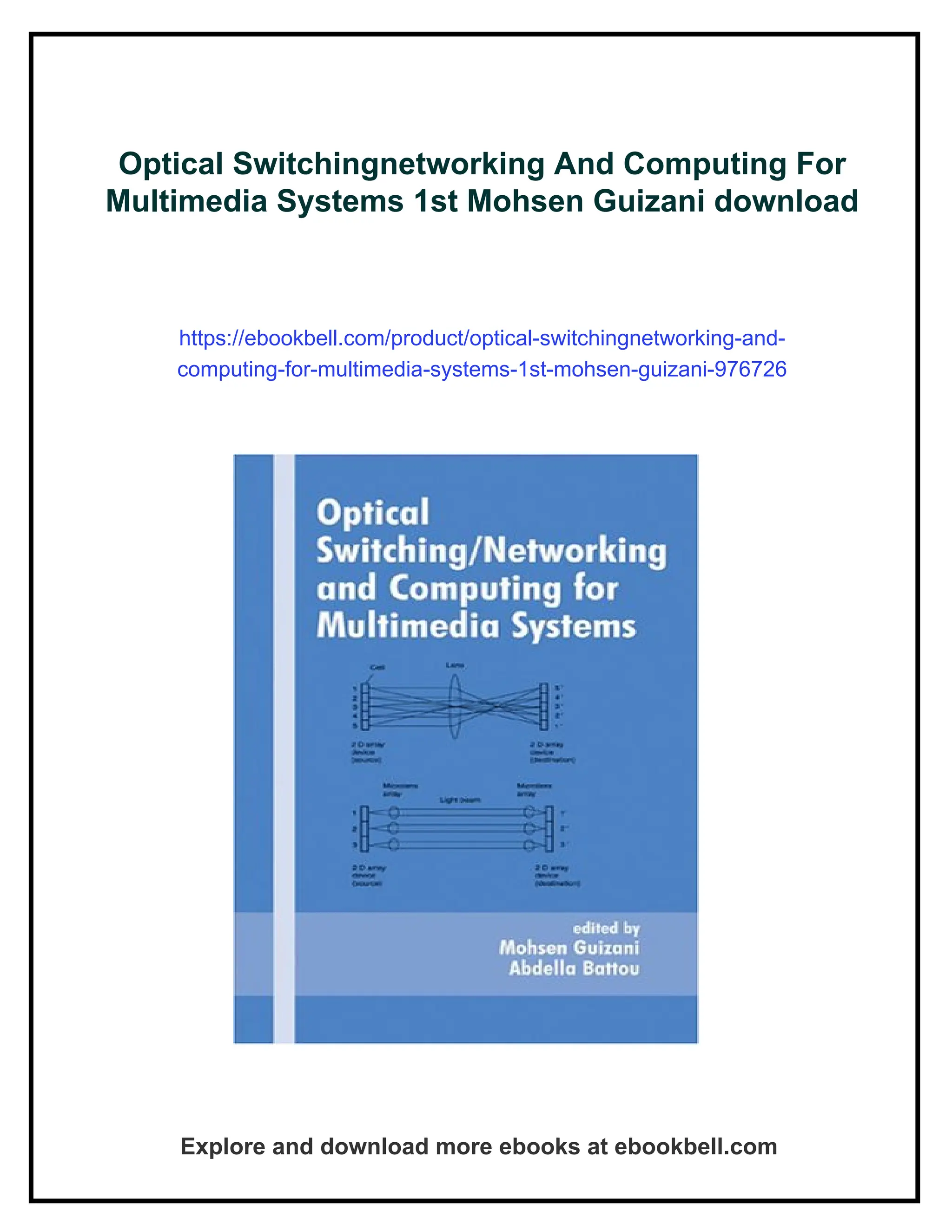
  • 1.
    Optical Switchingnetworking AndComputing For Multimedia Systems 1st Mohsen Guizani download https://ebookbell.com/product/optical-switchingnetworking-and- computing-for-multimedia-systems-1st-mohsen-guizani-976726 Explore and download more ebooks at ebookbell.com

  • 2.
    Here are somerecommended products that we believe you will be interested in. You can click the link to download. Optical Switching And Networking Handbook 1st Regis Bud Bates https://ebookbell.com/product/optical-switching-and-networking- handbook-1st-regis-bud-bates-917690 Optical Switching Device Technology And Applications In Networks Dalia Nandi https://ebookbell.com/product/optical-switching-device-technology-and- applications-in-networks-dalia-nandi-43887968 Optical Switching In Next Generation Data Centers Pavesi Lorenzo Testa https://ebookbell.com/product/optical-switching-in-next-generation- data-centers-pavesi-lorenzo-testa-6752628 Optical Switching 1st Edition Tarek S Elbawab https://ebookbell.com/product/optical-switching-1st-edition-tarek-s- elbawab-1222698
  • 3.
    Optical Switching NetworksMartin Maier https://ebookbell.com/product/optical-switching-networks-martin- maier-1222700 Solid State Lasers Tunable Sources And Passive Qswitching Elements Yehoshua Kalisky https://ebookbell.com/product/solid-state-lasers-tunable-sources-and- passive-qswitching-elements-yehoshua-kalisky-4965424 Optimal Design Of Switching Power Supply Ma Hongtao Sha Zhanyou Wang https://ebookbell.com/product/optimal-design-of-switching-power- supply-ma-hongtao-sha-zhanyou-wang-5311696 Optical Nonlinearities In Nanostructured Systems Carlos Torrestorres https://ebookbell.com/product/optical-nonlinearities-in- nanostructured-systems-carlos-torrestorres-46074278 Optical Wireless Communication Xizheng Ke Ke Dong https://ebookbell.com/product/optical-wireless-communication-xizheng- ke-ke-dong-46076490
  • 5.
    Marcel Dekker, Inc.New York • Basel TM Optical Switching/Networking and Computing for Multimedia Systems Mohsen Guizani University of West Florida Pensacola, Florida Abdella Battou firstwave Intelligent Optical Networks Greenbelt, Maryland edited by Copyright 2002 by Marcel Dekker. All Rights Reserved.
  • 6.
    ISBN: 0-8247-0707-9 This bookis printed on acid-free paper. Headquarters Marcel Dekker, Inc. 270 Madison Avenue, New York, NY 10016 tel: 212-696-9000; fax: 212-685-4540 Eastern Hemisphere Distribution Marcel Dekker AG Hutgasse 4, Postfach 812, CH-4001 Basel, Switzerland tel: 41-61-261-8482; fax: 41-61-261-8896 World Wide Web http://www.dekker.com The publisher offers discounts on this book when ordered in bulk quantities. For more information, write to Special Sales/Professional Marketing at the headquarters address above. Copyright  2002 by Marcel Dekker, Inc. All Rights Reserved. Neither this book nor any part may be reproduced or transmitted in any form or by any means, electronic or mechanical, including photocopying, microfilming, and recording, or by any information storage and retrieval system, without permission in writing from the publisher. Current printing (last digit): 10 9 8 7 6 5 4 3 2 1 PRINTED IN THE UNITED STATES OF AMERICA Copyright 2002 by Marcel Dekker. All Rights Reserved.
  • 7.
    OPTICAL ENGINEERING Founding Editor BrianJ. Thompson University of Rochester Rochester, New York Editorial Board Toshimitsu Asakura Hokkai-Gakuen University Sapporo, Hokkaido, Japan Nicholas F. Borrelli Corning, Inc. Corning, New York Chris Dainty Imperial College of Science, Technology, and Medicine London, England Bahram Javidi University of Connecticut Storrs, Connecticut Mark Kuzyk Washington State University Pullman, Washington Hiroshi Murata The Furukawa Electric Co., Ltd. Yokohama, Japan Edmond J. Murphy JDS/Uniphase Bloomfield, Connecticut Dennis R. Pape Photonic Systems Inc. Melbourne, Florida Joseph Shamir Technion–Israel Institute of Technology Hafai, Israel David S. Weiss Heidelberg Digital L.L.C. Rochester, New York Copyright 2002 by Marcel Dekker. All Rights Reserved.
  • 8.
    1. Electron andIon Microscopy and Microanalysis: Principles and Applications, Lawrence E. Murr 2. Acousto-Optic Signal Processing: Theory and Implementation, edited by Nor man J. Berg and John N. Lee 3. Electro-Optic and Acousto-Optic Scanning and Deflection, Milton Gottlieb, Clive L. M. Ireland, and John Martin Ley 4. Single-Mode Fiber Optics: Principles and Applications, Luc B. Jeunhomme 5. Pulse Code Formats for Fiber Optical Data Communication: Basic Principles and Applications, David J. Morris 6. Optical Materials: An Introduction to Selection and Application, Solomon Musikant 7. Infrared Methods for Gaseous Measurements: Theory and Practice, edited by Joda Wormhoudt 8. Laser Beam Scanning: Opto-Mechanical Devices, Systems, and Data Storage Optics, edited by Gerald F. Marshall 9. Opto-Mechanical Systems Design, Paul R. Yoder, Jr. 10. Optical Fiber Splices and Connectors: Theory and Methods, Calvin M. Miller with Stephen C. Mettler and Ian A. White 11. Laser Spectroscopy and Its Applications, edited by Leon J. Radziemski, Richard W. Solarz, and Jeffrey A. Paisner 12. Infrared Optoelectronics: Devices and Applications, William Nunley and J. Scott Bechtel 13. Integrated Optical Circuits and Components: Design and Applications, edited by Lynn D. Hutcheson 14. Handbook of Molecular Lasers, edited by Peter K. Cheo 15. Handbook of Optical Fibers and Cables, Hiroshi Murata 16. Acousto-Optics, Adrian Korpel 17. Procedures in Applied Optics, John Strong 18. Handbook of Solid-State Lasers, edited by Peter K. Cheo 19. Optical Computing: Digital and Symbolic, edited by Raymond Arrathoon 20. Laser Applications in Physical Chemistry, edited by D. K. Evans 21. Laser-Induced Plasmas and Applications, edited by Leon J. Radziemski and David A. Cremers 22. Infrared Technology Fundamentals, Irving J. Spiro and Monroe Schlessinger 23. Single-Mode Fiber Optics: Principles and Applications, Second Edition, Re vised and Expanded, Luc B. Jeunhomme 24. Image Analysis Applications, edited by Rangachar Kasturi and Mohan M. Trivedi 25. Photoconductivity: Art, Science, and Technology, N. V. Joshi 26. Principles of Optical Circuit Engineering, Mark A. Mentzer 27. Lens Design, Milton Laikin 28. Optical Components, Systems, and Measurement Techniques, Rajpal S. Sirohi and M. P. Kothiyal 29. Electron and Ion Microscopy and Microanalysis: Principles and Applications, Second Edition, Revised and Expanded, Lawrence E. Murr 30. Handbook of Infrared Optical Materials, edited by Paul Klocek 31. Optical Scanning, edited by Gerald F. Marshall 32. Polymers for Lightwave and Integrated Optics: Technology and Applications, edited by Lawrence A. Hornak 33. Electro-Optical Displays, edited by Mohammad A. Karim 34. Mathematical Morphology in Image Processing, edited by Edward R. Dougherty 35. Opto-Mechanical Systems Design: Second Edition, Revised and Expanded, Paul R. Yoder, Jr. 36. Polarized Light: Fundamentals and Applications, Edward Collett 37. Rare Earth Doped Fiber Lasers and Amplifiers, edited by Michel J. F. Digonnet 38. Speckle Metrology, edited by Rajpal S. Sirohi Copyright 2002 by Marcel Dekker. All Rights Reserved.
  • 9.
    39. Organic Photoreceptorsfor Imaging Systems, Paul M. Borsenberger and David S. Weiss 40. Photonic Switching and Interconnects, edited by Abdellatif Marrakchi 41. Design and Fabrication of Acousto-Optic Devices, edited by Akis P. Goutzoulis and Dennis R. Pape 42. Digital Image Processing Methods, edited by Edward R. Dougherty 43. Visual Science and Engineering: Models and Applications, edited by D. H. Kelly 44. Handbook of Lens Design, Daniel Malacara and Zacarias Malacara 45. Photonic Devices and Systems, edited by Robert G. Hunsberger 46. Infrared Technology Fundamentals: Second Edition, Revised and Expanded, edited by Monroe Schlessinger 47. Spatial Light Modulator Technology: Materials, Devices, and Applications, edited by Uzi Efron 48. Lens Design: Second Edition, Revised and Expanded, Milton Laikin 49. Thin Films for Optical Systems, edited by Francoise R. Flory 50. Tunable Laser Applications, edited by F. J. Duarte 51. Acousto-Optic Signal Processing: Theory and Implementation, Second Edition, edited by Norman J. Berg and John M. Pellegrino 52. Handbook of Nonlinear Optics, Richard L. Sutherland 53. Handbook of Optical Fibers and Cables: Second Edition, Hiroshi Murata 54. Optical Storage and Retrieval: Memory, Neural Networks, and Fractals, edited by Francis T. S. Yu and Suganda Jutamulia 55. Devices for Optoelectronics, Wallace B. Leigh 56. Practical Design and Production of Optical Thin Films, Ronald R. Willey 57. Acousto-Optics: Second Edition, Adrian Korpel 58. Diffraction Gratings and Applications, Erwin G. Loewen and Evgeny Popov 59. Organic Photoreceptors for Xerography, Paul M. Borsenberger and David S. Weiss 60. Characterization Techniques and Tabulations for Organic Nonlinear Optical Materials, edited by Mark G. Kuzyk and Carl W. Dirk 61. Interferogram Analysis for Optical Testing, Daniel Malacara, Manuel Servin, and Zacarias Malacara 62. Computational Modeling of Vision: The Role of Combination, William R. Uttal, Ramakrishna Kakarala, Spiram Dayanand, Thomas Shepherd, Jagadeesh Kalki, Charles F. Lunskis, Jr., and Ning Liu 63. Microoptics Technology: Fabrication and Applications of Lens Arrays and De- vices, Nicholas Borrelli 64. Visual Information Representation, Communication, and Image Processing, edited by Chang Wen Chen and Ya-Qin Zhang 65. Optical Methods of Measurement, Rajpal S. Sirohi and F. S. Chau 66. Integrated Optical Circuits and Components: Design and Applications, edited by Edmond J. Murphy 67. Adaptive Optics Engineering Handbook, edited by Robert K. Tyson 68. Entropy and Information Optics, Francis T. S. Yu 69. Computational Methods for Electromagnetic and Optical Systems, John M. Jarem and Partha P. Banerjee 70. Laser Beam Shaping, Fred M. Dickey and Scott C. Holswade 71. Rare-Earth-Doped Fiber Lasers and Amplifiers: Second Edition, Revised and Expanded, edited by Michel J. F. Digonnet 72. Lens Design: Third Edition, Revised and Expanded, Milton Laikin 73. Handbook of Optical Engineering, edited by Daniel Malacara and Brian J. Thompson 74. Handbook of Imaging Materials: Second Edition, Revised and Expanded, edited by Arthur S. Diamond and David S. Weiss 75. Handbook of Image Quality: Characterization and Prediction, Brian W. Keelan Copyright 2002 by Marcel Dekker. All Rights Reserved.
  • 10.
    76. Fiber OpticSensors, edited by Francis T. S. Yu and Shizhuo Yin 77. Optical Switching/Networking and Computing for Multimedia Systems, edited by Mohsen Guizani and Abdella Battou 78. Image Recognition and Classification: Algorithms, Systems, and Applications, edited by Bahram Javidi 79. Practical Design and Production of Optical Thin Films: Second Edition, Revised and Expanded, Ronald R. Willey 80. Ultrafast Lasers: Technology and Applications, edited by Martin E. Fermann, Almantas Galvanauskas, and Gregg Sucha 81. Light Propagation in Periodic Media: Differential Theory and Design, Michel Nevière and Evgeny Popov 82. Handbook of Nonlinear Optics, Second Edition, Revised and Expanded, Richard L. Sutherland Additional Volumes in Preparation Optical Remote Sensing: Science and Technology, Walter Egan Copyright 2002 by Marcel Dekker. All Rights Reserved. Copyright 2002 by Marcel Dekker. All Rights Reserved.
  • 11.
    Foreword We have witnessedthe rapid growth in the popularity of the Internet technology over the past few years. The current network technologies provide ubiquitous access to a vast amount of information on a huge variety of topics, but limited bandwidth has constrained the impact and growth of broadband multimedia appli- cations. To allow new broadband services to reach their potential will require an exponential increase in bandwidth availability to all users. These demanding high data rate applications will require the development of a robust and stable network infrastructure. At the current time, optical fiber is the medium of choice both to accommo- date this bandwidth explosion and to meet the increasing demands for quality- of-service (QoS) required by the emerging multimedia applications. Dense wave- length division multiplexing (DWDM) has provided the technological solution to increased network transport capacity. The next step in this evolutionary process is the implementation of photonic packet switching to offer high-speed data rate/ format transparency and configurability. This transformation to a packet-based environment is required to allow all the different forms of data and multimedia content that will need to be supported in tomorrow’s networks. While the debate about whether to have an optoelectronic or an all-optical (end-to-end) network rages on, the cost per bit continues to decline, and network operators continue to upgrade and improve their fiber-based networks to try to meet the needs of tomorrow’s broadband market. It is a pleasure to introduce this book, which discusses some of the funda- mental concepts necessary for broadband multimedia applications that will need to be supported by the optical network infrastructure. This includes issues relating to optical networking capabilities for the next generation Internet, the design and performance of a lightwave data storage network using computer analysis and simulation, analysis of multimedia access protocols for shared medium networks, scalable electro-optical Clos switch architectures, different routing issues in opti- cal switching and networking, and all-optical computing architectures. I believe Copyright 2002 by Marcel Dekker. All Rights Reserved.
  • 12.
    this book tobe a fine collection of research work written by experts in the field. The presentations stress some fundamental as well as advanced issues in light- wave technology, the future of optics in the multimedia technology, important optical switch and network architectures, routing and control for optical multi- media support, and QoS requirements. The book is intended as a reference for systems designers, hardware and software engineers, R&D managers, and market planners who seek an understanding of optical broadband networks that support multimedia systems. Scott Hinton Distinguished Professor and Chair Electrical Engineering and Computer Science The University of Kansas Lawrence, Kansas Copyright 2002 by Marcel Dekker. All Rights Reserved.
  • 13.
    Preface The last fewyears have witnessed an explosive growth in the development and deployment of networked applications that transmit and receive audio and video content over the Internet. New multimedia networking applications such as enter- tainment video, IP (Internet Protocol) telephony, Internet radio, teleconferencing, interactive games, and distance education are announced on a daily basis. The service requirements of these applications differ significantly from those of tradi- tional voice-oriented applications. In particular, multimedia applications are sensi- tive to end-to-end delay and delay variation but can tolerate occasional loss of data. These fundamentally different service requirements suggest that a network architecture that has been designed primarily for data communication may not be well suited for supporting multimedia applications. In this book, we investigate some of the supporting network architectures as well as some multimedia protocols that are supported by the high-speed networks. Our emphasis is on the optical part of the network architecture that includes the hardware as well as the protocol levels. As telecommunications and computer networking continue to converge, data traffic is gradually exceeding voice traffic. This means that many of the existing connection-oriented or circuit-switched networks will need to be up- graded to support packet-switched data traffic. The concept of wavelength divi- sion multiplexing (WDM) has provided us an opportunity to multiply network capacity. Current optical switching technologies allow us to deliver rapidly the enormous bandwidth of WDM networks. Of all the switching schemes, photonic packet switching appears to be a strong candidate because of the high speed, data rate/format transparency, and configurability it offers. Therefore the use of all- optical networking and switching to support the new multimedia applications seems inevitable. Optical networks are those in which the dominant physical layer technology for transport is optical fiber. They can be opaque or all-optical, and can be single- wavelength or based on dense wavelength division multiplexing (DWDM). In opaque networks, the path between end users is interrupted at intermediate nodes Copyright 2002 by Marcel Dekker. All Rights Reserved.
  • 14.
    by optical-electronic-optical (OEO)conversion operations. The traditional syn- chronous optical networks/synchronous digital hierarchy (SONET/SDH) is an opaque single-wavelength system. The intermediate nodes, being either elec- tronic/optical add-drop multiplexes (OADMs) or optical crossconnects (OXCs), actually have electronic bit handling in the signal path. None of these opaque systems has the versatility and power of the all-optical network. In addition to meeting the newly acquired data transmission demands, an all-optical network has other advantages. Optical fibers offer abundant band- width, low attenuation, and high speed. New optical equipment has recently been developed and deployed. Commercial systems with up to 160 OC-48 (10 Gb/s) channels have been announced that can communicate over paths thousands of kilometers long, uninterruped by OEO conversions. Advances in optical materials have contributed to the declining cost of optical elements that has made all-optical networks affordable. Offering service and maintenance is potentially much sim- pler for all-optical elements than for the traditional OEO systems. An all-optical network also has inherent robustness. The new physical layer can provide not only basic transport but also several other network-wide rerouting functions that allow the optical layer to exhibit extremely high service availability. New proto- cols at the medium access control (MAC) layer have been developed for new and ever changing environments. Optical networking architects were concerned with MAC protocols for optical packet switching, the combinatorics of wave- length conversion, and optimal forms of network topology. As the field has ma- tured, it has become clear that the more important problems relate to the network ‘‘control plane’’ and to ensuring the service integrity of the optical layer, which increasingly carries large routed chunks of precious traffic on which depends the viable operation of many institutions and businesses, public and private. One of the exciting things about the two-layer story is that both the optical networking community and the IP community have begun to agree that the way to control both layers is by multiprotocol label switching (MPLS) or, in the case of the optical layer, a slightly modified version called multiprotocol lambda switching (MPλS). Each of these control planes has two phases, the transient one in which paths are set up and the steady-state or traffic phase in which the state information, which has been set up in each node to define the paths, then acts to forward packets in a way that provides much of the long-missing quality- of-service (QoS) capability. The control phases of these two emerging standards provide a unified, agreed-upon way for the nodes in the IP and optical layers to set up and tear down their portions of virtual point-to-point IP packet connections between end users. There are a number of reasons for MPλS to replace the many variants in current practice in the lower communication layers (especially SONET/SDH) and the IP layer. These traditional control software families (IP and SONET/SDH) are very much vendor-dependent, their control structures Copyright 2002 by Marcel Dekker. All Rights Reserved.
  • 15.
    are totally differentfrom each other, and both are too slow to satisfy anticipated needs, not just for protection but also for restoration and provisioning. The first of the optical layer integrity processes to receive attention has been protection switching, the millisecond-scale substitution of a new lightpath for a failed one. This action usually requires prescanned algorithms akin to the SONET/SDH protection switching algorithms and invokes only a very localized part of the network, usually no more than a single span, string, or ring of notes. Conventional protection switching is often triggered by some bit-level process. In optical protection switching, the trigger can be loss of optical signal-to-noise ratio (OSNR). The second process is restoration, the replacement of the failed optical path within the network, or part of the network, by another—that is, providing a new backup for the former one, now playing the role of the service path. Since one can allow minutes or even longer to do this, it is possible not only to have real- time software do the job but also to involve much larger portions of the network in the process that can be tolerated for protection switching. Finally, there is provisioning or reconfiguration, in which one relieves stranded bandwidth conditions, arranges for the brokering of bandwidth between service providers using the optical facility, or even setting up rent-a-wavelength conditions. Provisioning/reconfiguration can involve optimization over the entire optical network portion or even several of them. Today, all these actions are expected to be available in the access, metro, and long-haul environments. These issues and more are discussed in this fine collection of chapters. This volume brings together work by some of the leading international experts in the field. The first chapter, by Ali and Kurtz, gives an overall picture of optical net- working capabilities for the next generation Internet. They address some key issues as to how the legacy SONET-based infrastructure currently in place will make a graceful transition to the next generation datacentric networking para- digm. They carefully address the problems with today’s legacy networking infra- structure and identify challenges facing both carriers and service providers. They provide an understanding of the current and future service portfolio and associ- ated requirements. Next, Wang and Hamdi investigate the analysis of multimedia access proto- cols for shared medium networks. They propose a methodology for integrating different MAC protocols into a single shared medium network to accommodate efficiently various types of multimedia traffic streams with different characteris- tics and QoS demands. In particular, they provide an integrated MAC protocol, termed the Multimedia Medium Access Control (Multimedia-MAC) protocol, that can efficiently and simultaneously serve three types of multimedia traffic streams: a constant bit rate (CBR) traffic and two classes of variable bit rate (VBR) traffic. Then a queuing system with vacation model is developed to estab- Copyright 2002 by Marcel Dekker. All Rights Reserved.
  • 16.
    lish a mathematicalframework for the analysis and performance evaluation of the proposed Multimedia-MAC protocol. The Multimedia-MAC design approach and performance evaluation schemes are applied to a wavelength division multi- plexing network, and it is shown that the proposed protocol design approach is general enough to be used in various shared medium networks. Then, Ramesh and Tanzer present the design and performance of a light- wave data storage network using computer analysis and simulation. This type of network, composed of broadcasting star couplers, cascading optical amplifiers, and intensity-modulated/direct detection transmission at data rates of 1 to 20 Gbps, is simulated using MATLAB and SIMULINK software to predict network performance factors. This involves both modeling system components and evalu- ating system performance measures. It is concluded that large network sizes are configurable, and scaling projections at 10 Gb/s show that cascaded optical ampli- fiers can extend to reach to several thousand end users, while WDM implementa- tion can produce aggregate network capacities of a hundred terabits per second. The next four chapters discuss different routing techniques in WDM net- works. First, Wang and Hamdi present a survey of routed wavelength WDM networks. The survey covers important issues related to their design and opera- tion, including virtual topology mapping, wavelength routing and assignment, dynamic routing, wavelength conversion, QoS provision, and multicasting. Sec- ond, Battou, Ben Brahim, and Khan present a thorough study and implementation of an optical network control plane. They describe the design of the optical net- work control plane, with particular emphasis on the difficult issues in optical network management, and lightpath signaling and routing. Next, Znati and Mel- hem describe routing and path establishment for point-to-point and point-to- multipoint communications over WDM networks. In order to address the QoS requirements, in terms of bandwidth and end-to-end delay of the underlying appli- cations, a low-cost, conversion-bound heuristic is proposed. The heuristic estab- lishes a tree of semi-lightpaths between a source and a group of destination nodes. The unique feature of this heuristic is that it decouples the cost of establishing the multicast tree from the delay incurred by data transmission due to lightwave conversion and processing at intermediate nodes along the transmission path. Finally, in this group, Shen, Pan, and Horiguchi provide an overview on recent developments on efficient routing in multihop optical networks supported by WDM with limited wavelength conversion. It addresses offline and online routing in both reliable and unreliable networks for point-to-point, multicast, and multiple multicast communication patterns. Group membership updating schemes for the three patterns are also discussed. The last category is a set of chapters dealing with optical architectures that serve as the backbone for the all-optical network. We provide description of free-space optical switch and network architectures as well as arithmetic, logic, and image processing ones. Guizani gives an overview of different types Copyright 2002 by Marcel Dekker. All Rights Reserved.
  • 17.
    of photonic ATMarchitectures based on three different switching techniques. Liotopoulos describes a three-stage Clos switch architecture, based on a two- level hierarchy of optical cross connects, which can be implemented with AWGFs and ODFs. A number of important related research issues are identified. Li and Esener describe a parallel free-space optical interconnection with all design methodologies and requirements. Advances in this area are reviewed. A num- ber of 3D optical components necessary for such architectures are presented. Fi- nally, Cherri and Alam present two chapters that discuss optical architectures that achieve ultrafast arithmetic, logical, and image processing operations using trinary signed-digit arithmetic and polarization-encoded optical shadow-casting. ACKNOWLEDGMENTS We would like to take this opportunity to thank the University of West Florida and the NRL for their support while this book was developed. Special thanks to all the authors who contributed to this book—in particular, Mounir Hamdi, Ghas- sen Ben Brahim, Bilal Khan, and Taieb F. Znati—for their patience and en- couragement, without which this work would not have been completed on time. Rita Lazazzaro and Eric Stannard have been very cooperative throughout this project—many thanks to both of them. We are grateful to our families for their support. Mohsen thanks his parents and family, in particular, his wife, Saida, and all the kids—for their patience and understanding during the many hours consumed in preparing the manuscript. Abdella thanks his family for their love and support during this project. Further, we acknowledge our teachers, friends, and colleagues, who have provided us with so much intellectual stimulation throughout our careers. The editors and authors welcome any comments and suggestions for im- provements or changes that could be implemented in forthcoming editions of this book. Comments can be sent to mguizani@cs.uwf.edu. Mohsen Guizani Abdella Battou Copyright 2002 by Marcel Dekker. All Rights Reserved.
  • 18.
    Contents Foreword Scott Hinton Preface Contributors 1.Optical Networking Capabilities for the Next-Generation Internet Mohamed A. Ali and Russ Kurtz 2. Analysis of Multimedia Access Protocols for Shared Medium Networks Lixin Wang and Mounir Hamdi 3. The Design and Performance of a Lightwave Data Storage Network Using Computer Analysis and Simulation S. K. Ramesh and Herbert J. Tanzer 4. Routed Wavelength WDM Networks Lixin Wang and Mounir Hamdi 5. The Optical Network Control Plane Abdella Battou, Ghassen Ben Brahim, and Bilal Khan 6. Routing and Path Establishment for Point-to-Point and Point-to-Multipoint Communications over WDM Networks Taieb F. Znati and Rami Melhem 7. Routing in Multihop Optical WDM Networks with Limited Wavelength Conversion Hong Shen, Yi Pan, and Susumu Horiguchi 8. Optical Switching Architectures Mohsen Guizani 9. Scalable Electro-Optical Clos Switch Architectures Fotios K. Liotopoulos 10. Parallel Free-Space Optical Interconnection Guoqiang Li and Sadik Esener Copyright 2002 by Marcel Dekker. All Rights Reserved.
  • 19.
    11. Optical ComputingUsing Trinary Signed-Digit Arithmetic Abdallah K. Cherri and Mohammad S. Alam 12. Ultrafast Arithmetic, Logical, and Image Processing Operations Using Polarization-Encoded Optical Shadow-Casting Abdallah K. Cherri and Mohammad S. Alam Copyright 2002 by Marcel Dekker. All Rights Reserved.
  • 20.
    Contributors Mohammad S. AlamThe University of South Alabama, Mobile, Alabama Mohamed A. Ali City College of the City University of New York, New York, New York Abdella Battou firstwave Intelligent Optical Networks, Greenbelt, Maryland Ghassen Ben Brahim Princeton Optical Systems, Princeton, New Jersey Abdallah K. Cherri Kuwait University, Safat, Kuwait Sadik Esener University of California, San Diego, La Jolla, California Mohsen Guizani University of West Florida, Pensacola, Florida Mounir Hamdi Hong Kong University of Science and Technology, Kowloon, Hong Kong Susumu Horiguchi Japan Advanced Institute of Science and Technology, Tatsunokuchi, Japan Bilal Khan Center for Computational Science at the Naval Research Labora- tory, Washington, D.C. Russ Kurtz REALTECH Systems Corporation, Edison, New Jersey Guoqiang Li University of California, San Diego, La Jolla, California, and Shanghai Institute of Optics and Fine Mechanics, Shanghai, People’s Republic of China Copyright 2002 by Marcel Dekker. All Rights Reserved.
  • 21.
    Fotios K. LiotopoulosComputer Technology Institute, Athens, Greece Rami Melhem University of Pittsburgh, Pittsburgh, Pennsylvania Yi Pan Georgia State University, Atlanta, Georgia S. K. Ramesh California State University, Sacramento, California Hong Shen Japan Advanced Institute of Science and Technology, Tatsuno- kuchi, Japan Herbert J. Tanzer Hewlett Packard Co., Roseville, California Lixin Wang Hong Kong University of Science and Technology, Kowloon, Hong Kong Taieb F. Znati University of Pittsburgh, Pittsburgh, Pennsylvania Copyright 2002 by Marcel Dekker. All Rights Reserved.
  • 22.
    1 Optical Networking Capabilitiesfor the Next-Generation Internet Mohamed A. Ali City College of the City University of New York, New York, New York Russ Kurtz REALTECH Systems Corporation, Edison, New Jersey 1 INTRODUCTION Over the past few years, the field of computer and telecommunications net- working has experienced tremendous growth. Traffic demand has increased sub- stantially, somewhat unexpectedly, prompting carriers to add capacity quickly and in the most cost-effective way possible. There is no sign that this increase is an anomaly, and both traffic and backbone capacity are likely to continue a rapid increase into the foreseeable future. The leaders of the data communications industry are not the same companies that lead the marketplace today in sales of telecommunications equipment, so one cannot extrapolate to the future by simply assuming the network element types deployed today will increase in speed and number to meet the capacity growth required in the future. The change in the fundamental character of backbone network traffic, as demonstrated by the current shift in the telecommunications industry from the traditional voice-centric TDM/SONET/SDH (time division multiplexing/syn- chronous optical networks/synchronous digital hierarchy) optimized circuit- switched networking paradigm to the data-centric packet-optimized networking paradigm, is leading to revolutionary changes in the traditional concepts of how networks are constructed. The primary reason for the paradigm shift in network Copyright 2002 by Marcel Dekker. All Rights Reserved.
  • 23.
    design is thenature of the traffic crossing today’s long-haul backbones. Specifi- cally, internet protocol (IP) applications are the fastest growing segment of a service provider’s network traffic. This growth is expected to continue well into this century. Concurrently with the emerging data-centric networking paradigm, there has been a well-publicized ‘‘explosion’’ of attention centered on the topic of optical networking. With skyrocketing optical networking startups, valuations, mergers, and acquisitions, the rest of the world has turned its attention to optical networking as the vehicle that promises to transform the Internet, blowing away bandwidth bottlenecks and almost eliminating delays. However, in the midst of much debate and excitement over the likely winners in the race to roll out optical networking technologies, no one seems to be certain of what, exactly, our industry is trying to accomplish. How can our industry bring this technology into the network quickly and cost-effectively? Where are we going with technology? Is it simply more bandwidth? One might argue that the end goal of our industry is the creation of an all- optical Internet, one that is free from all bandwidth and scalability restrictions, as well as distance limitations. While the vision for creating such a network of networks seems to be gaining momentum, the implications of implementing this vision are far-reaching: all conventional aspects of networking functionality have to be reconsidered; the most basic assumptions of how networks are constructed are being called into question. At a minimum, service providers, carriers, and enterprise network managers will be forced to rethink fully routing, switching, and traffic engineering for the emerging data-centric networking paradigm. The myriad innovations in dense wavelength division multiplexing (DWDM) technology that increase the number of wavelengths, generate more bandwidth, send multigigabit signals faster and longer distances, and those en- abling optical crossconnects (OXCs) with the ability to add, drop, and in effect construct wavelength-switched and wavelength-routed networks, are moving us towards this point. High-performance routers (IP layer) plus an intelligent optical transport layer (DWDM layer) equipped with a new breed of photonic networking equipment hold the keys to the two pieces of the puzzle that will comprise the next generation optical Internet. Of course, there are several visions of how best to marry these two technologies. The key question appears to be whether carriers should control their next-generation data-centric networks using only routers, or some combination of routers and OXC equipment. The realm in which we are likely to see the first real deployments of high- performance routers interconnected by intelligent optical core networks that uti- lize optical networking technology will likely be within the long-haul backbone. Several carriers have already completed field trials of all-optical systems, and many others have trials in process. So how will the migration to this new data- centric optical networking paradigm evolve? Copyright 2002 by Marcel Dekker. All Rights Reserved.
  • 24.
    The key ingredientto the success of any migration strategy is that the new networking paradigm must coexist with the aging TDM circuit switching infra- structure, offer the network reliability inherent in legacy SONET/SDH systems, and at the same time meet the surging demand for packet traffic. In other words, how the legacy SONET-based infrastructure currently in place can make a grace- ful transition to the next generation data-centric networking paradigm is the real challenge. To assess which architecture will enable the most effective migration strategy, the following two issues must be carefully addressed: (1) problems with today’s legacy networking infrastructure as well as challenges facing both carriers and service providers must be fully identified; (2) current and future service port- folio and associated requirements must be thoroughly understood. 1.1 Today’s Problems The fundamental problem facing both carriers and service providers is that In- ternet traffic is already skyrocketing, and looks certain to accelerate even further as broadband access technologies such as DSL (digital subscriber line) and cable modems are rolled out to the masses. Service providers are faced with daunting challenges that span both the access and backbone transport network require- ments. They must offer service breadth—IP, frame relay, ATM, Ethernet, and TDM-based voice—plus the flexibility to add and modify new services as market conditions warrant. While transporting data services, the new data-centric net- working paradigm must coexist with the voice infrastructure and offer the net- work reliability inherent in legacy SONET/SDH systems. Let us first consider the trouble with today’s most widely used standard, SONET. SONET infrastructure has been the standard for wide area networking for the past 15 years, ideally designed to handle circuit-switched voice and point- to-point TDM connections, it began to feel burdened by growing data traffic demands and the need to deliver real-time circuit provisioning. This is because SONET was designed before the explosion of the asynchronous and unpredict- able Interne-based traffic profiles. The asynchronous and unpredictable nature of Internet-based traffic profiles makes forecasting for growth all the more difficult, and the issue of scalability a major concern. Unfortunately, SONET was never designed to deal with these problems. SONET networks are always built under the assumption that transmit/ receive traffic is always balanced and predictable, so that growth would be easy to forecast. SONET’s inability to handle the huge influx of data traffic, and the associ- ated unpredictable traffic patterns, signaled the end of this standard’s long reign in the backbone transport network. While long-haul architectures based solely on SONET will be far too expensive and complex to meet the needs of tomorrow’s backbones, some of the functionality SONET encompasses will live on in differ- Copyright 2002 by Marcel Dekker. All Rights Reserved.
  • 25.
    ent, more efficientvehicles. The emerging data-centric networking paradigm, a purely optical Internet, by contrast, will bypass SONET altogether, providing for a backbone without capacity restrictions or distance limitations. SONET provides four primary functions: (1) intermediate multiplexing, (2) network survivability, (3) performance monitoring, and (4) bandwidth provi- sioning. The incorporation of these into any near-term optical Internet architec- ture is a prerequisite for any graceful transition. In the near term, optical net- working systems and technologies combined with high-performance multigigabit or terabit routers will be able to perform these functions. These systems are al- ready in late-stage development, and we can expect to see true commercial devel- opments beginning by the end of this year. So, while some SONET functionality is still needed, a separate SONET layer is not. That is not the end of the traditional network’s troubles. Another major issue facing today’s service providers is the static and cumbersome process of provisioning end-to-end circuits. Provisioning a cross-country OC-48 service is extremely manual, involves complex network planning and roll-out activities, and generally takes several months to accomplish. The roll-out of DWDM has led to another problem; current digital crossconnects simply aren’t big enough to handle the number of connections running across backbones. Carriers can foresee needing huge switch fabrics with thousands of ports, and right now, they do not exist. 1.2 Tomorrow’s Promises All of this is about to change. Several dramatic advances in the optical-net- working arena in recent years have emerged to set the foundation for the next- generation optical Internet and to challenge both the traditional view of net- working (e.g., routing, switching, provisioning, protection, and restoration) and the conventional approaches of networks design that have always addressed tech- nology first and management second. First, the abundance of bandwidth propelled by the explosion of DWDM poses, for the first time, a new challenge to network architects. Whereas in the past, IP, ATM, and related routing protocols have focused on managing the scarcity of bandwidth, the new challenge is managing the abundance of bandwidth. Second, rapid advances in DWDM technology—dense WDM add/drop multiplexers (ADMs), wideband optical amplifiers, stable single frequency lasers, novel optical crossconnects (OXCs)—with the ability to add, drop, and in effect construct wavelength-switched and wavelength-routed networks, are now begin- ning to shift the focus more toward optical networking and network-level issues. Thus, there is an attractive opportunity to evolve DWDM technology toward an optical networking infrastructure with transport, multiplexing, switching, routing, Copyright 2002 by Marcel Dekker. All Rights Reserved.
  • 26.
    survivability, bandwidth provisioning,and performance monitoring, supported at the optical layer. Harnessing the newly available bandwidth is difficult because today’s core network architecture, and the networking equipment it is built on, lack both the scale and functionality necessary to deliver the large amounts of bandwidth re- quired in the form of ubiquitous, rapidly scalable, multigigabit services. Today’s core network architecture model has four layers: IP and other content-bearing traffic, over ATM for traffic engineering, over SONET for transport, and over WDM for fiber capacity. This approach has functional overlap among its layers, contains outdated functionality, and will not be able to scale to meet the exploding volume of future data traffic, which makes it ineffective as the envisioned archi- tecture for a next-generation data-centric networking paradigm. A simplified two-tiered architecture that requires two types of subsystems will set the stage for a truly optical Internet: service delivery platforms that en- force service policies, and transport platforms that intelligently deliver the neces- sary bandwidth to these service platforms. If IP can be mapped directly onto the WDM layer, some of the unnecessary network layers can be eliminated, opening up new possibilities for the potential of collapsing today’s vertically layered net- work architecture into a horizontal model where all network elements work as peers dynamically to establish optical paths through the network. High-performance routers (IP layer) plus an intelligent optical transport layer (DWDM layer) equipped with a new breed of photonic networking equip- ment hold the keys to the two pieces of the puzzle that will compose the optical Internet. Closer and efficient interworking of these two pieces is the key to solving the puzzle. Specifically, linking the routing decision at the IP layer with the point- and-click provisioning capabilities of optical switches at the transport layer, in our opinion, is the cornerstone to the puzzle’s solution. This will allow routers and ATM switches to request bandwidth where and when they need it. Now that the basic building blocks are available for building such a network of networks, the key innovations will come from adding intelligence that enables the interworking of all the network elements (routers, ATM switches, DWDM transmission systems and OXCs). The IETF has already addressed the interwork- ing of routers and optical switches through the multiprotocol lambda switching (MPλS) initiative [1]. The main goal of this initiative is to provide a framework for real-time provisioning of optical channels, through combining recent ad- vances in multiprotocol label switching (MPLS) traffic-engineering control plane with emerging optical switching technology in a hybrid IP-centric optical net- work. However, only a high-level discussion has been presented. This work presents a balanced view of the vision of the next generation optical Internet and describe, two practical near-term optical Internet candidate model architectures along with a high-level discussion of their relative advantages Copyright 2002 by Marcel Dekker. All Rights Reserved.
  • 27.
    and disadvantages: (1)a router-centric architecture deployed on a thin optical layer, and (2) a hybrid router/OXC-centric architecture deployed on a rich and intelligent optical transport layer. A router-centric model assumes that IP-based traffic is driving all the growth in the network, and the most cost-effective solution is to terminate all optical links directly on the router. The granularity at which data can be switched is at the packet level. In a hybrid router/OXC model, all optical links coming into a core node are terminated on an OXC. The cross- connect switches transit traffic (data destined for another core node) directly to outbound connections, while switching access traffic (data destined for this core node) to ports connected to an access router. The granularity at which data can be switched is at the entire wavelength level, e.g., OC-48 or OC-192. Both models are based on the two-layer model, IP directly over WDM, and therefore DWDM equipment is available to provide the underlying band- width. The main issue is really about the efficiency of a pure packet-switched network versus a hybrid, which packet switches only at the access point and circuit switches through the network. The distinction between these two models is based on the way that the routing and signaling protocols are run over the IP and the optical subnetwork layers. A special consideration will be given to the hybrid router/OXC-centric model, referred to as the integrated model in a recent IETF draft [2], since it is our opinion that this model represents a credible starting point toward achieving an all-optical Internet. This model aims at a tighter and more coordinated integra- tion between the IP layer and the underlying DWDM-based optical transport layer. The work presented here builds on the recent IETF initiatives [1,2] and other related work on the (MPλS) [3,4] and addresses the implementation issues of the path selection component of the traffic engineering problem in a hybrid IP-centric DWDM-based optical network. An overview of the methodologies and associated algorithms for dynamic lightpath computation, that is based on a fully distributed implementation, is presented. Specifically, we show how the complex problem of real-time provisioning of optical channels can be simplified by using a simple dynamic constraint-based routing and wavelength assignment (RWA) algorithm that computes solutions to three subproblems: the routing problem, the constrained-based shortest route selection problem, and the wavelength assign- ment problem. We present two different schemes for dynamic provisioning of the optical channels. The first scheme is conceptually simple, but the overhead involved is excessive. The second scheme is not as overhead consuming as the first one but has the drawback that the chosen wavelength is only locally optimized along the selected route; consequently the utilization of network resources is not globally optimized. Two different scenarios are then considered: provisioning lightpaths Copyright 2002 by Marcel Dekker. All Rights Reserved.
  • 28.
    in a networkwith full wavelength conversion capability, and provisioning lightpaths in a network without wavelength conversion capability The remainder of this chapter is organized into four sections. Section 2 presents the case for building an optical Internet. Section 3 describes two near- term optical Internet candidate models. In Section 4, we present an overview of real-time provisioning at the optical layer and describe two different schemes for dynamic provisioning of the optical channels. Finally, section 5 offers summary and conclusion. 2 THE CASE FOR BUILDING AN OPTICAL INTERNET 2.1 Overview There is considerable debate in the telecommunications industry about the best technology for transporting IP services. Carriers are generally more committed to ATM as the common network technology. One of the underlying assumptions of the carriers is that data services would be one of many competing services in a portfolio of service types. As such, ATM networks are optimized to carry a mix of different service types rather than being optimized for one specific service type. The ATM virtual paths make it easier to construct router networks by giving routers the appearance of being only one hop apart, whereas in reality the virtual path may traverse many intermediate ATM switches. ATM does also provide a powerful set of capabilities in terms of traffic engineering. On the other hand, there are many in the Internet community who believe that soon, just about everything will ride over IP, so that a network optimized to carry IP is the most appropriate. While there are compelling arguments for both sides of the debate, the most likely near-term outcome is that IP over ATM and IP/MPLS directly over WDM services will exist in parallel to meet the spec- trum of customer requirements for IP networking. This is particularly true with the advent of DWDM-based optical transport systems as the main (and sole) underlying transport infrastructure that can support a multitude of transport ser- vice delivery mechanisms from traditional SONET/SDH services to the new opti- cal ATM and IP architectures. The case therefore for an optical Internet essentially rests on the predicted volumes for Internet traffic growth and the expected predominant types of In- ternet applications. If Internet traffic continues to grow exponentially, and if for the bulk of traffic all that is required is a ‘‘best efforts’’ or an ‘‘ensured’’ delivery service, then high-volume IP pipes would seem to be the most appropriate tech- nology. In that scenario, it seems appropriate to build a network, first and fore- most, that is optimized for the delivery of that type of service. The remaining services can then be delivered on top of an IP network (which may or may not Copyright 2002 by Marcel Dekker. All Rights Reserved.
  • 29.
    be less thanoptimal) or continue to be delivered over a parallel ATM network. We will refer to this data-centric networking solution as a router-centric architec- ture. The details of this architecture will be considered in the next section. On the other hand, if data services are treated as one of many competing services in a portfolio of service types, then it seems appropriate to build a net- work that is optimized to carry a mix of different service types rather than being optimized for one specific service type. We will refer to this networking solution as a hybrid router/OXC-centric architecture, the details of which will also be considered in the next section. 2.2 The Envisioned Data-Centric Networking Paradigm: Optical Internet Recently there have been several initiatives in building an optical Internet where IP routes are interconnected directly with WDM links [5]. A simplified two-tiered architecture that require two types of subsystems will set the stage for a truly optical Internet: service delivery platforms that enforce service policies and trans- port platforms that intelligently deliver the necessary bandwidth to these service platforms. High-performance routers plus an intelligent optical transport layer equipped with a new breed of photonic networking equipment hold the keys to the two pieces of the puzzle that will compose the optical Internet. However, closer and efficient interworking of these two pieces is the key to solving the puzzle. Specifically, linking the routing decision at the IP layer with the point-and-click provisioning capabilities of optical switches at the trans- port layer, in our opinion, is the cornerstone to the puzzle’s solution. This will allow routers and ATM switches to request bandwidth where and when they need it. As high-performance routers emerge with high bit rate optical interfaces (like OC-48c and OC-192c), the high bit rate multiplexing traditionally per- formed by a SONET terminal is no longer necessary. These routers, which repre- sent the first piece of the two-tiered networking model, can also handle equipment protection, further diminishing the need for SONET. On the other hand, in order for this new two-tiered model to be truly viable, optical networking technologies and systems must support additional functionality, including multiplexing, rout- ing, switching, survivability, bandwidth provisioning, and performance monitor- ing. These emerging sets of optical networking functionality and equipment is the second piece of the two-tiered puzzle that will compose the optical Internet. The following are some of the salient features and associated dramatic tech- nological changes that should take place en route towards implementing the envi- sioned optical Internet: (1) SONET transport should give way to optical transport; fast restoration (50 ms) is necessary; without it, a significant availability and reliability benchmark set by SONET would be lost; (2) bandwidth is provisioned, Copyright 2002 by Marcel Dekker. All Rights Reserved.
  • 30.
    not at TDMgranularities, but rather at wavelength granularity; to meet exponen- tial growth rates, rapid provisioning must be an integral part of the new architec- ture; (3) as future data network cores continue to scale—as traffic between pairs of backbone routers reaches just a single OC-48c/OC-192c—ATM’s virtual path becomes equivalent to a wavelength; (4) ATM cell granularity and traffic engi- neering are made obsolete by the use of MPLS at the IP level and wavelength traffic engineering at the optical transport layer; (5) restoration will take place at the optical transport layer in a fast, scalable manner. The service layer will be informed of the event only if the transport layer cannot restore due to lack of transport resources. Then the service layer will be advised to perform its restora- tion functions. The two will perform in a nonoverlapping, predictable, and scal- able manner. This simplified two-tiered architecture optical Internet is defined here as mapping IP traffic directly over the optical layer, as there is no underlying SONET/SDH and ATM transport layer/protocol. This architecture is commonly referred to as the IP-over-WDM problem. The IP-over-WDM problem has two fundamental sub-problems: the user-plane protocol stack problem and the routing problem. The user-plane protocol stack problem consists of defining the protocol stack for carrying IP packets over multiwavelength optical links, and the corre- sponding network architecture. Candidate protocol stacks include (1) IP over AAL/ATM over SONET/ SDH over WDM, (2) IP over PPP/HDLC over SONET/SDH over WDM, (3) IP over PPP/HDLC over WDM, and (4) IP directly over WDM. In accordance with the two-tiered architecture definition of an optical Internet described above, this work considers the two-layer protocol stack (IP directly over WDM) as the only viable candidate model for building the next generation optical Internet. 3 POSSIBLE NEAR-TERM GRACEFUL OPTICAL INTERNET TRANSITIONAL ARCHITECTURAL OPTIONS 3.1 Overview Clearly, there are several feasible optical Internet architectures that will emerge to challenge embedded infrastructure. Near-term transition strategies for wider deployment need to look at service requirements and product availability. High- performance routers (IP layer) plus an intelligent optical transport layer (DWDM layer) equipped with a new breed of photonic networking equipment hold the keys to the two pieces of the puzzle that will compose the next generation optical Internet. Of course, there are several visions of how best to marry these two technologies. The key question appears to be whether carriers should control their next generation data-centric networks using only routers, or some combination of routers and OXC equipment. The debate is really about the efficiency of a Copyright 2002 by Marcel Dekker. All Rights Reserved.
  • 31.
    pure packet-switched networkversus a hybrid, which packet switches only at the access point and circuit switches through the network. The realm in which we are likely to see the first real deployments of high- performance routers interconnected by intelligent optical core networks that uti- lize optical networking technology will likely be within the long-haul backbone. Several carriers have already completed field trials of all-optical systems, and many others have trials in process. The key ingredient to the success of any migration strategy is that the new networking paradigm must coexist with the aging TDM circuit switching infrastructure, offer the network reliability inherent in legacy SONET/SDH systems, and at the same time meet the surging demand for packet traffic. 3.2 The Router-Centric Model The notion of this model is to build a dedicated optical Internet network for large- volume backbone pipes that does not require an underlying multiservice SONET/ SDH and ATM transport protocols. In this model, IP routers are interconnected directly with point-to-point physical links on which multiple WDM channels are carried. A router-centric model assumes that IP-based traffic is driving all the growth in the network, and the most cost-effective solution is to terminate all optical links directly on the router. The router handles all traffic in a PoP (point of presence). All packets go through the router whether they are accessing the network through that PoP or entering and exiting via backbone connections. The granularity at which data can be switched is at the packet level. The case for building such a router-centric model is based on the following facts/predictions: (1) if networks of the future are predominantly ‘‘datagram based,’’ then there may not be a need for complex optical switching technology; (2) as interface rates approach line rates, aggregation is pushed to the edge of the network and handled locally by routers, thus making the multiplexing func- tionality in the backbone nodes redundant. The router at the edge, rather than an optical switching device at the core, becomes the prime intelligent device for routing and switching packets between various optical links. Traffic engineering of this network can now be accom- plished only at the IP layer as there is no underlying transport layer, and so protocols like MPLS becomes essential for the fast restoring, protection, effective management, and engineering of the network. The optical layer is completely separate from the IP layer, and optical trans- port offers only higher capacity and higher reliability. In this scenario, the optical network provides point-to-point optical links for the transport of IP packets through the optical domain. IP is more or less independent of the optical subnet- work. The IP/MPLS routing, topology distribution, and signaling protocols are independent of the routing, topology distribution, and signaling protocols at the Copyright 2002 by Marcel Dekker. All Rights Reserved.
  • 32.
    optical layer. Thismodel is conceptually similar to the conventional IP over ATM or MPOA models, but it is applied to an optical subnetwork directly. If full layer-3-based restoration speed is acceptable for IP applications, then significant bandwidth efficiency can be gained at the transport layer by the elimi- nation of the protection bandwidth. It is anticipated that layer 3 restoration capa- bilities will reach Carrier class performance using MPLS (this is not yet quite clear). But if bandwidth is cheap (WDM has significantly reduced the cost/bit), protection bandwidth is a small cost, so additional motivations are required to build the case for full layer 3 restoration. Router-only advocates stress that as the majority of traffic becomes IP (pre- dicted to be more than 95% by early next decade), it is more efficient to build a network strictly to optimize for IP. This minimizes the cost by requiring fewer boxes in the PoP and decreases the network management load. The downside to the router approach is that carriers need to map multiple protocols to IP, it requires the creation and management of IP routing adjacencies over the optical network, and routed networks are not considered as reliable or as capable of fast restora- tion. 3.3 The Hybrid Router/OXC-Centric Architecture Integrated Model As architectures and needs evolve, we see that the functionality within IP and the DWDM-based optical networking technologies and components converge. While these components overlap in some capabilities, they complement each oth- er’s strength. High-performance routers plus a smart optical transport layer equipped with a new breed of photonic networking components and subsystems together are setting the foundation for the next generation networking paradigm. These are the elements that will form the essence of the hybrid router/OXC- centric architecture or the integrated model. In a hybrid router/OXC model, all optical links coming into a PoP are terminated on an OXC. The crossconnect switches transit traffic (data destined for another PoP) directly to outbound connections while switching access traffic (data destined for this PoP) to ports connected to an access router. The router handles only the packets accessing the network through that PoP. Packets enter- ing and exiting via backbone connections are handled by a crossconnection, ei- ther at a TDM level or as an entire wavelength. All connections will need to terminate on the crossconnect to provide reconfigurability of the network. Under this hybrid model, the IP and optical networks are treated together as a single integrated network managed and traffic engineered in a unified manner. In this regard, the OXCs are treated just like any other router as far as the control plane is concerned. One of the main goals of the integration architecture is to make optical Copyright 2002 by Marcel Dekker. All Rights Reserved.
  • 33.
    channel provisioning drivenby IP data paths and traffic engineering mechanisms. This will require a tight cooperation of routing and resource management proto- cols at the two layers. Multiprotocol label switching (MPLS) for IP packets is believed to be the best integrating structure between IP and WDM. MPLS brings two main advantages. First, it can be used as a powerful instrument for traffic engineering. Second, it fits naturally to WDM when wavelengths are used as labels. This extension of the MPLS is called multiprotocol lambda switching [1– 4]. The main characteristics of this model is that the IP/MPLS layers act as peers of the optical transport network, so that a single routing protocol instance runs over both the IP/MPLS and optical domains. Hybrid advocates argue that routing is expensive and should be used only for access, because circuit switching is better for asynchronous traffic, and restor- ing traffic at the optical layer is faster and well understood. In addition, this model allows seamless interconnection of IP and optical networks. The downside to this approach is that hybrid networks have the disadvantages inherent to a circuit switch model—they waste bandwidth and introduce an N2 problem, e.g., to con- nect 30 routers in the east with 30 routers in the west requires more than 900 connections. Another disadvantage of the hybrid approach is that it requires rout- ing information specific to optical networks to be known to routers. Finally, as it is assumed they will need a router, hybrid solutions include another device to manage. In the following subsections, we start off with an overview of MPLS. The architecture of the hybrid router/OXC-centric model considered here is then pre- sented. Finally, we consider the implementation issues of the dynamic path selec- tion component of the traffic engineering problem in the hybrid router/OXC- centric model. 3.3.1 Overview of MPLS MPLS introduces a new forwarding paradigm for IP networks. The idea is similar to that in ATM and frame relay networks. A path is first established using a signaling protocol; then a label in the packet header, rather than the IP destination address, is used for making forwarding decisions in the network. In this way, MPLS introduces the notion of connection-oriented forwarding in an IP network. In the absence of MPLS, providing even the simplest traffic engineering functions (e.g., explicit routing) in an IP network is very cumbersome. Two signaling protocols may be used for path setup in MPLS: the Constraint-Based Routed Label Distribution Protocol (CR-LDP) and extensions to Resource Reservation Protocol (RSVP) [6]. The path set up by the signaling protocol is called a label-switched path (LSP). Routers that support MPLS are called label-switched routers (LSRs). An LSP typically originates at an edge LSR, traverses one or more core LSRs, and then terminates at another edge LSR. The Copyright 2002 by Marcel Dekker. All Rights Reserved.
  • 34.
    ingress edge LSRmaps the incoming traffic onto LSPs using the notion of a forwarding equivalence class (FEC). An FEC is described by a set of attributes such as the destination IP address prefix, type of service (TOS) fields, or IP protocol. All packets that match a given FEC will be sent on the LSP correspond- ing to that FEC. This is done by prepending the appropriate label to the IP packet. The core LSRs forward labeled packets using only information contained in the label; the rest of the IP header is not consulted. When an LSR receives a packet, it looks up the entry in its label information base (LIB), and determines the output interface and new outgoing label for the packet. Finally, the egress edge LSR will remove the label from the packet and forward it as a regular IP packet. 3.3.2 The Hybrid Network Model The network model considered here consists of IP/LSR routers attached to an optical core network. As shown in Fig. 1, the optical network consists of multi- ple optical crossconnects (OXCs) interconnected via WDM links in a general mesh topology. Each OXC can switch high-speed optical signals (e.g., OC-48, Figure 1 A hybrid router/OXC-centric architecture. Copyright 2002 by Marcel Dekker. All Rights Reserved.
  • 35.
    OC-192) from inputports to output ports. The switching fabric may be purely optical or electrical or a combination. The LSRs are clients of the optical network and are connected to their peers over switched optical paths (lightpaths) spanning potentially multiple OXCs. LSRs process traffic in the electrical domain on a packet-by-packet basis. The OXC processing unit is one wavelength. A lightpath is a fixed bandwidth connection between two network elements such as IP/LSR routers established via the OXCs. Two IP/LSR routers are logi- cally connected to each other by a single-hop channel. This logical channel is the so-called lightpath. A continuous lightpath is a path that uses the same wave- length on all links along the whole route from source to destination. Each node in this network consists of an IP router and a dynamically recon- figurable OXC. The IP/LSR router includes software for monitoring packet flows. The router is responsible for all nonlocal management functions, including the management of optical resources, configuration and capacity management, ad- dressing, routing, topology discovery, traffic engineering, and restoration. In gen- eral, the router may be traffic bearing, or it may function purely as a controller for the optical layer and carry no IP data traffic [2]. In this work, it is assumed to be a combination of both. The node may be implemented using a stand-alone router interfacing with the OXC through a defined interface, or it may be an integrated system, in which the router is part of the OXC system. These OXCs may be equipped with full wavelength conversion capability, limited wavelength conversion capability, or no wavelength conversion capability at all. If the WDM systems contain transponders or if electronic OXCs are used, then it is implied that a channel associated with a specific wavelength in the WDM input can be converted to an output channel associated with a different wavelength in the WDM output (i.e., wavelength conversion is inherent). How- ever, if the switching fabric is optical and there is no transponder function in the WDM system, then wavelength conversion is only implemented if optical-to- electronic conversion is performed at the input or output ports, or if optical wave- length converters are introduced to the OXC. Some of the processing capabilities and functionality of the hybrid nodes (wavelength conversion capable or incapable) comprising the core network are shown in Figs. 2, 3, and 4, respectively. These include, but are not limited to, wavelength merging, flow aggregation (grooming) into a continuous lightpath, flow switching to a different lightpath, and flow processing/termination at an intermediate node along a continuous lightpath. Wavelength merging is a strategy for reusing precious wavelengths that allows tributary flows to be aggregated by merging packets from several streams. The OXC requires enhanced capabilities to perform this merging function [7]. The device would be able to route the same wavelength from different incoming fibers into a single outgoing fiber. The key property of this device is that contention between bits on the wavelength must be resolved before they are multiplexed into the common outgoing fiber. Copyright 2002 by Marcel Dekker. All Rights Reserved.
  • 36.
    Figure 2 Backbonenodes without wavelength conversion capability. We define a flow as a sequence of packets that travel together along a subset of the same route in the network before exiting the network. This definition is a generalization of the more common, fine-granularity definition, which identi- fies a flow as sequence of packets with the same source and destination IP ad- dresses and transport port numbers. Figure 3 Backbone nodes with full wavelength conversion capability. Copyright 2002 by Marcel Dekker. All Rights Reserved.
  • 37.
    Figure 4 Backbonenodes with partial wavelength conversion and O-E-O processing capabilities. The MPLS label switching concept is extended to include wavelength- switched lightpaths. Optical nodes are treated as IP-MPLS devices, termed here- after optical lambda switch router (O-LSR) nodes, where each O-LSR node is assigned a unique IP address [3]. We assume that the OXCs are within one admin- istrative domain and run interdomain routing protocols, such as OSPF and IS- IS, for the purpose of dynamic topology discovery. For optimal use of network resources, the routing protocols have been enhanced to disseminate additional link-state information over that currently done by standard OSPF and IS-IS proto- cols. The request to set up a path can come either from a router or from an ATM switch connected to the OXCs (O-LSRs). The request must identify the ingress and the egress OXCs between whom the lightpath has to be set up. Additionally, it may also include traffic-related parameters such as bandwidth (OC-48/Oc-192), reliability parameters and restoration options, and setup and holding priorities for the path. The lightpaths are provisioned by choosing a route through the network with sufficient available capacity. The lightpath is established by allocat- ing capacity on each link along the chosen route, and appropriately configuring the OXCs. Protection is provided by reserving capacity on routes that are physi- cally diverse from the primary lightpath. Copyright 2002 by Marcel Dekker. All Rights Reserved.
  • 38.
    There should bea mechanism to exchange control information between OXCs, and between OXCs and other LSRs. This can be accomplished by using either an in-band or an out-of-band signaling channel (i.e., a 1510 nm super- visory channel), using the same links that are used to carry data-plane traffic. An OXC must be able to provide the MPLS traffic engineering control plane with pertinent information regarding the state of individual fibers attached to that OXC, as well the state of individual lightpaths or optical channel trails within each fiber. 4 REAL-TIME PROVISIONING AT THE OPTICAL LAYER 4.1 Overview Provisioning end-to-end circuits is an endless source of struggle for service pro- viders and a frustration for end-users. While a technology like multiprotocol lambda switching (MPλS) promises to ease and expedite provisioning, its effec- tiveness is yet to be tested and/or demonstrated. In addition, it is difficult to speculate whether the deployment of highly dynamic data-driven cut-through lightpaths within core networks will be widely adopted by carriers and ISPs. The reasons are numerous: possible CPU overhead in core network elements, complexity of proposed solutions, stability concerns, lack of true economic driv- ers for this type of service, and above all, the argument is put forth, Do we really need real-time provisioning? And if so, what is the target interval of provisioning? Is it a day, a week, a month, or perhaps much less or much more? In any case, we emphasize that although the scenario for the dynamic provisioning scheme proposed here needs more optimization (work currently going on), it is definitely a step forward in the right direction that will ultimately lead to much more ad- vanced real-time provisioning schemes in the near future. Dynamic computation of a lightpath involves the implementation of two traffic-engineering components: an information distribution mechanism that pro- vides knowledge of the relevant attributes of available network resources, and a path selection process that uses the information distributed by the dynamic link- state advertisement algorithm to select a path that meets the specific requirements of the traffic flow. Note that while MPLS provides a method of setting up explicit paths and forwarding traffic on them, it does not address the issue of how to find paths with constraints. To simplify the complex problem of real-time provisioning of optical channels, we develop a simple dynamic constraint-based routing and wavelength assignment (RWA) algorithm that computes solutions to three sub- problems: the routing problem, the constrained-based shortest route selection problem, and the wavelength assignment problem. Copyright 2002 by Marcel Dekker. All Rights Reserved.
  • 39.
    Two comments arein order here. First, note that the dynamic RWA algo- rithm is based on a fully distributed model in which all nodes maintain a synchro- nized and identical topology and link-state information (traffic-engineering data- base, TED). Second, the simplicity of the wavelength assignment algorithm is a function of whether the network nodes have full wavelength conversion capabil- ity, partial wavelength conversion capability, or no wavelength conversion capa- bility. 4.2 Dynamic Lightpath Computation The two traffic-engineering components that involve the dynamic computation of a lightpath (in a fully distributed implementation) in a hybrid IP-centric DWDM-based optical network are 1. An information distribution mechanism that provides knowledge of available network resources. This component is implemented by defining rela- tively simple extensions to the interior gateway protocol (IGP), e.g., open shortest path first (OSPF) so that link attributes are included as part of each router’s link- state advertisement. Some of the traffic-engineering extensions that need to be added to the IGP link-state advertisement include maximum link bandwidth, max- imum reservable link bandwidth, current bandwidth reservation, current band- width usage, and link coloring. These extensions capture optical link parameters and any constraints specific to optical networks. The topology and link-state in- formation maintained by all nodes are identical. Another important component is to define naming and addressing conventions for different elements of the phys- ical plant hierarchy. For example, primary and backup paths between ingress OXC and an egress OXC should follow routes that are physically separate. Con- trol architecture and signaling protocols used in MPLS, such as CR-LDP and RSVP, are not cognizant of the details of the physical plant connecting the net- work elements (LSRs). In fact, no standard terminology to describe the physical plant hierarchy exists. Therefore we have defined and assigned the naming and addressing convention for different elements of the physical plant hierarchy. We have implemented our own dynamic simple link-state advertisement algorithm (a simple version of an extended OSPF). This algorithm is capable of periodically updating and advertising, to maintain and refresh a synchronized data base for all nodes, all of the above link attributes. The link-state updates can be triggered, for instance, based on a given threshold of the number of available wavelengths per fiber, below which the updates can be triggered. 2. A path selection process that uses the information distributed by the dynamic link-state advertisement algorithm to select an explicit route that meets the specific requirements of the traffic flow. This process can be performed either off-line or on-line using a constraint-based routing calculation. The source router is basically responsible for computing the complete path all the way to the desti- nation through the optical domain, and then initiating path setup using the signal- Copyright 2002 by Marcel Dekker. All Rights Reserved.
  • 40.
    ing protocol (e.g.,CR-LDP or RSVP). The route may be specified either as a series of nodes (routers/OXCs) or in terms of the specific links used (as long as IP addresses are associated with these links). Once each node has a representation of the full physical network topology and the available resources on each link (these are obtained and updated via the link-state advertisement protocol), we need a path selection algorithm. To simplify the real-time provisioning problem, the path selection process, that is, the dynamic constraint-based RWA algorithm, computes solutions to three subproblems: the routing problem, the constrained- based shortest route selection problem, and the wavelength assignment problem. 4.2.1 The Routing Problem We emphasize that it is necessary to use explicit routing for constructing lightpaths. This is valuable for traffic engineering and load optimizations in the network. A shortest path algorithm is run off-line to calculate the shortest path between every source–destination node pair throughout the nodes composing the simulated arbitrary network topology. This procedure is repeated k times for ev- ery source–destination pair in order to select the other k-1 alternative shortest routes in an orderly fashion. The off-line calculated k shortest routes for every source–destination pair is then stored in the data base of each CSR. The routing scheme used here is a fixed alternate routing algorithm. This routing scheme is a constraint path selection in which a path is selected from a predetermined set of candidate paths. These candidate paths may include the shortest path route, the second shortest path route, the third shortest path route, etc. We have examined the performance of two fixed alternate routing selection algorithms, the k link-disjoint shortest routes, and the k best routes. The k link-disjoint routes. In this routing scheme, the alternate routes should be link-disjoint. Two alternate routes between a source S and a destination D cannot share any links. This routing approach provides a straightforward ap- proach to handling link failure. The set of shortest k-disjoint paths between all node pairs is computed in advance and stored in routing tables at each node. The k best-routes. In this approach, two alternate routes can share any num- ber of common links but should differ in at least one link. The set of shortest k- best paths between all node pairs is computed in advance and stored in routing tables at each node. 4.2.2 The Constraint-Based Shortest Route Selection Problem To optimize the utilization of the network resources, the route with the least average number of used wavelengths (least-congested path) per the entire route is then selected out of the k routes. This is achieved by applying a simple con- strained shortest path selection algorithm on the k routes stored off-line at the ingress node. This algorithm uses the information stored and updated, via the Copyright 2002 by Marcel Dekker. All Rights Reserved.
  • 41.
    link-state advertisement protocol,at the first-hop router’s TED. Specifically, these are the link attributes that are included as part of each router’s link-state advertise- ment. As an illustrative example, consider a lightpath request from A to C as shown in Fig. 1. There are two alternative disjoint routes (k ⫽ 2 in this example) that should be stored at node A. The first route (first shortest path route) is A– B–C, and the second route is A–E–D–C. The first route has two links, AB and BC. Assume that the number of used wavelengths on link AB ⫽ 4, and that the number of used wavelengths on link BC ⫽ 12. Then the average number of used wavelengths on route A–B–C ⫽ 8 wavelengths. The second disjoint alternative route (second shortest path route) has three links, AE, ED, and DC. Assume that the number of used wavelengths on link AE ⫽ 5, the number of used wavelengths on link ED ⫽ 2, and that the number of used wavelengths on link DC ⫽ 8, Then the average number of used wave- lengths on this route ⫽ 5 wavelengths. Because the average number of used wavelengths [5] on the second route (A–E–D–C) is less than those [8] on the first route (A–B–C), the second route is selected. Note that route A–B–C was not selected, even though it is the shortest path. This is a constraint-based shortest route selection problem. 4.2.3 The Wavelength Assignment Problem For a given request, once a constrained shortest path (the path with the least average number of used wavelengths per the entire route) is selected out of the k routes, a wavelength assignment algorithm is invoked (on-line) to assign the appropriate wavelength(s) across the entire route. A wavelength assignment algo- rithm must thus be used to select the appropriate wavelength (S). Several heuristics wavelength assignment algorithms can be used, such as the Random wavelength assignment (R), least used (LU), most used (MU), least- loaded (LL), and max-sum algorithms [8–12]. The implementation of these algo- rithms requires the propagation of information throughout the network about the state of every wavelength on every link in the network. As a result, the state required and the overhead involved in maintaining this information would be excessive. However, the advantage gained is that the chosen wavelength is glob- ally optimized, and consequently the utilization of network resources is globally optimized, since the wavelength assignment algorithm has global information about the state of every wavelength on every link in the network. Note that, as mentioned above, the complexity of the wavelength assign- ment algorithm depends on whether the network nodes are wavelength conver- sion capable or incapable. In general, the complexity of the proposed approach and the overhead involved in maintaining and updating the TED depends on the value of k. The smaller the value of k, the lower the overhead involved and the simpler the algorithm. A reasonable value of k may range from 4 to 6. Copyright 2002 by Marcel Dekker. All Rights Reserved.
  • 42.
    4.3 Provisioning Lightpathsin a Network with Full Wavelength Conversion Capabilities In an optical network with full wavelength conversion capability, channel alloca- tion (wavelength assignment) is a straightforward process and can be performed independently on different links along a route. On the other hand, if the utilization of the network resources is to be globally optimized, the wavelength assignment algorithm can be very complicated. The route on which a new lightpath is to be established is specified in the lightpath setup message. Once a lightpath request from a source is received by the first-hop router (ingress node), it computes the complete path all the way to the destination through the optical domain using the above approach. The output of this calcula- tion is an explicit route consisting of a sequence of hops that provides the shortest path through the network that meets the constraints. This explicit route is then passed to the signaling component that initiates path setup (to reserve resources) using the signaling protocol (e.g., CR-LDP or RSVP). The first-hop router creates a lightpath setup message and sends it toward the destination of the lightpath where it is received by the last-hop router (egress node). The lightpath request can be sent from the first-hop router as the payload of a normal IP/MPLS packet with router alert. A router alert ensures that the packet is processed by every router in the path. A channel is allocated for the lightpath on the downstream link at every node traversed by the setup. The identi- fier of the allocated channel is written to the setup message. After a channel has been allocated at a node, the router communicates with the OXC to reconfigure the OXC to provide the desired connectivity. If the setup fails, the first-hop router issues a release message to release resources allocated for the partially constructed lightpath. Upon failure, the first- hop router may attempt to establish the lightpath over an alternate route, before giving up on satisfying the original user request. This alternate route is selected out of the remaining k-1 routes, subject to the same constraints, i.e., the route with the least average number of used wavelengths per the entire route. After processing the setup, the destination (or the last-hop router) returns an acknowledgment to the source. The acknowledgment indicates that a channel has been allocated on each hop of the lightpath. It does not, however, confirm that the lightpath has been successfully implemented (i.e., the OXCs have been reconfigured). It may be desirable to have the acknowledgment confirm that every hop has completed the OXC configuration. Either way, the channel becomes available immediately after the request is sent, at the discretion of the user. Once established, the lightpath may carry arbitrary traffic, such as ATM, frame relay, or TDM circuit. If the user requests a restored lightpath, then capacity must be reserved within the network. This is performed independently, although potentially over- lapping in time, with the setup of the primary lightpath; but it may take a signifi- Copyright 2002 by Marcel Dekker. All Rights Reserved.
  • 43.
    cantly longer time.The first-hop router is responsible for ensuring that restoration capacity is reserved for all restorable failures. The first-hop router informs the source once this is completed. The establishment of a restored lightpath is com- pleted when the primary capacity is allocated and the restoration capacity is re- served [2]. 4.4 Provisioning Lightpaths in a Network Without Wavelength Conversion Capabilities A network or a subnetwork that does not have wavelength converters will be referred to as being wavelength continuous. In the case where wavelength con- verters are not available, the procedures used to provision a lightpath in the above section, where wavelength converters are available, are identical, except that the wavelength assignment algorithm is now different. In this case, where wavelength converters are not available, a common wavelength must be located on each link along the entire route. Whatever wave- length is chosen on the first link defines the wavelength allocation along the rest of the section. A wavelength assignment algorithm must thus be used to choose this wavelength. Finally, in the case where the lightpath is wavelength continuous (cut- through), optical nonlinearities, chromatic dispersion, amplifier spontaneous emission, and other factors together limit the scalability of an all-optical network. Routing in such networks will then have to take into account noise accumulation and dispersion to ensure that lightpaths are established with adequate signal quali- ties. This work assumes that the all-optical (sub-) network considered is geo- graphically constrained so that all routes will have adequate signal quality, and physical layer attributes can be ignored during routing and wavelength assign- ment. However, the policies and mechanisms proposed here can be extended to account for physical layer characteristics. It is important to emphasize that while the proposed scheme is conceptually simple, to provision the network one needs to propagate information throughout the network about the state of every wavelength on every link in the network. As a result, the states required and the overhead involved in maintaining this information would be excessive. To relieve the excessive overhead problem, another approach is first to select the shortest path between source and destination based only on the conven- tional OSPF algorithm; except that the overhead consuming heuristics wave- length assignment algorithms used above should now be replaced with a simple wavelength assignment signaling protocol (SWASP) that requires wavelength usage information from only the links along the chosen route [2,7]. In this case, we must select a route and wavelength upon which to establish a new lightpath, without detailed knowledge of wavelength availability. Con- Copyright 2002 by Marcel Dekker. All Rights Reserved.
  • 44.
    structing the continuouslightpath requires SWASP to pick a common free wave- length along the flow path; therefore the algorithm must collect the list of free wavelengths for each node. If there is one free wavelength common to all the nodes, it will be picked; if not, the algorithm returns a message to the first-hop router informing it that the lightpath cannot be established. The signaling can be initiated either at the, end of the path (last-hop router) or at the beginning of the path (first-hop router) [7]. If the signaling is initiated from the first-hop router, the algorithm picks the set of free wavelengths along the first link of the path to be established. When the next hop receives that set it intersects it with its own free wavelength set and forwards the result to the next hop. If the final set is not empty, the last-hop router picks one free wavelength from the resulting set, configures its local node, and sends an acknowledgment back to the previous hop with the chosen wave- length. Upon receiving an acknowledgment, the previous hop configures its local node and passes the acknowledgment to its previous hop, until the packet is received by the first-hop router (ingress node) [7]. The signaling can also be initiated from the last-hop router, but it will take more time. Although this second scheme is not as overhead consuming as the first one, the drawback is that the chosen wavelength is now only locally optimized, and consequently the utilization of network resources is not globally optimized. 5 CONCLUSION An overview of the vision of the next generation optical Internet has been pre- sented. We have described two practical near-term optical Internet candidate model architectures along with a high-level discussion of their relative advantages and disadvantages: a router-centric architecture deployed on a thin optical layer, and a hybrid router/OXC-centric architecture deployed on a rich and intelligent optical transport layer. The fundamental distinction between these two models is based on the way that the routing and signaling protocols are run over the IP and the optical subnetwork layers. This work has addressed the implementation issues of the path selection component of the traffic-engineering problem in a hybrid IP-centric DWDM- based optical network. An overview of the methodologies and associated algo- rithms for dynamic lightpath computation has also been presented. Specifically, we have shown how the complex problem of real-time provisioning of optical channels can be simplified by using a simple dynamic constraint-based routing and wavelength assignment (RWA) algorithm that computes solutions to three subproblems: the routing problem, the constraint-based shortest route selection problem, and the wavelength assignment problem. We have also presented two different schemes for dynamic provisioning Copyright 2002 by Marcel Dekker. All Rights Reserved.
  • 45.
    of the opticalchannels. The first scheme is conceptually simple, but the overhead involved is excessive. The second scheme is not as overhead consuming as the first one, but, its drawback is that the chosen wavelength is only locally optimized along the selected route, and consequently the utilization of network resources is not globally optimized. Two different scenarios are then considered: provisioning lightpaths in a network with full wavelength conversion capability, and provi- sioning lightpaths in a network without wavelength conversion capability Finally, it is important to emphasize that although the scenarios for the dynamic provisioning schemes proposed here need more optimization (work cur- rently going on), it is definitely a step in the right direction that will ultimately lead to much more advanced real-time provisioning schemes in the near future. REFERENCES 1. D. Awduche et al. Multiprotocol lambda switching. Internet draft, work in progress, Nov. 1999. 2. N. Chandhok et al. IP over Optical Networks: A Summary of Issues. Internet draft, work in progress, July 2000. 3. N. Ghani. Lambda-labeling: a framework for IP-over-WDM using MPLS. Optical Networks, Vol. 1, pp. 45–58, April 2000. 4. Yinghua Ye, S. Dixit, and M. A. Ali. On joint protection/restoration in IP-centric DWDM-based optical transport networks. IEEE Communication, Vol. 38, No. 6, pp. 174–183, June 2000. 5. B. Arnaud. Architectural and engineering issues for building an optical Internet. SPIE Proceedings, Vol. 3531, pp. 358–377, Nov. 1998. 6. D. Awduche, J. Malcolm, J. Agogbua, M. O’Dell, and J. MeManus. Requirements for traffic engineering over MPLS. Internet draft, RFC-2702, Sept. 1999. 7. J. Bannister, J. Touch, A. Willner, and S. Suryaputra. How many wavelengths do we really need? A study of the performance limits of packet over wavelengths. Optica Networks, Vol. 1, No. 2, pp. 17–28, April 2000. 8. O. Gerstel and S. Kutten. Dynamic wavelength allocation in all-optical ring Net- works, Proc. IEEE ICC 97, Montreal, Quebec, Canada, Vol. 1, pp. 432–436, June 1997. 9. S. Subramnian and R. A. Barry. Wavelength assignment in fixed routing WDM networks. Proc. ICC ’97, Montreal, Canada, Vol. 1, pp. 406–410, June 1997. 10. R. A. Barry and S. Subramanian. The MAX-SUM wavelength assignment algorithm for WDM ring networks. Proc. OFC 97, Feb. 1997. 11. G. Jeong and E. Ayanoglu. Comparison of wavelength-interchanging and wave- length-selective cross-connects in multiwavelength all-optical networks. Proc. IEEE INFOCOM ’96, San Francisco, CA, Vol. 1, pp. 156–163, March 1996. 12. E. Karasan and E. Ayanoglu. Effects of wavelength routing and selection algorithms on wavelength conversion gain in WDM optical networks. IEEE/ACM Transactions on Networking, Vol. 6, No. 2, pp. 186–196, April 1998. Copyright 2002 by Marcel Dekker. All Rights Reserved.
  • 46.
    2 Analysis of MultimediaAccess Protocols for Shared Medium Networks Lixin Wang and Mounir Hamdi Hong Kong University of Science and Technology, Kowloon, Hong Kong 1 INTRODUCTION Future local and metropolitan area networks (LANs/MANs) will be required to provide a wide variety of services, as shown in Fig. 1. The low-speed and non- quality-of-service-oriented services of Fig. 1 could be handled by evolutionary versions of the presently available networks. However, the high-speed and QoS- oriented services require a new generation of LANs and MANs. The target is therefore integrated services (multimedia) LANs and MANs that support the whole spectrum of the traffic shown in Fig. 1. However, with QoS-oriented multi- media LANs and MANs come various challenges. The most important challenge is the design of Medium Access Control or MAC protocols for these networks, since their topology is mostly based on a shared medium technology. One reason for this challenge is that all higher layer services (e.g., the ones shown in Fig. 1) are built on the fundamental packet transfer service provided by the MAC sub-layer, and it is the MAC protocol that determines the characteristics of this fundamental service. Hence improvements to MAC services result in improved system performance, while the provision of new MAC services means that new applications and services can be developed. Copyright 2002 by Marcel Dekker. All Rights Reserved.
  • 47.
    Figure 1 Variousapplications depend on the MAC protocols used in shared medium networks. A plethora of MAC protocols have been proposed for future-generation LANs/MANs [4]. Unfortunately, most of these MAC protocols are not suitable for multimedia applications because they have been designed with one generic traffic type in mind. As a result, they perform quite well for the traffic types they have been designed for but poorly for other traffic streams with different characteristics. This observation is true for MAC protocols for wireline networks as well as wireless networks. The objective of this paper is to propose a methodology and framework for integrating different MAC protocols into a single shared medium network efficiently to accommodate various types of multimedia traffic streams with dif- ferent characteristics and QoS demands. The proposed integrated MAC protocol is termed Multimedia Medium Access Control (Multimedia-MAC) protocol. We also develop efficient analytical methodologies for the performance evaluation of our MAC protocols using different traffic and networking environments. This paper is organized as follows. Section 2 gives an overview of MAC protocols. Section 3 introduces our Multimedia-MAC protocol. In Sec. 4, we derive an analytical model for the performance evaluation of our protocol. We present an example application of our Multimedia-MAC using wavelength divi- sion multiplexing networks in Sec. 5. Finally, Sec. 6 concludes the paper. 2 OVERVIEW OF MAC PROTOCOLS MAC protocols have been the subject of a vast amount of research over the past two decades. Without going into detail about any specific MAC protocol, we can Copyright 2002 by Marcel Dekker. All Rights Reserved.
  • 48.
    classify MAC protocolsinto three categories [4]: preallocation access protocols, reservation protocols, and random access protocols. Preallocation-based protocols. The nodes access the shared medium in a predetermined way. That is, each active node is allocated one or more slots within a frame, and these slots cannot be accessed by other nodes. Reservation-based protocols. A node that is preparing a packet transfer has to reserve one or more time slots within a frame before the actual packet transmission can take place. The reservation is typically done using dedi- cated control slots within a frame or a separate reservation channel. As a result, access to the data slots is achieved without the possibility of collision. Random access protocols. The nodes access the shared medium with no coordination between them. Thus when more than one packet is transmit- ted at the same time, a collision occurs, and the information contained in all the transmitted packets is lost. As a result, a collision resolution mechanism must be devised to avoid high packet delays or even unstable operation under high loads. To serve various multimedia applications, the traffic loaded on the network is no longer of a single type but is a mixture of different types of traffic streams to be served simultaneously. Different traffics have different characteristics and thus have different transmission requirements. We can classify multimedia traffic streams as a function of their data burstiness and delay requirements as shown in Fig. 2. For example, video/audio streams and plain old telephone service (POTS) have small data burstiness but require almost constant transmission delay and almost fixed bandwidth in order to guarantee their QoS. On the other hand, applications such as image networking and distance learning are less stringent in terms of their delay requirements, but their traffic streams are very bursty. Finally, there are other applications that require a very low delay while their traffic streams are bursty. Examples of this type of applications include control messages for video-on-demand systems or interactive games, and network control and management. These different traffic streams are better served by different MAC proto- cols. Video/audio data streams and other constant-bit-rate (CBR) traffic streams benefit best from allocation-based MAC protocols, since they can guarantee that each node has a cyclic and fixed available bandwidth. The best MAC protocols for this purpose would be a simple round-robin time division multiplexing access (TDMA) scheme. On the other hand, reservation-based MAC protocols are very well suited for applications where the traffic streams are bursty (i.e., VBR Traffic) or the traffic load of the nodes is unbalanced, since reservation-based MAC proto- cols schedule the transmission according to a particular transmission request. Copyright 2002 by Marcel Dekker. All Rights Reserved.
  • 49.
    Figure 2 Multipletraffic stream features and their appropriate MAC protocols. Finally, random access (contention) MAC protocols have the potential of meeting the delay requirements of very urgent messages, since their access delay is the lowest when collisions are avoided (or are infrequent). Some examples of these urgent messages (e.g., call setup) are listed in Fig. 2. These applications may not generate a lot of traffic data when compared to the other applications. But, once a certain traffic (message) is generated, they require a very low delay. Random access protocols perform very well, especially with respect to packet delays when the traffic load is low. However, if the traffic load gets high, then packet collisions start to occur more frequently. As a result, the performance can be quite poor. As we can see, none of these MAC protocols serves all types of traffic well, although each one of them is ideal for certain types of traffic streams. When these types of traffic are simultaneously loaded onto a single network, no single protocol can efficiently deal with all traffic types. With this observation, we propose an efficient access scheme for shared medium networks that 1. Integrates different types of MAC protocols into a single MAC pro- tocol. 2. Efficiently supports different types of traffic. 3. Can be widely applied into various kinds of shared medium networks. Copyright 2002 by Marcel Dekker. All Rights Reserved.
  • 50.
    We term thisprotocol the multimedia medium access control (Multimedia- MAC) protocol for shared medium networks. More specifically, a single Multimedia-MAC network can simultaneously support a wide range of multi- media applications. The functions required by these applications are supported by the subprotocols that are integrated into the Multimedia-MAC. 3 DESIGN OF MULTIMEDIA-MAC PROTOCOLS In this section we will introduce the principles behind the design of the Multime- dia-MAC. This design is general enough to be applied to a wide variety of shared medium networks. A Multimedia-MAC consists of multiple subprotocols, each of which serves a certain type of traffic. As shown in Fig. 3, the three types of protocols, preallocation, reservation, and contention protocols, which are denoted by TDM, RSV and CNT, respectively, are the most typical protocols. Therefore integration of these three protocols is expected to cover most multimedia traffic streams. To accommodate the three different control strategies into a single network, a time division multiplexing method is a natural choice. The idea is that each protocol in turn controls the shared medium. During that time, a protocol uses the medium, and the medium access is controlled according to the discipline of Figure 3 Multimedia-MAC protocol construction. Copyright 2002 by Marcel Dekker. All Rights Reserved.
  • 51.
    this protocol. Thusit can be thought of as if each protocol controls a subchannel of the overall channel, as shown in Fig. 3. We can properly arrange the priority of the three subprotocols in terms of occupying the medium. In this paper, a TDM subprotocol is considered the most time-restricted protocol because it follows a predefined order. Any delay in one cycle may affect the consecutive cycles, and consequently affect the QoS. Thus TDM is designated to have the highest priority to start its service.1 To ensure the fairness and the cyclic timing of the TDM sub-protocol, all three subprotocols should fill in the TDM framework. We can think of a cycle as a time frame, which is identified by a TDM cycle id. Because the TDM cycle is usually of constant time period, the frame is of fixed length. The frame is further divided into three parts, each of which is called a segment, corresponding to the three subprotocols. That is, each subprotocol takes a segment in a frame. The segment is identified by the subprotocol names. For instance, the segment occupied by a TDM subprotocol is called a TDM segment. The other two segments are named an RSV segment and a CNT segment, respectively. The RSV subprotocol is based on reservation, so before the data transmis- sion, the required bandwidth has to be determined. Therefore the RSV subproto- col should be allocated after the TDM subprotocol. Because the RSV type traffic is bursty traffic, the RSV subprotocol bandwidth requirement is variable. Since the frame size is fixed, the CNT segment can only be the remaining part of the frame after the TDM and the RSV segment allocation. The CNT is a random access protocol. Both the available bandwidth and the traffic load deter- mine its performance. When the TDM and the RSV traffic is high, the perfor- mance of the CNT subprotocol can be poor because the CNT protocol has the lowest priority to get the bandwidth. However, due to the burstiness of the RSV traffic, a large amount of bandwidth would be available after a burst has been served. The utilization of this bandwidth can achieve much better performance in this period (RSV idle period) because the CNT traffic load is relatively low, while the available bandwidth is almost the summation of the CNT and the RSV segments. It is feasible for the CNT subprotocol to fill in the idle period since the CNT subprotocol is a kind of immediate access protocol in which there is no extra signaling before the transmission. The channel can be accessed as soon as it is available. 4 ANALYTICAL MODELING OF THE MULTIMEDIA-MAC PROTOCOLS In our analysis of Multimedia-MAC, we are particularly interested in its perfor- mance with respect to QoS metrics. For example, we are interested in finding if 1 We can easily assign other priorities if it is more appropriate. Copyright 2002 by Marcel Dekker. All Rights Reserved.
  • 52.
    a packet hasmissed its transmission deadline or not. We propose a general ap- proach to find the deadline missing rate (DMR), which is defined as the probabil- ity that a packet transmission exceeds an arbitrary given deadline. This model can also be used in finding traditional metrics, such as mean packet delay and throughput. We use a queueing system with a vacation model to model the wait- ing time distribution of the subprotocols. Then we employ a numerical method to evaluate the distribution and obtain its moments. Based on the moments, we approximately determine the DMR of these subprotocols (Fig. 4). In a Multimedia-MAC protocol, the traffic streams are transmitted under the control of different subprotocols, and are multiplexed into the shared chan- nel(s). Thus the services given to each of the data streams are not continuous, i.e., the service may be unavailable sometimes. As a result, we employ a queueing with vacation model to model the Multimedia-MAC protocol. Corresponding to different features of the different traffics and their services, we use a different queueing model to analyze their performance. More precisely, we use a D/D/1 queue with vacation system to model a TDM subprotocol operation; we use a M(x) /M/1 queue with Erlang vacation to model the reservation type protocol; and we use a M/G/1 queue with deterministic vacation to model the random access protocol. To determine the DMR of a packet for a given traffic load and deadline, the packet waiting time distribution should be derived. However, it is a difficult problem to get the distribution of non-M/M/1 queues with general vacation [3]. Figure 4 Our approach to modeling and analyzing the Multimedia-MAC protocol. Copyright 2002 by Marcel Dekker. All Rights Reserved.
  • 53.
    We successfully applyan approach that combines the decomposition properties of general queueing vacation systems, numerically calculating the moments of the waiting time distribution from their Laplace–Stieltjes Transform (LST) forms, and approximately computing the tail probability from the moments. 4.1 General Queueing Model Without Vacation Let us start from a simple case: a general arrival and a general service with a single server model, denoted a GI/G/1 queue. 4.1.1 G/G/1 Queue Let wn denote the waiting time of the nth packet in the queue. Let un denote the interarrival time between the nth packet and the n ⫹ 1th packet, and vn denote the service time of the nth packet. We choose the packet departure time as the embedded point, denoted as Dn. Because we assume there is no server vacation at the moment, the transmission is continuous if the packet buffer is nonempty, i.e., the waiting time of a packet is equal to the previous packet waiting time plus its service time minus the interarrival time between them. Hence we have wn⫹1 ⫽ wn ⫹ vn ⫺ un (1) ⫽ wn ⫹ xn (2) where xn ⫽ vn ⫺ un . If the buffer is empty when the n ⫹ 1th packet arrives, the packet is transmitted immediately without queueing, so wn⫹1 ⫽ 0 in this case. Combining these two cases, we get wn⫹1 ⫽ MAX(0,wn ⫹ vn ⫺ un ) (3) From the above equation, we can get the idle period in which the server (the channel) is idle. The idle period is denoted by In ⫽ ⫺MIN(0,wn ⫹ vn ⫺ un ). Then wn⫹1 ⫺ In ⫽ wn ⫹ xn (4) E[e⫺s(wn⫹1⫺In ) ] ⫽ E[e⫺swn]E[e⫺sxn] (5) Because we have wn⫹1 ⫽ 0, when In ⬎ 0, and wn ≠ 0 when In ⫽ 0, we get E[e⫺s(wn⫹1⫺In ) ] ⫽ E[e⫺swn |In ⬎ 0]Pr(In ⬎ 0) (6) ⫹ E[e⫺swn⫹1 |In ⫽ 0]Pr(In ⫽ 0) Because wn⫹1 ⫽ 0 when In ⬎ 0, then E[e⫺swn⫹1 |In ⬎ 0] ⫽ 1. Let Pr(In ⬎ 0) ⫽ a0 which is the probability of a new packet arrival seeing an empty buffer. Using Eq. (7), we get Copyright 2002 by Marcel Dekker. All Rights Reserved.
  • 54.
    E[e⫺swn]E[e⫺sxn] ⫽ E[e⫺s(⫺In)|In ⬎ 0]α0 ⫹ E[e⫺sWn⫹1] ⫺ a0 (7) In a steady state, we get lim n→∞ E[e⫺swn ] ⫽ lim n→∞ E[e⫺swn⫹1 ] ⫽ E[e⫺sW ] Using the LST definition, the LST of the waiting time in the queue is W* (s) ⫽ E[e⫺sW ], and the LST of the idle period I is I* (s) ⫽ E[e⫺sI ]. We define the LST of the accessory random variable x ⫽ limn→∞ xn to be K* (s) ⫽ E[e⫺sX ]. Then by Eq. (7), we can get the packet waiting time in a G/G/1 queue as W* (s) ⫽ α0 [1 ⫺ I* (⫺s)] 1 ⫺ K* (s) (8) From equation (8), we can derive the LST forms of different queueing models for different arrivals and service disciplines. 4.1.2 D/D/1 Queue In a D/D/1 queue, the packet arrival rate and service rate are deterministic. Let λ denote the arrival rate and µ represent the service rate. Then un ⫽ 1/λ, and vn ⫽ 1/µ. Hence I* (s) ⫽ e⫺s(1/µ⫺1/λ) K* (s) ⫽ E[e⫺s(vn⫺un) ] ⫽ e⫺s(1/λ⫺ 1/µ) Thus the LST form of a D/D/1 queue is W* (s) ⫽ 1. 4.1.3 M/G/1 Queue For a Poisson arrival system, the idle time distribution is the same as the inter- arrival-time distribution because of the property of Poisson Arrival See Time Averages (PASTA) which implies the memoryless property of the Poisson pro- cess (17). Then A* (s) ⫽ I* (s) ⫽ λ (λ ⫹ s) (9) where A is the random variable of packet arrivals and A* (s) is its LST. We denote the packet service time distribution by B(t) and its LST by B* (s). Its mean is µ ⫽ B*′ (0). Recall that K(s) ⫽ E[e⫺s (vn⫺un) ] ⫽ E[e⫺svn]E[e⫺s(⫺un) ] ⫽ B* (s) λ λ ⫺ s (10) Copyright 2002 by Marcel Dekker. All Rights Reserved.
  • 55.
    Exploring the Varietyof Random Documents with Different Content
  • 56.
    Nadouesiouek is givenin a Relation of 1656, Nadouechiouec, 1660; and soon also Nadouesseronons, Nadouesserons, etc. An excellent article on the Sioux, entitled Dakota Land and Dakota Life, by Rev. E. D. Neill, occupies pp. 254- 294 of the 2d ed. 1872, of Minn. Hist. Soc. Coll., originally published in 1853. [VIII-4] The punctuation of the last two sentences in the original left Pike's meaning obscure. It was by no means evident whether the language which he had used to the Indians held up to their minds a happy coincidence of circumstances which the traders helped to bring about before the Almighty interfered at all, or whether the happy coincidence of circumstances consisted in the endorsement of his language both by the traders and the Almighty. On the whole, I am inclined to think he meant that the speeches he made to the Indians whom he addressed directly were repeated and backed up by the traders among those Indians to whom he had no access; and that this was the happy coincidence of circumstances which enabled the Almighty to finish the business. But after all I am not quite confident that I catch his meaning. If I do, I must say that he is not very complimentary to the Deity, whose assistance he suspects may have been necessary to effect that which the traders and himself jointly attempted. For it seems from his further reflections on the subject that he thought God possibly equal to burying the hatchet between the Sioux and Chippewas, but hardly able to keep the peace without the assistance of the military and of a special agent. However, Pike was nothing if not a good soldier, and he had Napoleonic authority for supposing that God
  • 57.
    would always befound on the side of the heaviest artillery. [IX-1] This article formed Doc. No. 2, pp. 52, 53 of the App. to Part III. of the orig. ed., entitled "Explanatory Table of Names of Places, Persons, and Things, made use of in this Volume." But there is not a name of any person in it, and not a name of anything in it that does not belong to Part I., i. e., to the Mississippi voyage alone. Having thus been obviously out of place in Part III., it is now brought where it belongs, and a new chapter made for it, with a new head, which more accurately indicates what it is. But even as a vocabulary of Mississippian place-names, it is a mere fragment, neither the plan nor scope of which is evident, as the names occur neither in alphabetical nor any other recognizable order, and include only a very small fraction of those which Pike uses in Part I. of his book. He may have intended to make something of it which should justify the title he gave it, and left it out of Part I. for that reason; but nothing more came of it, and it was finally bundled into Part III. The lists include a few terms which do not occur elsewhere in the work, as for example, "River of Means"; but are chiefly curious as an evidence of the difficulty our author found in spelling proper names twice alike.
  • 58.
    *** END OFTHE PROJECT GUTENBERG EBOOK THE EXPEDITIONS OF ZEBULON MONTGOMERY PIKE, VOLUME 1 (OF 3) *** Updated editions will replace the previous one—the old editions will be renamed. Creating the works from print editions not protected by U.S. copyright law means that no one owns a United States copyright in these works, so the Foundation (and you!) can copy and distribute it in the United States without permission and without paying copyright royalties. Special rules, set forth in the General Terms of Use part of this license, apply to copying and distributing Project Gutenberg™ electronic works to protect the PROJECT GUTENBERG™ concept and trademark. Project Gutenberg is a registered trademark, and may not be used if you charge for an eBook, except by following the terms of the trademark license, including paying royalties for use of the Project Gutenberg trademark. If you do not charge anything for copies of this eBook, complying with the trademark license is very easy. You may use this eBook for nearly any purpose such as creation of derivative works, reports, performances and research. Project Gutenberg eBooks may be modified and printed and given away—you may do practically ANYTHING in the United States with eBooks not protected by U.S. copyright law. Redistribution is subject to the trademark license, especially commercial redistribution. START: FULL LICENSE
  • 59.
    THE FULL PROJECTGUTENBERG LICENSE
  • 60.
    PLEASE READ THISBEFORE YOU DISTRIBUTE OR USE THIS WORK To protect the Project Gutenberg™ mission of promoting the free distribution of electronic works, by using or distributing this work (or any other work associated in any way with the phrase “Project Gutenberg”), you agree to comply with all the terms of the Full Project Gutenberg™ License available with this file or online at www.gutenberg.org/license. Section 1. General Terms of Use and Redistributing Project Gutenberg™ electronic works 1.A. By reading or using any part of this Project Gutenberg™ electronic work, you indicate that you have read, understand, agree to and accept all the terms of this license and intellectual property (trademark/copyright) agreement. If you do not agree to abide by all the terms of this agreement, you must cease using and return or destroy all copies of Project Gutenberg™ electronic works in your possession. If you paid a fee for obtaining a copy of or access to a Project Gutenberg™ electronic work and you do not agree to be bound by the terms of this agreement, you may obtain a refund from the person or entity to whom you paid the fee as set forth in paragraph 1.E.8. 1.B. “Project Gutenberg” is a registered trademark. It may only be used on or associated in any way with an electronic work by people who agree to be bound by the terms of this agreement. There are a few things that you can do with most Project Gutenberg™ electronic works even without complying with the full terms of this agreement. See paragraph 1.C below. There are a lot of things you can do with Project Gutenberg™ electronic works if you follow the terms of this agreement and help preserve free future access to Project Gutenberg™ electronic works. See paragraph 1.E below.
  • 61.
    1.C. The ProjectGutenberg Literary Archive Foundation (“the Foundation” or PGLAF), owns a compilation copyright in the collection of Project Gutenberg™ electronic works. Nearly all the individual works in the collection are in the public domain in the United States. If an individual work is unprotected by copyright law in the United States and you are located in the United States, we do not claim a right to prevent you from copying, distributing, performing, displaying or creating derivative works based on the work as long as all references to Project Gutenberg are removed. Of course, we hope that you will support the Project Gutenberg™ mission of promoting free access to electronic works by freely sharing Project Gutenberg™ works in compliance with the terms of this agreement for keeping the Project Gutenberg™ name associated with the work. You can easily comply with the terms of this agreement by keeping this work in the same format with its attached full Project Gutenberg™ License when you share it without charge with others. 1.D. The copyright laws of the place where you are located also govern what you can do with this work. Copyright laws in most countries are in a constant state of change. If you are outside the United States, check the laws of your country in addition to the terms of this agreement before downloading, copying, displaying, performing, distributing or creating derivative works based on this work or any other Project Gutenberg™ work. The Foundation makes no representations concerning the copyright status of any work in any country other than the United States. 1.E. Unless you have removed all references to Project Gutenberg: 1.E.1. The following sentence, with active links to, or other immediate access to, the full Project Gutenberg™ License must appear prominently whenever any copy of a Project Gutenberg™ work (any work on which the phrase “Project Gutenberg” appears, or with which the phrase “Project Gutenberg” is associated) is accessed, displayed, performed, viewed, copied or distributed:
  • 62.
    This eBook isfor the use of anyone anywhere in the United States and most other parts of the world at no cost and with almost no restrictions whatsoever. You may copy it, give it away or re-use it under the terms of the Project Gutenberg License included with this eBook or online at www.gutenberg.org. If you are not located in the United States, you will have to check the laws of the country where you are located before using this eBook. 1.E.2. If an individual Project Gutenberg™ electronic work is derived from texts not protected by U.S. copyright law (does not contain a notice indicating that it is posted with permission of the copyright holder), the work can be copied and distributed to anyone in the United States without paying any fees or charges. If you are redistributing or providing access to a work with the phrase “Project Gutenberg” associated with or appearing on the work, you must comply either with the requirements of paragraphs 1.E.1 through 1.E.7 or obtain permission for the use of the work and the Project Gutenberg™ trademark as set forth in paragraphs 1.E.8 or 1.E.9. 1.E.3. If an individual Project Gutenberg™ electronic work is posted with the permission of the copyright holder, your use and distribution must comply with both paragraphs 1.E.1 through 1.E.7 and any additional terms imposed by the copyright holder. Additional terms will be linked to the Project Gutenberg™ License for all works posted with the permission of the copyright holder found at the beginning of this work. 1.E.4. Do not unlink or detach or remove the full Project Gutenberg™ License terms from this work, or any files containing a part of this work or any other work associated with Project Gutenberg™. 1.E.5. Do not copy, display, perform, distribute or redistribute this electronic work, or any part of this electronic work, without prominently displaying the sentence set forth in paragraph 1.E.1
  • 63.
    with active linksor immediate access to the full terms of the Project Gutenberg™ License. 1.E.6. You may convert to and distribute this work in any binary, compressed, marked up, nonproprietary or proprietary form, including any word processing or hypertext form. However, if you provide access to or distribute copies of a Project Gutenberg™ work in a format other than “Plain Vanilla ASCII” or other format used in the official version posted on the official Project Gutenberg™ website (www.gutenberg.org), you must, at no additional cost, fee or expense to the user, provide a copy, a means of exporting a copy, or a means of obtaining a copy upon request, of the work in its original “Plain Vanilla ASCII” or other form. Any alternate format must include the full Project Gutenberg™ License as specified in paragraph 1.E.1. 1.E.7. Do not charge a fee for access to, viewing, displaying, performing, copying or distributing any Project Gutenberg™ works unless you comply with paragraph 1.E.8 or 1.E.9. 1.E.8. You may charge a reasonable fee for copies of or providing access to or distributing Project Gutenberg™ electronic works provided that: • You pay a royalty fee of 20% of the gross profits you derive from the use of Project Gutenberg™ works calculated using the method you already use to calculate your applicable taxes. The fee is owed to the owner of the Project Gutenberg™ trademark, but he has agreed to donate royalties under this paragraph to the Project Gutenberg Literary Archive Foundation. Royalty payments must be paid within 60 days following each date on which you prepare (or are legally required to prepare) your periodic tax returns. Royalty payments should be clearly marked as such and sent to the Project Gutenberg Literary Archive Foundation at the address specified in Section 4, “Information
  • 64.
    about donations tothe Project Gutenberg Literary Archive Foundation.” • You provide a full refund of any money paid by a user who notifies you in writing (or by e-mail) within 30 days of receipt that s/he does not agree to the terms of the full Project Gutenberg™ License. You must require such a user to return or destroy all copies of the works possessed in a physical medium and discontinue all use of and all access to other copies of Project Gutenberg™ works. • You provide, in accordance with paragraph 1.F.3, a full refund of any money paid for a work or a replacement copy, if a defect in the electronic work is discovered and reported to you within 90 days of receipt of the work. • You comply with all other terms of this agreement for free distribution of Project Gutenberg™ works. 1.E.9. If you wish to charge a fee or distribute a Project Gutenberg™ electronic work or group of works on different terms than are set forth in this agreement, you must obtain permission in writing from the Project Gutenberg Literary Archive Foundation, the manager of the Project Gutenberg™ trademark. Contact the Foundation as set forth in Section 3 below. 1.F. 1.F.1. Project Gutenberg volunteers and employees expend considerable effort to identify, do copyright research on, transcribe and proofread works not protected by U.S. copyright law in creating the Project Gutenberg™ collection. Despite these efforts, Project Gutenberg™ electronic works, and the medium on which they may be stored, may contain “Defects,” such as, but not limited to, incomplete, inaccurate or corrupt data, transcription errors, a copyright or other intellectual property infringement, a defective or
  • 65.
    damaged disk orother medium, a computer virus, or computer codes that damage or cannot be read by your equipment. 1.F.2. LIMITED WARRANTY, DISCLAIMER OF DAMAGES - Except for the “Right of Replacement or Refund” described in paragraph 1.F.3, the Project Gutenberg Literary Archive Foundation, the owner of the Project Gutenberg™ trademark, and any other party distributing a Project Gutenberg™ electronic work under this agreement, disclaim all liability to you for damages, costs and expenses, including legal fees. YOU AGREE THAT YOU HAVE NO REMEDIES FOR NEGLIGENCE, STRICT LIABILITY, BREACH OF WARRANTY OR BREACH OF CONTRACT EXCEPT THOSE PROVIDED IN PARAGRAPH 1.F.3. YOU AGREE THAT THE FOUNDATION, THE TRADEMARK OWNER, AND ANY DISTRIBUTOR UNDER THIS AGREEMENT WILL NOT BE LIABLE TO YOU FOR ACTUAL, DIRECT, INDIRECT, CONSEQUENTIAL, PUNITIVE OR INCIDENTAL DAMAGES EVEN IF YOU GIVE NOTICE OF THE POSSIBILITY OF SUCH DAMAGE. 1.F.3. LIMITED RIGHT OF REPLACEMENT OR REFUND - If you discover a defect in this electronic work within 90 days of receiving it, you can receive a refund of the money (if any) you paid for it by sending a written explanation to the person you received the work from. If you received the work on a physical medium, you must return the medium with your written explanation. The person or entity that provided you with the defective work may elect to provide a replacement copy in lieu of a refund. If you received the work electronically, the person or entity providing it to you may choose to give you a second opportunity to receive the work electronically in lieu of a refund. If the second copy is also defective, you may demand a refund in writing without further opportunities to fix the problem. 1.F.4. Except for the limited right of replacement or refund set forth in paragraph 1.F.3, this work is provided to you ‘AS-IS’, WITH NO OTHER WARRANTIES OF ANY KIND, EXPRESS OR IMPLIED,
  • 66.
    INCLUDING BUT NOTLIMITED TO WARRANTIES OF MERCHANTABILITY OR FITNESS FOR ANY PURPOSE. 1.F.5. Some states do not allow disclaimers of certain implied warranties or the exclusion or limitation of certain types of damages. If any disclaimer or limitation set forth in this agreement violates the law of the state applicable to this agreement, the agreement shall be interpreted to make the maximum disclaimer or limitation permitted by the applicable state law. The invalidity or unenforceability of any provision of this agreement shall not void the remaining provisions. 1.F.6. INDEMNITY - You agree to indemnify and hold the Foundation, the trademark owner, any agent or employee of the Foundation, anyone providing copies of Project Gutenberg™ electronic works in accordance with this agreement, and any volunteers associated with the production, promotion and distribution of Project Gutenberg™ electronic works, harmless from all liability, costs and expenses, including legal fees, that arise directly or indirectly from any of the following which you do or cause to occur: (a) distribution of this or any Project Gutenberg™ work, (b) alteration, modification, or additions or deletions to any Project Gutenberg™ work, and (c) any Defect you cause. Section 2. Information about the Mission of Project Gutenberg™ Project Gutenberg™ is synonymous with the free distribution of electronic works in formats readable by the widest variety of computers including obsolete, old, middle-aged and new computers. It exists because of the efforts of hundreds of volunteers and donations from people in all walks of life. Volunteers and financial support to provide volunteers with the assistance they need are critical to reaching Project Gutenberg™’s goals and ensuring that the Project Gutenberg™ collection will
  • 67.
    remain freely availablefor generations to come. In 2001, the Project Gutenberg Literary Archive Foundation was created to provide a secure and permanent future for Project Gutenberg™ and future generations. To learn more about the Project Gutenberg Literary Archive Foundation and how your efforts and donations can help, see Sections 3 and 4 and the Foundation information page at www.gutenberg.org. Section 3. Information about the Project Gutenberg Literary Archive Foundation The Project Gutenberg Literary Archive Foundation is a non-profit 501(c)(3) educational corporation organized under the laws of the state of Mississippi and granted tax exempt status by the Internal Revenue Service. The Foundation’s EIN or federal tax identification number is 64-6221541. Contributions to the Project Gutenberg Literary Archive Foundation are tax deductible to the full extent permitted by U.S. federal laws and your state’s laws. The Foundation’s business office is located at 809 North 1500 West, Salt Lake City, UT 84116, (801) 596-1887. Email contact links and up to date contact information can be found at the Foundation’s website and official page at www.gutenberg.org/contact Section 4. Information about Donations to the Project Gutenberg Literary Archive Foundation Project Gutenberg™ depends upon and cannot survive without widespread public support and donations to carry out its mission of increasing the number of public domain and licensed works that can be freely distributed in machine-readable form accessible by the widest array of equipment including outdated equipment. Many
  • 68.
    small donations ($1to $5,000) are particularly important to maintaining tax exempt status with the IRS. The Foundation is committed to complying with the laws regulating charities and charitable donations in all 50 states of the United States. Compliance requirements are not uniform and it takes a considerable effort, much paperwork and many fees to meet and keep up with these requirements. We do not solicit donations in locations where we have not received written confirmation of compliance. To SEND DONATIONS or determine the status of compliance for any particular state visit www.gutenberg.org/donate. While we cannot and do not solicit contributions from states where we have not met the solicitation requirements, we know of no prohibition against accepting unsolicited donations from donors in such states who approach us with offers to donate. International donations are gratefully accepted, but we cannot make any statements concerning tax treatment of donations received from outside the United States. U.S. laws alone swamp our small staff. Please check the Project Gutenberg web pages for current donation methods and addresses. Donations are accepted in a number of other ways including checks, online payments and credit card donations. To donate, please visit: www.gutenberg.org/donate. Section 5. General Information About Project Gutenberg™ electronic works Professor Michael S. Hart was the originator of the Project Gutenberg™ concept of a library of electronic works that could be freely shared with anyone. For forty years, he produced and distributed Project Gutenberg™ eBooks with only a loose network of volunteer support.
  • 69.
    Project Gutenberg™ eBooksare often created from several printed editions, all of which are confirmed as not protected by copyright in the U.S. unless a copyright notice is included. Thus, we do not necessarily keep eBooks in compliance with any particular paper edition. Most people start at our website which has the main PG search facility: www.gutenberg.org. This website includes information about Project Gutenberg™, including how to make donations to the Project Gutenberg Literary Archive Foundation, how to help produce our new eBooks, and how to subscribe to our email newsletter to hear about new eBooks.
  • 70.
    Welcome to ourwebsite – the perfect destination for book lovers and knowledge seekers. We believe that every book holds a new world, offering opportunities for learning, discovery, and personal growth. That’s why we are dedicated to bringing you a diverse collection of books, ranging from classic literature and specialized publications to self-development guides and children's books. More than just a book-buying platform, we strive to be a bridge connecting you with timeless cultural and intellectual values. With an elegant, user-friendly interface and a smart search system, you can quickly find the books that best suit your interests. Additionally, our special promotions and home delivery services help you save time and fully enjoy the joy of reading. Join us on a journey of knowledge exploration, passion nurturing, and personal growth every day! ebookbell.com