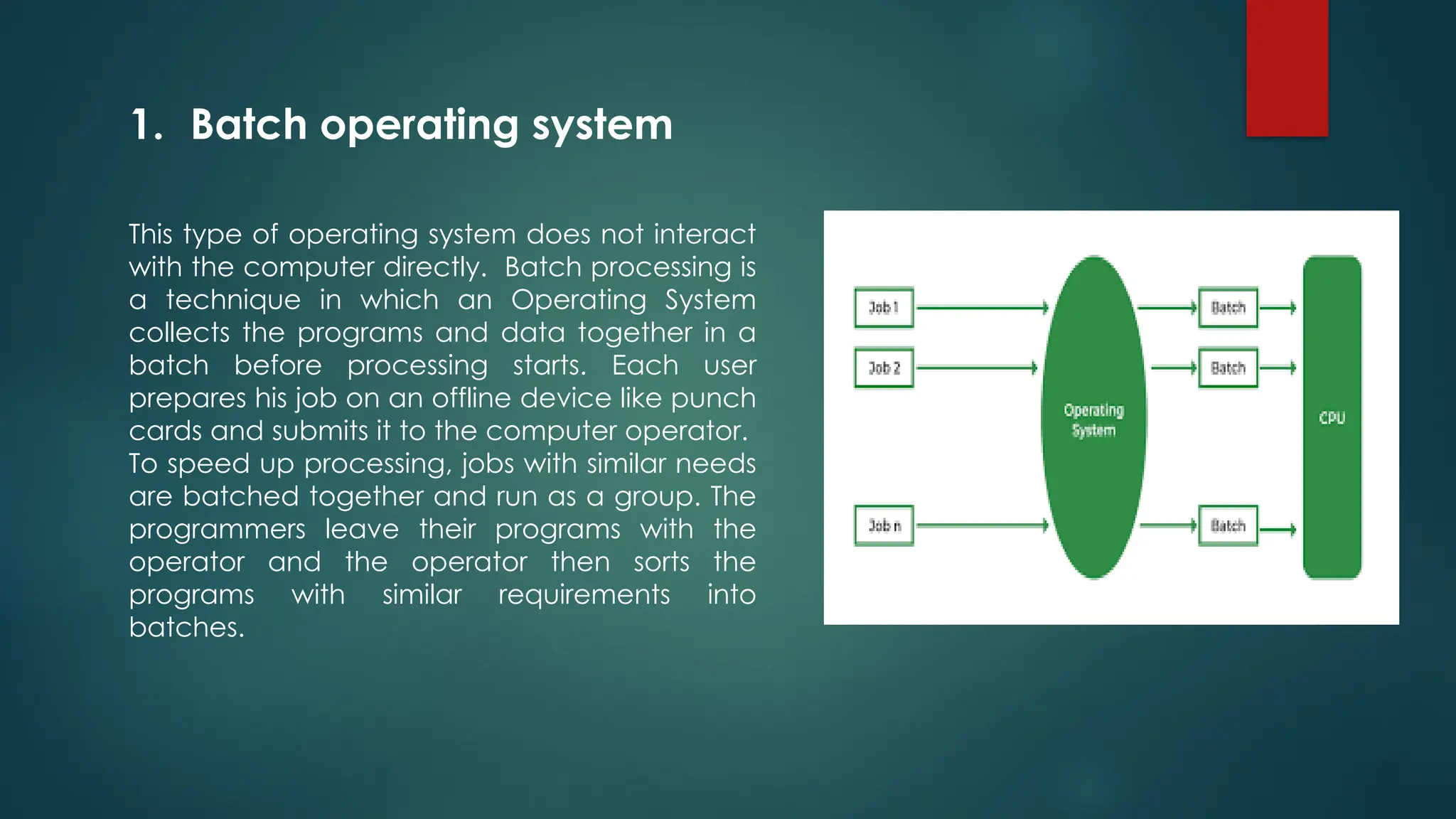
This type ofoperating system does not interact
with the computer directly. Batch processing is
a technique in which an Operating System
collects the programs and data together in a
batch before processing starts. Each user
prepares his job on an offline device like punch
cards and submits it to the computer operator.
To speed up processing, jobs with similar needs
are batched together and run as a group. The
programmers leave their programs with the
operator and the operator then sorts the
programs with similar requirements into
batches.
1. Batch operating system
3.
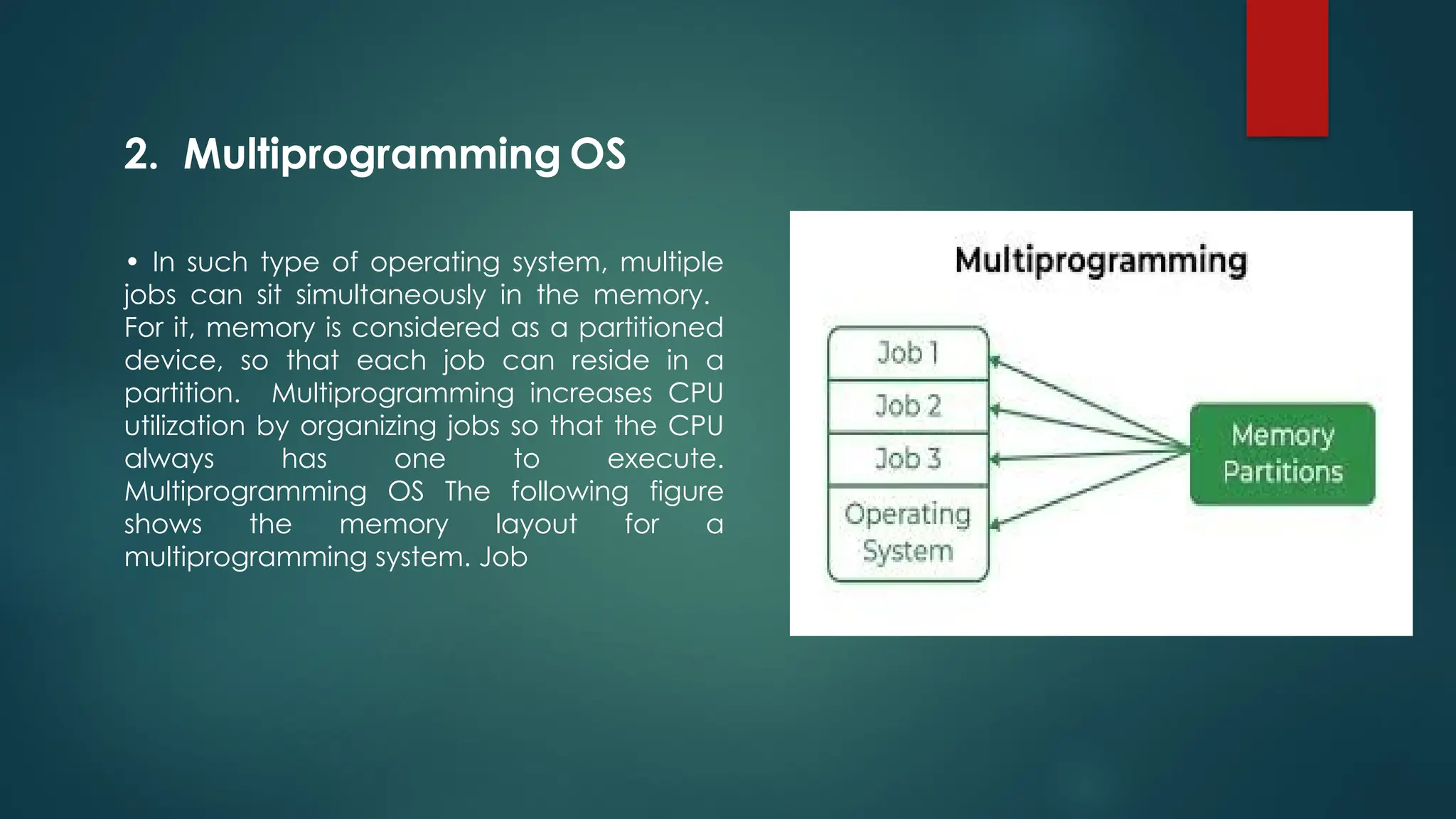
• In suchtype of operating system, multiple
jobs can sit simultaneously in the memory.
For it, memory is considered as a partitioned
device, so that each job can reside in a
partition. Multiprogramming increases CPU
utilization by organizing jobs so that the CPU
always has one to execute.
Multiprogramming OS The following figure
shows the memory layout for a
multiprogramming system. Job
2. Multiprogramming OS
4.
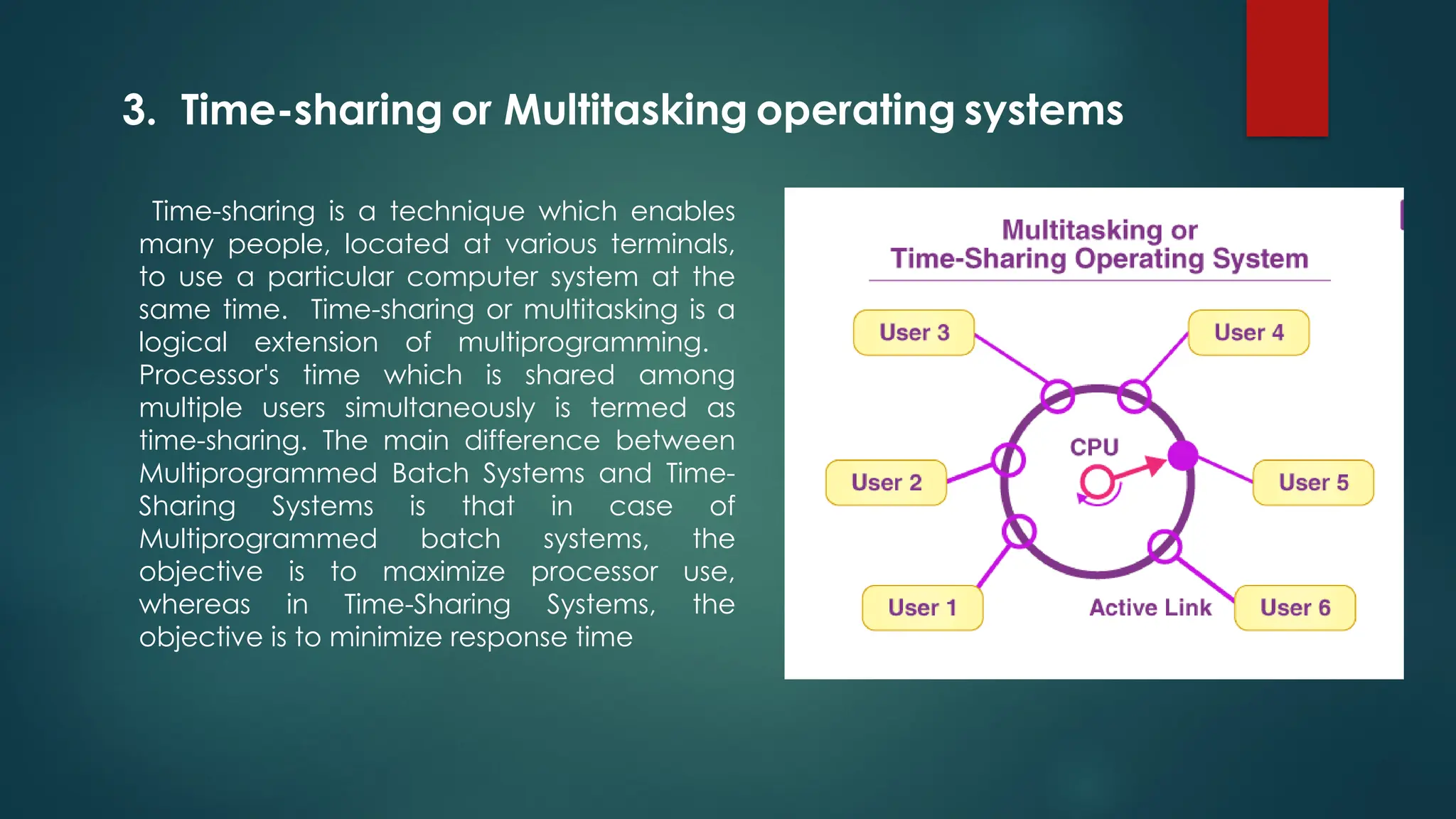
Time-sharing is atechnique which enables
many people, located at various terminals,
to use a particular computer system at the
same time. Time-sharing or multitasking is a
logical extension of multiprogramming.
Processor's time which is shared among
multiple users simultaneously is termed as
time-sharing. The main difference between
Multiprogrammed Batch Systems and Time-
Sharing Systems is that in case of
Multiprogrammed batch systems, the
objective is to maximize processor use,
whereas in Time-Sharing Systems, the
objective is to minimize response time
3. Time-sharing or Multitasking operating systems
5.
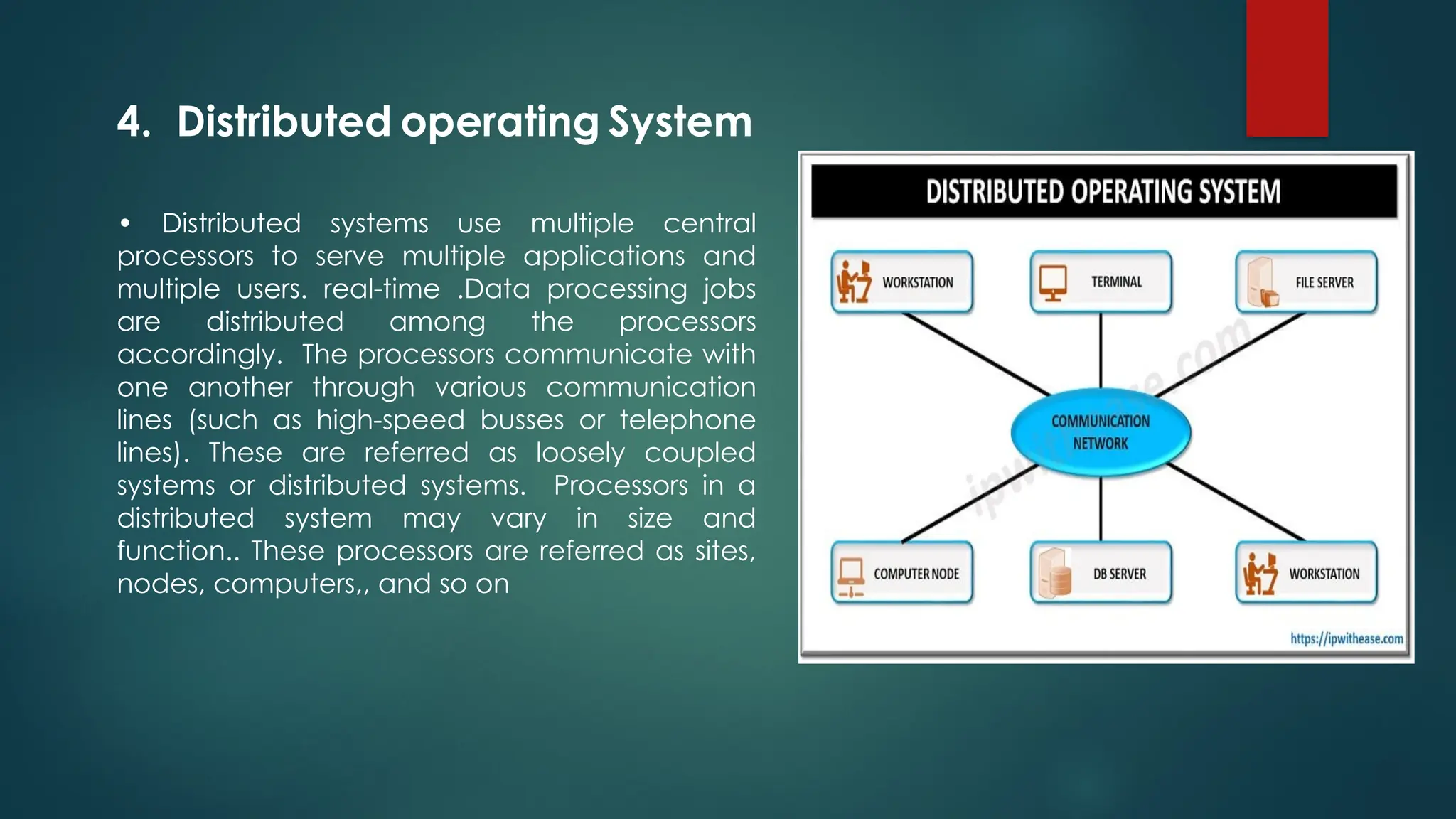
• Distributed systemsuse multiple central
processors to serve multiple applications and
multiple users. real-time .Data processing jobs
are distributed among the processors
accordingly. The processors communicate with
one another through various communication
lines (such as high-speed busses or telephone
lines). These are referred as loosely coupled
systems or distributed systems. Processors in a
distributed system may vary in size and
function.. These processors are referred as sites,
nodes, computers,, and so on
4. Distributed operating System
6.
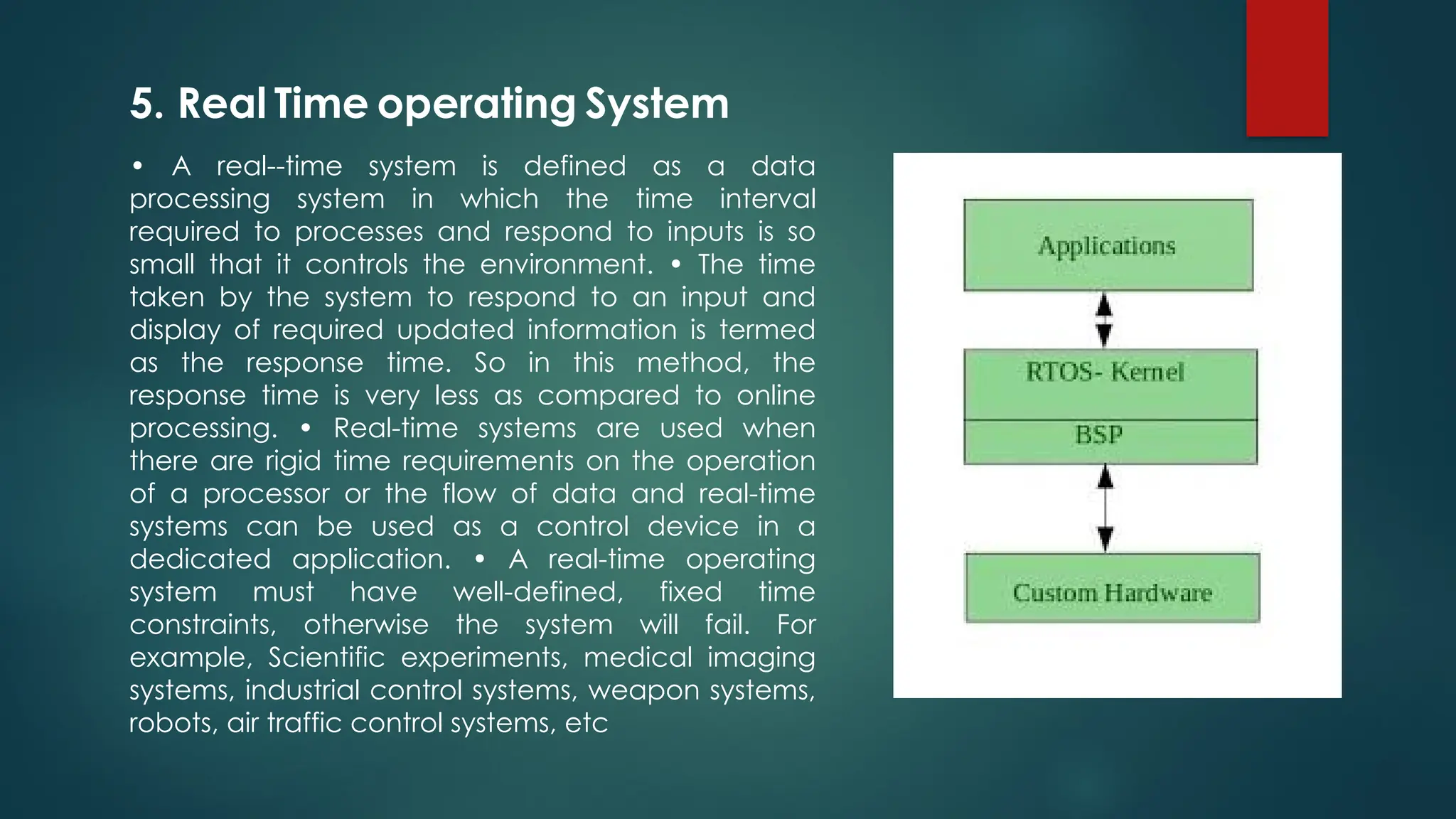
• A real--timesystem is defined as a data
processing system in which the time interval
required to processes and respond to inputs is so
small that it controls the environment. • The time
taken by the system to respond to an input and
display of required updated information is termed
as the response time. So in this method, the
response time is very less as compared to online
processing. • Real-time systems are used when
there are rigid time requirements on the operation
of a processor or the flow of data and real-time
systems can be used as a control device in a
dedicated application. • A real-time operating
system must have well-defined, fixed time
constraints, otherwise the system will fail. For
example, Scientific experiments, medical imaging
systems, industrial control systems, weapon systems,
robots, air traffic control systems, etc
5. Real Time operating System
7.
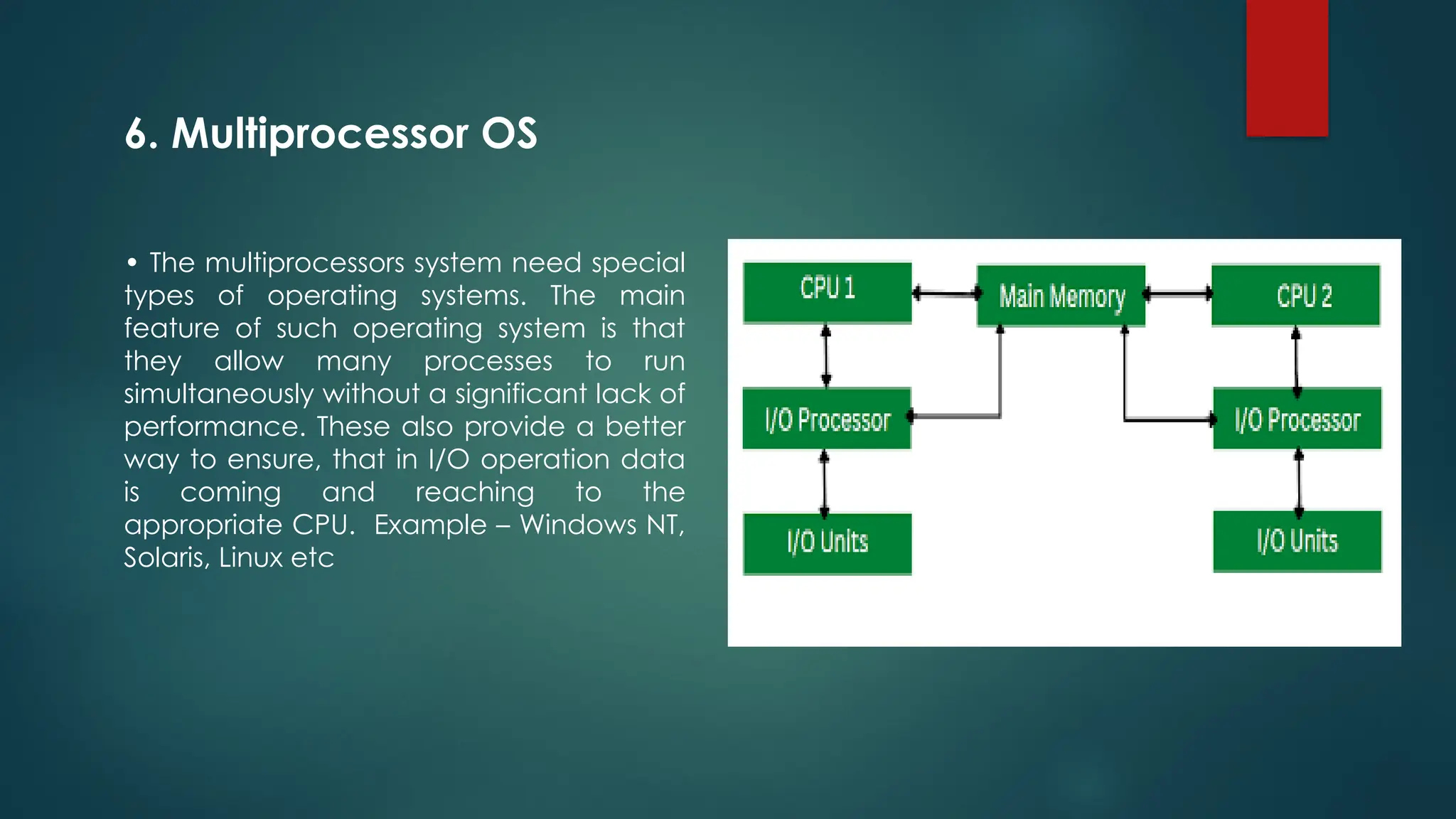
• The multiprocessorssystem need special
types of operating systems. The main
feature of such operating system is that
they allow many processes to run
simultaneously without a significant lack of
performance. These also provide a better
way to ensure, that in I/O operation data
is coming and reaching to the
appropriate CPU. Example – Windows NT,
Solaris, Linux etc
6. Multiprocessor OS