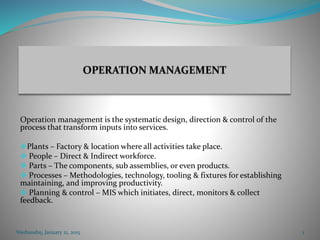
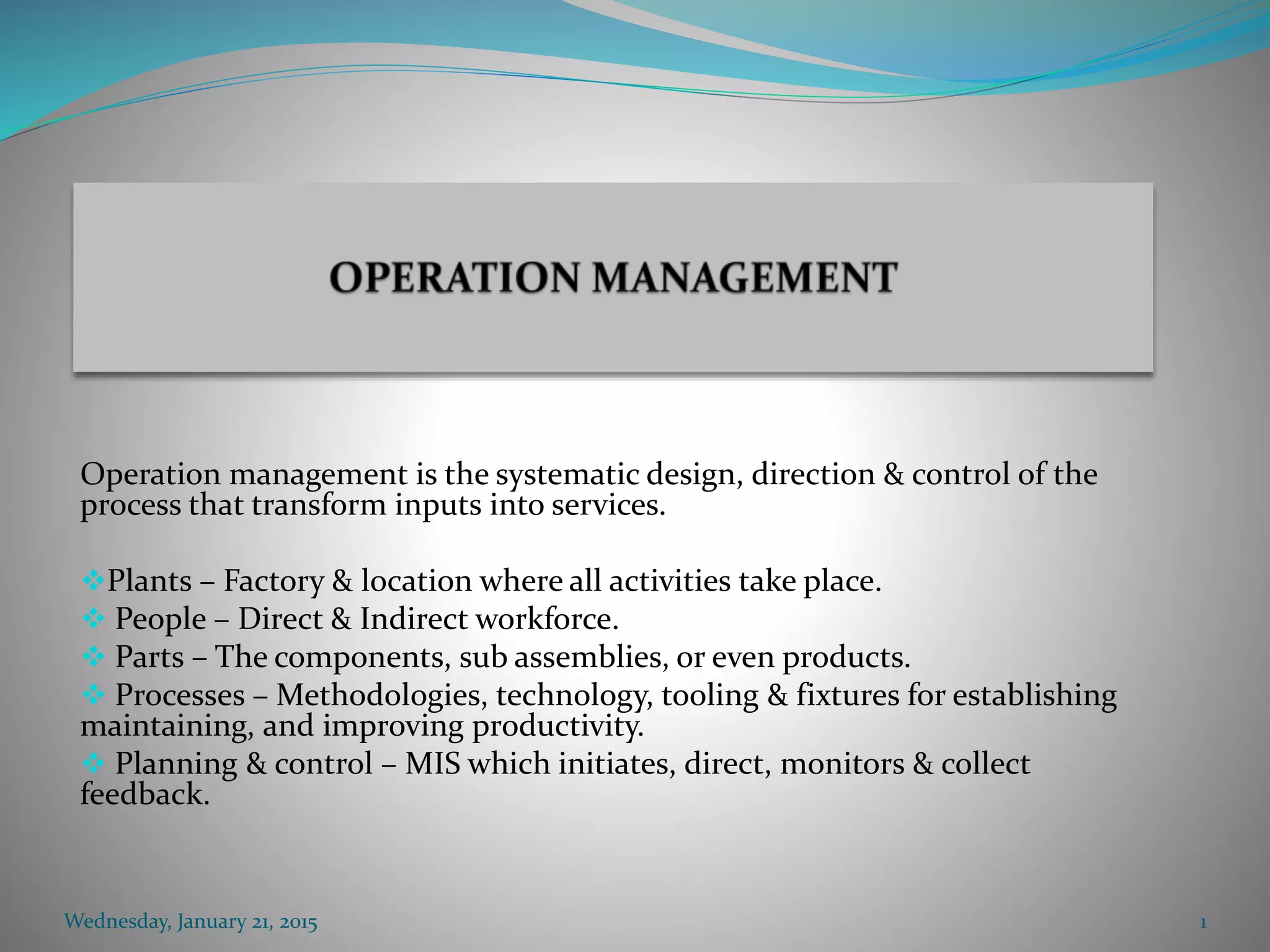
Operation management is the systematic design, direction & control of the
process that transform inputs into services.
Plants – Factory & location where all activities take place.
 People – Direct & Indirect workforce.
 Parts – The components, sub assemblies, or even products.
 Processes – Methodologies, technology, tooling & fixtures for establishing
maintaining, and improving productivity.
 Planning & control – MIS which initiates, direct, monitors & collect
feedback.
Wednesday, January 21, 2015 1
Wednesday, January 21, 2015 2
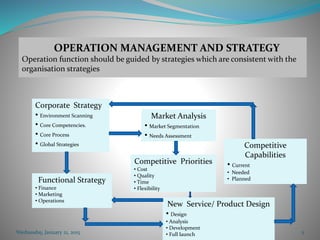
Corporate Strategy
• Environment Scanning
• Core Competencies.
• Core Process
• Global Strategies
Functional Strategy
• Finance
• Marketing
• Operations
Market Analysis
• Market Segmentation
• Needs Assessment
Competitive Priorities
• Cost
• Quality
• Time
• Flexibility
Competitive
Capabilities
• Current
• Needed
• Planned
New Service/ Product Design
• Design
• Analysis
• Development
• Full launch
OPERATION MANAGEMENT AND STRATEGY
Operation function should be guided by strategies which are consistent with the
organisation strategies
Wednesday, January 21, 2015 3
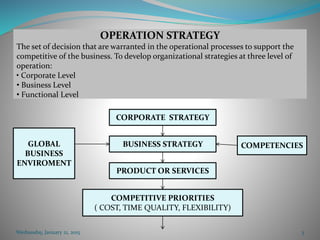
OPERATION STRATEGY
The set of decision that are warranted in the operational processes to support the
competitive of the business. To develop organizational strategies at three level of
operation:
• Corporate Level
• Business Level
• Functional Level
CORPORATE STRATEGY
BUSINESS STRATEGY
PRODUCT OR SERVICES
COMPETITIVE PRIORITIES
( COST, TIME QUALITY, FLEXIBILITY)
GLOBAL
BUSINESS
ENVIROMENT
COMPETENCIES
Wednesday, January 21, 2015 4
OPERATION STRATEGY
 Production Systems ( Make to stock/ Order, Assemble to order)
 Product Plans
 Outsourcing
 Process Decisions
 Quality Decisions
 Capacity Decisions ( Facility planning, location, layout)
 Operating Decisions.
 Technology Decisions.
 Resource Planning.
LINKAGE BETWEEN CORPORATE, BUSINESS &
OPERATION STRATEGY
Wednesday, January 21, 2015 5
The six elements of operation strategy are:
1) Designing of the production system – The product design has two varieties -
 Customised product design – The design is customised when the volume is low
and special features are inbuilt. Eg: Turbines, boiler, air compressors etc.
 Standard product design – The designer adopt a universal design so that the
product will have wide acceptance across the customer. Eg: Air conditioners, TV.
There are two types of production systems:
 Product focussed – system is adopted where mass production is using a group
of machines. Eg: Automobiles, computer.
 Process focussed – system is based on a single task like painting, packing, heat.
2) Facilities for the production and services – Production allows the firm to
provide the customer with products of low cost, faster delivery, on-time delivery.
ELEMENTS OR COMPONENTS OF OPERATION
STRATEGY
Wednesday, January 21, 2015 6
3) Product & service design and development –
 Generating the idea.
 Creating the feasibility reports.
 Designing the prototype
 Preparing a production model.
 Evaluating the economies of scale for production.
 Testing the product in the market.
 Obtaining feedback.
 Creating the final design and starting the production.
Product life cycle introduced in the market has its own life cycle.
1) Introduction stage.
2) Growth stage.
3) Maturity stage.
4) Decline stage.
ELEMENTS OR COMPONENTS OF OPERATION
STRATEGY
QUALITY
FLEXIBILITY
OPERATION
STRATEGY
TIME
Wednesday, January 21, 2015 7
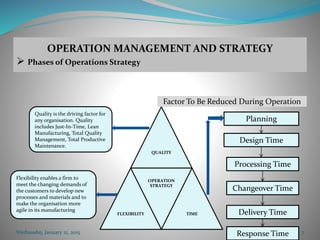
OPERATION MANAGEMENT AND STRATEGY
 Phases of Operations Strategy
Quality is the driving factor for
any organisation. Quality
includes Just-In-Time, Lean
Manufacturing, Total Quality
Management, Total Productive
Maintenance.
Flexibility enables a firm to
meet the changing demands of
the customers to develop new
processes and materials and to
make the organisation more
agile in its manufacturing
Planning
Design Time
Processing Time
Changeover Time
Delivery Time
Response Time
Factor To Be Reduced During Operation
Wednesday, January 21, 2015 8
OPERATION MANAGEMENT AND STRATEGY
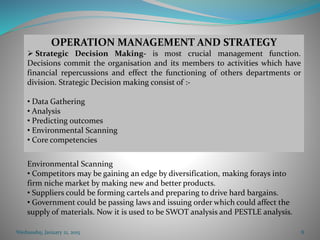
 Strategic Decision Making- is most crucial management function.
Decisions commit the organisation and its members to activities which have
financial repercussions and effect the functioning of others departments or
division. Strategic Decision making consist of :-
• Data Gathering
• Analysis
• Predicting outcomes
• Environmental Scanning
• Core competencies
Environmental Scanning
• Competitors may be gaining an edge by diversification, making forays into
firm niche market by making new and better products.
• Suppliers could be forming cartels and preparing to drive hard bargains.
• Government could be passing laws and issuing order which could affect the
supply of materials. Now it is used to be SWOT analysis and PESTLE analysis.
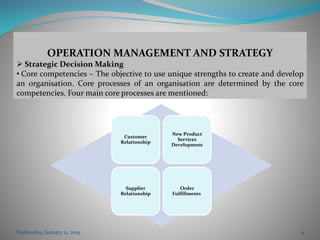
Customer
Relationship
New Product
Services
Development
Supplier
Relationship
Order
Fulfillments.
Wednesday, January 21, 2015 9
OPERATION MANAGEMENT AND STRATEGY
 Strategic Decision Making
• Core competencies – The objective to use unique strengths to create and develop
an organisation. Core processes of an organisation are determined by the core
competencies. Four main core processes are mentioned:
Wednesday, January 21, 2015 10
OPERATION MANAGEMENT AND STRATEGY
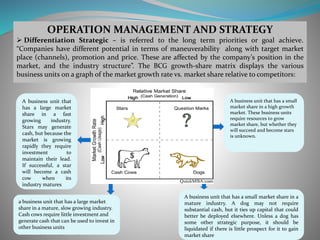
 Differentiation Strategic – is referred to the long term priorities or goal achieve.
“Companies have different potential in terms of maneuverability along with target market
place (channels), promotion and price. These are affected by the company’s position in the
market, and the industry structure”. The BCG growth-share matrix displays the various
business units on a graph of the market growth rate vs. market share relative to competitors:
A business unit that
has a large market
share in a fast
growing industry.
Stars may generate
cash, but because the
market is growing
rapidly they require
investment to
maintain their lead.
If successful, a star
will become a cash
cow when its
industry matures
a business unit that has a large market
share in a mature, slow growing industry.
Cash cows require little investment and
generate cash that can be used to invest in
other business units
A business unit that has a small
market share in a high growth
market. These business units
require resources to grow
market share, but whether they
will succeed and become stars
is unknown.
A business unit that has a small market share in a
mature industry. A dog may not require
substantial cash, but it ties up capital that could
better be deployed elsewhere. Unless a dog has
some other strategic purpose, it should be
liquidated if there is little prospect for it to gain
market share.
Wednesday, January 21, 2015 11
INDUSTRY BEST PRACTICES
Pragmatic Benchmarking – is a method of measuring a company’s processes,
methods and procedures in a way that all functions in great details.
Benchmarking - A process of comparison with a superior performer anywhere in
the world to improve quality . The following are types of benchmarking:-
 Process benchmarking – Business process.
 Financial benchmarking.
Performance benchmarking.
 Product benchmarking.
 Strategic benchmarking.
 Functional benchmarking.
Benchmarking is classified into two groups :
 Internal Benchmarking – refers to comparison within the organisation or
industry.
 External Benchmarking – refers to comparison with outsiders.
Wednesday, January 21, 2015 12
INDUSTRY BEST PRACTICES
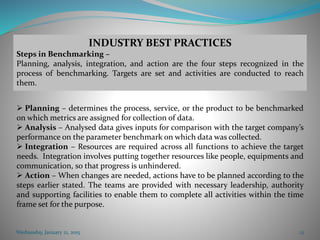
Steps in Benchmarking –
Planning, analysis, integration, and action are the four steps recognized in the
process of benchmarking. Targets are set and activities are conducted to reach
them.
 Planning – determines the process, service, or the product to be benchmarked
on which metrics are assigned for collection of data.
 Analysis – Analysed data gives inputs for comparison with the target company’s
performance on the parameter benchmark on which data was collected.
 Integration – Resources are required across all functions to achieve the target
needs. Integration involves putting together resources like people, equipments and
communication, so that progress is unhindered.
 Action – When changes are needed, actions have to be planned according to the
steps earlier stated. The teams are provided with necessary leadership, authority
and supporting facilities to enable them to complete all activities within the time
frame set for the purpose.
Wednesday, January 21, 2015 13
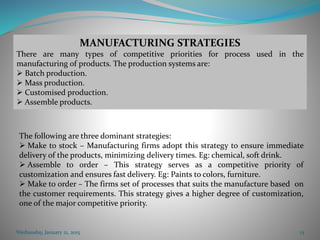
MANUFACTURING STRATEGIES
There are many types of competitive priorities for process used in the
manufacturing of products. The production systems are:
 Batch production.
 Mass production.
 Customised production.
 Assemble products.
The following are three dominant strategies:
 Make to stock – Manufacturing firms adopt this strategy to ensure immediate
delivery of the products, minimizing delivery times. Eg: chemical, soft drink.
 Assemble to order – This strategy serves as a competitive priority of
customization and ensures fast delivery. Eg: Paints to colors, furniture.
 Make to order – The firms set of processes that suits the manufacture based on
the customer requirements. This strategy gives a higher degree of customization,
one of the major competitive priority.

OPERATION STRATEGY

  • 1.
    Operation management isthe systematic design, direction & control of the process that transform inputs into services. Plants – Factory & location where all activities take place.  People – Direct & Indirect workforce.  Parts – The components, sub assemblies, or even products.  Processes – Methodologies, technology, tooling & fixtures for establishing maintaining, and improving productivity.  Planning & control – MIS which initiates, direct, monitors & collect feedback. Wednesday, January 21, 2015 1
  • 2.
    Wednesday, January 21,2015 2 Corporate Strategy • Environment Scanning • Core Competencies. • Core Process • Global Strategies Functional Strategy • Finance • Marketing • Operations Market Analysis • Market Segmentation • Needs Assessment Competitive Priorities • Cost • Quality • Time • Flexibility Competitive Capabilities • Current • Needed • Planned New Service/ Product Design • Design • Analysis • Development • Full launch OPERATION MANAGEMENT AND STRATEGY Operation function should be guided by strategies which are consistent with the organisation strategies
  • 3.
    Wednesday, January 21,2015 3 OPERATION STRATEGY The set of decision that are warranted in the operational processes to support the competitive of the business. To develop organizational strategies at three level of operation: • Corporate Level • Business Level • Functional Level CORPORATE STRATEGY BUSINESS STRATEGY PRODUCT OR SERVICES COMPETITIVE PRIORITIES ( COST, TIME QUALITY, FLEXIBILITY) GLOBAL BUSINESS ENVIROMENT COMPETENCIES
  • 4.
    Wednesday, January 21,2015 4 OPERATION STRATEGY  Production Systems ( Make to stock/ Order, Assemble to order)  Product Plans  Outsourcing  Process Decisions  Quality Decisions  Capacity Decisions ( Facility planning, location, layout)  Operating Decisions.  Technology Decisions.  Resource Planning. LINKAGE BETWEEN CORPORATE, BUSINESS & OPERATION STRATEGY
  • 5.
    Wednesday, January 21,2015 5 The six elements of operation strategy are: 1) Designing of the production system – The product design has two varieties -  Customised product design – The design is customised when the volume is low and special features are inbuilt. Eg: Turbines, boiler, air compressors etc.  Standard product design – The designer adopt a universal design so that the product will have wide acceptance across the customer. Eg: Air conditioners, TV. There are two types of production systems:  Product focussed – system is adopted where mass production is using a group of machines. Eg: Automobiles, computer.  Process focussed – system is based on a single task like painting, packing, heat. 2) Facilities for the production and services – Production allows the firm to provide the customer with products of low cost, faster delivery, on-time delivery. ELEMENTS OR COMPONENTS OF OPERATION STRATEGY
  • 6.
    Wednesday, January 21,2015 6 3) Product & service design and development –  Generating the idea.  Creating the feasibility reports.  Designing the prototype  Preparing a production model.  Evaluating the economies of scale for production.  Testing the product in the market.  Obtaining feedback.  Creating the final design and starting the production. Product life cycle introduced in the market has its own life cycle. 1) Introduction stage. 2) Growth stage. 3) Maturity stage. 4) Decline stage. ELEMENTS OR COMPONENTS OF OPERATION STRATEGY
  • 7.
    QUALITY FLEXIBILITY OPERATION STRATEGY TIME Wednesday, January 21,2015 7 OPERATION MANAGEMENT AND STRATEGY  Phases of Operations Strategy Quality is the driving factor for any organisation. Quality includes Just-In-Time, Lean Manufacturing, Total Quality Management, Total Productive Maintenance. Flexibility enables a firm to meet the changing demands of the customers to develop new processes and materials and to make the organisation more agile in its manufacturing Planning Design Time Processing Time Changeover Time Delivery Time Response Time Factor To Be Reduced During Operation
  • 8.
    Wednesday, January 21,2015 8 OPERATION MANAGEMENT AND STRATEGY  Strategic Decision Making- is most crucial management function. Decisions commit the organisation and its members to activities which have financial repercussions and effect the functioning of others departments or division. Strategic Decision making consist of :- • Data Gathering • Analysis • Predicting outcomes • Environmental Scanning • Core competencies Environmental Scanning • Competitors may be gaining an edge by diversification, making forays into firm niche market by making new and better products. • Suppliers could be forming cartels and preparing to drive hard bargains. • Government could be passing laws and issuing order which could affect the supply of materials. Now it is used to be SWOT analysis and PESTLE analysis.
  • 9.
    Customer Relationship New Product Services Development Supplier Relationship Order Fulfillments. Wednesday, January21, 2015 9 OPERATION MANAGEMENT AND STRATEGY  Strategic Decision Making • Core competencies – The objective to use unique strengths to create and develop an organisation. Core processes of an organisation are determined by the core competencies. Four main core processes are mentioned:
  • 10.
    Wednesday, January 21,2015 10 OPERATION MANAGEMENT AND STRATEGY  Differentiation Strategic – is referred to the long term priorities or goal achieve. “Companies have different potential in terms of maneuverability along with target market place (channels), promotion and price. These are affected by the company’s position in the market, and the industry structure”. The BCG growth-share matrix displays the various business units on a graph of the market growth rate vs. market share relative to competitors: A business unit that has a large market share in a fast growing industry. Stars may generate cash, but because the market is growing rapidly they require investment to maintain their lead. If successful, a star will become a cash cow when its industry matures a business unit that has a large market share in a mature, slow growing industry. Cash cows require little investment and generate cash that can be used to invest in other business units A business unit that has a small market share in a high growth market. These business units require resources to grow market share, but whether they will succeed and become stars is unknown. A business unit that has a small market share in a mature industry. A dog may not require substantial cash, but it ties up capital that could better be deployed elsewhere. Unless a dog has some other strategic purpose, it should be liquidated if there is little prospect for it to gain market share.
  • 11.
    Wednesday, January 21,2015 11 INDUSTRY BEST PRACTICES Pragmatic Benchmarking – is a method of measuring a company’s processes, methods and procedures in a way that all functions in great details. Benchmarking - A process of comparison with a superior performer anywhere in the world to improve quality . The following are types of benchmarking:-  Process benchmarking – Business process.  Financial benchmarking. Performance benchmarking.  Product benchmarking.  Strategic benchmarking.  Functional benchmarking. Benchmarking is classified into two groups :  Internal Benchmarking – refers to comparison within the organisation or industry.  External Benchmarking – refers to comparison with outsiders.
  • 12.
    Wednesday, January 21,2015 12 INDUSTRY BEST PRACTICES Steps in Benchmarking – Planning, analysis, integration, and action are the four steps recognized in the process of benchmarking. Targets are set and activities are conducted to reach them.  Planning – determines the process, service, or the product to be benchmarked on which metrics are assigned for collection of data.  Analysis – Analysed data gives inputs for comparison with the target company’s performance on the parameter benchmark on which data was collected.  Integration – Resources are required across all functions to achieve the target needs. Integration involves putting together resources like people, equipments and communication, so that progress is unhindered.  Action – When changes are needed, actions have to be planned according to the steps earlier stated. The teams are provided with necessary leadership, authority and supporting facilities to enable them to complete all activities within the time frame set for the purpose.
  • 13.
    Wednesday, January 21,2015 13 MANUFACTURING STRATEGIES There are many types of competitive priorities for process used in the manufacturing of products. The production systems are:  Batch production.  Mass production.  Customised production.  Assemble products. The following are three dominant strategies:  Make to stock – Manufacturing firms adopt this strategy to ensure immediate delivery of the products, minimizing delivery times. Eg: chemical, soft drink.  Assemble to order – This strategy serves as a competitive priority of customization and ensures fast delivery. Eg: Paints to colors, furniture.  Make to order – The firms set of processes that suits the manufacture based on the customer requirements. This strategy gives a higher degree of customization, one of the major competitive priority.

Editor's Notes

  • #4 Phases of Operation Strategy
  • #8 Phases of Operation Strategy