PRESENTED BY
PRESENTED BY
AKSHAY MAHAVEER PATIL
(
(2167571293528)
2167571293528)
AY-2022-23 SEM-VI
AY-2022-23 SEM-VI
YASHODA TECHNICAL CAMPUS
(FACULTY OF ENGINEERING)
ON
ON
OPERATION & MAINTENANCE OF DISTRIBUTION
TRANSFORMERS, PREVENTION OF FAILURES & REPAIRS
Power is transmitted at higher voltages to load centers
stepping up the voltage of generation.
The transmitted power cannot be used directly at load
centers, as it is at a higher voltage.
Most of the consumer services are at LT level i.e. 400 or 415 V
(phase to phase) or 230 or 240 V (phase to neutral).
Hence there is a need to step down the voltage in different
stages, before it reaches the consumers.
This stepping up and stepping down of voltages keeping the
transmitted power the same, except for little losses is carried
out by an equipment called transformer.
WHAT IS A TRANSFORMER?
It is an equipment which converts supply at one AC
voltage rating into supply at another voltage rating,
without changing the total apparent power in KVA
and without changing the frequency of the system.
Michael Faraday is the father of transformer and his
law of magnetic induction led to the discovery of
transformer.
The law says : "EMF is induced in a closed conducting
circuit when the magnetic flux linked with that circuit
changes with time and EMF is proportional to the rate
of change of the magnetic flux.
BASIC PRINCIPLE
Transformer comprises a closed magnetic circuit called core.
Two or more windings are placed on the core as per design
criteria.
The operating frequency in our country is 50 C/S. Core
provides a high permeability path to the magnetic circuit
besides supporting the winding.
When 50 C/S supply is given to a winding called primary
winding, it sets up an alternating magnetic flux of 50 C/S in
the core.
As the core provides high permeability path and as the
second winding is provided on the same core, the magnetic
flux linked with the secondary winding also alternates at the
same frequency of 50 C/S.
This alternating flux there, sets up an EMF in the
secondary winding as per the Faraday's law.
The EMF induced in the secondary winding is at the
same frequency as that of magnetic flux and primary
current.
However, its direction is opposite to the applied voltage.
If a load is connected to the secondary winding, the EMF
drives a current.
The change in the voltage is accomplished by the
difference in the number of turns in the primary and
secondary windings.
The induced EMF has the same voltage per turn as the
primary winding (when secondary is without any
electrical load).
If N1 and N2 are number of turns in primary and secondary
winding, then when secondary is not connected to any
electrical load,
N1/ N2 = V1/V2 (V1 and V2 are voltages in primary and
secondary winding .
When corresponding currents are I1 and I2, as transferred
apparent power is the same,
KVA = I1 V1 = I2 V2
V1/ V2 = I2/ I1 = N1/ N2
Under ideal conditions, primary ampere turns are equal to
the secondary ampere turns.
I1N1 = I2N2
The transformer can be used only in Alternate Current
(AC) system but not in Direct Current (DC) system.
When DC supply of the same voltage is applied to the
transformer, a very high current will pass in it, as in the
DC system there won't be reactance and the resistance is
too small.
Unless there is a protective system, the transformer will
fail in a quick time due to the over current.
ADVANTAGES OF TRANSFORMER
a) It is a stationary equipment without any internal rotating parts.
Hence O & M cost would be less.
(b) The stationary nature facilitates high voltage insulation and
thus stepping up and stepping down of voltages.
(c) Its operational efficiency is very high ( up to 95% for
distribution and 99% for EHT transformers)
(d) Besides facilitating power supply at different voltages of
utilization, it can be used in metering and protection systems of
the network. It can also be used for earthing of the neutral of
a power transformer.
(e) Transformer is the most important and relatively a more
costlier equipment in distribution or sub- transmission.
(f) It is virtually a work horse.
TYPES OF TRANSFORMERS
Main classification based on application :
• Power transformer : Transfer of power
• Distribution Transformer : Transfer of power
• Instrument Transformer : Measuring and protection
• Earthing Transformer : Earthing
• Rectifier Transformer : For providing controlled supply
suitable to process
Further classification of Power/Distribution transformer
- By Construction
a)As per core :
1. Core type 2. Shell type
b)As per phases:
1. Single phase 2. Three phase
c)As per number of windings:
1. Single winding
2. Two winding
3. Three winding
d) As per VOLTAGE – LT,HT,EHT,UHT
 LT- up to 650V
 HT- 11kV to 33kV
 EHT- 66kV to 400kV
 UHT- 765kV onwards
e) As per voltage ratio - Step up, Step down
f) As per Insulation - Dry type, Oil immersed, Gas filled
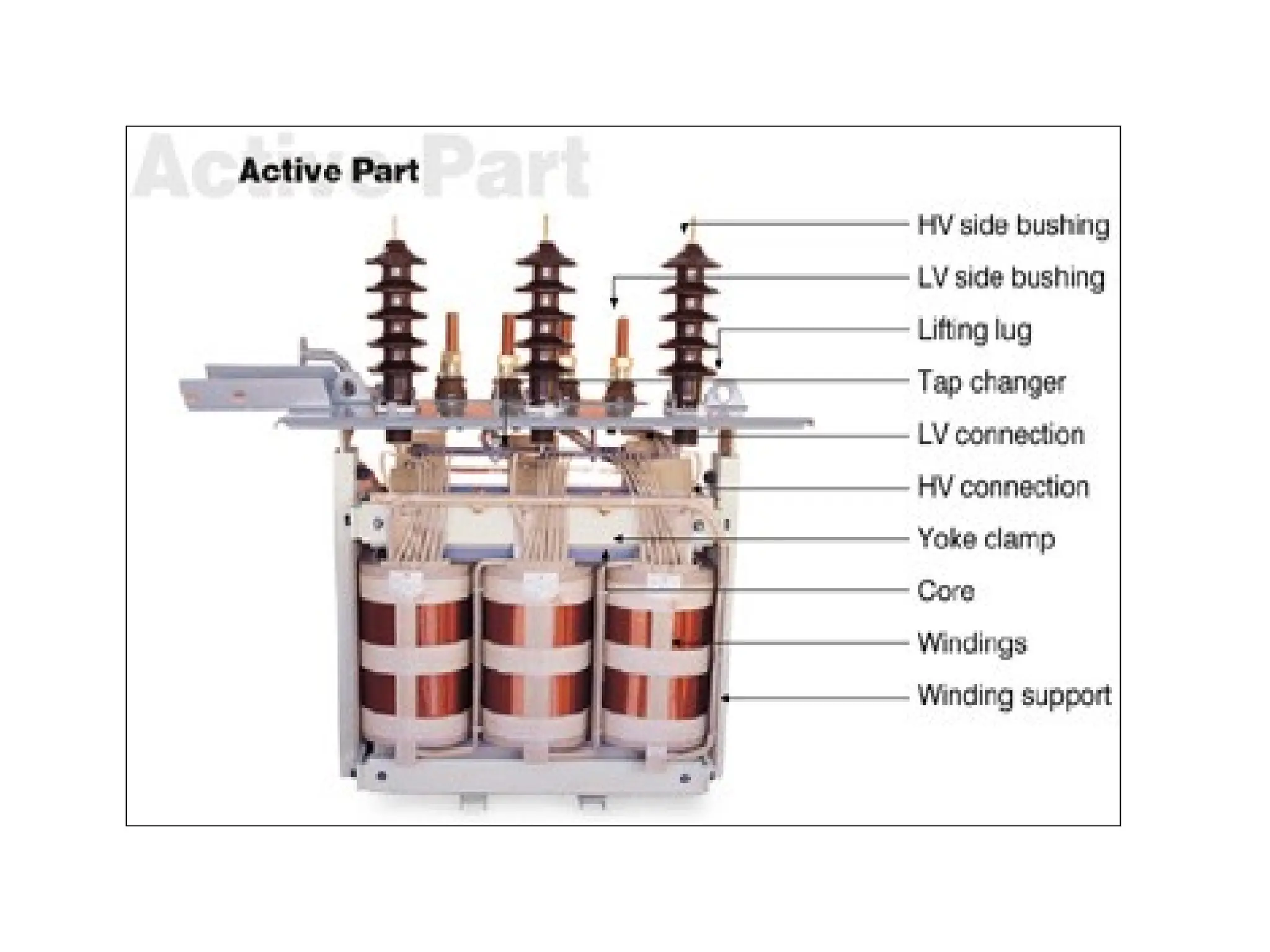
A transformer basically consist of :-
i. A magnetic core forming magnetic circuit
ii.Windings forming electrical circuits and
iii.Insulation, comprising transformer oil and solid
insulation consisting of paper, press board, wood etc.
MAGNETIC CORE
The transformer core is a closed magnetic circuit made up of thin
laminations of special electrical sheet steel (CRGO)
The main magnetic flux passes through the core
The function of the transformer core is to provide a high
permeability path to the magnetic circuit and to support the
transformer windings.
Core laminations are kept very thin (0.27mm)
Laminations are coated with insulation/ varnish (carlite coating)
to reduce Eddy currents and there by eddy current losses.
CRGO electrical steel with silicon content of approximately
3% is used for the core, the magnetic circuit of a transformer.
Ideal shape for a core section is circle since wastage of space
is minimum.
A perfectly circular core involves making each lamination of
different dimensions which is very uneconomical.
Stepped core is made by laminations of varying width and
packet heights and assembled to approximate a circle
CORE TYPE AND SHELL TYPE
CONSTRUCTIONS
There are two types of configurations of the core
1. Core type and 2. Shell type.
The choice of the type of construction depends upon the design
and manufacturing practices.
The core type magnetic circuit has three or five limbs placed
vertically.
Two horizontal yokes, one at the top and the other at the
bottom, close the magnetic circuit.
CORE TYPE
In the core type construction, the windings encircle the core and
in the shell type construction, the core encircles the windings.
 The yoke has two branches and the magnetic flux leaving the
limb branches into two parts while entering the yoke
Core type transformers are easy to manufacture.
The HV and LV winding coils are manufactured independently
and are then inserted on the limbs.
The windings are spiral or helical and are placed concentrically
over the limbs.
SHELL TYPE
In Shell type construction, the LV and HV windings are flat
and Pan-cake type.
Shell type core has minimum cutting of leakage flux.
In shell type transformers, the cross-section of the limb is
twice that of the yoke.
The manufacturing process of shell type core is slower and
costlier than that of a core type.
The core type construction is commonly used in India and
Europe for small and large transformers.
SHELL TYPE
The shell type construction is preferred for small single phase
transformers all over the World.
However, it is preferred in U.S.A. for large transformers also.
In 2-Limb construction, windings are placed on both the
limbs.
In 3-Limb single phase construction, single phase windings
are placed on the central limb only
LOSSES IN THE CORE
a. Hysteresis losses
b. Eddy current losses
The hysteresis loss occurs continuously in the core of a
transformer because the core is subjected to alternating
magnetic flux of 50 Hz.
This loss is reduced by using better grade CRGO steel
sheets.
LOSSES IN THE CORE
When alternating magnetic flux flows through the iron core,
small e.m.f. is induced in the magnetic material itself due to
changes in its own flux linkage.
The e.m.f. induced causes circulating currents in the metal.
Such currents are called Eddy currents, which when flowing
through the metal, cause I2
R loss in metal which appear as
heat.
Such losses are called Eddy Current Losses.
METHODS FOR MINIMIZING EDDY
CURRENT LOSSES
a. Laminated Core using thin sheets
b. Insulation of lamination
c. Use of material of high electrical resistivity
d. Use of Mitred joint
e. Reducing air gap
f. Continuous transposition of winding conductor .
g. By reducing thickness of laminations
 The eddy current loss is proportional to square of thickness
of laminations 't'.
By using amorphous metal of thickness 0.03mm, the core
losses are reduced to 30% from 100% when compared to
using CRGO laminations of 0.27 mm
WINDINGS
Windings are normally cylindrical in shape, since circular
coils offer great resistance to the radial component of
electromagnetic forces.
Windings of different types are used depending on their
rating.
HV and LV coils are placed concentrically with HV winding
on the out side.
A few important parameters governing the design and
operation of a transformer are discussed below:
1.Operating flux density :
 A good CRGO core can have an operating flux density of
1.6 to 1.7 tesla for sub-transmission power
transformers, 1.9 tesla for EHV transformer and 1.4 for
distribution transformer as CRGO has a saturation
density of above 2 Tesla.
 Amorphous metal has saturation density at 1.56
tesla and as such, the distribution transformers
are designed for 1.4 tesla.
 Increase of flux density will improve voltage/
turn, thereby reducing number of turns and
copper losses.
 But it will increase no load losses.
2. Percentage Impedance:
 Impedance of a transformer is the voltage drop on full
load due to the resistance and leakage reactance.
 It is also the % of the primary terminal voltage
required to circulate full load current under short
circuit conditions of the secondary.
 With one winding shorted, voltage at rated frequency
is applied to the other winding raising it to a value
sufficient to circulate rated current.
 With one winding shorted, voltage at rated frequency
is applied to the other winding raising it to a value
sufficient to circulate rated current.
 That voltage is called impedance voltage.
% Impedance = Impedance voltage/Rated voltage x 100
 Distribution Transformer= 4 to 5%
 Power transformer at 132/ 33kV level = 6.5% to 14
 When induced voltages of primary and secondary
windings are in the same direction, the polarity of the
two windings is same. This is called subtractive polarity.
 When the induced emfs are in opposite direction, the
polarity is called additive.
 By different combinations of internal connections of
windings and connection to terminals, different
polarities can be obtained
TRANSFORMER CONNECTIONS
1. Star/star Connection:
Advantages:
a) Voltage of each single phase unit connected to star/star bank has
only 57.7% of the line voltage reducing the voltage stress on each
phase.
 Hence they can be wound relatively for low voltage which gives
1.732 times voltage between phases.
b) This connection permits earthing of neutral to carry unbalanced
currents.
 When earthed solidly it has several benefits.
 During a phase to earth faults in one phase, the voltage in
other two healthy phases (phase to phase) is only 80% of the
phase to phase current
c) Facilitates feeding of single phase loads and three phase loads.
Vector group or connection symbol of a transformer denotes the
method of connection of primary and secondary windings and
the phase angle divergence of secondary with respect to primary
It is indicated in a short form, say ' Dy11'
First letter is a capital letter indicating the method of
connection of primary and second letter, a small letter, indicates
that of secondary
 Number indicates the phase angle difference of secondary
with respect to the primary in terms of clock position
DISADVANTAGES
Provides a path for 3rd harmonic currents
which increases losses, heats up insulation
and they will be interference with
communication
Magnetizing currents of each of three
windings will not be exactly identical making
it impossible to have perfectly balanced
voltages in all three phases.
2. Delta - Star
 Mainly used in distribution transformers
 Facilitates feeding single phase loads as well as 3 phase loads
 Third harmonic currents get suppressed due to passing through delta
winding
DY11
 In this, 'D‘ indicates that transformer primary is Delta
connected and 'y' indicates that the secondary is star
connected.
 Number 11 indicates that secondary is at 11'o Clock
position with reference to the primary
 Vector group is one of the factors to be considered for
operating transformers in parallel.
 For three phase transformers testing of polarity is done by
exciting the windings from a 3 phase supply and taking more
voltage measurements.
 Primary and secondary windings on any one limb have
induced emfs that are in time phase.
 Different combination of internal connections and connection
to terminals produce different phase divergence of secondary
voltage.
TAP CHANGERS
 These are devices for changing the voltage of a transformer.
 This is necessary to maintain bus voltages on the
secondary side at reasonable levels.
 The voltage change is obtained by changing number of
turns in the primary and secondary windings.
 Two types of tap changers are available:
1. Off Circuit Tap Changer :
 This is cheaper.
 Tap changing is effected when the transformer is off
 Off circuit tap changers are used where tap changing is done
once in a way as in the case of a Distribution transformer and
in some cases for Generator Transformers.
 However, after each tap change, the transformer has to be
tested with suitable megger for proper continuity at the new
tap.
 Operating off load tap changer when transformer is in
service will lead to extensive damage.
 However an electro magnetic latch switch is provided to
prevent inadvertent operation.
2. On load tap changer :
 Here tap changing is done while transformer is in service
without interrupting loads, as in the case of a power
transformer.
 On load tap changer normally consists of transition
resistors which bridge the circuit between tapping section
during the tap changer operation.
COOLING ARRANGEMENTS
Oil serves two purpose :
(1) Insulation and (2) Cooling of winding.
 Controlling the temperature inside the transformer is
necessary to ensure longer life due to less thermal
degradation of the insulation.
 The heat generated in the transformer is transmitted to
atmosphere through oil.
Different types of cooling are available.
ONAN Type :
 Oil Natural And Air Natural.
 Heat is transferred from windings and core to the oil.
 The hot oil is circulated in radiators by natural means letting off the
heat to atmosphere
Oil Preservation System :
 Oil readily absorbs moisture.
 Presence of moisture reduces the dielectric strength of oil.
 The moisture entry can be (a) through oil coming into
contact with air (b) Leakages past gasket or and (c)
formation inside the transformer as apart of insulation
failure due to high temperature.
 Different methods are available to reduce contamination of
oil with moisture.
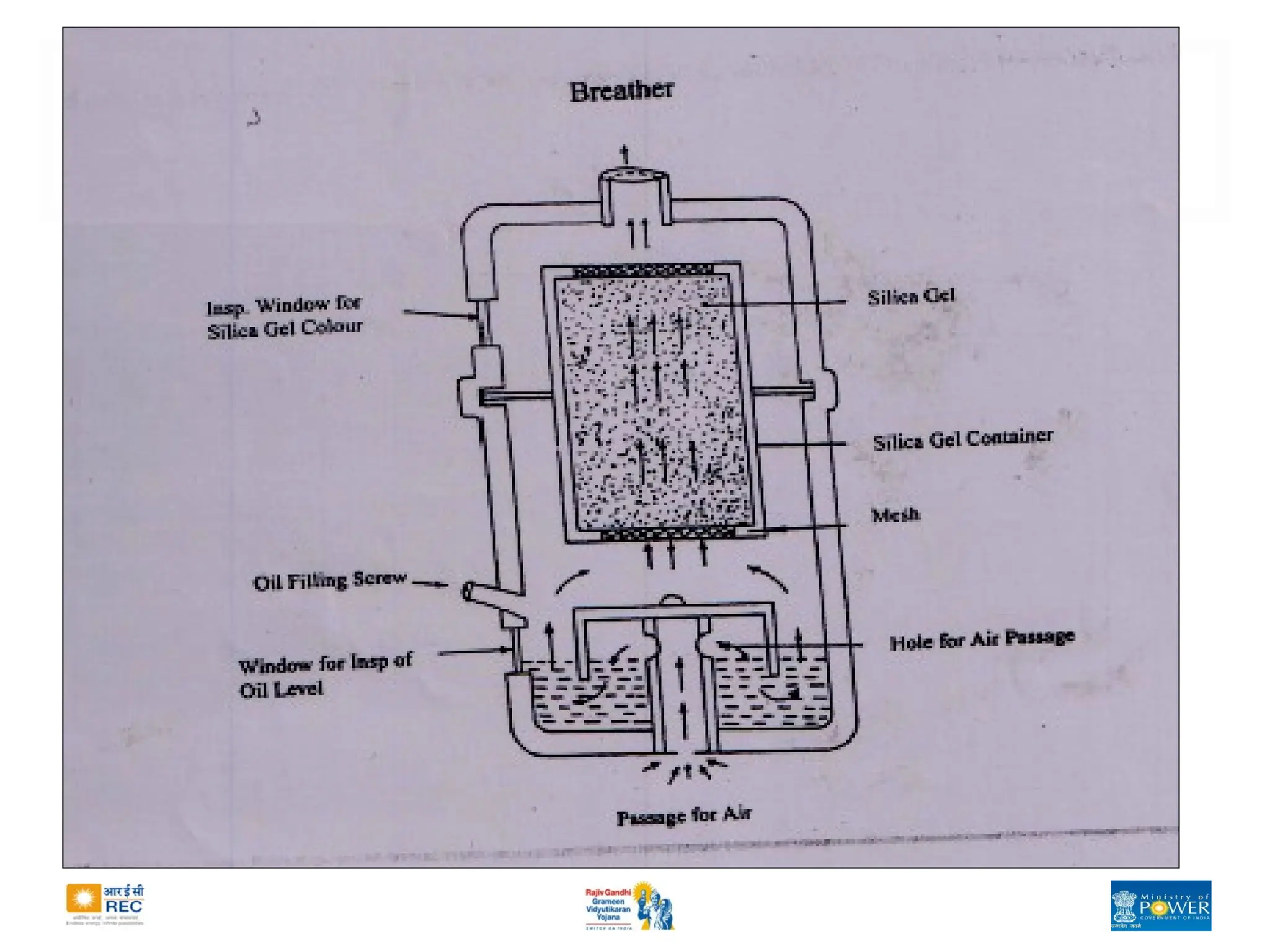
Silicagel breather :
 It is most commonly used and economical method of
limiting moisture content in air, so that oil in the
transformer comes into contact with fairly dry air.
 Silica gel breather is connected to the conservator tank.
 A silicagel breather consists of a cartridge packed with
silicagel desiccants and a small cup containing oil.
 Air is drawn into the conservator through oil cup and
breather where most of the moisture is absorbed.
Silicagel breather :
 Silicagel requires frequent reactivation to improve its
efficiency of absorption.
 A well maintained breather will dry the air down to dew
point below - 400C.
 Oil level shall be maintained in the cup to lessen air
ingress
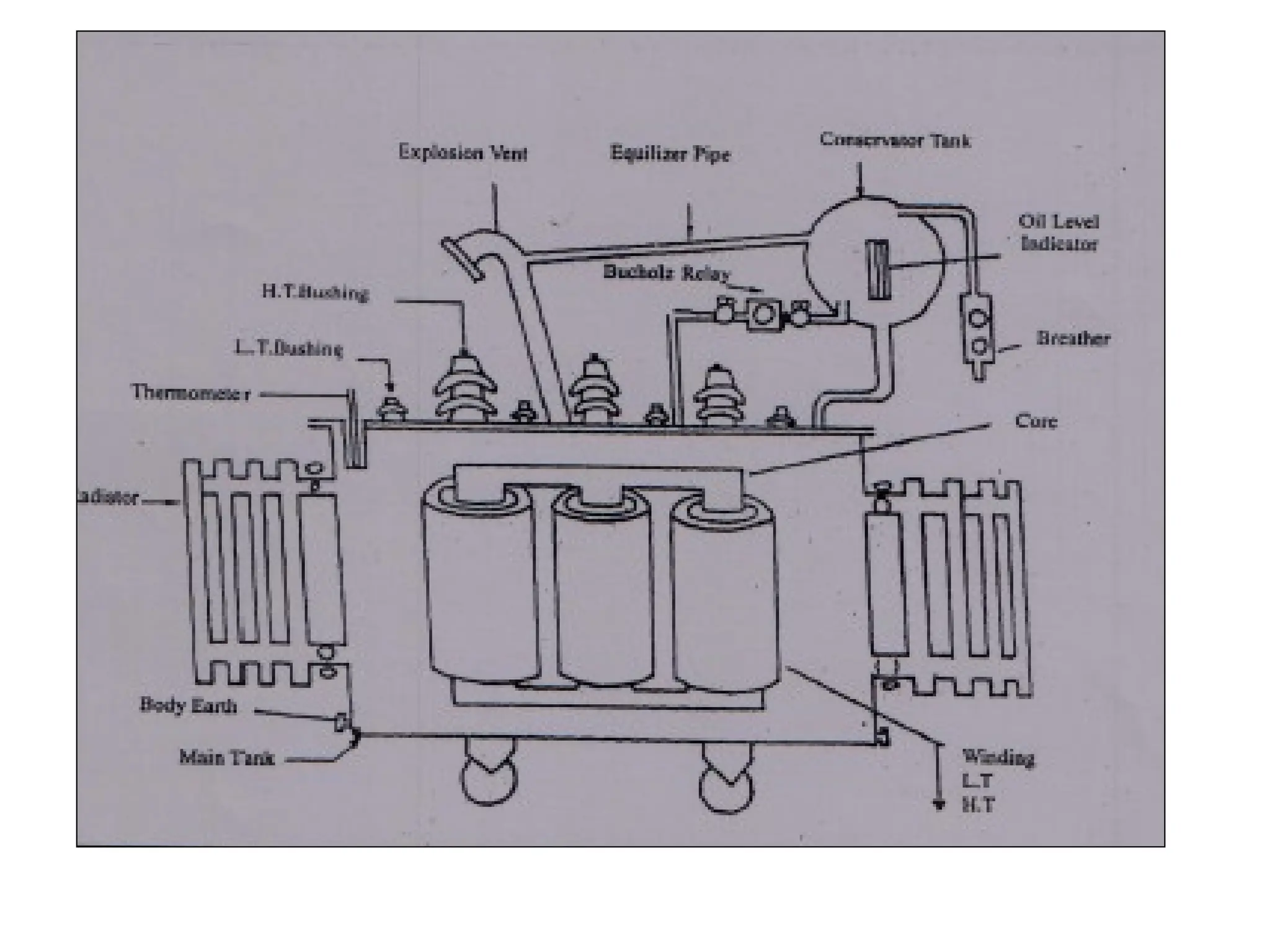
CONSERVATOR
 It is provided on the top of the transformer to allow expansion
and contraction of oil due to load variations.
 This is connected to the transformer main tank through a pipe
called equalizer pipe.
 when the load on the transformer increases and temperature
raises, oil in the main tank expands and oil level increases.
 If there is no sufficient space for this expanded oil, the
transformer diaphragm or explosion vent will burst open.
 Provision of conservator permits oil expansion in the
conservator.
 Because of this, oil level in the main tank will be at constant
level.
 Conservator is also fitted with oil level gauge.
 Conservator shall not be completely filled with oil.
BUSHINGS
 Winding leads have to be brought outside the transformers
for giving connection.
 In order to provide safe clearance for the winding leads from
the body of the transformer, they are taken out through
bushings on both HV and LV side.
TYPES OF BUSHINGS
 Bushings are of 2 types:
a) Porcelain type used up to 36 kV level.
b) Condenser type bushing used on EHV transformers.
 In porcelain bushings, the leads are taken out through hollow
porcelain bushings, with the internal space between bushing
body and is filled up by insulated oil.
 The size of the bushings becomes bulky with the raise in
voltage ratings.
 Hence, these type of bushings are limited upto 36 kV.
OPERATION AND MAINTAINANCE OF DISTRIBUTION TRANSFORMER  AND PREVENTIOMOF FAILURE

OPERATION AND MAINTAINANCE OF DISTRIBUTION TRANSFORMER AND PREVENTIOMOF FAILURE

  • 1.
    PRESENTED BY PRESENTED BY AKSHAYMAHAVEER PATIL AKSHAY MAHAVEER PATIL ( (2167571293528) 2167571293528) AY-2022-23 SEM-VI AY-2022-23 SEM-VI YASHODA TECHNICAL CAMPUS YASHODA TECHNICAL CAMPUS (FACULTY OF ENGINEERING) (FACULTY OF ENGINEERING) ON ON OPERATION & MAINTENANCE OF DISTRIBUTION OPERATION & MAINTENANCE OF DISTRIBUTION TRANSFORMERS, PREVENTION OF FAILURES & REPAIRS TRANSFORMERS, PREVENTION OF FAILURES & REPAIRS
  • 2.
    Power is transmittedat higher voltages to load centers stepping up the voltage of generation. The transmitted power cannot be used directly at load centers, as it is at a higher voltage. Most of the consumer services are at LT level i.e. 400 or 415 V (phase to phase) or 230 or 240 V (phase to neutral). Hence there is a need to step down the voltage in different stages, before it reaches the consumers. This stepping up and stepping down of voltages keeping the transmitted power the same, except for little losses is carried out by an equipment called transformer.
  • 3.
    WHAT IS ATRANSFORMER? It is an equipment which converts supply at one AC voltage rating into supply at another voltage rating, without changing the total apparent power in KVA and without changing the frequency of the system.
  • 4.
    Michael Faraday isthe father of transformer and his law of magnetic induction led to the discovery of transformer. The law says : "EMF is induced in a closed conducting circuit when the magnetic flux linked with that circuit changes with time and EMF is proportional to the rate of change of the magnetic flux.
  • 5.
    BASIC PRINCIPLE Transformer comprisesa closed magnetic circuit called core. Two or more windings are placed on the core as per design criteria. The operating frequency in our country is 50 C/S. Core provides a high permeability path to the magnetic circuit besides supporting the winding. When 50 C/S supply is given to a winding called primary winding, it sets up an alternating magnetic flux of 50 C/S in the core. As the core provides high permeability path and as the second winding is provided on the same core, the magnetic flux linked with the secondary winding also alternates at the same frequency of 50 C/S.
  • 6.
    This alternating fluxthere, sets up an EMF in the secondary winding as per the Faraday's law. The EMF induced in the secondary winding is at the same frequency as that of magnetic flux and primary current. However, its direction is opposite to the applied voltage. If a load is connected to the secondary winding, the EMF drives a current. The change in the voltage is accomplished by the difference in the number of turns in the primary and secondary windings. The induced EMF has the same voltage per turn as the primary winding (when secondary is without any electrical load).
  • 7.
    If N1 andN2 are number of turns in primary and secondary winding, then when secondary is not connected to any electrical load, N1/ N2 = V1/V2 (V1 and V2 are voltages in primary and secondary winding . When corresponding currents are I1 and I2, as transferred apparent power is the same, KVA = I1 V1 = I2 V2 V1/ V2 = I2/ I1 = N1/ N2 Under ideal conditions, primary ampere turns are equal to the secondary ampere turns. I1N1 = I2N2
  • 8.
    The transformer canbe used only in Alternate Current (AC) system but not in Direct Current (DC) system. When DC supply of the same voltage is applied to the transformer, a very high current will pass in it, as in the DC system there won't be reactance and the resistance is too small. Unless there is a protective system, the transformer will fail in a quick time due to the over current.
  • 9.
    ADVANTAGES OF TRANSFORMER a)It is a stationary equipment without any internal rotating parts. Hence O & M cost would be less. (b) The stationary nature facilitates high voltage insulation and thus stepping up and stepping down of voltages. (c) Its operational efficiency is very high ( up to 95% for distribution and 99% for EHT transformers) (d) Besides facilitating power supply at different voltages of utilization, it can be used in metering and protection systems of the network. It can also be used for earthing of the neutral of a power transformer. (e) Transformer is the most important and relatively a more costlier equipment in distribution or sub- transmission. (f) It is virtually a work horse.
  • 10.
    TYPES OF TRANSFORMERS Mainclassification based on application : • Power transformer : Transfer of power • Distribution Transformer : Transfer of power • Instrument Transformer : Measuring and protection • Earthing Transformer : Earthing • Rectifier Transformer : For providing controlled supply suitable to process
  • 11.
    Further classification ofPower/Distribution transformer - By Construction a)As per core : 1. Core type 2. Shell type b)As per phases: 1. Single phase 2. Three phase c)As per number of windings: 1. Single winding 2. Two winding 3. Three winding
  • 12.
    d) As perVOLTAGE – LT,HT,EHT,UHT  LT- up to 650V  HT- 11kV to 33kV  EHT- 66kV to 400kV  UHT- 765kV onwards e) As per voltage ratio - Step up, Step down f) As per Insulation - Dry type, Oil immersed, Gas filled
  • 13.
    A transformer basicallyconsist of :- i. A magnetic core forming magnetic circuit ii.Windings forming electrical circuits and iii.Insulation, comprising transformer oil and solid insulation consisting of paper, press board, wood etc.
  • 16.
    MAGNETIC CORE The transformercore is a closed magnetic circuit made up of thin laminations of special electrical sheet steel (CRGO) The main magnetic flux passes through the core The function of the transformer core is to provide a high permeability path to the magnetic circuit and to support the transformer windings. Core laminations are kept very thin (0.27mm) Laminations are coated with insulation/ varnish (carlite coating) to reduce Eddy currents and there by eddy current losses.
  • 17.
    CRGO electrical steelwith silicon content of approximately 3% is used for the core, the magnetic circuit of a transformer. Ideal shape for a core section is circle since wastage of space is minimum. A perfectly circular core involves making each lamination of different dimensions which is very uneconomical. Stepped core is made by laminations of varying width and packet heights and assembled to approximate a circle
  • 18.
    CORE TYPE ANDSHELL TYPE CONSTRUCTIONS There are two types of configurations of the core 1. Core type and 2. Shell type. The choice of the type of construction depends upon the design and manufacturing practices. The core type magnetic circuit has three or five limbs placed vertically. Two horizontal yokes, one at the top and the other at the bottom, close the magnetic circuit.
  • 19.
    CORE TYPE In thecore type construction, the windings encircle the core and in the shell type construction, the core encircles the windings.  The yoke has two branches and the magnetic flux leaving the limb branches into two parts while entering the yoke Core type transformers are easy to manufacture. The HV and LV winding coils are manufactured independently and are then inserted on the limbs. The windings are spiral or helical and are placed concentrically over the limbs.
  • 20.
    SHELL TYPE In Shelltype construction, the LV and HV windings are flat and Pan-cake type. Shell type core has minimum cutting of leakage flux. In shell type transformers, the cross-section of the limb is twice that of the yoke. The manufacturing process of shell type core is slower and costlier than that of a core type. The core type construction is commonly used in India and Europe for small and large transformers.
  • 21.
    SHELL TYPE The shelltype construction is preferred for small single phase transformers all over the World. However, it is preferred in U.S.A. for large transformers also. In 2-Limb construction, windings are placed on both the limbs. In 3-Limb single phase construction, single phase windings are placed on the central limb only
  • 22.
    LOSSES IN THECORE a. Hysteresis losses b. Eddy current losses The hysteresis loss occurs continuously in the core of a transformer because the core is subjected to alternating magnetic flux of 50 Hz. This loss is reduced by using better grade CRGO steel sheets.
  • 23.
    LOSSES IN THECORE When alternating magnetic flux flows through the iron core, small e.m.f. is induced in the magnetic material itself due to changes in its own flux linkage. The e.m.f. induced causes circulating currents in the metal. Such currents are called Eddy currents, which when flowing through the metal, cause I2 R loss in metal which appear as heat. Such losses are called Eddy Current Losses.
  • 24.
    METHODS FOR MINIMIZINGEDDY CURRENT LOSSES a. Laminated Core using thin sheets b. Insulation of lamination c. Use of material of high electrical resistivity d. Use of Mitred joint e. Reducing air gap f. Continuous transposition of winding conductor . g. By reducing thickness of laminations  The eddy current loss is proportional to square of thickness of laminations 't'. By using amorphous metal of thickness 0.03mm, the core losses are reduced to 30% from 100% when compared to using CRGO laminations of 0.27 mm
  • 25.
    WINDINGS Windings are normallycylindrical in shape, since circular coils offer great resistance to the radial component of electromagnetic forces. Windings of different types are used depending on their rating. HV and LV coils are placed concentrically with HV winding on the out side.
  • 26.
    A few importantparameters governing the design and operation of a transformer are discussed below: 1.Operating flux density :  A good CRGO core can have an operating flux density of 1.6 to 1.7 tesla for sub-transmission power transformers, 1.9 tesla for EHV transformer and 1.4 for distribution transformer as CRGO has a saturation density of above 2 Tesla.
  • 27.
     Amorphous metalhas saturation density at 1.56 tesla and as such, the distribution transformers are designed for 1.4 tesla.  Increase of flux density will improve voltage/ turn, thereby reducing number of turns and copper losses.  But it will increase no load losses.
  • 28.
    2. Percentage Impedance: Impedance of a transformer is the voltage drop on full load due to the resistance and leakage reactance.  It is also the % of the primary terminal voltage required to circulate full load current under short circuit conditions of the secondary.  With one winding shorted, voltage at rated frequency is applied to the other winding raising it to a value sufficient to circulate rated current.  With one winding shorted, voltage at rated frequency is applied to the other winding raising it to a value sufficient to circulate rated current.
  • 29.
     That voltageis called impedance voltage. % Impedance = Impedance voltage/Rated voltage x 100  Distribution Transformer= 4 to 5%  Power transformer at 132/ 33kV level = 6.5% to 14  When induced voltages of primary and secondary windings are in the same direction, the polarity of the two windings is same. This is called subtractive polarity.  When the induced emfs are in opposite direction, the polarity is called additive.  By different combinations of internal connections of windings and connection to terminals, different polarities can be obtained
  • 30.
    TRANSFORMER CONNECTIONS 1. Star/starConnection: Advantages: a) Voltage of each single phase unit connected to star/star bank has only 57.7% of the line voltage reducing the voltage stress on each phase.  Hence they can be wound relatively for low voltage which gives 1.732 times voltage between phases. b) This connection permits earthing of neutral to carry unbalanced currents.  When earthed solidly it has several benefits.  During a phase to earth faults in one phase, the voltage in other two healthy phases (phase to phase) is only 80% of the phase to phase current c) Facilitates feeding of single phase loads and three phase loads.
  • 31.
    Vector group orconnection symbol of a transformer denotes the method of connection of primary and secondary windings and the phase angle divergence of secondary with respect to primary It is indicated in a short form, say ' Dy11' First letter is a capital letter indicating the method of connection of primary and second letter, a small letter, indicates that of secondary  Number indicates the phase angle difference of secondary with respect to the primary in terms of clock position
  • 32.
    DISADVANTAGES Provides a pathfor 3rd harmonic currents which increases losses, heats up insulation and they will be interference with communication Magnetizing currents of each of three windings will not be exactly identical making it impossible to have perfectly balanced voltages in all three phases.
  • 33.
    2. Delta -Star  Mainly used in distribution transformers  Facilitates feeding single phase loads as well as 3 phase loads  Third harmonic currents get suppressed due to passing through delta winding
  • 34.
    DY11  In this,'D‘ indicates that transformer primary is Delta connected and 'y' indicates that the secondary is star connected.  Number 11 indicates that secondary is at 11'o Clock position with reference to the primary  Vector group is one of the factors to be considered for operating transformers in parallel.
  • 35.
     For threephase transformers testing of polarity is done by exciting the windings from a 3 phase supply and taking more voltage measurements.  Primary and secondary windings on any one limb have induced emfs that are in time phase.  Different combination of internal connections and connection to terminals produce different phase divergence of secondary voltage.
  • 36.
    TAP CHANGERS  Theseare devices for changing the voltage of a transformer.  This is necessary to maintain bus voltages on the secondary side at reasonable levels.  The voltage change is obtained by changing number of turns in the primary and secondary windings.
  • 37.
     Two typesof tap changers are available: 1. Off Circuit Tap Changer :  This is cheaper.  Tap changing is effected when the transformer is off  Off circuit tap changers are used where tap changing is done once in a way as in the case of a Distribution transformer and in some cases for Generator Transformers.  However, after each tap change, the transformer has to be tested with suitable megger for proper continuity at the new tap.  Operating off load tap changer when transformer is in service will lead to extensive damage.  However an electro magnetic latch switch is provided to prevent inadvertent operation.
  • 38.
    2. On loadtap changer :  Here tap changing is done while transformer is in service without interrupting loads, as in the case of a power transformer.  On load tap changer normally consists of transition resistors which bridge the circuit between tapping section during the tap changer operation.
  • 40.
    COOLING ARRANGEMENTS Oil servestwo purpose : (1) Insulation and (2) Cooling of winding.  Controlling the temperature inside the transformer is necessary to ensure longer life due to less thermal degradation of the insulation.  The heat generated in the transformer is transmitted to atmosphere through oil.
  • 41.
    Different types ofcooling are available. ONAN Type :  Oil Natural And Air Natural.  Heat is transferred from windings and core to the oil.  The hot oil is circulated in radiators by natural means letting off the heat to atmosphere
  • 42.
    Oil Preservation System:  Oil readily absorbs moisture.  Presence of moisture reduces the dielectric strength of oil.  The moisture entry can be (a) through oil coming into contact with air (b) Leakages past gasket or and (c) formation inside the transformer as apart of insulation failure due to high temperature.  Different methods are available to reduce contamination of oil with moisture.
  • 43.
    Silicagel breather : It is most commonly used and economical method of limiting moisture content in air, so that oil in the transformer comes into contact with fairly dry air.  Silica gel breather is connected to the conservator tank.  A silicagel breather consists of a cartridge packed with silicagel desiccants and a small cup containing oil.  Air is drawn into the conservator through oil cup and breather where most of the moisture is absorbed.
  • 44.
    Silicagel breather : Silicagel requires frequent reactivation to improve its efficiency of absorption.  A well maintained breather will dry the air down to dew point below - 400C.  Oil level shall be maintained in the cup to lessen air ingress
  • 46.
    CONSERVATOR  It isprovided on the top of the transformer to allow expansion and contraction of oil due to load variations.  This is connected to the transformer main tank through a pipe called equalizer pipe.  when the load on the transformer increases and temperature raises, oil in the main tank expands and oil level increases.  If there is no sufficient space for this expanded oil, the transformer diaphragm or explosion vent will burst open.  Provision of conservator permits oil expansion in the conservator.  Because of this, oil level in the main tank will be at constant level.  Conservator is also fitted with oil level gauge.  Conservator shall not be completely filled with oil.
  • 47.
    BUSHINGS  Winding leadshave to be brought outside the transformers for giving connection.  In order to provide safe clearance for the winding leads from the body of the transformer, they are taken out through bushings on both HV and LV side.
  • 48.
    TYPES OF BUSHINGS Bushings are of 2 types: a) Porcelain type used up to 36 kV level. b) Condenser type bushing used on EHV transformers.  In porcelain bushings, the leads are taken out through hollow porcelain bushings, with the internal space between bushing body and is filled up by insulated oil.  The size of the bushings becomes bulky with the raise in voltage ratings.  Hence, these type of bushings are limited upto 36 kV.