SOURCE
TECHNOLOGY
ABSTRACT
• Preface.
• Introduction to open source technology.
• Utilization.
• Comparison.
• Types.
• Caveats and benefits.
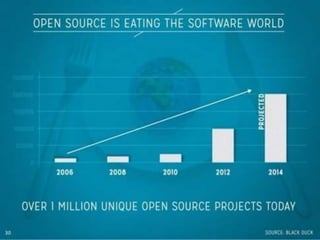
• Graphical representation.
• License and copyrights.
• Why it makes sense in financial services.
• Beneficial for development of society.
• Conclusion.
• The term open source proposed by group of people
in the free software movement who were critical of
political agenda and moral philosophy implied in the
term free software and sought to reframe the
discourse of to reflect more commercially minded
position.
PREFACE
• Open source technology is defined as the production and
development philosophy of allowing end users and developers to
not only see the source code of software, but modify it as well.
• Open source software is software whose source code is available
for modification or enhancement by anyone. "Source code" is the
part of software that most computer users don't ever see; it's the
code computer programmers can manipulate to change how a
piece of software—a "program" or "application"—works.
• Open source software is free software for your business and
personal use.
• Open source developers freely share their knowledge and make
the source code available to the public.
What is open source technology??
Utilization :
• Open source software is used in many businesses
and is used in more ways then people realize.
• The idea behind open source is development of high
quality , reliability and low cost software.
• Some of the organizations using open source
software include Travelocity , Wikipedia and US
postal service
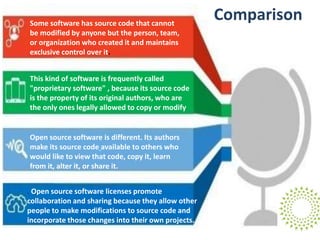
Some software has source code that cannot
be modified by anyone but the person, team,
or organization who created it and maintains
exclusive control over it.
Open source software is different. Its authors
make its source code available to others who
would like to view that code, copy it, learn
from it, alter it, or share it.
This kind of software is frequently called
"proprietary software" , because its source code
is the property of its original authors, who are
the only ones legally allowed to copy or modify
it.
. Open source software licenses promote
collaboration and sharing because they allow other
people to make modifications to source code and
incorporate those changes into their own projects.
Comparison
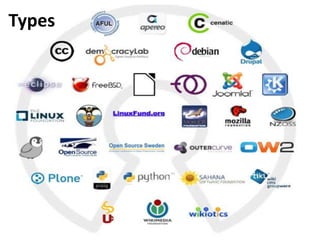
Types
.
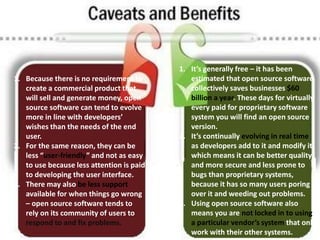
1. It’s generally free – it has been
estimated that open source software
collectively saves businesses $60
billion a year. These days for virtually
every paid for proprietary software
system you will find an open source
version.
2. It’s continually evolving in real time
as developers add to it and modify it,
which means it can be better quality
and more secure and less prone to
bugs than proprietary systems,
because it has so many users poring
over it and weeding out problems.
3. Using open source software also
means you are not locked in to using
a particular vendor’s system that only
work with their other systems.
1. Because there is no requirement to
create a commercial product that
will sell and generate money, open
source software can tend to evolve
more in line with developers’
wishes than the needs of the end
user.
2. For the same reason, they can be
less “user-friendly” and not as easy
to use because less attention is paid
to developing the user interface.
3. There may also be less support
available for when things go wrong
– open source software tends to
rely on its community of users to
respond to and fix problems.
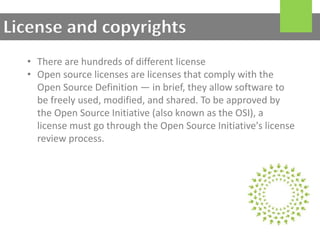
• There are hundreds of different license
• Open source licenses are licenses that comply with the
Open Source Definition — in brief, they allow software to
be freely used, modified, and shared. To be approved by
the Open Source Initiative (also known as the OSI), a
license must go through the Open Source Initiative's license
review process.
License and copyrights
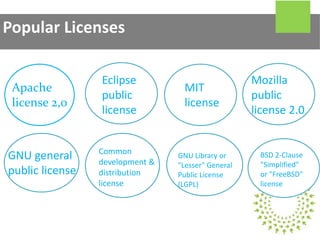
Popular Licenses
Apache
license 2,0
Eclipse
public
license
MIT
license
Mozilla
public
license 2.0
GNU general
public license
Common
development &
distribution
license
GNU Library or
"Lesser" General
Public License
(LGPL)
BSD 2-Clause
"Simplified"
or "FreeBSD"
license
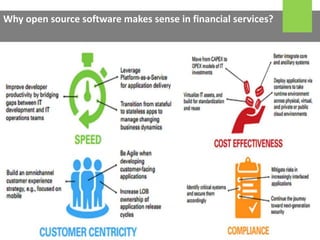
Why open source software makes sense in financial services?
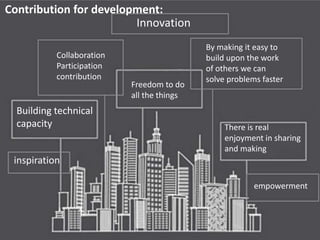
Innovation
By making it easy to
build upon the work
of others we can
solve problems faster
inspiration
empowerment
Freedom to do
all the things
Building technical
capacity There is real
enjoyment in sharing
and making
Collaboration
Participation
contribution
Contribution for development:
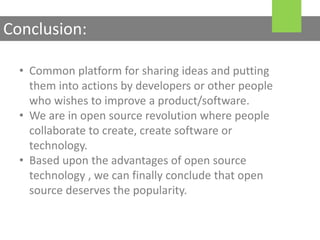
Conclusion:
• Common platform for sharing ideas and putting
them into actions by developers or other people
who wishes to improve a product/software.
• We are in open source revolution where people
collaborate to create, create software or
technology.
• Based upon the advantages of open source
technology , we can finally conclude that open
source deserves the popularity.
THANK-YOU
BY:
MISS. PRAJAKTA PAWAR.
MISS. ANKITA JOSHI.
FROM:
ATS SBGI MIRAJ.

Open source technologies

  • 1.
  • 2.
    ABSTRACT • Preface. • Introductionto open source technology. • Utilization. • Comparison. • Types. • Caveats and benefits. • Graphical representation. • License and copyrights. • Why it makes sense in financial services. • Beneficial for development of society. • Conclusion.
  • 3.
    • The termopen source proposed by group of people in the free software movement who were critical of political agenda and moral philosophy implied in the term free software and sought to reframe the discourse of to reflect more commercially minded position. PREFACE
  • 4.
    • Open sourcetechnology is defined as the production and development philosophy of allowing end users and developers to not only see the source code of software, but modify it as well. • Open source software is software whose source code is available for modification or enhancement by anyone. "Source code" is the part of software that most computer users don't ever see; it's the code computer programmers can manipulate to change how a piece of software—a "program" or "application"—works. • Open source software is free software for your business and personal use. • Open source developers freely share their knowledge and make the source code available to the public. What is open source technology??
  • 5.
    Utilization : • Opensource software is used in many businesses and is used in more ways then people realize. • The idea behind open source is development of high quality , reliability and low cost software. • Some of the organizations using open source software include Travelocity , Wikipedia and US postal service
  • 6.
    Some software hassource code that cannot be modified by anyone but the person, team, or organization who created it and maintains exclusive control over it. Open source software is different. Its authors make its source code available to others who would like to view that code, copy it, learn from it, alter it, or share it. This kind of software is frequently called "proprietary software" , because its source code is the property of its original authors, who are the only ones legally allowed to copy or modify it. . Open source software licenses promote collaboration and sharing because they allow other people to make modifications to source code and incorporate those changes into their own projects. Comparison
  • 7.
  • 8.
    . 1. It’s generallyfree – it has been estimated that open source software collectively saves businesses $60 billion a year. These days for virtually every paid for proprietary software system you will find an open source version. 2. It’s continually evolving in real time as developers add to it and modify it, which means it can be better quality and more secure and less prone to bugs than proprietary systems, because it has so many users poring over it and weeding out problems. 3. Using open source software also means you are not locked in to using a particular vendor’s system that only work with their other systems. 1. Because there is no requirement to create a commercial product that will sell and generate money, open source software can tend to evolve more in line with developers’ wishes than the needs of the end user. 2. For the same reason, they can be less “user-friendly” and not as easy to use because less attention is paid to developing the user interface. 3. There may also be less support available for when things go wrong – open source software tends to rely on its community of users to respond to and fix problems.
  • 11.
    • There arehundreds of different license • Open source licenses are licenses that comply with the Open Source Definition — in brief, they allow software to be freely used, modified, and shared. To be approved by the Open Source Initiative (also known as the OSI), a license must go through the Open Source Initiative's license review process. License and copyrights
  • 12.
    Popular Licenses Apache license 2,0 Eclipse public license MIT license Mozilla public license2.0 GNU general public license Common development & distribution license GNU Library or "Lesser" General Public License (LGPL) BSD 2-Clause "Simplified" or "FreeBSD" license
  • 13.
    Why open sourcesoftware makes sense in financial services?
  • 14.
    Innovation By making iteasy to build upon the work of others we can solve problems faster inspiration empowerment Freedom to do all the things Building technical capacity There is real enjoyment in sharing and making Collaboration Participation contribution Contribution for development:
  • 15.
    Conclusion: • Common platformfor sharing ideas and putting them into actions by developers or other people who wishes to improve a product/software. • We are in open source revolution where people collaborate to create, create software or technology. • Based upon the advantages of open source technology , we can finally conclude that open source deserves the popularity.
  • 16.
    THANK-YOU BY: MISS. PRAJAKTA PAWAR. MISS.ANKITA JOSHI. FROM: ATS SBGI MIRAJ.