Open Source Software KCB201 Virtual Cultures Dr Axel Bruns [email_address]
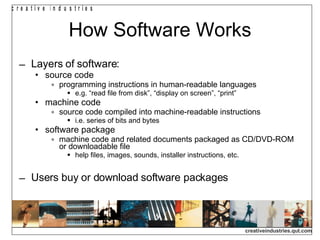
How Software Works Layers of software: source code programming instructions in human-readable languages e.g. “read file from disk”, “display on screen”, “print” machine code source code compiled into machine-readable instructions i.e. series of bits and bytes software package machine code and related documents packaged as CD/DVD-ROM or downloadable file help files, images, sounds, installer instructions, etc. Users buy or download software packages
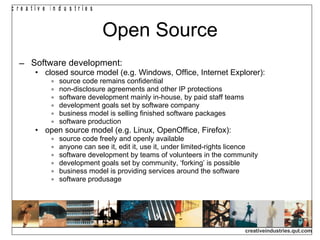
Open Source Software development: closed source model (e.g. Windows, Office, Internet Explorer): source code remains confidential non-disclosure agreements and other IP protections software development mainly in-house, by paid staff teams development goals set by software company business model is selling finished software packages software production open source model (e.g. Linux, OpenOffice, Firefox): source code freely and openly available anyone can see it, edit it, use it, under limited-rights licence software development by teams of volunteers in the community development goals set by community, ‘forking’ is possible business model is providing services around the software software produsage
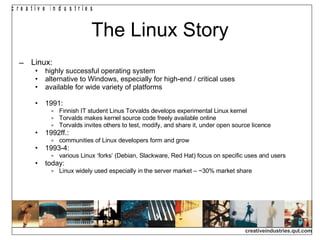
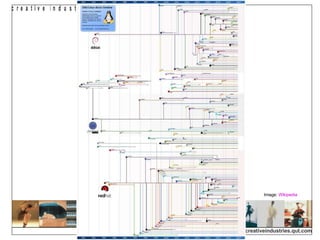
The Linux Story Linux: highly successful operating system alternative to Windows, especially for high-end / critical uses available for wide variety of platforms 1991:  Finnish IT student Linus Torvalds develops experimental Linux kernel Torvalds makes kernel source code freely available online Torvalds invites others to test, modify, and share it, under open source licence 1992ff.: communities of Linux developers form and grow 1993-4: various Linux ‘forks’ (Debian, Slackware, Red Hat) focus on specific uses and users today: Linux widely used especially in the server market – ~30% market share
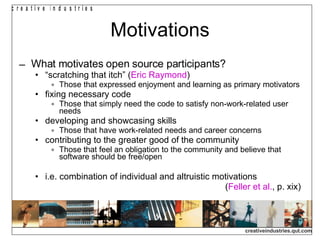
Motivations What motivates open source participants? “ scratching that itch” ( Eric Raymond ) Those that expressed enjoyment and learning as primary motivators fixing necessary code Those that simply need the code to satisfy non-work-related user needs developing and showcasing skills Those that have work-related needs and career concerns contributing to the greater good of the community Those that feel an obligation to the community and believe that software should be free/open i.e. combination of individual and altruistic motivations ( Feller et al. , p. xix)
Image:  Wikipedia
How Open Source Works Key assumptions: everyone has a contribution to make e.g. code changes, beta testing, error reports, feature requests, documentation, community leadership community involvement more likely if community experimentation is encouraged i.e. limited success if project direction is determined from above users will contribute if to do so is easy and beneficial for them and all i.e. combination of self-interest and altruistic motives shared ownership of the project is crucial i.e. contributions less likely if they only benefit a commercial software publisher Compare to key preconditions for produsage: equipotential users: everybody knows  something probabilistic processes: someone  will find a solution granular tasks: even small contributions add up shared content: nobody will exploit the community
Pros and Cons of Open Source Benefits: potentially faster development: larger team of developers (no “resource horizon”) ability to explore multiple solutions quickly development in direct response to user requests and suggestions immediate release of new revisions (commercial considerations irrelevant) greater transparency – no hidden functionality, clearly documented file standards zero cost for software purchases or upgrades Problems: survival of open source project depends on size and viability of community development mostly in areas of interest to community majority (“interest horizon”) lack of financial support for marketing or solving ‘dull’ problems switching costs from commercial software to open source Solution? pro-am model: companies investing in open source and offering services
Open Source as Produsage Key aspects: “ user innovation network” (von Hippel,  Feller et al.  ch. 14) “ networked-enabled collaboration” (O’Reilly,  Feller et al.  ch. 24) “ architecture of participation” (O’Reilly,  Feller et al.  ch. 24) Produsage principles: open participation, communal evaluation project is open for anyone to make contributions (which are tested by the community) fluid heterarchy,  ad hoc  meritocracy constructive contributors grow in community esteem and influence unfinished artefacts, continuing process project is never finished, always under development common property, individual rewards project is only feasible with open source licencing, but individuals can benefit Open source as early precursor to wider produsage trends…
Open News and Open Source Open source in its own words: “ The basic idea behind open source is very simple: When programmers can read, redistribute, and modify the source code for a piece of software, the Software evolves. People improve it, people adapt it, people fix bugs. And this can happen at a speed that, if one is used to the slow pace of conventional software development, seems astonishing. “ We in the open source community have learned that this rapid evolutionary process produces better software than the traditional closed model, in which only a very few programmers can see the source and everybody else must blindly use an opaque block of bits.” ( Opensource.org )

KCB201 Week 9 Slidecast: Open Source Software

  • 1.
    Open Source SoftwareKCB201 Virtual Cultures Dr Axel Bruns [email_address]
  • 2.
    How Software WorksLayers of software: source code programming instructions in human-readable languages e.g. “read file from disk”, “display on screen”, “print” machine code source code compiled into machine-readable instructions i.e. series of bits and bytes software package machine code and related documents packaged as CD/DVD-ROM or downloadable file help files, images, sounds, installer instructions, etc. Users buy or download software packages
  • 3.
    Open Source Softwaredevelopment: closed source model (e.g. Windows, Office, Internet Explorer): source code remains confidential non-disclosure agreements and other IP protections software development mainly in-house, by paid staff teams development goals set by software company business model is selling finished software packages software production open source model (e.g. Linux, OpenOffice, Firefox): source code freely and openly available anyone can see it, edit it, use it, under limited-rights licence software development by teams of volunteers in the community development goals set by community, ‘forking’ is possible business model is providing services around the software software produsage
  • 4.
    The Linux StoryLinux: highly successful operating system alternative to Windows, especially for high-end / critical uses available for wide variety of platforms 1991: Finnish IT student Linus Torvalds develops experimental Linux kernel Torvalds makes kernel source code freely available online Torvalds invites others to test, modify, and share it, under open source licence 1992ff.: communities of Linux developers form and grow 1993-4: various Linux ‘forks’ (Debian, Slackware, Red Hat) focus on specific uses and users today: Linux widely used especially in the server market – ~30% market share
  • 5.
    Motivations What motivatesopen source participants? “ scratching that itch” ( Eric Raymond ) Those that expressed enjoyment and learning as primary motivators fixing necessary code Those that simply need the code to satisfy non-work-related user needs developing and showcasing skills Those that have work-related needs and career concerns contributing to the greater good of the community Those that feel an obligation to the community and believe that software should be free/open i.e. combination of individual and altruistic motivations ( Feller et al. , p. xix)
  • 6.
  • 7.
    How Open SourceWorks Key assumptions: everyone has a contribution to make e.g. code changes, beta testing, error reports, feature requests, documentation, community leadership community involvement more likely if community experimentation is encouraged i.e. limited success if project direction is determined from above users will contribute if to do so is easy and beneficial for them and all i.e. combination of self-interest and altruistic motives shared ownership of the project is crucial i.e. contributions less likely if they only benefit a commercial software publisher Compare to key preconditions for produsage: equipotential users: everybody knows something probabilistic processes: someone will find a solution granular tasks: even small contributions add up shared content: nobody will exploit the community
  • 8.
    Pros and Consof Open Source Benefits: potentially faster development: larger team of developers (no “resource horizon”) ability to explore multiple solutions quickly development in direct response to user requests and suggestions immediate release of new revisions (commercial considerations irrelevant) greater transparency – no hidden functionality, clearly documented file standards zero cost for software purchases or upgrades Problems: survival of open source project depends on size and viability of community development mostly in areas of interest to community majority (“interest horizon”) lack of financial support for marketing or solving ‘dull’ problems switching costs from commercial software to open source Solution? pro-am model: companies investing in open source and offering services
  • 9.
    Open Source asProdusage Key aspects: “ user innovation network” (von Hippel, Feller et al. ch. 14) “ networked-enabled collaboration” (O’Reilly, Feller et al. ch. 24) “ architecture of participation” (O’Reilly, Feller et al. ch. 24) Produsage principles: open participation, communal evaluation project is open for anyone to make contributions (which are tested by the community) fluid heterarchy, ad hoc meritocracy constructive contributors grow in community esteem and influence unfinished artefacts, continuing process project is never finished, always under development common property, individual rewards project is only feasible with open source licencing, but individuals can benefit Open source as early precursor to wider produsage trends…
  • 10.
    Open News andOpen Source Open source in its own words: “ The basic idea behind open source is very simple: When programmers can read, redistribute, and modify the source code for a piece of software, the Software evolves. People improve it, people adapt it, people fix bugs. And this can happen at a speed that, if one is used to the slow pace of conventional software development, seems astonishing. “ We in the open source community have learned that this rapid evolutionary process produces better software than the traditional closed model, in which only a very few programmers can see the source and everybody else must blindly use an opaque block of bits.” ( Opensource.org )