Four Steps to Creating an 
Effective Open Source Policy 
by 
Greg Olson 
Senior Director, Open Source Management Practice 
© 2013 Black Duck®, Know Your Code®, Ohloh®, SpikeSource®, Spike® and the Black Duck logo are registered trademarks of Black Duck Software, Inc. in the United States 
and/or other jurisdictions. Koders™ is a trademark of Black Duck Software, Inc. All other trademarks are the property of their respective holders. All Rights Reserved.
2 
“ Companies must have a policy for procuring OSS, deciding 
which applications will be supported by OSS, and identifying 
the intellectual property risk or supportability risk associated 
with using OSS. Once a policy is in place, then there must be a 
governance process to enforce it.” 
Introduction 
Why Use Open Source Software? 
At this point in the evolution of the software 
industry, it has become difficult, if not 
impossible, to create any significant body of 
software without using at least some open source 
software (OSS). Open source has permeated our 
platforms and components, whether they are 
built in-house, provided by platform vendors, 
acquired from commercial software vendors or 
downloaded from the Internet. In addition to the 
prevalence of freely available code, there are 
compelling reasons to make use of open source 
software, including: 
• The best-in-class software in some areas 
is OSS 
• Products must interoperate with other OSS, 
e.g. Linux 
• Customers favor, and sometimes even 
require OSS 
• The ability to customize externally 
sourced software 
• Lower cost alternatives to traditional 
commercial packages 
• Faster time-to-market by avoiding 
development and testing of new code 
• Lower development costs by using free, 
already debugged code 
• Lower code maintenance costs by utilizing 
community maintenance 
– Laurie Wurster, Research Director, Gartner 
• Existing code base already contains 
significant OSS 
• OSS came with a corporate acquisition 
While most software managers are aware 
of the legal risks (e.g., license compliance 
with commercial strategies and additional 
code used, monitoring the use of code, etc.) 
and the operational risks (e.g., compatibility 
requirements, maintenance and support, 
integration concerns, among others) of 
using open source, the benefits far outweigh 
these concerns. 
As such, creating an open source software policy 
is a key strategic imperative for organizations in 
the software industry. 
What is an OSS Management Policy? 
A policy is a set of rules and guidelines for using 
and managing OSS in your organization. To be 
effective, it must cover all the essential aspects 
of managing OSS, yet it must be succinct and 
easily understood; otherwise nobody will read it, 
much less follow it. At Black Duck Consulting, 
our rule of thumb is that policies should be 
five pages or less, and reflect the way software 
is developed and delivered in your company, 
specifically. General rules are not likely to apply 
directly to your requirements and processes, 
so the results are likely to be approximate 
and inefficient.
3 
The Policy Development Process 
Creating an open source policy is not a trivial 
matter. OSS management spans multiple areas 
of responsibility, and the requirements and 
points-of-view of each of these areas must be 
included and reconciled if the policy is to be 
successful. As such, Black Duck Consulting 
has identified four specific steps to creating an 
effective open source policy: 
1. Identify key stakeholders 
2. Obtain an organizational commitment 
3. Draft the policy 
4. Review and approve the policy 
Step 1: Identify Key Stakeholders 
In most organizations the important stakeholders 
represent the following functions: 
• Software architecture: the role that specifies 
which elements are included in a software 
project 
• Software development: the engineers who 
build the software 
• QA and/or release management: those 
responsible for checking the quality and 
contents of project releases 
• Legal: those responsible for upstream 
and downstream agreements and license 
compatibility evaluation 
• Product or line of business management: 
the role responsible for the success of 
the software 
Organizations with sensitive data may also 
have a security stakeholder responsible for the 
security of software entering the organization and 
being released. 
Step 2: Obtain an Organizational 
Commitment 
The single most important success factor is 
securing a commitment from the necessary 
stakeholders to contribute the time and effort to 
completing a policy. This may should obvious, 
but more than once we’ve heard executives 
say, “I would rather see my dentist than work 
on policy.” 
Policy development teams are much more 
effective when they work from a shared 
base of understanding. In order to solidify a 
commitment from stakeholders, it is wise to 
collect and disseminate information about your 
organization’s use and plans for OSS. Such 
documents may include: 
• Existing policies and processes related 
to OSS 
• Inventories of OSS currently used within 
the organization 
• Existing license compliance requirements 
and procedures 
• Upstream and downstream agreements, and 
business relationships that involve OSS 
• New initiatives that might involve the use 
of OSS 
We have found that policy development teams 
are typically more effective when they work 
from a clearly articulated statement of the 
company’s strategy for using OSS. Usually this is 
a statement of the benefits the company wishes 
to realize and how it intends to ensure them. If 
your company does not have an OSS strategy 
statement, that would be a good place for the 
policy development team to start.
4 
Step 3: Draft the Policy 
The OSS policy is typically developed in a series 
of interactive meetings with participation of the 
relevant stakeholders in the organization. This is 
where the trade-offs inherent in any policy must 
be discussed and resolved in a way that best 
meets the organization’s needs. Some common 
trade-offs that occur in the multiple elements of 
an OSS policy include: 
• Controlling risk vs. development productivity 
• Broad, simple rules vs. specific, more 
complex rules 
• Self-checking vs. independent checking 
• Use of judgment calls vs. 
detailed prescriptions 
Many companies have found that using a 
facilitator with extensive experience in OSS 
policy and its operational implications can speed 
the working sessions to quicker results. 
We recommend that open source policies include 
the following eight elements: 
1) Program administration and management 
These first crucial decisions determine who 
will be responsible for the policy itself and who 
will oversee the OSS management program. 
These could be individuals or a permanent 
version of the policy development team, 
usually called something like the Open Source 
Management Board. 
Most companies define some additional roles, as 
well. The concept of an OSS component owner 
is very useful when defining policy for code 
management, support and maintenance and 
community interaction. The review and approval 
process typically requires a decision authority, 
usually called something like the Open Source 
Review Board. 
It is good practice to state whether the policy 
is confidential or shareable, and how it will be 
published. Since training is a critical success 
factor for OSS management, it is advisable to 
define a training policy as well. 
Remember: no policy goes unchanged for 
long. Most companies will go through several 
rapid revisions as they gain experience during 
the period of initial implementation. After 
that, it is a good idea to establish a periodic 
review and fine-tuning of the policy and OSS 
management processes. 
2) Discovery, acquisition and evaluation 
The greatest point of leverage occurs at the 
beginning of the OSS acquisition cycle. 
Efficiently finding and properly evaluating new 
software packages at this stage helps avoid 
future problems and risks. An OSS policy 
typically recommends certain sources of code 
and establishes evaluation criteria for the 
applicable classes of use within the organization. 
One of the most cost effective recommendations 
for sourcing OSS code is to evaluate components 
already used in-house. This kind of “shared 
use” delivers economies through lower overall 
complexity, support and maintenance and shared 
expertise. Companies may also choose to favor 
certain known, reliable distributors, distributions 
of OSS or original project sites rather than 
mirrors or redistributors. 
Establishing clear OSS evaluation criteria will 
generally prevent engineers from wasting time by 
evaluating software that will not be approved for 
use. Typical criteria include elements such as: 
• Architectural compatibility 
• Component modification needs 
• License compatibility 
• Code quality 
• Code stability and maturity 
• Quality and completeness of documentation 
• Security evaluation 
• Availability of support 
• Activity level of the community or health of 
commercial support vendor 
• Project maturity and its 
originating community 
• IP risk evaluation
Companies with sensitive data often specify 
security procedures and “sandbox” environments 
for evaluation of downloaded software in 
order to protect the integrity of their corporate 
network environment. 
Another important dimension of OSS evaluation 
is the type of use anticipated. Criteria for 
internal software development tools are likely to 
differ from criteria for components included in a 
product distributed to customers or deployed in a 
mission critical infrastructure system. Engineers 
will make better choices when use types and 
their associated criteria are well-defined. 
OSS license compatibility is one of the most 
complicated aspects of OSS evaluation. It 
is unreasonable to ask software engineers to 
interpret license documents, and it is also 
impractical to send every OSS candidate to the 
legal department for review. Many organizations 
have developed lists of common OSS licenses 
with indications of their suitability for each 
type of use applicable to the organization. As 
each new OSS license is evaluated by the legal 
department, its compatibility with each type 
of use is added to the list. As the license list 
grows, the approach allows engineers to quickly 
decide whether an OSS component is worth 
further evaluation, and the workload on the legal 
department diminishes. 
3) Review and approval 
No process can be considered reliable unless 
it is checked. The policy for review and 
approval specifies how an OSS component 
evaluation is reviewed and who may approve 
it for the specified use. Typically, a policy 
establishes an OSS review board consisting 
of key stakeholders such as architecture, 
software development, product management 
and legal to approve new requests. In many 
cases, though, a simpler approval cycle may 
be established for a new release version of an 
already approved component or reuse of an 
already approved component. These “fast track” 
opportunities typically reduce the overhead of 
OSS management and provide a strong incentive 
to developers to reuse OSS and work within the 
policy guidelines. 
4) Software procurement 
When a company acquires OSS embedded in 
the delivery of a third-party supplier, it is subject 
to the same license compliance requirements 
and many of the same operational risks as when 
it downloads the OSS directly. It is extremely 
common for OSS to enter an organization 
through commercial software suppliers or 
contract development organizations. An OSS 
policy should provide procurement guidance by 
requiring suppliers to report each OSS element 
embedded in their deliverables, whether it has 
been modified, and its license and license 
compliance terms. For software vendors that 
redistribute the delivered code, the policy 
may require a warranty and indemnification 
sufficient to protect the organization or specify 
code scanning to verify the contents and 
compliance terms. 
5) Code and documentation management 
This policy element is all about managing the 
operational risks that come with OSS. It is 
simple enough to manage a few OSS downloads 
through the lifecycle, but companies that 
use hundreds, or even thousands, of OSS 
components in multiple versions deployed 
in multiple configurations must manage 
this complexity carefully to be efficient and 
minimize problems. 
The policy should specify that the original 
source code, build files, documentation and 
license declaration for each OSS component 
must be archived. These elements should also 
be archived for OSS downloaded in binary form. 
OSS licenses sometimes change, and this is 
the only way to protect your organization’s right 
to continue using the component under the 
original license. 
5
All internal modifications must also be tracked, 
because compliance requirements are sometimes 
different for modified OSS. Most organizations 
also require that OSS archives be kept up-to-date 
with all internal bug fixes and enhancements so 
other projects can reuse these assets. 
The policy should also require tracking so that 
reports can easily be generated to identify all 
uses of a given OSS component (for addressing 
vulnerability reports or bug fixes) and to identify 
all OSS used in a given application or system (for 
producing lists of compliance requirements for 
a distribution). 
6) Support and maintenance 
OSS from communities is typically provided 
without warranty and under a “self-service” 
support model. Most OSS policies identify 
a responsible party for tracking security 
vulnerabilities and bugs, notifying other users 
of the component within the organization 
and applying fixes, as necessary. This role is 
typically called a component owner or code 
owner within an organization. Where commercial 
support is purchased for an OSS component, the 
component owner is typically the support contact 
for the organization. 
7) License Compliance 
For organizations that distribute software 
containing OSS or offer network-delivered 
services using software containing OSS, ensuring 
compliance with the relevant OSS licenses is 
a critical element of OSS management. The 
compliance requirements of most OSS licenses 
are triggered only on distribution, or, for a few 
OSS licenses such as the AGPL, on delivery of a 
network service using the code. 
The OSS policy of most organizations that 
distribute software requires an audit of each 
release to verify that no undocumented or mis-documented 
OSS is included. As a best practice, 
a policy should specify that these audits be 
performed well in advance of each scheduled 
release to prevent potentially extensive 
delays caused by a requirement to replace an 
incompatibly licensed OSS component at the 
last minute. 
Such an audit typically produces a list of OSS 
components and compliance requirements 
for the release. The policy should also clarify 
responsibilities for checking and executing the 
compliance requirements, which may include: 
• Code notice compliance 
• Documentation notice compliance 
• Splash or about-screen compliance 
• Contract addenda and terms compliance 
• Source code provisioning compliance 
In cases where your organization delivers 
software to customers that will further 
redistribute, the policy should also assign 
the responsibility to produce a list of OSS 
components and their licenses. 
8) Community Participation 
For OSS components acquired from 
communities, the only source of support is 
typically through community participation. 
An OSS policy should specify the kinds 
of community participation permitted (or 
required) and the standards and controls 
for these activities. The possible levels of 
participation include: 
• No community participation 
• Participation only through a 
commercial intermediary 
• Participation from personal account with 
no organizational attribution 
• Participation with organizational attribution 
• Presentation at conferences 
• Contribution of bug fixes 
• Contribution of documentation 
• Contribution of new functionality 
• Creation of a new OSS project 
The company’s strategy for using OSS and 
its business goals should dictate the kinds of 
participation allowed by the policy. 
6
7 
Step 4: Review and Approve the Policy 
The result of the working sessions is a draft 
policy document that must be circulated among 
the stakeholders for review and approval. Most 
organizations are able to develop a final policy 
document after two or three revisions. 
Implementation 
Once the OSS Policy document is completed, 
the next step is to implement the policy through 
a set of processes. Depending on the size and 
distribution of your organization, these processes 
may be supported by manual document-based 
procedures or automated workflow systems. 
In either case, good processes facilitate both 
efficient software development and effective 
OSS management, making it easy to “do the 
right thing.” Your processes must also contain 
adequate checks to make sure that the OSS 
policy is consistently followed. 
A key success factor for OSS management is 
training for all participants in the policy and 
processes. Even the best-intentioned individuals 
cannot follow rules and processes they don’t 
know and understand. 
Summary and Conclusions 
Any organization that uses more than a few OSS 
components will benefit from establishing a 
formal OSS policy. Typical benefits include: 
• Increased development velocity 
and flexibility 
• Cost savings: higher quality sourcing 
reduces costly problems down the road 
• Reduced incompatibilities: a managed 
OSS code base reduces duplication 
and incompatibilities 
• Reduced support needs: well-managed 
support reduces new problems and 
eliminates duplicated support activities 
• Overhead savings: license compliance can 
be assured with minimal overhead 
• Enhanced support: quality customer support 
and IP reporting become possible 
• Increased IP asset value: provable license 
compliance increases the value of the 
company’s IP assets 
About Black Duck Consulting 
The world’s leading companies turn to Black 
Duck Consulting to assess and evaluate how 
open source technologies and methods can help 
them achieve long-term business results. Black 
Duck consultants are experts in open source 
strategy and governance, as well as community 
engagement models, applying open source 
development processes in corporate IT, and 
the necessary policies and processes required 
for effective implementation. With hundreds of 
engagements assisting companies ranging from 
start-ups to the world’s largest corporations over 
the last decade, the Black Duck Consulting team 
creates innovative open source strategies for 
proven business success. 
Open Source Management 
Assessment Service 
For enterprises that have not yet implemented 
an open source management program, Black 
Duck Consulting offers a quick and easy way 
to learn about industry best practices and 
assess organizational readiness and governance 
maturity. The easy-to-use, Black Duck Open 
Source Management Assessment (OSMA), 
begins with a free self-guided client survey and 
includes a phone consultation. The assessment 
is designed to help clients accelerate the 
implementation of a governance program by 
weeks or months.
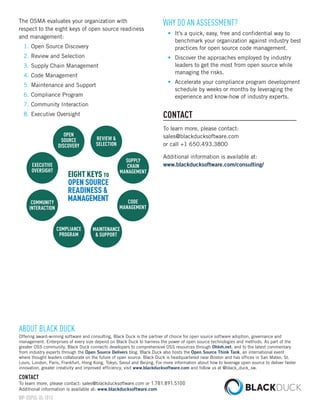
The OSMA evaluates your organization with 
respect to the eight keys of open source readiness 
and management: 
1. Open Source Discovery 
2. Review and Selection 
3. Supply Chain Management 
4. Code Management 
5. Maintenance and Support 
6. Compliance Program 
7. Community Interaction 
8. Executive Oversight 
Why do an Assessment? 
• It’s a quick, easy, free and confidential way to 
benchmark your organization against industry best 
practices for open source code management. 
• Discover the approaches employed by industry 
leaders to get the most from open source while 
managing the risks. 
• Accelerate your compliance program development 
schedule by weeks or months by leveraging the 
experience and know-how of industry experts. 
Contact 
To learn more, please contact: 
sales@blackducksoftware.com 
or call +1 650.493.3800 
Additional information is available at: 
www.blackducksoftware.com/consulting/ 
About Black Duck 
Offering award-winning software and consulting, Black Duck is the partner of choice for open source software adoption, governance and 
management. Enterprises of every size depend on Black Duck to harness the power of open source technologies and methods. As part of the 
greater OSS community, Black Duck connects developers to comprehensive OSS resources through Ohloh.net, and to the latest commentary 
from industry experts through the Open Source Delivers blog. Black Duck also hosts the Open Source Think Tank, an international event 
where thought leaders collaborate on the future of open source. Black Duck is headquartered near Boston and has offices in San Mateo, St. 
Louis, London, Paris, Frankfurt, Hong Kong, Tokyo, Seoul and Beijing. For more information about how to leverage open source to deliver faster 
innovation, greater creativity and improved efficiency, visit www.blackducksoftware.com and follow us at @black_duck_sw. 
Contact 
To learn more, please contact: sales@blackducksoftware.com or 1.781.891.5100 
Additional information is available at: www.blackducksoftware.com 
WP-OSPOL-UL-1013

Four Steps to Creating an Effective Open Source Policy

  • 1.
    Four Steps toCreating an Effective Open Source Policy by Greg Olson Senior Director, Open Source Management Practice © 2013 Black Duck®, Know Your Code®, Ohloh®, SpikeSource®, Spike® and the Black Duck logo are registered trademarks of Black Duck Software, Inc. in the United States and/or other jurisdictions. Koders™ is a trademark of Black Duck Software, Inc. All other trademarks are the property of their respective holders. All Rights Reserved.
  • 2.
    2 “ Companiesmust have a policy for procuring OSS, deciding which applications will be supported by OSS, and identifying the intellectual property risk or supportability risk associated with using OSS. Once a policy is in place, then there must be a governance process to enforce it.” Introduction Why Use Open Source Software? At this point in the evolution of the software industry, it has become difficult, if not impossible, to create any significant body of software without using at least some open source software (OSS). Open source has permeated our platforms and components, whether they are built in-house, provided by platform vendors, acquired from commercial software vendors or downloaded from the Internet. In addition to the prevalence of freely available code, there are compelling reasons to make use of open source software, including: • The best-in-class software in some areas is OSS • Products must interoperate with other OSS, e.g. Linux • Customers favor, and sometimes even require OSS • The ability to customize externally sourced software • Lower cost alternatives to traditional commercial packages • Faster time-to-market by avoiding development and testing of new code • Lower development costs by using free, already debugged code • Lower code maintenance costs by utilizing community maintenance – Laurie Wurster, Research Director, Gartner • Existing code base already contains significant OSS • OSS came with a corporate acquisition While most software managers are aware of the legal risks (e.g., license compliance with commercial strategies and additional code used, monitoring the use of code, etc.) and the operational risks (e.g., compatibility requirements, maintenance and support, integration concerns, among others) of using open source, the benefits far outweigh these concerns. As such, creating an open source software policy is a key strategic imperative for organizations in the software industry. What is an OSS Management Policy? A policy is a set of rules and guidelines for using and managing OSS in your organization. To be effective, it must cover all the essential aspects of managing OSS, yet it must be succinct and easily understood; otherwise nobody will read it, much less follow it. At Black Duck Consulting, our rule of thumb is that policies should be five pages or less, and reflect the way software is developed and delivered in your company, specifically. General rules are not likely to apply directly to your requirements and processes, so the results are likely to be approximate and inefficient.
  • 3.
    3 The PolicyDevelopment Process Creating an open source policy is not a trivial matter. OSS management spans multiple areas of responsibility, and the requirements and points-of-view of each of these areas must be included and reconciled if the policy is to be successful. As such, Black Duck Consulting has identified four specific steps to creating an effective open source policy: 1. Identify key stakeholders 2. Obtain an organizational commitment 3. Draft the policy 4. Review and approve the policy Step 1: Identify Key Stakeholders In most organizations the important stakeholders represent the following functions: • Software architecture: the role that specifies which elements are included in a software project • Software development: the engineers who build the software • QA and/or release management: those responsible for checking the quality and contents of project releases • Legal: those responsible for upstream and downstream agreements and license compatibility evaluation • Product or line of business management: the role responsible for the success of the software Organizations with sensitive data may also have a security stakeholder responsible for the security of software entering the organization and being released. Step 2: Obtain an Organizational Commitment The single most important success factor is securing a commitment from the necessary stakeholders to contribute the time and effort to completing a policy. This may should obvious, but more than once we’ve heard executives say, “I would rather see my dentist than work on policy.” Policy development teams are much more effective when they work from a shared base of understanding. In order to solidify a commitment from stakeholders, it is wise to collect and disseminate information about your organization’s use and plans for OSS. Such documents may include: • Existing policies and processes related to OSS • Inventories of OSS currently used within the organization • Existing license compliance requirements and procedures • Upstream and downstream agreements, and business relationships that involve OSS • New initiatives that might involve the use of OSS We have found that policy development teams are typically more effective when they work from a clearly articulated statement of the company’s strategy for using OSS. Usually this is a statement of the benefits the company wishes to realize and how it intends to ensure them. If your company does not have an OSS strategy statement, that would be a good place for the policy development team to start.
  • 4.
    4 Step 3:Draft the Policy The OSS policy is typically developed in a series of interactive meetings with participation of the relevant stakeholders in the organization. This is where the trade-offs inherent in any policy must be discussed and resolved in a way that best meets the organization’s needs. Some common trade-offs that occur in the multiple elements of an OSS policy include: • Controlling risk vs. development productivity • Broad, simple rules vs. specific, more complex rules • Self-checking vs. independent checking • Use of judgment calls vs. detailed prescriptions Many companies have found that using a facilitator with extensive experience in OSS policy and its operational implications can speed the working sessions to quicker results. We recommend that open source policies include the following eight elements: 1) Program administration and management These first crucial decisions determine who will be responsible for the policy itself and who will oversee the OSS management program. These could be individuals or a permanent version of the policy development team, usually called something like the Open Source Management Board. Most companies define some additional roles, as well. The concept of an OSS component owner is very useful when defining policy for code management, support and maintenance and community interaction. The review and approval process typically requires a decision authority, usually called something like the Open Source Review Board. It is good practice to state whether the policy is confidential or shareable, and how it will be published. Since training is a critical success factor for OSS management, it is advisable to define a training policy as well. Remember: no policy goes unchanged for long. Most companies will go through several rapid revisions as they gain experience during the period of initial implementation. After that, it is a good idea to establish a periodic review and fine-tuning of the policy and OSS management processes. 2) Discovery, acquisition and evaluation The greatest point of leverage occurs at the beginning of the OSS acquisition cycle. Efficiently finding and properly evaluating new software packages at this stage helps avoid future problems and risks. An OSS policy typically recommends certain sources of code and establishes evaluation criteria for the applicable classes of use within the organization. One of the most cost effective recommendations for sourcing OSS code is to evaluate components already used in-house. This kind of “shared use” delivers economies through lower overall complexity, support and maintenance and shared expertise. Companies may also choose to favor certain known, reliable distributors, distributions of OSS or original project sites rather than mirrors or redistributors. Establishing clear OSS evaluation criteria will generally prevent engineers from wasting time by evaluating software that will not be approved for use. Typical criteria include elements such as: • Architectural compatibility • Component modification needs • License compatibility • Code quality • Code stability and maturity • Quality and completeness of documentation • Security evaluation • Availability of support • Activity level of the community or health of commercial support vendor • Project maturity and its originating community • IP risk evaluation
  • 5.
    Companies with sensitivedata often specify security procedures and “sandbox” environments for evaluation of downloaded software in order to protect the integrity of their corporate network environment. Another important dimension of OSS evaluation is the type of use anticipated. Criteria for internal software development tools are likely to differ from criteria for components included in a product distributed to customers or deployed in a mission critical infrastructure system. Engineers will make better choices when use types and their associated criteria are well-defined. OSS license compatibility is one of the most complicated aspects of OSS evaluation. It is unreasonable to ask software engineers to interpret license documents, and it is also impractical to send every OSS candidate to the legal department for review. Many organizations have developed lists of common OSS licenses with indications of their suitability for each type of use applicable to the organization. As each new OSS license is evaluated by the legal department, its compatibility with each type of use is added to the list. As the license list grows, the approach allows engineers to quickly decide whether an OSS component is worth further evaluation, and the workload on the legal department diminishes. 3) Review and approval No process can be considered reliable unless it is checked. The policy for review and approval specifies how an OSS component evaluation is reviewed and who may approve it for the specified use. Typically, a policy establishes an OSS review board consisting of key stakeholders such as architecture, software development, product management and legal to approve new requests. In many cases, though, a simpler approval cycle may be established for a new release version of an already approved component or reuse of an already approved component. These “fast track” opportunities typically reduce the overhead of OSS management and provide a strong incentive to developers to reuse OSS and work within the policy guidelines. 4) Software procurement When a company acquires OSS embedded in the delivery of a third-party supplier, it is subject to the same license compliance requirements and many of the same operational risks as when it downloads the OSS directly. It is extremely common for OSS to enter an organization through commercial software suppliers or contract development organizations. An OSS policy should provide procurement guidance by requiring suppliers to report each OSS element embedded in their deliverables, whether it has been modified, and its license and license compliance terms. For software vendors that redistribute the delivered code, the policy may require a warranty and indemnification sufficient to protect the organization or specify code scanning to verify the contents and compliance terms. 5) Code and documentation management This policy element is all about managing the operational risks that come with OSS. It is simple enough to manage a few OSS downloads through the lifecycle, but companies that use hundreds, or even thousands, of OSS components in multiple versions deployed in multiple configurations must manage this complexity carefully to be efficient and minimize problems. The policy should specify that the original source code, build files, documentation and license declaration for each OSS component must be archived. These elements should also be archived for OSS downloaded in binary form. OSS licenses sometimes change, and this is the only way to protect your organization’s right to continue using the component under the original license. 5
  • 6.
    All internal modificationsmust also be tracked, because compliance requirements are sometimes different for modified OSS. Most organizations also require that OSS archives be kept up-to-date with all internal bug fixes and enhancements so other projects can reuse these assets. The policy should also require tracking so that reports can easily be generated to identify all uses of a given OSS component (for addressing vulnerability reports or bug fixes) and to identify all OSS used in a given application or system (for producing lists of compliance requirements for a distribution). 6) Support and maintenance OSS from communities is typically provided without warranty and under a “self-service” support model. Most OSS policies identify a responsible party for tracking security vulnerabilities and bugs, notifying other users of the component within the organization and applying fixes, as necessary. This role is typically called a component owner or code owner within an organization. Where commercial support is purchased for an OSS component, the component owner is typically the support contact for the organization. 7) License Compliance For organizations that distribute software containing OSS or offer network-delivered services using software containing OSS, ensuring compliance with the relevant OSS licenses is a critical element of OSS management. The compliance requirements of most OSS licenses are triggered only on distribution, or, for a few OSS licenses such as the AGPL, on delivery of a network service using the code. The OSS policy of most organizations that distribute software requires an audit of each release to verify that no undocumented or mis-documented OSS is included. As a best practice, a policy should specify that these audits be performed well in advance of each scheduled release to prevent potentially extensive delays caused by a requirement to replace an incompatibly licensed OSS component at the last minute. Such an audit typically produces a list of OSS components and compliance requirements for the release. The policy should also clarify responsibilities for checking and executing the compliance requirements, which may include: • Code notice compliance • Documentation notice compliance • Splash or about-screen compliance • Contract addenda and terms compliance • Source code provisioning compliance In cases where your organization delivers software to customers that will further redistribute, the policy should also assign the responsibility to produce a list of OSS components and their licenses. 8) Community Participation For OSS components acquired from communities, the only source of support is typically through community participation. An OSS policy should specify the kinds of community participation permitted (or required) and the standards and controls for these activities. The possible levels of participation include: • No community participation • Participation only through a commercial intermediary • Participation from personal account with no organizational attribution • Participation with organizational attribution • Presentation at conferences • Contribution of bug fixes • Contribution of documentation • Contribution of new functionality • Creation of a new OSS project The company’s strategy for using OSS and its business goals should dictate the kinds of participation allowed by the policy. 6
  • 7.
    7 Step 4:Review and Approve the Policy The result of the working sessions is a draft policy document that must be circulated among the stakeholders for review and approval. Most organizations are able to develop a final policy document after two or three revisions. Implementation Once the OSS Policy document is completed, the next step is to implement the policy through a set of processes. Depending on the size and distribution of your organization, these processes may be supported by manual document-based procedures or automated workflow systems. In either case, good processes facilitate both efficient software development and effective OSS management, making it easy to “do the right thing.” Your processes must also contain adequate checks to make sure that the OSS policy is consistently followed. A key success factor for OSS management is training for all participants in the policy and processes. Even the best-intentioned individuals cannot follow rules and processes they don’t know and understand. Summary and Conclusions Any organization that uses more than a few OSS components will benefit from establishing a formal OSS policy. Typical benefits include: • Increased development velocity and flexibility • Cost savings: higher quality sourcing reduces costly problems down the road • Reduced incompatibilities: a managed OSS code base reduces duplication and incompatibilities • Reduced support needs: well-managed support reduces new problems and eliminates duplicated support activities • Overhead savings: license compliance can be assured with minimal overhead • Enhanced support: quality customer support and IP reporting become possible • Increased IP asset value: provable license compliance increases the value of the company’s IP assets About Black Duck Consulting The world’s leading companies turn to Black Duck Consulting to assess and evaluate how open source technologies and methods can help them achieve long-term business results. Black Duck consultants are experts in open source strategy and governance, as well as community engagement models, applying open source development processes in corporate IT, and the necessary policies and processes required for effective implementation. With hundreds of engagements assisting companies ranging from start-ups to the world’s largest corporations over the last decade, the Black Duck Consulting team creates innovative open source strategies for proven business success. Open Source Management Assessment Service For enterprises that have not yet implemented an open source management program, Black Duck Consulting offers a quick and easy way to learn about industry best practices and assess organizational readiness and governance maturity. The easy-to-use, Black Duck Open Source Management Assessment (OSMA), begins with a free self-guided client survey and includes a phone consultation. The assessment is designed to help clients accelerate the implementation of a governance program by weeks or months.
  • 8.
    The OSMA evaluatesyour organization with respect to the eight keys of open source readiness and management: 1. Open Source Discovery 2. Review and Selection 3. Supply Chain Management 4. Code Management 5. Maintenance and Support 6. Compliance Program 7. Community Interaction 8. Executive Oversight Why do an Assessment? • It’s a quick, easy, free and confidential way to benchmark your organization against industry best practices for open source code management. • Discover the approaches employed by industry leaders to get the most from open source while managing the risks. • Accelerate your compliance program development schedule by weeks or months by leveraging the experience and know-how of industry experts. Contact To learn more, please contact: sales@blackducksoftware.com or call +1 650.493.3800 Additional information is available at: www.blackducksoftware.com/consulting/ About Black Duck Offering award-winning software and consulting, Black Duck is the partner of choice for open source software adoption, governance and management. Enterprises of every size depend on Black Duck to harness the power of open source technologies and methods. As part of the greater OSS community, Black Duck connects developers to comprehensive OSS resources through Ohloh.net, and to the latest commentary from industry experts through the Open Source Delivers blog. Black Duck also hosts the Open Source Think Tank, an international event where thought leaders collaborate on the future of open source. Black Duck is headquartered near Boston and has offices in San Mateo, St. Louis, London, Paris, Frankfurt, Hong Kong, Tokyo, Seoul and Beijing. For more information about how to leverage open source to deliver faster innovation, greater creativity and improved efficiency, visit www.blackducksoftware.com and follow us at @black_duck_sw. Contact To learn more, please contact: sales@blackducksoftware.com or 1.781.891.5100 Additional information is available at: www.blackducksoftware.com WP-OSPOL-UL-1013