Open Standard API’s as
Infrastructure for Innovation
The case of the HL7 FHIR International Patient Summary
Catherine Chronaki
Secretary General
HL7 Foundation, Brussels, Belgium
euoffice@HL7.org
Funded under
H2020-727745
2
HL7 Foundation:
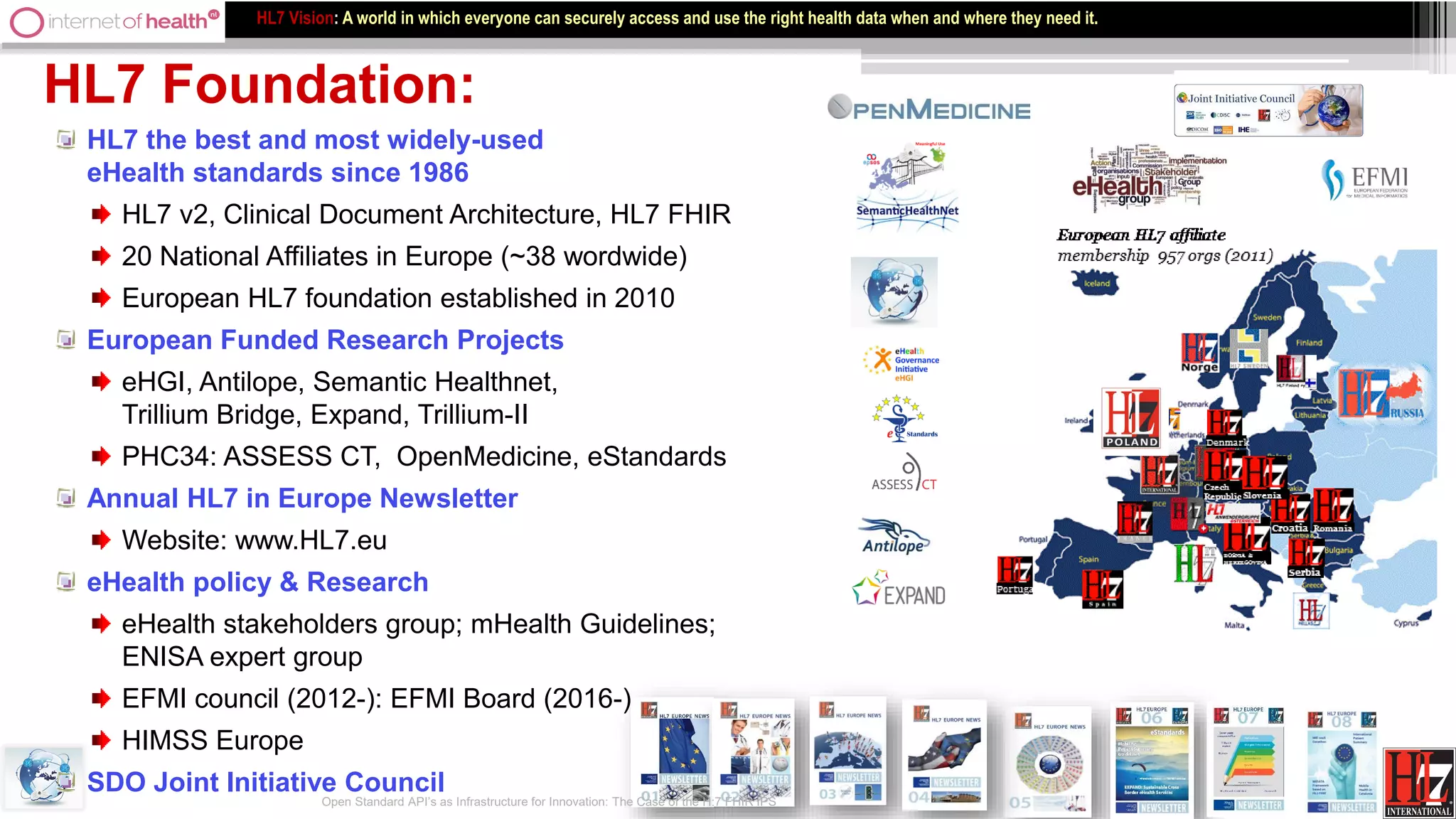
HL7 the best and most widely-used
eHealth standards since 1986
HL7 v2, Clinical Document Architecture, HL7 FHIR
20 National Affiliates in Europe (~38 wordwide)
European HL7 foundation established in 2010
European Funded Research Projects
eHGI, Antilope, Semantic Healthnet,
Trillium Bridge, Expand, Trillium-II
PHC34: ASSESS CT, OpenMedicine, eStandards
Annual HL7 in Europe Newsletter
Website: www.HL7.eu
eHealth policy & Research
eHealth stakeholders group; mHealth Guidelines;
ENISA expert group
EFMI council (2012-): EFMI Board (2016-)
HIMSS Europe
SDO Joint Initiative Council
HL7 Vision: A world in which everyone can securely access and use the right health data when and where they need it.
Open Standard API’s as Infrastructure for Innovation: The Case of the H:7 FHIR IPS
3Open Standard API’s as Infrastructure for Innovation: The Case of the H:7 FHIR IPS
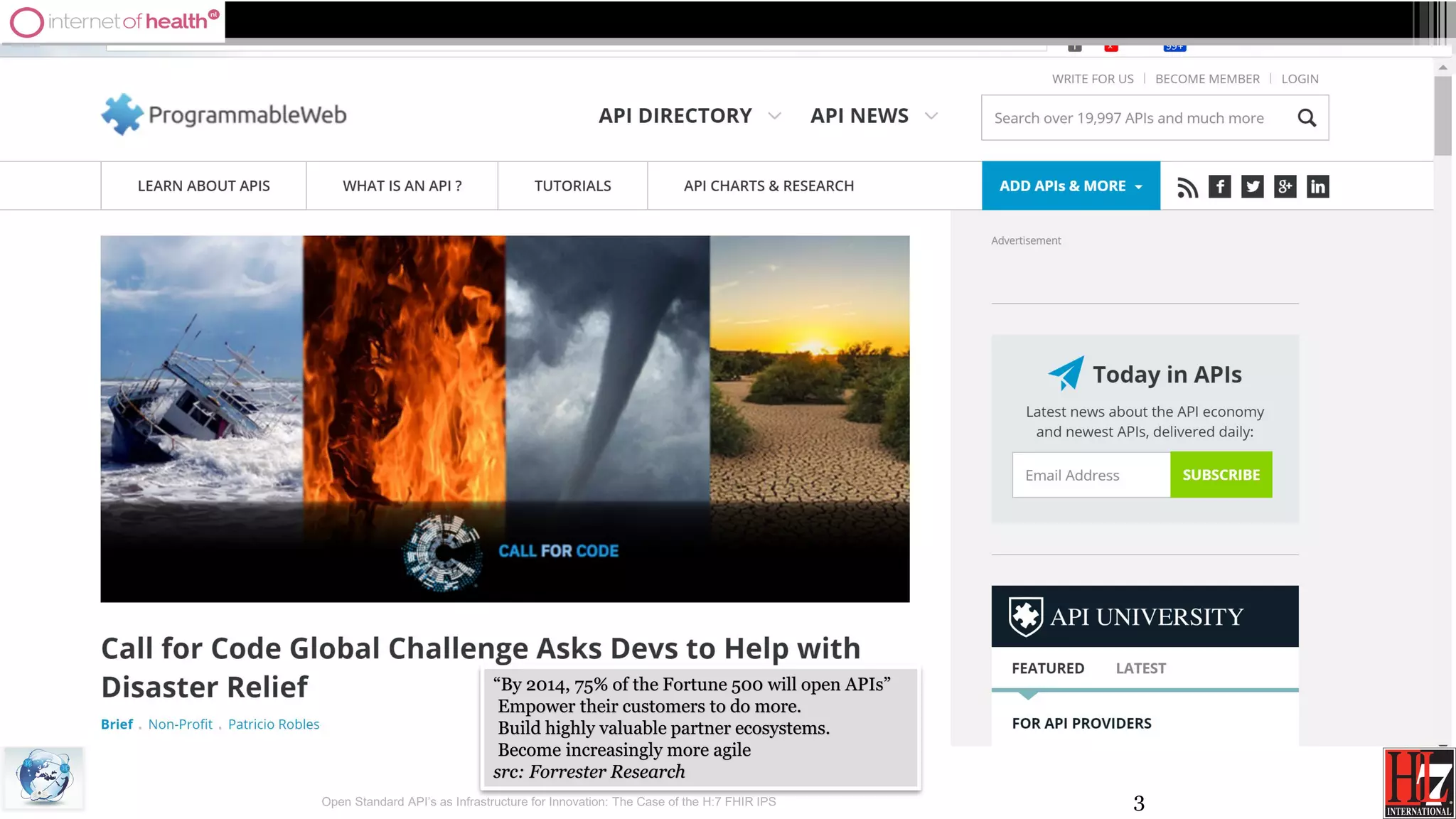
“By 2014, 75% of the Fortune 500 will open APIs”
Empower their customers to do more.
Build highly valuable partner ecosystems.
Become increasingly more agile
src: Forrester Research
4
Application programming interfaces (API)
An emerging (API) Economy
APIs are specifications or protocols that allow software
applications to share data.
Allow third parties to write software that accesses data and drives transactions.
Internal systems in the enterprise are restructured to uniformly support
innovative new projects—reducing maintenance costs and increasing agility.
APIs enable organizations to become platforms:
Reduce complexity: provide uniform data and transaction interfaces to internal and external entities
Improve change management: allow development of new functionality and create value by third parties
Create new opportunities: generate new ways to reach customers, generate revenue and build partnerships
Control access to partners, customers, and contractors
Bottom line: innovate more rapidly –APIs are a new means of creating value by third-party led innovation
API economy: economic effects enabled by companies, governments, non-profits & individuals using APIs to
provide programmable access to systems and processes.
new classes of applications with the potential to transform the way business is done.
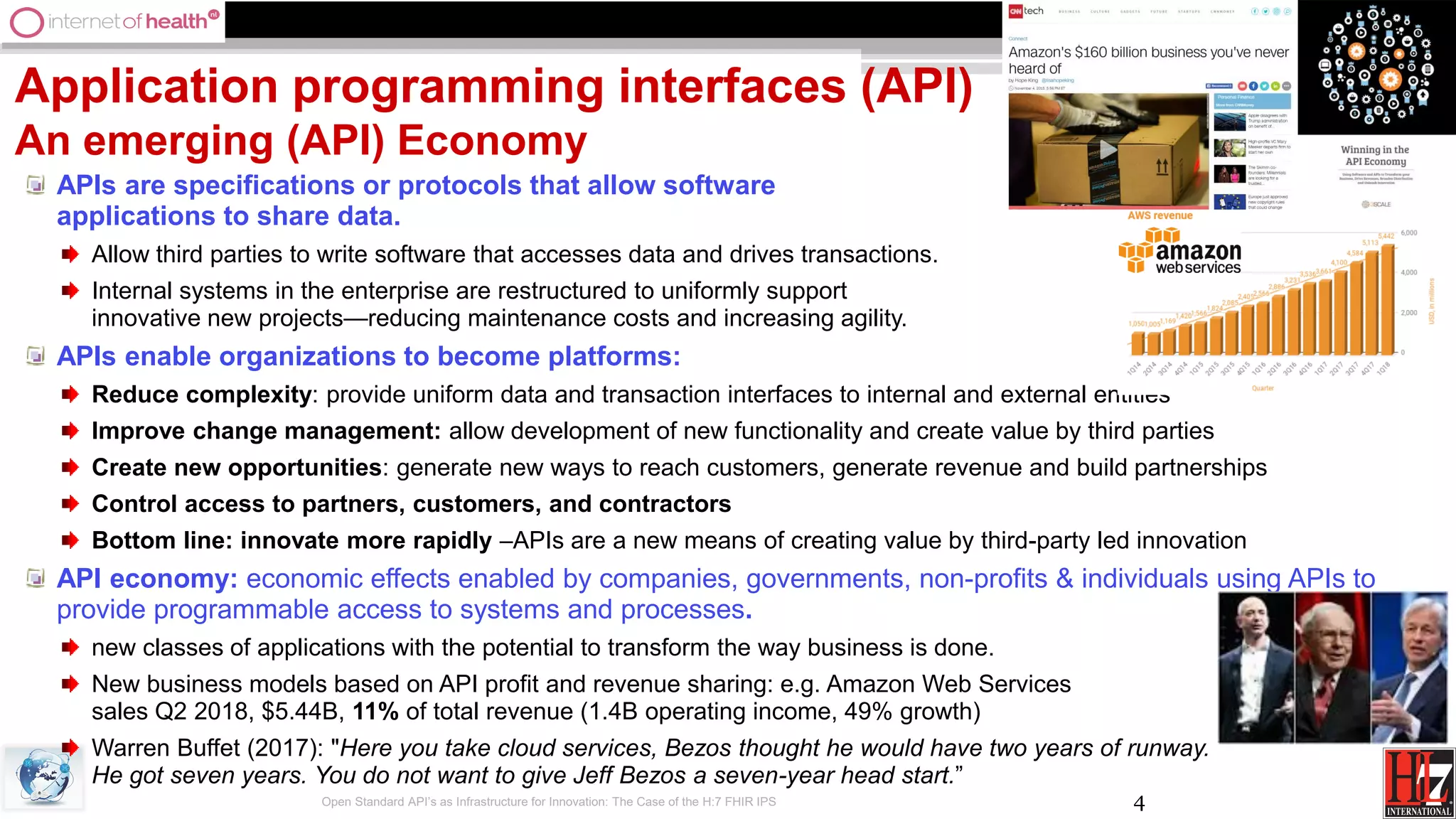
New business models based on API profit and revenue sharing: e.g. Amazon Web Services
sales Q2 2018, $5.44B, 11% of total revenue (1.4B operating income, 49% growth)
Warren Buffet (2017): "Here you take cloud services, Bezos thought he would have two years of runway.
He got seven years. You do not want to give Jeff Bezos a seven-year head start.”
Open Standard API’s as Infrastructure for Innovation: The Case of the H:7 FHIR IPS
5
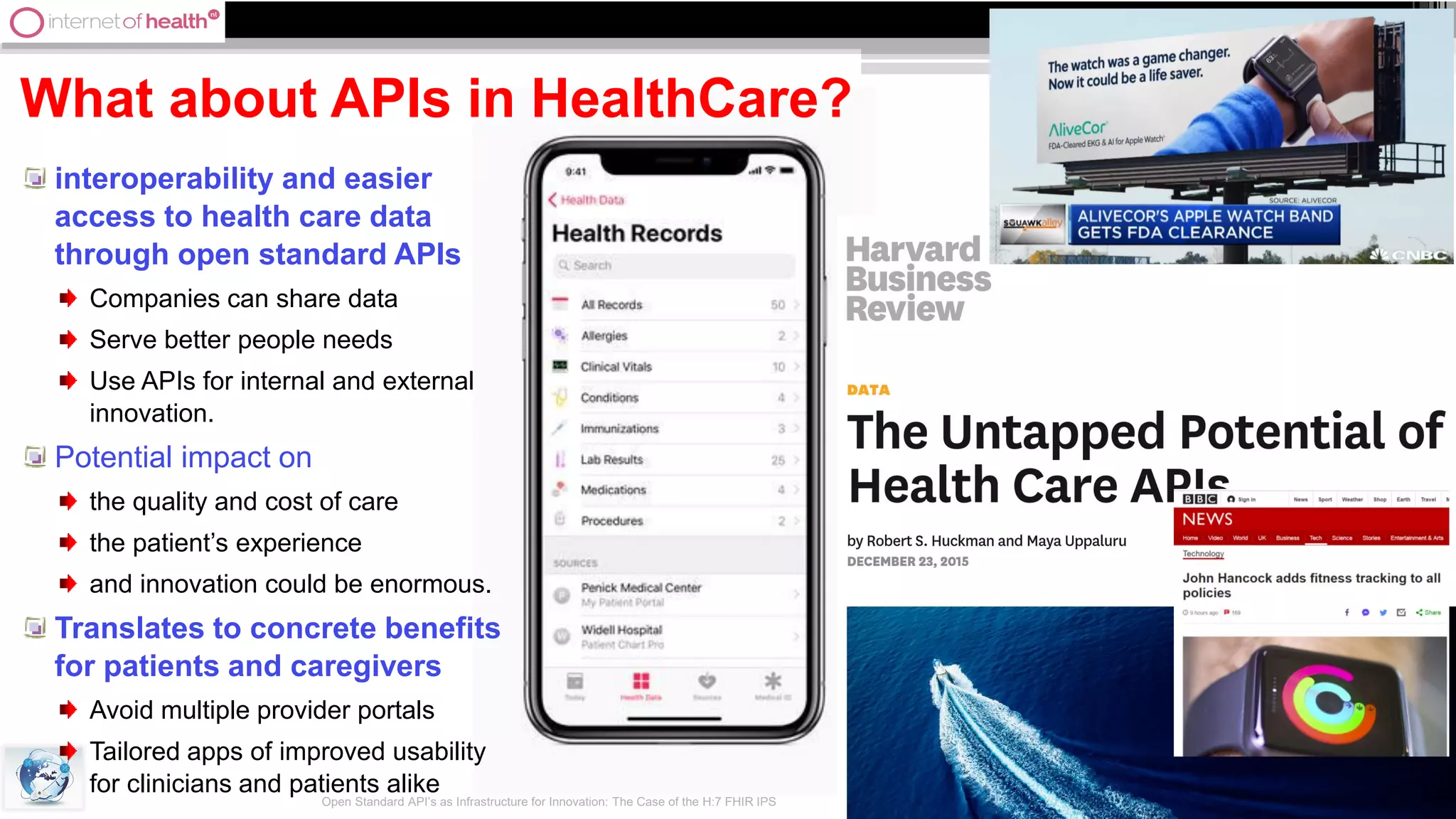
What about APIs in HealthCare?
interoperability and easier
access to health care data
through open standard APIs
Companies can share data
Serve better people needs
Use APIs for internal and external
innovation.
Potential impact on
the quality and cost of care
the patient’s experience
and innovation could be enormous.
Translates to concrete benefits
for patients and caregivers
Avoid multiple provider portals
Tailored apps of improved usability
for clinicians and patients alike
Open Standard API’s as Infrastructure for Innovation: The Case of the H:7 FHIR IPS
6
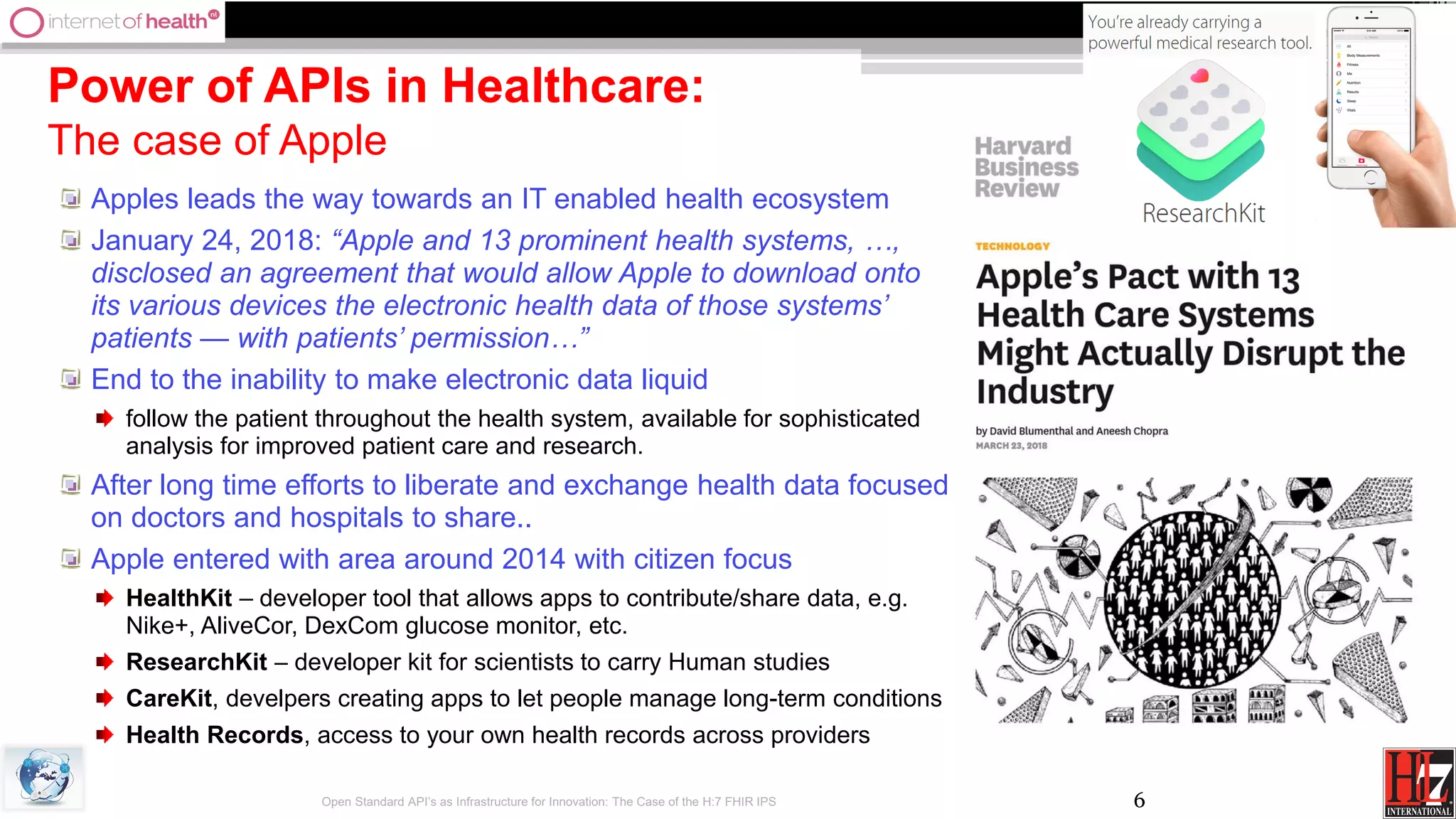
Power of APIs in Healthcare:
The case of Apple
Apples leads the way towards an IT enabled health ecosystem
January 24, 2018: “Apple and 13 prominent health systems, …,
disclosed an agreement that would allow Apple to download onto
its various devices the electronic health data of those systems’
patients — with patients’ permission…”
End to the inability to make electronic data liquid
follow the patient throughout the health system, available for sophisticated
analysis for improved patient care and research.
After long time efforts to liberate and exchange health data focused
on doctors and hospitals to share..
Apple entered with area around 2014 with citizen focus
HealthKit – developer tool that allows apps to contribute/share data, e.g.
Nike+, AliveCor, DexCom glucose monitor, etc.
ResearchKit – developer kit for scientists to carry Human studies
CareKit, develpers creating apps to let people manage long-term conditions
Health Records, access to your own health records across providers
Open Standard API’s as Infrastructure for Innovation: The Case of the H:7 FHIR IPS
7
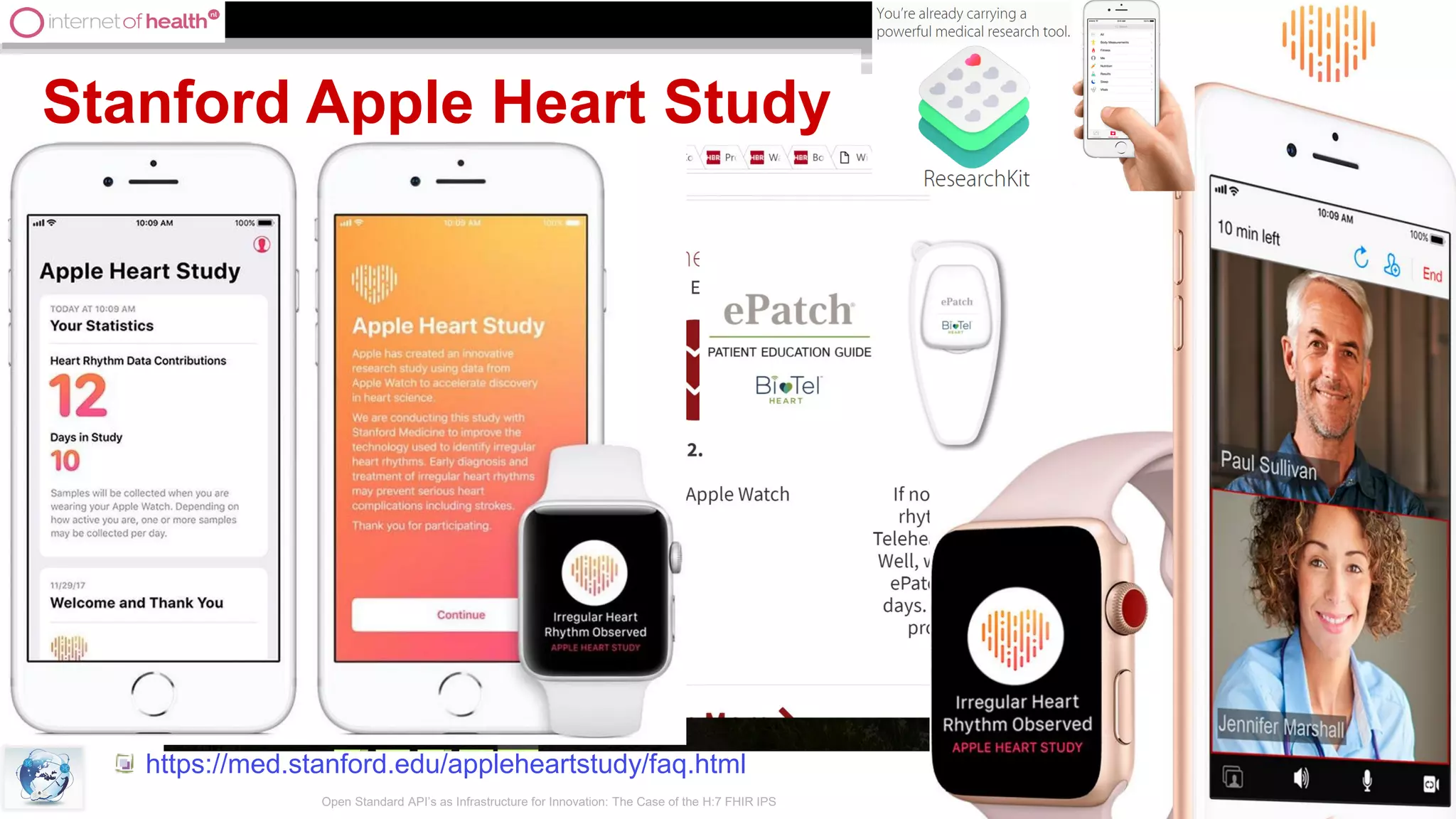
Stanford Apple Heart Study
https://med.stanford.edu/appleheartstudy/faq.html
Open Standard API’s as Infrastructure for Innovation: The Case of the H:7 FHIR IPS
8
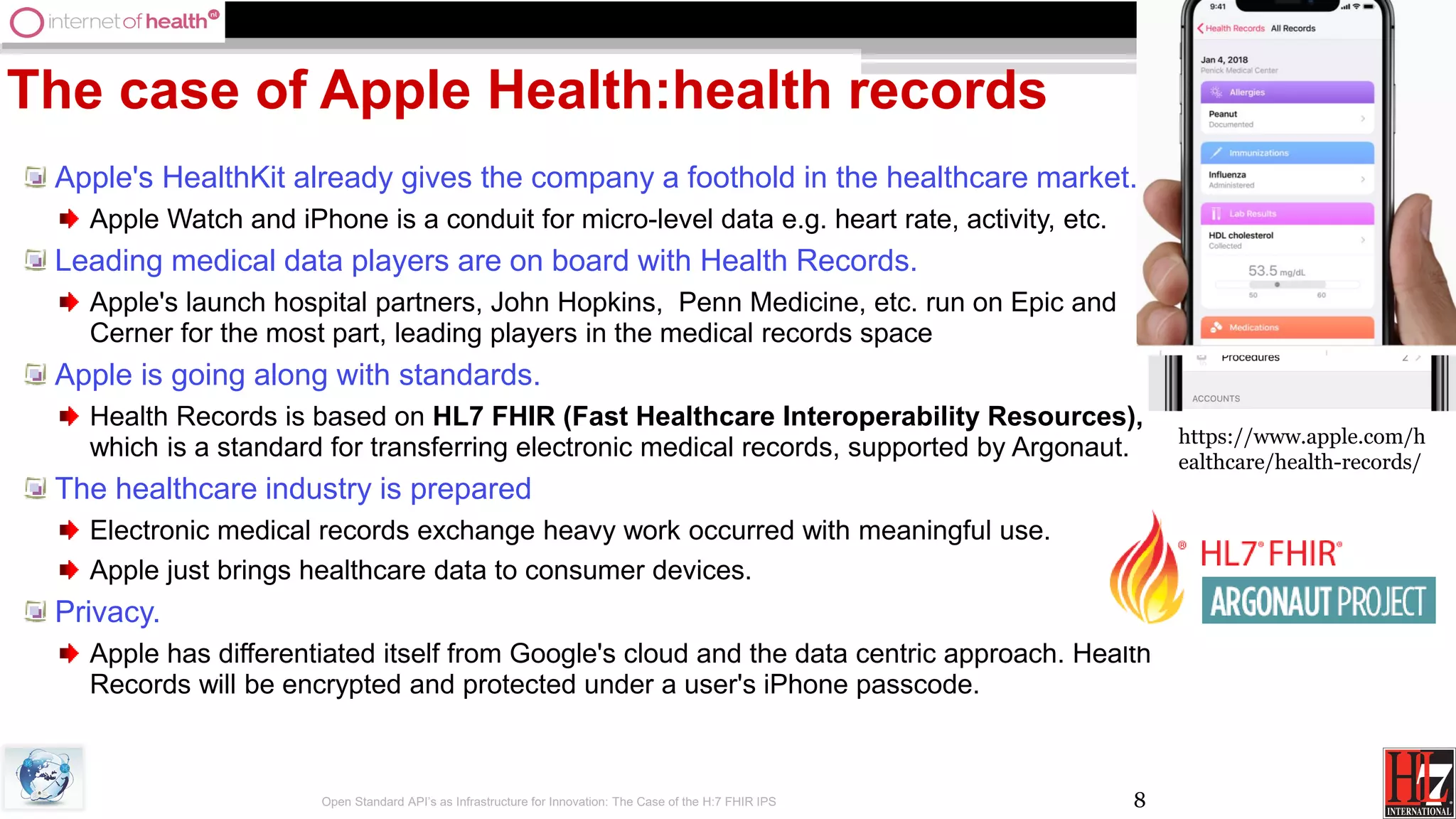
The case of Apple Health:health records
Apple's HealthKit already gives the company a foothold in the healthcare market.
Apple Watch and iPhone is a conduit for micro-level data e.g. heart rate, activity, etc.
Leading medical data players are on board with Health Records.
Apple's launch hospital partners, John Hopkins, Penn Medicine, etc. run on Epic and
Cerner for the most part, leading players in the medical records space
Apple is going along with standards.
Health Records is based on HL7 FHIR (Fast Healthcare Interoperability Resources),
which is a standard for transferring electronic medical records, supported by Argonaut.
The healthcare industry is prepared
Electronic medical records exchange heavy work occurred with meaningful use.
Apple just brings healthcare data to consumer devices.
Privacy.
Apple has differentiated itself from Google's cloud and the data centric approach. Health
Records will be encrypted and protected under a user's iPhone passcode.
Open Standard API’s as Infrastructure for Innovation: The Case of the H:7 FHIR IPS
https://www.apple.com/h
ealthcare/health-records/
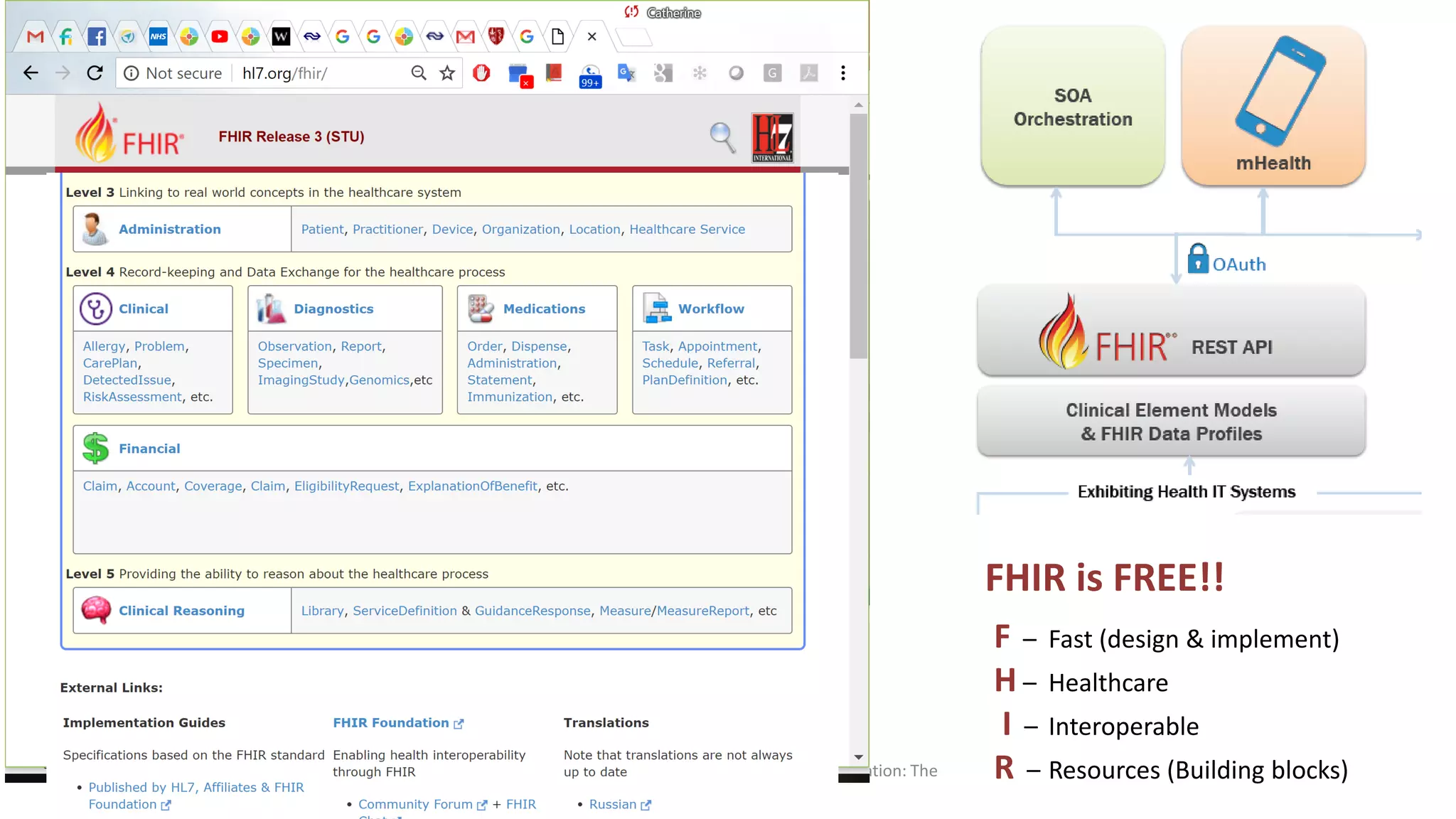
FHIR is FREE!!
F – Fast (design & implement)
H – Healthcare
I – Interoperable
R – Resources (Building blocks)Open Standard API’s as Infrastructure for Innovation: The
Case of the H:7 FHIR IPS
10
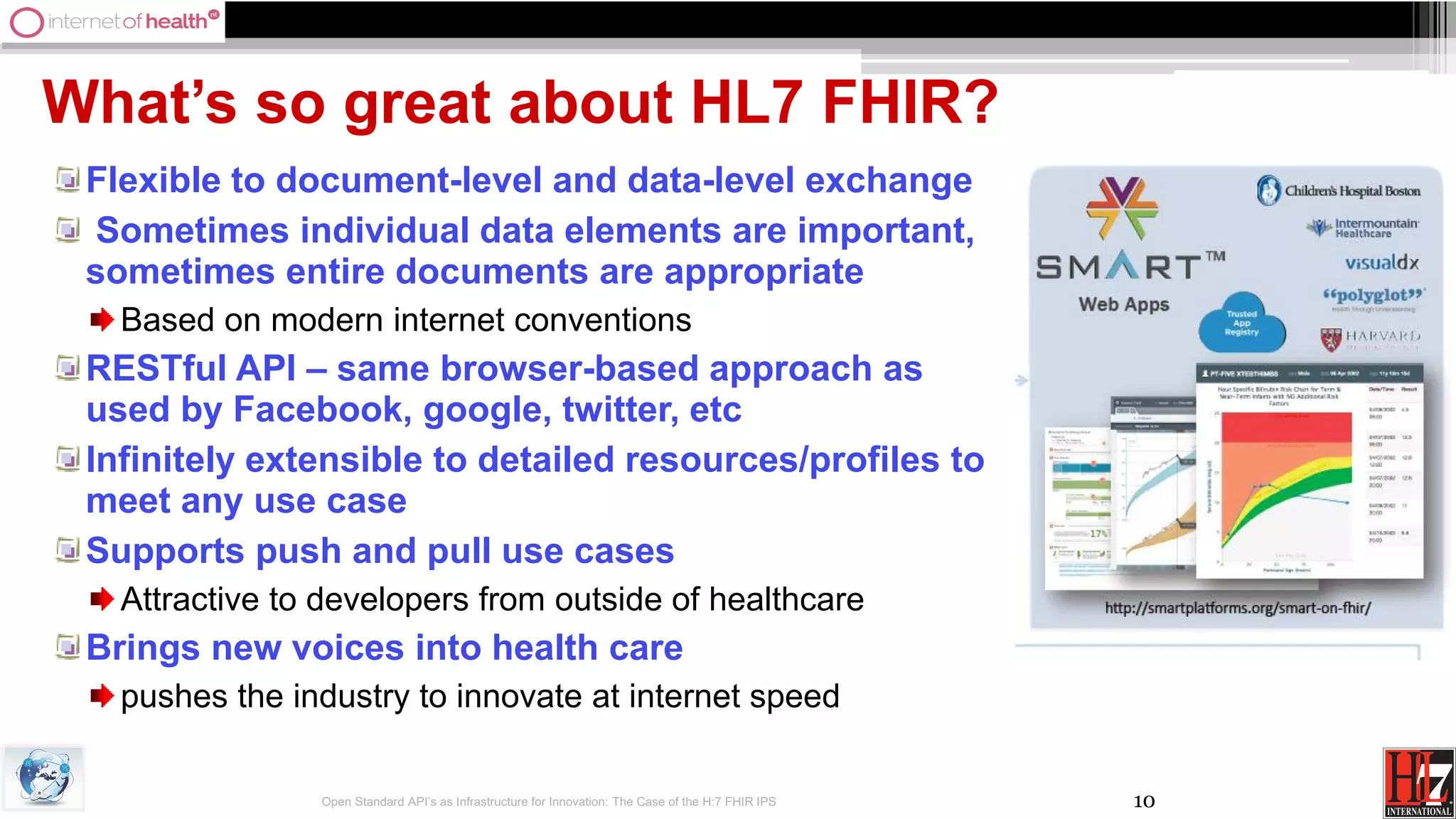
What’s so great about HL7 FHIR?
Flexible to document-level and data-level exchange
Sometimes individual data elements are important,
sometimes entire documents are appropriate
Based on modern internet conventions
RESTful API – same browser-based approach as
used by Facebook, google, twitter, etc
Infinitely extensible to detailed resources/profiles to
meet any use case
Supports push and pull use cases
Attractive to developers from outside of healthcare
Brings new voices into health care
pushes the industry to innovate at internet speed
Open Standard API’s as Infrastructure for Innovation: The Case of the H:7 FHIR IPS
11
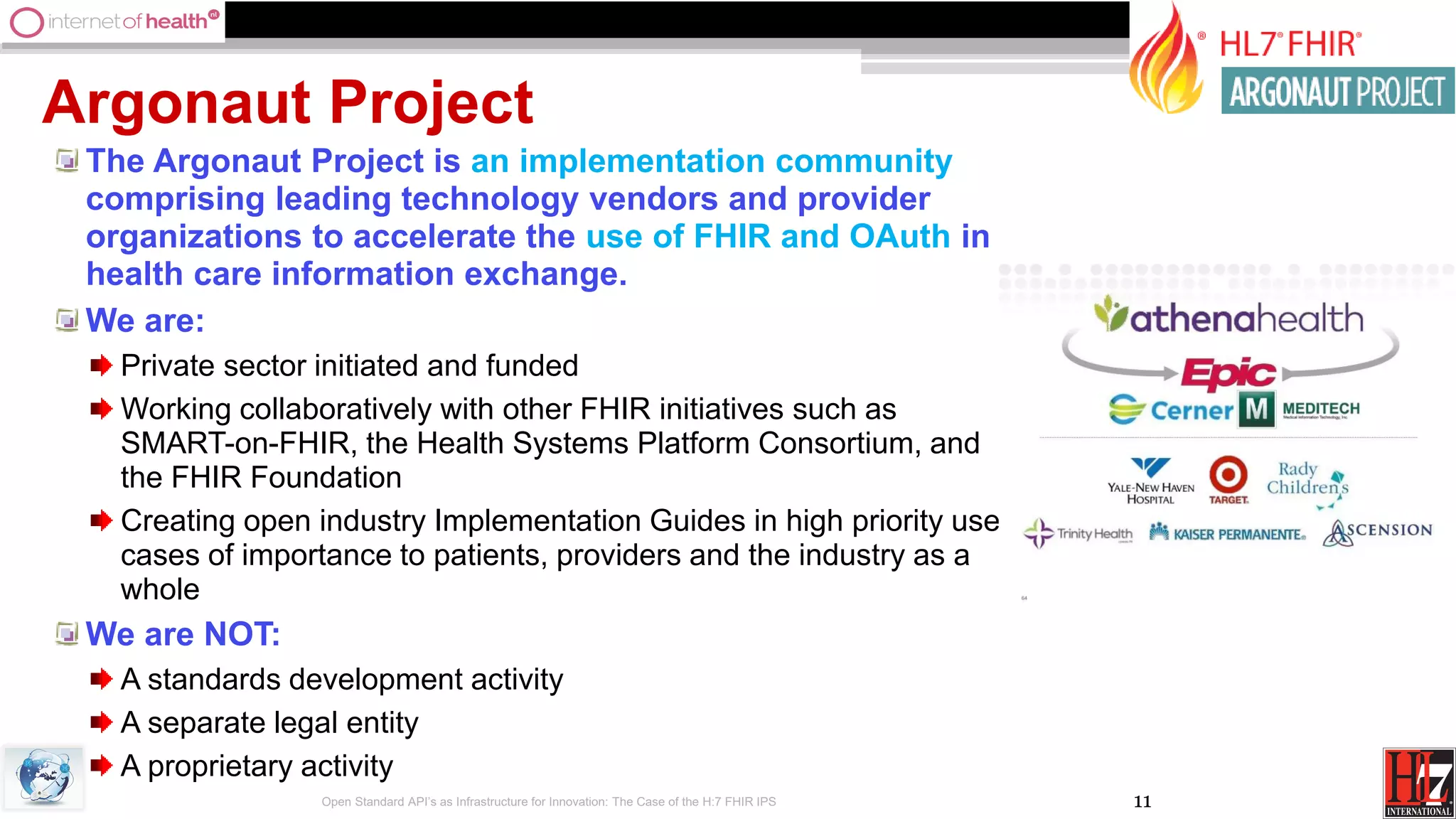
Argonaut Project
The Argonaut Project is an implementation community
comprising leading technology vendors and provider
organizations to accelerate the use of FHIR and OAuth in
health care information exchange.
We are:
Private sector initiated and funded
Working collaboratively with other FHIR initiatives such as
SMART-on-FHIR, the Health Systems Platform Consortium, and
the FHIR Foundation
Creating open industry Implementation Guides in high priority use
cases of importance to patients, providers and the industry as a
whole
We are NOT:
A standards development activity
A separate legal entity
A proprietary activity
Open Standard API’s as Infrastructure for Innovation: The Case of the H:7 FHIR IPS
12
Why do we need the Argonaut
Project to accelerate adoption of HL7 FHIR?
Standards development process, by design, values comprehensiveness
over speed-to-market
Market input is needed to make standards relevant and usable
Identification of priority use cases to meet market needs
Development of well-packaged implementation guides
Facilitation of testing and implementation community
Coupling with other standards or protocols needed for implementation (e.g.,
security)
Implementers need to have greater input (i.e., deeper, earlier) into
standards development
Need to get as much collaboration as early as possible in the cycle to
head off problems of heterogeneous implementations down the road
Open Standard API’s as Infrastructure for Innovation: The Case of the H:7 FHIR IPS
13
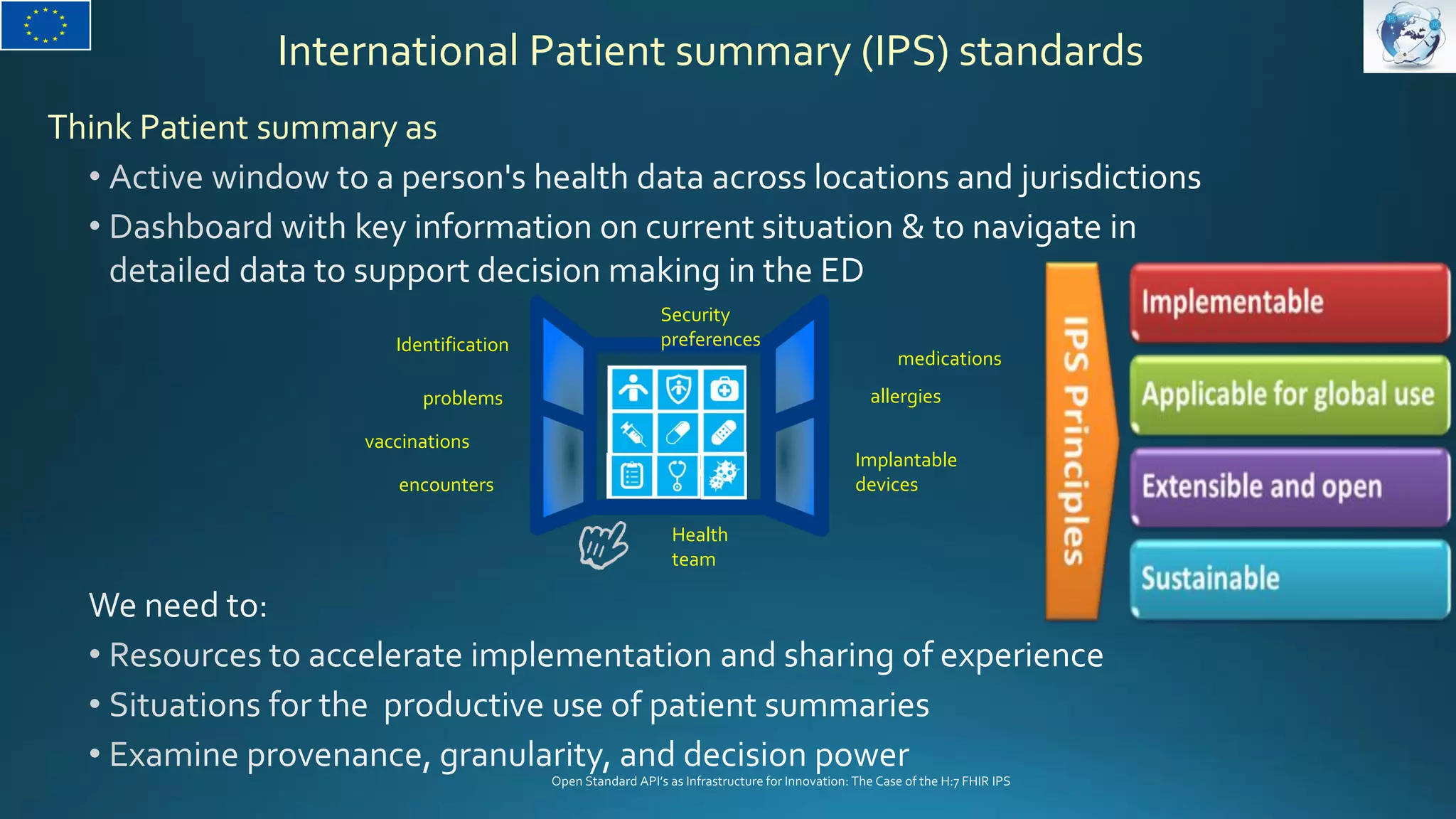
Patient summary as Health data navigator
Think of the Patient summary as a window to a person’s health or
dashboard to support the stakeholders in the ED:
Medications, allergies, vaccinations, problems and procedures,
labs, diagnostic imaging, recent or planned encounters, implantable devices
advance directives
“Bring the Power of Platforms to Health Care” using data to drive:
administrative automation, networked knowledge, and resource orchestration [Bush & Fox,
HBR November 2016]
eStandards need to
help build trust
unlock the power of health data
facilitate decision support
navigate the health system
Open Standard API’s as Infrastructure for Innovation: The Case of the H:7 FHIR IPS
Trillium-II
Reinforcing the Bridges and
Scaling up EU/US
Cooperation on Patient
Summary, 2017-2019
14
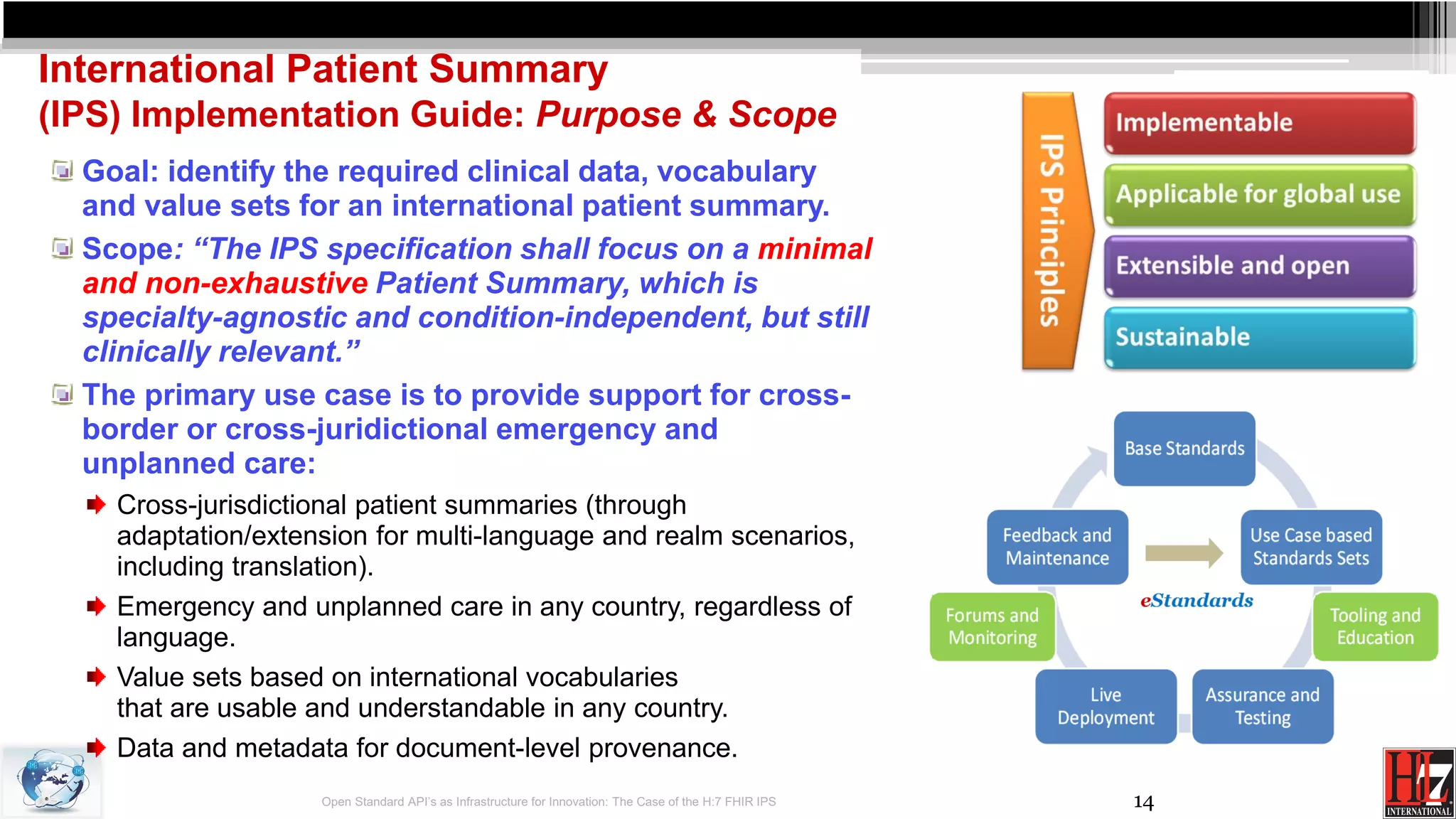
International Patient Summary
(IPS) Implementation Guide: Purpose & Scope
Goal: identify the required clinical data, vocabulary
and value sets for an international patient summary.
Scope: “The IPS specification shall focus on a minimal
and non-exhaustive Patient Summary, which is
specialty-agnostic and condition-independent, but still
clinically relevant.”
The primary use case is to provide support for cross-
border or cross-juridictional emergency and
unplanned care:
Cross-jurisdictional patient summaries (through
adaptation/extension for multi-language and realm scenarios,
including translation).
Emergency and unplanned care in any country, regardless of
language.
Value sets based on international vocabularies
that are usable and understandable in any country.
Data and metadata for document-level provenance.
Open Standard API’s as Infrastructure for Innovation: The Case of the H:7 FHIR IPS
International Patient summary (IPS) standards
Think Patient summary as
vaccinations
medications
encounters
Identification
allergies
Implantable
devices
Health
team
Security
preferences
Security
preferences
problems
© 2016 HL7 ® International. Licensed under Creative Commons. HL7 & Health Level Seven are registered trademarks of Health Level Seven International. Reg. U.S. TM Office.
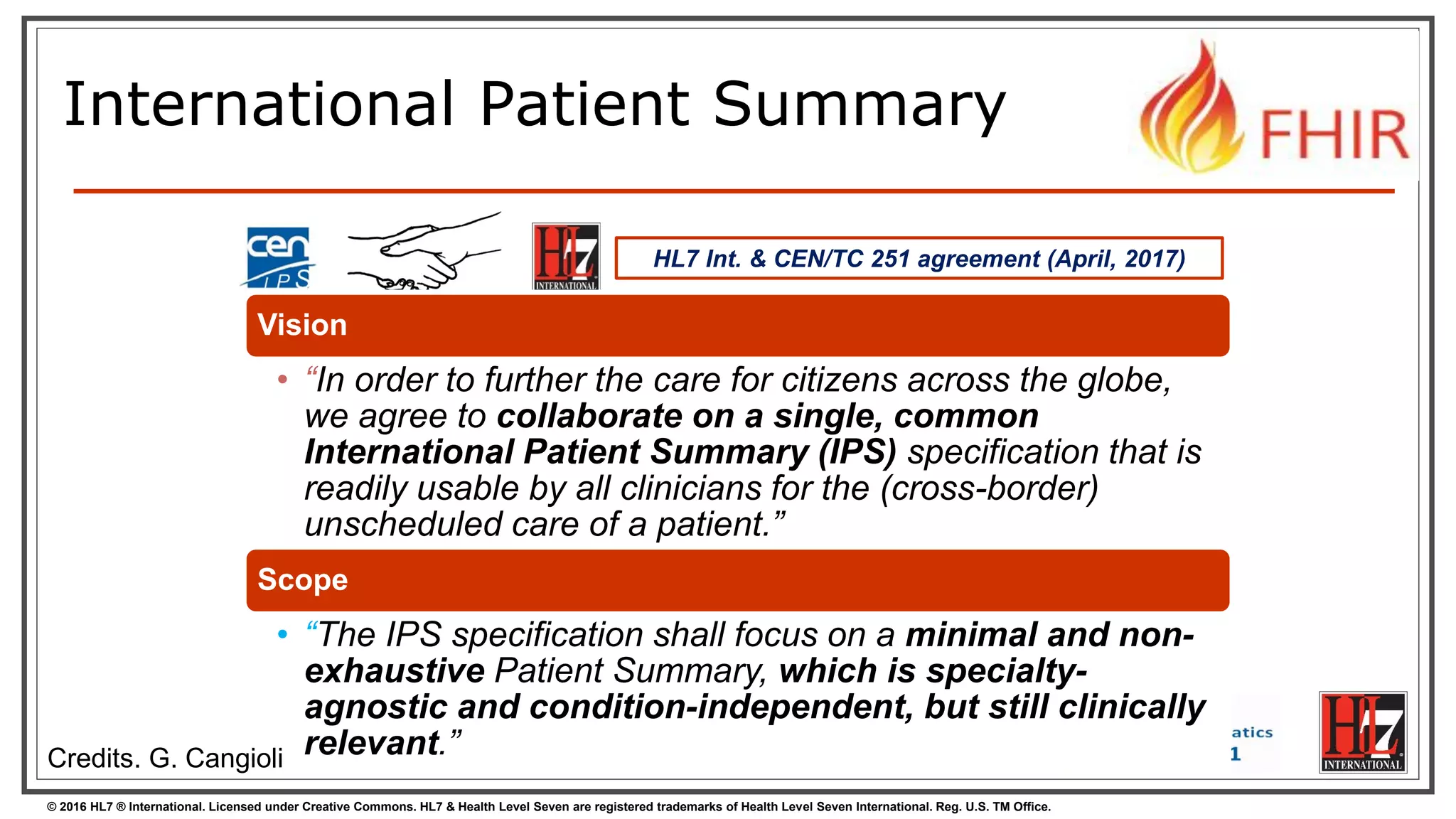
International Patient Summary
HL7 Int. & CEN/TC 251 agreement (April, 2017)
Vision
• “In order to further the care for citizens across the globe,
we agree to collaborate on a single, common
International Patient Summary (IPS) specification that is
readily usable by all clinicians for the (cross-border)
unscheduled care of a patient.”
Scope
• “The IPS specification shall focus on a minimal and non-
exhaustive Patient Summary, which is specialty-
agnostic and condition-independent, but still clinically
relevant.”Credits. G. Cangioli
© 2016 HL7 ® International. Licensed under Creative Commons. HL7 & Health Level Seven are registered trademarks of Health Level Seven International. Reg. U.S. TM Office.
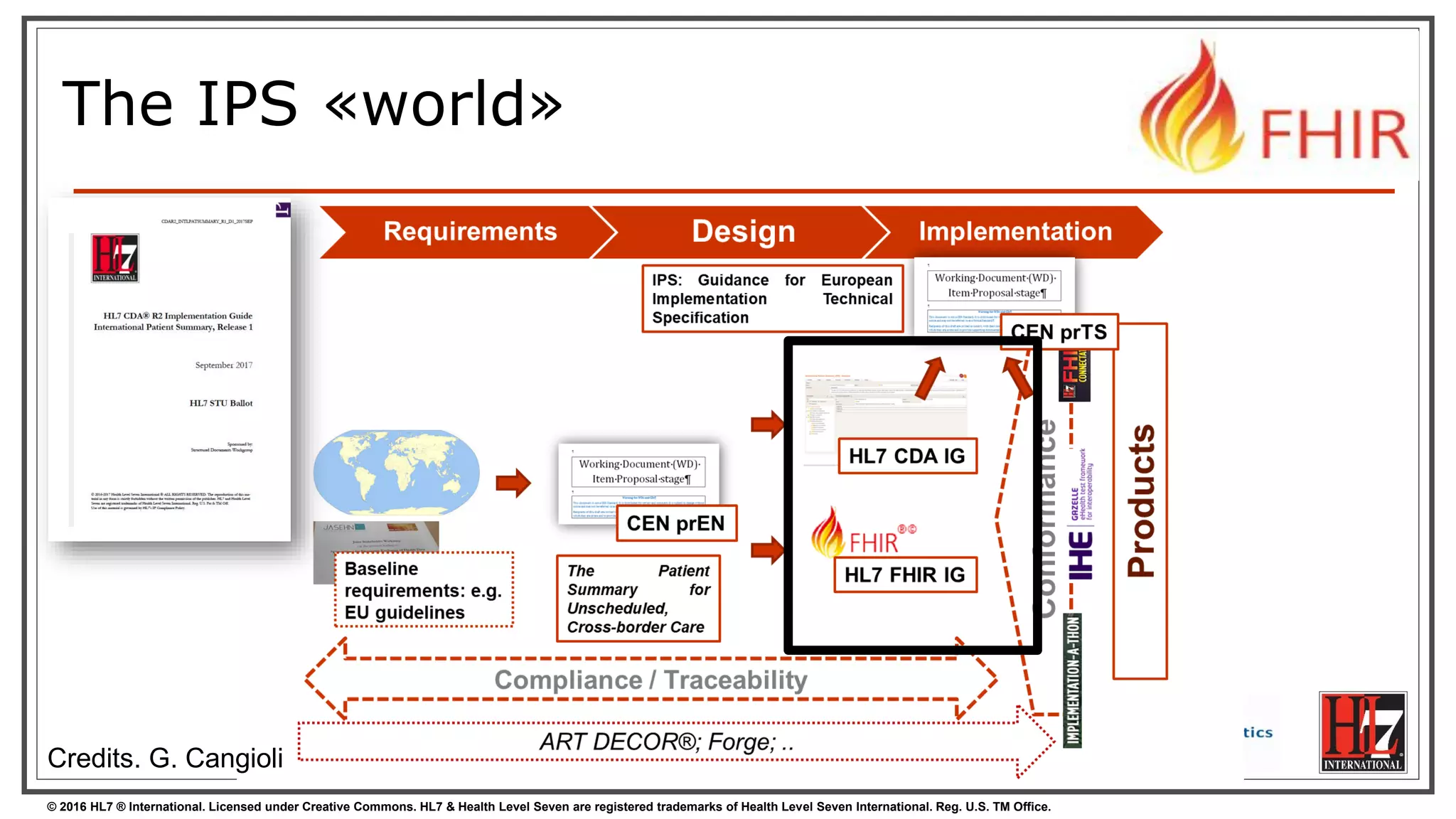
The IPS «world»
Credits. G. Cangioli
© 2016 HL7 ® International. Licensed under Creative Commons. HL7 & Health Level Seven are registered trademarks of Health Level Seven International. Reg. U.S. TM Office.
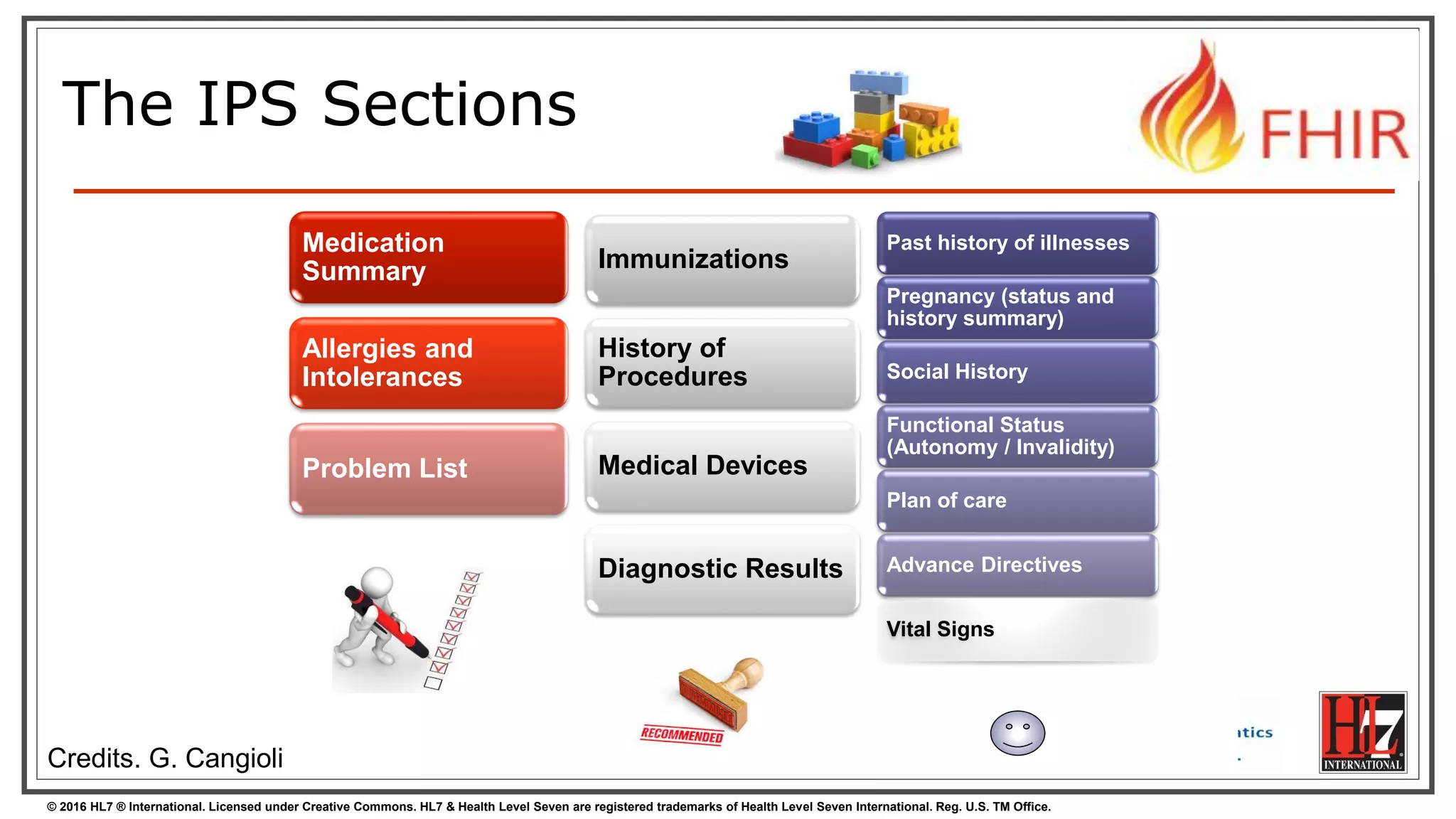
The IPS Sections
Medication
Summary
Allergies and
Intolerances
Problem List
Immunizations
History of
Procedures
Medical Devices
Diagnostic Results
Past history of illnesses
Pregnancy (status and
history summary)
Social History
Functional Status
(Autonomy / Invalidity)
Plan of care
Advance Directives
Vital Signs
Credits. G. Cangioli
© 2016 HL7 ® International. Licensed under Creative Commons. HL7 & Health Level Seven are registered trademarks of Health Level Seven International. Reg. U.S. TM Office.
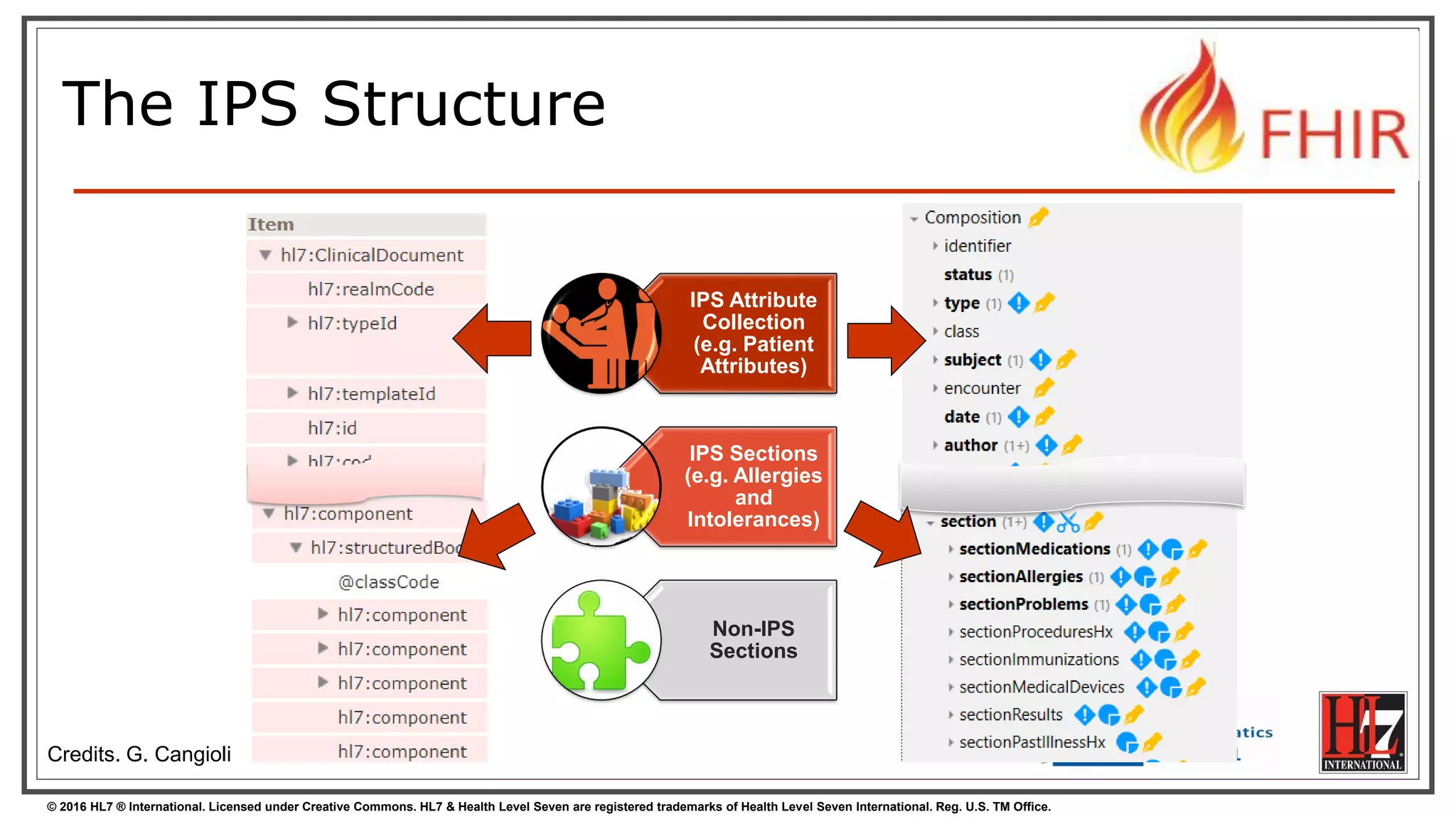
The IPS Structure
IPS Attribute
Collection
(e.g. Patient
Attributes)
IPS Sections
(e.g. Allergies
and
Intolerances)
Non-IPS
Sections
Credits. G. Cangioli
© 2016 HL7 ® International. Licensed under Creative Commons. HL7 & Health Level Seven are registered trademarks of Health Level Seven International. Reg. U.S. TM Office.
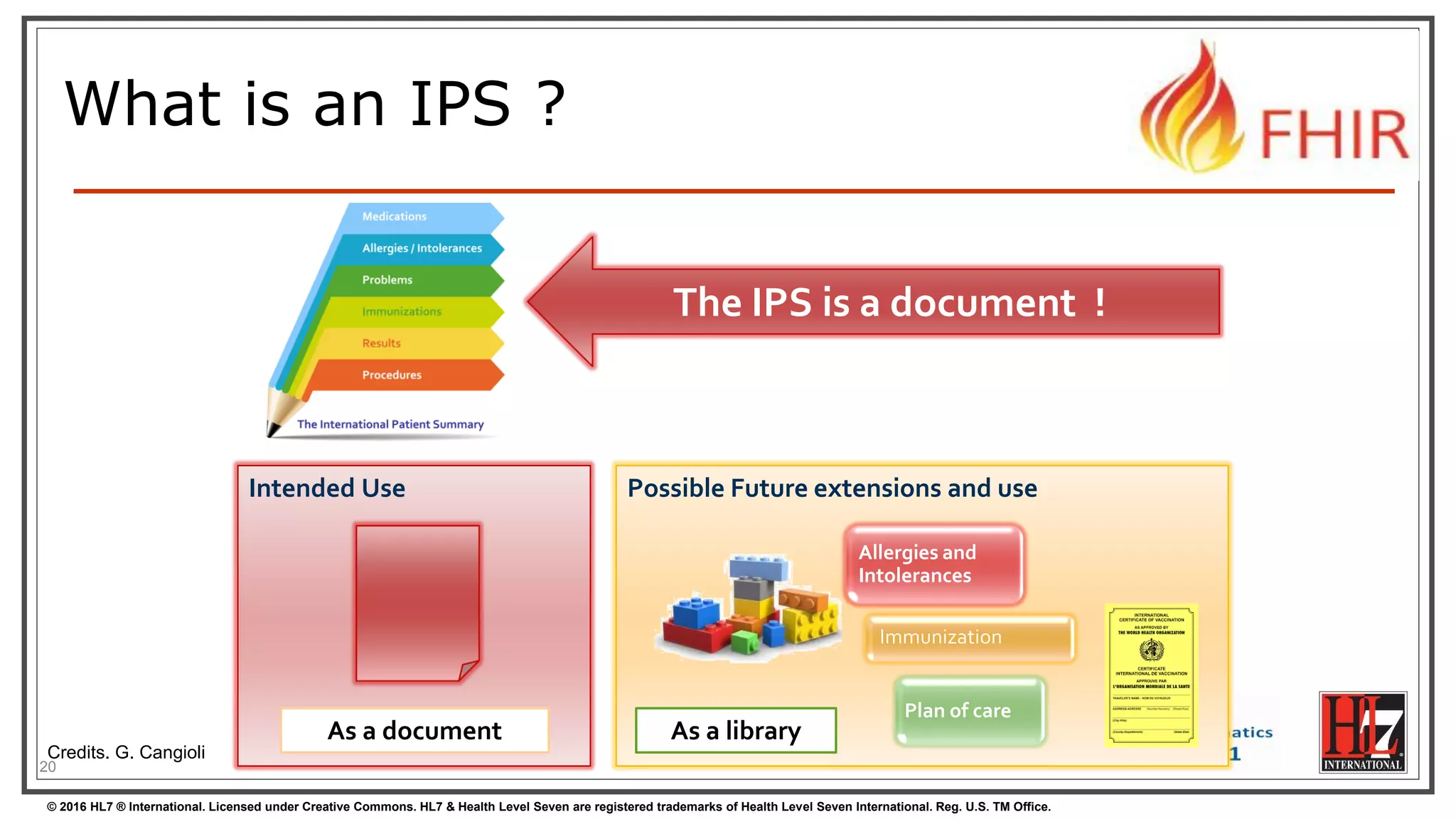
What is an IPS ?
20
Possible Future extensions and useIntended Use
As a libraryAs a document
The IPS is a document !
Immunization
Allergies and
Intolerances
Plan of care
Credits. G. Cangioli
21
Challenges to the use of APIs in health care
business case for both providers and their
IT allies to invest in this new partnership.
Leverage consumer-facing apps that solve
consumer health-related problems easily and
cheaply.
Risks of fraud and abuse in this new world
of data access are daunting.
Most consumers will delegate to third parties
accessing, storing, managing, and analyzing
their data.
Need for voluntary but enforceable code of
conduct to govern the behavior of private data
stewards.
Quality of customer-facing health
applications could become an important
issue.
If apps offer advice, it needs to be reliable.
If apps offer service, they need to deliver.
What is in scope of regulatory authorities?
How we can accelerate progress toward
use of open APIs within the health and care
industry:
Policy makers encourage data exchange for better
outcomes with financial incentives to providers.
Managers address the security concerns of patients
and providers
Vendors to implement open standardized APIs with
transparent terms of use, policies, and developer
fees.
Address cultural and workflow issues within health
systems
Apple’s collaboration with leading American
providers of health and information technology
services likely signals a new era in health and
medicine that echoes European and global
citizen health needs
Open Standard API’s as Infrastructure for Innovation: The Case of the H:7 FHIR IPS
22Open Standard API’s as Infrastructure for Innovation: The Case of the H:7 FHIR IPS
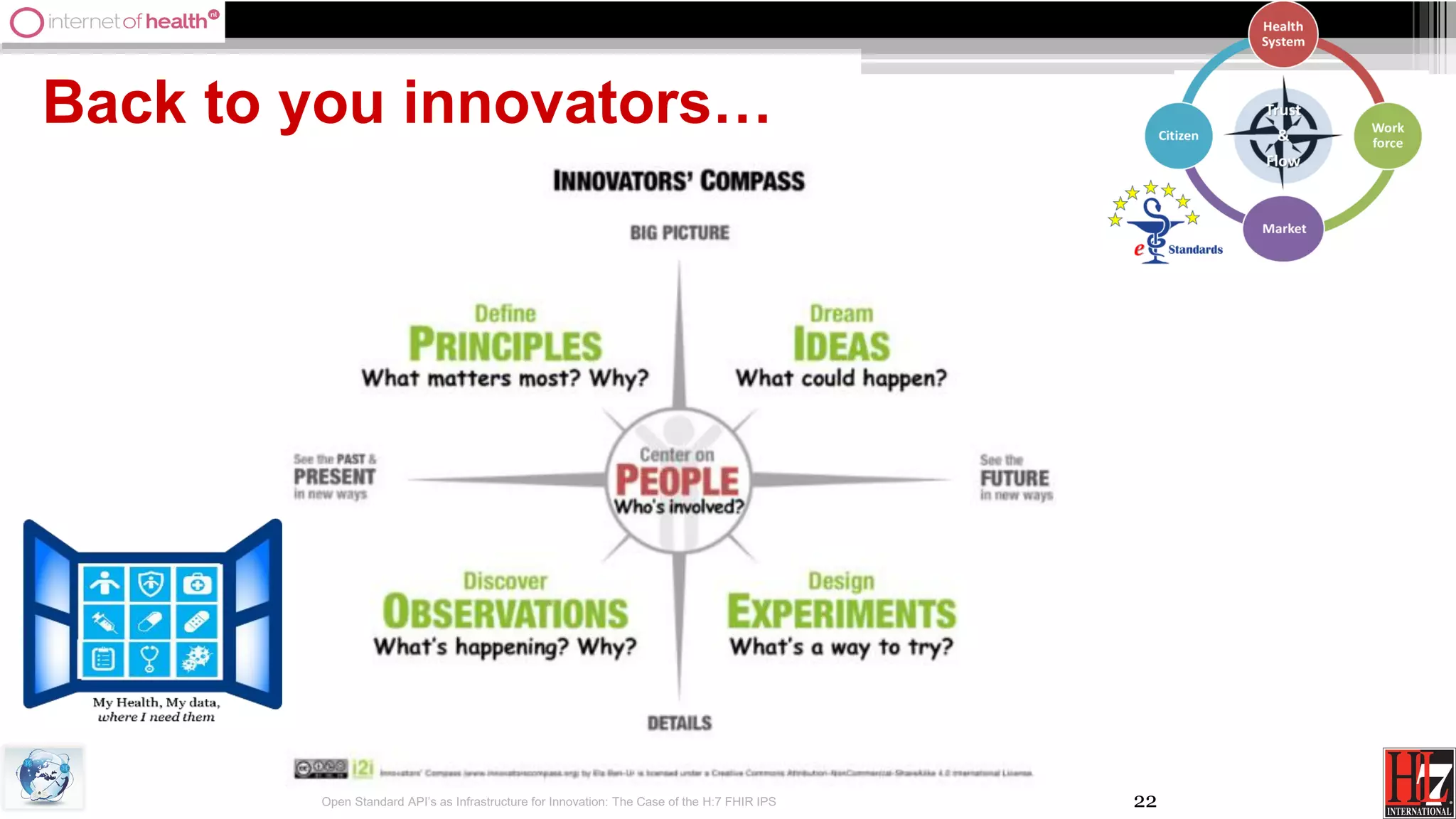
Back to you innovators…
23
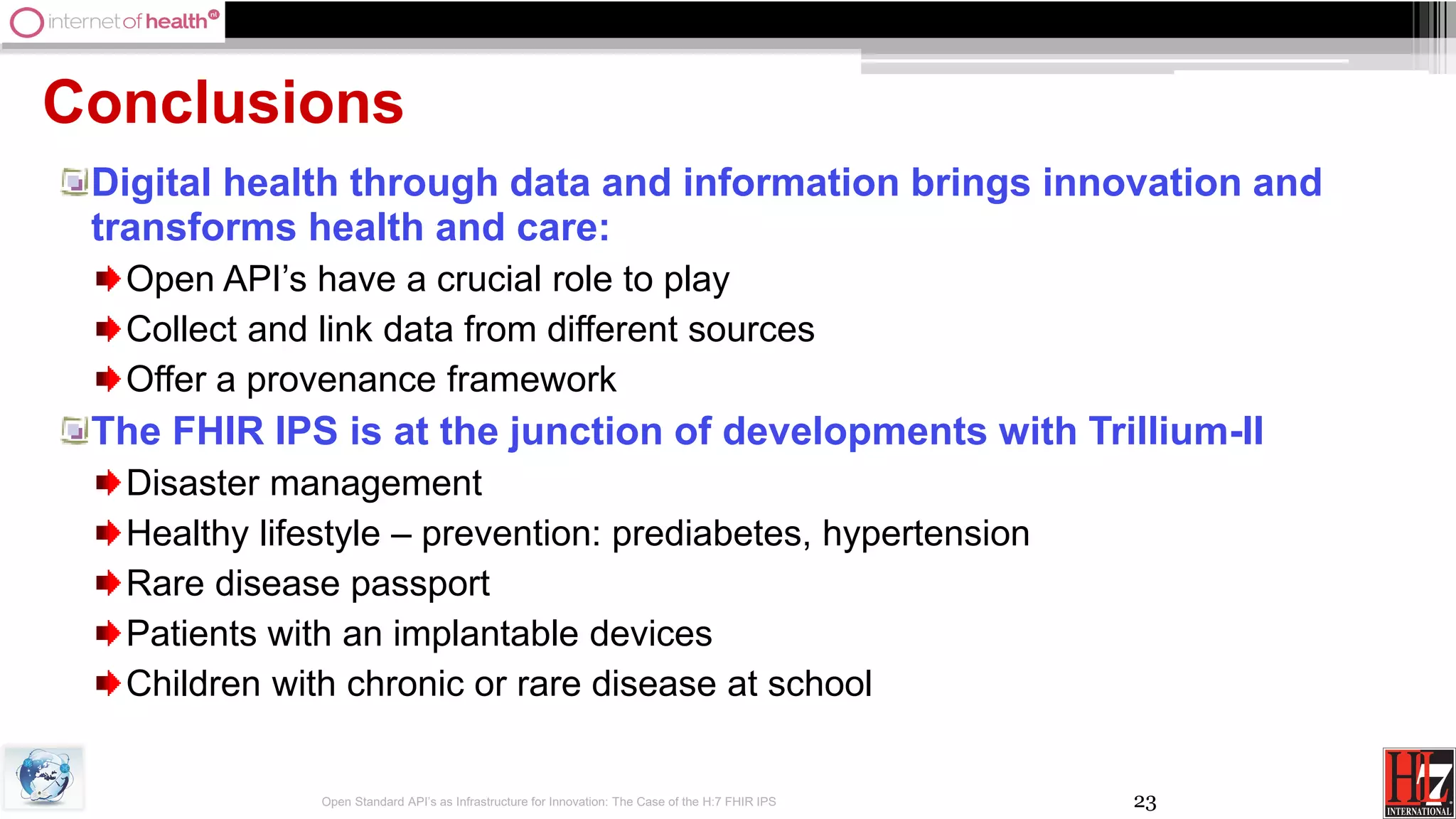
Conclusions
Digital health through data and information brings innovation and
transforms health and care:
Open API’s have a crucial role to play
Collect and link data from different sources
Offer a provenance framework
The FHIR IPS is at the junction of developments with Trillium-II
Disaster management
Healthy lifestyle – prevention: prediabetes, hypertension
Rare disease passport
Patients with an implantable devices
Children with chronic or rare disease at school
Open Standard API’s as Infrastructure for Innovation: The Case of the H:7 FHIR IPS
mhm@medcom.dk
euoffice@HL7.org
www.trilliumbridge.eu
Open Standard API’s as Infrastructure for Innovation: The Case of the H:7 FHIR IPS
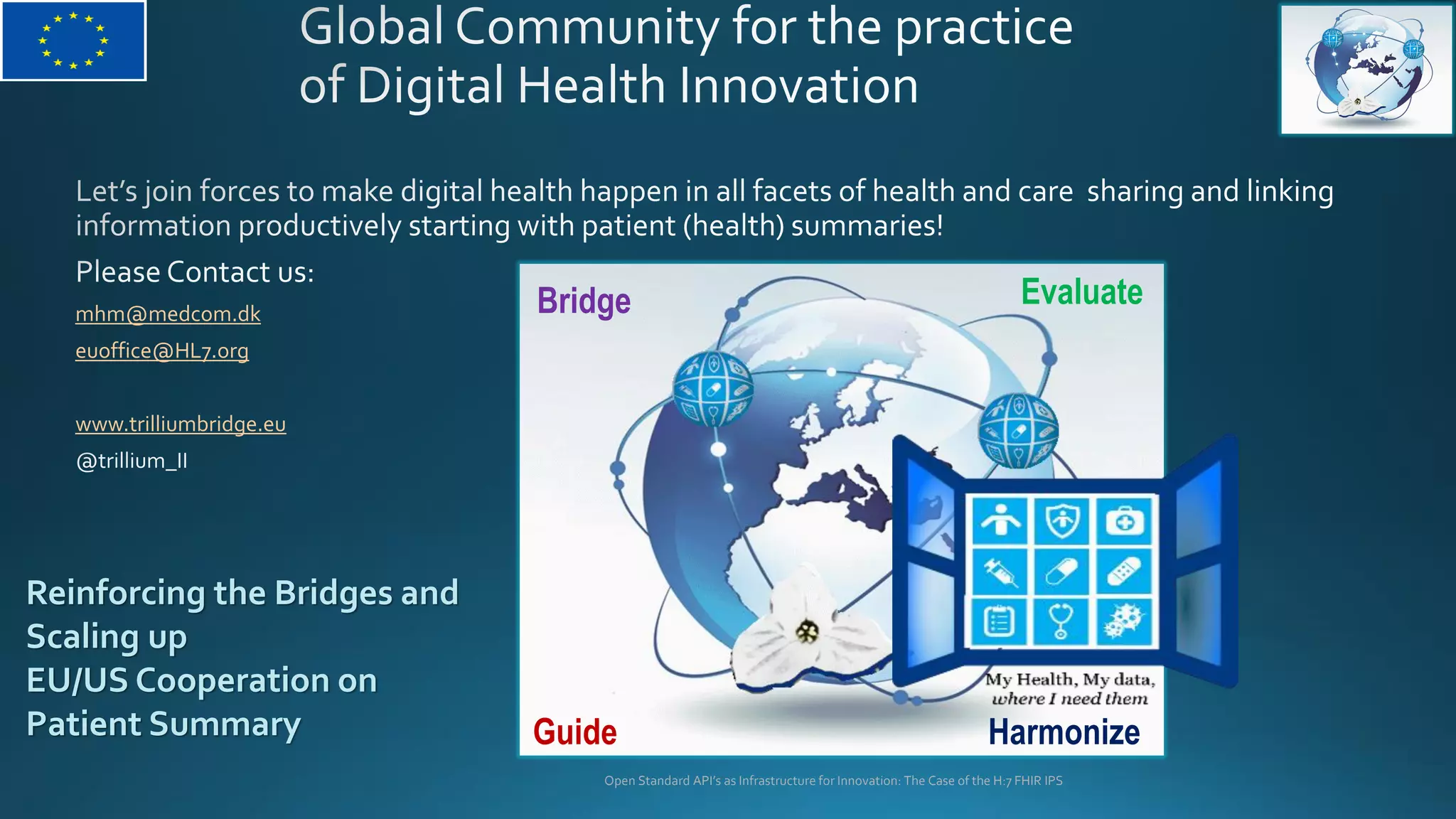
EvaluateBridge
HarmonizeGuide
Reinforcing the Bridges and
Scaling up
EU/US Cooperation on
Patient Summary

Open ap is-infrastructure4innovation_internetofhealth2018_v3

  • 1.
    Open Standard API’sas Infrastructure for Innovation The case of the HL7 FHIR International Patient Summary Catherine Chronaki Secretary General HL7 Foundation, Brussels, Belgium euoffice@HL7.org Funded under H2020-727745
  • 2.
    2 HL7 Foundation: HL7 thebest and most widely-used eHealth standards since 1986 HL7 v2, Clinical Document Architecture, HL7 FHIR 20 National Affiliates in Europe (~38 wordwide) European HL7 foundation established in 2010 European Funded Research Projects eHGI, Antilope, Semantic Healthnet, Trillium Bridge, Expand, Trillium-II PHC34: ASSESS CT, OpenMedicine, eStandards Annual HL7 in Europe Newsletter Website: www.HL7.eu eHealth policy & Research eHealth stakeholders group; mHealth Guidelines; ENISA expert group EFMI council (2012-): EFMI Board (2016-) HIMSS Europe SDO Joint Initiative Council HL7 Vision: A world in which everyone can securely access and use the right health data when and where they need it. Open Standard API’s as Infrastructure for Innovation: The Case of the H:7 FHIR IPS
  • 3.
    3Open Standard API’sas Infrastructure for Innovation: The Case of the H:7 FHIR IPS “By 2014, 75% of the Fortune 500 will open APIs” Empower their customers to do more. Build highly valuable partner ecosystems. Become increasingly more agile src: Forrester Research
  • 4.
    4 Application programming interfaces(API) An emerging (API) Economy APIs are specifications or protocols that allow software applications to share data. Allow third parties to write software that accesses data and drives transactions. Internal systems in the enterprise are restructured to uniformly support innovative new projects—reducing maintenance costs and increasing agility. APIs enable organizations to become platforms: Reduce complexity: provide uniform data and transaction interfaces to internal and external entities Improve change management: allow development of new functionality and create value by third parties Create new opportunities: generate new ways to reach customers, generate revenue and build partnerships Control access to partners, customers, and contractors Bottom line: innovate more rapidly –APIs are a new means of creating value by third-party led innovation API economy: economic effects enabled by companies, governments, non-profits & individuals using APIs to provide programmable access to systems and processes. new classes of applications with the potential to transform the way business is done. New business models based on API profit and revenue sharing: e.g. Amazon Web Services sales Q2 2018, $5.44B, 11% of total revenue (1.4B operating income, 49% growth) Warren Buffet (2017): "Here you take cloud services, Bezos thought he would have two years of runway. He got seven years. You do not want to give Jeff Bezos a seven-year head start.” Open Standard API’s as Infrastructure for Innovation: The Case of the H:7 FHIR IPS
  • 5.
    5 What about APIsin HealthCare? interoperability and easier access to health care data through open standard APIs Companies can share data Serve better people needs Use APIs for internal and external innovation. Potential impact on the quality and cost of care the patient’s experience and innovation could be enormous. Translates to concrete benefits for patients and caregivers Avoid multiple provider portals Tailored apps of improved usability for clinicians and patients alike Open Standard API’s as Infrastructure for Innovation: The Case of the H:7 FHIR IPS
  • 6.
    6 Power of APIsin Healthcare: The case of Apple Apples leads the way towards an IT enabled health ecosystem January 24, 2018: “Apple and 13 prominent health systems, …, disclosed an agreement that would allow Apple to download onto its various devices the electronic health data of those systems’ patients — with patients’ permission…” End to the inability to make electronic data liquid follow the patient throughout the health system, available for sophisticated analysis for improved patient care and research. After long time efforts to liberate and exchange health data focused on doctors and hospitals to share.. Apple entered with area around 2014 with citizen focus HealthKit – developer tool that allows apps to contribute/share data, e.g. Nike+, AliveCor, DexCom glucose monitor, etc. ResearchKit – developer kit for scientists to carry Human studies CareKit, develpers creating apps to let people manage long-term conditions Health Records, access to your own health records across providers Open Standard API’s as Infrastructure for Innovation: The Case of the H:7 FHIR IPS
  • 7.
    7 Stanford Apple HeartStudy https://med.stanford.edu/appleheartstudy/faq.html Open Standard API’s as Infrastructure for Innovation: The Case of the H:7 FHIR IPS
  • 8.
    8 The case ofApple Health:health records Apple's HealthKit already gives the company a foothold in the healthcare market. Apple Watch and iPhone is a conduit for micro-level data e.g. heart rate, activity, etc. Leading medical data players are on board with Health Records. Apple's launch hospital partners, John Hopkins, Penn Medicine, etc. run on Epic and Cerner for the most part, leading players in the medical records space Apple is going along with standards. Health Records is based on HL7 FHIR (Fast Healthcare Interoperability Resources), which is a standard for transferring electronic medical records, supported by Argonaut. The healthcare industry is prepared Electronic medical records exchange heavy work occurred with meaningful use. Apple just brings healthcare data to consumer devices. Privacy. Apple has differentiated itself from Google's cloud and the data centric approach. Health Records will be encrypted and protected under a user's iPhone passcode. Open Standard API’s as Infrastructure for Innovation: The Case of the H:7 FHIR IPS https://www.apple.com/h ealthcare/health-records/
  • 9.
    FHIR is FREE!! F– Fast (design & implement) H – Healthcare I – Interoperable R – Resources (Building blocks)Open Standard API’s as Infrastructure for Innovation: The Case of the H:7 FHIR IPS
  • 10.
    10 What’s so greatabout HL7 FHIR? Flexible to document-level and data-level exchange Sometimes individual data elements are important, sometimes entire documents are appropriate Based on modern internet conventions RESTful API – same browser-based approach as used by Facebook, google, twitter, etc Infinitely extensible to detailed resources/profiles to meet any use case Supports push and pull use cases Attractive to developers from outside of healthcare Brings new voices into health care pushes the industry to innovate at internet speed Open Standard API’s as Infrastructure for Innovation: The Case of the H:7 FHIR IPS
  • 11.
    11 Argonaut Project The ArgonautProject is an implementation community comprising leading technology vendors and provider organizations to accelerate the use of FHIR and OAuth in health care information exchange. We are: Private sector initiated and funded Working collaboratively with other FHIR initiatives such as SMART-on-FHIR, the Health Systems Platform Consortium, and the FHIR Foundation Creating open industry Implementation Guides in high priority use cases of importance to patients, providers and the industry as a whole We are NOT: A standards development activity A separate legal entity A proprietary activity Open Standard API’s as Infrastructure for Innovation: The Case of the H:7 FHIR IPS
  • 12.
    12 Why do weneed the Argonaut Project to accelerate adoption of HL7 FHIR? Standards development process, by design, values comprehensiveness over speed-to-market Market input is needed to make standards relevant and usable Identification of priority use cases to meet market needs Development of well-packaged implementation guides Facilitation of testing and implementation community Coupling with other standards or protocols needed for implementation (e.g., security) Implementers need to have greater input (i.e., deeper, earlier) into standards development Need to get as much collaboration as early as possible in the cycle to head off problems of heterogeneous implementations down the road Open Standard API’s as Infrastructure for Innovation: The Case of the H:7 FHIR IPS
  • 13.
    13 Patient summary asHealth data navigator Think of the Patient summary as a window to a person’s health or dashboard to support the stakeholders in the ED: Medications, allergies, vaccinations, problems and procedures, labs, diagnostic imaging, recent or planned encounters, implantable devices advance directives “Bring the Power of Platforms to Health Care” using data to drive: administrative automation, networked knowledge, and resource orchestration [Bush & Fox, HBR November 2016] eStandards need to help build trust unlock the power of health data facilitate decision support navigate the health system Open Standard API’s as Infrastructure for Innovation: The Case of the H:7 FHIR IPS Trillium-II Reinforcing the Bridges and Scaling up EU/US Cooperation on Patient Summary, 2017-2019
  • 14.
    14 International Patient Summary (IPS)Implementation Guide: Purpose & Scope Goal: identify the required clinical data, vocabulary and value sets for an international patient summary. Scope: “The IPS specification shall focus on a minimal and non-exhaustive Patient Summary, which is specialty-agnostic and condition-independent, but still clinically relevant.” The primary use case is to provide support for cross- border or cross-juridictional emergency and unplanned care: Cross-jurisdictional patient summaries (through adaptation/extension for multi-language and realm scenarios, including translation). Emergency and unplanned care in any country, regardless of language. Value sets based on international vocabularies that are usable and understandable in any country. Data and metadata for document-level provenance. Open Standard API’s as Infrastructure for Innovation: The Case of the H:7 FHIR IPS
  • 15.
    International Patient summary(IPS) standards Think Patient summary as vaccinations medications encounters Identification allergies Implantable devices Health team Security preferences Security preferences problems
  • 16.
    © 2016 HL7® International. Licensed under Creative Commons. HL7 & Health Level Seven are registered trademarks of Health Level Seven International. Reg. U.S. TM Office. International Patient Summary HL7 Int. & CEN/TC 251 agreement (April, 2017) Vision • “In order to further the care for citizens across the globe, we agree to collaborate on a single, common International Patient Summary (IPS) specification that is readily usable by all clinicians for the (cross-border) unscheduled care of a patient.” Scope • “The IPS specification shall focus on a minimal and non- exhaustive Patient Summary, which is specialty- agnostic and condition-independent, but still clinically relevant.”Credits. G. Cangioli
  • 17.
    © 2016 HL7® International. Licensed under Creative Commons. HL7 & Health Level Seven are registered trademarks of Health Level Seven International. Reg. U.S. TM Office. The IPS «world» Credits. G. Cangioli
  • 18.
    © 2016 HL7® International. Licensed under Creative Commons. HL7 & Health Level Seven are registered trademarks of Health Level Seven International. Reg. U.S. TM Office. The IPS Sections Medication Summary Allergies and Intolerances Problem List Immunizations History of Procedures Medical Devices Diagnostic Results Past history of illnesses Pregnancy (status and history summary) Social History Functional Status (Autonomy / Invalidity) Plan of care Advance Directives Vital Signs Credits. G. Cangioli
  • 19.
    © 2016 HL7® International. Licensed under Creative Commons. HL7 & Health Level Seven are registered trademarks of Health Level Seven International. Reg. U.S. TM Office. The IPS Structure IPS Attribute Collection (e.g. Patient Attributes) IPS Sections (e.g. Allergies and Intolerances) Non-IPS Sections Credits. G. Cangioli
  • 20.
    © 2016 HL7® International. Licensed under Creative Commons. HL7 & Health Level Seven are registered trademarks of Health Level Seven International. Reg. U.S. TM Office. What is an IPS ? 20 Possible Future extensions and useIntended Use As a libraryAs a document The IPS is a document ! Immunization Allergies and Intolerances Plan of care Credits. G. Cangioli
  • 21.
    21 Challenges to theuse of APIs in health care business case for both providers and their IT allies to invest in this new partnership. Leverage consumer-facing apps that solve consumer health-related problems easily and cheaply. Risks of fraud and abuse in this new world of data access are daunting. Most consumers will delegate to third parties accessing, storing, managing, and analyzing their data. Need for voluntary but enforceable code of conduct to govern the behavior of private data stewards. Quality of customer-facing health applications could become an important issue. If apps offer advice, it needs to be reliable. If apps offer service, they need to deliver. What is in scope of regulatory authorities? How we can accelerate progress toward use of open APIs within the health and care industry: Policy makers encourage data exchange for better outcomes with financial incentives to providers. Managers address the security concerns of patients and providers Vendors to implement open standardized APIs with transparent terms of use, policies, and developer fees. Address cultural and workflow issues within health systems Apple’s collaboration with leading American providers of health and information technology services likely signals a new era in health and medicine that echoes European and global citizen health needs Open Standard API’s as Infrastructure for Innovation: The Case of the H:7 FHIR IPS
  • 22.
    22Open Standard API’sas Infrastructure for Innovation: The Case of the H:7 FHIR IPS Back to you innovators…
  • 23.
    23 Conclusions Digital health throughdata and information brings innovation and transforms health and care: Open API’s have a crucial role to play Collect and link data from different sources Offer a provenance framework The FHIR IPS is at the junction of developments with Trillium-II Disaster management Healthy lifestyle – prevention: prediabetes, hypertension Rare disease passport Patients with an implantable devices Children with chronic or rare disease at school Open Standard API’s as Infrastructure for Innovation: The Case of the H:7 FHIR IPS
  • 24.
    mhm@medcom.dk euoffice@HL7.org www.trilliumbridge.eu Open Standard API’sas Infrastructure for Innovation: The Case of the H:7 FHIR IPS EvaluateBridge HarmonizeGuide Reinforcing the Bridges and Scaling up EU/US Cooperation on Patient Summary