Open Access Workshop 
for IOPPN post-doctoral researchers 
October 2014 
Lynne Meehan and Helen Cargill 
Research Support and Digital Assets, Library Services
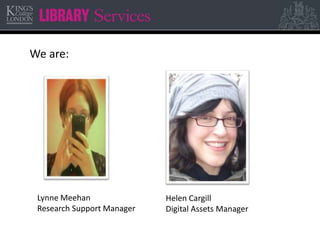
We are: 
Lynne Meehan 
Research Support Manager 
Helen Cargill 
Digital Assets Manager
Overview 
• What is Open Access 
• Open Access Publishing Choices 
• Funders and Open Access 
• Further Information and Library Support 
• Final thoughts
Open Access is: 
The open and free availability 
of research outputs to anyone 
at point of access – improving 
the way scholarly information 
is shared
Key Terms 
• Green Open Access 
= research outputs are deposited in digital repositories that can be 
accessed for free; either after a publisher embargo period or in pre-print 
form 
• Gold Open Access 
= immediate access to material online is free and in its final published 
format
Key Terms 
• Preprint 
= A first draft of an article, before peer-review. 
• Postprint 
= The final accepted version, before publisher’s copy-editing, proof 
corrections, layout and typesetting. May also be known as Author 
Accepted Manuscript.
Typical Questions about Open Access 
1. What are the consequences if I don’t make my research OA? 
2. What can I do if my co-authors aren’t interested in making a paper OA? 
3. How can I publish in a gold OA journal but have no funding? 
4. How do I handle signing a publisher copyright agreement? 
5. What resources exist to help me make my research open access?
Open Access publishing choices
Fully Open Access journals
Hybrid Open Access journals
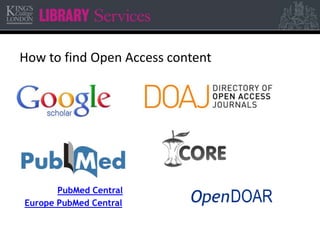
How to find Open Access content 
PubMed Central 
Europe PubMed Central
Funders and Open Access
Research funder Open Access policies 
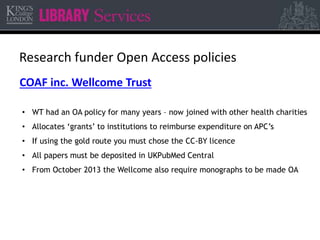
COAF inc. Wellcome Trust 
• WT had an OA policy for many years – now joined with other health charities 
• Allocates ‘grants’ to institutions to reimburse expenditure on APC’s 
• If using the gold route you must chose the CC-BY licence 
• All papers must be deposited in UKPubMed Central 
• From October 2013 the Wellcome also require monographs to be made OA
Research funder Open Access policies 
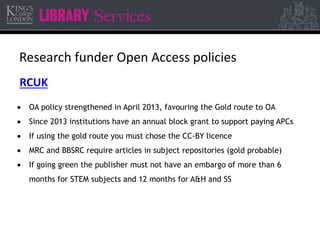
RCUK 
 OA policy strengthened in April 2013, favouring the Gold route to OA 
 Since 2013 institutions have an annual block grant to support paying APCs 
 If using the gold route you must chose the CC-BY licence 
 MRC and BBSRC require articles in subject repositories (gold probable) 
 If going green the publisher must not have an embargo of more than 6 
months for STEM subjects and 12 months for A&H and SS
Research funder Open Access policies 
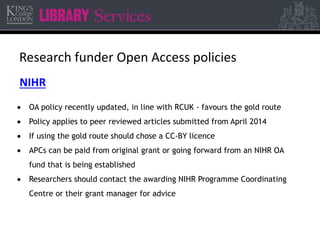
NIHR 
 OA policy recently updated, in line with RCUK - favours the gold route 
 Policy applies to peer reviewed articles submitted from April 2014 
 If using the gold route should chose a CC-BY licence 
 APCs can be paid from original grant or going forward from an NIHR OA 
fund that is being established 
 Researchers should contact the awarding NIHR Programme Coordinating 
Centre or their grant manager for advice
Research funder Open Access policies 
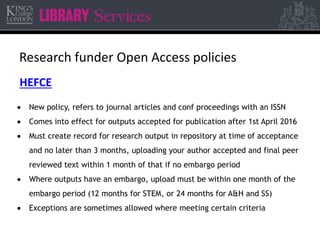
HEFCE 
 New policy, refers to journal articles and conf proceedings with an ISSN 
 Comes into effect for outputs accepted for publication after 1st April 2016 
 Must create record for research output in repository at time of acceptance 
and no later than 3 months, uploading your author accepted and final peer 
reviewed text within 1 month of that if no embargo period 
 Where outputs have an embargo, upload must be within one month of the 
embargo period (12 months for STEM, or 24 months for A&H and SS) 
 Exceptions are sometimes allowed where meeting certain criteria
Further Information & Support
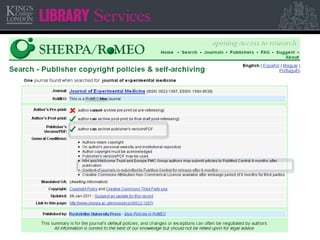
Publisher/Journal Open Access policies
Research Profiles & Institutional Repository 
Research Portal https://kclpure.kcl.ac.uk/portal/ 
Pure https://kclpure.kcl.ac.uk/admin/
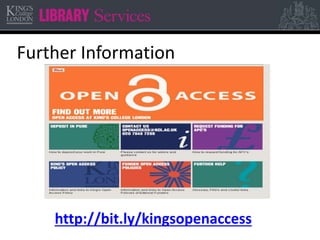
Further Information 
http://bit.ly/kingsopenaccess
Funds for Open Access 
• King’s has grants for Open Access Publishing from 
– COAF 
– RCUK 
– BIS 
• Some funders allow OA costs to be included in grant 
proposals – inc. NIHR, Leverhulme Trust and European 
Research Commission 
Not all funders cover OA costs
Support for you 
• Email openaccess@kcl.ac.uk 
• Call 020 7848 7298 
• Request for Open Access funding web form 
http://bit.ly/fundingrequest
Final Thoughts
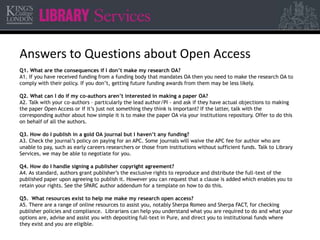
Answers to Questions about Open Access 
Q1. What are the consequences if I don’t make my research OA? 
A1. If you have received funding from a funding body that mandates OA then you need to make the research OA to 
comply with their policy. If you don’t, getting future funding awards from them may be less likely. 
Q2. What can I do if my co-authors aren’t interested in making a paper OA? 
A2. Talk with your co-authors – particularly the lead author/PI - and ask if they have actual objections to making 
the paper Open Access or if it’s just not something they think is important? If the latter, talk with the 
corresponding author about how simple it is to make the paper OA via your institutions repository. Offer to do this 
on behalf of all the authors. 
Q3. How do I publish in a gold OA journal but I haven’t any funding? 
A3. Check the journal’s policy on paying for an APC. Some journals will waive the APC fee for author who are 
unable to pay, such as early careers researchers or those from institutions without sufficient funds. Talk to Library 
Services, we may be able to negotiate for you. 
Q4. How do I handle signing a publisher copyright agreement? 
A4. As standard, authors grant publisher’s the exclusive rights to reproduce and distribute the full-text of the 
published paper upon agreeing to publish it. However you can request that a clause is added which enables you to 
retain your rights. See the SPARC author addendum for a template on how to do this. 
Q5. What resources exist to help me make my research open access? 
A5. There are a range of online resources to assist you, notably Sherpa Romeo and Sherpa FACT, for checking 
publisher policies and compliance. Librarians can help you understand what you are required to do and what your 
options are, advise and assist you with depositing full-text in Pure, and direct you to institutional funds where 
they exist and you are eligible.
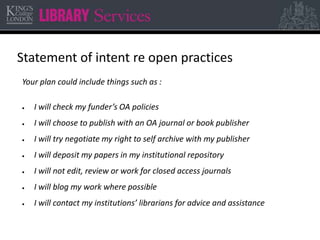
Statement of intent re open practices 
Your plan could include things such as : 
 I will check my funder’s OA policies 
 I will choose to publish with an OA journal or book publisher 
 I will try negotiate my right to self archive with my publisher 
 I will deposit my papers in my institutional repository 
 I will not edit, review or work for closed access journals 
 I will blog my work where possible 
 I will contact my institutions’ librarians for advice and assistance
Thank you

Open access workshop for IoPPN

  • 1.
    Open Access Workshop for IOPPN post-doctoral researchers October 2014 Lynne Meehan and Helen Cargill Research Support and Digital Assets, Library Services
  • 2.
    We are: LynneMeehan Research Support Manager Helen Cargill Digital Assets Manager
  • 3.
    Overview • Whatis Open Access • Open Access Publishing Choices • Funders and Open Access • Further Information and Library Support • Final thoughts
  • 4.
    Open Access is: The open and free availability of research outputs to anyone at point of access – improving the way scholarly information is shared
  • 5.
    Key Terms •Green Open Access = research outputs are deposited in digital repositories that can be accessed for free; either after a publisher embargo period or in pre-print form • Gold Open Access = immediate access to material online is free and in its final published format
  • 6.
    Key Terms •Preprint = A first draft of an article, before peer-review. • Postprint = The final accepted version, before publisher’s copy-editing, proof corrections, layout and typesetting. May also be known as Author Accepted Manuscript.
  • 7.
    Typical Questions aboutOpen Access 1. What are the consequences if I don’t make my research OA? 2. What can I do if my co-authors aren’t interested in making a paper OA? 3. How can I publish in a gold OA journal but have no funding? 4. How do I handle signing a publisher copyright agreement? 5. What resources exist to help me make my research open access?
  • 8.
  • 9.
  • 10.
  • 11.
    How to findOpen Access content PubMed Central Europe PubMed Central
  • 12.
  • 13.
    Research funder OpenAccess policies COAF inc. Wellcome Trust • WT had an OA policy for many years – now joined with other health charities • Allocates ‘grants’ to institutions to reimburse expenditure on APC’s • If using the gold route you must chose the CC-BY licence • All papers must be deposited in UKPubMed Central • From October 2013 the Wellcome also require monographs to be made OA
  • 14.
    Research funder OpenAccess policies RCUK  OA policy strengthened in April 2013, favouring the Gold route to OA  Since 2013 institutions have an annual block grant to support paying APCs  If using the gold route you must chose the CC-BY licence  MRC and BBSRC require articles in subject repositories (gold probable)  If going green the publisher must not have an embargo of more than 6 months for STEM subjects and 12 months for A&H and SS
  • 15.
    Research funder OpenAccess policies NIHR  OA policy recently updated, in line with RCUK - favours the gold route  Policy applies to peer reviewed articles submitted from April 2014  If using the gold route should chose a CC-BY licence  APCs can be paid from original grant or going forward from an NIHR OA fund that is being established  Researchers should contact the awarding NIHR Programme Coordinating Centre or their grant manager for advice
  • 16.
    Research funder OpenAccess policies HEFCE  New policy, refers to journal articles and conf proceedings with an ISSN  Comes into effect for outputs accepted for publication after 1st April 2016  Must create record for research output in repository at time of acceptance and no later than 3 months, uploading your author accepted and final peer reviewed text within 1 month of that if no embargo period  Where outputs have an embargo, upload must be within one month of the embargo period (12 months for STEM, or 24 months for A&H and SS)  Exceptions are sometimes allowed where meeting certain criteria
  • 17.
  • 18.
  • 20.
    Research Profiles &Institutional Repository Research Portal https://kclpure.kcl.ac.uk/portal/ Pure https://kclpure.kcl.ac.uk/admin/
  • 21.
  • 22.
    Funds for OpenAccess • King’s has grants for Open Access Publishing from – COAF – RCUK – BIS • Some funders allow OA costs to be included in grant proposals – inc. NIHR, Leverhulme Trust and European Research Commission Not all funders cover OA costs
  • 23.
    Support for you • Email openaccess@kcl.ac.uk • Call 020 7848 7298 • Request for Open Access funding web form http://bit.ly/fundingrequest
  • 24.
  • 25.
    Answers to Questionsabout Open Access Q1. What are the consequences if I don’t make my research OA? A1. If you have received funding from a funding body that mandates OA then you need to make the research OA to comply with their policy. If you don’t, getting future funding awards from them may be less likely. Q2. What can I do if my co-authors aren’t interested in making a paper OA? A2. Talk with your co-authors – particularly the lead author/PI - and ask if they have actual objections to making the paper Open Access or if it’s just not something they think is important? If the latter, talk with the corresponding author about how simple it is to make the paper OA via your institutions repository. Offer to do this on behalf of all the authors. Q3. How do I publish in a gold OA journal but I haven’t any funding? A3. Check the journal’s policy on paying for an APC. Some journals will waive the APC fee for author who are unable to pay, such as early careers researchers or those from institutions without sufficient funds. Talk to Library Services, we may be able to negotiate for you. Q4. How do I handle signing a publisher copyright agreement? A4. As standard, authors grant publisher’s the exclusive rights to reproduce and distribute the full-text of the published paper upon agreeing to publish it. However you can request that a clause is added which enables you to retain your rights. See the SPARC author addendum for a template on how to do this. Q5. What resources exist to help me make my research open access? A5. There are a range of online resources to assist you, notably Sherpa Romeo and Sherpa FACT, for checking publisher policies and compliance. Librarians can help you understand what you are required to do and what your options are, advise and assist you with depositing full-text in Pure, and direct you to institutional funds where they exist and you are eligible.
  • 26.
    Statement of intentre open practices Your plan could include things such as :  I will check my funder’s OA policies  I will choose to publish with an OA journal or book publisher  I will try negotiate my right to self archive with my publisher  I will deposit my papers in my institutional repository  I will not edit, review or work for closed access journals  I will blog my work where possible  I will contact my institutions’ librarians for advice and assistance
  • 27.