JAVA
Object Oriented Programming
Concepts
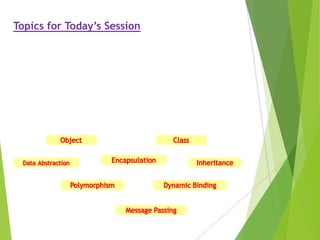
Topics for Today’s Session
Initially developed
by
James Gosling
at
Sun Microsystems
and
released
in
1995.
JAVA
Object Oriented Programming
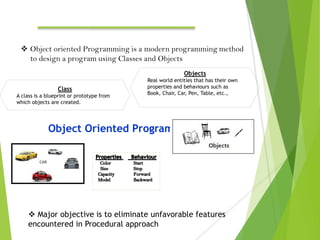
 Object oriented Programming is a modern programming method
to design a program using Classes and Objects
Objects
Real world entities that has their own
properties and behaviours such as
Book, Chair, Car, Pen, Table, etc.,
Class
A class is a blueprint or prototype from
which objects are created.
 Major objective is to eliminate unfavorable features
encountered in Procedural approach
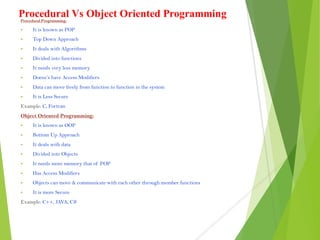
Procedural Vs Object Oriented ProgrammingProcedural Programming:
 It is known as POP
 Top Down Approach
 It deals with Algorithms
 Divided into functions
 It needs very less memory
 Doesn’s have Access Modifiers
 Data can move freely from function to function in the system
 It is Less Secure
Example: C, Fortran
Object Oriented Programming:
 It is known as OOP
 Bottom Up Approach
 It deals with data
 Divided into Objects
 It needs more memory that of POP
 Has Access Modifiers
 Objects can move & communicate with each other through member functions
 It is more Secure
Example: C++, JAVA, C#
Object Oriented Paradigm features
 Emphasis is on data rather than procedure.
 Programs are divided into what are known as objects.
 Data structures are designed such that they characterize the
objects.
 Methods that operate on the data of an object are tied
together in the data structure.
 Data is hidden and cannot be accessed by external functions.
 Objects may communicate with each other through methods.
 New data and methods can be easily added whenever
necessary.
 Follows bottom up approach in program design.
 First, the individual base elements of a program are specified.
 Then they are linked together to form larger sub sytems.
Applications of OOP
 Real-time systems
 Simulation and modeling
 Object-oriented databases
 Hypertext, hypermedia and expertext
 AI and expert systems
 Neural networks and parallel programming
 Decision support and office automation systems
What is Java?
 Java is a computing platform for application development
and an object-oriented,
 Class-based and Concurrent programming language
 It means many statements can be executed at the same time
instead of sequentially executing it.
 Java can run on all platforms and free to access.
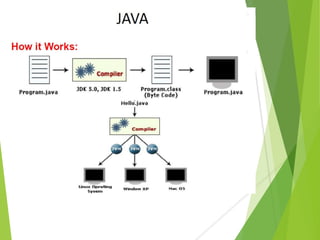
 It is platform-independent
 Java is Simple, Secure, Robust, Complete Object oriented
and Platform Independent High level Language
 It is Portable and Multi-thread technology gives High
Performance.
 It supports concurrency
 means the code can be executed by multiple processes at
the same time.
OOPS Concepts
 OBJECT ORIENTED PROGRAMMING (OOP) is a programming
concept that works on the principles of abstraction, encapsulation,
inheritance, and polymorphism
 It allows users to create the objects that they want and then,
create methods to handle those objects.
 The basic concept of OOPs is to create objects, re-use them
throughout the program, and manipulate these objects to get
results.
 Object Oriented Programming popularly known as OOP, is used in a
modern programming language like Java
Object-oriented programming has several advantages over procedural
programming:
 OOP is faster and easier to execute
 OOP provides a clear structure for the programs
 OOP helps to keep the Java code DRY "Don't Repeat Yourself", and
makes the code easier to maintain, modify and debug
 OOP makes it possible to create full reusable applications with less
code and shorter development time
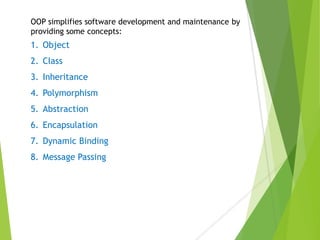
OOP simplifies software development and maintenance by
providing some concepts:
1. Object
2. Class
3. Inheritance
4. Polymorphism
5. Abstraction
6. Encapsulation
7. Dynamic Binding
8. Message Passing
Object:
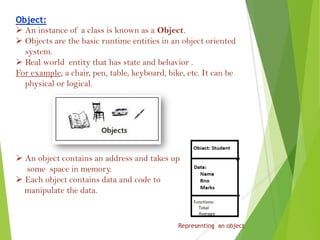
 An instance of a class is known as a Object.
 Objects are the basic runtime entities in an object oriented
system.
 Real world entity that has state and behavior .
For example, a chair, pen, table, keyboard, bike, etc. It can be
physical or logical.
 An object contains an address and takes up
some space in memory.
 Each object contains data and code to
manipulate the data.
Representing an object
Class
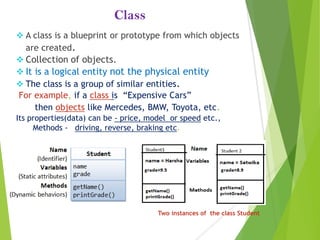
 A class is a blueprint or prototype from which objects
are created.
 Collection of objects.
 It is a logical entity not the physical entity
 The class is a group of similar entities.
For example, if a class is “Expensive Cars”
then objects like Mercedes, BMW, Toyota, etc.
Its properties(data) can be - price, model or speed etc.,
Methods - driving, reverse, braking etc.
Two instances of the class Student
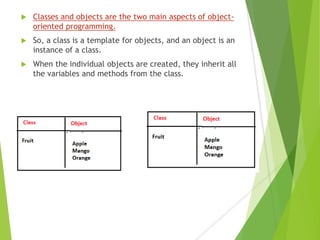
 Classes and objects are the two main aspects of object-
oriented programming.
 So, a class is a template for objects, and an object is an
instance of a class.
 When the individual objects are created, they inherit all
the variables and methods from the class.
Data Abstraction
 Hiding internal details and showing functionality is known
as abstraction.
For example phone call, we don't know the internal
processing.
 Abstraction refers to the act of representing essential
features without including the background details or
explanations.
 Classes use the concept of abstraction and they are known
as abstract data types (ADT).
 Classes are defined as a list of abstract attributes such as
size, weight and cost and methods that operate on these
attributes.
 The technique of creating new data types that are well
suited to an application to be programmed is known as Data
Abstraction
 In Java, we use abstract class and interface to achieve
abstraction.
Encapsulation
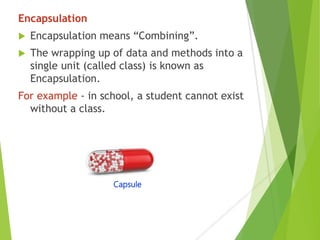
 Encapsulation means “Combining”.
 The wrapping up of data and methods into a
single unit (called class) is known as
Encapsulation.
For example - in school, a student cannot exist
without a class.
Capsule
Inheritance
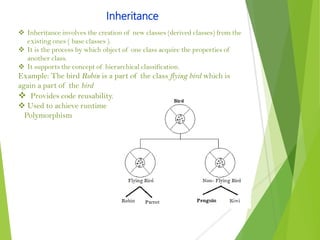
 Inheritance involves the creation of new classes (derived classes) from the
existing ones ( base classes ).
 It is the process by which object of one class acquire the properties of
another class.
 It supports the concept of hierarchical classification.
Example: The bird Robin is a part of the class flying bird which is
again a part of the bird
 Provides code reusability.
 Used to achieve runtime
Polymorphism
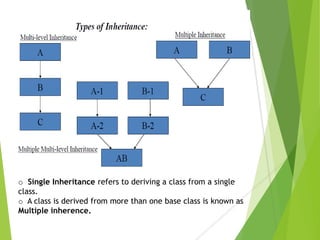
o Single Inheritance refers to deriving a class from a single
class.
o A class is derived from more than one base class is known as
Multiple inherence.
Polymorphism
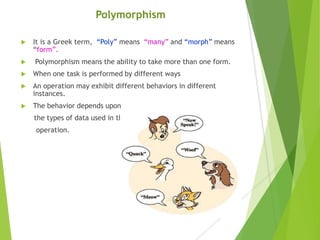
 It is a Greek term, “Poly” means “many” and “morph” means
“form”.
 Polymorphism means the ability to take more than one form.
 When one task is performed by different ways
 An operation may exhibit different behaviors in different
instances.
 The behavior depends upon
the types of data used in the
operation.
 There are 2 types of Polymorphism:
1. Compile-time Polymorphism (Method overloading / Static)
2. Runtime Polymorphism (Method Overriding / Dynamic)
Method overloading
 Having multiple methods with same name but with
different signature (number, type and order of
parameters).
Method Overriding
 When a subclass contains a method with the same name
and signature as in the super class .
Dynamic Binding
 Binding refers the linking of a procedure call to the code
to be executed in response to the call.
 Dynamic binding means that the code associated with a
given procedure call is not known until the time of the
call at runtime.
 It is associated with polymorphism & inheritance.
Message Passing
 A Message for an object is a request for execution of a
procedure .
 It is the process of invoking an operation on an object.
 It involves the name of the object, the name of the
method (message) and the information to be sent.
For Example: Employee. salary (name);
Here, Employee is the object,
salary is the message and
name is the parameter that contains information.
Summary
Conclusion
 In this lesson you learnt about
 Object Oriented Programming
 Procedural Vs Object Oriented Programming
 Object Oriented Paradigm
 Applications of OOP
 What is Java?
 OOPs Concepts
Oops concepts || Object Oriented Programming Concepts in Java

Oops concepts || Object Oriented Programming Concepts in Java

  • 1.
  • 2.
  • 3.
    Initially developed by James Gosling at SunMicrosystems and released in 1995. JAVA
  • 4.
    Object Oriented Programming Object oriented Programming is a modern programming method to design a program using Classes and Objects Objects Real world entities that has their own properties and behaviours such as Book, Chair, Car, Pen, Table, etc., Class A class is a blueprint or prototype from which objects are created.  Major objective is to eliminate unfavorable features encountered in Procedural approach
  • 5.
    Procedural Vs ObjectOriented ProgrammingProcedural Programming:  It is known as POP  Top Down Approach  It deals with Algorithms  Divided into functions  It needs very less memory  Doesn’s have Access Modifiers  Data can move freely from function to function in the system  It is Less Secure Example: C, Fortran Object Oriented Programming:  It is known as OOP  Bottom Up Approach  It deals with data  Divided into Objects  It needs more memory that of POP  Has Access Modifiers  Objects can move & communicate with each other through member functions  It is more Secure Example: C++, JAVA, C#
  • 6.
    Object Oriented Paradigmfeatures  Emphasis is on data rather than procedure.  Programs are divided into what are known as objects.  Data structures are designed such that they characterize the objects.  Methods that operate on the data of an object are tied together in the data structure.  Data is hidden and cannot be accessed by external functions.  Objects may communicate with each other through methods.  New data and methods can be easily added whenever necessary.  Follows bottom up approach in program design.  First, the individual base elements of a program are specified.  Then they are linked together to form larger sub sytems.
  • 7.
    Applications of OOP Real-time systems  Simulation and modeling  Object-oriented databases  Hypertext, hypermedia and expertext  AI and expert systems  Neural networks and parallel programming  Decision support and office automation systems
  • 8.
    What is Java? Java is a computing platform for application development and an object-oriented,  Class-based and Concurrent programming language  It means many statements can be executed at the same time instead of sequentially executing it.  Java can run on all platforms and free to access.  It is platform-independent  Java is Simple, Secure, Robust, Complete Object oriented and Platform Independent High level Language  It is Portable and Multi-thread technology gives High Performance.  It supports concurrency  means the code can be executed by multiple processes at the same time.
  • 11.
    OOPS Concepts  OBJECTORIENTED PROGRAMMING (OOP) is a programming concept that works on the principles of abstraction, encapsulation, inheritance, and polymorphism  It allows users to create the objects that they want and then, create methods to handle those objects.  The basic concept of OOPs is to create objects, re-use them throughout the program, and manipulate these objects to get results.  Object Oriented Programming popularly known as OOP, is used in a modern programming language like Java Object-oriented programming has several advantages over procedural programming:  OOP is faster and easier to execute  OOP provides a clear structure for the programs  OOP helps to keep the Java code DRY "Don't Repeat Yourself", and makes the code easier to maintain, modify and debug  OOP makes it possible to create full reusable applications with less code and shorter development time
  • 12.
    OOP simplifies softwaredevelopment and maintenance by providing some concepts: 1. Object 2. Class 3. Inheritance 4. Polymorphism 5. Abstraction 6. Encapsulation 7. Dynamic Binding 8. Message Passing
  • 13.
    Object:  An instanceof a class is known as a Object.  Objects are the basic runtime entities in an object oriented system.  Real world entity that has state and behavior . For example, a chair, pen, table, keyboard, bike, etc. It can be physical or logical.  An object contains an address and takes up some space in memory.  Each object contains data and code to manipulate the data. Representing an object
  • 14.
    Class  A classis a blueprint or prototype from which objects are created.  Collection of objects.  It is a logical entity not the physical entity  The class is a group of similar entities. For example, if a class is “Expensive Cars” then objects like Mercedes, BMW, Toyota, etc. Its properties(data) can be - price, model or speed etc., Methods - driving, reverse, braking etc. Two instances of the class Student
  • 15.
     Classes andobjects are the two main aspects of object- oriented programming.  So, a class is a template for objects, and an object is an instance of a class.  When the individual objects are created, they inherit all the variables and methods from the class.
  • 16.
    Data Abstraction  Hidinginternal details and showing functionality is known as abstraction. For example phone call, we don't know the internal processing.  Abstraction refers to the act of representing essential features without including the background details or explanations.  Classes use the concept of abstraction and they are known as abstract data types (ADT).  Classes are defined as a list of abstract attributes such as size, weight and cost and methods that operate on these attributes.  The technique of creating new data types that are well suited to an application to be programmed is known as Data Abstraction  In Java, we use abstract class and interface to achieve abstraction.
  • 17.
    Encapsulation  Encapsulation means“Combining”.  The wrapping up of data and methods into a single unit (called class) is known as Encapsulation. For example - in school, a student cannot exist without a class. Capsule
  • 18.
    Inheritance  Inheritance involvesthe creation of new classes (derived classes) from the existing ones ( base classes ).  It is the process by which object of one class acquire the properties of another class.  It supports the concept of hierarchical classification. Example: The bird Robin is a part of the class flying bird which is again a part of the bird  Provides code reusability.  Used to achieve runtime Polymorphism
  • 19.
    o Single Inheritancerefers to deriving a class from a single class. o A class is derived from more than one base class is known as Multiple inherence.
  • 20.
    Polymorphism  It isa Greek term, “Poly” means “many” and “morph” means “form”.  Polymorphism means the ability to take more than one form.  When one task is performed by different ways  An operation may exhibit different behaviors in different instances.  The behavior depends upon the types of data used in the operation.
  • 21.
     There are2 types of Polymorphism: 1. Compile-time Polymorphism (Method overloading / Static) 2. Runtime Polymorphism (Method Overriding / Dynamic) Method overloading  Having multiple methods with same name but with different signature (number, type and order of parameters). Method Overriding  When a subclass contains a method with the same name and signature as in the super class .
  • 22.
    Dynamic Binding  Bindingrefers the linking of a procedure call to the code to be executed in response to the call.  Dynamic binding means that the code associated with a given procedure call is not known until the time of the call at runtime.  It is associated with polymorphism & inheritance.
  • 23.
    Message Passing  AMessage for an object is a request for execution of a procedure .  It is the process of invoking an operation on an object.  It involves the name of the object, the name of the method (message) and the information to be sent. For Example: Employee. salary (name); Here, Employee is the object, salary is the message and name is the parameter that contains information.
  • 24.
  • 25.
    Conclusion  In thislesson you learnt about  Object Oriented Programming  Procedural Vs Object Oriented Programming  Object Oriented Paradigm  Applications of OOP  What is Java?  OOPs Concepts