Java/J2EE Programming Training
OOP with Java Contd.
Page 2Classification: Restricted
Agenda
• Deepdive into codingOOPwith Java…withpracticalexamples.
• Howto create aclass
• Howto createobjects
• Howto create instancevariables
• Howto create classvariables
• Constructors
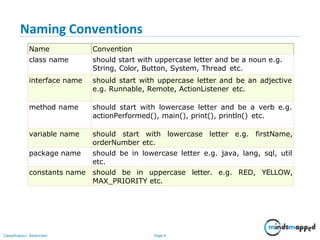
Naming Conventions
Classification: Restricted Page 4
Name Convention
class name should start with uppercase letter and be a noun e.g.
String, Color, Button, System, Thread etc.
interface name should start with uppercase letter and be an adjective
e.g. Runnable, Remote, ActionListener etc.
method name should start with lowercase letter and be a verb e.g.
actionPerformed(), main(), print(), println() etc.
variable name should start with lowercase letter e.g. firstName,
orderNumber etc.
package name should be in lowercase letter e.g. java, lang, sql, util
etc.
constants name should be in uppercase letter. e.g. RED, YELLOW,
MAX_PRIORITY etc.
Object and Class in Java - Demo
Classification: Restricted Page 5
A basic example of a class:
class Student1{
int id;//data member (also instance variable)
String name;//data member(also instance variable)
public static void main(String args[]){
Student1 s1=new Student1();//creating an object of Student
System.out.println(s1.id);
System.out.println(s1.name);
}
}
Another Example of Objects and Classes in Java
Classification: Restricted Page 6
class Student2{ int
rollno; String
name;
//methodvoid insertRecord(int r, String n){ rollno=r;
name=n;
}
void displayInformation(){System.out.println(rollno+" "+name);}//method
public static void main(String args[]){ Student2
s1=new Student2();
Student2 s2=new Student2();
s1.insertRecord(111,"Karan");
s2.insertRecord(222,"Aryan");
s1.displayInformation();
s2.displayInformation();
}
}
Memory Allocation
Classification: Restricted Page 7
Method Overloading
Classification: Restricted Page 9
• If a class have multiple methods by same name but different parameters.
• Advantage: Increases readability of the program.
• Two ways:
oBy changing number of arguments
oBy changing the data type
Method Overloading: Changing number of arguments
Classification: Restricted Page 10
class Calculation{
void sum(int a,int b){System.out.println(a+b);}
void sum(int a,int b,int c){System.out.println(a+b+c);}
public static void main(String args[]){
Calculation obj=new Calculation();
obj.sum(10,10,10);
obj.sum(20,20);
}
}
Method overloading: Changing data type of argument
Classification: Restricted Page 11
class Calculation2{
void sum(int a,int b){System.out.println(a+b);}
void sum(double a,double b){System.out.println(a+b);}
public static void main(String args[]){
Calculation2 obj=new Calculation2();
obj.sum(10.5,10.5);
obj.sum(20,20);
}
}
Classification: Restricted Page 12
Method overloading: Can it be done by changing return
type of methods?
class Calculation3{
int sum(int a,int b){System.out.println(a+b);}
double sum(int a,int b){System.out.println(a+b);}
public static void main(String args[]){
Calculation3 obj=new Calculation3(); int
result=obj.sum(20,20);
/* Compile Time Error; Here how can java determine which sum()
method should be called */
}
}
//
Method Overloading: Can we overload main() method?
Classification: Restricted Page 13
class Overloading1{
public static void main(int a){
System.out.println(a);
}
public static void main(String args[]){
System.out.println("main() method invoked");
main(10);
}
}
Method Overloading and Type Promotion
Classification: Restricted Page 14
One type is promoted to another implicitly if no matching datatype is
found
class OverloadingCalculation1{
void sum(int a,long b){System.out.println(a+b);}
void sum(int a,int b,int c){System.out.println(a+b+c);}
public static void main(String args[]){ OverloadingCalculation1
obj=new OverloadingCalculation1(); obj.sum(20,20);//now second
int literal will be promoted to long obj.sum(20,20,20);
}
}
Method overloading: Ambiguous code
Classification: Restricted Page 15
class OverloadingCalculation3{
void sum(int a,long b){System.out.println("a method invoked");}
void sum(long a,int b){System.out.println("b method invoked");}
public static void main(String args[]){ OverloadingCalculation3
obj=new OverloadingCalculation3(); obj.sum(20,20);//now
ambiguity; Compile time error.
}
}
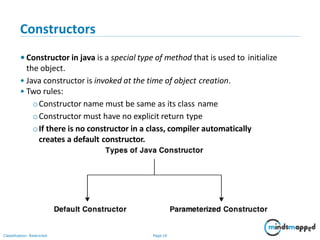
Constructors
• Constructor in java is a special type of method that is used to initialize
the object.
• Java constructor is invoked at the time of object creation.
• Two rules:
oConstructor name must be same as its class name
oConstructor must have no explicit return type
oIf there is no constructor in a class, compiler automatically
creates a default constructor.
Classification: Restricted Page 16
Example of default constructor that displays the default values
class Student3{ int id;
String name;
void display(){ System.out.println(id+"
"+name);
}
public static void main(String args[]){ Student3
s1=new Student3();
Student3 s2=new Student3();
s1.display();
s2.display();
}
}
Classification: Restricted Page 18
Example of parameterized constructor
class Student4{ int
id; String
name;
//Paremeterized ConstructorStudent4(int i,String n){ id =
i;
name = n;
}void display(){System.out.println(id+" "+name);}
public static void main(String args[]){ Student4 s1
= new Student4(111,"Karan"); Student4 s2 =
new Student4(222,"Aryan"); s1.display();
s2.display();
}
}
Example of Constructor Overloading
Classification: Restricted Page 20
class Student5{ int id; String name; int age;
Student5(int i,String n){ id = i;
name = n;
}
Student5(int i,String n,int a){ id = i;
name = n; age=a;
}
void display(){System.out.println(id+" "+name+" "+age);}
public static void main(String args[]){ Student5 s1 = new
Student5(111,"Karan"); Student5 s2 = new Student5(222,"Aryan",25);
s1.display();
s2.display();
}
}
Constructor vs Method
Classification: Restricted Page 21
Java Constructor Java Method
Constructor is used to initialize the
state of an object.
Method is used to expose behaviour
of an object.
Constructor must not have return
type.
Method must have return type.
Constructor is invoked implicitly. Method is invoked explicitly.
The java compiler provides a default
constructor if you don't have any
constructor.
Method is not provided by compiler in
any case.
Constructor name must be same as
the class name.
Method name may or may not be
same as class name.
Constructor Example: Used for cloning
Classification: Restricted Page 22
class Student6{ int id; String name;
Student6(int i, String n){ id = i;
name = n;
}
Student6(Student6 s){ id = s.id;
name =s.name;
}
void display(){System.out.println(id+" "+name);}
public static void main(String args[]){ Student6 s1 = new
Student6(111,"Karan"); Student6 s2 = new Student6(s1); s1.display();
s2.display();
}
}
Point to ponder…
Classification: Restricted Page 23
Does constructor return any value?
Java “Static”
Classification: Restricted Page 25
• The static keyword in java is used for memory management mainly.
• We can apply java static keyword with variables, methods, blocks and
nested class.
• The static keyword belongs to the class than instance of the class.
• The static can be:
ovariable (also known as class variable)
omethod (also known as class method)
oblock
onested class
Java Static Variable
Classification: Restricted Page 26
• If you declare any variable as static, it is known static variable.
• The static variable can be used to refer the common property of all objects
(that is not unique for each object) e.g. company name of employees,
college name of students etc.
• The static variable gets memory only once in class area at the time of class
loading.
• Advantage:
It makes your program memory efficient
Example: Problem without static variable
Classification: Restricted Page 27
class Student{
int rollno;
String name;
String college="ITS";
}
Example: Static Variable solution
Classification: Restricted Page 28
class Student8{ int rollno;
String name;
static String college ="ITS";
Student8(int r,String n){
rollno = r; name = n;
}
void display (){System.out.println(rollno+" "+name+" "+college);}
public static void main(String args[]){ Student8 s1 =
new Student8(111,"Karan"); Student8 s2 = new
Student8(222,"Aryan");
s1.display();
s2.display();
}
}
Static Variable Memory Allocation
Classification: Restricted Page 29
Example: Counter with static variable
Classification: Restricted Page 30
class Counter2{
static int count=0;//will get memory only once and retain its value
Counter2(){
count++;
System.out.println(count);
}
public static void main(String args[]){
Counter2 c1=new Counter2();
Counter2 c2=new Counter2();
Counter2 c3=new Counter2();
}
}
Java Static Method
Classification: Restricted Page 31
• A static method belongs to the class rather than object of a class.
• A static method can be invoked without the need for creating an instance of
a class.
• static method can access static data member and can change the value of
it.
• There are two main restrictions for the static method. They are:
o The static method can not use non static data member or call non-static
method directly.
o this and super cannot be used instatic context.
Static Method Example
Classification: Restricted Page 32
class Student9{ int rollno; String name;
static String college = "ITS";
static void change(){
college = "BBDIT";
}
Student9(int r, String n){
rollno = r; name = n;
}
void display (){System.out.println(rollno+" "+name+" "+college);} public static void main(String args[]){
Student9.change();
Student9 s1 = new Student9 (111,"Karan"); Student9 s2 = new Student9 (222,"Aryan");
Student9 s3 = new Student9 (333,"Sonoo");
s1.display();
s2.display();
s3.display();
}
}
Example of static method that performs normal calculation
Classification: Restricted Page 33
//Program to get cube of a given number by static method
class Calculate{
static int cube(int x){
return x*x*x;
}
public static void main(String args[]){
int result=Calculate.cube(5);
System.out.println(result);
}
}
What is the output?
Classification: Restricted Page 34
class A{
int a=40;//non static
public static void main(String args[]){
System.out.println(a);
}
}
Point to ponder
Classification: Restricted Page 35
• Why is main() method static?
Java Static Block
Classification: Restricted Page 36
• Is used to initialize the static data member.
• It is executed before main method at the time of classloading.
class A2{
static{System.out.println("static block is invoked");} public
static void main(String args[]){
System.out.println("Hello main");
}
}
“this” keyword
• In java, this is a reference variable that refers to the current object.
• Uses:
• this keyword can be used to refer current class instance variable.
• this() can be used to invoke current class constructor.
• this keyword can be used to invoke current class method (implicitly)
• this can be passed as an argument in the method call.
• this can be passed as argument in the constructor call.
• this keyword can also be used to return the current class instance.
Classification: Restricted Page 37
What’s the problem with the below code?
Classification: Restricted Page 38
class Student10{ int id;
String name;
Student10(int id,String name){ id = id;
name = name;
}
void display(){System.out.println(id+" "+name);}
public static void main(String args[]){ Student10 s1 =
new Student10(111,"Karan"); Student10 s2 = new
Student10(321,"Aryan"); s1.display();
s2.display();
}
}
Solution:
Classification: Restricted Page 39
//example of this keyword
class Student11{
int id; String
name;
Student11(int id,Stringname){ this.id = id;
this.name = name;
}
void display(){System.out.println(id+" "+name);} public static void
main(String args[]){
Student11 s1 = new Student11(111,"Karan");
Student11 s2 = new Student11(222,"Aryan");
s1.display();
s2.display();
}
}
Note: If local variables(formal arguments) and instance variables are different, there is no need to use
this keyword like in the following program:
this() for invoking current class constructor: Constructor Chaining
Classification: Restricted Page 40
//Program of this() constructor call (constructor chaining)
class Student13{ int id; String name;
Student13(){System.out.println("default constructor is invoked");}
Student13(int id,String name){
this ();//it is used to invoked current class constructor.
this.id = id; this.name = name;
}
void display(){System.out.println(id+" "+name);}
public static void main(String args[]){ Student13 e1 = new Student13(111,"karan");
Student13 e2 = new Student13(222,"Aryan"); e1.display();
e2.display();
}
}
Rule: Call to this() must be the first statement in constructor.
this keyword can be used to invoke current class method (explicitly)
class S{
void m(){
System.out.println("method is invoked");
}
void n(){
this.m();//no need because compiler does it for you.
}
void p(){
n();//complier will add this to invoke n() method as this.n()
}
public static void main(String args[]){ S s1 = new S();
s1.p();
}
}
Classification: Restricted Page 41
this keyword can be passed as an argument in the method.
Classification: Restricted Page 42
class S2{
void m(S2 obj){
System.out.println("method is invoked");
}
void p(){
m(this);
}
public static void main(String args[]){ S2 s1 =
new S2();
s1.p();
}
}
What is the output? What does the below code do?
class A5{
void m(){
System.out.println(this);//prints same reference ID
}
public static void main(String args[]){ A5 obj=new
A5();
System.out.println(obj);//prints the reference ID
obj.m();
}
}
Classification: Restricted Page 43
Thank You

OOP with Java - continued

  • 1.
  • 2.
    Page 2Classification: Restricted Agenda •Deepdive into codingOOPwith Java…withpracticalexamples. • Howto create aclass • Howto createobjects • Howto create instancevariables • Howto create classvariables • Constructors
  • 3.
    Naming Conventions Classification: RestrictedPage 4 Name Convention class name should start with uppercase letter and be a noun e.g. String, Color, Button, System, Thread etc. interface name should start with uppercase letter and be an adjective e.g. Runnable, Remote, ActionListener etc. method name should start with lowercase letter and be a verb e.g. actionPerformed(), main(), print(), println() etc. variable name should start with lowercase letter e.g. firstName, orderNumber etc. package name should be in lowercase letter e.g. java, lang, sql, util etc. constants name should be in uppercase letter. e.g. RED, YELLOW, MAX_PRIORITY etc.
  • 4.
    Object and Classin Java - Demo Classification: Restricted Page 5 A basic example of a class: class Student1{ int id;//data member (also instance variable) String name;//data member(also instance variable) public static void main(String args[]){ Student1 s1=new Student1();//creating an object of Student System.out.println(s1.id); System.out.println(s1.name); } }
  • 5.
    Another Example ofObjects and Classes in Java Classification: Restricted Page 6 class Student2{ int rollno; String name; //methodvoid insertRecord(int r, String n){ rollno=r; name=n; } void displayInformation(){System.out.println(rollno+" "+name);}//method public static void main(String args[]){ Student2 s1=new Student2(); Student2 s2=new Student2(); s1.insertRecord(111,"Karan"); s2.insertRecord(222,"Aryan"); s1.displayInformation(); s2.displayInformation(); } }
  • 6.
  • 7.
    Method Overloading Classification: RestrictedPage 9 • If a class have multiple methods by same name but different parameters. • Advantage: Increases readability of the program. • Two ways: oBy changing number of arguments oBy changing the data type
  • 8.
    Method Overloading: Changingnumber of arguments Classification: Restricted Page 10 class Calculation{ void sum(int a,int b){System.out.println(a+b);} void sum(int a,int b,int c){System.out.println(a+b+c);} public static void main(String args[]){ Calculation obj=new Calculation(); obj.sum(10,10,10); obj.sum(20,20); } }
  • 9.
    Method overloading: Changingdata type of argument Classification: Restricted Page 11 class Calculation2{ void sum(int a,int b){System.out.println(a+b);} void sum(double a,double b){System.out.println(a+b);} public static void main(String args[]){ Calculation2 obj=new Calculation2(); obj.sum(10.5,10.5); obj.sum(20,20); } }
  • 10.
    Classification: Restricted Page12 Method overloading: Can it be done by changing return type of methods? class Calculation3{ int sum(int a,int b){System.out.println(a+b);} double sum(int a,int b){System.out.println(a+b);} public static void main(String args[]){ Calculation3 obj=new Calculation3(); int result=obj.sum(20,20); /* Compile Time Error; Here how can java determine which sum() method should be called */ } } //
  • 11.
    Method Overloading: Canwe overload main() method? Classification: Restricted Page 13 class Overloading1{ public static void main(int a){ System.out.println(a); } public static void main(String args[]){ System.out.println("main() method invoked"); main(10); } }
  • 12.
    Method Overloading andType Promotion Classification: Restricted Page 14 One type is promoted to another implicitly if no matching datatype is found class OverloadingCalculation1{ void sum(int a,long b){System.out.println(a+b);} void sum(int a,int b,int c){System.out.println(a+b+c);} public static void main(String args[]){ OverloadingCalculation1 obj=new OverloadingCalculation1(); obj.sum(20,20);//now second int literal will be promoted to long obj.sum(20,20,20); } }
  • 13.
    Method overloading: Ambiguouscode Classification: Restricted Page 15 class OverloadingCalculation3{ void sum(int a,long b){System.out.println("a method invoked");} void sum(long a,int b){System.out.println("b method invoked");} public static void main(String args[]){ OverloadingCalculation3 obj=new OverloadingCalculation3(); obj.sum(20,20);//now ambiguity; Compile time error. } }
  • 14.
    Constructors • Constructor injava is a special type of method that is used to initialize the object. • Java constructor is invoked at the time of object creation. • Two rules: oConstructor name must be same as its class name oConstructor must have no explicit return type oIf there is no constructor in a class, compiler automatically creates a default constructor. Classification: Restricted Page 16
  • 15.
    Example of defaultconstructor that displays the default values class Student3{ int id; String name; void display(){ System.out.println(id+" "+name); } public static void main(String args[]){ Student3 s1=new Student3(); Student3 s2=new Student3(); s1.display(); s2.display(); } } Classification: Restricted Page 18
  • 16.
    Example of parameterizedconstructor class Student4{ int id; String name; //Paremeterized ConstructorStudent4(int i,String n){ id = i; name = n; }void display(){System.out.println(id+" "+name);} public static void main(String args[]){ Student4 s1 = new Student4(111,"Karan"); Student4 s2 = new Student4(222,"Aryan"); s1.display(); s2.display(); } }
  • 17.
    Example of ConstructorOverloading Classification: Restricted Page 20 class Student5{ int id; String name; int age; Student5(int i,String n){ id = i; name = n; } Student5(int i,String n,int a){ id = i; name = n; age=a; } void display(){System.out.println(id+" "+name+" "+age);} public static void main(String args[]){ Student5 s1 = new Student5(111,"Karan"); Student5 s2 = new Student5(222,"Aryan",25); s1.display(); s2.display(); } }
  • 18.
    Constructor vs Method Classification:Restricted Page 21 Java Constructor Java Method Constructor is used to initialize the state of an object. Method is used to expose behaviour of an object. Constructor must not have return type. Method must have return type. Constructor is invoked implicitly. Method is invoked explicitly. The java compiler provides a default constructor if you don't have any constructor. Method is not provided by compiler in any case. Constructor name must be same as the class name. Method name may or may not be same as class name.
  • 19.
    Constructor Example: Usedfor cloning Classification: Restricted Page 22 class Student6{ int id; String name; Student6(int i, String n){ id = i; name = n; } Student6(Student6 s){ id = s.id; name =s.name; } void display(){System.out.println(id+" "+name);} public static void main(String args[]){ Student6 s1 = new Student6(111,"Karan"); Student6 s2 = new Student6(s1); s1.display(); s2.display(); } }
  • 20.
    Point to ponder… Classification:Restricted Page 23 Does constructor return any value?
  • 21.
    Java “Static” Classification: RestrictedPage 25 • The static keyword in java is used for memory management mainly. • We can apply java static keyword with variables, methods, blocks and nested class. • The static keyword belongs to the class than instance of the class. • The static can be: ovariable (also known as class variable) omethod (also known as class method) oblock onested class
  • 22.
    Java Static Variable Classification:Restricted Page 26 • If you declare any variable as static, it is known static variable. • The static variable can be used to refer the common property of all objects (that is not unique for each object) e.g. company name of employees, college name of students etc. • The static variable gets memory only once in class area at the time of class loading. • Advantage: It makes your program memory efficient
  • 23.
    Example: Problem withoutstatic variable Classification: Restricted Page 27 class Student{ int rollno; String name; String college="ITS"; }
  • 24.
    Example: Static Variablesolution Classification: Restricted Page 28 class Student8{ int rollno; String name; static String college ="ITS"; Student8(int r,String n){ rollno = r; name = n; } void display (){System.out.println(rollno+" "+name+" "+college);} public static void main(String args[]){ Student8 s1 = new Student8(111,"Karan"); Student8 s2 = new Student8(222,"Aryan"); s1.display(); s2.display(); } }
  • 25.
    Static Variable MemoryAllocation Classification: Restricted Page 29
  • 26.
    Example: Counter withstatic variable Classification: Restricted Page 30 class Counter2{ static int count=0;//will get memory only once and retain its value Counter2(){ count++; System.out.println(count); } public static void main(String args[]){ Counter2 c1=new Counter2(); Counter2 c2=new Counter2(); Counter2 c3=new Counter2(); } }
  • 27.
    Java Static Method Classification:Restricted Page 31 • A static method belongs to the class rather than object of a class. • A static method can be invoked without the need for creating an instance of a class. • static method can access static data member and can change the value of it. • There are two main restrictions for the static method. They are: o The static method can not use non static data member or call non-static method directly. o this and super cannot be used instatic context.
  • 28.
    Static Method Example Classification:Restricted Page 32 class Student9{ int rollno; String name; static String college = "ITS"; static void change(){ college = "BBDIT"; } Student9(int r, String n){ rollno = r; name = n; } void display (){System.out.println(rollno+" "+name+" "+college);} public static void main(String args[]){ Student9.change(); Student9 s1 = new Student9 (111,"Karan"); Student9 s2 = new Student9 (222,"Aryan"); Student9 s3 = new Student9 (333,"Sonoo"); s1.display(); s2.display(); s3.display(); } }
  • 29.
    Example of staticmethod that performs normal calculation Classification: Restricted Page 33 //Program to get cube of a given number by static method class Calculate{ static int cube(int x){ return x*x*x; } public static void main(String args[]){ int result=Calculate.cube(5); System.out.println(result); } }
  • 30.
    What is theoutput? Classification: Restricted Page 34 class A{ int a=40;//non static public static void main(String args[]){ System.out.println(a); } }
  • 31.
    Point to ponder Classification:Restricted Page 35 • Why is main() method static?
  • 32.
    Java Static Block Classification:Restricted Page 36 • Is used to initialize the static data member. • It is executed before main method at the time of classloading. class A2{ static{System.out.println("static block is invoked");} public static void main(String args[]){ System.out.println("Hello main"); } }
  • 33.
    “this” keyword • Injava, this is a reference variable that refers to the current object. • Uses: • this keyword can be used to refer current class instance variable. • this() can be used to invoke current class constructor. • this keyword can be used to invoke current class method (implicitly) • this can be passed as an argument in the method call. • this can be passed as argument in the constructor call. • this keyword can also be used to return the current class instance. Classification: Restricted Page 37
  • 34.
    What’s the problemwith the below code? Classification: Restricted Page 38 class Student10{ int id; String name; Student10(int id,String name){ id = id; name = name; } void display(){System.out.println(id+" "+name);} public static void main(String args[]){ Student10 s1 = new Student10(111,"Karan"); Student10 s2 = new Student10(321,"Aryan"); s1.display(); s2.display(); } }
  • 35.
    Solution: Classification: Restricted Page39 //example of this keyword class Student11{ int id; String name; Student11(int id,Stringname){ this.id = id; this.name = name; } void display(){System.out.println(id+" "+name);} public static void main(String args[]){ Student11 s1 = new Student11(111,"Karan"); Student11 s2 = new Student11(222,"Aryan"); s1.display(); s2.display(); } } Note: If local variables(formal arguments) and instance variables are different, there is no need to use this keyword like in the following program:
  • 36.
    this() for invokingcurrent class constructor: Constructor Chaining Classification: Restricted Page 40 //Program of this() constructor call (constructor chaining) class Student13{ int id; String name; Student13(){System.out.println("default constructor is invoked");} Student13(int id,String name){ this ();//it is used to invoked current class constructor. this.id = id; this.name = name; } void display(){System.out.println(id+" "+name);} public static void main(String args[]){ Student13 e1 = new Student13(111,"karan"); Student13 e2 = new Student13(222,"Aryan"); e1.display(); e2.display(); } } Rule: Call to this() must be the first statement in constructor.
  • 37.
    this keyword canbe used to invoke current class method (explicitly) class S{ void m(){ System.out.println("method is invoked"); } void n(){ this.m();//no need because compiler does it for you. } void p(){ n();//complier will add this to invoke n() method as this.n() } public static void main(String args[]){ S s1 = new S(); s1.p(); } } Classification: Restricted Page 41
  • 38.
    this keyword canbe passed as an argument in the method. Classification: Restricted Page 42 class S2{ void m(S2 obj){ System.out.println("method is invoked"); } void p(){ m(this); } public static void main(String args[]){ S2 s1 = new S2(); s1.p(); } }
  • 39.
    What is theoutput? What does the below code do? class A5{ void m(){ System.out.println(this);//prints same reference ID } public static void main(String args[]){ A5 obj=new A5(); System.out.println(obj);//prints the reference ID obj.m(); } } Classification: Restricted Page 43
  • 40.