Presented by:-
    Sunil Kumar Shrama
Jaipur Engineering College,Kukas
NIIT Limited is a global education oriented company focusing on
imparting computer knowledge among its students.

Has been in education business for over many years.

Today it has presence in 40 countries worldwide.

Trained professionals of the topmost companies of the world.

Technical training available for fresher and experienced candidate
depending on their need.
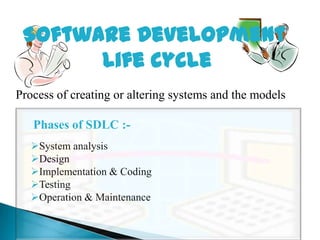
Software Development
       life cycle
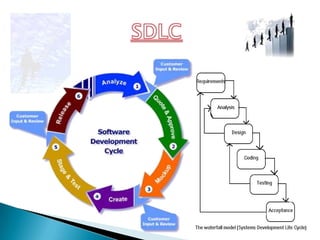
Process of creating or altering systems and the models

   Phases of SDLC :-
   System analysis
   Design
   Implementation & Coding
   Testing
   Operation & Maintenance
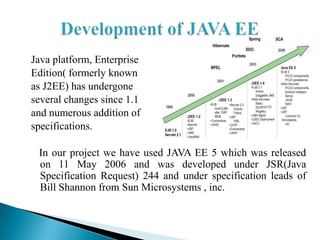
Java platform, Enterprise
Edition( formerly known
as J2EE) has undergone
several changes since 1.1
and numerous addition of
specifications.

 In our project we have used JAVA EE 5 which was released
 on 11 May 2006 and was developed under JSR(Java
 Specification Request) 244 and under specification leads of
 Bill Shannon from Sun Microsystems , inc.
Java EE is the Industry standard for developing portable, robust,
    scalable and secure server –side java technology applications. It is
    built on the solid foundation of Java Platform, Standard Edition
    (Java SE).

   What are Web Site, Web Application and Web         Services?
o   Web Site:Collection of static files, HTML pages, graphics and
    various other files.
o   Web Application: Web site with dynamic functionality on the
    server. A web application run program on server.
o   Web Services:Services that are offered by one application to
    another over the World Wide Web(www).
o   A java technology program that runs on the server.
o   Each Servlet request run in a seperate thread, so servlet request processing
    is significantly faster .
o   Servlets are platform independent because they are written in java
    programming language.
Java Server Pages Technology(JSP)
o   JSP technology enables to write standard HTML pages containing tags that
    run powerful programs based on the java programming language.
o   JSP pages are converted by the web container into a servlet instance. That
    servlet then processes each request to that JSP page.
o   JSP technology supports sepration of presentation and business logic due to
    this web designers can design and update pages without learning the java
    programming language.
o   Model is conceptualization of the objects that the user is working with
    conceptually and the mapping of those concepts into data stuctures the user
    model and data model.

o   View is a presentation of the model data.

o   To manipulate the model the user uses controls .The software that manages
    the user’s control events is the Controller.
Why do we do Session Management?
o As we know HTTP is a stateless protocol. Each request and response
    message connection is independent of the all others. This is significant
    because from one request to another(from same user) the HTTP server does
    not maintain a reference to the previous request. Therefore web container
    must create mechanism to store session information for a particular user.
Uses of Cookies for Session Management
o   Cookies are sent in a response from web server.
o   Cookies are stored on the client’s computer.
o   Cookies are stored in a partition assigned to the web server’s domain name.
    Cookies can be further partitioned by a path within a domain.
o   All cookies for that domain are sent in every request to that web server.
o   Cookies have a lifespan and are flushed by the client browser at the end of
    that lifespan
   Why do we use filters?
o   By using filters web containers intercepts incoming requests before they
    get to your code , preprocessing the request and additional functionality
    like.

o   Blocking access to a resource based on user identity or role membership.

o   Compressing the response data stream.

o   Transforming the response.

o   Measuring and logging servlet performance.
   Provides Facility to user to take a test as per his like.

   User can maintain his own profile.

   Unique User name and password provided to each user.

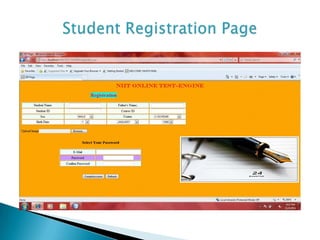
   Unique Student id is provided to each candidate.

   Administrator has a facility to Generate test, Schedule Test,
    Create his own questions, Even create new User.
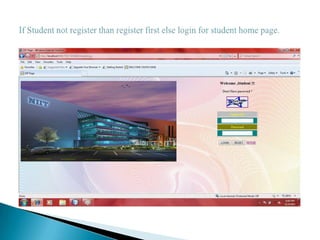
• On scheduling test student id is needed than according to the
  choice of a particular student test is scheduled.

• Now to again start test student id is needed. There are 5
  questions for any choice of candidate.

• The candidate can take a review of the previously accessed
  question and can directly answer any question.

• Get Instant Result on Completion of the Test.
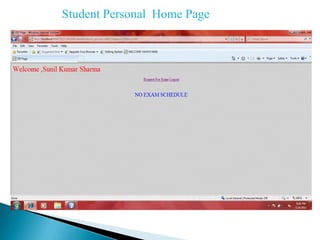
Student Personal Home Page
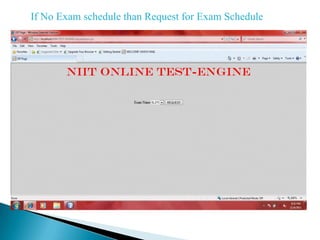
If No Exam schedule than Request for Exam Schedule
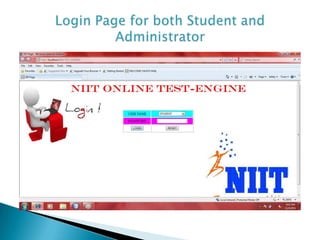
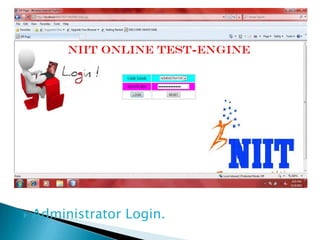
   Administrator Login.
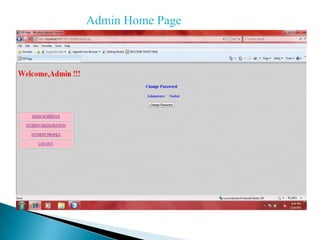
Admin Home Page
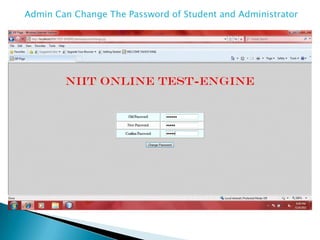
Admin Can Change The Password of Student and Administrator
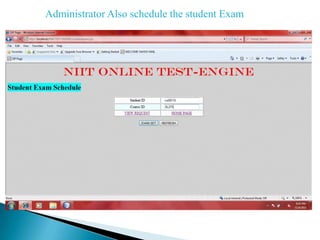
Administrator Also schedule the student Exam
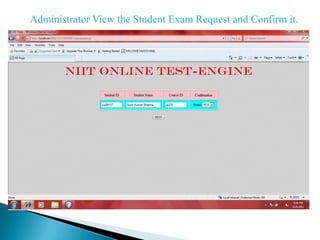
Administrator View the Student Exam Request and Confirm it.
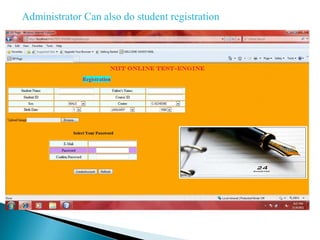
Administrator Can also do student registration
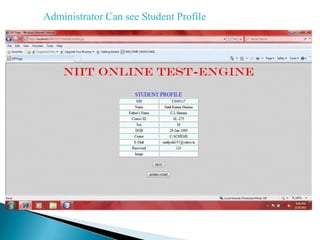
Administrator Can see Student Profile
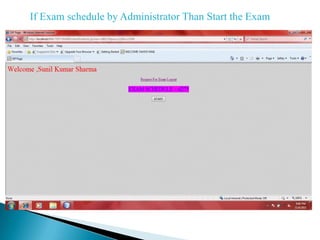
If Exam schedule by Administrator Than Start the Exam
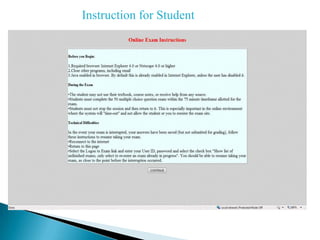
Instruction for Student
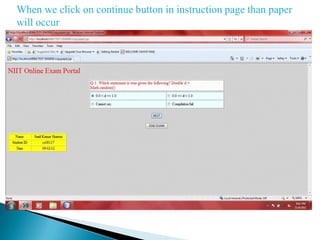
When we click on continue button in instruction page than paper
will occur
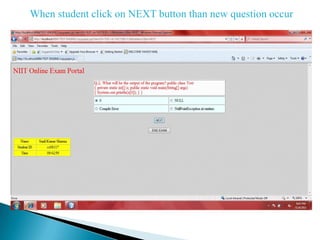
When student click on NEXT button than new question occur
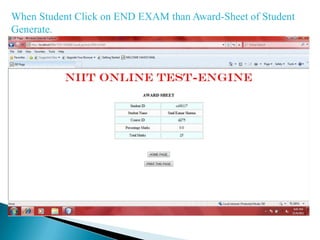
When Student Click on END EXAM than Award-Sheet of Student
Generate.
Online  Test Engine
Online  Test Engine

Online Test Engine

  • 1.
    Presented by:- Sunil Kumar Shrama Jaipur Engineering College,Kukas
  • 2.
    NIIT Limited isa global education oriented company focusing on imparting computer knowledge among its students. Has been in education business for over many years. Today it has presence in 40 countries worldwide. Trained professionals of the topmost companies of the world. Technical training available for fresher and experienced candidate depending on their need.
  • 3.
    Software Development life cycle Process of creating or altering systems and the models Phases of SDLC :- System analysis Design Implementation & Coding Testing Operation & Maintenance
  • 5.
    Java platform, Enterprise Edition(formerly known as J2EE) has undergone several changes since 1.1 and numerous addition of specifications. In our project we have used JAVA EE 5 which was released on 11 May 2006 and was developed under JSR(Java Specification Request) 244 and under specification leads of Bill Shannon from Sun Microsystems , inc.
  • 6.
    Java EE isthe Industry standard for developing portable, robust, scalable and secure server –side java technology applications. It is built on the solid foundation of Java Platform, Standard Edition (Java SE).  What are Web Site, Web Application and Web Services? o Web Site:Collection of static files, HTML pages, graphics and various other files. o Web Application: Web site with dynamic functionality on the server. A web application run program on server. o Web Services:Services that are offered by one application to another over the World Wide Web(www).
  • 7.
    o A java technology program that runs on the server. o Each Servlet request run in a seperate thread, so servlet request processing is significantly faster . o Servlets are platform independent because they are written in java programming language. Java Server Pages Technology(JSP) o JSP technology enables to write standard HTML pages containing tags that run powerful programs based on the java programming language. o JSP pages are converted by the web container into a servlet instance. That servlet then processes each request to that JSP page. o JSP technology supports sepration of presentation and business logic due to this web designers can design and update pages without learning the java programming language.
  • 8.
    o Model is conceptualization of the objects that the user is working with conceptually and the mapping of those concepts into data stuctures the user model and data model. o View is a presentation of the model data. o To manipulate the model the user uses controls .The software that manages the user’s control events is the Controller.
  • 9.
    Why do wedo Session Management? o As we know HTTP is a stateless protocol. Each request and response message connection is independent of the all others. This is significant because from one request to another(from same user) the HTTP server does not maintain a reference to the previous request. Therefore web container must create mechanism to store session information for a particular user. Uses of Cookies for Session Management o Cookies are sent in a response from web server. o Cookies are stored on the client’s computer. o Cookies are stored in a partition assigned to the web server’s domain name. Cookies can be further partitioned by a path within a domain. o All cookies for that domain are sent in every request to that web server. o Cookies have a lifespan and are flushed by the client browser at the end of that lifespan
  • 10.
    Why do we use filters? o By using filters web containers intercepts incoming requests before they get to your code , preprocessing the request and additional functionality like. o Blocking access to a resource based on user identity or role membership. o Compressing the response data stream. o Transforming the response. o Measuring and logging servlet performance.
  • 12.
    Provides Facility to user to take a test as per his like.  User can maintain his own profile.  Unique User name and password provided to each user.  Unique Student id is provided to each candidate.  Administrator has a facility to Generate test, Schedule Test, Create his own questions, Even create new User.
  • 13.
    • On schedulingtest student id is needed than according to the choice of a particular student test is scheduled. • Now to again start test student id is needed. There are 5 questions for any choice of candidate. • The candidate can take a review of the previously accessed question and can directly answer any question. • Get Instant Result on Completion of the Test.
  • 17.
  • 18.
    If No Examschedule than Request for Exam Schedule
  • 19.
    Administrator Login.
  • 20.
  • 21.
    Admin Can ChangeThe Password of Student and Administrator
  • 22.
  • 23.
    Administrator View theStudent Exam Request and Confirm it.
  • 24.
    Administrator Can alsodo student registration
  • 25.
    Administrator Can seeStudent Profile
  • 26.
    If Exam scheduleby Administrator Than Start the Exam
  • 27.
  • 28.
    When we clickon continue button in instruction page than paper will occur
  • 29.
    When student clickon NEXT button than new question occur
  • 31.
    When Student Clickon END EXAM than Award-Sheet of Student Generate.