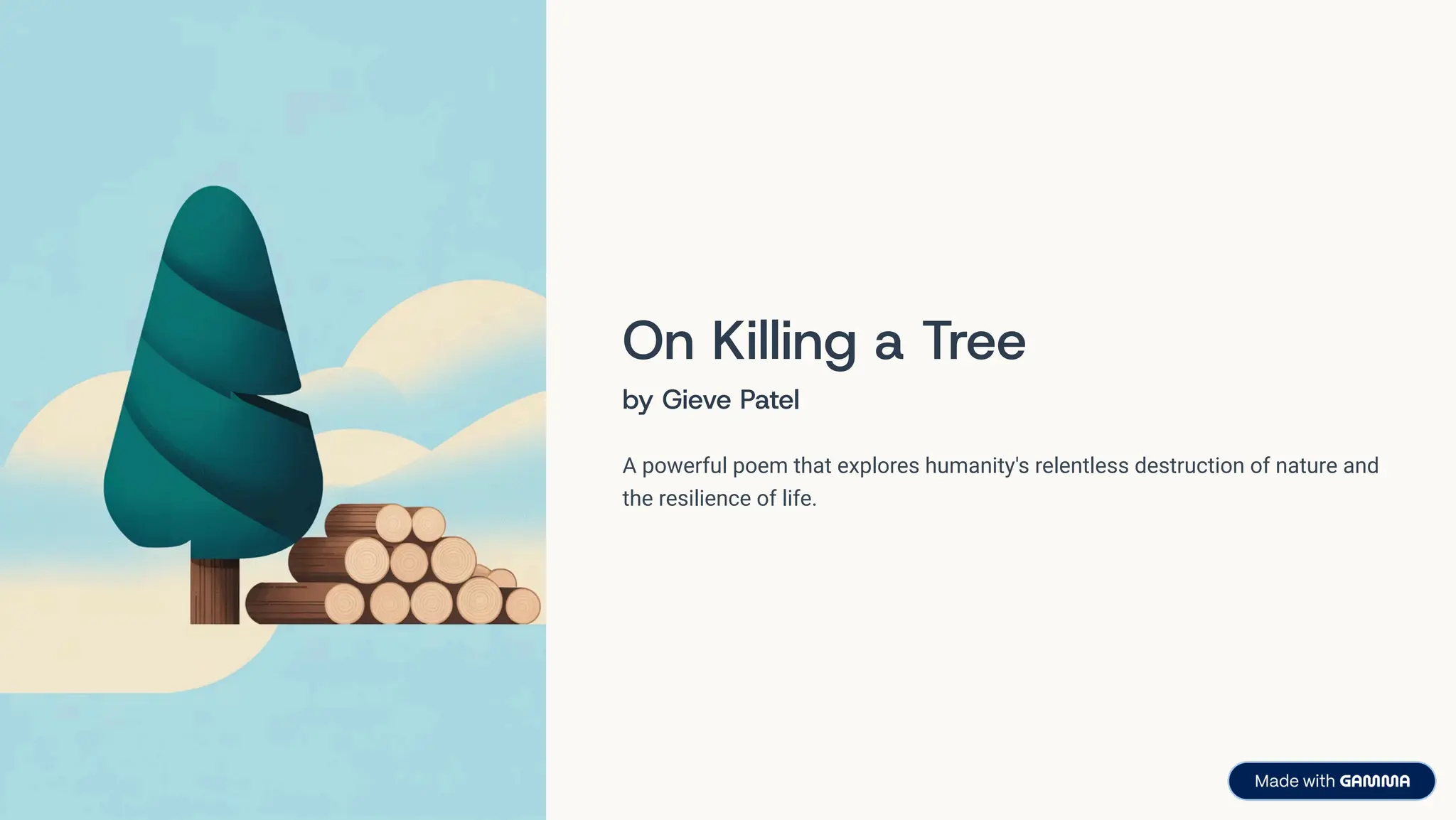
On Killing aTree
by Gieve Patel
A powerful poem that explores humanity's relentless destruction of nature and
the resilience of life.
2.
Introduction to thePoem
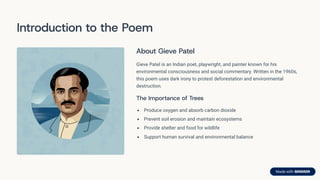
About Gieve Patel
Gieve Patel is an Indian poet, playwright, and painter known for his
environmental consciousness and social commentary. Written in the 1960s,
this poem uses dark irony to protest deforestation and environmental
destruction.
The Importance of Trees
Produce oxygen and absorb carbon dioxide
Prevent soil erosion and maintain ecosystems
Provide shelter and food for wildlife
Support human survival and environmental balance
3.
Stanza 1: TheResilience of Trees
"It takes much time to kill a tree,
Not a simple jab of the knife
Will do it. It has grown
Slowly consuming the earth,
Rising out of it, feeding
Upon its crust, absorbing
Years of sunlight, air, water,
And out of its leprous hide
Sprouting leaves."
Key Message
Trees are deeply rooted in life, drawing sustenance from
earth, air, water, and sunlight over many years. They cannot
be killed easily.
Tone
Ironic and instructional, as if teaching the "proper" way to
destroy nature, which actually emphasizes its cruelty.
Multiple Choice Questions
Q1: What does "leprous hide" refer to?
a) The diseased appearance of tree bark
b) The smooth texture of leaves
c) The roots underground
d) The flowers blooming
Q2: How long does it take to kill a tree according to the poem?
a) A few minutes
b) Much time and effort
c) One simple cut
d) A single day
Q3: What has the tree been consuming to grow?
a) Only water
b) Earth, sunlight, air, and water
c) Just sunlight
d) Chemical fertilizers
4.
Stanza 1: WordMeanings & Literary Devices
Word Meanings
Jab
A quick, sharp thrust or stab with a pointed object
Consuming
Using up, eating, or absorbing nutrients
Crust
The outer layer or surface of the earth
Leprous
Resembling leprosy; having a diseased, discolored, or rough
appearance
Hide
The bark or outer covering of the tree
Sprouting
Growing or producing new shoots and leaves
Literary Devices
Metaphor
"Consuming the earth" - The tree is compared to
something eating, showing how it draws nutrients from
soil
Personification
"Feeding upon its crust" - The tree is given human-like
qualities of feeding and eating
Imagery
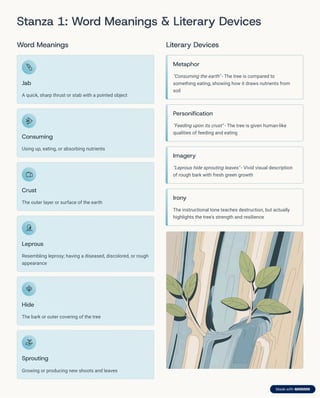
"Leprous hide sprouting leaves" - Vivid visual description
of rough bark with fresh green growth
Irony
The instructional tone teaches destruction, but actually
highlights the tree's strength and resilience
5.
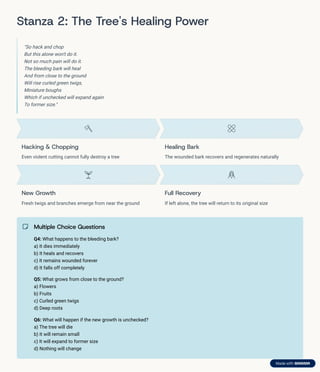
Stanza 2: TheTree's Healing Power
"So hack and chop
But this alone won't do it.
Not so much pain will do it.
The bleeding bark will heal
And from close to the ground
Will rise curled green twigs,
Miniature boughs
Which if unchecked will expand again
To former size."
Hacking & Chopping
Even violent cutting cannot fully destroy a tree
Healing Bark
The wounded bark recovers and regenerates naturally
New Growth
Fresh twigs and branches emerge from near the ground
Full Recovery
If left alone, the tree will return to its original size
Multiple Choice Questions
Q4: What happens to the bleeding bark?
a) It dies immediately
b) It heals and recovers
c) It remains wounded forever
d) It falls off completely
Q5: What grows from close to the ground?
a) Flowers
b) Fruits
c) Curled green twigs
d) Deep roots
Q6: What will happen if the new growth is unchecked?
a) The tree will die
b) It will remain small
c) It will expand to former size
d) Nothing will change
6.
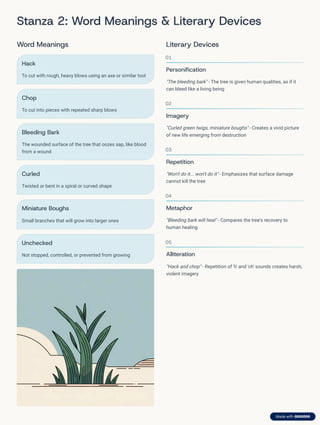
Stanza 2: WordMeanings & Literary Devices
Word Meanings
Hack
To cut with rough, heavy blows using an axe or similar tool
Chop
To cut into pieces with repeated sharp blows
Bleeding Bark
The wounded surface of the tree that oozes sap, like blood
from a wound
Curled
Twisted or bent in a spiral or curved shape
Miniature Boughs
Small branches that will grow into larger ones
Unchecked
Not stopped, controlled, or prevented from growing
Literary Devices
01
Personification
"The bleeding bark" - The tree is given human qualities, as if it
can bleed like a living being
02
Imagery
"Curled green twigs, miniature boughs" - Creates a vivid picture
of new life emerging from destruction
03
Repetition
"Won't do it... won't do it" - Emphasizes that surface damage
cannot kill the tree
04
Metaphor
"Bleeding bark will heal" - Compares the tree's recovery to
human healing
05
Alliteration
"Hack and chop" - Repetition of 'h' and 'ch' sounds creates harsh,
violent imagery
7.
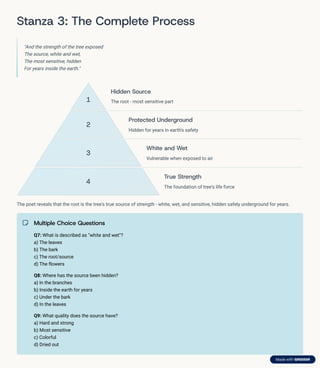
Stanza 3: TheComplete Process
"And the strength of the tree exposed
The source, white and wet,
The most sensitive, hidden
For years inside the earth."
1
Hidden Source
The root - most sensitive part
2
Protected Underground
Hidden for years in earth's safety
3
White and Wet
Vulnerable when exposed to air
4
True Strength
The foundation of tree's life force
The poet reveals that the root is the tree's true source of strength - white, wet, and sensitive, hidden safely underground for years.
Multiple Choice Questions
Q7: What is described as "white and wet"?
a) The leaves
b) The bark
c) The root/source
d) The flowers
Q8: Where has the source been hidden?
a) In the branches
b) Inside the earth for years
c) Under the bark
d) In the leaves
Q9: What quality does the source have?
a) Hard and strong
b) Most sensitive
c) Colorful
d) Dried out
8.
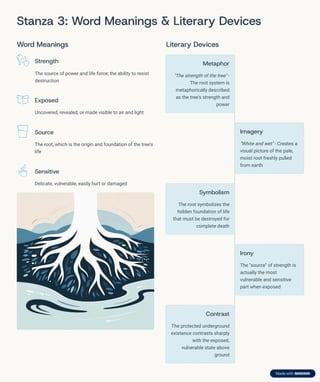
Stanza 3: WordMeanings & Literary Devices
Word Meanings
Strength
The source of power and life force; the ability to resist
destruction
Exposed
Uncovered, revealed, or made visible to air and light
Source
The root, which is the origin and foundation of the tree's
life
Sensitive
Delicate, vulnerable, easily hurt or damaged
Literary Devices
Metaphor
"The strength of the tree" -
The root system is
metaphorically described
as the tree's strength and
power
Imagery
"White and wet" - Creates a
visual picture of the pale,
moist root freshly pulled
from earth
Symbolism
The root symbolizes the
hidden foundation of life
that must be destroyed for
complete death
Irony
The "source" of strength is
actually the most
vulnerable and sensitive
part when exposed
Contrast
The protected underground
existence contrasts sharply
with the exposed,
vulnerable state above
ground
9.
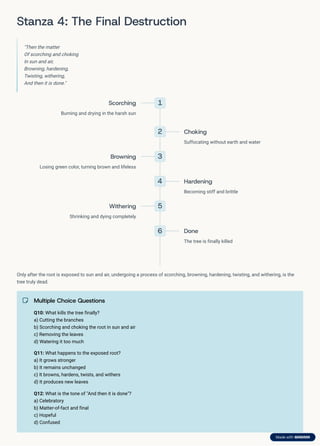
Stanza 4: TheFinal Destruction
"Then the matter
Of scorching and choking
In sun and air,
Browning, hardening,
Twisting, withering,
And then it is done."
1
Scorching
Burning and drying in the harsh sun
2 Choking
Suffocating without earth and water
3
Browning
Losing green color, turning brown and lifeless
4 Hardening
Becoming stiff and brittle
5
Withering
Shrinking and dying completely
6 Done
The tree is finally killed
Only after the root is exposed to sun and air, undergoing a process of scorching, browning, hardening, twisting, and withering, is the
tree truly dead.
Multiple Choice Questions
Q10: What kills the tree finally?
a) Cutting the branches
b) Scorching and choking the root in sun and air
c) Removing the leaves
d) Watering it too much
Q11: What happens to the exposed root?
a) It grows stronger
b) It remains unchanged
c) It browns, hardens, twists, and withers
d) It produces new leaves
Q12: What is the tone of "And then it is done"?
a) Celebratory
b) Matter-of-fact and final
c) Hopeful
d) Confused
10.
Answer Key &Poem Summary
MCQ Answer Key
Q1: A
Diseased bark
Q2: B
Much time
Q3: B
Earth, sun, air, water
Q4: B
It heals
Q5: C
Green twigs
Q6: C
Expand to former size
Q7: C
The root
Q8: B
Inside earth
Q9: B
Most sensitive
Q10: B
Scorching root
Q11: C
Browns & withers
Q12: B
Matter-of-fact
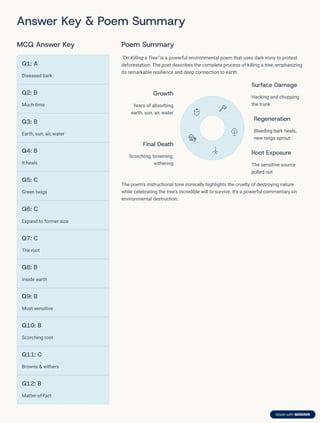
Poem Summary
"On Killing a Tree" is a powerful environmental poem that uses dark irony to protest
deforestation. The poet describes the complete process of killing a tree, emphasizing
its remarkable resilience and deep connection to earth.
The poem's instructional tone ironically highlights the cruelty of destroying nature
while celebrating the tree's incredible will to survive. It's a powerful commentary on
environmental destruction.
Growth
Years of absorbing
earth, sun, air, water
Surface Damage
Hacking and chopping
the trunk
Regeneration
Bleeding bark heals,
new twigs sprout
Root Exposure
The sensitive source
pulled out
Final Death
Scorching, browning,
withering