Moneyball, the Extra 2%, and What Baseball
Management, Fantasy Football, and Newspapers
Can Teach Us About Fostering Innovation in
Managing Collections
Greg Raschke
North Carolina State University
University of Oklahoma
March, 2014
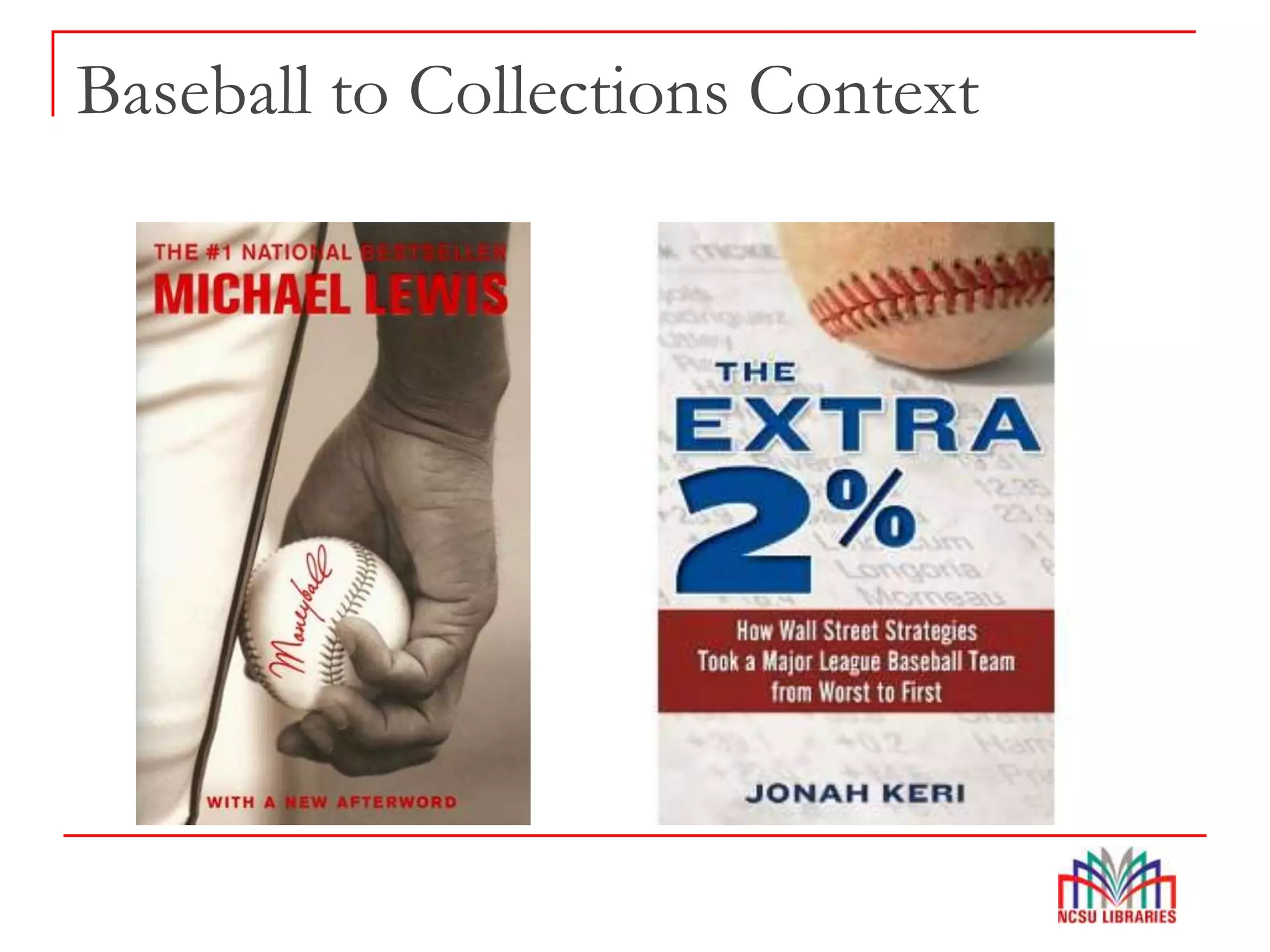
Baseball to Collections Context
Supply-Side Collections
 Print-based, unpredictable
demand, and legitimate need for
just in case collections
 Lead to judging quality by size (as
in the ARL rankings) and libraries
were then held captive to this
standard
 Contributed to inelastic demand
for journals and combinations of
speculative buying
 Use is secondary to size, dollars
expended, and other input
measures
 Credit to David Lewis
(http://ulib.iupui.edu/users/dlewis)
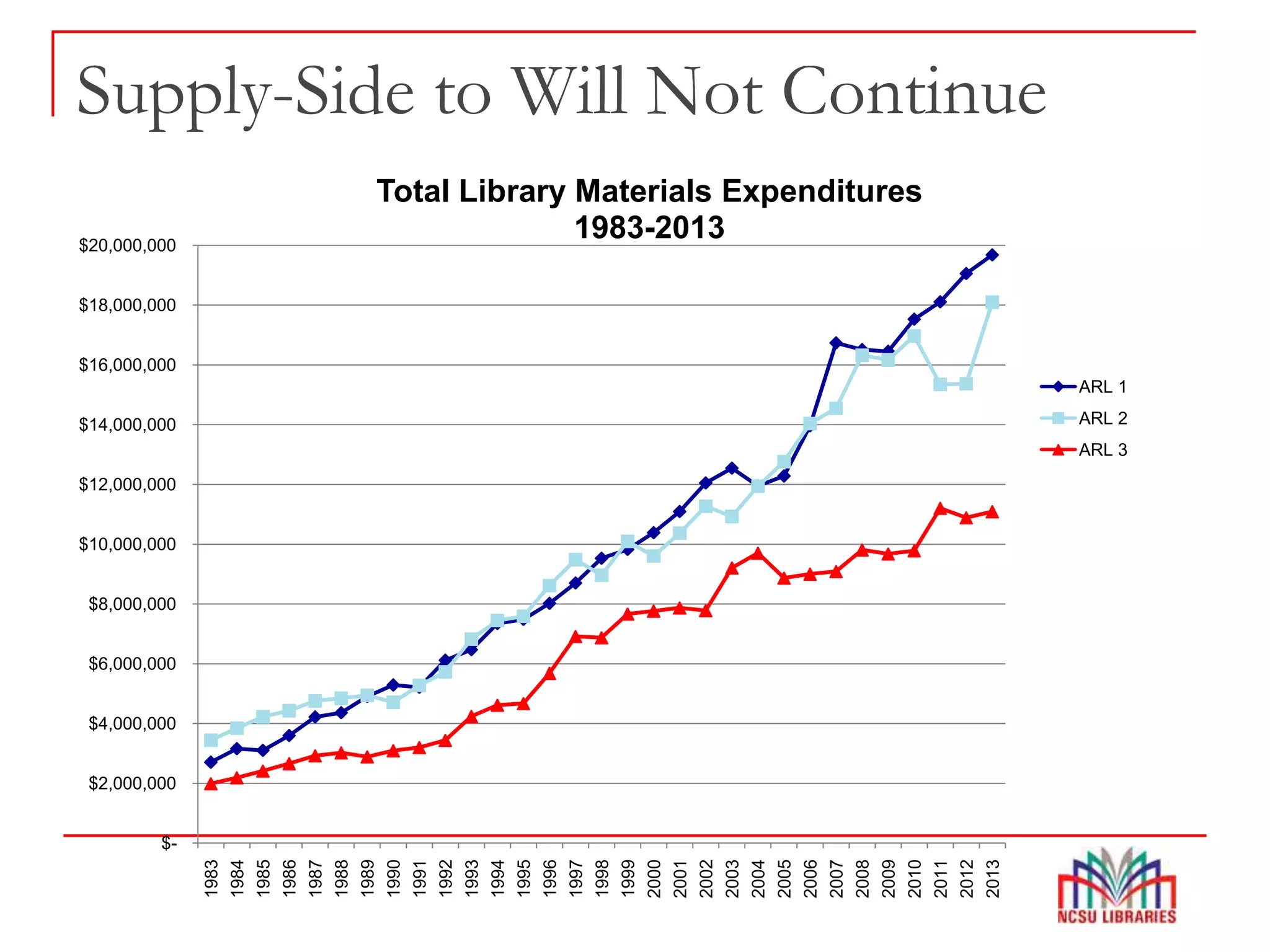
Supply-Side to Will Not Continue
$-
$2,000,000
$4,000,000
$6,000,000
$8,000,000
$10,000,000
$12,000,000
$14,000,000
$16,000,000
$18,000,000
$20,000,000
1983
1984
1985
1986
1987
1988
1989
1990
1991
1992
1993
1994
1995
1996
1997
1998
1999
2000
2001
2002
2003
2004
2005
2006
2007
2008
2009
2010
2011
2012
2013
Total Library Materials Expenditures
1983-2013
ARL 1
ARL 2
ARL 3
Assumptions
 Economics are not sustainable
 Collections budgets will not grow at rate of past 30 years
 Unit growth and growth in cost per unit are not sustainable
 Need to lower costs of overall system
 Lower unit costs
 Use data and users to be more precise
 Tipping point for ability and expectations to deliver content at point
of need
 Therefore collection practices and strategies must change
 This is difficult – much reason for optimism
Demand-Driven Collections – Core
Roles
 Make information
easily, widely, and cheaply
available
 Collections as drivers of
research, teaching, and
learning
 To make special or unique
collections held/managed by
the library available to the user
community and the world
Demand-Driven – More Assumptions
 Less tolerance for and less
investment in lower use
general collections
 Resource management based
increasingly on use
 Embrace expansion of
available content and sense-
making role
 Risks of not evolving and
failing to innovate –
newspapers
Demand-Driven – Assertions
 Tension between time-honored
role as custodians of
scholarship versus enabling
digital environment for
scholars
 Must work on:
 Lowering unit costs of
scholarly materials OR
 Lowering number of
publishable units
 Must free funds for investing in
“new” arenas such as digital
curation, digital scholarship,
DDA, and collaboration
Demand-Driven – Assertions
 Use based and user driven
collecting models will take
growing share of budget
 Bet on numbers
 Bet on good and quick
 Put resources into enabling
digital environment for
scholars and custodian role
will come out of that strategy
 Rewards of adapting – more
used and vital than ever
Demand-Driven – Changing Practice
 Access won – management and coherence are keys
 Not just PDA – portfolio of approaches - more responsive and
expansive
 Utilize new tools and techniques to become advanced analysts and
deliver content at point of need
 Truly embrace evidence-based decision making and ability to deliver
content on demand
 Challenges:
 Resource sharing
 Existing practices and organizational models
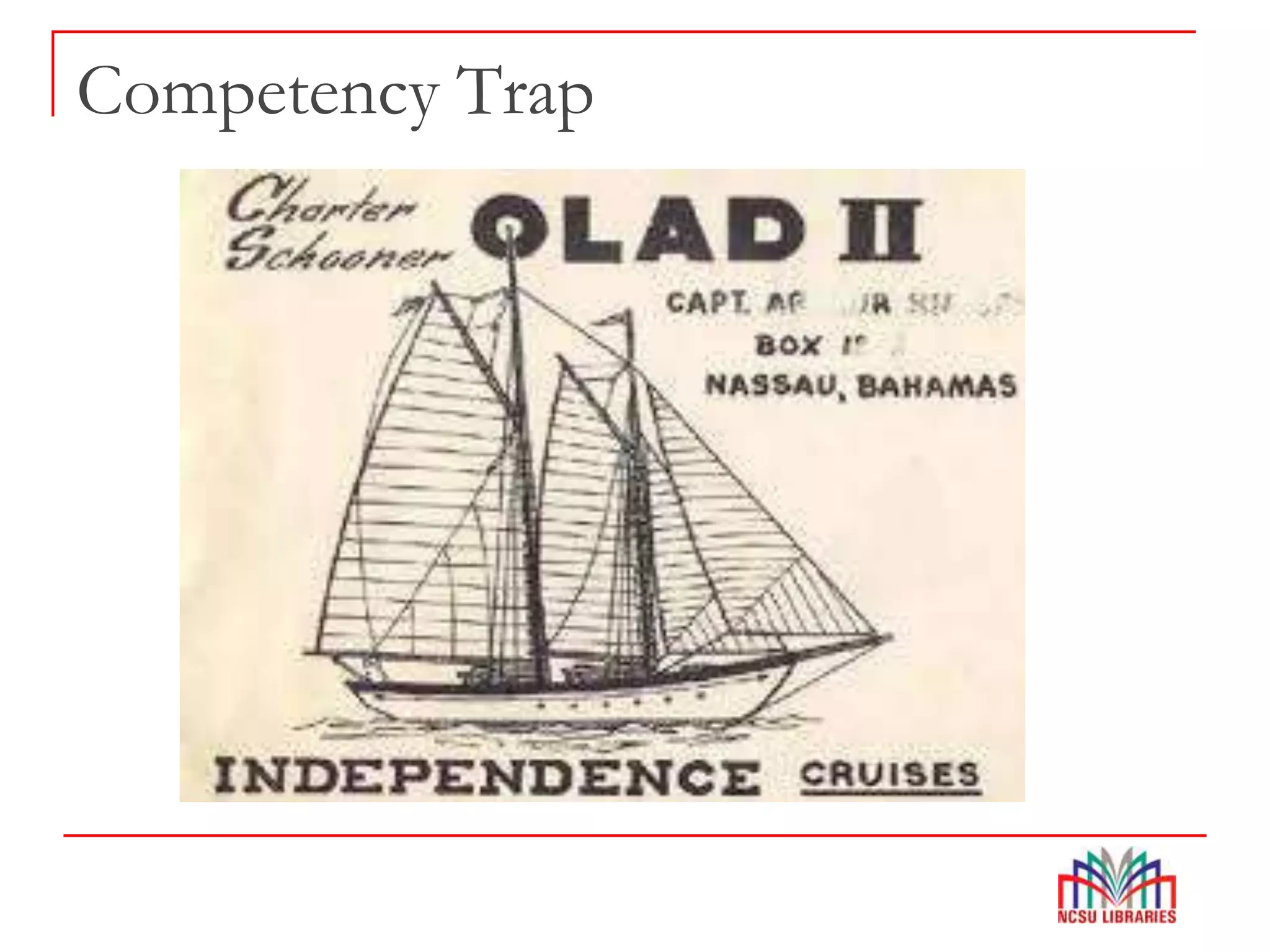
Competency Trap
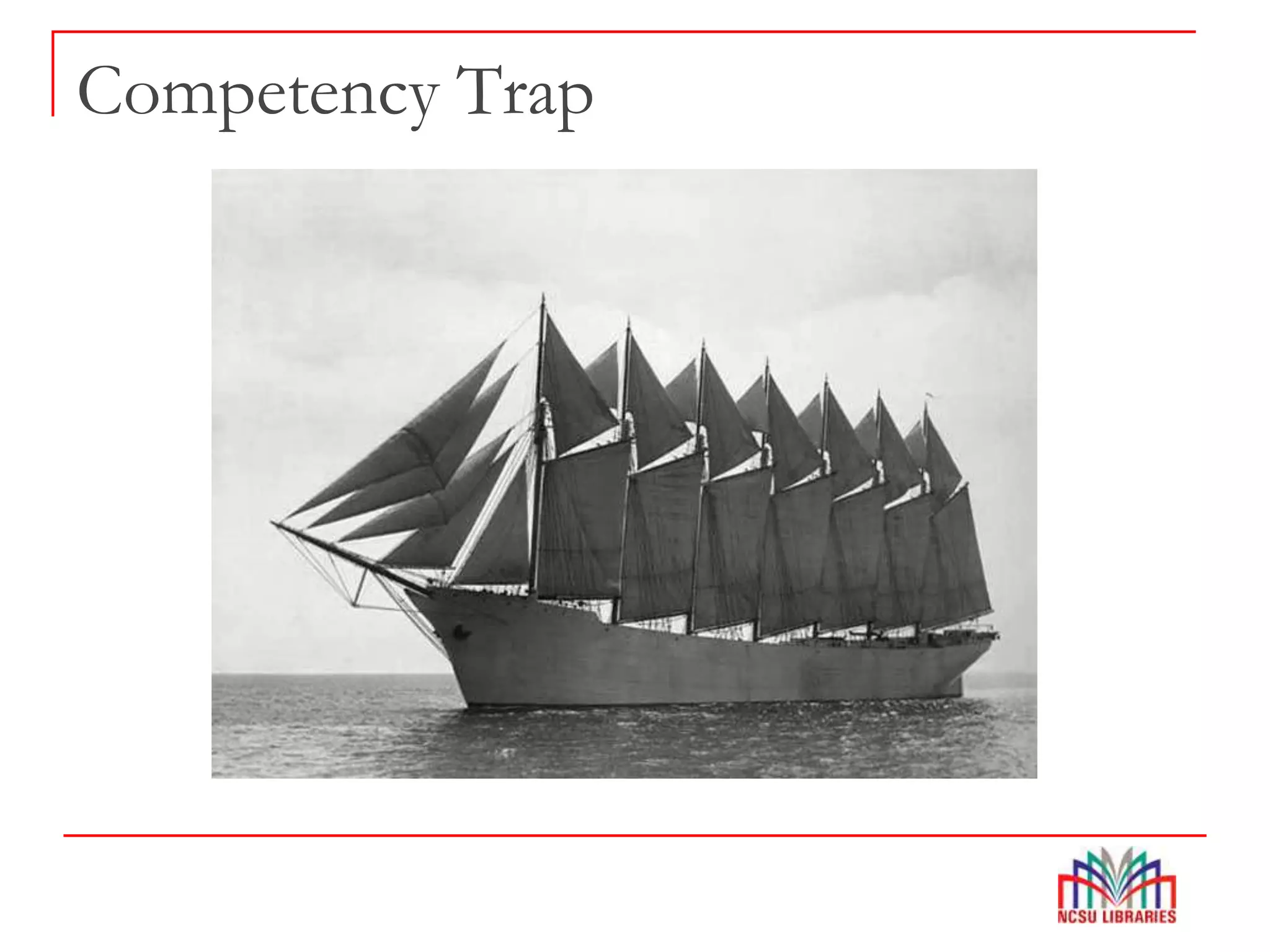
Competency Trap
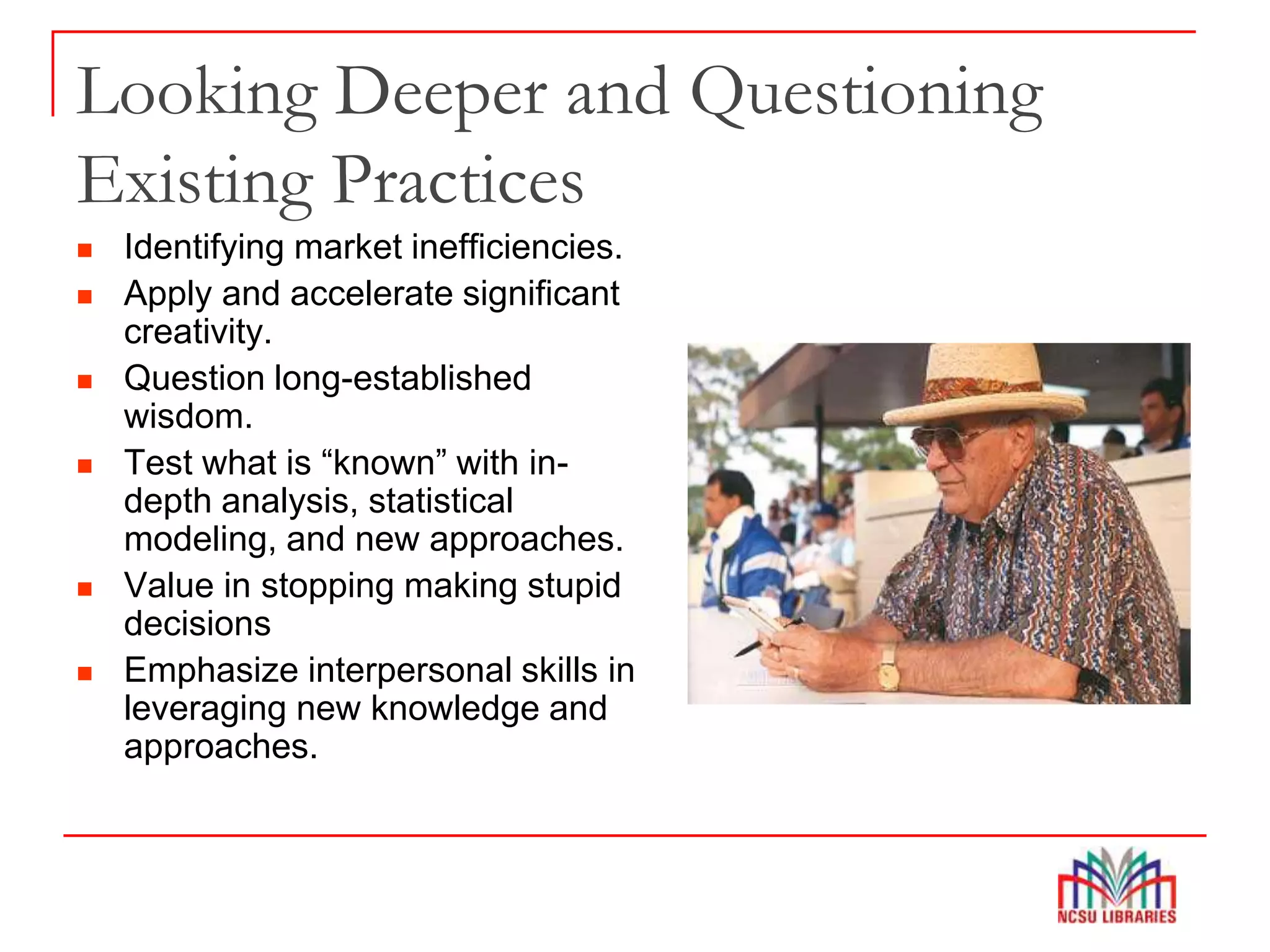
Looking Deeper and Questioning
Existing Practices
 Identifying market inefficiencies.
 Apply and accelerate significant
creativity.
 Question long-established
wisdom.
 Test what is “known” with in-
depth analysis, statistical
modeling, and new approaches.
 Value in stopping making stupid
decisions
 Emphasize interpersonal skills in
leveraging new knowledge and
approaches.
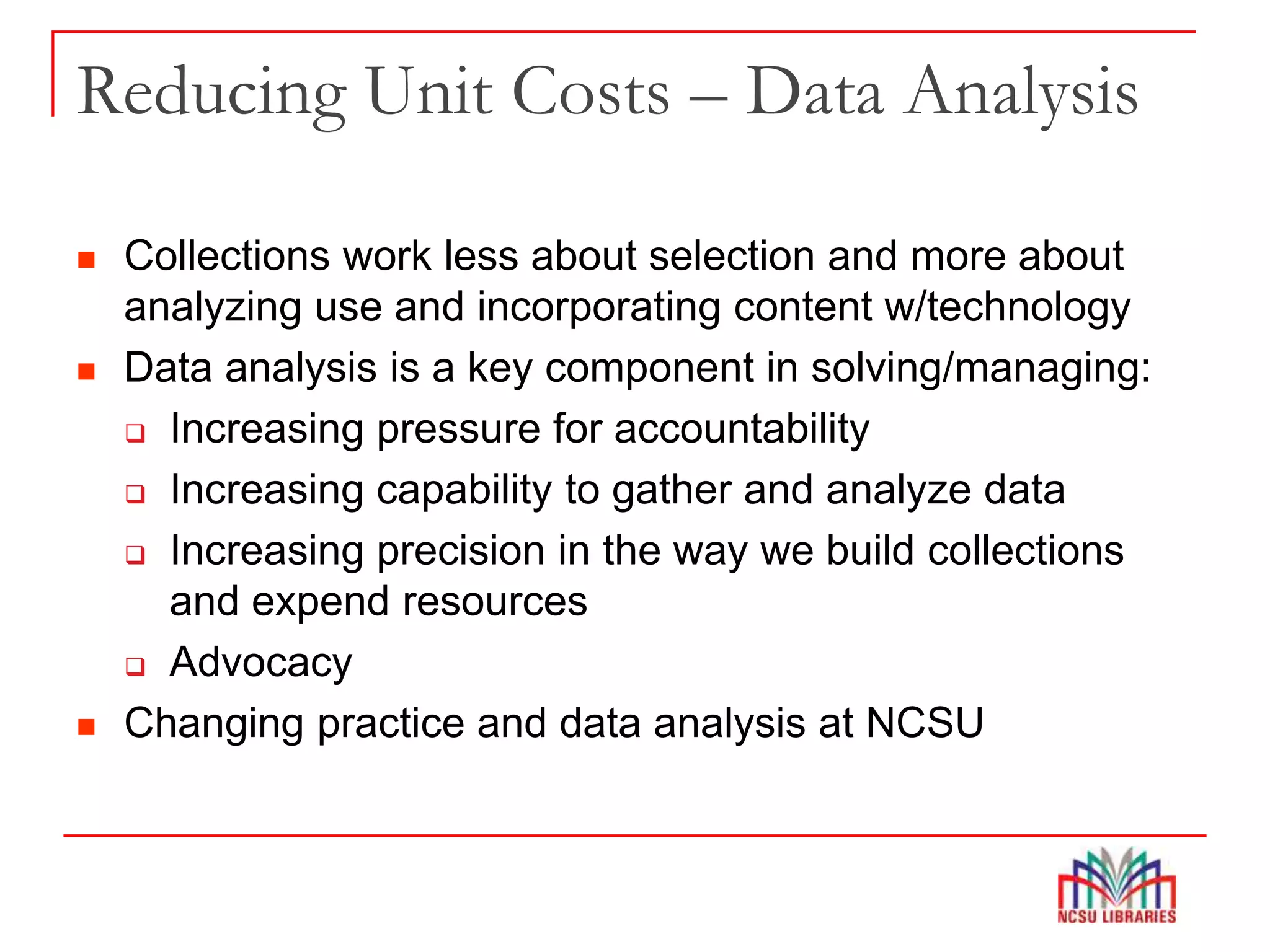
Reducing Unit Costs – Data Analysis
 Collections work less about selection and more about
analyzing use and incorporating content w/technology
 Data analysis is a key component in solving/managing:
 Increasing pressure for accountability
 Increasing capability to gather and analyze data
 Increasing precision in the way we build collections
and expend resources
 Advocacy
 Changing practice and data analysis at NCSU
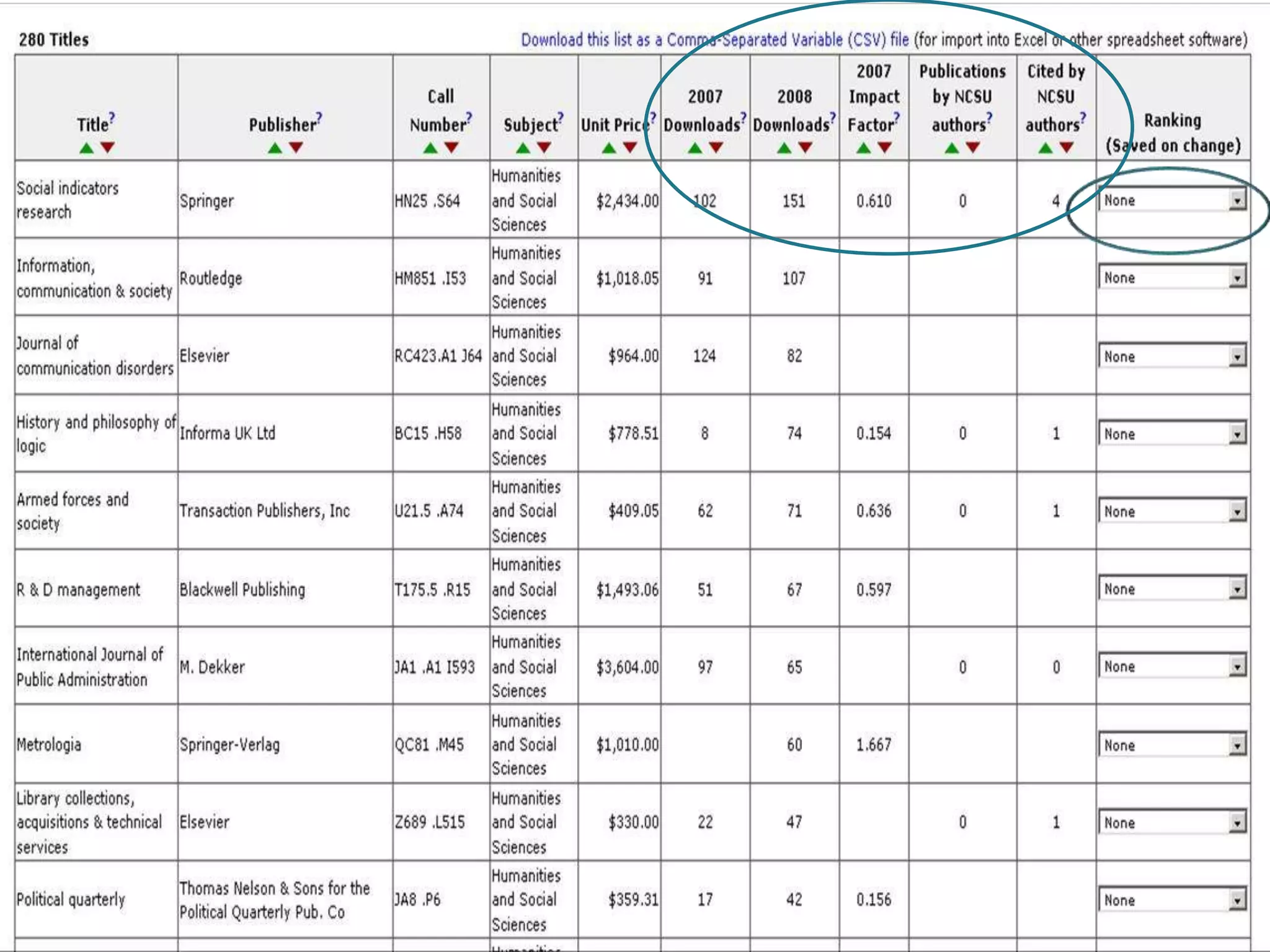
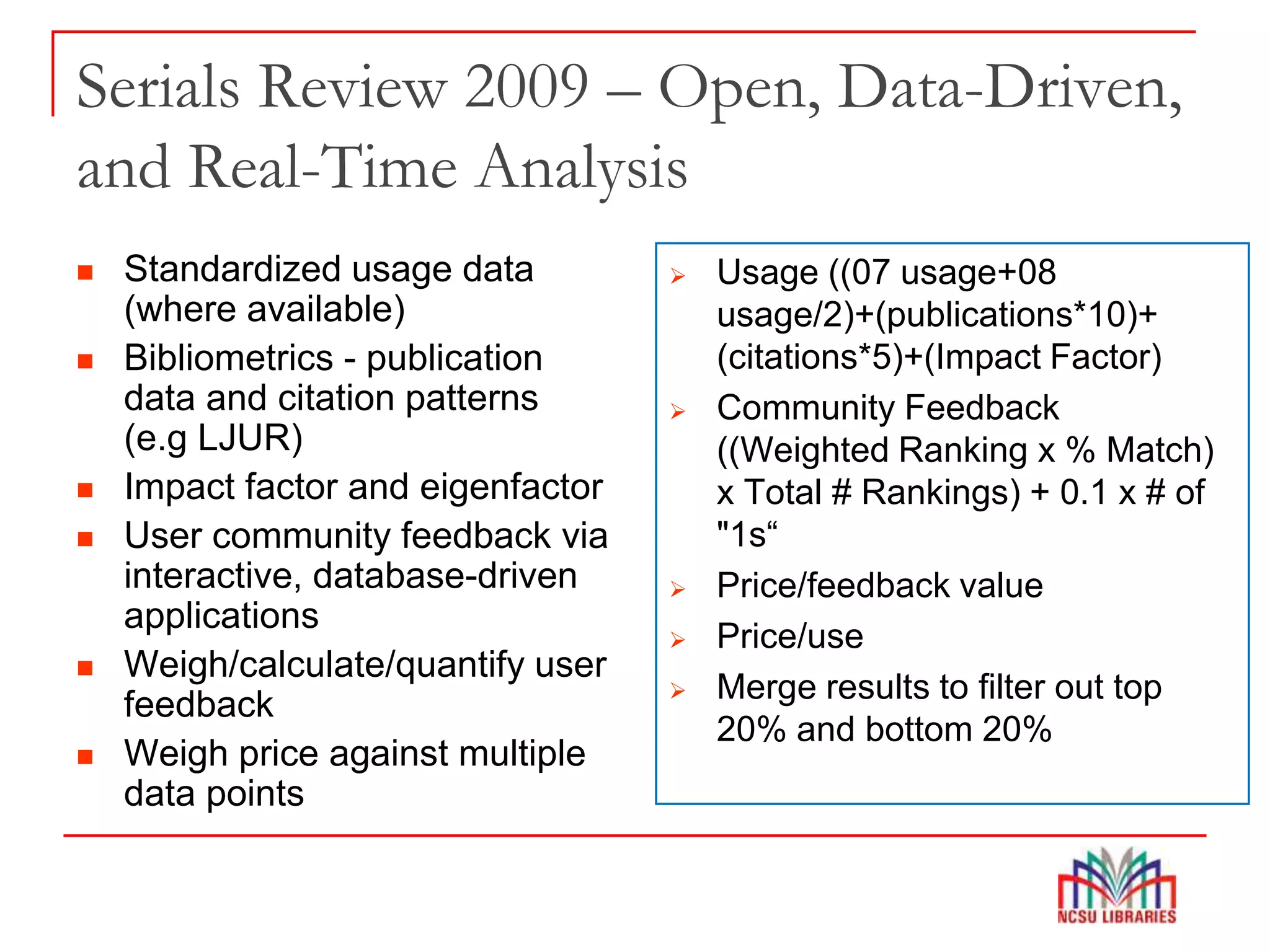
Serials Review 2009 – Open, Data-Driven,
and Real-Time Analysis
 Standardized usage data
(where available)
 Bibliometrics - publication
data and citation patterns
(e.g LJUR)
 Impact factor and eigenfactor
 User community feedback via
interactive, database-driven
applications
 Weigh/calculate/quantify user
feedback
 Weigh price against multiple
data points
 Usage ((07 usage+08
usage/2)+(publications*10)+
(citations*5)+(Impact Factor)
 Community Feedback
((Weighted Ranking x % Match)
x Total # Rankings) + 0.1 x # of
"1s“
 Price/feedback value
 Price/use
 Merge results to filter out top
20% and bottom 20%
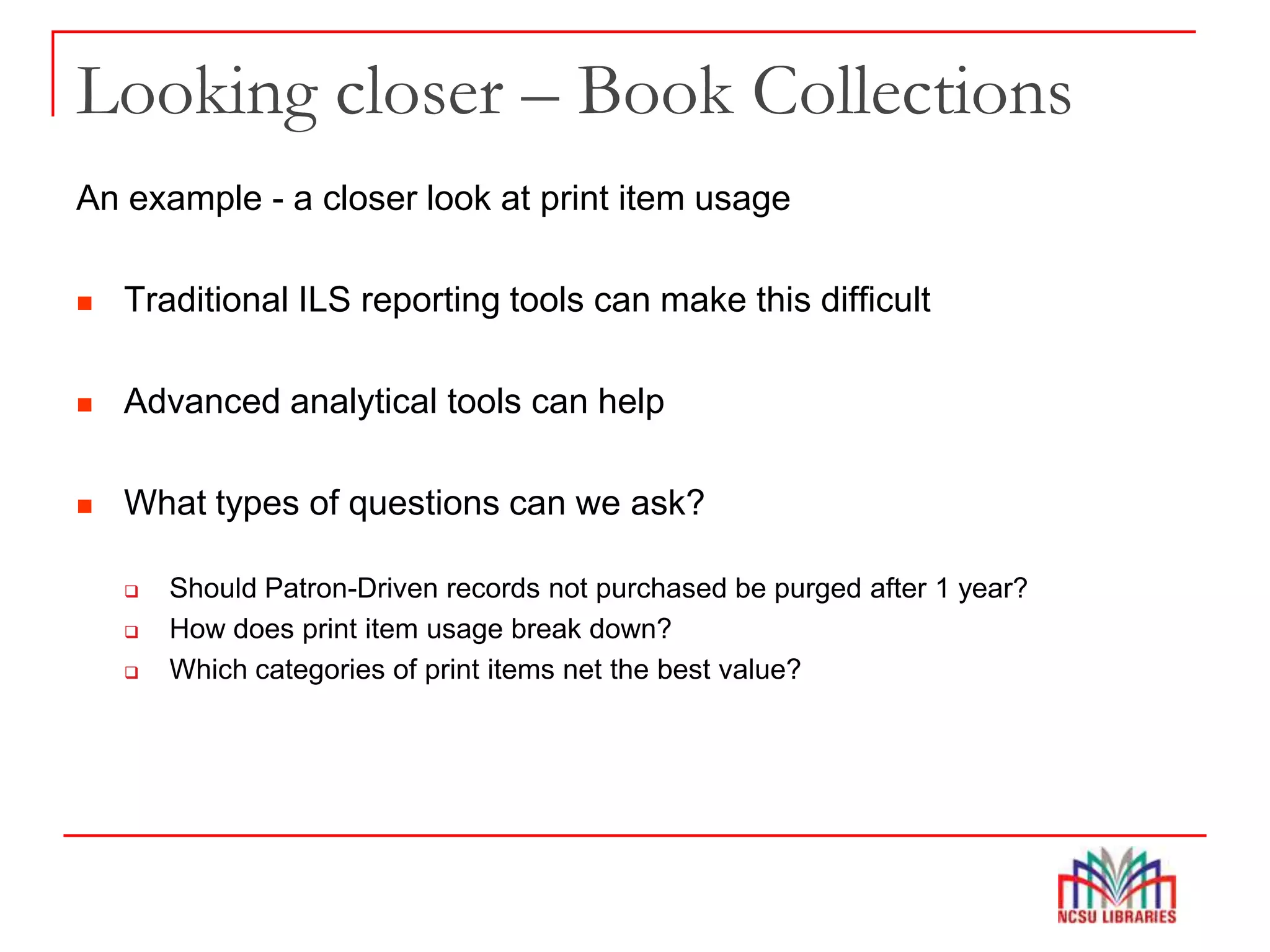
Looking closer – Book Collections
An example - a closer look at print item usage
 Traditional ILS reporting tools can make this difficult
 Advanced analytical tools can help
 What types of questions can we ask?
 Should Patron-Driven records not purchased be purged after 1 year?
 How does print item usage break down?
 Which categories of print items net the best value?
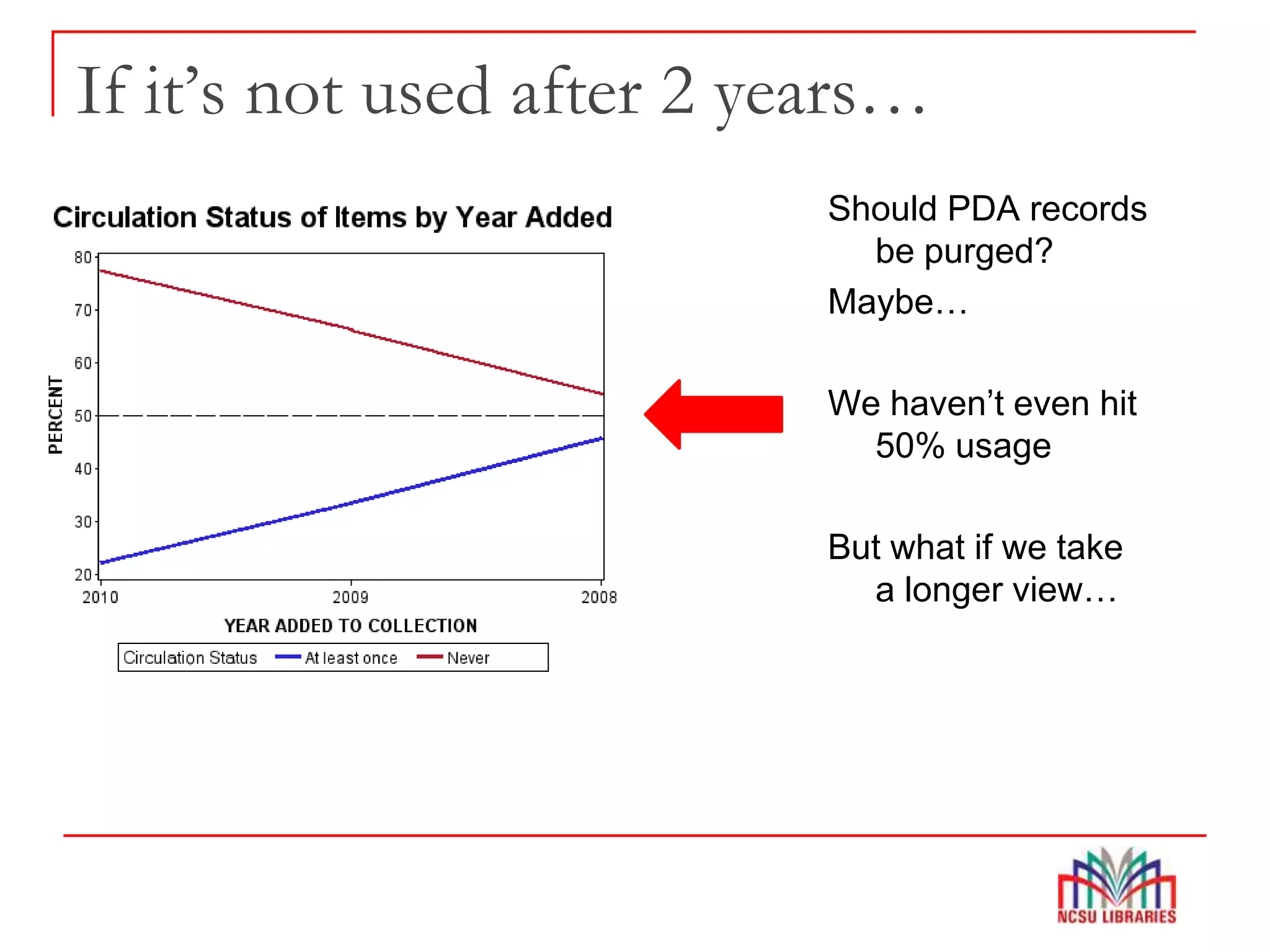
If it’s not used after 2 years…
Should PDA records
be purged?
Maybe…
We haven’t even hit
50% usage
But what if we take
a longer view…
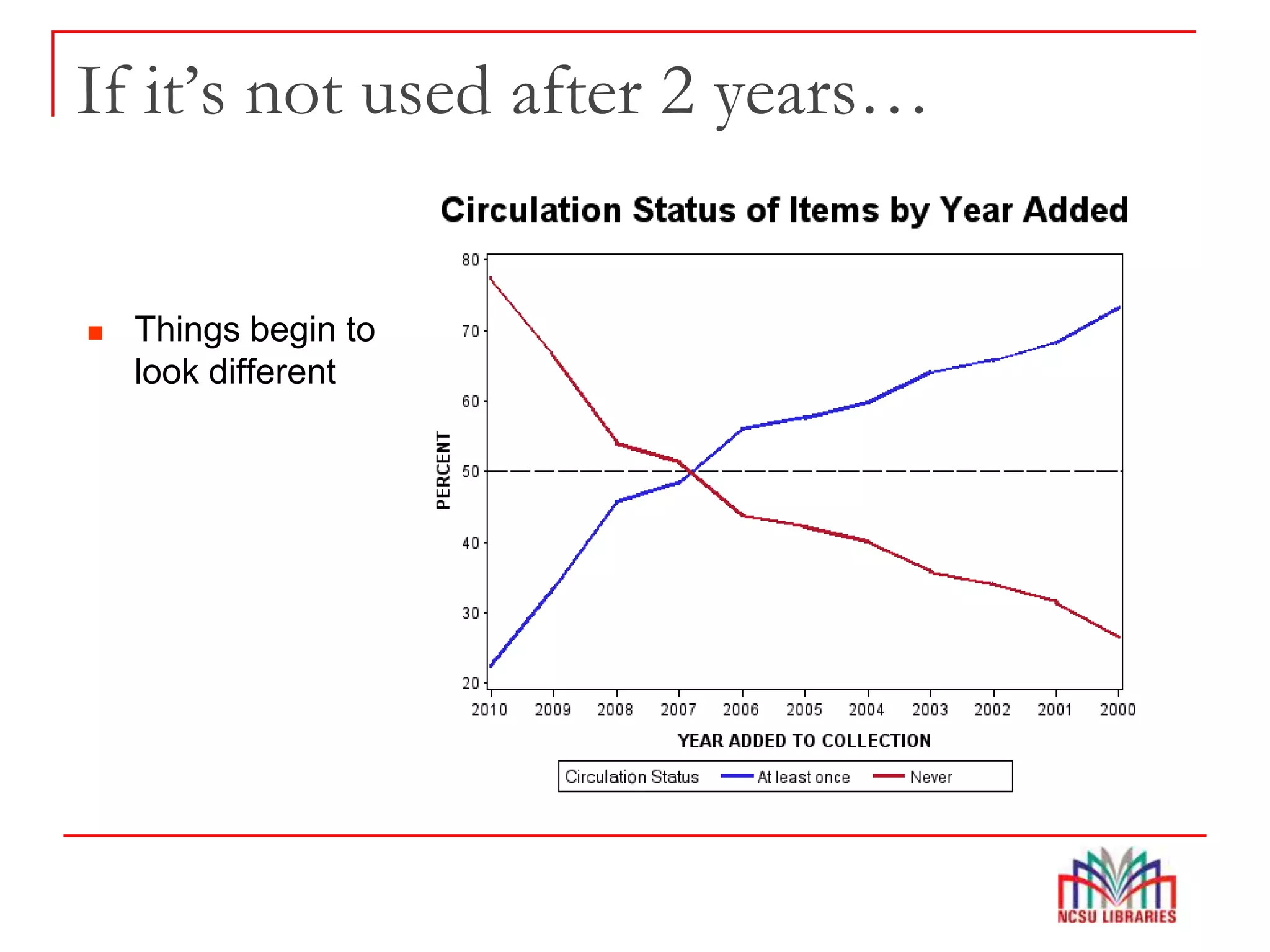
If it’s not used after 2 years…
 Things begin to
look different
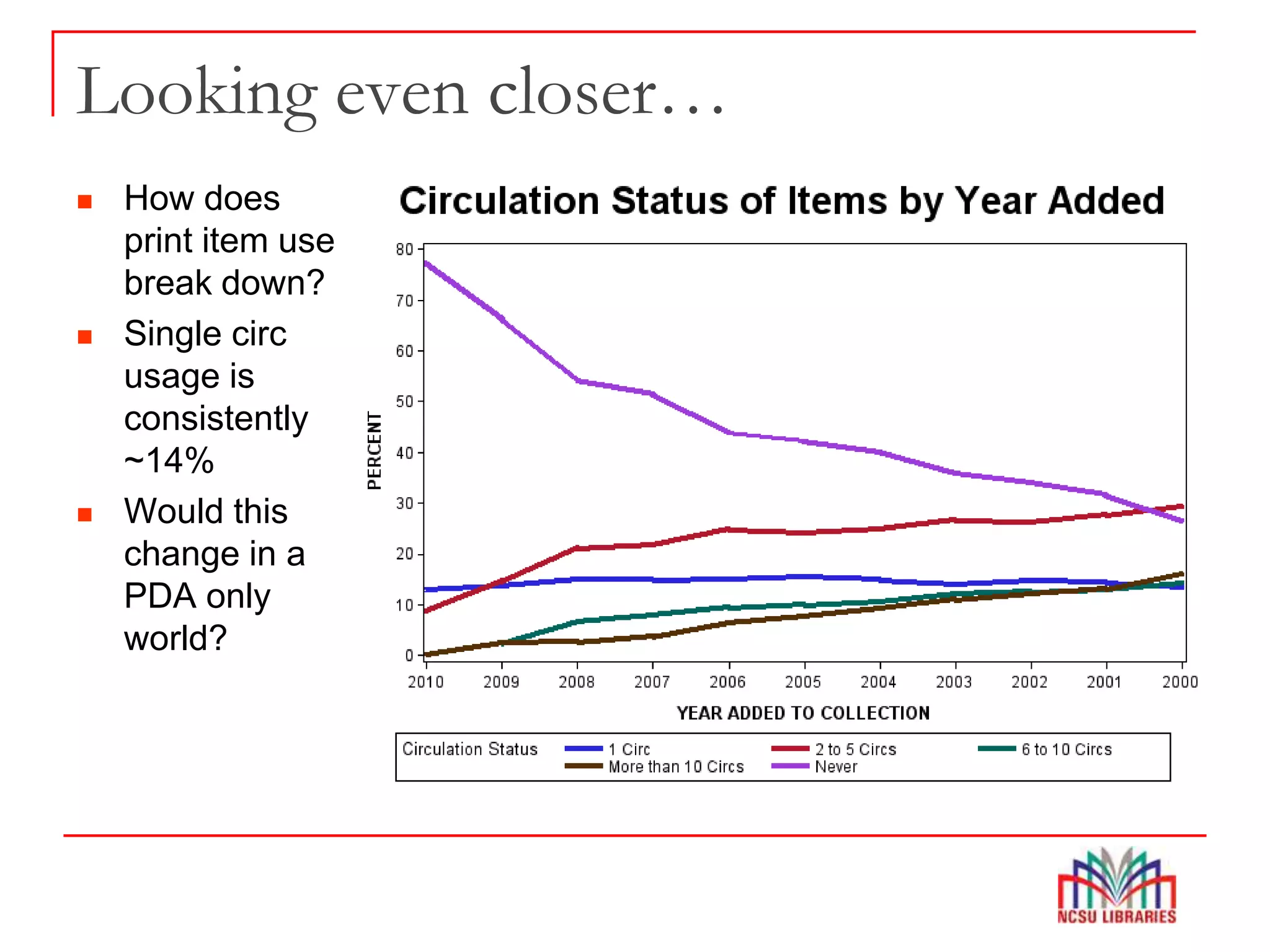
Looking even closer…
 How does
print item use
break down?
 Single circ
usage is
consistently
~14%
 Would this
change in a
PDA only
world?
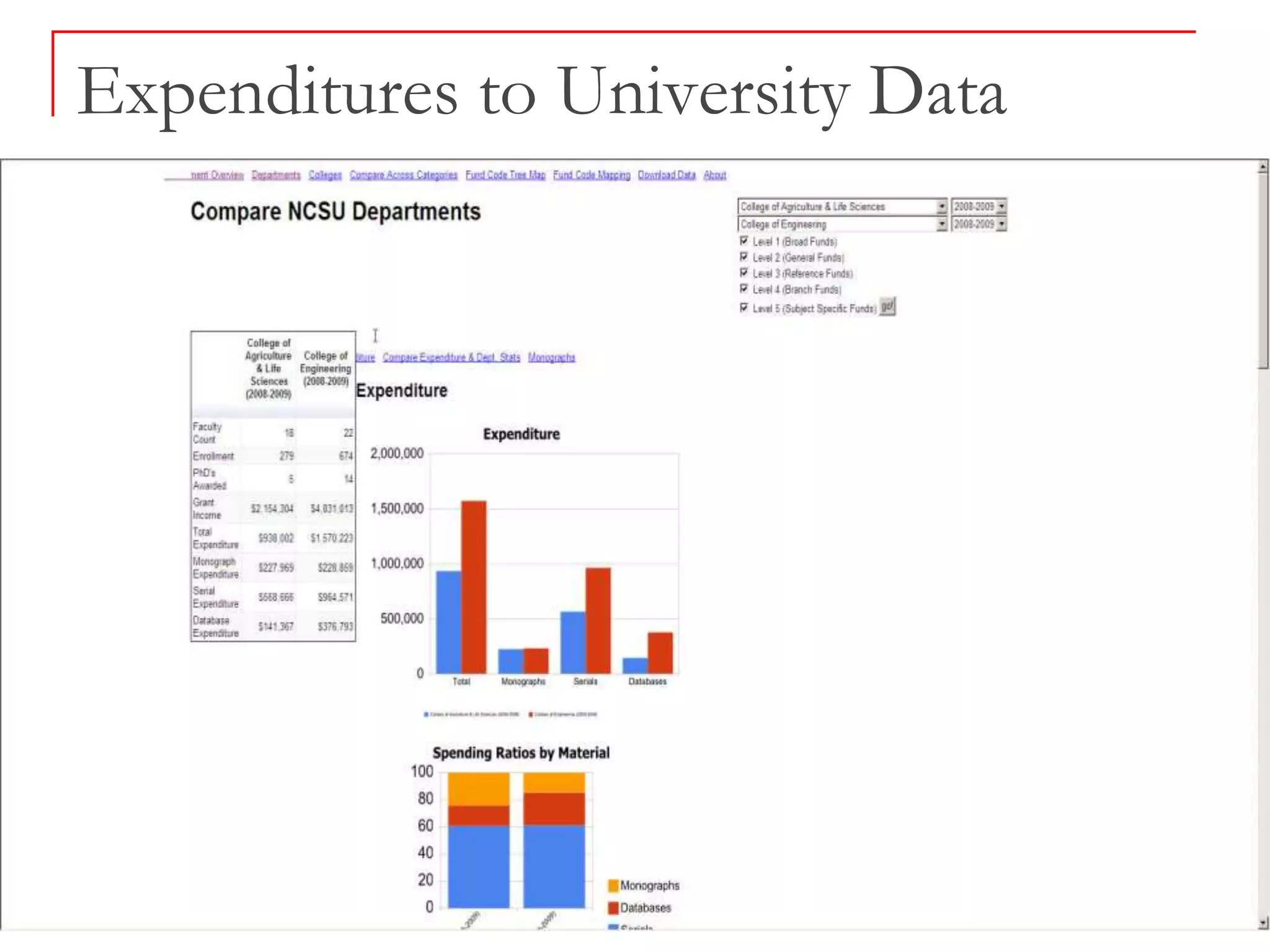
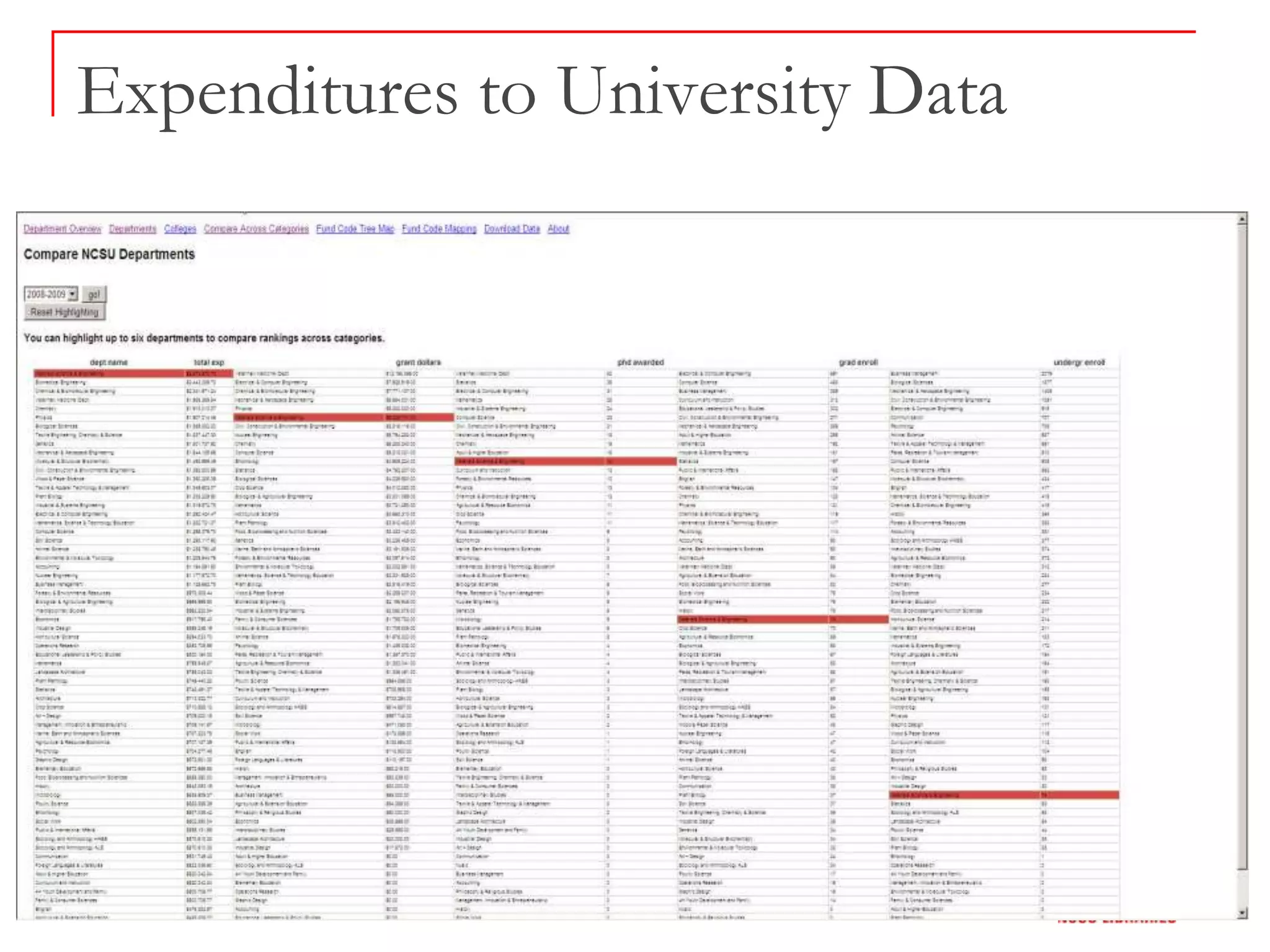
Expenditures to University Data
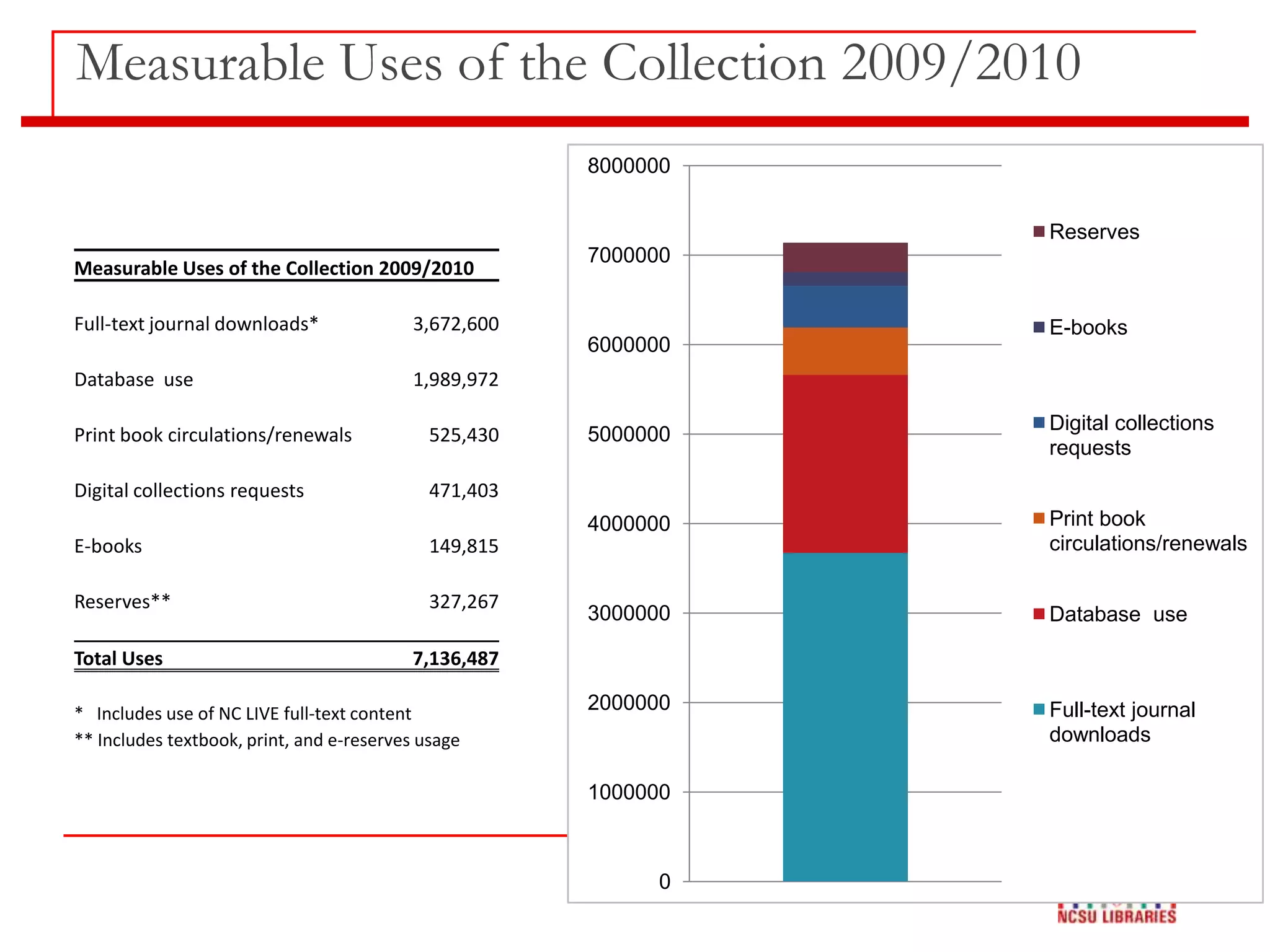
0
1000000
2000000
3000000
4000000
5000000
6000000
7000000
8000000
Reserves
E-books
Digital collections
requests
Print book
circulations/renewals
Database use
Full-text journal
downloads
Measurable Uses of the Collection 2009/2010
Full-text journal downloads* 3,672,600
Database use 1,989,972
Print book circulations/renewals 525,430
Digital collections requests 471,403
E-books 149,815
Reserves** 327,267
Total Uses 7,136,487
* Includes use of NC LIVE full-text content
** Includes textbook, print, and e-reserves usage
Measurable Uses of the Collection 2009/2010
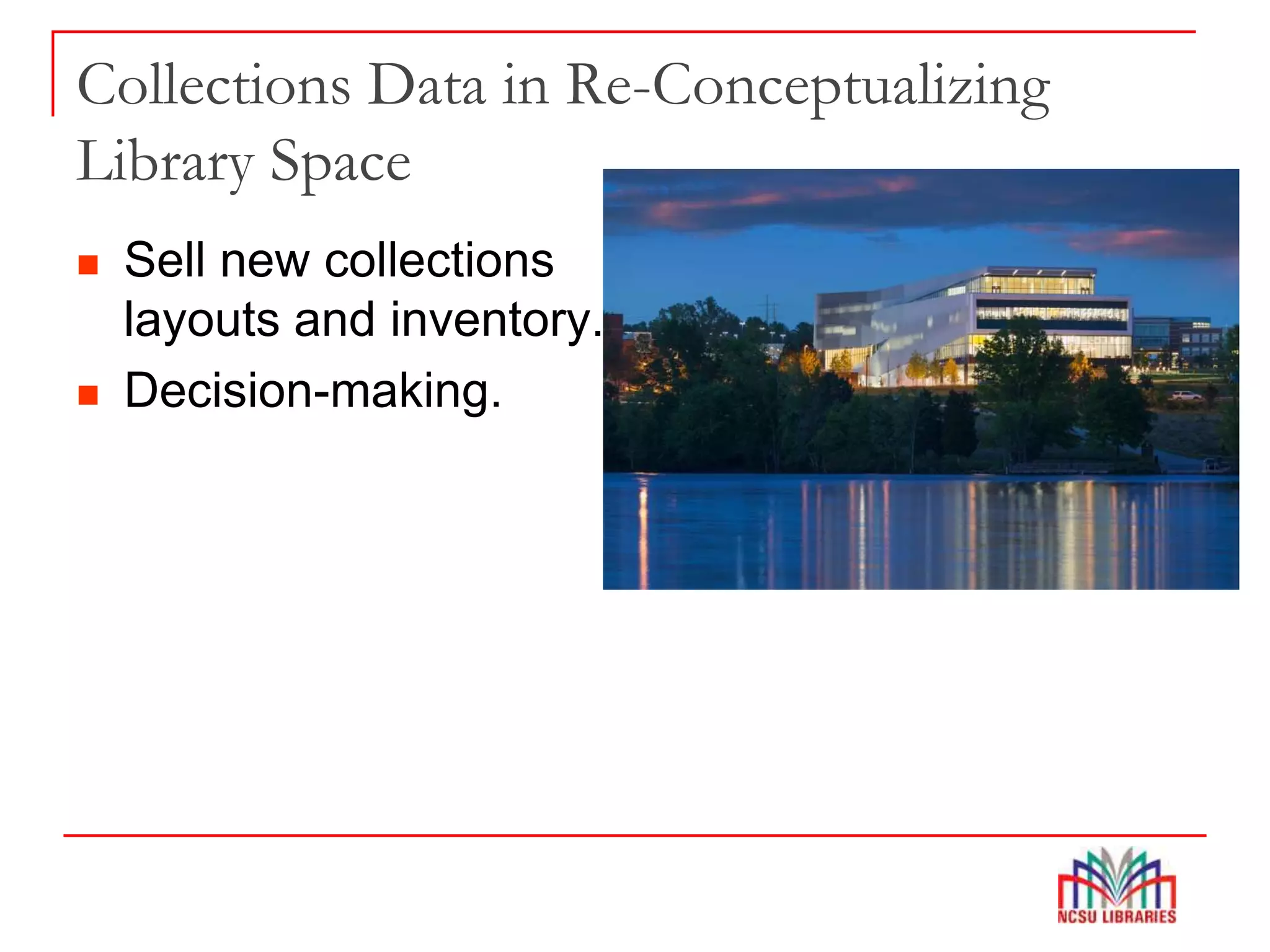
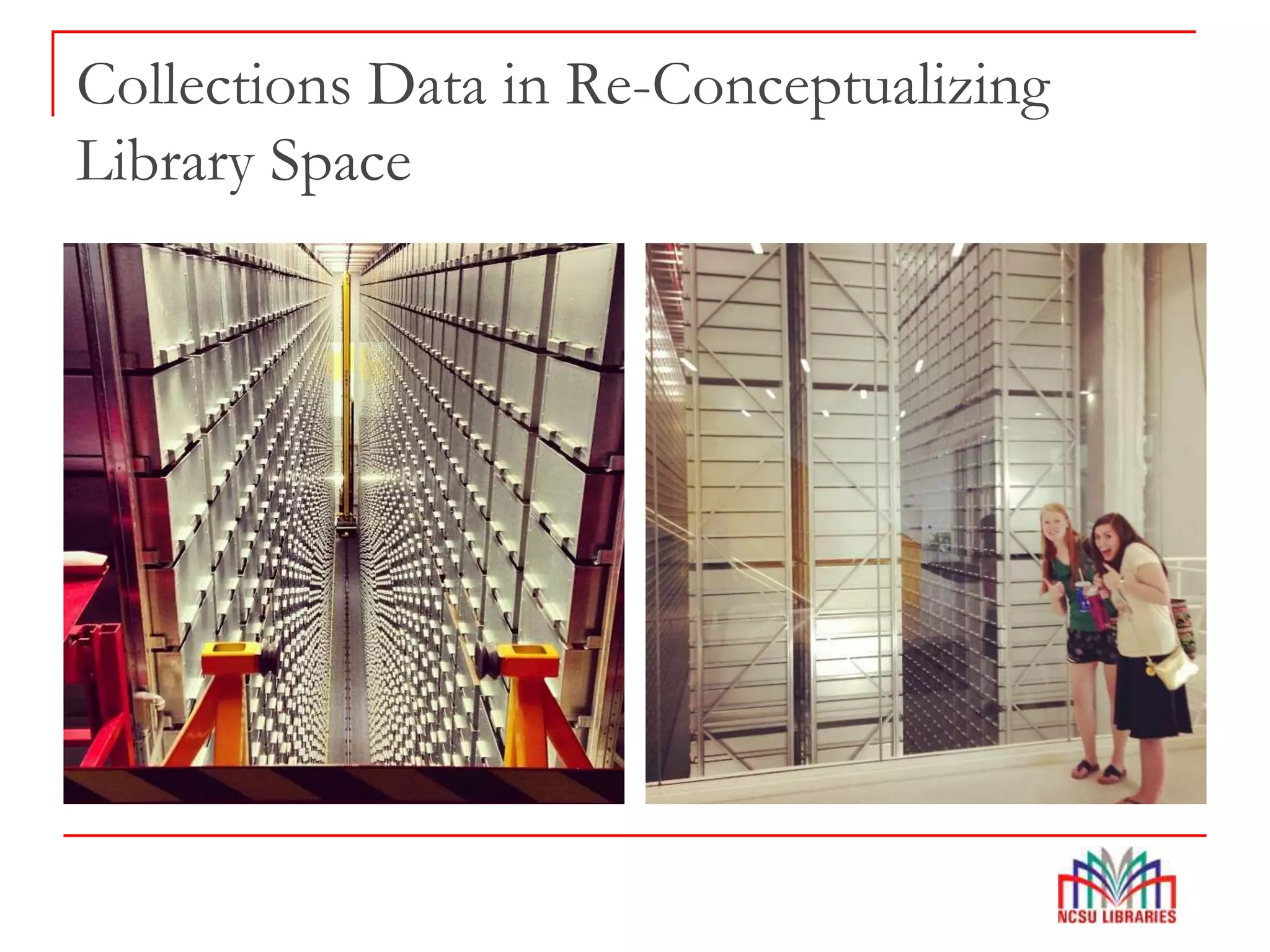
Collections Data in Re-Conceptualizing
Library Space
 Sell new collections
layouts and inventory.
 Decision-making.
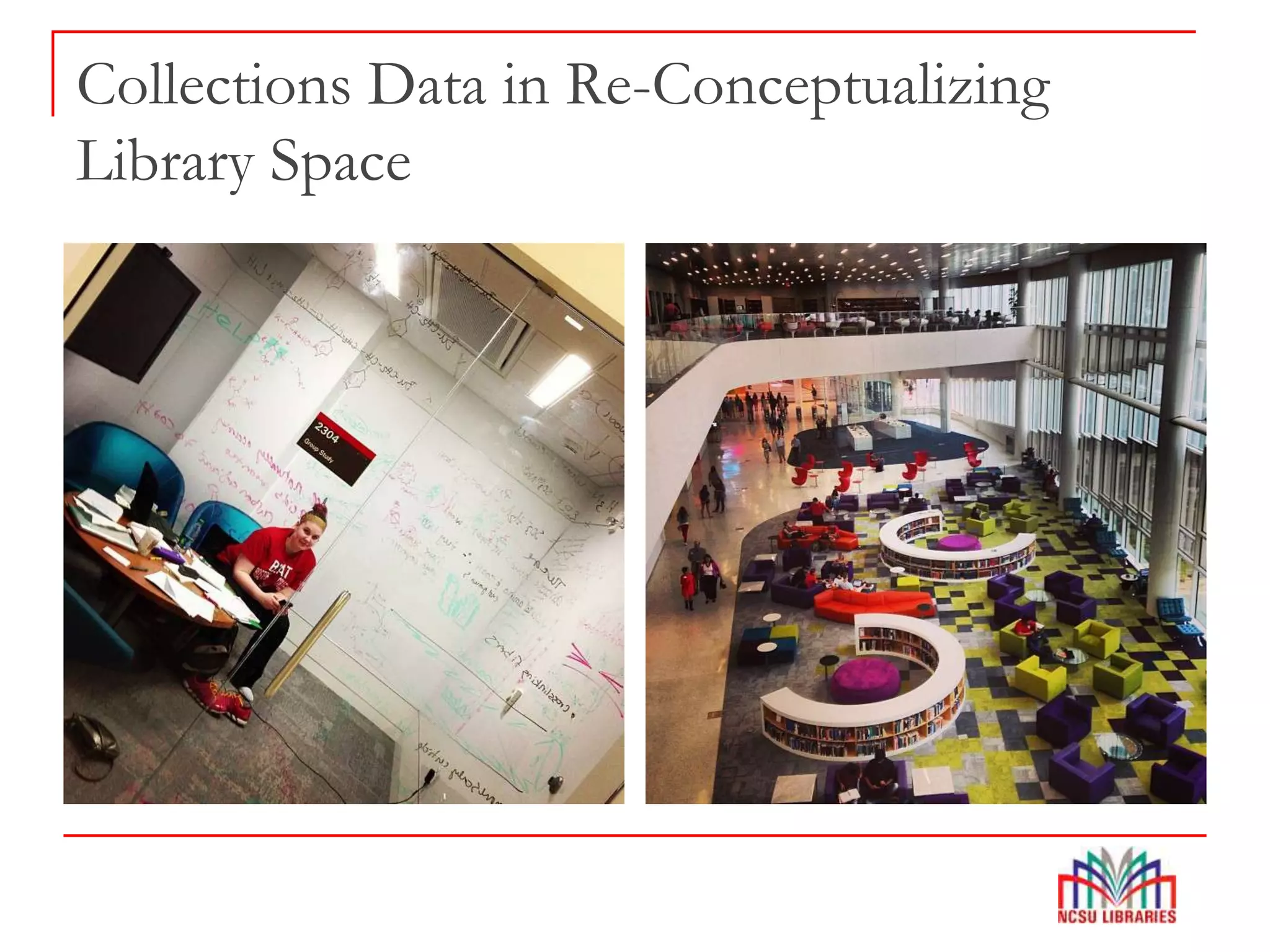
Collections Data in Re-Conceptualizing
Library Space
Collections Data in Re-Conceptualizing
Library Space
Collaborative Imperative
 Print curation
 Digital curation
 Digital collections
 Regional networks
 Mega-consortia and collective bargaining
 Reframe notion of collections budget
Challenges
 Have ability to be more
precise, more used, and
more relevant than ever –
need to make the
necessary changes
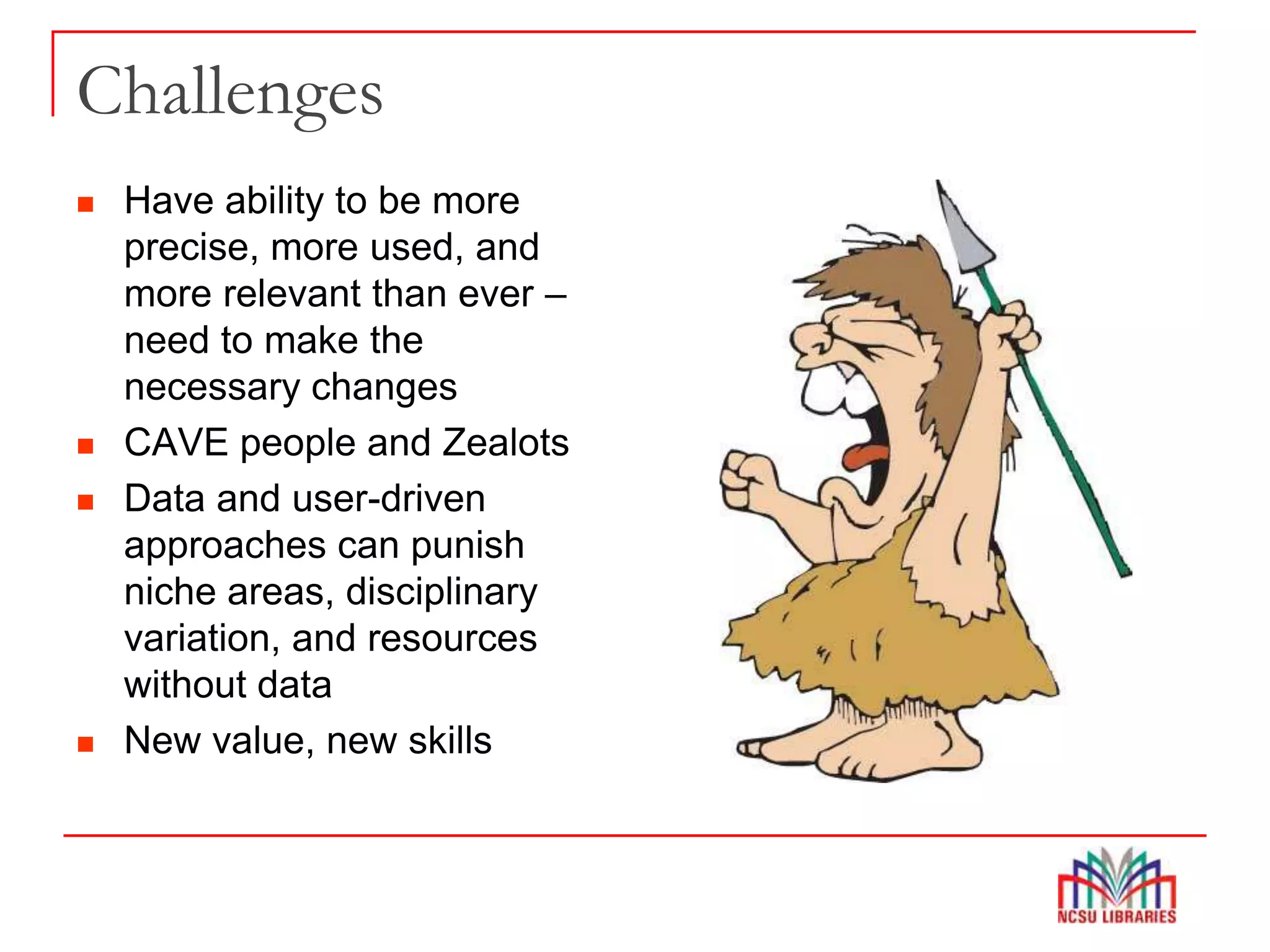
 CAVE people and Zealots
 Data and user-driven
approaches can punish
niche areas, disciplinary
variation, and resources
without data
 New value, new skills
Challenges, cont.
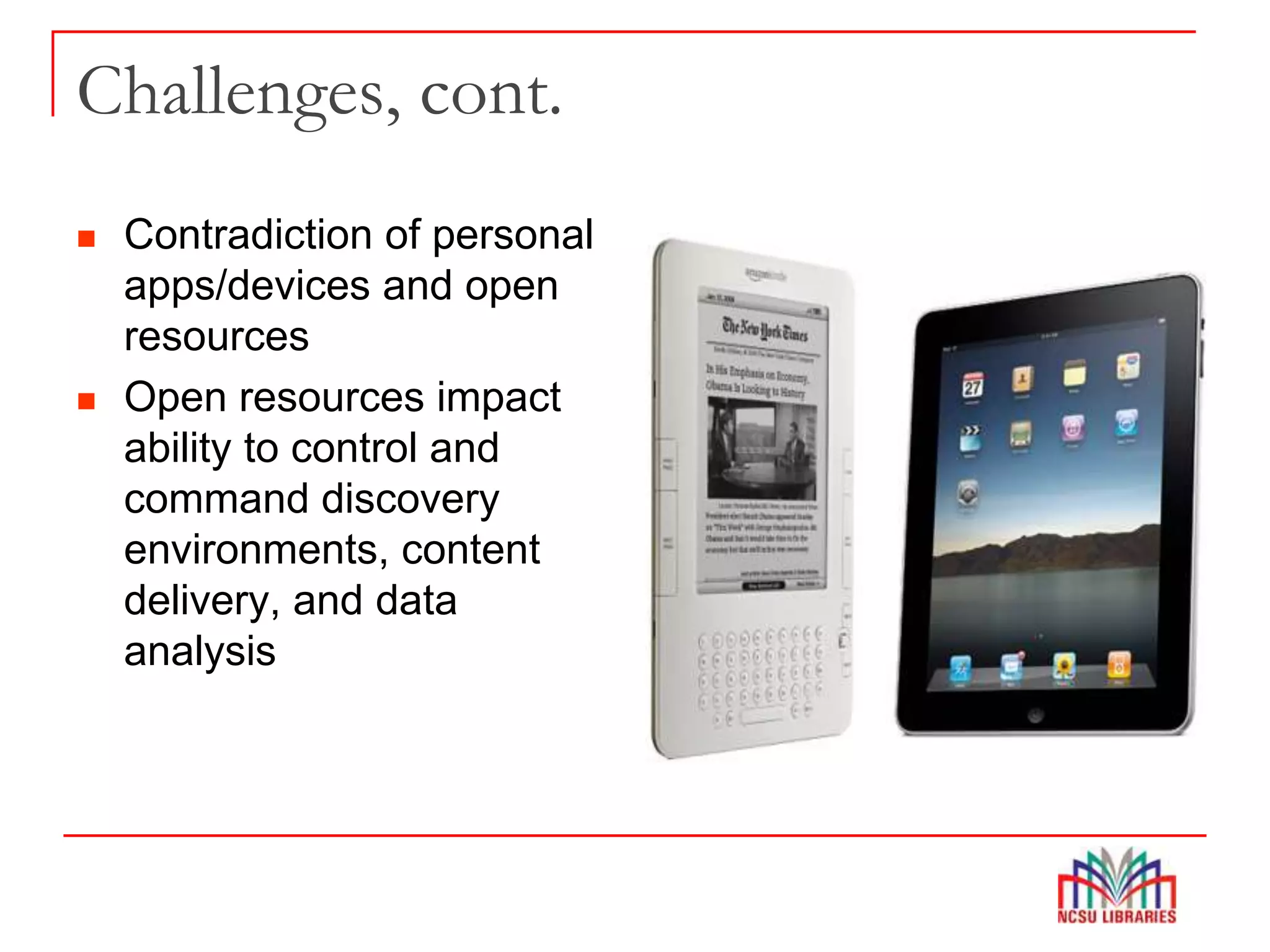
 Contradiction of personal
apps/devices and open
resources
 Open resources impact
ability to control and
command discovery
environments, content
delivery, and data
analysis
From Assumptions to Assertions to
Practice
 Grow/develop/hire analysts.
 Adapt statistical tools such as SAS software.
 Partner with digital library/technologists.
 Develop positive arbitrage.
 Put resources into enabling digital environment for scholars.
 Experiment – budget for it, reward it.
 Work hard to get the faculty to buy into new approaches.
 Combine analytical approaches with the people skills .
“…there was a bias toward what people saw with their own eyes,
or thought they had seen. The human mind played tricks on itself
when it relied exclusively on what it saw, and every trick it played
was a financial opportunity for someone who saw through the
illusion to the reality”.

Oklahoma Collections Innovation Presentation

  • 1.
    Moneyball, the Extra2%, and What Baseball Management, Fantasy Football, and Newspapers Can Teach Us About Fostering Innovation in Managing Collections Greg Raschke North Carolina State University University of Oklahoma March, 2014
  • 2.
  • 3.
    Supply-Side Collections  Print-based,unpredictable demand, and legitimate need for just in case collections  Lead to judging quality by size (as in the ARL rankings) and libraries were then held captive to this standard  Contributed to inelastic demand for journals and combinations of speculative buying  Use is secondary to size, dollars expended, and other input measures  Credit to David Lewis (http://ulib.iupui.edu/users/dlewis)
  • 4.
    Supply-Side to WillNot Continue $- $2,000,000 $4,000,000 $6,000,000 $8,000,000 $10,000,000 $12,000,000 $14,000,000 $16,000,000 $18,000,000 $20,000,000 1983 1984 1985 1986 1987 1988 1989 1990 1991 1992 1993 1994 1995 1996 1997 1998 1999 2000 2001 2002 2003 2004 2005 2006 2007 2008 2009 2010 2011 2012 2013 Total Library Materials Expenditures 1983-2013 ARL 1 ARL 2 ARL 3
  • 5.
    Assumptions  Economics arenot sustainable  Collections budgets will not grow at rate of past 30 years  Unit growth and growth in cost per unit are not sustainable  Need to lower costs of overall system  Lower unit costs  Use data and users to be more precise  Tipping point for ability and expectations to deliver content at point of need  Therefore collection practices and strategies must change  This is difficult – much reason for optimism
  • 6.
    Demand-Driven Collections –Core Roles  Make information easily, widely, and cheaply available  Collections as drivers of research, teaching, and learning  To make special or unique collections held/managed by the library available to the user community and the world
  • 7.
    Demand-Driven – MoreAssumptions  Less tolerance for and less investment in lower use general collections  Resource management based increasingly on use  Embrace expansion of available content and sense- making role  Risks of not evolving and failing to innovate – newspapers
  • 8.
    Demand-Driven – Assertions Tension between time-honored role as custodians of scholarship versus enabling digital environment for scholars  Must work on:  Lowering unit costs of scholarly materials OR  Lowering number of publishable units  Must free funds for investing in “new” arenas such as digital curation, digital scholarship, DDA, and collaboration
  • 9.
    Demand-Driven – Assertions Use based and user driven collecting models will take growing share of budget  Bet on numbers  Bet on good and quick  Put resources into enabling digital environment for scholars and custodian role will come out of that strategy  Rewards of adapting – more used and vital than ever
  • 10.
    Demand-Driven – ChangingPractice  Access won – management and coherence are keys  Not just PDA – portfolio of approaches - more responsive and expansive  Utilize new tools and techniques to become advanced analysts and deliver content at point of need  Truly embrace evidence-based decision making and ability to deliver content on demand  Challenges:  Resource sharing  Existing practices and organizational models
  • 11.
  • 12.
  • 13.
    Looking Deeper andQuestioning Existing Practices  Identifying market inefficiencies.  Apply and accelerate significant creativity.  Question long-established wisdom.  Test what is “known” with in- depth analysis, statistical modeling, and new approaches.  Value in stopping making stupid decisions  Emphasize interpersonal skills in leveraging new knowledge and approaches.
  • 14.
    Reducing Unit Costs– Data Analysis  Collections work less about selection and more about analyzing use and incorporating content w/technology  Data analysis is a key component in solving/managing:  Increasing pressure for accountability  Increasing capability to gather and analyze data  Increasing precision in the way we build collections and expend resources  Advocacy  Changing practice and data analysis at NCSU
  • 16.
    Serials Review 2009– Open, Data-Driven, and Real-Time Analysis  Standardized usage data (where available)  Bibliometrics - publication data and citation patterns (e.g LJUR)  Impact factor and eigenfactor  User community feedback via interactive, database-driven applications  Weigh/calculate/quantify user feedback  Weigh price against multiple data points  Usage ((07 usage+08 usage/2)+(publications*10)+ (citations*5)+(Impact Factor)  Community Feedback ((Weighted Ranking x % Match) x Total # Rankings) + 0.1 x # of "1s“  Price/feedback value  Price/use  Merge results to filter out top 20% and bottom 20%
  • 17.
    Looking closer –Book Collections An example - a closer look at print item usage  Traditional ILS reporting tools can make this difficult  Advanced analytical tools can help  What types of questions can we ask?  Should Patron-Driven records not purchased be purged after 1 year?  How does print item usage break down?  Which categories of print items net the best value?
  • 18.
    If it’s notused after 2 years… Should PDA records be purged? Maybe… We haven’t even hit 50% usage But what if we take a longer view…
  • 19.
    If it’s notused after 2 years…  Things begin to look different
  • 20.
    Looking even closer… How does print item use break down?  Single circ usage is consistently ~14%  Would this change in a PDA only world?
  • 21.
  • 22.
  • 23.
  • 24.
    0 1000000 2000000 3000000 4000000 5000000 6000000 7000000 8000000 Reserves E-books Digital collections requests Print book circulations/renewals Databaseuse Full-text journal downloads Measurable Uses of the Collection 2009/2010 Full-text journal downloads* 3,672,600 Database use 1,989,972 Print book circulations/renewals 525,430 Digital collections requests 471,403 E-books 149,815 Reserves** 327,267 Total Uses 7,136,487 * Includes use of NC LIVE full-text content ** Includes textbook, print, and e-reserves usage Measurable Uses of the Collection 2009/2010
  • 25.
    Collections Data inRe-Conceptualizing Library Space  Sell new collections layouts and inventory.  Decision-making.
  • 26.
    Collections Data inRe-Conceptualizing Library Space
  • 27.
    Collections Data inRe-Conceptualizing Library Space
  • 28.
    Collaborative Imperative  Printcuration  Digital curation  Digital collections  Regional networks  Mega-consortia and collective bargaining  Reframe notion of collections budget
  • 29.
    Challenges  Have abilityto be more precise, more used, and more relevant than ever – need to make the necessary changes  CAVE people and Zealots  Data and user-driven approaches can punish niche areas, disciplinary variation, and resources without data  New value, new skills
  • 30.
    Challenges, cont.  Contradictionof personal apps/devices and open resources  Open resources impact ability to control and command discovery environments, content delivery, and data analysis
  • 31.
    From Assumptions toAssertions to Practice  Grow/develop/hire analysts.  Adapt statistical tools such as SAS software.  Partner with digital library/technologists.  Develop positive arbitrage.  Put resources into enabling digital environment for scholars.  Experiment – budget for it, reward it.  Work hard to get the faculty to buy into new approaches.  Combine analytical approaches with the people skills . “…there was a bias toward what people saw with their own eyes, or thought they had seen. The human mind played tricks on itself when it relied exclusively on what it saw, and every trick it played was a financial opportunity for someone who saw through the illusion to the reality”.