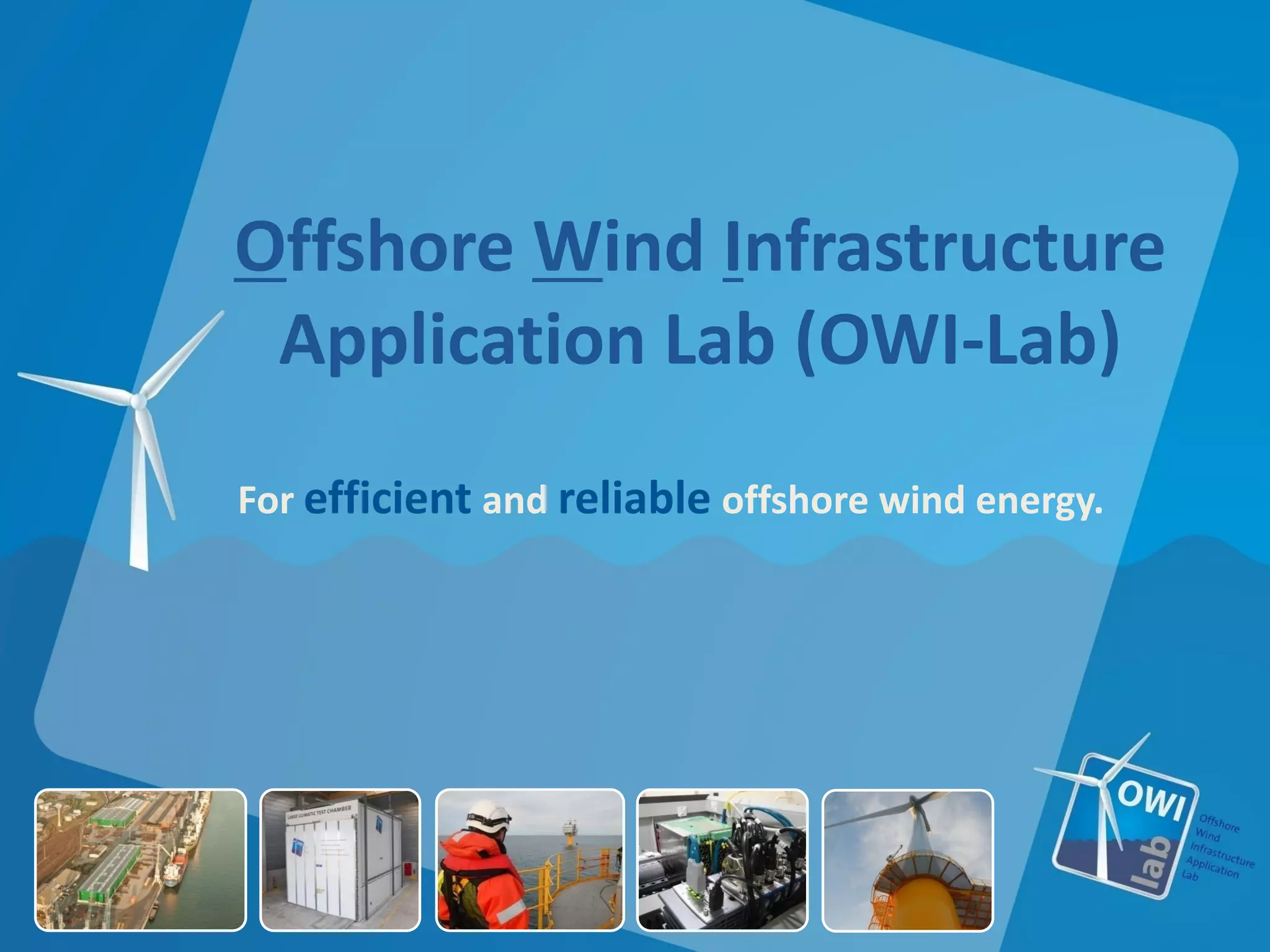
Offshore Wind Infrastructure
Application Lab (OWI-Lab)
For efficient and reliable offshore wind energy.
Offshore Wind Infrastructure Application Lab
 A Flemish Funded R&D initiative that aims to increase
the reliability and efficiency of offshore wind farms
 OWI-Lab is embedded within Sirris, the collective
centre of the Belgian technological industry.
Industrial Initiators of OWI-Lab

Industrial Coordinator

Scientific Coordinator
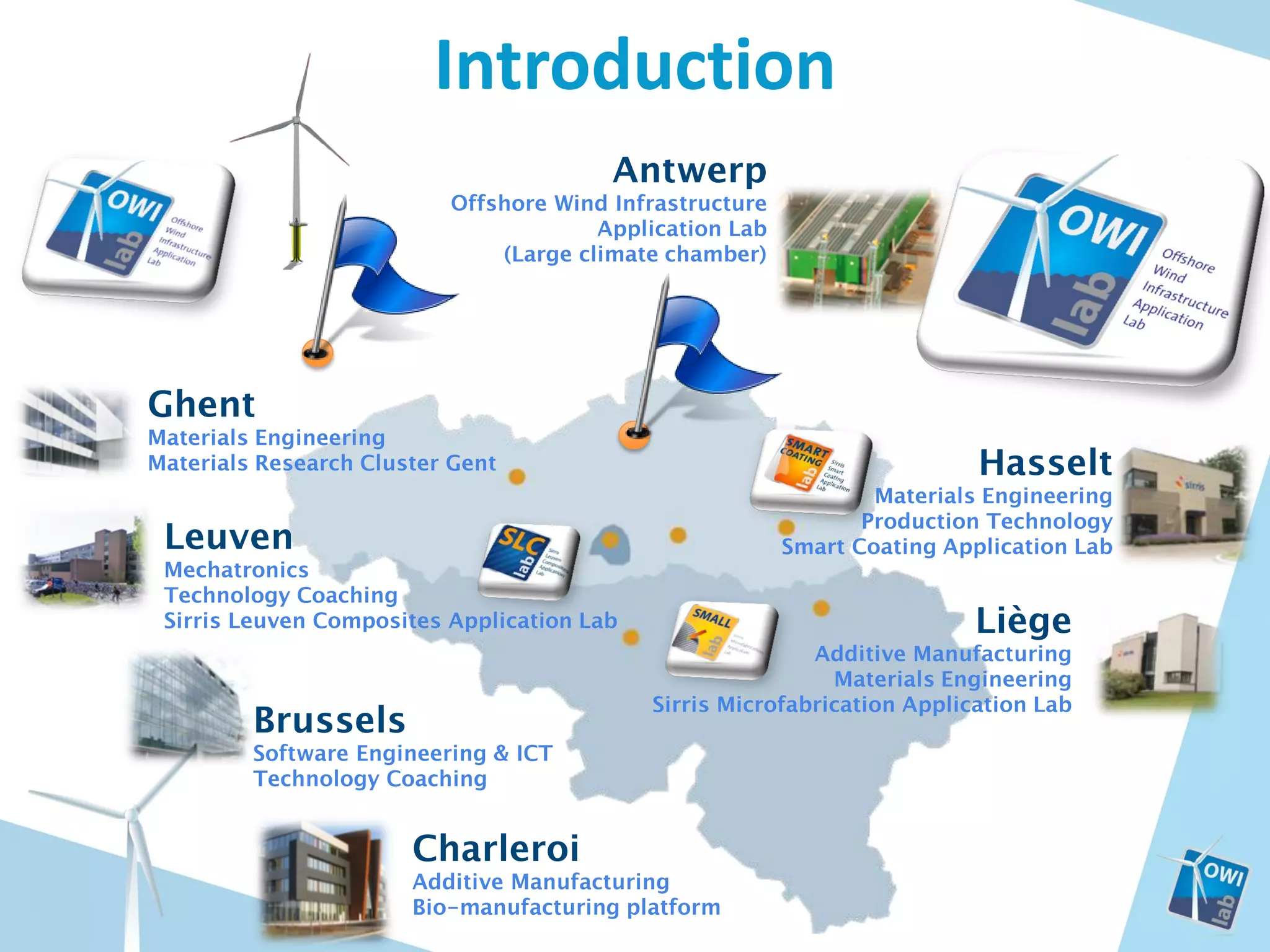
Introduction
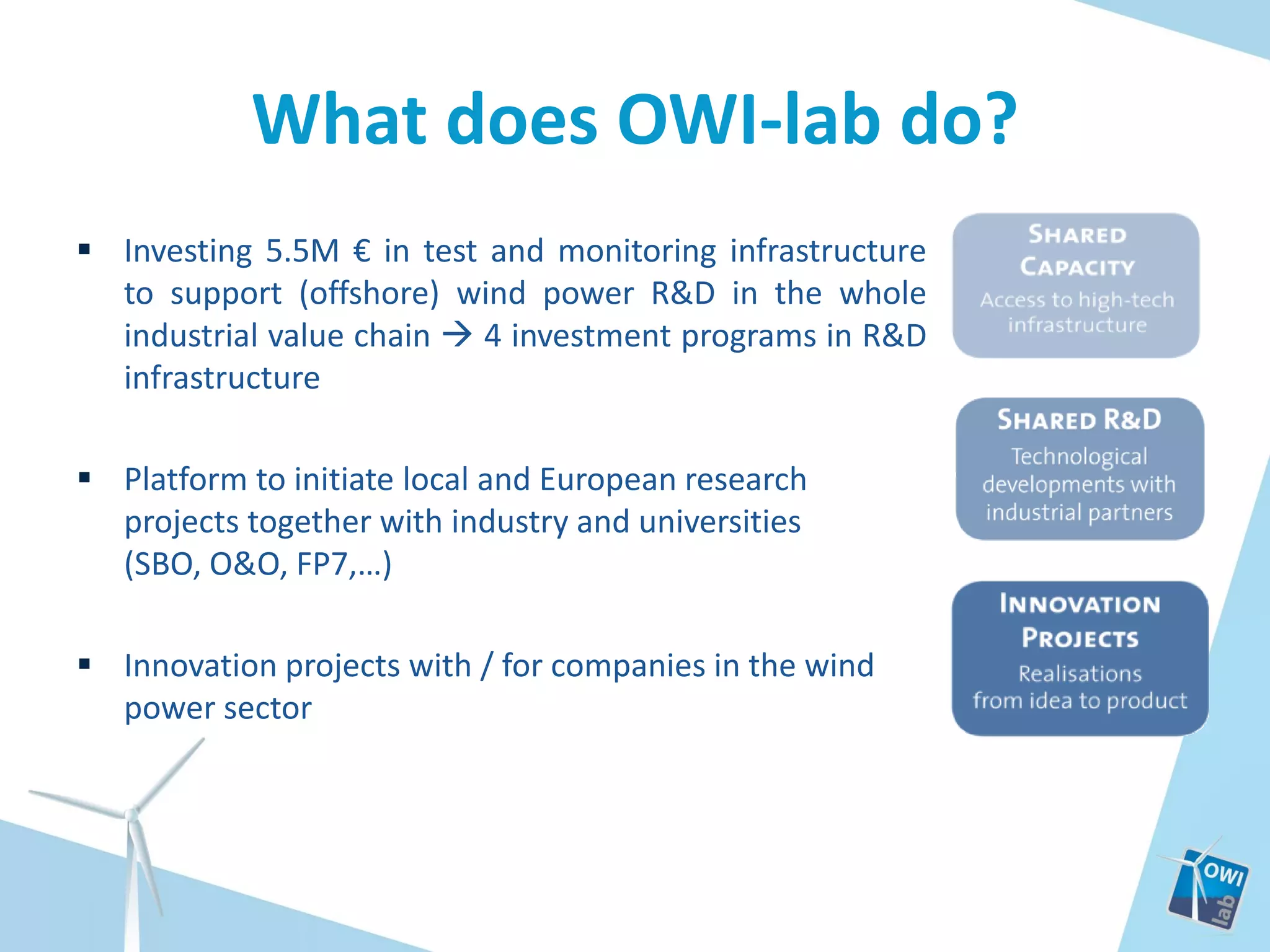
What does OWI-lab do?
 Investing 5.5M € in test and monitoring infrastructure
to support (offshore) wind power R&D in the whole
industrial value chain  4 investment programs in R&D
infrastructure
 Platform to initiate local and European research
projects together with industry and universities
(SBO, O&O, FP7,…)
 Innovation projects with / for companies in the wind
power sector
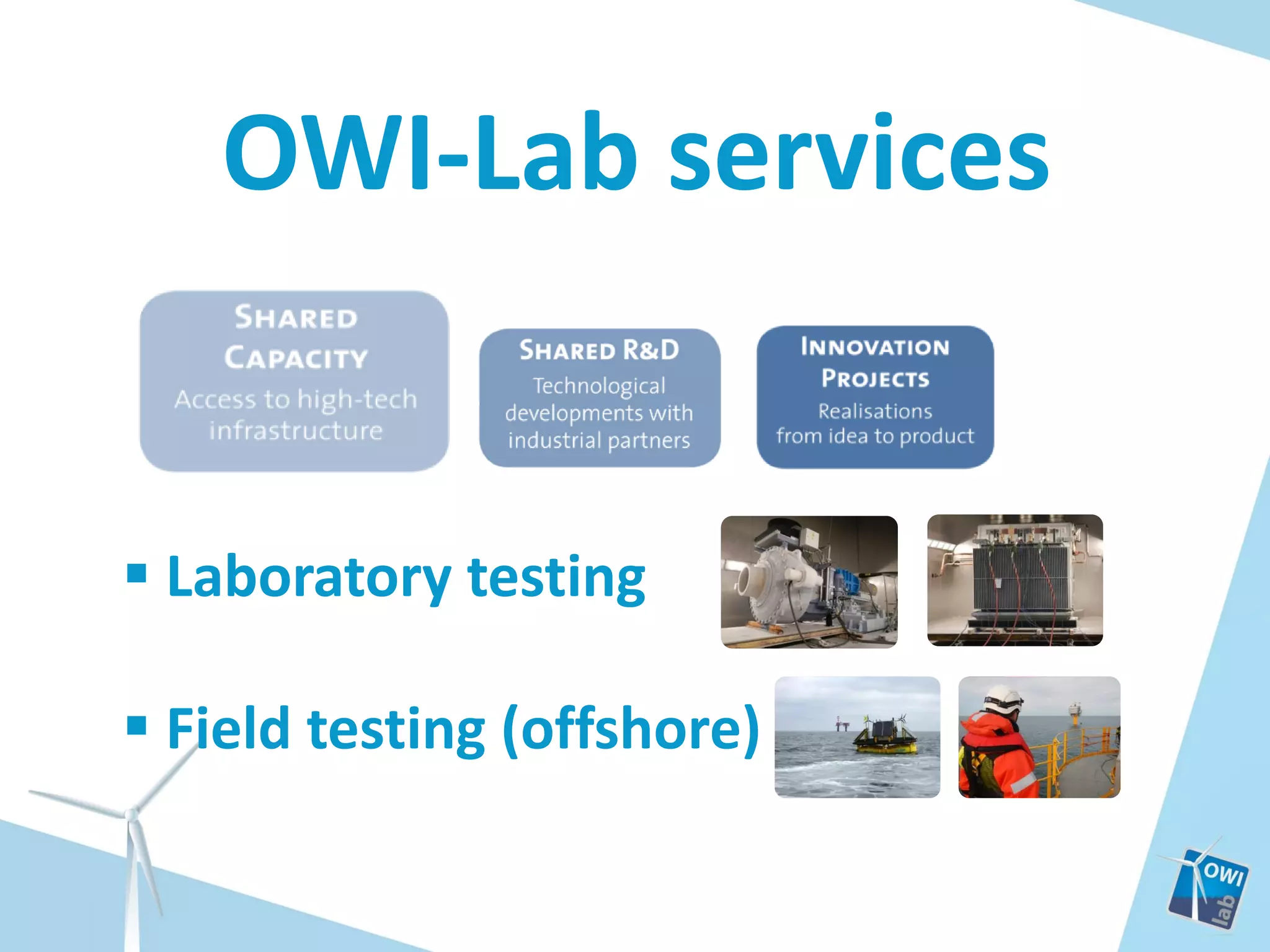
OWI-Lab services

 Laboratory testing
 Field testing (offshore)
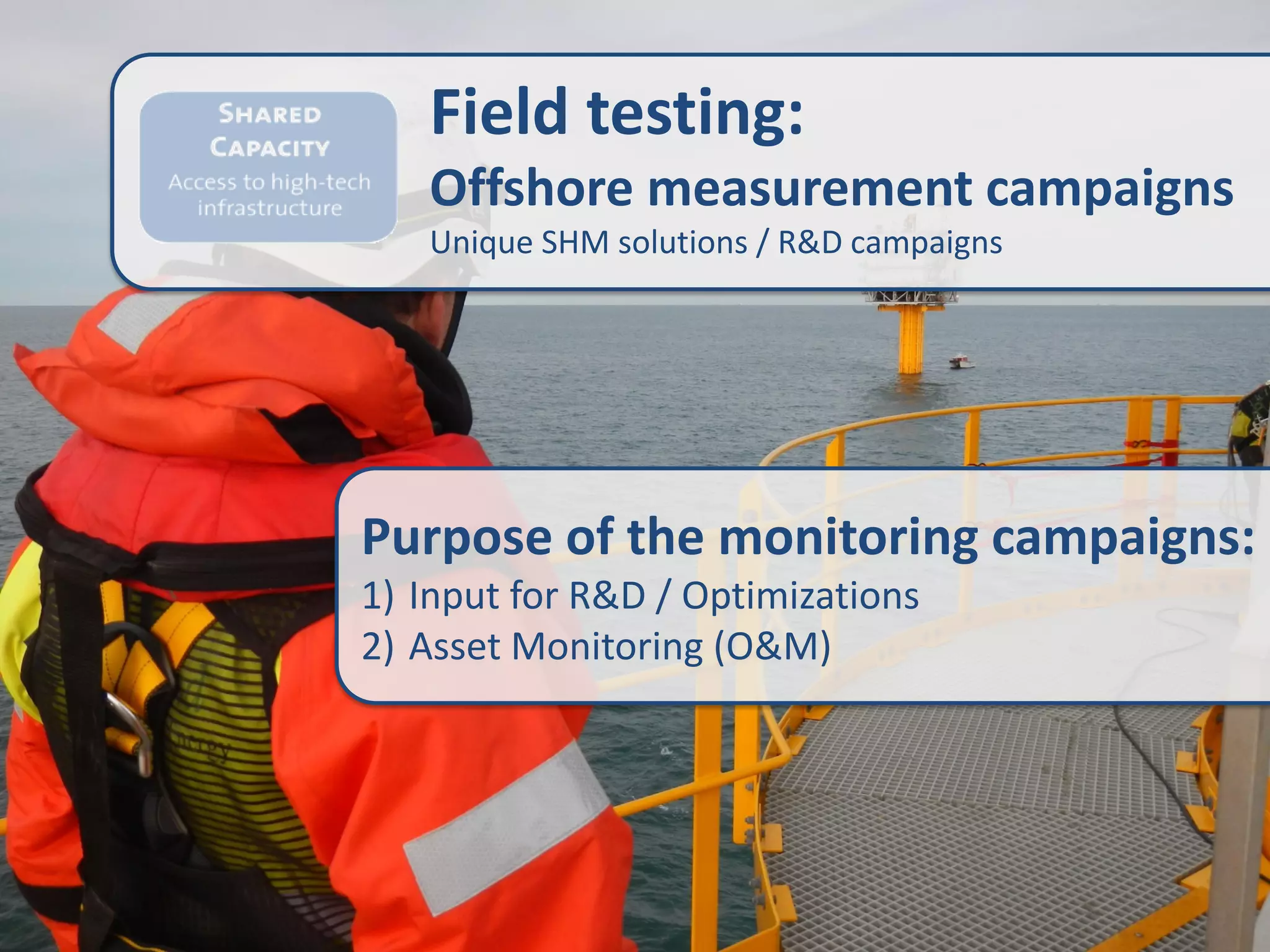
Field testing:
Offshore measurement campaigns
Unique SHM solutions / R&D campaigns

Purpose of the monitoring campaigns:
1) Input for R&D / Optimizations
2) Asset Monitoring (O&M)
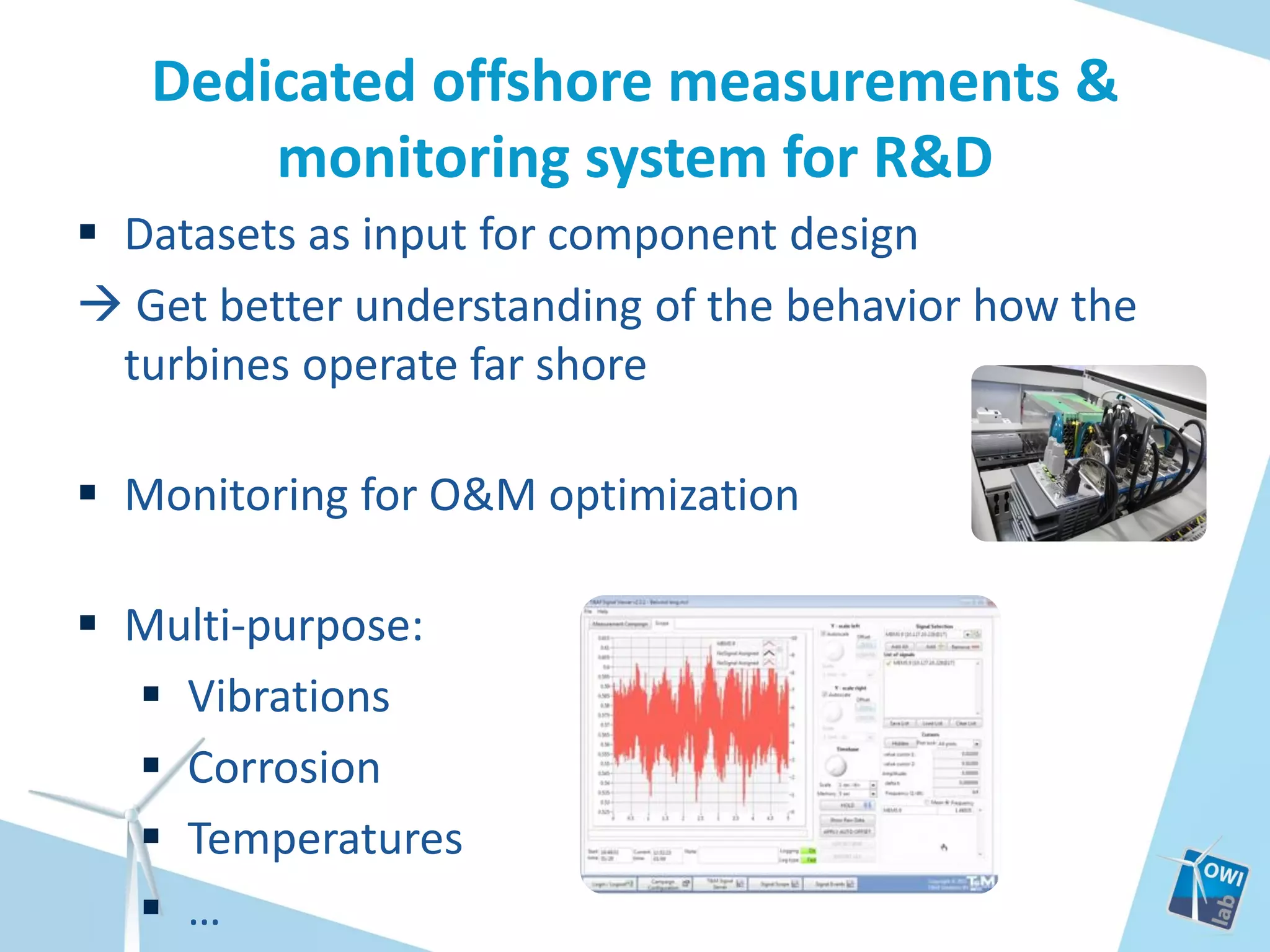
Dedicated offshore measurements &
monitoring system for R&D
 Datasets as input for component design
 Get better understanding of the behavior how the
turbines operate far shore
 Monitoring for O&M optimization

 Multi-purpose:
 Vibrations
 Corrosion
 Temperatures
 …
Ongoing R&D measurement & monitoring campaigns
(MC’s) in partnership with universities

 Structural Health Monitoring (VUB)
 Corrosion Monitoring (VUB)
 Drivetrain Monitoring (KU Leuven)
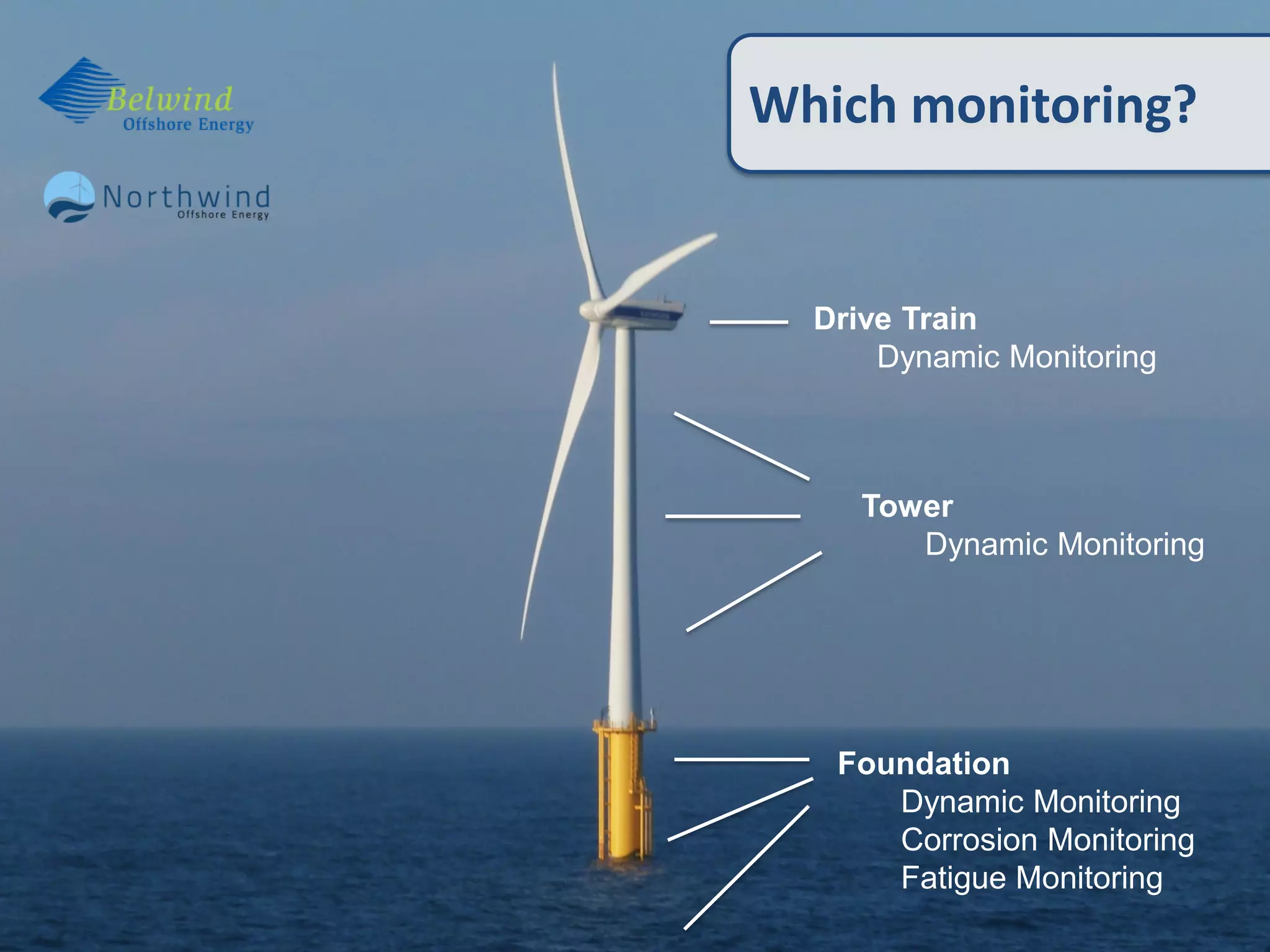
Which monitoring?

Drive Train
Dynamic Monitoring

Tower
Dynamic Monitoring

Foundation
Dynamic Monitoring
Corrosion Monitoring
Fatigue Monitoring
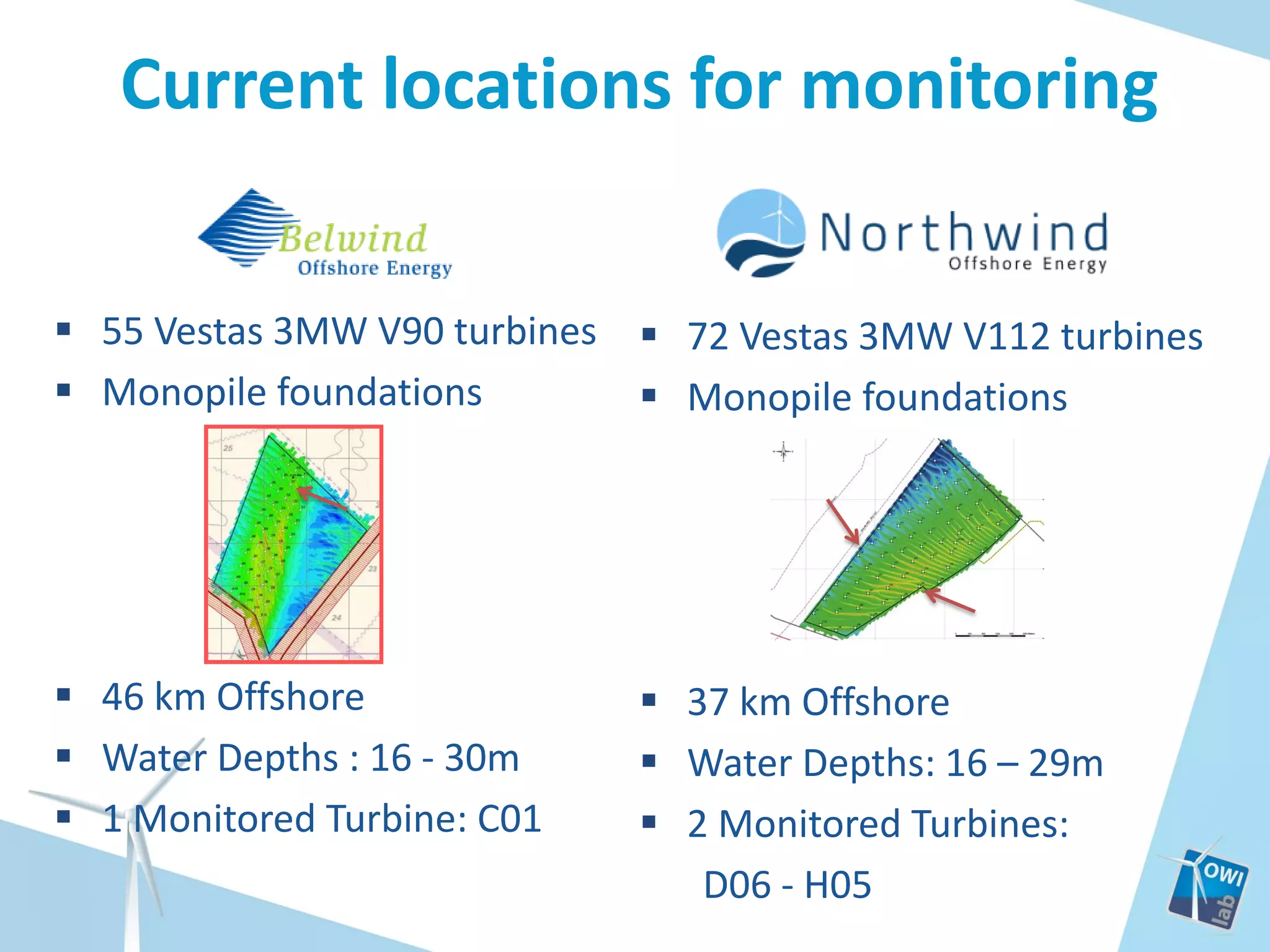
Current locations for monitoring
 55 Vestas 3MW V90 turbines  72 Vestas 3MW V112 turbines
 Monopile foundations

 46 km Offshore
 Water Depths : 16 - 30m
 1 Monitored Turbine: C01

 37 km Offshore
 Water Depths: 16 – 29m
 2 Monitored Turbines:
D06 - H05
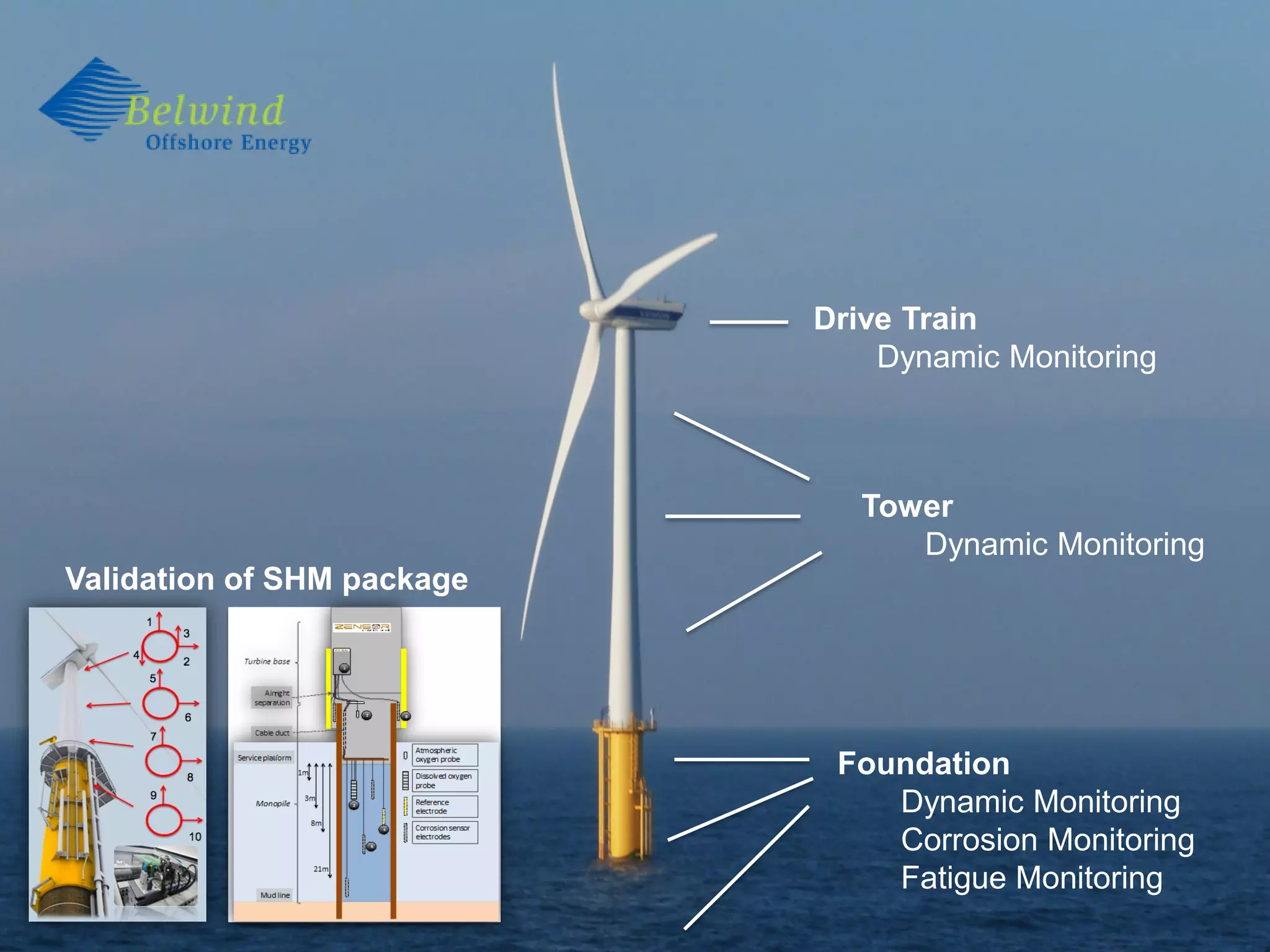
Drive Train
Dynamic Monitoring

Tower
Dynamic Monitoring
Validation of SHM package

Foundation
Dynamic Monitoring
Corrosion Monitoring
Fatigue Monitoring
Ongoing research projects:
Vibration-based Structural Health Monitoring (SHM)
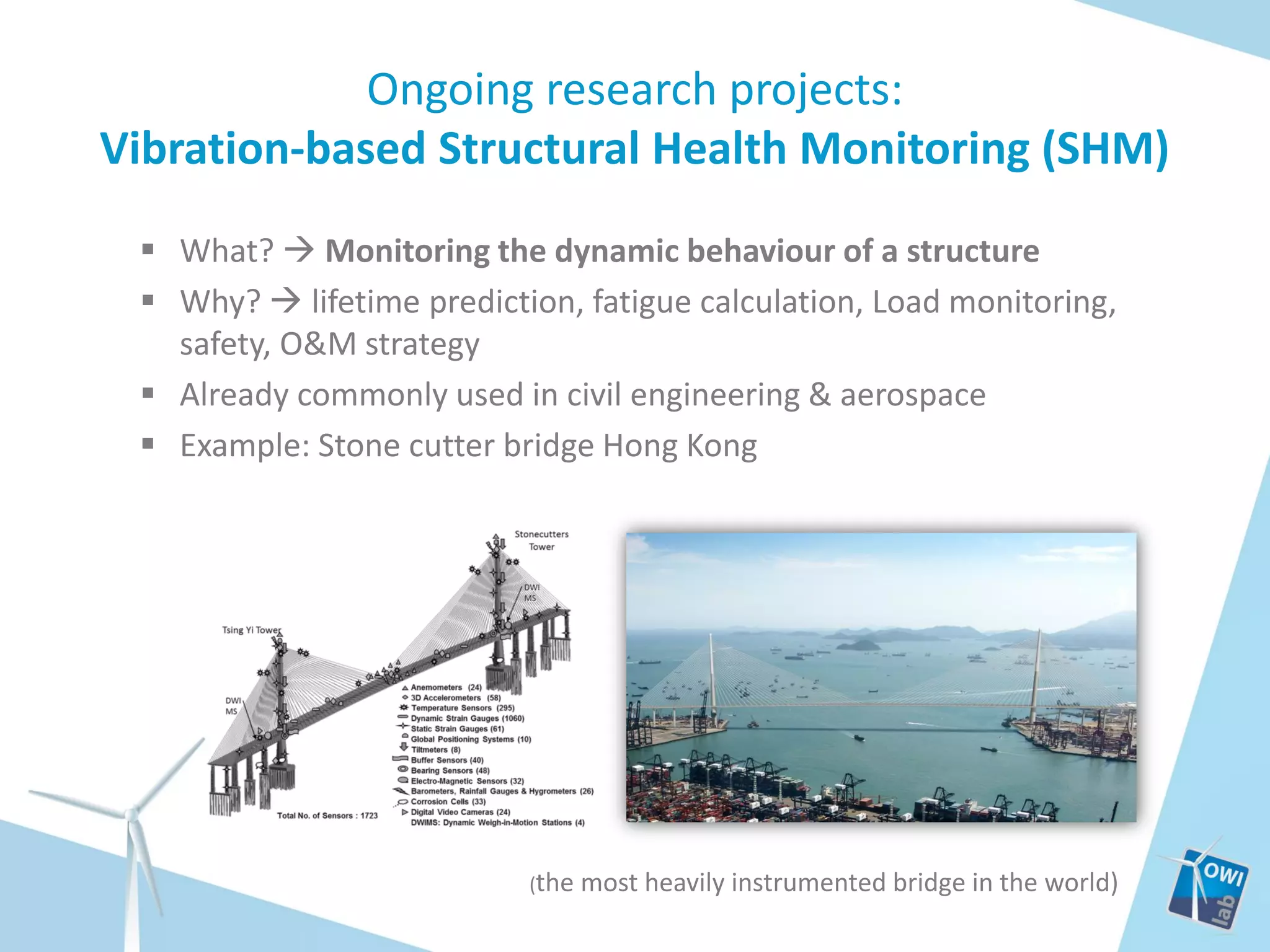
 What?  Monitoring the dynamic behaviour of a structure
 Why?  lifetime prediction, fatigue calculation, Load monitoring,
safety, O&M strategy
 Already commonly used in civil engineering & aerospace
 Example: Stone cutter bridge Hong Kong

(the

most heavily instrumented bridge in the world)
Ongoing research projects:
Vibration-based Structural Health Monitoring (SHM)
 Ongoing project OWI-Lab conserning SHM in partnership with VUB:
CONTINUOUS DYNAMIC MONITORING OF AN OFFSHORE WIND TURBINE
 Why?
 Excitations of wind and waves have an effect on the offshore wind turbine and
are capable of exciting the exciting vibration modes
 avoid resonant behaviour
 Gather insights in dynamic behaviour of wind turbine in offshore conditions
 input for new designs, optimization of structures
 Minimize O&M costs (scour protection around monopile structures)
 Identify the current state of the offshore wind turbine
(i.e. after a storm the scour protection can be damaged  can have an effect
on the vibration modes)
 Extend lifetime of wind turbine structure
Ongoing research projects:
Vibration-based Structural Health Monitoring (SHM)
 Why?
Example: Identify the current state of the offshore wind turbine

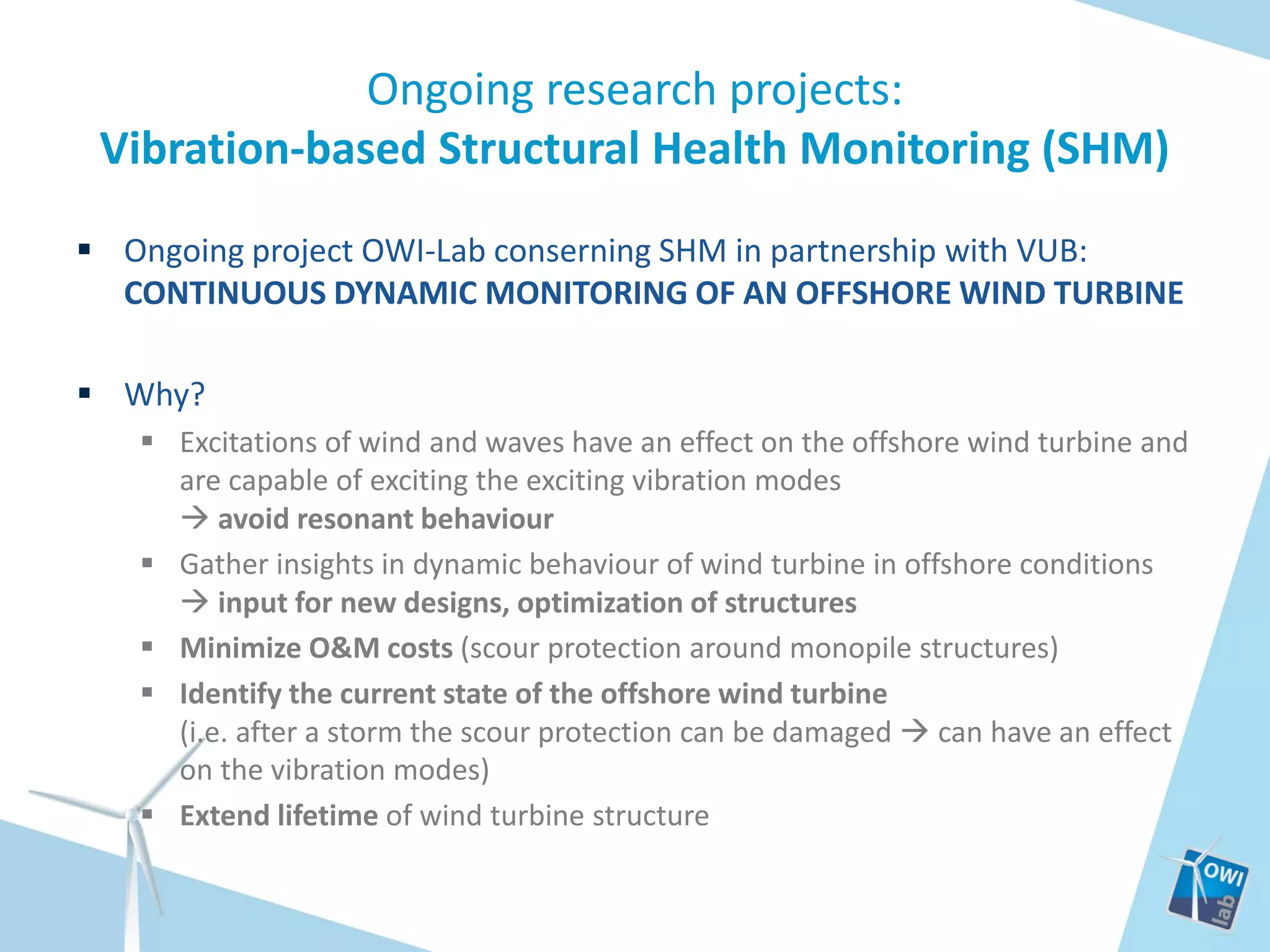
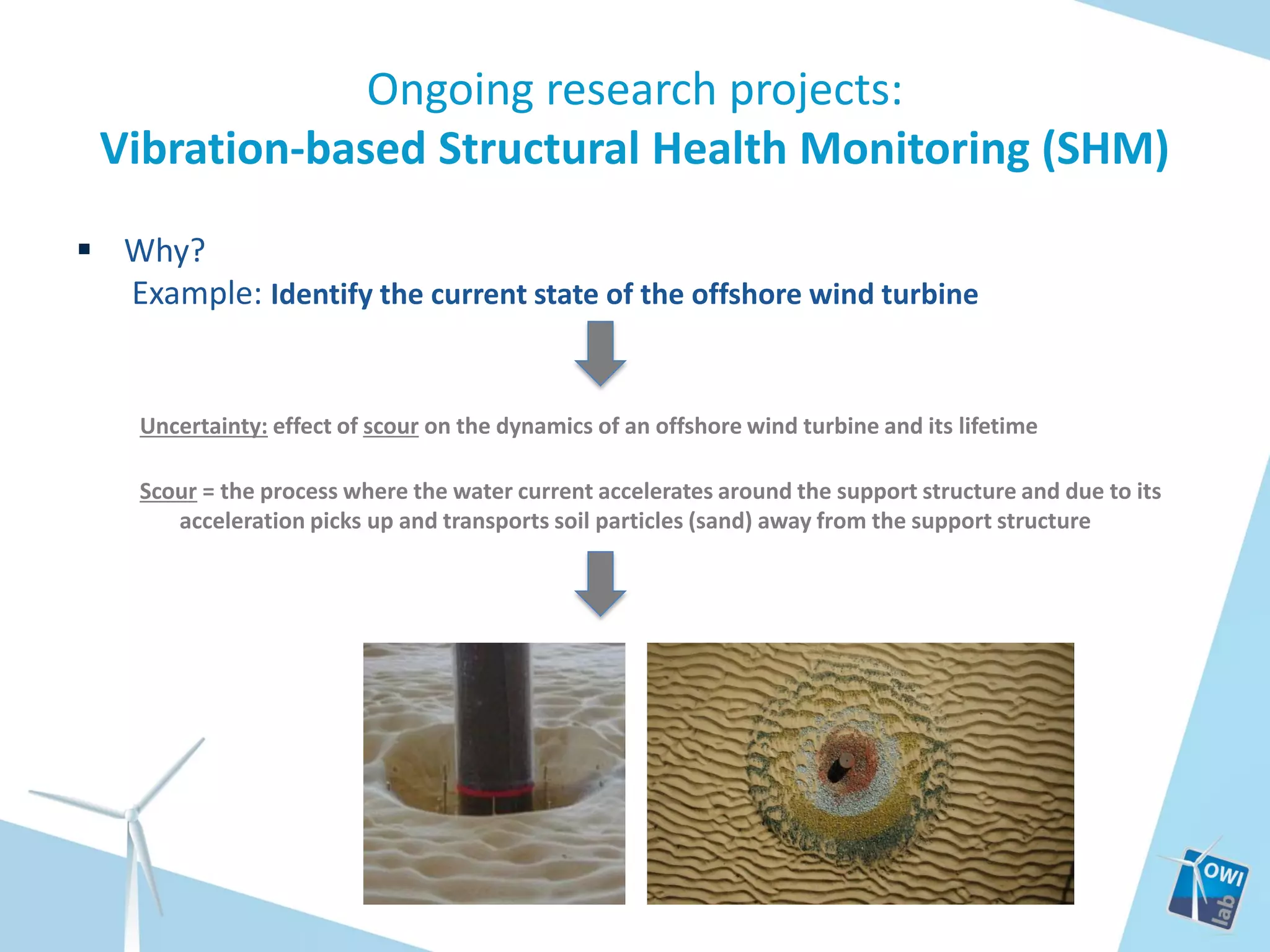
Uncertainty: effect of scour on the dynamics of an offshore wind turbine and its lifetime
Scour = the process where the water current accelerates around the support structure and due to its
acceleration picks up and transports soil particles (sand) away from the support structure
Ongoing research projects:
Vibration-based Structural Health Monitoring (SHM)
 Why?
Example: Identify the current state of the offshore wind turbine

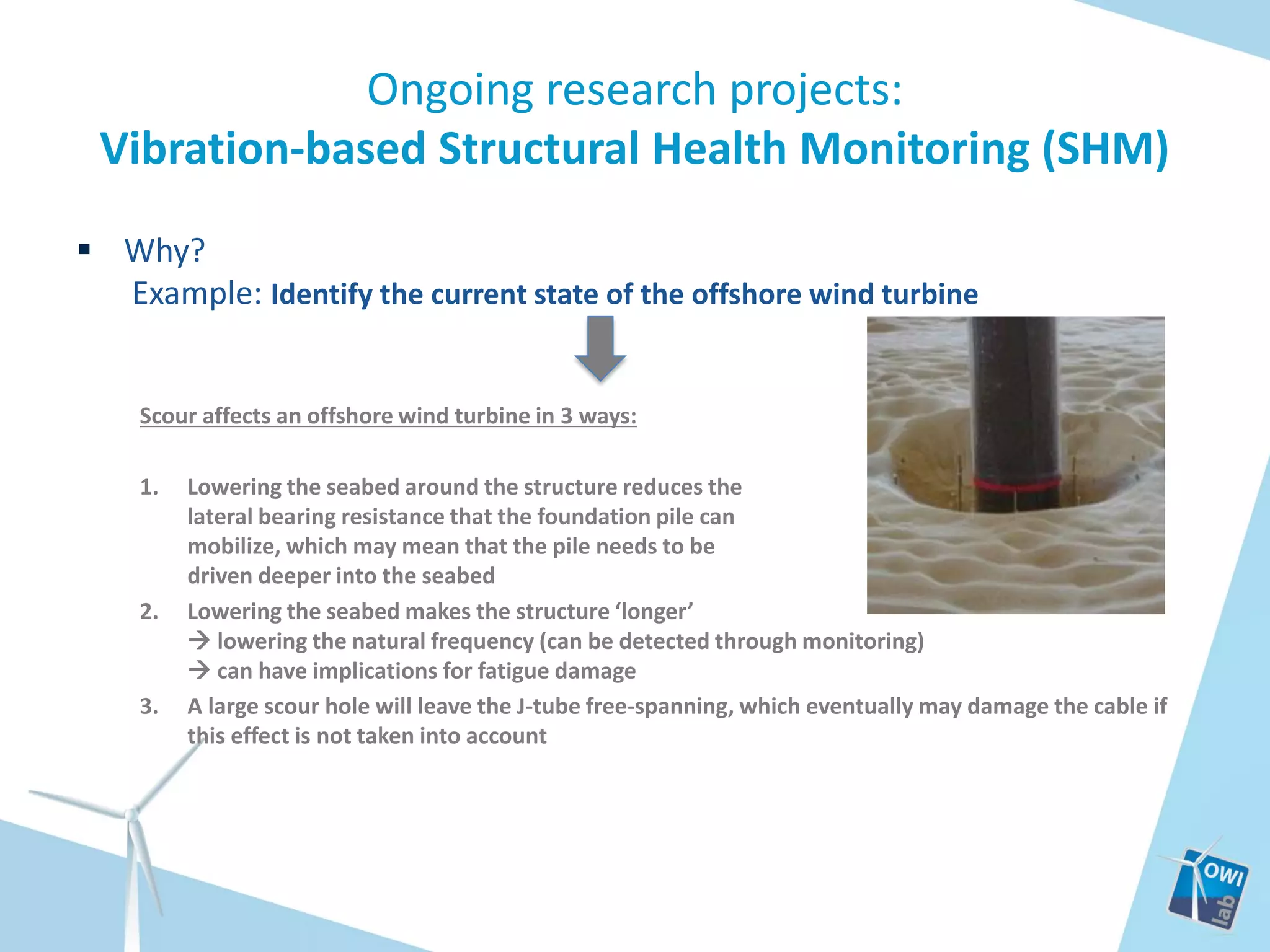
Scour affects an offshore wind turbine in 3 ways:
1.

2.

3.

Lowering the seabed around the structure reduces the
lateral bearing resistance that the foundation pile can
mobilize, which may mean that the pile needs to be
driven deeper into the seabed
Lowering the seabed makes the structure ‘longer’
 lowering the natural frequency (can be detected through monitoring)
 can have implications for fatigue damage
A large scour hole will leave the J-tube free-spanning, which eventually may damage the cable if
this effect is not taken into account
Ongoing research projects:
Vibration-based Structural Health Monitoring (SHM)
 Why?
Example: Identify the current state of the offshore wind turbine

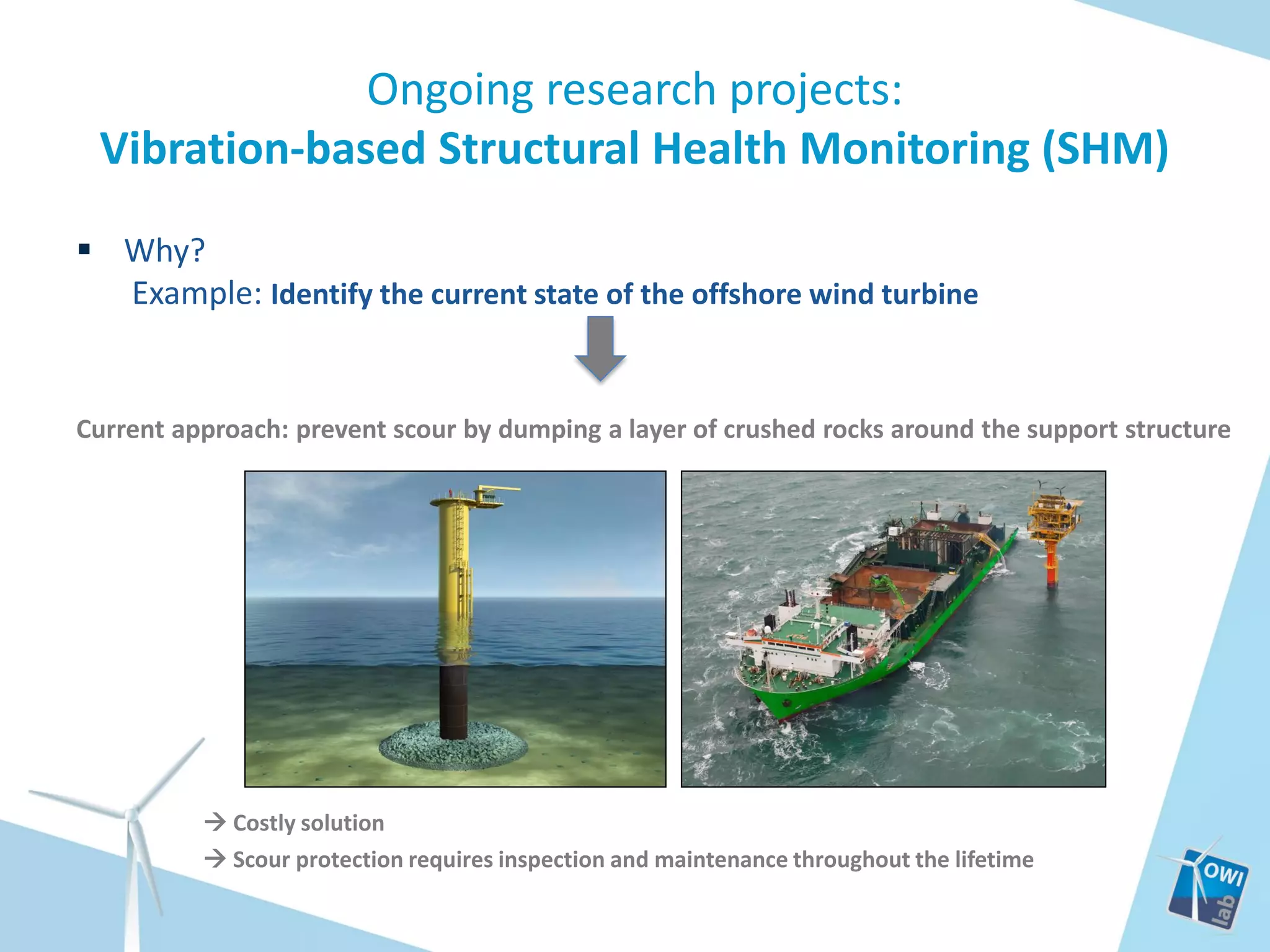
Current approach: prevent scour by dumping a layer of crushed rocks around the support structure

 Costly solution
 Scour protection requires inspection and maintenance throughout the lifetime
Ongoing research projects:
Vibration-based Structural Health Monitoring (SHM)
 How?
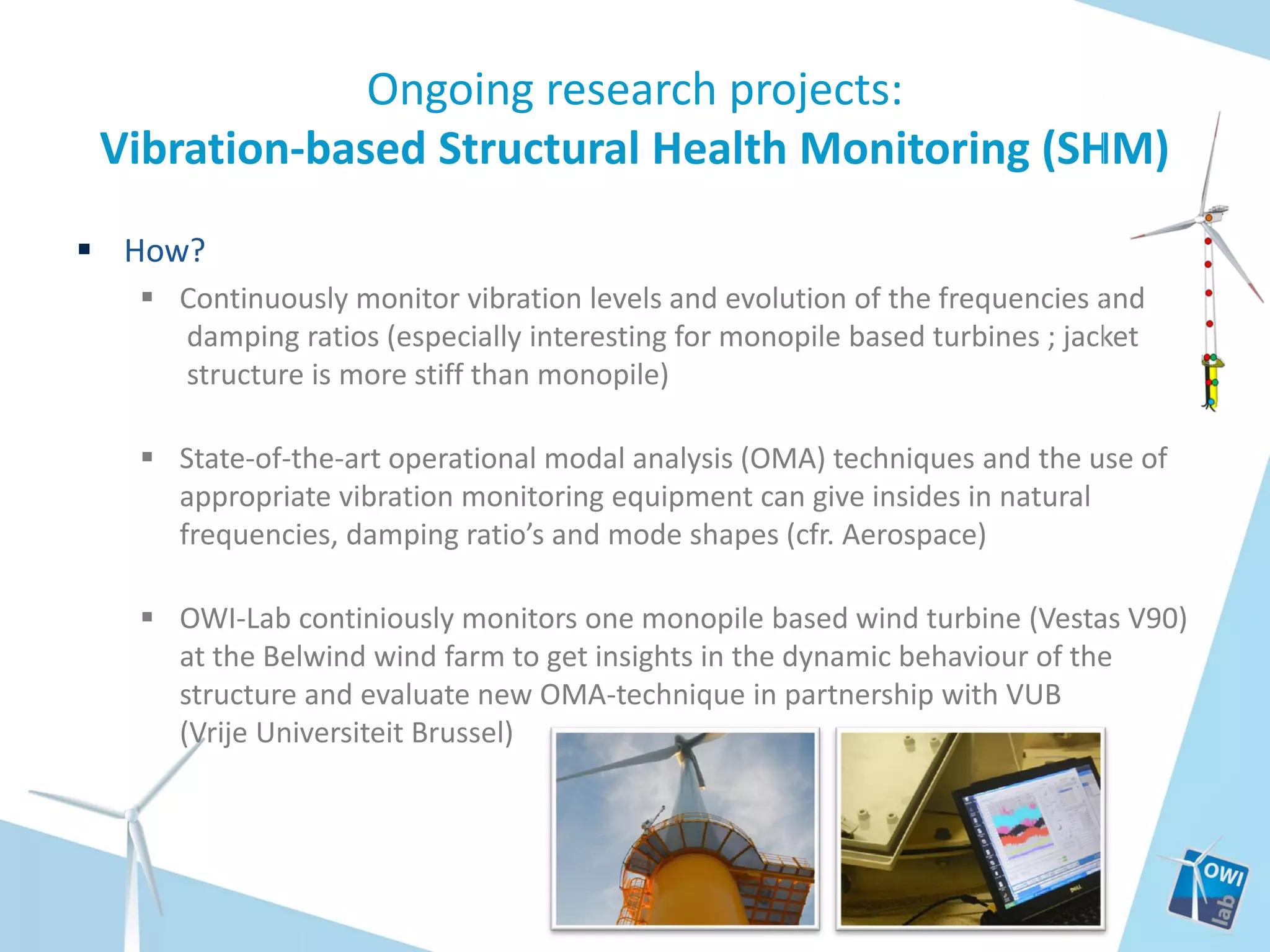
 Continuously monitor vibration levels and evolution of the frequencies and
damping ratios (especially interesting for monopile based turbines ; jacket
structure is more stiff than monopile)
 State-of-the-art operational modal analysis (OMA) techniques and the use of
appropriate vibration monitoring equipment can give insides in natural
frequencies, damping ratio’s and mode shapes (cfr. Aerospace)

 OWI-Lab continiously monitors one monopile based wind turbine (Vestas V90)
at the Belwind wind farm to get insights in the dynamic behaviour of the
structure and evaluate new OMA-technique in partnership with VUB
(Vrije Universiteit Brussel)
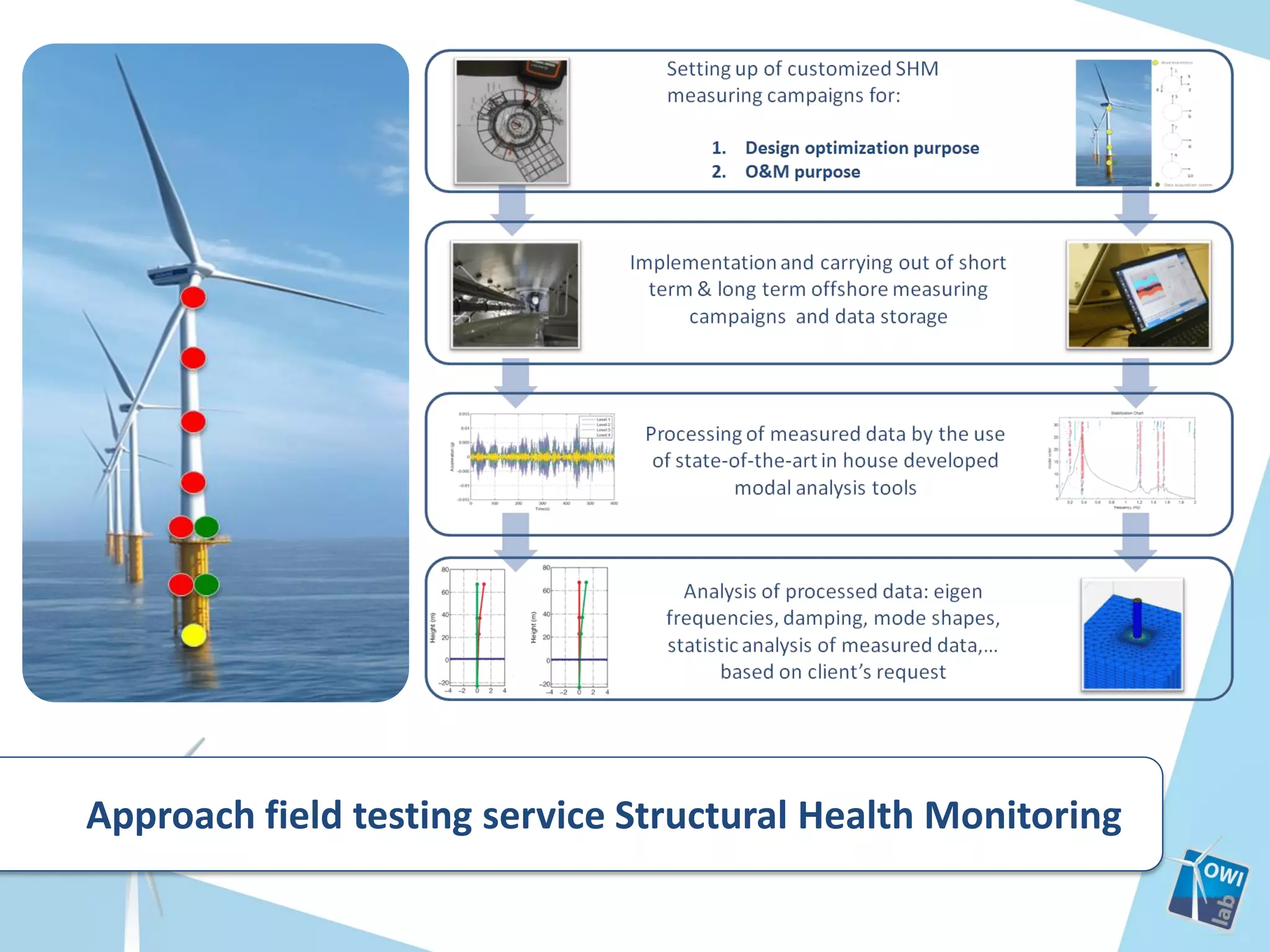
Approach field testing service Structural Health Monitoring )
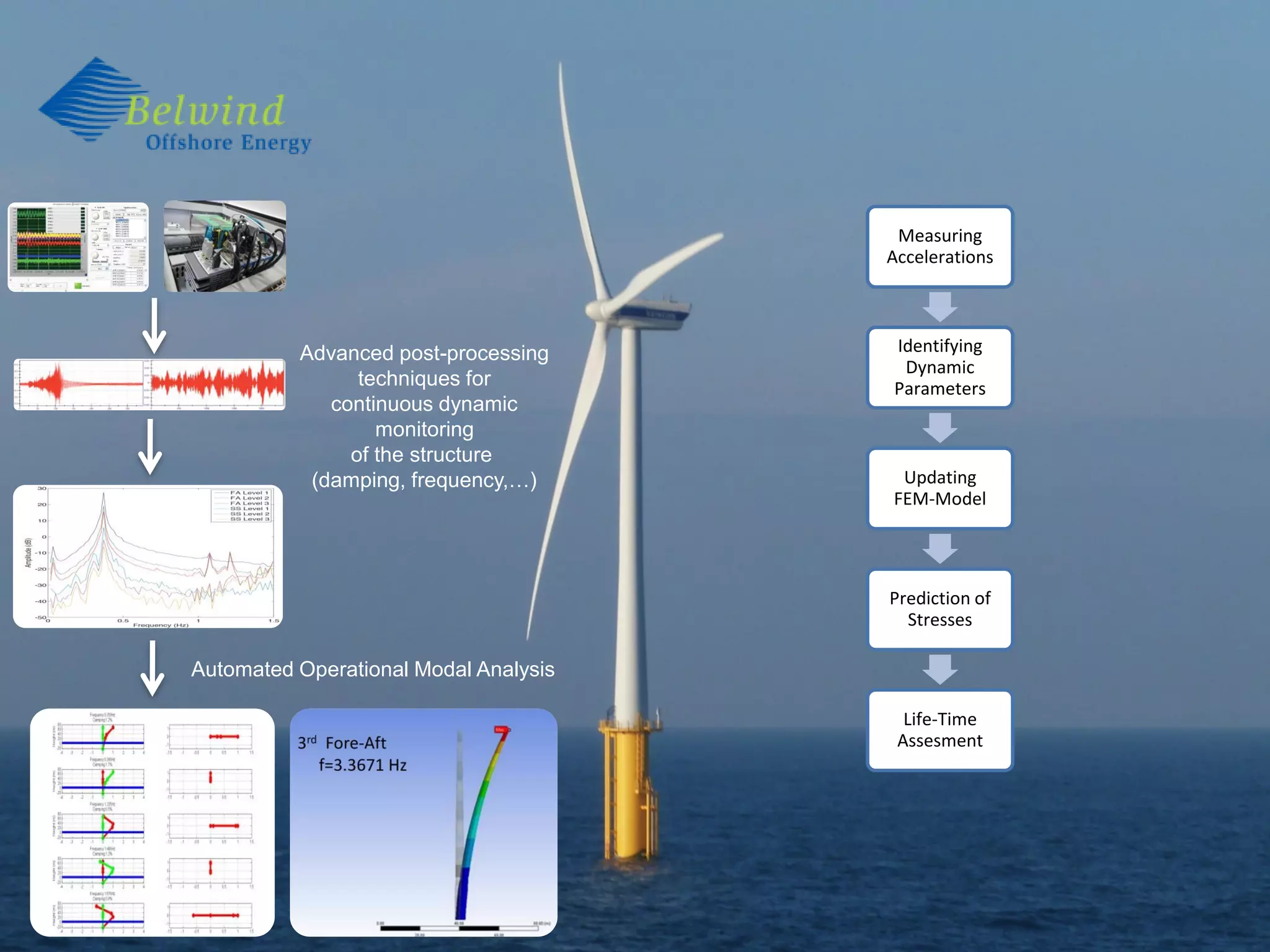
Measuring
Accelerations

Advanced post-processing
techniques for
continuous dynamic
monitoring
of the structure
(damping, frequency,…)

Identifying
Dynamic
Parameters

Updating
FEM-Model

Prediction of
Stresses

Automated Operational Modal Analysis
Life-Time
Assesment
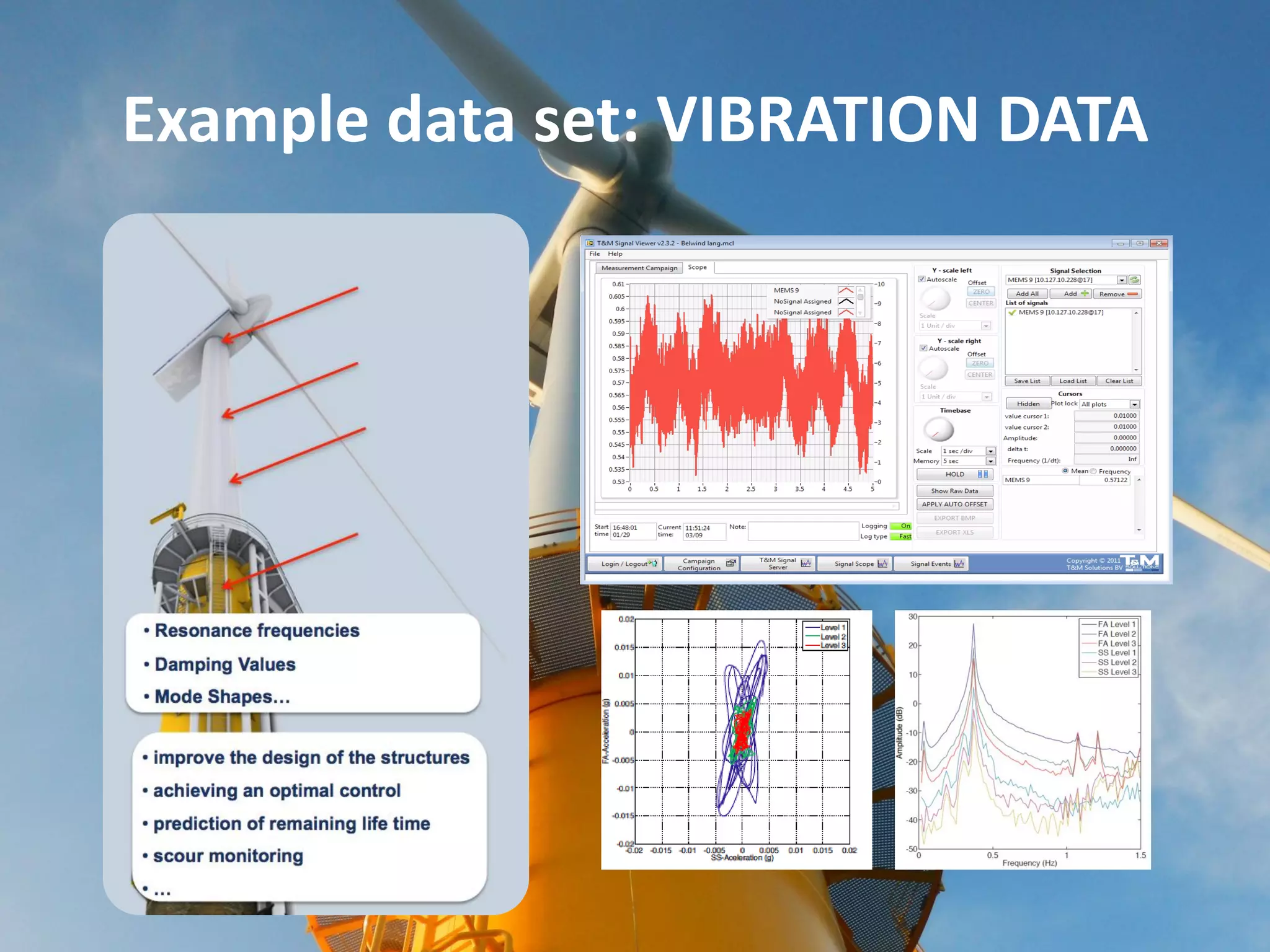
Example data set: VIBRATION DATA
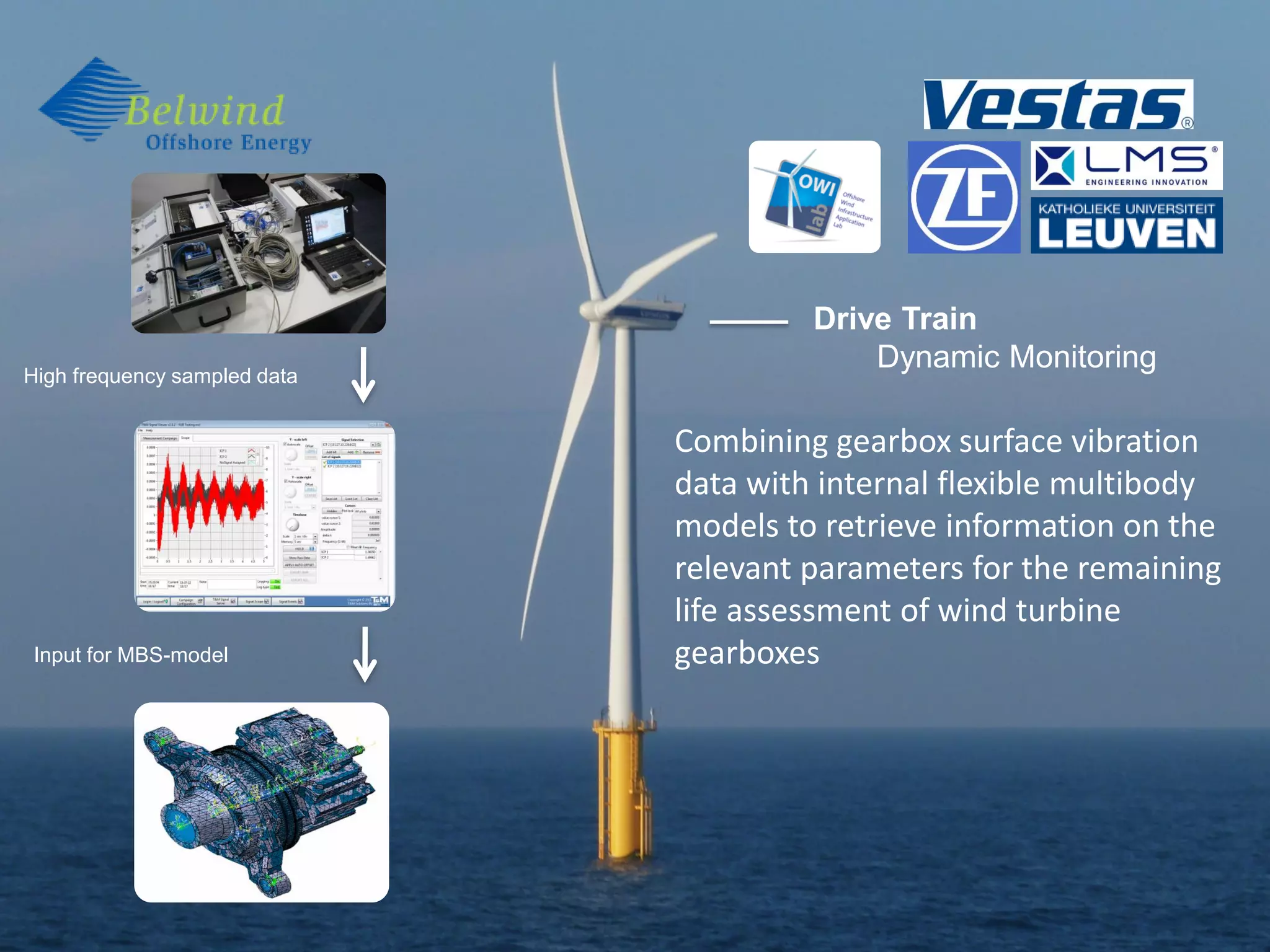
High frequency sampled data

Input for MBS-model

Drive Train
Dynamic Monitoring

Combining gearbox surface vibration
data with internal flexible multibody
models to retrieve information on the
relevant parameters for the remaining
life assessment of wind turbine
gearboxes
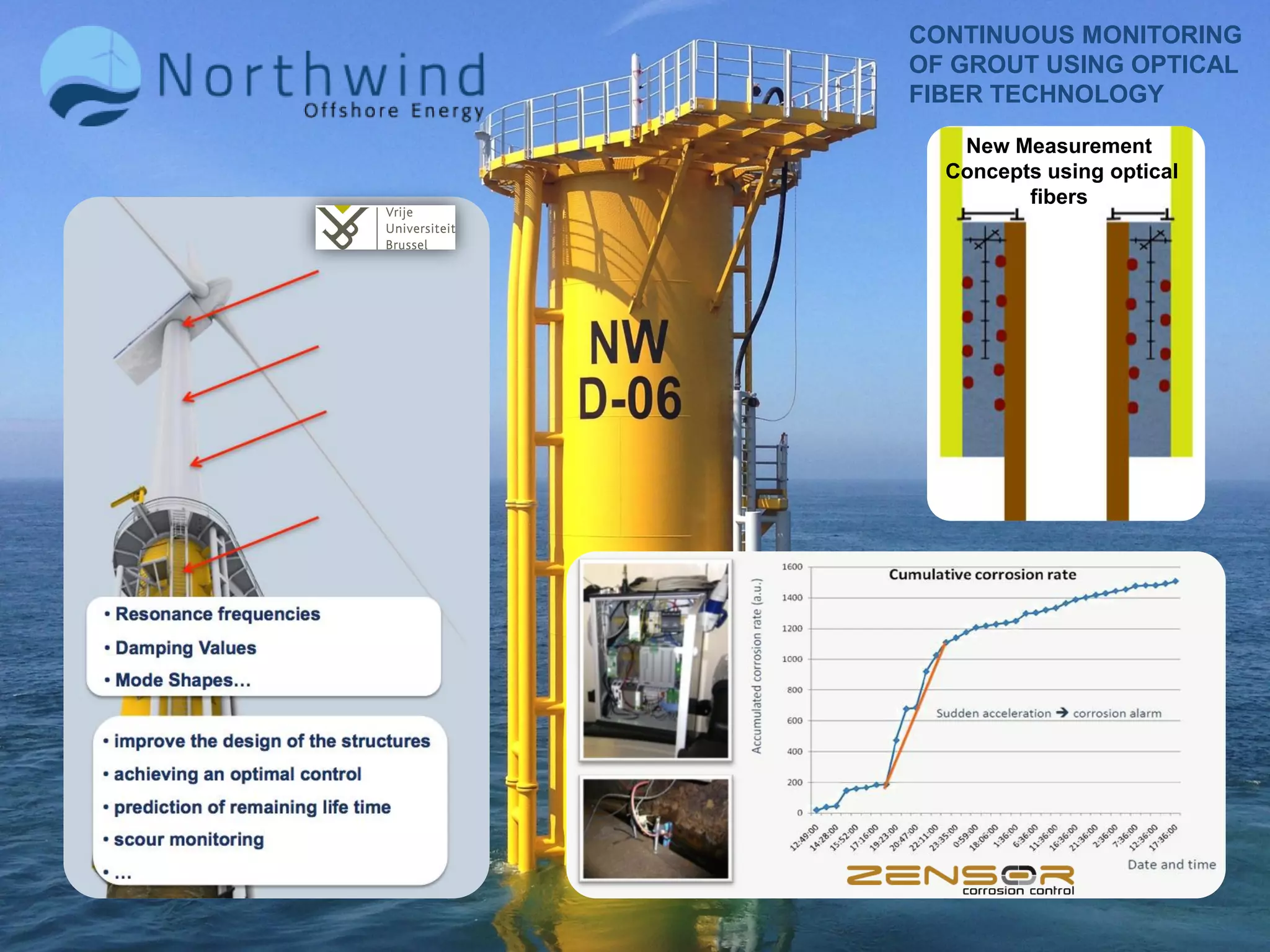
CONTINUOUS MONITORING
OF GROUT USING OPTICAL
FIBER TECHNOLOGY
New Measurement
Concepts using optical
fibers
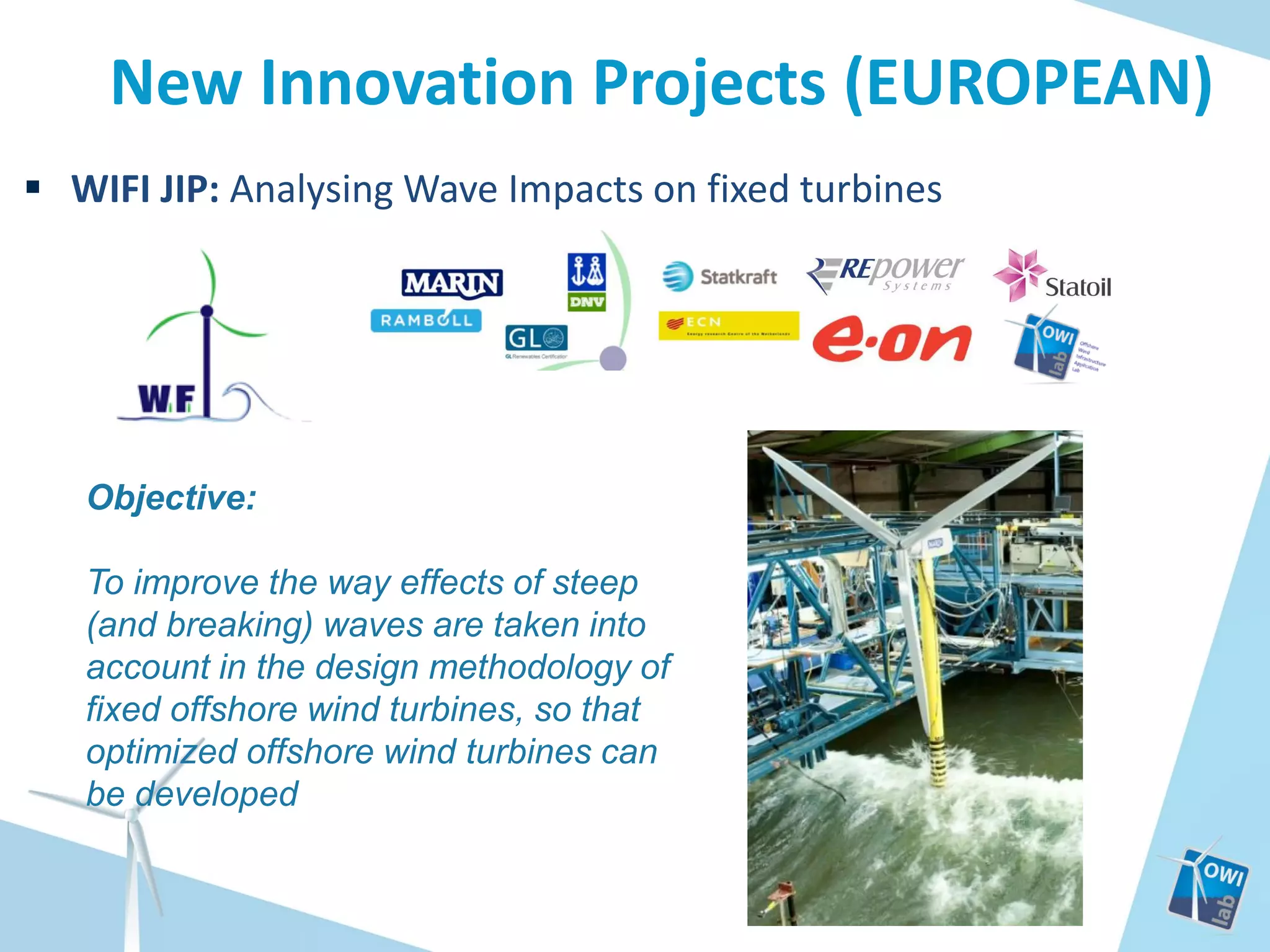
New Innovation Projects (EUROPEAN)
 WIFI JIP: Analysing Wave Impacts on fixed turbines

Objective:
To improve the way effects of steep
(and breaking) waves are taken into
account in the design methodology of
fixed offshore wind turbines, so that
optimized offshore wind turbines can
be developed
Thank you for your attention!

Pieterjan.jordaens@sirris.be

http://www.owi-lab.be/
@OWI_lab
Group: Offshore Wind
Infrastructure
Application Lab
(OWI-Lab)

Offshore research measurements & focus on structural health monitoring

  • 1.
    Offshore Wind Infrastructure ApplicationLab (OWI-Lab) For efficient and reliable offshore wind energy.
  • 2.
    Offshore Wind InfrastructureApplication Lab  A Flemish Funded R&D initiative that aims to increase the reliability and efficiency of offshore wind farms  OWI-Lab is embedded within Sirris, the collective centre of the Belgian technological industry. Industrial Initiators of OWI-Lab Industrial Coordinator Scientific Coordinator
  • 3.
  • 4.
    What does OWI-labdo?  Investing 5.5M € in test and monitoring infrastructure to support (offshore) wind power R&D in the whole industrial value chain  4 investment programs in R&D infrastructure  Platform to initiate local and European research projects together with industry and universities (SBO, O&O, FP7,…)  Innovation projects with / for companies in the wind power sector
  • 5.
    OWI-Lab services  Laboratorytesting  Field testing (offshore)
  • 6.
    Field testing: Offshore measurementcampaigns Unique SHM solutions / R&D campaigns Purpose of the monitoring campaigns: 1) Input for R&D / Optimizations 2) Asset Monitoring (O&M)
  • 7.
    Dedicated offshore measurements& monitoring system for R&D  Datasets as input for component design  Get better understanding of the behavior how the turbines operate far shore  Monitoring for O&M optimization  Multi-purpose:  Vibrations  Corrosion  Temperatures  …
  • 8.
    Ongoing R&D measurement& monitoring campaigns (MC’s) in partnership with universities  Structural Health Monitoring (VUB)  Corrosion Monitoring (VUB)  Drivetrain Monitoring (KU Leuven)
  • 9.
    Which monitoring? Drive Train DynamicMonitoring Tower Dynamic Monitoring Foundation Dynamic Monitoring Corrosion Monitoring Fatigue Monitoring
  • 10.
    Current locations formonitoring  55 Vestas 3MW V90 turbines  72 Vestas 3MW V112 turbines  Monopile foundations  Monopile foundations  46 km Offshore  Water Depths : 16 - 30m  1 Monitored Turbine: C01  37 km Offshore  Water Depths: 16 – 29m  2 Monitored Turbines: D06 - H05
  • 11.
    Drive Train Dynamic Monitoring Tower DynamicMonitoring Validation of SHM package Foundation Dynamic Monitoring Corrosion Monitoring Fatigue Monitoring
  • 12.
    Ongoing research projects: Vibration-basedStructural Health Monitoring (SHM)  What?  Monitoring the dynamic behaviour of a structure  Why?  lifetime prediction, fatigue calculation, Load monitoring, safety, O&M strategy  Already commonly used in civil engineering & aerospace  Example: Stone cutter bridge Hong Kong (the most heavily instrumented bridge in the world)
  • 13.
    Ongoing research projects: Vibration-basedStructural Health Monitoring (SHM)  Ongoing project OWI-Lab conserning SHM in partnership with VUB: CONTINUOUS DYNAMIC MONITORING OF AN OFFSHORE WIND TURBINE  Why?  Excitations of wind and waves have an effect on the offshore wind turbine and are capable of exciting the exciting vibration modes  avoid resonant behaviour  Gather insights in dynamic behaviour of wind turbine in offshore conditions  input for new designs, optimization of structures  Minimize O&M costs (scour protection around monopile structures)  Identify the current state of the offshore wind turbine (i.e. after a storm the scour protection can be damaged  can have an effect on the vibration modes)  Extend lifetime of wind turbine structure
  • 14.
    Ongoing research projects: Vibration-basedStructural Health Monitoring (SHM)  Why? Example: Identify the current state of the offshore wind turbine Uncertainty: effect of scour on the dynamics of an offshore wind turbine and its lifetime Scour = the process where the water current accelerates around the support structure and due to its acceleration picks up and transports soil particles (sand) away from the support structure
  • 15.
    Ongoing research projects: Vibration-basedStructural Health Monitoring (SHM)  Why? Example: Identify the current state of the offshore wind turbine Scour affects an offshore wind turbine in 3 ways: 1. 2. 3. Lowering the seabed around the structure reduces the lateral bearing resistance that the foundation pile can mobilize, which may mean that the pile needs to be driven deeper into the seabed Lowering the seabed makes the structure ‘longer’  lowering the natural frequency (can be detected through monitoring)  can have implications for fatigue damage A large scour hole will leave the J-tube free-spanning, which eventually may damage the cable if this effect is not taken into account
  • 16.
    Ongoing research projects: Vibration-basedStructural Health Monitoring (SHM)  Why? Example: Identify the current state of the offshore wind turbine Current approach: prevent scour by dumping a layer of crushed rocks around the support structure  Costly solution  Scour protection requires inspection and maintenance throughout the lifetime
  • 17.
    Ongoing research projects: Vibration-basedStructural Health Monitoring (SHM)  How?  Continuously monitor vibration levels and evolution of the frequencies and damping ratios (especially interesting for monopile based turbines ; jacket structure is more stiff than monopile)  State-of-the-art operational modal analysis (OMA) techniques and the use of appropriate vibration monitoring equipment can give insides in natural frequencies, damping ratio’s and mode shapes (cfr. Aerospace)  OWI-Lab continiously monitors one monopile based wind turbine (Vestas V90) at the Belwind wind farm to get insights in the dynamic behaviour of the structure and evaluate new OMA-technique in partnership with VUB (Vrije Universiteit Brussel)
  • 18.
    Approach field testingservice Structural Health Monitoring )
  • 19.
    Measuring Accelerations Advanced post-processing techniques for continuousdynamic monitoring of the structure (damping, frequency,…) Identifying Dynamic Parameters Updating FEM-Model Prediction of Stresses Automated Operational Modal Analysis Life-Time Assesment
  • 20.
    Example data set:VIBRATION DATA
  • 21.
    High frequency sampleddata Input for MBS-model Drive Train Dynamic Monitoring Combining gearbox surface vibration data with internal flexible multibody models to retrieve information on the relevant parameters for the remaining life assessment of wind turbine gearboxes
  • 23.
    CONTINUOUS MONITORING OF GROUTUSING OPTICAL FIBER TECHNOLOGY New Measurement Concepts using optical fibers
  • 25.
    New Innovation Projects(EUROPEAN)  WIFI JIP: Analysing Wave Impacts on fixed turbines Objective: To improve the way effects of steep (and breaking) waves are taken into account in the design methodology of fixed offshore wind turbines, so that optimized offshore wind turbines can be developed
  • 26.
    Thank you foryour attention! Pieterjan.jordaens@sirris.be http://www.owi-lab.be/ @OWI_lab Group: Offshore Wind Infrastructure Application Lab (OWI-Lab)