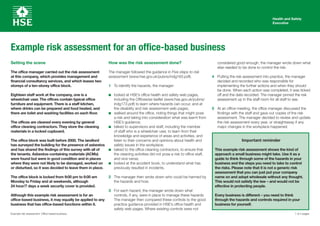
Example risk assessment: Office-based business
How was the risk assessment done?
The manager followed the guidance in Five steps to risk
assessment (www.hse.gov.uk/pubns/indg163.pdf).
1 To identify the hazards, the manager:
looked at HSE’s office
■
■ health and safety web pages,
including the Officewise leaflet (www.hse.gov.uk/pubns/
indg173.pdf) to learn where hazards can occur, and at
the disability and risk assessment web pages;
walked around the office, noting things that might pose
■
■
a risk and taking into consideration what was learnt from
HSE’s guidance;
talked to supervisors and staff, including the member
■
■
of staff who is a wheelchair user, to learn from their
knowledge and experience of areas and activities, and
listen to their concerns and opinions about health and
safety issues in the workplace;
talked to the office cleaning contractors, to ensure that
■
■
the cleaning activities did not pose a risk to office staff,
and vice-versa;
looked at the accident book, to understand what has
■
■
previously resulted in incidents.
2 The manager then wrote down who could be harmed by
the hazards and how.
3 For each hazard, the manager wrote down what
controls, if any, were in place to manage these hazards.
The manager then compared these controls to the good
practice guidance provided in HSE’s office health and
safety web pages. Where existing controls were not
considered good enough, the manager wrote down what
else needed to be done to control the risk.
4 Putting the risk assessment into practice, the manager
decided and recorded who was responsible for
implementing the further actions and when they should
be done. When each action was completed, it was ticked
off and the date recorded. The manager pinned the risk
assessment up in the staff room for all staff to see.
5 At an office meeting, the office manager discussed the
findings with the staff and gave out copies of the risk
assessment. The manager decided to review and update
the risk assessment every year, or straightaway if any
major changes in the workplace happened.
Setting the scene
The office manager carried out the risk assessment
at this company, which provides management and
financial consultancy services, and which leases two
storeys of a ten-storey office block.
Eighteen staff work at the company, one is a
wheelchair user. The offices contain typical office
furniture and equipment. There is a staff kitchen,
where drinks can be prepared and food heated, and
there are toilet and washing facilities on each floor.
The offices are cleaned every evening by general
office cleaning contractors. They store the cleaning
materials in a locked cupboard.
The office block was built before 2000. The landlord
has surveyed the building for the presence of asbestos
and has shared the findings of this survey with all of
the tenants. Asbestos-containing materials (ACMs)
were found but were in good condition and in places
where they were not likely to be damaged, worked on
or disturbed, so it was decided to leave them in place.
The office block is locked from 9:00 pm to 6:00 am
Monday to Friday and at weekends, although
24 hour/7 days a week security cover is provided.
Although this example risk assessment is for an
office-based business, it may equally be applied to any
business that has office-based functions within it.
Important reminder
This example risk assessment shows the kind of
approach a small business might take. Use it as a
guide to think through some of the hazards in your
business and the steps you need to take to control
the risks. Please note that it is not a generic risk
assessment that you can just put your company
name on and adopt wholesale without any thought.
This would not satisfy the law – and would not be
effective in protecting people.
Every business is different – you need to think
through the hazards and controls required in your
business for yourself.
Example risk assessment for an office-based business
1 of 4 pages
Health and Safety
Executive
Health and Safety
Executive
What are the hazards? Who might be harmed
and how?
What are you already doing? What further action is necessary? Action by
whom?
Action by
when?
Done
Slips and trips Staff and visitors may
be injured if they trip
over objects or slip on
spillages.
General good housekeeping.
■
■
All areas well lit, including stairs.
■
■
No trailing leads or cables.
■
■
Staff keep work areas clear, eg no boxes left in walkways,
■
■
deliveries stored immediately.
Offices cleaned every evening.
■
■
Better housekeeping in staff kitchen
■
■
needed, eg on spills.
All staff,
supervisors
to monitor
From now
on
1/10/07
Arrange for loose carpet tile on second
■
■
floor to be repaired/replaced.
Manager From now
on
Manual handling
of paper, office
equipment etc
Staff risk injuries or
back pain from handling
heavy/bulky objects, eg
deliveries of paper.
Trolley used to transport boxes of paper and other heavy items
■
■
when collecting deliveries etc.
High shelves for light objects only.
■
■
Remind staff that they should not try to
■
■
lift objects that look or appear too heavy
to handle.
Manager 4/10/07 4/10/07
Display screen
equipment
Staff risk posture
problems and pain,
discomfort or injuries,
eg to their hands/
arms, from overuse
or improper use or
from poorly designed
workstations or
work environments.
Headaches or sore eyes
can also occur, eg if the
lighting is poor.
DSE training and assessments of workstation from CD ROM
■
■
carried out by all new starters early on in induction. Any actions
to be carried out asap.
Reassessment to be carried out at any change to work feature,
■
■
eg equipment, furniture or the work environment such as
lighting.
Workstation and equipment set to ensure good posture and to
■
■
avoid glare and reflections on the screen.
Shared workstations are assessed for all users.
■
■
Work planned to include regular breaks or change of activity.
■
■
Lighting and temperature suitably controlled.
■
■
Adjustable blinds at window to control natural light on screen
■
■
Noise levels controlled.
■
■
Eye tests provided for those who need them, dutyholder to pay
■
■
for basic spectacles specific for VDU use (or portion of cost in
other cases).
Laptop users trained to carry out own DSE assessment for use
■
■
away from office. When used at office, laptop should be used
with docking station, screen, keyboard and mouse.
Supervisors to monitor to ensure staff
■
■
continue to get breaks away from the
computer.
Supervisors 4/10/07 4/10/07
Check that identified actions from self-
■
■
assessments are followed up ASAP.
Manager 21/10/07 4/10/07
Tell staff that they are to inform their
■
■
manager of any pain they have that may
be linked to computer use.
All staff 21/10/07 21/10/07
Broken window blind near accounts
■
■
section – letter to landlord.
Company
secretary
4/10/07 2/10/07
Remind laptop users to carry out regular
■
■
DSE assessment to avoid problems and
identify any issues.
Manager 4/10/07 4/10/07
Company name: Smith’s Consultants Date of risk assessment: 01/10/07
2 of 4 pages
Example risk assessment: Office-based business
3 of 4 pages
Example risk assessment: Office-based business
Health and Safety
Executive
Health and Safety
Executive
What are the hazards? Who might be harmed
and how?
What are you already doing? What further action is necessary? Action by
whom?
Action by
when?
Done
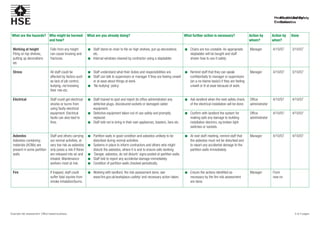
Working at height
Filing on top shelves,
putting up decorations
etc
Falls from any height
can cause bruising and
fractures.
Staff stand on chair to file on high shelves, put up decorations
■
■
etc.
Internal windows cleaned by contractor using a stepladder.
■
■
Chairs are too unstable. An appropriate
■
■
stepladder will be bought and staff
shown how to use it safely.
Manager 4/10/07 3/10/07
Stress All staff could be
affected by factors such
as lack of job control,
bullying, not knowing
their role etc.
Staff understand what their duties and responsibilities are.
■
■
Staff can talk to supervisors or manager if they are feeling unwell
■
■
or at ease about things at work.
‘No bullying’ policy.
■
■
Remind staff that they can speak
■
■
confidentially to manager or supervisors
(on a no-blame basis!) if they are feeling
unwell or ill at ease because of work.
Manager 4/10/07 3/10/07
Electrical Staff could get electrical
shocks or burns from
using faulty electrical
equipment. Electrical
faults can also lead to
fires.
Staff trained to spot and report (to office administrator) any
■
■
defective plugs, discoloured sockets or damaged cable/
equipment.
Defective equipment taken out of use safely and promptly
■
■
replaced.
Staff told not to bring in their own appliances, toasters, fans etc.
■
■
Ask landlord when the next safety check
■
■
of the electrical installation will be done.
Office
administrator
4/10/07 4/10/07
Confirm with landlord the system for
■
■
making safe any damage to building
installation electrics, eg broken light
switches or sockets.
Office
administrator
4/10/07 4/10/07
Asbestos
Asbestos-containing
materials (ACMs) are
present in some partition
walls
Staff and others carrying
out normal activities, at
very low risk as asbestos
only poses a risk if fibres
are released into air and
inhaled. Maintenance
workers most at risk.
Partition walls in good condition and asbestos unlikely to be
■
■
disturbed during normal activities.
Systems in place to inform contractors and others who might
■
■
disturb the asbestos, where it is and to ensure safe working.
‘Danger, asbestos, do not disturb’ signs posted at partition walls.
■
■
Staff told to report any accidental damage immediately.
■
■
Condition of partition walls checked periodically.
■
■
At next staff meeting, remind staff that
■
■
the asbestos must not be disturbed and
to report any accidental damage to the
partition walls immediately.
Manager 4/10/07 4/10/07
Fire If trapped, staff could
suffer fatal injuries from
smoke inhalation/burns.
Working with landlord, fire risk assessment done, see
■
■
www.fire.gov.uk/workplace+safety/ and necessary action taken.
Ensure the actions identified as
■
■
necessary by the fire risk assessment
are done.
Manager From
now on
4 of 4 pages
Example risk assessment: Office-based business
Health and Safety
Executive
What are the hazards? Who might be harmed
and how?
What are you already doing? What further action is necessary? Action by
whom?
Action by
when?
Done
Lone working Staff could suffer injury
or ill health while out
of the office, eg when
visiting clients’ offices,
or while working alone in
the office.
Staff write visit details in office diary and give a contact number.
■
■
Staff not returning to the office after a visit call in to report this.
■
■
Security staff check all areas, including toilets, before locking up
■
■
at night.
Whereabouts of staff ‘out of the office’ to
■
■
be monitored by office-based staff.
Office admin
team
From
now on
Assessment review date: 28/09/08
Published by the Health and Safety Executive 10/08

office (1).pdf

  • 1.
    Example risk assessment:Office-based business How was the risk assessment done? The manager followed the guidance in Five steps to risk assessment (www.hse.gov.uk/pubns/indg163.pdf). 1 To identify the hazards, the manager: looked at HSE’s office ■ ■ health and safety web pages, including the Officewise leaflet (www.hse.gov.uk/pubns/ indg173.pdf) to learn where hazards can occur, and at the disability and risk assessment web pages; walked around the office, noting things that might pose ■ ■ a risk and taking into consideration what was learnt from HSE’s guidance; talked to supervisors and staff, including the member ■ ■ of staff who is a wheelchair user, to learn from their knowledge and experience of areas and activities, and listen to their concerns and opinions about health and safety issues in the workplace; talked to the office cleaning contractors, to ensure that ■ ■ the cleaning activities did not pose a risk to office staff, and vice-versa; looked at the accident book, to understand what has ■ ■ previously resulted in incidents. 2 The manager then wrote down who could be harmed by the hazards and how. 3 For each hazard, the manager wrote down what controls, if any, were in place to manage these hazards. The manager then compared these controls to the good practice guidance provided in HSE’s office health and safety web pages. Where existing controls were not considered good enough, the manager wrote down what else needed to be done to control the risk. 4 Putting the risk assessment into practice, the manager decided and recorded who was responsible for implementing the further actions and when they should be done. When each action was completed, it was ticked off and the date recorded. The manager pinned the risk assessment up in the staff room for all staff to see. 5 At an office meeting, the office manager discussed the findings with the staff and gave out copies of the risk assessment. The manager decided to review and update the risk assessment every year, or straightaway if any major changes in the workplace happened. Setting the scene The office manager carried out the risk assessment at this company, which provides management and financial consultancy services, and which leases two storeys of a ten-storey office block. Eighteen staff work at the company, one is a wheelchair user. The offices contain typical office furniture and equipment. There is a staff kitchen, where drinks can be prepared and food heated, and there are toilet and washing facilities on each floor. The offices are cleaned every evening by general office cleaning contractors. They store the cleaning materials in a locked cupboard. The office block was built before 2000. The landlord has surveyed the building for the presence of asbestos and has shared the findings of this survey with all of the tenants. Asbestos-containing materials (ACMs) were found but were in good condition and in places where they were not likely to be damaged, worked on or disturbed, so it was decided to leave them in place. The office block is locked from 9:00 pm to 6:00 am Monday to Friday and at weekends, although 24 hour/7 days a week security cover is provided. Although this example risk assessment is for an office-based business, it may equally be applied to any business that has office-based functions within it. Important reminder This example risk assessment shows the kind of approach a small business might take. Use it as a guide to think through some of the hazards in your business and the steps you need to take to control the risks. Please note that it is not a generic risk assessment that you can just put your company name on and adopt wholesale without any thought. This would not satisfy the law – and would not be effective in protecting people. Every business is different – you need to think through the hazards and controls required in your business for yourself. Example risk assessment for an office-based business 1 of 4 pages Health and Safety Executive
  • 2.
    Health and Safety Executive Whatare the hazards? Who might be harmed and how? What are you already doing? What further action is necessary? Action by whom? Action by when? Done Slips and trips Staff and visitors may be injured if they trip over objects or slip on spillages. General good housekeeping. ■ ■ All areas well lit, including stairs. ■ ■ No trailing leads or cables. ■ ■ Staff keep work areas clear, eg no boxes left in walkways, ■ ■ deliveries stored immediately. Offices cleaned every evening. ■ ■ Better housekeeping in staff kitchen ■ ■ needed, eg on spills. All staff, supervisors to monitor From now on 1/10/07 Arrange for loose carpet tile on second ■ ■ floor to be repaired/replaced. Manager From now on Manual handling of paper, office equipment etc Staff risk injuries or back pain from handling heavy/bulky objects, eg deliveries of paper. Trolley used to transport boxes of paper and other heavy items ■ ■ when collecting deliveries etc. High shelves for light objects only. ■ ■ Remind staff that they should not try to ■ ■ lift objects that look or appear too heavy to handle. Manager 4/10/07 4/10/07 Display screen equipment Staff risk posture problems and pain, discomfort or injuries, eg to their hands/ arms, from overuse or improper use or from poorly designed workstations or work environments. Headaches or sore eyes can also occur, eg if the lighting is poor. DSE training and assessments of workstation from CD ROM ■ ■ carried out by all new starters early on in induction. Any actions to be carried out asap. Reassessment to be carried out at any change to work feature, ■ ■ eg equipment, furniture or the work environment such as lighting. Workstation and equipment set to ensure good posture and to ■ ■ avoid glare and reflections on the screen. Shared workstations are assessed for all users. ■ ■ Work planned to include regular breaks or change of activity. ■ ■ Lighting and temperature suitably controlled. ■ ■ Adjustable blinds at window to control natural light on screen ■ ■ Noise levels controlled. ■ ■ Eye tests provided for those who need them, dutyholder to pay ■ ■ for basic spectacles specific for VDU use (or portion of cost in other cases). Laptop users trained to carry out own DSE assessment for use ■ ■ away from office. When used at office, laptop should be used with docking station, screen, keyboard and mouse. Supervisors to monitor to ensure staff ■ ■ continue to get breaks away from the computer. Supervisors 4/10/07 4/10/07 Check that identified actions from self- ■ ■ assessments are followed up ASAP. Manager 21/10/07 4/10/07 Tell staff that they are to inform their ■ ■ manager of any pain they have that may be linked to computer use. All staff 21/10/07 21/10/07 Broken window blind near accounts ■ ■ section – letter to landlord. Company secretary 4/10/07 2/10/07 Remind laptop users to carry out regular ■ ■ DSE assessment to avoid problems and identify any issues. Manager 4/10/07 4/10/07 Company name: Smith’s Consultants Date of risk assessment: 01/10/07 2 of 4 pages Example risk assessment: Office-based business
  • 3.
    3 of 4pages Example risk assessment: Office-based business Health and Safety Executive Health and Safety Executive What are the hazards? Who might be harmed and how? What are you already doing? What further action is necessary? Action by whom? Action by when? Done Working at height Filing on top shelves, putting up decorations etc Falls from any height can cause bruising and fractures. Staff stand on chair to file on high shelves, put up decorations ■ ■ etc. Internal windows cleaned by contractor using a stepladder. ■ ■ Chairs are too unstable. An appropriate ■ ■ stepladder will be bought and staff shown how to use it safely. Manager 4/10/07 3/10/07 Stress All staff could be affected by factors such as lack of job control, bullying, not knowing their role etc. Staff understand what their duties and responsibilities are. ■ ■ Staff can talk to supervisors or manager if they are feeling unwell ■ ■ or at ease about things at work. ‘No bullying’ policy. ■ ■ Remind staff that they can speak ■ ■ confidentially to manager or supervisors (on a no-blame basis!) if they are feeling unwell or ill at ease because of work. Manager 4/10/07 3/10/07 Electrical Staff could get electrical shocks or burns from using faulty electrical equipment. Electrical faults can also lead to fires. Staff trained to spot and report (to office administrator) any ■ ■ defective plugs, discoloured sockets or damaged cable/ equipment. Defective equipment taken out of use safely and promptly ■ ■ replaced. Staff told not to bring in their own appliances, toasters, fans etc. ■ ■ Ask landlord when the next safety check ■ ■ of the electrical installation will be done. Office administrator 4/10/07 4/10/07 Confirm with landlord the system for ■ ■ making safe any damage to building installation electrics, eg broken light switches or sockets. Office administrator 4/10/07 4/10/07 Asbestos Asbestos-containing materials (ACMs) are present in some partition walls Staff and others carrying out normal activities, at very low risk as asbestos only poses a risk if fibres are released into air and inhaled. Maintenance workers most at risk. Partition walls in good condition and asbestos unlikely to be ■ ■ disturbed during normal activities. Systems in place to inform contractors and others who might ■ ■ disturb the asbestos, where it is and to ensure safe working. ‘Danger, asbestos, do not disturb’ signs posted at partition walls. ■ ■ Staff told to report any accidental damage immediately. ■ ■ Condition of partition walls checked periodically. ■ ■ At next staff meeting, remind staff that ■ ■ the asbestos must not be disturbed and to report any accidental damage to the partition walls immediately. Manager 4/10/07 4/10/07 Fire If trapped, staff could suffer fatal injuries from smoke inhalation/burns. Working with landlord, fire risk assessment done, see ■ ■ www.fire.gov.uk/workplace+safety/ and necessary action taken. Ensure the actions identified as ■ ■ necessary by the fire risk assessment are done. Manager From now on
  • 4.
    4 of 4pages Example risk assessment: Office-based business Health and Safety Executive What are the hazards? Who might be harmed and how? What are you already doing? What further action is necessary? Action by whom? Action by when? Done Lone working Staff could suffer injury or ill health while out of the office, eg when visiting clients’ offices, or while working alone in the office. Staff write visit details in office diary and give a contact number. ■ ■ Staff not returning to the office after a visit call in to report this. ■ ■ Security staff check all areas, including toilets, before locking up ■ ■ at night. Whereabouts of staff ‘out of the office’ to ■ ■ be monitored by office-based staff. Office admin team From now on Assessment review date: 28/09/08 Published by the Health and Safety Executive 10/08