Page 1 of 12
IN THE HIGH COURT OF ORISSA AT CUTTACK
SUO MOTU W.P.(C) No.14589 of 2021-PIL
In Re: Deaths of Sanitation Workers
-versus-
State of Odisha and Others … Opp. Parties
CORAM:
THE CHIEF JUSTICE
MR. JUSTICE B. P. ROUTRAY
Or.
No. Date
ORDER
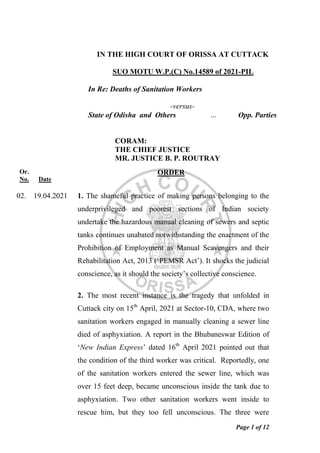
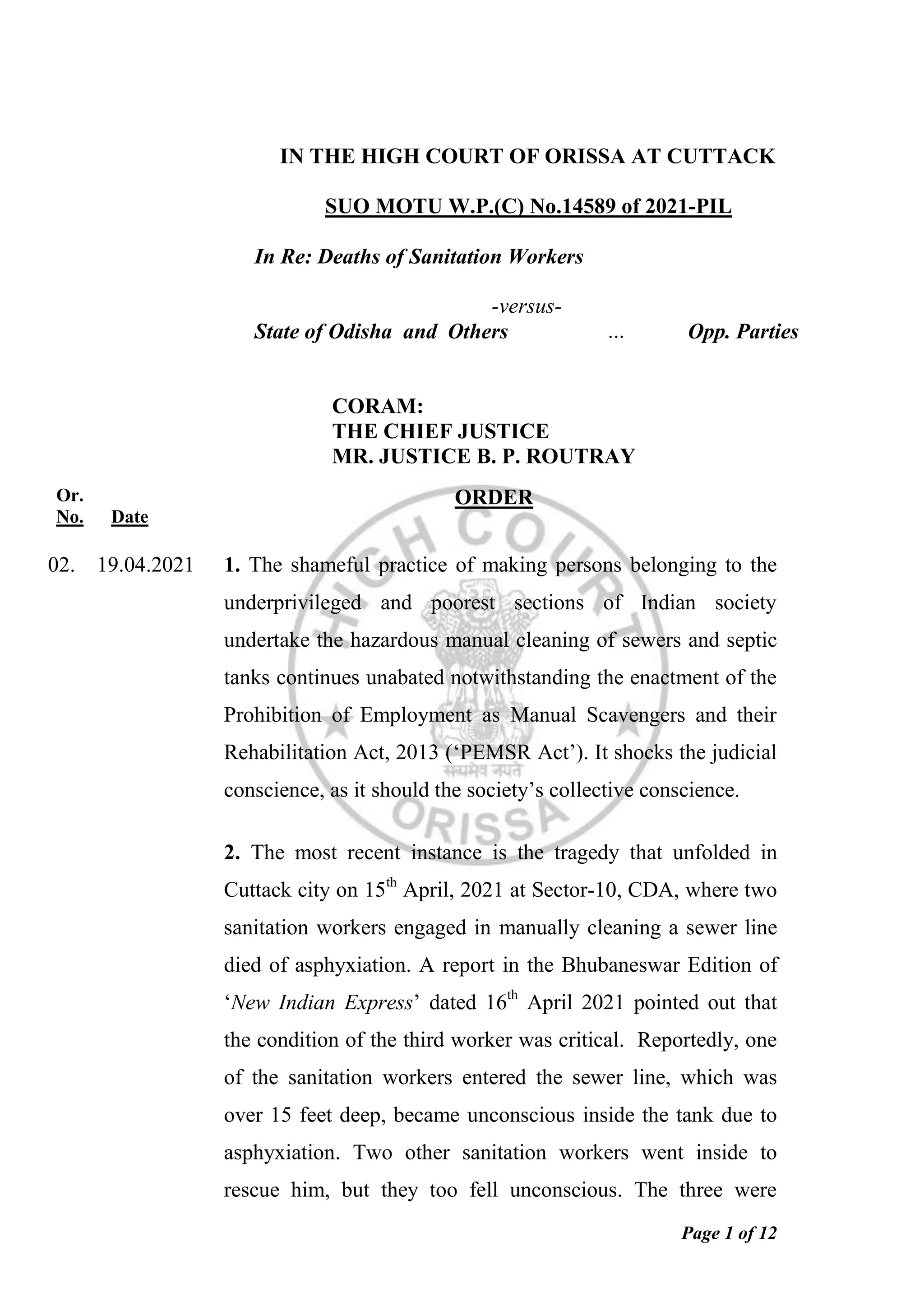
02. 19.04.2021 1. The shameful practice of making persons belonging to the
underprivileged and poorest sections of Indian society
undertake the hazardous manual cleaning of sewers and septic
tanks continues unabated notwithstanding the enactment of the
Prohibition of Employment as Manual Scavengers and their
Rehabilitation Act, 2013 (‗PEMSR Act‘). It shocks the judicial
conscience, as it should the society‘s collective conscience.
2. The most recent instance is the tragedy that unfolded in
Cuttack city on 15th
April, 2021 at Sector-10, CDA, where two
sanitation workers engaged in manually cleaning a sewer line
died of asphyxiation. A report in the Bhubaneswar Edition of
‗New Indian Express‘ dated 16th
April 2021 pointed out that
the condition of the third worker was critical. Reportedly, one
of the sanitation workers entered the sewer line, which was
over 15 feet deep, became unconscious inside the tank due to
asphyxiation. Two other sanitation workers went inside to
rescue him, but they too fell unconscious. The three were
// 2 //
Page 2 of 12
brought out with the help of firefighters and rushed to the SCB
Medical College & Hospital, Cuttack. The hospital authorities
declared two of them, Bishnu Naik of Badamba and
T.Prabhakar of Pattapol area of Cuttack brought dead, whereas
the third one, S. Siba Rao was stated to be receiving treatment.
All of them were in the age group of 30 to 35 years.
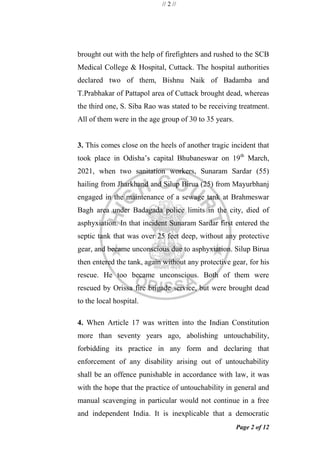
3. This comes close on the heels of another tragic incident that
took place in Odisha‘s capital Bhubaneswar on 19th
March,
2021, when two sanitation workers, Sunaram Sardar (55)
hailing from Jharkhand and Silup Birua (25) from Mayurbhanj
engaged in the maintenance of a sewage tank at Brahmeswar
Bagh area under Badagada police limits in the city, died of
asphyxiation. In that incident Sunaram Sardar first entered the
septic tank that was over 25 feet deep, without any protective
gear, and became unconscious due to asphyxiation. Silup Birua
then entered the tank, again without any protective gear, for his
rescue. He too became unconscious. Both of them were
rescued by Orissa fire brigade service, but were brought dead
to the local hospital.
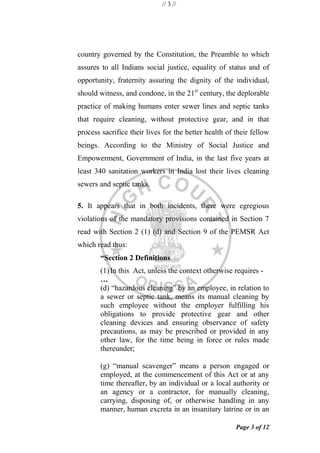
4. When Article 17 was written into the Indian Constitution
more than seventy years ago, abolishing untouchability,
forbidding its practice in any form and declaring that
enforcement of any disability arising out of untouchability
shall be an offence punishable in accordance with law, it was
with the hope that the practice of untouchability in general and
manual scavenging in particular would not continue in a free
and independent India. It is inexplicable that a democratic
// 3 //
Page 3 of 12
country governed by the Constitution, the Preamble to which
assures to all Indians social justice, equality of status and of
opportunity, fraternity assuring the dignity of the individual,
should witness, and condone, in the 21st
century, the deplorable
practice of making humans enter sewer lines and septic tanks
that require cleaning, without protective gear, and in that
process sacrifice their lives for the better health of their fellow
beings. According to the Ministry of Social Justice and
Empowerment, Government of India, in the last five years at
least 340 sanitation workers in India lost their lives cleaning
sewers and septic tanks.
5. It appears that in both incidents, there were egregious
violations of the mandatory provisions contained in Section 7
read with Section 2 (1) (d) and Section 9 of the PEMSR Act
which read thus:
“Section 2 Definitions
(1)In this Act, unless the context otherwise requires -
…
(d) ―hazardous cleaning‖ by an employee, in relation to
a sewer or septic tank, means its manual cleaning by
such employee without the employer fulfilling his
obligations to provide protective gear and other
cleaning devices and ensuring observance of safety
precautions, as may be prescribed or provided in any
other law, for the time being in force or rules made
thereunder;
(g) ―manual scavenger‖ means a person engaged or
employed, at the commencement of this Act or at any
time thereafter, by an individual or a local authority or
an agency or a contractor, for manually cleaning,
carrying, disposing of, or otherwise handling in any
manner, human excreta in an insanitary latrine or in an
// 4 //
Page 4 of 12
open drain or pit into which the human excreta from the
insanitary latrines is disposed of, or on a railway track
or in such other spaces or premises, as the Central
Government or a State Government may notify, before
the excreta fully decomposes in such manner as may be
prescribed, and the expression ―manual scavenging‖
shall be construed accordingly.
Explanation.—For the purpose of this clause,—
(a) ―engaged or employed‖ means being engaged or
employed on a regular or contract basis;
(b) a person engaged or employed to clean excreta with
the help of such devices and using such protective gear,
as the Central Government may notify in this behalf,
shall not be deemed to be a ‗manual scavenger‘;
“Section 7. Prohibition of persons from engagement
or employment for hazardous cleaning of sewers
and septic tanks. - No person, local authority or any
agency shall, from such date as the State Government
may notify, which shall not be later than one year from
the date of commencement of this Act, engage or
employ, either directly or indirectly, any person for
hazardous cleaning or a sewer or a septic tank.‖
― Section 9. Penalty for contravention of section 7. –
Whoever contravenes the provisions of section 7 shall
for the first contravention be punishable with
imprisonment for a term which may extend to two
years or with fine which may extend to two lakh rupees
or with both and for any subsequent contravention with
imprisonment which may extend to fine years or with
fine which may extend to fine lakh rupees, or with
both.‖
6. Rules 3 to 8 of the PEMSR Rules, 2013 contain other
mandatory provisions on the obligations of an employer
// 5 //
Page 5 of 12
towards an employee engaged in the cleaning of sewer lines
and septic tanks.
7. The Parliament enacted the PEMSR, which became
operative on 1st
October 2013, after finding that the existing
law, viz., the Employment of Manual Scavengers and
Construction of Dry Latrines (Prohibition) Act, 1993
(‗EMSCDLP Act‘) was not stringent enough to eliminate the
evils of insanitary latrines and manual scavenging. In Safai
Karmachari Andolan v. Union of India (2014) 11 SCC 224,
the Supreme Court of India that the PEMSR Act ―expressly
acknowledges the Article 17 and Article 21 rights of the
persons engaged in sewage cleaning and cleaning tanks as well
as persons cleaning human excreta on railway tracks.‖ What is
immediately relevant are the following directions issued by the
Supreme Court in para 23 of the aforesaid judgment:
“23. We have already noted various provisions of the 2013 Act
and also in the light of various orders of this Court we issue the
following directions:
23.1. …
23.2. If the practice of manual scavenging has to be brought to
a close and also to prevent future generations from the
inhuman practice of manual scavenging, rehabilitation of
manual scavengers will need to include;
(a) Sewer deaths – Entering sewer lines without safety
gear should be made a crime even in emergency
situations. For each such death, compensation of Rs.10
lakhs should be given to the family of the deceased.
// 6 //
Page 6 of 12
(b) Railways – Should take time-bound strategy to end
manual scavenging on the tracks.
(c) Persons released from manual scavenging should not
have to cross hurdles to receive what is their legitimate
due under the law.
(d) Provide support for dignified livelihood to safai
karmachari women in accordance with their choice of
livelihood schemes.
23.3. Identify the families of all persons who have died in
sewerage work (manholes, septic tanks) since 1993 and award
compensation of Rs.10 lakhs for each such death to the family
members depending on them.
23.4. Rehabilitation must be based on the principles of justice
and transformation.‖
8. In Safai Karmachari Andolan v. Union of India (supra),
the Supreme Court noted that the official statistics issued by
the Ministry of Social Justice and Empowerment for the year
2002-2003 ―puts the figure of identified manual scavengers at
6,76,009. Of these, over 95% are Dalits (persons belonging to
the scheduled castes), who are compelled to undertake this
denigrating task under the garb of ‗traditional occupation‘. The
manual scavengers are considered as untouchables by other
mainstream castes and are thrown into a vortex of severe social
and economic exploitation.‖
9. This then brings to fore another dimension to the social evil
involving deaths of sanitation workers and/or manual
scavengers. Where such persons belong to the scheduled castes
(SCs) or the scheduled tribes (ST), the provisions of the
Scheduled Castes and Scheduled Tribes (Prevention of
// 7 //
Page 7 of 12
Atrocities) Act, 1989(‗SC/ST POA Act‘) might get attracted.
In particular Section 2 (1) (bf) of the SC/ST POA Act defines
‗manual scavenger‘ to have the same meaning assigned to that
expression in Section 2 (1) (g) of the PEMSR Act. Under
Section 3 (1) (j) of the SC/ST POA Act, making a member of a
SC or ST do manual scavenging or employing or permitting
the employment of such member for such purpose by a person
not belonging to the SC or ST is described as an offence of
atrocity punishable with simple imprisonment for a minimum
six months and a maximum of five years and with fine. Under
Rule 12 (4) of the SC/ST POA Rules, 1995 the District
Magistrate has been made responsible for ensuring relief in
cash and kind to victims of atrocity, in terms of Annexure I and
II to the Schedule to the said Rules. For the atrocity defined in
Section 3 (1) (j) of the SC/ST POA Act, a compensation of Rs.
1 lakh to the victim is contemplated.
10. Turning to the two incidents at hand, the Court is conscious
that the Secretary, Housing & Urban Development
Department, Govt. of Odisha has ordered a joint probe into the
Cuttack incident by the Deputy Commissioner (Enforcement),
Cuttack Municipal Corporation and the Sadar Tahsildar,
Cuttack. Further it appears that the National Human Rights
Commission (NHRC) has called for a report on the incident at
Bhubaneswar.
11. Nevertheless, this Court considers it appropriate to take suo
motu notice of the tragic deaths of sanitation workers in the
two recent incidents at Bhubaneswar and Cuttack in order to
// 8 //
Page 8 of 12
ensure that the above directions of the Supreme Court and all
the relevant provisions of the PEMSR Act and the Rules
thereunder are implemented in letter and spirit. Further, this
should not be limited to the above two incidents, but others that
have taken place since 1993, as directed by the Supreme Court
in para 23.3 of its judgment in Safai Karmachari Andolan v.
Union of India (supra). The Court also considers it necessary
to examine the various legal issues that arise from such
incidents, including the applicability of the SC/ST POA Act
and the Rules thereunder.
12. In taking suo motu notice of the incidents, this Court would
like to recapitulate the following observations of the Supreme
Court of India in Delhi Jal Board v. National Campaign for
Dignity & Rights of Sewerage & Allied Workers (2011) 8
SCC 568, made while negativing the challenge to an
interlocutory order passed by the Delhi High Court mandating
payment of a compensation of Rs.2.25 lakhs for the death of a
sanitation worker:
―It is the duty of the judicial constituent of the State
like its political and executive constituents to protect
the rights of every citizen and every individual and
ensure that everyone is able to live with dignity. Given
the option, no one would like to enter the manhole of
sewage system for cleaning purposes, but there are
people who are forced to undertake such hazardous
jobs with the hope that at the end of the day they will
be able to make some money and feed their family.
They risk their lives for the comfort of others.
Unfortunately, for last few decades, a substantial
segment of the urban society has become insensitive to
the plight of the poor and downtrodden including those,
who, on account of sheer economic compulsions,
// 9 //
Page 9 of 12
undertake jobs/works which are inherently dangerous
to life. People belonging to this segment do not want to
understand why a person is made to enter manhole
without safety gears and proper equipments. They look
the other way when the body of a worker who dies in
the manhole is taken out with the help of ropes and
cranes. In this scenario, the Courts are not only entitled
but are under constitutional obligation to take
cognizance of the issues relating to the lives of the
people who are forced to undertake jobs which are
hazardous and dangerous to life. It will be a tragic and
sad day when the superior Courts will shut their doors
for those, who without any motive for personal gain or
other extraneous reasons, come forward to seek
protection and enforcement of the legal and
constitutional rights of the poor, downtrodden and
disadvantaged sections of the society.‖
13. The Court accordingly issues notice to the following
Opposite Parties:
(i) The State of Odisha through its Chief Secretary;
(ii) The Secretary, Housing & Urban Development
Department, Government of Odisha, Bhubaneswar
(iii) The Secretary, Scheduled Castes & Scheduled Tribe
Welfare Department, Government of Odisha;
(iv) The Public Health Engineering Organization, Government
of Odisha
(v) The Collector, Cuttack
(vi) The Collector, Khurda at Bhubaneswar
(vii) Commissioner, Cuttack Municipal Corporation
(viii) Commissioner, Bhubaneswar Municipal Corporation
(ix) LC Infra Project Private Limited, which is stated to be
engaged in the maintenance works of the sewage tanks in the
city of Bhubaneswar.
// 10 //
Page 10 of 12
14. Mr. P.K. Muduli, learned Advocate accepts notice on
behalf of the Opposite Parties at (i) to (vi) above. Notice be
issued to the Standing Counsels appearing for both CMC and
BMC. Notice by registered Speed Post, without process fee, be
issued to Opposite Parties (ix), at the address to be provided
within three days by Mr. Muduli to the Registry, returnable by
10th
May, 2021.
15. The following directions are issued to Opposite Parties (i)
to (viii) for immediate compliance:
(i) Ensure that compensation of Rs.10 lakhs each is
disbursed forthwith to the family of each of the sanitation
workers who died in the aforementioned tragic incidents –
in Bhubaneswar on 19th
March, 2021 and in Cuttack on
15th
April, 2021.
(ii) Ensure that the criminal law process has been set in
motion in respect of the two incidents as required under
Section 9 read with Section 10 of the PEMSR Act.
(iii) Examine, in case any of the victims belongs to the SC
or ST, where the relevant provisions of the SC & ST
(POA) Act and the Rules thereunder require to be
activated.
(iv) Inform the Court about the status of the enquiry on
the incident in Cuttack, and if the enquiry is complete, to
place the copy of the enquiry report and the corrective
steps taken pursuant thereto.
// 11 //
Page 11 of 12
16. Before the next date, the Collector, Cuttack, the Collector,
Khurda, the Commissioner, CMC and the Commissioner,
BMC will each file an affidavit of compliance with the above
directions. The State of Odisha will file a separate affidavit
before the next date listing out the steps it has taken thus far to
implement, in letter and spirit, the various provisions of the
PEMSR Act and the Rules thereunder, as well as the
EMSCDLP Act, including statistics relating to deaths of
sanitation workers since 1993, the compensation paid in
respect of each such death, whether the identified manual
scavenger and/or sewer/septic tank cleaner has been
rehabilitated and whether the parties who violated the law have
been prosecuted and punished according to law. Separate
affidavits shall be filed, again by the next date, by Opposite
Parties (iv) and (ix) explaining why the sanitation workers who
died in the tragic incidents at Cuttack and Bhubaneshwar
respectively were asked to undertake hazardous cleaning of the
sewer line and septic tank.
17. The Court appoints Mr. Bibhu Prasad Tripathy, Advocate
and Mrs. Pami Rath, Advocate as the amicus curiae (AC) to
assist the Court in the matter. The Registry shall forthwith
supply to each of the AC a copy of the news clipping, a copy
of this order and copies of the affidavits of the Opposite Parties
as and when received.
18. The Court requests the Secretary, Odisha State Legal
Services Authority (OSLSA) to immediately contact the family
of the victims, both in Cuttack and in Bhubaneswar, and if they
// 12 //
Page 12 of 12
need legal assistance, to forthwith inform both the AC. The
Secretary, OSLSA will also remain present in virtual mode on
the next date.
19. List this matter on 10th
May, 2021.
20. A copy of this order shall be delivered forthwith to the
Secretary OSLSA for compliance.
21. As the restrictions due to resurgence of COVID-19
situation are continuing, learned counsel for the parties may
utilize a printout of this order available in the High Court‘s
website, at par with certified copy, subject to attestation by the
concerned advocate, in the manner prescribed vide Court‘s
Notice No. 4587 dated 25th
March, 2020 as modified by
Court‘s Notice No. 4798 dated 15th
April, 2021.
(Dr. S. Muralidhar)
Chief Justice
( B.P. Routray)
Judge
S.P .Parida

Odisha hc suomotu

  • 1.
    Page 1 of12 IN THE HIGH COURT OF ORISSA AT CUTTACK SUO MOTU W.P.(C) No.14589 of 2021-PIL In Re: Deaths of Sanitation Workers -versus- State of Odisha and Others … Opp. Parties CORAM: THE CHIEF JUSTICE MR. JUSTICE B. P. ROUTRAY Or. No. Date ORDER 02. 19.04.2021 1. The shameful practice of making persons belonging to the underprivileged and poorest sections of Indian society undertake the hazardous manual cleaning of sewers and septic tanks continues unabated notwithstanding the enactment of the Prohibition of Employment as Manual Scavengers and their Rehabilitation Act, 2013 (‗PEMSR Act‘). It shocks the judicial conscience, as it should the society‘s collective conscience. 2. The most recent instance is the tragedy that unfolded in Cuttack city on 15th April, 2021 at Sector-10, CDA, where two sanitation workers engaged in manually cleaning a sewer line died of asphyxiation. A report in the Bhubaneswar Edition of ‗New Indian Express‘ dated 16th April 2021 pointed out that the condition of the third worker was critical. Reportedly, one of the sanitation workers entered the sewer line, which was over 15 feet deep, became unconscious inside the tank due to asphyxiation. Two other sanitation workers went inside to rescue him, but they too fell unconscious. The three were
  • 2.
    // 2 // Page2 of 12 brought out with the help of firefighters and rushed to the SCB Medical College & Hospital, Cuttack. The hospital authorities declared two of them, Bishnu Naik of Badamba and T.Prabhakar of Pattapol area of Cuttack brought dead, whereas the third one, S. Siba Rao was stated to be receiving treatment. All of them were in the age group of 30 to 35 years. 3. This comes close on the heels of another tragic incident that took place in Odisha‘s capital Bhubaneswar on 19th March, 2021, when two sanitation workers, Sunaram Sardar (55) hailing from Jharkhand and Silup Birua (25) from Mayurbhanj engaged in the maintenance of a sewage tank at Brahmeswar Bagh area under Badagada police limits in the city, died of asphyxiation. In that incident Sunaram Sardar first entered the septic tank that was over 25 feet deep, without any protective gear, and became unconscious due to asphyxiation. Silup Birua then entered the tank, again without any protective gear, for his rescue. He too became unconscious. Both of them were rescued by Orissa fire brigade service, but were brought dead to the local hospital. 4. When Article 17 was written into the Indian Constitution more than seventy years ago, abolishing untouchability, forbidding its practice in any form and declaring that enforcement of any disability arising out of untouchability shall be an offence punishable in accordance with law, it was with the hope that the practice of untouchability in general and manual scavenging in particular would not continue in a free and independent India. It is inexplicable that a democratic
  • 3.
    // 3 // Page3 of 12 country governed by the Constitution, the Preamble to which assures to all Indians social justice, equality of status and of opportunity, fraternity assuring the dignity of the individual, should witness, and condone, in the 21st century, the deplorable practice of making humans enter sewer lines and septic tanks that require cleaning, without protective gear, and in that process sacrifice their lives for the better health of their fellow beings. According to the Ministry of Social Justice and Empowerment, Government of India, in the last five years at least 340 sanitation workers in India lost their lives cleaning sewers and septic tanks. 5. It appears that in both incidents, there were egregious violations of the mandatory provisions contained in Section 7 read with Section 2 (1) (d) and Section 9 of the PEMSR Act which read thus: “Section 2 Definitions (1)In this Act, unless the context otherwise requires - … (d) ―hazardous cleaning‖ by an employee, in relation to a sewer or septic tank, means its manual cleaning by such employee without the employer fulfilling his obligations to provide protective gear and other cleaning devices and ensuring observance of safety precautions, as may be prescribed or provided in any other law, for the time being in force or rules made thereunder; (g) ―manual scavenger‖ means a person engaged or employed, at the commencement of this Act or at any time thereafter, by an individual or a local authority or an agency or a contractor, for manually cleaning, carrying, disposing of, or otherwise handling in any manner, human excreta in an insanitary latrine or in an
  • 4.
    // 4 // Page4 of 12 open drain or pit into which the human excreta from the insanitary latrines is disposed of, or on a railway track or in such other spaces or premises, as the Central Government or a State Government may notify, before the excreta fully decomposes in such manner as may be prescribed, and the expression ―manual scavenging‖ shall be construed accordingly. Explanation.—For the purpose of this clause,— (a) ―engaged or employed‖ means being engaged or employed on a regular or contract basis; (b) a person engaged or employed to clean excreta with the help of such devices and using such protective gear, as the Central Government may notify in this behalf, shall not be deemed to be a ‗manual scavenger‘; “Section 7. Prohibition of persons from engagement or employment for hazardous cleaning of sewers and septic tanks. - No person, local authority or any agency shall, from such date as the State Government may notify, which shall not be later than one year from the date of commencement of this Act, engage or employ, either directly or indirectly, any person for hazardous cleaning or a sewer or a septic tank.‖ ― Section 9. Penalty for contravention of section 7. – Whoever contravenes the provisions of section 7 shall for the first contravention be punishable with imprisonment for a term which may extend to two years or with fine which may extend to two lakh rupees or with both and for any subsequent contravention with imprisonment which may extend to fine years or with fine which may extend to fine lakh rupees, or with both.‖ 6. Rules 3 to 8 of the PEMSR Rules, 2013 contain other mandatory provisions on the obligations of an employer
  • 5.
    // 5 // Page5 of 12 towards an employee engaged in the cleaning of sewer lines and septic tanks. 7. The Parliament enacted the PEMSR, which became operative on 1st October 2013, after finding that the existing law, viz., the Employment of Manual Scavengers and Construction of Dry Latrines (Prohibition) Act, 1993 (‗EMSCDLP Act‘) was not stringent enough to eliminate the evils of insanitary latrines and manual scavenging. In Safai Karmachari Andolan v. Union of India (2014) 11 SCC 224, the Supreme Court of India that the PEMSR Act ―expressly acknowledges the Article 17 and Article 21 rights of the persons engaged in sewage cleaning and cleaning tanks as well as persons cleaning human excreta on railway tracks.‖ What is immediately relevant are the following directions issued by the Supreme Court in para 23 of the aforesaid judgment: “23. We have already noted various provisions of the 2013 Act and also in the light of various orders of this Court we issue the following directions: 23.1. … 23.2. If the practice of manual scavenging has to be brought to a close and also to prevent future generations from the inhuman practice of manual scavenging, rehabilitation of manual scavengers will need to include; (a) Sewer deaths – Entering sewer lines without safety gear should be made a crime even in emergency situations. For each such death, compensation of Rs.10 lakhs should be given to the family of the deceased.
  • 6.
    // 6 // Page6 of 12 (b) Railways – Should take time-bound strategy to end manual scavenging on the tracks. (c) Persons released from manual scavenging should not have to cross hurdles to receive what is their legitimate due under the law. (d) Provide support for dignified livelihood to safai karmachari women in accordance with their choice of livelihood schemes. 23.3. Identify the families of all persons who have died in sewerage work (manholes, septic tanks) since 1993 and award compensation of Rs.10 lakhs for each such death to the family members depending on them. 23.4. Rehabilitation must be based on the principles of justice and transformation.‖ 8. In Safai Karmachari Andolan v. Union of India (supra), the Supreme Court noted that the official statistics issued by the Ministry of Social Justice and Empowerment for the year 2002-2003 ―puts the figure of identified manual scavengers at 6,76,009. Of these, over 95% are Dalits (persons belonging to the scheduled castes), who are compelled to undertake this denigrating task under the garb of ‗traditional occupation‘. The manual scavengers are considered as untouchables by other mainstream castes and are thrown into a vortex of severe social and economic exploitation.‖ 9. This then brings to fore another dimension to the social evil involving deaths of sanitation workers and/or manual scavengers. Where such persons belong to the scheduled castes (SCs) or the scheduled tribes (ST), the provisions of the Scheduled Castes and Scheduled Tribes (Prevention of
  • 7.
    // 7 // Page7 of 12 Atrocities) Act, 1989(‗SC/ST POA Act‘) might get attracted. In particular Section 2 (1) (bf) of the SC/ST POA Act defines ‗manual scavenger‘ to have the same meaning assigned to that expression in Section 2 (1) (g) of the PEMSR Act. Under Section 3 (1) (j) of the SC/ST POA Act, making a member of a SC or ST do manual scavenging or employing or permitting the employment of such member for such purpose by a person not belonging to the SC or ST is described as an offence of atrocity punishable with simple imprisonment for a minimum six months and a maximum of five years and with fine. Under Rule 12 (4) of the SC/ST POA Rules, 1995 the District Magistrate has been made responsible for ensuring relief in cash and kind to victims of atrocity, in terms of Annexure I and II to the Schedule to the said Rules. For the atrocity defined in Section 3 (1) (j) of the SC/ST POA Act, a compensation of Rs. 1 lakh to the victim is contemplated. 10. Turning to the two incidents at hand, the Court is conscious that the Secretary, Housing & Urban Development Department, Govt. of Odisha has ordered a joint probe into the Cuttack incident by the Deputy Commissioner (Enforcement), Cuttack Municipal Corporation and the Sadar Tahsildar, Cuttack. Further it appears that the National Human Rights Commission (NHRC) has called for a report on the incident at Bhubaneswar. 11. Nevertheless, this Court considers it appropriate to take suo motu notice of the tragic deaths of sanitation workers in the two recent incidents at Bhubaneswar and Cuttack in order to
  • 8.
    // 8 // Page8 of 12 ensure that the above directions of the Supreme Court and all the relevant provisions of the PEMSR Act and the Rules thereunder are implemented in letter and spirit. Further, this should not be limited to the above two incidents, but others that have taken place since 1993, as directed by the Supreme Court in para 23.3 of its judgment in Safai Karmachari Andolan v. Union of India (supra). The Court also considers it necessary to examine the various legal issues that arise from such incidents, including the applicability of the SC/ST POA Act and the Rules thereunder. 12. In taking suo motu notice of the incidents, this Court would like to recapitulate the following observations of the Supreme Court of India in Delhi Jal Board v. National Campaign for Dignity & Rights of Sewerage & Allied Workers (2011) 8 SCC 568, made while negativing the challenge to an interlocutory order passed by the Delhi High Court mandating payment of a compensation of Rs.2.25 lakhs for the death of a sanitation worker: ―It is the duty of the judicial constituent of the State like its political and executive constituents to protect the rights of every citizen and every individual and ensure that everyone is able to live with dignity. Given the option, no one would like to enter the manhole of sewage system for cleaning purposes, but there are people who are forced to undertake such hazardous jobs with the hope that at the end of the day they will be able to make some money and feed their family. They risk their lives for the comfort of others. Unfortunately, for last few decades, a substantial segment of the urban society has become insensitive to the plight of the poor and downtrodden including those, who, on account of sheer economic compulsions,
  • 9.
    // 9 // Page9 of 12 undertake jobs/works which are inherently dangerous to life. People belonging to this segment do not want to understand why a person is made to enter manhole without safety gears and proper equipments. They look the other way when the body of a worker who dies in the manhole is taken out with the help of ropes and cranes. In this scenario, the Courts are not only entitled but are under constitutional obligation to take cognizance of the issues relating to the lives of the people who are forced to undertake jobs which are hazardous and dangerous to life. It will be a tragic and sad day when the superior Courts will shut their doors for those, who without any motive for personal gain or other extraneous reasons, come forward to seek protection and enforcement of the legal and constitutional rights of the poor, downtrodden and disadvantaged sections of the society.‖ 13. The Court accordingly issues notice to the following Opposite Parties: (i) The State of Odisha through its Chief Secretary; (ii) The Secretary, Housing & Urban Development Department, Government of Odisha, Bhubaneswar (iii) The Secretary, Scheduled Castes & Scheduled Tribe Welfare Department, Government of Odisha; (iv) The Public Health Engineering Organization, Government of Odisha (v) The Collector, Cuttack (vi) The Collector, Khurda at Bhubaneswar (vii) Commissioner, Cuttack Municipal Corporation (viii) Commissioner, Bhubaneswar Municipal Corporation (ix) LC Infra Project Private Limited, which is stated to be engaged in the maintenance works of the sewage tanks in the city of Bhubaneswar.
  • 10.
    // 10 // Page10 of 12 14. Mr. P.K. Muduli, learned Advocate accepts notice on behalf of the Opposite Parties at (i) to (vi) above. Notice be issued to the Standing Counsels appearing for both CMC and BMC. Notice by registered Speed Post, without process fee, be issued to Opposite Parties (ix), at the address to be provided within three days by Mr. Muduli to the Registry, returnable by 10th May, 2021. 15. The following directions are issued to Opposite Parties (i) to (viii) for immediate compliance: (i) Ensure that compensation of Rs.10 lakhs each is disbursed forthwith to the family of each of the sanitation workers who died in the aforementioned tragic incidents – in Bhubaneswar on 19th March, 2021 and in Cuttack on 15th April, 2021. (ii) Ensure that the criminal law process has been set in motion in respect of the two incidents as required under Section 9 read with Section 10 of the PEMSR Act. (iii) Examine, in case any of the victims belongs to the SC or ST, where the relevant provisions of the SC & ST (POA) Act and the Rules thereunder require to be activated. (iv) Inform the Court about the status of the enquiry on the incident in Cuttack, and if the enquiry is complete, to place the copy of the enquiry report and the corrective steps taken pursuant thereto.
  • 11.
    // 11 // Page11 of 12 16. Before the next date, the Collector, Cuttack, the Collector, Khurda, the Commissioner, CMC and the Commissioner, BMC will each file an affidavit of compliance with the above directions. The State of Odisha will file a separate affidavit before the next date listing out the steps it has taken thus far to implement, in letter and spirit, the various provisions of the PEMSR Act and the Rules thereunder, as well as the EMSCDLP Act, including statistics relating to deaths of sanitation workers since 1993, the compensation paid in respect of each such death, whether the identified manual scavenger and/or sewer/septic tank cleaner has been rehabilitated and whether the parties who violated the law have been prosecuted and punished according to law. Separate affidavits shall be filed, again by the next date, by Opposite Parties (iv) and (ix) explaining why the sanitation workers who died in the tragic incidents at Cuttack and Bhubaneshwar respectively were asked to undertake hazardous cleaning of the sewer line and septic tank. 17. The Court appoints Mr. Bibhu Prasad Tripathy, Advocate and Mrs. Pami Rath, Advocate as the amicus curiae (AC) to assist the Court in the matter. The Registry shall forthwith supply to each of the AC a copy of the news clipping, a copy of this order and copies of the affidavits of the Opposite Parties as and when received. 18. The Court requests the Secretary, Odisha State Legal Services Authority (OSLSA) to immediately contact the family of the victims, both in Cuttack and in Bhubaneswar, and if they
  • 12.
    // 12 // Page12 of 12 need legal assistance, to forthwith inform both the AC. The Secretary, OSLSA will also remain present in virtual mode on the next date. 19. List this matter on 10th May, 2021. 20. A copy of this order shall be delivered forthwith to the Secretary OSLSA for compliance. 21. As the restrictions due to resurgence of COVID-19 situation are continuing, learned counsel for the parties may utilize a printout of this order available in the High Court‘s website, at par with certified copy, subject to attestation by the concerned advocate, in the manner prescribed vide Court‘s Notice No. 4587 dated 25th March, 2020 as modified by Court‘s Notice No. 4798 dated 15th April, 2021. (Dr. S. Muralidhar) Chief Justice ( B.P. Routray) Judge S.P .Parida