OCEAN WAVE ENERGY
             MT5009
ANALYZING HI-TECH OPPORTUNITIES


                    Team members
                    Aryoko Wibowo S.     A0082149A
                    Jerico Juico         A0091472E
                    Lim Shoa Siong       A0068312L
                    Padmanaban Vivek     A0035842H
                    Prakash Sambasivam   A0027237J
                    Yeo Lian Sheng       A0081976N
OUTLINE


 • INTRODUCTION TO WAVE ENERGY
 • WAVE ENERGY CONVERSION SYSTEMS
    OSCILLATING WATER COLUMN (OWC)
    OVERTOPPING
 • WAVE ENERGY STATUS & OPPORTUNITIES
 • CONCLUSION


                                        2
Wave-Energy’s Characteristics


 The Process            Conversion of Wave’s Potential and Kinetic energy into
                        Electrical energy.
                        Constantly generated.
                        Do not deplete
 Notable         More depict able and reliable as a source of energy
 Characteristics Can be harnessed close to the shoreline, offshore, or
                 anywhere in-between.
                        Good forecast ability.
                        With 12 m/s wave velocity, 10hrs or more forecast ability.
 Significance           Estimated that 0.2% of Ocean’s untapped energy could
                        provide power sufficient for the entire world ! [1]

 [1] Ocean Wave energy Current Status and Future Prospective by João Cruz            3
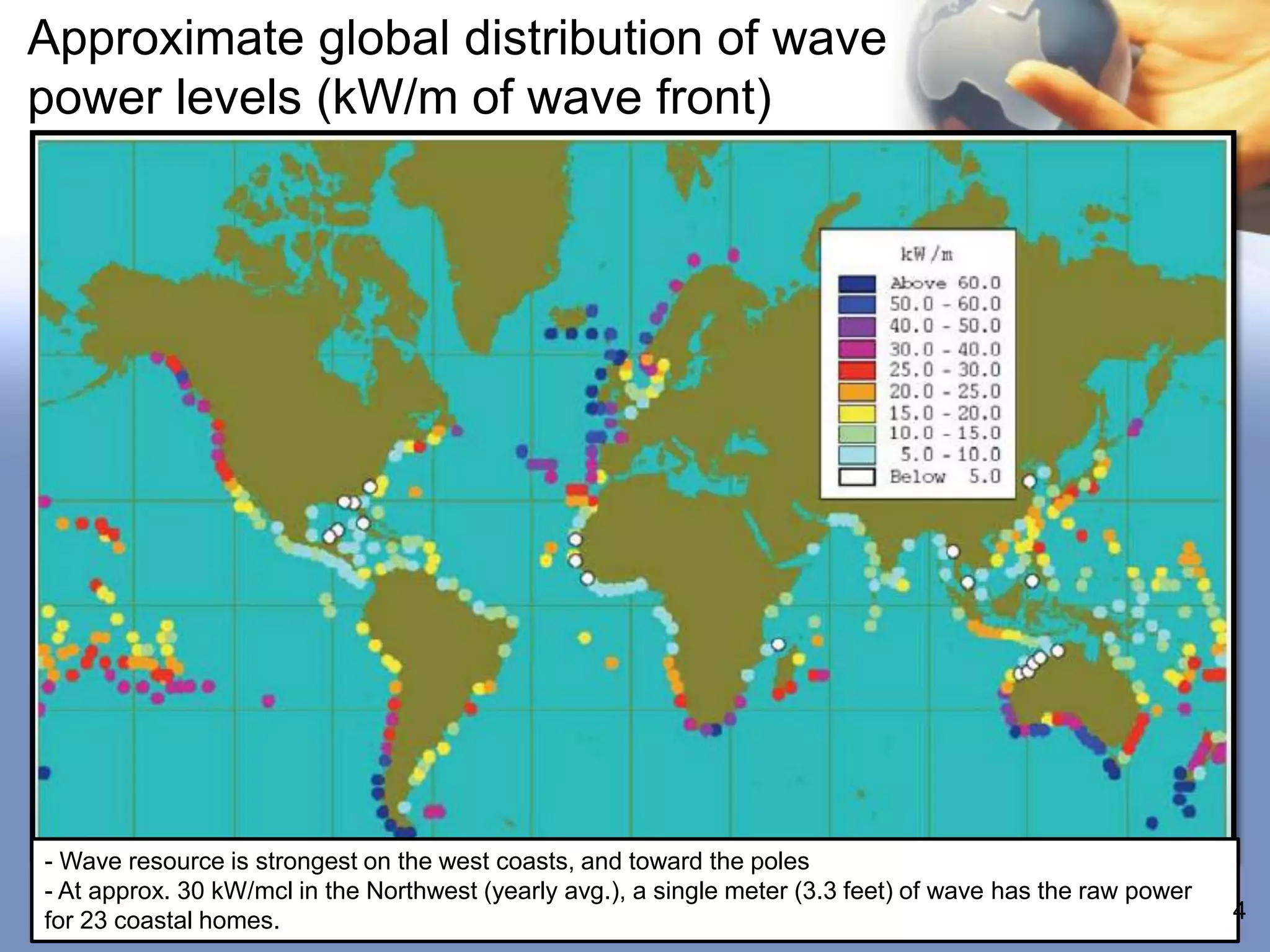
Approximate global distribution of wave
power levels (kW/m of wave front)


- Wave resource is strongest on the west coasts, and toward the poles
- At approx. 30 kW/mcl in the Northwest (yearly avg.), a single meter (3.3 feet) of wave has the raw power
for 23 coastal homes.                                                                                        4
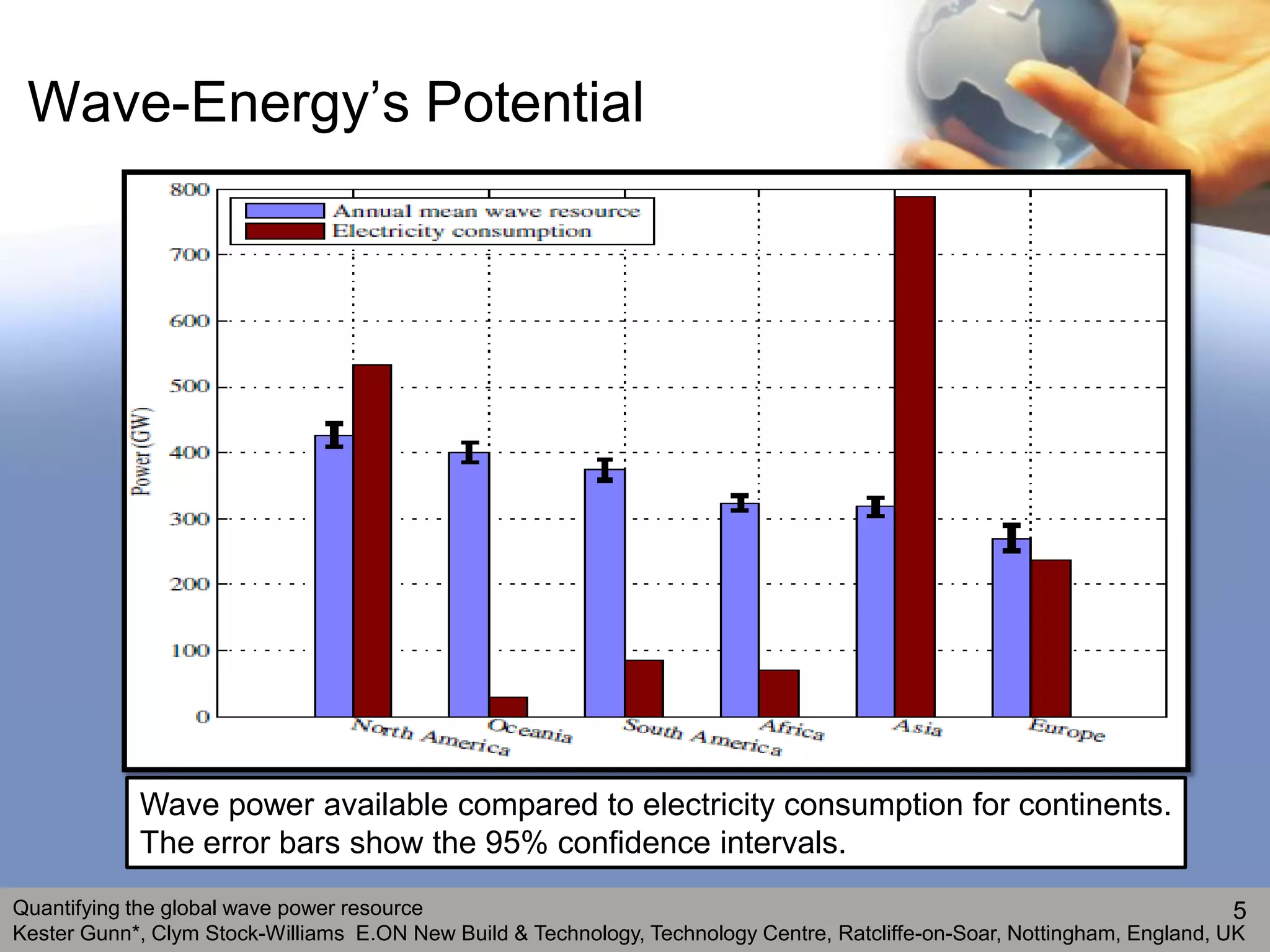
Wave-Energy’s Potential


            Wave power available compared to electricity consumption for continents.
            The error bars show the 95% confidence intervals.
Quantifying the global wave power resource                                                                                 5
Kester Gunn*, Clym Stock-Williams E.ON New Build & Technology, Technology Centre, Ratcliffe-on-Soar, Nottingham, England, UK
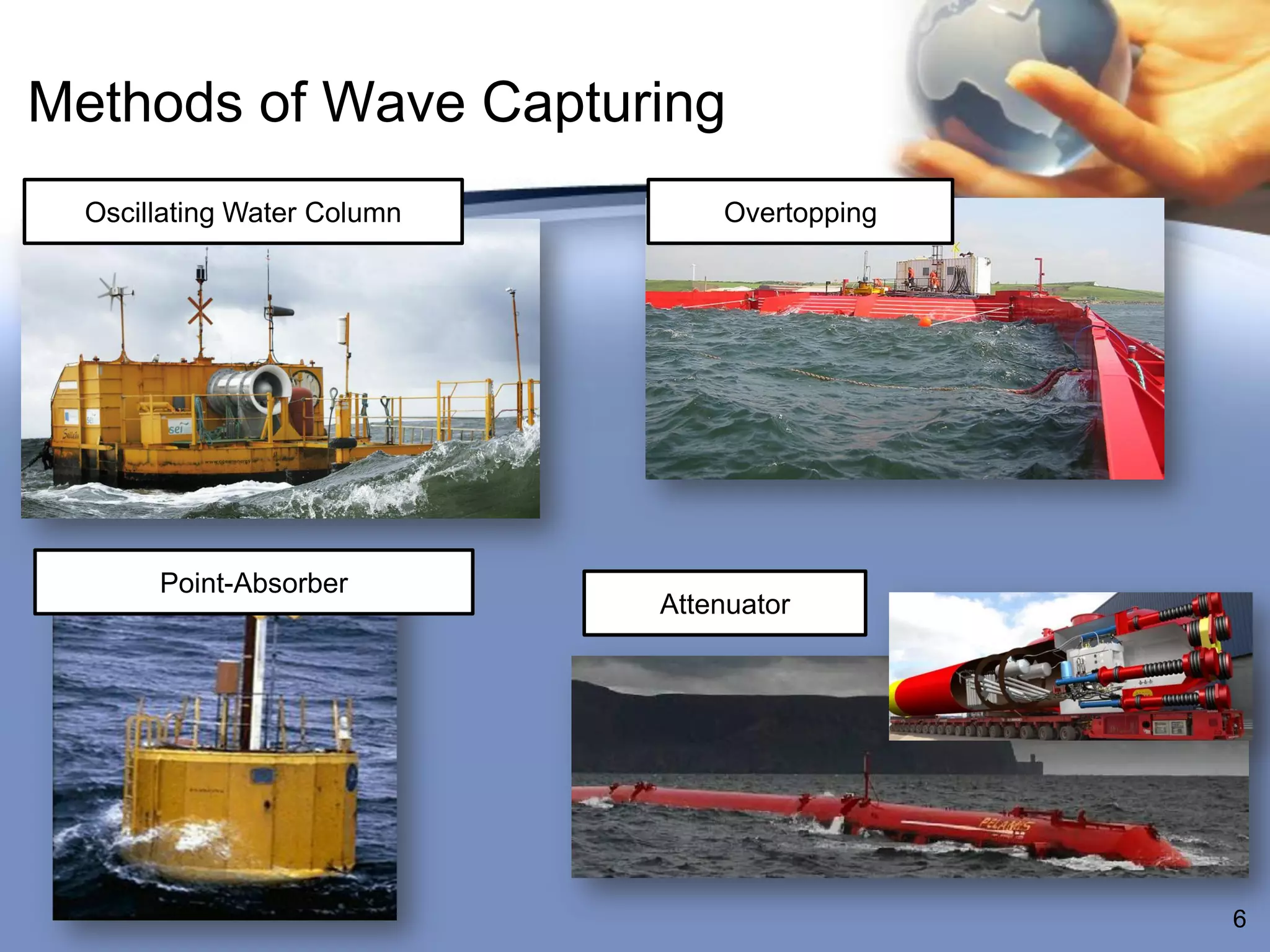
Methods of Wave Capturing
  Oscillating Water Column       Overtopping


       Point-Absorber
                             Attenuator


                                               6
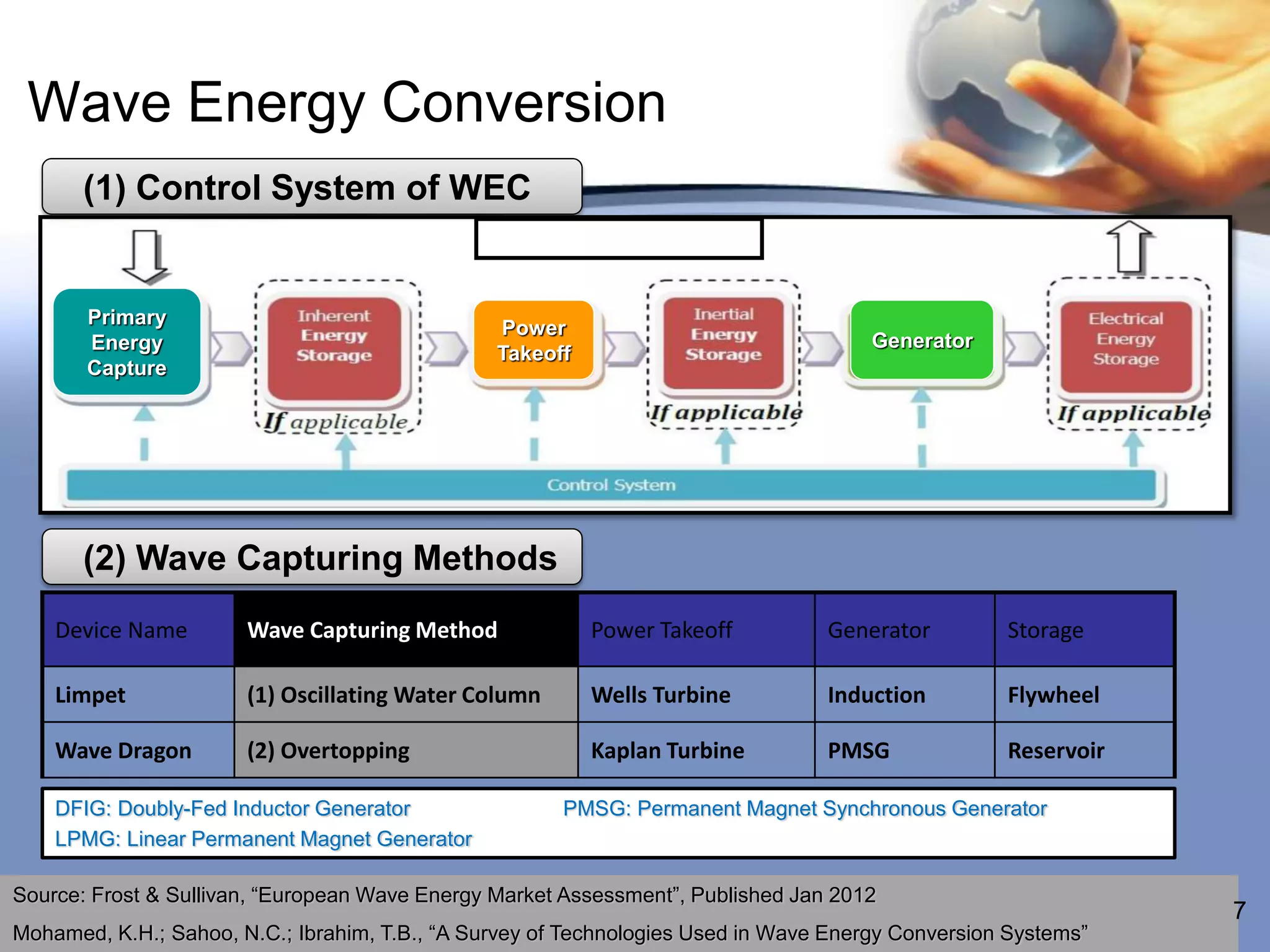
Wave Energy Conversion
       (1) Control System of WEC


       Primary
                                                Power
       Energy                                                                         Generator
                                                Takeoff
       Capture


       (2) Wave Capturing Methods
    Device Name        Wave Capturing Method              Power Takeoff          Generator         Storage

    Limpet             (1) Oscillating Water Column       Wells Turbine          Induction         Flywheel

    Wave Dragon        (2) Overtopping                    Kaplan Turbine         PMSG              Reservoir

    DFIG: Doubly-Fed Inductor Generator                PMSG: Permanent Magnet Synchronous Generator
    LPMG: Linear Permanent Magnet Generator

Source: Frost & Sullivan, “European Wave Energy Market Assessment”, Published Jan 2012
                                                                                                               7
Mohamed, K.H.; Sahoo, N.C.; Ibrahim, T.B., “A Survey of Technologies Used in Wave Energy Conversion Systems”
OUTLINE


 • INTRODUCTION TO WAVE ENERGY
 • WAVE ENERGY CONVERSION SYSTEMS
    OSCILLATING WATER COLUMN (OWC)
      •   Overview
      •   Efficiency
      •   Cost
      •   Scaling
      •   Components
    OVERTOPPING
 • WAVE ENERGY STATUS & OPPORTUNITIES
 • CONCLUSION

                                        8
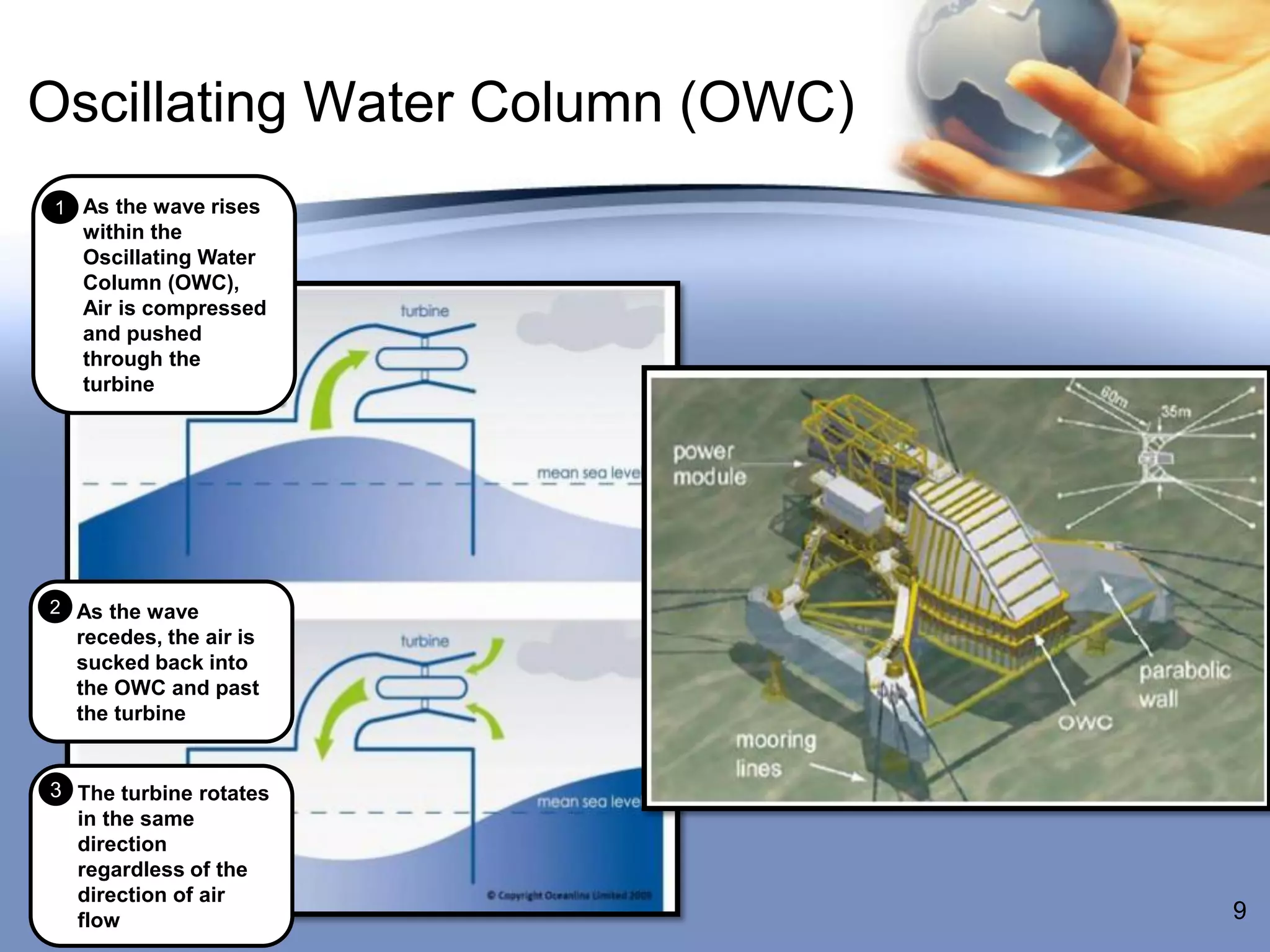
Oscillating Water Column (OWC)
1 As the wave rises
   within the
   Oscillating Water
   Column (OWC),
   Air is compressed
   and pushed
   through the
   turbine


2 As the wave
  recedes, the air is
  sucked back into
  the OWC and past
  the turbine


3 The turbine rotates
  in the same
  direction
  regardless of the
  direction of air
  flow                           9
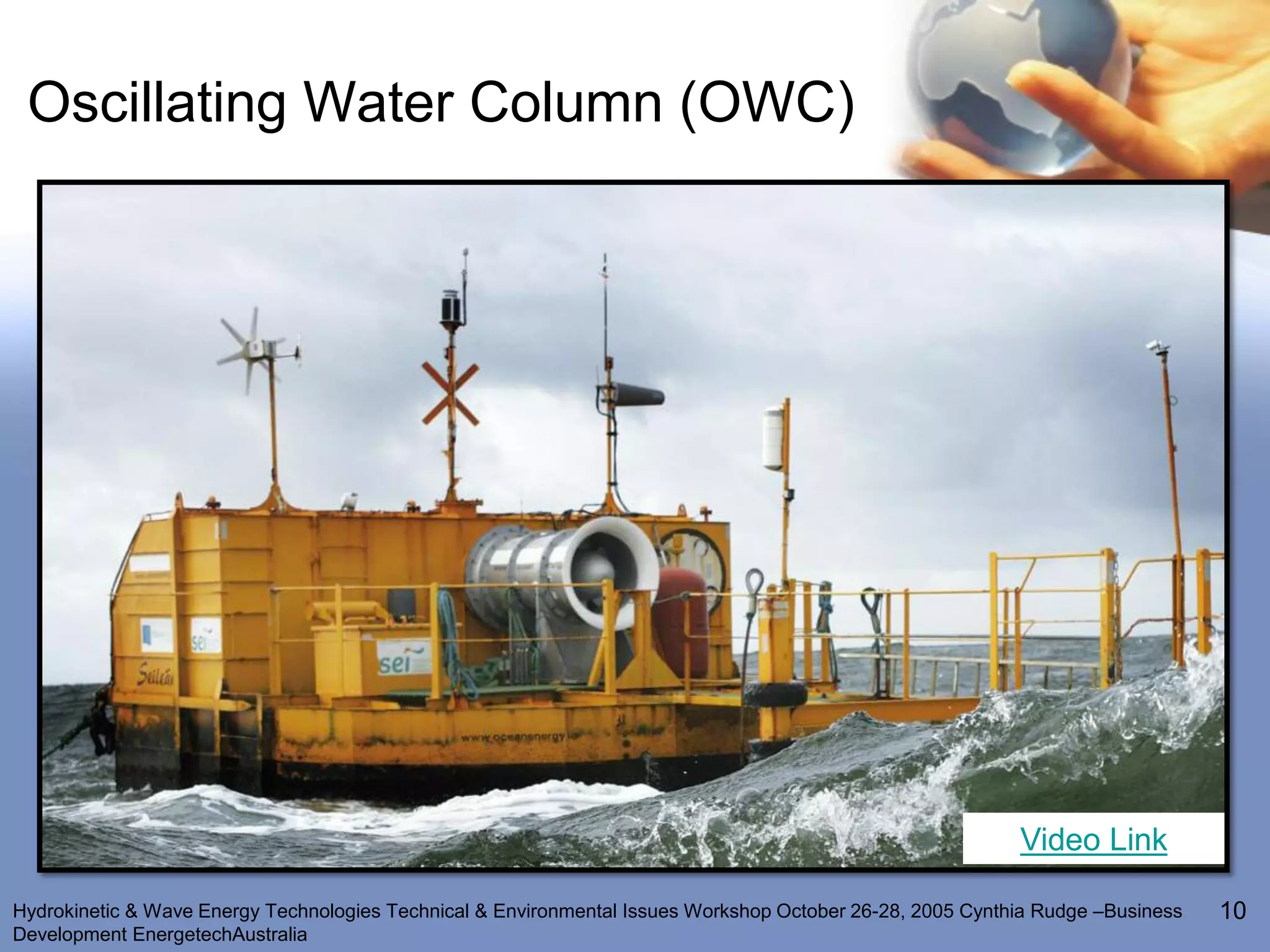
Oscillating Water Column (OWC)


                                                                                                           Video Link

Hydrokinetic & Wave Energy Technologies Technical & Environmental Issues Workshop October 26-28, 2005 Cynthia Rudge –Business   10
Development EnergetechAustralia
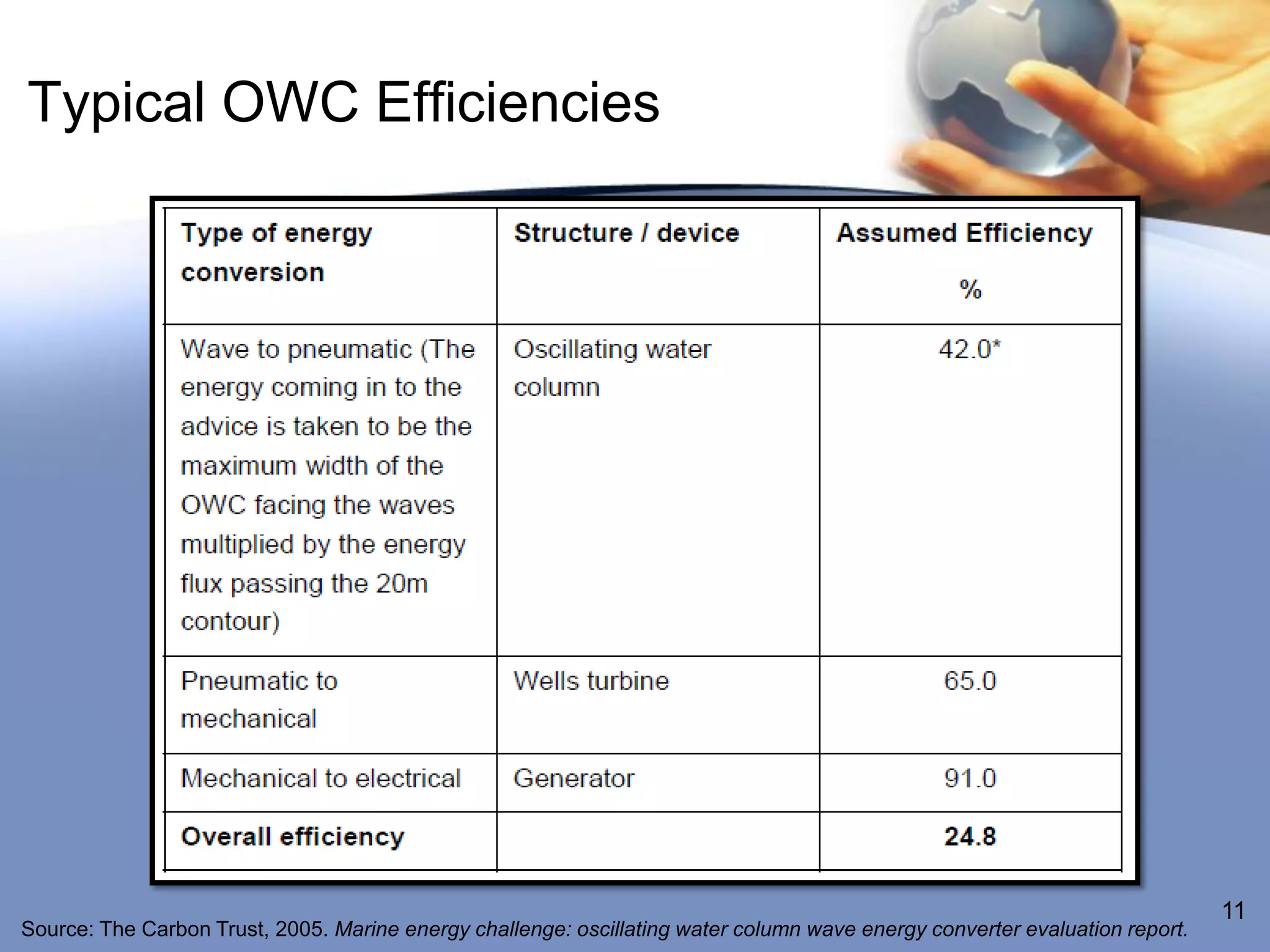
Typical OWC Efficiencies


                                                                                                                             11
Source: The Carbon Trust, 2005. Marine energy challenge: oscillating water column wave energy converter evaluation report.
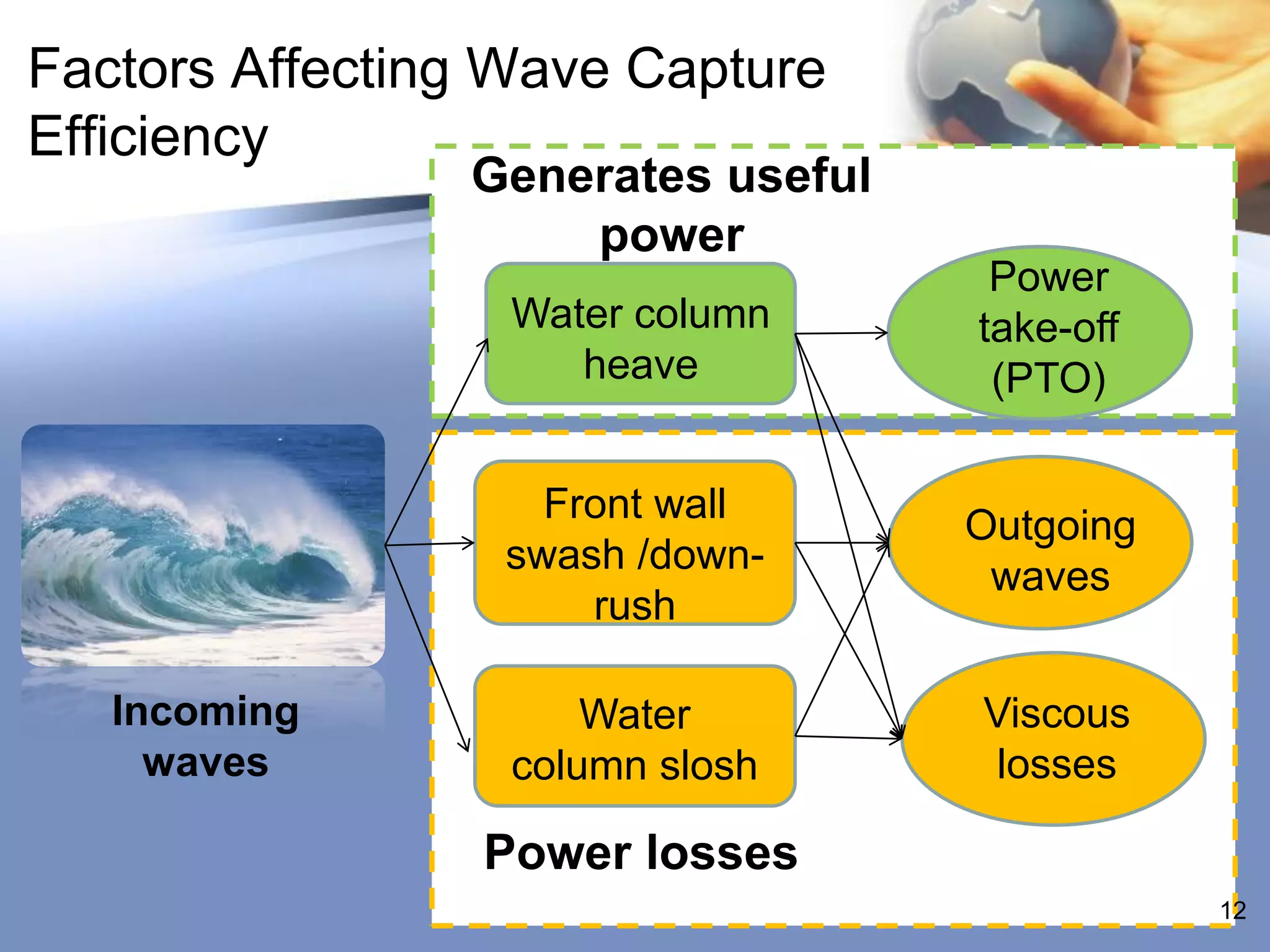
Factors Affecting Wave Capture
Efficiency
                Generates useful
                    power
                                    Power
                  Water column     take-off
                     heave          (PTO)

                   Front wall
                                   Outgoing
                 swash /down-
                                    waves
                     rush

   Incoming           Water        Viscous
     waves        column slosh      losses

                 Power losses
                                              12
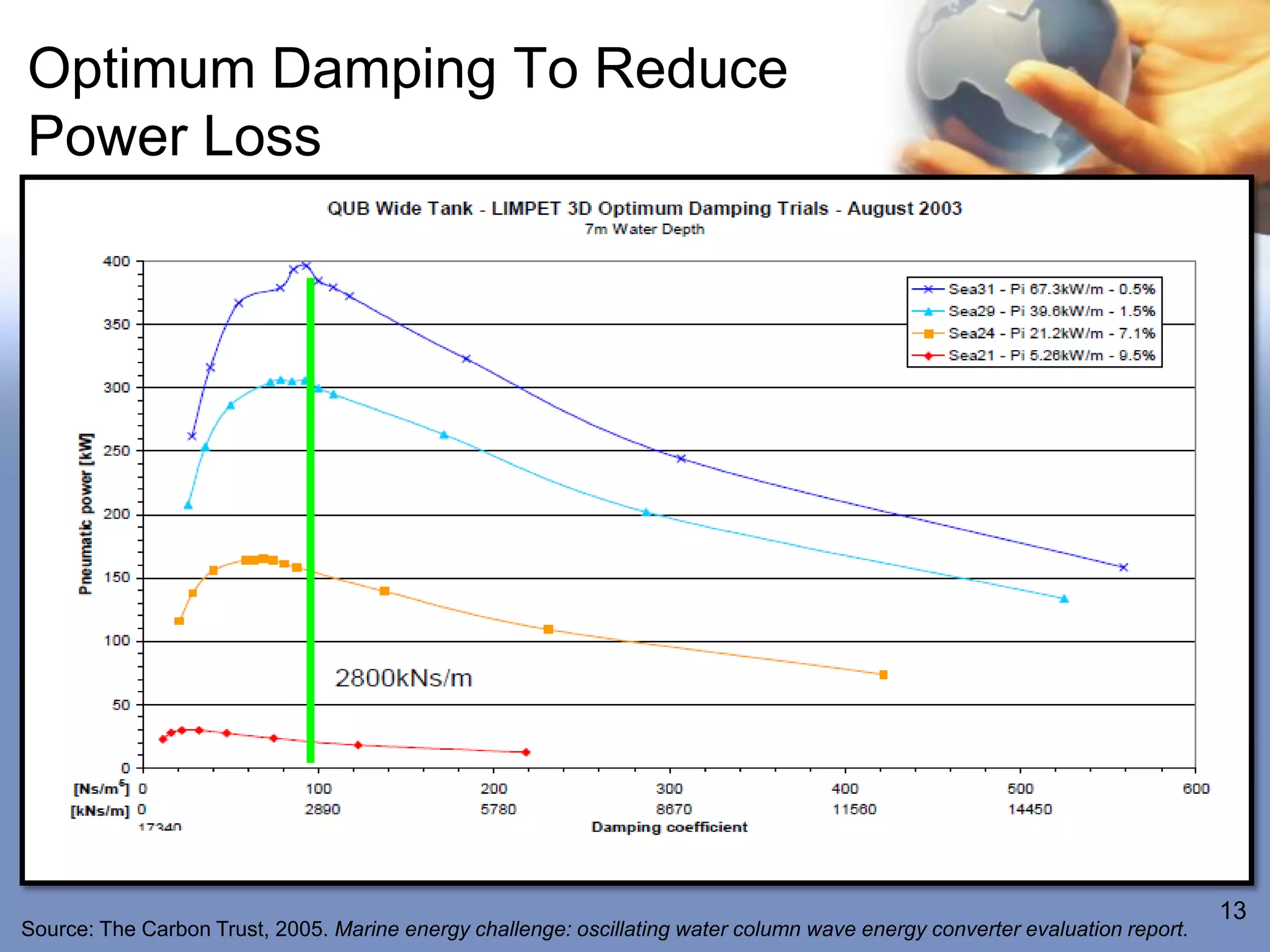
Optimum Damping To Reduce
Power Loss


                                                                                                                             13
Source: The Carbon Trust, 2005. Marine energy challenge: oscillating water column wave energy converter evaluation report.
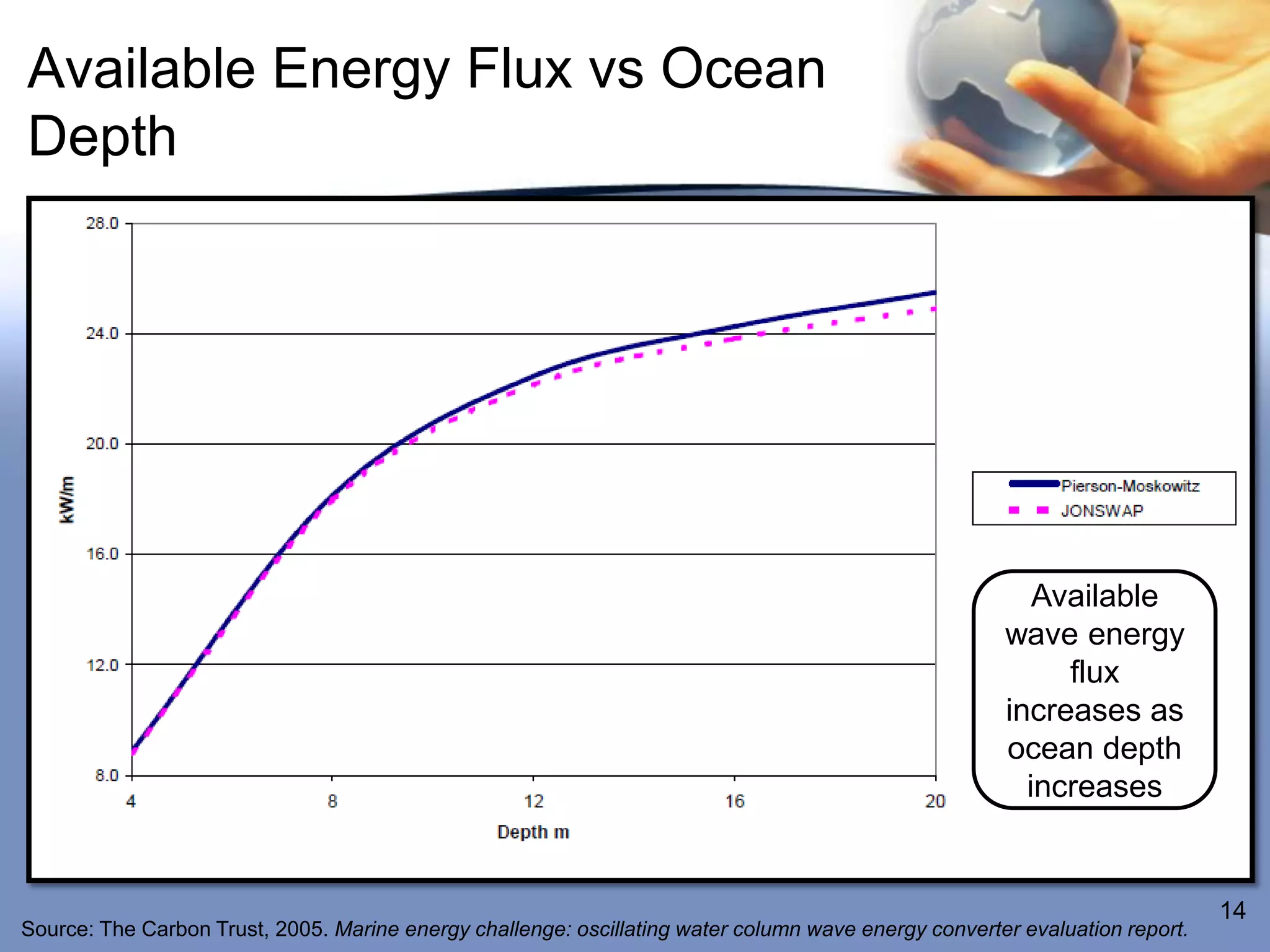
Available Energy Flux vs Ocean
Depth


                                                                                                         Available
                                                                                                      wave energy
                                                                                                           flux
                                                                                                      increases as
                                                                                                      ocean depth
                                                                                                        increases


                                                                                                                             14
Source: The Carbon Trust, 2005. Marine energy challenge: oscillating water column wave energy converter evaluation report.
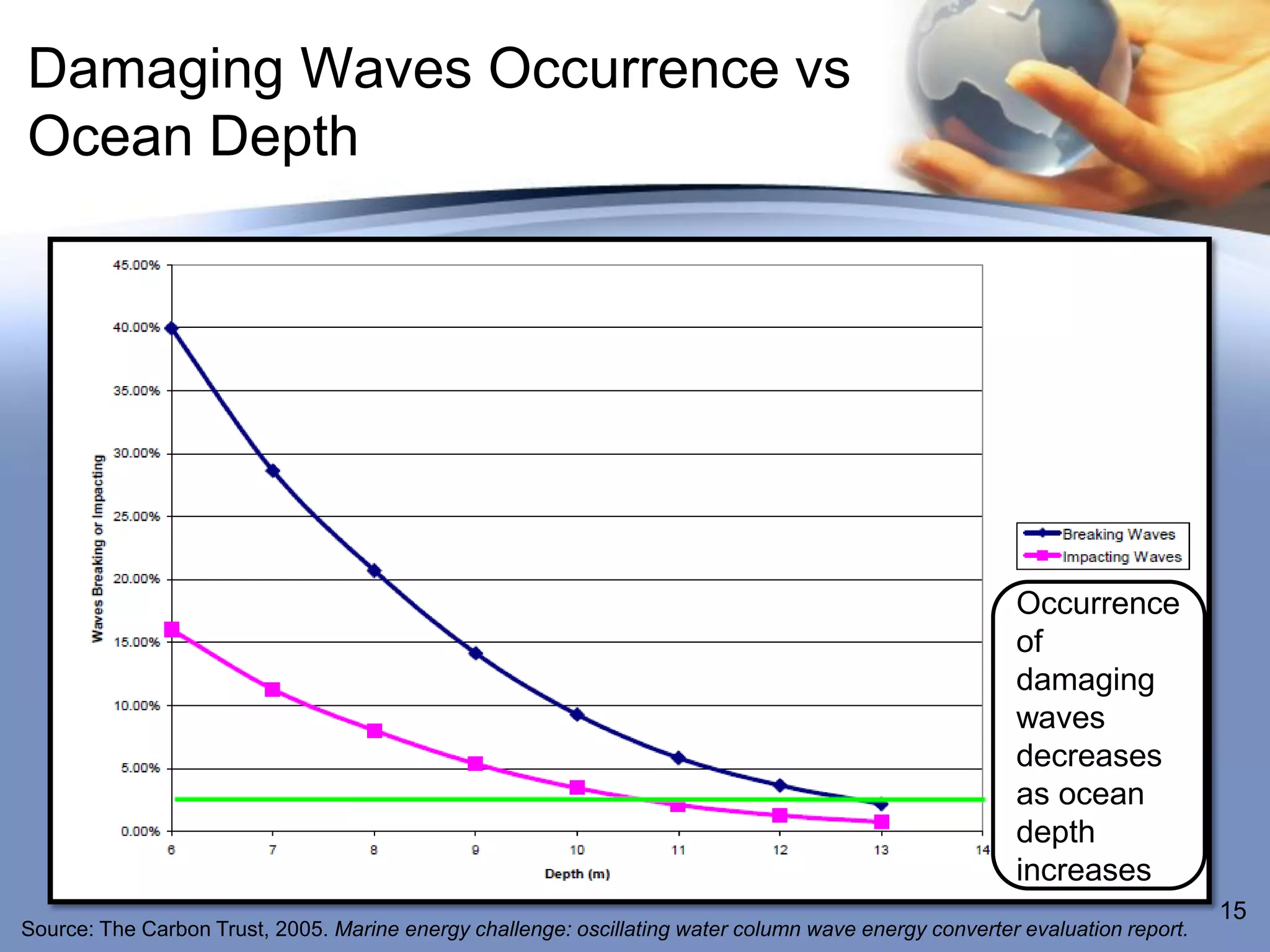
Damaging Waves Occurrence vs
Ocean Depth


                                                                                                       Occurrence
                                                                                                       of
                                                                                                       damaging
                                                                                                       waves
                                                                                                       decreases
                                                                                                       as ocean
                                                                                                       depth
                                                                                                       increases
                                                                                                                             15
Source: The Carbon Trust, 2005. Marine energy challenge: oscillating water column wave energy converter evaluation report.
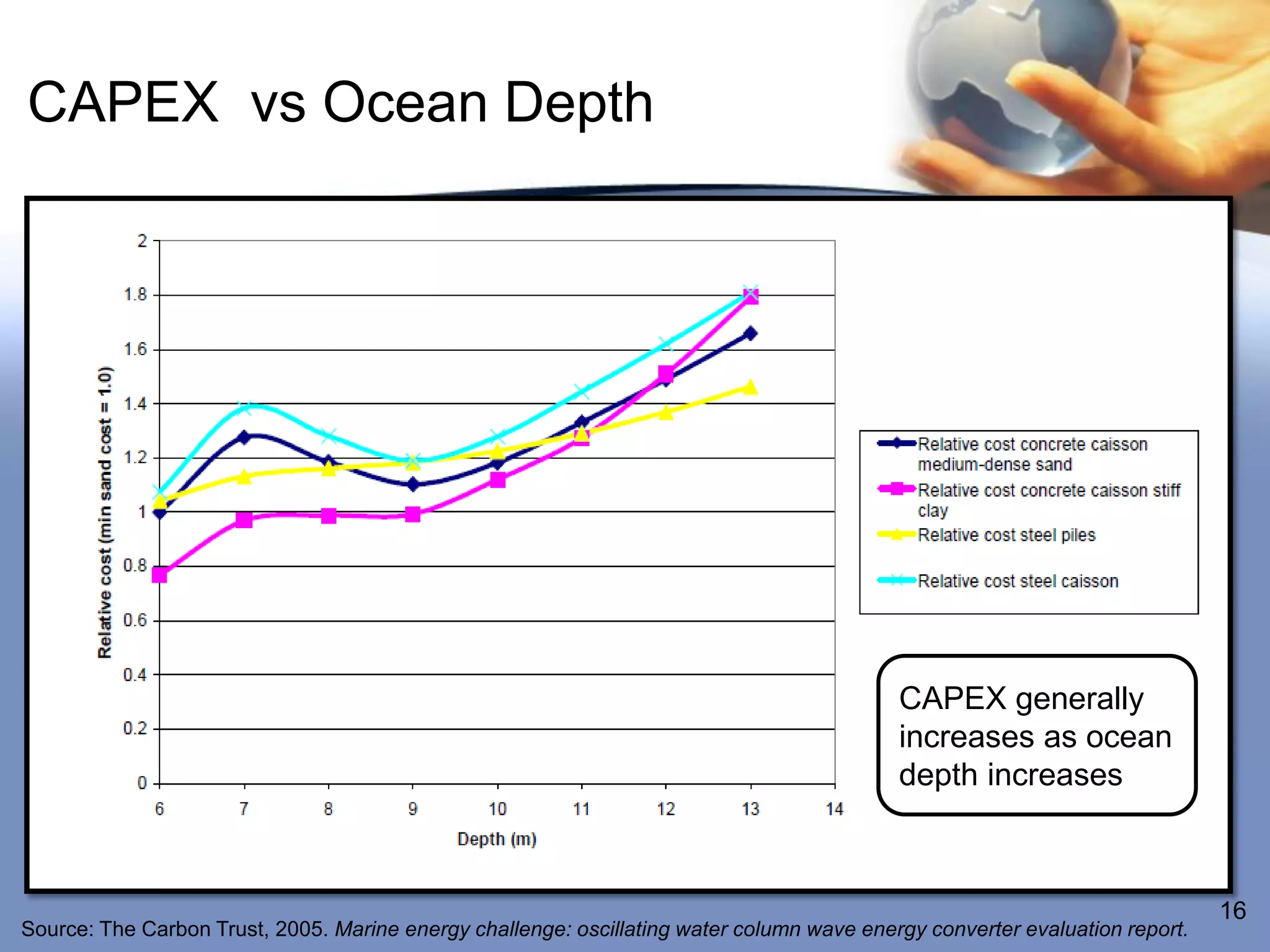
CAPEX vs Ocean Depth


                                                                                           CAPEX generally
                                                                                           increases as ocean
                                                                                           depth increases


                                                                                                                             16
Source: The Carbon Trust, 2005. Marine energy challenge: oscillating water column wave energy converter evaluation report.
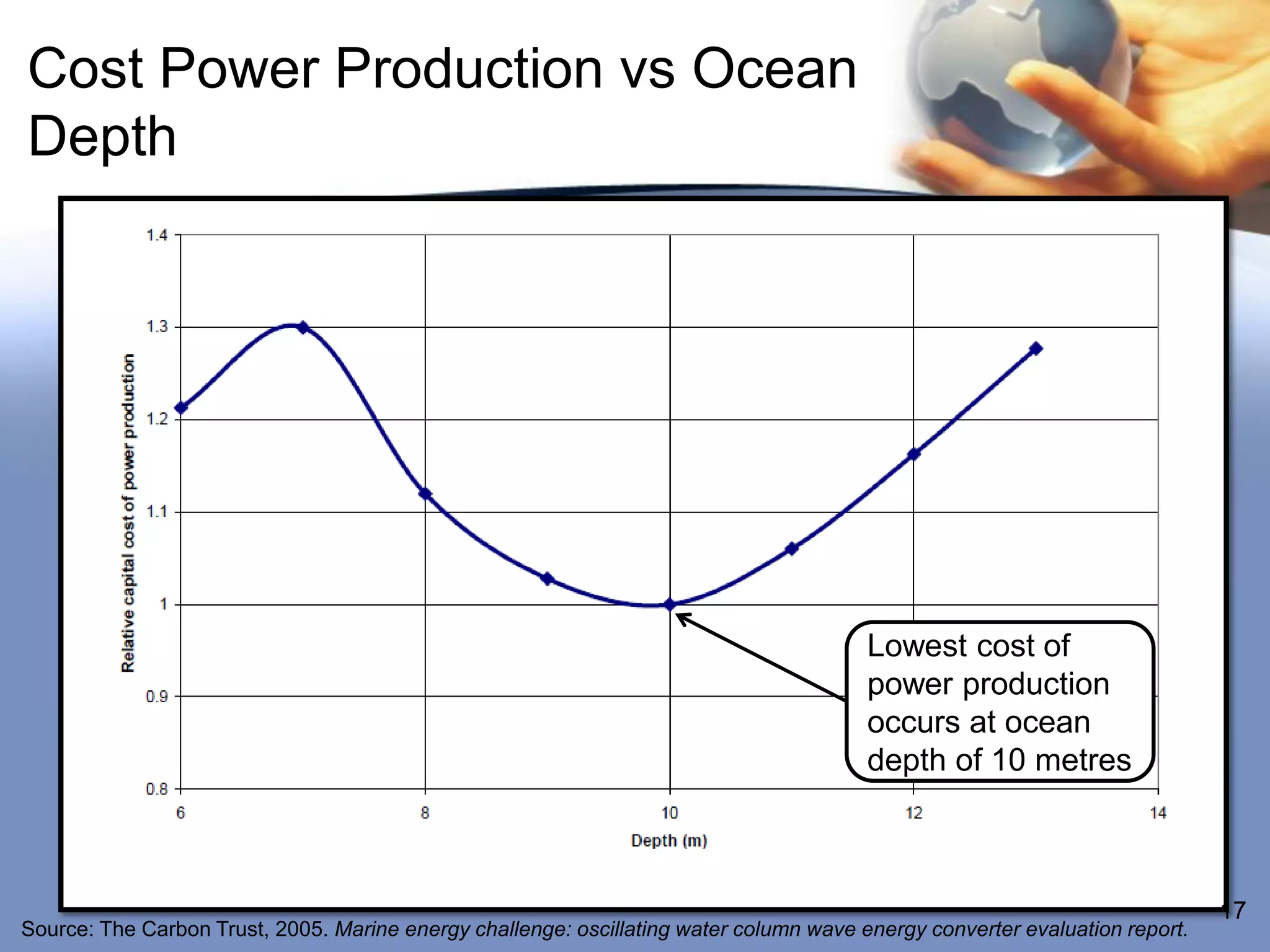
Cost Power Production vs Ocean
Depth


                                                                                        Lowest cost of
                                                                                        power production
                                                                                        occurs at ocean
                                                                                        depth of 10 metres


                                                                                                                             17
Source: The Carbon Trust, 2005. Marine energy challenge: oscillating water column wave energy converter evaluation report.
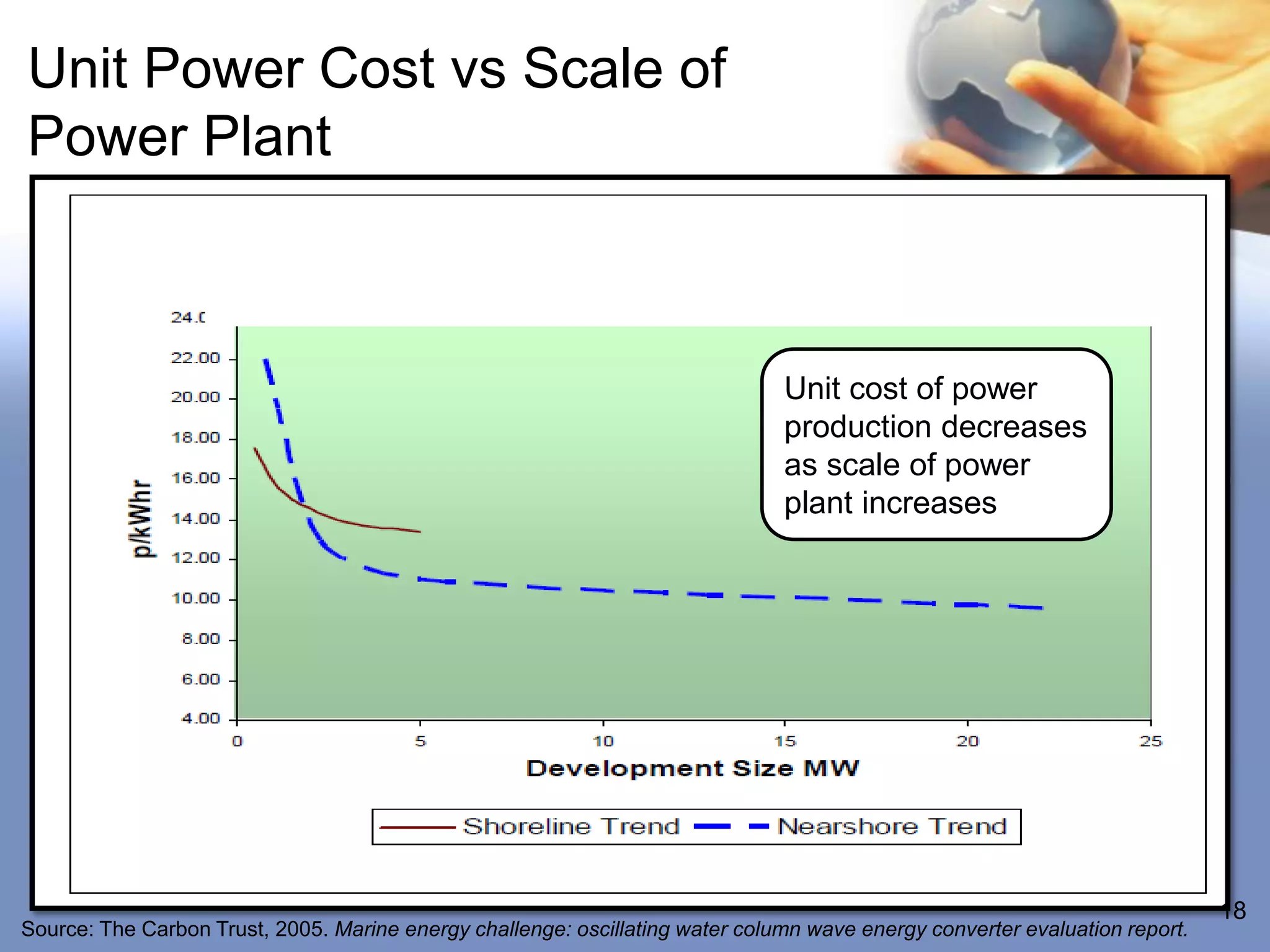
Unit Power Cost vs Scale of
Power Plant


                                                                               Unit cost of power
                                                                               production decreases
                                                                               as scale of power
                                                                               plant increases


                                                                                                                             18
Source: The Carbon Trust, 2005. Marine energy challenge: oscillating water column wave energy converter evaluation report.
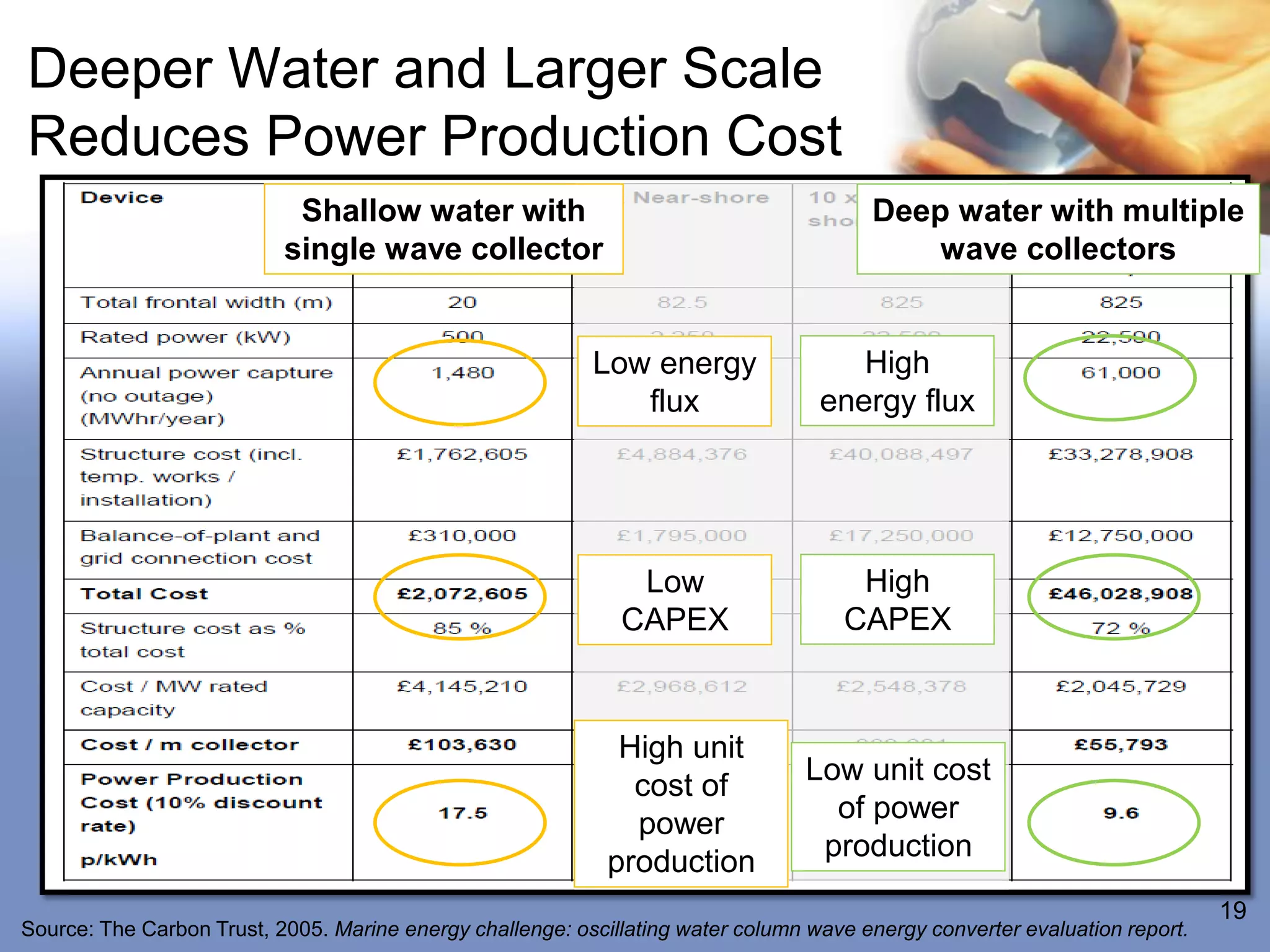
Deeper Water and Larger Scale
Reduces Power Production Cost
                            Shallow water with                                          Deep water with multiple
                           single wave collector                                            wave collectors


                                                           Low energy                 High
                                                              flux                 energy flux


                                                               Low                    High
                                                              CAPEX                  CAPEX


                                                              High unit
                                                               cost of           Low unit cost
                                                               power               of power
                                                             production           production
                                                                                                                             19
Source: The Carbon Trust, 2005. Marine energy challenge: oscillating water column wave energy converter evaluation report.
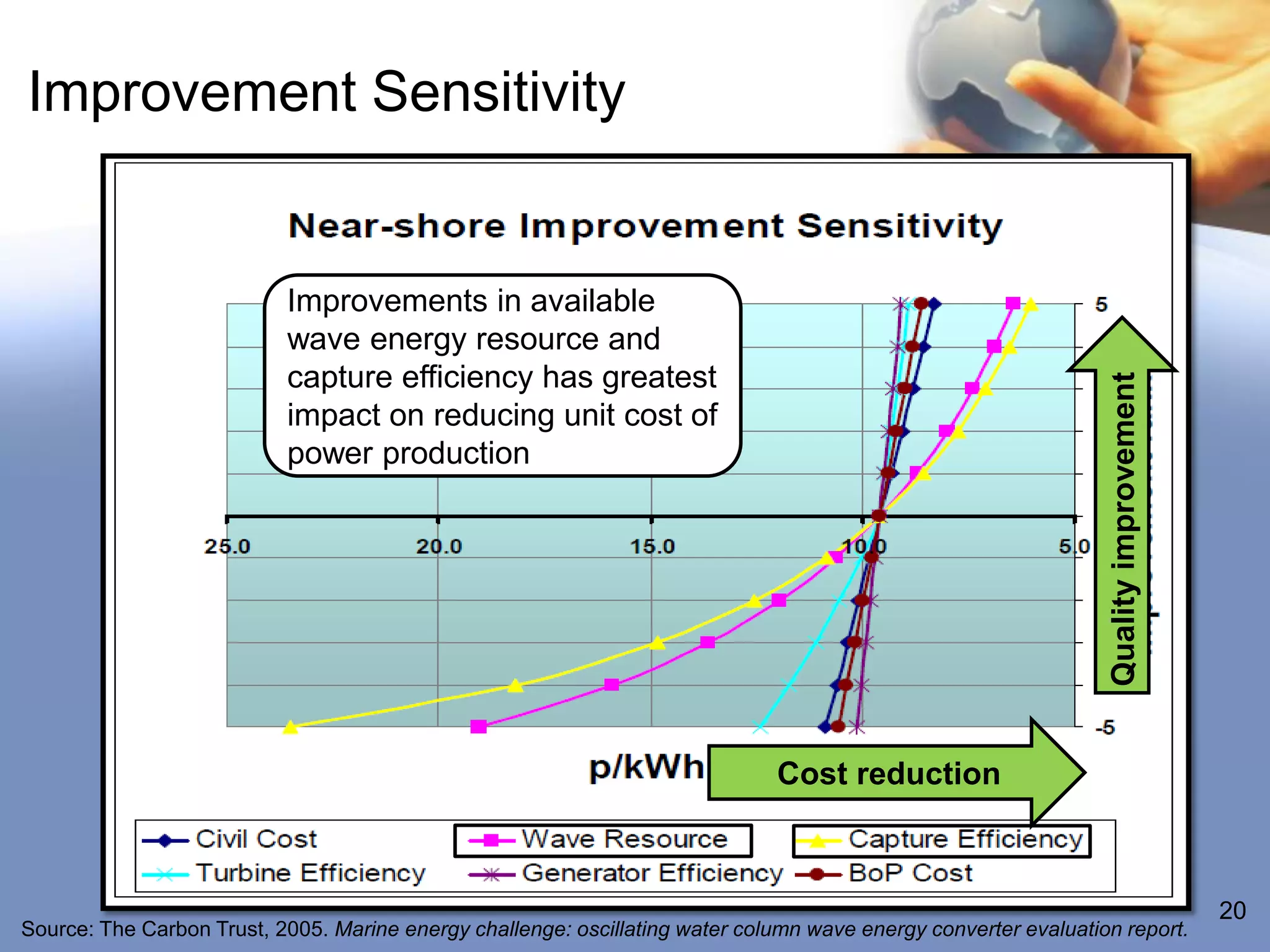
Improvement Sensitivity


                           Improvements in available
                           wave energy resource and
                           capture efficiency has greatest


                                                                                                                 Quality improvement
                           impact on reducing unit cost of
                           power production


                                                                              Cost reduction


                                                                                                                                       20
Source: The Carbon Trust, 2005. Marine energy challenge: oscillating water column wave energy converter evaluation report.
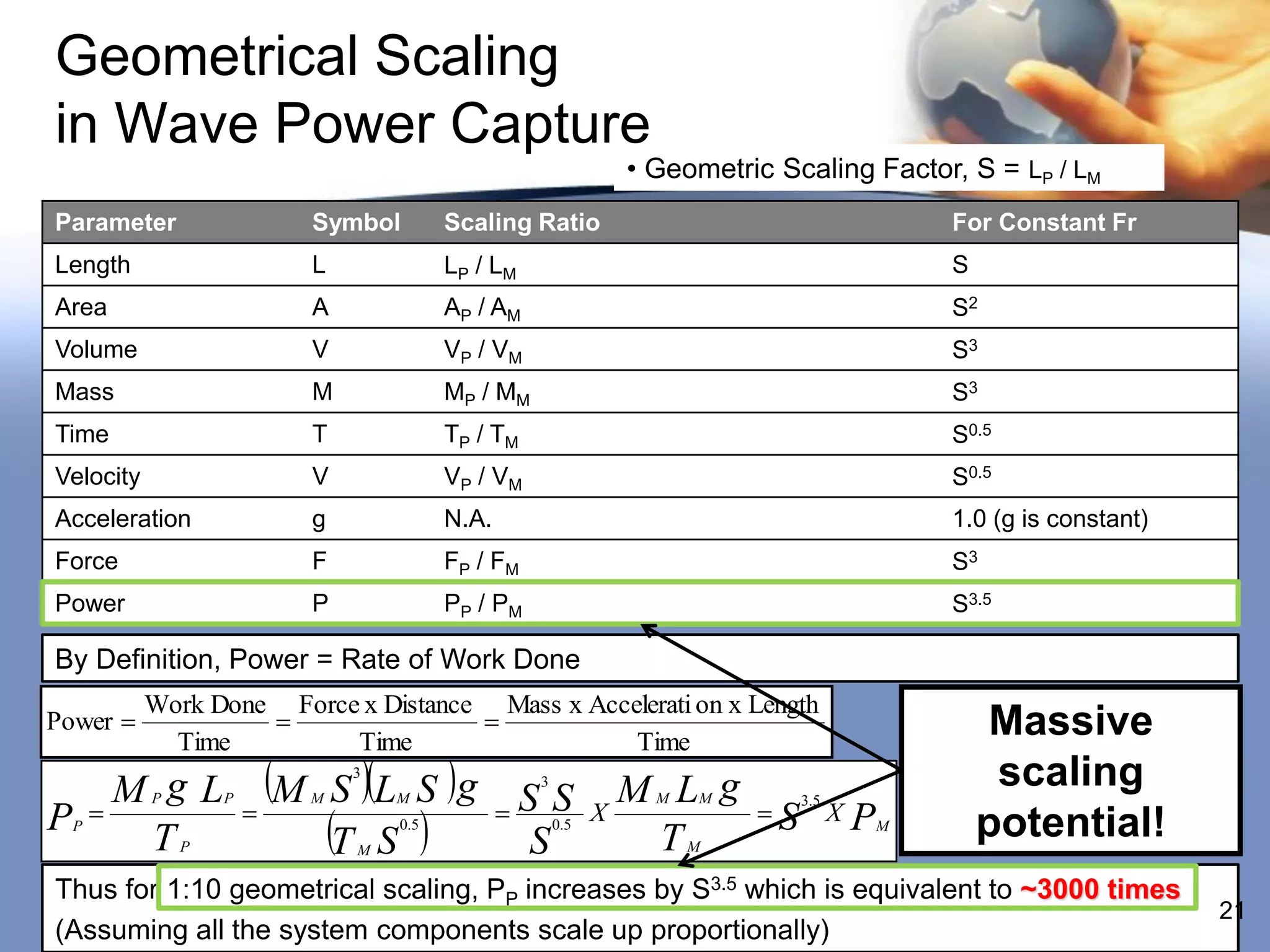
Geometrical Scaling
in Wave Power Capture
                                                                        • Geometric Scaling Factor, S = LP / LM
Parameter                       Symbol          Scaling Ratio                                           For Constant Fr
Length                          L               LP / LM                                                 S
Area                            A               AP / AM                                                 S2
Volume                          V               VP / VM                                                 S3
Mass                            M               MP / MM                                                 S3
Time                            T               TP / TM                                                 S0.5
Velocity                        V               VP / VM                                                 S0.5
Acceleration                    g               N.A.                                                    1.0 (g is constant)
Force                           F               FP / FM                                                 S3
Power                           P               PP / PM                                                 S3.5

By Definition, Power = Rate of Work Done
           Work Done Force x Distance Mass x Accelerati on x Length
Power                                                                                                    Massive
             Time         Time                   Time
    M gL                   M        S L S g
                                     3
                                                          3
                                                                        M L g                               scaling
                                                       S S
           P       P            M         M                               M   M
                      
                                    T S 
                                                                                      3.5
P P                                       0.5                 0.5
                                                                    X           S           X   P   M       potential!
     T         P                      M                  S               T    M


Thus for 1:10 geometrical scaling, PP increases by S3.5 which is equivalent to ~3000 times
                                                                                                                              21
(Assuming all the system components scale up proportionally)
Limitations to Geometric Scaling


 • Collector that is linked to a crest in one location
   and a trough in another would have reduced
   capture efficiency

 • Max of 40m wave collector width recommended

 • Hence, most companies are scaling up power
   plant capacity by using multiple collectors instead
   of further scaling up the size of each collector

                                                         22
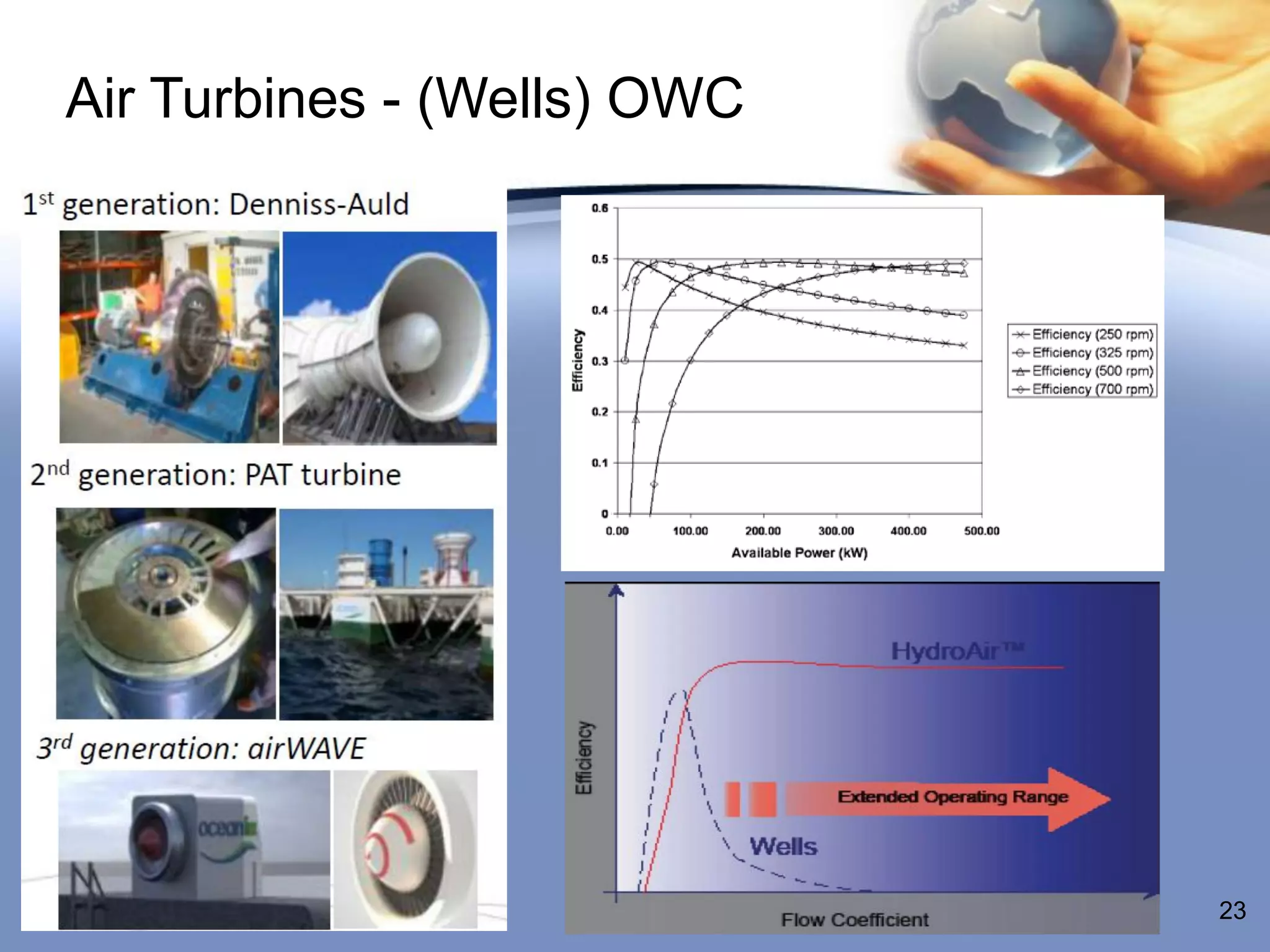
Air Turbines - (Wells) OWC


                             23
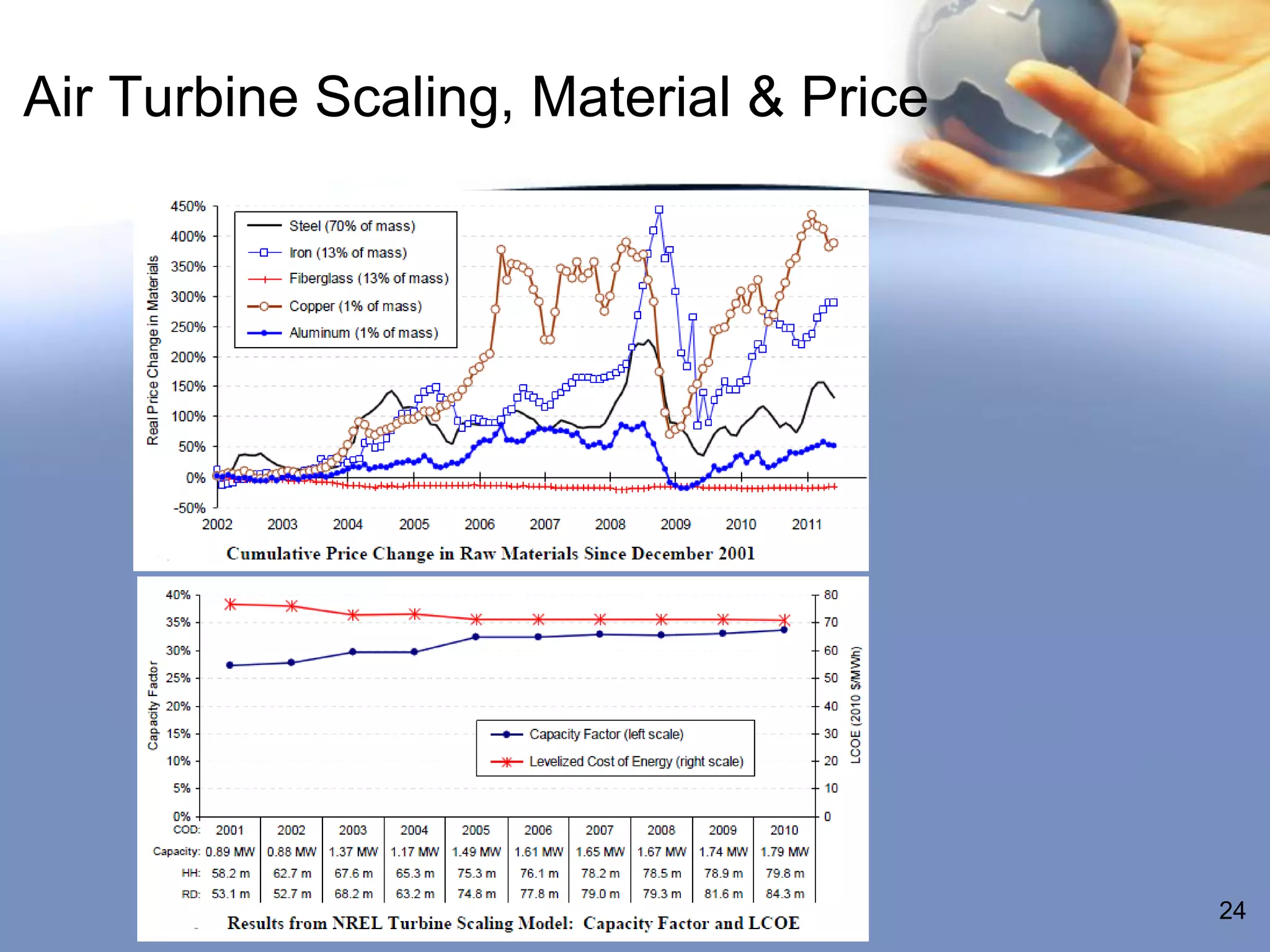
Air Turbine Scaling, Material & Price


                                        24
Oscillating Water Column
Potential for different types of Generator


                                                                                                        Per Unit (P.U.) Power


                                                                                       Induction Generator has lower cost
                                                                                         since it is not using expensive
                                                                                               permanent magnet


Machado, I.R.; Bozzi, F.A.; Watanabe, E.H.; Garcia-Rosa, P.B.; Martinez, M.; Molina, M.G.; Mercado, P.E.; , "Wave energy conversion system using
asynchronous generators - a comparative study," Power Electronics Conference (COBEP), 2011 Brazilian , vol., no., pp.286-291, 11-15 Sept. 2011doi:
10.1109/COBEP.2011.6085300URL: http://ieeexplore.ieee.org.libproxy1.nus.edu.sg/stamp/stamp.jsp?tp=&arnumber=6085300&isnumber=6085159
                                                                                                                                                     25
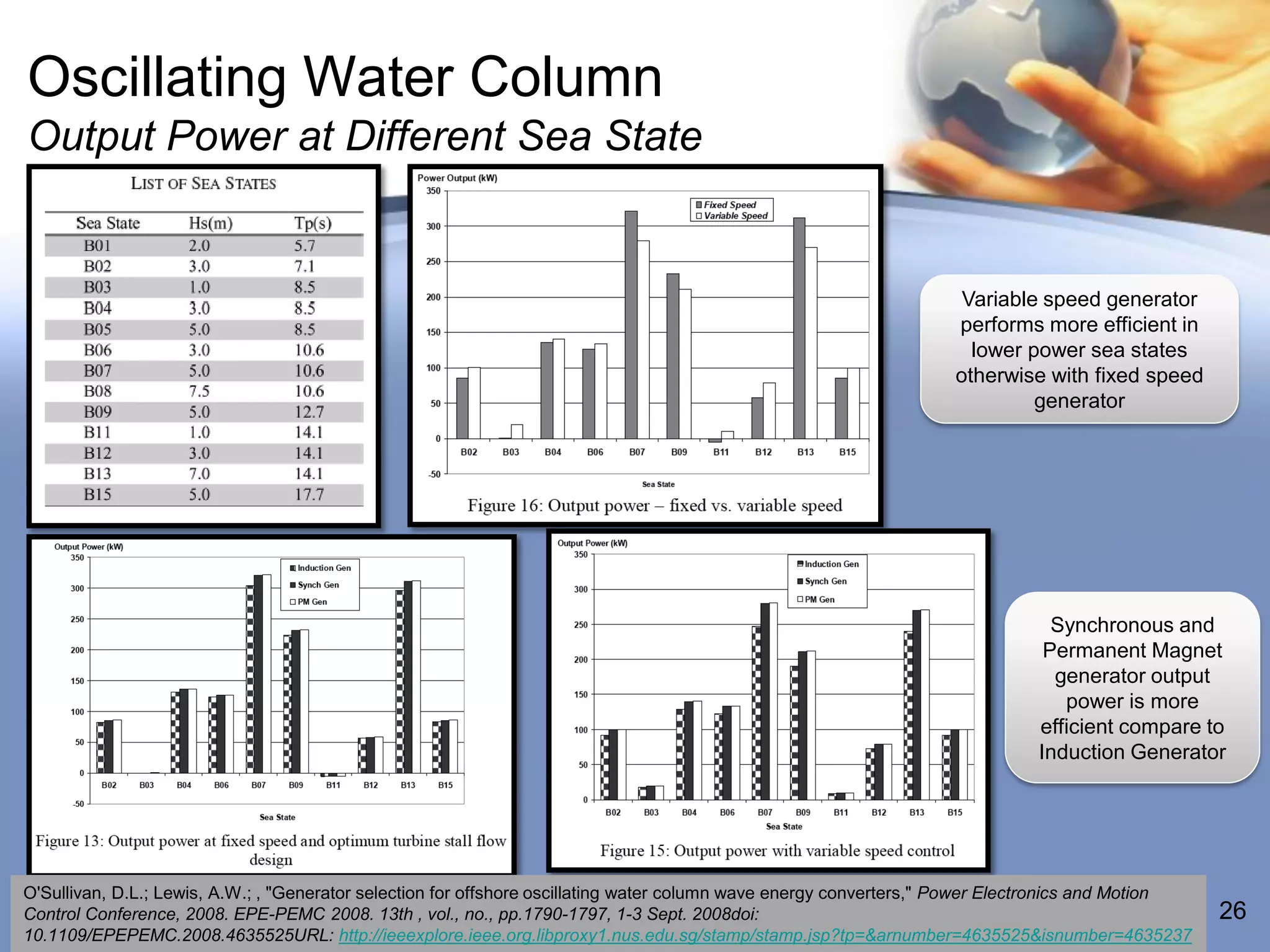
Oscillating Water Column
Output Power at Different Sea State


                                                                                                                    Variable speed generator
                                                                                                                   performs more efficient in
                                                                                                                     lower power sea states
                                                                                                                   otherwise with fixed speed
                                                                                                                            generator


                                                                                                                                Synchronous and
                                                                                                                               Permanent Magnet
                                                                                                                                generator output
                                                                                                                                 power is more
                                                                                                                              efficient compare to
                                                                                                                              Induction Generator


O'Sullivan, D.L.; Lewis, A.W.; , "Generator selection for offshore oscillating water column wave energy converters," Power Electronics and Motion
Control Conference, 2008. EPE-PEMC 2008. 13th , vol., no., pp.1790-1797, 1-3 Sept. 2008doi:                                                         26
10.1109/EPEPEMC.2008.4635525URL: http://ieeexplore.ieee.org.libproxy1.nus.edu.sg/stamp/stamp.jsp?tp=&arnumber=4635525&isnumber=4635237
OUTLINE


 • INTRODUCTION TO WAVE ENERGY
 • WAVE ENERGY CONVERSION SYSTEMS
        OSCILLATING WATER COLUMN (OWC)
      OVERTOPPING
       • Overview
       • Capacity
       • Cost
       • Efficiency
       • Components
 •   WAVE ENERGY STATUS & OPPORTUNITIES
 •   CONCLUSION
                                          27
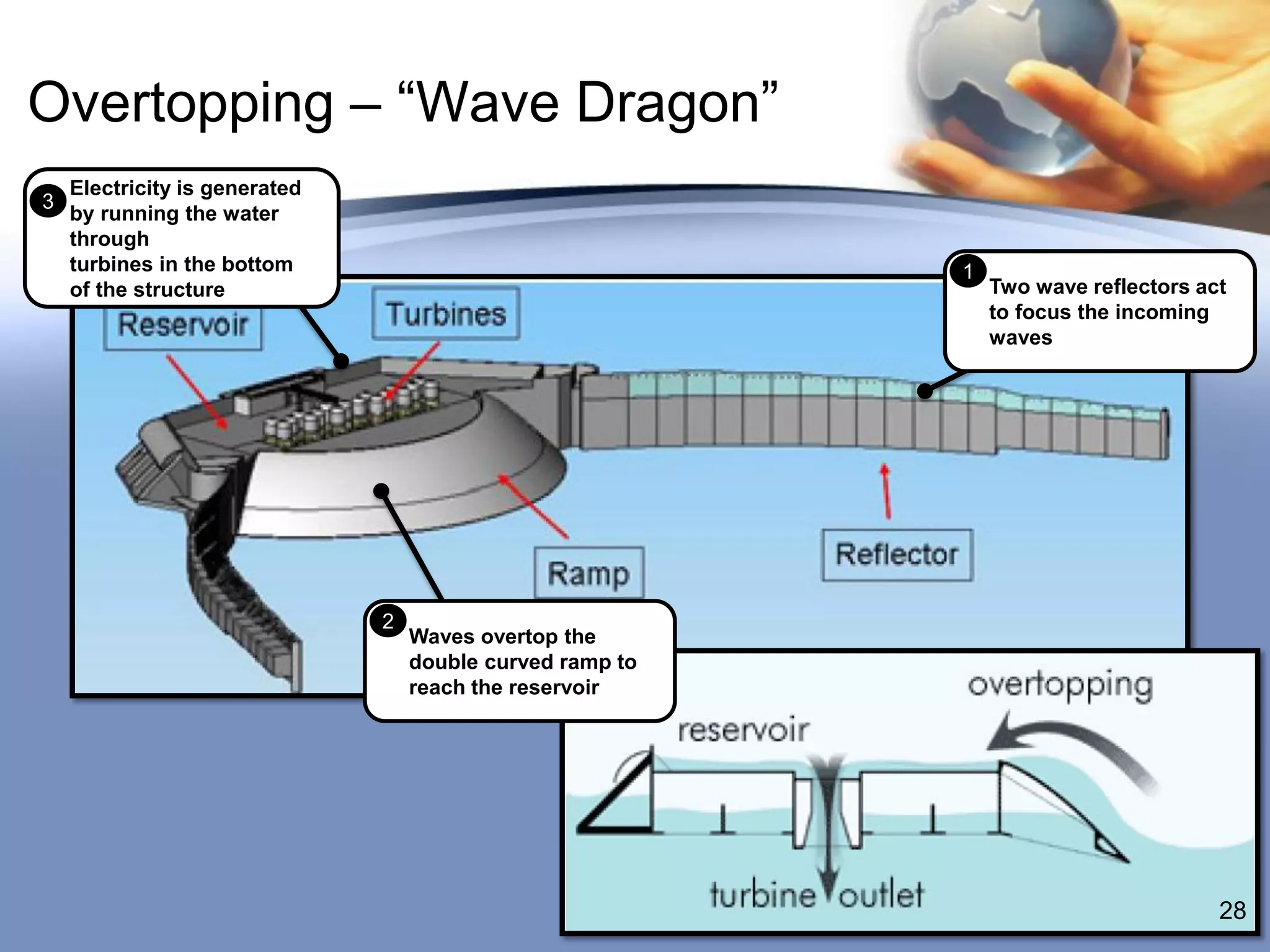
Overtopping – “Wave Dragon”
    Electricity is generated
3
    by running the water
    through
    turbines in the bottom                                 1
    of the structure                                           Two wave reflectors act
                                                               to focus the incoming
                                                               waves


                               2
                                   Waves overtop the
                                   double curved ramp to
                                   reach the reservoir


                                                                                     28
Overtopping – “Wave Dragon”


                              Video Link
                                           29
Installed Global Capacity of Wave
 Power on Trial (MW)

            1600                                                       Based on National
                                                                        Targets set by 4
            1400                                                         EU Countries

            1200

            1000

              800

              600

              400
                                                                    Ongoing
                                                                   as planned
              200

                0
                        2000        2008         2009            2011         2012         2020
               MW        0.5         2.25         0.34           6.4          73.6         1530

http://clean-future.com/renewable-energy/wave-power/wave-farms                                    30
EU Energy directive January 2008
Cost Comparison Amongst
 Various Technologies

                                                                                                           Natural Gas and
                        Wave Dragon         Solar PV                 Wind                 Biomass
                                                                                                                Coal
   Energy Density            High           Moderate              Moderate                  High                High
Approx. 1000 x denser
                        Low – Moderate         Low                Moderate                Very High               NA
      than wind
    Predictability          High.           Moderate              Moderate                Moderate             Moderate
 Accurate forecasts                       Low except in         Dispatchable,
                          Moderate                                                      Dispatchable         Dispatchable
  days in advance                          some sites        subject to fuel supply
   Capacity Factor        30% - 45%        12% - 25%              20% - 40%                 85%               50% - 90%
    Visual Impact          Moderate        Unobtrusive             Moderate                 High               Very High
                                                                                         Extensive but        Extensive but
                                         Limited for large
   Potential Sites        Extensive                               Moderate            permitting process   permitting process
                                          capacity sites
                                                                                        can be lengthy       can be lengthy
 Cost Per Kilowatt
Hour – Utility Power        12¢*            9 - 19¢                5 - 24¢                9 - 14¢              7 - 15¢


• By YEAR 2025: electricity costs of €0.08/kWh
• By YEAR 2050: electricity costs of €0.03-0.04/kWh*
OCEAN ENERGY TECHNOLOGIES for RENEWABLE ENERGY GENERATION
AUGUST 2009 Peter Meisen President, Global Energy Network Institute (GENI)
Alexandre Loiseau Research Associate, Global Energy Network Institute alexandre.loiseau.10@eigsi.fr
*Centre for Renewable Energy Sources. (2002). Wave energy utilization in Europe – Current status and                        31
perspectives. European thematic network on wave energy.
Costs Reduction Opportunity


 How is electricity cost expected to reach about
 0.03-0.04 €/kWh by 2050?

 Main part of the cost reduction and efficiency improvement
 should be realized by:
 • R&D
    – Multi-Level Reservoirs
    – Improvised Wave ramp
    – Wave Prediction Control Algorithm
 • Technical Learning Effects
 • Cumulative effects on Costs
                                                              32
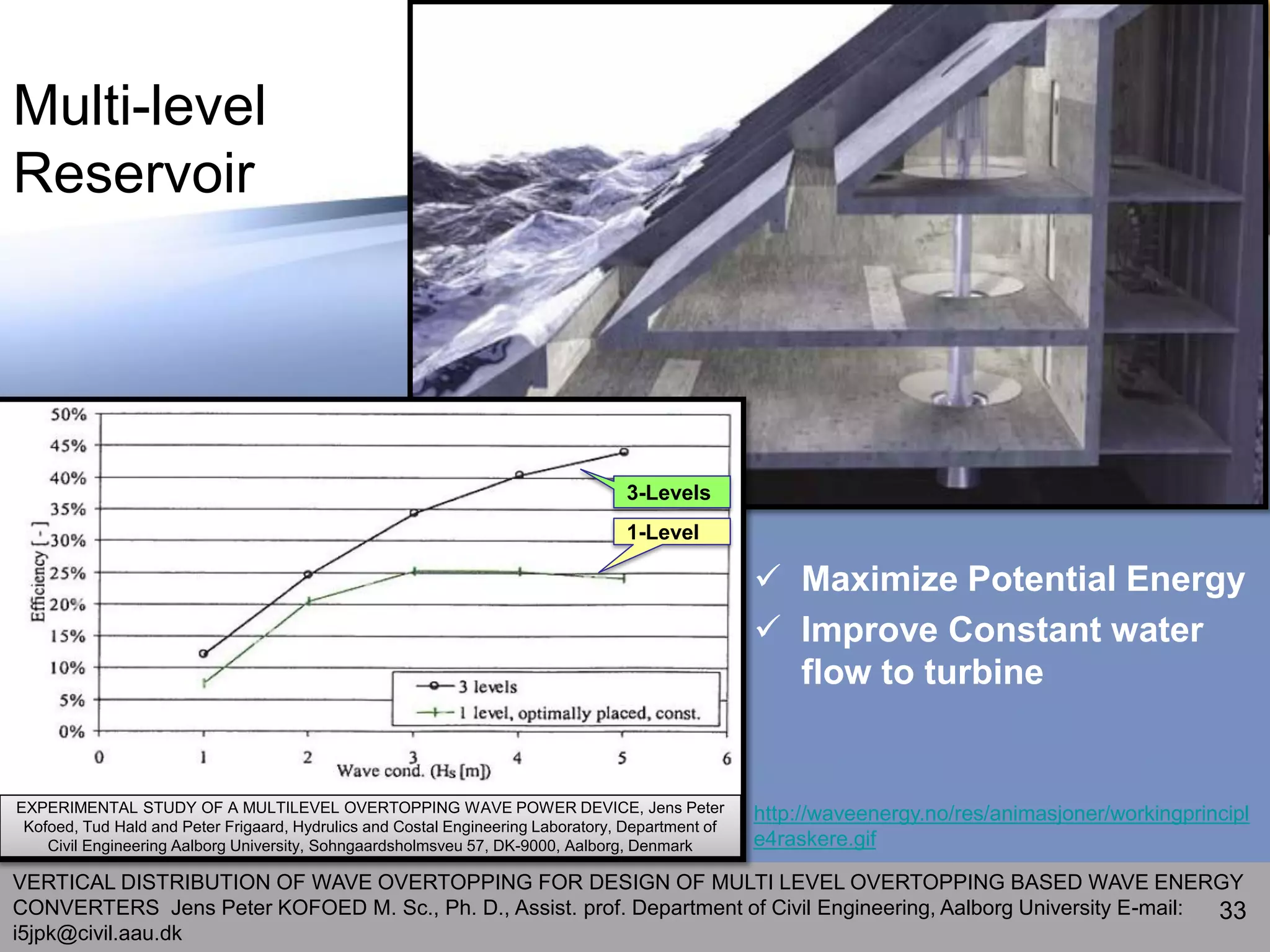
Multi-level
Reservoir


                                                                                  3-Levels
                                                                                  1-Level

                                                                                                    Maximize Potential Energy
                                                                                                    Improve Constant water
                                                                                                     flow to turbine


EXPERIMENTAL STUDY OF A MULTILEVEL OVERTOPPING WAVE POWER DEVICE, Jens Peter                       http://waveenergy.no/res/animasjoner/workingprincipl
 Kofoed, Tud Hald and Peter Frigaard, Hydrulics and Costal Engineering Laboratory, Department of
    Civil Engineering Aalborg University, Sohngaardsholmsveu 57, DK-9000, Aalborg, Denmark         e4raskere.gif

VERTICAL DISTRIBUTION OF WAVE OVERTOPPING FOR DESIGN OF MULTI LEVEL OVERTOPPING BASED WAVE ENERGY
CONVERTERS Jens Peter KOFOED M. Sc., Ph. D., Assist. prof. Department of Civil Engineering, Aalborg University E-mail: 33
i5jpk@civil.aau.dk
Improvised Wave Ramp

• This wave energy converter
  makes use of overtopping
  wave energy conversion
  technology to rotate a dual
  rotor system and convert
  wave energy directly into
  continuous rotary motion.
• This is done via mini
  buckets which are lined up
  along the ramp in a angled
  direction to support the
  rotation.
• Current Overall wave-to-
  wire efficiency at 18% could
  be increased up to 30%
                                 http://www.kineticwavepower.com/
                                                                    34
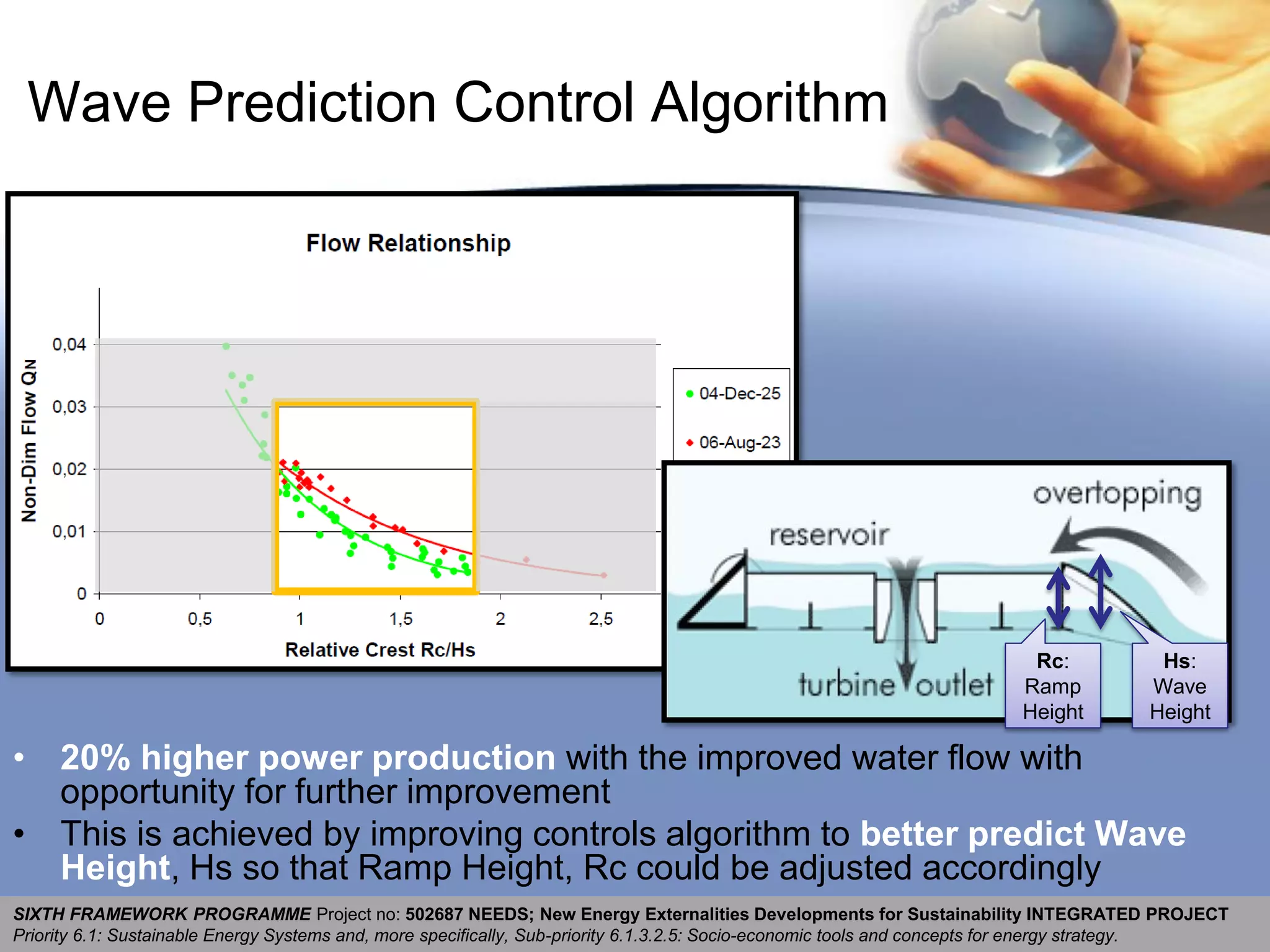
Wave Prediction Control Algorithm


                                                                                                                        Rc:            Hs:
                                                                                                                       Ramp           Wave
                                                                                                                       Height         Height

• 20% higher power production with the improved water flow with
  opportunity for further improvement
• This is achieved by improving controls algorithm to better predict Wave
  Height, Hs so that Ramp Height, Rc could be adjusted accordingly
SIXTH FRAMEWORK PROGRAMME Project no: 502687 NEEDS; New Energy Externalities Developments for Sustainability INTEGRATED PROJECT                 35
Priority 6.1: Sustainable Energy Systems and, more specifically, Sub-priority 6.1.3.2.5: Socio-economic tools and concepts for energy strategy.
Technical Learning Effects


      €/kw


                 Installation cost depending of production accumulated sales volume in GW

• Learning Rate of 14% (progress ratio of 0.86) for the whole period, which is
  at the same level as known from the wind industry.
• The investment cost will decrease with increasing accumulated sales

SIXTH FRAMEWORK PROGRAMME Project no: 502687 NEEDS; New Energy Externalities Developments for Sustainability INTEGRATED PROJECT                 36
Priority 6.1: Sustainable Energy Systems and, more specifically, Sub-priority 6.1.3.2.5: Socio-economic tools and concepts for energy strategy.
Cumulative effects on Costs

 4000                                                                       0.25

 3500
                                                                            0.20
 3000
 2500                                                                       0.15
 2000

 1500                                                                       0.10

 1000
                                                                            0.05
  500
    0                                                                      0.00
 €/kw          2007                 2025                 2050              €/kwh          2007                 2025                 2050

            Very Optimistic     Optimistic-realistic   Pessimistic                     Very Optimistic     Optimistic-realistic   Pessimistic


 Electricity Investment Cost for Years 2007,                                Electricity Production Cost for Years 2007,
 2025, 2050                                                                 2025, 2050

• Gradual cost reduction is anticipated with the technical learning, volume
  growth and R&D for improvement in overall efficiency and output.


SIXTH FRAMEWORK PROGRAMME Project no: 502687 NEEDS; New Energy Externalities Developments for Sustainability INTEGRATED PROJECT                 37
Priority 6.1: Sustainable Energy Systems and, more specifically, Sub-priority 6.1.3.2.5: Socio-economic tools and concepts for energy strategy.
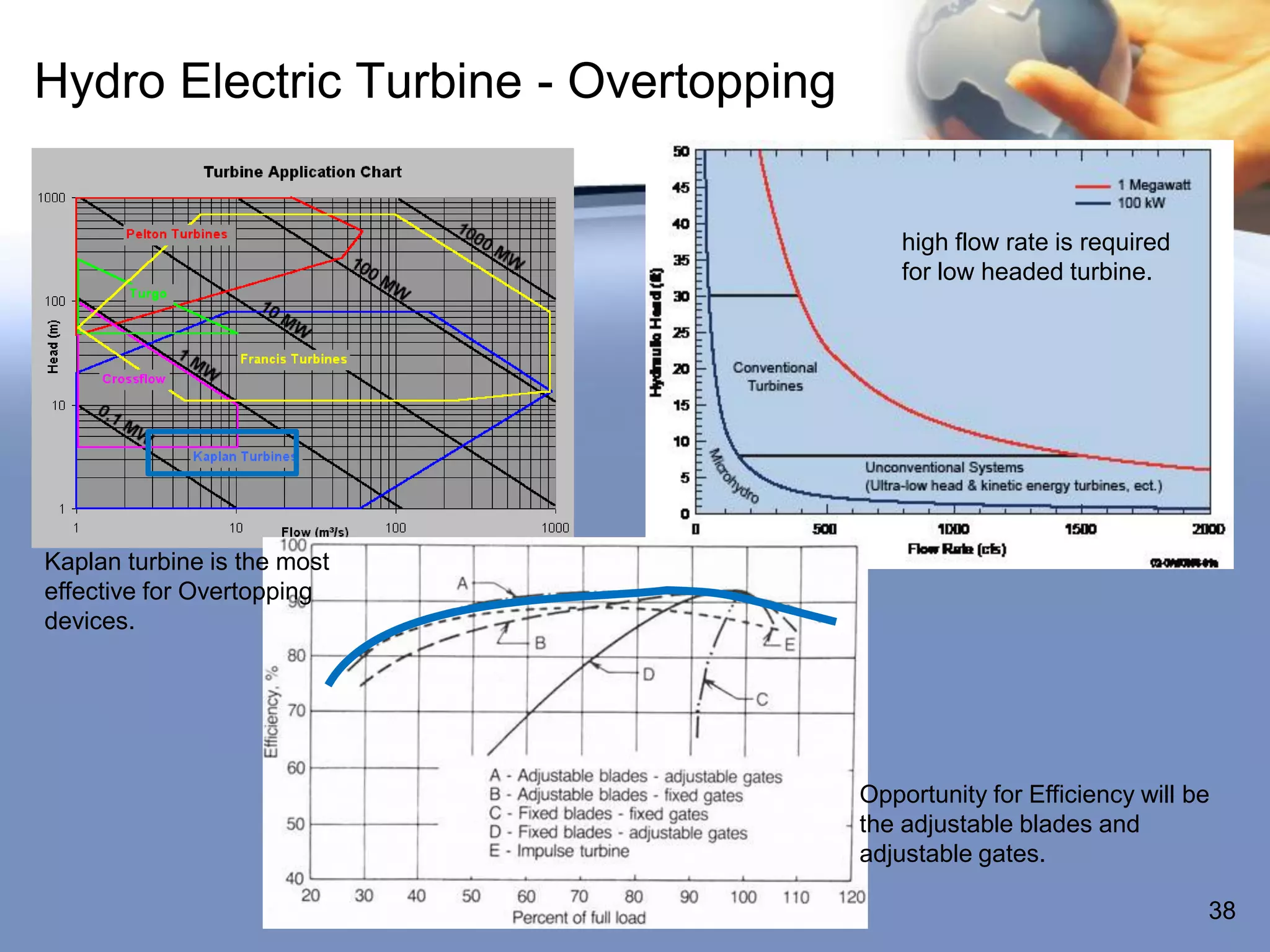
Hydro Electric Turbine - Overtopping


                                           high flow rate is required
                                           for low headed turbine.


Kaplan turbine is the most
effective for Overtopping
devices.


                                       Opportunity for Efficiency will be
                                       the adjustable blades and
                                       adjustable gates.

                                                                        38
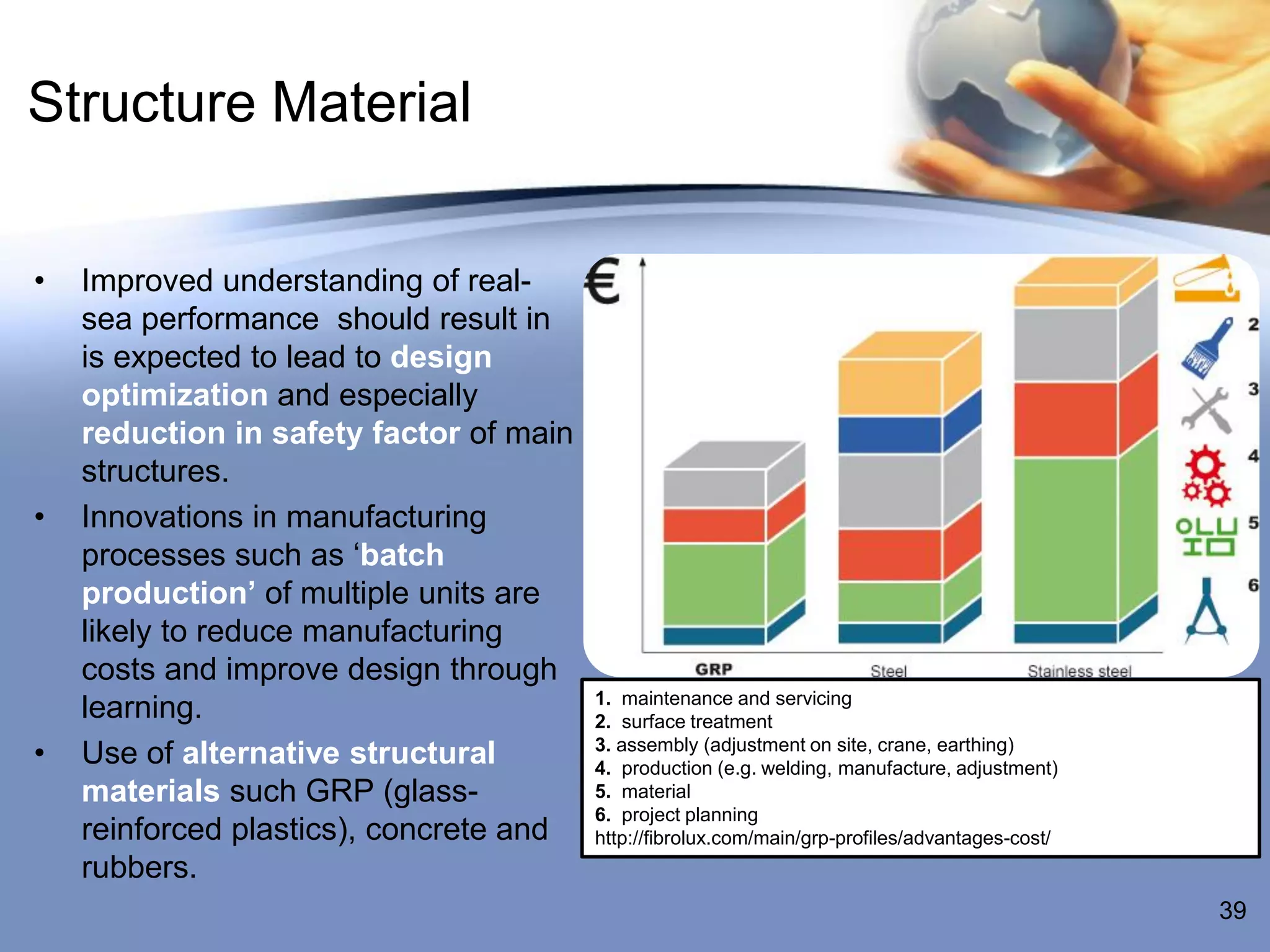
Structure Material


•   Improved understanding of real-
    sea performance should result in
    is expected to lead to design
    optimization and especially
    reduction in safety factor of main
    structures.
•   Innovations in manufacturing
    processes such as ‘batch
    production’ of multiple units are
    likely to reduce manufacturing
    costs and improve design through
                                         1. maintenance and servicing
    learning.                            2. surface treatment
•   Use of alternative structural        3. assembly (adjustment on site, crane, earthing)
                                         4. production (e.g. welding, manufacture, adjustment)
    materials such GRP (glass-           5. material
                                         6. project planning
    reinforced plastics), concrete and   http://fibrolux.com/main/grp-profiles/advantages-cost/
    rubbers.
                                                                                                  39
OUTLINE


 • INTRODUCTION TO WAVE ENERGY
 • WAVE ENERGY CONVERSION SYSTEMS
 •   WAVE ENERGY STATUS & OPPORTUNITIES
        Current Status
        Motivations & Challenges
        Technology Roadmap
        Opportunities
 •   CONCLUSION


                                          40
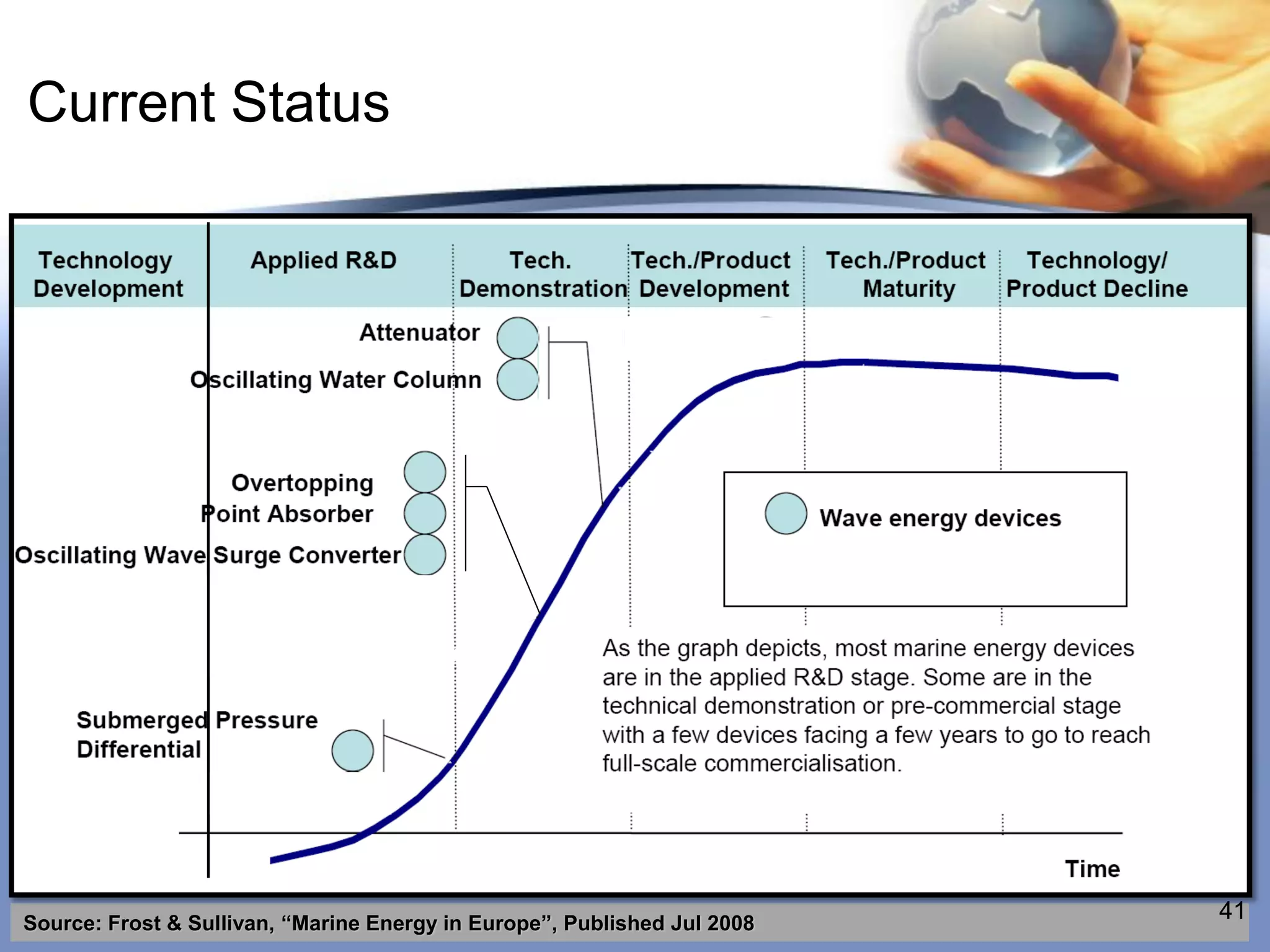
Current Status


Source: Frost & Sullivan, “Marine Energy in Europe”, Published Jul 2008
                                                                          41
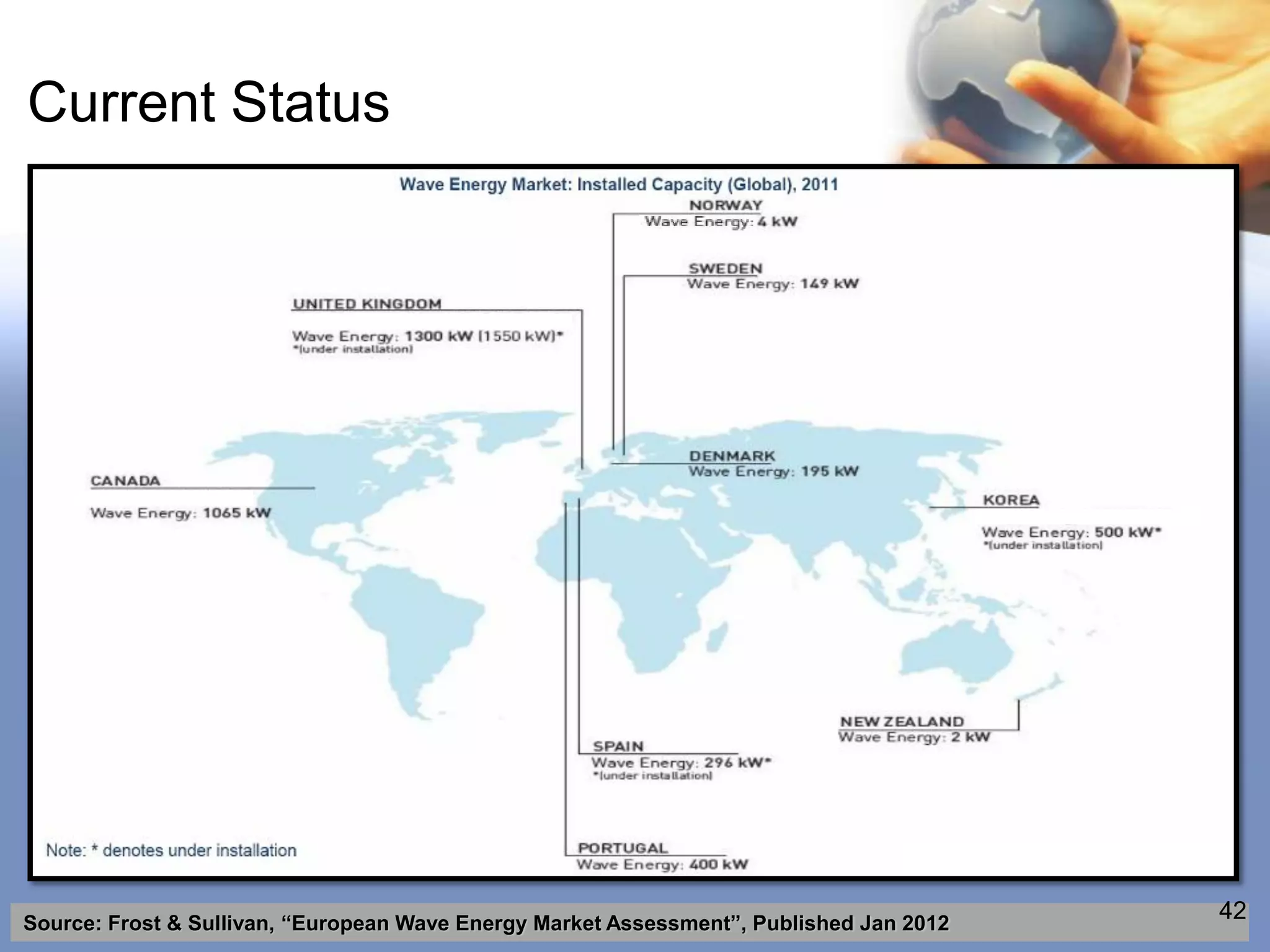
Current Status


Source: Frost & Sullivan, “European Wave Energy Market Assessment”, Published Jan 2012
                                                                                         42
Current Status


Source: Frost & Sullivan, “European Wave Energy Market Assessment”, Published Jan 2012
                                                                                         43
Breakdown Costs


                                                                     44   44
Source: Hayward, "The potential of wave energy”, Published in 2011
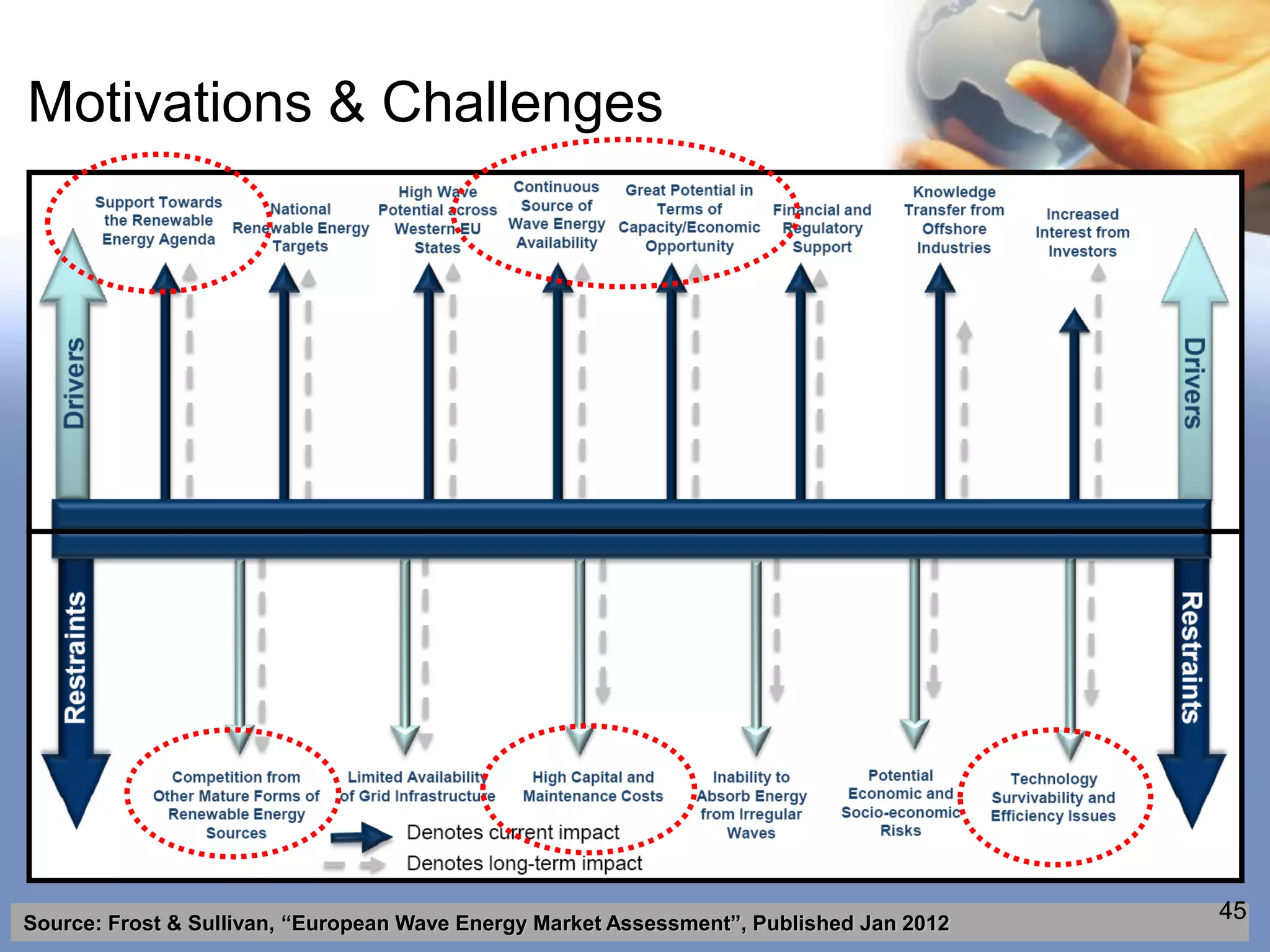
Motivations & Challenges


Source: Frost & Sullivan, “European Wave Energy Market Assessment”, Published Jan 2012
                                                                                         45
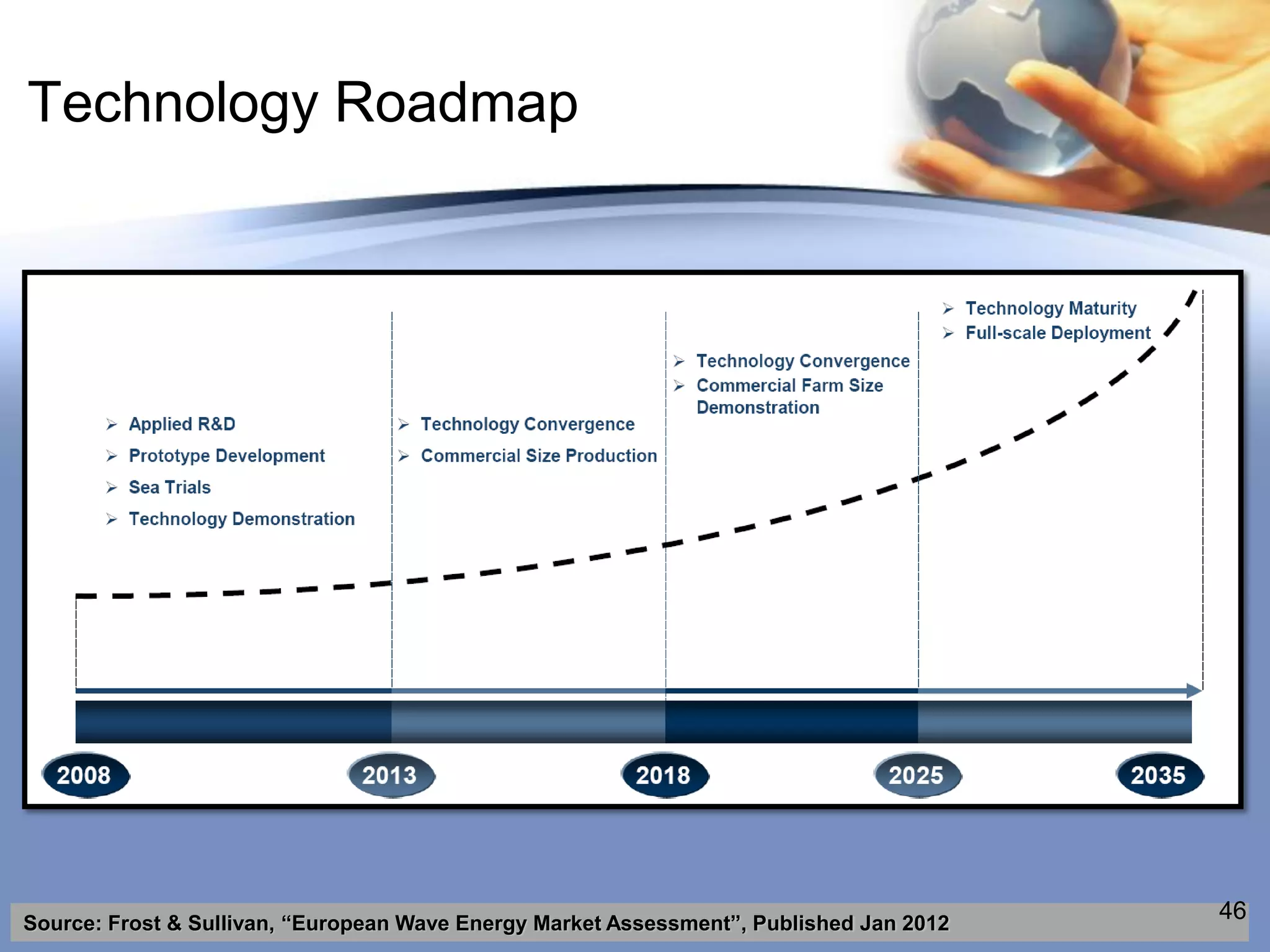
Technology Roadmap


Source: Frost & Sullivan, “European Wave Energy Market Assessment”, Published Jan 2012
                                                                                         46
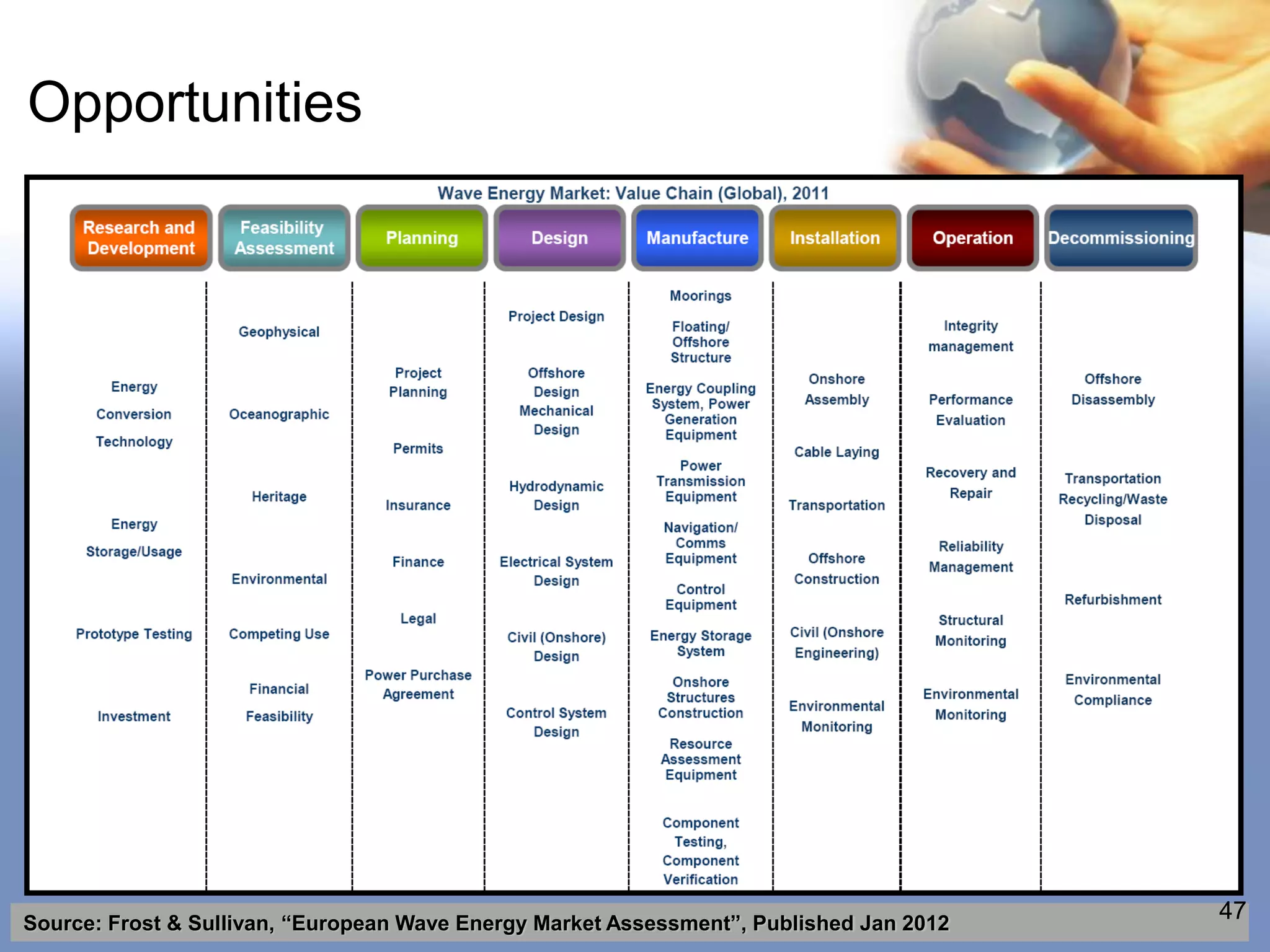
Opportunities


Source: Frost & Sullivan, “European Wave Energy Market Assessment”, Published Jan 2012
                                                                                         47
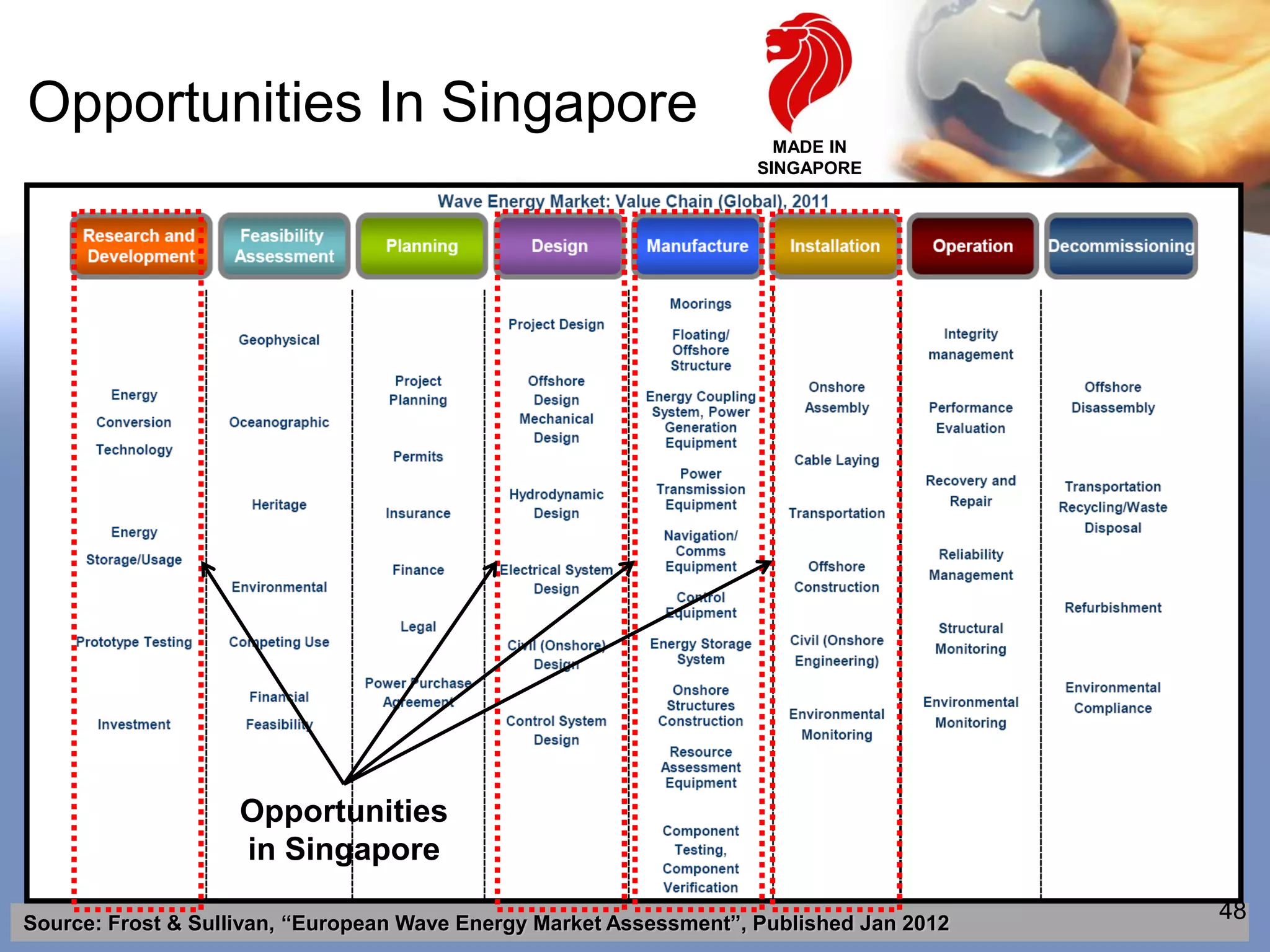
Opportunities In Singapore
                                                                      MADE IN
                                                                    SINGAPORE


                    Opportunities
                    in Singapore

Source: Frost & Sullivan, “European Wave Energy Market Assessment”, Published Jan 2012
                                                                                         48
Opportunities In Singapore
                                                                          MADE IN
                                                                        SINGAPORE


       Keppel and Sembcorp Marine has shown that it is possible to produce 70% of the
        world’s oil rig even though Singapore does not have any oil resources
          Similarly, Singapore could potentially venture into the wave energy market and
             become a leader in designing and building WEC platforms (or even power
             plants!)
       Cross leveraging from the Emerging regional hub for high-tech alternative energy
        research
          Solar photovoltaic cell manufacturing plant, REC, YR 2006
          Wind Energy Giant, VESTAS $500 millions regional research facility setup, YR
             2007
          Biodiesel plant (200,000 tonne) commissioned by Peter Cremer of Germany
               Home to the world's most advanced and largest commercial-scale biodiesel
                    facility producing diesel fuel from renewable feedstocks
          Singapore as Asia's Carbon Hub; Home to the only carbon emissions trading
             exchange in Asia


REFRAMING GLOBAL WARMING: TOWARD A STRATEGIC NATIONAL PLANNING FRAMEWORK Scott Victor Valentine               49
National University of Singapore, 469C Bukit Timah Road, Singapore 259772E-Mail: scott.valentine@nus.edu.sg
Opportunities In Singapore
                                           MADE IN
                                         SINGAPORE


 • Hann-Ocean Technology Pte Ltd
    – 7030 Ang Mo Kio Avenue 5, #09-
      61, Northstar @ AMK, Singapore
      569880


 • WEC product - Drakoo
    – Patented Technology
    – Sponsored by Sembcorp and
      SPRING Singapore
    – Status as of Dec 2011: Sea trial
      & testing
    – Maximum output 4kW
    – Efficiency 65~80%


                                                     50
Conclusion

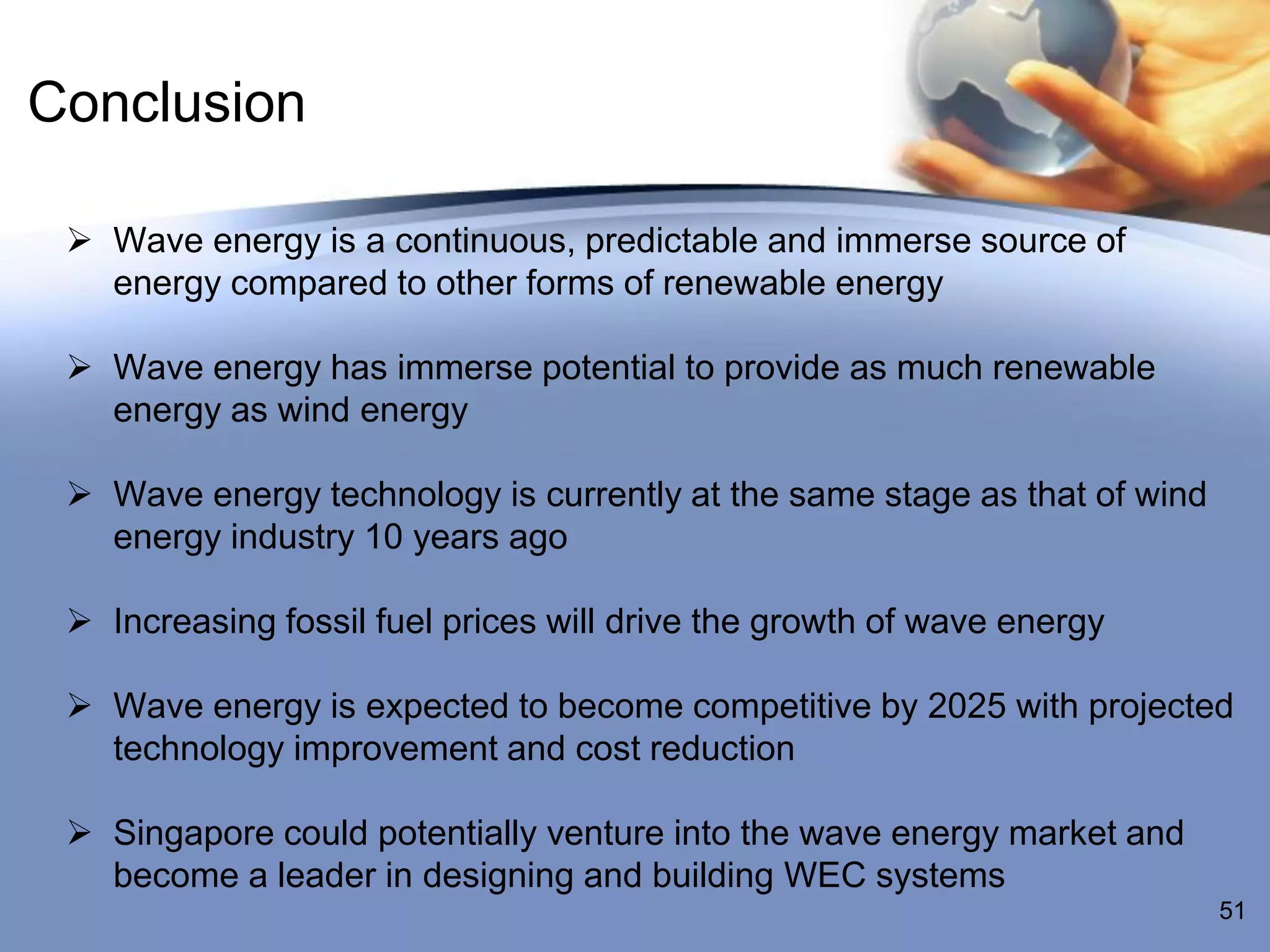
  Wave energy is a continuous, predictable and immerse source of
   energy compared to other forms of renewable energy

  Wave energy has immerse potential to provide as much renewable
   energy as wind energy

  Wave energy technology is currently at the same stage as that of wind
   energy industry 10 years ago

  Increasing fossil fuel prices will drive the growth of wave energy

  Wave energy is expected to become competitive by 2025 with projected
   technology improvement and cost reduction

  Singapore could potentially venture into the wave energy market and
   become a leader in designing and building WEC systems
                                                                           51
Are you ready to ride the wave !?
References

 •   Journal / Conference Articles
      –   Ted Brekken, “Fundamentals of Ocean Wave Energy Conversion, Modelling and Control”, IEEE International
          Symposium on Industrial Electronics (ISIE), 2010, Page(s): 3921 - 3966
      –   Lagoun, M.S.; Benalia, A.; Benbouzid, M.E.H., “Ocean Wave Converters: State of the Art and Current Status”,
          IEEE International Energy Conference and Exhibition (EnergyCon), 2010, Page(s): 636 – 641
      –   Mohamed, K.H.; Sahoo, N.C.; Ibrahim, T.B., “A Survey of Technologies Used in Wave Energy Conversion
          Systems”, International Conference on Energy, Automation, and Signal (ICEAS), 2011, Page(s): 1 – 6
      –   Kazmierkowski, M.P.; Jasinski, M., “Power electronic grid-interface for renewable ocean wave energy”, 7th
          International Conference-Workshop Compatibility and Power Electronics (CPE), 2011, Page(s): 457 – 463
      –   Sabzehgar, R.; Moallem, M., “A review of ocean wave energy conversion systems”, IEEE Electrical Power &
          Energy Conference (EPEC), 2009, Page(s): 1 - 6
      –   António F. de O. Falcão, “Wave energy utilization: A review of the technologies”, Review Article, Renewable
          and Sustainable Energy Reviews, Volume 14, Issue 3, April 2010, Pages 899-918
      –   AbuBakr S. Bahaj, “Generating electricity from the oceans”, Review Article, Renewable and Sustainable
          Energy Reviews, Volume 15, Issue 7, September 2011, Pages 3399-3416
      –   Drew, B, Plummer, A R, Sahinkaya, M N, “A review of wave energy converter technology”, Proceedings of the
          Institution of Mechanical Engineers – A, Volume 23, Issue 8, June 2009, Pages 887 - 902


                                                                                                                        53
References

 •   Market Research Report
      –   Frost & Sullivan, “European Wave Energy Market Assessment”, Published on 12 Jan 2012
      –   Frost & Sullivan, “Hydro, Wave, and Tidal Power--Market Penetration and Roadmapping (Technical Insights)”,
          Published on 30 Mar 2010
      –   Frost & Sullivan, “An Assessment of Current Technologies in Ocean Energy (Technical Insights)”, Published
          on 31 Dec 2008
      –   Frost & Sullivan, “Marine Energy in Europe”, Published on 23 Jul 2008


 •   Books
      –   Joao Cruz, “Ocean Wave Energy: Current Status and Future Perspectives”, SpringerLink 2008
      –   “Wave energy conversion”, Engineering Committee on Oceanic Resources, Working Group on Wave Energy
          Conversion, Elsevier 2003


                                                                                                                       54

ELectricity from Ocean Waves

  • 1.
    OCEAN WAVE ENERGY MT5009 ANALYZING HI-TECH OPPORTUNITIES Team members Aryoko Wibowo S. A0082149A Jerico Juico A0091472E Lim Shoa Siong A0068312L Padmanaban Vivek A0035842H Prakash Sambasivam A0027237J Yeo Lian Sheng A0081976N
  • 2.
    OUTLINE • INTRODUCTIONTO WAVE ENERGY • WAVE ENERGY CONVERSION SYSTEMS  OSCILLATING WATER COLUMN (OWC)  OVERTOPPING • WAVE ENERGY STATUS & OPPORTUNITIES • CONCLUSION 2
  • 3.
    Wave-Energy’s Characteristics TheProcess Conversion of Wave’s Potential and Kinetic energy into Electrical energy. Constantly generated. Do not deplete Notable More depict able and reliable as a source of energy Characteristics Can be harnessed close to the shoreline, offshore, or anywhere in-between. Good forecast ability. With 12 m/s wave velocity, 10hrs or more forecast ability. Significance Estimated that 0.2% of Ocean’s untapped energy could provide power sufficient for the entire world ! [1] [1] Ocean Wave energy Current Status and Future Prospective by João Cruz 3
  • 4.
    Approximate global distributionof wave power levels (kW/m of wave front) - Wave resource is strongest on the west coasts, and toward the poles - At approx. 30 kW/mcl in the Northwest (yearly avg.), a single meter (3.3 feet) of wave has the raw power for 23 coastal homes. 4
  • 5.
    Wave-Energy’s Potential Wave power available compared to electricity consumption for continents. The error bars show the 95% confidence intervals. Quantifying the global wave power resource 5 Kester Gunn*, Clym Stock-Williams E.ON New Build & Technology, Technology Centre, Ratcliffe-on-Soar, Nottingham, England, UK
  • 6.
    Methods of WaveCapturing Oscillating Water Column Overtopping Point-Absorber Attenuator 6
  • 7.
    Wave Energy Conversion (1) Control System of WEC Primary Power Energy Generator Takeoff Capture (2) Wave Capturing Methods Device Name Wave Capturing Method Power Takeoff Generator Storage Limpet (1) Oscillating Water Column Wells Turbine Induction Flywheel Wave Dragon (2) Overtopping Kaplan Turbine PMSG Reservoir DFIG: Doubly-Fed Inductor Generator PMSG: Permanent Magnet Synchronous Generator LPMG: Linear Permanent Magnet Generator Source: Frost & Sullivan, “European Wave Energy Market Assessment”, Published Jan 2012 7 Mohamed, K.H.; Sahoo, N.C.; Ibrahim, T.B., “A Survey of Technologies Used in Wave Energy Conversion Systems”
  • 8.
    OUTLINE • INTRODUCTIONTO WAVE ENERGY • WAVE ENERGY CONVERSION SYSTEMS  OSCILLATING WATER COLUMN (OWC) • Overview • Efficiency • Cost • Scaling • Components  OVERTOPPING • WAVE ENERGY STATUS & OPPORTUNITIES • CONCLUSION 8
  • 9.
    Oscillating Water Column(OWC) 1 As the wave rises within the Oscillating Water Column (OWC), Air is compressed and pushed through the turbine 2 As the wave recedes, the air is sucked back into the OWC and past the turbine 3 The turbine rotates in the same direction regardless of the direction of air flow 9
  • 10.
    Oscillating Water Column(OWC) Video Link Hydrokinetic & Wave Energy Technologies Technical & Environmental Issues Workshop October 26-28, 2005 Cynthia Rudge –Business 10 Development EnergetechAustralia
  • 11.
    Typical OWC Efficiencies 11 Source: The Carbon Trust, 2005. Marine energy challenge: oscillating water column wave energy converter evaluation report.
  • 12.
    Factors Affecting WaveCapture Efficiency Generates useful power Power Water column take-off heave (PTO) Front wall Outgoing swash /down- waves rush Incoming Water Viscous waves column slosh losses Power losses 12
  • 13.
    Optimum Damping ToReduce Power Loss 13 Source: The Carbon Trust, 2005. Marine energy challenge: oscillating water column wave energy converter evaluation report.
  • 14.
    Available Energy Fluxvs Ocean Depth Available wave energy flux increases as ocean depth increases 14 Source: The Carbon Trust, 2005. Marine energy challenge: oscillating water column wave energy converter evaluation report.
  • 15.
    Damaging Waves Occurrencevs Ocean Depth Occurrence of damaging waves decreases as ocean depth increases 15 Source: The Carbon Trust, 2005. Marine energy challenge: oscillating water column wave energy converter evaluation report.
  • 16.
    CAPEX vs OceanDepth CAPEX generally increases as ocean depth increases 16 Source: The Carbon Trust, 2005. Marine energy challenge: oscillating water column wave energy converter evaluation report.
  • 17.
    Cost Power Productionvs Ocean Depth Lowest cost of power production occurs at ocean depth of 10 metres 17 Source: The Carbon Trust, 2005. Marine energy challenge: oscillating water column wave energy converter evaluation report.
  • 18.
    Unit Power Costvs Scale of Power Plant Unit cost of power production decreases as scale of power plant increases 18 Source: The Carbon Trust, 2005. Marine energy challenge: oscillating water column wave energy converter evaluation report.
  • 19.
    Deeper Water andLarger Scale Reduces Power Production Cost Shallow water with Deep water with multiple single wave collector wave collectors Low energy High flux energy flux Low High CAPEX CAPEX High unit cost of Low unit cost power of power production production 19 Source: The Carbon Trust, 2005. Marine energy challenge: oscillating water column wave energy converter evaluation report.
  • 20.
    Improvement Sensitivity Improvements in available wave energy resource and capture efficiency has greatest Quality improvement impact on reducing unit cost of power production Cost reduction 20 Source: The Carbon Trust, 2005. Marine energy challenge: oscillating water column wave energy converter evaluation report.
  • 21.
    Geometrical Scaling in WavePower Capture • Geometric Scaling Factor, S = LP / LM Parameter Symbol Scaling Ratio For Constant Fr Length L LP / LM S Area A AP / AM S2 Volume V VP / VM S3 Mass M MP / MM S3 Time T TP / TM S0.5 Velocity V VP / VM S0.5 Acceleration g N.A. 1.0 (g is constant) Force F FP / FM S3 Power P PP / PM S3.5 By Definition, Power = Rate of Work Done Work Done Force x Distance Mass x Accelerati on x Length Power    Massive Time Time Time M gL M S L S g 3 3 M L g  scaling S S P P M M M M   T S  3.5 P P 0.5 0.5 X S X P M potential! T P M S T M Thus for 1:10 geometrical scaling, PP increases by S3.5 which is equivalent to ~3000 times 21 (Assuming all the system components scale up proportionally)
  • 22.
    Limitations to GeometricScaling • Collector that is linked to a crest in one location and a trough in another would have reduced capture efficiency • Max of 40m wave collector width recommended • Hence, most companies are scaling up power plant capacity by using multiple collectors instead of further scaling up the size of each collector 22
  • 23.
    Air Turbines -(Wells) OWC 23
  • 24.
    Air Turbine Scaling,Material & Price 24
  • 25.
    Oscillating Water Column Potentialfor different types of Generator Per Unit (P.U.) Power Induction Generator has lower cost since it is not using expensive permanent magnet Machado, I.R.; Bozzi, F.A.; Watanabe, E.H.; Garcia-Rosa, P.B.; Martinez, M.; Molina, M.G.; Mercado, P.E.; , "Wave energy conversion system using asynchronous generators - a comparative study," Power Electronics Conference (COBEP), 2011 Brazilian , vol., no., pp.286-291, 11-15 Sept. 2011doi: 10.1109/COBEP.2011.6085300URL: http://ieeexplore.ieee.org.libproxy1.nus.edu.sg/stamp/stamp.jsp?tp=&arnumber=6085300&isnumber=6085159 25
  • 26.
    Oscillating Water Column OutputPower at Different Sea State Variable speed generator performs more efficient in lower power sea states otherwise with fixed speed generator Synchronous and Permanent Magnet generator output power is more efficient compare to Induction Generator O'Sullivan, D.L.; Lewis, A.W.; , "Generator selection for offshore oscillating water column wave energy converters," Power Electronics and Motion Control Conference, 2008. EPE-PEMC 2008. 13th , vol., no., pp.1790-1797, 1-3 Sept. 2008doi: 26 10.1109/EPEPEMC.2008.4635525URL: http://ieeexplore.ieee.org.libproxy1.nus.edu.sg/stamp/stamp.jsp?tp=&arnumber=4635525&isnumber=4635237
  • 27.
    OUTLINE • INTRODUCTIONTO WAVE ENERGY • WAVE ENERGY CONVERSION SYSTEMS  OSCILLATING WATER COLUMN (OWC)  OVERTOPPING • Overview • Capacity • Cost • Efficiency • Components • WAVE ENERGY STATUS & OPPORTUNITIES • CONCLUSION 27
  • 28.
    Overtopping – “WaveDragon” Electricity is generated 3 by running the water through turbines in the bottom 1 of the structure Two wave reflectors act to focus the incoming waves 2 Waves overtop the double curved ramp to reach the reservoir 28
  • 29.
    Overtopping – “WaveDragon” Video Link 29
  • 30.
    Installed Global Capacityof Wave Power on Trial (MW) 1600 Based on National Targets set by 4 1400 EU Countries 1200 1000 800 600 400 Ongoing as planned 200 0 2000 2008 2009 2011 2012 2020 MW 0.5 2.25 0.34 6.4 73.6 1530 http://clean-future.com/renewable-energy/wave-power/wave-farms 30 EU Energy directive January 2008
  • 31.
    Cost Comparison Amongst Various Technologies Natural Gas and Wave Dragon Solar PV Wind Biomass Coal Energy Density High Moderate Moderate High High Approx. 1000 x denser Low – Moderate Low Moderate Very High NA than wind Predictability High. Moderate Moderate Moderate Moderate Accurate forecasts Low except in Dispatchable, Moderate Dispatchable Dispatchable days in advance some sites subject to fuel supply Capacity Factor 30% - 45% 12% - 25% 20% - 40% 85% 50% - 90% Visual Impact Moderate Unobtrusive Moderate High Very High Extensive but Extensive but Limited for large Potential Sites Extensive Moderate permitting process permitting process capacity sites can be lengthy can be lengthy Cost Per Kilowatt Hour – Utility Power 12¢* 9 - 19¢ 5 - 24¢ 9 - 14¢ 7 - 15¢ • By YEAR 2025: electricity costs of €0.08/kWh • By YEAR 2050: electricity costs of €0.03-0.04/kWh* OCEAN ENERGY TECHNOLOGIES for RENEWABLE ENERGY GENERATION AUGUST 2009 Peter Meisen President, Global Energy Network Institute (GENI) Alexandre Loiseau Research Associate, Global Energy Network Institute alexandre.loiseau.10@eigsi.fr *Centre for Renewable Energy Sources. (2002). Wave energy utilization in Europe – Current status and 31 perspectives. European thematic network on wave energy.
  • 32.
    Costs Reduction Opportunity How is electricity cost expected to reach about 0.03-0.04 €/kWh by 2050? Main part of the cost reduction and efficiency improvement should be realized by: • R&D – Multi-Level Reservoirs – Improvised Wave ramp – Wave Prediction Control Algorithm • Technical Learning Effects • Cumulative effects on Costs 32
  • 33.
    Multi-level Reservoir 3-Levels 1-Level  Maximize Potential Energy  Improve Constant water flow to turbine EXPERIMENTAL STUDY OF A MULTILEVEL OVERTOPPING WAVE POWER DEVICE, Jens Peter http://waveenergy.no/res/animasjoner/workingprincipl Kofoed, Tud Hald and Peter Frigaard, Hydrulics and Costal Engineering Laboratory, Department of Civil Engineering Aalborg University, Sohngaardsholmsveu 57, DK-9000, Aalborg, Denmark e4raskere.gif VERTICAL DISTRIBUTION OF WAVE OVERTOPPING FOR DESIGN OF MULTI LEVEL OVERTOPPING BASED WAVE ENERGY CONVERTERS Jens Peter KOFOED M. Sc., Ph. D., Assist. prof. Department of Civil Engineering, Aalborg University E-mail: 33 i5jpk@civil.aau.dk
  • 34.
    Improvised Wave Ramp •This wave energy converter makes use of overtopping wave energy conversion technology to rotate a dual rotor system and convert wave energy directly into continuous rotary motion. • This is done via mini buckets which are lined up along the ramp in a angled direction to support the rotation. • Current Overall wave-to- wire efficiency at 18% could be increased up to 30% http://www.kineticwavepower.com/ 34
  • 35.
    Wave Prediction ControlAlgorithm Rc: Hs: Ramp Wave Height Height • 20% higher power production with the improved water flow with opportunity for further improvement • This is achieved by improving controls algorithm to better predict Wave Height, Hs so that Ramp Height, Rc could be adjusted accordingly SIXTH FRAMEWORK PROGRAMME Project no: 502687 NEEDS; New Energy Externalities Developments for Sustainability INTEGRATED PROJECT 35 Priority 6.1: Sustainable Energy Systems and, more specifically, Sub-priority 6.1.3.2.5: Socio-economic tools and concepts for energy strategy.
  • 36.
    Technical Learning Effects €/kw Installation cost depending of production accumulated sales volume in GW • Learning Rate of 14% (progress ratio of 0.86) for the whole period, which is at the same level as known from the wind industry. • The investment cost will decrease with increasing accumulated sales SIXTH FRAMEWORK PROGRAMME Project no: 502687 NEEDS; New Energy Externalities Developments for Sustainability INTEGRATED PROJECT 36 Priority 6.1: Sustainable Energy Systems and, more specifically, Sub-priority 6.1.3.2.5: Socio-economic tools and concepts for energy strategy.
  • 37.
    Cumulative effects onCosts 4000 0.25 3500 0.20 3000 2500 0.15 2000 1500 0.10 1000 0.05 500 0 0.00 €/kw 2007 2025 2050 €/kwh 2007 2025 2050 Very Optimistic Optimistic-realistic Pessimistic Very Optimistic Optimistic-realistic Pessimistic Electricity Investment Cost for Years 2007, Electricity Production Cost for Years 2007, 2025, 2050 2025, 2050 • Gradual cost reduction is anticipated with the technical learning, volume growth and R&D for improvement in overall efficiency and output. SIXTH FRAMEWORK PROGRAMME Project no: 502687 NEEDS; New Energy Externalities Developments for Sustainability INTEGRATED PROJECT 37 Priority 6.1: Sustainable Energy Systems and, more specifically, Sub-priority 6.1.3.2.5: Socio-economic tools and concepts for energy strategy.
  • 38.
    Hydro Electric Turbine- Overtopping high flow rate is required for low headed turbine. Kaplan turbine is the most effective for Overtopping devices. Opportunity for Efficiency will be the adjustable blades and adjustable gates. 38
  • 39.
    Structure Material • Improved understanding of real- sea performance should result in is expected to lead to design optimization and especially reduction in safety factor of main structures. • Innovations in manufacturing processes such as ‘batch production’ of multiple units are likely to reduce manufacturing costs and improve design through 1. maintenance and servicing learning. 2. surface treatment • Use of alternative structural 3. assembly (adjustment on site, crane, earthing) 4. production (e.g. welding, manufacture, adjustment) materials such GRP (glass- 5. material 6. project planning reinforced plastics), concrete and http://fibrolux.com/main/grp-profiles/advantages-cost/ rubbers. 39
  • 40.
    OUTLINE • INTRODUCTIONTO WAVE ENERGY • WAVE ENERGY CONVERSION SYSTEMS • WAVE ENERGY STATUS & OPPORTUNITIES  Current Status  Motivations & Challenges  Technology Roadmap  Opportunities • CONCLUSION 40
  • 41.
    Current Status Source: Frost& Sullivan, “Marine Energy in Europe”, Published Jul 2008 41
  • 42.
    Current Status Source: Frost& Sullivan, “European Wave Energy Market Assessment”, Published Jan 2012 42
  • 43.
    Current Status Source: Frost& Sullivan, “European Wave Energy Market Assessment”, Published Jan 2012 43
  • 44.
    Breakdown Costs 44 44 Source: Hayward, "The potential of wave energy”, Published in 2011
  • 45.
    Motivations & Challenges Source:Frost & Sullivan, “European Wave Energy Market Assessment”, Published Jan 2012 45
  • 46.
    Technology Roadmap Source: Frost& Sullivan, “European Wave Energy Market Assessment”, Published Jan 2012 46
  • 47.
    Opportunities Source: Frost &Sullivan, “European Wave Energy Market Assessment”, Published Jan 2012 47
  • 48.
    Opportunities In Singapore MADE IN SINGAPORE Opportunities in Singapore Source: Frost & Sullivan, “European Wave Energy Market Assessment”, Published Jan 2012 48
  • 49.
    Opportunities In Singapore MADE IN SINGAPORE  Keppel and Sembcorp Marine has shown that it is possible to produce 70% of the world’s oil rig even though Singapore does not have any oil resources  Similarly, Singapore could potentially venture into the wave energy market and become a leader in designing and building WEC platforms (or even power plants!)  Cross leveraging from the Emerging regional hub for high-tech alternative energy research  Solar photovoltaic cell manufacturing plant, REC, YR 2006  Wind Energy Giant, VESTAS $500 millions regional research facility setup, YR 2007  Biodiesel plant (200,000 tonne) commissioned by Peter Cremer of Germany  Home to the world's most advanced and largest commercial-scale biodiesel facility producing diesel fuel from renewable feedstocks  Singapore as Asia's Carbon Hub; Home to the only carbon emissions trading exchange in Asia REFRAMING GLOBAL WARMING: TOWARD A STRATEGIC NATIONAL PLANNING FRAMEWORK Scott Victor Valentine 49 National University of Singapore, 469C Bukit Timah Road, Singapore 259772E-Mail: scott.valentine@nus.edu.sg
  • 50.
    Opportunities In Singapore MADE IN SINGAPORE • Hann-Ocean Technology Pte Ltd – 7030 Ang Mo Kio Avenue 5, #09- 61, Northstar @ AMK, Singapore 569880 • WEC product - Drakoo – Patented Technology – Sponsored by Sembcorp and SPRING Singapore – Status as of Dec 2011: Sea trial & testing – Maximum output 4kW – Efficiency 65~80% 50
  • 51.
    Conclusion  Waveenergy is a continuous, predictable and immerse source of energy compared to other forms of renewable energy  Wave energy has immerse potential to provide as much renewable energy as wind energy  Wave energy technology is currently at the same stage as that of wind energy industry 10 years ago  Increasing fossil fuel prices will drive the growth of wave energy  Wave energy is expected to become competitive by 2025 with projected technology improvement and cost reduction  Singapore could potentially venture into the wave energy market and become a leader in designing and building WEC systems 51
  • 52.
    Are you readyto ride the wave !?
  • 53.
    References • Journal / Conference Articles – Ted Brekken, “Fundamentals of Ocean Wave Energy Conversion, Modelling and Control”, IEEE International Symposium on Industrial Electronics (ISIE), 2010, Page(s): 3921 - 3966 – Lagoun, M.S.; Benalia, A.; Benbouzid, M.E.H., “Ocean Wave Converters: State of the Art and Current Status”, IEEE International Energy Conference and Exhibition (EnergyCon), 2010, Page(s): 636 – 641 – Mohamed, K.H.; Sahoo, N.C.; Ibrahim, T.B., “A Survey of Technologies Used in Wave Energy Conversion Systems”, International Conference on Energy, Automation, and Signal (ICEAS), 2011, Page(s): 1 – 6 – Kazmierkowski, M.P.; Jasinski, M., “Power electronic grid-interface for renewable ocean wave energy”, 7th International Conference-Workshop Compatibility and Power Electronics (CPE), 2011, Page(s): 457 – 463 – Sabzehgar, R.; Moallem, M., “A review of ocean wave energy conversion systems”, IEEE Electrical Power & Energy Conference (EPEC), 2009, Page(s): 1 - 6 – António F. de O. Falcão, “Wave energy utilization: A review of the technologies”, Review Article, Renewable and Sustainable Energy Reviews, Volume 14, Issue 3, April 2010, Pages 899-918 – AbuBakr S. Bahaj, “Generating electricity from the oceans”, Review Article, Renewable and Sustainable Energy Reviews, Volume 15, Issue 7, September 2011, Pages 3399-3416 – Drew, B, Plummer, A R, Sahinkaya, M N, “A review of wave energy converter technology”, Proceedings of the Institution of Mechanical Engineers – A, Volume 23, Issue 8, June 2009, Pages 887 - 902 53
  • 54.
    References • Market Research Report – Frost & Sullivan, “European Wave Energy Market Assessment”, Published on 12 Jan 2012 – Frost & Sullivan, “Hydro, Wave, and Tidal Power--Market Penetration and Roadmapping (Technical Insights)”, Published on 30 Mar 2010 – Frost & Sullivan, “An Assessment of Current Technologies in Ocean Energy (Technical Insights)”, Published on 31 Dec 2008 – Frost & Sullivan, “Marine Energy in Europe”, Published on 23 Jul 2008 • Books – Joao Cruz, “Ocean Wave Energy: Current Status and Future Perspectives”, SpringerLink 2008 – “Wave energy conversion”, Engineering Committee on Oceanic Resources, Working Group on Wave Energy Conversion, Elsevier 2003 54