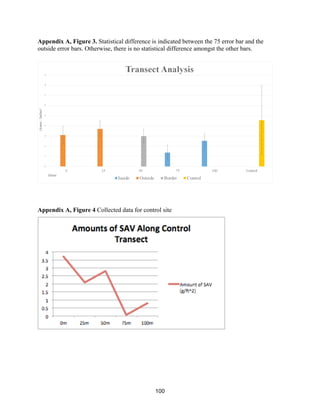
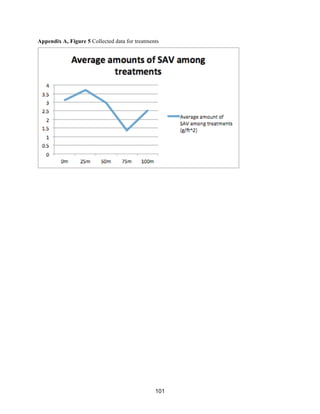
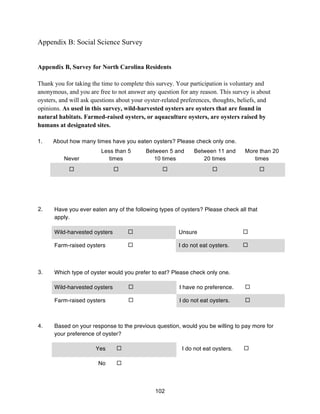
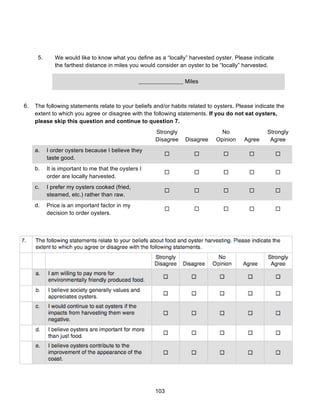
1
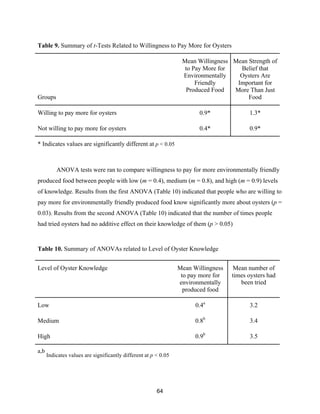
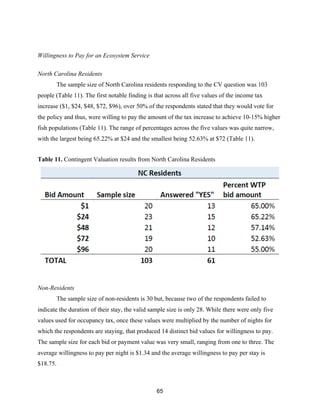
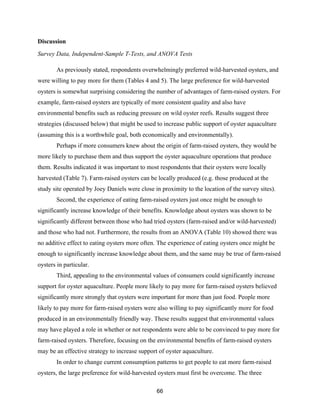
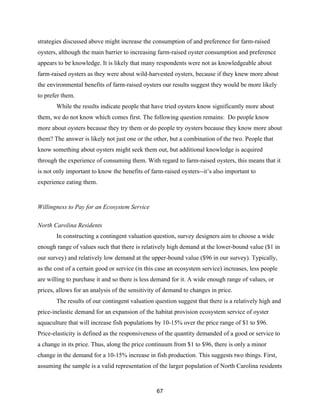
The Oyster Banks: A Dive into the Political, Scientific, and Social Realms of
Oysters and Oyster Aquaculture in North Carolina
December 2014
Outer Banks Field Site | Capstone Report
University of North Carolina at Chapel Hill
Jerome Allen, Quinton Grady, Dakota Koenigsberg,
Charlotte McEwen, Michaela Meredith, John St. Clair
Site Directors: Andy Keeler and Lindsay Dubbs
Professors: Adam Gibson and Lee Leidy
2
Special thanks to:
Joey Daniels, Alyson Lewis, Corey Adams, Bill and Ellen Kealy,
NC Community Foundation, Northeast NC Coastal Research and Environmental Education Fund
Acknowledgments:
Aaron McCall
Albert and Carolyn Gard
Awful Arthur’s staff
Beth Storie
Bill Birkemeier
Bill Smyth
Bob Luckey
Britt Purtee
Christian Legner
Christine Pickens
Daryl Law
Dave Sybert
David Gadd
Dewey Hemilright
Erin Fleckenstein
Feather Phillips
Frances Smyth
Full Circle Crab Company
George Wood
Grey Jernigan
Ike McRee
Jaime Yrigoyen
John Leidy
John McCord
Jon Mason
Jonathan Jones
Karen Clough
Kathy McMahan
Kenneth Jones
Kim Armstrong
Ladd Bayliss
Marie Magee
Marlene True
Michael Kelly and Kelly’s staff
Michael Piehler
Nancy White
Pat Raves
Paul Doshkov
Peggy Birkemeier
Peter Rascoe
Randy Swilling
Ray Meiggs
Reide Corbett
Renee Cahoon
Robbie Fearn
Robert L. Outten
Robert Perry
Sara Hallas
Sara Mirabilio
Sara Strickland
Scott Crocker
Stephanie O’Daly
The Honorable Terrence Boyle
Tom White
Trenor Bender
Willy Phillips
3
2014 OBXFS Students
Jerome Allen
Junior
BA Environmental Studies
BA Dramatic Arts
Greenville, NC
Quinton Grady
Senior
BA Environmental Studies
Goldsboro, NC
Dakota Koenigsberg
Senior
BA Environmental Studies
BA Economics
Arden, NC
Charlotte McEwen
Senior
BA Environmental Studies
BA Public Policy
Durham, NC
Michaela Meredith
Junior
BA Environmental Studies
Elon, NC
John St Clair
Senior
BA Environmental Studies
Camden, NC
4
Table&of&Contents&
DEFINITIONS)..........................................................................................................................................................)6!
ABSTRACT)...............................................................................................................................................................)7!
INTRODUCTION)....................................................................................................................................................)8!
BACKGROUND)....................................................................................................................................................)10!
OYSTERS!...................................................................................................................................................................................!10!
ECOSYSTEM!SERVICES!............................................................................................................................................................!11!
OYSTER!AQUACULTURE!.........................................................................................................................................................!13!
NATURAL)SCIENCE)RESEARCH)......................................................................................................................)15!
INTRODUCTION!........................................................................................................................................................................!15!
Study&Site&................................................................................................................................................................................&16!
HABITAT!PROVISION!..............................................................................................................................................................!20!
Introduction&...........................................................................................................................................................................&20!
Methods&...................................................................................................................................................................................&21!
Results&......................................................................................................................................................................................&24!
Discussion&...............................................................................................................................................................................&29!
LIGHT,!NUTRIENTS,!AND!SAV!DISTRIBUTION!AND!ABUNDANCE!..................................................................................!35!
Introduction&...........................................................................................................................................................................&35!
Methods&...................................................................................................................................................................................&36!
Results&......................................................................................................................................................................................&40!
Discussion&...............................................................................................................................................................................&49!
Conclusions&.............................................................................................................................................................................&53!
SOCIAL)SCIENCE)RESEARCH)...........................................................................................................................)54!
INTRODUCTION!........................................................................................................................................................................!54!
METHODS!.................................................................................................................................................................................!55!
Qualitative&Research&..........................................................................................................................................................&55!
Quantitative&Research&.......................................................................................................................................................&55!
Willingness&to&Pay&for&an&Ecosystem&Service&..........................................................................................................&55!
Population&Surveyed&..........................................................................................................................................................&57!
Sampling&Procedure&...........................................................................................................................................................&57!
Data&Analysis&.........................................................................................................................................................................&58!
RESULTS!....................................................................................................................................................................................!59!
Summary&of&Survey&Data&.................................................................................................................................................&59!
IndependentKSample&TKTests&and&ANOVA&Tests&....................................................................................................&62!
Willingness&to&Pay&for&an&Ecosystem&Service&..........................................................................................................&65!
DISCUSSION!..............................................................................................................................................................................!66!
Survey&Data,&IndependentKSample&TKTests,&and&ANOVA&Tests&........................................................................&66!
Willingness&to&Pay&for&an&Ecosystem&Service&..........................................................................................................&67!
ASSUMPTIONS!AND!LIMITATIONS!........................................................................................................................................!69!
POLICY)CONSIDERATIONS)..............................................................................................................................)71!
5
INTRODUCTION!........................................................................................................................................................................!71!
CURRENT!STATE!OF!REGULATION!........................................................................................................................................!73!
LEASING!PROCESS!...................................................................................................................................................................!76!
CHALLENGES!TO!OYSTER!AQUACULTURE!IN!NORTH!CAROLINA!....................................................................................!78!
SAV&Limitations&....................................................................................................................................................................&78!
Public&Trust&............................................................................................................................................................................&78!
Costly&and&time&consuming&lease&and&production&process&................................................................................&79!
STATES!WITH!POLICIES!FAVORABLE!TO!OYSTER!AQUACULTURE!...................................................................................!81!
Virginia&....................................................................................................................................................................................&81!
Connecticut&............................................................................................................................................................................&82!
Rhode&Island&..........................................................................................................................................................................&82!
Maryland&.................................................................................................................................................................................&83!
Louisiana&.................................................................................................................................................................................&83!
POLICY!OPTIONS!.....................................................................................................................................................................!84!
CONCLUSION!............................................................................................................................................................................!85!
OVERALL)CONCLUSIONS).................................................................................................................................)86!
REFERENCES).......................................................................................................................................................)89!
APPENDIX)A:)NATURAL)SCIENCE).................................................................................................................)95!
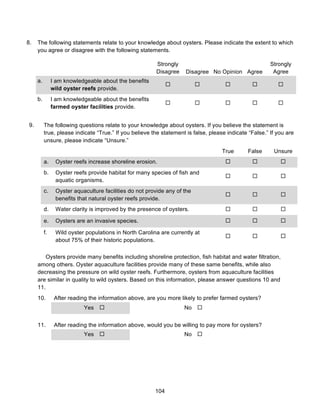
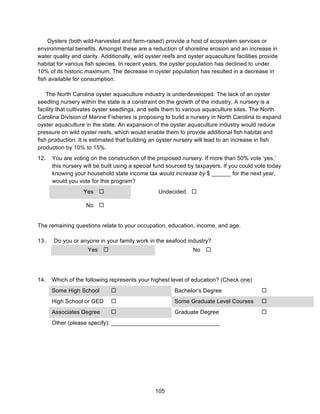
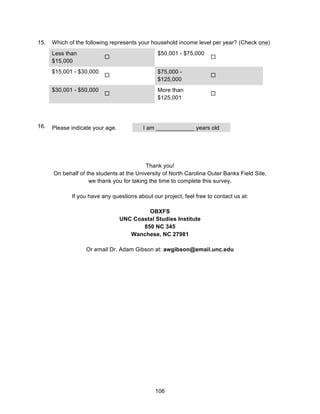
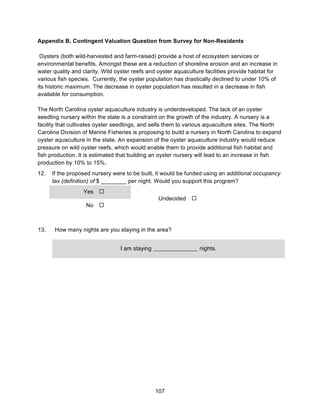
APPENDIX)B:)SOCIAL)SCIENCE)SURVEY)....................................................................................................)102!
6
Definitions
ANOVA: Analysis of variance
APNEP: Albemarle-Pamlico National Estuary Partnership
CBP: Chesapeake Bay Program
CHPP: Coastal Habitat Protection Plan
CRC: Coastal Resources Commission
FMP: North Carolina Oyster Fisheries Management Plan
FRA: Fisheries Reform Act
ICW: Intracoastal waterway
Kd : Light extinction coefficient
NCDENR/DENR: North Carolina Department of the Environment and Natural Resources
NCDMF/DMF: North Carolina Division of Marine Fisheries
N.C.G.S: North Carolina General Statutes
NCMFC/MFC: North Carolina Marine Fisheries Commission
NCSGA: North Carolina Shellfish Growers Association
NOAA: National Oceanic and Atmospheric Administration
NWP: Nationwide Permit
PAR: Photosynthetically active radiation
Pore water: Water filling the spaces between grains of sediment
ppb: Parts per billion
ppm: Parts per million
ppt: Parts per thousand
Quadrat: A quadrant that is laid along a transect
SAG: Submerged aquaculture gear
SAV: Submerged aquatic vegetation
SCDNR: South Carolina Department of Natural Resources
UNEP: United Nations Environment Programme
USACE: United States Army Corps of Engineers
VSGMEP: Virginia Sea Grant Marine Extension Program
7
Abstract
To gain a holistic perspective on the state of oyster aquaculture in North Carolina, this
study included natural science research of various ecosystem services; social science research of
public preferences, beliefs, and opinions; and a policy analysis of the current regulatory
framework. The natural science component of this research investigated the ecosystem services
provided by an oyster aquaculture facility, located in the Roanoke Sound, North Carolina, USA.
The ecosystem services assessed included water filtration, nutrient regulation, and habitat
provision. Potential effects of the facility and the ecosystem services that it provides on
submerged aquatic vegetation (SAV) density were also examined. Social science research
uncovered the relationship between people having eaten oysters, their knowledge of them, and
their willingness to pay for them. The policy component of the research considered the current
shellfish leasing process to understand why the oyster aquaculture industry in North Carolina has
stagnated, while that of other coastal states has expanded. Nutrient regulation assessments did
not conclusively correlate aquaculture sites with effects on nutrient concentrations, although
some effects appeared to be present. SAV assessments inferred that aquaculture gear type might
play a role in SAV density and distribution within the study site. The policy considerations of
this study found levels of oyster aquaculture have remained low in North Carolina due to the
state’s strict interpretation of the Public Trust Doctrine and high valuation of the ecosystem
services provided by SAV, especially compared to the relatively less understood ecosystem
services of oyster aquaculture. Policy options available to North Carolina to better promote the
growth of the industry were also provided. Lastly, this study calls for future research on oyster
aquaculture in North Carolina to provide a better understanding of the ecosystem services oyster
aquaculture provides and the potential of the industry in the state.
8
Introduction
Oysters are important to the current and future ecology and economy of coastal North
Carolina. In 2010, United States oyster landings were valued at over $117 million and the U.S. is
also among the top five global importers of oysters (Lutz 2012). Between 2003 and 2012, the
average annual commercial landings of oysters in North Carolina were over 521,000 pounds,
valued at over $2.5 million (DMF 2013). Oyster landings represent a small fraction of the total
value of North Carolina’s fisheries, which were valued at over $4.5 billion in 2010. The demand
for oysters in North Carolina and globally is met through a combination of oysters harvested
from wild oyster reefs and oysters raised at aquaculture facilities.
Oysters are clearly valued as a food commodity. Anyone who consumes oysters realizes
that they benefit from the harvested oyster, but they may not know that this benefit is termed an
ecosystem service. Ecosystem services are the benefits people obtain from ecosystems (UNEP
2005). Oysters provide a host of other ecosystem services in addition to the provision of food for
people, including habitat provision, nutrient cycling, and water filtration. In addition to the
economic value of oysters provided through jobs, incomes, and human consumption, oysters also
provide economic value via associated ecosystem services.
The primary goal of oyster aquaculture is to meet public demand for oysters and to
provide economic returns for investors. Holding demand constant, an increase in oyster
aquaculture production will decrease the amount of wild oysters harvested. However, there are
competing interests for estuarine areas that may be put into aquaculture production that focus on
other components of the ecosystem. For instance, submerged aquatic vegetation (SAV) are plants
that provide habitat to valuable commercial fish and other aquatic species. The current state of
North Carolina law and the state’s regulatory framework follow the federal mandate in
protecting SAV from destruction by coastal development, including aquaculture (USACE 2012).
SAV is protected because of its designation as critical habitat for aquatic species in North
Carolina.
Decreases in SAV density directly below aquaculture gear as a result of shading and
physical disturbance have been observed in Pacific Northwest and Atlantic Canadian estuaries
where rack and bag oyster aquaculture takes place (Everett et. al 1995, Skinner et al. 2013,
Skinner et al. 2014). However, because oysters are suspension-feeders that filter water as they
9
feed, they also have the potential to positively influence SAV. For example, the ecosystem
service of water filtration provided by oysters removes suspended particles, including particulate
nitrogen, from the water column, improving water clarity and regulating nutrients by
remineralizing nitrogen to ammonium, which can be used by SAV for growth (reviewed by
Dumbauld et al. 2009). In effect, aquaculture oysters may augment SAV growth in surrounding
areas, thus at least partially offsetting the negative effects of the facility. A key question this
project investigates is whether the aquaculture facility included in our study has a measurable
impact on water clarity and nutrient regulation and the abundance and distribution of SAV
surrounding and within the facility. The relationship between aquaculture and SAV is key to
inform the economic and environmental consequences of stimulating North Carolina’s oyster
aquaculture industry.
Because this topic is multidisciplinary by nature, the project includes three strands of
research: natural science, social science, and public policy. Natural science research associated
with this project was conducted at an oyster aquaculture facility and a control site located in the
Roanoke Sound, NC. The research was aimed at providing quantitative measurements of some of
the ecosystem services at the site. The social science research aimed to assess the public’s
beliefs, preferences, and opinions of oysters, given that the public drives the demand for oysters
and that its attitudes will affect regulatory public policy. Qualitative interviews were conducted
to create a quantitative survey that was administered at three locations along the Outer Banks.
Lastly, a policy analysis was conducted to review the current state of shellfish aquaculture
leasing in North Carolina and its implications for the future direction of the aquaculture industry
as a whole.
10
Background
Oysters
The “Eastern Oyster”, or Crassoteria virginica, is an immobile bivalve mollusk in the
Ostreidae family that is well adapted to estuarine habitats and is also typically found in brackish
to hypersaline lagoon environments. The eastern oyster is located along the coast of North
America from the Gulf of St. Lawrence to the Gulf of Mexico (Kennedy n.d.). They can live up
to forty years and grow up to eight inches long. Typically, during the summer or autumn, wild
adult (diploid) oysters release eggs and sperm into the water, where external fertilization occurs
(Kennedy n.d.). Females may spawn more than once a season, and one female may release up to
twenty million eggs (Kennedy n.d.). In the early stages of their lives, larvae are carried about by
currents throughout the water column for two to three weeks. At the end of this process, the
larvae will sink to the bottom. If the appropriate hard substrate is encountered, oysters will settle
and attach there for the rest of their lives. If the appropriate substrate is not found, the larvae will
not settle. (Kennedy n.d.). Because other oyster shells are the preferred settling location, oysters
are generally found growing together in clumps or on rocks. Oysters are fertile enough to
produce millions of spat, yet the amount of suitable hard substrate and certain climatic conditions
determine the population size (NCDENR). Oyster aquaculture facilities often grow sterile
triploid oysters rather than diploid oysters. Triploid oysters do not spawn in the summer, so they
can be harvested year-round. More energy can be directed at growth rather than gonad
development to help aquacultured triploid oysters grow faster. (Fincham 2010).
The eastern oyster, whether diploid and triploid, has morphological, physiological, and
behavioral adaptations that allow it to tolerate a wider range of natural variation in temperature,
salinity, suspended sediments, and dissolved oxygen relative to other aquatic species (Kennedy
n.d.). Oysters are found at depths from 2 to 7 meters in the Albemarle and Pamlico Sounds. The
salinity ranges are concentrations above 12 parts per thousand (ppt), as well as exactly at 5 ppt
(Kennedy n.d.). For comparison, the salinity concentration of freshwater rivers is 0 ppt, while
ocean salinity ranges from 32-37 ppt.
Due to the inability to control their own body temperature, oysters are sensitive to
temperature changes in relation to their growth, development, reproduction, and feeding activity.
Between -1°C to approximately 36°C is the typical range for eastern oysters. The optimal
11
temperature range for respiration and feedings is 24-26°C (Kennedy n.d.). There have been a
limited number of experiments performed to evaluate the effects of low dissolved oxygen on
oysters (Kennedy n.d.), but they have been observed to prefer oxygen saturation greater that 20%
(Eastern Biological Review Team 2007). Oysters tend to thrive optimally in pH levels ranging
from 6.8 to 9.25, although they can tolerate lower pH levels (Kennedy n.d.).
Phytoplankton are the main food source of oysters. Meanwhile, oysters face predation
from ctenophores and other planktivores at the larvae stage; and at the adult stage, oysters face
predation from cownose rays, black drum, oyster drills, crabs, worms, boring sponges, birds.
Oysters were historically abundant along the North Carolina coast. The Albemarle-
Pamlico Sound is an especially favorable location for oysters because of high sediment
deposition from adjacent river bodies, such as the Neuse and Pasquotank (Kennedy n.d.).
Increased fishing pressure and stock declines caused by diseases, poor water quality and habitat
loss have led to the collapse of the oyster population (Shellfish n.d.). Most NC oysters are
harvested at three years of age, at the minimum harvest size of 3 inches (Shellfish n.d.). Oysters
have been harvested from October to March with tongs, rakes, or by hand, in intertidal areas and
shallow water along coastal NC. They are also fished by dredging in parts of the Pamlico Sound
(Shellfish n.d.).
Ecosystem Services
According to the United Nations Environment Programme’s Millenium Ecosystem
Assessment (2005) ecosystem services are defined as, “[t]he benefits people obtain from
ecosystems. These include provisioning services such as food and water; regulating services such
as flood and disease control; cultural services such as spiritual, recreational, and cultural
benefits; and supporting services, such as nutrient cycling, that maintain the conditions for life on
Earth.”
Oysters are suspension-feeders that filter water as they feed. Thus, their feeding removes
suspended particles from the water column, providing the ecosystem services of improved water
clarity and nutrient regulation to their environment. Oysters’ highly efficient removal of
suspended particulate matter greater than 3µm from the water column increases water clarity
(Newell, 1988), which in turn, allows additional sunlight to penetrate through the water column,
12
increasing the potential for photosynthesis and the growth of SAV. SAV provides many
ecosystem services of its own, such as providing commercially valuable fish and invertebrates
with habitat, providing waterfowl, fish and mammals with a food source, nutrient filtration, and
erosion control (NOAA, 2014). Due to these additional ecosystem services, this report also
explores the relationship between oyster aquaculture and SAV.
Nutrient cycling is a significant ecosystem service that oysters provide to coastal
ecosystems (Pollack et al. 2013). As oysters filter water, they remove particulate nutrients from
the water column and incorporate some of the nutrients, including nitrogen and phosphorus into
their tissues and shells (Newell 2012). Then, when the oysters are harvested those nutrients are
removed from the system. For instance, Higgens et al. (2011), estimated, through modeling field
measurements, that harvesting 7.7 million cultivated oysters (76 mm) removed 1 ton of nitrogen
from the Chesapeake Bay. Nutrients not incorporated into oyster tissue and shell are expelled
along with other suspended particulate matter filtered by oysters, which together produce waste
particles in the form of faeces and pseudofaeces. This waste (referred to as “biodeposits”) readily
settles on the seabed beneath culture area. The biodeposits are organic-rich and consist of a
substantial proportion of fine particles (i.e. silt and clay). Seabed sediments beneath oyster
cultures can become organically enriched and fine-textured relative to surrounding areas, and
have anoxic sediments closer to the sediment surface (Forrest et. al 2009). Biodeposits also
contain concentrated nutrients, some of which can be remineralized to biologically available
ammonium and phosphorus, which can be used by SAV or other primary producers for growth
(Dumbauld et al. 2009). While these nutrients do play a major role in producing biomass at the
bottom of the food chain, excess amounts of these nutrients relative to one another can result in
increased phytoplankton productivity, which in turn can lead to eutrophication of the water
column, fish and invertebrate mortality, and decreases in biodiversity (Chorus and Bartram,
1999). Such decreases in biodiversity also reduce the ability of coastal and oceanic ecosystems to
provide food, maintain water quality, and recover from perturbations (Worm et al. 2006). Thus,
the presence of oyster reefs helps to reduce the amount of these nutrients available in the
production of explosive growth of phytoplankton that can lead to eutrophication. Because all
oysters are filter feeders, regardless of whether they are from an oyster reef or aquaculture
facility, it is expected that the water filtration and nutrient cycling ecosystem services would be
produced, at least to some degree, by oyster aquaculture sites.
13
As oysters tend to grow atop older oysters and are not necessarily evenly distributed
within wild oyster reefs, crevices and empty spaces are often found within the reef structure.
These empty spaces and hard shell surfaces provide novel habitats for many types of
commercially valuable juvenile fish, both benthic and pelagic organisms, and invertebrates
(Soniat, Finelli, & Ruiz, 2004). The structured habitat provided by oyster reefs can support a
diversity of taxa (Forrest, et al 2009)
Oyster Aquaculture
Oysters were once an abundant source of food in the waters of North Carolina and the
East Coast as a whole. In North America, oysters have been grown commercially in estuaries,
bays, and lagoons since the early 19th
century, and the cultivation of oysters has increased
tremendously during the 20th
century. The amount of estuarine habitat under oyster aquaculture
in North America far exceeds that devoted to producing any other species (Everett et al. 1995).
Oyster cultivation takes place primarily on the tidal flats of estuaries, using farming
methods that differ among localities, according to environmental conditions, the type of product
marketing, and tradition (FAO 2006a); (Forrest et al. 2009). A common technique is elevated
(off-ground) culture, which typically involves laying oysters on sticks, in mesh bags or trays
across wooden racks or steel trestles that are fixed in the intertidal zone and exposed during low
tide, or uses stake or long lines (Forrest et al. 2009).
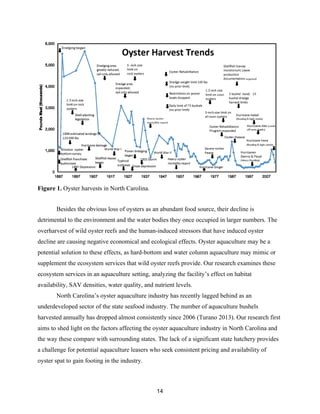
In 1902, the oyster harvest in North Carolina was at its peak, with approximately 5.6
million pounds of oyster meat, or 800,000 bushels of oysters, being harvested (Figure 1).
Estimates show that only 61,500 bushels of oysters were harvested in North Carolina in 2013
(North Carolina Coastal Federation n.d.). Aside from the natural stressor of disease,
anthropogenic influences have led to the decline, largely due to overharvest and habitat reduction
by the loss of hard bottom in water bottoms (NOAA 2014).
14
Figure 1. Oyster harvests in North Carolina.
Besides the obvious loss of oysters as an abundant food source, their decline is
detrimental to the environment and the water bodies they once occupied in larger numbers. The
overharvest of wild oyster reefs and the human-induced stressors that have induced oyster
decline are causing negative economical and ecological effects. Oyster aquaculture may be a
potential solution to these effects, as hard-bottom and water column aquaculture may mimic or
supplement the ecosystem services that wild oyster reefs provide. Our research examines these
ecosystem services in an aquaculture setting, analyzing the facility’s effect on habitat
availability, SAV densities, water quality, and nutrient levels.
North Carolina’s oyster aquaculture industry has recently lagged behind as an
underdeveloped sector of the state seafood industry. The number of aquaculture bushels
harvested annually has dropped almost consistently since 2006 (Turano 2013). Our research first
aims to shed light on the factors affecting the oyster aquaculture industry in North Carolina and
the way these compare with surrounding states. The lack of a significant state hatchery provides
a challenge for potential aquaculture leasers who seek consistent pricing and availability of
oyster spat to gain footing in the industry.
!
15
Natural Science Research
Introduction
The natural science component of our research focused on quantifying the ecosystem
services offered by an oyster aquaculture facility in the Roanoke Sound, within the Albemarle-
Pamlico estuarine system of North Carolina. The ecosystem services that were measured include
habitat provision, water filtration, and nutrient regulation. Submerged aquatic vegetation
distribution and abundance were too assessed because SAV is sensitive to the availability of light
and to nutrient concentrations. SAV provides many ecosystem services of its own, such as
providing commercially valuable fish and invertebrates with habitat, providing waterfowl, fish
and mammals with a food source, nutrient filtration, and erosion control (NOAA, 2014). Due to
these additional ecosystem services, this report also explores the relationship between oyster
aquaculture and SAV.
Wild oysters provide the services measured in our study, but because the role of oyster
aquaculture in providing these services is not well understood, the purpose of our study was to
reveal the degree to which aquaculture oysters also provide these ecosystem services. The
primary research questions that we addressed in our research are as follows: 1) For which
estuarine fish species do bottom rack oyster aquaculture facilities provide habitat and what is the
natural habitat of these species?; 2) How does the amount of time elapsed since initial
deployment of the oyster rack affect the abundance, diversity, and size structure of fish?; 3) Is
there a difference in the density of SAV between the inside of the aquaculture facility (aside
from under infrastructure), immediately outside the perimeter of the facility, and the control
site?; 4) Does oyster aquaculture have an effect on nutrient concentrations in the sediment and
water columns?; and 5) How does oyster aquaculture affect water clarity, using light as a proxy,
as compared to a control site with no oysters?
All research was conducted at the same study site but the study of habitat provision and
light and nutrients that were expected to influence SAV distribution and abundance were treated
as separate studies. Thus, these studies will be separated into sub-studies.
16
Study Site
An expansive chain of low-lying barrier islands extending from Virginia to Cape Fear
frames North Carolina’s coast, creating large and productive sounds and estuaries behind them.
Southwest of the Cape Fear River, dredging of the Atlantic Intracoastal Waterway in the 1930s
created an artificial extension of these barrier islands. The north part of the natural barrier
islands, the Outer Banks, separates the Albemarle-Pamlico estuarine system from the coastal
ocean. The topography of the three major capes has a major influence on adjacent ocean
circulation (Street et al. 2005).
Weather conditions, especially temperature, precipitations, winds, and storms, exert
major influences on the North Carolina coast and the fishery resources therein. The climate along
the North Carolina coast is also strongly influenced by the Atlantic Ocean. North Carolina’s
coastal ocean includes the convergence between two major oceanic currents: the warm, north-
flowing Gulf Stream and the cool, south-flowing Virginia coastal current, called the Labrador
Current (Street et al. 2005).
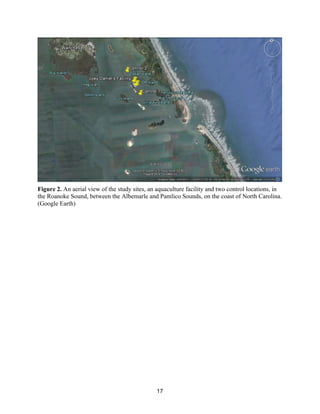
Our study was on an oyster aquaculture facility (Fig. 2) in the Roanoke Sound
(35°48'39.22"N, 75°34'59.72"W, 35°48'38.10"N, 75°35'3.05"W, 35°48'28.61"N,
75°34'52.83"W, 35°48'27.32"N, 75°34'57.29"W), between the Albemarle and Pamlico Sounds.
A dredge spoil island located .04 miles (37 meters) west of the facility, and the Bodie Island
Lighthouse is located .95 miles (355 meters) to the east of it. The Wanchese Harbor is located
2.14 miles (3444 meters) to the North, and Oregon Inlet, which connects to the Atlantic Ocean, is
located 3.56 miles (5,729 meters) to the South. The facility experiences a tidal range between .29
feet (.09 meters) and .93 feet (.28 meters) and is exposed to northeastern winds in the winter and
early spring, and southwestern winds in the summer and autumn.
17
Figure 2. An aerial view of the study sites, an aquaculture facility and two control locations, in
the Roanoke Sound, between the Albemarle and Pamlico Sounds, on the coast of North Carolina.
(Google Earth)
18
Figure 3. A map of the infrastructure at the study site, an aquaculture facility operated by Joey
Daniels, in the Roanoke Sound, North Carolina.
The aquaculture facility is operated by Joey Daniels and his staff of three. Joey Daniels
submitted an application to permit the site in July 2011 and infrastructure was built beginning in
April 2012, immediately upon the permit being issued. Harvest of oysters from the facility began
in 2013.
At the time of our study, 124 oyster “baskets” were deployed over an area of 47422 m2
.
Figure 3. is a map of the facility. The lightest shade of grey marks areas where oysters are
located and the intermediate shade of grey denotes boat lanes for navigation purposes. The
darkest shade of grey, the area marked “shed,” is a small dock containing equipment and a
generator-powered tumbling machine. Each light grey, rectangular-shaped section of the facility,
bounded by dots that represent physical markers, contains farmed oysters of a certain age.
The facility uses two different types of “baskets”: bottom racks and floating bags. The
bottom rack is a (.96 meters x .15 meter x 1.26 meter) cage-like structure that rests on sediment
19
surface at the bottom of the estuary, while the floating bags are rectangular with pinched edges
and buoys on the perimeters. These are attached to trawl lines. Each bottom rack structure
consists of three rectangular prism-shaped cages that are stacked vertically and bound together
by bungee cords, to form a larger rectangular prism or rack. Each cage is made of a square-
patterned interlocking metal mesh (¾ x ¾ inch) that forms the bottom and sides. A rectangular
mesh top made of the same material encloses the upper portion of each rack assembly (rack
assembly will be used to refer to three bottom racks stacked on top of one another). The floating
baskets are located in the northwestern and southwestern quadrants of the site (Figure 3); and the
bottom racks are concentrated in the northeastern and southeastern quadrants. Areas that are
occupied by aquaculture infrastructure are denoted by white in Figure 3.
There were two control sites. The southern site was located south of the study site, at
35°48'0.36"N, 75°34'45.57"W, and the northern site was located north of the study site at
approximately 35°49'8.88"N, 75°35'22.78"W. The southern control site was a small, natural
island that was only used on the second sampling date (Sept. 16, 2014) for SAV
presence/absence measurements but was abandoned in favor of the northern control site for
subsequent sampling dates. The northern control site was more similar to the study site because
of its size, proximity to a dredge spoil rather than natural island, and orientation. Measurements
at both control sites were made parallel to and between 100 and 200 m from the shoreline of the
islands.
We visited the study and control sites four times in the fall (September and October) of
2014. The first visit was a scoping cruise, during which no measurements were made and another
visit was cut short due to storm warnings. Cloud coverage was variable between sampling dates,
yet most measurements were conducted with full sun exposure.
20
Habitat Provision
Introduction
Two hypotheses were formulated with regard to the habitat provision ecosystem service
of oyster aquaculture facilities. First, it was hypothesized that oyster aquaculture facilities would
provide habitat for species that would typically be found near wild oyster reefs, but would not
otherwise be associated with areas of sandy bottom or SAV. Support for this came from the
inferences that predators of oysters are able to consume aquaculture oysters just as they consume
oysters from wild reefs and species using oysters for purposes other than food would be able to
utilize both wild and farmed oysters similarly. These inferences are also reflected within
previous research regarding these comparisons. Tallman and Forrester (2007) conclude that
oyster cages provide “good-quality” habitat for organisms typically associated with a hard-
bottom environment such as natural oyster reefs. Additionally, Erbland and Ozbay (2008)
similarly coincide that submerged oyster cages can provide additional habitat to areas of SAV or
sandy bottom, supporting economically and ecologically viable organisms. These studies, along
with our initial inferences, give support to the comparison tested within our first hypothesis. The
second hypothesis stated that the more time elapsed since the initial deployment of an oyster
rack, the more number of individual organisms and number of species an oyster rack provides
habitat for. To test the second hypothesis, we analyzed the number of distinct species within a
rack and the number of total organisms within a rack. We also tested for a relationship between
time elapsed since rack deployment and the average length of finfish. The second hypothesis
addressed possible temporal relationships between time and selected variables related to the
organisms observed within the racks. Support came from the notion that, upon initial
deployment, the racks only contained oysters and the assumption that over time, as additional
organisms colonize the oyster racks, they will either reproduce inside of them, attract other
species that prey on them, or both.
21
Methods
To assess the habitat provided by oyster aquaculture, we collected finfish, invertebrate,
and algae samples from bottom racks deployed for variable periods of time at the study site. Our
data were collected solely from bottom racks.
Figure 4. Example of the layered oyster racks at Joey Daniels’ aquaculture facility.
On September 5, 2014, Joey Daniels pulled up two oyster rack assemblies; the first rack
contained oysters introduced to that section of the site on July 8, 2014 and the second rack
contained oysters introduced to another section on April 9. On October 3, Joey Daniels pulled up
two more rack assemblies; the first rack contained oysters introduced on June 13 and the second
rack contained oysters introduced on February 21.
Finfish and Invertebrates
Before pulling up a rack assembly, Joey Daniels laid down a tarp across the bottom of a
flat-bottom boat. The tarp was large enough to easily cover the bottom of the rack assembly.
Joey Daniels used a mechanical crane-like device mounted on his boat to lift an oyster rack
assembly out of the water and onto the floor of his boat. He then unattached the bungee cords
and lifted the lid of the cage, allowing access to the contents. There was one exception to this
methodology of pulling racks. The first rack pulled on the second trip to the study site (October
22
3) strayed from previously determined, normal methodology. On this pull, the rack assembly was
suspended in the air off the side of the boat, over the water. Joey Daniels then boated to the
“shed” area (Figure 3) before moving the suspended rack assembly over the boat and lowering it
onto the tarp.
Once the rack was onboard, the research group boarded the boat with two large buckets,
each filled about halfway with water taken from the Sound. We removed all finfish larger than 2
cm in length and all invertebrates larger than 1 cm from the rack and placed fish and crabs in
separate buckets. We needed to shake the racks to get some of the crabs to fall off and we sorted
through the oysters in each rack to ensure all fish and crabs were found and removed. We then
lifted the top rack from two racks under it and placed it to the side. The process of removing and
sorting fish and crabs was repeated for the middle rack, after which the middle rack was set to
the side, stacked on top of the top rack. This process was then repeated for the bottom rack. After
we collected all fish and crabs over 1 cm in length from all three rack of the rack assembly, we
took the two buckets back to our boat. Joey Daniels put the rack assembly back together and
returned it to its proper section.
The fish bucket was emptied into a shallow, metal storage tank on the back of our boat.
We measured and photographed each finfish specimen. On our first trip (September 5), we used
a Vernier caliper to measure the length of each fish. On our second trip (October 3rd), we used a
ruler specifically designed for measuring fish. After measuring the fish, we released them back
into the Sound. Next, we emptied the crab bucket into the storage tank and measured only the
largest and smallest of each crab species, taking pictures of those largest and smallest crabs of
each species as well. In general, there were many more crabs than fish. We counted the total
number of crabs of each species and afterward, returned them to the Sound as well. We placed
non-crab invertebrates in the crab bucket and measured and photographed them. All fish we
collected were in fact larger than 2 cm in length, however, some of the crabs were under 1 cm
and these were still included in our count. It should be noted that there were many very small
fish and especially crabs, less than 2 and 1 cm in size respectively, that were not removed from
the oyster racks and so were not measured or included in our count. Similarly, the fish and crabs
larger than the mesh size that were within the facility and that didn’t enter the aquaculture cages
prior to outgrowing the mesh size were not counted nor were species found in the water column
rather than the benthos. For example, many red drum were observed swimming around pilings.
23
Algae
On October 3, 2014, scrape samples were taken from the rack assemblies to measure
algal growth on cage surfaces as part of the habitat provided by the aquaculture facility. To do
this, we scraped a certain surface area of the racks with plastic knives and placed the algae in
Whirlpacks. Three total scrape samples were taken, all from the top rack of the rack assembly.
On the first rack assembly, the scrape sample came from the upper lip that lines the outer
perimeter of the top rack. This sample was taken from 28 square-shaped metal grids that overlay
a surface area of 101.6 cm2
. On the second rack assembly, two separate scrape samples were
taken. The first came from the middle portion of the top rack’s lid; this sample was taken from
25 grids overlaying a surface area of 90.7 cm2
. The second came from one of the corners of the
upper lip that lines the outer perimeter; this sample was taken from 14 grids overlaying a surface
area of 50.8 cm2
. Upon returning to the lab, algal samples were dried for 48 hours at 115°C, after
which samples were weighed. The carbon and nitrogen concentrations of the algal samples were
determined with a Perkin Elmer CHN.
Data Analysis
Photographed fish were identified, with the help of an expert, and the mean, maximum,
and minimum length of each species of fish and the maximum and minimum length of each
species of crab from each rack were calculated.
Linear and exponential regressions were used to quantify the correlation between the
amount of time elapsed since oyster racks were deployed and the total number of organisms, the
total number of distinct species, and the average lengths of fish in each rack.
Algae biomasses for entire racks were calculated by multiplying by an appropriate scale
factor that assumed that algal growth was homogenous on the surface of the top rack of each
three-rack stack. The vast majority of algal growth was observed on the top rack of the three-
rack assembly, with very little algal growth below the first rack. The total carbon, hydrogen, and
nitrogen mass contents were calculated as a percentage of the total mass of algal growth on the
oyster racks.
24
Results
Finfish and Invertebrates
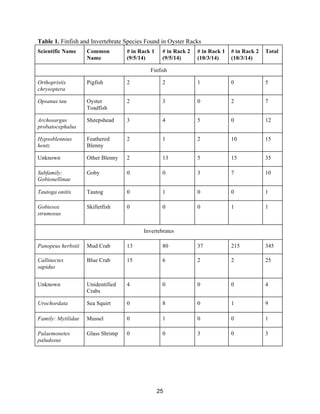
In total, eight species of finfish and six species of invertebrates were found in oyster
aquaculture racks (Table 1). The most common finfish found in the oyster racks were various
types of Blennys (n = 50; Table 1), including Feathered Blennys (n = 15; Table 1). The majority
of the Blennys were found in the second rack pull on each of the two field days. Sheepshead and
Gobies were also common, with a total count of 12 and 10 individuals, respectively (Table 1).
However, no Sheepshead were found in the second rack pull of the second field day and no
Gobies were found in either of the two rack pulls on the first field day (Table 1). Oyster toadfish
and Pigfish had relatively smaller counts, but were found in three of the four rack pulls (Table 1).
Tautog and Skilletfish were rare, with only one sighting of each among all rack pulls (Table 1).
Regarding the invertebrates, mud crabs were by far the most common, with a total of 345
individuals (Table 1). However, the vast majority of mud crabs (n = 215) were found in the
second rack pull on the second field day (Table 1). Blue crabs were less common, but 25
individuals were still found in total, with 15 of these found in the first rack pull on the first field
day (Table 1). Four of the crabs observed were unidentifiable. Sea squirts, glass shrimp, and a
mussel were also found. However, the mussel and glass shrimp were only found in one rack pull
and eight of the nine total sea squirts were found in the second rack pull on the first field day
(Table 1).
25
Table 1. Finfish and Invertebrate Species Found in Oyster Racks
Scientific Name Common
Name
# in Rack 1
(9/5/14)
# in Rack 2
(9/5/14)
# in Rack 1
(10/3/14)
# in Rack 2
(10/3/14)
Total
Finfish
Orthopristis
chrysoptera
Pigfish 2 2 1 0 5
Opsanus tau Oyster
Toadfish
2 3 0 2 7
Archosargus
probatocephalus
Sheepshead 3 4 5 0 12
Hypsoblennius
hentz
Feathered
Blenny
2 1 2 10 15
Unknown Other Blenny 2 13 5 15 35
Subfamily:
Gobionellinae
Goby 0 0 3 7 10
Tautoga onitis Tautog 0 1 0 0 1
Gobiesox
strumosus
Skilletfish 0 0 0 1 1
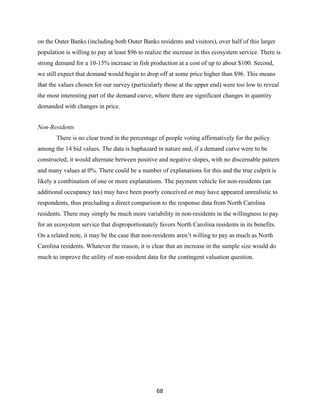
Invertebrates
Panopeus herbstii Mud Crab 13 80 37 215 345
Callinectes
sapidus
Blue Crab 15 6 2 2 25
Unknown Unidentified
Crabs
4 0 0 0 4
Urochordata Sea Squirt 0 8 0 1 9
Family: Mytilidae Mussel 0 1 0 0 1
Palaemonetes
paludosus
Glass Shrimp 0 0 3 0 3
26
Table 1 summarizes the data from all finfish and invertebrate species found in four of the
oyster aquaculture racks at the study site on two field days (Sept. 5, 2014 and Oct. 5, 2014). The
four racks pulled were intentionally picked for variation in the amount of time they had been
submerged for. This was to allow for the ability to test for a relationship between time elapsed
and other variables. There was no discernable correlation between time since cages were
deployed and species richness, which is the combined number of finfish and invertebrate species
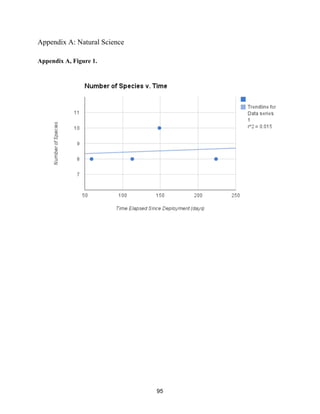
(R2
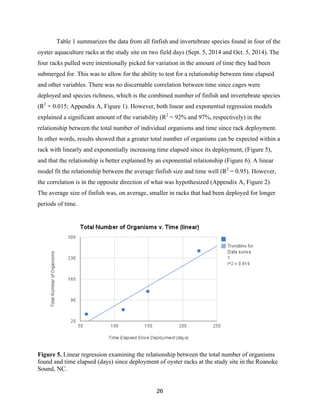
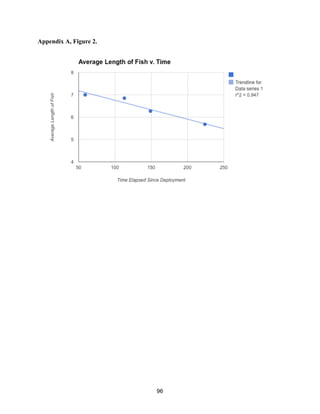
= 0.015; Appendix A, Figure 1). However, both linear and exponential regression models
explained a significant amount of the variability (R2
= 92% and 97%, respectively) in the
relationship between the total number of individual organisms and time since rack deployment.
In other words, results showed that a greater total number of organisms can be expected within a
rack with linearly and exponentially increasing time elapsed since its deployment, (Figure 5),
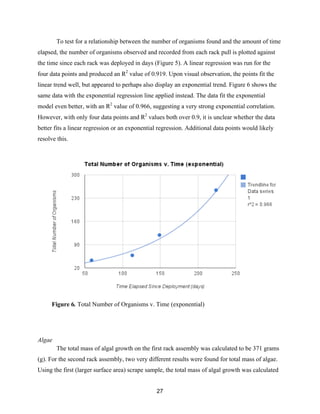
and that the relationship is better explained by an exponential relationship (Figure 6). A linear
model fit the relationship between the average finfish size and time well (R2
= 0.95). However,
the correlation is in the opposite direction of what was hypothesized (Appendix A, Figure 2).
The average size of finfish was, on average, smaller in racks that had been deployed for longer
periods of time.
Figure 5. Linear regression examining the relationship between the total number of organisms
found and time elapsed (days) since deployment of oyster racks at the study site in the Roanoke
Sound, NC.
27
To test for a relationship between the number of organisms found and the amount of time
elapsed, the number of organisms observed and recorded from each rack pull is plotted against
the time since each rack was deployed in days (Figure 5). A linear regression was run for the
four data points and produced an R2
value of 0.919. Upon visual observation, the points fit the
linear trend well, but appeared to perhaps also display an exponential trend. Figure 6 shows the
same data with the exponential regression line applied instead. The data fit the exponential
model even better, with an R2
value of 0.966, suggesting a very strong exponential correlation.
However, with only four data points and R2
values both over 0.9, it is unclear whether the data
better fits a linear regression or an exponential regression. Additional data points would likely
resolve this.
Figure 6. Total Number of Organisms v. Time (exponential)
Algae
The total mass of algal growth on the first rack assembly was calculated to be 371 grams
(g). For the second rack assembly, two very different results were found for total mass of algae.
Using the first (larger surface area) scrape sample, the total mass of algal growth was calculated
28
to be 382 g, which is close to the calculated mass of algae on the first rack. Using the second
(smaller surface area) scrape sample, the total mass of algae was calculated to be 621 g. The
percentages of carbon and nitrogen content in the algae were similar, but not the same, among
the three scrape samples. The sample from the first rack assembly was found to contain 14.8%
carbon and 2.2% nitrogen. The first (larger surface area) sample from the second rack assembly
was found to contain 17.3% carbon and 2.1% nitrogen. The second sample from the second rack
assembly was found to contain 14.2% carbon and 1.55% nitrogen. Together, these calculations
indicate an average algal mass per rack assembly of 458 and average carbon and nitrogen in algal
organic matter to be 15.4% and 1.95%, respectively
29
Discussion
Returning to our first hypothesis, we found that the oyster aquaculture facility did
provide habitat for species that would typically be found near or on wild oyster reefs. The habitat
provided by oyster aquaculture facilities has an economic value both directly through providing
habitat for commercially and recreationally valuable fish and indirectly by providing habitat for
species that are prey of commercially and recreationally valuable fish. Because habitat existed in
the area before the aquaculture facility, the gross habitat value of the facility is somewhat
misleading. Whether it consisted of sandy bottom, SAV, or a combination of habitats, the pre-
aquaculture habitat value would ideally be subtracted from the gross habitat value of the
aquaculture facility to find the net habitat value provided by the facility. Alternatively, similar
measurements could be collected from empty oyster bottom racks at the control site. This would
provide another way of establishing a baseline habitat value that could be compared to the
measurements at the study site. However, there was no information available describing what the
lease area looked like or what species it contained before the aquaculture facility was installed,
and there were no oyster racks on the bottom of the control site. Therefore, the habitat value
measurements collected at the aquaculture facility could not be contextualized in this way.
Nonetheless, we were able to determine which of the species observed in the aquaculture racks
have economic value, either commercially or recreationally.
Tautog are larger finfish which are commonly sought after by recreational sport
fishermen (Peninsula Saltwater Sport Fisherman’s Association, 2014). While Tautog populations
have historically been overfished, they are recovering and still hold an annual market for
commercial fishermen. Sheepshead have a modest commercial value due to their abundance
across coastal waters. Sheepshead are especially important as a recreational species, with
recreational fishing accounting for 90-95% of the annual catch in some coastal Atlantic states
such as Florida (Hill, 2005). Blue crab is “perhaps the most sought-after shellfish in the mid-
Atlantic region”, caught recreationally and commercially in large numbers (NOAA, 2012).
While oyster toadfish are edible, they are rarely eaten and serve no commercial or recreational
value (CBP, 2014). The Atlantic mud crab, brenny, and skilletfish do not grow large enough to
be a viable food source and are not commercially or recreationally valuable.
30
Our initial hypothesis stated that oyster aquaculture facilities would provide habitat for
species of finfish and crabs that would typically be found at or near wild oyster reefs, but would
not otherwise be associated with areas of sandy bottom or SAV. Because we were unable to
utilize a control site for this part of our research, we reviewed literature on the species we
observed, specifically their habitats, to assess this first hypothesis. We found 5 species of fish
and 2 species of crabs at the study site that either utilize oyster reefs as habitat or prey upon
oysters. These species include oyster toadfish, blenny, skilletfish, tautog, sheepshead, blue crabs,
and mud crabs.
Oyster toadfish habitat typically consists of sandy, rocky, and muddy bottoms on oyster
reefs, additionally containing eelgrass (Save the Bay, 1998). Toadfish are omnivores that feed on
Crassostrea virginica (Save the Bay, 1998). We identified few oyster toadfish in three of our
four rack pulls, and the range from juvenile to adult fish suggests that oyster racks are being
utilized by this species as habitat similar to oyster reefs. While the presence of eelgrass found
along areas of the study site corresponds with known oyster toadfish habitat, eelgrass mass was
dwarfed by other SAV types--particularly widgeon grass--at the study site. Feather blenny were
also present at each of our four rack pulls. These smaller finfish are known to utilize oyster
reefs/beds as habitat, although they are not a consumer of oysters (Cavalluzzi, 1999). Therefore,
feather blenny are also utilizing the habitat provided by oyster aquaculture racks as they would
oyster reefs. Skilletfish, found in one of our four rack pulls, are dependent on oysters for habitat
and spawning sites. These fish mostly utilize oyster reefs as habitat, although they may be found
within eelgrass beds. Skilletfish spawn inside of empty oyster shells and use the crevices within
oyster reefs for camouflage and protection from predators (Chesapeake Bay Program, 2014).
While oyster reefs provide important habitat for skilletfish, we can only conjecture that oyster
racks also provide this spawning habitat function. Tautog are known to use oyster reefs as habitat
and predate several species of shellfish (Chesapeake Bay Program, 2014). Additionally, Tallman
and Forrester (2007) found an abundance of tautog at “oyster grow-out cages” when comparing
these cages with natural and artificial oyster reefs. The presence of only one tautog in our four
rack pulls does not suggest habitat use, but in line with other studies, could be expanded upon.
Like other species discussed, sheepshead utilize oyster reefs for habitat and eat oysters. Juvenile
sheepshead are known to eat algae (SCDNR, 2005) and have also been found in previous studies
to utilize submerged aquaculture gear as habitat (Erbland and Ozbay, 2008). The presence of
31
sheepshead in 3 of 4 rack pulls, along with the identification of algae on the oyster racks,
suggests both oysters and algae as possible drivers for sheephead to utilize oyster racks for
habitat and food.
Two species of invertebrates--blue crabs and mud crabs--were found to vary widely in
number and size amongst all four rack pulls. Blue crabs utilize soft-bottom and seagrass beds
within estuaries as habitat and scavenge many species of fish and invertebrates for food,
including oysters. (NOAA, 2012) The size of blue crabs measured from our rack pulls suggests
that adult blue crabs may live within the SAV and sandy bottom at the study site, taking
advantage of oyster racks as a source of food. It is possible that these crabs were utilizing oyster
racks as habitat, although blue crabs do not usually live on oyster reefs. Mud crabs were also
present in all four rack pulls, displaying large counts relative to blue crabs. Mud crabs are known
to exist within wild oyster beds and prey upon oysters (Sweat, 2009), although they are
scavengers/omnivores. We cannot extrapolate the presence of mud crabs to a use of oyster racks
as habitat, so it is unclear how mud crabs are utilizing this area.
Some of the species we found utilize the oyster racks directly, as habitat or food, while
others may prey on those species. In this way, the second group of organisms does not benefit
from the oyster racks directly, but the aquaculture facility does provide indirect benefits such as a
predictably located food source. As an example from our study, the aquaculture facility provides
both a direct and indirect food source to oyster toadfish. While the oyster toadfish prey on
oysters and use oyster reefs and racks as habitat, they also eat mud crabs, which were found in
very high numbers in some of the oyster racks (Sweat, 2009). A more complete evaluation of the
trophic relationships between the fish and crabs we observed would be desirable to inform the
quality and quantity of habitat provided by oyster aquaculture facilities.
Concerning our second hypothesis, our data only supports one of the two parts. The
component that is supported by the linear and exponentials model is the notion that with more
time elapsed since the initial deployment of farmed oyster racks, there are a greater number of
organisms found within the oyster rack. However, our data fails to support the part of the
hypothesis stating that with more time elapsed, there are a greater number of species within the
oyster racks. No correlation between time elapsed and number of species was observed
(Appendix A Figure 1).
32
Our data indicates that finfish are, on average, smaller with the more time since cages
have been deployed. We believe that this is due to the small number of species that are typically
found on the bottom near oysters, which is even further limited by the size of the metal grid of
the racks. The racks are made of a ¾ in. by ¾ in. metal mesh, so anything larger than that would
have to enter the rack at a young age (and small size) and grow to a size that would trap the
organism within the rack. The diversion from the normal rack pulling methodology on one of our
three rack pulls (the rack deployed on June 13 and pulled on Oct. 3) may have caused a
discrepancy in our data as we saw small fish and crabs fall out of the rack assembly while it was
suspended over the water, and we suspect that more organisms fell out than just those we
observed.
With regard to the algal scrape samples, we assumed that the areas we were measuring
samples from are typical of the algal growth all along the top rack of the assembly. Further, we
assumed that the bottom two racks had no algal growth, but there was some, albeit a relatively
small amount compared to the top. Algae provides food and converts inorganic nitrogen to
organic nitrogen for consumer organisms (those of higher order than primary producers) as it
grows on oyster reefs (Street et al. 2005). We found considerable amounts of algal growth on the
top racks of the assembly. While we are unable to further examine our results and quantify the
value of algae to consumer organisms, previous research on submerged aquaculture gear (SAG)
infers that these assemblies share similarities to oyster reefs and should contain an intrinsic
habitat value (Dealteris et al. 2004). The presence of algae-consuming species such as
Sheepshead in our oyster racks, along with previous research comparing SAG and oyster reef
habitat value, infers that algae may provide a habitat value similar to its role among shell bottom.
Further research to extrapolate the intrinsic value of SAG algae from the other components
within these assemblies is recommended.
Our methodology had many limitations due to time and resource constraints. We only
had the capability to record species associated with the aquaculture cages at this one aquaculture
facility rather than sampling the benthos (area near the sediment surface) and pelagic
environment overlying and between cages using independent sampling with alternative fishing
gear at several different aquaculture facilities. This limitation in sampling methods also
prevented habitat value assessment at control sites and sites prior to the introduction of oyster
33
aquaculture gear. Also, we were only able to pull and take measurements for four rack
assemblies. More data would be preferable and would allow for more robust statistical analyses.
Because this study was limited in temporal and spatial scope, and the physical, biological,
and chemical conditions across the Albemarle Pamlico Sound vary widely, we suggest that
further studies should be conducted to more fully assess the habitat value offered by oyster
aquaculture facilities. Ideally, at least some study sites within the larger study would include
baseline data, from before the installation of the facility. In addition, control sites consisting of
variable types of estuarine habitat, such as SAV, wild oyster reefs, and sandy bottom would be
included. This data would allow for the establishment of a monetary or economic value of this
ecosystem service, which would better quantify the value of habitat provision for finfish and
invertebrates by oyster aquaculture.
Overall, we feel that our study showed that oyster aquaculture facilities using bottom
racks provide habitat for a variety of finfish and invertebrates, some of which have commercial
and/or recreational value. Habitat is provided by the oyster racks for algae that grows on the rack
surfaces, the oysters contained within the racks, and finfish and shellfish that make their way into
the racks. Our results are consistent with those from similar studies, although our methodology
was unique in the sense that other studies took measurements using lift nets or trap surveys
instead. A 2004 study by Dealteris et al. compared the habitat value of SAG, SAV, and non-
vegetated seabed and found a number of advantages of SAG habitat over the other two. SAG
habitat had significantly greater surface area, its physical structure “protects juvenile fish from
predators and provides substrate for sessile invertebrates that serve as forage for fish and
invertebrates,” and it “supported a significantly higher abundance of organisms per m2
”
(Dealteris et al. 2004). This study concluded that SAG provides substantially greater habitat
value than either SAV or non-vegetated seabed because SAG is “especially beneficial to
ecosystems that support native species of recreationally and commercially important fish and
invertebrates in their early life history stages” (Dealteris et al. 2004). This could potentially
explain why so many of the fish observed in our study were juveniles. A 2008 study, comparing
the habitat provided by SAG and oyster reefs, concluded, “...oyster aquaculture supports
additional populations of ecologically and economically important macrofauna compared with a
created oyster reef” (Erbland 2008). Like the Dealteris et al. study, the results of this 2008 study
found that oyster aquaculture hosted significantly greater species richness than the comparison
34
habitat. However, while the Dealteris et al. study found no significant difference in species
diversity between SAG and SAV, the 2008 study found that the oyster reef featured significantly
greater species evenness compared to SAG (Dealteris et al. 2004; Erbland 2008). More studies
are warranted to assess the habitat value of oyster aquaculture, especially as it compares to that
of SAV and oyster reefs. This is particularly important for North Carolina because regulations, as
they stand, assume that facilities displace habitat value provided by SAV without accounting for
the value provided by the facilities themselves.
35
Light, Nutrients, and SAV Distribution and Abundance
Introduction
Nutrients and water clarity are vital to SAV growth and abundance. With oysters filtering
particulates out of the water column and redistributing nutrients from the water column to the
sediment surface, where they are remineralized, oysters increase the available sunlight reaching
SAV for use in photosynthesis as well as increasing the nutrients available to SAV for primary
production (Newell, 1988; Newell 2012; Forrest et al, 2009). Therefore, examining nutrient
regulation and water filtration provided by oysters was especially relevant to analyzing the
abundance and distribution of SAV at the aquaculture facility and how it may be affected by
these two regulatory ecosystem services. Submerged aquatic vegetation may be shaded and
otherwise displaced by aquaculture gear directly under the gear (Everett et. al 1995, Skinner et
al. 2013, Skinner et al. 2014), but SAV in the area surrounding an aquaculture facility may
benefit from the oysters’ presence. These relationships are important to understand if changes are
to be made in the oyster aquaculture industry in North Carolina regarding SAV limits and
monitoring.
Because oysters are filter feeders, we hypothesized that oyster aquaculture would
improve water clarity by allowing more sunlight to penetrate the water column and affect
nutrient concentrations through converting nutrients in the water column to the sediment, where
they would be remineralized to biologically available forms. Furthermore, it was hypothesized
that SAV density would be greater immediately outside and inside the aquaculture site, with the
exception of areas that are directly under SAG, than at the control site.
36
Methods
There were generally two treatments and a control that were sampled for each SAV
density, water and sediment water nutrient concentrations, and water clarity. The first treatment
is “inside,” which refers to samples collected inside the footprint of the aquaculture facility, but
that were not occupied by SAG, including racks, bags, docks, and pilings. The second treatment
is “outside,” which refers to samples collected from the edge of the facility to 50 m outside of the
facility. Replicates from both inside and outside were distributed among the southwest,
southeast, northwest, and northeast quadrants of the facility. For SAV density measurements,
there was also a “border” treatment that is explained below.
Water Clarity
Using a meter stick, an average SAV height of 35 cm was determined prior to entering
the research site. Photosynthetically active radiation (PAR), or the wavelengths of solar radiation
that is used by photosynthesizing organisms (400-700 nm), was measured on September 16th
,
2014 and October 2nd
, 2014 using a spherical PAR sensor (LiCor). The LiCor sensor was
positioned just beneath the water surface (Z) and at the predetermined depth of the SAV, 35 cm
above the sediment surface, at each sampling location. Light levels (mmol photons m-2
s-1
) at
these two depths - E0 for the surface and Ez for the predetermined depth- were used to calculate
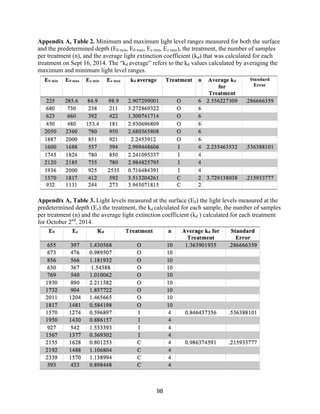
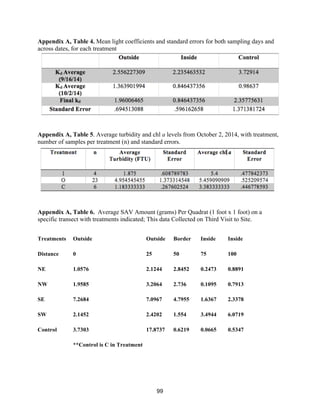
the mean light extinction coefficient (kd ) at each location using the Lambert-Beer equation
where kd = -[ln (light Z/light O)]/0.35. Extinction coefficients were determined at the northern,
southern, eastern, and western perimeters of the aquaculture facility (outside, O) as well as 4
spots in the boat canal in the middle of the aquaculture facility (inside, I). Extinction coefficients
were also determined at 2 spots at the control site (control, C) on September 16th
, 2014 add at 4
spots on October 2nd
, 2014.
A YSI water quality sonde with conductivity, pH, dissolved oxygen, turbidity, and chl a
probes was used to measure various environmental parameters at each sampling location on
September 16th
, 2014 – both at the aquaculture facility and the control site. Turbidity and
chlorophyll are of particular interest to our water clarity research. Measurements were taken at
the surface and again at our previously determined measurements based on SAV height.
37
Nutrients
Sediment core, water column, and surface sediment samples for nutrient analysis were
collected on October 3, 2014. One core, one water column, and one surface sediment sample
were recovered from within the footprint of the aquaculture facility (Figure 3) and from between
50 and 100 m outside the facility at each the southwest, northwest, and northeast corners. Two
core, water column, and surface sediment samples were also collected from the control site
(Figure 2).
YSI measurements of water temperature and dissolved oxygen concentrations indicated
that the water column was well-mixed, and thus, representative water column samples were
collected from the middle of the water column in 1 L brown HDPE Nalgene bottles. Core
samples were collected from the top 30 cm of the sediment surface using a 9.5 cm diameter
corer. Surface water was carefully poured off of cores and pore water was extracted from the
middle of each core using a syringe. The syringe was rinsed between extractions of pore water
samples by rinsing three times with DI water. Surface sediment samples were scraped from the
top 5cm of the sediment surface and collected in PPFD sample bottles.
Water column and pore water samples were filtered through Whatman GF/F filters
immediately upon collection and filtrate was collected in 50 mL polystyrene Falcon tubes.
Filtered water and sediment samples were transported to the laboratory in coolers and stored at -
10 degrees C until nutrient analysis (within 30 days).
Phosphate, nitrate, and ammonium concentrations in water column and pore water
samples were determined spectrophotometrically. Phosphate was analyzed using standard
methods (Parsons et al. 1984). Nitrate was analyzed using the Nitrate Elimination Company Low
Range Lab Nitrate Test Kit method (saltwater samples; 0.05-1.0 ppm). The ammonium
concentrations were determined using methods adapted from Holmes et al. (1999) and Kang et
al. (2003).
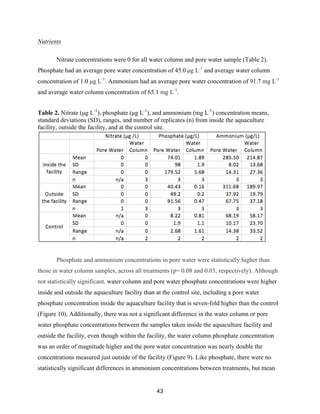
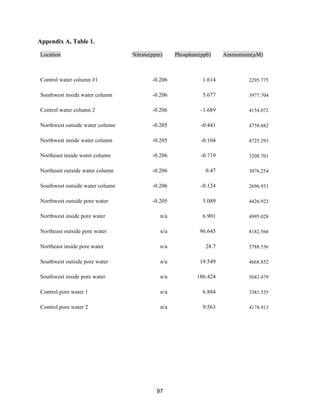
Appendix A Table 1 shows the complete concentration readings. Negative analyte
concentrations were assumed to be below the detection limit and rounded to nil. Means, ranges,
and standard errors for water column and pore water nutrient concentrations were calculated for
each treatment (Table 2).
38
SAV
Our field methods examinations of SAV consisted of qualitative (observational) and
quantitative transect sampling similar to that of Rodusky et al. (2004).
During the September 2014 visit to the site, we quantified the presence/absence of SAV
across 100 m transects that extended across both inside and outside treatments in the southwest
and northwest quadrants and the canal between the southwest and southeast areas of the site. For
the southwest and northwest transects, two groups of three were inside the perimeter of the site
and both were laid in between one of the three lines of floating bags. Starting at 0 (outside) and
every 10 m, the presence or absence of SAV was assessed physically (by touch) to both the right
and left sides of each transect. This method was also conducted at control site 1 along four
transects. This method resulted in 10 sampling points per transect. In total, 12 transects were
examined (120 sampling points).
During the Oct. 2014 visit to the site, we examined the shoot density of SAV within the
facility, on the border of the facility’s perimeter, outside of the facility’s perimeters, and at
control site 2, according to the methods used in Capers (2000). A 100 m transect was laid in each
the northeast, northwest, southeast, and southwest quadrants, perpendicular to the perimeter,
beginning 50 meter outside of the footprint of the facility and extending 50 m into the interior of
the facility.
A weighted PVC 1 ft2
quadrat was dropped vertically into the water column at each
sampling location, and the SAV within the quadrat was uprooted by hand and collected in plastic
vessels. SAV was sampled at 25 m increments along the transect, where 0 and 25 samples were
from the “outside” treatment, 75 and 100 m samples were from the “inside” treatment, and a
“border” sample was taken at the edge of the facility (50 m). Once collected, SAV from each
quadrat was sorted by species (eelgrass, shoal grass, widgeon grass). This method resulted in 20
subsamples from inside and outside of the aquaculture facility and five samples from control site
2. SAV samples were transported to the lab in a cooler.
Upon return to the laboratory, species-sorted SAV samples were rinsed with tap water to
remove sediment particles and roots were clipped. Samples including both dead and living seas
grass were placed in pre-weighed aluminum envelopes and then dried in a 60 ◦C drying oven for
39
48 hours. Dried SAV samples were weighed to obtain density measurements for each species of
SAV per unit area for each quadrat (g ft-2
).
Means, standard errors, and ranges of SAV density by species and across species along
each transect were calculated for each treatment. Treatments included outside the aquaculture
facility (0 and 25 m quadrats), the border of the facility (50 m quadrat), and inside the facility (75
and 100 m quadrats), as well as for the control site. Border samples were treated as an
independent treatment because they extended across inside and outside treatments and initial
comparisons between treatments and this location along each transect revealed a large difference.
Means and standard errors of SAV density for all species was also calculated for the eastern and
western halves of the aquaculture facility to better assess the spatial distribution of SAV within
the facility and how it corresponded with proximity to different types of gear, which were rack
assemblies and floating bags, respectively.
Data Analysis
Relationships between the light extinction coefficients on each sampling date and across
both sampling dates and between concentrations of the pore water and water column samples
from inside the aquaculture facility, outside the facility, and at the control site were tested using
two-sided t-tests (α = 0.10 ).
40
Results
Water Clarity
On both sampling occasions, PAR varied between 300 and 400 nm from the water’s
surface to the depth of SAV, with a few exceptional outliers. On September 16, 2014, light
extinction at the control site was statistically greater than both inside and outside the aquaculture
facility (p = 0.065 and 0.024, respectively). In other words, significantly more surface light
reached the sediment surface both inside and outside of the aquaculture facility than the control
site. Outside mean kd was slightly greater (2.55) than the inside mean kd (2.23) but the difference
between treatments was not significant (Appendix A, Table 2).
On October 2, 2014, the mean outside kd (1.36) was statistically greater than (p=0.06) and
close to double the mean inside kd (0.84). The mean control kd of 0.98 is closer to the mean
inside kd than the mean outside kd. Similar to the results observed on the first sampling day, the
kd was greater at the control site than inside the facility, yet the difference was not significant. In
other words, on the Oct. sampling occasion, the most light reached the seabed inside the facility
and the least light reached the seabed outside of the facility and the light reaching the seabed at
the control site was less than but most similar to the amount reaching the seabed inside the
facility (Appendix A, Table 3).
Overall mean kd across dates for both the outside (1.96) and inside (0.85) treatments for
the aquaculture facility were smaller than the average Kd calculated for the control site (2.36)
(Figure. 6; Appendix A, Table 4), although differences were not significant.
41
Figure 7. Mean light extinction coefficients for all three treatments across sampling dates.
Error bars represent 1 standard error from the mean.
On the Sept. 16, 2014, turbidity concentrations were higher both inside and outside the
aquaculture facility than at the control site (Fig. 8), although the difference was only significant
between the outside and the control (p=0.01). Turbidity levels were over twice as high outside
the aquaculture facility as compared to the levels measure inside the facility (p=0.05). Chl a
concentrations followed a similar pattern (Figure 9). Chl a was statistically lower at the control
site than both inside (p=0.01) and outside (p=0.007) the facility. Between the inside and outside
of the facility, chl a was lower inside, but not significantly, with approximately a .06 µg/L
difference.
42
Figure 8. Mean turbidity levels for all three treatments on September 16th
, 2014.
Error bars represent 1 standard error from the mean.
Figure 9. Mean chl a levels for all three treatments on September 16th
, 2014.Error
bars represent 1 standard error from the mean.
43
Nutrients
Nitrate concentrations were 0 for all water column and pore water sample (Table 2).
Phosphate had an average pore water concentration of 45.0 µg L-1
and average water column
concentration of 1.0 µg L-1
. Ammonium had an average pore water concentration of 91.7 mg L-1
and average water column concentration of 65.1 mg L-1
.
Table 2. Nitrate (µg L-1
), phosphate (µg L-1
), and ammonium (mg L-1
) concentration means,
standard deviations (SD), ranges, and number of replicates (n) from inside the aquaculture
facility, outside the facility, and at the control site.
Phosphate and ammonium concentrations in pore water were statistically higher than
those in water column samples, across all treatments (p= 0.08 and 0.03, respectively). Although
not statistically significant, water column and pore water phosphate concentrations were higher
inside and outside the aquaculture facility than at the control site, including a pore water
phosphate concentration inside the aquaculture facility that is seven-fold higher than the control
(Figure 10). Additionally, there was not a significant difference in the water column or pore
water phosphate concentrations between the samples taken inside the aquaculture facility and
outside the facility, even though within the facility, the water column phosphate concentration
was an order of magnitude higher and the pore water concentration was nearly double the
concentrations measured just outside of the facility (Figure 9). Like phosphate, there were no
statistically significant differences in ammonium concentrations between treatments, but mean
44
ammonium concentrations in the pore water from inside and outside the aquaculture facility were
4.2 and 4.6 times higher, respectively, than the ammonium concentrations from the control site
(Figure 11).
Figure 10. Water column and pore water phosphate concentration (µg L-1
)
means of inside and outside the aquaculture facility and at the control site.
Error bars represent 1 standard error of the mean.
45
Figure 11. Water column and pore water ammonium concentration averages
from inside and outside the aquaculture facility and at the control site. Error
bars represent 1 standard error of the mean.
46
Figure 12. Water column and pore water means ammonium concentrations (mg L-1
) of
inside and outside the aquaculture facility and at the control site. Error bars represent 1
standard error of the mean.
SAV
The Sept. 2014 physical assessments for presence/absence of samples for all transects
were almost completely homogeneous amongst all treatments. Submerged aquatic vegetation
was present at all sampling locations. On Oct. 2014, we observed that SAV was most dense
immediately outside and on the border of the aquaculture facility. Submerged aquatic vegetation
was least dense inside the aquaculture facility (especially at 75 m quadrats that were 25 m from
the border of the site) (Appendix A. Table 6). Average amounts of SAV among transects for
each treatment indicated an increase in the average amount SAV from 0 to 25-meter treatments,
followed by a large decrease in average amounts of SAV from 25 through 75-meter treatments.
The average amount of SAV increased between 75 and 100-meter treatments (Appendix A,
Table 6). While a similarity does appear to exist between 50 through the 100-meter treatments of
47
our control transect and 50 through the 100-meter treatments of our aquaculture site transects, no
other patterns appear to be shared between the two (Appendix A., Fig. 3-5). Though none of
these differences in SAV coverage appeared to be statistically significant, future research of the
study site with additional treatments and data points would provide further insight into overall
patterns of SAV distribution.
Figure 13. Observed differences between inside (I), outside (O), border (B), and
control (C) treatments. Error bars represent 1 standard error of the mean.
We observed that there were spatial patterns in SAV density between and within the
eastern and western halves of the facility. The western half of the facility showed similar mean
SAV densities between the quadrats inside and outside of the facility. However, on the eastern
half of the facility, the outside mean SAV density was significantly larger than inside mean
density. Submerged aquatic vegetation density outside of the eastern side of the facility was also
significantly denser than on the inside and outside western half of the facility (Fig. 14).
48
Figure 14. Observed mean SAV density (g ft-2
) inside eastern (IE), inside western
(IW), outside eastern (OE), and outside western (OW) quadrants. There is statistical
difference between the errors bars of the IE, OE pairs and the OW, IW pairs.
49
Discussion
We saw few statistically significant differences in water clarity, sediment and water
column nutrient concentrations, and SAV density among treatments, which reveals the primary
limitation of our study: we were only able to collect a limited dataset on one or two sampling
occasions. With such a small sample size, there were large standard errors that overrode
differences between treatments. Nonetheless, our data does reveal patterns in water clarity,
nutrient concentrations, and SAV density that suggest that oyster aquaculture does provide water
filtration and nutrient regulation services that in turn provide conditions favorable to SAV
growth and overall water quality improvement. Further, SAV was still present inside and outside
of the facility at densities not significantly different from at the control site. The results from our
study highlight that environmental benefit is conferred by the oyster aquaculture facility and
provide guidance for future investigation into quantifying the services provided by oyster
aquaculture facilities.
Water Clarity
When all data is considered together, more light reaches the sediment surface inside the
aquaculture facility, aside from locations under SAG that we assumed to receive no PAR, which
is likely an overstatement, and outside the facility than reaches the sediment surface at the
control site. The lack of statistical difference suggests that variability in light extinction within
each treatment across days is influenced by other environmental factors other than just proximity
to the aquaculture facility.
Despite these findings regarding light levels, turbidity and chl a levels measured on the
first sampling day, September 16th
, were actually lowest at the control site. These data present a
conundrum because both turbidity and chl a increase light extinction and it would be expected
that light extinction would increase with increasing turbidity and chl a. We believe this unusual
observation is due to human error using the YSI sonde. The sonde is heavy and if it touches the
sediment surface, it resuspends sediment, thus contributing to water column chl a and turbidity.
We observed that we touched the sonde to the bottom frequently and believe that this
confounded our data. General observations lead us to believe the oyster bags within the facility
were breaking up waves, thus reducing wave action, resuspension of sediments, and thus,
50
turbidity. Our data comparing turbidity levels within the facility to those outside support these
observations yet the lower turbidity at the control site confounds the relationship.
These results show that the change in light levels with the change in depth was smaller
between the surface of the water and the predetermined SAV height at the aquaculture facility
that at the control site. This supports the hypothesis that the presence of oysters at the
aquaculture facility improves water clarity by filtration, allowing more light to be transmitted
through the water column. Additionally, the light extinction coefficient was lower inside the
aquaculture facility as compared to outside of the facility, suggesting that the effect of improved
water clarity surrounding oysters has spatial limitations.
In the future, we suggest that studies include more sampling days to further assess water
clarity improvements provided by aquaculture oysters, the other environmental factors that
influence water clarity around the aquaculture facility, and the spatial extent of water clarity
improvement around aquaculture facilities.
Nutrients
Nutrient concentrations were generally higher at the aquaculture site than at the control
site, even though the data was not statistically significant. Phosphate pore water concentrations
were highest inside the aquaculture facility and lowest at the control site. Ammonium pore water
concentrations were highest outside the control site and lowest at the control site. Water column
phosphate and ammonium concentrations were highest inside the aquaculture facility.
The effect of oyster aquaculture on water column and sediment nitrate levels was
inconclusive because results showed no nitrate was present in any of the samples. This may have
been because there was no nitrate present in the water or sediment at the aquaculture site or
control site or because of an error in our collection and analysis procedure. The nitrate analysis
procedure required a large amount of water to be analyzed, which was not possible in the pore
water samples. Thus, only one pore water sample was able to analyzed for nitrate. Additionally,
all of the nitrate readings were -0.205 µg L-1
or - 0.206 µg L-1
. This may have been because the
true nitrate concentrations were too low to be detected using our analysis method or there could
have been an issue with the method.
51
Future research should continue to research the effect oyster aquaculture has on pore
water and water column nutrient concentrations. Our data suggests that oyster aquaculture
facilities have an effect on nutrient regulation, providing more biologically available nitrogen
and phosphorus in the water column and pore water that is available for primary producers. This
effect should be better understood especially given increasing nutrient loading into the
Albemarle-Pamlico sound system. Inorganic nutrients are crucial to healthy ecosystems and
primary production. However, at too high of concentrations, they can cause excessive algal
growth, which can be detrimental to SAV growth, and in extreme cases, cause eutrophication.
However, we do not expect this buildup to occur at the aquaculture site because of the proximity
to Oregon Inlet and the resultant expected mixing and sediment transport. With nutrients being
as important as they are, there should be a greater understanding of the potential effects that
oyster aquaculture has on nutrient concentrations.
SAV
As recorded by the Division of Marine Fisheries during previous years, SAV meadow has
covered the Albemarle and Pamlico Sounds and even accounting for aquaculture facilities, SAV
will still be present (Inventory 2008). However, the trends and patterns from our study indicate
that SAV density is slightly lower within the aquaculture facility and absent under rack
assemblies according to our observations. In studies such as, Ruiz et al. 2001, Everett et al. 2001,
and Newell 2004, their results affirmed that SAV was lower in aquaculture sites, because of
shading from gear coverage and the infrastructure built into the sound. For our study, the small
amount of samples is likely to have influenced our results.
Differences between western and eastern halves of the study site may be due to
differences in depth on these opposite ends of the site. The eastern side of the site is deeper than
the western side of the site. However, the differences in SAV density may alternatively be due to
differences in gear across the study site. On the eastern side of the site, the rack assemblies rest
on the seabed and are constantly submerged, while western floating bags remain on the surface.
We observed that there is SAV growing between the floating bags but that they partially shade
more of the sediment surface than the rack assemblies, which completely block sunlight from the
sediment surface in their immediate footprint but not much outside of it. The differences in how
52
these different types of gear prevent sunlight from reaching the sound bottom may account for
the significantly greater SAV density outside of the eastern side of the facility.
The process by which SAV reproduces may present an opposing factor influencing the
differences in the amounts of SAV between the eastern and western sides of the site (Street et. al,
2005). During the summer, SAV release floating seed pods which later settle to the bottom of the
water column and grow into new plants. The presence of floating oyster bags on the western side
of the site may be stopping the movement of these seedpods along the surface of the water,
causing an increased amount of seedpods to settle to the bottom of the water column near the
floating bags (Street et. al, 2005). During data collection, we observed the trawl lines of the
perimeter were covered in SAV. Further studies should be conducted on the effects of different
types of aquaculture equipment on SAV density and light extinction around gear.
53
Conclusions
Even though the effect of oyster aquaculture on water clarity and nutrient concentrations
needs to be further studied, our results suggest that water clarity was improved and more
biologically available nutrients were supplied by oyster aquaculture. Several studies looking at
nutrient concentrations found similar results (Forrest et. al., 2009; Crawford et.al., 2003). These
studies also found that oyster aquaculture may regulate nutrients through transferring nutrients in
the water column to the sediment. However, for SAV growth and water clarity, many studies had
opposing results (Ruiz et al. 2001; Everett et al. 1995; Newell, 2004).
It appeared that SAV presence was not entirely affected by oyster aquaculture in the
study site. In our SAV study, we were unable to quantify the change in estuarine benthos within
and around the facility. This would have taken into account the shading from the equipment,
which can affect photosynthesis. Though SAV is not entirely affected by the aquaculture facility,
sufficient study on the marginal differences caused by factors such as types of gear and depth,
will shine a better light on SAV management. SAV serves important ecosystem services such as
essential habitat and a food source, and comprehending the relationship between oyster
aquaculture and SAV density will assist in both retaining these services and the construction of
future facilities.
While improvements to water clarity and nutrient concentrations are ecosystem services
in themselves, they are also very important to the growth and health of SAV. Water clarity
increases the amount of available light reaching SAV for photosynthesis and proper nutrient
concentrations are essential for primary production. Alternatively, if nutrient concentrations pass
a threshold and build up, it can be detrimental to SAV growth (Forrest et al. 2009 ). However, we
do not expect this buildup to occur at the aquaculture site because of the proximity to Oregon
Inlet and the resultant expected mixing and sediment transport. Understanding the relationships
between oyster aquaculture and water clarity and nutrient concentrations and how this may affect
SAV is important if changes to the oyster aquaculture industry are to be made.
54
Social Science Research
Introduction
The purpose of the social science research was to gain a better understanding of public
perceptions, knowledge, attitudes, and valuation of oysters and oyster aquaculture. Investigating
the culture of the oyster industry and public perceptions of oysters can help us to understand the
role oysters in the present and future of the Outer Banks, both ecologically and economically. In
order to investigate the social aspects of oysters, both qualitative interviews and quantitative
surveying methods were used.
55
Methods
Qualitative Research
Qualitative interviews were used as a starting point for the development of research
questions. We conducted an interview with two oyster industry professionals in an effort to
understand the perspective of the restaurant industry on oysters before composing the survey that
was distributed. Based on the interview, we found that locality and cost are customers’ primary
concerns and that the source of oysters is one of the most common questions asked by restaurant
patrons. Concerning demographics, the interviewees noted that the majority of people who order
oysters tend to be in groups rather than alone because oysters are often eaten in a social setting.
If restaurant patrons had any knowledge about the ecosystem service provided by oysters, it was
likely to be that oysters filter water.
Quantitative Research
The interview was used to inform the construction of a quantitative survey. Five key
variables emerged from subsequent analysis of the qualitative interview and for each variable,
research questions were formulated. The variables and research questions are: preferences (Do
customers prefer wild-harvested or farmed-raised oysters? Why do people order oysters?), habits
(How do customers order their oysters?), knowledge (What do customers think they know about
oysters and what do they actually know?), valuation (How much are people willing to pay to
increase the amount of ecosystem services provided by oysters via stimulating North Carolina’s
aquaculture industry?), and demographics (What is the age, income, and education level of
oyster consumers?). Quantitative research allowed for more in-depth statistical analyses of these
variables.
Willingness to Pay for an Ecosystem Service
The survey also contained an economic component, which utilized a method known as
contingent valuation. Contingent valuation (CV) is a stated preference method that can be used
to measure values other than direct use values (Keeler 2014). Ecosystem services are an indirect
56
use value--a consequence of natural systems that provides utility to people. For example, oysters
provide habitat for fish and aquatic invertebrates. The CV question in the survey assessed the
willingness to pay for this ecosystem service and is reproduced below.
Oysters (both wild-harvested and farm-raised) provide a host of ecosystem services or
environmental benefits. Amongst these are a reduction of shoreline erosion and an increase in
water quality and clarity. Wild oyster reefs and oyster aquaculture facilities provide habitat for
various fish species. Currently, the oyster population has drastically declined to under 10% of its
historic maximum. The decrease in oyster population has resulted in a decrease in fish available
for consumption.
The North Carolina oyster aquaculture industry is underdeveloped. The lack of an oyster
seedling nursery within the state is a constraint on the growth of the industry. A nursery is a
facility that cultivates oyster seedlings, and sells them to various aquaculture sites. The North
Carolina Division of Marine Fisheries is proposing to build a nursery in North Carolina to
expand oyster aquaculture in the state. An expansion of the oyster aquaculture industry would
reduce pressure on wild oyster reefs, which would enable them to provide additional fish habitat
and fish production. It is estimated that building an oyster nursery will lead to an increase in fish
production by 10% to 15%.
There were two alternatives for the remainder of the question depending on whether a
particular respondent was a North Carolina resident or not. For North Carolina residents, the
question continues: You are voting on the construction of the proposed nursery. If more than
50% vote ‘yes,’ this nursery will be built using a special fund sourced by taxpayers. If you could
vote today knowing your household state income tax would increase by $____ for the next year,
would you vote for this program?
For non-residents, the question continues: If the proposed nursery were to be built, it
would be funded using an additional occupancy tax (a fee included in your hotel or rental home
bill) of $____ per night. Would you support this program?
To assess willingness to pay, all CV questions must include what is known as a “payment
vehicle.” This survey utilized two alternative payment vehicles, which depend on whether or not
the respondent is a North Carolina resident. For North Carolina residents, the payment vehicle
was a one-time increase in state income tax. The values chosen for the amount of the increase
were $1, $24, $48, $72, and $96. For non-residents, the payment vehicle was an additional
57
occupancy tax. The values chosen for the amount of the increase were $0.50, $1, $3, $5, and $7.
Because the occupancy tax is levied on a per-night basis, respondents were also asked about the
length of their stay and this length, measured in number of nights, is multiplied by the value of
the additional occupancy tax to obtain willingness to pay. When constructing the surveys, the
team aimed for a relatively equal distribution of the five payment values for both North Carolina
residents and non-residents. Although respondents were asked about their willingness to pay for
the policy of establishing a new seedling nursery, which would increase fish abundance by 10-
15%, by answering this question, they were indirectly stating their willingness to pay for the
ecosystem service of habitat provision resulting from an increase in oyster abundance.
Responses of North Carolina residents were separated into five groups based on the value
of the tax increase. For each value, the percentage of respondents who stated that they would
vote for the policy was calculated.
Population Surveyed
A large majority of survey respondents were from North Carolina (80%), although
responses were also obtained from out-of-state residents. Our goal was to survey a mix of both,
particularly for the purpose of the CV question, and within a wide age range. Specifically where
the respondents resided, such as in the Outer Banks, was not asked nor was it necessarily
relevant to the research. Two different restaurants were used as survey locations - one in Nags
Head and one in Kill Devil Hills - and downtown Manteo served as a third survey location. Both
restaurants were well-known, casual dining locations that serve oyster among a variety of other
foods. Downtown Manteo was chosen for both its proximity and potential variety of respondents.
Sampling Procedure
Surveys were distributed in November 2014. Personal-intercept surveys were conducted
twice in Manteo, the second time during the First Friday event, by approaching potential
respondents throughout the downtown area. Personal-intercept surveys were also conducted
twice at Kelly’s Outer Banks Restaurant and Tavern in Nags Head. To meet the request of the
owner and manager, restaurant employees initially approached patrons and asked if they would
be interested in taking a student survey. If they agreed, we distributed the survey and collected
58
after completed. We remained available to these respondents to answer any questions asked
while taking the survey.
Surveys were also given to the staff at Awful Arthur's in Kill Devil Hills and Kelly’s to
distribute to customers while we were not present. The staff at Awful Arthur’s distributed and
collected the surveys over the course of several days and the Kelly’s staff distributed surveys one
night.
Data Analysis
Quantitative data were analyzed using Statistical Package for the Social Sciences (SPSS)
version 21.0 and Microsoft Excel. Summary statistics were calculated, providing frequencies of
answers, standard deviations, means, and percentages of answers. Additionally, independent
sample t-tests and analyses of variance (ANOVAs) were also calculated.
59
Results
Data was collected from 143 completed surveys. We estimated our response rate from the
personal intercept survey deployment in downtown Manteo to be about 83%. Given the nature of
our survey deployment at Kelly’s and Awful Arthur’s, we were dependent upon waiters and
managers to find respondents before being allowed to approach them, therefore no response rate
could be computed for these survey deployment locations. In general, the survey was well
received; most people were happy to complete the survey and some felt they had learned a lot
from it.
Summary of Survey Data
The following tables display the results of selected questions from the survey. These
results may include the number of people who responded to the question (denoted as ‘n’), the
percentage of responses for each answer choice, the mean of the results (based on coding), and
the standard deviation of the results (also based on coding). All of the percentages were
calculated based on the number of respondents for each question. Of those who took the survey,
not everyone answered every question.
Table 3 shows the that the majority of survey respondents (63%) had eaten oysters over
ten times; 42% had eaten oysters between 11 and 20 times. Only 4% had never eaten oysters and
the remaining 33% had eaten them one to ten times.
Table 3.
How many times have you eaten oysters?
Code 0 1 2 3 4 Mean St. Dev.
Answer
Choice
Never <5 5 to 10 11 to 20 >20 3.4 1.3
Percent 4% 8% 25% 42% 21%
In Table 4, exactly half of the survey respondents prefer wild-harvested oysters. Of the
survey participants, 39% had no preference and only 1% of preferred farm-raised oysters. Of
60
those participants who expressed a preference, about 99% preferred wild-harvested oysters. The
next survey question, the results of which are summarized in Table 5, was a follow-up question
that asked whether respondents would be willing to pay more for their preference of oyster
(either wild-harvested or wild-caught). As Table 5 shows, 60% replied that they would be willing
to pay more for their preference, while only 29% would not be willing to pay more. Lastly, 11%
of respondents replied they “do not eat oysters.”
Table 4.
Which type of oyster would you prefer to eat?
Answer
Choice
Wild-Harvested
Oysters
Farm-Raised
Oysters
I have no
preference.
I do not eat
oysters.
Percent 50% 1% 39% 10%
Table 5.
Based upon your response to the previous question [Question 3 in survey], would you be willing to pay
more for your preference of oyster?
Answer Choice Yes No I don’t eat oysters
Percent 60% 29% 11%
Table 6 displays the breakdown of oyster knowledge levels of survey respondents. The
oyster knowledge values were calculated based on the results of six survey questions intended to
measure oyster knowledge. Results from these questions were then combined into an overall
oyster knowledge metric. Table 6 summarizes the distribution of respondents along the oyster
knowledge continuum.
61
Table 6.
Knowledge Matrix
Knowledge n Percent
Low 45 31.5%
Medium 30 21.0%
High 59 41.3%
One survey question asked respondents the furthest distance, in miles, for which they
would consider oysters to be locally sourced. The most popular answers were 50 and 100 miles,
with a frequency of 33 and 28 respectively. The mean distance was 61.4 miles, but the results
were highly variable, with a standard deviation of over 40 miles. This question, which asked
respondents to define ‘locally harvested’ was followed up with a question that asked respondents
how important it is to them that their oysters are locally harvested. The results for this follow up
question are displayed in Table 7; 63% answered that they either agree or strongly agree that the
origin of oysters is important to them. One-fourth had no opinion and the remaining 12%
disagreed or strongly disagreed.
If food was produced in an environmentally friendly manner, 62% of respondents were
willing to pay more for it, while 28% had no opinion and the remaining 10% were not willing to
pay more. Almost two-thirds of respondents (65%) agreed or strongly agreed that society
generally values and appreciates oysters. About a fourth of survey participants had no opinion
and the remaining ten percent believed that society does not generally value and appreciate
oysters. Almost 80% of respondents believed that oysters are important for more than just food,
while only 2% did not.
62
Table 7. Summary of General Habits and Beliefs Regarding Oysters
Strongly
Disagree
Disagree No Opinion Agree Strongly
Agree
It is important to me that the
oysters I order are locally
harvested.
4% 8% 25% 42% 21%
I am willing to pay more for
environmentally friendly
produced food.
6% 4% 28% 42% 20%
I believe society generally
values and appreciates
oysters.
4% 6% 26% 49% 16%
I believe oysters are
important for more than just
food.
0% 2% 18% 44% 35%
Independent-Sample T-Tests and ANOVA Tests
Independent-sample t-tests and ANOVA tests were run to test for differences between
many different variables.
Independent-sample t-tests were conducted comparing knowledge levels between people
who have tried different types of oysters (i.e., wild-harvested and farm-raised) and those who
have not. The data for knowledge levels used in both of these analyses were pulled from the
knowledge matrix in Table 6. The first t-test compared knowledge levels among people who
have eaten wild-harvested oysters (m = 2.2) and those who have not (m = 1.8) (Table 8). The
second t-test compared knowledge levels among those who have eaten farm-raised oysters (m =
2.3) and those who have not (m = 1.8) (Table 8). Results from these analyses indicated that for
both types of oysters (wild-harvested and farm-raised), people who have eaten oysters know
significantly (p < .01) more about them.
63
Table 8. Summary of t-Tests Related to Level of Oyster Knowledge
Groups Mean Level of Oyster
Knowledge
Had tried wild-harvested oysters 2.2*
Had not tried wild-harvested oysters 1.8*
Had tried farm-raised oysters 2.3*
Had not tried farm-raised oysters 1.8*
* Indicates values are significantly different at p < 0.05
Two of the survey questions were preceded by a paragraph that informed respondents of
various ecosystem services provided by oysters. It also explained that aquaculture oysters
provide many of the same benefits of wild oysters, while also decreasing pressure on wild oyster
populations. Independent-sample t-tests were conducted comparing those persuaded by the
informational paragraph to pay more for oysters to those not persuaded to pay more. Results
indicated people who were persuaded to increase their willingness to pay for oysters believe
more strongly that society as a whole generally values and appreciates oysters (m = 0.9 compared
to m = 0.4, where p < 0.01) (Table 9). Also, people who were persuaded to increase their
willingness to pay for oysters believe with stronger conviction that oysters are useful for more
than just a food source (m = 1.3 compared to m = .9, where p < 0.01) (Table 9).
64
Table 9. Summary of t-Tests Related to Willingness to Pay More for Oysters
Groups
Mean Willingness
to Pay More for
Environmentally
Friendly
Produced Food
Mean Strength of
Belief that
Oysters Are
Important for
More Than Just
Food
Willing to pay more for oysters 0.9* 1.3*
Not willing to pay more for oysters 0.4* 0.9*
* Indicates values are significantly different at p < 0.05
ANOVA tests were ran to compare willingness to pay for more environmentally friendly
produced food between people with low (m = 0.4), medium (m = 0.8), and high (m = 0.9) levels
of knowledge. Results from the first ANOVA (Table 10) indicated that people who are willing to
pay more for environmentally friendly produced food know significantly more about oysters (p =
0.03). Results from the second ANOVA (Table 10) indicated that the number of times people
had tried oysters had no additive effect on their knowledge of them (p > 0.05)
Table 10. Summary of ANOVAs related to Level of Oyster Knowledge
Level of Oyster Knowledge Mean Willingness
to pay more for
environmentally
produced food
Mean number of
times oysters had
been tried
Low 0.4a
3.2
Medium 0.8b
3.4
High 0.9b
3.5
a,b
Indicates values are significantly different at p < 0.05
65
Willingness to Pay for an Ecosystem Service
North Carolina Residents
The sample size of North Carolina residents responding to the CV question was 103
people (Table 11). The first notable finding is that across all five values of the income tax
increase ($1, $24, $48, $72, $96), over 50% of the respondents stated that they would vote for
the policy and thus, were willing to pay the amount of the tax increase to achieve 10-15% higher
fish populations (Table 11). The range of percentages across the five values was quite narrow,
with the largest being 65.22% at $24 and the smallest being 52.63% at $72 (Table 11).
Table 11. Contingent Valuation results from North Carolina Residents
Non-Residents
The sample size of non-residents is 30 but, because two of the respondents failed to
indicate the duration of their stay, the valid sample size is only 28. While there were only five
values used for occupancy tax, once these values were multiplied by the number of nights for
which the respondents are staying, that produced 14 distinct bid values for willingness to pay.
The sample size for each bid or payment value was very small, ranging from one to three. The
average willingness to pay per night is $1.34 and the average willingness to pay per stay is
$18.75.
66
Discussion
Survey Data, Independent-Sample T-Tests, and ANOVA Tests
As previously stated, respondents overwhelmingly preferred wild-harvested oysters, and
were willing to pay more for them (Tables 4 and 5). The large preference for wild-harvested
oysters is somewhat surprising considering the number of advantages of farm-raised oysters. For
example, farm-raised oysters are typically of more consistent quality and also have
environmental benefits such as reducing pressure on wild oyster reefs. Results suggest three
strategies (discussed below) that might be used to increase public support of oyster aquaculture
(assuming this is a worthwhile goal, both economically and environmentally).
Perhaps if more consumers knew about the origin of farm-raised oysters, they would be
more likely to purchase them and thus support the oyster aquaculture operations that produce
them. Results indicated it was important to most respondents that their oysters were locally
harvested (Table 7). Farm-raised oysters can be locally produced (e.g. those produced at the
study site operated by Joey Daniels were close in proximity to the location of the survey sites).
Second, the experience of eating farm-raised oysters just once might be enough to
significantly increase knowledge of their benefits. Knowledge about oysters was shown to be
significantly different between those who had tried oysters (farm-raised and/or wild-harvested)
and those who had not. Furthermore, the results from an ANOVA (Table 10) showed there was
no additive effect to eating oysters more often. The experience of eating oysters once might be
enough to significantly increase knowledge about them, and the same may be true of farm-raised
oysters in particular.
Third, appealing to the environmental values of consumers could significantly increase
support for oyster aquaculture. People more likely to pay more for farm-raised oysters believed
significantly more strongly that oysters were important for more than just food. People more
likely to pay more for farm-raised oysters were also willing to pay significantly more for food
produced in an environmentally friendly way. These results suggest that environmental values
may have played a role in whether or not respondents were able to be convinced to pay more for
farm-raised oysters. Therefore, focusing on the environmental benefits of farm-raised oysters
may be an effective strategy to increase support of oyster aquaculture.
In order to change current consumption patterns to get people to eat more farm-raised
oysters, the large preference for wild-harvested oysters must first be overcome. The three
67
strategies discussed above might increase the consumption of and preference for farm-raised
oysters, although the main barrier to increasing farm-raised oyster consumption and preference
appears to be knowledge. It is likely that many respondents were not as knowledgeable about
farm-raised oysters as they were about wild-harvested oysters, because if they knew more about
the environmental benefits of farm-raised oysters our results suggest they would be more likely
to prefer them.
While the results indicate people that have tried oysters know significantly more about
them, we do not know which comes first. The following question remains: Do people know
more about oysters because they try them or do people try oysters because they know more about
them? The answer is likely not just one or the other, but a combination of the two. People that
know something about oysters might seek them out, but additional knowledge is acquired
through the experience of consuming them. With regard to farm-raised oysters, this means that it
is not only important to know the benefits of farm-raised oysters--it’s also important to
experience eating them.
Willingness to Pay for an Ecosystem Service
North Carolina Residents
In constructing a contingent valuation question, survey designers aim to choose a wide
enough range of values such that there is relatively high demand at the lower-bound value ($1 in
our survey) and relatively low demand at the upper-bound value ($96 in our survey). Typically,
as the cost of a certain good or service (in this case an ecosystem service) increases, less people
are willing to purchase it and so there is less demand for it. A wide enough range of values, or
prices, allows for an analysis of the sensitivity of demand to changes in price.
The results of our contingent valuation question suggest that there is a relatively high and
price-inelastic demand for an expansion of the habitat provision ecosystem service of oyster
aquaculture that will increase fish populations by 10-15% over the price range of $1 to $96.
Price-elasticity is defined as the responsiveness of the quantity demanded of a good or service to
a change in its price. Thus, along the price continuum from $1 to $96, there is only a minor
change in the demand for a 10-15% increase in fish production. This suggests two things. First,
assuming the sample is a valid representation of the larger population of North Carolina residents
68
on the Outer Banks (including both Outer Banks residents and visitors), over half of this larger
population is willing to pay at least $96 to realize the increase in this ecosystem service. There is
strong demand for a 10-15% increase in fish production at a cost of up to about $100. Second,
we still expect that demand would begin to drop off at some price higher than $96. This means
that the values chosen for our survey (particularly those at the upper end) were too low to reveal
the most interesting part of the demand curve, where there are significant changes in quantity
demanded with changes in price.
Non-Residents
There is no clear trend in the percentage of people voting affirmatively for the policy
among the 14 bid values. The data is haphazard in nature and, if a demand curve were to be
constructed, it would alternate between positive and negative slopes, with no discernable pattern
and many values at 0%. There could be a number of explanations for this and the true culprit is
likely a combination of one or more explanations. The payment vehicle for non-residents (an
additional occupancy tax) may have been poorly conceived or may have appeared unrealistic to
respondents, thus precluding a direct comparison to the response data from North Carolina
residents. There may simply be much more variability in non-residents in the willingness to pay
for an ecosystem service that disproportionately favors North Carolina residents in its benefits.
On a related note, it may be the case that non-residents aren’t willing to pay as much as North
Carolina residents. Whatever the reason, it is clear that an increase in the sample size would do
much to improve the utility of non-resident data for the contingent valuation question.
69
Assumptions and Limitations
Administering surveys only in the month of November caused us to extrapolate our
results to the entire year, which is a large assumption, especially in the Outer Banks. Tourism
leads to a huge variation in population throughout each season. Additionally, we are assuming
that November represents an average month for oyster consumption. Oysters are a popular fare
during the fall and, while more people on average may visit the Outer Banks during the summer,
more people on average may eat oysters during the fall. If oysters were as popular year-round as
they are when they are considered “in season,” we could be confident that we are best
representing consumers’ opinions of them.
Since we only resided in the Outer Banks for one semester, we were extremely limited in
terms of time. We would have benefited from administering pre-tests to determine components
such as the validity of our questions and conceptions about our survey’s content and
presentation. Having an idea of these parameters before the formal surveying began would have
eased the editing process and allowed for more in-depth analysis of our results. Issues with the
wording of some questions arose, such as the validity of an open-ended question asking what
distance one considers a “locally sourced” oyster to be from. Not all answers were given in
miles, and a few survey recipients expressed confused on how to answer the question. Pre-testing
would have also given us an idea of how long the survey seemed to patrons. We prefaced our
survey as a short, 10-15 minute survey and, although most people completed their surveys within
this time frame, some did not.
Our sample size of 143 completed surveys was not as large as we would have liked.
Although we were able to complete our research and analyze our results with confidence, a
larger, more diverse sample would have had an effect on the relationships we found. The major
limitation of our survey sample was that the number of out-of-state surveys we received was
much smaller than that of the in-state surveys. This impacted our extrapolation of our results to
out-of-state residents.
We were also unable to answer questions and gauge concerns from patrons that
completed surveys administered by Kelly’s and Awful Arthur’s employees. This, along with
variations in our oral introduction of the survey to patrons, led to a lack of standardization.
Finally, the validity of our response rate was limited by incomplete response logs. Throughout
70
surveying in downtown Manteo and at Kelly’s, notes of contacts--both those who declined the
survey and accepted it--were often left unaccounted for. These response logs were completely
absent for surveys administered by Kelly’s employees.
71
Policy Considerations
Introduction
Between 2003 and 2012, the average annual commercial landings of oysters in North
Carolina was valued at over $2.5 million (DMF 2013). While wild caught oysters compose the
majority of this industry, oyster aquaculture comprises only 21% of the total value (Blustein
2013). While many other coastal states have a regulatory structure that encourages oyster
aquaculture, North Carolina has generally made it more difficult to begin new or expanded
oyster businesses through both its lengthy and costly leasing procedure and, more importantly,
its narrow interpretation of the risks oyster aquaculture may pose to fisheries habitat. An
overview of the current regulatory framework and regulations impacting the oyster aquaculture
industry in North Carolina, and a review of some of the oyster aquaculture policies of several
coastal states with thriving aquaculture industries provides the basis for suggestions of policy
options that could contribute to a growing oyster aquaculture industry in the state.
North Carolina has allowed the bottom of public trust waters, up to two acres, to be
leased by state residents for private aquaculture use since 1858 (Conrad 2013). Public trust
waters and the lands beneath them are those held by the state for the benefit, use and enjoyment
of the public. Under the common law public trust doctrine, certain lands and waters belong to the
public for the benefit of the public and, therefore, public access to these lands and waters is
guaranteed (Baur et. al 2008). As a result, these lands could not be subject to the ownership of
any single person to the exclusion of others. North Carolina has codified the public trust doctrine
in N.C.G.S. § 1-45.1, to state, “‘Public trust rights’ means those rights held in trust by the State
for the use and benefit of the people of the State in common. They are established by common
law as interpreted by the courts of this State. They include, but are not limited to, the right to
navigate, swim, hunt, fish, and enjoy all recreational activities in the watercourses of the State.”
The public trust doctrine impacts the regulation of oyster aquaculture because the aquaculture
facilities are constructed on public trust lands and in public trust waters. The degree to which the
public trust is protected by states may affect their oyster aquaculture policies.
In 1989, legislation was enacted in North Carolina that allowed for the use of the water
column above existing shellfish leases for commercial shellfish aquaculture (Conrad 2013). The
first lease was issued in 1991; however, there has been little growth in the industry, with the
72
number of active shellfish leases remaining relatively constant since 1979 (Conrad 2013). The
oyster aquaculture industry, and its policies, have seen little change since its establishment in
1858. Although there has been some variation in fees, requirements, and state assistance, for
example, much of the leasing and operating framework for the state’s oyster aquaculture industry
has stayed roughly the same. While North Carolina’s oyster aquaculture industry has remained
largely stagnant, other coastal states have seen growth in their aquaculture industries. States like
Virginia, Connecticut, Rhode Island, Maryland, and Louisiana have thriving private oyster
aquaculture industries because of state policies promoting this industry. Table 12 shows the
comparative oyster aquaculture industry values between Virginia and North Carolina.
Table 12.
(North Carolina Rural Economic Development Center, 2013)
73
Current state of regulation
The oyster aquaculture industry in North Carolina is regulated by the North Carolina
General Statutes and the Marine Fisheries Commission (MFC) Rules. The MFC is tasked with
managing, restoring, developing, cultivating, conserving, protecting and regulating the state’s
marine and estuarine resources and implementing laws relating to coastal fisheries, including
shellfish (N. C. G. S. Section 143B-289.51). Chapter 113, Article 16 of the N.C.G.S addresses
the cultivation of shellfish with N.C.G.S. § 113-201(b) granting power to the MFC to make rules
to manage oysters and other shellfish and to "take all steps necessary to develop and improve the
cultivation, harvesting, and marketing of [oysters]." The legislative findings provide that,
“shellfish cultivation provides increased seafood production and long-term economic and
employment opportunities . . . [and] provides increased ecological benefits to the estuarine
environment by promoting natural water filtration and increased fishery habitats” (N.C.G.S.
Section 113-201(a)). It is the policy of the state to, “encourage the development of private,
commercial shellfish cultivation in ways that are compatible with other public uses of marine and
estuarine resources” (N. C. G. S. Section 113-201(a)). The MFC delegates authority to the
Division of Marine Fisheries (DMF) to manage the State's oyster resources. DMF is responsible
for the stewardship of the state's marine and estuarine resources. Interestingly, the DMF traces its
roots to 1822, when the North Carolina General Assembly enacted legislation to impose gear
restrictions on oyster harvest (NCDMF).
Generally, the federal government has responsibility for managing fishing activities
occurring from three to two hundred miles from the U.S. coast (Baur 2008). The Magnuson-
Stevens Act (MSA) was passed by Congress in 1976 and established a Fishery Conservation
Zone extending from the U. S. shores to 200 miles (Baur 2008). Additionally, the MSA
established rules for managing fishing activities within this zone. The MSA also implemented a
management structure for domestic fisheries by establishing eight (8) regional fishery
management councils (Baur et al. 2008). These councils have the discretion to determine which
fisheries require conservation and management, and until the council makes this decision, the
fishery is not subject to federal regulation (Baur et al. 2008). In 1996, the Sustainable Fisheries
Act (SFA) was passed and amended the MSA (Baur et al. 2008). Under the SFA, conservation of
fishery stocks was made the top priority of the regional fishery councils (Anderson et al. 2014).
74
In 1997, the North Carolina Fisheries Reform Act (FRA) was enacted and mandated that
DMF develop management plans for all commercially and recreationally significant marine
fisheries species of the state., After the DMF drafts a fishery management plan (FMP), it is
reviewed and adopted by the MFC (Anderson et al. 2014). Pursuant to the FRA, DMF created a
North Carolina Oyster Fishery Management Plan (N.C. Oyster FMP) to manage the State's
oyster population. The N.C. Oyster FMP was first enacted in 2001 and amended most recently in
2014. The objective of the N. C. Oyster FMP is to manage the oyster population so that it
"achieves sustainable harvest and maximizes its role in providing ecological benefits to the
state's estuaries (N. C. Oyster FMP)." In addition to discussing issues that have historically been
of concern regarding oyster populations and oyster harvests in the state, the N. C. Oyster FMP
also provides recommendations for the management of oyster populations and harvests.
In addition to compliance with state statutory provisions and MFC Rules, there are
federal permitting requirements for siting and constructing an oyster aquaculture facility. At the
federal level, the Army Corps of Engineers (Corps) worked closely with NOAA and other
federal agencies to create the Nationwide Permit 48 (NWP) for shellfish aquaculture leasing.
Because the federal government has the right to regulate navigable waterways, granted to the
Army Corps in the River and Harbors Act of 1899, permits are required before undertaking
activities that alter these waterways. A shellfish aquaculture operation requires a NWP from the
Corps authorizing the installation of structures in project areas located in navigable waters of the
United States as well as the discharge of dredged or fill material into such waters (USACE
2012). The goal of the NWP was to help streamline the aquaculture permitting process by
creating one permit and limiting pre-construction notification needs. In the Decision Document,
the Corps addresses comments and concerns regarding habitat, ecosystem services, and public
interests in potential lease sites.
Twenty specific public interests that could be affected by shellfish aquaculture leasing
were reviewed and discussed in the process of creating the NWP and in the rationale behind
authorizing previously mentioned uses of public lands. Of particular interest were general
environmental concerns, fish and wildlife values, and overall water quality. The NWP
acknowledges that water, air, noise, pollution, and habitat quality may be disrupted or affected
by the addition of structures for aquaculture, but that the effects will be minor. In fact, it is noted
that commercially produced shellfish populations may even improve these mentioned
75
environmental concerns, providing habitat, better water quality, and potentially reducing
eutrophication. With each of the 20 public interests considered, pros and cons were discussed,
and the effects of oyster aquaculture on public interests were largely noted to be minor. Not all
effects would be negative, and some would actually be beneficial, such as boosting the local
economy with increased commercial shellfish operations (USACE 2012).
The Decision Document also addresses the ecosystem services SAV provides. SAV ia
designated as essential fish habitat under the Federal Magnuson-Stevens Fishery Conservation
and Management Act. While overall the NWP limits pre-construction notification needs, in cases
where SAV is found, notification is required before construction begins (USACE 2012).
Furthermore, for potential commercial shellfish aquaculture sites to be leased, there is a ½ acre
limit on the amount of SAV that can be present at the site and no activities can affect SAV
present in the area (USACE 2012). Each state must follow this federal regulation; however, there
appears to be differences in the interpretation by regional Corps offices and individual states.
76
Leasing process
There are two ways to acquire a shellfish lease in North Carolina; the first is the
purchase/ transfer of an existing lease and the second is to apply for a new lease (Conrad 2013).
N.C.G.S. § 113-202 establishes the process for acquiring new and renewal ground leases and
N.C.G.S. § 113-202.1 addresses the process for water column leases for shellfish aquaculture
(Conrad 2013). The process for transferring or purchasing an existing lease is straightforward
under the statutes; however, is the statutory procedures and application process for obtaining a
new lease are more lengthy and complex. To be eligible for an aquaculture lease in a new area,
applications, fees, and prerequisites must be met. First, applicants must select a site for potential
ground lease that meets the criteria set out by N.C.G.S. § 113-202. This section states that the
areas considered suitable for leasing must meet the following six requirements;
1. The area leased must be suitable for the cultivation and harvesting of shellfish in
commercial quantities;
2. The area leased must not contain a natural shellfish bed (10 bushels or more of
shellfish per acre);
3. Cultivation of shellfish in the leased area will be compatible with lawful utilization
by the public of other marine and estuarine resources. Other public uses which may be
considered include, but are not limited to, navigation, fishing and recreation;
4. Cultivation of shellfish in the leased area will not impinge upon the rights of riparian
owners;
5. The area leased must not include an area designated for inclusion in the
Department's Shellfish Management Program; and
6. The area leased must not include an area which the State Health Director has
recommended be closed to shellfish harvest by reason of pollution.
Additionally, the Wilmington District Army Corps establishes that the leased area can not
contain adversely impact SAV, in other words, cannot contain nor historically contain SAV
(USACE 2012). After selecting a site, potential applicants must complete the North Carolina
shellfish bottom lease application and submit it to DMF with a $200 application fee. In the
application, applicants must provide information describing the area of interest in addition to a
map of the location. Applicants must also include information on the source of the oyster
77
cultch/seed they plan to use, the volume of oysters to be planted per acre, the planned planting
dates, expected harvest in bushels per acre, market potential, equipment available, labor
available, capital investment, estimated returns, and any marking/identification plans the
applicant has for the site. After receiving an application, the DMF then reviews the lease
application to determine if it is compliant with standards regarding shellfish bottom leasing (as
per rule 15A NCAC 03O.0201) and if the application has been sufficiently completed (as per
rule 15A NCAC 03O.0202), a press release is then published in the local newspaper. There is a
thirty day public comment period concerning the lease (Mirabilio 2014). If there are no major
objections, then the application is approved. The NCDMF will process the $200 filing fee and
send a letter of notification to the applicant. Along with the $200 bottom lease application, there
is a $10/year/acre lease rental fee and a $100 bottom lease renewal fee that must be paid every 5
years (NCDMFa n.d.).
To obtain a water column lease, an applicant must also submit a bottom lease application
for the same area or already be leasing the bottom of that area. The water column application is
similar to the bottom lease application. The application includes a utilization plan for the water
column lease that asks for the type of gear being used in addition to the rest of the production
plan requirements of a bottom lease application (NCDMFb n.d.). Part of the application consists
of three maps: a top view or planview plat, a cross-section drawing, and a location map
(NCDMFb n.d.). The water column lease application is similarly processed and reviewed. The
applicant must provide a survey of the proposed lease site to DMF, although if the applicant is
leasing the bottom of the site, this survey may have already been provided (NCDMFb n.d.).
DMF biologists also investigate the proposed lease site and their findings are sent to the director
of the DMF for approval (NCDMFb n.d.). Once the survey is found to be acceptable, the lease
will be approved and the applicant will be expected to pay all rents and fees in advance and mark
the lease site with permanent lease signs (NCDMFb n.d.). The water column lease application
fee and lease rental fee are both $100 and the lease renewal fee for water column leases is $100
every 5 years (NCDMFb). There is no limit to the number of times leases can be renewed.
78
Challenges to oyster aquaculture in North Carolina
SAV Limitations
Although the NWP provides an important framework for protecting the public interest,
there are issues with its application to the oyster aquaculture industry in North Carolina. Many
states take a more comprehensive approach when considering how oyster aquaculture may affect
SAV, considering both ecological and economic benefits and impacts. However, based upon
personal communication with fishermen, it appears that North Carolina has taken a rigid
approach to such considerations in an effort to protect SAV and its ecosystem services. The
North Carolina MFC and the Coastal Resources Commission (CRC) define SAV as “..those
habitats in public trust and estuarine waters with one or more species of submerged vegetation
such as eelgrass, shoal grass, and widgeon grass” (Street et. al 2005). The notification of SAV
presence to the Corps district engineer along with North Carolina’s strict interpretation of the
NWP SAV limitations creates barriers for those seeking to start oyster aquaculture facilities.
Potential leases that may destroy or remove any amount of SAV will not be permitted, as any
loss of SAV is considered as an “absolute loss” of the habitat within the state (USACE 2012).
Because of the abundance of SAV on the North Carolina coast, some areas that would be
favorable for oyster aquaculture are unable to be leased.
Public Trust
North Carolina has a strict application of the Public Trust Doctrine and the public interest
is greatly considered in decision-making for oyster aquaculture facility. N.C.G.S. § 113-202
explicitly states that oyster cultivation leases should be granted only when it is determined that
the "public interest will benefit from issuance of the lease." Additionally, the statute provides
that leases can only be approved to residents of North Carolina. Two tests were established by
the North Carolina courts to determine whether a privilege, such as oyster aquaculture, meets the
public services intent of the state constitution. First, the privilege must “provide a significant
benefit to the general public welfare above the benefit to the individual.” Secondly, “the
legislature in granting the privilege must show reasonable basis to conclude it served the public
interest” (N.C. Oyster FMP n.d.). Because oyster aquaculture is a private, for-profit enterprise,
which limits the public use of public trust lands, challenges arise when the “public interest” of a
79
potential lease is considered. This has resulted in a hindrance of growth in the oyster aquaculture
industry because there has been a limited number of areas available to be leased for potential
oyster aquaculture operations.
Other states have applied their public trust doctrines to oyster aquaculture facilities
differently than North Carolina. Other states have recognized that oyster aquaculture facilities
benefit the public interest economically and ecologically and are therefore, more likely to issues
leases. For example, in Rhode Island, state residency is not required to begin an oyster operation
in the state and in Louisiana, the estuarine waters of the State can be purchased and privately
used for aquaculture. Different interpretations of the Public Trust Doctrine have implications on
the oyster aquaculture industries of states.
Costly and time consuming lease and production process
As in any other business venture, the range of costs are an important consideration for
individuals or businesses seeking to enter the oyster aquaculture industry. These costs include
application fees, leasing fees, transportation costs, surveying costs, equipment costs, and the cost
of the oyster seed (cultch) (Mirabilio 2014). Surveys must be provided to DMF for all new lease
applications and any existing leases that change their boundaries (NCDMFb n.d.). Surveys can
be quite expensive, ranging between $1,000 and $2,000 (Mirabilio 2014). A large amount of
equipment, which culminates in a substantial overhead cost, is needed to run an aquaculture
facility. This equipment includes, but is not limited to, boat(s), oyster bags or racks, and
tumbling equipment.
The sizable upfront cost is exacerbated by the substantial time lag between when the
lease is first obtained and when the oysters are ready to be harvested and sold. After a lease
application is obtained, completed, and submitted, it takes about a year for potential leasee to
deploy the cultch (Mirabilio 2014). The oysters must grow to at least three inches in length
before they are harvestable. The amount of time it takes for the oyster to develop is highly
variable. When using traditional aquaculture practices, oysters typically take about three years to
grow to the three-inch harvestable size. However, using innovative practices such as triploid
(sterile) oysters and bottom rack equipment, oysters can reach harvestable size in 18 months
(Mirabilio 2014). There is no guarantee that a lease application will be approved upon its first
80
submission, and, as a result, the application may need to be further revised before it is approved,
which may be a time-consuming process for lease applicants.
While there are start-up costs associated with any business venture that often create
barriers to entry into the industry, some coastal states have adopted policies to help mitigate
some of these expenses typically associated with oyster aquaculture. In Rhode Island, for
example, tax exemptions on oyster aquaculture equipment and products make starting oyster
aquaculture operations more feasible for those interested in entering the industry (Green & Tracy
2013). Additionally, the lack of a state-funded oyster hatchery in North Carolina means that
many operators of oyster aquaculture facilities in North Carolina must source their cultch from
other states, such as Virginia. Some states, including Massachusetts, have publically-funded
shellfish group consortiums dedicated to producing shellfish seed (Woods Hole Sea Grant,
2000). These programs provide seed for wild release as well as for sale to private oyster growers.
Funding of these programs for hatcheries assist in establishing the industry in states and can
mitigate costs.
81
States with policies favorable to oyster aquaculture
Virginia
Virginia has had significant growth in its oyster aquaculture industry in recent years. In
2013, 31 million aquaculture oysters were sold, compared to 800,000 in 2005 (Hudson and
Murray 2014). The total sales of aquaculture oysters in 2012 totaled $9.5 million, almost $3
million more than the previous year (Dietrich 2013). With such similar conditions as North
Carolina, the disparity between the oyster aquaculture industry in Virginia and North Carolina
can at least in part be attributed to Virginia’s policies that promote the industry. In 1992, the
Virginia Aquaculture Advisory Board was established and tasked with advising the Marine
Resources Commission on “policy matters related to aquaculture” (Green & Tracy 2013).
Virginia promotes oyster “gardening” under piers and along the shorelines of privately owned
waterfront property, up to ½ an acre. While a permit must be obtained for oyster gardening, if the
oysters are not for sale, then there is no cost to obtain this permit and the permit application
process is quite straightforward (Virginia Marine Resources Commission n.d.). This makes
growing oysters for environmental benefits and/or for personal consumption easy for riparian
owners in Virginia.
Similarly, North Carolina similarly permits a dock or pier owner to apply to DMF for an
Under Dock Oyster Culture Permit to attach up to 90 square feet of oyster cultivation containers
to the dock or pier (N. C. G. S. Section 113-210(b) and (c)). The attachment of the oyster
cultivation containers to the dock or pier must be compatible with the uses of marine and
estuarine resources by the public for navigation, fishing and recreation (N. C. G. S. Section 113-
210(c)(3). Under dock oyster culture permits are valid for one year and are neither assignable nor
transferable (N. C. G. S. Section 113-210(d) and (i)). In contrast to Virginia's oyster gardening
provisions, a fee of $100.00 is charged annually for these permits in North Carolina (N. C. G. S.
Section 113—210(l). As in Virginia, the holder of the under dock oyster culture permit is
prohibited from selling the oysters cultivated with an under dock oyster culture permit (N . C. G.
S. Section 113-201(h).
Unlike North Carolina, Virginia has streamlined the permitting process for those seeking
a lease for aquaculture. Virginia worked with the federal government to create a general federal
permit, which establishes areas preapproved for aquaculture, thus eliminating the barrier of
requiring an applicant for an aquaculture permits (Green & Tracy 2013). Additionally, Virginia
82
has made efforts to transition the industry from an extensive aquaculture industry, or more
hands-off approach, to an intensive approach, more reminiscent of farming. Only 6.2 million
oysters were planted in 2005; however, this number increased to 106 million in 2013. Disease
and predation are a significant reason why the transition from extensive to intensive aquaculture
practices has occurred. In recent years, in contrast to North Carolina, Virginia has funded and
operated hatcheries that have produced reliable supplies of spat which has helped Virginia’s
oyster aquaculture industry grow (Hudson and Murray 2014).
Connecticut
Although a small state, Connecticut has enacted policies that have promoted oyster
aquaculture (Green & Tracy 2013). To make the permitting process less cumbersome,
Connecticut has developed a joint permit application with one point of contact to streamline the
application process. Additionally, most of the land and waterways suitable for aquaculture are
already in use. Connecticut has a bidding process for leasing land available for aquaculture.
When the land becomes available, the state opens a bidding process and re-leases the grounds to
the highest responsible bidder. From 2004 to 2008, Connecticut saw a 12% annual increase in
aquaculture production and a 22% annual increase in aquaculture sales (Green & Tracy 2013).
Rhode Island
Although Rhode Island had virtually no shellfish aquaculture industry in the early 1990s,
Rhode Island has taken significant steps to improve its aquaculture industry in recent years
(Green & Tracy 2013). Unlike North Carolina, Rhode Island has no state residency requirements
for aquaculture leases, and aquaculture equipment and products are exempt from the state’s sales
and use tax. Oyster aquaculture in Rhode Island is attractive to private investors because the state
can grant an aquaculture lease to any legal entity. Additionally, the tax exemptions and
incentives offered for aquaculture equipment and products make starting and operating an
aquaculture business more affordable and attractive to the leasee (Green & Tracy 2013).
83
Maryland
Maryland, like North Carolina, has had a lull in commercial shellfish aquaculture in last
several decades. However, the state has implemented new strategies to increase the number of
leases and aquaculture sites in the state, prompting a renewed focus on bolstering the industry
(Maryland Department of Natural Resources n.d.). As in Virginia, the Department of Natural
Resources in Maryland and the U. S. Army Corps of Engineers began accepting joint
applications for new commercial shellfish aquaculture ventures in the Chesapeake Bay in 2012.
This streamlines the state and federal permitting process, which otherwise has been noted as a
significant issue for potential leasers. Additionally in 2011, new legislation was passed to allow
the joint application to lease in oyster sanctuaries and use cages and float structures on water
column leases (Maryland Department of Natural Resources n.d.).
Louisiana
Louisiana’s current oyster bed leasing permit requirements are quite different from the
North Carolina requirements. Some permit stipulations in Louisiana are that permits are issued
only for areas within the coastal zone of privately owned property and water bottoms (no permits
are issued for offshore cultivation),permit are issued for the life of the project and the permit fee
is $1000. Additionally, the state permitting requirements for oyster aquaculture do not contain
restrictions due to the presence or absence of SAV (Standard 2008).
84
Policy Options
With increasing research on the potentially effects of oyster aquaculture on ecosystems,
the North Carolina government may become more interested in promoting aquaculture in the
state. The SAV limitations and leasing process are significant barriers to the industry currently,
and should North Carolina decide to change it policies so that aquaculture is more highly
prioritized, focusing on these aspects would have a significant impact. Streamlining the leasing
process and reducing the fees associated with the permits may encourage additional interest in
oyster aquaculture. Eliminating state residency requirements, as in Rhode Island, may promote
interest and investment in the the state’s private aquaculture industry. Rhode Island has seen a
large increase in interest by private aquaculture companies in its aquaculture industry since
eliminating its state residency requirement. Lastly, North Carolina could fund further research on
the ecosystem services provided by oyster aquaculture and aquaculture’s potential effects on
SAV. If research indicates that the ecosystem services of oyster aquaculture could have overall
benefits on SAV populations and marine ecosystems, North Carolina may want to adopt more
comprehensive policies when considering the impacts aquaculture may have on SAV.
85
Conclusion
Although North Carolina has had a historical oyster industry, oyster aquaculture in the
state has remained at relatively low levels while neighboring states have seen a sharp upward
trend. North Carolina highly values protecting SAV and has, therefore, taken a rigid stance to
protect it. Additionally, NC has a narrow application of the Public Trust Doctrine, both of which
have greatly limited the growth of the industry. A lengthy and costly leasing permit process has
also limited the growth. Several other Atlantic states have much larger oyster aquaculture
industries because of policies and regulations that promote the industry. In 2012, oyster
aquaculture was a $9.5 million industry in Virginia while the industry in North Carolina was
valued at only $595,000. With similar marine conditions, a large part of that discrepancy is due
to differing aquaculture policies and regulations. If policy makers decide to adopt new policies
and regulations that more highly promote the oyster aquaculture industry, there is a wide range
of policy options available. Among them are streamlining the leasing process and reducing the
fees associated with the permits, eliminating state residency requirements, and funding further
research on the ecosystem services provided by oyster aquaculture and aquaculture’s potential
effects on SAV.
86
Overall Conclusions
Oysters are an important species for coastal communities in North Carolina, providing
direct and indirect benefits to coastal economies and ecosystems. An increase in oyster
aquaculture would help meet the current demand for oysters and reduce the impacts of harvesting
on wild oyster populations. Additional benefits from ecosystem services would be experienced
as harvest rates for wild oyster populations are reduced and additional oysters are introduced to
the environment via aquaculture. Our natural science research sought to quantify the ecosystem
services aquaculture facilities could provide, namely water filtration, habitat provision, and
nutrient regulation. Also considered were the effects of aquaculture facilities on SAV, a critical
habitat for aquatic species that provides many ecosystem services of its own. The social science
aspect of the study provided insight into public sentiment towards oyster aquaculture, as the
public drives the demand for oysters and the public’s attitudes will ultimately affect the
regulatory framework regarding oyster aquaculture. The policy aspect of this study examined the
current state of shellfish aquaculture leasing in North Carolina and its implications for the
direction of the aquaculture industry as a whole.
We have gained several conclusions from the natural science component of our research.
Water quality assessments from the study site displayed that oyster aquaculture can improve
water quality through filtration and shortened light extinction. This finding could extend to the
strengthening of other ecosystem services, such as water clarity improving the growth of SAV
within the study site. While habitat assessments are inconclusive in confirming that SAG
provides a similar habitat service to wild oyster reefs, our research recommends further
consideration of this relationship. A positive correlation between time of oyster placement and
the number of organisms present within SAG infers that the aquaculture site is providing certain
habitat to aquatic organisms, increasing temporally. The findings of several recreationally and
commercially viable organisms within SAG also lead us to consider that the site provides an
additional economic value to the harvesting of oysters. Nutrient regulation assessments do not
conclusively correlate aquaculture sites with an effect on nutrient concentrations. However, there
did seem to be some effect on nutrients. This relationship should be further assessed by future
studies. Nutrient concentrations have an important role in the health of ecosystems and primary
production, two crucial components within the Roanoke Sound and other water bodies. Finally,
87
SAV density assessments infer that type of gear used in an aquaculture facility may impact the
growth, density, and distribution of SAV inside the facility. Research displays differences in
SAV distribution patterns within and outside of the site and a similarity in overall density. As
SAV provides many ecosystem services and is an important consideration in the leasing and
application process for oyster aquaculture facilities in North Carolina, future research regarding
overall effects of aquaculture facilities and their gear on SAV should be conducted.
The social science component of our research generated insight into the public’s
perception of aquaculture oysters and their connections to oysters. First, we found that peoples’
knowledge and values dictate their willingness to pay for oysters. While people overwhelmingly
prefer wild caught oysters to farmed oysters, we found a positive relationship between oyster
consumption and knowledge of oysters. Additionally, the public seems to value the
environmental benefits provided by oysters. An increase in the consumption of farm raised
oysters, along with existent environmental considerations, would infer more preference towards
and willingness to pay for aquaculture oysters in the future. Education of the benefits of
aquaculture oysters is a promising outlet for impacting the public’s perception and future
preference. Secondly, while the results from our contingent valuation question were not entirely
conclusive, they aided us in constructing a demand curve to illustrate the public’s willingness to
pay to strengthen the state’s oyster aquaculture industry.
Our study of the current regulatory framework for oyster aquaculture provided us with
insight as to why the amount of aquaculture operations in North Carolina has remained relatively
low in comparison to other coastal states. North Carolina highly values the ecosystem services
provided by SAV and has a strict interpretation of the Public Trust Doctrine, which limits the
growth of the industry. While SAV does provide many important ecosystem services, our natural
science research seems to suggest that the overall effect of oyster aquaculture on SAV in our
study site seems to be small, and that oyster aquaculture facilities provide additional ecosystem
services that might offset those lost due to a loss of SAV. An expensive and lengthy application
process for obtaining aquaculture leases has limited growth of the industry within the state.
While other states have implemented policies and regulations that promote aquaculture and
recognize that doing so is in the public’s interest, North Carolina’s current regulations seem to
lack such considerations. There are several options available to North Carolina policy makers
that would promote the growth of oyster aquaculture in the state. Some of these include
88
streamlining the leasing process and the fees associated with obtaining the permits, eliminating
the state residency requirements, and funding further research on the ecosystem services
provided by oyster aquaculture and aquaculture’s potential effects on SAV.
In summation, relating our natural science and social science conclusions to our policy
findings is crucial to continue our research’s discourse and inspire future research efforts. Our
social science research showed that people seem to be interested in the ecosystem services
provided by oyster aquaculture. Further studies regarding ecosystem services provided by
aquaculture sites will likely improve public perception of aquaculture oysters if the information
is made readily available to consumers. Based on our findings, it is also likely that this would
result in a higher willingness to pay for aquaculture oysters among consumers. Policy is a major
determinant as to the future of oyster aquaculture in NC. However, a greater understanding of the
ecosystem services provided by oyster aquaculture may ultimately determine whether policies
will continue to limit growth in the industry or if they will be changed to promote it. Should
future research indicate that oyster aquaculture provides ecosystem services above any that may
be lost due to the creation of aquaculture facilities; policies in NC may need to be adapted to
reflect this and better promote the industry.
89
References
Albemarle-Pamlico National Estuary Partnership (APNEP). 2013 North Carolina Oyster
Summit. 2013. North Carolina Department of Environment and Natural Resources. [cited
2014 Dec 7].
Albemarle-Pamlico National Estuary Partnership (APNEP). About US. 2014. North Carolina
Department of Environment and Natural Resources. [cited 2014 Dec 7].
Anderson K, Mirabilio S. 2014. A History of Commercial Fisheries, Regulations and
Management. Legal Tides. [Internet]. [cited 2014 Dec 7]. Available from:
http://ncseagrant.ncsu.edu/ncseagrant_docs/coastallaw/LT/lt_summer_2014.pdf
Bauer D., Eichenberg T., Sutton, M. 2008. Ocean Coastal Law and Policy [Print]. 1st.
Chicago(IL):American Bar Association; [cited 2014 Dec 6]
Blustein D. 2013. August 18. Made in NC: Oyster farmers work to propel aquaculture in
NC. News and Observer [Internet]. [Last Updated August 18, 2013, cited November 20,
2014]
Worm B, Barbier E, Beaumont N, Duffy E, Folke C, Halpern B, Jackson J, et al. 2006. Impacts
of Biodiversity Loss on Ocean Ecosystem Services. Science Magazine Volume 314
(November): 31.
Capers, Robert S. 2000. A comparison of two sampling techniques in the study of submersed
macrophyte richness and abundance. Aquatic Botany.[cited 2014 Dec 7]. 87-92.
Chesapeake Bay Program [Internet]. Annapolis, Maryland. Field Guide. Skilletfish; 2012 [Cited
2014 Nov 21]; [3 screens]. Available from:
http://www.chesapeakebay.net/fieldguide/critter/skilletfish
Chesapeake Bay Program [Internet]. Annapolis, Maryland. Field Guide. Tautog; 2012 [Cited
2014 Nov 21]; [2 screens]. Available from:
http://www.chesapeakebay.net/fieldguide/critter/tautog
Cloern J. 2001. Our evolving conceptual model of the coastal eutrophication problem. Marine
Ecology Progress Series [Internet]. [cited 2014 Nov 21] 210:223-253. Available from:
http://www.int-res.com/articles/meps/210/m210p223.pdf
Coastal Habitat Protection Plan (CHPP). 2005. [Internet] NC Division of Marine Fisheries; [cited
2014 December 4]. Available from:
http://www.ncdmf.net/habitat/chppdocs/A_Title%20ExecSumandTOC.pdf
Conrad B. 2013. North Carolina Shellfish Lease Program [Internet].:NC Division of Marine
Fisheries; [cited 2014 November 20]. Available from:
http://portal.ncdenr.org/c/document_library/get_file?uuid=817a9a88-bf49-4108-be00-
fe93ce2de5ee&groupId=38337
Crawford C, Macleod C, Mitchell I. 2003. Effects of shellfish farming on the benthic
environment. Aquaculture [Internet]. [cited 2014 Dec 7] 224(1-4): 117-140. Available from:
http://ac.els-cdn.com/S0044848603002102/1-s2.0-S0044848603002102-
main.pdf?_tid=5b67d8c0-7e53-11e4-baa2-
00000aab0f02&acdnat=1417985901_0e1700d926a2988b39b51e5a7ab23df1
Dealteris J, Kilpatrick B, Rheault R. 2004. A comparative evaluation of the habitat value of
shellfish aquaculture gear, submerged aquatic vegetation and a non-vegetated seabed”.
Journal of Shellfish Research (Vol. 23, No. 3) [Internet]. [cited 2014 Nov 23]
90
Dietrich T. 2013. Oyster farming down to a science. Daily Press [Internet]. [2013 Apr 21, cited
2014 Nov 23]. Available from: http://articles.dailypress.com/2013-04-21/news/dp-nws-
aquaculture-report-vims-20130421_1_native-oysters-marine-science-virginia-institute
Division of Marine Fisheries. N.C. Department of Environment and Natural Resources
[Internet]. Raleigh (NC): Division of Marine Fisheries; c2013. Eastern oysters; 2013 [cited
2014 Dec 5]; [about 2 screens]. Available from: http://portal.ncdenr.org/web/mf/35-eastern-
oyster-ssr-2013
Dumbauld, B. R., Ruesink, J. L., & Rumrill, S. S. (2009). The ecological role of bivalve shellfish
aquaculture in the estuarine environment: A review with application to oyster and clam
culture in West Coast (USA) estuaries. Aquaculture, 290(3-4), 196–223.
doi:10.1016/j.aquaculture.2009.02.033
Erbland P, Ozbay G. A Comparison of the Macrofaunal Communities Inhabiting a Crassostrea
virginica Oyster Reef and Oyster Aquaculture Gear in Indian River Bay, Delaware. Journal
of Shellfish Research. 2008 [cited 2014 Dec 5]; Vol. 27, No. 4: 757–768.
Forrest, Barrie M. et al. 2009. Bivalve aquaculture in estuaries: review and synthesis of oyster
cultivation effects. Elsevier Aquaculture. 1-15.
Fincham, Michael W. 2010 Trials & Errors & Triploids Odyssey of an Oyster Inventor
[Internet]. [cited 2014 Dec 9]; [about 10 screens]. Available from:
http://ww2.mdsg.umd.edu/CQ/v09n2/main2/
Frankenberg, D. 1995. North Carolina Blue Ribbon Advisory Council on Oysters: Final Report
on Studies and Recommendations. North Carolina Department of Environment, Health, and
Natural Resources. Raleigh, NC.
Grabowski J, Brumbaugh R, Conrad R. Keeler A, Opaluch J, Peterson C, Piehler M, Powers S,
Smyth A. 2012. Economic Valuation of Ecosystem Services Provided by Oyster Reefs.
BioScience [Internet]. [cited 2014 Nov 23]; 62(10) [about 10 screens]. Available from:
http://bioscience.oxfordjournals.org/content/62/10/900.full.pdf
Green C, Tracy T. 2013. Fostering Shellfish Aquaculture Production in Maryland and Other
States [Internet].:Department of Legislative Services; [cited 2014 Nov 22]. Available from:
http://dls.state.md.us/data/polanasubare/polanasubare_natresenvntra/Fostering-Shellfish-
Aquaculture-Production-in-Maryland-and-Other-States.pdf
Hargis and Haven 1999. Chesapeake Bay Oyster reefs, Their Importance, Destruction and
Guideline for Restoring Them. pp 329-259
Higgins, C. B., Stephenson, K., & Brown, B. L. (2011). Nutrient Bioassimilation Capacity
of Aquacultured Oysters: Quantification of an Ecosystem Service. Journal of Environment
Quality, 40(1), 271. doi:10.2134/jeq2010.0203
Holmes R., Aminot A, Kéroul R. Hooker B, Peterson B. 1999. A simple and precise
method for measuring ammonium in marine and freshwater ecosystems. Canadian Journal
of Fisheries and Aquatic Sciences [Internet]. [cited 2014 Dec 7] 56(10):1801-1808.
Available from: http://www.turnerdesigns.com/t2/doc/appnotes/S-0103.pdf
Hudson K, Murray T. 2014. Virginia Shellfish Aquaculture Situation and Outlook Report.
[Internet]. [2014 April, cited 2014 Nov 23] Virginia Sea Grant Marine Extension Program.
Available from:
http://www.vims.edu/research/units/centerspartners/map/aquaculture/docs_aqua/20140411_
Shellfish_Aq_Report.pdf
91
Chorus I, Bartram J. 1999. Toxic Cyanobacteria in Water: A Guide to Their Public Health
Consequences, Monitoring and Management. [Internet]. F & FN Spon. Available from:
http://www.who.int/water_sanitation_health/resourcesquality/toxcyanbegin.pdf.
Inventory of SAV Maps and Survey Work in Coastal North Carolina (1981-2008) [Internet].
Morehead City(NC):NC Marine Fisheries; Available from:
http://www.ncfisheries.net/habitat/miscdownloads/SAV_mapping_inventory_2008.pdf
Keeler, A. Total Economic Value and Ecosystem Services. Lecture presented at: Coastal Studies
Institute; 2014 Oct 7; Wanchese, NC.
Kennedy V. Eastern Oyster [Internet]. Cambridge(MA):University of Maryland. Available from:
http://www.dnr.state.md.us/irc/docs/00000260_03.pdf
Kingston, RI . Adapted from Save the Bay; 1998. The Uncommon Guide to Common Life on
Narragansett Bay. Oyster toadfish (Opsanus tau); Unknown [cited 2014 Nov 20]; [1
screen]. Available from: http://www.edc.uri.edu/restoration/html/gallery/fish/toad.htm
Louisiana Revised Statutes. Chapter 59 Article 579,.2
Lutz CG, Sambidi P, Harrison RW. Agricultural Marketing Resource Center [Internet]. Ames
(IA): Ag Marketing Resource Center; c2002-2014. Oyster profile; 2012 [cited 2014 Dec 5];
[about 5 screens]. Available from:
http://www.agmrc.org/commodities__products/aquaculture/oyster-profile/
Maryland Department of Natural Resources. Shellfish Aquaculture. [Internet]. [cited 2014 Nov
21]. Available from: http://dnr2.maryland.gov/fisheries/Pages/aquaculture/shellfish.aspx
Mirabilio, S. 2014. Shellfish Regulation at the State Level. Lecture presented at: Coastal Studies
Institute; 2014 Nov 6; Wanchese, NC.
National Oceanic and Atmospheric Administration. Chesapeake Bay Office [Internet]. Blue
crab; August 2012 [cited 2014 Nov 16]; [7 screens]. Available from:
http://chesapeakebay.noaa.gov/fish-facts/blue-crab
NCSGA. North Carolina Shellfish Growers Association [Internet]. Available from:
http://www.ncagr.gov/markets/aquaculture/NCSG.html
Newell R. 1988. Ecological Changes in Chesapeake Bay: Are They the Result of
Overharvesting the American Oyster, Crassostrea Virginica? [Internet]. University of
Maryland, Horn Point Environmental Laboratories. [cited 2014 Nov 19]. Available from:
http://www.oyster-restoration.org/wp-content/uploads/2012/06/Newell-1988-filtering.pdf
Newell, R. 2004. Ecosystem influences of natural and cultivated populations of suspension
feeding bivalve molluscs: a review. Journal of Shellfish Research. [Internet]. Vol 23 (3):
867-874. [cited 2014 November 24]. Available from:
http://darc.cms.udel.edu/ibog/newellecobivalve2.pdf
Newell R, Koch E. 2004. Modeling seagrass density and distribution in response to changes
in turbidity stemming from bivalve filtration and seagrass sediment stabilization. Estuaries.
October 2004. [Internet]. Vol 27 (No. 5): 793-806. [cited 2014 Nov 26]. Available from:
http://www.coonamessettfarm.com/sitebuildercontent/sitebuilderfiles/Modeling_Seagrass_D
ensity_Distribution_in_Response.pdf
Newell R, Cornwell JC, Owens MS. 2002. Influence of simulated bivalve biodeposition
and microphytobenthos on sediment nitrogen dynamics: a laboratory study. [Internet]
.Limnology and Oceanography. 47(5): 1367-1379. [cited 2014 Nov 26]. Available from:
http://www.ecsga.org/Pages/Sustainability/bivalve_biodeposition_paper.pdf
92
NOAA Chesapeake Bay Office. 2014. Submerged Aquatic Vegetation [Internet]. NOAA
Chesapeake Bay Office. Available from: http://chesapeakebay.noaa.gov/submerged-aquatic-
vegetation/submerged-aquatic-vegetation
NOAA Chesapeake Bay Office. 2014. Oyster Reefs [Internet]. NOAA Chesapeake Bay
Office. [cited 20 November 2014]. Available from:
http://chesapeakebay.noaa.gov/oysters/oyster-reefs
North Carolina Coastal Federation. Oyster Habitat [Internet]. North Carolina Coast Federation.
Available from: http://www.nccoast.org/Content.aspx?key=0dec568b-85f4-4e84-86d1-
8a449db4055f&title=Oyster+Habitat
North Carolina Division of Marine Fisheries (NCDMF). North Carolina Shellfish Bottom Lease
Application [Internet]. Morehead City(NC): [Last Updated, cited 2014 November 10] .
Available from: http://portal.ncdenr.org/c/document_library/get_file?uuid=c44ecfcd-721f-
464d-84b3-e9c9d90f16c9&groupId=38337
North Carolina Division of Marine Fisheries. North Carolina Shellfish Lease Water Column
Application [Internet]. Morehead City(NC), cited 2014 November 10] . Available from:
http://portal.ncdenr.org/c/document_library/get_file?uuid=4b9a8236-63bd-40b2-a3d6-
cd3964ac3187&groupId=38337
North Carolina General Statutes. Chapter 1 Article 45.
North Carolina General Statutes. Chapter 113 Article 16.
North Carolina Rural Economic Development Center . 2013. A comparative case study of
Virginia and North Carolina’s oyster aquaculture development. [Internet]. [cited 2014 Dec
6]. Available from:
http://ncseagrant.ncsu.edu/ncseagrant_docs/products/2010s/comparative_study_va_nc_oyste
r_aquaculture.pdf
Ocean Water: Salinity [Internet]. Arlington (VA):Office of Naval Research; [cited 2014 Dec
6] . Available from: http://www.onr.navy.mil/focus/ocean/water/salinity1.html
Officer, C. G, Smayda, T. J., Mann, R. (1982). Benthic filter feeding: A natural eutrophication
control. Mar Ecol. Prog. Ser. 9: 203-210
Orth, R. et al. Long term trends in submersed aquatic vegetation (SAV) in Chesapeake Bay,
USA, related to water quality [Internet]. Estuaries and Coasts. 2010. Vol 33: 1144-1163.
[cited 2014 Nov 24]. Available from:
http://www.chesapeakebay.net/channel_files/13327/long-
term_trends_in_submerged_aquatic_vegetation.pdf
Peninsula Salt Water Sport Fisherman’s Association. [Internet]. Newport News (VA): Tautog;
unknown [cited 2014 Nov 24]; [2 screens]. Available from:
http://www.pswsfa.com/tautog.htm
Pollack J, Yoskowitz D, Kim HC, Montagna P. 2013. Role and Value of Nitrogen
Regulation Provided by Oysters (Crassostrea Virginica) in the Mission-Aransas Estuary,
Texas, USA [Internet]. PLoS One. Available from:
http://www.plosone.org/article/info%3Adoi%2F10.1371%2Fjournal.pone.0065314.
Pollack J, Montagna P, Yoskowitz D, Stunz G, Kim HC. 2010. Ecosystem Services of
Oyster Reefs [Internet]. Harte Research Institute for Gulf of Mexico Studies, Texas A&M
University-Corpus Christi. Available from:
https://www.estuaries.org/pdf/2010conference/tuesday16/spinnaker/session4/pollack-
ecosystem.pdf
93
Ruiz, JM et. al. Effects of Fish Farm Loadings on Seagrass (Posidonia oceanica) Distribution,
Growth and Photosynthesis [Internet]. Marine Pollution Bulletin. Vol. 42 (9): 749-760.
[cited 2014 Nov 21]. Available from: http://portal.nceas.ucsb.edu/working_group/valuation-
of-coastal-habitats/meta-analysis/papers-for-meta-analysis-database/seagrass-articles-
chris/newseagrass/ruiz2003mpb.pdf
Shellfish Aquaculture: Ecosystem Effects, Benthic-Pelagic Coupling and Potential for Nutrient
Trading [Internet]. University of Maryland Center for Environmental Science. [2012];
Available from: http://www.chesapeakebay.net/channel_files/18087/attachment_v_-
_oyster_aquaculture_report_2.pdf.
Shellfish Culture is Good for the Environment. East Coast Shellfish Growers Association
[Internet]. [cited 2014 Nov 20] [about 3 screens] Available from:
http://www.ecsga.org/Pages/Sustainability/CultureBenefits.htm
Shiavanto et. al. Legal and Regulatory Hurdles to Mariculture in Louisiana [Internet]. Baton
Rouge, Louisiana:Louisiana Seagrant. [cited 2014 Nov 3] [19 screens] Available from:
http://www.mcatoolkit.org/pdf/ISLMC_04/Schiavinato_Presentation.pdf
Skinner, M. a., Courtenay, S. C., McKindsey, C. W., Carver, C. E., & Mallet, A. L. (2014).
Experimental determination of the effects of light limitation from suspended bag oyster
(Crassostrea virginica) aquaculture on the structure and photosynthesis of eelgrass (Zostera
marina). Journal of Experimental Marine Biology and Ecology, 459, 169–180.
doi:10.1016/j.jembe.2014.05.012
Skinner, M., Courtenay, S., & McKindsey, C. (2013). Reductions in distribution, photosynthesis,
and productivity of eelgrass Zostera marina associated with oyster Crassostrea virginica
aquaculture. Marine Ecology Progress Series, 486, 105–119. doi:10.3354/meps10345
South Carolina Department of Natural Resources [Internet]. Columbia (SC): 2013. Marine
Species. Sheepshead; 2013 [cited 2014 Nov 22]; [4 screens]. Available from:
http://www.dnr.sc.gov/marine/species/sheepshead.html
Smith, Val H. and Schindler, David W. Eutrophication Science: Where do we go from here?
Trends in Ecology and Evolution. [Internet]. 2009. Vol 24 (4): 201-207. [cited 2014 Nov
28]. Available from:
http://izt.ciens.ucv.ve/ecologia/Archivos/ECO_POB%202009/ECOPO7_2009/Smith%20y
%20Schindler%202009.pdf
Smithsonian Marine Station at Fort Pierce. K. Hill [Internet]. Fort Pierce (FL): Species
Inventory. Archos_probat (Sheepshead); September 2005 [cited 2014 Nov 16]; [9 screens].
Available from: http://www.sms.si.edu/IRLSpec/Archos_probat.htm
Smithsonian Marine Station at Fort Pierce. Keith Sweat [Internet]. Fort Pierce (FL): Species
Inventory. Atlantic Mud Crab; August 20 2009 [cited 2014 Nov 16]; [7 screens]. Available
from: http://www.sms.si.edu/IRLSpec/Panope_herbsti.htm
Standard Conditions for Oyster Leasing Areas [Internet]. Baton Rouge(NC):Louisiana
Department of Wildlife and Fisheries (LDWF); [2007 February 28, cited 2014 December 5].
Available from:
http://dnr.louisiana.gov/assets/docs/coastal/CUP/oysteractivities/StandardConditionsOyster
LeasingArea.pdf
Street et. al. Coastal Habitat Protection Plan (2005) [Internet]. Morehead City (NC):NC Division
of Marine Fisheries. [cited 2014 Nov 3] Available from:
http://www.ncfisheries.net/habitat/chpp2k5/_Complete%20CHPP.pdf
94
Tallman J, Forrester G. Oyster Grow-Out Cages Function as Artificial Reefs for Temperate
Fishes. Transactions of the American Fisheries Society. 2007 [cited 2014 Dec 5]; 136: 790–
799.
Thomas M. Soniat, Christopher M. Finelli, and Jenny T. Ruiz. 2004. Vertical Structure and
Predator Refuge Mediate Oyster Reef Development and Community Dynamics [Internet].
Elsevier. [cited 2014 Nov 5]; [about 2 screens] Available from:
http://www.sciencedirect.com/science/article/pii/S0022098104002497.
Turano, Marc J. North Carolina Aquaculture Development Conference. 2013. Shellfish
Production Methods and Economics - Eastern Oyster [Internet]. [cited 2014 Nov 9]; [about
18 screens] Available from:
http://www.ncaquaculture.org/pdfs/2013_marine_session/turano_economics.pdf
United States Army Corp of Engineers. 2012. Decision Document Nationwide Permit 48
[Internet]. [cited 2014 Nov 7]; [about 48 screens] Available from:
http://www.usace.army.mil/Portals/2/docs/civilworks/nwp/2012/NWP_48_2012.pdf
University of Rhode Island Environmental Data Center [Internet]. Kingston (RI); c2014. [cited
2014 Nov 4]. Available from: http://www.edc.uri.edu
University of North Carolina Wilmington. The North Carolina Shellfish Siting Tool. [Internet]
[cited 2014 Nov 6]; [about 2 screens] http://uncw.edu/benthic/sitingtool/
Virginia Institute of Marine Sciences. [Internet] Glouchester Point (VA). Marty Cavalluzzi. Fish
of the Month. Feather Blenny; 1999 July 13 [cited 2014 Nov 20]; [2 screens]. Available
from: http://www.fisheries.vims.edu/blenny.htm
Virginia Marine Resources Commission. Shellfish Aquaculture, Farming and Gardening
[Internet]. (VA):Virginia.gov; [cited 2014 Nov 23]. Available from:
http://www.mrc.virginia.gov/Shellfish_Aquaculture.shtm
Woods Hole Sea Grant. 2000 Sep. Shellfish Aquaculture in Massachusetts [Internet]. Woods
Hole (MA):Woods Hole Oceanographic Institution. [cited 2014 Dec 6]; [about 5 screens].
Available from: http://www.whoi.edu/seagrant/page.do?pid=51817&tid=282&cid=88727
95
Appendix A: Natural Science
Appendix A, Figure 1.
96
Appendix A, Figure 2.
97
Appendix A, Table 1.
Location Nitrate(ppm) Phosphate(ppb) Ammonium(µM)
Control water column #1 -0.206 1.614 2295.775
Southwest inside water column -0.206 5.677 3977.704
Control water column 2 -0.206 -1.689 4154.072
Northwest outside water column -0.205 -0.441 4758.042
Northwest inside water column -0.205 -0.104 4725.293
Northeast inside water column -0.206 -0.719 3208.701
Northeast outside water column -0.206 0.47 3076.254
Southwest outside water column -0.206 -0.124 2696.931
Northwest outside pore water -0.205 5.089 4426.923
Northwest inside pore water n/a 6.901 4995.028
Northeast outside pore water n/a 96.645 8182.566
Northeast inside pore water n/a 28.7 5788.536
Southwest outside pore water n/a 19.549 4668.852
Southwest inside pore water n/a 186.424 5043.479
Control pore water 1 n/a 6.884 3381.535
Control pore water 2 n/a 9.563 4178.913
98
Appendix A, Table 2. Minimum and maximum light level ranges measured for both the surface
and the predetermined depth (E0 min, E0 max, Ez min, Ez max), the treatment, the number of samples
per treatment (n), and the average light extinction coefficient (kd) that was calculated for each
treatment on Sept 16, 2014. The “kd average” refers to the kd values calculated by averaging the
maximum and minimum light level ranges.
Appendix A, Table 3. Light levels measured at the surface (E0) the light levels measured at the
predetermined depth (Ez) the treatment, the kd calculated for each sample, the number of samples
per treatment (n) and the average light extinction coefficient (kd ) calculated for each treatment
for October 2nd
, 2014.
99
Appendix A, Table 4. Mean light coefficients and standard errors for both sampling days and
across dates, for each treatment
Appendix A, Table 5. Average turbidity and chl a levels from October 2, 2014, with treatment,
number of samples per treatment (n) and standard errors.
Appendix A, Table 6. Average SAV Amount (grams) Per Quadrat (1 foot x 1 foot) on a
specific transect with treatments indicated; This data Collected on Third Visit to Site.
Treatments Outside Outside Border Inside Inside
Distance 0 25 50 75 100
NE 1.0576 2.1244 2.8452 0.2473 0.8891
NW 1.9585 3.2064 2.736 0.1095 0.7913
SE 7.2684 7.0967 4.7955 1.6367 2.3378
SW 2.1452 2.4202 1.554 3.4944 6.0719
Control 3.7303 17.8737 0.6219 0.0665 0.5347
**Control is C in Treatment
100
Appendix A, Figure 3. Statistical difference is indicated between the 75 error bar and the
outside error bars. Otherwise, there is no statistical difference amongst the other bars.
Appendix A, Figure 4 Collected data for control site
101
Appendix A, Figure 5 Collected data for treatments
102
Appendix B: Social Science Survey
Appendix B, Survey for North Carolina Residents
Thank you for taking the time to complete this survey. Your participation is voluntary and
anonymous, and you are free to not answer any question for any reason. This survey is about
oysters, and will ask questions about your oyster-related preferences, thoughts, beliefs, and
opinions. As used in this survey, wild-harvested oysters are oysters that are found in
natural habitats. Farmed-raised oysters, or aquaculture oysters, are oysters raised by
humans at designated sites.
1. About how many times have you eaten oysters? Please check only one.
Never
Less than 5
times
Between 5 and
10 times
Between 11 and
20 times
More than 20
times
! ! ! ! !
2. Have you ever eaten any of the following types of oysters? Please check all that
apply.
Wild-harvested oysters ! Unsure !
Farm-raised oysters ! I do not eat oysters. !
3. Which type of oyster would you prefer to eat? Please check only one.
Wild-harvested oysters ! I have no preference. !
Farm-raised oysters ! I do not eat oysters. !
4. Based on your response to the previous question, would you be willing to pay more for
your preference of oyster?
Yes ! I do not eat oysters. !
No !
103
5. We would like to know what you define as a “locally” harvested oyster. Please indicate
the farthest distance in miles you would consider an oyster to be “locally” harvested.
______________ Miles
6. The following statements relate to your beliefs and/or habits related to oysters. Please indicate the
extent to which you agree or disagree with the following statements. If you do not eat oysters,
please skip this question and continue to question 7.
Strongly
Disagree Disagree
No
Opinion Agree
Strongly
Agree
a. I order oysters because I believe they
taste good.
! ! ! ! !
b. It is important to me that the oysters I
order are locally harvested.
! ! ! ! !
c. I prefer my oysters cooked (fried,
steamed, etc.) rather than raw.
! ! ! ! !
d. Price is an important factor in my
decision to order oysters.
! ! ! ! !
104
8. The following statements relate to your knowledge about oysters. Please indicate the extent to which
you agree or disagree with the following statements.
Strongly
Disagree Disagree No Opinion Agree
Strongly
Agree
a. I am knowledgeable about the benefits
wild oyster reefs provide.
! ! ! ! !
b. I am knowledgeable about the benefits
farmed oyster facilities provide.
! ! ! ! !
9. The following questions relate to your knowledge about oysters. If you believe the statement is
true, please indicate “True.” If you believe the statement is false, please indicate “False.” If you are
unsure, please indicate “Unsure.”
True False Unsure
a. Oyster reefs increase shoreline erosion. ! ! !
b. Oyster reefs provide habitat for many species of fish and
aquatic organisms.
! ! !
c. Oyster aquaculture facilities do not provide any of the
benefits that natural oyster reefs provide.
! ! !
d. Water clarity is improved by the presence of oysters. ! ! !
e. Oysters are an invasive species. ! ! !
f. Wild oyster populations in North Carolina are currently at
about 75% of their historic populations.
! ! !
Oysters provide many benefits including shoreline protection, fish habitat and water filtration,
among others. Oyster aquaculture facilities provide many of these same benefits, while also
decreasing the pressure on wild oyster reefs. Furthermore, oysters from aquaculture facilities
are similar in quality to wild oysters. Based on this information, please answer questions 10 and
11.
10. After reading the information above, are you more likely to prefer farmed oysters?
Yes ! No !
11. After reading the information above, would you be willing to pay more for oysters?
Yes ! No !
105
Oysters (both wild-harvested and farm-raised) provide a host of ecosystem services or
environmental benefits. Amongst these are a reduction of shoreline erosion and an increase in
water quality and clarity. Additionally, wild oyster reefs and oyster aquaculture facilities provide
habitat for various fish species. In recent years, the oyster population has declined to under
10% of its historic maximum. The decrease in oyster population has resulted in a decrease in
fish available for consumption.
The North Carolina oyster aquaculture industry is underdeveloped. The lack of an oyster
seedling nursery within the state is a constraint on the growth of the industry. A nursery is a
facility that cultivates oyster seedlings, and sells them to various aquaculture sites. The North
Carolina Division of Marine Fisheries is proposing to build a nursery in North Carolina to expand
oyster aquaculture in the state. An expansion of the oyster aquaculture industry would reduce
pressure on wild oyster reefs, which would enable them to provide additional fish habitat and
fish production. It is estimated that building an oyster nursery will lead to an increase in fish
production by 10% to 15%.
12. You are voting on the construction of the proposed nursery. If more than 50% vote ‘yes,’
this nursery will be built using a special fund sourced by taxpayers. If you could vote today
knowing your household state income tax would increase by $ ______ for the next year,
would you vote for this program?
Yes ! Undecided !
No !
The remaining questions relate to your occupation, education, income, and age.
13. Do you or anyone in your family work in the seafood industry?
Yes ! No !
14. Which of the following represents your highest level of education? (Check one)
Some High School ! Bachelor’s Degree !
High School or GED ! Some Graduate Level Courses !
Associates Degree ! Graduate Degree !
Other (please specify): __________________________________
106
15. Which of the following represents your household income level per year? (Check one)
Less than
$15,000
!
$50,001 - $75,000
!
$15,001 - $30,000
!
$75,000 -
$125,000
!
$30,001 - $50,000
!
More than
$125,001
!
16. Please indicate your age. I am ____________ years old
Thank you!
On behalf of the students at the University of North Carolina Outer Banks Field Site,
we thank you for taking the time to complete this survey.
If you have any questions about our project, feel free to contact us at:
OBXFS
UNC Coastal Studies Institute
850 NC 345
Wanchese, NC 27981
Or email Dr. Adam Gibson at: awgibson@email.unc.edu
107
Appendix B, Contingent Valuation Question from Survey for Non-Residents
Oysters (both wild-harvested and farm-raised) provide a host of ecosystem services or
environmental benefits. Amongst these are a reduction of shoreline erosion and an increase in
water quality and clarity. Wild oyster reefs and oyster aquaculture facilities provide habitat for
various fish species. Currently, the oyster population has drastically declined to under 10% of
its historic maximum. The decrease in oyster population has resulted in a decrease in fish
available for consumption.
The North Carolina oyster aquaculture industry is underdeveloped. The lack of an oyster
seedling nursery within the state is a constraint on the growth of the industry. A nursery is a
facility that cultivates oyster seedlings, and sells them to various aquaculture sites. The North
Carolina Division of Marine Fisheries is proposing to build a nursery in North Carolina to expand
oyster aquaculture in the state. An expansion of the oyster aquaculture industry would reduce
pressure on wild oyster reefs, which would enable them to provide additional fish habitat and
fish production. It is estimated that building an oyster nursery will lead to an increase in fish
production by 10% to 15%.
12. If the proposed nursery were to be built, it would be funded using an additional occupancy
tax (definition) of $ ________ per night. Would you support this program?
Yes !
Undecided !
No !
13. How many nights are you staying in the area?
I am staying ______________ nights.

OBXFS_2014_Capstone

  • 1.
    1 The Oyster Banks:A Dive into the Political, Scientific, and Social Realms of Oysters and Oyster Aquaculture in North Carolina December 2014 Outer Banks Field Site | Capstone Report University of North Carolina at Chapel Hill Jerome Allen, Quinton Grady, Dakota Koenigsberg, Charlotte McEwen, Michaela Meredith, John St. Clair Site Directors: Andy Keeler and Lindsay Dubbs Professors: Adam Gibson and Lee Leidy
  • 2.
    2 Special thanks to: JoeyDaniels, Alyson Lewis, Corey Adams, Bill and Ellen Kealy, NC Community Foundation, Northeast NC Coastal Research and Environmental Education Fund Acknowledgments: Aaron McCall Albert and Carolyn Gard Awful Arthur’s staff Beth Storie Bill Birkemeier Bill Smyth Bob Luckey Britt Purtee Christian Legner Christine Pickens Daryl Law Dave Sybert David Gadd Dewey Hemilright Erin Fleckenstein Feather Phillips Frances Smyth Full Circle Crab Company George Wood Grey Jernigan Ike McRee Jaime Yrigoyen John Leidy John McCord Jon Mason Jonathan Jones Karen Clough Kathy McMahan Kenneth Jones Kim Armstrong Ladd Bayliss Marie Magee Marlene True Michael Kelly and Kelly’s staff Michael Piehler Nancy White Pat Raves Paul Doshkov Peggy Birkemeier Peter Rascoe Randy Swilling Ray Meiggs Reide Corbett Renee Cahoon Robbie Fearn Robert L. Outten Robert Perry Sara Hallas Sara Mirabilio Sara Strickland Scott Crocker Stephanie O’Daly The Honorable Terrence Boyle Tom White Trenor Bender Willy Phillips
  • 3.
    3 2014 OBXFS Students JeromeAllen Junior BA Environmental Studies BA Dramatic Arts Greenville, NC Quinton Grady Senior BA Environmental Studies Goldsboro, NC Dakota Koenigsberg Senior BA Environmental Studies BA Economics Arden, NC Charlotte McEwen Senior BA Environmental Studies BA Public Policy Durham, NC Michaela Meredith Junior BA Environmental Studies Elon, NC John St Clair Senior BA Environmental Studies Camden, NC
  • 4.
    4 Table&of&Contents& DEFINITIONS)..........................................................................................................................................................)6! ABSTRACT)...............................................................................................................................................................)7! INTRODUCTION)....................................................................................................................................................)8! BACKGROUND)....................................................................................................................................................)10! OYSTERS!...................................................................................................................................................................................!10! ECOSYSTEM!SERVICES!............................................................................................................................................................!11! OYSTER!AQUACULTURE!.........................................................................................................................................................!13! NATURAL)SCIENCE)RESEARCH)......................................................................................................................)15! INTRODUCTION!........................................................................................................................................................................!15! Study&Site&................................................................................................................................................................................&16! HABITAT!PROVISION!..............................................................................................................................................................!20! Introduction&...........................................................................................................................................................................&20! Methods&...................................................................................................................................................................................&21! Results&......................................................................................................................................................................................&24! Discussion&...............................................................................................................................................................................&29! LIGHT,!NUTRIENTS,!AND!SAV!DISTRIBUTION!AND!ABUNDANCE!..................................................................................!35! Introduction&...........................................................................................................................................................................&35! Methods&...................................................................................................................................................................................&36! Results&......................................................................................................................................................................................&40! Discussion&...............................................................................................................................................................................&49! Conclusions&.............................................................................................................................................................................&53! SOCIAL)SCIENCE)RESEARCH)...........................................................................................................................)54! INTRODUCTION!........................................................................................................................................................................!54! METHODS!.................................................................................................................................................................................!55! Qualitative&Research&..........................................................................................................................................................&55! Quantitative&Research&.......................................................................................................................................................&55! Willingness&to&Pay&for&an&Ecosystem&Service&..........................................................................................................&55! Population&Surveyed&..........................................................................................................................................................&57! Sampling&Procedure&...........................................................................................................................................................&57! Data&Analysis&.........................................................................................................................................................................&58! RESULTS!....................................................................................................................................................................................!59! Summary&of&Survey&Data&.................................................................................................................................................&59! IndependentKSample&TKTests&and&ANOVA&Tests&....................................................................................................&62! Willingness&to&Pay&for&an&Ecosystem&Service&..........................................................................................................&65! DISCUSSION!..............................................................................................................................................................................!66! Survey&Data,&IndependentKSample&TKTests,&and&ANOVA&Tests&........................................................................&66! Willingness&to&Pay&for&an&Ecosystem&Service&..........................................................................................................&67! ASSUMPTIONS!AND!LIMITATIONS!........................................................................................................................................!69! POLICY)CONSIDERATIONS)..............................................................................................................................)71!
  • 5.
    5 INTRODUCTION!........................................................................................................................................................................!71! CURRENT!STATE!OF!REGULATION!........................................................................................................................................!73! LEASING!PROCESS!...................................................................................................................................................................!76! CHALLENGES!TO!OYSTER!AQUACULTURE!IN!NORTH!CAROLINA!....................................................................................!78! SAV&Limitations&....................................................................................................................................................................&78! Public&Trust&............................................................................................................................................................................&78! Costly&and&time&consuming&lease&and&production&process&................................................................................&79! STATES!WITH!POLICIES!FAVORABLE!TO!OYSTER!AQUACULTURE!...................................................................................!81! Virginia&....................................................................................................................................................................................&81! Connecticut&............................................................................................................................................................................&82! Rhode&Island&..........................................................................................................................................................................&82! Maryland&.................................................................................................................................................................................&83! Louisiana&.................................................................................................................................................................................&83! POLICY!OPTIONS!.....................................................................................................................................................................!84! CONCLUSION!............................................................................................................................................................................!85! OVERALL)CONCLUSIONS).................................................................................................................................)86! REFERENCES).......................................................................................................................................................)89! APPENDIX)A:)NATURAL)SCIENCE).................................................................................................................)95! APPENDIX)B:)SOCIAL)SCIENCE)SURVEY)....................................................................................................)102!
  • 6.
    6 Definitions ANOVA: Analysis ofvariance APNEP: Albemarle-Pamlico National Estuary Partnership CBP: Chesapeake Bay Program CHPP: Coastal Habitat Protection Plan CRC: Coastal Resources Commission FMP: North Carolina Oyster Fisheries Management Plan FRA: Fisheries Reform Act ICW: Intracoastal waterway Kd : Light extinction coefficient NCDENR/DENR: North Carolina Department of the Environment and Natural Resources NCDMF/DMF: North Carolina Division of Marine Fisheries N.C.G.S: North Carolina General Statutes NCMFC/MFC: North Carolina Marine Fisheries Commission NCSGA: North Carolina Shellfish Growers Association NOAA: National Oceanic and Atmospheric Administration NWP: Nationwide Permit PAR: Photosynthetically active radiation Pore water: Water filling the spaces between grains of sediment ppb: Parts per billion ppm: Parts per million ppt: Parts per thousand Quadrat: A quadrant that is laid along a transect SAG: Submerged aquaculture gear SAV: Submerged aquatic vegetation SCDNR: South Carolina Department of Natural Resources UNEP: United Nations Environment Programme USACE: United States Army Corps of Engineers VSGMEP: Virginia Sea Grant Marine Extension Program
  • 7.
    7 Abstract To gain aholistic perspective on the state of oyster aquaculture in North Carolina, this study included natural science research of various ecosystem services; social science research of public preferences, beliefs, and opinions; and a policy analysis of the current regulatory framework. The natural science component of this research investigated the ecosystem services provided by an oyster aquaculture facility, located in the Roanoke Sound, North Carolina, USA. The ecosystem services assessed included water filtration, nutrient regulation, and habitat provision. Potential effects of the facility and the ecosystem services that it provides on submerged aquatic vegetation (SAV) density were also examined. Social science research uncovered the relationship between people having eaten oysters, their knowledge of them, and their willingness to pay for them. The policy component of the research considered the current shellfish leasing process to understand why the oyster aquaculture industry in North Carolina has stagnated, while that of other coastal states has expanded. Nutrient regulation assessments did not conclusively correlate aquaculture sites with effects on nutrient concentrations, although some effects appeared to be present. SAV assessments inferred that aquaculture gear type might play a role in SAV density and distribution within the study site. The policy considerations of this study found levels of oyster aquaculture have remained low in North Carolina due to the state’s strict interpretation of the Public Trust Doctrine and high valuation of the ecosystem services provided by SAV, especially compared to the relatively less understood ecosystem services of oyster aquaculture. Policy options available to North Carolina to better promote the growth of the industry were also provided. Lastly, this study calls for future research on oyster aquaculture in North Carolina to provide a better understanding of the ecosystem services oyster aquaculture provides and the potential of the industry in the state.
  • 8.
    8 Introduction Oysters are importantto the current and future ecology and economy of coastal North Carolina. In 2010, United States oyster landings were valued at over $117 million and the U.S. is also among the top five global importers of oysters (Lutz 2012). Between 2003 and 2012, the average annual commercial landings of oysters in North Carolina were over 521,000 pounds, valued at over $2.5 million (DMF 2013). Oyster landings represent a small fraction of the total value of North Carolina’s fisheries, which were valued at over $4.5 billion in 2010. The demand for oysters in North Carolina and globally is met through a combination of oysters harvested from wild oyster reefs and oysters raised at aquaculture facilities. Oysters are clearly valued as a food commodity. Anyone who consumes oysters realizes that they benefit from the harvested oyster, but they may not know that this benefit is termed an ecosystem service. Ecosystem services are the benefits people obtain from ecosystems (UNEP 2005). Oysters provide a host of other ecosystem services in addition to the provision of food for people, including habitat provision, nutrient cycling, and water filtration. In addition to the economic value of oysters provided through jobs, incomes, and human consumption, oysters also provide economic value via associated ecosystem services. The primary goal of oyster aquaculture is to meet public demand for oysters and to provide economic returns for investors. Holding demand constant, an increase in oyster aquaculture production will decrease the amount of wild oysters harvested. However, there are competing interests for estuarine areas that may be put into aquaculture production that focus on other components of the ecosystem. For instance, submerged aquatic vegetation (SAV) are plants that provide habitat to valuable commercial fish and other aquatic species. The current state of North Carolina law and the state’s regulatory framework follow the federal mandate in protecting SAV from destruction by coastal development, including aquaculture (USACE 2012). SAV is protected because of its designation as critical habitat for aquatic species in North Carolina. Decreases in SAV density directly below aquaculture gear as a result of shading and physical disturbance have been observed in Pacific Northwest and Atlantic Canadian estuaries where rack and bag oyster aquaculture takes place (Everett et. al 1995, Skinner et al. 2013, Skinner et al. 2014). However, because oysters are suspension-feeders that filter water as they
  • 9.
    9 feed, they alsohave the potential to positively influence SAV. For example, the ecosystem service of water filtration provided by oysters removes suspended particles, including particulate nitrogen, from the water column, improving water clarity and regulating nutrients by remineralizing nitrogen to ammonium, which can be used by SAV for growth (reviewed by Dumbauld et al. 2009). In effect, aquaculture oysters may augment SAV growth in surrounding areas, thus at least partially offsetting the negative effects of the facility. A key question this project investigates is whether the aquaculture facility included in our study has a measurable impact on water clarity and nutrient regulation and the abundance and distribution of SAV surrounding and within the facility. The relationship between aquaculture and SAV is key to inform the economic and environmental consequences of stimulating North Carolina’s oyster aquaculture industry. Because this topic is multidisciplinary by nature, the project includes three strands of research: natural science, social science, and public policy. Natural science research associated with this project was conducted at an oyster aquaculture facility and a control site located in the Roanoke Sound, NC. The research was aimed at providing quantitative measurements of some of the ecosystem services at the site. The social science research aimed to assess the public’s beliefs, preferences, and opinions of oysters, given that the public drives the demand for oysters and that its attitudes will affect regulatory public policy. Qualitative interviews were conducted to create a quantitative survey that was administered at three locations along the Outer Banks. Lastly, a policy analysis was conducted to review the current state of shellfish aquaculture leasing in North Carolina and its implications for the future direction of the aquaculture industry as a whole.
  • 10.
    10 Background Oysters The “Eastern Oyster”,or Crassoteria virginica, is an immobile bivalve mollusk in the Ostreidae family that is well adapted to estuarine habitats and is also typically found in brackish to hypersaline lagoon environments. The eastern oyster is located along the coast of North America from the Gulf of St. Lawrence to the Gulf of Mexico (Kennedy n.d.). They can live up to forty years and grow up to eight inches long. Typically, during the summer or autumn, wild adult (diploid) oysters release eggs and sperm into the water, where external fertilization occurs (Kennedy n.d.). Females may spawn more than once a season, and one female may release up to twenty million eggs (Kennedy n.d.). In the early stages of their lives, larvae are carried about by currents throughout the water column for two to three weeks. At the end of this process, the larvae will sink to the bottom. If the appropriate hard substrate is encountered, oysters will settle and attach there for the rest of their lives. If the appropriate substrate is not found, the larvae will not settle. (Kennedy n.d.). Because other oyster shells are the preferred settling location, oysters are generally found growing together in clumps or on rocks. Oysters are fertile enough to produce millions of spat, yet the amount of suitable hard substrate and certain climatic conditions determine the population size (NCDENR). Oyster aquaculture facilities often grow sterile triploid oysters rather than diploid oysters. Triploid oysters do not spawn in the summer, so they can be harvested year-round. More energy can be directed at growth rather than gonad development to help aquacultured triploid oysters grow faster. (Fincham 2010). The eastern oyster, whether diploid and triploid, has morphological, physiological, and behavioral adaptations that allow it to tolerate a wider range of natural variation in temperature, salinity, suspended sediments, and dissolved oxygen relative to other aquatic species (Kennedy n.d.). Oysters are found at depths from 2 to 7 meters in the Albemarle and Pamlico Sounds. The salinity ranges are concentrations above 12 parts per thousand (ppt), as well as exactly at 5 ppt (Kennedy n.d.). For comparison, the salinity concentration of freshwater rivers is 0 ppt, while ocean salinity ranges from 32-37 ppt. Due to the inability to control their own body temperature, oysters are sensitive to temperature changes in relation to their growth, development, reproduction, and feeding activity. Between -1°C to approximately 36°C is the typical range for eastern oysters. The optimal
  • 11.
    11 temperature range forrespiration and feedings is 24-26°C (Kennedy n.d.). There have been a limited number of experiments performed to evaluate the effects of low dissolved oxygen on oysters (Kennedy n.d.), but they have been observed to prefer oxygen saturation greater that 20% (Eastern Biological Review Team 2007). Oysters tend to thrive optimally in pH levels ranging from 6.8 to 9.25, although they can tolerate lower pH levels (Kennedy n.d.). Phytoplankton are the main food source of oysters. Meanwhile, oysters face predation from ctenophores and other planktivores at the larvae stage; and at the adult stage, oysters face predation from cownose rays, black drum, oyster drills, crabs, worms, boring sponges, birds. Oysters were historically abundant along the North Carolina coast. The Albemarle- Pamlico Sound is an especially favorable location for oysters because of high sediment deposition from adjacent river bodies, such as the Neuse and Pasquotank (Kennedy n.d.). Increased fishing pressure and stock declines caused by diseases, poor water quality and habitat loss have led to the collapse of the oyster population (Shellfish n.d.). Most NC oysters are harvested at three years of age, at the minimum harvest size of 3 inches (Shellfish n.d.). Oysters have been harvested from October to March with tongs, rakes, or by hand, in intertidal areas and shallow water along coastal NC. They are also fished by dredging in parts of the Pamlico Sound (Shellfish n.d.). Ecosystem Services According to the United Nations Environment Programme’s Millenium Ecosystem Assessment (2005) ecosystem services are defined as, “[t]he benefits people obtain from ecosystems. These include provisioning services such as food and water; regulating services such as flood and disease control; cultural services such as spiritual, recreational, and cultural benefits; and supporting services, such as nutrient cycling, that maintain the conditions for life on Earth.” Oysters are suspension-feeders that filter water as they feed. Thus, their feeding removes suspended particles from the water column, providing the ecosystem services of improved water clarity and nutrient regulation to their environment. Oysters’ highly efficient removal of suspended particulate matter greater than 3µm from the water column increases water clarity (Newell, 1988), which in turn, allows additional sunlight to penetrate through the water column,
  • 12.
    12 increasing the potentialfor photosynthesis and the growth of SAV. SAV provides many ecosystem services of its own, such as providing commercially valuable fish and invertebrates with habitat, providing waterfowl, fish and mammals with a food source, nutrient filtration, and erosion control (NOAA, 2014). Due to these additional ecosystem services, this report also explores the relationship between oyster aquaculture and SAV. Nutrient cycling is a significant ecosystem service that oysters provide to coastal ecosystems (Pollack et al. 2013). As oysters filter water, they remove particulate nutrients from the water column and incorporate some of the nutrients, including nitrogen and phosphorus into their tissues and shells (Newell 2012). Then, when the oysters are harvested those nutrients are removed from the system. For instance, Higgens et al. (2011), estimated, through modeling field measurements, that harvesting 7.7 million cultivated oysters (76 mm) removed 1 ton of nitrogen from the Chesapeake Bay. Nutrients not incorporated into oyster tissue and shell are expelled along with other suspended particulate matter filtered by oysters, which together produce waste particles in the form of faeces and pseudofaeces. This waste (referred to as “biodeposits”) readily settles on the seabed beneath culture area. The biodeposits are organic-rich and consist of a substantial proportion of fine particles (i.e. silt and clay). Seabed sediments beneath oyster cultures can become organically enriched and fine-textured relative to surrounding areas, and have anoxic sediments closer to the sediment surface (Forrest et. al 2009). Biodeposits also contain concentrated nutrients, some of which can be remineralized to biologically available ammonium and phosphorus, which can be used by SAV or other primary producers for growth (Dumbauld et al. 2009). While these nutrients do play a major role in producing biomass at the bottom of the food chain, excess amounts of these nutrients relative to one another can result in increased phytoplankton productivity, which in turn can lead to eutrophication of the water column, fish and invertebrate mortality, and decreases in biodiversity (Chorus and Bartram, 1999). Such decreases in biodiversity also reduce the ability of coastal and oceanic ecosystems to provide food, maintain water quality, and recover from perturbations (Worm et al. 2006). Thus, the presence of oyster reefs helps to reduce the amount of these nutrients available in the production of explosive growth of phytoplankton that can lead to eutrophication. Because all oysters are filter feeders, regardless of whether they are from an oyster reef or aquaculture facility, it is expected that the water filtration and nutrient cycling ecosystem services would be produced, at least to some degree, by oyster aquaculture sites.
  • 13.
    13 As oysters tendto grow atop older oysters and are not necessarily evenly distributed within wild oyster reefs, crevices and empty spaces are often found within the reef structure. These empty spaces and hard shell surfaces provide novel habitats for many types of commercially valuable juvenile fish, both benthic and pelagic organisms, and invertebrates (Soniat, Finelli, & Ruiz, 2004). The structured habitat provided by oyster reefs can support a diversity of taxa (Forrest, et al 2009) Oyster Aquaculture Oysters were once an abundant source of food in the waters of North Carolina and the East Coast as a whole. In North America, oysters have been grown commercially in estuaries, bays, and lagoons since the early 19th century, and the cultivation of oysters has increased tremendously during the 20th century. The amount of estuarine habitat under oyster aquaculture in North America far exceeds that devoted to producing any other species (Everett et al. 1995). Oyster cultivation takes place primarily on the tidal flats of estuaries, using farming methods that differ among localities, according to environmental conditions, the type of product marketing, and tradition (FAO 2006a); (Forrest et al. 2009). A common technique is elevated (off-ground) culture, which typically involves laying oysters on sticks, in mesh bags or trays across wooden racks or steel trestles that are fixed in the intertidal zone and exposed during low tide, or uses stake or long lines (Forrest et al. 2009). In 1902, the oyster harvest in North Carolina was at its peak, with approximately 5.6 million pounds of oyster meat, or 800,000 bushels of oysters, being harvested (Figure 1). Estimates show that only 61,500 bushels of oysters were harvested in North Carolina in 2013 (North Carolina Coastal Federation n.d.). Aside from the natural stressor of disease, anthropogenic influences have led to the decline, largely due to overharvest and habitat reduction by the loss of hard bottom in water bottoms (NOAA 2014).
  • 14.
    14 Figure 1. Oysterharvests in North Carolina. Besides the obvious loss of oysters as an abundant food source, their decline is detrimental to the environment and the water bodies they once occupied in larger numbers. The overharvest of wild oyster reefs and the human-induced stressors that have induced oyster decline are causing negative economical and ecological effects. Oyster aquaculture may be a potential solution to these effects, as hard-bottom and water column aquaculture may mimic or supplement the ecosystem services that wild oyster reefs provide. Our research examines these ecosystem services in an aquaculture setting, analyzing the facility’s effect on habitat availability, SAV densities, water quality, and nutrient levels. North Carolina’s oyster aquaculture industry has recently lagged behind as an underdeveloped sector of the state seafood industry. The number of aquaculture bushels harvested annually has dropped almost consistently since 2006 (Turano 2013). Our research first aims to shed light on the factors affecting the oyster aquaculture industry in North Carolina and the way these compare with surrounding states. The lack of a significant state hatchery provides a challenge for potential aquaculture leasers who seek consistent pricing and availability of oyster spat to gain footing in the industry. !
  • 15.
    15 Natural Science Research Introduction Thenatural science component of our research focused on quantifying the ecosystem services offered by an oyster aquaculture facility in the Roanoke Sound, within the Albemarle- Pamlico estuarine system of North Carolina. The ecosystem services that were measured include habitat provision, water filtration, and nutrient regulation. Submerged aquatic vegetation distribution and abundance were too assessed because SAV is sensitive to the availability of light and to nutrient concentrations. SAV provides many ecosystem services of its own, such as providing commercially valuable fish and invertebrates with habitat, providing waterfowl, fish and mammals with a food source, nutrient filtration, and erosion control (NOAA, 2014). Due to these additional ecosystem services, this report also explores the relationship between oyster aquaculture and SAV. Wild oysters provide the services measured in our study, but because the role of oyster aquaculture in providing these services is not well understood, the purpose of our study was to reveal the degree to which aquaculture oysters also provide these ecosystem services. The primary research questions that we addressed in our research are as follows: 1) For which estuarine fish species do bottom rack oyster aquaculture facilities provide habitat and what is the natural habitat of these species?; 2) How does the amount of time elapsed since initial deployment of the oyster rack affect the abundance, diversity, and size structure of fish?; 3) Is there a difference in the density of SAV between the inside of the aquaculture facility (aside from under infrastructure), immediately outside the perimeter of the facility, and the control site?; 4) Does oyster aquaculture have an effect on nutrient concentrations in the sediment and water columns?; and 5) How does oyster aquaculture affect water clarity, using light as a proxy, as compared to a control site with no oysters? All research was conducted at the same study site but the study of habitat provision and light and nutrients that were expected to influence SAV distribution and abundance were treated as separate studies. Thus, these studies will be separated into sub-studies.
  • 16.
    16 Study Site An expansivechain of low-lying barrier islands extending from Virginia to Cape Fear frames North Carolina’s coast, creating large and productive sounds and estuaries behind them. Southwest of the Cape Fear River, dredging of the Atlantic Intracoastal Waterway in the 1930s created an artificial extension of these barrier islands. The north part of the natural barrier islands, the Outer Banks, separates the Albemarle-Pamlico estuarine system from the coastal ocean. The topography of the three major capes has a major influence on adjacent ocean circulation (Street et al. 2005). Weather conditions, especially temperature, precipitations, winds, and storms, exert major influences on the North Carolina coast and the fishery resources therein. The climate along the North Carolina coast is also strongly influenced by the Atlantic Ocean. North Carolina’s coastal ocean includes the convergence between two major oceanic currents: the warm, north- flowing Gulf Stream and the cool, south-flowing Virginia coastal current, called the Labrador Current (Street et al. 2005). Our study was on an oyster aquaculture facility (Fig. 2) in the Roanoke Sound (35°48'39.22"N, 75°34'59.72"W, 35°48'38.10"N, 75°35'3.05"W, 35°48'28.61"N, 75°34'52.83"W, 35°48'27.32"N, 75°34'57.29"W), between the Albemarle and Pamlico Sounds. A dredge spoil island located .04 miles (37 meters) west of the facility, and the Bodie Island Lighthouse is located .95 miles (355 meters) to the east of it. The Wanchese Harbor is located 2.14 miles (3444 meters) to the North, and Oregon Inlet, which connects to the Atlantic Ocean, is located 3.56 miles (5,729 meters) to the South. The facility experiences a tidal range between .29 feet (.09 meters) and .93 feet (.28 meters) and is exposed to northeastern winds in the winter and early spring, and southwestern winds in the summer and autumn.
  • 17.
    17 Figure 2. Anaerial view of the study sites, an aquaculture facility and two control locations, in the Roanoke Sound, between the Albemarle and Pamlico Sounds, on the coast of North Carolina. (Google Earth)
  • 18.
    18 Figure 3. Amap of the infrastructure at the study site, an aquaculture facility operated by Joey Daniels, in the Roanoke Sound, North Carolina. The aquaculture facility is operated by Joey Daniels and his staff of three. Joey Daniels submitted an application to permit the site in July 2011 and infrastructure was built beginning in April 2012, immediately upon the permit being issued. Harvest of oysters from the facility began in 2013. At the time of our study, 124 oyster “baskets” were deployed over an area of 47422 m2 . Figure 3. is a map of the facility. The lightest shade of grey marks areas where oysters are located and the intermediate shade of grey denotes boat lanes for navigation purposes. The darkest shade of grey, the area marked “shed,” is a small dock containing equipment and a generator-powered tumbling machine. Each light grey, rectangular-shaped section of the facility, bounded by dots that represent physical markers, contains farmed oysters of a certain age. The facility uses two different types of “baskets”: bottom racks and floating bags. The bottom rack is a (.96 meters x .15 meter x 1.26 meter) cage-like structure that rests on sediment
  • 19.
    19 surface at thebottom of the estuary, while the floating bags are rectangular with pinched edges and buoys on the perimeters. These are attached to trawl lines. Each bottom rack structure consists of three rectangular prism-shaped cages that are stacked vertically and bound together by bungee cords, to form a larger rectangular prism or rack. Each cage is made of a square- patterned interlocking metal mesh (¾ x ¾ inch) that forms the bottom and sides. A rectangular mesh top made of the same material encloses the upper portion of each rack assembly (rack assembly will be used to refer to three bottom racks stacked on top of one another). The floating baskets are located in the northwestern and southwestern quadrants of the site (Figure 3); and the bottom racks are concentrated in the northeastern and southeastern quadrants. Areas that are occupied by aquaculture infrastructure are denoted by white in Figure 3. There were two control sites. The southern site was located south of the study site, at 35°48'0.36"N, 75°34'45.57"W, and the northern site was located north of the study site at approximately 35°49'8.88"N, 75°35'22.78"W. The southern control site was a small, natural island that was only used on the second sampling date (Sept. 16, 2014) for SAV presence/absence measurements but was abandoned in favor of the northern control site for subsequent sampling dates. The northern control site was more similar to the study site because of its size, proximity to a dredge spoil rather than natural island, and orientation. Measurements at both control sites were made parallel to and between 100 and 200 m from the shoreline of the islands. We visited the study and control sites four times in the fall (September and October) of 2014. The first visit was a scoping cruise, during which no measurements were made and another visit was cut short due to storm warnings. Cloud coverage was variable between sampling dates, yet most measurements were conducted with full sun exposure.
  • 20.
    20 Habitat Provision Introduction Two hypotheseswere formulated with regard to the habitat provision ecosystem service of oyster aquaculture facilities. First, it was hypothesized that oyster aquaculture facilities would provide habitat for species that would typically be found near wild oyster reefs, but would not otherwise be associated with areas of sandy bottom or SAV. Support for this came from the inferences that predators of oysters are able to consume aquaculture oysters just as they consume oysters from wild reefs and species using oysters for purposes other than food would be able to utilize both wild and farmed oysters similarly. These inferences are also reflected within previous research regarding these comparisons. Tallman and Forrester (2007) conclude that oyster cages provide “good-quality” habitat for organisms typically associated with a hard- bottom environment such as natural oyster reefs. Additionally, Erbland and Ozbay (2008) similarly coincide that submerged oyster cages can provide additional habitat to areas of SAV or sandy bottom, supporting economically and ecologically viable organisms. These studies, along with our initial inferences, give support to the comparison tested within our first hypothesis. The second hypothesis stated that the more time elapsed since the initial deployment of an oyster rack, the more number of individual organisms and number of species an oyster rack provides habitat for. To test the second hypothesis, we analyzed the number of distinct species within a rack and the number of total organisms within a rack. We also tested for a relationship between time elapsed since rack deployment and the average length of finfish. The second hypothesis addressed possible temporal relationships between time and selected variables related to the organisms observed within the racks. Support came from the notion that, upon initial deployment, the racks only contained oysters and the assumption that over time, as additional organisms colonize the oyster racks, they will either reproduce inside of them, attract other species that prey on them, or both.
  • 21.
    21 Methods To assess thehabitat provided by oyster aquaculture, we collected finfish, invertebrate, and algae samples from bottom racks deployed for variable periods of time at the study site. Our data were collected solely from bottom racks. Figure 4. Example of the layered oyster racks at Joey Daniels’ aquaculture facility. On September 5, 2014, Joey Daniels pulled up two oyster rack assemblies; the first rack contained oysters introduced to that section of the site on July 8, 2014 and the second rack contained oysters introduced to another section on April 9. On October 3, Joey Daniels pulled up two more rack assemblies; the first rack contained oysters introduced on June 13 and the second rack contained oysters introduced on February 21. Finfish and Invertebrates Before pulling up a rack assembly, Joey Daniels laid down a tarp across the bottom of a flat-bottom boat. The tarp was large enough to easily cover the bottom of the rack assembly. Joey Daniels used a mechanical crane-like device mounted on his boat to lift an oyster rack assembly out of the water and onto the floor of his boat. He then unattached the bungee cords and lifted the lid of the cage, allowing access to the contents. There was one exception to this methodology of pulling racks. The first rack pulled on the second trip to the study site (October
  • 22.
    22 3) strayed frompreviously determined, normal methodology. On this pull, the rack assembly was suspended in the air off the side of the boat, over the water. Joey Daniels then boated to the “shed” area (Figure 3) before moving the suspended rack assembly over the boat and lowering it onto the tarp. Once the rack was onboard, the research group boarded the boat with two large buckets, each filled about halfway with water taken from the Sound. We removed all finfish larger than 2 cm in length and all invertebrates larger than 1 cm from the rack and placed fish and crabs in separate buckets. We needed to shake the racks to get some of the crabs to fall off and we sorted through the oysters in each rack to ensure all fish and crabs were found and removed. We then lifted the top rack from two racks under it and placed it to the side. The process of removing and sorting fish and crabs was repeated for the middle rack, after which the middle rack was set to the side, stacked on top of the top rack. This process was then repeated for the bottom rack. After we collected all fish and crabs over 1 cm in length from all three rack of the rack assembly, we took the two buckets back to our boat. Joey Daniels put the rack assembly back together and returned it to its proper section. The fish bucket was emptied into a shallow, metal storage tank on the back of our boat. We measured and photographed each finfish specimen. On our first trip (September 5), we used a Vernier caliper to measure the length of each fish. On our second trip (October 3rd), we used a ruler specifically designed for measuring fish. After measuring the fish, we released them back into the Sound. Next, we emptied the crab bucket into the storage tank and measured only the largest and smallest of each crab species, taking pictures of those largest and smallest crabs of each species as well. In general, there were many more crabs than fish. We counted the total number of crabs of each species and afterward, returned them to the Sound as well. We placed non-crab invertebrates in the crab bucket and measured and photographed them. All fish we collected were in fact larger than 2 cm in length, however, some of the crabs were under 1 cm and these were still included in our count. It should be noted that there were many very small fish and especially crabs, less than 2 and 1 cm in size respectively, that were not removed from the oyster racks and so were not measured or included in our count. Similarly, the fish and crabs larger than the mesh size that were within the facility and that didn’t enter the aquaculture cages prior to outgrowing the mesh size were not counted nor were species found in the water column rather than the benthos. For example, many red drum were observed swimming around pilings.
  • 23.
    23 Algae On October 3,2014, scrape samples were taken from the rack assemblies to measure algal growth on cage surfaces as part of the habitat provided by the aquaculture facility. To do this, we scraped a certain surface area of the racks with plastic knives and placed the algae in Whirlpacks. Three total scrape samples were taken, all from the top rack of the rack assembly. On the first rack assembly, the scrape sample came from the upper lip that lines the outer perimeter of the top rack. This sample was taken from 28 square-shaped metal grids that overlay a surface area of 101.6 cm2 . On the second rack assembly, two separate scrape samples were taken. The first came from the middle portion of the top rack’s lid; this sample was taken from 25 grids overlaying a surface area of 90.7 cm2 . The second came from one of the corners of the upper lip that lines the outer perimeter; this sample was taken from 14 grids overlaying a surface area of 50.8 cm2 . Upon returning to the lab, algal samples were dried for 48 hours at 115°C, after which samples were weighed. The carbon and nitrogen concentrations of the algal samples were determined with a Perkin Elmer CHN. Data Analysis Photographed fish were identified, with the help of an expert, and the mean, maximum, and minimum length of each species of fish and the maximum and minimum length of each species of crab from each rack were calculated. Linear and exponential regressions were used to quantify the correlation between the amount of time elapsed since oyster racks were deployed and the total number of organisms, the total number of distinct species, and the average lengths of fish in each rack. Algae biomasses for entire racks were calculated by multiplying by an appropriate scale factor that assumed that algal growth was homogenous on the surface of the top rack of each three-rack stack. The vast majority of algal growth was observed on the top rack of the three- rack assembly, with very little algal growth below the first rack. The total carbon, hydrogen, and nitrogen mass contents were calculated as a percentage of the total mass of algal growth on the oyster racks.
  • 24.
    24 Results Finfish and Invertebrates Intotal, eight species of finfish and six species of invertebrates were found in oyster aquaculture racks (Table 1). The most common finfish found in the oyster racks were various types of Blennys (n = 50; Table 1), including Feathered Blennys (n = 15; Table 1). The majority of the Blennys were found in the second rack pull on each of the two field days. Sheepshead and Gobies were also common, with a total count of 12 and 10 individuals, respectively (Table 1). However, no Sheepshead were found in the second rack pull of the second field day and no Gobies were found in either of the two rack pulls on the first field day (Table 1). Oyster toadfish and Pigfish had relatively smaller counts, but were found in three of the four rack pulls (Table 1). Tautog and Skilletfish were rare, with only one sighting of each among all rack pulls (Table 1). Regarding the invertebrates, mud crabs were by far the most common, with a total of 345 individuals (Table 1). However, the vast majority of mud crabs (n = 215) were found in the second rack pull on the second field day (Table 1). Blue crabs were less common, but 25 individuals were still found in total, with 15 of these found in the first rack pull on the first field day (Table 1). Four of the crabs observed were unidentifiable. Sea squirts, glass shrimp, and a mussel were also found. However, the mussel and glass shrimp were only found in one rack pull and eight of the nine total sea squirts were found in the second rack pull on the first field day (Table 1).
  • 25.
    25 Table 1. Finfishand Invertebrate Species Found in Oyster Racks Scientific Name Common Name # in Rack 1 (9/5/14) # in Rack 2 (9/5/14) # in Rack 1 (10/3/14) # in Rack 2 (10/3/14) Total Finfish Orthopristis chrysoptera Pigfish 2 2 1 0 5 Opsanus tau Oyster Toadfish 2 3 0 2 7 Archosargus probatocephalus Sheepshead 3 4 5 0 12 Hypsoblennius hentz Feathered Blenny 2 1 2 10 15 Unknown Other Blenny 2 13 5 15 35 Subfamily: Gobionellinae Goby 0 0 3 7 10 Tautoga onitis Tautog 0 1 0 0 1 Gobiesox strumosus Skilletfish 0 0 0 1 1 Invertebrates Panopeus herbstii Mud Crab 13 80 37 215 345 Callinectes sapidus Blue Crab 15 6 2 2 25 Unknown Unidentified Crabs 4 0 0 0 4 Urochordata Sea Squirt 0 8 0 1 9 Family: Mytilidae Mussel 0 1 0 0 1 Palaemonetes paludosus Glass Shrimp 0 0 3 0 3
  • 26.
    26 Table 1 summarizesthe data from all finfish and invertebrate species found in four of the oyster aquaculture racks at the study site on two field days (Sept. 5, 2014 and Oct. 5, 2014). The four racks pulled were intentionally picked for variation in the amount of time they had been submerged for. This was to allow for the ability to test for a relationship between time elapsed and other variables. There was no discernable correlation between time since cages were deployed and species richness, which is the combined number of finfish and invertebrate species (R2 = 0.015; Appendix A, Figure 1). However, both linear and exponential regression models explained a significant amount of the variability (R2 = 92% and 97%, respectively) in the relationship between the total number of individual organisms and time since rack deployment. In other words, results showed that a greater total number of organisms can be expected within a rack with linearly and exponentially increasing time elapsed since its deployment, (Figure 5), and that the relationship is better explained by an exponential relationship (Figure 6). A linear model fit the relationship between the average finfish size and time well (R2 = 0.95). However, the correlation is in the opposite direction of what was hypothesized (Appendix A, Figure 2). The average size of finfish was, on average, smaller in racks that had been deployed for longer periods of time. Figure 5. Linear regression examining the relationship between the total number of organisms found and time elapsed (days) since deployment of oyster racks at the study site in the Roanoke Sound, NC.
  • 27.
    27 To test fora relationship between the number of organisms found and the amount of time elapsed, the number of organisms observed and recorded from each rack pull is plotted against the time since each rack was deployed in days (Figure 5). A linear regression was run for the four data points and produced an R2 value of 0.919. Upon visual observation, the points fit the linear trend well, but appeared to perhaps also display an exponential trend. Figure 6 shows the same data with the exponential regression line applied instead. The data fit the exponential model even better, with an R2 value of 0.966, suggesting a very strong exponential correlation. However, with only four data points and R2 values both over 0.9, it is unclear whether the data better fits a linear regression or an exponential regression. Additional data points would likely resolve this. Figure 6. Total Number of Organisms v. Time (exponential) Algae The total mass of algal growth on the first rack assembly was calculated to be 371 grams (g). For the second rack assembly, two very different results were found for total mass of algae. Using the first (larger surface area) scrape sample, the total mass of algal growth was calculated
  • 28.
    28 to be 382g, which is close to the calculated mass of algae on the first rack. Using the second (smaller surface area) scrape sample, the total mass of algae was calculated to be 621 g. The percentages of carbon and nitrogen content in the algae were similar, but not the same, among the three scrape samples. The sample from the first rack assembly was found to contain 14.8% carbon and 2.2% nitrogen. The first (larger surface area) sample from the second rack assembly was found to contain 17.3% carbon and 2.1% nitrogen. The second sample from the second rack assembly was found to contain 14.2% carbon and 1.55% nitrogen. Together, these calculations indicate an average algal mass per rack assembly of 458 and average carbon and nitrogen in algal organic matter to be 15.4% and 1.95%, respectively
  • 29.
    29 Discussion Returning to ourfirst hypothesis, we found that the oyster aquaculture facility did provide habitat for species that would typically be found near or on wild oyster reefs. The habitat provided by oyster aquaculture facilities has an economic value both directly through providing habitat for commercially and recreationally valuable fish and indirectly by providing habitat for species that are prey of commercially and recreationally valuable fish. Because habitat existed in the area before the aquaculture facility, the gross habitat value of the facility is somewhat misleading. Whether it consisted of sandy bottom, SAV, or a combination of habitats, the pre- aquaculture habitat value would ideally be subtracted from the gross habitat value of the aquaculture facility to find the net habitat value provided by the facility. Alternatively, similar measurements could be collected from empty oyster bottom racks at the control site. This would provide another way of establishing a baseline habitat value that could be compared to the measurements at the study site. However, there was no information available describing what the lease area looked like or what species it contained before the aquaculture facility was installed, and there were no oyster racks on the bottom of the control site. Therefore, the habitat value measurements collected at the aquaculture facility could not be contextualized in this way. Nonetheless, we were able to determine which of the species observed in the aquaculture racks have economic value, either commercially or recreationally. Tautog are larger finfish which are commonly sought after by recreational sport fishermen (Peninsula Saltwater Sport Fisherman’s Association, 2014). While Tautog populations have historically been overfished, they are recovering and still hold an annual market for commercial fishermen. Sheepshead have a modest commercial value due to their abundance across coastal waters. Sheepshead are especially important as a recreational species, with recreational fishing accounting for 90-95% of the annual catch in some coastal Atlantic states such as Florida (Hill, 2005). Blue crab is “perhaps the most sought-after shellfish in the mid- Atlantic region”, caught recreationally and commercially in large numbers (NOAA, 2012). While oyster toadfish are edible, they are rarely eaten and serve no commercial or recreational value (CBP, 2014). The Atlantic mud crab, brenny, and skilletfish do not grow large enough to be a viable food source and are not commercially or recreationally valuable.
  • 30.
    30 Our initial hypothesisstated that oyster aquaculture facilities would provide habitat for species of finfish and crabs that would typically be found at or near wild oyster reefs, but would not otherwise be associated with areas of sandy bottom or SAV. Because we were unable to utilize a control site for this part of our research, we reviewed literature on the species we observed, specifically their habitats, to assess this first hypothesis. We found 5 species of fish and 2 species of crabs at the study site that either utilize oyster reefs as habitat or prey upon oysters. These species include oyster toadfish, blenny, skilletfish, tautog, sheepshead, blue crabs, and mud crabs. Oyster toadfish habitat typically consists of sandy, rocky, and muddy bottoms on oyster reefs, additionally containing eelgrass (Save the Bay, 1998). Toadfish are omnivores that feed on Crassostrea virginica (Save the Bay, 1998). We identified few oyster toadfish in three of our four rack pulls, and the range from juvenile to adult fish suggests that oyster racks are being utilized by this species as habitat similar to oyster reefs. While the presence of eelgrass found along areas of the study site corresponds with known oyster toadfish habitat, eelgrass mass was dwarfed by other SAV types--particularly widgeon grass--at the study site. Feather blenny were also present at each of our four rack pulls. These smaller finfish are known to utilize oyster reefs/beds as habitat, although they are not a consumer of oysters (Cavalluzzi, 1999). Therefore, feather blenny are also utilizing the habitat provided by oyster aquaculture racks as they would oyster reefs. Skilletfish, found in one of our four rack pulls, are dependent on oysters for habitat and spawning sites. These fish mostly utilize oyster reefs as habitat, although they may be found within eelgrass beds. Skilletfish spawn inside of empty oyster shells and use the crevices within oyster reefs for camouflage and protection from predators (Chesapeake Bay Program, 2014). While oyster reefs provide important habitat for skilletfish, we can only conjecture that oyster racks also provide this spawning habitat function. Tautog are known to use oyster reefs as habitat and predate several species of shellfish (Chesapeake Bay Program, 2014). Additionally, Tallman and Forrester (2007) found an abundance of tautog at “oyster grow-out cages” when comparing these cages with natural and artificial oyster reefs. The presence of only one tautog in our four rack pulls does not suggest habitat use, but in line with other studies, could be expanded upon. Like other species discussed, sheepshead utilize oyster reefs for habitat and eat oysters. Juvenile sheepshead are known to eat algae (SCDNR, 2005) and have also been found in previous studies to utilize submerged aquaculture gear as habitat (Erbland and Ozbay, 2008). The presence of
  • 31.
    31 sheepshead in 3of 4 rack pulls, along with the identification of algae on the oyster racks, suggests both oysters and algae as possible drivers for sheephead to utilize oyster racks for habitat and food. Two species of invertebrates--blue crabs and mud crabs--were found to vary widely in number and size amongst all four rack pulls. Blue crabs utilize soft-bottom and seagrass beds within estuaries as habitat and scavenge many species of fish and invertebrates for food, including oysters. (NOAA, 2012) The size of blue crabs measured from our rack pulls suggests that adult blue crabs may live within the SAV and sandy bottom at the study site, taking advantage of oyster racks as a source of food. It is possible that these crabs were utilizing oyster racks as habitat, although blue crabs do not usually live on oyster reefs. Mud crabs were also present in all four rack pulls, displaying large counts relative to blue crabs. Mud crabs are known to exist within wild oyster beds and prey upon oysters (Sweat, 2009), although they are scavengers/omnivores. We cannot extrapolate the presence of mud crabs to a use of oyster racks as habitat, so it is unclear how mud crabs are utilizing this area. Some of the species we found utilize the oyster racks directly, as habitat or food, while others may prey on those species. In this way, the second group of organisms does not benefit from the oyster racks directly, but the aquaculture facility does provide indirect benefits such as a predictably located food source. As an example from our study, the aquaculture facility provides both a direct and indirect food source to oyster toadfish. While the oyster toadfish prey on oysters and use oyster reefs and racks as habitat, they also eat mud crabs, which were found in very high numbers in some of the oyster racks (Sweat, 2009). A more complete evaluation of the trophic relationships between the fish and crabs we observed would be desirable to inform the quality and quantity of habitat provided by oyster aquaculture facilities. Concerning our second hypothesis, our data only supports one of the two parts. The component that is supported by the linear and exponentials model is the notion that with more time elapsed since the initial deployment of farmed oyster racks, there are a greater number of organisms found within the oyster rack. However, our data fails to support the part of the hypothesis stating that with more time elapsed, there are a greater number of species within the oyster racks. No correlation between time elapsed and number of species was observed (Appendix A Figure 1).
  • 32.
    32 Our data indicatesthat finfish are, on average, smaller with the more time since cages have been deployed. We believe that this is due to the small number of species that are typically found on the bottom near oysters, which is even further limited by the size of the metal grid of the racks. The racks are made of a ¾ in. by ¾ in. metal mesh, so anything larger than that would have to enter the rack at a young age (and small size) and grow to a size that would trap the organism within the rack. The diversion from the normal rack pulling methodology on one of our three rack pulls (the rack deployed on June 13 and pulled on Oct. 3) may have caused a discrepancy in our data as we saw small fish and crabs fall out of the rack assembly while it was suspended over the water, and we suspect that more organisms fell out than just those we observed. With regard to the algal scrape samples, we assumed that the areas we were measuring samples from are typical of the algal growth all along the top rack of the assembly. Further, we assumed that the bottom two racks had no algal growth, but there was some, albeit a relatively small amount compared to the top. Algae provides food and converts inorganic nitrogen to organic nitrogen for consumer organisms (those of higher order than primary producers) as it grows on oyster reefs (Street et al. 2005). We found considerable amounts of algal growth on the top racks of the assembly. While we are unable to further examine our results and quantify the value of algae to consumer organisms, previous research on submerged aquaculture gear (SAG) infers that these assemblies share similarities to oyster reefs and should contain an intrinsic habitat value (Dealteris et al. 2004). The presence of algae-consuming species such as Sheepshead in our oyster racks, along with previous research comparing SAG and oyster reef habitat value, infers that algae may provide a habitat value similar to its role among shell bottom. Further research to extrapolate the intrinsic value of SAG algae from the other components within these assemblies is recommended. Our methodology had many limitations due to time and resource constraints. We only had the capability to record species associated with the aquaculture cages at this one aquaculture facility rather than sampling the benthos (area near the sediment surface) and pelagic environment overlying and between cages using independent sampling with alternative fishing gear at several different aquaculture facilities. This limitation in sampling methods also prevented habitat value assessment at control sites and sites prior to the introduction of oyster
  • 33.
    33 aquaculture gear. Also,we were only able to pull and take measurements for four rack assemblies. More data would be preferable and would allow for more robust statistical analyses. Because this study was limited in temporal and spatial scope, and the physical, biological, and chemical conditions across the Albemarle Pamlico Sound vary widely, we suggest that further studies should be conducted to more fully assess the habitat value offered by oyster aquaculture facilities. Ideally, at least some study sites within the larger study would include baseline data, from before the installation of the facility. In addition, control sites consisting of variable types of estuarine habitat, such as SAV, wild oyster reefs, and sandy bottom would be included. This data would allow for the establishment of a monetary or economic value of this ecosystem service, which would better quantify the value of habitat provision for finfish and invertebrates by oyster aquaculture. Overall, we feel that our study showed that oyster aquaculture facilities using bottom racks provide habitat for a variety of finfish and invertebrates, some of which have commercial and/or recreational value. Habitat is provided by the oyster racks for algae that grows on the rack surfaces, the oysters contained within the racks, and finfish and shellfish that make their way into the racks. Our results are consistent with those from similar studies, although our methodology was unique in the sense that other studies took measurements using lift nets or trap surveys instead. A 2004 study by Dealteris et al. compared the habitat value of SAG, SAV, and non- vegetated seabed and found a number of advantages of SAG habitat over the other two. SAG habitat had significantly greater surface area, its physical structure “protects juvenile fish from predators and provides substrate for sessile invertebrates that serve as forage for fish and invertebrates,” and it “supported a significantly higher abundance of organisms per m2 ” (Dealteris et al. 2004). This study concluded that SAG provides substantially greater habitat value than either SAV or non-vegetated seabed because SAG is “especially beneficial to ecosystems that support native species of recreationally and commercially important fish and invertebrates in their early life history stages” (Dealteris et al. 2004). This could potentially explain why so many of the fish observed in our study were juveniles. A 2008 study, comparing the habitat provided by SAG and oyster reefs, concluded, “...oyster aquaculture supports additional populations of ecologically and economically important macrofauna compared with a created oyster reef” (Erbland 2008). Like the Dealteris et al. study, the results of this 2008 study found that oyster aquaculture hosted significantly greater species richness than the comparison
  • 34.
    34 habitat. However, whilethe Dealteris et al. study found no significant difference in species diversity between SAG and SAV, the 2008 study found that the oyster reef featured significantly greater species evenness compared to SAG (Dealteris et al. 2004; Erbland 2008). More studies are warranted to assess the habitat value of oyster aquaculture, especially as it compares to that of SAV and oyster reefs. This is particularly important for North Carolina because regulations, as they stand, assume that facilities displace habitat value provided by SAV without accounting for the value provided by the facilities themselves.
  • 35.
    35 Light, Nutrients, andSAV Distribution and Abundance Introduction Nutrients and water clarity are vital to SAV growth and abundance. With oysters filtering particulates out of the water column and redistributing nutrients from the water column to the sediment surface, where they are remineralized, oysters increase the available sunlight reaching SAV for use in photosynthesis as well as increasing the nutrients available to SAV for primary production (Newell, 1988; Newell 2012; Forrest et al, 2009). Therefore, examining nutrient regulation and water filtration provided by oysters was especially relevant to analyzing the abundance and distribution of SAV at the aquaculture facility and how it may be affected by these two regulatory ecosystem services. Submerged aquatic vegetation may be shaded and otherwise displaced by aquaculture gear directly under the gear (Everett et. al 1995, Skinner et al. 2013, Skinner et al. 2014), but SAV in the area surrounding an aquaculture facility may benefit from the oysters’ presence. These relationships are important to understand if changes are to be made in the oyster aquaculture industry in North Carolina regarding SAV limits and monitoring. Because oysters are filter feeders, we hypothesized that oyster aquaculture would improve water clarity by allowing more sunlight to penetrate the water column and affect nutrient concentrations through converting nutrients in the water column to the sediment, where they would be remineralized to biologically available forms. Furthermore, it was hypothesized that SAV density would be greater immediately outside and inside the aquaculture site, with the exception of areas that are directly under SAG, than at the control site.
  • 36.
    36 Methods There were generallytwo treatments and a control that were sampled for each SAV density, water and sediment water nutrient concentrations, and water clarity. The first treatment is “inside,” which refers to samples collected inside the footprint of the aquaculture facility, but that were not occupied by SAG, including racks, bags, docks, and pilings. The second treatment is “outside,” which refers to samples collected from the edge of the facility to 50 m outside of the facility. Replicates from both inside and outside were distributed among the southwest, southeast, northwest, and northeast quadrants of the facility. For SAV density measurements, there was also a “border” treatment that is explained below. Water Clarity Using a meter stick, an average SAV height of 35 cm was determined prior to entering the research site. Photosynthetically active radiation (PAR), or the wavelengths of solar radiation that is used by photosynthesizing organisms (400-700 nm), was measured on September 16th , 2014 and October 2nd , 2014 using a spherical PAR sensor (LiCor). The LiCor sensor was positioned just beneath the water surface (Z) and at the predetermined depth of the SAV, 35 cm above the sediment surface, at each sampling location. Light levels (mmol photons m-2 s-1 ) at these two depths - E0 for the surface and Ez for the predetermined depth- were used to calculate the mean light extinction coefficient (kd ) at each location using the Lambert-Beer equation where kd = -[ln (light Z/light O)]/0.35. Extinction coefficients were determined at the northern, southern, eastern, and western perimeters of the aquaculture facility (outside, O) as well as 4 spots in the boat canal in the middle of the aquaculture facility (inside, I). Extinction coefficients were also determined at 2 spots at the control site (control, C) on September 16th , 2014 add at 4 spots on October 2nd , 2014. A YSI water quality sonde with conductivity, pH, dissolved oxygen, turbidity, and chl a probes was used to measure various environmental parameters at each sampling location on September 16th , 2014 – both at the aquaculture facility and the control site. Turbidity and chlorophyll are of particular interest to our water clarity research. Measurements were taken at the surface and again at our previously determined measurements based on SAV height.
  • 37.
    37 Nutrients Sediment core, watercolumn, and surface sediment samples for nutrient analysis were collected on October 3, 2014. One core, one water column, and one surface sediment sample were recovered from within the footprint of the aquaculture facility (Figure 3) and from between 50 and 100 m outside the facility at each the southwest, northwest, and northeast corners. Two core, water column, and surface sediment samples were also collected from the control site (Figure 2). YSI measurements of water temperature and dissolved oxygen concentrations indicated that the water column was well-mixed, and thus, representative water column samples were collected from the middle of the water column in 1 L brown HDPE Nalgene bottles. Core samples were collected from the top 30 cm of the sediment surface using a 9.5 cm diameter corer. Surface water was carefully poured off of cores and pore water was extracted from the middle of each core using a syringe. The syringe was rinsed between extractions of pore water samples by rinsing three times with DI water. Surface sediment samples were scraped from the top 5cm of the sediment surface and collected in PPFD sample bottles. Water column and pore water samples were filtered through Whatman GF/F filters immediately upon collection and filtrate was collected in 50 mL polystyrene Falcon tubes. Filtered water and sediment samples were transported to the laboratory in coolers and stored at - 10 degrees C until nutrient analysis (within 30 days). Phosphate, nitrate, and ammonium concentrations in water column and pore water samples were determined spectrophotometrically. Phosphate was analyzed using standard methods (Parsons et al. 1984). Nitrate was analyzed using the Nitrate Elimination Company Low Range Lab Nitrate Test Kit method (saltwater samples; 0.05-1.0 ppm). The ammonium concentrations were determined using methods adapted from Holmes et al. (1999) and Kang et al. (2003). Appendix A Table 1 shows the complete concentration readings. Negative analyte concentrations were assumed to be below the detection limit and rounded to nil. Means, ranges, and standard errors for water column and pore water nutrient concentrations were calculated for each treatment (Table 2).
  • 38.
    38 SAV Our field methodsexaminations of SAV consisted of qualitative (observational) and quantitative transect sampling similar to that of Rodusky et al. (2004). During the September 2014 visit to the site, we quantified the presence/absence of SAV across 100 m transects that extended across both inside and outside treatments in the southwest and northwest quadrants and the canal between the southwest and southeast areas of the site. For the southwest and northwest transects, two groups of three were inside the perimeter of the site and both were laid in between one of the three lines of floating bags. Starting at 0 (outside) and every 10 m, the presence or absence of SAV was assessed physically (by touch) to both the right and left sides of each transect. This method was also conducted at control site 1 along four transects. This method resulted in 10 sampling points per transect. In total, 12 transects were examined (120 sampling points). During the Oct. 2014 visit to the site, we examined the shoot density of SAV within the facility, on the border of the facility’s perimeter, outside of the facility’s perimeters, and at control site 2, according to the methods used in Capers (2000). A 100 m transect was laid in each the northeast, northwest, southeast, and southwest quadrants, perpendicular to the perimeter, beginning 50 meter outside of the footprint of the facility and extending 50 m into the interior of the facility. A weighted PVC 1 ft2 quadrat was dropped vertically into the water column at each sampling location, and the SAV within the quadrat was uprooted by hand and collected in plastic vessels. SAV was sampled at 25 m increments along the transect, where 0 and 25 samples were from the “outside” treatment, 75 and 100 m samples were from the “inside” treatment, and a “border” sample was taken at the edge of the facility (50 m). Once collected, SAV from each quadrat was sorted by species (eelgrass, shoal grass, widgeon grass). This method resulted in 20 subsamples from inside and outside of the aquaculture facility and five samples from control site 2. SAV samples were transported to the lab in a cooler. Upon return to the laboratory, species-sorted SAV samples were rinsed with tap water to remove sediment particles and roots were clipped. Samples including both dead and living seas grass were placed in pre-weighed aluminum envelopes and then dried in a 60 ◦C drying oven for
  • 39.
    39 48 hours. DriedSAV samples were weighed to obtain density measurements for each species of SAV per unit area for each quadrat (g ft-2 ). Means, standard errors, and ranges of SAV density by species and across species along each transect were calculated for each treatment. Treatments included outside the aquaculture facility (0 and 25 m quadrats), the border of the facility (50 m quadrat), and inside the facility (75 and 100 m quadrats), as well as for the control site. Border samples were treated as an independent treatment because they extended across inside and outside treatments and initial comparisons between treatments and this location along each transect revealed a large difference. Means and standard errors of SAV density for all species was also calculated for the eastern and western halves of the aquaculture facility to better assess the spatial distribution of SAV within the facility and how it corresponded with proximity to different types of gear, which were rack assemblies and floating bags, respectively. Data Analysis Relationships between the light extinction coefficients on each sampling date and across both sampling dates and between concentrations of the pore water and water column samples from inside the aquaculture facility, outside the facility, and at the control site were tested using two-sided t-tests (α = 0.10 ).
  • 40.
    40 Results Water Clarity On bothsampling occasions, PAR varied between 300 and 400 nm from the water’s surface to the depth of SAV, with a few exceptional outliers. On September 16, 2014, light extinction at the control site was statistically greater than both inside and outside the aquaculture facility (p = 0.065 and 0.024, respectively). In other words, significantly more surface light reached the sediment surface both inside and outside of the aquaculture facility than the control site. Outside mean kd was slightly greater (2.55) than the inside mean kd (2.23) but the difference between treatments was not significant (Appendix A, Table 2). On October 2, 2014, the mean outside kd (1.36) was statistically greater than (p=0.06) and close to double the mean inside kd (0.84). The mean control kd of 0.98 is closer to the mean inside kd than the mean outside kd. Similar to the results observed on the first sampling day, the kd was greater at the control site than inside the facility, yet the difference was not significant. In other words, on the Oct. sampling occasion, the most light reached the seabed inside the facility and the least light reached the seabed outside of the facility and the light reaching the seabed at the control site was less than but most similar to the amount reaching the seabed inside the facility (Appendix A, Table 3). Overall mean kd across dates for both the outside (1.96) and inside (0.85) treatments for the aquaculture facility were smaller than the average Kd calculated for the control site (2.36) (Figure. 6; Appendix A, Table 4), although differences were not significant.
  • 41.
    41 Figure 7. Meanlight extinction coefficients for all three treatments across sampling dates. Error bars represent 1 standard error from the mean. On the Sept. 16, 2014, turbidity concentrations were higher both inside and outside the aquaculture facility than at the control site (Fig. 8), although the difference was only significant between the outside and the control (p=0.01). Turbidity levels were over twice as high outside the aquaculture facility as compared to the levels measure inside the facility (p=0.05). Chl a concentrations followed a similar pattern (Figure 9). Chl a was statistically lower at the control site than both inside (p=0.01) and outside (p=0.007) the facility. Between the inside and outside of the facility, chl a was lower inside, but not significantly, with approximately a .06 µg/L difference.
  • 42.
    42 Figure 8. Meanturbidity levels for all three treatments on September 16th , 2014. Error bars represent 1 standard error from the mean. Figure 9. Mean chl a levels for all three treatments on September 16th , 2014.Error bars represent 1 standard error from the mean.
  • 43.
    43 Nutrients Nitrate concentrations were0 for all water column and pore water sample (Table 2). Phosphate had an average pore water concentration of 45.0 µg L-1 and average water column concentration of 1.0 µg L-1 . Ammonium had an average pore water concentration of 91.7 mg L-1 and average water column concentration of 65.1 mg L-1 . Table 2. Nitrate (µg L-1 ), phosphate (µg L-1 ), and ammonium (mg L-1 ) concentration means, standard deviations (SD), ranges, and number of replicates (n) from inside the aquaculture facility, outside the facility, and at the control site. Phosphate and ammonium concentrations in pore water were statistically higher than those in water column samples, across all treatments (p= 0.08 and 0.03, respectively). Although not statistically significant, water column and pore water phosphate concentrations were higher inside and outside the aquaculture facility than at the control site, including a pore water phosphate concentration inside the aquaculture facility that is seven-fold higher than the control (Figure 10). Additionally, there was not a significant difference in the water column or pore water phosphate concentrations between the samples taken inside the aquaculture facility and outside the facility, even though within the facility, the water column phosphate concentration was an order of magnitude higher and the pore water concentration was nearly double the concentrations measured just outside of the facility (Figure 9). Like phosphate, there were no statistically significant differences in ammonium concentrations between treatments, but mean
  • 44.
    44 ammonium concentrations inthe pore water from inside and outside the aquaculture facility were 4.2 and 4.6 times higher, respectively, than the ammonium concentrations from the control site (Figure 11). Figure 10. Water column and pore water phosphate concentration (µg L-1 ) means of inside and outside the aquaculture facility and at the control site. Error bars represent 1 standard error of the mean.
  • 45.
    45 Figure 11. Watercolumn and pore water ammonium concentration averages from inside and outside the aquaculture facility and at the control site. Error bars represent 1 standard error of the mean.
  • 46.
    46 Figure 12. Watercolumn and pore water means ammonium concentrations (mg L-1 ) of inside and outside the aquaculture facility and at the control site. Error bars represent 1 standard error of the mean. SAV The Sept. 2014 physical assessments for presence/absence of samples for all transects were almost completely homogeneous amongst all treatments. Submerged aquatic vegetation was present at all sampling locations. On Oct. 2014, we observed that SAV was most dense immediately outside and on the border of the aquaculture facility. Submerged aquatic vegetation was least dense inside the aquaculture facility (especially at 75 m quadrats that were 25 m from the border of the site) (Appendix A. Table 6). Average amounts of SAV among transects for each treatment indicated an increase in the average amount SAV from 0 to 25-meter treatments, followed by a large decrease in average amounts of SAV from 25 through 75-meter treatments. The average amount of SAV increased between 75 and 100-meter treatments (Appendix A, Table 6). While a similarity does appear to exist between 50 through the 100-meter treatments of
  • 47.
    47 our control transectand 50 through the 100-meter treatments of our aquaculture site transects, no other patterns appear to be shared between the two (Appendix A., Fig. 3-5). Though none of these differences in SAV coverage appeared to be statistically significant, future research of the study site with additional treatments and data points would provide further insight into overall patterns of SAV distribution. Figure 13. Observed differences between inside (I), outside (O), border (B), and control (C) treatments. Error bars represent 1 standard error of the mean. We observed that there were spatial patterns in SAV density between and within the eastern and western halves of the facility. The western half of the facility showed similar mean SAV densities between the quadrats inside and outside of the facility. However, on the eastern half of the facility, the outside mean SAV density was significantly larger than inside mean density. Submerged aquatic vegetation density outside of the eastern side of the facility was also significantly denser than on the inside and outside western half of the facility (Fig. 14).
  • 48.
    48 Figure 14. Observedmean SAV density (g ft-2 ) inside eastern (IE), inside western (IW), outside eastern (OE), and outside western (OW) quadrants. There is statistical difference between the errors bars of the IE, OE pairs and the OW, IW pairs.
  • 49.
    49 Discussion We saw fewstatistically significant differences in water clarity, sediment and water column nutrient concentrations, and SAV density among treatments, which reveals the primary limitation of our study: we were only able to collect a limited dataset on one or two sampling occasions. With such a small sample size, there were large standard errors that overrode differences between treatments. Nonetheless, our data does reveal patterns in water clarity, nutrient concentrations, and SAV density that suggest that oyster aquaculture does provide water filtration and nutrient regulation services that in turn provide conditions favorable to SAV growth and overall water quality improvement. Further, SAV was still present inside and outside of the facility at densities not significantly different from at the control site. The results from our study highlight that environmental benefit is conferred by the oyster aquaculture facility and provide guidance for future investigation into quantifying the services provided by oyster aquaculture facilities. Water Clarity When all data is considered together, more light reaches the sediment surface inside the aquaculture facility, aside from locations under SAG that we assumed to receive no PAR, which is likely an overstatement, and outside the facility than reaches the sediment surface at the control site. The lack of statistical difference suggests that variability in light extinction within each treatment across days is influenced by other environmental factors other than just proximity to the aquaculture facility. Despite these findings regarding light levels, turbidity and chl a levels measured on the first sampling day, September 16th , were actually lowest at the control site. These data present a conundrum because both turbidity and chl a increase light extinction and it would be expected that light extinction would increase with increasing turbidity and chl a. We believe this unusual observation is due to human error using the YSI sonde. The sonde is heavy and if it touches the sediment surface, it resuspends sediment, thus contributing to water column chl a and turbidity. We observed that we touched the sonde to the bottom frequently and believe that this confounded our data. General observations lead us to believe the oyster bags within the facility were breaking up waves, thus reducing wave action, resuspension of sediments, and thus,
  • 50.
    50 turbidity. Our datacomparing turbidity levels within the facility to those outside support these observations yet the lower turbidity at the control site confounds the relationship. These results show that the change in light levels with the change in depth was smaller between the surface of the water and the predetermined SAV height at the aquaculture facility that at the control site. This supports the hypothesis that the presence of oysters at the aquaculture facility improves water clarity by filtration, allowing more light to be transmitted through the water column. Additionally, the light extinction coefficient was lower inside the aquaculture facility as compared to outside of the facility, suggesting that the effect of improved water clarity surrounding oysters has spatial limitations. In the future, we suggest that studies include more sampling days to further assess water clarity improvements provided by aquaculture oysters, the other environmental factors that influence water clarity around the aquaculture facility, and the spatial extent of water clarity improvement around aquaculture facilities. Nutrients Nutrient concentrations were generally higher at the aquaculture site than at the control site, even though the data was not statistically significant. Phosphate pore water concentrations were highest inside the aquaculture facility and lowest at the control site. Ammonium pore water concentrations were highest outside the control site and lowest at the control site. Water column phosphate and ammonium concentrations were highest inside the aquaculture facility. The effect of oyster aquaculture on water column and sediment nitrate levels was inconclusive because results showed no nitrate was present in any of the samples. This may have been because there was no nitrate present in the water or sediment at the aquaculture site or control site or because of an error in our collection and analysis procedure. The nitrate analysis procedure required a large amount of water to be analyzed, which was not possible in the pore water samples. Thus, only one pore water sample was able to analyzed for nitrate. Additionally, all of the nitrate readings were -0.205 µg L-1 or - 0.206 µg L-1 . This may have been because the true nitrate concentrations were too low to be detected using our analysis method or there could have been an issue with the method.
  • 51.
    51 Future research shouldcontinue to research the effect oyster aquaculture has on pore water and water column nutrient concentrations. Our data suggests that oyster aquaculture facilities have an effect on nutrient regulation, providing more biologically available nitrogen and phosphorus in the water column and pore water that is available for primary producers. This effect should be better understood especially given increasing nutrient loading into the Albemarle-Pamlico sound system. Inorganic nutrients are crucial to healthy ecosystems and primary production. However, at too high of concentrations, they can cause excessive algal growth, which can be detrimental to SAV growth, and in extreme cases, cause eutrophication. However, we do not expect this buildup to occur at the aquaculture site because of the proximity to Oregon Inlet and the resultant expected mixing and sediment transport. With nutrients being as important as they are, there should be a greater understanding of the potential effects that oyster aquaculture has on nutrient concentrations. SAV As recorded by the Division of Marine Fisheries during previous years, SAV meadow has covered the Albemarle and Pamlico Sounds and even accounting for aquaculture facilities, SAV will still be present (Inventory 2008). However, the trends and patterns from our study indicate that SAV density is slightly lower within the aquaculture facility and absent under rack assemblies according to our observations. In studies such as, Ruiz et al. 2001, Everett et al. 2001, and Newell 2004, their results affirmed that SAV was lower in aquaculture sites, because of shading from gear coverage and the infrastructure built into the sound. For our study, the small amount of samples is likely to have influenced our results. Differences between western and eastern halves of the study site may be due to differences in depth on these opposite ends of the site. The eastern side of the site is deeper than the western side of the site. However, the differences in SAV density may alternatively be due to differences in gear across the study site. On the eastern side of the site, the rack assemblies rest on the seabed and are constantly submerged, while western floating bags remain on the surface. We observed that there is SAV growing between the floating bags but that they partially shade more of the sediment surface than the rack assemblies, which completely block sunlight from the sediment surface in their immediate footprint but not much outside of it. The differences in how
  • 52.
    52 these different typesof gear prevent sunlight from reaching the sound bottom may account for the significantly greater SAV density outside of the eastern side of the facility. The process by which SAV reproduces may present an opposing factor influencing the differences in the amounts of SAV between the eastern and western sides of the site (Street et. al, 2005). During the summer, SAV release floating seed pods which later settle to the bottom of the water column and grow into new plants. The presence of floating oyster bags on the western side of the site may be stopping the movement of these seedpods along the surface of the water, causing an increased amount of seedpods to settle to the bottom of the water column near the floating bags (Street et. al, 2005). During data collection, we observed the trawl lines of the perimeter were covered in SAV. Further studies should be conducted on the effects of different types of aquaculture equipment on SAV density and light extinction around gear.
  • 53.
    53 Conclusions Even though theeffect of oyster aquaculture on water clarity and nutrient concentrations needs to be further studied, our results suggest that water clarity was improved and more biologically available nutrients were supplied by oyster aquaculture. Several studies looking at nutrient concentrations found similar results (Forrest et. al., 2009; Crawford et.al., 2003). These studies also found that oyster aquaculture may regulate nutrients through transferring nutrients in the water column to the sediment. However, for SAV growth and water clarity, many studies had opposing results (Ruiz et al. 2001; Everett et al. 1995; Newell, 2004). It appeared that SAV presence was not entirely affected by oyster aquaculture in the study site. In our SAV study, we were unable to quantify the change in estuarine benthos within and around the facility. This would have taken into account the shading from the equipment, which can affect photosynthesis. Though SAV is not entirely affected by the aquaculture facility, sufficient study on the marginal differences caused by factors such as types of gear and depth, will shine a better light on SAV management. SAV serves important ecosystem services such as essential habitat and a food source, and comprehending the relationship between oyster aquaculture and SAV density will assist in both retaining these services and the construction of future facilities. While improvements to water clarity and nutrient concentrations are ecosystem services in themselves, they are also very important to the growth and health of SAV. Water clarity increases the amount of available light reaching SAV for photosynthesis and proper nutrient concentrations are essential for primary production. Alternatively, if nutrient concentrations pass a threshold and build up, it can be detrimental to SAV growth (Forrest et al. 2009 ). However, we do not expect this buildup to occur at the aquaculture site because of the proximity to Oregon Inlet and the resultant expected mixing and sediment transport. Understanding the relationships between oyster aquaculture and water clarity and nutrient concentrations and how this may affect SAV is important if changes to the oyster aquaculture industry are to be made.
  • 54.
    54 Social Science Research Introduction Thepurpose of the social science research was to gain a better understanding of public perceptions, knowledge, attitudes, and valuation of oysters and oyster aquaculture. Investigating the culture of the oyster industry and public perceptions of oysters can help us to understand the role oysters in the present and future of the Outer Banks, both ecologically and economically. In order to investigate the social aspects of oysters, both qualitative interviews and quantitative surveying methods were used.
  • 55.
    55 Methods Qualitative Research Qualitative interviewswere used as a starting point for the development of research questions. We conducted an interview with two oyster industry professionals in an effort to understand the perspective of the restaurant industry on oysters before composing the survey that was distributed. Based on the interview, we found that locality and cost are customers’ primary concerns and that the source of oysters is one of the most common questions asked by restaurant patrons. Concerning demographics, the interviewees noted that the majority of people who order oysters tend to be in groups rather than alone because oysters are often eaten in a social setting. If restaurant patrons had any knowledge about the ecosystem service provided by oysters, it was likely to be that oysters filter water. Quantitative Research The interview was used to inform the construction of a quantitative survey. Five key variables emerged from subsequent analysis of the qualitative interview and for each variable, research questions were formulated. The variables and research questions are: preferences (Do customers prefer wild-harvested or farmed-raised oysters? Why do people order oysters?), habits (How do customers order their oysters?), knowledge (What do customers think they know about oysters and what do they actually know?), valuation (How much are people willing to pay to increase the amount of ecosystem services provided by oysters via stimulating North Carolina’s aquaculture industry?), and demographics (What is the age, income, and education level of oyster consumers?). Quantitative research allowed for more in-depth statistical analyses of these variables. Willingness to Pay for an Ecosystem Service The survey also contained an economic component, which utilized a method known as contingent valuation. Contingent valuation (CV) is a stated preference method that can be used to measure values other than direct use values (Keeler 2014). Ecosystem services are an indirect
  • 56.
    56 use value--a consequenceof natural systems that provides utility to people. For example, oysters provide habitat for fish and aquatic invertebrates. The CV question in the survey assessed the willingness to pay for this ecosystem service and is reproduced below. Oysters (both wild-harvested and farm-raised) provide a host of ecosystem services or environmental benefits. Amongst these are a reduction of shoreline erosion and an increase in water quality and clarity. Wild oyster reefs and oyster aquaculture facilities provide habitat for various fish species. Currently, the oyster population has drastically declined to under 10% of its historic maximum. The decrease in oyster population has resulted in a decrease in fish available for consumption. The North Carolina oyster aquaculture industry is underdeveloped. The lack of an oyster seedling nursery within the state is a constraint on the growth of the industry. A nursery is a facility that cultivates oyster seedlings, and sells them to various aquaculture sites. The North Carolina Division of Marine Fisheries is proposing to build a nursery in North Carolina to expand oyster aquaculture in the state. An expansion of the oyster aquaculture industry would reduce pressure on wild oyster reefs, which would enable them to provide additional fish habitat and fish production. It is estimated that building an oyster nursery will lead to an increase in fish production by 10% to 15%. There were two alternatives for the remainder of the question depending on whether a particular respondent was a North Carolina resident or not. For North Carolina residents, the question continues: You are voting on the construction of the proposed nursery. If more than 50% vote ‘yes,’ this nursery will be built using a special fund sourced by taxpayers. If you could vote today knowing your household state income tax would increase by $____ for the next year, would you vote for this program? For non-residents, the question continues: If the proposed nursery were to be built, it would be funded using an additional occupancy tax (a fee included in your hotel or rental home bill) of $____ per night. Would you support this program? To assess willingness to pay, all CV questions must include what is known as a “payment vehicle.” This survey utilized two alternative payment vehicles, which depend on whether or not the respondent is a North Carolina resident. For North Carolina residents, the payment vehicle was a one-time increase in state income tax. The values chosen for the amount of the increase were $1, $24, $48, $72, and $96. For non-residents, the payment vehicle was an additional
  • 57.
    57 occupancy tax. Thevalues chosen for the amount of the increase were $0.50, $1, $3, $5, and $7. Because the occupancy tax is levied on a per-night basis, respondents were also asked about the length of their stay and this length, measured in number of nights, is multiplied by the value of the additional occupancy tax to obtain willingness to pay. When constructing the surveys, the team aimed for a relatively equal distribution of the five payment values for both North Carolina residents and non-residents. Although respondents were asked about their willingness to pay for the policy of establishing a new seedling nursery, which would increase fish abundance by 10- 15%, by answering this question, they were indirectly stating their willingness to pay for the ecosystem service of habitat provision resulting from an increase in oyster abundance. Responses of North Carolina residents were separated into five groups based on the value of the tax increase. For each value, the percentage of respondents who stated that they would vote for the policy was calculated. Population Surveyed A large majority of survey respondents were from North Carolina (80%), although responses were also obtained from out-of-state residents. Our goal was to survey a mix of both, particularly for the purpose of the CV question, and within a wide age range. Specifically where the respondents resided, such as in the Outer Banks, was not asked nor was it necessarily relevant to the research. Two different restaurants were used as survey locations - one in Nags Head and one in Kill Devil Hills - and downtown Manteo served as a third survey location. Both restaurants were well-known, casual dining locations that serve oyster among a variety of other foods. Downtown Manteo was chosen for both its proximity and potential variety of respondents. Sampling Procedure Surveys were distributed in November 2014. Personal-intercept surveys were conducted twice in Manteo, the second time during the First Friday event, by approaching potential respondents throughout the downtown area. Personal-intercept surveys were also conducted twice at Kelly’s Outer Banks Restaurant and Tavern in Nags Head. To meet the request of the owner and manager, restaurant employees initially approached patrons and asked if they would be interested in taking a student survey. If they agreed, we distributed the survey and collected
  • 58.
    58 after completed. Weremained available to these respondents to answer any questions asked while taking the survey. Surveys were also given to the staff at Awful Arthur's in Kill Devil Hills and Kelly’s to distribute to customers while we were not present. The staff at Awful Arthur’s distributed and collected the surveys over the course of several days and the Kelly’s staff distributed surveys one night. Data Analysis Quantitative data were analyzed using Statistical Package for the Social Sciences (SPSS) version 21.0 and Microsoft Excel. Summary statistics were calculated, providing frequencies of answers, standard deviations, means, and percentages of answers. Additionally, independent sample t-tests and analyses of variance (ANOVAs) were also calculated.
  • 59.
    59 Results Data was collectedfrom 143 completed surveys. We estimated our response rate from the personal intercept survey deployment in downtown Manteo to be about 83%. Given the nature of our survey deployment at Kelly’s and Awful Arthur’s, we were dependent upon waiters and managers to find respondents before being allowed to approach them, therefore no response rate could be computed for these survey deployment locations. In general, the survey was well received; most people were happy to complete the survey and some felt they had learned a lot from it. Summary of Survey Data The following tables display the results of selected questions from the survey. These results may include the number of people who responded to the question (denoted as ‘n’), the percentage of responses for each answer choice, the mean of the results (based on coding), and the standard deviation of the results (also based on coding). All of the percentages were calculated based on the number of respondents for each question. Of those who took the survey, not everyone answered every question. Table 3 shows the that the majority of survey respondents (63%) had eaten oysters over ten times; 42% had eaten oysters between 11 and 20 times. Only 4% had never eaten oysters and the remaining 33% had eaten them one to ten times. Table 3. How many times have you eaten oysters? Code 0 1 2 3 4 Mean St. Dev. Answer Choice Never <5 5 to 10 11 to 20 >20 3.4 1.3 Percent 4% 8% 25% 42% 21% In Table 4, exactly half of the survey respondents prefer wild-harvested oysters. Of the survey participants, 39% had no preference and only 1% of preferred farm-raised oysters. Of
  • 60.
    60 those participants whoexpressed a preference, about 99% preferred wild-harvested oysters. The next survey question, the results of which are summarized in Table 5, was a follow-up question that asked whether respondents would be willing to pay more for their preference of oyster (either wild-harvested or wild-caught). As Table 5 shows, 60% replied that they would be willing to pay more for their preference, while only 29% would not be willing to pay more. Lastly, 11% of respondents replied they “do not eat oysters.” Table 4. Which type of oyster would you prefer to eat? Answer Choice Wild-Harvested Oysters Farm-Raised Oysters I have no preference. I do not eat oysters. Percent 50% 1% 39% 10% Table 5. Based upon your response to the previous question [Question 3 in survey], would you be willing to pay more for your preference of oyster? Answer Choice Yes No I don’t eat oysters Percent 60% 29% 11% Table 6 displays the breakdown of oyster knowledge levels of survey respondents. The oyster knowledge values were calculated based on the results of six survey questions intended to measure oyster knowledge. Results from these questions were then combined into an overall oyster knowledge metric. Table 6 summarizes the distribution of respondents along the oyster knowledge continuum.
  • 61.
    61 Table 6. Knowledge Matrix Knowledgen Percent Low 45 31.5% Medium 30 21.0% High 59 41.3% One survey question asked respondents the furthest distance, in miles, for which they would consider oysters to be locally sourced. The most popular answers were 50 and 100 miles, with a frequency of 33 and 28 respectively. The mean distance was 61.4 miles, but the results were highly variable, with a standard deviation of over 40 miles. This question, which asked respondents to define ‘locally harvested’ was followed up with a question that asked respondents how important it is to them that their oysters are locally harvested. The results for this follow up question are displayed in Table 7; 63% answered that they either agree or strongly agree that the origin of oysters is important to them. One-fourth had no opinion and the remaining 12% disagreed or strongly disagreed. If food was produced in an environmentally friendly manner, 62% of respondents were willing to pay more for it, while 28% had no opinion and the remaining 10% were not willing to pay more. Almost two-thirds of respondents (65%) agreed or strongly agreed that society generally values and appreciates oysters. About a fourth of survey participants had no opinion and the remaining ten percent believed that society does not generally value and appreciate oysters. Almost 80% of respondents believed that oysters are important for more than just food, while only 2% did not.
  • 62.
    62 Table 7. Summaryof General Habits and Beliefs Regarding Oysters Strongly Disagree Disagree No Opinion Agree Strongly Agree It is important to me that the oysters I order are locally harvested. 4% 8% 25% 42% 21% I am willing to pay more for environmentally friendly produced food. 6% 4% 28% 42% 20% I believe society generally values and appreciates oysters. 4% 6% 26% 49% 16% I believe oysters are important for more than just food. 0% 2% 18% 44% 35% Independent-Sample T-Tests and ANOVA Tests Independent-sample t-tests and ANOVA tests were run to test for differences between many different variables. Independent-sample t-tests were conducted comparing knowledge levels between people who have tried different types of oysters (i.e., wild-harvested and farm-raised) and those who have not. The data for knowledge levels used in both of these analyses were pulled from the knowledge matrix in Table 6. The first t-test compared knowledge levels among people who have eaten wild-harvested oysters (m = 2.2) and those who have not (m = 1.8) (Table 8). The second t-test compared knowledge levels among those who have eaten farm-raised oysters (m = 2.3) and those who have not (m = 1.8) (Table 8). Results from these analyses indicated that for both types of oysters (wild-harvested and farm-raised), people who have eaten oysters know significantly (p < .01) more about them.
  • 63.
    63 Table 8. Summaryof t-Tests Related to Level of Oyster Knowledge Groups Mean Level of Oyster Knowledge Had tried wild-harvested oysters 2.2* Had not tried wild-harvested oysters 1.8* Had tried farm-raised oysters 2.3* Had not tried farm-raised oysters 1.8* * Indicates values are significantly different at p < 0.05 Two of the survey questions were preceded by a paragraph that informed respondents of various ecosystem services provided by oysters. It also explained that aquaculture oysters provide many of the same benefits of wild oysters, while also decreasing pressure on wild oyster populations. Independent-sample t-tests were conducted comparing those persuaded by the informational paragraph to pay more for oysters to those not persuaded to pay more. Results indicated people who were persuaded to increase their willingness to pay for oysters believe more strongly that society as a whole generally values and appreciates oysters (m = 0.9 compared to m = 0.4, where p < 0.01) (Table 9). Also, people who were persuaded to increase their willingness to pay for oysters believe with stronger conviction that oysters are useful for more than just a food source (m = 1.3 compared to m = .9, where p < 0.01) (Table 9).
  • 64.
    64 Table 9. Summaryof t-Tests Related to Willingness to Pay More for Oysters Groups Mean Willingness to Pay More for Environmentally Friendly Produced Food Mean Strength of Belief that Oysters Are Important for More Than Just Food Willing to pay more for oysters 0.9* 1.3* Not willing to pay more for oysters 0.4* 0.9* * Indicates values are significantly different at p < 0.05 ANOVA tests were ran to compare willingness to pay for more environmentally friendly produced food between people with low (m = 0.4), medium (m = 0.8), and high (m = 0.9) levels of knowledge. Results from the first ANOVA (Table 10) indicated that people who are willing to pay more for environmentally friendly produced food know significantly more about oysters (p = 0.03). Results from the second ANOVA (Table 10) indicated that the number of times people had tried oysters had no additive effect on their knowledge of them (p > 0.05) Table 10. Summary of ANOVAs related to Level of Oyster Knowledge Level of Oyster Knowledge Mean Willingness to pay more for environmentally produced food Mean number of times oysters had been tried Low 0.4a 3.2 Medium 0.8b 3.4 High 0.9b 3.5 a,b Indicates values are significantly different at p < 0.05
  • 65.
    65 Willingness to Payfor an Ecosystem Service North Carolina Residents The sample size of North Carolina residents responding to the CV question was 103 people (Table 11). The first notable finding is that across all five values of the income tax increase ($1, $24, $48, $72, $96), over 50% of the respondents stated that they would vote for the policy and thus, were willing to pay the amount of the tax increase to achieve 10-15% higher fish populations (Table 11). The range of percentages across the five values was quite narrow, with the largest being 65.22% at $24 and the smallest being 52.63% at $72 (Table 11). Table 11. Contingent Valuation results from North Carolina Residents Non-Residents The sample size of non-residents is 30 but, because two of the respondents failed to indicate the duration of their stay, the valid sample size is only 28. While there were only five values used for occupancy tax, once these values were multiplied by the number of nights for which the respondents are staying, that produced 14 distinct bid values for willingness to pay. The sample size for each bid or payment value was very small, ranging from one to three. The average willingness to pay per night is $1.34 and the average willingness to pay per stay is $18.75.
  • 66.
    66 Discussion Survey Data, Independent-SampleT-Tests, and ANOVA Tests As previously stated, respondents overwhelmingly preferred wild-harvested oysters, and were willing to pay more for them (Tables 4 and 5). The large preference for wild-harvested oysters is somewhat surprising considering the number of advantages of farm-raised oysters. For example, farm-raised oysters are typically of more consistent quality and also have environmental benefits such as reducing pressure on wild oyster reefs. Results suggest three strategies (discussed below) that might be used to increase public support of oyster aquaculture (assuming this is a worthwhile goal, both economically and environmentally). Perhaps if more consumers knew about the origin of farm-raised oysters, they would be more likely to purchase them and thus support the oyster aquaculture operations that produce them. Results indicated it was important to most respondents that their oysters were locally harvested (Table 7). Farm-raised oysters can be locally produced (e.g. those produced at the study site operated by Joey Daniels were close in proximity to the location of the survey sites). Second, the experience of eating farm-raised oysters just once might be enough to significantly increase knowledge of their benefits. Knowledge about oysters was shown to be significantly different between those who had tried oysters (farm-raised and/or wild-harvested) and those who had not. Furthermore, the results from an ANOVA (Table 10) showed there was no additive effect to eating oysters more often. The experience of eating oysters once might be enough to significantly increase knowledge about them, and the same may be true of farm-raised oysters in particular. Third, appealing to the environmental values of consumers could significantly increase support for oyster aquaculture. People more likely to pay more for farm-raised oysters believed significantly more strongly that oysters were important for more than just food. People more likely to pay more for farm-raised oysters were also willing to pay significantly more for food produced in an environmentally friendly way. These results suggest that environmental values may have played a role in whether or not respondents were able to be convinced to pay more for farm-raised oysters. Therefore, focusing on the environmental benefits of farm-raised oysters may be an effective strategy to increase support of oyster aquaculture. In order to change current consumption patterns to get people to eat more farm-raised oysters, the large preference for wild-harvested oysters must first be overcome. The three
  • 67.
    67 strategies discussed abovemight increase the consumption of and preference for farm-raised oysters, although the main barrier to increasing farm-raised oyster consumption and preference appears to be knowledge. It is likely that many respondents were not as knowledgeable about farm-raised oysters as they were about wild-harvested oysters, because if they knew more about the environmental benefits of farm-raised oysters our results suggest they would be more likely to prefer them. While the results indicate people that have tried oysters know significantly more about them, we do not know which comes first. The following question remains: Do people know more about oysters because they try them or do people try oysters because they know more about them? The answer is likely not just one or the other, but a combination of the two. People that know something about oysters might seek them out, but additional knowledge is acquired through the experience of consuming them. With regard to farm-raised oysters, this means that it is not only important to know the benefits of farm-raised oysters--it’s also important to experience eating them. Willingness to Pay for an Ecosystem Service North Carolina Residents In constructing a contingent valuation question, survey designers aim to choose a wide enough range of values such that there is relatively high demand at the lower-bound value ($1 in our survey) and relatively low demand at the upper-bound value ($96 in our survey). Typically, as the cost of a certain good or service (in this case an ecosystem service) increases, less people are willing to purchase it and so there is less demand for it. A wide enough range of values, or prices, allows for an analysis of the sensitivity of demand to changes in price. The results of our contingent valuation question suggest that there is a relatively high and price-inelastic demand for an expansion of the habitat provision ecosystem service of oyster aquaculture that will increase fish populations by 10-15% over the price range of $1 to $96. Price-elasticity is defined as the responsiveness of the quantity demanded of a good or service to a change in its price. Thus, along the price continuum from $1 to $96, there is only a minor change in the demand for a 10-15% increase in fish production. This suggests two things. First, assuming the sample is a valid representation of the larger population of North Carolina residents
  • 68.
    68 on the OuterBanks (including both Outer Banks residents and visitors), over half of this larger population is willing to pay at least $96 to realize the increase in this ecosystem service. There is strong demand for a 10-15% increase in fish production at a cost of up to about $100. Second, we still expect that demand would begin to drop off at some price higher than $96. This means that the values chosen for our survey (particularly those at the upper end) were too low to reveal the most interesting part of the demand curve, where there are significant changes in quantity demanded with changes in price. Non-Residents There is no clear trend in the percentage of people voting affirmatively for the policy among the 14 bid values. The data is haphazard in nature and, if a demand curve were to be constructed, it would alternate between positive and negative slopes, with no discernable pattern and many values at 0%. There could be a number of explanations for this and the true culprit is likely a combination of one or more explanations. The payment vehicle for non-residents (an additional occupancy tax) may have been poorly conceived or may have appeared unrealistic to respondents, thus precluding a direct comparison to the response data from North Carolina residents. There may simply be much more variability in non-residents in the willingness to pay for an ecosystem service that disproportionately favors North Carolina residents in its benefits. On a related note, it may be the case that non-residents aren’t willing to pay as much as North Carolina residents. Whatever the reason, it is clear that an increase in the sample size would do much to improve the utility of non-resident data for the contingent valuation question.
  • 69.
    69 Assumptions and Limitations Administeringsurveys only in the month of November caused us to extrapolate our results to the entire year, which is a large assumption, especially in the Outer Banks. Tourism leads to a huge variation in population throughout each season. Additionally, we are assuming that November represents an average month for oyster consumption. Oysters are a popular fare during the fall and, while more people on average may visit the Outer Banks during the summer, more people on average may eat oysters during the fall. If oysters were as popular year-round as they are when they are considered “in season,” we could be confident that we are best representing consumers’ opinions of them. Since we only resided in the Outer Banks for one semester, we were extremely limited in terms of time. We would have benefited from administering pre-tests to determine components such as the validity of our questions and conceptions about our survey’s content and presentation. Having an idea of these parameters before the formal surveying began would have eased the editing process and allowed for more in-depth analysis of our results. Issues with the wording of some questions arose, such as the validity of an open-ended question asking what distance one considers a “locally sourced” oyster to be from. Not all answers were given in miles, and a few survey recipients expressed confused on how to answer the question. Pre-testing would have also given us an idea of how long the survey seemed to patrons. We prefaced our survey as a short, 10-15 minute survey and, although most people completed their surveys within this time frame, some did not. Our sample size of 143 completed surveys was not as large as we would have liked. Although we were able to complete our research and analyze our results with confidence, a larger, more diverse sample would have had an effect on the relationships we found. The major limitation of our survey sample was that the number of out-of-state surveys we received was much smaller than that of the in-state surveys. This impacted our extrapolation of our results to out-of-state residents. We were also unable to answer questions and gauge concerns from patrons that completed surveys administered by Kelly’s and Awful Arthur’s employees. This, along with variations in our oral introduction of the survey to patrons, led to a lack of standardization. Finally, the validity of our response rate was limited by incomplete response logs. Throughout
  • 70.
    70 surveying in downtownManteo and at Kelly’s, notes of contacts--both those who declined the survey and accepted it--were often left unaccounted for. These response logs were completely absent for surveys administered by Kelly’s employees.
  • 71.
    71 Policy Considerations Introduction Between 2003and 2012, the average annual commercial landings of oysters in North Carolina was valued at over $2.5 million (DMF 2013). While wild caught oysters compose the majority of this industry, oyster aquaculture comprises only 21% of the total value (Blustein 2013). While many other coastal states have a regulatory structure that encourages oyster aquaculture, North Carolina has generally made it more difficult to begin new or expanded oyster businesses through both its lengthy and costly leasing procedure and, more importantly, its narrow interpretation of the risks oyster aquaculture may pose to fisheries habitat. An overview of the current regulatory framework and regulations impacting the oyster aquaculture industry in North Carolina, and a review of some of the oyster aquaculture policies of several coastal states with thriving aquaculture industries provides the basis for suggestions of policy options that could contribute to a growing oyster aquaculture industry in the state. North Carolina has allowed the bottom of public trust waters, up to two acres, to be leased by state residents for private aquaculture use since 1858 (Conrad 2013). Public trust waters and the lands beneath them are those held by the state for the benefit, use and enjoyment of the public. Under the common law public trust doctrine, certain lands and waters belong to the public for the benefit of the public and, therefore, public access to these lands and waters is guaranteed (Baur et. al 2008). As a result, these lands could not be subject to the ownership of any single person to the exclusion of others. North Carolina has codified the public trust doctrine in N.C.G.S. § 1-45.1, to state, “‘Public trust rights’ means those rights held in trust by the State for the use and benefit of the people of the State in common. They are established by common law as interpreted by the courts of this State. They include, but are not limited to, the right to navigate, swim, hunt, fish, and enjoy all recreational activities in the watercourses of the State.” The public trust doctrine impacts the regulation of oyster aquaculture because the aquaculture facilities are constructed on public trust lands and in public trust waters. The degree to which the public trust is protected by states may affect their oyster aquaculture policies. In 1989, legislation was enacted in North Carolina that allowed for the use of the water column above existing shellfish leases for commercial shellfish aquaculture (Conrad 2013). The first lease was issued in 1991; however, there has been little growth in the industry, with the
  • 72.
    72 number of activeshellfish leases remaining relatively constant since 1979 (Conrad 2013). The oyster aquaculture industry, and its policies, have seen little change since its establishment in 1858. Although there has been some variation in fees, requirements, and state assistance, for example, much of the leasing and operating framework for the state’s oyster aquaculture industry has stayed roughly the same. While North Carolina’s oyster aquaculture industry has remained largely stagnant, other coastal states have seen growth in their aquaculture industries. States like Virginia, Connecticut, Rhode Island, Maryland, and Louisiana have thriving private oyster aquaculture industries because of state policies promoting this industry. Table 12 shows the comparative oyster aquaculture industry values between Virginia and North Carolina. Table 12. (North Carolina Rural Economic Development Center, 2013)
  • 73.
    73 Current state ofregulation The oyster aquaculture industry in North Carolina is regulated by the North Carolina General Statutes and the Marine Fisheries Commission (MFC) Rules. The MFC is tasked with managing, restoring, developing, cultivating, conserving, protecting and regulating the state’s marine and estuarine resources and implementing laws relating to coastal fisheries, including shellfish (N. C. G. S. Section 143B-289.51). Chapter 113, Article 16 of the N.C.G.S addresses the cultivation of shellfish with N.C.G.S. § 113-201(b) granting power to the MFC to make rules to manage oysters and other shellfish and to "take all steps necessary to develop and improve the cultivation, harvesting, and marketing of [oysters]." The legislative findings provide that, “shellfish cultivation provides increased seafood production and long-term economic and employment opportunities . . . [and] provides increased ecological benefits to the estuarine environment by promoting natural water filtration and increased fishery habitats” (N.C.G.S. Section 113-201(a)). It is the policy of the state to, “encourage the development of private, commercial shellfish cultivation in ways that are compatible with other public uses of marine and estuarine resources” (N. C. G. S. Section 113-201(a)). The MFC delegates authority to the Division of Marine Fisheries (DMF) to manage the State's oyster resources. DMF is responsible for the stewardship of the state's marine and estuarine resources. Interestingly, the DMF traces its roots to 1822, when the North Carolina General Assembly enacted legislation to impose gear restrictions on oyster harvest (NCDMF). Generally, the federal government has responsibility for managing fishing activities occurring from three to two hundred miles from the U.S. coast (Baur 2008). The Magnuson- Stevens Act (MSA) was passed by Congress in 1976 and established a Fishery Conservation Zone extending from the U. S. shores to 200 miles (Baur 2008). Additionally, the MSA established rules for managing fishing activities within this zone. The MSA also implemented a management structure for domestic fisheries by establishing eight (8) regional fishery management councils (Baur et al. 2008). These councils have the discretion to determine which fisheries require conservation and management, and until the council makes this decision, the fishery is not subject to federal regulation (Baur et al. 2008). In 1996, the Sustainable Fisheries Act (SFA) was passed and amended the MSA (Baur et al. 2008). Under the SFA, conservation of fishery stocks was made the top priority of the regional fishery councils (Anderson et al. 2014).
  • 74.
    74 In 1997, theNorth Carolina Fisheries Reform Act (FRA) was enacted and mandated that DMF develop management plans for all commercially and recreationally significant marine fisheries species of the state., After the DMF drafts a fishery management plan (FMP), it is reviewed and adopted by the MFC (Anderson et al. 2014). Pursuant to the FRA, DMF created a North Carolina Oyster Fishery Management Plan (N.C. Oyster FMP) to manage the State's oyster population. The N.C. Oyster FMP was first enacted in 2001 and amended most recently in 2014. The objective of the N. C. Oyster FMP is to manage the oyster population so that it "achieves sustainable harvest and maximizes its role in providing ecological benefits to the state's estuaries (N. C. Oyster FMP)." In addition to discussing issues that have historically been of concern regarding oyster populations and oyster harvests in the state, the N. C. Oyster FMP also provides recommendations for the management of oyster populations and harvests. In addition to compliance with state statutory provisions and MFC Rules, there are federal permitting requirements for siting and constructing an oyster aquaculture facility. At the federal level, the Army Corps of Engineers (Corps) worked closely with NOAA and other federal agencies to create the Nationwide Permit 48 (NWP) for shellfish aquaculture leasing. Because the federal government has the right to regulate navigable waterways, granted to the Army Corps in the River and Harbors Act of 1899, permits are required before undertaking activities that alter these waterways. A shellfish aquaculture operation requires a NWP from the Corps authorizing the installation of structures in project areas located in navigable waters of the United States as well as the discharge of dredged or fill material into such waters (USACE 2012). The goal of the NWP was to help streamline the aquaculture permitting process by creating one permit and limiting pre-construction notification needs. In the Decision Document, the Corps addresses comments and concerns regarding habitat, ecosystem services, and public interests in potential lease sites. Twenty specific public interests that could be affected by shellfish aquaculture leasing were reviewed and discussed in the process of creating the NWP and in the rationale behind authorizing previously mentioned uses of public lands. Of particular interest were general environmental concerns, fish and wildlife values, and overall water quality. The NWP acknowledges that water, air, noise, pollution, and habitat quality may be disrupted or affected by the addition of structures for aquaculture, but that the effects will be minor. In fact, it is noted that commercially produced shellfish populations may even improve these mentioned
  • 75.
    75 environmental concerns, providinghabitat, better water quality, and potentially reducing eutrophication. With each of the 20 public interests considered, pros and cons were discussed, and the effects of oyster aquaculture on public interests were largely noted to be minor. Not all effects would be negative, and some would actually be beneficial, such as boosting the local economy with increased commercial shellfish operations (USACE 2012). The Decision Document also addresses the ecosystem services SAV provides. SAV ia designated as essential fish habitat under the Federal Magnuson-Stevens Fishery Conservation and Management Act. While overall the NWP limits pre-construction notification needs, in cases where SAV is found, notification is required before construction begins (USACE 2012). Furthermore, for potential commercial shellfish aquaculture sites to be leased, there is a ½ acre limit on the amount of SAV that can be present at the site and no activities can affect SAV present in the area (USACE 2012). Each state must follow this federal regulation; however, there appears to be differences in the interpretation by regional Corps offices and individual states.
  • 76.
    76 Leasing process There aretwo ways to acquire a shellfish lease in North Carolina; the first is the purchase/ transfer of an existing lease and the second is to apply for a new lease (Conrad 2013). N.C.G.S. § 113-202 establishes the process for acquiring new and renewal ground leases and N.C.G.S. § 113-202.1 addresses the process for water column leases for shellfish aquaculture (Conrad 2013). The process for transferring or purchasing an existing lease is straightforward under the statutes; however, is the statutory procedures and application process for obtaining a new lease are more lengthy and complex. To be eligible for an aquaculture lease in a new area, applications, fees, and prerequisites must be met. First, applicants must select a site for potential ground lease that meets the criteria set out by N.C.G.S. § 113-202. This section states that the areas considered suitable for leasing must meet the following six requirements; 1. The area leased must be suitable for the cultivation and harvesting of shellfish in commercial quantities; 2. The area leased must not contain a natural shellfish bed (10 bushels or more of shellfish per acre); 3. Cultivation of shellfish in the leased area will be compatible with lawful utilization by the public of other marine and estuarine resources. Other public uses which may be considered include, but are not limited to, navigation, fishing and recreation; 4. Cultivation of shellfish in the leased area will not impinge upon the rights of riparian owners; 5. The area leased must not include an area designated for inclusion in the Department's Shellfish Management Program; and 6. The area leased must not include an area which the State Health Director has recommended be closed to shellfish harvest by reason of pollution. Additionally, the Wilmington District Army Corps establishes that the leased area can not contain adversely impact SAV, in other words, cannot contain nor historically contain SAV (USACE 2012). After selecting a site, potential applicants must complete the North Carolina shellfish bottom lease application and submit it to DMF with a $200 application fee. In the application, applicants must provide information describing the area of interest in addition to a map of the location. Applicants must also include information on the source of the oyster
  • 77.
    77 cultch/seed they planto use, the volume of oysters to be planted per acre, the planned planting dates, expected harvest in bushels per acre, market potential, equipment available, labor available, capital investment, estimated returns, and any marking/identification plans the applicant has for the site. After receiving an application, the DMF then reviews the lease application to determine if it is compliant with standards regarding shellfish bottom leasing (as per rule 15A NCAC 03O.0201) and if the application has been sufficiently completed (as per rule 15A NCAC 03O.0202), a press release is then published in the local newspaper. There is a thirty day public comment period concerning the lease (Mirabilio 2014). If there are no major objections, then the application is approved. The NCDMF will process the $200 filing fee and send a letter of notification to the applicant. Along with the $200 bottom lease application, there is a $10/year/acre lease rental fee and a $100 bottom lease renewal fee that must be paid every 5 years (NCDMFa n.d.). To obtain a water column lease, an applicant must also submit a bottom lease application for the same area or already be leasing the bottom of that area. The water column application is similar to the bottom lease application. The application includes a utilization plan for the water column lease that asks for the type of gear being used in addition to the rest of the production plan requirements of a bottom lease application (NCDMFb n.d.). Part of the application consists of three maps: a top view or planview plat, a cross-section drawing, and a location map (NCDMFb n.d.). The water column lease application is similarly processed and reviewed. The applicant must provide a survey of the proposed lease site to DMF, although if the applicant is leasing the bottom of the site, this survey may have already been provided (NCDMFb n.d.). DMF biologists also investigate the proposed lease site and their findings are sent to the director of the DMF for approval (NCDMFb n.d.). Once the survey is found to be acceptable, the lease will be approved and the applicant will be expected to pay all rents and fees in advance and mark the lease site with permanent lease signs (NCDMFb n.d.). The water column lease application fee and lease rental fee are both $100 and the lease renewal fee for water column leases is $100 every 5 years (NCDMFb). There is no limit to the number of times leases can be renewed.
  • 78.
    78 Challenges to oysteraquaculture in North Carolina SAV Limitations Although the NWP provides an important framework for protecting the public interest, there are issues with its application to the oyster aquaculture industry in North Carolina. Many states take a more comprehensive approach when considering how oyster aquaculture may affect SAV, considering both ecological and economic benefits and impacts. However, based upon personal communication with fishermen, it appears that North Carolina has taken a rigid approach to such considerations in an effort to protect SAV and its ecosystem services. The North Carolina MFC and the Coastal Resources Commission (CRC) define SAV as “..those habitats in public trust and estuarine waters with one or more species of submerged vegetation such as eelgrass, shoal grass, and widgeon grass” (Street et. al 2005). The notification of SAV presence to the Corps district engineer along with North Carolina’s strict interpretation of the NWP SAV limitations creates barriers for those seeking to start oyster aquaculture facilities. Potential leases that may destroy or remove any amount of SAV will not be permitted, as any loss of SAV is considered as an “absolute loss” of the habitat within the state (USACE 2012). Because of the abundance of SAV on the North Carolina coast, some areas that would be favorable for oyster aquaculture are unable to be leased. Public Trust North Carolina has a strict application of the Public Trust Doctrine and the public interest is greatly considered in decision-making for oyster aquaculture facility. N.C.G.S. § 113-202 explicitly states that oyster cultivation leases should be granted only when it is determined that the "public interest will benefit from issuance of the lease." Additionally, the statute provides that leases can only be approved to residents of North Carolina. Two tests were established by the North Carolina courts to determine whether a privilege, such as oyster aquaculture, meets the public services intent of the state constitution. First, the privilege must “provide a significant benefit to the general public welfare above the benefit to the individual.” Secondly, “the legislature in granting the privilege must show reasonable basis to conclude it served the public interest” (N.C. Oyster FMP n.d.). Because oyster aquaculture is a private, for-profit enterprise, which limits the public use of public trust lands, challenges arise when the “public interest” of a
  • 79.
    79 potential lease isconsidered. This has resulted in a hindrance of growth in the oyster aquaculture industry because there has been a limited number of areas available to be leased for potential oyster aquaculture operations. Other states have applied their public trust doctrines to oyster aquaculture facilities differently than North Carolina. Other states have recognized that oyster aquaculture facilities benefit the public interest economically and ecologically and are therefore, more likely to issues leases. For example, in Rhode Island, state residency is not required to begin an oyster operation in the state and in Louisiana, the estuarine waters of the State can be purchased and privately used for aquaculture. Different interpretations of the Public Trust Doctrine have implications on the oyster aquaculture industries of states. Costly and time consuming lease and production process As in any other business venture, the range of costs are an important consideration for individuals or businesses seeking to enter the oyster aquaculture industry. These costs include application fees, leasing fees, transportation costs, surveying costs, equipment costs, and the cost of the oyster seed (cultch) (Mirabilio 2014). Surveys must be provided to DMF for all new lease applications and any existing leases that change their boundaries (NCDMFb n.d.). Surveys can be quite expensive, ranging between $1,000 and $2,000 (Mirabilio 2014). A large amount of equipment, which culminates in a substantial overhead cost, is needed to run an aquaculture facility. This equipment includes, but is not limited to, boat(s), oyster bags or racks, and tumbling equipment. The sizable upfront cost is exacerbated by the substantial time lag between when the lease is first obtained and when the oysters are ready to be harvested and sold. After a lease application is obtained, completed, and submitted, it takes about a year for potential leasee to deploy the cultch (Mirabilio 2014). The oysters must grow to at least three inches in length before they are harvestable. The amount of time it takes for the oyster to develop is highly variable. When using traditional aquaculture practices, oysters typically take about three years to grow to the three-inch harvestable size. However, using innovative practices such as triploid (sterile) oysters and bottom rack equipment, oysters can reach harvestable size in 18 months (Mirabilio 2014). There is no guarantee that a lease application will be approved upon its first
  • 80.
    80 submission, and, asa result, the application may need to be further revised before it is approved, which may be a time-consuming process for lease applicants. While there are start-up costs associated with any business venture that often create barriers to entry into the industry, some coastal states have adopted policies to help mitigate some of these expenses typically associated with oyster aquaculture. In Rhode Island, for example, tax exemptions on oyster aquaculture equipment and products make starting oyster aquaculture operations more feasible for those interested in entering the industry (Green & Tracy 2013). Additionally, the lack of a state-funded oyster hatchery in North Carolina means that many operators of oyster aquaculture facilities in North Carolina must source their cultch from other states, such as Virginia. Some states, including Massachusetts, have publically-funded shellfish group consortiums dedicated to producing shellfish seed (Woods Hole Sea Grant, 2000). These programs provide seed for wild release as well as for sale to private oyster growers. Funding of these programs for hatcheries assist in establishing the industry in states and can mitigate costs.
  • 81.
    81 States with policiesfavorable to oyster aquaculture Virginia Virginia has had significant growth in its oyster aquaculture industry in recent years. In 2013, 31 million aquaculture oysters were sold, compared to 800,000 in 2005 (Hudson and Murray 2014). The total sales of aquaculture oysters in 2012 totaled $9.5 million, almost $3 million more than the previous year (Dietrich 2013). With such similar conditions as North Carolina, the disparity between the oyster aquaculture industry in Virginia and North Carolina can at least in part be attributed to Virginia’s policies that promote the industry. In 1992, the Virginia Aquaculture Advisory Board was established and tasked with advising the Marine Resources Commission on “policy matters related to aquaculture” (Green & Tracy 2013). Virginia promotes oyster “gardening” under piers and along the shorelines of privately owned waterfront property, up to ½ an acre. While a permit must be obtained for oyster gardening, if the oysters are not for sale, then there is no cost to obtain this permit and the permit application process is quite straightforward (Virginia Marine Resources Commission n.d.). This makes growing oysters for environmental benefits and/or for personal consumption easy for riparian owners in Virginia. Similarly, North Carolina similarly permits a dock or pier owner to apply to DMF for an Under Dock Oyster Culture Permit to attach up to 90 square feet of oyster cultivation containers to the dock or pier (N. C. G. S. Section 113-210(b) and (c)). The attachment of the oyster cultivation containers to the dock or pier must be compatible with the uses of marine and estuarine resources by the public for navigation, fishing and recreation (N. C. G. S. Section 113- 210(c)(3). Under dock oyster culture permits are valid for one year and are neither assignable nor transferable (N. C. G. S. Section 113-210(d) and (i)). In contrast to Virginia's oyster gardening provisions, a fee of $100.00 is charged annually for these permits in North Carolina (N. C. G. S. Section 113—210(l). As in Virginia, the holder of the under dock oyster culture permit is prohibited from selling the oysters cultivated with an under dock oyster culture permit (N . C. G. S. Section 113-201(h). Unlike North Carolina, Virginia has streamlined the permitting process for those seeking a lease for aquaculture. Virginia worked with the federal government to create a general federal permit, which establishes areas preapproved for aquaculture, thus eliminating the barrier of requiring an applicant for an aquaculture permits (Green & Tracy 2013). Additionally, Virginia
  • 82.
    82 has made effortsto transition the industry from an extensive aquaculture industry, or more hands-off approach, to an intensive approach, more reminiscent of farming. Only 6.2 million oysters were planted in 2005; however, this number increased to 106 million in 2013. Disease and predation are a significant reason why the transition from extensive to intensive aquaculture practices has occurred. In recent years, in contrast to North Carolina, Virginia has funded and operated hatcheries that have produced reliable supplies of spat which has helped Virginia’s oyster aquaculture industry grow (Hudson and Murray 2014). Connecticut Although a small state, Connecticut has enacted policies that have promoted oyster aquaculture (Green & Tracy 2013). To make the permitting process less cumbersome, Connecticut has developed a joint permit application with one point of contact to streamline the application process. Additionally, most of the land and waterways suitable for aquaculture are already in use. Connecticut has a bidding process for leasing land available for aquaculture. When the land becomes available, the state opens a bidding process and re-leases the grounds to the highest responsible bidder. From 2004 to 2008, Connecticut saw a 12% annual increase in aquaculture production and a 22% annual increase in aquaculture sales (Green & Tracy 2013). Rhode Island Although Rhode Island had virtually no shellfish aquaculture industry in the early 1990s, Rhode Island has taken significant steps to improve its aquaculture industry in recent years (Green & Tracy 2013). Unlike North Carolina, Rhode Island has no state residency requirements for aquaculture leases, and aquaculture equipment and products are exempt from the state’s sales and use tax. Oyster aquaculture in Rhode Island is attractive to private investors because the state can grant an aquaculture lease to any legal entity. Additionally, the tax exemptions and incentives offered for aquaculture equipment and products make starting and operating an aquaculture business more affordable and attractive to the leasee (Green & Tracy 2013).
  • 83.
    83 Maryland Maryland, like NorthCarolina, has had a lull in commercial shellfish aquaculture in last several decades. However, the state has implemented new strategies to increase the number of leases and aquaculture sites in the state, prompting a renewed focus on bolstering the industry (Maryland Department of Natural Resources n.d.). As in Virginia, the Department of Natural Resources in Maryland and the U. S. Army Corps of Engineers began accepting joint applications for new commercial shellfish aquaculture ventures in the Chesapeake Bay in 2012. This streamlines the state and federal permitting process, which otherwise has been noted as a significant issue for potential leasers. Additionally in 2011, new legislation was passed to allow the joint application to lease in oyster sanctuaries and use cages and float structures on water column leases (Maryland Department of Natural Resources n.d.). Louisiana Louisiana’s current oyster bed leasing permit requirements are quite different from the North Carolina requirements. Some permit stipulations in Louisiana are that permits are issued only for areas within the coastal zone of privately owned property and water bottoms (no permits are issued for offshore cultivation),permit are issued for the life of the project and the permit fee is $1000. Additionally, the state permitting requirements for oyster aquaculture do not contain restrictions due to the presence or absence of SAV (Standard 2008).
  • 84.
    84 Policy Options With increasingresearch on the potentially effects of oyster aquaculture on ecosystems, the North Carolina government may become more interested in promoting aquaculture in the state. The SAV limitations and leasing process are significant barriers to the industry currently, and should North Carolina decide to change it policies so that aquaculture is more highly prioritized, focusing on these aspects would have a significant impact. Streamlining the leasing process and reducing the fees associated with the permits may encourage additional interest in oyster aquaculture. Eliminating state residency requirements, as in Rhode Island, may promote interest and investment in the the state’s private aquaculture industry. Rhode Island has seen a large increase in interest by private aquaculture companies in its aquaculture industry since eliminating its state residency requirement. Lastly, North Carolina could fund further research on the ecosystem services provided by oyster aquaculture and aquaculture’s potential effects on SAV. If research indicates that the ecosystem services of oyster aquaculture could have overall benefits on SAV populations and marine ecosystems, North Carolina may want to adopt more comprehensive policies when considering the impacts aquaculture may have on SAV.
  • 85.
    85 Conclusion Although North Carolinahas had a historical oyster industry, oyster aquaculture in the state has remained at relatively low levels while neighboring states have seen a sharp upward trend. North Carolina highly values protecting SAV and has, therefore, taken a rigid stance to protect it. Additionally, NC has a narrow application of the Public Trust Doctrine, both of which have greatly limited the growth of the industry. A lengthy and costly leasing permit process has also limited the growth. Several other Atlantic states have much larger oyster aquaculture industries because of policies and regulations that promote the industry. In 2012, oyster aquaculture was a $9.5 million industry in Virginia while the industry in North Carolina was valued at only $595,000. With similar marine conditions, a large part of that discrepancy is due to differing aquaculture policies and regulations. If policy makers decide to adopt new policies and regulations that more highly promote the oyster aquaculture industry, there is a wide range of policy options available. Among them are streamlining the leasing process and reducing the fees associated with the permits, eliminating state residency requirements, and funding further research on the ecosystem services provided by oyster aquaculture and aquaculture’s potential effects on SAV.
  • 86.
    86 Overall Conclusions Oysters arean important species for coastal communities in North Carolina, providing direct and indirect benefits to coastal economies and ecosystems. An increase in oyster aquaculture would help meet the current demand for oysters and reduce the impacts of harvesting on wild oyster populations. Additional benefits from ecosystem services would be experienced as harvest rates for wild oyster populations are reduced and additional oysters are introduced to the environment via aquaculture. Our natural science research sought to quantify the ecosystem services aquaculture facilities could provide, namely water filtration, habitat provision, and nutrient regulation. Also considered were the effects of aquaculture facilities on SAV, a critical habitat for aquatic species that provides many ecosystem services of its own. The social science aspect of the study provided insight into public sentiment towards oyster aquaculture, as the public drives the demand for oysters and the public’s attitudes will ultimately affect the regulatory framework regarding oyster aquaculture. The policy aspect of this study examined the current state of shellfish aquaculture leasing in North Carolina and its implications for the direction of the aquaculture industry as a whole. We have gained several conclusions from the natural science component of our research. Water quality assessments from the study site displayed that oyster aquaculture can improve water quality through filtration and shortened light extinction. This finding could extend to the strengthening of other ecosystem services, such as water clarity improving the growth of SAV within the study site. While habitat assessments are inconclusive in confirming that SAG provides a similar habitat service to wild oyster reefs, our research recommends further consideration of this relationship. A positive correlation between time of oyster placement and the number of organisms present within SAG infers that the aquaculture site is providing certain habitat to aquatic organisms, increasing temporally. The findings of several recreationally and commercially viable organisms within SAG also lead us to consider that the site provides an additional economic value to the harvesting of oysters. Nutrient regulation assessments do not conclusively correlate aquaculture sites with an effect on nutrient concentrations. However, there did seem to be some effect on nutrients. This relationship should be further assessed by future studies. Nutrient concentrations have an important role in the health of ecosystems and primary production, two crucial components within the Roanoke Sound and other water bodies. Finally,
  • 87.
    87 SAV density assessmentsinfer that type of gear used in an aquaculture facility may impact the growth, density, and distribution of SAV inside the facility. Research displays differences in SAV distribution patterns within and outside of the site and a similarity in overall density. As SAV provides many ecosystem services and is an important consideration in the leasing and application process for oyster aquaculture facilities in North Carolina, future research regarding overall effects of aquaculture facilities and their gear on SAV should be conducted. The social science component of our research generated insight into the public’s perception of aquaculture oysters and their connections to oysters. First, we found that peoples’ knowledge and values dictate their willingness to pay for oysters. While people overwhelmingly prefer wild caught oysters to farmed oysters, we found a positive relationship between oyster consumption and knowledge of oysters. Additionally, the public seems to value the environmental benefits provided by oysters. An increase in the consumption of farm raised oysters, along with existent environmental considerations, would infer more preference towards and willingness to pay for aquaculture oysters in the future. Education of the benefits of aquaculture oysters is a promising outlet for impacting the public’s perception and future preference. Secondly, while the results from our contingent valuation question were not entirely conclusive, they aided us in constructing a demand curve to illustrate the public’s willingness to pay to strengthen the state’s oyster aquaculture industry. Our study of the current regulatory framework for oyster aquaculture provided us with insight as to why the amount of aquaculture operations in North Carolina has remained relatively low in comparison to other coastal states. North Carolina highly values the ecosystem services provided by SAV and has a strict interpretation of the Public Trust Doctrine, which limits the growth of the industry. While SAV does provide many important ecosystem services, our natural science research seems to suggest that the overall effect of oyster aquaculture on SAV in our study site seems to be small, and that oyster aquaculture facilities provide additional ecosystem services that might offset those lost due to a loss of SAV. An expensive and lengthy application process for obtaining aquaculture leases has limited growth of the industry within the state. While other states have implemented policies and regulations that promote aquaculture and recognize that doing so is in the public’s interest, North Carolina’s current regulations seem to lack such considerations. There are several options available to North Carolina policy makers that would promote the growth of oyster aquaculture in the state. Some of these include
  • 88.
    88 streamlining the leasingprocess and the fees associated with obtaining the permits, eliminating the state residency requirements, and funding further research on the ecosystem services provided by oyster aquaculture and aquaculture’s potential effects on SAV. In summation, relating our natural science and social science conclusions to our policy findings is crucial to continue our research’s discourse and inspire future research efforts. Our social science research showed that people seem to be interested in the ecosystem services provided by oyster aquaculture. Further studies regarding ecosystem services provided by aquaculture sites will likely improve public perception of aquaculture oysters if the information is made readily available to consumers. Based on our findings, it is also likely that this would result in a higher willingness to pay for aquaculture oysters among consumers. Policy is a major determinant as to the future of oyster aquaculture in NC. However, a greater understanding of the ecosystem services provided by oyster aquaculture may ultimately determine whether policies will continue to limit growth in the industry or if they will be changed to promote it. Should future research indicate that oyster aquaculture provides ecosystem services above any that may be lost due to the creation of aquaculture facilities; policies in NC may need to be adapted to reflect this and better promote the industry.
  • 89.
    89 References Albemarle-Pamlico National EstuaryPartnership (APNEP). 2013 North Carolina Oyster Summit. 2013. North Carolina Department of Environment and Natural Resources. [cited 2014 Dec 7]. Albemarle-Pamlico National Estuary Partnership (APNEP). About US. 2014. North Carolina Department of Environment and Natural Resources. [cited 2014 Dec 7]. Anderson K, Mirabilio S. 2014. A History of Commercial Fisheries, Regulations and Management. Legal Tides. [Internet]. [cited 2014 Dec 7]. Available from: http://ncseagrant.ncsu.edu/ncseagrant_docs/coastallaw/LT/lt_summer_2014.pdf Bauer D., Eichenberg T., Sutton, M. 2008. Ocean Coastal Law and Policy [Print]. 1st. Chicago(IL):American Bar Association; [cited 2014 Dec 6] Blustein D. 2013. August 18. Made in NC: Oyster farmers work to propel aquaculture in NC. News and Observer [Internet]. [Last Updated August 18, 2013, cited November 20, 2014] Worm B, Barbier E, Beaumont N, Duffy E, Folke C, Halpern B, Jackson J, et al. 2006. Impacts of Biodiversity Loss on Ocean Ecosystem Services. Science Magazine Volume 314 (November): 31. Capers, Robert S. 2000. A comparison of two sampling techniques in the study of submersed macrophyte richness and abundance. Aquatic Botany.[cited 2014 Dec 7]. 87-92. Chesapeake Bay Program [Internet]. Annapolis, Maryland. Field Guide. Skilletfish; 2012 [Cited 2014 Nov 21]; [3 screens]. Available from: http://www.chesapeakebay.net/fieldguide/critter/skilletfish Chesapeake Bay Program [Internet]. Annapolis, Maryland. Field Guide. Tautog; 2012 [Cited 2014 Nov 21]; [2 screens]. Available from: http://www.chesapeakebay.net/fieldguide/critter/tautog Cloern J. 2001. Our evolving conceptual model of the coastal eutrophication problem. Marine Ecology Progress Series [Internet]. [cited 2014 Nov 21] 210:223-253. Available from: http://www.int-res.com/articles/meps/210/m210p223.pdf Coastal Habitat Protection Plan (CHPP). 2005. [Internet] NC Division of Marine Fisheries; [cited 2014 December 4]. Available from: http://www.ncdmf.net/habitat/chppdocs/A_Title%20ExecSumandTOC.pdf Conrad B. 2013. North Carolina Shellfish Lease Program [Internet].:NC Division of Marine Fisheries; [cited 2014 November 20]. Available from: http://portal.ncdenr.org/c/document_library/get_file?uuid=817a9a88-bf49-4108-be00- fe93ce2de5ee&groupId=38337 Crawford C, Macleod C, Mitchell I. 2003. Effects of shellfish farming on the benthic environment. Aquaculture [Internet]. [cited 2014 Dec 7] 224(1-4): 117-140. Available from: http://ac.els-cdn.com/S0044848603002102/1-s2.0-S0044848603002102- main.pdf?_tid=5b67d8c0-7e53-11e4-baa2- 00000aab0f02&acdnat=1417985901_0e1700d926a2988b39b51e5a7ab23df1 Dealteris J, Kilpatrick B, Rheault R. 2004. A comparative evaluation of the habitat value of shellfish aquaculture gear, submerged aquatic vegetation and a non-vegetated seabed”. Journal of Shellfish Research (Vol. 23, No. 3) [Internet]. [cited 2014 Nov 23]
  • 90.
    90 Dietrich T. 2013.Oyster farming down to a science. Daily Press [Internet]. [2013 Apr 21, cited 2014 Nov 23]. Available from: http://articles.dailypress.com/2013-04-21/news/dp-nws- aquaculture-report-vims-20130421_1_native-oysters-marine-science-virginia-institute Division of Marine Fisheries. N.C. Department of Environment and Natural Resources [Internet]. Raleigh (NC): Division of Marine Fisheries; c2013. Eastern oysters; 2013 [cited 2014 Dec 5]; [about 2 screens]. Available from: http://portal.ncdenr.org/web/mf/35-eastern- oyster-ssr-2013 Dumbauld, B. R., Ruesink, J. L., & Rumrill, S. S. (2009). The ecological role of bivalve shellfish aquaculture in the estuarine environment: A review with application to oyster and clam culture in West Coast (USA) estuaries. Aquaculture, 290(3-4), 196–223. doi:10.1016/j.aquaculture.2009.02.033 Erbland P, Ozbay G. A Comparison of the Macrofaunal Communities Inhabiting a Crassostrea virginica Oyster Reef and Oyster Aquaculture Gear in Indian River Bay, Delaware. Journal of Shellfish Research. 2008 [cited 2014 Dec 5]; Vol. 27, No. 4: 757–768. Forrest, Barrie M. et al. 2009. Bivalve aquaculture in estuaries: review and synthesis of oyster cultivation effects. Elsevier Aquaculture. 1-15. Fincham, Michael W. 2010 Trials & Errors & Triploids Odyssey of an Oyster Inventor [Internet]. [cited 2014 Dec 9]; [about 10 screens]. Available from: http://ww2.mdsg.umd.edu/CQ/v09n2/main2/ Frankenberg, D. 1995. North Carolina Blue Ribbon Advisory Council on Oysters: Final Report on Studies and Recommendations. North Carolina Department of Environment, Health, and Natural Resources. Raleigh, NC. Grabowski J, Brumbaugh R, Conrad R. Keeler A, Opaluch J, Peterson C, Piehler M, Powers S, Smyth A. 2012. Economic Valuation of Ecosystem Services Provided by Oyster Reefs. BioScience [Internet]. [cited 2014 Nov 23]; 62(10) [about 10 screens]. Available from: http://bioscience.oxfordjournals.org/content/62/10/900.full.pdf Green C, Tracy T. 2013. Fostering Shellfish Aquaculture Production in Maryland and Other States [Internet].:Department of Legislative Services; [cited 2014 Nov 22]. Available from: http://dls.state.md.us/data/polanasubare/polanasubare_natresenvntra/Fostering-Shellfish- Aquaculture-Production-in-Maryland-and-Other-States.pdf Hargis and Haven 1999. Chesapeake Bay Oyster reefs, Their Importance, Destruction and Guideline for Restoring Them. pp 329-259 Higgins, C. B., Stephenson, K., & Brown, B. L. (2011). Nutrient Bioassimilation Capacity of Aquacultured Oysters: Quantification of an Ecosystem Service. Journal of Environment Quality, 40(1), 271. doi:10.2134/jeq2010.0203 Holmes R., Aminot A, Kéroul R. Hooker B, Peterson B. 1999. A simple and precise method for measuring ammonium in marine and freshwater ecosystems. Canadian Journal of Fisheries and Aquatic Sciences [Internet]. [cited 2014 Dec 7] 56(10):1801-1808. Available from: http://www.turnerdesigns.com/t2/doc/appnotes/S-0103.pdf Hudson K, Murray T. 2014. Virginia Shellfish Aquaculture Situation and Outlook Report. [Internet]. [2014 April, cited 2014 Nov 23] Virginia Sea Grant Marine Extension Program. Available from: http://www.vims.edu/research/units/centerspartners/map/aquaculture/docs_aqua/20140411_ Shellfish_Aq_Report.pdf
  • 91.
    91 Chorus I, BartramJ. 1999. Toxic Cyanobacteria in Water: A Guide to Their Public Health Consequences, Monitoring and Management. [Internet]. F & FN Spon. Available from: http://www.who.int/water_sanitation_health/resourcesquality/toxcyanbegin.pdf. Inventory of SAV Maps and Survey Work in Coastal North Carolina (1981-2008) [Internet]. Morehead City(NC):NC Marine Fisheries; Available from: http://www.ncfisheries.net/habitat/miscdownloads/SAV_mapping_inventory_2008.pdf Keeler, A. Total Economic Value and Ecosystem Services. Lecture presented at: Coastal Studies Institute; 2014 Oct 7; Wanchese, NC. Kennedy V. Eastern Oyster [Internet]. Cambridge(MA):University of Maryland. Available from: http://www.dnr.state.md.us/irc/docs/00000260_03.pdf Kingston, RI . Adapted from Save the Bay; 1998. The Uncommon Guide to Common Life on Narragansett Bay. Oyster toadfish (Opsanus tau); Unknown [cited 2014 Nov 20]; [1 screen]. Available from: http://www.edc.uri.edu/restoration/html/gallery/fish/toad.htm Louisiana Revised Statutes. Chapter 59 Article 579,.2 Lutz CG, Sambidi P, Harrison RW. Agricultural Marketing Resource Center [Internet]. Ames (IA): Ag Marketing Resource Center; c2002-2014. Oyster profile; 2012 [cited 2014 Dec 5]; [about 5 screens]. Available from: http://www.agmrc.org/commodities__products/aquaculture/oyster-profile/ Maryland Department of Natural Resources. Shellfish Aquaculture. [Internet]. [cited 2014 Nov 21]. Available from: http://dnr2.maryland.gov/fisheries/Pages/aquaculture/shellfish.aspx Mirabilio, S. 2014. Shellfish Regulation at the State Level. Lecture presented at: Coastal Studies Institute; 2014 Nov 6; Wanchese, NC. National Oceanic and Atmospheric Administration. Chesapeake Bay Office [Internet]. Blue crab; August 2012 [cited 2014 Nov 16]; [7 screens]. Available from: http://chesapeakebay.noaa.gov/fish-facts/blue-crab NCSGA. North Carolina Shellfish Growers Association [Internet]. Available from: http://www.ncagr.gov/markets/aquaculture/NCSG.html Newell R. 1988. Ecological Changes in Chesapeake Bay: Are They the Result of Overharvesting the American Oyster, Crassostrea Virginica? [Internet]. University of Maryland, Horn Point Environmental Laboratories. [cited 2014 Nov 19]. Available from: http://www.oyster-restoration.org/wp-content/uploads/2012/06/Newell-1988-filtering.pdf Newell, R. 2004. Ecosystem influences of natural and cultivated populations of suspension feeding bivalve molluscs: a review. Journal of Shellfish Research. [Internet]. Vol 23 (3): 867-874. [cited 2014 November 24]. Available from: http://darc.cms.udel.edu/ibog/newellecobivalve2.pdf Newell R, Koch E. 2004. Modeling seagrass density and distribution in response to changes in turbidity stemming from bivalve filtration and seagrass sediment stabilization. Estuaries. October 2004. [Internet]. Vol 27 (No. 5): 793-806. [cited 2014 Nov 26]. Available from: http://www.coonamessettfarm.com/sitebuildercontent/sitebuilderfiles/Modeling_Seagrass_D ensity_Distribution_in_Response.pdf Newell R, Cornwell JC, Owens MS. 2002. Influence of simulated bivalve biodeposition and microphytobenthos on sediment nitrogen dynamics: a laboratory study. [Internet] .Limnology and Oceanography. 47(5): 1367-1379. [cited 2014 Nov 26]. Available from: http://www.ecsga.org/Pages/Sustainability/bivalve_biodeposition_paper.pdf
  • 92.
    92 NOAA Chesapeake BayOffice. 2014. Submerged Aquatic Vegetation [Internet]. NOAA Chesapeake Bay Office. Available from: http://chesapeakebay.noaa.gov/submerged-aquatic- vegetation/submerged-aquatic-vegetation NOAA Chesapeake Bay Office. 2014. Oyster Reefs [Internet]. NOAA Chesapeake Bay Office. [cited 20 November 2014]. Available from: http://chesapeakebay.noaa.gov/oysters/oyster-reefs North Carolina Coastal Federation. Oyster Habitat [Internet]. North Carolina Coast Federation. Available from: http://www.nccoast.org/Content.aspx?key=0dec568b-85f4-4e84-86d1- 8a449db4055f&title=Oyster+Habitat North Carolina Division of Marine Fisheries (NCDMF). North Carolina Shellfish Bottom Lease Application [Internet]. Morehead City(NC): [Last Updated, cited 2014 November 10] . Available from: http://portal.ncdenr.org/c/document_library/get_file?uuid=c44ecfcd-721f- 464d-84b3-e9c9d90f16c9&groupId=38337 North Carolina Division of Marine Fisheries. North Carolina Shellfish Lease Water Column Application [Internet]. Morehead City(NC), cited 2014 November 10] . Available from: http://portal.ncdenr.org/c/document_library/get_file?uuid=4b9a8236-63bd-40b2-a3d6- cd3964ac3187&groupId=38337 North Carolina General Statutes. Chapter 1 Article 45. North Carolina General Statutes. Chapter 113 Article 16. North Carolina Rural Economic Development Center . 2013. A comparative case study of Virginia and North Carolina’s oyster aquaculture development. [Internet]. [cited 2014 Dec 6]. Available from: http://ncseagrant.ncsu.edu/ncseagrant_docs/products/2010s/comparative_study_va_nc_oyste r_aquaculture.pdf Ocean Water: Salinity [Internet]. Arlington (VA):Office of Naval Research; [cited 2014 Dec 6] . Available from: http://www.onr.navy.mil/focus/ocean/water/salinity1.html Officer, C. G, Smayda, T. J., Mann, R. (1982). Benthic filter feeding: A natural eutrophication control. Mar Ecol. Prog. Ser. 9: 203-210 Orth, R. et al. Long term trends in submersed aquatic vegetation (SAV) in Chesapeake Bay, USA, related to water quality [Internet]. Estuaries and Coasts. 2010. Vol 33: 1144-1163. [cited 2014 Nov 24]. Available from: http://www.chesapeakebay.net/channel_files/13327/long- term_trends_in_submerged_aquatic_vegetation.pdf Peninsula Salt Water Sport Fisherman’s Association. [Internet]. Newport News (VA): Tautog; unknown [cited 2014 Nov 24]; [2 screens]. Available from: http://www.pswsfa.com/tautog.htm Pollack J, Yoskowitz D, Kim HC, Montagna P. 2013. Role and Value of Nitrogen Regulation Provided by Oysters (Crassostrea Virginica) in the Mission-Aransas Estuary, Texas, USA [Internet]. PLoS One. Available from: http://www.plosone.org/article/info%3Adoi%2F10.1371%2Fjournal.pone.0065314. Pollack J, Montagna P, Yoskowitz D, Stunz G, Kim HC. 2010. Ecosystem Services of Oyster Reefs [Internet]. Harte Research Institute for Gulf of Mexico Studies, Texas A&M University-Corpus Christi. Available from: https://www.estuaries.org/pdf/2010conference/tuesday16/spinnaker/session4/pollack- ecosystem.pdf
  • 93.
    93 Ruiz, JM et.al. Effects of Fish Farm Loadings on Seagrass (Posidonia oceanica) Distribution, Growth and Photosynthesis [Internet]. Marine Pollution Bulletin. Vol. 42 (9): 749-760. [cited 2014 Nov 21]. Available from: http://portal.nceas.ucsb.edu/working_group/valuation- of-coastal-habitats/meta-analysis/papers-for-meta-analysis-database/seagrass-articles- chris/newseagrass/ruiz2003mpb.pdf Shellfish Aquaculture: Ecosystem Effects, Benthic-Pelagic Coupling and Potential for Nutrient Trading [Internet]. University of Maryland Center for Environmental Science. [2012]; Available from: http://www.chesapeakebay.net/channel_files/18087/attachment_v_- _oyster_aquaculture_report_2.pdf. Shellfish Culture is Good for the Environment. East Coast Shellfish Growers Association [Internet]. [cited 2014 Nov 20] [about 3 screens] Available from: http://www.ecsga.org/Pages/Sustainability/CultureBenefits.htm Shiavanto et. al. Legal and Regulatory Hurdles to Mariculture in Louisiana [Internet]. Baton Rouge, Louisiana:Louisiana Seagrant. [cited 2014 Nov 3] [19 screens] Available from: http://www.mcatoolkit.org/pdf/ISLMC_04/Schiavinato_Presentation.pdf Skinner, M. a., Courtenay, S. C., McKindsey, C. W., Carver, C. E., & Mallet, A. L. (2014). Experimental determination of the effects of light limitation from suspended bag oyster (Crassostrea virginica) aquaculture on the structure and photosynthesis of eelgrass (Zostera marina). Journal of Experimental Marine Biology and Ecology, 459, 169–180. doi:10.1016/j.jembe.2014.05.012 Skinner, M., Courtenay, S., & McKindsey, C. (2013). Reductions in distribution, photosynthesis, and productivity of eelgrass Zostera marina associated with oyster Crassostrea virginica aquaculture. Marine Ecology Progress Series, 486, 105–119. doi:10.3354/meps10345 South Carolina Department of Natural Resources [Internet]. Columbia (SC): 2013. Marine Species. Sheepshead; 2013 [cited 2014 Nov 22]; [4 screens]. Available from: http://www.dnr.sc.gov/marine/species/sheepshead.html Smith, Val H. and Schindler, David W. Eutrophication Science: Where do we go from here? Trends in Ecology and Evolution. [Internet]. 2009. Vol 24 (4): 201-207. [cited 2014 Nov 28]. Available from: http://izt.ciens.ucv.ve/ecologia/Archivos/ECO_POB%202009/ECOPO7_2009/Smith%20y %20Schindler%202009.pdf Smithsonian Marine Station at Fort Pierce. K. Hill [Internet]. Fort Pierce (FL): Species Inventory. Archos_probat (Sheepshead); September 2005 [cited 2014 Nov 16]; [9 screens]. Available from: http://www.sms.si.edu/IRLSpec/Archos_probat.htm Smithsonian Marine Station at Fort Pierce. Keith Sweat [Internet]. Fort Pierce (FL): Species Inventory. Atlantic Mud Crab; August 20 2009 [cited 2014 Nov 16]; [7 screens]. Available from: http://www.sms.si.edu/IRLSpec/Panope_herbsti.htm Standard Conditions for Oyster Leasing Areas [Internet]. Baton Rouge(NC):Louisiana Department of Wildlife and Fisheries (LDWF); [2007 February 28, cited 2014 December 5]. Available from: http://dnr.louisiana.gov/assets/docs/coastal/CUP/oysteractivities/StandardConditionsOyster LeasingArea.pdf Street et. al. Coastal Habitat Protection Plan (2005) [Internet]. Morehead City (NC):NC Division of Marine Fisheries. [cited 2014 Nov 3] Available from: http://www.ncfisheries.net/habitat/chpp2k5/_Complete%20CHPP.pdf
  • 94.
    94 Tallman J, ForresterG. Oyster Grow-Out Cages Function as Artificial Reefs for Temperate Fishes. Transactions of the American Fisheries Society. 2007 [cited 2014 Dec 5]; 136: 790– 799. Thomas M. Soniat, Christopher M. Finelli, and Jenny T. Ruiz. 2004. Vertical Structure and Predator Refuge Mediate Oyster Reef Development and Community Dynamics [Internet]. Elsevier. [cited 2014 Nov 5]; [about 2 screens] Available from: http://www.sciencedirect.com/science/article/pii/S0022098104002497. Turano, Marc J. North Carolina Aquaculture Development Conference. 2013. Shellfish Production Methods and Economics - Eastern Oyster [Internet]. [cited 2014 Nov 9]; [about 18 screens] Available from: http://www.ncaquaculture.org/pdfs/2013_marine_session/turano_economics.pdf United States Army Corp of Engineers. 2012. Decision Document Nationwide Permit 48 [Internet]. [cited 2014 Nov 7]; [about 48 screens] Available from: http://www.usace.army.mil/Portals/2/docs/civilworks/nwp/2012/NWP_48_2012.pdf University of Rhode Island Environmental Data Center [Internet]. Kingston (RI); c2014. [cited 2014 Nov 4]. Available from: http://www.edc.uri.edu University of North Carolina Wilmington. The North Carolina Shellfish Siting Tool. [Internet] [cited 2014 Nov 6]; [about 2 screens] http://uncw.edu/benthic/sitingtool/ Virginia Institute of Marine Sciences. [Internet] Glouchester Point (VA). Marty Cavalluzzi. Fish of the Month. Feather Blenny; 1999 July 13 [cited 2014 Nov 20]; [2 screens]. Available from: http://www.fisheries.vims.edu/blenny.htm Virginia Marine Resources Commission. Shellfish Aquaculture, Farming and Gardening [Internet]. (VA):Virginia.gov; [cited 2014 Nov 23]. Available from: http://www.mrc.virginia.gov/Shellfish_Aquaculture.shtm Woods Hole Sea Grant. 2000 Sep. Shellfish Aquaculture in Massachusetts [Internet]. Woods Hole (MA):Woods Hole Oceanographic Institution. [cited 2014 Dec 6]; [about 5 screens]. Available from: http://www.whoi.edu/seagrant/page.do?pid=51817&tid=282&cid=88727
  • 95.
    95 Appendix A: NaturalScience Appendix A, Figure 1.
  • 96.
  • 97.
    97 Appendix A, Table1. Location Nitrate(ppm) Phosphate(ppb) Ammonium(µM) Control water column #1 -0.206 1.614 2295.775 Southwest inside water column -0.206 5.677 3977.704 Control water column 2 -0.206 -1.689 4154.072 Northwest outside water column -0.205 -0.441 4758.042 Northwest inside water column -0.205 -0.104 4725.293 Northeast inside water column -0.206 -0.719 3208.701 Northeast outside water column -0.206 0.47 3076.254 Southwest outside water column -0.206 -0.124 2696.931 Northwest outside pore water -0.205 5.089 4426.923 Northwest inside pore water n/a 6.901 4995.028 Northeast outside pore water n/a 96.645 8182.566 Northeast inside pore water n/a 28.7 5788.536 Southwest outside pore water n/a 19.549 4668.852 Southwest inside pore water n/a 186.424 5043.479 Control pore water 1 n/a 6.884 3381.535 Control pore water 2 n/a 9.563 4178.913
  • 98.
    98 Appendix A, Table2. Minimum and maximum light level ranges measured for both the surface and the predetermined depth (E0 min, E0 max, Ez min, Ez max), the treatment, the number of samples per treatment (n), and the average light extinction coefficient (kd) that was calculated for each treatment on Sept 16, 2014. The “kd average” refers to the kd values calculated by averaging the maximum and minimum light level ranges. Appendix A, Table 3. Light levels measured at the surface (E0) the light levels measured at the predetermined depth (Ez) the treatment, the kd calculated for each sample, the number of samples per treatment (n) and the average light extinction coefficient (kd ) calculated for each treatment for October 2nd , 2014.
  • 99.
    99 Appendix A, Table4. Mean light coefficients and standard errors for both sampling days and across dates, for each treatment Appendix A, Table 5. Average turbidity and chl a levels from October 2, 2014, with treatment, number of samples per treatment (n) and standard errors. Appendix A, Table 6. Average SAV Amount (grams) Per Quadrat (1 foot x 1 foot) on a specific transect with treatments indicated; This data Collected on Third Visit to Site. Treatments Outside Outside Border Inside Inside Distance 0 25 50 75 100 NE 1.0576 2.1244 2.8452 0.2473 0.8891 NW 1.9585 3.2064 2.736 0.1095 0.7913 SE 7.2684 7.0967 4.7955 1.6367 2.3378 SW 2.1452 2.4202 1.554 3.4944 6.0719 Control 3.7303 17.8737 0.6219 0.0665 0.5347 **Control is C in Treatment
  • 100.
    100 Appendix A, Figure3. Statistical difference is indicated between the 75 error bar and the outside error bars. Otherwise, there is no statistical difference amongst the other bars. Appendix A, Figure 4 Collected data for control site
  • 101.
    101 Appendix A, Figure5 Collected data for treatments
  • 102.
    102 Appendix B: SocialScience Survey Appendix B, Survey for North Carolina Residents Thank you for taking the time to complete this survey. Your participation is voluntary and anonymous, and you are free to not answer any question for any reason. This survey is about oysters, and will ask questions about your oyster-related preferences, thoughts, beliefs, and opinions. As used in this survey, wild-harvested oysters are oysters that are found in natural habitats. Farmed-raised oysters, or aquaculture oysters, are oysters raised by humans at designated sites. 1. About how many times have you eaten oysters? Please check only one. Never Less than 5 times Between 5 and 10 times Between 11 and 20 times More than 20 times ! ! ! ! ! 2. Have you ever eaten any of the following types of oysters? Please check all that apply. Wild-harvested oysters ! Unsure ! Farm-raised oysters ! I do not eat oysters. ! 3. Which type of oyster would you prefer to eat? Please check only one. Wild-harvested oysters ! I have no preference. ! Farm-raised oysters ! I do not eat oysters. ! 4. Based on your response to the previous question, would you be willing to pay more for your preference of oyster? Yes ! I do not eat oysters. ! No !
  • 103.
    103 5. We wouldlike to know what you define as a “locally” harvested oyster. Please indicate the farthest distance in miles you would consider an oyster to be “locally” harvested. ______________ Miles 6. The following statements relate to your beliefs and/or habits related to oysters. Please indicate the extent to which you agree or disagree with the following statements. If you do not eat oysters, please skip this question and continue to question 7. Strongly Disagree Disagree No Opinion Agree Strongly Agree a. I order oysters because I believe they taste good. ! ! ! ! ! b. It is important to me that the oysters I order are locally harvested. ! ! ! ! ! c. I prefer my oysters cooked (fried, steamed, etc.) rather than raw. ! ! ! ! ! d. Price is an important factor in my decision to order oysters. ! ! ! ! !
  • 104.
    104 8. The followingstatements relate to your knowledge about oysters. Please indicate the extent to which you agree or disagree with the following statements. Strongly Disagree Disagree No Opinion Agree Strongly Agree a. I am knowledgeable about the benefits wild oyster reefs provide. ! ! ! ! ! b. I am knowledgeable about the benefits farmed oyster facilities provide. ! ! ! ! ! 9. The following questions relate to your knowledge about oysters. If you believe the statement is true, please indicate “True.” If you believe the statement is false, please indicate “False.” If you are unsure, please indicate “Unsure.” True False Unsure a. Oyster reefs increase shoreline erosion. ! ! ! b. Oyster reefs provide habitat for many species of fish and aquatic organisms. ! ! ! c. Oyster aquaculture facilities do not provide any of the benefits that natural oyster reefs provide. ! ! ! d. Water clarity is improved by the presence of oysters. ! ! ! e. Oysters are an invasive species. ! ! ! f. Wild oyster populations in North Carolina are currently at about 75% of their historic populations. ! ! ! Oysters provide many benefits including shoreline protection, fish habitat and water filtration, among others. Oyster aquaculture facilities provide many of these same benefits, while also decreasing the pressure on wild oyster reefs. Furthermore, oysters from aquaculture facilities are similar in quality to wild oysters. Based on this information, please answer questions 10 and 11. 10. After reading the information above, are you more likely to prefer farmed oysters? Yes ! No ! 11. After reading the information above, would you be willing to pay more for oysters? Yes ! No !
  • 105.
    105 Oysters (both wild-harvestedand farm-raised) provide a host of ecosystem services or environmental benefits. Amongst these are a reduction of shoreline erosion and an increase in water quality and clarity. Additionally, wild oyster reefs and oyster aquaculture facilities provide habitat for various fish species. In recent years, the oyster population has declined to under 10% of its historic maximum. The decrease in oyster population has resulted in a decrease in fish available for consumption. The North Carolina oyster aquaculture industry is underdeveloped. The lack of an oyster seedling nursery within the state is a constraint on the growth of the industry. A nursery is a facility that cultivates oyster seedlings, and sells them to various aquaculture sites. The North Carolina Division of Marine Fisheries is proposing to build a nursery in North Carolina to expand oyster aquaculture in the state. An expansion of the oyster aquaculture industry would reduce pressure on wild oyster reefs, which would enable them to provide additional fish habitat and fish production. It is estimated that building an oyster nursery will lead to an increase in fish production by 10% to 15%. 12. You are voting on the construction of the proposed nursery. If more than 50% vote ‘yes,’ this nursery will be built using a special fund sourced by taxpayers. If you could vote today knowing your household state income tax would increase by $ ______ for the next year, would you vote for this program? Yes ! Undecided ! No ! The remaining questions relate to your occupation, education, income, and age. 13. Do you or anyone in your family work in the seafood industry? Yes ! No ! 14. Which of the following represents your highest level of education? (Check one) Some High School ! Bachelor’s Degree ! High School or GED ! Some Graduate Level Courses ! Associates Degree ! Graduate Degree ! Other (please specify): __________________________________
  • 106.
    106 15. Which ofthe following represents your household income level per year? (Check one) Less than $15,000 ! $50,001 - $75,000 ! $15,001 - $30,000 ! $75,000 - $125,000 ! $30,001 - $50,000 ! More than $125,001 ! 16. Please indicate your age. I am ____________ years old Thank you! On behalf of the students at the University of North Carolina Outer Banks Field Site, we thank you for taking the time to complete this survey. If you have any questions about our project, feel free to contact us at: OBXFS UNC Coastal Studies Institute 850 NC 345 Wanchese, NC 27981 Or email Dr. Adam Gibson at: awgibson@email.unc.edu
  • 107.
    107 Appendix B, ContingentValuation Question from Survey for Non-Residents Oysters (both wild-harvested and farm-raised) provide a host of ecosystem services or environmental benefits. Amongst these are a reduction of shoreline erosion and an increase in water quality and clarity. Wild oyster reefs and oyster aquaculture facilities provide habitat for various fish species. Currently, the oyster population has drastically declined to under 10% of its historic maximum. The decrease in oyster population has resulted in a decrease in fish available for consumption. The North Carolina oyster aquaculture industry is underdeveloped. The lack of an oyster seedling nursery within the state is a constraint on the growth of the industry. A nursery is a facility that cultivates oyster seedlings, and sells them to various aquaculture sites. The North Carolina Division of Marine Fisheries is proposing to build a nursery in North Carolina to expand oyster aquaculture in the state. An expansion of the oyster aquaculture industry would reduce pressure on wild oyster reefs, which would enable them to provide additional fish habitat and fish production. It is estimated that building an oyster nursery will lead to an increase in fish production by 10% to 15%. 12. If the proposed nursery were to be built, it would be funded using an additional occupancy tax (definition) of $ ________ per night. Would you support this program? Yes ! Undecided ! No ! 13. How many nights are you staying in the area? I am staying ______________ nights.