
SEMEY STATE MEDICAL
UNIVERSITY
NAME : SHARMA HAMENT
GROUP : 438
TOPIC : OBSTRUCTIVE BRONCHITIS
CHECKED BY : MAM ZANNA
Bronchitis
• Bronchitis, this disease in the acute form of
obstructive bronchitis in children is the most
frequent disease of the child in the first years of
life. Respiratory diseases - common and requires
serious treatment of the phenomenon, it is
important to remember the prevention. In adults
these diseases are less common, but children and
infants are very susceptible to various forms of
bronchitis. This is due to the mechanism of
development of the child, so the disease, its
diagnosis and treatment have their own
characteristics of this age group.
DEFINITION
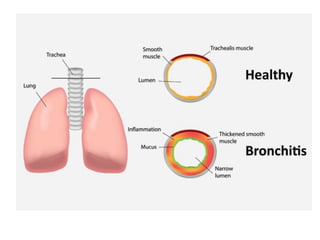
• Bronchitis is an inflammation of the bronchial
mucosa, which can hit hull and the bodies of
the upper respiratory tract. Start
inflammatory processes in the nose and
throat after the ingress of the virus, and later
spread to the respiratory tract. Feature of
bronchitis is considered that the disease
develops in the presence of certain factors
and has not spread to other organs of the
respiratory system.
CAUSES OF BRONCHITIS
The causes of obstructive bronchitis in children
can be different. Most often it is:
• viruses and bacteria;
• significant hypothermia;
• ecology;
• communication with a sick child.
• The first place among the instigators of
bronchitis is a virus which weaken the
immune system and contribute to the
infiltration of harmful microbes into the
respiratory tract. Another factor is the gas
content and dust content of the air that we
breathe a child. As the bronchitis is
transmitted by airborne droplets, the risk of
Contracting them when dealing with a sick
person is also very large.
• Most cases of bronchitis recorded in autumn-
winter season when the temperature
decreases, the viruses aktiviziruyutsya, and
the body's immune system weakens. Boys and
girls suffer equally often. Children have their
own features of development, to a certain
extent contribute to the occurrence of
bronchitis.
BRONCHITIS IN INFANTS
• Obstructive bronchitis in infants and toddlers
the first 3 years of life due to the anatomical
features of the bronchial tubes and their
components. At this age, the internal organs
of children continue to actively shape that
becomes a favorable factor for their defeat
harmful microorganisms. Bronchial structures
at this age long enough, but the gaps are
small.
• The mucociliary apparatus that is responsible
for the production of sputum is not
sufficiently developed and is not in full force.
He is responsible forprotecting the bronchial
tubes from the ingress of viruses and bacteria.
The immaturity of bronchial smooth muscle
contributes to the appearance of spasms even
with a small irritation.
CLASSIFICATION OF BRONCHITIS
In the international classification are three
kinds of bronchitis in children:
• acute bronchitis;
• obstructive bronchitis;
• acute bronchiolitis.
OBSTRUCTIVE BRONCHITIS IN BABIES
• Bronchitis, the child develops gradually. First,
there are the usual runny nose and dry cough,
which increases in the evening and night
hours. The kid may also complain of chest
pain, weakness, fussy, restless, nervous. Often
the body temperature rises above 38 °C,
having trouble breathing: wheezing in the
lungs, shortness of breath.
• The acute form of bronchitis lasts no more
than a week to cure it for 5-6 days. If mucus
becomes transparent, it reflects the acute
stage of bronchitis, but the pus is a sign of
chronic form of the disease. If treatment is not
started on time or is incorrect, the bronchitis
threatens severe and serious consequences.
• One of them is an ordinary transition of
bronchitis into obstructive form. Obstructive
bronchitis in children is one of the kinds of
destruction of the bronchi caused by
inflammation, which manifests as a violation
of their patency.
The causes of the disease are
different:
• congenital disorders of the respiratory system;
• hypoxia;
• chest injuries;
• prematurity.
THE SYMPTOMS OBSTRUCTIVE
BRONCHITIS
• The main symptoms of obstructive bronchitis is a
heavy cough, cyanosis of the fingers and the
crumbs of his lips. Vivid manifestations to
establish a form of disease quite easily. It helps to
start proper treatment. Acute obstructive
bronchitis in children is growing rapidly and
affects healthy parts of the respiratory system. In
such cases, the boy's condition is deteriorating
with every second. Tocharacteristic features of
obstructive bronchitis include bouts of coughing
at night, especially if the day the baby was active
and interacted with my peers.
• If we are talking about the baby, his behavior will be
restless: toddler causeless crying, can't sleep, tossing in
her sleep. If you listen to the breath, you can hear
wheezing and rattling, whistling in the chest. Another
sure sign of obstructive bronchitis - shortness of
breath, which is accompanied by the participation of
auxiliary muscles in the breathing procedure. You may
notice if you pay attention to the ribs and stomach of
the child: the spaces between the ribs are drawn
inward, stomach tense, and his chest looks
permanently filled with air. One gets the impression
that the baby was exposed to the air, and to exhale it.
• Dry cough, which eventually passes into the
wet with sputum is the main symptom of
bronchitis. About it tells the beginning of the
progression of respiratory failure, manifested
by frequent and intermittent breathing, rapid
heartbeat.
PATHOPHYSIOLOGY
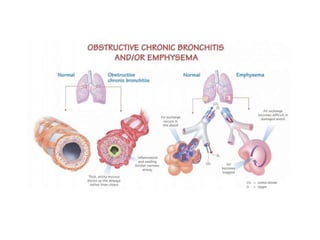
• The development of obstructive bronchitis in
young children depends on the provocateur of
the disease and the reactivity of the bronchial
system of the baby. Manifest obstruction of
spasm of bronchial smooth muscle, mucosal
edema and allocation of thick mucus in large
quantities.
• Moreover, for each such process affect your
microorganisms. Some viruses affect the
nervous nodes surrounding bronchi, which
leads to the loss of their tone and cause
spasm. Others cause too abundant secretion
of mucus. And the third attack leads to edema
of the mucosa, which narrows its lumen.
Usually there is a combination of these signs,
ie, the body gets several types of bacteria,
which leads to increased obstruction.
• Most at risk of the disease obstructive
bronchitis kids with allergies or who have
excess weight. These factors reinforce the
tendency to spasm and reactive edema of the
bronchi, regardless of the action of microbes.
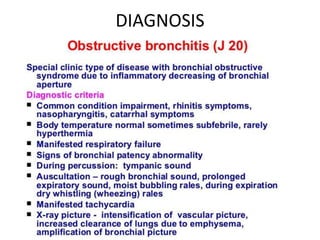
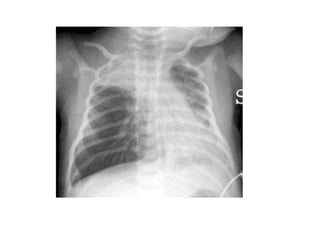
DIAGNOSIS
HOW TO TREAT OBSTRUCTIVE
BRONCHITIS?
• The healing process in the presence of
obstructive bronchitis is quite heavy and long, it
consists of various procedures. As soon as the
diagnosis or a suspicion of the presence of this
type of bronchitis, it is necessary to take urgent
measures to combat disease, especially if the
baby is a few months old.
• The first thing to do is to reduce manifestations of
bronchial obstruction and restore patency of the
organs.
• First, you need to try to calm the baby. Anxiety
intensify breathing problems and worsen the
permeability of the bronchi. For thisused anti-
anxiety medications on a natural basis at the
dosage corresponding to the age of the baby.
• Should be pulmonary with special
preparations, because this is the most
effective and efficient method of relief of
obstruction.
• For infants you can use devices such as a
nebulizer or ultrasonic nebulizer. Mixture
designed to conduct inhalation must contain
glucocorticoids and salbutamol. The method
of inhalation is useful in that all drugs by
inhalation are delivered directly to the bronchi
and the result is visible already after a few
minutes the first treatment.
• Are required and inhalation of humidified
oxygen, which is carried out in parallel with
other curative measures. If inhalation does
not give the desired effect, is the imposition of
bronchodilator with the help of dropper.
Mandatory this procedure is in case of an
intoxication, accompanied by dehydration.
REFERENCE
1. Author's lectures on pediatrics. Respiratory diseases. Volume 5. / ed. V.F.
Demin et al. - M., 2011. - P. 217 - 228.
2. Bronchial obstruction in children / Ed. L.F. Kaznacheyeva. - Novosibirsk,
2013. - P.3-27.
3. Respiratory diseases in children / Ed. B.M. Blokhin. - Moscow: Publishing
House "Medpraktika-M", 2007.- pp 454-476.
4. Combination therapy of bronchial obstruction in children / N.A. Geppe.-
"The attending physician» .- № 6. - 2009.
5. Practical pediatric pulmonology : Handbook. 3rd ed. / Ed. V.K. Tatochenko.
Moscow, 2006.
6. Guidelines for the rational use of drugs (formulary). 2007: manual for the
system of post-diploma prof. Education of Physicians / Ed. A.G. Chuchalina (et
al.). M .: GEOTAR Media, 2007. – 768p.
7. Tsybulkin E.K. Threatening condition in pediatrics. Emergency medical
care. - M .: GEOTAR Media, 2007. - 224p.
THANK YOU

obstructive bronchitis

  • 1.
    SEMEY STATE MEDICAL UNIVERSITY NAME: SHARMA HAMENT GROUP : 438 TOPIC : OBSTRUCTIVE BRONCHITIS CHECKED BY : MAM ZANNA
  • 2.
    Bronchitis • Bronchitis, thisdisease in the acute form of obstructive bronchitis in children is the most frequent disease of the child in the first years of life. Respiratory diseases - common and requires serious treatment of the phenomenon, it is important to remember the prevention. In adults these diseases are less common, but children and infants are very susceptible to various forms of bronchitis. This is due to the mechanism of development of the child, so the disease, its diagnosis and treatment have their own characteristics of this age group.
  • 3.
    DEFINITION • Bronchitis isan inflammation of the bronchial mucosa, which can hit hull and the bodies of the upper respiratory tract. Start inflammatory processes in the nose and throat after the ingress of the virus, and later spread to the respiratory tract. Feature of bronchitis is considered that the disease develops in the presence of certain factors and has not spread to other organs of the respiratory system.
  • 4.
    CAUSES OF BRONCHITIS Thecauses of obstructive bronchitis in children can be different. Most often it is: • viruses and bacteria; • significant hypothermia; • ecology; • communication with a sick child.
  • 5.
    • The firstplace among the instigators of bronchitis is a virus which weaken the immune system and contribute to the infiltration of harmful microbes into the respiratory tract. Another factor is the gas content and dust content of the air that we breathe a child. As the bronchitis is transmitted by airborne droplets, the risk of Contracting them when dealing with a sick person is also very large.
  • 6.
    • Most casesof bronchitis recorded in autumn- winter season when the temperature decreases, the viruses aktiviziruyutsya, and the body's immune system weakens. Boys and girls suffer equally often. Children have their own features of development, to a certain extent contribute to the occurrence of bronchitis.
  • 7.
    BRONCHITIS IN INFANTS •Obstructive bronchitis in infants and toddlers the first 3 years of life due to the anatomical features of the bronchial tubes and their components. At this age, the internal organs of children continue to actively shape that becomes a favorable factor for their defeat harmful microorganisms. Bronchial structures at this age long enough, but the gaps are small.
  • 8.
    • The mucociliaryapparatus that is responsible for the production of sputum is not sufficiently developed and is not in full force. He is responsible forprotecting the bronchial tubes from the ingress of viruses and bacteria. The immaturity of bronchial smooth muscle contributes to the appearance of spasms even with a small irritation.
  • 9.
    CLASSIFICATION OF BRONCHITIS Inthe international classification are three kinds of bronchitis in children: • acute bronchitis; • obstructive bronchitis; • acute bronchiolitis.
  • 10.
    OBSTRUCTIVE BRONCHITIS INBABIES • Bronchitis, the child develops gradually. First, there are the usual runny nose and dry cough, which increases in the evening and night hours. The kid may also complain of chest pain, weakness, fussy, restless, nervous. Often the body temperature rises above 38 °C, having trouble breathing: wheezing in the lungs, shortness of breath.
  • 11.
    • The acuteform of bronchitis lasts no more than a week to cure it for 5-6 days. If mucus becomes transparent, it reflects the acute stage of bronchitis, but the pus is a sign of chronic form of the disease. If treatment is not started on time or is incorrect, the bronchitis threatens severe and serious consequences.
  • 12.
    • One ofthem is an ordinary transition of bronchitis into obstructive form. Obstructive bronchitis in children is one of the kinds of destruction of the bronchi caused by inflammation, which manifests as a violation of their patency.
  • 14.
    The causes ofthe disease are different: • congenital disorders of the respiratory system; • hypoxia; • chest injuries; • prematurity.
  • 15.
    THE SYMPTOMS OBSTRUCTIVE BRONCHITIS •The main symptoms of obstructive bronchitis is a heavy cough, cyanosis of the fingers and the crumbs of his lips. Vivid manifestations to establish a form of disease quite easily. It helps to start proper treatment. Acute obstructive bronchitis in children is growing rapidly and affects healthy parts of the respiratory system. In such cases, the boy's condition is deteriorating with every second. Tocharacteristic features of obstructive bronchitis include bouts of coughing at night, especially if the day the baby was active and interacted with my peers.
  • 16.
    • If weare talking about the baby, his behavior will be restless: toddler causeless crying, can't sleep, tossing in her sleep. If you listen to the breath, you can hear wheezing and rattling, whistling in the chest. Another sure sign of obstructive bronchitis - shortness of breath, which is accompanied by the participation of auxiliary muscles in the breathing procedure. You may notice if you pay attention to the ribs and stomach of the child: the spaces between the ribs are drawn inward, stomach tense, and his chest looks permanently filled with air. One gets the impression that the baby was exposed to the air, and to exhale it.
  • 17.
    • Dry cough,which eventually passes into the wet with sputum is the main symptom of bronchitis. About it tells the beginning of the progression of respiratory failure, manifested by frequent and intermittent breathing, rapid heartbeat.
  • 18.
    PATHOPHYSIOLOGY • The developmentof obstructive bronchitis in young children depends on the provocateur of the disease and the reactivity of the bronchial system of the baby. Manifest obstruction of spasm of bronchial smooth muscle, mucosal edema and allocation of thick mucus in large quantities.
  • 20.
    • Moreover, foreach such process affect your microorganisms. Some viruses affect the nervous nodes surrounding bronchi, which leads to the loss of their tone and cause spasm. Others cause too abundant secretion of mucus. And the third attack leads to edema of the mucosa, which narrows its lumen. Usually there is a combination of these signs, ie, the body gets several types of bacteria, which leads to increased obstruction.
  • 21.
    • Most atrisk of the disease obstructive bronchitis kids with allergies or who have excess weight. These factors reinforce the tendency to spasm and reactive edema of the bronchi, regardless of the action of microbes.
  • 22.
  • 24.
    HOW TO TREATOBSTRUCTIVE BRONCHITIS? • The healing process in the presence of obstructive bronchitis is quite heavy and long, it consists of various procedures. As soon as the diagnosis or a suspicion of the presence of this type of bronchitis, it is necessary to take urgent measures to combat disease, especially if the baby is a few months old. • The first thing to do is to reduce manifestations of bronchial obstruction and restore patency of the organs.
  • 25.
    • First, youneed to try to calm the baby. Anxiety intensify breathing problems and worsen the permeability of the bronchi. For thisused anti- anxiety medications on a natural basis at the dosage corresponding to the age of the baby. • Should be pulmonary with special preparations, because this is the most effective and efficient method of relief of obstruction.
  • 26.
    • For infantsyou can use devices such as a nebulizer or ultrasonic nebulizer. Mixture designed to conduct inhalation must contain glucocorticoids and salbutamol. The method of inhalation is useful in that all drugs by inhalation are delivered directly to the bronchi and the result is visible already after a few minutes the first treatment.
  • 27.
    • Are requiredand inhalation of humidified oxygen, which is carried out in parallel with other curative measures. If inhalation does not give the desired effect, is the imposition of bronchodilator with the help of dropper. Mandatory this procedure is in case of an intoxication, accompanied by dehydration.
  • 28.
    REFERENCE 1. Author's lectureson pediatrics. Respiratory diseases. Volume 5. / ed. V.F. Demin et al. - M., 2011. - P. 217 - 228. 2. Bronchial obstruction in children / Ed. L.F. Kaznacheyeva. - Novosibirsk, 2013. - P.3-27. 3. Respiratory diseases in children / Ed. B.M. Blokhin. - Moscow: Publishing House "Medpraktika-M", 2007.- pp 454-476. 4. Combination therapy of bronchial obstruction in children / N.A. Geppe.- "The attending physician» .- № 6. - 2009. 5. Practical pediatric pulmonology : Handbook. 3rd ed. / Ed. V.K. Tatochenko. Moscow, 2006. 6. Guidelines for the rational use of drugs (formulary). 2007: manual for the system of post-diploma prof. Education of Physicians / Ed. A.G. Chuchalina (et al.). M .: GEOTAR Media, 2007. – 768p. 7. Tsybulkin E.K. Threatening condition in pediatrics. Emergency medical care. - M .: GEOTAR Media, 2007. - 224p.
  • 29.

Editor's Notes